EP1009623B1 - Low density composite article and process for its manufacture - Google Patents
Low density composite article and process for its manufacture Download PDFInfo
- Publication number
- EP1009623B1 EP1009623B1 EP98926235A EP98926235A EP1009623B1 EP 1009623 B1 EP1009623 B1 EP 1009623B1 EP 98926235 A EP98926235 A EP 98926235A EP 98926235 A EP98926235 A EP 98926235A EP 1009623 B1 EP1009623 B1 EP 1009623B1
- Authority
- EP
- European Patent Office
- Prior art keywords
- preg
- pressure
- psig
- mandrel
- composite article
- Prior art date
- Legal status (The legal status is an assumption and is not a legal conclusion. Google has not performed a legal analysis and makes no representation as to the accuracy of the status listed.)
- Expired - Lifetime
Links
- 239000002131 composite material Substances 0.000 title claims abstract description 60
- 238000000034 method Methods 0.000 title claims abstract description 58
- 230000008569 process Effects 0.000 title claims abstract description 50
- 238000004519 manufacturing process Methods 0.000 title description 11
- 238000005056 compaction Methods 0.000 claims abstract description 8
- 239000000463 material Substances 0.000 claims description 45
- VYPSYNLAJGMNEJ-UHFFFAOYSA-N Silicium dioxide Chemical compound O=[Si]=O VYPSYNLAJGMNEJ-UHFFFAOYSA-N 0.000 claims description 17
- 239000004744 fabric Substances 0.000 claims description 15
- 229920001568 phenolic resin Polymers 0.000 claims description 13
- 239000005011 phenolic resin Substances 0.000 claims description 13
- KXGFMDJXCMQABM-UHFFFAOYSA-N 2-methoxy-6-methylphenol Chemical compound [CH]OC1=CC=CC([CH])=C1O KXGFMDJXCMQABM-UHFFFAOYSA-N 0.000 claims description 11
- 239000000377 silicon dioxide Substances 0.000 claims description 9
- 230000005484 gravity Effects 0.000 claims description 3
- 238000001816 cooling Methods 0.000 claims description 2
- 239000007789 gas Substances 0.000 claims 2
- 238000010438 heat treatment Methods 0.000 claims 1
- 230000003628 erosive effect Effects 0.000 abstract description 12
- 230000001747 exhibiting effect Effects 0.000 abstract description 2
- 230000002829 reductive effect Effects 0.000 abstract description 2
- OKTJSMMVPCPJKN-UHFFFAOYSA-N Carbon Chemical compound [C] OKTJSMMVPCPJKN-UHFFFAOYSA-N 0.000 description 21
- 239000000945 filler Substances 0.000 description 17
- 229920005989 resin Polymers 0.000 description 15
- 239000011347 resin Substances 0.000 description 15
- 229910052799 carbon Inorganic materials 0.000 description 13
- 239000000835 fiber Substances 0.000 description 12
- 229920000297 Rayon Polymers 0.000 description 11
- 229920002239 polyacrylonitrile Polymers 0.000 description 11
- 239000002964 rayon Substances 0.000 description 11
- 229910002804 graphite Inorganic materials 0.000 description 9
- 239000010439 graphite Substances 0.000 description 9
- 235000013824 polyphenols Nutrition 0.000 description 9
- 239000000203 mixture Substances 0.000 description 7
- 230000002787 reinforcement Effects 0.000 description 7
- 229920001971 elastomer Polymers 0.000 description 6
- 239000000806 elastomer Substances 0.000 description 6
- 238000012360 testing method Methods 0.000 description 5
- 229920000049 Carbon (fiber) Polymers 0.000 description 4
- 230000008901 benefit Effects 0.000 description 4
- 239000004917 carbon fiber Substances 0.000 description 4
- 238000009472 formulation Methods 0.000 description 4
- 239000011159 matrix material Substances 0.000 description 4
- 239000004005 microsphere Substances 0.000 description 4
- ISWSIDIOOBJBQZ-UHFFFAOYSA-N phenol group Chemical group C1(=CC=CC=C1)O ISWSIDIOOBJBQZ-UHFFFAOYSA-N 0.000 description 4
- CURLTUGMZLYLDI-UHFFFAOYSA-N Carbon dioxide Chemical compound O=C=O CURLTUGMZLYLDI-UHFFFAOYSA-N 0.000 description 3
- 229920003235 aromatic polyamide Polymers 0.000 description 3
- 230000001351 cycling effect Effects 0.000 description 3
- 239000011521 glass Substances 0.000 description 3
- 239000003365 glass fiber Substances 0.000 description 3
- 230000006872 improvement Effects 0.000 description 3
- VNWKTOKETHGBQD-UHFFFAOYSA-N methane Chemical compound C VNWKTOKETHGBQD-UHFFFAOYSA-N 0.000 description 3
- 229920000728 polyester Polymers 0.000 description 3
- -1 polyethylene Polymers 0.000 description 3
- 229920001187 thermosetting polymer Polymers 0.000 description 3
- 239000004677 Nylon Substances 0.000 description 2
- IISBACLAFKSPIT-UHFFFAOYSA-N bisphenol A Chemical compound C=1C=C(O)C=CC=1C(C)(C)C1=CC=C(O)C=C1 IISBACLAFKSPIT-UHFFFAOYSA-N 0.000 description 2
- 229910002092 carbon dioxide Inorganic materials 0.000 description 2
- 230000008859 change Effects 0.000 description 2
- 239000007788 liquid Substances 0.000 description 2
- 229920001778 nylon Polymers 0.000 description 2
- 230000036961 partial effect Effects 0.000 description 2
- 239000003380 propellant Substances 0.000 description 2
- 230000009467 reduction Effects 0.000 description 2
- 239000007787 solid Substances 0.000 description 2
- 238000005382 thermal cycling Methods 0.000 description 2
- 239000003039 volatile agent Substances 0.000 description 2
- XQUPVDVFXZDTLT-UHFFFAOYSA-N 1-[4-[[4-(2,5-dioxopyrrol-1-yl)phenyl]methyl]phenyl]pyrrole-2,5-dione Chemical compound O=C1C=CC(=O)N1C(C=C1)=CC=C1CC1=CC=C(N2C(C=CC2=O)=O)C=C1 XQUPVDVFXZDTLT-UHFFFAOYSA-N 0.000 description 1
- 229910052582 BN Inorganic materials 0.000 description 1
- ZOXJGFHDIHLPTG-UHFFFAOYSA-N Boron Chemical compound [B] ZOXJGFHDIHLPTG-UHFFFAOYSA-N 0.000 description 1
- PZNSFCLAULLKQX-UHFFFAOYSA-N Boron nitride Chemical compound N#B PZNSFCLAULLKQX-UHFFFAOYSA-N 0.000 description 1
- 229920000742 Cotton Polymers 0.000 description 1
- 239000004593 Epoxy Substances 0.000 description 1
- 229920000271 Kevlar® Polymers 0.000 description 1
- 239000004698 Polyethylene Substances 0.000 description 1
- 230000004308 accommodation Effects 0.000 description 1
- 239000000654 additive Substances 0.000 description 1
- 230000000996 additive effect Effects 0.000 description 1
- 230000002411 adverse Effects 0.000 description 1
- PNEYBMLMFCGWSK-UHFFFAOYSA-N aluminium oxide Inorganic materials [O-2].[O-2].[O-2].[Al+3].[Al+3] PNEYBMLMFCGWSK-UHFFFAOYSA-N 0.000 description 1
- 229910000410 antimony oxide Inorganic materials 0.000 description 1
- 239000004760 aramid Substances 0.000 description 1
- 230000009286 beneficial effect Effects 0.000 description 1
- 229940054066 benzamide antipsychotics Drugs 0.000 description 1
- 150000003936 benzamides Chemical class 0.000 description 1
- 230000015572 biosynthetic process Effects 0.000 description 1
- 229910052796 boron Inorganic materials 0.000 description 1
- 239000001569 carbon dioxide Substances 0.000 description 1
- 238000012512 characterization method Methods 0.000 description 1
- 239000000470 constituent Substances 0.000 description 1
- 239000002826 coolant Substances 0.000 description 1
- GYZLOYUZLJXAJU-UHFFFAOYSA-N diglycidyl ether Chemical class C1OC1COCC1CO1 GYZLOYUZLJXAJU-UHFFFAOYSA-N 0.000 description 1
- 239000006185 dispersion Substances 0.000 description 1
- 239000003822 epoxy resin Substances 0.000 description 1
- 230000002349 favourable effect Effects 0.000 description 1
- 238000010304 firing Methods 0.000 description 1
- LNEPOXFFQSENCJ-UHFFFAOYSA-N haloperidol Chemical compound C1CC(O)(C=2C=CC(Cl)=CC=2)CCN1CCCC(=O)C1=CC=C(F)C=C1 LNEPOXFFQSENCJ-UHFFFAOYSA-N 0.000 description 1
- 238000005470 impregnation Methods 0.000 description 1
- 239000004761 kevlar Substances 0.000 description 1
- 230000000670 limiting effect Effects 0.000 description 1
- 230000014759 maintenance of location Effects 0.000 description 1
- VTRUBDSFZJNXHI-UHFFFAOYSA-N oxoantimony Chemical compound [Sb]=O VTRUBDSFZJNXHI-UHFFFAOYSA-N 0.000 description 1
- 230000035699 permeability Effects 0.000 description 1
- 230000000704 physical effect Effects 0.000 description 1
- 229920003192 poly(bis maleimide) Polymers 0.000 description 1
- 229920000647 polyepoxide Polymers 0.000 description 1
- 229920000573 polyethylene Polymers 0.000 description 1
- 239000004814 polyurethane Substances 0.000 description 1
- 229920002635 polyurethane Polymers 0.000 description 1
- 238000003825 pressing Methods 0.000 description 1
- HBMJWWWQQXIZIP-UHFFFAOYSA-N silicon carbide Chemical compound [Si+]#[C-] HBMJWWWQQXIZIP-UHFFFAOYSA-N 0.000 description 1
- 229910010271 silicon carbide Inorganic materials 0.000 description 1
- 238000010561 standard procedure Methods 0.000 description 1
- 239000007858 starting material Substances 0.000 description 1
- 150000004684 trihydrates Chemical class 0.000 description 1
- 238000010792 warming Methods 0.000 description 1
- 238000004804 winding Methods 0.000 description 1
Images






Classifications
-
- B—PERFORMING OPERATIONS; TRANSPORTING
- B29—WORKING OF PLASTICS; WORKING OF SUBSTANCES IN A PLASTIC STATE IN GENERAL
- B29C—SHAPING OR JOINING OF PLASTICS; SHAPING OF MATERIAL IN A PLASTIC STATE, NOT OTHERWISE PROVIDED FOR; AFTER-TREATMENT OF THE SHAPED PRODUCTS, e.g. REPAIRING
- B29C70/00—Shaping composites, i.e. plastics material comprising reinforcements, fillers or preformed parts, e.g. inserts
- B29C70/04—Shaping composites, i.e. plastics material comprising reinforcements, fillers or preformed parts, e.g. inserts comprising reinforcements only, e.g. self-reinforcing plastics
- B29C70/28—Shaping operations therefor
- B29C70/40—Shaping or impregnating by compression not applied
- B29C70/42—Shaping or impregnating by compression not applied for producing articles of definite length, i.e. discrete articles
- B29C70/44—Shaping or impregnating by compression not applied for producing articles of definite length, i.e. discrete articles using isostatic pressure, e.g. pressure difference-moulding, vacuum bag-moulding, autoclave-moulding or expanding rubber-moulding
-
- B—PERFORMING OPERATIONS; TRANSPORTING
- B29—WORKING OF PLASTICS; WORKING OF SUBSTANCES IN A PLASTIC STATE IN GENERAL
- B29K—INDEXING SCHEME ASSOCIATED WITH SUBCLASSES B29B, B29C OR B29D, RELATING TO MOULDING MATERIALS OR TO MATERIALS FOR MOULDS, REINFORCEMENTS, FILLERS OR PREFORMED PARTS, e.g. INSERTS
- B29K2105/00—Condition, form or state of moulded material or of the material to be shaped
- B29K2105/04—Condition, form or state of moulded material or of the material to be shaped cellular or porous
-
- B—PERFORMING OPERATIONS; TRANSPORTING
- B29—WORKING OF PLASTICS; WORKING OF SUBSTANCES IN A PLASTIC STATE IN GENERAL
- B29K—INDEXING SCHEME ASSOCIATED WITH SUBCLASSES B29B, B29C OR B29D, RELATING TO MOULDING MATERIALS OR TO MATERIALS FOR MOULDS, REINFORCEMENTS, FILLERS OR PREFORMED PARTS, e.g. INSERTS
- B29K2995/00—Properties of moulding materials, reinforcements, fillers, preformed parts or moulds
- B29K2995/0012—Properties of moulding materials, reinforcements, fillers, preformed parts or moulds having particular thermal properties
- B29K2995/0017—Heat stable
-
- B—PERFORMING OPERATIONS; TRANSPORTING
- B29—WORKING OF PLASTICS; WORKING OF SUBSTANCES IN A PLASTIC STATE IN GENERAL
- B29K—INDEXING SCHEME ASSOCIATED WITH SUBCLASSES B29B, B29C OR B29D, RELATING TO MOULDING MATERIALS OR TO MATERIALS FOR MOULDS, REINFORCEMENTS, FILLERS OR PREFORMED PARTS, e.g. INSERTS
- B29K2995/00—Properties of moulding materials, reinforcements, fillers, preformed parts or moulds
- B29K2995/0037—Other properties
- B29K2995/0063—Density
-
- B—PERFORMING OPERATIONS; TRANSPORTING
- B29—WORKING OF PLASTICS; WORKING OF SUBSTANCES IN A PLASTIC STATE IN GENERAL
- B29L—INDEXING SCHEME ASSOCIATED WITH SUBCLASS B29C, RELATING TO PARTICULAR ARTICLES
- B29L2031/00—Other particular articles
- B29L2031/30—Vehicles, e.g. ships or aircraft, or body parts thereof
- B29L2031/3097—Cosmonautical vehicles; Rockets
Definitions
- the present invention relates to low density composite articles, and in particular to low density rocket nozzle components.
- the present invention further relates to a process for making the low density composite rocket nozzle components.
- Pre-preg materials generally include fabric and/or fiber that has/have been pre-impregnated with resin, typically a phenolic resin.
- resin typically a phenolic resin.
- the fabric or fiber is referred to as the reinforcement of the composite while the resin is called the composite matrix or matrix formulation.
- pre-preg a standard density or low density material
- pre-pregs for fabricating standard density composite rocket nozzle components include the reinforcement, matrix formulation, and appropriate fillers.
- carbon having substantially the same density as the carbon fiber is selected as the filler.
- Carbon or graphite fibers can be rayon, polyacrylonitrile ("PAN”) or pitch-based materials.
- PAN polyacrylonitrile
- Glass and silica composite pre-pregs utilize silica fillers when fillers are used.
- hollow spheres such as described in U.S. Patent No. 4,268,320, U.S. Patent No. 4,294,750, or U.S. Patent No. 4,621,024, are introduced into the pre-preg formulation as the filler.
- the effective densities of these hollow spheres typically range from 0.2 g/ml to 0.5 g/ml.
- an elastomer is added to the resin mix to maintain a more even dispersion of the hollow spheres during pre-impregnation of the fiber/fiber reinforcement.
- the cost of the conventional low density composite material can be 50 to 100 percent higher than that of the standard density version of the material.
- hollow spheres and elastomer in the pre-preg formulation also results in a composite having an across ply tensile strength as low as one tenth that of standard density material.
- the lower across ply tensile strength of LDCs significantly increases the likelihood of the LDC rocket nozzle components experiences ply lifting, wedge outs and other failure phenomena.
- LDCs used in exit cone environments can exhibit ply lift. The tendency of these materials to exhibit these failure modes must be addressed and accommodated by nozzle design. Such accommodation typically involves making the components thicker to improve margins of safety; however, the added thickness of the components partially offsets the weight advantage, i.e., the lower density, that LDC materials have over standard density materials.
- One predominantly used process for the fabrication of conventional so-called standard density nozzle components involves applying material to a mandrel such as by tape wrapping; ply by ply applying and debulking of pre-preg at very high pressures and temperatures to soften the resin, immediately followed by cooling; and autoclaving or hydroclaving curing, such as by pressurized curing at 15.1 kg/cm 2 (200 psig) to 71.3 kg/cm 2 (1000 psig).
- the material is applied to the mandrel in such a way as to achieve 80 to 95 percent of the material debulk (compaction) required in the final component.
- the conventional pre-pregs are designed to be used at elevated (high) pressures and temperatures to produce fully densified composites.
- the present process achieves the aforementioned objects while enabling the practitioner to avoid the need to use a specially designed pre-preg to fabricate low density composite articles, including rocket nozzle components.
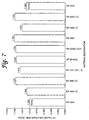
- UF means unfilled.
- VC means vacuum cured according to the present invention.
- NARC HRPF means standard density composite made using a pre-preg MX-4926 from Flberite.
- a LDR designation, such as in Figure 7, means specially formulated pre-preg designed for use in fabricating a conventional low density composite having microballoon fillers.
- the designation PC means a post-cure step.
- the present process concerns the production of composite reinforced products, particularly rocket nozzle type components.
- Our novel rocket nozzle components have lower density compared to corresponding industry standard density composite reinforced rocket nozzle components.
- Our rocket nozzle components remarkably exhibit erosion resistance and charring which are similar to the high density products prepared using an industry standard practice.
- our process offers a reduction in the weight penalty and the retention of desirable erosion and charring properties in finished rocket nozzle components.
- our process comprises (a) forming a compacted pre-preg into a desired configuration under a pre-determined level of compaction which is less than the compaction (pressure) applied in the conventional process; (b) curing the formed pre-preg at a selected temperature and pressure, wherein the pressure can be vacuum or less than about atmospheric pressure (e.g., about 1.03 kg/cm 2 (14 lbs/in 2 ) at sea level); and (c) obtaining the cured product, such as a low density rocket nozzle component.
- the pre-pregs are partially debulked, and, in general may be debulked less than 80%, more particularly they are debulked to less than about 50%. Therefore, although the terms debulked or debulking may be used in describing our inventions, it should be understood that we mean partially debulked, e.g. less than 80% preferably less than 50% debulked.
- the forming and curing are conducted at sufficiently low pressures to permit the formation of voids in the resulting component, the voids being formed from volatiles evolving during the curing.
- the resulting cured product has a lower density than standard density products, even when the cured product of the present invention is formed from a composition substantially or completely free of low density fillers, such as hollow spheres ("microballoons"), and elastomers.
- the cured articles prepared in accordance with the present invention have a specific gravity which is lower than standard density composite rocket nozzle.
- a suitable carbon phenolic resin based pre-preg a lower density (SpG) in a range of about 1.00 (e.g. 1.03) to about 1.15 g/ml can be prepared, and for other pre-pregs, such as a silica cloth pre-preg, composite rocket nozzle components having densities (SpG) of about 1.35 to 1.49 can be fabricated.
- the cured articles of the present invention also exhibit across ply tensile strengths which may be greater than, or at least near to, those observed with well-prepared composites from standard density pre-pregs.
- the composite rocket nozzles of our invention can have an across ply tensile strength of about 127.6 kg/cm 2 (1800 psig) to about 211.9 kg/cm 2 (3000 psig), and more particularly can be readily prepared to have across ply tensile strengths of 127.6 kg/cm 2 (1800 psig) to 155.7 kg/cm 2 (2200 psig).
- the above-mentioned (a) can be performed by winding a suitable pre-preg material about a mandrel using a tape wrap process as shown in FIG. 2.
- This figure depicts :
- (b) involves curing the formed pre-preg at a selected temperature and pressure.
- the pressure can vary and can be vacuum or up to less than about atmospheric pressure.
- the wrapped billet can be vacuum bagged using a vapor impermeable vacuum bag, such as a nylon vacuum bag, sealed with vacuum putty.
- a suitably thick or suitably layered bleeder material is used so that any resin bleed from the curing material does not ⁇ clog vacuum lines or to avoid (if not minimize) adversely affect the vacuum bag itself.
- a bleeder material may comprise, for instance, at least one layer of perforated film; at least two layers of cotton mop; or at least two layers of bleeder material, such as a polyester bleeder material (about 283 g (10 oz) or about 542.5 g/m 2 (16 oz/yard 2 ) of polyester bleeder material).
- the vacuum bagged material is then cured using a selected maximum vacuum.
- the vacuum provides the only pressure applied during the curing, and low pressures on the order of sub-atmospheric up to about, preferably less than, atmospheric can be used, such as a vacuum equivalent of about 0.88 kg/cm 2 (12.5 psia) to less than about 1.03 kg/cm 2 (14.7 psia), although the pressure selected will depend on the prevalent atmospheric pressure. Still lower pressures can also be used.
- the low pressure vacuum can, for instance, be in a range of from about 0.88 kg/cm 2 (12.5 psia) to about 1.03 kg/cm 2 (14 psia), and more particularly in a range of from about 0.88 kg/cm 2 (12.5 psia) to about 0.89 kg/cm 2 (12.7 psia).
- the cure pressure is adjusted to maintain or provide the desired cured component density.
- the cure pressures can range, for instance, from 0.88 kg/cm 2 (12.5 psia) to about 10.6 kg/cm 2 (150 psig), but generally a lower upper pressure is preferred, such as up to about 4.5 kg/cm 2 (50 psig).
- a suitable applied low cure pressure can be achieved by vacuum bagging the component by adapting the methodology per standard procedure for cure, but in which a vacuum is pulled throughout the cure cycle.
- thermal cycling it is possible to use thermal cycling to cure the pre-preg.
- various temperatures or temperatures and residence times are selected to ensure the satisfactory curing of the composite article fabricated in accordance with the process of the present invention.
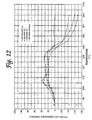
- An exemplary, non-limiting temperature cycle that can be practiced in accordance with an embodiment of the present invention involves a thermal cycle in which the pre-preg is heated and cooled in cycles which change on the order of about 0.56°C (1°F) per minute.
- a three-stage temperature cycle can be used, although other-staged temperature cycling can be used within the scope of the invention.
- the thermal cycling can be programmed to have a first hold at about 82.2°C (180°F) for a residence time of about 1.25-1.5 hours, a second hold at about 104°C (220°F) for a comparable residence time as the first hold, and a third hold at a temperature in a range of from about 154°C (310°F) to about 160°C (320°F) for about 60 or more minutes for each inch of component wall thickness.
- the residence time at a holding temperature will be a function of process variables, such as the thickness of the material to be cured.
- suitable curing cyclings including both residence times and cure temperatures, is within the purview of those skilled in the art and can be determined without undue experimentation when done in reference to the instant disclosure.
- a further post-cure step can, if desired, be conducted.
- press debulking in a mold can be employed as an alternative to tape wrapping for performing step (a).
- Figure 3 depicts :
- Flat panels can be prepared using the platen mold process step to de-bulk the pre-preg. For instance, for a 0 degree ply angle flat panel, ply stacks can be de-bulked to stops (see FIG. 3) to achieve the pre-selected ply thickness. Ply thicknesses can vary, but plies of 0.051 cm (20 mils) to 0.056 cm (22 mils) can be facilely prepared. In general, de-bulked ply stacks are less than about 2.54 cm (1 inch) thick, such as, for example, 2.03 cm (0.80 inch) thick perpendicular to the ply. For billets other than flat panel lay up, it may be desired to use different ply angles.
- a 45 degree ply angle can be used in a closed cylindrical mold, with angled end plugs, inside of the press.
- the de-bulked plies as stated above, have a thickness of less than about 2.54 cm (1.0 inch) perpendicular to the ply.
- De-bulking can be achieved by warming the plies and the mold to a suitable temperature, generally above 37.8°C (100°F), such as about 54.4°C (130°F) to about 65.6°C (150°F), while applying pressure to close the press to stops.
- the de-bulked plies are allowed to cool while the press remains closed to the stops.
- the ply stacks are stacked together. Flat panels can be free standing and angle lay ups can be contained within the mold.
- the ply stacks are vacuum bagged and cured to a temperature cycle as described above.
- the platen mold with configured (shaped) pre-composite can, if desired, be autoclaved or placed in an oven for curing.
- debulk application pressures can be varied from just about a few tenths kg/cm 2 (a few psig) to less than about 57.2 kg/cm 2 (800 psig).
- the pressures may generally be in a range of 17.9 kg/cm 2 (240 psig) to about 3.8 kg/cm 2 (40 psig).
- the present process uses lower pressures.
- the present process is atypical and contrary to a vendor recommended procedure for using a standard density pre-preg.
- tape wrap or compaction pressures are selected in combination with cure pressures that allow voids to form based on the vapor pressure of the constituents of the resin.
- the pressure for applying the pre-preg to the mandrel is backed off sufficiently until the selected ply spacing is achieved.
- the debulked billet can be vacuum bagged and cured, whereby the applied vacuum results in atmospheric pressure being applied to the billet, providing across ply pressure that results in a cured component having an across ply tensile strength that is greater than the across ply tensile strengths achieved in pre-pregs which were specially designed by vendors to result in low density composite components.
- the use of the vacuum bag technique offers the further related advantage that volatiles evolving in the cure are capable of growing into voids in the curing material which further reduces the density of the component. As a consequence a conventional standard density material can now be used to produce a low density composite component.
- Panels fabricated according to the present process using a standard density grade carbon phenolic indicate that a cured bulk density as low as 1.0 to 1.15 grams per cubic centimeter can be produced.
- the same material, processed to typical, vendor recommended process parameters which are the norm in the industry results in a composite component having a bulk density of 1.45 to 1.49 grams per cubic centimeter.
- the present process can produce cured products from filled pre-pregs which have a lower density than a corresponding product prepared according to industry standard.
- a silica-filled phenolic pre-preg was processed to a cured article having a density of 1.53 g/ml using the present process whereas like material processed using the industry standard process had a density of 1.75 g/ml.
- a glass-filed pre-preg was likewise processed to a cured product having a lower density (1.81 g/ml) verses 2.0 g/ml for a conventionally prepared article.
- Suitable pre-preg materials are generally characterized by a reinforcement (fibers, cloth, tape) to which is impregnated with a thermosetting resin.
- Suitable reinforcement can comprise wide variety of fibers or filaments known in the art. These fibers and filaments include, but are not limited to, glass fibers, boron filaments, boron nitride, silicon carbide, graphite (carbon) filaments and high modulus organic filaments, particularly organic filaments of the nylon, polyethylene, and aramid type. Examples of high modulus organic filaments include, but are not limited to, poly(benzothiazoles) and poly(aromatic amides) which are commonly referred to simply as "aramids". Aramids include poly (benzamides) and family of materials sold by E.
- thermosetting resins include, for example, phenolic resins, and epoxy resins (especially those based on diglycidyl ethers of bisphenol A are employed).
- bismaleimide resins, polyurethanes, polyesters, and the like, and any combination thereof may also be employed as the base resin or a component thereof.
- a phenolic resin matrix resin for the pre-preg is used.
- Suitable commercially available curable phenolic resins are SC-1008 (Borden) and 91-LD phenolic resin (Stuart -Ironsides).
- Epoxy-based pre-pregs are not preferred for rocket motor nozzle components.
- a suitable pre-preg is, in general, pliable to enable it to be wrapped. Pliability is generally observed prior to debulking, and curing.
- the pre-preg materials can, if desired, include filler materials. Suitable filler materials include silica, carbon powder and others known to those skilled in the art. Filler materials can serve more than one function. For instance, some fillers, including powdered alumina trihydrate or antimony oxide, may also provide some flame resistance, or other characteristics to the final cured products, but are nonetheless fillers.
- the present process does not require, and preferably avoids the use of hollow microspheres (and elastomers) in order to produce a low density composite article.
- pre-preg materials are suitable for use herein.
- a carbon cloth impregnated with a curable phenolic resin can be used.
- the carbon cloth can be rayon-based, polyacrylonitrile (PAN) based, or pitch-based.
- PAN polyacrylonitrile
- These types of pre-pregs include the industry standard density pre-pregs such as MX-4926 (28-38% resin, 8-16% filler, the remainder including cloth reinforcement) which is a rayon based carbon phenolic pre-preg from Fiberite.
- Other suitable materials from Fiberite include PAN-based pre-pregs, such as those sold under the designations MX-4946 or MX-4920 which both used a T300 fiber/yarn which is a vendor designation for a yarn having a modulus of 300 million.
- T type fiber/yarn products
- These materials can include a filler, and generally include carbon powder filler.
- Graphite cloth phenolics can be used.
- the graphite fiber can be rayon, PAN or pitch based.
- Suitable commercially available graphite pre-pregs include Fiberite products sold under the designations MXG-175 (graphite which is, rayon based) and MX-4961 (graphite which is PAN based).
- Glass cloth pre-pregs include a glass fiber reinforced phenolic resin such as MXB-6001 from Fiberite.
- Silica fiber reinforced phenolic resin such as a product from Fiberite known as MX-2600, can be used.
- the fabric weave can be different between suitable pre-pregs.
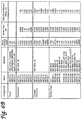
- Table HS stands for harness satin weave, e.g. 8HS means 8 harness satin weave, etc., whereas a simple weave pattern comprises one over, one under, one over.
- designations 3K, 6K and 12K refer, respectively, 3000, 6000 and 12,000 filaments in a single yarn used in the pre-preg.
- the materials with MB, microballoons may be used, but are not preferred because the composites produced therewith do not exhibit the overall balance of favorable properties for composites produced using standard density pre-pregs according to the present invention.
- the present invention does not require the use of the conventional specially formulated pre-pregs for low density.
- these low density pre-pregs include a low density carbon cloth phenolic, such as one in which the resin is filled with microballoons/microspheres, carbon filler and optionally an elastomer additive, such as MX-4926 LDC (rayon based carbon fiber) from Fiberite
- MX-4926 LDC rayon based carbon fiber
- MXS-385LD low density glass fiber reinforced phenolic resin loaded (filled) with microballoons/microspheres
- a low density silica cloth phenolic filled with microballoons/microspheres is known, and may also have an easterner-modified resin, such as the specially formulated low density pre-preg known as MX-2600LD from Fiberite.
- Final cured and shaped products producible by the present process include rocket nozzle components.
- the present process can also be used to manufacture composite panels.
- a standard density carbon-fiber cloth impregnated with a curable phenolic resin can be used to prepare a panel having, when cured, a bulk density of 1.0 g/ml to 1.15 g/ml.
- This type of panel is more cost-effective than a panel or, for instance, other part, such as an aft exit cone, for a C4 missile.
- Rocket motor components include, among others, blast tubes (aft, mid and/or forward); nozzle throats; exit cones; and-such components as depicted in FIG. 17.
- blast tubes aft, mid and/or forward
- nozzle throats nozzle throats
- exit cones exit cones
- FIG. 17 nozzle components
- across ply properties of the composite material can be tailored by adjusting the pressure used in the initial compaction step and pressure used in the cure step. Such adjustments are techniques that, when viewed in reference to this disclosure, would be within the purview of the skilled artisan without undue experimentation.
- the data show that orders of magnitude improvement in tensile strength and significant improvement in erosion resistance are attainable with composite rocket nozzle components prepared according to the present process.
- One of the unexpected beneficial attributes is the over 400% improvement in across ply tensile strength with the present low density composite products compared to the conventional low density composite products.
Landscapes
- Chemical & Material Sciences (AREA)
- Engineering & Computer Science (AREA)
- Composite Materials (AREA)
- Mechanical Engineering (AREA)
- Moulding By Coating Moulds (AREA)
- Casting Or Compression Moulding Of Plastics Or The Like (AREA)
Applications Claiming Priority (7)
| Application Number | Priority Date | Filing Date | Title |
|---|---|---|---|
| US4860497P | 1997-06-04 | 1997-06-04 | |
| US4860597P | 1997-06-04 | 1997-06-04 | |
| US48605P | 1997-06-04 | ||
| US48604P | 1997-06-04 | ||
| US4867297P | 1997-06-05 | 1997-06-05 | |
| US48672P | 1997-06-05 | ||
| PCT/US1998/011414 WO1998055288A1 (en) | 1997-06-04 | 1998-06-04 | Low density composite article and process for its manufacture |
Publications (2)
| Publication Number | Publication Date |
|---|---|
| EP1009623A1 EP1009623A1 (en) | 2000-06-21 |
| EP1009623B1 true EP1009623B1 (en) | 2004-10-06 |
Family
ID=27367377
Family Applications (1)
| Application Number | Title | Priority Date | Filing Date |
|---|---|---|---|
| EP98926235A Expired - Lifetime EP1009623B1 (en) | 1997-06-04 | 1998-06-04 | Low density composite article and process for its manufacture |
Country Status (4)
| Country | Link |
|---|---|
| EP (1) | EP1009623B1 (https=) |
| JP (2) | JP4392863B2 (https=) |
| AU (1) | AU7811898A (https=) |
| WO (1) | WO1998055288A1 (https=) |
Families Citing this family (3)
| Publication number | Priority date | Publication date | Assignee | Title |
|---|---|---|---|---|
| CN102596715A (zh) * | 2009-11-23 | 2012-07-18 | 应用纳米结构方案公司 | Cnt特制复合材料地面基结构 |
| US8899939B2 (en) * | 2009-12-23 | 2014-12-02 | General Electric Company | Process for producing a ceramic matrix composite article and article formed thereby |
| AU2011256789A1 (en) | 2010-02-02 | 2012-07-12 | Applied Nanostructured Solutions, Llc | Fiber containing parallel-aligned carbon nanotubes |
Family Cites Families (8)
| Publication number | Priority date | Publication date | Assignee | Title |
|---|---|---|---|---|
| US4104340A (en) * | 1975-01-27 | 1978-08-01 | Minnesota Mining And Manufacturing Company | Method of making structural member from prepreg sheet of fusible resin microfibers and heat-resistant reinforcing fibers |
| US4323623A (en) * | 1977-09-14 | 1982-04-06 | Mcdonnell Douglas Corporation | Composite plastic structure and method for producing same |
| GB8400293D0 (en) * | 1984-01-06 | 1984-02-08 | Wiggins Teape Group Ltd | Moulded fibre reinforced plastics articles |
| JPS6228230A (ja) * | 1985-07-31 | 1987-02-06 | Nissan Motor Co Ltd | ロケツトノズル素材の製造方法 |
| FI884606A7 (fi) * | 1988-10-07 | 1990-04-08 | Ahlstroem Oy | Foerfarande foer framstaellning av armerade plastprodukter. |
| US5273818A (en) * | 1989-01-19 | 1993-12-28 | General Electric Company | Expanded fiber composite structure having a cylindrical shape and useful as a filter |
| US5280706A (en) * | 1992-06-25 | 1994-01-25 | Thiokol Corporation | Composite/metal hybrid rocket motor case and methods for manufacturing |
| US5456836A (en) * | 1992-09-25 | 1995-10-10 | Albany International Corp. | High-efficiency, self-supporting filter element made from fibers |
-
1998
- 1998-06-04 JP JP50280999A patent/JP4392863B2/ja not_active Expired - Fee Related
- 1998-06-04 EP EP98926235A patent/EP1009623B1/en not_active Expired - Lifetime
- 1998-06-04 AU AU78118/98A patent/AU7811898A/en not_active Abandoned
- 1998-06-04 WO PCT/US1998/011414 patent/WO1998055288A1/en not_active Ceased
-
2006
- 2006-09-06 JP JP2006241199A patent/JP4476260B2/ja not_active Expired - Lifetime
Also Published As
| Publication number | Publication date |
|---|---|
| JP4392863B2 (ja) | 2010-01-06 |
| EP1009623A1 (en) | 2000-06-21 |
| AU7811898A (en) | 1998-12-21 |
| WO1998055288A1 (en) | 1998-12-10 |
| JP2002514143A (ja) | 2002-05-14 |
| JP2007050705A (ja) | 2007-03-01 |
| JP4476260B2 (ja) | 2010-06-09 |
Similar Documents
| Publication | Publication Date | Title |
|---|---|---|
| CA2278816C (en) | Fiber material partially impregnated with a resin | |
| Akovali | Handbook of composite fabrication | |
| EP2440390B1 (en) | Method of delivering a thermoplastic and/or crosslinking resin to a composite laminate structure | |
| US8168106B2 (en) | Process for producing a reinforcing woven fabric, a preform and a fiber reinforced plastic molded component | |
| JP4126978B2 (ja) | プリフォームおよびそれからなるfrpならびにfrpの製造方法 | |
| US6679965B1 (en) | Low density composite rocket nozzle components and process for making the same from standard density phenolic matrix, fiber reinforced materials | |
| EP2794272A2 (en) | Prepreg, fiber reinforced composite material, and manufacturing method for fiber reinforced composite material | |
| JP4304948B2 (ja) | 強化繊維基材、プリフォームおよびそれよりなる繊維強化樹脂成形体ならびに繊維強化樹脂成形体の製造方法 | |
| EP1009623B1 (en) | Low density composite article and process for its manufacture | |
| KR102470605B1 (ko) | 수지 함량율이 높은, 고광택 열가소성 프리프레그 라미네이트 및 그 제조방법 | |
| EP3585607B1 (en) | Fiber composite with reduced surface roughness and method for its manufacture | |
| Perepelkin | Polymer Fibre Composites, Basic Types, Principles of Manufacture, and Properties. Part 2. Fabrication and Properties of Polymer Composite Materials. | |
| JPH07137163A (ja) | 管状複合成形体の製造方法 | |
| JP4134805B2 (ja) | スクリムクロス貼り合わせ一方向プリプレグの製造方法 | |
| JPH01148545A (ja) | 層間ハイブリッド積層材 | |
| JPH01148547A (ja) | 対称ハイブリッド積層材 | |
| JPH04105926A (ja) | 補強耐火性複合管の製造方法 | |
| Hartness et al. | Characterization and development of materials for advanced textile composites | |
| Jaoan et al. | Uemura, S., Sohda, Y., Ido, Y. and Yamamoto, S.(Nippon Oil Co, Japan) L/S Pat 4 849 200 | |
| Roncato et al. | Chambery, France) US Pat 5 328 493 (12 July 1994) |
Legal Events
| Date | Code | Title | Description |
|---|---|---|---|
| PUAI | Public reference made under article 153(3) epc to a published international application that has entered the european phase |
Free format text: ORIGINAL CODE: 0009012 |
|
| 17P | Request for examination filed |
Effective date: 19991201 |
|
| AK | Designated contracting states |
Kind code of ref document: A1 Designated state(s): FR |
|
| 17Q | First examination report despatched |
Effective date: 20010910 |
|
| RAP1 | Party data changed (applicant data changed or rights of an application transferred) |
Owner name: ALLIANT TECHSYSTEMS INC. |
|
| GRAH | Despatch of communication of intention to grant a patent |
Free format text: ORIGINAL CODE: EPIDOS IGRA |
|
| GRAH | Despatch of communication of intention to grant a patent |
Free format text: ORIGINAL CODE: EPIDOS IGRA |
|
| GRAH | Despatch of communication of intention to grant a patent |
Free format text: ORIGINAL CODE: EPIDOS IGRA |
|
| GRAA | (expected) grant |
Free format text: ORIGINAL CODE: 0009210 |
|
| AK | Designated contracting states |
Kind code of ref document: B1 Designated state(s): FR |
|
| PLBE | No opposition filed within time limit |
Free format text: ORIGINAL CODE: 0009261 |
|
| STAA | Information on the status of an ep patent application or granted ep patent |
Free format text: STATUS: NO OPPOSITION FILED WITHIN TIME LIMIT |
|
| ET | Fr: translation filed | ||
| 26N | No opposition filed |
Effective date: 20050707 |
|
| PGFP | Annual fee paid to national office [announced via postgrant information from national office to epo] |
Ref country code: FR Payment date: 20120705 Year of fee payment: 15 |
|
| REG | Reference to a national code |
Ref country code: FR Ref legal event code: ST Effective date: 20140228 |
|
| PG25 | Lapsed in a contracting state [announced via postgrant information from national office to epo] |
Ref country code: FR Free format text: LAPSE BECAUSE OF NON-PAYMENT OF DUE FEES Effective date: 20130701 |