EP1008601B1 - Method for producing palladium complex compound - Google Patents
Method for producing palladium complex compound Download PDFInfo
- Publication number
- EP1008601B1 EP1008601B1 EP99124673A EP99124673A EP1008601B1 EP 1008601 B1 EP1008601 B1 EP 1008601B1 EP 99124673 A EP99124673 A EP 99124673A EP 99124673 A EP99124673 A EP 99124673A EP 1008601 B1 EP1008601 B1 EP 1008601B1
- Authority
- EP
- European Patent Office
- Prior art keywords
- group
- substituent
- general formula
- trifluoromethyl
- phenyl
- Prior art date
- Legal status (The legal status is an assumption and is not a legal conclusion. Google has not performed a legal analysis and makes no representation as to the accuracy of the status listed.)
- Expired - Lifetime
Links
- KDLHZDBZIXYQEI-UHFFFAOYSA-N Palladium Chemical compound [Pd] KDLHZDBZIXYQEI-UHFFFAOYSA-N 0.000 title claims description 104
- 150000001875 compounds Chemical class 0.000 title claims description 68
- 229910052763 palladium Inorganic materials 0.000 title claims description 47
- 238000004519 manufacturing process Methods 0.000 title claims description 9
- -1 bis(trifluoromethyl)phenyl group Chemical group 0.000 claims description 138
- XYFCBTPGUUZFHI-UHFFFAOYSA-N Phosphine Chemical compound P XYFCBTPGUUZFHI-UHFFFAOYSA-N 0.000 claims description 82
- 238000000034 method Methods 0.000 claims description 82
- 125000003118 aryl group Chemical group 0.000 claims description 70
- 125000001424 substituent group Chemical group 0.000 claims description 67
- RIOQSEWOXXDEQQ-UHFFFAOYSA-N triphenylphosphine Chemical group C1=CC=CC=C1P(C=1C=CC=CC=1)C1=CC=CC=C1 RIOQSEWOXXDEQQ-UHFFFAOYSA-N 0.000 claims description 57
- 125000001997 phenyl group Chemical group [H]C1=C([H])C([H])=C(*)C([H])=C1[H] 0.000 claims description 46
- 238000006243 chemical reaction Methods 0.000 claims description 41
- 229910000073 phosphorus hydride Inorganic materials 0.000 claims description 41
- 125000002023 trifluoromethyl group Chemical group FC(F)(F)* 0.000 claims description 39
- 125000000217 alkyl group Chemical group 0.000 claims description 37
- 239000000126 substance Substances 0.000 claims description 28
- 229910052799 carbon Inorganic materials 0.000 claims description 27
- 125000001624 naphthyl group Chemical group 0.000 claims description 26
- 239000002904 solvent Substances 0.000 claims description 26
- 125000003545 alkoxy group Chemical group 0.000 claims description 25
- 239000003446 ligand Substances 0.000 claims description 24
- GDTBXPJZTBHREO-UHFFFAOYSA-N bromine Substances BrBr GDTBXPJZTBHREO-UHFFFAOYSA-N 0.000 claims description 23
- 229910052794 bromium Inorganic materials 0.000 claims description 23
- 125000004076 pyridyl group Chemical group 0.000 claims description 22
- 125000005493 quinolyl group Chemical group 0.000 claims description 22
- WKBOTKDWSSQWDR-UHFFFAOYSA-N Bromine atom Chemical compound [Br] WKBOTKDWSSQWDR-UHFFFAOYSA-N 0.000 claims description 21
- 125000005428 anthryl group Chemical group [H]C1=C([H])C([H])=C2C([H])=C3C(*)=C([H])C([H])=C([H])C3=C([H])C2=C1[H] 0.000 claims description 21
- 125000000753 cycloalkyl group Chemical group 0.000 claims description 21
- 239000000460 chlorine Substances 0.000 claims description 19
- 229910052801 chlorine Inorganic materials 0.000 claims description 19
- 125000000449 nitro group Chemical group [O-][N+](*)=O 0.000 claims description 19
- ZAMOUSCENKQFHK-UHFFFAOYSA-N Chlorine atom Chemical compound [Cl] ZAMOUSCENKQFHK-UHFFFAOYSA-N 0.000 claims description 18
- 229910052731 fluorine Inorganic materials 0.000 claims description 18
- 239000011737 fluorine Substances 0.000 claims description 18
- 229910052736 halogen Inorganic materials 0.000 claims description 18
- 150000002367 halogens Chemical group 0.000 claims description 18
- QGZKDVFQNNGYKY-UHFFFAOYSA-N Ammonia Chemical compound N QGZKDVFQNNGYKY-UHFFFAOYSA-N 0.000 claims description 17
- 125000001153 fluoro group Chemical group F* 0.000 claims description 16
- 125000005843 halogen group Chemical group 0.000 claims description 16
- 150000003003 phosphines Chemical class 0.000 claims description 16
- 125000002924 primary amino group Chemical group [H]N([H])* 0.000 claims description 16
- 125000001302 tertiary amino group Chemical group 0.000 claims description 16
- 150000001491 aromatic compounds Chemical class 0.000 claims description 15
- 125000000467 secondary amino group Chemical group [H]N([*:1])[*:2] 0.000 claims description 15
- WPYMKLBDIGXBTP-UHFFFAOYSA-N benzoic acid Chemical compound OC(=O)C1=CC=CC=C1 WPYMKLBDIGXBTP-UHFFFAOYSA-N 0.000 claims description 14
- XLYOFNOQVPJJNP-UHFFFAOYSA-N water Substances O XLYOFNOQVPJJNP-UHFFFAOYSA-N 0.000 claims description 13
- 150000002941 palladium compounds Chemical class 0.000 claims description 10
- MUJIDPITZJWBSW-UHFFFAOYSA-N palladium(2+) Chemical compound [Pd+2] MUJIDPITZJWBSW-UHFFFAOYSA-N 0.000 claims description 10
- 125000004453 alkoxycarbonyl group Chemical group 0.000 claims description 9
- 125000000040 m-tolyl group Chemical group [H]C1=C([H])C(*)=C([H])C(=C1[H])C([H])([H])[H] 0.000 claims description 9
- 125000003261 o-tolyl group Chemical group [H]C1=C([H])C(*)=C(C([H])=C1[H])C([H])([H])[H] 0.000 claims description 9
- 125000001037 p-tolyl group Chemical group [H]C1=C([H])C(=C([H])C([H])=C1*)C([H])([H])[H] 0.000 claims description 9
- 125000003178 carboxy group Chemical group [H]OC(*)=O 0.000 claims description 8
- 125000004435 hydrogen atom Chemical group [H]* 0.000 claims description 8
- CSVCVIHEBDJTCJ-UHFFFAOYSA-N 1-bromo-3,5-bis(trifluoromethyl)benzene Chemical compound FC(F)(F)C1=CC(Br)=CC(C(F)(F)F)=C1 CSVCVIHEBDJTCJ-UHFFFAOYSA-N 0.000 claims description 7
- 239000005711 Benzoic acid Substances 0.000 claims description 7
- 125000002777 acetyl group Chemical group [H]C([H])([H])C(*)=O 0.000 claims description 7
- 235000010233 benzoic acid Nutrition 0.000 claims description 7
- 125000004093 cyano group Chemical group *C#N 0.000 claims description 7
- PNDPGZBMCMUPRI-UHFFFAOYSA-N iodine Chemical compound II PNDPGZBMCMUPRI-UHFFFAOYSA-N 0.000 claims description 7
- 125000000876 trifluoromethoxy group Chemical group FC(F)(F)O* 0.000 claims description 7
- 125000002947 alkylene group Chemical group 0.000 claims description 6
- ZCYVEMRRCGMTRW-UHFFFAOYSA-N 7553-56-2 Chemical compound [I] ZCYVEMRRCGMTRW-UHFFFAOYSA-N 0.000 claims description 5
- 125000005227 alkyl sulfonate group Chemical group 0.000 claims description 5
- 125000005228 aryl sulfonate group Chemical group 0.000 claims description 5
- 239000011630 iodine Substances 0.000 claims description 5
- 229910052740 iodine Inorganic materials 0.000 claims description 5
- 125000000962 organic group Chemical group 0.000 claims description 5
- 125000004108 n-butyl group Chemical group [H]C([H])([H])C([H])([H])C([H])([H])C([H])([H])* 0.000 claims description 4
- COIOYMYWGDAQPM-UHFFFAOYSA-N tris(2-methylphenyl)phosphane Chemical compound CC1=CC=CC=C1P(C=1C(=CC=CC=1)C)C1=CC=CC=C1C COIOYMYWGDAQPM-UHFFFAOYSA-N 0.000 claims description 4
- 150000001412 amines Chemical class 0.000 claims description 3
- 229910021529 ammonia Inorganic materials 0.000 claims description 3
- 125000004653 anthracenylene group Chemical group 0.000 claims description 3
- 125000002529 biphenylenyl group Chemical group C1(=CC=CC=2C3=CC=CC=C3C12)* 0.000 claims description 3
- 125000001495 ethyl group Chemical group [H]C([H])([H])C([H])([H])* 0.000 claims description 3
- 125000005647 linker group Chemical group 0.000 claims description 3
- 125000002496 methyl group Chemical group [H]C([H])([H])* 0.000 claims description 3
- 125000004957 naphthylene group Chemical group 0.000 claims description 3
- 125000000843 phenylene group Chemical group C1(=C(C=CC=C1)*)* 0.000 claims description 3
- IOHPVZBSOKLVMN-UHFFFAOYSA-N 2-(2-phenylethyl)benzoic acid Chemical compound OC(=O)C1=CC=CC=C1CCC1=CC=CC=C1 IOHPVZBSOKLVMN-UHFFFAOYSA-N 0.000 claims description 2
- 150000002940 palladium Chemical class 0.000 claims description 2
- TUQOTMZNTHZOKS-UHFFFAOYSA-N tributylphosphine Chemical compound CCCCP(CCCC)CCCC TUQOTMZNTHZOKS-UHFFFAOYSA-N 0.000 claims description 2
- LFNXCUNDYSYVJY-UHFFFAOYSA-N tris(3-methylphenyl)phosphane Chemical compound CC1=CC=CC(P(C=2C=C(C)C=CC=2)C=2C=C(C)C=CC=2)=C1 LFNXCUNDYSYVJY-UHFFFAOYSA-N 0.000 claims description 2
- 125000004432 carbon atom Chemical group C* 0.000 claims 12
- 125000003277 amino group Chemical group 0.000 claims 1
- YXFVVABEGXRONW-UHFFFAOYSA-N Toluene Chemical compound CC1=CC=CC=C1 YXFVVABEGXRONW-UHFFFAOYSA-N 0.000 description 30
- VLKZOEOYAKHREP-UHFFFAOYSA-N n-Hexane Chemical compound CCCCCC VLKZOEOYAKHREP-UHFFFAOYSA-N 0.000 description 25
- HEDRZPFGACZZDS-MICDWDOJSA-N Trichloro(2H)methane Chemical compound [2H]C(Cl)(Cl)Cl HEDRZPFGACZZDS-MICDWDOJSA-N 0.000 description 24
- WYURNTSHIVDZCO-UHFFFAOYSA-N Tetrahydrofuran Chemical compound C1CCOC1 WYURNTSHIVDZCO-UHFFFAOYSA-N 0.000 description 20
- 239000013078 crystal Substances 0.000 description 18
- 150000001721 carbon Chemical group 0.000 description 14
- 238000003756 stirring Methods 0.000 description 14
- IJGRMHOSHXDMSA-UHFFFAOYSA-N nitrogen Substances N#N IJGRMHOSHXDMSA-UHFFFAOYSA-N 0.000 description 12
- 125000001246 bromo group Chemical group Br* 0.000 description 10
- 239000000047 product Substances 0.000 description 10
- 238000003786 synthesis reaction Methods 0.000 description 10
- YLQBMQCUIZJEEH-UHFFFAOYSA-N tetrahydrofuran Natural products C=1C=COC=1 YLQBMQCUIZJEEH-UHFFFAOYSA-N 0.000 description 10
- UHOVQNZJYSORNB-UHFFFAOYSA-N Benzene Chemical compound C1=CC=CC=C1 UHOVQNZJYSORNB-UHFFFAOYSA-N 0.000 description 9
- YMWUJEATGCHHMB-UHFFFAOYSA-N Dichloromethane Chemical compound ClCCl YMWUJEATGCHHMB-UHFFFAOYSA-N 0.000 description 9
- 239000012295 chemical reaction liquid Substances 0.000 description 9
- 239000000203 mixture Substances 0.000 description 9
- QJPQVXSHYBGQGM-UHFFFAOYSA-N palladium;triphenylphosphane Chemical compound [Pd].C1=CC=CC=C1P(C=1C=CC=CC=1)C1=CC=CC=C1.C1=CC=CC=C1P(C=1C=CC=CC=1)C1=CC=CC=C1 QJPQVXSHYBGQGM-UHFFFAOYSA-N 0.000 description 9
- 238000005160 1H NMR spectroscopy Methods 0.000 description 8
- VHUUQVKOLVNVRT-UHFFFAOYSA-N Ammonium hydroxide Chemical compound [NH4+].[OH-] VHUUQVKOLVNVRT-UHFFFAOYSA-N 0.000 description 8
- XKRFYHLGVUSROY-UHFFFAOYSA-N Argon Chemical group [Ar] XKRFYHLGVUSROY-UHFFFAOYSA-N 0.000 description 8
- 229910052757 nitrogen Inorganic materials 0.000 description 8
- RTZKZFJDLAIYFH-UHFFFAOYSA-N Diethyl ether Chemical compound CCOCC RTZKZFJDLAIYFH-UHFFFAOYSA-N 0.000 description 7
- MUALRAIOVNYAIW-UHFFFAOYSA-N binap Chemical group C1=CC=CC=C1P(C=1C(=C2C=CC=CC2=CC=1)C=1C2=CC=CC=C2C=CC=1P(C=1C=CC=CC=1)C=1C=CC=CC=1)C1=CC=CC=C1 MUALRAIOVNYAIW-UHFFFAOYSA-N 0.000 description 7
- 230000015572 biosynthetic process Effects 0.000 description 7
- YJVFFLUZDVXJQI-UHFFFAOYSA-L palladium(ii) acetate Chemical compound [Pd+2].CC([O-])=O.CC([O-])=O YJVFFLUZDVXJQI-UHFFFAOYSA-L 0.000 description 7
- XEKOWRVHYACXOJ-UHFFFAOYSA-N Ethyl acetate Chemical compound CCOC(C)=O XEKOWRVHYACXOJ-UHFFFAOYSA-N 0.000 description 6
- ZMANZCXQSJIPKH-UHFFFAOYSA-N Triethylamine Chemical compound CCN(CC)CC ZMANZCXQSJIPKH-UHFFFAOYSA-N 0.000 description 6
- 239000007787 solid Substances 0.000 description 6
- HVFQJWGYVXKLTE-UHFFFAOYSA-N 3,5-bis(trifluoromethyl)benzoic acid Chemical compound OC(=O)C1=CC(C(F)(F)F)=CC(C(F)(F)F)=C1 HVFQJWGYVXKLTE-UHFFFAOYSA-N 0.000 description 5
- CSNNHWWHGAXBCP-UHFFFAOYSA-L Magnesium sulfate Chemical compound [Mg+2].[O-][S+2]([O-])([O-])[O-] CSNNHWWHGAXBCP-UHFFFAOYSA-L 0.000 description 5
- ZMXDDKWLCZADIW-UHFFFAOYSA-N N,N-Dimethylformamide Chemical compound CN(C)C=O ZMXDDKWLCZADIW-UHFFFAOYSA-N 0.000 description 5
- 238000000354 decomposition reaction Methods 0.000 description 5
- 239000000706 filtrate Substances 0.000 description 5
- 239000007788 liquid Substances 0.000 description 5
- 238000002844 melting Methods 0.000 description 5
- 230000008018 melting Effects 0.000 description 5
- 238000001953 recrystallisation Methods 0.000 description 5
- HPALAKNZSZLMCH-UHFFFAOYSA-M sodium;chloride;hydrate Chemical class O.[Na+].[Cl-] HPALAKNZSZLMCH-UHFFFAOYSA-M 0.000 description 5
- 229910001220 stainless steel Inorganic materials 0.000 description 5
- 239000010935 stainless steel Substances 0.000 description 5
- 238000003828 vacuum filtration Methods 0.000 description 5
- 238000004679 31P NMR spectroscopy Methods 0.000 description 4
- UGFAIRIUMAVXCW-UHFFFAOYSA-N Carbon monoxide Chemical compound [O+]#[C-] UGFAIRIUMAVXCW-UHFFFAOYSA-N 0.000 description 4
- IAZDPXIOMUYVGZ-UHFFFAOYSA-N Dimethylsulphoxide Chemical compound CS(C)=O IAZDPXIOMUYVGZ-UHFFFAOYSA-N 0.000 description 4
- JUJWROOIHBZHMG-UHFFFAOYSA-N Pyridine Chemical compound C1=CC=NC=C1 JUJWROOIHBZHMG-UHFFFAOYSA-N 0.000 description 4
- 229910052786 argon Inorganic materials 0.000 description 4
- 239000003054 catalyst Substances 0.000 description 4
- 239000010410 layer Substances 0.000 description 4
- 238000002156 mixing Methods 0.000 description 4
- QJGQUHMNIGDVPM-UHFFFAOYSA-N nitrogen group Chemical group [N] QJGQUHMNIGDVPM-UHFFFAOYSA-N 0.000 description 4
- BWHMMNNQKKPAPP-UHFFFAOYSA-L potassium carbonate Chemical compound [K+].[K+].[O-]C([O-])=O BWHMMNNQKKPAPP-UHFFFAOYSA-L 0.000 description 4
- 239000002994 raw material Substances 0.000 description 4
- ZWEHNKRNPOVVGH-UHFFFAOYSA-N 2-Butanone Chemical compound CCC(C)=O ZWEHNKRNPOVVGH-UHFFFAOYSA-N 0.000 description 3
- CSCPPACGZOOCGX-UHFFFAOYSA-N Acetone Chemical compound CC(C)=O CSCPPACGZOOCGX-UHFFFAOYSA-N 0.000 description 3
- WEVYAHXRMPXWCK-UHFFFAOYSA-N Acetonitrile Chemical compound CC#N WEVYAHXRMPXWCK-UHFFFAOYSA-N 0.000 description 3
- AVXURJPOCDRRFD-UHFFFAOYSA-N Hydroxylamine Chemical compound ON AVXURJPOCDRRFD-UHFFFAOYSA-N 0.000 description 3
- FXHOOIRPVKKKFG-UHFFFAOYSA-N N,N-Dimethylacetamide Chemical compound CN(C)C(C)=O FXHOOIRPVKKKFG-UHFFFAOYSA-N 0.000 description 3
- SJRJJKPEHAURKC-UHFFFAOYSA-N N-Methylmorpholine Chemical compound CN1CCOCC1 SJRJJKPEHAURKC-UHFFFAOYSA-N 0.000 description 3
- NBIIXXVUZAFLBC-UHFFFAOYSA-N Phosphoric acid Chemical compound OP(O)(O)=O NBIIXXVUZAFLBC-UHFFFAOYSA-N 0.000 description 3
- KWYUFKZDYYNOTN-UHFFFAOYSA-M Potassium hydroxide Chemical compound [OH-].[K+] KWYUFKZDYYNOTN-UHFFFAOYSA-M 0.000 description 3
- HEMHJVSKTPXQMS-UHFFFAOYSA-M Sodium hydroxide Chemical compound [OH-].[Na+] HEMHJVSKTPXQMS-UHFFFAOYSA-M 0.000 description 3
- WLYPBMBWKYALCG-UHFFFAOYSA-N [2,4-bis(trifluoromethyl)phenyl]boronic acid Chemical group OB(O)C1=CC=C(C(F)(F)F)C=C1C(F)(F)F WLYPBMBWKYALCG-UHFFFAOYSA-N 0.000 description 3
- 150000001336 alkenes Chemical class 0.000 description 3
- 229910002091 carbon monoxide Inorganic materials 0.000 description 3
- 230000003197 catalytic effect Effects 0.000 description 3
- UAOMVDZJSHZZME-UHFFFAOYSA-N diisopropylamine Chemical compound CC(C)NC(C)C UAOMVDZJSHZZME-UHFFFAOYSA-N 0.000 description 3
- 238000003780 insertion Methods 0.000 description 3
- 230000037431 insertion Effects 0.000 description 3
- 229910000069 nitrogen hydride Inorganic materials 0.000 description 3
- JRZJOMJEPLMPRA-UHFFFAOYSA-N olefin Natural products CCCCCCCC=C JRZJOMJEPLMPRA-UHFFFAOYSA-N 0.000 description 3
- 239000012044 organic layer Substances 0.000 description 3
- 230000002829 reductive effect Effects 0.000 description 3
- 239000000243 solution Substances 0.000 description 3
- 125000003944 tolyl group Chemical group 0.000 description 3
- 125000004199 4-trifluoromethylphenyl group Chemical group [H]C1=C([H])C(=C([H])C([H])=C1*)C(F)(F)F 0.000 description 2
- XTHFKEDIFFGKHM-UHFFFAOYSA-N Dimethoxyethane Chemical compound COCCOC XTHFKEDIFFGKHM-UHFFFAOYSA-N 0.000 description 2
- LFQSCWFLJHTTHZ-UHFFFAOYSA-N Ethanol Chemical compound CCO LFQSCWFLJHTTHZ-UHFFFAOYSA-N 0.000 description 2
- PXGOKWXKJXAPGV-UHFFFAOYSA-N Fluorine Chemical compound FF PXGOKWXKJXAPGV-UHFFFAOYSA-N 0.000 description 2
- JLTDJTHDQAWBAV-UHFFFAOYSA-N N,N-dimethylaniline Chemical compound CN(C)C1=CC=CC=C1 JLTDJTHDQAWBAV-UHFFFAOYSA-N 0.000 description 2
- IMNFDUFMRHMDMM-UHFFFAOYSA-N N-Heptane Chemical compound CCCCCCC IMNFDUFMRHMDMM-UHFFFAOYSA-N 0.000 description 2
- OFBQJSOFQDEBGM-UHFFFAOYSA-N Pentane Chemical compound CCCCC OFBQJSOFQDEBGM-UHFFFAOYSA-N 0.000 description 2
- VYPSYNLAJGMNEJ-UHFFFAOYSA-N Silicium dioxide Chemical compound O=[Si]=O VYPSYNLAJGMNEJ-UHFFFAOYSA-N 0.000 description 2
- CDBYLPFSWZWCQE-UHFFFAOYSA-L Sodium Carbonate Chemical compound [Na+].[Na+].[O-]C([O-])=O CDBYLPFSWZWCQE-UHFFFAOYSA-L 0.000 description 2
- VMHLLURERBWHNL-UHFFFAOYSA-M Sodium acetate Chemical compound [Na+].CC([O-])=O VMHLLURERBWHNL-UHFFFAOYSA-M 0.000 description 2
- 150000004982 aromatic amines Chemical class 0.000 description 2
- HQABUPZFAYXKJW-UHFFFAOYSA-N butan-1-amine Chemical compound CCCCN HQABUPZFAYXKJW-UHFFFAOYSA-N 0.000 description 2
- 239000007795 chemical reaction product Substances 0.000 description 2
- 238000001816 cooling Methods 0.000 description 2
- 239000012043 crude product Substances 0.000 description 2
- JQVDAXLFBXTEQA-UHFFFAOYSA-N dibutylamine Chemical compound CCCCNCCCC JQVDAXLFBXTEQA-UHFFFAOYSA-N 0.000 description 2
- GGSUCNLOZRCGPQ-UHFFFAOYSA-N diethylaniline Chemical compound CCN(CC)C1=CC=CC=C1 GGSUCNLOZRCGPQ-UHFFFAOYSA-N 0.000 description 2
- 125000001301 ethoxy group Chemical group [H]C([H])([H])C([H])([H])O* 0.000 description 2
- 238000001914 filtration Methods 0.000 description 2
- 125000001449 isopropyl group Chemical group [H]C([H])([H])C([H])(*)C([H])([H])[H] 0.000 description 2
- 125000000956 methoxy group Chemical group [H]C([H])([H])O* 0.000 description 2
- 125000003506 n-propoxy group Chemical group [H]C([H])([H])C([H])([H])C([H])([H])O* 0.000 description 2
- 125000004123 n-propyl group Chemical group [H]C([H])([H])C([H])([H])C([H])([H])* 0.000 description 2
- 230000007935 neutral effect Effects 0.000 description 2
- SCVFZCLFOSHCOH-UHFFFAOYSA-M potassium acetate Chemical compound [K+].CC([O-])=O SCVFZCLFOSHCOH-UHFFFAOYSA-M 0.000 description 2
- 229910000027 potassium carbonate Inorganic materials 0.000 description 2
- 239000000843 powder Substances 0.000 description 2
- 150000003141 primary amines Chemical class 0.000 description 2
- WGYKZJWCGVVSQN-UHFFFAOYSA-N propylamine Chemical compound CCCN WGYKZJWCGVVSQN-UHFFFAOYSA-N 0.000 description 2
- UMJSCPRVCHMLSP-UHFFFAOYSA-N pyridine Natural products COC1=CC=CN=C1 UMJSCPRVCHMLSP-UHFFFAOYSA-N 0.000 description 2
- 150000003335 secondary amines Chemical class 0.000 description 2
- 239000000741 silica gel Substances 0.000 description 2
- 229910002027 silica gel Inorganic materials 0.000 description 2
- 239000007858 starting material Substances 0.000 description 2
- 239000006188 syrup Substances 0.000 description 2
- 235000020357 syrup Nutrition 0.000 description 2
- 150000003512 tertiary amines Chemical class 0.000 description 2
- 150000003475 thallium Chemical class 0.000 description 2
- 238000004809 thin layer chromatography Methods 0.000 description 2
- 229910052723 transition metal Inorganic materials 0.000 description 2
- 150000003624 transition metals Chemical class 0.000 description 2
- 238000006886 vinylation reaction Methods 0.000 description 2
- IZKCKOPHMWHBHR-OWOJBTEDSA-N (e)-3-[3,5-bis(trifluoromethyl)phenyl]prop-2-enoic acid Chemical compound OC(=O)\C=C\C1=CC(C(F)(F)F)=CC(C(F)(F)F)=C1 IZKCKOPHMWHBHR-OWOJBTEDSA-N 0.000 description 1
- RYHBNJHYFVUHQT-UHFFFAOYSA-N 1,4-Dioxane Chemical compound C1COCCO1 RYHBNJHYFVUHQT-UHFFFAOYSA-N 0.000 description 1
- NNMBNYHMJRJUBC-UHFFFAOYSA-N 1-bromo-3-(trifluoromethyl)benzene Chemical compound FC(F)(F)C1=CC=CC(Br)=C1 NNMBNYHMJRJUBC-UHFFFAOYSA-N 0.000 description 1
- WGSXKYXKAARAKD-UHFFFAOYSA-N 1-fluoro-3-isocyanato-5-(trifluoromethyl)benzene Chemical group FC1=CC(N=C=O)=CC(C(F)(F)F)=C1 WGSXKYXKAARAKD-UHFFFAOYSA-N 0.000 description 1
- BMVXCPBXGZKUPN-UHFFFAOYSA-N 1-hexanamine Chemical compound CCCCCCN BMVXCPBXGZKUPN-UHFFFAOYSA-N 0.000 description 1
- VDPIZIZDKPFXLI-UHFFFAOYSA-N 1-iodo-3,5-bis(trifluoromethyl)benzene Chemical compound FC(F)(F)C1=CC(I)=CC(C(F)(F)F)=C1 VDPIZIZDKPFXLI-UHFFFAOYSA-N 0.000 description 1
- 238000004293 19F NMR spectroscopy Methods 0.000 description 1
- NEURYOYRKPFLKH-UHFFFAOYSA-N 2-chloro-1-isocyanato-4-(trifluoromethyl)benzene Chemical group FC(F)(F)C1=CC=C(N=C=O)C(Cl)=C1 NEURYOYRKPFLKH-UHFFFAOYSA-N 0.000 description 1
- 125000004182 2-chlorophenyl group Chemical group [H]C1=C([H])C(Cl)=C(*)C([H])=C1[H] 0.000 description 1
- 125000004198 2-fluorophenyl group Chemical group [H]C1=C([H])C(F)=C(*)C([H])=C1[H] 0.000 description 1
- 125000006304 2-iodophenyl group Chemical group [H]C1=C([H])C(I)=C(*)C([H])=C1[H] 0.000 description 1
- 125000004204 2-methoxyphenyl group Chemical group [H]C1=C([H])C(*)=C(OC([H])([H])[H])C([H])=C1[H] 0.000 description 1
- 125000004179 3-chlorophenyl group Chemical group [H]C1=C([H])C(*)=C([H])C(Cl)=C1[H] 0.000 description 1
- 125000004180 3-fluorophenyl group Chemical group [H]C1=C([H])C(*)=C([H])C(F)=C1[H] 0.000 description 1
- 125000006305 3-iodophenyl group Chemical group [H]C1=C([H])C(I)=C([H])C(*)=C1[H] 0.000 description 1
- 125000004207 3-methoxyphenyl group Chemical group [H]C1=C([H])C(*)=C([H])C(OC([H])([H])[H])=C1[H] 0.000 description 1
- 125000004801 4-cyanophenyl group Chemical group [H]C1=C([H])C(C#N)=C([H])C([H])=C1* 0.000 description 1
- 125000004860 4-ethylphenyl group Chemical group [H]C1=C([H])C(=C([H])C([H])=C1*)C([H])([H])C([H])([H])[H] 0.000 description 1
- 125000001255 4-fluorophenyl group Chemical group [H]C1=C([H])C(*)=C([H])C([H])=C1F 0.000 description 1
- 125000006306 4-iodophenyl group Chemical group [H]C1=C([H])C(*)=C([H])C([H])=C1I 0.000 description 1
- 125000004172 4-methoxyphenyl group Chemical group [H]C1=C([H])C(OC([H])([H])[H])=C([H])C([H])=C1* 0.000 description 1
- 125000004863 4-trifluoromethoxyphenyl group Chemical group [H]C1=C([H])C(OC(F)(F)F)=C([H])C([H])=C1* 0.000 description 1
- QTBSBXVTEAMEQO-UHFFFAOYSA-M Acetate Chemical compound CC([O-])=O QTBSBXVTEAMEQO-UHFFFAOYSA-M 0.000 description 1
- HTJDQJBWANPRPF-UHFFFAOYSA-N Cyclopropylamine Chemical compound NC1CC1 HTJDQJBWANPRPF-UHFFFAOYSA-N 0.000 description 1
- 238000010485 C−C bond formation reaction Methods 0.000 description 1
- 238000007341 Heck reaction Methods 0.000 description 1
- NTIZESTWPVYFNL-UHFFFAOYSA-N Methyl isobutyl ketone Chemical compound CC(C)CC(C)=O NTIZESTWPVYFNL-UHFFFAOYSA-N 0.000 description 1
- UIHCLUNTQKBZGK-UHFFFAOYSA-N Methyl isobutyl ketone Natural products CCC(C)C(C)=O UIHCLUNTQKBZGK-UHFFFAOYSA-N 0.000 description 1
- CTQNGGLPUBDAKN-UHFFFAOYSA-N O-Xylene Chemical compound CC1=CC=CC=C1C CTQNGGLPUBDAKN-UHFFFAOYSA-N 0.000 description 1
- 101150003085 Pdcl gene Proteins 0.000 description 1
- NINIDFKCEFEMDL-UHFFFAOYSA-N Sulfur Chemical compound [S] NINIDFKCEFEMDL-UHFFFAOYSA-N 0.000 description 1
- 239000007983 Tris buffer Substances 0.000 description 1
- 150000001338 aliphatic hydrocarbons Chemical class 0.000 description 1
- 150000001408 amides Chemical class 0.000 description 1
- 229940040526 anhydrous sodium acetate Drugs 0.000 description 1
- 239000007864 aqueous solution Substances 0.000 description 1
- 150000004945 aromatic hydrocarbons Chemical class 0.000 description 1
- 150000001502 aryl halides Chemical class 0.000 description 1
- JWURBBVJKIEUGQ-UHFFFAOYSA-N butyl 3-[3,5-bis(trifluoromethyl)phenyl]prop-2-enoate Chemical compound CCCCOC(=O)C=CC1=CC(C(F)(F)F)=CC(C(F)(F)F)=C1 JWURBBVJKIEUGQ-UHFFFAOYSA-N 0.000 description 1
- CQEYYJKEWSMYFG-UHFFFAOYSA-N butyl acrylate Chemical compound CCCCOC(=O)C=C CQEYYJKEWSMYFG-UHFFFAOYSA-N 0.000 description 1
- 230000006315 carbonylation Effects 0.000 description 1
- 238000005810 carbonylation reaction Methods 0.000 description 1
- 238000006555 catalytic reaction Methods 0.000 description 1
- 239000007810 chemical reaction solvent Substances 0.000 description 1
- 125000001309 chloro group Chemical group Cl* 0.000 description 1
- 230000008878 coupling Effects 0.000 description 1
- 238000010168 coupling process Methods 0.000 description 1
- 238000005859 coupling reaction Methods 0.000 description 1
- HPNMFZURTQLUMO-UHFFFAOYSA-N diethylamine Chemical compound CCNCC HPNMFZURTQLUMO-UHFFFAOYSA-N 0.000 description 1
- 230000004069 differentiation Effects 0.000 description 1
- 229940043279 diisopropylamine Drugs 0.000 description 1
- WEHWNAOGRSTTBQ-UHFFFAOYSA-N dipropylamine Chemical compound CCCNCCC WEHWNAOGRSTTBQ-UHFFFAOYSA-N 0.000 description 1
- 150000002170 ethers Chemical class 0.000 description 1
- 125000003754 ethoxycarbonyl group Chemical group C(=O)(OCC)* 0.000 description 1
- 238000000605 extraction Methods 0.000 description 1
- 239000007789 gas Substances 0.000 description 1
- 238000010438 heat treatment Methods 0.000 description 1
- 125000000623 heterocyclic group Chemical group 0.000 description 1
- XMBWDFGMSWQBCA-UHFFFAOYSA-N hydrogen iodide Chemical compound I XMBWDFGMSWQBCA-UHFFFAOYSA-N 0.000 description 1
- 150000007529 inorganic bases Chemical class 0.000 description 1
- 125000002346 iodo group Chemical group I* 0.000 description 1
- SNHMUERNLJLMHN-UHFFFAOYSA-N iodobenzene Chemical compound IC1=CC=CC=C1 SNHMUERNLJLMHN-UHFFFAOYSA-N 0.000 description 1
- JJWLVOIRVHMVIS-UHFFFAOYSA-N isopropylamine Chemical compound CC(C)N JJWLVOIRVHMVIS-UHFFFAOYSA-N 0.000 description 1
- 150000002576 ketones Chemical class 0.000 description 1
- 125000001160 methoxycarbonyl group Chemical group [H]C([H])([H])OC(*)=O 0.000 description 1
- 125000006606 n-butoxy group Chemical group 0.000 description 1
- 125000001298 n-hexoxy group Chemical group [H]C([H])([H])C([H])([H])C([H])([H])C([H])([H])C([H])([H])C([H])([H])O* 0.000 description 1
- 125000001280 n-hexyl group Chemical group C(CCCCC)* 0.000 description 1
- 125000003935 n-pentoxy group Chemical group [H]C([H])([H])C([H])([H])C([H])([H])C([H])([H])C([H])([H])O* 0.000 description 1
- 125000000740 n-pentyl group Chemical group [H]C([H])([H])C([H])([H])C([H])([H])C([H])([H])C([H])([H])* 0.000 description 1
- 150000002825 nitriles Chemical class 0.000 description 1
- 229910000510 noble metal Inorganic materials 0.000 description 1
- TVMXDCGIABBOFY-UHFFFAOYSA-N octane Chemical compound CCCCCCCC TVMXDCGIABBOFY-UHFFFAOYSA-N 0.000 description 1
- 239000005416 organic matter Substances 0.000 description 1
- 239000003960 organic solvent Substances 0.000 description 1
- 125000002524 organometallic group Chemical group 0.000 description 1
- 238000006464 oxidative addition reaction Methods 0.000 description 1
- 125000003854 p-chlorophenyl group Chemical group [H]C1=C([H])C(*)=C([H])C([H])=C1Cl 0.000 description 1
- 125000000636 p-nitrophenyl group Chemical group [H]C1=C([H])C(=C([H])C([H])=C1*)[N+]([O-])=O 0.000 description 1
- PIBWKRNGBLPSSY-UHFFFAOYSA-L palladium(II) chloride Chemical compound Cl[Pd]Cl PIBWKRNGBLPSSY-UHFFFAOYSA-L 0.000 description 1
- INIOZDBICVTGEO-UHFFFAOYSA-L palladium(ii) bromide Chemical compound Br[Pd]Br INIOZDBICVTGEO-UHFFFAOYSA-L 0.000 description 1
- GPNDARIEYHPYAY-UHFFFAOYSA-N palladium(ii) nitrate Chemical compound [Pd+2].[O-][N+]([O-])=O.[O-][N+]([O-])=O GPNDARIEYHPYAY-UHFFFAOYSA-N 0.000 description 1
- ZOUWOGOTHLRRLS-UHFFFAOYSA-N palladium;phosphane Chemical compound P.[Pd] ZOUWOGOTHLRRLS-UHFFFAOYSA-N 0.000 description 1
- DPBLXKKOBLCELK-UHFFFAOYSA-N pentan-1-amine Chemical compound CCCCCN DPBLXKKOBLCELK-UHFFFAOYSA-N 0.000 description 1
- 235000011056 potassium acetate Nutrition 0.000 description 1
- 239000002244 precipitate Substances 0.000 description 1
- 230000035484 reaction time Effects 0.000 description 1
- 125000005920 sec-butoxy group Chemical group 0.000 description 1
- 125000002914 sec-butyl group Chemical group [H]C([H])([H])C([H])([H])C([H])(*)C([H])([H])[H] 0.000 description 1
- 238000010898 silica gel chromatography Methods 0.000 description 1
- 239000001632 sodium acetate Substances 0.000 description 1
- 235000017281 sodium acetate Nutrition 0.000 description 1
- 229910000029 sodium carbonate Inorganic materials 0.000 description 1
- 229910052717 sulfur Inorganic materials 0.000 description 1
- 239000011593 sulfur Substances 0.000 description 1
- 125000004213 tert-butoxy group Chemical group [H]C([H])([H])C(O*)(C([H])([H])[H])C([H])([H])[H] 0.000 description 1
- 125000000999 tert-butyl group Chemical group [H]C([H])([H])C(*)(C([H])([H])[H])C([H])([H])[H] 0.000 description 1
- GBECUEIQVRDUKB-UHFFFAOYSA-M thallium monochloride Chemical compound [Tl]Cl GBECUEIQVRDUKB-UHFFFAOYSA-M 0.000 description 1
- DASUJKKKKGHFBF-UHFFFAOYSA-L thallium(i) carbonate Chemical compound [Tl+].[Tl+].[O-]C([O-])=O DASUJKKKKGHFBF-UHFFFAOYSA-L 0.000 description 1
- 125000005259 triarylamine group Chemical group 0.000 description 1
- IMFACGCPASFAPR-UHFFFAOYSA-N tributylamine Chemical compound CCCCN(CCCC)CCCC IMFACGCPASFAPR-UHFFFAOYSA-N 0.000 description 1
- YFTHZRPMJXBUME-UHFFFAOYSA-N tripropylamine Chemical compound CCCN(CCC)CCC YFTHZRPMJXBUME-UHFFFAOYSA-N 0.000 description 1
- XRALRSQLQXKXKP-UHFFFAOYSA-N tris(3,5-dimethylphenyl)phosphane Chemical compound CC1=CC(C)=CC(P(C=2C=C(C)C=C(C)C=2)C=2C=C(C)C=C(C)C=2)=C1 XRALRSQLQXKXKP-UHFFFAOYSA-N 0.000 description 1
- WXAZIUYTQHYBFW-UHFFFAOYSA-N tris(4-methylphenyl)phosphane Chemical compound C1=CC(C)=CC=C1P(C=1C=CC(C)=CC=1)C1=CC=C(C)C=C1 WXAZIUYTQHYBFW-UHFFFAOYSA-N 0.000 description 1
- 239000008096 xylene Substances 0.000 description 1
Classifications
-
- C—CHEMISTRY; METALLURGY
- C07—ORGANIC CHEMISTRY
- C07F—ACYCLIC, CARBOCYCLIC OR HETEROCYCLIC COMPOUNDS CONTAINING ELEMENTS OTHER THAN CARBON, HYDROGEN, HALOGEN, OXYGEN, NITROGEN, SULFUR, SELENIUM OR TELLURIUM
- C07F15/00—Compounds containing elements of Groups 8, 9, 10 or 18 of the Periodic Table
- C07F15/0006—Compounds containing elements of Groups 8, 9, 10 or 18 of the Periodic Table compounds of the platinum group
- C07F15/006—Palladium compounds
-
- C—CHEMISTRY; METALLURGY
- C07—ORGANIC CHEMISTRY
- C07F—ACYCLIC, CARBOCYCLIC OR HETEROCYCLIC COMPOUNDS CONTAINING ELEMENTS OTHER THAN CARBON, HYDROGEN, HALOGEN, OXYGEN, NITROGEN, SULFUR, SELENIUM OR TELLURIUM
- C07F15/00—Compounds containing elements of Groups 8, 9, 10 or 18 of the Periodic Table
- C07F15/0006—Compounds containing elements of Groups 8, 9, 10 or 18 of the Periodic Table compounds of the platinum group
- C07F15/006—Palladium compounds
- C07F15/0066—Palladium compounds without a metal-carbon linkage
Definitions
- the present invention relates to a method for producing a palladium-phosphine complex compound, which is useful as a catalyst of organic synthesis.
- transition metal complexes have been used as catalysts of organic synthesis.
- noble metal complexes are stable and easy to handle. Thus, they are widely used as catalysts for organic synthesis, although they are high in price.
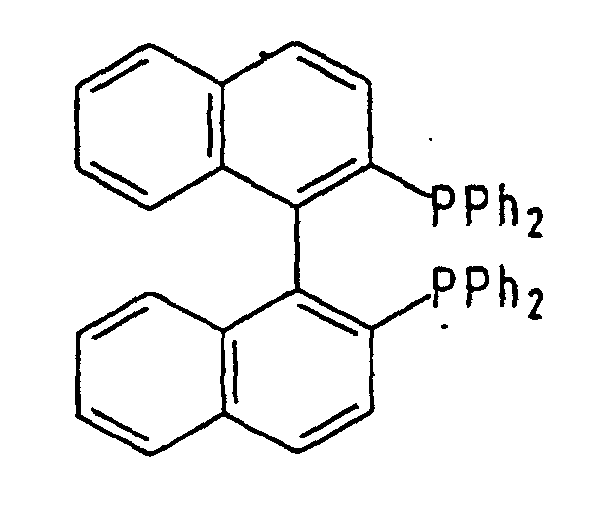
- a ligand of 2,2'-bis(diphenylphosphino)-1,1'-binaphtyl hereinafter referred to as "BINAP"
- BINAP 2,2'-bis(diphenylphosphino)-1,1'-binaphtyl
- palladium complex compounds having ligands of trifluoromethylphenyl and tris(trifluoromethyl)phenyl, which are represented by the general formulas: where Y is fluorine, chlorine, bromine, or iodine.
- J. Organomet. Chem., 1971, 28, 287 discloses a method for producing a palladium complex compound represented by the general formula Ar 1 Pd(PPh 3 ) 2 X 1 where Ar 1 represents an aryl and X 1 is a halogen. In this method, a stable palladium complex Pd 0 (PPh 3 ) 4 is reacted with an aryl halide.
- J. Organometallics, 1996, 15(17), 3708 discloses a similar method in which a palladium complex Pd 2 (dba) 3 is used.
- J. Chem. Commun., 1994, 121 discloses a reaction of dibromobis(triphenylphosphine)palladium(II) with toluene in the presence of potassium carbonate at 130°C for 1 hr to obtain a small amount of bromo[methylphenyl]bis(triphenylphosphine)palladium(II).
- the obtained crystals are dispersed in benzene. Then, triphenylphosphine is added, thereby preparing a transparent solution. Then, the solvent is distilled away. After that, n-hexane is added, thereby obtaining the aimed palladium complex compound in the form of crystal.
- J. Oraganomet. Chem. 553 (1998) 83-90 discloses a method for producing trans-[Pd(OOC-(C 6 H 4 )-2-SMe- ⁇ 1 -O)Ph(PPh 3 ) 2 ].
- a thallium salt 2-RS-C 6 H 4 -COOTI is prepared by reacting 2-RS-C 6 H 4 -COOH with thallium carbonate in ethanol. Then, the thallium salt is reacted with trans-[PdCl(Ph)(PPh 3 ) 2 ] in tetrahydrofuran, thereby obtaining the product with a precipitate of thallium chloride.
- a first method for producing a first palladium-complex compound represented by the general formula (4) With this, it is possible to easily obtain the product by the following reaction steps (a) and (b).
- the first method comprises:
- the second method comprises a single reaction step of reacting an aromatic compound represented by the general formula (1), with a palladium compound, a phosphine derivative and a benzoic acid derivative represented by the general formula (3), in the presence of a basic substance, thereby obtaining the first palladium-complex compound.
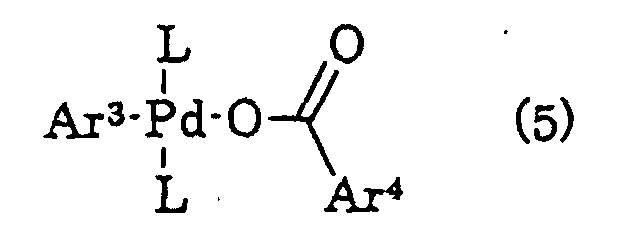
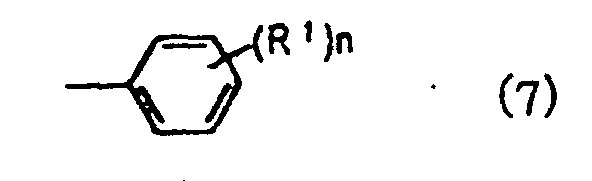
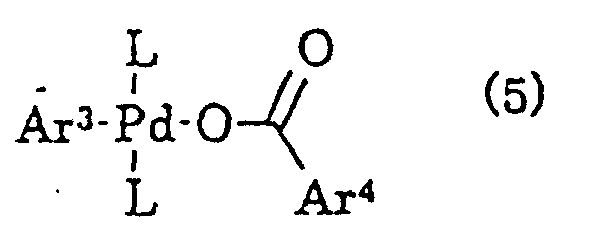
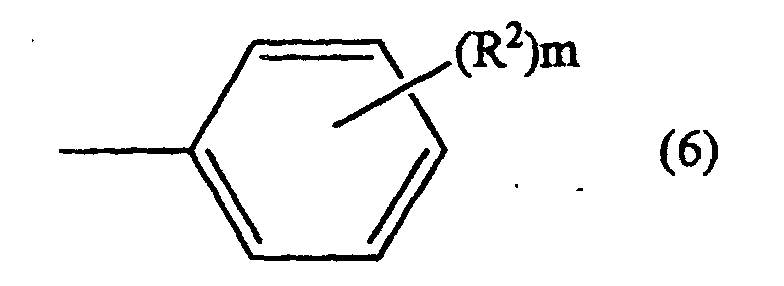
- a novel palladium complex compound which can be produced by the above-mentioned first, or second method, is represented by the general formula (5), where Ar 3 and Ar 4 are respectively aryl groups represented by the general formulas (6) and (7), and each L is independently a phosphine ligand, where R 2 is trifluoromethyl group, trifluoromethyloxy group, a halogen that is fluorine, chlorine, bromine or iodine, nitro group, acetyl group, cyano group, an alkyl group having a carbon atom number of 1-4, an alkoxyl group having a carbon atom number of 1-4, or an alkoxycarbonyl group having a carbon atom number of 2-5; and m is an integer of 0-4, where R 1 is trifluoromethyl group, and n is an integer of 1-3.
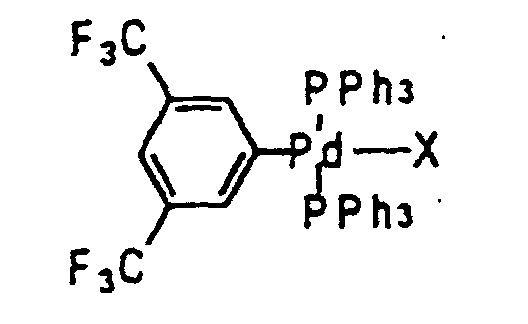
- the following palladium complex compound which can be produced by step (a) of the above-mentioned first method, is represented by the general formula Ar 5 -PdL 2 X where Ar 5 is bis(trifluoromethyl)phenyl group, X is a halogen that is fluorine, chlorine, bromine or iodine, and each L is independently a phosphine ligand.
- Ar 1 X used in the first and second methods X is defined as above and preferably bromine or iodine in practical use.
- Ar 1 is defined as being an aryl group, as mentioned above.
- This aryl group Ar 1 can be selected from carbon cyclic groups, such as phenyl and naphthyl, and heterocyclic groups, such as pyridyl and quinolyl. These groups may have substituents.
- the aryl group Ar 1 is preferably one represented by the general formula (6), where R 2 is a halogen that is fluorine, chlorine, bromine or iodine, or a monovalent organic group, and m is an integer of 0-4.
- the substituent R 2 is not particularly limited so long as it is inert in the reaction of the invention.
- Ar 2 is also defined as being an aryl group, as mentioned above.
- This aryl group Ar 2 can also be selected from the above-mentioned exemplary groups of the aryl group Ar 1 .
- the exemplary groups of the aryl group Ar 2 may also have substituents.
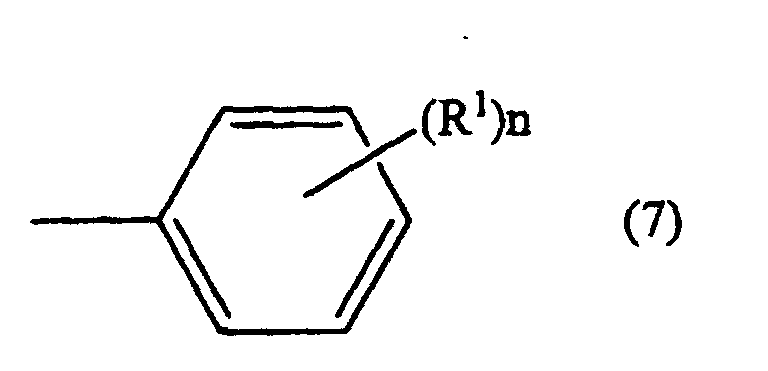
- the aryl group Ar 2 is preferably one represented by the general formula (7), where R 1 is defined as R 2 of the general formula (6) and n is an integer of 0-3.
- the substituent R 1 is not particularly limited so long as it is inert in the reaction of the invention.
- Examples of the substituents R 1 and R 2 in the general formulas (6) and (7) are trifluoromethyl group, trifluoromethyloxy group, halogens that are fluorine, chlorine, bromine and iodine, nitro group, acetyl group, cyano group, alkyl groups each having a carbon atom number of 1-4, alkoxyl groups each having a carbon atom number of 1-4, and alkoxycarbonyl groups each having a carbon atom number of 2-5.
- Examples of the alkyl group are methyl group, ethyl group, n-propyl group, and i-propyl group.
- alkoxyl group examples are methoxy group, ethoxy group, n-propoxy group, and i-propoxy group.
- alkoxycarbonyl group examples are methoxycarbonyl group, ethoxycarbonyl group, n-propoxycarbonyl group, and i-propoxycarbonyl group.
- the aryls group Ar 1 is preferably one in which at least one of R 2 is trifluoromethyl group.
- the aryl group Ar 2 is also preferably one in which at least one of R 1 is trifluoromethyl group.
- aryl groups Ar 1 and Ar 2 used in the first and second methods are (1) aryl groups each having one trifluoromethyl, such as 2-trifluoromethylphenyl, 3-trifluoromethylphenyl, and 4-trifluoromethylphenyl, (2) aryl groups each having one trifluoromethoxy, such as 2-trifluoromethoxyphenyl, 3-trifluoromethoxyphenyl, and 4-trifluoromethoxyphenyl, (3) aryl groups each having one fluorine, such as 2-fluorophenyl, 3-fluorophenyl, and 4-fluorophenyl, (4) aryl groups each having one chlorine, such as 2-chlorophenyl, 3-chlorophenyl, and 4-chlorophenyl, (5) aryl groups each having one bromine, such as 2-bromorophenyl, 3-bromorophenyl, and 4-bromorophenyl, (6) aryl groups each having one iodine, such as 2-iodine,
- Each of the aryl groups Ar 1 and Ar 2 may have at least two substituents. These at least two substituents may be any arbitrary combination of various substituents. One of the at least two substituents of the aryl group Ar 1 or Ar 2 is preferably trifluoromethyl group.
- Nonlimitative examples of such aryl groups Ar 1 and Ar 2 are 2-chloro-3-(trifluoromethyl)phenyl, 2-fluoro-3-(trifluoromethyl)phenyl, 2-fluoro-4-(trifluoromethyl)phenyl, 3-fluoro-5-(trifluoromethyl)phenyl, 2-bromo-6-(trifluoromethyl)phenyl, 4-chloro-2-(trifluoromethyl)phenyl, 4-fluoro-2-(trifluoromethyl)phenyl, 2-chloro-6-(trifluoromethyl)phenyl, 4-fluoro-3-(trifluoromethyl)phenyl, 1-chloro-4-(trifluoromethyl)phenyl, 2-fluoro-6-(trifluoromethyl)phenyl, 2-fluoro-5-(trifluoromethyl)phenyl, 2-chloro-4-(trifluoromethyl)phenyl, 4-chloro-3-(trifluoromethyl)phenyl,
- Each aryl group Ar 1 or Ar 2 is preferably one having at least two trifluoromethyl groups.
- Examples of such aryl group are 2,3-bis(trifluoromethyl)phenyl, 2,4-bis(trifluoromethyl)phenyl, 2,5-bis(trifluoromethyl)phenyl, 2,6-bis(trifluoromethyl)phenyl, 3,4-bis(trifluoromethyl)phenyl, and 3,5-bis(trifluoromethyl)phenyl.
- aryl group examples include 2,3,4-tris(trifluoromethyl)phenyl, 2,4,5-tris(trifluoromethyl)phenyl, 2,3,5-tris(trifluoromethyl)phenyl, 1,3,5-tris(trifluoromethyl)phenyl, 3,4,5-tris(trifluoromethyl)phenyl, 2,3,4,6-tetrakis(trifluoromethyl)phenyl, 1-bromo-2,3,4-tris(trifluoromethyl)phenyl, 2-bromo-4,5,6-tris(trifluoromethyl)phenyl, and the like; and 3,5-dichloro-4,6-bis(trifluoromethyl)phenyl, 2-dichloro-3,5-bis(trifluoromethyl)phenyl, 2-methoxy-3,5-bis(trifluoromethyl)phenyl, 2-bromo-3,5-bis(trifluoromethyl)phenyl, 2-nitro-4,6-bis(trifluoro
- the second palladium-complex compound (Ar 1 -PdL 2 X), prepared in step (a) of the first method of the invention, is preferably one in which at least one of R 2 is trifluoromethyl group and more preferably one in which at least two of R 2 are trifluoromethyl groups, since the aimed product becomes extremely useful.
- the benzoic acid (Ar 2 -COOH), which is used in the first and second methods of the invention, is preferably one in which at least one of R 1 is trifluoromethyl group and more preferably one in which at least two of R 1 are trifluoromethyl groups, since the aimed product becomes extremely useful.
- the second palladium-complex compound represented by the general formula (2), Ar 1 -PdL 2 X, where each L is independently a phosphine ligand, is prepared in step (a) of the first method. Furthermore, the phosphine derivative is used in the first and second methods.
- Such phosphine (phosphine derivative or phosphine ligand) used in the first and second methods is not particularly limited and may be one represented by the general formula P(R 1 ) 3 , which can be a monodentate ligand in Ar 1 -PdL 2 X, where each R 1 is independently a first group selected from the group consisting of lower alkyl groups, cycloalkyl groups, phenyl group, naphthyl group, anthryl group, pyridyl group and quinolyl group.
- the first group optionally has a first substituent R 2 selected from the group consisting of nitro group, primary amino group, secondary amino group, tertiary amino group, halogen atoms, and a second substituent.
- the second substituent is selected from the group consisting of lower alkyl groups, cycloalkyl groups, phenyl group, naphthyl group, anthryl group, pyridyl group and quinolyl group.
- the second substituent optionally has a third substituent R 3 selected from the group consisting of nitro group, primary amino group, secondary amino group, tertiary amino group, halogen atoms, and a substituent being selected from the group consisting of lower alkyl groups, lower alkoxy groups, cycloalkyl groups, phenyl group, naphthyl group, anthryl group, pyridyl group, and quinolyl group.
- the substituent optionally has a substituent.
- lower alkyl groups for example, of the above-mentioned phosphine, can be straight chain or branched alkyl groups each having a carbon atom number of 1-6.
- Examples of such lower alkyl groups are methyl group (hereinafter may be referred to as "Me"), ethyl group, n-propyl group, i-propyl group, n-butyl group, sec-butyl group, tert-butyl group, n-pentyl group, and n-hexyl group.
- lower alkoxy groups for example, of the above-mentioned phosphine can be straight chain or branched alkoxy groups each having a carbon atom number of 1-6.
- Examples of such lower alkoxy groups are methoxy group (hereinafter may be referred to as "MeO"), ethoxy group, n-propoxy group, i-propoxy group, n-butoxy group, sec-butoxy group, tert-butoxy group, n-pentoxy group, and n-hexyloxy group.
- R 1 is preferably phenyl group, o-tolyl group, m-tolyl group, p-tolyl group, 4-acynyl group, or 3,5-xylyl group.
- phosphine are triphenylphosphine, tris(o-tolyl)phosphine, tris(m-tolyl)phosphine, tris(p-tolyl)phosphine, tris(4-acynyl)phosphine, tris(3,5-xylyl)phosphine, and tris(n-butyl)phosphine.
- the phosphine P(R 1 ) 3 can be a first one represented by the following formula: where n is an integer of 1-2, an arbitrary number of hydrogen atoms of the condensed ring may be replaced with the above-defined first substituent R 2 , and each R 4 is independently phenyl group, o-tolyl group, m-tolyl group, p-tolyl group, 4-acynyl group, or 3,5-xylyl group.
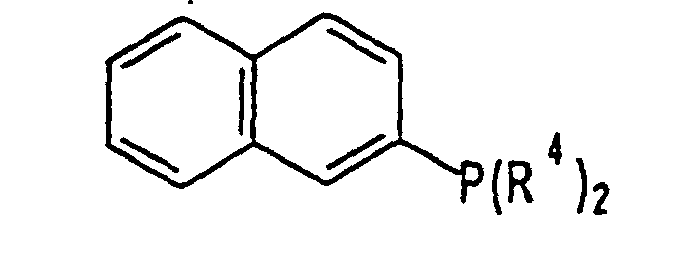
- Such phosphine P(R 1 ) 3 can be a second one represented by the following formula: where an arbitrary number of hydrogen atoms of the naphthalene ring may be replaced with the above-defined first substituent R 2 , and each R 4 is defined as above. Furthermore, the phosphine P(R 1 ) 3 can be a third one represented by the following formula: where an arbitrary number of hydrogen atoms of the naphthalene ring may be replaced with lower alkyl groups or lower alkoxy groups, and each R 4 is defined as above. Furthermore, the phosphine P(R 1 ) 3 can be a fourth one represented by the following formula where R 5 is a lower alkyl group, and each R 4 is defined as above.
- the phosphine P(R 1 ) 3 can be fifth one represented by the following formula: where each R 4 is defined as above.
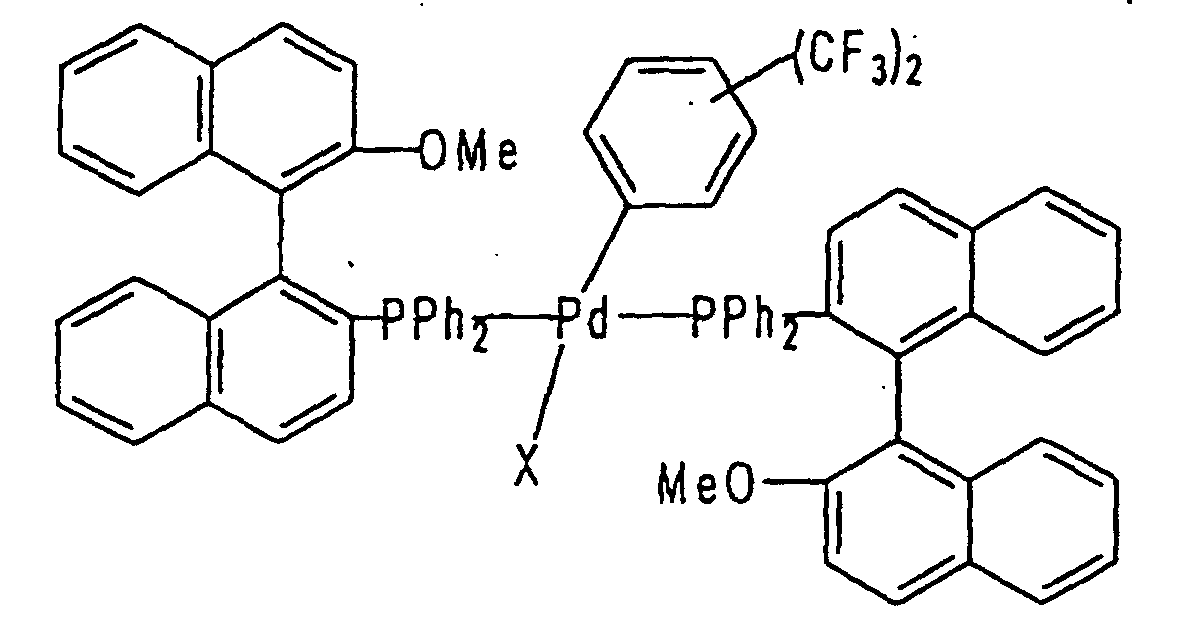
- a preferable example of the second palladium-complex compound containing the above fifth phosphine, which can be used as the starting material of the third method, is one represented by the following formula: where X is a halogen that is fluorine, chlorine, bromine or iodine, trifluoromethanesulfonate group, an alkylsulfonate group having a carbon atom number of 1-4, or a substituted or unsubstituted arylsulfonate group.
- X is preferably bromine, and two of the trifluoromethyl group are particularly preferably bonded to the 3- and 5-positions.
- the phosphine (i.e., phosphine derivative or phosphine ligand) used in the first and second methods may be one represented by the general formula (R 1 ) 2 P-Q-P(R 1 ) 2 , which can be a bidentate ligand in Ar 1 -PdL 2 X, where each R 1 is defined as in the phosphine P(R 1 ) 3 , and Q is a bivalent group.
- R 1 is preferably phenyl group, o-tolyl group, m-tolyl group, p-tolyl group, 4-acynyl group, or 3,5-xylyl group.
- the first bivalent group optionally has an arbitrary number of a substituent that can be selected from nitro group, primary amino group, secondary amino group, tertiary amino group, halogen atoms, lower alkyl groups, lower alkoxy groups, cycloalkyl groups, phenyl group, naphthyl group, anthryl group, pyridyl group, and quinolyl group.
- the bivalent group Q can be a preferable one selected from alkylene group, biphenylene group, binaphthylene group and bianthrylene group.
- This preferable one optionally has an arbitrary number of a group selected from nitro group, primary amino group, secondary amino group, tertiary amino group, halogen atoms, lower alkyl groups, lower alkoxy groups, cycloalkyl groups, phenyl group, naphthyl group, anthryl group, pyridyl group, and quinolyl group.
- the phosphine (R 1 ) 2 P-Q- P(R 1 ) 2 can be a first one represented by the following general formula: where an arbitrary number of hydrogen atoms of each aromatic ring may be replaced with the above-defined first substituent R 2 , R 4 is defined as in the first one of the phosphine P(R 1 ) 3 , each of m and n is independently an integer of 0-2.
- the phosphine (R 1 ) 2 P-Q-P(R 1 ) 2 can be a second one represented by the following general formula: where an arbitrary number of hydrogen atoms of each aromatic ring may be replaced with the above-defined first substituent R 2 , and R 4 is defined as in the first one of the phosphine P(R 1 ) 3 .
- the phosphine (R 1 ) 2 P-Q-P(R 1 ) 2 can be a third one represented by the following general formula: where an arbitrary number of hydrogen atoms of each aromatic ring may be replaced with a lower alkyl group or a lower alkoxy group.
- a preferable example of the second palladium-complex compound containing the above third phosphine (R 1 ) 2 P ⁇ Q ⁇ P(R 1 ) 2 which can be used as the starting material of the third method, is one represented by the following formula: where X is a halogen that is fluorine, chlorine, bromine or iodine, trifluoromethanesulfonate group, an alkylsulfonate group having a carbon atom number of 1-4, or a substituted or unsubstituted arylsulfonate group.
- X is preferably bromine, and two of the trifluoromethyl group are particularly preferably bonded to the 3- and 5-positions.
- the phosphine i.e., the phosphine derivative or phosphine ligand
- the phosphine may be one represented by the general formula (R 4 ) 2 P-(CH 2 ) q -P(R 4 ) 2 where R 4 is defined as above, and q is an integer of 2-8.
- the phosphine may be one represented by the general formula Ph 2 P-(CH 2 ) q -PPh 2 where q is an integer of 2-8.
- the palladium compound which is used in the first and second methods, is preferably a palladium salt, such as palladium acetate, palladium chloride, palladium bromide, palladium iodide, or palladium nitrate.
- the palladium compound can be a palladium-complex(II), such as [Pd(NH 3 ) 4 ]Y 2 , Pd(NH 3 ) 2 Y 2 , Pd(NH 3 ) 4 , or PdY 4 , where Y is halogen that is chlorine, bromine or iodine.
- the basic substance which is used in the first and second methods, including each of the first and second basic substances used in the first method, is not limited to a particular type.
- Nonlimitative examples of the basic substance are (i) ammonia and the like, such as ammonia and hydroxyamine, (2) amines, such as primary amine, secondary amine, tertiary amine, alicyclic amine (e.g., cyclopropylamine), and aromatic amine, and (a) inorganic bases, such as acetate (e.g., sodium acetate and potassium acetate), sodium hydroxide, potassium hydroxide, sodium carbonate, and potassium carbonate.
- acetate e.g., sodium acetate and potassium acetate
- sodium hydroxide potassium hydroxide
- sodium carbonate sodium carbonate
- potassium carbonate potassium carbonate
- Examples of the primary amine are propylamine, isopropylamine, butylamine, amylamine, and hexylamine.
- Examples of the secondary amine are diethylamine, dipropylamine, diisopropylamine, and dibutylamine.
- Examples of the third amine are triethylamine, tripropylamine, and tributylamine.
- Examples of the aromatic amine are triarylamine, N,N-dimethylaniline, N,N-diethylaniline, pyridine, and N-methylmorpholine.
- a solvent in the first and second methods of the invention.
- solvent examples include (1) aliphatic hydrocarbons, such as pentane, hexane, heptane, and octane, (2) aromatic hydrocarbons, such as benzene, toluene, and xylene, (3) ethers, such as diethyl ether, dioxane, tetrahydrofuran (THF), and ethylene glycol dimethyl ether, (4) ketones, such as acetone, methyl ethyl ketone, and methyl isobutyl ketone, (5) nitriles such as acetonitrile, (6) tertiary amines such as pyridine, (7) acid amides, such as N,N-dimethylformamide (DMF) and N,N-dimethylacetamide (DMAc), (8) sulfur-containing compounds, such as dimethylsulfoxide (DMSO) and sulforan
- the second method of the invention it is essentially possible to complete the reaction in a single reaction vessel. Therefore, it becomes possible to remarkably simplify the reaction procedures. It is optional to modify the reaction of the second method by providing several reaction steps.
- the respective amounts of the raw materials used in the reaction are not particularly limited.
- the respective amounts of the other raw materials, such as the basic substance and the solvent are not particularly limited, and they can be used in respective suitable amounts.
- the reaction in each of the first and second methods may be conducted as follows, and the following manner can be modified suitably.
- a reaction vessel is charged with the raw materials (for example, in the case of the step (a) of the first method, the aromatic compound Ar 1 X, the palladium compound, the phosphine derivative, the basic substance, and optionally solvent).
- the reaction vessel may or may not be pressurized and may or may not be stirred.
- the charged raw materials may or may not be heated to conduct the reaction, and the reaction may be conducted at a temperature of about 0-200°C, preferably of about 50-150°C to accelerate the reaction.
- the reaction vessel may be cooled down, and then the contents of the reaction vessel are taken out.
- the aimed product e.g., the second palladium-complex compound in the step (a) of the first method. If necessary, the aimed product can be purified through recrystallization, silica gel chromatography, or the like.
- the above-stated novel first and second palladium complex compounds according to the third aspect of the invention will be described in detail, as follows.
- the first palladium complex compound which can be produced by the first or second method, is represented by the general formula (5): where Ar 3 and Ar 4 are respectively aryl groups represented by the above general formulas (6) and (7), and each L is independently a phosphine ligand.
- R 2 is trifluoromethyl group, trifluoromethyloxy group, a halogen that is fluorine, chlorine, bromine or iodine, nitro group, acetyl group, cyano group, an alkyl group having a carbon atom number of 1-4, an alkoxyl group having a carbon atom number of 1-4, or an alkoxycarbonyl group having a carbon atom number of 2-5. Examples of these alkyl group, alkoxy group and alkoxycarbonyl groups of Ar 3 are the same as the above-stated examples of those groups of Ar 1 .
- R 1 is trifluoromethyl group.
- Examples of the aryl group Ar 4 are (1) aryl groups each having one trifluoromethyl, such as 2-trifluoromethylphenyl, 3-trifluoromethylphenyl, and 4-trifluoromethylphenyl, and (2) aryl groups each having two trifluoromethyl groups, such as 2,3-bis(trifluoromethyl)phenyl, 2,4-bis(trifluoromethyl)phenyl, 2,5-bis(trifluoromethyl)phenyl, 2,6-bis(trifluoromethyl)phenyl, 3,4-bis(trifluoromethyl)phenyl, and 3,5-bis(trifluoromethyl)phenyl.
- aryl groups each having one trifluoromethyl such as 2-trifluoromethylphenyl, 3-trifluoromethylphenyl, and 4-trifluoromethylphenyl
- aryl groups each having two trifluoromethyl groups such as 2,3-bis(trifluoromethyl)phenyl, 2,4-bis(trifluoromethyl)
- the palladium complex compound represented by the general formula (5) is preferably one represented by the following general formula: where R 2 , m and L are defined as above. Furthermore, it is more preferably one represented by the following general formula: where R 2 , m and L are defined as above.
- the aryl group Ar 3 is preferably one in which at least one of R 2 is trifluoromethyl group. Examples of the aryl group Ar 3 are the same as those of the aryl groups Ar 1 and Ar 2 .
- the aryl group Ar 3 may have at least two substituents.
- At least two substituents may be any arbitrary combination of various substituents.
- One of the at least two substituents of the aryl group Ar 3 is preferably trifluoromethyl group.
- Nonlimitative examples of such aryl group Ar 3 are the same as those of the aryl groups Ar 1 and Ar 2 .
- the aryl group Ar 3 is preferably one having at least two trifluoromethyl groups. Examples of such aryl group are the same as those of the aryl group Ar 1 or Ar 2 . Further nonlimitative examples of the aryl group Ar 3 are the same as those of the aryl group Ar 1 or Ar 2 .
- the second palladium complex compound which is produced by step (a) of the first method, is represented by the general formula Ar 5 -PdL 2 X where Ar 5 is bis(trifluoromethyl)phenyl group, X is a halogen that is fluorine, chlorine, bromine or iodine, and each L is independently a phosphine ligand.
- Examples of the aryl group Ar 5 are 2,3-bis(trifluoromethyl)phenyl, 2,4-bis(trifluoromethyl)phenyl, 2,5-bis(trifluoromethyl)phenyl, 2,6-bis(trifluoromethyl)phenyl, 3,4-bis(trifluoromethyl)phenyl, and 3,5-bis(trifluoromethyl)phenyl. Of these, 3,5-bis(trifluoromethyl)phenyl is more preferable.
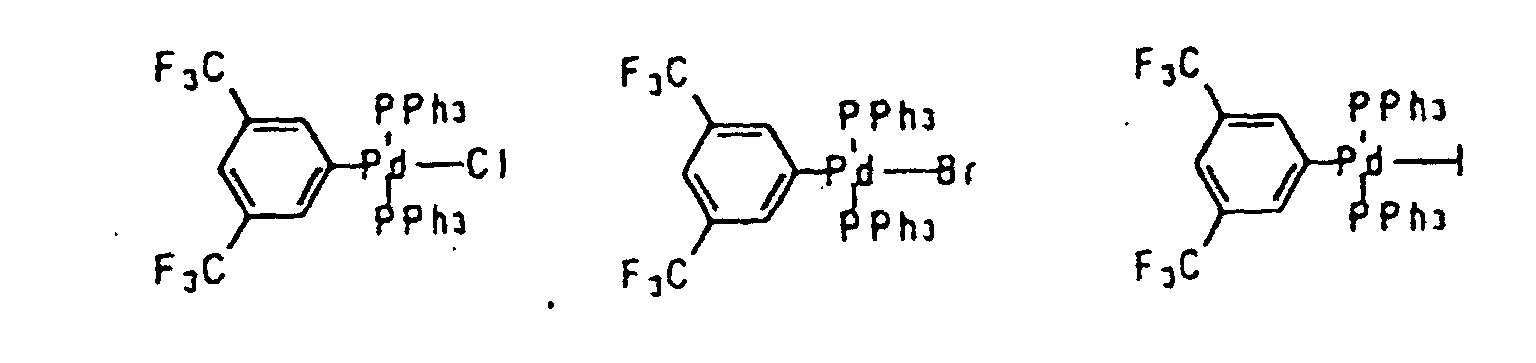
- the second palladium complex compound may be represented by the following general formula: where Ph is phenyl group, and X is a halogen that is fluorine, chlorine, bromine or iodine.
- Preferable examples of the second palladium complex compound are those represented by the following general formulas: where Ph is phenyl group, Tolyl is tolyl group, and n-Bu is n-butyl group. Of these, more preferable examples are those represented by the following formulas.
- the phosphine ligand of the novel first palladium complex compounds is not particularly limited, and is the same as the phosphine used in the first and second methods. Therefore, all the above descriptions of the phosphine used in the first and second methods is applicable to that of the novel first palladium complex compound.
- the novel first palladium complex compound can be crystalline, can be dissolved in various organic solvents, thereby becoming stable. Furthermore, these compounds are each stable in the air at room temperature. Due to such physical and chemical properties of these compounds, it becomes easy to isolate these compounds, thereby making them high in purity. Furthermore, it is easy to store these compounds, thereby making them easy to be handled in an industrial scale use.
- the novel first palladium complex compounds has catalytic activity in various reactions, such as (1) carbonylation of an aromatic compound through an insertion of monoxide or the like into a halogenated aryl and the subsequent reductive release, (2) vinylation through an insertion of olefin into a halogenated aryl and the subsequent reductive release, and (3) coupling of a halogenated aryl.
- an example of the novel first palladium complex compound [3,5-bis(trifluoromethyl)benzoato) 3, 5'- bis(trifluoromethyl)-phenylbis(triphenylphosphine)palladium(II), represented by the following formula, has catalytic activity in vinylation through an insertion of olefin into a halogenated aryl and the subsequent reductive release.
- a stainless steel autoclave was charged with 32.5 g of 3,5-bis(trifluoromethyl)bromobenzene, 25.0 g of palladium acetate, 87.3 g of triphenylphosphine, and 75 ml of tetrahydrofuran, followed by stirring. Then, the autoclave was further charged with 38.0 g of 25% aqueous ammonia. Then, the atmosphere of the autoclave was replaced with nitrogen two times. Then, the nitrogen pressure was adjusted to 3 kg/cm 2 , and it was started to stir the mixture. With this, the inside temperature of the autoclave has increased. Then, it was started to heat the autoclave by adjusting an oil bath temperature to 105°C.
- Example 1 Example 1 was repeated except in that the autoclave was charged with 4.00 g of 3,5-bis(trifluoromethyl)iodobenzene, 2.64 g of palladium acetate, 9.29 g of triphenylphosphine, 8.91 g of tetrahydrofuran, and 3.45 g of aqueous ammonia and that the reaction was conducted under a condition that the reaction temperature was in a range of 60-80°C and the reaction time was 3 hr. With this, there was obtained 8.81 g of crystals. The crystals were identified as being iodo[3,5-bis(trifluoromethyl) phenyl]bis (triphenylphosphine)palladium(II) by the following properties:
- a stainless steel autoclave was charged with 400 g of 3,5-bis(trifluoromethyl)bromobenzene, 2.40 g of bromo[3,5-bis(trifluoromethyl)phenyl]bis(triphenylphosphine) palladium(II), followed by mixing. Then, the autoclave was further charged with 291.4 g of triethylamine, 0.887 g of triphenylphosphine, and 200 g of water. While the autoclave was closed, it was started to stir the mixture. Then, the atmosphere of the autoclave was replaced with nitrogen three times and then with carbon monoxide three times.
- the initial pressure of carbon monoxide was adjusted to 3 kg/cm 2 , and it was started to heat the autoclave in an oil bath.
- the inside temperature reached 104-105°C
- the inside pressure was adjusted to 8.5 kg/cm 2 .
- the autoclave was maintained at an inside temperature of 105°C and an inside pressure of 8.5 kg/cm 2 , while the amount of carbon monoxide to be introduced was adjusted.
- the heating was stopped, and then the autoclave was cooled down. Then, the inside gas was purged.
- the reaction liquid was put into a separating funnel, followed by the addition of 200 ml of water.
- the thus treated liquid was dropped by a dropping funnel to 370 g of a 6N-HCl aqueous solution contained in a 2-liter beaker, while this solution was maintained at a temperature of 20-30°C and stirred. With this, crystals were precipitated, then separated by vacuum filtration, and then washed with 1120 ml of water and then 336 ml of cooled toluene, thereby obtaining 279 g of colorless crystals of 3,5-bis(trifluoromethyl)benzoic acid.
- Example 1 was repeated except that the recrystallization was omitted, thereby obtaining pale green crystals of bromo[3,5-bis(trifluoromethyl)phenyl]bis (triphenylphosphine)palladium (II). Then, a stainless steel autoclave was charged with 70.0 g of the obtained bromo[3,5-bis(trifluoromethyl)phenyl]bis(triphenylphosphine) palladium (II), 39.1 g of 3,5-bis(trifluoromethyl)benzoic acid, and 150 ml of tetrahydrofuran, followed by mixing and stirring. The autoclave was further charged with 20.5 g of 25% aqueous ammonia.
- the atmosphere of the autoclave was replaced with nitrogen two times. Then, the nitrogen pressure was adjusted to 3 kg/cm 2 , and it was started to stir the mixture. Then, it was started to heat the autoclave by adjusting an oil bath temperature to 100°C. About 2 hr later, the oil bath was removed. Then, the autoclave was cooled down. Then, 500 ml of toluene and 200 ml of 25% aqueous ammonia were added to the reaction liquid, followed by stirring for several minutes.
- a stainless steel autoclave was charged with 65.3 g of 3,5-bis(trifluoromethyl)bromobenzene, 100 ml of tetrahydrofuran, 50.0 g of palladium acetate, 175.5 g of triphenylphosphine, 57.6 g of 3,5-bis(trifluoromethyl)benzoic acid, and 60.8 g of 25% aqueous ammonia. Then, the atmosphere of the autoclave was replaced with nitrogen two times. Then, the nitrogen pressure was adjusted to 3 kg/cm 2 , and it was started to stir the mixture. With this, the inside temperature of the autoclave has increased to about 50°C.
- the reaction liquid was cooled down to room temperature. Then, the reaction liquid was poured into an iced water. Organic matter of the reaction liquid was extracted by ether. The obtained organic layer (ether layer) was separated from the aqueous layer, then washed with water three times and then with a saturated brine two times, and then dried with anhydrous magnesium sulfate. Then, the solvent was distilled off under vacuum using an evaporator, thereby obtaining a brown solid matter as residue. This solid matter was subjected to recrystallization using n-hexane, thereby obtaining 22.3 g of crystals. The crystals were identified as being 3,5-bis(trifluoromethyl) cinnamic acid n-butyl ester by the following properties:
Landscapes
- Chemical & Material Sciences (AREA)
- Organic Chemistry (AREA)
- Organic Low-Molecular-Weight Compounds And Preparation Thereof (AREA)
- Low-Molecular Organic Synthesis Reactions Using Catalysts (AREA)
Description





2-chloro-3-(trifluoromethyl)phenyl,
2-fluoro-3-(trifluoromethyl)phenyl,
2-fluoro-4-(trifluoromethyl)phenyl,
3-fluoro-5-(trifluoromethyl)phenyl,
2-bromo-6-(trifluoromethyl)phenyl,
4-chloro-2-(trifluoromethyl)phenyl,
4-fluoro-2-(trifluoromethyl)phenyl,
2-chloro-6-(trifluoromethyl)phenyl,
4-fluoro-3-(trifluoromethyl)phenyl,
1-chloro-4-(trifluoromethyl)phenyl,
2-fluoro-6-(trifluoromethyl)phenyl,
2-fluoro-5-(trifluoromethyl)phenyl,
2-chloro-4-(trifluoromethyl)phenyl,
4-chloro-3-(trifluoromethyl)phenyl,
4-chloro-2-(trifluoromethyl)phenyl and the like;
2-methyl-3-(trifluoromethyl)phenyl,
3-methyl-5-(trifluoromethyl)phenyl,
2-methyl-4-(trifluoromethyl)phenyl,
4,5-dimethyl-2-(trifluoromethyl)phenyl,
2-methyl-5-(trifluoromethyl)phenyl,
5,6-dimethyl-2-(trifluoromethyl)phenyl,
4ethyl-3-(trifluoromethyl)phenyl, and the like;
2-methoxy-4-(trifluoromethyl)phenyl,
2-ethoxy-4-(trifluoromethyl)phenyl,
4-ethoxy-2-(trifluoromethyl)phenyl,
4-methoxy-2-(trifluoromethyl)phenyl,
2-methoxy-5-(trifluoromethyl)phenyl, and the like;
2-nitro-3-(trifluoromethyl)phenyl,
2-nitro-4-(trifluoromethyl)phenyl,
4-nitro-2-(trifluoromethyl)phenyl,
3-nitro-5-(trifluoromethyl)phenyl,
2-nitro-5-(trifluoromethyl)phenyl,
4-nitro-3-(trifluoromethyl)phenyl, and the like;
2-cyano-5-(trifluoromethyl)phenyl,
2-cyano-4-(trifluoromethyl)phenyl,
4-fluoro-3-cyano-5-(trifluoromethyl)phenyl,
4-cyano-3-(trifluoromethyl)phenyl,
2-chloro-5-cyano-3-(trifluoromethyl)phenyl,
4-cyano-2-(trifluoromethyl)phenyl, and the like; and
2-amino-6-(trifluoromethyl)phenyl,
2-amino-5-(trifluoromethyl)phenyl,
2-amino-4-(trifluoromethyl)phenyl,
2-amino-3-(trifluoromethyl)phenyl,
3-amino-6-(trifluoromethyl)phenyl,
3-amino-5-(trifluoromethyl)phenyl,
4-amino-2-(trifluoromethyl)phenyl,
4-amino-3-(trifluoromethyl)phenyl, and the like. Each aryl group Ar1 or Ar2 is preferably one having at least two trifluoromethyl groups. Examples of such aryl group are
2,3-bis(trifluoromethyl)phenyl, 2,4-bis(trifluoromethyl)phenyl,
2,5-bis(trifluoromethyl)phenyl, 2,6-bis(trifluoromethyl)phenyl,
3,4-bis(trifluoromethyl)phenyl, and
3,5-bis(trifluoromethyl)phenyl. Further nonlimitative examples of such aryl group are
2,3,4-tris(trifluoromethyl)phenyl,
2,4,5-tris(trifluoromethyl)phenyl,
2,3,5-tris(trifluoromethyl)phenyl,
1,3,5-tris(trifluoromethyl)phenyl,
3,4,5-tris(trifluoromethyl)phenyl,
2,3,4,6-tetrakis(trifluoromethyl)phenyl,
1-bromo-2,3,4-tris(trifluoromethyl)phenyl,
2-bromo-4,5,6-tris(trifluoromethyl)phenyl, and the like; and
3,5-dichloro-4,6-bis(trifluoromethyl)phenyl,
2-dichloro-3,5-bis(trifluoromethyl)phenyl,
2-methoxy-3,5-bis(trifluoromethyl)phenyl,
2-bromo-3,5-bis(trifluoromethyl)phenyl,
2-nitro-4,6-bis(trifluoromethyl)phenyl,
5,6-dichloro-1,3-bis(trifluoromethyl)phenyl,
4-chloro-3,5-bis(trifluoromethyl)phenyl, and the like.










[3,5-bis(trifluoromethyl)benzoato) 3, 5'- bis(trifluoromethyl)-phenylbis(triphenylphosphine)palladium(II), represented by the following formula, has catalytic activity in vinylation through an insertion of olefin into a halogenated aryl and the subsequent reductive release.

δ ppm 6.75(s,1H), 7.09(s,2H), 7.24·7.37(m,18H), and 7.50-7.55(m,12H); and
δ ppm 27.33(s).
δ ppm 6.75(s,1H), 7.07(s,2H), 7.24-7.37(m,18H), and 7.48-7.56(m,12H).
δ ppm 6.97(s,1H), 7.09(s,2H), 7.20-7.32(m,18H), 7.40-7.50(m,12H), 7.53(s,2H), and 7.62(s,1H); and
δ ppm 25.73(s).
δ ppm 6.97(s,1H), 7.09(s,2H), 7.20-7.32(m,18H), 7.40-7.50(m,12H), 7.53(s,2H), and 7.62(s,1H); and
δ ppm 25.73(s).
δ ppm 6.47(dd, J=7.3, 7.8Hz, 1H), 6.77(d, J=7.3Hz, 1H), 6.80(brs, 1H), 6.95(d, J=7.8Hz, 1H), 7.24-7.30(m, 18H), and 7.40-7.46(m, 12H).
δ ppm 0.975(t, J=7.3Hz, 3H), 1.38-1.50(m, 2H), 1.66-1.75(m, 2H), 4.25(t, J=6.6Hz, 2H), 6.57(d, J=16Hz, 1H), 7.70(d, J=16Hz, 1H), 7.86(s, 1H), and 7.93(s, 2H).

δ ppm: 3.35(s, 6H), 6.48-6.63(m, 9H), 6.65-6.80(m, 10H), 6.85-6.95 (m, 4H), 7.04-7.16(m, 10H), 7.27 (bs, 1H), 7.50-7.60(m, 7H), 7.95(d, 2H, J=8.1Hz), 8.05(d, 2H, J=8.7Hz), and 8.84-8.95 (m, 2H); and

δ ppm: 6.58-6.82 (m, 8H), 6.96-7.16(m, 9H), 7.33 (d, 1H, 7.5Hz), 7.38(d; 1H, 6.3Hz), 7.40-7.64(m, 10H), 7.69(dd, 1H, J=9.0, 1.8Hz), and 7.76-7.94(m, 5H);
δ ppm 14.84(d, J=38.1) and 30.51(d, J=40.0);
δ ppm -62.98(s); and
Claims (49)
- A method for producing a first palladium-complex compound represented by the general formula (4), said method comprising:where Ar1, Ar2, and L are defined as above.(a) reacting an aromatic compound represented by the general formula (1), with a palladium compound and a phosphine derivative, in the presence of a first basic substance, thereby obtaining a second palladium-complex compound represented by the general formula (2); and(b) reacting said second palladium-complex compound with a benzoic acid represented by the general formula (3), in the presence of a second basic substance, thereby producing said first palladium -complex compound,

- A method for producing a palladium-complex compound represented by the general formula (4), said method comprising:where Ar1, Ar2 and X are defined as above, and each L is independently a phosphine ligand.reacting an aromatic compound represented by the general formula (1), with a palladium compound, a phosphine derivative and a benzoic acid derivative represented by the general formula (3), in the presence of a basic substance, thereby obtaining said palladium-complex compound,

- A palladium complex compound represented by the general formula (5),where Ar3 and Ar4 are respectively aryl groups represented by the general formulas (6) and (7), and each L is independently a phosphine ligand,
 where R2 is trifluoromethyl group, trifluoromethyloxy group, a halogen that is fluorine, chlorine, bromine or iodine, nitro group, acetyl group, cyano group, an alkyl group having a carbon atom number of 1-4, an alkoxyl group having a carbon atom number of 1-4, or an alkoxycarbonyl group having a carbon atom number of 2-5; and m is an integer of 0-4,
 where R1 is trifluoromethyl group, and n is an integer of 1-3.
- A method according to claim 1, wherein said second palladium complex compound is represented by the general formula Ar5-PdL2X where Ar5 is bis(trifluoromethyl)phenyl group, X is a halogen that is fluorine, chlorine, bromine or iodine, and each L is independently a phosphine ligand.
- A method according to claim 1 or 2, wherein said Ar1 in the general formula (1) is represented by the general formula (6),where R2 is a halogen that is fluorine, chlorine, bromine or iodine, or a monovalent organic group, and m is an integer of 0-4.

- A method according to claim 5, wherein said monovalent organic group of R2 in the general formula (6) is trifluoromethyl group, trifluoromethyloxy group, nitro group, acetyl group, cyano group, an alkyl group having a carbon atom number of 1-4, an alkoxyl group having a carbon atom number of 1-4, or an alkoxycarbonyl group having a carbon atom number of 2-5.
- A method according to claim 1 or 2, wherein said Ar1 in the general formula (1) is a phenyl group having at least one trifluoromethyl group.
- A method according claim 1 or 2, wherein said Ar1 in the general formula (1) is a phenyl group having at least two trifluoromethyl groups.
- A method according to claim 1 or 2, wherein said aromatic compound is 3,5-bis(trifluoromethyl)bromobenzene or 3,5 - bis(trifluoromethyúiodobenzene.
- A method according to claim 1 or 2, wherein said X in the general formula (1) is bromine or iodine.
- A method according to claim 1 or 2, wherein said palladium compound is a palladium salt.
- A method according to claim 1 or 2, wherein said phosphine derivative is represented by the general formula:
- A method according to claim 12, wherein at least one of said R1 of said phosphine derivative is selected from the group consisting of phenyl group, o-tolyl group, m-tolyl group, p-tolyl group, 4-acynyl group, and 3,5-xylyl group.
- A method according to claim 12, wherein said phosphine derivative is represented by the following general formula:where an arbitrary number of hydrogen atoms of naphthalene ring is optionally replaced with said first substituent R2, and each R4 is independently a group selected from the group consisting of phenyl group, o-tolyl group, m-tolyl group, p-tolyl group, 4-acynyl group, and 3,5-xylyl group.

- A method according to claim 1 or 2, wherein said phosphine derivative is represented by the general formula (R1)2P-Q-P(R1)2 where Q is a bivalent group, and each R1 is independently a first group selected from the group consisting of lower alkyl groups, cycloalkyl groups, phenyl group, naphthyl group, anthryl group, pyridyl group and quinolyl group, said first group optionally having a first substituent R2 selected from the group consisting of nitro group, primary amino group, secondary amino group, tertiary amino group, halogen atoms, and a second substituent, said second substituent being selected from the group consisting of lower alkyl groups, cycloalkyl groups, phenyl group, naphthyl group, anthryl group, pyridyl group and quinolyl group, said second substituent optionally having a third substituent R3 selected from the group consisting of nitro group, primary amino group, secondary amino group, tertiary amino group, halogen atoms, and a substituent being selected from the group consisting of lower alkyl groups, lower alkoxy groups, cycloalkyl groups, phenyl group, naphthyl group, anthryl group, pyridyl group, and quinolyl group, said substituent optionally having a substituent.
- A method according to claim 15, wherein said bivalent group Q comprises (1) an arbitrary number of a first bivalent group selected from the group consisting of alkylene group, phenylene group, naphthylene group, and anthrylene group, and (2) an arbitrary number of a bonding group selected from the group consisting of single bond, -O-, -S-, -C(=O)-, and -S(=O)-, said first bivalent group optionally having an arbitrary number of a substituent selected from the group consisting of nitro group, primary amino group, secondary amino group, tertiary amino group, halogen atoms, lower alkyl groups, lower alkoxy groups, cycloalkyl groups, phenyl group, naphthyl group, anthryl group, pyridyl group, and quinolyl group.
- A method according to claim 15, wherein said bivalent group Q has a substituent optionally and is selected from the group consisting of alkylene group, biphenylene group, binaphthylene group and bianthrylene group, and said substituent of said bivalent group Q is an arbitrary number of a group selected from the group consisting of nitro group, primary amino group, secondary amino group, tertiary amino group, halogen atoms, lower alkyl groups, lower alkoxy groups, cycloalkyl groups, phenyl group, naphthyl group, anthryl group, pyridyl group, and quinolyl group.
- A method according to claim 1 or 2, wherein said phosphine derivative is triphenylphosphine.
- A method according to claim 1 or 2, wherein said basic substance is selected from the group consisting of ammonia and amines.
- A method according to claim 1 or 2, wherein said reacting said aromatic compound is conducted in the presence of a solvent.
- A method according to claim 1 or 2, wherein said reacting said aromatic compound is conducted in the presence of water as a solvent.
- A method according to claim 1 or 2, wherein said reacting said aromatic compound is conducted in a single reaction vessel.
- A method according to claim 1 or 2, wherein said Ar2 in the general formula (3) is represented by the general formula (7),where R1 is a halogen that is fluorine, chlorine, bromine or iodine, or a monovalent organic group, and n is an integer of 0-3.
- A method according to claim 23, wherein said monovalent organic group of said R1 in the general formula (7) is trifluoromethyl group, trifluoromethyloxy group, nitro group, acetyl group, cyano group, an alkyl group having a carbon atom number of 1-4, an alkoxyl group having a carbon atom number of 1-4, or an alkoxycarbonyl group having a carbon atom number of 2-5.
- A method according to claim 1 or 2, wherein said Ar2 in the general formula (3) is a phenyl group having at least one trifluoromethyl group.
- A method according claim 1 or 2, wherein said Ar2 in the general formula (3) is a phenyl group having at least two trifluoromethyl groups.
- A method according to claim 1, wherein said reacting said second palladium-complex compound is conducted in the presence of a solvent.
- A method according to claim 1, wherein said reacting said second palladium-complex compound is conducted in the presence of water as a solvent.
- A method according to claim 1 or 2, wherein said phosphine ligand is selected from the group consisting of triphenylphosphine, tris(o-tolyl)phosphine, tris(m-tolyl)phosphine, and tris(n-butyl)phosphine.
- A method according to claim 1, wherein said phosphine ligand in the general formula (2) is triphenylphosphine.
- A palladium complex compound according to claim 3, wherein said aryl group represented by the general formula (7) is bis(trifluoromethyl)phenyl group.
- A palladium complex compound according to claim 3, wherein said aryl group represented by the general formula (7) is 3,5-bis(trifluoromethyl)phenyl group.
- A palladium complex compound according to claim 3, wherein at least one of said R2 in the general formula (6) is trifluoromethyl group.
- A palladium complex compound according to claim 3, wherein said aryl group represented by the general formula (6) is phenyl group, trifluoromethylphenyl group or bis(trifluoromethyl)phenyl group.
- A palladium complex compound according to claim 3, wherein said aryl group represented by the general formula (6) is 3-trifluoromethylphenyl group or 3,5-bis(trifluoromethyl)phenyl group.
- A palladium complex compound according to claim 3, wherein said aryl group represented by the general formula (6) is phenyl group, 3-trifluoromethylphenyl group or 3,5-bis(trifluoromethyl)phenyl group, and said aryl group represented by the general formula (7) is 3,5-bis(trifluoromethyl)phenyl group.
- A palladium complex compound according to claim 3, wherein each L in the general formula (5) is represented by the general formula P(R3)3 where each R3 is independently (1) a phenyl group optionally having a substituent or (2) an alkyl group having a carbon atom number of 1-6.
- A palladium complex compound according to claim 37, wherein each R3 is independently selected from the group consisting of phenyl group, o-tolyl group, m-tolyl group, p-tolyl group, methyl group, ethyl group and n-butyl group.
- A palladium complex compound according to claim 3, wherein each L in the general formula (5) is triphenylphosphine.
- A palladium complex compound according to claim 3, which is [3,5 bis(trifluoromethyl)benzoato]3',5'-bis (trifluoromethyl)phenylbis(triphenylphosphine)palladium(II).
- A palladium complex compound according to claim 3, which is [3,5-bis(trifluoromethyl)benzoato]3'-trifluoromethyl-phenylbis(triphenylphosphine)palladium(II).
- A method according to claim 4, wherein said Ar5 is 3,5-bis(trifluoromethyl)phenyl group.
- A method according to claim 4, wherein each L is represented by the general formula:
- A method according to claim 43, wherein at least one of said R1 of each L is selected from the group consisting of phenyl group, o-tolyl group, m-tolyl group, p-tolyl group, 4-acynyl group, and 3,5-xylyl group.
- A method according to claim 43, wherein each L is represented by the following general formula:where an arbitrary number of hydrogen atoms of naphthalene ring is optionally replaced with said first substituent R2, and each R4 is independently a group selected from the group consisting of phenyl group, o-tolyl group, m-tolyl group, p-tolyl group, 4-acynyl group, and 3,5-xylyl group.
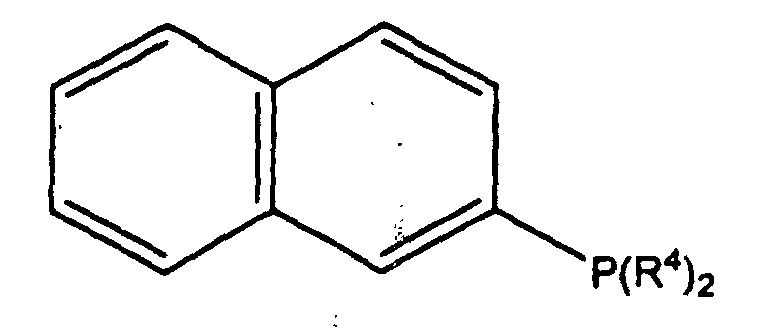
- A method according to claim 1 or 2, wherein each L is represented by the general formula (R1)2P-Q-P(R1)2 where Q is a bivalent group, and each R1 is independently a first group selected from the group consisting of lower alkyl groups, cycloalkyl groups, phenyl group, naphthyl group, anthryl group, pyridyl group and quinolyl group, said first group optionally having a first substituent R2 selected from the group consisting of nitro group, primary amino group, secondary amino group, tertiary amino group, halogen atoms, and a second substituent, said second substituent being selected from the group consisting of lower alkyl groups, cycloalkyl groups, phenyl group, naphthyl group, anthryl group, pyridyl group and quinolyl group, said second substituent optionally having a third substituent R3 selected from the group consisting of nitro group, primary amino group, secondary amino group, tertiary amino group, halogen atoms, and a substituent being selected from the group consisting of lower alkyl groups, lower alkoxy groups, cycloalkyl groups, phenyl group, naphthyl group, anthryl group, pyridyl group, and quinolyl group, said substituent optionally having a substituent.
- A method according to claim 46, wherein said bivalent group Q comprises (1) an arbitrary number of a first bivalent group selected from the group consisting of alkylene group, phenylene group, naphthylene group, and anthrylene group, and (2) an arbitrary number of a bonding group selected from the group consisting of single bond, -O-, -S-, -C(=O)-, and -S(=O)-, said first bivalent group optionally having an arbitrary number of a substituent selected from the group consisting of nitro group, primary amino group, secondary amino group, tertiary amino group, halogen atoms, lower alkyl groups, lower alkoxy groups, cycloalkyl groups, phenyl group, naphthyl group, anthryl group, pyridyl group, and quinolyl group.
- A method according to claim 46, wherein said bivalent group Q has a substituent optionally and is selected from the group consisting of alkylene group, biphenylene group, binaphthylene group and bianthrylene group, and said substituent of said bivalent group Q is an arbitrary number of a group selected from the group consisting of nitro group, primary amino group, second dary amino group, tertiary amino group, halogen atoms, lower alkyl groups, lower alkoxy groups, cycloalkyl groups, phenyl group, naphthyl group, anthryl group, pyridyl group, and quinolyl group.
- A method according to claim 4, wherein each L is triphenylphosphine.
Applications Claiming Priority (10)
| Application Number | Priority Date | Filing Date | Title |
|---|---|---|---|
| JP35152998 | 1998-12-10 | ||
| JP35153098 | 1998-12-10 | ||
| JP35153098A JP3730793B2 (en) | 1998-12-10 | 1998-12-10 | Palladium complex compound |
| JP35152998 | 1998-12-10 | ||
| JP17839599 | 1999-06-24 | ||
| JP17839499 | 1999-06-24 | ||
| JP17839399 | 1999-06-24 | ||
| JP17839599A JP3717335B2 (en) | 1999-06-24 | 1999-06-24 | Method for producing palladium complex compound |
| JP17839399 | 1999-06-24 | ||
| JP17839499 | 1999-06-24 |
Publications (3)
| Publication Number | Publication Date |
|---|---|
| EP1008601A2 EP1008601A2 (en) | 2000-06-14 |
| EP1008601A3 EP1008601A3 (en) | 2002-01-30 |
| EP1008601B1 true EP1008601B1 (en) | 2005-03-09 |
Family
ID=27528718
Family Applications (1)
| Application Number | Title | Priority Date | Filing Date |
|---|---|---|---|
| EP99124673A Expired - Lifetime EP1008601B1 (en) | 1998-12-10 | 1999-12-10 | Method for producing palladium complex compound |
Country Status (2)
| Country | Link |
|---|---|
| US (2) | US6706905B1 (en) |
| EP (1) | EP1008601B1 (en) |
Families Citing this family (7)
| Publication number | Priority date | Publication date | Assignee | Title |
|---|---|---|---|---|
| DE10123884A1 (en) * | 2001-05-16 | 2002-11-21 | Bayer Ag | Preparation of palladium catalyst solution or dispersion involves reacting chloro-, bromo- or iodo-aromatic or aryl sulfonate, phosphine or diphosphine ligand and palladium salt |
| DE10300124A1 (en) * | 2003-01-07 | 2004-07-15 | Bayer Ag | Process for the preparation of arylalkynes |
| HU230438B1 (en) * | 2010-12-16 | 2016-06-28 | CHINOIN Gyógyszer és Vegyészeti Termékek Gyára Zrt. 20% | New palladium catalyst, process for preparation and use thereof |
| CN109833916B (en) * | 2019-03-22 | 2021-08-27 | 江苏禾本生化有限公司 | Composite catalyst for propiconazole cyclization reaction and preparation method thereof |
| CN113200939A (en) * | 2021-03-31 | 2021-08-03 | 广东石油化工学院 | Bis (1, 3-thiazole) amine and preparation method thereof |
| CN116422377B (en) * | 2023-04-03 | 2024-10-18 | 广东欧凯新材料有限公司 | Method and catalyst for preparing isononanoate through Pd catalyzed alkoxycarbonyl |
| CN117088773B (en) * | 2023-08-24 | 2026-03-31 | 云南中医药大学 | A synthetic method for palladium-catalyzed carbon-carbon bond formation |
Family Cites Families (1)
| Publication number | Priority date | Publication date | Assignee | Title |
|---|---|---|---|---|
| US3674825A (en) | 1969-09-30 | 1972-07-04 | Union Carbide Corp | Halo(aryl)metal compounds and method of preparation |
-
1999
- 1999-12-10 US US09/458,080 patent/US6706905B1/en not_active Expired - Fee Related
- 1999-12-10 EP EP99124673A patent/EP1008601B1/en not_active Expired - Lifetime
-
2002
- 2002-04-05 US US10/116,057 patent/US6878663B2/en not_active Expired - Fee Related
Also Published As
| Publication number | Publication date |
|---|---|
| US6706905B1 (en) | 2004-03-16 |
| EP1008601A3 (en) | 2002-01-30 |
| US20020111482A1 (en) | 2002-08-15 |
| US6878663B2 (en) | 2005-04-12 |
| EP1008601A2 (en) | 2000-06-14 |
Similar Documents
| Publication | Publication Date | Title |
|---|---|---|
| KR940011904B1 (en) | Method for producing carboxylic acid amides or esters | |
| US6706905B1 (en) | Method for producing palladium complex compound | |
| ES2283850T3 (en) | NEW CARBEN-NICKEL COMPLEXES, -PALADIO AND -PLATINO, ITS PRODUCTION AND USE IN CATALYTIC REACTIONS. | |
| US6326517B1 (en) | Method of producing benzamides | |
| JP3552934B2 (en) | Method for producing benzoic acid amides | |
| JP3730825B2 (en) | Palladium complex compound and method for producing the same | |
| EP1270582B1 (en) | Triphenylphosphine derivatives, palladium or nickel complexes thereof, and process for preparing biaryl derivatives | |
| KR100548807B1 (en) | Arine intermediates and methods for their preparation | |
| JP3717355B2 (en) | Method for producing cinnamic acid derivative | |
| JP3717335B2 (en) | Method for producing palladium complex compound | |
| JP5544756B2 (en) | Phosphine compound and catalyst comprising the phosphine compound and a transition metal compound | |
| DE69924077T2 (en) | Process for the preparation of a palladium complex compound | |
| JP4114262B2 (en) | Ferrocenylaminophosphine and catalyst containing the phosphine | |
| JPH0641137A (en) | Phthalocyanine derivative and its production and production of its intermediate | |
| JP3579275B2 (en) | Method for producing benzoic acid derivative | |
| JP5023683B2 (en) | Process for producing benzofluorene derivative and intermediate thereof | |
| JP2000169419A (en) | Manufacture of benzoic acids and their esters | |
| JPH08239338A (en) | Method of synthesizing methyl-1,1-dichloromethyl ether ethyl-1,1-dichloro-methyl ether | |
| JP3730793B2 (en) | Palladium complex compound | |
| JP4435447B2 (en) | Method for producing methoxymethyltriarylphosphonium chloride | |
| JPH04169542A (en) | Production of bistrifluoromethylbiphenyl | |
| JPH06239766A (en) | Production of biaryl compound | |
| CA2207572C (en) | Process for the production of 2-(substituted benzoyl)-1,3 cyclohexanediones | |
| SK281492B6 (en) | Process for the preparation of arylamides of heteroaromatic carboxylic acids and 2-chloro-6-[1-methyl-3-(trifluoromethyl)pyrazol-5-yloxy]pyridine as an intermediate | |
| JPH0841005A (en) | Production of 4-fluoroalkoxycynnamonitrile compound |
Legal Events
| Date | Code | Title | Description |
|---|---|---|---|
| PUAI | Public reference made under article 153(3) epc to a published international application that has entered the european phase |
Free format text: ORIGINAL CODE: 0009012 |
|
| AK | Designated contracting states |
Kind code of ref document: A2 Designated state(s): AT BE CH CY DE DK ES FI FR GB GR IE IT LI LU MC NL PT SE Kind code of ref document: A2 Designated state(s): DE FR |
|
| AX | Request for extension of the european patent |
Free format text: AL;LT;LV;MK;RO;SI |
|
| PUAL | Search report despatched |
Free format text: ORIGINAL CODE: 0009013 |
|
| AK | Designated contracting states |
Kind code of ref document: A3 Designated state(s): AT BE CH CY DE DK ES FI FR GB GR IE IT LI LU MC NL PT SE |
|
| AX | Request for extension of the european patent |
Free format text: AL;LT;LV;MK;RO;SI |
|
| 17P | Request for examination filed |
Effective date: 20020702 |
|
| AKX | Designation fees paid |
Free format text: DE FR |
|
| 17Q | First examination report despatched |
Effective date: 20030703 |
|
| GRAP | Despatch of communication of intention to grant a patent |
Free format text: ORIGINAL CODE: EPIDOSNIGR1 |
|
| GRAS | Grant fee paid |
Free format text: ORIGINAL CODE: EPIDOSNIGR3 |
|
| GRAA | (expected) grant |
Free format text: ORIGINAL CODE: 0009210 |
|
| AK | Designated contracting states |
Kind code of ref document: B1 Designated state(s): DE FR |
|
| REG | Reference to a national code |
Ref country code: IE Ref legal event code: FG4D |
|
| REF | Corresponds to: |
Ref document number: 69924077 Country of ref document: DE Date of ref document: 20050414 Kind code of ref document: P |
|
| PGFP | Annual fee paid to national office [announced via postgrant information from national office to epo] |
Ref country code: FR Payment date: 20051219 Year of fee payment: 7 |
|
| PLBE | No opposition filed within time limit |
Free format text: ORIGINAL CODE: 0009261 |
|
| STAA | Information on the status of an ep patent application or granted ep patent |
Free format text: STATUS: NO OPPOSITION FILED WITHIN TIME LIMIT |
|
| PGFP | Annual fee paid to national office [announced via postgrant information from national office to epo] |
Ref country code: DE Payment date: 20060227 Year of fee payment: 7 |
|
| 26N | No opposition filed |
Effective date: 20051212 |
|
| ET | Fr: translation filed | ||
| PG25 | Lapsed in a contracting state [announced via postgrant information from national office to epo] |
Ref country code: DE Free format text: LAPSE BECAUSE OF NON-PAYMENT OF DUE FEES Effective date: 20070703 |
|
| REG | Reference to a national code |
Ref country code: FR Ref legal event code: ST Effective date: 20070831 |
|
| PG25 | Lapsed in a contracting state [announced via postgrant information from national office to epo] |
Ref country code: FR Free format text: LAPSE BECAUSE OF NON-PAYMENT OF DUE FEES Effective date: 20070102 |