EP1000112B1 - Cosmetic composition containing siloxane-based polyamides as thickening agents - Google Patents
Cosmetic composition containing siloxane-based polyamides as thickening agents Download PDFInfo
- Publication number
- EP1000112B1 EP1000112B1 EP98938143A EP98938143A EP1000112B1 EP 1000112 B1 EP1000112 B1 EP 1000112B1 EP 98938143 A EP98938143 A EP 98938143A EP 98938143 A EP98938143 A EP 98938143A EP 1000112 B1 EP1000112 B1 EP 1000112B1
- Authority
- EP
- European Patent Office
- Prior art keywords
- polyamide
- group
- methyl
- phenyl
- siloxane
- Prior art date
- Legal status (The legal status is an assumption and is not a legal conclusion. Google has not performed a legal analysis and makes no representation as to the accuracy of the status listed.)
- Expired - Lifetime
Links
- 239000000203 mixture Substances 0.000 title claims description 275
- 239000004952 Polyamide Substances 0.000 title claims description 180
- 229920002647 polyamide Polymers 0.000 title claims description 180
- KPUWHANPEXNPJT-UHFFFAOYSA-N disiloxane Chemical class [SiH3]O[SiH3] KPUWHANPEXNPJT-UHFFFAOYSA-N 0.000 title claims description 100
- 239000002537 cosmetic Substances 0.000 title claims description 81
- 239000002562 thickening agent Substances 0.000 title description 16
- 229920001296 polysiloxane Polymers 0.000 claims description 99
- 239000003213 antiperspirant Substances 0.000 claims description 86
- 230000001166 anti-perspirative effect Effects 0.000 claims description 85
- 125000002496 methyl group Chemical group [H]C([H])([H])* 0.000 claims description 71
- 239000000047 product Substances 0.000 claims description 63
- 239000012530 fluid Substances 0.000 claims description 61
- 125000001997 phenyl group Chemical group [H]C1=C([H])C([H])=C(*)C([H])=C1[H] 0.000 claims description 60
- -1 siloxane chain Chemical group 0.000 claims description 58
- 239000002904 solvent Substances 0.000 claims description 56
- 125000001495 ethyl group Chemical group [H]C([H])([H])C([H])([H])* 0.000 claims description 52
- 239000003349 gelling agent Substances 0.000 claims description 52
- XLYOFNOQVPJJNP-UHFFFAOYSA-N water Substances O XLYOFNOQVPJJNP-UHFFFAOYSA-N 0.000 claims description 40
- 235000013870 dimethyl polysiloxane Nutrition 0.000 claims description 35
- 229920000435 poly(dimethylsiloxane) Polymers 0.000 claims description 35
- 125000000217 alkyl group Chemical group 0.000 claims description 33
- 239000002585 base Substances 0.000 claims description 33
- 239000004205 dimethyl polysiloxane Substances 0.000 claims description 31
- 239000003205 fragrance Substances 0.000 claims description 26
- 238000000034 method Methods 0.000 claims description 26
- 125000001449 isopropyl group Chemical group [H]C([H])([H])C([H])(*)C([H])([H])[H] 0.000 claims description 25
- 125000001436 propyl group Chemical group [H]C([*])([H])C([H])([H])C([H])([H])[H] 0.000 claims description 25
- 239000004094 surface-active agent Substances 0.000 claims description 23
- 125000002947 alkylene group Chemical group 0.000 claims description 22
- NAQMVNRVTILPCV-UHFFFAOYSA-N hexane-1,6-diamine Chemical compound NCCCCCCN NAQMVNRVTILPCV-UHFFFAOYSA-N 0.000 claims description 22
- 239000004615 ingredient Substances 0.000 claims description 21
- 229910052757 nitrogen Inorganic materials 0.000 claims description 20
- 150000004985 diamines Chemical class 0.000 claims description 19
- 239000002253 acid Substances 0.000 claims description 14
- 229910052782 aluminium Inorganic materials 0.000 claims description 13
- 229920001223 polyethylene glycol Polymers 0.000 claims description 12
- DHMQDGOQFOQNFH-UHFFFAOYSA-N Glycine Chemical compound NCC(O)=O DHMQDGOQFOQNFH-UHFFFAOYSA-N 0.000 claims description 11
- XAGFODPZIPBFFR-UHFFFAOYSA-N aluminium Chemical compound [Al] XAGFODPZIPBFFR-UHFFFAOYSA-N 0.000 claims description 9
- 150000001408 amides Chemical class 0.000 claims description 9
- 239000000490 cosmetic additive Substances 0.000 claims description 9
- 229910052698 phosphorus Inorganic materials 0.000 claims description 9
- 239000002202 Polyethylene glycol Substances 0.000 claims description 8
- 150000001732 carboxylic acid derivatives Chemical class 0.000 claims description 8
- 238000010438 heat treatment Methods 0.000 claims description 8
- 125000000026 trimethylsilyl group Chemical group [H]C([H])([H])[Si]([*])(C([H])([H])[H])C([H])([H])[H] 0.000 claims description 8
- 125000006273 (C1-C3) alkyl group Chemical group 0.000 claims description 7
- 239000000654 additive Substances 0.000 claims description 7
- 125000004122 cyclic group Chemical group 0.000 claims description 7
- 238000005227 gel permeation chromatography Methods 0.000 claims description 7
- 238000004519 manufacturing process Methods 0.000 claims description 7
- 150000005690 diesters Chemical class 0.000 claims description 6
- 229940057874 phenyl trimethicone Drugs 0.000 claims description 6
- 239000011541 reaction mixture Substances 0.000 claims description 6
- LINXHFKHZLOLEI-UHFFFAOYSA-N trimethyl-[phenyl-bis(trimethylsilyloxy)silyl]oxysilane Chemical compound C[Si](C)(C)O[Si](O[Si](C)(C)C)(O[Si](C)(C)C)C1=CC=CC=C1 LINXHFKHZLOLEI-UHFFFAOYSA-N 0.000 claims description 6
- 125000000008 (C1-C10) alkyl group Chemical group 0.000 claims description 5
- 125000006239 protecting group Chemical group 0.000 claims description 5
- 239000000516 sunscreening agent Substances 0.000 claims description 5
- 229910052727 yttrium Inorganic materials 0.000 claims description 5
- 125000006832 (C1-C10) alkylene group Chemical group 0.000 claims description 4
- 229940058020 2-amino-2-methyl-1-propanol Drugs 0.000 claims description 4
- VEXZGXHMUGYJMC-UHFFFAOYSA-M Chloride anion Chemical compound [Cl-] VEXZGXHMUGYJMC-UHFFFAOYSA-M 0.000 claims description 4
- XEFQLINVKFYRCS-UHFFFAOYSA-N Triclosan Chemical compound OC1=CC(Cl)=CC=C1OC1=CC=C(Cl)C=C1Cl XEFQLINVKFYRCS-UHFFFAOYSA-N 0.000 claims description 4
- ZGUQGPFMMTZGBQ-UHFFFAOYSA-N [Al].[Al].[Zr] Chemical compound [Al].[Al].[Zr] ZGUQGPFMMTZGBQ-UHFFFAOYSA-N 0.000 claims description 4
- VSCWAEJMTAWNJL-UHFFFAOYSA-K aluminium trichloride Chemical compound Cl[Al](Cl)Cl VSCWAEJMTAWNJL-UHFFFAOYSA-K 0.000 claims description 4
- CBTVGIZVANVGBH-UHFFFAOYSA-N aminomethyl propanol Chemical compound CC(C)(N)CO CBTVGIZVANVGBH-UHFFFAOYSA-N 0.000 claims description 4
- 125000004429 atom Chemical group 0.000 claims description 4
- 125000004432 carbon atom Chemical group C* 0.000 claims description 4
- 150000001924 cycloalkanes Chemical class 0.000 claims description 4
- 239000001257 hydrogen Substances 0.000 claims description 4
- 229910052739 hydrogen Inorganic materials 0.000 claims description 4
- 125000004435 hydrogen atom Chemical class [H]* 0.000 claims description 4
- 125000002887 hydroxy group Chemical group [H]O* 0.000 claims description 4
- CXQXSVUQTKDNFP-UHFFFAOYSA-N octamethyltrisiloxane Chemical class C[Si](C)(C)O[Si](C)(C)O[Si](C)(C)C CXQXSVUQTKDNFP-UHFFFAOYSA-N 0.000 claims description 4
- 229920000768 polyamine Polymers 0.000 claims description 4
- 125000004169 (C1-C6) alkyl group Chemical group 0.000 claims description 3
- 239000004471 Glycine Substances 0.000 claims description 3
- LVYZJEPLMYTTGH-UHFFFAOYSA-H dialuminum chloride pentahydroxide dihydrate Chemical compound [Cl-].[Al+3].[OH-].[OH-].[Al+3].[OH-].[OH-].[OH-].O.O LVYZJEPLMYTTGH-UHFFFAOYSA-H 0.000 claims description 3
- 238000006459 hydrosilylation reaction Methods 0.000 claims description 3
- 238000006116 polymerization reaction Methods 0.000 claims description 3
- 230000000475 sunscreen effect Effects 0.000 claims description 3
- ICUTUKXCWQYESQ-UHFFFAOYSA-N triclocarban Chemical compound C1=CC(Cl)=CC=C1NC(=O)NC1=CC=C(Cl)C(Cl)=C1 ICUTUKXCWQYESQ-UHFFFAOYSA-N 0.000 claims description 3
- XBTRYWRVOBZSGM-UHFFFAOYSA-N (4-methylphenyl)methanediamine Chemical compound CC1=CC=C(C(N)N)C=C1 XBTRYWRVOBZSGM-UHFFFAOYSA-N 0.000 claims description 2
- LZZYPRNAOMGNLH-UHFFFAOYSA-M Cetrimonium bromide Chemical compound [Br-].CCCCCCCCCCCCCCCC[N+](C)(C)C LZZYPRNAOMGNLH-UHFFFAOYSA-M 0.000 claims description 2
- VGGSQFUCUMXWEO-UHFFFAOYSA-N Ethene Chemical compound C=C VGGSQFUCUMXWEO-UHFFFAOYSA-N 0.000 claims description 2
- 239000005977 Ethylene Substances 0.000 claims description 2
- PIICEJLVQHRZGT-UHFFFAOYSA-N Ethylenediamine Chemical compound NCCN PIICEJLVQHRZGT-UHFFFAOYSA-N 0.000 claims description 2
- GLUUGHFHXGJENI-UHFFFAOYSA-N Piperazine Chemical compound C1CNCCN1 GLUUGHFHXGJENI-UHFFFAOYSA-N 0.000 claims description 2
- YCLAMANSVUJYPT-UHFFFAOYSA-L aluminum chloride hydroxide hydrate Chemical compound O.[OH-].[Al+3].[Cl-] YCLAMANSVUJYPT-UHFFFAOYSA-L 0.000 claims description 2
- 229940053431 aluminum sesquichlorohydrate Drugs 0.000 claims description 2
- YXZZLAMCXFHTTE-UHFFFAOYSA-N aluminum;propane-1,2-diol;trihypochlorite;hydrate Chemical compound O.[Al+3].Cl[O-].Cl[O-].Cl[O-].CC(O)CO YXZZLAMCXFHTTE-UHFFFAOYSA-N 0.000 claims description 2
- 125000003277 amino group Chemical group 0.000 claims description 2
- 125000003178 carboxy group Chemical group [H]OC(*)=O 0.000 claims description 2
- YMKDRGPMQRFJGP-UHFFFAOYSA-M cetylpyridinium chloride Chemical compound [Cl-].CCCCCCCCCCCCCCCC[N+]1=CC=CC=C1 YMKDRGPMQRFJGP-UHFFFAOYSA-M 0.000 claims description 2
- 229960001927 cetylpyridinium chloride Drugs 0.000 claims description 2
- 239000008407 cosmetic solvent Substances 0.000 claims description 2
- KNXDJTLIRRQLBE-UHFFFAOYSA-H dialuminum;propane-1,2-diol;chloride;pentahydroxide;hydrate Chemical compound O.[OH-].[OH-].[OH-].[OH-].[OH-].[Al+3].[Al+3].[Cl-].CC(O)CO KNXDJTLIRRQLBE-UHFFFAOYSA-H 0.000 claims description 2
- QWPPOHNGKGFGJK-UHFFFAOYSA-N hypochlorous acid Chemical class ClO QWPPOHNGKGFGJK-UHFFFAOYSA-N 0.000 claims description 2
- 239000000077 insect repellent Substances 0.000 claims description 2
- 150000002823 nitrates Chemical class 0.000 claims description 2
- 229920001558 organosilicon polymer Polymers 0.000 claims description 2
- ADGFKRMKSIAMAI-UHFFFAOYSA-L oxygen(2-);zirconium(4+);chloride;hydroxide Chemical compound [OH-].[O-2].[Cl-].[Zr+4] ADGFKRMKSIAMAI-UHFFFAOYSA-L 0.000 claims description 2
- 125000000843 phenylene group Chemical group C1(=C(C=CC=C1)*)* 0.000 claims description 2
- 150000004986 phenylenediamines Chemical class 0.000 claims description 2
- 150000003751 zinc Chemical class 0.000 claims description 2
- 125000004178 (C1-C4) alkyl group Chemical group 0.000 claims 1
- YQLZOAVZWJBZSY-UHFFFAOYSA-N decane-1,10-diamine Chemical compound NCCCCCCCCCCN YQLZOAVZWJBZSY-UHFFFAOYSA-N 0.000 claims 1
- 239000013067 intermediate product Substances 0.000 claims 1
- 239000000499 gel Substances 0.000 description 73
- YXFVVABEGXRONW-UHFFFAOYSA-N Toluene Chemical compound CC1=CC=CC=C1 YXFVVABEGXRONW-UHFFFAOYSA-N 0.000 description 51
- OKKJLVBELUTLKV-UHFFFAOYSA-N Methanol Chemical compound OC OKKJLVBELUTLKV-UHFFFAOYSA-N 0.000 description 39
- 239000012071 phase Substances 0.000 description 38
- 239000011149 active material Substances 0.000 description 35
- 239000000463 material Substances 0.000 description 33
- 229920000642 polymer Polymers 0.000 description 31
- 239000002781 deodorant agent Substances 0.000 description 25
- XMSXQFUHVRWGNA-UHFFFAOYSA-N Decamethylcyclopentasiloxane Chemical compound C[Si]1(C)O[Si](C)(C)O[Si](C)(C)O[Si](C)(C)O[Si](C)(C)O1 XMSXQFUHVRWGNA-UHFFFAOYSA-N 0.000 description 23
- 229940086555 cyclomethicone Drugs 0.000 description 23
- IJGRMHOSHXDMSA-UHFFFAOYSA-N Atomic nitrogen Chemical compound N#N IJGRMHOSHXDMSA-UHFFFAOYSA-N 0.000 description 22
- 238000006243 chemical reaction Methods 0.000 description 21
- 239000007787 solid Substances 0.000 description 21
- 238000002156 mixing Methods 0.000 description 19
- LFQSCWFLJHTTHZ-UHFFFAOYSA-N Ethanol Chemical compound CCO LFQSCWFLJHTTHZ-UHFFFAOYSA-N 0.000 description 18
- FRPZMMHWLSIFAZ-UHFFFAOYSA-N 10-undecenoic acid Chemical compound OC(=O)CCCCCCCCC=C FRPZMMHWLSIFAZ-UHFFFAOYSA-N 0.000 description 16
- BASFCYQUMIYNBI-UHFFFAOYSA-N platinum Chemical compound [Pt] BASFCYQUMIYNBI-UHFFFAOYSA-N 0.000 description 16
- 239000000243 solution Substances 0.000 description 16
- 239000004480 active ingredient Substances 0.000 description 15
- KHAVLLBUVKBTBG-UHFFFAOYSA-N caproleic acid Natural products OC(=O)CCCCCCCC=C KHAVLLBUVKBTBG-UHFFFAOYSA-N 0.000 description 15
- 238000009472 formulation Methods 0.000 description 15
- 229960002703 undecylenic acid Drugs 0.000 description 15
- 150000001875 compounds Chemical class 0.000 description 14
- 239000003921 oil Substances 0.000 description 14
- 235000019198 oils Nutrition 0.000 description 14
- VTYYLEPIZMXCLO-UHFFFAOYSA-L Calcium carbonate Chemical compound [Ca+2].[O-]C([O-])=O VTYYLEPIZMXCLO-UHFFFAOYSA-L 0.000 description 12
- 239000007788 liquid Substances 0.000 description 12
- 238000010926 purge Methods 0.000 description 11
- WNWHHMBRJJOGFJ-UHFFFAOYSA-N 16-methylheptadecan-1-ol Chemical compound CC(C)CCCCCCCCCCCCCCCO WNWHHMBRJJOGFJ-UHFFFAOYSA-N 0.000 description 10
- 150000001412 amines Chemical class 0.000 description 10
- 238000001816 cooling Methods 0.000 description 10
- 229940008099 dimethicone Drugs 0.000 description 10
- DNIAPMSPPWPWGF-UHFFFAOYSA-N Propylene glycol Chemical compound CC(O)CO DNIAPMSPPWPWGF-UHFFFAOYSA-N 0.000 description 9
- 239000003795 chemical substances by application Substances 0.000 description 9
- 239000003974 emollient agent Substances 0.000 description 9
- 239000000839 emulsion Substances 0.000 description 9
- FFUAGWLWBBFQJT-UHFFFAOYSA-N hexamethyldisilazane Chemical compound C[Si](C)(C)N[Si](C)(C)C FFUAGWLWBBFQJT-UHFFFAOYSA-N 0.000 description 9
- 239000003054 catalyst Substances 0.000 description 8
- 239000006071 cream Substances 0.000 description 8
- GLDOVTGHNKAZLK-UHFFFAOYSA-N octadecan-1-ol Chemical compound CCCCCCCCCCCCCCCCCCO GLDOVTGHNKAZLK-UHFFFAOYSA-N 0.000 description 8
- 239000000725 suspension Substances 0.000 description 8
- 150000001298 alcohols Chemical class 0.000 description 7
- 230000000670 limiting effect Effects 0.000 description 7
- POPACFLNWGUDSR-UHFFFAOYSA-N methoxy(trimethyl)silane Chemical compound CO[Si](C)(C)C POPACFLNWGUDSR-UHFFFAOYSA-N 0.000 description 7
- 229910052697 platinum Inorganic materials 0.000 description 7
- 238000003756 stirring Methods 0.000 description 7
- ITMCEJHCFYSIIV-UHFFFAOYSA-N triflic acid Chemical compound OS(=O)(=O)C(F)(F)F ITMCEJHCFYSIIV-UHFFFAOYSA-N 0.000 description 7
- 239000003981 vehicle Substances 0.000 description 7
- XXBAQTDVRLRXEV-UHFFFAOYSA-N 3-tetradecoxypropan-1-ol Chemical compound CCCCCCCCCCCCCCOCCCO XXBAQTDVRLRXEV-UHFFFAOYSA-N 0.000 description 6
- VYPSYNLAJGMNEJ-UHFFFAOYSA-N Silicium dioxide Chemical compound O=[Si]=O VYPSYNLAJGMNEJ-UHFFFAOYSA-N 0.000 description 6
- UIIMBOGNXHQVGW-UHFFFAOYSA-M Sodium bicarbonate Chemical compound [Na+].OC([O-])=O UIIMBOGNXHQVGW-UHFFFAOYSA-M 0.000 description 6
- 239000004599 antimicrobial Substances 0.000 description 6
- 229910000019 calcium carbonate Inorganic materials 0.000 description 6
- 239000007795 chemical reaction product Substances 0.000 description 6
- 238000001879 gelation Methods 0.000 description 6
- 229910052751 metal Inorganic materials 0.000 description 6
- 239000002184 metal Substances 0.000 description 6
- 229940116987 ppg-3 myristyl ether Drugs 0.000 description 6
- DHKHKXVYLBGOIT-UHFFFAOYSA-N acetaldehyde Diethyl Acetal Natural products CCOC(C)OCC DHKHKXVYLBGOIT-UHFFFAOYSA-N 0.000 description 5
- 150000001241 acetals Chemical class 0.000 description 5
- 239000003086 colorant Substances 0.000 description 5
- BXWNKGSJHAJOGX-UHFFFAOYSA-N hexadecan-1-ol Chemical compound CCCCCCCCCCCCCCCCO BXWNKGSJHAJOGX-UHFFFAOYSA-N 0.000 description 5
- 239000000155 melt Substances 0.000 description 5
- 150000003839 salts Chemical class 0.000 description 5
- 239000003760 tallow Substances 0.000 description 5
- 239000001993 wax Substances 0.000 description 5
- NBIIXXVUZAFLBC-UHFFFAOYSA-N Phosphoric acid Chemical compound OP(O)(O)=O NBIIXXVUZAFLBC-UHFFFAOYSA-N 0.000 description 4
- 230000000844 anti-bacterial effect Effects 0.000 description 4
- 230000000845 anti-microbial effect Effects 0.000 description 4
- 239000002552 dosage form Substances 0.000 description 4
- 230000000694 effects Effects 0.000 description 4
- 150000002148 esters Chemical class 0.000 description 4
- 150000002191 fatty alcohols Chemical class 0.000 description 4
- 150000002334 glycols Chemical class 0.000 description 4
- QSHDDOUJBYECFT-UHFFFAOYSA-N mercury Chemical compound [Hg] QSHDDOUJBYECFT-UHFFFAOYSA-N 0.000 description 4
- 229910052753 mercury Inorganic materials 0.000 description 4
- GOQYKNQRPGWPLP-UHFFFAOYSA-N n-heptadecyl alcohol Natural products CCCCCCCCCCCCCCCCCO GOQYKNQRPGWPLP-UHFFFAOYSA-N 0.000 description 4
- 239000011148 porous material Substances 0.000 description 4
- 125000002924 primary amino group Chemical group [H]N([H])* 0.000 description 4
- 239000008247 solid mixture Substances 0.000 description 4
- HLZKNKRTKFSKGZ-UHFFFAOYSA-N tetradecan-1-ol Chemical compound CCCCCCCCCCCCCCO HLZKNKRTKFSKGZ-UHFFFAOYSA-N 0.000 description 4
- 238000002834 transmittance Methods 0.000 description 4
- HIQIXEFWDLTDED-UHFFFAOYSA-N 4-hydroxy-1-piperidin-4-ylpyrrolidin-2-one Chemical compound O=C1CC(O)CN1C1CCNCC1 HIQIXEFWDLTDED-UHFFFAOYSA-N 0.000 description 3
- IAYPIBMASNFSPL-UHFFFAOYSA-N Ethylene oxide Chemical compound C1CO1 IAYPIBMASNFSPL-UHFFFAOYSA-N 0.000 description 3
- 239000004166 Lanolin Substances 0.000 description 3
- 239000004698 Polyethylene Substances 0.000 description 3
- 230000002378 acidificating effect Effects 0.000 description 3
- WYANSMZYIOPJFV-UHFFFAOYSA-L aluminum;2-aminoacetic acid;zirconium(4+);chloride;hydroxide;hydrate Chemical compound O.[OH-].[Al+3].[Cl-].[Zr+4].NCC(O)=O WYANSMZYIOPJFV-UHFFFAOYSA-L 0.000 description 3
- 229940088710 antibiotic agent Drugs 0.000 description 3
- 230000015572 biosynthetic process Effects 0.000 description 3
- 239000004359 castor oil Substances 0.000 description 3
- 235000019438 castor oil Nutrition 0.000 description 3
- 239000007810 chemical reaction solvent Substances 0.000 description 3
- 239000008367 deionised water Substances 0.000 description 3
- 229910021641 deionized water Inorganic materials 0.000 description 3
- 235000014113 dietary fatty acids Nutrition 0.000 description 3
- POULHZVOKOAJMA-UHFFFAOYSA-N dodecanoic acid Chemical compound CCCCCCCCCCCC(O)=O POULHZVOKOAJMA-UHFFFAOYSA-N 0.000 description 3
- 239000000194 fatty acid Substances 0.000 description 3
- 229930195729 fatty acid Natural products 0.000 description 3
- 150000004665 fatty acids Chemical class 0.000 description 3
- ZEMPKEQAKRGZGQ-XOQCFJPHSA-N glycerol triricinoleate Natural products CCCCCC[C@@H](O)CC=CCCCCCCCC(=O)OC[C@@H](COC(=O)CCCCCCCC=CC[C@@H](O)CCCCCC)OC(=O)CCCCCCCC=CC[C@H](O)CCCCCC ZEMPKEQAKRGZGQ-XOQCFJPHSA-N 0.000 description 3
- 239000012535 impurity Substances 0.000 description 3
- 238000010348 incorporation Methods 0.000 description 3
- 235000019388 lanolin Nutrition 0.000 description 3
- 229940039717 lanolin Drugs 0.000 description 3
- 239000002245 particle Substances 0.000 description 3
- 229920000573 polyethylene Polymers 0.000 description 3
- 238000002360 preparation method Methods 0.000 description 3
- 125000005373 siloxane group Chemical group [SiH2](O*)* 0.000 description 3
- 229910000030 sodium bicarbonate Inorganic materials 0.000 description 3
- 235000017557 sodium bicarbonate Nutrition 0.000 description 3
- JNYAEWCLZODPBN-JGWLITMVSA-N (2r,3r,4s)-2-[(1r)-1,2-dihydroxyethyl]oxolane-3,4-diol Chemical class OC[C@@H](O)[C@H]1OC[C@H](O)[C@H]1O JNYAEWCLZODPBN-JGWLITMVSA-N 0.000 description 2
- ALSTYHKOOCGGFT-KTKRTIGZSA-N (9Z)-octadecen-1-ol Chemical compound CCCCCCCC\C=C/CCCCCCCCO ALSTYHKOOCGGFT-KTKRTIGZSA-N 0.000 description 2
- KBPLFHHGFOOTCA-UHFFFAOYSA-N 1-Octanol Chemical compound CCCCCCCCO KBPLFHHGFOOTCA-UHFFFAOYSA-N 0.000 description 2
- IFTRQJLVEBNKJK-UHFFFAOYSA-N CCC1CCCC1 Chemical compound CCC1CCCC1 IFTRQJLVEBNKJK-UHFFFAOYSA-N 0.000 description 2
- 229920002884 Laureth 4 Polymers 0.000 description 2
- 239000005639 Lauric acid Substances 0.000 description 2
- CTQNGGLPUBDAKN-UHFFFAOYSA-N O-Xylene Chemical compound CC1=CC=CC=C1C CTQNGGLPUBDAKN-UHFFFAOYSA-N 0.000 description 2
- 229910000147 aluminium phosphate Inorganic materials 0.000 description 2
- 238000013459 approach Methods 0.000 description 2
- 239000007864 aqueous solution Substances 0.000 description 2
- 230000003385 bacteriostatic effect Effects 0.000 description 2
- 235000013871 bee wax Nutrition 0.000 description 2
- 229940092738 beeswax Drugs 0.000 description 2
- 239000012166 beeswax Substances 0.000 description 2
- FSIJKGMIQTVTNP-UHFFFAOYSA-N bis(ethenyl)-methyl-trimethylsilyloxysilane Chemical compound C[Si](C)(C)O[Si](C)(C=C)C=C FSIJKGMIQTVTNP-UHFFFAOYSA-N 0.000 description 2
- 229920001400 block copolymer Polymers 0.000 description 2
- 238000009835 boiling Methods 0.000 description 2
- 125000002843 carboxylic acid group Chemical group 0.000 description 2
- 239000003153 chemical reaction reagent Substances 0.000 description 2
- 150000001805 chlorine compounds Chemical class 0.000 description 2
- MTHSVFCYNBDYFN-UHFFFAOYSA-N diethylene glycol Chemical compound OCCOCCO MTHSVFCYNBDYFN-UHFFFAOYSA-N 0.000 description 2
- SZXQTJUDPRGNJN-UHFFFAOYSA-N dipropylene glycol Chemical compound OCCCOCCCO SZXQTJUDPRGNJN-UHFFFAOYSA-N 0.000 description 2
- 238000004821 distillation Methods 0.000 description 2
- 239000003814 drug Substances 0.000 description 2
- 229940079593 drug Drugs 0.000 description 2
- 238000001035 drying Methods 0.000 description 2
- 239000003995 emulsifying agent Substances 0.000 description 2
- SFNALCNOMXIBKG-UHFFFAOYSA-N ethylene glycol monododecyl ether Chemical compound CCCCCCCCCCCCOCCO SFNALCNOMXIBKG-UHFFFAOYSA-N 0.000 description 2
- 229910021485 fumed silica Inorganic materials 0.000 description 2
- 229920001519 homopolymer Polymers 0.000 description 2
- 150000002430 hydrocarbons Chemical class 0.000 description 2
- SUMDYPCJJOFFON-UHFFFAOYSA-N isethionic acid Chemical compound OCCS(O)(=O)=O SUMDYPCJJOFFON-UHFFFAOYSA-N 0.000 description 2
- 229940061515 laureth-4 Drugs 0.000 description 2
- 230000000873 masking effect Effects 0.000 description 2
- 239000004530 micro-emulsion Substances 0.000 description 2
- 229940043348 myristyl alcohol Drugs 0.000 description 2
- 239000002736 nonionic surfactant Substances 0.000 description 2
- 239000002304 perfume Substances 0.000 description 2
- CLSUSRZJUQMOHH-UHFFFAOYSA-L platinum dichloride Chemical compound Cl[Pt]Cl CLSUSRZJUQMOHH-UHFFFAOYSA-L 0.000 description 2
- 239000002798 polar solvent Substances 0.000 description 2
- 229920000056 polyoxyethylene ether Polymers 0.000 description 2
- 229920001451 polypropylene glycol Polymers 0.000 description 2
- 239000000843 powder Substances 0.000 description 2
- 229920005604 random copolymer Polymers 0.000 description 2
- 239000000376 reactant Substances 0.000 description 2
- 230000002829 reductive effect Effects 0.000 description 2
- 239000011347 resin Substances 0.000 description 2
- 229920005989 resin Polymers 0.000 description 2
- 238000012163 sequencing technique Methods 0.000 description 2
- 229910052710 silicon Inorganic materials 0.000 description 2
- 239000010703 silicon Substances 0.000 description 2
- 229920002545 silicone oil Polymers 0.000 description 2
- 238000006467 substitution reaction Methods 0.000 description 2
- 150000005846 sugar alcohols Polymers 0.000 description 2
- 238000003786 synthesis reaction Methods 0.000 description 2
- 229960003500 triclosan Drugs 0.000 description 2
- 150000005691 triesters Chemical class 0.000 description 2
- MBYLVOKEDDQJDY-UHFFFAOYSA-N tris(2-aminoethyl)amine Chemical compound NCCN(CCN)CCN MBYLVOKEDDQJDY-UHFFFAOYSA-N 0.000 description 2
- 239000008096 xylene Substances 0.000 description 2
- FFJCNSLCJOQHKM-CLFAGFIQSA-N (z)-1-[(z)-octadec-9-enoxy]octadec-9-ene Chemical compound CCCCCCCC\C=C/CCCCCCCCOCCCCCCCC\C=C/CCCCCCCC FFJCNSLCJOQHKM-CLFAGFIQSA-N 0.000 description 1
- GODZNYBQGNSJJN-UHFFFAOYSA-N 1-aminoethane-1,2-diol Chemical compound NC(O)CO GODZNYBQGNSJJN-UHFFFAOYSA-N 0.000 description 1
- DURPTKYDGMDSBL-UHFFFAOYSA-N 1-butoxybutane Chemical compound CCCCOCCCC DURPTKYDGMDSBL-UHFFFAOYSA-N 0.000 description 1
- DCBSHORRWZKAKO-INIZCTEOSA-N 1-myristoyl-sn-glycerol Chemical compound CCCCCCCCCCCCCC(=O)OC[C@@H](O)CO DCBSHORRWZKAKO-INIZCTEOSA-N 0.000 description 1
- NQDZCRSUOVPTII-UHFFFAOYSA-N 10-methylundecan-1-ol Chemical compound CC(C)CCCCCCCCCO NQDZCRSUOVPTII-UHFFFAOYSA-N 0.000 description 1
- RWKSBJVOQGKDFZ-UHFFFAOYSA-N 16-methylheptadecyl 2-hydroxypropanoate Chemical compound CC(C)CCCCCCCCCCCCCCCOC(=O)C(C)O RWKSBJVOQGKDFZ-UHFFFAOYSA-N 0.000 description 1
- WCOXQTXVACYMLM-UHFFFAOYSA-N 2,3-bis(12-hydroxyoctadecanoyloxy)propyl 12-hydroxyoctadecanoate Chemical compound CCCCCCC(O)CCCCCCCCCCC(=O)OCC(OC(=O)CCCCCCCCCCC(O)CCCCCC)COC(=O)CCCCCCCCCCC(O)CCCCCC WCOXQTXVACYMLM-UHFFFAOYSA-N 0.000 description 1
- LCZVSXRMYJUNFX-UHFFFAOYSA-N 2-[2-(2-hydroxypropoxy)propoxy]propan-1-ol Chemical compound CC(O)COC(C)COC(C)CO LCZVSXRMYJUNFX-UHFFFAOYSA-N 0.000 description 1
- ZVUNTIMPQCQCAQ-UHFFFAOYSA-N 2-dodecanoyloxyethyl dodecanoate Chemical compound CCCCCCCCCCCC(=O)OCCOC(=O)CCCCCCCCCCC ZVUNTIMPQCQCAQ-UHFFFAOYSA-N 0.000 description 1
- TZGPACAKMCUCKX-UHFFFAOYSA-N 2-hydroxyacetamide Chemical compound NC(=O)CO TZGPACAKMCUCKX-UHFFFAOYSA-N 0.000 description 1
- JZSMZIOJUHECHW-GTJZZHROSA-N 2-hydroxypropyl (z,12r)-12-hydroxyoctadec-9-enoate Chemical compound CCCCCC[C@@H](O)C\C=C/CCCCCCCC(=O)OCC(C)O JZSMZIOJUHECHW-GTJZZHROSA-N 0.000 description 1
- USFZMSVCRYTOJT-UHFFFAOYSA-N Ammonium acetate Chemical compound N.CC(O)=O USFZMSVCRYTOJT-UHFFFAOYSA-N 0.000 description 1
- 239000005695 Ammonium acetate Substances 0.000 description 1
- 241000894006 Bacteria Species 0.000 description 1
- OKTJSMMVPCPJKN-UHFFFAOYSA-N Carbon Chemical compound [C] OKTJSMMVPCPJKN-UHFFFAOYSA-N 0.000 description 1
- 229920002261 Corn starch Polymers 0.000 description 1
- WQZGKKKJIJFFOK-GASJEMHNSA-N Glucose Natural products OC[C@H]1OC(O)[C@H](O)[C@@H](O)[C@@H]1O WQZGKKKJIJFFOK-GASJEMHNSA-N 0.000 description 1
- CMBYOWLFQAFZCP-UHFFFAOYSA-N Hexyl dodecanoate Chemical compound CCCCCCCCCCCC(=O)OCCCCCC CMBYOWLFQAFZCP-UHFFFAOYSA-N 0.000 description 1
- OFOBLEOULBTSOW-UHFFFAOYSA-N Malonic acid Chemical compound OC(=O)CC(O)=O OFOBLEOULBTSOW-UHFFFAOYSA-N 0.000 description 1
- YBGZDTIWKVFICR-JLHYYAGUSA-N Octyl 4-methoxycinnamic acid Chemical compound CCCCC(CC)COC(=O)\C=C\C1=CC=C(OC)C=C1 YBGZDTIWKVFICR-JLHYYAGUSA-N 0.000 description 1
- 229910019142 PO4 Inorganic materials 0.000 description 1
- 239000004743 Polypropylene Substances 0.000 description 1
- 229920001213 Polysorbate 20 Polymers 0.000 description 1
- GOOHAUXETOMSMM-UHFFFAOYSA-N Propylene oxide Chemical compound CC1CO1 GOOHAUXETOMSMM-UHFFFAOYSA-N 0.000 description 1
- 235000021355 Stearic acid Nutrition 0.000 description 1
- FOLJTMYCYXSPFQ-CJKAUBRRSA-N [(2r,3s,4s,5r,6r)-6-[(2s,3s,4s,5r)-3,4-dihydroxy-5-(hydroxymethyl)-2-(octadecanoyloxymethyl)oxolan-2-yl]oxy-3,4,5-trihydroxyoxan-2-yl]methyl octadecanoate Chemical compound O[C@@H]1[C@@H](O)[C@H](O)[C@@H](COC(=O)CCCCCCCCCCCCCCCCC)O[C@@H]1O[C@@]1(COC(=O)CCCCCCCCCCCCCCCCC)[C@@H](O)[C@H](O)[C@@H](CO)O1 FOLJTMYCYXSPFQ-CJKAUBRRSA-N 0.000 description 1
- 239000002250 absorbent Substances 0.000 description 1
- 230000002745 absorbent Effects 0.000 description 1
- 238000010521 absorption reaction Methods 0.000 description 1
- GTDPSWPPOUPBNX-UHFFFAOYSA-N ac1mqpva Chemical compound CC12C(=O)OC(=O)C1(C)C1(C)C2(C)C(=O)OC1=O GTDPSWPPOUPBNX-UHFFFAOYSA-N 0.000 description 1
- 238000007171 acid catalysis Methods 0.000 description 1
- 238000005903 acid hydrolysis reaction Methods 0.000 description 1
- 150000007513 acids Chemical class 0.000 description 1
- 125000002252 acyl group Chemical group 0.000 description 1
- 230000002411 adverse Effects 0.000 description 1
- 239000000443 aerosol Substances 0.000 description 1
- 238000013019 agitation Methods 0.000 description 1
- 125000001931 aliphatic group Chemical group 0.000 description 1
- 125000005189 alkyl hydroxy group Chemical group 0.000 description 1
- AZDRQVAHHNSJOQ-UHFFFAOYSA-N alumane Chemical class [AlH3] AZDRQVAHHNSJOQ-UHFFFAOYSA-N 0.000 description 1
- PNEYBMLMFCGWSK-UHFFFAOYSA-N aluminium oxide Inorganic materials [O-2].[O-2].[O-2].[Al+3].[Al+3] PNEYBMLMFCGWSK-UHFFFAOYSA-N 0.000 description 1
- 229940048496 aluminum zirconium pentachlorohydrex gly Drugs 0.000 description 1
- 229940048506 aluminum zirconium tetrachlorohydrex gly Drugs 0.000 description 1
- 229940072028 aluminum zirconium trichlorohydrex gly Drugs 0.000 description 1
- 125000003368 amide group Chemical group 0.000 description 1
- 150000001413 amino acids Chemical class 0.000 description 1
- 229940043376 ammonium acetate Drugs 0.000 description 1
- 235000019257 ammonium acetate Nutrition 0.000 description 1
- 238000004458 analytical method Methods 0.000 description 1
- 125000000129 anionic group Chemical group 0.000 description 1
- 229940027983 antiseptic and disinfectant quaternary ammonium compound Drugs 0.000 description 1
- 239000008346 aqueous phase Substances 0.000 description 1
- 239000004760 aramid Substances 0.000 description 1
- 229920003235 aromatic polyamide Polymers 0.000 description 1
- 238000007080 aromatic substitution reaction Methods 0.000 description 1
- 125000003118 aryl group Chemical group 0.000 description 1
- 239000000022 bacteriostatic agent Substances 0.000 description 1
- OGBUMNBNEWYMNJ-UHFFFAOYSA-N batilol Chemical class CCCCCCCCCCCCCCCCCCOCC(O)CO OGBUMNBNEWYMNJ-UHFFFAOYSA-N 0.000 description 1
- 239000006172 buffering agent Substances 0.000 description 1
- 229940026215 c12-15 alkyl lactate Drugs 0.000 description 1
- 229910052799 carbon Inorganic materials 0.000 description 1
- 150000007942 carboxylates Chemical class 0.000 description 1
- 150000001735 carboxylic acids Chemical class 0.000 description 1
- 125000002091 cationic group Chemical group 0.000 description 1
- 229960000541 cetyl alcohol Drugs 0.000 description 1
- 239000002738 chelating agent Substances 0.000 description 1
- 239000004927 clay Substances 0.000 description 1
- 229910052570 clay Inorganic materials 0.000 description 1
- 229940031728 cocamidopropylamine oxide Drugs 0.000 description 1
- 230000001010 compromised effect Effects 0.000 description 1
- 238000009833 condensation Methods 0.000 description 1
- 230000005494 condensation Effects 0.000 description 1
- 238000006482 condensation reaction Methods 0.000 description 1
- 230000003750 conditioning effect Effects 0.000 description 1
- 238000007796 conventional method Methods 0.000 description 1
- 229920001577 copolymer Polymers 0.000 description 1
- 239000008120 corn starch Substances 0.000 description 1
- 239000008406 cosmetic ingredient Substances 0.000 description 1
- 238000004132 cross linking Methods 0.000 description 1
- 238000002425 crystallisation Methods 0.000 description 1
- 230000008025 crystallization Effects 0.000 description 1
- 230000007423 decrease Effects 0.000 description 1
- 230000008021 deposition Effects 0.000 description 1
- 238000011161 development Methods 0.000 description 1
- 125000006159 dianhydride group Chemical group 0.000 description 1
- 125000005442 diisocyanate group Chemical group 0.000 description 1
- 239000000539 dimer Substances 0.000 description 1
- 239000006185 dispersion Substances 0.000 description 1
- 238000009826 distribution Methods 0.000 description 1
- LQZZUXJYWNFBMV-UHFFFAOYSA-N dodecan-1-ol Chemical compound CCCCCCCCCCCCO LQZZUXJYWNFBMV-UHFFFAOYSA-N 0.000 description 1
- 229920001971 elastomer Polymers 0.000 description 1
- 239000000806 elastomer Substances 0.000 description 1
- 230000003028 elevating effect Effects 0.000 description 1
- 230000008030 elimination Effects 0.000 description 1
- 238000003379 elimination reaction Methods 0.000 description 1
- 238000011067 equilibration Methods 0.000 description 1
- 150000002170 ethers Chemical class 0.000 description 1
- 230000001747 exhibiting effect Effects 0.000 description 1
- 150000002194 fatty esters Chemical class 0.000 description 1
- 239000000945 filler Substances 0.000 description 1
- 239000010419 fine particle Substances 0.000 description 1
- 230000009969 flowable effect Effects 0.000 description 1
- 235000013305 food Nutrition 0.000 description 1
- 239000011521 glass Substances 0.000 description 1
- 239000008103 glucose Substances 0.000 description 1
- 125000005456 glyceride group Chemical group 0.000 description 1
- 230000009931 harmful effect Effects 0.000 description 1
- GTABBGRXERZUAH-UHFFFAOYSA-N hexadecan-1-ol;2-methyloxirane;oxirane Chemical compound C1CO1.CC1CO1.CCCCCCCCCCCCCCCCO GTABBGRXERZUAH-UHFFFAOYSA-N 0.000 description 1
- 229940100463 hexyl laurate Drugs 0.000 description 1
- 229920006158 high molecular weight polymer Polymers 0.000 description 1
- 239000013628 high molecular weight specie Substances 0.000 description 1
- 229930195733 hydrocarbon Natural products 0.000 description 1
- 239000008172 hydrogenated vegetable oil Substances 0.000 description 1
- 238000011065 in-situ storage Methods 0.000 description 1
- 150000008040 ionic compounds Chemical class 0.000 description 1
- 229940045996 isethionic acid Drugs 0.000 description 1
- XMVBHZBLHNOQON-UHFFFAOYSA-N isolauryl alcohol Natural products CCCCCCC(CO)CCCC XMVBHZBLHNOQON-UHFFFAOYSA-N 0.000 description 1
- 229940093629 isopropyl isostearate Drugs 0.000 description 1
- XUGNVMKQXJXZCD-UHFFFAOYSA-N isopropyl palmitate Chemical compound CCCCCCCCCCCCCCCC(=O)OC(C)C XUGNVMKQXJXZCD-UHFFFAOYSA-N 0.000 description 1
- 239000006193 liquid solution Substances 0.000 description 1
- 239000002480 mineral oil Substances 0.000 description 1
- 239000002547 new drug Substances 0.000 description 1
- QIQXTHQIDYTFRH-UHFFFAOYSA-N octadecanoic acid Chemical compound CCCCCCCCCCCCCCCCCC(O)=O QIQXTHQIDYTFRH-UHFFFAOYSA-N 0.000 description 1
- OQCDKBAXFALNLD-UHFFFAOYSA-N octadecanoic acid Natural products CCCCCCCC(C)CCCCCCCCC(O)=O OQCDKBAXFALNLD-UHFFFAOYSA-N 0.000 description 1
- IOQPZZOEVPZRBK-UHFFFAOYSA-N octan-1-amine Chemical compound CCCCCCCCN IOQPZZOEVPZRBK-UHFFFAOYSA-N 0.000 description 1
- 229960001679 octinoxate Drugs 0.000 description 1
- IIGMITQLXAGZTL-UHFFFAOYSA-N octyl octadecanoate Chemical compound CCCCCCCCCCCCCCCCCC(=O)OCCCCCCCC IIGMITQLXAGZTL-UHFFFAOYSA-N 0.000 description 1
- 229940055577 oleyl alcohol Drugs 0.000 description 1
- XMLQWXUVTXCDDL-UHFFFAOYSA-N oleyl alcohol Natural products CCCCCCC=CCCCCCCCCCCO XMLQWXUVTXCDDL-UHFFFAOYSA-N 0.000 description 1
- 238000004806 packaging method and process Methods 0.000 description 1
- 239000012188 paraffin wax Substances 0.000 description 1
- 239000011236 particulate material Substances 0.000 description 1
- 239000006072 paste Substances 0.000 description 1
- 239000003209 petroleum derivative Substances 0.000 description 1
- NBIIXXVUZAFLBC-UHFFFAOYSA-K phosphate Chemical compound [O-]P([O-])([O-])=O NBIIXXVUZAFLBC-UHFFFAOYSA-K 0.000 description 1
- 239000010452 phosphate Substances 0.000 description 1
- 229920003023 plastic Polymers 0.000 description 1
- 239000004033 plastic Substances 0.000 description 1
- 229920003229 poly(methyl methacrylate) Polymers 0.000 description 1
- 239000004848 polyfunctional curative Substances 0.000 description 1
- 230000000379 polymerizing effect Effects 0.000 description 1
- 239000004926 polymethyl methacrylate Substances 0.000 description 1
- 229940051841 polyoxyethylene ether Drugs 0.000 description 1
- 239000000256 polyoxyethylene sorbitan monolaurate Substances 0.000 description 1
- 235000010486 polyoxyethylene sorbitan monolaurate Nutrition 0.000 description 1
- 229920001155 polypropylene Polymers 0.000 description 1
- 229940068977 polysorbate 20 Drugs 0.000 description 1
- 229920001343 polytetrafluoroethylene Polymers 0.000 description 1
- 239000004810 polytetrafluoroethylene Substances 0.000 description 1
- NEOZOXKVMDBOSG-UHFFFAOYSA-N propan-2-yl 16-methylheptadecanoate Chemical compound CC(C)CCCCCCCCCCCCCCC(=O)OC(C)C NEOZOXKVMDBOSG-UHFFFAOYSA-N 0.000 description 1
- 150000003856 quaternary ammonium compounds Chemical class 0.000 description 1
- 230000035484 reaction time Effects 0.000 description 1
- 230000002441 reversible effect Effects 0.000 description 1
- 229910052703 rhodium Inorganic materials 0.000 description 1
- 239000010948 rhodium Substances 0.000 description 1
- MHOVAHRLVXNVSD-UHFFFAOYSA-N rhodium atom Chemical compound [Rh] MHOVAHRLVXNVSD-UHFFFAOYSA-N 0.000 description 1
- 239000012266 salt solution Substances 0.000 description 1
- 239000000377 silicon dioxide Substances 0.000 description 1
- 125000003808 silyl group Chemical group [H][Si]([H])([H])[*] 0.000 description 1
- 229940048106 sodium lauroyl isethionate Drugs 0.000 description 1
- 159000000000 sodium salts Chemical class 0.000 description 1
- BRMSVEGRHOZCAM-UHFFFAOYSA-M sodium;2-dodecanoyloxyethanesulfonate Chemical compound [Na+].CCCCCCCCCCCC(=O)OCCS([O-])(=O)=O BRMSVEGRHOZCAM-UHFFFAOYSA-M 0.000 description 1
- 238000000935 solvent evaporation Methods 0.000 description 1
- 241000894007 species Species 0.000 description 1
- 239000003381 stabilizer Substances 0.000 description 1
- 230000000087 stabilizing effect Effects 0.000 description 1
- 239000008117 stearic acid Substances 0.000 description 1
- 229940012831 stearyl alcohol Drugs 0.000 description 1
- 238000003860 storage Methods 0.000 description 1
- 239000000126 substance Substances 0.000 description 1
- 125000001424 substituent group Chemical group 0.000 description 1
- 230000037072 sun protection Effects 0.000 description 1
- 239000000454 talc Substances 0.000 description 1
- 229910052623 talc Inorganic materials 0.000 description 1
- UWHCKJMYHZGTIT-UHFFFAOYSA-N tetraethylene glycol Chemical compound OCCOCCOCCOCCO UWHCKJMYHZGTIT-UHFFFAOYSA-N 0.000 description 1
- 229920001169 thermoplastic Polymers 0.000 description 1
- 239000004416 thermosoftening plastic Substances 0.000 description 1
- UHUUYVZLXJHWDV-UHFFFAOYSA-N trimethyl(methylsilyloxy)silane Chemical compound C[SiH2]O[Si](C)(C)C UHUUYVZLXJHWDV-UHFFFAOYSA-N 0.000 description 1
- 238000001429 visible spectrum Methods 0.000 description 1
- GAWWVVGZMLGEIW-GNNYBVKZSA-L zinc ricinoleate Chemical compound [Zn+2].CCCCCC[C@@H](O)C\C=C/CCCCCCCC([O-])=O.CCCCCC[C@@H](O)C\C=C/CCCCCCCC([O-])=O GAWWVVGZMLGEIW-GNNYBVKZSA-L 0.000 description 1
- 229940100530 zinc ricinoleate Drugs 0.000 description 1
Classifications
-
- A—HUMAN NECESSITIES
- A61—MEDICAL OR VETERINARY SCIENCE; HYGIENE
- A61K—PREPARATIONS FOR MEDICAL, DENTAL OR TOILETRY PURPOSES
- A61K8/00—Cosmetics or similar toiletry preparations
- A61K8/18—Cosmetics or similar toiletry preparations characterised by the composition
- A61K8/72—Cosmetics or similar toiletry preparations characterised by the composition containing organic macromolecular compounds
- A61K8/84—Cosmetics or similar toiletry preparations characterised by the composition containing organic macromolecular compounds obtained by reactions otherwise than those involving only carbon-carbon unsaturated bonds
- A61K8/89—Polysiloxanes
- A61K8/896—Polysiloxanes containing atoms other than silicon, carbon, oxygen and hydrogen, e.g. dimethicone copolyol phosphate
- A61K8/898—Polysiloxanes containing atoms other than silicon, carbon, oxygen and hydrogen, e.g. dimethicone copolyol phosphate containing nitrogen, e.g. amodimethicone, trimethyl silyl amodimethicone or dimethicone propyl PG-betaine
-
- A—HUMAN NECESSITIES
- A61—MEDICAL OR VETERINARY SCIENCE; HYGIENE
- A61K—PREPARATIONS FOR MEDICAL, DENTAL OR TOILETRY PURPOSES
- A61K8/00—Cosmetics or similar toiletry preparations
- A61K8/02—Cosmetics or similar toiletry preparations characterised by special physical form
- A61K8/04—Dispersions; Emulsions
- A61K8/042—Gels
-
- A—HUMAN NECESSITIES
- A61—MEDICAL OR VETERINARY SCIENCE; HYGIENE
- A61Q—SPECIFIC USE OF COSMETICS OR SIMILAR TOILETRY PREPARATIONS
- A61Q15/00—Anti-perspirants or body deodorants
-
- C—CHEMISTRY; METALLURGY
- C08—ORGANIC MACROMOLECULAR COMPOUNDS; THEIR PREPARATION OR CHEMICAL WORKING-UP; COMPOSITIONS BASED THEREON
- C08G—MACROMOLECULAR COMPOUNDS OBTAINED OTHERWISE THAN BY REACTIONS ONLY INVOLVING UNSATURATED CARBON-TO-CARBON BONDS
- C08G69/00—Macromolecular compounds obtained by reactions forming a carboxylic amide link in the main chain of the macromolecule
-
- C—CHEMISTRY; METALLURGY
- C08—ORGANIC MACROMOLECULAR COMPOUNDS; THEIR PREPARATION OR CHEMICAL WORKING-UP; COMPOSITIONS BASED THEREON
- C08G—MACROMOLECULAR COMPOUNDS OBTAINED OTHERWISE THAN BY REACTIONS ONLY INVOLVING UNSATURATED CARBON-TO-CARBON BONDS
- C08G69/00—Macromolecular compounds obtained by reactions forming a carboxylic amide link in the main chain of the macromolecule
- C08G69/42—Polyamides containing atoms other than carbon, hydrogen, oxygen, and nitrogen
-
- C—CHEMISTRY; METALLURGY
- C08—ORGANIC MACROMOLECULAR COMPOUNDS; THEIR PREPARATION OR CHEMICAL WORKING-UP; COMPOSITIONS BASED THEREON
- C08G—MACROMOLECULAR COMPOUNDS OBTAINED OTHERWISE THAN BY REACTIONS ONLY INVOLVING UNSATURATED CARBON-TO-CARBON BONDS
- C08G77/00—Macromolecular compounds obtained by reactions forming a linkage containing silicon with or without sulfur, nitrogen, oxygen or carbon in the main chain of the macromolecule
- C08G77/42—Block-or graft-polymers containing polysiloxane sequences
- C08G77/452—Block-or graft-polymers containing polysiloxane sequences containing nitrogen-containing sequences
- C08G77/455—Block-or graft-polymers containing polysiloxane sequences containing nitrogen-containing sequences containing polyamide, polyesteramide or polyimide sequences
-
- C—CHEMISTRY; METALLURGY
- C08—ORGANIC MACROMOLECULAR COMPOUNDS; THEIR PREPARATION OR CHEMICAL WORKING-UP; COMPOSITIONS BASED THEREON
- C08L—COMPOSITIONS OF MACROMOLECULAR COMPOUNDS
- C08L83/00—Compositions of macromolecular compounds obtained by reactions forming in the main chain of the macromolecule a linkage containing silicon with or without sulfur, nitrogen, oxygen or carbon only; Compositions of derivatives of such polymers
- C08L83/10—Block- or graft-copolymers containing polysiloxane sequences
-
- A—HUMAN NECESSITIES
- A61—MEDICAL OR VETERINARY SCIENCE; HYGIENE
- A61K—PREPARATIONS FOR MEDICAL, DENTAL OR TOILETRY PURPOSES
- A61K2800/00—Properties of cosmetic compositions or active ingredients thereof or formulation aids used therein and process related aspects
- A61K2800/40—Chemical, physico-chemical or functional or structural properties of particular ingredients
- A61K2800/48—Thickener, Thickening system
-
- Y—GENERAL TAGGING OF NEW TECHNOLOGICAL DEVELOPMENTS; GENERAL TAGGING OF CROSS-SECTIONAL TECHNOLOGIES SPANNING OVER SEVERAL SECTIONS OF THE IPC; TECHNICAL SUBJECTS COVERED BY FORMER USPC CROSS-REFERENCE ART COLLECTIONS [XRACs] AND DIGESTS
- Y10—TECHNICAL SUBJECTS COVERED BY FORMER USPC
- Y10S—TECHNICAL SUBJECTS COVERED BY FORMER USPC CROSS-REFERENCE ART COLLECTIONS [XRACs] AND DIGESTS
- Y10S424/00—Drug, bio-affecting and body treating compositions
- Y10S424/05—Stick
Definitions
- the present invention is directed to novel polyamide gelling agents, methods of making such agents and cosmetic agents made therefrom.
- polyamides While a number of references have disclosed polyamides as a class of compounds, it has been found that certain groups of polyamides containing siloxane portions are novel and are useful in making excellent cosmetic products, especially antiperspirants and deodorants.
- Cosmetic compositions for example, a solid cosmetic composition, such as a gel, soft-solid or semi-solid (cream), or stick
- a base composition containing at least one silicone fluid (for example, silicone liquids such as silicone oils) which is thickened using a siloxane-based polyamide as a gelling agent; a carrier in which cosmetically active materials are incorporated; and at least one active ingredient to provide the activity for such cosmetic composition.
- Particular embodiments of the present invention include deodorant and antiperspirant compositions (and base compositions therefor), in which the cosmetically active ingredient is a deodorant active material and/or an antiperspirant active material.
- Embodiments of the present invention are not limited, however, to such antiperspirant and/or deodorant compositions, and are also directed to other cosmetic compositions containing other cosmetically active ingredients, such as sun protection compositions containing sun-screen agents as the active material.
- Preferred embodiments of formulated cosmetic products are directed to cosmetic compositions which are transparent (clear), including solid transparent (clear) compositions, especially transparent (clear) deodorant and/or antiperspirant compositions which are sticks or gels. While selected embodiments of cosmetic compositions made with the polyamides described are preferably clear or transparent, the cosmetic compositions need not, however, be clear or transparent, and can be translucent, or opaque.
- compositions made with the siloxane-based polyamides have improved application and cosmetic properties (including reduced tackiness and stickiness), and, more preferably, have improved clarity/low residue properties.
- Antiperspirant products are well known in the art. Antiperspirant products have appeared in the marketplace in various dosage forms, such as sticks, gels, rollons, aerosols and creams. Generally, these dosage forms include a solution of the active ingredient in a solvent, a suspension of the active ingredient in a non-solvent, or a multi-phase dispersion or emulsion in which a solution of the active ingredient is dispersed in some continuous phase or in which the solubilized active ingredient constitutes a continuous phase.
- the roll-on is an example of a liquid form composition
- the stick form is an example of a solid form composition
- the gel form is a thickened form which may or may not be a solid (for example, under some circumstances gels can flow).
- the stick form can be distinguished from a gel on the basis that in a stick the formulated product can maintain its shape for extended time periods outside the package (allowing for some shrinkage due to solvent evaporation), while a gel cannot so maintain its shape. Adjustment of amounts of gelling or thickening agents such as bentones, fumed silica, polyethylene, stearyl alcohol or castor wax, can be used in order to form a gel or stick.
- Gels, pastes and creams (which are also known as soft-solids or semi-solids) can be suitably packaged in containers which have the appearance of a stick, but which dispense through apertures (for example, slots or pores) on the top surface of the package. These products have been called soft sticks or “smooth-ons”. These products hereinafter are generically called “gels”. Reference is made to US-A-5,102,656, US-A-5,069,897 and US-A-4,937,069 , each of which discloses such gels, including physical characteristics thereof such as viscosity and hardness.
- compositions which can be dispensed through apertures is described in US-A-5,102,656.
- This disclosed composition is a creamy, heterogeneous anhydrous antiperspirant product containing, in percent by weight, of the total weight of the composition, 30% - 70% of a volatile silicone as a carrier, 7 - 30% of a suitable gelling agent or agents, and about 12 - 30% of a physiologically acceptable antiperspirant agent.
- the gelling agent can be any of a number of materials, including, for example, hydrogenated vegetable oil, hydrogenated castor oil, fatty acids having from 14 to 36 carbon atoms, beeswax, paraffin wax, fatty alcohols having from 14 to 24 carbon atoms, polyethylene and the like.
- Clear or translucent sticks consisting essentially of a solution of the active antiperspirant material in a polyhydric alcohol vehicle, gelled by dibenzylidene monosorbitol acetal, have been disclosed. Since the gelling agent is inherently unstable in an acidic environment, and since conventional active antiperspirant materials are acidic, much work has been involved in discovering suitable stabilizing or buffering agents to prevent or slow down acid attack on the acetal gelling agent. Such work has not been completely successful. Moreover, these clear or translucent antiperspirant sticks containing the acetal gelling agent and including a solubilized active antiperspirant material, have the disadvantage of being inherently tacky.
- Clear or translucent antiperspirant gels (which have been dispensed from containers having the appearance of a stick) have been marketed, consisting of viscous, high internal phase emulsions. These gels exhibit some advantages over the aforementioned acetal-based clear sticks, in that the selection of formulation ingredients is less restricted (for example, water can be used), and often tack can be reduced significantly. But these emulsions suffer from various disadvantages, including often requiring the use of ethanol to achieve desired aesthetics. In connection with these emulsions, see US-A- 4,673,570 WO 92/05767.
- US-A- 5,120,531 discloses rinse-off hair conditioner and styling compositions providing a gel-network thickened vehicle for the styling polymer and solvent.
- This patent discloses various siloxanes as the conditioning agent including polydiorganosiloxanes having quaternary ammonium-substituted groups attached to the silicon, and polydiorganosiloxanes having silicone-bonded substituents which are amino-substituted hydrocarbon groups.
- US-A-5,500,209 discloses a gel or stick which includes active deodorant and/or antiperspirant ingredients, a polyamide gelling agent, and a solvent for the polyamide gelling agent, which gel or stick composition can be clear or translucent.
- This patent discloses that the polyamide gelling agent is soluble in a cosmetically acceptable solvent at elevated temperatures, and solidifies (gels) upon cooling; acceptable solvents are disclosed as including various alcohols, including various glycols.
- the polyamide-containing stick or gel disclosed in the aforementioned patent contains desirable properties in connection with stability of the composition, (particularly in the presence of acidic antiperspirant active materials, and in providing clear or translucent gel or stick compositions) such formulas may result in tackiness and stickiness both upon and after application to the skin.
- US-A-5,603,925 discloses use of a specific solvent system for a solid composition containing an antiperspirant active material and a polyamide gelling agent.
- This solvent system is glycol-free and contains a non-ionic surfactant and a polar solvent. Water is the polar solvent, and with the non-ionic surfactant acts as a dispersing medium for the antiperspirant active material, in which sufficient water is used to give a clear or translucent solution/emulsion of the antiperspirant active material.
- a typical technique to reduce the tackiness of, for example, antiperspirant formulations is the incorporation of cyclomethicone ( tetra- penta- or hexacyclodimethyl-siloxanes or mixtures thereof).
- This cyclomethicone is a very low-viscosity liquid that provides excellent lubricity and does not leave stains on the skin and/or clothing. More than 50% by weight of cyclomethicone has been incorporated into solid stick antiperspirant formulations, for example, using a wax solidifying agent.
- cyclomethicone is a nonsolvent for the dimer based polyamides described as gelling agents in US-A- 5,500,209.
- cyclomethicone only limited quantities can be incorporated in solid compositions gelled using such polyamide gelling agent, without destroying the clarity of the gelled composition. Beyond that point, the gelled composition becomes cloudy because of either excessive crystallization of the polyamide or immiscibility of the cyclomethicone in the mixture.
- US-A- 5,272,241 discloses organofunctional siloxanes useful in both the personal care and plastics industries, the siloxanes being amino acid functionalized silicones.
- US-A- 4,604,442 relates to siloxanes carrying aromatic acyl groups. It requires the use of non-siloxane diacid reactants.
- a base composition in which a cosmetically active material can be incorporated to form a cosmetic composition for example, an antiperspirant and/or deodorant, wherein the base composition is thickened using a selected siloxane-based polyamide gelling agent.
- siloxane-based polyamides polymers which can be used as gelling agents to thicken cosmetic compositions, which polymers are compatible with volatile and/or non-volatile silicone liquids.
- Objects of the present invention also include providing a cosmetic composition including this base composition and cosmetically active materials and methods of using this cosmetic composition.
- the foregoing objects are achieved by the present invention which comprises forming novel siloxane-based polyamides and using the polyamides as gelling agents to formulate cosmetic compositions such as deodorants and antiperspirants.
- the selected polyamides described herein exhibit superior performance when used to form cosmetic compositions.
- the polyamides of this invention are multiples of a unit represented by the following Formula A: where:
- X, Y, DP, and R 1 - R 4 may be the same or different for each unit of the polyamide. said polyamide not being formed from units of the formula: where
- the present invention relates to a base composition made by combining (a) 0.5-80 wt% based on the total weight of the composition of at least one siloxane-ased polyamide of the invention; (b) 5-95 wt% silicone fluid; and if (a) + (b) do no equal 100%,then a portion of solvent sufficient to make 100% wherein the solvent is selected from the group consisting of solvents.
- the invention relates to a cosmetic composition made by combining (a) a base composition made by combining (i) 0.5-80 wt.% based on total weight of the composition of at least one siloxane-based polyamide of the invention; (ii) 5-95 wt.% silicone fluid; and (b) at least one additional ingredient selected from the group consisting of cosmetically active additives and cosmetically acceptable solvents, wherein the total amount of the additional ingredients added is in the range of 0.1-85 wt.% based on the total weight of the cosmetic composition.
- the invention relates to a cosmetic composition made by combining based on the total weight of the composition:
- the invention relates to a method of making a silicone polyamide which includes at least one repeating unit represented by the formula wherein X is a linear or branched C 1 -C 30 alkylene chain; Y is a linear or branched C 1 -C 20 alkylene chain; DP is an integer having a value of 15-500; n is an integer having a value of 1-500; with the proviso that Y can also represent for providing linkage to another repeating unit, in which case R, R", and R"' are linear or branched C 1 -C 10 alkyl or alkylene groups; and T is ⁇ CH, N, P, or Al; comprising heating an intimate reaction mixture containing a silicone diacid, diester, di-anhydride or diacid chloride, and an organic polyamine at a temperature greater than 100 °C, removing water from the reaction mixture, and thereafter recovering and isolating from the reaction mixture a silicone polyamide; the silicone diacid being an organosilicon polymer
- the invention relates to the silicone polyamide prepared according to the preparation method of the invention and having a number average weight of from 4,000 to 200,000 daltons as determined by gel permeation chromatography using polydimethyl siloxane as a standard.
- the invention relates to a composition
- a silicone polyamide having at least one repeating unit represented by the formula wherein X is a linear or branched C 1 -C 30 alkylene chain; Y is a linear or branched C 1 -C 20 alkylene chain DP is an integer having a value of 15-500; n is an integer having a value of 1-500; with the proviso that Y can also represent for providing linkage to another repeating unit, in which case R', R", and R"' are linear or branched C 1 -C 10 alkyl or alkylene groups; and T is ⁇ CH, N, P, or Al, said polyamide not being formed from units of the formula: wherein X is a linear or branched C 1 -C 30 alkylene chain; Y is a linear or branched C 1 -C 20 alkylene chain DP is an integer having a value of 15-500; n is an integer having a value of 1-500; with the proviso that Y
- siloxane groups we mean groups having siloxane units: (for example, where R 30 and R 31 are each independently selected from the group consisting of organic moieties, and each of R 30 and R 31 are connected to the silicon by a carbon-silicon bond.
- the carbon numbers in the alkylene chain do not include the carbons in the extra segments or substitutions.
- the polyamides must have a siloxane portion in the backbone and optionally may have a siloxane portion in a pendant or branched portion.
- Formula A is representative of a linear homopolymer.
- Acceptable variations of the invention include: (1) polyamides in which multiple values of DP, X, Y, and R 1 - R 4 occur in one polymeric molecule, wherein the sequencing of these units may be alternating, random or block; (2) polyamides in which an organic triamine or higher amine such as tris(2-aminoethyl)amine replaces the organic diamine in part, to produce a branched or crosslinked molecule; and (3) physical blends of any of (1) and (2) and/or linear homopolymers.
- Particular examples of compounds of Formula A include the following:
- the siloxane-based polyamides (1) contain both siloxane groups and amide groups to thicken compositions containing silicone fluids (volatile and/or non-volatile silicone fluids); (2) are non-flowable solids at room temperature; and (3) dissolve in a fluid which contains silicone at a temperature of 25 - 160 °C to form a translucent or clear solution at a temperature in this range.
- the siloxane units in the siloxane-based polyamides must be in the main or backbone chain but can also optionally be present in branched or pendent chains.
- the siloxane units occur in segments as described above.
- the siloxane units can occur individually or in segments.
- siloxane-based polyamides include:
- the polyamides of Formula A can be produced through a condensation reaction in which a diacid is reacted with a diamine and water is removed.
- the diacid contains siloxane groups.
- carboxydecyl-terminated polydimethylsiloxane may be used as the diacid.
- diacid chlorides, dianhydrides and diesters can be used instead of the diacids.
- One method includes using approximately equal molar amounts of the diamine and diacid.
- a preferred reaction scheme for making polyamides of Formula I involves the condensation of a siloxane diacid with an organic diamine as follows:
- the efficiency of the gellant is improved by reducing the length of the siloxane units (that is, selecting and making a molecule with a DP ⁇ 50), but the compatibility with cyclomethicone may be compromised as the DP decreases.
- transparent gels can be obtained if an organic emollient such as PPG-3 myristyl ether or isocetyl alcohol is blended at various levels with the silicone fluids.
- Preferred organic amines include (I) linear alkyl diamines such as hexamethylene diamine and ethylene diamine and mixtures thereof; (2) phenylene diamine; and (3) other amines such as piperizine, decamethylene, xylene diamine, and polyethylene glycol diamine.
- a particular example of this general reaction scheme is the use of undecylenic acid (10-undecanoic acid, CAS # 112-38-9) and di(trimethylsilyl)amine as the protecting group on the undecylenic acid.
- the first step involves the preparation of a dimethylhydride endblocked polydimethyl siloxane polymer using acid catalysis.
- Dihydrido tetramethyldisiloxane, dimethylcyclosiloxanes and trifluoromethane sulfonic acid are mixed together and heated to 80 °C to allow for an equilibration reaction which forms the dimethylhydrogen endblocked polydimethyl siloxane polymer and dimethylcyclosiloxanes.
- the siloxane is neutralized using calcium carbonate or sodium bicarbonate at 80°C for a minimum of 2 hours. Once neutralized the polymer is filtered and isolated (Product A).
- the carboxylic acid group of undecylenic acid is protected by a trimethylsilyl group which is obtained by reacting undecylenic acid with hexamethyldisilazane.
- Undecylenic acid and toluene are added to a flask and the hexamethyldisilazane is added to an addition funnel and added dropwise while the materials are mixing.
- the temperature of the reaction vessel is increased to 110 °C and the mixture is allowed to react for four hours.
- the flask is then heated to 150 °C under a vacuum in the range of 665 - 2660 N/m 2 (5 - 20 mm of mercury) and the toluene is removed.
- Product A is reacted with Product B via a hydrosilylation reaction using any suitable platinum or rhodium catalyst.
- Product A is placed in a flask with the platinum catalyst, the materials are mixed and heated to 80 °C.
- a sufficient amount of a neutralized complex of platinous chloride and divinyl tetramethyl disiloxane may be used at a concentration to provide 5-15 parts per million (ppm) Pt metal per total composition.
- Product B is placed in an addition funnel and added dropwise to product A at a controlled rate to control the exotherm which results. An exotherm occurs so it is important to monitor the addition of Product B.
- the mixture is allowed to react at temperature for an additional hour.
- the mixture is then heated to 150 °C under vacuum (for example, in the range of 665 - 2660 N/m 2 (5-20 mm of mercury)) to remove dimethylcyclosiloxanes and any unreacted undecylenic acid.
- the mixture is then cooled to below 60 °C and methanol is added to deprotect the undecylenic acid. This reaction forms the carboxylic acid endblocked siloxane and trimethylmethoxy silane.
- the materials are allowed to react for at least one hour at 60 °C and then the flask is heated to 150 °C under vacuum (for example, in the range of 665 - 2660 N/m 2 (5-20 mm of mercury)) to remove residual methanol and trimethylmethoxy silane.
- the dicarboxylic acid functional siloxane is then isolated (Product C).
- Product C is reacted with hexamethylenediamine in an amidization reaction.
- Product C and toluene are placed in a flask and allowed to mix at room temperature.
- Hexamethylenediamine is added to Product C and the temperature of the flask is increased to 150 °C.
- the flask is equipped with a Dean Stark trap and a nitrogen purge to assist in the water removal to form the amide linkage.
- the reaction is allowed to proceed for 3-4 hours; toluene and water are removed from the Dean Stark trap periodically. After complete reaction the product is removed from the reaction vessel while still moltlen.
- the silicone polyamide forms a clear rigid thermoplastic (Product D).
- Compounds of Formula I may be made by using a siloxane diacid (or acid derivative) with a single average DP value.
- Compounds of Formula II may be made by using two or more dimethylhydrogen endblocked siloxanes which are prepared, then mixed and converted to carboxylate, and then converted to a polyamide having a random sequence.
- the two (or more) dimethylhydrogen endblocked siloxanes may be added sequentially to form a block copolymer.
- Compounds of Formula III may be made as described above in the particular process description, but the diamines are mixed and then added to the siloxane diacid (or acid derivative) to form the polyamide. Optionally they may be added sequentially to form different blocks.
- Compounds of Formula IV may be made as described above in the particular process description, but the polyamine is mixed with the diamine then added to the diacid (or acid derivative as described above).
- the polyamide gelling agent can also be endcapped.
- the endcapping may be effected with the use of an agent selected from the group consisting of C1-C20 aliphatic monohydric alcohols, C1-C20 aliphatic primary amines, phenyl primary amines optionally substituted by 1-3 members selected from C1-C6 aliphatics, C1-C20 aliphatic acids and C1 - C20 aliphatic acid chlorides.
- the siloxane-based polyamides used as thickening agents in base and cosmetic compositions of the present invention contain both siloxane units and amide linkages.
- the siloxane units provide compatibility with the silicone fluid (for example with the cyclomethicones), while the amide linkages and the spacing and selection of the locations of the amide linkages facilitate gelation and the formation of cosmetic products. While opaque as well as clear compositions may be formed, it is preferred that the cosmetic compositions formed be clear and leave no residue upon cooling a solution of the siloxane polymer in the silicone fluid.
- the base composition formed from the polyamides of this invention and the silicone fluids can be made by techniques of mixing and heating known to those skilled in the art for making such forms as gels, soft solids and sticks as well as making cosmetic products which contain various active ingredients.
- the base compositions according to the present invention include (1) at least one silicone fluid; (2) a siloxane-based polyamide gelling agent containing a siloxane portion in the backbone which is a polymer that is soluble in the silicone fluid and that can form a gel from a solution in the silicone fluid; and (3) optionally at least one additional solvent (for example, that is miscible in the silicone fluid chosen).
- silicone fluid is meant those materials conventionally utilized in cosmetic compositions.
- Suitable silicone fluids may be volatile, non-volatile or a mixture of both. These include linear siloxanes known as dimethicones, linear siloxanes containing an aromatic substitution such as phenyl trimethicone and the various cyclic siloxanes having from 4-6 siloxane units in a ring optionally substituted by C1-C6 alkyl or phenyl, particularly cyclic dimethyl siloxanes such as cyclomethicones. Mixtures of such silicone fluids may also be used.
- Suitable volatile silicone liquids are described in US-A-5,102,656. Examples of other known silicone fluids for use in cosmetic compositions are disclosed in US-A- 4,853,214 and are suitable for use in this invention. Other particular examples include linear volatile silicone fluids, for example, silicone liquids conventionally used in cosmetic compositions.
- soluble in the silicone fluid we mean that the polymer can be dissolved in the silicone fluid at least at elevated temperatures but below the boiling point of the silicone fluid.
- the base composition is then combined with at least one active ingredient (which itself may need a further vehicle to be incorporated into the base composition) and other optional ingredients such as fragrance, emollients (especially silicone-miscible emollients), coloring agents, fillers, antibacterials (antimicrobials) and other conventional ingredients known to those in the art for formulating such products to form cosmetic compositions.
- active ingredient which itself may need a further vehicle to be incorporated into the base composition
- other optional ingredients such as fragrance, emollients (especially silicone-miscible emollients), coloring agents, fillers, antibacterials (antimicrobials) and other conventional ingredients known to those in the art for formulating such products to form cosmetic compositions.
- the cosmetic compositions according to the present invention include at least one silicone fluid and the siloxane-containing polymer as well as at least one cosmetically active material, incorporated in the composition in an amount sufficient to have a functional effect.
- actives include, but are not limited to fragrances, sunscreens, antiperspirants, deodorants and antibacterials (antimicrobials).
- a sufficient amount of a sun-screening agent is provided in the composition such that when the composition is applied to the skin, the skin is protected from the harmful effects of the sun (for example, is protected from ultraviolet rays from the sun).
- compositions of the present invention can also be utilized to form clear antiperspirant compositions having multiphase systems.
- multiphase systems having a polar (for example, water) phase (including an antiperspirant active material) and an oil phase (including the silicone fluids and siloxane polymer).
- refractive indices of the oil and polar phases desirably should be matched, as done conventionally in the art.
- Base and cosmetic compositions according to the present invention can easily be manufactured by methods known to those skilled in the art such as by using known mixing procedures.
- Base compositions according to the present invention can be made by mixing the various components at an elevated temperature (that is, by heating and mixing the various components) and then cooling in order to form the gelled (solidified) composition, for example, as a gel or stick.
- the additional ingredients are added using techniques and at times in the manufacturing process as are known to those in the art.
- any volatile components such as fragrances
- the solvent and thickening agent for example, the polyamide gelling agent
- An active ingredient for example, antiperspirant active material, for example, in dry form or as part of a solution
- canisters for example, dispensing packages, and solidified, as with conventional stick and gel compositions.
- the silicone-based polyamide polymer can be dissolved in the silicone fluid, for example, at elevated temperatures (for example, up to 160 °C) so as to form a solution, with cooling then being performed to form the gel. It is preferred that the solution is not heated too long or at too high a temperature, since such disadvantageously may cause the gel to be colored (rather than colorless).
- the cosmetic active can be added to the solution of silicone fluid and polymer gelling agent and mixed therewith so as to be homogeneously distributed in the product.
- the silicone fluids and siloxane-containing polymers can be mixed at elevated temperatures so as to dissolve the polymer in the silicone fluids. with cosmetically active ingredients being added to the mixture of silicone fluids and polymer. Upon cooling the mixture, the polymer forms a gel from the mixture, achieving the desired product. In the case where an aqueous phase is included, an emulsion is the result.
- the base compositions of the present invention are thermally reversible gels: that is, they form gels upon being cooled and are liquified when heated.
- the molten product at elevated temperatures, can be poured into dispensing containers and allowed to cool and harden therein.
- the product can be packaged into conventional dispensing containers having a porous top surface, as conventionally done in the art.
- a cosmetic composition according to the present invention is in the form of a stick product
- the composition can be applied by elevating the stick out of the package so as to expose the end of the stick, and then rubbing the end of the stick on the skin in order to deposit stick material (including the cosmetically active material such as the antiperspirant active) on the skin.
- stick material including the cosmetically active material such as the antiperspirant active
- the composition according to the present invention is in the form of a gel composition, packaged in a dispensing container having a top surface with pores, the gel is extruded from the dispensing container through the pores and applied to the skin by rubbing the gel material that has been extruded through the top surface of the container on the skin.
- the active material on the skin is available to reduce body malodor and/or reduce the flow of perspiration from, for example, the axillary regions of the body.
- Polyamides of this invention can be used as a thickening agent in compositions containing silicone fluids to form creams (for example, semi-solid or soft solid), gels and sticks; thus, both soft (and mushy) or firm (and hard) compositions can be formed.
- the firmness of the product will depend on the amount of the gelling agent(s) used.
- Clear cosmetic compositions can be formed if all the components of the particular cosmetic composition are soluble in each other, resulting in a single phase product.
- Clear cosmetic compositions can also be prepared from multiple phase compositions, for example, an emulsion or suspension, if each phase individually is clear and the refractive index of each phase is matched. Additionally, clear cosmetic compositions can be made from multiple phase compositions if the droplet (particle) size of the internal phase(s) are small enough, less than 0.5 micron. Examples of this are microemulsions and very fine particles in suspension. If the aforementioned conditions are not met, the cosmetic compositions will exhibit various degrees of transparency and opacity.
- Additives may be added to the base composition to add active ingredients, improve mechanical properties, improve aesthetic properties, make a clear product, make a product with color, etc.
- cosmetic compositions may then be made by combining the base composition with one or more additional components, active ingredients, one or more vehicles to allow the active ingredient to combine more easily (or with more desirable properties) with the base composition, and other ingredients used by those in the art to formulate cosmetically acceptable products including fragrances, emollients, antibacterials hardeners, strengtheners, chelating agents, colorants, emulsifiers and other additives such as, silicas, silica-based resins, corn starch, alumina, fumed silica, calcium carbonate, clay, talc, high molecular weight polymers (for example silicone gums, elastomers, polymethylmethacrylate, polyethylene, polypropylene and polytetrafluoroethylene).
- an external gelled oil phase contains silicone fluids and the siloxane-based polyamide gellant, as well as optional additives for the antiperspirant product such as emollients, surfactants, fragrances, etc.
- antiperspirant active phase consists of solid particles.
- These particles may be antiperspirant salt powders (such as aluminum chlorohydrate or aluminum zirconium tetrachlorohydrex glycine) and may contain water levels of 0-75 weight%. At the higher water levels (for example, > 50% water) some gelation promoter (such as ammonium acetate) may be required to provide rigidity to these aqueous droplets.
- the internal phase consists of a liquid solution containing dissolved antiperspirant salt, and typically involves solvents such as water, propylene glycol, dipropylene glycol, tripropylene glycol, ethanol, etc.
- Microemulsions can also be used to achieve clear products.
- deodorant and/or antiperspirant compositions in the form of creams (including soft solids and semi-solids), gels and also sticks, which have high efficacy, an attractive appearance (for example, which can be clear or at least translucent), and preferably which are made to leave substantially no visible (white) residue either upon application or upon drying, can be achieved.
- the polyamide gelling agent can be used in an amount of 0.5-80 percent by weight, more particularly 1-30 percent by weight and most particularly 2-20 percent by weight. It is preferred that the gellant not exceed 50 percent by weight of the base composition.
- the silicone fluid portion is in the range of 5-95 percent by weight, more particularly 10-80 percent by weight, even more particularly 20-80 percent by weight.
- additional solvents, mixtures of solvents or cosmetic additives may be added to the base composition. Suitable additional solvents are those which are either themselves or in mixtures with other solvents miscible in the originally selected silicone fluid (for example, C14-C20 fatty alcohols, isopropyl myristate, and PPG-3 myristyl ether).
- an addition level of 0.5-8 weight %, preferably 2-6 %, based on the total weight of the cosmetic composition may be used.
- silicone-based polyamide For sticks, higher levels of the silicone-based polyamide will be used such as in the range of 5-30, particularly 6-20 and, more particularly, 10-15 weight percent based on the total weight of the composition.
- the siloxane-based polyamide gelling agent can consist of one or more polyamides as described above (or a mixture of these polymers) as the sole gelling agent, or can contain the polyamide admixed with other thickening agents (including conventional gelling agents).
- the siloxane units provide compatibility with the silicone fluids.
- the amide portions are utilized reversibly for cross-linking purposes so as to form the gel.
- compositions according to the present invention are thermoreversible gels; that is, the gels are formed by cooling a solution of the polymer in the silicone fluids, but the gel can be broken (formed back into a liquid) by heating the gel.
- the gels of the present invention include silicone fluids. These fluids can be volatile or non-volatile and include, illustratively (and not of a limiting nature), phenyl trimethicone, cyclomethicones and/or dimethicones.
- the silicone fluid includes cyclomethicones.
- the cyclomethicone used (that is, ring size of the cyclomethicone) has an effect on the hardness of the gels formed. That is, cyclomethicone having five siloxane units produces a softer gel than that produced utilizing a material with 6 siloxane units. As the ring size of the cyclomethicone increases, the rigidity of the gel system formed increases. As described above, particular examples of suitable cyclomethicones include those having rings of 4-6 siloxane units.
- the base composition is then mixed with the other ingredients listed elsewhere so that the final cosmetic composition can be made.
- additional ingredients can be used in amounts of 0.1-85 percent, more particularly 0.1-75 percent and, even more particularly, 0.1-55 percent where the percentages are based by weight on the total composition as 100 percent.
- the lower percent ranges include formulations where only fragrances or antimicrobials are used, and the upper ranges include formulations containing active antiperspirant ingredients.
- An antiperspirant active itself can be present in the final cosmetic formulation in an amount of from 5-30 percent.
- Cosmetic compositions according to the present invention can also include surface active agents and/or solvents for the cosmetically active material.
- the antiperspirant active material can be included in the composition in a solution in, for example, water, ethanol and/or propylene glycol, which may not be miscible with the silicone fluid, and the composition can also include surface active agents so as to disperse the solution of antiperspirant active material in the composition.
- the composition according to the present invention is a deodorant composition
- the composition can include conventional fragrances and/or antibacterial (antimicrobial) agents as deodorant active materials.
- antiperspirant active and “deodorant active” materials are discussed. Both types of materials contribute to reduction of body malodor, for example, axillary malodor.
- reduction of body malodor it is meant that, generally, there is less body malodor after application of the composition to a person's skin. as compared to a person's malodor without application of the composition. Such reduction can be due to a masking of the malodor. absorption and/or chemical reaction of the malodorous material, reduction of the levels of the bacteria producing the malodorous materials, for example, from perspiration, reduction of perspiration, etc.
- the antiperspirant active materials when utilized in appropriate amounts, primarily act to reduce malodor by reducing perspiration; the antiperspirant active materials can also have a deodorant function, for example, as an antimicrobial or bacteriostatic agent.
- the deodorant active materials do not substantially reduce perspiration, but reduce malodor in other ways. For example, as fragrances masking the malodor or reducing the malodor intensity; absorbents; antimicrobial (bacteriostatic) agents; or agents chemically reacting with malodorous materials.
- any of the known antiperspirant active materials can be utilized. These include, by way of example (and not of a limiting nature), aluminum chlorohydrate, aluminum chloride, aluminum sesquichlorohydrate, zirconyl hydroxychloride, aluminum-zirconium glycine complex (for example, aluminum zirconium trichlorohydrex gly, aluminum zirconium pentachlorohydrex gly, aluminum zirconium tetrachlorohydrex gly and aluminum zirconium octochlorohydrex gly), aluminum chlorohydrex PG, aluminum chlorohydrex PEG, aluminum dichlorohydrex PG, and aluminum dichlorohydrex PEG.
- aluminum chlorohydrate aluminum chloride
- aluminum sesquichlorohydrate zirconyl hydroxychloride
- aluminum-zirconium glycine complex for example, aluminum zirconium trichlorohydrex gly, aluminum zirconium pentachlorohydrex gly, aluminum
- the aluminum-containing materials can be commonly referred to as antiperspirant active aluminum salts.
- the foregoing metal antiperspirant active materials are antiperspirant active metal salts.
- such compositions need not include aluminum-containing metal salts, and can include other antiperspirant active materials, including other antiperspirant active metal salts.
- Category I active antiperspirant ingredients listed in the Food and Drug Administration's Monograph on antiperspirant drugs for over-the-counter human use can be used.
- any new drug, not listed in the Monograph such as aluminum nitratohydrate and its combination with zirconyl hydroxychlorides and nitrates, or aluminum-stannous chlorohydrates. can be incorporated as an antiperspirant active ingredient in antiperspirant compositions according to the present invention.
- Antiperspirant actives can be incorporated into compositions according to the present invention in amounts in the range of 0.1 - 30%, preferably 15 - 25%, by weight, of the total weight of the composition.
- the amount used will depend on the formulation of the composition. For example, at amounts in the lower end of the broader range (for example, 0.1 - 10%), the antiperspirant active material will not substantially reduce the flow of perspiration, but will reduce malodor, for example, by acting as an antimicrobial material.
- deodorant active materials are incorporated in compositions according to the present invention, so as to provide deodorant compositions
- conventional deodorant fragrances and/or antimicrobial agents can be incorporated as the deodorant active materials.
- a fragrance would, illustratively, be incorporated in an amount of 0.5% - 3.0% by weight, of the total weight of the composition.
- bacteriostats include bacteriostatic quaternary ammonium compounds such as 2-amino-2-methyl-1-propanol (AMP), cetyl-trimethylammonium bromide, cetyl pyridinium chloride, 2, 4, 4'-trichloro-2'-hydroxydiphenylether (Triclosan), N-(4-chlorophenyl)-N'-(3,4-dichlorophenyl)urea (Triclocarban) and various zinc salts (for example, zinc ricinoleate).
- AMP 2-amino-2-methyl-1-propanol
- Triclosan cetyl-trimethylammonium bromide
- cetyl pyridinium chloride 2, 4, 4'-trichloro-2'-hydroxydiphenylether
- Triclocarban N-(4-chlorophenyl)-N'-(3,4-dichlorophenyl)urea
- Triclocarban various zinc salts (for example, zinc
- compositions according to the present invention can include other cosmetic additives conventionally incorporated in cosmetic compositions, including (but not limited to) perfumes, cosmetic powders, colorants, emulsifiers, emollients, waxes, organosilicones, fatty esters, fatty alcohols, bees wax, behenoxy dimethicone, stearyl alcohol, etc. and other cosmetic agents.
- cosmetic additives conventionally incorporated in cosmetic compositions, including (but not limited to) perfumes, cosmetic powders, colorants, emulsifiers, emollients, waxes, organosilicones, fatty esters, fatty alcohols, bees wax, behenoxy dimethicone, stearyl alcohol, etc. and other cosmetic agents.
- optional components such as colorants, perfumes and additives described in the following U.S. Patents: US-A-5,019,375 US-A- 4.937.069 and US-A-5.102.656.
- the use of optional additives
- the composition can also include a solvent for the antiperspirant active.
- This solvent which is not miscible with the silicone fluid, can illustratively be water, ethanol, propylene glycol and/or dipropylene glycol.
- the antiperspirant active is utilized in a solution in the solvent, it may be necessary to match refractive indices of the antiperspirant active solution with that of the oil portion of the composition, in order to achieve a transparent or clear composition.
- the antiperspirant active material is suspended in the base composition as particulate material, it may also be necessary to match refractive indices of the active material and base composition to obtain a clear or transparent composition as described above.
- the solvent for the antiperspirant active material can be included in the composition in an amount within the range of 0 - 75%, preferably 0 - 25%, by weight, of the total weight of the composition.
- the solvent for the thickening agent is included in the composition in an amount sufficient such that the thickening agent can be dissolved therein and gelled therefrom, and includes a silicone fluid (for example, a silicone oil, such as cyclomethicone and/or dimethicone).
- a silicone fluid for example, a silicone oil, such as cyclomethicone and/or dimethicone.
- the thickening agent can be dissolved in the solvent and gelled therefrom, for example, upon cooling the composition during manufacture thereof.
- the solvent is not limited to those materials containing only a silicone fluid, and can contain other solvents for the thickening agent as long as such other solvents are compatible with.
- the active cosmetic material and do not disadvantageously affect, for example, clarity of the composition, especially where it is desired to provide a clear cosmetic composition.
- the solvents can include esters (for example, isopropyl myristate and C12-15 alkyl lactate), silicone fluids (for example, cyclomethicone, dimethicone), guerbet alcohols having 8-30 carbons, particularly 12-22 carbons (for example, isolauryl alcohol, isocetyl alcohol, isostearyl alcohol), fatty alcohols (for example, stearyl alcohol, myristyl alcohol, oleyl alcohol), ethanol, and ethoxylated and propoxylated alcohols (for example, the polyethylene glycol ether of lauryl alcohol that conforms to the formula CH 3 (CH 2 ) 10 CH 2 (OCH 2 CH 2 ) b OH where b has an average value of 4 (also called laureth -4).
- esters for example, isopropyl myristate and C12-15 alkyl lactate
- silicone fluids for example, cyclomethicone, dimethicone
- PPG-14 butyl ether where the "PPG-14" portion is the polymer of propylene oxide that conforms generally to the formula H(OCH 2 C(CH 3 )H) c OH, where c has an average value of 14, or PPG-3 myristyl ether which is the polypropylene glycol ether of myristyl alcohol that conforms to the formula CH 3 (CH 2 ) 12 CH 2 (OCH(CH 3 )CH 2 ) d OH where d has an average value of 3.
- Mixtures of solvents can also be used.
- the gelling agent must be soluble in the solvent system, at least at elevated temperatures, as described in US-A-5,500,209.
- compositions according to the present invention desirably include silicone-miscible emollients.
- Illustrative emollients which are not limiting of the present invention, would include guerbet alcohols (such as isocetyl alcohol or isostearyl alcohol); esters (such as isopropyl palmitate, isopropyl isostearate, octyl stearate, hexyl laurate and isostearyl lactate); a liquid mixture of hydrocarbons which are liquids at ambient temperatures (such as petroleum distillates and light mineral oils); and ethanol.
- the silicone-miscible solvents also called emollients
- the composition includes a surfactant or surfactant blend.
- Surfactants illustratively include alkanolamides (such as N-alkyl pyrrolidone), ethoxylated amides (for example, the polyethylene glycol amide of tallow acid that conforms generally to the formula RC(O)-NH-(CH 2 CH 2 O) n H where RCO- represents the fatty acids derived from tallow and n has an average value of 50 (also called PEG-50 tallow amide)); amine oxides (for example, cocamidopropylamine oxide); ethoxylated carboxylic acids (for example, the polyethylene glycol diester of lauric acid that conforms generally to the formula CH 3 (CH 2 ) 10 C(O)-(OCH 2 CH 2 ) n O-C(O)(CH 2 ) 10 CH 3 where n has an average value of 8 (also called PEG-8 d
- the surfactant includes non-ionic compounds, and can also include blends thereof with cationic (for example, the polyethylene glycol amine of tallow acid that conforms generally to the formula R-NH-(CH 2 CH 2 O) n H (also called PEG-15 tallow amine)) or anionic (for example, sodium lauroyl isethionate which is the sodium salt of the lauric acid ester of isethionic acid) surfactants.
- cationic for example, the polyethylene glycol amine of tallow acid that conforms generally to the formula R-NH-(CH 2 CH 2 O) n H (also called PEG-15 tallow amine)
- anionic for example, sodium lauroyl isethionate which is the sodium salt of the lauric acid ester of isethionic acid
- compositions according to the present invention can, illustratively, be included in amounts of 0 - 15%, preferably 1 - 10%, by weight, of the total weight of the composition.
- compositions according to the present invention can be creams (semi-solids or soft-solids), gels or sticks, depending on amounts of thickening agent incorporated in the composition. It is difficult to quantitatively distinguish between a cosmetic "gel” and a cosmetic "stick". Generally, a gel is more viscous than a liquid or than a paste which fails to retain its shape; however, it is not as rigid as a stick. Typically, it is understood that gels are soft, deformable products while sticks are free-standing solids.
- a commercial deodorant stick has been determined to have a plateau storage modulus G'( ⁇ ) of roughly 10 5 Pa and a complex viscosity of 10 6 Pa second (both at an angular frequency of 0.1 rad-sec).
- a commercial antiperspirant gel has been determined to have a G'( ⁇ ) value of roughly 10 3 Pa and a complex viscosity of 10 4 Pa second (at 0.1 rad-sec).
- Cosmetic compositions according to the present invention include both a thickening agent and a solvent for the polyamide gelling agent (in the present application, the polyamide gelling agent and solvent for the gelling agent provide a vehicle for the active cosmetic material, and have been so designated as a vehicle).
- base compositions and cosmetic compositions according to the present invention contain a sufficient amount of the thickening agent such that the final cosmetic composition is a solid composition, for example, a gel or stick.
- compositions within the scope of the present invention are set forth. These examples are illustrative of the present invention, and are not limiting. Amounts of components in these examples are in weight percent, of the total weight of the composition.
- the cosmetic composition according to the present invention can be packaged in conventional containers, using conventional techniques.
- the composition when the composition is a stick composition, the composition, while still in liquid form, can be introduced into a dispensing package as conventionally done in the art, and cooled therein so as to thicken in the package.
- a gel or soft-solid cosmetic composition is produced, the composition can be introduced into a dispensing package (for example, a package having a top surface with pores) as conventionally done in the art. Thereafter, the product can be dispensed from the dispensing package i as conventionally done in the art, to deposit the active material, for example, on the skin. This provides good deposition of the active material on the skin.
- compositions are described as including or comprising specific components or materials, or where methods are described as including or comprising specific steps, it is contemplated by the inventors that the compositions of the present invention also consist essentially of, or consist of, the recited components or materials, and also consist essentially of, or consist of, the recited steps. Accordingly, throughout the present disclosure any described composition of the present invention can consist essentially of, or consist of, the recited components or materials, and any described method of the present invention can consist essentially of, or consist of, the recited steps.
- a desired feature of the present invention is that a clear, or transparent, cosmetic composition, (for example, a clear or transparent deodorant or antiperspirant composition) can be provided.
- a clear, or transparent, cosmetic composition for example, a clear or transparent deodorant or antiperspirant composition
- the term clear or transparent according to the present invention is intended to connote its usual dictionary definition: thus, a clear, for example, stick or gel antiperspirant composition of the present invention allows ready viewing of objects behind it.
- a translucent composition although allowing light to pass through, causes the light to be scattered so that it will be impossible to see clearly objects behind the translucent composition.
- An opaque composition does not allow light to pass therethrough.
- a gel or stick is deemed to be transparent or clear if the maximum transmittance of light of any wavelength in the range 400-800 nm through a sample 1 cm thick is at least 35%, preferably at least 50%.
- the gel or stick is deemed translucent if the maximum transmittance of such light through the sample is between 2% and less than 35%.
- a gel or stick is deemed opaque if the maximum transmittance of light is less than 2%.
- the transmittance can be measured by placing a sample of the aforementioned thickness into a light beam of a spectrophotometer whose working range includes the visible spectrum, such as a Bausch & Lomb Spectronic 88 Spectro-photometer®. As to this definition of clear, see EP-A-0 291 334.
- a polyamide is used to form a solid composition of the present invention which is a clear, or at least a translucent, gel or stick (for example, antiperspirant gel or stick composition).
- the vacuums described in Examples 1-5 are in the range of 665 - 2660 N/m 2 (5 - 20 millimeters of mercury). While particular siloxane-based polyamides are disclosed or used in the following Examples, it is to be understood that other siloxane-based polyamides (for example, those made with a purified siloxane diacid, di-anhydride, diesters, or diacid chloride) may also be used.
- a 3000 ml three neck flask equipped with a thermometer, electrical stirrer and a condenser was charged with 1427.2 g of dimethylcyclosiloxanes, 172.8 g of tetramethyldihydrogen disiloxane and 1.3 g of trifluoromethane sulfonic acid.
- the flask was heated to 80 degrees C and kept at this temperature for 4 hours. After 4 hours, 25 g of sodium bicarbonate were added and the contents of the flask were mixed at 80 °C for another 2 hours.
- the reaction product (15 DP dimethylhydrogen endblocked polydimethyl siloxane) was filtered using a 0.8 ⁇ m (micron) filter paper.
- the temperature was then raised to 150 °C under a vacuum for approximately 1 hour. The vacuum was removed and the reactor was allowed to cool below 60 °C. Once below 60 °C, 110.0 g of methanol were added to the reactor and the temperature set at 60 °C. After 2 hours the temperature was increased to 150 °C under vacuum to remove residual methanol and trimethylmethoxysilane.
- To a 500 ml flask equipped with a thermometer, electrical stirrer, condenser, nitrogen purge and a Dean Stark trap were added 100 g of the product (15 DP carboxylic acid endblocked siloxane), 20 g of toluene and 7.19 g of hexamethylenediamine. The reactor temperature was increased to 150 °C for 4 hours. During the reaction water and toluene were periodically removed from the Dean Stark trap. The final silicone polyamide was poured off at approximately 150° C while still in the melt form.
- a 3000 ml three neck flask equipped with a thermometer, electrical stirrer and a condenser was charged with 2000.0 g of dimethylcyclosiloxanes, 129.9 g of tetramethyldihydrogen disiloxane and 1.6 g of trifluoromethane sulfonic acid.
- the flask was heated to 80 °C and kept at temperature for 4 hours. After 4 hours, 45 g of calcium carbonate were added and mixed at 80 °C for another 2 hours.
- the reaction product was filtered using a 0.8 ⁇ m (micron) filter paper.
- a 2000 ml three neck flask equipped with a thermometer, electrical stirrer and a condenser was charged with 1394.4 g of dimethylcyclosiloxanes, 5.6 g of tetramethyldihydrogen disiloxane and 0.67 g of trifluoromethane sulfonic acid.
- the flask was heated to 80 °C and kept at temperature for 4 hours. After 4 hours, 35 g of calcium carbonate were added and mixed at 80 °C for another 2 hours.
- the reaction product was filtered using a 0.8 ⁇ m (micron) filter paper.
- a 2000 ml three neck flask equipped with a thermometer, electrical stirrer and a condenser was charged with 1536.0 g of dimethylcyclosiloxanes, 64.0 g of tetramethyldihydrogen disiloxane and 1.3 g of trifluoromethane sulfonic acid.
- the flask was heated to 80 °C and kept at temperature for 4 hours. After 4 hours, 25 g of sodium bicarbonate were added and mixed at 80 °C for another 2 hours.
- the reaction product was filtered using a 0.8 ⁇ m (micron) filter paper (45 DP dimethylhydrogen endblocked polydimethyl siloxane).
- a 3000 ml flask equipped with a thermometer, electrical stirrer,, and a condenser was charged with 2000.0 g of dimethylcyclosiloxanes, 129.9 g of tetramethyldihydrogen disiloxane and 1.67 g of trifluoromethane sulfonic acid.
- the flask was heated to 80°C while mixing and kept at temperature for 4 hours. After 4 hours, 45 g of calcium carbonate were added and mixed at 80 °C for another 2 hours.
- the reaction product was filtered using a 0.8 ⁇ m (micron) filter paper (30 DP dimethylhydrogen endblocked polydimethyl siloxane).
- the temperature was then taken to 150 °C under vacuum for approximately 1 hour. The vacuum was removed and the reactor was cooled to below 60 °C. Once below 60 °C, 85.0 g of methanol were added to the reactor and the temperature was set to 60 °C. After 2 hours the temperature was increased to 150 °C under vacuum to remove residual methanol and trimethylmethoxysilane.
- To a 2000 ml flask equipped with a thermometer, electrical stirrer, condenser, nitrogen purge and a Dean Stark trap were added 1485.1 g of the product (45 DP and 30 DP carboxylic acid endblocked siloxane), 100 g of toluene and 63.0 g of hexamethylenediamine.
- the reactor temperature was increased to 150 °C for 4 hours. During the reaction, water and toluene were periodically removed from the Dean Stark trap. The final silicone polyamide was poured off at a temperature of approximately 150°C while still in the melt form.
- a 3000 ml three neck flask equipped with a thermometer, electrical stirrer and a condenser was charged with 2000.0 g of dimethylcyclosiloxanes, 129.9 g of tetramethyldihydrogen disiloxane and 1.6 of trifluoromethane sulfonic acid.
- the flask was heated to 80 °C and kept at temperature for 4 hours. After 4 hours, 45 g of calcium carbonate wee added and mixed at 80 °C for another 2 hours.
- the reaction product was filtered using a 0.8 ⁇ m (micron) filter paper.
- the siloxane-based polyamide of Example 2 is a material as described above in the systhesis of such material.
- siloxane-based polyamide from Example 2 gellant
- cyclomethicone silicone fluid
- fragrance deodorant active
- Example B Component w/w% Oil Phase Siloxane-based polyamide of Example 2 12.00 Trimethylated silica (Dow Corning® 749) 2.50 Behenoxy dimethicone (Abil® Wax 2440) 2.50 Cyclomethicone (Dow Corning® 245) 29.37 Phenyl trimethicone (Dow Corning® 556) 10.00 Isostearyl alcohol (Prisorine® 3515) 0.50 Polar Phase Deionized water 22.13 Al Zr tetrachlorohydrex gly (Rezal® 36 GP) 20.00 Polysorbate 20 1.00
- Examples D and E were made by the method described in Example B using the components described below.
- the compositions of Examples D and E were tested by an independent trained panel and were found to have significantly better aesthetics (tack and wetness) than a leading commercial clear antiperspirant stick; better aesthetics (tack) than a leading commercial clear deodorant; and similar aesthetics (tack) to a leading commercial suspension antiperspirant stick.
- Example D Example E %w/w % w/w Oil Phase Cyclomethicone (Dow Corning® 245) 23.35 28.29 Siloxane-based polyamide of Example 2 12.00 15.00 PPG-3 myristyl ether (Witeonol® APM) 16.30 --- Behenoxy dimethicone (Abil ®wax 2440) 2.00 1.50 Isostearyl alcohol (Prisorine® 3515) 0.50 0.50 Phenyl trimethicone (Dow Corning® 556) 5.00 10.00 Trimethylated silica (Dow Corning® 749) --- 1.50 Polar Phase Deionized Water 18.85 21.21 Al Zr tetrachlorohydrex gly (Rezal® 36 GP) 20.00 20.00 Dimethicone copolyol (Dow Corning® 193) 2.00 2.00 2.00
- Example F Example G % w/w % w/w Oil Phase Cyclomethicone (Dow Corning® 245) 23.60 22.42 Siloxane-based polyamide of Example 2 12.00 12.00 PPG-3 myristyl ether (Witconol® APM) 16.30 16.30 Behenoxy dimethicone (Abil ®wax 2440) 2.00 2.00 Isostearyl alcohol (Prisorine® 3515) 0.50 0.50 Phenyl trimethicone (Dow Corning® 556) 5.00 5.00 Polar Phase Deionized Water 19.60 16.78 Al Zr tetrachlorohydrex gly (Rezal® 36 GP) 20.00 20.00 Dimethicone copolyol (Dow Corning® 193) 1.00
- the following gel examples were made by the following method using the components described in the table below. All percents are by weight based on the total composition of the composition.
- a silicone fluid such as cyclomethicone and the gellant (siloxane-based polyamide gellant of the invention) are weighed out and placed into a glass beaker with heating and stirring (250 rotations per minute) until all of the gellant is melted. This typically occurs at about 100 °C.
- the rest of the components of the oil phase is added to the batch after all of the gellant has completely dissolved, and mixing is continued for 10 minutes.
- the polar phase components are slowly added in aiiquots over a 10 minute period while mixing at 300 rotations per minute.
- suitable ranges for the components are as follows: Oil Phase (50-70%) Siloxane-based polyamide 0.5-8.0% preferably 2-6% Silicone Fluid 20-60% preferably 35-45% Cosmetic additive(s) and/or solvents 0-20% preferably 7-15% Surfactant 0-10% preferably 3-7% Fragrance 0-3% preferably 1-2% Polar Phase (50-30%) Water (and/or water miscible solvent) 5-40% preferably 15-25% Antiperspirant Active 10-25% preferably 15-25% Surfactant 0-5% preferably 1-2%
- a siloxane-based polyamide of Example 2 (20 weight percent of the final composition) is dissolved into cyclomethicone (55 weight percent) by heating the mixture to 95 °C with stirring. When all of the gellant is dissolved, the mixture is cooled to 75 °C. The Al/Zr tetrachlorohydrex gly ( 24 weight percent, Reach® 908) is added with stirring. The mixture is cooled to 70 degrees and fragrance (1 weight percent) is added with stirring. The mixture is poured into suitable containers and allowed to cool.
Landscapes
- Health & Medical Sciences (AREA)
- Chemical & Material Sciences (AREA)
- Life Sciences & Earth Sciences (AREA)
- Organic Chemistry (AREA)
- Chemical Kinetics & Catalysis (AREA)
- Polymers & Plastics (AREA)
- Medicinal Chemistry (AREA)
- Veterinary Medicine (AREA)
- Animal Behavior & Ethology (AREA)
- Public Health (AREA)
- General Health & Medical Sciences (AREA)
- Epidemiology (AREA)
- Birds (AREA)
- Dispersion Chemistry (AREA)
- Cosmetics (AREA)
- Compositions Of Macromolecular Compounds (AREA)
- Silicon Polymers (AREA)
- Polyamides (AREA)
Description
- The present invention is directed to novel polyamide gelling agents, methods of making such agents and cosmetic agents made therefrom.
- While a number of references have disclosed polyamides as a class of compounds, it has been found that certain groups of polyamides containing siloxane portions are novel and are useful in making excellent cosmetic products, especially antiperspirants and deodorants.
- Cosmetic compositions (for example, a solid cosmetic composition, such as a gel, soft-solid or semi-solid (cream), or stick), are comprised of a base composition containing at least one silicone fluid (for example, silicone liquids such as silicone oils) which is thickened using a siloxane-based polyamide as a gelling agent; a carrier in which cosmetically active materials are incorporated; and at least one active ingredient to provide the activity for such cosmetic composition. Particular embodiments of the present invention include deodorant and antiperspirant compositions (and base compositions therefor), in which the cosmetically active ingredient is a deodorant active material and/or an antiperspirant active material. Embodiments of the present invention are not limited, however, to such antiperspirant and/or deodorant compositions, and are also directed to other cosmetic compositions containing other cosmetically active ingredients, such as sun protection compositions containing sun-screen agents as the active material.
- Preferred embodiments of formulated cosmetic products are directed to cosmetic compositions which are transparent (clear), including solid transparent (clear) compositions, especially transparent (clear) deodorant and/or antiperspirant compositions which are sticks or gels. While selected embodiments of cosmetic compositions made with the polyamides described are preferably clear or transparent, the cosmetic compositions need not, however, be clear or transparent, and can be translucent, or opaque.
- The compounds described herein and used as gelling agents in this invention are selected siloxane-based polyamides and mixtures thereof. Preferably compositions made with the siloxane-based polyamides have improved application and cosmetic properties (including reduced tackiness and stickiness), and, more preferably, have improved clarity/low residue properties.
- Antiperspirant products are well known in the art. Antiperspirant products have appeared in the marketplace in various dosage forms, such as sticks, gels, rollons, aerosols and creams. Generally, these dosage forms include a solution of the active ingredient in a solvent, a suspension of the active ingredient in a non-solvent, or a multi-phase dispersion or emulsion in which a solution of the active ingredient is dispersed in some continuous phase or in which the solubilized active ingredient constitutes a continuous phase.
- Of the above-referred-to dosage forms, the roll-on is an example of a liquid form composition, the stick form is an example of a solid form composition, and the gel form is a thickened form which may or may not be a solid (for example, under some circumstances gels can flow). The stick form can be distinguished from a gel on the basis that in a stick the formulated product can maintain its shape for extended time periods outside the package (allowing for some shrinkage due to solvent evaporation), while a gel cannot so maintain its shape. Adjustment of amounts of gelling or thickening agents such as bentones, fumed silica, polyethylene, stearyl alcohol or castor wax, can be used in order to form a gel or stick.
- Gels, pastes and creams (which are also known as soft-solids or semi-solids) can be suitably packaged in containers which have the appearance of a stick, but which dispense through apertures (for example, slots or pores) on the top surface of the package. These products have been called soft sticks or "smooth-ons". These products hereinafter are generically called "gels". Reference is made to US-A-5,102,656, US-A-5,069,897 and US-A-4,937,069 , each of which discloses such gels, including physical characteristics thereof such as viscosity and hardness.
- A representative composition which can be dispensed through apertures is described in US-A-5,102,656. This disclosed composition is a creamy, heterogeneous anhydrous antiperspirant product containing, in percent by weight, of the total weight of the composition, 30% - 70% of a volatile silicone as a carrier, 7 - 30% of a suitable gelling agent or agents, and about 12 - 30% of a physiologically acceptable antiperspirant agent. This patent discloses that the gelling agent can be any of a number of materials, including, for example, hydrogenated vegetable oil, hydrogenated castor oil, fatty acids having from 14 to 36 carbon atoms, beeswax, paraffin wax, fatty alcohols having from 14 to 24 carbon atoms, polyethylene and the like.
- Recently, there has been significant activity in developing clear or translucent antiperspirant sticks and gels. Clear or translucent sticks consisting essentially of a solution of the active antiperspirant material in a polyhydric alcohol vehicle, gelled by dibenzylidene monosorbitol acetal, have been disclosed. Since the gelling agent is inherently unstable in an acidic environment, and since conventional active antiperspirant materials are acidic, much work has been involved in discovering suitable stabilizing or buffering agents to prevent or slow down acid attack on the acetal gelling agent. Such work has not been completely successful. Moreover, these clear or translucent antiperspirant sticks containing the acetal gelling agent and including a solubilized active antiperspirant material, have the disadvantage of being inherently tacky. Thus, development work in connection with these clear or translucent antiperspirant sticks containing the acetal gelling agent has also focused on discovering suitable anti-tack agents for this dosage form. However, since acid hydrolysis of the gelling agent occurs more rapidly in aqueous solutions, formulators have been forced to avoid using water in the formulations. This severely restricts the ability of the formulator to develop cosmetically elegant formulations which are simultaneously chemically stable, optically clear, low in tack, low in residue and which have acceptable application aesthetics.
- Clear or translucent antiperspirant gels (which have been dispensed from containers having the appearance of a stick) have been marketed, consisting of viscous, high internal phase emulsions. These gels exhibit some advantages over the aforementioned acetal-based clear sticks, in that the selection of formulation ingredients is less restricted (for example, water can be used), and often tack can be reduced significantly. But these emulsions suffer from various disadvantages, including often requiring the use of ethanol to achieve desired aesthetics. In connection with these emulsions, see US-A- 4,673,570 WO 92/05767.
- US-A- 5,120,531 discloses rinse-off hair conditioner and styling compositions providing a gel-network thickened vehicle for the styling polymer and solvent. This patent discloses various siloxanes as the conditioning agent including polydiorganosiloxanes having quaternary ammonium-substituted groups attached to the silicon, and polydiorganosiloxanes having silicone-bonded substituents which are amino-substituted hydrocarbon groups.
- US-A-5,500,209 discloses a gel or stick which includes active deodorant and/or antiperspirant ingredients, a polyamide gelling agent, and a solvent for the polyamide gelling agent, which gel or stick composition can be clear or translucent. This patent discloses that the polyamide gelling agent is soluble in a cosmetically acceptable solvent at elevated temperatures, and solidifies (gels) upon cooling; acceptable solvents are disclosed as including various alcohols, including various glycols. While the polyamide-containing stick or gel disclosed in the aforementioned patent contains desirable properties in connection with stability of the composition, (particularly in the presence of acidic antiperspirant active materials, and in providing clear or translucent gel or stick compositions) such formulas may result in tackiness and stickiness both upon and after application to the skin.
- Addressing this problem of tackiness and stickiness in connection with cosmetic compositions utilizing a polyamide gelling agent, US-A-5,603,925 (published February 18, 1997) discloses use of a specific solvent system for a solid composition containing an antiperspirant active material and a polyamide gelling agent. This solvent system is glycol-free and contains a non-ionic surfactant and a polar solvent. Water is the polar solvent, and with the non-ionic surfactant acts as a dispersing medium for the antiperspirant active material, in which sufficient water is used to give a clear or translucent solution/emulsion of the antiperspirant active material.
- A typical technique to reduce the tackiness of, for example, antiperspirant formulations is the incorporation of cyclomethicone ( tetra- penta- or hexacyclodimethyl-siloxanes or mixtures thereof). This cyclomethicone is a very low-viscosity liquid that provides excellent lubricity and does not leave stains on the skin and/or clothing. More than 50% by weight of cyclomethicone has been incorporated into solid stick antiperspirant formulations, for example, using a wax solidifying agent. However, cyclomethicone is a nonsolvent for the dimer based polyamides described as gelling agents in US-A- 5,500,209. Moreover, only limited quantities of the cyclomethicone can be incorporated in solid compositions gelled using such polyamide gelling agent, without destroying the clarity of the gelled composition. Beyond that point, the gelled composition becomes cloudy because of either excessive crystallization of the polyamide or immiscibility of the cyclomethicone in the mixture.
- US-A-5,243,010 discloses aromatic polyamide resins having pendant silyl groups.
- US-A- 5,272,241 discloses organofunctional siloxanes useful in both the personal care and plastics industries, the siloxanes being amino acid functionalized silicones.
- US-A-5,919,441 (published July 6, 1999) describes in general the use of polyamides as gelling agents for cosmetic compositions.
- WO-A-97/36573, citable under Art 54(3) EPC, describes the production of copolymers of the formulawhere

- p is an average value and is selected to be in the range of 2-10;
- R at each occurrence is independently selected from the group consisting of methyl, ethyl, propyl, isopropyl and phenyl wherein the phenyl may optionally be substituted by 1-3 of a member of the group consisting of methyl and ethyl;
- Q' is selected from the group consisting of (a) a straight or branched alkyl chain
having 1-40 carbons, optionally substituted by at least one of methyl, ethyl,
propyl, isopropyl, hydroxy, carboxyl and phenyl groups wherein the phenyl may
optionally be substituted by 1-3 of a member of the group consisting of methyl
and ethyl, wherein the alkyl chain may optionally contain at least one an alkenyl
bond and (b) an alkyl chain containing at least one cyclic or phenyl group
wherein said chain has 7-40 carbons, particularly 7-20 carbons, and may optionally be substituted by at least one of methyl, ethyl, propyl, isopropyl, hydroxy, carboxyl and phenyl groups wherein the phenyl may optionally be substituted by 1-3 of a member of the group consisting of methyl and ethyl,
wherein the alkyl chain may optionally contain at least one alkenyl bond: X'= NH2. -
- In GB-A-2 147 305 block copolymers of polyamide/polysiloxane are described wherein a diisocyanate is used to form the bridging units between the blocks and wherein the diamine reactant used comprises a polyamide block.
- US-A- 4,604,442 relates to siloxanes carrying aromatic acyl groups. It requires the use of non-siloxane diacid reactants.
- Notwithstanding the foregoing, there is still a need for improved siloxane-based polyamide gelling agents and cosmetic compositions made therefrom, especially when the base compositions made with the polyamides are capable of forming cosmetic products having improved clarity. Moreover, it is also desired to provide such base compositions, thickened utilizing such gelling agent, which are transparent and clear, and can be formed into products having varying degrees of firmness, such as from a cream to a stick, depending on amounts of thickening agent contained in the composition.
- Thus, it is an object of the present invention to provide a base composition, in which a cosmetically active material can be incorporated to form a cosmetic composition for example, an antiperspirant and/or deodorant, wherein the base composition is thickened using a selected siloxane-based polyamide gelling agent.
- It is a further object of the present invention to provide a base composition which is capable of exhibiting improved aesthetics such as clarity and which preferably leaves no visible (white) residue upon application and after drying.
- It is an overall object of the present invention to provide siloxane-based polyamides polymers which can be used as gelling agents to thicken cosmetic compositions, which polymers are compatible with volatile and/or non-volatile silicone liquids.
- Objects of the present invention also include providing a cosmetic composition including this base composition and cosmetically active materials and methods of using this cosmetic composition.
- The foregoing objects are achieved by the present invention which comprises forming novel siloxane-based polyamides and using the polyamides as gelling agents to formulate cosmetic compositions such as deodorants and antiperspirants. The selected polyamides described herein exhibit superior performance when used to form cosmetic compositions. The polyamides of this invention are multiples of a unit represented by the following Formula A:where:

- (1) DP is an average value for degree of polymerization of a siloxane portion of the polyamide and is selected from the group consisting of 1-700, preferably 15-500, and more preferably 15-45. DP represents an average value for degree of polymerization of the siloxane units in the polymer with greater or lesser DP values centered around the indicated DP value.
- (2) n is a number selected from the group consisting of 1-500, particularly 1-100, more particularly 4-25, where n is the number of units in the polyamide;
- (3) X is a linear or branched chain alkylene having 1-30 carbons, particularly 3-10 carbons and, more particularly, 10 carbons.
- (4) Y is selected from the group consisting of linear or branched chain alkylenes
having 1-40 carbons, particularly 1-20 carbons, more particularly 2-6 carbons and,
especially 6 carbons, wherein
- (a) The alkylene group may optionally and additionally contain in the alkylene portion at least one of (i) 1-3 amide linkages; (ii) C5 or C6 cycloalkane; and (iii) phenylene optionally substituted by 1-3 members selected independently from the group consisting of C1-C3 alkyls; and
- (b) the alkylene group itself may optionally be substituted by at least one
member selected from the group consisting of (i) hydroxy; (ii) C3-C8 cycloalkane;
(iii) 1-3 members selected independently from the group consisting of C1-C3 alkyls;
phenyl optionally substituted by 1-3 members selected independently from the group
consisting of C1-C3 alkyls; (iv) C1 - C3 alkyl hydroxy; and (v) C1 - C6 alkyl amine;
or
Y = Z where Z = T(R20)(R21)(R22) where each of R20, R21 and R22 are independently selected from the group consisting of linear and branched C1-C10 alkylenes; and T is selected from the group consisting of CR, where R is selected from hydrogen, the group consisting of the group defined for R1 - R4, and a trivalent atom selected from N, P and Al. - (5) Each of R1 - R4 (collectively "R") is independently selected from the group consisting of methyl, ethyl, propyl, isopropyl, a siloxane chain, and phenyl, wherein the phenyl may optionally be substituted by 1-3 members from the group consisting of methyl and ethyl. More particularly, values for R1 - R4 are selected from methyl and ethyl and especially methyl.
-
- The values for X, Y, DP, and R1 - R4 may be the same or different for each unit of the polyamide. said polyamide not being formed from units of the formula:where

- p is an average value and is selected to be in the range of 2-10;
- R at each occurrence is independently selected from the group consisting of methyl, ethyl, propyl, isopropyl and phenyl wherein the phenyl may optionally be substituted by 1-3 of a member of the group consisting of methyl and ethyl;
- Q' is selected from the group consisting of (a) a straight or branched alkyl chain
having 1-40 carbons, optionally substituted by at least one of methyl, ethyl,
propyl, isopropyl, hydroxy, carboxyl and phenyl groups wherein the phenyl may
optionally be substituted by 1-3 of a member of the group consisting of methyl
and ethyl, wherein the alkyl chain may optionally contain at least one an alkenyl
bond and (b) an alkyl chain containing at least one cyclic or henyl group wherein
said chain has 7-40 carbons, particularly 7-20 carbons, and may optionally be
substituted by at least one of methyl, ethyl, propyl, isopropyl, hydroxy, carboxyl
andphenyl groups wherein the phenyl may optionally be substituted by 1-3 of a
member of the group consisting of methyl and ethyl, wherein the alkyl chain may
optionally contain at least one alkenyl bond:
X'= NH2. -
- In addition, the present invention relates to a base composition made by combining (a) 0.5-80 wt% based on the total weight of the composition of at least one siloxane-ased polyamide of the invention; (b) 5-95 wt% silicone fluid; and if (a) + (b) do no equal 100%,then a portion of solvent sufficient to make 100% wherein the solvent is selected from the group consisting of solvents.
- Further, the invention relates to a cosmetic composition made by combining (a) a base composition made by combining (i) 0.5-80 wt.% based on total weight of the composition of at least one siloxane-based polyamide of the invention; (ii) 5-95 wt.% silicone fluid; and (b) at least one additional ingredient selected from the group consisting of cosmetically active additives and cosmetically acceptable solvents, wherein the total amount of the additional ingredients added is in the range of 0.1-85 wt.% based on the total weight of the cosmetic composition.
- Moreover, the invention relates to a cosmetic composition made by combining based on the total weight of the composition:
- (a) a base composition made by combining:
- (i) 0.5-80 percent by weight of at least one siloxane-based polyamide of the invention:
- (ii) 5-95 percent by weight silicone fluid; and
- (iii) optionally up to 40 percent by weight of at least one solvent; and
- (b) 0.1-85 percent by weight of at least one additional ingredients selected from
the group consisting of
- (i) 0.1-30 weight percent of an antiperspirant active;
- (ii) 0.5-3.0 weight percent of a fragrance;
- (iii) 0.2-1.0 weight percent of a bacteriostat; and
- (iv) 0-15 weight percent of a surfactant;
- (v) an effective amount of a sunscreen;
- (vi) an effective amount of an insect repellant; and
- (c) at least one additional ingredient selected from water and other cosmetically acceptable ingredients.
-
- In another aspect, the invention relates to a method of making a silicone polyamide which includes at least one repeating unit represented by the formulawherein X is a linear or branched C1-C30 alkylene chain; Y is a linear or branched C1-C20 alkylene chain; DP is an integer having a value of 15-500; n is an integer having a value of 1-500;

with the proviso that Y can also representfor providing linkage to another repeating unit, in which case R, R", and R"' are linear or branched C1-C10 alkyl or alkylene groups; and T is ≡CH, N, P, or Al;
comprising heating an intimate reaction mixture containing a silicone diacid, diester, di-anhydride or diacid chloride, and an organic polyamine at a temperature greater than 100 °C, removing water from the reaction mixture, and thereafter recovering and isolating from the reaction mixture a silicone polyamide; the silicone diacid being an organosilicon polymer of the formula Y'(CH2)n'SiR2O(R2SiO)mR2Si(CH2)n'Y' in which R is independently selected from the group consisting of methyl, ethyl, propyl, isopropyl, phenyl, and a phenyl group substituted with 1-3 methyl or ethyl groups; Y' is - CO2H; n' is an integer having a value of 1-20; and m is an integer having a value of 15-1500,
said polyamide not being formed from units of the formula:where
- p is an average value and is selected to be in the range of 2-10;
- R at each occurrence is independently selected from the group consisting of methyl, ethyl, propyl, isopropyl and phenyl wherein the phenyl may optionally be substituted by 1-3 of a member of the group consisting of methyl and ethyl.
- Q' is selected from the group consisting of (a) a straight or branched alkyl chain
having 1-40 carbons, optionally substituted by at least one of methyl, ethyl,
propyl, isopropyl, hydroxy, carboxyl and phenyl groups wherein the phenyl may
optionally be substituted by 1-3 of a member of the group consisting of methyl
and ethyl, wherein the alkyl chain may optionally contain at least one an alkenyl
bond and (b) an alkyl chain containing at least one cyclic or phenyl group
wherein said chain has 7-40 carbons, particularly 7-20 carbons, and may
optionally be substituted by at least one of methyl, ethyl, propyl, isopropyl,
hydroxy, carboxyl and phenyl groups wherein the phenyl may optionally be
substituted by 1-3 of a member of the group consisting of methyl and ethyl,
wherein the alkyl chain may optionally contain at least one alkenyl bond:
X'= NH2. -
- Further, the invention relates to the silicone polyamide prepared according to the preparation method of the invention and having a number average weight of from 4,000 to 200,000 daltons as determined by gel permeation chromatography using polydimethyl siloxane as a standard.
- In yet another aspect, the invention relates to a composition comprising a silicone polyamide having at least one repeating unit represented by the formulawherein X is a linear or branched C1-C30 alkylene chain; Y is a linear or branched C1-C20 alkylene chain DP is an integer having a value of 15-500; n is an integer having a value of 1-500; with the proviso that Y can also represent
 for providing linkage to another repeating unit, in which case R', R", and R"' are linear or branched C1-C10 alkyl or alkylene groups; and T is ≡CH, N, P, or Al, said polyamide not being formed from units of the formula:
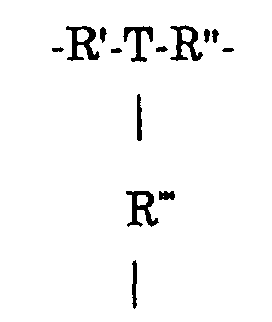 where
where
- p is an average value and is selected to be in the range of 2-10;
- R at each occurrence is independently selected from the group consisting of methyl, ethyl, propyl, isopropyl and phenyl wherein the phenyl may optionally be substituted by 1-3 of a member of the group consisting of methyl and ethyl;
- Q' is selected from the group consisting of (a) a straight or branched alkyl chain
having 1-40 carbons, optionally substituted by at least one of methyl, ethyl,
propyl, isopropyl, hydroxy, carboxyl and phenyl groups wherein the phenyl may
optionally be substituted by 1-3 of a member of the group consisting of methyl
and ethyl, wherein the alkyl chain may optionally contain at least one an alkenyl
bond and (b) an alkyl chain containing at least one cyclic or phenyl group
wherein said chain has 7-40 carbons, particularly 7-20 carbons, and may optionally be substituted by at least one of methyl, ethyl, propyl, isopropyl, hydroxy, carboxyl and phenyl groups wherein the phenyl may optionally be substituted by 1-3 of a member of the group consisting of methyl and ethyl, wherein the alkyl chain may optionally contain at least one alkenyl bond: X'= NH2. -
- By siloxane groups we mean groups having siloxane units: (for example,where R30 and R31 are each independently selected from the group consisting of organic moieties, and each of R30 and R31 are connected to the silicon by a carbon-silicon bond.

- The carbon numbers in the alkylene chain do not include the carbons in the extra segments or substitutions. Also, the polyamides must have a siloxane portion in the backbone and optionally may have a siloxane portion in a pendant or branched portion.
- If repeated with no variations in the defined variables, Formula A is representative of a linear homopolymer. Acceptable variations of the invention include: (1) polyamides in which multiple values of DP, X, Y, and R1 - R4 occur in one polymeric molecule, wherein the sequencing of these units may be alternating, random or block; (2) polyamides in which an organic triamine or higher amine such as tris(2-aminoethyl)amine replaces the organic diamine in part, to produce a branched or crosslinked molecule; and (3) physical blends of any of (1) and (2) and/or linear homopolymers.
- Particular examples of compounds of Formula A include the following:
- 1) Polyamides of Formula I:
where the values for X, Y, n, R1 - R4, and DP are as defined for Formula A. A particular subgroup of Formula I are compounds where each of R1, R2, R3 and R4 are each methyl. Preferred polyamides of Formula I are:
 where DP is selected from 15-500, particularly 15-45, and even more particularly is 29.
Another particular group contains polyamides of Formula I where the values of X, Y, DP and R1 - R4 remain the same in each unit of the polymer. - 2) Polyamides containing multiple siloxane block lengths as shown in Formula II:
where X, Y, n, and R1 - R4 have the meanings described above for Formula A; m is selected from the same groups as defined for n, and n and m denote the total number of units enclosed within the brackets, with the individual units arranged with regular, alternating, block or random sequencing; R5 - R8 is selected from the same group as defined for R1 - R4; DP1 and DP2 may be the same or different and are each independently selected from the same group as defined for DP; and the units denominated by n and m may be structured to form either block (regularly sequenced) or random copolymers. A particular subgroup for compounds of Formula II has all of the R groups selected to be methyl. Another particular subgroup of compounds of Formula II has DP1 = DP2. A third particular subgroup has all of the R groups selected to be methyl and DP1 = DP2.
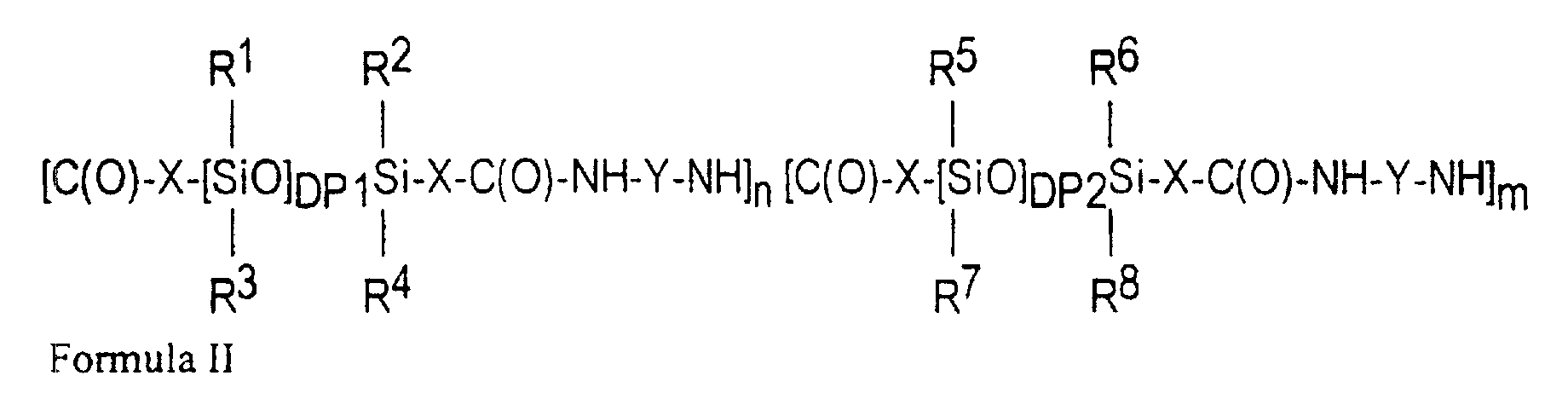
- 3) Polyamides synthesized from multiple diamines as shown in Formula III:
where X, Y, m, n, and R1 - R8, DP1, DP2 have the same meanings as described above for Formula A and Formula II; Y1 is independently selected from the same group as defined for Y; and the units denominated by n and m may be structured to form either block (regularly sequenced) or random copolymers. A particular subgroup of compounds of Formula III has DP1 = DP2. Another particular subgroup of compounds of Formula III has all of the R groups selected to be methyl. A third particular subgroup has all of the R groups selected to be methyl and DP1 = DP2.
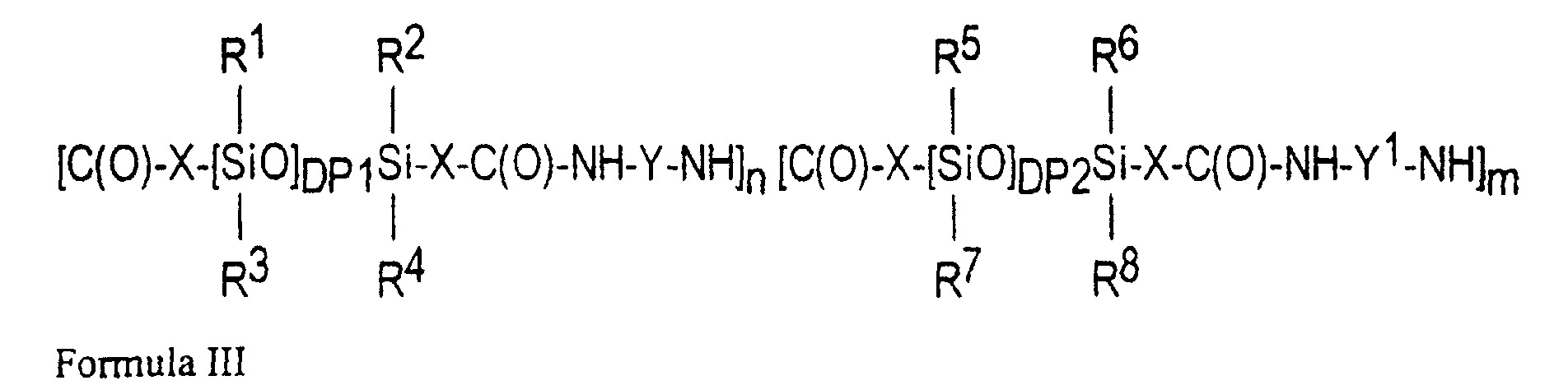
- 4) Polyamides synthesized with trifunctional amine as shown in Formula IV:
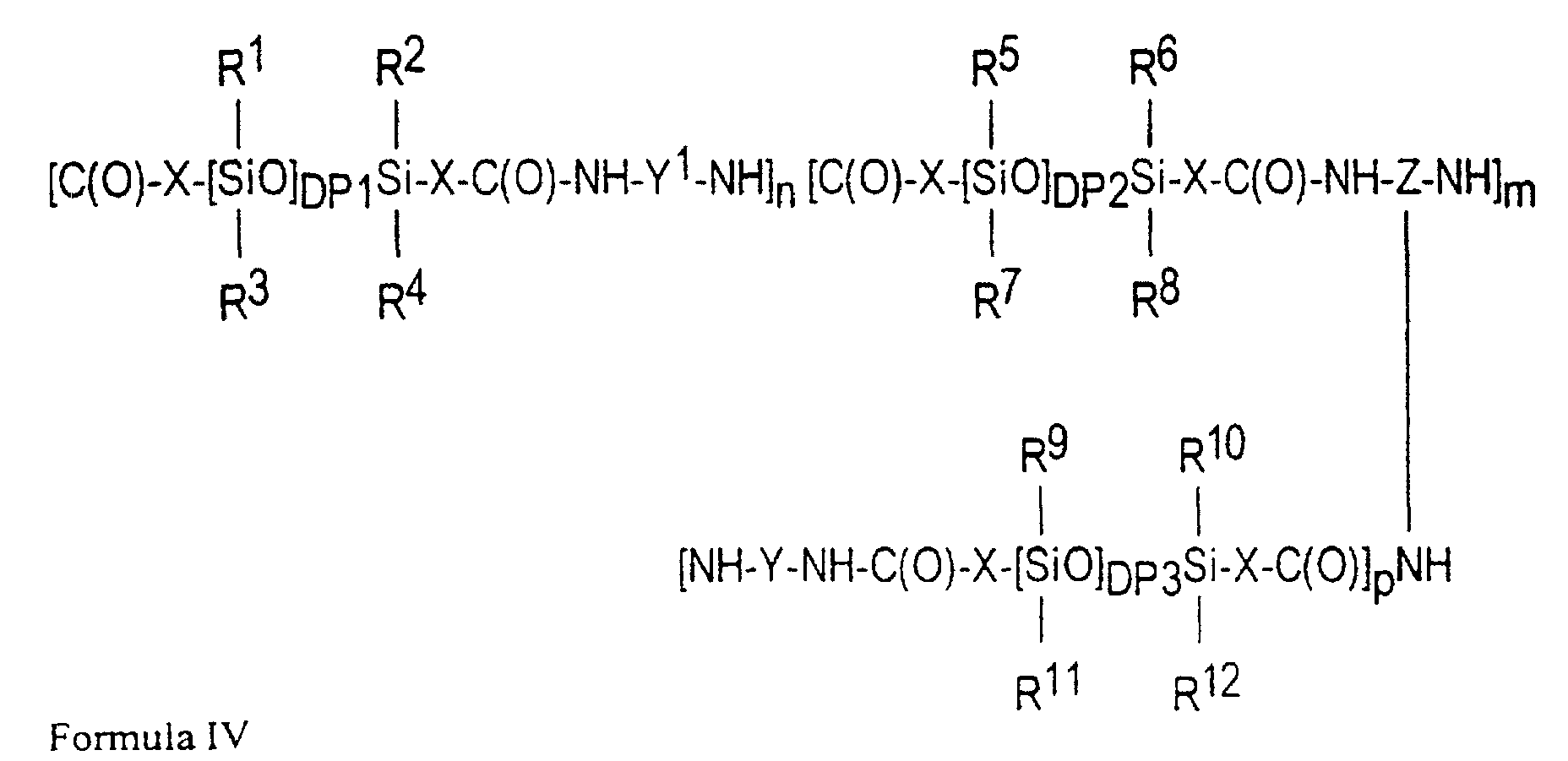 where X, Y, Y1, R1 - R8, m, n, DP 1-DP2, have the same values as defined above;
 -
- A particular group of compounds of Formula IV arewhere X = -(CH2)10-, Y = -(CH2)- ; DP= 15-45; m = 5-20% of m+n+p; and Z = (- CH2CH2)3N.
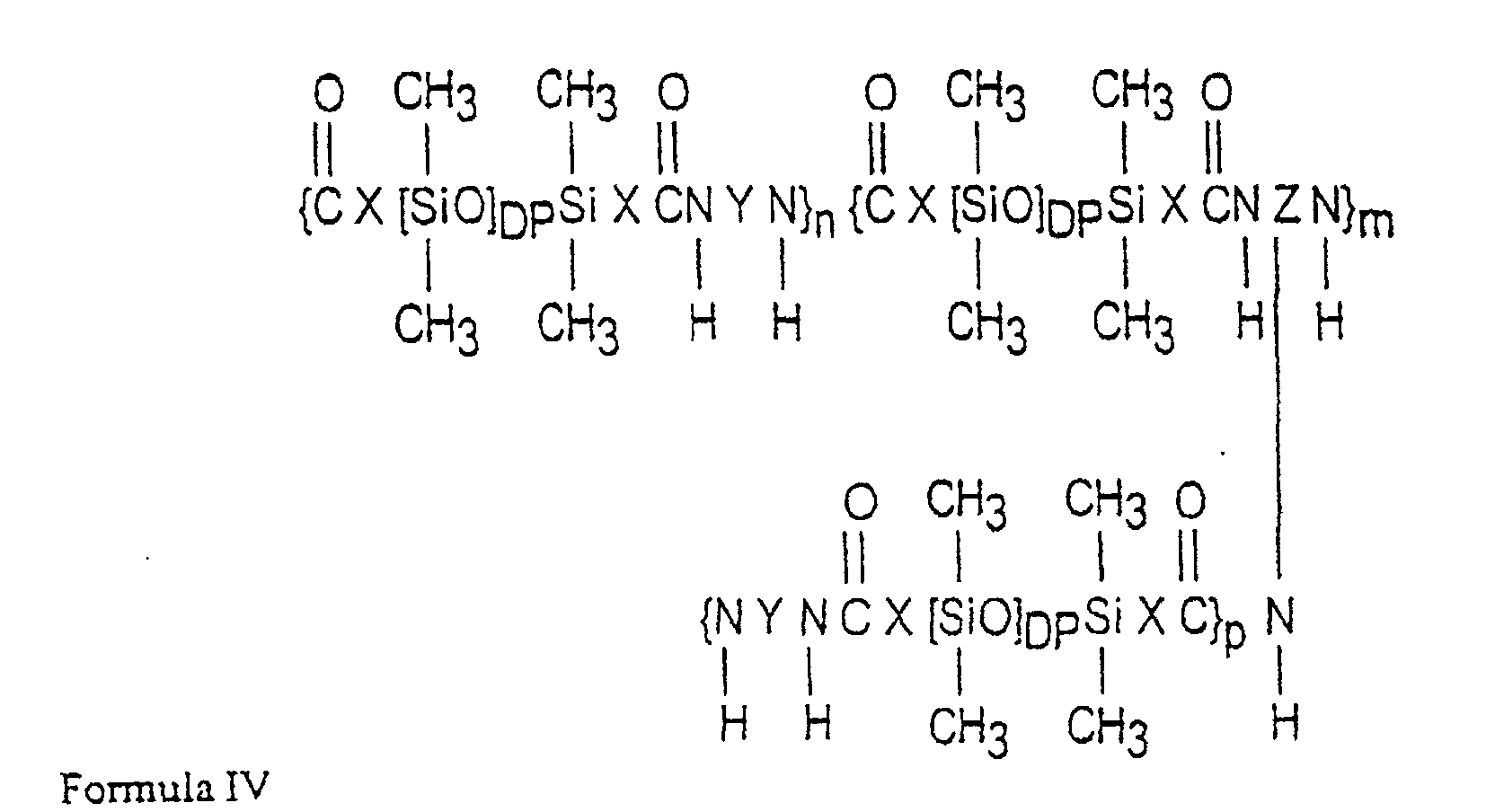
- In general, the siloxane-based polyamides (1) contain both siloxane groups and amide groups to thicken compositions containing silicone fluids (volatile and/or non-volatile silicone fluids); (2) are non-flowable solids at room temperature; and (3) dissolve in a fluid which contains silicone at a temperature of 25 - 160 °C to form a translucent or clear solution at a temperature in this range.
- With regard to the siloxane units in the siloxane-based polyamides, the siloxane units must be in the main or backbone chain but can also optionally be present in branched or pendent chains. In the main chain the siloxane units occur in segments as described above. In the branched or pendent chains the siloxane units can occur individually or in segments.
- Particular groups of siloxane-based polyamides include:
- (a) polyamides of Formula I where DP is 15-50;
- (b) physical blends of two or more polyamides wherein at least one polyamide has a value for DP in the range of 15-50 and at least one polyamide has a value for DP in the range of 30-500;
- (c) compounds of Formula II where (1) the value for DP1 = 15-50 and the value for DP2 = 30-500 and (2) the portion of the polyamide having DP1 is about 1-99 weight % based on the weight of the total polyamide content and the portion of the polyamide having DP2 is about 1-99 weight %;
- (d) physical blends of polyamides of Formula I made by combining (1) 80-99 weight % of a polyamide where n = 2-10 and especially where n = 3-6, and (2) 1-20 weight % of a polyamide where n = 5-500, especially where n = 6-100;
- (e) polyamides of Formula III where at least one of Y and Y1 contains at least one hydroxyl substitution;
- (f) polyamides of Formula A synthesized with at least a portion of an activated di-acid (diacid chloride, dianhydride or diester) instead of the diacid;
- (g) polyamides of Formula A where X = -(CH2)3-;
- (h) polyamides of Formula A where X = -(CH2)10 -;
- (i) polyamides of Formula A where the polyamides are made with a monofunctional chain stopper selected from the group consisting of monofunctional amines, monofunctional acids, monofunctional alcohols, including fatty acids, fatty alcohols and fatty amines, such as, for example: octylamine, octanol, stearic acid and stearyl alcohol.
-
- In general, the polyamides of Formula A can be produced through a condensation reaction in which a diacid is reacted with a diamine and water is removed. In this case the diacid contains siloxane groups. For example, carboxydecyl-terminated polydimethylsiloxane may be used as the diacid. Note that other organic diacids, diamines and monofunctional agents can be used in conjunction with the diacid and diamine to give modified properties. Also diacid chlorides, dianhydrides and diesters can be used instead of the diacids. One method includes using approximately equal molar amounts of the diamine and diacid.
- A preferred reaction scheme for making polyamides of Formula I involves the condensation of a siloxane diacid with an organic diamine as follows:
- (1) A dimethyl hydride endblocked polydimethylsiloxane is prepared containing the appropriate number of siloxane units to achieve the desired value of DP.
- (2) The carboxylic acid group of undecylenic acid is protected through reaction with hexamethyldisilazane.
- (3) The dimethyl hydride endblocked polydimethylsiloxane and the protected undecylenic acid (the products of Steps (1) and (2)) are reacted to produce a siloxane diacid (carboxydecyl terminated polydimethylsiloxane). This reaction is accomplished in the presence of a platinum catalyst such as chloroplatinic acid, and the product is washed with methanol to remove the trimethylsilyl protecting group.
- (4) The siloxane diacid (product of Step (3)) is reacted with an organic diamine to produce a siloxane-based polyamide. This reaction may involve the use of reaction solvent such as toluene or xylene.
-
- Optimal polymers are formed from the reaction of a siloxane diacid with a DP= 1-500, especially 15-45, and an organic polyfunctional amine. Polymers having molecular weights in the range of 3,000 - 200,000 may be produced, especially those in the range of 5,000-50,000. Optimizing the length of the siloxane portions of the molecule (the "DP") involves a balancing of various considerations. Polyamides with long siloxane chains ( for example, DP > 50) tend to produce soft gels in cyclomethicone. The efficiency of the gellant is improved by reducing the length of the siloxane units (that is, selecting and making a molecule with a DP < 50), but the compatibility with cyclomethicone may be compromised as the DP decreases. For example, a polyamide synthesized from a siloxane diacid with a DP=15 and hexamethylene diamine does not produce clears gels in cylcomethicone. However, transparent gels can be obtained if an organic emollient such as PPG-3 myristyl ether or isocetyl alcohol is blended at various levels with the silicone fluids. As a result, polymers with DP=30 are preferred, so that the formulation for the resulting cosmetic composition has a combination of compatibility with silicone fluids and good gelling efficiency.
- Preferred organic amines include (I) linear alkyl diamines such as hexamethylene diamine and ethylene diamine and mixtures thereof; (2) phenylene diamine; and (3) other amines such as piperizine, decamethylene, xylene diamine, and polyethylene glycol diamine.
- Acceptable variations of this process may be used by:
- (a) Varying the length of the individual siloxane portion (the DP of the siloxane diacid), noting that higher DP values lead to better polymer compatibility with silicone fluids, but lowered gelation efficiency and, hence, softer gels;
- (b) Optimizing the reaction conditions to promote a selected range of molecular weights, for example, higher molecular weights. It is believed that higher molecular weight polymers provide gels with better mechanical properties; such higher molecular weight distributions could be obtained through minimizing reagent impurities, optimizing reaction times and temperatures, etc. Examples of removing impurities include removing monofunctional impurities such as those in the carboxy silicones.
- (c) Varying the diamine used to alter the rigidity of gels produced. Substituted diamines such as trimethyl hexylene diamine produce polymers with lower gelation efficiency than polymers based on analogous unsubstituted diamines (such as hexamethylene diamine). It is believed that diamines with steric hindrance act to interrupt the intermolecular associations of the polymer and, thus, result in softer gels.
- (d) Selecting a solvent other than toluene or xylene to be used as a reaction solvent. The solvent should be chosen based on its boiling point, its ability to form azeotropes with water, and its safety profile. Optimal solvents will facilitate elimination of water from the reaction vessel to favor higher molecular weight products. Alternatively, cyclomethicone can be used as a reaction solvent so that a gel system is created directly in situ.
- (e) Replacing the siloxane diacid (also called silicone diacid) reagent with an analogous activated species such as an ethyl diester, di-acid chloride or di-anhydride, to improve efficiency.
- (f) Replacing the organic diamine in part with an organic triamine or a higher amine to produce a branched or crosslinked polyamide.
-
- A particular example of this general reaction scheme is the use of undecylenic acid (10-undecanoic acid, CAS # 112-38-9) and di(trimethylsilyl)amine as the protecting group on the undecylenic acid.
- A more particular description of the overall process is as follows. The first step involves the preparation of a dimethylhydride endblocked polydimethyl siloxane polymer using acid catalysis. Dihydrido tetramethyldisiloxane, dimethylcyclosiloxanes and trifluoromethane sulfonic acid are mixed together and heated to 80 °C to allow for an equilibration reaction which forms the dimethylhydrogen endblocked polydimethyl siloxane polymer and dimethylcyclosiloxanes. After 4 hours of polymerizing at 80 °C, the siloxane is neutralized using calcium carbonate or sodium bicarbonate at 80°C for a minimum of 2 hours. Once neutralized the polymer is filtered and isolated (Product A).
- The carboxylic acid group of undecylenic acid is protected by a trimethylsilyl group which is obtained by reacting undecylenic acid with hexamethyldisilazane. Undecylenic acid and toluene are added to a flask and the hexamethyldisilazane is added to an addition funnel and added dropwise while the materials are mixing. Upon complete addition of the hexamethyldisilazane, the temperature of the reaction vessel is increased to 110 °C and the mixture is allowed to react for four hours. The flask is then heated to 150 °C under a vacuum in the range of 665 - 2660 N/m2 (5 - 20 mm of mercury) and the toluene is removed. After complete removal of the toluene, a distillation column is used to purify the protected undecylenic acid. The distillation is performed at approximately 150 °C and 1330 N/m2 (10 mm Hg). The overhead product is isolated (Product B).
- Product A is reacted with Product B via a hydrosilylation reaction using any suitable platinum or rhodium catalyst. Product A is placed in a flask with the platinum catalyst, the materials are mixed and heated to 80 °C. With regard to an example of a suitable catalyst, a sufficient amount of a neutralized complex of platinous chloride and divinyl tetramethyl disiloxane (for example as described in U.S. Patent 5,175,325) may be used at a concentration to provide 5-15 parts per million (ppm) Pt metal per total composition. Product B is placed in an addition funnel and added dropwise to product A at a controlled rate to control the exotherm which results. An exotherm occurs so it is important to monitor the addition of Product B. After the addition of Product B is completed, the mixture is allowed to react at temperature for an additional hour. The mixture is then heated to 150 °C under vacuum (for example, in the range of 665 - 2660 N/m2 (5-20 mm of mercury)) to remove dimethylcyclosiloxanes and any unreacted undecylenic acid. The mixture is then cooled to below 60 °C and methanol is added to deprotect the undecylenic acid. This reaction forms the carboxylic acid endblocked siloxane and trimethylmethoxy silane. The materials are allowed to react for at least one hour at 60 °C and then the flask is heated to 150 °C under vacuum (for example, in the range of 665 - 2660 N/m2 (5-20 mm of mercury)) to remove residual methanol and trimethylmethoxy silane. The dicarboxylic acid functional siloxane is then isolated (Product C).
- Product C is reacted with hexamethylenediamine in an amidization reaction. Product C and toluene are placed in a flask and allowed to mix at room temperature. Hexamethylenediamine is added to Product C and the temperature of the flask is increased to 150 °C. The flask is equipped with a Dean Stark trap and a nitrogen purge to assist in the water removal to form the amide linkage. Once at 150°C, the reaction is allowed to proceed for 3-4 hours; toluene and water are removed from the Dean Stark trap periodically. After complete reaction the product is removed from the reaction vessel while still moltlen. Upon cooling the silicone polyamide forms a clear rigid thermoplastic (Product D).
- Compounds of Formula I may be made by using a siloxane diacid (or acid derivative) with a single average DP value.
- Compounds of Formula II may be made by using two or more dimethylhydrogen endblocked siloxanes which are prepared, then mixed and converted to carboxylate, and then converted to a polyamide having a random sequence. Optionally, the two (or more) dimethylhydrogen endblocked siloxanes may be added sequentially to form a block copolymer.
- Compounds of Formula III may be made as described above in the particular process description, but the diamines are mixed and then added to the siloxane diacid (or acid derivative) to form the polyamide. Optionally they may be added sequentially to form different blocks.
- Compounds of Formula IV may be made as described above in the particular process description, but the polyamine is mixed with the diamine then added to the diacid (or acid derivative as described above).
- It has been found that optimal gelation occurs with polyamide gellants of molecular weight (number average) greater than 4,000 daltons as determined by gel permeation chromatography (GPC) using polydimethylsiloxane as a standard. Polymers of extremely high molecular weight (for example, greater than 200.000 daltons) tend to produce rubbery, elastic gels and are less desirable and the optimal range of molecular weights for the primary gellant should be from 4,000 - 50,000 daltons, especially 5,000 - 50,000 daltons. It is believed, however, that incorporation of low levels of such high molecular weight species, for example, 0.5 weight % of a high molecular weight polyamide having a molecular weight in the range of 20,000-200,000 may give the base composition and cosmetic compositions made therefrom improved mechanical properties.
- Optionally the polyamide gelling agent can also be endcapped. The endcapping may be effected with the use of an agent selected from the group consisting of C1-C20 aliphatic monohydric alcohols, C1-C20 aliphatic primary amines, phenyl primary amines optionally substituted by 1-3 members selected from C1-C6 aliphatics, C1-C20 aliphatic acids and C1 - C20 aliphatic acid chlorides.
- As noted above, the siloxane-based polyamides used as thickening agents in base and cosmetic compositions of the present invention contain both siloxane units and amide linkages. The siloxane units provide compatibility with the silicone fluid (for example with the cyclomethicones), while the amide linkages and the spacing and selection of the locations of the amide linkages facilitate gelation and the formation of cosmetic products. While opaque as well as clear compositions may be formed, it is preferred that the cosmetic compositions formed be clear and leave no residue upon cooling a solution of the siloxane polymer in the silicone fluid.
- The base composition formed from the polyamides of this invention and the silicone fluids (including volatile and non-volatile silicone fluids) (optionally with the addition of other solvents and/or other cosmetic additives) can be made by techniques of mixing and heating known to those skilled in the art for making such forms as gels, soft solids and sticks as well as making cosmetic products which contain various active ingredients.
- The base compositions according to the present invention include (1) at least one silicone fluid; (2) a siloxane-based polyamide gelling agent containing a siloxane portion in the backbone which is a polymer that is soluble in the silicone fluid and that can form a gel from a solution in the silicone fluid; and (3) optionally at least one additional solvent (for example, that is miscible in the silicone fluid chosen).
- By silicone fluid is meant those materials conventionally utilized in cosmetic compositions. Suitable silicone fluids may be volatile, non-volatile or a mixture of both. These include linear siloxanes known as dimethicones, linear siloxanes containing an aromatic substitution such as phenyl trimethicone and the various cyclic siloxanes having from 4-6 siloxane units in a ring optionally substituted by C1-C6 alkyl or phenyl, particularly cyclic dimethyl siloxanes such as cyclomethicones. Mixtures of such silicone fluids may also be used. Suitable volatile silicone liquids are described in US-A-5,102,656. Examples of other known silicone fluids for use in cosmetic compositions are disclosed in US-A- 4,853,214 and are suitable for use in this invention. Other particular examples include linear volatile silicone fluids, for example, silicone liquids conventionally used in cosmetic compositions.
- By soluble in the silicone fluid, we mean that the polymer can be dissolved in the silicone fluid at least at elevated temperatures but below the boiling point of the silicone fluid.
- The base composition is then combined with at least one active ingredient (which itself may need a further vehicle to be incorporated into the base composition) and other optional ingredients such as fragrance, emollients (especially silicone-miscible emollients), coloring agents, fillers, antibacterials (antimicrobials) and other conventional ingredients known to those in the art for formulating such products to form cosmetic compositions.
- The cosmetic compositions according to the present invention include at least one silicone fluid and the siloxane-containing polymer as well as at least one cosmetically active material, incorporated in the composition in an amount sufficient to have a functional effect. Such actives include, but are not limited to fragrances, sunscreens, antiperspirants, deodorants and antibacterials (antimicrobials). For example, where the composition is a composition to protect skin from the sun, a sufficient amount of a sun-screening agent is provided in the composition such that when the composition is applied to the skin, the skin is protected from the harmful effects of the sun (for example, is protected from ultraviolet rays from the sun).
- The compositions of the present invention can also be utilized to form clear antiperspirant compositions having multiphase systems. such multiphase systems having a polar (for example, water) phase (including an antiperspirant active material) and an oil phase (including the silicone fluids and siloxane polymer). In order to provide a clear multiphase system, refractive indices of the oil and polar phases desirably should be matched, as done conventionally in the art.
- Base and cosmetic compositions according to the present invention can easily be manufactured by methods known to those skilled in the art such as by using known mixing procedures. Base compositions according to the present invention can be made by mixing the various components at an elevated temperature (that is, by heating and mixing the various components) and then cooling in order to form the gelled (solidified) composition, for example, as a gel or stick. For cosmetic compositions, the additional ingredients are added using techniques and at times in the manufacturing process as are known to those in the art. Desirably, any volatile components (such as fragrances) are added to the mixture at a relatively late stage of the mixing, so as to limit volatilization of the volatile components.
- Generally, the solvent and thickening agent (for example, the polyamide gelling agent) are mixed and heated so as to fully dissolve the thickening agent in the solvent. An active ingredient (for example, antiperspirant active material, for example, in dry form or as part of a solution) can be added after the thickening agent fully dissolves, and mixing then takes place. Mixing continues with cooling, with, for example, colorant and fragrance then being added. Thereafter, the resulting composition, still liquid, is poured into canisters, for example, dispensing packages, and solidified, as with conventional stick and gel compositions.
- An illustrative and non-limiting example of the present invention is as follows. The silicone-based polyamide polymer can be dissolved in the silicone fluid, for example, at elevated temperatures (for example, up to 160 °C) so as to form a solution, with cooling then being performed to form the gel. It is preferred that the solution is not heated too long or at too high a temperature, since such disadvantageously may cause the gel to be colored (rather than colorless). The cosmetic active can be added to the solution of silicone fluid and polymer gelling agent and mixed therewith so as to be homogeneously distributed in the product.
- For example, the silicone fluids and siloxane-containing polymers can be mixed at elevated temperatures so as to dissolve the polymer in the silicone fluids. with cosmetically active ingredients being added to the mixture of silicone fluids and polymer. Upon cooling the mixture, the polymer forms a gel from the mixture, achieving the desired product. In the case where an aqueous phase is included, an emulsion is the result. The base compositions of the present invention are thermally reversible gels: that is, they form gels upon being cooled and are liquified when heated.
- Where the product is a stick product, the molten product, at elevated temperatures, can be poured into dispensing containers and allowed to cool and harden therein. Where the product is a soft solid or cream, the product can be packaged into conventional dispensing containers having a porous top surface, as conventionally done in the art.
- When a cosmetic composition according to the present invention is in the form of a stick product, the composition can be applied by elevating the stick out of the package so as to expose the end of the stick, and then rubbing the end of the stick on the skin in order to deposit stick material (including the cosmetically active material such as the antiperspirant active) on the skin. When the composition according to the present invention is in the form of a gel composition, packaged in a dispensing container having a top surface with pores, the gel is extruded from the dispensing container through the pores and applied to the skin by rubbing the gel material that has been extruded through the top surface of the container on the skin. Thus, in the case of an antiperspirant, the active material on the skin is available to reduce body malodor and/or reduce the flow of perspiration from, for example, the axillary regions of the body.
- Polyamides of this invention can be used as a thickening agent in compositions containing silicone fluids to form creams (for example, semi-solid or soft solid), gels and sticks; thus, both soft (and mushy) or firm (and hard) compositions can be formed. The firmness of the product will depend on the amount of the gelling agent(s) used.
- Products of varying clarity and transparency can be formed. Clear cosmetic compositions can be formed if all the components of the particular cosmetic composition are soluble in each other, resulting in a single phase product. Clear cosmetic compositions can also be prepared from multiple phase compositions, for example, an emulsion or suspension, if each phase individually is clear and the refractive index of each phase is matched. Additionally, clear cosmetic compositions can be made from multiple phase compositions if the droplet (particle) size of the internal phase(s) are small enough, less than 0.5 micron. Examples of this are microemulsions and very fine particles in suspension. If the aforementioned conditions are not met, the cosmetic compositions will exhibit various degrees of transparency and opacity.
- Additives may be added to the base composition to add active ingredients, improve mechanical properties, improve aesthetic properties, make a clear product, make a product with color, etc. Thus, cosmetic compositions may then be made by combining the base composition with one or more additional components, active ingredients, one or more vehicles to allow the active ingredient to combine more easily (or with more desirable properties) with the base composition, and other ingredients used by those in the art to formulate cosmetically acceptable products including fragrances, emollients, antibacterials hardeners, strengtheners, chelating agents, colorants, emulsifiers and other additives such as, silicas, silica-based resins, corn starch, alumina, fumed silica, calcium carbonate, clay, talc, high molecular weight polymers (for example silicone gums, elastomers, polymethylmethacrylate, polyethylene, polypropylene and polytetrafluoroethylene).
- In the case of antiperspirant emulsion or suspension formulations, there is an external gelled oil phase and an internal phase which contains the antiperspirant active. The external gelled oil phase contains silicone fluids and the siloxane-based polyamide gellant, as well as optional additives for the antiperspirant product such as emollients, surfactants, fragrances, etc.
- In the suspension approach the internal, antiperspirant active phase consists of solid particles. These particles may be antiperspirant salt powders (such as aluminum chlorohydrate or aluminum zirconium tetrachlorohydrex glycine) and may contain water levels of 0-75 weight%. At the higher water levels (for example, > 50% water) some gelation promoter (such as ammonium acetate) may be required to provide rigidity to these aqueous droplets.
- In the emulsion approach the internal phase consists of a liquid solution containing dissolved antiperspirant salt, and typically involves solvents such as water, propylene glycol, dipropylene glycol, tripropylene glycol, ethanol, etc.
- Microemulsions can also be used to achieve clear products.
- In one particular aspect of the invention, deodorant and/or antiperspirant compositions, in the form of creams (including soft solids and semi-solids), gels and also sticks, which have high efficacy, an attractive appearance (for example, which can be clear or at least translucent), and preferably which are made to leave substantially no visible (white) residue either upon application or upon drying, can be achieved.
- In the base composition, the polyamide gelling agent can be used in an amount of 0.5-80 percent by weight, more particularly 1-30 percent by weight and most particularly 2-20 percent by weight. It is preferred that the gellant not exceed 50 percent by weight of the base composition. The silicone fluid portion is in the range of 5-95 percent by weight, more particularly 10-80 percent by weight, even more particularly 20-80 percent by weight. Optionally, additional solvents, mixtures of solvents or cosmetic additives may be added to the base composition. Suitable additional solvents are those which are either themselves or in mixtures with other solvents miscible in the originally selected silicone fluid (for example, C14-C20 fatty alcohols, isopropyl myristate, and PPG-3 myristyl ether).
- Thus, for gels an addition level of 0.5-8 weight %, preferably 2-6 %, based on the total weight of the cosmetic composition may be used.
- For sticks, higher levels of the silicone-based polyamide will be used such as in the range of 5-30, particularly 6-20 and, more particularly, 10-15 weight percent based on the total weight of the composition.
- The siloxane-based polyamide gelling agent, can consist of one or more polyamides as described above (or a mixture of these polymers) as the sole gelling agent, or can contain the polyamide admixed with other thickening agents (including conventional gelling agents). The siloxane units provide compatibility with the silicone fluids. The amide portions are utilized reversibly for cross-linking purposes so as to form the gel.
- Compositions according to the present invention are thermoreversible gels; that is, the gels are formed by cooling a solution of the polymer in the silicone fluids, but the gel can be broken (formed back into a liquid) by heating the gel.
- The gels of the present invention include silicone fluids. These fluids can be volatile or non-volatile and include, illustratively (and not of a limiting nature), phenyl trimethicone, cyclomethicones and/or dimethicones. Preferably, the silicone fluid includes cyclomethicones. The cyclomethicone used (that is, ring size of the cyclomethicone) has an effect on the hardness of the gels formed. That is, cyclomethicone having five siloxane units produces a softer gel than that produced utilizing a material with 6 siloxane units. As the ring size of the cyclomethicone increases, the rigidity of the gel system formed increases. As described above, particular examples of suitable cyclomethicones include those having rings of 4-6 siloxane units.
- The base composition is then mixed with the other ingredients listed elsewhere so that the final cosmetic composition can be made. Such additional ingredients can be used in amounts of 0.1-85 percent, more particularly 0.1-75 percent and, even more particularly, 0.1-55 percent where the percentages are based by weight on the total composition as 100 percent. The lower percent ranges include formulations where only fragrances or antimicrobials are used, and the upper ranges include formulations containing active antiperspirant ingredients. An antiperspirant active itself (excluding any vehicle for adding the active to the formulation) can be present in the final cosmetic formulation in an amount of from 5-30 percent.
- Cosmetic compositions according to the present invention can also include surface active agents and/or solvents for the cosmetically active material. For example, where the composition is an antiperspirant composition, containing antiperspirant active material, the antiperspirant active material can be included in the composition in a solution in, for example, water, ethanol and/or propylene glycol, which may not be miscible with the silicone fluid, and the composition can also include surface active agents so as to disperse the solution of antiperspirant active material in the composition. Where the composition according to the present invention is a deodorant composition, the composition can include conventional fragrances and/or antibacterial (antimicrobial) agents as deodorant active materials.
- Various cosmetically active materials incorporated in cosmetic compositions are disclosed in US-A- 4,322,400.
- Throughout the present specification, "antiperspirant active" and "deodorant active" materials are discussed. Both types of materials contribute to reduction of body malodor, for example, axillary malodor. By reduction of body malodor, it is meant that, generally, there is less body malodor after application of the composition to a person's skin. as compared to a person's malodor without application of the composition. Such reduction can be due to a masking of the malodor. absorption and/or chemical reaction of the malodorous material, reduction of the levels of the bacteria producing the malodorous materials, for example, from perspiration, reduction of perspiration, etc. The antiperspirant active materials, when utilized in appropriate amounts, primarily act to reduce malodor by reducing perspiration; the antiperspirant active materials can also have a deodorant function, for example, as an antimicrobial or bacteriostatic agent. The deodorant active materials do not substantially reduce perspiration, but reduce malodor in other ways. For example, as fragrances masking the malodor or reducing the malodor intensity; absorbents; antimicrobial (bacteriostatic) agents; or agents chemically reacting with malodorous materials.
- Where the composition contains an antiperspirant active, any of the known antiperspirant active materials can be utilized. These include, by way of example (and not of a limiting nature), aluminum chlorohydrate, aluminum chloride, aluminum sesquichlorohydrate, zirconyl hydroxychloride, aluminum-zirconium glycine complex (for example, aluminum zirconium trichlorohydrex gly, aluminum zirconium pentachlorohydrex gly, aluminum zirconium tetrachlorohydrex gly and aluminum zirconium octochlorohydrex gly), aluminum chlorohydrex PG, aluminum chlorohydrex PEG, aluminum dichlorohydrex PG, and aluminum dichlorohydrex PEG. The aluminum-containing materials can be commonly referred to as antiperspirant active aluminum salts. Generally, the foregoing metal antiperspirant active materials are antiperspirant active metal salts. In the embodiments which are antiperspirant compositions according to the present invention, such compositions need not include aluminum-containing metal salts, and can include other antiperspirant active materials, including other antiperspirant active metal salts. Generally, Category I active antiperspirant ingredients listed in the Food and Drug Administration's Monograph on antiperspirant drugs for over-the-counter human use can be used. In addition, any new drug, not listed in the Monograph, such as aluminum nitratohydrate and its combination with zirconyl hydroxychlorides and nitrates, or aluminum-stannous chlorohydrates. can be incorporated as an antiperspirant active ingredient in antiperspirant compositions according to the present invention.
- Antiperspirant actives can be incorporated into compositions according to the present invention in amounts in the range of 0.1 - 30%, preferably 15 - 25%, by weight, of the total weight of the composition. The amount used will depend on the formulation of the composition. For example, at amounts in the lower end of the broader range (for example, 0.1 - 10%), the antiperspirant active material will not substantially reduce the flow of perspiration, but will reduce malodor, for example, by acting as an antimicrobial material.
- Where deodorant active materials are incorporated in compositions according to the present invention, so as to provide deodorant compositions, conventional deodorant fragrances and/or antimicrobial agents can be incorporated as the deodorant active materials. A fragrance would, illustratively, be incorporated in an amount of 0.5% - 3.0% by weight, of the total weight of the composition. Known bacteriostats include bacteriostatic quaternary ammonium compounds such as 2-amino-2-methyl-1-propanol (AMP), cetyl-trimethylammonium bromide, cetyl pyridinium chloride, 2, 4, 4'-trichloro-2'-hydroxydiphenylether (Triclosan), N-(4-chlorophenyl)-N'-(3,4-dichlorophenyl)urea (Triclocarban) and various zinc salts (for example, zinc ricinoleate). The bacteriostat can, illustratively, be included in the composition in an amount of 0.1-1.0% by weight, of the total weight of the composition. Triclosan, can illustratively be included in an amount of from 0.1% to about 0.5% by weight, of the total weight of the composition.
- Compositions according to the present invention can include other cosmetic additives conventionally incorporated in cosmetic compositions, including (but not limited to) perfumes, cosmetic powders, colorants, emulsifiers, emollients, waxes, organosilicones, fatty esters, fatty alcohols, bees wax, behenoxy dimethicone, stearyl alcohol, etc. and other cosmetic agents. As for various other ingredients which can be incorporated, attention is directed to the optional components such as colorants, perfumes and additives described in the following U.S. Patents: US-A-5,019,375 US-A- 4.937.069 and US-A-5.102.656. The use of optional additives may, of course, adversely affect clarity.
- Where the composition is an antiperspirant composition, the composition can also include a solvent for the antiperspirant active. This solvent, which is not miscible with the silicone fluid, can illustratively be water, ethanol, propylene glycol and/or dipropylene glycol. Where the antiperspirant active is utilized in a solution in the solvent, it may be necessary to match refractive indices of the antiperspirant active solution with that of the oil portion of the composition, in order to achieve a transparent or clear composition. Where the antiperspirant active material is suspended in the base composition as particulate material, it may also be necessary to match refractive indices of the active material and base composition to obtain a clear or transparent composition as described above. Such refractive index matching is a technique known in the art, and is shown in WO 92/05767. The solvent for the antiperspirant active material can be included in the composition in an amount within the range of 0 - 75%, preferably 0 - 25%, by weight, of the total weight of the composition.
- The solvent for the thickening agent is included in the composition in an amount sufficient such that the thickening agent can be dissolved therein and gelled therefrom, and includes a silicone fluid (for example, a silicone oil, such as cyclomethicone and/or dimethicone). Thus, the thickening agent can be dissolved in the solvent and gelled therefrom, for example, upon cooling the composition during manufacture thereof. The solvent is not limited to those materials containing only a silicone fluid, and can contain other solvents for the thickening agent as long as such other solvents are compatible with. for example, the active cosmetic material and do not disadvantageously affect, for example, clarity of the composition, especially where it is desired to provide a clear cosmetic composition. Illustratively, and not to be limiting, the solvents can include esters (for example, isopropyl myristate and C12-15 alkyl lactate), silicone fluids (for example, cyclomethicone, dimethicone), guerbet alcohols having 8-30 carbons, particularly 12-22 carbons (for example, isolauryl alcohol, isocetyl alcohol, isostearyl alcohol), fatty alcohols (for example, stearyl alcohol, myristyl alcohol, oleyl alcohol), ethanol, and ethoxylated and propoxylated alcohols (for example, the polyethylene glycol ether of lauryl alcohol that conforms to the formula CH3(CH2)10CH2(OCH2CH2)b OH where b has an average value of 4 (also called laureth -4). PPG-14 butyl ether, where the "PPG-14" portion is the polymer of propylene oxide that conforms generally to the formula H(OCH2C(CH3)H)cOH, where c has an average value of 14, or PPG-3 myristyl ether which is the polypropylene glycol ether of myristyl alcohol that conforms to the formula CH3(CH2)12CH2(OCH(CH3)CH2)dOH where d has an average value of 3. Mixtures of solvents can also be used. Of course, the gelling agent must be soluble in the solvent system, at least at elevated temperatures, as described in US-A-5,500,209.
- Compositions according to the present invention desirably include silicone-miscible emollients. Illustrative emollients, which are not limiting of the present invention, would include guerbet alcohols (such as isocetyl alcohol or isostearyl alcohol); esters (such as isopropyl palmitate, isopropyl isostearate, octyl stearate, hexyl laurate and isostearyl lactate); a liquid mixture of hydrocarbons which are liquids at ambient temperatures (such as petroleum distillates and light mineral oils); and ethanol. The silicone-miscible solvents (also called emollients) can be included in the compositions of the present invention in amounts within the range of 0 - 70%, preferably 0 - 25%, by weight, of the total weight of the composition.
- Where a multi-phase system is utilized as the composition of the present invention, preferably the composition includes a surfactant or surfactant blend. Surfactants illustratively include alkanolamides (such as N-alkyl pyrrolidone), ethoxylated amides (for example, the polyethylene glycol amide of tallow acid that conforms generally to the formula RC(O)-NH-(CH2CH2O)nH where RCO- represents the fatty acids derived from tallow and n has an average value of 50 (also called PEG-50 tallow amide)); amine oxides (for example, cocamidopropylamine oxide); ethoxylated carboxylic acids (for example, the polyethylene glycol diester of lauric acid that conforms generally to the formula CH3(CH2)10C(O)-(OCH2CH2)nO-C(O)(CH2)10CH3 where n has an average value of 8 (also called PEG-8 dilaurate)); ethoxylated glycerides (for example, a polyethylene glycol derivative of Castor Oil with an average of 4 moles of ethylene oxide (also called PEG-4 castor oil)); glycol esters (for example, propylene glycol ricinoleate); monoglycerides (for example, glycerol myristate); polyglyceryl esters (for example, polyglyceryl-4 oleyl ether); polyhydric alcohol esters and ethers (for example, sucrose distearate): sorbitan/sorbitan esters (for example, sorbitan sesquiisostearate); triesters of phosphoric acid (for example, trioleth-8 phosphate (a material which is predominantly the triester of phosphoric acid and ethoxylated oleyl alcohol with an average of 8 moles of ethylene oxide)); ethoxylated alcohols (for example, laureth-4); ethoxylated lanolin (for example, a polyethylene glycol derivative of Lanolin with an average of 20 moles of ethylene oxide (also called PEG-20 lanolin)); ethoxylated polysiloxanes (for example, dimethicone copolyol); propoxylated polyoxyethylene ethers (for example, the polyoxypropylene, polyoxyethylene ether of cetyl alcohol that conforms generally to the formula CH3(CH2)14CH2(OCH(CH3)CH2)x(OCH2CH2)yOH where x has an average value of 5 and has an average value of 20 (also called PPG-5 ceteth-20)); and alkylpolyglycosides (for example, lauryl glucose). The surfactant (or surfactant blend) includes non-ionic compounds, and can also include blends thereof with cationic (for example, the polyethylene glycol amine of tallow acid that conforms generally to the formula R-NH-(CH2CH2O)nH (also called PEG-15 tallow amine)) or anionic (for example, sodium lauroyl isethionate which is the sodium salt of the lauric acid ester of isethionic acid) surfactants.
- The surfactant or blend thereof incorporated in compositions according to the present invention can, illustratively, be included in amounts of 0 - 15%, preferably 1 - 10%, by weight, of the total weight of the composition.
- As indicated previously, the compositions according to the present invention can be creams (semi-solids or soft-solids), gels or sticks, depending on amounts of thickening agent incorporated in the composition. It is difficult to quantitatively distinguish between a cosmetic "gel" and a cosmetic "stick". Generally, a gel is more viscous than a liquid or than a paste which fails to retain its shape; however, it is not as rigid as a stick. Typically, it is understood that gels are soft, deformable products while sticks are free-standing solids. For example, by rheological analysis, a commercial deodorant stick has been determined to have a plateau storage modulus G'(ω) of roughly 105 Pa and a complex viscosity of 106 Pa second (both at an angular frequency of 0.1 rad-sec). On the other hand, a commercial antiperspirant gel has been determined to have a G'(ω) value of roughly 103 Pa and a complex viscosity of 104 Pa second (at 0.1 rad-sec).
- Cosmetic compositions according to the present invention include both a thickening agent and a solvent for the polyamide gelling agent (in the present application, the polyamide gelling agent and solvent for the gelling agent provide a vehicle for the active cosmetic material, and have been so designated as a vehicle).
- In a series of preferred embodiments base compositions and cosmetic compositions according to the present invention contain a sufficient amount of the thickening agent such that the final cosmetic composition is a solid composition, for example, a gel or stick.
- In the following, illustrative examples of compositions within the scope of the present invention are set forth. These examples are illustrative of the present invention, and are not limiting. Amounts of components in these examples are in weight percent, of the total weight of the composition.
- The cosmetic composition according to the present invention can be packaged in conventional containers, using conventional techniques. For example, where the composition is a stick composition, the composition, while still in liquid form, can be introduced into a dispensing package as conventionally done in the art, and cooled therein so as to thicken in the package. Where a gel or soft-solid cosmetic composition is produced, the composition can be introduced into a dispensing package (for example, a package having a top surface with pores) as conventionally done in the art. Thereafter, the product can be dispensed from the dispensing package i as conventionally done in the art, to deposit the active material, for example, on the skin. This provides good deposition of the active material on the skin.
- Throughout the present specification, where compositions are described as including or comprising specific components or materials, or where methods are described as including or comprising specific steps, it is contemplated by the inventors that the compositions of the present invention also consist essentially of, or consist of, the recited components or materials, and also consist essentially of, or consist of, the recited steps. Accordingly, throughout the present disclosure any described composition of the present invention can consist essentially of, or consist of, the recited components or materials, and any described method of the present invention can consist essentially of, or consist of, the recited steps.
- Throughout the specification and claims all percents are in percents by weight.
- A desired feature of the present invention is that a clear, or transparent, cosmetic composition, (for example, a clear or transparent deodorant or antiperspirant composition) can be provided. The term clear or transparent according to the present invention is intended to connote its usual dictionary definition: thus, a clear, for example, stick or gel antiperspirant composition of the present invention allows ready viewing of objects behind it. By contrast, a translucent composition, although allowing light to pass through, causes the light to be scattered so that it will be impossible to see clearly objects behind the translucent composition. An opaque composition does not allow light to pass therethrough. Within the context of the present invention, a gel or stick is deemed to be transparent or clear if the maximum transmittance of light of any wavelength in the range 400-800 nm through a sample 1 cm thick is at least 35%, preferably at least 50%. The gel or stick is deemed translucent if the maximum transmittance of such light through the sample is between 2% and less than 35%. A gel or stick is deemed opaque if the maximum transmittance of light is less than 2%. The transmittance can be measured by placing a sample of the aforementioned thickness into a light beam of a spectrophotometer whose working range includes the visible spectrum, such as a Bausch & Lomb Spectronic 88 Spectro-photometer®. As to this definition of clear, see EP-A-0 291 334. Thus, according to the present invention, there are differences between transparent (clear), translucent and opaque compositions.
- In a particular embodiment of the invention a polyamide is used to form a solid composition of the present invention which is a clear, or at least a translucent, gel or stick (for example, antiperspirant gel or stick composition).
- In the following, specific synthesis examples for forming siloxane-based polyamides of this invention are set forth, and specific examples of antiperspirant and deodorant compositions within the scope of the present invention are also set forth. These specific synthesis examples and examples are illustrative in connection with the present invention, and are not limiting. In the following, as well as throughout the present disclosure, names utilized are the CTFA (Cosmetics, Toiletry and Fragrance Association, Inc.) names, as set forth in the CTFA International Cosmetic Ingredient Dictionary (4th Ed. 1991). Throughout the description of this invention chemical abbreviations and symbols have their usual and customary meanings. Unless otherwise indicated, the vacuums described in Examples 1-5 are in the range of 665 - 2660 N/m2 (5 - 20 millimeters of mercury). While particular siloxane-based polyamides are disclosed or used in the following Examples, it is to be understood that other siloxane-based polyamides (for example, those made with a purified siloxane diacid, di-anhydride, diesters, or diacid chloride) may also be used.
- A 3000 ml three neck flask equipped with a thermometer, electrical stirrer and a condenser was charged with 1427.2 g of dimethylcyclosiloxanes, 172.8 g of tetramethyldihydrogen disiloxane and 1.3 g of trifluoromethane sulfonic acid. The flask was heated to 80 degrees C and kept at this temperature for 4 hours. After 4 hours, 25 g of sodium bicarbonate were added and the contents of the flask were mixed at 80 °C for another 2 hours. The reaction product (15 DP dimethylhydrogen endblocked polydimethyl siloxane) was filtered using a 0.8 µm (micron) filter paper. To a 2000 ml flask equipped with a thermometer, electrical stirrer condenser and nitrogen purge were added 800 g of the product (15 DP dimethylhydrogen endblocked polydimethyl siloxane) and a sufficient amount of a neutralized complex of platinous chloride and divinyl tetramethyl disiloxane was added to provide a concentration of 5-15 ppm Pt metal per total composition. The mixture was heated to 80 °C while mixing. In an addition funnel were placed 325.0 g of trimethylsilyl protected undecylenic acid; the material was added dropwise to the reactor and an exotherm was observed. After complete addition the temperature was increased to 110 °C and the mixture was allowed to react for an additional hour. The temperature was then raised to 150 °C under a vacuum for approximately 1 hour. The vacuum was removed and the reactor was allowed to cool below 60 °C. Once below 60 °C, 110.0 g of methanol were added to the reactor and the temperature set at 60 °C. After 2 hours the temperature was increased to 150 °C under vacuum to remove residual methanol and trimethylmethoxysilane. To a 500 ml flask equipped with a thermometer, electrical stirrer, condenser, nitrogen purge and a Dean Stark trap were added 100 g of the product (15 DP carboxylic acid endblocked siloxane), 20 g of toluene and 7.19 g of hexamethylenediamine. The reactor temperature was increased to 150 °C for 4 hours. During the reaction water and toluene were periodically removed from the Dean Stark trap. The final silicone polyamide was poured off at approximately 150° C while still in the melt form.
- A 3000 ml three neck flask equipped with a thermometer, electrical stirrer and a condenser was charged with 2000.0 g of dimethylcyclosiloxanes, 129.9 g of tetramethyldihydrogen disiloxane and 1.6 g of trifluoromethane sulfonic acid. The flask was heated to 80 °C and kept at temperature for 4 hours. After 4 hours, 45 g of calcium carbonate were added and mixed at 80 °C for another 2 hours. The reaction product was filtered using a 0.8 µm (micron) filter paper. To a 2000 ml flask equipped with a thermometer, electrical stirrer, condenser and nitrogen purge were added 816 g of the product (30 DP dimethylhydrogen endblocked polydimethyl siloxane) and sufficient of the platinum catalyst as described in Example 1. The mixture was heated to 80 °C while mixing. In an addition funnel were placed 189.0 g of trimethylsilyl protected undecylenic acid: the material was added dropwise to the reactor and an exotherm was observed. After complete addition the temperature was increased to 110 °C and allowed to react for an additional hour. The temperature was then taken to 150 °C under a vacuum for approximately 1 hour. The vacuum was removed and the reactor was allowed to cool below 60 °C. Once below 60 °C, 57.1 g of methanol were added to the reactor and the temperature set at 60 °C. After 2 hours the temperature was increased to 150°C under vacuum to remove residual methanol and trimethylmethoxysilane. To a 500 ml flask equipped with a thermometer, electrical stirrer, condenser, nitrogen purge and a Dean Stark trap were added 250 g of the product (30 DP carboxylic acid endblocked siloxane), 40 g of toluene and 10.9 g of hexamethylenediamine. The reactor temperature was increased to 150 °C for 4 hours. During the reaction water and toluene were periodically removed from the Dean Stark trap. The final silicone polyamide was poured off at approximately 150° C while still in the melt form.
- A 2000 ml three neck flask equipped with a thermometer, electrical stirrer and a condenser was charged with 1394.4 g of dimethylcyclosiloxanes, 5.6 g of tetramethyldihydrogen disiloxane and 0.67 g of trifluoromethane sulfonic acid. The flask was heated to 80 °C and kept at temperature for 4 hours. After 4 hours, 35 g of calcium carbonate were added and mixed at 80 °C for another 2 hours. The reaction product was filtered using a 0.8 µm (micron) filter paper. To a 2000 ml flask equipped with a thermometer, electrical stirrer, condenser and nitrogen purge were added 1200 g of the product (500 DP dimethylhydrogen endbiocked polydimethyl siloxane) and sufficient of the platinum catalyst as described in Example 1. The mixture was heated to 80 °C while mixing. In an addition funnel was placed 16.5 g of trimethylsilyl protected undecylenic acid, the material was added dropwise to the reactor, an exotherm was observed. After complete addition the temperature was increased to 110 °C and allowed to react for an additional hour. The temperature was then taken to 150 °C under a vacuum for approximately 1 hour. The vacuum was removed and the reactor was allowed to cool below 60° C. Once below 60 °C, 30.0 g of methanol were added to the reactor and the temperature set at 60 °C. After 2 hours the temperature was increased to 150 °C under vacuum to remove residual methanol and trimethylmethoxysilane. To a 2000 ml flask equipped with a thermometer, electrical stirrer, condenser, nitrogen purge and a Dean Stark trap were added 988.5 g of the product (500 DP carboxylic acid endblocked siloxane), 75 g of toluene and 3.07 g of hexamethylenediamine. The reactor temperature was increased to 150°C for 4 hours. During the reaction water and toluene were periodically removed from the Dean Stark trap. The final silicone polyamide was poured off at approximately 150 °C while still in the melt form.
- A 2000 ml three neck flask equipped with a thermometer, electrical stirrer and a condenser was charged with 1536.0 g of dimethylcyclosiloxanes, 64.0 g of tetramethyldihydrogen disiloxane and 1.3 g of trifluoromethane sulfonic acid. The flask was heated to 80 °C and kept at temperature for 4 hours. After 4 hours, 25 g of sodium bicarbonate were added and mixed at 80 °C for another 2 hours. The reaction product was filtered using a 0.8 µm (micron) filter paper (45 DP dimethylhydrogen endblocked polydimethyl siloxane). A 3000 ml flask equipped with a thermometer, electrical stirrer,, and a condenser was charged with 2000.0 g of dimethylcyclosiloxanes, 129.9 g of tetramethyldihydrogen disiloxane and 1.67 g of trifluoromethane sulfonic acid. The flask was heated to 80°C while mixing and kept at temperature for 4 hours. After 4 hours, 45 g of calcium carbonate were added and mixed at 80 °C for another 2 hours. The reaction product was filtered using a 0.8 µm (micron) filter paper (30 DP dimethylhydrogen endblocked polydimethyl siloxane). To a 2000 ml flask equipped with a thermometer, electrical stirrer, condenser, and nitrogen purge were added 250 g of the product (45 DP dimethylhydrogen endblocked polydimethyl siloxane), 1250 g of product 11 (30 DP dimethylhydrogen endblocked polydimethyl siioxane) and sufficient of the platinum catalyst as described in Example 1. The mixture was heated to 80 °C while mixing. In an addition funnel was placed 334 g of trimethylsilyl protected undecylenic acid; the material was added dropwise to the reactor and an exotherm was observed. After the addition was completed the temperature was increased to 110°C and the contents were allowed to react for an additional hour. The temperature was then taken to 150 °C under vacuum for approximately 1 hour. The vacuum was removed and the reactor was cooled to below 60 °C. Once below 60 °C, 85.0 g of methanol were added to the reactor and the temperature was set to 60 °C. After 2 hours the temperature was increased to 150 °C under vacuum to remove residual methanol and trimethylmethoxysilane. To a 2000 ml flask equipped with a thermometer, electrical stirrer, condenser, nitrogen purge and a Dean Stark trap were added 1485.1 g of the product (45 DP and 30 DP carboxylic acid endblocked siloxane), 100 g of toluene and 63.0 g of hexamethylenediamine.
- The reactor temperature was increased to 150 °C for 4 hours. During the reaction, water and toluene were periodically removed from the Dean Stark trap. The final silicone polyamide was poured off at a temperature of approximately 150°C while still in the melt form.
- A 3000 ml three neck flask equipped with a thermometer, electrical stirrer and a condenser was charged with 2000.0 g of dimethylcyclosiloxanes, 129.9 g of tetramethyldihydrogen disiloxane and 1.6 of trifluoromethane sulfonic acid. The flask was heated to 80 °C and kept at temperature for 4 hours. After 4 hours, 45 g of calcium carbonate wee added and mixed at 80 °C for another 2 hours. The reaction product was filtered using a 0.8 µm (micron) filter paper. To a 2000 ml flask equipped with a thermometer, electrical stirrer, condenser and nitrogen purge were added 816 g of the product (30 DP dimethylhydrogen endblocked polydimethyl siloxane) and sufficient of the platinum catalyst as described in Example 1. The mixture was heated to 80 °C while mixing. In an addition funnel was placed 189.0 g of trimethylsilyl protected undecylenic acid; the material was added dropwise to the reactor and an exotherm was observed. After the addition was completed, the temperature was then taken to 150 °C under a vacuum for approximately 1 hour. The vacuum was then removed and the reactor was allowed to cool to a temperature below 60 °C. Once below 60 °C, 57.1 g of methanol were added to the reactor and the temperature was set at 60 °C. After 2 hours, the temperature was increased to 150 degrees under vacuum to remove residual methanol and trimethylmethoxysilane. To a 500 ml flask equipped with a thermometer, electrical stirrer, condenser, nitrogen purge and a Dean Stark trap were added 150 g of the product (30 DP carboxylic acid endblocked siloxane), 39.1 g of toluene, 5.71 g of hexamethylenediamine and .72 g of tris(2-aminoethyl)amine. The reactor temperature was increased to 150 °C for 4 hours. During the reaction, water and toluene were periodically removed from the Dean Stark trap. The final silicone polyamide was poured off at a temperature of approximately 150 °C while still in the melt form.
- The following formulation examples are illustrative of the invention. As referred to in the Formulation Examples, the siloxane-based polyamide of Example 2 is a material as described above in the systhesis of such material.
- The following materials are combined. The amounts given are in percents by weight based on the total weight of the composition.
siloxane-based polyamide from Example 2 (gellant) 20% cyclomethicone (silicone fluid) 79% fragrance (deodorant active) 1% Total 100% - The following is a generic formula for a clear antiperspirant stick.
Component Range Preferred w/w % w/w % Oil Phase Siloxane-based polyamide gellant 6 - 20 10 - 15 Silicone fluids 10 - 90 20 - 50 Cosmetic additives and/or solvents 0 - 40 5 - 21 Fragrance, color QS QS Polar Phase Water and/or water miscible solvent 10 - 40 15 - 25 Antiperspirant active 5 - 30 15 - 25 Surfactant 0-10 0.5 - 3 Total 100 100 -
- 1) Weigh all the oil phase components except the fragrance into a kettle and mix and heat until clear, cool to 70 - 80° C.
- 2) Weigh all the polar phase components except the surfactant into a separate kettle and mix and heat until clear. When clear, add the surfactant to the salt solution, Continue heating the polar phase to 70 - 80° C.
- 3) Add the hot polar phase to the hot oil phase with moderate agitation to avoid air incorporation.
- 4) Continue mixing and cool to 55 - 65°C and add fragrance.
- 5) Continue cooling to 5 - 10 °C above the gelation point and pour into containers.
-
- The following clear antiperspirant stick of with good aesthetics was prepared following the generalized manufacturing procedure described in Example B.
Component w/w% Oil Phase Siloxane-based polyamide of Example 2 12.00 Trimethylated silica (Dow Corning® 749) 2.50 Behenoxy dimethicone (Abil® Wax 2440) 2.50 Cyclomethicone (Dow Corning® 245) 29.37 Phenyl trimethicone (Dow Corning® 556) 10.00 Isostearyl alcohol (Prisorine® 3515) 0.50 Polar Phase Deionized water 22.13 Al Zr tetrachlorohydrex gly (Rezal® 36 GP) 20.00 Polysorbate 20 1.00 - Examples D and E were made by the method described in Example B using the components described below. The compositions of Examples D and E were tested by an independent trained panel and were found to have significantly better aesthetics (tack and wetness) than a leading commercial clear antiperspirant stick; better aesthetics (tack) than a leading commercial clear deodorant; and similar aesthetics (tack) to a leading commercial suspension antiperspirant stick.
Component Example D Example E %w/w % w/w Oil Phase Cyclomethicone (Dow Corning® 245) 23.35 28.29 Siloxane-based polyamide of Example 2 12.00 15.00 PPG-3 myristyl ether (Witeonol® APM) 16.30 --- Behenoxy dimethicone (Abil ®wax 2440) 2.00 1.50 Isostearyl alcohol (Prisorine® 3515) 0.50 0.50 Phenyl trimethicone (Dow Corning® 556) 5.00 10.00 Trimethylated silica (Dow Corning® 749) --- 1.50 Polar Phase Deionized Water 18.85 21.21 Al Zr tetrachlorohydrex gly (Rezal® 36 GP) 20.00 20.00 Dimethicone copolyol (Dow Corning® 193) 2.00 2.00 - The following compositions of Examples F and G were made by the method described in Example B using the components described below. These compositions were tested for antiperspirancy and showed parity efficacy to a leading commercial suspension antiperspirant stick
Component Example F Example G % w/w % w/w Oil Phase Cyclomethicone (Dow Corning® 245) 23.60 22.42 Siloxane-based polyamide of Example 2 12.00 12.00 PPG-3 myristyl ether (Witconol® APM) 16.30 16.30 Behenoxy dimethicone (Abil ®wax 2440) 2.00 2.00 Isostearyl alcohol (Prisorine® 3515) 0.50 0.50 Phenyl trimethicone (Dow Corning® 556) 5.00 5.00 Polar Phase Deionized Water 19.60 16.78 Al Zr tetrachlorohydrex gly (Rezal® 36 GP) 20.00 20.00 Dimethicone copolyol (Dow Corning® 193) 1.00 5.00 - The following gel examples were made by the following method using the components described in the table below. All percents are by weight based on the total composition of the composition. A silicone fluid such as cyclomethicone and the gellant (siloxane-based polyamide gellant of the invention) are weighed out and placed into a glass beaker with heating and stirring (250 rotations per minute) until all of the gellant is melted. This typically occurs at about 100 °C. The rest of the components of the oil phase is added to the batch after all of the gellant has completely dissolved, and mixing is continued for 10 minutes. The polar phase components are slowly added in aiiquots over a 10 minute period while mixing at 300 rotations per minute. Mixing is continued for 15 minutes at 400 rotations per minute while maintaining a temperature of 85 °C. The batch is then transferred to a heated homogenizer and homogenized for 2 minutes. Fragrance (if used) is then added and the mixing is continued for another minute. The batch is transferred to the packaging while it is still hot and allowed to set. (Note that while specific stirring rates have been described above, low speed stirring of other values may be substituted for 250 rpm; and moderate speed stirring may be substituted for 300-400 rpm rates.) In general, suitable ranges for the components are as follows:
Oil Phase (50-70%) Siloxane-based polyamide 0.5-8.0% preferably 2-6% Silicone Fluid 20-60% preferably 35-45% Cosmetic additive(s) and/or solvents 0-20% preferably 7-15% Surfactant 0-10% preferably 3-7% Fragrance 0-3% preferably 1-2% Polar Phase (50-30%) Water (and/or water miscible solvent) 5-40% preferably 15-25% Antiperspirant Active 10-25% preferably 15-25% Surfactant 0-5% preferably 1-2% -

-

- The method described above for Gel Example 1 was repeated with the following components where the amounts listed are in percent by weight:
Oil Phase Cyclomethicone 41.15% Siloxane-based polyamide of Example 2 2.35% Cyclomethicone/dimethicone copolyol 6.0% Isopropyl myristate 4.5% PPG-3 myristyl ether 4.5% Fragrance 1.0% Octyl methoxy cinnamate 0.5% Polar Phase Aluminum chlorohydrale (50% aqueous solution) 40.0% - A siloxane-based polyamide of Example 2 (20 weight percent of the final composition) is dissolved into cyclomethicone (55 weight percent) by heating the mixture to 95 °C with stirring. When all of the gellant is dissolved, the mixture is cooled to 75 °C. The Al/Zr tetrachlorohydrex gly ( 24 weight percent, Reach® 908) is added with stirring. The mixture is cooled to 70 degrees and fragrance (1 weight percent) is added with stirring. The mixture is poured into suitable containers and allowed to cool.
R9 - R12 are selected from the same group as defined for R1 - R8, DP3 is selected from the same group as defined for DP; and p is selected from the same groups as defined for m and n;
Z = T(R20)(R21)(R22) where each of R20, R21 and R22 are each independently selected from the group consisting of linear and branched C1-C10 alkylene, and T is selected from the group consisting of CR (where R is selected from hydrogen and the same group as defined for R1 - R4), and a trivalent atom selected from N, P and Al.
Preferred values for p are 1-25 with more preferred values being 1-7. Preferred values for R1 - R12 are methyl. A preferred value for T is N. Particular values for each of DP1-DP3 are 15-500 and more particularly are 15-45. A preferred value for each of R20, R21 and R22 is ethylene. A preferred value for Z = (- CH2CH2)3N.
Claims (57)
- A siloxane-based polyamide formed from units of Formula Awhere:
 or Y may be Z where Z=T(R20)(R21)(R22) where each of R20, R21 and R22 are independently selected from the group consisting of linear and branched C1-C10 alkylenes; and T is selected from the group consisting of CR, where R is selected from the group consisting of hydrogen, the group consisting of the group defined for R1-R4; and a trivalent atom selected from N, P, and Al; and wherein each value for X, Y, DP, and R1-R4 may be the same or different for each unit in the polyamide,(1) n is a number selected from the group consisting of 1-500, where n is the number of units in the polyamide;(2) DP is an average value for degree of polymerization of a siloxane portion of the polyamide and is selected from the group consisting of 1-700;(3) X is a linear or branched chain alkylene having 1-30 carbons;(4) each of R1-R4 is independently selected from the group consisting of methyl, ethyl, propyl, isopropyl, a siloxane chain, and phenyl, wherein the phenyl may optionally be substituted by 1-3 members from the group consisting of methyl and ethyl; and(5) Y is selected from the group consisting of linear or branched chain alkylenes having 1-40 carbons, wherein(a) The alkylene group may optionally and additionally contain in the alkylene portion at least one member from the group consisting of(i) 1-3 amide linkages;(ii) C5 and C6 cycloalkane; and(iii) phenylene optionally substituted by 1-3 members selected independently from the group consisting of C1-C3 alkyls, and(b) the alkylene group itself may optionally be substituted by at least one member selected from the group consisting of(i) hydroxy;(ii) C3-C8 cycloalkane(iii) 1-3 members selected independently from the group consisting of C1-C3 alkyls; phenyl optionally substituted by 1-3 members selected independently from te group consisting of C1-C3 alkyls;(iv) C1-C3 alkyl hydroxy; and(v) C1-C6 alkyl amine;
said polyamide not being formed from units of the formula:where p is an average value and is selected to be in the range of 2-10;
R at each occurrence is independently selected from the group consisting of methyl, ethyl, propyl, isopropyl and phenyl wherein the phenyl may optionally be substituted by 1-3 of a member of the group consisting of methyl and ethyl;
Q' is selected from the group consisting of (a) a straight or branched alkyl chain having 1-40 carbons, optionally substituted by at least one of methyl, ethyl, propyl, isopropyl, hydroxy, carboxyl and phenyl groups wherein the phenyl may optionally be substituted by 1-3 of a member of the group consisting of methyl and ethyl, wherein the alkyl chain may optionally contain at least one an alkenyl bond and (b) an alkyl chain containing at least one cyclic or phenyl group wherein said chain has 7-40 carbons, particularly 7-20 carbons, and may optionally be substituted by at least one of methyl, ethyl, propyl, isopropyl, hydroxy, carboxyl and phenyl groups wherein the phenyl may optionally be substituted by 1-3 of a member of the group consisting of methyl and ethyl, wherein the alkyl chain may optionally contain at least one alkenyl bond: X'= NH2. - A polyamide as claimed in Claim 1 wherein each DP in the polyamide is a number in the range of 15-500.
- A polyamide as claimed in Claim 1 wherein each DP in the polyamide is a number in the range of 15-45.
- A polyamide as claimed in Claim 1 wherein the value of n in the polyamide is a number in the range of 1-100.
- A polyamide as claimed in Claim 1 wherein the value of n in the polyamide is a number in the range of wherein 4-25.
- A polyamide as claimed in Claim 1 wherein X has 3-10 carbons.
- A polyamide as claimed in Claim 1 wherein X has 10 carbons.
- A polyamide as claimed in Claim 1 wherein each Y in the polyamide may be the same or different and has 2-6 carbons.
- A polyamide as claimed in Claim 1 wherein each of R1 - R4 is selected from methyl and ethyl.
- A polyamide as claimed in Claim 1 wherein each of R1 - R4 is methyl.
- A polyamide as claimed in Claim 1 wherein the polyamide has a structure of Formula I:wherein the values of X, Y, DP, and R1 - R4 in each unit of the polyamide remain the same.
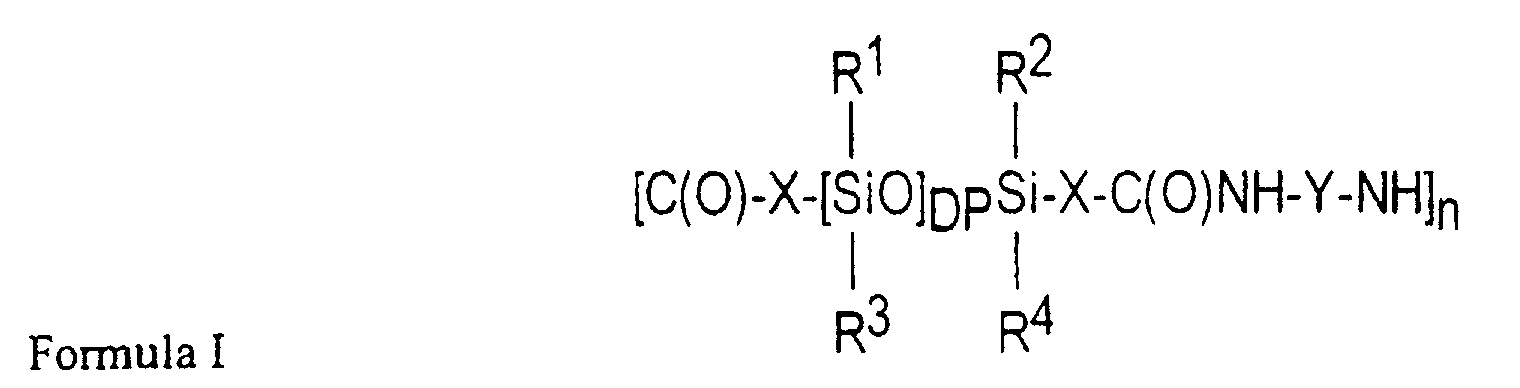
- A polyamide as claimed in Claim 11 wherein each of R1, R2, R3 and R4 is methyl.
- A polyamide as claimed in Claim 12 having the following formula:where DP = 15-500.

- A polyamide as claimed in Claim 13 where DP = 15-45.
- A polyamide as claimed in Claim 1 wherein the polyamide comprises multiple siloxane block lengths as shown in Formula II:where DP1 and DP2 are each independently selected from the group defined for DP; m is selected from the same group as defined for n, and n and m denote the total number of units enclosed within the brackets, with the individual units arranged in a regular, alternating, block or random sequence; and R5 - R8 are each independently selected from the same group defined for R1 - R4.

- A polyamide as claimed in Claim 15 wherein each of R1 - R8 is methyl.
- A polyamide as claimed in Claim 15 wherein DP1 = DP2.
- A polyamide as claimed in Claim 15 wherein each of R1 - R8 is methyl and DP1 = DP2.
- A polyamide as claimed in Claim 1 wherein the polyamide has a structure as shown in Formula III:where Y1 is selected from the same group as defined for Y.

- A polyamide as claimed in Claim 19 wherein each of R1 - R8 is methyl.
- A polyamide as claimed in Claim 19 wherein DP1 = DP2.
- A polyamide as claimed in Claim 20 wherein each of R1 - R8 is methyl and DP1 = DP2.
- A polyamide as claimed in Claim 1 wherein the polyamide has a structure as shown in Formula IV:each of R9-R12 is independently selected from the group defined for R1-R4 ; and Z=T(R20)(R21)(R22) where each of R20, R21 and R22 are independently selected from the group consisting of linear and branched C1-C10 alkylenes; and T is selected from the group consisting of CR, where R is selected from the group consisting of hydrogen, the group defined for R1-R4 and a trivalent atom selected from N, P and Al.

- A polyamide as claimed in Claim 23 wherein each of DP1 - DP3 is independently selected from the range 15-45.
- A polyamide as claimed in Claim 23 wherein m=5-20% of m+n+p.
- A polyamide as claimed in Claim 23 wherein R1-R12 are each methyl.
- A polyamide as claimed in Claim 24 wherein T is N.
- A polyamide as claimed in Claim 23 wherein each of R20, R21 and R22 is ethylene.
- A polyamide as claimed in Claim 23 wherein for Z=(-CH2CH2)3N.
- A polyamide as claimed in Claim 23 having the formula:where X = -(CH2)10-, Y = -(CH2)- ; DP= 15-45; m = 5-20% of m+n+p; and Z = (- CH2CH2)3N.
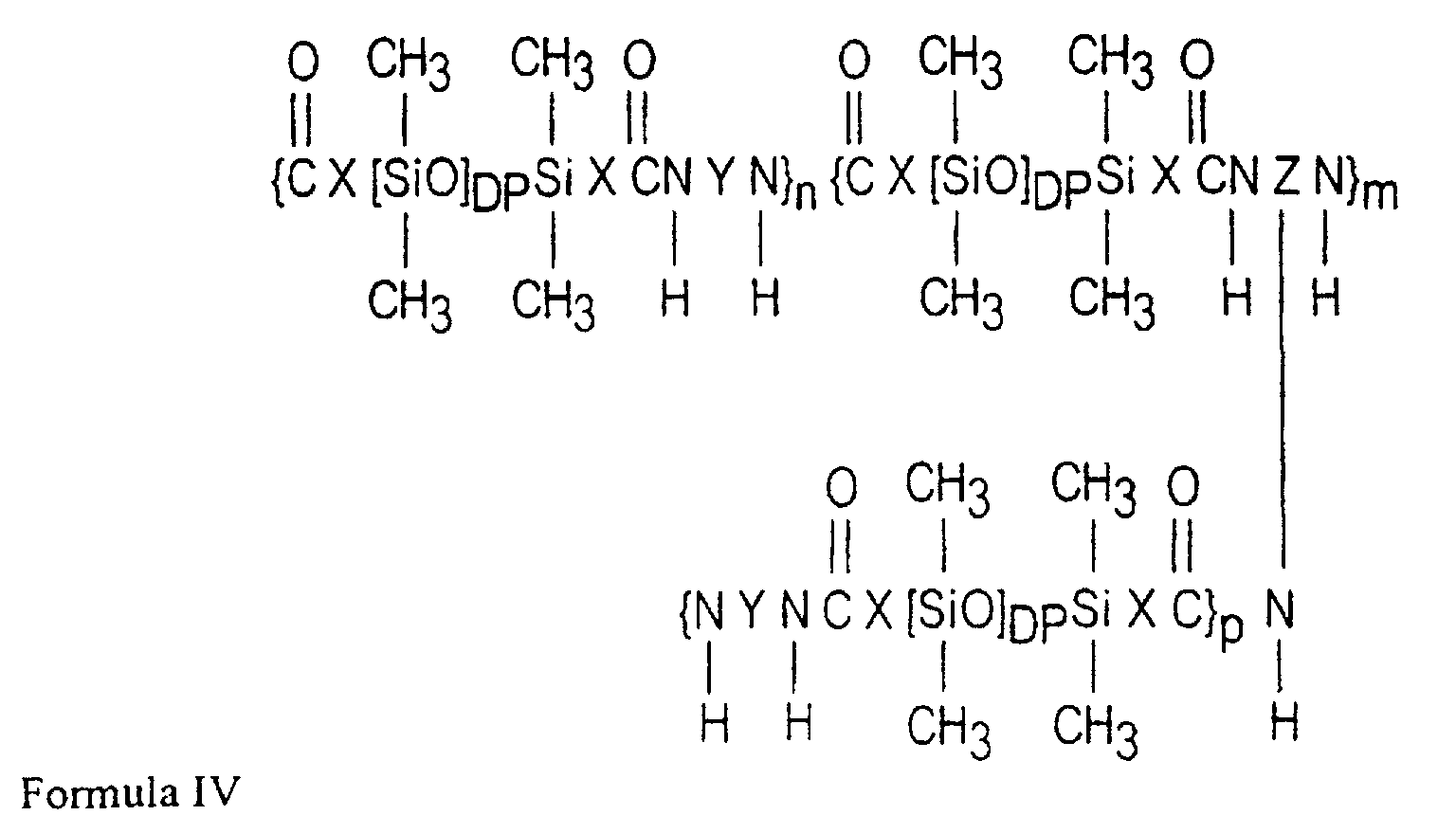
- A base composition made by combining:(a) 0.5-80 percent by weight based on the total weight of the composition of at least one siloxane-based polyamide as described in Claim 1;(b) 5 - 95 percent by weight silicone fluid: and(c) if (a) + (b) do not equal 100 percent, then a portion of solvent sufficient to make 100 percent wherein the solvent is selected from the group consisting of solvents.
- A cosmetic composition made by combining(a) a base composition made by combining:(i) 0.5 - 80 percent by weight based on the total weight of the composition of at least one siloxane-based polyamide as described in Claim 1;(ii) 5 - 95 percent by weight silicone fluid; and(b) at least one additional ingredient selected from the group consisting of cosmetically active additives and cosmetically acceptable solvents wherein the total amount of the additional ingredients added is in the range of 0.1 - 85% by weight based on the total weight of the cosmetic composition.
- A cosmetic composition according to Claim 32 which is a gel and wherein the amount of siloxane-based polyamide is in the range of 0.5 - 8%.
- A cosmetic composition according to Claim 32 which is a stick and wherein the amount of siloxane-based polyamide is in the range of 5 - 30%.
- A cosmetic composition made by combining based on the total weight of the composition:(a) a base composition made by combining:(i) 0.5-80 percent by weight of at least one siloxane-based polyamide as described in Claim 1;(ii) 5 - 95 percent by weight silicone fluid; and(iii) optionally up to 40 percent by weight of at least one solvent; and(b) 0.1 - 85 percent by weight of at least one additional ingredients selected from the group consisting of(i) 0.1-30 weight percent of an antiperspirant active;(ii) 0.5-3.0 weight percent of a fragrance;(iii) 0.2-1.0 weight percent of a bacteriostat; and(iv) 0-15 weight percent of a surfactant;(v) an effective amount of a sunscreen;(vi) an effective amount of an insect repellant; and(c) at least one additional ingredient selected from water and other cosmetically acceptable ingredients.
- A cosmetic composition as claimed in Claim 35 wherein the amount of siloxane-based polyamide is in the range of 0.5 - 8 weight percent.
- A cosmetic composition as claimed in Claim 35 wherein the amount of siloxane-based polyamide is in the range of 6 - 20 weight percent.
- A cosmetic composition as claimed in Claim 35 wherein the silicone fluid is selected from the group consisting of volatile silicones, non-volatile silicones and mixtures of any of the foregoing.
- A cosmetic composition as claimed in Claim 38 wherein the silicone fluid is selected from the group consisting of dimethicones, phenyl trimethicone, and cyclic siloxanes having from 4-6 siloxane units in a ring optionally substituted by C1-C6 alkyl or phenyl.
- A cosmetic composition as claimed in Claim 32 wherein the cosmetic active is an antiperspirant selected from the group consisting of aluminum chlorohydrate, aluminum chloride, aluminum sesquichlorohydrate, zirconyl hydroxychloride, aluminum-zirconium glycine complex, aluminum chlorohydrex PG, aluminum chlorohydrex PEG, aluminum dichlorohydrex PG, and aluminum dichlorohydrex PEG, aluminum nitratohydrate and its combination with zirconyl hydroxychlorides and nitrates, and aluminum-stannous chlorohydrates.
- A cosmetic composition as claimed in Claim 35 wherein the bacteriostat is selected from the group consisting of 2-amino-2-methyl-1-propanol (AMP), cetyl-trimethylammonium bromide, cetyl pyridinium chloride, 2, 4, 4'-trichloro-2'-hydroxydiphenylether , N-(4-chlorophenyl)-N'-(3,4-dichlorophenyl)urea and zinc salts.
- A cosmetic composition as claimed in Claim 35 made with the following components where all components are in percent by weight based on the total weight of the composition:
Oil Phase (50-70%) Siloxane-based polyamide 0,5-8.0% Silicone fluid 20-60% Cosmetic additive(s) and/or solvents 0-20% Surfactant 0-10% Fragrance 0-3% Polar Phase (50-30%) Water (and/or water miscible solvent) 5-40% Antiperspirant active 10-25% Surfactant 0-5% - A cosmetic composition as claimed in Claim 42 made with the following components:
Oil Phase (50-70%) Siloxane-based polyamide 2-6% Silicone fluid 35-45% Cosmetic additive(s) and/or solvents 7-15% Surfactant 3-7% Fragrance 1-2% Polar Phase (50-30%) Water (and/or water miscible solvent) 15-25% Antiperspirant active 15-25% Surfactant 1-2% - A cosmetic composition as claimed in Claim 35 made with the following components wherein the components are in percent by weight based on the total weight of the composition:
Oil Phase Siloxane-based polyamide gellant 6 - 20% Silicone fluids 10 - 90% Cosmetic additives and/or solvents 0 - 40% Fragrance, color QS Polar Phase Water and/or water miscible solvent 10 - 40% Antiperspirant active 5 - 30% Surfactant 0-10% Total 100 - A composition as claimed in Claim 44 made with the following components:
Oil Phase Siloxane-based polyamide gellant 10 - 15% Silicone fluids 20 - 50% Cosmetic additives 5 - 21 % and/or solvents Fragrance, color QS Polar Phase Water and/or water miscible solvent 15 - 25% Antiperspirant active 15 - 25% Surfactant 0.5 - 3% Total 100 - A method of making a silicone polyamide which includes at least one repeating unit represented by the formulawherein X is a linear or branched C1-C30 alkylene chain; Y is a linear or branched C1-C20 alkylene chain; DP is an integer having a value of 15-500; n is an integer having a value of 1-500;

with the proviso that Y can also representfor providing linkage to another repeating unit, in which case R, R", and R"' are linear or branched C1-C10 alkyl or alkylene groups; and T is ≡CH, N, P, or Al;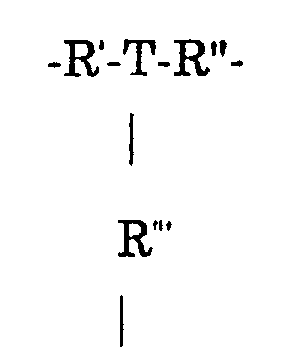
comprising heating an intimate reaction mixture containing a silicone diacid, diester, di-anhydride or diacid chloride, and an organic polyamine at a temperature greater than 100°C, removing water from the reaction mixture, and thereafter recovering and isolating from the reaction mixture a silicone polyamide; the silicone diacid being an organosilicon polymer of the formula Y'(CH2)n'SiR2O(R2SiO)mR2Si(CH2)n'Y' in which R is independently selected from the group consisting of methyl, ethyl, propyl, isopropyl, phenyl, and a phenyl group substituted with 1-3 methyl or ethyl groups; Y' is - CO2H; n' is an integer having a value of 1-20; and m is an integer having a value of 15-1500, said polyamide not being formed from units of the formula:where
p is an average value and is selected to be in the range of 2-10;
R at each occurrence is independently selected from the group consisting of methyl, ethyl, propyl, isopropyl and phenyl wherein the phenyl may optionally be substituted by 1-3 of a member of the group consisting of methyl and ethyl;
Q' is selected from the group consisting of (a) a straight or branched alkyl chain having 1-40 carbons, optionally substituted by at least one of methyl, ethyl, propyl, isopropyl, hydroxy, carboxyl and phenyl groups wherein the phenyl may optionally be substituted by 1-3 of a member of the group consisting of methyl and ethyl, wherein the alkyl chain may optionally contain at least one an alkenyl bond and (b) an alkyl chain containing at least one cyclic or phenyl group wherein said chain has 7-40 carbons, particularly 7-20 carbons, and may optionally be substituted by at least one of methyl, ethyl, propyl, isopropyl, hydroxy, carboxyl and phenyl groups wherein the phenyl may optionally be substituted by 1-3 of a member of the group consisting of methyl and ethyl, wherein the alkyl chain may optionally contain at least one alkenyl bond: X'= NH2. - A method according to Claim 46 in which the organic diamine has the formula X-R'-X in which X is -NH2; and R' is an alkylene chain having 1-40 carbon atoms, or an alkyl chain having 1-40 carbon atoms which is substituted with C1-C4 alkyl groups, phenyl, hydroxyl, carboxyl, or amino groups.
- A method according to Claim 47 in which the organic polyamine is selected from the group consisting of hexamethylene diamine, ethylene diamine, piperizine, phenylene diamine, decamethylene diamine, xylene diamine, and polyethylene glycol diamine.
- A method according to Claim 46 in which the silicone diacid is prepared by a process comprising reacting a hydride-terminated polydimethylsiloxane with an unsaturated carboxylic acid containing an acid protecting group; forming an hydrosilation intermediate product containing the acid protecting group; removing the acid protecting group from the hydrosilation product to form an unprotected silicone diacid.
- A method according to Claim 49 in which the acid protecting group is a trimethylsilyl group (CH3)3 Si-provided by reacting the unsaturated carboxylic acid with a silazane.
- A silicone polyamide prepared according to the method defined in Claim 46 having a number average molecular weight or from 4,000 to 200,000 daltons, as determined by gel permeation chromatography using polydimethylsiloxane as a standard.
- A silicone polyamide prepared according to the method defined in Claim 51 having a number average molecular weight of from 5,000 to 50,000 daltons, as determined by gel permeation chromatography using polydimethylsiloxane as a standard.
- A composition comprising a silicone polyamide having at least one repeating unit represented by the formulawherein X is a linear or branched C1-C30 alkylene chain; Y is a linear or branched C1-C20 alkylene chain; DP is an integer having a value of 15-500; n is an integer having a value of 1-500;

with the proviso that Y can also representfor providing linkage to another repeating unit, in which case R', R", and R"' are linear or branched C1-C10 alkyl or alkylene groups; and T is ≡ CH, N, P, or Al, said polyamide not being formed from units of the formula: where
where
p is an average value and is selected to be in the range of 2-10;
R at each occurrence is independently selected from the group consisting of methyl, ethyl, propyl, isopropyl and phenyl wherein the phenyl may optionally be substituted by 1-3 of a member of the group consisting of methyl and ethyl.
Q' is selected from the group consisting of (a) a straight or branched alkyl chain having 1-40 carbons, optionally substituted by at least one of methyl, ethyl, propyl, isopropyl, hydroxy, carboxyl and phenyl groups wherein the phenyl may optionally be substituted by 1-3 of a member of the group consisting of methyl and ethyl, wherein the alkyl chain may optionally contain at least one an alkenyl bond and (b) an alkyl chain containing at least one cyclic or phenyl group wherein said chain has 7-40 carbons, particularly 7-20 carbons, and may optionally be substituted by at least one of methyl, ethyl, propyl, isopropyl, hydroxy, carboxyl and phenyl groups wherein the phenyl may optionally be substituted by 1-3 of a member of the group consisting of methyl and ethyl, wherein the alkyl chain may optionally contain at least one alkenyl bond: X'= NH2. - A composition according to Claim 53 in which the silicone polyamide has a number average molecular weight of from 4,000 to 200,000 daltons, as determined by gel permeation chromatography using polydimethylsiloxane as a standard.
- A composition according to Claim 54 in which the silicone polyamide has a number average molecular weight of from 5,000 to 50,000 daltons, as determined by gel permeation chromatography using polydimethylsiloxane as a standard.
- A composition according to Claim 53 including a silicone fluid selected from the group consisting of cyclomethicones, dimethicones, and phenyltrimethicones.
- A composition according to Claim 53 in which the repeating unit of the silicone polyamide is represented by the formulaor the formula
 wherein X is a linear or branched C1-C30 alkylene chain; Y, Y1, and Y2 are linear or branched C1-C20 alkylene chains; DP1, DP2, and DP3 are integers each having values of 15-500; n, m, and p are integers each having values of 1-500; Z is represented by
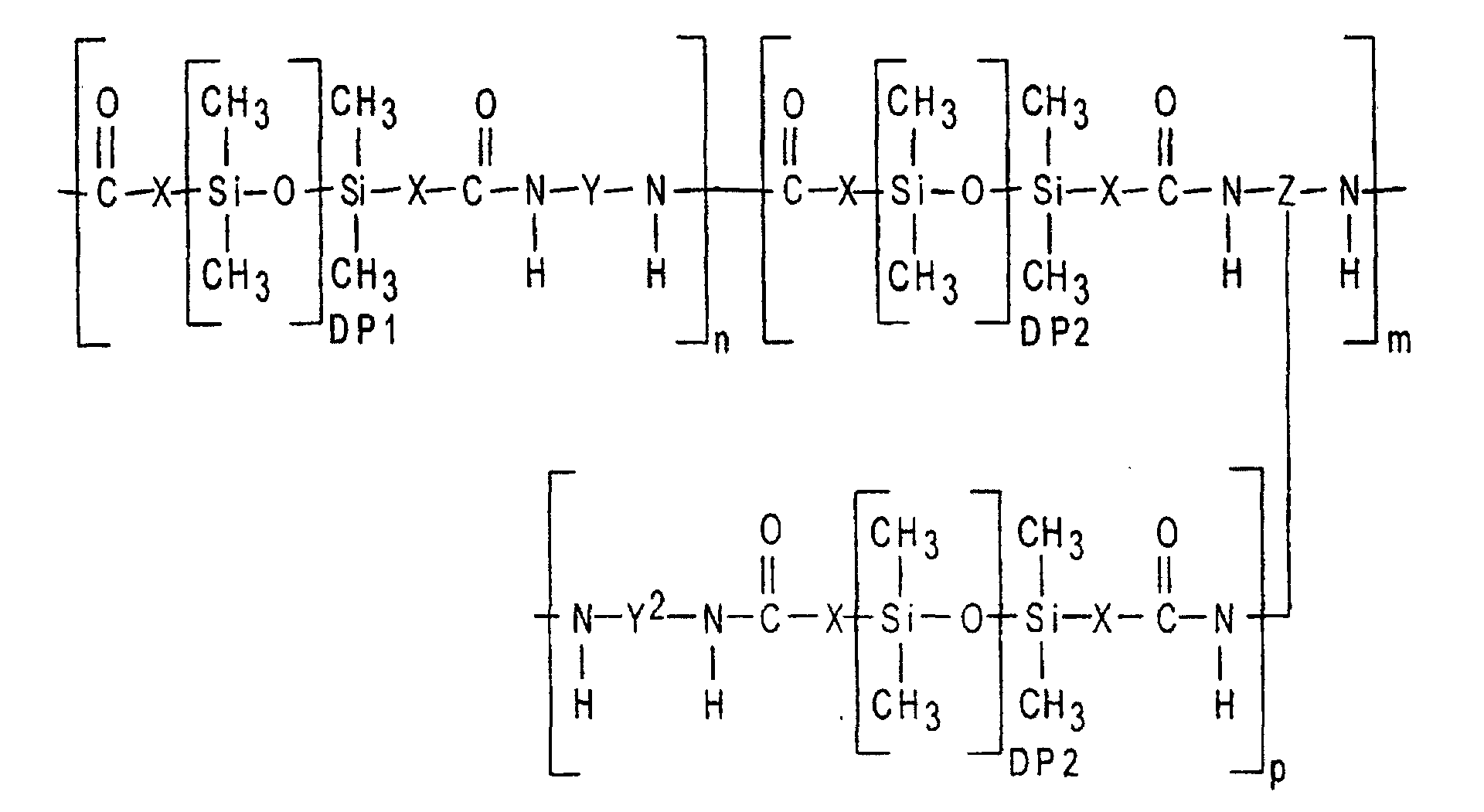 wherein R', R", and R"' are linear or branched C1-C10 alkyl or alkylene groups; and T is ≡CH, N, P, or Al; provided n is not the same as m, or Y is not the same as Y1, or DP1 is not the same as DP2.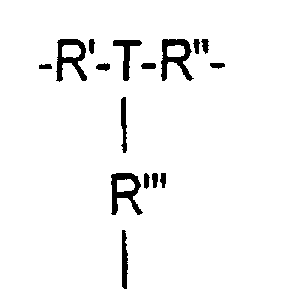
Applications Claiming Priority (3)
| Application Number | Priority Date | Filing Date | Title |
|---|---|---|---|
| US08/904,709 US6051216A (en) | 1997-08-01 | 1997-08-01 | Cosmetic composition containing siloxane based polyamides as thickening agents |
| US904709 | 1997-08-01 | ||
| PCT/US1998/015846 WO1999006473A1 (en) | 1997-08-01 | 1998-07-30 | Cosmetic composition containing siloxane-based polyamides as thickening agents |
Publications (2)
| Publication Number | Publication Date |
|---|---|
| EP1000112A1 EP1000112A1 (en) | 2000-05-17 |
| EP1000112B1 true EP1000112B1 (en) | 2003-04-23 |
Family
ID=25419616
Family Applications (1)
| Application Number | Title | Priority Date | Filing Date |
|---|---|---|---|
| EP98938143A Expired - Lifetime EP1000112B1 (en) | 1997-08-01 | 1998-07-30 | Cosmetic composition containing siloxane-based polyamides as thickening agents |
Country Status (20)
| Country | Link |
|---|---|
| US (2) | US6051216A (en) |
| EP (1) | EP1000112B1 (en) |
| JP (1) | JP4868375B2 (en) |
| KR (1) | KR20010022502A (en) |
| CN (1) | CN1268151A (en) |
| AR (1) | AR016784A1 (en) |
| AT (1) | ATE238371T1 (en) |
| AU (1) | AU730357B2 (en) |
| BR (1) | BR9811064A (en) |
| CA (1) | CA2298703C (en) |
| CO (1) | CO4990924A1 (en) |
| DE (1) | DE69813826T2 (en) |
| ES (1) | ES2198738T3 (en) |
| HU (1) | HU229575B1 (en) |
| NO (1) | NO20000492L (en) |
| NZ (1) | NZ502604A (en) |
| PL (1) | PL194820B1 (en) |
| TR (1) | TR200000438T2 (en) |
| WO (1) | WO1999006473A1 (en) |
| ZA (1) | ZA986823B (en) |
Families Citing this family (435)
| Publication number | Priority date | Publication date | Assignee | Title |
|---|---|---|---|---|
| US5981680A (en) * | 1998-07-13 | 1999-11-09 | Dow Corning Corporation | Method of making siloxane-based polyamides |
| US6503632B1 (en) * | 1998-08-14 | 2003-01-07 | Nof Corporation | Polydialkylsiloxane/polyamide copolymer, process for producing the same, and various materials |
| CN1158066C (en) * | 1998-12-08 | 2004-07-21 | 弗门尼舍有限公司 | Transparent perfuming compositions |
| GB9908202D0 (en) | 1999-04-12 | 1999-06-02 | Unilever Plc | Cosmetic compositions |
| GB9908218D0 (en) * | 1999-04-12 | 1999-06-02 | Unilever Plc | Antiperspirant compositions |
| FR2796272B1 (en) | 1999-07-15 | 2003-09-19 | Oreal | COMPOSITION WITHOUT WAX STRUCTURED IN A RIGID FORM BY A POLYMER |
| FR2796271B1 (en) | 1999-07-15 | 2002-01-11 | Oreal | COMPOSITION WITHOUT WAX STRUCTURED IN A RIGID FORM BY A POLYMER |
| ATE293425T1 (en) * | 1999-12-28 | 2005-05-15 | Oreal | STRUCTURED LONG-LASTING PREPARATION CONTAINING A POLYMER AND PASTEY FATS |
| FR2804018B1 (en) * | 2000-01-24 | 2008-07-11 | Oreal | COMPOSITION WITHOUT STRUCTURED TRANSFER IN RIGID FORM BY A POLYMER |
| FR2808679B1 (en) * | 2000-05-09 | 2006-09-22 | Oreal | PROCESS FOR INCREASING THE PERSISTENCE OF AT LEAST ONE COSMETIC AND / OR CARE EFFECT OF A COSMETIC COMPOSITION, COSMETIC COMPOSITION AND USE THEREOF |
| US6403067B1 (en) * | 2000-05-19 | 2002-06-11 | Colgate-Palmolive Company | Stable emulsions for cosmetic products |
| GB0016937D0 (en) | 2000-07-10 | 2000-08-30 | Unilever Plc | Antiperspirant compositions |
| US6451295B1 (en) * | 2000-08-31 | 2002-09-17 | Colgate-Palmolive Company | Clear antiperspirants and deodorants made with siloxane-based polyamides |
| US20020048557A1 (en) * | 2000-08-31 | 2002-04-25 | Heng Cai | Antiperspirants and deodorants with low white residue on skin and fabric |
| US6387357B1 (en) * | 2000-10-20 | 2002-05-14 | Colgate-Palmolive Company | High oil clear emulsion with diene elastomer |
| AU2002256544A1 (en) * | 2000-12-12 | 2002-06-24 | L'oreal Sa | Cosmetic compositions containing at least one heteropolymer and at least one gelling agent and methods of using the same |
| US8080257B2 (en) | 2000-12-12 | 2011-12-20 | L'oreal S.A. | Cosmetic compositions containing at least one hetero polymer and at least one film-forming silicone resin and methods of using |
| US20020111330A1 (en) * | 2000-12-12 | 2002-08-15 | Carlos Pinzon | Compositions containing heteropolymers and methods of using same |
| AU2001220877A1 (en) * | 2000-12-12 | 2002-06-24 | L'oreal S.A. | Cosmetic composition comprising heteropolymers and a solid substance and method of using same |
| FR2817740B1 (en) * | 2000-12-12 | 2006-08-04 | Oreal | METHOD FOR MANUFACTURING A COLORED COSMETIC COMPOSITION OF CONTROLLED TRANSMITTANCE MAKE-UP |
| WO2002047623A1 (en) * | 2000-12-12 | 2002-06-20 | L'oreal Sa | Composition comprising at least one heteropolymer and at least one inert filler and methods for use |
| US7276547B2 (en) | 2000-12-12 | 2007-10-02 | L'oreal S.A. | Compositions comprising heteropolymers and at least one oil-soluble polymers chosen from alkyl celluloses and alkylated guar gums |
| FR2817739B1 (en) * | 2000-12-12 | 2005-01-07 | Oreal | TRANSPARENT OR TRANSLUCENT COLORED COSMETIC COMPOSITION |
| WO2002047630A1 (en) * | 2000-12-12 | 2002-06-20 | L'oreal | Cosmetic composition comprising a mixture of polymers |
| US6881400B2 (en) * | 2000-12-12 | 2005-04-19 | L'oreal S.A. | Use of at least one polyamide polymer in a mascara composition for increasing the adhesion of and/or expressly loading make-up deposited on eyelashes |
| US6835399B2 (en) * | 2000-12-12 | 2004-12-28 | L'ORéAL S.A. | Cosmetic composition comprising a polymer blend |
| AU2001225392A1 (en) * | 2000-12-13 | 2002-06-24 | L Oreal | Composition structured with a polymer containing a heteroatom and an organogelator |
| MY122823A (en) * | 2000-12-21 | 2006-05-31 | Colgate Palmolive Co | Elastomer free, high efficacy antiperspirant stick |
| US6511658B2 (en) | 2000-12-21 | 2003-01-28 | Colgate-Palmolive Company | High efficacy antiperspirant stick with concentrated elastomer |
| PE20020781A1 (en) * | 2000-12-21 | 2002-08-28 | Colgate Palmolive Co | HIGH EFFICIENCY ANTI-TRANSPIRANT BAR |
| FR2819400B1 (en) * | 2001-01-15 | 2004-12-03 | Oreal | COSMETIC COMPOSITION FOR MAKE-UP OR CARE OF KERATINIC MATERIALS INCLUDING A MIXTURE OF POLYMERS |
| US7025953B2 (en) * | 2001-01-17 | 2006-04-11 | L'oreal S.A. | Nail polish composition comprising a polymer |
| FR2819399B1 (en) * | 2001-01-17 | 2003-02-21 | Oreal | COSMETIC COMPOSITION CONTAINING POLYMER AND FLUORINATED OIL |
| FR2825628B1 (en) * | 2001-06-07 | 2004-03-19 | Oreal | COSMETIC COMPOSITION COMPRISING A POLYMER COMPRISING JUNCTION GROUPS CAPABLE OF ESTABLISHING EACH AT LEAST THREE H-LINKS |
| FR2825916B1 (en) * | 2001-06-14 | 2004-07-23 | Oreal | COMPOSITION BASED ON SILICONE OIL STRUCTURED IN RIGID FORM, PARTICULARLY FOR COSMETIC USE |
| FR2825915B1 (en) * | 2001-06-14 | 2006-02-03 | Oreal | COMPOSITION BASED ON STRUCTURED SILICONE OIL IN RIGID FORM, IN PARTICULAR FOR COSMETIC USE |
| FR2825914B1 (en) * | 2001-06-14 | 2003-09-19 | Oreal | COMPOSITION BASED ON SILICONE OIL STRUCTURED IN RIGID FORM, IN PARTICULAR FOR COSMETIC USE |
| US6497861B1 (en) | 2001-06-21 | 2002-12-24 | Color Access, Inc. | Stable cosmetic emulsion with polyamide gelling agent |
| US20080233065A1 (en) * | 2001-06-21 | 2008-09-25 | Wang Tian X | Stable Cosmetic Emulsion With Polyamide Gelling Agent |
| JP4628672B2 (en) * | 2001-07-12 | 2011-02-09 | ダウ・コーニング・コーポレイション | Method for producing silicone-organic copolymer |
| US6800713B2 (en) | 2001-07-12 | 2004-10-05 | Dow Corning Corporation | Methods for making silicone-organic copolymers |
| US20030082129A1 (en) * | 2001-08-07 | 2003-05-01 | Buckingham Anne Marie | Hair and skin care compositions containing siloxane-based polyamide copolymers |
| US6426062B1 (en) * | 2001-10-05 | 2002-07-30 | Colgate-Palmolive Company | Underarm gel products with water lock component |
| US6436382B1 (en) * | 2001-10-05 | 2002-08-20 | Colgate-Palmolive Company | Underarm products with water lock component |
| US6716420B2 (en) | 2001-10-05 | 2004-04-06 | L′Oreal | Methods of use and of making a mascara comprising at least one coloring agent and at least one heteropolymer |
| FR2832060B1 (en) * | 2001-11-09 | 2004-07-09 | Oreal | COMPOSITION CONTAINING AN AMINO ACID N-ACYL ESTER AND A POLYAMIDE-STRUCTURED UV FILTER |
| US20080057011A1 (en) * | 2001-12-12 | 2008-03-06 | L'oreal S.A., | Composition structured with a polymer containing a heteroatom and an Organogelator |
| US6815486B2 (en) * | 2002-04-12 | 2004-11-09 | Dow Corning Corporation | Thermally conductive phase change materials and methods for their preparation and use |
| WO2003088931A2 (en) * | 2002-04-16 | 2003-10-30 | Cosmetica, Inc. | Polymeric odor absorption ingredients for personal care products |
| FR2840615B1 (en) * | 2002-06-10 | 2005-08-05 | Oreal | ORGANOSILOXANE POLYMERS AND THEIR USE IN COSMETIC OR DERMATOLOGICAL COMPOSITIONS |
| US8333956B2 (en) * | 2002-06-11 | 2012-12-18 | Color Access, Inc. | Stable cosmetic emulsion with polyamide gelling agent |
| US8449870B2 (en) * | 2002-06-11 | 2013-05-28 | Color Access, Inc. | Stable cosmetic emulsion with polyamide gelling agent |
| US20040115153A1 (en) * | 2002-12-17 | 2004-06-17 | L'oreal | Compositions containing at least one oil structured with at least one silicone-polyamide polymer, and at least one silicone gum and methods of using the same |
| US20040247549A1 (en) * | 2002-06-12 | 2004-12-09 | L'oreal S.A. | Cosmetic emulsions containing at least one hetero polymer and at least one sunscreen and methods of using the same |
| US20030235552A1 (en) * | 2002-06-12 | 2003-12-25 | L'oreal | Cosmetic composition for care and/or makeup, structured with silicone polymers and film-forming silicone resins |
| US7329699B2 (en) * | 2003-07-11 | 2008-02-12 | L'oreal | Composition containing oil, structuring polymer, and coated silicone elastomer, and methods of making and using the same |
| US6958155B2 (en) * | 2002-06-12 | 2005-10-25 | L'oreal | Cosmetic compositions comprising at least one polysiloxane based polyamide |
| US20050008598A1 (en) | 2003-07-11 | 2005-01-13 | Shaoxiang Lu | Cosmetic compositions comprising a structuring agent, silicone powder and swelling agent |
| US20040042980A1 (en) * | 2002-06-12 | 2004-03-04 | L'oreal | Cosmetic emulsions containing at least one hetero polymer and at least one sunscreen, and methods of using same |
| ES2346304T3 (en) * | 2002-06-12 | 2010-10-14 | L'oreal | COSMETIC COMPOSITION OF CARE AND / OR STRUCTURED MAKEUP WITH SILICONE POLYMERS AND ORGANOGELIFYING AGENTS, IN A RIGID FORM. |
| US20040115154A1 (en) * | 2002-12-17 | 2004-06-17 | L'oreal | Compositions containing at least one oil structured with at least one silicone-polyamide polymer, and at least one short chain ester and methods of using the same |
| US20030235548A1 (en) * | 2002-06-12 | 2003-12-25 | L'oreal | Cosmetic composition for care and/or treatment and/or makeup of the emulsion type structured with silicone polymers |
| US6916464B2 (en) * | 2002-12-20 | 2005-07-12 | L'oreal | Sunscreen compositions |
| FR2840807B1 (en) * | 2002-06-12 | 2005-03-11 | COSMETIC CARE AND / OR MAKEUP COMPOSITION, STRUCTURED BY SILICONE POLYMERS AND ORGANOGELATORS, IN RIGID FORM | |
| US20030232030A1 (en) * | 2002-06-12 | 2003-12-18 | L'oreal | Compositions containing at least one oil structured with at least one silicone-polyamide polymer, and at least one gelling agent and methods of using the same |
| US20040120912A1 (en) * | 2002-12-17 | 2004-06-24 | L'oreal | Compositions containing at least one oil structured with at least one silicone-polyamide polymer, and at least one crystalline silicone compound and methods of using the same |
| US7879316B2 (en) * | 2002-06-12 | 2011-02-01 | L'oreal | Cosmetic composition containing a polyorganosiloxane polymer |
| US20030235553A1 (en) * | 2002-06-12 | 2003-12-25 | L'oreal | Cosmetic compositions containing at least one silicone-polyamide polymer, at least one oil and at least one film-forming agent and methods of using the same |
| US7008629B2 (en) * | 2002-07-22 | 2006-03-07 | L'ORéAL S.A. | Compositions comprising at least one heteropolymer and fibers, and methods of using the same |
| DE10241148A1 (en) * | 2002-09-05 | 2004-03-18 | Wacker-Chemie Gmbh | Silicone oil pastes |
| US8007772B2 (en) * | 2002-10-02 | 2011-08-30 | L'oreal S.A. | Compositions to be applied to the skin and the integuments |
| US20060018854A1 (en) * | 2002-10-02 | 2006-01-26 | Christophe Dumousseaux | Cosmetic compositions |
| US6783692B2 (en) | 2002-10-17 | 2004-08-31 | Dow Corning Corporation | Heat softening thermally conductive compositions and methods for their preparation |
| KR20050075366A (en) * | 2002-10-24 | 2005-07-20 | 콜게이트-파아므올리브캄파니 | Silicon modified polyamide material useful for oral care |
| US7410695B2 (en) * | 2002-10-24 | 2008-08-12 | Dow Corning Corporation | Siloxane based amide modified nylons |
| JP2004182693A (en) * | 2002-12-05 | 2004-07-02 | Shiseido Co Ltd | External preparation composition |
| AU2003295249A1 (en) * | 2002-12-09 | 2004-06-30 | Suprapolix B.V. | Siloxane polymers with quadruple hydrogen bonding units |
| FR2848449B1 (en) * | 2002-12-17 | 2006-11-24 | Oreal | COSMETIC COMPOSITION OF CARE AND / OR MAKE-UP, STRUCTURED BY SILICONE POLYMERS |
| EP1578387B1 (en) * | 2002-12-17 | 2008-08-13 | L'oreal | Transparent or translucent care and/or make-up cosmetic composition structured with silicone polymers |
| EP1575535B1 (en) * | 2002-12-17 | 2008-12-17 | L'oreal | Care and/or make-up cosmetic composition structured with silicone polymers |
| US8728500B2 (en) | 2002-12-17 | 2014-05-20 | L'oreal | Composition containing a polyorganosiloxane polymer, a thickening agent and at least one volatile alcohol |
| FR2848422B1 (en) * | 2002-12-17 | 2009-07-03 | Oreal | TRANSPARENT OR TRANSLUCENT COSMETIC COMPOSITION OF CARE AND / OR MAKE-UP, STRUCTURED BY SILICONE POLYMERS |
| US20040166133A1 (en) * | 2003-01-21 | 2004-08-26 | L'oreal | Method of making a mascara composition comprising polyamide polymer and at least one solid substance having a melting point of 45oC or greater |
| US6838541B2 (en) * | 2003-02-12 | 2005-01-04 | Dow Corning Corporation | Method of making siloxane-based polyamide elastomers |
| WO2004078125A2 (en) * | 2003-03-04 | 2004-09-16 | Colgate-Palmolive Company | Aerosol antiperspirant with polyamide |
| US20040180032A1 (en) * | 2003-03-15 | 2004-09-16 | Manelski Jean Marie | Long wearing cosmetic composition |
| US20040191512A1 (en) | 2003-03-27 | 2004-09-30 | Samuel Mooney | Melt-spun synthetic fiber and process for producing the fiber |
| US6994845B2 (en) * | 2003-04-08 | 2006-02-07 | Colgate-Palmolive Company | Soft solid compositions with reduced syneresis |
| US20040241123A1 (en) * | 2003-05-30 | 2004-12-02 | Christine Popoff | Suspension free and elastomer free antiperspirant cream |
| US7204976B2 (en) * | 2003-05-30 | 2007-04-17 | Colgate-Palmolive Company | High efficacy gel with low glycol content |
| US20050019286A1 (en) * | 2003-06-09 | 2005-01-27 | Wang Tian Xian | Stable cosmetic emulsion with polyamide |
| US20050089498A1 (en) * | 2003-10-24 | 2005-04-28 | Patil Anjali A. | Cosmetic compositions containing first and second film forming polymers |
| EP2267062B1 (en) * | 2003-11-04 | 2017-10-25 | SupraPolix B.V. | Supramolecular polymers containing quadruple hydrogen bonding units in the polymer backbone |
| US8633171B2 (en) | 2003-11-13 | 2014-01-21 | Elc Management, Llc | Transparent oil gelling system |
| JP2007511512A (en) * | 2003-11-13 | 2007-05-10 | イーエルシー マネージメント エルエルシー | Transparent oil gelation system |
| US20050158260A1 (en) * | 2003-12-12 | 2005-07-21 | L'oreal | Cosmetic composition containing a polyorganosiloxane polymer |
| US20050163736A1 (en) * | 2004-01-27 | 2005-07-28 | Heng Cai | Dual phase stick |
| CN1933809B (en) * | 2004-03-17 | 2010-12-01 | 株式会社高丝 | oily cleaning material |
| US7981404B2 (en) * | 2004-04-08 | 2011-07-19 | L'oreal S.A. | Composition for application to the skin, to the lips, to the nails, and/or to hair |
| US20050238979A1 (en) * | 2004-04-08 | 2005-10-27 | Christophe Dumousseaux | Compositions for application to the skin, to the lips, to the nails, and/or to hair |
| US20050257715A1 (en) * | 2004-04-08 | 2005-11-24 | Christophe Dumousseaux | Compositions for application to the skin, to the lips, to the nails, and/or to hair |
| US7678301B2 (en) | 2004-04-20 | 2010-03-16 | Dow Corning Corporation | Vesicles of high molecular weight silicone polyethers |
| WO2005103118A1 (en) | 2004-04-20 | 2005-11-03 | Dow Corning Corporation | Aqueous dispersions of silicone polyether block copolymers |
| US20050287103A1 (en) * | 2004-06-08 | 2005-12-29 | Vanina Filippi | Cosmetic composition comprising at least one ester and at least one film-forming polymer |
| US8268952B2 (en) * | 2004-07-12 | 2012-09-18 | Suprapolix B.V. | Supramolecular ionomers |
| US20070274941A9 (en) * | 2004-07-16 | 2007-11-29 | Xavier Blin | Two-coat cosmetic product comprising at least one silicone polymer |
| US20060034791A1 (en) * | 2004-07-16 | 2006-02-16 | L'oreal | Cosmetic composition comprising a silicone polymer |
| US20060013791A1 (en) * | 2004-07-16 | 2006-01-19 | L'oreal | Cosmetic composition comprising a defined silicone polymer and a film former |
| FR2873035A1 (en) | 2004-07-16 | 2006-01-20 | Oreal | COSMETIC COMPOSITION COMPRISING A DEFINED SILICONE POLYMER AND A FILMOGENIC AGENT. |
| DE602005016578D1 (en) * | 2004-10-05 | 2009-10-22 | Oreal | MAKE-UP KIT AND METHOD |
| FR2876011B1 (en) * | 2004-10-05 | 2006-12-29 | Oreal | METHOD FOR MAKE-UP A SUPPORT AND KIT FOR IMPLEMENTING SAID METHOD |
| US9649261B2 (en) | 2004-10-05 | 2017-05-16 | L'oreal | Method of applying makeup to a surface and a kit for implementing such a method |
| GB0422918D0 (en) * | 2004-10-15 | 2004-11-17 | Boots Co Plc | Skincare composition |
| US7758848B2 (en) * | 2004-10-22 | 2010-07-20 | L'oreal | Cosmetic composition containing a polyorganosiloxane polymer |
| EP1661549A1 (en) * | 2004-11-04 | 2006-05-31 | L'oreal | Cosmetic compositions and methods of use |
| WO2006060295A1 (en) * | 2004-12-01 | 2006-06-08 | Dow Corning Corporation | Silicone polyether-amide block copolymers |
| US20060130248A1 (en) * | 2004-12-21 | 2006-06-22 | L'oreal | Easily removable water resistant cosmetic makeup compositions |
| JP4955266B2 (en) * | 2004-12-21 | 2012-06-20 | 株式会社コーセー | Hair cosmetics |
| FR2879442B1 (en) | 2004-12-21 | 2007-07-20 | Oreal | COSMETIC COMPOSITION FOR WATER-RESISTANT MAKE-UP AND EASILY CLEANSABLE |
| CN101084275B (en) | 2004-12-23 | 2011-09-14 | 陶氏康宁公司 | Crosslinkable saccharide-siloxane compositions, and networks, coatings and articles formed therefrom |
| US20060171910A1 (en) * | 2004-12-30 | 2006-08-03 | Audrey Ricard | Cosmetic composition containing an alkoxylated alcohol ester and a hydrocarbon-based ester oil |
| US20060193801A1 (en) * | 2005-01-31 | 2006-08-31 | L'oreal | Solid cosmetic composition textured with an organic copolymer |
| FR2881343B1 (en) * | 2005-01-31 | 2007-04-20 | Oreal | SOLID COSMETIC COMPOSITION FOR MAKE-UP AND / OR CARE |
| US20060193808A1 (en) * | 2005-02-04 | 2006-08-31 | Frederic Auguste | Composition for coating keratin fibers, comprising a fatty alcohol wax and a cellulose-based polymer |
| US20060210502A1 (en) * | 2005-03-17 | 2006-09-21 | The Gillette Company | Anhydrous antiperspirant composition containing skin softeners |
| US20060216257A1 (en) * | 2005-03-24 | 2006-09-28 | L'oreal | Makeup and/or care kit providing volumizing effect |
| US7754800B2 (en) | 2005-04-06 | 2010-07-13 | Dow Corning Europe Sa | Organosiloxane compositions |
| ES2376888T3 (en) | 2005-05-04 | 2012-03-20 | Suprapolix B.V. | Biologically active, bio-absorbable or biomedical modular supramolecular materials |
| EP1885331A2 (en) * | 2005-05-23 | 2008-02-13 | Dow Corning Corporation | Personal care compositions comprising saccharide-siloxane copolymers |
| CN102418279B (en) * | 2005-05-23 | 2014-12-17 | 陶氏康宁公司 | Surface treatment compositions comprising saccharide-siloxane copolymers |
| FR2888115B1 (en) * | 2005-07-08 | 2013-02-15 | Oreal | LIQUID FOUNDATION, MAKE - UP PROCESS AND KIT FOR IMPLEMENTING SUCH A METHOD. |
| US20100068163A1 (en) * | 2005-07-13 | 2010-03-18 | L'oreal | Keratin Fibre Coating Composition Comprising a Liquid Fatty Phase and a Tackifying Resin |
| EP1743627B1 (en) * | 2005-07-13 | 2014-12-17 | L'Oréal | Highly resistant make up composition for the lips comprising a low molecular weight resin |
| WO2007008575A1 (en) * | 2005-07-13 | 2007-01-18 | L'oreal | Cosmetic compositions containing liposoluble polymers and tackifiers |
| FR2889952A1 (en) | 2005-07-22 | 2007-03-02 | Oreal | COATING PROCESS |
| US8241617B2 (en) * | 2005-08-01 | 2012-08-14 | L'oréal | Methods for removing make-up compositions from keratin materials |
| FR2889921B1 (en) | 2005-08-30 | 2007-12-28 | Oreal | CONDITIONING AND APPLICATION ASSEMBLY COMPRISING A MAGNETIC DEVICE. |
| US7790148B2 (en) * | 2005-09-02 | 2010-09-07 | L'oreal | Compositions containing silicone polymer, wax and volatile solvent |
| US7884158B2 (en) * | 2005-09-06 | 2011-02-08 | L'Oré´al | Cosmetic compositions containing block copolymers, tackifiers and phenylated silicones |
| US20070093619A1 (en) * | 2005-10-24 | 2007-04-26 | L'oreal | Compositions having enhanced cosmetic properties |
| FR2892925B1 (en) * | 2005-11-09 | 2007-12-14 | Oreal | COMPOSITION FOR COATING LAMPS IN FOAM FORM |
| WO2007054830A2 (en) * | 2005-11-09 | 2007-05-18 | L'oreal | Composition for coating the eyelashes or the eyebrows, comprising a fatty-phase-structuring polymer containing polyorganosiloxane units |
| US20070128233A1 (en) * | 2005-12-05 | 2007-06-07 | L'oreal | Cosmetic composition having a unique cushiony texture |
| FR2894816B1 (en) * | 2005-12-16 | 2008-02-01 | Oreal | COSMETIC OR PHARMACEUTICAL COMPOSITION COMPRISING A COPOLYMER HAVING AT LEAST ONE IONIZABLE GROUP AND COSMETIC TREATMENT METHOD |
| US9320693B2 (en) * | 2005-12-21 | 2016-04-26 | L'oreal | Cosmetic composition with a volumizing effect |
| US20070196301A1 (en) | 2005-12-21 | 2007-08-23 | L'oreal | Cosmetic composition with a volumizing effect |
| KR101298355B1 (en) | 2005-12-23 | 2013-08-20 | 쓰리엠 이노베이티브 프로퍼티즈 컴파니 | Films including thermoplastic silicone block copolymers |
| US7371464B2 (en) | 2005-12-23 | 2008-05-13 | 3M Innovative Properties Company | Adhesive compositions |
| EP2860213B1 (en) * | 2005-12-23 | 2016-09-07 | 3M Innovative Properties Company | Multilayer films including thermoplastic silicone block copolymers |
| US7501184B2 (en) | 2005-12-23 | 2009-03-10 | 3M Innovative Properties Company | Polydiorganosiloxane polyoxamide copolymers |
| US20070149745A1 (en) * | 2005-12-23 | 2007-06-28 | 3M Innovative Properties Company | Polydiorganosiloxane-containing materials with oxalylamino groups |
| JP5424866B2 (en) * | 2006-03-21 | 2014-02-26 | ダウ・コーニング・コーポレイション | Silicone polyether elastomer gel |
| US8110630B2 (en) | 2006-03-21 | 2012-02-07 | Dow Corning Corporation | Silicone elastomer gels |
| WO2007109282A2 (en) | 2006-03-21 | 2007-09-27 | Dow Corning Corporation | Silicone-organic elastomer gels |
| US8313735B2 (en) * | 2006-10-30 | 2012-11-20 | Oreal | Long-wearing cosmetic product system for providing extended shine and gloss |
| US8758739B2 (en) | 2006-05-03 | 2014-06-24 | L'oreal | Cosmetic compositions containing block copolymers, tackifiers and gelling agents |
| US8557230B2 (en) * | 2006-05-03 | 2013-10-15 | L'oreal | Cosmetic compositions containing block copolymers, tackifiers and shine enhancing agents |
| US8673282B2 (en) * | 2006-05-03 | 2014-03-18 | L'oreal | Cosmetic compositions containing block copolymers, tackifiers and a selective solvent for soft blocks |
| US8673284B2 (en) * | 2006-05-03 | 2014-03-18 | L'oreal | Cosmetic compositions containing block copolymers, tackifiers and a selective solvent for hard blocks |
| US8778323B2 (en) | 2006-05-03 | 2014-07-15 | L'oréal | Cosmetic compositions containing block copolymers, tackifiers and modified silicones |
| US20080102049A1 (en) * | 2006-10-30 | 2008-05-01 | L'oreal | Long-wearing cosmetic product system having high shine and gloss |
| US8673283B2 (en) * | 2006-05-03 | 2014-03-18 | L'oreal | Cosmetic compositions containing block copolymers, tackifiers and a solvent mixture |
| CN101478973B (en) * | 2006-05-23 | 2013-08-28 | 陶氏康宁公司 | Novel silicone film formers for active ingredient delivery |
| CN101448573B (en) * | 2006-05-23 | 2012-05-23 | 陶氏康宁公司 | Borane catalyst complexes with amide functional polymers and curable compositions made therefrom |
| FR2901698B1 (en) | 2006-05-31 | 2008-08-08 | Oreal | COSMETIC COMPOSITION COMPRISING VINYL POLYMER AND OLEFIN COPOLYME |
| ATE484623T1 (en) | 2006-06-07 | 2010-10-15 | Dow Corning | TREATMENT OF TEXTILES WITH SILICONE POLYETHERAMID BLOCK COPOLYMERS |
| FR2902006B1 (en) * | 2006-06-13 | 2009-06-05 | Oreal | COSMETIC COMPOSITION FOR LIPS ASSOCIATING A SURFACTANT PHOSPHATE AND A SILICONE POLYMER |
| EP2087027B1 (en) | 2006-11-20 | 2011-10-05 | SupraPolix B.V. | Supramolecular polymers from low-melting, easily processable building blocks |
| EP1935400B1 (en) | 2006-12-19 | 2013-09-04 | L'Oréal | Composition for skin make-up comprising a resin, a block copolymer, a solid fat, and no volatile oils |
| US9345649B2 (en) * | 2006-12-21 | 2016-05-24 | Avon Products, Inc. | Cosmetic composition containing novel fractal particle-based gels |
| MX2007016506A (en) | 2006-12-29 | 2008-10-28 | Oreal | Composition containing a polyorganosiloxane polymer, a thickening agent and at least one volatile alcohol . |
| JP2010514763A (en) * | 2006-12-29 | 2010-05-06 | ダウ・コーニング・コーポレイション | Personal care composition comprising silicone elastomer gel |
| FR2910807A1 (en) | 2006-12-29 | 2008-07-04 | Oreal | COSMETIC COMPOSITION INCLUDING A DERIVATIVE OF BIS UREE. |
| FR2910809B1 (en) | 2006-12-29 | 2009-02-13 | Oreal | COSMETIC COMPOSITION COMPRISING A BIS UREA DERIVATIVE. |
| FR2911065B1 (en) | 2007-01-04 | 2009-03-20 | Oreal | MAKE-UP KERATIN FIBER KIT. |
| US8658141B2 (en) * | 2007-01-12 | 2014-02-25 | L'oreal | Cosmetic composition containing a block copolymer, a tackifier, a silsesquioxane wax and/or resin |
| ES2929030T3 (en) * | 2007-01-12 | 2022-11-24 | Oreal | Use of active ingredients that make it possible to increase the ceramide content of the lips, as a protection agent for fragile lips |
| US8603444B2 (en) * | 2007-01-12 | 2013-12-10 | L'oréal | Cosmetic compositions containing a block copolymer, a tackifier and a high viscosity ester |
| US20080171008A1 (en) * | 2007-01-17 | 2008-07-17 | L'oreal S.A. | Composition containing a polyorganosiloxane polymer, a tackifier, a wax and a block copolymer |
| JP5197631B2 (en) * | 2007-02-20 | 2013-05-15 | ダウ コーニング コーポレーション | Hydrogen-bonding polyorganosiloxane-based filler treatment agent |
| US8628789B2 (en) * | 2007-03-23 | 2014-01-14 | Suprapolix, B.V. | Strong reversible hydrogels |
| FR2915892B1 (en) | 2007-05-10 | 2009-07-03 | Oreal | FOAM COMPOSITION COMPRISING A POLYMERIC STRUCTURANT |
| FR2915893B1 (en) | 2007-05-10 | 2012-05-11 | Oreal | COSMETIC COMPOSITION IN THE FORM OF FOAM WITHOUT WAX |
| US7705101B2 (en) * | 2007-06-22 | 2010-04-27 | 3M Innovative Properties Company | Branched polydiorganosiloxane polyamide copolymers |
| US8063166B2 (en) | 2007-06-22 | 2011-11-22 | 3M Innovative Properties Company | Polydiorganosiloxane polyamide copolymers having organic soft segments |
| US7705103B2 (en) * | 2007-06-22 | 2010-04-27 | 3M Innovative Properties Company | Polydiorganosiloxane polyoxamide copolymers |
| US20080318065A1 (en) * | 2007-06-22 | 2008-12-25 | Sherman Audrey A | Mixtures of polydiorganosiloxane polyamide-containing components and organic polymers |
| US7507849B2 (en) * | 2007-06-22 | 2009-03-24 | 3M Innovative Properties Company | Cyclic silazanes containing an oxamido ester group and methods of making these compounds |
| FR2918271B1 (en) | 2007-07-03 | 2009-11-13 | Oreal | COSMETIC COMPOSITION COMPRISING A SILICONE POLYMER AND A TACKIFYING RESIN HAVING CERTAIN ELASTICITY |
| US8222363B2 (en) * | 2007-09-26 | 2012-07-17 | Dow Corning Corporation | Silicone organic elastomer gels from organopolysiloxane resins |
| FR2924940B1 (en) * | 2007-12-13 | 2012-10-19 | Oreal | COSMETIC COMPOSITION COMPRISING MACADAMIA OIL AND A WAX. |
| FR2924939B1 (en) | 2007-12-13 | 2010-02-26 | Oreal | METHOD FOR HAIR COLORING FROM A COMPOSITION COMPRISING A HYDROPHOBIC FILMOGENIC POLYMER, A PIGMENT AND A VOLATILE SOLVENT |
| US8431671B2 (en) | 2008-03-26 | 2013-04-30 | 3M Innovative Properties Company | Structured polydiorganosiloxane polyamide containing devices and methods |
| CN102027082B (en) * | 2008-04-14 | 2013-09-18 | 陶氏康宁公司 | Emulsions of boron crosslinked organopolysiloxanes |
| CN102046701B (en) * | 2008-04-14 | 2012-11-21 | 陶氏康宁公司 | Emulsions of boron crosslinked organopolysiloxanes and their use in personal care compositions |
| EP2276819A1 (en) * | 2008-04-14 | 2011-01-26 | Dow Corning Corporation | Emulsions of dilatant organopolysiloxanes |
| FR2931670B1 (en) | 2008-06-02 | 2015-05-22 | Oreal | POLYESTER COMPOSITIONS IN A FATTY PHASE AND USES THEREOF. |
| FR2932070B1 (en) | 2008-06-10 | 2012-08-17 | Oreal | MAKE-UP AND / OR CARE OF LASHES |
| FR2932980B1 (en) | 2008-06-27 | 2010-12-24 | Oreal | COSMETIC COMPOSITION FOR MAKE-UP AND / OR LIP CARE |
| US8754213B2 (en) * | 2008-07-04 | 2014-06-17 | Suprapolix B.V. | High flow supramolecular compounds |
| GB0813140D0 (en) * | 2008-07-18 | 2008-08-27 | Dow Corning | Home and personal care compositions |
| FR2933866A1 (en) * | 2008-07-21 | 2010-01-22 | Oreal | COSMETIC COMPOSITION WITH IMPROVED APPLICATION TIME |
| FR2934129B1 (en) * | 2008-07-24 | 2014-05-02 | Oreal | COSMETIC TREATMENT PROCESS. |
| FR2934493B1 (en) * | 2008-08-01 | 2010-09-17 | Oreal | PROCESS FOR THE TATING OF HUMAN KERATIN FIBERS |
| WO2010025311A1 (en) * | 2008-08-29 | 2010-03-04 | Dow Corning Corporation | Silicone-organic hybrid emulsions in personal care applications |
| US20100112022A1 (en) * | 2008-09-17 | 2010-05-06 | Jody Lynn Hoying | Antiperspirant Products and Methods of Merchandising the Same |
| EP2337555B1 (en) | 2008-10-22 | 2016-07-13 | Dow Corning Corporation | Aminofunctional endblocked silicone polyether copolymers in personal care compositions |
| EP2181692B1 (en) | 2008-10-27 | 2016-09-28 | Unilever PLC | Antiperspirant compositions |
| ES2618314T3 (en) | 2008-10-27 | 2017-06-21 | Unilever N.V. | Antiperspirant compositions |
| ES2428906T3 (en) | 2008-11-17 | 2013-11-12 | L'oréal | Cosmetic scented procedure; perfume composition, body odor treatment procedure |
| EP2358444B1 (en) | 2008-11-17 | 2016-12-28 | L'Oréal | Cosmetic method for treating human perspiration using particles of an expanded amorphous mineral material; compositions. |
| FR2938763B1 (en) | 2008-11-24 | 2012-09-28 | Oreal | SOLID COSMETIC COMPOSITION FOR APPLICATION TO KERATIN FIBERS |
| FR2938764B1 (en) * | 2008-11-24 | 2012-06-08 | Oreal | SOLID COSMETIC COMPOSITION FOR APPLICATION TO KERATIN FIBERS |
| FR2939033B1 (en) | 2008-12-02 | 2012-08-31 | Oreal | COSMETIC COMPOSITION FOR MAKE-UP AND / OR CARE OF KERATINIC MATERIALS, AND METHOD FOR MAKE-UP |
| FR2940111B1 (en) | 2008-12-19 | 2012-06-01 | Oreal | KERATINIC MATERIAL COATING KIT COMPRISING A POLYSACCHARIDE AND A IONIC OR DATIVE COMPLEXATION AGENT |
| FR2940115B1 (en) | 2008-12-19 | 2012-06-15 | Oreal | KERATINIC MATERIAL COATING KIT COMPRISING A POLYSACCHARIDE AND A CHEMICAL CROSSLINKING AGENT |
| FR2941375A1 (en) | 2009-01-27 | 2010-07-30 | Oreal | COSMETIC COMPOSITION FOR IMPROVING THE SKIN SURFACE APPEARANCE |
| EP2221039B1 (en) | 2009-02-18 | 2017-11-22 | Unilever Plc, A Company Registered In England And Wales under company no. 41424 of Unilever House | Antiperspirant compositions |
| FR2943225B1 (en) | 2009-03-17 | 2011-06-03 | Oreal | DEVICE FOR CONDITIONING AND APPLYING AT LEAST ONE SOLID COSMETIC COMPOSITION |
| FR2943254B1 (en) | 2009-03-18 | 2011-06-17 | Oreal | COSMETIC COMPOSITION COMPRISING A SILICONE POLYAMIDE, A SILICONE RESIN, AND AT LEAST 51% COLORING MATERIAL |
| GB0905205D0 (en) | 2009-03-26 | 2009-05-13 | Dow Corning | Preparation of organosiloxane polymer |
| GB0905204D0 (en) | 2009-03-26 | 2009-05-13 | Dow Corning | Preparation of organosiloxane polymers |
| FR2944958B1 (en) | 2009-04-30 | 2011-07-08 | Oreal | WAX-IN-WATER EMULSION COMPRISING THE ASSOCIATION OF A GLUTAMIC ACID DERIVATIVE AND ALKYLPOLYGLYCOSIDE |
| WO2010146147A2 (en) | 2009-06-18 | 2010-12-23 | L'oreal | Composition for treating keratin fibres comprising a block copolymer, a siloxane resin and a volatile solvent |
| FR2946876B1 (en) | 2009-06-19 | 2011-07-29 | Oreal | COSMETIC MAKE-UP AND / OR CARE COMPOSITION COMPRISING A TACKIFYING RESIN, AND A PARTICULAR OIL ASSOCIATION |
| GB0910657D0 (en) | 2009-06-22 | 2009-08-05 | Unilever Plc | Antiperspirant compositions |
| EP2464428A2 (en) | 2009-08-13 | 2012-06-20 | Dow Corning Corporation | Granulated dry cleanser for the care of keratinous substrates |
| EP2473561B1 (en) | 2009-09-03 | 2016-11-16 | Dow Corning Corporation | Personal care compositions with pituitous silicone fluids |
| KR20120059599A (en) | 2009-09-03 | 2012-06-08 | 다우 코닝 코포레이션 | Pituitous silicone fluids |
| FR2949955B1 (en) | 2009-09-11 | 2011-12-09 | Oreal | METHOD FOR MAKE-UP AND / OR CARE OF KERATINIC MATERIALS |
| FR2949958B1 (en) | 2009-09-11 | 2012-10-05 | Oreal | COSMETIC SET OF MAKE-UP AND / OR CARE OF KERATINIC MATERIALS |
| FR2951717B1 (en) | 2009-10-22 | 2012-04-20 | Oreal | USE OF A DIALKYLPHENYL-4-AMINOPIPERIDINE AS A TREATMENT AGENT FOR HUMAN PERSPIRATION; NOVEL COMPOUNDS, COMPOSITIONS CONTAINING SAME |
| FR2951639B1 (en) | 2009-10-22 | 2011-11-04 | Oreal | USE OF ADENOSINE AND / OR ONE OF ITS DERIVATIVES AS A TREATMENT AGENT FOR HUMAN TRANSPIRATION |
| KR20120101015A (en) | 2009-10-23 | 2012-09-12 | 다우 코닝 코포레이션 | Hydrophilically-modified silicone compositions |
| CN102666665B (en) | 2009-10-23 | 2015-07-22 | 道康宁公司 | Silicone compositions comprising a swollen silicone gel |
| JP5744046B2 (en) | 2009-11-25 | 2015-07-01 | ダウ コーニング コーポレーションDow Corning Corporation | Volatile cyclic siloxane |
| FR2953715B1 (en) | 2009-12-11 | 2012-02-17 | Oreal | ANHYDROUS FLUID FILTERING COMPOSITION COMPRISING AN OILY PHASE, A PARTICULAR TRIAZINE FILTER AND A RHEOLOGICAL AGENT THAT IS THICKENING OR GELIFYING OIL |
| FR2954140A1 (en) | 2009-12-17 | 2011-06-24 | Oreal | COSMETIC OR DERMATOLOGICAL COMPOSITIONS BASED ON BACTERIOCINS AND PREBIOTICS |
| FR2954138B1 (en) | 2009-12-17 | 2012-03-02 | Oreal | COSMETIC TREATMENT PROCESS FOR BODY ODORS USING BACTERIOCIN COMPOSITION |
| EP2335677A1 (en) | 2009-12-17 | 2011-06-22 | L'Oréal | Cosmetic composition with a volume-increasing effect including behenyl alcohol used as a thickener |
| FR2954130B1 (en) | 2009-12-18 | 2012-02-24 | Oreal | COSMETIC COMPOSITION COMPRISING A SUPRAMOLECULAR COMPOUND CAPABLE OF ESTABLISHING HYDROGEN BONDS, AND A PARTICULAR ADDITIONAL INGREDIENT |
| FR2954131B1 (en) | 2009-12-18 | 2016-02-19 | Oreal | COSMETIC COMPOSITION COMPRISING A SUPRAMOLECULAR COMPOUND CAPABLE OF ESTABLISHING HYDROGEN BONDS, AND A PARTICULAR OIL |
| EP2353582A1 (en) | 2009-12-18 | 2011-08-10 | L'Oréal | Cosmetic composition for eyelashes |
| US20110202028A1 (en) | 2010-02-16 | 2011-08-18 | Carlo Toro | Release sheet material |
| FR2958158B1 (en) | 2010-03-30 | 2012-06-08 | Oreal | COSMETIC COMPOSITION BASED ON POLYESTER |
| JP5827790B2 (en) | 2010-04-28 | 2015-12-02 | 東レ・ダウコーニング株式会社 | Cosmetic and skin external preparation containing higher alcohol-modified silicone |
| CN102906161B (en) | 2010-04-30 | 2014-10-22 | 道康宁东丽株式会社 | Novel organopolysiloxane, surfactant, emulsion composition, powder treatment agent, thickening agent of oil-based raw material, gelling agent, gel composition, and cosmetic raw material comprising novel organopolysiloxane, as well as, preparation for external use and cosmetic comprising the same |
| WO2011136394A1 (en) | 2010-04-30 | 2011-11-03 | Dow Corning Toray Co., Ltd. | Powder treatment agent comprising sugar alcohol -modified organopolysiloxane |
| EP2563844A1 (en) | 2010-04-30 | 2013-03-06 | Dow Corning Toray Co., Ltd. | Organopolysiloxane and use thereof as surfactant, powder treatment agent, thickening agent of oil -based raw material or gelling agent. gel and emulsion compositions, as well as, preparations for external use and cosmetics comprising the same |
| FR2959932A1 (en) | 2010-05-17 | 2011-11-18 | Oreal | MAKE-UP AND / OR CARE COMPOSITION OF KERATIN FIBERS HAVING IMPROVED HOLDING PROPERTIES |
| FR2960433B1 (en) | 2010-05-26 | 2012-08-17 | Oreal | COSMETIC METHOD FOR MAKE-UP AND / OR CARE OF SKIN AND / OR LIP |
| WO2011148325A1 (en) | 2010-05-26 | 2011-12-01 | L'oreal | Cosmetic composition based on a supramolecular polymer and a silicone filler |
| FR2960434B1 (en) | 2010-05-26 | 2012-08-17 | Oreal | COSMETIC COMPOSITION BASED ON A SUPRAMOLECULAR POLYMER AND AN ABSORBENT CHARGE |
| WO2011148324A2 (en) | 2010-05-26 | 2011-12-01 | L'oreal | Cosmetic composition based on a supramolecular polymer and a silicone compound |
| US8933134B2 (en) | 2010-06-09 | 2015-01-13 | L'oreal | Compositions containing agar and a softening agent |
| FR2961396B1 (en) | 2010-06-16 | 2013-03-15 | Oreal | PROCESS FOR MAKE-UP OR CARE OF KERATIN FIBERS USING RETRACTABLE FIBERS AND USE THEREOF |
| FR2961392A1 (en) | 2010-06-17 | 2011-12-23 | Oreal | USE OF AMINO ACID DERIVATIVES AS A TREATMENT AGENT FOR HUMAN PERSPIRATION; NEW COMPOUNDS; COMPOSITIONS CONTAINING THEM |
| FR2961508A1 (en) | 2010-06-17 | 2011-12-23 | Oreal | AMINO ACID DERIVATIVES; COMPOSITIONS CONTAINING THEM; USE AS A TREATMENT AGENT FOR HUMAN PERSPIRATION |
| FR2961509B1 (en) | 2010-06-17 | 2014-01-31 | Oreal | AMINO ACID DERIVATIVES; COMPOSITIONS CONTAINING THEM; USE AS A TREATMENT AGENT FOR HUMAN PERSPIRATION |
| FR2961510A1 (en) | 2010-06-17 | 2011-12-23 | Oreal | USE AS A TREATMENT AGENT FOR HUMAN PERSPIRATION; NOVEL AMINO ACID DERIVATIVES; COMPOSITIONS CONTAINING THEM |
| FR2962037B1 (en) | 2010-07-02 | 2013-01-11 | Oreal | COSMETIC COMPOSITION COMPRISING AT LEAST ONE ORGANOPOLYSILOXANE ELASTOMER AND AT LEAST ONE TACKIFYING RESIN |
| FR2962036B1 (en) | 2010-07-02 | 2012-07-27 | Oreal | METHOD FOR COMPLEMENTING RELIEF IMPERFECTIONS IN HOLES |
| EP2598113B1 (en) | 2010-07-30 | 2016-04-20 | Dow Corning Toray Co., Ltd. | Cosmetic for hair containing co-modified organopolysiloxane |
| JP2012046508A (en) | 2010-07-30 | 2012-03-08 | Dow Corning Toray Co Ltd | Cosmetic for hair containing sugar alcohol-modified silicone |
| WO2012027143A1 (en) | 2010-08-23 | 2012-03-01 | Dow Corning Corporation | Saccharide siloxane copolymers and methods for their preparation and use |
| CN103154091B (en) | 2010-08-23 | 2015-02-25 | 道康宁公司 | Emulsions containing saccharide siloxane copolymer emulsifiers and methods for their preparation and use |
| KR101858022B1 (en) | 2010-08-23 | 2018-05-16 | 다우 실리콘즈 코포레이션 | Saccharide siloxanes stable in aqueous environtments and methods for the preparation and use of such saccharide siloxanes |
| CN103154092A (en) | 2010-08-23 | 2013-06-12 | 道康宁公司 | Emulsions containing saccharide siloxane copolymer emulsifiers and methods for their preparation and use |
| FR2964870B1 (en) | 2010-09-17 | 2012-10-19 | Oreal | SOLID COSMETIC COMPOSITION OF MAKE-UP |
| FR2964871B1 (en) | 2010-09-17 | 2012-10-19 | Oreal | SOLID COSMETIC COMPOSITION OF MAKE-UP |
| EP2450394B1 (en) | 2010-11-05 | 2017-06-07 | SupraPolix B.V. | A process for the preparation of a supramolecular polymer |
| EP2637632B1 (en) | 2010-11-12 | 2018-12-05 | Unilever PLC | Antiperspirant compositions containing triethylhexanoin |
| FR2967905B1 (en) | 2010-11-25 | 2013-07-12 | Oreal | PROCESS FOR TREATING TRANSPIRATION USING A CARBONYL COMPOUND WHICH CAN BE REACTED ACCORDING TO THE MAILLARD REACTION |
| FR2968957B1 (en) | 2010-12-15 | 2020-06-19 | L'oreal | COSMETIC COMPOSITION COMPRISING A SUPRAMOLECULAR COMPOUND CAPABLE OF ESTABLISHING HYDROGEN BONES, A SILICONE OIL AND A WAX |
| FR2968935B1 (en) | 2010-12-21 | 2012-12-28 | Oreal | USE OF HYDROPHOBIC AEROGEL PARTICLES AS DEODORANT ACTIVE; METHOD OF TREATING HUMAN BODILY ODORS |
| FR2968938B1 (en) | 2010-12-21 | 2013-06-21 | Oreal | ANHYDROUS AND SOLID COSMETIC COMPOSITION |
| US9463151B2 (en) | 2010-12-27 | 2016-10-11 | Dow Corning Toray Co., Ltd. | Cosmetic containing liquid organopolysiloxane |
| US8945525B2 (en) | 2010-12-30 | 2015-02-03 | L'oreal | Comfortable, long-wearing, transfer-resistant colored cosmetic compositions having high gloss and a non-tacky feel |
| US10076487B2 (en) * | 2010-12-30 | 2018-09-18 | L'oreal | Comfortable, long-wearing, transfer-resistant colored cosmetic compositions |
| US20120219516A1 (en) | 2011-02-25 | 2012-08-30 | L'oreal S.A. | Cosmetic compositions having long lasting shine |
| EP2691477A1 (en) | 2011-03-28 | 2014-02-05 | Dow Corning Corporation | Solid colouring compositions |
| EP2716687A4 (en) | 2011-05-30 | 2015-02-25 | Dow Corning Toray Co Ltd | BY A MONO / DIGLYCERIN DERIVATIVE MODIFIED ORGANOPOLYSILOXAN ELASTOMER AND ITS USE |
| WO2012175330A2 (en) | 2011-06-20 | 2012-12-27 | L'oreal | Cosmetic use of a flocculant polymer as antiperspirant |
| FR2976805B1 (en) | 2011-06-23 | 2013-07-12 | Oreal | COSMETIC COMPOSITION COMPRISING A SUPRAMOLECULAR COMPOUND CAPABLE OF ESTABLISHING HYDROGEN BONDS, AND TWO SEPARATE PARTICULATE SILICONE OILS |
| FR2978035B1 (en) | 2011-07-22 | 2015-03-20 | Oreal | USE AS ANTITRANSPIRANT OF A MULTIVALENT CATION SALT WITHOUT ANTITRANSPIRANT ALUMINUM HALOGEN OR COMPOUND SUSCEPTIBLE TO REACT WITH THIS SALT TO PRODUCE ANTITRANSPIRANT EFFECT |
| FR2978036B1 (en) | 2011-07-22 | 2013-07-19 | Oreal | PROCESS FOR TREATING TRANSPIRATION USING AN ANHYDROUS COMPOSITION COMPRISING TWO REAGENTS PRODUCING IN-SITU ASSEMBLY ON THE SKIN A TRANSPIRING EFFECT |
| WO2013013902A2 (en) | 2011-07-22 | 2013-01-31 | L'oreal | Method for the treatment of human perspiration using a polyvalent cation salt and an anion salt |
| JP2013095834A (en) | 2011-10-31 | 2013-05-20 | Dow Corning Toray Co Ltd | Long chain hydrocarbon-modified silicone/amino-modified silicone copolymer and use of the same |
| JP2013095835A (en) | 2011-10-31 | 2013-05-20 | Dow Corning Toray Co Ltd | Long chain amide-modified silicone/amino-modified silicone copolymer and use of the same |
| US20140308229A1 (en) | 2011-11-29 | 2014-10-16 | Dow Corning Corporation | Aminofunctional Silicone Emulsions For Fiber Treatments |
| FR2983406B1 (en) | 2011-12-05 | 2014-03-28 | Oreal | COSMETIC COMPOSITION FOR COATING KERATINIC FIBERS |
| FR2984143B1 (en) | 2011-12-20 | 2014-07-11 | Oreal | PROCESS FOR APPLYING A PARTICULAR ACRYLIC POLYMER PIGMENT COLORING COMPOSITION AND SILICONE COPOLYMER, AND APPROPRIATE DEVICE |
| FR2984132B1 (en) | 2011-12-20 | 2014-08-01 | Oreal | PIGMENT COMPOSITION BASED ON PARTICULAR ACRYLIC POLYMER AND SILICONE COPOLYMER, COLORING PROCESS |
| FR2984089B1 (en) | 2011-12-20 | 2014-01-10 | Oreal | APPLICATION DEVICE COMPRISING A COMPOSITION BASED ON HYDROPHOBIC FILMOGENIC POLYMER AND A VOLATILE SOLVENT, PROCESS FOR TREATING KERATINOUS FIBERS USING THE SAME |
| FR2984142B1 (en) | 2011-12-20 | 2013-12-20 | Oreal | COMPOSITION COMPRISING A PARTICULAR ACRYLIC POLYMER AND SILICONE COPOLYMER, PROCESS FOR TREATING KERATINOUS FIBERS USING THE SAME |
| FR2984698B1 (en) | 2011-12-22 | 2014-01-24 | Oreal | LIP MAKE-UP KIT, COSMETIC PRODUCT APPLICATOR, AND MAKE-UP PROCESS USING THE SAME |
| FR2984699B1 (en) | 2011-12-22 | 2014-01-24 | Oreal | LIP MAKE-UP KIT, COSMETIC PRODUCT APPLICATOR, AND MAKE-UP PROCESS USING THE SAME |
| JP6369888B2 (en) | 2011-12-27 | 2018-08-08 | 東レ・ダウコーニング株式会社 | Novel liquid organopolysiloxane and use thereof |
| FR2989889B1 (en) | 2012-04-26 | 2016-12-30 | Oreal | COSMETIC COMPOSITION COMPRISING SILANE AND LIPOPHILIC THICKENER |
| FR2990850B1 (en) | 2012-05-25 | 2014-05-16 | Oreal | COSMETIC COMPOSITION COMPRISING THE ASSOCIATION OF A LIPOPHILIC DERIVATIVE OF SALICYLIC ACID, AN ANTI-TRANSPIRANT ALUMINUM SALT OR COMPLEX, AND AN ACETIC N, DIACIDAL AMINO ACID SALT |
| WO2013190469A2 (en) | 2012-06-19 | 2013-12-27 | L'oreal | Cosmetic process for making up and/or caring for the lips |
| FR2992559B1 (en) | 2012-06-29 | 2014-06-20 | Oreal | BILOKE PROCESS FOR COLORING KERATIN FIBERS |
| FR2993453B1 (en) | 2012-07-20 | 2016-05-13 | Oreal | COSMETIC COMPOSITION FOR COATING KERATINIC FIBERS |
| US9610239B2 (en) | 2012-10-11 | 2017-04-04 | Dow Corning Corporation | Aqueous silicone polyether microemulsions |
| FR2996756B1 (en) | 2012-10-15 | 2020-06-05 | L'oreal | COSMETIC USE OF A SINGLE-UNSATURATED FATTY ACID OR ONE OF ITS SALTS AND / OR ITS ESTERS AS A DEODORING ACTIVE INGREDIENT |
| FR2996759B1 (en) | 2012-10-15 | 2015-01-16 | Oreal | COSMETIC COMPOSITION FOR COATING KERATINIC FIBERS |
| FR2996757B1 (en) | 2012-10-15 | 2015-01-02 | Oreal | COSMETIC COMPOSITION FOR COATING KERATINIC FIBERS |
| FR2996762B1 (en) | 2012-10-15 | 2014-11-21 | Oreal | COSMETIC COMPOSITION FOR COATING KERATINIC FIBERS |
| EP2922939A2 (en) | 2012-11-21 | 2015-09-30 | Dow Corning Corporation | Fabric care compositions comprising emulsions |
| FR2998782B1 (en) | 2012-11-30 | 2015-04-17 | Oreal | WATER-IN-OIL COSMETIC EMULSION, PARTICULARLY CONDITIONED IN THE FORM OF AEROSOL COMPRISING AT LEAST ONE VINYL POLYMER, AT LEAST ONE OLEFIN COPOLYMER AND AT LEAST ONE ANTI-TRANSPARENT ACTIVE INGREDIENT |
| EP2928438B1 (en) | 2012-12-04 | 2018-08-15 | L'oreal | Solid powdery cosmetic composition |
| WO2014123775A1 (en) | 2013-02-05 | 2014-08-14 | Dow Corning Corporation | Polysiloxane-polyamide copolymer, and methods of making and using the same |
| FR3004940B1 (en) | 2013-04-26 | 2015-05-22 | Oreal | COSMETIC USE OF AN ESSENTIAL OIL OF SATUREJA MONTANA RICH IN GERANIOL AS ACTIVE DEODORANT |
| BR112015031258A2 (en) * | 2013-06-14 | 2017-07-25 | Unilever Nv | method of producing a structured liquid composition, structured liquid composition, perspiration treatment product and use of a structured liquid |
| CN103406068B (en) * | 2013-08-21 | 2015-01-07 | 齐齐哈尔大学 | Organosilicon gemini surfactant containing amido bonds and preparation method thereof |
| FR3011740B1 (en) | 2013-10-11 | 2015-10-23 | Oreal | COSMETIC COMPOSITION FOR COATING KERATINIC FIBERS |
| FR3011741B1 (en) | 2013-10-11 | 2015-10-23 | Oreal | COSMETIC COMPOSITION FOR COATING KERATINIC FIBERS |
| EP3060193B1 (en) | 2013-10-25 | 2017-07-05 | Unilever Plc. | Antiperspirant emulsion sticks |
| WO2015167963A1 (en) | 2014-04-28 | 2015-11-05 | Dow Corning Corporation | Cross-linked composition and cosmetic composition comprising the same |
| EP2939654A1 (en) | 2014-04-30 | 2015-11-04 | L'Oréal | Composition comprising microcapsules containing silicone elastomer |
| EP2939655A1 (en) | 2014-04-30 | 2015-11-04 | L'Oréal | Composition comprising microcapsules containing reflective particles |
| EP2939653A1 (en) | 2014-04-30 | 2015-11-04 | L'Oréal | Composition comprising microcapsules containing particles with a high wet point |
| JP6340437B2 (en) | 2014-05-21 | 2018-06-06 | ダウ シリコーンズ コーポレーション | Cross-linked aminosiloxane polymer and production method |
| US9872828B2 (en) | 2014-05-21 | 2018-01-23 | Dow Corning Corporation | Emulsion of cross-linked aminosiloxane polymer |
| FR3023475B1 (en) | 2014-07-09 | 2016-07-22 | Oreal | ANHYDROUS SOLID COSMETIC OR DERMATOLOGICAL COMPOSITION BASED ON BENEFICIAL AGENT RELEASE PARTICLES |
| FR3023477B1 (en) | 2014-07-10 | 2017-11-24 | Oreal | COSMETIC USE OF SPICULISPORIC ACID AS DEODORANT ACTIVE |
| JP6334807B2 (en) | 2014-07-23 | 2018-05-30 | ダウ シリコーンズ コーポレーション | Mucous silicone fluid |
| FR3025100B1 (en) | 2014-08-28 | 2016-12-09 | Oreal | GEL-TYPE COSMETIC COMPOSITION IMPROVED |
| EP3212154B1 (en) | 2014-10-27 | 2020-06-03 | Unilever PLC, a company registered in England and Wales under company no. 41424 of | Anhydrous antiperspirant compositions |
| FR3032613B1 (en) | 2014-12-12 | 2017-02-17 | Oreal | DEODORANT EMULSION CONTAINING A MIXTURE OF ALKYLPOLYGLYCOSIDE AND FATTY ALCOHOL, AN ASSOCIATIVE NON-IONIC POLYURETHANE POLYETHER, A VOLATILE HYDROCARBON OIL |
| US11382855B2 (en) | 2014-12-18 | 2022-07-12 | L'oreal | Compositions and methods for improving the appearance of the skin |
| FR3030232A1 (en) | 2014-12-18 | 2016-06-24 | Oreal | METHOD OF MAKE-UP OF COSMETIC COMPOSITIONS COMPRISING A HIGH CONTENT OF POLYMER IN DISPERSION OR SOLUTION |
| WO2016100830A1 (en) | 2014-12-19 | 2016-06-23 | Dow Corning Corporation | Method of preparing functionalized particles |
| FR3031297A1 (en) | 2015-01-07 | 2016-07-08 | Oreal | MASCARA SOLVENTS VOLATILE HYDROCARBONS AND SILICONES |
| FR3031298A1 (en) | 2015-01-07 | 2016-07-08 | Oreal | MASCARA SUNFLOWER WAX AND VOLATILE HYDROCARBON OIL |
| FR3031299A1 (en) | 2015-01-07 | 2016-07-08 | Oreal | MICROCAR MASK OF CARNAUBA |
| US11491255B2 (en) | 2015-04-06 | 2022-11-08 | 3M Innovative Properties Company | Removable film forming gel compositions and methods for their application |
| US10441527B2 (en) | 2015-04-08 | 2019-10-15 | Dow Silicones Corporation | Fluid compositions and personal care |
| EP3280770A1 (en) | 2015-04-08 | 2018-02-14 | Dow Corning Corporation | Pituitous silicone fluid composition |
| FR3041252B1 (en) | 2015-09-18 | 2019-01-25 | Capsum | STABLE DISPERSIONS OF DROPS COMPRISING A GELIFYING AGENT |
| WO2017102359A1 (en) | 2015-12-17 | 2017-06-22 | L'oreal | Composition of gel/gel type based on hydrophobic coated pigments and a liquid fatty acid and/or a glycol compound |
| US10292922B2 (en) | 2015-12-31 | 2019-05-21 | L'oreal | Silicone-wax dispersion compositions for removing cosmetic films |
| US10835479B2 (en) | 2015-12-31 | 2020-11-17 | L'oreal | Systems and methods for improving the appearance of the skin |
| CN109069368A (en) | 2016-04-27 | 2018-12-21 | 美国陶氏有机硅公司 | Hydrophilic silane |
| EP3455283B1 (en) | 2016-05-10 | 2020-06-10 | Dow Silicones Corporation | Silicone block copolymer having an aminofunctional endblocking group and method for its preparation and use |
| JP2019529596A (en) | 2016-07-28 | 2019-10-17 | スリーエム イノベイティブ プロパティズ カンパニー | Segmented silicone polyamide block copolymer and articles containing the same |
| CN109563265B (en) | 2016-07-28 | 2021-06-01 | 3M创新有限公司 | Segmented silicone polyamide block copolymer and products containing the same |
| US10687601B2 (en) | 2016-07-29 | 2020-06-23 | L'oreal | Cosmetic care system |
| US10688034B2 (en) | 2016-07-29 | 2020-06-23 | L'oreal | Long-wearing, transfer-resistant cosmetic composition having improved tackiness |
| WO2018052648A1 (en) | 2016-09-19 | 2018-03-22 | Dow Corning Corporation | Copolymer composition for personal care |
| US11672768B2 (en) | 2016-09-19 | 2023-06-13 | Dow Silicones Corporation | Skin contact adhesive and methods for its preparation and use |
| US11142639B2 (en) | 2016-09-19 | 2021-10-12 | Dow Silicones Corporation | Polyurethane-polyorganosiloxane copolymer and method for its preparation |
| FR3057768B1 (en) | 2016-10-26 | 2018-12-07 | Capsum | DOUBLE EMULSIONS COMPRISING A GELIFIED FAT PHASE |
| FR3057767B1 (en) | 2016-10-26 | 2018-12-07 | Capsum | DOUBLE EMULSIONS WITH DOUBLE COACERVAT |
| FR3061006B1 (en) | 2016-12-22 | 2020-10-02 | Oreal | SOLID COSMETIC COMPOSITION CONSISTING OF A SILICONE POLYAMIDE, A SILICONE RESIN AND A DISPERSE AQUEOUS PHASE |
| FR3061429B1 (en) | 2016-12-29 | 2020-11-27 | Oreal | ANHYDROUS COMPOSITION INCLUDING A MAGNESIUM SALT |
| US20180214370A1 (en) | 2017-01-31 | 2018-08-02 | L'oreal | Topcoat for long-wear lip compositions |
| US20210177726A1 (en) | 2017-02-15 | 2021-06-17 | Dow Silicones Corporation | Personal care compositions including a polyurethane - polyorganosiloxane copolymer |
| WO2018165434A1 (en) | 2017-03-08 | 2018-09-13 | Dow Silicones Corporation | Long lasting cosmetic composition comprising silicone elastomer |
| FR3067930B1 (en) | 2017-06-27 | 2020-01-10 | Capsum | DISPERSIONS COMPRISING AT LEAST ONE HYDROCARBON VOLATILE OIL |
| KR102689624B1 (en) | 2017-06-28 | 2024-07-31 | 다우 도레이 캄파니 리미티드 | Film forming agents for cosmetics and cosmetics containing the same |
| FR3070858B1 (en) | 2017-09-14 | 2020-02-21 | Capsum | DISPERSION WITH HIGH FAT PIGMENT DISPERSE PHASE |
| FR3072029A1 (en) | 2017-10-09 | 2019-04-12 | L'oreal | METHOD FOR TREATING HUMAN TRANSPIRATION USING A CATION AND ANION IN THE PRESENCE OF A MODULATOR |
| JP7311505B2 (en) | 2017-11-20 | 2023-07-19 | ダウ シリコーンズ コーポレーション | Crosslinked aminosilicone polymer and method of preparation and use thereof |
| US20190262257A1 (en) | 2018-02-28 | 2019-08-29 | L'oreal | Matte lip compositions |
| WO2020061000A1 (en) | 2018-09-17 | 2020-03-26 | Elevance Renewable Sciences, Inc | Segmented silicone polymers and methods of making and using the same |
| WO2020061004A1 (en) | 2018-09-17 | 2020-03-26 | Elevance Renewable Sciences, Inc | Functionalized silicone polymers and methods of making and using the same |
| FR3088205B1 (en) | 2018-11-13 | 2020-10-30 | Oreal | TWO-COMPOSITION EYEBROW AND CONTOUR MAKEUP KIT; TWO-STEP MAKE-UP PROCESS |
| FR3088206B1 (en) | 2018-11-13 | 2020-10-30 | Oreal | TWO-COMPOSITION EYEBROW AND CONTOUR MAKEUP KIT; TWO-STEP MAKE-UP PROCESS |
| FR3094224B1 (en) | 2019-03-29 | 2021-05-28 | Chanel Parfums Beaute | Composition allowing the transfer of a colored pattern to the skin and uses |
| FR3094222B1 (en) | 2019-03-29 | 2021-09-10 | Chanel Parfums Beaute | Long-lasting cosmetic composition |
| FR3094228B1 (en) | 2019-03-29 | 2022-04-01 | Chanel Parfums Beaute | Primer for long-lasting makeup |
| FR3094226B1 (en) | 2019-03-29 | 2021-11-26 | Chanel Parfums Beaute | Long-lasting cosmetic composition |
| FR3094220B1 (en) | 2019-03-29 | 2022-02-25 | Chanel Parfums Beaute | Peelable film-forming cosmetic composition |
| WO2020203145A1 (en) | 2019-04-01 | 2020-10-08 | ダウ・東レ株式会社 | Copolymer having carbosiloxane dendrimer structure, and composition, cosmetic ingredient, coating forming agent, and cosmetic containing same |
| FR3098109B1 (en) | 2019-07-03 | 2022-02-04 | Chanel Parfums Beaute | Moisturizing solid cosmetic composition |
| FR3098107B1 (en) | 2019-07-03 | 2022-07-29 | Chanel Parfums Beaute | Solid cosmetic composition |
| FR3098108B1 (en) | 2019-07-03 | 2022-04-01 | Chanel Parfums Beaute | Long-lasting solid cosmetic composition |
| FR3098110B1 (en) | 2019-07-03 | 2022-02-04 | Chanel Parfums Beaute | Solid cosmetic composition |
| US11241375B2 (en) | 2019-09-30 | 2022-02-08 | L'oréal | Cosmetic composition comprising biodegradable polymers |
| CN110743309B (en) * | 2019-11-08 | 2022-04-05 | 3M中国有限公司 | Automotive interior care composition, method for caring automotive interior, and automotive interior |
| EP4061876A1 (en) | 2019-11-19 | 2022-09-28 | Dow Silicones Corporation | Aqueous leather coating composition |
| EP4061854B1 (en) | 2019-11-19 | 2024-11-27 | Dow Silicones Corporation | Silicon glycan and method of preparing same |
| US20220363783A1 (en) | 2019-11-19 | 2022-11-17 | Dow Silicones Corporation | Method of preparing a silicon glycan |
| CN114630857A (en) | 2019-11-26 | 2022-06-14 | 美国陶氏有机硅公司 | Method for producing polyepoxysazanes and for producing aminofunctional polyorganosiloxanes using polyepoxysazanes |
| FR3104027B1 (en) | 2019-12-06 | 2021-11-26 | Chanel Parfums Beaute | Cosmetic composition with metallic effect |
| CN114829491B (en) | 2019-12-23 | 2023-07-28 | 美国陶氏有机硅公司 | Aqueous emulsion containing interpenetrating network of silicone rubber and crosslinked organic polymer |
| FR3113588B1 (en) | 2020-08-28 | 2023-06-09 | Oreal | WATER-IN-OIL EMULSIONS CONTAINING LOW HLB SURFACTANT, SILICONE GUM AND SILOXYSILICATE RESIN |
| FR3112949B1 (en) | 2020-07-29 | 2023-02-24 | Oreal | WATER-IN-OIL EMULSIONS CONTAINING LATEX AND SILOXYSILICATE RESIN |
| WO2021222764A1 (en) | 2020-04-30 | 2021-11-04 | L'oreal | Water-in-oil emulsions containing surfactant, silicone gum and/or latex, and siloxysilicate resin |
| FR3110406B1 (en) | 2020-05-21 | 2022-12-23 | Capsum | Stable dispersion without bark |
| FR3110405B1 (en) | 2020-05-21 | 2022-05-13 | Capsum | Double stable emulsion without bark |
| US11160735B1 (en) | 2020-06-24 | 2021-11-02 | L'oreal | Long wear lip cosmetic system and topcoat |
| FR3113239B1 (en) | 2020-08-10 | 2023-05-26 | Oreal | COSMETIC SYSTEM AND LONG-LASTING LIP TOPCOAT |
| WO2021262430A1 (en) | 2020-06-24 | 2021-12-30 | L'oreal | Long wear lip cosmetic system and topcoat |
| FR3114501B1 (en) | 2020-09-29 | 2024-02-16 | Oreal | Keratin fiber makeup kit with two compositions; two-step makeup process |
| FR3117831A1 (en) | 2020-12-18 | 2022-06-24 | L'oreal | Cosmetic use of fatty chain derivatives of diglutamide lysine as a deodorant active ingredient |
| WO2022138330A1 (en) | 2020-12-21 | 2022-06-30 | ダウ・東レ株式会社 | Radical copolymer composition, production method therefor, and cosmetic or cosmetic ingredient containing radical copolymer composition |
| FR3117833A1 (en) | 2020-12-21 | 2022-06-24 | L'oreal | Three-step makeup process comprising on the one hand a basic amino acid and on the other hand an acid dye and kit |
| FR3117832A1 (en) | 2020-12-21 | 2022-06-24 | L'oreal | Two-step makeup process comprising on the one hand an amino acid and on the other hand an acid dye and kit |
| FR3117804B1 (en) | 2020-12-22 | 2024-03-01 | Oreal | METHOD FOR TREATING HUMAN SWEAT AND BODY ODOR USING MAGNESIUM OXIDE AND PHOSPHATE SALT |
| FR3117867B1 (en) | 2020-12-22 | 2024-03-08 | Oreal | Microdispersion of natural wax |
| FR3119317B1 (en) | 2021-02-04 | 2024-05-03 | Capsum | Composition in the form of a stable macroscopic emulsion comprising a percentage of ingredients of natural origin greater than or equal to 95% according to standard ISO 16128 |
| JP2024518988A (en) | 2021-05-18 | 2024-05-08 | ダウ シリコーンズ コーポレーション | Process for preparing cyclic siloxazanes and their use for the preparation of amino-functional polyorganosiloxanes - Patents.com |
| ES3022832T3 (en) | 2021-07-07 | 2025-05-29 | Unilever Ip Holdings B V | Method of manufacture of antiperspirant salts |
| MX2024000336A (en) | 2021-07-07 | 2024-01-25 | Unilever Ip Holdings B V | Emulsion antiperspirant compositions. |
| FR3126314B1 (en) | 2021-08-30 | 2024-03-08 | Oreal | long-lasting cosmetic composition comprising expanded perlite |
| FR3126875B1 (en) | 2021-09-10 | 2023-08-11 | Oreal | Make-up kit comprising an aqueous make-up composition, and a fixing composition with a continuous oily phase with a hydrophobic film-forming polymer |
| FR3127404B1 (en) | 2021-09-29 | 2023-10-13 | Oreal | Long-lasting diluted cosmetic composition comprising mixed sensory modifiers |
| FR3129286A1 (en) | 2021-11-24 | 2023-05-26 | Capsum | MACROSCOPIC DISPERSION |
| FR3129590A1 (en) | 2021-11-26 | 2023-06-02 | Capsum | SOLAR MACROSCOPIC DISPERSION WITHOUT BARK |
| FR3129593A1 (en) | 2021-11-30 | 2023-06-02 | L'oreal | Aqueous care and/or makeup composition comprising a fatty acid monoester, a neutralized anionic surfactant, a VP/Eicosene copolymer, a semi-crystalline polymer and a latex |
| FR3130136A1 (en) | 2021-12-14 | 2023-06-16 | L'oreal | Water-in-oil emulsions comprising a surfactant, a water-soluble vinyl polymer and an organosiloxane |
| FR3130134B1 (en) | 2021-12-14 | 2023-12-22 | Oreal | Water-in-oil emulsions comprising a surfactant, an acrylic polymer and an organosiloxane |
| FR3134970B1 (en) | 2022-04-28 | 2024-03-15 | Oreal | Makeup kit for eyebrows and the skin around the eyebrows comprising an anhydrous film-forming composition and a 3-layer makeup composition and makeup process |
| WO2024113195A1 (en) | 2022-11-30 | 2024-06-06 | Dow Toray Co., Ltd. | A solid particle of organosilicon-functional co-polymer, manufacturing processthereof, and cosmetics comprising said solid particle |
| FR3144758A1 (en) | 2023-01-10 | 2024-07-12 | L'oreal | Eyebrow makeup composition with a non-glycerol silicone resin, a glycerol silicone resin, a volatile hydrocarbon oil and a thickener |
| WO2024165693A1 (en) | 2023-02-08 | 2024-08-15 | Chanel Parfums Beaute | Cosmetic composition comprising hydrophobic and hydrophilic treated pigments |
| FR3147707A1 (en) | 2023-04-17 | 2024-10-18 | L'oreal | ANHYDROUS cosmetic composition, including OIL AND LAMELLAR MINERALS AND METHODS OF USE |
| WO2024182099A1 (en) | 2023-02-27 | 2024-09-06 | L'oreal | Anhydrous cosmetic composition including oil and platy mineral, and methods of use |
| FR3148717A1 (en) | 2023-05-15 | 2024-11-22 | L'oreal | Aqueous cosmetic composition comprising a fatty acid monoester, a neutralized anionic surfactant, a VP/Eicosene copolymer, a semi-crystalline polymer, a latex, a filler and a polyol |
| FR3152122B3 (en) | 2023-08-17 | 2025-09-12 | Oreal | COMPOSITION IN THE FORM OF A WATER-IN-OIL EMULSION AND ASSOCIATED METHODS |
| FR3153747A1 (en) | 2023-10-06 | 2025-04-11 | L'oreal | Aqueous composition comprising a fatty acid monoester, a neutralized anionic surfactant, a liquid polyester derived from a diol dimer and an unsaturated fatty acid dimer, a latex and a polyol |
| FR3154003A1 (en) | 2023-10-16 | 2025-04-18 | L'oreal | Eyebrow makeup method with first felt-tip pen composition and second composition with a non-glycerolated silicone resin, a glycerolated silicone resin, a silicone polyamide |
| FR3154004A1 (en) | 2023-10-16 | 2025-04-18 | L'oreal | Two-step eyebrow makeup process with a first composition of pencil lead type and a second composition with a non-glycerolated silicone resin, a glycerolated silicone resin, a silicone polyamide |
| FR3154607A1 (en) | 2023-10-30 | 2025-05-02 | L'oreal | LIQUID MAKE-UP COMPOSITION COMPRISING SILICONE FILM-FORMING AGENTS, OILS, A SILICONE GUM AND PIGMENTS AND METHOD FOR USING IT |
| FR3156653A1 (en) | 2023-12-15 | 2025-06-20 | L'oreal | Solid cosmetic composition comprising an indenic hydrocarbon resin, a silicone resin and a dispersed aqueous phase |
| FR3157183A1 (en) | 2023-12-20 | 2025-06-27 | L'oreal | INVERSE EMULSION COMPRISING PULLULAN, AN APOLAR HYDROCARBON OIL, A SILICONE FILMLOGEN POLYMER, A COLORING MATERIAL AND MAKE-UP PROCESS |
| WO2025169011A1 (en) | 2024-02-06 | 2025-08-14 | L'oreal | Non-solid cosmetic composition with an apolar volatile hydrocarbon oil, a solvent with an alcohol, acid, amine or amide function and a silicone elastomer with carboxylic acid functions |
| FR3160320B3 (en) | 2024-03-25 | 2026-04-17 | Oreal | NON-SOLID COSMETIC COMPOSITION WITH A NON-POLAR VOLATILE HYDROCARBONATE OIL, A SOLVENT HAVING AN ALCOHOL, ACID, AMINE OR AMIDE FUNCTIONALITY AND A SILICONE ELASTOMER HAVING CARBOXYLIC ACID FUNCTIONS. |
| FR3159099A1 (en) | 2024-02-09 | 2025-08-15 | L'oreal | Aqueous composition comprising a wax, a neutralized C12-C20 monoalkyl phosphate, a liquid polyester derived from a dimer diol and an unsaturated fatty acid dimer, a latex and a polyol |
| FR3161433A1 (en) | 2024-04-17 | 2025-10-24 | Chanel Parfums Beaute | Process for the synthesis of bio-sourced solid fatty substances |
| FR3162356A1 (en) | 2024-05-24 | 2025-11-28 | Chanel Parfums Beaute | Solid skincare and/or makeup composition |
| FR3165168A1 (en) | 2024-07-30 | 2026-02-06 | Chanel Parfums Beaute | Solid cosmetic composition |
| FR3167545A1 (en) | 2024-10-18 | 2026-04-24 | L'oreal | Composition comprising a polyester and a lipophilic silicone polymer |
Family Cites Families (23)
| Publication number | Priority date | Publication date | Assignee | Title |
|---|---|---|---|---|
| FR1488956A (en) * | 1962-07-25 | 1967-07-21 | Rech S Pharma Et Scient | Polyamides containing silicon and their preparation |
| US4322400A (en) * | 1978-12-19 | 1982-03-30 | Dragoco Inc. | Cosmetic stick composition |
| US5102656A (en) * | 1983-07-29 | 1992-04-07 | The Mennen Company | Antiperspirant creams |
| JPS6055021A (en) * | 1983-09-05 | 1985-03-29 | Daiseru Hiyurusu Kk | Production of polyamide/polysiloxane block copolymer |
| JPS61204227A (en) * | 1985-03-08 | 1986-09-10 | Toshiba Silicone Co Ltd | Polysiloxane-polyamide multi-block copolymer and production thereof |
| US4673570A (en) * | 1985-03-20 | 1987-06-16 | Carter-Wallace, Inc. | Gelled antiperspirant compositions |
| US4604442A (en) * | 1985-03-29 | 1986-08-05 | General Electric Company | Organopolysiloxane-polyamide block polymers and method for making |
| US4937069A (en) * | 1985-11-15 | 1990-06-26 | Bristol-Myers Squibb Company | Anhydrous semi-solid antiperspirant suspension |
| AU597822B2 (en) * | 1987-05-15 | 1990-06-07 | Unilever Plc | Transparent antiperspirant stick compositions |
| US4853214A (en) * | 1987-09-08 | 1989-08-01 | The Procter & Gamble Company | Antiperspirant creams containing volatile silicones |
| US5069897A (en) * | 1987-10-16 | 1991-12-03 | The Proctor & Gamble Company | Antiperspirant creams |
| US5019375A (en) * | 1989-03-14 | 1991-05-28 | The Procter & Gamble Company | Low residue antiperspirant creams |
| US5120531A (en) * | 1990-04-06 | 1992-06-09 | The Procter & Gamble Company | Hair styling conditioners |
| DE69130978T2 (en) * | 1990-10-04 | 1999-09-09 | Gillette Co | COSMETIC TECHNOLOGY |
| KR940007322B1 (en) * | 1991-03-14 | 1994-08-13 | 재단법인한국화학연구소 | Novel aromatic polyimide and preparation thereof |
| EP0545002A1 (en) * | 1991-11-21 | 1993-06-09 | Kose Corporation | Silicone polymer, paste-like composition and water-in-oil type cosmetic composition comprising the same |
| US5272241A (en) * | 1992-08-21 | 1993-12-21 | General Electric Company | Amino acid functionalized silicones and method for preparation |
| JPH07173395A (en) * | 1993-12-21 | 1995-07-11 | Kao Corp | Gel composition |
| US5500209A (en) * | 1994-03-17 | 1996-03-19 | The Mennen Company | Deodorant and antiperspirant compositions containing polyamide gelling agent |
| US5603925A (en) * | 1995-04-21 | 1997-02-18 | The Mennen Company | Clear or translucent tack-free antiperspirant stick or gel composition and manufacturing method |
| EP0891183B1 (en) * | 1996-04-01 | 2002-10-09 | Colgate-Palmolive Company | Cosmetic composition containing amides and silicon-modified waxes |
| US5874069A (en) * | 1997-01-24 | 1999-02-23 | Colgate-Palmolive Company | Cosmetic composition containing silicon-modified amides as thickening agents and method of forming same |
| US5919441A (en) * | 1996-04-01 | 1999-07-06 | Colgate-Palmolive Company | Cosmetic composition containing thickening agent of siloxane polymer with hydrogen-bonding groups |
-
1997
- 1997-08-01 US US08/904,709 patent/US6051216A/en not_active Expired - Lifetime
-
1998
- 1998-07-28 CO CO98042941A patent/CO4990924A1/en unknown
- 1998-07-30 CA CA2298703A patent/CA2298703C/en not_active Expired - Lifetime
- 1998-07-30 JP JP2000505224A patent/JP4868375B2/en not_active Expired - Fee Related
- 1998-07-30 CN CN98808606A patent/CN1268151A/en active Pending
- 1998-07-30 AT AT98938143T patent/ATE238371T1/en not_active IP Right Cessation
- 1998-07-30 HU HU0002543A patent/HU229575B1/en not_active IP Right Cessation
- 1998-07-30 EP EP98938143A patent/EP1000112B1/en not_active Expired - Lifetime
- 1998-07-30 ES ES98938143T patent/ES2198738T3/en not_active Expired - Lifetime
- 1998-07-30 BR BR9811064-0A patent/BR9811064A/en not_active IP Right Cessation
- 1998-07-30 TR TR2000/00438T patent/TR200000438T2/en unknown
- 1998-07-30 ZA ZA9806823A patent/ZA986823B/en unknown
- 1998-07-30 WO PCT/US1998/015846 patent/WO1999006473A1/en not_active Ceased
- 1998-07-30 KR KR1020007001088A patent/KR20010022502A/en not_active Ceased
- 1998-07-30 AU AU86736/98A patent/AU730357B2/en not_active Ceased
- 1998-07-30 DE DE69813826T patent/DE69813826T2/en not_active Expired - Lifetime
- 1998-07-30 PL PL338438A patent/PL194820B1/en unknown
- 1998-07-30 NZ NZ502604A patent/NZ502604A/en unknown
- 1998-07-31 AR ARP980103823A patent/AR016784A1/en active IP Right Grant
-
1999
- 1999-11-03 US US09/433,148 patent/US6353076B1/en not_active Expired - Lifetime
-
2000
- 2000-01-31 NO NO20000492A patent/NO20000492L/en unknown
Also Published As
| Publication number | Publication date |
|---|---|
| ATE238371T1 (en) | 2003-05-15 |
| NO20000492D0 (en) | 2000-01-31 |
| NO20000492L (en) | 2000-03-28 |
| WO1999006473A1 (en) | 1999-02-11 |
| HUP0002543A3 (en) | 2002-11-28 |
| DE69813826D1 (en) | 2003-05-28 |
| CA2298703A1 (en) | 1999-02-11 |
| KR20010022502A (en) | 2001-03-15 |
| ZA986823B (en) | 2000-01-31 |
| CN1268151A (en) | 2000-09-27 |
| PL194820B1 (en) | 2007-07-31 |
| AR016784A1 (en) | 2001-08-01 |
| NZ502604A (en) | 2002-02-01 |
| CA2298703C (en) | 2011-07-19 |
| US6353076B1 (en) | 2002-03-05 |
| AU8673698A (en) | 1999-02-22 |
| AU730357B2 (en) | 2001-03-08 |
| JP2001512164A (en) | 2001-08-21 |
| BR9811064A (en) | 2000-09-19 |
| PL338438A1 (en) | 2000-11-06 |
| ES2198738T3 (en) | 2004-02-01 |
| HUP0002543A1 (en) | 2000-12-28 |
| HU229575B1 (en) | 2014-02-28 |
| DE69813826T2 (en) | 2004-04-01 |
| JP4868375B2 (en) | 2012-02-01 |
| US6051216A (en) | 2000-04-18 |
| EP1000112A1 (en) | 2000-05-17 |
| TR200000438T2 (en) | 2000-12-21 |
| CO4990924A1 (en) | 2000-12-26 |
Similar Documents
| Publication | Publication Date | Title |
|---|---|---|
| US6051216A (en) | Cosmetic composition containing siloxane based polyamides as thickening agents | |
| US6451295B1 (en) | Clear antiperspirants and deodorants made with siloxane-based polyamides | |
| EP0912163B1 (en) | Composition with thickening agents having hydrogen-bonding groups | |
| EP0891183B1 (en) | Cosmetic composition containing amides and silicon-modified waxes | |
| US5874069A (en) | Cosmetic composition containing silicon-modified amides as thickening agents and method of forming same | |
| AU2001288587B2 (en) | Antiperspirants and deodorants with low white residue | |
| EP1304999B1 (en) | Antiperspirant formulations | |
| WO2005072694A1 (en) | Dual phase antiperspirant stick gelled with a siliconized polyamide | |
| RU2184529C2 (en) | Composition with thickeners having groups capable of forming hydrogen bonds | |
| AU762026B2 (en) | Composition with thickening agents having hydrogen-bonding groups |
Legal Events
| Date | Code | Title | Description |
|---|---|---|---|
| PUAI | Public reference made under article 153(3) epc to a published international application that has entered the european phase |
Free format text: ORIGINAL CODE: 0009012 |
|
| 17P | Request for examination filed |
Effective date: 20000224 |
|
| AK | Designated contracting states |
Kind code of ref document: A1 Designated state(s): AT BE CH CY DE DK ES FI FR GB GR IE IT LI NL PT SE |
|
| AX | Request for extension of the european patent |
Free format text: RO PAYMENT 20000224 |
|
| RIN1 | Information on inventor provided before grant (corrected) |
Inventor name: PETROFF, LENIN, JAMES Inventor name: MOGHE, BHALCHANDRA Inventor name: MENDOLIA, MICHAEL Inventor name: KING, DOUGLAS, W. Inventor name: FREUNDLICH, JOEL Inventor name: ESPOSITO, ANTHONY Inventor name: CAI, HENG Inventor name: BARR, MORTON, L. |
|
| 17Q | First examination report despatched |
Effective date: 20010119 |
|
| GRAG | Despatch of communication of intention to grant |
Free format text: ORIGINAL CODE: EPIDOS AGRA |
|
| GRAG | Despatch of communication of intention to grant |
Free format text: ORIGINAL CODE: EPIDOS AGRA |
|
| GRAH | Despatch of communication of intention to grant a patent |
Free format text: ORIGINAL CODE: EPIDOS IGRA |
|
| GRAH | Despatch of communication of intention to grant a patent |
Free format text: ORIGINAL CODE: EPIDOS IGRA |
|
| GRAA | (expected) grant |
Free format text: ORIGINAL CODE: 0009210 |
|
| AK | Designated contracting states |
Designated state(s): AT BE CH CY DE DK ES FI FR GB GR IE IT LI NL PT SE |
|
| AX | Request for extension of the european patent |
Extension state: RO |
|
| PG25 | Lapsed in a contracting state [announced via postgrant information from national office to epo] |
Ref country code: NL Free format text: LAPSE BECAUSE OF FAILURE TO SUBMIT A TRANSLATION OF THE DESCRIPTION OR TO PAY THE FEE WITHIN THE PRESCRIBED TIME-LIMIT Effective date: 20030423 Ref country code: LI Free format text: LAPSE BECAUSE OF FAILURE TO SUBMIT A TRANSLATION OF THE DESCRIPTION OR TO PAY THE FEE WITHIN THE PRESCRIBED TIME-LIMIT Effective date: 20030423 Ref country code: FI Free format text: LAPSE BECAUSE OF FAILURE TO SUBMIT A TRANSLATION OF THE DESCRIPTION OR TO PAY THE FEE WITHIN THE PRESCRIBED TIME-LIMIT Effective date: 20030423 Ref country code: CH Free format text: LAPSE BECAUSE OF FAILURE TO SUBMIT A TRANSLATION OF THE DESCRIPTION OR TO PAY THE FEE WITHIN THE PRESCRIBED TIME-LIMIT Effective date: 20030423 Ref country code: AT Free format text: LAPSE BECAUSE OF FAILURE TO SUBMIT A TRANSLATION OF THE DESCRIPTION OR TO PAY THE FEE WITHIN THE PRESCRIBED TIME-LIMIT Effective date: 20030423 |
|
| REG | Reference to a national code |
Ref country code: GB Ref legal event code: FG4D |
|
| REG | Reference to a national code |
Ref country code: CH Ref legal event code: EP |
|
| REF | Corresponds to: |
Ref document number: 69813826 Country of ref document: DE Date of ref document: 20030528 Kind code of ref document: P |
|
| REG | Reference to a national code |
Ref country code: IE Ref legal event code: FG4D |
|
| PG25 | Lapsed in a contracting state [announced via postgrant information from national office to epo] |
Ref country code: SE Free format text: LAPSE BECAUSE OF FAILURE TO SUBMIT A TRANSLATION OF THE DESCRIPTION OR TO PAY THE FEE WITHIN THE PRESCRIBED TIME-LIMIT Effective date: 20030723 Ref country code: PT Free format text: LAPSE BECAUSE OF FAILURE TO SUBMIT A TRANSLATION OF THE DESCRIPTION OR TO PAY THE FEE WITHIN THE PRESCRIBED TIME-LIMIT Effective date: 20030723 Ref country code: GR Free format text: LAPSE BECAUSE OF FAILURE TO SUBMIT A TRANSLATION OF THE DESCRIPTION OR TO PAY THE FEE WITHIN THE PRESCRIBED TIME-LIMIT Effective date: 20030723 Ref country code: DK Free format text: LAPSE BECAUSE OF FAILURE TO SUBMIT A TRANSLATION OF THE DESCRIPTION OR TO PAY THE FEE WITHIN THE PRESCRIBED TIME-LIMIT Effective date: 20030723 |
|
| PG25 | Lapsed in a contracting state [announced via postgrant information from national office to epo] |
Ref country code: IE Free format text: LAPSE BECAUSE OF NON-PAYMENT OF DUE FEES Effective date: 20030730 Ref country code: CY Free format text: LAPSE BECAUSE OF FAILURE TO SUBMIT A TRANSLATION OF THE DESCRIPTION OR TO PAY THE FEE WITHIN THE PRESCRIBED TIME-LIMIT Effective date: 20030730 |
|
| PGFP | Annual fee paid to national office [announced via postgrant information from national office to epo] |
Ref country code: BE Payment date: 20030904 Year of fee payment: 6 |
|
| NLV1 | Nl: lapsed or annulled due to failure to fulfill the requirements of art. 29p and 29m of the patents act | ||
| REG | Reference to a national code |
Ref country code: CH Ref legal event code: PL |
|
| REG | Reference to a national code |
Ref country code: ES Ref legal event code: FG2A Ref document number: 2198738 Country of ref document: ES Kind code of ref document: T3 |
|
| ET | Fr: translation filed | ||
| PLBE | No opposition filed within time limit |
Free format text: ORIGINAL CODE: 0009261 |
|
| STAA | Information on the status of an ep patent application or granted ep patent |
Free format text: STATUS: NO OPPOSITION FILED WITHIN TIME LIMIT |
|
| 26N | No opposition filed |
Effective date: 20040126 |
|
| REG | Reference to a national code |
Ref country code: IE Ref legal event code: MM4A |
|
| PG25 | Lapsed in a contracting state [announced via postgrant information from national office to epo] |
Ref country code: BE Free format text: LAPSE BECAUSE OF NON-PAYMENT OF DUE FEES Effective date: 20040731 |
|
| BERE | Be: lapsed |
Owner name: *DOW CORNING CORP. Effective date: 20040731 Owner name: *COLGATE-PALMOLIVE CY Effective date: 20040731 |
|
| BERE | Be: lapsed |
Owner name: *DOW CORNING CORP. Effective date: 20040731 Owner name: *COLGATE-PALMOLIVE CY Effective date: 20040731 |
|
| REG | Reference to a national code |
Ref country code: FR Ref legal event code: PLFP Year of fee payment: 19 |
|
| PGFP | Annual fee paid to national office [announced via postgrant information from national office to epo] |
Ref country code: DE Payment date: 20160726 Year of fee payment: 19 Ref country code: IT Payment date: 20160722 Year of fee payment: 19 Ref country code: GB Payment date: 20160727 Year of fee payment: 19 |
|
| PGFP | Annual fee paid to national office [announced via postgrant information from national office to epo] |
Ref country code: FR Payment date: 20160726 Year of fee payment: 19 |
|
| PGFP | Annual fee paid to national office [announced via postgrant information from national office to epo] |
Ref country code: ES Payment date: 20160726 Year of fee payment: 19 |
|
| REG | Reference to a national code |
Ref country code: DE Ref legal event code: R119 Ref document number: 69813826 Country of ref document: DE |
|
| GBPC | Gb: european patent ceased through non-payment of renewal fee |
Effective date: 20170730 |
|
| REG | Reference to a national code |
Ref country code: FR Ref legal event code: ST Effective date: 20180330 |
|
| PG25 | Lapsed in a contracting state [announced via postgrant information from national office to epo] |
Ref country code: GB Free format text: LAPSE BECAUSE OF NON-PAYMENT OF DUE FEES Effective date: 20170730 Ref country code: DE Free format text: LAPSE BECAUSE OF NON-PAYMENT OF DUE FEES Effective date: 20180201 |
|
| PG25 | Lapsed in a contracting state [announced via postgrant information from national office to epo] |
Ref country code: FR Free format text: LAPSE BECAUSE OF NON-PAYMENT OF DUE FEES Effective date: 20170731 |
|
| PG25 | Lapsed in a contracting state [announced via postgrant information from national office to epo] |
Ref country code: IT Free format text: LAPSE BECAUSE OF NON-PAYMENT OF DUE FEES Effective date: 20170730 |
|
| REG | Reference to a national code |
Ref country code: ES Ref legal event code: FD2A Effective date: 20181029 |
|
| PG25 | Lapsed in a contracting state [announced via postgrant information from national office to epo] |
Ref country code: ES Free format text: LAPSE BECAUSE OF NON-PAYMENT OF DUE FEES Effective date: 20170731 |