EP0994724B1 - Methods and compositions for impairing multiplication of hiv-1 - Google Patents
Methods and compositions for impairing multiplication of hiv-1 Download PDFInfo
- Publication number
- EP0994724B1 EP0994724B1 EP98934401A EP98934401A EP0994724B1 EP 0994724 B1 EP0994724 B1 EP 0994724B1 EP 98934401 A EP98934401 A EP 98934401A EP 98934401 A EP98934401 A EP 98934401A EP 0994724 B1 EP0994724 B1 EP 0994724B1
- Authority
- EP
- European Patent Office
- Prior art keywords
- pro
- seq
- arg
- peptide
- ser
- Prior art date
- Legal status (The legal status is an assumption and is not a legal conclusion. Google has not performed a legal analysis and makes no representation as to the accuracy of the status listed.)
- Expired - Lifetime
Links
Images



Classifications
-
- C—CHEMISTRY; METALLURGY
- C07—ORGANIC CHEMISTRY
- C07K—PEPTIDES
- C07K14/00—Peptides having more than 20 amino acids; Gastrins; Somatostatins; Melanotropins; Derivatives thereof
- C07K14/005—Peptides having more than 20 amino acids; Gastrins; Somatostatins; Melanotropins; Derivatives thereof from viruses
-
- A—HUMAN NECESSITIES
- A61—MEDICAL OR VETERINARY SCIENCE; HYGIENE
- A61K—PREPARATIONS FOR MEDICAL, DENTAL OR TOILETRY PURPOSES
- A61K38/00—Medicinal preparations containing peptides
- A61K38/04—Peptides having up to 20 amino acids in a fully defined sequence; Derivatives thereof
- A61K38/10—Peptides having 12 to 20 amino acids
-
- A—HUMAN NECESSITIES
- A61—MEDICAL OR VETERINARY SCIENCE; HYGIENE
- A61K—PREPARATIONS FOR MEDICAL, DENTAL OR TOILETRY PURPOSES
- A61K39/00—Medicinal preparations containing antigens or antibodies
- A61K39/12—Viral antigens
-
- A—HUMAN NECESSITIES
- A61—MEDICAL OR VETERINARY SCIENCE; HYGIENE
- A61K—PREPARATIONS FOR MEDICAL, DENTAL OR TOILETRY PURPOSES
- A61K39/00—Medicinal preparations containing antigens or antibodies
- A61K39/12—Viral antigens
- A61K39/21—Retroviridae, e.g. equine infectious anemia virus
-
- A—HUMAN NECESSITIES
- A61—MEDICAL OR VETERINARY SCIENCE; HYGIENE
- A61P—SPECIFIC THERAPEUTIC ACTIVITY OF CHEMICAL COMPOUNDS OR MEDICINAL PREPARATIONS
- A61P31/00—Antiinfectives, i.e. antibiotics, antiseptics, chemotherapeutics
- A61P31/12—Antivirals
- A61P31/14—Antivirals for RNA viruses
- A61P31/18—Antivirals for RNA viruses for HIV
-
- C—CHEMISTRY; METALLURGY
- C07—ORGANIC CHEMISTRY
- C07K—PEPTIDES
- C07K16/00—Immunoglobulins [IG], e.g. monoclonal or polyclonal antibodies
- C07K16/08—Immunoglobulins [IG], e.g. monoclonal or polyclonal antibodies against material from viruses
- C07K16/10—RNA viruses
- C07K16/112—Retroviridae (F), e.g. leukemia viruses
- C07K16/114—Lentivirus (G), e.g. human immunodeficiency virus [HIV], feline immunodeficiency virus [FIV] or simian immunodeficiency virus [SIV]
- C07K16/1147—Regulatory proteins, e.g. trans-activator of transcription [TAT], rev or vacuolar protein targeting [VPT]
-
- A—HUMAN NECESSITIES
- A61—MEDICAL OR VETERINARY SCIENCE; HYGIENE
- A61K—PREPARATIONS FOR MEDICAL, DENTAL OR TOILETRY PURPOSES
- A61K39/00—Medicinal preparations containing antigens or antibodies
- A61K2039/545—Medicinal preparations containing antigens or antibodies characterised by the dose, timing or administration schedule
-
- A—HUMAN NECESSITIES
- A61—MEDICAL OR VETERINARY SCIENCE; HYGIENE
- A61K—PREPARATIONS FOR MEDICAL, DENTAL OR TOILETRY PURPOSES
- A61K39/00—Medicinal preparations containing antigens or antibodies
- A61K2039/555—Medicinal preparations containing antigens or antibodies characterised by a specific combination antigen/adjuvant
- A61K2039/55511—Organic adjuvants
- A61K2039/55566—Emulsions, e.g. Freund's adjuvant, MF59
-
- A—HUMAN NECESSITIES
- A61—MEDICAL OR VETERINARY SCIENCE; HYGIENE
- A61K—PREPARATIONS FOR MEDICAL, DENTAL OR TOILETRY PURPOSES
- A61K39/00—Medicinal preparations containing antigens or antibodies
- A61K2039/60—Medicinal preparations containing antigens or antibodies characteristics by the carrier linked to the antigen
- A61K2039/6031—Proteins
- A61K2039/6037—Bacterial toxins, e.g. diphteria toxoid [DT], tetanus toxoid [TT]
-
- A—HUMAN NECESSITIES
- A61—MEDICAL OR VETERINARY SCIENCE; HYGIENE
- A61K—PREPARATIONS FOR MEDICAL, DENTAL OR TOILETRY PURPOSES
- A61K39/00—Medicinal preparations containing antigens or antibodies
-
- C—CHEMISTRY; METALLURGY
- C07—ORGANIC CHEMISTRY
- C07K—PEPTIDES
- C07K2317/00—Immunoglobulins specific features
- C07K2317/30—Immunoglobulins specific features characterized by aspects of specificity or valency
- C07K2317/34—Identification of a linear epitope shorter than 20 amino acid residues or of a conformational epitope defined by amino acid residues
-
- C—CHEMISTRY; METALLURGY
- C07—ORGANIC CHEMISTRY
- C07K—PEPTIDES
- C07K2319/00—Fusion polypeptide
- C07K2319/60—Fusion polypeptide containing spectroscopic/fluorescent detection, e.g. green fluorescent protein [GFP]
-
- C—CHEMISTRY; METALLURGY
- C12—BIOCHEMISTRY; BEER; SPIRITS; WINE; VINEGAR; MICROBIOLOGY; ENZYMOLOGY; MUTATION OR GENETIC ENGINEERING
- C12N—MICROORGANISMS OR ENZYMES; COMPOSITIONS THEREOF; PROPAGATING, PRESERVING, OR MAINTAINING MICROORGANISMS; MUTATION OR GENETIC ENGINEERING; CULTURE MEDIA
- C12N2740/00—Reverse transcribing RNA viruses
- C12N2740/00011—Details
- C12N2740/10011—Retroviridae
- C12N2740/15011—Lentivirus, not HIV, e.g. FIV, SIV
- C12N2740/15022—New viral proteins or individual genes, new structural or functional aspects of known viral proteins or genes
-
- C—CHEMISTRY; METALLURGY
- C12—BIOCHEMISTRY; BEER; SPIRITS; WINE; VINEGAR; MICROBIOLOGY; ENZYMOLOGY; MUTATION OR GENETIC ENGINEERING
- C12N—MICROORGANISMS OR ENZYMES; COMPOSITIONS THEREOF; PROPAGATING, PRESERVING, OR MAINTAINING MICROORGANISMS; MUTATION OR GENETIC ENGINEERING; CULTURE MEDIA
- C12N2740/00—Reverse transcribing RNA viruses
- C12N2740/00011—Details
- C12N2740/10011—Retroviridae
- C12N2740/16011—Human Immunodeficiency Virus, HIV
- C12N2740/16311—Human Immunodeficiency Virus, HIV concerning HIV regulatory proteins
- C12N2740/16322—New viral proteins or individual genes, new structural or functional aspects of known viral proteins or genes
-
- C—CHEMISTRY; METALLURGY
- C12—BIOCHEMISTRY; BEER; SPIRITS; WINE; VINEGAR; MICROBIOLOGY; ENZYMOLOGY; MUTATION OR GENETIC ENGINEERING
- C12N—MICROORGANISMS OR ENZYMES; COMPOSITIONS THEREOF; PROPAGATING, PRESERVING, OR MAINTAINING MICROORGANISMS; MUTATION OR GENETIC ENGINEERING; CULTURE MEDIA
- C12N2740/00—Reverse transcribing RNA viruses
- C12N2740/00011—Details
- C12N2740/10011—Retroviridae
- C12N2740/16011—Human Immunodeficiency Virus, HIV
- C12N2740/16311—Human Immunodeficiency Virus, HIV concerning HIV regulatory proteins
- C12N2740/16334—Use of virus or viral component as vaccine, e.g. live-attenuated or inactivated virus, VLP, viral protein
Definitions
- the present invention relates generally to compositions and methods useful for inhibiting the multiplication of human immunodeficiency virus-1 (HIV-1) in infected patients, symptomatic or asymptomatic, and for attenuating HIV-1 multiplication during primary infection in previously uninfected subjects, thus minimizing progression to AIDS.
- HIV-1 human immunodeficiency virus-1
- HIV-1 human immunodeficiency virus type 1
- RNA High plasma levels of human immunodeficiency virus type 1 (HIV-1) RNA are found during primary infection with HIV-1, the seroconversion illness, [ C. Baumberger et al, AIDS, 7:(suppl 2):S59 (1993 ); M. S. Saag et al, Nature Med., 2:625 (1996 )], after which they subside as the immune response controls the infection to a variable extent.
- Post seroconversion lower but detectable levels of plasma HIV-1 RNA are present, and these levels rise with disease progression to again attain high levels at the AIDS stage [ M. S. Saag et al, Nature Med., 2:265 (1996 )].
- any intervention that inhibits HIV-1 infectivity during initial infection and/or lowers viral load post sero-conversion is likely to have a favorable influence on the eventual outcome, delaying or preventing progression to AIDS.
- HIV-1 human immunodeficiency virus
- methods are now employed to treat patients infected with human immunodeficiency virus (HIV-1), including treatment with certain combinations of protease inhibitor drugs.
- HIV-1 human immunodeficiency virus
- this type of treatment is associated with serious side effects in some patients.
- vaccines are under development for control of the spread of HIV-1 to uninfected humans.
- this effort has largely been directed to proteins of the virus, expressed on the surface of infected cells, which are recognized by cytotoxic T cells with elimination of the infected cells, while free virus is blocked and cleared by antibody to surface antigens of the virion.
- Limitations of this mode of vaccination are readily apparent for HIV-1, which has demonstrated a great diversity in immunogenic viral epitopes and rapid mutational variations that occur within and between individuals [ B. D.
- tat transactivating gene of HIV-1, which produces a protein (Tat) essential for transcription of the virus.
- the tat gene and its protein have been sequenced and examined for involvement in proposed treatments of HIV [see, e.g., U. S. Patent No. 5,158,877 ; U. S. Patent No. 5,238,882 ; U. S. Patent No. 5,110,802 ; International Patent Application No. WO92/07871, published May 14, 1992 ; International Patent Application No. WO91/10453, published July 25, 1991 ; International Patent Application No. WO91/09958, published July 11, 1991 ; International Patent Application No. WO87/02989, published May 21, 1987 ].
- Tat protein is released extracellularly, making it available to be taken up by other infected cells to enhance transcription of HIV-1 in the cells and to be taken up by noninfected cells, altering host cell gene activations and rendering the cells susceptible to infection by the virus. Uptake of Tat by cells is very strong, and has been reported as mediated by a short basic sequence of the protein [ S. Fawell et al., Proc. Natl. Acad. Sci., USA, 91:664-668 (1994 )].
- Tat protein and to the integrin cell surface receptor capable of binding to the Tat protein.
- Two Tat sequences that bind integrin are identified, which are the basic region or domain which is the dominant binding site for the integrin, having a peptide sequence of -Arg-Lys-Lys-Arg-Arg-Gln-Arg-Arg-Arg-[SEQ ID NO: 4], as well as -Gly-Arg-Gly-Asp-Ser-Pro- [SEQ ID NO: 5].
- compositions and methods for treatment of HIV-1 both prophylactically and therapeutically, which are useful to lower the viral levels of HIV-1 for the treatment and possible prevention of the subsequent, generally fatal, AIDS disease.
- the invention provides as a novel composition comprising two, three or four peptides or polypeptides, which comprise an amino acid sequence selected from the formula referred to as Epitope I:Rl-Val-Asp-Pro-Y-Leu-Glu-Pro-R2 [SEQ ID NO: 36], wherein Y is variously Arg, Lys, Ser or Asn.
- the N-terminal R1 may represent hydrogen (i.e., the hydrogen on the unmodified N terminal amino acid), or a lower alkyl, or a lower alkanoyl.
- R1 may also include a sequence of between 1 to about 5 amino acids, optionally substituted with a lower alkyl or lower alkanoyl.
- R1 is -X-Pro-, wherein X is Glu or Asp.
- R1 represents 2 amino acids.
- the C-terminal R2 can also represent the hydroxyl group on the C terminal amino acid or an amide.
- R2 is preferably a sequence of between 1 to about 14 additional amino acids amidated at the carboxyl terminus.
- R2 is -Trp-Lys-His-Pro-Gly-Ser- amide [SEQ ID NO: 10].
- the peptides or polypeptides of these compositions are produced synthetically or recombinantly.
- This composition may take the form of one or more of the above-described peptides expressed as a synthetic peptide coupled to a carrier, or expressed as a multiple antigenic peptide, or the selected peptides may be expressed within a recombinantly produced protein.
- This composition is designed to induce antibodies reactive with greater than 95% of the known variants of the HIV-1 Tat protein.
- composition further contains one or more additional peptide or polypeptide(s) which represent other amino acid sequences which correspond to amino acid residues 2 or 4 to 10 of an HIV-1 Tat protein.
- additional peptide or polypeptide(s) which represent other amino acid sequences which correspond to amino acid residues 2 or 4 to 10 of an HIV-1 Tat protein. These optional amino acid sequences are described in detail below. These sequences are preferably from an HIV-1 strain with a Tat protein variant at that location.
- the invention provides a novel composition comprising a peptide or polypeptide of the formula referred to as Epitope II: R3-Lys-X-Leu-Gly-Ile-Ser-Tyr-Gly-Arg-Lys-Lys- R4 [SEQ ID NO: 37].
- X is Gly or Ala.
- the N terminal R3 may represent hydrogen (i.e., the hydrogen on the unmodified N terminal amino acid), or may be a lower alkyl, or a lower alkanoyl.
- R3 may also include a sequence of between 1 to about 5 amino acids, optionally substituted with a lower alkyl or lower alkanoyl.
- the C terminal R4 may be the free hydroxyl of the C terminal amino acid, or an amide, or a sequence of one or up to about 5 additional amino acids, optionally substituted with an amide.
- the peptides or polypeptides of these compositions are produced synthetically or recombinantly, provided that the recombinant Epitope II peptide is situated at the C terminus of the recombinant protein.
- This composition may take the form of one or more of the above-described peptides expressed as a synthetic peptide coupled to a carrier, or expressed as a multiple antigenic peptide. This composition is designed to induce antibodies reactive with greater than about 95% of the known variants of HIV- 1 Tat protein.
- compositions may further comprise a peptide or polypeptide of the formula referred to as Epitope III: R5-Arg-Arg-X-Z-A-Y-Ser-R6 [SEQ ID NO: 38], wherein X is selected from the group consisting of Ala, Pro, Ser and Gln; wherein Y is selected from the group consisting of Asp, Asn, Gly and Ser; wherein Z is selected from the group consisting of Pro and His; and wherein A is selected from the group consisting of Gln and Pro.
- R5-Arg-Arg-X-Z-A-Y-Ser-R6 [SEQ ID NO: 38]
- X is selected from the group consisting of Ala, Pro, Ser and Gln
- Y is selected from the group consisting of Asp, Asn, Gly and Ser
- Z is selected from the group consisting of Pro and His
- A is selected from the group consisting of Gln and Pro.
- the N terminal R5 is hydrogen, a lower alkyl, a lower alkanoyl, or a sequence of between 1 to about 3 amino acids, optionally substituted with a lower alkyl or lower alkanoyl.
- R5 is -Gln-Arg-, optionally modified as above.
- the C terminal R6 is either a free hydroxyl or an amide.
- a preferred embodiment of such a composition contains at least three Epitope III peptides,i.e.,-Gln-Arg-Arg-Arg-Ala- Pro-Gln-Asp-Ser- (amino acids 54-62 of SEQ ID NO: 1),-Gln-Arg-Arg-Arg-Ala-His- Gln-Asp-Ser- (amino acids 2-10 of SEQ ID NO: 65),and -Gln-Arg-Arg-Arg-Ala-Pro- Pro-Asp-Ser- (amino acids 264-272 of SEQ ID NO: 3), optionally modified as above.
- Epitope III peptides i.e.,-Gln-Arg-Arg-Arg-Ala- Pro-Gln-Asp-Ser- (amino acids 54-62 of SEQ ID NO: 1),-Gln-Arg-Arg-Arg-Ala-His- Gln-Asp-Ser- (amino acids
- compositions representative of aa 56-62 of Tat, but having different sequences from that of the above formula may also be included in the composition.
- the peptides or polypeptides of these compositions are produced synthetically or recombinantly.
- This composition may take the form of one or more of the above described peptides expressed as a synthetic peptide coupled to a carrier, or expressed as a multiple antigenic peptide, or the selected peptides may be expressed within a recombinantly produced protein.
- This composition is designed to induce antibodies reactive with greater than about 75% of all known variants of HIV-1 Tat protein.
- compositions may further comprise a peptide or polypeptide of the formula referred to as Epitope IV:R7-Ser-Gln-X-His-Gln-Y-Ser-Leu-Ser-Lys-Gln-Pro-R8 [SEQ ID NO: 39], wherein X is selected from the group consisting of Asn and Thr; and wherein Y is selected from the group consisting of Ala and Val.
- the N terminal R7 may be hydrogen, a lower alkyl, a lower alkanoyl, or a sequence of between 1 to about 3 amino acids, optionally substituted with a lower alkyl or lower alkanoyl.
- the C terminal R8 may be a free hydroxyl, an amide, or a sequence of one or up to about 3 additional amino acids, optionally substituted with an amide.
- a preferred Epitope IV peptide is -Ser-Gln-Thr-His-Gln-Ala-Ser-Leu-Ser-Lys-Gln-Pro- [SEQ ID NO: 40].
- the peptides or polypeptides of these compositions are produced synthetically or recombinantly.
- This composition may take the form of one or more of the above-described peptides expressed as a synthetic peptide coupled to a carrier, or expressed as a multiple antigenic peptide, or the selected peptides may be expressed within a recombinantly produced protein.
- This composition is designed to induce antibodies reactive with greater than 64% of all known variants of HIV-1 Tat protein.
- this invention provides a composition described above that contains peptides or polypeptides which comprise one or more Epitope I peptides in combination with one or more Epitope II peptides, and/or one or more Epitope III peptides, and/or one or more Epitope IV peptides.
- Such compositions can combine appropriate Epitope peptides, so as to provide for a composition that induces antibodies reactive with greater than about 99% of all known HIV-1 Tat proteins.
- the invention provides a synthetic gene which encodes sequentially a peptide or polypeptide that contains at least one Epitope I amino acid sequence defined above, optionally with a carboxy terminal Epitope II peptide, or contains at least two Epitope I amino acid sequences.
- the synthetic gene may contain each amino acid sequence separated by a spacer sequence, or may express each peptide/polypeptide in an open reading frame with a carrier protein.
- the synthetic gene may be separated from the carrier protein by a spacer if the spacer is fused to an Epitope I sequence, leaving an Epitope II sequence at the carboxy terminus of the recombinant protein.
- Further embodiments include multiple Epitope I peptides fused together and to the carrier protein.
- the invention provides a synthetic molecule, e.g. a vector, comprising the above-described synthetic gene, operatively linked to regulatory nucleic acid sequences, which direct and control expression of the product of the synthetic gene in a host cell.
- a synthetic molecule e.g. a vector, comprising the above-described synthetic gene, operatively linked to regulatory nucleic acid sequences, which direct and control expression of the product of the synthetic gene in a host cell.
- the invention provides a recombinant virus which contains the above described synthetic gene or synthetic molecule, which virus is capable of expressing multiple copies of the product of the gene or molecule in a host cell.
- the virus is non-pathogenic to humans.
- the invention provides an isolated antibody composition which is directed against a peptide or polypeptide of the compositions described above.
- Antibodies may also be obtained against multiple components of the compositions described above.
- This antibody is produced by immunizing a mammal with a peptide/polypeptide composition of the invention, a synthetic gene or synthetic molecule of the invention; a recombinant virus or commensal bacterium of the invention; and isolating and purifying antibody from said immunized mammal.
- the antibody may be a polyclonal antibody, a monoclonal antibody, a chimeric antibody, a humanized antibody, a human antibody, or mixtures thereof.
- another aspect of the invention is a pharmaceutical composition useful for inducing antibodies that react with greater than 95%, and preferably greater than 99%, of the known HIV-1 Tat proteins. These induced antibodies can impair the multiplication of HIV-1.
- the pharmaceutical composition comprises at least one of the recombinant or synthetic peptide/polypeptide compositions described above; the synthetic gene/molecule described above; the recombinant virus described herein; or the commensal bacterium described herein, in a pharmaceutically acceptable carrier.
- Still a further aspect of the invention is a pharmaceutical composition useful for impairing the multiplication of HIV-1, this composition containing an above described antibody composition.
- the compositions may be used for reducing the viral levels of HIV-1 by exposing a human to antibody-inducing pharmaceutical compositions described above, actively inducing antibodies that react with most HIV-1 Tat proteins, and impairing the multiplication of the virus in vivo.
- This use is appropriate for an HIV-1 infected subject with a competent immune system, or an uninfected or recently infected subject.
- the use induces antibodies which react with HIV- 1 Tat proteins, which antibodies reduce viral multiplication during any initial acute infection with HIV- 1 and minimize chronic viremia which leads to AIDS.
- the invention provides use of the compositions for reducing the viral levels of HIV-1 by administering to a human, who is incapable of mounting an effective or rapid immune response to infection with HIV-1, a pharmaceutical composition containing the antibody compositions described above.
- the method can involve chronically administering the composition.
- compositions described above are well as host cells transfected with such compositions.
- the invention provides a method for detecting the titers and reactivity patterns of antibodies in subjects vaccinated with the compositions of this invention.
- the method includes the steps of incubating dilutions of the subject's biological fluid, e.g. serum, with plates or beads on which are bound one or more peptides of the Epitopes I through IV, washing away unbound biological materials, and measuring any antibody binding to the peptides with labeled reagent, e.g., an anti-human immunoglobulin to which is associated an enzyme.
- labeled reagent e.g., an anti-human immunoglobulin to which is associated an enzyme.
- the signal produced by the label may be evoked by further adding a substrate which reacts with the enzyme, e.g., producing a color change.
- Other conventional labels may also be incorporated into this assay design.
- the present invention provides a solution to the above-stated problem by providing compositions which induce antibodies in uninfected or early stage infected subjects still capable of mounting an immune response to an immunogen, the antibodies reacting with greater than 95%, and preferably, greater than 99% of known HIV-1 Tat protein variants.
- the induced antibodies can inhibit multiplication of HIV-1. This prevents further disease progression to AIDS.
- Antibody compositions are also provided for use in infected or non-infected humans, who are incapable of mounting an effective or rapid immune response to HIV-1 infection. These compositions are capable of reacting with greater than 95%, and preferably greater than 99%, Tat proteins thus reducing viral levels of HIV-1.
- These antibodies are useful in both therapeutic and prophylactic contexts to control the development of AIDS in a large population exposed to, or infected by, HIV-1 strains which produce upon infection immunologically distinct Tat proteins.
- compositions of the present invention which are based on peptides provided by certain epitopes of HIV-1 Tat protein, may be proteinaceous in nature, or may be nucleic acid compositions which encode the peptides and polypeptides that induce antibodies to Tat, which in turn impair multiplication of HIV-1.
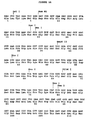
- HIV-1 Tat protein is produced from two exons: Exon 1 encodes a 72 amino acid (aa) protein (see Fig. 1 , SEQ ID NO: 1) which may be expressed without splicing or be spliced with the approximately 29 amino acid peptide encoded by Exon 2 to produce an approximately 101 amino acid peptide. Since the 72 amino acid product of Exon 1 is capable alone of cellular uptake and activation, it is essential that antibodies react with and interdict intercellular transport of the 72 amino acid peptide. HIV-1 Tat contains Cys at aa positions 22 and 37 of Exon 1 [SEQ ID NOS: 1 and 2], and 5 additional Cys between these. This region of the peptide is termed the Cys rich region and has Cys-Cys covalent linkages producing complex tertiary structure. The scientific literature has indicated that this region does not appear to be immunogenic.
- the inventor has identified epitopes, i.e., binding regions, recognized by antibodies (antigenic sequences) in the N-terminal linear sequence 1-21 (22 aa) and the C-terminal linear sequence 38-72 (35 aa) of Exon I [SEQ ID NO: 2] or other Tat sequence variants. Immunogenic regions of these larger sequences were identified by the inventor and are underlined in the N terminal and C terminal consensus sequences of Exon 1 below: Epitope I was identified as the nine amino acid sequence of aa positions 2-10 of Exon 1. Epitope II was identified as the eleven amino acid sequence of aa positions 41-51 of Exon 1. Epitope III was identified as the 7 amino acid sequence of aa positions 56-62 of Exon 1. Epitope IV was identified as the twelve amino acid sequence of aa positions 62-73 of Tat, including the first Pro (aa 73) of Exon 2 and overlaps Ser 62 of Epitope III (dotted underlining).
- Tat sequence variant means a polypeptide or peptide containing Tat protein amino acid residues, or a sequence from another HIV-1 strain Tat protein that is substantially similar to the sequence of SEQ ID NO: 1.
- Each variant may differ from the consensus sequence of Fig. 1 [SEQ ID NO: 1] and/or from another variant by at least one amino acid change within the residues of interest for Epitopes I through IV. This change may provide the same or different antigenic specificity to that particular Tat Epitope when added to the composition of the invention.
- the present invention provides a composition containing a non-naturally occurring peptide or polypeptide, which comprises two, three or four Epitope I amino acid sequences. These Epitope I sequences elicit a specific humoral immune response (for the purpose of this invention) in a mammal exposed to the Epitope I sequences in vivo.
- the Epitope I amino acid sequences correspond to amino acid residues 2-10 or 4-10 of the Tat consensus sequence [SEQ ID NO: 1] of Fig. 1 which is derived from a number of "Tat sequence variants".
- Epitope I defines peptides of the general formula: R1- -Val-Asp-
- the N-terminal R1 may represent the hydrogen on the unmodified N terminal amino acid Val, or R1 may be a lower alkyl, or a lower alkanoyl attached to the Val. R1 may also include a sequence of between 1 to about 5 amino acids, optionally substituted with a lower alkyl or lower alkanoyl. In one embodiment, R1 is -X-Pro-, wherein X is Glu or Asp.
- the C-terminal R2 can represent the hydroxyl group on the C terminal amino acid Pro, or R2 can be an amide on the Pro; alternatively, R2 is a sequence of between 1 to about 14 additional amino acids, optionally amidated at the carboxyl terminus.
- the X and Y positions represent common variants of this Epitope peptide, wherein X is Glu (90%) or Asp (10%), and Y is variously Arg (74%), Lys (11%), Ser (9%) or Asn (4%). Peptides containing Glu or Asp at position X induce antibodies that effectively cross-react with the other variant.
- peptides omitting the X-P effectively induce antibodies to Val-Asp-Pro-Arg-Leu-Glu-Pro (amino acids 4-10 of SEQ ID NO: 1).
- a desirable immunogen of the formula Glu-Pro-Val-Asp-Pro-Lys-Leu-Glu-Pro [SEQ ID NO: 56] reacts/cross-reacts greater than 95% of known HIV-1 Tat proteins, while an immunogen of the formula Val-Asp-Pro-Lys-Leu-Gly-Pro [SEQ ID NO: 57] reacts/cross-reacts with greater than 97% of known HIV-1 Tat proteins.
- Antibodies to all four position Y variants are generated by using all four as immunogens.
- cross-reactivity permits a reduction to two or even one immunizing sequence to induce reactivity to all four position Y variants.
- the reactivities of antibodies induced by the Epitope I-containing peptide: Val-Asp-Pro-Y-Leu-Glu-Pro-Typ-Lys-His-Pro-Gly-Ser-[SEQ ID NO: 58], where Y is Arg, Lys, Ser or Asn are reported in Table 1 below. Dark shading shows self-reactivity, pale shading shows significant (.40%) cross-reactivity.
- composition of this invention contains two, three or four of the following Epitope I peptides or polypeptides:
- the immunogen in which Y is Lys [SEQ ID NO: 7] induces antibodies with good reactivity with the three other variants. No immunogen induced high titer antibodies with good cross-reactivity with the variant in which Y was Ser.
- an immunogen of Epitope I in which Y was Lys [SEQ ID NO: 7] may suffice for full cross-reactivity to all four position Y variants, and may be used alone in an immunogenic composition. While this pattern of response of the peptide in which Y is Lys occurs in the majority of tests to date, it should be expected by one of skill in the art, that some differences in cross-reactivity from the results above may occur in some test samples.
- Epitope I peptide immunogen contains at position Y an ornithine, since the ornithine side chain is similar to lysine with one less -CH 2 -, This Epitope I sequence may provide even more cross-reactivity, and may be used alone or in combination with other Epitope I immunogens.
- the seven amino acid residues which form the minimum reactive Epitope I sequences may be flanked by other amino acids, so that the entire Epitope I sequence may be between 7 and about 25 amino acids in length.
- the identity of the flanking amino acids is not essential to the biological function of the Epitope I immunogen.
- additional amino acids on the N-terminus of Epitope I sequences do not affect immunogenicity.
- the N-terminal R1 of Epitope I may be selected from the group consisting of a free N terminal amino acid hydrogen, a lower alkyl (i.e., C1-C10 alkyl), a lower C1-C10 alkanoyl, such as an acetyl group, or a sequence of between 1 to about 5 amino acids.
- R1 represents 2 amino acids.
- R2 can be a simple free hydroxyl group, it can also be a C terminal amide.
- R2 is preferably a sequence of between 1 to about 14 additional amino acids amidated at the carboxyl terminus.
- R2 is -Trp-Lys-His-Pro-Gly-Ser-amide [SEQ ID NO: 10].
- Epitope I composition of the invention may contain a number of additional peptides or polypeptides, which contain other sequences which correspond to amino acid residues between aa 2-aa10 of SEQ ID NO: 1, but are derived from other Tat variants which do not cross-react well with antibodies to the Epitope I compositions described above.
- additional peptides and polypeptides are referred to as "optional Epitope Ia immunogens".
- optional Epitope Ia immunogens which can be present in compositions of this invention can contain at least one copy of at least one of the following amino acid sequences [SEQ ID NOS: 11 through 18, respectively]:
- the Epitope I compositions of this invention may contain multiple copies of a single peptide, or multiple copies of different Epitope I peptides, including optionally Epitope Ia peptides, in any order, or multiple copies of at least two of these peptides. In one embodiment, at least one copy of all four amino acid sequences [SEQ ID NOS: 6-9] are present.
- the Epitope I and Ia peptides or polypeptides of these compositions are produced synthetically or recombinantly.
- the Epitope I immunogens can be expressed as synthetic peptides coupled to carrier protein.
- the Epitope I immunogens may also be expressed as multiple antigenic peptides, optionally coupled to carrier protein.
- the Epitope I immunogens may be expressed within a recombinantly produced protein, optionally co-expressed or fused in frame with a carrier protein.
- Epitope I compositions demonstrate a biological activity of inducing in an immunized, immune competent mammal, i.e., a non-infected human, or an asymptomatic infected human, an active humoral immune response (i.e., antibodies) that is directed against greater than 95%, and preferably greater than 99%, of the known variants of Tat proteins of HIV-1.
- an active humoral immune response i.e., antibodies
- the end result of such treatment is an impairment of the multiplication of HIV-1 in an acute infection, thereby preventing high post-seroconversion plasma levels of HIV-1 that are associated with progression to AIDS.
- Active induction of antibodies in the early asymptomatic phase of HIV infection may reduce viral multiplication, lower the plasma viral load and reduce the likelihood of progression to AIDS.
- composition which contains at least one Epitope I immunogen up to all four of the SEQ ID NO: 6-9 amino acid sequences, can elicit an immune response to about 97% of the 400 known Tat sequences of the common B subtypes of HIV-I and with Tat proteins of all 18 non-B subtype HIV-1 that have been sequenced [courtesy of Dr. Esther Guzman, Los Alamos NIAID HIV database; GenBank database].
- the present invention provides a composition comprising at least one Epitope II amino acid sequence.
- This Epitope II sequence elicits a specific humoral immune response (for the purpose of this invention) in a mammal exposed to the Epitope II sequence in vivo.
- Epitope II defines peptides of the Formula R3-Lys-X-Leu-Gly-Ile-Ser-Tyr-Gly-Arg-Lys-Lys- R4, wherein X is Gly (70%) or Ala (30%). This sequence is highly conserved.
- the immunogen in which X is Gly induces antibodies cross-reactive with the sequence in which X is Ala.
- the N terminal R3 may represent the hydrogen on the unmodified N terminal amino acid Lys, or R3 may be a lower alkyl, or a lower alkanoyl, such as an acetyl group, substituent on the Lys. R3 may also include a sequence of between 1 to about 5 amino acids, optionally substituted with a lower alkyl or lower alkanoyl.
- the C terminal R4 may represent the free hydroxyl of the C terminal amino acid Lys, or R3 may be an amide on that C terminal amino acid. R3 may optionally be a sequence of one or up to about 5 additional amino acids, optionally substituted with an amide.
- the presently preferred immunogen for Epitope II is -Lys-Gly-Leu-Gly-Ile-Ser-Tyr-Gly-Arg-Lys-Lys- (amino acids 41-51 of SEQ ID NO: 1). This would react/cross-react with greater than 96% of known HIV-1 Tat proteins.
- Epitope II is poorly immunogenic when presented within other sequences. Thus, for optimal immunogenicity, this sequence is prepared as a synthetic peptide fused to, or coupled to, a carrier protein or as a multiple antigenic peptide, optionally coupled to carrier protein. Alternatively, Epitope II may be expressed as the C terminal sequence of a recombinant protein, which is optionally fused in frame to a carrier protein at its amino terminal sequence. In a composition of this invention, an Epitope II peptide is preferably presented alone or in combination with one or more Epitope I peptides. Other compositions may employ one or more Epitope III or IV peptides.
- the present invention provides that the Epitope I Immunogenic Compositions and the Epitope II Immunogenic Compositions may further comprise at least one, and preferably two or more Epitope III amino acid sequences. These Epitope III sequences elicit a specific humoral immune response (for the purpose of this invention) in a mammal exposed to the Epitope III sequences in vivo. This epitope shows considerable more variation than Epitopes I and II. These Epitope III immunogenic peptides and polypeptides are derived from Tat variant protein sequences corresponding to amino acids 56-62 of SEQ ID NO: 1.
- Epitope III defines peptides of the formula: R5-Arg-Arg-X-Z-A-Y-Ser-R6 [SEQ ID NO: 38], wherein X may be Ala, Pro, Ser or Gln; Y may be Asp, Asn, Gly or Ser; Z may be Pro or His; and A may be Gln or Pro.
- the Epitope III immunogens in which X is Ala induce antibodies that cross-react with the other position X variants.
- Epitope III immunogens containing Asp in position Y induce antibodies that cross-react with the other position Y variants.
- the seven amino residues which form the minimum reactive Epitope III sequences may be flanked by other amino acids, so that the entire Epitope III sequence may be between 7 and about 15 amino acids in length.
- the identity of the flanking amino acids is not essential to the biological function of the Epitope III immunogen.
- additional amino acids on the N-terminus of Epitope III sequences do not affect immunogenicity.
- the N terminal R5 may optionally represent the hydrogen on the N-terminal Arg, or R5 is a lower alkyl or alkanoyl, such as an acetyl group, substituent on the N-terminal Arg.
- R5 is a sequence of between 1 to about 3 amino acids, optionally substituted with a lower alkyl or lower alkanoyl.
- R5 is -Gln-Arg-, optionally modified as above, which improves the immunogenicity of the Epitope.
- the C terminal R6 represents either the free hydroxyl on the C terminal amino acid or an amide substituent on the C terminal amino acid, because any C-terminal extension impairs immunogenicity.
- Epitope III immunogens which can be present in compositions of this invention can include at least one copy of at least one of the following preferred Epitope III amino acid sequences: R5-Gln-Arg-Arg-Arg-Ala-Pro-Gln-Asp-Ser-R6, R5-Gln-Arg-Arg-Arg-Ala-His-Gln-Asp-Ser-R6, and R5-Gln-Arg-Arg-Arg-Arg-Ala-Pro-Pro-Asp-Ser-R6, optionally modified as above [SEQ ID NOS: 20 through 22, respectively].
- Still other optional immunogenic sequences which may be included in the Epitope III compositions include R5-Arg-Arg-Pro-Pro-Gln-Asp-Asn-R6,R5-Arg-Arg-Ala-Pro-Gln-Asp-Arg-R6; R5 -Arg-Gly-Ala-Pro-Gln-Asp-Ser-R6; R5-Arg-Arg-Ala-Pro-Glu-Asp-Ser-R6; or R5-Arg-Arg-Ala-Ser-Gln-Asp-Ser-R6 [SEQ ID NOS: 23 through 27, respectively].
- compositions of the invention can induce antibodies that react with rare Tat proteins of HIV-1 which are not cross-reactive with, or do not have a sufficiently strong cross-reactivity to, antibodies induced by the preferred Epitope III immunogens.
- Epitope III peptides or polypeptides are poorly immunogenic when presented within other sequences.
- the Epitope III sequences may be prepared recombinantly, for optimal immunogenicity, these sequences would be prepared synthetically and coupled to a carrier protein, or as multiple antigenic peptides, optionally coupled to carrier protein.
- Epitope III may be expressed as the C terminal sequence of a recombinant protein, which is optionally fused in frame to a carrier protein at its amino terminal sequence.
- Compositions of this invention would preferably contain three or more different Epitope III immunogens, with Epitope I or Epitope II immunogens, and optionally with one or more Epitope IV immunogens.
- the present invention provides that the Epitope I Immunogenic Compositions and the Epitope II Immunogenic Compositions may further comprise at least one, and preferably two or more Epitope IV amino acid sequences. These Epitope IV sequences elicit a specific humoral immune response (for the purpose of this invention) in a mammal exposed to the Epitope IV sequences in vivo.
- the Epitope IV immunogenic peptides and polypeptides are derived from Tat variant protein sequences corresponding to amino acids 62-72 of SEQ ID NO: 1, including a C-terminal Pro from Exon 2 of HIV-1 Tat.
- Epitope IV defines peptides of the formula:R7-Ser-Gln-X-His-Gln-Y-Ser-Leu-Ser-Lys-Gln-Pro-R8 [SEQ ID NO: 39], wherein X may be Asn or Thr; and Y may be Ala or Val.
- the immunogen in which X is Thr induces antibodies that cross-react with the immunogen in which X is Asn.
- the immunogen in which Y is Val induce antibodies that do not cross-react with the peptides in which Y is Ala. However, the peptides containing Ala in position Y induce antibodies that cross-react with peptides for Epitope IV in which Y is Val.
- the optimal Epitope IV immunogen is Ser-Gln-Thr-His-Gln-Ala-Ser-Leu-Ser-Lys-Gln-Pro [SEQ ID NO: 40] and this induces antibodies reactive/cross-reactive with 64% of known HIV-1 Tat proteins.
- the twelve amino acid residues which form the minimum reactive Epitope IV sequences may be flanked by a few other amino acids, so that the entire Epitope IV sequence may be between 12 and about 18 amino acids in length.
- the N terminal R7 may represent the hydrogen of the N terminal amino acid, or a lower alkyl or alkanoyl, such as an acetyl group substituent on the N terminal amino acid. Although N-terminal extension markedly inhibits immunogenicity, the R7 may also be a sequence of between 1 to about 3 amino acids, optionally substituted with a lower alkyl or lower alkanoyl.
- the C terminal R8 may represent the free hydroxyl on the C terminal amino acid, or an amide substituent on the C terminal amino acid, or R8 may be a sequence of one or up to about 3 additional amino acids, optionally substituted with an amide.
- the C-terminal Pro which is an important component of the epitope, is encoded by exon 2 of Tat. Thus antibodies to Epitope IV would be poorly reactive with nonspliced Tat Exon 1 protein.
- This Epitope IV sequence is poorly immunogenic when presented within other sequences. Thus, for optimal immunogenicity, this sequence would be prepared as a synthetic peptide coupled to carrier protein or as a multiple antigenic peptide, optionally coupled to carrier protein. Compositions of this invention would preferably contain two or more different Epitope IV immunogens, with Epitope I or Epitope 2 immunogens, and optionally with one or more Epitope III immunogens.
- compositions of this invention i.e., the peptide/polypeptides containing the above-identified amino acid sequences, when provided to a human subject, are useful in the immunologic interdiction of extracellular Tat proteins of most HIV-1 strains. These compositions function to critically reduce explosive multiplication of the virus and permit effective immune control of the virus.
- the immunogens for each Epitope are preferably designed to induce antibodies reactive with the highest proportion of naturally occurring variants of each epitope.
- an epitope such as Epitope I
- multiple copies of an immunogen could be incorporated in a synthetic or recombinant immunogen to enhance the immunogenicity and produce higher titer antibodies.
- immunogens for two or more epitopes could be combined to extend coverage, since variations in sequence of each epitope occur independently. For example, combining an Epitope I immunogen(s) (95%) with an Epitope II immunogen (96%) would result in antibodies in immunologically responsive subjects reactive with 99.8% of known HIV-1 Tat proteins.
- a composition of this invention contains one Epitope I (underlined)-Epitope II (double-underlined) fused peptide immunogen such as Cys- Glu-Pro-Val-Asp-Pro-Lys-Leu-Glu-Pro -Trp- Lys-Glu-Leu-Gly-Ile-Ser-Tyr-Gly-Arg-Lys-Lys -amide [SEQ ID NO: 67], coupled to carrier protein attached to Epitope I, or the same peptide (less the N-terminal Cys for coupling), synthesized as a multiple antigenic peptide, optionally coupled to carrier protein.
- mixtures of two or more immunogens could be used as follows.
- Epitope I immunogens with or without any Epitope II , III or IV or other optional immunogens, may be prepared and used in immunogenic compositions in a variety of forms, for example, chemically synthesized or as recombinant peptides, polypeptides, proteins, fusion proteins or fused peptides.
- a composition of the present invention may be a synthetic peptide, containing single or multiple copies of the same or different Epitope I immunogen amino acid sequences and/or Epitope II/III/IV immunogenic amino acid sequences, and optionally amino acid sequences of the optional immunogens, coupled to a selected carrier protein.
- multiple above-described Epitope I amino acid sequences with or without flanking sequences may be combined sequentially in a polypeptide and coupled to the same carrier.
- the Epitope I, II, III, or IV immunogens may be coupled individually as peptides to the same or a different carrier proteins, and the resulting immunogen-carrier constructs mixed together to form a single composition.
- the carrier protein is desirably a protein or other molecule which can enhance the immunogenicity of the selected immunogen.
- a carrier may be a larger molecule which has an adjuvanting effect.
- Exemplary conventional protein carriers include, without limitation, E . coli DnaK protein, galactokinase (galK, which catalyzes the first step of galactose metabolism in bacteria), ubiquitin, ⁇ -mating factor, ⁇ -galactosidase, and influenza NS-1 protein.
- Toxoids i.e., the sequence which encodes the naturally occurring toxin, with sufficient modifications to eliminate its toxic activity
- diphtheria toxoid and tetanus toxoid may also be employed as carriers.
- bacterial heat shock proteins e.g., mycobacterial hsp-70 may be used.
- Glutathione reductase (GST) is another useful carrier.
- GST Glutathione reductase
- one or more epitope immunogen and optional immunogen peptides/polypeptides may be covalently linked to a mycobacterial E . coli heat shock protein 70 (hsp70) [ K. Suzue et al, J. Immunol., 156:873 (1996 )].
- the composition is formed by covalently linking the immunogen-containing peptide or polypeptide sequences to diphtheria toxoid.
- the peptides or polypeptide epitope immunogens and any selected optional immunogens may be in the form of a multiple antigenic peptide ("MAP", also referred to as an octameric lysine core peptide) construct.
- MAP multiple antigenic peptide
- Such a construct may be designed employing the MAP system described by Tam, Proc. Natl. Acad. Sci. USA, 85:5409-5413 (1988 ). This system makes use of a core matrix of lysine residues onto which multiple copies of the same Epitope I or optional immunogens of the invention are synthesized as described [ D. Posnett et al., J. Biol. Chem., 263(4):1719-1725 (1988 ); J.
- an epitope composition of this invention can include a MAP in which the peptide or polypeptide epitope immunogen attached to the lysine core contains one or sequential repeats of the four amino acid sequences [SEQ ID NOS: 6-9] identified above. Multiple different MAPs may be employed to obtain any desired combination ofEpitope I, II, III or IV sequences. Preferably these MAP constructs are associated with other T cell stimulatory sequences, or as pharmaceutical compositions, administered in conjunction with T cell stimulatory agents, such as known adjuvants.
- each peptide/polypeptide immunogen, or each amino acid sequence in the immunogen may be optionally separated by an optional amino acid sequences called "spacers".
- Spacers are sequences of between 1 to about 4 amino acids which are interposed between two sequences to permit linkage therebetween without adversely effecting the three dimensional structure of the immunogen. Spacers may also contain restriction endonuclease cleavage sites to enable separation of the sequences, where desired. Suitable spacers or linkers are known and may be readily designed and selected by one of skill in the art. Preferred spacers are sequences containing Gly and/or Ser amino acids.
- nucleic acid sequences which encode the above-described peptide/polypeptide compositions, including the peptide and polypeptide immunogens of the compositions described above, including those peptides and polypeptides fused to carrier proteins.
- the nucleic acid sequences may also include sequences encoding the carrier proteins.
- one preferred embodiment of the invention is a "synthetic gene" which encodes sequentially for one or more Epitope I immunogenic peptides/polypeptide.
- the synthetic gene preferably encodes two, three or all four Epitope I amino acid sequences [SEQ ID NOS: 6 through 9, respectively]:
- the synthetic gene can also encode any selection of the optional immunogens identified above, and may include an Epitope II or III immunogen provided that the Epitope II or III peptide is fused to the C terminus of the Epitope I sequence and not further modified on its own C terminus.
- the synthetic gene may encode multiple copies of the same amino acid sequence, copies of multiple different immunogens or amino acid sequences, or multiple copies of multiple different immunogens or amino acid sequences.
- the synthetic gene may encode the selected amino acid sequences in an open reading frame with, or fused to, a nucleic acid sequence encoding a carrier protein.
- a further characteristic of the synthetic gene may be that it encodes a spacer between each sequence encoding an immunogen and/or between the sequence encoding an immunogen and the sequence encoding the carrier protein.
- the synthetic gene of the present invention may also be part of a synthetic or recombinant molecule.
- the synthetic molecule may be a nucleic acid construct, such as a vector or plasmid which contains the synthetic gene encoding the protein, peptide, polypeptide, fusion protein or fusion peptide under the operative control of nucleic acid sequences encoding regulatory elements such as promoters, termination signals, and the like.
- Such synthetic molecules may be used to produce the polypeptide/peptide immunogen compositions recombinantly.
- the synthetic gene or synthetic molecules can be prepared by the use of chemical synthesis methods or preferably, by recombinant techniques.
- the synthetic gene or molecules may contain certain preference codons for the species of the indicated host cell.
- the synthetic gene or molecules may be used in a variety of ways.
- these synthetic nucleic acid sequences may be employed to express the peptide/polypeptides of the invention in vitro in a host cell culture.
- the expressed immunogens after suitable purification, may then be incorporated into a pharmaceutical reagent or vaccine.
- the synthetic gene or synthetic molecule of this invention may be administered directly into a mammalian, preferably human subject, as so-called 'naked DNA' to express the protein/peptide immunogen in vivo in a patient.
- a mammalian preferably human subject
- the synthetic molecule e.g., a vector or plasmid
- the synthetic molecule may be used for direct injection into the mammalian host. This results in expression of the protein by host cells and subsequent presentation to the immune system to induce antibody formation in vivo.
- the synthetic genes or molecules of this invention may be incorporated into a non-pathogenic microorganism.
- the resulting microorganism when administered to a mammalian host expresses and multiplies the expressed compositions of this invention in vivo to induced specific antibody formation.
- non-pathogenic recombinant viruses which carry the compositions or synthetic genes of this invention and are useful for administration to a mammalian patient may be prepared by use of conventional methodology and selected from among known nonpathogenic microorganisms.
- Suitable non-pathogenic viruses which may be engineered to carry the synthetic gene into the cells of the host include poxviruses, such as vaccinia, adenovirus, canarypox, retroviruses and the like.
- poxviruses such as vaccinia, adenovirus, canarypox, retroviruses and the like.
- a number of such non-pathogenic viruses are commonly used for human gene therapy, and as carrier for other vaccine agents, and are known and selectable by one of skill in the art.
- compositions of the invention and the individual polypeptides/peptides containing the Epitope I or, II, and optionally Epitope III or Epitope IV or optional immunogens of this invention, the synthetic genes, and synthetic molecules of the invention, may be prepared conventionally by resort to known chemical synthesis techniques, such as described by Merrifield, J. Amer. Chem. Soc., 85:2149-2154 (1963 ).
- the compositions of this invention may be prepared by known recombinant DNA techniques by cloning and expressing within a host microorganism or cell a DNA fragment carrying a sequence encoding a peptide/polypeptide containing an Epitope I and/or optional immunogen and optional carrier protein.
- Coding sequences for the Eptiope I and optional immunogens can be prepared synthetically [ W. P. C. Stemmer et al, Gene, 164:49 (1995 ) or can be derived from viral RNA by known techniques, or from available cDNA-containing plasmids.
- Combinations of these techniques may be used, such as for production of the synthetic gene, which may require assembly of sequential immunogens by conventional molecular biology techniques, and site-directed mutagenesis to provide desired sequences of immunogens.
- the product of the synthetic gene is then produced recombinantly. All of these manipulations may be performed by conventional methodology.
- Systems for cloning and expressing the peptide/polypeptide compositions of this invention using the synthetic genes or molecules include various microorganisms and cells which are well known in recombinant technology. These include, for example, various strains of E . coli , Bacillus , Streptomyces , and Saccharomyces , as well as mammalian, yeast and insect cells. Suitable vectors therefor are known and available from private and public laboratories and depositories and from commercial vendors. Currently, the most preferred host is a mammalian cell such as Chinese Hamster ovary cells (CHO) or COS-1 cells These hosts may be used in connection with poxvirus vectors, such as vaccinia or swinepox.
- poxvirus vectors such as vaccinia or swinepox.
- Another preferred system includes the baculovirus expression system and vectors.
- compositions of this invention i.e., the polypeptide/peptides containing the indicated copies of the Epitope I immunogens and optional immunogens may be isolated either from the cellular contents by conventional lysis techniques or from cell medium by conventional methods, such as chromatography. See, e.g., Sambrook et al., Molecular Cloning. A Laboratory Manual., 2d Edit., Cold Spring Harbor Laboratory, New York (1989 ).
- Suitable plasmid and viral vectors used either for production of the peptide/polypeptide components as DNA vaccines are well known to those of skill in the art and are not a limitation of the present invention. See, Sambrook et al., cited above and the references above to production of the protein. See, also International Patent Application PCT WO94/01139, published January 20, 1994 .
- the DNA encoding the selected peptide/polypeptide is inserted into a vector or plasmid which contains other optional flanking sequences, a promoter, an mRNA leader sequence, an initiation site and other regulatory sequences capable of directing the multiplication and expression of that sequence in vivo or in vitro.
- vectors permit infection of patient's cells and expression of the synthetic gene sequence in vivo or expression of it as a protein/peptide or fusion protein/peptide in vitro.
- the resulting composition may be formulated into a Epitope I composition with any number of optional immunogens and screened for efficacy by in vivo assays.
- assays employ immunization of an animal, e.g., a rabbit or a simian, with the composition, and evaluation of titers of antibody to the Tat proteins of HIV-1 or to synthetic detector peptides corresponding to variant Tat sequences (as shown in the examples below).
- An isolated mammalian antibody composition which is directed against a peptide or polypeptide of the invention, as described above, is also an aspect of this invention.
- Such polyclonal antibody compositions are produced by immunizing a mammal with a peptide/polypeptide composition containing an assortment of Epitope I, II, III, and/or IV immunogens and optional immunogens, as described above.
- Suitable mammals include primates, such as monkeys; smaller laboratory animals, such as rabbits and mice, as well as larger animals, such as horse, sheep, and cows. Such antibodies may also be produced in transgenic animals.
- a desirable host for raising polyclonal antibodies to a composition of this invention includes humans.
- the polyclonal antibodies raised in the mammal exposed to the composition are isolated and purified from the plasma or serum of the immunized mammal by conventional techniques.
- Conventional harvesting techniques can include plasmapheresis, among others.
- Such polyclonal antibody compositions may themselves be employed as pharmaceutical compositions of this invention.
- other forms of antibodies may be developed using conventional techniques, including monoclonal antibodies, chimeric antibodies, humanized antibodies and fully human antibodies. See, e.g., Harlow et al., Antibodies A Laboratory Manual, Cold Spring Harbor Laboratory, (1988 ); Queen et al., Proc. Nat'l. Acad. Sci. USA, 86: 10029-10032 (1989 ); Hodgson et al., Bio/Technologyo 9:421(1991 ); International PCT Application PCT/GB91/01554 , Publication No. W092/04381 and International PCT Application PCT/GB93/00725 , Publication No.
- anti-Tat antibodies may be developed by screening hybridomas or combinatorial libraries, or antibody phage displays [ W. D. Huse et al., Science, 246:1275-1281(11988 )] using the polyclonal or monoclonal antibodies produced according to this invention and the amino acid sequences of the Epitope I, II, III, IV or optional immunogens.
- These antibody compositions bind to greater than 95%, and preferably greater than 99% of known Tat protein variants of HIV-1, and prevent the Tat proteins from supporting further HIV-1 multiplication.
- these antibodies are useful in pharmaceutical methods and formulations described below.
- a pharmaceutical composition useful for inducing antibodies that react with greater than 95%, preferably greater than 99%, of known HIV-1 Tat proteins and impair the multiplication of HIV1 can comprise as its active agents, one or more of the peptides or polypeptides of Epitopes I or, II, and, optionally Epitopes III, or IV.
- Several desirable compositions include the following above described components:
- compositions may contain additional ingredients.
- Pharmaceutical formulations containing the compositions of this invention may contain other active agents, such as T cell stimulatory agents for the MAPs, adjuvants and immunostimulatory cytokines, such as IL-12 and other well-known cytokines, for the protein/peptide compositions. All of these pharmaceutical compositions can operate to lower the viral levels of a mammal.
- compositions comprising
- Epitope I and/or II, and/or III, and/or IV amino acid sequences with optional immunogenic amino acid sequences are admixed with a pharmaceutically acceptable vehicle suitable for administration as a protein composition for prophylaxis or treatment of virus infections. These proteins may be combined in a single pharmaceutical preparation for administration.
- Suitable pharmaceutically acceptable carriers for use in an immunogenic proteinaceous composition of the invention are well known to those of skill in the art. Such carriers include, for example, saline, buffered saline, a selected adjuvant, such as aqueous suspensions of aluminum and magnesium hydroxides, liposomes, oil in water emulsions and others. Suitable adjuvants may also be employed in the protein-containing compositions of this invention. The present invention is not limited by the selection of the carrier or adjuvant.
- Suitable vehicles for direct DNA, plasmid nucleic acid, or recombinant vector administration include, without limitation, saline, or sucrose, protamine, polybrene, polylysine, polycations, proteins, CaPO 4 or spermidine. See e.g, PCT applicationWO94/01139 and the references cited above.
- the peptide/polypeptide compositions and synthetic genes or molecules in vivo are capable of eliciting in an immunized host mammal, e.g., a human, an immune response capable of interdicting greater than about 95% to about 99% of known extracellular Tat protein variants from HIV-1 and thereby lowering the viral levels.
- Yet another pharmaceutical composition useful for impairing the multiplication of HIV-1 comprises an antibody composition as described in detail above.
- the antibodies may be carried in a saline solution or other suitable carrier.
- the antibody compositions are capable of providing an immediate, exogenously provided interdiction of Tat.
- compositions from the above-described components, having appropriate pH, isotonicity, stability and other conventional characteristics is within the skill of the art.
- the compositions of the invention may be used for reducing the viral levels of HIV-1 by exposing a human to the Tat antibody-inducing pharmaceutical compositions described above, actively inducing antibodies that react with greater than 95%, preferably greater than 99%, of known HIV-1 Tat proteins, and impairing the multiplication of the virus in vivo .
- This use is appropriate for an HIV-1 infected subject with a competent immune system, or an uninfected or recently infected subject.
- the use induces antibodies which react with HIV-1 Tat proteins, which antibodies reduce viral multiplication during any initial acute infection with HIV1 and minimize chronic viremia leading to AIDS. This use also lowers chronic viral multiplication in infected subjects, again minimizing progression to AIDS.
- the pharmaceutical compositions may be therapeutically administered to an HIV-1 infected human with a competent immune system for treatment or control of viral infection.
- an infected human may be asymptomatic.
- the pharmaceutical compositions may be administered to an uninfected human for prophylaxis.
- the pharmaceutical compositions preferably contain the peptide/polypeptide compositions, the synthetic genes or molecules, the recombinant virus or the commensal recombinant bacterium.
- Each of these active components of the pharmaceutical composition actively induces in the exposed human the formation of anti-Tat antibodies which block the transfer of Tat from infected cells to other infected or uninfected cells. This action reduces the multiplicity of infection and blocks the burst of HIV-1 viral expansion, and thus lowers viral levels. In already infected patients, this method of reduction of viral levels can reduce chronic viremia and progression to AIDS. In uninfected humans, this administration of the compositions of the invention can reduce acute infection and thus minimize chronic viremia leading to progression to AIDS.
- the compositions may be used for reducing the viral levels of HIV-1 by administering to a human, who is incapable of mounting an effective or rapid immune response to infection with HIV-1, a pharmaceutical composition containing the antibody compositions described above.
- the use can involve chronically administering the composition.
- patients suitable for treatment with this method are HIV-1 infected patients who are immunocompromised by disease and unable to mount a strong immune response. In later stages of HIV-1 infection, the likelihood of generating effective titers of antibodies is less, due to the immune impairment associated with the disease.
- HIV-1 infected pregnant women neonates of infected mothers
- unimmunized patients with putative exposure e.g., a human who has been inadvertently "stuck" with a needle used by an HIV- 1 infected human.
- the use of the invention preferably employs as the pharmaceutical composition the antibody composition of the invention, which is a polyclonal antibody composition prepared in other mammals, preferably normal humans.
- the other forms of antibody described above may be employed.
- These antibody compositions are administered as passive immunotherapy to inhibit viral multiplication and lower the viral load.
- the exogenous antibodies which react with greater than 95%, preferably greater than 99%, of known Tat proteins from
- HIV-1 provide in the patient an immediate interdiction of the transfer of Tat from virally infected cells to other infected or uninfected cells.
- the patient may be chronically treated with the antibody composition for a long treatment regimen.
- compositions of the present invention are administered by an appropriate route, e.g., by the subcutaneous, oral, intravenous, intraperitoneal, intramuscular, nasal, or inhalation routes.
- the presently preferred route of administration is intramuscular for the immunizing (active induction) compositions and intravenous or intramuscular for the antibody (passive therapy) compositions.
- the recombinant viral vectors or naked DNA is preferably administered i.m., however, other certain recombinant viral vectors may be delivered orally.
- the amount of the protein, peptide or nucleic acid sequences of the invention present in each vaccine dose is selected with regard to consideration of the patient's age, weight, sex, general physical condition and the like.
- the .amount of active component required to induce an immune response, preferably a protective response, or produce an exogenous effect in the patient without significant adverse side effects varies depending upon the pharmaceutical composition employed and the optional presence of an adjuvant (for the protein-containing compositions).
- each dose will comprise between about 50 ⁇ g to about 2 mg of the peptide/polypeptide immunogens per mL of a sterile solution.
- a more preferred dosage may be about 500 ⁇ g of immunogen.
- Other dosage ranges may also be contemplated by one of skill in the art.
- Initial doses may be optionally followed by repeated boosts, where desirable.
- the antibody compositions of the present invention can be employed in chronic treatments for subjects at risk of acute infection due to needle sticks or maternal infection.
- a dosage frequency for such "acute" infections may range from daily dosages to once or twice a week i.v. or i.m., for a duration of about 6 weeks.
- the antibody compositions of the present invention can also be employed in chronic treatments for infected patients, or patients with advanced HIV. In infected patients, the frequency of chronic administration may range from daily dosages to once or twice a week i.v. or i.m., and may depend upon the half-life of the immunogen (e.g., about 7-21 days). However, the duration of chronic treatment for such infected patients is anticipated to be an indefinite, but prolonged period.
- compositions of this invention may be designed for direct administration of synthetic genes or molecules of this invention as "naked DNA"
- the amounts of components in the DNA and vector compositions and the mode of administration, e.g., injection or intranasal may be selected and adjusted by one of skill in the art.
- each dose will comprise between about 50 ⁇ g to about 1 mg of immunogen-encoding DNA per mL of a sterile solution.
- the doses may range from about 20 to about 50 ml of saline solution containing concentrations of from about 1 x 10 7 to 1 x 10 10 pfu/ml recombinant virus of the present invention.
- a preferred human dosage is about 20 ml saline solution at the above concentrations.
- one of skill in the art may alter such dosages depending upon the identity of the recombinant virus and the makeup of the immunogen that it is delivering to the host.
- compositions of this invention are designed to retard or minimize infection by the selected virus of an uninfected mammal, e.g., human. Such compositions thus have utility as vaccines.
- Anti-Tat protein antibodies are not reactive with the HIV-1 proteins used in diagnostic assays to detect seroconversion after infection. Thus, subjects treated with the compositions of this invention would not be stigmatized with false-positive tests for HIV-1 infection, and it would remain possible to detect seroconversion if treated subjects did become infected with HIV-1.
- compositions of this invention affords a radically different strategy for AIDS vaccination because it permits the lowering of viral levels by biological interdiction of greater than about 95%, and preferably greater than about 99%, of known Tat protein variants of HIV-1, lowering multiplication of HIV-1.
- the use of the Tat immunogen-containing compositions has a particularly desirable advantage in contrast to other treatments and prophylactic methods employed against such viruses. Because interdiction of the Tat protein extracellularly inhibits the multiplication of all HIV quasi-species or strains indiscriminately, it does not create a selective pressure on the parent virus itself for selection of mutant virus variants. Thus, blocking the uptake of Tat protein by the patient's cells not only reduces the level of viremia, but does so in a manner that precludes the selection of "escape variants".
- the invention comprises a method of actively treating asymptomatic HIV-1 infected subjects with viremia, since during the course of the disease, extracellular Tat protein likely contributes to the persistent infection and immune abnormalities that are present at this stage of HIV-1 infection. Interdiction of extracellular Tat protein by antibodies induced by immunization according to this invention can reduce viremia with more effective immune control, and result in delay or prevention of progression to AIDS.
- compositions of this invention are capable of reducing viremia in patients already infected with the virus by blocking further uptake of the Tat protein by uninfected cells.
- compositions of the present invention used either alone or in conjunction with other therapeutic regimens for HIV infected patients, are anticipated to assist in the reduction of viremia and prevention of clinical deterioration.
- the formulations and modes of administration are substantially identical to those described specifically above and may be administered concurrently or simultaneously with other conventional therapeutics for the specific viral infection.
- repeated dosages of the immunizing compositions may be desirable, such as a yearly booster or a booster at other intervals.
- the peptides and polypeptides described above can also be employed as reagents of a kit useful for the measurement and detection of titers and specificities of antibodies induced by vaccination with the compositions described above.
- the kit of the invention can include one or more peptides of Epitopes I through IV.
- each peptide has on its N terminus the protein biotin and a spacer, e.g.,-Ser-Gly-Ser-Gly- [SEQ ID NO: 30].
- the peptide may have on its C terminus a spacer, e.g., -Gly-Ser-Gly-Ser- [SEQ ID NO: 90], and the protein biocytin.
- kits which provide binding agents known to those of skill in the diagnostic assay art may also be employed for the same purposes.
- labeled reagents which detect the binding of antibody to the immobilized Epitope peptides, such as a goat anti-human immunoglobulin or the like.
- the label on the reagent may be selected from the many known diagnostic labels, such as radioactive compounds, fluorescent compounds and proteins, colorimetric enzymes, etc.
- the kit thus also contains miscellaneous reagents and apparatus for reading labels, e.g., certain substrates that interact with an enzymatic label to produce a color signal, etc., apparatus for taking blood samples, as well as appropriate vials and other diagnostic assay components.
- labels e.g., certain substrates that interact with an enzymatic label to produce a color signal, etc.
- apparatus for taking blood samples as well as appropriate vials and other diagnostic assay components.
- diagnostic assay components One of skill in the art may also readily select other conventional diagnostic components for this kit.
- kits and reagents may be employed in a method for detecting the titers and reactivity patterns of antibodies in subjects vaccinated with the compositions of this invention.
- a method for determining the presence and or titer of antibodies induced by immunization to a Tat immunogen includes the steps of contacting a biological sample from an immunized subject, e.g., a body fluid, preferably blood, serum or plasma, but also possibly urine, saliva and other fluids or tissue, with one or more of the binding sequences ofEpitope I, II, III or IV, preferably immobilized on a solid support, such as a plate or beads.
- the Epitope I, II, III or IV binding sequences employed in this method may be the minimal binding regions, unmodified.
- sequences include -Val-Asp-Pro-Y-Leu-Glu-Pro- [SEQ ID NO: 86] or -Glu-Pro-Val-Asp-Pro-Y-Leu-Glu-Pro- [SEQ ID NO: 124], wherein Y is selected from the group consisting of Arg, Lys, Ser and Asn; and/or -Lys-X-Leu-Gly-Ile-Ser-Tyr-Gly-Arg-Lys-Lys- [SEQ ID NO: 87], wherein X is selected from the group consisting of Gly or Ala; and/or -Arg-Arg-X-Z-A-Y-Ser- [SEQ ID NO: 88], wherein X is selected from the group consisting of Ala, Pro, Ser and Gln; wherein Y is selected from the group consisting of Asp, Asn, Gly and Ser; wherein Z is selected from the group consisting of Pro and His; wherein A is selected from the group consisting
- the support is washed to eliminate any material from the biological sample which is not bound to the peptides.
- washing steps are conventional in diagnostic assays, and performed with saline. If antibodies to Epitopes I, or II, or III, or IV, or a combination thereof, were induced in the subject by the above-described treatment, the immobilized peptides have been bound with antibody from the biological sample.
- a labeled reagent is added to the material on the support to detect the binding between the peptides on the solid support and antibody in said biological sample.
- such a reagent is an anti-human immunoglobulin, such as goat anti-human immunoglobulin.
- the label is selected from among a wide array of conventionally employed diagnostic labels, as discussed above.
- the label can be a colorimetric enzyme, which upon contact with a substrate produces a detectable color signal. The presence and/or intensity of the color provides evidence of the induction of antibody in the treated subject.
- This assay may be employed to determine the efficacy of the immunization, as well as to monitor immune status of a patient.
- compositions of this invention are small number of immunogens required for inclusion into a composition of this invention to cross-react with greater than 95 to greater than 99% of known Tat protein variants of HIV-1 of the common B subtype.
- an immunogen of Epitope I in which Y was Lys [SEQ ID NO: 7] could suffice for full cross-reactivity to all four position Y variants, and could be used alone in an immunogenic composition.
- the Epitope I immunogenic composition containing all four Epitope I amino acid sequences cross-reacts with 387 of 399 Tat proteins of HIV-1 of the common B subtype, as well as with all 18 Tat protein sequences from less frequent non-B subtypes of HIV-1.
- a single composition may be usefully employed in protecting against or treating infection, caused by the vast majority of HIV-1 strains that can be encountered.
- compositions of this invention may be easily identified using the methods described herein, and included in the compositions. This flexibility enables the compositions of this invention to be useful prophylactically against any new strain or strains of HIV-1 identified in the future.
- one of skill in the art is expected to be readily able to incorporate new combinations of Tat immunogens (and the nucleic acid constructs encoding them) into the compositions.
- Cross-reactivity studies with antibodies raised to synthetic peptides corresponding to each Tat variant can be utilized to eliminate the need for immunizing with Tat variants in which the sequence changes are immunologically silent, in that these peptides are strongly bound by antibodies to the consensus sequence or other variants.
- compositions of the invention illustrate preferred methods for preparing the compositions of the invention and utilizing these compositions to induce antibodies to Tat proteins of the virus in an immunized host.
- a peptide corresponding to amino acids 4-16 of SEQ ID NO: 1 illustrated in Fig. 1 was synthesized as described below. This sequence is among the most frequent sequence representation at these positions in 31 Tat protein sequences of the common B subtype reported in the NIAID HIV database. This sequence was chosen as a putative immunogen, named Epitope I.
- Immunizing peptides were covalently coupled to diphtheria toxoid (DT) carrier protein via the cysteinyl side chain by the method of A. C. J. Lee et al., Molec. Immunol., 17:749 (1980 ), using a ratio of 6-8 moles peptide per mole of diphtheria toxoid.
- a peptide corresponding to the amino acid sequence of the immunogen peptide was synthesized by the method of Geysen, cited above, for use in ELISA assays for detection of reactivity and cross-reactivity. Additional peptides with N- and C-terminal truncations were also synthesized.
- detector peptides had an N-terminal -Ser-Gly-Ser-Gly- [SEQ ID NO: 30] added, with biotinylation of the new N-terminus, and the C-terminal remained a free acid.
- the C-terminal detecting peptides for some of these experiments had been inadvertently synthesized with an amidated C-terminus, which may have led to a spuriously high binding for SEQ ID NO: #32 -Asp-Pro-Arg-Leu-Glu-Pro-Trp-Lys-His-Pro-Gly-Ser-reported in Tables 2 and 3 below.
- the peptide conjugates were taken up in purified water and emulsified 1:1 with complete Freund's adjuvant (CFA) or incomplete Freund's adjuvant (IFA) [ ANTIBODIES - A LABORATORY MANUAL, Eds. E. Harlow and P. Lane, Cold Spring Harbor Laboratory (1998 )].
- CFA complete Freund's adjuvant
- IFA incomplete Freund's adjuvant
- Two rabbits were used for the immunizing peptide, with the initial intramuscular (IM) injection with conjugate in CFA and a subsequent IM boost at 2 weeks with conjugate in IFA.
- IM intramuscular
- a pre-bleed was drawn before the first injection and larger bleeds were taken 3 and 5 weeks after the booster injection.
- Terminus Detector Sequences C Terminus % binding SEQ ID No N0 Val-Asp-Pro-Arg-Leu-Glu-Pro-Trp-Lys-His-Pro-Gly-Ser-Gln-Pro-Lys-Thr-Ala-OH C + 11 124 71 N0 Val-Asp-Pro-Arg-Leu-Glu-Pro-Trp-Lys-His-Pro-Gly-Ser-OH C + 6 100 28 N0 Val-Asp-Pro-Arg-Leu-Glu-Pro-Trp-OH C + 1 120 33 N0 Val-Asp-Pro-Arg-Leu-Glu-Pro-Trp-OH C + 1 120 33 N0 Val-Asp-Pro-Arg-Leu-Glu-Pro-Trp-OH C + 1 120 33 N0 Val-Asp-Pro-Arg-Leu-Glu-Pro-Trp-OH C + 1 120 33 N0 Val-Asp-Pro-Arg-Leu-
- N terminal extension of the epitope sequence in the immunogen does not affect immunogenicity.
- C terminal extension up to Val-Asp-Pro-Arg-Leu-Glu-Pro-Trp-Lys-His-Pro-Gly-Ser-NH 2 [SEQ ID NO: 28] results in a 10-fold enhancement on titer.
- the present optimal immunizing sequence appears to be SEQ ID NO: 28.
- GMT on SEQ ID NO: 28 is reported as % of GMT of antiserums to SEQ ID NO: 28 on this peptide, as shown in Table 4.
- Terminus Immunogen Sequence C Terminus % binding Seq ID # N0 Val-Asp-Pro-Arg-Leu-Glu-Pro -Trp-Lys-His-Pro-Gly-Ser-NH 2 C+6 100 28 N+2 Glu-Pro-Val-Asp-Pro-Arg-Leu-Glu-Pro-Trp-Lys-His-Pro-Gly-Ser-OH C+6 105 99 N0 Val-Asp-Pro-Arg-Leu-Glu-Pro-Trp-Lys-His-Pro-OH C+4 10 100 N0 Val-Asp-Pro-Arg-Leu-Glu-Pro-Trp-Lys-OH C+2 67 101 N0 Val-Asp-Pro-Arg-Leu-Glu-Pro-NH 2 C0 9 102
- EXAMPLE 2 SEQUENCE VARIATIONS IN EPITOPE I OF HIV-1 TAT PROTEIN AND IMMUNOLOGICAL CROSS-REACTIVITIES OF ANTISERUMS TO THESE SEQUENCES
- Tat protein AA 5-10 of SEQ ID NO:1 were analyzed in sequences available in HUMAN RETROVIRUSES and AIDS 1996, published by the Theoretical Biology and Biophysics Group of the Los Alamos National Laboratory, Los Alamos, NM, and additional sequences kindly obtained from GenBank by Esther Guzman of the Los Alamos Laboratory.
- Tables 8 and 9 demonstrate that each variant is an effective immunogen, but in general there is only modest cross-reactivity between variants. The best cross-reactivity is obtained with the Lys 3-containing immunogen. This implies that optimal coverage would require inclusion of all four variants as immunogens in a primary composition as described above.
- Detector peptides were made for all remaining epitope variants and tested for cross-reactivity with the antiserums to the appropriate position 3 primary hexapeptide immunogen.
- the cross-reactivities versus self-reactivity with the appropriate position 3 primary immunogen are displayed in Table 10.
- Immunization with the four primary Epitope I sequences can induce high titer antibodies reactive with Tat proteins of >97% of all HIV-1 strains. This coverage can be optionally extended with the inclusion of additional rare Epitope I variant sequences in the immunizing composition.
- a peptide corresponding to amino acids 38-55 of SEQ ID NO: 1 illustrated in Fig. 1 was synthesized as described in Example 1. Using the methods described in Example 1, a low titer antibody response in rabbits was detected and Table 28 summarizes studies defining the sequence involved in this antibody binding. The geometric mean titer (GMT) is reported as percentage of self-titer.
- GTT geometric mean titer
- Lys-Gly-Leu-Gly-Ile-Ser-Tyr-Gly-Arg-Lys-Lys induces high titer antibodies which react with greater than 96% of known HIV-1 Tat proteins.
- a peptide was synthesized which corresponded to amino acids 53-62 of SEQ ID NO: 1 illustrated in Fig. 1 as described below.
- the sequence is the most frequent sequence representations at these positions in 31 Tat protein sequences of the common B subtype reported in the NIAID HIV database.
- the sequence was chosen as a second putative immunogen.
- the amino acid sequences of the immunogen -Arg-Gln-Arg-Arg-Arg-Ala-Pro-Gln-Asp-Ser- [SEQ ID NO: 29] was synthesized as described in Example 1 for Epitope I.
- the experiments for which data is reported are represented in Tables 15-16 below.
- Immunizing peptides were generally purified to greater than 95% purity by reverse phase HPLC, and purity was further confirmed by mass spectometry (MS). Immunizing peptides were covalently coupled to diphtheria toxoid (DT) carrier protein via the cysteinyl side chain as described for Epitope I in Example 1A.
- DT diphtheria toxoid
- Peptides corresponding to the amino acid sequence of the immunogen peptide were synthesized by the method of Geysen, cited above, for use in ELISA assays for detection of reactivity and cross-reactivity. Additional peptides with N- and C-terminal truncations were also synthesized. For most of the experiments reported below in Table 15, detector peptides had an N-terminal -Ser-Gly-Ser-Gly-[SEQ ID NO: 30] added, with biotinylation of the new N-terminus, and the C-terminal remained a free acid. These detector peptides had a purity exceeding 70% by mass spectometry and were not purified further.
- the peptide conjugates were taken up in purified water and emulsified 1:1 with CFA or IFA as described in Example 1C. Total volume per rabbit was 1 ml, and this contained 100 ⁇ g of peptide coupled to DT. Two rabbits were used for the immunizing peptide, with the initial intramuscular (IM) injection with conjugate in CFA and a subsequent IM boost at 2 weeks with conjugate in IFA. A pre-bleed was drawn before the first injection and larger bleeds were taken 3 and 5 weeks after the booster injection.
- IM intramuscular
- N terminal extension up to a point enhances immunogenicity, with maximal titers being obtained with Gln-Arg-Arg-Arg-Ala-Pro-Gln-Asp-Ser (amino acids 54-62 of SEQ ID NO: 1) and a drop in immunogenicity occurring with Arg-Arg-Gln-Arg-Arg-Arg-Ala-Pro-Gln-Asp-Ser-(amino acids 52-62 of SEQ ID NO: 1) as the immunogen.
- Tat protein AA 56-72 Variations in the sequence of Tat protein AA 56-72 were analyzed in sequences available in HUMAN RETROVIRUSES and AIDS 1996, (cited above) and additional sequences [GenBank], as described in Example 4.
- Table 17 SEQUENCES #/ (%) of Tat Sequences SEQ ID NO. -Arg-Arg-Ala-Pro-Pro-Asp-Ser- 20 (4%) 20 -Arg-Arg-Ala-Pro-Pro-Asp-Asn- 21 (4%) 50 -Arg-Arg-Ala-His-Gln-Asp-Ser- 20 (4%) 21 -Arg-Arg-Ala-His-Gln-Asn-Ser- 17 (3.5%) 22 -Arg-Arg-Ala-Pro-Gln-Gly-Asn- 10 (2%) 51 -Arg-Gly-Ala-Pro-Gin-Asp-Ser- 9 (2%) 25 -Arg-Arg-Ala-Pro-Glu-Asp-Ser- 8 (2%) 26 -Arg-Arg-Ala-Ser-Gln-Asp-Ser- 8 (2%) 27 -Arg-Arg-Pro-Pro-Pro-
- Epitope III sequences were only available from 18 examples of HIV-1 non-B subtypes. Unlike Epitope I, they showed divergence from the B subtype sequences and optionally a larger number of sequences can be selected for inclusion into the composition of this invention, if additional non-B subtype Epitope III sequences are determined and are desirable in an immunogenic composition of this invention.
- Immunizing and detector sequences were synthesized, as described in Example 1, for the sequences in Table 18. Rabbits were immunized and antiserums were tested by ELISA, as described in Example 4, for reactivity and cross-reactivity. The various antiserums and detector peptides were utilized to determine immunogenicity of the various sequences and the extent of immunological cross reactivity. The incidence and immunological reactivity of Epitope III sequences of the formula -Arg-Arg-X-Pro-Gln-Y-Ser- [SEQ ID NO: 10] (see above) are shown in Table 18.
- mice with the synthetic peptide-Ser-Gln-Thr-His-Gln-Val-Ser-Leu-Ser-Lys-Gln-Pro [SEQ ID NO: 112] and determined that antibodies reactive with this peptide were generated, with a geometric mean titer of 26,517.
- a synthetic gene was constructed that incorporated in frame eight Epitope I variants (including the four primary immunogens of the invention) and thirteen Epitope III variants, these constituting all the variant Epitope I and Epitope III sequences found in the Tat protein sequences of 31 HIV-1 B subtype strains reported in the 1996 HUMAN RETROVIRUSES and AIDS compilation, cited above. These included amino acids 4-16 for Epitope I and 53-62 for Epitope III, using the numbering of SEQ ID NO: 1 illustrated in Fig. 1 . The epitope sequences were separated by dipeptide spacers containing Gly and/or Ser residues.
- Figs. 2A-2C The sequence of this one exemplary gene of this invention is shown in Figs. 2A-2C [SEQ ID NOS: 2 and 3].
- the gene was assembled as described in W.P.C. Stemmer et al., Gene, 164:49 (1995 ). Briefly, eleven top strand 60-mer oligonucleotides (oligos) and eleven bottom strand oligos with 20 nucleotide (nt) overlaps were synthesized along with two end 50-mers. The twenty-two 60-mers were incubated together under hybridizing conditions and polymerase chain reaction (PCR) was used to fill in the sequence and amplify it. The end 50-mers were then added and the assembly completed by PCR, with isolation of the full length gene on agarose gel.
- PCR polymerase chain reaction
- This gene was then excised with restriction enzymes and inserted into the expression vector pBAD [ L-M. Guzman et al., J. Bacteriol, 177:4121 (1950 )] containing, in frame, the sequence for green fluorescent protein (GFP) [ A. Crameri et al., Nature Biotech, 14:315 (1996 )].
- GFP green fluorescent protein
- the isolated colonies were grown and expression was induced. Protein from each of three colonies had fluorescent bands on Western blotting with the expected molecular size (i.e., twice that of GFP alone). The resulting protein was soluble and was purified by nickel column affinity purification utilizing a hexa-histidyl that had been incorporated in the sequence.
- Yield was approximately 1 mg protein per liter of supernatant after double affinity purification to yield >90% purity.
- mice Three mice were immunized with 10 ⁇ g each of an aqueous solution of the fusion protein of Example 7 emulsified with an equal volume of Freund's complete adjuvant, given intraperitoneally. Two weeks later they were similarly boosted, except that Freund's incomplete adjuvant was used. Serums were obtained three weeks later.
- the monkeys were randomized into two groups.
- mice of group 1 were immunized with 0.4 mg diphtheria toxoid (Commonwealth Scrum Laboratories, Victoria, Australia) with 0.25 mg threonyl muramyl dipeptide (T-MDP) in 0.5 ml water, this being emulsified with 0.5 ml MF75 adjuvant (Chiron Corp, Emeryville CA).
- T-MDP threonyl muramyl dipeptide
- Each monkey of group 2 was immunized with 0.1 mg of the synthetic peptide Cys-Val-Asp-Pro-Asn-Leu-Glu-Pro-Trp-His-Pro-Gly-Ser-amide [SEQ ID NO: 84] coupled to 0.4 mg diphtheria toxoid [ A. C. Lee et al., Mol. Immunol., 17:749 (1980 )].
- the conjugate was dissolved in 0.5 ml water containing 0.25 mg T-MDP and emulsified with 0.5 ml MF75 adjuvant.
- the synthetic peptide immunogen contained the B cell Epitope I, Val-Asp-Pro-Asn-Leu-Glu-Pro-Trp-Lys-His-Pro-Gly-Ser- [SEQ ID NO: 115] of the Tat protein of SF33 HIV-1 that is incorporated in the SHIV SF33 molecular clone that was used to challenge the monkeys (see above).
- the control monkeys had background titers ranging from 25 to 44, while the test group had titers of 1788 to 9588, as shown in Table 24 below.
- Table 24 CONTROL GROUP TEST GROUP Monkey # Titer Monkey # Titer 18782 30 18759 1788 18785 25 18789 5780 18786 30 18790 2718 18859 54 18863 4139 18908 46 18945 9588 GMT 35 GMT 4068
- Plasma was drawn in EDTA at weeks 2, 4 and 8, and copies of viral RNA per ml of plasma were measured by QR-RT-PCR, using SIV probes for the SIV component of SHIV SF33 [ A. J. Conrad et al., J. Acq. Imm. Def. Syndrome and Hum. Retrovirol., 10:425 (1995 )]. The results are summarized as follows in Tables 25 and 26.
- SHIV SF33 caused an acute infection, with peak levels of viral RNA at 2 weeks and barely or non-detectable levels by week 8.
- Monkeys immunized with a synthetic peptide conjugate that induced antibodies to the Tat protein of the challenge SHIV SF33 virus had, by comparison with control immunized monkeys, a 71% reduction in peak virus levels in plasma 2 weeks after viral challenge, with a 43% inhibition being still detectable in the subsiding plasma viral levels at 4 weeks. This shows that SHIV multiplication in vivo was inhibited in the presence of antibodies to the Tat protein being utilized by the virus, and suggests that a similar effect would prevail in HIV infected humans.
- the immunizing peptides were Cys-Val-Asp-Pro-Asn-Leu-Glu-Pro-Trp-Lys-His-Pro-Gly-Ser-amide [SEQ ID NO: 116] (Epitope I) and Cys-Arg-Gln-Arg-Arg-Arg-Ala-Pro-Asp-Ser-Ser-Gln-Asn-His-Gln-OH [SEQ ID NO: 117] (Epitope III).
- Geometric mean plasma viral loads at the peak (2 weeks) were 456,000 for the test group and 234,000 for the controls. However, from 4 weeks post challenge on viral loads in the test group dropped significantly below those in the control group (Table 27).
- Table 27 Week 4 Week 8 Week 12 Week 16
- GML Viral load -controls 17,000 900 400 120 (# negative) (0/5) (0/5) (0/5) (1/5)
- GML Viral load - tests 5,000 300 8 4 (# negative) (0/9) (0/9) (0/9) (6/9) (7/9) % inhibition 71% 67% 98% 97%
- Seroconversion to SIV positive occurred at 4-8 weeks.
- the post seroconversion viral loads (the most significant prognostic marker in HIV-1 infection) were significantly lowered in the presence of antibodies to HIV-1 Tat protein.
- TNF ⁇ which is released during an immune response, activates cells and is known to by-pass the requirement for Tat mediated activation to support HIV-1 proliferation.
- Tat interdiction On the acute infection were masked by the peri-immunization TNF ⁇ activation; once this subsided, the Tat immunized group developed significantly lower viral loads, with the majority having undetectable ( ⁇ 100 copies/ml) levels in plasma.
- an assay method may be employed.
- peptides containing the sequences reported in Table 28 are used to develop kits measuring titers and reactivity patterns of antibodies in vaccinated subjects.
- peptides are synthesized with Biotin-Ser-Gly-Ser-Gly- [SEQ ID NO: 123] at the N-terminus.
- Each peptide is coated onto separate avidin coated plates, with a sequence -Ser-Gly-Ser-Gly- [SEQ ID NO: 30] serving as a spacer to ensure that the relevant peptide sequence is external to the biotin binding pocket of avidin.
- the plates are then incubated with dilutions of test serum, washed, and the antibody binding determined with reagent to human immunoglobulin, e.g., rabbit anti-human immunoglobulin, bound to, e.g., biotin, or directly labeled with enzyme.
- An avidin-enzyme complex is used to detect the biotin label, or a reagent employed to react with the enzyme and produce a colorimetric signal (R&D kit inserts).
Landscapes
- Health & Medical Sciences (AREA)
- Life Sciences & Earth Sciences (AREA)
- Chemical & Material Sciences (AREA)
- Virology (AREA)
- Medicinal Chemistry (AREA)
- General Health & Medical Sciences (AREA)
- Organic Chemistry (AREA)
- Immunology (AREA)
- Animal Behavior & Ethology (AREA)
- Pharmacology & Pharmacy (AREA)
- Veterinary Medicine (AREA)
- Public Health (AREA)
- Proteomics, Peptides & Aminoacids (AREA)
- Epidemiology (AREA)
- Molecular Biology (AREA)
- Mycology (AREA)
- Genetics & Genomics (AREA)
- Microbiology (AREA)
- Gastroenterology & Hepatology (AREA)
- Biochemistry (AREA)
- Biophysics (AREA)
- Communicable Diseases (AREA)
- Bioinformatics & Cheminformatics (AREA)
- Engineering & Computer Science (AREA)
- Hematology (AREA)
- AIDS & HIV (AREA)
- Tropical Medicine & Parasitology (AREA)
- Oncology (AREA)
- Chemical Kinetics & Catalysis (AREA)
- General Chemical & Material Sciences (AREA)
- Nuclear Medicine, Radiotherapy & Molecular Imaging (AREA)
- Peptides Or Proteins (AREA)
- Medicines Containing Antibodies Or Antigens For Use As Internal Diagnostic Agents (AREA)
- Pharmaceuticals Containing Other Organic And Inorganic Compounds (AREA)
- Measuring Or Testing Involving Enzymes Or Micro-Organisms (AREA)
- Preparation Of Compounds By Using Micro-Organisms (AREA)
- Micro-Organisms Or Cultivation Processes Thereof (AREA)
- Medicines That Contain Protein Lipid Enzymes And Other Medicines (AREA)
- Compositions Of Macromolecular Compounds (AREA)
Applications Claiming Priority (3)
| Application Number | Priority Date | Filing Date | Title |
|---|---|---|---|
| US893853 | 1978-04-06 | ||
| US08/893,853 US5891994A (en) | 1997-07-11 | 1997-07-11 | Methods and compositions for impairing multiplication of HIV-1 |
| PCT/US1998/014332 WO1999002185A1 (en) | 1997-07-11 | 1998-07-10 | Methods and compositions for impairing multiplication of hiv-1 |
Publications (3)
| Publication Number | Publication Date |
|---|---|
| EP0994724A1 EP0994724A1 (en) | 2000-04-26 |
| EP0994724A4 EP0994724A4 (en) | 2004-12-08 |
| EP0994724B1 true EP0994724B1 (en) | 2008-11-05 |
Family
ID=25402225
Family Applications (1)
| Application Number | Title | Priority Date | Filing Date |
|---|---|---|---|
| EP98934401A Expired - Lifetime EP0994724B1 (en) | 1997-07-11 | 1998-07-10 | Methods and compositions for impairing multiplication of hiv-1 |
Country Status (9)
| Country | Link |
|---|---|
| US (6) | US5891994A (https=) |
| EP (1) | EP0994724B1 (https=) |
| JP (1) | JP4278293B2 (https=) |
| AT (1) | ATE413189T1 (https=) |
| AU (1) | AU745012C (https=) |
| CA (1) | CA2295691C (https=) |
| DE (1) | DE69840195D1 (https=) |
| ES (1) | ES2317668T3 (https=) |
| WO (1) | WO1999002185A1 (https=) |
Families Citing this family (55)
| Publication number | Priority date | Publication date | Assignee | Title |
|---|---|---|---|---|
| SG71046A1 (en) * | 1996-10-10 | 2000-03-21 | Connector Systems Tech Nv | High density connector and method of manufacture |
| US5891994A (en) * | 1997-07-11 | 1999-04-06 | Thymon L.L.C. | Methods and compositions for impairing multiplication of HIV-1 |
| US20010008627A1 (en) * | 1999-01-22 | 2001-07-19 | Soll David R. | Hiv-encoded chemoattractant |
| FR2792206B1 (fr) * | 1999-04-13 | 2006-08-04 | Centre Nat Rech Scient | Vaccin anti-vih-1 comprenant tout ou partie de la proteine tat de vih-1 |
| AU4082300A (en) * | 1999-06-21 | 2001-01-09 | Government Of The United States Of America, As Represented By The Secretary Of The Department Of Health And Human Services, The | Hiv tat peptides and multiple peptide conjugate system |
| US20050226890A1 (en) * | 1999-08-12 | 2005-10-13 | Cohen David I | Tat-based vaccine compositions and methods of making and using same |
| US6399067B1 (en) * | 2000-04-28 | 2002-06-04 | Thymon L.L.C. | Methods and compositions for impairing multiplication of HIV-1 |
| US20080044435A1 (en) * | 2004-03-16 | 2008-02-21 | Cohen David I | Tat-Based Tolerogen Compositions and Methods of Making and Using Same |
| NO314587B1 (no) * | 2000-09-04 | 2003-04-14 | Bionor Immuno As | HIV regulatoriske- og hjelpepeptider, antigener, vaksinepreparater, immunoassay testsett og en metode for påvisning av antistoffer fremkaltav HIV |
| FR2814958B1 (fr) * | 2000-10-06 | 2003-03-07 | Aventis Pasteur | Composition vaccinale |
| AU2002331599A1 (en) * | 2001-08-16 | 2003-03-03 | The General Hospital Corporation | Epitopes of human immunodeficiency virus-1 |
| AU2002365366B2 (en) | 2001-11-21 | 2007-05-10 | The Trustees Of The University Of Pennsylvania | Simian adenovirus nucleic acid and amino acid sequences, vectors containing same, and methods of use |
| EP1944043A1 (en) | 2001-11-21 | 2008-07-16 | The Trustees of the University of Pennsylvania | Simian adenovirus nucleic acid and amino acid sequences, vectors containing same, and methods of use |
| WO2003091275A2 (en) * | 2002-04-23 | 2003-11-06 | Andrea Savarino | Compositions containing anti-hiv peptides and methods of use |
| AU2003303197A1 (en) * | 2002-12-18 | 2004-07-14 | University Of Maryland Biotechnology Institute | Vaccines against HIV-TAT protein to generate neutralizing antibodies |
| WO2004084805A2 (en) * | 2003-03-19 | 2004-10-07 | The J. David Gladstone Institutes | Acetylated tat polypeptides and methods of use thereof |
| WO2005062871A2 (en) * | 2003-12-19 | 2005-07-14 | University Of Maryland Biotechnology Institute | Tat linear epitope peptides and conjugates thereof for use in therapeutic compositions and assays |
| US20060205070A1 (en) * | 2004-01-13 | 2006-09-14 | The Government Of The Usa, As Represented By The Secretary, Department Of Health And Human Services | HIV TEV compositions and methods of use |
| US8034773B2 (en) * | 2004-02-05 | 2011-10-11 | Arizona Biomedical Research Commission | Immunostimulatory compositions and uses thereof |
| US7927580B2 (en) | 2004-03-16 | 2011-04-19 | Nanirx, Inc. | Tat-based immunomodulatory compositions and methods of their discovery and use |
| FR2868318B1 (fr) * | 2004-04-01 | 2012-11-16 | Commissariat Energie Atomique | Antigene tat stabilise et ses applications pour la vaccination anti-vih |
| US8178649B2 (en) * | 2004-12-07 | 2012-05-15 | Arizona Biomedical Research Commission | Immunostimulatory compositions and uses thereof |
| WO2006088739A1 (en) * | 2005-02-15 | 2006-08-24 | Thymon, L.L.C. | Assays for detecting the tat protein in hiv-1 infection |
| JP2008535783A (ja) * | 2005-02-15 | 2008-09-04 | サイモン・エル・エル・シー | Hiv−1の増殖を弱めるための方法および組成物 |
| WO2006089678A2 (en) * | 2005-02-22 | 2006-08-31 | Bioinvent International Ab | Antibodies and peptides binding to hiv tat, and uses thereof |
| AU2007284656A1 (en) * | 2006-08-14 | 2008-02-21 | Thymon, L.L.C. | Compositions and methods for the treatment and prophylaxis of multiple strains and subtypes of HIV-1 |
| US8460697B2 (en) * | 2006-12-13 | 2013-06-11 | Susavion Biosciences, Inc. | Pro-angiogenic peptides and uses thereof |
| US7811995B2 (en) * | 2006-12-13 | 2010-10-12 | Susavion Biosciences, Inc. | Therapeutic and diagnostic peptides |
| US8496942B2 (en) * | 2006-12-13 | 2013-07-30 | Susavion Biosciences, Inc. | Therapeutic peptides and uses thereof |
| USRE46425E1 (en) | 2006-12-13 | 2017-06-06 | Susavion Biosciences, Inc. | Pro-angiogenic peptides and uses thereof |
| US7838497B2 (en) * | 2006-12-13 | 2010-11-23 | Susavion Biosciences, Inc. | Pro-angiogenic peptides |
| US20110027315A1 (en) * | 2007-09-07 | 2011-02-03 | Allen Harmsen | Protein cages and their uses |
| CN101883858B (zh) | 2007-11-28 | 2015-07-22 | 宾夕法尼亚大学托管会 | 猿猴亚家族E腺病毒SAdV-39、-25.2、-26、-30、-37和-38及其应用 |
| CN102131920B (zh) | 2007-11-28 | 2013-11-06 | 宾夕法尼亚大学托管会 | 猿猴亚家族C腺病毒SAdV-40、-31和-34及其应用 |
| JP5661476B2 (ja) | 2008-03-04 | 2015-01-28 | ザ・トラステイーズ・オブ・ザ・ユニバーシテイ・オブ・ペンシルベニア | サルアデノウイルスSAdV−36、−42.1、−42.2および−44ならびにそれらの用途 |
| WO2010051367A1 (en) | 2008-10-31 | 2010-05-06 | The Trustees Of The University Of Pennsylvania | Simian adenoviruses sadv-43, -45,-48,-49, and -50 and uses thereof |
| EP2411043B1 (en) | 2009-03-23 | 2013-07-31 | PIN Pharma, Inc. | Treatment of cancer with immunostimulatory hiv tat derivative polypeptides |
| CA2762203A1 (en) | 2009-05-29 | 2010-12-02 | Soumitra Roy | Simian adenovirus 41 and uses thereof |
| US20100322943A1 (en) | 2009-06-17 | 2010-12-23 | Thomas Cantor | Therapeutic and diagnostic affinity purified specific polyclonal antibodies |
| AU2011230619C1 (en) | 2010-03-25 | 2016-06-23 | Oregon Health & Science University | CMV glycoproteins and recombinant vectors |
| AU2011332025B2 (en) | 2010-11-23 | 2015-06-25 | The Trustees Of The University Of Pennsylvania | Subfamily E simian adenoviruses A1321, A1325, A1295, A1309 and A1322 and uses thereof |
| HUE037408T2 (hu) | 2011-06-10 | 2018-08-28 | Univ Oregon Health & Science | CMV glikoproteinek és rekombináns vektorok |
| CA2789539A1 (en) | 2011-09-12 | 2013-03-12 | International Aids Vaccine Initiative | Immunoselection of recombinant vesicular stomatitis virus expressing hiv-1 proteins by broadly neutralizing antibodies |
| US9402894B2 (en) | 2011-10-27 | 2016-08-02 | International Aids Vaccine Initiative | Viral particles derived from an enveloped virus |
| SG11201407343XA (en) | 2012-05-18 | 2014-12-30 | Univ Pennsylvania | Subfamily e simian adenoviruses a1302, a1320, a1331 and a1337 and uses thereof |
| ES2631608T3 (es) | 2012-06-27 | 2017-09-01 | International Aids Vaccine Initiative | Variante de la glicoproteína Env del VIH-1 |
| RU2653754C2 (ru) * | 2012-12-06 | 2018-05-14 | Пин Фарма, Инк. | Лечение воспалительных, аутоиммунных и нейродегенеративных нарушений иммуннодепрессивными полипетидами, являющимися производными тат |
| EP2848937A1 (en) | 2013-09-05 | 2015-03-18 | International Aids Vaccine Initiative | Methods of identifying novel HIV-1 immunogens |
| CN105705164A (zh) | 2013-10-04 | 2016-06-22 | 品诺制药公司 | 用于癌症治疗的免疫刺激性hiv tat衍生多肽 |
| US10058604B2 (en) | 2013-10-07 | 2018-08-28 | International Aids Vaccine Initiative | Soluble HIV-1 envelope glycoprotein trimers |
| ES2833230T3 (es) | 2014-05-13 | 2021-06-14 | Univ Pennsylvania | Composiciones que comprenden AVV que expresan construcciones y usos de doble anticuerpo del mismo |
| EP3069730A3 (en) | 2015-03-20 | 2017-03-15 | International Aids Vaccine Initiative | Soluble hiv-1 envelope glycoprotein trimers |
| US9931394B2 (en) | 2015-03-23 | 2018-04-03 | International Aids Vaccine Initiative | Soluble HIV-1 envelope glycoprotein trimers |
| AU2022264509A1 (en) | 2021-04-27 | 2023-12-14 | Generation Bio Co. | Non-viral dna vectors expressing therapeutic antibodies and uses thereof |
| CN119072330A (zh) | 2022-03-14 | 2024-12-03 | 世代生物公司 | 异源初免加强疫苗组合物和使用方法 |
Family Cites Families (53)
| Publication number | Priority date | Publication date | Assignee | Title |
|---|---|---|---|---|
| US4405712A (en) * | 1981-07-01 | 1983-09-20 | The United States Of America As Represented By The Department Of Health And Human Services | LTR-Vectors |
| US4531167A (en) * | 1983-08-25 | 1985-07-23 | Pioneer Research, Inc. | Servowriter system for magnetic disc drives |
| US4738922A (en) * | 1984-05-25 | 1988-04-19 | Dana Farber Cancer Institute | Trans-acting transcriptional factors |
| US6858712B1 (en) * | 1984-08-22 | 2005-02-22 | The United States Of America As Represented By The Department Of Health And Human Services | Cloning and expression of HTLV-III DNA |
| US4871488A (en) * | 1985-04-22 | 1989-10-03 | Albany Medical College Of Union University | Reconstituting viral glycoproteins into large phospholipid vesicles |
| US5801056A (en) * | 1985-05-24 | 1998-09-01 | Dana-Farber Cancer Institute | Nucleic acid encoding HIV-1 tat protein |
| US4735896A (en) * | 1986-03-04 | 1988-04-05 | United Biomedical, Inc. | Synthetic peptide and process of using same for the detection and diagnosis of AIDS and pre-AIDS conditions |
| PT83682B (en) * | 1985-11-06 | 1988-12-05 | Smithkline Beckman Corp | Process for the expression of an aids virus gene |
| CS256960B1 (en) * | 1985-11-16 | 1988-04-15 | Viktor Krchnak | Peptides with properties of antigenic determinants and method of their production |
| US4812929A (en) * | 1985-11-19 | 1989-03-14 | Rodime Plc | Head positioning mechanism for rotating disk data storage system |
| US5306614A (en) * | 1986-01-22 | 1994-04-26 | Institut Pasteur | Methods and kits for diagnosing human immunodeficiency virus type 2(HIV-2) |
| US4839288A (en) * | 1986-01-22 | 1989-06-13 | Institut Pasteur | Retrovirus capable of causing AIDS, antigens obtained from this retrovirus and corresponding antibodies and their application for diagnostic purposes |
| US4983387A (en) * | 1986-05-19 | 1991-01-08 | Viral Technologies Inc. | HIV related peptides, immunogenic antigens, and use therefor as subunit vaccine for AIDS virus |
| US5030714A (en) * | 1986-06-23 | 1991-07-09 | Institut Pasteur | Variant of LAV viruses |
| US5166050A (en) * | 1986-08-20 | 1992-11-24 | Bristol-Myers Squibb Company | Monoclonal antibodies and peptides useful in treating and diagnosing HIV infections |
| US5476765A (en) * | 1987-01-09 | 1995-12-19 | United Biomedical, Inc. | Synthetic peptide compositions with immunoreactivities to antibodies to HTLV and as vaccines |
| US5026635A (en) * | 1987-05-19 | 1991-06-25 | Du Pont Merck Pharmaceutical | Stable human cell lines expressing an indicator gene product under virus-specific genetic controls |
| US5110802A (en) * | 1987-07-14 | 1992-05-05 | City Of Hope | Oligonucleotide phosphonates and method of inhibiting a human immunodeficiency virus in vitro utilizing said oligonucleotide phosphonates |
| US5019510A (en) * | 1987-10-28 | 1991-05-28 | Institut Pasteur | Isolation, molecular cloning and sequencing of an HIV-1 isolate from a Gabonese donor |
| US4888290A (en) * | 1987-11-06 | 1989-12-19 | Coulter Corporation | Monoclonal antibody specific to HIV antigens |
| US5831034A (en) * | 1987-11-13 | 1998-11-03 | Hermann Katinger | Human monoclonal anti-HIV-I-antibodies |
| US5606026A (en) * | 1988-03-25 | 1997-02-25 | The Institute For Human Genetics And Biochemistry | Natural human IgM antibodies immunoreactive with the Tat protein of HIV-1 |
| GB8808892D0 (en) * | 1988-04-15 | 1988-05-18 | British Bio Technology | Gene synthesis |
| US5043262A (en) * | 1988-05-12 | 1991-08-27 | Dana Farber Cancer Institute | Protein, sequences containing the VPU gene therefore, vectors, methods of preparation and use |
| DE3934366A1 (de) * | 1989-10-14 | 1991-04-18 | Chemotherapeutisches Forschungsinstitut Georg Speyer Haus | Vakzine zum schutz vor hiv-virusinfektionen, verfahren zu ihrer herstellung und ihre verwendung als diagnostikum und immuntherapeutikum |
| US5670617A (en) * | 1989-12-21 | 1997-09-23 | Biogen Inc | Nucleic acid conjugates of tat-derived transport polypeptides |
| JPH05505102A (ja) * | 1989-12-21 | 1993-08-05 | ホワイトヘツド・インスチチユート・フオー・バイオメデイカル・リサーチ | 真核細胞の中に分子を配達する方法 |
| US5804604A (en) * | 1989-12-21 | 1998-09-08 | Biogen, Inc. | Tat-derived transport polypeptides and fusion proteins |
| AU642959B2 (en) * | 1990-01-18 | 1993-11-04 | United States of America, as represented by the Secretary, U.S. Department of Commerce, The | Vector with multiple target response elements affecting gene expression |
| GB9003010D0 (en) * | 1990-02-09 | 1990-04-04 | Glaxo Group Ltd | Gene expression in yeast cells |
| US5527894A (en) * | 1990-06-11 | 1996-06-18 | Nexstar Pharmacueticals, Inc. | Ligands of HIV-1 tat protein |
| GB9016973D0 (en) * | 1990-08-02 | 1990-09-19 | Medical Res Council | Viral growth inhibition |
| ES2095959T3 (es) * | 1990-10-24 | 1997-03-01 | Allelix Biopharma | Inhibidores de la replicacion del virus vih a base de peptidos. |
| US5646120A (en) * | 1990-10-24 | 1997-07-08 | Allelix Biopharmaceuticals, Inc. | Peptide-based inhibitors of HIV replication |
| JPH06508603A (ja) * | 1991-02-14 | 1994-09-29 | ラ ホヤ キャンサー リサーチ ファウンデーション | HIV Tatタンパク質に対する新規インテグリン特異性 |
| US5350835A (en) * | 1991-11-05 | 1994-09-27 | Board Of Regents, University Of Texas | Cellular nucleic acid binding protein and uses thereof in regulating gene expression and in the treatment of aids |
| DE69311764T2 (de) * | 1992-05-14 | 1998-02-05 | Polymun Scient Immunbio Forsch | Peptide, die Antikörper induzieren, die genetisch divergierende HIV-1 Isolationen neutralisieren |
| JPH08500965A (ja) * | 1992-05-22 | 1996-02-06 | デイナ ファーバー キャンサー インスチチュート | ハイブリッドウイルス発現ベクター,その使用および新規アッセイ |
| WO1994015634A1 (en) * | 1992-12-30 | 1994-07-21 | Matthias Rath | Tat and rev oligopeptides in hiv treatment |
| FR2700169B1 (fr) * | 1993-01-04 | 1995-03-24 | Transgene Sa | Nouveaux variants trans-dominants TAT du virus de l'immunodéficience humaine. |
| DE4405810A1 (de) * | 1994-02-23 | 1995-08-24 | Behringwerke Ag | Von einem Retrovirus aus der HIV-Gruppe abgeleitete Peptide und deren Verwendung |
| US5421412A (en) * | 1994-03-10 | 1995-06-06 | North Carolina State University | Methods and compositions for fracturing subterranean formations |
| WO1995031999A1 (en) * | 1994-05-23 | 1995-11-30 | Immunogiology Research Institute, Inc. | Compositions of transactivating proteins of human immunodeficiency virus |
| US5793559A (en) * | 1996-02-27 | 1998-08-11 | Quantum Corporation | In drive correction of servo pattern errors |
| SG52990A1 (en) * | 1996-07-09 | 1998-09-28 | Ibm | Improvements to radial self-propagation pattern generation for disk file servowriting |
| US5875064A (en) * | 1996-07-09 | 1999-02-23 | International Business Machines Corporation | Method and system for accurate self-servowriting with normalization in a disk drive |
| US6024965A (en) * | 1996-10-18 | 2000-02-15 | Erasums University Rotterdam | Induction of REV and TAT specific cytotoxic T-cells for prevention and treatment of human immunodeficiency virus (HIV) infection |
| US5891994A (en) * | 1997-07-11 | 1999-04-06 | Thymon L.L.C. | Methods and compositions for impairing multiplication of HIV-1 |
| US6023145A (en) * | 1999-04-21 | 2000-02-08 | Guzik Technical Enterprises | Head and disk tester with a thermal drift-compensated closed-loop positioning system |
| US6507450B1 (en) * | 1999-06-11 | 2003-01-14 | Western Digital Technologies, Inc. | Method of continuously recording servo bursts along one continuous, single helix spiral |
| US6519107B1 (en) * | 1999-09-24 | 2003-02-11 | Maxtor Corporation | Hard disk drive having self-written servo burst patterns |
| US6399067B1 (en) * | 2000-04-28 | 2002-06-04 | Thymon L.L.C. | Methods and compositions for impairing multiplication of HIV-1 |
| JP2008535783A (ja) * | 2005-02-15 | 2008-09-04 | サイモン・エル・エル・シー | Hiv−1の増殖を弱めるための方法および組成物 |
-
1997
- 1997-07-11 US US08/893,853 patent/US5891994A/en not_active Expired - Lifetime
-
1998
- 1998-07-10 ES ES98934401T patent/ES2317668T3/es not_active Expired - Lifetime
- 1998-07-10 AT AT98934401T patent/ATE413189T1/de not_active IP Right Cessation
- 1998-07-10 AU AU83927/98A patent/AU745012C/en not_active Ceased
- 1998-07-10 WO PCT/US1998/014332 patent/WO1999002185A1/en not_active Ceased
- 1998-07-10 CA CA2295691A patent/CA2295691C/en not_active Expired - Fee Related
- 1998-07-10 JP JP2000501775A patent/JP4278293B2/ja not_active Expired - Lifetime
- 1998-07-10 DE DE69840195T patent/DE69840195D1/de not_active Expired - Lifetime
- 1998-07-10 US US09/113,921 patent/US6193981B1/en not_active Expired - Fee Related
- 1998-07-10 EP EP98934401A patent/EP0994724B1/en not_active Expired - Lifetime
-
1999
- 1999-11-30 US US09/451,067 patent/US6525179B1/en not_active Expired - Fee Related
-
2002
- 2002-02-28 US US10/086,208 patent/US7008622B2/en not_active Expired - Fee Related
- 2002-09-30 US US10/262,435 patent/US20030166832A1/en not_active Abandoned
-
2006
- 2006-07-24 US US11/491,755 patent/US20060258594A1/en not_active Abandoned
Also Published As
| Publication number | Publication date |
|---|---|
| DE69840195D1 (de) | 2008-12-18 |
| US6193981B1 (en) | 2001-02-27 |
| JP2001509368A (ja) | 2001-07-24 |
| AU745012C (en) | 2003-08-07 |
| US20060258594A1 (en) | 2006-11-16 |
| US20030194408A1 (en) | 2003-10-16 |
| EP0994724A1 (en) | 2000-04-26 |
| US6525179B1 (en) | 2003-02-25 |
| AU745012B2 (en) | 2002-03-07 |
| US7008622B2 (en) | 2006-03-07 |
| AU8392798A (en) | 1999-02-08 |
| US5891994A (en) | 1999-04-06 |
| EP0994724A4 (en) | 2004-12-08 |
| ATE413189T1 (de) | 2008-11-15 |
| CA2295691C (en) | 2012-01-24 |
| JP4278293B2 (ja) | 2009-06-10 |
| CA2295691A1 (en) | 1999-01-21 |
| US20030166832A1 (en) | 2003-09-04 |
| WO1999002185A1 (en) | 1999-01-21 |
| ES2317668T3 (es) | 2009-04-16 |
Similar Documents
| Publication | Publication Date | Title |
|---|---|---|
| EP0994724B1 (en) | Methods and compositions for impairing multiplication of hiv-1 | |
| EP1278534B1 (en) | Methods and compositions for impairing multiplication of hiv-1 | |
| AU2001253762A1 (en) | Methods and compositions for impairing multiplication of HIV-1 | |
| ES2293643T3 (es) | Secuencias nucleotidicas de antigenos retroviricos vih-1 del grupo (o subgrupo) o. | |
| US6291157B1 (en) | Antigenically-marked non-infectious retrovirus-like particles | |
| CA2155017C (en) | Vpr function and activity | |
| US20030215793A1 (en) | Complete genome sequence of a simian immunodeficiency virus from a wild chimpanzee | |
| AU4884002A (en) | Methods and compositions for impairing multiplication of HIV-1 | |
| US6521739B1 (en) | Complete genome sequence of a simian immunodeficiency virus from a red-capped mangabey | |
| HK1056322A (en) | Methods and compositions for impairing multiplication of hiv-1 | |
| WO2005062871A2 (en) | Tat linear epitope peptides and conjugates thereof for use in therapeutic compositions and assays |
Legal Events
| Date | Code | Title | Description |
|---|---|---|---|
| PUAI | Public reference made under article 153(3) epc to a published international application that has entered the european phase |
Free format text: ORIGINAL CODE: 0009012 |
|
| 17P | Request for examination filed |
Effective date: 20000131 |
|
| AK | Designated contracting states |
Kind code of ref document: A1 Designated state(s): AT BE CH CY DE DK ES FI FR GB GR IE IT LI LU MC NL PT SE |
|
| A4 | Supplementary search report drawn up and despatched |
Effective date: 20041022 |
|
| RIC1 | Information provided on ipc code assigned before grant |
Ipc: 7A 61P 31/18 B Ipc: 7C 12N 5/10 B Ipc: 7G 01N 33/68 B Ipc: 7C 07K 16/08 B Ipc: 7C 12N 1/21 B Ipc: 7C 12N 7/01 B Ipc: 7C 12N 15/49 B Ipc: 7A 61K 39/21 A |
|
| 17Q | First examination report despatched |
Effective date: 20050419 |
|
| 17Q | First examination report despatched |
Effective date: 20050419 |
|
| GRAP | Despatch of communication of intention to grant a patent |
Free format text: ORIGINAL CODE: EPIDOSNIGR1 |
|
| GRAS | Grant fee paid |
Free format text: ORIGINAL CODE: EPIDOSNIGR3 |
|
| GRAA | (expected) grant |
Free format text: ORIGINAL CODE: 0009210 |
|
| AK | Designated contracting states |
Kind code of ref document: B1 Designated state(s): AT BE CH CY DE DK ES FI FR GB GR IE IT LI LU MC NL PT SE |
|
| REG | Reference to a national code |
Ref country code: GB Ref legal event code: FG4D |
|
| REG | Reference to a national code |
Ref country code: CH Ref legal event code: EP |
|
| REG | Reference to a national code |
Ref country code: IE Ref legal event code: FG4D |
|
| REF | Corresponds to: |
Ref document number: 69840195 Country of ref document: DE Date of ref document: 20081218 Kind code of ref document: P |
|
| REG | Reference to a national code |
Ref country code: CH Ref legal event code: NV Representative=s name: PATENTANWAELTE SCHAAD, BALASS, MENZL & PARTNER AG |
|
| NLV1 | Nl: lapsed or annulled due to failure to fulfill the requirements of art. 29p and 29m of the patents act | ||
| REG | Reference to a national code |
Ref country code: ES Ref legal event code: FG2A Ref document number: 2317668 Country of ref document: ES Kind code of ref document: T3 |
|
| PG25 | Lapsed in a contracting state [announced via postgrant information from national office to epo] |
Ref country code: AT Free format text: LAPSE BECAUSE OF FAILURE TO SUBMIT A TRANSLATION OF THE DESCRIPTION OR TO PAY THE FEE WITHIN THE PRESCRIBED TIME-LIMIT Effective date: 20081105 |
|
| PG25 | Lapsed in a contracting state [announced via postgrant information from national office to epo] |
Ref country code: NL Free format text: LAPSE BECAUSE OF FAILURE TO SUBMIT A TRANSLATION OF THE DESCRIPTION OR TO PAY THE FEE WITHIN THE PRESCRIBED TIME-LIMIT Effective date: 20081105 Ref country code: FI Free format text: LAPSE BECAUSE OF FAILURE TO SUBMIT A TRANSLATION OF THE DESCRIPTION OR TO PAY THE FEE WITHIN THE PRESCRIBED TIME-LIMIT Effective date: 20081105 |
|
| PG25 | Lapsed in a contracting state [announced via postgrant information from national office to epo] |
Ref country code: DK Free format text: LAPSE BECAUSE OF FAILURE TO SUBMIT A TRANSLATION OF THE DESCRIPTION OR TO PAY THE FEE WITHIN THE PRESCRIBED TIME-LIMIT Effective date: 20081105 Ref country code: BE Free format text: LAPSE BECAUSE OF FAILURE TO SUBMIT A TRANSLATION OF THE DESCRIPTION OR TO PAY THE FEE WITHIN THE PRESCRIBED TIME-LIMIT Effective date: 20081105 |
|
| PG25 | Lapsed in a contracting state [announced via postgrant information from national office to epo] |
Ref country code: SE Free format text: LAPSE BECAUSE OF FAILURE TO SUBMIT A TRANSLATION OF THE DESCRIPTION OR TO PAY THE FEE WITHIN THE PRESCRIBED TIME-LIMIT Effective date: 20090205 Ref country code: PT Free format text: LAPSE BECAUSE OF FAILURE TO SUBMIT A TRANSLATION OF THE DESCRIPTION OR TO PAY THE FEE WITHIN THE PRESCRIBED TIME-LIMIT Effective date: 20090406 |
|
| PLBE | No opposition filed within time limit |
Free format text: ORIGINAL CODE: 0009261 |
|
| STAA | Information on the status of an ep patent application or granted ep patent |
Free format text: STATUS: NO OPPOSITION FILED WITHIN TIME LIMIT |
|
| 26N | No opposition filed |
Effective date: 20090806 |
|
| PG25 | Lapsed in a contracting state [announced via postgrant information from national office to epo] |
Ref country code: MC Free format text: LAPSE BECAUSE OF NON-PAYMENT OF DUE FEES Effective date: 20090731 |
|
| PG25 | Lapsed in a contracting state [announced via postgrant information from national office to epo] |
Ref country code: GR Free format text: LAPSE BECAUSE OF FAILURE TO SUBMIT A TRANSLATION OF THE DESCRIPTION OR TO PAY THE FEE WITHIN THE PRESCRIBED TIME-LIMIT Effective date: 20090206 |
|
| PG25 | Lapsed in a contracting state [announced via postgrant information from national office to epo] |
Ref country code: LU Free format text: LAPSE BECAUSE OF NON-PAYMENT OF DUE FEES Effective date: 20090710 |
|
| PG25 | Lapsed in a contracting state [announced via postgrant information from national office to epo] |
Ref country code: CY Free format text: LAPSE BECAUSE OF FAILURE TO SUBMIT A TRANSLATION OF THE DESCRIPTION OR TO PAY THE FEE WITHIN THE PRESCRIBED TIME-LIMIT Effective date: 20081105 |
|
| PGFP | Annual fee paid to national office [announced via postgrant information from national office to epo] |
Ref country code: IE Payment date: 20110725 Year of fee payment: 14 Ref country code: CH Payment date: 20110725 Year of fee payment: 14 Ref country code: FR Payment date: 20110805 Year of fee payment: 14 |
|
| PGFP | Annual fee paid to national office [announced via postgrant information from national office to epo] |
Ref country code: GB Payment date: 20110725 Year of fee payment: 14 Ref country code: DE Payment date: 20110727 Year of fee payment: 14 Ref country code: ES Payment date: 20110726 Year of fee payment: 14 |
|
| PGFP | Annual fee paid to national office [announced via postgrant information from national office to epo] |
Ref country code: IT Payment date: 20110726 Year of fee payment: 14 |
|
| REG | Reference to a national code |
Ref country code: CH Ref legal event code: PL |
|
| GBPC | Gb: european patent ceased through non-payment of renewal fee |
Effective date: 20120710 |
|
| REG | Reference to a national code |
Ref country code: FR Ref legal event code: ST Effective date: 20130329 |
|
| PG25 | Lapsed in a contracting state [announced via postgrant information from national office to epo] |
Ref country code: GB Free format text: LAPSE BECAUSE OF NON-PAYMENT OF DUE FEES Effective date: 20120710 Ref country code: LI Free format text: LAPSE BECAUSE OF NON-PAYMENT OF DUE FEES Effective date: 20120731 Ref country code: FR Free format text: LAPSE BECAUSE OF NON-PAYMENT OF DUE FEES Effective date: 20120731 Ref country code: CH Free format text: LAPSE BECAUSE OF NON-PAYMENT OF DUE FEES Effective date: 20120731 Ref country code: DE Free format text: LAPSE BECAUSE OF NON-PAYMENT OF DUE FEES Effective date: 20130201 |
|
| REG | Reference to a national code |
Ref country code: IE Ref legal event code: MM4A |
|
| PG25 | Lapsed in a contracting state [announced via postgrant information from national office to epo] |
Ref country code: IT Free format text: LAPSE BECAUSE OF NON-PAYMENT OF DUE FEES Effective date: 20120710 |
|
| PG25 | Lapsed in a contracting state [announced via postgrant information from national office to epo] |
Ref country code: IE Free format text: LAPSE BECAUSE OF NON-PAYMENT OF DUE FEES Effective date: 20120710 |
|
| REG | Reference to a national code |
Ref country code: DE Ref legal event code: R119 Ref document number: 69840195 Country of ref document: DE Effective date: 20130201 |
|
| REG | Reference to a national code |
Ref country code: ES Ref legal event code: FD2A Effective date: 20131021 |
|
| PG25 | Lapsed in a contracting state [announced via postgrant information from national office to epo] |
Ref country code: ES Free format text: LAPSE BECAUSE OF NON-PAYMENT OF DUE FEES Effective date: 20120711 |