Technical Field
The present invention relates to ultra-light weight porous
ceramics provided with a high heat-resistance that is used for
heat insulating tiles and the like, and a method for manufacturing
the same.
Background Art
It has been recently required in some application fields
to produce a lightweight ceramic sintered body. Manufacturing
methods comprising the steps of filling granules of foamed
polystyrene into the starting material of ceramics, processing
the filled material into a green body and sintering the green
body to produce a porous ceramic sintered body having voids
generated by incinerating the granule portions have been
attempted to allow the sintered body to be lightweight. When
the inorganic substances such as kaolinite and sericite
comprising the principal component of the ceramic starting
material have a specific gravity of about 2 g/cm3, the bulk volume
of the ceramic starting material have to be increased ten times
relative to the original volume by adding granules, in order to
make the sintered body to be lightweight to an extent of 1/10
with an apparent specific gravity of, for example, 0.2 g/cm3.
When the granules to be used for increasing the bulk volume
of the ceramics have a particle size as small as several
micrometers (µm), the overall particle number to be added becomes
so large that the sintered porous body contains countless number
of fine pores in its ceramic frame to unable to maintain its shape
because the ceramic body becomes very brittle. When granules
having a particle size of several millimeters (mm) are added,
on the other hand, a green body in which granules come in contact
with each other are formed, thereby the ceramic frame of the
porous body can be hardly formed due to collapse of the ceramic
frame. Consequently, a specific gravity of 0.35 g/cm3 has been
achieved at most by adding granules in the conventional ceramic
body in order to obtain the lightweight ceramics. Lightweight
ceramics having smaller specific gravities as described above
can not be actually obtained, which is the problem to be solved
by the present invention.
Disclosure of Invention
The present invention, carried out for solving the problems
as hitherto described, provides a porous ceramic sintered body
formed by filling a ceramic starting material with granules to
be converted into voids by incinerating during the baking step,
wherein the specific gravity is adjusted to 0.3 g/cm3 or less
by filling the ceramic starting material with the granules
consisting of at least two kinds of granules having different
average grain sizes with each other.
The granules described above are composed of larger size
(diameter) granules for forming a porous frame and smaller size
(diameter) granules for allowing the frame itself to be more
porous.
Medium size (diameter) granules having a mean grain size
between those of the larger size grains and smaller size grains
may be further filled into the ceramic starting material.
In addition to the larger size granules and the smaller
size granules the mean grain size of the medium size granules
is selected from the grain size by which voids are formed by
filling the medium size granules in the thick frame portions
formed among the larger size granules.
The mean grain size of the larger size granules is in the
range from 1.5 to 5 mm, preferably in the range from 2.0 to 4.5
mm and more preferably in the range from 2.0 to 3.5 mm, and the
mean grain size of the smaller size granules is in the range from
0.01 to 0.5 mm, preferably in the range from 0.04 to 0.2 mm and
more preferably in the range from 0.06 to 0.15 mm.
The mean grain size of the medium size granules is in the
range from 0.5 to 3.0 mm, and preferably in the range from 0.8
to 2.5 mm.
The present invention also provides a method for
manufacturing a porous ceramic sintered body by filling a ceramic
starting material with granules to be converted into voids by
incinerating in the baking step, wherein a green body is formed
by filling the ceramic starting material with larger size
granules selected from those having a mean grain size of 1.5 to
5 mm, medium size granules selected from those having a mean grain
size of 0.5 to 3.0 mm and smaller size granules selected from
those having a mean grain size of 0.04 to 0.2 mm, followed by
sintering to form a porous ceramic sintered body with a specific
gravity of 0.3 g/cm3 or less.
Accordingly, the present invention provides unprecedented
ultra-lightweight porous ceramics having a specific gravity of
0.3 g/cm3 or less or about 0.1 g/cm3 at best.
Brief Description of Drawings
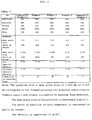
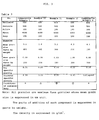
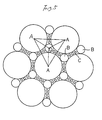
FIG. 1 shows TABLE 1, FIG. 2 shows TABLE 2, FIG. 3 shows
TABLE 3, FIG. 4 shows TABLE 4 and FIG. 5 shows an illustrative
drawing of the body-centered cubic arrangement of granules
projected on a plane.
Best Mode for Carrying Out the Invention
The ceramic starting material to be used in the present
invention contains as principal components at least one kind
selected from natural materials such as kaolinite, sericite,
montmorillonite and tosdite, or artificial materials such as
aluminum oxide, silicone oxide, zirconium oxide and lithium
aluminosilicate.
Any granules that are known in the art to form voids after
incineration during the baking step can be used for the granules
to be filled into the ceramic starting material. However, when
a porous ceramic sintered body made to be lightweight with a
specific gravity of about 0.1 g/cm3 is manufactured according
to the present invention, the mechanical strength of the green
body for the ceramic material becomes weak. Accordingly, it is
preferable to use low expansivity granular materials like low
specific gravity organic foam materials such as polystyrene,
polyethylene and polypropylene in order to prevent the ceramic
starting materials that serve as frames of the porous body from
being cracked due to expansive force caused by expansion of the
granules during temperature increase for sintering. Especially
preferable examples are maximum foam grains that have been
previously expanded at a highest degree (about 99% of expansion
(foaming)) that allows no more expansion (foaming) by
temperature increase.
While at least two kinds of granules with smaller grain
size and larger grain size are used, at least one kind of the
smaller size granules with a mean grain size in the range from
0.01 to 0.5 mm, preferably in the range from 0.04 to 0.2 mm and
more preferably in the range from 0.06 to 0.1 mm, and at least
one kind of the larger size granules with a mean grain size in
the range from 0.5 to 5 mm, preferably in the range from 0.8 to
4 mm and more preferably in the range from 1.0 to 3.5 mm are
selected, respectively. When the mean grain size becomes
smaller, the total grain number is increased so that the frame
itself of the porous body becomes so brittle to make it difficult
to maintain the frame strength while, when the mean grain becomes
larger, the grains make a contact with each other in the green
body so that it becomes difficult to maintain the frame of the
porous body after sintering.
Accordingly, a combination of the different grain sizes
of the larger grains and smaller grains is used because, while
formation of the porous body frame is secured by allowing the
provability of mutual contact of the larger size grains to be
as small as possible, the porous body is not sufficiently made
to be lightweight by merely adding the larger size grains since
thick (large diameter) frames are formed. Therefore, for making
the frame itself lightweight, the specific gravity is decreased
by simultaneously filling the porous body with the smaller size
granules to an extent not to make the porous body brittle owing
to voids generated by the smaller size granules.
The following measures are also considered in the present
invention for maintaining the strength of the porous sintered
body. That is, provided that four larger size granules are
arranged in a three-dimensional space with an equal angles among
the lines connecting respective granules, the center of each
grain is located at each apex of an equilateral triangular cone
(body-centered cubic arrangement) and each apex forms a
three-dimensional geometry with an angle of about 109° relative
to the center of the equilateral triangular cone. The center
of the equi-triangular cone serves as a portion where no granules
exist, making the frame thick (large diameter) to inhibit the
sintered body from being lightweight.
While the sintered body may be made to be lightweight by
substituting the thick frame portion with smaller size granules
having fine pores, the frame may be occupied with fine voids to
result in reduced strength besides a lot of smaller size grains
are needed.
Accordingly, the presence of the medium size granules for
forming voids in the thick frame portions becomes significant.
In other words, the filling amount of the smaller size granules
can be reduced with voids formed by filling this thick portions
with the medium size grains, thereby maintaining the strength
along with making the sintered body to be more lightweight.
Although the medium size grains advantageously have a diameter
a little smaller than that theoretically calculated from the
body-centered cubic arrangement, it is practically required to
have a diameter sufficient for being filled into the thick frame
formed among the larger size grains. The actual mean grain size
of the medium size granules is, however, selected in the range
from 0.5 to 3.0 mm, preferably in the range from 0.8 to 2.5 mm
and more preferably in the range from 0.8 to 2.5 mm when the
larger size grains with the foregoing mean grain size are
selected.
The conditions as described above will be apparent from
the illustrative drawing showing the projection plane view of
the body-center arrangement as shown in FIG. 5. In the drawing,
symbol A represents the centers of the larger size grains, symbol
O represents the center of the centers A, symbol B represents
the medium size grains, and symbol C represents the smaller size
grains.
Detergents, fibers such as pulps, starch, cellulose and
the like may be added in the ceramic starting material to be used
in the present invention in order to improve the dispersive
property of the granules in the principal component as well as
for enhancing dry strength of the green body.
The baking atmosphere may be either an oxidative atmosphere
or a non-oxidative atmosphere (a reducing atmosphere containing
an oxygen source).
Examples for carrying out the present invention will be
described below together with comparative examples.
〈Example 1〉
Used were 825 parts by weight of kaolinite and 375 parts
by weight of sericite as ceramic starting materials and maximum
foam polystyrene granules. 50 parts by weight of the larger size
granules having a mean grain size of 3.2 mm, a mixture of two
kinds of the medium size granules - 130 parts by weight of the
medium size granules with a mean grain size of 2.2mm and 70 parts
by weight with a mean grain size of 1.0 mm - and 100 parts by
weight of the smaller size granules with a mean grain size of
0.08 mm were mixed with 2750 parts by weight of water to prepare
a slurry by mixing. The slurry was molded in a mold with a
dimension of 5 cm × 5 cm × 10 cm under a molding pressure of 2.1
kg/cm3. After thorough drying (24 hours at 50 °C), the green body
formed was taken out of the mold. The green body had a specific
gravity of 0.27/cm3, which was baked for 7 hours while the
temperature was slowly increased up to 1300 °C. After baking
for 1 hour at 1300 °C, the temperature was again slowly decreased
within 12 hours. The porous ceramic sintered body had a specific
gravity of 0.22 g/cm3. The ceramic sintered body could maintain
its shape without being crushed by hand, showing that a good
quality of porous ceramic was obtained. The results are shown
in TABLE 1.
〈Example 2〉
A slurry was prepared by mixing 700 parts by weight of
kaolinite and 500 parts by weight of sericite as ceramic starting
materials, 50, 100, 70 and 150 parts by weight of the maximum
foam grains with a mean grain size of 3.2 mm, 2.2 mm, 1.0 mm and
0.08 mm, respectively, and 1500 parts by weight of water. The
slurry was molded in a mold by the same method as described in
Example 1, forming a green body with a specific gravity of
0.30g/cm3 after drying. The green body was baked under the same
conditions as used previously to obtain a good porous ceramic
sintered body with a specific gravity of 0.24 g/cm3. The results
are shown in TABLE 1.
〈Examples 3 to 6〉
The same experimental procedures as used in Example 1 were
applied to a slurry prepared by mixing the ceramic starting
materials, granules, water and the like used in Example 1 in
proportions listed in TABLE 1. The specific gravities of the
green bodies after drying and sintering were as shown in TABLE
1. The ceramic sintered bodies prepared in these examples had
sufficient mechanical strengths with good qualities.
〈Comparative Examples 1 to 4〉
The mixtures of the ceramic starting materials, granules,
water and the like were prescribed as shown in Example 3. The
slurry prepared by mixing merely one sort of the foamed grains
used in Example 1 in a proportion shown in TABLE 1 was processed
as in Example 1. The specific gravities of the green body after
drying and after sintering were as shown in TABLE 1.
The green body in Comparative Example 1 prepared by mixing
merely the granules with a mean grain size of 3.2 mm, and the
green body in Comparative Example 2 prepared by merely mixing
the granules with a mean grain size of 2.1 mm were so loosely
caked that they had been collapsed during the sintering steps,
being impossible to maintain block shapes. The green body
prepared by using the granules with a mean grain size of 1.0 mm
alone in Comparative Example 3 was half-collapsed during the
sintering step to unable handling. Although a green body with
a dry specific gravity of less than 0.35 g/cm2 was attempted to
form using the granules with a mean grain size of 0.08 mm alone
in Comparative Example 4, a good green body could not be prepared
due to a large bulk volume of the foamed body. Therefore, a green
body with a dry specific gravity of 0.39 g/cm' was forced to be
subjected to sintering. The sintered body as described above
was largely shrunk during sintering with an increased specific
gravity of 0.46 g/cm3 as compared with that after drying. The
sintered body was so brittle that it was easily collapsed. These
results are shown in TABLE 1.
〈Examples 7 to 9, Comparative Examples 5 and 6〉
The slurry obtained by mixing the ceramic starting
materials, granules, water and the like in proportions listed
in TABLE 2 were processed by the same method as in Example 1.
A series of Examples 7 to 9 and Comparative Examples 5 and 6
were carried out for observing the effects in which one kind of
the larger size grains were used with a fixed amount of addition
while changing the grain size of the smaller size granules. The
results as shown in TABLE 2 were obtained with respect to the
specific gravity of the green body after drying, specific gravity
of the porous body after sintering and the conditions of the
sintered body.
A good ceramic sintered body was obtained in Example 8.
Although the ceramic sintered body obtained in Example 7 had
a little brittle frame, it could maintain the shape of the
sintered body suitable for handling. While cells in the sintered
body in Example 9 tend to be rough, its shape could be maintained.
Although the sintered body prepared in Comparative Example
5 could barely maintain its shape, it was so brittle that the
finger could penetrate into the sintered body by gently pressing
with the finger and handling was impossible since it was readily
collapsed. The shape of the sintered body in Comparative Example
6 was barely maintained with its surface skin but inside of it
had been completely collapsed.
〈Example 10 to 12, Comparative Example 7 and 8〉
Slurries obtained by mixing the ceramic starting
materials, granules (maximum foam granules), water and the like
were processed by the same method as in Example 1. A series of
Examples and Comparative Examples were carried out in order to
observe the effects of using one kind of the smaller size granules
with a fixed amount of addition while changing the grain size
of the larger size granules. The specific gravities of the green
bodies after drying, specific gravities of the porous bodies
after sintering and the conditions of the sintered bodies are
shown in TABLE 3.
A good ceramic sintered body was obtained in Example 11
while the ceramic sintered bodies obtained in Examples 10 and
12 were satisfactory.
On the contrary, the ceramic sintered body in Comparative
Example 7 had been shrunk by being accompanied by an increase
of the specific gravity. The ceramic sintered body in
Comparative Example 8 had been collapsed during the sintering
step.
〈Examples 13 to 15, Comparative Examples 9 and 10〉
The slurries obtained by mixing the ceramic starting
materials, granules, water and the like in proportions shown in
TABLE 4 were processed by the same method as used in Example 1.
A series of Examples and Comparative Examples were carried out
in order to observe the effects of fixing the amount of addition
of the first larger size grains and smaller size grains while
changing the amount of addition of the second larger size grains.
The specific gravities of the green bodies after drying,
specific gravities of the porous bodies after sintering and the
conditions of the sintered bodies are shown in TABLE 4.
Although good ceramic sintered bodies were obtained in
Example 13 to 15, an increase of the specific gravity was observed
in Comparative Example 9 with a poor mechanical strength of the
brittle sintered body. While appearance of the sintered body
in Comparative Example 10 was good, cells in it had been
collapsed.
Industrial Applicability
The present invention provides a lightweight porous
ceramic with a specific gravity of less than 0.3 g/cm3 or up to
0.1 g/cm3 at best, providing a unprecedented ultra-lightweight
porous ceramic.