EP0981573B1 - Emulsions stables, leur procede de preparation et leurs applications - Google Patents
Emulsions stables, leur procede de preparation et leurs applications Download PDFInfo
- Publication number
- EP0981573B1 EP0981573B1 EP99907719A EP99907719A EP0981573B1 EP 0981573 B1 EP0981573 B1 EP 0981573B1 EP 99907719 A EP99907719 A EP 99907719A EP 99907719 A EP99907719 A EP 99907719A EP 0981573 B1 EP0981573 B1 EP 0981573B1
- Authority
- EP
- European Patent Office
- Prior art keywords
- phase
- emulsion
- elastomer
- solvent
- mass
- Prior art date
- Legal status (The legal status is an assumption and is not a legal conclusion. Google has not performed a legal analysis and makes no representation as to the accuracy of the status listed.)
- Expired - Lifetime
Links
- 239000000839 emulsion Substances 0.000 title claims description 168
- 238000002360 preparation method Methods 0.000 title claims description 38
- 239000003381 stabilizer Substances 0.000 claims description 111
- 239000000126 substance Substances 0.000 claims description 93
- 229920001577 copolymer Polymers 0.000 claims description 87
- 239000000806 elastomer Substances 0.000 claims description 80
- 229920001971 elastomer Polymers 0.000 claims description 76
- 239000002904 solvent Substances 0.000 claims description 68
- 239000003960 organic solvent Substances 0.000 claims description 42
- 239000006185 dispersion Substances 0.000 claims description 41
- -1 microcellulose Polymers 0.000 claims description 41
- 229920003171 Poly (ethylene oxide) Polymers 0.000 claims description 37
- UAEPNZWRGJTJPN-UHFFFAOYSA-N methylcyclohexane Chemical compound CC1CCCCC1 UAEPNZWRGJTJPN-UHFFFAOYSA-N 0.000 claims description 36
- 229920001400 block copolymer Polymers 0.000 claims description 31
- 239000012756 surface treatment agent Substances 0.000 claims description 25
- 229920000578 graft copolymer Polymers 0.000 claims description 24
- 239000002270 dispersing agent Substances 0.000 claims description 23
- 239000000203 mixture Substances 0.000 claims description 22
- 230000015572 biosynthetic process Effects 0.000 claims description 21
- 150000001875 compounds Chemical class 0.000 claims description 19
- GYNNXHKOJHMOHS-UHFFFAOYSA-N methyl-cycloheptane Natural products CC1CCCCCC1 GYNNXHKOJHMOHS-UHFFFAOYSA-N 0.000 claims description 18
- 238000011065 in-situ storage Methods 0.000 claims description 17
- LYCAIKOWRPUZTN-UHFFFAOYSA-N Ethylene glycol Chemical compound OCCO LYCAIKOWRPUZTN-UHFFFAOYSA-N 0.000 claims description 16
- 238000000034 method Methods 0.000 claims description 13
- 239000002245 particle Substances 0.000 claims description 13
- VYPSYNLAJGMNEJ-UHFFFAOYSA-N Silicium dioxide Chemical compound O=[Si]=O VYPSYNLAJGMNEJ-UHFFFAOYSA-N 0.000 claims description 12
- 239000002671 adjuvant Substances 0.000 claims description 12
- 239000005062 Polybutadiene Substances 0.000 claims description 11
- 239000013543 active substance Substances 0.000 claims description 11
- 229920002857 polybutadiene Polymers 0.000 claims description 11
- 229920000642 polymer Polymers 0.000 claims description 11
- 239000003795 chemical substances by application Substances 0.000 claims description 10
- 229910052500 inorganic mineral Inorganic materials 0.000 claims description 10
- 239000011707 mineral Substances 0.000 claims description 10
- 238000002156 mixing Methods 0.000 claims description 10
- 239000002736 nonionic surfactant Substances 0.000 claims description 10
- 229920001195 polyisoprene Polymers 0.000 claims description 10
- PPBRXRYQALVLMV-UHFFFAOYSA-N Styrene Chemical compound C=CC1=CC=CC=C1 PPBRXRYQALVLMV-UHFFFAOYSA-N 0.000 claims description 8
- 239000007787 solid Substances 0.000 claims description 8
- 238000001704 evaporation Methods 0.000 claims description 7
- 239000007788 liquid Substances 0.000 claims description 7
- 239000002798 polar solvent Substances 0.000 claims description 7
- 229920001223 polyethylene glycol Polymers 0.000 claims description 7
- 229920000036 polyvinylpyrrolidone Polymers 0.000 claims description 7
- 239000001267 polyvinylpyrrolidone Substances 0.000 claims description 7
- 235000013855 polyvinylpyrrolidone Nutrition 0.000 claims description 7
- VSKJLJHPAFKHBX-UHFFFAOYSA-N 2-methylbuta-1,3-diene;styrene Chemical compound CC(=C)C=C.C=CC1=CC=CC=C1.C=CC1=CC=CC=C1 VSKJLJHPAFKHBX-UHFFFAOYSA-N 0.000 claims description 6
- ZHNUHDYFZUAESO-UHFFFAOYSA-N Formamide Chemical compound NC=O ZHNUHDYFZUAESO-UHFFFAOYSA-N 0.000 claims description 6
- IMNFDUFMRHMDMM-UHFFFAOYSA-N N-Heptane Chemical compound CCCCCCC IMNFDUFMRHMDMM-UHFFFAOYSA-N 0.000 claims description 6
- 229920000459 Nitrile rubber Polymers 0.000 claims description 6
- YXFVVABEGXRONW-UHFFFAOYSA-N Toluene Chemical compound CC1=CC=CC=C1 YXFVVABEGXRONW-UHFFFAOYSA-N 0.000 claims description 6
- FACXGONDLDSNOE-UHFFFAOYSA-N buta-1,3-diene;styrene Chemical compound C=CC=C.C=CC1=CC=CC=C1.C=CC1=CC=CC=C1 FACXGONDLDSNOE-UHFFFAOYSA-N 0.000 claims description 6
- 230000008020 evaporation Effects 0.000 claims description 6
- 125000001453 quaternary ammonium group Chemical group 0.000 claims description 6
- 239000000377 silicon dioxide Substances 0.000 claims description 6
- 229920000468 styrene butadiene styrene block copolymer Polymers 0.000 claims description 6
- 230000003253 viricidal effect Effects 0.000 claims description 6
- NIXOWILDQLNWCW-UHFFFAOYSA-N acrylic acid group Chemical group C(C=C)(=O)O NIXOWILDQLNWCW-UHFFFAOYSA-N 0.000 claims description 5
- 238000013019 agitation Methods 0.000 claims description 5
- 230000004048 modification Effects 0.000 claims description 5
- 238000012986 modification Methods 0.000 claims description 5
- 229920000193 polymethacrylate Polymers 0.000 claims description 5
- 229920003048 styrene butadiene rubber Polymers 0.000 claims description 5
- HZAXFHJVJLSVMW-UHFFFAOYSA-N 2-Aminoethan-1-ol Chemical compound NCCO HZAXFHJVJLSVMW-UHFFFAOYSA-N 0.000 claims description 4
- PEDCQBHIVMGVHV-UHFFFAOYSA-N Glycerine Chemical compound OCC(O)CO PEDCQBHIVMGVHV-UHFFFAOYSA-N 0.000 claims description 4
- 229920002367 Polyisobutene Polymers 0.000 claims description 4
- 239000004793 Polystyrene Substances 0.000 claims description 4
- 239000003139 biocide Substances 0.000 claims description 4
- 239000001913 cellulose Substances 0.000 claims description 4
- 229920002678 cellulose Polymers 0.000 claims description 4
- 239000004205 dimethyl polysiloxane Substances 0.000 claims description 4
- 230000000694 effects Effects 0.000 claims description 4
- NLYAJNPCOHFWQQ-UHFFFAOYSA-N kaolin Chemical compound O.O.O=[Al]O[Si](=O)O[Si](=O)O[Al]=O NLYAJNPCOHFWQQ-UHFFFAOYSA-N 0.000 claims description 4
- 229920000435 poly(dimethylsiloxane) Polymers 0.000 claims description 4
- 229920000570 polyether Polymers 0.000 claims description 4
- 229920000098 polyolefin Polymers 0.000 claims description 4
- 229920001451 polypropylene glycol Polymers 0.000 claims description 4
- 229920001296 polysiloxane Polymers 0.000 claims description 4
- 229920002223 polystyrene Polymers 0.000 claims description 4
- 229920002451 polyvinyl alcohol Polymers 0.000 claims description 4
- 229940123208 Biguanide Drugs 0.000 claims description 3
- RUPBZQFQVRMKDG-UHFFFAOYSA-M Didecyldimethylammonium chloride Chemical compound [Cl-].CCCCCCCCCC[N+](C)(C)CCCCCCCCCC RUPBZQFQVRMKDG-UHFFFAOYSA-M 0.000 claims description 3
- IAZDPXIOMUYVGZ-UHFFFAOYSA-N Dimethylsulphoxide Chemical compound CS(C)=O IAZDPXIOMUYVGZ-UHFFFAOYSA-N 0.000 claims description 3
- WSFSSNUMVMOOMR-UHFFFAOYSA-N Formaldehyde Chemical compound O=C WSFSSNUMVMOOMR-UHFFFAOYSA-N 0.000 claims description 3
- DGAQECJNVWCQMB-PUAWFVPOSA-M Ilexoside XXIX Chemical compound C[C@@H]1CC[C@@]2(CC[C@@]3(C(=CC[C@H]4[C@]3(CC[C@@H]5[C@@]4(CC[C@@H](C5(C)C)OS(=O)(=O)[O-])C)C)[C@@H]2[C@]1(C)O)C)C(=O)O[C@H]6[C@@H]([C@H]([C@@H]([C@H](O6)CO)O)O)O.[Na+] DGAQECJNVWCQMB-PUAWFVPOSA-M 0.000 claims description 3
- 239000004952 Polyamide Substances 0.000 claims description 3
- 229920002472 Starch Polymers 0.000 claims description 3
- 239000002174 Styrene-butadiene Substances 0.000 claims description 3
- 125000001931 aliphatic group Chemical group 0.000 claims description 3
- OQLKNTOKMBVBKV-UHFFFAOYSA-N hexamidine Chemical compound C1=CC(C(=N)N)=CC=C1OCCCCCCOC1=CC=C(C(N)=N)C=C1 OQLKNTOKMBVBKV-UHFFFAOYSA-N 0.000 claims description 3
- 229960001915 hexamidine Drugs 0.000 claims description 3
- WQYVRQLZKVEZGA-UHFFFAOYSA-N hypochlorite Chemical class Cl[O-] WQYVRQLZKVEZGA-UHFFFAOYSA-N 0.000 claims description 3
- 229920002647 polyamide Polymers 0.000 claims description 3
- 229920001610 polycaprolactone Polymers 0.000 claims description 3
- 229920000728 polyester Polymers 0.000 claims description 3
- 229920005862 polyol Polymers 0.000 claims description 3
- 150000003077 polyols Chemical class 0.000 claims description 3
- 239000011734 sodium Substances 0.000 claims description 3
- 229910052708 sodium Inorganic materials 0.000 claims description 3
- 239000008107 starch Substances 0.000 claims description 3
- 235000019698 starch Nutrition 0.000 claims description 3
- 239000005995 Aluminium silicate Substances 0.000 claims description 2
- 239000004593 Epoxy Substances 0.000 claims description 2
- ZLMJMSJWJFRBEC-UHFFFAOYSA-N Potassium Chemical compound [K] ZLMJMSJWJFRBEC-UHFFFAOYSA-N 0.000 claims description 2
- 239000002253 acid Substances 0.000 claims description 2
- 125000003158 alcohol group Chemical group 0.000 claims description 2
- 235000012211 aluminium silicate Nutrition 0.000 claims description 2
- 150000001412 amines Chemical class 0.000 claims description 2
- 238000004873 anchoring Methods 0.000 claims description 2
- 125000003118 aryl group Chemical group 0.000 claims description 2
- 125000004069 aziridinyl group Chemical group 0.000 claims description 2
- 150000004283 biguanides Chemical class 0.000 claims description 2
- 238000006243 chemical reaction Methods 0.000 claims description 2
- 238000004925 denaturation Methods 0.000 claims description 2
- 230000036425 denaturation Effects 0.000 claims description 2
- 235000011187 glycerol Nutrition 0.000 claims description 2
- 229930195733 hydrocarbon Natural products 0.000 claims description 2
- 239000012948 isocyanate Substances 0.000 claims description 2
- 150000002513 isocyanates Chemical class 0.000 claims description 2
- ISWSIDIOOBJBQZ-UHFFFAOYSA-N phenol group Chemical group C1(=CC=CC=C1)O ISWSIDIOOBJBQZ-UHFFFAOYSA-N 0.000 claims description 2
- ZWLUXSQADUDCSB-UHFFFAOYSA-N phthalaldehyde Chemical compound O=CC1=CC=CC=C1C=O ZWLUXSQADUDCSB-UHFFFAOYSA-N 0.000 claims description 2
- 239000004014 plasticizer Substances 0.000 claims description 2
- 229920001084 poly(chloroprene) Polymers 0.000 claims description 2
- 229920003229 poly(methyl methacrylate) Polymers 0.000 claims description 2
- 229920000058 polyacrylate Polymers 0.000 claims description 2
- 239000004926 polymethyl methacrylate Substances 0.000 claims description 2
- 239000011591 potassium Substances 0.000 claims description 2
- 229910052700 potassium Inorganic materials 0.000 claims description 2
- 108090000623 proteins and genes Proteins 0.000 claims description 2
- 102000004169 proteins and genes Human genes 0.000 claims description 2
- 239000000454 talc Substances 0.000 claims description 2
- 229910052623 talc Inorganic materials 0.000 claims description 2
- 229920000428 triblock copolymer Polymers 0.000 claims description 2
- 229920002554 vinyl polymer Polymers 0.000 claims description 2
- XLYOFNOQVPJJNP-UHFFFAOYSA-N water Substances O XLYOFNOQVPJJNP-UHFFFAOYSA-N 0.000 claims description 2
- 239000004372 Polyvinyl alcohol Substances 0.000 claims 2
- 125000003438 dodecyl group Chemical group [H]C([H])([H])C([H])([H])C([H])([H])C([H])([H])C([H])([H])C([H])([H])C([H])([H])C([H])([H])C([H])([H])C([H])([H])C([H])([H])C([H])([H])* 0.000 claims 2
- 239000003495 polar organic solvent Substances 0.000 claims 2
- 229920002717 polyvinylpyridine Polymers 0.000 claims 2
- 230000003019 stabilising effect Effects 0.000 claims 2
- 239000004698 Polyethylene Substances 0.000 claims 1
- 125000001797 benzyl group Chemical group [H]C1=C([H])C([H])=C(C([H])=C1[H])C([H])([H])* 0.000 claims 1
- 230000003115 biocidal effect Effects 0.000 claims 1
- 239000011248 coating agent Substances 0.000 claims 1
- 238000000576 coating method Methods 0.000 claims 1
- 229960001760 dimethyl sulfoxide Drugs 0.000 claims 1
- 239000004632 polycaprolactone Substances 0.000 claims 1
- 229920000573 polyethylene Polymers 0.000 claims 1
- 239000012071 phase Substances 0.000 description 258
- 239000000243 solution Substances 0.000 description 69
- 239000000693 micelle Substances 0.000 description 28
- 238000003756 stirring Methods 0.000 description 19
- 238000004581 coalescence Methods 0.000 description 15
- 230000006641 stabilisation Effects 0.000 description 14
- 229920000359 diblock copolymer Polymers 0.000 description 11
- 238000005189 flocculation Methods 0.000 description 11
- 230000016615 flocculation Effects 0.000 description 11
- 238000011105 stabilization Methods 0.000 description 10
- 239000004094 surface-active agent Substances 0.000 description 9
- 241001080024 Telles Species 0.000 description 8
- 238000004090 dissolution Methods 0.000 description 8
- 239000004927 clay Substances 0.000 description 7
- 239000000470 constituent Substances 0.000 description 7
- 238000012544 monitoring process Methods 0.000 description 5
- 230000008569 process Effects 0.000 description 5
- 229920002633 Kraton (polymer) Polymers 0.000 description 4
- 229920002565 Polyethylene Glycol 400 Polymers 0.000 description 4
- 238000004519 manufacturing process Methods 0.000 description 4
- 239000000463 material Substances 0.000 description 4
- 101100536354 Drosophila melanogaster tant gene Proteins 0.000 description 3
- VGGSQFUCUMXWEO-UHFFFAOYSA-N Ethene Chemical compound C=C VGGSQFUCUMXWEO-UHFFFAOYSA-N 0.000 description 3
- 238000005481 NMR spectroscopy Methods 0.000 description 3
- 229920004890 Triton X-100 Polymers 0.000 description 3
- 238000004458 analytical method Methods 0.000 description 3
- 238000005119 centrifugation Methods 0.000 description 3
- 230000001687 destabilization Effects 0.000 description 3
- 230000001681 protective effect Effects 0.000 description 3
- KGIGUEBEKRSTEW-UHFFFAOYSA-N 2-vinylpyridine Chemical compound C=CC1=CC=CC=N1 KGIGUEBEKRSTEW-UHFFFAOYSA-N 0.000 description 2
- QGZKDVFQNNGYKY-UHFFFAOYSA-O Ammonium Chemical compound [NH4+] QGZKDVFQNNGYKY-UHFFFAOYSA-O 0.000 description 2
- OKTJSMMVPCPJKN-UHFFFAOYSA-N Carbon Chemical compound [C] OKTJSMMVPCPJKN-UHFFFAOYSA-N 0.000 description 2
- 239000005977 Ethylene Substances 0.000 description 2
- 239000002202 Polyethylene glycol Substances 0.000 description 2
- 240000008042 Zea mays Species 0.000 description 2
- 238000010586 diagram Methods 0.000 description 2
- 238000009792 diffusion process Methods 0.000 description 2
- 238000009826 distribution Methods 0.000 description 2
- 239000013536 elastomeric material Substances 0.000 description 2
- 230000004927 fusion Effects 0.000 description 2
- WGCNASOHLSPBMP-UHFFFAOYSA-N hydroxyacetaldehyde Natural products OCC=O WGCNASOHLSPBMP-UHFFFAOYSA-N 0.000 description 2
- 238000000399 optical microscopy Methods 0.000 description 2
- 230000008520 organization Effects 0.000 description 2
- 244000052769 pathogen Species 0.000 description 2
- JLFNLZLINWHATN-UHFFFAOYSA-N pentaethylene glycol Chemical compound OCCOCCOCCOCCOCCO JLFNLZLINWHATN-UHFFFAOYSA-N 0.000 description 2
- 239000012873 virucide Substances 0.000 description 2
- WCVOGSZTONGSQY-UHFFFAOYSA-N 2,4,6-trichloroanisole Chemical compound COC1=C(Cl)C=C(Cl)C=C1Cl WCVOGSZTONGSQY-UHFFFAOYSA-N 0.000 description 1
- WDQMWEYDKDCEHT-UHFFFAOYSA-N 2-ethylhexyl 2-methylprop-2-enoate Chemical compound CCCCC(CC)COC(=O)C(C)=C WDQMWEYDKDCEHT-UHFFFAOYSA-N 0.000 description 1
- QYLJIYOGHRGUIH-CIUDSAMLSA-N Arg-Ile Chemical compound CC[C@H](C)[C@@H](C(O)=O)NC(=O)[C@@H](N)CCCNC(N)=N QYLJIYOGHRGUIH-CIUDSAMLSA-N 0.000 description 1
- 241000894006 Bacteria Species 0.000 description 1
- 241000700605 Viruses Species 0.000 description 1
- 238000005054 agglomeration Methods 0.000 description 1
- 230000002776 aggregation Effects 0.000 description 1
- 125000000217 alkyl group Chemical group 0.000 description 1
- 238000010539 anionic addition polymerization reaction Methods 0.000 description 1
- 238000000149 argon plasma sintering Methods 0.000 description 1
- 238000004630 atomic force microscopy Methods 0.000 description 1
- 125000001743 benzylic group Chemical group 0.000 description 1
- 210000000988 bone and bone Anatomy 0.000 description 1
- OGHNVEJMJSYVRP-UHFFFAOYSA-N carvedilol Chemical compound COC1=CC=CC=C1OCCNCC(O)COC1=CC=CC2=C1C1=CC=CC=C1N2 OGHNVEJMJSYVRP-UHFFFAOYSA-N 0.000 description 1
- 230000000295 complement effect Effects 0.000 description 1
- 238000011109 contamination Methods 0.000 description 1
- 238000001514 detection method Methods 0.000 description 1
- 238000002296 dynamic light scattering Methods 0.000 description 1
- 238000004945 emulsification Methods 0.000 description 1
- 238000011156 evaluation Methods 0.000 description 1
- 229960004279 formaldehyde Drugs 0.000 description 1
- 235000019256 formaldehyde Nutrition 0.000 description 1
- 238000009472 formulation Methods 0.000 description 1
- 230000002538 fungal effect Effects 0.000 description 1
- 150000002334 glycols Chemical class 0.000 description 1
- 230000005484 gravity Effects 0.000 description 1
- 239000007924 injection Substances 0.000 description 1
- 238000002347 injection Methods 0.000 description 1
- 229920002521 macromolecule Polymers 0.000 description 1
- 230000007246 mechanism Effects 0.000 description 1
- 239000012528 membrane Substances 0.000 description 1
- WSFSSNUMVMOOMR-NJFSPNSNSA-N methanone Chemical compound O=[14CH2] WSFSSNUMVMOOMR-NJFSPNSNSA-N 0.000 description 1
- 229920000847 nonoxynol Polymers 0.000 description 1
- SNQQPOLDUKLAAF-UHFFFAOYSA-N nonylphenol Chemical class CCCCCCCCCC1=CC=CC=C1O SNQQPOLDUKLAAF-UHFFFAOYSA-N 0.000 description 1
- 239000012074 organic phase Substances 0.000 description 1
- 230000001717 pathogenic effect Effects 0.000 description 1
- 229920000196 poly(lauryl methacrylate) Polymers 0.000 description 1
- 239000011148 porous material Substances 0.000 description 1
- KMUONIBRACKNSN-UHFFFAOYSA-N potassium dichromate Chemical class [K+].[K+].[O-][Cr](=O)(=O)O[Cr]([O-])(=O)=O KMUONIBRACKNSN-UHFFFAOYSA-N 0.000 description 1
- 239000011164 primary particle Substances 0.000 description 1
- 230000009467 reduction Effects 0.000 description 1
- 230000015227 regulation of liquid surface tension Effects 0.000 description 1
- 238000009877 rendering Methods 0.000 description 1
- 238000011160 research Methods 0.000 description 1
- 238000004062 sedimentation Methods 0.000 description 1
- 238000010008 shearing Methods 0.000 description 1
- 239000011343 solid material Substances 0.000 description 1
- 238000005063 solubilization Methods 0.000 description 1
- 230000007928 solubilization Effects 0.000 description 1
- 238000004611 spectroscopical analysis Methods 0.000 description 1
- 230000003068 static effect Effects 0.000 description 1
- 238000004381 surface treatment Methods 0.000 description 1
- 238000003786 synthesis reaction Methods 0.000 description 1
- 125000000383 tetramethylene group Chemical group [H]C([H])([*:1])C([H])([H])C([H])([H])C([H])([H])[*:2] 0.000 description 1
Images

Classifications
-
- C—CHEMISTRY; METALLURGY
- C08—ORGANIC MACROMOLECULAR COMPOUNDS; THEIR PREPARATION OR CHEMICAL WORKING-UP; COMPOSITIONS BASED THEREON
- C08J—WORKING-UP; GENERAL PROCESSES OF COMPOUNDING; AFTER-TREATMENT NOT COVERED BY SUBCLASSES C08B, C08C, C08F, C08G or C08H
- C08J3/00—Processes of treating or compounding macromolecular substances
- C08J3/20—Compounding polymers with additives, e.g. colouring
- C08J3/205—Compounding polymers with additives, e.g. colouring in the presence of a continuous liquid phase
- C08J3/21—Compounding polymers with additives, e.g. colouring in the presence of a continuous liquid phase the polymer being premixed with a liquid phase
- C08J3/215—Compounding polymers with additives, e.g. colouring in the presence of a continuous liquid phase the polymer being premixed with a liquid phase at least one additive being also premixed with a liquid phase
-
- A—HUMAN NECESSITIES
- A61—MEDICAL OR VETERINARY SCIENCE; HYGIENE
- A61L—METHODS OR APPARATUS FOR STERILISING MATERIALS OR OBJECTS IN GENERAL; DISINFECTION, STERILISATION OR DEODORISATION OF AIR; CHEMICAL ASPECTS OF BANDAGES, DRESSINGS, ABSORBENT PADS OR SURGICAL ARTICLES; MATERIALS FOR BANDAGES, DRESSINGS, ABSORBENT PADS OR SURGICAL ARTICLES
- A61L15/00—Chemical aspects of, or use of materials for, bandages, dressings or absorbent pads
- A61L15/16—Bandages, dressings or absorbent pads for physiological fluids such as urine or blood, e.g. sanitary towels, tampons
- A61L15/22—Bandages, dressings or absorbent pads for physiological fluids such as urine or blood, e.g. sanitary towels, tampons containing macromolecular materials
- A61L15/24—Macromolecular compounds obtained by reactions only involving carbon-to-carbon unsaturated bonds; Derivatives thereof
-
- A—HUMAN NECESSITIES
- A61—MEDICAL OR VETERINARY SCIENCE; HYGIENE
- A61L—METHODS OR APPARATUS FOR STERILISING MATERIALS OR OBJECTS IN GENERAL; DISINFECTION, STERILISATION OR DEODORISATION OF AIR; CHEMICAL ASPECTS OF BANDAGES, DRESSINGS, ABSORBENT PADS OR SURGICAL ARTICLES; MATERIALS FOR BANDAGES, DRESSINGS, ABSORBENT PADS OR SURGICAL ARTICLES
- A61L31/00—Materials for other surgical articles, e.g. stents, stent-grafts, shunts, surgical drapes, guide wires, materials for adhesion prevention, occluding devices, surgical gloves, tissue fixation devices
- A61L31/04—Macromolecular materials
- A61L31/048—Macromolecular materials obtained by reactions only involving carbon-to-carbon unsaturated bonds
-
- C—CHEMISTRY; METALLURGY
- C08—ORGANIC MACROMOLECULAR COMPOUNDS; THEIR PREPARATION OR CHEMICAL WORKING-UP; COMPOSITIONS BASED THEREON
- C08J—WORKING-UP; GENERAL PROCESSES OF COMPOUNDING; AFTER-TREATMENT NOT COVERED BY SUBCLASSES C08B, C08C, C08F, C08G or C08H
- C08J2321/00—Characterised by the use of unspecified rubbers
-
- Y—GENERAL TAGGING OF NEW TECHNOLOGICAL DEVELOPMENTS; GENERAL TAGGING OF CROSS-SECTIONAL TECHNOLOGIES SPANNING OVER SEVERAL SECTIONS OF THE IPC; TECHNICAL SUBJECTS COVERED BY FORMER USPC CROSS-REFERENCE ART COLLECTIONS [XRACs] AND DIGESTS
- Y10—TECHNICAL SUBJECTS COVERED BY FORMER USPC
- Y10S—TECHNICAL SUBJECTS COVERED BY FORMER USPC CROSS-REFERENCE ART COLLECTIONS [XRACs] AND DIGESTS
- Y10S977/00—Nanotechnology
- Y10S977/902—Specified use of nanostructure
- Y10S977/904—Specified use of nanostructure for medical, immunological, body treatment, or diagnosis
- Y10S977/906—Drug delivery
-
- Y—GENERAL TAGGING OF NEW TECHNOLOGICAL DEVELOPMENTS; GENERAL TAGGING OF CROSS-SECTIONAL TECHNOLOGIES SPANNING OVER SEVERAL SECTIONS OF THE IPC; TECHNICAL SUBJECTS COVERED BY FORMER USPC CROSS-REFERENCE ART COLLECTIONS [XRACs] AND DIGESTS
- Y10—TECHNICAL SUBJECTS COVERED BY FORMER USPC
- Y10T—TECHNICAL SUBJECTS COVERED BY FORMER US CLASSIFICATION
- Y10T428/00—Stock material or miscellaneous articles
- Y10T428/249921—Web or sheet containing structurally defined element or component
- Y10T428/249994—Composite having a component wherein a constituent is liquid or is contained within preformed walls [e.g., impregnant-filled, previously void containing component, etc.]
- Y10T428/249995—Constituent is in liquid form
- Y10T428/249997—Encapsulated liquid
Definitions
- the present invention relates to stable emulsions comprising a continuous phase formed from an elastomer solution in an organic solvent and a dispersed phase, in the form of droplets of equal or equal diameter greater than 10 ⁇ m, which droplets contain a chemical substance active in a solvent immiscible with the elastomer solution and are capable of being transformed into elastomer films.
- the present invention also relates to the preparation process of said emulsions as well as to the elastomer films containing them: said emulsions can lead, after evaporation of the solvent from the elastomer, to a film elastic containing stable droplets of liquid, of equal or greater diameter at 10 ⁇ m.
- the Applicant was more particularly interested in improving the stability of the emulsions B in A during step (1) , in particular those having droplets of diameter at least equal to 10 ⁇ m and preferably between 10 and 50 ⁇ m.
- the different elastomeric materials usually used in the medical or paramedical field (hygiene, in particular) can be modified, from so as to be associated with active chemical substances, having a protection, when using this material (gloves, finger cots, condoms, bands and various dressings).
- active chemical substances having a protection
- both in the case of examination or intervention surgical or odontology only for protection against pathogens, such as, for example bacteria, viruses and fungal spores, a rupture or sometimes even just pores or a crack in the elastomer membrane, can lead to contamination of the carrier of said material by syringe injections, suture needles, trocar, shards of bone etc.
- the diameter of the droplets is increased, so as to allow the release of a sufficient effective amount of substance active, to quickly neutralize the pathogen, which can thus be accidentally introduced into the carrier, the problem of the stability of the emulsion can be pose crucially.
- an emulsion can be defined as "a heterogeneous system consisting of at least one immiscible liquid intimately dispersed in another in the form of droplets ".
- These systems generally contain one or more surfactants, such as the block or graft copolymers described in International Application WO 95/17453.
- the particles are subjected to Van der Waals attraction forces and to electrostatic or steric repulsion forces linked to the presence of copolymer, as well as to gravity forces, if the densities of the phases present are different.
- the balance between the forces of attraction and repulsion is at the origin stabilization or destabilization of emulsions.
- Block or graft copolymers as described in International Application WO 95/17453 are particularly suitable for stabilization emulsions comprising droplets of diameter less than or equal to 10 ⁇ m, reducing the phenomena of coalescence and / or flocculation.
- the Applicant has also found that, when the emulsion comprises certain chemical substances x having surfactant properties, it is possible to reduce the content of block or graft copolymer, or even to get rid of it.
- said chemical substance, included in phase B and associated with the particulate stabilizer also makes it possible to obtain a stable emulsion.
- the proportions of the different constituents of the emulsion are expressed in mass fractions and not in fractions volume.
- said mass fraction of the block or graft copolymer, ⁇ CD is between 0.001 and 0.2, preferably between 0.01 and 0.1.
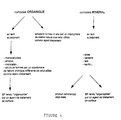
- particulate stabilizer whose surface condition is organophilic means an organic solid compound, in particular of the polymer or mineral type, finely divided and dispersible in the continuous phase (phase A); the surface condition can be modified by a surface treatment agent, to make said particulate stabilizer organophilic.
- the block or graft copolymer designated by dispersing copolymer essentially serves to facilitate the dispersion of one liquid in the other during the preparation of the emulsion, by lowering the interfacial tension between phase A and B, and only partially to the stabilization of the droplets since the latter is mainly provided by the particulate stabilizer .
- the combination of a dispersing copolymer and a particulate stabilizer makes it possible to stabilize an emulsion comprising droplets of diameter ⁇ 10 ⁇ m.
- the particulate stabilizer alone has no dispersing effect and does not allow the emulsion to be produced; similarly, the dispersing copolymer alone does not sufficiently stabilize the emulsion.
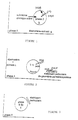
- FIG. 2 A block diagram representing an emulsion droplet stabilized by a mixture of dispersing copolymer and of a particulate stabilizer is shown in FIG. 2.
- said mass fraction of the surface treatment agent, ⁇ ATS is between 0.001 and 0.1.
- the particulate stabilizer when the particulate stabilizer is of mineral type, the latter is chosen from the group which comprises clays, silicas, talc, kaolin or derivatives of these products and is treated at the surface with an agent.
- surface treatment able to make it organophilic and therefore dispersible in the continuous phase (phase A) of the emulsion, and to impart stabilization properties to it sterically and is added, as an adjuvant, to phase A containing the solution of elastomer in solvent a and the dispersing copolymer ;
- the mass fraction of surface treatment agent relative to the particulate stabilizer in the emulsion is between 0.001 and 0.5, as specified above.
- said mass fraction of the surface treatment agent, ⁇ ATS is between 0.001 and 0.1.
- the mineral particulate stabilizer can be chosen from commercially available "organophilic” products, such as for example certain organophilic silicas or clays (Bentone 38, Bentone SD-1 RHEOX INC., ...), and therefore does not require no additional surface treatment agents.
- said emulsion comprises several particulate stabilizers , such as for example the combination of a particulate stabilizer formed in situ during the dissolution of the dispersing copolymer with a second particulate stabilizer in the form of an adjuvant.
- the dispersing block copolymer is selected from di-block copolymers, of polyA-block-polyB type, triblock copolymers of polyB-block-polyA-block-polyB type (BAB), of type polyA-block-polyB-block-polyA (ABA), of type polyA-block-polyB-block-polyC (ABC) or polyA-block-polyC-block-polyB (ACB), or more generally among the multiblock compounds containing polyA, polyB and polyC sequences and the copolymer of the dispersed grafted type is selected from compounds of the polyA-grafted-polyB type, polyB-grafted-polyA, of type polyA-grafted-polyB and polyC or of type polyC-grafted-polyA and polyB.
- BAB triblock copolymers of polyB-block-polyA-block-polyB type
- ABA type polyA-block-polyB-block-polyA
- the proportions of polyA sequence expressed in mass by relative to the sum of the polyA + polyB sequences, are between 10 and 90%, and the proportions of polyB sequences are between 90 and 10%, and the proportions mass of polyC sequences are between 0 and 50% compared to all of the sequences.
- the molar masses of the poly A, poly B and poly C sequences are between 1,000 and 500,000 Daltons.
- the poly A blocks, compatible with the non-polar or slightly polar solvent a are selected from the group consisting of polydienes, polyolefins, polyethers or silicones, such as polyisoprene, polybutadiene, polyisobutene, hydrogenated polybutadiene or hydrogenated polyisoprene, poly (4-tertiobutylstyrene), polyoxypropylene, polyoxybutylene, polydimethylsiloxane, poly (2-ethyl methacrylate hexyl), poly (lauryl methacrylate) miscible with an elastomer solution in a solvent a
- the polyB sequences, compatible with solvent b are selected from the group consisting of polyoxyethylene, polyvinylpyrrolidone, polyacids, poly (vinyl alcohol) and poly (vinylpyridine) quaternized.
- the polyC sequences can be chosen from the group which comprises polymers which may either be compatible with solvent a or solvent b, or not compatible with solvents a and b .
- the polyC sequence is chosen, without limitation, from the group formed by acrylic or vinyl polymers such as poly (methyl methacrylate) or polystyrene.
- the surface treatment agent capable of rendering the particulate stabilizer organophilic, is selected from the group consisting of block or graft copolymers containing at least one polyA 'block, soluble in the solvent a , and a polyB ′ block capable of adsorbing or anchoring to the surface of the particulate stabilizer , said poly A ′ and poly B ′ sequences being identical or different from the poly A and poly B sequences and functionalized oligomers of polyA'-F type, in which F is a chemical function capable of adsorbing on the particulate stabilizer .
- the polyA ′ blocks are chosen from polymers soluble in the apolar or sparingly polar solvent a , as for example in the group which comprises polydienes, polyolefins, polyethers or silicones, such as polyisoprene, polybutadiene, polyisobutene, hydrogenated polybutadiene or hydrogenated polyisoprene, poly (4-tertiobutylstyrene), polyoxypropylene, polyoxybutylene, polydimethylsiloxane, poly (2-ethyl hexyl methacrylate), poly (methacrylate) an elastomer solution in a solvent a
- the poly B ′ blocks are chosen from polymers capable of adsorbing on the surface of the particulate stabilizer , and is chosen from the group which comprises polyoxyethylene, polyvinylpyrrolidone, acrylic polyacids , poly (vinyl alcohol) and poly (vinylpyridine) which
- the proportions of polyA 'sequence are between 10 and 90%, preferably between 20 and 80% and the proportions of polyB 'sequences are between 90 and 10%.
- the molar masses of the polyA 'and polyB' sequences are between 150 and 200,000 Daltons.
- F is selected from the group consisting of acid, amine or alcohol functions and groups capable of reacting chemically with the surface of the particulate stabilizer , such as for example epoxy, isocyanate or aziridine groups .
- Such emulsions of an active chemical substance x in an elastomer solution comprise droplets which have a diameter equal to or greater than 10 ⁇ m and a very good stability conferred jointly by said block or graft copolymer and by said rendered particulate stabilizer organophilic by a surface treatment agent as defined above.
- the stability of said emulsions can be evaluated by detection coalescence and flocculation phenomena, as well as by monitoring the diameter droplets over time.
- the elastomer, the solvent a , the active chemical substance x and the solvent b are in particular those described in International Application WO 95/17453.
- this active chemical substance x can play the role of dispersing agent. It follows that, under these conditions, it is possible to reduce the content of block or graft copolymer in the emulsion described above, or even to get rid of it, thus simplifying the formulation of the emulsion according to the invention while ensuring proper stabilization of droplets with a diameter ⁇ 10 ⁇ m.
- said elastomer, said solvent a, said solvent b and said particulate stabilizer are as defined above in the context of emulsions comprising a dispersing agent selected from the group consisting of block or graft copolymers.
- the combination of the active chemical substance x possessing surfactant properties and of the particulate stabilizer or stabilizers, preferably when these are block or graft copolymers as defined above, makes it possible to stabilize an emulsion comprising droplets of diameter ⁇ 10 ⁇ m.
- the particulate stabilizer is added during the formation of the emulsion, that is to say at the moment when phase B is dispersed in phase A.
- the particulate stabilizer can be made organophilic directly by the copolymer used for the dispersion of the emulsion.
- the present invention also relates to an elastomer film, characterized in that it is obtained by evaporation of the solvent a , from an emulsion as defined above.
- Such an elastomer film which can advantageously serve as a protective support, comprises stable droplets of a solvent b immiscible with the elastomer, loaded with at least one active substance x , which droplets have a diameter ⁇ 10 ⁇ m, are uniformly distributed throughout the elastomeric material.
- the combination of at least one block or graft copolymer and at least one particulate stabilizer makes it possible to obtain the stability of the emulsion both in the presence of the solvent a and during the 'Evaporation of said solvent has , that is to say during the formation of the film, which is stable and has optimal mechanical characteristics.
- the present invention also relates to the different applications of the elastomer film according to the invention, more particularly in the field medical and paramedical: gloves, finger cots, condoms or dressings with a elastomer film according to the invention.
- Example 1 Evaluation of the stability and the diameter of the emulsions obtained according to the invention.
- the stability and the diameter of the emulsions are evaluated in the conditions specified below, taking into account the following parameters.
- an emulsion will be considered stable when it neither coalesces nor flocculates.
- the diameter of the emulsion is measured by the technique of photosedimentation on an aliquot part of the emulsion, on a device of the type SHIMADZU SA-CP3.
- the particulate stabilizer corresponds to a fixed structure formed in situ by a fraction of the dispersing copolymer in solution in solvent a .
- phase A
- SEBS poly-styrene-poly (ethylene / co / butylene) -polystyrene copolymer
- SEBS poly-styrene-poly (ethylene / co / butylene) -polystyrene copolymer
- phase B
- Bardac dimethyldidecylammonium chloride
- PEG 400 polyethylene glycol with a molecular weight of 400 Daltons
- PBut-POE polybutadiene-polyoxyethylene diblock copolymer
- the copolymer is dissolved using a protocol commonly described in the literature (EK Lin et al., Macromolecules, 1996, 29, 4432-4441). In this example, 10 grams of this copolymer are dissolved in 90 grams of methylcyciohexane.
- the aggregates represent 60% by mass of the initial copolymer, and can be separated from the micelles if necessary by centrifugation, then taken up in methylcyclohexane so as to form a solution of given concentration therein.
- the copolymer solution containing the micelles ( dispersing copolymer ) and the aggregates ( particulate stabilizer ) in methylcyclohexane (10% by mass solution).
- This solution contains 0.24 gram of copolymer in the form of dispersing copolymer (micelles) and 0.36 gram in the form of particulate stabilizer (aggregates).
- the particulate stabilizer can be added, with gentle stirring, after emulsification of phase B in phase A, the copolymer in the form of a micelle serving as a dispersant.
- the emulsion formed has a modal diameter of 7 ⁇ m and is not stable, as indicated by the study at TURBISCAN MA1000 (reduction of the backscatter signal at course of time).
- Example 3 Emulsion prepared in the presence of a poly (4-tertiobutyl styrene) -polyoxyethylene diblock copolymer, denoted P t BuSt-POE ( dispersing copolymer ) and an organic particulate stabilizer formed in situ from this diblock copolymer
- PBut-POE copolymer is replaced by a poly (4-tertiobutylstyrene) -polyoxyethylene diblock copolymer denoted P t BuSt-POE, containing 45% by mass of POE (determination by 1 H NMR), and of total molar mass of 7700 Daltons.
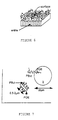
- This copolymer is dissolved in methylcyclohexane (10% solution by mass, formed from 10 grams of copolymer in 90 grams of solvent a ), and forms therein a mixture of micelles and aggregates, the latter being in the form rectangular and composed of a central structure of crystallized POE and "hair" of P t BuSt (see Figure 6). Their size, evaluated by optical microscopy, is between 1 and 3 ⁇ m. These aggregates represent 50% by mass of the initial copolymer, and in this case play the role of particulate stabilizer .
- the "hair" of P t BuSt allows the dispersion of the particulate stabilizer in the solvent a , so that it is not necessary to use a surface treatment agent.
- phase B 0102
- CD 0.024
- SP 0.024
- ATS 0
- Example 4 Emulsion prepared in the presence of a hydrogenated polybutadiene-polyoxyethylene diblock copolymer, denoted HPBut-POE ( dispersing copolymer ) and of an organic particulate stabilizer formed in situ from this diblock copolymer: Monitoring of the diameter of the emulsion as a function of time
- the dispersing copolymer is a diblock copolymer HPBut-POE, containing 50% by mass of POE (determination by 1 H NMR), and of total molar mass of 8300 Daltons.
- This copolymer is dissolved in methylcyclohexane (10% solution by mass, formed from 10 grams of copolymer in 90 grams of solvent a ), and forms therein a mixture of micelles and aggregates, the latter representing approximately 75 % by mass of the initial copolymer, and in this case play the role of particulate stabilizer .
- the preparation method is similar to that described in the example 2.
- phase B To 100 grams of a SEBS solution identical to that used in the previous example, 6 grams of the solution containing the micelles and the aggregates ( particulate stabilizer ) in methylcyclohexane (10% solution) are added. The whole is homogenized before adding, with stirring, 12 grams of phase B.
- phase B 0102
- CD 0012
- SP 0.036
- ATS 0
- the modal diameter of the emulsion is represented as a function of time in the table below: Duration (hours) 0 2 6 9 24 Modal diameter ( ⁇ m) 23.5 22.5 22.7 23.0 23.9
- the diameter of the droplets did not evolved over time, which shows that the emulsion has neither coalesced nor flocculated.
- Example 5 Emulsion prepared in the presence of a graft copolymer ( dispersing copolymer ) and a mineral particulate stabilizer of the silica type.
- the dispersing copolymer is a graft copolymer of the polyethersiloxane type sold by the company GOLDSCHMIDT AG under the name TEGOPREN 5840.
- the particulate stabilizer is silica sold by the company DEGUSSA.
- This compound can be organized either in the form of primary particles (spheres of 12 nm diameter, according to DEGUSSA), or in the form of combinations of these particles, of less defined structure and of larger dimension.
- this silica has undergone a chemical treatment at the supplier in order to make it dispersible in aliphatic solvent.
- phase A
- Phase A consists of a solution of SEBS KRATON G1652 15% in methylcyclohexane.
- Phase B is identical to that used in Example 2.
- the viscosity of the shear emulsion low is increased by the presence of organophilic silica, which reduces the speed of phase B sedimentation.
- Example 6 Emulsion prepared in the presence of a diblock copolymer P t BuSt-POE ( dispersing copolymer ) and a mineral particulate stabilizer of clay type.
- the dispersing copolymer is a block copolymer P t BuSt-POE with characteristics similar to that used in Example 3.
- micelles and other associated structures are formed. These the latter are separated from the micelles by centrifugation and represent 50% in mass of the copolymer. The micelles form a solution at 5% by mass in the methylcyclohexane.
- the particulate stabilizer is an organophilic clay of the CLAYTONE AF type sold by the company LAPORTE ABSORBANTS. Its structure is of lamellar type, its dimensions being of the order of a micrometer.
- this particulate stabilizer is made organophilic by the supplier by chemical treatment (fixation on the surface of the clay of a quaternary ammonium carrying alkyl functions), and will therefore be used as it is.
- phase A
- Phase A consists of a solution of SEBS KRATON G1652 15% in methylcyclohexane.
- Phase B is identical to that used in Examples 2 and 3.
- organophilic clay results in an increase in viscosity at very low shear or at rest.
- the analysis of the diffusion and backscattering profiles of this emulsion using the Turbiscan MA1000 demonstrates that there is no coalescence nor flocculation.
- Example 7 Production of an emulsion from a solution of copolymer P t BuSt-POE containing micelles and aggregates, and of a second particulate stabilizer of clay type.
- This example is a variant of Example 6 described above.
- the crude copolymer solution i.e. the solution the micelles and aggregates, is introduced as it is in phase A.
- organophilic clay and the aggregates formed by the copolymer.
- the emulsion has similar characteristics (diameter, stability).
- the emulsion which is formed has a larger diameter (20-25 ⁇ m) while being stable.
- Example 8 Emulsion Prepared in the Presence of an Active Chemical Substance x Serving as a Dispersing Agent and of an Organic Particulate Stabilizer Consisting of Fixed Structures of a Diblock Hydrogenated Polybutadiene-Poly (Oxyethylene)
- the dispersing copolymer whose role is to lower the surface tension between phase A and phase B, is replaced by a chemical substance x having both a virucidal activity and surfactant characteristics similar to those of copolymer.
- This chemical substance introduced directly into phase B, is ethoxylated nonyl phenol, sold by the company Union Carbide under the name Triton X100.
- the particulate stabilizer is a HPBut-POE block copolymer, containing 50% by mass of POE, with characteristics similar to that used in Example 4.
- This copolymer is dissolved in methylcyclohexane (10% by mass solution, formed at from 10 grams of copolymer in 90 grams of solvent a ), and forms therein a mixture of micelles and aggregates, the latter representing approximately 75% by mass of the initial copolymer.
- the aggregates are separated from the micelles by centrifugation and taken up in methylcyclohexane so as to form a 5% solution therein.
- phase A
- Phase A consists of a solution of SEBS KRATON G1652 15% in methylcyclohexane.
- phase B
- Triton X100 is dissolved, with stirring, in polyethylene glycol of molar mass 400 Daltons (PEG 400) so as to obtain a solution with 30% by mass in Triton X100.
- PEG 400 polyethylene glycol of molar mass 400 Daltons
- Example 9 Preparation of an elastomer film.
- the solvent a is evaporated under atmospheric pressure at room temperature from an emulsion as defined in Examples 2 to 8; an elastomer film is thus obtained containing, in the form of a stable dispersion, droplets of solvent b , loaded with active chemical substance x , with a diameter ⁇ 10 ⁇ m.
Landscapes
- Health & Medical Sciences (AREA)
- Chemical & Material Sciences (AREA)
- Chemical Kinetics & Catalysis (AREA)
- Epidemiology (AREA)
- Veterinary Medicine (AREA)
- Public Health (AREA)
- General Health & Medical Sciences (AREA)
- Animal Behavior & Ethology (AREA)
- Life Sciences & Earth Sciences (AREA)
- Organic Chemistry (AREA)
- Materials Engineering (AREA)
- Engineering & Computer Science (AREA)
- Hematology (AREA)
- Polymers & Plastics (AREA)
- Medicinal Chemistry (AREA)
- Heart & Thoracic Surgery (AREA)
- Surgery (AREA)
- Vascular Medicine (AREA)
- Processes Of Treating Macromolecular Substances (AREA)
- Compositions Of Macromolecular Compounds (AREA)
- Materials For Medical Uses (AREA)
Applications Claiming Priority (3)
| Application Number | Priority Date | Filing Date | Title |
|---|---|---|---|
| FR9803234 | 1998-03-17 | ||
| FR9803234 | 1998-03-17 | ||
| PCT/FR1999/000586 WO1999047589A1 (fr) | 1998-03-17 | 1999-03-16 | Emulsions stables, leur procede de preparation et leurs applications |
Publications (2)
| Publication Number | Publication Date |
|---|---|
| EP0981573A1 EP0981573A1 (fr) | 2000-03-01 |
| EP0981573B1 true EP0981573B1 (fr) | 2004-09-01 |
Family
ID=9524123
Family Applications (1)
| Application Number | Title | Priority Date | Filing Date |
|---|---|---|---|
| EP99907719A Expired - Lifetime EP0981573B1 (fr) | 1998-03-17 | 1999-03-16 | Emulsions stables, leur procede de preparation et leurs applications |
Country Status (6)
| Country | Link |
|---|---|
| US (1) | US6391326B1 (enExample) |
| EP (1) | EP0981573B1 (enExample) |
| JP (1) | JP2002501572A (enExample) |
| DE (1) | DE69919794T2 (enExample) |
| ES (1) | ES2228011T3 (enExample) |
| WO (1) | WO1999047589A1 (enExample) |
Cited By (1)
| Publication number | Priority date | Publication date | Assignee | Title |
|---|---|---|---|---|
| EP1950765A1 (fr) | 2007-01-25 | 2008-07-30 | Hutchinson | Matériau élastomere multicouches charge en composes attenuateurs de radiations, son procédé de préparation et ses utilisations |
Families Citing this family (17)
| Publication number | Priority date | Publication date | Assignee | Title |
|---|---|---|---|---|
| AU2002345679A1 (en) * | 2001-06-15 | 2003-01-02 | Grain Processing Corporation | Biodegradable sorbents |
| FR2843069B1 (fr) | 2002-07-31 | 2004-10-15 | Hutchinson | Materiau elastomere multicouches charge en substance chimique active et ses utilisations. |
| FR2845930B1 (fr) * | 2002-10-21 | 2006-05-26 | Oreal | Procede de solubilisation de composes lipophiles en solution aqueuse par des copolymeres blocs amphiphiles et composition cosmetique |
| KR100757724B1 (ko) * | 2002-10-21 | 2007-09-11 | 로레알 | 친유성 화합물의 용해 방법, 및 화장 조성물 |
| US7129277B2 (en) * | 2002-12-31 | 2006-10-31 | 3M Innovative Properties Company | Emulsions including surface-modified inorganic nanoparticles |
| US7001580B2 (en) * | 2002-12-31 | 2006-02-21 | 3M Innovative Properties Company | Emulsions including surface-modified organic molecules |
| US7141612B2 (en) * | 2002-12-31 | 2006-11-28 | 3M Innovative Properties Company | Stabilized foams including surface-modified organic molecules |
| US7495051B2 (en) * | 2004-09-27 | 2009-02-24 | 3M Innovative Properties Company | Nanocomposite and method of making the same |
| US7329702B2 (en) * | 2004-09-27 | 2008-02-12 | 3M Innovative Properties Company | Composition and method of making the same |
| US7691932B2 (en) * | 2004-09-27 | 2010-04-06 | 3M Innovative Properties Company | Method of making a composition and nanocomposites therefrom |
| US8193270B2 (en) * | 2004-12-14 | 2012-06-05 | 3M Innovative Properties Company | Method of making composites and nanocomposites |
| CN101679759B (zh) * | 2008-02-22 | 2013-01-30 | 圣萨拉姆集团 | 聚合物混合料及由该聚合物混合料制成的成形品 |
| US8087412B2 (en) * | 2008-05-01 | 2012-01-03 | Ansell Healthcare Products Llc | Dip-formed synthetic polyisoprene latex articles with improved intraparticle and interparticle crosslinks |
| US8445631B2 (en) * | 2009-10-13 | 2013-05-21 | Kraton Polymers U.S. Llc | Metal-neutralized sulfonated block copolymers, process for making them and their use |
| US10662269B2 (en) | 2017-08-31 | 2020-05-26 | Lifestyles Healthcare Pte. Ltd. | Ziegler-Natta catalyzed polyisoprene articles |
| US12317956B2 (en) | 2020-04-29 | 2025-06-03 | UA Thomas Co. Ltd. | Slip resistant shoe cover |
| CN119798911A (zh) * | 2025-01-02 | 2025-04-11 | 万华化学集团股份有限公司 | 一种水性sbs胶乳及其制备方法和应用 |
Family Cites Families (15)
| Publication number | Priority date | Publication date | Assignee | Title |
|---|---|---|---|---|
| JPS51125442A (en) * | 1975-04-24 | 1976-11-01 | Nitto Electric Ind Co Ltd | A hydrous gel and a process for preparing it |
| US4747845A (en) * | 1983-10-17 | 1988-05-31 | Enquay Pharmaceutical Associates | Synthetic resin matrix system for the extended delivery of drugs |
| GB8511379D0 (en) * | 1985-05-03 | 1985-06-12 | Allied Colloids Ltd | Compositions for sizing paper |
| USRE33048E (en) * | 1984-10-31 | 1989-09-05 | Midwest Research Institute | Marine anti-fouling coating formulations containing a soluble phase including a organotin polymer in combination with an insoluble phase including a crosslinked organotin polymer |
| US4923698A (en) * | 1986-12-19 | 1990-05-08 | S. C. Johnson & Son, Inc. | Bioactive film-forming composition for control of crawling insects and the like |
| US5045341A (en) * | 1987-07-17 | 1991-09-03 | Shlenker Robin R T | Covering such as a suit, glove, condom or sheath forming a chemical barrier against harmful agents and methods of making the same |
| US4983716A (en) * | 1990-01-16 | 1991-01-08 | The Sherwin-Williams Company | Non-aqueous dispersions |
| US5466725A (en) * | 1990-02-22 | 1995-11-14 | Baxter International, Inc. | Anti-viral materials |
| DE4216167A1 (de) * | 1992-05-18 | 1993-11-25 | Roehm Gmbh | Wasserlösliche Polymerdispersionen |
| US5425955A (en) * | 1992-11-13 | 1995-06-20 | Isp Investments Inc. | Compositions of insoluble film-forming polymers and uses therefor |
| FR2714386B1 (fr) * | 1993-12-23 | 1996-03-08 | Hutchinson | Film d'élastomère, son procédé de préparation et ses applications. |
| JPH0913274A (ja) * | 1995-06-27 | 1997-01-14 | Tosuko Kk | セルロース系繊維粉体の分散液及びそれを使用する布帛のコーティング方法 |
| FR2740777B1 (fr) * | 1995-11-02 | 1998-01-02 | Hutchinson | Films d'elastomere contenant au moins une substance chimique active, leur procede de preparation et leurs applications |
| DE19542077A1 (de) * | 1995-11-11 | 1997-05-15 | Basf Ag | Verwendung einer wäßrigen Polymerisatdispersion zur Herstellung von Wasserdampfsperren |
| US5684080A (en) * | 1995-11-15 | 1997-11-04 | Shell Oil Company | Aqueous polymer emulsion |
-
1999
- 1999-03-16 ES ES99907719T patent/ES2228011T3/es not_active Expired - Lifetime
- 1999-03-16 US US09/423,638 patent/US6391326B1/en not_active Expired - Lifetime
- 1999-03-16 JP JP54664899A patent/JP2002501572A/ja active Pending
- 1999-03-16 DE DE69919794T patent/DE69919794T2/de not_active Expired - Lifetime
- 1999-03-16 EP EP99907719A patent/EP0981573B1/fr not_active Expired - Lifetime
- 1999-03-16 WO PCT/FR1999/000586 patent/WO1999047589A1/fr not_active Ceased
Cited By (2)
| Publication number | Priority date | Publication date | Assignee | Title |
|---|---|---|---|---|
| EP1950765A1 (fr) | 2007-01-25 | 2008-07-30 | Hutchinson | Matériau élastomere multicouches charge en composes attenuateurs de radiations, son procédé de préparation et ses utilisations |
| FR2911991A1 (fr) * | 2007-01-25 | 2008-08-01 | Hutchinson Sa | Materiau elastomere multicouches charge en composes attenuateurs de radiations, son procede de preparation et ses utilisations |
Also Published As
| Publication number | Publication date |
|---|---|
| DE69919794T2 (de) | 2005-09-01 |
| EP0981573A1 (fr) | 2000-03-01 |
| ES2228011T3 (es) | 2005-04-01 |
| JP2002501572A (ja) | 2002-01-15 |
| WO1999047589A1 (fr) | 1999-09-23 |
| DE69919794D1 (de) | 2004-10-07 |
| US6391326B1 (en) | 2002-05-21 |
Similar Documents
| Publication | Publication Date | Title |
|---|---|---|
| EP0981573B1 (fr) | Emulsions stables, leur procede de preparation et leurs applications | |
| EP0687283B1 (fr) | Film d'elastomere comprenant des gouttelettes, son procede de preparation et ses applications | |
| Holowka et al. | Charged polypeptide vesicles with controllable diameter | |
| CA2076010C (fr) | Microspheres, leur procede de preparation et leur utilisation | |
| Vega et al. | PLGA nanospheres for the ocular delivery of flurbiprofen: drug release and interactions | |
| EP0771837B1 (fr) | Films d'élastomère contenant au moins une substance chimique active, leur procédé de préparation et leurs applications | |
| EP0646001B1 (fr) | Microspheres en polymere bioresorbable, exemptes de tensioactif, leur preparation et leur application comme medicament | |
| EP2392550B1 (fr) | Nouvelles dispersions aqueuses stables de nanoparticules de polymères thermoplastiques haute performance et leurs utilisations comme agents filmifiants | |
| EP0934059A1 (fr) | Procede de preparation de nanoparticules de methylidene malonate, nanoparticules contenant eventuellement une ou plusieurs molecules biologiquement actives | |
| EP2883605A1 (en) | Microcapsule-manufacturing process and microcapsules | |
| Atanase et al. | Block copolymer stabilized nonaqueous biocompatible sub-micron emulsions for topical applications | |
| EP1299458B1 (fr) | Dispersion aqueuse a base d'huiles silicones visqueuses reticulables par condensation en un elastomere adherent utilisables notamment comme mastics ou peintures, procede de preparation | |
| EP1617814A2 (fr) | Procede de dispersion de substances hydrosolubles ou hydrophiles dans un fluide a pression supercritique | |
| EP0576377A1 (fr) | Microcapsules contenant au moins un principe actif, leurs applications et l'un de leurs procédés de préparation | |
| FR2806005A1 (fr) | Procede de preparation de particules colloidales sous forme de nanocapsules | |
| CA2102185C (fr) | Procede de preparation de nanoparticules | |
| EP1409571B1 (fr) | Compositions aqueuses comprenant un microgel chimique associe a un polymere aqueux | |
| EP1216091B1 (fr) | Procede d'encapsulation de matieres actives par coacervation de polymeres en solvant organique non-chlore | |
| Chai et al. | Poly (vinyl alcohol) s and Their Glycoderivatives as Efficient Shell-Builders of Nanocapsules by Nanoprecipitation | |
| EP0597036A1 (fr) | Composes d'ammonium quaternaires micro-encapsules | |
| WO2003090916A2 (fr) | Preparation d'une emulsion par dilution d'un concentre emulsionnable comprenant un copolymere amphiphile | |
| BE891141A (fr) | Preparation d'un gel capable de vehiculer des gaz | |
| JPH08134160A (ja) | エマルジョンおよびその製造方法並びにポリマー粒子 | |
| RU2293766C2 (ru) | Способ получения надмолекулярных композитов | |
| WO2024256601A1 (fr) | Emulsions simples |
Legal Events
| Date | Code | Title | Description |
|---|---|---|---|
| PUAI | Public reference made under article 153(3) epc to a published international application that has entered the european phase |
Free format text: ORIGINAL CODE: 0009012 |
|
| 17P | Request for examination filed |
Effective date: 19991208 |
|
| AK | Designated contracting states |
Kind code of ref document: A1 Designated state(s): BE CH DE DK ES FI FR GB IT LI MC NL SE |
|
| 17Q | First examination report despatched |
Effective date: 20011205 |
|
| GRAP | Despatch of communication of intention to grant a patent |
Free format text: ORIGINAL CODE: EPIDOSNIGR1 |
|
| GRAS | Grant fee paid |
Free format text: ORIGINAL CODE: EPIDOSNIGR3 |
|
| GRAA | (expected) grant |
Free format text: ORIGINAL CODE: 0009210 |
|
| AK | Designated contracting states |
Kind code of ref document: B1 Designated state(s): BE CH DE DK ES FI FR GB IT LI MC NL SE |
|
| PG25 | Lapsed in a contracting state [announced via postgrant information from national office to epo] |
Ref country code: NL Free format text: LAPSE BECAUSE OF FAILURE TO SUBMIT A TRANSLATION OF THE DESCRIPTION OR TO PAY THE FEE WITHIN THE PRESCRIBED TIME-LIMIT Effective date: 20040901 Ref country code: FI Free format text: LAPSE BECAUSE OF FAILURE TO SUBMIT A TRANSLATION OF THE DESCRIPTION OR TO PAY THE FEE WITHIN THE PRESCRIBED TIME-LIMIT Effective date: 20040901 |
|
| REG | Reference to a national code |
Ref country code: GB Ref legal event code: FG4D Free format text: NOT ENGLISH |
|
| REG | Reference to a national code |
Ref country code: CH Ref legal event code: EP |
|
| REF | Corresponds to: |
Ref document number: 69919794 Country of ref document: DE Date of ref document: 20041007 Kind code of ref document: P |
|
| PG25 | Lapsed in a contracting state [announced via postgrant information from national office to epo] |
Ref country code: SE Free format text: LAPSE BECAUSE OF FAILURE TO SUBMIT A TRANSLATION OF THE DESCRIPTION OR TO PAY THE FEE WITHIN THE PRESCRIBED TIME-LIMIT Effective date: 20041201 Ref country code: DK Free format text: LAPSE BECAUSE OF FAILURE TO SUBMIT A TRANSLATION OF THE DESCRIPTION OR TO PAY THE FEE WITHIN THE PRESCRIBED TIME-LIMIT Effective date: 20041201 |
|
| GBT | Gb: translation of ep patent filed (gb section 77(6)(a)/1977) |
Effective date: 20041207 |
|
| NLV1 | Nl: lapsed or annulled due to failure to fulfill the requirements of art. 29p and 29m of the patents act | ||
| PG25 | Lapsed in a contracting state [announced via postgrant information from national office to epo] |
Ref country code: MC Free format text: LAPSE BECAUSE OF NON-PAYMENT OF DUE FEES Effective date: 20050331 Ref country code: LI Free format text: LAPSE BECAUSE OF NON-PAYMENT OF DUE FEES Effective date: 20050331 Ref country code: CH Free format text: LAPSE BECAUSE OF NON-PAYMENT OF DUE FEES Effective date: 20050331 |
|
| REG | Reference to a national code |
Ref country code: ES Ref legal event code: FG2A Ref document number: 2228011 Country of ref document: ES Kind code of ref document: T3 |
|
| PLBE | No opposition filed within time limit |
Free format text: ORIGINAL CODE: 0009261 |
|
| STAA | Information on the status of an ep patent application or granted ep patent |
Free format text: STATUS: NO OPPOSITION FILED WITHIN TIME LIMIT |
|
| 26N | No opposition filed |
Effective date: 20050602 |
|
| REG | Reference to a national code |
Ref country code: CH Ref legal event code: PL |
|
| REG | Reference to a national code |
Ref country code: FR Ref legal event code: PLFP Year of fee payment: 17 |
|
| REG | Reference to a national code |
Ref country code: FR Ref legal event code: PLFP Year of fee payment: 18 |
|
| PGFP | Annual fee paid to national office [announced via postgrant information from national office to epo] |
Ref country code: ES Payment date: 20160309 Year of fee payment: 18 |
|
| PGFP | Annual fee paid to national office [announced via postgrant information from national office to epo] |
Ref country code: GB Payment date: 20160321 Year of fee payment: 18 Ref country code: BE Payment date: 20160321 Year of fee payment: 18 |
|
| PGFP | Annual fee paid to national office [announced via postgrant information from national office to epo] |
Ref country code: DE Payment date: 20160330 Year of fee payment: 18 |
|
| PGFP | Annual fee paid to national office [announced via postgrant information from national office to epo] |
Ref country code: IT Payment date: 20160324 Year of fee payment: 18 |
|
| REG | Reference to a national code |
Ref country code: FR Ref legal event code: PLFP Year of fee payment: 19 |
|
| REG | Reference to a national code |
Ref country code: DE Ref legal event code: R119 Ref document number: 69919794 Country of ref document: DE |
|
| GBPC | Gb: european patent ceased through non-payment of renewal fee |
Effective date: 20170316 |
|
| PG25 | Lapsed in a contracting state [announced via postgrant information from national office to epo] |
Ref country code: DE Free format text: LAPSE BECAUSE OF NON-PAYMENT OF DUE FEES Effective date: 20171003 |
|
| REG | Reference to a national code |
Ref country code: FR Ref legal event code: PLFP Year of fee payment: 20 |
|
| PG25 | Lapsed in a contracting state [announced via postgrant information from national office to epo] |
Ref country code: IT Free format text: LAPSE BECAUSE OF NON-PAYMENT OF DUE FEES Effective date: 20170316 Ref country code: GB Free format text: LAPSE BECAUSE OF NON-PAYMENT OF DUE FEES Effective date: 20170316 |
|
| REG | Reference to a national code |
Ref country code: BE Ref legal event code: MM Effective date: 20170331 |
|
| REG | Reference to a national code |
Ref country code: ES Ref legal event code: FD2A Effective date: 20180507 |
|
| PG25 | Lapsed in a contracting state [announced via postgrant information from national office to epo] |
Ref country code: BE Free format text: LAPSE BECAUSE OF NON-PAYMENT OF DUE FEES Effective date: 20170331 |
|
| PGFP | Annual fee paid to national office [announced via postgrant information from national office to epo] |
Ref country code: FR Payment date: 20180222 Year of fee payment: 20 |
|
| PG25 | Lapsed in a contracting state [announced via postgrant information from national office to epo] |
Ref country code: ES Free format text: LAPSE BECAUSE OF NON-PAYMENT OF DUE FEES Effective date: 20170317 |