EP0977902B1 - Herstellung von zweiwegformgedächtnisteilen - Google Patents
Herstellung von zweiwegformgedächtnisteilen Download PDFInfo
- Publication number
- EP0977902B1 EP0977902B1 EP97919618A EP97919618A EP0977902B1 EP 0977902 B1 EP0977902 B1 EP 0977902B1 EP 97919618 A EP97919618 A EP 97919618A EP 97919618 A EP97919618 A EP 97919618A EP 0977902 B1 EP0977902 B1 EP 0977902B1
- Authority
- EP
- European Patent Office
- Prior art keywords
- alloy
- temperature
- austenitic
- treatment
- subjecting
- Prior art date
- Legal status (The legal status is an assumption and is not a legal conclusion. Google has not performed a legal analysis and makes no representation as to the accuracy of the status listed.)
- Expired - Lifetime
Links
- 238000004519 manufacturing process Methods 0.000 title claims description 9
- 229910045601 alloy Inorganic materials 0.000 claims description 150
- 239000000956 alloy Substances 0.000 claims description 150
- 238000011282 treatment Methods 0.000 claims description 124
- 238000010438 heat treatment Methods 0.000 claims description 101
- 229910000734 martensite Inorganic materials 0.000 claims description 62
- 230000009466 transformation Effects 0.000 claims description 55
- 230000032683 aging Effects 0.000 claims description 49
- 238000000034 method Methods 0.000 claims description 43
- 230000008569 process Effects 0.000 claims description 42
- 229910001000 nickel titanium Inorganic materials 0.000 claims description 35
- 230000003750 conditioning effect Effects 0.000 claims description 26
- 239000007943 implant Substances 0.000 claims description 23
- 229910001285 shape-memory alloy Inorganic materials 0.000 claims description 14
- 230000003446 memory effect Effects 0.000 claims description 13
- 230000008878 coupling Effects 0.000 claims description 11
- 238000010168 coupling process Methods 0.000 claims description 11
- 238000005859 coupling reaction Methods 0.000 claims description 11
- 230000000930 thermomechanical effect Effects 0.000 claims description 11
- 230000007423 decrease Effects 0.000 claims description 8
- 238000001556 precipitation Methods 0.000 claims description 8
- 238000012360 testing method Methods 0.000 claims description 8
- 238000005096 rolling process Methods 0.000 claims description 7
- 230000015572 biosynthetic process Effects 0.000 claims description 6
- 230000001747 exhibiting effect Effects 0.000 claims description 5
- 238000004804 winding Methods 0.000 claims description 5
- 238000002844 melting Methods 0.000 claims description 4
- 230000008018 melting Effects 0.000 claims description 4
- 230000008707 rearrangement Effects 0.000 claims description 4
- HZEWFHLRYVTOIW-UHFFFAOYSA-N [Ti].[Ni] Chemical compound [Ti].[Ni] HZEWFHLRYVTOIW-UHFFFAOYSA-N 0.000 claims description 2
- 238000003754 machining Methods 0.000 claims 2
- 238000001816 cooling Methods 0.000 description 9
- PXHVJJICTQNCMI-UHFFFAOYSA-N Nickel Chemical compound [Ni] PXHVJJICTQNCMI-UHFFFAOYSA-N 0.000 description 6
- 230000036760 body temperature Effects 0.000 description 5
- 239000007858 starting material Substances 0.000 description 5
- 230000008859 change Effects 0.000 description 4
- 239000000463 material Substances 0.000 description 4
- 229910052759 nickel Inorganic materials 0.000 description 4
- 238000002360 preparation method Methods 0.000 description 4
- 230000002441 reversible effect Effects 0.000 description 4
- 238000000137 annealing Methods 0.000 description 3
- 230000000694 effects Effects 0.000 description 3
- HLXZNVUGXRDIFK-UHFFFAOYSA-N nickel titanium Chemical compound [Ti].[Ti].[Ti].[Ti].[Ti].[Ti].[Ti].[Ti].[Ti].[Ti].[Ti].[Ni].[Ni].[Ni].[Ni].[Ni].[Ni].[Ni].[Ni].[Ni].[Ni].[Ni].[Ni].[Ni].[Ni] HLXZNVUGXRDIFK-UHFFFAOYSA-N 0.000 description 3
- 239000010936 titanium Substances 0.000 description 3
- 238000012549 training Methods 0.000 description 3
- 230000007704 transition Effects 0.000 description 3
- 229920000147 Styrene maleic anhydride Polymers 0.000 description 2
- RTAQQCXQSZGOHL-UHFFFAOYSA-N Titanium Chemical compound [Ti] RTAQQCXQSZGOHL-UHFFFAOYSA-N 0.000 description 2
- 238000005452 bending Methods 0.000 description 2
- 210000004027 cell Anatomy 0.000 description 2
- 229910052751 metal Inorganic materials 0.000 description 2
- 239000002184 metal Substances 0.000 description 2
- 210000000056 organ Anatomy 0.000 description 2
- 238000005482 strain hardening Methods 0.000 description 2
- 230000000451 tissue damage Effects 0.000 description 2
- 231100000827 tissue damage Toxicity 0.000 description 2
- 229910052719 titanium Inorganic materials 0.000 description 2
- VEXZGXHMUGYJMC-UHFFFAOYSA-M Chloride anion Chemical compound [Cl-] VEXZGXHMUGYJMC-UHFFFAOYSA-M 0.000 description 1
- UFHFLCQGNIYNRP-UHFFFAOYSA-N Hydrogen Chemical compound [H][H] UFHFLCQGNIYNRP-UHFFFAOYSA-N 0.000 description 1
- 229910000990 Ni alloy Inorganic materials 0.000 description 1
- 229910001069 Ti alloy Inorganic materials 0.000 description 1
- 229910010380 TiNi Inorganic materials 0.000 description 1
- 230000004913 activation Effects 0.000 description 1
- 238000004873 anchoring Methods 0.000 description 1
- 230000008901 benefit Effects 0.000 description 1
- 210000000013 bile duct Anatomy 0.000 description 1
- 210000002421 cell wall Anatomy 0.000 description 1
- 238000006243 chemical reaction Methods 0.000 description 1
- 229910052804 chromium Inorganic materials 0.000 description 1
- 230000006835 compression Effects 0.000 description 1
- 238000007906 compression Methods 0.000 description 1
- 230000001143 conditioned effect Effects 0.000 description 1
- 238000007796 conventional method Methods 0.000 description 1
- 229910052802 copper Inorganic materials 0.000 description 1
- 230000007797 corrosion Effects 0.000 description 1
- 238000005260 corrosion Methods 0.000 description 1
- 230000000881 depressing effect Effects 0.000 description 1
- 239000001257 hydrogen Substances 0.000 description 1
- 229910052739 hydrogen Inorganic materials 0.000 description 1
- 230000006872 improvement Effects 0.000 description 1
- 238000011065 in-situ storage Methods 0.000 description 1
- 238000009434 installation Methods 0.000 description 1
- 229910052742 iron Inorganic materials 0.000 description 1
- 238000005304 joining Methods 0.000 description 1
- 229910001092 metal group alloy Inorganic materials 0.000 description 1
- 150000002739 metals Chemical class 0.000 description 1
- 239000000203 mixture Substances 0.000 description 1
- 238000010606 normalization Methods 0.000 description 1
- 230000006911 nucleation Effects 0.000 description 1
- 238000010899 nucleation Methods 0.000 description 1
- 230000000399 orthopedic effect Effects 0.000 description 1
- 238000013021 overheating Methods 0.000 description 1
- 238000011084 recovery Methods 0.000 description 1
- 238000001953 recrystallisation Methods 0.000 description 1
- 230000009467 reduction Effects 0.000 description 1
- 210000002784 stomach Anatomy 0.000 description 1
- 210000001519 tissue Anatomy 0.000 description 1
- 238000000844 transformation Methods 0.000 description 1
- 229910052720 vanadium Inorganic materials 0.000 description 1
- 230000002792 vascular Effects 0.000 description 1
- 238000010792 warming Methods 0.000 description 1
Images
Classifications
-
- C—CHEMISTRY; METALLURGY
- C22—METALLURGY; FERROUS OR NON-FERROUS ALLOYS; TREATMENT OF ALLOYS OR NON-FERROUS METALS
- C22F—CHANGING THE PHYSICAL STRUCTURE OF NON-FERROUS METALS AND NON-FERROUS ALLOYS
- C22F1/00—Changing the physical structure of non-ferrous metals or alloys by heat treatment or by hot or cold working
- C22F1/006—Resulting in heat recoverable alloys with a memory effect
-
- A—HUMAN NECESSITIES
- A61—MEDICAL OR VETERINARY SCIENCE; HYGIENE
- A61F—FILTERS IMPLANTABLE INTO BLOOD VESSELS; PROSTHESES; DEVICES PROVIDING PATENCY TO, OR PREVENTING COLLAPSING OF, TUBULAR STRUCTURES OF THE BODY, e.g. STENTS; ORTHOPAEDIC, NURSING OR CONTRACEPTIVE DEVICES; FOMENTATION; TREATMENT OR PROTECTION OF EYES OR EARS; BANDAGES, DRESSINGS OR ABSORBENT PADS; FIRST-AID KITS
- A61F2/00—Filters implantable into blood vessels; Prostheses, i.e. artificial substitutes or replacements for parts of the body; Appliances for connecting them with the body; Devices providing patency to, or preventing collapsing of, tubular structures of the body, e.g. stents
- A61F2/82—Devices providing patency to, or preventing collapsing of, tubular structures of the body, e.g. stents
- A61F2/86—Stents in a form characterised by the wire-like elements; Stents in the form characterised by a net-like or mesh-like structure
-
- A—HUMAN NECESSITIES
- A61—MEDICAL OR VETERINARY SCIENCE; HYGIENE
- A61F—FILTERS IMPLANTABLE INTO BLOOD VESSELS; PROSTHESES; DEVICES PROVIDING PATENCY TO, OR PREVENTING COLLAPSING OF, TUBULAR STRUCTURES OF THE BODY, e.g. STENTS; ORTHOPAEDIC, NURSING OR CONTRACEPTIVE DEVICES; FOMENTATION; TREATMENT OR PROTECTION OF EYES OR EARS; BANDAGES, DRESSINGS OR ABSORBENT PADS; FIRST-AID KITS
- A61F2210/00—Particular material properties of prostheses classified in groups A61F2/00 - A61F2/26 or A61F2/82 or A61F9/00 or A61F11/00 or subgroups thereof
- A61F2210/0014—Particular material properties of prostheses classified in groups A61F2/00 - A61F2/26 or A61F2/82 or A61F9/00 or A61F11/00 or subgroups thereof using shape memory or superelastic materials, e.g. nitinol
- A61F2210/0023—Particular material properties of prostheses classified in groups A61F2/00 - A61F2/26 or A61F2/82 or A61F9/00 or A61F11/00 or subgroups thereof using shape memory or superelastic materials, e.g. nitinol operated at different temperatures whilst inside or touching the human body, heated or cooled by external energy source or cold supply
Definitions
- the present invention generally relates to shape memory alloys (SMA) i.e. alloys which can switch from one shape to another, "memorized” state upon a change in temperature. More specifically, the present invention relates to an SMA which is nickel-titanium based, also known as Nitinol.
- SMA shape memory alloys
- Such SMA can undergo a reversible transformation from a martensitic state, in which the material is relatively soft and deformable, to an austenitic state in which the material possesses super elastic properties and is relatively firm.
- the transformation from the martensitic state to the austenitic state will be referred to herein as the “austenitic transformation "
- the other transformation, from the austenitic state to the martensitic state will be referred to herein as the "martensitic transformation” .
- the austenitic transformation occurs over a range of temperature which is higher than the range of temperatures in which the reverse transformation occurs. This means, that once transformed to an austenitic state, an SMA will remain in that state even when cooled to a temperature below that in which the austenitic transformation began, as long as the temperature is above that in which the martensitic transformation begins.
- SMAs are alloys of nickel and titanium - NiTi alloys.
- NiTi alloys have found a variety of uses in medical as well as other fields. Medical uses of SMA's, particularly an NiTi-based alloy has been described in U.S. Patents 4,665,906, 5,067,957, European Patent Application 143,580, U.S. Patent 4,820,298 and many others.
- the alloy will undergo an austenitic transformation over a narrow, well defined range.
- a vascular stent of the two-way SMA type such as that described in European Patent Application, Publication No. 625153, is typically deployed in the body while being in the martensitic state at body temperature, and then after heating, it transforms into the austenitic state, and then remains in the austenitic state when cooled to the body temperature.
- the austenitic transformation will begin at a temperature several degrees above body temperature and will be over a temperature range which will not cause tissue damage owing to the excessive heating.
- WO 89 10421-A discloses a process for controlling the physical and mechanical properties of a nickel-titanium alloy exhibiting shape memory effect, said process comprising the following steps:
- SME shape memory effect
- the process of the invention has two aspects.
- one aspect to be referred to herein at times as the " said first aspect ", the process yields an alloy with a direction of the austenitic and the martensitic transformations
- the document US-A-4 283 233 discloses a process for changing the shape transition temperature range of a nickel-titanium alloy comprising the following steps :
- NiTi alloy will be used to denote an alloy comprising primarily nickel and titanium atoms but may contain also trace amounts of other metals).
- a NiTi alloy has typically the following empiric formula: Ni 1 Ti m A n Wherein A represents Cu, Fe, Cr or V l, m, and n representing the proportions of the metal atoms within the alloy, the value of l, m and n being about as follows:
- the TMT while it may in some instance be performed in a single step, occasionally it is necessary to do it in a few steps if the total strain value could exceed a critical value which may give rise to formation of pre-cracks (crack nucleation) in the alloy.
- the process comprising the steps of:
- this treatment comprises:
- steps (ii) and (iii) of said first aspect comprise:
- step (iii) above is usually sufficient, it may at times be desired to repeat this cycle one or more times.
- the final heat and memorizing treatment comprises:
- steps (ii) and (iv) comprise:
- a f will be between about 10 to about 60°C.
- the alloy may then be subjected to ageing heat treatment at a temperature of about 350-500°C.
- the alloy can then be subjected to a solution treatment at a temperature of about 510 to about 800°C.
- the alloy By differential ageing or solution treatment in different portions the alloy will have different temperatures of austenitic transformation. This is at times desired, for example, in the case of a medical stent, to have portions thereof with different transition temperatures of austenitic transformation and/or martensitic transformation.
- SMAs for a variety of applications may be prepared.
- medical devices e.g. various orthopaedic devices, tooth rooth implants, medical stents, intrauterine implants, as well as non-medical devices, e.g. tube joints.
- a process for the preparation of such medical devices, as well as devices prepared by such process also form an aspect of the invention.
- the temperature range over which the austenitic transformation takes place, is critical in a variety of medical applications.
- medical stents such as those made of a two-way shape memory alloy (SMA) described in European Patent Application No. 626153.
- SMA shape memory
- Such a shape memory (SM) device is deployed in a tubular organ at body temperature, and then heated so as to allow the occurrence of the austenitic transformation. Once heated, it remains in the austenitic state in body temperature and supports the wall of the tubular organ.
- Such SM devices are designed so that the beginning of the austenitic transformation will occur at a temperature at or above 40°C.
- the range of temperature over which the austenitic transformation occurs should desirably be narrow since excessive heating where the temperature range is large, can cause tissue damage. Furthermore, a narrow temperature range will generally ensure also a more rapid transition from the martensitic to the austenitic states.
- a raw NiTi alloy which is typically provided by manufacturers in the form of a wire or a rod is first tested for the difference between A s and A f .
- a small sample of the material is taken.
- the alloy e.g. the wire or the rod, is then subjected to a first heat treatment.
- the alloy is subjected to a thermo-mechanical treatment (TMT) where the alloy is simultaneously heated and subjected to a mechanical deformation.
- TMT thermo-mechanical treatment
- the mechanical deformation typically involves changing the form of the alloy, from an initial form of a wire or rod, to that of a ribbon, band, etc; or alternatively, changing the wire or rod into a wire or rod of a smaller diameter.
- SME shape memory effect
- the total degree of deformation during the TMT should be less than 55%, preferably less than 40%. Where the total required eventual deformation is more than 55%, the TMT is performed in two steps with an intermediate heat treatment.
- the thermo-mechanical treatment may, for example, be: warm rolling where the alloy is processed to be used as a medical stent; warm drawing where the alloy is processed to be used as an orthopaedic tooth root implant; etc.
- warm rolling or drawing the alloy is typically heated to a temperature of about 0.3-0.6 Tm (Tm being the melting temperature in °K).
- Tm being the melting temperature in °K.
- the heating of the deforming portion must be by electro-stimulation, e.g. at a current density of about 500-2000 A/cm 2 .
- a big advantage of such a treatment is that in addition to causing a mechanical deformation, it leads also to heating of the pre-cracks with a high dislocation density owing to the relatively high electrical resistance at such pre-cracks which gives rise to a selective overheating at such points and heating of the pre-cracks.
- electro-stimulated warm TMT at the above current density accelerates dislocation reaction, which results in a perfect dislocation subgrain structure formation.
- the heating electrical current gives rise to a dynamic ageing process with a second phase precipitation on the walls of the subgrain dislocation cells.
- This structure provides for a very narrow thermal interval of austenitic transformation A f -A s for the shape memory alloy, and for a variety of other advantageous properties to be explained below.
- the memorizing treatment involves a conditioning step in which microscopic changes within the alloy condition it to "memorize” the two forms which the alloy assumes during its use, that in the martensitic state ( “martensitic form” ) and that in the austenitic state ( “austenitic form” ).
- the alloy is formed into a shape to be assumed by it in the austenitic state, e.g. in the case of a stent this involves winding on a mandrel having a diameter of a stent in the austenitic state.
- the alloy is then typically placed in a vacuum or inert atmosphere furnace, in which it is first subjected to a memorizing and internal structure polygonization treatment, at a temperature of about 450-550°C for about 0.5-1.5 hours, and then heated to about 600-800°C for about 2-50 mins. During this latter heating, the alloy undergoes a solution treatment with re-arrangement of dislocations which are freed after solution treatment. Subsequently, the alloy is subjected to a final aging treatment at a temperature of about 350-500°C for about 0.15-2.5 hours.
- the result of the above treatment is a subgrain structure which imparts the alloy with several features.
- the temperature of the austenitic transformation, A f can be adjusted within a range of 10-60°C with a very narrow interval of A f -A s of about 1-5°C.
- the alloy may be subjected to a solution treatment at a temperature of about 510-800°C.
- a solution treatment at a temperature of about 510-800°C.
- both the temperature as well as the ageing time can be controlled.
- the Nitinol alloy has after the final heat treatment an A s of about 45°C and an A f of about 48°C
- the A s and A f decrease to about 23°C and 27°C, respectively
- following solution treatment at 640°C for 10 mins. A s and A f decrease to about 11°C and 15°C, respectively.
- the alloy is subjected to an ageing heat treatment at a temperature of about 350-500°C.
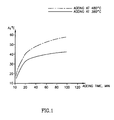
- both the temperature as well as the ageing time can be controlled. This is demonstrated, for example, in Fig. 1 which gives the relation between the ageing time at two different temperatures (380°C and 480°C) and the resulting A f , following a solution treatment at 640°C for 20 mins.
- ageing treatment at 380°C for about 100 mins. yields an A f of about 40°C, with the same A f being reached with an ageing treatment at 480°C of about 40 mins.
- Ageing at a temperature of about 450°C for about 80 mins. will yield an A s of about 46°C and an A f of about 49°C (not shown in Fig. 1).
- a unique feature of the process of the invention is the fact that the two-way SME is induced by only one cycle of deformation.
- this may bc achieved by deforming the alloy into a conditioning form at a temperature of T ⁇ M s + 30°C followed by heating to a temperature at or above the A f of the alloy.
- the deformation should be less than 15% and preferably less than 7%.
- a deformation above 15% will effect the internal structure of the material and yield a total or partial loss of the memory form of the austenitic state.
- a deformation between 7% and 15% will have only such a partial harming effect.
- the martensitic memory form which the alloy assumes after the above conditioning step is an intermediate form between the austenitic memory form and the conditioning form.
- the direction of the two-way SME following such memorizing treatment coincides with the direction in the martensitic state deformation. For example, whcre a deformation in the martensitic state involves a decrease in diameter, the diameter of the alloy in the martensitic state will be less than that of the austenitic state, and vice versa .
- the process in accordance with said first aspect allows a reversible adjustment of the characteristic transformation temperatures as well as the direction of the two-way SME at the final stage of manufacture.
- a final memorizing treatment in accordance with the second aspect of the invention gives rise to a two-way SME without the need for a final deformation to induce the two-way SME. This effect is not determined when indirect SME occurs.
- the second aspect is useful, for example, for the manufacture of a stent with a two-way SME, and the description below will refer to this specific embodiment.
- the NiTi ribbon or wire is wound on a mandrel having a diameter equal to 2R 1 constrained and placed into a vacuum furnace, at a temperature of about 450-550°C for about 0.5-2.0 hours, so that internal structure normalization and textural formation takes place.
- the alloy is then subjected to solution treatment and structure improvement at a temperature of 600-800°C for 2-50 min., and then to an aging treatment at 350-500°C for 0 - 2.5 hours.
- the ribbon or wire is then rewound on a mandrel with a diameter 2R 2 , which is the diameter to be assumed by the stent in the austenitic state and then subjected to a memorizing treatment at 500-600°C for more than 10 min. and aging treatment at temperature of 350-500°C for 0.15-2.5 hours.
- the two-way SME in cooling may either coincide or oppose the direction of the deformation in the martensitic state.
- R 2 is larger than R 1
- R tw will be smaller than R 2
- the device shrinks when it is cooled.
- R 2 is less than 0, i.e. a reverse bending
- R 2 is larger than R tw
- the device will expand when cooled.
- Another result of the process of the present invention is a high resistance of the formed alloy, to pitting corrosion and hydrogen embrittlement which may occur in the biological media with their relatively high chlorine ion content.
- the starting material was a super-elastic NiTi wire, with a diameter of 1.5 mm.
- a sample of the wire was treated at a temperature of 500°C for 1.5 hours and the temperature interval A f -A s was determined and was found to be 15°C.
- the wire was then subjected to a first heat treatment at 550°C for two hours, and then to a thermo-mechanical electro-simulated treatment, with the current density being 900 A/cm 2 and the strain rate being 0.3 sec -1 .
- the TMT was repeated three times with two intermediate heat treatments at 500°C for one hour each.
- the ribbon thickness was eventually reduced to 0.25 mm.
- the ribbon was then wound and constrained on a mandrel having a diameter of 8 mm, and placed into a vacuum furnace and heated to 500°C for 0.6 hours, and then subjected to a solution treatment at 650°C for 30 mins. This was followed by an aging treatment at 400°C for 1 hour.
- the spiral coiled stent which was obtained had an A s of 40°C and an A f of 43°C.
- the stent was then wound on a 3 mm. diameter mandrel at a temperature of 25°C and heated to above 43°C for shape recovery.
- a stent with a two-way SME was obtained, having an austenitic memory form in which its diameter was 8 mm, a martensitic memory form to which it shrank when cooled below 25°C in which it had a diameter of 7.3 mm.
- the stent In order to install the stent, in situ within the body, it is wound on a catheter, and then inserted into the desired place within the bile duct. The stent is then activated by raising its temperature to more than 43°C. To remove the stent it has to be cooled below 25°C and after shrinking it can be pulled away.
- a stent was prepared from the same TiNi wire as used in Example 1.
- the wire was subjected to a first heat treatment and then to a TMT, similarly as described in Example 1, the difference being that the final thickness of the wire which was obtained was 0.28 mm.
- the ribbon was then wound on a mandrel having a diameter of 70 mm, was constrained and then heated to 500°C for 1 hour and then to a solution treatment at 650°C for 20 mins.
- the ribbon was then wound on a mandrel having a diameter of 16 mm., was constrained and subjected to a memorizing treatment at 520°C for 30 mins., and then to aging treatment at 400°C for 2 hours.
- the stent is wound on a catheter with a diameter of 5 mm, inserted into the desired place within the esophageal tract and is activated by heating above 45°C. When the stent is cooled, it expands which prevents the stent from falling into the stomach.
- a stent was prepared in a similar manner as that of Example 2, with the difference being that the ribbon was wound on a mandrel having a diameter of 5 mm. and after heat treatment was rewound on the mandrel with the opposite direction. After heat treatment, similarly as in Example 2, the stent expands when cooled from a diameter of 16 mm. to a diameter of 25 mm.
- NiTi wire the composition of the alloy was 50.5 at % Ni and 49.5 at % Ti.
- the wire was subjected to a first heat treatment and then to a TMT, similarly as described in Example 1 (however using warm drawing instead of warm rolling).
- Example 4 Starting material and treatment was similar to that of Example 4. The final diameter which was achieved (by warm drawing) was 0.25 mm. The wire was constrained in the necessary shape and heat treated after TMT at 520°C for 0.5 hours, solution treatment at 680°C for 10 mins. and ageing at 450°C for 1.5 hours.
- the starting material was a super-elastic Nitinol (50.8 at % Ni) rod with diameter of 10 mm.
- the rod was subjected to a first heat treatment at 550°C for 2 hours and then to a TMT - drawing at 500°C, with a strain rate of 0.5 sec -1 .
- the TMT was repeated 2 times with intermediate heat treatment at 500°C for 1 hour.
- the rod had a final diameter of 6.0 mm.
- the rod was machined into a shape of a tooth root implant with 6 force segments (legs) for anchoring into the jaw bone,
- the leg's length was 3,4 and 5mm for different implants.
- the implant was then subjected to polgonization heat treatment at 500°C, for 1 hours, then the implant's lets were distorted on the mandrel, following which the implant was subjected to heat treatment at 650°C, for 30 min. and to aging at 480°C for 1.5 hours. Then the implant's legs were forced together with a conic cup, (from distorted diameter 5.0mm to closed conditions with diameter 3.0mm).
- a 10 mm NiTi rod identical to that which served as the starting material in Example 6 was treated in the same manner as described in Example 6 to yield a rod with a diameter of 6 mm.
- This rod was then machined into the shape of the hollow cylinder with an internal conditioning diameter (ID) of 4.4 mm.
- ID internal conditioning diameter
- the cylinder was subjected to poligonization and solution heat treatment: 500°C for 1 hour and then of 680°C for 20 min. It was then cooled, expended on a mandrel with a diameter of 4.5 mm and subjected to memorizing and aging heat treatment: 530°C for 30 min. and 430°C for 40 min.
- the tube coupling was then cooled and expanded on the mandrel to yield an internal diameter of 4.75 mm.
- conventional couplings where the two way SME is induced during installation (expansion and heating) in direction of expansion, cooling results in loosening of the coupling.
Landscapes
- Chemical & Material Sciences (AREA)
- Physics & Mathematics (AREA)
- Thermal Sciences (AREA)
- Crystallography & Structural Chemistry (AREA)
- Engineering & Computer Science (AREA)
- Materials Engineering (AREA)
- Mechanical Engineering (AREA)
- Metallurgy (AREA)
- Organic Chemistry (AREA)
- Materials For Medical Uses (AREA)
Claims (14)
- Verfahren zur Bearbeitung einer NiTi-Legierung im unbehandelten Zustand mit einer Ausgangsform zur Bildung einer Legierung mit einer abschließenden Form, in welcher sie ein Formgedächtnis bzw. einen Shape-Memory-Effekt (SME) in zwei Richtungen aufweist, wodurch sie einen austenitischen und einen martensitischen Memory-Zustand mit zugehöriger austenitischer bzw. martensitischer Form aufweist, wobei das Verfahren in Kombination die folgenden Schritte aufweist:(a) Prüfen der Legierung auf NiTi-Basis im unbehandelten Zustand, um so durch Messen des Unterschiedes zwischen As und Af einen abgeschätzten Aufschluss über die innere Struktur der Legierung zu erhalten, wobei As eine Temperatur ist, bei welcher die austenitische Transformation, nämlich die Transformation aus dem martensitischen Zustand in den austenitischen Zustand, einsetzt, und Af eine Temperatur ist, bei welcher die austenitische Transformation beendet ist;(b) Vornehmen einer ersten Wärmebehandlung bei der NiTi-Legierung im unbehandelten Zustand, welcher die im Schritt (a) erhaltenen Ergebnisse zugrunde liegen, um so Legierungen mit einer anfänglichen inneren Struktur zu erhalten, welche eine im wesentlichen gleiche zufällige Versetzungsdichte aufweisen, wobei die erste Wärmebehandlung in der Weise definiert ist, dassin den Fällen, in denen der Unterschied weniger als 7 °C beträgt, die Wärmebehandlung der Legierung auf eine Temperatur von 450 - 500 ° über 0,5 bis 1,0 Stunden erfolgt;in den Fällen, in denen der Unterschied mehr als 7 °C beträgt, die Wärmebehandlung der Legierung auf eine Temperatur von 510 - 550 ° über 1,0 bis 2,5 Stunden erfolgt;(c) Vornehmen einer thermomechanischen Behandlung (TMT) bei der Legierung bei einer Temperatur von über 0,3 Tm, wobei Tm die Schmelztemperatur der Legierung in Kelvin ist, unter Einbeziehung der plastischen Verformung der Legierung bei gleichzeitiger Erwärmung während eines dynamischen Alterungsprozesses, um eine polygone Verschiebungsstruktur im Subkombereich zu erzielen, die durch Ausfällung dekoriert ist;(d) falls die Verformung im Schritt (c) nicht die abschließende Form erbracht hat, Vornehmen einer zwischengeschalteten Wärmebehandlung bei der Legierung einer zum Abschließen eines Zyklus zur Bildung der Verschiebungsstruktur im Subkornbereich;(e) Wiederholen der Schritte (c) und (d), bis die abschließende Form erhalten wurde; und(f) Vornehmen einer abschließenden Wärmebehandlung bei der Legierung mit Ausbildung des Memory-Effekts, um zwei Memory-Zustände zu erhalten, die aus einem austenitischen Zustand, in dem die Legierung eine austenitische Form aufweist, und einem martensitischen Zustand besteht, wobei diese Behandlung folgende Schritte umfasst:(I) Umformen der Legierung zu der austenitischen Form; Vornahme einer Behandlung zur Polygonisation bei der Legierung im Bereich von 450 bis 550 °C, um eine Anordnung mit zufälliger Verschiebung zu erzielen, dann Behandeln der Legierung mit einer Lösung zur Freisetzung einer ungeordneten Verschiebung aus der Ausfällung und um für deren Neuordnung zu sorgen, sowie anschließend Bearbeitung zur Alterung; und Verformen der Legierung, damit diese eine Konditionierungsform mit einem höheren Grad der Verformung als bei der martensitischen Form annimmt, und mit Erwärmung, um die beiden Memory-Zustände herbeizuführen; oder(II) Umformen der Legierung zu einer Konditionierungsform mit einem höheren Grad der Verformung als bei der martensitischen Form; Vornahme einer Wärmebehandlung mit anschließender Polygonisation bei der Legierung und Behandeln der Legierung mit einer Lösung im Bereich von 600 bis 800 °C, und anschließend bei Bedarf Vornehmen einer Bearbeitung zur Alterung bei der Legierung; Umformen der Legierung zu der austenitischen Form und Vornehmen einer Wärmebehandlung bei der Legierung zur Erzielung des Memory-Effekts, sowie einer Behandlung zur Alterung.
- Verfahren nach Anspruch 1, welches die folgenden Schritte umfasst:(a) Erwärmen einer Probe der NiTi-Legierung im unbehandelten Zustand auf eine Temperatur von 450 bis 550 °C über 0,5 bis 2,5 Stunden lang, und anschließendes Untersuchen der Probe auf eine Temperaturdifferenz zwischen As und Af,(b) Vornehmen einer ersten Wärmebehandlung der NiTi-Legierung im unbehandelten Zustand auf der Grundlage der Differenz Af - As, die im Schritt (a) ermittelt wurde, auf die folgende Weise:in den Fällen, in denen der Unterschied weniger als 7 °C beträgt, erfolgt die Wärmebehandlung der Legierung auf eine Temperatur von 450 - 500 ° über 0,5 bis 1,0 Stunden;in den Fällen, in denen der Unterschied mehr als 7 °C beträgt, erfolgt die Wärmebehandlung der Legierung auf eine Temperatur von 510 - 550 ° über 1,0 bis 2,5 Stunden;(c) Vornehmen einer TMT-Behandlung bei der Legierung unter Einbeziehung einer plastischen Verformung der Legierung mit einer Verformungsgeschwindigkeit von weniger als 5 sec-1 bei gleichzeitiger Erwärmung im Inneren eines Teils der Legierung, in welchem die Verformung bis zu einer Temperatur von 250 bis 550 °C auftritt, wobei die Verformung bei diesem Schritt weniger als 55 % beträgt;(d) falls die Verformung im Schritt (c) nicht die abschließende Form erbracht hat, Vornehmen einer zwischengeschalteten Wärmebehandlung bei der Legierung bei einer Temperatur von 500 bis 550 °C über 0,5 bis 2 Stunden und anschließendes Wiederholen des Schritts (c); und(e) Vornehmen einer abschließenden Wärmebehandlung bei der Legierung mit Ausbildung des Memory-Effekts, um zwei Memory-Zustände zu erhalten, die aus einem austenitischen Zustand, in dem die Legierung eine austenitische Form aufweist, und einem martensitischen Zustand besteht, wobei diese Behandlung folgende Schritte umfasst:(I) Umformen der Legierung zu der austenitischen Form; Vornehmen einer Behandlung der Legierung zur Polygonisation im Bereich von 450 bis 550 °C, um eine Anordnung mit zufälliger Verschiebung zu erzielen, dann Behandeln der Legierung mit einer Lösung zur Freisetzung einer ungeordneten Verschiebung aus der Ausfällung und um für deren Neuordnung zu sorgen, sowie anschließend Behandlung der Legierung zur Alterung; und Verformen der Legierung, damit diese eine Konditionierungsform mit einem höheren Grad der Verformung als bei der martensitischen Form annimmt, und mit Erwärmung, um die beiden Memory-Zustände herbeizuführen; oder(II) Umformen der Legierung zu einer Konditionierungsform mit einem höheren Grad der Verformung als bei der martensitischen Form; Vornahme einer Wärmebehandlung bei der Legierung mit anschließender Polygonisation und Behandeln der Legierung mit einer Lösung im Bereich von 600 bis 800 °C, und anschließend bei Bedarf Vornahme einer Behandlung zur Alterung bei der Legierung; Umformen der Legierung zu der austenitischen Form und Vornehmen einer Wärmebehandlung bei der Legierung zur Erzielung des Memory-Effekts, sowie einer Behandlung zur Alterung.
- Verfahren nach Anspruch 2, bei welchem im Schritt (c) zur Umformung die Verformung weniger als 40 % beträgt.
- Verfahren nach einem der Ansprüche 1 bis 3, bei welchem die abschließende Wärmebehandlung mit Behandlung zur Herbeiführung des Memory-Effekts die folgenden Schritte umfasst:wobei Ms eine Temperatur darstellt, bei welcher die martensitische Transformation einsetzt, und anschließendes Erwärmen der Legierung auf eine Temperatur, die der Temperatur entspricht oder über dieser liegt, bei der die austenitische Transformation der Legierung beendet ist.(I) Umformen der Legierung zu der austenitischen Form;(II) Vornehmen einer Wärmebehandlung der Legierung zur Polygonisation über 0,5 bis 1,5 Stunden lang bei 450 bis 550 °C, anschließend Behandeln der Legierung mit einer Lösung über 2 bis 50 Minuten lang bei 600 bis 800 °C, und anschließendes Vornehmen einer Behandlung zur Alterung über 0,15 bis 2,5 Stunden lang bei 350 bis 500 °C, und(III) Umformen der Legierung zur Sicherstellung einer Konditionierungsform, wobei die Verformung weniger als 15 % beträgt und bei einer Temperatur T vorgenommen wird, welche der folgenden Formel entspricht:
- Verfahren nach Anspruch 4, bei welchem die Verformung der Legierung zur Umformung in die Konditionierungsform im Schritt (III) weniger als 7 % beträgt.
- Verfahren nach einem der Ansprüche 1 bis 3, bei welchem die abschließende Wärmebehandlung mit Herbeiführung des Memory-Effekts folgendes umfasst:(I) Umformen der Legierung zu der Konditionierungsform;(II) Vornehmen einer Wärmebehandlung der Legierung über 0,5 bis 1,5 Stunden lang bei 450 bis 550 °C, anschließend Behandeln der Legierung zur Polygonisation und Behandeln derselben mit einer Lösung über 2 bis 50 Minuten lang bei 600 bis 800 °C, und anschließendes Vornehmen einer Behandlung zur Alterung über 0 bis 2 Stunden lang bei 350 bis 500 °C;(III) Umformen der Legierung zur austenitischen Form; und(IV) Vornehmen einer Wärmebehandlung der Legierung mit Herbeiführen des Memory-Effekts über eine längere Zeit als 10 Minuten bei 500 bis 600 °C, und anschließendes Vornehmen einer Behandlung zur Alterung über 0,15 bis 2,5 Stunden lang bei 350 bis 500 °C.
- Verfahren nach den Ansprüchen 4 bis 6, welches den folgenden zusätzlichen Schritt umfasst:(g) Einstellen der Temperatur, bei welcher die austenitische Transformation eintritt, durch eine der beiden folgenden Maßnahmen:eine Behandlung zur Alterung bei einer Temperatur von 350 bis 500 °C, um die Temperatur zu erhöhen, bei welcher die austenitische Transformation eintritt, oderBehandlung mit einer Lösung bei einer Temperatur von 510 bis 800 °C, um die Temperatur zu senken, bei welcher die austenitische Transformation auftritt.
- Verfahren nach einem der Ansprüche 1 bis 7, bei welchem die thermomechanische Behandlung (TMT) die Elektrostimulierung mit einer Stromdichte von 500 bis 2000 A/cm2 umfasst.
- Verfahren zur Herstellung einer Vorrichtung für den Einsatz in der Medizin, welches eine Legierung mit Formgedächtnis (SMA) aufweist, die einen Shape-Memory-Effekt in zwei Richtungen verkörpert, wobei das Verfahren die Behandlung einer SMA-Legierung gemäß dem Verfahren nach einem der Ansprüche 1 bis 8 umfasst.
- Verfahren nach Anspruch 9, bei welchem es sich bei der Vorrichtung für den Einsatz in der Medizin ein Stent ist.
- Verfahren zur Herstellung eines Stents zum Einsatz in der Medizin aus einer NiTi-Legierung, die dabei in Form eines Drahts mit einem ersten Durchmesser vorliegt, wobei der Stent entweder die Form eines Drahts mit einem zweiten Durchmesser oder die Form eines Streifens aufweist und wobei der Stent einen Shape-Memory-Effekt in zwei Richtungen (SME) mit einem austenitischen Memory-Zustand und einem martensitischen Memory-Zustand mit zugehöriger austenitischer Form bzw. martensitischer Form aufweist, wobei das Verfahren die folgenden Schritte umfasst:wodurch man einen Stent mit einem austenitischen Zustand erhält, bei dem er einen im vorstehenden Punkt (I) angenommenen Durchmesser aufweist, und mit einem martensitischen Zustand, in dem er einen Durchmesser aufweist, der einem Wert zwischen dem Konditionierungsdurchmesser und dem Durchmesser im austenitischen Zustand entspricht.(a) Erwärmen einer Probe des NiTi-Drahtes über 0,5 bis 2,5 Stunden lang auf eine Temperatur von 450 bis 550 °C, und anschließendes Untersuchen der Probe auf eine Temperaturdifferenz zwischen As und Af, wobei As eine Temperatur ist, bei welcher die austenitische Transformation, nämlich die Transformation aus dem martensitischen Zustand in den austenitischen Zustand einsetzt, und Af eine Temperatur ist, bei welcher die austenitische Transformation beendet ist;(b) Vornehmen einer ersten Wärmebehandlung des Drahtes auf der Grundlage der Differenz Af - As, die im Schritt (a) ermittelt wurde, auf die folgende Weise:in den Fällen, in denen der Unterschied weniger als 7 °C beträgt, erfolgt die Wärmebehandlung des Drahtes auf eine Temperatur von 450 - 500 °C über 0,5 bis 1,0 Stunden;in den Fällen, in denen der Unterschied mehr als 7 °C beträgt, erfolgt die Wärmebehandlung des Drahtes auf eine Temperatur von 510 - 550 °C über 1,0 bis 2,5 Stunden;(c) Vornehmen einer thermomechanischen Behandlung an dem Draht unter Einbeziehung eines Arbeitsgangs zum Warmwalzen des Drahtes bei einer Verformungsgeschwindigkeit von weniger als 5 sec-1 bei gleichzeitiger Erwärmung durch Elektrostimulation mit einer Stromdichte von 500 bis 2000 A/cm2 im Inneren eines Teils des Drahtes, in welchem die Verformung auftritt, wobei die Verformung bei diesem Schritt weniger als 55 % beträgt;(d) falls die Verformung im Schritt (c) nicht eine Querschnittsform der abschließenden Form erbracht hat, Vornehmen einer zwischengeschalteten Wärmebehandlung bei dem Draht bei einer Temperatur von 500 bis 550 °C über 0,5 bis 2 Stunden und anschließendes Wiederholen des Schritts (c); und(e) Vornehmen einer abschließenden Wärmebehandlung bei dem Draht mit Ausbildung des Memory-Effekts, wobei diese Behandlung folgende Schritte umfasst:wobei Ms eine Temperatur darstellt, bei welcher die martensitische Transformation einsetzt, und anschließendes Erwärmen des Drahtes bzw. Streifens auf eine Temperatur, die der Temperatur entspricht oder über dieser liegt, bei der die austenitische Transformation beendet ist.(I) Aufwickeln des in Schritt (c) erhaltenen Drahtes bzw. Streifens auf einen Dorn mit einem Durchmesser, der im austenitischen Zustand von dem Stent zu gewährleisten ist,(II) Vornehmen einer Wärmebehandlung des Drahtes zur Polygonisation bei 450 bis 550 °C über 0,5 bis 1,5 Stunden lang, dann Behandeln des Drahtes mit einer Lösung bei etwa 600 bis 800 °C über 2 bis 50 Minuten lang, sowie anschließend Behandlung des Drahtes zur Alterung bei 350 bis 500 °C über 0,15 bis 2,5 Stunden lang,(III) Verformen des Drahtes durch Aufwickeln desselben auf einen Dom mit einem Konditionierungsdurchmesser, wobei die Verformung weniger als etwa 7 % beträgt und bei einer Temperatur T vorgenommen wird, welche der folgenden Formel entspricht:
- Verfahren zur Herstellung eines Stents zum Einsatz in der Medizin aus einem NiTi-Draht mit einem ersten Durchmesser, wobei der Stent entweder die Form eines Drahtes mit einem zweiten Durchmesser oder die Form eines Streifens aufweist und wobei der Stent ein Formgedächtnis (SME) in zwei Richtungen mit einem austenitischen und einem martensitischen Gedächtniszustand mit der zugehörigen jeweiligen austenitischen bzw. martensitischen Form besitzt, wobei das Verfahren die folgenden Schritte umfasst:wodurch man einen Stent mit einem austenitischen Zustand erhält, in dem er einen Durchmesser besitzt, zu dem der Draht im Schritt (III) geformt wurde, sowie mit einem martensitischen Zustand, in dem er einen Durchmesser aufweist, der einem Wert zwischen dem Konditionierungsdurchmesser und dem Durchmesser des Stents im austenitischen Zustand entspricht.(a) Erwärmen einer Probe eines Drahtes aus einer Legierung auf der Basis von Nickel-Titan über 0,5 bis 2,5 Stunden lang auf eine Temperatur von 450 bis 550 °C, und anschließendes Untersuchen der Probe auf eine Temperaturdifferenz zwischen As und Af, wobei As eine Temperatur ist, bei welcher die austenitische Transformation, nämlich die Transformation aus dem martensitischen Zustand in den austenitischen Zustand einsetzt, und Af eine Temperatur ist, bei welcher die austenitische Transformation beendet ist;(b) Vornehmen einer ersten Wärmebehandlung des Drahtes auf der Grundlage der Differenz Af - As, die im Schritt (a) ermittelt wurde, auf die folgende Weise:in den Fällen, in denen der Unterschied weniger als 7 °C beträgt, erfolgt die Wärmebehandlung des Drahtes auf eine Temperatur von 450 - 500 ° über 0,5 bis 1,0 Stunden;in den Fällen, in denen der Unterschied mehr als 7 °C beträgt, erfolgt die Wärmebehandlung des Drahtes auf eine Temperatur von 510 - 550 ° über 1,0 bis 2,5 Stunden;(c) Vornehmen einer thermomechanischen Behandlung an dem Draht unter Einbeziehung eines Arbeitsgangs zum Warmwalzen des Drahtes bei einer Verformungsgeschwindigkeit von weniger als 5 sec-1 bei gleichzeitiger Erwärmung durch Elektrostimulation mit einer Stromdichte von 500 bis 2000 A/cm2 im Inneren eines Teils des Drahtes, in welchem die Verformung auftritt, wobei die Verformung bei diesem Schritt weniger als 55 % beträgt;(d) falls die Verformung im Schritt (c) nicht eine Querschnittsform der abschließenden Form erbracht hat, Vornehmen einer zwischengeschalteten Wärmebehandlung bei dem Draht 0,2 Stunden lang bei einer Temperatur von 500 bis 550 °C und anschließendes Wiederholen des Schritts (c); und(e) Vornehmen einer abschließenden Wärmebehandlung bei dem Draht mit Ausbildung des Memory-Effekts, wobei diese Behandlung folgende Schritte umfasst:(I) Aufwickeln des in Schritt (c) erhaltenen Drahtes bzw. Streifens auf einen Dom mit einem Konditionierungsdurchmesser, der sich von dem Durchmesser unterscheidet, den der Stent im austenitischen Zustand einnehmen soll,(II) Vornehmen einer Wärmebehandlung des Drahtes bei 450 bis 550 °C über 0,5 bis 2 Stunden lang, anschließend Behandlung zur Polygonisation und dann Behandeln des Drahtes mit einer Lösung bei etwa 600 bis 800 °C über 2 bis 50 Minuten lang, sowie anschließend Behandlung des Drahtes zur Alterung bei 350 bis 500 °C über 0 bis 2 Stunden lang,(III) Aufwickeln des Drahtes bzw. Streifens auf einen Dom mit einem Durchmesser, den der Stent im austenitischen Zustand einnehmen soll,(IV) Wärmebehandlung des Drahtes mit Ausbildung des Memory-Effekts bei etwa 500 bis 600 °C über einen Zeitraum von mehr als 10 Minuten, sowie anschließend Behandlung des Drahtes zur Alterung bei 350 bis 500 °C über 0,15 bis 2,5 Stunden lang;
- Verfahren zur Herstellung eines Zahnwurzel-Implantats aus einer NiTi-Legierung, welche ein Formgedächtnis (SME) in zwei Richtungen mit einem austenitischen und einem martensitischen Gedächtniszustand mit der zugehörigen jeweiligen austenitischen bzw. martensitischen Form besitzt, wobei das Verfahren die folgenden Schritte umfasst:wodurch man ein Implantat mit einem austenitischen Zustand erhält, in dem es einen Durchmesser besitzt, den es im Schritt (I) angenommen hat, sowie mit einem martensitischen Zustand, in dem es einen Durchmesser aufweist, der einem Wert zwischen dem Konditionierungsdurchmesser und dem Durchmesser des Stents im austenitischen Zustand entspricht.(a) Erwärmen einer Probe eines Stabs aus einer Ni-Ti-Legierung über 0,5 bis 2,5 Stunden lang auf eine Temperatur von 450 bis 550 °C, und anschließendes Untersuchen der Probe auf eine Temperaturdifferenz zwischen As und Af, wobei As eine Temperatur ist, bei welcher die austenitische Transformation, nämlich die Transformation aus dem martensitischen Zustand in den austenitischen Zustand einsetzt, und Af eine Temperatur ist, bei welcher die austenitische Transformation beendet ist;(b) Vornehmen einer ersten Wärmebehandlung des Stabes auf der Grundlage der Differenz Af - As, die im Schritt (a) ermittelt wurde, auf die folgende Weise:in den Fällen, in denen der Unterschied weniger als 7 °C beträgt, erfolgt die Wärmebehandlung des Drahtes auf eine Temperatur von 450 - 500 °C über 0,5 bis 1,0 Stunden;in den Fällen, in denen der Unterschied mehr als 7 °C beträgt, erfolgt die Wärmebehandlung des Drahtes auf eine Temperatur von 510 - 550 °C über 1,0 bis 2,5 Stunden;(c) Vornehmen einer thermomechanischen Behandlung an dem Stab unter Einbeziehung eines Arbeitsgangs zum Warmziehen des Stabs bei einer Verformungsgeschwindigkeit von weniger als 5 sec-1 bei gleichzeitiger Erwärmung, wobei die gesamte Zugumformung in diesem Schritt weniger als 55 % beträgt;(d) falls die Verformung im Schritt (c) nicht eine Querschnittsform der abschließenden Form erbracht hat, Vornehmen einer zwischengeschalteten Wärmebehandlung bei dem Stab 0,5 bis 2 Stunden lang bei einer Temperatur von 500 bis 550 °C und anschließendes Wiederholen des Schritts (c); und(e) maschinelle Bearbeitung des Stabs, um die Form des Implantats zu erhalten;(f) Vornehmen einer abschließenden Wärmebehandlung an den Stab mit Ausbildung des Memory-Effekts, wobei diese Behandlung folgende Schritte umfasst:(I) Aufweiten der Kraftsegmente des Implantats auf einen Durchmesser, den das Implantat im austenitischen Zustand einnehmen soll,(II) Vornehmen einer Wärmebehandlung des Implantats zur Polygonisation bei 450 bis 550 °C über 0,5 bis 1,5 Stunden lang, anschließend Behandeln des Implantats mit einer Lösung bei etwa 600 bis 800 °C über 2 bis 50 Minuten lang, sowie danach Behandlung des Implantats zur Alterung bei 350 bis 500 °C über 0,15 bis 2,5 Stunden lang,(III) Verformen der Kraftsegmente des Implantats auf einen Konditionierungsdurchmesser bei einer Zugumformung von weniger als 7 % , wobei der Vorgang bei einer Temperatur von T < Ms + 30 °C vorgenommen wird, wobei Ms eine Temperatur angibt, bei welcher die martensitische Transformation einsetzt, und wobei das Implantat dann auf eine Temperatur erwärmt wird, die bei dem Wert oder über diesem liegt, bei welchem die austenitische Transformation beendet ist;
- Verfahren zur Herstellung einer Schlauchkupplung aus einer NiTi-Legierung, welche ein Formgedächtnis (SME) in zwei Richtungen mit einem austenitischen und einem martensitischen Gedächtniszustand mit der zugehörigen jeweiligen austenitischen bzw. martensitischen Form besitzt, wobei das Verfahren die folgenden Schritte umfasst:wodurch man eine Kupplung mit einem austenitischen Zustand erhält, in dem sie einen Durchmesser besitzt, auf den sie im Schritt (II) geformt wurde, sowie mit einem martensitischen Zustand, in dem sie einen Durchmesser aufweist, der einem Wert zwischen dem Konditionierungs-Innendurchmesser und dem Durchmesser der Kupplung im austenitischen Zustand entspricht.(a) Erwärmen einer Probe eines NiTi-Stabs über 0,5 bis 2,5 Stunden lang auf eine Temperatur von 450 bis 550 °C, und anschließendes Untersuchen der Probe auf eine Temperaturdifferenz zwischen As und Af, wobei As eine Temperatur ist, bei welcher die austenitische Transformation, nämlich die Transformation aus dem martensitischen Zustand in den austenitischen Zustand einsetzt, und Af eine Temperatur ist, bei welcher die austenitische Transformation beendet ist;(b) Vornehmen einer ersten Wärmebehandlung des Stabs auf der Grundlage der Differenz Af - As, die im Schritt (a) ermittelt wurde, auf die folgende Weise:in den Fällen, in denen der Unterschied weniger als 7 °C beträgt, erfolgt die Wärmebehandlung des Drahtes auf eine Temperatur von 450 - 500 °C über 0,5 bis 1,0 Stunden;in den Fällen, in denen der Unterschied mehr als 7 °C beträgt, erfolgt die Wärmebehandlung des Drahtes auf eine Temperatur von 510 - 550 °C über 1,0 bis 2,5 Stunden;(c) Vornehmen einer thermomechanischen Behandlung an dem Draht unter Einbeziehung eines Arbeitsgangs zum Warmziehen bei einer Verformungsgeschwindigkeit von weniger als 5 sec-1 bei gleichzeitiger Erwärmung, wobei die gesamte Zugumformung weniger als 55 % beträgt;(d) falls die Verformung im Schritt (c) nicht eine Querschnittsform der abschließenden Form erbracht hat, Vornehmen einer zwischengeschalteten Wärmebehandlung bei dem Stab 0,5 bis 2 Stunden lang bei einer Temperatur von 500 bis 550 °C und anschließendes Wiederholen des Schritts (c); und(e) maschinelle Bearbeitung des Stabs, um eine Kupplung in Form eines Hohlzylinders mit einem Innendurchmesser zur Konditionierung zu erhalten;(f) Vornehmen einer abschließenden Wärmebehandlung an dem Zylinder mit Ausbildung des Memory-Effekts, wobei diese Behandlung folgende Schritte umfasst:(I) Vornehmen einer Wärmebehandlung des Zylinders zur Polygonisation bei 450 bis 550 °C über etwa 0,5 bis 1,5 Stunden lang, anschließend Behandeln des Zylinders mit einer Lösung bei etwa 600 bis 800 °C über 2 bis 50 Minuten lang, sowie anschließend Behandlung des Zylinders zur Alterung bei 350 bis 500 °C über 0 bis 2,5 Stunden lang,(II) Aufweiten des Zylinders auf einen Durchmesser, den die Kupplung im austenitischen Zustand einnehmen soll;(III) Wärmebehandlung des Zylinders mit Ausbildung des Memory-Effekts bei etwa 500 bis 600 °C über einen Zeitraum von mehr als 10 Minuten, sowie anschließend Behandlung des Drahtes zur Alterung bei 350 bis 500 °C über 0,15 bis 2,5 Stunden lang;
Applications Claiming Priority (2)
| Application Number | Priority Date | Filing Date | Title |
|---|---|---|---|
| US08/432,802 US5624508A (en) | 1995-05-02 | 1995-05-02 | Manufacture of a two-way shape memory alloy and device |
| PCT/IL1997/000134 WO1998049363A1 (en) | 1995-05-02 | 1997-04-25 | Manufacture of two-way shape memory devices |
Publications (2)
| Publication Number | Publication Date |
|---|---|
| EP0977902A1 EP0977902A1 (de) | 2000-02-09 |
| EP0977902B1 true EP0977902B1 (de) | 2004-07-07 |
Family
ID=26322206
Family Applications (1)
| Application Number | Title | Priority Date | Filing Date |
|---|---|---|---|
| EP97919618A Expired - Lifetime EP0977902B1 (de) | 1995-05-02 | 1997-04-25 | Herstellung von zweiwegformgedächtnisteilen |
Country Status (3)
| Country | Link |
|---|---|
| US (1) | US5624508A (de) |
| EP (1) | EP0977902B1 (de) |
| WO (1) | WO1998049363A1 (de) |
Families Citing this family (61)
| Publication number | Priority date | Publication date | Assignee | Title |
|---|---|---|---|---|
| US5882444A (en) * | 1995-05-02 | 1999-03-16 | Litana Ltd. | Manufacture of two-way shape memory devices |
| US5836066A (en) * | 1996-07-22 | 1998-11-17 | Innovative Dynamics, Inc. | Process for the production of two-way shape memory alloys |
| US5997580A (en) * | 1997-03-27 | 1999-12-07 | Johnson & Johnson Professional, Inc. | Cement restrictor including shape memory material |
| US5902475A (en) | 1997-04-08 | 1999-05-11 | Interventional Technologies, Inc. | Method for manufacturing a stent |
| US6726829B2 (en) | 1997-04-08 | 2004-04-27 | Scimed Life Systems, Inc. | Method of manufacturing a stent |
| BE1011180A6 (fr) * | 1997-05-27 | 1999-06-01 | Medicorp R & D Benelux Sa | Endoprothese luminale auto expansible. |
| IL121316A (en) * | 1997-07-15 | 2001-07-24 | Litana Ltd | A medical device for planting in an alloy body with memory properties |
| US5964770A (en) * | 1997-09-30 | 1999-10-12 | Litana Ltd. | High strength medical devices of shape memory alloy |
| US6106642A (en) | 1998-02-19 | 2000-08-22 | Boston Scientific Limited | Process for the improved ductility of nitinol |
| US6149742A (en) * | 1998-05-26 | 2000-11-21 | Lockheed Martin Corporation | Process for conditioning shape memory alloys |
| US6254550B1 (en) | 1998-08-19 | 2001-07-03 | Cook Incorporated | Preformed wire guide |
| US7314477B1 (en) | 1998-09-25 | 2008-01-01 | C.R. Bard Inc. | Removable embolus blood clot filter and filter delivery unit |
| CA2289169A1 (en) * | 1998-11-11 | 2000-05-11 | Ogawa Spring Co., Ltd. | Stent, manufacturing method thereof and indwelling method thereof |
| US8092514B1 (en) | 1998-11-16 | 2012-01-10 | Boston Scientific Scimed, Inc. | Stretchable anti-buckling coiled-sheet stent |
| US6258118B1 (en) | 1998-11-25 | 2001-07-10 | Israel Aircraft Industries Ltd. | Removable support device |
| US6413273B1 (en) | 1998-11-25 | 2002-07-02 | Israel Aircraft Industries Ltd. | Method and system for temporarily supporting a tubular organ |
| GB2347861B (en) * | 1999-03-13 | 2003-11-26 | Biointeractions Ltd | Biocompatible endoprostheses |
| US6379383B1 (en) | 1999-11-19 | 2002-04-30 | Advanced Bio Prosthetic Surfaces, Ltd. | Endoluminal device exhibiting improved endothelialization and method of manufacture thereof |
| US7335426B2 (en) * | 1999-11-19 | 2008-02-26 | Advanced Bio Prosthetic Surfaces, Ltd. | High strength vacuum deposited nitinol alloy films and method of making same |
| WO2002038080A2 (en) * | 2000-11-07 | 2002-05-16 | Advanced Bio Prosthetic Surfaces, Ltd. | Endoluminal stent, self-fupporting endoluminal graft and methods of making same |
| US6688828B1 (en) | 2000-12-01 | 2004-02-10 | Arizona Board Of Regents | Self-torquing fasteners |
| US20030074075A1 (en) * | 2001-08-27 | 2003-04-17 | Thomas James C. | Expandable implant for partial disc replacement and reinforcement of a disc partially removed in a discectomy and for reduction and maintenance of alignment of cancellous bone fractures and methods and apparatuses for same |
| US9204956B2 (en) | 2002-02-20 | 2015-12-08 | C. R. Bard, Inc. | IVC filter with translating hooks |
| US20040067122A1 (en) * | 2002-02-26 | 2004-04-08 | Arizona Board Of Regents | Self-torquing fasteners |
| WO2004028340A2 (en) * | 2002-09-26 | 2004-04-08 | Advanced Bio Prosthetic Surfaces, Ltd. | High strength vacuum deposited nitionol alloy films, medical thin film graft materials and method of making same |
| EP1608416B1 (de) * | 2003-03-31 | 2009-01-07 | Memry Corporation | Medizinprodukte mit arzneimittel-elutions-eigenschaften und herstellungsverfahren dafür |
| US7192496B2 (en) * | 2003-05-01 | 2007-03-20 | Ati Properties, Inc. | Methods of processing nickel-titanium alloys |
| US7491227B2 (en) * | 2003-06-16 | 2009-02-17 | Boston Scientific Scimed, Inc. | Coiled-sheet stent with flexible mesh design |
| US20040260377A1 (en) * | 2003-06-17 | 2004-12-23 | Medinol, Ltd. | Shape memory alloy endoprosthesis delivery system |
| US7455737B2 (en) * | 2003-08-25 | 2008-11-25 | Boston Scientific Scimed, Inc. | Selective treatment of linear elastic materials to produce localized areas of superelasticity |
| US7704267B2 (en) | 2004-08-04 | 2010-04-27 | C. R. Bard, Inc. | Non-entangling vena cava filter |
| US7794473B2 (en) * | 2004-11-12 | 2010-09-14 | C.R. Bard, Inc. | Filter delivery system |
| US8267954B2 (en) * | 2005-02-04 | 2012-09-18 | C. R. Bard, Inc. | Vascular filter with sensing capability |
| US12115057B2 (en) | 2005-05-12 | 2024-10-15 | C.R. Bard, Inc. | Tubular filter |
| MX2007013932A (es) | 2005-05-12 | 2008-01-28 | Bard Inc C R | Filtro de coagulo de sangre removible. |
| US8062327B2 (en) | 2005-08-09 | 2011-11-22 | C. R. Bard, Inc. | Embolus blood clot filter and delivery system |
| WO2007018086A1 (ja) * | 2005-08-11 | 2007-02-15 | Konica Minolta Opto, Inc. | 駆動装置、レンズ鏡胴、撮像装置、レンズ駆動方法及び形状記憶合金の製造方法 |
| WO2007061927A2 (en) | 2005-11-18 | 2007-05-31 | C. R. Bard, Inc. | Vena cava filter with filament |
| WO2007133366A2 (en) | 2006-05-02 | 2007-11-22 | C. R. Bard, Inc. | Vena cava filter formed from a sheet |
| CA2655158A1 (en) | 2006-06-05 | 2007-12-13 | C.R. Bard Inc. | Embolus blood clot filter utilizable with a single delivery system or a single retrieval system in one of a femoral or jugular access |
| KR100834554B1 (ko) * | 2006-10-12 | 2008-06-02 | 연세대학교 산학협력단 | 이방향성 형상기억장치 및 그 제작 방법 그리고 이를적용한 보온성 제품 |
| WO2008070130A1 (en) * | 2006-12-04 | 2008-06-12 | Cook Incorporated | Method for loading medical device into a delivery system |
| US9034007B2 (en) | 2007-09-21 | 2015-05-19 | Insera Therapeutics, Inc. | Distal embolic protection devices with a variable thickness microguidewire and methods for their use |
| RU2382113C2 (ru) * | 2007-12-27 | 2010-02-20 | Федеральное государственное образовательное учреждение высшего профессионального образования Санкт-Петербургский государственный университет | Способ обработки сплава никелид титана с эффектом памяти формы |
| EP2268234B1 (de) * | 2008-04-23 | 2012-02-29 | Cook Medical Technologies LLC | Verfahren zum einsatz eines medizinprodukts in ein freisetzungssystem |
| EP2189120A1 (de) * | 2008-11-19 | 2010-05-26 | Université Libre de Bruxelles | Chirurgische Nadel mit Formgedächtnis |
| US7955449B2 (en) * | 2008-07-17 | 2011-06-07 | Intek Technology, L.L.C. | Process for inducing a two-way shape memory effect in a device formed of a shape memory alloy and a device made by the process |
| CA2769208C (en) | 2009-07-29 | 2017-10-31 | C.R. Bard, Inc. | Tubular filter |
| JP5732468B2 (ja) | 2009-11-17 | 2015-06-10 | ジョンソン,ウィリアム・ビー | 耐疲労性の向上したニチノール器具 |
| US8475711B2 (en) | 2010-08-12 | 2013-07-02 | Ati Properties, Inc. | Processing of nickel-titanium alloys |
| US8409372B1 (en) | 2010-09-02 | 2013-04-02 | The United States of America as Represented by the Administraton of National Aeronautics and Space Administration | Thermomechanical methodology for stabilizing shape memory alloy (SMA) response |
| US9279171B2 (en) | 2013-03-15 | 2016-03-08 | Ati Properties, Inc. | Thermo-mechanical processing of nickel-titanium alloys |
| US8715314B1 (en) | 2013-03-15 | 2014-05-06 | Insera Therapeutics, Inc. | Vascular treatment measurement methods |
| US8679150B1 (en) | 2013-03-15 | 2014-03-25 | Insera Therapeutics, Inc. | Shape-set textile structure based mechanical thrombectomy methods |
| US8715315B1 (en) | 2013-03-15 | 2014-05-06 | Insera Therapeutics, Inc. | Vascular treatment systems |
| CA2901443A1 (en) | 2013-03-15 | 2014-09-25 | Insera Therapeutics, Inc. | Vascular treatment devices and methods |
| US10149965B2 (en) * | 2013-07-11 | 2018-12-11 | Cook Medical Technologies Llc | Shape memory guide wire |
| WO2016182791A1 (en) | 2015-05-14 | 2016-11-17 | Cook Medical Technologies, LLC | Endoscopic needle stylet with enhanced-flexibility lengths |
| EP3416568A4 (de) | 2016-02-16 | 2019-10-16 | Insera Therapeutics, Inc. | Absaugungsvorrichtungen und verankerte strömungsumleitungsvorrichtungen |
| RU2623977C1 (ru) * | 2016-03-28 | 2017-06-29 | Российская Федерация, от имени которой выступает Государственная корпорация по атомной энергии "Росатом" (Госкорпорация "Росатом") | Способ изготовления муфт из сплава с памятью формы |
| CN119424054B (zh) * | 2023-07-31 | 2025-12-05 | 武汉联影智融医疗科技有限公司 | 骨科植入器械 |
Family Cites Families (11)
| Publication number | Priority date | Publication date | Assignee | Title |
|---|---|---|---|---|
| US4283233A (en) * | 1980-03-07 | 1981-08-11 | The United States Of America As Represented By The Secretary Of The Navy | Method of modifying the transition temperature range of TiNi base shape memory alloys |
| US5067957A (en) * | 1983-10-14 | 1991-11-26 | Raychem Corporation | Method of inserting medical devices incorporating SIM alloy elements |
| US4665906A (en) * | 1983-10-14 | 1987-05-19 | Raychem Corporation | Medical devices incorporating sim alloy elements |
| US4533411A (en) * | 1983-11-15 | 1985-08-06 | Raychem Corporation | Method of processing nickel-titanium-base shape-memory alloys and structure |
| FR2563055A1 (fr) * | 1984-04-12 | 1985-10-18 | Souriau & Cie | Procede de realisation de connecteur |
| JP2769616B2 (ja) * | 1987-03-30 | 1998-06-25 | 時枝 直満 | 多結晶体の結晶方位再配列方法 |
| US4820298A (en) * | 1987-11-20 | 1989-04-11 | Leveen Eric G | Internal vascular prosthesis |
| US4881981A (en) * | 1988-04-20 | 1989-11-21 | Johnson Service Company | Method for producing a shape memory alloy member having specific physical and mechanical properties |
| US4935068A (en) * | 1989-01-23 | 1990-06-19 | Raychem Corporation | Method of treating a sample of an alloy |
| FR2687154B1 (fr) * | 1992-02-07 | 1995-05-12 | Rhone Poulenc Rorer Sa | Nouveau derive de l'isoindolinone, sa preparation et les compositions pharmaceutiques qui le contiennent. |
| US5254130A (en) * | 1992-04-13 | 1993-10-19 | Raychem Corporation | Surgical device |
-
1995
- 1995-05-02 US US08/432,802 patent/US5624508A/en not_active Expired - Fee Related
-
1997
- 1997-04-25 WO PCT/IL1997/000134 patent/WO1998049363A1/en not_active Ceased
- 1997-04-25 EP EP97919618A patent/EP0977902B1/de not_active Expired - Lifetime
Also Published As
| Publication number | Publication date |
|---|---|
| US5624508A (en) | 1997-04-29 |
| WO1998049363A1 (en) | 1998-11-05 |
| EP0977902A1 (de) | 2000-02-09 |
Similar Documents
| Publication | Publication Date | Title |
|---|---|---|
| US5882444A (en) | Manufacture of two-way shape memory devices | |
| WO1998049363A1 (en) | Manufacture of two-way shape memory devices | |
| US5876434A (en) | Implantable medical devices of shape memory alloy | |
| JP4046760B2 (ja) | 改良型組織支持装置 | |
| EP0143580B1 (de) | Formgedächtnislegierungen | |
| JP3949228B2 (ja) | 形状記憶合金の処理方法 | |
| EP1163890B1 (de) | Stent | |
| EP1060280B1 (de) | Verfahren zur verbesserung der ductilität von nitinol | |
| US4654092A (en) | Nickel-titanium-base shape-memory alloy composite structure | |
| US7828916B2 (en) | Methods of crimping expandable medical devices | |
| US20080249610A1 (en) | Shape memory alloy endoprosthesis delivery system | |
| US20040087997A1 (en) | Medical devices incorporating elastically deformable SIM elements | |
| RU2201470C2 (ru) | Способ получения сплава с двойной памятью формы и способ изготовления устройств из этого сплава | |
| AU742141B2 (en) | Manufacture of two-way shape memory devices | |
| RU99124813A (ru) | Способ получения сплава с двойной памятью формы и способ изготовления устройств из этого сплава | |
| CN1084800C (zh) | 双程形状记忆合金及器件的制造方法 | |
| JP4220585B2 (ja) | ステント | |
| KR20010020245A (ko) | 양방향 형상 기억 장치의 제조 | |
| HK1031900B (en) | Implantable medical devices of shape memory alloy |
Legal Events
| Date | Code | Title | Description |
|---|---|---|---|
| PUAI | Public reference made under article 153(3) epc to a published international application that has entered the european phase |
Free format text: ORIGINAL CODE: 0009012 |
|
| 17P | Request for examination filed |
Effective date: 19991026 |
|
| AK | Designated contracting states |
Kind code of ref document: A1 Designated state(s): AT BE CH DE DK ES FI FR GB GR IE IT LI LU MC NL PT SE |
|
| 17Q | First examination report despatched |
Effective date: 20001130 |
|
| GRAH | Despatch of communication of intention to grant a patent |
Free format text: ORIGINAL CODE: EPIDOS IGRA |
|
| GRAH | Despatch of communication of intention to grant a patent |
Free format text: ORIGINAL CODE: EPIDOS IGRA |
|
| GRAA | (expected) grant |
Free format text: ORIGINAL CODE: 0009210 |
|
| AK | Designated contracting states |
Kind code of ref document: B1 Designated state(s): AT BE CH DE DK ES FI FR GB GR IE IT LI LU MC NL PT SE |
|
| PG25 | Lapsed in a contracting state [announced via postgrant information from national office to epo] |
Ref country code: LI Free format text: LAPSE BECAUSE OF FAILURE TO SUBMIT A TRANSLATION OF THE DESCRIPTION OR TO PAY THE FEE WITHIN THE PRESCRIBED TIME-LIMIT Effective date: 20040707 Ref country code: FI Free format text: LAPSE BECAUSE OF FAILURE TO SUBMIT A TRANSLATION OF THE DESCRIPTION OR TO PAY THE FEE WITHIN THE PRESCRIBED TIME-LIMIT Effective date: 20040707 Ref country code: CH Free format text: LAPSE BECAUSE OF FAILURE TO SUBMIT A TRANSLATION OF THE DESCRIPTION OR TO PAY THE FEE WITHIN THE PRESCRIBED TIME-LIMIT Effective date: 20040707 Ref country code: BE Free format text: LAPSE BECAUSE OF FAILURE TO SUBMIT A TRANSLATION OF THE DESCRIPTION OR TO PAY THE FEE WITHIN THE PRESCRIBED TIME-LIMIT Effective date: 20040707 Ref country code: AT Free format text: LAPSE BECAUSE OF FAILURE TO SUBMIT A TRANSLATION OF THE DESCRIPTION OR TO PAY THE FEE WITHIN THE PRESCRIBED TIME-LIMIT Effective date: 20040707 |
|
| REG | Reference to a national code |
Ref country code: GB Ref legal event code: FG4D |
|
| REG | Reference to a national code |
Ref country code: CH Ref legal event code: EP |
|
| REG | Reference to a national code |
Ref country code: IE Ref legal event code: FG4D |
|
| REF | Corresponds to: |
Ref document number: 69729807 Country of ref document: DE Date of ref document: 20040812 Kind code of ref document: P |
|
| PG25 | Lapsed in a contracting state [announced via postgrant information from national office to epo] |
Ref country code: GR Free format text: LAPSE BECAUSE OF FAILURE TO SUBMIT A TRANSLATION OF THE DESCRIPTION OR TO PAY THE FEE WITHIN THE PRESCRIBED TIME-LIMIT Effective date: 20041007 Ref country code: DK Free format text: LAPSE BECAUSE OF FAILURE TO SUBMIT A TRANSLATION OF THE DESCRIPTION OR TO PAY THE FEE WITHIN THE PRESCRIBED TIME-LIMIT Effective date: 20041007 |
|
| PG25 | Lapsed in a contracting state [announced via postgrant information from national office to epo] |
Ref country code: ES Free format text: LAPSE BECAUSE OF FAILURE TO SUBMIT A TRANSLATION OF THE DESCRIPTION OR TO PAY THE FEE WITHIN THE PRESCRIBED TIME-LIMIT Effective date: 20041018 |
|
| REG | Reference to a national code |
Ref country code: SE Ref legal event code: TRGR |
|
| REG | Reference to a national code |
Ref country code: CH Ref legal event code: PL |
|
| PG25 | Lapsed in a contracting state [announced via postgrant information from national office to epo] |
Ref country code: LU Free format text: LAPSE BECAUSE OF NON-PAYMENT OF DUE FEES Effective date: 20050425 Ref country code: IE Free format text: LAPSE BECAUSE OF NON-PAYMENT OF DUE FEES Effective date: 20050425 |
|
| PG25 | Lapsed in a contracting state [announced via postgrant information from national office to epo] |
Ref country code: SE Free format text: LAPSE BECAUSE OF NON-PAYMENT OF DUE FEES Effective date: 20050426 |
|
| PG25 | Lapsed in a contracting state [announced via postgrant information from national office to epo] |
Ref country code: MC Free format text: LAPSE BECAUSE OF NON-PAYMENT OF DUE FEES Effective date: 20050430 |
|
| ET | Fr: translation filed | ||
| PLBE | No opposition filed within time limit |
Free format text: ORIGINAL CODE: 0009261 |
|
| STAA | Information on the status of an ep patent application or granted ep patent |
Free format text: STATUS: NO OPPOSITION FILED WITHIN TIME LIMIT |
|
| 26N | No opposition filed |
Effective date: 20050408 |
|
| EUG | Se: european patent has lapsed | ||
| PGFP | Annual fee paid to national office [announced via postgrant information from national office to epo] |
Ref country code: NL Payment date: 20070326 Year of fee payment: 11 |
|
| PGFP | Annual fee paid to national office [announced via postgrant information from national office to epo] |
Ref country code: DE Payment date: 20070327 Year of fee payment: 11 |
|
| PGFP | Annual fee paid to national office [announced via postgrant information from national office to epo] |
Ref country code: GB Payment date: 20070328 Year of fee payment: 11 |
|
| PG25 | Lapsed in a contracting state [announced via postgrant information from national office to epo] |
Ref country code: PT Free format text: LAPSE BECAUSE OF NON-PAYMENT OF DUE FEES Effective date: 20041207 |
|
| PGFP | Annual fee paid to national office [announced via postgrant information from national office to epo] |
Ref country code: IT Payment date: 20070621 Year of fee payment: 11 |
|
| PGFP | Annual fee paid to national office [announced via postgrant information from national office to epo] |
Ref country code: FR Payment date: 20070426 Year of fee payment: 11 |
|
| GBPC | Gb: european patent ceased through non-payment of renewal fee |
Effective date: 20080425 |
|
| NLV4 | Nl: lapsed or anulled due to non-payment of the annual fee |
Effective date: 20081101 |
|
| PG25 | Lapsed in a contracting state [announced via postgrant information from national office to epo] |
Ref country code: NL Free format text: LAPSE BECAUSE OF NON-PAYMENT OF DUE FEES Effective date: 20081101 Ref country code: DE Free format text: LAPSE BECAUSE OF NON-PAYMENT OF DUE FEES Effective date: 20081101 |
|
| REG | Reference to a national code |
Ref country code: FR Ref legal event code: ST Effective date: 20081231 |
|
| PG25 | Lapsed in a contracting state [announced via postgrant information from national office to epo] |
Ref country code: FR Free format text: LAPSE BECAUSE OF NON-PAYMENT OF DUE FEES Effective date: 20080430 |
|
| PG25 | Lapsed in a contracting state [announced via postgrant information from national office to epo] |
Ref country code: GB Free format text: LAPSE BECAUSE OF NON-PAYMENT OF DUE FEES Effective date: 20080425 |
|
| PG25 | Lapsed in a contracting state [announced via postgrant information from national office to epo] |
Ref country code: IT Free format text: LAPSE BECAUSE OF NON-PAYMENT OF DUE FEES Effective date: 20080425 |