EP0974433A1 - Verfahren und Vorrichtung zum perforieren einer Vliesbahn aus Fasern oder Filamenten - Google Patents
Verfahren und Vorrichtung zum perforieren einer Vliesbahn aus Fasern oder Filamenten Download PDFInfo
- Publication number
- EP0974433A1 EP0974433A1 EP99490020A EP99490020A EP0974433A1 EP 0974433 A1 EP0974433 A1 EP 0974433A1 EP 99490020 A EP99490020 A EP 99490020A EP 99490020 A EP99490020 A EP 99490020A EP 0974433 A1 EP0974433 A1 EP 0974433A1
- Authority
- EP
- European Patent Office
- Prior art keywords
- fibers
- filaments
- cylinder
- orifice
- displacement
- Prior art date
- Legal status (The legal status is an assumption and is not a legal conclusion. Google has not performed a legal analysis and makes no representation as to the accuracy of the status listed.)
- Withdrawn
Links
Images


Classifications
-
- B—PERFORMING OPERATIONS; TRANSPORTING
- B32—LAYERED PRODUCTS
- B32B—LAYERED PRODUCTS, i.e. PRODUCTS BUILT-UP OF STRATA OF FLAT OR NON-FLAT, e.g. CELLULAR OR HONEYCOMB, FORM
- B32B38/00—Ancillary operations in connection with laminating processes
- B32B38/04—Punching, slitting or perforating
-
- A—HUMAN NECESSITIES
- A61—MEDICAL OR VETERINARY SCIENCE; HYGIENE
- A61F—FILTERS IMPLANTABLE INTO BLOOD VESSELS; PROSTHESES; DEVICES PROVIDING PATENCY TO, OR PREVENTING COLLAPSING OF, TUBULAR STRUCTURES OF THE BODY, e.g. STENTS; ORTHOPAEDIC, NURSING OR CONTRACEPTIVE DEVICES; FOMENTATION; TREATMENT OR PROTECTION OF EYES OR EARS; BANDAGES, DRESSINGS OR ABSORBENT PADS; FIRST-AID KITS
- A61F13/00—Bandages or dressings; Absorbent pads
- A61F13/15—Absorbent pads, e.g. sanitary towels, swabs or tampons for external or internal application to the body; Supporting or fastening means therefor; Tampon applicators
- A61F13/15577—Apparatus or processes for manufacturing
- A61F13/15707—Mechanical treatment, e.g. notching, twisting, compressing, shaping
- A61F13/15731—Treating webs, e.g. for giving them a fibrelike appearance, e.g. by embossing
-
- B—PERFORMING OPERATIONS; TRANSPORTING
- B26—HAND CUTTING TOOLS; CUTTING; SEVERING
- B26F—PERFORATING; PUNCHING; CUTTING-OUT; STAMPING-OUT; SEVERING BY MEANS OTHER THAN CUTTING
- B26F1/00—Perforating; Punching; Cutting-out; Stamping-out; Apparatus therefor
-
- D—TEXTILES; PAPER
- D04—BRAIDING; LACE-MAKING; KNITTING; TRIMMINGS; NON-WOVEN FABRICS
- D04H—MAKING TEXTILE FABRICS, e.g. FROM FIBRES OR FILAMENTARY MATERIAL; FABRICS MADE BY SUCH PROCESSES OR APPARATUS, e.g. FELTS, NON-WOVEN FABRICS; COTTON-WOOL; WADDING ; NON-WOVEN FABRICS FROM STAPLE FIBRES, FILAMENTS OR YARNS, BONDED WITH AT LEAST ONE WEB-LIKE MATERIAL DURING THEIR CONSOLIDATION
- D04H1/00—Non-woven fabrics formed wholly or mainly of staple fibres or like relatively short fibres
- D04H1/40—Non-woven fabrics formed wholly or mainly of staple fibres or like relatively short fibres from fleeces or layers composed of fibres without existing or potential cohesive properties
- D04H1/42—Non-woven fabrics formed wholly or mainly of staple fibres or like relatively short fibres from fleeces or layers composed of fibres without existing or potential cohesive properties characterised by the use of certain kinds of fibres insofar as this use has no preponderant influence on the consolidation of the fleece
- D04H1/4374—Non-woven fabrics formed wholly or mainly of staple fibres or like relatively short fibres from fleeces or layers composed of fibres without existing or potential cohesive properties characterised by the use of certain kinds of fibres insofar as this use has no preponderant influence on the consolidation of the fleece using different kinds of webs, e.g. by layering webs
-
- D—TEXTILES; PAPER
- D04—BRAIDING; LACE-MAKING; KNITTING; TRIMMINGS; NON-WOVEN FABRICS
- D04H—MAKING TEXTILE FABRICS, e.g. FROM FIBRES OR FILAMENTARY MATERIAL; FABRICS MADE BY SUCH PROCESSES OR APPARATUS, e.g. FELTS, NON-WOVEN FABRICS; COTTON-WOOL; WADDING ; NON-WOVEN FABRICS FROM STAPLE FIBRES, FILAMENTS OR YARNS, BONDED WITH AT LEAST ONE WEB-LIKE MATERIAL DURING THEIR CONSOLIDATION
- D04H13/00—Other non-woven fabrics
-
- B—PERFORMING OPERATIONS; TRANSPORTING
- B32—LAYERED PRODUCTS
- B32B—LAYERED PRODUCTS, i.e. PRODUCTS BUILT-UP OF STRATA OF FLAT OR NON-FLAT, e.g. CELLULAR OR HONEYCOMB, FORM
- B32B38/00—Ancillary operations in connection with laminating processes
- B32B38/04—Punching, slitting or perforating
- B32B2038/047—Perforating
-
- B—PERFORMING OPERATIONS; TRANSPORTING
- B32—LAYERED PRODUCTS
- B32B—LAYERED PRODUCTS, i.e. PRODUCTS BUILT-UP OF STRATA OF FLAT OR NON-FLAT, e.g. CELLULAR OR HONEYCOMB, FORM
- B32B2305/00—Condition, form or state of the layers or laminate
- B32B2305/10—Fibres of continuous length
- B32B2305/20—Fibres of continuous length in the form of a non-woven mat
Definitions
- the present invention relates to the field of tablecloths, nonwoven, made up of fibers or filaments, intended in particular but not exclusively to be used for the production of hygiene articles, for example for diapers for babies or for adult incontinence or protections feminine. They relate more particularly to a process and a device capable to produce perforations in such a nonwoven web.
- the document EP 0214608 describes a device and a process for making perforations through a nonwoven which, in a manner specific, is mainly composed of thermoplastic fibers.
- the device in question comprises two members between which the fiber web passes.
- the first member supports a plurality of studs while the other member includes recesses arranged in such a way that the ends of the studs penetrate into the tablecloth and repel certain fibers.
- the studs and the outline of the recesses of the second organ are heated so that the thermoplastic fibers that have been thus discarded are related to each other. Perforations are thus produced whose peripheral contours are consolidated, being formed of fibers bound together to each other.
- the process used in document EP 0214608 has the drawbacks on the one hand of requiring the use of thermoplastic fibers and on the other hand to provide, at the perforations, a some rigidity due to the presence, at the perforations, of the welded fibers to each other.
- the goal set by the applicant is to propose a method of perforation of a nonwoven web of fibers or filaments which overcomes the disadvantages cited above.
- each perforation is carried out, initially, by locally deforming the sheet so as to displace, in a direction substantially perpendicular to the general plane of said sheet, certain fibers, and, in a second step, to cut the fibers or filaments at the level of this deformation.
- the displacement of the fibers or filaments, towards the inside of the orifice is produced by suction.
- the cutting of the fibers or filaments in elevation relative to the other side of the part is made by moving a knife along this other side, while the fibers or filaments are locked in position at the orifice. If there is had no blockage in the position of the fibers or filaments, at the level of the orifice, it is it is probable that at least part of said fibers or filaments would be repelled towards inside the hole when the knife passes.
- this installation comprises a part provided with at least one through hole and a means of displacement of the fibers or filaments inside the orifice.
- this means of movement is constituted by the heating pad.
- the part is thin and the displacement means is capable of ensuring the displacement of the fibers or filaments to through the hole beyond the other side of the room; the installation also includes a means for cutting the fibers or filaments protruding from said other face.
- the thin piece is a rotating perforated cylinder and the means of displacement of the fibers or filaments is a suction system inside said cylinder.
- the nonwoven web of fibers or filaments is applied on the first external face of the rotating cylinder and, at the system level aspiration, the fibers or filaments penetrate, under the effect of the suction, inside the orifices formed in the cylinder until protruding beyond the other inner face of said cylinder.
- the cutting means is a fixed knife disposed inside the cylinder and the cutting blade of which comes at the other inner face of the cylinder.
- the installation according to the invention comprises at least one blocking block synchronized with the means of displacement to apply on the outer periphery of the orifice, after the displacement of the fibers or filaments towards the interior of the orifice.
- the stud does not penetrate properly speaking inside the orifice but has a configuration which is such that it just jam the fibers which delimit, at the level of the surface of the perforated cylinder, the base of the deformed area.
- each blocking stud is supported by a cylinder whose rotation is synchronized with the rotation of the suction perforated cylinder. This special effect has the effect, when of the application of the blocking pad on the fibers, to cause a slight displacement said fibers which promotes the action of the cutting blade.
- the perforated nonwoven tablecloth obtained by the process or using the device of the invention can be used in all areas where the presence of perforations is sought, and in particular in the field of articles hygiene, especially in contact with the user's skin, as a cover absorbent mattress.
- tablecloth can be used alone or in combination with other tablecloths.
- it will more particularly be a composite nonwoven, constituted superimposition and assembly, for example by thermobonding, of several tablecloths of which at least one will be a perforated nonwoven tablecloth according to the invention.
- the choice of constituent fibers or filaments of each tablecloth will be determined according to the desired application.
- a composite nonwoven may consist of two webs of card, one of which is perforated in accordance with the invention, the two sails being then assembled by thermobonding.
- a composite nonwoven can be formed by the assembly of two card webs between which is laid a sheet of filaments continuous perforated, of the Meltblown type.
- perforated nonwoven tablecloth is used alone or as a that constituting a composite nonwoven, it can, depending on the applications, be perforated only on a portion of its surface limited to what will be, during the manufacture of the final article, a liquid acquisition zone.
- the subject of the present invention is the production of perforations in a nonwoven web of fibers or filaments.
- the device 1 specially designed for the realization of such perforations consists of a first cylinder 2 which is a perforated cylinder suction, driven in rotation about its longitudinal axis 3, and a second cylinder 4, rotated about its longitudinal axis 5, parallel to the axis 3 of the first cylinder 2.
- the first cylinder 2 has, on its outer periphery, a part cylindrical, thin, provided with through holes 7. This part outer 6 is rotated in the direction of arrow F.
- This first cylinder 2 also has a cylindrical inner part 8, of the same axis longitudinal 3. This inner part 8 is fixed and delimits an internal chamber 9 to which is connected a suction source not shown.
- a suction chamber 10 which relates the internal chamber 9 and a determined angular portion 11 of the outer part 6.
- This suction chamber 10 is delimited on the one hand by two uprights 12, 13 fixed on the inner part 8 on either side of an opening 14 formed in said part 8 and on the other hand by a sealing lip 15 and a blade 16 extending respectively between each upright 12, 13 and the inner face 6 a of the outer part 6.
- the sealing lip 15 may in particular consist of a rubber band, the end 15 a of which is in contact with said inner face 6 a .
- the blade 16 is terminated by a cutting end forming a cutting blade 16 a , inclined towards the inside of the suction chamber 10. In the direction of rotation F of the first cylinder 2, the sealing lip 15 is disposed further upstream and the blade 16 further downstream.
- the suction source When the suction source is in operation, it creates a depression in the internal chamber 9 which causes a suction current to through the suction chamber 10, including through the orifices 7 of the part exterior 6 located at the angular portion 11 between the ends 15a and 16a of the sealing lip 15 and of the blade 16.
- the second cylinder 4 is provided, on its periphery, with blocking studs 17 which are arranged to cooperate with the orifices 7 made in the room outside 6 of the first cylinder 2.
- each blocking pad 17 is in the form of a cylindrical element terminated by a hemispherical end 18 which is of a diameter slightly greater than the diameter of the orifice 7, with which it must cooperate.
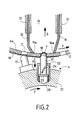
- the two cylinders 2, 4 are synchronized so that during their respective rotation according to the arrows F, the hemispherical end 18 of a given stud 17 is applied precisely on the peripheral contour 7 a of the corresponding orifice 7, as this is clear from an examination of Figure 2.
- Perforations using the device 1 are carried out in the following conditions.
- the nonwoven web 19, consisting of fibers or filaments, for example from a card is applied to the first perforated cylinder 2 on a portion thereof delimited by two applicator rollers 20, driven in rotation at the same linear speed that the first perforated cylinder 2.
- the sheet of fibers 19 passes at the level of the angular portion 11 which is in relation to the suction chamber 10. Due to the intervening suction current through the orifices 7 located in this angular portion 11, the fibers or filaments which are located at the right of each orifice 7 tend to move towards the interior of the orifice 7 so that certain fibers or filaments are in elevation by relative to the inner face 6a of the outer part 6 of the first perforated cylinder 2.
- the hemispherical tip 18 is shaped such that when it bears on the periphery 7a of the orifice 7, it does not protrude beyond the inner face 6a of the part 6.
- it is preferably mounted on a spring 20 so as to compensate for any adjustment deviations and to avoid inadvertent crushing of the fibers or filaments.
- the function of the blocking pad 17 is to keep in position the fibers or filaments 21 displaced towards the inside of the orifice 7 so that the cutting blade 16 a can precisely cut the parts of fibers or filaments projecting, in the suction chamber 10, beyond the inner surface 6a of the part 6.
- the hemispherical end 18 of the pad 17 comes progressively close the orifice 7, the as of rotation two cylinders 2, 4 so that during the final blocking in position of the fibers or filaments and during cutting, the orifice 7 is completely closed.
- This progressive closure also makes it possible to limit the movement of the fibers or filaments towards the interior of the suction chamber 10 because there is already a partial pinching of certain fibers or filaments by the blocking pad 17 even before the passage of the orifice 7 in the suction chamber 10.
- the blocking block 17 is mounted in the outer part 21 of the second cylinder 4 via a housing 22 at bottom of which is disposed the spring 20.
- the stud 17 is arranged inside the housing 22 so that it turns on itself when it moves in the direction of the arrow H during the compression of the spring 20. More precisely, the stud 17 is provided with a pin 23, projecting inside the housing 22, this pin penetrating into a slide 23 formed in the wall of said housing 22 and which is inclined with respect to the direction H of displacement in height of the stud 17.
- the nonwoven web 19 is perforated continuously in the area where the second cylinder 4 cooperates with the orifices 7 of the first cylinder 2. It is understood that this zone can make all the width of the tablecloth or may be only part of this width depending on the application that is targeted. In particular when this ply 19 is used for the production of a hygiene article to promote the passage of liquid, it it may be wise to perforate said ply 19 only in the area which, in the made-up article, will correspond to the acquisition of liquid.
- the nonwoven web 19 which is perforated by the device 1 is a sheet composed of the superposition of three layers 25, 26, 27, the outer layers 25, 27 being two card webs coming from the two combers 28, 29 of a carder 30.
- the intermediate layer 26 is made of extruded blown filaments of the Meltblown type. So we get a composite sheet 19 'made up of the three said layers 25, 26, 27, the perforations of which are made by cutting the fibrous or filamentary elements from the three layers successive.
- hydrophilic or hydrophobic nature of the fibers or filaments constitutive of each layer is one of the parameters on which it is possible to intervene according to the desired applications.
- the displacement of the fibers or filaments, during aspiration, is all the easier as these fibers or filaments have a degree significant freedom in the starting layer (in one or more layers). It is therefore preferable than the mechanical or thermal means of entanglement or bonding of the fibers or filaments occurs after the perforations according to the invention.
- the perforated sheet 19 ′ then passes through a thermobonding assembly 31.
Landscapes
- Engineering & Computer Science (AREA)
- Health & Medical Sciences (AREA)
- Textile Engineering (AREA)
- Mechanical Engineering (AREA)
- Life Sciences & Earth Sciences (AREA)
- Vascular Medicine (AREA)
- Biomedical Technology (AREA)
- Heart & Thoracic Surgery (AREA)
- Epidemiology (AREA)
- Manufacturing & Machinery (AREA)
- Animal Behavior & Ethology (AREA)
- General Health & Medical Sciences (AREA)
- Public Health (AREA)
- Veterinary Medicine (AREA)
- Forests & Forestry (AREA)
- Nonwoven Fabrics (AREA)
- Absorbent Articles And Supports Therefor (AREA)
- Orthopedics, Nursing, And Contraception (AREA)
Applications Claiming Priority (2)
| Application Number | Priority Date | Filing Date | Title |
|---|---|---|---|
| FR9809579 | 1998-07-23 | ||
| FR9809579A FR2781508B1 (fr) | 1998-07-23 | 1998-07-23 | Procede et dispositif de perforation d'une nappe non tissee de fibres ou filaments |
Publications (1)
| Publication Number | Publication Date |
|---|---|
| EP0974433A1 true EP0974433A1 (de) | 2000-01-26 |
Family
ID=9529054
Family Applications (1)
| Application Number | Title | Priority Date | Filing Date |
|---|---|---|---|
| EP99490020A Withdrawn EP0974433A1 (de) | 1998-07-23 | 1999-07-16 | Verfahren und Vorrichtung zum perforieren einer Vliesbahn aus Fasern oder Filamenten |
Country Status (3)
| Country | Link |
|---|---|
| EP (1) | EP0974433A1 (de) |
| JP (1) | JP2000096412A (de) |
| FR (1) | FR2781508B1 (de) |
Cited By (14)
| Publication number | Priority date | Publication date | Assignee | Title |
|---|---|---|---|---|
| EP1172188A1 (de) * | 2000-07-12 | 2002-01-16 | Albis | Verfahren sowie Vorrichtung zum perforieren einer Vliesstoffbahn |
| FR2811604A1 (fr) * | 2000-07-12 | 2002-01-18 | Albis | Dispositif de perforation d'une nappe non tissee |
| FR2811603A1 (fr) * | 2000-07-12 | 2002-01-18 | Albis | Procede de perforation d'une nappe non tissee |
| US20110309544A1 (en) * | 2010-06-21 | 2011-12-22 | Matthew Todd Hupp | Method for providing a web with unique perforations |
| US8268429B2 (en) | 2010-06-21 | 2012-09-18 | The Procter & Gamble Company | Perforated web product |
| US8283013B2 (en) | 2010-06-21 | 2012-10-09 | The Procter & Gamble Company | Uniquely perforated web product |
| US8287976B2 (en) | 2010-06-21 | 2012-10-16 | The Procter & Gamble Company | Uniquely perforated web product |
| US8287977B2 (en) | 2010-06-21 | 2012-10-16 | The Procter & Gamble Company | Uniquely perforated web product |
| US8443725B2 (en) | 2010-06-21 | 2013-05-21 | The Procter & Gamble Company | Method of perforating a web |
| US8468938B2 (en) | 2010-06-21 | 2013-06-25 | The Procter & Gamble Company | Apparatus for perforating a web material |
| US8535483B2 (en) | 2010-06-21 | 2013-09-17 | The Procter & Gamble Company | Apparatus for uniquely perforating a web material |
| US8757058B2 (en) | 2010-06-21 | 2014-06-24 | The Procter & Gamble Company | Process for perforating a web |
| US8763523B2 (en) | 2010-06-21 | 2014-07-01 | The Procter & Gamble Company | Method of perforating a web material |
| US8763526B2 (en) | 2010-06-21 | 2014-07-01 | The Procter & Gamble Company | Apparatus for perforating a web material |
Citations (5)
| Publication number | Priority date | Publication date | Assignee | Title |
|---|---|---|---|---|
| US4636417A (en) * | 1974-12-10 | 1987-01-13 | Rasmussen O B | Fibrous reticular sheet material |
| EP0214608A2 (de) * | 1985-09-09 | 1987-03-18 | Kimberly-Clark Corporation | Nichtgewebter Stoff mit Öffnungen |
| EP0598970A1 (de) * | 1992-11-17 | 1994-06-01 | PANTEX S.r.l. | Verfahren und Vorrichtung zum Herstellen einer Membrane oder einer Folie zum Überziehen von Damenbinden oder Leinentückern oder für Filtersysteme oder dergleichen |
| FR2704179A1 (fr) * | 1993-04-19 | 1994-10-28 | Guial Sa | Matériau plan composite comportant un film perforé et des fibres thermoplastiques, utilisation et procédé de fabrication. |
| US5573719A (en) * | 1994-11-30 | 1996-11-12 | Kimberly-Clark Corporation | Process of making highly absorbent nonwoven fabric |
-
1998
- 1998-07-23 FR FR9809579A patent/FR2781508B1/fr not_active Expired - Fee Related
-
1999
- 1999-07-16 EP EP99490020A patent/EP0974433A1/de not_active Withdrawn
- 1999-07-19 JP JP11204588A patent/JP2000096412A/ja active Pending
Patent Citations (5)
| Publication number | Priority date | Publication date | Assignee | Title |
|---|---|---|---|---|
| US4636417A (en) * | 1974-12-10 | 1987-01-13 | Rasmussen O B | Fibrous reticular sheet material |
| EP0214608A2 (de) * | 1985-09-09 | 1987-03-18 | Kimberly-Clark Corporation | Nichtgewebter Stoff mit Öffnungen |
| EP0598970A1 (de) * | 1992-11-17 | 1994-06-01 | PANTEX S.r.l. | Verfahren und Vorrichtung zum Herstellen einer Membrane oder einer Folie zum Überziehen von Damenbinden oder Leinentückern oder für Filtersysteme oder dergleichen |
| FR2704179A1 (fr) * | 1993-04-19 | 1994-10-28 | Guial Sa | Matériau plan composite comportant un film perforé et des fibres thermoplastiques, utilisation et procédé de fabrication. |
| US5573719A (en) * | 1994-11-30 | 1996-11-12 | Kimberly-Clark Corporation | Process of making highly absorbent nonwoven fabric |
Cited By (16)
| Publication number | Priority date | Publication date | Assignee | Title |
|---|---|---|---|---|
| EP1172188A1 (de) * | 2000-07-12 | 2002-01-16 | Albis | Verfahren sowie Vorrichtung zum perforieren einer Vliesstoffbahn |
| FR2811604A1 (fr) * | 2000-07-12 | 2002-01-18 | Albis | Dispositif de perforation d'une nappe non tissee |
| FR2811603A1 (fr) * | 2000-07-12 | 2002-01-18 | Albis | Procede de perforation d'une nappe non tissee |
| US7080584B2 (en) | 2000-07-12 | 2006-07-25 | Albis | Method and apparatus for perforating a non-woven sheet |
| US20110309544A1 (en) * | 2010-06-21 | 2011-12-22 | Matthew Todd Hupp | Method for providing a web with unique perforations |
| US8268429B2 (en) | 2010-06-21 | 2012-09-18 | The Procter & Gamble Company | Perforated web product |
| US8283013B2 (en) | 2010-06-21 | 2012-10-09 | The Procter & Gamble Company | Uniquely perforated web product |
| US8287976B2 (en) | 2010-06-21 | 2012-10-16 | The Procter & Gamble Company | Uniquely perforated web product |
| US8287977B2 (en) | 2010-06-21 | 2012-10-16 | The Procter & Gamble Company | Uniquely perforated web product |
| US8443725B2 (en) | 2010-06-21 | 2013-05-21 | The Procter & Gamble Company | Method of perforating a web |
| US8468938B2 (en) | 2010-06-21 | 2013-06-25 | The Procter & Gamble Company | Apparatus for perforating a web material |
| US8535483B2 (en) | 2010-06-21 | 2013-09-17 | The Procter & Gamble Company | Apparatus for uniquely perforating a web material |
| US8757058B2 (en) | 2010-06-21 | 2014-06-24 | The Procter & Gamble Company | Process for perforating a web |
| US8763523B2 (en) | 2010-06-21 | 2014-07-01 | The Procter & Gamble Company | Method of perforating a web material |
| US8763526B2 (en) | 2010-06-21 | 2014-07-01 | The Procter & Gamble Company | Apparatus for perforating a web material |
| US9259848B2 (en) | 2010-06-21 | 2016-02-16 | The Procter & Gamble Company | Method for providing a web with unique lines of weakness |
Also Published As
| Publication number | Publication date |
|---|---|
| FR2781508A1 (fr) | 2000-01-28 |
| JP2000096412A (ja) | 2000-04-04 |
| FR2781508B1 (fr) | 2000-10-13 |
Similar Documents
| Publication | Publication Date | Title |
|---|---|---|
| EP0974433A1 (de) | Verfahren und Vorrichtung zum perforieren einer Vliesbahn aus Fasern oder Filamenten | |
| EP0646193B1 (de) | Verbund-material mit perforierter folie und thermoplastischen fasern, dessen verwendung und verfahren zur herstellung | |
| EP1172188B1 (de) | Verfharen sowie Vorrichtung zum Perforieren einer Vliesstoffbahn | |
| EP1226297B1 (de) | Verfahren zur herstellung eines vliesstoffes mit hydrodynamischer vernadelung | |
| FR2557018A1 (fr) | Procede de fabrication de couches elastiques, appareil de mise en oeuvre de ce procede et produit obtenu | |
| FR2887235A1 (fr) | Transport trous de vide a grande vitesse | |
| FR2536432A1 (fr) | Procede pour la fabrication d'etoffes non tissees portant des motifs en creux ou en relief, et etoffes non tissees ainsi obtenues | |
| EP0886480A1 (de) | Faltenhülse und verfahren zu ihrer herstellung | |
| FR2874188A1 (fr) | Procede et dispositif pour travailler une bande de matiere par ultrasons | |
| FR2792656A1 (fr) | Dispositif permettant d'assurer l'ouverture et la repartition d'un faisceau de filaments lors de la realisation d'une nappe textile non tissee | |
| FR3032715A1 (fr) | Procede de confection de bandes adhesives textiles. | |
| FR2756510A1 (fr) | Tete de drapage, pour la fabrication de plaques en materiau composite | |
| EP0400249B1 (de) | Vorrichtung zum Perforieren eines blattartigen Produktes | |
| EP0719125A1 (de) | Perforierter thermoplastischesr film | |
| EP1812638B1 (de) | Trommel für wasserstrahlverwirbelungsmaschine für vliesstoff | |
| EP2056703B1 (de) | Blockierschutzvorrichtung und dynamische bremsensteuerung in einer maschine zur automatischen verteilung geschnittener wischtücher | |
| EP2803458B1 (de) | Herstellungsverfahren einer Vorform für Fasern durch Wicklung, und Werkzeug zur Umsetzung dieses Verfahrens | |
| EP2032752A1 (de) | Vorrichtung zur herstellung von vliesstoffen | |
| CH627954A5 (fr) | Dispositif pour le depot d'un agent liquide de liaison sur une nappe fibreuse destinee a la fabrication de filtres a cigarettes. | |
| EP0850037A1 (de) | Verbundfliesstoff, seine herstellung und seine verwendung für absorbierende hygieneartikel | |
| FR2811603A1 (fr) | Procede de perforation d'une nappe non tissee | |
| WO1998052726A1 (fr) | Methode ainsi que dispositif pour le percement en continu d'un film thermoplastique par une grille avec ouvertures en forme d'ellipse | |
| EP1702874B1 (de) | Method and device of transporting a non-woven web with electrostatic charge in at least an area with a dimension smaller than the width of said web | |
| FR2704244A1 (fr) | Matériau plan composite comportant un film et des fibres thermoplastiques, utilisation et procédé de fabrication. | |
| BE883828A (fr) | Procede de fabrication de sacs, machine pour la mise en oeuvre de ce procede et sacs obtenus. |
Legal Events
| Date | Code | Title | Description |
|---|---|---|---|
| PUAI | Public reference made under article 153(3) epc to a published international application that has entered the european phase |
Free format text: ORIGINAL CODE: 0009012 |
|
| AK | Designated contracting states |
Kind code of ref document: A1 Designated state(s): AT BE CH CY DE DK ES FI FR GB GR IE IT LI LU MC NL PT SE |
|
| AX | Request for extension of the european patent |
Free format text: AL;LT;LV;MK;RO;SI |
|
| 17P | Request for examination filed |
Effective date: 20000726 |
|
| AKX | Designation fees paid |
Free format text: AT BE CH CY DE DK ES FI FR GB GR IE IT LI LU MC NL PT SE |
|
| AXX | Extension fees paid |
Free format text: AL PAYMENT 20000726;LT PAYMENT 20000726;LV PAYMENT 20000726;MK PAYMENT 20000726;RO PAYMENT 20000726;SI PAYMENT 20000726 |
|
| GRAH | Despatch of communication of intention to grant a patent |
Free format text: ORIGINAL CODE: EPIDOS IGRA |
|
| STAA | Information on the status of an ep patent application or granted ep patent |
Free format text: STATUS: THE APPLICATION IS DEEMED TO BE WITHDRAWN |
|
| 18D | Application deemed to be withdrawn |
Effective date: 20030325 |