EP0970263B1 - Procede electrolytique de recuperation et de recyclage de l'argent a partir d'une solution nitrique - Google Patents
Procede electrolytique de recuperation et de recyclage de l'argent a partir d'une solution nitrique Download PDFInfo
- Publication number
- EP0970263B1 EP0970263B1 EP98917210A EP98917210A EP0970263B1 EP 0970263 B1 EP0970263 B1 EP 0970263B1 EP 98917210 A EP98917210 A EP 98917210A EP 98917210 A EP98917210 A EP 98917210A EP 0970263 B1 EP0970263 B1 EP 0970263B1
- Authority
- EP
- European Patent Office
- Prior art keywords
- silver
- mol
- concentration
- solution
- carried out
- Prior art date
- Legal status (The legal status is an assumption and is not a legal conclusion. Google has not performed a legal analysis and makes no representation as to the accuracy of the status listed.)
- Expired - Lifetime
Links
Images

Classifications
-
- G—PHYSICS
- G21—NUCLEAR PHYSICS; NUCLEAR ENGINEERING
- G21F—PROTECTION AGAINST X-RADIATION, GAMMA RADIATION, CORPUSCULAR RADIATION OR PARTICLE BOMBARDMENT; TREATING RADIOACTIVELY CONTAMINATED MATERIAL; DECONTAMINATION ARRANGEMENTS THEREFOR
- G21F9/00—Treating radioactively contaminated material; Decontamination arrangements therefor
- G21F9/04—Treating liquids
- G21F9/06—Processing
-
- C—CHEMISTRY; METALLURGY
- C25—ELECTROLYTIC OR ELECTROPHORETIC PROCESSES; APPARATUS THEREFOR
- C25B—ELECTROLYTIC OR ELECTROPHORETIC PROCESSES FOR THE PRODUCTION OF COMPOUNDS OR NON-METALS; APPARATUS THEREFOR
- C25B1/00—Electrolytic production of inorganic compounds or non-metals
-
- C—CHEMISTRY; METALLURGY
- C25—ELECTROLYTIC OR ELECTROPHORETIC PROCESSES; APPARATUS THEREFOR
- C25C—PROCESSES FOR THE ELECTROLYTIC PRODUCTION, RECOVERY OR REFINING OF METALS; APPARATUS THEREFOR
- C25C1/00—Electrolytic production, recovery or refining of metals by electrolysis of solutions
- C25C1/20—Electrolytic production, recovery or refining of metals by electrolysis of solutions of noble metals
-
- C—CHEMISTRY; METALLURGY
- C02—TREATMENT OF WATER, WASTE WATER, SEWAGE, OR SLUDGE
- C02F—TREATMENT OF WATER, WASTE WATER, SEWAGE, OR SLUDGE
- C02F1/00—Treatment of water, waste water, or sewage
- C02F1/46—Treatment of water, waste water, or sewage by electrochemical methods
- C02F1/461—Treatment of water, waste water, or sewage by electrochemical methods by electrolysis
- C02F1/467—Treatment of water, waste water, or sewage by electrochemical methods by electrolysis by electrochemical disinfection; by electrooxydation or by electroreduction
- C02F1/4676—Treatment of water, waste water, or sewage by electrochemical methods by electrolysis by electrochemical disinfection; by electrooxydation or by electroreduction by electroreduction
- C02F1/4678—Treatment of water, waste water, or sewage by electrochemical methods by electrolysis by electrochemical disinfection; by electrooxydation or by electroreduction by electroreduction of metals
-
- Y—GENERAL TAGGING OF NEW TECHNOLOGICAL DEVELOPMENTS; GENERAL TAGGING OF CROSS-SECTIONAL TECHNOLOGIES SPANNING OVER SEVERAL SECTIONS OF THE IPC; TECHNICAL SUBJECTS COVERED BY FORMER USPC CROSS-REFERENCE ART COLLECTIONS [XRACs] AND DIGESTS
- Y02—TECHNOLOGIES OR APPLICATIONS FOR MITIGATION OR ADAPTATION AGAINST CLIMATE CHANGE
- Y02P—CLIMATE CHANGE MITIGATION TECHNOLOGIES IN THE PRODUCTION OR PROCESSING OF GOODS
- Y02P10/00—Technologies related to metal processing
- Y02P10/20—Recycling
Definitions
- the present invention relates to a method of electrolytic selective recovery and recycling money from a nitric solution containing silver in Ag (I) form, this process comprising successive stages of electroplating and resolubilization of silver Ag (O) deposited.
- the invention applies in particular to selective recovery of Ag (I) by Ag reduction metal from nitrate solutions from the plutonium waste treatment in reprocessing of nuclear fuels and to resolubilization of silver metal in Ag (I) with a view to its recycling upstream of the process.
- the document FR-A-0 704 663 describes a method of separating money in the state electrolysis, from solutions of hyposulphite containing silver ions, Ag (I), used in particular in photography.
- This process consists of adding to the solution to be treated, besides gelatin, an activating agent specific sulfur-containing product intended to provide during the electrolysis of very small deposits cathodic silver sulphide.
- US-A-4,226,685 relates to a process for removing heavy metals such as silver and cyanide ions from plating effluents electrolytic which implements a device single chamber electrolysis system, without compartments separate, including large area cathodes Specifically formed of a bed of conductive particles.
- the specific treatment of nitric effluents, likewise that the possible resolubilization of the metal, by example of the deposited money, is absolutely not mentioned, it is only mentioned that the cathodes on which are the metals are dismounted, removed from the device and subsequently processed by classical purification techniques.
- the document FR-A-0 449 735 relates to a "depollution" reactor electrolyte for the treatment of aqueous effluents containing heavy metals comprising a single vessel in which are placed alternately, electrodes of opposite polarity, the cathodes being preferably made in the form of electrodes removable volumes with granular filling, by example based on petroleum coke.
- the treatment of solutions nitrates including money is not addressed, the recovery of deposited metal is done by removing the removable cathode and by conventionally treating the granular bed out of the tank to recover the metal.
- Cost constraints, on the one hand, and constraints related to the quality of vitrified waste, on the other hand impose to limit the amount of money introduced into the glasses.
- the process of separating money by precipitation has two disadvantages, namely the use of large quantities of reducing agents and anti-nitrous agents, which are often undesirable and difficult to degrade, penalizing management effluent, and the need to proceed with a solid / liquid separation.
- JP-A-05 188 187 discloses, according to the abstract the recovery of metals from a nitric solution of dissolution resulting for example from the dissolution of a spent nuclear fuel.
- the method described in this document implements a controlled potential electrolysis without addition of anti-nitrous compounds.
- the object of the invention is among other things, to remedy the disadvantages processes of the prior art.
- the method according to the invention therefore makes it possible to overcome two of the essential disadvantages to the methods of the prior art described above.
- the method of the invention is much more economical than the processes of art prior.
- the realization of the stage electroless plating allows for compared to processes operating at controlled potential of limit electrodeposition times. It is indeed the intensity that governs the amount of money deposited.
- the process according to the invention recovery and recycling of money therefore allows for selectively recover the money from a nitric solution containing it.
- This solution may be any aqueous solution containing the silver in Ag (I) form (Ag ⁇ ); the silver concentration (Ag I) of the treated solution is preferably from 0.01 to 0.1 mol / l.
- the solution is a nitric solution, i.e. it contains nitric acid HNO 3 , preferably at a concentration of 0.1 to 6 mol / l; for example 5 mol / l.
- the treated solution can comprise, besides Ag (I) ions one or more other cations generally referred to as "troublesome cations", these cations are usually metal cations belonging, for example, to the group formed by Fe, Ni, Cr, Mn, Mg and Zn and they are usually present at a concentration for each of them lower or equal to 0.1 mol / l for example less than or equal to 0.05 mol / l.
- troublesome cations these cations are usually metal cations belonging, for example, to the group formed by Fe, Ni, Cr, Mn, Mg and Zn and they are usually present at a concentration for each of them lower or equal to 0.1 mol / l for example less than or equal to 0.05 mol / l.
- the process according to the invention not only allows the quantitative deposit with an electroplating efficiency close to 100% money from a solution containing these annoying cations, but also a selective deposit, that is, the silver Ag (0) deposited is of purity high: usually more than 90%.
- the nitric solution can be in particular a nitric solution resulting from the treatment plutonium waste by the PUREX process.
- the nitric solution containing silver in Ag (I) form can therefore further include one or more radioactive element (s) belonging for example to group formed of U, Pu, Am, Np, Cm and Lanthanides.
- the concentration of each of the elements present radioactive being generally lower or equal to 100 mg / l.
- the concentration is preferably less than or equal to 50 mg / l and for Am and the Pu it is preferably less than or equal to 1.25 mg / l.
- the method according to the invention allows also the selective deposit of money from a solution containing these radioactive elements. This selectivity is demonstrated by the fact that money Ag (0) deposited at the cathode is extremely pure, and that, therefore, the subsequent resolubilization of the money metal in Ag (I) during the second stage of the process gives a solution that contains a fraction of alpha activity generally less than 1% of the initial activity, a decontamination factor FD greater than 100.
- the resolubilized silver metal in a nitric environment can easily be recycled in upstream of the Ag (II) leaching process electrogenerated.
- compositions such as suspension may also be present in the nitric solution at a concentration usually less than 100 mg / l.
- the steps electroplating (recovery) of silver and resolubilization (recycling) of the deposited money have place in the same device.
- This device is preferably a electrolyser without separate chamber and enclosure unique.
- Such a device has an ohmic drop greatly reduced and gives high yields in even in the presence of troublesome cations, while that the electroplating of silver is practically quantitative and that the overall silver yield at the outcome of both stages is also very high.
- Such an electrolyser is, for example, type described in EP-A-0 449 735 and is constituted, as shown in Figure 1 of a tub (1), generally of parallelepipedal shape made of, for example, PVC, polyethylene, polypropylene or any other inert material vis-à-vis the solutions to be treated and the reagents put implementation and the electrolysis process.
- the tank can be in the form of two half-tanks lower and upper, the upper half-tank forming a removable lid and the lower half-bowl forming the tank itself, these two half-tanks being united with each other by any adequate means of attachment or attachment: hinge, flange (4), etc.
- This tank is equipped, at one of its ends of a device or channel supply (2), and possibly an overflow security and at the other end of the orifice and outlet pipe or drain (3), as well as an orifice and a pipe of recirculation (5), these pipes being provided by example of closure means and / or control of the flow such as valves (6) (7).
- the tank also includes in its part a flange (8) to which is connected a pipeline for the evacuation of gaseous effluents are directed for example to a washing column.
- Pipings (22,23) are also provided in the upper part of the tank, and are connected for example to a carrier gas supply (22) such air or a neutral gas and a water (23).
- a carrier gas supply (22) such air or a neutral gas and a water (23).
- a number of other taps (9) are also planned in the tank to allow the passage of sensors, and / or cables connected to measuring devices or electrodes monitoring the reaction.
- the electrolyser may be provided inter alia an explosimeter sensor placed in the exhaust system for gaseous effluents and to follow the release of hydrogen.
- the electrolyser or electrolysis cell is equipped with one or more electrode (s) opposite polarity.
- Electrodes of opposite polarities can be arranged alternately as it is the case of the apparatus described in EP-A-0 449 735.
- the electrode (s) corresponding to one of the polarities are preferably one or more large-area electrode (s) deployed, said (s) voluminal (s) electrode (s), preferably removable (s) and removable (s), as described in the European patent already cited above.
- large deployed area generally means an area of a few m 2 , preferably 1 to 10 m 2 .
- the at least one volumetric electrode (s) is (are) preferably the cathode (s) of the electrolyser used in the process according to the invention and is (are) constituted for example by a stack. a large number (for example 10 to 25) of metal grids, for example stainless steel.
- the one or more volumetric electrodes for example the cathode (s)
- the cathode (s) have a large deployed surface allowing current densities of between 1 and 10 mA / cm 2 , for intensities of 100 to 500 A.
- the grids constituting the cathode (s) can be placed in frames ensuring their rigidity, these frames being made of a material inert vis-à-vis the electrolysis, and vis-à-vis
- these frames can be made of poly (vinyl chloride), polyethylene or polypropylene.
- the cathode (s) can also be covered with a filter cloth with a high porosity, in order to to limit the formation of dendrites likely to cause short circuits between anodes and cathodes.
- the electrolyser will preferably comprise cathodes and n + 1 anodes, as an example, the electrolyser shown in FIG. anodes (10) between which are intercalated volumic cathodes (11).
- the anodes used are made by example in platinum or even ruthenium titanium or irridium, that is to say in titanium covered with a deposit electrocatalytic solution of iridium oxide and / or ruthenium.
- the frame (s) of the cathode (s) the anodes are equipped with means cooperating with means provided in the tank of the electrolyser and to position and fix the case Removable and removable in the tank electrolyser.
- These means can be on the one hand pins and on the other hand grooves cooperating with said lugs and provided in the tank of the electrolyser, for example grooves dug to even the wall of this tank.
- the process according to the invention comprises all first a step of electroplating the silver in which operating parameters governing electrolysis are preferably perfectly controlled within specific ranges of values, which ensures a high current efficiency and a deposit quasi-quantitative money with great selectivity.
- the cathode is subjected to a low current density, preferably less than or equal to 10 mA / cm 2 , for example from 2 to 6 mA / cm 2 , and an anti-nitrous compound such as urea is added which prevents any autocatalytic solubilization reaction of silver Ag (0) deposited by HNO 3 .
- the intensity provided is greater than what is necessary to reduce money and so we also reduce nitric acid, this which explains that we must resort to the implementation of anti-nitrous compounds. It's here also one of the characteristics of the process according to the invention during the electroplating step carried out at imposed intensity, than to require the implementation of anti-nitrous compounds.
- the addition of such anti-nitrous agents or compounds is not indicated in processes where one performs electroplating with controlled potential.
- the anti-nitrous compound is generally chosen from urea and hydrogen peroxide.
- Urea must generally be initially added, for example at a concentration of 0.1 mol / l, but depending on the time required for the operations, an addition may be necessary continuously from an aqueous solution of concentration 8 mol / l.
- the amount of urea to be added depends on the composition of the solutions to be treated. For nitric acid solutions as defined above the amount of urea should generally be less than 6.10 -6 mol / s / A. Urea is an easily degradable reagent with no detrimental influence on the rest of the process.
- oxygenated water will preferably be used. anti-nitrous compound at a concentration which can be easily determined by those skilled in the art.
- the silver electrodeposition stage can be done in batch mode "batch", but is preferably carried out with a recirculation continuous nitric solution to be unsealed.
- the tank of the electrolyser (1) is supplied with nitric solution to be treated via a circulation pump (12) at a regulated flow rate measured by a rotameter (13) at from a storage tank or feed tank of sufficient capacity (14) for example 1 m 3 which contains the nitric solution to "désargierier".
- the supply line (again called recirculation line) (15) is also provided with means of fillings such as valves (16, 17).
- a solution of urea can usually be introduced into the circuit preferably, by through the stitching (21) provided in the pipe (2) upstream of the electrolyser.
- the tank (14) is provided with means allowing to regulate the temperature of the nitric solution to treat.
- these means are represented in the form of a coil (18) plunging into the solution and traveled by a heat transfer fluid.
- the means for regulating the temperature of the solution also include a sensor temperature (19).
- the storage tank also includes a number of taps (20) for, for example the introduction of reagents or others.
- the solution nitrate treated, "désargent strucke”, having crossed the electrolyser leaves this electrolyser through the orifice recirculation and flows through a pipeline of recirculation (5) provided with a valve (6) and regains the storage tank (14), from where it is again returned to the electrolyser via the second part of the recirculation pipe (15) and the pipe (2).
- the electrolyser is thus fed with continuous at a constant flow, the nitric solution getting poorer with each passing through Ag (I) while the metallic silver Ag (0) is deposited on the cathode (s).
- Recirculation is continued, while according to the kinetics of electrodeposition of silver, for example by means of a double potentiometry platinum electrode.
- the end of the electroplating which corresponds for example to a concentration of Ag (I) less than 100 mg / l, is evidenced by a leap potential.
- the duration of the electroplating operation is variable it is dependent on the amount of money to recover and imposed intensity, and corresponds to faradic yields of 50 to 100%.
- the second stage of the process according to the invention which is a step of resolubilizing money deposited in the form of metal Ag during the stage previous electroplating.
- this resolubilization step takes place in the same device as where it took place the electrodeposition step, which is preferably a electrolyser without separate compartment consisting of a single enclosure, for example of the type already described above.
- the resolubilization step comprises usually two more steps, on the one hand a first step of emptying the apparatus where unrolled the electroplating, on the other hand a second resolubilization step proper.
- the emptying is preferably carried out immediately after the end of the electroplating step and comprises a washing / rinsing with a rinsing fluid of preferably with water, preferably water demineralized or acid of normality less than 0.1 N.
- the rinsing fluid such as water into the device such as the electrolyser or enclosure plunger electrolysis, and at a flow rate that is preferably greater than 300 l / h for an apparatus of a volume of about 100 liters.
- the emptying is carried out preferably under tension, at know for example 12 volts.
- the resolubilization step itself Ag (0) silver deposited on the cathode (s) is carried out by introducing fresh nitric acid concentrated at a concentration for example higher or preferably 4 mol / l, preferably 6 mol / l, preferably at zero intensity.
- the emptying is carried out simply by the intermediary of the pipeline (3) by opening the valve (7).
- Rinsing can be done by injection of water from the pipe (23).
- Fresh nitric acid, for example at 6 N or 6 mol / l, necessary for resolubilization-redissolution is usually contained in a tank (24), for example with a capacity of 300 liters, and circulates it using a pump 28 by via conduits (25), (26) provided with valve (27) to the electrolyser and from this latest.
- the silver metal recovered at the end of the very selective first step of electroplating is of high purity, thus the nitric solution final Ag (I) obtained after resolubilization of Ag (0) contains very few troublesome cations and / or radioactive elements.
- the resulting solution thus contains a fraction of alpha activity generally lower than 1% (FD decontamination factor ⁇ 100) of the activity initial and can be easily recycled for example upstream of the process.
- the equipment used includes a single chamber electrolyser and without compartment separated, of parallelepipedal shape connected to a loop recirculation in a similar way to what is shown in Figure 1.
- This electrolyser with a capacity of 1.5 l is equipped with two titanium anodes covered with an electrocatalytic deposit of iridium oxide and / or ruthenium which each have an expanded surface of 110 cm 2 , and a cathode in 316L stainless steel.
- Each of the cathodes consists of a stack of 25 grids of dimensions 95 ⁇ 115 mm with a smooth and uniform 0.8 mm wire; each of these cathodes has an expanded surface of 2700 cm 2 .
- the current efficiency was 78%.
- Example I the quantitative and selective deposit of silver (Ag (0)) to from the nitric solution described above and containing troublesome cations.
- the current efficiency was 65%.
- the radioactive elements are essentially U, Pu and Am.
- solutions also include "annoying" cations Fe, Cr, Mn and Ni.
- the equipment used includes a single chamber electrolyser and without compartment identical to that of Examples 1 and 2, but adapted to the conditions of implementation in the middle active, that is to say placed in a glove box.
- This deposition is performed extremely selectively, since the resolubilization of Ag (O) to Ag (I) by HNO 3 in a subsequent step contains a fraction of the alpha activity less than or equal to 1% of the initial activity.
- This residual activity corresponds to retention volume of the electrolyser, essentially at the cathode, after draining the solution to to unseal and without rinsing with water the electrolyzer.
- the equipment used is consistent with that described in Figure 1, and includes an electrolyser and a feed tank containing the nitric solution to unseal.
- the electrolyser of parallelepipedal shape manufactured in PVC with a capacity 100 l, and is supplied by the solution to bevisionégentifier, by a pump with circulation, with a flow rate of 13 m 3 / h from the tank of storage of 1 m 3 .
- the electrolyser is, as shown in FIG. 1, equipped with 6 volumic cathodes with 316 L stainless steel grids with a surface area of 16 m 2 , and 7 platinum anodes with a surface area of 0.7 m 2. .
- the stacks of grids constituting the cathodes are placed in frames ensuring their rigidity.
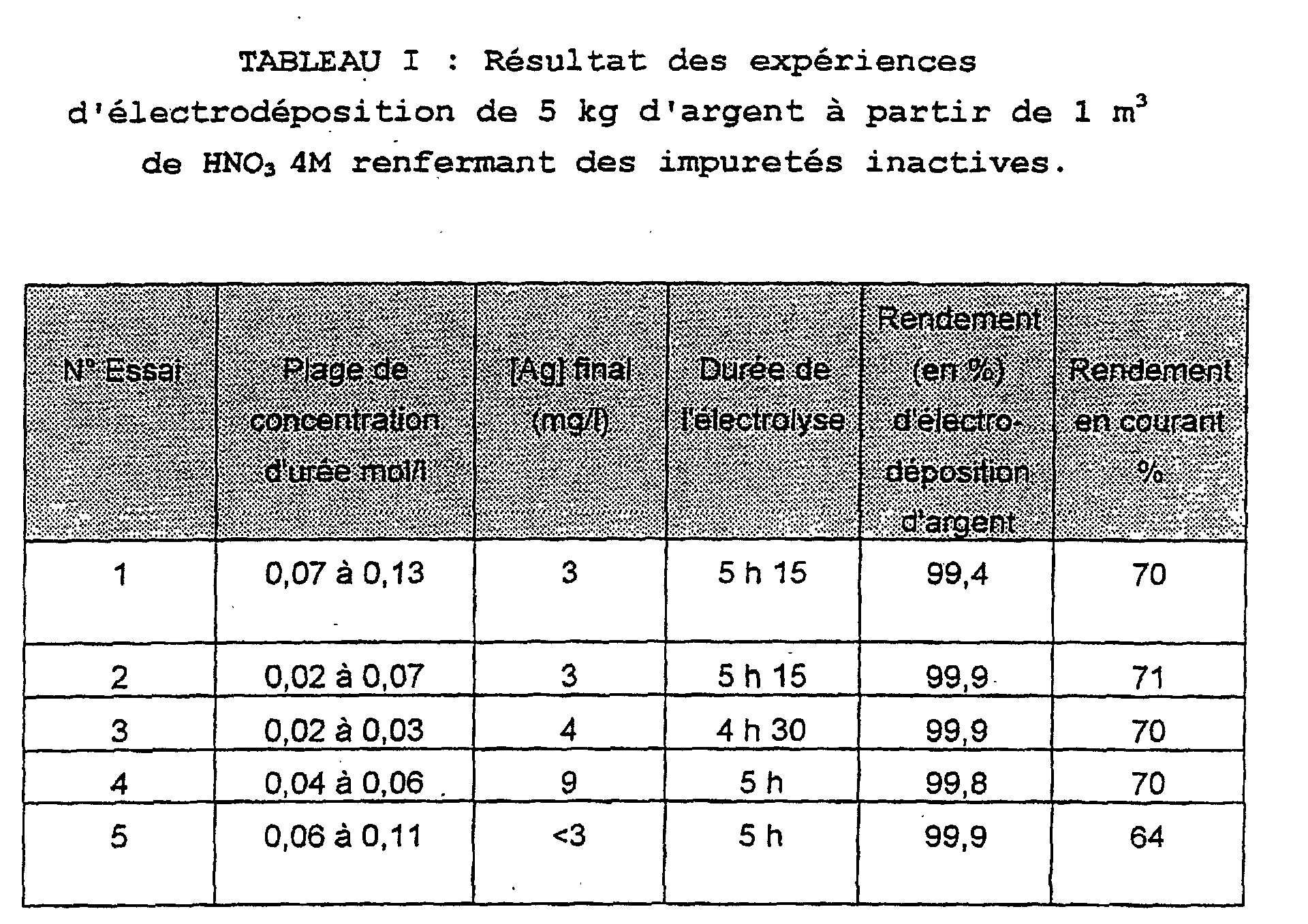
- the treated nitric solution with a volume of 1 m 3 contained 5 kg of silver, and had a concentration of HNO 3 of 4 mol / l.
- the recirculation flow rate was set at 13 m 3 / h, a current intensity of 400 A was applied, a cathode current density of 2.5 mA / cm 2 according to the invention.
- the temperature of the solution has been regulated at 22-25 ° C.
- the urea feed is carried out in continuous at a rate of 11 to 22 mol / h of urea by addition an aqueous solution of urea at 8 mol / l.
- the table shows that the 5 kg of silver are electrodeposited with silver yields greater than 99%, lasting between 4 hours and 30 minutes and 5:15.
- the current efficiencies are from 64 to 70%.
- Hydrogen evolution monitoring has demonstrated the virtual absence of hydrogen electrogeneration during the silver electrodeposition, especially at the end of electrolysis where H 2 ⁇ 1% ppv.
Landscapes
- Chemical & Material Sciences (AREA)
- Engineering & Computer Science (AREA)
- Chemical Kinetics & Catalysis (AREA)
- Electrochemistry (AREA)
- Materials Engineering (AREA)
- Metallurgy (AREA)
- Organic Chemistry (AREA)
- Physics & Mathematics (AREA)
- General Engineering & Computer Science (AREA)
- High Energy & Nuclear Physics (AREA)
- Inorganic Chemistry (AREA)
- Electrolytic Production Of Metals (AREA)
- Electrolytic Production Of Non-Metals, Compounds, Apparatuses Therefor (AREA)
Description
- la figure 1 est un schéma de principe de l'installation de "désargentification" pour la mise en oeuvre du procédé selon l'invention, comprenant en particulier un électrolyseur sans compartiment séparé et constitué d'une enceinte unique.
- La figure 2 est un graphique illustrant la cinétique d'électrodéposition de l'argent dans un électrolyseur sans compartiment séparé. En abscisse est porté le temps (exprimé en minutes) et en ordonnées est portée la concentration en Ag(I) (exprimée en mol/l x 10-2). La courbe inférieure illustre l'électrodéposition d'argent à partir d'une solution d'Ag(I) ne renfermant pas de cations gênants, tandis que la courbe supérieure illustre l'électrodéposition d'argent à partir d'une solution renfermant en outre des cations gênants (Fe, Ni, Cr et Mn).
- concentration en HNO3 : 4 mol/l
- concentration en Ag(I) : 0,05 mol/l
- concentration en cations "gênants" : 0
- concentration en urée ajoutée initialement : 0,1 mol/l
- volume de solution nitrique traitée : 10 litres.
- concentration en HNO3 : 4 mol/l
- concentration en Ag(I) : 0,05 mol/l
- concentration en cations gênants :
- Fe(III) : 2,50 10-3 mol/l
- Mn(III) : 0,08 10-3 mol/l
- Ni(II) : 0,32 10-3 mol/l
- Cr(III) : 0,75 10-3 mol/l
- concentration totale en cations gênants : 3,65 10-3 mol/l.
- concentration en urée ajoutée initialement : 0,1 mol/l.
- volume de solution nitrique traitée : 10 litres.
- concentration en HNO3 : 4 mol/l
- concentration en Ag initiale : 5,28 10-2 mol/l
- concentration en urée initiale : 0,242 mol/l
- concentration en cations gênants :
- Fe(III) : 2,9 10-3 mol/l
- Ni(II) : 3,5 10 -4 mol/l
- Cr(III) : 8 10-4 mol/l
- Mn(III) : 9 10-5 mol/l
- Concentration totale en cations gênants : 4,14 10-3 mol/l.
- concentration en éléments radioactifs :
- Pu : 1,5 mg/l
- U : 50 mg/l
- Am : 0,1 mg/l
- concentration totale en éléments radioactifs : 51,6 mg/l
- volume de solution nitrique traitée : 1,7 l.
- le dégagement d'hydrogène dans le circuit des effluents gazeux par capteur explosimètre,
- le suivi tout ou rien de [Ag(I)] par potentiométrie à double électrode de platine,
- le suivi spectrophotométrique d'HNO2 à 370 nm.
Claims (18)
- Procédé électrolytique de récupération sélective et de recyclage de l'argent à partir d'une solution nitrique le contenant sous forme d'Ag(I), ce procédé comprenant des étapes successives d'électrodéposition de l'argent sous forme d'argent métal Ag(0) puis de resolubilisation de l'argent Ag(0) déposé, pour donner une solution finale d'Ag(I) dans lequel ladite étape d'électrodéposition est réalisée à intensité imposée, lesdites étapes successives d'électrodéposition de l'argent et de resolubilisation de l'argent déposé sont réalisées dans le même appareil, et un agent anti-nitreux est ajouté pendant l'étape d'électrodéposition.
- Procédé selon la revendication 1, caractérisé en ce que ledit appareil est un électrolyseur à enceinte unique, sans compartiment séparé.
- Procédé selon la revendication 1, caractérisé en ce que la solution initiale contient l'argent Ag(I) à une concentration de 0,01 à 0,1 mol/l.
- Procédé selon la revendication 1, caractérisé en ce que la solution initiale contient l'acide nitrique à une concentration de 0,1 à 6 mol/l.
- Procédé selon la revendication 1, caractérisé en ce que la solution initiale, outre l'argent, comprend un ou plusieurs cation(s) de métaux appartenant au groupe formé de Fe, Ni, Cr, Mn, Mg et Zn.
- Procédé selon la revendication 5, caractérisé en ce que la concentration de chacun des cations présents est inférieure ou égale à 0,1 mol/l.
- Procédé selon la revendication 1, caractérisé en ce que la solution initiale comprend un ou plusieurs élément(s) radioactif(s) appartenant au groupe formé de U, Pu, Am, Np, Cm et des lanthanides.
- Procédé selon la revendication 7, caractérisé en ce que la concentration de chacun des éléments radioactifs présent est inférieure ou égale à 100 mg/l.
- Procédé selon la revendication 1, caractérisé en ce que ladite étape d'électrodéposition de l'argent est réalisée à une densité de courant de cathode inférieure ou égale à 10 mA/cm2.
- Procédé selon la revendication 1 caractérisé en ce que ledit composé anti-nitreux est choisi parmi l'urée et l'eau oxygénée.
- Procédé selon la revendication 10, caractérisé en ce que l'urée est ajoutée en continu à raison d'environ 6.10-6 mol/s/A.
- Procédé selon la revendication 2, caractérisé en ce que l'électrolyseur comporte une ou plusieurs cathode(s) de grande surface déployée.
- Procédé selon la revendication 1, caractérisé en ce que ladite étape de resolubilisation comprend une première étape de vidange dudit appareil et une seconde étape de resolubilisation proprement dite de l'Ag(0) déposé sur la ou les cathode(s).
- Procédé selon la revendication 13, caractérisé en ce que ladite étape de vidange est réalisée sous tension.
- Procédé selon la revendication 13, caractérisé en ce que ladite étape de vidange comprend le rinçage dudit appareil par un fluide de rinçage.
- Procédé selon la revendication 15, caractérisé en ce que ledit fluide de rinçage est injecté par effet piston à un débit supérieur à 300 l/h.
- Procédé selon la revendication 13, caractérisé en ce que ladite étape de resolubilisation de l'argent Ag(0) déposé sur la ou les cathode(s) est réalisée par introduction d'acide nitrique frais concentré à une concentration supérieure ou égale à 4 mol/l.
- Procédé selon la revendication 13, caractérisé en ce que ladite étape de resolubilisation proprement dite est réalisée à courant nul.
Applications Claiming Priority (3)
| Application Number | Priority Date | Filing Date | Title |
|---|---|---|---|
| FR9703552 | 1997-03-24 | ||
| FR9703552A FR2761085B1 (fr) | 1997-03-24 | 1997-03-24 | Procede electrolytique de recuperation et de recyclage de l'argent a partir d'une solution nitrique |
| PCT/FR1998/000580 WO1998042894A1 (fr) | 1997-03-24 | 1998-03-23 | Procede electrolytique de recuperation et de recyclage de l'argent a partir d'une solution nitrique |
Publications (2)
| Publication Number | Publication Date |
|---|---|
| EP0970263A1 EP0970263A1 (fr) | 2000-01-12 |
| EP0970263B1 true EP0970263B1 (fr) | 2003-02-19 |
Family
ID=9505109
Family Applications (1)
| Application Number | Title | Priority Date | Filing Date |
|---|---|---|---|
| EP98917210A Expired - Lifetime EP0970263B1 (fr) | 1997-03-24 | 1998-03-23 | Procede electrolytique de recuperation et de recyclage de l'argent a partir d'une solution nitrique |
Country Status (7)
| Country | Link |
|---|---|
| US (1) | US6428679B1 (fr) |
| EP (1) | EP0970263B1 (fr) |
| JP (1) | JP4435875B2 (fr) |
| DE (1) | DE69811482T2 (fr) |
| FR (1) | FR2761085B1 (fr) |
| RU (1) | RU2171318C2 (fr) |
| WO (1) | WO1998042894A1 (fr) |
Families Citing this family (8)
| Publication number | Priority date | Publication date | Assignee | Title |
|---|---|---|---|---|
| DE102008016020A1 (de) * | 2008-03-28 | 2009-10-01 | Areva Np Gmbh | Verfahren zum Konditionieren einer bei der nasschemischen Reinigung eines nuklearen Dampferzeugers anfallenden Reinigungslösung |
| DE102010018233A1 (de) | 2010-04-23 | 2011-10-27 | Deutsches Zentrum für Luft- und Raumfahrt e.V. | Herzunterstützungsvorrichtung |
| JP5558232B2 (ja) * | 2010-07-05 | 2014-07-23 | 株式会社東芝 | 高放射性レベル廃液からの希少金属の回収方法及び回収装置 |
| CN102732730B (zh) * | 2012-06-28 | 2013-11-06 | 江苏龙源催化剂有限公司 | 选择性催化还原脱硝催化剂钒组分回收的方法 |
| CN103215615B (zh) * | 2013-04-10 | 2016-08-03 | 东莞市华生电镀机械设备有限公司 | 一种贵金属的回收方法 |
| CN104478140A (zh) * | 2014-11-27 | 2015-04-01 | 长沙有色冶金设计研究院有限公司 | 一种有色金属冶炼污酸净化处理方法 |
| CN115679099A (zh) * | 2022-10-31 | 2023-02-03 | 河南金渠银通金属材料有限公司 | 一种用于将硝酸银还原银单质的装置 |
| KR102879702B1 (ko) * | 2023-04-27 | 2025-11-03 | 한국에너지기술연구원 | 티타늄이 고용된 이리듐산화물 및 티타늄 산화물의 복합체 촉매를 포함하는 산소발생용 전극, 그 산소발생용 전극의 제조 방법 및 그 산소발생용 전극를 포함하는 수전해 장치 |
Family Cites Families (7)
| Publication number | Priority date | Publication date | Assignee | Title |
|---|---|---|---|---|
| US4362608A (en) * | 1980-03-31 | 1982-12-07 | Silver Systems, Ltd. | Silver recovery method |
| AT380032B (de) * | 1983-08-29 | 1986-03-25 | Oegussa | Elektrolytisches silberraffinationsverfahren |
| EP0465401A1 (fr) * | 1990-03-23 | 1992-01-08 | Spac S.A. | Appareil récupérateur d'argent ou d'autres métaux précieux en solution dans un liquide |
| CA2017032C (fr) * | 1990-05-17 | 1995-10-10 | Khay Gie J. Tan | Raffinage hydrometallurgique de l'argent |
| JPH04131393A (ja) * | 1990-09-21 | 1992-05-06 | Power Reactor & Nuclear Fuel Dev Corp | 電解法によるパラジウムの回収方法および回収装置 |
| JP2713828B2 (ja) * | 1992-01-14 | 1998-02-16 | 動力炉・核燃料開発事業団 | 核燃料再処理溶解液から有価金属を回収する方法 |
| WO1998058089A1 (fr) * | 1997-06-16 | 1998-12-23 | Mitsubishi Materials Corporation | Procede de fusion de metal noble |
-
1997
- 1997-03-24 FR FR9703552A patent/FR2761085B1/fr not_active Expired - Fee Related
-
1998
- 1998-03-23 WO PCT/FR1998/000580 patent/WO1998042894A1/fr not_active Ceased
- 1998-03-23 EP EP98917210A patent/EP0970263B1/fr not_active Expired - Lifetime
- 1998-03-23 RU RU99122606A patent/RU2171318C2/ru active
- 1998-03-23 US US09/381,663 patent/US6428679B1/en not_active Expired - Lifetime
- 1998-03-23 DE DE69811482T patent/DE69811482T2/de not_active Expired - Lifetime
- 1998-03-23 JP JP54325098A patent/JP4435875B2/ja not_active Expired - Lifetime
Also Published As
| Publication number | Publication date |
|---|---|
| JP2001517268A (ja) | 2001-10-02 |
| EP0970263A1 (fr) | 2000-01-12 |
| FR2761085B1 (fr) | 1999-04-16 |
| JP4435875B2 (ja) | 2010-03-24 |
| US6428679B1 (en) | 2002-08-06 |
| RU2171318C2 (ru) | 2001-07-27 |
| DE69811482T2 (de) | 2003-11-27 |
| FR2761085A1 (fr) | 1998-09-25 |
| WO1998042894A1 (fr) | 1998-10-01 |
| DE69811482D1 (de) | 2003-03-27 |
Similar Documents
| Publication | Publication Date | Title |
|---|---|---|
| EP0158555B1 (fr) | Procédé pour récupérer le plutonium contenu dans des déchets solides | |
| WO2004079840A2 (fr) | Eletrode a flux traversant tridimensionnelle et cellule electrochimique | |
| FR2660789A1 (fr) | Procede de decontamination de metaux radioactifs. | |
| WO2005035149A1 (fr) | Procede de purification de matiere contaminee par des metaux lourds et appareil destine a cet effet | |
| US5458745A (en) | Method for removal of technetium from radio-contaminated metal | |
| WO1998042894A1 (fr) | Procede electrolytique de recuperation et de recyclage de l'argent a partir d'une solution nitrique | |
| FR2761804A1 (fr) | Procede de recuperation d'uranium et d'elements transuraniens dans du combustible nucleaire use | |
| FR3010714A1 (fr) | Procede et dispositif pour la purifcation d'eaux usees radioactives contenant des radionucleides d'iode | |
| EP0296984B1 (fr) | Procédé d'élimination des ions chlorure présents dans des déchets solides contaminés tels que des cendres d'incinération contaminées par des actinides | |
| EP0756582A1 (fr) | Destruction des complexes cyano metalliques par la combinaison d'oxydation chimique et d'electrolyse | |
| FR2731717A1 (fr) | Procede d'oxydation electrochimique de am (vii) en am (vi), utilisable pour separer l'americium des solutions de retraitement de combustibles nucleaires uses | |
| KR101082458B1 (ko) | 고성능 금속 용해장치 및 용해방법 | |
| WO2009004257A2 (fr) | Procédé de traitement mixte chimique électrochimique d'un milieu liquide chargé en nitrates, dispositif pour traiter un tel milieu liquide et applications | |
| EP0584188B1 (fr) | Procede de desargentation par electrolyse | |
| EP0559561B1 (fr) | Procédé de dissolution du bioxyde de plutonium au moyen de radicaux OH' produits par radiolyse de l'eau, utilisable pour le traitement des fines de dissolution et des déchets plutonifères | |
| FR2573221A1 (fr) | Procede et dispositif pour la recuperation de l'argent des bains de fixage | |
| EP0691659A1 (fr) | Anode consommable, procédé d'électrodissolution appliqué à la décontamination d'effluents liquides faiblement radioactifs, et dispositif de mise en oeuvre de ce procédé | |
| FR2579998A1 (en) | Device for removing silver from baths containing silver | |
| FR2681079A1 (fr) | Dispositif et procede d'electrolyse a electrode poreuse et agitee. | |
| FR2750242A1 (fr) | Procede de retraitement de combustibles nucleaires | |
| EP1042752B1 (fr) | Procede et dispositif pour l'oxydation d'un ou de plusieurs actinide/s,stabilise/s sous forme reduite par un ou plusieurs agent/s anti-nitreux, en solution nitrique concentree | |
| FR2463639A1 (fr) | Procede de traitement des solutions de chlorure de plomb | |
| WO1996025247A1 (fr) | Procede d'extraction de chrome et/ou d'arsenic presents dans des materiaux solides ou semi-solides | |
| FR2736631A1 (fr) | Procede de traitement par electrolyse d'un effluent liquide contenant des metaux dissous et application au traitement d'effluents contenant du cerium | |
| FR2491093A1 (fr) | Procede pour recharger en palladium une solution de depot d'un alliage de palladium et de nickel |
Legal Events
| Date | Code | Title | Description |
|---|---|---|---|
| PUAI | Public reference made under article 153(3) epc to a published international application that has entered the european phase |
Free format text: ORIGINAL CODE: 0009012 |
|
| 17P | Request for examination filed |
Effective date: 19990903 |
|
| AK | Designated contracting states |
Kind code of ref document: A1 Designated state(s): BE DE FR GB |
|
| 17Q | First examination report despatched |
Effective date: 20000911 |
|
| GRAG | Despatch of communication of intention to grant |
Free format text: ORIGINAL CODE: EPIDOS AGRA |
|
| GRAG | Despatch of communication of intention to grant |
Free format text: ORIGINAL CODE: EPIDOS AGRA |
|
| GRAH | Despatch of communication of intention to grant a patent |
Free format text: ORIGINAL CODE: EPIDOS IGRA |
|
| GRAH | Despatch of communication of intention to grant a patent |
Free format text: ORIGINAL CODE: EPIDOS IGRA |
|
| GRAA | (expected) grant |
Free format text: ORIGINAL CODE: 0009210 |
|
| RAP1 | Party data changed (applicant data changed or rights of an application transferred) |
Owner name: COMPAGNIE GENERALE DES MATIERES NUCLEAIRES Owner name: COMMISSARIAT A L'ENERGIE ATOMIQUE |
|
| AK | Designated contracting states |
Designated state(s): BE DE FR GB |
|
| REG | Reference to a national code |
Ref country code: GB Ref legal event code: FG4D Free format text: NOT ENGLISH |
|
| REF | Corresponds to: |
Ref document number: 69811482 Country of ref document: DE Date of ref document: 20030327 Kind code of ref document: P |
|
| GBT | Gb: translation of ep patent filed (gb section 77(6)(a)/1977) |
Effective date: 20030509 |
|
| PLBE | No opposition filed within time limit |
Free format text: ORIGINAL CODE: 0009261 |
|
| STAA | Information on the status of an ep patent application or granted ep patent |
Free format text: STATUS: NO OPPOSITION FILED WITHIN TIME LIMIT |
|
| 26N | No opposition filed |
Effective date: 20031120 |
|
| REG | Reference to a national code |
Ref country code: FR Ref legal event code: PLFP Year of fee payment: 19 |
|
| PGFP | Annual fee paid to national office [announced via postgrant information from national office to epo] |
Ref country code: DE Payment date: 20160316 Year of fee payment: 19 |
|
| REG | Reference to a national code |
Ref country code: FR Ref legal event code: PLFP Year of fee payment: 20 |
|
| PGFP | Annual fee paid to national office [announced via postgrant information from national office to epo] |
Ref country code: FR Payment date: 20170331 Year of fee payment: 20 |
|
| PGFP | Annual fee paid to national office [announced via postgrant information from national office to epo] |
Ref country code: GB Payment date: 20170323 Year of fee payment: 20 Ref country code: BE Payment date: 20170327 Year of fee payment: 20 |
|
| REG | Reference to a national code |
Ref country code: DE Ref legal event code: R119 Ref document number: 69811482 Country of ref document: DE |
|
| PG25 | Lapsed in a contracting state [announced via postgrant information from national office to epo] |
Ref country code: DE Free format text: LAPSE BECAUSE OF NON-PAYMENT OF DUE FEES Effective date: 20171003 |
|
| REG | Reference to a national code |
Ref country code: BE Ref legal event code: MK Effective date: 20180323 |
|
| REG | Reference to a national code |
Ref country code: GB Ref legal event code: PE20 Expiry date: 20180322 |
|
| PG25 | Lapsed in a contracting state [announced via postgrant information from national office to epo] |
Ref country code: GB Free format text: LAPSE BECAUSE OF EXPIRATION OF PROTECTION Effective date: 20180322 |