EP0970239B1 - Nachweis von mikrobiellen metaboliten - Google Patents
Nachweis von mikrobiellen metaboliten Download PDFInfo
- Publication number
- EP0970239B1 EP0970239B1 EP98913597A EP98913597A EP0970239B1 EP 0970239 B1 EP0970239 B1 EP 0970239B1 EP 98913597 A EP98913597 A EP 98913597A EP 98913597 A EP98913597 A EP 98913597A EP 0970239 B1 EP0970239 B1 EP 0970239B1
- Authority
- EP
- European Patent Office
- Prior art keywords
- group
- hydrogen
- inositol
- formula
- indoxyl
- Prior art date
- Legal status (The legal status is an assumption and is not a legal conclusion. Google has not performed a legal analysis and makes no representation as to the accuracy of the status listed.)
- Expired - Lifetime
Links
- 238000001514 detection method Methods 0.000 title claims abstract description 21
- 230000000813 microbial effect Effects 0.000 title claims description 3
- 239000002207 metabolite Substances 0.000 title description 2
- 239000000758 substrate Substances 0.000 claims abstract description 58
- 150000001875 compounds Chemical class 0.000 claims abstract description 35
- 229910052739 hydrogen Inorganic materials 0.000 claims abstract description 34
- 239000001257 hydrogen Substances 0.000 claims abstract description 34
- 102000004190 Enzymes Human genes 0.000 claims abstract description 31
- 108090000790 Enzymes Proteins 0.000 claims abstract description 31
- 150000003839 salts Chemical class 0.000 claims abstract description 26
- 238000000034 method Methods 0.000 claims abstract description 23
- UFHFLCQGNIYNRP-UHFFFAOYSA-N Hydrogen Chemical compound [H][H] UFHFLCQGNIYNRP-UHFFFAOYSA-N 0.000 claims abstract description 15
- 125000004435 hydrogen atom Chemical group [H]* 0.000 claims abstract description 15
- 125000004178 (C1-C4) alkyl group Chemical group 0.000 claims abstract description 9
- 230000001580 bacterial effect Effects 0.000 claims abstract description 7
- 125000001424 substituent group Chemical group 0.000 claims abstract description 7
- 241000186781 Listeria Species 0.000 claims abstract description 6
- 102000006486 Phosphoinositide Phospholipase C Human genes 0.000 claims abstract description 6
- 108010044302 Phosphoinositide phospholipase C Proteins 0.000 claims abstract description 6
- 230000001717 pathogenic effect Effects 0.000 claims abstract description 6
- 241000193755 Bacillus cereus Species 0.000 claims abstract description 4
- 239000000463 material Substances 0.000 claims abstract description 4
- 241000191967 Staphylococcus aureus Species 0.000 claims abstract description 3
- 241000193388 Bacillus thuringiensis Species 0.000 claims abstract 2
- 101710139410 1-phosphatidylinositol phosphodiesterase Proteins 0.000 claims description 31
- 102100037097 Protein disulfide-isomerase A3 Human genes 0.000 claims description 31
- 229960000367 inositol Drugs 0.000 claims description 25
- HEMHJVSKTPXQMS-UHFFFAOYSA-M Sodium hydroxide Chemical compound [OH-].[Na+] HEMHJVSKTPXQMS-UHFFFAOYSA-M 0.000 claims description 18
- QGZKDVFQNNGYKY-UHFFFAOYSA-N Ammonia Chemical compound N QGZKDVFQNNGYKY-UHFFFAOYSA-N 0.000 claims description 15
- SJRJJKPEHAURKC-UHFFFAOYSA-N N-Methylmorpholine Chemical compound CN1CCOCC1 SJRJJKPEHAURKC-UHFFFAOYSA-N 0.000 claims description 15
- ZMANZCXQSJIPKH-UHFFFAOYSA-N Triethylamine Chemical compound CCN(CC)CC ZMANZCXQSJIPKH-UHFFFAOYSA-N 0.000 claims description 15
- JUJWROOIHBZHMG-UHFFFAOYSA-N Pyridine Chemical compound C1=CC=NC=C1 JUJWROOIHBZHMG-UHFFFAOYSA-N 0.000 claims description 14
- WMFOQBRAJBCJND-UHFFFAOYSA-M Lithium hydroxide Chemical compound [Li+].[OH-] WMFOQBRAJBCJND-UHFFFAOYSA-M 0.000 claims description 12
- KWYUFKZDYYNOTN-UHFFFAOYSA-M Potassium hydroxide Chemical compound [OH-].[K+] KWYUFKZDYYNOTN-UHFFFAOYSA-M 0.000 claims description 12
- RWRDLPDLKQPQOW-UHFFFAOYSA-N Pyrrolidine Chemical compound C1CCNC1 RWRDLPDLKQPQOW-UHFFFAOYSA-N 0.000 claims description 12
- 150000003863 ammonium salts Chemical class 0.000 claims description 12
- 238000003556 assay Methods 0.000 claims description 12
- 229910052736 halogen Inorganic materials 0.000 claims description 12
- 150000002367 halogens Chemical class 0.000 claims description 12
- 150000007530 organic bases Chemical class 0.000 claims description 10
- 150000003905 phosphatidylinositols Chemical class 0.000 claims description 10
- 150000007529 inorganic bases Chemical class 0.000 claims description 9
- YNAVUWVOSKDBBP-UHFFFAOYSA-N Morpholine Chemical compound C1COCCN1 YNAVUWVOSKDBBP-UHFFFAOYSA-N 0.000 claims description 8
- GLUUGHFHXGJENI-UHFFFAOYSA-N Piperazine Chemical compound C1CNCCN1 GLUUGHFHXGJENI-UHFFFAOYSA-N 0.000 claims description 8
- NQRYJNQNLNOLGT-UHFFFAOYSA-N Piperidine Chemical compound C1CCNCC1 NQRYJNQNLNOLGT-UHFFFAOYSA-N 0.000 claims description 8
- PAFZNILMFXTMIY-UHFFFAOYSA-N cyclohexylamine Chemical compound NC1CCCCC1 PAFZNILMFXTMIY-UHFFFAOYSA-N 0.000 claims description 8
- RZXMPPFPUUCRFN-UHFFFAOYSA-N p-toluidine Chemical compound CC1=CC=C(N)C=C1 RZXMPPFPUUCRFN-UHFFFAOYSA-N 0.000 claims description 8
- 239000004094 surface-active agent Substances 0.000 claims description 8
- 229910021529 ammonia Inorganic materials 0.000 claims description 7
- UMJSCPRVCHMLSP-UHFFFAOYSA-N pyridine Natural products COC1=CC=CN=C1 UMJSCPRVCHMLSP-UHFFFAOYSA-N 0.000 claims description 7
- CDAISMWEOUEBRE-UHFFFAOYSA-N scyllo-inosotol Natural products OC1C(O)C(O)C(O)C(O)C1O CDAISMWEOUEBRE-UHFFFAOYSA-N 0.000 claims description 7
- SQUHHTBVTRBESD-UHFFFAOYSA-N Hexa-Ac-myo-Inositol Natural products CC(=O)OC1C(OC(C)=O)C(OC(C)=O)C(OC(C)=O)C(OC(C)=O)C1OC(C)=O SQUHHTBVTRBESD-UHFFFAOYSA-N 0.000 claims description 6
- 238000006243 chemical reaction Methods 0.000 claims description 6
- 125000004093 cyano group Chemical group *C#N 0.000 claims description 6
- 239000000654 additive Substances 0.000 claims description 5
- 239000003593 chromogenic compound Substances 0.000 claims description 5
- CDAISMWEOUEBRE-GPIVLXJGSA-N inositol Chemical compound O[C@H]1[C@H](O)[C@@H](O)[C@H](O)[C@H](O)[C@@H]1O CDAISMWEOUEBRE-GPIVLXJGSA-N 0.000 claims description 5
- 125000002496 methyl group Chemical group [H]C([H])([H])* 0.000 claims description 5
- AFBPFSWMIHJQDM-UHFFFAOYSA-N N-methyl-N-phenylamine Natural products CNC1=CC=CC=C1 AFBPFSWMIHJQDM-UHFFFAOYSA-N 0.000 claims description 4
- HPNMFZURTQLUMO-UHFFFAOYSA-N diethylamine Chemical compound CCNCC HPNMFZURTQLUMO-UHFFFAOYSA-N 0.000 claims description 4
- 125000002887 hydroxy group Chemical group [H]O* 0.000 claims description 4
- 125000006239 protecting group Chemical group 0.000 claims description 4
- CBXCPBUEXACCNR-UHFFFAOYSA-N tetraethylammonium Chemical compound CC[N+](CC)(CC)CC CBXCPBUEXACCNR-UHFFFAOYSA-N 0.000 claims description 4
- QEMXHQIAXOOASZ-UHFFFAOYSA-N tetramethylammonium Chemical compound C[N+](C)(C)C QEMXHQIAXOOASZ-UHFFFAOYSA-N 0.000 claims description 4
- 108010071390 Serum Albumin Proteins 0.000 claims description 3
- 102000007562 Serum Albumin Human genes 0.000 claims description 3
- RAHZWNYVWXNFOC-UHFFFAOYSA-N Sulphur dioxide Chemical group O=S=O RAHZWNYVWXNFOC-UHFFFAOYSA-N 0.000 claims description 3
- 230000000996 additive effect Effects 0.000 claims description 3
- 125000003178 carboxy group Chemical group [H]OC(*)=O 0.000 claims description 3
- NLFBCYMMUAKCPC-KQQUZDAGSA-N ethyl (e)-3-[3-amino-2-cyano-1-[(e)-3-ethoxy-3-oxoprop-1-enyl]sulfanyl-3-oxoprop-1-enyl]sulfanylprop-2-enoate Chemical compound CCOC(=O)\C=C\SC(=C(C#N)C(N)=O)S\C=C\C(=O)OCC NLFBCYMMUAKCPC-KQQUZDAGSA-N 0.000 claims description 3
- 150000002431 hydrogen Chemical group 0.000 claims description 3
- 125000000449 nitro group Chemical group [O-][N+](*)=O 0.000 claims description 3
- 241000186779 Listeria monocytogenes Species 0.000 claims description 2
- 102000014384 Type C Phospholipases Human genes 0.000 claims description 2
- 108010079194 Type C Phospholipases Proteins 0.000 claims description 2
- 125000002924 primary amino group Chemical group [H]N([H])* 0.000 claims description 2
- 125000004202 aminomethyl group Chemical group [H]N([H])C([H])([H])* 0.000 claims 2
- 230000002708 enhancing effect Effects 0.000 claims 2
- 239000002671 adjuvant Substances 0.000 claims 1
- 125000003277 amino group Chemical group 0.000 claims 1
- 229940097012 bacillus thuringiensis Drugs 0.000 claims 1
- 230000001131 transforming effect Effects 0.000 claims 1
- 235000013305 food Nutrition 0.000 abstract description 3
- 235000013361 beverage Nutrition 0.000 abstract description 2
- 230000000694 effects Effects 0.000 description 18
- 238000003776 cleavage reaction Methods 0.000 description 15
- 230000007017 scission Effects 0.000 description 15
- 239000000243 solution Substances 0.000 description 13
- 108091003079 Bovine Serum Albumin Proteins 0.000 description 12
- OKKJLVBELUTLKV-UHFFFAOYSA-N Methanol Chemical compound OC OKKJLVBELUTLKV-UHFFFAOYSA-N 0.000 description 12
- 229940098773 bovine serum albumin Drugs 0.000 description 12
- HEDRZPFGACZZDS-UHFFFAOYSA-N Chloroform Chemical compound ClC(Cl)Cl HEDRZPFGACZZDS-UHFFFAOYSA-N 0.000 description 10
- LFQSCWFLJHTTHZ-UHFFFAOYSA-N Ethanol Chemical compound CCO LFQSCWFLJHTTHZ-UHFFFAOYSA-N 0.000 description 8
- XLYOFNOQVPJJNP-UHFFFAOYSA-N water Substances O XLYOFNOQVPJJNP-UHFFFAOYSA-N 0.000 description 7
- 229910019142 PO4 Inorganic materials 0.000 description 6
- 239000000975 dye Substances 0.000 description 6
- VHUUQVKOLVNVRT-UHFFFAOYSA-N Ammonium hydroxide Chemical compound [NH4+].[OH-] VHUUQVKOLVNVRT-UHFFFAOYSA-N 0.000 description 5
- 238000002835 absorbance Methods 0.000 description 5
- 235000011114 ammonium hydroxide Nutrition 0.000 description 5
- 238000007747 plating Methods 0.000 description 5
- 238000002360 preparation method Methods 0.000 description 5
- 239000007787 solid Substances 0.000 description 5
- 239000000126 substance Substances 0.000 description 5
- JWAZRIHNYRIHIV-UHFFFAOYSA-N 2-naphthol Chemical compound C1=CC=CC2=CC(O)=CC=C21 JWAZRIHNYRIHIV-UHFFFAOYSA-N 0.000 description 4
- IJGRMHOSHXDMSA-UHFFFAOYSA-N Atomic nitrogen Chemical compound N#N IJGRMHOSHXDMSA-UHFFFAOYSA-N 0.000 description 4
- 239000000908 ammonium hydroxide Substances 0.000 description 4
- 239000000872 buffer Substances 0.000 description 4
- 239000003623 enhancer Substances 0.000 description 4
- COHYTHOBJLSHDF-UHFFFAOYSA-N indigo powder Natural products N1C2=CC=CC=C2C(=O)C1=C1C(=O)C2=CC=CC=C2N1 COHYTHOBJLSHDF-UHFFFAOYSA-N 0.000 description 4
- -1 inositol phosphates Chemical class 0.000 description 4
- 239000000203 mixture Substances 0.000 description 4
- 239000003921 oil Substances 0.000 description 4
- 230000003647 oxidation Effects 0.000 description 4
- 238000007254 oxidation reaction Methods 0.000 description 4
- 239000000047 product Substances 0.000 description 4
- 239000011550 stock solution Substances 0.000 description 4
- 238000012360 testing method Methods 0.000 description 4
- QTBSBXVTEAMEQO-UHFFFAOYSA-N Acetic acid Chemical compound CC(O)=O QTBSBXVTEAMEQO-UHFFFAOYSA-N 0.000 description 3
- 241000894006 Bacteria Species 0.000 description 3
- XEKOWRVHYACXOJ-UHFFFAOYSA-N Ethyl acetate Chemical compound CCOC(C)=O XEKOWRVHYACXOJ-UHFFFAOYSA-N 0.000 description 3
- 239000007983 Tris buffer Substances 0.000 description 3
- 238000010521 absorption reaction Methods 0.000 description 3
- 230000015572 biosynthetic process Effects 0.000 description 3
- 230000002255 enzymatic effect Effects 0.000 description 3
- 239000001963 growth medium Substances 0.000 description 3
- 239000010452 phosphate Substances 0.000 description 3
- 235000021317 phosphate Nutrition 0.000 description 3
- LENZDBCJOHFCAS-UHFFFAOYSA-N tris Chemical compound OCC(N)(CO)CO LENZDBCJOHFCAS-UHFFFAOYSA-N 0.000 description 3
- JKMHFZQWWAIEOD-UHFFFAOYSA-N 2-[4-(2-hydroxyethyl)piperazin-1-yl]ethanesulfonic acid Chemical compound OCC[NH+]1CCN(CCS([O-])(=O)=O)CC1 JKMHFZQWWAIEOD-UHFFFAOYSA-N 0.000 description 2
- BTJIUGUIPKRLHP-UHFFFAOYSA-M 4-nitrophenolate Chemical compound [O-]C1=CC=C([N+]([O-])=O)C=C1 BTJIUGUIPKRLHP-UHFFFAOYSA-M 0.000 description 2
- HBAQYPYDRFILMT-UHFFFAOYSA-N 8-[3-(1-cyclopropylpyrazol-4-yl)-1H-pyrazolo[4,3-d]pyrimidin-5-yl]-3-methyl-3,8-diazabicyclo[3.2.1]octan-2-one Chemical class C1(CC1)N1N=CC(=C1)C1=NNC2=C1N=C(N=C2)N1C2C(N(CC1CC2)C)=O HBAQYPYDRFILMT-UHFFFAOYSA-N 0.000 description 2
- OKTJSMMVPCPJKN-UHFFFAOYSA-N Carbon Chemical compound [C] OKTJSMMVPCPJKN-UHFFFAOYSA-N 0.000 description 2
- RTZKZFJDLAIYFH-UHFFFAOYSA-N Diethyl ether Chemical compound CCOCC RTZKZFJDLAIYFH-UHFFFAOYSA-N 0.000 description 2
- 101000603420 Homo sapiens Nuclear pore complex-interacting protein family member A1 Proteins 0.000 description 2
- 235000000177 Indigofera tinctoria Nutrition 0.000 description 2
- UWSDONTXWQOZFN-UHFFFAOYSA-N N-nitrosopiperidine Chemical compound O=NN1CCCCC1 UWSDONTXWQOZFN-UHFFFAOYSA-N 0.000 description 2
- 102100038845 Nuclear pore complex-interacting protein family member A1 Human genes 0.000 description 2
- 239000013504 Triton X-100 Substances 0.000 description 2
- 229920004890 Triton X-100 Polymers 0.000 description 2
- 239000008346 aqueous phase Substances 0.000 description 2
- 229950011260 betanaphthol Drugs 0.000 description 2
- 239000007853 buffer solution Substances 0.000 description 2
- 238000007796 conventional method Methods 0.000 description 2
- 238000006471 dimerization reaction Methods 0.000 description 2
- 238000002474 experimental method Methods 0.000 description 2
- 230000001744 histochemical effect Effects 0.000 description 2
- 229940097275 indigo Drugs 0.000 description 2
- COHYTHOBJLSHDF-BUHFOSPRSA-N indigo dye Chemical compound N\1C2=CC=CC=C2C(=O)C/1=C1/C(=O)C2=CC=CC=C2N1 COHYTHOBJLSHDF-BUHFOSPRSA-N 0.000 description 2
- 208000015181 infectious disease Diseases 0.000 description 2
- 150000002632 lipids Chemical class 0.000 description 2
- 238000004519 manufacturing process Methods 0.000 description 2
- 238000005259 measurement Methods 0.000 description 2
- 229910052757 nitrogen Inorganic materials 0.000 description 2
- HEGSGKPQLMEBJL-RKQHYHRCSA-N octyl beta-D-glucopyranoside Chemical compound CCCCCCCCO[C@@H]1O[C@H](CO)[C@@H](O)[C@H](O)[C@H]1O HEGSGKPQLMEBJL-RKQHYHRCSA-N 0.000 description 2
- 239000012074 organic phase Substances 0.000 description 2
- 239000002244 precipitate Substances 0.000 description 2
- 238000012216 screening Methods 0.000 description 2
- 238000003756 stirring Methods 0.000 description 2
- 125000003088 (fluoren-9-ylmethoxy)carbonyl group Chemical group 0.000 description 1
- 0 *c1c(c(*I)c[n]2)c2c(*)c(*)c1* Chemical compound *c1c(c(*I)c[n]2)c2c(*)c(*)c1* 0.000 description 1
- SXHMVNXROAUURW-UHFFFAOYSA-N 1,2-IcP Natural products OC1C(O)C(O)C(O)C2OP(O)(=O)OC21 SXHMVNXROAUURW-UHFFFAOYSA-N 0.000 description 1
- SXHMVNXROAUURW-FTYOSCRSSA-N 1D-myo-inositol 1,2-cyclic phosphate Chemical compound O[C@@H]1[C@@H](O)[C@H](O)[C@@H](O)[C@H]2OP(O)(=O)O[C@H]21 SXHMVNXROAUURW-FTYOSCRSSA-N 0.000 description 1
- MFYSUUPKMDJYPF-UHFFFAOYSA-N 2-[(4-methyl-2-nitrophenyl)diazenyl]-3-oxo-n-phenylbutanamide Chemical compound C=1C=CC=CC=1NC(=O)C(C(=O)C)N=NC1=CC=C(C)C=C1[N+]([O-])=O MFYSUUPKMDJYPF-UHFFFAOYSA-N 0.000 description 1
- OPIFSICVWOWJMJ-AEOCFKNESA-N 5-bromo-4-chloro-3-indolyl beta-D-galactoside Chemical compound O[C@@H]1[C@@H](O)[C@@H](O)[C@@H](CO)O[C@H]1OC1=CNC2=CC=C(Br)C(Cl)=C12 OPIFSICVWOWJMJ-AEOCFKNESA-N 0.000 description 1
- NLXLAEXVIDQMFP-UHFFFAOYSA-N Ammonium chloride Substances [NH4+].[Cl-] NLXLAEXVIDQMFP-UHFFFAOYSA-N 0.000 description 1
- 241000193403 Clostridium Species 0.000 description 1
- 102000053187 Glucuronidase Human genes 0.000 description 1
- 108010060309 Glucuronidase Proteins 0.000 description 1
- 102000012750 Membrane Glycoproteins Human genes 0.000 description 1
- 108010090054 Membrane Glycoproteins Proteins 0.000 description 1
- VYPSYNLAJGMNEJ-UHFFFAOYSA-N Silicium dioxide Chemical compound O=[Si]=O VYPSYNLAJGMNEJ-UHFFFAOYSA-N 0.000 description 1
- PMZURENOXWZQFD-UHFFFAOYSA-L Sodium Sulfate Chemical compound [Na+].[Na+].[O-]S([O-])(=O)=O PMZURENOXWZQFD-UHFFFAOYSA-L 0.000 description 1
- 241000191940 Staphylococcus Species 0.000 description 1
- 125000002777 acetyl group Chemical group [H]C([H])([H])C(*)=O 0.000 description 1
- 230000002378 acidificating effect Effects 0.000 description 1
- 125000002252 acyl group Chemical group 0.000 description 1
- 238000005904 alkaline hydrolysis reaction Methods 0.000 description 1
- 125000001118 alkylidene group Chemical group 0.000 description 1
- 238000004458 analytical method Methods 0.000 description 1
- 239000012062 aqueous buffer Substances 0.000 description 1
- 239000007864 aqueous solution Substances 0.000 description 1
- QVGXLLKOCUKJST-UHFFFAOYSA-N atomic oxygen Chemical compound [O] QVGXLLKOCUKJST-UHFFFAOYSA-N 0.000 description 1
- 238000000376 autoradiography Methods 0.000 description 1
- 125000001797 benzyl group Chemical group [H]C1=C([H])C([H])=C(C([H])=C1[H])C([H])([H])* 0.000 description 1
- 102000005936 beta-Galactosidase Human genes 0.000 description 1
- 108010005774 beta-Galactosidase Proteins 0.000 description 1
- 239000012472 biological sample Substances 0.000 description 1
- 210000001124 body fluid Anatomy 0.000 description 1
- 239000010839 body fluid Substances 0.000 description 1
- 229910052794 bromium Inorganic materials 0.000 description 1
- 125000000484 butyl group Chemical group [H]C([*])([H])C([H])([H])C([H])([H])C([H])([H])[H] 0.000 description 1
- 230000008859 change Effects 0.000 description 1
- 229910052801 chlorine Inorganic materials 0.000 description 1
- 238000011109 contamination Methods 0.000 description 1
- 239000010779 crude oil Substances 0.000 description 1
- 239000012043 crude product Substances 0.000 description 1
- 238000002425 crystallisation Methods 0.000 description 1
- 230000008025 crystallization Effects 0.000 description 1
- 239000012228 culture supernatant Substances 0.000 description 1
- FNIATMYXUPOJRW-UHFFFAOYSA-N cyclohexylidene Chemical group [C]1CCCCC1 FNIATMYXUPOJRW-UHFFFAOYSA-N 0.000 description 1
- KXGVEGMKQFWNSR-LLQZFEROSA-N deoxycholic acid Chemical compound C([C@H]1CC2)[C@H](O)CC[C@]1(C)[C@@H]1[C@@H]2[C@@H]2CC[C@H]([C@@H](CCC(O)=O)C)[C@@]2(C)[C@@H](O)C1 KXGVEGMKQFWNSR-LLQZFEROSA-N 0.000 description 1
- 229960003964 deoxycholic acid Drugs 0.000 description 1
- KXGVEGMKQFWNSR-UHFFFAOYSA-N deoxycholic acid Natural products C1CC2CC(O)CCC2(C)C2C1C1CCC(C(CCC(O)=O)C)C1(C)C(O)C2 KXGVEGMKQFWNSR-UHFFFAOYSA-N 0.000 description 1
- 230000001419 dependent effect Effects 0.000 description 1
- 239000003599 detergent Substances 0.000 description 1
- 150000001982 diacylglycerols Chemical class 0.000 description 1
- 230000008034 disappearance Effects 0.000 description 1
- 238000010828 elution Methods 0.000 description 1
- 238000006911 enzymatic reaction Methods 0.000 description 1
- 125000001495 ethyl group Chemical group [H]C([H])([H])C([H])([H])* 0.000 description 1
- 210000003527 eukaryotic cell Anatomy 0.000 description 1
- 238000001914 filtration Methods 0.000 description 1
- 229910052731 fluorine Inorganic materials 0.000 description 1
- 239000011521 glass Substances 0.000 description 1
- 244000052637 human pathogen Species 0.000 description 1
- 238000007327 hydrogenolysis reaction Methods 0.000 description 1
- 230000007062 hydrolysis Effects 0.000 description 1
- 238000006460 hydrolysis reaction Methods 0.000 description 1
- 230000002209 hydrophobic effect Effects 0.000 description 1
- 229910052740 iodine Inorganic materials 0.000 description 1
- 239000002609 medium Substances 0.000 description 1
- 239000012528 membrane Substances 0.000 description 1
- 239000000693 micelle Substances 0.000 description 1
- 238000013508 migration Methods 0.000 description 1
- 230000005012 migration Effects 0.000 description 1
- CGVLVOOFCGWBCS-RGDJUOJXSA-N n-octyl β-d-thioglucopyranoside Chemical compound CCCCCCCCS[C@@H]1O[C@H](CO)[C@@H](O)[C@H](O)[C@H]1O CGVLVOOFCGWBCS-RGDJUOJXSA-N 0.000 description 1
- JNHJKSFGKYXCCV-FSGNTSDLSA-N naphthalen-2-yl [(2s,3s,5r,6s)-2,3,4,5,6-pentahydroxycyclohexyl] hydrogen phosphate Chemical compound O[C@H]1[C@H](O)C(O)[C@H](O)[C@H](O)C1OP(O)(=O)OC1=CC=C(C=CC=C2)C2=C1 JNHJKSFGKYXCCV-FSGNTSDLSA-N 0.000 description 1
- 239000006225 natural substrate Substances 0.000 description 1
- 239000007800 oxidant agent Substances 0.000 description 1
- 230000001590 oxidative effect Effects 0.000 description 1
- 229910052760 oxygen Inorganic materials 0.000 description 1
- 239000001301 oxygen Substances 0.000 description 1
- 244000052769 pathogen Species 0.000 description 1
- 230000001575 pathological effect Effects 0.000 description 1
- 230000037361 pathway Effects 0.000 description 1
- 150000004713 phosphodiesters Chemical class 0.000 description 1
- 150000003906 phosphoinositides Chemical class 0.000 description 1
- 239000000843 powder Substances 0.000 description 1
- 108090000765 processed proteins & peptides Proteins 0.000 description 1
- 230000001737 promoting effect Effects 0.000 description 1
- 230000000069 prophylactic effect Effects 0.000 description 1
- 125000001436 propyl group Chemical group [H]C([*])([H])C([H])([H])C([H])([H])[H] 0.000 description 1
- 102000004169 proteins and genes Human genes 0.000 description 1
- 108090000623 proteins and genes Proteins 0.000 description 1
- 239000000376 reactant Substances 0.000 description 1
- 239000012429 reaction media Substances 0.000 description 1
- 238000011160 research Methods 0.000 description 1
- 239000011347 resin Substances 0.000 description 1
- 229920005989 resin Polymers 0.000 description 1
- 239000000523 sample Substances 0.000 description 1
- 230000035945 sensitivity Effects 0.000 description 1
- 230000019491 signal transduction Effects 0.000 description 1
- 239000000741 silica gel Substances 0.000 description 1
- 229910002027 silica gel Inorganic materials 0.000 description 1
- FHHPUSMSKHSNKW-SMOYURAASA-M sodium deoxycholate Chemical compound [Na+].C([C@H]1CC2)[C@H](O)CC[C@]1(C)[C@@H]1[C@@H]2[C@@H]2CC[C@H]([C@@H](CCC([O-])=O)C)[C@@]2(C)[C@@H](O)C1 FHHPUSMSKHSNKW-SMOYURAASA-M 0.000 description 1
- 159000000000 sodium salts Chemical class 0.000 description 1
- 239000003774 sulfhydryl reagent Substances 0.000 description 1
- 239000000725 suspension Substances 0.000 description 1
- 238000003786 synthesis reaction Methods 0.000 description 1
- 125000001412 tetrahydropyranyl group Chemical group 0.000 description 1
- 150000003573 thiols Chemical class 0.000 description 1
- RYYWUUFWQRZTIU-UHFFFAOYSA-K thiophosphate Chemical compound [O-]P([O-])([O-])=S RYYWUUFWQRZTIU-UHFFFAOYSA-K 0.000 description 1
Images


Classifications
-
- C—CHEMISTRY; METALLURGY
- C12—BIOCHEMISTRY; BEER; SPIRITS; WINE; VINEGAR; MICROBIOLOGY; ENZYMOLOGY; MUTATION OR GENETIC ENGINEERING
- C12Q—MEASURING OR TESTING PROCESSES INVOLVING ENZYMES, NUCLEIC ACIDS OR MICROORGANISMS; COMPOSITIONS OR TEST PAPERS THEREFOR; PROCESSES OF PREPARING SUCH COMPOSITIONS; CONDITION-RESPONSIVE CONTROL IN MICROBIOLOGICAL OR ENZYMOLOGICAL PROCESSES
- C12Q1/00—Measuring or testing processes involving enzymes, nucleic acids or microorganisms; Compositions therefor; Processes of preparing such compositions
- C12Q1/34—Measuring or testing processes involving enzymes, nucleic acids or microorganisms; Compositions therefor; Processes of preparing such compositions involving hydrolase
-
- C—CHEMISTRY; METALLURGY
- C07—ORGANIC CHEMISTRY
- C07F—ACYCLIC, CARBOCYCLIC OR HETEROCYCLIC COMPOUNDS CONTAINING ELEMENTS OTHER THAN CARBON, HYDROGEN, HALOGEN, OXYGEN, NITROGEN, SULFUR, SELENIUM OR TELLURIUM
- C07F9/00—Compounds containing elements of Groups 5 or 15 of the Periodic Table
- C07F9/02—Phosphorus compounds
- C07F9/547—Heterocyclic compounds, e.g. containing phosphorus as a ring hetero atom
- C07F9/553—Heterocyclic compounds, e.g. containing phosphorus as a ring hetero atom having one nitrogen atom as the only ring hetero atom
- C07F9/572—Five-membered rings
- C07F9/5728—Five-membered rings condensed with carbocyclic rings or carbocyclic ring systems
-
- C—CHEMISTRY; METALLURGY
- C12—BIOCHEMISTRY; BEER; SPIRITS; WINE; VINEGAR; MICROBIOLOGY; ENZYMOLOGY; MUTATION OR GENETIC ENGINEERING
- C12Q—MEASURING OR TESTING PROCESSES INVOLVING ENZYMES, NUCLEIC ACIDS OR MICROORGANISMS; COMPOSITIONS OR TEST PAPERS THEREFOR; PROCESSES OF PREPARING SUCH COMPOSITIONS; CONDITION-RESPONSIVE CONTROL IN MICROBIOLOGICAL OR ENZYMOLOGICAL PROCESSES
- C12Q1/00—Measuring or testing processes involving enzymes, nucleic acids or microorganisms; Compositions therefor; Processes of preparing such compositions
- C12Q1/34—Measuring or testing processes involving enzymes, nucleic acids or microorganisms; Compositions therefor; Processes of preparing such compositions involving hydrolase
- C12Q1/44—Measuring or testing processes involving enzymes, nucleic acids or microorganisms; Compositions therefor; Processes of preparing such compositions involving hydrolase involving esterase
-
- C—CHEMISTRY; METALLURGY
- C12—BIOCHEMISTRY; BEER; SPIRITS; WINE; VINEGAR; MICROBIOLOGY; ENZYMOLOGY; MUTATION OR GENETIC ENGINEERING
- C12Q—MEASURING OR TESTING PROCESSES INVOLVING ENZYMES, NUCLEIC ACIDS OR MICROORGANISMS; COMPOSITIONS OR TEST PAPERS THEREFOR; PROCESSES OF PREPARING SUCH COMPOSITIONS; CONDITION-RESPONSIVE CONTROL IN MICROBIOLOGICAL OR ENZYMOLOGICAL PROCESSES
- C12Q2334/00—O-linked chromogens for determinations of hydrolase enzymes, e.g. glycosidases, phosphatases, esterases
- C12Q2334/50—Indoles
- C12Q2334/52—5-Bromo-4-chloro-3-indolyl, i.e. BCI
-
- G—PHYSICS
- G01—MEASURING; TESTING
- G01N—INVESTIGATING OR ANALYSING MATERIALS BY DETERMINING THEIR CHEMICAL OR PHYSICAL PROPERTIES
- G01N2333/00—Assays involving biological materials from specific organisms or of a specific nature
- G01N2333/90—Enzymes; Proenzymes
- G01N2333/914—Hydrolases (3)
- G01N2333/916—Hydrolases (3) acting on ester bonds (3.1), e.g. phosphatases (3.1.3), phospholipases C or phospholipases D (3.1.4)
-
- Y—GENERAL TAGGING OF NEW TECHNOLOGICAL DEVELOPMENTS; GENERAL TAGGING OF CROSS-SECTIONAL TECHNOLOGIES SPANNING OVER SEVERAL SECTIONS OF THE IPC; TECHNICAL SUBJECTS COVERED BY FORMER USPC CROSS-REFERENCE ART COLLECTIONS [XRACs] AND DIGESTS
- Y10—TECHNICAL SUBJECTS COVERED BY FORMER USPC
- Y10S—TECHNICAL SUBJECTS COVERED BY FORMER USPC CROSS-REFERENCE ART COLLECTIONS [XRACs] AND DIGESTS
- Y10S435/00—Chemistry: molecular biology and microbiology
- Y10S435/8215—Microorganisms
- Y10S435/822—Microorganisms using bacteria or actinomycetales
- Y10S435/832—Bacillus
- Y10S435/834—Bacillus cereus
-
- Y—GENERAL TAGGING OF NEW TECHNOLOGICAL DEVELOPMENTS; GENERAL TAGGING OF CROSS-SECTIONAL TECHNOLOGIES SPANNING OVER SEVERAL SECTIONS OF THE IPC; TECHNICAL SUBJECTS COVERED BY FORMER USPC CROSS-REFERENCE ART COLLECTIONS [XRACs] AND DIGESTS
- Y10—TECHNICAL SUBJECTS COVERED BY FORMER USPC
- Y10S—TECHNICAL SUBJECTS COVERED BY FORMER USPC CROSS-REFERENCE ART COLLECTIONS [XRACs] AND DIGESTS
- Y10S435/00—Chemistry: molecular biology and microbiology
- Y10S435/8215—Microorganisms
- Y10S435/822—Microorganisms using bacteria or actinomycetales
- Y10S435/882—Staphylococcus
- Y10S435/883—Staphylococcus aureus
Definitions
- the invention generally relates to the art of detecting microbial metabolites, i. e. substances secreted or otherwise produced by pathogenic microbes, and specifically to the detection of phosphatidyl-inositol-specific phospholipase C; the term "detection" is intended herein to include detection methods and assay techniques, substances or substrates for use in such methods, as well as novel compositions and substances.
- phosphatidyl-inositol-specific phospholipases C also termed PI-PLCS herein
- PI-PLCS phosphatidyl-inositol-specific phospholipases C
- PI-PLC activity which is found in culture media of certain microbes, notably pathogenic strains of Listeria, Staphylococcus and Clostridium. Such interest is due both to the severity of pathological effects of these bacteria as well as to the problems of their reliable and easy detection.
- Bacterial PI-PLCs are soluble enzymes which hydrolyse phosphatidylinositol (PI) and glycan-phosphatidinyl-inositol (GPI) but not PI-phosphates, whereas eukaryotic PI-PLCs are membrane-associated and Ca 2+ -dependent enzymes which do hydrolyse both PI as well as PI phosphaces.
- the first continuous assay of PI-PLC used 2-naphthyl myoinositol-1-phosphate (2-NIP) as a substrate for fluorometric measurement of PI-PLC activity (cf. M.S. Shashidhar, J.J. Voltechnik, J.F.W. Keana, O.H. Griffith; Anal. Biochem. 198 (1991), 10).
- This substrate has two mayor disadvantages, however: while 2-naphthol has its maximum fluorescence intensity at pH 10.4, PI-PLC has an optimal pH at about pH 7.4 and is not active above pH 9.0. Therefore, a pH of 8.5 was selected for assay purposes as a compromise between retaining both sufficient fluorescence intensity of 2-naphthol as well as the pH activity profile of the enzyme. Also, specific activity was quite low in some instances.
- NPIP 4-Nitrophenyl myo-inositol-1-phosphate
- a main object of the present invention is to provide a novel chromogenic substrate for decoding PI-PLC, e.g. by means of conventional spectrophotometric and histochemical assays including use in plating media and which substrate is substantially free from the disadvantages of prior art substrates enumerated above.
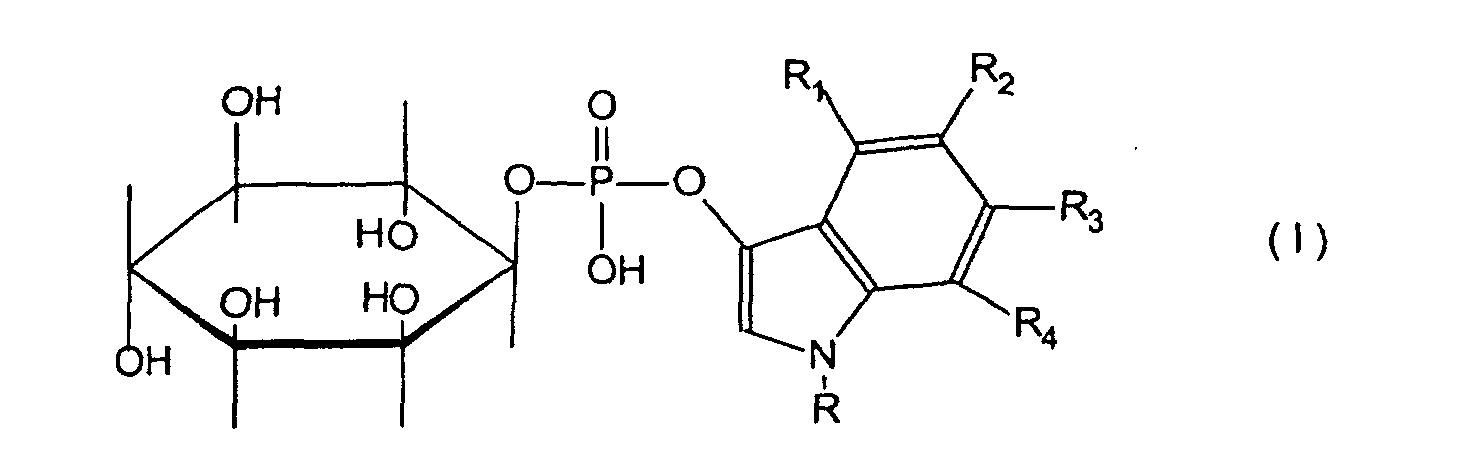
- 3-indoxyl-myoinositol-1-phosphate compounds is used herein to refer to compounds of the formula (I) defined below, and to the salts thereof with organic or inorganic bases, such as ammonia (this term being used interchangeably with ammonium hydroxide, depending upon the presence or absence of water) and other bases of the type mentioned below, having no disadvantageous effect upon the stability of the formula I compounds: wherein R is selected from the group consisting of hydrogen and C 1-4 alkyl, such a methyl, ethyl, propyl or butyl, and R 1 , R 2 , R 3 , and R 4 are selected from the group consisting of hydrogen and chromogenic substituents, such as halogen (e.g.
- R is selected from hydrogen or methyl
- R 1 is selected from the group consisting of hydrogen and halogen (Cl preferred)
- R 2 is selected from the group consisting of hydrogen, halogen (Br preferred) and cyano
- R 3 is selected from the group consisting of hydrogen and halogen (Cl preferred)
- R 4 is hydrogen.
- Preferred salts of formula I compounds are those formed with lithium hydroxide, sodium hydroxide, potassium hydroxide, ammonia, ammonium hydroxide, diethylamine, triethylamine, cyclohexylamine, pyridine, piperidine, piperazine, pyrrolidine, morpholine, N-methylmorpholine, p-toluidine, tetramethylammonium, and tetraethylammonium.
- the most preferred compounds within the scope of formula I above and the salts thereof are those which yield deeply colored (preferably blue) indigo dyes when used as substrates for detecting PI PLC, i.e. upon cleavage by PI-PLC, dimerisation, and subsequent oxidation.
- a few simple tests will indicate those specific compounds of formula I or their salts which are best suited for a specific substrate use. Examples of preferred formula I compounds will be given below.
- the following group of compounds of formula I has been shown to be a particularly suitable group of compounds for the purposes of the present invention and, thus, constitute a preferred group: 5-bromo-4-chloro-3-indoxyl-myo-inositol-1-phosphate, 5-bromo-6-chloro-3-indoxyl-myo-inositol-1-phosphate, 6-chloro-3-indoxyl-myo-inositol-1-phosphate, and 6-fluoro-3-indoxyl-myo-inositol-1-phosphate.
- the salts of the above compounds with an organic or inorganic base such as typically the ammonium salts, represent a preferred group of formula I compounds according to the invention.
- compounds of formula I and the salts thereof as defined above are used as a chromogenic substrate for the detection of phosphatidylinositol-specific phospholipase C (1-phosahatidyl-D-myo-inositol inositolphospho-hydrolase or "PI-PLC").
- PI-PLC phosphatidylinositol-specific phospholipase C
- the method of detecting PI-PLC according to the invention comprises the use of a chromogenic substrate containing at least one compound of formula I or a salt thereof.
- the efficacity of compounds of formula I and the salt thereof as substrates for PI-PLC detection is believed to reside in the fact that cleavage of a substrate according to the invention by bacterial PI-PLC results mainly in the formation of inositol 1,2-cyclic phosphate and 5-bromo-4-chloro-3-i-ndoxyl which - after dimerisation - can subsequently be oxidized by atmospheric oxygen or another oxidant to a deep blue indigo dye suitable for sensitive chromoscopic detection by conventional methods and apparatus.
- the invention provides, inter alia, a method of detecting such pathogens by means of the novel substrate, e.g. by screening for bacterial enzyme production directly on plating media, for example, of clinical samples or cultures isolated from food.
- a preferred specific compound for use according to the invention is the ammonium salt of the compound of formula IV below, i.e. 5-bromo-4-chloro-3-indoxyl myo-inositol-1-phosphate; the ammonium salt of the formula IV compound will be referred to as "X-phos-inositol" herein below):
- Compounds of formula I or their salts can be obtained generally by creating, in a first process step, the corresponding indoxyl-3-dichloro phosphates of formula II given below with a reactive inositol compound, e.g.
- G-Ins-OH a OH-protected inositol having a free hydroxyl group in 1-position
- intermediate compound III is converted into a salt with an organic or inorganic base, such as ammonium hydroxide, before proceeding to the second reaction step: in which A is hydrogen or a conventional N-protecting group, such as C 1-4 alkyl (preferably methyl); acyl (preferably acetyl; or N-protecting groups commonly known as Boc, Fmoc, etc., and G is an OH protecting group on each hydroxyl of inositol except the 1-hydroxy; typical examples for G include optionally substituted benzyl, optionally substituted C 3-6 alkylidene (e.g. isopropylidene, cyclopentylidene or cyclohexylidene); and optionally substituted tetrahydropyranyl.
- A is hydrogen or a conventional N-protecting group, such as C 1-4 alkyl (preferably methyl); acyl (preferably acetyl; or N-protecting groups commonly known as Boc, Fmoc, etc.
- G is an
- all protecting groups G and optional N-protecting group on the formula III intermediate are removed, e.g. by hydrogenolysis or acidic cleavage, depending upon the nature of the OH-protecting groups; if A is an N-protecting group it can be removed by conventional methods of peptide chemistry, e.g. alkaline hydrolysis.
- the preferred novel substrate compound of formula IV i.e. 5-bromo-4-chloro-3-indoxyl myo-inositol-1-phosphate in the form of the ammonium salt of the formula IV, or X-phos-inositol, is a colorless watersoluble substance having an UV-maximum (in Tris/HCl-buffer at pH 7) at 290 nm with an absorption coefficient of 5000 1 mol -1 cm -1 .
- the 5, 5' -dibromo-4,4'-dichloro-indigo generated by the PI-PLC detection method according to the invention i.e.
- PI-PLC dimeritation and subsequent oxidation
- PI-PLC dimeritation and subsequent oxidation
- the indigo dye is intensely coloured with an absorption coefficient near 6000 l mol -1 cm -1 .
- the dye stays dissolved in buffer solutions for at least about 24 hours but tends to precipitate partially upon standing for longer periods.
- X-phos-inositol Based upon tests made with X-phos-inositol it is expected that the novel substrates according to the invention are stable if stored during extended periods at temperatures below about - 15°C and protected from light. Also, X-phos-inositol proved to be stable in conventional buffer solutions (Hepes/NaOH; Tris/HCl) for several days at pH 7 and room temperature. Thus, problems with background signals as was the case with some prior art substrates caused by slow hydrolysis of the substrate in the buffer media, are avoided and, again, similar properties can be expected for other formula I compounds.
- Hepes/NaOH Tris/HCl
- the novel substrate of formula I preferably the salts of the compound of formula IV with an organic or inorganic base, such as ammonia or ammonium hydroxide, is used for a sensitive spectrophotometric assay of PI-PLC from Bacillus cereus; in this embodiment, the substrate is used in combination with serum albumin, e.g. bovine serum albumin(BSA) or, alternatively, with a surfactant.
- serum albumin e.g. bovine serum albumin(BSA) or, alternatively, with a surfactant.
- Substrates using 5-bromo-4-chloro-3-indoxyl as chromophor are suitable for the detection of various enzymes on culture media, e.g. X-Gal for ⁇ -galactosidase or X-glucuronic acid sodium salt for ⁇ -glucuronidase.
- the deep blue 5,5'-dibromo-4,4'-dichloro-indigo dye gives a characteristic, strongly coloured precipitate on plating media which is clearly distinguished from even a yellow background as is encountered frequently. Furthermore the insolubility prevents migration of the dye throughout the plate.
- novel media of formula including the preferred X-phos-inositol will generally improve and facilitate detection of PI-PLC producing colonies of bacteria.
- Step 1 Preparation of the ammonium salt of 1-acetyl-5-bromo-4-chloro-3-indoxyl [2,3:5,6-di-isopropylidene-4-(4-methoxy-tetrahydropyran-4-yl) -myo-inositol)-1-phosphate
- chloroform (30 ml) was added. The solution was then stirred for an additional period of 10 min. The organic phase was separated and the aqueous phase was extracted with chloroform(10 ml).
- Step 2 Preparation of the ammonium salt of 1-acetyl-5-bromo-4-chloro-3-indoxyl myo-inositol-1-phosphate
- Step 3 Preparation of the ammonium salt of 5-bromo-4-chloro-3-indoxyl myo-inositol-1-phosphate X-phos-inositol
- the crude ammonium salt of 1-acetyl-5-bromo-4-chloro-3-indoxyl myo-inositol-1-phosphate(0.55 g,1 mMol) obtained in the preceding step was added to a 2 N solution of gaseous ammonia in methanol (5 ml, aldrich # 34,142-8) and stirred under nitrogen for three hours at ambient temperature. The oil slowly dissolved while the solution gradually turned green.
- PI-PLC The procedure for the detection of PI-PLC was as follows: X-phos-inositol was dissolved in 0.1 M Hepes/NaOH-buffer or Tris/HCl-buffer of pH 7.0 containing 0.1% of bovine serum albumin (BSA).
- BSA bovine serum albumin
- a surfactant such as deoxycholic acid sodium salt, Triton X-100 or octylglucoside was used. In these cases, the rates of cleavage were somewhat smaller (cf. Fig. 5) .
- 3.5 ml of the solution were transferred to a cuvette and the spectrometer was set to 650 nm. After adding an aliquot from a stock solution of PI-PLC (Boehringer Mannheim # 1143 069; specific activity 600 U/mg, 5U/100 ⁇ l solution, corresponding to 8.33 ⁇ g/100 ⁇ l) the photometer readings were noted after defined periods of time for different substrates and enzyme concentrations, respectively.
- PI-PLC Boehringer Mannheim # 1143 069; specific activity 600 U/mg, 5U/100 ⁇ l solution, corresponding to 8.33 ⁇ g/100 ⁇ l
- the absorbance was measured directly by the spectrometer during several hours.
- Figure 1 shows the time dependence of the absorbance at 650 nm for various substrate concentrations.
- the amount of enzyme added was 0.167 ⁇ g (2 ml stock solution), and 0.1% BSA were used as additive. The appearance of the indigo color was retarded.
- the sigmoidal form of the lines indicate a rather complex kinetic. This might from the need to form a complex of the BSA, the enzyme and the substrate. The delay might also be attributed to dimerization and oxidation subsequent to enzymatic cleavage of the substrate.
- Figures 2 and 3 show the change of absorbance as a function of time for different enzyme concentrations at a substrate concentration of 5 mM and addition of BSA.
- the linear areas could be used to determine enzyme concentrations.
- the rates of cleavage [nMol/min] and the specific enzyme activities are as shown in Table 2.
- a plot of the cleavage rates versus amount of enzyme added indicated satisfactory linearity for the higher range of values (addition of 2, 5 and 10 ⁇ l stock solution, and 167, 416 and 833 ng of enzyme, respectively) and a decrease for the lower range of values (0.5 and 1 ⁇ l, or 42 and 83 ng enzyme, respectively).
- Fig. 5 shows a comparison of the enzymatic cleavage of X-phos-inositol using different enhancer additives.
- the invention provides for safe, sensitive and commercially viable detection of potentially pathogenic bacterial activity of such microbes as Bacillus cereus, 3. Thuringiensis, Staphylococcus aureus and various Listeria strains in potentially infected materials including physiological samples or consumable goods such as foods and beverages.
- the scope of the invention is to be construed on the basis of the following claim.
Landscapes
- Chemical & Material Sciences (AREA)
- Organic Chemistry (AREA)
- Life Sciences & Earth Sciences (AREA)
- Health & Medical Sciences (AREA)
- Wood Science & Technology (AREA)
- Engineering & Computer Science (AREA)
- Zoology (AREA)
- Proteomics, Peptides & Aminoacids (AREA)
- General Health & Medical Sciences (AREA)
- Biochemistry (AREA)
- Molecular Biology (AREA)
- Immunology (AREA)
- Biotechnology (AREA)
- Biophysics (AREA)
- Microbiology (AREA)
- Analytical Chemistry (AREA)
- Physics & Mathematics (AREA)
- Bioinformatics & Cheminformatics (AREA)
- General Engineering & Computer Science (AREA)
- Genetics & Genomics (AREA)
- Measuring Or Testing Involving Enzymes Or Micro-Organisms (AREA)
- Cosmetics (AREA)
Claims (20)



Applications Claiming Priority (3)
| Application Number | Priority Date | Filing Date | Title |
|---|---|---|---|
| US3947997P | 1997-02-28 | 1997-02-28 | |
| US39479P | 1997-02-28 | ||
| PCT/EP1998/001091 WO1998038332A1 (en) | 1997-02-28 | 1998-02-26 | Detection of microbial metabolites |
Publications (2)
| Publication Number | Publication Date |
|---|---|
| EP0970239A1 EP0970239A1 (de) | 2000-01-12 |
| EP0970239B1 true EP0970239B1 (de) | 2004-12-08 |
Family
ID=21905693
Family Applications (1)
| Application Number | Title | Priority Date | Filing Date |
|---|---|---|---|
| EP98913597A Expired - Lifetime EP0970239B1 (de) | 1997-02-28 | 1998-02-26 | Nachweis von mikrobiellen metaboliten |
Country Status (8)
| Country | Link |
|---|---|
| US (2) | US6068988A (de) |
| EP (1) | EP0970239B1 (de) |
| JP (1) | JP3558348B2 (de) |
| AT (1) | ATE284450T1 (de) |
| AU (1) | AU730518B2 (de) |
| CA (1) | CA2281709C (de) |
| DE (1) | DE69828035T2 (de) |
| WO (1) | WO1998038332A1 (de) |
Families Citing this family (19)
| Publication number | Priority date | Publication date | Assignee | Title |
|---|---|---|---|---|
| FR2766204B1 (fr) * | 1997-07-15 | 1999-09-03 | Pasteur Sanofi Diagnostics | Milieu de culture permettant la detection des bacteries pathogenes du genre listeria et procede d'identification de ces bacteries |
| EP0949266B1 (de) * | 1998-03-23 | 2003-05-28 | Biosynth AG | Neue potentiell fluorogene Verbindungen |
| US20030096315A1 (en) | 2000-05-03 | 2003-05-22 | Sanders Mitchell C. | Device for detecting bacterial contamination and method of use |
| EP1219628B1 (de) * | 2000-12-27 | 2003-04-02 | Biosynth AG | Neue Substrate zur Detektion von mikrobiellen Metaboliten |
| US6482642B2 (en) | 2001-03-29 | 2002-11-19 | Environmental Biodetection Products.Com | Testing kit and methodology for testing for the presence of microorganisms |
| WO2003063693A2 (en) * | 2002-01-31 | 2003-08-07 | Expressive Constructs, Inc. | Method for detecting microorganisms |
| AU2004225575B2 (en) * | 2003-01-31 | 2008-02-21 | Ethicon, Inc. | Method for detecting escherichia coli |
| CA2557612C (en) | 2003-11-03 | 2014-06-17 | Ethicon, Inc. | Methods, peptides and biosensors useful for detecting a broad spectrum of bacteria |
| DE602005011031D1 (en) * | 2004-09-17 | 2008-12-24 | Idenix Pharmaceuticals Inc | Phosphoindole als hiv-inhibitoren |
| US20070259393A1 (en) * | 2006-05-02 | 2007-11-08 | Lawrence Restaino | Plating media for the presumptive identification of Listeria sp, Listeria monocytogenes and Listeria ivanovii |
| ES2488922T3 (es) | 2006-09-29 | 2014-09-01 | Idenix Pharmaceuticals, Inc. | Fosfoindoles enantiómeramente puros como inhibidores del HIV |
| CN101918583A (zh) * | 2007-10-19 | 2010-12-15 | 查尔斯斯塔克德雷珀实验室公司 | 用于鉴定样品中细菌的挥发性有机化合物的快速检测 |
| EP2209906A2 (de) * | 2007-11-05 | 2010-07-28 | Life Technologies Corporation | Neue plattierungsmedien |
| WO2010126856A1 (en) * | 2009-04-27 | 2010-11-04 | The Charles Stark Draper Laboratory, Inc. | Rapid detection of volatile organic compounds for identification of mycobacterium tuberculosis in a sample |
| JP5757549B2 (ja) * | 2009-10-16 | 2015-07-29 | 栄研化学株式会社 | 卵黄液による発色反応および/または蛍光発色反応増強作用 |
| EP2479221A1 (de) * | 2010-11-04 | 2012-07-25 | Biosynth AG | Neuartige Anwendungen von Indoloindol und Indolochinolinfarbstoffen |
| CA2823518A1 (en) | 2010-12-30 | 2012-07-05 | 3M Innovative Properties Company | Articles and method for detecting a target microorganism |
| WO2012125781A2 (en) * | 2011-03-15 | 2012-09-20 | Colorado State University Research Foundation | Rapid detection of pathogens using paper devices |
| JP2015126756A (ja) * | 2015-04-10 | 2015-07-09 | 栄研化学株式会社 | 卵黄液による発色反応および/または蛍光発色反応増強作用 |
Family Cites Families (2)
| Publication number | Priority date | Publication date | Assignee | Title |
|---|---|---|---|---|
| US5364767A (en) * | 1993-02-11 | 1994-11-15 | Research Organics, In. | Chromogenic compounds and methods of using same |
| FR2766204B1 (fr) * | 1997-07-15 | 1999-09-03 | Pasteur Sanofi Diagnostics | Milieu de culture permettant la detection des bacteries pathogenes du genre listeria et procede d'identification de ces bacteries |
-
1997
- 1997-12-10 US US08/988,540 patent/US6068988A/en not_active Expired - Lifetime
-
1998
- 1998-02-26 DE DE69828035T patent/DE69828035T2/de not_active Expired - Lifetime
- 1998-02-26 WO PCT/EP1998/001091 patent/WO1998038332A1/en not_active Ceased
- 1998-02-26 EP EP98913597A patent/EP0970239B1/de not_active Expired - Lifetime
- 1998-02-26 JP JP53731498A patent/JP3558348B2/ja not_active Expired - Lifetime
- 1998-02-26 AT AT98913597T patent/ATE284450T1/de not_active IP Right Cessation
- 1998-02-26 AU AU68241/98A patent/AU730518B2/en not_active Ceased
- 1998-02-26 CA CA002281709A patent/CA2281709C/en not_active Expired - Fee Related
-
1999
- 1999-08-11 US US09/372,101 patent/US6051391A/en not_active Expired - Lifetime
Also Published As
| Publication number | Publication date |
|---|---|
| CA2281709C (en) | 2004-01-06 |
| CA2281709A1 (en) | 1998-09-03 |
| JP3558348B2 (ja) | 2004-08-25 |
| US6068988A (en) | 2000-05-30 |
| US6051391A (en) | 2000-04-18 |
| DE69828035D1 (de) | 2005-01-13 |
| WO1998038332A1 (en) | 1998-09-03 |
| DE69828035T2 (de) | 2005-11-24 |
| AU6824198A (en) | 1998-09-18 |
| JP2001509680A (ja) | 2001-07-24 |
| ATE284450T1 (de) | 2004-12-15 |
| EP0970239A1 (de) | 2000-01-12 |
| AU730518B2 (en) | 2001-03-08 |
Similar Documents
| Publication | Publication Date | Title |
|---|---|---|
| US6051391A (en) | Detection of microbial metabolites | |
| JP3413144B2 (ja) | 蛍光性ベンゾチアゾール誘導体の製法及び用途 | |
| FI63064B (fi) | Foerfarande foer fluorometrisk bestaemning av aktiviteten av fettspjaelkande enzymer och medel foer att genomfoera foerfarandet | |
| US4716222A (en) | Substrates for hydrolases | |
| EP1219628B1 (de) | Neue Substrate zur Detektion von mikrobiellen Metaboliten | |
| US5091527A (en) | Substrate for phospholipase | |
| US5035998A (en) | Hydrolase substrates | |
| JPH0687800B2 (ja) | リパ−ゼ基質、及びリパ−ゼの視覚的測定法及び測定試薬 | |
| US4820632A (en) | Agent and process for the detection of redox systems | |
| US4758508A (en) | Analytical process and agents for the detection of esterolytic and/or proteolytic enzymes | |
| US20030032080A1 (en) | Novel potentially fluorogenic compounds and plating media containing same | |
| Wang et al. | Fluorescein monophosphates as fluorogenic substrates for protein tyrosine phosphatases | |
| US4777269A (en) | 7-Phenylacetic acid-4-alkyl-coumarinyl amides useful in fluorometric determination of the activity of hydrolases | |
| JP3581958B2 (ja) | 新規な潜在的蛍光原性化合物 | |
| GB2134524A (en) | Fluorogenic esters of phosphoric acid | |
| EP1054933B1 (de) | Chemielumineszierende reaktionen unter verwendung von dihydroxylierten aromaten und heterocyclischen enolphosphaten | |
| Zandonella et al. | Enantiomeric perylene‐glycerolipids as fluorogenic substrates for a dual wavelength assay of lipase activity and stereoselectivity | |
| EP0292169A2 (de) | Substrate für beta-Galactosidase | |
| US6448422B1 (en) | Chromogenic compound | |
| EP1790734A1 (de) | Mikrobielles Verfahren | |
| US20090098589A1 (en) | Method | |
| WO2002002570A1 (en) | Chromogenic compound |
Legal Events
| Date | Code | Title | Description |
|---|---|---|---|
| PUAI | Public reference made under article 153(3) epc to a published international application that has entered the european phase |
Free format text: ORIGINAL CODE: 0009012 |
|
| AK | Designated contracting states |
Kind code of ref document: A1 Designated state(s): AT BE CH DE DK ES FI FR GB IT LI LU NL PT SE |
|
| 17P | Request for examination filed |
Effective date: 19991203 |
|
| RIN1 | Information on inventor provided before grant (corrected) |
Inventor name: HUMM, ROLAND Inventor name: SPITZ, URS, P. Inventor name: SCHABERT, GUENTER |
|
| GRAP | Despatch of communication of intention to grant a patent |
Free format text: ORIGINAL CODE: EPIDOSNIGR1 |
|
| GRAS | Grant fee paid |
Free format text: ORIGINAL CODE: EPIDOSNIGR3 |
|
| GRAA | (expected) grant |
Free format text: ORIGINAL CODE: 0009210 |
|
| AK | Designated contracting states |
Kind code of ref document: B1 Designated state(s): AT BE CH DE DK ES FI FR GB IT LI LU NL PT SE |
|
| PG25 | Lapsed in a contracting state [announced via postgrant information from national office to epo] |
Ref country code: FI Free format text: LAPSE BECAUSE OF FAILURE TO SUBMIT A TRANSLATION OF THE DESCRIPTION OR TO PAY THE FEE WITHIN THE PRESCRIBED TIME-LIMIT Effective date: 20041208 |
|
| REG | Reference to a national code |
Ref country code: GB Ref legal event code: FG4D |
|
| REG | Reference to a national code |
Ref country code: CH Ref legal event code: EP |
|
| REG | Reference to a national code |
Ref country code: CH Ref legal event code: NV Representative=s name: RITSCHER & PARTNER AG |
|
| REF | Corresponds to: |
Ref document number: 69828035 Country of ref document: DE Date of ref document: 20050113 Kind code of ref document: P |
|
| PG25 | Lapsed in a contracting state [announced via postgrant information from national office to epo] |
Ref country code: LU Free format text: LAPSE BECAUSE OF NON-PAYMENT OF DUE FEES Effective date: 20050226 |
|
| PG25 | Lapsed in a contracting state [announced via postgrant information from national office to epo] |
Ref country code: SE Free format text: LAPSE BECAUSE OF FAILURE TO SUBMIT A TRANSLATION OF THE DESCRIPTION OR TO PAY THE FEE WITHIN THE PRESCRIBED TIME-LIMIT Effective date: 20050308 Ref country code: DK Free format text: LAPSE BECAUSE OF FAILURE TO SUBMIT A TRANSLATION OF THE DESCRIPTION OR TO PAY THE FEE WITHIN THE PRESCRIBED TIME-LIMIT Effective date: 20050308 |
|
| PG25 | Lapsed in a contracting state [announced via postgrant information from national office to epo] |
Ref country code: ES Free format text: LAPSE BECAUSE OF FAILURE TO SUBMIT A TRANSLATION OF THE DESCRIPTION OR TO PAY THE FEE WITHIN THE PRESCRIBED TIME-LIMIT Effective date: 20050319 |
|
| PLBE | No opposition filed within time limit |
Free format text: ORIGINAL CODE: 0009261 |
|
| STAA | Information on the status of an ep patent application or granted ep patent |
Free format text: STATUS: NO OPPOSITION FILED WITHIN TIME LIMIT |
|
| 26N | No opposition filed |
Effective date: 20050909 |
|
| ET | Fr: translation filed | ||
| PGFP | Annual fee paid to national office [announced via postgrant information from national office to epo] |
Ref country code: NL Payment date: 20070204 Year of fee payment: 10 |
|
| PGFP | Annual fee paid to national office [announced via postgrant information from national office to epo] |
Ref country code: CH Payment date: 20070221 Year of fee payment: 10 Ref country code: AT Payment date: 20070221 Year of fee payment: 10 |
|
| PG25 | Lapsed in a contracting state [announced via postgrant information from national office to epo] |
Ref country code: PT Free format text: LAPSE BECAUSE OF NON-PAYMENT OF DUE FEES Effective date: 20050508 |
|
| PGFP | Annual fee paid to national office [announced via postgrant information from national office to epo] |
Ref country code: BE Payment date: 20070417 Year of fee payment: 10 |
|
| REG | Reference to a national code |
Ref country code: CH Ref legal event code: NV Representative=s name: SCHMAUDER & PARTNER AG PATENTANWALTSBUERO |
|
| BERE | Be: lapsed |
Owner name: *BIOSYNTH A.G. Effective date: 20080228 |
|
| REG | Reference to a national code |
Ref country code: CH Ref legal event code: PL |
|
| PG25 | Lapsed in a contracting state [announced via postgrant information from national office to epo] |
Ref country code: LI Free format text: LAPSE BECAUSE OF NON-PAYMENT OF DUE FEES Effective date: 20080229 Ref country code: CH Free format text: LAPSE BECAUSE OF NON-PAYMENT OF DUE FEES Effective date: 20080229 |
|
| NLV4 | Nl: lapsed or anulled due to non-payment of the annual fee |
Effective date: 20080901 |
|
| PG25 | Lapsed in a contracting state [announced via postgrant information from national office to epo] |
Ref country code: NL Free format text: LAPSE BECAUSE OF NON-PAYMENT OF DUE FEES Effective date: 20080901 Ref country code: AT Free format text: LAPSE BECAUSE OF NON-PAYMENT OF DUE FEES Effective date: 20080226 |
|
| PG25 | Lapsed in a contracting state [announced via postgrant information from national office to epo] |
Ref country code: BE Free format text: LAPSE BECAUSE OF NON-PAYMENT OF DUE FEES Effective date: 20080228 |
|
| PGFP | Annual fee paid to national office [announced via postgrant information from national office to epo] |
Ref country code: IT Payment date: 20120227 Year of fee payment: 15 |
|
| REG | Reference to a national code |
Ref country code: FR Ref legal event code: PLFP Year of fee payment: 19 |
|
| PG25 | Lapsed in a contracting state [announced via postgrant information from national office to epo] |
Ref country code: IT Free format text: LAPSE BECAUSE OF NON-PAYMENT OF DUE FEES Effective date: 20140226 |
|
| REG | Reference to a national code |
Ref country code: FR Ref legal event code: PLFP Year of fee payment: 20 |
|
| PGFP | Annual fee paid to national office [announced via postgrant information from national office to epo] |
Ref country code: DE Payment date: 20170217 Year of fee payment: 20 Ref country code: FR Payment date: 20170217 Year of fee payment: 20 |
|
| PGFP | Annual fee paid to national office [announced via postgrant information from national office to epo] |
Ref country code: GB Payment date: 20170216 Year of fee payment: 20 |
|
| REG | Reference to a national code |
Ref country code: DE Ref legal event code: R071 Ref document number: 69828035 Country of ref document: DE |
|
| REG | Reference to a national code |
Ref country code: GB Ref legal event code: PE20 Expiry date: 20180225 |
|
| PG25 | Lapsed in a contracting state [announced via postgrant information from national office to epo] |
Ref country code: GB Free format text: LAPSE BECAUSE OF EXPIRATION OF PROTECTION Effective date: 20180225 |