EP0969643A2 - Sprachnachrichtensystem mit Rückrufmöglichkeit ohne Trennung der Fernsprechleitung - Google Patents
Sprachnachrichtensystem mit Rückrufmöglichkeit ohne Trennung der Fernsprechleitung Download PDFInfo
- Publication number
- EP0969643A2 EP0969643A2 EP99304908A EP99304908A EP0969643A2 EP 0969643 A2 EP0969643 A2 EP 0969643A2 EP 99304908 A EP99304908 A EP 99304908A EP 99304908 A EP99304908 A EP 99304908A EP 0969643 A2 EP0969643 A2 EP 0969643A2
- Authority
- EP
- European Patent Office
- Prior art keywords
- voice messaging
- messaging system
- call
- telephone
- voice
- Prior art date
- Legal status (The legal status is an assumption and is not a legal conclusion. Google has not performed a legal analysis and makes no representation as to the accuracy of the status listed.)
- Withdrawn
Links
Images


Classifications
-
- H—ELECTRICITY
- H04—ELECTRIC COMMUNICATION TECHNIQUE
- H04M—TELEPHONIC COMMUNICATION
- H04M1/00—Substation equipment, e.g. for use by subscribers
- H04M1/64—Automatic arrangements for answering calls; Automatic arrangements for recording messages for absent subscribers; Arrangements for recording conversations
- H04M1/65—Recording arrangements for recording a message from the calling party
- H04M1/658—Means for redirecting recorded messages to other extensions or equipment
-
- H—ELECTRICITY
- H04—ELECTRIC COMMUNICATION TECHNIQUE
- H04M—TELEPHONIC COMMUNICATION
- H04M1/00—Substation equipment, e.g. for use by subscribers
- H04M1/64—Automatic arrangements for answering calls; Automatic arrangements for recording messages for absent subscribers; Arrangements for recording conversations
- H04M1/65—Recording arrangements for recording a message from the calling party
- H04M1/652—Means for playing back the recorded messages by remote control over a telephone line
-
- H—ELECTRICITY
- H04—ELECTRIC COMMUNICATION TECHNIQUE
- H04M—TELEPHONIC COMMUNICATION
- H04M3/00—Automatic or semi-automatic exchanges
- H04M3/42—Systems providing special services or facilities to subscribers
- H04M3/50—Centralised arrangements for answering calls; Centralised arrangements for recording messages for absent or busy subscribers ; Centralised arrangements for recording messages
- H04M3/53—Centralised arrangements for recording incoming messages, i.e. mailbox systems
- H04M3/533—Voice mail systems
-
- H—ELECTRICITY
- H04—ELECTRIC COMMUNICATION TECHNIQUE
- H04M—TELEPHONIC COMMUNICATION
- H04M2242/00—Special services or facilities
- H04M2242/22—Automatic class or number identification arrangements
-
- H—ELECTRICITY
- H04—ELECTRIC COMMUNICATION TECHNIQUE
- H04M—TELEPHONIC COMMUNICATION
- H04M3/00—Automatic or semi-automatic exchanges
- H04M3/42—Systems providing special services or facilities to subscribers
- H04M3/42025—Calling or Called party identification service
- H04M3/42034—Calling party identification service
- H04M3/42042—Notifying the called party of information on the calling party
-
- H—ELECTRICITY
- H04—ELECTRIC COMMUNICATION TECHNIQUE
- H04M—TELEPHONIC COMMUNICATION
- H04M3/00—Automatic or semi-automatic exchanges
- H04M3/42—Systems providing special services or facilities to subscribers
- H04M3/428—Arrangements for placing incoming calls on hold
-
- H—ELECTRICITY
- H04—ELECTRIC COMMUNICATION TECHNIQUE
- H04M—TELEPHONIC COMMUNICATION
- H04M3/00—Automatic or semi-automatic exchanges
- H04M3/42—Systems providing special services or facilities to subscribers
- H04M3/48—Arrangements for recalling a calling subscriber when the wanted subscriber ceases to be busy
-
- H—ELECTRICITY
- H04—ELECTRIC COMMUNICATION TECHNIQUE
- H04Q—SELECTING
- H04Q3/00—Selecting arrangements
- H04Q3/72—Finding out and indicating number of calling subscriber
Definitions
- This invention relates generally to voice messaging systems. More particularly, it relates to a telephone answering device capable of allowing a user to remotely retrieve voice messages and call back a person who left a message without disconnecting from the remote telephone line.
- Voice messaging systems in general, and telephone answering devices are useful devices for the home or office.
- a conventional telephone answering device operates on a single telephone line and answers an incoming call to an unused (i.e., on-hook) telephone after a desired number of rings.
- the telephone answering device causes the telephone line to enter an off-hook condition, then plays an outgoing greeting message to the caller. After the outgoing message, the caller may leave a voice message on the telephone answering device. At a later time, the voice message is replayed by the user, either local to the telephone answering device or via remote connection from another telephone.
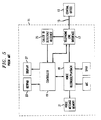
- Fig. 5 illustrates a conventional telephone answering device capable of answering an incoming call on a telephone line.
- a telephone answering device 11 is connected to a telephone company central office 13 via a telephone line 15 .
- a telephone line interface (TLI) 17 in the telephone answering device 11 provides the conventional isolation, DC and AC impedance as required by telephone company standards.
- the telephone line interface 17 also provides a ring detect signal to a controller 19 .
- Controller 19 may be any suitable processor, e.g., microprocessor, microcontroller, or digital signal processor (DSP).
- DSP digital signal processor
- the telephone answering device 11 After a desired number of ring signals, the telephone answering device 11 causes the telephone line interface 17 to place the telephone line in an off-hook state, and instructs a voice recorder/playback audio module 18 to play an outgoing greeting message over the telephone line 15 to the caller. Upon completion of the outgoing greeting message, the caller may leave a voice message in voice memory 21 under the control of controller 19 .
- a keypad 23 allows the user to select various modes of operation, including the playback of voice messages.
- the conventional telephone answering device 11 illustrated in Fig. 5 includes a Calling Identity Delivery (Caller ID) detector/receiver 25 to detect and receive call related information, e.g., the telephone number and/or household name of a calling party.
- Call related information e.g., the telephone number and/or household name of a calling party.
- the call related information is displayed on display 27 .
- the user of the conventional telephone answering device 11 can determine the name and telephone number of the caller leaving the voice message.
- Basic call information such as Caller ID information is transmitted from the local telephone company to the called party while the called party's phone is in a hung-up or on-hook state, e.g., between the first and second rings.
- a remote user of a voice messaging system such as a telephone answering device may want to return a call to a caller who left a voice message.
- the remote user may need to return the telephone calls but may not have sufficient funds or change to complete the task.
- the telephone answering device's location is a toll call from the user's remote location, the user will be required to make multiple toll calls to return his/her messages thereby spending additional money.
- persons may leave a message without leaving a telephone number in the voice message.
- the call related information e.g., Caller ID information
- the call related information may be the only information useful for calling the caller back, but is displayed at the telephone answering device itself.
- a controlling system for a voice messaging system comprises a controller.
- a calling module controlled by the controller, is adapted to initiate a telephone call back to a caller to the voice messaging system.
- the controlling system also includes a DTMF generator.
- the calling module causes the controller to initiate an outgoing call, with a telephone number of the outgoing call relating to a party who called the voice messaging system.
- a telephone answering device comprises a controller and a voice recorder/playback module.
- a calling module is also included which is activated by a remote user to call back a caller.
- the calling module causes the controller to initiate a telephone call between the remote user and the caller.
- a method for remotely calling back callers to a voice messaging system in accordance with the principles of the present invention comprises allowing a user remote access via a telephone line to stored voice messages in a voice messaging system.
- the remote user is placed on hold.
- a call on the telephone line from the voice messaging system is initiated to a previous caller to the voice messaging system, while the remote user remains on hold.
- a communication path between the remote user and the caller is established.
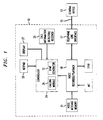
- Fig. 1 illustrates a telephone answering device for allowing a user to remotely retrieve voice messages and return one or more calls to callers, without having to disconnect from a telephone line, in accordance with the principles of the present invention.
- Fig. 2 illustrates another embodiment of a telephone answering device for allowing a user to remotely retrieve voice messages and return one or more calls to callers without having to disconnect from a telephone line, in accordance with the principles of the present invention.
- Fig. 3 illustrates yet another embodiment of a telephone answering device for allowing a user to remotely retrieve voice messages and return one or more calls to callers without having to disconnect from a telephone line, in accordance with the principles of the present invention.
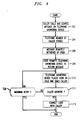
- Fig. 4 is a flow chart illustrating the process by which the telephone answering device of FIGS. 1 - 3 constructed in accordance with the present invention records a caller's voice message, allows a user to remotely retrieve the voice message, and return a call to any caller without having to disconnect from the telephone line.
- Fig. 5 illustrates a conventional telephone answering device operating on a single telephone line.
- the present invention provides a voice messaging system, and method for recording a voice message of a caller, which allows a user to remotely retrieve a voice message and return a call to the caller who left the voice message, without having to disconnect from the telephone line.
- call related information with respect to a caller is detected and received in a call information detector/receiver.
- a telephone answering device in accordance with the principles of the present invention automatically answers the call by placing the telephone line in an off-hook condition and initiating a standard outgoing greeting message. Thereafter, the caller can leave a voice message on the telephone answering device, which is stored in voice message memory via a voice recorder/ playback module.
- the telephone answering device can be prompted to connect the remote user with the third party caller without disconnecting the remote user from the telephone line.
- a voice messaging system in accordance with the principles of the present invention increases the user's convenience, increases productivity by not requiring the remote user to hang up and separately call back each caller to his/her voice messaging system, and decreases costs by calling the third party caller from a home or office location.
- Fig. 1 illustrates a telephone answering device, indicated generally at 10 , capable of recording a voice message of a caller, allowing a user to remotely retrieve the voice message, and allowing the user to return a call to the caller leaving the voice message, without having to disconnect from the initial telephone call, in accordance with the principles of the present invention.
- the telephone answering device 10 includes at least one telephone line interface 17 for interconnection with a central office 13 via a telephone line 15 .
- the telephone line interface 17 interconnects the telephone line 15 with a voice recorder/playback module 18 .
- the telephone line interface 17 preferably interconnects the telephone line 15 with a call information detector/ receiver 25 (e.g., for detecting and receiving the available Caller ID information).
- the call information detector/receiver 25 detects and receives available call related information regarding a caller to the user of the telephone line 15 .
- the telephone answering device 10 of the present invention further includes a dual tone, multiple frequency (DTMF) generator 22 implemented within a controller 24 .
- the controller 24 may be any suitable processor, e.g., microprocessor, microcontroller, or digital signal processor (DSP).
- DSP digital signal processor
- the DTMF generator 22 provides touch tone signals for use by the telephone answering device 10 to dial out on the telephone line 15 when prompted by the remote user of the telephone answering device 10 , e.g., after the retrieval of the voice messages.
- the telephone answering device 10 of Fig. 1 further includes a calling module 26 which can return a call to a past caller without requiring a remote user to disconnect from the telephone line 15 .
- the central office 13 may include conventional three way conference calling services.
- the calling module 26 of the telephone answering device 10 flashes the telephone line 15 to put the remote user on hold, and allows a dial tone from the central office 13 to be presented to the telephone answering device 10 .
- the telephone answering device 10 then dials out, using call related information if available, e.g., Caller ID information.
- the controller 24 may provide pre-stored voice prompt information requesting a telephone number be input by the remote user.
- the voice recorder/playback module 18 may audibly request that a telephone number be input using a DTMF keypad.
- the controller 24 would include a DTMF decoder to decode the digits of the telephone number as they are input by the remote user.
- the telephone answering device 10 then establishes a telephone call between the telephone answering device 10 and the third party, and again flashes the telephone line 15 to indicate to the central office 15 to conference together the incoming telephone call from the remote user with the outgoing telephone call to the third party, and to present the same to the remote user as a single telephone call.
- a three way call is established between the remote user, the telephone answering device 10 , and the third party.
- the calling module 26 is preferably a software module included within the program code of the controller 24 .
- the calling module 26 can be implemented separate from the controller 24 , but regardless, will preferably be in communication with the controller 24 .
- Fig. 2 shows an alternative embodiment of the telephone answering device 10 .
- Fig. 2 shows a DTMF generator 22 which is separate from the controller 24 .
- the DTMF generator 22 is controlled by the controller 24 .
- Fig. 3 shows yet another embodiment of a telephone answering device 10 in accordance with the principles of the present invention.
- Fig. 3 shows that rather than having the three way conference calling services utilizing one telephone line 15 as in Figs. 1 and 2, the remote user can instead utilize at least two telephone lines 15, 28 and a telephone answering device 10 having two telephone line interfaces 17a, 17b for receiving the multiple telephone lines 15, 28 .
- the telephone answering device 10 still records the incoming voice message of a caller in the manner described above.
- the user remotely retrieves his/her voice messages from the telephone answering device 10 on one telephone line, e.g., on the first telephone line 15 .
- the telephone answering device 10 upon directive from a remote user, then establishes a call on the second telephone line 28 back to the caller who left a particular voice message.
- the remote user may designate the particular voice message to return a call to by, e.g., inputting a particular predetermined code when prompted by the telephone answering device 10 .
- the telephone answering device 10 Upon establishment of the call from the telephone answering device 10 to the third party on the second telephone line 28 , the telephone answering device 10 establishes a voice communication path between the first telephone line 15 and the second telephone line 28 . In this way, the remote user can return a message or speak directly with the caller leaving the voice message without having to be disconnected from the first telephone line 15 .
- the number of telephone lines actually accessible through the telephone answering device 10 for conference calling by the user is limited only by the number of connections available to the telephone answering device 10 .
- Fig. 4 illustrates a flow chart showing the process by which the telephone answering devices 10 of FIGS. 1 and 2 allow a remote user to return a call to a person leaving a voice message wherein the telephone answering device 10 maintains connection to the telephone line 15 after retrieval of the voice message by the remote user.
- step 202 the caller attempts to call the user at the telephone number of the telephone line 15 .
- the telephone answering device 10 Upon a predetermined number of rings, the telephone answering device 10 answers and plays an outgoing greeting message such as "l'm not available right now, please leave a message" or other similar greeting.
- the telephone answering device 10 further generally allows the caller to record an incoming voice message of a predetermined or indeterminate length.
- the telephone answering device 10 stores the voice message in voice message memory 21 until the user, either local or remote, retrieves and deletes the voice message from the telephone answering device 10 .
- the call related information e.g., the telephone number with respect to the voice message, is indicated to the user via a display 27 and stored in memory accessible by the controller 24 , as indicated in step 204 .
- step 206 the user remotely retrieves, e.g., from a location remote from the telephone answering device 10 , the voice message left by the caller on the telephone answering device 10 .
- step 208 upon retrieving the incoming message from the telephone answering device 10 , the remote user of the telephone answering device can prompt the telephone answering device 10 to flash the telephone line 15 , thus placing the remote user on hold.
- step 210 the DTMF generator 22 provides touch tone signals for use by the telephone answering device 10 to dial out on the telephone line 15 , to return a call to the person leaving the voice message.
- step 212 the telephone answering device 10 determines if the third party caller has answered the call from the telephone answering device 10 dialed on the telephone line 15 . If not, step 210 is repeated until the caller answers.
- a time-out or maximum retry limit may be tested in step 214 to exit the calling module 26 , e.g., after a predetermined number of unsuccessful callback tries.
- the user may set the predetermined number of unsuccessful callback tries before timeout, or may rely on a factory default setting, e.g., of two.
- the telephone answering device 10 again flashes the telephone line 15 and causes the central office 13 to connect the remote user to the third party caller.
- the telephone answering device 10 may again flash the telephone line 15 before the called-back caller answers his/her telephone.
Landscapes
- Engineering & Computer Science (AREA)
- Signal Processing (AREA)
- Telephonic Communication Services (AREA)
- Telephone Function (AREA)
Applications Claiming Priority (2)
| Application Number | Priority Date | Filing Date | Title |
|---|---|---|---|
| US109098 | 1998-07-02 | ||
| US09/109,098 US6393108B1 (en) | 1998-07-02 | 1998-07-02 | Voice messaging system which allows a remote user to return a call without disconnecting from a telephone line |
Publications (2)
| Publication Number | Publication Date |
|---|---|
| EP0969643A2 true EP0969643A2 (de) | 2000-01-05 |
| EP0969643A3 EP0969643A3 (de) | 2003-09-03 |
Family
ID=22325758
Family Applications (1)
| Application Number | Title | Priority Date | Filing Date |
|---|---|---|---|
| EP99304908A Withdrawn EP0969643A3 (de) | 1998-07-02 | 1999-06-23 | Sprachnachrichtensystem mit Rückrufmöglichkeit ohne Trennung der Fernsprechleitung |
Country Status (4)
| Country | Link |
|---|---|
| US (1) | US6393108B1 (de) |
| EP (1) | EP0969643A3 (de) |
| JP (1) | JP2000101710A (de) |
| CA (1) | CA2272236C (de) |
Cited By (2)
| Publication number | Priority date | Publication date | Assignee | Title |
|---|---|---|---|---|
| WO2001047228A1 (en) * | 1999-12-20 | 2001-06-28 | Nokia Corporation | An implementation of call drop-back in a telecommunication network |
| EP1215871A1 (de) * | 2000-12-14 | 2002-06-19 | Hewlett-Packard Company, A Delaware Corporation | Automatischer Rückruf in einem Nachrichtensystem |
Families Citing this family (13)
| Publication number | Priority date | Publication date | Assignee | Title |
|---|---|---|---|---|
| US6456709B1 (en) * | 1997-03-13 | 2002-09-24 | Metro One Telecommunications, Inc. | Method and apparatus for monitoring telephonic members and providing directory assistance |
| US20020136367A1 (en) * | 1997-03-13 | 2002-09-26 | Elsey Nicholas J. | Technique for facilitating communications with a party after initial unsuccessful communications therewith |
| US6567507B1 (en) * | 1998-05-26 | 2003-05-20 | Siemens Information & Communication Networks, Inc. | System and method for automated return to messaging mailbox |
| US6909780B1 (en) * | 1999-01-13 | 2005-06-21 | Altigen Communications, Inc. | Voice mail call out method and apparatus |
| US6721399B2 (en) * | 2000-12-15 | 2004-04-13 | Siemens Information & Communication Networks, Inc. | Apparatus and systems for utilizing caller ID data to automate return call processing |
| US7391857B2 (en) * | 2000-12-15 | 2008-06-24 | Siemens Communications, Inc. | Methods and apparatus for forwarding caller ID data from a call answering device utilizing a call control system |
| US20020191226A1 (en) * | 2001-06-15 | 2002-12-19 | Chen-Peng Huang | Call screening device for a facsimile machine |
| US6879675B2 (en) * | 2002-05-15 | 2005-04-12 | Thomson Licensing S.A. | Toll saving call feature from a remote site to initiate a call through a CPE that supports 3 way calling |
| US7145998B1 (en) * | 2002-07-29 | 2006-12-05 | Bellsouth Intellectual Property Corporation | Systems, methods, and devices for a callback/callback reminder feature |
| US6987961B1 (en) * | 2004-06-28 | 2006-01-17 | Neomagic Corp. | Ethernet emulation using a shared mailbox between two processors in a feature phone |
| US8501581B2 (en) * | 2006-03-29 | 2013-08-06 | Micron Technology, Inc. | Methods of forming semiconductor constructions |
| JP2008085901A (ja) * | 2006-09-28 | 2008-04-10 | Toshiba Corp | 電話交換システム及びこの電話交換システムで使用されるサービス提供方法 |
| US8605870B2 (en) * | 2008-08-08 | 2013-12-10 | Movius Interactive Corp. | Virtual subscriber service |
Family Cites Families (16)
| Publication number | Priority date | Publication date | Assignee | Title |
|---|---|---|---|---|
| US4893335A (en) * | 1984-09-14 | 1990-01-09 | Fuller Research And Development Company | Remote access telephone control system |
| US4930152A (en) * | 1988-08-31 | 1990-05-29 | Bell Communications Research, Inc. | Call return telephone service |
| US4873719A (en) * | 1988-11-18 | 1989-10-10 | Morris Reese | Enhanced calling number delivery service system |
| US5062133A (en) * | 1989-07-07 | 1991-10-29 | Logotronix Incorporated | Multi-function telephone call management system |
| US5390236A (en) * | 1992-03-31 | 1995-02-14 | Klausner Patent Technologies | Telephone answering device linking displayed data with recorded audio message |
| BR9306961A (pt) * | 1992-08-26 | 1999-01-12 | Bellsouth Corp | Sistema de comunicações de número pessoal |
| WO1994027394A1 (en) * | 1993-05-17 | 1994-11-24 | Bogen Communications, Inc. | Telephone answering and voice messaging machine |
| US5425091A (en) * | 1994-02-28 | 1995-06-13 | U S West Technologies, Inc. | Method and system for providing an automatic customer callback service |
| US5764731A (en) * | 1994-10-13 | 1998-06-09 | Yablon; Jay R. | Enhanced system for transferring, storing and using signaling information in a switched telephone network |
| JP2780666B2 (ja) * | 1995-04-21 | 1998-07-30 | 日本電気株式会社 | コールバック機能付き音声メール方式 |
| KR0155635B1 (ko) * | 1995-05-25 | 1998-11-16 | 김광호 | 3인통화 서비스가 가입된 자동 응답 전화기에서 착신신호를 외출지로 자동연결하는 방법 |
| US5761271A (en) * | 1996-01-18 | 1998-06-02 | Casio Phonemate, Inc. | Telephone answering device with improved pager access feature |
| US6067349A (en) * | 1997-12-31 | 2000-05-23 | Estech Systems, Inc. | Dialing using caller ID |
| US5974117A (en) * | 1997-07-15 | 1999-10-26 | Mahvi; A. Pascal | Telecommunication system |
| US6330079B1 (en) * | 1997-09-08 | 2001-12-11 | Mci Communications Corporation | Integrated voicemail and faxmail platform for a communications system |
| US6195418B1 (en) * | 1997-12-31 | 2001-02-27 | Alcatel Usa, Inc. | Telephone system having a callback capability and method for connecting a recipient of a message to a caller |
-
1998
- 1998-07-02 US US09/109,098 patent/US6393108B1/en not_active Expired - Lifetime
-
1999
- 1999-05-18 CA CA002272236A patent/CA2272236C/en not_active Expired - Fee Related
- 1999-06-23 EP EP99304908A patent/EP0969643A3/de not_active Withdrawn
- 1999-06-28 JP JP11182353A patent/JP2000101710A/ja active Pending
Cited By (2)
| Publication number | Priority date | Publication date | Assignee | Title |
|---|---|---|---|---|
| WO2001047228A1 (en) * | 1999-12-20 | 2001-06-28 | Nokia Corporation | An implementation of call drop-back in a telecommunication network |
| EP1215871A1 (de) * | 2000-12-14 | 2002-06-19 | Hewlett-Packard Company, A Delaware Corporation | Automatischer Rückruf in einem Nachrichtensystem |
Also Published As
| Publication number | Publication date |
|---|---|
| EP0969643A3 (de) | 2003-09-03 |
| CA2272236C (en) | 2002-12-10 |
| JP2000101710A (ja) | 2000-04-07 |
| CA2272236A1 (en) | 2000-01-02 |
| US6393108B1 (en) | 2002-05-21 |
Similar Documents
| Publication | Publication Date | Title |
|---|---|---|
| US6026156A (en) | Enhanced call waiting | |
| US5825867A (en) | Enhanced call waiting | |
| US6744867B1 (en) | Remote control of CPE-based service logic | |
| US5473671A (en) | Selective screening of incoming calls for cellular telephone systems | |
| US7054418B2 (en) | Network based voice mail with call screening | |
| US6430270B1 (en) | Automatic conversational record | |
| US6639972B1 (en) | Method for screening active voice mail messages | |
| CA2272236C (en) | Voice messaging system which allows a remote user to return a call without disconnecting from a telephone line | |
| JPH07154510A (ja) | 音声帯域内シグナリング切り換え方法およびデータ伝送方法 | |
| US6393106B1 (en) | Telephone answering device which records voice message of third party caller | |
| JP2000083103A (ja) | 呼び出し信号を交換する通知方法、呼び出し信号を交換する方法およびインタ―ネットイネ―ブルド装置 | |
| EP0952742B1 (de) | Punkt-zu-Punkt-zu-Punkt-Anruf | |
| US6882719B2 (en) | Method for providing outgoing call reservation service in exchange system | |
| US6038291A (en) | Call forwarding via a 2-line phone | |
| US5809113A (en) | Enhanced, deferred messaging service | |
| US6618473B1 (en) | Telephone caller screening device | |
| US6556662B1 (en) | Method and apparatus for providing dialed number verification | |
| US6091721A (en) | Apparatus for telephone communication over plural channels | |
| US7162027B1 (en) | Voice messaging system caller ring bypass control | |
| US6493429B1 (en) | Telephone with ability to push audible read out data | |
| EP0900504B1 (de) | Anschliessen von telefonen, faxgeräten und rechnern in einem intelligenten netzwerk | |
| US5870463A (en) | Answering telephone using three-party call service | |
| CA2284213A1 (en) | Ring type based on call related information | |
| JP2000059503A (ja) | 着信拒否方法、並びに着信拒否機能付き電話機 | |
| AU1101499A (en) | Enhanced call waiting |
Legal Events
| Date | Code | Title | Description |
|---|---|---|---|
| PUAI | Public reference made under article 153(3) epc to a published international application that has entered the european phase |
Free format text: ORIGINAL CODE: 0009012 |
|
| AK | Designated contracting states |
Kind code of ref document: A2 Designated state(s): AT BE CH CY DE DK ES FI FR GB GR IE IT LI LU MC NL PT SE |
|
| AX | Request for extension of the european patent |
Free format text: AL;LT;LV;MK;RO;SI |
|
| PUAL | Search report despatched |
Free format text: ORIGINAL CODE: 0009013 |
|
| AK | Designated contracting states |
Kind code of ref document: A3 Designated state(s): AT BE CH CY DE DK ES FI FR GB GR IE IT LI LU MC NL PT SE |
|
| AX | Request for extension of the european patent |
Extension state: AL LT LV MK RO SI |
|
| AKX | Designation fees paid | ||
| REG | Reference to a national code |
Ref country code: DE Ref legal event code: 8566 |
|
| STAA | Information on the status of an ep patent application or granted ep patent |
Free format text: STATUS: THE APPLICATION IS DEEMED TO BE WITHDRAWN |
|
| 18D | Application deemed to be withdrawn |
Effective date: 20040304 |