EP0968569B1 - Power interface circuit for a tdma transmitter - Google Patents
Power interface circuit for a tdma transmitter Download PDFInfo
- Publication number
- EP0968569B1 EP0968569B1 EP98911325A EP98911325A EP0968569B1 EP 0968569 B1 EP0968569 B1 EP 0968569B1 EP 98911325 A EP98911325 A EP 98911325A EP 98911325 A EP98911325 A EP 98911325A EP 0968569 B1 EP0968569 B1 EP 0968569B1
- Authority
- EP
- European Patent Office
- Prior art keywords
- voltage
- channel mosfet
- gate
- supply
- interface circuit
- Prior art date
- Legal status (The legal status is an assumption and is not a legal conclusion. Google has not performed a legal analysis and makes no representation as to the accuracy of the status listed.)
- Expired - Lifetime
Links
- 239000003990 capacitor Substances 0.000 claims description 32
- 238000000034 method Methods 0.000 claims description 7
- 230000004044 response Effects 0.000 claims description 5
- 230000001276 controlling effect Effects 0.000 claims description 4
- 230000001105 regulatory effect Effects 0.000 claims description 2
- 108091006146 Channels Proteins 0.000 description 20
- 238000004891 communication Methods 0.000 description 10
- 238000010586 diagram Methods 0.000 description 9
- 230000008901 benefit Effects 0.000 description 4
- 230000005540 biological transmission Effects 0.000 description 4
- 230000000295 complement effect Effects 0.000 description 4
- 230000006870 function Effects 0.000 description 3
- 102000004129 N-Type Calcium Channels Human genes 0.000 description 1
- 108090000699 N-Type Calcium Channels Proteins 0.000 description 1
- 230000015556 catabolic process Effects 0.000 description 1
- 230000001413 cellular effect Effects 0.000 description 1
- 230000008878 coupling Effects 0.000 description 1
- 238000010168 coupling process Methods 0.000 description 1
- 238000005859 coupling reaction Methods 0.000 description 1
- 230000005669 field effect Effects 0.000 description 1
- 238000005259 measurement Methods 0.000 description 1
- 229910044991 metal oxide Inorganic materials 0.000 description 1
- 150000004706 metal oxides Chemical class 0.000 description 1
- 238000012986 modification Methods 0.000 description 1
- 230000004048 modification Effects 0.000 description 1
- 239000004065 semiconductor Substances 0.000 description 1
Images


Classifications
-
- H—ELECTRICITY
- H04—ELECTRIC COMMUNICATION TECHNIQUE
- H04B—TRANSMISSION
- H04B1/00—Details of transmission systems, not covered by a single one of groups H04B3/00 - H04B13/00; Details of transmission systems not characterised by the medium used for transmission
- H04B1/02—Transmitters
- H04B1/04—Circuits
-
- H—ELECTRICITY
- H03—ELECTRONIC CIRCUITRY
- H03K—PULSE TECHNIQUE
- H03K17/00—Electronic switching or gating, i.e. not by contact-making and –breaking
- H03K17/06—Modifications for ensuring a fully conducting state
- H03K17/063—Modifications for ensuring a fully conducting state in field-effect transistor switches
-
- H—ELECTRICITY
- H03—ELECTRONIC CIRCUITRY
- H03F—AMPLIFIERS
- H03F1/00—Details of amplifiers with only discharge tubes, only semiconductor devices or only unspecified devices as amplifying elements
- H03F1/02—Modifications of amplifiers to raise the efficiency, e.g. gliding Class A stages, use of an auxiliary oscillation
- H03F1/0205—Modifications of amplifiers to raise the efficiency, e.g. gliding Class A stages, use of an auxiliary oscillation in transistor amplifiers
- H03F1/0211—Modifications of amplifiers to raise the efficiency, e.g. gliding Class A stages, use of an auxiliary oscillation in transistor amplifiers with control of the supply voltage or current
- H03F1/0244—Stepped control
-
- H—ELECTRICITY
- H04—ELECTRIC COMMUNICATION TECHNIQUE
- H04B—TRANSMISSION
- H04B1/00—Details of transmission systems, not covered by a single one of groups H04B3/00 - H04B13/00; Details of transmission systems not characterised by the medium used for transmission
- H04B1/38—Transceivers, i.e. devices in which transmitter and receiver form a structural unit and in which at least one part is used for functions of transmitting and receiving
- H04B1/40—Circuits
- H04B1/44—Transmit/receive switching
Definitions
- This invention generally relates to the field of power interface circuits and, more particularly, to power interface circuits for time division multiple access (TDMA) transmitters.
- TDMA time division multiple access
- TDMA communication systems have been widely used in today's digital cellular systems, to communicate voice and data between a plurality of portable or mobile transceiver units.
- a radio frequency channel is subdivided into a number of TDMA channels comprising time slots during which the transceiver units communicate TDMA messages with each other.
- Each transceiver unit includes a TDMA transmitter that transmits bursts of messages during an assigned transmit channel and a TDMA receiver that receives the messages during an assigned receive channel.
- each transmitter includes a radio frequency power amplifier (RFPA), which draws relatively significant battery current when energized.
- RFPA radio frequency power amplifier
- the transmitter is equipped with a power interface circuit that selectively couples the supply voltage to the RFPA only during an assigned transmit channel, to minimize battery current drain.
- RFPA radio frequency power amplifier
- the transmitter is equipped with a power interface circuit that selectively couples the supply voltage to the RFPA only during an assigned transmit channel, to minimize battery current drain.
- such power interface circuit includes a switch that connects and disconnects the supply voltage to and from the RFPA under the control of a switch control signal.
- FIG. 1 shows schematic diagram of one conventional power interface circuit 10 that uses such p-channel MOSFET 12, which is biased through resistors 11 and 13 to selectively connect and disconnect a supply voltage provided on line 14 to an RFPA 16.
- the p-channel MOSFET is turned on to connect the supply voltage to the RFPA 16 during one binary state and is turned off to disconnect the supply voltage from the RFPA 16 during another binary state.
- a negative voltage is applied across the transistor's gate-to-source junction that increases (or enhances) the conductivity of its p-channel.
- a negative gate voltage i.e. ground
- a positive gate voltage i.e. V SUPPLY
- n-channel MOSFETs occupy two to three times less die space and provide faster switching speeds. They could also be configured to protect the RFPA from voltage peaks through simple regulation circuits, for example, by coupling a Zener diode at the gate of the MOSFET. Thus, the n-channel MOSFETs are an attractive alternative to p-channel MOSFETs in communication system switching applications.
- n-channel MOSFETs Despite the advantages offered by the n-channel MOSFETs, their use in portable communication units have been limited because in order to use the n-channel MOSFET as a switch, the MOSFET must be biased to operate in an on-state. Biasing the n-channel MOSFET in the on-state requires application of a gate voltage that is more positive than the supply voltage; a task not easily achievable-given the supply voltage is the highest voltage available in the communication unit.
- a switch control circuit controls the n-channel MOSFET to connect or disconnect the power supply to and from the TDMA power amplifier.
- the switch control signal has a first binary state during which the switch control signal has a first voltage level, and it has a second binary state during which the switch control signal has a second voltage level.
- the switch control circuit turns off the n-channel MOSFET to disconnect the power supply from the power amplifier during the first binary state, and it turns on the n-channel MOSFET to connect the power supply to the power amplifier during the second binary state.
- the n-channel MOSFET has a drain coupled to the power supply and a source connected to the power amplifier.
- the power interface circuit uses the first and second voltage levels of the switch control signal to control the switching state of the n-channel MOSFET by controlling a gate-to-source voltage level.
- the power interface circuit uses the first voltage level to place the n-channel MOSFET in an off-state by producing a gate-to-source voltage level that is less than a threshold voltage level corresponding to the pinch-off voltage of the MOSFET.
- the power interface circuit uses the second voltage level to place the n-channel MOSFET in an on-state by producing a gate-to-source voltage level that is greater than the threshold voltage.
- the N-channel MOSFET protects the power amplifier from supply voltage fluctuations.
- a Zener diode may be coupled to the gate of the n-channel MOSFET to regulate the gate voltage, thereby protecting the power amplifier.
- the power interface circuit includes a capacitor that is charged during the first binary state, when the control signal, which is coupled to the gate of the n-channel MOSFET, provides the first voltage level that turns off the n-channel MOSFET. Subsequently, during the second binary state, the capacitor is connected to the gate of the n-channel MOSFET to provide the second voltage level that is equal to or greater than the threshold voltage that turns on the MOSFET.
- the second voltage level provided by the capacitor is substantially equal to the sum of the voltage level of the control signal during the second binary state and the voltage level to which the capacitor was charged to during the first binary state.
- the power interface circuit includes a reference voltage generator that produces a reference voltage level and a capacitor switch circuit that controls the connections of the capacitor.
- the capacitor switch circuit connects the capacitor to the reference voltage generator, which charges the capacitor to the reference voltage level.
- the capacitor switch circuit connects the capacitor to the gate of the n-channel MOSFET.
- the capacitor which is coupled to the supply control signal, provides a gate voltage level that is substantially equal to the reference voltage level plus the level of control signal during the second binary state.
- the capacitor switch circuit includes MOSFETs in one exemplary embodiment of the invention and includes bipolar transistors in another exemplary embodiment.
- transmitters used in other systems having different access methodologies e.g., code division multiple access (CDMA) on frequency division multiple access (FDMA)
- CDMA code division multiple access
- FDMA frequency division multiple access
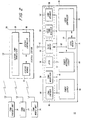
- FIG. 2 there is shown a block diagram of an exemplary TDMA communication system 22 that includes a plurality of portable TDMA transceiver units 24 that communicate with each other through a central control station 26.
- the portable transceiver units and the central control station communicate with each other over one or more frequency channels that are subdivided into TDMA channels, which are time slots during which TDMA messages are communicated.
- the central station includes a central TDMA transceiver 28 that is configured to communicate the messages with the portable transceiver units in accordance with predefined RF modulation and demodulation techniques.
- a central controller 30 executes a central control program, which is stored in a central memory 32, to control the overall operation of the TDMA communication system, including the assignment of the TDMA channels and the routing of various data and control signals within the system.
- Each portable transceiver unit 24 includes a local controller 34 that, under the control of a local control program stored in a local memory 36, controls the overall operation of the transceiver unit, including the transmission and reception of the TDMA messages during designated TDMA channels.
- the transceiver unit includes a TDMA receiver section 38 and a TDMA transmitter section 40 that are connected to a common antenna 42 via an RX/TX switch 44, which operates under the control of the local controller to couple the antenna to the transmitter section and the receiver section during corresponding transmit and receive channels.
- the transmitter section transmits bursts of messages, and the receiver section receives the messages during a designated TDMA receive channel. Additionally, the receiver section can also be used to make control or traffic channel measurements during other channels.
- a power supply 46 such as a battery, provides a supply voltage on line 48, which can be, for example, approximately 5 volts, to operate various sections of the transceiver unit.
- the receiver section 38 includes a local TDMA receiver 50 that demodulates TDMA messages received through the antenna 42 during a corresponding receive channel.
- a TDMA decoder 52 decodes the received TDMA messages and delivers them to a user as an audio or text message.
- the transmitter section 40 includes a TDMA encoder 54 that appropriately encodes audio or text messages from the user into encoded TDMA messages and delivers them to a TDMA modulator 56.
- the modulated TDMA messages are applied to an RFPA 58 which, when energized during a corresponding TDMA transmit channel, amplifies the modulated messages and couples them, through the TX/RX switch 44, to the antenna.
- the local controller 34 In accordance with the TDMA transmit and receive channel assignments of a particular transceiver unit 24, the local controller 34 generates a supply control signal on line 60, for controlling the switching of the power supply 46 and the RFPA 58, and it generates a TX/RX switch control signal on line 62, for controlling the switching of the TX/RX switch 44 between the receiver and the transmitter sections 38 and 40.
- the TDMA transmitter section includes a power interface circuit 64 that is configured according to the present invention, to provide the switching function between the supply voltage and the RFPA 58.
- the supply control signal which is generated by the local controller 34 on line 60.
- the supply control signal is at one of two binary states: a first binary state when the power supply is disconnected from the RFPA 58, and a second binary state when the power supply is connected to the RFPA 58.
- the supply control signal has a first voltage level V 1 , e.g. zero volts, and during the subsequent second binary state, it has a second voltage level V 2 , e.g. 3.75 volts.
- each first binary state corresponds to the period when the transmitter section 40 is disabled from transmitting
- the duration of each second binary state corresponds to the period when the transmitter section is enabled to transmit TDMA messages.
- Fig. 3 depicts an example wherein the supply control signal toggles the RFPA 58 on and off at approximately a 50 % duty cycle, those skilled in the art will appreciate that this waveform is idealized for discussion purposes and that, in practice, the duty cycle will vary depending on, for example, the number of time slots per TDMA frame that a transceiver unit is transmitting, whether discontinuous transmission techniques are applied, etc.
- the power interface circuit 64 uses an n-channel MOSFET, which is turned off during the first binary state to disconnect the supply voltage from the RFPA 58 and is turned on during the second binary state to connect the supply voltage to the RFPA 58.
- the n-channel MOSFET is turned off by being biased to an off-state and is turned on by being biased placed to an on-state.
- the power interface circuit 64 biases the n-channel MOSFET to the on-state by producing a gate-to-source voltage V GS , i.e., the voltage across the gate and the source of the n-channel MOSFET, that is greater or more positive than a threshold voltage V T that corresponds to the pinch-off voltage of the MOSFET.
- V GS gate-to-source voltage
- V T threshold voltage
- the power interface circuit Conversely, to bias the n-channel MOSFET to off-state with minimum channel conductivity, the power interface circuit produces a gate-to-source voltage V GS of zero volts that is less than the threshold voltage V T . This voltage will reduce the drain current I D to a negligible value, thus, turning off the n-channel MOSFET.
- the power interface circuit takes advantage of the first voltage level (V 1 ) and the second voltage level (V 2) of the supply control signal, to provide the biasing voltages for the n-channel MOSFET. More particularly, during the second binary state, the power interface circuit uses the second voltage level V 2 to provide a gate-to-source voltage V GS that is more positive than the threshold voltage V T .
- the gate-to-source voltage V GS during the second binary state is provided by connecting a capacitor to the gate of the n-channel MOSFET.
- the capacitor which is initially charged during the first binary state, provides the more positive gate-to-source voltage V GS using the voltage level of the supply control signal during the second binary state.
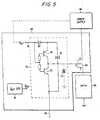
- FIG. 4 shows a schematic diagram of one exemplary embodiment of the power interface circuit 64 of the present invention.
- the power interface circuit includes an n-channel MOSFET 66 that is biased via the supply voltage, the RFPA 58, and a switch control circuit 70.
- the drain of the n-channel MOSFET 66 is coupled to the power supply, its source is coupled to the RFPA 58, and its gate is coupled to the switch control circuit 70.
- the switch control circuit In response to the supply control signal, the switch control circuit provides a gate voltage that controls the on-state and off-state of the n-channel MOSFET 66. Assuming the supply voltage provided by the power supply is 5 volts, the switch control circuit provides a gate voltage that is about 7.5 volts, i.e., V T of 2.5 volts above the battery supply voltage, which turns on the n-channel MOSFET 66.
- the switch control circuit 70 controls the switching state of the n-channel MOSFET 66 based on the binary state of the supply control signal.
- the switch control circuit uses the first voltage level V 1 during the first binary state to provide a first gate voltage that turns off the n-channel MOSFET by reducing the gate-to-source voltage V GS to zero volts, which is less than the threshold voltage V T .
- the switch control circuit uses the second voltage level V 2 to turn on the n-channel MOSFET by increasing the gate-to-source voltage V GS to a voltage level that is greater than the threshold voltage V T . In this way, the switch control circuit 70 operates the n-channel MOSFET in the on-state and off-state, in response to the voltage levels of the supply control signal during the first and second binary states.
- the switch control circuit 70 includes a complementary MOSFET pair comprising a p-channel MOSFET 72 and an n-channel MOSFET 74 that are connected to each other in series, and a capacitor 76 that is coupled across the complementary MOSFET pair.
- the p-channel MOSFET 72 and the n-channel MOSFET 74 have a common junction 78 at their drains that is connected to the gate of the n-channel MOSFET 66, to provide the gate voltage.
- the switch control circuit 70 includes a reference voltage generator 80 that generates a reference voltage V ref on line 82 substantially equal to the second voltage level V 2 , which in this example is about 3.75 volts.
- the reference voltage is provided by the power supply 46, as shown by the dotted lines.
- the reference voltage V ref may also be equal to the supply voltage.
- the reference voltage V ref is coupled to the gates of the p-channel MOSFET 72 and the n-channel MOSFET 74.
- the reference voltage V ref also couples to the source of the p-channel MOSFET 72 and to one end of the capacitor through a diode 84.
- the supply control signal on line 60 is coupled to the other end of the capacitor and to the source of the n-channel MOSFET 74, through a resistor 86.
- the p-channel and the n-channel MOSFETs 72 and 74 function in a complementary manner with respect to each other. That is, when the p-channel MOSFET 72 is on the n-channel MOSFET 74 is off, and vice versa.
- the reference voltage turns off the p-channel MOSFET 72 and turns on the n-channel MOSFET 74.
- the capacitor 76 is charged to the reference voltage level V ref . Consequently, the first voltage level V 1 of zero volts is applied as the gate voltage to the n-channel MOSFET 66, which operates the n-channel MOSFET 66 in the off-state and disconnects the power supply 46 from the RFPA 58.
- the n-channel MOSFET 74 turns off.
- the supply control signal which is coupled to the capacitor 76, produces a source voltage at the p-channel MOSFET 72 the reference voltage level V ref plus the second voltage level V 2 .
- This source voltage turns on the p-channel MOSFET 72 to connect the capacitor 76 to the gate of the n-channel MOSFET 66.
- the capacitor applies a gate voltage to the n-channel MOSFET 66 equal to the reference voltage level V ref plus the second voltage level V 2 .
- the gate voltage so produced insures a positive gate-to-source voltage of about 2.5 volts (7.5 volts gate voltage minus 5 volts supply voltage at the source) is developed, to operate the n-channel MOSFET 66 in the on-state.
- the n-channel MOSFET connects the supply voltage to the RFPA 58, which enables the transmission of the TDMA messages during the second binary state.
- the complementary MOSFETs 72 and 74 constitute a capacitor switch circuit that is responsive to the supply control signal, to control the charging of the capacitor during the first binary state and the second binary state.
- a Zener diode 73 may be coupled to the gate of the n-channel MOSFET 66 to regulate the gate voltage.
- a zener diode with 7.5- volts breakdown voltage insures that the gate-to-source voltage is greater than or equal to the threshold voltage V T , when the supply voltage is used as the reference voltage.
- the RFPA 58 is protected from voltage variations of the supply voltage. This is mainly because the voltage applied to the RFPA 58 is set by a source voltage that follows the gate voltage independent of the variations at the drain, which is coupled to the supply voltage.
- the gate voltage level is set by the reference voltage, which in one exemplary embodiment is independently generated from the supply voltage by the reference voltage generator 80.
- the reference voltage is supplied by the power supply, as in the other exemplary arrangement described above, the regulating Zener diode 73 makes the gate voltage independent of the voltage variations of the supply voltage.
- a second exemplary embodiment of the invention which operates similar to the arrangement of FIG. 4, uses a PNP bipolar transistor 90 and an NPN bipolar transistor 92, instead of the MOSFETs 72 and 74, for implementing the switch control circuit 70.
- the PNP transistor 90 is closed and the NPN 92 transistor is open, thereby charging the capacitor 76 to the voltage reference, while applying the first voltage level V 1 to the gate of the n-channel MOSFET 66.
- the n-channel MOSFET 66 is turned off, disconnecting the power supply 46 from the RFPA 58.
- the PNP transistor 90 opens.
- the gate-to-source voltage at the n-channel MOSFET turns on the n-channel MOSFET 66 and connecting the power supply to the RFPA.
- the present invention provides a simple and effective arrangement for using an n-channel MOSFET in the power interface circuit of a TDMA transmitter, thus reducing the size of such circuit and increasing its switching speed.
- the present invention takes advantage of the voltage levels provided by the supply control signal to raise the gate-to-source potential across the n-channel MOSFET to a more positive level than that provided by the power supply of the transceiver unit. In this way, the n-channel MOSFET is selectively operated in the on-state or off-state, to control the switching function between the power supply and the RFPA.
Landscapes
- Engineering & Computer Science (AREA)
- Computer Networks & Wireless Communication (AREA)
- Signal Processing (AREA)
- Power Engineering (AREA)
- Transmitters (AREA)
- Electronic Switches (AREA)
- Time-Division Multiplex Systems (AREA)
- Amplifiers (AREA)
- Direct Current Feeding And Distribution (AREA)
- Transceivers (AREA)
Applications Claiming Priority (3)
| Application Number | Priority Date | Filing Date | Title |
|---|---|---|---|
| US819937 | 1997-03-18 | ||
| US08/819,937 US5892403A (en) | 1997-03-18 | 1997-03-18 | Power interface circuit for a TDMA transmitter |
| PCT/SE1998/000484 WO1998042080A1 (en) | 1997-03-18 | 1998-03-17 | Power interface circuit for a tdma transmitter |
Publications (2)
| Publication Number | Publication Date |
|---|---|
| EP0968569A1 EP0968569A1 (en) | 2000-01-05 |
| EP0968569B1 true EP0968569B1 (en) | 2006-08-09 |
Family
ID=25229487
Family Applications (1)
| Application Number | Title | Priority Date | Filing Date |
|---|---|---|---|
| EP98911325A Expired - Lifetime EP0968569B1 (en) | 1997-03-18 | 1998-03-17 | Power interface circuit for a tdma transmitter |
Country Status (10)
| Country | Link |
|---|---|
| US (1) | US5892403A (enExample) |
| EP (1) | EP0968569B1 (enExample) |
| JP (1) | JP2001515673A (enExample) |
| KR (1) | KR100464894B1 (enExample) |
| CN (1) | CN1100397C (enExample) |
| AU (1) | AU740807B2 (enExample) |
| BR (1) | BR9808274A (enExample) |
| EE (1) | EE9900408A (enExample) |
| MY (1) | MY123877A (enExample) |
| WO (1) | WO1998042080A1 (enExample) |
Families Citing this family (19)
| Publication number | Priority date | Publication date | Assignee | Title |
|---|---|---|---|---|
| US6148220A (en) | 1997-04-25 | 2000-11-14 | Triquint Semiconductor, Inc. | Battery life extending technique for mobile wireless applications |
| SE9803960L (sv) | 1998-11-19 | 2000-05-20 | Ericsson Telefon Ab L M | Mobiltelefon |
| US6373340B1 (en) * | 2000-08-14 | 2002-04-16 | K. S. Waves, Ltd. | High-efficiency audio power amplifier |
| US6624702B1 (en) | 2002-04-05 | 2003-09-23 | Rf Micro Devices, Inc. | Automatic Vcc control for optimum power amplifier efficiency |
| US20040070454A1 (en) * | 2002-10-15 | 2004-04-15 | Triquint Semiconductor, Inc. | Continuous bias circuit and method for an amplifier |
| US7058374B2 (en) * | 2002-10-15 | 2006-06-06 | Skyworks Solutions, Inc. | Low noise switching voltage regulator |
| US20040072554A1 (en) * | 2002-10-15 | 2004-04-15 | Triquint Semiconductor, Inc. | Automatic-bias amplifier circuit |
| US7010284B2 (en) | 2002-11-06 | 2006-03-07 | Triquint Semiconductor, Inc. | Wireless communications device including power detector circuit coupled to sample signal at interior node of amplifier |
| US20040125759A1 (en) * | 2002-12-27 | 2004-07-01 | Yochem Donald M. | Method and mobile station for operating in accordance with a discontinuous transmission mode |
| US7177370B2 (en) * | 2003-12-17 | 2007-02-13 | Triquint Semiconductor, Inc. | Method and architecture for dual-mode linear and saturated power amplifier operation |
| FR2890258B1 (fr) * | 2005-08-30 | 2007-10-12 | Thales Sa | Dispositif et procede pour amplifier des signaux rf impulsionnels |
| US20090072225A1 (en) * | 2007-09-18 | 2009-03-19 | Electronics And Telecommunications Research Institute | Flat panel display device having organic thin film transistor and manufacturing method thereof |
| KR100907255B1 (ko) * | 2007-09-18 | 2009-07-10 | 한국전자통신연구원 | 유기 박막 트랜지스터를 구비하는 표시 장치 |
| MY150267A (en) * | 2008-08-13 | 2013-12-31 | Motorola Solutions Inc | Method and apparatus for controling output power of communication equipment |
| US8620237B2 (en) * | 2009-09-16 | 2013-12-31 | Silicon Laboratories Inc. | System and method for dynamically regulating voltage to minimize power consumption |
| JP5806076B2 (ja) * | 2011-10-11 | 2015-11-10 | 古野電気株式会社 | Rfパルス信号生成用スイッチング回路、rfパルス信号生成回路、および物標探知装置 |
| KR101847678B1 (ko) * | 2014-01-09 | 2018-04-10 | 주식회사 만도 | 제너 다이오드를 이용한 보호 회로 구현 방법 및 장치 |
| CN105786143A (zh) * | 2014-12-25 | 2016-07-20 | 鸿富锦精密工业(武汉)有限公司 | 电子设备供电系统 |
| US9740326B2 (en) * | 2015-03-31 | 2017-08-22 | Synaptics Incorporated | Sensor array with split-drive differential sensing |
Family Cites Families (5)
| Publication number | Priority date | Publication date | Assignee | Title |
|---|---|---|---|---|
| US5111084A (en) * | 1990-05-31 | 1992-05-05 | Westinghouse Electric Corp. | Low loss drain pulser circuit for solid state microwave power amplifiers |
| JPH06261386A (ja) * | 1993-03-05 | 1994-09-16 | Pioneer Electron Corp | ミューティング制御回路 |
| US5423078A (en) * | 1993-03-18 | 1995-06-06 | Ericsson Ge Mobile Communications Inc. | Dual mode power amplifier for analog and digital cellular telephones |
| JPH08204796A (ja) * | 1995-01-24 | 1996-08-09 | Oki Electric Ind Co Ltd | 無線装置の電源制御回路 |
| US5514995A (en) * | 1995-01-30 | 1996-05-07 | Micrel, Inc. | PCMCIA power interface |
-
1997
- 1997-03-18 US US08/819,937 patent/US5892403A/en not_active Expired - Lifetime
-
1998
- 1998-03-10 MY MYPI98001033A patent/MY123877A/en unknown
- 1998-03-17 KR KR10-1999-7008527A patent/KR100464894B1/ko not_active Expired - Fee Related
- 1998-03-17 BR BR9808274-4A patent/BR9808274A/pt not_active IP Right Cessation
- 1998-03-17 EP EP98911325A patent/EP0968569B1/en not_active Expired - Lifetime
- 1998-03-17 CN CN98805240A patent/CN1100397C/zh not_active Expired - Fee Related
- 1998-03-17 JP JP54044398A patent/JP2001515673A/ja not_active Ceased
- 1998-03-17 WO PCT/SE1998/000484 patent/WO1998042080A1/en not_active Ceased
- 1998-03-17 EE EEP199900408A patent/EE9900408A/xx unknown
- 1998-03-17 AU AU65301/98A patent/AU740807B2/en not_active Ceased
Also Published As
| Publication number | Publication date |
|---|---|
| EE9900408A (et) | 2000-04-17 |
| AU740807B2 (en) | 2001-11-15 |
| CN1100397C (zh) | 2003-01-29 |
| KR100464894B1 (ko) | 2005-01-05 |
| HK1028498A1 (en) | 2001-02-16 |
| KR20000076423A (ko) | 2000-12-26 |
| JP2001515673A (ja) | 2001-09-18 |
| CN1257622A (zh) | 2000-06-21 |
| US5892403A (en) | 1999-04-06 |
| AU6530198A (en) | 1998-10-12 |
| BR9808274A (pt) | 2000-05-16 |
| MY123877A (en) | 2006-06-30 |
| WO1998042080A1 (en) | 1998-09-24 |
| EP0968569A1 (en) | 2000-01-05 |
Similar Documents
| Publication | Publication Date | Title |
|---|---|---|
| US5892403A (en) | Power interface circuit for a TDMA transmitter | |
| US9660848B2 (en) | Methods and structures to generate on/off keyed carrier signals for signal isolators | |
| US5689818A (en) | Mobile terminal device for telecommunications, including a switch circuit | |
| KR20150073194A (ko) | 복수의 충전 포트들을 포함하는 전자 디바이스에서의 전력 경로 스위칭 | |
| EP1698093A2 (en) | Rf backscatter transmission with zero dc power consumption | |
| US6756843B2 (en) | Signal transmitter with pulse-controlled amplification | |
| EP0965166B1 (en) | Flexible current control in power amplifiers | |
| EP0700165B1 (en) | Portable transceiver | |
| CA2019266A1 (en) | Burst mode transmitter/receiver unit | |
| US6343222B1 (en) | Dual mode power controllers and related method and radiotelephones | |
| US7116566B2 (en) | Method and circuit for controlling switching frequency signal | |
| KR19990087501A (ko) | 고전압 전자 엔코더에 유용한 전압 레귤레이터집적 회로 | |
| HK1028498B (en) | Power interface circuit for a tdma transmitter | |
| KR20000062876A (ko) | 안테나 장치 | |
| US7529536B2 (en) | RF-controlled power saving communication system | |
| EP1952563B1 (en) | System and method for efficient power supply regulation compatible with radio frequency operation | |
| US6522901B1 (en) | Portable radio transceiver | |
| US5825160A (en) | Power control circuit in wireless mobile communication system | |
| AU2003201127A1 (en) | High-frequency signal switching | |
| KR100279374B1 (ko) | 무선모뎀의 전원회로 | |
| KR19990051189A (ko) | 이동단말기에서의 전원전압강하 방지장치 | |
| KR100435555B1 (ko) | 반이중 통신용 송수신기 | |
| KR100300537B1 (ko) | 코드분할다중접속시스템의전원공급회로 | |
| JPH08204796A (ja) | 無線装置の電源制御回路 | |
| KR940013271A (ko) | 송신출력 제한회로 및 방법 |
Legal Events
| Date | Code | Title | Description |
|---|---|---|---|
| PUAI | Public reference made under article 153(3) epc to a published international application that has entered the european phase |
Free format text: ORIGINAL CODE: 0009012 |
|
| 17P | Request for examination filed |
Effective date: 19991018 |
|
| AK | Designated contracting states |
Kind code of ref document: A1 Designated state(s): ES GB IT SE |
|
| 17Q | First examination report despatched |
Effective date: 20040303 |
|
| RAP1 | Party data changed (applicant data changed or rights of an application transferred) |
Owner name: TELEFONAKTIEBOLAGET LM ERICSSON (PUBL) |
|
| GRAP | Despatch of communication of intention to grant a patent |
Free format text: ORIGINAL CODE: EPIDOSNIGR1 |
|
| GRAS | Grant fee paid |
Free format text: ORIGINAL CODE: EPIDOSNIGR3 |
|
| GRAA | (expected) grant |
Free format text: ORIGINAL CODE: 0009210 |
|
| AK | Designated contracting states |
Kind code of ref document: B1 Designated state(s): ES GB IT SE |
|
| PG25 | Lapsed in a contracting state [announced via postgrant information from national office to epo] |
Ref country code: IT Free format text: LAPSE BECAUSE OF FAILURE TO SUBMIT A TRANSLATION OF THE DESCRIPTION OR TO PAY THE FEE WITHIN THE PRESCRIBED TIME-LIMIT;WARNING: LAPSES OF ITALIAN PATENTS WITH EFFECTIVE DATE BEFORE 2007 MAY HAVE OCCURRED AT ANY TIME BEFORE 2007. THE CORRECT EFFECTIVE DATE MAY BE DIFFERENT FROM THE ONE RECORDED. Effective date: 20060809 |
|
| REG | Reference to a national code |
Ref country code: GB Ref legal event code: FG4D |
|
| PG25 | Lapsed in a contracting state [announced via postgrant information from national office to epo] |
Ref country code: SE Free format text: LAPSE BECAUSE OF FAILURE TO SUBMIT A TRANSLATION OF THE DESCRIPTION OR TO PAY THE FEE WITHIN THE PRESCRIBED TIME-LIMIT Effective date: 20061109 |
|
| PG25 | Lapsed in a contracting state [announced via postgrant information from national office to epo] |
Ref country code: ES Free format text: LAPSE BECAUSE OF FAILURE TO SUBMIT A TRANSLATION OF THE DESCRIPTION OR TO PAY THE FEE WITHIN THE PRESCRIBED TIME-LIMIT Effective date: 20061120 |
|
| PLBE | No opposition filed within time limit |
Free format text: ORIGINAL CODE: 0009261 |
|
| STAA | Information on the status of an ep patent application or granted ep patent |
Free format text: STATUS: NO OPPOSITION FILED WITHIN TIME LIMIT |
|
| 26N | No opposition filed |
Effective date: 20070510 |
|
| GBPC | Gb: european patent ceased through non-payment of renewal fee |
Effective date: 20070317 |
|
| PG25 | Lapsed in a contracting state [announced via postgrant information from national office to epo] |
Ref country code: GB Free format text: LAPSE BECAUSE OF NON-PAYMENT OF DUE FEES Effective date: 20070317 |