EP0959415B1 - Appareil, procéde et support d'enregistrement pour la décomposition de données - Google Patents
Appareil, procéde et support d'enregistrement pour la décomposition de données Download PDFInfo
- Publication number
- EP0959415B1 EP0959415B1 EP98310513A EP98310513A EP0959415B1 EP 0959415 B1 EP0959415 B1 EP 0959415B1 EP 98310513 A EP98310513 A EP 98310513A EP 98310513 A EP98310513 A EP 98310513A EP 0959415 B1 EP0959415 B1 EP 0959415B1
- Authority
- EP
- European Patent Office
- Prior art keywords
- partial
- feature
- events
- data
- segment
- Prior art date
- Legal status (The legal status is an assumption and is not a legal conclusion. Google has not performed a legal analysis and makes no representation as to the accuracy of the status listed.)
- Expired - Lifetime
Links
Images







Classifications
-
- G—PHYSICS
- G06—COMPUTING OR CALCULATING; COUNTING
- G06F—ELECTRIC DIGITAL DATA PROCESSING
- G06F18/00—Pattern recognition
- G06F18/20—Analysing
- G06F18/21—Design or setup of recognition systems or techniques; Extraction of features in feature space; Blind source separation
- G06F18/211—Selection of the most significant subset of features
-
- Y—GENERAL TAGGING OF NEW TECHNOLOGICAL DEVELOPMENTS; GENERAL TAGGING OF CROSS-SECTIONAL TECHNOLOGIES SPANNING OVER SEVERAL SECTIONS OF THE IPC; TECHNICAL SUBJECTS COVERED BY FORMER USPC CROSS-REFERENCE ART COLLECTIONS [XRACs] AND DIGESTS
- Y10—TECHNICAL SUBJECTS COVERED BY FORMER USPC
- Y10S—TECHNICAL SUBJECTS COVERED BY FORMER USPC CROSS-REFERENCE ART COLLECTIONS [XRACs] AND DIGESTS
- Y10S707/00—Data processing: database and file management or data structures
- Y10S707/99931—Database or file accessing
- Y10S707/99933—Query processing, i.e. searching
- Y10S707/99935—Query augmenting and refining, e.g. inexact access
-
- Y—GENERAL TAGGING OF NEW TECHNOLOGICAL DEVELOPMENTS; GENERAL TAGGING OF CROSS-SECTIONAL TECHNOLOGIES SPANNING OVER SEVERAL SECTIONS OF THE IPC; TECHNICAL SUBJECTS COVERED BY FORMER USPC CROSS-REFERENCE ART COLLECTIONS [XRACs] AND DIGESTS
- Y10—TECHNICAL SUBJECTS COVERED BY FORMER USPC
- Y10S—TECHNICAL SUBJECTS COVERED BY FORMER USPC CROSS-REFERENCE ART COLLECTIONS [XRACs] AND DIGESTS
- Y10S707/00—Data processing: database and file management or data structures
- Y10S707/99941—Database schema or data structure
- Y10S707/99942—Manipulating data structure, e.g. compression, compaction, compilation
-
- Y—GENERAL TAGGING OF NEW TECHNOLOGICAL DEVELOPMENTS; GENERAL TAGGING OF CROSS-SECTIONAL TECHNOLOGIES SPANNING OVER SEVERAL SECTIONS OF THE IPC; TECHNICAL SUBJECTS COVERED BY FORMER USPC CROSS-REFERENCE ART COLLECTIONS [XRACs] AND DIGESTS
- Y10—TECHNICAL SUBJECTS COVERED BY FORMER USPC
- Y10S—TECHNICAL SUBJECTS COVERED BY FORMER USPC CROSS-REFERENCE ART COLLECTIONS [XRACs] AND DIGESTS
- Y10S707/00—Data processing: database and file management or data structures
- Y10S707/99951—File or database maintenance
- Y10S707/99952—Coherency, e.g. same view to multiple users
- Y10S707/99953—Recoverability
Definitions
- the present invention relates to a technology for extracting a collection of related data from randomly accumulated data.
- feature is defined as follows.
- a height measurement or a weight measurement or, alternatively, age or gender information, for one of these persons is a quantity that indicates a feature of that person.
- gender for example, is responsive to only two classifications, namely, "male” and "female”. It may therefore seem awkward to use the term “quantity” here.
- the term is used even in this instance.
- one record which is the result of measurements of feature quantities with respect to one person, corresponds to the job of taking measurements with respect to that person. Accordingly, one such record in, illustratively, a database, is referred to as one event.
- one event in, illustratively, a database, is referred to as one event.
- the quantity characterizing a system operation acquired in one measurement is a feature quantity.
- an apparatus for data decomposition by extracting partial data of high relevance from whole data comprising a plurality of N events, each event having a feature quantity for each of D features, the partial data being a subset of said N events within a partial feature space defined as a subset of said feature quantities; the apparatus comprising: selecting means for selecting a subset of the feature quantities so as to define a partial feature space; dividing means for dividing each feature quantity into a plurality of sections so that the partial feature space defines a respective set of segments designated according to the sections, whereby each segment has a dimension defined by the features of the partial feature space; determining means for determining the number R of segments of the partial feature space that include at least one event; ordering means for ordering the segments including at least one event according to the number of included events, starting with the segment including the highest number of events; evaluating means for applying, for each integer I with 1 ⁇ I ⁇ R, an evaluation function with respect to the partial feature space for the subset of events that
- a method for data decomposition by extracting partial data of high relevance from whole data comprising a plurality of N events, each event having a feature quantity for each of D features, the partial data being a subset of said N events within a partial feature space defined as a subset of said feature quantities; the method comprising the steps of: selecting a subset of the feature quantities so as to define a partial feature space; dividing each feature quantity into a plurality of sections, so that the partial feature space defines a respective set of segments designated according to the sections, whereby each segment has a dimension defined by the features of the partial feature space; determining the number R segments of the partial feature space that include at least one event; ordering the segments including at least one event according to the number of included events, starting with the segment including the highest number of events; applying, for each integer I with 1 ⁇ I ⁇ R, an evaluation function with respect to the partial feature space for the subset of events that are comprised in the subset of the first I segments of said
- a computer-readable storage medium storing a program for data decomposition by extracting partial data of high relevance from whole data, the whole data comprising a plurality of N events, each event having a feature quantity for each of D features, the partial data being a subset of said N events within a partial feature space defined as a subset of said feature quantities; said program causing a computer to perform a process comprising the steps of: selecting a subset of the feature quantities so as to define a partial feature space; dividing each feature quantity into a plurality of sections, so that the partial feature space defines a respective set of segments designated according to the sections, whereby each segment has a dimension defined by the features of the partial feature space; determining the number R of segments of the partial feature space that include at least one event; ordering the segments including at least one event according to the number of included events, starting with the segment including the highest number of events; applying, for each integer I with 1 ⁇ I ⁇ R, an evaluation function with respect to the partial feature space for
- the mutually relevant records (events) and the feature quantities associated with each event from the blindly accumulated data are selected and extracted from an assembly of a totality of events and an assembly of feature quantities. Accordingly, it is possible easily to extract mutually relevant data, without human intervention for the purpose of sifting through the data.
- This technology can be used effectively as an antecedent process to processes for finding interrelations in a fixed interval of data among data gathered, such as illustratively, multi-variable analysis, data mining, and pattern recognition.
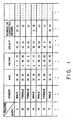
- Fig.1 shows an illustrative data matrix of events and feature quantities, which, with respect to the present invention, is referred to as a whole situation.
- Fig.1 also shows the research results obtained with respect to the number of cigarettes smoked in one day by a plurality of persons.
- a record concerning one person with respect to whom the research was conducted represents one event. Up to seven events are disclosed therein.
- the substance of the research conducted with respect to one person is a feature quantity, and, in Fig.1, "gender”, “age”, “height”, “weight”, and “number of cigarettes” are indicated.
- a “number of cigarettes” is cataloged as the data representing the number of cigarettes smoked in one day by one person.
- the number of research subjects can be greater than the number expressed in Fig.1 In any event, however, an assembly of a combination of all collected feature quantities and all collected events, as well as the combination of all feature quantities and all events, as well as the data indicated by these combinations, is referred to as a whole situation.
- a partial situation is a combination of a partial assembly of desired events and a partial assembly of feature quantities, as well as the assembly of data designated by that combination.
- a first, a third, a fifth, and a sixth record, as well as "gender”, "age”, and “number of cigarettes”, are adopted respectively as a partial assembly of events and a partial assembly of feature quantities.
- the instant partial situation comprises these event assemblies and feature quantity assemblies and corresponds to the data enclosed by the broad line in Fig. 1.
- the method defines a feature quantity selection vector d , which indicates whether a feature quantity is to be selected.
- the selection vector d is a vector comprising information indicating whether each type of feature quantity is to be selected.
- a symbol representing a vector is hereinafter denoted by an alphabetical letter with a line drawn thereunder.
- D is an all feature quantity count. Setting d i as "t” indicates that that feature quantity is selected. Alternatively, setting d i as "f” indicates that that feature quantity is not selected.
- the feature quantities "gender” through “number of cigarettes” are caused to correspond respectively, and in order, to d 1 -d 5 .
- the feature quantity selection vector D when all feature quantities are selected
- Fig.2 illustrates conceptually how a partial situation is specified, within a whole situation, according to a feature selection vector and an event selection vector.
- the number of selected events n is disposed on the vertical axis
- the number of selected feature quantities d is disposed on the horizontal axis.
- the space indicating the actual whole situation is the space spanned by the base vector for the feature quantity selection vector d and the base vector for the event selection vector n . Because this space comprises a multi-dimensional space greater than three dimensions, however, it is infeasible to precisely illustrate this space in a drawing. Accordingly, the concept of specifying a partial situation is explained according to Fig.2.
- a specified range of events disposed on the horizontal axis is designated (to facilitate the illustration in Fig.2, a fixed range on the horizontal axis has been designated, as in the case of the feature quantity; strictly speaking, however, this designation is not necessarily accurate).
- a portion specified by the feature quantity so designated and the event so designated (in Fig. 2, a portion denoted by the lattice-like lines) becomes a partial situation.
- the partial situations in Fig. 2 are not adjacent to each other, but rather are scattered segments that are combined to form a partial situation.
- a partial situation is designated according to the feature quantity selection vector d and the event selection vector n , the partial situation so designated is not the mass of adjacent data in the space created by the whole situation. Rather, a partial situation comprises an assembly of data distributed throughout the whole situation.
- the width of the total space for the feature quantity spanned by the feature quantity selection vector d consists of varieties 2 D .
- the width of the total space for the event selection space spanned by the event selection vector n consists of varieties 2 N .
- each feature quantity is divided into segments. If the feature quantity is "height", for example, coordinates for "height” values are divided at the appropriate value intervals, in consideration of the consecutive nature of the data.
- a histogram is representative of a graph so generated. Specifically, consecutive values for the feature quantities are divided into quantity sections on a horizontal axis, and processing is performed from the perspective of the number of events in those sections. This type of discretization is undertaken with regard to all feature quantities.
- Feature quantities are discretized inherently, illustratively, in the case of "gender". Where the feature quantities are discretized from the beginning (“gender", for instance), and there are only two values that the feature quantities can take, that discretized state is conveniently utilized, as it then exists, as the discretized state.
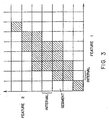
- Fig. 3 discloses a schematical representation of the appearance of the feature quantity spaces divided into segments, when the feature quantities are a "feature 1" and a "feature 2".
- the "feature 1" coordinate axis is divided into a plurality of sections, and the "feature 2" coordinate axis, also, is so divided, the resulting feature quantity space spanned by the "feature 1" and the "feature 2" is divided into a plurality of segments, as shown in Fig. 3.
- This division is performed with respect to all the features. Therefore, if the number of sections per feature is expressed, illustratively, as s i , the number of segments S d contained in the partial features space specified by the feature (quantity) selection vector d would be:
- segment selection vector r d which selects a prescribed number of segments from among segments like those shown in Fig.3, is defined below.
- segments included in partial feature spaces are suitably numbered. Setting the r di corresponding to those numbers to "t” means that that segment was selected. Alternatively, setting r di to "f” means that that segment was not selected.
- event count vector denoting the number of events for each segment, where event selection vector n is specified in the partial feature space that is designated according to the same feature selection vector, is made to be k d ( n ), that vector can be expressed as follows:
- the variable i specifies the pre-numbered segments. It is k d i , moreover, that indicates how many respective events fall within the segments specified by i, where the events have been selected by the event selection vector n . Adding the number of events found in all segments yields a sum of the events selected by event selection vector n .
- the equation below follows therefrom.
- Specifying segment selection vector k d ( n ) in this way means that a specific territory (a territory may be other than contiguous) in a partial feature space is designated. However, it does not necessarily follow that events are contained within the designated territory.
- a segment count R d ( n ) comprising more than one event is indicated by the following equation.
- properties of the partial situations exhibiting high matchability are a high selected event count, a high selected feature count, and a low volume of information for descriptions.
- the all segment count S d in the partial feature spaces increases monotonically with the selected feature count.
- the all segment count S d is utilized, in place of the selected feature count d, as a variable distinguishing the partial situations with high matchability. It is believed that the following states materialize in partial situations with high matchability:
- each of the constants C 1 , C 2 , and C 3 should be set so as to obtain suitable evaluation values.
- the function giving the above-described matchability evaluation value is set to indicate the existence of relevance among data when the evaluation value is a maximum value, it is appropriate to set the function to indicate the existence of relevance among data when the evaluation value is a minimum value, as well.
- Matchability is assessed in terms of whether a partial situation maximizes the above-described function (1), which gives the evaluation value.
- the totality of both the event selection space and the feature quantity selection space are searched, and it is determined whether these spaces, as presently constituted, yield a maximum function.
- the combined space width of the selected event space and the selected feature space is 2 N+D , even a computer would require considerable time to make the necessary calculations.
- the all event count N is, generally, higher than the all feature count D, the disclosure below contemplates narrowing the space to be searched to a selected event space comprising a width of 2 N .
- the feature selection vector d is fixed; and a search is conducted within the segment space spanned by the segment selection vector r d .
- the segment selection vector r d specifies a partial situation by designating a segment, irrespective of whether or not an event is therein contained.
- whether or not a matchability evaluation value for a partial situation is the maximum value therefor is determined according to how many and in what way events are contained in a selected segment.
- the partial situation J ( d , r - d ), which is designated according to a segment selection vector r - d comprising empty segments that contain no events, clearly is not a partial situation in which the matchability evaluation value has a maximum value.
- the matchability evaluation value is, therefore, reduced. Namely, it is Pareto optimal only when one selects an event selection vector in which the number of events included in all selected segments becomes the number of events k d i (N) included when all event selection vector N is selected. Searching of the other event selection vectors is unnecessary.
- Fig.4 is a schematic representation showing how the selected segments and the selected events exist in feature selection spaces.
- the squares defined by thick lines in Fig.4 represent the selected segments, and each event is depicted by a circle.
- the segments containing no events are not selected, and the number of events residing in each segment is the same as the number of events contained in the subject segments when a partial situation is designated by the all event selection vector N .
- an index arrangement q1 , q2, ..., q R d ( N ), ordering from the highest to the lowest value each component (or element) k d i ( N ) of a maximum event count vector (an event vector indicating how many events are contained in each segment when all segments are selected) is defined.
- this arrangement may be expressed as follows:
- an assembly of segment selection vectors r d (r') is considered, for which the selected segment count is r'.
- the vectors contained in this assembly are limited to the number of combinations for selecting a quantity r' from among a quantity R d ( N ). Because the selected segment count r' is fixed among the segment selection vectors contained in this assembly, clearly, the matchability evaluation value in the segment selection vectors ⁇ d (r') (maximum segment selection vectors) will increase.
- the maximum segment selection vector ⁇ d (r') is a segment selection vector which, as shown below, collects the segments comprising as many event counts k di ( N ) as possible.
- n' (r') The event count n' (r') in this particular case is:
- each element of the maximum event count vectors is shown in Fig.5.
- each element for the maximum event count vectors is rearranged from the highest value to the lowest value, and a matchability evaluation value M is calculated with r' moved.
- the value of k qi ( N ) drops sharply, the evaluation value M carries its maximum value.
- Publicly known technology can be used to obtain the maximum value for the evaluation value M.
- each selected candidate partial situation, J ( d , r d "), remains a maximum value with respect to directional changes for the number of all feature quantity types, D.
- the feature quantity selection vector when a i th feature, not selected, is added in the feature quantity selection vector d is made to be d +i .
- the feature quantity selection vector when a selected i th feature selection vector has been omitted in the feature quantity selection vector d is made to be d -i .
- a method of calculating a matchability evaluation value in each case is next explained.
- the selected segment count r +i / d " in a expanded partial feature space, one must know the selected segment count r +i / d j " required when individual events k d j ( N ) saved within the j th segment selected in r d '' are arranged in the i th feature segment. Some calculation is necessary to derive this count. This calculation is hereinafter discussed. If r d +i j is known, the count r d + i " can be obtained by the following equation.
- a segment selection vector condensed in that space is defined as follows.
- each element of the segment selection vector r d '' occupies one segment in the partial feature space.
- the condensed segment selection vector expressed according to equation (3) is also a partial space for that vector, it is possible to project from the vector r d '' to the vector r d -1 ''. If, among the projected vector elements, there is even one true element, each element of the condensed segment selection vector is set to true.
- the partial situation J ( d , r d '') is not one which is to be extracted, because the partial situation in question is not a maximum value. Conversely, if the partial situation in question were a maximum value, the partial situation in question would constitute a situation that is to be extracted.
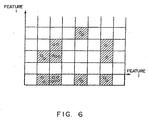
- Fig. 6 depicts conceptually how a selected segment changes when a feature i is either added to, or deleted from, a partial situation.
- feature quantity j is established as the feature that does not change.
- the circles in Fig. 6 represent discrete events. If the feature i is added, the events stored in the feature j-direction segments are dispersed in the direction of feature i. Because the differences in each event attributable to the difference in feature quantity i are not manifest when only the direction of feature j is contemplated, the addition of the feature quantity i ensures that the events disposed in the same segment are distributed in the direction of the feature quantity i.
- a new selected segment count must be determined, taking account of the dispersion of these kinds of events. If, on the other hand, a feature i is deleted, each event that was dispersed in the direction of the feature quantity i, if these events are included in the same segment in the direction of the feature quantity j, are collected within that segment. Accordingly, when a condensed segment selection vector is generated, the segments disposed in the direction of the feature quantity i are deleted. When there are a plurality of segment selection vectors that have selected the same segment disposed in the directions of different feature qualities, these are consolidated into one condensed event selection vector. Using this condensed segment selection vector, the condensed selected segment count should be calculated.
- the foregoing explanation discloses a method for extracting partial situations having inter-data relevance, when a feature selection vector d is fixed. Further, by undertaking a whole search with respect to a combination of feature selection spaces 2 D , a plurality of partial situations is extracted.
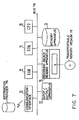
- Fig. 7 shows the hardware configuration of an apparatus for executing programs that perform the processes of this illustrative embodiment.
- a CPU 70 which executes program commands, is linked to bus 78.
- This configuration proceeds with processing while exchanging data with other apparatuses.
- bus 71 To bus 71 are connected: ROM 71, RAM 72, a communication interface 73, a memory apparatus 74, an apparatus for reading recording medium 75, and an input/output apparatus 77.
- ROM 71 On ROM 71 is recorded, illustratively, an operating system that comprises the basic program for causing the apparatuses shown in Fig. 7 to operate under the control of the CPU 70.
- the CPU 70 reads the OS from ROM 71, when power is applied to the apparatuses shown in Fig.7, and facilitates the input of commands from the input/output apparatus 77 and the output of data to input/output apparatus 77.
- Input/output apparatus 77 comprises input devices -- e.g., a keyboard or a mouse -- as well as output devices, a display monitor or printer being representative thereof. Further, the input/output apparatus 77, among other things, inputs data that are to be processed using the method of the present invention and outputs data so processed.
- input devices e.g., a keyboard or a mouse -- as well as output devices, a display monitor or printer being representative thereof. Further, the input/output apparatus 77, among other things, inputs data that are to be processed using the method of the present invention and outputs data so processed.
- RAM 72 deploys programs to be executed by the CPU 70 so that those programs can be executed and stores those programs.
- the CPU 70 processes data and causes the processing results to be stored temporarily in RAM. Data that are to be processed thereafter are similarly stored in RAM 72.
- the processed data that are temporarily stored in RAM 72 are tendered to a user via the output apparatus 77.
- Programs that perform the processes of the present invention are recorded on a memory device 74, a hard drive being illustrative thereof, or on a transportable memory medium 76.
- the subject programs are sent from the memory apparatus 74, or, alternatively, from a memory media reading apparatus 75, which reads the transportable memory medium 76, to RAM 72, and the CPU 70 is set to an execute-ready state.
- the transportable memory medium 76 is, illustratively, a CD-ROM or a floppy disk, and the memory medium reading apparatus 75 comprises, by way of example, a CD-ROM drive or a floppy disk drive.
- ROM 71 If the apparatuses shown in Fig.7 are employed as dedicated devices for the present invention, it is appropriate to store in advance the subject programs in ROM 71. It is to be noted, however, that, because ROM 71 cannot be overwritten, hardware so configured is not amenable to remedial action indicated in the case of program-intrinsic problems or where program adjustment is required for processing convenience.
- Communication interface 73 is connected to bus 78.
- the system is configured to facilitate the receipt of data and programs by way of communication circuits. It is possible to configure the system so that programs for practising the invention can be downloaded from an information provider 79 using the communication interface 73. After being stored on the memory device 74 or the transportable memory medium 76, the subject programs can be deployed in RAM 72 and used. It is conceivable, further, that the system be used to receive data to be processed from an information provider 79 and, subsequent to the processing of the data, transmit the processed data by way of the communication interface 73 to appropriate communication partners. It is also feasible to construct a LAN or like network among information providers and execute on a network the programs used in the invention.
- Fig. 8 illustrates the relationships among the modules that make up the programs for executing the processes of the present invention.
- the configuration of the programs shown in Fig.8, represents the relationships among the program modules, which are described in object oriented language, and the lines linking the modules indicate that, as between the modules joined by a line, a relationship employing the lower module depends from the upper module.
- An outgoing line from a module indicates what types of variables that particular module has.
- the "vector" module appearing in Fig.8 generates a model of vector-format data, as a data format, defines the basic configuration of data structures, and comprises a variable number of elements.
- the “event” module inherits vector-format data defined by the “vector” module as a data format and is utilized to express one event.
- the “event” module has, as variables, numbers utilized in arranging and reordering segment values for each feature quantity.
- the "nsegmentsInFeature” module comprises a class for expressing segment count for each feature quantity. Using this class, or a class inheriting this class, a user sets segment counts in each feature quantity, in order to produce segments responsive to feature quantity attributes.
- the “featureofDouble” module inherits classes defined by the "nsegmentsInFeature” module. This module causes a user to input a minimum value and a maximum value for a feature quantity, as well as a grid width therefor, and establishes the parameters for dividing a feature quantity space into segments.
- the "fullFeatureSpace” module is a class having information concerning the aggregate feature quantity space. This module holds as a variable the all feature quantity count and holds information relating to features as arrangements.
- the “fullFeatureSpace” module is one of the class members to which the “matchability” module refers. Using the information concerning feature quantities held by the "fullFeatureSpace” module, the “matchability” module performs processing for calculating matchability.
- the "partialFeatureSpace” module refers to the "fullFeatureSpace” module as a class member and possesses information relating to partial feature spaces.
- the feature quantity selection vectors are the substance of this module.
- this module comprises, illustratively, the following variables: selected (valid) feature counts, feature counts not selected (invalid), and aggregate segment counts for valid feature spaces.
- the “segmentElement” module holds the event vectors, which become segment elements, and, in addition to employing the event classes to hold references to selected partial feature quantity spaces or positions within the partial feature quantity spaces, holds rankings ordered according to the event counts (sizes) comprising selected events internally, the accumulated event count where a specific segment count r' is set, and the evaluation values according to matchability.
- the “segmentVolume” module comprises the substance of the segment space that is configured as a primary original arrangement for the "segmentElement” module and performs processing among the segment selection spaces with respect to the designated feature quantity selection vectors.
- This module is called from the "matchability” module and has the following illustrative variables: the references to partialFeatureSpace that designates selected partial spaces; a hash table for indexing segments generated automatically according to processing expediency; an index according to the number (size) of events contained in a segment, and a total event account; and a local solution index (event vectors expressing a maximum value when a feature quantity vector is fixed).
- the "situation” module inherits the "vector” module classes and holds events as an element thereof. Additionally, it holds as variables the number of segments selected, the total segment size, and a matchability evaluation value from accumulation results.
- Fig. 9 discloses the flow of processes executed by a program of the preferred embodiment.
- the data format used is the data structure provided by the "situation" module shown in Fig. 8. With the feature quantity selection vector as D and the event selection vector as N , the data format generates data that express the whole situation.
- step S2 the main routine clears situation list A.
- Situation list A is a list of selected matchable events (a combination of events and features recognized as having mutual relevance and events) and its format is that of a list enumerating matchable situations using a data structure provided by the "situation" module shown in Fig.8.
- step S2 the "matchability" module is called from the main routine, and, in step S3, it is decided whether all of the feature selection vectors d have been generated.
- step S3 the system proceeds to step S4, because, at that point, the feature selection vectors have not yet been determined, and the matchability evaluations have not yet been performed.
- step S4 the feature selection vectors d are generated, and the "segmentVolume" module is called. The program then proceeds to step S5.
- the situation list B is cleared in step S5.
- the situation list B is a list of situations selected in specific partial feature spaces. In terms of its population, the situation list B holds the situations as vectors that take as an element the r' value for each situation shown in Fig.5. These situations are formed according to the inherited data structure models provided by the "vector" module in Fig.8.
- the segments for the partial feature spaces are ordered according to an event count k d i ( N ).
- the segment counts for each feature space are held by the "fullFeatureSpace” module, which possesses the "nsegmentsInFeature” module as an arrangement of inherited classes.
- the feature selection vectors generated in step S4 are input to the "partialFeatureSpace” module.
- the “segmentElement” module refers to “partialFeatureSpace” information and holds the “event” module information.
- the “segmentVolume” module possesses the “segmentElement” arrangements, figures the event count contained in each segment (segment size), and sorts the segments by size (in order of diminishing size).
- r' shown in Fig.5, is set in step S7, and an event count n' (r') corresponding to this r' and a matchability evaluation value M are calculated.
- step S9 it is decided whether all the situations in the situation list B have been tested.
- the term "test”, as here used, refers to a determination of whether the situations included in the situation list B maximize the evaluation value, notwithstanding the changes made to the feature selection vectors. If testing has not been performed with respect to all the situations, a next situation X is selected from the situation list B in step S10. Here, the evaluation value is Mx.
- step S11 it is decided whether all the features for the feature selection vectors d have been changed. Specifically, it is determined whether all "true” and “false” for the feature selection vector elements have been substituted and whether the variations in evaluation values have been tested. If the judgment is "NO", the process advances to step S12.
- step S12 a feature selection vector for which one feature i has been changed is generated.
- the process then advances to step S13.
- step S13 it is determined whether the variation of the feature i converts ("excision") a "true” into a "false". In the case of an excision, the process proceeds to step S14, and, in the case of no excision, the process advances to step S15.
- Step S14 calculates the evaluation value Mx -i
- step S15 calculates the evaluation value Mx +1 in the case of the addition of features.
- the method for calculating the selected segment count r d ", which is required to calculate the evaluation value when features are added, is hereunder described.
- step S16 When the respective evaluation quantities are computed in either of step S14 or step S15, it is determined in step S16 whether the evaluation quantities computed in either of step S14 or step S15 are greater than those prior to the changing of the feature selection vectors. If it is determined that these values are greater, the situation X continues to be a candidate for a matchable situation and, therefore, the process returns to step S11 and repeats the process until it has finished changing all the features for the feature selection vectors d . Once all the features have been changed, the present situation X, the subject of the present investigation, is judged to be a matchable situation, and, therefore, the process returns to step S9 to determine whether all the situations in the situation list B were tested.
- the program performs the processing according to steps subsequent to S10.
- the situation list B is in step S18 added to the situation List A, and the program returns to step S3 (wherein the "matchability" module is called).
- the situation list A is an arrangement of the situation modules and lists events and features. Because the situation list B stores only the selected segment count r d '', some additional processing is required here. This processing is hereunder explained.
- step S16 Where it is determined in step S16 that the evaluation quantity computed in either of step S14 or step S15 is greater than the evaluation quantity prior to the changing of the feature selection vectors, it is not possible for the above-described situation X to become a matchability situation. Therefore, the situation X is in step S17 deleted from the situation list B. The program then proceeds to step S9. Only the situations remaining in the situation list B, after thus changing the feature selection vectors for all the situations in the situation list B and testing for matchability situations, are added to the situation list A (step S18), and the program returns to step S3.
- step S3 it is determined whether the processing described above has been performed for all the feature selection vectors, and, if this processing has not been performed, the processing pursuant to step S4 and subsequent steps is carried out.
- step S3 it is determined that the processing for all the feature selection vectors has been finished, processing is brought to a close by proceeding to step S19 and there either displaying or printing out the situation list A as a processing result.
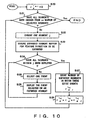
- Fig. 10 discloses a flow chart describing the processing required in step S15, which is shown in Fig. 9.
- step S20 which establishes the selected segment count after the addition of features, is set to zero in step S20.
- step S21 it is determined whether all the segments have been selected from the quantity r d segments chosen prior to the expansion of the feature selection spaces in step S21. Where the processing for all the segments has not been completed, the program moves to step S22 and selects one segment j. A segment buffer for the segments generated in the direction of the features that are to be expanded is secured in step S23.
- step S24 it is determined whether all the events in j have been deployed in the direction of expansion. If not all processing has been completed, in step S25 one event is selected, and the selected event is deployed (disposed) on the expanded segments (step S26). Returning to step S24, this kind of deployment processing is executed for all events in the segment j. The events are then disposed on the expanded segments.
- step S27 When the deployment of all the events in segment j is completed, the number r +1 / d j " of expanded segments (segments added when the feature spaces are expanded in the direction of feature i) in which there exist events is counted in step S27. The value obtained in step S27 is then added to the selected segment count r d +1 in step S28. Then, returning to step S21, this processing is repeated for each of the r d number of selected segments, and the processing is brought to a close when the processing for all the segments has been completed.
- the segments selected in step S22 are chosen, and the process of adding in step S28 corresponds to the execution of equation (2), previously cited.
- Fig. 11 describes the details of step S18, shown in Fig. 9.
- step S30 it is determined in step S30 whether all the situations within the situation list B have been processed. At either the beginning of or at some intermediate point in the processing, the program proceeds to step S31.
- step S31 a new situation X is selected from the situation list B.
- a buffer R for holding the situation X is generated in step S32. This buffer is the class instance for the "situation" module.
- Step S33 saves in the buffer R, illustratively, the evaluation value M for situation X, and the selected segment count r d .
- step S34 It is determined in step S34 whether all the segments within the situation X have been processed. At either the beginning of or at some intermediate point in the processing, the program proceeds to step S35. In step 35, one segment is chosen from the situation X, and it is determined whether all the events within the segment have been added to the buffer R. At either the beginning of or at some intermediate point in processing, the process moves to step S37, where an event is selected and added to the buffer R. The process moves to step S36, and, when all events within the selected segment have been added to the buffer R, the program returns to step S34, where it is determined whether all the segments within situation X have been processed. If processing is incomplete, the processing pursuant to steps subsequent from S34 is repeated.
- step S30 where the processing is repeated until the above-described processing is completed for all the situations within the situation list B.
- step S38 the buffer R is added to the output for the situation list A, and the processing pursuant to step S18, shown in Fig. 9, is completed.
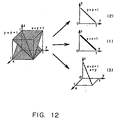
- Fig. 12 and Fig. 13 disclose the results of practicing the technology of the illustrative embodiment for test data.
- the M (matchability) situation 1 denotes the situation marked (1) in Fig. 12.
- the M situation 2 denotes the situation marked (2) in Fig. 12.
- the M situation 3 denotes the situation marked (3) in Fig. 12.
- the processing in the illustrative embodiment was thus performed for test data demonstrating distinct inter-data relevance.
- the test succeeded not only in extracting the two planes in which the events were initially disposed, but also in extracting the intersection of the two planes.
- Pursuant to the present invention it is possible to extract from among data randomly accumulated data bearing mutual relationships as a partial data assembly that combines varieties of features possessed by the data and events (records) that indicate interrelationships. Further, it is possible automatically to perform the task of dividing problems.
- the present invention is extremely effective also as an antecedent process to such processes as multi-variable analysis, data mining, or pattern recognition, which extract some kind of regularity or feature from large quantities of data.
Landscapes
- Engineering & Computer Science (AREA)
- Data Mining & Analysis (AREA)
- Theoretical Computer Science (AREA)
- Bioinformatics & Cheminformatics (AREA)
- Artificial Intelligence (AREA)
- Bioinformatics & Computational Biology (AREA)
- Computer Vision & Pattern Recognition (AREA)
- Evolutionary Biology (AREA)
- Evolutionary Computation (AREA)
- Physics & Mathematics (AREA)
- General Engineering & Computer Science (AREA)
- General Physics & Mathematics (AREA)
- Life Sciences & Earth Sciences (AREA)
- Information Retrieval, Db Structures And Fs Structures Therefor (AREA)
- Management, Administration, Business Operations System, And Electronic Commerce (AREA)
- Complex Calculations (AREA)
Claims (54)
- Appareil pour la décomposition de données en extrayant des données partielles de grand intérêt d'un ensemble de données J, l'ensemble de données comprenant une pluralité de N événements, chaque événement ayant une quantité de caractéristiques pour chacune des D caractéristiques, les données partielles étant un sous-ensemble desdits N événements dans un espace de caractéristiques partielles défini comme un sous-ensemble desdites quantités de caractéristiques ;
l'appareil comprenant :un moyen de sélection destiné à sélectionner (54) un sous-ensemble des quantités de caractéristiques de manière à définir un espace de caractéristiques partielles ;un moyen de division destiné à diviser chaque quantité de caractéristiques en une pluralité de sections de sorte que l'espace de caractéristiques partielles définisse un ensemble respectif de segments conçus selon les sections, moyennant quoi chaque segment a une dimension définie par les caractéristiques de l'espace de caractéristiques partielles ;un moyen de détermination destiné à déterminer le nombre R de segments de l'espace de caractéristiques partielles qui comprennent au moins un événement ;un moyen d'ordonnance destiné à ordonner (56) les segments comprenant au moins un événement selon le nombre d'événements inclus, en commençant par le segment comprenant le nombre le plus élevé d'événements ;un moyen d'évaluation destiné à appliquer (57), pour chaque nombre entier I avec 1 ≤ I ≤ R, une fonction d'évaluation par rapport à l'espace de caractéristiques partielles pour le sous-ensemble d'événements qui sont compris dans le sous-ensemble des premiers I segments dudit ordre de segments, pour calculer des valeurs d'évaluation ; etun moyen d'extraction destiné à extraire (58), en tant que dites données partielles, le sous-ensemble d'événements entraínant la valeur d'évaluation la plus élevée en combinaison avec l'espace de caractéristiques partielles. - Appareil pour la décomposition de données selon la revendication 1,
dans lequel ledit moyen de sélection sélectionne (S4) tous les espaces de caractéristiques partielles possibles, c'est-à-dire, tous les sous-ensembles desdites quantités de caractéristiques. - Appareil pour la décomposition de données selon la revendication 1 ou 2,
dans lequel ledit moyen d'extraction extrait (S8) uniquement lesdites données partielles si l'ajout de toute caractéristique pas encore comprise dans l'espace de caractéristiques partielles correspondant, ou le retrait de toute caractéristique comprise dans l'espace de caractéristiques partielles correspondant n'entraíne pas une valeur d'évaluation supérieure à la valeur d'évaluation déjà calculée. - Appareil pour la décomposition de données selon la revendication 1, 2 ou 3, dans lequel
ledit moyen d'évaluation calcule les valeurs d'évaluation en incluant un compte d'événements sélectionnés, un compte total de segments dans des espaces de caractéristiques partielles qui sont à sélectionner, et un compte de segments sélectionnés dans les espaces de caractéristiques partielles qui sont à sélectionner. - Appareil pour la décomposition de données selon la revendication 1, 2 ou 3, dans lequel
ledit moyen d'évaluation calcule les valeurs d'évaluation en incluant un compte d'événements sélectionnés, un compte total de segments dans les espaces de caractéristiques partielles qui sont à sélectionner, un compte d'événements sélectionnés dans les espaces de caractéristiques partielles qui sont à sélectionner, et un compte total d'événements. - Appareil pour la décomposition de données selon la revendication 4, dans lequel
ledit moyen d'évaluation utilise une fonction d'évaluation qui augmente de façon régulière par rapport au nombre d'événements sélectionnés, augmente de façon régulière par rapport à un compte tous segments dans les espaces de caractéristiques partielles qui sont à sélectionner, et diminue de façon régulière par rapport à un compte de segments sélectionnés dans les espaces de caractéristiques partielles qui sont à sélectionner, et
ledit appareil pour la décomposition de données extrait des données partielles correspondant à la valeur maximale pour une valeur d'évaluation. - Appareil pour la décomposition de données selon la revendication 5, dans lequel
ledit moyen d'évaluation utilise une fonction d'évaluation qui augmente de façon régulière par rapport au nombre d'événements sélectionnés, augmente de façon régulière par rapport à un compte tous segments dans les espaces de caractéristiques partielles qui sont à sélectionner, et diminue de façon régulière par rapport à un compte d'événements sélectionnés dans les espaces de caractéristiques partielles qui sont à sélectionner, et
ledit appareil pour la décomposition de données extrait des données partielles correspondant à la valeur maximale pour une valeur d'évaluation. - Appareil pour la décomposition de données selon la revendication 6 ou 7, dans lequel
ledit moyen d'extraction extrait les données partielles correspondant à une valeur minimale utilisant une fonction d'évaluation dans laquelle les relations d'augmentation/diminution sont inversées par rapport à ladite fonction d'évaluation. - Appareil pour la décomposition de données selon la revendication 1, dans lequel
ledit moyen d'évaluation calcule une valeur d'évaluation utilisant des paramètres comprenant des rapports de comptes d'événements inclus dans des situations partielles dont chacun représente des données partielles de l'ensemble de données et est conçu par des événements sélectionnés et des caractéristiques sélectionnées, des valeurs moyennes pour les comptes d'événements sélectionnés pour chaque segment dans les espaces de caractéristiques partielles, et des rapports d'occupation d'espace pour les comptes de segments sélectionnés dans les espaces de caractéristiques partielles. - Appareil pour la décomposition de données selon la revendication 9, dans lequel
ledit moyen d'évaluation utilise une fonction d'évaluation qui augmente de façon régulière par rapport au rapport de comptes d'événements inclus dans une situation partielle, augmente de façon régulière par rapport à la valeur moyenne de comptes d'événements sélectionnés pour chaque segment dans les espaces de caractéristiques partielles, et diminue de façon régulière par rapport au rapport d'occupation d'espace des comptes de segments sélectionnés dans les espaces de caractéristiques partielles, et
ledit moyen d'extraction extrait les données partielles correspondant à la valeur maximale pour une valeur d'évaluation qui est une valeur de sortie de ladite fonction d'évaluation. - Appareil pour la décomposition de données selon la revendication 10, dans lequel
les données partielles correspondant à une valeur minimale sont identifiées en utilisant une fonction d'évaluation dans laquelle les relations d'augmentation/diminution sont inversées par rapport à ladite fonction d'évaluation. - Appareil pour la décomposition de données selon la revendication 10, dans lequel
ledit moyen d'évaluation utilise C1, C2, C3 comme constantes positives, n/N comme rapport du nombre d'événements inclus dans une situation partielle, n/r d comme valeur moyenne des comptes d'événements sélectionnés pour chaque segment dans les espaces de caractéristiques partielles, r d /S d comme rapport d'occupation pour les comptes de segments sélectionnés dans les espaces de caractéristiques partielles, et - Appareil pour la décomposition de données selon la revendication 12, dans lequel
C1, C2, C3 sont établis tels que C1 = k, C2 = 0,3 k, et C3 = 0,7 k (k est une constante). - Appareil pour la décomposition de données selon la revendication 1, comprenant :un moyen de génération destiné à générer (S10) une pluralité d'espaces de caractéristiques partielles comme combinaisons de sélections de caractéristiques ;un moyen de recherche destiné à rechercher (S11-S17) les valeurs extrêmes de valeurs d'évaluation selon des changements des combinaisons d'événements dans des espaces de caractéristiques partielles spécifiques générés par le moyen de génération ;un moyen de confirmation destiné à confirmer que les combinaisons d'événements qui deviendront des valeurs extrêmes sont des valeurs extrêmes par rapport à d'infimes changements de directions de sélection de quantités de caractéristiques ; etun moyen de sortie destiné à sortir des résultats de sélections d'événements et de caractéristiques, qui sont des valeurs extrêmes par rapport également à tout changement provenant dudit moyen de recherche et dudit moyen de confirmation.
- Appareil pour la décomposition de données selon la revendication 14,
dans lequel ledit moyen de recherche recherche les valeurs extrêmes de valeurs d'évaluation selon des changements des combinaisons d'événements, en sélectionnant des segments et en sélectionnant indirectement des événements dans les espaces de sélection de segments conçus par des espaces de caractéristiques partielles spécifiques générés par le moyen de génération. - Appareil pour la décomposition de données selon la revendication 15, dans lequel
les segments ne comprenant aucun événement ne sont pas sélectionnés dans la sélection de segments. - Appareil pour la décomposition de données selon la revendication 15, dans lequel
tous les événements contenus dans les segments sélectionnés sont sélectionnés. - Appareil pour la décomposition de données selon la revendication 15, dans lequel
les segments avec des comptes d'événements élevés sont sélectionnés de façon préférentielle. - Procédé mis en oeuvre dans un ordinateur pour la décomposition de données en extrayant des données partielles de grand intérêt d'un ensemble de données, l'ensemble de données comprenant une pluralité de N événements, chaque événement ayant une quantité de caractéristiques pour chacune des D caractéristiques, les données partielles étant un sous-ensemble desdits N événements dans un espace de caractéristiques partielles défini comme un sous-ensemble desdites quantités de caractéristiques ;
le procédé comprenant les étapes consistant à :sélectionner (54) un sous-ensemble des quantités de caractéristiques de manière à définir un espace de caractéristiques partielles ;diviser chaque quantité de caractéristiques en une pluralité de sections de sorte que l'espace de caractéristiques partielles définisse un ensemble respectif de segments conçus selon les sections, moyennant quoi chaque segment a une dimension définie par les caractéristiques de l'espace de caractéristiques partielles ;déterminer le nombre R de segments de l'espace de caractéristiques partielles qui comprennent au moins un événement ;ordonner (S6) les segments comprenant au moins un événement selon le nombre d'événements inclus, en commençant par le segment comprenant le nombre le plus élevé d'événements ;appliquer (S6), pour chaque nombre entier 1 avec 1 ≤ I ≤ R, une fonction d'évaluation par rapport à l'espace de caractéristiques partielles pour le sous-ensemble d'événements qui sont compris dans le sous-ensemble des premiers I segments dudit ordre de segments, pour calculer des valeurs d'évaluation ; etextraire (S8), en tant que dites données partielles, le sous-ensemble d'événements entraínant la valeur d'évaluation la plus élevée en combinaison avec l'espace de caractéristiques partielles. - Procédé pour la décomposition de données selon la revendication 19,
dans lequel, dans ladite étape de sélection (S4), tous les espaces de caractéristiques partielles possibles, c'est-à-dire, tous les sous-ensembles desdites quantités de caractéristiques, sont sélectionnés. - Procédé pour la décomposition de données selon la revendication 19 ou 20,
dans lequel, dans ladite étape d'extraction (S8), lesdites données partielles sont seulement extraites si l'ajout de toute caractéristique pas encore comprise dans l'espace de caractéristiques partielles correspondant, ou le retrait de toute caractéristique comprise dans l'espace de caractéristiques partielles correspondant n'entraíne pas une valeur d'évaluation supérieure à la valeur d'évaluation déjà calculée. - Procédé pour la décomposition de données selon la revendication 19, dans lequel
les valeurs d'évaluation sont calculées en incluant un compte d'événements sélectionnés, un compte total de segments dans les espaces de caractéristiques partielles qui sont à sélectionner, et un compte de segments sélectionnés dans les espaces de caractéristiques partielles qui sont à sélectionner. - Procédé pour la décomposition de données selon la revendication 19, dans lequel
les valeurs d'évaluation sont calculées en incluant un compte d'événements sélectionnés, un compte total de segments dans des espaces de caractéristiques partielles qui sont à sélectionner, un compte d'événements sélectionnés dans des espaces de caractéristiques partielles qui sont à sélectionner, et un compte total d'événements. - Procédé pour la décomposition de données selon la revendication 22, dans lequel
ladite étape d'évaluation utilise une fonction d'évaluation qui augmente de façon régulière par rapport à un nombre d'événements sélectionnés, augmente de façon régulière par rapport à un compte tous segments dans les espaces de caractéristiques partielles qui sont sélectionnés, et diminue de façon régulière par rapport à un compte de segments sélectionnés dans les espaces de caractéristiques partielles qui sont sélectionnés, et
ladite étape d'extraction extrait les données partielles correspondant à la valeur maximale pour la valeur d'évaluation. - Procédé pour la décomposition de données selon la revendication 23, dans lequel
ladite étape d'évaluation utilise une fonction d'évaluation qui augmente de façon régulière par rapport à un nombre d'événements sélectionnés, augmente de façon régulière par rapport à un compte tous segments dans les espaces de caractéristiques partielles qui sont sélectionnés, et diminue de façon régulière par rapport à un compte d'événements sélectionnés dans les espaces de caractéristiques partielles qui sont sélectionnés, et
ladite étape d'extraction extrait les données partielles correspondant à la valeur maximale pour la valeur d'évaluation. - Procédé pour la décomposition de données selon la revendication 24, ou 25, dans lequel
les données partielles correspondant à une valeur minimale sont extraites en utilisant une fonction d'évaluation dans laquelle des relations d'augmentation/diminution sont inversées par rapport à ladite fonction d'évaluation. - Procédé pour la décomposition de données selon la revendication 19, dans lequel
une valeur d'évaluation est calculée en utilisant des paramètres comprenant des rapports de comptes d'événements inclus dans des situations partielles qui sont des données partielles de l'ensemble de données et sont conçus par des événements sélectionnés et des quantités de caractéristiques sélectionnées, des valeurs moyennes pour des comptes d'événements sélectionnés pour chaque segment dans les espaces de caractéristiques partielles, et des rapports d'occupation d'espace pour des comptes de segments sélectionnés dans les espaces de caractéristiques partielles. - Procédé pour la décomposition de données selon la revendication 27, dans lequel
ledit procédé pour la décomposition de données utilise une fonction d'évaluation qui augmente de façon régulière par rapport au rapport de comptes d'événements inclus dans une situation partielle, augmente de façon régulière par rapport à la valeur moyenne de comptes d'événements sélectionnés pour chaque segment dans les espaces de caractéristiques partielles, et diminue de façon régulière par rapport au rapport d'occupation d'espace de comptes de segments sélectionnés dans les espaces de caractéristiques partielles, et
ledit procédé pour la décomposition de données extrait les données partielles correspondant à une valeur maximale pour une valeur d'évaluation qui est une valeur de sortie de ladite fonction d'évaluation. - Procédé pour la décomposition de donnes selon la revendication 8, dans lequel
les données partielles correspondant à une valeur minimale sont calculées en utilisant une fonction d'évaluation dans laquelle des relations d'augmentation/diminution sont inversées par rapport à ladite fonction d'évaluation. - Procédé pour la décomposition de données selon la revendication 28, dans lequel
ledit procédé pour la décomposition de données utilise C1, C2, C3 comme constantes positives, n/N comme rapport du nombre d'événements inclus dans une situation partielle, n/r d comme valeur moyenne des comptes d'événements sélectionnés pour chaque segment dans les espaces de caractéristiques partielles, r d /S d comme rapport d'occupation pour les comptes de segments sélectionnés dans les espaces de caractéristiques partielles, et - Procédé pour la décomposition de données selon la revendication 30, dans lequel
C1, C2, C3 sont établis tels que C1 = k, C2 = 0,3 k, et C3 = 0,7 k (k est une constante). - Procédé pour la décomposition de données selon la revendication 21, l'étape d'extraction d'une pluralité de données partielles pour lesquelles les valeurs d'évaluation sont des valeurs extrêmes par rapport à des changements des combinaisons de caractéristiques et des combinaisons d'événements, comprenant en outre les étapes consistant à:générer (S10) les combinaisons de sélections de caractéristiques ;rechercher (S11-S17) les valeurs extrêmes de valeurs d'évaluation selon des changements des combinaisons d'événements dans des espaces de caractéristiques partielles spécifiques générés par l'étape de génération ;confirmer que les combinaisons d'événements qui deviendront des valeurs extrêmes sont des valeurs extrêmes par rapport à d'infimes changements de directions de sélection de caractéristiques ; etsortir des résultats de sélections d'événements et de caractéristiques, qui sont des valeurs extrêmes par rapport également à tout changement provenant de ladite étape de recherche et de ladite étape de confirmation.
- Procédé pour la décomposition de données selon la revendication 32, l'étape de recherche des valeurs extrêmes pour une valeur d'évaluation selon des changements des combinaisons d'événements dans des espaces de caractéristiques partielles spécifiés, comprenant en outre l'étape consistant à :rechercher les valeurs extrêmes de valeurs d'évaluation selon les changements de combinaisons d'événements en sélectionnant des segments et en sélectionnant indirectement des événements dans les espaces de sélection de segments conçus par des espaces de caractéristiques partielles générés spécifiques.
- Procédé pour la décomposition de données selon la revendication 33, dans lequel
les segments ne comprenant aucun événement ne sont pas sélectionnés dans la sélection de segments. - Procédé pour la décomposition de données selon la revendication 33, dans lequel
tous les événements contenus dans les segments sélectionnés sont sélectionnés. - Procédé pour la décomposition de données selon la revendication 29, dans lequel
les segments avec des comptes d'événements élevés sont sélectionnés de façon préférentielle. - Support de stockage lisible sur ordinateur stockant un programme pour la décomposition de données en extrayant des données partielles de grand intérêt d'un ensemble de données, l'ensemble de données comprenant une pluralité de N événements, chaque événement ayant une quantité de caractéristiques pour chacune des D caractéristiques, les données partielles étant un sous-ensemble desdits N événements dans un espace de caractéristiques partielles défini comme un sous-ensemble desdites quantités de caractéristiques ;
ledit programme amenant un ordinateur à effectuer un processus comprenant les étapes consistant à :sélectionner un sous-ensemble des quantités de caractéristiques de manière à définir un espace de caractéristiques partielles ;diviser chaque quantité de caractéristiques en une pluralité de sections de sorte que l'espace de caractéristiques partielles définisse un ensemble respectif de segments conçus selon les sections, moyennant quoi chaque segment a une dimension définie par les caractéristiques de l'espace de caractéristiques partielles ;déterminer le nombre R de segments de l'espace de caractéristiques partielles qui comprennent au moins un événement ;ordonner les segments comprenant au moins un événement selon le nombre d'événements inclus, en commençant par le segment comprenant le nombre le plus élevé d'événements ;appliquer, pour chaque nombre entier I avec 1 ≤ I ≤ R, une fonction d'évaluation par rapport à l'espace de caractéristiques partielles pour le sous-ensemble d'événements qui sont compris dans le sous-ensemble des premiers I segments dudit ordre de segments, pour calculer des valeurs d'évaluation ; etextraire, en tant que dites données partielles, le sous-ensemble d'événements entraínant la valeur d'évaluation la plus élevée en combinaison avec l'espace de caractéristiques partielles. - Support de stockage selon la revendication 37,
dans lequel ledit programme amène l'ordinateur à sélectionner tous les espaces de caractéristiques partielles possibles, c'est-à-dire, tous les sous-ensembles desdites quantités de caractéristiques. - Support de stockage selon la revendication 37 ou 38,
dans lequel ledit programme amène l'ordinateur à extraire lesdites données partielles seulement si l'ajout de toute caractéristique pas encore comprise dans l'espace de caractéristiques partielles correspondant, ou le retrait de toute caractéristique comprise dans l'espace de caractéristiques partielles correspondant, n'entraíne pas une valeur d'évaluation supérieure à la valeur d'évaluation déjà calculée. - Support de stockage selon la revendication 37, dans lequel
les valeurs d'évaluation sont calculées en incluant un compte d'événements sélectionnés, un compte total de segments dans des espaces de caractéristiques partielles qui sont à sélectionner, et un compte de segments sélectionnés dans les espaces de caractéristiques partielles qui sont à sélectionner. - Support de stockage selon la revendication 37, dans lequel
les valeurs d'évaluation sont calculées en incluant un compte d'événements sélectionnés, un compte total de segments dans les espaces de caractéristiques partielles qui sont à sélectionner, un compte d'événements sélectionnés dans les espaces de caractéristiques partielles qui sont à sélectionner, et un compte total d'événements. - Support de stockage selon la revendication 41, dans lequel
ledit programme amène l'ordinateur à utiliser une fonction d'évaluation qui augmente de façon régulière par rapport à un nombre d'événements sélectionnés, augmente de façon régulière par rapport à un compte tous segments dans les espaces de caractéristiques partielles qui sont à sélectionner, et diminue de façon régulière par rapport à un compte de segments sélectionnés dans les espaces de caractéristiques partielles qui sont à sélectionner, et
ledit programme amène l'ordinateur à extraire les données partielles correspondant à la valeur maximale pour une valeur d'évaluation. - Support de stockage selon la revendication 42, dans lequel
ledit programme amène l'ordinateur à utiliser une fonction d'évaluation qui augmente de façon régulière par rapport au nombre d'événements sélectionnés, augmente de façon régulière par rapport à un compte tous segments dans les espaces de caractéristiques partielles qui sont à sélectionner, et diminue de façon régulière par rapport à un compte de segments sélectionnés dans les espaces de caractéristiques partielles qui sont à sélectionner, et
ledit programme amène l'ordinateur à extraire les données partielles correspondant à la valeur maximale pour une valeur d'évaluation. - Support de stockage selon la revendication 42 ou 43, dans lequel
les données partielles correspondant à une valeur minimale sont extraites en utilisant une fonction d'évaluation dans laquelle les relations d'augmentation/diminution sont inversées par rapport à ladite fonction d'évaluation. - Support de stockage selon la revendication 37, dans lequel
une valeur d'évaluation est calculée en utilisant des paramètres comprenant des rapports de comptes d'événements inclus dans des situations partielles qui sont des données partielles de l'ensemble de données et sont conçus par des événements sélectionnés et des caractéristiques sélectionnées, des valeurs moyennes pour les comptes d'événements sélectionnés pour chaque segment dans les espaces de caractéristiques partielles, et des rapports d'occupation d'espace pour les comptes de segments sélectionnés dans les espaces de caractéristiques partielles. - Support de stockage selon la revendication 45, dans lequel
ledit programme amène l'ordinateur à utiliser une fonction d'évaluation qui augmente de façon régulière par rapport au rapport de comptes d'événements inclus dans une situation partielle, augmente de façon régulière par rapport à la valeur moyenne de comptes d'événements sélectionnés pour chaque segment dans les espaces de caractéristiques partielles, et diminue de façon régulière par rapport au rapport d'occupation d'espace des comptes de segments sélectionnés dans les espaces de caractéristiques partielles, et
ledit programme amène l'ordinateur à extraire des données partielles correspondant à la valeur maximale pour une valeur d'évaluation qui est une valeur de sortie de ladite fonction d'évaluation. - Support de stockage selon la revendication 46, dans lequel
les données partielles correspondant à une valeur minimale sont calculées en utilisant une fonction d'évaluation dans laquelle les relations d'augmentation/diminution sont inversées par rapport à ladite fonction d'évaluation. - Support de stockage selon la revendication 46, dans lequel
ledit programme amène l'ordinateur à utiliser C1, C2, C3 comme constantes positives, n/N comme rapport du nombre d'événements inclus dans une situation partielle, n/r d comme valeur moyenne des comptes d'événements sélectionnés pour chaque segment dans les espaces de caractéristiques partielles, r d /S d comme rapport d'occupation pour les comptes de segments sélectionnés dans les espaces de caractéristiques partielles, et - Support de stockage selon la revendication 48, dans lequel
C1, C2, C3 sont établis tels que C1 = k, C2 = 0,3 k, et C3 = 0,7 k (k est une constante). - Support de stockage selon la revendication 37, dans lequel ledit programme amène l'ordinateur à extraire une pluralité de données partielles pour lesquelles les valeurs d'évaluation sont des valeurs maximales par rapport à des changements des combinaisons de caractéristiques et des combinaisons d'événements, et amène l'ordinateur à effectuer un processus comprenant les étapes consistant à :générer des combinaisons de sélections de quantités de caractéristiques ;rechercher les valeurs extrêmes de valeurs d'évaluation selon des changements des combinaisons d'événements dans des espaces de caractéristiques partielles spécifiques générés par l'étape de génération ;confirmer que les combinaisons d'événements qui deviendront des valeurs extrêmes sont des valeurs extrêmes par rapport à d'infimes changements de directions de sélection de caractéristiques ; etsortir des résultats de sélections d'événements et de caractéristiques, qui sont des valeurs extrêmes par rapport également à tout changement provenant de ladite étape de recherche et de ladite étape de confirmation.
- Support de stockage selon la revendication 50, dans lequel
ledit programme amène un ordinateur à rechercher les valeurs extrêmes de valeurs d'évaluation selon des changements des combinaisons d'événements en sélectionnant des segments et en sélectionnant indirectement des événements dans les espaces de sélection de segments conçus par des espaces de caractéristiques partielles générés spécifiques. - Support de stockage selon la revendication 51, dans lequel
les segments ne comprenant aucun événement ne sont pas sélectionnés dans la sélection de segments. - Support de stockage selon la revendication 51, dans lequel
tous les événements contenus dans les segments sélectionnés sont sélectionnés. - Support de stockage selon la revendication 51, dans lequel
les segments avec des comptes d'événements élevés sont sélectionnés de façon préférentielle.
Applications Claiming Priority (2)
| Application Number | Priority Date | Filing Date | Title |
|---|---|---|---|
| JP13983198A JP3762835B2 (ja) | 1998-05-21 | 1998-05-21 | データ分解装置、その方法、及び記録媒体 |
| JP13983198 | 1998-05-21 |
Publications (3)
| Publication Number | Publication Date |
|---|---|
| EP0959415A2 EP0959415A2 (fr) | 1999-11-24 |
| EP0959415A3 EP0959415A3 (fr) | 2000-03-15 |
| EP0959415B1 true EP0959415B1 (fr) | 2005-11-23 |
Family
ID=15254516
Family Applications (1)
| Application Number | Title | Priority Date | Filing Date |
|---|---|---|---|
| EP98310513A Expired - Lifetime EP0959415B1 (fr) | 1998-05-21 | 1998-12-21 | Appareil, procéde et support d'enregistrement pour la décomposition de données |
Country Status (4)
| Country | Link |
|---|---|
| US (1) | US6341283B1 (fr) |
| EP (1) | EP0959415B1 (fr) |
| JP (1) | JP3762835B2 (fr) |
| DE (1) | DE69832470T2 (fr) |
Families Citing this family (36)
| Publication number | Priority date | Publication date | Assignee | Title |
|---|---|---|---|---|
| AU5074701A (en) * | 1999-10-18 | 2001-06-25 | Douglas E. Blasiman | A method and system for transacting a purchase using a credit card from the seller |
| US6907426B2 (en) * | 2001-05-17 | 2005-06-14 | International Business Machines Corporation | Systems and methods for identifying and counting instances of temporal patterns |
| US7225193B2 (en) * | 2001-12-21 | 2007-05-29 | Honeywell International Inc. | Method and apparatus for retrieving event data related to an activity |
| US7152068B2 (en) * | 2001-12-21 | 2006-12-19 | Honeywell International Inc. | Method and apparatus for retrieving time series data related to an activity |
| US7496591B2 (en) * | 2001-12-21 | 2009-02-24 | Honeywell International Inc. | Method and system for capturing, storing and retrieving events and activities |
| US7027954B2 (en) * | 2001-12-21 | 2006-04-11 | Honeywell International Inc. | Method and apparatus for retrieving activity data related to an activity |
| JP2003345777A (ja) * | 2002-05-24 | 2003-12-05 | Fujitsu Ltd | データ分解装置 |
| US7305133B2 (en) * | 2002-11-01 | 2007-12-04 | Mitsubishi Electric Research Laboratories, Inc. | Pattern discovery in video content using association rules on multiple sets of labels |
| US7143352B2 (en) * | 2002-11-01 | 2006-11-28 | Mitsubishi Electric Research Laboratories, Inc | Blind summarization of video content |
| US7375731B2 (en) * | 2002-11-01 | 2008-05-20 | Mitsubishi Electric Research Laboratories, Inc. | Video mining using unsupervised clustering of video content |
| US7313279B2 (en) * | 2003-07-08 | 2007-12-25 | Computer Associates Think, Inc. | Hierarchical determination of feature relevancy |
| US7454417B2 (en) | 2003-09-12 | 2008-11-18 | Google Inc. | Methods and systems for improving a search ranking using population information |
| US7505964B2 (en) | 2003-09-12 | 2009-03-17 | Google Inc. | Methods and systems for improving a search ranking using related queries |
| JP4274221B2 (ja) * | 2006-10-02 | 2009-06-03 | ソニー株式会社 | 情報処理装置および方法、プログラム、並びに記録媒体 |
| US8661029B1 (en) | 2006-11-02 | 2014-02-25 | Google Inc. | Modifying search result ranking based on implicit user feedback |
| US8938463B1 (en) | 2007-03-12 | 2015-01-20 | Google Inc. | Modifying search result ranking based on implicit user feedback and a model of presentation bias |
| US8694374B1 (en) | 2007-03-14 | 2014-04-08 | Google Inc. | Detecting click spam |
| US9092510B1 (en) | 2007-04-30 | 2015-07-28 | Google Inc. | Modifying search result ranking based on a temporal element of user feedback |
| US8694511B1 (en) | 2007-08-20 | 2014-04-08 | Google Inc. | Modifying search result ranking based on populations |
| US8909655B1 (en) | 2007-10-11 | 2014-12-09 | Google Inc. | Time based ranking |
| US8396865B1 (en) | 2008-12-10 | 2013-03-12 | Google Inc. | Sharing search engine relevance data between corpora |
| JP5572966B2 (ja) * | 2009-03-06 | 2014-08-20 | 日本電気株式会社 | データ類似度計算方法、システム、およびプログラム |
| US9009146B1 (en) | 2009-04-08 | 2015-04-14 | Google Inc. | Ranking search results based on similar queries |
| US8103672B2 (en) * | 2009-05-20 | 2012-01-24 | Detectent, Inc. | Apparatus, system, and method for determining a partial class membership of a data record in a class |
| US8447760B1 (en) | 2009-07-20 | 2013-05-21 | Google Inc. | Generating a related set of documents for an initial set of documents |
| US8498974B1 (en) | 2009-08-31 | 2013-07-30 | Google Inc. | Refining search results |
| US8972391B1 (en) | 2009-10-02 | 2015-03-03 | Google Inc. | Recent interest based relevance scoring |
| US8874555B1 (en) | 2009-11-20 | 2014-10-28 | Google Inc. | Modifying scoring data based on historical changes |
| US8615514B1 (en) | 2010-02-03 | 2013-12-24 | Google Inc. | Evaluating website properties by partitioning user feedback |
| US8924379B1 (en) | 2010-03-05 | 2014-12-30 | Google Inc. | Temporal-based score adjustments |
| US8959093B1 (en) | 2010-03-15 | 2015-02-17 | Google Inc. | Ranking search results based on anchors |
| US9623119B1 (en) | 2010-06-29 | 2017-04-18 | Google Inc. | Accentuating search results |
| US8832083B1 (en) | 2010-07-23 | 2014-09-09 | Google Inc. | Combining user feedback |
| US9002867B1 (en) | 2010-12-30 | 2015-04-07 | Google Inc. | Modifying ranking data based on document changes |
| US9183499B1 (en) | 2013-04-19 | 2015-11-10 | Google Inc. | Evaluating quality based on neighbor features |
| US11586703B2 (en) | 2018-02-08 | 2023-02-21 | Nec Corporation | Feature transformation apparatus and method, and recording medium |
Family Cites Families (9)
| Publication number | Priority date | Publication date | Assignee | Title |
|---|---|---|---|---|
| US5794209A (en) * | 1995-03-31 | 1998-08-11 | International Business Machines Corporation | System and method for quickly mining association rules in databases |
| US5615341A (en) * | 1995-05-08 | 1997-03-25 | International Business Machines Corporation | System and method for mining generalized association rules in databases |
| US5758147A (en) * | 1995-06-28 | 1998-05-26 | International Business Machines Corporation | Efficient information collection method for parallel data mining |
| JP3489279B2 (ja) * | 1995-07-21 | 2004-01-19 | 株式会社日立製作所 | データ分析装置 |
| US5713016A (en) * | 1995-09-05 | 1998-01-27 | Electronic Data Systems Corporation | Process and system for determining relevance |
| JP3118181B2 (ja) * | 1995-10-26 | 2000-12-18 | インターナショナル・ビジネス・マシーンズ・コーポレ−ション | データ間結合ルール導出方法及び装置 |
| JPH09134365A (ja) * | 1995-11-01 | 1997-05-20 | Internatl Business Mach Corp <Ibm> | 最適化結合ルール導出方法及び装置 |
| JP3072708B2 (ja) * | 1995-11-01 | 2000-08-07 | インターナショナル・ビジネス・マシーンズ・コーポレ−ション | データベース検索方法及び装置 |
| US6189005B1 (en) * | 1998-08-21 | 2001-02-13 | International Business Machines Corporation | System and method for mining surprising temporal patterns |
-
1998
- 1998-05-21 JP JP13983198A patent/JP3762835B2/ja not_active Expired - Fee Related
- 1998-12-21 US US09/216,711 patent/US6341283B1/en not_active Expired - Lifetime
- 1998-12-21 DE DE69832470T patent/DE69832470T2/de not_active Expired - Lifetime
- 1998-12-21 EP EP98310513A patent/EP0959415B1/fr not_active Expired - Lifetime
Also Published As
| Publication number | Publication date |
|---|---|
| US6341283B1 (en) | 2002-01-22 |
| EP0959415A3 (fr) | 2000-03-15 |
| DE69832470T2 (de) | 2006-06-08 |
| EP0959415A2 (fr) | 1999-11-24 |
| JP3762835B2 (ja) | 2006-04-05 |
| JPH11338855A (ja) | 1999-12-10 |
| DE69832470D1 (de) | 2005-12-29 |
Similar Documents
| Publication | Publication Date | Title |
|---|---|---|
| EP0959415B1 (fr) | Appareil, procéde et support d'enregistrement pour la décomposition de données | |
| US7739096B2 (en) | System for extraction of representative data for training of adaptive process monitoring equipment | |
| US7222269B2 (en) | Performance evaluation device, performance evaluation information managing device, performance evaluation method, performance evaluation information managing method, performance evaluation system | |
| JP3586565B2 (ja) | 棒グラフ表示方法およびそのプログラム記憶媒体 | |
| CN103324642B (zh) | 为数据建立索引的系统和方法以及数据查询方法 | |
| JP3118181B2 (ja) | データ間結合ルール導出方法及び装置 | |
| EP2216749A1 (fr) | Dispositif de classification d'image et programme de classification d'image | |
| JP4388301B2 (ja) | 画像検索装置、画像検索方法、画像検索プログラム及びそのプログラムを記録した記録媒体 | |
| KR100309666B1 (ko) | 데이터간결합룰도출방법및장치와,직교볼록영역분리추출방법및장치 | |
| US5802254A (en) | Data analysis apparatus | |
| US20020123987A1 (en) | Nearest neighbor data method and system | |
| JP3204154B2 (ja) | 時系列データ解析装置 | |
| CN111612491A (zh) | 状态分析模型构建方法、分析方法及装置 | |
| US20040015460A1 (en) | Controlled capacity modeling tool | |
| JPH05114899A (ja) | ネツトワーク障害診断方式 | |
| CN117015812A (zh) | 用于对数据点进行聚类的系统 | |
| JPH09167152A (ja) | 対話的モデル作成方法 | |
| US20060184474A1 (en) | Data analysis apparatus, data analysis program, and data analysis method | |
| JPH05204991A (ja) | 時系列データ検索方法およびこれを用いた検索システム | |
| JP2003316819A (ja) | オブジェクト分類検索装置及びそれを実行するためのプログラム | |
| Fortin et al. | Delineation and analysis of vegetation boundaries | |
| JP4234841B2 (ja) | データ分析装置 | |
| JP2003281358A (ja) | 特許分析システム及び特許分析グラフ製造方法 | |
| JP3464148B2 (ja) | 認識装置における識別空間の表現方法、テンプレート評価方法及び学習装置、記録媒体 | |
| Berisha et al. | Efficient data driven mixture-of-expert extraction from trained networks |
Legal Events
| Date | Code | Title | Description |
|---|---|---|---|
| PUAI | Public reference made under article 153(3) epc to a published international application that has entered the european phase |
Free format text: ORIGINAL CODE: 0009012 |
|
| AK | Designated contracting states |
Kind code of ref document: A2 Designated state(s): DE GB |
|
| AX | Request for extension of the european patent |
Free format text: AL;LT;LV;MK;RO;SI |
|
| PUAL | Search report despatched |
Free format text: ORIGINAL CODE: 0009013 |
|
| AK | Designated contracting states |
Kind code of ref document: A3 Designated state(s): AT BE CH CY DE DK ES FI FR GB GR IE IT LI LU MC NL PT SE |
|
| AX | Request for extension of the european patent |
Free format text: AL;LT;LV;MK;RO;SI |
|
| 17P | Request for examination filed |
Effective date: 20000419 |
|
| AKX | Designation fees paid |
Free format text: DE GB |
|
| 17Q | First examination report despatched |
Effective date: 20030411 |
|
| GRAP | Despatch of communication of intention to grant a patent |
Free format text: ORIGINAL CODE: EPIDOSNIGR1 |
|
| GRAS | Grant fee paid |
Free format text: ORIGINAL CODE: EPIDOSNIGR3 |
|
| GRAA | (expected) grant |
Free format text: ORIGINAL CODE: 0009210 |
|
| RBV | Designated contracting states (corrected) |
Designated state(s): DE |
|
| AK | Designated contracting states |
Kind code of ref document: B1 Designated state(s): DE |
|
| REF | Corresponds to: |
Ref document number: 69832470 Country of ref document: DE Date of ref document: 20051229 Kind code of ref document: P |
|
| PLBE | No opposition filed within time limit |
Free format text: ORIGINAL CODE: 0009261 |
|
| STAA | Information on the status of an ep patent application or granted ep patent |
Free format text: STATUS: NO OPPOSITION FILED WITHIN TIME LIMIT |
|
| 26N | No opposition filed |
Effective date: 20060824 |
|
| PGFP | Annual fee paid to national office [announced via postgrant information from national office to epo] |
Ref country code: DE Payment date: 20141216 Year of fee payment: 17 |
|
| REG | Reference to a national code |
Ref country code: DE Ref legal event code: R119 Ref document number: 69832470 Country of ref document: DE |
|
| PG25 | Lapsed in a contracting state [announced via postgrant information from national office to epo] |
Ref country code: DE Free format text: LAPSE BECAUSE OF NON-PAYMENT OF DUE FEES Effective date: 20160701 |