EP0955214B1 - Airbag fabric possessing improved packed volume and stable air permeability - Google Patents
Airbag fabric possessing improved packed volume and stable air permeability Download PDFInfo
- Publication number
- EP0955214B1 EP0955214B1 EP99108338A EP99108338A EP0955214B1 EP 0955214 B1 EP0955214 B1 EP 0955214B1 EP 99108338 A EP99108338 A EP 99108338A EP 99108338 A EP99108338 A EP 99108338A EP 0955214 B1 EP0955214 B1 EP 0955214B1
- Authority
- EP
- European Patent Office
- Prior art keywords
- fabric
- per
- process according
- air
- permeability
- Prior art date
- Legal status (The legal status is an assumption and is not a legal conclusion. Google has not performed a legal analysis and makes no representation as to the accuracy of the status listed.)
- Expired - Lifetime
Links
- 239000004744 fabric Substances 0.000 title claims description 134
- 230000035699 permeability Effects 0.000 title claims description 47
- 238000000034 method Methods 0.000 claims description 21
- 230000008569 process Effects 0.000 claims description 19
- 238000010276 construction Methods 0.000 claims description 16
- XLYOFNOQVPJJNP-UHFFFAOYSA-N water Substances O XLYOFNOQVPJJNP-UHFFFAOYSA-N 0.000 claims description 6
- 229920001971 elastomer Polymers 0.000 claims description 5
- 239000002759 woven fabric Substances 0.000 claims description 5
- 239000004677 Nylon Substances 0.000 claims description 4
- 229920001778 nylon Polymers 0.000 claims description 4
- 238000012360 testing method Methods 0.000 description 9
- 238000012545 processing Methods 0.000 description 8
- 230000006835 compression Effects 0.000 description 7
- 238000007906 compression Methods 0.000 description 7
- 230000008901 benefit Effects 0.000 description 5
- 238000000576 coating method Methods 0.000 description 5
- 238000005259 measurement Methods 0.000 description 5
- 229920002302 Nylon 6,6 Polymers 0.000 description 4
- 238000002203 pretreatment Methods 0.000 description 4
- 238000009941 weaving Methods 0.000 description 4
- 238000003490 calendering Methods 0.000 description 3
- 238000010835 comparative analysis Methods 0.000 description 3
- 239000000463 material Substances 0.000 description 3
- 230000000704 physical effect Effects 0.000 description 3
- 230000015572 biosynthetic process Effects 0.000 description 2
- 230000008859 change Effects 0.000 description 2
- 230000007423 decrease Effects 0.000 description 2
- 238000001514 detection method Methods 0.000 description 2
- 238000011156 evaluation Methods 0.000 description 2
- 230000000670 limiting effect Effects 0.000 description 2
- 238000004519 manufacturing process Methods 0.000 description 2
- 238000012856 packing Methods 0.000 description 2
- 230000003068 static effect Effects 0.000 description 2
- 239000004753 textile Substances 0.000 description 2
- 101100065878 Caenorhabditis elegans sec-10 gene Proteins 0.000 description 1
- 101100172879 Caenorhabditis elegans sec-5 gene Proteins 0.000 description 1
- 101100172886 Caenorhabditis elegans sec-6 gene Proteins 0.000 description 1
- 101100172892 Caenorhabditis elegans sec-8 gene Proteins 0.000 description 1
- 241000845082 Panama Species 0.000 description 1
- 230000004308 accommodation Effects 0.000 description 1
- 230000002411 adverse Effects 0.000 description 1
- 238000013459 approach Methods 0.000 description 1
- 230000009286 beneficial effect Effects 0.000 description 1
- 238000006243 chemical reaction Methods 0.000 description 1
- 239000003795 chemical substances by application Substances 0.000 description 1
- YACLQRRMGMJLJV-UHFFFAOYSA-N chloroprene Chemical compound ClC(=C)C=C YACLQRRMGMJLJV-UHFFFAOYSA-N 0.000 description 1
- 230000000593 degrading effect Effects 0.000 description 1
- 230000001419 dependent effect Effects 0.000 description 1
- 238000006073 displacement reaction Methods 0.000 description 1
- 238000001035 drying Methods 0.000 description 1
- 230000008030 elimination Effects 0.000 description 1
- 238000003379 elimination reaction Methods 0.000 description 1
- 230000001939 inductive effect Effects 0.000 description 1
- 238000003780 insertion Methods 0.000 description 1
- 230000037431 insertion Effects 0.000 description 1
- 238000009434 installation Methods 0.000 description 1
- 230000007246 mechanism Effects 0.000 description 1
- 238000012986 modification Methods 0.000 description 1
- 230000004048 modification Effects 0.000 description 1
- 238000012544 monitoring process Methods 0.000 description 1
- 229920001084 poly(chloroprene) Polymers 0.000 description 1
- 229920000728 polyester Polymers 0.000 description 1
- 229920001296 polysiloxane Polymers 0.000 description 1
- 230000002829 reductive effect Effects 0.000 description 1
- 229920005989 resin Polymers 0.000 description 1
- 239000011347 resin Substances 0.000 description 1
- 230000000717 retained effect Effects 0.000 description 1
- 238000009991 scouring Methods 0.000 description 1
- 238000012956 testing procedure Methods 0.000 description 1
Images


Classifications
-
- B—PERFORMING OPERATIONS; TRANSPORTING
- B60—VEHICLES IN GENERAL
- B60R—VEHICLES, VEHICLE FITTINGS, OR VEHICLE PARTS, NOT OTHERWISE PROVIDED FOR
- B60R21/00—Arrangements or fittings on vehicles for protecting or preventing injuries to occupants or pedestrians in case of accidents or other traffic risks
- B60R21/02—Occupant safety arrangements or fittings, e.g. crash pads
- B60R21/16—Inflatable occupant restraints or confinements designed to inflate upon impact or impending impact, e.g. air bags
- B60R21/23—Inflatable members
- B60R21/235—Inflatable members characterised by their material
-
- D—TEXTILES; PAPER
- D03—WEAVING
- D03D—WOVEN FABRICS; METHODS OF WEAVING; LOOMS
- D03D1/00—Woven fabrics designed to make specified articles
- D03D1/02—Inflatable articles
-
- B—PERFORMING OPERATIONS; TRANSPORTING
- B60—VEHICLES IN GENERAL
- B60R—VEHICLES, VEHICLE FITTINGS, OR VEHICLE PARTS, NOT OTHERWISE PROVIDED FOR
- B60R21/00—Arrangements or fittings on vehicles for protecting or preventing injuries to occupants or pedestrians in case of accidents or other traffic risks
- B60R21/02—Occupant safety arrangements or fittings, e.g. crash pads
- B60R21/16—Inflatable occupant restraints or confinements designed to inflate upon impact or impending impact, e.g. air bags
- B60R21/23—Inflatable members
- B60R21/237—Inflatable members characterised by the way they are folded
- B60R2021/2375—Folding devices
-
- B—PERFORMING OPERATIONS; TRANSPORTING
- B60—VEHICLES IN GENERAL
- B60R—VEHICLES, VEHICLE FITTINGS, OR VEHICLE PARTS, NOT OTHERWISE PROVIDED FOR
- B60R21/00—Arrangements or fittings on vehicles for protecting or preventing injuries to occupants or pedestrians in case of accidents or other traffic risks
- B60R21/02—Occupant safety arrangements or fittings, e.g. crash pads
- B60R21/16—Inflatable occupant restraints or confinements designed to inflate upon impact or impending impact, e.g. air bags
- B60R21/23—Inflatable members
- B60R21/237—Inflatable members characterised by the way they are folded
-
- Y—GENERAL TAGGING OF NEW TECHNOLOGICAL DEVELOPMENTS; GENERAL TAGGING OF CROSS-SECTIONAL TECHNOLOGIES SPANNING OVER SEVERAL SECTIONS OF THE IPC; TECHNICAL SUBJECTS COVERED BY FORMER USPC CROSS-REFERENCE ART COLLECTIONS [XRACs] AND DIGESTS
- Y10—TECHNICAL SUBJECTS COVERED BY FORMER USPC
- Y10T—TECHNICAL SUBJECTS COVERED BY FORMER US CLASSIFICATION
- Y10T428/00—Stock material or miscellaneous articles
- Y10T428/13—Hollow or container type article [e.g., tube, vase, etc.]
- Y10T428/1334—Nonself-supporting tubular film or bag [e.g., pouch, envelope, packet, etc.]
- Y10T428/1345—Single layer [continuous layer]
-
- Y—GENERAL TAGGING OF NEW TECHNOLOGICAL DEVELOPMENTS; GENERAL TAGGING OF CROSS-SECTIONAL TECHNOLOGIES SPANNING OVER SEVERAL SECTIONS OF THE IPC; TECHNICAL SUBJECTS COVERED BY FORMER USPC CROSS-REFERENCE ART COLLECTIONS [XRACs] AND DIGESTS
- Y10—TECHNICAL SUBJECTS COVERED BY FORMER USPC
- Y10T—TECHNICAL SUBJECTS COVERED BY FORMER US CLASSIFICATION
- Y10T428/00—Stock material or miscellaneous articles
- Y10T428/13—Hollow or container type article [e.g., tube, vase, etc.]
- Y10T428/1352—Polymer or resin containing [i.e., natural or synthetic]
- Y10T428/1362—Textile, fabric, cloth, or pile containing [e.g., web, net, woven, knitted, mesh, nonwoven, matted, etc.]
Definitions
- the invention relates generally to a process to provide a plain weave air bag fabric, for use in the manufacture of an air bag, and more particularly one which can be packed into small volumes without unduly affecting air permeability.
- US 5 073 418 A forms the closest prior art according to the preamble of claim 1.
- Fabrics used for manufacturing air bags are required in general to possess a limited and controlled air permeability.
- such fabrics are generally woven structures formed from synthetic yarns made up of a plurality of individual filaments. Formation of such fabrics may be carried out on weaving machines using air-jet, water-jet or mechanical means for insertion of filling yarns between a plurality of warp yarns in a manner well known to those of skill in the art.
- Such woven textile materials are disclosed for example in U.S. Patents 5,704,402 to Bowen et al. (WO 97/57068), wherein the weave structure of such a fabric is disclosed, but not a corresponding process to achieve said structure.
- One such known construction is a 420 denier nylon 6,6 fabric having 22.5 threads per cm (57 threads/inch) in the warp, and 21 threads per cm (53 threads/per inch) in the fill, and sold under the trade designation MICROPERMTM by Milliken & Company in LaGrange, Georgia.
- a problem associated with this practice is once again the fact that the fabric produced may have relatively poor foldability due to the very high number of threads per inch within the woven construction which increases the stiffness and hence the packed volume requirement.
- Packed volume i.e. foldability
- good foldability is crucial if the air bag is to be accommodated in the steering wheel of motor vehicles in the least amount of space.
- good foldability also makes possible the trouble-free inflation of the air bag for protecting a vehicle occupant in the event of a collision. Further, these issues of packing and trouble-free inflation become even more important as complex folding patterns are utilized to control initial impact in instances where an occupant may be directly facing the deploying cushion.
- the present invention provides a process for providing such a fabric and therefore represents a useful advancement over the state of the art.
- the process has the features recited in claim 1 below. Further embodiments are defined in the dependent claims.
- the present invention can provide an air bag fabric of improved foldability which may be constructed from a broad range of yarn types.
- the improved foldability is achieved by means of inexpensive mechanical treatment processes without substantially increasing air permeability characteristics of the fabric, which mechanical treatment processes additionally reduce variations in physical properties across the width of the fabric as may be introduced during weaving.
- the present invention can provide a woven air bag fabric which does not exhibit substantial increases in permeability when subjected to biaxial forces in the warp and fill directions.
- a woven fabric constructed substantially of synthetic yarn which has undergone processing by mechanical compression.
- the compressed fabric has a packed volume per unit area of fabric which is less than the packed volume per unit area of the fabric prior to mechanical compression.
- a woven fabric constructed substantially of synthetic yarn which has undergone processing such that the compressed fabric has a packed volume per unit area of fabric which is less than the packed volume per unit area of the fabric prior to processing.
- the static air permeability of the fabric does not substantially increase beyond the value measured in the untensioned state when the fabric is subjected to biaxial tensions in the range up to about 27 kg per cm (150 pounds force per linear inch).
- these permeability characteristics are achieved for fabric formed using highly efficient plain and basket weave constructions.
- a typical system includes a folded inflatable air bag 12 disposed within a confined module 14 housed within the steering wheel 16 or dash panel if used for passenger side restraint.
- the air bag 12 is typically formed from a fabric 18 and is fixed to an inflator 20 which in turn is linked to a collision detection sensor (not shown).
- the collision detection sensor sends a signal to the inflator 20 thereby inducing a chemical reaction of a gas-generating agent to inflate the air bag 12 from the stowed position of Fig. 1 to the inflated position illustrated in Fig.
- the module 14 is disposed within the steering wheel, it is to be appreciated that the module may also be positioned in any other location opposing a vehicle occupant including the dash panel, door panel, or forward seat as may be desired.
- the material of construction for the air bag 12 typically includes at least a portion of woven fabric.
- Such fabric is generally woven from synthetic yarns which yarns are, in turn, formed from a plurality of filaments twisted together in known configurations. Filaments formed of polyester or nylon are generally preferred and filaments formed of nylon 6,6 may be most preferred. It is contemplated that suitable linear densities for the yarn used in the fabric according to the present invention may range from about 4.44 tex (40 denier) to about 133.33 tex (1200 denier) while the denier of the individual filaments therein may range from between 0.11 tex (1 denier) to about 1.11 tex (10 denier).
- the fabrics according to the present invention are preferably manufactured in a relatively tight construction, using either a plain or Panama weave. However, twill weaves may also be utilized if desired.
- some typical constructions for the fabric according to the present invention are set forth in Table I below.
- filament deniers of about 3 (0.33 tex) are believed to be representative of low denier per filament constructions while deniers of about 6 (0.67 tex) are believed to be representative of regular denier per filament constructions.
- the designation of threads per inch is in the state to which the fabric may be finished. That is, the thread density may be achieved either on the loom or through finishing (i.e. scouring and drying).
- these constructions are in no way intended to be limiting to the scope of the invention herein but are provided only as illustrative of air bag fabric types which may benefit from further processing to improve foldability (i.e. reduce packed volume characteristics) through further processing in accordance with the present invention.
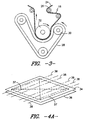
- the fabric 18 made up of warp yarns 24 and fill yarns 26 is passed adjacent to and in intimate contact with a rubber belt 28 into a nip between a nip roll 30 and a heatable drum 32.
- the rubber belt is elongated due to the curvature around the nip roll and the force exerted by the drum.
- the fabric is preferably held between the belt and the drum for approximately 180° of revolution around the drum 32 so as to permit complete recoil.
- One potentially preferred piece of equipment for use in practicing such mechanical compression of the fabric 18 is believed to be available from Morrison Textile Machinery Corporation having a place of business at Fort Lawn, South Carolina.
- the temperature of the drum 32 should be maintained between about room temperature and about 163°C (325°F). Lower temperatures of about 120°C (250°F) or less may be preferred.
- the dynamic air permeability measurements for each of the fabrics is set forth in Table II below as is the packed volume measurements for such fabric for a fixed area of fabric both before and after processing.
- the fabric reference designations correspond to those set forth in Table I.
- the air permeability measurements set forth in Table II above are for dynamic air permeability which represents the performance of the fabric under instantaneous application of a differential pressure.
- dynamic testing is believed to provide a more realistic portrayal of fabric performance in an air bag during a collision event wherein the bag is inflated within a few milliseconds.
- the equipment is set at a particular differential pressure desired. The set pressure is then built up within a cylinder and exhausted quickly across the fabric.
- the measurement in millimeters per second represents the flow of a volume of gas (mm 3 ) through a given area of fabric (mm 2 ) within a short length of time (sec) upon application of a defined differential pressure drop across the fabric.
- FIG. 6 there is illustrated a permeability curve for a 70 tex (630 denier) fabric using multifilament nylon yarn with a filament linear density of 0.33 tex (3 denier) per filament and having a weave density of 15.7 threads/cm (40 threads per inch) in the warp direction by 15.7 threads/cm (40 threads per inch) in the fill direction which has undergone mechanical compression as taught herein.
- Static permeability values were taken over a range of biaxial tensions applied across the fabric to replicate the stresses encountered during a collision event.
- this plain weave fabric is characterized by an air permeability of slightly greater than 27 l/min (1 cfm) in the untensioned state when measured with a differential pressure of 124 Pascal (0.5 inches of water) across the fabric. As the fabric is subjected to biaxial loading in both the warp and the fill direction, the measured air permeability initially decreases and thereafter recovers to a level just above 27 l/min (1 cfm).
- the permeability of the fabric according to the present invention does not spike upwardly as biaxial tensions are applied. This is in dramatic contrast to prior art plain weave fabrics which are known to exhibit permeability increases of several hundred percent when subjected to biaxial tension in the range of interest.
- representative curves illustrating percentage change in permeability taken at a pressure of 500 Pascal (2 inches of water) across the fabric are provided for a high weave density prior art fabric and for a fabric according to the present invention.
- An important feature of the fabric according to the present invention resides in the fact that although its initial untensioned air permeability is greater than 0.3 m/min (1 cfm per square foot) of fabric at 124 Pa (half an inch of water), as is generally advocated for good permeability performance, the fact that the permeability does not substantially increase when tension is applied indicates that this fabric will actually perform as well as a high weave density, low permeability fabric with a starting untensioned air permeability of substantially less than 27 l/min (1 cfm).
- the fabric according to the present invention also exhibits excellent performance character when measured according to other recognized standards.
- the grab tensile strength of the 70 tex (630 denier) fabric according to the present invention has been measured to be in excess of 295 kg (650 pounds) pursuant to ASTM D-5034; the stiffness of the 70 tex (630 denier) fabric according to the present invention has been measured to be less than 0.91 kg (2 pounds) pursuant to ASTM D-4032; the trapezoidal tear of the 70 tex (630 denier) fabric has been measured to be about 68 kg (150 pounds); the tongue tear of the 70 tex (630 denier) fabric according to the present invention has been measured to be about 7 kg (60 pounds) pursuant to ASTM D-2661; and seam strength of the 630 denier fabric as measured pursuant to ASTM D-1683 is about 154 kg (340 pounds) force in the warp direction, about 145 kg (320 pounds) force in the fill direction
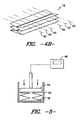
- FIGS. 4A, 4B and 5 The comparative evaluation of packed volume characteristics for treated and untreated fabric as set forth in Table II was carried out using a testing technique and apparatus substantially as illustrated in FIGS. 4A, 4B and 5. Specifically, two square fabric panels 34, 36 having a length of 71 cm (28 inches) on each side as illustrated in FIG. 4A were placed in overlying relation to one another so as to simulate the face and back of a simple air bag configuration, after which seams 37 were applied as shown. The seams were formed of 138 nylon thread at 8 - 12 stitches per 2.54 cm (inch). The resulting square double layered fabric configuration was then folded in a fan configuration along fold lines 38 on either side of the double layered fabric configuration to yield a substantially rectangular configuration with fan folds along either elongate boundary edge as shown in FIG.
- the layered fabric configuration was thereafter folded in a fan configuration along fold lines 40 at either end so as to yield a substantially square final folded configuration.
- the fabric structure folded in the manner described was placed in a test confinement chamber 42 having internal dimensions of 12.7 cm x 12.7 cm (5 inches X 5 inches).
- a platen 44 machined to conform with the internal dimensions of the test confinement chamber 42 is thereafter lowered into the test confinement chamber attached to an In-stron tester such as will be well known to those of skill in the art.
- the force applied by the platen 44 is monitored by a display 46.
- the volume occupied by the fabric within the test confinement chamber for any given applied force can thus be determined by simply monitoring the displacement of the platen 44 within the confinement chamber at such applied force.
- the packed volume of the pre-treatment fabric was in each case greater than the packed volume of the post-treatment fabric when measured under the same applied pressure.
- this beneficial result was achieved without substantially increasing air permeability of the fabric.
- the processed fabric according to the present invention is believed to provide the further benefit of reducing any variation in physical properties such as air permeability which may exist across the width of a woven fabric.
- These variations are generally understood to be due to different levels of residual stress induced during the weaving process. Such stresses may differ from yarn to yarn and machine to machine due to slight differences in gripping mechanisms and yarn beat-up.
- Such residual stresses introduced during the weaving operation can be reduced by balancing the uneven yarn crimp as may exist across the fabric width. This may be achieved by subjecting the fabric to mechanical compression in accordance with the preferred practice of the present invention.
- the advantages of the fabric according to the present invention can thus be seen to result in a more compact air bag system which does not sacrifice air permeability thereby providing designers with additional flexibility in choices regarding the use of such systems.
- the air bag system comprises the air bag itself, the accommodation for the air bag in the vehicle, and the control system for releasing the air bag function.
Landscapes
- Engineering & Computer Science (AREA)
- Mechanical Engineering (AREA)
- Textile Engineering (AREA)
- Air Bags (AREA)
- Woven Fabrics (AREA)
Applications Claiming Priority (2)
| Application Number | Priority Date | Filing Date | Title |
|---|---|---|---|
| US09/074,123 US6327759B1 (en) | 1997-04-17 | 1998-05-07 | Air bag fabric possessing improved packed volume and stable air permeability |
| US74123 | 1998-05-07 |
Publications (2)
| Publication Number | Publication Date |
|---|---|
| EP0955214A1 EP0955214A1 (en) | 1999-11-10 |
| EP0955214B1 true EP0955214B1 (en) | 2005-10-19 |
Family
ID=22117867
Family Applications (1)
| Application Number | Title | Priority Date | Filing Date |
|---|---|---|---|
| EP99108338A Expired - Lifetime EP0955214B1 (en) | 1998-05-07 | 1999-04-28 | Airbag fabric possessing improved packed volume and stable air permeability |
Country Status (4)
| Country | Link |
|---|---|
| US (1) | US6327759B1 (enExample) |
| EP (1) | EP0955214B1 (enExample) |
| JP (1) | JPH11350288A (enExample) |
| DE (1) | DE69927741T2 (enExample) |
Families Citing this family (9)
| Publication number | Priority date | Publication date | Assignee | Title |
|---|---|---|---|---|
| US6220309B1 (en) | 1999-09-24 | 2001-04-24 | Milliken & Company | Inflatable fabrics comprising basket-woven attachment points between fabric panels |
| US6429155B1 (en) * | 1999-06-17 | 2002-08-06 | Milliken & Company | Low permeability airbag cushions having film coatings of extremely low thickness |
| US20040229538A1 (en) * | 2003-05-15 | 2004-11-18 | Love Franklin S. | Woven stretch fabrics and methods of making same |
| US6978808B2 (en) * | 2003-07-17 | 2005-12-27 | Milliken & Company | Bias-woven side curtain airbag |
| US7232001B2 (en) | 2004-08-24 | 2007-06-19 | Sam Hakki | Collision air bag and flotation system |
| CA2649406C (en) * | 2006-04-12 | 2012-06-26 | Norbert Huber | Airbag fabric |
| MX2011001287A (es) * | 2008-08-07 | 2011-03-21 | Invista Tech Sarl | Telas tejidas para bolsas de aire a partir de cintas polimericas de pelicula ranurada. |
| JP5566474B2 (ja) * | 2009-12-30 | 2014-08-06 | コーロン インダストリーズ インク | エアバッグクッション及びこれを含むエアバッグシステム |
| US9279200B2 (en) * | 2012-05-11 | 2016-03-08 | Toyobo Co., Ltd. | Base fabric for air bag which hardly causes “bottoming” upon collision |
Family Cites Families (31)
| Publication number | Priority date | Publication date | Assignee | Title |
|---|---|---|---|---|
| JPS4896849A (enExample) | 1972-03-13 | 1973-12-11 | ||
| DE8714595U1 (de) | 1987-11-03 | 1988-01-28 | Bloch, Klaus, 5205 St Augustin | Airbag für Kraftfahrzeuge |
| IT1229928B (it) * | 1988-10-14 | 1991-09-16 | Sperotto Rimar Spa | Apparecchiatura per provocare il restringimento di un tessuto. |
| US4977016B1 (en) * | 1988-10-28 | 1998-03-03 | Stern & Stern Ind Inc | Low permeability fabric and method of making same |
| US5010663A (en) * | 1988-10-28 | 1991-04-30 | Stern & Stern Industries, Inc. | Low permeability fabric and method of making same |
| ES2056324T5 (es) | 1989-09-07 | 2005-04-16 | Polyamide High Performance Gmbh | Tejido sin recubrir para airbags. |
| US5236775A (en) | 1990-02-12 | 1993-08-17 | Hoechst Aktiengesellschaft | Fabric for airbag |
| US5011183A (en) | 1990-06-08 | 1991-04-30 | Stern & Stern Industries, Inc. | Bag, airbag, and method of making the same |
| JPH04228338A (ja) | 1990-12-27 | 1992-08-18 | Nissan Motor Co Ltd | エアバッグ装置のバッグ本体製造方法 |
| US5508073A (en) | 1991-02-26 | 1996-04-16 | Akzo Nv | Uncoated fabric for manufacturing air bags |
| US5110666A (en) | 1991-05-06 | 1992-05-05 | Reeves Brothers, Inc. | Coated fabric structure for air bag applications |
| ES2130144T3 (es) | 1991-07-16 | 1999-07-01 | Akzo Nobel Nv | Tejidos tecnicos con permeabilidad al aire ajustada de forma preestablecida y alta resistencia al envejecimiento, asi como procedimiento para su produccion. |
| JP3036215B2 (ja) * | 1992-03-18 | 2000-04-24 | タカタ株式会社 | エアバッグ |
| EP0562458A1 (de) * | 1992-03-25 | 1993-09-29 | Akzo Nobel N.V. | Technische Gewebe mit hoher Temperaturbeständigkeit |
| DE4327649A1 (de) * | 1992-11-27 | 1994-06-01 | Trw Repa Gmbh | Gassack für ein Rückhaltesystem in Fahrzeugen und Gewebe zu seiner Herstellung |
| ES2064297T3 (es) | 1992-11-27 | 1998-07-01 | Trw Repa Gmbh | Bolsa inflable para un sistema de retencion en un vehiculo y tejido para su fabricacion. |
| WO1995005296A1 (de) * | 1993-08-17 | 1995-02-23 | Trw Repa Gmbh | Gassack für ein rückhaltesystem in fahrzeugen und gewebe zu seiner herstellung |
| US5277230A (en) | 1993-02-22 | 1994-01-11 | Milliken Research Corporation | Double twillwoven air bag fabric |
| EP0636721B1 (de) | 1993-07-31 | 1998-09-02 | Akzo Nobel N.V. | Verfahren zur Herstellung von unbeschichteten technischen Geweben |
| DE4401003A1 (de) * | 1994-01-17 | 1995-07-20 | Hoechst Ag | Gewebe hoher Drapierfähigkeit, Verfahren zu dessen Herstellung, dessen Verwendung zur Herstellung von Airbags sowie Airbag aus diesem Gewebe |
| GB2301320B (en) * | 1994-01-28 | 1998-03-11 | Asahi Chemical Ind | Air bag |
| US5503197A (en) | 1994-03-30 | 1996-04-02 | Milliken Research Corporation | Method for producing high weave density airbag fabric on a water-jet loom using unsized yarns |
| US5421378A (en) | 1994-03-30 | 1995-06-06 | Milliken Research Corporation | Airbag weaving on a water-jet loom using yarns |
| US5566434A (en) * | 1994-06-15 | 1996-10-22 | Jps Automotive Products Corporation | Air bag for use in a motor vehicle and method of producing same |
| US5650207A (en) * | 1995-09-29 | 1997-07-22 | Highland Industries, Inc. | Airbag fabric |
| US5704402A (en) | 1996-04-01 | 1998-01-06 | Milliken Research Corporation | Air bag fabric |
| US5858886A (en) * | 1996-07-02 | 1999-01-12 | Milliken Research Corporation | Low permeability airbag fabric |
| DE19633387A1 (de) * | 1996-08-19 | 1998-02-26 | Takata Europ Gmbh | Verfahren und Vorrichtung zum Unterbringen eines Luftsackes einer Airbagvorrichtung in einem Behälter und Airbagvorrichtung mit einem zu einem Paket gefalteten Luftsack |
| US5788266A (en) * | 1996-09-16 | 1998-08-04 | Autoliv Asp, Inc. | Simplified airbag module housing |
| US5881776A (en) * | 1997-01-24 | 1999-03-16 | Safety Components Fabric Technologies, Inc. | Rapier woven low permeability air bag fabric |
| US6473948B1 (en) * | 1997-04-17 | 2002-11-05 | Milliken & Company | Air bag fabric possessing improved packed volume characteristics |
-
1998
- 1998-05-07 US US09/074,123 patent/US6327759B1/en not_active Ceased
-
1999
- 1999-04-28 DE DE69927741T patent/DE69927741T2/de not_active Expired - Fee Related
- 1999-04-28 EP EP99108338A patent/EP0955214B1/en not_active Expired - Lifetime
- 1999-05-07 JP JP11127020A patent/JPH11350288A/ja active Pending
Also Published As
| Publication number | Publication date |
|---|---|
| DE69927741T2 (de) | 2006-07-20 |
| JPH11350288A (ja) | 1999-12-21 |
| US6327759B1 (en) | 2001-12-11 |
| DE69927741D1 (de) | 2006-03-02 |
| EP0955214A1 (en) | 1999-11-10 |
Similar Documents
| Publication | Publication Date | Title |
|---|---|---|
| US5921287A (en) | Air bag fabric with specific weave construction | |
| US7409970B2 (en) | Inflatable fabrics comprising basket-woven attachment points between fabric panels | |
| US6455449B1 (en) | Coated multi-denier mixed fabrics for use in inflatable vehicle restraint systems | |
| WO2007022147A2 (en) | One-piece woven air bag with tethers | |
| EP1313630A2 (en) | Abrasion and/or puncture resistant fabrics, airbag cushions, and methods | |
| EP2799602A2 (en) | An inflatable fabrics and an air-bag | |
| US5952250A (en) | Uncoated fabric for producing airbags | |
| KR100245073B1 (ko) | 에어백 및 그의 제조방법 | |
| US6327759B1 (en) | Air bag fabric possessing improved packed volume and stable air permeability | |
| US6672339B2 (en) | Air bag fabric possessing improved packed volume characteristics | |
| US20030194934A1 (en) | Low permeability, high strength timing fabric for utilization within airbag inflation modules | |
| USRE38769E1 (en) | Air bag fabric possessing improved packed volume and stable air permeability | |
| EP1026049B1 (en) | Air bag | |
| KR101103802B1 (ko) | 사이드 커튼형 에어백, 그의 제조방법, 및 이를 포함하는에어백 시스템 | |
| EP1698523A2 (en) | Abrasion and/or puncture resistant fabrics, airbag cushions, and methods | |
| EP4166702B1 (en) | Airbag patch cloth | |
| MXPA99007540A (en) | Air bag fabric possessing improved packed volume characteristics | |
| EP4234780B1 (en) | Two layer fabric and articles comprising same | |
| KR100476474B1 (ko) | 에어백용 원단 및 그의 제조방법. | |
| CN111051149A (zh) | 安全气囊 | |
| KR20190037403A (ko) | 사이드 커튼형 에어백 및 이를 포함하는 에어백 시스템 | |
| KR100614621B1 (ko) | 고온 및 저온 환경 하에서 강도가 우수한 에어백용 원단및 그의 제조방법 | |
| JPH07186856A (ja) | エアバッグ用基布 | |
| JPH07186857A (ja) | エアバッグ用基布 | |
| WO2022097094A1 (en) | Airbag fabrics |
Legal Events
| Date | Code | Title | Description |
|---|---|---|---|
| PUAI | Public reference made under article 153(3) epc to a published international application that has entered the european phase |
Free format text: ORIGINAL CODE: 0009012 |
|
| AK | Designated contracting states |
Kind code of ref document: A1 Designated state(s): DE ES FR GB IT SE |
|
| AX | Request for extension of the european patent |
Free format text: AL;LT;LV;MK;RO;SI |
|
| 17P | Request for examination filed |
Effective date: 20000510 |
|
| AKX | Designation fees paid |
Free format text: DE ES FR GB IT SE |
|
| 17Q | First examination report despatched |
Effective date: 20020416 |
|
| GRAP | Despatch of communication of intention to grant a patent |
Free format text: ORIGINAL CODE: EPIDOSNIGR1 |
|
| GRAS | Grant fee paid |
Free format text: ORIGINAL CODE: EPIDOSNIGR3 |
|
| GRAA | (expected) grant |
Free format text: ORIGINAL CODE: 0009210 |
|
| AK | Designated contracting states |
Kind code of ref document: B1 Designated state(s): DE ES FR GB IT SE |
|
| PG25 | Lapsed in a contracting state [announced via postgrant information from national office to epo] |
Ref country code: IT Free format text: LAPSE BECAUSE OF FAILURE TO SUBMIT A TRANSLATION OF THE DESCRIPTION OR TO PAY THE FEE WITHIN THE PRESCRIBED TIME-LIMIT;WARNING: LAPSES OF ITALIAN PATENTS WITH EFFECTIVE DATE BEFORE 2007 MAY HAVE OCCURRED AT ANY TIME BEFORE 2007. THE CORRECT EFFECTIVE DATE MAY BE DIFFERENT FROM THE ONE RECORDED. Effective date: 20051019 |
|
| REG | Reference to a national code |
Ref country code: GB Ref legal event code: FG4D |
|
| PG25 | Lapsed in a contracting state [announced via postgrant information from national office to epo] |
Ref country code: SE Free format text: LAPSE BECAUSE OF FAILURE TO SUBMIT A TRANSLATION OF THE DESCRIPTION OR TO PAY THE FEE WITHIN THE PRESCRIBED TIME-LIMIT Effective date: 20060119 |
|
| PG25 | Lapsed in a contracting state [announced via postgrant information from national office to epo] |
Ref country code: ES Free format text: LAPSE BECAUSE OF FAILURE TO SUBMIT A TRANSLATION OF THE DESCRIPTION OR TO PAY THE FEE WITHIN THE PRESCRIBED TIME-LIMIT Effective date: 20060130 |
|
| REF | Corresponds to: |
Ref document number: 69927741 Country of ref document: DE Date of ref document: 20060302 Kind code of ref document: P |
|
| ET | Fr: translation filed | ||
| PLBE | No opposition filed within time limit |
Free format text: ORIGINAL CODE: 0009261 |
|
| STAA | Information on the status of an ep patent application or granted ep patent |
Free format text: STATUS: NO OPPOSITION FILED WITHIN TIME LIMIT |
|
| 26N | No opposition filed |
Effective date: 20060720 |
|
| PGFP | Annual fee paid to national office [announced via postgrant information from national office to epo] |
Ref country code: DE Payment date: 20070531 Year of fee payment: 9 |
|
| PGFP | Annual fee paid to national office [announced via postgrant information from national office to epo] |
Ref country code: GB Payment date: 20070425 Year of fee payment: 9 |
|
| PGFP | Annual fee paid to national office [announced via postgrant information from national office to epo] |
Ref country code: FR Payment date: 20070417 Year of fee payment: 9 |
|
| GBPC | Gb: european patent ceased through non-payment of renewal fee |
Effective date: 20080428 |
|
| PG25 | Lapsed in a contracting state [announced via postgrant information from national office to epo] |
Ref country code: DE Free format text: LAPSE BECAUSE OF NON-PAYMENT OF DUE FEES Effective date: 20081101 |
|
| REG | Reference to a national code |
Ref country code: FR Ref legal event code: ST Effective date: 20081231 |
|
| PG25 | Lapsed in a contracting state [announced via postgrant information from national office to epo] |
Ref country code: FR Free format text: LAPSE BECAUSE OF NON-PAYMENT OF DUE FEES Effective date: 20080430 |
|
| PG25 | Lapsed in a contracting state [announced via postgrant information from national office to epo] |
Ref country code: GB Free format text: LAPSE BECAUSE OF NON-PAYMENT OF DUE FEES Effective date: 20080428 |