EP0952859B1 - Larynx-intubationsgerät - Google Patents
Larynx-intubationsgerät Download PDFInfo
- Publication number
- EP0952859B1 EP0952859B1 EP97943444A EP97943444A EP0952859B1 EP 0952859 B1 EP0952859 B1 EP 0952859B1 EP 97943444 A EP97943444 A EP 97943444A EP 97943444 A EP97943444 A EP 97943444A EP 0952859 B1 EP0952859 B1 EP 0952859B1
- Authority
- EP
- European Patent Office
- Prior art keywords
- pad
- airway device
- laryngeal
- laryngeal airway
- tube
- Prior art date
- Legal status (The legal status is an assumption and is not a legal conclusion. Google has not performed a legal analysis and makes no representation as to the accuracy of the status listed.)
- Expired - Lifetime
Links
Images









Classifications
-
- A—HUMAN NECESSITIES
- A61—MEDICAL OR VETERINARY SCIENCE; HYGIENE
- A61B—DIAGNOSIS; SURGERY; IDENTIFICATION
- A61B1/00—Instruments for performing medical examinations of the interior of cavities or tubes of the body by visual or photographical inspection, e.g. endoscopes; Illuminating arrangements therefor
- A61B1/267—Instruments for performing medical examinations of the interior of cavities or tubes of the body by visual or photographical inspection, e.g. endoscopes; Illuminating arrangements therefor for the respiratory tract, e.g. laryngoscopes or bronchoscopes
-
- A—HUMAN NECESSITIES
- A61—MEDICAL OR VETERINARY SCIENCE; HYGIENE
- A61M—DEVICES FOR INTRODUCING MEDIA INTO, OR ONTO, THE BODY; DEVICES FOR TRANSDUCING BODY MEDIA OR FOR TAKING MEDIA FROM THE BODY; DEVICES FOR PRODUCING OR ENDING SLEEP OR STUPOR
- A61M16/00—Devices for influencing the respiratory system of patients by gas treatment, e.g. ventilators; Tracheal tubes
- A61M16/04—Tracheal tubes
-
- A—HUMAN NECESSITIES
- A61—MEDICAL OR VETERINARY SCIENCE; HYGIENE
- A61M—DEVICES FOR INTRODUCING MEDIA INTO, OR ONTO, THE BODY; DEVICES FOR TRANSDUCING BODY MEDIA OR FOR TAKING MEDIA FROM THE BODY; DEVICES FOR PRODUCING OR ENDING SLEEP OR STUPOR
- A61M16/00—Devices for influencing the respiratory system of patients by gas treatment, e.g. ventilators; Tracheal tubes
- A61M16/04—Tracheal tubes
- A61M16/0402—Special features for tracheal tubes not otherwise provided for
- A61M16/0409—Special features for tracheal tubes not otherwise provided for with mean for closing the oesophagus
-
- A—HUMAN NECESSITIES
- A61—MEDICAL OR VETERINARY SCIENCE; HYGIENE
- A61M—DEVICES FOR INTRODUCING MEDIA INTO, OR ONTO, THE BODY; DEVICES FOR TRANSDUCING BODY MEDIA OR FOR TAKING MEDIA FROM THE BODY; DEVICES FOR PRODUCING OR ENDING SLEEP OR STUPOR
- A61M16/00—Devices for influencing the respiratory system of patients by gas treatment, e.g. ventilators; Tracheal tubes
- A61M16/04—Tracheal tubes
- A61M16/0434—Cuffs
- A61M16/0445—Special cuff forms, e.g. undulated
-
- A—HUMAN NECESSITIES
- A61—MEDICAL OR VETERINARY SCIENCE; HYGIENE
- A61M—DEVICES FOR INTRODUCING MEDIA INTO, OR ONTO, THE BODY; DEVICES FOR TRANSDUCING BODY MEDIA OR FOR TAKING MEDIA FROM THE BODY; DEVICES FOR PRODUCING OR ENDING SLEEP OR STUPOR
- A61M16/00—Devices for influencing the respiratory system of patients by gas treatment, e.g. ventilators; Tracheal tubes
- A61M16/04—Tracheal tubes
- A61M16/0488—Mouthpieces; Means for guiding, securing or introducing the tubes
-
- A—HUMAN NECESSITIES
- A61—MEDICAL OR VETERINARY SCIENCE; HYGIENE
- A61M—DEVICES FOR INTRODUCING MEDIA INTO, OR ONTO, THE BODY; DEVICES FOR TRANSDUCING BODY MEDIA OR FOR TAKING MEDIA FROM THE BODY; DEVICES FOR PRODUCING OR ENDING SLEEP OR STUPOR
- A61M16/00—Devices for influencing the respiratory system of patients by gas treatment, e.g. ventilators; Tracheal tubes
- A61M16/04—Tracheal tubes
- A61M16/0488—Mouthpieces; Means for guiding, securing or introducing the tubes
- A61M16/049—Mouthpieces
- A61M16/0495—Mouthpieces with tongue depressors
-
- A—HUMAN NECESSITIES
- A61—MEDICAL OR VETERINARY SCIENCE; HYGIENE
- A61M—DEVICES FOR INTRODUCING MEDIA INTO, OR ONTO, THE BODY; DEVICES FOR TRANSDUCING BODY MEDIA OR FOR TAKING MEDIA FROM THE BODY; DEVICES FOR PRODUCING OR ENDING SLEEP OR STUPOR
- A61M2210/00—Anatomical parts of the body
- A61M2210/06—Head
- A61M2210/0625—Mouth
- A61M2210/0656—Epiglottis
Definitions
- This invention is concerned with the management of a human airway in order to control respiration. More particularly, the invention concerns a device that couples an airway tube reliably and safely with the laryngeal opening, the upper end of the trachea, which is the breathing passageway that leads to the lungs.
- the device seats in the throat immediately adjacent the laryngeal opening, tensions and erects the laryngeal opening, and seals within the laryngeal opening to provide a channel through the airway tube for artificial ventilation of the lungs.
- the airway of a human being includes the throat and windpipe, and leads to the lungs. Control and management of a patient's airway are required under a variety of circumstances. During the administration of general anesthesia, in particular, the resultant loss of consciousness and muscle tone require that patient ventilation be maintained through an artificial airway. Control of a patient's airway is also necessary to permit mechanical ventilation of a patient with diseased or injured lungs and during resuscitation of a hemodynamically compromised and apneic or non-breathing patient. Mechanical ventilation of a patient involves forming a seal about some portion of the patient's breathing anatomy and introducing air that varies in pressure through the seal. The air is provided through a tube from a ventilating machine.
- the seal confines the varying air pressure in the airway and lungs of the patient, imposing an artificial respiration on the lungs.
- a breach in the seal undesirably lets the varying pressure escape to the ambient atmosphere, which inhibits airway management. Therefore, the quality and efficacy of an airway management device depends upon the seal that it forms where it interfaces with a patient's airway.
- airway devices A wide variety of devices are currently available to manage a patient's airway. For simplicity, these airway devices can he categorized as follows: face masks, tracheal tubes and pharyngeal airways.
- a face mask covering the mouth and nose and with a port for connection to a ventilation means is commonly used for short term control of the airway.
- the face mask is non-invasive in that sealing of the airway is accomplished not by penetration into the patient's airway, but rather by skin contact, with the mask encircling the mouth and nose.
- airway patency is not assured since the tongue and other structures can obstruct the airway.
- a face mask does not prevent the introduction of air into the esophagus and stomach (gastric insufflation) or protect against the aspiration of stomach contents (breathing of vomited material). Still further, the face mask precludes surgical field avoidance during oral, nasal and facial procedures, and it is inappropriate for patients with facial burns.
- Tracheal tubes are inserted through the mouth or nose and into the trachea (the windpipe) where an inflatable balloon or cuff surrounding the tube seals against the interior surface of the trachea.
- This approach avoids the deficiencies of face masks because it includes the provision of a conduit traversing the pharynx, and forms an effective seal against the airway, allowing positive pressure ventilation, and protection against aspiration of stomach contents.
- tracheal tubes create new challenges. They are difficult to insert and position properly within the trachea, almost always requiring a laryngoscope, stylet or other intubation aid.
- U.S. Patent No. 5,259,371 discloses another endotracheal tube, without a balloon, that is introduced into a person's larynx through an auxillary tube with a flange that rests on the larynx.
- Another method of ensuring a patent airway is to insert a tracheostomy tube through an opening in the front of the neck and directly into the trachea.
- This approach is even more invasive than the tracheal tube in that it requires surgery to install the tube; consequently, it is reserved for patients chronically requiring ventilatory assistance or for those needing emergency relief from an obstructed upper airway.
- a supraglottic seal seals in the throat, above the larynx, while providing a passageway to the laryngeal opening through which ventilatory gases may be delivered. Since these devices normally terminate in the pharynx, the portion of the throat from the mouth to the larynx, they are commonly referred to as "pharyngeal” devices. When combined with a breathing tube, a pharyngeal device is called a "pharyngeal airway" device.
- a variety of pharyngeal airway devices have been developed for assistance in maintaining a human airway. Some oro-pharyngeal airway devices are useful in displacing the tongue or as bite blocks, but are incapable of maintaining the airway by themselves, since a seal is not effected. Other devices include a tube with a cuff to seal against the pharyngeal wall at the base of the tongue, and with another cuff that seals around the plugged distal end of a tube situated in the esophagus. Patient ventilation occurs through side holes in the tube between the two cuffs, the side holes aligned with the laryngeal opening.
- Another pharyngeal airway device includes a tube with an inflatable cuff surrounding its distal end.
- the cuff is intended to seal against the pharyngeal wall, above the epiglottis.
- a laryngeal mask airway device in this regard which is disclosed in EP-A-0389272 is adapted to occupy space in a person's pharynx near the person's larynx.
- GB-A-2298796 discloses an introducer along which a laryngeal mask airway device can be slid into position.
- pharyngeal airway devices seal against pharyngeal structures surrounding the larynx, and merely mask or cover the larynx, rather than sealing within or directly against it. These devices characteristically form inadequate seals that leak with a moderate level of positive pressure ventilation. Further, these devices provide easily breached or imperfect barriers between the esophagus and trachea, allowing gastric insufflation and/or aspiration of stomach contents. Also, these devices usually include air channels with small bores that limit the size of tracheal tubes that can be inserted into a trachea, should intubation be desired.
- the inadequate sealing performance of pharyngeal airway devices is not surprising considering their designs and the anatomy with which they interface.
- the larynx (“voice box") is the most proximal part of the trachea and opens into the pharynx, immediately behind the base of the tongue.
- the adult laryngeal inlet (the opening into the larynx and trachea) looks very similar to a piece of pipe, approximately 5/8" in diameter with its end beveled at an approximately 30° angle.
- the pipe analogy is accurate when describing the general appearance of the trachea and larynx, however it is not an accurate analogy of the functional anatomy.
- the laryngeal inlet is not a rigid structure.
- the anterior wall of the laryngeal inlet (the side facing the tongue), including the tip of the beveled end of the inlet, is formed by the epiglottis, which is a flexible cartilage.
- the epiglottis provides some structure to the laryngeal inlet but is sufficiently flexible that it can easily be bent posteriorly, away from the tongue, to fully cover and block the inlet.
- the distal posterior aspect of the laryngeal inlet is formed by two small, movable arytenoid cartilages.
- the side walls of the laryngeal inlet are formed by very flexible quadrangular membranes attached to the arytenoid cartilages posteriorly and to the epiglottis anteriorly.
- Our invention is a laryngeal airway device comprising a curved or flexible tube with proximal and distal ends.
- the tube has a sealing member attached at its distal end that forms a seal within the rim of the laryngeal inlet.
- the seal within the rim of the laryngeal inlet makes our device fundamentally different than pharyngeal airway devices which seal against pharyngeal structures.
- Substantially in the midline of the anterior surface of the sealing member is a hole in communication with the distal end of the flexible tube. The hole approximates the aperture of the laryngeal inlet when the device is properly positioned for use, forming an air conduit with the larynx.
- the cartilaginous support structure and membranous side walls of the laryngeal inlet are both compressible and collapsible and are therefore difficult to seal against.
- Our device seals against the compressible and collapsible laryngeal inlet in a very specific and unique way.
- Our key observation is that while the laryngeal inlet may have little strength to resist external circumferential compression, it has considerable tensile strength (the ability to resist stretching).
- the epiglottic cartilage forming the anterior wall of the laryngeal inlet is attached to the thyroid cartilage of the larynx at its distal end and at its proximal end is free to move in an anterior or posterior direction, like a "lever".
- Attached to and supported by this "lever” are the flexible quadrangular membranes which form the side walls of the laryngeal inlet.
- the proximal edge of the quadrangular membranes, called the ary-epiglottic folds, form the majority of the rim of the laryngeal inlet. Pivoting the epiglottic "lever” in an anterior direction (toward the tongue) stretches the ary-epiglottic folds between the epiglottis and their posterior attachment on the arytenoid cartilages.
- the ary-epiglottic folds are minimally stretchable and, when tensioned, create a relatively firm rim at the laryngeal inlet. The pad of our device abuts and seals against and within the tensioned rim of the laryngeal inlet.
- Another object of this invention is the provision of an airway device with which a human airway may be managed by formation of a seal between the device and the laryngeal opening.
- Yet another object of this invention is the provision of a laryngeal airway device that tensions the rim of the laryngeal inlet with which it then forms a seal for airway management.
- Yet another object of this invention is the provision of airway management by means of a laryngeal device that seals against the compressible and collapsible laryngeal inlet.
- the first embodiment of our invention is a laryngeal airway device 10 that includes an air channel 11 and a sealing member 14.
- the primary component of the air channel 11 is an air tube 12.
- the sealing member 14 includes a pad 16 of soft, compliant material, having a hole 18.
- the hole 18 opens through the pad 16.
- the sealing member 14 further includes a wedge-shaped molded plastic support member 20 having a passageway 24 that transitions to a socket 26 in its rearward end.
- the socket 26 accepts the distal end 27 of the air tube 12.
- the passageway 24 opens through the support member 20 by way of a hole 21 that aligns with the hole 18 in the pad 16.
- the laryngeal airway device 10 is assembled by suitably bonding the air tube 12, pad 16, and support member 20 together.
- the air channel 11 provides an air pathway that is open from the proximal end 28 of the air tube 12 through the tube 12, the support member passageway 24, and the hole 18 in the pad 16.
- the pad 16 (also, "conformable cushion”) forms the anterior face of the sealing member 14 of the laryngeal airway device 10.
- the pad 16 is adapted to abut against and conform to the rim of the laryngeal opening (as opposed to surrounding it) to form a seal therewith.
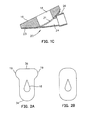
- the dotted line 32 represents the outline of the rim of the laryngeal inlet where it contacts the pad 16, one can see that the hole 18 is contained within that rim.
- Application of a seating force on the sealing member 14 in the direction of the rim of the laryngeal opening will cause the portion of the pad 16 that abuts the laryngeal opening rim at 32 to compress against the rim.
- Pad material between the hole 18 and the rim of the laryngeal opening at 32 will be uncompressed, as will material between the rim of the laryngeal opening and the outside edge of the pad 16. This forms an effective seal between the laryngeal opening and the pad 16 that constrains artificial ventilation delivered by way of the hole 18 to the airway and lungs of a patient.
- the pad 16 is preferably made of a closed-cell polyvinyl chloride (PVC) foam material, or equivalent.
- PVC polyvinyl chloride
- the slow time required by certain closed-cell foams to reexpand after compression may be advantageous in our invention. Some of these foams remain compressed for 15-45 seconds after release of a compressive force. This characteristic of the foam material allows time for the laryngeal airway device 10 to be inserted into a patient's mouth with the pad compressed, reducing the anterior-posterior thickness of the pad 16 and its total bulk. After a short delay, the resilient foam re-expands to its total thickness, remaining compressed only against the rim of the laryngeal opening at 32 to advantageously form a seal with the larynx. Many other open or closed foam cell materials are also suitable, with or without surface "skinning".
- the pad 16 may alternatively be made from any other suitable compressible and resilient material, or from an inflatable bladder.
- the laryngeal airway device in which the pad 16 is formed of a foam material may have an additional advantage.
- the foam may absorb fluids with which it comes into contact. Preapplication of fluids to the pad 16 before insertion is expected to improve the sealing capability of the pad 16 against the rim of the laryngeal inlet. The natural saliva in the pharynx is also expected to improve the seal.
- the anterior surface 17 of the pad 16 forms the anterior surface of the laryngeal airway device.
- This surface may be contoured in manner that is adapted to the contour of the throat in the vicinity of the laryngeal inlet.
- a contoured pad 16 may include a slight anterior projection of the anterior surface of the pad in the area immediately proximal to the hole 18. This projection is expected to force the epiglottis anteriorly, to assist in tensioning the rim of the laryngeal inlet.
- the anterior surface 17 of the pad 16 may be substantially planar.
- the hole 18 (of which there may be one or more) is substantially in the midline of the anterior face of the pad 16 and is in communication with the distal end 27 of the air tube 12 on the posterior side of the pad 16,
- the hole 18 provides a conduit for delivering ventilatory gases from the distal end 27 to the laryngeal inlet.
- there is a single hole 18 whose transverse dimension is smaller than the corresponding transverse diameter of the laryngeal inlet, thereby allowing the material of the pad 16 surrounding the hole to form a seal by abutting against the rim of the laryngeal inlet as described above.
- the hole 18 is elongate in shape, narrowest in its transverse dimension.
- the hole 18 has an elongate teardrop shape, with its pointed end directed proximally. Considering the oval shape of the rim of the laryngeal inlet at 32, the elongate teardrop-shaped hole 18 in the pad 16 maximizes the chances of alignment and patency along the longitudinal axis, the axis with the highest chance of error in alignment.
- the narrow portion of the hole 18 prevents the epiglottis from falling into and occluding the air channel formed by the hole 18 in the pad 16, while still providing the maximal opportunity for longitudinal alignment.
- the pad 16 is illustrated, in top plan, in Fig. 2A.
- the periphery of the pad 16 has a quasi-rectangular shape with a rounded distal end 34.
- the distal end 34 of the pad 16 seats in the hypopharyngeal space, just above the upper esophageal sphincter.
- our laryngeal airway device is not intended to enter the upper esophagus.
- the two small lateral protrusions or wings 19 are formed on either side of the proximal end 36 of the pad 16,
- An alternative embodiment of the pad 16 is illustrated in Fig. 2B. This embodiment comprises a substantially rectangular periphery with rounded corners.
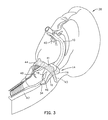
- Fig. 3 the upper portion of a patient 38 is shown in a partially schematic, partially cutout view with our laryngeal airway device 10 inserted through the patient's mouth 40.
- the illustrated portion of the patient's anatomy includes the epiglottis 42, and hyoid bone 44.
- the laryngeal inlet comprises the aryepiglottic fold 46 whose upper edge forms a portion of the rim of the laryngeal opening that abuts the pad 16 at the position indicated by reference numeral 32 in Figs. 1A and 1B.
- the upper portion of the airway, immediately within the rim of the laryngeal opening is referred to as the laryngeal vestibule 48.
- the hyoid bone 44 is attached to the epiglottis 42 in its midline by the hyo-epiglottic ligament.
- the U-shaped hyoid bone 44 is substantially horizontally oriented.
- the hyoid bone 44 is always positioned in the airway at the level of the laryngeal inlet.
- the side portions of the U-shaped of the hyoid bone are referred to as the greater horns.
- One greater horn 45 is visible in dotted outline in Fig. 3.
- the greater horns of the hyoid bone 44 define the transverse width of the pharynx at the level of the laryngeal inlet.
- the shape of the periphery of the pad 16 is adapted to fit transversely between the greater horns of the hyoid bone 44. Lateral alignment between the pad 16 and the laryngeal inlet rim is assured by the transverse dimension which adapts the pad to fit snugly between the greater horns of the hyoid bone 44.
- the laterally protruding wings 19 are adapted to be wider than the transverse width between the greater horns of the hyoid bone 44.
- the laryngeal airway device 10 is advanced into the pharynx, sealing member first, until the lateral protruding wings 19 contact and seat on the greater horns of the hyoid bone 44, preventing further advancement. Since the hyoid bone 44 is always at the level of the laryngeal inlet, the winged shape of the scaling member 14 provides a positive endpoint, assuring dependable longitudinal alignment between the hole 18 and the laryngeal inlet.
- the wings 19 of the pad 16 When the wings 19 of the pad 16 are properly seated on the hyoid bone 44, the wings also help to prevent the laryngeal airway device from accidental dislodgment.
- the wings 19 in effect are trapped between the hyoid bone 44 distally and the soft tissue of the tonsillar pillars (not shown) proximally, which are located on the side walls of the pharynx near the back of the throat.
- the tonsillar pillars create a resistance to spontaneous ejection of the airway device from its properly seated position.
- the sealing member 14 in a longitudinal section, is substantially wedge shaped, to approximate the angle of the bevel of the laryngeal inlet.
- the distal end of the sealing member 14 is thin in the antcro-posterior dimension, while the proximal portion is thicker.
- the support member 20 is preferably made of a molded flexible plastic which is stiffer than the material of which the pad 16 is made, yet which is pliable enough to aid in the insertion of an endotracheal tube (described below).
- the support member 20 serves to anchor the distal end 27 of the air tube 12.
- the passageway 24 of the support member is a complete conical, or cylindrical space with the hole 21 in its anterior wall.
- the air tube 12 is preferably a curved or flexible tube made of PVC or urethane plastic. Alternatively, other types of plastic and rubber material would also be suitable.
- an optional pharyngeal blade 50 facilitates insertion of the laryngeal airway device 10, and eliminates the need for a clinician to insert fingers in the throat and mouth of the patient.
- the pharyngeal blade 50 is substantially 1-shaped, with the upper leg 52 of the J serving as a handle and the lower leg 54 of the J acting as an insertion blade.
- the lower leg 54 widens and then narrows to the distal tip 55 to present a spoon-like shape.
- the blade may be substantially L-shaped.
- the blade 50 is preferably constructed of a lightweight, relatively stiff plastic such as polypropylene or PVC. Alternately, the blade 50 may he made of metal, or other suitable materials.
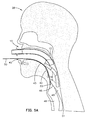
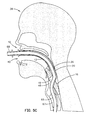
- Figs. 5A and 5B Use of a laryngeal airway device according to the invention is illustrated in Figs. 5A and 5B. These pictures arc side views showing a side elevation section of the head and throat of the patient 38 illustrated earlier in Fig. 3.
- the blade 50 is directed to the back of the pharynx of the patient 38 and, when the distal tip 55 of the blade contacts the posterior pharyngeal wall, the blade 50 is then pivoted as it is advanced caudally down the throat.
- the smooth blade surface elevates the epiglottis 42 anteriorly and slides along the tongue 43 and epiglottis 42, without allowing either of these flexible structures to fold over the laryngeal inlet.
- the blade 50 When the blade 50 is fully inserted into the pharynx, the blade 50 is lifted in an antero-caudad direction to open the mouth 40 and retract the tongue 43, creating an open channel for the laryngeal airway device 10.
- the holes 56 permit ventilation through the laryngeal inlet.
- the laryngeal airway device 10 is then introduced through the mouth 40, advancing it along the posterior surface of the blade 50 until it meets a resistance to further advancement.
- the wings 19 of the preferred embodiment have engaged the greater horns of the hyoid bone (not shown in Figs. 5A-5C) as discussed above, and the hole 18 is in proper alignment with the laryngeal inlet.
- the blade 50 is then removed by simply pulling it out of the mouth 40, while holding the proximal end of the air tube 12 to stabilize the laryngeal airway device 10 in position.
- Fig. 5B illustrates, when the sealing member 14 of the laryngeal airway device 10 is seated, the distal end 34 of the pad 16 is lodged in the hypopharyngeal space 49 just above the esophagus 51. At the same time, the proximal end of the pad 16 presses against the epiglottis 42 forcing it in an anterior direction toward the tongue 43, thereby stretching the ary-epiglottic folds, which create a relatively firm rim at the laryngeal inlet. As shown in Fig. 5B, the pad 16 abuts and seals against the tensioned rim of the laryngeal inlet, with a part 56 of the anterior surface of the pad 16 projecting into the laryngeal vestibule 48.
- a space is created on the anterior side of the airway device between the proximal anterior edge of the pad 16 and the air tube 12. This space can accommodate the extremely compliant tongue.
- Fig. 5B shows the tongue beginning to fall posteriorly into this space. When the tongue is accommodated in this space, it helps to seal the epiglottis 42 against the pad 16 and also helps to stabilize the airway device against accidental removal.
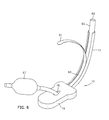
- a tear strip 60 is provided, for example, on the anterior side of the air tube 12 as shown in Fig. 6.
- the upper end of the tear strip 60 projects into a tab 61.
- the tear strip 60 is integral with the air tube 12.
- the air tube 12 is extruded or molded with two partial thickness scored lines or grooves running along its entire length.
- the air tube 12 could be extruded with two small spaced-apart lumens within the wall of the tube 12.
- the air tube 12 is longitudinally weakened along the lines to create one or more seams along which the material of the air tube can be parted by tearing.
- the strip of tubing wall between the two grooves (or lumens) serves as the tear strip 60, which can be removed by grasping the tab 61 and pulling it away from the air tube 12.
- the tear strip 60 separates from the air tube 12 along the weakened grooves.
- an open channel is created along the entire length of the air tube 12.
- the seams may be located laterally or posteriorly on the air tube.
- an endotracheal tube can be passed through the laryngeal airway device and into the trachea by way of the air tube 12 and through the hole 18.
- This is shown in Figs. 5C and 6, where an endotracheal tube 65 has been inserted through the air tube 12, distal end first.
- a distal balloon 67 on the endotracheal tube 65 is inflated, which seats the tube in the trachea.
- the strip 60 is then pulled away from the air tube 12, the endotracheal tube is rotated forwardly out of the slot created in the air tube 12 by the absence of the strip 60, and the laryngeal airway device 10 is pulled out of the patient's throat.
- the laryngeal airway device 10 can be pulled over the proximal end 69 of the endotracheal tube.
- the endotracheal tube 65 is connected to a ventilating apparatus, by a connector 68 for example, the laryngeal airway device 10 may be pulled out of the mouth along the endotracheal tube 65 to a point where, using scissors, the hole 18 may be enlarged and the support member 20 cut away so that the laryngeal airway device 10 can be pulled off of the endotracheal tube 65.
- the sealing member 14 can be constructed with a corresponding peel-away section, as explained later with respect to other embodiments.
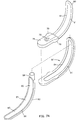
- FIG. 7A A second embodiment of the laryngeal airway device is illustrated in Figs. 7A-7C.
- the pad forming the anterior face of the laryngeal airway device is indicated by reference numeral 76.
- the pad 76 includes a teardrop-shaped hole 78.
- the pad 76 is bonded to a molded pad 80 forming the posterior surface of the laryngeal airway device.
- the molded pad 80 is preferably made of a foam plastic material selected to have flexibility and compressibility characteristics that provide structural support to the more compressible and conformable cushion portion of the laryngeal airway device.
- the molded pad 80 may also include a molded air channel 82 that is received in a trough 84.
- the molded air channel 82 is open at 85 and includes a peripheral lip 86 that is received on and bonded to the anterior surface 87 of the molded pad 80.
- a connector 88 is forward on the proximal end of the molded air channel 82.
- An additional strip of material 89 may be integral with the proximal end of the pad 76, attaching just above the wings 79.
- the strip of material 89 is preferably perforated at 91 to create a removable tear-strip along its length for intubation as described above with reference to Figs. 5C and 6.
- the entire strip 89 of flexible material may be removable by parting an adhesive bond along its length.
- the strip 89 is glued or bonded to the peripheral lip 86 in order to confine airflow through the molded air channel 82, between the hole 78 and the connector 88.
- the pieces illustrated in Figs. 7A and 7B form the single integral laryngeal airway device that is indicated by reference numeral 99 in Fig. 7C.
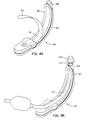
- Figs. 8A and 8B illustrate operation of the laryngeal airway device 99 when intubation is indicated or desired.
- a strip 93 has been pulled away from the strip 89 along the perforations 91 so that the interior of the molded air channel 82 is exposed.
- Fig. 8B shows an endotracheal tube 101 inserted through the connector 88 of the molded air channel 82.
- the laryngeal airway device 99 can be removed from the endotracheal tube 101 by cutting away the structure of the device 99 around the socket 88.
- the entire laryngeal airway device 99 can be pulled over the distal end of the endotracheal tube 101 in a quick maneuver.
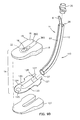
- Figs. 9A-9C illustrate a third embodiment of the laryngeal airway device that includes a molded plastic support member 120 having an open slot or passageway 124 and a partial socket at its rearward end 126 to accept the distal end 27 of the air tube 12.
- a laryngeal airway device 110 is assembled by suitably bonding the air tube 12.
- pad 16 and support member 120 together.
- the under surface of the pad 16 can be glued to the opposing surface 123 of the support member 120.
- a posterior pad 122 made of a foam material or an inflatable bladder may be mounted to the posterior side of the support member 120.
- the posterior pad 122 optimally serves as a cushion against the posterior wall of the pharynx, elevates the device anteriorly toward the laryngeal inlet, and helps to stabilize the device, preventing it from shifting position during use.
- a gauze or cloth layer may be added to the posterior pad 122 to frictionally engage the posterior wall of the pharynx, for further stability.
- the molded plastic support member 120 is sandwiched internally between the pad 16 and the posterior pad 122.
- the support member 120 is preferably made of a molded flexible plastic that is stiffer than the materials of which the pad 16 and the optional posterior pad 122 are made.
- the support member 120 serves to anchor the distal end 27 of the air tube 12.
- the socket 126 of the support member is an incomplete ring with a void in its anterior wall.
- the void corresponds with the removable strip portion 60 of the air tube 12 (described above).
- the support member 120 has an elbow portion immediately distal to the distal end 27 of the air tube 12, which redirects air, and or a fiber optic scope or endotrachcal tube through the hole 18 in the pad 16, and toward the laryngeal inlet.
- the support member 120 may include a midline depression 125 in the plane of its anterior surface 123, distal to the elbow. This depression may be designed to accommodate the rigid ringlike cricoid cartilage, by allowing the cricoid cartilage and the cushion supporting it to be depressed through the plane of the surface 123.
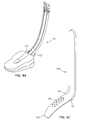
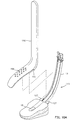
- the support member 120 also includes retaining flanges 127. These are intended to retain a pharyngeal blade 150 having retaining slots, one of which is indicated by 159.
- the retaining slots 159 are set back from the distal end 155 of the lower leg 154 of the pharyngeal blade 150.
- the pharyngeal blade 150 is attached to the laryngeal airway device 110 by the interlocking action between the retaining flanges 127 on the support piece 120 and the retaining slots 159 on the blade 150.
- the lower leg 154 compresses the pad 16, with the distal end 155 of the blade extending slightly beyond the distal end of the pad 16.
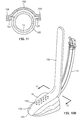
- FIG. 11 shows, in a cross section taken along 11-11 in Fig. 10B, the retention of the laryngeal blade 150 by engagement of the elongate slots 159 with the flanges 127 on the support member 120.
- the holes 156 align with the hole 18 to permit ventilation through the laryngeal inlet, by way of the air channel 12.
- FIG. 12B is a cross section taken at 12B-12B in Fig. 12A, with the blade 150 attached to the laryngeal airway device 110.
- each of the flanges 127 includes a respective hole 128.
- the blade portion 154 includes, set back from the distal tip 155, a pair of projections 162 on the posterior side of the blade 150, each of which extends toward the distal end 155 and which may be received in a respective one of the holes 128 to attach the blade 150 to the laryngeal airway device 110.
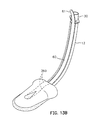
- a sealing member 214 comprises a support member in the form of a pad of compliant material 220 that is stiffer and less compliant than the material of which the pad 16 is made. This pad is termed the "posterior pad”, while the pad 16 may be termed the "anterior pad”.
- the posterior pad 220 includes a passageway 224 and a shaped recess 226 having an anterior surface 227.
- the anterior pad 16 is bonded, for example, by gluing, to the surface 227 of the posterior pad 220.
- the alternate embodiment illustrated in Figs. 13A and 13B operates as described above for airway management, and may have any of the optional adaptations for insertion and for intubation that are disclosed in connection with previously-described embodiments.
- Figs. 9B, 13A and 13B shows lines of weakness 360 in the pad 16 that extend from the wide portion of the teardrop-shaped hole 18 to the proximal edge of the pad 16.
- These lines represent a tear strip that is generally aligned with the tear strip 60 and that can be removed with the tear strip 60 to completely open the laryngeal airway device to facilitate removal of the laryngeal airway device from an endotracheal tube, without requiring scissors to assist in removal.
- the fifth embodiment of our invention fortes an effective fluid seal with a laryngeal inlet, positions the laryngeal airway device very accurately and dependably with respect to the laryngeal inlet, and improves the ease of insertion of the laryngeal airway device into a patient.
- the fifth embodiment of our laryngeal airway device provides an increased angle of the anterior surface on the sealing member lateral to the hole through the sealing member.
- the increased angle anticipates and accommodates a pronounced scallop in the lateral rim of the laryngeal inlet, increasing the reliability of a seal formed therewith by the sealing member of the device.
- the fifth embodiment also increases the accuracy which with our device can be placed in the throat of a patient, and enhances the dependability of the seal with the upper portion of the laryngeal inlet.
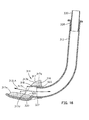
- the fifth embodiment of our laryngeal airway device is illustrated in Figs. 14, 15, 16 and 17.
- Fig. 14 is an isometric view of the fifth embodiment, assembled.
- Fig. 15 is an isometric exploded view showing the elements of the fifth embodiment,
- Fig. 16 is a side sectional view of the fifth embodiment.
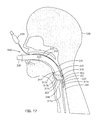
- Fig. 17 is a side elevational view of the fifth embodiment after having been advanced against the laryngeal inlet.
- the device 300 includes an air tube 312 and a sealing member 314.
- the sealing member 314 includes a pad 316 with an anterior surface 317.
- the tube 312 and pad 316 may be formed with the materials described above in respect of embodiments one through four.
- a hole 318 opens through the anterior surface 317 and the pad 316.
- the hole 318 is substantially in the midline of the pad 316. It may be teardrop-shaped, narrowest in its transverse dimension, which is smaller than the transverse dimension of the laryngeal opening with which it is adapted to seal.
- the sealing member 314 further includes a sigmoid-shaped, molded plastic support member 320 having a sleeve 323 that defines a passageway 324.
- the distal end 327 of the air tube 312 is received in the rear opening of the sleeve 323. When assembled, the air tube 312 communicates through its distal end 327, the sleeve 323, and the hole 318.
- the sleeve 323 preferably has the longitudinal shape of a truncated cone that funnels the larger diameter distal end 327 of the air tube 312 down to the smaller diameter of the hole 318.
- the shape of the sleeve 323 could be tubular.
- the sleeve 323 is preferably tear-drop shaped in cross-section, with the point of the tear-drop at 325 oriented posteriorly (toward the bottom) with respect to the sealing member 314.
- the teardrop shapes of the hole 318 and sleeve 323 approximate the shape of the supraglottic larynx, with the point of the sleeve 323 fitting between the arytenoid cartilages.
- these shapes could be substantially oval or round in cross-section.
- Preferably the cleft 325 is on the posterior wall at the apex 325 of the sleeve's teardrop shape. Therefore, the wall of the collar, when contacting the arytenoid cartilages, is very flexible and the contact is non-traumatic.
- the anterior portion of the wall of the sleeve 323 is intact and therefore stiffer than the posterior portion, thereby enabling the sleeve 323 to support the epiglottis on its anterior wall portion.
- the cleft at 325 allows expansion of the sleeve 323, particularly at its distal margin, to accommodate the passage of an oversized tracheal tube through its lumen.
- a connector 330 is mounted to the proximal end 328 of the air tube 312.
- An inflatable balloon 331 is mounted to the tube 312 by attachment to the posterior surface of the support member and by a collar 332 that slides over the outer surface of the air tube 312 near its distal end 327. The balloon 331 is thereby retained on the air tube 312, posteriorly to the sealing member 314.
- the fifth embodiment as so far described is assembled by suitably bonding the pad 316 to the support member 320 by way of, for example, an adhesive layer 326, and then bonding the distal tip 327 of the air tube 312 in the posterior opening of the sleeve 323.
- an air passageway opens from the proximal end 328 of the air tube 312 through the tube 312 and the sleeve 323, and extends through the hole 318.
- the anterior surface 317 of the pad 316 has a proximal anterior extension 317a that transitions into a convex curve 317b.
- the convex curve 317b of the anterior surface transitions, on either side of the hole 318, into lateral anterior surface portions 317c. From the bottoms of the lateral anterior surface portions 317c, the anterior surface 317 transitions through a concave curve 317d to a distal extension 317e.
- the distal extension 317e, the concave curve 317d, the lateral anterior surface portions 317c, the convex curve 317b As shown in Figs. 16 and 17, the anterior surface 317 of the pad 316 has a proximal anterior extension 317a that transitions into a convex curve 317b.
- the convex curve 317b of the anterior surface transitions, on either side of the hole 318, into lateral anterior surface portions 317c. From the bottoms of the lateral anterior surface portions 317c, the anterior surface 317 transition
- anterior surface 317 combines to give the anterior surface a substantially sigmoid shape.
- the angle ⁇ which the lateral anterior surface portions 317d forms with an extension of a longitudinal axis 312LA of the distal end 327 of the air tube 312 is preferably approximately 55°. Alternatively, this angle may be in the range of approximately 30° to approximately 90°.
- the ventilation hole 318 (and the distal end of the sleeve 323) must accurately oppose the orifice of the laryngeal inlet. It is preferable that the accurate alignment of the ventilation hole in our device with the laryngeal inlet be accomplished during "blind" or non-visualized insertion.
- the design of our fifth embodiment accurately and dependably positions the laryngeal airway device with respect to the laryngeal inlet, as now described.
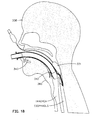
- Figs. 17 and 18 for an understanding of the operation of the fifth embodiment of our laryngeal airway device. These pictures are side views showing a side elevation section of the head and throat of a patient 338. Refer also to Fig. 19 for an understanding of the anatomical space in which the scaling member 314 must be positioned for accurately and dependably seating in the throat of a patient. (Although not shown in these illustrations, a pharyngeal blade, such as the blade 50 discussed previously, may be used to assist in the insertion of the laryngeal airway device 300).
- Fig. 17 illustrates, when the sealing member 314 of the laryngeal airway device 300 is seated against the laryngeal opening, the distal extension 317e of the anterior surface 317 is lodged in the hypopharyngeal space 349, just above the esophagus.
- the proximal anterior extension 317a and the upper portion of the convex curve 317b press against the epiglottis 342, forcing it in an anterior direction toward the tongue 343, thereby stretching the ary-epiglottic folds, which create a relatively firm rim at the laryngeal inlet.
- the angle that the lateral anterior portions 317c of the anterior surface 317 form with respect to the longitudinal axis 312LA have been previously described.
- the distal extension 317e of the anterior surface 317 is angled toward the longitudinal axis 312LA, but projected distally. This forms the tight concave curve in the anterior surface 317, at 317d.
- the portion of the anterior surface 317 that transitions through the concave curve 317d creates a reliable end-point to insertion of the laryngeal airway device when it firmly abuts the arytenoid cartilages 352 of the laryngeal inlet. This end point accurately positions the laryngeal airway device longitudinally, with respect to the laryngeal inlet, along or substantially parallel to the longitudinal axis shown in Fig. 19.
- the larynx can be expected to be resting on the posterior wall 351 of the patient's hypopharynx 349.
- the distal extension 317e of the anterior surface 317 is inserted between the posterior side 350 of the larynx and the posterior wall 351. Inserting the distal extension 317e between these two structures holds the laryngeal airway device 300 in place, stabilizing the device 300 to prevent movement when in use. Further, the distal extension 317e accurately positions the laryngeal device 300 along the anterior-posterior (A-P) axis (Fig.
- the laryngeal airway device 300 is also accurately positioned in the transverse axis shown in Fig. 19 (from side-to-side of the patient's neck) by sizing the width of the anterior surface 317 and/or the support member 320 to the width of the pharynx at the level of the laryngeal inlet. In general, this width will be defined by the distance between the wings of the hyoid bone 44 (reference Fig. 19).
- the laryngeal airway device 300 may be slightly wider than the available space, with the provision that the material of which the pad 316 is made is compressible, which will provide a snug fit between the side walls of the pharynx.
- the lateral anterior surface portions 317c embody a means for accurately positioning the sealing member 314 with respect to the laryngeal inlet in both the longitudinal and A-P axes. Sizing the width of the anterior surface 317 to the width of the pharynx centers the device with respect to the laryngeal inlet in the transverse axis. Therefore, the sealing member 314 accurately and dependably positions itself in three axes with respect to the laryngeal inlet, when inserted blindly into the pharynx.
- the laryngeal airway device 300 must be in firm contact with the laryngeal inlet. This can be difficult when the lateral rim portions of the laryngeal inlet are scalloped severely. Typical scalloping is seen in Fig. 19 in the lateral rim portion 372.
- the convex curve 317b is shaped to fill the scalloped rim 372. With reference to Figs. 17, 18 and 19, such contact is provided by a thickness along the A-P axis that is sufficient to force the anterior surface 317 against the laryngeal inlet.
- One potential problem is that excessive thickness in the A-P dimension might make insertion of the laryngeal airway device 300 through the mouth.
- the laryngeal airway device 300 by provision of the inflatable balloon 331 that is carried on the posterior side of the air tube 312. As shown in Fig. 17. the laryngeal airway device 300 is inserted to the pharynx with the balloon 331 deflated, reducing the A-P thickness for insertion. When the anterior surface 317 is properly positioned with respect to the larynx, the balloon 331 is inflated, thereby elevating the laryngeal airway device 300 off of the posterior pharyngeal wall 351 and forcing it anteriorly against the laryngeal inlet and epiglottis 342.
- the balloon 331 is inflated by way of a tube 333 having at its distal a fitting 334 through which it pressurized air may be introduced for inflating the balloon 331.
- Inflation of the balloon and rotation of the sealing member 314 anteriorly against the epiglottis 342 are shown in Fig. 18.
- the anterior rotation of the sealing member 314 by inflation of the balloon 331 against the epiglottis is evidenced by a slight bulge 360 in the neck of the patient 338.
- the sigmoid shape of the anterior surface 317, particularly in the convex curve portion 317b follows the scalloping in the lateral edges of the laryngeal inlet, which enhances the seal formed between the sealing portion 314 and the laryngeal inlet.
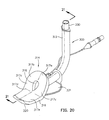
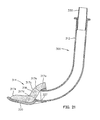
- Figs. 20 and 21 illustrate an optional variation of the fifth embodiment in which the sleeve 323 is omitted from the support member 320.
- the anterior surface 317 of the pad 316 of the sealing member 314 has the surface features 317a, 317b, 317c, 317d, 317e that impose a sigmoid shape on the anterior surface 317.
- the support member 320 is preferably a molded plastic piece in which the sleeve 323 can be included, or omitted.
- the fifth embodiment of the laryngeal airway device 300 may be adapted to include the integral perforations of previously-described embodiments that would enable the device 300 to be used as a channel for intubation which could be stripped away from an in-place endotracheal tube, if desired.
Landscapes
- Health & Medical Sciences (AREA)
- Pulmonology (AREA)
- Life Sciences & Earth Sciences (AREA)
- Engineering & Computer Science (AREA)
- Veterinary Medicine (AREA)
- Public Health (AREA)
- General Health & Medical Sciences (AREA)
- Animal Behavior & Ethology (AREA)
- Heart & Thoracic Surgery (AREA)
- Biomedical Technology (AREA)
- Emergency Medicine (AREA)
- Hematology (AREA)
- Anesthesiology (AREA)
- Surgery (AREA)
- Otolaryngology (AREA)
- Medical Informatics (AREA)
- Pathology (AREA)
- Nuclear Medicine, Radiotherapy & Molecular Imaging (AREA)
- Biophysics (AREA)
- Physics & Mathematics (AREA)
- Physiology (AREA)
- Optics & Photonics (AREA)
- Molecular Biology (AREA)
- Radiology & Medical Imaging (AREA)
- Surgical Instruments (AREA)
- Prostheses (AREA)
- Arc Welding In General (AREA)
- External Artificial Organs (AREA)
- Endoscopes (AREA)
Claims (24)
- Larynx-Intubationsgerät (100, 300) mit einer Luftröhre (11, 312) mit einem nahen Ende und einem entfernten Ende, mit einem Dichtungselement (14, 314), das an dem entfernten Ende der Luftröhre angebracht ist, die angepasst ist, um Raum in der Pharynx bzw. dem Rachen einer Person einzunehmen, und mit einem Durchgang (24, 324) in dem Dichtungselement, der durch das entfernte Ende in Verbindung mit der Luftröhre steht, dadurch gekennzeichnet, dassdas Dichtungselement ein zusammendrückbares Polster bzw. Kissen (16, 316) mit einer vorderen Oberfläche (17, 317) und einem relativ steifen Tragteil (20, 320) hinter bzw. auf der Rückseite des zusammendrückbaren Kissens enthält, und dasssich wenigstens ein Loch (18, 318) in dem Kissen zwischen der vorderen Oberfläche des Kissens und dem Durchgang öffnet.
- Larynx-Intubationsgerät nach Anspruch 1, wobei die vordere Oberfläche (17) des Kissens im wesentlichen flach ist.
- Larynx-Intubationsgerät nach Anspruch 1, wobei die vordere Oberfläche (317) des Kissens mit einer Kontur versehen ist.
- Larynx-Intubationsgerät nach Anspruch 1, wobei der Umfang des Kissens eine im wesentlichen rechtwinklige Form hat.
- Larynx-Intubationsgerät nach Anspruch 1, wobei der Umfang des Kissens seitlich vorstehende Flügel bzw. Vorsprünge (19) aufweist.
- Larynx-Intubationsgerät nach Anspruch 5, wobei die Quer-Breite des Kissens, über die Flügel gemessen, breiter als die Quer-Breite des Kissens weg von den Flügeln ist.
- Larynx-Intubationsgerät nach Anspruch 1, wobei das Loch eine langgestreckte Form mit einer Längsabmessung hat, die größer ist als eine Querabmessung.
- Larynx-Intubationsgerät nach Anspruch 7, wobei das Loch eine tränenartige Form mit einem spitzzulaufenden Ende hat, das nah bzw. in der Nähe orientiert ist.
- Larynx-Intubationsgerät nach Anspruch 1, wobei die Luftröhre ein flexibles Rohr aufweist.
- Larynx-Intubationsgerät nach Anspruch 9, wobei das flexible Rohr wenigstens einen Längsschnitt hat, der sich längs seiner Länge erstreckt und eine Linie relativer Schwächung (91) in einer Wand des Rohrs bildet.
- Larynx-Intubationsgerät nach Anspruch 10, wobei das flexible Rohr zwei Längsschnitte aufweist, die einen entfernbaren Streifen (60) bilden, der sich in Längsrichtung auf dem flexiblen Rohr erstreckt.
- Larynx-Intubationsgerät nach Anspruch 11, wobei der entfernbare Streifen auf einer vorderen Wand des flexiblen Rohrs vorgesehen ist und an seinem nahen Ende einen Lappen bzw. eine (ausgestanzte) Zunge (61) enthält.
- Larynx-Intubationsgerät nach Anspruch 1, wobei das Tragelement eine vordere Oberfläche hat, die mit einer hinteren Oberfläche des Kissens verbunden ist.
- Larynx-Intubationsgerät nach Anspruch 13, wobei das Tragelement einen Ellenbogenbereich zur Umlenkung der in der Luftröhre fließenden Luft in Richtung auf das Loch enthält.
- Larynx-Intubationsgerät nach Anspruch 1, wobei die Luftröhre ein flexibles gegossenes bzw. geformtes Element mit einem entfernbaren Materialstreifen (60) ist.
- Larynx-Intubationsgerät nach Anspruch 15, wobei das eine Wand der Luftröhre bildende Material in Längsrichtung längs einer Linie (91) schwächer bzw. dünner ausgelegt ist, um eine Naht bzw. einen Saum zu bilden.
- Larynx-Intubationsgerät nach Anspruch 15, wobei das eine Wand der Luftröhre bildende Material in Längsrichtung in zwei parallelen Linien zu einem abnehmbaren Abreißstreifen perforiert ist.
- Larynx-Intubationsgerät nach Anspruch 15, weiterhin mit einem Material, das eine mit dem gegossenen Teil verbundene Wand bildet.
- Larynx-Intubationsgerät nach Anspruch 1, wobei das Tragelement eine vordere Oberfläche und einen Schlitz hat, wobei eine hintere Oberfläche des Kissens mit der vorderen Oberfläche über dem Schlitz verbunden ist, wodurch der Durchgang ausgebildet wird.
- Larynx-Intubationsgerät nach Anspruch 19, wobei die Luftröhre ein flexibles Rohr aufweist, das wenigstens eine sich längs seiner Länge erstreckenden Längsabschnitt enthält der eine Linie relativer Schwächung in einer Wand des Rohrs erzeugt, wobei das Kissen eine Linie relativer Schwächung über dem Schlitz in Ausrichtung mit dem wenigstens einen Längsschnitt enthält.
- Larynx-Intubationsgerät nach Anspruch 19, weiterhin mit einem hinteren Kissen, das mit einer hinteren Oberfläche des Tragelementes verbunden ist.
- Larynx-Intubationsgerät nach Anspruch 1, wobei das Tragelement ein im wesentlichen (elastisch) nachgiebiges Material in der Weise aufweist, dass das Tragelement steifer als das Kissen ist.
- Larynx-Intubationsgerät nach Anspruch 22, wobei das Kissen ein erstes weiches, (elastisch) nachgiebiges Kunststoff-Material aufweist, das Tragelement ein zweites weiches, (elastisch) nachgiebiges Kunststoff-Material aufweist, und das Material des Kissens weicher und (elastisch) nachgiebiger als das Material des Tragelementes ist.
- Larynx-Intubationsgerät nach einem der Ansprüche 1 bis 23 in Kombination mit einer Pharynx-Klinge bzw. einem Pharynx-Messer bzw. -Blatt.
Applications Claiming Priority (5)
| Application Number | Priority Date | Filing Date | Title |
|---|---|---|---|
| US730791 | 1985-05-06 | ||
| US08/730,791 US5937859A (en) | 1996-10-16 | 1996-10-16 | Laryngeal airway device |
| US885682 | 1997-06-30 | ||
| US08/885,682 US6070581A (en) | 1996-10-16 | 1997-06-30 | Laryngeal airway device |
| PCT/US1997/016838 WO1998016273A1 (en) | 1996-10-16 | 1997-09-24 | Laryngeal airway device |
Publications (2)
| Publication Number | Publication Date |
|---|---|
| EP0952859A1 EP0952859A1 (de) | 1999-11-03 |
| EP0952859B1 true EP0952859B1 (de) | 2000-11-08 |
Family
ID=27112110
Family Applications (1)
| Application Number | Title | Priority Date | Filing Date |
|---|---|---|---|
| EP97943444A Expired - Lifetime EP0952859B1 (de) | 1996-10-16 | 1997-09-24 | Larynx-intubationsgerät |
Country Status (9)
| Country | Link |
|---|---|
| US (1) | US6070581A (de) |
| EP (1) | EP0952859B1 (de) |
| CN (1) | CN1133471C (de) |
| AT (1) | ATE197409T1 (de) |
| AU (1) | AU719829B2 (de) |
| CA (1) | CA2265482C (de) |
| DE (1) | DE69703502T2 (de) |
| ES (1) | ES2154056T3 (de) |
| WO (1) | WO1998016273A1 (de) |
Families Citing this family (94)
| Publication number | Priority date | Publication date | Assignee | Title |
|---|---|---|---|---|
| US5878745A (en) | 1996-03-01 | 1999-03-09 | Brain; Archibald I.J. | Gastro-laryngeal mask |
| US6427686B2 (en) * | 1996-10-16 | 2002-08-06 | Augustine Medical, Inc. | Airway device with provision for coupling to an introducer |
| US6830049B2 (en) * | 1996-10-16 | 2004-12-14 | Arizant Healthcare Inc. | Airway device with provision for coupling to an introducer |
| NL1004640C2 (nl) * | 1996-11-28 | 1998-06-05 | Ideamed N V | Beademingsinrichting. |
| US6079409A (en) * | 1997-07-25 | 2000-06-27 | Brain; Archibald Ian Jeremy | Intubating laryngeal mask |
| GB9721840D0 (en) * | 1997-10-16 | 1997-12-17 | Smiths Industries Plc | Laryngeal mask assemblies |
| US7331346B2 (en) * | 1997-12-24 | 2008-02-19 | Indian Ocean Medical, Inc. | Monitoring and control for a laryngeal mask airway device |
| GB9727367D0 (en) * | 1997-12-24 | 1998-02-25 | Brain Archibald Ian Jeremy | Improvements in laryngeal mask airway devices |
| GB9817537D0 (en) * | 1998-08-13 | 1998-10-07 | Brain Archibald Ian Jeremy | A laryngear mask airway with mutually independant laterally-placed ultra-flexible eastric access/discharge and airway tubes |
| US6196224B1 (en) * | 1998-09-30 | 2001-03-06 | David D. Alfery | Perilaryngeal oral airway |
| GB9821771D0 (en) * | 1998-10-06 | 1998-12-02 | Brain Archibald Ian Jeremy | Improvements relating to laryngeal mask airway devices |
| US6119695A (en) * | 1998-11-25 | 2000-09-19 | Augustine Medical, Inc. | Airway device with provision for lateral alignment, depth positioning, and retention in an airway |
| DE60045166D1 (de) † | 1999-04-09 | 2010-12-09 | Laryngeal Mask Co Ltd | Kehlkopfmaske zum einmaligen Gebrauch |
| US6705318B1 (en) | 1999-04-09 | 2004-03-16 | Archibald I. J. Brain | Disposable LMA |
| US6631720B1 (en) * | 1999-10-07 | 2003-10-14 | Archibald I. J. Brain | Laryngeal mask with large-bore gastric drainage |
| GB2364644A (en) * | 2000-07-15 | 2002-02-06 | Donald Munro Miller | A streamlined liner of the pharygeal airway (SLIPA) |
| SE0003592L (sv) * | 2000-10-05 | 2002-04-06 | Octagon Med Prod | Trakeostomitub och användning av koniostomitub såsom trakeostomitub |
| US7159589B2 (en) * | 2001-08-23 | 2007-01-09 | Indian Ocean Medical Inc. | Disposable laryngeal mask airway device |
| US6792943B2 (en) | 2001-09-05 | 2004-09-21 | Minnesota High-Tech Resources, Llc | Intubating ventilatory face mask |
| US20060247496A1 (en) * | 2001-10-31 | 2006-11-02 | Peter Tjong Joe Wai | Instrument for creating space in a human pharynx, and method for using the instrument |
| US7762261B1 (en) | 2001-11-08 | 2010-07-27 | Fortuna Anibal De Oliveira | Combination artificial airway device and esophageal obturator |
| US7040322B2 (en) * | 2001-11-08 | 2006-05-09 | Fortuna Anibal De Oliveira | Combination artificial airway device and esophageal obturator |
| US7040312B2 (en) * | 2002-05-16 | 2006-05-09 | Engineered Medical Systems, Inc. | Perilaryngeal oral airway with flexible tip guide |
| GB2413963B (en) * | 2002-08-14 | 2007-03-07 | Muhammed Aslam Nasir | Improved airway device |
| GB0218868D0 (en) * | 2002-08-14 | 2002-09-25 | Nasir Muhammed A | Improved airway management device |
| US6792948B2 (en) * | 2003-01-22 | 2004-09-21 | Archibald I. J. Brain | Laryngeal mask airway device with airway tube having flattened outer circumference and elliptical inner airway passage |
| ES2234387B1 (es) * | 2003-02-24 | 2007-08-01 | Pedro Acha Gandarias | Laringoscopio optico luminoso con dispositivo de extraccion de fluidos incorporado. |
| US7608040B1 (en) | 2003-02-24 | 2009-10-27 | City Of Hope | Device to aid in placing tracheal tubes |
| EP1654025B1 (de) * | 2003-08-14 | 2012-03-14 | Muhammed Aslam Nasir | Verbesserte Atemwegsvorrichtung |
| US7134431B2 (en) * | 2003-09-08 | 2006-11-14 | Indian Ocean Medical Inc. | Laryngeal mask airway device with position controlling tab |
| US7128071B2 (en) * | 2003-09-10 | 2006-10-31 | Indian Ocean Medical Inc. | Intubating laryngeal mask airway device with fiber optic assembly |
| JP2005143756A (ja) * | 2003-11-13 | 2005-06-09 | Scalar Corp | 経口エアウェイ、及び気道確保補助器具 |
| US8091554B2 (en) * | 2004-01-30 | 2012-01-10 | The General Hospital Corporation | Methods and devices for relieving upper airway obstructions |
| US20050166928A1 (en) * | 2004-01-30 | 2005-08-04 | Yandong Jiang | Methods and devices for maintaining an open airway |
| US7096868B2 (en) * | 2004-03-09 | 2006-08-29 | Nellcor Puritan Bennett Incorporated | Laryngeal airway device |
| US7201168B2 (en) * | 2004-04-14 | 2007-04-10 | King Systems Corporation | Non-tracheal ventilation tube |
| GB0510951D0 (en) * | 2005-05-27 | 2005-07-06 | Laryngeal Mask Company The Ltd | Laryngeal mask airway device |
| US7938118B2 (en) * | 2006-04-06 | 2011-05-10 | Kessler Joel D | Combination laryngeal mask airway with dual blocking and fluid removal features and method |
| DE102006029182B3 (de) * | 2006-06-24 | 2007-07-12 | Universitätsklinikum Schleswig-Holstein | Larynxmaske mit integriertem Endotrachealtubus |
| US7878201B2 (en) * | 2006-09-29 | 2011-02-01 | Mongeon Douglas R | Supraglottic airway device and method of use |
| CN101172180B (zh) * | 2006-10-31 | 2010-08-18 | 张地利 | 喉头罩 |
| GB2444779A (en) * | 2006-12-14 | 2008-06-18 | Archibald Ian Jeremy Brain | A laryngeal mask with with drug delivery means |
| USD611138S1 (en) | 2006-12-21 | 2010-03-02 | Intersurgical Uab | Laryngeal mask airway device |
| EP1938855A1 (de) * | 2006-12-29 | 2008-07-02 | Ti-Li Chang | Kehlkopfmaskenluftweg ohne Aufblasen |
| GB0719054D0 (en) * | 2007-09-29 | 2007-11-07 | Nasir Muhammed A | Airway device |
| CN101450235B (zh) * | 2007-11-28 | 2013-03-13 | 刘春江 | 一种呼吸辅助系统 |
| CN101450238B (zh) * | 2007-11-28 | 2012-09-12 | 刘春江 | 一种气管插管辅助装置 |
| GB0810169D0 (en) * | 2008-06-04 | 2008-07-09 | Cosmeplast Ets | Improvements relating to respiratory interface devices |
| US20100094417A1 (en) * | 2008-10-15 | 2010-04-15 | Christopher Robert Johnson | Dual Hook Laryngeal Cable Prosthesis (DHLCP) used to correct airflow in the larynx of horses affected with left recurrent laryngeal neuropathy |
| GB0821291D0 (en) * | 2008-11-21 | 2008-12-31 | Nasir Muhammed A | Improved airway device |
| WO2010083433A1 (en) | 2009-01-15 | 2010-07-22 | Beth Israel Deaconess Medical Center | Pressure measuring syringe |
| GB0903654D0 (en) | 2009-03-03 | 2009-04-15 | Laryngeal Mask Company The Ltd | Artificial airway device |
| EP3434307B1 (de) | 2009-07-06 | 2020-05-20 | Teleflex Life Sciences Unlimited Company | Künstlicher atemweg |
| USD665495S1 (en) | 2009-07-14 | 2012-08-14 | Muhammed Aslam Nasir | Medical device |
| CN102498377B (zh) | 2009-08-13 | 2014-05-14 | 奇姆德恩医疗有限公司 | 压力指示器 |
| US8434486B2 (en) * | 2009-12-18 | 2013-05-07 | Covidien Lp | Supraglottic fixation device for endotracheal tubes |
| EP2550049A2 (de) * | 2010-03-22 | 2013-01-30 | ART Healthcare Ltd. | Endotrachealsonde mit einem oder mehreren blockierungselementen, blockierungselemente und verfahren zur verwendung der blockierungselemente |
| GB201010647D0 (en) | 2010-06-24 | 2010-08-11 | Docsinnovent Ltd | Stopper device |
| GB201016562D0 (en) | 2010-10-01 | 2010-11-17 | Laryngeal Mask Company The Ltd | Artificial airway device |
| WO2012049448A2 (en) | 2010-10-15 | 2012-04-19 | The Laryngeal Mask Company Limited | Artificial airway device |
| DK201001052A (en) * | 2010-11-19 | 2011-11-10 | Ambu As | A tracheal intubation guide |
| CN103429291A (zh) | 2011-02-02 | 2013-12-04 | 梅田有限公司 | 改进的人工气道 |
| GB2489258A (en) | 2011-03-22 | 2012-09-26 | Donald Munro Miller | Supra-laryngeal device which seals against the pharynx |
| GB2489407A (en) | 2011-03-23 | 2012-10-03 | Donald Munro Miller | Laryngeal mask and tracheal tube airway devices |
| CN103596613B (zh) * | 2011-05-31 | 2016-08-17 | 国立大学法人冈山大学 | 喉罩 |
| USD688787S1 (en) | 2011-06-08 | 2013-08-27 | Intersurgical Ag | Airway device cap and strap holder |
| USD665254S1 (en) | 2011-06-08 | 2012-08-14 | Intersurgical Ag | Airway device packaging |
| USD693920S1 (en) | 2011-06-08 | 2013-11-19 | Intersurgical Ag | Airway device |
| GB2492357B (en) * | 2011-06-28 | 2014-09-10 | Breslauer Ltd | Improved laryngeal mask assembly |
| USD712244S1 (en) | 2011-09-23 | 2014-09-02 | Intersurgical Ag | Medical device package |
| GB201120628D0 (en) | 2011-11-30 | 2012-01-11 | Laryngeal Mask Company The Ltd | Endoscopy device |
| USD761952S1 (en) | 2012-07-27 | 2016-07-19 | Docsinnovent Limited | Airway device |
| GB201201438D0 (en) * | 2012-01-27 | 2012-03-14 | Docsinnovent Ltd | Improved stopper device |
| CA2874914C (en) | 2012-06-04 | 2020-02-25 | Singularity Ag | Laryngeal mask head |
| US20140069421A1 (en) * | 2012-09-12 | 2014-03-13 | Po-Yu Kuo | Medical oral airway instrument |
| EP2903673B1 (de) * | 2012-10-08 | 2017-09-20 | The Cleveland Clinic Foundation | Umkehrbare atemwegsvorrichtung |
| EP2965687B1 (de) * | 2013-03-06 | 2018-01-31 | Medcom Flow, S.A. | Kehlkopfmaske mit starrer einziehbarer lasche und vorrichtung für beatmung und intubation |
| EP3068476A4 (de) * | 2013-11-15 | 2017-07-26 | Ciel Medical, Inc. | Vorrichtungen und verfahren zur atemwegsabsaugung |
| GB2521375C (en) | 2013-12-17 | 2021-09-29 | Aslam Nasir Muhammed | Intubating Airway Device |
| GB2529650A (en) * | 2014-08-27 | 2016-03-02 | Carl Michael Walkden | Self sealing absorbent subglottic airway device |
| USD1051359S1 (en) | 2015-06-15 | 2024-11-12 | Intersurgical Ag | Airway device |
| USD842456S1 (en) | 2015-12-15 | 2019-03-05 | Intersurgical Ag | Airway device |
| US20180177964A1 (en) * | 2016-12-22 | 2018-06-28 | Tianjin Medan Medical Corp. | Glottis mask airway |
| AU201714823S (en) | 2017-02-27 | 2017-10-12 | Teleflex Life Sciences Unlimited Co | Laryngeal mask airway device |
| CN106823086A (zh) * | 2017-03-09 | 2017-06-13 | 杭州富善医疗器械有限公司 | 喉罩 |
| US10213567B1 (en) * | 2017-11-08 | 2019-02-26 | Shan Theventhiran | Easily removable intubating LMA |
| GB201720733D0 (en) | 2017-12-13 | 2018-01-24 | Ashkal Development Ltd | Airway device |
| CA3112459A1 (en) * | 2018-11-20 | 2020-05-28 | Glenn P. Gardner | Bi-functional intubating and ventilating supraglottic airway |
| JP1649725S (de) | 2019-01-18 | 2020-01-14 | ||
| US12303643B2 (en) | 2019-01-23 | 2025-05-20 | Genesis Airway Innovations Pty Ltd | Intubation apparatus and method of use |
| CN110743071B (zh) * | 2019-10-31 | 2024-01-23 | 田鸣 | 一种气管导管 |
| CN111135418A (zh) * | 2019-12-31 | 2020-05-12 | 宁德市闽东医院 | 一种口腔段固定式气管导管 |
| USD1025348S1 (en) | 2020-04-16 | 2024-04-30 | Intersurgical Ag | Airway device |
| CN112043928A (zh) * | 2020-10-09 | 2020-12-08 | 山东省千佛山医院 | 一种辅助可视软镜检查和插管的口咽通气道及医疗设备 |
Family Cites Families (24)
| Publication number | Priority date | Publication date | Assignee | Title |
|---|---|---|---|---|
| GB478958A (en) * | 1936-07-23 | 1938-01-24 | Edward Baron | A throat pack with airway, for use during oral and other operations |
| US4351342A (en) * | 1981-06-10 | 1982-09-28 | Wiita Bruce E | Balloon catheter |
| GB2229367A (en) * | 1989-03-22 | 1990-09-26 | Archibald Ian Jeremy Brain | Artificial airway device |
| US4976261A (en) * | 1989-04-03 | 1990-12-11 | Advanced Pulmonary Technologies, Inc. | Endotracheal tube with inflatable cuffs |
| US5038766A (en) * | 1989-11-08 | 1991-08-13 | Parker Jeffrey D | Blind orolaryngeal and oroesophageal guiding and aiming device |
| GB9119703D0 (en) * | 1991-09-14 | 1991-10-30 | Dingley John | Medico-surgical device |
| GB9204754D0 (en) * | 1992-03-05 | 1992-04-15 | Brain Archibald Ian Jeremy | Mould for manufacture of a laryngeal mask |
| US5259371A (en) * | 1992-08-13 | 1993-11-09 | Tonrey Francis G | Endotracheal tube and method of intubation |
| US5355879A (en) * | 1992-09-28 | 1994-10-18 | Brain Archibald Ian Jeremy | Laryngeal-mask construction |
| US5494029A (en) * | 1992-09-29 | 1996-02-27 | Hood Laboratories | Laryngeal stents |
| US5443063A (en) * | 1993-08-31 | 1995-08-22 | The Johns Hopkins University | Cuffed oro-pharyngeal airway |
| JP3782123B2 (ja) * | 1994-05-31 | 2006-06-07 | 住友ベークライト株式会社 | 咽腔用エアウエイ |
| GB9422224D0 (en) * | 1994-11-03 | 1994-12-21 | Brain Archibald Ian Jeremy | A laryngeal mask airway device modified to detect and/or stimulate mescle or nerve activity |
| DE4447186A1 (de) * | 1994-12-30 | 1996-07-11 | Johann Dr Med Wittenbeck | Larynxmaske (=Kehlkopfmaske) zur fiberoptischen endotrachealen Intubation bei gleichzeitiger künstlicher Beatmung eines Patienten |
| US5477851A (en) * | 1995-01-26 | 1995-12-26 | Callaghan; Eric B. | Laryngeal mask assembly and method for removing same |
| US5513627A (en) * | 1995-01-27 | 1996-05-07 | Flam; Gary H. | Esophageal tracheal intubator airway |
| GB9505399D0 (en) * | 1995-03-17 | 1995-05-03 | Smiths Industries Plc | Medico-surgical devices |
| MY115052A (en) * | 1995-10-03 | 2003-03-31 | Archibald Ian Jeremy Brain | Laryngeal mask airway incorporating an epiglottic elevating mechanism |
| MY138519A (en) * | 1995-10-03 | 2009-06-30 | Indian Ocean Medical Inc | Artificial airway device |
| US5791341A (en) * | 1995-12-19 | 1998-08-11 | Bullard; James Roger | Oropharyngeal stent with laryngeal aditus shield and nasal airway with laryngeal aditus shield |
| GB9606012D0 (en) * | 1996-03-22 | 1996-05-22 | Brain Archibald Ian Jeremy | Laryngeal mask with gastric-drainage feature |
| US5623921A (en) * | 1996-04-10 | 1997-04-29 | Kinsinger; J. William | Laryngeal mask airway and method for its use |
| US5682880A (en) * | 1996-07-26 | 1997-11-04 | Brain; Archibald Ian Jeremy | Laryngeal-mask airway with guide element, stiffener, and fiberoptic access |
| US5988167A (en) * | 1997-05-02 | 1999-11-23 | Kamen; Jack M. | Foam cuff for laryngeal mask airway |
-
1997
- 1997-06-30 US US08/885,682 patent/US6070581A/en not_active Expired - Fee Related
- 1997-09-24 EP EP97943444A patent/EP0952859B1/de not_active Expired - Lifetime
- 1997-09-24 AU AU44917/97A patent/AU719829B2/en not_active Ceased
- 1997-09-24 AT AT97943444T patent/ATE197409T1/de not_active IP Right Cessation
- 1997-09-24 DE DE69703502T patent/DE69703502T2/de not_active Expired - Fee Related
- 1997-09-24 CA CA002265482A patent/CA2265482C/en not_active Expired - Fee Related
- 1997-09-24 CN CNB971988277A patent/CN1133471C/zh not_active Expired - Fee Related
- 1997-09-24 WO PCT/US1997/016838 patent/WO1998016273A1/en not_active Ceased
- 1997-09-24 ES ES97943444T patent/ES2154056T3/es not_active Expired - Lifetime
Also Published As
| Publication number | Publication date |
|---|---|
| EP0952859A1 (de) | 1999-11-03 |
| US6070581A (en) | 2000-06-06 |
| AU4491797A (en) | 1998-05-11 |
| DE69703502T2 (de) | 2001-06-13 |
| AU719829B2 (en) | 2000-05-18 |
| CN1133471C (zh) | 2004-01-07 |
| WO1998016273A1 (en) | 1998-04-23 |
| CA2265482C (en) | 2004-04-20 |
| DE69703502D1 (en) | 2000-12-14 |
| ATE197409T1 (de) | 2000-11-11 |
| HK1023953A1 (en) | 2000-09-29 |
| CA2265482A1 (en) | 1998-04-23 |
| CN1236326A (zh) | 1999-11-24 |
| ES2154056T3 (es) | 2001-03-16 |
Similar Documents
| Publication | Publication Date | Title |
|---|---|---|
| AU719829B2 (en) | Laryngeal airway device | |
| US5937859A (en) | Laryngeal airway device | |
| JP5096444B2 (ja) | 改良型エアウェイ装置 | |
| US6439232B1 (en) | Laryngeal mask airway device | |
| US6634354B2 (en) | Laryngeal mask airway | |
| US6196224B1 (en) | Perilaryngeal oral airway | |
| US6338343B1 (en) | Airway device with provision for lateral alignment, depth positioning, and retention in an airway | |
| US5964217A (en) | Method and apparatus for ventilation/oxygenation during guided insertion of an endotracheal tube | |
| KR101566563B1 (ko) | 후두 마스크 | |
| JP2918338B2 (ja) | 気道と,食道からの排出物の同心状の排出とのための喉頭のマスク | |
| EP1133330B1 (de) | Atemwegsvorrichtung mit vorkehrung für die koppelung an eine einführvorrichtung | |
| US20010050082A1 (en) | Laryngeal mask airway | |
| EP1409055A2 (de) | Laryngealmasken-luftweg | |
| HK1023953B (en) | Laryngeal airway device |
Legal Events
| Date | Code | Title | Description |
|---|---|---|---|
| PUAI | Public reference made under article 153(3) epc to a published international application that has entered the european phase |
Free format text: ORIGINAL CODE: 0009012 |
|
| 17P | Request for examination filed |
Effective date: 19990419 |
|
| AK | Designated contracting states |
Kind code of ref document: A1 Designated state(s): AT BE CH DE DK ES FI FR GB GR IE IT LI LU MC NL PT SE |
|
| GRAG | Despatch of communication of intention to grant |
Free format text: ORIGINAL CODE: EPIDOS AGRA |
|
| 17Q | First examination report despatched |
Effective date: 19991227 |
|
| GRAG | Despatch of communication of intention to grant |
Free format text: ORIGINAL CODE: EPIDOS AGRA |
|
| GRAH | Despatch of communication of intention to grant a patent |
Free format text: ORIGINAL CODE: EPIDOS IGRA |
|
| GRAH | Despatch of communication of intention to grant a patent |
Free format text: ORIGINAL CODE: EPIDOS IGRA |
|
| GRAA | (expected) grant |
Free format text: ORIGINAL CODE: 0009210 |
|
| AK | Designated contracting states |
Kind code of ref document: B1 Designated state(s): AT BE CH DE DK ES FI FR GB GR IE IT LI LU MC NL PT SE |
|
| PG25 | Lapsed in a contracting state [announced via postgrant information from national office to epo] |
Ref country code: FI Free format text: LAPSE BECAUSE OF FAILURE TO SUBMIT A TRANSLATION OF THE DESCRIPTION OR TO PAY THE FEE WITHIN THE PRESCRIBED TIME-LIMIT Effective date: 20001108 |
|
| REF | Corresponds to: |
Ref document number: 197409 Country of ref document: AT Date of ref document: 20001111 Kind code of ref document: T |
|
| REG | Reference to a national code |
Ref country code: CH Ref legal event code: EP |
|
| REG | Reference to a national code |
Ref country code: IE Ref legal event code: FG4D |
|
| REF | Corresponds to: |
Ref document number: 69703502 Country of ref document: DE Date of ref document: 20001214 |
|
| ITF | It: translation for a ep patent filed | ||
| PG25 | Lapsed in a contracting state [announced via postgrant information from national office to epo] |
Ref country code: PT Free format text: LAPSE BECAUSE OF FAILURE TO SUBMIT A TRANSLATION OF THE DESCRIPTION OR TO PAY THE FEE WITHIN THE PRESCRIBED TIME-LIMIT Effective date: 20010208 Ref country code: DK Free format text: LAPSE BECAUSE OF FAILURE TO SUBMIT A TRANSLATION OF THE DESCRIPTION OR TO PAY THE FEE WITHIN THE PRESCRIBED TIME-LIMIT Effective date: 20010208 |
|
| PG25 | Lapsed in a contracting state [announced via postgrant information from national office to epo] |
Ref country code: GR Free format text: LAPSE BECAUSE OF FAILURE TO SUBMIT A TRANSLATION OF THE DESCRIPTION OR TO PAY THE FEE WITHIN THE PRESCRIBED TIME-LIMIT Effective date: 20010209 |
|
| ET | Fr: translation filed | ||
| REG | Reference to a national code |
Ref country code: CH Ref legal event code: NV Representative=s name: PATENTANWALTSBUERO FELDMANN AG |
|
| REG | Reference to a national code |
Ref country code: ES Ref legal event code: FG2A Ref document number: 2154056 Country of ref document: ES Kind code of ref document: T3 |
|
| PLBE | No opposition filed within time limit |
Free format text: ORIGINAL CODE: 0009261 |
|
| STAA | Information on the status of an ep patent application or granted ep patent |
Free format text: STATUS: NO OPPOSITION FILED WITHIN TIME LIMIT |
|
| 26N | No opposition filed | ||
| REG | Reference to a national code |
Ref country code: GB Ref legal event code: IF02 |
|
| PGFP | Annual fee paid to national office [announced via postgrant information from national office to epo] |
Ref country code: CH Payment date: 20020902 Year of fee payment: 6 |
|
| PGFP | Annual fee paid to national office [announced via postgrant information from national office to epo] |
Ref country code: MC Payment date: 20020904 Year of fee payment: 6 |
|
| PGFP | Annual fee paid to national office [announced via postgrant information from national office to epo] |
Ref country code: LU Payment date: 20020919 Year of fee payment: 6 |
|
| PGFP | Annual fee paid to national office [announced via postgrant information from national office to epo] |
Ref country code: IE Payment date: 20020927 Year of fee payment: 6 |
|
| PG25 | Lapsed in a contracting state [announced via postgrant information from national office to epo] |
Ref country code: LU Free format text: LAPSE BECAUSE OF NON-PAYMENT OF DUE FEES Effective date: 20030924 Ref country code: IE Free format text: LAPSE BECAUSE OF NON-PAYMENT OF DUE FEES Effective date: 20030924 |
|
| PG25 | Lapsed in a contracting state [announced via postgrant information from national office to epo] |
Ref country code: MC Free format text: LAPSE BECAUSE OF NON-PAYMENT OF DUE FEES Effective date: 20030930 Ref country code: LI Free format text: LAPSE BECAUSE OF NON-PAYMENT OF DUE FEES Effective date: 20030930 Ref country code: CH Free format text: LAPSE BECAUSE OF NON-PAYMENT OF DUE FEES Effective date: 20030930 |
|
| REG | Reference to a national code |
Ref country code: CH Ref legal event code: PUE Owner name: ARIZANT HEALTHCARE INC. Free format text: AUGUSTINE MEDICAL, INC.#SUITE 100, 10393 WEST 70TH STREET#EDEN PRAIRIE, MN 55344 (US) -TRANSFER TO- ARIZANT HEALTHCARE INC.#SUITE 100, 10393 WEST 70TH STREET#EDEN PRAIRIE, MN 55344 (US) |
|
| REG | Reference to a national code |
Ref country code: GB Ref legal event code: 732E |
|
| REG | Reference to a national code |
Ref country code: CH Ref legal event code: NV Representative=s name: PATENTANWAELTE FELDMANN & PARTNER AG |
|
| REG | Reference to a national code |
Ref country code: CH Ref legal event code: PL |
|
| REG | Reference to a national code |
Ref country code: IE Ref legal event code: MM4A |
|
| NLS | Nl: assignments of ep-patents |
Owner name: ARIZANT HEALTHCARE INC. |
|
| REG | Reference to a national code |
Ref country code: ES Ref legal event code: PC2A |
|
| REG | Reference to a national code |
Ref country code: FR Ref legal event code: TP |
|
| PGFP | Annual fee paid to national office [announced via postgrant information from national office to epo] |
Ref country code: NL Payment date: 20050829 Year of fee payment: 9 |
|
| PGFP | Annual fee paid to national office [announced via postgrant information from national office to epo] |
Ref country code: AT Payment date: 20050901 Year of fee payment: 9 |
|
| PGFP | Annual fee paid to national office [announced via postgrant information from national office to epo] |
Ref country code: SE Payment date: 20050921 Year of fee payment: 9 |
|
| PG25 | Lapsed in a contracting state [announced via postgrant information from national office to epo] |
Ref country code: IT Free format text: LAPSE BECAUSE OF NON-PAYMENT OF DUE FEES Effective date: 20050924 |
|
| PGFP | Annual fee paid to national office [announced via postgrant information from national office to epo] |
Ref country code: ES Payment date: 20050927 Year of fee payment: 9 |
|
| PGFP | Annual fee paid to national office [announced via postgrant information from national office to epo] |
Ref country code: BE Payment date: 20051017 Year of fee payment: 9 |
|
| PG25 | Lapsed in a contracting state [announced via postgrant information from national office to epo] |
Ref country code: AT Free format text: LAPSE BECAUSE OF NON-PAYMENT OF DUE FEES Effective date: 20060924 |
|
| PG25 | Lapsed in a contracting state [announced via postgrant information from national office to epo] |
Ref country code: SE Free format text: LAPSE BECAUSE OF NON-PAYMENT OF DUE FEES Effective date: 20060925 |
|
| PG25 | Lapsed in a contracting state [announced via postgrant information from national office to epo] |
Ref country code: BE Free format text: LAPSE BECAUSE OF NON-PAYMENT OF DUE FEES Effective date: 20060930 |
|
| PG25 | Lapsed in a contracting state [announced via postgrant information from national office to epo] |
Ref country code: NL Free format text: LAPSE BECAUSE OF NON-PAYMENT OF DUE FEES Effective date: 20070401 |
|
| EUG | Se: european patent has lapsed | ||
| NLV4 | Nl: lapsed or anulled due to non-payment of the annual fee |
Effective date: 20070401 |
|
| REG | Reference to a national code |
Ref country code: ES Ref legal event code: FD2A Effective date: 20060925 |
|
| BERE | Be: lapsed |
Owner name: *ARIZANT HEALTHCARE INC. Effective date: 20060930 |
|
| PGFP | Annual fee paid to national office [announced via postgrant information from national office to epo] |
Ref country code: GB Payment date: 20070809 Year of fee payment: 11 |
|
| PG25 | Lapsed in a contracting state [announced via postgrant information from national office to epo] |
Ref country code: ES Free format text: LAPSE BECAUSE OF NON-PAYMENT OF DUE FEES Effective date: 20060925 |
|
| PGFP | Annual fee paid to national office [announced via postgrant information from national office to epo] |
Ref country code: DE Payment date: 20070928 Year of fee payment: 11 |
|
| PGFP | Annual fee paid to national office [announced via postgrant information from national office to epo] |
Ref country code: FR Payment date: 20070904 Year of fee payment: 11 |
|
| GBPC | Gb: european patent ceased through non-payment of renewal fee |
Effective date: 20080924 |
|
| REG | Reference to a national code |
Ref country code: FR Ref legal event code: ST Effective date: 20090529 |
|
| PG25 | Lapsed in a contracting state [announced via postgrant information from national office to epo] |
Ref country code: DE Free format text: LAPSE BECAUSE OF NON-PAYMENT OF DUE FEES Effective date: 20090401 |
|
| PG25 | Lapsed in a contracting state [announced via postgrant information from national office to epo] |
Ref country code: FR Free format text: LAPSE BECAUSE OF NON-PAYMENT OF DUE FEES Effective date: 20080930 |
|
| PG25 | Lapsed in a contracting state [announced via postgrant information from national office to epo] |
Ref country code: GB Free format text: LAPSE BECAUSE OF NON-PAYMENT OF DUE FEES Effective date: 20080924 |