EP0951880B1 - Verfahren zum Aufbringen einer dauernd klebrig bleibenden Schicht auf die Innenseite einer Brustprothese - Google Patents
Verfahren zum Aufbringen einer dauernd klebrig bleibenden Schicht auf die Innenseite einer Brustprothese Download PDFInfo
- Publication number
- EP0951880B1 EP0951880B1 EP99101207A EP99101207A EP0951880B1 EP 0951880 B1 EP0951880 B1 EP 0951880B1 EP 99101207 A EP99101207 A EP 99101207A EP 99101207 A EP99101207 A EP 99101207A EP 0951880 B1 EP0951880 B1 EP 0951880B1
- Authority
- EP
- European Patent Office
- Prior art keywords
- prosthesis
- adhesive layer
- film
- sheath
- silicone rubber
- Prior art date
- Legal status (The legal status is an assumption and is not a legal conclusion. Google has not performed a legal analysis and makes no representation as to the accuracy of the status listed.)
- Expired - Lifetime
Links
Images


Classifications
-
- A—HUMAN NECESSITIES
- A61—MEDICAL OR VETERINARY SCIENCE; HYGIENE
- A61F—FILTERS IMPLANTABLE INTO BLOOD VESSELS; PROSTHESES; DEVICES PROVIDING PATENCY TO, OR PREVENTING COLLAPSING OF, TUBULAR STRUCTURES OF THE BODY, e.g. STENTS; ORTHOPAEDIC, NURSING OR CONTRACEPTIVE DEVICES; FOMENTATION; TREATMENT OR PROTECTION OF EYES OR EARS; BANDAGES, DRESSINGS OR ABSORBENT PADS; FIRST-AID KITS
- A61F2/00—Filters implantable into blood vessels; Prostheses, i.e. artificial substitutes or replacements for parts of the body; Appliances for connecting them with the body; Devices providing patency to, or preventing collapsing of, tubular structures of the body, e.g. stents
- A61F2/50—Prostheses not implantable in the body
- A61F2/52—Mammary prostheses
-
- A—HUMAN NECESSITIES
- A61—MEDICAL OR VETERINARY SCIENCE; HYGIENE
- A61F—FILTERS IMPLANTABLE INTO BLOOD VESSELS; PROSTHESES; DEVICES PROVIDING PATENCY TO, OR PREVENTING COLLAPSING OF, TUBULAR STRUCTURES OF THE BODY, e.g. STENTS; ORTHOPAEDIC, NURSING OR CONTRACEPTIVE DEVICES; FOMENTATION; TREATMENT OR PROTECTION OF EYES OR EARS; BANDAGES, DRESSINGS OR ABSORBENT PADS; FIRST-AID KITS
- A61F2/00—Filters implantable into blood vessels; Prostheses, i.e. artificial substitutes or replacements for parts of the body; Appliances for connecting them with the body; Devices providing patency to, or preventing collapsing of, tubular structures of the body, e.g. stents
- A61F2/50—Prostheses not implantable in the body
- A61F2/5044—Designing or manufacturing processes
- A61F2/5046—Designing or manufacturing processes for designing or making customized prostheses, e.g. using templates, finite-element analysis or CAD-CAM techniques
- A61F2002/5053—Designing or manufacturing processes for designing or making customized prostheses, e.g. using templates, finite-element analysis or CAD-CAM techniques using a positive or a negative model, e.g. casting model or mould
-
- A—HUMAN NECESSITIES
- A61—MEDICAL OR VETERINARY SCIENCE; HYGIENE
- A61F—FILTERS IMPLANTABLE INTO BLOOD VESSELS; PROSTHESES; DEVICES PROVIDING PATENCY TO, OR PREVENTING COLLAPSING OF, TUBULAR STRUCTURES OF THE BODY, e.g. STENTS; ORTHOPAEDIC, NURSING OR CONTRACEPTIVE DEVICES; FOMENTATION; TREATMENT OR PROTECTION OF EYES OR EARS; BANDAGES, DRESSINGS OR ABSORBENT PADS; FIRST-AID KITS
- A61F2/00—Filters implantable into blood vessels; Prostheses, i.e. artificial substitutes or replacements for parts of the body; Appliances for connecting them with the body; Devices providing patency to, or preventing collapsing of, tubular structures of the body, e.g. stents
- A61F2/50—Prostheses not implantable in the body
- A61F2/78—Means for protecting prostheses or for attaching them to the body, e.g. bandages, harnesses, straps, or stockings for the limb stump
- A61F2002/7806—Means for protecting prostheses or for attaching them to the body, e.g. bandages, harnesses, straps, or stockings for the limb stump using adhesive means
-
- Y—GENERAL TAGGING OF NEW TECHNOLOGICAL DEVELOPMENTS; GENERAL TAGGING OF CROSS-SECTIONAL TECHNOLOGIES SPANNING OVER SEVERAL SECTIONS OF THE IPC; TECHNICAL SUBJECTS COVERED BY FORMER USPC CROSS-REFERENCE ART COLLECTIONS [XRACs] AND DIGESTS
- Y10—TECHNICAL SUBJECTS COVERED BY FORMER USPC
- Y10T—TECHNICAL SUBJECTS COVERED BY FORMER US CLASSIFICATION
- Y10T156/00—Adhesive bonding and miscellaneous chemical manufacture
- Y10T156/10—Methods of surface bonding and/or assembly therefor
- Y10T156/1002—Methods of surface bonding and/or assembly therefor with permanent bending or reshaping or surface deformation of self sustaining lamina
- Y10T156/1028—Methods of surface bonding and/or assembly therefor with permanent bending or reshaping or surface deformation of self sustaining lamina by bending, drawing or stretch forming sheet to assume shape of configured lamina while in contact therewith
- Y10T156/1031—Methods of surface bonding and/or assembly therefor with permanent bending or reshaping or surface deformation of self sustaining lamina by bending, drawing or stretch forming sheet to assume shape of configured lamina while in contact therewith with preshaping of lamina
Definitions
- the invention relates to a method for applying a permanently sticky Layer of a tacky addition-curing two-component silicone rubber compound on the inside of a breast prosthesis consisting of a bowl-shaped body made of a soft elastic material, preferably from one body from a soft, elastically adjusted addition-cross-linking Two-component silicone rubber compound, which is sealed in plastic films, that cover the outside and the inside of it, and that in a mold is cured with the addition of heat.
- the object of the invention is to propose further methods, according to which in simple and advantageous way with permanently sticky layers Have breast prostheses of the type specified at the beginning connected.
- the adhesive layer is cured with a carrier film and the carrier film with the one still lying flat and welded along a circumferential edge later prosthesis sleeve is glued and then the prosthesis sleeve with the addition-curing two-component silicone rubber filled and in a mold is cured.
- the adhesive layer is produced in a known manner separately in a form in which it connects to the carrier film.
- the adhesive layer can already be applied with the carrier film to a film or film web before the prosthetic sleeve is made from it.
- the adhesive layer applied directly to the sheath or web prior to making the sheath is, and without mediation via a carrier layer.
- the later forming the back of the prosthesis before the manufacture of the sheath the adhesive layer is fully applied. If this is provided with the adhesive layer later film forming the back of the prosthesis with the film forming the front of the prosthesis The foil is welded along a circumferential edge, the welding tools press through the adhesive layer so that there is a good weld of the the flat-lying covering film sheets comes. After making the Prostheses, the permanently sticky layers are protected by release films, which are removed before the prosthesis is put on.
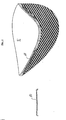
- FIG. 1 is in a lower shell, not shown one mold with an addition-crosslinking two-component silicone rubber 1 filled sleeve inserted, which covers the front of the prosthesis Foil 2 and a foil 3 covering the back of the prosthesis, which are welded together along their peripheral edge 4.
- the prosthetic sleeve is made of PU foils lying flat on top of each other before filling.
- the two-component silicone rubber is filled through an edge opening, see above that the prosthesis cover due to the elasticity of the film material, the shape of the later breast prosthesis.
- the molded cover 5 has one on its side facing the rear of the prosthesis shallow recess 6 forming a channel, the shape of which is a negative form of adhesive layer to be applied to the back of the prosthesis. Flows into the canal a connector 7 inserted into a bore of the molded cover, to which a hose 8 is connected via the channel-like recess 6 after closing of the molded cover 5 of the two-component silicone rubber forming the adhesive layer is filled by a pump.
- Two-component silicone rubber is used together with the prosthesis body cured in a conventional manner in an oven.
- the first step is in a flat dish an elastic and / or plastic thermoplastic material with a trough-shaped Recess that corresponds to the shape of the subsequent adhesive layer, in in a special manufacturing process, a layer that remains permanently sticky a two-component silicone rubber mass.
- the bowl 10 with the in this hardened adhesive layer 11 is then matched to the shell shape Cutout of the molded cover 5 inserted and with the one prepared in this way
- the mold lid is then closed.
- the permanently sticky one The layer is then again together with the prosthetic body in an oven cured so that the adhesive layer covers the back of the prosthesis Foil connects.
- the flat shell 10 of peeled off the adhesive layer so that it can be used again. The so is then produced and connected to the back of the prosthesis covered by a release film.
- FIG. 3 In the embodiment of FIG. 3 is on the back of the prosthesis Foil 3 a peelable release film 20 applied with the film 3 in the Is connected so that a channel 21 is formed between the two, the shape corresponds to the adhesive layer to be applied.
- This channel 21 is before closing the mold with the mold cover 5 with a two-component silicone rubber composition forming the adhesive layer filled.
- a channel is worked into the mold cover, which corresponds to the shape of the adhesive layer.
- the channel with the Adhesive layer-forming two-component silicone rubber compound is filled after closing the mold, it is cured with the prosthetic body.
- the prosthesis can then be removed from the mold, with the adhesive layer passing through the release film 21 is protected, which is only removed by the wearer before it is put on becomes.
Landscapes
- Health & Medical Sciences (AREA)
- Cardiology (AREA)
- Oral & Maxillofacial Surgery (AREA)
- Transplantation (AREA)
- Engineering & Computer Science (AREA)
- Biomedical Technology (AREA)
- Heart & Thoracic Surgery (AREA)
- Vascular Medicine (AREA)
- Life Sciences & Earth Sciences (AREA)
- Animal Behavior & Ethology (AREA)
- General Health & Medical Sciences (AREA)
- Public Health (AREA)
- Veterinary Medicine (AREA)
- Prostheses (AREA)
Description
- Fig. 1
- einen Querschnitt durch eine in einer nicht dargestellten Form liegende Brustprothese, die durch einen Formdeckel abgedeckt ist, der auf seiner der Prothese zugewandten Seite mit einem der aufzubringenden Klebeschicht entsprechenden Kanal versehen ist,
- Fig. 2
- eine der Fig. 1 entsprechende Darstellung, bei der zwischen dem Formdeckel und der Prothesenrückseite ein flexibler Streifen mit einer Ausnehmung eingelegt ist, die mit dem Klebestreifen gefüllt ist, und
- Fig. 3
- eine der Fig. 1 entsprechende Darstellung, bei der auf die Prothesenrückseite eine abziehbare Folie aufgebracht ist, zwischen der und der Prothesenrückseite ein der Form der Klebeschicht entsprechender Kanal eingebracht ist, der mit dem die Klebeschicht bildenden Zweikomponentensilikonkautschuk gefüllt ist.
Claims (4)
- Verfahren zum Aufbringen einer dauernd klebrig bleibenden Schicht aus einer klebrig eingestellten additionsvernetzenden Zweikomponentensilikonkautschukmasse auf die Innenseite einer Brustprothese, bestehend aus einem schalenförmigen Körper aus einem weichelastischem Material, vorzugsweise aus einem Körper aus einer weichelastisch eingestellten additionsvernetzenden Zweikomponentensilikonkautschukmasse, der in Kunststoffolien eingeschweißt ist, die dessen Außenseite und dessen Innenseite abdecken, und der in einer Form unter Zuführung von Wärme ausgehärtet ist,
dadurch gekennzeichnet,daß die Klebeschicht unter Verbindung mit einer Tragfolie ausgehärtet und die Tragfolie mit der noch flachliegenden und längs eines umlaufenden Randes verschweißten späteren Prothesenhülle verklebt wird und daß sodann die Prothesenhülle mit dem additionsvernetzenden Zweikomponentensilikonkautschuk gefüllt und in einer Form ausgehärtet wird. - Verfahren nach Anspruch 1, dadurch gekennzeichnet, daß die Klebeschicht mit der Tragfolie auf eine Folie oder Folienbahn schon vor der Herstellung der Prothesenhülle aufgebracht wird.
- Verfahren nach Anspruch 1, dadurch gekennzeichnet, daß die Klebeschicht unmittelbar auf die Hülle oder die Bahn vor der Herstellung der Hülle aufgebracht wird.
- Verfahren nach Anspruch 1, dadurch gekennzeichnet, daß auf die die spätere Prothesenrückseite bildende Bahn vor Herstellung der Hülle die Klebeschicht vollflächig aufgebracht wird.
Priority Applications (1)
| Application Number | Priority Date | Filing Date | Title |
|---|---|---|---|
| EP03014843A EP1360951B1 (de) | 1998-04-21 | 1999-01-22 | Verfahren zum Aufbringen einer dauernd klebrig bleibenden Schicht auf die Innenseite einer Brustprothese |
Applications Claiming Priority (2)
| Application Number | Priority Date | Filing Date | Title |
|---|---|---|---|
| DE19817769 | 1998-04-21 | ||
| DE19817769A DE19817769A1 (de) | 1998-04-21 | 1998-04-21 | Verfahren zum Aufbringen einer dauernd klebrig bleibenden Schicht auf die Innenseite einer Brustprothese |
Related Child Applications (1)
| Application Number | Title | Priority Date | Filing Date |
|---|---|---|---|
| EP03014843A Division EP1360951B1 (de) | 1998-04-21 | 1999-01-22 | Verfahren zum Aufbringen einer dauernd klebrig bleibenden Schicht auf die Innenseite einer Brustprothese |
Publications (3)
| Publication Number | Publication Date |
|---|---|
| EP0951880A2 EP0951880A2 (de) | 1999-10-27 |
| EP0951880A3 EP0951880A3 (de) | 1999-12-29 |
| EP0951880B1 true EP0951880B1 (de) | 2003-10-29 |
Family
ID=7865305
Family Applications (2)
| Application Number | Title | Priority Date | Filing Date |
|---|---|---|---|
| EP99101207A Expired - Lifetime EP0951880B1 (de) | 1998-04-21 | 1999-01-22 | Verfahren zum Aufbringen einer dauernd klebrig bleibenden Schicht auf die Innenseite einer Brustprothese |
| EP03014843A Expired - Lifetime EP1360951B1 (de) | 1998-04-21 | 1999-01-22 | Verfahren zum Aufbringen einer dauernd klebrig bleibenden Schicht auf die Innenseite einer Brustprothese |
Family Applications After (1)
| Application Number | Title | Priority Date | Filing Date |
|---|---|---|---|
| EP03014843A Expired - Lifetime EP1360951B1 (de) | 1998-04-21 | 1999-01-22 | Verfahren zum Aufbringen einer dauernd klebrig bleibenden Schicht auf die Innenseite einer Brustprothese |
Country Status (5)
| Country | Link |
|---|---|
| US (4) | US6342117B1 (de) |
| EP (2) | EP0951880B1 (de) |
| CA (1) | CA2269482A1 (de) |
| DE (3) | DE19817769A1 (de) |
| DK (2) | DK1360951T3 (de) |
Families Citing this family (7)
| Publication number | Priority date | Publication date | Assignee | Title |
|---|---|---|---|---|
| FR2805275B1 (fr) * | 2000-02-21 | 2004-12-10 | Plasto Sa | Procede de fixation de protheses externes |
| US7575596B2 (en) * | 2001-02-21 | 2009-08-18 | Amoena Medizin-Orthopädie-Technik GmbH | Two-layer external breast prosthesis with self-shaping feature and process for the manufacture thereof |
| US6579292B2 (en) * | 2001-06-18 | 2003-06-17 | Sdgi Holdings, Inc. | Connection assembly for spinal implant systems |
| US6758720B2 (en) * | 2002-05-31 | 2004-07-06 | Bragel International, Inc. | Attachable breast form enhancement system |
| US7753954B2 (en) * | 2008-04-11 | 2010-07-13 | American Breast Care LP | Breast prosthesis for patients with edema |
| US8562679B2 (en) | 2010-09-16 | 2013-10-22 | American Breat Care, LP | Three layer breast prosthesis |
| GB201116897D0 (en) * | 2011-09-30 | 2011-11-16 | Ahcan Uros G | Methods and apparatus for reconstructive surgery |
Family Cites Families (20)
| Publication number | Priority date | Publication date | Assignee | Title |
|---|---|---|---|---|
| US4172298A (en) * | 1976-06-16 | 1979-10-30 | Cornelius Rechenberg | Breast prosthesis |
| DE2701627B2 (de) * | 1977-01-17 | 1979-03-29 | Cornelius 8204 Brannenburg Rechenberg | Verfahren zur Herstellung einer Brustprothese |
| DE2737321A1 (de) | 1977-08-18 | 1979-03-01 | Cornelius Rechenberg | Verfahren und vorrichtung zur herstellung von brustprothesen |
| DE2802375A1 (de) * | 1978-01-20 | 1979-07-26 | Bodo Knoche | Brustprothese |
| US4249975A (en) * | 1978-08-14 | 1981-02-10 | Cornelius Rechenberg | Process of manufacturing artificial breasts |
| US4364880A (en) * | 1981-01-16 | 1982-12-21 | Howse Jeanette W | Method for making a breast prosthesis |
| DE3336279C2 (de) * | 1983-10-05 | 1986-01-09 | Kunststofftechnik Degler GmbH, 8217 Grassau | Brustprothese und Verfahren zu ihrer Herstellung |
| DK177289D0 (da) * | 1989-04-13 | 1989-04-13 | Coloplast As | Brystprotese |
| DE3942608A1 (de) * | 1989-12-22 | 1991-07-11 | Otto Thaemert Textil Und Kunst | Verfahren zur herstellung von brustprothesen |
| DE9107507U1 (de) * | 1991-06-18 | 1991-11-07 | Amoena-Medizin-Orthopädie-Technik GmbH, 8201 Raubling | Brustprothese |
| DE9114512U1 (de) * | 1991-11-14 | 1993-01-14 | "Amoena" Medizin-Orthopädie-Technik GmbH, 83064 Raubling | Brustprothese |
| DE59208575D1 (de) * | 1991-11-14 | 1997-07-10 | Amoena Med Orthopaedie Tech | Verfahren zum Herstellen einer Brustprothese |
| DE4211542A1 (de) * | 1991-11-14 | 1993-05-19 | Amoena Med Orthopaedie Tech | Verfahren zum herstellen einer brustprothese |
| US5171321A (en) * | 1992-03-09 | 1992-12-15 | Davis Joseph P | Nipple prosthesis and method of making the same |
| DE9204743U1 (de) * | 1992-04-06 | 1992-07-23 | Amoena-Medizin-Orthopädie-Technik GmbH, 8201 Raubling | Brustprothese |
| EP0588756A3 (en) * | 1992-09-17 | 1994-08-24 | Euromail Ltd | Attachment of a breast prosthesis |
| DE9306572U1 (de) * | 1993-04-30 | 1993-12-02 | "Amoena" Medizin-Orthopädie-Technik GmbH, 83064 Raubling | Brustprothese |
| DK144493A (da) * | 1993-12-23 | 1995-06-24 | Coloplast As | Fremgangsmåde til fremstilling af en folieemballeret brystprotese og formværktøj til brug ved udøvelse af fremgangsmåden |
| DE29607969U1 (de) * | 1996-05-02 | 1996-06-20 | "Amoena" Medizin-Orthopädie-Technik GmbH, 83064 Raubling | Brustprothese |
| DE29713203U1 (de) * | 1997-05-15 | 1997-09-25 | AMOENA Medizin-Orthopädie-Technik GmbH & Co., 83064 Raubling | Brustprothese |
-
1998
- 1998-04-21 DE DE19817769A patent/DE19817769A1/de not_active Ceased
-
1999
- 1999-01-22 EP EP99101207A patent/EP0951880B1/de not_active Expired - Lifetime
- 1999-01-22 EP EP03014843A patent/EP1360951B1/de not_active Expired - Lifetime
- 1999-01-22 DK DK03014843T patent/DK1360951T3/da active
- 1999-01-22 DE DE59907497T patent/DE59907497D1/de not_active Expired - Lifetime
- 1999-01-22 DE DE59911385T patent/DE59911385D1/de not_active Expired - Fee Related
- 1999-01-22 DK DK99101207T patent/DK0951880T3/da active
- 1999-04-21 US US09/295,529 patent/US6342117B1/en not_active Expired - Lifetime
- 1999-04-21 CA CA002269482A patent/CA2269482A1/en not_active Abandoned
-
2001
- 2001-08-15 US US09/930,006 patent/US6494912B2/en not_active Expired - Fee Related
-
2002
- 2002-10-09 US US10/267,349 patent/US7060147B2/en not_active Expired - Fee Related
- 2002-10-09 US US10/267,515 patent/US20030034121A1/en not_active Abandoned
Also Published As
| Publication number | Publication date |
|---|---|
| EP1360951A3 (de) | 2003-12-10 |
| US20030034121A1 (en) | 2003-02-20 |
| DE59907497D1 (de) | 2003-12-04 |
| US6494912B2 (en) | 2002-12-17 |
| DK0951880T3 (da) | 2004-03-08 |
| US7060147B2 (en) | 2006-06-13 |
| EP0951880A3 (de) | 1999-12-29 |
| EP0951880A2 (de) | 1999-10-27 |
| DE59911385D1 (de) | 2005-02-03 |
| DK1360951T3 (da) | 2005-03-29 |
| EP1360951A2 (de) | 2003-11-12 |
| US6342117B1 (en) | 2002-01-29 |
| DE19817769A1 (de) | 1999-11-04 |
| EP1360951B1 (de) | 2004-12-29 |
| US20020049496A1 (en) | 2002-04-25 |
| CA2269482A1 (en) | 1999-10-21 |
| US20030038400A1 (en) | 2003-02-27 |
Similar Documents
| Publication | Publication Date | Title |
|---|---|---|
| DE3336279C2 (de) | Brustprothese und Verfahren zu ihrer Herstellung | |
| DE3938328C1 (de) | ||
| DE69205200T2 (de) | Deckel für Behälter mit grosser Öffnung und Verfahren zu seiner Herstellung. | |
| EP0542119B1 (de) | Verfahren zur Herstellung einer Brustprothese | |
| EP0542242B1 (de) | Verfahren zum Herstellen einer Brustprothese | |
| DE4336878C2 (de) | Verfahren zum Herstellen eines Kunstharzbauteils | |
| DE69413979T2 (de) | Verfahren zum Herstellen von einer Kraftfahrzeugszierleiste mit einer Polymerhaut auf einem Substrat | |
| EP1360951B1 (de) | Verfahren zum Aufbringen einer dauernd klebrig bleibenden Schicht auf die Innenseite einer Brustprothese | |
| EP0433636B1 (de) | Verfahren zur Herstellung von Brustprothesen | |
| DE69515662T2 (de) | Aus Kunststoff geformtes Schaumteil mit einer äusseren Beschichtung und Verfahren zu seiner Herstellung | |
| EP1032503B1 (de) | Dichtsystem mit dichtungsprofil und klebeband | |
| WO1995021734A1 (de) | Verklebbarer formteil aus kunststoff und verfahren zur herstellung dieses formteils | |
| DE19818452A1 (de) | Harzbeschichtete Substratfassung und Verfahren zu ihrer Herstellung | |
| WO2007036577A1 (de) | Verfahren zur herstellung eines kunststoffformteils mit einem integrierten fensterelement mittels spritzguss sowie spritzgegossenes kunststoffformteil mit einem integrierten fensterelement | |
| DE69713727T2 (de) | Glasscheibe mit einem Umfangrahmen aus Kunststoff, Formkörper und Verfahren zur seiner Herstellung | |
| DE8702715U1 (de) | Längs einer Kante offene Schallplattentasche | |
| EP1503706B1 (de) | Brustprothese | |
| DE4202511C1 (en) | Foam moulding prodn. | |
| EP1504872A1 (de) | Verfahren und Inlay-Folie zum Herstellen eines diffusionsdichten Behältnisses aus Kunststoff mit Dekorationsflächen und einer Inlay-folie | |
| DE202007016726U1 (de) | Dekorbauteil | |
| EP0760645A1 (de) | Sauger | |
| DE4418604A1 (de) | Sauger | |
| EP0047884A1 (de) | Abdeckkopf für die Handhabe einer Warmwasserarmatur | |
| DE102019200944A1 (de) | Recycelbare Verpackung mit Zwangstrennung | |
| DE2234529A1 (de) | Verfahren zur herstellung einer packung |
Legal Events
| Date | Code | Title | Description |
|---|---|---|---|
| PUAI | Public reference made under article 153(3) epc to a published international application that has entered the european phase |
Free format text: ORIGINAL CODE: 0009012 |
|
| AK | Designated contracting states |
Kind code of ref document: A2 Designated state(s): DE DK FR GB IE IT NL |
|
| AX | Request for extension of the european patent |
Free format text: AL;LT;LV;MK;RO;SI |
|
| PUAL | Search report despatched |
Free format text: ORIGINAL CODE: 0009013 |
|
| AK | Designated contracting states |
Kind code of ref document: A3 Designated state(s): AT BE CH CY DE DK ES FI FR GB GR IE IT LI LU MC NL PT SE |
|
| AX | Request for extension of the european patent |
Free format text: AL;LT;LV;MK;RO;SI |
|
| 17P | Request for examination filed |
Effective date: 20000324 |
|
| AKX | Designation fees paid |
Free format text: DE DK FR GB IE IT NL |
|
| 17Q | First examination report despatched |
Effective date: 20021004 |
|
| GRAH | Despatch of communication of intention to grant a patent |
Free format text: ORIGINAL CODE: EPIDOS IGRA |
|
| GRAS | Grant fee paid |
Free format text: ORIGINAL CODE: EPIDOSNIGR3 |
|
| GRAA | (expected) grant |
Free format text: ORIGINAL CODE: 0009210 |
|
| AK | Designated contracting states |
Kind code of ref document: B1 Designated state(s): DE DK FR GB IE IT NL |
|
| REG | Reference to a national code |
Ref country code: GB Ref legal event code: FG4D Free format text: NOT ENGLISH |
|
| REG | Reference to a national code |
Ref country code: IE Ref legal event code: FG4D Free format text: GERMAN |
|
| REF | Corresponds to: |
Ref document number: 59907497 Country of ref document: DE Date of ref document: 20031204 Kind code of ref document: P |
|
| GBT | Gb: translation of ep patent filed (gb section 77(6)(a)/1977) |
Effective date: 20040109 |
|
| REG | Reference to a national code |
Ref country code: DK Ref legal event code: T3 |
|
| ET | Fr: translation filed | ||
| PLBE | No opposition filed within time limit |
Free format text: ORIGINAL CODE: 0009261 |
|
| STAA | Information on the status of an ep patent application or granted ep patent |
Free format text: STATUS: NO OPPOSITION FILED WITHIN TIME LIMIT |
|
| 26N | No opposition filed |
Effective date: 20040730 |
|
| PGFP | Annual fee paid to national office [announced via postgrant information from national office to epo] |
Ref country code: DK Payment date: 20090122 Year of fee payment: 11 |
|
| PGFP | Annual fee paid to national office [announced via postgrant information from national office to epo] |
Ref country code: NL Payment date: 20090127 Year of fee payment: 11 |
|
| PGFP | Annual fee paid to national office [announced via postgrant information from national office to epo] |
Ref country code: IT Payment date: 20090123 Year of fee payment: 11 |
|
| REG | Reference to a national code |
Ref country code: NL Ref legal event code: V1 Effective date: 20100801 |
|
| REG | Reference to a national code |
Ref country code: DK Ref legal event code: EBP |
|
| PG25 | Lapsed in a contracting state [announced via postgrant information from national office to epo] |
Ref country code: NL Free format text: LAPSE BECAUSE OF NON-PAYMENT OF DUE FEES Effective date: 20100801 |
|
| PG25 | Lapsed in a contracting state [announced via postgrant information from national office to epo] |
Ref country code: DK Free format text: LAPSE BECAUSE OF NON-PAYMENT OF DUE FEES Effective date: 20100131 |
|
| PG25 | Lapsed in a contracting state [announced via postgrant information from national office to epo] |
Ref country code: IT Free format text: LAPSE BECAUSE OF NON-PAYMENT OF DUE FEES Effective date: 20100122 |
|
| REG | Reference to a national code |
Ref country code: FR Ref legal event code: PLFP Year of fee payment: 18 |
|
| REG | Reference to a national code |
Ref country code: FR Ref legal event code: PLFP Year of fee payment: 19 |
|
| REG | Reference to a national code |
Ref country code: FR Ref legal event code: PLFP Year of fee payment: 20 |
|
| PGFP | Annual fee paid to national office [announced via postgrant information from national office to epo] |
Ref country code: DE Payment date: 20180129 Year of fee payment: 20 Ref country code: GB Payment date: 20180122 Year of fee payment: 20 |
|
| PGFP | Annual fee paid to national office [announced via postgrant information from national office to epo] |
Ref country code: IE Payment date: 20180118 Year of fee payment: 20 Ref country code: FR Payment date: 20180122 Year of fee payment: 20 |
|
| REG | Reference to a national code |
Ref country code: DE Ref legal event code: R071 Ref document number: 59907497 Country of ref document: DE |
|
| REG | Reference to a national code |
Ref country code: GB Ref legal event code: PE20 Expiry date: 20190121 |
|
| REG | Reference to a national code |
Ref country code: IE Ref legal event code: MK9A |
|
| PG25 | Lapsed in a contracting state [announced via postgrant information from national office to epo] |
Ref country code: GB Free format text: LAPSE BECAUSE OF EXPIRATION OF PROTECTION Effective date: 20190121 Ref country code: IE Free format text: LAPSE BECAUSE OF EXPIRATION OF PROTECTION Effective date: 20190122 |