EP0951603B1 - Lagenförmiges tissuepapier mit verbesserten funktionseigenschaften - Google Patents
Lagenförmiges tissuepapier mit verbesserten funktionseigenschaften Download PDFInfo
- Publication number
- EP0951603B1 EP0951603B1 EP97909935A EP97909935A EP0951603B1 EP 0951603 B1 EP0951603 B1 EP 0951603B1 EP 97909935 A EP97909935 A EP 97909935A EP 97909935 A EP97909935 A EP 97909935A EP 0951603 B1 EP0951603 B1 EP 0951603B1
- Authority
- EP
- European Patent Office
- Prior art keywords
- fibers
- paper
- layers
- layer
- inner layer
- Prior art date
- Legal status (The legal status is an assumption and is not a legal conclusion. Google has not performed a legal analysis and makes no representation as to the accuracy of the status listed.)
- Revoked
Links
- 239000000835 fiber Substances 0.000 claims abstract description 116
- 230000035807 sensation Effects 0.000 claims abstract description 12
- 239000000945 filler Substances 0.000 claims abstract description 11
- 229920002994 synthetic fiber Polymers 0.000 claims abstract description 6
- 239000012209 synthetic fiber Substances 0.000 claims abstract description 6
- 239000011121 hardwood Substances 0.000 claims description 10
- 229920002301 cellulose acetate Polymers 0.000 claims description 5
- VTYYLEPIZMXCLO-UHFFFAOYSA-L Calcium carbonate Chemical compound [Ca+2].[O-]C([O-])=O VTYYLEPIZMXCLO-UHFFFAOYSA-L 0.000 claims description 4
- GWEVSGVZZGPLCZ-UHFFFAOYSA-N Titan oxide Chemical compound O=[Ti]=O GWEVSGVZZGPLCZ-UHFFFAOYSA-N 0.000 claims description 4
- 229920003043 Cellulose fiber Polymers 0.000 claims description 3
- 239000003795 chemical substances by application Substances 0.000 claims description 3
- 229910000019 calcium carbonate Inorganic materials 0.000 claims description 2
- 239000004927 clay Substances 0.000 claims description 2
- 229910052570 clay Inorganic materials 0.000 claims description 2
- 239000004408 titanium dioxide Substances 0.000 claims description 2
- 239000000123 paper Substances 0.000 description 78
- 239000011122 softwood Substances 0.000 description 7
- 239000000203 mixture Substances 0.000 description 6
- 239000000126 substance Substances 0.000 description 6
- 244000166124 Eucalyptus globulus Species 0.000 description 5
- 239000002655 kraft paper Substances 0.000 description 5
- 229920000297 Rayon Polymers 0.000 description 4
- 239000011230 binding agent Substances 0.000 description 4
- 238000000034 method Methods 0.000 description 4
- 239000002964 rayon Substances 0.000 description 4
- 229920002472 Starch Polymers 0.000 description 3
- 230000008901 benefit Effects 0.000 description 3
- 230000007423 decrease Effects 0.000 description 3
- 238000004537 pulping Methods 0.000 description 3
- 238000000926 separation method Methods 0.000 description 3
- 241000894007 species Species 0.000 description 3
- 239000008107 starch Substances 0.000 description 3
- 235000019698 starch Nutrition 0.000 description 3
- OKTJSMMVPCPJKN-UHFFFAOYSA-N Carbon Chemical compound [C] OKTJSMMVPCPJKN-UHFFFAOYSA-N 0.000 description 2
- 229920001131 Pulp (paper) Polymers 0.000 description 2
- 239000007767 bonding agent Substances 0.000 description 2
- OSGAYBCDTDRGGQ-UHFFFAOYSA-L calcium sulfate Chemical compound [Ca+2].[O-]S([O-])(=O)=O OSGAYBCDTDRGGQ-UHFFFAOYSA-L 0.000 description 2
- 238000004519 manufacturing process Methods 0.000 description 2
- 150000003856 quaternary ammonium compounds Chemical class 0.000 description 2
- 239000005909 Kieselgur Substances 0.000 description 1
- 229920000433 Lyocell Polymers 0.000 description 1
- 239000004677 Nylon Substances 0.000 description 1
- VYPSYNLAJGMNEJ-UHFFFAOYSA-N Silicium dioxide Chemical compound O=[Si]=O VYPSYNLAJGMNEJ-UHFFFAOYSA-N 0.000 description 1
- LSNNMFCWUKXFEE-UHFFFAOYSA-N Sulfurous acid Chemical compound OS(O)=O LSNNMFCWUKXFEE-UHFFFAOYSA-N 0.000 description 1
- YKTSYUJCYHOUJP-UHFFFAOYSA-N [O--].[Al+3].[Al+3].[O-][Si]([O-])([O-])[O-] Chemical compound [O--].[Al+3].[Al+3].[O-][Si]([O-])([O-])[O-] YKTSYUJCYHOUJP-UHFFFAOYSA-N 0.000 description 1
- 230000002745 absorbent Effects 0.000 description 1
- 239000002250 absorbent Substances 0.000 description 1
- 239000002390 adhesive tape Substances 0.000 description 1
- 238000007605 air drying Methods 0.000 description 1
- PNEYBMLMFCGWSK-UHFFFAOYSA-N aluminium oxide Inorganic materials [O-2].[O-2].[O-2].[Al+3].[Al+3] PNEYBMLMFCGWSK-UHFFFAOYSA-N 0.000 description 1
- 239000000378 calcium silicate Substances 0.000 description 1
- 229910052918 calcium silicate Inorganic materials 0.000 description 1
- OYACROKNLOSFPA-UHFFFAOYSA-N calcium;dioxido(oxo)silane Chemical compound [Ca+2].[O-][Si]([O-])=O OYACROKNLOSFPA-UHFFFAOYSA-N 0.000 description 1
- 230000008021 deposition Effects 0.000 description 1
- 238000001035 drying Methods 0.000 description 1
- 230000003203 everyday effect Effects 0.000 description 1
- 230000001815 facial effect Effects 0.000 description 1
- 239000011521 glass Substances 0.000 description 1
- 239000004005 microsphere Substances 0.000 description 1
- 238000000465 moulding Methods 0.000 description 1
- 229920001778 nylon Polymers 0.000 description 1
- 229920000728 polyester Polymers 0.000 description 1
- 239000011435 rock Substances 0.000 description 1
- 239000004094 surface-active agent Substances 0.000 description 1
- 239000000454 talc Substances 0.000 description 1
- 229910052623 talc Inorganic materials 0.000 description 1
- 150000003512 tertiary amines Chemical class 0.000 description 1
- 150000004684 trihydrates Chemical class 0.000 description 1
- YSGSDAIMSCVPHG-UHFFFAOYSA-N valyl-methionine Chemical compound CSCCC(C(O)=O)NC(=O)C(N)C(C)C YSGSDAIMSCVPHG-UHFFFAOYSA-N 0.000 description 1
- XLYOFNOQVPJJNP-UHFFFAOYSA-N water Substances O XLYOFNOQVPJJNP-UHFFFAOYSA-N 0.000 description 1
- 239000002023 wood Substances 0.000 description 1
Images
Classifications
-
- B—PERFORMING OPERATIONS; TRANSPORTING
- B32—LAYERED PRODUCTS
- B32B—LAYERED PRODUCTS, i.e. PRODUCTS BUILT-UP OF STRATA OF FLAT OR NON-FLAT, e.g. CELLULAR OR HONEYCOMB, FORM
- B32B29/00—Layered products comprising a layer of paper or cardboard
- B32B29/002—Layered products comprising a layer of paper or cardboard as the main or only constituent of a layer, which is next to another layer of the same or of a different material
-
- D—TEXTILES; PAPER
- D21—PAPER-MAKING; PRODUCTION OF CELLULOSE
- D21H—PULP COMPOSITIONS; PREPARATION THEREOF NOT COVERED BY SUBCLASSES D21C OR D21D; IMPREGNATING OR COATING OF PAPER; TREATMENT OF FINISHED PAPER NOT COVERED BY CLASS B31 OR SUBCLASS D21G; PAPER NOT OTHERWISE PROVIDED FOR
- D21H27/00—Special paper not otherwise provided for, e.g. made by multi-step processes
- D21H27/30—Multi-ply
- D21H27/38—Multi-ply at least one of the sheets having a fibrous composition differing from that of other sheets
-
- B—PERFORMING OPERATIONS; TRANSPORTING
- B32—LAYERED PRODUCTS
- B32B—LAYERED PRODUCTS, i.e. PRODUCTS BUILT-UP OF STRATA OF FLAT OR NON-FLAT, e.g. CELLULAR OR HONEYCOMB, FORM
- B32B29/00—Layered products comprising a layer of paper or cardboard
-
- D—TEXTILES; PAPER
- D21—PAPER-MAKING; PRODUCTION OF CELLULOSE
- D21F—PAPER-MAKING MACHINES; METHODS OF PRODUCING PAPER THEREON
- D21F11/00—Processes for making continuous lengths of paper, or of cardboard, or of wet web for fibre board production, on paper-making machines
- D21F11/02—Processes for making continuous lengths of paper, or of cardboard, or of wet web for fibre board production, on paper-making machines of the Fourdrinier type
- D21F11/04—Processes for making continuous lengths of paper, or of cardboard, or of wet web for fibre board production, on paper-making machines of the Fourdrinier type paper or board consisting on two or more layers
-
- D—TEXTILES; PAPER
- D21—PAPER-MAKING; PRODUCTION OF CELLULOSE
- D21F—PAPER-MAKING MACHINES; METHODS OF PRODUCING PAPER THEREON
- D21F11/00—Processes for making continuous lengths of paper, or of cardboard, or of wet web for fibre board production, on paper-making machines
- D21F11/14—Making cellulose wadding, filter or blotting paper
-
- B—PERFORMING OPERATIONS; TRANSPORTING
- B32—LAYERED PRODUCTS
- B32B—LAYERED PRODUCTS, i.e. PRODUCTS BUILT-UP OF STRATA OF FLAT OR NON-FLAT, e.g. CELLULAR OR HONEYCOMB, FORM
- B32B2250/00—Layers arrangement
- B32B2250/04—4 layers
-
- B—PERFORMING OPERATIONS; TRANSPORTING
- B32—LAYERED PRODUCTS
- B32B—LAYERED PRODUCTS, i.e. PRODUCTS BUILT-UP OF STRATA OF FLAT OR NON-FLAT, e.g. CELLULAR OR HONEYCOMB, FORM
- B32B2250/00—Layers arrangement
- B32B2250/05—5 or more layers
-
- B—PERFORMING OPERATIONS; TRANSPORTING
- B32—LAYERED PRODUCTS
- B32B—LAYERED PRODUCTS, i.e. PRODUCTS BUILT-UP OF STRATA OF FLAT OR NON-FLAT, e.g. CELLULAR OR HONEYCOMB, FORM
- B32B2250/00—Layers arrangement
- B32B2250/26—All layers being made of paper or paperboard
-
- B—PERFORMING OPERATIONS; TRANSPORTING
- B32—LAYERED PRODUCTS
- B32B—LAYERED PRODUCTS, i.e. PRODUCTS BUILT-UP OF STRATA OF FLAT OR NON-FLAT, e.g. CELLULAR OR HONEYCOMB, FORM
- B32B2262/00—Composition or structural features of fibres which form a fibrous or filamentary layer or are present as additives
- B32B2262/04—Cellulosic plastic fibres, e.g. rayon
-
- B—PERFORMING OPERATIONS; TRANSPORTING
- B32—LAYERED PRODUCTS
- B32B—LAYERED PRODUCTS, i.e. PRODUCTS BUILT-UP OF STRATA OF FLAT OR NON-FLAT, e.g. CELLULAR OR HONEYCOMB, FORM
- B32B2264/00—Composition or properties of particles which form a particulate layer or are present as additives
- B32B2264/10—Inorganic particles
-
- D—TEXTILES; PAPER
- D21—PAPER-MAKING; PRODUCTION OF CELLULOSE
- D21H—PULP COMPOSITIONS; PREPARATION THEREOF NOT COVERED BY SUBCLASSES D21C OR D21D; IMPREGNATING OR COATING OF PAPER; TREATMENT OF FINISHED PAPER NOT COVERED BY CLASS B31 OR SUBCLASS D21G; PAPER NOT OTHERWISE PROVIDED FOR
- D21H13/00—Pulp or paper, comprising synthetic cellulose or non-cellulose fibres or web-forming material
- D21H13/02—Synthetic cellulose fibres
- D21H13/08—Synthetic cellulose fibres from regenerated cellulose
-
- D—TEXTILES; PAPER
- D21—PAPER-MAKING; PRODUCTION OF CELLULOSE
- D21H—PULP COMPOSITIONS; PREPARATION THEREOF NOT COVERED BY SUBCLASSES D21C OR D21D; IMPREGNATING OR COATING OF PAPER; TREATMENT OF FINISHED PAPER NOT COVERED BY CLASS B31 OR SUBCLASS D21G; PAPER NOT OTHERWISE PROVIDED FOR
- D21H15/00—Pulp or paper, comprising fibres or web-forming material characterised by features other than their chemical constitution
- D21H15/02—Pulp or paper, comprising fibres or web-forming material characterised by features other than their chemical constitution characterised by configuration
- D21H15/04—Pulp or paper, comprising fibres or web-forming material characterised by features other than their chemical constitution characterised by configuration crimped, kinked, curled or twisted fibres
Definitions
- the present invention relates to tissue paper, and more particularly to tissue paper having plural layers.
- Tissue paper is a staple of everyday life. Tissue paper is frequently used for bath tissue, facial tissue, and for paper towels. Tissue paper is typically cellulosic and fibrous, the fibers having been prepared from various types of pulping processes and various species of deciduous and coniferous woods. Recycled and synthetic fibers may also be used.
- Tissue paper needs to have properties which meet three primary criteria in order to be consumer acceptable: bulk which encompasses the inversely related properties of caliper and density, strength and softness. Typically softness and strength have been optimized by layering the fibers comprising the paper. Bulk is obtained in other manners, such as molding a wet embryonic web into a photopolymer belt, according to commonly assigned US-A-4,637,859, issued January 20, 1987 to Trokhan.
- the term "layer" refers to a stratum of fibers formed in the wet end of a papermaking machine and which is different from an adjacent stratum.
- the difference may include the preponderance of fiber species.
- the difference may also include the chemical treatment, pulping or any other factors which affect the properties of that stratum of fibers.
- the layer is typically deposited onto a forming wire.
- a layer refers to an individual stratum of fibers, typically superimposed on one or more different strata, and deposited onto a common forming wire with the other strata. Deposition is accomplished by having each layer deposited from a separate channel of a split headbox. Alternatively, the layers can be deposited onto a common forming wire from separate headboxes.
- Another way to determine if paper is layered is to analyze various regions of the paper throughout its thickness.
- the analysis includes the regions disposed on the opposed faces of the paper and several regions between the opposed faces of the paper.
- Different regions of the paper throughout its thickness may be accessed for analysis by removing fibers from the paper, starting at either or both faces with adhesive tape, as is known in the art.
- the fibers adhering to the tape are then analyzed for species content, chemical treatment, pulping, or any other factor which may affect the properties of the fiber.
- the paper is considered to be layered, or 2) the paper is made as described above using a split headbox or more than one headbox which discharges onto a common forming wire, the paper is considered to be layered.
- a "ply” refers to a single sheet, having one or more layers, as taken off of the forming element. A ply may later be combined with other plies, embossed, etc., as desired.
- US-A-2,881,669 issued April 14, 1959 to Thomas et al. discloses paper having three layers.
- the three layers comprise a central layer of short fibers and two outer layers of long fibers. This arrangement is said to improve strength and provide reduced ply separation.
- Papers subject to ply separation i.e. having layers which shear during creping, are said to be disclosed in US-A-4,166,001, issued August 28, 1979 to Dunning et al.
- Dunning et al. discloses a three layered paper having a central layer of weakly bonded fibers between two outer layers of strongly bonded fibers.
- Ply separable paper is also disclosed in commonly assigned US-A-4,225,382 issued September 30, 1980 to Kearney et al.
- Kearney et al. teaches a three layered structure having two layers of well bonded fibers separated by an interior layer of short fibers.
- EP-A-0 531 112, published March 10, 1993, in the name of Jujo discloses a three layer toilet paper.
- the intermediate layer is about one hundred percent wood pulp.
- the outer layers comprise wood and rayon pulps mixed in a weight ratio of 40-80:60-20. This arrangement is said to provide a strong, absorbent toilet paper which is also water dispersible.
- US-A-5,087,324, issued February 11, 1992 to Awofeso et al. discloses a two-ply, two-layer paper towel having two outer layers and two inner layers.
- the two outer layers comprise blends of Kraft softwood and Kraft hardwood.
- the two inner layers comprise high bulking fibers or chemi-thermomechanical pulp.
- the prior art also teaches a single ply, three layer paper.
- the two outer layers provide softness.
- the inner layer provides strength.
- the paper may comprise five layers, two outer layers of relatively short papermaking fibers, the outer layers being exposed to and providing a soft tactile sensation to the user.
- the paper may further comprise two intermediate layers of relatively long papermaking fibers, the intermediate layers being juxtaposed with the outer layers.
- the paper of the preferred embodiment may further comprise a central layer of low density high bulking fibers, the central layer being juxtaposed with and separating the intermediate layers.
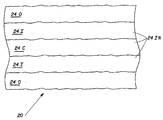
- Figure 1 is a fragmentary sectional view of paper made according to the present invention and having five layers.
- the present invention comprises a cellulosic fibrous paper 20 having multiple layers.
- layer refers to an embryonic web supplied wet from a headbox and superimposed upon one or more other embryonic webs which are supplied wet from a headbox.
- the embryonic webs making up an individual layer may be supplied from different headboxes, or from a common headbox split by leaves.
- a suitable split headbox is available from the Valmet Company of Karlstad, Sweden or from the Beloit Company of Rockton, Illinois, as a STRATA-FLO type headbox.
- the different layers may have the same or different consistencies and same or different fiber mass or flow rates within the split headbox.
- Suitable processes for layering according to the present invention are disclosed in commonly assigned US-A-3,994,771, issued November 30, 1976 to Morgan, Jr. et al.; 4,225,382, issued September 30, 1980 to Kearney et al.; and 4,300,981, issued November 17, 1981 to Carstens the disclosures of which patents show suitable layering processes.
- a paper 20 according to the present invention comprises a plurality of layers.
- the paper 20 may comprise five layers, although embodiments having more or less layers are suitable for the present invention.
- One or more of the layers may comprise cellulosic fibers, so that the paper 20 is a macroscopically monoplanar cellulosic fibrous structure.
- Cellulosic fibers and cellulosic fibrous structures are fully described and defined in commonly assigned US-A-5,443,691, issued August 22, 1995 to Phan et al..
- one or more layers may comprise synthetic fibers, as also described in the aforementioned '691 patent issued to Phan et al.
- the paper 20 of Figure 1 has five layers: two outer layers 240, two intermediate layers 24I, and a central layer 24C.
- the intermediate and central layers are collectively referred to as inner layers 24IN.
- Each layer is disposed in face-to-face relationship with one or more of the other layers and joined thereto at a non-stepwise interface.
- Each layer has two opposed surfaces which define this interface.
- the layers are referred to as "inwardly facing” and “outwardly facing” which, respectively refer to orientations towards the central plane of the paper 20 and towards the exposed surface of the paper 20, respectively.
- each outer layer 240 has an outwardly facing surface and an inwardly facing surface.
- the outwardly facing surfaces of the outer layers are exposed to the user and are primarily responsible for the tactile sensation of the paper 20 perceived by the user.
- the inwardly facing surfaces of the outer layers are juxtaposed with respective intermediate layers 241 at an interface.
- each intermediate layer 241 has an outwardly facing surface and an inwardly facing surface. These outwardly facing surfaces of the intermediate layers 24I are juxtaposed with the inwardly facing surfaces of the outer layers at the interface. The inwardly facing surfaces of the intermediate layers 241 are juxtaposed with the central layer 24C at yet another interface.
- the central layer 24C separates the intermediate layers 241.
- the central layer 24C has two outwardly facing surfaces. The outwardly facing surfaces of the central layer 24C are juxtaposed with the respective inwardly facing surfaces of the intermediate layers 24I.
- the two outer layers provide the functional benefit of imparting tactile softness to the user.
- the outer layers 24O comprise relatively short hardwood fibers. Hardwood fibers are preferred for the outer layers 24O because they generally exhibit lesser bonding to other fibers. As noted in the aforementioned U.S. patent 4,300,981 issued to Carstens, this yields free fiber ends which are upstanding from the outer layer 24O and provide a soft, velutinous tactile sensation to the user.
- the fibers in the outer layers 24O have fiber lengths of less than about 1.5 mm.
- the outer layers 24O may comprise Eucalyptus fibers, such as fibers available from the Aracruz Company of Rio de Janeiro, Brazil. If it is desired to use less than one hundred percent Eucalyptus fibers in the outer layers 24O, a blend of Eucalyptus, hardwood Kraft and hardwood sulfite fibers may be utilized.
- chemical softeners may be added to the paper 20 during papermaking. Suitable chemical softeners may be added according to the teachings of commonly assigned US-A-5,217,576, issued June 8, 1993 to Phan and 5,262,007, issued November 16, 1993 to Phan et al.. Redibond 5320, available from the National Starch and Chemical Corporation of Bridgewater, New Jersey may be used in the outer layer 24O to provide additional chemical bonding in the hardwood of the outer layer 24O and thereby reduce lint in the resulting paper 20.
- the two intermediate layers 24I provide the functional benefit of imparting strength to the paper 20. Since any tensile forces applied within the X-Y plane of the paper 20 act upon all of the layers in parallel, the layers providing the strength may be effectively disposed at any position internal to the outer layers, which impart the soft tactile sensation to the user.
- Softwood fibers are preferred for the intermediate layers 24I because they generally exhibit greater bonding to other fibers, which bonding improves strength.
- the fibers in the intermediate layers 24I have fiber lengths of about 2.5 mm or greater.
- the intermediate layers 241 which provide the strength may be made of softwood, preferably Northern Softwood Kraft (NSK) as is commonly available from the Weyerhaeuser Company of Tacoma, Washington under the name Grand Prairie softwood Kraft. If it is not desired to use one hundred percent NSK in the strength carrying layers, a blend of NSK and low cost fibers or NSK and recycled fibers may be utilized in this layer. However, preferably such a blend comprises at least about 50 percent NSK.
- NSK Northern Softwood Kraft
- dry strength binders wet strength binders, temporary wet strength binders, permanent wet strength binders, and other bonding agents redispersible or cross-linked insoluble such as latexes may be added to the intermediate layers 24I.
- bonding agents are provided by Hercules Inc., of Wilmington, Delaware, under the tradename Kymene, from Cytec under the name Parez 750, and National Starch under the name Cobond.
- the central layer 24C comprises low density high bulking fibers.
- Low density high bulking fibers are those which decrease density and increase caliper over a like quantity of conventional hardwood or softwood fibers.
- low density bulking fibers are suitable for use with the present invention: 1) weakly bonded fibers, 2) debonded fibers 3) curled fibers, and 4) fibers combined with fillers to increase the volume.
- Suitable weakly bonded fibers may be synthetic.
- Suitable synthetic fibers for the central layer 24C include nylon, polyester, cellulose acetate, and preferably rayon. Rayon is generally preferred because it is a synthetic cellulosic fiber and is highly compatible with the cellulosic fibers recommended for the other layers. Suitable rayon fibers are available from Courtaulds Fibers Inc. of Axis, AL, as Tencel type fibers. Another preferred weakly bonded fiber is cellulose acetate fibers. Cellulose acetate fibers are preferred because they are also synthetic cellulosic fibers and inhibit bonds from forming between adjacent cellulosic fibers. Suitable cellulose acetate fibers are available from the Hoescht Cellanese Inc. of Rock Hill, SC.
- the second embodiment utilizes debonded fibers in the central layer 24C.
- Fibers may be chemically debonded from one another, thereby allowing them to easily separate, and thereby generate bulk.
- Debonded fibers may separate either during papermaking, or during creping.
- Suitable debonding agents include quaternary ammonium compounds. Suitable quaternary ammonium compounds are found in commonly assigned US-A-5,240,562 issued to Phan et al.. Other suitable debonding agents include tertiary amines and other surfactants as are well known in the art.
- the third embodiment utilizes curled fibers in the central layer 24C.
- Preferred curled fibers include cross-linked cellulosic fibers. It is preferred that the cross-linked cellulosic fibers be made of a hardwood such as Eucalyptus. Shorter length hardwood fibers, even when curled, have the advantages of being more easily formed and moldable during papermaking.
- Suitable cross-linked cellulosic fibers may be made according to commonly assigned US-A-5,183,707, issued February 2, 1993 to Herron et al. and 5,190,563, issued March 2, 1993 to Herron et al..
- the curled fibers may not be cross-linked.
- Curled fibers which are not cross-linked may be made by flash drying, dry fiberizing, and wet high consistency curling. Suitable methods for preparing curled fibers are described in GB-A-2 279 372, filed June 23, 1994 by Farrington, Jr., et al..
- the fibers in the central layer 24C may be combined with fillers which increase the volume of the central layer 24C, and hence the entire paper 20.
- Such fillers inhibit bonding forming between adjacent cellulosic fibers and additionally increase the volume of such a layer.
- the filler is non-cellulosic. More preferably, the filler is particulate. Suitable non-cellulosic particulate fillers include clay, calcium carbonate, titanium dioxide, talc, aluminum silicate, calcium silicate, alumina trihydrate, activated carbon, pearl starch, calcium sulfate, glass microspheres, diatomaceous earth, and mixtures thereof.
- the non-cellulosic particulate filler may comprise from about 8 percent to about 20 percent by weight of the tissue paper 20.
- a layered paper 20 may be made having, again, two outer layers 24O of fibers which provide a soft tactile sensation to the user.
- the two intermediate layers 241 may each be made of the low density bulking fibers.
- the central layer 24C which provides the strength for the layered paper 20 may be made of longer fibers which provide relatively greater bonding.
- a four layer paper 20 may be provided.
- the four layer structure can have two outer layers 24O of relatively short fibers, such as eucalyptus.
- Such a paper 20 may further have two intermediate layers 24IN: one inner layer 24I of bulking fibers and one inner layer 241 of longer, preferably softwood, fibers for strength.
- a paper 20 may be made having only one outer layer 24O with relatively short fibers, and intermediate layers 24IN as set forth above. Such a paper 20 may be combined with another such paper 20 in a laminate to form a two ply paper 20 having both outwardly facing surfaces comprise relatively short papermaking fibers which impart softness to the user.
- the paper 20 according to the present invention may either be through air dried or conventionally dried with press felts. If the paper 20 is through air dried, it may be made on clothing woven on a Jacquard loom, as disclosed, for example, in EP-A-0 677 612, published October 18, 1995 in the names of Wendt et al. Furthermore, the paper 20 according to the present invention may be creped as is known in the art or may be uncreped. Also, the paper 20 may be micro-contracted as, illustrated in the aforementioned application published in the names of Wendt et al., or need not be micro-contracted.
Landscapes
- Paper (AREA)
- Sanitary Thin Papers (AREA)
- Materials For Medical Uses (AREA)
Claims (10)
- Lagiges Tissuepapier mit:wenigstens einer äußeren Lage mit relativ kurzen Papier machenden Fasern, wodurch die wenigstens eine äußere Lage dem Benutzer eine weiche taktile Empfindung verleiht;wenigstens einer ersten inneren Lage mit relativ landen Papier machenden Fasern, wodurch die Fasern dem Papier Festigkeit verleihen; undwenigstens einer zweiten inneren Lage mit geringer Dichte, stark bauschenden Fasern, wobei die Fasern das Volumen des Papiers steigern, wobei jede der Lagen in einer seitenweisen Beziehung mit wenigstens einer anderen Lage übereinander angeordnet sind, wodurch die äußere Lage einem Benutzer frei entgegen gerichtet ist.
- Papier nach Anspruch 1, in welchem die wenigstens eine erste innere Lage zwei Zwischenlagen umfaßt, wobei eine der Innenlagen neben der äußeren Lage angeordnet ist und eine der Innenlagen neben der zweiten Innenlage angeordnet ist.
- Papier nach Anspruch 2, in welchem die zweite Innenlage eine zentrale Lage aufweist, die neben den Zwischenlagen angeordnet ist und diese trennt.
- Papier nach Anspruch 1, mit vier Lagen, zwei äußeren Lagen aus relativ kurzen Papier machenden Fasern, wodurch die äußeren Lagen einem Benutzer frei entgegen gerichtet sind und für eine weiche taktile Empfindung sorgen, einer ersten inneren Lage aus relativ langen Papier machenden Fasern, wobei die relativ langen Papier machenden Fasern dem Papier eine Festigkeit verleihen. wobei die erste innere Lage neben einer der äußeren Lagen angeordnet ist, einer zweiten inneren Lage von stark bauschenden Fasern geringer Dichte, wobei die zweite innere Lage neben der ersten inneren Lage und der anderen der äußeren Lagen angeordnet ist, wodurch die beiden Innenlagen zwischen den beiden äußeren Lagen liegen.
- Papier nach Anspruch 1, mit fünf Lagen, zwei äußeren Lagen von relativ kurzen Papier machenden Fasern, wodurch die äußeren Lagen dem Benutzer frei entgegen gerichtet sind und für eine weiche taktile Empfindung sorgen, zwei Zwischenlagen aus relativ langen Papier machenden Fasern, wobei die Zwischenlagen neben den äußeren Lagen angeordnet sind, wodurch die langen Fasern dem Papier Festigkeit verleihen, und einer zentralen Lage aus stark bauschenden Fasern geringer Dichte, wobei die zentrale Lage neben den Zwischenlagen angeordnet ist, und diese trennt.
- Papier nach den Ansprüchen 3 und 5, in welchem die zentrale Lage schwach gebundene Fasern aufweist und in welchem vorzugsweise die schwach gebundenen Fasern synthetische Fasern sind und bei welchem ganz bevorzugt die synthetischen Fasern Zelluloseacetat umfassen.
- Papier nach den Ansprüchen 3 und 5, in welchem die zentrale Lage entbundene Fasern und ein Entbindungsmittel umfaßt.
- Papier nach den Ansprüchen, 1, 2, 3 und 4, in welchem die zweite innere Lage ferner aufweist einen nicht zelluloseartigen, teilchenförmigen Füllstoff und vorzugsweise der nicht zelluloseartige, teilchenförmige Füllstoff von etwa 8 Gew.% bis etwa 20 Gew.% des Papiers umfaßt und ganz bevorzugt der teilchenförmige Füllstoff ausgewählt ist aus der Gruppe bestehend aus Ton, Kalziumcarbonat und Titandioxid.
- Papier nach Anspruch 8, in welchem die zentrale Lage gekräuselte Fasern aufweist und vorzugsweise die gekräuselten Fasern vernetzte Zellulosefasern sind und ganz bevorzugt die vernetzten Zellulosefasern aus Hartholzfasern hergestellt sind.
- Papier nach den Ansprüchen 1, 2, 3, 4, 5, 6 7, 8 und 9, welches ungekreppt ist.
Applications Claiming Priority (3)
| Application Number | Priority Date | Filing Date | Title |
|---|---|---|---|
| US73894996A | 1996-10-24 | 1996-10-24 | |
| US738949 | 1996-10-24 | ||
| PCT/US1997/017796 WO1998017864A1 (en) | 1996-10-24 | 1997-10-03 | Layered tissue having improved functional properties |
Publications (2)
| Publication Number | Publication Date |
|---|---|
| EP0951603A1 EP0951603A1 (de) | 1999-10-27 |
| EP0951603B1 true EP0951603B1 (de) | 2002-08-14 |
Family
ID=24970175
Family Applications (1)
| Application Number | Title | Priority Date | Filing Date |
|---|---|---|---|
| EP97909935A Revoked EP0951603B1 (de) | 1996-10-24 | 1997-10-03 | Lagenförmiges tissuepapier mit verbesserten funktionseigenschaften |
Country Status (12)
| Country | Link |
|---|---|
| EP (1) | EP0951603B1 (de) |
| JP (1) | JP3418625B2 (de) |
| KR (1) | KR100325837B1 (de) |
| CN (1) | CN1109162C (de) |
| AT (1) | ATE222309T1 (de) |
| AU (1) | AU4742997A (de) |
| BR (1) | BR9712644A (de) |
| CA (1) | CA2269705C (de) |
| DE (1) | DE69714774T2 (de) |
| ES (1) | ES2182039T3 (de) |
| WO (1) | WO1998017864A1 (de) |
| ZA (1) | ZA979287B (de) |
Cited By (5)
| Publication number | Priority date | Publication date | Assignee | Title |
|---|---|---|---|---|
| US6861380B2 (en) | 2002-11-06 | 2005-03-01 | Kimberly-Clark Worldwide, Inc. | Tissue products having reduced lint and slough |
| US6887350B2 (en) | 2002-12-13 | 2005-05-03 | Kimberly-Clark Worldwide, Inc. | Tissue products having enhanced strength |
| US6929714B2 (en) | 2002-10-08 | 2005-08-16 | Kimberly-Clark Worldwide, Inc. | Tissue products having reduced slough |
| US9410292B2 (en) | 2012-12-26 | 2016-08-09 | Kimberly-Clark Worldwide, Inc. | Multilayered tissue having reduced hydrogen bonding |
| US11255051B2 (en) | 2017-11-29 | 2022-02-22 | Kimberly-Clark Worldwide, Inc. | Fibrous sheet with improved properties |
Families Citing this family (12)
| Publication number | Priority date | Publication date | Assignee | Title |
|---|---|---|---|---|
| US6423183B1 (en) | 1997-12-24 | 2002-07-23 | Kimberly-Clark Worldwide, Inc. | Paper products and a method for applying a dye to cellulosic fibers |
| FI113287B (fi) * | 1998-01-21 | 2004-03-31 | Metso Paper Inc | Menetelmä monikerrospaperin/kartongin valmistamiseksi |
| MXPA02001757A (es) * | 1999-08-19 | 2002-08-06 | Procter & Gamble | Un tisu de capas multiples que tiene una capa absorbente de baja densidad y alto calibre. |
| US6749721B2 (en) | 2000-12-22 | 2004-06-15 | Kimberly-Clark Worldwide, Inc. | Process for incorporating poorly substantive paper modifying agents into a paper sheet via wet end addition |
| US6582560B2 (en) | 2001-03-07 | 2003-06-24 | Kimberly-Clark Worldwide, Inc. | Method for using water insoluble chemical additives with pulp and products made by said method |
| US7749356B2 (en) | 2001-03-07 | 2010-07-06 | Kimberly-Clark Worldwide, Inc. | Method for using water insoluble chemical additives with pulp and products made by said method |
| SE0201484D0 (sv) * | 2002-05-15 | 2002-05-15 | Sca Hygiene Prod Ab | Fibrous web product |
| US6916402B2 (en) | 2002-12-23 | 2005-07-12 | Kimberly-Clark Worldwide, Inc. | Process for bonding chemical additives on to substrates containing cellulosic materials and products thereof |
| US7670459B2 (en) | 2004-12-29 | 2010-03-02 | Kimberly-Clark Worldwide, Inc. | Soft and durable tissue products containing a softening agent |
| US8426031B2 (en) | 2011-09-21 | 2013-04-23 | Kimberly-Clark Worldwide, Inc. | Soft tissue product comprising cotton |
| US9416494B2 (en) | 2012-12-26 | 2016-08-16 | Kimberly-Clark Worldwide, Inc. | Modified cellulosic fibers having reduced hydrogen bonding |
| BR112017016894B1 (pt) | 2015-02-27 | 2022-01-18 | Kimberly-Clark Worldwide, Inc | Produto de papel tissue e método para formação de um produto de papel tissue multicamadas fundamentos |
Family Cites Families (7)
| Publication number | Priority date | Publication date | Assignee | Title |
|---|---|---|---|---|
| US1826557A (en) * | 1929-02-01 | 1931-10-06 | Falulah Paper Company | Paper |
| US3994771A (en) * | 1975-05-30 | 1976-11-30 | The Procter & Gamble Company | Process for forming a layered paper web having improved bulk, tactile impression and absorbency and paper thereof |
| US4913773A (en) * | 1987-01-14 | 1990-04-03 | James River-Norwalk, Inc. | Method of manufacture of paperboard |
| US4888092A (en) | 1987-09-22 | 1989-12-19 | The Mead Corporation | Primary paper sheet having a surface layer of pulp fines |
| US5087324A (en) * | 1990-10-31 | 1992-02-11 | James River Corporation Of Virginia | Paper towels having bulky inner layer |
| CA2077239C (en) * | 1991-09-02 | 1997-05-06 | Takeshi Demura | Bathroom tissue and process for producing the same |
| JP3558638B2 (ja) * | 1994-03-25 | 2004-08-25 | ウェヤーハウザー・カンパニー | 嵩高いセルロース繊維を用いているマルチプライセルロース製品 |
-
1997
- 1997-10-03 EP EP97909935A patent/EP0951603B1/de not_active Revoked
- 1997-10-03 WO PCT/US1997/017796 patent/WO1998017864A1/en not_active Ceased
- 1997-10-03 JP JP51939298A patent/JP3418625B2/ja not_active Expired - Fee Related
- 1997-10-03 DE DE69714774T patent/DE69714774T2/de not_active Revoked
- 1997-10-03 ES ES97909935T patent/ES2182039T3/es not_active Expired - Lifetime
- 1997-10-03 BR BR9712644-6A patent/BR9712644A/pt not_active Application Discontinuation
- 1997-10-03 AT AT97909935T patent/ATE222309T1/de not_active IP Right Cessation
- 1997-10-03 CA CA002269705A patent/CA2269705C/en not_active Expired - Fee Related
- 1997-10-03 CN CN97199670A patent/CN1109162C/zh not_active Expired - Fee Related
- 1997-10-03 KR KR1019997003584A patent/KR100325837B1/ko not_active Expired - Fee Related
- 1997-10-03 AU AU47429/97A patent/AU4742997A/en not_active Abandoned
- 1997-10-16 ZA ZA9709287A patent/ZA979287B/xx unknown
Cited By (6)
| Publication number | Priority date | Publication date | Assignee | Title |
|---|---|---|---|---|
| US6929714B2 (en) | 2002-10-08 | 2005-08-16 | Kimberly-Clark Worldwide, Inc. | Tissue products having reduced slough |
| US6861380B2 (en) | 2002-11-06 | 2005-03-01 | Kimberly-Clark Worldwide, Inc. | Tissue products having reduced lint and slough |
| US6887350B2 (en) | 2002-12-13 | 2005-05-03 | Kimberly-Clark Worldwide, Inc. | Tissue products having enhanced strength |
| US9410292B2 (en) | 2012-12-26 | 2016-08-09 | Kimberly-Clark Worldwide, Inc. | Multilayered tissue having reduced hydrogen bonding |
| US11255051B2 (en) | 2017-11-29 | 2022-02-22 | Kimberly-Clark Worldwide, Inc. | Fibrous sheet with improved properties |
| US12043963B2 (en) | 2017-11-29 | 2024-07-23 | Kimberly-Clark Worldwide, Inc. | Fibrous sheet with improved properties |
Also Published As
| Publication number | Publication date |
|---|---|
| KR100325837B1 (ko) | 2002-02-25 |
| ES2182039T3 (es) | 2003-03-01 |
| CN1237217A (zh) | 1999-12-01 |
| DE69714774D1 (de) | 2002-09-19 |
| KR20000052773A (ko) | 2000-08-25 |
| CA2269705A1 (en) | 1998-04-30 |
| WO1998017864A1 (en) | 1998-04-30 |
| CA2269705C (en) | 2004-07-13 |
| AU4742997A (en) | 1998-05-15 |
| ATE222309T1 (de) | 2002-08-15 |
| BR9712644A (pt) | 1999-10-26 |
| DE69714774T2 (de) | 2002-11-28 |
| CN1109162C (zh) | 2003-05-21 |
| ZA979287B (en) | 1998-05-11 |
| JP2000505157A (ja) | 2000-04-25 |
| JP3418625B2 (ja) | 2003-06-23 |
| EP0951603A1 (de) | 1999-10-27 |
Similar Documents
| Publication | Publication Date | Title |
|---|---|---|
| US6328850B1 (en) | Layered tissue having improved functional properties | |
| EP0951603B1 (de) | Lagenförmiges tissuepapier mit verbesserten funktionseigenschaften | |
| US5087324A (en) | Paper towels having bulky inner layer | |
| CA2288721C (en) | Soft multi-ply tissue paper having a surface deposited strengthening agent | |
| EP0496524B1 (de) | Verfahren zur Herstellung eines geschichteten Tissuepapiers hoher Reinheit | |
| JP4242554B2 (ja) | 異なる坪量と密度を有する紙構造体 | |
| EP0660900B1 (de) | Mehrlagiges papier und verfahren zu seiner herstellung | |
| US5320710A (en) | Soft high strength tissue using long-low coarseness hesperaloe fibers | |
| CA2642085C (en) | Acacia fiber-containing fibrous structures and methods for making same | |
| RU2178817C2 (ru) | Картон с высокой жесткостью и упаковка, изготовленная из него | |
| AU2005322624B2 (en) | Multiple ply tissue products having enhanced interply liquid capacity | |
| EP4261346B1 (de) | Herstellung von papier- oder deckenpapier | |
| EP0404189B1 (de) | Verfahren zur Herstellung eines Doppelgewebes und eines Produktes aus einem Doppelgewebe | |
| WO1993014267A1 (en) | Reinforced absorbent paper | |
| US20090280297A1 (en) | Paper product with visual signaling upon use | |
| MXPA99003802A (en) | Layered tissue having improved functional properties | |
| JPH1150398A (ja) | プラスチックで塗工される壁紙のための原紙およびプラスチック塗工壁紙 | |
| MXPA99010408A (en) | Soft multi-ply tissue paper having a surface deposited strengthening agent |
Legal Events
| Date | Code | Title | Description |
|---|---|---|---|
| PUAI | Public reference made under article 153(3) epc to a published international application that has entered the european phase |
Free format text: ORIGINAL CODE: 0009012 |
|
| 17P | Request for examination filed |
Effective date: 19990419 |
|
| AK | Designated contracting states |
Kind code of ref document: A1 Designated state(s): AT BE CH DE DK ES FI FR GB GR IE IT LI LU NL PT SE |
|
| 17Q | First examination report despatched |
Effective date: 19991122 |
|
| GRAG | Despatch of communication of intention to grant |
Free format text: ORIGINAL CODE: EPIDOS AGRA |
|
| GRAG | Despatch of communication of intention to grant |
Free format text: ORIGINAL CODE: EPIDOS AGRA |
|
| GRAH | Despatch of communication of intention to grant a patent |
Free format text: ORIGINAL CODE: EPIDOS IGRA |
|
| GRAH | Despatch of communication of intention to grant a patent |
Free format text: ORIGINAL CODE: EPIDOS IGRA |
|
| GRAA | (expected) grant |
Free format text: ORIGINAL CODE: 0009210 |
|
| AK | Designated contracting states |
Kind code of ref document: B1 Designated state(s): AT BE CH DE DK ES FI FR GB GR IE IT LI LU NL PT SE |
|
| PG25 | Lapsed in a contracting state [announced via postgrant information from national office to epo] |
Ref country code: NL Free format text: LAPSE BECAUSE OF FAILURE TO SUBMIT A TRANSLATION OF THE DESCRIPTION OR TO PAY THE FEE WITHIN THE PRESCRIBED TIME-LIMIT Effective date: 20020814 Ref country code: LI Free format text: LAPSE BECAUSE OF FAILURE TO SUBMIT A TRANSLATION OF THE DESCRIPTION OR TO PAY THE FEE WITHIN THE PRESCRIBED TIME-LIMIT Effective date: 20020814 Ref country code: GR Free format text: LAPSE BECAUSE OF FAILURE TO SUBMIT A TRANSLATION OF THE DESCRIPTION OR TO PAY THE FEE WITHIN THE PRESCRIBED TIME-LIMIT Effective date: 20020814 Ref country code: FI Free format text: LAPSE BECAUSE OF FAILURE TO SUBMIT A TRANSLATION OF THE DESCRIPTION OR TO PAY THE FEE WITHIN THE PRESCRIBED TIME-LIMIT Effective date: 20020814 Ref country code: CH Free format text: LAPSE BECAUSE OF FAILURE TO SUBMIT A TRANSLATION OF THE DESCRIPTION OR TO PAY THE FEE WITHIN THE PRESCRIBED TIME-LIMIT Effective date: 20020814 Ref country code: BE Free format text: LAPSE BECAUSE OF FAILURE TO SUBMIT A TRANSLATION OF THE DESCRIPTION OR TO PAY THE FEE WITHIN THE PRESCRIBED TIME-LIMIT Effective date: 20020814 Ref country code: AT Free format text: LAPSE BECAUSE OF FAILURE TO SUBMIT A TRANSLATION OF THE DESCRIPTION OR TO PAY THE FEE WITHIN THE PRESCRIBED TIME-LIMIT Effective date: 20020814 |
|
| REF | Corresponds to: |
Ref document number: 222309 Country of ref document: AT Date of ref document: 20020815 Kind code of ref document: T |
|
| REG | Reference to a national code |
Ref country code: GB Ref legal event code: FG4D |
|
| REG | Reference to a national code |
Ref country code: CH Ref legal event code: EP |
|
| REG | Reference to a national code |
Ref country code: IE Ref legal event code: FG4D |
|
| REF | Corresponds to: |
Ref document number: 69714774 Country of ref document: DE Date of ref document: 20020919 |
|
| PG25 | Lapsed in a contracting state [announced via postgrant information from national office to epo] |
Ref country code: LU Free format text: LAPSE BECAUSE OF NON-PAYMENT OF DUE FEES Effective date: 20021003 Ref country code: IE Free format text: LAPSE BECAUSE OF NON-PAYMENT OF DUE FEES Effective date: 20021003 |
|
| PG25 | Lapsed in a contracting state [announced via postgrant information from national office to epo] |
Ref country code: DK Free format text: LAPSE BECAUSE OF FAILURE TO SUBMIT A TRANSLATION OF THE DESCRIPTION OR TO PAY THE FEE WITHIN THE PRESCRIBED TIME-LIMIT Effective date: 20021114 |
|
| PG25 | Lapsed in a contracting state [announced via postgrant information from national office to epo] |
Ref country code: PT Free format text: LAPSE BECAUSE OF FAILURE TO SUBMIT A TRANSLATION OF THE DESCRIPTION OR TO PAY THE FEE WITHIN THE PRESCRIBED TIME-LIMIT Effective date: 20021129 |
|
| NLV1 | Nl: lapsed or annulled due to failure to fulfill the requirements of art. 29p and 29m of the patents act | ||
| ET | Fr: translation filed | ||
| REG | Reference to a national code |
Ref country code: CH Ref legal event code: PL |
|
| REG | Reference to a national code |
Ref country code: ES Ref legal event code: FG2A Ref document number: 2182039 Country of ref document: ES Kind code of ref document: T3 |
|
| PLBQ | Unpublished change to opponent data |
Free format text: ORIGINAL CODE: EPIDOS OPPO |
|
| PLBI | Opposition filed |
Free format text: ORIGINAL CODE: 0009260 |
|
| PLBQ | Unpublished change to opponent data |
Free format text: ORIGINAL CODE: EPIDOS OPPO |
|
| PLBI | Opposition filed |
Free format text: ORIGINAL CODE: 0009260 |
|
| PLBF | Reply of patent proprietor to notice(s) of opposition |
Free format text: ORIGINAL CODE: EPIDOS OBSO |
|
| 26 | Opposition filed |
Opponent name: KIMBERLY-CLARK WORLDWIDE, INC Effective date: 20030509 |
|
| 26 | Opposition filed |
Opponent name: SCA HYGIENE PRODUCTS AB Effective date: 20030514 Opponent name: KIMBERLY-CLARK WORLDWIDE, INC Effective date: 20030509 |
|
| REG | Reference to a national code |
Ref country code: IE Ref legal event code: MM4A |
|
| PGFP | Annual fee paid to national office [announced via postgrant information from national office to epo] |
Ref country code: SE Payment date: 20031006 Year of fee payment: 7 |
|
| PGFP | Annual fee paid to national office [announced via postgrant information from national office to epo] |
Ref country code: ES Payment date: 20031022 Year of fee payment: 7 |
|
| PLAX | Notice of opposition and request to file observation + time limit sent |
Free format text: ORIGINAL CODE: EPIDOSNOBS2 |
|
| PLBB | Reply of patent proprietor to notice(s) of opposition received |
Free format text: ORIGINAL CODE: EPIDOSNOBS3 |
|
| PG25 | Lapsed in a contracting state [announced via postgrant information from national office to epo] |
Ref country code: SE Free format text: LAPSE BECAUSE OF NON-PAYMENT OF DUE FEES Effective date: 20041004 Ref country code: ES Free format text: LAPSE BECAUSE OF NON-PAYMENT OF DUE FEES Effective date: 20041004 |
|
| APBP | Date of receipt of notice of appeal recorded |
Free format text: ORIGINAL CODE: EPIDOSNNOA2O |
|
| APBM | Appeal reference recorded |
Free format text: ORIGINAL CODE: EPIDOSNREFNO |
|
| EUG | Se: european patent has lapsed | ||
| APBQ | Date of receipt of statement of grounds of appeal recorded |
Free format text: ORIGINAL CODE: EPIDOSNNOA3O |
|
| APAH | Appeal reference modified |
Free format text: ORIGINAL CODE: EPIDOSCREFNO |
|
| REG | Reference to a national code |
Ref country code: ES Ref legal event code: FD2A Effective date: 20041004 |
|
| REG | Reference to a national code |
Ref country code: HK Ref legal event code: WD Ref document number: 1023379 Country of ref document: HK |
|
| PGFP | Annual fee paid to national office [announced via postgrant information from national office to epo] |
Ref country code: GB Payment date: 20060915 Year of fee payment: 10 |
|
| PGFP | Annual fee paid to national office [announced via postgrant information from national office to epo] |
Ref country code: IT Payment date: 20061031 Year of fee payment: 10 Ref country code: DE Payment date: 20061031 Year of fee payment: 10 |
|
| APBU | Appeal procedure closed |
Free format text: ORIGINAL CODE: EPIDOSNNOA9O |
|
| RDAF | Communication despatched that patent is revoked |
Free format text: ORIGINAL CODE: EPIDOSNREV1 |
|
| RDAG | Patent revoked |
Free format text: ORIGINAL CODE: 0009271 |
|
| STAA | Information on the status of an ep patent application or granted ep patent |
Free format text: STATUS: PATENT REVOKED |
|
| 27W | Patent revoked |
Effective date: 20071203 |
|
| GBPR | Gb: patent revoked under art. 102 of the ep convention designating the uk as contracting state |
Effective date: 20071203 Free format text: 20071203 |
|
| PLAB | Opposition data, opponent's data or that of the opponent's representative modified |
Free format text: ORIGINAL CODE: 0009299OPPO |
|
| PLAB | Opposition data, opponent's data or that of the opponent's representative modified |
Free format text: ORIGINAL CODE: 0009299OPPO |
|
| PG25 | Lapsed in a contracting state [announced via postgrant information from national office to epo] |
Ref country code: FR Free format text: LAPSE BECAUSE OF NON-PAYMENT OF DUE FEES Effective date: 20061031 |
|
| PGFP | Annual fee paid to national office [announced via postgrant information from national office to epo] |
Ref country code: FR Payment date: 20061003 Year of fee payment: 10 |
|
| PG25 | Lapsed in a contracting state [announced via postgrant information from national office to epo] |
Ref country code: IT Free format text: LAPSE BECAUSE OF NON-PAYMENT OF DUE FEES Effective date: 20071003 |