EP0946774B1 - Iron-based powder - Google Patents
Iron-based powder Download PDFInfo
- Publication number
- EP0946774B1 EP0946774B1 EP97913335A EP97913335A EP0946774B1 EP 0946774 B1 EP0946774 B1 EP 0946774B1 EP 97913335 A EP97913335 A EP 97913335A EP 97913335 A EP97913335 A EP 97913335A EP 0946774 B1 EP0946774 B1 EP 0946774B1
- Authority
- EP
- European Patent Office
- Prior art keywords
- powder
- weight
- alloy powder
- molybdenum
- alloy
- Prior art date
- Legal status (The legal status is an assumption and is not a legal conclusion. Google has not performed a legal analysis and makes no representation as to the accuracy of the status listed.)
- Expired - Lifetime
Links
Images


Classifications
-
- C—CHEMISTRY; METALLURGY
- C22—METALLURGY; FERROUS OR NON-FERROUS ALLOYS; TREATMENT OF ALLOYS OR NON-FERROUS METALS
- C22C—ALLOYS
- C22C33/00—Making ferrous alloys
- C22C33/02—Making ferrous alloys by powder metallurgy
-
- C—CHEMISTRY; METALLURGY
- C22—METALLURGY; FERROUS OR NON-FERROUS ALLOYS; TREATMENT OF ALLOYS OR NON-FERROUS METALS
- C22C—ALLOYS
- C22C33/00—Making ferrous alloys
- C22C33/02—Making ferrous alloys by powder metallurgy
- C22C33/0207—Using a mixture of pre-alloyed powders or a master alloy
-
- C—CHEMISTRY; METALLURGY
- C22—METALLURGY; FERROUS OR NON-FERROUS ALLOYS; TREATMENT OF ALLOYS OR NON-FERROUS METALS
- C22C—ALLOYS
- C22C33/00—Making ferrous alloys
- C22C33/02—Making ferrous alloys by powder metallurgy
- C22C33/0257—Making ferrous alloys by powder metallurgy characterised by the range of the alloying elements
- C22C33/0278—Making ferrous alloys by powder metallurgy characterised by the range of the alloying elements with at least one alloying element having a minimum content above 5%
- C22C33/0285—Making ferrous alloys by powder metallurgy characterised by the range of the alloying elements with at least one alloying element having a minimum content above 5% with Cr, Co, or Ni having a minimum content higher than 5%
Definitions
- This invention is concerned with an iron-based powder for use in manufacturing a component by a powder metallurgy route (PM).
- the PM route It is well known to manufacture components by the PM route, ie by preparing an iron-based powder, compacting the powder to form a "green" body, and then sintering so that the powder fuses together to form the component.
- the powder is a mixture of elemental powders with iron predominating, and, in other cases, the powder comprises an alloy of iron and other elements (such alloyed powders can be produced by water atomisation). It is also known to mix alloyed powder with elemental iron, and to mix different alloyed powders.
- the PM route provides many advantages, particularly in reduced machining.
- GB 2 298 869 A discloses an alloy powder having a composition consisting of, in weight percentages, 14 to 30 chromium, 1 to 5 molybdenum, 0 to 5 vanadium, 0 to 6 tungsten, the total of molybdenum, vanadium and tungsten being at least 3, a total of 0 to 5 of other strong carbide forming elements, eg niobium, tantalum, and titanium, 0 to 1.5 silicon, carbon with a minimum level sufficient to form carbides with the all of the molybdenum, vanadium, tungsten, and any other strong carbide forming elements present, and a balance which is iron and incidental impurities.
- the maximum level of carbon is expressed as one fifth of the chromium content minus 2. Examples are given comprising 20 to 28 chromium, 2 to 3 molybdenum, 1.5 to 2.5 vanadium, 2.5 to 3.5 tungsten, 0.8 to 1.5 silicon, and 0.555 to 2 carbon.
- the powder is produced by rapid atomisation followed by an annealing treatment and has a substantially ferritic matrix containing at least 12% of chromium in solution and a dispersion of carbides.
- Components made from the alloy powders disclosed in GB 2 298 869 A do not exhibit good hot oxidation resistance. It is also proposed in GB 2 298 869 A that the wear resistance of components made from conventional stainless steel powders can be improved by blending the stainless steel powder with the powder disclosed therein. An example is given of 80% stainless steel to 20% of the disclosed alloy powder. However, blends of minor proportions of the disclosed powder with stainless steel powder does not result in components with good hot oxidation resistance.
- GB 2 298 869 A in discussing manufacture of a product from a mixture of conventional stainless steel powder and the powder disclosed therein, does not disclose any unexpected advantageous physical or mechanical properties arising as a result of the combination of these powders. Rather the hardness of the disclosed powder is brought to the mixture to enhance the hardness of the softer conventional stainless steel powder, and in the absence of any indications to the contrary the properties of the products formed from the powder mixture will be largely those of the stainless steel powder used.
- Components produced from the powder mixture according to the present invention have as a further advantage the substantial elimination of the chattering effect during machining, enabling the manufacture of such components which may subsequently be machined to high tolerances. It is also an advantage of the present invention that such machined components have an excellent surface finish. In addition, the improved machining characteristics of the present invention lead to the machining tool having a longer life.
- the invention provides an iron-based powder for use in manufacturing a component by a powder metallurgy route, which powder is a mixture consisting of a first alloy powder consisting of, in weight percentages, 14 to 30 chromium, 1 to 5 molybdenum, 0 to 5 vanadium, 0 to 6 tungsten, the total of molybdenum, vanadium and tungsten being at least 3, a total of 0 to 5 of other strong carbide forming elements selected from niobium, tantalum and titanium, 0 to 1.5 silicon, 0.555 to 2 carbon with a minimum amount sufficient to form carbides with substantially all of the molybdenum, vanadium, tungsten, and any other strong carbide forming elements present, and the balance is iron together with incidental impurities, a second alloy powder of an austenitic stainless steel, and a solid lubricant forming 3.5 to 30% by weight of the mixture, and, by weight, the major portion of the combination of the first alloy powder and the second alloy powder being formed by
- a powder according to the invention enables components with satisfactory performance in the conditions mentioned to be manufactured by a one step cold compaction and one step sintering PM route.
- the first alloy powder gives good wear resistance and corrosion resistance.
- the second alloy powder contributes to green strength, reduces porosity, and increases corrosion resistance.
- the second alloy powder also increases the coefficient of thermal expansion, allowing tuning of this perameter for compatability with co-operating components.
- the solid lubricant comprises up to 5% by weight of the mixture.
- the solid lubricant comprises molybdenum disulphide (MoS 2 ).
- Powder according to the invention was compared with a comparison powder comprising only the first alloy powder and was found to have increased compressibility.
- Components manufactured from a powder according to the invention were found to have improved hot oxidation resistance, an increased coefficient of thermal expansion, and increased density, in comparison with components manufactured from the comparison powder.
- said first alloy powder comprises, in weight percentages, 20 to 28 chromium, 2 to 3 molybdenum, 1.5 to 2.5 vanadium, 2.5 to 3.5 tungsten, 0.8 to 1.5 silicon, 0.555 to 2 carbon, and a balance which is iron and incidental impurities.
- the second alloy powder comprises, in weight percentages, 1 to 37 nickel, 12 to 28 chromium, 0 to 19 manganese, 0 to 7% molybdenum, a maximum of 1 niobium, aa maximum of 0.4 nitrogen, a maximum of 0.2 carbon, and a balance is iron and incidental impurities.
- the second alloy powder may comprise, in weight percentages, 8 to 16 nickel, 12 to 20 chromium, 0 to 4 molybdenum, less than 0.1 carbon, and a balance which is iron and incidental impurities. Good results were obtained when said second alloy powder comprised, in weight percentages, 11 to 13 nickel, 16.2 to 17.2 chromium, 1 to 3 molybdenum, and 0 to 1 silicon.
- said combination of the first alloy powder and the second alloy powder may comprise 50 to 95% by weight of the first alloy powder. Good results have been obtained when this percentage was between 70 and 80.
- the proportion of the second alloy powder can be adjusted to adjust the coefficient of thermal expansion, eg where the component is a turbocharger bushing, its coefficient of thermal expansion can be matched with that of its housing.
- the coefficient of thermal expansion can be greater than 12 x 10 -6 °c -1 .
- the invention also provides a powder consisting of a mixture of the iron based powder referred to above as being according to the invention, and an addition of up to 1% by weight of free carbon.
- a sintering aid may be included, eg about 0.5% by weight of phosphorus.
- the invention enables a powder to be used for manufacturing a component having hot oxidation resistance by a powder metallurgy route.
- an iron-based powder was made by mixing a first water-atomised alloy powder, a second water-atomised alloy powder, a solid lubricant, and a standard binder.
- the first alloy powder had a composition (in percentages by weight) of: 24.3 chromium, 3.1 molybdenum, 2.2 vanadium, 3.2 tungsten, 1.6 carbon, 1.3 silicon, and a balance consisting of iron and incidental impurities (mainly sulphur about 0.1%).
- the second alloy powder had a composition (in percentages by weight) of: 12.7 nickel, 17.1 chromium, 2.3 molybdenum, 0.9 silicon, 0.025 carbon, and a balance consisting of iron and incidental impurities.
- the solid lubricant was molybdenum disulphide and the binder was Acrawax.
- the mixture comprised 70% of the first alloy powder, 26.5% of the second alloy powder, and 3.5% of the solid lubricant. To this 0.5% of the binder was added. Samples of the mixture were pressed to form a green body at compaction pressures illustrated in Figure 1 by stars. Figure 1 illustrates the densities achieved in the first example. Figure 1 also illustrates the densities achieved with a comparison powder (shown by diagonal crosses). The comparison powder had none of the second alloy, being 96.5% of the first alloy and 3.5% of the solid lubricant.
- the sintered components made by the first example were found to have a hardness of 59 HRA.
- the components were also subjected to wear tests and corrosion tests (in particular a hot oxidation test illustrated by Figure 3) and were found to be suitable for use in high temperature applications and in the presence of exhaust gases.
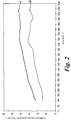
- the components made by the first illustrative example were tested to determine their coefficient of linear thermal expansion over a temperature range.
- the line A in Figure 2 shows the results while the line B shows the results obtained for components made from the comparison powder mentioned-above.
- Figure 3 shows the components from the first illustrative example as small squares and those from the comparison powder as large squares. From Figure 3, it can be seen that the hot oxidation resistance of the comparative example becomes progressively worse at higher temperatures while that of the first illustrative example is not only better but also increases at a much lower rate as temperature increases.
- a friction test was then conducted on samples according to this example.
- the test involved taking these samples and placing each sample in a test rig.
- each end of the sample was placed in a bushing, each bushing subsequently being loaded to 2 kg to produce a downward force on each end of the sample.
- the sample was then heated to about 600°C in a hot diesel exhaust environment.
- the sample was then rotated at 20 cycles per minute in this environment for 110 hours of continuous testing.
- the bearing pressure under these conditions was about 0.1MPa and the coefficient of friction during testing was found to be between 0.15 and 0.5.
- the first example was repeated except that the sintering was vacuum sintering at 1200°C.
- the components had a hardness of 50 HRA and the sintered densities were up to 6.53 Mgm -3 .
- the components also passed the wear and corrosion resistance tests.
- the percentage of the second alloy powder was varied with the percentage of the first alloy powder being altered to make up the difference.
- test results indicate that in powders according to the invention enable components to be manufactured by a PM route, the components having an improved hot oxidation resistance but only slightly reduced wear resistance in comparison with components made from the first alloy powder, ie without an austenitic stainless steel component.
- a further set of illustrative examples were prepared using a commercially available austenitic stainless steel having the designation 316L. Across the range of samples, as the level of solid lubricant was increased by a set amount, the amounts of the first alloy and the austenitic stainless steel were each reduced, such that a ratio of 2.6:1 of the first alloy to the austenitc stainless steel was maintained.
- the samples were made by preparing a mixture of the first alloy, the stainless steel and the solid lubricant as required. Each mixture was pressed to form a green compact. The green compact was heated at 10°C/min to a temperature of about 600°C and held at that temperature for 30 minutes.
- the samples were then heated at 10°C/min to about 900°C and held at that temperature for 30 minutes. Finally, the samples were heated at 5°C/min under near vacuum of 4 mbar Ar to about 1175°C and held at that temperature for 60 minutes before being allowed to cool to room temperature.
- Each of the samples was subjected to a hot oxidation test.
- the samples were maintained at a constant temperature of 750°C for 24 hours and the weight gain for each sample was determined.
- the weight gain is illustrative of the amount of oxide formed on each sample. It was found that at up to 30% Molybdenum Disulphide a satisfactory result could be obtained in that less than 1% weight gain was detected.
- oxide forms, it forms in the interstices or pores of the sintered material, eventually causing the sintered material to fracture as the volume of oxide becomes greater than the volume of the pores in which it is forming.
- the fracture of a PM part is best avoided, and a part that forms little oxide while maintaining its physical properties is thus desirable.
- a further set of illustrative examples was prepared.
- the samples were substantially identical, each sample containing determined amounts of each of the first alloy, the second alloy and the solid lubricant.
- the powder mixture was sintered in a Walking Beam furnace in a nitrogen/hydrogen atmosphere.
- the samples were sintered at various temperatures. It was found that a sintering temperature above about 1230°C was required to produce samples that could be machined without causing above average wear to the machining tools.
Landscapes
- Chemical & Material Sciences (AREA)
- Engineering & Computer Science (AREA)
- Materials Engineering (AREA)
- Mechanical Engineering (AREA)
- Metallurgy (AREA)
- Organic Chemistry (AREA)
- Powder Metallurgy (AREA)
Description
Claims (11)
- An iron-based powder for use in manufacturing a component by a powder metallurgy route, which powder is a mixture consisting of a first alloy powder consisting of, in weight percentages, 14 to 30 chromium, 1 to 5 molybdenum, 0 to 5 vanadium, 0 to 6 tungsten, the total of molybdenum, vanadium and tungsten being at least 3, a total of 0 to 5 of other strong carbide forming elements selected from niobium, tantalum and titanium, 0 to 1.5 silicon, 0.555 to 2 carbon with a minimum amount sufficient to form carbides with substantially all of the molybdenum, vanadium, tungsten, and any other strong carbide forming elements present, and the balance is iron together with incidental impurities, a second alloy powder of an austenitic stainless steel, and a solid lubricant forming 3.5 to 30% by weight of the mixture, and, by weight, the major portion of the combination of the first alloy powder and the second alloy powder being formed by the first alloy powder, with the second alloy powder forming the minor portion of this combination.
- A powder according to claim 1, wherein said first alloy powder comprises, in weight percentages, 20 to 28 chromium, 2 to 3 molybdenum, 1.5 to 2.5 vanadium, 2.5 to 3.5 tungsten, 0.8 to 1.5 silicon, and 0.555 to 2 carbon.
- A powder according to either one of claims 1 and 2, wherein the second alloy powder comprises 1 to 37% of nickel, 12 to 28% of chromium, 0 to 19% manganese, 0 to 7% molybdenum, 0 to 1% niobium, 0 to 0.4% nitrogen, 0 to 0.2% of carbon, and the balance is iron together with incidental impurities, all percentages being by weight.
- A powder according to claim 3, wherein the second alloy powder comprises 8 to 16% of nickel, 12 to 20% of chromium, 0 to 4% molybdenum, 0 to 0.1% carbon, all percentages being by weight.
- A powder according to claim 4, wherein said second alloy powder comprises 11 to 13% of nickel, and 16.2 to 17.2% of chromium, all percentages being by weight.
- A powder according to claim 5, wherein said second alloy comprises 1 to 3% by weight of molybdenum.
- A powder according to any one of claims 1 to 6, wherein said combination of the first alloy powder and the second alloy powder comprises up to 95% by weight of the first alloy powder.
- A powder consisting of a mixture of a powder according to any one of claims 1 to 7, and an addition of up to 1% by weight of free carbon.
- A powder consisting of a mixture of a powder according to any one of claims 1 to 8, and a sintering aid.
- A powder according to claim 9, wherein the solid lubricant comprises up to 5% by weight.
- A powder according to any one of claims 1 to 10, wherein the solid lubricant comprises molybdenum disulphide.
Applications Claiming Priority (3)
| Application Number | Priority Date | Filing Date | Title |
|---|---|---|---|
| GB9624999 | 1996-11-30 | ||
| GBGB9624999.0A GB9624999D0 (en) | 1996-11-30 | 1996-11-30 | Iron-based powder |
| PCT/GB1997/003221 WO1998024941A1 (en) | 1996-11-30 | 1997-11-25 | Iron-based powder |
Publications (2)
| Publication Number | Publication Date |
|---|---|
| EP0946774A1 EP0946774A1 (en) | 1999-10-06 |
| EP0946774B1 true EP0946774B1 (en) | 2004-04-21 |
Family
ID=10803783
Family Applications (1)
| Application Number | Title | Priority Date | Filing Date |
|---|---|---|---|
| EP97913335A Expired - Lifetime EP0946774B1 (en) | 1996-11-30 | 1997-11-25 | Iron-based powder |
Country Status (8)
| Country | Link |
|---|---|
| US (1) | US6123748A (en) |
| EP (1) | EP0946774B1 (en) |
| JP (1) | JP4223559B2 (en) |
| KR (1) | KR100613942B1 (en) |
| DE (1) | DE69728786T2 (en) |
| GB (1) | GB9624999D0 (en) |
| RU (1) | RU2210616C2 (en) |
| WO (1) | WO1998024941A1 (en) |
Cited By (2)
| Publication number | Priority date | Publication date | Assignee | Title |
|---|---|---|---|---|
| WO2009126674A3 (en) * | 2008-04-08 | 2010-01-21 | Federal-Mogul Corporation | Powdered metal alloy composition for wear and temperature resistance applications and method of producing same |
| DE102015213706A1 (en) * | 2015-07-21 | 2017-01-26 | Mahle International Gmbh | Tribological system comprising a valve seat ring and a valve |
Families Citing this family (27)
| Publication number | Priority date | Publication date | Assignee | Title |
|---|---|---|---|---|
| GB9917510D0 (en) * | 1999-07-27 | 1999-09-29 | Federal Mogul Sintered Prod | Sintered steel material |
| SE0102102D0 (en) * | 2001-06-13 | 2001-06-13 | Hoeganaes Ab | High density stainless steel products and method of preparation thereof |
| SE0201825D0 (en) * | 2002-06-14 | 2002-06-14 | Hoeganaes Ab | Hot compaction or steel powders |
| FR2840969B1 (en) * | 2002-06-14 | 2004-09-03 | Snecma Moteurs | DENSE SELF-LUBRICATING DRY MATERIAL; MECHANICAL PIECE IN SAID MATERIAL; PROCESS FOR THE PREPARATION OF SAID MATERIAL |
| DE10321521B3 (en) * | 2003-05-14 | 2004-06-09 | Gkn Sinter Metals Gmbh | Oil pump used in the production of molded parts comprises a housing made from aluminum containing moving molded parts partially made from a sinterable material consisting of an austenitic iron-base alloy |
| US7153339B2 (en) * | 2004-04-06 | 2006-12-26 | Hoeganaes Corporation | Powder metallurgical compositions and methods for making the same |
| SE0401042D0 (en) * | 2004-04-21 | 2004-04-21 | Hoeganaes Ab | Lubricants for metallurgical powder compositions |
| SE0401644D0 (en) * | 2004-06-23 | 2004-06-23 | Hoeganaes Ab | Lubricants for insulated soft magnetic iron-based powder compositions |
| SE0401707D0 (en) * | 2004-07-02 | 2004-07-02 | Hoeganaes Ab | Stainless steel powder |
| US7314498B2 (en) * | 2004-10-19 | 2008-01-01 | Pmg Ohio Corp. | Sintered alloys for cam lobes and other high wear articles |
| FR2880564B1 (en) * | 2005-01-12 | 2008-07-25 | Snecma Moteurs Sa | "MIXTURE OF POWDERS SUITABLE FOR SINTING TO FORM A SOLUBLIFIER SOLID MATERIAL" |
| US7722803B2 (en) * | 2006-07-27 | 2010-05-25 | Pmg Indiana Corp. | High carbon surface densified sintered steel products and method of production therefor |
| RU2458172C2 (en) * | 2006-09-22 | 2012-08-10 | Хеганес Аб (Пабл) | Metallurgical powdered composition and method for its obtaining |
| GB2451898A (en) * | 2007-08-17 | 2009-02-18 | Federal Mogul Sintered Prod | Sintered valve seat |
| ES2659979T3 (en) * | 2007-09-28 | 2018-03-20 | Höganäs Ab (Publ) | Metallurgical powder composition and production method |
| US9162285B2 (en) | 2008-04-08 | 2015-10-20 | Federal-Mogul Corporation | Powder metal compositions for wear and temperature resistance applications and method of producing same |
| US9624568B2 (en) | 2008-04-08 | 2017-04-18 | Federal-Mogul Corporation | Thermal spray applications using iron based alloy powder |
| JP5100487B2 (en) * | 2008-04-25 | 2012-12-19 | 日立粉末冶金株式会社 | Manufacturing method of sintered machine parts |
| US20110171008A1 (en) * | 2008-09-25 | 2011-07-14 | Borgwarner Inc. | Turbocharger and adjustment ring therefor |
| DE102010035293A1 (en) * | 2010-08-25 | 2012-03-01 | Bosch Mahle Turbo Systems Gmbh & Co. Kg | Sintered molded part comprises carbon, chromium, nickel, molybdenum, manganese, silicon, at least one of cobalt, titanium, niobium, vanadium or tungsten, sulfur, and iron including production related impurities |
| CN103314227B (en) * | 2011-01-19 | 2016-05-18 | 西门子公司 | For the sliding bearing and the turbine with this sliding bearing of turbine rotor |
| US9534280B2 (en) | 2011-05-19 | 2017-01-03 | Borgwarner Inc. | Austenitic iron-based alloy, turbocharger and component made thereof |
| RU2481906C2 (en) * | 2011-07-21 | 2013-05-20 | Валерий Никитич Гринавцев | Method of feeding lubricant in strain site |
| JP5939384B2 (en) * | 2012-03-26 | 2016-06-22 | 日立化成株式会社 | Sintered alloy and method for producing the same |
| DE102018214344A1 (en) * | 2018-08-24 | 2020-02-27 | Mahle International Gmbh | Process for the manufacture of a powder metallurgical product |
| CN111774562B (en) * | 2020-06-22 | 2022-07-15 | 陈柏翰 | Powder composition, preparation method and application thereof |
| CN115867722A (en) * | 2020-09-24 | 2023-03-28 | 三菱重工发动机和增压器株式会社 | Manufacturing method of turbocharger housing and turbocharger housing |
Family Cites Families (10)
| Publication number | Priority date | Publication date | Assignee | Title |
|---|---|---|---|---|
| SE408435B (en) * | 1976-11-03 | 1979-06-11 | Hoeganaes Ab | WAY TO PRODUCE A COPPER-CONTAINING IRON POWDER |
| US4170474A (en) * | 1978-10-23 | 1979-10-09 | Pitney-Bowes | Powder metal composition |
| DE3345930C2 (en) * | 1983-12-20 | 1986-04-30 | Sintermetallwerk Krebsöge GmbH, 5608 Radevormwald | Method for producing a sintered material |
| DE3572695D1 (en) * | 1984-06-06 | 1989-10-05 | Sumitomo Metal Ind | Sintered stainless steel and production process therefor |
| JPS6176650A (en) * | 1984-09-21 | 1986-04-19 | Nissan Motor Co Ltd | Wear resistant sintered alloy |
| RU2034086C1 (en) * | 1992-06-09 | 1995-04-30 | Кеглин Борис Григорьевич | Powder antifriction alloy based on iron |
| AU4826693A (en) * | 1992-09-25 | 1994-04-26 | Powdrex Limited | A method of producing sintered alloy steel components |
| JP2642570B2 (en) * | 1992-12-18 | 1997-08-20 | 新日本製鐵株式会社 | Heat- and wear-resistant cast slab support for continuous casting |
| US5856625A (en) * | 1995-03-10 | 1999-01-05 | Powdrex Limited | Stainless steel powders and articles produced therefrom by powder metallurgy |
| GB2298869B (en) * | 1995-03-10 | 1999-03-03 | Powdrex Ltd | Stainless steel powders and articles produced therefrom by powder metallurgy |
-
1996
- 1996-11-30 GB GBGB9624999.0A patent/GB9624999D0/en active Pending
-
1997
- 1997-11-25 KR KR1019997004613A patent/KR100613942B1/en not_active Expired - Lifetime
- 1997-11-25 JP JP52531498A patent/JP4223559B2/en not_active Expired - Fee Related
- 1997-11-25 DE DE69728786T patent/DE69728786T2/en not_active Expired - Lifetime
- 1997-11-25 US US09/319,070 patent/US6123748A/en not_active Expired - Lifetime
- 1997-11-25 RU RU99113828/02A patent/RU2210616C2/en not_active IP Right Cessation
- 1997-11-25 EP EP97913335A patent/EP0946774B1/en not_active Expired - Lifetime
- 1997-11-25 WO PCT/GB1997/003221 patent/WO1998024941A1/en not_active Ceased
Cited By (3)
| Publication number | Priority date | Publication date | Assignee | Title |
|---|---|---|---|---|
| WO2009126674A3 (en) * | 2008-04-08 | 2010-01-21 | Federal-Mogul Corporation | Powdered metal alloy composition for wear and temperature resistance applications and method of producing same |
| DE102015213706A1 (en) * | 2015-07-21 | 2017-01-26 | Mahle International Gmbh | Tribological system comprising a valve seat ring and a valve |
| US10612432B2 (en) | 2015-07-21 | 2020-04-07 | Mahle International Gmbh | Tribological system, comprising a valve seat ring and a valve |
Also Published As
| Publication number | Publication date |
|---|---|
| JP2001505255A (en) | 2001-04-17 |
| JP4223559B2 (en) | 2009-02-12 |
| EP0946774A1 (en) | 1999-10-06 |
| DE69728786D1 (en) | 2004-05-27 |
| DE69728786T2 (en) | 2005-03-31 |
| KR100613942B1 (en) | 2006-08-18 |
| GB9624999D0 (en) | 1997-01-15 |
| WO1998024941A1 (en) | 1998-06-11 |
| KR20000057241A (en) | 2000-09-15 |
| RU2210616C2 (en) | 2003-08-20 |
| US6123748A (en) | 2000-09-26 |
Similar Documents
| Publication | Publication Date | Title |
|---|---|---|
| US6123748A (en) | Iron-based powder | |
| CA1337748C (en) | Sintered materials | |
| JP4891421B2 (en) | Powder metallurgy mixture and method for producing powder metallurgy parts using the same | |
| EP0167034B1 (en) | Valve-seat insert for internal combustion engines and its production | |
| KR101551453B1 (en) | Metallurgical powder composition and method of production | |
| RU2280706C2 (en) | Iron-based copper-containing sintered article and method of its production | |
| KR20040066937A (en) | Sinterable metal powder mixture for the production of sintered components | |
| JP3378012B2 (en) | Manufacturing method of sintered product | |
| KR100691097B1 (en) | Sintered Steel Material | |
| JP4580984B2 (en) | Stainless steel powder | |
| US5545249A (en) | Sintered bearing alloy for high-temperature application and method of manufacturing an article of the alloy | |
| CN114425617B (en) | Wear-resistant and highly thermally conductive sintered alloys especially suitable for bearings and valve seat rings | |
| US4696696A (en) | Sintered alloy having improved wear resistance property | |
| GB2319782A (en) | Iron-Based powder | |
| JPH0517839A (en) | High temperature bearing alloy and method for producing the same | |
| EP0946775B1 (en) | Iron based metal powder mixture and component made therefrom | |
| EP0277239B1 (en) | Abrasion-resistant sintered alloy and process for its production | |
| JPH10219410A (en) | High density sintered alloy material and method for producing the same | |
| JPH0841607A (en) | Heat-resistant and wear-resistant sintered stainless steel | |
| JPS61291954A (en) | Sintering material having wear resistance and corrosion resistance at high temperature and its manufacture | |
| CN119351889B (en) | Clean fuel engine valve seat ring and preparation method thereof, engine and automobile | |
| JPH06299284A (en) | High-strength nitrided sintered member having excellent wear resistance and method for manufacturing the same | |
| JPH0114985B2 (en) | ||
| GB2210894A (en) | Sintered materials | |
| GB2088414A (en) | Sintering Stainless Steel Powder |
Legal Events
| Date | Code | Title | Description |
|---|---|---|---|
| PUAI | Public reference made under article 153(3) epc to a published international application that has entered the european phase |
Free format text: ORIGINAL CODE: 0009012 |
|
| 17P | Request for examination filed |
Effective date: 19990511 |
|
| AK | Designated contracting states |
Kind code of ref document: A1 Designated state(s): DE ES FR IT SE |
|
| 17Q | First examination report despatched |
Effective date: 20001005 |
|
| GRAP | Despatch of communication of intention to grant a patent |
Free format text: ORIGINAL CODE: EPIDOSNIGR1 |
|
| GRAS | Grant fee paid |
Free format text: ORIGINAL CODE: EPIDOSNIGR3 |
|
| GRAA | (expected) grant |
Free format text: ORIGINAL CODE: 0009210 |
|
| RAP1 | Party data changed (applicant data changed or rights of an application transferred) |
Owner name: FEDERAL-MOGUL SINTERED PRODUCTS LIMITED |
|
| AK | Designated contracting states |
Kind code of ref document: B1 Designated state(s): DE ES FR IT SE |
|
| REF | Corresponds to: |
Ref document number: 69728786 Country of ref document: DE Date of ref document: 20040527 Kind code of ref document: P |
|
| PG25 | Lapsed in a contracting state [announced via postgrant information from national office to epo] |
Ref country code: SE Free format text: LAPSE BECAUSE OF FAILURE TO SUBMIT A TRANSLATION OF THE DESCRIPTION OR TO PAY THE FEE WITHIN THE PRESCRIBED TIME-LIMIT Effective date: 20040721 |
|
| PG25 | Lapsed in a contracting state [announced via postgrant information from national office to epo] |
Ref country code: ES Free format text: LAPSE BECAUSE OF FAILURE TO SUBMIT A TRANSLATION OF THE DESCRIPTION OR TO PAY THE FEE WITHIN THE PRESCRIBED TIME-LIMIT Effective date: 20040801 |
|
| ET | Fr: translation filed | ||
| PLBE | No opposition filed within time limit |
Free format text: ORIGINAL CODE: 0009261 |
|
| STAA | Information on the status of an ep patent application or granted ep patent |
Free format text: STATUS: NO OPPOSITION FILED WITHIN TIME LIMIT |
|
| 26N | No opposition filed |
Effective date: 20050124 |
|
| PGFP | Annual fee paid to national office [announced via postgrant information from national office to epo] |
Ref country code: FR Payment date: 20101109 Year of fee payment: 14 |
|
| PGFP | Annual fee paid to national office [announced via postgrant information from national office to epo] |
Ref country code: IT Payment date: 20101119 Year of fee payment: 14 |
|
| REG | Reference to a national code |
Ref country code: FR Ref legal event code: ST Effective date: 20120731 |
|
| PG25 | Lapsed in a contracting state [announced via postgrant information from national office to epo] |
Ref country code: IT Free format text: LAPSE BECAUSE OF NON-PAYMENT OF DUE FEES Effective date: 20111125 |
|
| PG25 | Lapsed in a contracting state [announced via postgrant information from national office to epo] |
Ref country code: FR Free format text: LAPSE BECAUSE OF NON-PAYMENT OF DUE FEES Effective date: 20111130 |
|
| PGFP | Annual fee paid to national office [announced via postgrant information from national office to epo] |
Ref country code: DE Payment date: 20131129 Year of fee payment: 17 |
|
| REG | Reference to a national code |
Ref country code: DE Ref legal event code: R119 Ref document number: 69728786 Country of ref document: DE |
|
| PG25 | Lapsed in a contracting state [announced via postgrant information from national office to epo] |
Ref country code: DE Free format text: LAPSE BECAUSE OF NON-PAYMENT OF DUE FEES Effective date: 20150602 |