EP0943697A1 - High-toughness spring steel - Google Patents
High-toughness spring steel Download PDFInfo
- Publication number
- EP0943697A1 EP0943697A1 EP98919508A EP98919508A EP0943697A1 EP 0943697 A1 EP0943697 A1 EP 0943697A1 EP 98919508 A EP98919508 A EP 98919508A EP 98919508 A EP98919508 A EP 98919508A EP 0943697 A1 EP0943697 A1 EP 0943697A1
- Authority
- EP
- European Patent Office
- Prior art keywords
- steel
- content
- addition
- spring steel
- strength
- Prior art date
- Legal status (The legal status is an assumption and is not a legal conclusion. Google has not performed a legal analysis and makes no representation as to the accuracy of the status listed.)
- Granted
Links
Images


Classifications
-
- C—CHEMISTRY; METALLURGY
- C21—METALLURGY OF IRON
- C21D—MODIFYING THE PHYSICAL STRUCTURE OF FERROUS METALS; GENERAL DEVICES FOR HEAT TREATMENT OF FERROUS OR NON-FERROUS METALS OR ALLOYS; MAKING METAL MALLEABLE, e.g. BY DECARBURISATION OR TEMPERING
- C21D9/00—Heat treatment, e.g. annealing, hardening, quenching or tempering, adapted for particular articles; Furnaces therefor
- C21D9/02—Heat treatment, e.g. annealing, hardening, quenching or tempering, adapted for particular articles; Furnaces therefor for springs
-
- C—CHEMISTRY; METALLURGY
- C22—METALLURGY; FERROUS OR NON-FERROUS ALLOYS; TREATMENT OF ALLOYS OR NON-FERROUS METALS
- C22C—ALLOYS
- C22C38/00—Ferrous alloys, e.g. steel alloys
- C22C38/001—Ferrous alloys, e.g. steel alloys containing N
-
- C—CHEMISTRY; METALLURGY
- C22—METALLURGY; FERROUS OR NON-FERROUS ALLOYS; TREATMENT OF ALLOYS OR NON-FERROUS METALS
- C22C—ALLOYS
- C22C38/00—Ferrous alloys, e.g. steel alloys
- C22C38/02—Ferrous alloys, e.g. steel alloys containing silicon
-
- C—CHEMISTRY; METALLURGY
- C22—METALLURGY; FERROUS OR NON-FERROUS ALLOYS; TREATMENT OF ALLOYS OR NON-FERROUS METALS
- C22C—ALLOYS
- C22C38/00—Ferrous alloys, e.g. steel alloys
- C22C38/04—Ferrous alloys, e.g. steel alloys containing manganese
-
- C—CHEMISTRY; METALLURGY
- C22—METALLURGY; FERROUS OR NON-FERROUS ALLOYS; TREATMENT OF ALLOYS OR NON-FERROUS METALS
- C22C—ALLOYS
- C22C38/00—Ferrous alloys, e.g. steel alloys
- C22C38/18—Ferrous alloys, e.g. steel alloys containing chromium
- C22C38/20—Ferrous alloys, e.g. steel alloys containing chromium with copper
-
- C—CHEMISTRY; METALLURGY
- C22—METALLURGY; FERROUS OR NON-FERROUS ALLOYS; TREATMENT OF ALLOYS OR NON-FERROUS METALS
- C22C—ALLOYS
- C22C38/00—Ferrous alloys, e.g. steel alloys
- C22C38/18—Ferrous alloys, e.g. steel alloys containing chromium
- C22C38/22—Ferrous alloys, e.g. steel alloys containing chromium with molybdenum or tungsten
-
- C—CHEMISTRY; METALLURGY
- C22—METALLURGY; FERROUS OR NON-FERROUS ALLOYS; TREATMENT OF ALLOYS OR NON-FERROUS METALS
- C22C—ALLOYS
- C22C38/00—Ferrous alloys, e.g. steel alloys
- C22C38/18—Ferrous alloys, e.g. steel alloys containing chromium
- C22C38/24—Ferrous alloys, e.g. steel alloys containing chromium with vanadium
-
- C—CHEMISTRY; METALLURGY
- C22—METALLURGY; FERROUS OR NON-FERROUS ALLOYS; TREATMENT OF ALLOYS OR NON-FERROUS METALS
- C22C—ALLOYS
- C22C38/00—Ferrous alloys, e.g. steel alloys
- C22C38/18—Ferrous alloys, e.g. steel alloys containing chromium
- C22C38/26—Ferrous alloys, e.g. steel alloys containing chromium with niobium or tantalum
-
- C—CHEMISTRY; METALLURGY
- C22—METALLURGY; FERROUS OR NON-FERROUS ALLOYS; TREATMENT OF ALLOYS OR NON-FERROUS METALS
- C22C—ALLOYS
- C22C38/00—Ferrous alloys, e.g. steel alloys
- C22C38/18—Ferrous alloys, e.g. steel alloys containing chromium
- C22C38/28—Ferrous alloys, e.g. steel alloys containing chromium with titanium or zirconium
-
- C—CHEMISTRY; METALLURGY
- C22—METALLURGY; FERROUS OR NON-FERROUS ALLOYS; TREATMENT OF ALLOYS OR NON-FERROUS METALS
- C22C—ALLOYS
- C22C38/00—Ferrous alloys, e.g. steel alloys
- C22C38/18—Ferrous alloys, e.g. steel alloys containing chromium
- C22C38/32—Ferrous alloys, e.g. steel alloys containing chromium with boron
-
- C—CHEMISTRY; METALLURGY
- C22—METALLURGY; FERROUS OR NON-FERROUS ALLOYS; TREATMENT OF ALLOYS OR NON-FERROUS METALS
- C22C—ALLOYS
- C22C38/00—Ferrous alloys, e.g. steel alloys
- C22C38/18—Ferrous alloys, e.g. steel alloys containing chromium
- C22C38/34—Ferrous alloys, e.g. steel alloys containing chromium with more than 1.5% by weight of silicon
-
- C—CHEMISTRY; METALLURGY
- C22—METALLURGY; FERROUS OR NON-FERROUS ALLOYS; TREATMENT OF ALLOYS OR NON-FERROUS METALS
- C22C—ALLOYS
- C22C38/00—Ferrous alloys, e.g. steel alloys
- C22C38/18—Ferrous alloys, e.g. steel alloys containing chromium
- C22C38/40—Ferrous alloys, e.g. steel alloys containing chromium with nickel
- C22C38/42—Ferrous alloys, e.g. steel alloys containing chromium with nickel with copper
-
- C—CHEMISTRY; METALLURGY
- C22—METALLURGY; FERROUS OR NON-FERROUS ALLOYS; TREATMENT OF ALLOYS OR NON-FERROUS METALS
- C22C—ALLOYS
- C22C38/00—Ferrous alloys, e.g. steel alloys
- C22C38/18—Ferrous alloys, e.g. steel alloys containing chromium
- C22C38/40—Ferrous alloys, e.g. steel alloys containing chromium with nickel
- C22C38/44—Ferrous alloys, e.g. steel alloys containing chromium with nickel with molybdenum or tungsten
-
- C—CHEMISTRY; METALLURGY
- C22—METALLURGY; FERROUS OR NON-FERROUS ALLOYS; TREATMENT OF ALLOYS OR NON-FERROUS METALS
- C22C—ALLOYS
- C22C38/00—Ferrous alloys, e.g. steel alloys
- C22C38/18—Ferrous alloys, e.g. steel alloys containing chromium
- C22C38/40—Ferrous alloys, e.g. steel alloys containing chromium with nickel
- C22C38/46—Ferrous alloys, e.g. steel alloys containing chromium with nickel with vanadium
-
- C—CHEMISTRY; METALLURGY
- C22—METALLURGY; FERROUS OR NON-FERROUS ALLOYS; TREATMENT OF ALLOYS OR NON-FERROUS METALS
- C22C—ALLOYS
- C22C38/00—Ferrous alloys, e.g. steel alloys
- C22C38/18—Ferrous alloys, e.g. steel alloys containing chromium
- C22C38/40—Ferrous alloys, e.g. steel alloys containing chromium with nickel
- C22C38/50—Ferrous alloys, e.g. steel alloys containing chromium with nickel with titanium or zirconium
-
- C—CHEMISTRY; METALLURGY
- C22—METALLURGY; FERROUS OR NON-FERROUS ALLOYS; TREATMENT OF ALLOYS OR NON-FERROUS METALS
- C22C—ALLOYS
- C22C38/00—Ferrous alloys, e.g. steel alloys
- C22C38/18—Ferrous alloys, e.g. steel alloys containing chromium
- C22C38/40—Ferrous alloys, e.g. steel alloys containing chromium with nickel
- C22C38/54—Ferrous alloys, e.g. steel alloys containing chromium with nickel with boron
-
- C—CHEMISTRY; METALLURGY
- C21—METALLURGY OF IRON
- C21D—MODIFYING THE PHYSICAL STRUCTURE OF FERROUS METALS; GENERAL DEVICES FOR HEAT TREATMENT OF FERROUS OR NON-FERROUS METALS OR ALLOYS; MAKING METAL MALLEABLE, e.g. BY DECARBURISATION OR TEMPERING
- C21D1/00—General methods or devices for heat treatment, e.g. annealing, hardening, quenching or tempering
- C21D1/18—Hardening; Quenching with or without subsequent tempering
-
- Y—GENERAL TAGGING OF NEW TECHNOLOGICAL DEVELOPMENTS; GENERAL TAGGING OF CROSS-SECTIONAL TECHNOLOGIES SPANNING OVER SEVERAL SECTIONS OF THE IPC; TECHNICAL SUBJECTS COVERED BY FORMER USPC CROSS-REFERENCE ART COLLECTIONS [XRACs] AND DIGESTS
- Y10—TECHNICAL SUBJECTS COVERED BY FORMER USPC
- Y10S—TECHNICAL SUBJECTS COVERED BY FORMER USPC CROSS-REFERENCE ART COLLECTIONS [XRACs] AND DIGESTS
- Y10S148/00—Metal treatment
- Y10S148/902—Metal treatment having portions of differing metallurgical properties or characteristics
- Y10S148/908—Spring
Definitions
- the present invention relates to a spring steel used for high strength springs employed for automobiles, other industrial machines, and the like.
- Japanese Unexamined Patent Publication (Kokai) No. 57-32353 discloses a procedure wherein fine carbides which are brought into solid solution by quench-hardening and which are precipitated by tempering are formed in the steel by adding elements such as V, Nb and Mo, and the fine carbides limit the movement of dislocations and improve the resistance to setting.
- a steel for springs has such a fracture property that the steel can withstand the harsh environment where the springs are used.
- the impact toughness of the steel disclosed in Japanese Unexamined Patent Publication (Kokai) No. 57-32353 is from 2.2 to 2.8 kgf-m/cm 2 as measured using a JIS No. 3 test piece. Therefore, it can be concluded that the steel can never have a sufficiently high toughness.
- An object of the present invention is to provide a steel material for springs having a high strength and a high toughness after heat treatment.
- the present inventors have developed a steel having a sufficient ductility and a sufficient impact toughness, even when the steel is made to have a high strength, by refining austenite grains with precipitates which have never been observed in conventional spring steels, and extremely decreasing the impurities at austenite grain boundaries which tend to promote fracture.
- a first aspect of the present invention provides a high toughness spring steel comprising, based on mass, 0.35 to 0.85% of C, 0.9 to 2.5% of Si, 0.1 to 1.2% of Mn, 0.1 to 2.0% of Cr, 0.005 to 0.07% of Ti, 0.001 to 0.007% of N, the Ti content being greater than four times the N content in terms of percent by mass, P and S with restrictive contents of less than 0.020% and less than 0.020%, respectively, and the balance of Fe and unavoidable impurities.
- a second aspect of the present invention provides a high toughness spring steel comprising, based on mass, 0.35 to 0.85% of C, 0.9 to 2.5% of Si, 0.1 to 1.2% of Mn, 0.1 to 2.0% of Cr, 0.005 to 0.07% of Ti, 0.0005 to 0.0060% of B, 0.001 to 0.007% of N, the Ti content being greater than four times the N content in terms of percent by mass, P and S in restrictive contents of less than 0.020% and less than 0.020%, respectively, and the balance of Fe and unavoidable impurities.
- a third aspect of the present invention provides a high toughness spring steel further comprising, based on mass, one or two kinds of the following elements with the following contents: 0.05 to 0.5% of V and 0.01 to 0.10% of Nb, in addition to the elements defined in the first or the second aspect of the present invention.
- a fourth aspect of the present invention provides a high toughness spring steel further comprising, based on mass, one or two kinds of the following elements with the following contents: 0.05 to 1.0% of Ni and 0.05 to 1.0% of Mo, in addition to the elements defined in the first or the second aspect of the present invention.
- a fifth aspect of the present invention provides a high toughness spring steel further comprising, based on mass, one or two kinds of the following elements with the following contents: 0.05 to 0.5% of V and 0.01 to 0.10% of Nb, and one or two kinds of the following elements with the following contents: 0.05 to 1.0% of Ni and 0.05 to 1.0% of Mo, in addition to the elements defined in the first or the second aspect of the present invention.
- a sixth aspect of the present invention provides a high toughness spring steel further comprising, based on mass, 0.05 to 0.3% of Cu, in addition to the elements defined in the first or the second aspect of the present invention.
- a seventh aspect of the present invention provides a high toughness spring steel further comprising, based on mass, 0.05 to 0.5% of Cu and 0.05 to 1.0% of Ni, the Cu content being less than the Ni content in terms of percent by mass provided that the Cu content is greater than 0.3%, in addition to the elements defined in the first or the second aspect of the present invention.
- An eighth aspect of the present invention provides a high toughness spring steel further comprising, based on mass, one or two kinds of the following elements with the following contents: 0.05 to 0.5% of V and 0.01 to 0.10% of Nb, in addition to the elements defined in the sixth or the seventh aspect of the present invention.
- a ninth aspect of the present invention provides a high toughness spring steel further comprising, based on mass, 0.05 to 1.0% of Mo, in addition to the elements defined in the sixth or the seventh aspect of the present invention.
- a tenth aspect of the present invention provides a high toughness spring steel further comprising, based on mass, one or two kinds of the following elements with the following contents: 0.05 to 0.5% of V and 0.01 to 0.10% of Nb, and 0.05 to 1.0% of Mo, in addition to the elements defined in the sixth or the seventh aspect of the present invention.
- the present inventors have achieved the invention of a steel wire excellent in high strength and impact toughness after bench-hardening and tempering while avoiding the use of large amounts of alloying elements as observed in many conventional technologies.
- the C is an element which greatly influences the fundamental strength of the steel material.
- the C content is defined to be 0.35 to 0.85%.
- the C content is less than 0.35%, a sufficient strength cannot be obtained, and large amounts of other alloying elements must be added.
- the C content exceeds 0.85%, the steel becomes close to hypereutectoid, and the toughness of the steel is considerably lowered.
- Si is an element necessary for ensuring the strength, the hardness and the resistance to setting of springs.
- the lower limit of the Si content is defined to be 0.9%.
- the upper limit of the Si content is defined to be 2.5%.
- the lower limit of the Mn content is defined to be 0.1%.
- the upper limit of the Mn content is defined to be 1.2%.
- Cr is an element effective in improving the heat resistance and quench-hardenability of the steel.
- addition of Cr in a large amount not only increases the cost of the steel but also embrittles it so that cracks tend to be formed during wire drawing. Accordingly, in order to ensure the quench-hardenability of the steel, the lower limit of the Cr content is defined to be 0.1%.
- the upper limit thereof is defined to be 2.0% where the embrittlement becomes significant.
- Ti hardens the steel to improve the strength. However, part of Ti precipitates in the steel as nitride and carbide. In particular, the precipitation temperature of nitride is high, and the nitride is already precipitated in the molten steel. The bonding strength of nitride is high, and Ti is used for fixing N in the steel. When B is to be added to the steel, Ti is added in an amount sufficient to fix N so that B is prevented from forming BN.
- the precipitated nitride, carbide and carbonitride suppress austenite grain growth and refine austenite grains.
- the lower limit of the Ti content is defined to be 0.005% as a minimum addition amount necessary for fixing N and refining austenite grains.
- the upper limit of the Ti content is defined to be 0.07% as a maximum amount which does not exert adverse effects on the fracture property because of the precipitate size.
- B is known as an element for improving the quench-hardenability of the steel. Moreover, B is effective in increasing the cleanliness of the austenite grain boundaries. That is, addition of B makes nondetrimental such elements as P and S segregating at grain boundaries to lower the toughness, and as a result improves the fracture property. When B combines with N to form BN during the addition of B, the effect is ruined.
- the lower limit of the addition amount of B is defined to be 0.0005% from which the addition effect becomes definite.
- the upper limit thereof is defined to be 0.0060% at which the addition effect is saturated.
- the pinning particles can, therefore, be stably formed under various conditions of heat treatments conducted until the springs are produced.
- N is added in an amount of at least 0.001%.
- the upper limit of the addition amount of N is defined to be 0.007%.
- the Ti content is defined to be greater than four times the N content in terms of percent by mass for reasons as explained below. Since it is difficult to control the strength of the steel with N by heat treatment, N must be surely precipitated as TiN. It is necessary that all N be fixed as TiN, and that fine carbides effective in refining austenite grains must then be formed with excessive Ti. In view of what is mentioned above, it is appropriate that the Ti content be greater than four times the N content in terms of percent by mass and the content relationship is thus defined. Precipitates formed by Ti addition have the effect of trapping hydrogen which attacks the steel in a corrosive environment, and the resistance to hydrogen-induced delayed fracture is also improved.
- P hardens the steel, and segregates to embrittle the steel material.
- P segregated at austenite grain boundaries lowers the impact toughness of the steel, and induces delayed fracture when hydrogen attacks the steel.
- a low content of P is, therefore, preferred.
- the P content is restricted to less than 0.020%.
- S embrittles the steel when it is present therein, similarly to S.
- the influence of S is extremely reduced by Mn.
- MnS since MnS also takes the morphology of inclusions, the fracture property becomes poor. It is, therefore, desirable that the S content be decreased as much as possible. In order to suppress the adverse effect as much as possible, the S content is restricted to less than 0.020%.
- the effect of refining austenite grains synergizes, and the toughness can be increased stably.
- the effect of V cannot be recognized substantially when the addition amount is less than 0.05%, and coarse undissolved inclusions are formed to lower the toughness of the steel when the addition amount exceeds 0.5%.
- Nb is similar to V in that the effect of adding Nb is substantially not recognized when the addition amount is less than 0.01%, and that Nb forms coarse undissolved inclusions to lower the toughness of the steel when the addition amount exceeds 0.10%. Moreover, the precipitates of V or Nb have the effect of trapping hydrogen which attacks the steel in a corrosive environment, and the resistance to hydrogen-induced delayed fracture is also improved.
- Addition of Mo in an amount of 0.05 to 1.0% improves the quench-hardenability, and the steel can be highly strengthened stably by heat treatment. Since the resultant steel is excellent in resistance to tempering softening and shows no decrease in the strength even after tempering at high temperature, it is excellent in toughness and a hydrogen-induced delayed fracture property. It can, therefore, be concluded from a comparison between the steel containing Mo and a steel containing no Mo and having the same strength that the former steel is excellent in a fracture property in a corrosive environment because the former steel can be tempered at high temperature. No effect can be observed when the addition amount is less than 0.05%, and the effect is saturated when the amount exceeds 1.0%.
- Ni in an amount of 0.05 to 1.0% improves the quench-hardenability of the steel, and the steel can be highly strengthened stably after heat treatment. Ni also has the effect of improving the corrosion resistance. Ni inhibits the formation of rust, and improves the fracture property of the steel in a corrosive environment. When Ni is added in an amount less than 0.05%, no effect of the addition is observed. When Ni is added in an amount exceeding 1.0%, the effect is saturated.
- Cu prevents the decarburization of the steel. Since a decarburization layer shortens the fatigue life of the steel after forming springs, an effort has been made to reduce the decarburization layer as much as possible. When the decarburization layer of the steel becomes deep, the surface layer is removed by surface removal or peeling. Cu also has the effect of improving resistance to corrosion of the steel similarly to Ni.
- Cu shows the effects of inhibiting decarburization and improving resistance to corrosion when Cu is added in an amount of at least 0.05%. As described later, addition of Cu in an amount exceeding 0.5% tends to cause embrittlement of the steel leading to rolling defect formation even when Ni is added. Accordingly, the lower limit and the upper limit of the addition amounts of Cu are defined to be 0.05% and 0.5%, respectively.
- Table 1 shows the chemical composition of each of the steels of the present invention.
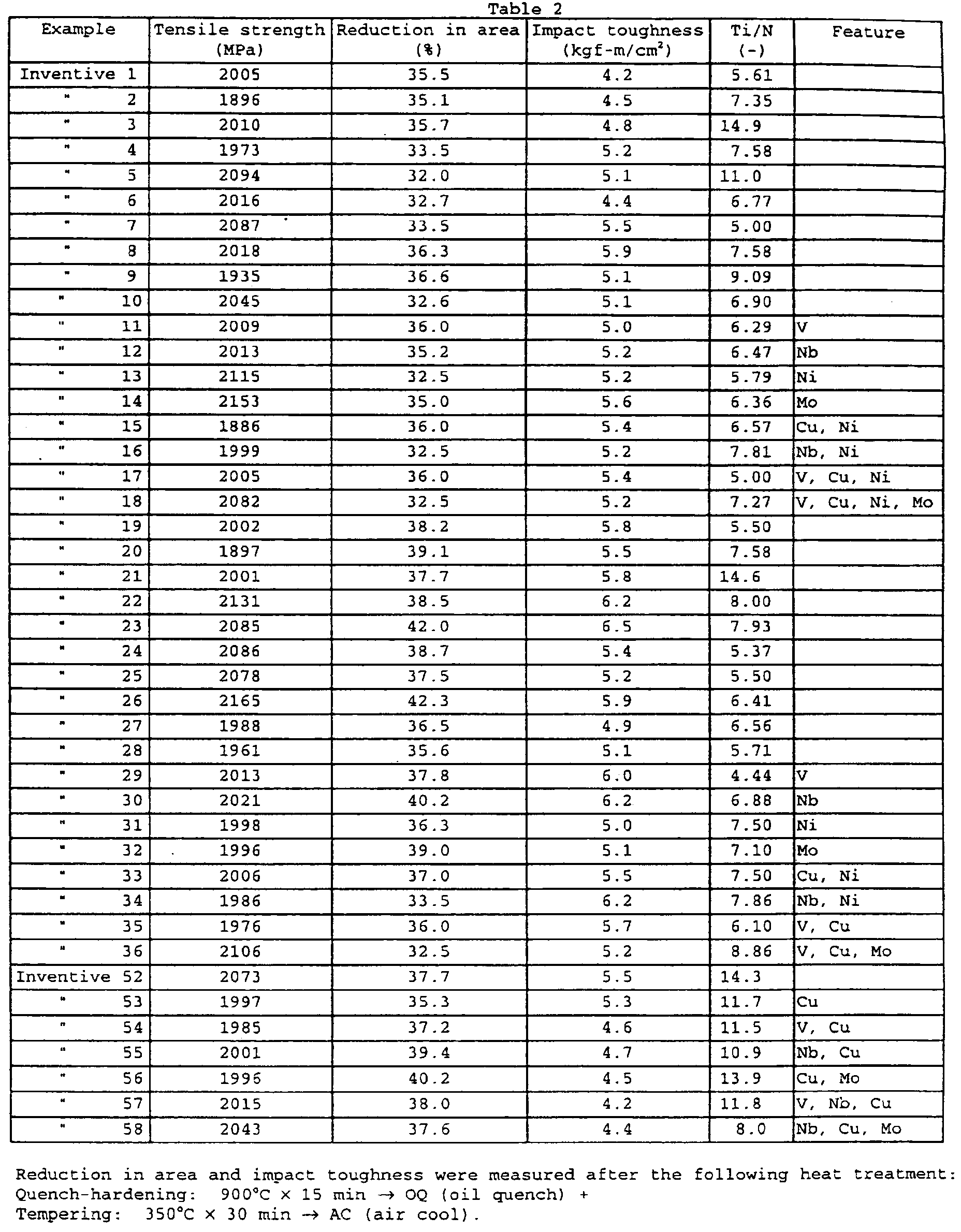
- Table 2 shows the tensile strength, the reduction in area, the impact toughness, the Ti/N ratio, etc. of the steel having a chemical composition shown in Table 1.
- Table 3 shows the chemical composition of each of the comparative steels.
- Table 4 shows the tensile strength, the reduction in area, the impact toughness, the Ti/N ratio, etc. of the steel having a chemical composition shown in Table 3.
- Steels used in most of the examples of the present invention were prepared by refining molten steels in a 200-ton converter, and continuous-casting the molten steels into billets. Moreover, steels in some of the examples (samples 5, 9, 11 and 40) were melted in a 2-ton vacuum melting furnace.
- a molten steel prepared by a converter was continuous-cast to give a slab.
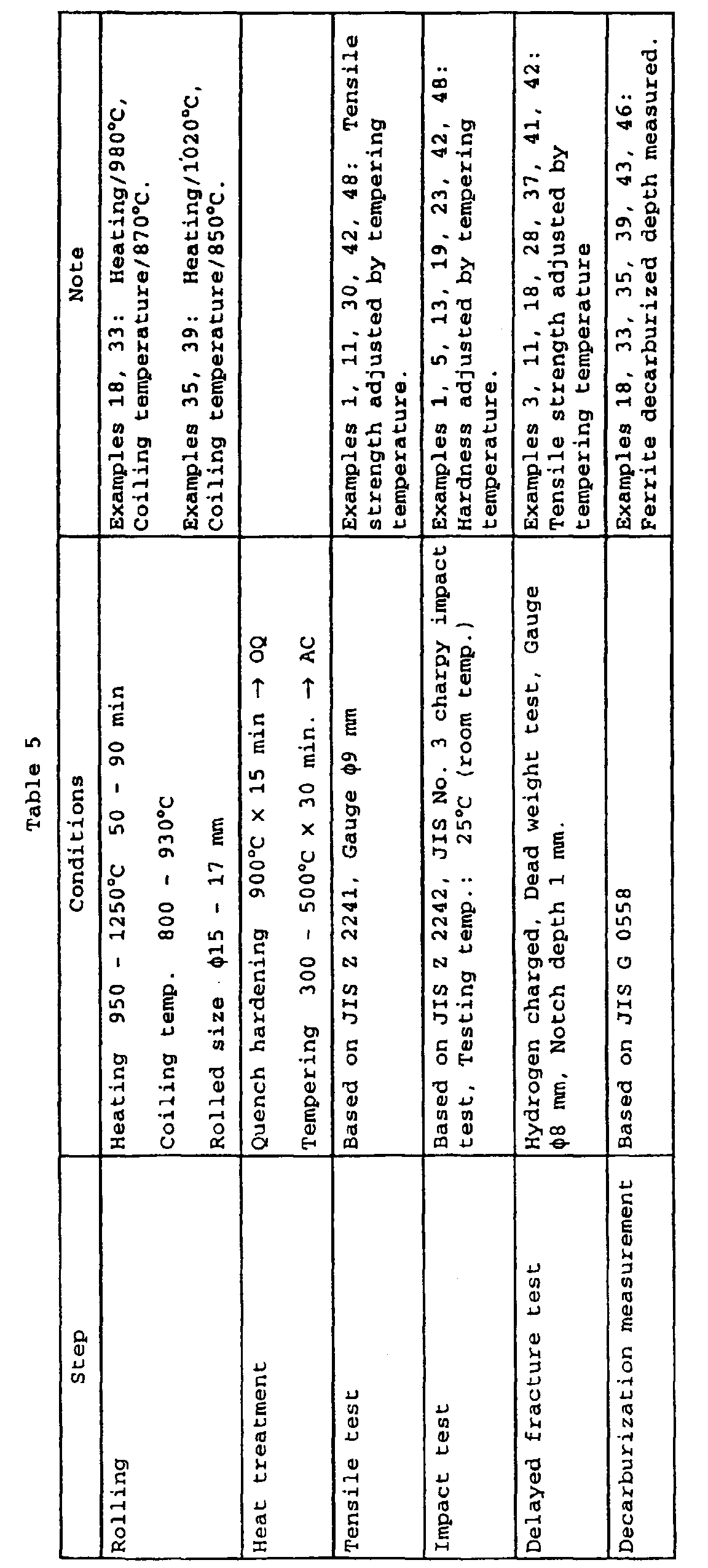
- An ingot was prepared from a molten steel having been prepared in a 2-ton vacuum melting furnace. The slab and the ingot were bloomed to give billets, which were quench-hardened, tempered, and machined to give various test pieces. Table 5 shows the details. Oil quenching at 60°C and air cooling related to the heat treatment conditions are designated below as OQ and AC, respectively.
- test pieces used for measuring the tensile strength, the reduction in area and the impact toughness shown in Tables 2 and 4 were heat treated under the following conditions.
- the test pieces were quenched by holding them at 900°C for 15 minutes and subjecting them to OQ (oil quenching), and the quenched test pieces were tempered by holding them at 350°C for 30 minutes and subjected to AC. All the test pieces in the examples and comparative examples had a tensile strength of about 1,900 MPa.
- steels in Comparative Examples 50, 51 and 59 which demonstrated the influence of Cu contained Cu either as a combination of Cu and Ni in amounts outside the scope of the present invention or as Cu alone in an amount outside the scope thereof. Consequently, the steels had low hot ductility, and reticulate cracks were formed on the surface of the steels during rolling. The resultant steel billets, therefore, had lower quality as spring steels, and evaluation of the mechanical properties of the steels was stopped.
- Example 1 the reduction in area of test pieces of each steel was measured while the test pieces had strengths different from each other.
- the results are shown in Fig. 1.
- Steels of the examples (Examples 1, 11, 19 and 30) showed a stabilized reduction in area of 33 to 38% though they had strengths different from each other in the range of 1,600 to 2,200 MPa.
- the reduction in area of the test pieces gradually lowered as the strength as the strength became high, and even the highest reduction in area was as low as about 30% compared with that in the examples.
- Fig. 2 shows a comparison of impact toughness values of the steels having various hardness values in Examples 1, 5, 13, 19, 23, 42 and 48.
- the test pieces of the steels were heat treated under conditions shown in Table 5, and the hardness was varied by tempering temperature.
- Steels of the invention in examples showed an impact toughness as high as from 4.0 to 5.0 kgf-m/cm 2 even when the steels had a high hardness, namely, even when the steels were on the high strength side.
- Example 5 In Example 5 in which the contents of P and S of the steel were lowered, the steel had an impact toughness as high as from 4.0 to 5.0 kgf-m/cm 2 even when the steel was on the low strength side.
- Example 19 and 23 in which B was further added the steels showed a stabilized impact toughness as high as at least 5.0 kgf-m/cm 2 at any hardness of the steels.
- the steels showed an impact toughness of up to 3.0 kgf-m/cm 2 even when the steels had a low hardness and as a result showed a maximum impact toughness, and the impact toughness lowered further when the steels had a higher strength.
- Examples 3, 11, 18, 28, 37, 41 and 42 the resistance to hydrogen-induced delayed fracture was measured.
- the measurements were made by a hydrogen charged dead weight test, in which a constant load was applied to a test piece in an H 2 SO 4 solution with pH 3 while hydrogen was charged to the test piece by applying a current thereto at a current density of 1.0 mA/cm 2 ; and a maximum applied stress at which no fracture occurred for 200 hours was defined as a delayed fracture limit strength.
- Fig. 3 shows the results of a tensile strength measured in the air and the delayed fracture limit strength.
- any of the steels in the examples showed a good delayed fracture property at any strength level for the following conjectured reasons.
- the steels in the examples had a fine austenite grain size, contained hydrogen trap sites in an increased amount, and had clean grain boundaries, compared with the steels in the comparative examples.
- Fig. 4 shows the results of measuring a decarburized layer immediately after rolling in Examples 18, 33, 35, 39, 43 and 46.
- the test pieces were allowed to cool in the air immediately after rolling.
- the decarburized layer was measured by the following procedure. A test piece was cut in a direction normal to the rolling direction, and the cross-section was ground. The ground cross-section was etched with 2% nital so that the microstructure was manifested. The peripheral portion of the microstructure was observed with an optical microscope with a magnification of x 100. An area where at least three adjacent ferrite grains were present was defined as ferrite decarburization, and the depth was measured.
- Example 39 in which Cu was not added, ferrite decarburization about 20 ⁇ m in depth was recognized. On the other hand, in Examples 18, 33 and 35 in which Cu was added, decarburization is seen to have been inhibited. As explained above, addition of Cu improves the decarburization property of the steel, and as a result a spring steel excellent in productivity can be obtained.
- the austenite grains are refined by adding Ti while N is controlled, and the austenite grain boundaries are cleaned by restricting the contents of P and S, and adding B.
- the steel of the invention therefore, has a high ductility and a high impact toughness even when it has a strength as high as exceeding 2,000 MPa.
- the quality of the steel of the invention can be further improved by adding elements for increasing the quench-hardenability and elements for inhibiting the decarburization. Accordingly, the use of the steel of the present invention makes it possible to produce springs having a high strength and excellent in a fracture property.
- the steel of the present invention can correspond to springs having a wide range of strength. Accordingly, springs having various strengths can be produced easily without decreasing the reliability.
Landscapes
- Chemical & Material Sciences (AREA)
- Engineering & Computer Science (AREA)
- Materials Engineering (AREA)
- Mechanical Engineering (AREA)
- Metallurgy (AREA)
- Organic Chemistry (AREA)
- Physics & Mathematics (AREA)
- Thermal Sciences (AREA)
- Crystallography & Structural Chemistry (AREA)
- Heat Treatment Of Steel (AREA)
- Heat Treatment Of Articles (AREA)
- Springs (AREA)
Abstract
Description


| Example | Tensile strength (MPa) | Reduction in area (%) | Impact toughness (kgf-m/cm2) | Ti/N (-) | |
| Comparative | |||||
| 37 | 1995 | 24.3 | 2.5 | 5.71 | P > 0.020 |
| Comparative 38 | 2103 | 25.6 | 2.8 | 5.81 | S > 0.020 |
| Comparative 39 | 2056 | 23.3 | 2.1 | 4.13 | N > 0.007 |
| Comparative 40 | 2140 | 27.1 | 1.9 | 5.00 | Nb > 0.10 |
| Comparative 41 | 2056 | 23.2 | 2.8 | 0 | no |
| Comparative | |||||
| 42 | 2020 | 27.2 | 1.8 | 0 | no |
| Comparative | |||||
| 43 | 2132 | 22.5 | 2.1 | 6.00 | P > 0.020 |
| Comparative 44 | 2016 | 25.6 | 1.8 | 6.25 | S > 0.020 |
| Comparative 45 | 2154 | 25.4 | 2.2 | 0 | no |
| Comparative | |||||
| 46 | 1968 | 19.8 | 2.0 | 4.36 | N > 0.007 |
| Comparative 47 | 1966 | 25.2 | 2.1 | 2.20 | Ti/N < 4 |
| | 2103 | 26.2 | 2.2 | 0 | no Ti |
| Comparative 49 | 2033 | 27.0 | 2.6 | 0 | no Ti |
| Comparative 50 | - | - | - | 5.78 | Cu·cracking |
| Comparative 51 | - | - | - | 7.50 | Cu > Ni·cracking |
| Comparative 59 | - | - | - | 10.0 | Cu > 0.5 cracking |
| Reduction in area and impact toughness were measured after the following heat treatment: Quench-hardening: 900°C × 15 min → OQ (oil quench) + Tempering: 350°C × 30 min → AC (air cool) |
Claims (10)
- A high toughness spring steel comprising, based on mass (the same hereinafter), 0.35 to 0.85% of C, 0.9 to 2.5% of Si, 0.1 to 1.2% of Mn, 0.1 to 2.0% of Cr, 0.005 to 0.07% of Ti, 0.001 to 0.007% of N, the Ti content being greater than four times the N content in terms of percent by mass, P and S with restrictive contents of less than 0.020% and less than 0.020%, respectively, and the balance of Fe and unavoidable impurities.
- A high toughness spring steel comprising 0.35 to 0.85% of C, 0.9 to 2.5% of Si, 0.1 to 1.2% of Mn, 0.1 to 2.0% of Cr, 0.005 to 0.07% of Ti, 0.0005 to 0.0060% of B, 0.001 to 0.007% of N, the Ti content being greater than four times the N content in terms of percent by mass, P and S in restrictive contents of less than 0.020% and less than 0.020%, respectively, and the balance of Fe and unavoidable impurities.
- A high toughness spring steel further comprising one or two kinds of the following elements with the following contents: 0.05 to 0.5% of V and 0.01 to 0.10% of Nb, in addition to the elements defined in claim 1 or 2.
- A high toughness spring steel further comprising one or two kinds of the following elements with the following contents: 0.05 to 1.0% of Ni and 0.05 to 1.0% of Mo, in addition to the elements defined in claim 1 or 2.
- A high toughness spring steel further comprising one or two kinds of the following elements with the following contents: 0.05 to 0.5% of V and 0.01 to 0.10% of Nb, and one or two kinds of the following elements with the following contents: 0.05 to 1.0% of Ni and 0.05 to 1.0% of Mo, in addition to the elements defined in claim 1 or 2.
- A high toughness spring steel further comprising 0.05 to 0.3% of Cu, in addition to the elements defined in claim 1 or 2.
- A high toughness spring steel further comprising 0.05 to 0.5% of Cu and 0.05 to 1.0% of Ni, the Cu content being less than the Ni content in terms of percent by mass provided that the Cu content is greater than 0.3%, in addition to the elements defined in claim 1 or 2.
- A high toughness spring steel further comprising one or two kinds of the following elements with the following contents: 0.05 to 0.5% of V and 0.01 to 0.10% of Nb, in addition to the elements defined in claim 6 or 7.
- A high toughness spring steel further comprising 0.05 to 1.0% of Mo, in addition to the elements defined in claim 6 or 7.
- A high toughness spring steel further comprising one or two kinds of the following elements with the following contents: 0.05 to 0.5% of V and 0.01 to 0.10% of Nb, and 0.05 to 1.0% of Mo, in addition to the elements defined in claim 6 or 7.
Applications Claiming Priority (5)
| Application Number | Priority Date | Filing Date | Title |
|---|---|---|---|
| JP12050897 | 1997-05-12 | ||
| JP12050897 | 1997-05-12 | ||
| JP3457898 | 1998-02-17 | ||
| JP3457898A JP3577411B2 (en) | 1997-05-12 | 1998-02-17 | High toughness spring steel |
| PCT/JP1998/002027 WO1998051834A1 (en) | 1997-05-12 | 1998-05-07 | High-toughness spring steel |
Publications (3)
| Publication Number | Publication Date |
|---|---|
| EP0943697A1 true EP0943697A1 (en) | 1999-09-22 |
| EP0943697A4 EP0943697A4 (en) | 2002-12-04 |
| EP0943697B1 EP0943697B1 (en) | 2010-10-27 |
Family
ID=26373408
Family Applications (1)
| Application Number | Title | Priority Date | Filing Date |
|---|---|---|---|
| EP19980919508 Expired - Lifetime EP0943697B1 (en) | 1997-05-12 | 1998-05-07 | High-toughness spring steel |
Country Status (6)
| Country | Link |
|---|---|
| US (1) | US6406565B1 (en) |
| EP (1) | EP0943697B1 (en) |
| JP (1) | JP3577411B2 (en) |
| KR (1) | KR100304817B1 (en) |
| DE (1) | DE69841971D1 (en) |
| WO (1) | WO1998051834A1 (en) |
Cited By (24)
| Publication number | Priority date | Publication date | Assignee | Title |
|---|---|---|---|---|
| EP1096031A3 (en) * | 1999-10-29 | 2001-05-16 | Mitsubishi Steel Muroran Inc. | High-strength spring steel |
| RU2190684C1 (en) * | 2001-06-28 | 2002-10-10 | Открытое акционерное общество "Новолипецкий металлургический комбинат" | Cold-rolled steel for stamping complex-shaped details |
| RU2233905C1 (en) * | 2003-05-12 | 2004-08-10 | Открытое акционерное общество "Магнитогорский металлургический комбинат" | Cold-rolled steel for deep drawing |
| RU2233904C1 (en) * | 2003-05-12 | 2004-08-10 | Открытое акционерное общество "Магнитогорский металлургический комбинат" | Cold-rolled steel for deep drawing |
| EP1361289A4 (en) * | 2001-02-07 | 2004-08-25 | Nippon Steel Corp | THERMALLY TREATED STEEL WIRE FOR HIGH STRENGTH SPRING |
| EP1577411A4 (en) * | 2002-11-21 | 2006-01-25 | Mitsubishi Steel Mfg | SPRING STEEL HAVING IMPROVED COOLING CHARACTERISTICS AND IMPROVED PIT CORROSION RESISTANCE |
| EP1783239A1 (en) * | 2005-11-02 | 2007-05-09 | Kabushiki Kaisha Kobe Seiko Sho | Spring steel with excellent resistance to hydrogen embrittlement and steel wire and spring obtained from the steel |
| FR2894987A1 (en) * | 2005-12-15 | 2007-06-22 | Ascometal Sa | SPRING STEEL, AND METHOD FOR MANUFACTURING A SPRING USING THE SAME, AND SPRING REALIZED IN SUCH A STEEL |
| EP1801255A1 (en) * | 2005-12-20 | 2007-06-27 | Kabushiki Kaisha Kobe Seiko Sho | Cold formable spring steel wire excellent in cold cutting capability and fatigue properties and manufacturing process thereof |
| EP2017358A3 (en) * | 2007-07-20 | 2009-04-29 | Kabushiki Kaisha Kobe Seiko Sho | Steel wire material for spring and its producing method |
| EP2058411A4 (en) * | 2006-11-09 | 2010-01-13 | Nippon Steel Corp | HIGH RESISTANCE SPRING STEEL AND THERMALLY TREATED STEEL WIRE FOR HIGH RESISTANCE SPRINGS |
| CN103614654A (en) * | 2013-10-22 | 2014-03-05 | 芜湖市鸿坤汽车零部件有限公司 | Alloy steel material used for engine shield and preparation method of the alloy steel material |
| EP2634280A4 (en) * | 2010-10-29 | 2014-04-02 | Kobe Steel Ltd | CARBON RICH STEEL MACHINE HAVING EXCELLENT WIRE STRETCHABILITY |
| EP2003222A4 (en) * | 2006-03-31 | 2014-08-20 | Nippon Steel & Sumitomo Metal Corp | TREATMENT STEEL FOR HIGH RESISTANCE SPRINGS |
| EP2746420A4 (en) * | 2011-08-18 | 2015-06-03 | Nippon Steel & Sumitomo Metal Corp | SPRING STEEL, AND SPRING |
| EP2692885A4 (en) * | 2011-03-31 | 2015-06-03 | Kobe Steel Ltd | Spring steel wire rod having excellent wire drawability and excellent fatigue characteristics after wire drawing, and spring steel wire having excellent fatigue characteristics and excellent spring formability |
| CN104745965A (en) * | 2015-03-04 | 2015-07-01 | 鞍钢集团矿业公司 | High-carbon medium-chromium medium-manganese multicomponent alloy steel ball mill lining plate and thermal treatment process thereof |
| CN105908087A (en) * | 2016-07-05 | 2016-08-31 | 安庆市灵宝机械有限责任公司 | High-temperature-resistant and abrasion-resistant alloy steel for bucket teeth of coal cutter and preparation method of high-temperature-resistant and abrasion-resistant alloy steel for bucket teeth of coal cutter |
| WO2017186533A1 (en) * | 2016-04-26 | 2017-11-02 | Agro Holding Gmbh | Upholstery spring, method for producing an upholstery spring, mattress, and upholstered furniture |
| EP3293280A1 (en) * | 2016-09-09 | 2018-03-14 | Hyundai Motor Company | High strength special steel |
| EP3409810A4 (en) * | 2016-01-26 | 2019-07-31 | Nippon Steel Corporation | SPRING STEEL |
| EP3553198A4 (en) * | 2016-12-06 | 2019-11-13 | Posco | MACHINE WIRE FOR EXCELLENT CORROSION FATIGUE RESISTANCE SPRINGS, STEEL WIRE, AND MANUFACTURING METHOD THEREFOR |
| US10487380B2 (en) | 2016-08-17 | 2019-11-26 | Hyundai Motor Company | High-strength special steel |
| EP4610385A4 (en) * | 2022-12-21 | 2026-04-15 | Posco Co Ltd | Spring steel wire with improved resistance to permanent deformation and manufacturing process for it |
Families Citing this family (20)
| Publication number | Priority date | Publication date | Assignee | Title |
|---|---|---|---|---|
| JP4119516B2 (en) * | 1998-03-04 | 2008-07-16 | 新日本製鐵株式会社 | Steel for cold forging |
| AU2002313307B2 (en) * | 2001-06-28 | 2005-08-11 | Nippon Steel Corporation | Low carbon steel sheet, low carbon steel cast piece and method for production thereof |
| EP1534867A2 (en) * | 2002-09-04 | 2005-06-01 | Intermet Corporation | Austempered cast iron article and a method of making the same |
| CN101001969A (en) * | 2004-08-26 | 2007-07-18 | 大同特殊钢株式会社 | Steel for high strength spring, and high strength spring and method for manufacture thereof |
| CN100360699C (en) * | 2005-08-12 | 2008-01-09 | 王明顺 | Quenched alloy cast iron stylotrachealis |
| JP4310359B2 (en) * | 2006-10-31 | 2009-08-05 | 株式会社神戸製鋼所 | Steel wire for hard springs with excellent fatigue characteristics and wire drawability |
| US8328169B2 (en) * | 2009-09-29 | 2012-12-11 | Chuo Hatsujo Kabushiki Kaisha | Spring steel and spring having superior corrosion fatigue strength |
| JP5418199B2 (en) * | 2009-12-18 | 2014-02-19 | 愛知製鋼株式会社 | Steel and leaf spring parts for leaf springs with excellent strength and toughness |
| JP5520591B2 (en) | 2009-12-18 | 2014-06-11 | 愛知製鋼株式会社 | Steel and leaf spring parts for high fatigue strength leaf springs |
| JP6027302B2 (en) | 2009-12-22 | 2016-11-16 | 株式会社神戸製鋼所 | High strength tempered spring steel |
| JP5711539B2 (en) | 2011-01-06 | 2015-05-07 | 中央発條株式会社 | Spring with excellent corrosion fatigue strength |
| ES2437185B1 (en) * | 2012-07-05 | 2014-10-08 | Gerdau Investigacion Y Desarrollo Europa, S.A. | STEEL MANUFACTURING PROCESS FOR APPLICATIONS WITH HIGH ELASTIC LIMIT FOR APPLICATIONS OF HIGH REQUIREMENTS FOR FATIGUE, AND STEEL OBTAINED BY THE PROCESS |
| CN103243268A (en) * | 2013-05-09 | 2013-08-14 | 内蒙古北方重工业集团有限公司 | High-quality H13 rear earth mold steel and production method thereof |
| US10202665B2 (en) * | 2014-04-23 | 2019-02-12 | Nippon Steel & Sumitomo Metal Corporation | Spring steel and method for producing the same |
| CN104818424B (en) * | 2015-03-25 | 2017-04-12 | 内蒙古北方重工业集团有限公司 | High-quality H13 rare earth die steel and production method thereof |
| WO2016186033A1 (en) | 2015-05-15 | 2016-11-24 | 新日鐵住金株式会社 | Spring steel |
| EP3330400A1 (en) | 2015-07-28 | 2018-06-06 | Sidenor Investigación y Desarrollo, S.A. | Steel for springs of high resistance and hardenability |
| JP6356309B1 (en) * | 2016-10-19 | 2018-07-11 | 三菱製鋼株式会社 | High-strength spring, method for manufacturing the same, steel for high-strength spring, and method for manufacturing the same |
| BR112019025042A2 (en) | 2017-06-15 | 2020-06-16 | Nippon Steel Corporation | LAMINATED STEEL FOR SPRING STEEL |
| JP7260838B2 (en) * | 2020-05-28 | 2023-04-19 | 日本製鉄株式会社 | Steel wire for spring, spring and method for producing them |
Family Cites Families (7)
| Publication number | Priority date | Publication date | Assignee | Title |
|---|---|---|---|---|
| JPS6487749A (en) * | 1987-09-30 | 1989-03-31 | Kobe Steel Ltd | Non-heattreated high-strength steel wire for spring |
| JP2946798B2 (en) * | 1991-03-28 | 1999-09-06 | 住友金属工業株式会社 | High strength spring steel |
| JP3512463B2 (en) * | 1994-04-22 | 2004-03-29 | 新日本製鐵株式会社 | High strength mechanical structural steel excellent in delayed fracture resistance and hydrogen penetration resistance and method for producing the same |
| JPH08295931A (en) * | 1995-04-21 | 1996-11-12 | Nippon Steel Corp | Wire rod with excellent wire drawing workability |
| US5776267A (en) | 1995-10-27 | 1998-07-07 | Kabushiki Kaisha Kobe Seiko Sho | Spring steel with excellent resistance to hydrogen embrittlement and fatigue |
| JP3643657B2 (en) | 1996-07-22 | 2005-04-27 | ダイセル化学工業株式会社 | Aqueous resin dispersion |
| JPH10196697A (en) * | 1997-01-10 | 1998-07-31 | Kobe Steel Ltd | High strength spring with excellent environmental brittleness resistance |
-
1998
- 1998-02-17 JP JP3457898A patent/JP3577411B2/en not_active Expired - Lifetime
- 1998-05-07 DE DE69841971T patent/DE69841971D1/en not_active Expired - Lifetime
- 1998-05-07 EP EP19980919508 patent/EP0943697B1/en not_active Expired - Lifetime
- 1998-05-07 WO PCT/JP1998/002027 patent/WO1998051834A1/en not_active Ceased
-
1999
- 1999-01-11 KR KR1019997000181A patent/KR100304817B1/en not_active Expired - Lifetime
-
2000
- 2000-10-11 US US09/686,032 patent/US6406565B1/en not_active Expired - Lifetime
Cited By (42)
| Publication number | Priority date | Publication date | Assignee | Title |
|---|---|---|---|---|
| US6322747B1 (en) | 1999-10-29 | 2001-11-27 | Mitsubishi Steel Muroran Inc. | High-strength spring steel |
| EP1096031A3 (en) * | 1999-10-29 | 2001-05-16 | Mitsubishi Steel Muroran Inc. | High-strength spring steel |
| EP1361289A4 (en) * | 2001-02-07 | 2004-08-25 | Nippon Steel Corp | THERMALLY TREATED STEEL WIRE FOR HIGH STRENGTH SPRING |
| US7575646B2 (en) | 2001-02-07 | 2009-08-18 | Nippon Steel Corporation | Heat-treated steel wire for high strength spring |
| RU2190684C1 (en) * | 2001-06-28 | 2002-10-10 | Открытое акционерное общество "Новолипецкий металлургический комбинат" | Cold-rolled steel for stamping complex-shaped details |
| US7850794B2 (en) | 2002-11-21 | 2010-12-14 | Mitsubishi Steel Mfg. Co., Ltd. | Spring steel with improved hardenability and pitting resistance |
| US8197614B2 (en) | 2002-11-21 | 2012-06-12 | Mitsubishi Steel Mfg. Co., Ltd. | Spring steel with improved hardenability and pitting resistance |
| EP1577411A4 (en) * | 2002-11-21 | 2006-01-25 | Mitsubishi Steel Mfg | SPRING STEEL HAVING IMPROVED COOLING CHARACTERISTICS AND IMPROVED PIT CORROSION RESISTANCE |
| US8337642B2 (en) | 2002-11-21 | 2012-12-25 | Mitsubishi Steel Mfg. Co., Ltd. | Spring steel with improved hardenability and pitting resistance |
| RU2233905C1 (en) * | 2003-05-12 | 2004-08-10 | Открытое акционерное общество "Магнитогорский металлургический комбинат" | Cold-rolled steel for deep drawing |
| RU2233904C1 (en) * | 2003-05-12 | 2004-08-10 | Открытое акционерное общество "Магнитогорский металлургический комбинат" | Cold-rolled steel for deep drawing |
| EP1783239A1 (en) * | 2005-11-02 | 2007-05-09 | Kabushiki Kaisha Kobe Seiko Sho | Spring steel with excellent resistance to hydrogen embrittlement and steel wire and spring obtained from the steel |
| US8557061B2 (en) | 2005-11-02 | 2013-10-15 | Kabushiki Kaisha Kobe Seiko Sho | Spring steel with excellent resistance to hydrogen embrittlement and steel wire and spring obtained from the steel |
| FR2894987A1 (en) * | 2005-12-15 | 2007-06-22 | Ascometal Sa | SPRING STEEL, AND METHOD FOR MANUFACTURING A SPRING USING THE SAME, AND SPRING REALIZED IN SUCH A STEEL |
| WO2007080256A1 (en) * | 2005-12-15 | 2007-07-19 | Ascometal | Spring steel, method for producing a spring using said steel and a spring made from such steel |
| CN101400818B (en) * | 2005-12-15 | 2012-08-29 | 株式会社神户制钢所 | Spring steel, method for producing a spring using said steel and a spring made from such steel |
| EP1801255A1 (en) * | 2005-12-20 | 2007-06-27 | Kabushiki Kaisha Kobe Seiko Sho | Cold formable spring steel wire excellent in cold cutting capability and fatigue properties and manufacturing process thereof |
| US9611523B2 (en) | 2005-12-20 | 2017-04-04 | Kabushiki Kaisha Kobe Seiko Sho (Kobe Steel, Ltd.) | Cold formable spring steel wire excellent in cold cutting capability and fatigue properties and manufacturing process thereof |
| KR100845368B1 (en) * | 2005-12-20 | 2008-07-09 | 가부시키가이샤 고베 세이코쇼 | Cold formable spring steel wire excellent in cold cutting capability and fatigue properties and manufacturing process thereof |
| EP2003222A4 (en) * | 2006-03-31 | 2014-08-20 | Nippon Steel & Sumitomo Metal Corp | TREATMENT STEEL FOR HIGH RESISTANCE SPRINGS |
| EP2058411A4 (en) * | 2006-11-09 | 2010-01-13 | Nippon Steel Corp | HIGH RESISTANCE SPRING STEEL AND THERMALLY TREATED STEEL WIRE FOR HIGH RESISTANCE SPRINGS |
| US8382918B2 (en) | 2007-07-20 | 2013-02-26 | Kobe Steel, Ltd. | Steel wire material for spring and its producing method |
| EP2374904A1 (en) * | 2007-07-20 | 2011-10-12 | Kabushiki Kaisha Kobe Seiko Sho (Kobe Steel, Ltd.) | Steel wire material for spring and its producing method |
| EP2017358A3 (en) * | 2007-07-20 | 2009-04-29 | Kabushiki Kaisha Kobe Seiko Sho | Steel wire material for spring and its producing method |
| US9994940B2 (en) | 2010-10-29 | 2018-06-12 | Kobe Steel, Ltd. | High carbon steel wire rod having excellent drawability |
| EP2634280A4 (en) * | 2010-10-29 | 2014-04-02 | Kobe Steel Ltd | CARBON RICH STEEL MACHINE HAVING EXCELLENT WIRE STRETCHABILITY |
| EP2692885A4 (en) * | 2011-03-31 | 2015-06-03 | Kobe Steel Ltd | Spring steel wire rod having excellent wire drawability and excellent fatigue characteristics after wire drawing, and spring steel wire having excellent fatigue characteristics and excellent spring formability |
| EP2746420A4 (en) * | 2011-08-18 | 2015-06-03 | Nippon Steel & Sumitomo Metal Corp | SPRING STEEL, AND SPRING |
| US9523404B2 (en) | 2011-08-18 | 2016-12-20 | Nippon Steel & Sumitomo Metal Corporation | Spring steel and spring |
| CN103614654A (en) * | 2013-10-22 | 2014-03-05 | 芜湖市鸿坤汽车零部件有限公司 | Alloy steel material used for engine shield and preparation method of the alloy steel material |
| CN104745965A (en) * | 2015-03-04 | 2015-07-01 | 鞍钢集团矿业公司 | High-carbon medium-chromium medium-manganese multicomponent alloy steel ball mill lining plate and thermal treatment process thereof |
| CN104745965B (en) * | 2015-03-04 | 2016-06-01 | 鞍钢集团矿业公司 | Manganese Complex Alloy Steel ball grinding machine lining board and thermal treatment process in chromium in high-carbon |
| US11390936B2 (en) | 2016-01-26 | 2022-07-19 | Nippon Steel Corporation | Spring steel |
| EP3409810A4 (en) * | 2016-01-26 | 2019-07-31 | Nippon Steel Corporation | SPRING STEEL |
| WO2017186533A1 (en) * | 2016-04-26 | 2017-11-02 | Agro Holding Gmbh | Upholstery spring, method for producing an upholstery spring, mattress, and upholstered furniture |
| CN109152485A (en) * | 2016-04-26 | 2019-01-04 | 农业控股有限公司 | Cushion spring and for manufacturing cushion spring, mattress and the method for upholstered furniture |
| CN105908087A (en) * | 2016-07-05 | 2016-08-31 | 安庆市灵宝机械有限责任公司 | High-temperature-resistant and abrasion-resistant alloy steel for bucket teeth of coal cutter and preparation method of high-temperature-resistant and abrasion-resistant alloy steel for bucket teeth of coal cutter |
| US10487380B2 (en) | 2016-08-17 | 2019-11-26 | Hyundai Motor Company | High-strength special steel |
| EP3293280A1 (en) * | 2016-09-09 | 2018-03-14 | Hyundai Motor Company | High strength special steel |
| US10487382B2 (en) | 2016-09-09 | 2019-11-26 | Hyundai Motor Company | High strength special steel |
| EP3553198A4 (en) * | 2016-12-06 | 2019-11-13 | Posco | MACHINE WIRE FOR EXCELLENT CORROSION FATIGUE RESISTANCE SPRINGS, STEEL WIRE, AND MANUFACTURING METHOD THEREFOR |
| EP4610385A4 (en) * | 2022-12-21 | 2026-04-15 | Posco Co Ltd | Spring steel wire with improved resistance to permanent deformation and manufacturing process for it |
Also Published As
| Publication number | Publication date |
|---|---|
| US6406565B1 (en) | 2002-06-18 |
| DE69841971D1 (en) | 2010-12-09 |
| JP3577411B2 (en) | 2004-10-13 |
| KR100304817B1 (en) | 2001-10-29 |
| JPH1129839A (en) | 1999-02-02 |
| EP0943697B1 (en) | 2010-10-27 |
| WO1998051834A1 (en) | 1998-11-19 |
| EP0943697A4 (en) | 2002-12-04 |
| KR20000029246A (en) | 2000-05-25 |
Similar Documents
| Publication | Publication Date | Title |
|---|---|---|
| EP0943697B1 (en) | High-toughness spring steel | |
| EP2017358B1 (en) | Steel wire material for spring and its producing method | |
| JP5079788B2 (en) | Non-tempered steel for martensitic hot forging and hot-forged non-tempered steel parts | |
| EP1900837B1 (en) | High-strength wire rod excelling in wire drawing performance and high strength steel wire | |
| KR100949373B1 (en) | Heat-treated steel for high strength springs | |
| EP1897964B1 (en) | High-strength wire rod excelling in wire drawing performance and process for producing the same | |
| EP2617850A1 (en) | High-strength hot rolled steel sheet having excellent toughness and method for producing same | |
| EP2746420B1 (en) | Spring steel and spring | |
| JP2010216008A (en) | Stock steel sheet for high strength machine component, method for producing the same, and method for producing high strength machine component | |
| EP3999667B1 (en) | Method for producing a steel part and steel part | |
| JP3893756B2 (en) | Hot forging steel | |
| JP3857835B2 (en) | Steel for high strength bolt and method for producing high strength bolt | |
| KR20220087978A (en) | Wire rod for graphitization heat treatment and graphite steel with excellent cuttability and soft magnetism | |
| JP3739958B2 (en) | Steel with excellent machinability and its manufacturing method | |
| JP3644217B2 (en) | Induction-hardened parts and manufacturing method thereof | |
| JP3534146B2 (en) | Non-heat treated steel excellent in fatigue resistance and method for producing the same | |
| EP1666621B1 (en) | Hot forged non-heat treated steel for induction hardening | |
| KR100363194B1 (en) | A method for high toughness bolts | |
| JPH10237582A (en) | High-strength, high-toughness free-cut non-heat treated steel | |
| KR101115716B1 (en) | High strength steel having excellent delayed fracture resistance and low yield ratio and method for producing the same | |
| JP7444096B2 (en) | Hot rolled steel sheet and its manufacturing method | |
| KR101115718B1 (en) | High strength steel having excellent delayed fracture resistance and elongation and method for producing the same | |
| KR100605723B1 (en) | High strength steel product with excellent delayed fracture resistance and manufacturing method | |
| KR101115769B1 (en) | High strength steel having excellent delayed fracture resistance and low yield ratio and method for producing the same | |
| KR100268843B1 (en) | The manufacturing method for heat treatmented high strength steel sheet with excellent normal and high temperature strength |
Legal Events
| Date | Code | Title | Description |
|---|---|---|---|
| PUAI | Public reference made under article 153(3) epc to a published international application that has entered the european phase |
Free format text: ORIGINAL CODE: 0009012 |
|
| 17P | Request for examination filed |
Effective date: 19990205 |
|
| AK | Designated contracting states |
Kind code of ref document: A1 Designated state(s): DE |
|
| A4 | Supplementary search report drawn up and despatched |
Effective date: 20021018 |
|
| AK | Designated contracting states |
Kind code of ref document: A4 Designated state(s): DE |
|
| RIC1 | Information provided on ipc code assigned before grant |
Free format text: 7C 22C 38/50 A, 7C 22C 38/34 B, 7C 22C 38/28 B |
|
| 17Q | First examination report despatched |
Effective date: 20030502 |
|
| GRAP | Despatch of communication of intention to grant a patent |
Free format text: ORIGINAL CODE: EPIDOSNIGR1 |
|
| GRAS | Grant fee paid |
Free format text: ORIGINAL CODE: EPIDOSNIGR3 |
|
| GRAA | (expected) grant |
Free format text: ORIGINAL CODE: 0009210 |
|
| RIN1 | Information on inventor provided before grant (corrected) |
Inventor name: BANNO, TOSHIO,C/O NIPPON STEEL CORPORATION Inventor name: MIYAKI, TAKANARI,C/O NIPPON STEEL CORPORATION Inventor name: HAGIWARA, HIROSHI,C/O NIPPON STEEL CORPORATION Inventor name: HASHIMURA, MASAYUKI,C/O NIPPON STEEL CORPORATION |
|
| AK | Designated contracting states |
Kind code of ref document: B1 Designated state(s): DE |
|
| REF | Corresponds to: |
Ref document number: 69841971 Country of ref document: DE Date of ref document: 20101209 Kind code of ref document: P |
|
| PLBE | No opposition filed within time limit |
Free format text: ORIGINAL CODE: 0009261 |
|
| STAA | Information on the status of an ep patent application or granted ep patent |
Free format text: STATUS: NO OPPOSITION FILED WITHIN TIME LIMIT |
|
| 26N | No opposition filed |
Effective date: 20110728 |
|
| REG | Reference to a national code |
Ref country code: DE Ref legal event code: R097 Ref document number: 69841971 Country of ref document: DE Effective date: 20110728 |
|
| REG | Reference to a national code |
Ref country code: DE Ref legal event code: R082 Ref document number: 69841971 Country of ref document: DE Representative=s name: VOSSIUS & PARTNER PATENTANWAELTE RECHTSANWAELT, DE Effective date: 20130227 Ref country code: DE Ref legal event code: R082 Ref document number: 69841971 Country of ref document: DE Representative=s name: VOSSIUS & PARTNER, DE Effective date: 20130227 Ref country code: DE Ref legal event code: R081 Ref document number: 69841971 Country of ref document: DE Owner name: NIPPON STEEL & SUMITOMO METAL CORPORATION, JP Free format text: FORMER OWNER: NIPPON STEEL CORP., TOKIO/TOKYO, JP Effective date: 20130227 |
|
| PGFP | Annual fee paid to national office [announced via postgrant information from national office to epo] |
Ref country code: DE Payment date: 20170502 Year of fee payment: 20 |
|
| REG | Reference to a national code |
Ref country code: DE Ref legal event code: R071 Ref document number: 69841971 Country of ref document: DE |