EP0942027A2 - A polymerizable composition - Google Patents
A polymerizable composition Download PDFInfo
- Publication number
- EP0942027A2 EP0942027A2 EP99301965A EP99301965A EP0942027A2 EP 0942027 A2 EP0942027 A2 EP 0942027A2 EP 99301965 A EP99301965 A EP 99301965A EP 99301965 A EP99301965 A EP 99301965A EP 0942027 A2 EP0942027 A2 EP 0942027A2
- Authority
- EP
- European Patent Office
- Prior art keywords
- bis
- compound
- resin
- polymerizable composition
- thio
- Prior art date
- Legal status (The legal status is an assumption and is not a legal conclusion. Google has not performed a legal analysis and makes no representation as to the accuracy of the status listed.)
- Granted
Links
Classifications
-
- C—CHEMISTRY; METALLURGY
- C08—ORGANIC MACROMOLECULAR COMPOUNDS; THEIR PREPARATION OR CHEMICAL WORKING-UP; COMPOSITIONS BASED THEREON
- C08G—MACROMOLECULAR COMPOUNDS OBTAINED OTHERWISE THAN BY REACTIONS ONLY INVOLVING UNSATURATED CARBON-TO-CARBON BONDS
- C08G59/00—Polycondensates containing more than one epoxy group per molecule; Macromolecules obtained by polymerising compounds containing more than one epoxy group per molecule using curing agents or catalysts which react with the epoxy groups
- C08G59/18—Macromolecules obtained by polymerising compounds containing more than one epoxy group per molecule using curing agents or catalysts which react with the epoxy groups ; e.g. general methods of curing
- C08G59/20—Macromolecules obtained by polymerising compounds containing more than one epoxy group per molecule using curing agents or catalysts which react with the epoxy groups ; e.g. general methods of curing characterised by the epoxy compounds used
- C08G59/22—Di-epoxy compounds
- C08G59/30—Di-epoxy compounds containing atoms other than carbon, hydrogen, oxygen and nitrogen
-
- C—CHEMISTRY; METALLURGY
- C08—ORGANIC MACROMOLECULAR COMPOUNDS; THEIR PREPARATION OR CHEMICAL WORKING-UP; COMPOSITIONS BASED THEREON
- C08G—MACROMOLECULAR COMPOUNDS OBTAINED OTHERWISE THAN BY REACTIONS ONLY INVOLVING UNSATURATED CARBON-TO-CARBON BONDS
- C08G75/00—Macromolecular compounds obtained by reactions forming a linkage containing sulfur with or without nitrogen, oxygen, or carbon in the main chain of the macromolecule
- C08G75/02—Polythioethers
- C08G75/06—Polythioethers from cyclic thioethers
- C08G75/08—Polythioethers from cyclic thioethers from thiiranes
-
- C—CHEMISTRY; METALLURGY
- C07—ORGANIC CHEMISTRY
- C07D—HETEROCYCLIC COMPOUNDS
- C07D303/00—Compounds containing three-membered rings having one oxygen atom as the only ring hetero atom
- C07D303/02—Compounds containing oxirane rings
- C07D303/34—Compounds containing oxirane rings with hydrocarbon radicals, substituted by sulphur, selenium or tellurium atoms
-
- C—CHEMISTRY; METALLURGY
- C07—ORGANIC CHEMISTRY
- C07D—HETEROCYCLIC COMPOUNDS
- C07D331/00—Heterocyclic compounds containing rings of less than five members, having one sulfur atom as the only ring hetero atom
- C07D331/02—Three-membered rings
-
- C—CHEMISTRY; METALLURGY
- C08—ORGANIC MACROMOLECULAR COMPOUNDS; THEIR PREPARATION OR CHEMICAL WORKING-UP; COMPOSITIONS BASED THEREON
- C08G—MACROMOLECULAR COMPOUNDS OBTAINED OTHERWISE THAN BY REACTIONS ONLY INVOLVING UNSATURATED CARBON-TO-CARBON BONDS
- C08G59/00—Polycondensates containing more than one epoxy group per molecule; Macromolecules obtained by polymerising compounds containing more than one epoxy group per molecule using curing agents or catalysts which react with the epoxy groups
- C08G59/18—Macromolecules obtained by polymerising compounds containing more than one epoxy group per molecule using curing agents or catalysts which react with the epoxy groups ; e.g. general methods of curing
- C08G59/20—Macromolecules obtained by polymerising compounds containing more than one epoxy group per molecule using curing agents or catalysts which react with the epoxy groups ; e.g. general methods of curing characterised by the epoxy compounds used
- C08G59/22—Di-epoxy compounds
- C08G59/30—Di-epoxy compounds containing atoms other than carbon, hydrogen, oxygen and nitrogen
- C08G59/302—Di-epoxy compounds containing atoms other than carbon, hydrogen, oxygen and nitrogen containing sulfur
-
- C—CHEMISTRY; METALLURGY
- C08—ORGANIC MACROMOLECULAR COMPOUNDS; THEIR PREPARATION OR CHEMICAL WORKING-UP; COMPOSITIONS BASED THEREON
- C08G—MACROMOLECULAR COMPOUNDS OBTAINED OTHERWISE THAN BY REACTIONS ONLY INVOLVING UNSATURATED CARBON-TO-CARBON BONDS
- C08G65/00—Macromolecular compounds obtained by reactions forming an ether link in the main chain of the macromolecule
- C08G65/02—Macromolecular compounds obtained by reactions forming an ether link in the main chain of the macromolecule from cyclic ethers by opening of the heterocyclic ring
- C08G65/04—Macromolecular compounds obtained by reactions forming an ether link in the main chain of the macromolecule from cyclic ethers by opening of the heterocyclic ring from cyclic ethers only
- C08G65/22—Cyclic ethers having at least one atom other than carbon and hydrogen outside the ring
-
- G—PHYSICS
- G02—OPTICS
- G02B—OPTICAL ELEMENTS, SYSTEMS OR APPARATUS
- G02B1/00—Optical elements characterised by the material of which they are made; Optical coatings for optical elements
- G02B1/04—Optical elements characterised by the material of which they are made; Optical coatings for optical elements made of organic materials, e.g. plastics
Definitions
- This invention relates to a (thio)epoxy compound suitably used in the field of resins such as optical materials including plastic lenses, prisms, optical fibers, information recording media and light emitting diodes which are required to have a high refractive index and a high transparency, as well as resins therefrom.
- resins such as optical materials including plastic lenses, prisms, optical fibers, information recording media and light emitting diodes which are required to have a high refractive index and a high transparency, as well as resins therefrom.
- This invention also relates to a polymerizable composition suitably used as a starting material for a plastic lens for eyeglasses.
- a plastic lens is lighter and less brittle than an inorganic lens, and dyeable, which has been therefore rapidly prevailing in the areas of optical devices such as a lens of eyeglasses and a camera lens.
- Such a plastic lens is required to exhibit optical properties including a high refractive index and a high Abbe number and physical properties including high heat resistance and a low specific gravity.
- the resins which may be widely used for these applications include those prepared by radical polymerization of diethylene glycol bis(allylcarbonate) (referred to as "D.A.C.”). These resins have various features such as excellent impact resistance, lightness, excellent dye-affinity, and good processability including machinability and abradability. These resins, however, have a low refractive index (nd) of about 1.50, leading to a lens with thick center and margin. Thus, there is a need for a resin for a lens with a higher refractive index.
- Resins with a higher refractive index than D.A.C. resin are known; for example, polythiourethane resins (e.g., JP-A 63-46213); sulfur-containing O-(meth)acrylate resins (e.g., JP-A 1-128966, 3-217412 and 4-16141); and thio(meth)acrylate resins (e.g., JP-A 63-188660 and JP-B 3-59060), in which sulfur atoms are introduced.
- a polythiourethane resin is well-balanced in its properties, that is, having suitable properties such as a high refractive index and good impact resistance.
- a refractive index and an Abbe number are, however, conflicting properties; as the refractive index increases, the Abbe number decreases. It is, therefore, quite difficult to simultaneously improve these properties. Thus, it has been intensively investigated to achieve a high refractive index, preventing an Abbe number from being decreased.
- a high refractive index can be achieved while maintaining a relatively high Abbe number.
- nd refractive index
- An thioepoxy resin prepared from an thioepoxy compound tends to turn yellow during heating in a secondary process, long-term storage or its use. Such yellowing may cause tone alteration of an eyeglass which is required to be fashionable. Thus, it may not meet the needs of routine users of eyeglasses.
- An objective of this invention is to provide a polymerizable composition which can be used to prepare a resin having a very high refractive index and a high transparency.
- Preferred embodiments have nd of 1.71 or higher, maintaining a high Abbe number.
- a particularly preferred embodiment can provide a polymerizable composition which can give a resin maintaining a high refractive index and a high heat resistance, and which can prevent yellowing.
- the inventors have intensely investigated to solve the above problems and finally have found that a higher refractive index can be provided by using a (thio)epoxy compound having at least one intramolecular disulfide bond which has been believed to be unstable (e.g., Reld.E.E., Organic Chemistry of Bivalent Sulfur Vol.3).
- one aspect of this invention is a polymerizable composition
- a polymerizable composition comprising a (thio)epoxy compound having at least one intramolecular disulfide bond.
- the second aspect of this invention is a polymerizable composition
- a polymerizable composition comprising one or more compounds selected from the group of compounds having at least one NH 2 group and/or at least one NH group per a molecule as a yellowing inhibitor, having a total molar ratio of 0.001 to 0.5 of NH 2 and NH groups in the inhibitor to thioepoxy and epoxy groups in the (thio)epoxy compound comprising at least one intramolecular disulfide bond.
- a polymerizable composition comprising a (thio)epoxy compound having at least one intramolecular disulfide bond according to the first aspect of this invention contains at least one epoxy or thioepoxy compound having a disulfide bond and an epoxy or thioepoxy group.
- the composition may contain inorganic and/or organic compounds including polyether or polysulfide oligomers such as dimers, trimers and tetramers thereof, inorganic and organic acids added as a polymerization retarder, solvents or other byproducts as long as they are not harmful.
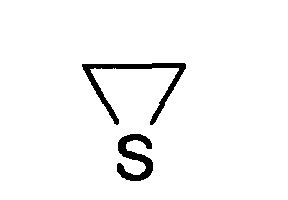
- (thio)epoxy means thioepoxy or epoxy.
- Thioepoxy is represented by the following structure:
- a (thio)epoxy compound having at least one intramolecular disulfide bond includes (thio)epoxy compound having one intramolecular disulfide bond such as bis(2,3-epoxypropyl) disulfide and bis(2,3-epithiopropyl) disulfide; (thio)epoxy compounds having two or more intramolecular disulfide bond such as bis(2,3-epithiopropyldithio)methane, bis(2,3-epithiopropyldithio)ethane, bis(6,7-epithio-3,4-dithiaheptane) sulfide, 1,4-dithian-2,5-bis(2,3-epitiopropyldithiomethyl), 1,3-bis(2,3-epithiopropyldithiomethyl)benzene, 1,6-bis(2,3-epithiopropyldithio)-2-(
- bis(2,3-epithiopropyl) disulfide can be prepared by reacting bis(2,3-epoxypropyl) disulfide with a sulfurating agent such as a thiocyanate, thiourea, triphenylphosphine sulfide and 3-methylbenzothiazol-2-thione, preferably a thiocyanate and thiourea.
- a sulfurating agent such as a thiocyanate, thiourea, triphenylphosphine sulfide and 3-methylbenzothiazol-2-thione, preferably a thiocyanate and thiourea.
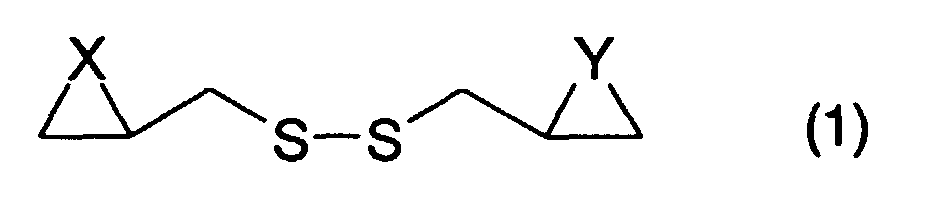
- X and Y are independently oxygen or sulfur and may be different or the same.
- a most preferred (thio)epoxy compound having at least one intramolecular disulfide bond is bis(2,3-epithiopropyl) disulfide.
- the (thio)epoxy compound having at least one intramolecular disulfide bond may be used to improve a refractive index of a resin prepared by curing a polymerizable composition comprising the (thio)epoxy compound.
- a polymerizable composition comprising a (thio)epoxy compound having at least one intramolecular disulfide bond according to the first aspect of this invention may contain resin modifiers for mainly improving resin properties, e.g., adjusting optical properties such as a refractive index; and physical properties such as impact resistance and a specific gravity, as well as handling properties such as the viscosity of the composition.
- resin modifiers for mainly improving resin properties, e.g., adjusting optical properties such as a refractive index; and physical properties such as impact resistance and a specific gravity, as well as handling properties such as the viscosity of the composition.
- Resin modifiers which may be used include (thio)epoxy compounds other than those contained in the (thio)epoxy compound having at least one intramolecular disulfide bond according to the first aspect of this invention, thiols, organic mercapto acids, organic acids and acid anhydrides, amino acids, mercaptoamines, amines and olefins including (meth)acrylates.
- thioepoxy compound as a modifier are, but not limited to, linear aliphatic 2,3-epithiopropylthio compounds such as bis(2,3-epithiopropyl) sulfide, bis(2,3-epithiopropylthio)methane, 1,2-bis(2,3-epithiopropylthio)ethane, 1,2-bis(2,3-epithiopropylthio)propane, 1,3-bis(2,3-epithiopropylthio)propane, 1,3-bis(2,3-epithiopropylthio)-2-methylpropane, 1,4-bis(2,3-epithiopropylthio)butane, 1,4-bis(2,3-epithiopropylthio)-2-methylbutane, 1,3-bis(2,3-epithiopropylthio)butane, 1,5-bis(2,3-epith
- Specific epoxy compounds which may be used include, but are not limited to, phenolic epoxy compounds prepared by condensation of an epihalohydrin with a polyphenol including bisphenol-A glycidyl ether; alcoholic epoxy compounds prepared by condensation of an epihalohydrin with a polyalcohol including hydrogenated bisphenol-A glycidyl ether; glycidyl ester epoxy compounds prepared by condensation of an epihalohydrin with an organic polyacid derivatives including 3,4-epoxycyclohexylmethyl-3',4'-epoxycyclohexane carboxylate and diglycidyl 1,2-hexahydrophthalate; amino epoxy compounds prepared by condensation of an epihalohydrin with a secondary amine; and aliphatic polyepoxy compounds such as vinylcyclohexene diepoxide.
- thiols which may be used include, but are not limited to, aliphatic thiols such as methyl mercaptan, ethyl mercaptan, 1,2-ethanedithiol, 1,2-propanedithiol, 1,3-propanedithiol, 2,2-propanedithiol, 1,4-butanedithiol, 1,2,3-trimercaptopropane, tetrakis(mercaptomethyl)methane, 1,2-dimercaptocyclohexane, bis(2-mercaptoethyl) sulfide, 2,3-dimercapto-1-propanol, ethyleneglycol bis(3-mercaptopropionate), diethyleneglycol bis(3-mercaptopropionate), diethyleneglycol bis(2-mercaptoglycolate), pentaerythritol tetrakis(2-mercaptothioglycolate), pentaerythr
- Organic mercapto acids which may be used include, but are not limited to, thioglycolic acid, 3-mercaptopropionic acid, thioacetic acid, thiolactic acid, thiomalic acid and thiosalicylic acid.
- Organic acids and their anhydrides which may be used include, but are not limited to, the above polymerization retarders as well as thiodiglycolic acid, thiodipropionic acid, dithiodipropionic acid, phthalic anhydride, hexahydrophthalic anhydride, methylhexahydrophthalic anhydride, methyltetrahydrophthalic anhydride, methylnorbornenoic anhydride, methylnorbornanoic anhydride, maleic anhydride, trimellite anhydride and pyromellitic dianhydride.
- Olefins which may be used include, but are not limited to, (meth)acrylates such as benzyl acrylate, benzyl methacrylate, butoxyethyl acrylate, butoxymethyl methacrylate, cyclohexyl acrylate, cyclohexyl methacrylate, 2-hydroxyethyl acrylate, 2-hydroxyethyl methacrylate, glycidyl acrylate, glycidyl methacrylate, phenoxyethyl acrylate, phenoxyethyl methacrylate, phenyl methacrylate, 3-phenoxy-2-hydroxypropyl acrylate, ethyleneglycol diacrylate, ethyleneglycol dimethacrylate, diethyleneglycol diacrylate, diethyleneglycol dimethacrylate, triethyleneglycol diacrylate, triethyleneglycol dimethacrylate, tetraethyleneglycol diacrylate, tetraethyleneglycol dimethacryl
- resin modifiers may be used alone or in combination of two or more thereof.
- Curing catalysts which may be used in the first aspect of this invention may be typically tertiary amines, phosphines, Lewis acids, radical polymerization catalysts and cationic polymerization catalysts.
- the preferable curing catalysts include, but are not limited to, aliphatic and aromatic tertiary amines such as triethylamine, tri-n-butylamine, tri-n-hexylamine, N,N-diisopropylethylamine, triethylenediamine, triphenylamine, N,N-dimethylethanolamine, N,N-diethylethanolamine, N,N-dibutylethanolamine, triethanolamine, N-ethyldiethanolamine, N,N-dimethylbenzylamine, N,N-diethylbenzylamine, tribenzylamine, N-methyldibenzylamine, N,N-dimethylcyclohexylamine, N,N-diethylcyclohexylamine, N,N-dimethylbutylamine, N-methyldicyclohexylamine, N-methylmorpholine, N-isopropylmorpholine, pyridine, quinoline
- These curing catalysts may be used alone or in combination of two or more thereof.
- a curing catalyst may be preferably added in a proportion of 0.001 to 10 wt%, more preferably 0.01 to 5 wt% to the total amount of the polymerizable composition comprising a (thio)epoxy compound. If the proportion is less than 0.001 wt%, polymerization may be insufficient due to a too small effect of the catalyst. On the other hand, the catalyst may be contained in a proportion of more than 10 wt%, but it may cause problems such as a shorter pot life and deterioration in transparency, optical properties or weatherproof.
- a typical polymerization process for preparing the resin according to the first aspect of this invention is casting polymerization.
- a polymerizable composition comprising a (thio)epoxy compound and a curing catalyst, which may be also referred to as a monomer mixture, is poured between molds held by a fixing means such as a gasket and tapes, during which some treatments such as defoaming may be, if necessary, conducted.
- a polymerization product may be took out from the mold.
- a polymerization method or polymerization conditions for preparing a resin according to the first aspect of this invention cannot be generalized since they depend on the amounts and types of ingredients such as curing catalysts as well as types and proportions of monomers.
- Heat curing conditions for a polymerizable composition according the first aspect of this invention poured into the mold significantly vary depending on various factors such as a type of a composition comprising a (thio)epoxy compound, a type of a curing catalyst and the shape of the mold and therefore cannot be specifically limited, but the composition may be typically cured at -50 to 200 °C for 1 to 100 hours. It may be cured keeping or gradually raising a temperature within a range of 10 °C to 150 °C for 1 to 80 hours, providing good results.
- composition comprising a (thio)epoxy compound having at least one intramolecular disulfide bond, especially a (thio)epoxy compound having an intramolecular disulfide bond, may be cured in a reduced time by UV irradiation, where a curing catalyst such as a radical polymerization catalyst may be necessary.
- a variety of substances such as chain extenders, crosslinking agents, photostabilizers, UV absorbents, antioxidants, anti-coloring agents, dyes, fillers and internal mold release agents, may be added, depending on a purpose, as in the known molding methods.
- the resin which has been taken out from the mold, may be, if necessary, annealed.
- a resin obtained by curing a polymerizable composition comprising a (thio)epoxy compound having at least one intramolecular disulfide bond according to the first aspect of this invention has a high refractive index, a reduced dispersibility and a high thermal resistance, especially an extremely high refractive index. It is a transparent resin having a refractive index of preferably nd ⁇ 1.71, more preferably nd ⁇ 1.72, most preferably nd ⁇ 1.73.
- the resin of this invention can be formed in various forms by altering a mold in the casting polymerization, and be thus used as optical device materials for an eyeglass lens, a camera lens and a light emitting diode (LED), as well as a transparent resin for a variety of applications. In particular, it is suitable for an optical device material for an eyeglass lens and a camera lens.
- a lens from the resin according to the first aspect of this invention may be, if necessary, subject to physical or chemical post-treatments such as surface abrasion, antistatic treatment, hard coating, non-reflection coating and dyeing, for improvements such as prevention of reflection; improvement in hardness, abrasion resistance or chemical resistance; and impartation of antifoggy or cosmetic property.
- physical or chemical post-treatments such as surface abrasion, antistatic treatment, hard coating, non-reflection coating and dyeing, for improvements such as prevention of reflection; improvement in hardness, abrasion resistance or chemical resistance; and impartation of antifoggy or cosmetic property.
- JP-As 9-110979, 9-71580, 9-255781 and 10-298287 describing thioepoxy resins list primary and secondary amines corresponding to Compound (b) according to the second aspect of this invention as a curing catalyst, but they have disclosed only hydrogenated 4,4'-diaminodiphenylmethane in their examples and comparative examples.
- a reaction mixture became cloudy and lost transparency due to local polymerization immediately after adding 4,4'-diaminodiphenylmethane to an thioepoxy compound.
- the composition has a proportion of 0.001 to 0.5, preferably equal to or more 0.01 and less than 0.3 of the total molar number of NH 2 and NH groups in the above primary and secondary amines (referred to as Compound (b)) to the total molar number of thioepoxy and epoxy groups in a (thio)epoxy compound having at least one intramolecular disulfide bond (referred to as Compound (a)).
- the total molar ratio is more than 0.5, a resulting resin after polymerization has reduced heat resistance and a lower refractive index. If the ratio is less than 0.001, yellowing cannot be adequately prevented as intended in the second aspect of this invention.
- a polymerizable composition according to the second aspect of this invention comprises Compounds (a) and (b), and may contain inorganic and/or organic compounds including polyether or polysulfide oligomers such as dimers, trimers and tetramers thereof, inorganic and organic acids added as a polymerization retarder, solvents or other byproducts as long as they are not harmful.
- inorganic and/or organic compounds including polyether or polysulfide oligomers such as dimers, trimers and tetramers thereof, inorganic and organic acids added as a polymerization retarder, solvents or other byproducts as long as they are not harmful.
- a polymerizable composition according to the second aspect of this invention may contain resin modifiers for mainly improving resin properties, e.g., adjusting optical properties such as a refractive index; and physical properties such as impact resistance and a specific gravity, as well as improving handling properties as the viscosity of the composition.
- resin modifiers for mainly improving resin properties, e.g., adjusting optical properties such as a refractive index; and physical properties such as impact resistance and a specific gravity, as well as improving handling properties as the viscosity of the composition.
- Resin modifiers which may be used are as described above.
- Compound (b) in the second aspect of this invention are, but not limited to,
- a polymerizable composition according to the second aspect of this invention may be cured by heating or being left at an ambient temperature in the presence or absence of a curing catalyst, to provide a resin. It may be preferable to use a curing catalyst since curing may not proceed adequately or at all in the absence of the catalyst.
- Typical curing catalysts which may be used for the second aspect of this invention include amines other than Compound (b) in the second aspect of this invention, phosphines, Lewis acids, radical polymerization catalysts and cation polymerization catalysts as described in terms of the first aspect of this invention.
- a curing catalyst may be preferably added in a proportion of 0.001 to 10 wt%, more preferably 0.01 to 1 wt% to the total amount of the polymerizable composition comprising Compound (a) having an epoxy or thioepoxy group. If its proportion is less than 0.001 wt%, polymerization may be insufficient due to a too small effect of the catalyst. On the other hand, the catalyst may be contained in a proportion of more than 10 wt%, but it may cause problems such as a shorter pot life and deterioration in transparency, optical properties or weatherproof.
- a typical polymerization process for preparing the resin according to the second aspect of this invention(e.g., a plastic lens) is casting polymerization.
- a polymerizable composition according to the second aspect of this invention after mixing, if necessary, with a curing catalyst and/or a resin modifier, is poured between molds held by a fixing means such as a gasket and tapes. Before or after pouring, some treatments such as defoaming may be, if necessary, conducted.
- a polymerization product may be took out from the mold.
- a polymerization method and polymerization conditions for preparing a resin according to the second aspect of this invention cannot be generalized since they depend on the amounts and types of ingredients such as curing catalysts as well as types and proportions of monomers.
- Heat curing conditions for a polymerizable composition according the second aspect of this invention poured into the mold significantly vary depending on various factors such as Compounds (a) and (b) in the second aspect of this invention, a type of a resin modifier, a type of a curing catalyst and the shape of the mold and therefore cannot be specifically limited, but the composition may be typically cured at -50 to 200 °C for 1 to 100 hours.
- It may be cured keeping or gradually raising a temperature within a range of 10 °C to 150 °C for 1 to 80 hours, providing good results.
- the polymerizable composition according to the second aspect of this invention may be cured in a reduced time by UV irradiation, where a curing catalyst such as a radical polymerization catalyst may be added.
- a curing catalyst such as a radical polymerization catalyst
- a variety of substances such as chain extenders, crosslinking agents, photostabilizers, UV absorbents, antioxidants, anti-coloring agents other than those in the second aspect of this invention, dyes, fillers, internal and external mold release agents, internal and external adherence improver and compounds having a hydroxy group as a dye-affinity improver may be added, depending on a purpose, as in the known molding methods.
- the resin, which has been took out from the mold may be, if necessary, annealed.
- the resin of the second aspect of this invention can be formed in various forms by altering a mold in the casting polymerization, and be thus used as an optical material for an eyeglass lens, a camera lens and a light emitting diode (LED), as well as a transparent resin for a variety of applications.
- it is suitable for an optical material for an eyeglass lens and a camera lens.
- a lens from the optical material according to the second aspect of this invention may be, if necessary, subject to physical or chemical post-treatments such as surface abrasion, antistatic treatment, hard coating, non-reflection coating and dyeing, for improvements such as prevention of reflection; improvement in hardness, abrasion resistance or chemical resistance; and impartation of antifoggy or cosmetic property.
- physical or chemical post-treatments such as surface abrasion, antistatic treatment, hard coating, non-reflection coating and dyeing, for improvements such as prevention of reflection; improvement in hardness, abrasion resistance or chemical resistance; and impartation of antifoggy or cosmetic property.
- the dried white crystals 250 mL of methanol and 500 mL of toluene were placed in a reaction vessel. Keeping the internal temperature at 3 to 5 °C, 240 g of 47 wt% sodium hydroxide (2.8 mol) was added dropwise over 1 hour, and the reaction mixture was aged for 30 min. After completion of the reaction, 100 mL of toluene was added. The organic layer was washed with water three times, dried over anhydrous magnesium sulfate and filtered. The filtrate was evaporated.
- thermometer and a condenser were placed 100 g of Compound (A) prepared as described in Preparation Example 1 with a purity of 96 wt% (0.54 mol), 100 g of thiourea (1.3 mol), 2 g of acetic acid, 250 mL of toluene and 200 mL of methanol. Keeping the internal temperature at 15 °C, the mixture was stirred for 16 hours.
- the residue was distilled and 50 g of fraction was collected at 26 °C/0.2 mmHg.
- the collected product was 3-mercapto-1,2-propylene sulfide with a purity of 99 wt% (yield after calculated based on the purity: 59 %).
- the physical properties of the molding (lens) are shown in Table 1.
- the physical properties of the molding (lens) are shown in Table 1.
- the physical properties of the molding (lens) are shown in Table 1.
- a polymerizable composition for an optical resin can provide a transparent resin having excellent optical properties such as a considerably high refractive index, which may contribute to achieving a thinner lens, especially in the field of eyeglasses.
- Change rate of tone A resin was heated in the air at 120 °C for 3 hours, and the rate was determined on the basis of the difference between its b* values before and after heating. Each compound (a) was cured in the presence of only a curing catalyst without compound (b). The resin product was heated in the air at 120 °C for 3 hours. The difference between its b* values before and after heating was used as a reference value for tone change.
- Change rate of tone ⁇ (b* after heating)-(b* before heating) ⁇ in the system with Compound (b) / ⁇ (b* after heating)-(b* before heating) ⁇ in the system without Compound (b)
- N,N-dimethylcyclohexylamine (referred to as DCA) (0.2 g) as a curing catalyst was added to 100 g of Compound (B) as Compound (a) and 5 g of n-propylamine as Compound (b).
- the mixture was stirred, defoamed 0.4 hours under a reduced pressure, filtered through a 3 ⁇ m fluororesin (Teflon®) filter and poured into a mold template consisting of glass molds and a gasket.
- the mold was gradually warmed from 30 °C to 100 °C and at the temperature the mixture was polymerized for 10 hours. After completion of the polymerization, the mold was gradually cooled and the resin was took out from the mold.
- the resin was annealed at 100 °C for 2 hours.
- the resin (lens) was further heated at 120 °C for 3 hours, and then its physical properties were determined. Its physical properties and tone change results are shown in Table 2.
- Example 9 The procedure as described in Example 9 was repeated, except that n-propylamine as Compound (b) was replaced with 5 g of isopropylamine.
- the physical properties and the tone change results for the resin are shown in Table 2.
- Example 9 The procedure as described in Example 9 was repeated, except that n-propylamine as Compound (b) was replaced with 5 g of n-butylamine.
- the physical properties and the tone change results for the resin are shown in Table 2.
- Example 9 The procedure as described in Example 9 was repeated, except that n-propylamine as Compound (b) was replaced with 5 g of sec-butylamine.
- the physical properties and the tone change results for the resin are shown in Table 2.
- Example 9 The procedure as described in Example 9 was repeated, except that n-propylamine as Compound (b) was replaced with 5 g of tert-butylamine.
- the physical properties and the tone change results for the resin are shown in Table 2.
- Example 9 The procedure as described in Example 9 was repeated, except that n-propylamine as Compound (b) was replaced with 5 g of n-hexylamine.
- the physical properties and the tone change results for the resin are shown in Table 2.
- Example 9 The procedure as described in Example 9 was repeated, except that n-propylamine as Compound (b) was replaced with 5 g of n-octylamine.
- the physical properties and the tone change results for the resin are shown in Table 2.
- Example 9 The procedure as described in Example 9 was repeated, except that n-propylamine as Compound (b) was replaced with 5 g of n-laurylamine.
- the physical properties and the tone change results for the resin are shown in Table 2.
- Example 9 The procedure as described in Example 9 was repeated, except that n-propylamine as Compound (b) was replaced with 5 g of methoxyethylamine.
- the physical properties and the tone change results for the resin are shown in Table 2.
- Example 9 The procedure as described in Example 9 was repeated, except that n-propylamine as Compound (b) was replaced with 5 g of cyclohexylamine.
- the physical properties and the tone change results for the resin are shown in Table 2.
- Example 9 The procedure as described in Example 9 was repeated, except that n-propylamine as Compound (b) was replaced with 3 g of 2-aminoethanol.
- the physical properties and the tone change results for the resin are shown in Table 2.
- Example 9 The procedure as described in Example 9 was repeated, except that n-propylamine as Compound (b) was replaced with 5 g of benzylamine.
- the physical properties and the tone change results for the resin are shown in Table 2.
- Example 9 The procedure as described in Example 9 was repeated, except that n-propylamine as Compound (b) was replaced with 5 g of ⁇ -phenethylamine.
- the physical properties and the tone change results for the resin are shown in Table 2.
- Example 9 The procedure as described in Example 9 was repeated, except that n-propylamine as Compound (b) was replaced with 5 g of aniline.
- the physical properties and the tone change results for the resin are shown in Table 2.
- Example 9 The procedure as described in Example 9 was repeated, except that n-propylamine as Compound (b) was replaced with 5 g of o-toluidine.
- the physical properties and the tone change results for the resin are shown in Table 2.
- Example 9 The procedure as described in Example 9 was repeated, except that n-propylamine as Compound (b) was replaced with 5 g of 2-methylbenzylamine.
- the physical properties and the tone change results for the resin are shown in Table 2.
- Example 9 The procedure as described in Example 9 was repeated, except that n-propylamine as Compound (b) was replaced with 5 g of ⁇ -naphthylamine.
- the physical properties and the tone change results for the resin are shown in Table 2.
- Example 9 The procedure as described in Example 9 was repeated, except that n-propylamine as Compound (b) was replaced with 3 g of ethylenediamine.
- the physical properties and the tone change results for the resin are shown in Table 2.
- Example 9 The procedure as described in Example 9 was repeated, except that n-propylamine as Compound (b) was replaced with 3 g of diaminopropane.
- the physical properties and the tone change results for the resin are shown in Table 2.
- Example 9 The procedure as described in Example 9 was repeated, except that n-propylamine as Compound (b) was replaced with 3 g of diaminobutane.
- the physical properties and the tone change results for the resin are shown in Table 2.
- Example 9 The procedure as described in Example 9 was repeated, except that n-propylamine as Compound (b) was replaced with 3 g of diaminomethylbicycloheptane.
- the physical properties and the tone change results for the resin are shown in Table 2.
- Example 9 The procedure as described in Example 9 was repeated, except that n-propylamine as Compound (b) was replaced with 3 g of m-xylylenediamine.
- the physical properties and the tone change results for the resin are shown in Table 2.
- Example 9 The procedure as described in Example 9 was repeated, except that n-propylamine as Compound (b) was replaced with 3 g of 1,3-diaminomethylcyclohexylamine.
- the physical properties and the tone change results for the resin are shown in Table 2.
- Example 9 The procedure as described in Example 9 was repeated, except that n-propylamine as Compound (b) was replaced with 3 g of naphthalenediamine.
- the physical properties and the tone change results for the resin are shown in Table 2.
- Example 9 The procedure as described in Example 9 was repeated, except that n-propylamine as Compound (b) was replaced with 3 g of N,N'-dimethylethylenediamine.
- the physical properties and the tone change results for the resin are shown in Table 2.
- Example 9 The procedure as described in Example 9 was repeated, except that n-propylamine as Compound (b) was replaced with 3 g of piperazine.
- the physical properties and the tone change results for the resin are shown in Table 2.
Landscapes
- Chemical & Material Sciences (AREA)
- Organic Chemistry (AREA)
- Health & Medical Sciences (AREA)
- Chemical Kinetics & Catalysis (AREA)
- Medicinal Chemistry (AREA)
- Polymers & Plastics (AREA)
- Physics & Mathematics (AREA)
- General Physics & Mathematics (AREA)
- Optics & Photonics (AREA)
- Polymers With Sulfur, Phosphorus Or Metals In The Main Chain (AREA)
- Epoxy Resins (AREA)
Abstract
Description
| C | H | O | S | |
| Measured (%) | 39.0 | 5.4 | 18.5 | 37.1 |
| Calculated (%) | 40.4 | 5.7 | 17.9 | 36.0 |
| C | H | S | |
| Measured (%) | 32.6 | 4.6 | 62.8 |
| Calculated (%) | 34.2 | 4.8 | 61.0 |
| C | H | S | |
| Measured (%) | 32.6 | 4.8 | 62.8 |
| Calculated (%) | 34.2 | 4.8 | 61.0 |
| Polymerizable Composition | Refractive Index(nd) | Abbe No. | Specific Gravity | Tg (°C) | |
| Exam.1 | Compd.(B)85% Composition | 1.737 | 33 | 1.47 | 84 |
| Exam.2 | Compd.(B)94% Composition | 1.740 | 33 | 1.47 | 95 |
| Exam.3 | Compds.(B)+(C) Composition | 1.734 | 33 | 1.46 | 81 |
| Exam.4 | Compds.(B)+(D) Composition | 1.736 | 33 | 1.46 | 88 |
| Exam.5 | Compds.(B)+(A) Composition | 1.729 | 33 | 1.46 | 92 |
| Exam.6 | Compds.(B)+(E) Composition | 1.725 | 33 | 1.46 | 78 |
| Exam.7 | Compds.(B)+(F) Composition | 1.722 | 33 | 1.46 | 79 |
| Exam.8 | Compds.(B)+(G) Composition | 1.728 | 32 | 1.46 | 77 |
| Comp. Exam.1 | Compd.(H)89% Composition | 1.701 | 36 | 1.41 | 82 |


Claims (10)
- A polymerizable composition comprising a (thio)epoxy compound having at least one intramolecular disulfide bond.
- A polymerizable composition as claimed in Claim 1 where the (thio)epoxy compound having at least one intramolecular disulfide bond is represented by formula (1):wherein X and Y are independently oxygen or sulfur and may be different or the same.

- A polymerizable composition as claimed in Claim 1 where the (thio)epoxy compound having at least one intramolecular disulfide bond is a compound having at least two 2,3-epithiopropyl groups in its molecule.
- A polymerizable composition as claimed any preceding claim comprising one or more compounds selected from the group of compounds having at least one NH2 group and/or at least one NH group per a molecule as a yellowing inhibitor, having a total molar ratio of 0.001 to 0.5 of NH2 and NH groups in the inhibitor to thioepoxy and epoxy groups in the (thio)epoxy compound comprising at least one intramolecular disulfide bond.
- A resin prepared by curing a polymerizable composition according to any of claims 1 to 4.
- An optical device consisting of a resin prepared by curing a polymerizable composition according to any of claims 1 to 4.
- An optical device according to claim 6 which is a plastic lens.
- Use of an optical device as claimed in claim 6, as a plastic lens.
- A process for manufacturing a resin comprising casting polymerization of a polymerizable composition according to any of claims 1 to 4.
- A process for manufacturing an optical device comprising casting polymerization of a polymerizable composition according to any of claims 1 to 4.
Applications Claiming Priority (4)
| Application Number | Priority Date | Filing Date | Title |
|---|---|---|---|
| JP6340298 | 1998-03-13 | ||
| JP6340298 | 1998-03-13 | ||
| JP3024699 | 1999-02-08 | ||
| JP03024699A JP3373800B2 (en) | 1999-02-08 | 1999-02-08 | New optical resin |
Publications (3)
| Publication Number | Publication Date |
|---|---|
| EP0942027A2 true EP0942027A2 (en) | 1999-09-15 |
| EP0942027A3 EP0942027A3 (en) | 2002-02-27 |
| EP0942027B1 EP0942027B1 (en) | 2005-05-18 |
Family
ID=26368564
Family Applications (1)
| Application Number | Title | Priority Date | Filing Date |
|---|---|---|---|
| EP99301965A Expired - Lifetime EP0942027B1 (en) | 1998-03-13 | 1999-03-15 | A polymerizable composition |
Country Status (4)
| Country | Link |
|---|---|
| US (3) | US6204311B1 (en) |
| EP (1) | EP0942027B1 (en) |
| KR (1) | KR100324408B1 (en) |
| DE (1) | DE69925322T2 (en) |
Cited By (19)
| Publication number | Priority date | Publication date | Assignee | Title |
|---|---|---|---|---|
| EP1058133A3 (en) * | 1999-06-03 | 2001-08-22 | Mitsui Chemicals, Inc. | Polymerizable composition and process for producing optical resin comprising the same |
| WO2002051911A1 (en) * | 2000-12-22 | 2002-07-04 | Essilor International Compagnie Generale D'optique | Diepisulfide based prepolymers and their use in the optical field |
| US6417322B1 (en) | 2000-09-25 | 2002-07-09 | Essilor International Compagnie General D'optique | Episulfide based polymerizable composition catalyzed by an (alkoxyphenyl)phosphine, articles made therefrom and process for making same |
| WO2003002632A1 (en) * | 2001-06-29 | 2003-01-09 | Essilor International Compagnie Generale D'optique | Fast polymerizable/curable episulfide based composition, polymerization/curing process and optical articles resulting therefrom |
| EP1270566A4 (en) * | 2000-04-07 | 2003-05-14 | Mitsubishi Gas Chemical Co | Episulfide compound and process for producing the same |
| US6592801B2 (en) | 2001-04-30 | 2003-07-15 | Essilor International Compagnie Generale D'optique | Photopolymerization of episulfides using metal complexes and its use for making ophthalmic lenses |
| EP1334974A1 (en) * | 2002-02-07 | 2003-08-13 | Hoya Corporation | Cyclic disulfide compound, process of producing the same and optical product comprising the same |
| WO2003076496A1 (en) * | 2002-03-12 | 2003-09-18 | Mitsui Chemicals, Inc. | Thioepoxy based polymerizable composition and method for production thereof |
| EP1211276A3 (en) * | 2000-10-26 | 2003-11-26 | Hoya Corporation | Optical product, asymmetric disulfide compound used therefor and method for producing the asymmetric disulfide compound |
| US7129321B2 (en) | 2003-03-24 | 2006-10-31 | Essilor International Compagnie Generale D'optique | Thiophosphine compounds and methods of making polymerizable compositions containing them and their use for making ophthalmic lenses |
| JP2006316283A (en) * | 2006-08-04 | 2006-11-24 | Mitsui Chemicals Inc | Method for improving mold release property of resin for lens |
| JP2007051301A (en) * | 2006-11-16 | 2007-03-01 | Mitsui Chemicals Inc | Lens with improved mold-releasability |
| WO2007036194A1 (en) * | 2005-09-28 | 2007-04-05 | Osram Opto Semiconductors Gmbh | Epoxide resin system and moulding material produced from said epoxide resin system and opto-electronic component with said moulding material |
| US7338984B2 (en) | 2002-07-22 | 2008-03-04 | Mitsui Chemicals, Inc. | Resin composition containing ultrafine inorganic particle |
| US8746879B2 (en) | 2009-11-02 | 2014-06-10 | Essilor International (Compagnie Générale d'Optique) | Adhesive system for a laminated lens and method for applying same |
| CN105669640A (en) * | 2016-03-29 | 2016-06-15 | 黄河三角洲京博化工研究院有限公司 | Clean preparation method of episulfides |
| CN106397370A (en) * | 2016-08-30 | 2017-02-15 | 黄河三角洲京博化工研究院有限公司 | Method for producing high-quality epoxy compound |
| US10018810B2 (en) | 2012-08-31 | 2018-07-10 | Daicel Corporation | Curable composition, cured product thereof, optical member and optical device |
| EP3816203A4 (en) * | 2019-05-21 | 2021-10-27 | Lg Chem, Ltd. | CURING COMPOSITION, AND OPTICAL ELEMENT INCLUDING A CURED PRODUCT THEREOF |
Families Citing this family (33)
| Publication number | Priority date | Publication date | Assignee | Title |
|---|---|---|---|---|
| US6635195B1 (en) | 2000-02-04 | 2003-10-21 | Essilor International Compagnie Generale D'optique | Cationic photopolymerization of diepisulfides and application to the manufacture of optical lenses |
| AUPR949201A0 (en) | 2001-12-14 | 2002-01-24 | Sola International Holdings Ltd | Photochromic coating process |
| CN1286883C (en) * | 2002-03-01 | 2006-11-29 | 三井化学株式会社 | Polymerizable composition containing novel cyclic sulfur compound and resin obtained by curing the polymerizable composition |
| US6700708B2 (en) | 2002-05-30 | 2004-03-02 | Agere Systems, Inc. | Micro-lens array and method of making micro-lens array |
| US20040171743A1 (en) * | 2003-01-21 | 2004-09-02 | Terry Brewer, Ph.D. | Hybrid organic-inorganic polymer coatings with high refractive indices |
| JP2004323642A (en) * | 2003-04-23 | 2004-11-18 | Riso Kagaku Corp | Cationic polymerizable composition and ink |
| US7192999B2 (en) | 2003-09-19 | 2007-03-20 | Brewer Science Inc. | Polyimides for use as high refractive index, thin film materials |
| JP2008514764A (en) * | 2004-09-28 | 2008-05-08 | ブルーワー サイエンス アイ エヌ シー. | Curable high refractive index resin for optoelectronic applications |
| PT1864181T (en) * | 2005-03-01 | 2016-10-06 | Carl Zeiss Vision Australia Holdings Ltd | Coatings for ophthalmic lens elements |
| JP4890872B2 (en) * | 2006-01-30 | 2012-03-07 | ルネサスエレクトロニクス株式会社 | Transparent epoxy resin composition for optical semiconductor encapsulation and optical semiconductor integrated circuit device using the same |
| US20090189303A1 (en) * | 2006-05-09 | 2009-07-30 | Carl Zeiss Vision Australia Holdings Limited | Methods for forming coated high index optical elements |
| US9796159B2 (en) * | 2011-04-14 | 2017-10-24 | The United States Of America As Represented By The Administrator Of Nasa | Electric field activated shape memory polymer composite |
| WO2013095016A1 (en) * | 2011-12-21 | 2013-06-27 | 주식회사 케이오씨솔루션 | Polymerizable composition for optical material containing thioepoxy compound, and preparation method of optical material |
| WO2013109118A1 (en) * | 2012-01-20 | 2013-07-25 | 주식회사 케이오씨솔루션 | Method for preparing thioepoxy-based optical material and polymerizable composition thereof |
| KR101562052B1 (en) | 2012-03-01 | 2015-10-20 | 미쯔비시 가스 케미칼 컴파니, 인코포레이티드 | Polymerizable composition for optical materials |
| TWI574952B (en) | 2012-04-16 | 2017-03-21 | Mitsubishi Gas Chemical Co | Preparation of sulfur - containing epoxy compounds |
| KR101443845B1 (en) * | 2012-09-03 | 2014-09-23 | 주식회사 엘지화학 | Polarizing plate comprising hard coating film |
| US20140088383A1 (en) * | 2012-09-14 | 2014-03-27 | Senseonics, Incorporated | Integrated catalytic protection of oxidation sensitive materials |
| JP5859709B2 (en) | 2013-03-29 | 2016-02-10 | 三井化学株式会社 | Polymerizable composition for optical material, optical material and method for producing optical material |
| WO2015137402A1 (en) | 2014-03-11 | 2015-09-17 | 三井化学株式会社 | Production method for episulfide compound for optical material, episulfide-containing composition, and polymerizable composition including episulfide-containing composition and for use in optical material |
| EP3257876B1 (en) | 2015-02-10 | 2020-01-01 | Mitsui Chemicals, Inc. | Polymerizable composition and novel alkyne compound |
| KR102502695B1 (en) * | 2015-05-04 | 2023-02-22 | 미쓰이 가가쿠 가부시키가이샤 | Polymerizable Composition for Thioepoxy based Optical Material and Method of Producing for Thioepoxy based Optical Material |
| US10844010B2 (en) * | 2016-03-18 | 2020-11-24 | Mitsui Chemicals, Inc. | Process for producing (poly)sulfide compound and process for producing episulfide compound |
| US11529230B2 (en) | 2019-04-05 | 2022-12-20 | Amo Groningen B.V. | Systems and methods for correcting power of an intraocular lens using refractive index writing |
| US11678975B2 (en) | 2019-04-05 | 2023-06-20 | Amo Groningen B.V. | Systems and methods for treating ocular disease with an intraocular lens and refractive index writing |
| US12377622B2 (en) | 2019-04-05 | 2025-08-05 | Amo Groningen B.V. | Systems and methods for vergence matching with an optical profile and using refractive index writing |
| US11583389B2 (en) | 2019-04-05 | 2023-02-21 | Amo Groningen B.V. | Systems and methods for correcting photic phenomenon from an intraocular lens and using refractive index writing |
| US12357509B2 (en) | 2019-04-05 | 2025-07-15 | Amo Groningen B.V. | Systems and methods for improving vision from an intraocular lens in an incorrect position and using refractive index writing |
| US11564839B2 (en) | 2019-04-05 | 2023-01-31 | Amo Groningen B.V. | Systems and methods for vergence matching of an intraocular lens with refractive index writing |
| US11944574B2 (en) | 2019-04-05 | 2024-04-02 | Amo Groningen B.V. | Systems and methods for multiple layer intraocular lens and using refractive index writing |
| US11583388B2 (en) | 2019-04-05 | 2023-02-21 | Amo Groningen B.V. | Systems and methods for spectacle independence using refractive index writing with an intraocular lens |
| KR102703465B1 (en) | 2019-10-31 | 2024-09-04 | 주식회사 엘지화학 | Curable composition and optical material |
| US12525723B2 (en) | 2023-03-17 | 2026-01-13 | United States Of America As Represented By The Administrator Of Nasa | Deployable antenna reflectors array formed of multiple connected gores |
Family Cites Families (13)
| Publication number | Priority date | Publication date | Assignee | Title |
|---|---|---|---|---|
| US3467558A (en) * | 1967-09-01 | 1969-09-16 | Dow Chemical Co | Pyrotechnic disseminating composition containing an agent to be disseminated |
| US3856933A (en) * | 1968-03-04 | 1974-12-24 | Dow Chemical Co | Pyrotechnic disseminating system |
| JPS5022554B1 (en) * | 1970-09-14 | 1975-07-31 | ||
| JPS5321823B2 (en) | 1973-06-26 | 1978-07-05 | ||
| GB2111053B (en) * | 1981-11-30 | 1985-07-31 | Sandoz Ltd | Di- and tri-sulphides |
| JPH0771580A (en) | 1993-09-01 | 1995-03-17 | Honda Motor Co Ltd | Control device for hydraulically actuated transmission for vehicle |
| US5807975A (en) * | 1995-08-16 | 1998-09-15 | Mitsubishi Gas Chemical Company,Inc. | Alkyl sulfide type episulfide compound |
| JP3491660B2 (en) | 1995-08-16 | 2004-01-26 | 三菱瓦斯化学株式会社 | Novel linear alkyl sulfide type episulfide compound |
| JP3864998B2 (en) | 1995-09-08 | 2007-01-10 | 三菱瓦斯化学株式会社 | Novel branched alkyl sulfide type episulfide compounds |
| US5945504A (en) * | 1996-01-17 | 1999-08-31 | Mitsubishi Gas Chemical Company, Inc. | Episulfide compound |
| JPH09255781A (en) | 1996-01-17 | 1997-09-30 | Mitsubishi Gas Chem Co Inc | New episulfide compound |
| JP3465528B2 (en) | 1997-04-22 | 2003-11-10 | 三菱瓦斯化学株式会社 | New resin for optical materials |
| JP3663861B2 (en) * | 1997-12-03 | 2005-06-22 | 三菱瓦斯化学株式会社 | Novel resin composition |
-
1999
- 1999-03-08 US US09/263,483 patent/US6204311B1/en not_active Expired - Lifetime
- 1999-03-13 KR KR1019990008527A patent/KR100324408B1/en not_active Expired - Lifetime
- 1999-03-15 EP EP99301965A patent/EP0942027B1/en not_active Expired - Lifetime
- 1999-03-15 DE DE69925322T patent/DE69925322T2/en not_active Expired - Lifetime
-
2000
- 2000-12-26 US US09/745,448 patent/US6300464B2/en not_active Expired - Lifetime
-
2001
- 2001-08-01 US US09/918,549 patent/US6458917B2/en not_active Expired - Lifetime
Cited By (32)
| Publication number | Priority date | Publication date | Assignee | Title |
|---|---|---|---|---|
| EP1058133A3 (en) * | 1999-06-03 | 2001-08-22 | Mitsui Chemicals, Inc. | Polymerizable composition and process for producing optical resin comprising the same |
| EP1270566A4 (en) * | 2000-04-07 | 2003-05-14 | Mitsubishi Gas Chemical Co | Episulfide compound and process for producing the same |
| US6417322B1 (en) | 2000-09-25 | 2002-07-09 | Essilor International Compagnie General D'optique | Episulfide based polymerizable composition catalyzed by an (alkoxyphenyl)phosphine, articles made therefrom and process for making same |
| EP1211276A3 (en) * | 2000-10-26 | 2003-11-26 | Hoya Corporation | Optical product, asymmetric disulfide compound used therefor and method for producing the asymmetric disulfide compound |
| WO2002051911A1 (en) * | 2000-12-22 | 2002-07-04 | Essilor International Compagnie Generale D'optique | Diepisulfide based prepolymers and their use in the optical field |
| US6486298B1 (en) | 2000-12-22 | 2002-11-26 | Essilor International Compagnie Generale D'optique | Diepisulfide based prepolymers and their use in the optical field |
| KR100773578B1 (en) | 2000-12-22 | 2007-11-05 | 에실러에떼르나쇼날(꽁빠니제네랄돕띠끄) | Diesulfide-based prepolymers and their use in optics |
| AU2002219210B2 (en) * | 2000-12-22 | 2006-05-04 | Essilor International (Compagnie Generale D'optique) | Diepisulfide based prepolymers and their use in the optical field |
| US6592801B2 (en) | 2001-04-30 | 2003-07-15 | Essilor International Compagnie Generale D'optique | Photopolymerization of episulfides using metal complexes and its use for making ophthalmic lenses |
| US6891017B2 (en) | 2001-06-29 | 2005-05-10 | Essilor International Compagnie General D'optique | Fast polymerizable/curable episulfide based composition, polymerization/curing process and optical articles resulting therefrom |
| WO2003002632A1 (en) * | 2001-06-29 | 2003-01-09 | Essilor International Compagnie Generale D'optique | Fast polymerizable/curable episulfide based composition, polymerization/curing process and optical articles resulting therefrom |
| EP1334974A1 (en) * | 2002-02-07 | 2003-08-13 | Hoya Corporation | Cyclic disulfide compound, process of producing the same and optical product comprising the same |
| US6995276B1 (en) | 2002-02-07 | 2006-02-07 | Hoya Corporation | Cyclic disulfide compound, process of producing the same and optical product comprising the same |
| WO2003076496A1 (en) * | 2002-03-12 | 2003-09-18 | Mitsui Chemicals, Inc. | Thioepoxy based polymerizable composition and method for production thereof |
| KR100716487B1 (en) * | 2002-03-12 | 2007-05-10 | 미쓰이 가가쿠 가부시키가이샤 | Method for production of thioepoxy based polymerizable composition |
| EP1484352A4 (en) * | 2002-03-12 | 2005-11-16 | Mitsui Chemicals Inc | Thioepoxy based polymerizable composition and method for production thereof |
| US7354989B2 (en) | 2002-03-12 | 2008-04-08 | Mitsui Chemicals, Inc. | Thioepoxy based polymerizable composition and method for production thereof |
| US7338984B2 (en) | 2002-07-22 | 2008-03-04 | Mitsui Chemicals, Inc. | Resin composition containing ultrafine inorganic particle |
| US7129321B2 (en) | 2003-03-24 | 2006-10-31 | Essilor International Compagnie Generale D'optique | Thiophosphine compounds and methods of making polymerizable compositions containing them and their use for making ophthalmic lenses |
| US7446228B2 (en) | 2003-03-24 | 2008-11-04 | Essilor International Compagnie Generale D'optique | Thiophosphine compounds |
| US7378556B2 (en) | 2003-03-24 | 2008-05-27 | Essilor International Compagnie Generale D'optique | Process for making thiophosphine compounds |
| WO2007036194A1 (en) * | 2005-09-28 | 2007-04-05 | Osram Opto Semiconductors Gmbh | Epoxide resin system and moulding material produced from said epoxide resin system and opto-electronic component with said moulding material |
| JP2006316283A (en) * | 2006-08-04 | 2006-11-24 | Mitsui Chemicals Inc | Method for improving mold release property of resin for lens |
| JP2007051301A (en) * | 2006-11-16 | 2007-03-01 | Mitsui Chemicals Inc | Lens with improved mold-releasability |
| US8746879B2 (en) | 2009-11-02 | 2014-06-10 | Essilor International (Compagnie Générale d'Optique) | Adhesive system for a laminated lens and method for applying same |
| US10018810B2 (en) | 2012-08-31 | 2018-07-10 | Daicel Corporation | Curable composition, cured product thereof, optical member and optical device |
| US11029497B2 (en) | 2012-08-31 | 2021-06-08 | Daicel Corporation | Curable composition, cured product thereof, optical member and optical device |
| CN105669640A (en) * | 2016-03-29 | 2016-06-15 | 黄河三角洲京博化工研究院有限公司 | Clean preparation method of episulfides |
| CN106397370A (en) * | 2016-08-30 | 2017-02-15 | 黄河三角洲京博化工研究院有限公司 | Method for producing high-quality epoxy compound |
| CN106397370B (en) * | 2016-08-30 | 2018-08-17 | 黄河三角洲京博化工研究院有限公司 | A method of producing high-quality epoxide |
| EP3816203A4 (en) * | 2019-05-21 | 2021-10-27 | Lg Chem, Ltd. | CURING COMPOSITION, AND OPTICAL ELEMENT INCLUDING A CURED PRODUCT THEREOF |
| US11945914B2 (en) | 2019-05-21 | 2024-04-02 | Lg Chem, Ltd. | Curable composition and optical material comprising cured product thereof |
Also Published As
| Publication number | Publication date |
|---|---|
| US6300464B2 (en) | 2001-10-09 |
| US20010002413A1 (en) | 2001-05-31 |
| US20020019511A1 (en) | 2002-02-14 |
| DE69925322T2 (en) | 2005-10-27 |
| US6458917B2 (en) | 2002-10-01 |
| US6204311B1 (en) | 2001-03-20 |
| EP0942027A3 (en) | 2002-02-27 |
| KR19990077861A (en) | 1999-10-25 |
| DE69925322D1 (en) | 2005-06-23 |
| KR100324408B1 (en) | 2002-02-27 |
| EP0942027B1 (en) | 2005-05-18 |
Similar Documents
| Publication | Publication Date | Title |
|---|---|---|
| EP0942027B1 (en) | A polymerizable composition | |
| KR100716487B1 (en) | Method for production of thioepoxy based polymerizable composition | |
| EP0785194B1 (en) | Episulfide compound | |
| JP3563006B2 (en) | (Thio) epoxy polymerizable composition | |
| JP3366605B2 (en) | New episulfide compounds | |
| JP3373800B2 (en) | New optical resin | |
| JP3973617B2 (en) | (Thio) epoxy polymerizable composition | |
| JP3405934B2 (en) | New optical resin | |
| JP3668670B2 (en) | Polymerizable composition and method for producing optical resin comprising the same | |
| JP3373827B2 (en) | Lens manufacturing method | |
| EP1058133B1 (en) | Polymerizable composition and process for producing optical resin comprising the same | |
| JP3387873B2 (en) | Purification method of (thio) epoxy compound | |
| JP2003246859A (en) | Resin used for lens and method for producing lens | |
| JP3718189B2 (en) | Polymerizable composition containing novel episulfide compound, resin and lens comprising the polymerizable composition | |
| JP2001200057A (en) | Resin used for lens and method for manufacturing lens | |
| JP3821766B2 (en) | Method for producing cured resin | |
| JP4015338B2 (en) | Episulfide polymerizable composition and resin production method | |
| KR20020032363A (en) | Optical product, asymmetric disulfide compound used therefor and method for producing the asymmetric disulfide compound | |
| JP3373825B2 (en) | Polymerizable composition and method for producing optical resin comprising the same | |
| JP3686806B2 (en) | Purification method of (thio) epoxy compound | |
| JP4704974B2 (en) | Method for improving releasability of lens resin | |
| JP2001164110A (en) | Polymerizable composition | |
| JP2007051301A (en) | Lens with improved mold-releasability |
Legal Events
| Date | Code | Title | Description |
|---|---|---|---|
| PUAI | Public reference made under article 153(3) epc to a published international application that has entered the european phase |
Free format text: ORIGINAL CODE: 0009012 |
|
| 17P | Request for examination filed |
Effective date: 19990406 |
|
| AK | Designated contracting states |
Kind code of ref document: A2 Designated state(s): AT BE CH CY DE DK ES FI FR GB GR IE IT LI LU MC NL PT SE Kind code of ref document: A2 Designated state(s): DE FR GB IT |
|
| AX | Request for extension of the european patent |
Free format text: AL;LT;LV;MK;RO;SI |
|
| PUAL | Search report despatched |
Free format text: ORIGINAL CODE: 0009013 |
|
| AK | Designated contracting states |
Kind code of ref document: A3 Designated state(s): AT BE CH CY DE DK ES FI FR GB GR IE IT LI LU MC NL PT SE |
|
| AX | Request for extension of the european patent |
Free format text: AL;LT;LV;MK;RO;SI |
|
| AKX | Designation fees paid |
Free format text: DE FR GB IT |
|
| 17Q | First examination report despatched |
Effective date: 20030826 |
|
| GRAP | Despatch of communication of intention to grant a patent |
Free format text: ORIGINAL CODE: EPIDOSNIGR1 |
|
| RAP1 | Party data changed (applicant data changed or rights of an application transferred) |
Owner name: MITSUI CHEMICALS, INC. |
|
| GRAS | Grant fee paid |
Free format text: ORIGINAL CODE: EPIDOSNIGR3 |
|
| GRAA | (expected) grant |
Free format text: ORIGINAL CODE: 0009210 |
|
| AK | Designated contracting states |
Kind code of ref document: B1 Designated state(s): DE FR GB IT |
|
| REG | Reference to a national code |
Ref country code: GB Ref legal event code: FG4D |
|
| REG | Reference to a national code |
Ref country code: IE Ref legal event code: FG4D |
|
| REF | Corresponds to: |
Ref document number: 69925322 Country of ref document: DE Date of ref document: 20050623 Kind code of ref document: P |
|
| ET | Fr: translation filed | ||
| PLBE | No opposition filed within time limit |
Free format text: ORIGINAL CODE: 0009261 |
|
| STAA | Information on the status of an ep patent application or granted ep patent |
Free format text: STATUS: NO OPPOSITION FILED WITHIN TIME LIMIT |
|
| 26N | No opposition filed |
Effective date: 20060221 |
|
| REG | Reference to a national code |
Ref country code: FR Ref legal event code: PLFP Year of fee payment: 17 |
|
| REG | Reference to a national code |
Ref country code: FR Ref legal event code: PLFP Year of fee payment: 18 |
|
| REG | Reference to a national code |
Ref country code: FR Ref legal event code: PLFP Year of fee payment: 19 |
|
| REG | Reference to a national code |
Ref country code: FR Ref legal event code: PLFP Year of fee payment: 20 |
|
| PGFP | Annual fee paid to national office [announced via postgrant information from national office to epo] |
Ref country code: DE Payment date: 20180322 Year of fee payment: 20 Ref country code: GB Payment date: 20180321 Year of fee payment: 20 |
|
| PGFP | Annual fee paid to national office [announced via postgrant information from national office to epo] |
Ref country code: FR Payment date: 20180323 Year of fee payment: 20 |
|
| PGFP | Annual fee paid to national office [announced via postgrant information from national office to epo] |
Ref country code: IT Payment date: 20180327 Year of fee payment: 20 |
|
| REG | Reference to a national code |
Ref country code: DE Ref legal event code: R071 Ref document number: 69925322 Country of ref document: DE |
|
| REG | Reference to a national code |
Ref country code: GB Ref legal event code: PE20 Expiry date: 20190314 |
|
| PG25 | Lapsed in a contracting state [announced via postgrant information from national office to epo] |
Ref country code: GB Free format text: LAPSE BECAUSE OF EXPIRATION OF PROTECTION Effective date: 20190314 |