EP0941584B1 - Verfahren zur übertragungsoptimierung und sender - Google Patents
Verfahren zur übertragungsoptimierung und senderInfo
- Publication number
- EP0941584B1 EP0941584B1 EP98938721A EP98938721A EP0941584B1 EP 0941584 B1 EP0941584 B1 EP 0941584B1 EP 98938721 A EP98938721 A EP 98938721A EP 98938721 A EP98938721 A EP 98938721A EP 0941584 B1 EP0941584 B1 EP 0941584B1
- Authority
- EP
- European Patent Office
- Prior art keywords
- signal
- signals
- transmitter
- level
- word length
- Prior art date
- Legal status (The legal status is an assumption and is not a legal conclusion. Google has not performed a legal analysis and makes no representation as to the accuracy of the status listed.)
- Expired - Lifetime
Links
- 238000000034 method Methods 0.000 title claims abstract description 49
- 230000005540 biological transmission Effects 0.000 title claims abstract description 5
- 238000006243 chemical reaction Methods 0.000 claims abstract description 15
- 230000008054 signal transmission Effects 0.000 claims abstract description 5
- 238000003491 array Methods 0.000 description 2
- 101000767160 Saccharomyces cerevisiae (strain ATCC 204508 / S288c) Intracellular protein transport protein USO1 Proteins 0.000 description 1
- 230000003044 adaptive effect Effects 0.000 description 1
- 230000003321 amplification Effects 0.000 description 1
- 230000015572 biosynthetic process Effects 0.000 description 1
- 238000004364 calculation method Methods 0.000 description 1
- 230000001413 cellular effect Effects 0.000 description 1
- 230000001419 dependent effect Effects 0.000 description 1
- 230000000694 effects Effects 0.000 description 1
- 238000005259 measurement Methods 0.000 description 1
- 238000003199 nucleic acid amplification method Methods 0.000 description 1
- 238000013139 quantization Methods 0.000 description 1
- 238000001228 spectrum Methods 0.000 description 1
- 238000003786 synthesis reaction Methods 0.000 description 1
Images

Classifications
-
- H—ELECTRICITY
- H04—ELECTRIC COMMUNICATION TECHNIQUE
- H04W—WIRELESS COMMUNICATION NETWORKS
- H04W52/00—Power management, e.g. Transmission Power Control [TPC] or power classes
- H04W52/04—Transmission power control [TPC]
- H04W52/30—Transmission power control [TPC] using constraints in the total amount of available transmission power
- H04W52/34—TPC management, i.e. sharing limited amount of power among users or channels or data types, e.g. cell loading
- H04W52/343—TPC management, i.e. sharing limited amount of power among users or channels or data types, e.g. cell loading taking into account loading or congestion level
-
- H—ELECTRICITY
- H04—ELECTRIC COMMUNICATION TECHNIQUE
- H04W—WIRELESS COMMUNICATION NETWORKS
- H04W52/00—Power management, e.g. Transmission Power Control [TPC] or power classes
- H04W52/04—Transmission power control [TPC]
- H04W52/30—Transmission power control [TPC] using constraints in the total amount of available transmission power
- H04W52/34—TPC management, i.e. sharing limited amount of power among users or channels or data types, e.g. cell loading
- H04W52/346—TPC management, i.e. sharing limited amount of power among users or channels or data types, e.g. cell loading distributing total power among users or channels
Definitions
- the invention relates to a method of optimizing transmission, which method is used at a transmitter receiving several digital signals that are modulated, which transmitter comprises converter means converting a signal into an analog signal before signal transmission, and in which method the position of the signal to be converted within the dynamic range of the converter means affects optimality of the signal obtained from the conversion.
- the invention also relates to a transmitter receiving digital signals, which transmitter is used in a radio system to optimally transmit signals, the transmitter comprising modulation means arranged to modulate the received signals, and converter means converting the digital signal into an analog signal before signal transmission, the position of the signal received by the converter means within the dynamic range of the converter means affecting optimality of the signal obtained from the conversion.
- a signal coming from the direction of a fixed network usually propagates to a base station via a mobile exchange and a base station controller.
- the base station operating as a transmitter receives a digital signal coming from the direction of a fixed PSTN network and forwards the signal to a subscriber terminal.
- the base station also has information on directing the signal to be transmitted into the desired timeslot, for example.
- the base station has information on the power level at which the signal is transmitted, for example.
- the base station transmits signals to subscriber terminals at different power levels according to instructions obtainable from the radio system. When transmitting the signal, the base station operates as a transmitter.
- the base station performs various types of codings, such as channel coding, to data comprising the received signal, after which digital signals coming from different channels are modulated. After the modulation, the signals are converted into analog signals, after which the signals are combined in the analog parts of the transmitter. Next, the combined signal is amplified and transmitted onto a radio path.
- codings such as channel coding
- the spectrum of a signal transmitted by a prior art transmitter comprises various types of interference caused by the conversion of digital signals into analog signals and by the combining of the signals.
- the base station receives signals whose frequencies and power levels are usually very different. Problems are particularly caused by signals coming to a D/A converter at different power levels, since, in prior art solutions, constant optimal utilization of the dynamic range of the converter is impossible. In addition, converters available at the moment cannot tolerate interference in the signal well enough. After the combination, the signals with different power levels also bring about interference, particularly to adjacent channels.
- EP 735 702 discloses a signal reception method employing the weighting of the received signal.
- the method disclosed in the prior art differs from the one disclosed in the application, for example, in that in the method disclosed in the prior art, signals are not set into a correct mutual relation after they are combined and converted into analog signals.
- the method disclosed in the prior art is used in signal reception, whereas the one disclosed in the application is used at a transmitter.
- EP 263 357 discloses a reception method in which signals are received with several antennas. The received signals are combined by using weighting coefficients.
- the method disclosed in the prior art is used in signal reception, whereas the one disclosed in the application is used at a transmitter. Furthermore, in the method disclosed in the prior art, the manner of weighting the signal differs from the one in the method disclosed in the application.
- EP 807 988 discloses a method of generating weighting coefficients. The disclosed method differs from the one disclosed in the application in that in the method disclosed in the prior art, no reference is made to combining the weighted signal and converting the combined signal into an analog signal, for example.
- EP 806 844 differs from the one disclosed in the application in that it is used at a receiver.
- the method disclosed in the prior art uses weighting coefficients, but the weighting coefficients are feedback-controlled.
- EP 0 565 505 discloses duplex power control in a cellular mobile radio telephone system. Measurements of mobile signal strength received at the base station are used to determine the portion or power that should be transmitted by the base station to a particular mobile.
- JP 921 9615 discloses a transceiver structure using a reference signal for calculating weighting coefficients.
- adaptive antenna arrays are used at the transceiver. It is not necessary to use antenna arrays in the solution of the application.
- a reference signal as disclosed in the prior art is not used in the method disclosed in the application.
- An object of the invention is to provide a method and transmitter to solve the above problems. This is achieved by a method of the type presented in the introduction, which is characterized in that each modulated signal is weighted by a specific weighting coefficient so as to set the mutual power levels of the signals into predetermined relations based on the power levels received and such that the word length of the digital signal increases towards the maximum word length accepted by the converter means, the signals are combined after the weighting, and the combined signal is converted into an analog signal, after which the analog signal is scaled to a predetermined power level.
- the transmitter is characterized in that it comprises means for generating weighting coefficients, means for weighting each modulated signal by a specific weighting coefficient so as to set the mutual power levels of the signals into predetermined relations based on the power levels received and such that the word length of the digital signal increases towards the maximum word length accepted by the converter means, means for combining the weighted signals, after which the means convert the combined signal into an analog signal, and means for scaling the analog signal to a predetermined power level.
- the invention is based on the idea that a signal coming to a D/A converter is so processed that after the processing, the signal utilizes the dynamic range of the converter as optimally as possible.
- the dynamics the D/A converter is optimized when several digitally modulated signals are combined. This is done in two phases. In a first phase, the power levels of the signals are set into a correct relation with one another in such a way that the dynamics of the converter becomes optimally utilized.
- the modulated signals are combined, after which the combined signal is set to the absolutely correct power level.
- the method and transmitter of the invention provide many advantages.
- the method enables conversion of digital signals at different power levels into analog signals in such a way that a signal coming to the transmitter even at a very low power level is converted by optimally utilizing the dynamic range of a converter.
- This is implemented in such a way that each received signal is weighted by a weighting coefficient matched to the signal, whereby the word length of the signal can be matched to the maximum word length of the converter, and problems caused by different signal power levels are thus solved.
- the transmitter can be implemented with fewer analog parts or by combining analog parts, whereby the transmitter can be implemented at a lower cost.
- the transmitter tolerates interference much better than previously implemented transmitters.
- the transmitter of the invention consumes less power than prior art transmitters, since the number of analog parts consuming power can be reduced, for example.
- Figure 1 shows a radio system comprising a number of base stations 100 and a base station controller 200. Furthermore, the radio system comprises a number of subscriber terminals 300.
- the base stations 100 are connected to the base station controller 200 via a fixed transmission network, for example.
- the base stations 100 receive a digital signal coming from the PSTN (Public Switched Telephone Network) and being converted into an analog signal that is forwarded via a radio path to the subscriber terminals 300.
- PSTN Public Switched Telephone Network
- the base stations 100 operate as transceivers.
- FIG 2 shows a transmitter that can be used in the radio system presented in Figure 1.
- the transmitter is located in the base station 100.
- the transmitter generates a signal to be transmitted to the subscriber terminal 300.
- the transmitter comprises a number of means 110, and means 130.
- the transmitter comprises means 190 receiving a signal from the means 110, 130.
- the means 110 receive a digital signal coming from the PSTN, for example, and modulate the received signal preferably by a digital modulation method.
- the transmitter according to the figure uses the DDS method (Direct Digital Synthesis) by means of which the modulated signal is brought to the desired frequency.
- DDS method Direct Digital Synthesis
- the means 110 modulate several different signals, and each signal establishes different connections to the subscriber terminals 300.
- the connections can be calls, for example.
- Each modulated signal has its specific power level, indicated by S_level in the figure.
- the means 130 generate, on the basis of the power levels of the signals received by the transmitter, weighting coefficients (PC i ) that are applied to the means 190.
- the transmitter according to the figure receives four signals, and for each of them, the means 130 generate a weighting coefficient indicated by PC 1 ...PC 4 .
- the power level of the signal is proportional to the amplitude of the signal, for example.
- the transmitter also comprises means 140 that is connected to the means 190 and combines signals coming from the means 190.
- the transmitter further comprises means 170, 180, and converter means 120.
- the converter means 120 receive the signal that is combined by the means 140 and convert it into an analog signal.
- the analog signal is applied to the means 180 that change the power level of the received signal.
- the means 130 also generate, on the basis of the power levels of the signals received by the means 110, scaling factors (CTRL_VGA) that are converted into an analog signal in the means 170.
- CTRL_VGA scaling factors
- the means 170 are implemented by a D/A converter.
- the analog signal generated by the means 170 is applied to the means 180.
- the means 180 change, on the basis of the signal coming from the means 170, the power level of the signal coming from the converter means 120.
- the signal coming from the means 170 is used as a control signal.
- the means 180 are implemented by a VGA amplifier (Variable Gain Amplifier), for example, whose amplification changes in connection with the change of the control signal.
- the converter means 120 are implemented by a D/A converter.
- An optimal word length having, for example, the same length as the maximum word length accepted by the converter means 120 can be selected for the signal coming to the converter means 120 via the means 140.
- the conversion of a signal in the converter means 120 can be optimally carried out when the converter means 120 receive a signal substantially equivalent to the width of the dynamic range of the converter means, for example.
- the means 130 generate weighting coefficients by using signals received by the transmitter.
- the means 190 weight each modulated signal by a weighting coefficient proportional to the received signals.
- the means 190 which are operationally connected to the means 110, 130, generate, from the modulated signal and from the weighting coefficient proportional to the modulated signal, a result that substantially corresponds to multiplication.
- the weighting distributes the modulated signal optimally over the dynamic range of the converter means 120. In other words, as regards the converter 120, the signals are disposed within the optimal range.
- the means 130 can optimally weight the signal coming to the converter means 120 in such a way that the word length of the digital signal increases towards the maximum word length accepted by the converter means 120, for example.
- the means 190 weight each modulated signal by a specific weighting coefficient so as to set the mutual power levels of the signals into predetermined relations.
- a predetermined relation refers to a relation or a ratio between the signals, the ratio being obtained from the relations of the mutual power levels predetermined for the signal.
- each signal is further optimally disposed within the dynamic range of the converter means 120.
- the means 190 set the power levels of the signals into predetermined relations according to the specific power level in each signal during the modulation.
- the power levels of the signals coming from the means 110 to the means 190 are the same.
- the means 110 modulate the signals to the same power level in such a way that the power levels of the signals are at the same level before they are weighed.
- the means 190 change the mutual relation of the signal power levels compared with the relations of the power levels of the received signals.
- the width of the dynamic range of the converter means 120 is 13 bits.
- a signal having a word length of 14 bits is obtained from the output of the means 110.
- the signal obtained from the output of the means 110 is weighted by a weighting coefficient proportional to the power level (S_level) of the signal, a signal word length of 10 bits may then be obtained at the input of the converter means 120.
- the means 130 change the weighting coefficient (PC i ) associated with the signal to 0.5, whereby the word length of the signal coming from the means 110 may be changed to 13 bits.
- PC i weighting coefficient associated with the signal
- the signal obtained from the output of the converter means 120 is again weighted by a signal (CTRL_VGA) that is obtained from the means 130 and generates a scaling factor.
- CTRL_VGA a signal obtained from the means 130 and generates a scaling factor.
- the means 130 generate a scaling factor whose value is 0.125.
- the means 130 generate a weighting coefficient in such a way that the means 130 measure the power level of the signal received by the transmitter, for example.
- the means can also obtain information on the magnitude of the power level in some other manner.
- the means 130 multiply or, similarly thereto, weight the maximum word length accepted by the converter means 120 by the measured power level value.
- the obtained multiplication result is divided, similarly to the multiplication, by the sum of the power levels of the modulated signals. Instead of dividing, the multiplication result can also be weighed by the inverse of the sum of the modulated signal power levels.
- the transmitter of the invention enables more efficient utilization of the capacity of the converter means 120.
- the means 130 also generate scaling factors by using the signals received by the transmitter.
- the scaling factors are applied to the means 180 via the means 170.
- the means 180 scale, by using the scaling factors, the signal converted into the analog signal to a predetermined power level or amplitude, defining signal intensity.
- the means 180 scale the signals that form the combined signal to the desired power level by the same scaling factor.
- the means 180 are implemented by an amplifier.
- the amplifier amplifies or attenuates, on the basis of the scaling factor generated by the means 130, the analog signal coming from the means 120.
- the means 180 dynamically adjust the absolute power level of the signal to the desired level.
- the means 130 sum the power levels of the signals received by the transmitter, after which the means 130 divide the summing result by the maximum word length value accepted by the converter means 120. Instead of dividing, the summing result can be weighted, i.e. multiplied by the inverse of the maximum word length value accepted by the converter means 120.
- a signal obtained from the means 110 be IN 1 , for example.
- a signal obtained from the output of the means 120 be INT 1 , for example.
- the means 130 generate a weighting coefficient PC 1 that is proportional to the power level of the received signal and also to the IN, signal.
- the INT 1 signal is obtained from the output of the means 190, and receives the value IN 1 *PC 1 .
- the means 130 generate a scaling factor CTRL_VGA by means of which the weighted signal is restored to the desired power level.
- a signal obtained from the output of the means 180 be OUT 1 .
- the transmitter preferably comprises means 150, 160, disposed between the means 140 and 120.
- the means 150 round the value of the combined signal obtained from the means 140 to a proximate value.
- the means 160 add a random signal to the combined signal. Adding the random signal reduces interference in the signal before the signal is converted into an analog signal. Adding the random signal particularly reduces the effects of harmonic waves and quantization noise on the signal.
- the method of the invention is described concerning the weighting coefficients (PC i ) that are used in the method and set the modulated signals into a mutually correct weighting relation.
- the power level, or the signal level, S_level_1 of a first signal is four.
- the power level S_level_2 of a second signal is three.
- PC 2 then obtains the value 3 / 4 * PC 1 , in which case the signals obtained from the output of the means 110 are correctly pre-weighted with regard to one another.
- the power levels of the signals obtained from the output of the means 110 are at level one.
- the values weighted by the weighting coefficient PC i bear now a correct relation with regard to one another.
- the modulated signals also bear a correct power level in relation to one another. However, the signals are not yet absolutely correctly weighted.
- a symbol MOD refers to a signal that is obtained from the output of the means 110 and weighted by the coefficient PC 1 .
- a symbol MOD 2 refers to a signal that is obtained from the output of the means 110 and weighted by the coefficient PC 2 . Consequently, a signal having the value PC 1 *MOD 1 + PC 2 *MOD 2 is received from the output of the means 140.
- the means 130 generate a scaling factor whose value is 1 / 2 .
- the signal obtained from the output of the means 140 is multiplied by the scaling factor, whereby a signal whose value is 4*MOD 1 + 3*MOD 2 is obtained as a result.
- the value of the signal is thus in accordance with the original S_level values, in other words, the signals are also absolutely correctly weighted.
Landscapes
- Engineering & Computer Science (AREA)
- Computer Networks & Wireless Communication (AREA)
- Signal Processing (AREA)
- Transmitters (AREA)
- Digital Transmission Methods That Use Modulated Carrier Waves (AREA)
- Amplifiers (AREA)
- Radio Transmission System (AREA)
- Measuring Pulse, Heart Rate, Blood Pressure Or Blood Flow (AREA)
- Ultra Sonic Daignosis Equipment (AREA)
- Measurement Of Force In General (AREA)
- Optical Fibers, Optical Fiber Cores, And Optical Fiber Bundles (AREA)
- Cable Transmission Systems, Equalization Of Radio And Reduction Of Echo (AREA)
- Mobile Radio Communication Systems (AREA)
- Pens And Brushes (AREA)
- Inspection Of Paper Currency And Valuable Securities (AREA)
Claims (35)
- Verfahren des Optimierens von Übertragung, wobei das Verfahren an einem Sender verwendet wird, der mehrere digitale Signale empfängt, die moduliert werden, wobei der Sender Konvertiermittel (120) umfasst, die ein Signal vor der Signalübertragung in ein analoges Signal konvertieren, und wobei in dem Verfahren die Position des zu konvertierenden Signals innerhalb des dynamischen Bereichs der Konvertiermittel (120) die Optimalität des durch die Konvertierung erhaltenen Signals beeinflusst, dadurch gekennzeichnet, dass- jedes modulierte Signal durch einen spezifischen Gewichts-Koeffizienten gewichtet wird, um die gegenseitigen Leistungspegel der Signale in vorbestimmte Relationen auf Grundlage der empfangenen Leistungspegel dort zu setzen, so dass die Wortlänge des digitalen Signals hin zu der maximalen, von den Konvertiermitteln (120) akzeptierten Wortlänge steigt,- die Signale nach dem Gewichten kombiniert werden, und- das kombinierte Signal in das analoge Signal konvertiert wird, wonach das analoge Signal auf einen vorbestimmtem Leistungspegel skaliert wird.
- Verfahren nach Anspruch 1, dadurch gekennzeichnet, dass in dem Gewichten die Leistungspegel der Signale in vorbestimmte Relationen gemäß eines spezifischen Leistungspegels in jedem Signal während der Modulation gesetzt werden.
- Verfahren nach Anspruch 1, dadurch gekennzeichnet, dass in dem Gewichten die gegenseitige Relation der Leistungspegel der Signale geändert wird.
- Verfahren nach Anspruch 1, dadurch gekennzeichnet, dass die Signale zu demselben Leistungspegel moduliert werden.
- Verfahren nach Anspruch 1, dadurch gekennzeichnet, dass die Signale, die das kombinierte Signal bilden, zu dem erwünschten Leistungspegel durch denselben Skalierungsfaktor skaliert werden.
- Verfahren nach Anspruch 5, dadurch gekennzeichnet, dass der Skalierungsfaktor durch Summieren der Leistungspegel der empfangenen Signale erzeugt wird, wonach das Summierergebnis, mit dem maximalen durch die Konvertiermittel (120) akzeptierten Wortlängewert dividiert oder gewichtet wird.
- Verfahren nach Anspruch 1, dadurch gekennzeichnet, dass in dem Skalieren ein Skalierungsfaktor, der in ein analoges Signal konvertiert wurde, verwendet wird.
- Verfahren nach Anspruch 1, dadurch gekennzeichnet, dass das Skalieren den Leistungspegel jedes Signals, das das kombinierte Signal bildet, zu dem Leistungspegel in dem Signal vor der Signalmodulation wiederherstellt.
- Verfahren nach Anspruch 1, dadurch gekennzeichnet, dass in dem Gewichten die Wortlänge des Signals der optimalen Wortlänge der Konvertiermittel (120) angepasst wird.
- Verfahren nach Anspruch 1, dadurch gekennzeichnet, dass die Wortlänge des kombinierten Signals zu einer dazu benachbarten Wortlänge oder zu einer vorher erwünschten Wortlänge gerundet wird.
- Verfahren nach Anspruch 1, dadurch gekennzeichnet, dass ein zufälliges Signal zu dem kombinierten Signal addiert wird, um die Interferenz darin zu reduzieren.
- Verfahren nach Anspruch 1, dadurch gekennzeichnet, dass der Gewichts-Koeffizient durch Messen des Leistungspegels des empfangenen Signals erzeugt wird, wonach der maximale durch die Konvertiermittel (120) akzeptierte Signalwortlängenwert multipliziert oder, ähnlich dazu, durch den gemessenen Leistungspegelwert gewichtet wird, und das erhaltene Multiplikationsergebnis durch die Summe der Leistungspegel der modulierten Signale dividiert oder gewichtet wird.
- Verfahren nach Anspruch 1, dadurch gekennzeichnet, dass die Signale durch ein digitales Modulationsverfahren moduliert werden, in der jedes Signal zum Beispiel auf eine spezifische Frequenz durch das DDS-Verfahren gesetzt wird.
- Verfahren nach Anspruch 1, dadurch gekennzeichnet, dass jedes modulierte Signal durch den Koeffizienten gewichtet wird, der im Wesentlichen durch die folgende Formel oder eine äquivalente Formel erhalten wird

wobeiPC i für den Gewichts-Koeffizienten steht,S_Level i für den Leistungspegel des empfangenen Signals steht,Max_DAC_Scale eine Konstante ist, die das Maximum des Konvertierungsbereichs der Konvertiermittel definiert,
- Verfahren nach Anspruch 1, dadurch gekennzeichnet, dass das analoge Signal durch den Skalierungsfaktor skaliert wird, der im Wesentlichen durch folgende Formel oder eine äquivalente Formel erhalten wird

wobeiCTRL_VGA für den Skalierungsfaktor steht,Max_DAC_Scale eine Konstante ist, die das Maximum desKonvertierungsbereichs der Konvertiermittel definiert,
- Sender, der digitale Signale empfängt, wobei der Sender in einem Funksystem zum optimalen Übertragen von Signalen verwendet wird, um Signale optimal zu übertragen, wobei der Sender Modulationsmittel (110), die eingerichtet sind, die empfangenen Signale zu modulieren, und Konvertiermittel (120) umfasst, zum Konvertieren des digitalen Signals in ein analoges Signal vor einer Signalübertragung, wobei die Position des von den Konvertiermittel (120) erhaltenen Signals innerhalb des dynamischen Bereichs der Konvertiermittel (120) eine Optimalität des von der Konvertierung erhaltenen Signals beeinflusst, dadurch gekennzeichnet, dass der Sender- Mittel (130) zum Erzeugen von Gewichts-Koeffizienten,- Mittel (190) zum Gewichten jedes modulierten Signals durch einen spezifischen Gewichts-Koeffizienten, um die gegenseitigen Leistungspegel der Signale in zuvor bestimmte Relationen auf Grundlage der empfangenen Leistungspegel zu setzen, so dass die Wortlänge des digitalen Signals hin zu der maximalen, von den Konvertiermitteln (120) akzeptierten Wortlänge steigt,- Mittel (14D) zum Kombinieren der gewichteten Signale, wonach die Mittel (120) das kombinierte Signal in das analoge Signal konvertieren, und- Mittel (180) zum Skalieren des analogen Signals auf einen vorbestimmten Leistungspegel umfasst.
- Sender nach Anspruch 16, dadurch gekennzeichnet, dass in dem Gewichten die Mittel (190) die Leistungspegel der Signale in vorbestimmte Relationen gemäß dem spezifischen Leistungspegel in dem Signal während der Modulation setzt.
- Sender nach Anspruch 16, dadurch gekennzeichnet, dass in dem Gewichten die Mittel (190) die gegenseitige Relation der Leistungspegel der Signale ändert.
- Sender nach Anspruch 16, dadurch gekennzeichnet, dass die Mittel (110) die Signale zu dem gleichen Leistungspegel derart modulieren, dass die Leistungspegel der Signale vor dem Gewichten der Signale auf demselben Pegel sind.
- Sender nach Anspruch 16, dadurch gekennzeichnet, dass die Mittel (180) die Signale skalieren, die das kombinierte Signal zu dem erwünschten Leistungspegel durch denselben Skalierungsfaktor bilden.
- Sender nach Anspruch 16, dadurch gekennzeichnet, dass die Mittel (180) die Signale skalieren, die das kombinierte Signal durch denselben Skalierungsfaktor bilden.
- Sender nach Anspruch 16, dadurch gekennzeichnet, dass die Mittel (180) die Signale, die das kombinierte Signal bilden, auf den erwünschten Leistungspegel setzen.
- Sender nach Anspruch 16, dadurch gekennzeichnet, dass in dem Gewichten, die Mittel (130) das Signal, das zu den Konvertiermitteln (120) kommt, an die optimale Wortlänge der Konvertiermittel (120) anpassen.
- Sender nach Anspruch 16, dadurch gekennzeichnet, dass die Mittel (190) aus dem modulierten Signal und aus dem Gewichts-Koeffizient proportional zu dem modulierten Signal ein Ergebnis bilden, das im Wesentlichen der Multiplikation entspricht.
- Sender nach Anspruch 16, dadurch gekennzeichnet, dass der Sender Mittel (150) zum Runden der Wortlänge des kombinierten Signals auf eine dazu benachbarten Wortlänge oder zu einer vorher erwünschten Wortlänge umfasst.
- Sender nach Anspruch 16, dadurch gekennzeichnet, dass der Sender Mittel (160) zum Addieren eines zufälliges Signal zu dem kombinierten Signal umfasst, um die Interferenz in dem kombinierten Signal vor der Konvertierung des Signals in ein analoges Signal zu reduzieren.
- Sender nach Anspruch 16, dadurch gekennzeichnet, dass die Mittel (130) den Gewichts-Koeffizient derart erzeugen, dass die Mittel (130) den Leistungspegel des durch den Sender empfangenen Signals messen, wonach die Mittel (130) den maximalen Wortlängenwert, der durch die Konvertiermittel (120) durch den gemessenen Leistungspegelwert akzeptiert wird, multiplizieren oder, ähnlich dazu, gewichten, und das erhaltene Multiplikationsergebnis durch die Summe der Leistungspegel der modulierten Signale dividiert oder gewichtet wird.
- Sender nach Anspruch 16, dadurch gekennzeichnet, dass die Mittel (130) die Skalierungsfaktoren bilden, die in dem Skalieren verwendet werden und die Mittel (130) durch den erzeugten Skalierungsfaktor das analoge Signal gewichten, das durch die Mittel (120) zu einem vordefiniertem Leistungspegel erzeugt wird.
- Sender nach Anspruch 16, dadurch gekennzeichnet, dass die Mittel (130) den Skalierungsfaktor derart erzeugen, dass die Mittel (130) die Leistungspegel der durch den Sender empfangenen Signale summieren, wonach die Mittel (130) das Summierergebnis, mit dem maximalen durch die Konvertiermittel (120) akzeptierten Signalwortlängewert dividieren oder gewichten.
- Sender nach Anspruch 16, dadurch gekennzeichnet, dass der Sender Mittel (170) umfasst, die betrieblich mit den Mitteln (130) verbunden sind und die den Skalierungsfaktor konvertieren, der in dem Skalieren in ein analoges Signal verwendet wird.
- Sender nach Anspruch 16, dadurch gekennzeichnet, dass, in der Praxis, die Mittel (180) durch einen Verstärker implementiert sind, der das analoge Signal, das von den Mitteln (120) kommt, auf der Grundlage des durch die Mittel (130) erzeugten Skalierungsfaktor verstärkt oder dämpft.
- Sender nach Anspruch 16, dadurch gekennzeichnet, dass die Mittel (110) das Signal vorzugsweise durch ein digitales Modulationsverfahren modulieren.
- Sender nach Anspruch 16, dadurch gekennzeichnet, dass in der Modulation die Mittel (110) jedes Signal zum Beispiel auf seine spezifische Betriebs-Frequenz durch das DDS-Verfahren setzten.
- Sender nach Anspruch 16, dadurch gekennzeichnet, dass die Mittel (130) die Gewichts-Koeffizienten für jedes durch dem Sender empfangenes Signal erzeugen, durch die Verwendung im Wesentlichen folgender Formel oder einer äquivalenten Formel
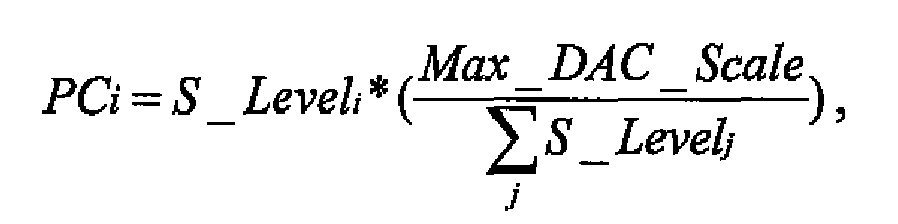
wobeiPC i für den Gewichts-Koeffizient steht,S_Level i für den Leistungspegel des empfangenen Signals steht,Max_DAC_Scale eine Konstante ist, die das Maximum des Konvertierungsbereichs der Konvertiermittel definiert,
- Sender nach Anspruch 16, dadurch gekennzeichnet, dass die Mittel (130) die Skalierungsfaktoren erzeugen, die in dem Skalieren durch Verwenden im Wesentlichen folgender Formel oder einer äquivalente Formel verwendet werden

wobeiCTRL_VGA für den Skalierungsfaktor steht,Max_DAC_Scale eine Konstante ist, die das Maximum des Konvertierungsbereichs der Konvertiermittel definiert,
Applications Claiming Priority (3)
| Application Number | Priority Date | Filing Date | Title |
|---|---|---|---|
| FI973337A FI107666B (fi) | 1997-08-14 | 1997-08-14 | Menetelmä lähetyksen optimoimiseksi ja lähetin |
| FI973337 | 1997-08-14 | ||
| PCT/FI1998/000625 WO1999009676A2 (en) | 1997-08-14 | 1998-08-13 | Method of optimizing transmission, and transmitter |
Publications (2)
| Publication Number | Publication Date |
|---|---|
| EP0941584A2 EP0941584A2 (de) | 1999-09-15 |
| EP0941584B1 true EP0941584B1 (de) | 2006-10-04 |
Family
ID=8549354
Family Applications (1)
| Application Number | Title | Priority Date | Filing Date |
|---|---|---|---|
| EP98938721A Expired - Lifetime EP0941584B1 (de) | 1997-08-14 | 1998-08-13 | Verfahren zur übertragungsoptimierung und sender |
Country Status (11)
| Country | Link |
|---|---|
| US (1) | US6526102B1 (de) |
| EP (1) | EP0941584B1 (de) |
| JP (1) | JP2001505027A (de) |
| CN (1) | CN1154254C (de) |
| AT (1) | ATE341865T1 (de) |
| AU (1) | AU8733898A (de) |
| DE (1) | DE69836071T2 (de) |
| ES (1) | ES2273431T3 (de) |
| FI (1) | FI107666B (de) |
| NO (1) | NO991725L (de) |
| WO (1) | WO1999009676A2 (de) |
Families Citing this family (7)
| Publication number | Priority date | Publication date | Assignee | Title |
|---|---|---|---|---|
| US7194022B2 (en) * | 2002-06-07 | 2007-03-20 | Nokia Corporation | Method and system having capacity-dependent baseband gain and coverage-capacity swapping in a multi-carrier base station transmitters |
| US7453945B2 (en) * | 2003-09-05 | 2008-11-18 | Lucent Technologies Inc. | Methods and devices for controlling RF, multi-carrier amplifier signal power |
| WO2005041353A1 (en) * | 2003-10-23 | 2005-05-06 | Telecom Italia S.P.A | Antenna system and method for configuring a radiating pattern |
| US7907671B2 (en) * | 2004-12-03 | 2011-03-15 | Motorola Mobility, Inc. | Method and system for scaling a multi-channel signal |
| US7674281B2 (en) * | 2005-09-02 | 2010-03-09 | Forthright Engineering Pllc | Apparatus and methods for providing a flow of a heat transfer fluid in a microenvironment |
| US8315581B2 (en) | 2008-09-18 | 2012-11-20 | Intel Mobile Communications GmbH | Transmitter with hybrid closed loop power control |
| EP2727184B1 (de) * | 2011-06-30 | 2018-12-26 | CommScope Technologies LLC | Aktivantennen-subarray-strukturen |
Citations (1)
| Publication number | Priority date | Publication date | Assignee | Title |
|---|---|---|---|---|
| EP0565505A2 (de) * | 1992-04-10 | 1993-10-13 | Ericsson Inc. | Duplexleistungsregelung in einem zellularen Mobil-Funktelefonsystem |
Family Cites Families (13)
| Publication number | Priority date | Publication date | Assignee | Title |
|---|---|---|---|---|
| US4639914A (en) | 1984-12-06 | 1987-01-27 | At&T Bell Laboratories | Wireless PBX/LAN system with optimum combining |
| DE3634439A1 (de) | 1986-10-09 | 1988-04-14 | Blaupunkt Werke Gmbh | Verfahren und schaltungsanordnung zum empfang von radiowellen |
| US5191594A (en) | 1991-11-27 | 1993-03-02 | The United States Of America As Represented By The United States Department Of Energy | Fading channel simulator |
| FR2732490B1 (fr) | 1995-03-28 | 1997-04-25 | Thomson Csf | Procede de reception multicapteur d'une station de base d'un reseau de communication echangeant des donnees avec des mobiles, et dispositif pour sa mise en oeuvre |
| FI100017B (fi) * | 1995-08-29 | 1997-08-15 | Nokia Telecommunications Oy | Yhteyden laadun estimointimenetelmä ja vastaanotin |
| CN1092431C (zh) | 1995-11-29 | 2002-10-09 | Ntt移动通信网株式会社 | 分集接收机及其控制方法 |
| JPH09219615A (ja) | 1996-02-14 | 1997-08-19 | Toshiba Corp | アダプティブアレイ送受信装置の指向性制御方法と無線通信システムおよびアダプティブアレイ送受信装置 |
| EP0807989B1 (de) | 1996-05-17 | 2001-06-27 | Motorola Ltd | Verfahren und Vorrichtung zur Gewichtung eines Uebertragungsweges |
| DE19649926A1 (de) * | 1996-12-02 | 1998-06-04 | Wegmann & Co Gmbh | Kommunikationseinrichtung in einem Kampffahrzeug |
| US6018644A (en) * | 1997-01-28 | 2000-01-25 | Northrop Grumman Corporation | Low-loss, fault-tolerant antenna interface unit |
| US5842114A (en) * | 1997-02-12 | 1998-11-24 | Interdigital Technology Corporation | Global channel power control to minimize spillover in a wireless communication environment |
| KR100275071B1 (ko) * | 1998-06-23 | 2000-12-15 | 윤종용 | 이동통신기지국의스마트안테나시스템용송수신장치 |
| US6256502B1 (en) * | 1998-12-23 | 2001-07-03 | Nortel Networks Limited | Wideband multicarrier power control for a cellular PCS basestation tranmitter |
-
1997
- 1997-08-14 FI FI973337A patent/FI107666B/fi active
-
1998
- 1998-08-13 EP EP98938721A patent/EP0941584B1/de not_active Expired - Lifetime
- 1998-08-13 US US09/284,121 patent/US6526102B1/en not_active Expired - Fee Related
- 1998-08-13 AU AU87338/98A patent/AU8733898A/en not_active Abandoned
- 1998-08-13 DE DE69836071T patent/DE69836071T2/de not_active Expired - Lifetime
- 1998-08-13 CN CNB988011530A patent/CN1154254C/zh not_active Expired - Fee Related
- 1998-08-13 JP JP51284499A patent/JP2001505027A/ja active Pending
- 1998-08-13 AT AT98938721T patent/ATE341865T1/de not_active IP Right Cessation
- 1998-08-13 ES ES98938721T patent/ES2273431T3/es not_active Expired - Lifetime
- 1998-08-13 WO PCT/FI1998/000625 patent/WO1999009676A2/en not_active Ceased
-
1999
- 1999-04-13 NO NO991725A patent/NO991725L/no not_active Application Discontinuation
Patent Citations (1)
| Publication number | Priority date | Publication date | Assignee | Title |
|---|---|---|---|---|
| EP0565505A2 (de) * | 1992-04-10 | 1993-10-13 | Ericsson Inc. | Duplexleistungsregelung in einem zellularen Mobil-Funktelefonsystem |
Also Published As
| Publication number | Publication date |
|---|---|
| NO991725D0 (no) | 1999-04-13 |
| NO991725L (no) | 1999-04-13 |
| WO1999009676A3 (en) | 1999-05-06 |
| CN1236511A (zh) | 1999-11-24 |
| FI973337A7 (fi) | 1999-02-15 |
| WO1999009676A2 (en) | 1999-02-25 |
| CN1154254C (zh) | 2004-06-16 |
| AU8733898A (en) | 1999-03-08 |
| ATE341865T1 (de) | 2006-10-15 |
| FI973337A0 (fi) | 1997-08-14 |
| ES2273431T3 (es) | 2007-05-01 |
| FI107666B (fi) | 2001-09-14 |
| JP2001505027A (ja) | 2001-04-10 |
| DE69836071T2 (de) | 2007-03-29 |
| US6526102B1 (en) | 2003-02-25 |
| EP0941584A2 (de) | 1999-09-15 |
| DE69836071D1 (de) | 2006-11-16 |
Similar Documents
| Publication | Publication Date | Title |
|---|---|---|
| US6252915B1 (en) | System and method for gaining control of individual narrowband channels using a wideband power measurement | |
| EP1276233B1 (de) | Verfahren und Vorrichtung zur Regelung der Sendeleistung in einem mobilen Kommunikationssystem | |
| CA2224572C (en) | Radio with peak power and bandwidth efficient modulation | |
| US7248656B2 (en) | Digital convertible radio SNR optimization | |
| US6463264B1 (en) | Wireless communication apparatus and transmission power control method in wireless communication apparatus | |
| US5708681A (en) | Hybrid analog/digital method and apparatus for controlling the transmission power level of a radio transceiver | |
| EP1429472B1 (de) | Schnurloses Kommunikationsgerät und Verfahren zur Leistungsregelung dafür | |
| US7545880B1 (en) | Multiple polynomial digital predistortion | |
| RU2119714C1 (ru) | Способ и устройство для снижения максимального значения мощности огибающей линейного усилителя мощности | |
| EP1067676B1 (de) | Verfahren zur breitbandigen Linearisierung von Leistungsverstärkern | |
| JPH07131407A (ja) | 基地局送受信装置 | |
| EP1339248B1 (de) | Verfahren und einrichtung zur verstärkungsentzerrung auf der grundlage einer breitband-mehrträger-basisstation | |
| US6771940B2 (en) | Multi-channel peak power smoothing | |
| AU749189B2 (en) | AGC circuit | |
| EP0941584B1 (de) | Verfahren zur übertragungsoptimierung und sender | |
| JP3360044B2 (ja) | 基地局送信装置とそれを用いたcdma移動通信システム | |
| JP3450146B2 (ja) | アダプティブアレーアンテナの指向性制御回路 | |
| EP1569350A1 (de) | Leistungsbegrenzungsvorrichtung und digitaler funksender damit | |
| JP4185601B2 (ja) | 送信電力制御方法及び送信電力制御装置及びそれを備えた基地局 | |
| GB2349522A (en) | Transmit power level control in a mobile telephone | |
| EP1094614A2 (de) | CDMA Sender | |
| HK1083278A (en) | Power limit device and digital radio transmitter using the same | |
| HK1109253A (en) | System and method for gain control of individual narrowband channels using a wideband power measurement |
Legal Events
| Date | Code | Title | Description |
|---|---|---|---|
| PUAI | Public reference made under article 153(3) epc to a published international application that has entered the european phase |
Free format text: ORIGINAL CODE: 0009012 |
|
| 17P | Request for examination filed |
Effective date: 19990423 |
|
| AK | Designated contracting states |
Kind code of ref document: A2 Designated state(s): AT BE CH CY DE DK ES FI FR GB GR IE IT LI LU MC NL PT SE |
|
| RAP1 | Party data changed (applicant data changed or rights of an application transferred) |
Owner name: NOKIA NETWORKS OY |
|
| RAP1 | Party data changed (applicant data changed or rights of an application transferred) |
Owner name: NOKIA CORPORATION |
|
| 17Q | First examination report despatched |
Effective date: 20040507 |
|
| GRAP | Despatch of communication of intention to grant a patent |
Free format text: ORIGINAL CODE: EPIDOSNIGR1 |
|
| GRAS | Grant fee paid |
Free format text: ORIGINAL CODE: EPIDOSNIGR3 |
|
| GRAA | (expected) grant |
Free format text: ORIGINAL CODE: 0009210 |
|
| AK | Designated contracting states |
Kind code of ref document: B1 Designated state(s): AT BE CH CY DE DK ES FI FR GB GR IE IT LI LU MC NL PT SE |
|
| PG25 | Lapsed in a contracting state [announced via postgrant information from national office to epo] |
Ref country code: NL Free format text: LAPSE BECAUSE OF FAILURE TO SUBMIT A TRANSLATION OF THE DESCRIPTION OR TO PAY THE FEE WITHIN THE PRESCRIBED TIME-LIMIT Effective date: 20061004 Ref country code: LI Free format text: LAPSE BECAUSE OF FAILURE TO SUBMIT A TRANSLATION OF THE DESCRIPTION OR TO PAY THE FEE WITHIN THE PRESCRIBED TIME-LIMIT Effective date: 20061004 Ref country code: IT Free format text: LAPSE BECAUSE OF FAILURE TO SUBMIT A TRANSLATION OF THE DESCRIPTION OR TO PAY THE FEE WITHIN THE PRE;WARNING: LAPSES OF ITALIAN PATENTS WITH EFFECTIVE DATE BEFORE 2007 MAY HAVE OCCURRED AT ANY TIME BEFORE 2007. THE CORRECT EFFECTIVE DATE MAY BE DIFFERENT FROM THE ONE RECORDED.SCRIBED TIME-LIMIT Effective date: 20061004 Ref country code: FI Free format text: LAPSE BECAUSE OF FAILURE TO SUBMIT A TRANSLATION OF THE DESCRIPTION OR TO PAY THE FEE WITHIN THE PRESCRIBED TIME-LIMIT Effective date: 20061004 Ref country code: CH Free format text: LAPSE BECAUSE OF FAILURE TO SUBMIT A TRANSLATION OF THE DESCRIPTION OR TO PAY THE FEE WITHIN THE PRESCRIBED TIME-LIMIT Effective date: 20061004 Ref country code: BE Free format text: LAPSE BECAUSE OF FAILURE TO SUBMIT A TRANSLATION OF THE DESCRIPTION OR TO PAY THE FEE WITHIN THE PRESCRIBED TIME-LIMIT Effective date: 20061004 Ref country code: AT Free format text: LAPSE BECAUSE OF FAILURE TO SUBMIT A TRANSLATION OF THE DESCRIPTION OR TO PAY THE FEE WITHIN THE PRESCRIBED TIME-LIMIT Effective date: 20061004 |
|
| REG | Reference to a national code |
Ref country code: GB Ref legal event code: FG4D |
|
| REG | Reference to a national code |
Ref country code: CH Ref legal event code: EP |
|
| REG | Reference to a national code |
Ref country code: IE Ref legal event code: FG4D |
|
| REF | Corresponds to: |
Ref document number: 69836071 Country of ref document: DE Date of ref document: 20061116 Kind code of ref document: P |
|
| PG25 | Lapsed in a contracting state [announced via postgrant information from national office to epo] |
Ref country code: SE Free format text: LAPSE BECAUSE OF FAILURE TO SUBMIT A TRANSLATION OF THE DESCRIPTION OR TO PAY THE FEE WITHIN THE PRESCRIBED TIME-LIMIT Effective date: 20070104 Ref country code: DK Free format text: LAPSE BECAUSE OF FAILURE TO SUBMIT A TRANSLATION OF THE DESCRIPTION OR TO PAY THE FEE WITHIN THE PRESCRIBED TIME-LIMIT Effective date: 20070104 |
|
| ET | Fr: translation filed | ||
| PG25 | Lapsed in a contracting state [announced via postgrant information from national office to epo] |
Ref country code: PT Free format text: LAPSE BECAUSE OF FAILURE TO SUBMIT A TRANSLATION OF THE DESCRIPTION OR TO PAY THE FEE WITHIN THE PRESCRIBED TIME-LIMIT Effective date: 20070316 |
|
| NLV1 | Nl: lapsed or annulled due to failure to fulfill the requirements of art. 29p and 29m of the patents act | ||
| REG | Reference to a national code |
Ref country code: CH Ref legal event code: PL |
|
| REG | Reference to a national code |
Ref country code: ES Ref legal event code: FG2A Ref document number: 2273431 Country of ref document: ES Kind code of ref document: T3 |
|
| PLBE | No opposition filed within time limit |
Free format text: ORIGINAL CODE: 0009261 |
|
| STAA | Information on the status of an ep patent application or granted ep patent |
Free format text: STATUS: NO OPPOSITION FILED WITHIN TIME LIMIT |
|
| 26N | No opposition filed |
Effective date: 20070705 |
|
| PG25 | Lapsed in a contracting state [announced via postgrant information from national office to epo] |
Ref country code: MC Free format text: LAPSE BECAUSE OF NON-PAYMENT OF DUE FEES Effective date: 20070831 Ref country code: GR Free format text: LAPSE BECAUSE OF FAILURE TO SUBMIT A TRANSLATION OF THE DESCRIPTION OR TO PAY THE FEE WITHIN THE PRESCRIBED TIME-LIMIT Effective date: 20070105 |
|
| PG25 | Lapsed in a contracting state [announced via postgrant information from national office to epo] |
Ref country code: IE Free format text: LAPSE BECAUSE OF NON-PAYMENT OF DUE FEES Effective date: 20070813 |
|
| PG25 | Lapsed in a contracting state [announced via postgrant information from national office to epo] |
Ref country code: LU Free format text: LAPSE BECAUSE OF NON-PAYMENT OF DUE FEES Effective date: 20070813 Ref country code: CY Free format text: LAPSE BECAUSE OF FAILURE TO SUBMIT A TRANSLATION OF THE DESCRIPTION OR TO PAY THE FEE WITHIN THE PRESCRIBED TIME-LIMIT Effective date: 20061004 |
|
| PGFP | Annual fee paid to national office [announced via postgrant information from national office to epo] |
Ref country code: ES Payment date: 20100915 Year of fee payment: 13 |
|
| PGFP | Annual fee paid to national office [announced via postgrant information from national office to epo] |
Ref country code: IT Payment date: 20100818 Year of fee payment: 13 |
|
| PGFP | Annual fee paid to national office [announced via postgrant information from national office to epo] |
Ref country code: GB Payment date: 20110810 Year of fee payment: 14 |
|
| PG25 | Lapsed in a contracting state [announced via postgrant information from national office to epo] |
Ref country code: IT Free format text: LAPSE BECAUSE OF NON-PAYMENT OF DUE FEES Effective date: 20110813 |
|
| REG | Reference to a national code |
Ref country code: ES Ref legal event code: FD2A Effective date: 20121207 |
|
| PGFP | Annual fee paid to national office [announced via postgrant information from national office to epo] |
Ref country code: FR Payment date: 20120823 Year of fee payment: 15 |
|
| PG25 | Lapsed in a contracting state [announced via postgrant information from national office to epo] |
Ref country code: ES Free format text: LAPSE BECAUSE OF NON-PAYMENT OF DUE FEES Effective date: 20110814 |
|
| GBPC | Gb: european patent ceased through non-payment of renewal fee |
Effective date: 20120813 |
|
| PG25 | Lapsed in a contracting state [announced via postgrant information from national office to epo] |
Ref country code: GB Free format text: LAPSE BECAUSE OF NON-PAYMENT OF DUE FEES Effective date: 20120813 |
|
| PGFP | Annual fee paid to national office [announced via postgrant information from national office to epo] |
Ref country code: DE Payment date: 20130807 Year of fee payment: 16 |
|
| REG | Reference to a national code |
Ref country code: FR Ref legal event code: ST Effective date: 20140430 |
|
| PG25 | Lapsed in a contracting state [announced via postgrant information from national office to epo] |
Ref country code: FR Free format text: LAPSE BECAUSE OF NON-PAYMENT OF DUE FEES Effective date: 20130902 |
|
| REG | Reference to a national code |
Ref country code: DE Ref legal event code: R119 Ref document number: 69836071 Country of ref document: DE |
|
| REG | Reference to a national code |
Ref country code: DE Ref legal event code: R119 Ref document number: 69836071 Country of ref document: DE Effective date: 20150303 |
|
| PG25 | Lapsed in a contracting state [announced via postgrant information from national office to epo] |
Ref country code: DE Free format text: LAPSE BECAUSE OF NON-PAYMENT OF DUE FEES Effective date: 20150303 |