EP0935458B1 - Mindestens eine nukleinsäure enthaltende zusammensetzungen - Google Patents
Mindestens eine nukleinsäure enthaltende zusammensetzungen Download PDFInfo
- Publication number
- EP0935458B1 EP0935458B1 EP97933736A EP97933736A EP0935458B1 EP 0935458 B1 EP0935458 B1 EP 0935458B1 EP 97933736 A EP97933736 A EP 97933736A EP 97933736 A EP97933736 A EP 97933736A EP 0935458 B1 EP0935458 B1 EP 0935458B1
- Authority
- EP
- European Patent Office
- Prior art keywords
- vesicles
- composition according
- nucleic acid
- dna
- gene
- Prior art date
- Legal status (The legal status is an assumption and is not a legal conclusion. Google has not performed a legal analysis and makes no representation as to the accuracy of the status listed.)
- Expired - Lifetime
Links
- 239000000203 mixture Substances 0.000 title claims description 59
- 150000007523 nucleic acids Chemical group 0.000 title claims description 40
- 108020004707 nucleic acids Proteins 0.000 title claims description 39
- 102000039446 nucleic acids Human genes 0.000 title claims description 39
- 108090000623 proteins and genes Proteins 0.000 claims description 62
- 238000000034 method Methods 0.000 claims description 34
- 239000004094 surface-active agent Substances 0.000 claims description 29
- 125000002091 cationic group Chemical group 0.000 claims description 25
- 102000004190 Enzymes Human genes 0.000 claims description 17
- 108090000790 Enzymes Proteins 0.000 claims description 17
- 238000002360 preparation method Methods 0.000 claims description 16
- 108010033040 Histones Proteins 0.000 claims description 15
- 239000004973 liquid crystal related substance Substances 0.000 claims description 15
- 102000004169 proteins and genes Human genes 0.000 claims description 15
- 102000006947 Histones Human genes 0.000 claims description 13
- LYCAIKOWRPUZTN-UHFFFAOYSA-N Ethylene glycol Chemical compound OCCO LYCAIKOWRPUZTN-UHFFFAOYSA-N 0.000 claims description 12
- 229920002873 Polyethylenimine Polymers 0.000 claims description 12
- 239000002671 adjuvant Substances 0.000 claims description 12
- -1 alkali metal salt Chemical class 0.000 claims description 12
- HVYWMOMLDIMFJA-DPAQBDIFSA-N cholesterol Chemical compound C1C=C2C[C@@H](O)CC[C@]2(C)[C@@H]2[C@@H]1[C@@H]1CC[C@H]([C@H](C)CCCC(C)C)[C@@]1(C)CC2 HVYWMOMLDIMFJA-DPAQBDIFSA-N 0.000 claims description 12
- 230000000694 effects Effects 0.000 claims description 12
- PEDCQBHIVMGVHV-UHFFFAOYSA-N Glycerine Chemical compound OCC(O)CO PEDCQBHIVMGVHV-UHFFFAOYSA-N 0.000 claims description 9
- 230000009466 transformation Effects 0.000 claims description 9
- 239000008194 pharmaceutical composition Substances 0.000 claims description 8
- 108091034117 Oligonucleotide Proteins 0.000 claims description 7
- 230000006870 function Effects 0.000 claims description 7
- 238000000338 in vitro Methods 0.000 claims description 7
- JNYAEWCLZODPBN-JGWLITMVSA-N (2r,3r,4s)-2-[(1r)-1,2-dihydroxyethyl]oxolane-3,4-diol Chemical compound OC[C@@H](O)[C@H]1OC[C@H](O)[C@H]1O JNYAEWCLZODPBN-JGWLITMVSA-N 0.000 claims description 6
- 241000234282 Allium Species 0.000 claims description 6
- 235000002732 Allium cepa var. cepa Nutrition 0.000 claims description 6
- FBPFZTCFMRRESA-KVTDHHQDSA-N D-Mannitol Chemical compound OC[C@@H](O)[C@@H](O)[C@H](O)[C@H](O)CO FBPFZTCFMRRESA-KVTDHHQDSA-N 0.000 claims description 6
- 229930195725 Mannitol Natural products 0.000 claims description 6
- CZMRCDWAGMRECN-UGDNZRGBSA-N Sucrose Chemical compound O[C@H]1[C@H](O)[C@@H](CO)O[C@@]1(CO)O[C@@H]1[C@H](O)[C@@H](O)[C@H](O)[C@@H](CO)O1 CZMRCDWAGMRECN-UGDNZRGBSA-N 0.000 claims description 6
- 229930006000 Sucrose Natural products 0.000 claims description 6
- 239000003795 chemical substances by application Substances 0.000 claims description 6
- 235000012000 cholesterol Nutrition 0.000 claims description 6
- 235000014113 dietary fatty acids Nutrition 0.000 claims description 6
- 229930195729 fatty acid Natural products 0.000 claims description 6
- 239000000194 fatty acid Substances 0.000 claims description 6
- 150000004665 fatty acids Chemical class 0.000 claims description 6
- WGCNASOHLSPBMP-UHFFFAOYSA-N hydroxyacetaldehyde Natural products OCC=O WGCNASOHLSPBMP-UHFFFAOYSA-N 0.000 claims description 6
- 230000010354 integration Effects 0.000 claims description 6
- 239000007788 liquid Substances 0.000 claims description 6
- 239000000594 mannitol Substances 0.000 claims description 6
- 235000010355 mannitol Nutrition 0.000 claims description 6
- 150000003904 phospholipids Chemical class 0.000 claims description 5
- 229920000642 polymer Polymers 0.000 claims description 5
- 230000006798 recombination Effects 0.000 claims description 5
- 238000005215 recombination Methods 0.000 claims description 5
- 210000000988 bone and bone Anatomy 0.000 claims description 4
- 239000003093 cationic surfactant Substances 0.000 claims description 4
- 230000002950 deficient Effects 0.000 claims description 4
- 150000002191 fatty alcohols Chemical class 0.000 claims description 4
- 239000002773 nucleotide Substances 0.000 claims description 4
- 125000003729 nucleotide group Chemical group 0.000 claims description 4
- 229920000223 polyglycerol Polymers 0.000 claims description 4
- 229920006395 saturated elastomer Chemical class 0.000 claims description 4
- 239000005720 sucrose Substances 0.000 claims description 4
- 108060004795 Methyltransferase Proteins 0.000 claims description 3
- 101710183280 Topoisomerase Proteins 0.000 claims description 3
- 239000002253 acid Substances 0.000 claims description 3
- 230000007547 defect Effects 0.000 claims description 3
- 230000010076 replication Effects 0.000 claims description 3
- 238000010008 shearing Methods 0.000 claims description 3
- SHBUUTHKGIVMJT-UHFFFAOYSA-N Hydroxystearate Chemical compound CCCCCCCCCCCCCCCCCC(=O)OO SHBUUTHKGIVMJT-UHFFFAOYSA-N 0.000 claims description 2
- 102000001706 Immunoglobulin Fab Fragments Human genes 0.000 claims description 2
- 108010054477 Immunoglobulin Fab Fragments Proteins 0.000 claims description 2
- 229920003171 Poly (ethylene oxide) Polymers 0.000 claims description 2
- 239000002202 Polyethylene glycol Substances 0.000 claims description 2
- 229910052784 alkaline earth metal Inorganic materials 0.000 claims description 2
- 230000000890 antigenic effect Effects 0.000 claims description 2
- 230000003915 cell function Effects 0.000 claims description 2
- 238000012937 correction Methods 0.000 claims description 2
- 150000002148 esters Chemical class 0.000 claims description 2
- 150000002170 ethers Chemical class 0.000 claims description 2
- 125000005456 glyceride group Chemical group 0.000 claims description 2
- 229940072106 hydroxystearate Drugs 0.000 claims description 2
- 230000002018 overexpression Effects 0.000 claims description 2
- 229920001983 poloxamer Polymers 0.000 claims description 2
- 229920001223 polyethylene glycol Polymers 0.000 claims description 2
- 229920001451 polypropylene glycol Polymers 0.000 claims description 2
- 230000008707 rearrangement Effects 0.000 claims description 2
- NLQLSVXGSXCXFE-UHFFFAOYSA-N sitosterol Natural products CC=C(/CCC(C)C1CC2C3=CCC4C(C)C(O)CCC4(C)C3CCC2(C)C1)C(C)C NLQLSVXGSXCXFE-UHFFFAOYSA-N 0.000 claims description 2
- 239000000725 suspension Substances 0.000 claims description 2
- 150000003626 triacylglycerols Chemical class 0.000 claims description 2
- 235000015112 vegetable and seed oil Nutrition 0.000 claims description 2
- 239000008158 vegetable oil Substances 0.000 claims description 2
- 150000001298 alcohols Chemical class 0.000 claims 1
- 229910052783 alkali metal Inorganic materials 0.000 claims 1
- 239000000074 antisense oligonucleotide Substances 0.000 claims 1
- 238000012230 antisense oligonucleotides Methods 0.000 claims 1
- 229960005486 vaccine Drugs 0.000 claims 1
- 108020004414 DNA Proteins 0.000 description 71
- 210000004027 cell Anatomy 0.000 description 41
- 239000013598 vector Substances 0.000 description 36
- 238000001890 transfection Methods 0.000 description 31
- 238000005538 encapsulation Methods 0.000 description 21
- 230000008901 benefit Effects 0.000 description 13
- 230000008569 process Effects 0.000 description 13
- 238000005516 engineering process Methods 0.000 description 12
- 239000002502 liposome Substances 0.000 description 12
- 238000011534 incubation Methods 0.000 description 11
- 210000004940 nucleus Anatomy 0.000 description 11
- 108010005774 beta-Galactosidase Proteins 0.000 description 10
- 239000006185 dispersion Substances 0.000 description 10
- 238000001727 in vivo Methods 0.000 description 10
- 239000000243 solution Substances 0.000 description 10
- 238000012360 testing method Methods 0.000 description 10
- 238000009472 formulation Methods 0.000 description 9
- XLYOFNOQVPJJNP-UHFFFAOYSA-N water Substances O XLYOFNOQVPJJNP-UHFFFAOYSA-N 0.000 description 9
- IIZPXYDJLKNOIY-JXPKJXOSSA-N 1-palmitoyl-2-arachidonoyl-sn-glycero-3-phosphocholine Chemical compound CCCCCCCCCCCCCCCC(=O)OC[C@H](COP([O-])(=O)OCC[N+](C)(C)C)OC(=O)CCC\C=C/C\C=C/C\C=C/C\C=C/CCCCC IIZPXYDJLKNOIY-JXPKJXOSSA-N 0.000 description 8
- 230000009471 action Effects 0.000 description 8
- 238000009792 diffusion process Methods 0.000 description 8
- 230000014509 gene expression Effects 0.000 description 8
- 239000000787 lecithin Substances 0.000 description 8
- 229940067606 lecithin Drugs 0.000 description 8
- 235000010445 lecithin Nutrition 0.000 description 8
- 239000000047 product Substances 0.000 description 8
- 238000012546 transfer Methods 0.000 description 8
- 210000002950 fibroblast Anatomy 0.000 description 7
- 239000012528 membrane Substances 0.000 description 7
- 229940096992 potassium oleate Drugs 0.000 description 7
- MLICVSDCCDDWMD-KVVVOXFISA-M potassium;(z)-octadec-9-enoate Chemical compound [K+].CCCCCCCC\C=C/CCCCCCCC([O-])=O MLICVSDCCDDWMD-KVVVOXFISA-M 0.000 description 7
- 108010039918 Polylysine Proteins 0.000 description 6
- 210000001163 endosome Anatomy 0.000 description 6
- 238000002474 experimental method Methods 0.000 description 6
- 229920000656 polylysine Polymers 0.000 description 6
- 229920002884 Laureth 4 Polymers 0.000 description 5
- 239000002585 base Substances 0.000 description 5
- 210000000805 cytoplasm Anatomy 0.000 description 5
- 230000002255 enzymatic effect Effects 0.000 description 5
- SFNALCNOMXIBKG-UHFFFAOYSA-N ethylene glycol monododecyl ether Chemical compound CCCCCCCCCCCCOCCO SFNALCNOMXIBKG-UHFFFAOYSA-N 0.000 description 5
- 238000010348 incorporation Methods 0.000 description 5
- 238000002347 injection Methods 0.000 description 5
- 239000007924 injection Substances 0.000 description 5
- 229940061515 laureth-4 Drugs 0.000 description 5
- WTJKGGKOPKCXLL-RRHRGVEJSA-N phosphatidylcholine Chemical compound CCCCCCCCCCCCCCCC(=O)OC[C@H](COP([O-])(=O)OCC[N+](C)(C)C)OC(=O)CCCCCCCC=CCCCCCCCC WTJKGGKOPKCXLL-RRHRGVEJSA-N 0.000 description 5
- 210000002966 serum Anatomy 0.000 description 5
- PZNPLUBHRSSFHT-RRHRGVEJSA-N 1-hexadecanoyl-2-octadecanoyl-sn-glycero-3-phosphocholine Chemical compound CCCCCCCCCCCCCCCCCC(=O)O[C@@H](COP([O-])(=O)OCC[N+](C)(C)C)COC(=O)CCCCCCCCCCCCCCC PZNPLUBHRSSFHT-RRHRGVEJSA-N 0.000 description 4
- UZOVYGYOLBIAJR-UHFFFAOYSA-N 4-isocyanato-4'-methyldiphenylmethane Chemical compound C1=CC(C)=CC=C1CC1=CC=C(N=C=O)C=C1 UZOVYGYOLBIAJR-UHFFFAOYSA-N 0.000 description 4
- 241001465754 Metazoa Species 0.000 description 4
- 206010028980 Neoplasm Diseases 0.000 description 4
- 108010047956 Nucleosomes Proteins 0.000 description 4
- 238000004458 analytical method Methods 0.000 description 4
- 239000007864 aqueous solution Substances 0.000 description 4
- 102000005936 beta-Galactosidase Human genes 0.000 description 4
- 238000006243 chemical reaction Methods 0.000 description 4
- 238000001415 gene therapy Methods 0.000 description 4
- 210000001623 nucleosome Anatomy 0.000 description 4
- 239000000523 sample Substances 0.000 description 4
- 239000008347 soybean phospholipid Substances 0.000 description 4
- 229960004793 sucrose Drugs 0.000 description 4
- 230000009885 systemic effect Effects 0.000 description 4
- 230000001052 transient effect Effects 0.000 description 4
- 239000003981 vehicle Substances 0.000 description 4
- 108091032973 (ribonucleotides)n+m Proteins 0.000 description 3
- 101710163270 Nuclease Proteins 0.000 description 3
- ZLMJMSJWJFRBEC-UHFFFAOYSA-N Potassium Chemical compound [K] ZLMJMSJWJFRBEC-UHFFFAOYSA-N 0.000 description 3
- JLCPHMBAVCMARE-UHFFFAOYSA-N [3-[[3-[[3-[[3-[[3-[[3-[[3-[[3-[[3-[[3-[[3-[[5-(2-amino-6-oxo-1H-purin-9-yl)-3-[[3-[[3-[[3-[[3-[[3-[[5-(2-amino-6-oxo-1H-purin-9-yl)-3-[[5-(2-amino-6-oxo-1H-purin-9-yl)-3-hydroxyoxolan-2-yl]methoxy-hydroxyphosphoryl]oxyoxolan-2-yl]methoxy-hydroxyphosphoryl]oxy-5-(5-methyl-2,4-dioxopyrimidin-1-yl)oxolan-2-yl]methoxy-hydroxyphosphoryl]oxy-5-(6-aminopurin-9-yl)oxolan-2-yl]methoxy-hydroxyphosphoryl]oxy-5-(6-aminopurin-9-yl)oxolan-2-yl]methoxy-hydroxyphosphoryl]oxy-5-(6-aminopurin-9-yl)oxolan-2-yl]methoxy-hydroxyphosphoryl]oxy-5-(6-aminopurin-9-yl)oxolan-2-yl]methoxy-hydroxyphosphoryl]oxyoxolan-2-yl]methoxy-hydroxyphosphoryl]oxy-5-(5-methyl-2,4-dioxopyrimidin-1-yl)oxolan-2-yl]methoxy-hydroxyphosphoryl]oxy-5-(4-amino-2-oxopyrimidin-1-yl)oxolan-2-yl]methoxy-hydroxyphosphoryl]oxy-5-(5-methyl-2,4-dioxopyrimidin-1-yl)oxolan-2-yl]methoxy-hydroxyphosphoryl]oxy-5-(5-methyl-2,4-dioxopyrimidin-1-yl)oxolan-2-yl]methoxy-hydroxyphosphoryl]oxy-5-(6-aminopurin-9-yl)oxolan-2-yl]methoxy-hydroxyphosphoryl]oxy-5-(6-aminopurin-9-yl)oxolan-2-yl]methoxy-hydroxyphosphoryl]oxy-5-(4-amino-2-oxopyrimidin-1-yl)oxolan-2-yl]methoxy-hydroxyphosphoryl]oxy-5-(4-amino-2-oxopyrimidin-1-yl)oxolan-2-yl]methoxy-hydroxyphosphoryl]oxy-5-(4-amino-2-oxopyrimidin-1-yl)oxolan-2-yl]methoxy-hydroxyphosphoryl]oxy-5-(6-aminopurin-9-yl)oxolan-2-yl]methoxy-hydroxyphosphoryl]oxy-5-(4-amino-2-oxopyrimidin-1-yl)oxolan-2-yl]methyl [5-(6-aminopurin-9-yl)-2-(hydroxymethyl)oxolan-3-yl] hydrogen phosphate Polymers Cc1cn(C2CC(OP(O)(=O)OCC3OC(CC3OP(O)(=O)OCC3OC(CC3O)n3cnc4c3nc(N)[nH]c4=O)n3cnc4c3nc(N)[nH]c4=O)C(COP(O)(=O)OC3CC(OC3COP(O)(=O)OC3CC(OC3COP(O)(=O)OC3CC(OC3COP(O)(=O)OC3CC(OC3COP(O)(=O)OC3CC(OC3COP(O)(=O)OC3CC(OC3COP(O)(=O)OC3CC(OC3COP(O)(=O)OC3CC(OC3COP(O)(=O)OC3CC(OC3COP(O)(=O)OC3CC(OC3COP(O)(=O)OC3CC(OC3COP(O)(=O)OC3CC(OC3COP(O)(=O)OC3CC(OC3COP(O)(=O)OC3CC(OC3COP(O)(=O)OC3CC(OC3COP(O)(=O)OC3CC(OC3COP(O)(=O)OC3CC(OC3CO)n3cnc4c(N)ncnc34)n3ccc(N)nc3=O)n3cnc4c(N)ncnc34)n3ccc(N)nc3=O)n3ccc(N)nc3=O)n3ccc(N)nc3=O)n3cnc4c(N)ncnc34)n3cnc4c(N)ncnc34)n3cc(C)c(=O)[nH]c3=O)n3cc(C)c(=O)[nH]c3=O)n3ccc(N)nc3=O)n3cc(C)c(=O)[nH]c3=O)n3cnc4c3nc(N)[nH]c4=O)n3cnc4c(N)ncnc34)n3cnc4c(N)ncnc34)n3cnc4c(N)ncnc34)n3cnc4c(N)ncnc34)O2)c(=O)[nH]c1=O JLCPHMBAVCMARE-UHFFFAOYSA-N 0.000 description 3
- 244000309466 calf Species 0.000 description 3
- 230000001413 cellular effect Effects 0.000 description 3
- LQZZUXJYWNFBMV-UHFFFAOYSA-N dodecan-1-ol Chemical compound CCCCCCCCCCCCO LQZZUXJYWNFBMV-UHFFFAOYSA-N 0.000 description 3
- 210000002216 heart Anatomy 0.000 description 3
- 238000002513 implantation Methods 0.000 description 3
- 238000002156 mixing Methods 0.000 description 3
- 229910052700 potassium Inorganic materials 0.000 description 3
- 239000011591 potassium Substances 0.000 description 3
- 238000011160 research Methods 0.000 description 3
- 239000000758 substrate Substances 0.000 description 3
- 210000001541 thymus gland Anatomy 0.000 description 3
- 231100000419 toxicity Toxicity 0.000 description 3
- 230000001988 toxicity Effects 0.000 description 3
- 239000002691 unilamellar liposome Substances 0.000 description 3
- 230000003612 virological effect Effects 0.000 description 3
- OPIFSICVWOWJMJ-AEOCFKNESA-N 5-bromo-4-chloro-3-indolyl beta-D-galactoside Chemical compound O[C@@H]1[C@@H](O)[C@@H](O)[C@@H](CO)O[C@H]1OC1=CNC2=CC=C(Br)C(Cl)=C12 OPIFSICVWOWJMJ-AEOCFKNESA-N 0.000 description 2
- 206010001488 Aggression Diseases 0.000 description 2
- 108020004635 Complementary DNA Proteins 0.000 description 2
- 102000016911 Deoxyribonucleases Human genes 0.000 description 2
- 108010053770 Deoxyribonucleases Proteins 0.000 description 2
- IAYPIBMASNFSPL-UHFFFAOYSA-N Ethylene oxide Chemical compound C1CO1 IAYPIBMASNFSPL-UHFFFAOYSA-N 0.000 description 2
- 108091028043 Nucleic acid sequence Proteins 0.000 description 2
- 108700008625 Reporter Genes Proteins 0.000 description 2
- 230000016571 aggressive behavior Effects 0.000 description 2
- 150000001412 amines Chemical class 0.000 description 2
- 230000004888 barrier function Effects 0.000 description 2
- 230000015572 biosynthetic process Effects 0.000 description 2
- 210000002421 cell wall Anatomy 0.000 description 2
- 229940107161 cholesterol Drugs 0.000 description 2
- 239000013065 commercial product Substances 0.000 description 2
- 230000000052 comparative effect Effects 0.000 description 2
- 239000002299 complementary DNA Substances 0.000 description 2
- 238000009833 condensation Methods 0.000 description 2
- 230000005494 condensation Effects 0.000 description 2
- 239000000470 constituent Substances 0.000 description 2
- 231100000433 cytotoxic Toxicity 0.000 description 2
- 230000001472 cytotoxic effect Effects 0.000 description 2
- 230000003013 cytotoxicity Effects 0.000 description 2
- 231100000135 cytotoxicity Toxicity 0.000 description 2
- 230000003247 decreasing effect Effects 0.000 description 2
- 235000013681 dietary sucrose Nutrition 0.000 description 2
- 239000008393 encapsulating agent Substances 0.000 description 2
- 210000003527 eukaryotic cell Anatomy 0.000 description 2
- 238000000799 fluorescence microscopy Methods 0.000 description 2
- 238000009396 hybridization Methods 0.000 description 2
- 230000003993 interaction Effects 0.000 description 2
- 238000010253 intravenous injection Methods 0.000 description 2
- 150000002632 lipids Chemical class 0.000 description 2
- 238000005259 measurement Methods 0.000 description 2
- 239000003094 microcapsule Substances 0.000 description 2
- 238000000386 microscopy Methods 0.000 description 2
- 210000000056 organ Anatomy 0.000 description 2
- 230000002138 osteoinductive effect Effects 0.000 description 2
- 239000002245 particle Substances 0.000 description 2
- 239000013612 plasmid Substances 0.000 description 2
- 238000010186 staining Methods 0.000 description 2
- 229960005322 streptomycin Drugs 0.000 description 2
- 239000006228 supernatant Substances 0.000 description 2
- 230000008685 targeting Effects 0.000 description 2
- 230000001225 therapeutic effect Effects 0.000 description 2
- 238000002560 therapeutic procedure Methods 0.000 description 2
- 230000001131 transforming effect Effects 0.000 description 2
- 238000013519 translation Methods 0.000 description 2
- 241001430294 unidentified retrovirus Species 0.000 description 2
- 238000005406 washing Methods 0.000 description 2
- WHTVZRBIWZFKQO-AWEZNQCLSA-N (S)-chloroquine Chemical compound ClC1=CC=C2C(N[C@@H](C)CCCN(CC)CC)=CC=NC2=C1 WHTVZRBIWZFKQO-AWEZNQCLSA-N 0.000 description 1
- QRXMUCSWCMTJGU-UHFFFAOYSA-N 5-bromo-4-chloro-3-indolyl phosphate Chemical compound C1=C(Br)C(Cl)=C2C(OP(O)(=O)O)=CNC2=C1 QRXMUCSWCMTJGU-UHFFFAOYSA-N 0.000 description 1
- 229920000936 Agarose Polymers 0.000 description 1
- 102000007350 Bone Morphogenetic Proteins Human genes 0.000 description 1
- 108010007726 Bone Morphogenetic Proteins Proteins 0.000 description 1
- 108091003079 Bovine Serum Albumin Proteins 0.000 description 1
- 108010001857 Cell Surface Receptors Proteins 0.000 description 1
- 108010077544 Chromatin Proteins 0.000 description 1
- 201000003883 Cystic fibrosis Diseases 0.000 description 1
- 230000007018 DNA scission Effects 0.000 description 1
- 102000007260 Deoxyribonuclease I Human genes 0.000 description 1
- 108010008532 Deoxyribonuclease I Proteins 0.000 description 1
- 208000005189 Embolism Diseases 0.000 description 1
- LFQSCWFLJHTTHZ-UHFFFAOYSA-N Ethanol Chemical compound CCO LFQSCWFLJHTTHZ-UHFFFAOYSA-N 0.000 description 1
- VGGSQFUCUMXWEO-UHFFFAOYSA-N Ethene Chemical compound C=C VGGSQFUCUMXWEO-UHFFFAOYSA-N 0.000 description 1
- 102000002464 Galactosidases Human genes 0.000 description 1
- 108010093031 Galactosidases Proteins 0.000 description 1
- 102100034343 Integrase Human genes 0.000 description 1
- 108010061833 Integrases Proteins 0.000 description 1
- YIVJZNGAASQVEM-UHFFFAOYSA-N Lauroyl peroxide Chemical compound CCCCCCCCCCCC(=O)OOC(=O)CCCCCCCCCCC YIVJZNGAASQVEM-UHFFFAOYSA-N 0.000 description 1
- 241000699670 Mus sp. Species 0.000 description 1
- 239000000020 Nitrocellulose Substances 0.000 description 1
- 108010077850 Nuclear Localization Signals Proteins 0.000 description 1
- 108700020796 Oncogene Proteins 0.000 description 1
- 102000035195 Peptidases Human genes 0.000 description 1
- 108091005804 Peptidases Proteins 0.000 description 1
- 239000004365 Protease Substances 0.000 description 1
- 229920000297 Rayon Polymers 0.000 description 1
- 241000862632 Soja Species 0.000 description 1
- 108700005077 Viral Genes Proteins 0.000 description 1
- 241000700605 Viruses Species 0.000 description 1
- GRRMZXFOOGQMFA-UHFFFAOYSA-J YoYo-1 Chemical compound [I-].[I-].[I-].[I-].C12=CC=CC=C2C(C=C2N(C3=CC=CC=C3O2)C)=CC=[N+]1CCC[N+](C)(C)CCC[N+](C)(C)CCC[N+](C1=CC=CC=C11)=CC=C1C=C1N(C)C2=CC=CC=C2O1 GRRMZXFOOGQMFA-UHFFFAOYSA-J 0.000 description 1
- 150000007513 acids Chemical class 0.000 description 1
- 239000000654 additive Substances 0.000 description 1
- 238000013019 agitation Methods 0.000 description 1
- 239000003513 alkali Substances 0.000 description 1
- 150000001342 alkaline earth metals Chemical class 0.000 description 1
- 230000002927 anti-mitotic effect Effects 0.000 description 1
- 230000000692 anti-sense effect Effects 0.000 description 1
- 230000006907 apoptotic process Effects 0.000 description 1
- 239000003125 aqueous solvent Substances 0.000 description 1
- 239000007900 aqueous suspension Substances 0.000 description 1
- 239000012298 atmosphere Substances 0.000 description 1
- 230000033228 biological regulation Effects 0.000 description 1
- 210000004369 blood Anatomy 0.000 description 1
- 239000008280 blood Substances 0.000 description 1
- 229940112869 bone morphogenetic protein Drugs 0.000 description 1
- 238000010804 cDNA synthesis Methods 0.000 description 1
- 230000015556 catabolic process Effects 0.000 description 1
- 150000001767 cationic compounds Chemical class 0.000 description 1
- 229920006317 cationic polymer Polymers 0.000 description 1
- 230000030833 cell death Effects 0.000 description 1
- 238000012512 characterization method Methods 0.000 description 1
- 229960003677 chloroquine Drugs 0.000 description 1
- WHTVZRBIWZFKQO-UHFFFAOYSA-N chloroquine Natural products ClC1=CC=C2C(NC(C)CCCN(CC)CC)=CC=NC2=C1 WHTVZRBIWZFKQO-UHFFFAOYSA-N 0.000 description 1
- 210000003483 chromatin Anatomy 0.000 description 1
- 238000004040 coloring Methods 0.000 description 1
- 230000000295 complement effect Effects 0.000 description 1
- 239000002537 cosmetic Substances 0.000 description 1
- 238000006731 degradation reaction Methods 0.000 description 1
- 230000001687 destabilization Effects 0.000 description 1
- 230000001066 destructive effect Effects 0.000 description 1
- 238000011161 development Methods 0.000 description 1
- 238000007865 diluting Methods 0.000 description 1
- 238000009826 distribution Methods 0.000 description 1
- 239000003814 drug Substances 0.000 description 1
- 229940079593 drug Drugs 0.000 description 1
- 238000001962 electrophoresis Methods 0.000 description 1
- 230000012202 endocytosis Effects 0.000 description 1
- 230000003628 erosive effect Effects 0.000 description 1
- 238000001704 evaporation Methods 0.000 description 1
- 230000008020 evaporation Effects 0.000 description 1
- 239000012894 fetal calf serum Substances 0.000 description 1
- 238000001914 filtration Methods 0.000 description 1
- GNBHRKFJIUUOQI-UHFFFAOYSA-N fluorescein Chemical compound O1C(=O)C2=CC=CC=C2C21C1=CC=C(O)C=C1OC1=CC(O)=CC=C21 GNBHRKFJIUUOQI-UHFFFAOYSA-N 0.000 description 1
- 239000007850 fluorescent dye Substances 0.000 description 1
- 210000005260 human cell Anatomy 0.000 description 1
- 230000000642 iatrogenic effect Effects 0.000 description 1
- 238000002649 immunization Methods 0.000 description 1
- 230000003053 immunization Effects 0.000 description 1
- 239000004615 ingredient Substances 0.000 description 1
- 230000003834 intracellular effect Effects 0.000 description 1
- 210000004185 liver Anatomy 0.000 description 1
- 210000004072 lung Anatomy 0.000 description 1
- 238000004519 manufacturing process Methods 0.000 description 1
- 230000007246 mechanism Effects 0.000 description 1
- 210000004779 membrane envelope Anatomy 0.000 description 1
- 102000006240 membrane receptors Human genes 0.000 description 1
- 108020004999 messenger RNA Proteins 0.000 description 1
- 239000003068 molecular probe Substances 0.000 description 1
- 229920001220 nitrocellulos Polymers 0.000 description 1
- 239000003960 organic solvent Substances 0.000 description 1
- 230000000399 orthopedic effect Effects 0.000 description 1
- 230000011164 ossification Effects 0.000 description 1
- 239000008188 pellet Substances 0.000 description 1
- 230000000149 penetrating effect Effects 0.000 description 1
- 230000035515 penetration Effects 0.000 description 1
- 238000000053 physical method Methods 0.000 description 1
- 239000002244 precipitate Substances 0.000 description 1
- 230000037452 priming Effects 0.000 description 1
- 238000012545 processing Methods 0.000 description 1
- 210000001236 prokaryotic cell Anatomy 0.000 description 1
- 230000001737 promoting effect Effects 0.000 description 1
- 230000005855 radiation Effects 0.000 description 1
- 239000002964 rayon Substances 0.000 description 1
- 102000005962 receptors Human genes 0.000 description 1
- 230000004044 response Effects 0.000 description 1
- 210000003705 ribosome Anatomy 0.000 description 1
- 150000003839 salts Chemical class 0.000 description 1
- 210000001626 skin fibroblast Anatomy 0.000 description 1
- 238000005476 soldering Methods 0.000 description 1
- 238000001179 sorption measurement Methods 0.000 description 1
- 239000008223 sterile water Substances 0.000 description 1
- 239000000126 substance Substances 0.000 description 1
- 238000006467 substitution reaction Methods 0.000 description 1
- 230000002195 synergetic effect Effects 0.000 description 1
- 210000001519 tissue Anatomy 0.000 description 1
- 241001529453 unidentified herpesvirus Species 0.000 description 1
- 239000013603 viral vector Substances 0.000 description 1
- 238000012800 visualization Methods 0.000 description 1
- 238000004804 winding Methods 0.000 description 1
Images
Classifications
-
- A—HUMAN NECESSITIES
- A61—MEDICAL OR VETERINARY SCIENCE; HYGIENE
- A61K—PREPARATIONS FOR MEDICAL, DENTAL OR TOILETRY PURPOSES
- A61K9/00—Medicinal preparations characterised by special physical form
- A61K9/10—Dispersions; Emulsions
- A61K9/127—Synthetic bilayered vehicles, e.g. liposomes or liposomes with cholesterol as the only non-phosphatidyl surfactant
- A61K9/1271—Non-conventional liposomes, e.g. PEGylated liposomes or liposomes coated or grafted with polymers
-
- A—HUMAN NECESSITIES
- A61—MEDICAL OR VETERINARY SCIENCE; HYGIENE
- A61K—PREPARATIONS FOR MEDICAL, DENTAL OR TOILETRY PURPOSES
- A61K48/00—Medicinal preparations containing genetic material which is inserted into cells of the living body to treat genetic diseases; Gene therapy
-
- A—HUMAN NECESSITIES
- A61—MEDICAL OR VETERINARY SCIENCE; HYGIENE
- A61K—PREPARATIONS FOR MEDICAL, DENTAL OR TOILETRY PURPOSES
- A61K9/00—Medicinal preparations characterised by special physical form
- A61K9/10—Dispersions; Emulsions
- A61K9/127—Synthetic bilayered vehicles, e.g. liposomes or liposomes with cholesterol as the only non-phosphatidyl surfactant
- A61K9/1271—Non-conventional liposomes, e.g. PEGylated liposomes or liposomes coated or grafted with polymers
- A61K9/1272—Non-conventional liposomes, e.g. PEGylated liposomes or liposomes coated or grafted with polymers comprising non-phosphatidyl surfactants as bilayer-forming substances, e.g. cationic lipids or non-phosphatidyl liposomes coated or grafted with polymers
-
- A—HUMAN NECESSITIES
- A61—MEDICAL OR VETERINARY SCIENCE; HYGIENE
- A61P—SPECIFIC THERAPEUTIC ACTIVITY OF CHEMICAL COMPOUNDS OR MEDICINAL PREPARATIONS
- A61P1/00—Drugs for disorders of the alimentary tract or the digestive system
- A61P1/18—Drugs for disorders of the alimentary tract or the digestive system for pancreatic disorders, e.g. pancreatic enzymes
-
- A—HUMAN NECESSITIES
- A61—MEDICAL OR VETERINARY SCIENCE; HYGIENE
- A61P—SPECIFIC THERAPEUTIC ACTIVITY OF CHEMICAL COMPOUNDS OR MEDICINAL PREPARATIONS
- A61P19/00—Drugs for skeletal disorders
-
- A—HUMAN NECESSITIES
- A61—MEDICAL OR VETERINARY SCIENCE; HYGIENE
- A61P—SPECIFIC THERAPEUTIC ACTIVITY OF CHEMICAL COMPOUNDS OR MEDICINAL PREPARATIONS
- A61P31/00—Antiinfectives, i.e. antibiotics, antiseptics, chemotherapeutics
- A61P31/12—Antivirals
-
- A—HUMAN NECESSITIES
- A61—MEDICAL OR VETERINARY SCIENCE; HYGIENE
- A61P—SPECIFIC THERAPEUTIC ACTIVITY OF CHEMICAL COMPOUNDS OR MEDICINAL PREPARATIONS
- A61P35/00—Antineoplastic agents
-
- C—CHEMISTRY; METALLURGY
- C12—BIOCHEMISTRY; BEER; SPIRITS; WINE; VINEGAR; MICROBIOLOGY; ENZYMOLOGY; MUTATION OR GENETIC ENGINEERING
- C12N—MICROORGANISMS OR ENZYMES; COMPOSITIONS THEREOF; PROPAGATING, PRESERVING, OR MAINTAINING MICROORGANISMS; MUTATION OR GENETIC ENGINEERING; CULTURE MEDIA
- C12N15/00—Mutation or genetic engineering; DNA or RNA concerning genetic engineering, vectors, e.g. plasmids, or their isolation, preparation or purification; Use of hosts therefor
- C12N15/09—Recombinant DNA-technology
- C12N15/87—Introduction of foreign genetic material using processes not otherwise provided for, e.g. co-transformation
- C12N15/88—Introduction of foreign genetic material using processes not otherwise provided for, e.g. co-transformation using microencapsulation, e.g. using amphiphile liposome vesicle
Definitions
- the invention relates to novel compositions containing at least a nucleic acid and their applications in the biomedical field, in particular in gene therapy.
- All of these vectors contain cationic molecules.
- liposomes are colloidal structures comprising an aqueous core separated from the external environment by one or more bilayers of phospholipid molecules. Their application in cosmetics and pharmacology has been the subject of a large number of patents describing multiple uses of these vectors since their discovery in the 1960s.
- liposomes were quickly distinguished composed of a single bilayer, liposomes composed of several bilayers often designated by the abbreviation MLV corresponding to English terminology "Multi-Layered Vesicles".
- MLV corresponding to English terminology "Multi-Layered Vesicles”.
- -Multilayer vesicles are badly sized controlled and is generally well above the micrometer.
- SUV small vesicles often designated by the abbreviation SUV corresponding to the English terminology "Small Unilamellar Vesicles "whose size does not exceed 100 to 300 nm and large vesicles often designated by the abbreviation LUV corresponding to English terminology "Large Unilamellar Vesicles” which can reach several tens of size micrometers.
- LUV Large Unilamellar Vesicles
- MLV multilamellar vesicles Due to their large size, multilamellar vesicles (MLV) have little use in medical applications. Indeed, the risks embolism involved in the introduction of particles larger than the micrometer in the bloodstream make their use impossible by intravenous injection. In addition, too large a size prevents vesicles to cross the tissue barriers, allowing them to be found in the blood when injected intramuscularly or subcutaneously. Finally, it there are no really effective processes to produce MLV in a way perfectly controlled. Most of the applications have been developed with SUVs that meet the safety and control criteria necessary for biomedical use.
- Liposome-type vesicles or paucilamellar vesicles have common to be made up of one or more lamellar layers surrounding a watery heart.
- vesicles multilamellar which differ structurally from the previous ones by the fact that they have a so-called "onion" structure and consist of their center to their periphery, a succession of lamellar layers separated by a liquid medium.
- These vesicles can be obtained by a process comprising the preparation of a crystal-liquid lamellar phase and its transformation by application shear. Such a method is in particular described in patent WO 93/19735 from French patent FR-2 689 418 or WO 95/18601.
- Another advantage is that all of the molecules entering the Preparation of the compositions of the invention are commercially available.
- Another advantage of the process allowing the preparation of the compositions of the invention is that it allows the use of a wide variety of surfactants.
- the invention provides a vehicle allowing, probably due to its specific structure, to protect the nucleic acid external aggressions, in particular enzymatic aggressions.
- This point is illustrated by example 1.
- the strength of technology of the invention is partly due to this protection of nucleic acids against nucleases.
- the first layers of the multilamellar vesicle are actually destroyed by the action enzymatic in the endosome, but there is enough DNA encapsulated when rupture of the endosome, to have release of this DNA in the cytoplasm, thus able to reach the nucleus.
- the high concentration of surfactants in the vesicles of the invention could favor, during the erosion of the first layers, the destabilization of the endosome by the action of surfactants released on walls of the endosome.
- the invention makes it possible, if necessary, to incorporate into the compositions, products of a cationic nature already known for their value in transfection, the other ingredients of the composition of the invention making it possible to mask the cationic character of this molecule, thus allowing to use it for in vivo applications.
- the invention therefore provides, in addition, a means of increasing the effectiveness or of decreasing the toxicity of a cationic molecule known for its use in transfection.
- most of the cationic compounds used are cytotoxic and this cytotoxicity can be reduced by encapsulating these molecules, which constitutes an additional advantage of the invention.
- the invention relates, according to one of its essential characteristics, a composition containing at least one nucleic acid at least part of which is included inside multilamellar vesicles, characterized in that said vesicles consist of their center to their periphery of bilayers comprising at least one surfactant, concentric and separated by a liquid medium. Vesicles having such a structure will be below designated by vesicles with "onion structure”.
- onion structure is meant, as explained above, a multilamellar structure, in which the substantially shaped vesicles spherical consist of a succession of concentric bilayers and, this, from the center to the periphery of the vesicles, hence the name of onion structure used, by analogy, to qualify such structures.
- such structures are obtained by incorporation at least one nucleic acid in a crystal-liquid lamellar phase comprising at least one surfactant then transformation of this phase lamellar liquid crystal in a dense phase of multilamellar vesicles of small size.
- a process for the preparation of a composition containing at least one nucleic acid as defined above according to which a phase is prepared lamellar liquid crystal incorporating said nucleic acid and causing the rearrangement of said liquid-crystal phase into multilamellar vesicles by application of a shear.
- This shear could be a homogeneous shear, which presents the advantage of leading to perfectly homogeneous size vesicles.
- simple mechanical agitation may be sufficient to lead to the formation of the multilamellar vesicles of the invention.
- the invention relates to products capable of being obtained by this process.
- the formulation advantageously involves a mixture of surfactant molecules. It is generally used at least two surfactants different having different lipophilic hydrophilic scales, which allows continuously adjust the properties of the bilayers and thus control the appearance of the instability which governs the formation of multilamellar vesicles.
- the vesicles constituting the compositions of the present invention have dimensions of less than 1 ⁇ m, of preferably between 0.1 and 1 ⁇ m.
- the surfactants constituting the bilayers of the vesicles are non-cationic surfactants, which presents, as we saw previously, a big advantage compared to compositions of the prior art using cationic molecules.
- the surfactants entering the composition of the vesicle bilayers consist of non-surfactants Cationic.
- the surfactants chosen, in particular the surfactants mentioned above, are advantageously chosen from the category of surfactants permitted by the legislation for pharmaceutical use depending on the route of Directors.
- the first surfactant will present advantageously a lipophilic hydrophilic balance of between 1 and 6 while the second surfactant will have a lipophilic hydrophilic balance of between 3 and 15.
- the preparation obtained after transformation of the lamellar phase liquid crystal in multilamellar vesicles can then be diluted, in particular with an aqueous solvent to thereby obtain an aqueous suspension of vesicles.
- the encapsulation yield of the nucleic acid (s) in the compositions of the invention is advantageously at least 10%, preferably at least 40% but can also be between 60 and 100%, which represents an additional advantage compared to art technologies prior.
- compositions of the invention containing vesicles containing at least one nucleic acid can be used for in vitro applications, in particular for transforming a cell line, in particular for immortalizing it or modifying the expression of one or more genes .
- the invention provides a means for vectoring nucleic acids, this vectorization being able to be carried out both in vivo and in vitro.
- vesicles can also be used for the preparation of pharmaceutical compositions for use in gene therapy.
- nucleic acid which may contain vesicles of the invention, there may be mentioned DNA or a DNA nucleotide sequence.
- the vesicles may also contain a particular gene or a sequence of this gene, more particularly a sequence coding for a protein given.
- compositions of the invention can also include in the vesicles of RNA or a nucleotide sequence of RNA.
- oligonucleotide in the vesicles, this oligonucleotide possibly being of the type sense and / or antisense.
- the vesicles of the invention advantageously have a smaller size at 1 ⁇ m, preferably between 0.1 and 1 ⁇ m. This size can be controlled and limited by the application of a homogeneous shear on the liquid-crystal phase according to the method of patent FR-2,689,418 or WO 9319735.
- different products could be co-encapsulated with the nucleic acid in view, in particular, either to improve the conditions of action of this nucleic acid, or provide additional functionality to that of the encapsulated product.
- compositions can be produced by the process previously described, incorporating the product to be co-encapsulated in combination with nucleic acid in the liquid crystal phase.
- histones which are proteins, naturally existing in the nucleus for condense DNA. Histones have the particularity of staying tightly linked to DNA and are thus likely to play an important role in many genomic reactions.
- histones that we will encapsulate advantageously in combination with at least one nucleic acid, in particular with DNA, we will mention histones called nucleosomes, responsible for folding of DNA into nucleosomes, more precisely histones H2A, H2B, H3 and H4 and the histone H1 which does not participate directly in the folding of DNA in nucleosome, but in the stacking of these.
- the multilamellar vesicle of integration enzymes whose function is to allow the gene introduced into a cell to express itself in the host cell, but above all to integrate into the genome, to give daughter cell lines keeping the function provided by the introduced gene.
- retrovirus only the use of retrovirus as a DNA vector allows stable and efficient gene transfer, by integrating the viral genome into the host cell.
- retroviruses in the field Biomedical.
- the strength of the technology of the invention is to be able to co-encapsulate DNA with proteins, especially enzymes allowing this integration called integration enzymes. We can thus bring in a same vector DNA and the tools necessary for its incorporation.
- site specific recombinant enzymes which allow to introduce, or even to eliminate, given nucleotide sequences.
- This shape of recombination is called site-specific recombination because the enzyme recombination called integrase recognizes nucleotide sequences that can be introduced into a DNA vector capable of recombining with DNA of the host cell.
- This recombinant enzyme brings specific sites together, initiates the DNA cleavage and soldering reaction.
- DNA is replicated in eukaryotic organisms in the form of chromatin in which DNA is strongly associated with histones, proteins that can also be used according to the present invention to optimize the amount of encapsulated DNA. If this structure condensed into stacked nucleosomes, acts as a barrier that would stop, for example, the enzymes responsible for replication, the association of condensed DNA with enzymes such as topoisomerases or helicases solves any problems winding or opening the propeller.
- compositions of the invention provide a nucleic acid vehicle containing no no cationic molecule.
- Encapsulation also helps reduce molecule concentration cationic used, thanks to the synergistic effect which improves its efficiency.
- the vesicles comprising the nucleic acid may also, depending on particularly interesting variants of the invention, be modified to surface in order to be better recognized by the targeted target.
- we will add molecules, usually proteins, to their vesicles will be specifically recognized by certain targets in the body, and therefore to increase on the one hand the selectivity of the transfection and on the other hand its efficiency.
- Several methods can be used, in particular the use of monoclonal antibodies. In all cases it is necessary to fix the system of targeting on the surface of the vesicle, so that its recognition efficiency is Max. This fixation can be achieved by physical methods (adsorption) or chemical.
- vesicles of the invention In both cases, the ease of obtaining and manipulation of the vesicles of the invention are major assets for success of these grafting of functions on the surface of the vectors.
- One of the applications important in the biomedical field is the use of vesicles bearing their surface of monoclonal antibodies or Fab fragments, specific for cell surface receptors involved, for example, in the recognition of viral particles (herpes virus ...) and acting as a transducer of the response cellular.
- the invention relates, according to other essential characteristics, to pharmaceutical compositions containing vesicles as defined previously containing different nucleic acids, suspended in a pharmaceutically acceptable vehicle.
- nucleic acids can be encapsulated.
- the encapsulation of a complete gene may be carried out with a view to supply a pharmaceutical composition intended to replace a deficient gene or absent.
- a pharmaceutical composition intended to replace a deficient gene or absent.
- such use may be made in the processing of Cystic fibrosis.
- Encapsulation of nucleic constructs like oligonucleotides intended to induce overexpression or attenuation of activity a specific gene can be used in oncology applications or in virology.
- vectors can also be used in immunization models with from DNA encoding an antigenic protein.
- RNA can also vectorize RNA because the vectorization of a sequence complementary nucleotide hybridizing to the transcript inhibits reading of mRNA by ribosomes and prevents its translation into an active protein.
- the invention also relates to the use of the defined compositions previously as an agent for transforming a cell line.
- the technology of the invention provides vesicles allowing transfection to be carried out in the presence of serum, which is impossible to achieve with vesicles of the prior art. This constitutes considerable progress which makes it possible for the first time to envisage the use of vesicles based on surfactants in vivo.
- the first transfection results in vivo are very encouraging. These results showed that gene transfer could take place at the tumor site and by systemic injection.
- the intravenous injection into animals of vesicles according to the invention encapsulating the ⁇ -galactosidase gene makes it possible to induce galactosidase activity in different organs (heart, lung, liver). This point is very encouraging for the therapeutic use of the process.
- the invention also relates to the use of vesicles multilamellar onion structure for the preparation of a composition pharmaceutical intended to correct or remedy a deficient cellular function or altered or to bring a new function to a cell, especially in the field of oncology, virology or the correction of bone defects.
- this vector affects several areas of biomedical research, in particular oncology.
- first results were obtained in mice bearing tumors. of the injections of vesicles encapsulating a reporter gene were performed and a gene activity has been identified at the tumor level. It then becomes possible to consider the use of such vectors carrying genes coding for factors antimitotic, or involved in the phenomena of apoptosis (cell death) so to study the effect of this gene transfer on tumor regression.
- this vector also functions in vivo at a given implantation site.
- Another field of application of these vectors relates to current methods of bone substitution.
- the implantation in a bone defect of vesicles carrying the gene coding for osteoinductive proteins known under the acronym BMPs corresponding to the English terminology "Bone Morphogenetic Proteins" should promote osteogenesis. If the future of these osteoinductive factors in the orthopedic field is very promising, it remains, at present, to solve the major problem of vectorization, of the regulation of the delivery system at the implantation site without observing systemic effect.
- the present invention provides for the first time an acceptable vector.
- the purpose of this example is to show the effectiveness of microvesicles multilamellars according to the invention to encapsulate a DNA and protect it from the action of the enzyme DNase.
- a grafted DNA DNA-DIG
- Microvesicles containing DNA, as well as free DNA are then subjected to the action of the enzyme.
- DNA integrity is ensuity revealed by hybridization of the complementary DNA and staining. We observes that the DNA encapsulated according to the process is intact, while the DNA free was destroyed by the enzyme.
- a dispersion of the microvesicles is prepared in diluting 50 mg of paste in 1 ml of sterile water.
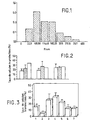
- the size of the microvesicles is measured by dynamic diffusion of the light on a 1% dispersion of the dough in water. We get a value of diameter of about 0.2 ⁇ m. This value is confirmed by microscopy electronic (cryofracture). The size measurement results are shown on the Figure 1 giving the histogram of the size distribution, observed by microscopy. More precise size control can be obtained using the process described in patent WO-A-93 19735.
- a basic dispersion of the microvesicles containing the DNA is prepared from 50 mg of paste, dispersed in 1 ml of water. This basic dispersion is then diluted in water to obtain 5 test dispersions, containing 10 ng / ml at 1 ⁇ g / ml of DNA, by variation of a factor 10. DNA-DIG solutions are prepared free of the same concentrations to serve as controls.
- the purpose of this example is to show that DNA encapsulated according to the process of the invention is able to penetrate inside cells, to be there released, and reach the nucleus.
- a plasmid DNA to a fluorescent probe, which will allow visualization of cellular incorporation by fluorescence microscopy.
- the various cell lines, human fibroblasts (primary culture), NIH 3T3 (ATCC) are maintained under conventional culture conditions (IMDM, Gibco, Life technology), containing 10% calf serum (Gibco, Life technology), 10,000 U of penicillin-streptomycin (Gibco, Life technology) at 37 ° C, in an atmosphere containing 5% CO 2 .
- IMDM calf serum
- Prco penicillin-streptomycin
- the cells are placed in the presence of a 10% dispersion of microvesicles containing DNA for 5 min, in an IMDM medium alone. After this incubation time, the cells are washed to remove the vesicle dispersions and then visualized.
- This example shows that the DNA could have been incorporated into the fibroblasts, then crossed the cytoplasm to reach the nucleus.
- the purpose of this example is to show that a gene encapsulated in multilamellar microvesicles of the invention can be incorporated into the nucleus of a cell and express themselves.
- the test selected is the use of the gene which codes for ⁇ -galactosidase, and whose expression is highlighted by the blue coloring nuclei of the transfected cells, during the reaction with the X-GAL substrate.
- the transfection efficiency is compared to that of a vector commercial, LipofectAce® (Life Technology).
- microvesicles containing the gene which codes for ⁇ -galactosidase are prepared according to the procedure of Example 1, using an aqueous solution of the gene, at 10 mg / ml.
- Three types of modified LacZ type gene were tested: pRSCLacZ, pCHLacZ and pRSVLacZ-Sal-1.
- Each gene was coencapsulated with polylysine in a concentration of 100 ⁇ M, of molecular weight either 3.5 kDa, or 10 kDa.
- composition of the microvesicles is as follows: Soy lecithin 90% phosphatidylcholine 41.5% Cholesterol (Sigma) 3.5% Potassium oleate 5% Aqueous solution of DNA and polylysine 49.5%.
- the microvesicles are dispersed in water, in order to obtain an incubation medium containing 10 ⁇ g / ml of DNA.
- the cells (human fibroblasts, primary culture) are maintained under conventional culture conditions as in Example 2.
- the medium is replaced by an IMDM medium containing 100 ⁇ M of chloroquine, and without serum.
- Incubation with microvesicles lasts from 2 to 12 hours.
- the cells are then washed and kept in culture for 48 hours in a complete medium (IMDM, serum, penicillin-streptomycin).
- the transfection is visualized by washing the cells, fixation, and addition of the X-GAL substrate (Biosynth AG). This substrate is cleaved by the enzyme corresponding to the ⁇ -galactosidase gene, giving a precipitate dark blue exclusively intracellular due to the intranuclear signal generally designated by "nls”, according to the English terminology "nuclear localization signal”.
- a DNAse test identical to that described in Example 1 can be carried out on this reporter gene, using for the "dot-blot" technique a cDNA labeled with 32 P. It is then observed that, as in the example 1, the DNA encapsulated in the microvesicles according to the invention is not destroyed by DNAse. On the other hand, the encapsulation yield observed is lower.
- the same protection test against DNAse carried out on this same gene vectorized by the commercial product does not show any protection of this type of vector, which could explain the low rate of transfection obtained for this commercial product.
- the purpose of this example is to highlight the possibility use of cationic additives to improve the effectiveness of the transfection.
- the adjuvant used is a polymer, polyethyleneimine.
- Many tests are carried out, under conditions similar to those of Example 3 (transfection of the ⁇ -galactosidase gene), but without using polylysine.
- two formulations with polylysine, but without adjuvant are prepared, one identical to that of Example 3 (lecithin, potassium oleate, cholesterol), the other identical to that of Example 1 (lecithin, laureth 4).
- three transfection experiments are performed using either a commercial vector LipofectAce® (Life Technology), i.e. non-DNA encapsulated, complexed with polyethyleneimine.
- the operating mode is strictly identical to that used in Example 3, using pRSVLacZ as the gene.
- Polyethyleneimine (mass molar 50 kDa, Sigma) is added to the aqueous DNA solution before encapsulation, at two concentrations: 10 mM and 100 ⁇ M.
- Example 3 lecithin, cholesterol, potassium oleate
- Example 1 lecithin, laureth 4
- the protocol is identical to that of Example 3.
- the transfection is performed on human fibroblasts (primary culture). In all cases, the gene concentration in the incubation medium is 10 ⁇ g / ml.
- the purpose of this example is to highlight the possibility of co-encapsulation non-cationic DNA condensing aids for improve transfection efficiency.
- the adjuvant used is a mixture of histones H1, H2a, H2b, H3, H4 of calf thymus (supplier: Boehringer).
- the DNA used is the same as that used in Example 4.
- DNA is previously condensed by simultaneous solution of equal weight of DNA and the mixture of histones H1, H2a, H2b, H3, H4 of thymus veal (50 ⁇ g of DNA with 50 ⁇ g of mixture of histones in 12 ⁇ l of water) and incubation of the mixture for 10 min at 37 ° C.
- the operating mode is strictly identical to that used in Example 3, using the mixture solution instead of the gene solution DNA / histone.
- composition by weight of the vesicles is: soy lecithin 90% phosphatidyl choline: 31.5% cholesterol 6.5% lauric alcohol ethoxylated with 4 EO 2% aqueous solution of DNA / histone mixture 60%
- DNA 1 ⁇ g of DNA was labeled with 32 P (according to the so-called random priming method) and mixed with 49 ⁇ g of unlabeled DNA (to respect the quantity of 50 ⁇ g of DNA).
- This DNA is encapsulated and the vesicles are dispersed in water.
- the suspension is ultracentrifuged at 30,000 rpm for 45 minutes. The supernatant is separated from the pellet and each is counted in a ⁇ counter to assess the radioactivity present.
- the encapsulation yield measured is always greater than 80%
- Transfection tests are performed on skin fibroblasts human according to an incubation and counting protocol identical to that described in Examples 3.
- the concentration of DNA used in the dispersion contact of the cells is 5 ⁇ g / ml.
- the percentage of transfection under these conditions varies from 20 to 30% (defined as the number of cells transfected compared to the cells incubated).
Landscapes
- Health & Medical Sciences (AREA)
- Life Sciences & Earth Sciences (AREA)
- Chemical & Material Sciences (AREA)
- General Health & Medical Sciences (AREA)
- Animal Behavior & Ethology (AREA)
- Engineering & Computer Science (AREA)
- Medicinal Chemistry (AREA)
- Genetics & Genomics (AREA)
- Pharmacology & Pharmacy (AREA)
- Public Health (AREA)
- Veterinary Medicine (AREA)
- Organic Chemistry (AREA)
- Bioinformatics & Cheminformatics (AREA)
- Epidemiology (AREA)
- Molecular Biology (AREA)
- Biotechnology (AREA)
- Dispersion Chemistry (AREA)
- Biomedical Technology (AREA)
- Nuclear Medicine, Radiotherapy & Molecular Imaging (AREA)
- General Chemical & Material Sciences (AREA)
- Chemical Kinetics & Catalysis (AREA)
- Biophysics (AREA)
- Zoology (AREA)
- Wood Science & Technology (AREA)
- General Engineering & Computer Science (AREA)
- Biochemistry (AREA)
- Physics & Mathematics (AREA)
- Plant Pathology (AREA)
- Microbiology (AREA)
- Virology (AREA)
- Communicable Diseases (AREA)
- Physical Education & Sports Medicine (AREA)
- Oncology (AREA)
- Medicines That Contain Protein Lipid Enzymes And Other Medicines (AREA)
- Pharmaceuticals Containing Other Organic And Inorganic Compounds (AREA)
- Medicinal Preparation (AREA)
- Medicines Containing Antibodies Or Antigens For Use As Internal Diagnostic Agents (AREA)
- Micro-Organisms Or Cultivation Processes Thereof (AREA)
Claims (21)
- Zusammensetzung, die mindestens eine Nucleinsäure enthält, die mindestens teilweise im Innern von multilamellaren Vesicula eingeschlossen ist, dadurch gekennzeichnet, dass die genannten Vesicula ab ihrem Zentrum bis zu ihrer Peripherie aus konzentrischen und durch ein flüssiges Medium voneinander getrennten Doppelschichten bestehen, die mindestens ein Tensid umfassen.
- Zusammensetzung nach Anspruch 1, dadurch gekennzeichnet, dass die genannten Vesicula Dimensionen von weniger als 1 µm, vorzugsweise zwischen 0,1 und 1 µm, haben.
- Zusammensetzung nach einem der Ansprüche 1 oder 2, dadurch gekennzeichnet, dass es sich bei den Tensiden, welche die genannten Doppelschichten der genannten Vesicula aufbauen, um nicht-kationische Tenside handelt.
- Zusammensetzung nach Anspruch 3, dadurch gekennzeichnet, dass die genannten nicht-kationischen Tenside ausgewählt sind aus der Gruppe, die besteht aus:hydrierten oder nicht-hydrierten Phospholipiden,linearen oder verzweigten, gesättigten oder einfach oder mehrfach ungesättigten C6-C18-Fettsäuren in Form der Säure oder in Form eines Alkalimetall-, Erdalkalimetall- oder Aminsalzes,ethoxylierte oder nicht ethoxylierte Ester der genannten Fettsäuren mitSaccharose,Sorbitan,Mannit,Glycerin oder Polyglycerin,Glycol,Mono-, Di- oder Triglyceriden oder Mischungen von Glyceriden der genannten Fettsäuren,linearen oder verzweigten, ethoxylierten oder nicht ethoxylierten, gesättigten oder einfach oder mehrfach ungesättigten C6-C18-Fettalkoholen,ethoxylierten oder nicht ethoxylierten Ethem der genannten Fettalkohole mitSaccharose,Sorbitan,Mannit,Glycerin oder Polyglycerin,Glycol,hydrierten oder nicht hydrierten polyethoxylierten Pflanzenölen,Sequenz-Polymeren von Polyoxyethylen und Polyoxypropylen (Poloxameren),Polyethylenglycol-hydroxystearat,Alkoholen mit einem Sterin-Gerüst wie Cholesterin, Sitosterin.
- Zusammensetzung nach einem der Ansprüche 1 bis 4, dadurch gekennzeichnet, dass die Doppelschichten der genannten Vesicula mindestens zwei Tenside umfassen, von denen eines ein hydrophiles-lipophiles Gleichgewicht (HLB) zwischen 1 und 6 und das andere ein hydrophiles-lipophiles Gleichgewicht (HLB) zwischen 3 und 15 aufweisen.
- Zusammensetzung nach einem der Ansprüche 1 bis 5, dadurch gekennzeichnet, dass mindestens 10 %, vorzugsweise mindestens 40 %, der genannten Nucleinsäure(n) im Innern der genannten multilamellaren Vesicula eingeschlossen sind.
- Zusammensetzung nach einem der Ansprüche 1 bis 6, dadurch gekennzeichnet, dass 60 bis 100 % der genannten Nucleinsäure(n) im Innern der genannten Vesicula eingeschlossen sind.
- Zusammensetzung nach einem der Ansprüche 1 bis 7, dadurch gekennzeichnet, dass es sich bei der genannten Nucleinsäure um die DNA oder eine Nucleotid-Sequenz der DNA handelt.
- Zusammensetzung nach einem der Ansprüche 1 bis 7, dadurch gekennzeichnet, dass es sich bei der genannten Nucleinsäure um ein spezielles Gen oder eine Sequenz des genannten Gens, insbesondere um eine für ein gegebenes Protein codierende Sequenz handelt.
- Zusammensetzung nach einem der Ansprüche 1 bis 7, dadurch gekennzeichnet, dass es sich bei der genannten Nucleinsäure um die RNA oder eine Nucleotid-Sequenz der RNA handelt.
- Zusammensetzung nach einem der Ansprüche 1 bis 7, dadurch gekennzeichnet, dass es sich bei der genannten Nucleinsäure um ein codierendes und/oder nicht-codierendes Oligonucleotid handelt.
- Zusammensetzung nach einem der Ansprüche 1 bis 11, dadurch gekennzeichnet, dass die genannten Vesicula außerdem ein kationisches Adjuvans, insbesondere ein Polyethylenimin, enthalten, das zusammen mit der genannten Nucleinsäure co-eingekapselt ist.
- Zusammensetzung nach einem der Ansprüche 1 bis 12, dadurch gekennzeichnet, dass sie mindestens ein coeingekapseltes Produkt enthält, das ausgewählt ist aus der Gruppe der DNA-Kondensationsagentien, insbesondere unter den Histonen, der Integrations- oder Rekombinations-Enzyme, der für die Optimierung der Replikation der eingekapselten Nucleinsäure bestimmten Enzyme wie der Topoisomerasen oder Helicasen.
- Zusammensetzung nach einem der Ansprüche 1 bis 13, dadurch gekennzeichnet, dass die genannten Vesicula an der Oberfläche modifiziert sind durch Zuordnung (Addition) von Molekülen, die es ihnen erlauben, von einem Target in dem Organismus spezifisch erkannt zu werden, insbesondere durch Zuordnung (Addition) von monoklonalen Antikörpern oder Fab-Fragmenten.
- Verfahren zur Herstellung einer Zusammensetzung nach einem der Ansprüche 1 bis 14, dadurch gekennzeichnet, dass es umfasst die Herstellung einer Kristall-Flüssigkeits-Lamellenphase, welche die genannte Nucleinsäure enthält, und die Umlagerung der genannten Kristall-Flüssigkeits-Phase zu multilamellaren Vesicula durch Anwendung einer Scherkraft.
- Pharmazeutische Zusammensetzung, die Vesicula, wie sie in einem der Ansprüche 1 bis 14 definiert sind, suspendiert in einem pharmazeutisch akzeptablen Vehiculum enthält.
- Pharmazeutische Zusammensetzung nach Anspruch 16, dadurch gekennzeichnet, dass es sich bei der genannten eingekapselten Nucleinsäure um ein vollständiges Gen, insbesondere ein Gen handelt, das ein defektes Gen oder ein fehlendes Gen ersetzen soll.
- Pharmazeutische Zusammensetzung nach Anspruch 16, dadurch gekennzeichnet, dass es sich bei der genannten Nucleinsäure um ein Oligonucleotid handelt, das dazu bestimmt ist, eine Überexpression oder eine Schwächung der Aktivität eines spezifischen Gens zu induzieren.
- Pharmazeutische Zusammensetzung nach Anspruch 16, dadurch gekennzeichnet, dass es sich um einen Impfstoff handelt, wobei die genannte Nucleinsäure eine DNA ist, die für ein Antigen-Protein codiert.
- Verwendung von multilamellaren Vesicula mit Zwiebel-Struktur, wie sie in einem der Ansprüche 1 bis 14 definiert sind, zur Herstellung einer pharmazeutischen Zusammensetzung zum Korrigieren oder Beseitigen einer defekten oder veränderten Zellfunktion oder zur Einführung einer neuen Funktion in eine Zelle, insbesondere auf dem Gebiet der Kanzerologie, der Virologie oder der Korrektur von Knochendefekten.
- Verfahren zur in vitro-Transformation einer Zellinie, dadurch gekennzeichnet, dass es darin besteht, dass man die genannte Zellinie mit einer Zusammensetzung nach einem der Ansprüche 1 bis 14 behandelt.
Applications Claiming Priority (3)
| Application Number | Priority Date | Filing Date | Title |
|---|---|---|---|
| FR9608844A FR2751222B1 (fr) | 1996-07-16 | 1996-07-16 | Compositions contenant au moins un acide nucleique et leurs applications dans le domaine biomedical, en particulier en therapie genique |
| FR9608844 | 1996-07-16 | ||
| PCT/FR1997/001304 WO1998002144A1 (fr) | 1996-07-16 | 1997-07-15 | Compositions contenant au moins un acide nucleique |
Publications (2)
| Publication Number | Publication Date |
|---|---|
| EP0935458A1 EP0935458A1 (de) | 1999-08-18 |
| EP0935458B1 true EP0935458B1 (de) | 2002-04-10 |
Family
ID=9494072
Family Applications (1)
| Application Number | Title | Priority Date | Filing Date |
|---|---|---|---|
| EP97933736A Expired - Lifetime EP0935458B1 (de) | 1996-07-16 | 1997-07-15 | Mindestens eine nukleinsäure enthaltende zusammensetzungen |
Country Status (9)
| Country | Link |
|---|---|
| US (1) | US6387396B2 (de) |
| EP (1) | EP0935458B1 (de) |
| JP (1) | JP2000516916A (de) |
| AU (1) | AU722479B2 (de) |
| CA (1) | CA2260284A1 (de) |
| DE (1) | DE69711907T2 (de) |
| ES (1) | ES2175439T3 (de) |
| FR (1) | FR2751222B1 (de) |
| WO (1) | WO1998002144A1 (de) |
Families Citing this family (12)
| Publication number | Priority date | Publication date | Assignee | Title |
|---|---|---|---|---|
| ES2212305T3 (es) * | 1997-06-23 | 2004-07-16 | Alza Corporation | Polinucleotidos encapsulados en liposomas, composicion y procedimiento. |
| FR2766706B1 (fr) * | 1997-07-30 | 2001-05-25 | Biovector Therapeutics Sa | Complexes particulaires stables de charge globale neutre ou negative de structure multilamellaire composes par au moins une substance biologiquement active globalement anionique et un constituant cationique, leur preparation et utilisation |
| FR2766705B1 (fr) * | 1997-07-30 | 2001-05-25 | Biovector Therapeutics | Complexe particulaire de charge globale neutre ou negative forme d'une vesicule cationique ou neutre et d'une substance biologiquement active anionique, leur preparation et leur utilisation |
| FR2769022B1 (fr) * | 1997-09-29 | 2000-11-03 | Capsulis | Vecteurs d'antigenes et compositions therapeutiques contenant des antigenes |
| FR2790975B1 (fr) * | 1999-03-16 | 2001-06-01 | Capsulis | Milieux sous forme de dispersions complexes, leur procede de preparation et leurs utilisations |
| FR2802422B1 (fr) * | 1999-12-21 | 2002-08-09 | Capsulis | Structures mixtes resultant de l'incorporation d'une macromolecule biologique, en particulier d'adn, dans une phase structuree d'amphiphiles et vesicules obtenues a partir de ces structures |
| EP1267946A4 (de) * | 2000-02-28 | 2008-07-02 | Genesegues Inc | Nanokapsel-einkapselungs-system und verfahren |
| ATE455839T1 (de) * | 2000-12-01 | 2010-02-15 | Novozymes As | Verkapselung von verbindungen in vesikeln |
| US20080063700A1 (en) * | 2004-01-23 | 2008-03-13 | Keio University | Support Accumulating In Injured Part In Vascular Channel |
| EP1867726A4 (de) * | 2005-03-24 | 2008-09-24 | Univ Hokkaido Nat Univ Corp | Zur wirksamen zuführung einer gegebenen substanz in den zellkern fähiges liposom |
| GB0605521D0 (en) * | 2006-03-18 | 2006-04-26 | Isis Innovation | Adjuvant |
| KR101601035B1 (ko) | 2013-02-28 | 2016-03-08 | 주식회사 종근당 | 키토산 및 액상결정 형성 물질을 포함하는 유전자 전달용 조성물 |
Family Cites Families (16)
| Publication number | Priority date | Publication date | Assignee | Title |
|---|---|---|---|---|
| US4394448A (en) * | 1978-02-24 | 1983-07-19 | Szoka Jr Francis C | Method of inserting DNA into living cells |
| US5169637A (en) * | 1983-03-24 | 1992-12-08 | The Liposome Company, Inc. | Stable plurilamellar vesicles |
| US5916588A (en) * | 1984-04-12 | 1999-06-29 | The Liposome Company, Inc. | Peptide-containing liposomes, immunogenic liposomes and methods of preparation and use |
| US5041278A (en) * | 1985-10-15 | 1991-08-20 | The Liposome Company, Inc. | Alpha tocopherol-based vesicles |
| US5723147A (en) * | 1987-02-23 | 1998-03-03 | Depotech Corporation | Multivesicular liposomes having a biologically active substance encapsulated therein in the presence of a hydrochloride |
| US5286634A (en) * | 1989-09-28 | 1994-02-15 | Stadler Joan K | Synergistic method for host cell transformation |
| DE4005152A1 (de) * | 1990-02-17 | 1991-08-22 | Guenter Prof Dr Kahl | Verbesserung der transformation von pflanzenzellen |
| WO1993012240A1 (en) * | 1991-12-17 | 1993-06-24 | The Regents Of The University Of California | Gene therapy for cystic fibrosis transmembrane conductance regulator activity (cftr) |
| US5593972A (en) * | 1993-01-26 | 1997-01-14 | The Wistar Institute | Genetic immunization |
| WO1995016437A1 (en) * | 1993-12-17 | 1995-06-22 | Micro-Pak, Inc. | Method of transmitting a biologically active material to a cell |
| FR2714621B1 (fr) * | 1994-01-06 | 1996-02-23 | Centre Nat Rech Scient | Procédé de préparation de liposomes sans utilisation de solvant organique. |
| US5672358A (en) * | 1994-06-21 | 1997-09-30 | Ascent Pharmaceuticals, Inc. | Controlled release aqueous emulsion |
| US5627159A (en) * | 1994-10-27 | 1997-05-06 | Life Technologies, Inc. | Enhancement of lipid cationic transfections in the presence of serum |
| US5827531A (en) * | 1994-12-02 | 1998-10-27 | The United States Of America As Represented By The Administrator Of The National Aeronautics And Space Administration | Microcapsules and methods for making |
| AU6691496A (en) * | 1995-08-01 | 1997-02-26 | Advanced Therapies, Inc. | Enhanced artificial viral envelopes for cellular delivery of therapeutic substances |
| IL115199A (en) * | 1995-09-07 | 2005-05-17 | Opperbas Holding Bv | Composition comprising a polynucleic acid molecule in a liposome and method using said composition |
-
1996
- 1996-07-16 FR FR9608844A patent/FR2751222B1/fr not_active Expired - Fee Related
-
1997
- 1997-07-15 EP EP97933736A patent/EP0935458B1/de not_active Expired - Lifetime
- 1997-07-15 JP JP10505688A patent/JP2000516916A/ja not_active Ceased
- 1997-07-15 CA CA002260284A patent/CA2260284A1/en not_active Abandoned
- 1997-07-15 US US09/147,475 patent/US6387396B2/en not_active Expired - Fee Related
- 1997-07-15 DE DE69711907T patent/DE69711907T2/de not_active Expired - Fee Related
- 1997-07-15 AU AU36982/97A patent/AU722479B2/en not_active Ceased
- 1997-07-15 WO PCT/FR1997/001304 patent/WO1998002144A1/fr not_active Ceased
- 1997-07-15 ES ES97933736T patent/ES2175439T3/es not_active Expired - Lifetime
Also Published As
| Publication number | Publication date |
|---|---|
| AU3698297A (en) | 1998-02-09 |
| AU722479B2 (en) | 2000-08-03 |
| EP0935458A1 (de) | 1999-08-18 |
| DE69711907T2 (de) | 2002-10-31 |
| ES2175439T3 (es) | 2002-11-16 |
| DE69711907D1 (de) | 2002-05-16 |
| US20020012696A1 (en) | 2002-01-31 |
| CA2260284A1 (en) | 1998-01-22 |
| US6387396B2 (en) | 2002-05-14 |
| FR2751222B1 (fr) | 1998-10-09 |
| JP2000516916A (ja) | 2000-12-19 |
| WO1998002144A1 (fr) | 1998-01-22 |
| FR2751222A1 (fr) | 1998-01-23 |
Similar Documents
| Publication | Publication Date | Title |
|---|---|---|
| EP0809705B1 (de) | Nukleinsäure enthaltende zusammensetzung, herstellung und verwendung | |
| CA2473212C (fr) | Composition pharmaceutique ameliorant le transfert de gene in vivo | |
| EP0344040B1 (de) | Insbesondere zum Tragen von biologisch aktiven Molekülen geeignetes teilchenförmiges Vektorsystem und Verfahren zu seiner Herstellung | |
| EP1513506B1 (de) | Vektorsystem enthaltend nanopartikeln gleichmässiger grösse,welche aus zumindestens einem polymer und einem positiv geladenen polysaccharid bestehen,und herstellungsverfahren dieses systems | |
| EP2890364B1 (de) | Formulierung zur verabreichung von nukleotidsequenzen zur modulierung endogener interferierender rna-mechanismen | |
| EP2925882B1 (de) | Screening-verfahren mit hohem durchsatz zur identifizierung von biomarkern, therapeutischen zielen oder therapeutischen wirkstoffen | |
| FR2766706A1 (fr) | Complexes particulaires stables de charge globale neutre ou negative de structure multilamellaire composes par au moins une substance biologiquement active globalement anionique et un constituant cationique, leur preparation et utilisation | |
| EP0935458A1 (de) | Mindestens eine nukleinsäure enthaltende mittel | |
| EP1007097B1 (de) | Formulierung von stabilisierter kationischen transfektionsmittel/nukleinsäuren partikeln | |
| CA2451874C (fr) | Oligonucleotides antisens capables d'inhiber la formation des tubes capillaires par des cellules endotheliales | |
| KR19980067138A (ko) | 유전자 또는 생물학적 활성 약물을 세포내로 효과적으로 전달하는 지방 유제 및 그것의 제조방법 | |
| EP3999520B1 (de) | Hybrider htirna-/nanopartikel-komplex und seine verwendung zur behandlung einer krankheit des verdauungssystems | |
| EP0726760A1 (de) | Selbstemulgierende formulierung zur bildung einer öl-in-wasser-emulsion | |
| FR2776927A1 (fr) | Compositions pour la vectorisation de molecules | |
| CA2275455A1 (fr) | Conjugues d'un vecteur particulaire et d'oligonucleotides, leur procede de preparation et les compositions pharmaceutiques les contenant | |
| EP0948638A1 (de) | Herstellungsmethode für das eingringen von nukleinsäure | |
| WO1998029102A1 (fr) | Vecteur particulaire homeocharge et composition pharmaceutique ou cosmetique le contenant | |
| EP0763116A1 (de) | Rekombinatie viren,ihre herstellung und ihre verwendung in der gentherapie | |
| KR20000012106A (ko) | 유전자 또는 약물을 효과적으로 전달하는 지방유제, 지질미립구 및 이들의 제조방법 | |
| FR3026009A1 (fr) | Nanocapsules lipidiques, compositions pharmaceutiques, procede de preparation, et utilisations correspondants | |
| FR2868953A1 (fr) | Composition pour le transfert intracellulaire d'un acide nucleique. | |
| FR2766705A1 (fr) | Complexe particulaire de charge globale neutre ou negative forme d'une vesicule cationique ou neutre et d'une substance biologiquement active anionique, leur preparation et leur utilisation |
Legal Events
| Date | Code | Title | Description |
|---|---|---|---|
| PUAI | Public reference made under article 153(3) epc to a published international application that has entered the european phase |
Free format text: ORIGINAL CODE: 0009012 |
|
| 17P | Request for examination filed |
Effective date: 19990118 |
|
| AK | Designated contracting states |
Kind code of ref document: A1 Designated state(s): BE DE ES FR GB IT |
|
| 17Q | First examination report despatched |
Effective date: 19991005 |
|
| GRAG | Despatch of communication of intention to grant |
Free format text: ORIGINAL CODE: EPIDOS AGRA |
|
| GRAG | Despatch of communication of intention to grant |
Free format text: ORIGINAL CODE: EPIDOS AGRA |
|
| GRAG | Despatch of communication of intention to grant |
Free format text: ORIGINAL CODE: EPIDOS AGRA |
|
| GRAH | Despatch of communication of intention to grant a patent |
Free format text: ORIGINAL CODE: EPIDOS IGRA |
|
| GRAH | Despatch of communication of intention to grant a patent |
Free format text: ORIGINAL CODE: EPIDOS IGRA |
|
| REG | Reference to a national code |
Ref country code: GB Ref legal event code: IF02 |
|
| GRAA | (expected) grant |
Free format text: ORIGINAL CODE: 0009210 |
|
| AK | Designated contracting states |
Kind code of ref document: B1 Designated state(s): BE DE ES FR GB IT |
|
| REF | Corresponds to: |
Ref document number: 69711907 Country of ref document: DE Date of ref document: 20020516 |
|
| GBT | Gb: translation of ep patent filed (gb section 77(6)(a)/1977) |
Effective date: 20020704 |
|
| REG | Reference to a national code |
Ref country code: ES Ref legal event code: FG2A Ref document number: 2175439 Country of ref document: ES Kind code of ref document: T3 |
|
| PLBE | No opposition filed within time limit |
Free format text: ORIGINAL CODE: 0009261 |
|
| STAA | Information on the status of an ep patent application or granted ep patent |
Free format text: STATUS: NO OPPOSITION FILED WITHIN TIME LIMIT |
|
| 26N | No opposition filed |
Effective date: 20030113 |
|
| PGFP | Annual fee paid to national office [announced via postgrant information from national office to epo] |
Ref country code: ES Payment date: 20080718 Year of fee payment: 12 Ref country code: DE Payment date: 20080730 Year of fee payment: 12 |
|
| PGFP | Annual fee paid to national office [announced via postgrant information from national office to epo] |
Ref country code: IT Payment date: 20080717 Year of fee payment: 12 Ref country code: FR Payment date: 20080730 Year of fee payment: 12 |
|
| PGFP | Annual fee paid to national office [announced via postgrant information from national office to epo] |
Ref country code: GB Payment date: 20080630 Year of fee payment: 12 |
|
| PGFP | Annual fee paid to national office [announced via postgrant information from national office to epo] |
Ref country code: BE Payment date: 20080722 Year of fee payment: 12 |
|
| BERE | Be: lapsed |
Owner name: *CAPSULIS Effective date: 20090731 |
|
| GBPC | Gb: european patent ceased through non-payment of renewal fee |
Effective date: 20090715 |
|
| REG | Reference to a national code |
Ref country code: FR Ref legal event code: ST Effective date: 20100331 |
|
| PG25 | Lapsed in a contracting state [announced via postgrant information from national office to epo] |
Ref country code: FR Free format text: LAPSE BECAUSE OF NON-PAYMENT OF DUE FEES Effective date: 20090731 |
|
| PG25 | Lapsed in a contracting state [announced via postgrant information from national office to epo] |
Ref country code: GB Free format text: LAPSE BECAUSE OF NON-PAYMENT OF DUE FEES Effective date: 20090715 |
|
| PG25 | Lapsed in a contracting state [announced via postgrant information from national office to epo] |
Ref country code: DE Free format text: LAPSE BECAUSE OF NON-PAYMENT OF DUE FEES Effective date: 20100202 Ref country code: BE Free format text: LAPSE BECAUSE OF NON-PAYMENT OF DUE FEES Effective date: 20090731 |
|
| REG | Reference to a national code |
Ref country code: ES Ref legal event code: FD2A Effective date: 20090716 |
|
| PG25 | Lapsed in a contracting state [announced via postgrant information from national office to epo] |
Ref country code: ES Free format text: LAPSE BECAUSE OF NON-PAYMENT OF DUE FEES Effective date: 20090716 |
|
| PG25 | Lapsed in a contracting state [announced via postgrant information from national office to epo] |
Ref country code: IT Free format text: LAPSE BECAUSE OF NON-PAYMENT OF DUE FEES Effective date: 20090715 |