EP0932212A1 - Nonaqueous electrolyte secondary battery - Google Patents
Nonaqueous electrolyte secondary battery Download PDFInfo
- Publication number
- EP0932212A1 EP0932212A1 EP98936743A EP98936743A EP0932212A1 EP 0932212 A1 EP0932212 A1 EP 0932212A1 EP 98936743 A EP98936743 A EP 98936743A EP 98936743 A EP98936743 A EP 98936743A EP 0932212 A1 EP0932212 A1 EP 0932212A1
- Authority
- EP
- European Patent Office
- Prior art keywords
- nonaqueous electrolyte
- secondary battery
- electrolyte secondary
- binder
- negative electrode
- Prior art date
- Legal status (The legal status is an assumption and is not a legal conclusion. Google has not performed a legal analysis and makes no representation as to the accuracy of the status listed.)
- Withdrawn
Links
Images

Classifications
-
- H—ELECTRICITY
- H01—ELECTRIC ELEMENTS
- H01M—PROCESSES OR MEANS, e.g. BATTERIES, FOR THE DIRECT CONVERSION OF CHEMICAL ENERGY INTO ELECTRICAL ENERGY
- H01M4/00—Electrodes
- H01M4/02—Electrodes composed of, or comprising, active material
- H01M4/62—Selection of inactive substances as ingredients for active masses, e.g. binders, fillers
- H01M4/621—Binders
- H01M4/622—Binders being polymers
-
- H—ELECTRICITY
- H01—ELECTRIC ELEMENTS
- H01M—PROCESSES OR MEANS, e.g. BATTERIES, FOR THE DIRECT CONVERSION OF CHEMICAL ENERGY INTO ELECTRICAL ENERGY
- H01M4/00—Electrodes
- H01M4/02—Electrodes composed of, or comprising, active material
- H01M4/62—Selection of inactive substances as ingredients for active masses, e.g. binders, fillers
-
- H—ELECTRICITY
- H01—ELECTRIC ELEMENTS
- H01M—PROCESSES OR MEANS, e.g. BATTERIES, FOR THE DIRECT CONVERSION OF CHEMICAL ENERGY INTO ELECTRICAL ENERGY
- H01M4/00—Electrodes
- H01M4/02—Electrodes composed of, or comprising, active material
- H01M4/62—Selection of inactive substances as ingredients for active masses, e.g. binders, fillers
- H01M4/621—Binders
-
- H—ELECTRICITY
- H01—ELECTRIC ELEMENTS
- H01M—PROCESSES OR MEANS, e.g. BATTERIES, FOR THE DIRECT CONVERSION OF CHEMICAL ENERGY INTO ELECTRICAL ENERGY
- H01M4/00—Electrodes
- H01M4/02—Electrodes composed of, or comprising, active material
- H01M4/62—Selection of inactive substances as ingredients for active masses, e.g. binders, fillers
- H01M4/621—Binders
- H01M4/622—Binders being polymers
- H01M4/623—Binders being polymers fluorinated polymers
-
- H—ELECTRICITY
- H01—ELECTRIC ELEMENTS
- H01M—PROCESSES OR MEANS, e.g. BATTERIES, FOR THE DIRECT CONVERSION OF CHEMICAL ENERGY INTO ELECTRICAL ENERGY
- H01M10/00—Secondary cells; Manufacture thereof
- H01M10/05—Accumulators with non-aqueous electrolyte
- H01M10/052—Li-accumulators
- H01M10/0525—Rocking-chair batteries, i.e. batteries with lithium insertion or intercalation in both electrodes; Lithium-ion batteries
-
- H—ELECTRICITY
- H01—ELECTRIC ELEMENTS
- H01M—PROCESSES OR MEANS, e.g. BATTERIES, FOR THE DIRECT CONVERSION OF CHEMICAL ENERGY INTO ELECTRICAL ENERGY
- H01M4/00—Electrodes
- H01M4/02—Electrodes composed of, or comprising, active material
- H01M4/36—Selection of substances as active materials, active masses, active liquids
- H01M4/58—Selection of substances as active materials, active masses, active liquids of inorganic compounds other than oxides or hydroxides, e.g. sulfides, selenides, tellurides, halogenides or LiCoFy; of polyanionic structures, e.g. phosphates, silicates or borates
- H01M4/583—Carbonaceous material, e.g. graphite-intercalation compounds or CFx
- H01M4/587—Carbonaceous material, e.g. graphite-intercalation compounds or CFx for inserting or intercalating light metals
-
- Y—GENERAL TAGGING OF NEW TECHNOLOGICAL DEVELOPMENTS; GENERAL TAGGING OF CROSS-SECTIONAL TECHNOLOGIES SPANNING OVER SEVERAL SECTIONS OF THE IPC; TECHNICAL SUBJECTS COVERED BY FORMER USPC CROSS-REFERENCE ART COLLECTIONS [XRACs] AND DIGESTS
- Y02—TECHNOLOGIES OR APPLICATIONS FOR MITIGATION OR ADAPTATION AGAINST CLIMATE CHANGE
- Y02E—REDUCTION OF GREENHOUSE GAS [GHG] EMISSIONS, RELATED TO ENERGY GENERATION, TRANSMISSION OR DISTRIBUTION
- Y02E60/00—Enabling technologies; Technologies with a potential or indirect contribution to GHG emissions mitigation
- Y02E60/10—Energy storage using batteries
Definitions
- the present invention relates to a nonaqueous electrolyte secondary battery having a large capacity and a low self-discharge ratio.
- secondary batteries In recent years, wide use of portable apparatuses, such as video cameras, raises a need for secondary batteries to be employed in place of primary batteries which are disposable batteries because the secondary batteries can repetitively be used.
- a major portion of secondary batteries available at present are nickel-cadmium batteries each containing an alkali electrolyte.
- the foregoing batteries each having a voltage of about 1.2 V, however, encounter a difficulty in raising the energy density. Moreover, there arises a problem of an excessively high self-discharge ratio of 20 % or higher per month.
- a nonaqueous electrolyte secondary battery which contain a nonaqueous solvent to serve as the electrolyte and a fight metal, such as lithium, to serve as the negative electrode. Since a high voltage of 3 V or higher can be realized, the foregoing battery has a high energy density and a low self-discharge ratio.
- the above-mentioned secondary battery encounters undesirable contact of metal lithium or the like employed to form the negative electrode with the positive electrode because the metal lithium or the like is grown to a dendrite form owning to repetitive charging and discharging. As a result, short circuit takes place in the inside portion of the battery and the lifetime of the battery is too short to be put to practical use.
- a nonaqueous electrolyte secondary battery has been investigated in which lithium or the like is alloyed with another metal to use the obtained alloy as the negative electrode of the battery. Also in the foregoing case, the alloy is formed into very fine particles and, therefore, a problem arises in that the lifetime is shortened.
- a nonaqueous electrolyte secondary battery has been disclosed in, for example, Japanese Patent Laid-Open No. 62-90863.
- a carbonaceous material such as cokes, is employed as an active material for the negative electrode. Since the foregoing secondary battery is free from the above-mentioned problems of the negative electrode, an excellent lifetime characteristic against cycle operation can be realized.
- Japanese Patent Laid-Open No. Japanese Patent Laid-Open No.
- Li x MO 2 (where M is one or more types of transition metals and x is not less than 0.05 nor more than 1.10) enables a nonaqueous electrolyte secondary battery having an elongated lifetime and a high energy density to be obtained.
- nonaqueous electrolyte secondary battery containing carbon material to serves as the active material for the negative electrode having the high energy density encounters rapid rise in the temperature if an external short circuit takes place in a charged state. Therefore, adverse influences are sometimes exerted on the adjacent electric elements.
- the nonaqueous electrolyte secondary battery which contains the carbonaceous material to serve as the active material for the negative electrode, exhibits a long cycle lifetime and excellent safety as compared with batteries of a type containing metal lithium or the like. However, an improvement in the cycle characteristic even under a heavy load has been required.
- a nonaqueous electrolyte secondary battery according to the present invention comprises a binder for powder in a negative electrode, wherein the binder for powder in the negative electrode is a mix of fluorine polymer and aromatic vinyl-conjugate diene polymer.
- the nonaqueous electrolyte secondary battery according to the present invention comprises the binder which is the mix of the fluorine polymer and the aromatic vinyl-conjugate diene polymer. Therefore, a capacity required as the battery can be maintained. Moreover, rise in the temperature occurring when an external short circuit takes place can be prevented.
- the binder for powder contains cellulose derivative to serve as a viscosity bodying agent so that prevention of rise in the temperature occurring when external short circuit takes place and improvement in the cycle characteristic even under a heavy load are realized.
- a nonaqueous electrolyte secondary battery according to the present invention incorporates a negative electrode, a positive electrode and a nonaqueous electrolyte.
- the negative electrode is composed of an active material for the negative electrode, a binder and a collector.
- a carbonaceous material for preparing the active material for the negative electrode is not limited particularly.
- a material such as petroleum pitch, polymer resin or green cokes, containing resin components is a suitable material.
- any one of the following materials may be employed: graphite which has completely been carbonized, pyrolytic carbon, cokes (coal cokes, pitch cokes or petroleum cokes), carbon black (acetylene black or the like), vitreous carbon, a calcinated organic polymer material (which is obtained by calcinating an organic polymer material at appropriate temperatures not lower than 500°C in an inactive gas flow or in a vacuum), pitch containing carbon fiber and the foregoing resin and resin which can easily be sintered, for example, furan rein, divinyl benzene, polyvinylidene fluoride or vinylidene chloride and with which a mix is prepared, followed by calcinating the mix.
- the present invention is characterized in that the binder in the negative electrode is a mix of fluorine polymers and aromatic vinyl-conjugate diene polymer.
- the binder When the mix of the fluorine polymer and the aromatic vinyl-conjugate diene polymer is employed as the binder, a capacity required for the battery can be maintained. Moreover, rise in the temperatures of the battery occurring when external short circuit takes place can be prevented. The excellent adhesiveness of the aromatic vinyl-conjugate diene polymer contributes to prevention of the rise in the temperature. When the aromatic vinyl-conjugate diene polymer is mixed with the fluorine polymer, a required capacity is maintained.
- fluorine polymers may be employed: polytetrafluoroethylene, fluorine rubber, tetrafluoroethylene propylene rubber, silicon fluoride rubber, ethylene tetrafluoroperfluoroalkylvinyl ether resin (PFA), ethylene tetrafluoroethylene copolymer resin (ETFE), polychlorotrifluoroethylene (PCTFE) and tetrafluoroethylene hexafluoropropylene copolymer (FEP).
- PFA ethylene tetrafluoroperfluoroalkylvinyl ether resin
- ETFE ethylene tetrafluoroethylene copolymer resin
- PCTFE polychlorotrifluoroethylene
- FEP tetrafluoroethylene hexafluoropropylene copolymer
- the aromatic vinyl-conjugate diene polymer may be styrene-butadiene latex or the like.
- the weight mixture ratio of the fluorine polymer and the aromatic vinyl-conjugate diene polymer is set such that fluorine polymer is not less than one time nor more than 99 times the aromatic vinyl-conjugate diene polymer.
- the fluorine polymer cannot solely prevent rise in the temperature occurring when short circuit takes place.
- use of only the aromatic vinyl-conjugate diene polymer results in reduction in the capacity of the battery.
- the ratio of the binder for powder with respect to the negative electrode is not less than 2 wt% nor more than 15 wt%. If the content of the binder does not satisfy the foregoing range, the capacity of the battery is undesirably reduced.
- the binder for powder contains a cellulose derivative which serves as a viscosity bodying agent.
- the cellulose derivative is expressed by the following chemical formula and classified into various types depending on the substitutional group R.
- R is one or more groups selected from H, CH 2 COONa, CH 2 COOLi, CH 2 CH 2 OH [CH 2 CH (CH 3 ) 2 O] m H (m is an integer not smaller than 1) and CH 2 COOH and n is 10 to 10,000.
- the cellulose derivative may be any one of the following materials: methyl cellulose, ethyl cellulose, carboxymethyl cellulose (R in the foregoing formula is CH 2 COONa or CH 2 COOLi), carboxymethylethyl cellulose and hydroxyethyl cellulose (R in the foregoing formula is CH 2 CH 2 OH) and hydroxypropyl cellulose (R in the foregoing formula is [CH 2 CH (CH 3 ) 2 O] m H).
- the cellulose derivative serving as the viscosity bodying agent When the cellulose derivative serving as the viscosity bodying agent is contained in the binder, rise in the temperature of the battery occurring when external short circuit takes place can be prevented. Moreover, the cycle characteristic even under a heavy load can be improved It can be considered that the reason for this lies in a fact that a high liquid retention characteristic of the cellulose derivative contributes to the foregoing effect.
- the ratio of the cellulose derivative with respect to the total weight of the negative electrode is not less than 0.1 wt% nor more than 5 wt%. If the content of the cellulose derivative is lower than 0.1 wt%, a satisfactory effect of improving the cycle characteristic under a heavy load cannot be obtained. If the content of the cellulose derivative is higher than 5 wt%, the quantity of the active material is undesirably and correspondingly reduced.
- the positive electrode has an active material which contains lithium composite oxide Li x MO 2 (where M is one or more types of transition metals, preferably any one of Co, Ni and Fe and x satisfies a range 0.005 ⁇ x ⁇ 1.10).
- the active material is exemplified by a lithium composite oxide expressed by LiCoO 2 , LiNiO 2 or LiNi y Co (1-y) O 2 (where 0.05 ⁇ x ⁇ 1.10 and 0 ⁇ y ⁇ 1).
- LiMn 2 O 4 may be employed.
- the lithium composite oxide can be obtained by mixing a carbonate, such as lithium, cobalt or nickel, in accordance with the composition, and then the mix is calcinated at temperatures in a range from 600°C to 1000°C. Note that the starting material is not limited to the carbonate. The synthesis from hydride or oxide is permitted.
- the nonaqueous electrolyte may be an arbitrary material, such as a nonaqueous electrolyte obtained by dissolving an electrolyte in solvent, a material obtained by gelatinizing the foregoing nonaqueous electrolyte (a gel electrolyte) or a material obtained by swelling a polymer material with the foregoing nonaqueous electrolyte (a solid electrolyte).
- a nonaqueous electrolyte obtained by dissolving an electrolyte in solvent a material obtained by gelatinizing the foregoing nonaqueous electrolyte (a gel electrolyte) or a material obtained by swelling a polymer material with the foregoing nonaqueous electrolyte (a solid electrolyte).
- the nonaqueous electrolyte may be a conventional nonaqueous electrolyte of a type obtained by dissolving an electrolyte in organic solvent. Therefore, the organic solvent is exemplified by ester, such as propylene carbonate, ethylene carbonate or ⁇ -butyl lactone; ether such as diethylether, tetrahydrofuran, substitution tetrahydrofuran, dioxolane, pyran, its derivative, dimethoxyethane or diethoxyethane; 3-substitution-2-oxazolidinone, such as 3-methyl-2-oxazolidione; methylsulfolane; acetonitrile; and propionitrile.
- ester such as propylene carbonate, ethylene carbonate or ⁇ -butyl lactone
- ether such as diethylether, tetrahydrofuran, substitution tetrahydrofuran, dioxolane, pyran, its derivative, dimethoxye
- the electrolyte may be lithium perchlorate, lithium borofluoride, lithium phosphoflouoride, lithium chloroaluminate, halogenated lithium, trifluoromethane sulfonate or the like.
- a known gelatinizing material or polymer material may be employed.
- any one of the following materials may be employed: polyvinylidene fluoride, copolymer of vinylidene fluoride and hexafluoropropylene, polyamide, aromatic polyamide, polyolefine, polyester, polycarbonate, polyimide, poly (meta) acrylate, polyacrylonitrile and the like.
- the polyacrylonitrile polymer (abbreviated as PAN type polymer) having a CN group at the side chain thereof has a high dielectric constant. Therefore, a solid polymer electrolyte having a high ion conductivity can be formed.
- Acrylonitrile is able to copolymerize with another monomer.
- a copolymer with perfluoromethacrylate, various (meta) acrylate, acrylamide, acrylic acid or methacrylic acid may be employed.
- it is preferable that a copolymer of (meta) acrylate and a monomer having ethylene oxide at the side chain thereof or a propylene oxide chain is employed.
- a positive electrode 2 was manufactured as follows.
- a compound for the positive electrode was prepared such that 0.5 mole of lithium carbonate and 1 mole of cobalt carbonate were mixed with each other, and then the mixture was calcinated in air at 900°C for 5 hours. Thus, LiCoO 2 was obtained. Then, LiCoO 2 was pulverized so that powder having an average particle size of 10 ⁇ m was obtained. Then, LiCoO 2 was used as an active material for the positive electrode such that 91 wt% of LiCoO 2 , 6 wt% of graphite serving as a conductive material and 3 wt% of polyvinylidene fluoride serving as a binder for the positive electrode were mixed.
- a mix for the positive electrode was prepared, and then the mix was dispersed in N-methyl-2-pyrolidone so as to be slurried. Obtained slurry was applied to aluminum which was a collector for the positive electrode and which had a thickness of 20 ⁇ m. Then, the slurry was dried, and then a compression molding operation using a roller pressing machine was performed. Thus, an elongated electrode was manufactured.
- a negative electrode 1 was manufactured as follows.
- a starting material for the active material for the negative electrode was petroleum pitch. Functional groups each containing oxygen was introduced (so-called oxygen crosslinking) by 10 % to 20 %. Then, calcination in an inactive gas was performed at 1000°C so that a non-graphitizing carbon material was obtained which had a characteristic similar to that of a vitreous carbon material. Then, 90 wt% of the obtained carbon material and 10 wt% of polyvinylidene fluoride serving as the binder for the negative electrode were mixed with each other so that a mix for the negative electrode was prepared. Then, the mix was dispersed in N-methyl-2-pyrolidone so as to be slurried. Obtained paste was applied to two sides of copper foil having a thickness of 10 ⁇ m, and then paste was dried and compression-molded by a roller pressing machine. Thus, an elongated electrode was manufactured.
- the thus-obtained negative electrode 1 and positive electrode 2 were sequentially laminated such that a separator 3 in the form of a fine-porous polypropylene film having a thickness of 25 ⁇ m was interposed. Then, the laminate was wound many times around a center pin 14 so that an electrode element was manufactured.
- the thus-manufactured electrode element was accommodated in a battery can 5. Moreover, an insulating plate 4 was placed on each of the upper and lower electrode element. A positive-electrode lead 13 applied with an insulating tape was drawn out from a positive-pole collector 11 so as to be welded to a safety valve unit 8 conducted with a battery cover 7. Also a negative-electrode lead 12 was drawn out from a negative-electrode collector 10 so as to be welded to the battery can 5.
- SBR type latex styrene butadiene latex
- the battery (Sample 1) containing the binder composed of only polyvinylidene fluoride had a large initial capacity of 1353 mAh. However, the highest temperature at the short circuit was 95°C which was an excessively high temperature.
- the batteries (Sample 3 and Samples 9 to 11) in which the binder was contained by 2 wt% to 15 wt% with respect to the negative electrode when the mixture ratio of polyvinylidene fluoride and SBR type latex was 5.0:5.0 had large initial capacities of 1244 mAh to 1349 mAh. Moreover, low highest temperatures of 58°C to 69°C at short circuit were realized as the structure of the binder. On the other hand, the battery (Sample 8) containing the binder by 1 wt% had a low highest temperature of 40°C at short circuit. However, the initial capacity was 673 mAh was too small.
- the battery (Sample 12) containing the binder composed of fluorine rubber and SBR type latex (at a mixture ratio: 5.0:5.0) had a large initial capacity of 1296 mAh. Moreover, a low highest temperature at short circuit of 65°C was realized. Therefore, the foregoing structure was suitable for the binder.
- the battery (Samples 13 to 16) containing the viscosity bodying agent was carboxymethyl cellulose added by 0.1 wt% to 5 wt% had large initial capacities of 1303 mAh to 1350 mAh. As compared with the battery (Sample 3) to which carboxymethyl cellulose was not added, large capacity retention ratios of 85 % to 88 % were realized. Thus, the cycle characteristic under a heavy load was improved. On the other hand, the battery (Sample 17) containing the viscosity bodying agent which was carboxymethylcellulose by 10 wt% encountered reduction in the active material correspondingly. Therefore, a too small initial capacity of 1227 mAh was realized.
- the battery (Sample 18) containing the viscosity bodying agent which was hydroxyethyl cellulose added by 1.0 wt% had a large initial capacity of 1336 mAh and a high capacity retention ratio of 88 %. Therefore, the cycle characteristic under a heavy load was improved.
- the structure according to the present invention is able to prevent rise in the temperature occurring when short circuit takes place while a satisfactorily large capacity is being maintained.
- the reason for this can be considered that the excellent adhesiveness of SBR type latex contributes to prevention of the rise in the temperature.
- mixture with polyvinylidene fluoride enables a large capacity to be maintained.
- cellulose derivative such as carboxymethyl cellulose or hydroxyethyl cellulose, serving as the viscosity bodying agent is added to the binder, the cycle characteristic under a heavy load can be improved. The reason for this is considered that the satisfactory liquid retention characteristic of the cellulose derivative contributes to the improvement.
- the active material for the negative electrode was artificial graphite obtained by processing pitch cokes at a temperature of 2800°C.
- the obtained artificial graphite was in the form of particles having an average particle size of 30 ⁇ m, Lc of 85 and d002 of 3.336 ⁇ .
- Obtained slurry was applied to the two sides of rolled copper foil serving as a collector for the negative electrode and having a thickness of 10 ⁇ m. Then, the slurry was dried, and then a compression molding operation using a roller pressing machine was performed. Thus, an elongated electrode was manufactured.
- the thus-manufactured elongated electrode was employed. Moreover, a mix was obtained by dissolving, at a ratio of 1.5 moles/liter, LiPF 6 in solvent obtained by mixing ethylene carbonate, propylene carbonate, diethyl carbonate and dimethyl carbonate at ratios 2:1:2:5. The mix was employed as the electrolyte. The other operations similar to those for manufacturing Sample 1 were performed so that a battery having a diameter of 18 mm and a height of 65 mm was manufactured.
- the viscosity bodying agent was hydroxypropyl cellulose.
- a process similar to that for manufacturing Sample 19 was
- the viscosity bodying agent was electrolytic copper foil.
- a process similar to that for manufacturing Sample 19 was performed to manufacture a battery except for the collector for the negative electrode which was electrolytic copper foil which had the same thickness as that of rolled copper foil and which was employed in place of the rolled copper foil.
- the positive electrode was a nickel material.
- the nickel type positive electrode was manufactured as follows.
- a compound for the positive electrode was obtained such that 1 mole of lithium hydroxide, 0.8 mole of nickel hydroxide and 0.2 mole of cobalt hydroxide were mixed, followed by calcinating the mix at 800°C for 5 hours in an oxygen atmosphere. Thus, LiNi 0.8 Co 0.2 O 2 was obtained.
- LiNi 0.8 Co 0.2 O 2 was pulverized by a bowl mill so that powder having an average particle size of 10 ⁇ m was obtained.
- the negative electrode was manufactured similar to Sample 19 so that a battery similar to that according to Sample 19 was manufactured.
- a material was obtained by adding another type resin component to SBR type latex.
- the other operations were similar to that for manufacturing Sample 19 so that a battery was manufactured.
- Samples 19 to 23 according to the examples of the present invention had excellent charging/discharging efficiency and cycle characteristic.
- the reason why the cycle characteristic was improved as compared with Sample 24 in which CMC was not added lies in that addition of fibrous molecules, such as CMC, caused SBR and CMC to be mixed and adhesion to be performed without deterioration in the reactiveness of the surfaces of the carbon portions.
- cylindrical nonaqueous electrolyte secondary batteries were manufactured in the foregoing examples of the present invention, similar effects can be obtained when the present invention is applied to batteries having another shape, for example, a rectangular shape, a laminate shape or a card shape.
- teflon or the like may be employed as the fluorine binder.
Landscapes
- Chemical & Material Sciences (AREA)
- Chemical Kinetics & Catalysis (AREA)
- Electrochemistry (AREA)
- General Chemical & Material Sciences (AREA)
- Battery Electrode And Active Subsutance (AREA)
- Secondary Cells (AREA)
- Compositions Of Macromolecular Compounds (AREA)
Abstract
A nonaqueous electrolyte secondary battery is manufactured
which contains a binder for powder in a negative electrode thereof,
the binder being a mix of fluorine polymer and aromatic vinyl-conjugate
diene polymer. The weight mixture ratio of fluorine
polymer and the aromatic vinyl-conjugate diene polymer is such that
fluorine polymer is not less than one time nor more than 99 times the
aromatic vinyl-conjugate diene polymer. The ratio of binder for
powder with respect to the negative electrode is not less than 2 wt%
nor more than 15 wt%. It is preferable that the binder for powder
contains cellulose derivative as a viscosity bodying agent.
Description
The present invention relates to a nonaqueous electrolyte
secondary battery having a large capacity and a low self-discharge
ratio.
In recent years, wide use of portable apparatuses, such as video
cameras, raises a need for secondary batteries to be employed in
place of primary batteries which are disposable batteries because the
secondary batteries can repetitively be used. A major portion of
secondary batteries available at present are nickel-cadmium batteries
each containing an alkali electrolyte. The foregoing batteries each
having a voltage of about 1.2 V, however, encounter a difficulty in
raising the energy density. Moreover, there arises a problem of an
excessively high self-discharge ratio of 20 % or higher per month.
Therefore, a nonaqueous electrolyte secondary battery has been
investigated which contain a nonaqueous solvent to serve as the
electrolyte and a fight metal, such as lithium, to serve as the negative
electrode. Since a high voltage of 3 V or higher can be realized, the
foregoing battery has a high energy density and a low self-discharge
ratio. However, the above-mentioned secondary battery encounters
undesirable contact of metal lithium or the like employed to form the
negative electrode with the positive electrode because the metal
lithium or the like is grown to a dendrite form owning to repetitive
charging and discharging. As a result, short circuit takes place in the
inside portion of the battery and the lifetime of the battery is too short
to be put to practical use.
Therefore, a nonaqueous electrolyte secondary battery has been
investigated in which lithium or the like is alloyed with another metal
to use the obtained alloy as the negative electrode of the battery.
Also in the foregoing case, the alloy is formed into very fine particles
and, therefore, a problem arises in that the lifetime is shortened.
To overcome the above-mentioned problems, a nonaqueous
electrolyte secondary battery has been disclosed in, for example,
Japanese Patent Laid-Open No. 62-90863. In the foregoing battery, a
carbonaceous material, such as cokes, is employed as an active
material for the negative electrode. Since the foregoing secondary
battery is free from the above-mentioned problems of the negative
electrode, an excellent lifetime characteristic against cycle operation
can be realized. As suggested by the inventors of the present
invention in Japanese Patent Laid-Open No. 63-135099, use of
LixMO2 (where M is one or more types of transition metals and x is
not less than 0.05 nor more than 1.10) enables a nonaqueous
electrolyte secondary battery having an elongated lifetime and a high
energy density to be obtained.
However, also the above-mentioned nonaqueous electrolyte
secondary battery containing carbon material to serves as the active
material for the negative electrode having the high energy density
encounters rapid rise in the temperature if an external short circuit
takes place in a charged state. Therefore, adverse influences are
sometimes exerted on the adjacent electric elements.
The nonaqueous electrolyte secondary battery, which contains
the carbonaceous material to serve as the active material for the
negative electrode, exhibits a long cycle lifetime and excellent safety
as compared with batteries of a type containing metal lithium or the
like. However, an improvement in the cycle characteristic even under
a heavy load has been required.
An object of the present invention is to provide a nonaqueous
electrolyte secondary battery which is capable of preventing
excessive rise in the temperature even if an unintentional external
short circuit occurs. Another object of the present invention is to
provide a nonaqueous electrolyte secondary battery having an
excellent cycle characteristic even under a heavy load.
As a result of energetic investigations performed by the
inventors of the present invention, a fact has been found that rise in
the temperature occurring when external short circuit takes place can
be prevented when a mix of fluorine polymers and aromatic vinyl-conjugate
diene polymers is employed in an electrode incorporating a
carbonaceous material, a collector and a binder.
That is, a nonaqueous electrolyte secondary battery according
to the present invention comprises a binder for powder in a negative
electrode, wherein the binder for powder in the negative electrode is
a mix of fluorine polymer and aromatic vinyl-conjugate diene polymer.
The nonaqueous electrolyte secondary battery according to the
present invention comprises the binder which is the mix of the fluorine
polymer and the aromatic vinyl-conjugate diene polymer. Therefore,
a capacity required as the battery can be maintained. Moreover, rise
in the temperature occurring when an external short circuit takes
place can be prevented.
Moreover, the binder for powder contains cellulose derivative to
serve as a viscosity bodying agent so that prevention of rise in the
temperature occurring when external short circuit takes place and
improvement in the cycle characteristic even under a heavy load are
realized.
A nonaqueous electrolyte secondary battery according to the
present invention incorporates a negative electrode, a positive
electrode and a nonaqueous electrolyte.
The negative electrode is composed of an active material for the
negative electrode, a binder and a collector.
A carbonaceous material for preparing the active material for
the negative electrode is not limited particularly. A material, such as
petroleum pitch, polymer resin or green cokes, containing resin
components is a suitable material. Moreover, any one of the following
materials may be employed: graphite which has completely been
carbonized, pyrolytic carbon, cokes (coal cokes, pitch cokes or
petroleum cokes), carbon black (acetylene black or the like), vitreous
carbon, a calcinated organic polymer material (which is obtained by
calcinating an organic polymer material at appropriate temperatures
not lower than 500°C in an inactive gas flow or in a vacuum), pitch
containing carbon fiber and the foregoing resin and resin which can
easily be sintered, for example, furan rein, divinyl benzene,
polyvinylidene fluoride or vinylidene chloride and with which a mix is
prepared, followed by calcinating the mix.
The present invention is characterized in that the binder in the
negative electrode is a mix of fluorine polymers and aromatic vinyl-conjugate
diene polymer.
When the mix of the fluorine polymer and the aromatic vinyl-conjugate
diene polymer is employed as the binder, a capacity
required for the battery can be maintained. Moreover, rise in the
temperatures of the battery occurring when external short circuit
takes place can be prevented. The excellent adhesiveness of the
aromatic vinyl-conjugate diene polymer contributes to prevention of
the rise in the temperature. When the aromatic vinyl-conjugate diene
polymer is mixed with the fluorine polymer, a required capacity is
maintained.
For example, one or more types of the following fluorine
polymers may be employed: polytetrafluoroethylene, fluorine rubber,
tetrafluoroethylene propylene rubber, silicon fluoride rubber, ethylene
tetrafluoroperfluoroalkylvinyl ether resin (PFA), ethylene
tetrafluoroethylene copolymer resin (ETFE),
polychlorotrifluoroethylene (PCTFE) and tetrafluoroethylene
hexafluoropropylene copolymer (FEP). The aromatic vinyl-conjugate
diene polymer may be styrene-butadiene latex or the like. In addition
to usual materials, a material having a hydrogenated terminal, a
material having an end modified with a carboxyl group or the like may
be employed to obtain a similar effect.
It is preferable that the weight mixture ratio of the fluorine
polymer and the aromatic vinyl-conjugate diene polymer is set such
that fluorine polymer is not less than one time nor more than 99 times
the aromatic vinyl-conjugate diene polymer. The fluorine polymer
cannot solely prevent rise in the temperature occurring when short
circuit takes place. On the other hand, use of only the aromatic vinyl-conjugate
diene polymer results in reduction in the capacity of the
battery.
It is preferable that the ratio of the binder for powder with
respect to the negative electrode is not less than 2 wt% nor more than
15 wt%. If the content of the binder does not satisfy the foregoing
range, the capacity of the battery is undesirably reduced.
It is preferable that the binder for powder contains a cellulose
derivative which serves as a viscosity bodying agent.
The cellulose derivative is expressed by the following chemical
formula and classified into various types depending on the
substitutional group R.
 where R is one or more groups selected from H, CH2COONa,
CH2COOLi, CH2CH2OH [CH2CH (CH3)2O]m H (m is an integer not
smaller than 1) and CH2COOH and n is 10 to 10,000.
where R is one or more groups selected from H, CH2COONa,
CH2COOLi, CH2CH2OH [CH2CH (CH3)2O]m H (m is an integer not
smaller than 1) and CH2COOH and n is 10 to 10,000.
In this embodiment, the cellulose derivative may be any one of
the following materials: methyl cellulose, ethyl cellulose,
carboxymethyl cellulose (R in the foregoing formula is CH2COONa or
CH2COOLi), carboxymethylethyl cellulose and hydroxyethyl cellulose
(R in the foregoing formula is CH2CH2OH) and hydroxypropyl
cellulose (R in the foregoing formula is [CH2CH (CH3)2O]m H).
When the cellulose derivative serving as the viscosity bodying
agent is contained in the binder, rise in the temperature of the battery
occurring when external short circuit takes place can be prevented.
Moreover, the cycle characteristic even under a heavy load can be
improved It can be considered that the reason for this lies in a fact
that a high liquid retention characteristic of the cellulose derivative
contributes to the foregoing effect.
It is preferable that the ratio of the cellulose derivative with
respect to the total weight of the negative electrode is not less than
0.1 wt% nor more than 5 wt%. If the content of the cellulose
derivative is lower than 0.1 wt%, a satisfactory effect of improving
the cycle characteristic under a heavy load cannot be obtained. If the
content of the cellulose derivative is higher than 5 wt%, the quantity
of the active material is undesirably and correspondingly reduced.
On the other hand, the positive electrode has an active material
which contains lithium composite oxide LixMO2 (where M is one or
more types of transition metals, preferably any one of Co, Ni and Fe
and x satisfies a range 0.005 ≤ x ≤ 1.10). The active material is
exemplified by a lithium composite oxide expressed by LiCoO2,
LiNiO2 or LiNiyCo(1-y)O2 (where 0.05 ≤ x ≤ 1.10 and 0 < y < 1).
Moreover, LiMn2O4 may be employed.
The lithium composite oxide can be obtained by mixing a
carbonate, such as lithium, cobalt or nickel, in accordance with the
composition, and then the mix is calcinated at temperatures in a range
from 600°C to 1000°C. Note that the starting material is not limited to
the carbonate. The synthesis from hydride or oxide is permitted.
The nonaqueous electrolyte may be an arbitrary material, such
as a nonaqueous electrolyte obtained by dissolving an electrolyte in
solvent, a material obtained by gelatinizing the foregoing nonaqueous
electrolyte (a gel electrolyte) or a material obtained by swelling a
polymer material with the foregoing nonaqueous electrolyte (a solid
electrolyte).
The nonaqueous electrolyte may be a conventional nonaqueous
electrolyte of a type obtained by dissolving an electrolyte in organic
solvent. Therefore, the organic solvent is exemplified by ester, such
as propylene carbonate, ethylene carbonate or γ-butyl lactone; ether
such as diethylether, tetrahydrofuran, substitution tetrahydrofuran,
dioxolane, pyran, its derivative, dimethoxyethane or diethoxyethane;
3-substitution-2-oxazolidinone, such as 3-methyl-2-oxazolidione;
methylsulfolane; acetonitrile; and propionitrile. One of the foregoing
materials may be employed or a mixture of the same may be
employed.
The electrolyte may be lithium perchlorate, lithium borofluoride,
lithium phosphoflouoride, lithium chloroaluminate, halogenated
lithium, trifluoromethane sulfonate or the like.
When the gel electrolyte or the solid electrolyte is employed, a
known gelatinizing material or polymer material may be employed.
For example, any one of the following materials may be employed:
polyvinylidene fluoride, copolymer of vinylidene fluoride and
hexafluoropropylene, polyamide, aromatic polyamide, polyolefine,
polyester, polycarbonate, polyimide, poly (meta) acrylate,
polyacrylonitrile and the like.
Among the foregoing polymers, the polyacrylonitrile polymer
(abbreviated as PAN type polymer) having a CN group at the side
chain thereof has a high dielectric constant. Therefore, a solid
polymer electrolyte having a high ion conductivity can be formed.
Acrylonitrile is able to copolymerize with another monomer. Thus, a
copolymer with perfluoromethacrylate, various (meta) acrylate,
acrylamide, acrylic acid or methacrylic acid may be employed. In
particular, it is preferable that a copolymer of (meta) acrylate and a
monomer having ethylene oxide at the side chain thereof or a
propylene oxide chain is employed.
To prove the effect of the present invention, samples were
manufactured and evaluated.
Initially, a positive electrode 2 was manufactured as follows.
A compound for the positive electrode was prepared such that
0.5 mole of lithium carbonate and 1 mole of cobalt carbonate were
mixed with each other, and then the mixture was calcinated in air at
900°C for 5 hours. Thus, LiCoO2 was obtained. Then, LiCoO2 was
pulverized so that powder having an average particle size of 10 µm
was obtained. Then, LiCoO2 was used as an active material for the
positive electrode such that 91 wt% of LiCoO2, 6 wt% of graphite
serving as a conductive material and 3 wt% of polyvinylidene fluoride
serving as a binder for the positive electrode were mixed. Thus, a mix
for the positive electrode was prepared, and then the mix was
dispersed in N-methyl-2-pyrolidone so as to be slurried. Obtained
slurry was applied to aluminum which was a collector for the positive
electrode and which had a thickness of 20 µm. Then, the slurry was
dried, and then a compression molding operation using a roller
pressing machine was performed. Thus, an elongated electrode was
manufactured.
Then, a negative electrode 1 was manufactured as follows.
A starting material for the active material for the negative
electrode was petroleum pitch. Functional groups each containing
oxygen was introduced (so-called oxygen crosslinking) by 10 % to 20
%. Then, calcination in an inactive gas was performed at 1000°C so
that a non-graphitizing carbon material was obtained which had a
characteristic similar to that of a vitreous carbon material. Then, 90
wt% of the obtained carbon material and 10 wt% of polyvinylidene
fluoride serving as the binder for the negative electrode were mixed
with each other so that a mix for the negative electrode was prepared.
Then, the mix was dispersed in N-methyl-2-pyrolidone so as to be
slurried. Obtained paste was applied to two sides of copper foil
having a thickness of 10 µm, and then paste was dried and
compression-molded by a roller pressing machine. Thus, an elongated
electrode was manufactured.
Then, as sown in FIG. 1, the thus-obtained negative electrode 1
and positive electrode 2 were sequentially laminated such that a
separator 3 in the form of a fine-porous polypropylene film having a
thickness of 25 µm was interposed. Then, the laminate was wound
many times around a center pin 14 so that an electrode element was
manufactured.
The thus-manufactured electrode element was accommodated
in a battery can 5. Moreover, an insulating plate 4 was placed on
each of the upper and lower electrode element. A positive-electrode
lead 13 applied with an insulating tape was drawn out from a positive-pole
collector 11 so as to be welded to a safety valve unit 8 conducted
with a battery cover 7. Also a negative-electrode lead 12 was drawn
out from a negative-electrode collector 10 so as to be welded to the
battery can 5.
Then, an electrolyte obtained by dissolving 1 mole/litter LiPF6 in
mixed solution of propylene carbonate and diethyl carbonate was
injected into the battery can 5. Then, the battery can 5 was crimped
through a sealing gasket 6 so that the safety valve unit 8 and the
battery cover 7 were secured. As a result, a cylindrical nonaqueous
electrolyte secondary battery having a diameter of 18 mm and a
height of 65 mm was manufactured.
A similar process to that for manufacturing Sample 1 was
performed except for the binder for the negative electrode which was
styrene butadiene latex (hereinafter called "SBR type latex")
employed in place of polyvinylidene fluoride. Thus, a cylindrical
nonaqueous electrolyte secondary battery was manufactured.
A similar process to that for manufacturing Sample 1 was
performed except for the binder for the negative electrode which was
a mix of polyvinylidene fluoride and SBR type latex at a mixture ratio
of 5.0:5.0. Thus, a cylindrical nonaqueous electrolyte secondary
battery was manufactured.
A similar process to that for manufacturing Sample 1 was
performed except for the binder for the negative electrode which was
a mix of polyvinylidene fluoride and SBR type latex at a mixture ratio
of 7.0:3.0. Thus, a cylindrical nonaqueous electrolyte secondary
battery was manufactured.
A similar process to that for manufacturing Sample 1 was
performed except for the binder for the negative electrode which was
a mix of polyvinylidene fluoride and SBR type latex at a mixture ratio
of 8.0:2.0. Thus, a cylindrical nonaqueous electrolyte secondary
battery was manufactured.
A similar process to that for manufacturing Sample 1 was
performed except for the binder for the negative electrode which was
a mix of polyvinylidene fluoride and SBR type latex at a mixture ratio
of 9.0:1.0. Thus, a cylindrical nonaqueous electrolyte secondary
battery was manufactured.
A similar process to that for manufacturing Sample 1 was
performed except for the binder for the negative electrode which was
a mix of polyvinylidene fluoride and SBR type latex at a mixture ratio
of 9.9:0.1. Thus, a cylindrical nonaqueous electrolyte secondary
battery was manufactured.
A similar process to that for manufacturing Sample 1 was
performed except for the binder for the negative electrode which was
a mix of polyvinylidene fluoride and SBR type latex at a mixture ratio
of 5.0:5.0 and the content of the binder for the negative electrode
which was 1 %. Thus, a cylindrical nonaqueous electrolyte secondary
battery was manufactured.
A similar process to that for manufacturing Sample 1 was
performed except for the binder for the negative electrode which was
a mix of polyvinylidene fluoride and SBR type latex at a mixture ratio
of 5.0:5.0 and the content of the binder for the negative electrode
which was 2 %. Thus, a cylindrical nonaqueous electrolyte secondary
battery was manufactured.
A similar process to that for manufacturing Sample 1 was
performed except for the binder for the negative electrode which was
a mix of polyvinylidene fluoride and SBR type latex at a mixture ratio
of 5.0:5.0 and the content of the binder for the negative electrode
which was 5 %. Thus, a cylindrical nonaqueous electrolyte secondary
battery was manufactured.
A similar process to that for manufacturing Sample 1 was
performed except for the binder for the negative electrode which was
a mix of polyvinylidene fluoride and SBR type latex at a mixture ratio
of 5.0:5.0 and the content of the binder for the negative electrode
which was 15 %. Thus, a cylindrical nonaqueous electrolyte
secondary battery was manufactured.
A similar process to that for manufacturing Sample 1 was
performed except for the binder for the negative electrode which was
a mix of fluorine rubber (vinylidene fluoride-propylene hexafluoride
copolymer) and SBR type latex at a mixture ratio of 5.0:5.0. Thus, a
cylindrical nonaqueous electrolyte secondary battery was
manufactured.
A similar process to that for manufacturing Sample 1 was
performed except for carboxymethyl cellulose (expressed as "CMC"
in the table) which was added as the viscosity bodying agent for the
negative electrode by 0.1 wt%. Thus, a cylindrical nonaqueous
electrolyte secondary battery was manufactured.
A similar process to that for manufacturing Sample 1 was
performed except for carboxymethyl cellulose which was added as
the viscosity bodying agent for the negative electrode by 1.0 wt%.
Thus, a cylindrical nonaqueous electrolyte secondary battery was
manufactured.
A similar process to that for manufacturing Sample 1 was
performed except for carboxymethyl cellulose which was added as
the viscosity bodying agent for the negative electrode by 3.0 wt%.
Thus, a cylindrical nonaqueous electrolyte secondary battery was
manufactured.
A similar process to that for manufacturing Sample 1 was
performed except for carboxymethyl cellulose which was added as
the viscosity bodying agent for the negative electrode by 5.0 wt%.
Thus, a cylindrical nonaqueous electrolyte secondary battery was
manufactured.
A similar process to that for manufacturing Sample 1 was
performed except for carboxymethyl cellulose which was added as
the viscosity bodying agent for the negative electrode by 10 wt%.
Thus, a cylindrical nonaqueous electrolyte secondary battery was
manufactured.
A similar process to that for manufacturing Sample 1 was
performed except for hydroxyethyl cellulose (expressed as "HEC" in
the table) which was added as the viscosity bodying agent for the
negative electrode by 1.0 wt%. Thus, a cylindrical nonaqueous
electrolyte secondary battery was manufactured.
The thus-manufactured cylindrical nonaqueous electrolyte
secondary battery according to Samples 1 to 12 were charged and
discharged under the following conditions. Thus, the initial capacity
and rise in the temperature occurring when external short circuit
takes place in a charged state were measured. Results were shown in
Tables 1 to 3.
The thus-manufactured cylindrical nonaqueous electrolyte
secondary battery according to Samples 1 and Samples 13 to 18 were
charged and discharged 100 cycles under the following conditions.
Thus, the initial capacity and a capacity retention ratio at the 100
cycles were measured. The discharging condition at this time
corresponded to a 0.5-hour discharge ratio. That is, the foregoing test
was a cycle test of discharge under a heavy load. Results were
shown in Tables 4 and 5.
| Content of Binder (wt%) | Mixture Ratio of Binder (with respect to 10 which was the overall quantity) | Initial Capacity (mAh) | Highest Temperature At Short Circuit (°C) | ||
| Ratio of PVDF | Ratio of SBR | ||||
| Sample 3 | 10 | 5.0 | 5.0 | 1349 | 69 |
| Sample 4 | 10 | 7.0 | 3.0 | 1350 | 71 |
| Sample 5 | 10 | 8.0 | 2.0 | 1352 | 70 |
| Sample 6 | 10 | 9.0 | 1.0 | 1351 | 76 |
| Sample 7 | 10 | 9.9 | 0.1 | 1351 | 83 |
| Sample 1 | 10 | 10.0 | 0.0 | 1353 | 95 |
| Sample 2 | 10 | 0.0 | 10.0 | 1206 | 66 |
| Content of Binder (wt%) | Mixture Ratio of Binder (with respect to 10 which was the overall quantity) | Initial Capacity (mAh) | Highest Temperature At Short Circuit (°C) | ||
| Ratio of PVDF | Ratio of SBR | ||||
| Sample 9 | 2 | 5.0 | 5.0 | 1244 | 58 |
| Sample 10 | 5 | 5.0 | 5.0 | 1327 | 68 |
| Sample 3 | 10 | 5.0 | 5.0 | 1349 | 69 |
| Sample 11 | 15 | 5.0 | 5.0 | 1311 | 67 |
| Sample 8 | 1 | 5.0 | 5.0 | 673 | 40 |
| Content of Binder (wt%) | Mixture Binder (with to 10 which overall quantity) | Ratio of respect was the | Initial Capacity (mAh) | Highest Temperature At Short Circuit (°C) | |
| Ratio of Fluorine Rubber | Ratio of SBR | ||||
| Sample 12 | 10 | 5.0 | 5.0 | 1296 | 65 |
| Content of CMC (wt%) | Content of Binder (wt%) | Mixture Ratio of Binder (with respect to 10 which was the overall quantity) | Initial Capacity (mAh) | Capacity Retention Ratio (%) | ||
| Ratio of PVDF | Ratio of SBR | |||||
| Sample 3 | 0 | 10 | 5 | 5 | 1349 | 83 |
| Sample 13 | 0.1 | 10 | 5 | 5 | 1350 | 85 |
| Sample 14 | 1 | 10 | 5 | 5 | 1339 | 88 |
| Sample 15 | 3 | 10 | 5 | 5 | 1321 | 87 |
| Sample 16 | 5 | 10 | 5 | 5 | 1303 | 88 |
| Sample 14 | 10 | 10 | 5 | 5 | 1227 | 87 |
| Content of HEC (wt%) | Content of Binder (wt%) | Mixture Ratio of Binder (with respect to 10 which was the overall quantity) | Initial Capacity (mAh) | Capacity Retention Ratio (%) | ||
| Ratio of PVDF | Ratio of SBR | |||||
| Sample 18 | 1 | 10 | 5 | 5 | 1336 | 88 |
As can be understood from Table 1, batteries (Samples 3 to 7) in
which the mixture ratio of polyvinylidene fluoride and SBR type latex
constituting the binder was 5.5 to 9.9:0.1 when the content of the
binder with respect to the negative electrode was 10 wt% had large
initial capacities of 1349 mAh to 1352 mAh. Moreover, a low highest
temperature of 69°C to 83°C at the short circuit was observed. Thus,
the foregoing batteries had structures suitable for the binder. The
battery (Sample 1) containing the binder composed of only
polyvinylidene fluoride had a large initial capacity of 1353 mAh.
However, the highest temperature at the short circuit was 95°C which
was an excessively high temperature. The battery (Sample 2)
containing the binder composed of only SBR type latex had a low
highest temperature at the short circuit of 66°C. However, the initial
capacity was too small which was 1206 mAh.
As can be understood from Table 2, the batteries (Sample 3 and
Samples 9 to 11) in which the binder was contained by 2 wt% to 15
wt% with respect to the negative electrode when the mixture ratio of
polyvinylidene fluoride and SBR type latex was 5.0:5.0 had large
initial capacities of 1244 mAh to 1349 mAh. Moreover, low highest
temperatures of 58°C to 69°C at short circuit were realized as the
structure of the binder. On the other hand, the battery (Sample 8)
containing the binder by 1 wt% had a low highest temperature of 40°C
at short circuit. However, the initial capacity was 673 mAh was too
small.
As can be understood from Table 3, also the battery (Sample
12) containing the binder composed of fluorine rubber and SBR type
latex (at a mixture ratio: 5.0:5.0) had a large initial capacity of 1296
mAh. Moreover, a low highest temperature at short circuit of 65°C
was realized. Therefore, the foregoing structure was suitable for the
binder.
As can be understood from Table 4, the battery (Samples 13 to
16) containing the viscosity bodying agent was carboxymethyl
cellulose added by 0.1 wt% to 5 wt% had large initial capacities of
1303 mAh to 1350 mAh. As compared with the battery (Sample 3) to
which carboxymethyl cellulose was not added, large capacity
retention ratios of 85 % to 88 % were realized. Thus, the cycle
characteristic under a heavy load was improved. On the other hand,
the battery (Sample 17) containing the viscosity bodying agent which
was carboxymethylcellulose by 10 wt% encountered reduction in the
active material correspondingly. Therefore, a too small initial
capacity of 1227 mAh was realized.
As can be understood from Table 5, the battery (Sample 18)
containing the viscosity bodying agent which was hydroxyethyl
cellulose added by 1.0 wt% had a large initial capacity of 1336 mAh
and a high capacity retention ratio of 88 %. Therefore, the cycle
characteristic under a heavy load was improved.
As can be understood from the above-mentioned results, the
structure according to the present invention is able to prevent rise in
the temperature occurring when short circuit takes place while a
satisfactorily large capacity is being maintained. The reason for this
can be considered that the excellent adhesiveness of SBR type latex
contributes to prevention of the rise in the temperature. Moreover,
mixture with polyvinylidene fluoride enables a large capacity to be
maintained.
Since cellulose derivative, such as carboxymethyl cellulose or
hydroxyethyl cellulose, serving as the viscosity bodying agent is
added to the binder, the cycle characteristic under a heavy load can
be improved. The reason for this is considered that the satisfactory
liquid retention characteristic of the cellulose derivative contributes
to the improvement.
In this example, graphite was employed in the negative
electrode.
That is, the negative electrode of Sample 1 was changed to
artificial graphite so that Sample 19 was manufactured.
The active material for the negative electrode was artificial
graphite obtained by processing pitch cokes at a temperature of
2800°C. The obtained artificial graphite was in the form of particles
having an average particle size of 30 µm, Lc of 85 and d002 of 3.336
Å.
Then, 90 wt% of the obtained carbon material, 5 wt% of
polyvinylidene fluoride serving as the binder and 5 wt% of SBR type
latex were mixed. Then, 1 wt% of CMC (carboxymethyl cellulose)
was added so that a mix for the negative electrode was prepared.
Then, the mix was dispersed in N-methyl-2-pyrolidone so as to be
slurried.
Obtained slurry was applied to the two sides of rolled copper foil
serving as a collector for the negative electrode and having a
thickness of 10 µm. Then, the slurry was dried, and then a
compression molding operation using a roller pressing machine was
performed. Thus, an elongated electrode was manufactured.
The thus-manufactured elongated electrode was employed.
Moreover, a mix was obtained by dissolving, at a ratio of 1.5
moles/liter, LiPF6 in solvent obtained by mixing ethylene carbonate,
propylene carbonate, diethyl carbonate and dimethyl carbonate at
ratios 2:1:2:5. The mix was employed as the electrolyte. The other
operations similar to those for manufacturing Sample 1 were
performed so that a battery having a diameter of 18 mm and a height
of 65 mm was manufactured.
In this example, the viscosity bodying agent was hydroxypropyl
cellulose.
A process similar to that for manufacturing Sample 19 was
performed to manufacture a battery except for the viscosity bodying
agent which was hydroxypropyl cellulose employed in place of CMC.
In this example, the viscosity bodying agent was electrolytic
copper foil.
A process similar to that for manufacturing Sample 19 was
performed to manufacture a battery except for the collector for the
negative electrode which was electrolytic copper foil which had the
same thickness as that of rolled copper foil and which was employed
in place of the rolled copper foil.
In this example, the positive electrode was a nickel material.
Initially, the nickel type positive electrode was manufactured as
follows.
A compound for the positive electrode was obtained such that 1
mole of lithium hydroxide, 0.8 mole of nickel hydroxide and 0.2 mole of
cobalt hydroxide were mixed, followed by calcinating the mix at
800°C for 5 hours in an oxygen atmosphere. Thus, LiNi0.8Co0.2O2
was obtained.
Obtained LiNi0.8Co0.2O2 was pulverized by a bowl mill so that
powder having an average particle size of 10 µm was obtained.
Then, 91 parts by weight of LiNi0.8Co0.2O2, 6 parts by weight
of graphite serving as a conductive material and 3 parts by weight of
polyvinylidene fluoride serving as a binder were mixed. Then, N-methyl-pyrolidone
serving as a dispersant was added so that paste
was prepared. The paste was dried, and then obtained slurry was
applied to aluminum foil which was a collector for the positive
electrode and which had a thickness of 20 µm. Then, the slurry was
dried, and then compression molding using a roller pressing machine
was performed. Thus, an elongated electrode was manufactured.
The negative electrode was manufactured similar to Sample 19
so that a battery similar to that according to Sample 19 was
manufactured.
In this example, a material was obtained by adding another type
resin component to SBR type latex.
Although the SBR according to Sample 19 had a composition
that styrene : butadiene : the other resin component = 40:60:0, the
composition according to this example was such that styrene :
butadiene : the other resin component = 35:30:35. The other
operations were similar to that for manufacturing Sample 19 so that a
battery was manufactured.
A process similar to that for manufacturing Sample 19 was
performed to manufacture a battery except for CMC which was
omitted from the binder for the negative electrode of the Sample 19.
The thus-manufactured cylindrical nonaqueous electrolyte
secondary batteries according to Samples 19 to 24 were charged and
discharged 100 cycles under the following condition. Then, the initial
capacities and capacity retention ratios after the 100 cycles were
completed were measured. Results were shown in Table 6.
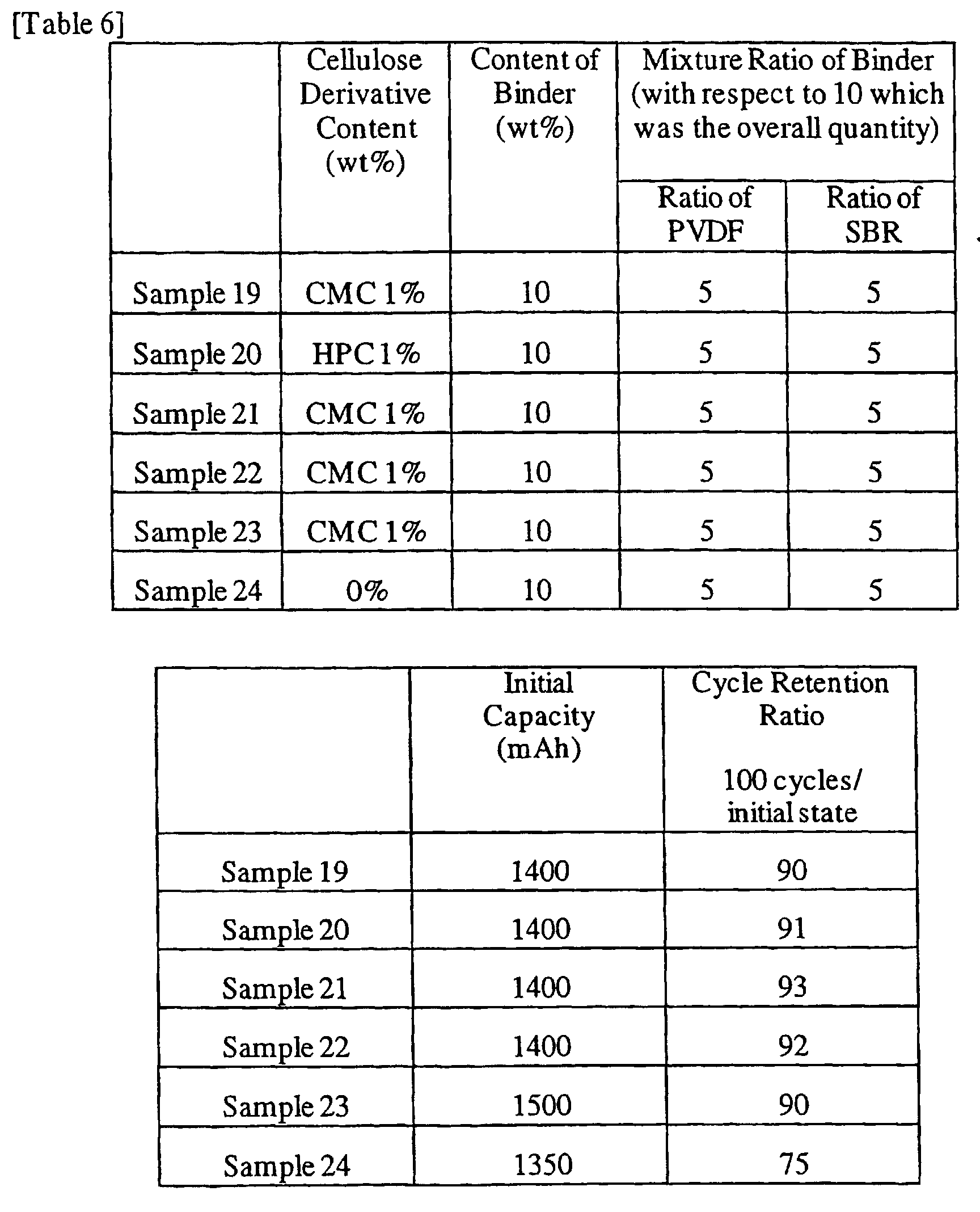
As can be understood from the foregoing results, Samples 19 to
23 according to the examples of the present invention had excellent
charging/discharging efficiency and cycle characteristic. The reason
why the cycle characteristic was improved as compared with Sample
24 in which CMC was not added lies in that addition of fibrous
molecules, such as CMC, caused SBR and CMC to be mixed and
adhesion to be performed without deterioration in the reactiveness of
the surfaces of the carbon portions.
Although the cylindrical nonaqueous electrolyte secondary
batteries were manufactured in the foregoing examples of the present
invention, similar effects can be obtained when the present invention
is applied to batteries having another shape, for example, a
rectangular shape, a laminate shape or a card shape.
Note that teflon or the like may be employed as the fluorine
binder.
Claims (11)
- A nonaqueous electrolyte secondary battery comprising: a binder for powder in a negative electrode, wherein said binder for powder contains a mix of fluorine polymer and aromatic vinyl-conjugate diene polymer.
- A nonaqueous electrolyte secondary battery according to claim 1, wherein the fluorine polymer is at least one type of materials selected from a group consisting of polyvinylidene fluoride, polytetrafluoroethylene and fluorine rubber.
- A nonaqueous electrolyte secondary battery according to claim 1, wherein the aromatic vinyl-conjugate diene polymer is styrene-butadiene latex.
- A nonaqueous electrolyte secondary battery according to claim 1, wherein a weight mixture ratio of fluorine polymer and aromatic vinyl-conjugate diene polymer is such that fluorine polymer is not less than one time nor more than 99 times the aromatic vinyl-conjugate diene polymer.
- A nonaqueous electrolyte secondary battery according to claim 1, wherein a ratio of said binder for powder with respect to the total weight of said negative electrode is not less than 2 wt% nor more than 15 wt%.
- A nonaqueous electrolyte secondary battery according to claim 1, wherein said binder for powder contains cellulose derivative as a viscosity bodying agent.
- A nonaqueous electrolyte secondary battery according to claim 6, wherein a ratio of said cellulose derivative with respect to the total weight of said negative electrode is not less than 0.1 wt% nor more than 5 wt%.
- A nonaqueous electrolyte secondary battery according to claim 1, wherein a carbonaceous material is contained as an active material for said negative electrode.
- A nonaqueous electrolyte secondary battery according to claim 8, wherein said carbonaceous material is a non-graphitizing carbon material.
- A nonaqueous electrolyte secondary battery according to claim 8, where in said carbonaceous material is graphite.
- A nonaqueous electrolyte secondary battery according to claim 1, wherein LiMxO2 (where M is one or more types of transition metals and 0.05 ≤ x ≤ 1.10) is contained as an active material for said positive electrode.
Applications Claiming Priority (5)
| Application Number | Priority Date | Filing Date | Title |
|---|---|---|---|
| JP21646897 | 1997-08-11 | ||
| JP21646897 | 1997-08-11 | ||
| JP36106097 | 1997-12-26 | ||
| JP36106097 | 1997-12-26 | ||
| PCT/JP1998/003578 WO1999008335A1 (en) | 1997-08-11 | 1998-08-11 | Nonaqueous electrolyte secondary battery |
Publications (2)
| Publication Number | Publication Date |
|---|---|
| EP0932212A1 true EP0932212A1 (en) | 1999-07-28 |
| EP0932212A4 EP0932212A4 (en) | 2000-10-25 |
Family
ID=26521447
Family Applications (1)
| Application Number | Title | Priority Date | Filing Date |
|---|---|---|---|
| EP98936743A Withdrawn EP0932212A4 (en) | 1997-08-11 | 1998-08-11 | NON-AQUEOUS ELECTROLYTE ELECTRIC BATTERY |
Country Status (6)
| Country | Link |
|---|---|
| EP (1) | EP0932212A4 (en) |
| JP (1) | JP4437239B2 (en) |
| KR (1) | KR20000068746A (en) |
| CN (1) | CN1239594A (en) |
| TW (1) | TW382829B (en) |
| WO (1) | WO1999008335A1 (en) |
Cited By (4)
| Publication number | Priority date | Publication date | Assignee | Title |
|---|---|---|---|---|
| FR2836600A1 (en) * | 2001-12-20 | 2003-08-29 | Denso Corp | LITHIUM SECONDARY BATTERY ELECTRODE AND LITHIUM SECONDARY BATTERY AND MANUFACTURING METHOD THEREOF |
| US20080292969A1 (en) * | 2007-05-23 | 2008-11-27 | Sony Corporation | Gel electrolyte secondary battery |
| WO2011097184A3 (en) * | 2010-02-05 | 2011-11-24 | International Battery, Inc. | Rechargeable battery using an aqueous binder |
| EP3809502A4 (en) * | 2019-05-24 | 2021-10-06 | Contemporary Amperex Technology Co., Limited | POSITIVE ELECTRODE CURRENT COLLECTOR, POSITIVE ELECTRODE PLATE, ELECTROCHEMICAL DEVICE AND ELECTRICAL APPARATUS INCLUDING AN ELECTROCHEMICAL DEVICE |
Families Citing this family (5)
| Publication number | Priority date | Publication date | Assignee | Title |
|---|---|---|---|---|
| JP2007234418A (en) * | 2006-03-01 | 2007-09-13 | Matsushita Electric Ind Co Ltd | Negative electrode mixture paste for non-aqueous secondary battery, negative electrode and non-aqueous secondary battery using the same, and method for producing negative electrode mixture paste |
| JP2010238365A (en) * | 2009-03-30 | 2010-10-21 | Hitachi Vehicle Energy Ltd | Nonaqueous electrolyte secondary battery |
| JP5879673B2 (en) * | 2009-09-03 | 2016-03-08 | ソニー株式会社 | Method for producing negative electrode for non-aqueous electrolyte secondary battery |
| JP5120522B2 (en) | 2010-11-29 | 2013-01-16 | Jsr株式会社 | Binder composition for battery, slurry for battery electrode, solid electrolyte composition, electrode and all solid state battery |
| CN103403918A (en) * | 2011-02-24 | 2013-11-20 | 日本电气株式会社 | Separator for accumulators, and accumulator |
Family Cites Families (9)
| Publication number | Priority date | Publication date | Assignee | Title |
|---|---|---|---|---|
| JPS54103513A (en) * | 1978-01-31 | 1979-08-15 | Matsushita Electric Industrial Co Ltd | Nonnelectrolyte cell |
| JPH0758614B2 (en) * | 1988-11-17 | 1995-06-21 | 松下電器産業株式会社 | Hydrogen storage alloy electrode and manufacturing method thereof |
| JPH04342966A (en) * | 1991-05-21 | 1992-11-30 | Toshiba Battery Co Ltd | Secondary battery with non-aqueous solvent |
| JPH06215761A (en) * | 1993-01-21 | 1994-08-05 | Matsushita Electric Ind Co Ltd | Nonaqueous electrolyte secondary battery graphite electrode and nonaqueous electrolyte secondary battery using it |
| JPH07105935A (en) * | 1993-10-07 | 1995-04-21 | Matsushita Electric Ind Co Ltd | Non-aqueous electrolyte secondary battery |
| JPH07335221A (en) * | 1994-06-07 | 1995-12-22 | Toshiba Battery Co Ltd | Coin type nonelectrolytic secondary battery |
| JPH08250122A (en) * | 1995-03-07 | 1996-09-27 | Japan Synthetic Rubber Co Ltd | Method of forming battery electrode |
| JP3539448B2 (en) * | 1995-04-19 | 2004-07-07 | 日本ゼオン株式会社 | Non-aqueous secondary battery |
| JP3624921B2 (en) * | 1996-02-05 | 2005-03-02 | 日本ゼオン株式会社 | Binder for battery, binder composition, electrode, and battery |
-
1998
- 1998-08-11 JP JP51198599A patent/JP4437239B2/en not_active Expired - Fee Related
- 1998-08-11 WO PCT/JP1998/003578 patent/WO1999008335A1/en not_active Ceased
- 1998-08-11 KR KR1019997003121A patent/KR20000068746A/en not_active Ceased
- 1998-08-11 CN CN98801321A patent/CN1239594A/en active Pending
- 1998-08-11 EP EP98936743A patent/EP0932212A4/en not_active Withdrawn
- 1998-08-20 TW TW087113721A patent/TW382829B/en not_active IP Right Cessation
Cited By (6)
| Publication number | Priority date | Publication date | Assignee | Title |
|---|---|---|---|---|
| FR2836600A1 (en) * | 2001-12-20 | 2003-08-29 | Denso Corp | LITHIUM SECONDARY BATTERY ELECTRODE AND LITHIUM SECONDARY BATTERY AND MANUFACTURING METHOD THEREOF |
| US20080292969A1 (en) * | 2007-05-23 | 2008-11-27 | Sony Corporation | Gel electrolyte secondary battery |
| WO2011097184A3 (en) * | 2010-02-05 | 2011-11-24 | International Battery, Inc. | Rechargeable battery using an aqueous binder |
| US8076026B2 (en) | 2010-02-05 | 2011-12-13 | International Battery, Inc. | Rechargeable battery using an aqueous binder |
| EP3809502A4 (en) * | 2019-05-24 | 2021-10-06 | Contemporary Amperex Technology Co., Limited | POSITIVE ELECTRODE CURRENT COLLECTOR, POSITIVE ELECTRODE PLATE, ELECTROCHEMICAL DEVICE AND ELECTRICAL APPARATUS INCLUDING AN ELECTROCHEMICAL DEVICE |
| US11158859B2 (en) | 2019-05-24 | 2021-10-26 | Contemporary Amperex Technology Co., Limited | Positive electrode current collector, positive electrode plate, electrochemical device, and electric equipment comprising the electrochemical device |
Also Published As
| Publication number | Publication date |
|---|---|
| CN1239594A (en) | 1999-12-22 |
| JP4437239B2 (en) | 2010-03-24 |
| WO1999008335A1 (en) | 1999-02-18 |
| EP0932212A4 (en) | 2000-10-25 |
| TW382829B (en) | 2000-02-21 |
| KR20000068746A (en) | 2000-11-25 |
Similar Documents
| Publication | Publication Date | Title |
|---|---|---|
| US6379842B1 (en) | Mixed lithium manganese oxide and lithium nickel cobalt oxide positive electrodes | |
| JP3427570B2 (en) | Non-aqueous electrolyte secondary battery | |
| US6746799B2 (en) | Lithium phosphate composite positive electrode and non-aqueous electrolyte cell | |
| US20170155137A1 (en) | Positive active material and non-aqueous electrolyte secondary battery | |
| JP3598153B2 (en) | Non-aqueous electrolyte secondary battery | |
| KR20040106225A (en) | Battery | |
| JP2001076727A (en) | Positive active material for non-aqueous electrolyte battery and non-aqueous electrolyte battery | |
| JP2001345100A (en) | Carbonaceous particles for negative electrode of lithium secondary cell, preparation process thereof, negative electrode for lithium secondary cell and lithium secondary cell | |
| KR100364069B1 (en) | Non-aqueous Electrolyte Secondary Battery | |
| EP0932212A1 (en) | Nonaqueous electrolyte secondary battery | |
| JPH0883608A (en) | Lithium secondary battery | |
| KR100975875B1 (en) | Cathode active material, manufacturing method thereof, cathode and lithium battery employing the same | |
| JPWO1999008335A1 (en) | Nonaqueous electrolyte secondary battery | |
| JP2004356092A (en) | battery | |
| JPH1116567A (en) | Non-aqueous electrolyte battery and method of manufacturing the same | |
| JP2002222651A (en) | Non-aqueous electrolyte secondary battery | |
| JPH08180878A (en) | Lithium secondary battery | |
| JP2001006684A (en) | Non-aqueous electrolyte battery | |
| JP3468956B2 (en) | Non-aqueous electrolyte secondary battery | |
| JP2005071712A (en) | Method for producing positive electrode | |
| JP2000106187A (en) | Nonaqueous electrolytic secondary battery | |
| JP2002313320A (en) | Non-aqueous secondary battery | |
| JP3517117B2 (en) | Lithium secondary battery | |
| JP4088850B2 (en) | Non-aqueous solvent secondary battery | |
| JPH07296848A (en) | Non-aqueous electrolyte secondary battery |
Legal Events
| Date | Code | Title | Description |
|---|---|---|---|
| PUAI | Public reference made under article 153(3) epc to a published international application that has entered the european phase |
Free format text: ORIGINAL CODE: 0009012 |
|
| 17P | Request for examination filed |
Effective date: 19990408 |
|
| AK | Designated contracting states |
Kind code of ref document: A1 Designated state(s): DE FR GB |
|
| A4 | Supplementary search report drawn up and despatched |
Effective date: 20000913 |
|
| AK | Designated contracting states |
Kind code of ref document: A4 Designated state(s): DE FR GB |
|
| 17Q | First examination report despatched |
Effective date: 20010409 |
|
| STAA | Information on the status of an ep patent application or granted ep patent |
Free format text: STATUS: THE APPLICATION IS DEEMED TO BE WITHDRAWN |
|
| 18D | Application deemed to be withdrawn |
Effective date: 20050301 |