EP0928705A1 - Radialluftreifen - Google Patents
Radialluftreifen Download PDFInfo
- Publication number
- EP0928705A1 EP0928705A1 EP98929752A EP98929752A EP0928705A1 EP 0928705 A1 EP0928705 A1 EP 0928705A1 EP 98929752 A EP98929752 A EP 98929752A EP 98929752 A EP98929752 A EP 98929752A EP 0928705 A1 EP0928705 A1 EP 0928705A1
- Authority
- EP
- European Patent Office
- Prior art keywords
- ribbon
- cords
- rubber
- tire
- belt layer
- Prior art date
- Legal status (The legal status is an assumption and is not a legal conclusion. Google has not performed a legal analysis and makes no representation as to the accuracy of the status listed.)
- Granted
Links
Images


Classifications
-
- B—PERFORMING OPERATIONS; TRANSPORTING
- B60—VEHICLES IN GENERAL
- B60C—VEHICLE TYRES; TYRE INFLATION; TYRE CHANGING; CONNECTING VALVES TO INFLATABLE ELASTIC BODIES IN GENERAL; DEVICES OR ARRANGEMENTS RELATED TO TYRES
- B60C9/00—Reinforcements or ply arrangement of pneumatic tyres
- B60C9/18—Structure or arrangement of belts or breakers, crown-reinforcing or cushioning layers
- B60C9/20—Structure or arrangement of belts or breakers, crown-reinforcing or cushioning layers built-up from rubberised plies each having all cords arranged substantially parallel
- B60C9/22—Structure or arrangement of belts or breakers, crown-reinforcing or cushioning layers built-up from rubberised plies each having all cords arranged substantially parallel the plies being arranged with all cords disposed along the circumference of the tyre
- B60C9/2204—Structure or arrangement of belts or breakers, crown-reinforcing or cushioning layers built-up from rubberised plies each having all cords arranged substantially parallel the plies being arranged with all cords disposed along the circumference of the tyre obtained by circumferentially narrow strip winding
-
- B—PERFORMING OPERATIONS; TRANSPORTING
- B60—VEHICLES IN GENERAL
- B60C—VEHICLE TYRES; TYRE INFLATION; TYRE CHANGING; CONNECTING VALVES TO INFLATABLE ELASTIC BODIES IN GENERAL; DEVICES OR ARRANGEMENTS RELATED TO TYRES
- B60C9/00—Reinforcements or ply arrangement of pneumatic tyres
- B60C9/18—Structure or arrangement of belts or breakers, crown-reinforcing or cushioning layers
- B60C9/26—Folded plies
- B60C9/263—Folded plies further characterised by an endless zigzag configuration in at least one belt ply, i.e. no cut edge being present
-
- Y—GENERAL TAGGING OF NEW TECHNOLOGICAL DEVELOPMENTS; GENERAL TAGGING OF CROSS-SECTIONAL TECHNOLOGIES SPANNING OVER SEVERAL SECTIONS OF THE IPC; TECHNICAL SUBJECTS COVERED BY FORMER USPC CROSS-REFERENCE ART COLLECTIONS [XRACs] AND DIGESTS
- Y10—TECHNICAL SUBJECTS COVERED BY FORMER USPC
- Y10T—TECHNICAL SUBJECTS COVERED BY FORMER US CLASSIFICATION
- Y10T152/00—Resilient tires and wheels
- Y10T152/10—Tires, resilient
- Y10T152/10495—Pneumatic tire or inner tube
- Y10T152/10765—Characterized by belt or breaker structure
- Y10T152/10783—Reinforcing plies made up from wound narrow ribbons
Definitions
- the present invention relates to a pneumatic radial tire; in particular, it pertains to a pneumatic radial tire which is capable of suppressing irregular wear of the tread by a improved helical belt that is arranged on the outer peripheral side of the carcass.
- the tread patterns of pneumatic radial tires are often determined mainly in view of the desired performance of the tire, such as maneuvering stability and wet performance.
- the tread is formed with a plurality of grooves extending in the circumferential direction and widthwise direction of the tire, to thereby define discrete land portions in the form of blocks.
- the tread undergoes irregular wear.
- the block configuration can be modified for the purpose of preventing irregular wear of the tread, though such modifications are not practically carried out. This is because modification of the block configuration makes it difficult to preserve the maneuvering stability, wet performance and the like, which are required as the basic performance of the tire. Accordingly, it would be desirable to suppress irregular wear of the tread by improving the belt structure.
- the present invention is based on recognition obtained with respect to pneumatic radial tires in which there is arranged, on outer peripheral side of a radial carcass, a winding layer or so-called helical belt layer wherein a ribbon comprised of a plurality of cords embedded in a rubber is successively wound in helical manner with a predetermined angle relative to the circumferential direction of the tread portion.
- a winding layer or so-called helical belt layer wherein a ribbon comprised of a plurality of cords embedded in a rubber is successively wound in helical manner with a predetermined angle relative to the circumferential direction of the tread portion.
- the inventor thus conducted through investigations on the mechanism of occurrence of irregular wear of the tread portion, as well as countermeasures for suppressing and preventing the same.
- the result of such investigations can be summarized as follows.
- the tread rubber 12 undergoes a shearing deformation within the ground contact surface so that a point Q 1 on the tread region, which is located on the normal line passing through a point P 1 on the belt layer 11 outside the ground contact surface, is shifted to a retracted point Q 2 in the ground contact surface, which is retraced rearwards of a point P 2 in the rotational direction R.
- the relationship indicated by the line segment P 1 - Q 1 which is perpendicular to the belt layer 11 outside the ground contact surface, changes to the relationship indicated by the line segment P 2 - Q 2 , which is inclined relative to a normal linen intersecting the point P 2 on the belt layer 11 within the ground contact surface, during which the tread rubber 12 undergoes a shearing deformation. This relationship is maintained until immediately before the tread region comes out of the ground contact surface as shown by a line segment P 3 - Q 3 .
- the tread rubber 12 restores to the original state so that the relationship indicated by a line segment P 4 - Q 4 is recovered wherein the point Q 4 on the tread region is located on the normal line intersecting the point P 4 on the belt layer 11, as is the case with the point Q 1 for the line segment P 1 - Q 1 .
- This recovery causes the shear strain of the tread rubber 12 to be rapidly released, thereby causing a sliding movement of the tread rubber 12 and a resultant increase in the wear amount of the edge portion, particularly at the kick-out side of the block. This is a main factor of so-called "heel-and-toe wear".
- the inventor noted that the tread portion undergoes a marked bending deformation in the vicinity of a portion which is applied with the load when the tire is pressed against the road surface, and the bending deformation causes a compressive deformation along a circumferential direction of the belt layer with a longitudinal center line of the tread portion as the center.
- the inventor then considered that, by arranging the outermost belt layer at a location spaced from the bending-neutral plane by as increased distance as possible, it would be possible to reduce the compressive deformation amount of the belt layer and thereby reduce the relative displacement between the outermost belt layer and the tread.
- the present invention has been accomplished through the above-mentioned development process, and provides a pneumatic radial tire which comprises a radial carcass of at least one ply, and a reinforcing belt arranged on an outer peripheral side of the radial carcass, wherein the reinforcing belt has a helical belt layer in which a ribbon comprised of a rubber and a plurality of reinforcing cords embedded in the rubber is successively wound in helical manner, at an angle with respect to a circumferential direction of a tread portion, and wherein the ribbon forms the helical belt layer having a cross-section in which the reinforcing cords are dispersed in a thickness direction and a width direction of the ribbon.
- a curve connecting both centers of the reinforcing cords, which are situated adjacent to each other in the width direction in the cross-section of the ribbon has at least one peak and/or bottom as seen in the thickness direction of the ribbon.
- the curve connecting the centers of the reinforcing cords preferably has at least one peak and at least one bottom, so that the cords are more effectively dispersed.
- the maximum dispersion of the reinforcing cords with respect to the thickness direction of the ribbon i.e., the maximum distance between the highest peak and the lowest bottom in the radial direction of the tire, is set to be approximately 1 to 3 mm.
- the reason why the dispersion in the thickness direction of the ribbon is set to be within a range of approximately 1 to 3 mm is that a sufficient effect of the dispersion cannot be achieved in the case of less than approximately 1 mm, whereas the cords are excessively dispersed in the case of more than approximately 3 mm, thereby lowering the hoop effect and degrading the maneuvering stability.
- a ratio of a widthwise center distance between the peak and bottom of the curve, which are adjacent to each other, to the maximum dispersion of the reinforcing cords in the thickness direction of the ribbon is approximately 0.2 to 6, so as to optimize the dispersion of the cords.
- the ribbon has a cross-sectional shape which is in the form of a parallelogram.
- the surfaces of the side edge of neighboring turns of the ribbon can be brought in positive abutment with each other.
- the ribbon can be produced by continuously extruding a plurality of cords and a rubber through a mouthpiece having an extrusion orifice of 12 mm in width and 2 mm in height, for example, such that the cords are dispersed in the thickness and width directions of the ribbon.
- a cord guide member having an opening or holes corresponding in diameter to the respective cords, on the upstream side of the mouthpiece.
- the so-obtained ribbon provides such functional advantages as realization of a desired arrangement of the cords at a high degree of freedom, improvement in adhesion between the rubber and cords thereby preventing separation, in contrast to conventional ribbon obtained by calendar rolls in order to unite a plurality of cords to a rubber sheet.
- the reinforcing cords are comprised of organic fibers.
- the belt layer arranged on the radially inner side of the helical belt layer at a predetermined inclination angle with reference to the circumferential direction may be comprised of either organic fiber cords or steel cords.
- Fig. 3 a meridional-sectional view of a pneumatic radial tire to which the invention can be applied, having a size of 225/50ZR16, for example.
- the tire designated as a whole by reference numeral 20, comprises a pair of bead cores 21 (only one of which is shown), a radial carcass 22 of at least one ply which bridges between the bead cores 21, and a reinforcing belt 23 which is arranged on outer peripheral side of the radial carcass 22.
- the reinforcing belt 23 comprises a hellcal belt layer 25 and a laminated belt layer 26 arranged on radially inner side of the helical belt layer 25.
- the helical belt layer 23 includes a ribbon which is comprised of a rubber and a plurality of cords embedded in the rubber, preferably organic fiber cords such as nylon cords, and which is successively wound in a helical manner at an angle with reference to the circumferential direction of the tread portion 24.
- the laminated belt layer 26 includes two rubber-coated steel cord layers, each of which is comprised of a rubber and a plurality of steel cords embedded in the rubber. These steel cord layers are laminated one above the other such that the cords extend at an acute angle with reference the circumferential direction of the tire, in opposite directions to each other with reference to the equatorial line of the tire.
- the tread pattern is basically block pattern
- the ribbon constituting the helical belt layer 25 is formed by continuously extruding a plurality of nylon cords and an unvulcanized rubber through a mouthpiece which includes an extrusion orifice of, for example, 12 mm in width and 2 mm in height, as will be described hereinafter.
- a mouthpiece which includes an extrusion orifice of, for example, 12 mm in width and 2 mm in height, as will be described hereinafter.
- the ribbon 30 constituting a conventional helical belt layer includes a plurality of reinforcing cords 32 coated with rubber 31 and dispersed in a straight manner in the width direction, in the cross-section of the ribbon 30.
- the ribbon 40 constituting the helical belt layer includes cords 42 coated with rubber 41 and dispersed not only in the width direction but also in the thickness direction, in the cross-section of the ribbon 40.
- Fig. 4B shows Embodiment 1 in which the ribbon 40 has a rectangular cross-section and the cords 42 are arranged so as to extend upward to the right side, and Fig.
- FIG. 4C shows Embodiment 2 in which the ribbon 40 has a cross-section in the form of parallelogram and the cords 42 are arranged in the ribbon 40 so as to extend downward to the right side.
- Figs. 4D to 4I show Embodiments 4 to 8 in which the ribbon 40 has a cross-section in the form of parallelogram and the cords 42 are arranged in the ribbon 40 in non-linear manner.
- the shape of such curve i.e., cord pattern
- a designates the thickness of the ribbon
- b the width of the ribbon
- c the maximum dispersion of the cords in the thickness direction of the ribbon
- d the center distance of the peak and bottom which are adjacent to each other in the width direction of the ribbon.
- the ratio d / c of the center distance "d" between the peak and bottom adjacent to each other in the width direction, to the maximum dispersion "c" the reinforcing cords is set to be within a range of 0.26 to 6.
- test tires having a conventional helical belt as shown in Fig. 4A, and embodiment tires provided with helical belts according to the embodiments shown in Figs. 4B to 4I, respectively.
- Each of such test tires has the same specification as those described with reference to Fig. 3, including a helical belt layer comprised of a ribbon in which 50 nylon cords of 1260 d/2 are arranged per 50 mm.
- the ribbon of the helical belt in each test tire has dimensions as shown in Table 1.
- Each test tire has been mounted on a rim of 7J - 16 under an internal pressure of 240 kPa, and secured as a rear wheel onto a rear wheel drive type Japanese passenger car having an engine displacement of 3000 cc. Then, the car has been subjected to a running test of 1000 km along a comprehensive test road in a test course, with an increased driving force applied under an accelerated-wear condition. The performance has been evaluated by measuring the wear amount at the portion which exhibited the highest wear (the toe portion of a block which exhibited a heel-and-toe wear), ad comparing the running distances per 1 mm in wear amount (wear resistance).
- the evaluated data is represented as normalized indices in Table 1, with the running distance of the control tire per 1 mm in wear amount (wear resistance) assumed to be 100.
- a (mm) b (mm) c (mm) d / c wear Index Control 0.7 12 0 0 100 Embodiment 1 2 12 1.8 110 Embodiment 2 2 12 1.8 110 Embodiment 3 2 12 1.8 3.3 115 Embodiment 4 2 12 1.8 1.7 125 Embodiment 5 2 12 1.8 1.7 125 Embodiment 6 3 12 1.8 2.1 132 Embodiment 7 3.5 12 3.3 0.9 135 Embodiment 8 3 12 2.8 0.4 135
- the embodiment tires according to the present invention exhibit improved wear resistance as compared to the control tire. It can be also recognized that the embodiment tires 7, 8 are equivalent in terms of wear index, though the embodiment tire 8 exhibits a maneuvering stability which is improved to some extent as compared to the embodiment tire 7.
- the ribbon constituting the conventional helical belt layer (Fig. 4A) is generally produced by uniting a plurality of cords to a rubber sheet by means of calendar rollers, whereas the ribbon constituting the helical belt layer according to the invention (Figs. 4B to 4I) can be produced at a higher productivity by the process and production line described below.
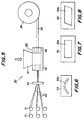
- a production line 50 is shown in Fig. 5, in which cords 52 are supplied from a plurality of bobbins 51 corresponding in number to the cords, and these cords 52 are guided to an insulation machine 54 through a comb-like guide member 53.
- the insulation machine 54 is detachably provided with an insert guide member 55 at its inlet and a mouthpiece 56 at its outlet, and further with a introduction port 57 for unvulcanized rubber at the center upper portion thereof.
- a ribbon-winding device 58 is arranged at a location on the downstream side of the insulation machine 54, for temporarily winding a ribbon 59 which has been extruded from the insulation machine 54.
- the insulation machine 54 in the above-mentioned production line 50 may be of such type which is not equipped with an extruding screw. This is because the winding speed of the ribbon 59 can be adjusted depending upon the elasticity and adhesiveness (or tackiness) of the rubber, in order to allow the extrusion of rubber to be adequately controlled.
- the insert guide member 55 disposed at the inlet of the insulation machine 54 is formed with a plurality of holes arranged according to the desired pattern of the cords in the ribbon 59 to be produced.
- the insert guide 55 shown in Fig. 6 is formed with a plurality of holes 55a having substantially the same pattern as the cords 42 of the ribbon 40 shown in Fig. 4d.
- the mouthpiece 56 arranged at the outlet of the insulation machine 54 has an orifice 56a of about 12 mm in width and about 2 mm in height, for example.
- the orifice 56a has a cross-section which is rectangular (Fig. 7) when the ribbon shown in Fig. 4b is to be produced, and which is in the form of parallelogram when the ribbons shown in Figs. 4c to 4i are to be produced.
- the ribbon extruded from the insulation machine may be directly wound on a green tire, with the winding apparatus omitted.
- a plurality of the cords unwound from the bobbins are guided to the insulation machine through the comb-like guide member, are arranged by the insert guide member into the same pattern as the holes thereof, and are then passed through the inside of the insulation machine.
- unvulcanized rubber is supplied thereto through the introduction port at the upper center of the insulation machine such that the cords arranged into the desired pattern are coated by unvulcanized rubber.
- the unvulcanized rubber coating the cords is shaped into a desired cross-section, for example, rectangular or parallelogram cross-section.
- the so-produced ribbon is continuously wound on the winding device.
- the insert guide and the mouthpiece may be detachably arranged at the inlet and the outlet of the insulation machine, so as to be exchangeable depending upon the desired pattern of the cords the desired cross-sectional shape of the ribbon.
- the helical belt arranged on the outer peripheral side of the carcass can be improved to realize a pneumatic radial tire which is capable of effectively suppressing occurrence of irregular wear of the tread portion, particularly when the tire is applied with a driving force.
Landscapes
- Engineering & Computer Science (AREA)
- Mechanical Engineering (AREA)
- Tires In General (AREA)
Applications Claiming Priority (3)
| Application Number | Priority Date | Filing Date | Title |
|---|---|---|---|
| JP17469897 | 1997-06-30 | ||
| JP17469897 | 1997-06-30 | ||
| PCT/JP1998/002922 WO1999000261A1 (fr) | 1997-06-30 | 1998-06-30 | Pneu radial |
Publications (3)
| Publication Number | Publication Date |
|---|---|
| EP0928705A1 true EP0928705A1 (de) | 1999-07-14 |
| EP0928705A4 EP0928705A4 (de) | 2003-03-19 |
| EP0928705B1 EP0928705B1 (de) | 2004-08-25 |
Family
ID=15983113
Family Applications (1)
| Application Number | Title | Priority Date | Filing Date |
|---|---|---|---|
| EP98929752A Expired - Lifetime EP0928705B1 (de) | 1997-06-30 | 1998-06-30 | Radialluftreifen |
Country Status (6)
| Country | Link |
|---|---|
| US (1) | US6170547B1 (de) |
| EP (1) | EP0928705B1 (de) |
| JP (1) | JP4315475B2 (de) |
| DE (1) | DE69825857T2 (de) |
| ES (1) | ES2226148T3 (de) |
| WO (1) | WO1999000261A1 (de) |
Families Citing this family (6)
| Publication number | Priority date | Publication date | Assignee | Title |
|---|---|---|---|---|
| DE602005002692T2 (de) * | 2004-08-03 | 2008-02-07 | Sumitomo Rubber Industries Ltd., Kobe | Methode zur Herstellung eines Kautschukelements für Reifen |
| CN101541521A (zh) | 2006-11-30 | 2009-09-23 | 横滨橡胶株式会社 | 充气轮胎的制造方法 |
| DE102008049754A1 (de) * | 2008-09-30 | 2010-04-08 | Continental Automotive Gmbh | Verfahren und Vorrichtung zur Verschleißdiagnose eines Kraftfahrzeugs |
| JP7048204B2 (ja) * | 2016-10-18 | 2022-04-05 | 株式会社ブリヂストン | タイヤ |
| JP6930943B2 (ja) * | 2018-06-19 | 2021-09-01 | 株式会社ブリヂストン | 空気入りタイヤ |
| CN116238271B (zh) * | 2023-04-11 | 2025-08-01 | 山东玲珑轮胎股份有限公司 | 一种包含钢丝帘布的轮胎 |
Family Cites Families (9)
| Publication number | Priority date | Publication date | Assignee | Title |
|---|---|---|---|---|
| US3802982A (en) * | 1970-01-06 | 1974-04-09 | Steelastic Co | Reinforced tire fabric and method and apparatus for making same |
| US3979536A (en) * | 1971-07-08 | 1976-09-07 | Uniroyal Inc. | Zero degree belted tires, and high "soft stretch" belt-forming tapes therefor |
| US4050973A (en) * | 1971-07-08 | 1977-09-27 | Uniroyal Inc. | Methods of building zero degree belted tires, using high soft stretch belt-forming tapes |
| GB1487426A (en) * | 1974-09-17 | 1977-09-28 | Bekaert Sa Nv | Reinforcement of vehicle tyres |
| JPH03204306A (ja) * | 1989-12-29 | 1991-09-05 | Sumitomo Rubber Ind Ltd | ラジアルタイヤ |
| DE69110954T2 (de) * | 1990-04-18 | 1995-11-23 | Sumitomo Rubber Ind | Gürtelluftreifen für Motorräder und Verfahren zur Herstellung. |
| JPH04331604A (ja) * | 1990-10-23 | 1992-11-19 | Sumitomo Rubber Ind Ltd | 高速重荷重用ラジアルタイヤ |
| JP3151037B2 (ja) * | 1992-02-07 | 2001-04-03 | 株式会社ブリヂストン | 空気入りラジアルタイヤ |
| JP3151041B2 (ja) * | 1992-03-31 | 2001-04-03 | 株式会社ブリヂストン | 空気入りタイヤ |
-
1998
- 1998-06-29 JP JP50544999A patent/JP4315475B2/ja not_active Expired - Fee Related
- 1998-06-30 ES ES98929752T patent/ES2226148T3/es not_active Expired - Lifetime
- 1998-06-30 WO PCT/JP1998/002922 patent/WO1999000261A1/ja not_active Ceased
- 1998-06-30 DE DE69825857T patent/DE69825857T2/de not_active Expired - Lifetime
- 1998-06-30 US US09/254,020 patent/US6170547B1/en not_active Expired - Lifetime
- 1998-06-30 EP EP98929752A patent/EP0928705B1/de not_active Expired - Lifetime
Also Published As
| Publication number | Publication date |
|---|---|
| US6170547B1 (en) | 2001-01-09 |
| EP0928705A4 (de) | 2003-03-19 |
| ES2226148T3 (es) | 2005-03-16 |
| EP0928705B1 (de) | 2004-08-25 |
| JP4315475B2 (ja) | 2009-08-19 |
| WO1999000261A1 (fr) | 1999-01-07 |
| DE69825857T2 (de) | 2005-09-01 |
| DE69825857D1 (de) | 2004-09-30 |
Similar Documents
| Publication | Publication Date | Title |
|---|---|---|
| EP0524704B1 (de) | Gürtelreifen und Verfahren zur Herstellung | |
| EP1902867B1 (de) | Radialluftreifen | |
| EP1800905B1 (de) | Pneumatischer Radialflugzeugreifen | |
| US20100024946A1 (en) | Pneumatic tire | |
| EP0622253B1 (de) | Radiale Luftreifen | |
| US5082042A (en) | Belt arrangement for high durable pneumatic radial tire | |
| EP0542567B1 (de) | Luftreifen | |
| US20010050134A1 (en) | Method of producing pneumatic tires | |
| EP1057659B1 (de) | Radialer Reifen für PKW | |
| JP2769040B2 (ja) | 高速走行用空気入りラジアルタイヤ | |
| EP0928705B1 (de) | Radialluftreifen | |
| WO1999015727A1 (en) | Steel cord, method of manufacturing same, and pneumatic tire | |
| EP0941873B1 (de) | Radiale LKW-Luftreifen | |
| JP2000015717A (ja) | 空気入りタイヤ用補強層の製造方法および製造設備 | |
| EP1122098B1 (de) | Luftreifen | |
| JPWO1999000261A1 (ja) | 空気入りラジアルタイヤ | |
| JPH08156513A (ja) | 空気入りラジアルタイヤ | |
| EP0470835B1 (de) | Radialer Luftreifen | |
| JP3644744B2 (ja) | 空気入りラジアルタイヤ | |
| EP1072444A1 (de) | Schwerlastgürtelreifen | |
| JPH0514641B2 (de) | ||
| JP3151038B2 (ja) | 空気入りラジアルタイヤ | |
| JPS63125406A (ja) | 空気入りタイヤ | |
| JPH03220001A (ja) | 高速走行用空気入りラジアルタイヤ | |
| JP3010016B2 (ja) | 自動二輪車用タイヤ |
Legal Events
| Date | Code | Title | Description |
|---|---|---|---|
| PUAI | Public reference made under article 153(3) epc to a published international application that has entered the european phase |
Free format text: ORIGINAL CODE: 0009012 |
|
| 17P | Request for examination filed |
Effective date: 19990304 |
|
| AK | Designated contracting states |
Kind code of ref document: A1 Designated state(s): DE ES FR GB IT |
|
| A4 | Supplementary search report drawn up and despatched |
Effective date: 20030130 |
|
| 17Q | First examination report despatched |
Effective date: 20030519 |
|
| GRAP | Despatch of communication of intention to grant a patent |
Free format text: ORIGINAL CODE: EPIDOSNIGR1 |
|
| GRAS | Grant fee paid |
Free format text: ORIGINAL CODE: EPIDOSNIGR3 |
|
| GRAA | (expected) grant |
Free format text: ORIGINAL CODE: 0009210 |
|
| AK | Designated contracting states |
Kind code of ref document: B1 Designated state(s): DE ES FR GB IT |
|
| REG | Reference to a national code |
Ref country code: GB Ref legal event code: FG4D |
|
| REF | Corresponds to: |
Ref document number: 69825857 Country of ref document: DE Date of ref document: 20040930 Kind code of ref document: P |
|
| REG | Reference to a national code |
Ref country code: ES Ref legal event code: FG2A Ref document number: 2226148 Country of ref document: ES Kind code of ref document: T3 |
|
| ET | Fr: translation filed | ||
| PLBE | No opposition filed within time limit |
Free format text: ORIGINAL CODE: 0009261 |
|
| STAA | Information on the status of an ep patent application or granted ep patent |
Free format text: STATUS: NO OPPOSITION FILED WITHIN TIME LIMIT |
|
| 26N | No opposition filed |
Effective date: 20050526 |
|
| PGFP | Annual fee paid to national office [announced via postgrant information from national office to epo] |
Ref country code: ES Payment date: 20070626 Year of fee payment: 10 |
|
| PGFP | Annual fee paid to national office [announced via postgrant information from national office to epo] |
Ref country code: GB Payment date: 20070627 Year of fee payment: 10 |
|
| PGFP | Annual fee paid to national office [announced via postgrant information from national office to epo] |
Ref country code: IT Payment date: 20070618 Year of fee payment: 10 |
|
| GBPC | Gb: european patent ceased through non-payment of renewal fee |
Effective date: 20080630 |
|
| PG25 | Lapsed in a contracting state [announced via postgrant information from national office to epo] |
Ref country code: GB Free format text: LAPSE BECAUSE OF NON-PAYMENT OF DUE FEES Effective date: 20080630 |
|
| REG | Reference to a national code |
Ref country code: ES Ref legal event code: FD2A Effective date: 20080701 |
|
| PG25 | Lapsed in a contracting state [announced via postgrant information from national office to epo] |
Ref country code: IT Free format text: LAPSE BECAUSE OF NON-PAYMENT OF DUE FEES Effective date: 20080630 |
|
| PG25 | Lapsed in a contracting state [announced via postgrant information from national office to epo] |
Ref country code: ES Free format text: LAPSE BECAUSE OF NON-PAYMENT OF DUE FEES Effective date: 20080701 |
|
| PGFP | Annual fee paid to national office [announced via postgrant information from national office to epo] |
Ref country code: DE Payment date: 20140619 Year of fee payment: 17 |
|
| REG | Reference to a national code |
Ref country code: FR Ref legal event code: CA Effective date: 20140812 |
|
| REG | Reference to a national code |
Ref country code: DE Ref legal event code: R081 Ref document number: 69825857 Country of ref document: DE Owner name: BRIDGESTONE CORPORATION, JP Free format text: FORMER OWNER: BRIDGESTONE CORP., TOKIO/TOKYO, JP Effective date: 20140828 |
|
| PGFP | Annual fee paid to national office [announced via postgrant information from national office to epo] |
Ref country code: FR Payment date: 20140619 Year of fee payment: 17 |
|
| REG | Reference to a national code |
Ref country code: DE Ref legal event code: R119 Ref document number: 69825857 Country of ref document: DE |
|
| REG | Reference to a national code |
Ref country code: FR Ref legal event code: ST Effective date: 20160229 |
|
| PG25 | Lapsed in a contracting state [announced via postgrant information from national office to epo] |
Ref country code: DE Free format text: LAPSE BECAUSE OF NON-PAYMENT OF DUE FEES Effective date: 20160101 |
|
| PG25 | Lapsed in a contracting state [announced via postgrant information from national office to epo] |
Ref country code: FR Free format text: LAPSE BECAUSE OF NON-PAYMENT OF DUE FEES Effective date: 20150630 |