EP0926167B1 - Herstellung von syndiotaktischem 1,2-Polybutadien mit einem chromhaltigen Katalysator - Google Patents
Herstellung von syndiotaktischem 1,2-Polybutadien mit einem chromhaltigen Katalysator Download PDFInfo
- Publication number
- EP0926167B1 EP0926167B1 EP98122116A EP98122116A EP0926167B1 EP 0926167 B1 EP0926167 B1 EP 0926167B1 EP 98122116 A EP98122116 A EP 98122116A EP 98122116 A EP98122116 A EP 98122116A EP 0926167 B1 EP0926167 B1 EP 0926167B1
- Authority
- EP
- European Patent Office
- Prior art keywords
- chromium
- polybutadiene
- syndiotactic
- tris
- syndiotacticity
- Prior art date
- Legal status (The legal status is an assumption and is not a legal conclusion. Google has not performed a legal analysis and makes no representation as to the accuracy of the status listed.)
- Expired - Lifetime
Links
- 229920002589 poly(vinylethylene) polymer Polymers 0.000 title claims description 39
- 239000011651 chromium Substances 0.000 title claims description 36
- 229910052804 chromium Inorganic materials 0.000 title claims description 29
- VYZAMTAEIAYCRO-UHFFFAOYSA-N Chromium Chemical compound [Cr] VYZAMTAEIAYCRO-UHFFFAOYSA-N 0.000 title claims description 25
- 239000003054 catalyst Substances 0.000 title description 58
- 238000002360 preparation method Methods 0.000 title description 5
- 238000006116 polymerization reaction Methods 0.000 claims description 37
- 238000000034 method Methods 0.000 claims description 28
- KAKZBPTYRLMSJV-UHFFFAOYSA-N Butadiene Chemical compound C=CC=C KAKZBPTYRLMSJV-UHFFFAOYSA-N 0.000 claims description 26
- 238000002844 melting Methods 0.000 claims description 18
- 230000008018 melting Effects 0.000 claims description 18
- 239000007983 Tris buffer Substances 0.000 claims description 12
- 150000001845 chromium compounds Chemical class 0.000 claims description 12
- 229930195733 hydrocarbon Natural products 0.000 claims description 11
- 150000002430 hydrocarbons Chemical class 0.000 claims description 11
- 150000002901 organomagnesium compounds Chemical class 0.000 claims description 11
- 239000002904 solvent Substances 0.000 claims description 11
- GBHRVZIGDIUCJB-UHFFFAOYSA-N hydrogenphosphite Chemical compound OP([O-])[O-] GBHRVZIGDIUCJB-UHFFFAOYSA-N 0.000 claims description 9
- 239000004215 Carbon black (E152) Substances 0.000 claims description 7
- -1 hydrocarbyl magnesium halide Chemical class 0.000 claims description 6
- 238000004519 manufacturing process Methods 0.000 claims description 6
- 125000003903 2-propenyl group Chemical group [H]C([*])([H])C([H])=C([H])[H] 0.000 claims description 5
- 125000000217 alkyl group Chemical group 0.000 claims description 5
- 125000003710 aryl alkyl group Chemical group 0.000 claims description 5
- 125000003118 aryl group Chemical group 0.000 claims description 5
- 125000000753 cycloalkyl group Chemical group 0.000 claims description 5
- YNQLUTRBYVCPMQ-UHFFFAOYSA-N Ethylbenzene Chemical compound CCC1=CC=CC=C1 YNQLUTRBYVCPMQ-UHFFFAOYSA-N 0.000 claims description 4
- 239000011777 magnesium Substances 0.000 claims description 4
- NPCUWXDZFXSRLT-UHFFFAOYSA-N chromium;2-ethylhexanoic acid Chemical compound [Cr].CCCCC(CC)C(O)=O NPCUWXDZFXSRLT-UHFFFAOYSA-N 0.000 claims description 3
- XEHUIDSUOAGHBW-UHFFFAOYSA-N chromium;pentane-2,4-dione Chemical compound [Cr].CC(=O)CC(C)=O.CC(=O)CC(C)=O.CC(=O)CC(C)=O XEHUIDSUOAGHBW-UHFFFAOYSA-N 0.000 claims description 3
- 230000000379 polymerizing effect Effects 0.000 claims description 3
- ZCYVEMRRCGMTRW-UHFFFAOYSA-N 7553-56-2 Chemical group [I] ZCYVEMRRCGMTRW-UHFFFAOYSA-N 0.000 claims description 2
- WKBOTKDWSSQWDR-UHFFFAOYSA-N Bromine atom Chemical group [Br] WKBOTKDWSSQWDR-UHFFFAOYSA-N 0.000 claims description 2
- HGMVQDDMCTVRBH-UHFFFAOYSA-N C(C=CC)[Cr](CC=CC)CC=CC Chemical compound C(C=CC)[Cr](CC=CC)CC=CC HGMVQDDMCTVRBH-UHFFFAOYSA-N 0.000 claims description 2
- ZAMOUSCENKQFHK-UHFFFAOYSA-N Chlorine atom Chemical group [Cl] ZAMOUSCENKQFHK-UHFFFAOYSA-N 0.000 claims description 2
- SSKMJCDNQFTRNF-UHFFFAOYSA-K [Cr+3].CCCCCCCCCc1ccccc1[O-].CCCCCCCCCc1ccccc1[O-].CCCCCCCCCc1ccccc1[O-] Chemical compound [Cr+3].CCCCCCCCCc1ccccc1[O-].CCCCCCCCCc1ccccc1[O-].CCCCCCCCCc1ccccc1[O-] SSKMJCDNQFTRNF-UHFFFAOYSA-K 0.000 claims description 2
- 238000013019 agitation Methods 0.000 claims description 2
- IWCQVOVBDXJJDF-UHFFFAOYSA-N benzene;chromium;cyclohexane Chemical compound [Cr].[CH-]1[CH-][CH-][CH-][CH-][CH-]1.C1=CC=CC=C1 IWCQVOVBDXJJDF-UHFFFAOYSA-N 0.000 claims description 2
- GDTBXPJZTBHREO-UHFFFAOYSA-N bromine Chemical group BrBr GDTBXPJZTBHREO-UHFFFAOYSA-N 0.000 claims description 2
- 229910052794 bromium Inorganic materials 0.000 claims description 2
- 239000000460 chlorine Chemical group 0.000 claims description 2
- 229910052801 chlorine Inorganic materials 0.000 claims description 2
- TYYBBNOTQFVVKN-UHFFFAOYSA-N chromium(2+);cyclopenta-1,3-diene Chemical compound [Cr+2].C=1C=C[CH-]C=1.C=1C=C[CH-]C=1 TYYBBNOTQFVVKN-UHFFFAOYSA-N 0.000 claims description 2
- YMZYRUGVHTYUBH-GNOQXXQHSA-K chromium(3+) (Z)-octadec-9-enoate Chemical compound [Cr+3].CCCCCCCC\C=C/CCCCCCCC([O-])=O.CCCCCCCC\C=C/CCCCCCCC([O-])=O.CCCCCCCC\C=C/CCCCCCCC([O-])=O YMZYRUGVHTYUBH-GNOQXXQHSA-K 0.000 claims description 2
- XAEDOELURBIECT-UHFFFAOYSA-K chromium(3+) triphenoxide Chemical compound [Cr+3].[O-]c1ccccc1.[O-]c1ccccc1.[O-]c1ccccc1 XAEDOELURBIECT-UHFFFAOYSA-K 0.000 claims description 2
- ZJUZSYOZFGLOCJ-UHFFFAOYSA-K chromium(3+);3,3,5,5-tetramethylhexanoate Chemical compound [Cr+3].CC(C)(C)CC(C)(C)CC([O-])=O.CC(C)(C)CC(C)(C)CC([O-])=O.CC(C)(C)CC(C)(C)CC([O-])=O ZJUZSYOZFGLOCJ-UHFFFAOYSA-K 0.000 claims description 2
- YNXPQVGKKRKEQV-UHFFFAOYSA-N chromium(3+);ethanolate Chemical compound [Cr+3].CC[O-].CC[O-].CC[O-] YNXPQVGKKRKEQV-UHFFFAOYSA-N 0.000 claims description 2
- IVKVYYVDZLZGGY-UHFFFAOYSA-K chromium(3+);octadecanoate Chemical compound [Cr+3].CCCCCCCCCCCCCCCCCC([O-])=O.CCCCCCCCCCCCCCCCCC([O-])=O.CCCCCCCCCCCCCCCCCC([O-])=O IVKVYYVDZLZGGY-UHFFFAOYSA-K 0.000 claims description 2
- BAGFIDQDYVAODN-UHFFFAOYSA-N chromium(3+);propan-2-olate Chemical compound [Cr+3].CC(C)[O-].CC(C)[O-].CC(C)[O-] BAGFIDQDYVAODN-UHFFFAOYSA-N 0.000 claims description 2
- OXMLCJOPQGRRKV-UHFFFAOYSA-K chromium(3+);tribenzoate Chemical compound [Cr+3].[O-]C(=O)C1=CC=CC=C1.[O-]C(=O)C1=CC=CC=C1.[O-]C(=O)C1=CC=CC=C1 OXMLCJOPQGRRKV-UHFFFAOYSA-K 0.000 claims description 2
- GEYKKJXGTKHSDI-UHFFFAOYSA-N chromium;1,2,3,4,5-pentamethylcyclopentane Chemical compound [Cr].C[C]1[C](C)[C](C)[C](C)[C]1C.C[C]1[C](C)[C](C)[C](C)[C]1C GEYKKJXGTKHSDI-UHFFFAOYSA-N 0.000 claims description 2
- 239000011737 fluorine Substances 0.000 claims description 2
- 229910052731 fluorine Inorganic materials 0.000 claims description 2
- 125000001153 fluoro group Chemical group F* 0.000 claims description 2
- 239000007789 gas Substances 0.000 claims description 2
- 239000011630 iodine Chemical group 0.000 claims description 2
- 229910052740 iodine Chemical group 0.000 claims description 2
- AUHZEENZYGFFBQ-UHFFFAOYSA-N mesitylene Substances CC1=CC(C)=CC(C)=C1 AUHZEENZYGFFBQ-UHFFFAOYSA-N 0.000 claims description 2
- 230000001681 protective effect Effects 0.000 claims description 2
- 229910052749 magnesium Inorganic materials 0.000 claims 2
- FYYHWMGAXLPEAU-UHFFFAOYSA-N Magnesium Chemical compound [Mg] FYYHWMGAXLPEAU-UHFFFAOYSA-N 0.000 claims 1
- VLKZOEOYAKHREP-UHFFFAOYSA-N n-Hexane Chemical compound CCCCCC VLKZOEOYAKHREP-UHFFFAOYSA-N 0.000 description 23
- 239000000178 monomer Substances 0.000 description 15
- 229920000642 polymer Polymers 0.000 description 14
- UHOVQNZJYSORNB-UHFFFAOYSA-N Benzene Chemical compound C1=CC=CC=C1 UHOVQNZJYSORNB-UHFFFAOYSA-N 0.000 description 9
- YXFVVABEGXRONW-UHFFFAOYSA-N Toluene Chemical compound CC1=CC=CC=C1 YXFVVABEGXRONW-UHFFFAOYSA-N 0.000 description 9
- 239000003960 organic solvent Substances 0.000 description 7
- QGJOPFRUJISHPQ-UHFFFAOYSA-N Carbon disulfide Chemical compound S=C=S QGJOPFRUJISHPQ-UHFFFAOYSA-N 0.000 description 6
- KFZMGEQAYNKOFK-UHFFFAOYSA-N Isopropanol Chemical compound CC(C)O KFZMGEQAYNKOFK-UHFFFAOYSA-N 0.000 description 6
- 230000000052 comparative effect Effects 0.000 description 6
- 239000000243 solution Substances 0.000 description 6
- LFQSCWFLJHTTHZ-UHFFFAOYSA-N Ethanol Chemical compound CCO LFQSCWFLJHTTHZ-UHFFFAOYSA-N 0.000 description 5
- 150000001875 compounds Chemical class 0.000 description 5
- 229920001971 elastomer Polymers 0.000 description 5
- 239000000203 mixture Substances 0.000 description 5
- VOITXYVAKOUIBA-UHFFFAOYSA-N triethylaluminium Chemical compound CC[Al](CC)CC VOITXYVAKOUIBA-UHFFFAOYSA-N 0.000 description 5
- XLYOFNOQVPJJNP-UHFFFAOYSA-N water Substances O XLYOFNOQVPJJNP-UHFFFAOYSA-N 0.000 description 5
- IJGRMHOSHXDMSA-UHFFFAOYSA-N Atomic nitrogen Chemical compound N#N IJGRMHOSHXDMSA-UHFFFAOYSA-N 0.000 description 4
- FGDYPDTYJUUHRA-UHFFFAOYSA-N bis(2,2-dimethylpropyl) hydrogen phosphite Chemical compound CC(C)(C)COP(O)OCC(C)(C)C FGDYPDTYJUUHRA-UHFFFAOYSA-N 0.000 description 4
- ZLMKQJQJURXYLC-UHFFFAOYSA-N bis(2-ethylhexoxy)-oxophosphanium Chemical compound CCCCC(CC)CO[P+](=O)OCC(CC)CCCC ZLMKQJQJURXYLC-UHFFFAOYSA-N 0.000 description 4
- 125000004432 carbon atom Chemical group C* 0.000 description 4
- 238000010528 free radical solution polymerization reaction Methods 0.000 description 4
- KJJBSBKRXUVBMX-UHFFFAOYSA-N magnesium;butane Chemical compound [Mg+2].CCC[CH2-].CCC[CH2-] KJJBSBKRXUVBMX-UHFFFAOYSA-N 0.000 description 4
- RIOQSEWOXXDEQQ-UHFFFAOYSA-N triphenylphosphine Chemical compound C1=CC=CC=C1P(C=1C=CC=CC=1)C1=CC=CC=C1 RIOQSEWOXXDEQQ-UHFFFAOYSA-N 0.000 description 4
- XDTMQSROBMDMFD-UHFFFAOYSA-N Cyclohexane Chemical compound C1CCCCC1 XDTMQSROBMDMFD-UHFFFAOYSA-N 0.000 description 3
- OKKJLVBELUTLKV-UHFFFAOYSA-N Methanol Chemical compound OC OKKJLVBELUTLKV-UHFFFAOYSA-N 0.000 description 3
- IMNFDUFMRHMDMM-UHFFFAOYSA-N N-Heptane Chemical compound CCCCCCC IMNFDUFMRHMDMM-UHFFFAOYSA-N 0.000 description 3
- 238000005481 NMR spectroscopy Methods 0.000 description 3
- 150000004945 aromatic hydrocarbons Chemical class 0.000 description 3
- QNRMTGGDHLBXQZ-UHFFFAOYSA-N buta-1,2-diene Chemical compound CC=C=C QNRMTGGDHLBXQZ-UHFFFAOYSA-N 0.000 description 3
- 150000001993 dienes Chemical class 0.000 description 3
- 150000002681 magnesium compounds Chemical class 0.000 description 3
- 229920002554 vinyl polymer Polymers 0.000 description 3
- XKRFYHLGVUSROY-UHFFFAOYSA-N Argon Chemical compound [Ar] XKRFYHLGVUSROY-UHFFFAOYSA-N 0.000 description 2
- NLZUEZXRPGMBCV-UHFFFAOYSA-N Butylhydroxytoluene Chemical compound CC1=CC(C(C)(C)C)=C(O)C(C(C)(C)C)=C1 NLZUEZXRPGMBCV-UHFFFAOYSA-N 0.000 description 2
- 239000007818 Grignard reagent Substances 0.000 description 2
- XEEYBQQBJWHFJM-UHFFFAOYSA-N Iron Chemical compound [Fe] XEEYBQQBJWHFJM-UHFFFAOYSA-N 0.000 description 2
- KDLHZDBZIXYQEI-UHFFFAOYSA-N Palladium Chemical compound [Pd] KDLHZDBZIXYQEI-UHFFFAOYSA-N 0.000 description 2
- OFBQJSOFQDEBGM-UHFFFAOYSA-N Pentane Chemical compound CCCCC OFBQJSOFQDEBGM-UHFFFAOYSA-N 0.000 description 2
- 150000001338 aliphatic hydrocarbons Chemical class 0.000 description 2
- 239000003963 antioxidant agent Substances 0.000 description 2
- 230000003078 antioxidant effect Effects 0.000 description 2
- 238000006243 chemical reaction Methods 0.000 description 2
- 229910017052 cobalt Inorganic materials 0.000 description 2
- 239000010941 cobalt Substances 0.000 description 2
- GUTLYIVDDKVIGB-UHFFFAOYSA-N cobalt atom Chemical compound [Co] GUTLYIVDDKVIGB-UHFFFAOYSA-N 0.000 description 2
- BZRRQSJJPUGBAA-UHFFFAOYSA-L cobalt(ii) bromide Chemical compound Br[Co]Br BZRRQSJJPUGBAA-UHFFFAOYSA-L 0.000 description 2
- 238000001816 cooling Methods 0.000 description 2
- 238000000113 differential scanning calorimetry Methods 0.000 description 2
- 239000000806 elastomer Substances 0.000 description 2
- 238000001914 filtration Methods 0.000 description 2
- 150000004795 grignard reagents Chemical class 0.000 description 2
- GDOPTJXRTPNYNR-UHFFFAOYSA-N methylcyclopentane Chemical compound CC1CCCC1 GDOPTJXRTPNYNR-UHFFFAOYSA-N 0.000 description 2
- 229910052757 nitrogen Inorganic materials 0.000 description 2
- DJFBJKSMACBYBD-UHFFFAOYSA-N phosphane;hydrate Chemical compound O.P DJFBJKSMACBYBD-UHFFFAOYSA-N 0.000 description 2
- OJMIONKXNSYLSR-UHFFFAOYSA-N phosphorous acid Chemical class OP(O)O OJMIONKXNSYLSR-UHFFFAOYSA-N 0.000 description 2
- 230000037048 polymerization activity Effects 0.000 description 2
- 239000005060 rubber Substances 0.000 description 2
- 229920003051 synthetic elastomer Polymers 0.000 description 2
- 230000001988 toxicity Effects 0.000 description 2
- 231100000419 toxicity Toxicity 0.000 description 2
- MCULRUJILOGHCJ-UHFFFAOYSA-N triisobutylaluminium Chemical compound CC(C)C[Al](CC(C)C)CC(C)C MCULRUJILOGHCJ-UHFFFAOYSA-N 0.000 description 2
- PRBHEGAFLDMLAL-UHFFFAOYSA-N 1,5-Hexadiene Natural products CC=CCC=C PRBHEGAFLDMLAL-UHFFFAOYSA-N 0.000 description 1
- VYXHVRARDIDEHS-UHFFFAOYSA-N 1,5-cyclooctadiene Chemical compound C1CC=CCCC=C1 VYXHVRARDIDEHS-UHFFFAOYSA-N 0.000 description 1
- 239000004912 1,5-cyclooctadiene Substances 0.000 description 1
- IAFOZDNGQPHOPN-UHFFFAOYSA-N 2,2-dimethylpropyl-trihydroxy-methyl-$l^{5}-phosphane Chemical compound CC(C)(C)CP(C)(O)(O)O IAFOZDNGQPHOPN-UHFFFAOYSA-N 0.000 description 1
- BBDKZWKEPDTENS-UHFFFAOYSA-N 4-Vinylcyclohexene Chemical compound C=CC1CCC=CC1 BBDKZWKEPDTENS-UHFFFAOYSA-N 0.000 description 1
- XBVRRTRRKMYABK-UHFFFAOYSA-N CC(C)C1CCC(C)CC1OP(O)OC1C(C(C)C)CCC(C)C1 Chemical compound CC(C)C1CCC(C)CC1OP(O)OC1C(C(C)C)CCC(C)C1 XBVRRTRRKMYABK-UHFFFAOYSA-N 0.000 description 1
- ABXKXVWOKXSBNR-UHFFFAOYSA-N CCC[Mg]CCC Chemical compound CCC[Mg]CCC ABXKXVWOKXSBNR-UHFFFAOYSA-N 0.000 description 1
- 229930194542 Keto Natural products 0.000 description 1
- ZOKXTWBITQBERF-UHFFFAOYSA-N Molybdenum Chemical compound [Mo] ZOKXTWBITQBERF-UHFFFAOYSA-N 0.000 description 1
- CTQNGGLPUBDAKN-UHFFFAOYSA-N O-Xylene Chemical compound CC1=CC=CC=C1C CTQNGGLPUBDAKN-UHFFFAOYSA-N 0.000 description 1
- RTAQQCXQSZGOHL-UHFFFAOYSA-N Titanium Chemical compound [Ti] RTAQQCXQSZGOHL-UHFFFAOYSA-N 0.000 description 1
- CDKFWIMBZAUBRS-UHFFFAOYSA-M [I-].CC[Mg+] Chemical compound [I-].CC[Mg+] CDKFWIMBZAUBRS-UHFFFAOYSA-M 0.000 description 1
- SNIYGPDAYLBEMK-UHFFFAOYSA-M [I-].[Mg+]C1=CC=CC=C1 Chemical compound [I-].[Mg+]C1=CC=CC=C1 SNIYGPDAYLBEMK-UHFFFAOYSA-M 0.000 description 1
- 125000001931 aliphatic group Chemical group 0.000 description 1
- 150000001361 allenes Chemical class 0.000 description 1
- 229910052782 aluminium Inorganic materials 0.000 description 1
- 238000004458 analytical method Methods 0.000 description 1
- 229910052786 argon Inorganic materials 0.000 description 1
- XNINJQATBBNSIK-UHFFFAOYSA-N benzyl methyl hydrogen phosphite Chemical compound COP(O)OCC1=CC=CC=C1 XNINJQATBBNSIK-UHFFFAOYSA-N 0.000 description 1
- 230000015572 biosynthetic process Effects 0.000 description 1
- GREPCQSHIYHYOJ-UHFFFAOYSA-N bis(cyclobutylmethyl) hydrogen phosphite Chemical compound C1CCC1COP(O)OCC1CCC1 GREPCQSHIYHYOJ-UHFFFAOYSA-N 0.000 description 1
- XEBKSZLZGUSOIV-UHFFFAOYSA-N bis(cyclohexylmethyl) hydrogen phosphite Chemical compound C1CCCCC1COP(O)OCC1CCCCC1 XEBKSZLZGUSOIV-UHFFFAOYSA-N 0.000 description 1
- QVTOUQDEBVBBNF-UHFFFAOYSA-N bis(cyclopentylmethyl) hydrogen phosphite Chemical compound C1CCCC1COP(O)OCC1CCCC1 QVTOUQDEBVBBNF-UHFFFAOYSA-N 0.000 description 1
- LPXIZUQKLQMTFJ-UHFFFAOYSA-N bis(cyclopropylmethyl) hydrogen phosphite Chemical compound C1CC1COP(O)OCC1CC1 LPXIZUQKLQMTFJ-UHFFFAOYSA-N 0.000 description 1
- SCNZWPPOKZMTQG-UHFFFAOYSA-N bis(naphthalen-1-ylmethyl) hydrogen phosphite Chemical compound C1=CC=C2C(COP(OCC=3C4=CC=CC=C4C=CC=3)O)=CC=CC2=C1 SCNZWPPOKZMTQG-UHFFFAOYSA-N 0.000 description 1
- COXSXIJJRSUURN-UHFFFAOYSA-N butyl ethyl hydrogen phosphite Chemical compound CCCCOP(O)OCC COXSXIJJRSUURN-UHFFFAOYSA-N 0.000 description 1
- 235000010354 butylated hydroxytoluene Nutrition 0.000 description 1
- 150000001732 carboxylic acid derivatives Chemical class 0.000 description 1
- 230000003197 catalytic effect Effects 0.000 description 1
- KZCDXNZVNRLDFN-UHFFFAOYSA-N chromium(2+);1,2,3,4,5-pentamethylcyclopenta-1,3-diene Chemical compound [Cr+2].CC=1C(C)=C(C)[C-](C)C=1C.CC=1C(C)=C(C)[C-](C)C=1C KZCDXNZVNRLDFN-UHFFFAOYSA-N 0.000 description 1
- WVBBLFIICUWMEM-UHFFFAOYSA-N chromocene Chemical compound [Cr+2].C1=CC=[C-][CH]1.C1=CC=[C-][CH]1 WVBBLFIICUWMEM-UHFFFAOYSA-N 0.000 description 1
- VACIXPOMJJIDBM-UHFFFAOYSA-N cobalt triacetoacetate Chemical compound [Co+3].CC(=O)[CH-]C(C)=O.CC(=O)[CH-]C(C)=O.CC(=O)[CH-]C(C)=O VACIXPOMJJIDBM-UHFFFAOYSA-N 0.000 description 1
- 239000012967 coordination catalyst Substances 0.000 description 1
- 229920006037 cross link polymer Polymers 0.000 description 1
- CLNAKAMERQATIK-UHFFFAOYSA-N cyclohexyl methyl hydrogen phosphite Chemical compound COP(O)OC1CCCCC1 CLNAKAMERQATIK-UHFFFAOYSA-N 0.000 description 1
- 230000001419 dependent effect Effects 0.000 description 1
- DYUGVWSETOTNKQ-UHFFFAOYSA-N dibenzyl hydrogen phosphite Chemical compound C=1C=CC=CC=1COP(O)OCC1=CC=CC=C1 DYUGVWSETOTNKQ-UHFFFAOYSA-N 0.000 description 1
- UZEFVQBWJSFOFE-UHFFFAOYSA-N dibutyl hydrogen phosphite Chemical compound CCCCOP(O)OCCCC UZEFVQBWJSFOFE-UHFFFAOYSA-N 0.000 description 1
- YZBQACCXQMAWKA-UHFFFAOYSA-N dicyclobutyl hydrogen phosphite Chemical compound C1CCC1OP(O)OC1CCC1 YZBQACCXQMAWKA-UHFFFAOYSA-N 0.000 description 1
- HEGXHCKAUFQNPC-UHFFFAOYSA-N dicyclohexyl hydrogen phosphite Chemical compound C1CCCCC1OP(O)OC1CCCCC1 HEGXHCKAUFQNPC-UHFFFAOYSA-N 0.000 description 1
- PQLXNXDHKGYXFE-UHFFFAOYSA-N dicyclopentyl hydrogen phosphite Chemical compound C1CCCC1OP(O)OC1CCCC1 PQLXNXDHKGYXFE-UHFFFAOYSA-N 0.000 description 1
- WYPOCAVDDXABIF-UHFFFAOYSA-N didecyl hydrogen phosphite Chemical compound CCCCCCCCCCOP(O)OCCCCCCCCCC WYPOCAVDDXABIF-UHFFFAOYSA-N 0.000 description 1
- SPBMDAHKYSRJFO-UHFFFAOYSA-N didodecyl hydrogen phosphite Chemical compound CCCCCCCCCCCCOP(O)OCCCCCCCCCCCC SPBMDAHKYSRJFO-UHFFFAOYSA-N 0.000 description 1
- SULWMEGSVQCTSK-UHFFFAOYSA-N diethyl hydrogen phosphite Chemical compound CCOP(O)OCC SULWMEGSVQCTSK-UHFFFAOYSA-N 0.000 description 1
- XFUSKHPBJXJFRA-UHFFFAOYSA-N dihexyl hydrogen phosphite Chemical compound CCCCCCOP(O)OCCCCCC XFUSKHPBJXJFRA-UHFFFAOYSA-N 0.000 description 1
- YLFBFPXKTIQSSY-UHFFFAOYSA-N dimethoxy(oxo)phosphanium Chemical compound CO[P+](=O)OC YLFBFPXKTIQSSY-UHFFFAOYSA-N 0.000 description 1
- NOCMYCSJUZYBNE-UHFFFAOYSA-N dioctadecyl hydrogen phosphite Chemical compound CCCCCCCCCCCCCCCCCCOP(O)OCCCCCCCCCCCCCCCCCC NOCMYCSJUZYBNE-UHFFFAOYSA-N 0.000 description 1
- XMQYIPNJVLNWOE-UHFFFAOYSA-N dioctyl hydrogen phosphite Chemical compound CCCCCCCCOP(O)OCCCCCCCC XMQYIPNJVLNWOE-UHFFFAOYSA-N 0.000 description 1
- FYOYCZHNDCCGCE-UHFFFAOYSA-N diphenyl hydrogen phosphite Chemical compound C=1C=CC=CC=1OP(O)OC1=CC=CC=C1 FYOYCZHNDCCGCE-UHFFFAOYSA-N 0.000 description 1
- NFORZJQPTUSMRL-UHFFFAOYSA-N dipropan-2-yl hydrogen phosphite Chemical compound CC(C)OP(O)OC(C)C NFORZJQPTUSMRL-UHFFFAOYSA-N 0.000 description 1
- RRJHOMPUEYYASJ-UHFFFAOYSA-N ditert-butyl hydrogen phosphite Chemical compound CC(C)(C)OP(O)OC(C)(C)C RRJHOMPUEYYASJ-UHFFFAOYSA-N 0.000 description 1
- 238000001035 drying Methods 0.000 description 1
- 230000000694 effects Effects 0.000 description 1
- 239000000839 emulsion Substances 0.000 description 1
- 238000007720 emulsion polymerization reaction Methods 0.000 description 1
- 150000002085 enols Chemical class 0.000 description 1
- 238000001704 evaporation Methods 0.000 description 1
- 230000008020 evaporation Effects 0.000 description 1
- 239000000835 fiber Substances 0.000 description 1
- 238000005227 gel permeation chromatography Methods 0.000 description 1
- 239000011521 glass Substances 0.000 description 1
- 150000008282 halocarbons Chemical class 0.000 description 1
- 239000001307 helium Substances 0.000 description 1
- 229910052734 helium Inorganic materials 0.000 description 1
- SWQJXJOGLNCZEY-UHFFFAOYSA-N helium atom Chemical compound [He] SWQJXJOGLNCZEY-UHFFFAOYSA-N 0.000 description 1
- GEAWFZNTIFJMHR-UHFFFAOYSA-N hepta-1,6-diene Chemical compound C=CCCCC=C GEAWFZNTIFJMHR-UHFFFAOYSA-N 0.000 description 1
- PYGSKMBEVAICCR-UHFFFAOYSA-N hexa-1,5-diene Chemical compound C=CCCC=C PYGSKMBEVAICCR-UHFFFAOYSA-N 0.000 description 1
- OWNREPLQSNCLCY-UHFFFAOYSA-N hexyl methyl hydrogen phosphite Chemical compound CCCCCCOP(O)OC OWNREPLQSNCLCY-UHFFFAOYSA-N 0.000 description 1
- 229920006158 high molecular weight polymer Polymers 0.000 description 1
- 125000001183 hydrocarbyl group Chemical group 0.000 description 1
- 239000001257 hydrogen Substances 0.000 description 1
- 229910052739 hydrogen Inorganic materials 0.000 description 1
- 238000011065 in-situ storage Methods 0.000 description 1
- 238000010348 incorporation Methods 0.000 description 1
- 229910052742 iron Inorganic materials 0.000 description 1
- 125000000468 ketone group Chemical group 0.000 description 1
- WRYKIHMRDIOPSI-UHFFFAOYSA-N magnesium;benzene Chemical compound [Mg+2].C1=CC=[C-]C=C1.C1=CC=[C-]C=C1 WRYKIHMRDIOPSI-UHFFFAOYSA-N 0.000 description 1
- LWLPYZUDBNFNAH-UHFFFAOYSA-M magnesium;butane;bromide Chemical compound [Mg+2].[Br-].CCC[CH2-] LWLPYZUDBNFNAH-UHFFFAOYSA-M 0.000 description 1
- QUXHCILOWRXCEO-UHFFFAOYSA-M magnesium;butane;chloride Chemical compound [Mg+2].[Cl-].CCC[CH2-] QUXHCILOWRXCEO-UHFFFAOYSA-M 0.000 description 1
- CCERQOYLJJULMD-UHFFFAOYSA-M magnesium;carbanide;chloride Chemical compound [CH3-].[Mg+2].[Cl-] CCERQOYLJJULMD-UHFFFAOYSA-M 0.000 description 1
- DLPASUVGCQPFFO-UHFFFAOYSA-N magnesium;ethane Chemical compound [Mg+2].[CH2-]C.[CH2-]C DLPASUVGCQPFFO-UHFFFAOYSA-N 0.000 description 1
- FRIJBUGBVQZNTB-UHFFFAOYSA-M magnesium;ethane;bromide Chemical compound [Mg+2].[Br-].[CH2-]C FRIJBUGBVQZNTB-UHFFFAOYSA-M 0.000 description 1
- RVOYYLUVELMWJF-UHFFFAOYSA-N magnesium;hexane Chemical compound [Mg+2].CCCCC[CH2-].CCCCC[CH2-] RVOYYLUVELMWJF-UHFFFAOYSA-N 0.000 description 1
- WCFJMDWWJOCLSJ-UHFFFAOYSA-N magnesium;methanidylbenzene Chemical compound [Mg+2].[CH2-]C1=CC=CC=C1.[CH2-]C1=CC=CC=C1 WCFJMDWWJOCLSJ-UHFFFAOYSA-N 0.000 description 1
- DQZLQYHGCKLKGU-UHFFFAOYSA-N magnesium;propane Chemical compound [Mg+2].C[CH-]C.C[CH-]C DQZLQYHGCKLKGU-UHFFFAOYSA-N 0.000 description 1
- 239000000463 material Substances 0.000 description 1
- 229910052751 metal Inorganic materials 0.000 description 1
- 239000002184 metal Substances 0.000 description 1
- 125000002496 methyl group Chemical group [H]C([H])([H])* 0.000 description 1
- PVZIAHGFYMFVMO-UHFFFAOYSA-N methyl phenyl hydrogen phosphite Chemical compound COP(O)OC1=CC=CC=C1 PVZIAHGFYMFVMO-UHFFFAOYSA-N 0.000 description 1
- 150000007522 mineralic acids Chemical class 0.000 description 1
- 229910052750 molybdenum Inorganic materials 0.000 description 1
- 239000011733 molybdenum Substances 0.000 description 1
- 238000000465 moulding Methods 0.000 description 1
- 229910052763 palladium Inorganic materials 0.000 description 1
- QYZLKGVUSQXAMU-UHFFFAOYSA-N penta-1,4-diene Chemical compound C=CCC=C QYZLKGVUSQXAMU-UHFFFAOYSA-N 0.000 description 1
- ANRQGKOBLBYXFM-UHFFFAOYSA-M phenylmagnesium bromide Chemical compound Br[Mg]C1=CC=CC=C1 ANRQGKOBLBYXFM-UHFFFAOYSA-M 0.000 description 1
- AQSJGOWTSHOLKH-UHFFFAOYSA-N phosphite(3-) Chemical class [O-]P([O-])[O-] AQSJGOWTSHOLKH-UHFFFAOYSA-N 0.000 description 1
- DOIRQSBPFJWKBE-UHFFFAOYSA-N phthalic acid di-n-butyl ester Natural products CCCCOC(=O)C1=CC=CC=C1C(=O)OCCCC DOIRQSBPFJWKBE-UHFFFAOYSA-N 0.000 description 1
- 238000001556 precipitation Methods 0.000 description 1
- 238000012673 precipitation polymerization Methods 0.000 description 1
- 239000011541 reaction mixture Substances 0.000 description 1
- 230000003014 reinforcing effect Effects 0.000 description 1
- 238000007789 sealing Methods 0.000 description 1
- 239000011877 solvent mixture Substances 0.000 description 1
- 238000010557 suspension polymerization reaction Methods 0.000 description 1
- 238000003786 synthesis reaction Methods 0.000 description 1
- 229920005992 thermoplastic resin Polymers 0.000 description 1
- 239000010936 titanium Substances 0.000 description 1
- 229910052719 titanium Inorganic materials 0.000 description 1
- 229910052723 transition metal Inorganic materials 0.000 description 1
- 150000003624 transition metals Chemical class 0.000 description 1
- 229910052720 vanadium Inorganic materials 0.000 description 1
- GPPXJZIENCGNKB-UHFFFAOYSA-N vanadium Chemical compound [V]#[V] GPPXJZIENCGNKB-UHFFFAOYSA-N 0.000 description 1
- 239000008096 xylene Substances 0.000 description 1
Classifications
-
- C—CHEMISTRY; METALLURGY
- C08—ORGANIC MACROMOLECULAR COMPOUNDS; THEIR PREPARATION OR CHEMICAL WORKING-UP; COMPOSITIONS BASED THEREON
- C08F—MACROMOLECULAR COMPOUNDS OBTAINED BY REACTIONS ONLY INVOLVING CARBON-TO-CARBON UNSATURATED BONDS
- C08F136/00—Homopolymers of compounds having one or more unsaturated aliphatic radicals, at least one having two or more carbon-to-carbon double bonds
- C08F136/02—Homopolymers of compounds having one or more unsaturated aliphatic radicals, at least one having two or more carbon-to-carbon double bonds the radical having only two carbon-to-carbon double bonds
- C08F136/04—Homopolymers of compounds having one or more unsaturated aliphatic radicals, at least one having two or more carbon-to-carbon double bonds the radical having only two carbon-to-carbon double bonds conjugated
- C08F136/06—Butadiene
-
- C—CHEMISTRY; METALLURGY
- C08—ORGANIC MACROMOLECULAR COMPOUNDS; THEIR PREPARATION OR CHEMICAL WORKING-UP; COMPOSITIONS BASED THEREON
- C08F—MACROMOLECULAR COMPOUNDS OBTAINED BY REACTIONS ONLY INVOLVING CARBON-TO-CARBON UNSATURATED BONDS
- C08F2410/00—Features related to the catalyst preparation, the catalyst use or to the deactivation of the catalyst
- C08F2410/01—Additive used together with the catalyst, excluding compounds containing Al or B
-
- Y—GENERAL TAGGING OF NEW TECHNOLOGICAL DEVELOPMENTS; GENERAL TAGGING OF CROSS-SECTIONAL TECHNOLOGIES SPANNING OVER SEVERAL SECTIONS OF THE IPC; TECHNICAL SUBJECTS COVERED BY FORMER USPC CROSS-REFERENCE ART COLLECTIONS [XRACs] AND DIGESTS
- Y10—TECHNICAL SUBJECTS COVERED BY FORMER USPC
- Y10S—TECHNICAL SUBJECTS COVERED BY FORMER USPC CROSS-REFERENCE ART COLLECTIONS [XRACs] AND DIGESTS
- Y10S525/00—Synthetic resins or natural rubbers -- part of the class 520 series
- Y10S525/914—Polymer from conjugated diene hydrocarbon or halohydrocarbons having more than 50 per cent 1,2-microstructure
Definitions
- This invention relates to a catalyst system for the production of syndiotactic 1, 2-polybutadiene.
- Syndiotactic 1,2-polybutadiene is a thermoplastic resin which has double bonds attached in an alternating fashion to its polymeric backbone. Films, fibers and molded articles can be made utilizing syndiotactic 1,2-polybutadiene. It can also be blended into rubbers and cocured therewith. Syndiotactic 1,2-polybutadiene can be made by solution, emulsion or suspension polymerization. It typically has a melting point which is within the range of about 195°C. to about 215° ° C.
- Coordination catalysts based on chromium compounds such as triethylaluminium/chromium tris(acetylacetonate) have a low activity and have not been usable on a technical scale.
- U.S. Pat. No. 4,751,275 assigned to Bayer, discloses a process for the preparation of SPB by the solution polymerization of 1,3-butadiene in a hydrocarbon polymerization medium, such as benzene, toluene, cyclohexane, or n-hexane.
- the catalyst system used in this solution polymerization contains a chromium-III compound which is soluble in hydrocarbons, a trialkylaluminum compound, and di-neopentylphosphite or neopentylmethylphosphite.
- the polymerization product was not well charaterized as neither the melting temperature nor the degree of syndiotacticity is reported.
- the object of this invention is to overcome the disadvantages of the prior art and provide a new and improved catalyst system for the production of syndiotactic 1, 2-polybutadiene having a higher melting point and increased syndiotacticity over syndiotactic 1, 2-polybutadiene products of the prior art.
- the instant invention relates to a method for forming a syndiotactic 1,2-polybutadiene product having a syndiotacticity of more than 66.5 % and a melting temperature of more than about 100°C.
- the method includes polymerizing 1,3-butadiene, in the presence of catalytically effective amounts of: (a) an organomagnesium compound; (b) a chromium compound; and, (c) a dihydrocarbyl hydrogen phosphite.
- the present invention also contemplates a product of the method and an article made from the product.
- the present invention teaches a process for producing syndiotactic 1, 2-polybutadiene by polymerizing 1,3-butadiene with a catalyst system comprising: (a) a hydrocarbon-soluble chromium compound, (b) an organomagnesium compound, and (c) a dihydrocarbyl hydrogen phosphite.
- the chromium compound employed in the catalyst system of the instant invention is soluble in a hydrocarbon solvent such as aromatic hydrocarbons, aliphatic hydrocarbons or cycloaliphatic hydrocarbons and includes, but is not limited to, chromium carboxylates such as chromium 2-ethylhexanoate, chromium neodecanoate, chromium naphthenate, chromium stearate, chromium oleate, and chromium benzoate; chromium ⁇ -diketonates such as chromium tris(acetylacetonate), chromium tris(trifluoroacetylacetonate), chromium tris(hexafluoroacetylacetonate), chromium tris(benzoylacetonate), and chromium tris(2,2,6,6-tetramethyl-3,5-heptanedionate); chromium alkoxides
- the organomagnesium compound employed in the catalyst system of the instant invention is a dihydrocarbyl magnesium compound or a hydrocarbon soluble Grignard reagent.
- the dihydrocarbyl magnesium compound is represented by the formula MgR 2 , where each R, which may be the same or different, is for example, an alkyl, cycloalkyl, aryl, aralkyl, or allyl group; each group preferably containing from 1 or the appropriate minimum carbon atoms to form such group up to 20 carbon atoms.
- dihydrocarbyl magnesium compounds examples include diethyl magnesium, di-n-propyl magnesium, diisopropyl magnesium, dibutyl magnesium, dihexyl magnesium, diphenyl magnesium, and dibenzyl magnesium.
- the organomagnesium compound is soluble in hydrocarbon polymerization medium.
- Dibutyl magnesium is particularly preferred on the grounds of availability and solubility.
- the hydrocarbon soluble Grignard reagent is represented by the formula RMgX where R is a hydrocarbyl group such as exemplified above and X is fluorine, chlorine, bromine or iodine.
- RMgX catalyst components include: ethylmagnesium bromide, butylmagnesium bromide, phenylmagnesium bromide, methylmagnesium chloride, butylmagnesium chloride, ethylmagnesium iodide, phenylmagnesium iodide and the like.
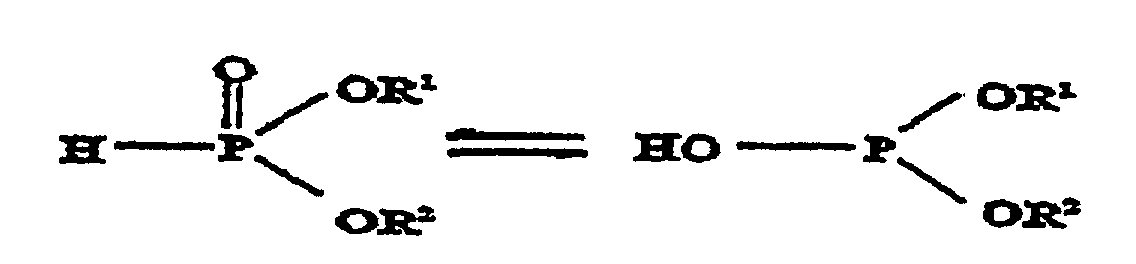
- the dihydrocarbyl hydrogen phosphites employed in the catalyst system of the present invention may be represented by the following keto-enol tautomeric structures: where R 1 and R 2 are alkyl, cycloalkyl, aryl, aralkyl, or allyl groups which may or may not be identical, each group preferably containing from 1 or the appropriate minimum carbon atoms to form each group up to 20 carbon atoms.
- the dihydrocarbyl hydrogen phosphites exist mainly as the keto tautomer (shown on the left), with the enol tautomer (shown on the right) being the minor species. Both tautomers may be self associated in dimeric or trimeric forms by hydrogen bonding.
- the dihydrocarbyl phosphites may be exemplified by dimethyl hydrogen phosphite, diethyl hydrogen phosphite; dibutyl hydrogen phosphite, dihexyl hydrogen phosphite, dioctyl hydrogen phosphite, didecyl hydrogen phosphite, didodecyl hydrogen phosphite, dioctadecyl hydrogen phosphite, diisopropyl hydrogen phosphite, di- tert -butyl hydrogen phosphite, bis(2-ethylhexyl) hydrogen phosphite, dineopentyl hydrogen phosphite, bis(cyclopropylmethyl) hydrogen phosphite, bis(cyclobutylmethyl) hydrogen phosphite, bis(cyclopentylmethyl) hydrogen phosphite, bis(cyclohexylmethyl) hydrogen
- the catalyst according to the present invention may be formed in situ by adding the catalyst components to the monomer/solvent mixture in either a stepwise or simultaneous manner.
- the sequence in which the components are added in a stepwise manner is immaterial but the components are preferably added in the sequence of organomagnesium compound, chromium compound, and finally dihydrocarbyl hydrogen phosphite.
- the catalyst may also be preformed by premixing the components outside the polymerization system and the resulting premixed catalyst added to the polymerization system.
- the catalyst system of the present invention has polymerization activity over a wide range of total catalyst concentrations and catalyst component ratios.
- the catalyst components apparently interact to form the active catalyst species.
- the optimum concentration for any one catalyst component is dependent upon the concentrations of the other catalyst components. While polymerization will occur over a wide range of catalyst concentrations and ratios, the polymers having the most desirable properties are obtained within a narrower range.
- the molar ratio of the organomagnesium compound to the chromium compound can be varied from about 2:1 to about 50:1. However, a preferred range of Mg/Cr molar ratio is from about 3:1 to about 20:1.
- the molar ratio of the dihydrocarbyl hydrogen phosphite to the chromium compound (P/Cr) can be varied from about 0.5:1 to about 25:1, with a preferred range of P/Cr molar ratio being from about 1:1 to 10:1.
- the organic solvent usable for the catalyst component solution may be selected from aromatic hydrocarbons, aliphatic hydrocarbons and cycloaliphatic hydrocarbons, and mixtures of two or more of the above-mentioned compounds.
- the organic solvent consists of at least one selected from benzene, toluene, xylene, n-hexane, n-heptane and cyclohexane.
- the total catalyst concentration in the polymerization mass depends on such factors as purity of the components, polymerization rate and conversion desired, and the polymerization temperature. Therefore, specific total catalyst concentrations cannot be definatively set forth except to say that catalytically effective amounts of the respective catalyst components should be used. Generally, the amount of the chromium compound used can be varied from 0.01 to 2 mmol per 100 grams of 1,3-butadiene, with a preferred range being from 0.05 to 1.0 mmol per 100 grams of 1,3-butadiene. Certain specific total catalyst concentrations and catalyst component ratios which produce polymers having desired properties are illustrated in the examples of the present invention.
- a molecular weight regulator may be employed to expand the scope of the polymerization system in such a manner that it can be used for the synthesis of syndiotactic 1, 2-polybutadiene ranging from an extremely high molecular weight polymer to a low molecular weight polymer.
- a molecular weight regulator are accumulated diolefins, such as allene and 1,2-butadiene, and nonconjugated diolefins such as 1,5-cyclooctadiene, 4-vinylcyclohexene, 1,4-pentadiene, 1,5-hexadiene, and 1,6-heptadiene.
- the amount of the molecular weight regulator used is in the range of 0.01 to 1 phm and preferably in the range of 0.05 to 0.5 phm.
- the polymerizations of this invention are usually carried out in inert organic solvents.
- solvents are aliphatic, cycloalipatic, and aromatic hydrocarbons.
- the preferred solvents are hexane, pentane, cyclohexane, methylcyclopentane, benzene, and toluene. Commercial mixtures of the above hydrocarbons may also be used. It will normally be desirable to select a solvent which is inert with respect to the catalyst system employed to initiate the polymerization reaction.
- a solution polymerization system may be employed in which the monomer 1,3-butadiene to be polymerized and the polymer formed are soluble in the polymerization medium.
- a precipitation polymerization system may be employed by choosing a solvent in which the polymer formed is insoluble. In both cases, an amount of the organic solvent in addition to the organic solvent contained in the catalyst component solutions is added to the polymerization system. The additional organic solvent may be either the same as or different from the organic solvent contained in the catalyst component solutions.
- the concentration of the monomer 1,3-butadiene to be polymerized is not limited to a special range.
- the concentration of the 1,3-butadiene in the polymerization reaction mixture be in a range of from 3 to 80% by weight, but a more preferred range is from about 5% to about 50% by weight, and the most preferred range is from about 10% to about 30% by weight.
- the polymerization process of the present invention may be carried out in either a continuous manner or in a batchwise manner, both employing moderate to vigorous agitation.
- the polymerization is conducted under anaerobic conditions using in inert protective gas such as nitrogen, argon or helium.
- the polymerization temperature employed in the practice of this invention may vary widely from a low temperature, such as -10°C or below, to a high temperature such as 100°C or above, with a preferred temperature range from about 20° C to 90°C.
- the heat of polymerization may be removed by external cooling, cooling by evaporation of the monomer 1,3-butadiene or the solvent, or a combination of the two methods.
- the polymerization pressure employed in the practice of this invention may vary widely, a preferred pressure range is from about 1 atmosphere to about 10 atmospheres.
- the polymerization reaction on reaching the desired degree of polymerization, can be stopped by the addition of a known polymerization terminator into the reaction system to inactivate the catalyst system, followed by the conventional steps of desolventization and drying as are typically employed and are known to those skilled in the art in the production of conjugated diene polymers.
- the terminator employed to inactivate the catalyst system is a protic compound such as an alcohol, a carboxylic acid, an inorganic acid, and water or a combination thereof.
- An antioxidant such as 2,6-di-tert-butyl-4-methylphenol may be added along with, before or after addition of the terminator. The amount of the antioxidant employed is usually in the range of 0.2% to 1% by weight of the polymer product.
- the syndiotactic 1,2-polybutadiene product may be isolated from the polymerization mixture by precipitation with an alcohol such as methanol, ethanol, or isopropanol or by steam distilllation of the solvent and unreacted monomer, followed by filtration.
- the product is then dried under a constant vacuum at a temperature of about 25°C to about 100°C (preferably at about 60°C).
- Syndiotactic 1,2-polybutadiene has many uses. Syndiotactic 1,2-polybutadiene can be incorporated into synthetic elastomers in order to improve the green strength of elastomers particularly in tires.
- the supporting carcass (reinforcing carcass) of tires is particularly prone to distortion during tire building and curing procedures. For this reason the incorporation of syndiotactic 1,2-polybutadiene into elastomers which are used as the supporting carcass for tires has particular utility. Syndiotactic 1,2-polybutadiene is also useful in the manufacture of food films and in many molding applications.
- An oven dried one liter glass bottle was capped with a self-sealing rubber liner and a perforated metal cap and purged with a stream of nitrogen.
- the bottle was charged with 200 grams of a 25 % by weight of 1,3-butadiene in hexane blend (25/75 w/w) and 255 grams of additional hexane.
- the following catalyst components were added to the bottle in the following order: 0.45 mmol of MgBu 2 ; 0.050 mmol of chromium 2-ethylhexanoate, and 0.25 mmol of bis(2-ethylhexyl) hydrogen phosphite.
- the bottle was tumbled for 4 hours in a water bath maintained at 50°C.
- the polymerization was terminated by addition of 10 ml of isopropanol containing 0.5 g of 2,6-di- t -butyl-4-methylphenol.
- the polymerization mixture was added into 3 liters of isopropanol.
- the polymer was isolated by filtration and dried to a constant weight under vacuum at 60°C. The yield was 32.5 grams (65%).
- the syndiotacticity of the recovered 1,2-polybutadiene was confirmed by the results of analysis by differential scanning calorimetry (DSC) and nuclear magnetic resonance (NMR). As measured by DSC, the 1,2-polybutadiene had a melting point of 144°C.
- the polymer indicated a 1,2-microstructure content of 86.2%, and a syndiotacticity of 70.8%. As determined by gel permeation chromatography, the polymer has a weight average molecular weight (M w ) of 997,000, a number average molecular weight (M n ) of 490,000, and a polydispersity index (M w /M n ) of 2.0.
- M w weight average molecular weight
- M n number average molecular weight
- M w /M n polydispersity index
- Example 2 the procedure in Example 1 was repeated having the monomer and the catalyst ratio as shown in Table I.
- the monomer charge, amounts of catalysts and the properties of the resultant syndiotactic 1,2-polybutadiene produced in each example are summarized in Table I.
- Example 4 the procedure in Example I was repeated except that dineopentyl hydrogen phosphite was substituted for bis(2-ethylhexyl) hydrogen phosphite, having the monomer and the catalyst ratio varied as shown in Table I.
- the monomer charge, amounts of catalysts and the properties of the resultant syndiotactic 1,2-polybutadiene produced in each example are summarized in Table I.
- Example 9 the procedure in Example 1 was repeated except that triethyl aluminum was substituted for dibutyl magnesium, dineopentyl hydrogen phosphite was substituted for bis(2-ethylhexyl) hydrogen phosphite, and the monomer charge and the amounts of catalysts were varied as shown in Table II.
- Table II The properties of the resultant syndiotactic 1,2-polybutadiene produced in each example are summarized in Table II.
- Example 11 a series of polymerizations were carried out to evaluate 1,2-butadiene as a molecular weight regulator. The procedure is essentially identical to that described in Example 1 except that various amounts of 1,2-butadiene were added to a polymerization bottle containing the monomer solution before addition of the catalyst components. The monomer charge, amounts of catalysts and the properties of the resultant syndiotactic 1,2-polybutadiene produced in each example are summarized in Table III.
Landscapes
- Chemical & Material Sciences (AREA)
- Health & Medical Sciences (AREA)
- Chemical Kinetics & Catalysis (AREA)
- Medicinal Chemistry (AREA)
- Polymers & Plastics (AREA)
- Organic Chemistry (AREA)
- Transition And Organic Metals Composition Catalysts For Addition Polymerization (AREA)
- Addition Polymer Or Copolymer, Post-Treatments, Or Chemical Modifications (AREA)
- Manufacture Of Macromolecular Shaped Articles (AREA)
Claims (15)
- Verfahren zur Bildung eines syndiotaktischen 1,2-Polybutadienprodukts, umfassend:Polymerisation von 1,3-Butadien in einem Kohlenwasserstofflösungsmittel in Gegenwart von katalytisch wirksamen Mengen von(a) einer Organomagnesiumverbindung,(b) einer Chromverbindung und(c) einem Dihydrocarbylhydrogenphosphit.
- Verfahren nach Anspruch 1, dadurch gekennzeichnet, dass die Chromverbindung und die Organomagnesiumverbindung in dem Kohlenwasserstofflösungsmittel löslich sind.
- Verfahren nach Anspruch 1, dadurch gekennzeichnet, dass das syndiotaktische 1,2-Polybutadien eine Syndiotaktizität von mehr als 66,5% und eine Schmelztemperatur von mehr als etwa 100°C hat.
- Verfahren nach Anspruch 1, dadurch gekennzeichnet, dass das syndiotaktische 1,2-Polybutadien eine Syndiotaktizität von mehr als 70% und eine Schmelztemperatur von mehr als etwa 140°C hat.
- Verfahren nach Anspruch 1, dadurch gekennzeichnet, dass bei dem genannten Verfahren die Polymerisation unter Rühren bei einer Temperatur von zwischen etwa -10°C bis etwa 100°C unter einem inerten Schutzgas durchgeführt wird.
- Verfahren nach Anspruch 1, dadurch gekennzeichnet, dass bei dem genannten Verfahren die Polymerisation in Gegenwart eines Molekulargewichts-Regulierungsmittels durchgeführt wird.
- Verfahren nach Anspruch 1, dadurch gekennzeichnet, dass die Organomagnesiumverbindung Dihydrocarbylmagnesium oder ein Hydrocarbylmagnesiumhalogenid ist.
- Verfahren nach Anspruch 1, dadurch gekennzeichnet, dass die Organomagnesiumverbindung durch die Formel MgR2 angegeben wird, wobei jedes R für die gleichen oder verschiedene Gruppen steht und aus der Gruppe bestehend aus Alkyl-, Cycloalkyl-, Aryl-, Aralkyl- und Allylgruppen ausgewählt wird.
- Verfahren nach Anspruch 1, dadurch gekennzeichnet, dass das die Organomagnesiumverbindung durch die Formel RMgX angegeben wird, wobei jedes R aus der Gruppe bestehend aus Alkyl, Cycloalkyl, Aryl, Aralkyl und Allyl ausgewählt wird und X aus der Gruppe bestehend aus Fluor, Chlor, Brom und Iod ausgewählt wird.
- Verfahren nach Anspruch 1, dadurch gekennzeichnet, dass die Chromverbindung aus der Gruppe bestehend aus Chrom-2-ethylhexanoat, Chrom-neodecanoat, Chrom-naphthenat, Chrom-stearat, Chrom-oleat, Chrom-benzoat, Chrom-tris(acetylacetonat), Chrom-tris(trifluoracetylacetonat), Chrom-tris(hexafluoracetylacetonat), Chrom-tris(benzoylacetonat), Chrom-tris(2,2,6,6-tetramethyl-3,5-heptandionat), Chrom-ethoxid, Chrom-isopropoxid, Chrom-2-ethylhexoxid, Chrom-phenoxid, Chrom-nonylphenoxid und Chrom-naphthoxid, tris(Allyl)chrom, tris(Methally)chrom, tris(Crotyl)chrom, bis(Cyclopentadienyl)chrom, bis(Pentamethylcyclopentadienyl)chrom, bis(Benzol)chrom, bis (Ethylbenzol)chrom und bis(Mesitylen)chrom ausgewählt wird.
- Verfahren nach Anspruch 1, dadurch gekennzeichnet, dass das Dihydrocarbylhydrogenphosphit die allgemeinen tautomeren Strukturenhat, worin R1 und R2 unabhängig voneinander aus der Gruppe bestehend aus Alkyl-, Cycloalkyl-, Aryl-, Aralkyl- und Allylgruppen ausgewählt werden.
- Syndiotaktisches 1,2-Polybutadien mit einer Syndiotaktizität von mehr als 66,5% und einer Schmelztemperatur von mehr als etwa 100°C.
- Syndiotaktisches 1,2-Polybutadien nach Anspruch 12, dadurch gekennzeichnet, dass es eine Syndiotaktizität von mehr als 70% und eine Schmelztemperatur von mehr als 140°C hat.
- Industrieprodukt gebildet aus einem syndiotaktischen 1,2-Polybutadien mit einer Syndiotaktizität von mehr als 66,5% und einer Schmelztemperatur von mehr als etwa 100°C.
- Industrieprodukt gebildet aus einem syndiotaktischen 1,2-Polybutadien wie in Anspruch 14 definiert, wobei das syndiotaktische 1,2-Polybutadien eine Syndiotaktizität von mehr als 70% und eine Schmelztemperatur von mehr als etwa 140°C hat.
Applications Claiming Priority (2)
| Application Number | Priority Date | Filing Date | Title |
|---|---|---|---|
| US08/996,656 US6201080B1 (en) | 1997-12-23 | 1997-12-23 | Preparation of syndiotactic 1, 2-polybutadiene using a chromium-containing catalyst system |
| US996656 | 1997-12-23 |
Publications (2)
| Publication Number | Publication Date |
|---|---|
| EP0926167A1 EP0926167A1 (de) | 1999-06-30 |
| EP0926167B1 true EP0926167B1 (de) | 2002-11-06 |
Family
ID=25543153
Family Applications (1)
| Application Number | Title | Priority Date | Filing Date |
|---|---|---|---|
| EP98122116A Expired - Lifetime EP0926167B1 (de) | 1997-12-23 | 1998-11-23 | Herstellung von syndiotaktischem 1,2-Polybutadien mit einem chromhaltigen Katalysator |
Country Status (6)
| Country | Link |
|---|---|
| US (1) | US6201080B1 (de) |
| EP (1) | EP0926167B1 (de) |
| JP (1) | JPH11255817A (de) |
| CA (1) | CA2255351A1 (de) |
| DE (1) | DE69809182T2 (de) |
| ES (1) | ES2186078T3 (de) |
Families Citing this family (16)
| Publication number | Priority date | Publication date | Assignee | Title |
|---|---|---|---|---|
| US6277779B1 (en) | 1998-10-14 | 2001-08-21 | Bridgestone Corporation | Process and iron-based catalyst composition for the production of syndiotactic 1,2-polybutadiene |
| US6399732B2 (en) | 1998-10-14 | 2002-06-04 | Bridgestone Corporation | Preparation of conjugated diene polymers by using an iron-based catalayst system |
| US6284702B1 (en) | 1998-10-14 | 2001-09-04 | Bridgestone Corporation | Iron-based catalyst composition and process for producing syndiotactic 1,2-polybutadiene |
| US6288183B1 (en) | 1999-12-30 | 2001-09-11 | Bridgestone Corporation | Catalyst composition and process for controlling the characteristics of conjugated diene polymers |
| US6197888B1 (en) * | 1999-12-30 | 2001-03-06 | Bridgestone Corporation | Process for producing blends of syndiotactic 1, 2-polybutadiene and rubbery elastomers with an iron-based catalyst system |
| WO2001079308A2 (en) * | 2000-04-13 | 2001-10-25 | Bridgestone Corporation | Cr-based catalyst composition for the manufacture of conjugated diene rubber |
| EP1274752A2 (de) * | 2000-04-13 | 2003-01-15 | Bridgestone Corporation | Verwendung einen auf khromium oder molybdenium basierten katalysatorsystem für die herstellung von mischungen von syndiotaktischen 1,2-polybutadien une elastomeren aus kautschuk |
| US6465585B2 (en) | 2001-02-19 | 2002-10-15 | Bridgestone Corporation | Chromium-based catalyst composition for producing conjugated diene polymers |
| US7211619B2 (en) * | 2001-08-07 | 2007-05-01 | Bridgestone Corporation | Stabilizing high-vinyl polybutadiene |
| US6610804B2 (en) | 2001-08-24 | 2003-08-26 | Bridgestone Corporation | Iron-based catalyst composition for the manufacture of syndiotactic 1, 2-polybutadiene |
| US6576725B1 (en) | 2002-01-18 | 2003-06-10 | Bridgestone Corporation | Iron-based catalyst for producing high-vinyl polybutadiene |
| US6720397B2 (en) | 2002-02-20 | 2004-04-13 | Bridgestone Corporation | Polymerization process for preparing syndiotactic 1,2-polybutadiene |
| US6890990B2 (en) | 2003-05-30 | 2005-05-10 | Solvay Engineered Polymers, Inc. | Co-agents for the preparation of thermoplastic elastomeric blends of rubber and polyolefins |
| US7291677B2 (en) * | 2003-12-15 | 2007-11-06 | Solvay Engineered Polymers, Inc. | Adherent, modified thermoplastic elastomeric blends, articles, and methods |
| US7872075B2 (en) * | 2005-10-07 | 2011-01-18 | Exxonmobil Chemical Patents Inc. | Peroxide-cured thermoplastic vulcanizates and process for making the same |
| US20120129097A1 (en) * | 2010-11-18 | 2012-05-24 | Jonghan Choi | Photopolymer Printing Plates with In Situ Non-Directional Floor Formed During Extrusion |
Family Cites Families (8)
| Publication number | Priority date | Publication date | Assignee | Title |
|---|---|---|---|---|
| BE759763A (fr) | 1969-12-02 | 1971-05-17 | Ube Industries | Procede pour la preparption de 1,2-polybutadiene |
| JPS5023709B2 (de) | 1971-12-09 | 1975-08-09 | ||
| US3879367A (en) * | 1973-11-19 | 1975-04-22 | Firestone Tire & Rubber Co | Production of crystalline, high-vinyl polybutadiene |
| JPS53143685A (en) | 1977-05-23 | 1978-12-14 | Japan Synthetic Rubber Co Ltd | Preparation of 1,2-polybutadiene |
| US4168374A (en) | 1978-04-05 | 1979-09-18 | The Goodyear Tire & Rubber Company | Copolymerization of conjugated diolefins using a chromium-containing catalyst system |
| US4168357A (en) | 1978-04-05 | 1979-09-18 | The Goodyear Tire & Rubber Company | Preparation of high cis-1,4-polypentadiene |
| DE3538130A1 (de) | 1985-10-26 | 1987-04-30 | Bunawerke Huels Gmbh | Verfahren und katalysator zur herstellung von syndiotaktischem 1,2-polybutadien |
| TW344744B (en) * | 1995-05-02 | 1998-11-11 | Ube Industries | Improved process for producing syndiotactic-1,2-polybutadiene |
-
1997
- 1997-12-23 US US08/996,656 patent/US6201080B1/en not_active Expired - Lifetime
-
1998
- 1998-11-23 EP EP98122116A patent/EP0926167B1/de not_active Expired - Lifetime
- 1998-11-23 ES ES98122116T patent/ES2186078T3/es not_active Expired - Lifetime
- 1998-11-23 DE DE69809182T patent/DE69809182T2/de not_active Expired - Fee Related
- 1998-12-09 CA CA002255351A patent/CA2255351A1/en not_active Abandoned
- 1998-12-22 JP JP10376351A patent/JPH11255817A/ja active Pending
Also Published As
| Publication number | Publication date |
|---|---|
| DE69809182T2 (de) | 2003-04-03 |
| JPH11255817A (ja) | 1999-09-21 |
| ES2186078T3 (es) | 2003-05-01 |
| US6201080B1 (en) | 2001-03-13 |
| EP0926167A1 (de) | 1999-06-30 |
| DE69809182D1 (de) | 2002-12-12 |
| CA2255351A1 (en) | 1999-06-23 |
Similar Documents
| Publication | Publication Date | Title |
|---|---|---|
| JP5820025B2 (ja) | 鉄をベースにした触媒組成物及びシンジオタクチック1,2−ポリブタジエンの製造方法 | |
| US5919875A (en) | Method of preparing syndiotactic 1,2-polybutadiene with a chromium-based catalyst system | |
| EP0926167B1 (de) | Herstellung von syndiotaktischem 1,2-Polybutadien mit einem chromhaltigen Katalysator | |
| JP5584239B2 (ja) | シンジオタクティック1,2−ポリブタジエンの製造方法およびそのための鉄を基とする触媒組成物 | |
| EP0962471B1 (de) | Katalysator und Verfahren zur Herstellung von syndiotactischem 1,2-Polybutadien | |
| US6310152B1 (en) | Synthesis of elastomeric high trans-1,4-polybutadiene | |
| EP0994130B1 (de) | Verfahren zur Herstellung von syndiotactischem 1,2-Polybutadien und dafür verwendeter Katalysator auf Eisenbasis | |
| US6211313B1 (en) | Iron-based catalyst composition and process for producing conjugated diene polymers | |
| US20020137862A1 (en) | Preparation of conjugated diene polymers by using an iron-based catalyst system | |
| US3935180A (en) | Polybutadiene and process for producing same | |
| JP2003519257A (ja) | 触媒組成物と共役ジエンポリマーの特性の制御方法 | |
| JP2003531248A (ja) | Moが基になった触媒組成物を用いて共役ジエン重合体の性質を調節する方法 |
Legal Events
| Date | Code | Title | Description |
|---|---|---|---|
| PUAI | Public reference made under article 153(3) epc to a published international application that has entered the european phase |
Free format text: ORIGINAL CODE: 0009012 |
|
| AK | Designated contracting states |
Kind code of ref document: A1 Designated state(s): DE ES FR GB IT |
|
| AX | Request for extension of the european patent |
Free format text: AL;LT;LV;MK;RO;SI |
|
| 17P | Request for examination filed |
Effective date: 19990719 |
|
| AKX | Designation fees paid |
Free format text: DE ES FR GB IT |
|
| GRAG | Despatch of communication of intention to grant |
Free format text: ORIGINAL CODE: EPIDOS AGRA |
|
| 17Q | First examination report despatched |
Effective date: 20020318 |
|
| GRAG | Despatch of communication of intention to grant |
Free format text: ORIGINAL CODE: EPIDOS AGRA |
|
| GRAH | Despatch of communication of intention to grant a patent |
Free format text: ORIGINAL CODE: EPIDOS IGRA |
|
| RIN1 | Information on inventor provided before grant (corrected) |
Inventor name: KANG, JUNG W. Inventor name: HALL, JAMES E. Inventor name: OZAWA, YOICHI F. Inventor name: LUO, STEVEN |
|
| GRAH | Despatch of communication of intention to grant a patent |
Free format text: ORIGINAL CODE: EPIDOS IGRA |
|
| GRAA | (expected) grant |
Free format text: ORIGINAL CODE: 0009210 |
|
| PGFP | Annual fee paid to national office [announced via postgrant information from national office to epo] |
Ref country code: FR Payment date: 20021105 Year of fee payment: 5 |
|
| AK | Designated contracting states |
Kind code of ref document: B1 Designated state(s): DE ES FR GB IT |
|
| REG | Reference to a national code |
Ref country code: GB Ref legal event code: FG4D |
|
| PGFP | Annual fee paid to national office [announced via postgrant information from national office to epo] |
Ref country code: GB Payment date: 20021115 Year of fee payment: 5 |
|
| PGFP | Annual fee paid to national office [announced via postgrant information from national office to epo] |
Ref country code: DE Payment date: 20021127 Year of fee payment: 5 |
|
| REF | Corresponds to: |
Ref document number: 69809182 Country of ref document: DE Date of ref document: 20021212 |
|
| PGFP | Annual fee paid to national office [announced via postgrant information from national office to epo] |
Ref country code: ES Payment date: 20021216 Year of fee payment: 5 |
|
| ET | Fr: translation filed | ||
| REG | Reference to a national code |
Ref country code: ES Ref legal event code: FG2A Ref document number: 2186078 Country of ref document: ES Kind code of ref document: T3 |
|
| PLBE | No opposition filed within time limit |
Free format text: ORIGINAL CODE: 0009261 |
|
| STAA | Information on the status of an ep patent application or granted ep patent |
Free format text: STATUS: NO OPPOSITION FILED WITHIN TIME LIMIT |
|
| 26N | No opposition filed |
Effective date: 20030807 |
|
| PG25 | Lapsed in a contracting state [announced via postgrant information from national office to epo] |
Ref country code: GB Free format text: LAPSE BECAUSE OF NON-PAYMENT OF DUE FEES Effective date: 20031123 |
|
| PG25 | Lapsed in a contracting state [announced via postgrant information from national office to epo] |
Ref country code: ES Free format text: LAPSE BECAUSE OF NON-PAYMENT OF DUE FEES Effective date: 20031124 |
|
| PG25 | Lapsed in a contracting state [announced via postgrant information from national office to epo] |
Ref country code: DE Free format text: LAPSE BECAUSE OF NON-PAYMENT OF DUE FEES Effective date: 20040602 |
|
| GBPC | Gb: european patent ceased through non-payment of renewal fee |
Effective date: 20031123 |
|
| PG25 | Lapsed in a contracting state [announced via postgrant information from national office to epo] |
Ref country code: FR Free format text: LAPSE BECAUSE OF NON-PAYMENT OF DUE FEES Effective date: 20040730 |
|
| REG | Reference to a national code |
Ref country code: FR Ref legal event code: ST |
|
| REG | Reference to a national code |
Ref country code: ES Ref legal event code: FD2A Effective date: 20031124 |
|
| PG25 | Lapsed in a contracting state [announced via postgrant information from national office to epo] |
Ref country code: IT Free format text: LAPSE BECAUSE OF NON-PAYMENT OF DUE FEES;WARNING: LAPSES OF ITALIAN PATENTS WITH EFFECTIVE DATE BEFORE 2007 MAY HAVE OCCURRED AT ANY TIME BEFORE 2007. THE CORRECT EFFECTIVE DATE MAY BE DIFFERENT FROM THE ONE RECORDED. Effective date: 20051123 |