EP0925382B1 - Verschleissbeständiger, mechanisch hochbelastbarer und reibungsarmer randschichtaufbau aus einem substrat aus titan oder seinen legierungen sowie verfahren zu seiner herstellung - Google Patents
Verschleissbeständiger, mechanisch hochbelastbarer und reibungsarmer randschichtaufbau aus einem substrat aus titan oder seinen legierungen sowie verfahren zu seiner herstellung Download PDFInfo
- Publication number
- EP0925382B1 EP0925382B1 EP97943774A EP97943774A EP0925382B1 EP 0925382 B1 EP0925382 B1 EP 0925382B1 EP 97943774 A EP97943774 A EP 97943774A EP 97943774 A EP97943774 A EP 97943774A EP 0925382 B1 EP0925382 B1 EP 0925382B1
- Authority
- EP
- European Patent Office
- Prior art keywords
- titanium
- laser
- layer
- wear
- alloys
- Prior art date
- Legal status (The legal status is an assumption and is not a legal conclusion. Google has not performed a legal analysis and makes no representation as to the accuracy of the status listed.)
- Expired - Lifetime
Links
Images

Classifications
-
- C—CHEMISTRY; METALLURGY
- C23—COATING METALLIC MATERIAL; COATING MATERIAL WITH METALLIC MATERIAL; CHEMICAL SURFACE TREATMENT; DIFFUSION TREATMENT OF METALLIC MATERIAL; COATING BY VACUUM EVAPORATION, BY SPUTTERING, BY ION IMPLANTATION OR BY CHEMICAL VAPOUR DEPOSITION, IN GENERAL; INHIBITING CORROSION OF METALLIC MATERIAL OR INCRUSTATION IN GENERAL
- C23C—COATING METALLIC MATERIAL; COATING MATERIAL WITH METALLIC MATERIAL; SURFACE TREATMENT OF METALLIC MATERIAL BY DIFFUSION INTO THE SURFACE, BY CHEMICAL CONVERSION OR SUBSTITUTION; COATING BY VACUUM EVAPORATION, BY SPUTTERING, BY ION IMPLANTATION OR BY CHEMICAL VAPOUR DEPOSITION, IN GENERAL
- C23C28/00—Coating for obtaining at least two superposed coatings either by methods not provided for in a single one of groups C23C2/00 - C23C26/00 or by combinations of methods provided for in subclasses C23C and C25C or C25D
- C23C28/30—Coatings combining at least one metallic layer and at least one inorganic non-metallic layer
- C23C28/32—Coatings combining at least one metallic layer and at least one inorganic non-metallic layer including at least one pure metallic layer
- C23C28/321—Coatings combining at least one metallic layer and at least one inorganic non-metallic layer including at least one pure metallic layer with at least one metal alloy layer
-
- A—HUMAN NECESSITIES
- A61—MEDICAL OR VETERINARY SCIENCE; HYGIENE
- A61L—METHODS OR APPARATUS FOR STERILISING MATERIALS OR OBJECTS IN GENERAL; DISINFECTION, STERILISATION OR DEODORISATION OF AIR; CHEMICAL ASPECTS OF BANDAGES, DRESSINGS, ABSORBENT PADS OR SURGICAL ARTICLES; MATERIALS FOR BANDAGES, DRESSINGS, ABSORBENT PADS OR SURGICAL ARTICLES
- A61L27/00—Materials for grafts or prostheses or for coating grafts or prostheses
- A61L27/02—Inorganic materials
- A61L27/04—Metals or alloys
- A61L27/06—Titanium or titanium alloys
-
- A—HUMAN NECESSITIES
- A61—MEDICAL OR VETERINARY SCIENCE; HYGIENE
- A61L—METHODS OR APPARATUS FOR STERILISING MATERIALS OR OBJECTS IN GENERAL; DISINFECTION, STERILISATION OR DEODORISATION OF AIR; CHEMICAL ASPECTS OF BANDAGES, DRESSINGS, ABSORBENT PADS OR SURGICAL ARTICLES; MATERIALS FOR BANDAGES, DRESSINGS, ABSORBENT PADS OR SURGICAL ARTICLES
- A61L27/00—Materials for grafts or prostheses or for coating grafts or prostheses
- A61L27/02—Inorganic materials
- A61L27/08—Carbon ; Graphite
-
- B—PERFORMING OPERATIONS; TRANSPORTING
- B23—MACHINE TOOLS; METAL-WORKING NOT OTHERWISE PROVIDED FOR
- B23K—SOLDERING OR UNSOLDERING; WELDING; CLADDING OR PLATING BY SOLDERING OR WELDING; CUTTING BY APPLYING HEAT LOCALLY, e.g. FLAME CUTTING; WORKING BY LASER BEAM
- B23K26/00—Working by laser beam, e.g. welding, cutting or boring
- B23K26/20—Bonding
- B23K26/32—Bonding taking account of the properties of the material involved
-
- B—PERFORMING OPERATIONS; TRANSPORTING
- B23—MACHINE TOOLS; METAL-WORKING NOT OTHERWISE PROVIDED FOR
- B23K—SOLDERING OR UNSOLDERING; WELDING; CLADDING OR PLATING BY SOLDERING OR WELDING; CUTTING BY APPLYING HEAT LOCALLY, e.g. FLAME CUTTING; WORKING BY LASER BEAM
- B23K26/00—Working by laser beam, e.g. welding, cutting or boring
- B23K26/34—Laser welding for purposes other than joining
-
- C—CHEMISTRY; METALLURGY
- C22—METALLURGY; FERROUS OR NON-FERROUS ALLOYS; TREATMENT OF ALLOYS OR NON-FERROUS METALS
- C22F—CHANGING THE PHYSICAL STRUCTURE OF NON-FERROUS METALS AND NON-FERROUS ALLOYS
- C22F1/00—Changing the physical structure of non-ferrous metals or alloys by heat treatment or by hot or cold working
- C22F1/16—Changing the physical structure of non-ferrous metals or alloys by heat treatment or by hot or cold working of other metals or alloys based thereon
- C22F1/18—High-melting or refractory metals or alloys based thereon
- C22F1/183—High-melting or refractory metals or alloys based thereon of titanium or alloys based thereon
-
- C—CHEMISTRY; METALLURGY
- C22—METALLURGY; FERROUS OR NON-FERROUS ALLOYS; TREATMENT OF ALLOYS OR NON-FERROUS METALS
- C22F—CHANGING THE PHYSICAL STRUCTURE OF NON-FERROUS METALS AND NON-FERROUS ALLOYS
- C22F3/00—Changing the physical structure of non-ferrous metals or alloys by special physical methods, e.g. treatment with neutrons
-
- C—CHEMISTRY; METALLURGY
- C23—COATING METALLIC MATERIAL; COATING MATERIAL WITH METALLIC MATERIAL; CHEMICAL SURFACE TREATMENT; DIFFUSION TREATMENT OF METALLIC MATERIAL; COATING BY VACUUM EVAPORATION, BY SPUTTERING, BY ION IMPLANTATION OR BY CHEMICAL VAPOUR DEPOSITION, IN GENERAL; INHIBITING CORROSION OF METALLIC MATERIAL OR INCRUSTATION IN GENERAL
- C23C—COATING METALLIC MATERIAL; COATING MATERIAL WITH METALLIC MATERIAL; SURFACE TREATMENT OF METALLIC MATERIAL BY DIFFUSION INTO THE SURFACE, BY CHEMICAL CONVERSION OR SUBSTITUTION; COATING BY VACUUM EVAPORATION, BY SPUTTERING, BY ION IMPLANTATION OR BY CHEMICAL VAPOUR DEPOSITION, IN GENERAL
- C23C28/00—Coating for obtaining at least two superposed coatings either by methods not provided for in a single one of groups C23C2/00 - C23C26/00 or by combinations of methods provided for in subclasses C23C and C25C or C25D
- C23C28/30—Coatings combining at least one metallic layer and at least one inorganic non-metallic layer
- C23C28/32—Coatings combining at least one metallic layer and at least one inorganic non-metallic layer including at least one pure metallic layer
- C23C28/322—Coatings combining at least one metallic layer and at least one inorganic non-metallic layer including at least one pure metallic layer only coatings of metal elements only
-
- C—CHEMISTRY; METALLURGY
- C23—COATING METALLIC MATERIAL; COATING MATERIAL WITH METALLIC MATERIAL; CHEMICAL SURFACE TREATMENT; DIFFUSION TREATMENT OF METALLIC MATERIAL; COATING BY VACUUM EVAPORATION, BY SPUTTERING, BY ION IMPLANTATION OR BY CHEMICAL VAPOUR DEPOSITION, IN GENERAL; INHIBITING CORROSION OF METALLIC MATERIAL OR INCRUSTATION IN GENERAL
- C23C—COATING METALLIC MATERIAL; COATING MATERIAL WITH METALLIC MATERIAL; SURFACE TREATMENT OF METALLIC MATERIAL BY DIFFUSION INTO THE SURFACE, BY CHEMICAL CONVERSION OR SUBSTITUTION; COATING BY VACUUM EVAPORATION, BY SPUTTERING, BY ION IMPLANTATION OR BY CHEMICAL VAPOUR DEPOSITION, IN GENERAL
- C23C28/00—Coating for obtaining at least two superposed coatings either by methods not provided for in a single one of groups C23C2/00 - C23C26/00 or by combinations of methods provided for in subclasses C23C and C25C or C25D
- C23C28/30—Coatings combining at least one metallic layer and at least one inorganic non-metallic layer
- C23C28/32—Coatings combining at least one metallic layer and at least one inorganic non-metallic layer including at least one pure metallic layer
- C23C28/324—Coatings combining at least one metallic layer and at least one inorganic non-metallic layer including at least one pure metallic layer with at least one metal matrix material layer comprising a mixture of at least two metals or metal phases or a metal-matrix material with hard embedded particles, e.g. WC-Me
-
- C—CHEMISTRY; METALLURGY
- C23—COATING METALLIC MATERIAL; COATING MATERIAL WITH METALLIC MATERIAL; CHEMICAL SURFACE TREATMENT; DIFFUSION TREATMENT OF METALLIC MATERIAL; COATING BY VACUUM EVAPORATION, BY SPUTTERING, BY ION IMPLANTATION OR BY CHEMICAL VAPOUR DEPOSITION, IN GENERAL; INHIBITING CORROSION OF METALLIC MATERIAL OR INCRUSTATION IN GENERAL
- C23C—COATING METALLIC MATERIAL; COATING MATERIAL WITH METALLIC MATERIAL; SURFACE TREATMENT OF METALLIC MATERIAL BY DIFFUSION INTO THE SURFACE, BY CHEMICAL CONVERSION OR SUBSTITUTION; COATING BY VACUUM EVAPORATION, BY SPUTTERING, BY ION IMPLANTATION OR BY CHEMICAL VAPOUR DEPOSITION, IN GENERAL
- C23C28/00—Coating for obtaining at least two superposed coatings either by methods not provided for in a single one of groups C23C2/00 - C23C26/00 or by combinations of methods provided for in subclasses C23C and C25C or C25D
- C23C28/30—Coatings combining at least one metallic layer and at least one inorganic non-metallic layer
- C23C28/34—Coatings combining at least one metallic layer and at least one inorganic non-metallic layer including at least one inorganic non-metallic material layer, e.g. metal carbide, nitride, boride, silicide layer and their mixtures, enamels, phosphates and sulphates
- C23C28/343—Coatings combining at least one metallic layer and at least one inorganic non-metallic layer including at least one inorganic non-metallic material layer, e.g. metal carbide, nitride, boride, silicide layer and their mixtures, enamels, phosphates and sulphates with at least one DLC or an amorphous carbon based layer, the layer being doped or not
-
- C—CHEMISTRY; METALLURGY
- C23—COATING METALLIC MATERIAL; COATING MATERIAL WITH METALLIC MATERIAL; CHEMICAL SURFACE TREATMENT; DIFFUSION TREATMENT OF METALLIC MATERIAL; COATING BY VACUUM EVAPORATION, BY SPUTTERING, BY ION IMPLANTATION OR BY CHEMICAL VAPOUR DEPOSITION, IN GENERAL; INHIBITING CORROSION OF METALLIC MATERIAL OR INCRUSTATION IN GENERAL
- C23C—COATING METALLIC MATERIAL; COATING MATERIAL WITH METALLIC MATERIAL; SURFACE TREATMENT OF METALLIC MATERIAL BY DIFFUSION INTO THE SURFACE, BY CHEMICAL CONVERSION OR SUBSTITUTION; COATING BY VACUUM EVAPORATION, BY SPUTTERING, BY ION IMPLANTATION OR BY CHEMICAL VAPOUR DEPOSITION, IN GENERAL
- C23C28/00—Coating for obtaining at least two superposed coatings either by methods not provided for in a single one of groups C23C2/00 - C23C26/00 or by combinations of methods provided for in subclasses C23C and C25C or C25D
- C23C28/30—Coatings combining at least one metallic layer and at least one inorganic non-metallic layer
- C23C28/34—Coatings combining at least one metallic layer and at least one inorganic non-metallic layer including at least one inorganic non-metallic material layer, e.g. metal carbide, nitride, boride, silicide layer and their mixtures, enamels, phosphates and sulphates
- C23C28/347—Coatings combining at least one metallic layer and at least one inorganic non-metallic layer including at least one inorganic non-metallic material layer, e.g. metal carbide, nitride, boride, silicide layer and their mixtures, enamels, phosphates and sulphates with layers adapted for cutting tools or wear applications
-
- A—HUMAN NECESSITIES
- A61—MEDICAL OR VETERINARY SCIENCE; HYGIENE
- A61F—FILTERS IMPLANTABLE INTO BLOOD VESSELS; PROSTHESES; DEVICES PROVIDING PATENCY TO, OR PREVENTING COLLAPSING OF, TUBULAR STRUCTURES OF THE BODY, e.g. STENTS; ORTHOPAEDIC, NURSING OR CONTRACEPTIVE DEVICES; FOMENTATION; TREATMENT OR PROTECTION OF EYES OR EARS; BANDAGES, DRESSINGS OR ABSORBENT PADS; FIRST-AID KITS
- A61F2310/00—Prostheses classified in A61F2/28 or A61F2/30 - A61F2/44 being constructed from or coated with a particular material
- A61F2310/00005—The prosthesis being constructed from a particular material
- A61F2310/00011—Metals or alloys
- A61F2310/00023—Titanium or titanium-based alloys, e.g. Ti-Ni alloys
-
- A—HUMAN NECESSITIES
- A61—MEDICAL OR VETERINARY SCIENCE; HYGIENE
- A61F—FILTERS IMPLANTABLE INTO BLOOD VESSELS; PROSTHESES; DEVICES PROVIDING PATENCY TO, OR PREVENTING COLLAPSING OF, TUBULAR STRUCTURES OF THE BODY, e.g. STENTS; ORTHOPAEDIC, NURSING OR CONTRACEPTIVE DEVICES; FOMENTATION; TREATMENT OR PROTECTION OF EYES OR EARS; BANDAGES, DRESSINGS OR ABSORBENT PADS; FIRST-AID KITS
- A61F2310/00—Prostheses classified in A61F2/28 or A61F2/30 - A61F2/44 being constructed from or coated with a particular material
- A61F2310/00005—The prosthesis being constructed from a particular material
- A61F2310/00161—Carbon; Graphite
-
- B—PERFORMING OPERATIONS; TRANSPORTING
- B23—MACHINE TOOLS; METAL-WORKING NOT OTHERWISE PROVIDED FOR
- B23K—SOLDERING OR UNSOLDERING; WELDING; CLADDING OR PLATING BY SOLDERING OR WELDING; CUTTING BY APPLYING HEAT LOCALLY, e.g. FLAME CUTTING; WORKING BY LASER BEAM
- B23K2103/00—Materials to be soldered, welded or cut
- B23K2103/08—Non-ferrous metals or alloys
- B23K2103/14—Titanium or alloys thereof
-
- Y—GENERAL TAGGING OF NEW TECHNOLOGICAL DEVELOPMENTS; GENERAL TAGGING OF CROSS-SECTIONAL TECHNOLOGIES SPANNING OVER SEVERAL SECTIONS OF THE IPC; TECHNICAL SUBJECTS COVERED BY FORMER USPC CROSS-REFERENCE ART COLLECTIONS [XRACs] AND DIGESTS
- Y10—TECHNICAL SUBJECTS COVERED BY FORMER USPC
- Y10T—TECHNICAL SUBJECTS COVERED BY FORMER US CLASSIFICATION
- Y10T428/00—Stock material or miscellaneous articles
- Y10T428/24—Structurally defined web or sheet [e.g., overall dimension, etc.]
- Y10T428/24942—Structurally defined web or sheet [e.g., overall dimension, etc.] including components having same physical characteristic in differing degree
-
- Y—GENERAL TAGGING OF NEW TECHNOLOGICAL DEVELOPMENTS; GENERAL TAGGING OF CROSS-SECTIONAL TECHNOLOGIES SPANNING OVER SEVERAL SECTIONS OF THE IPC; TECHNICAL SUBJECTS COVERED BY FORMER USPC CROSS-REFERENCE ART COLLECTIONS [XRACs] AND DIGESTS
- Y10—TECHNICAL SUBJECTS COVERED BY FORMER USPC
- Y10T—TECHNICAL SUBJECTS COVERED BY FORMER US CLASSIFICATION
- Y10T428/00—Stock material or miscellaneous articles
- Y10T428/24—Structurally defined web or sheet [e.g., overall dimension, etc.]
- Y10T428/24942—Structurally defined web or sheet [e.g., overall dimension, etc.] including components having same physical characteristic in differing degree
- Y10T428/2495—Thickness [relative or absolute]
- Y10T428/24967—Absolute thicknesses specified
- Y10T428/24975—No layer or component greater than 5 mils thick
-
- Y—GENERAL TAGGING OF NEW TECHNOLOGICAL DEVELOPMENTS; GENERAL TAGGING OF CROSS-SECTIONAL TECHNOLOGIES SPANNING OVER SEVERAL SECTIONS OF THE IPC; TECHNICAL SUBJECTS COVERED BY FORMER USPC CROSS-REFERENCE ART COLLECTIONS [XRACs] AND DIGESTS
- Y10—TECHNICAL SUBJECTS COVERED BY FORMER USPC
- Y10T—TECHNICAL SUBJECTS COVERED BY FORMER US CLASSIFICATION
- Y10T428/00—Stock material or miscellaneous articles
- Y10T428/26—Web or sheet containing structurally defined element or component, the element or component having a specified physical dimension
- Y10T428/263—Coating layer not in excess of 5 mils thick or equivalent
- Y10T428/264—Up to 3 mils
- Y10T428/265—1 mil or less
-
- Y—GENERAL TAGGING OF NEW TECHNOLOGICAL DEVELOPMENTS; GENERAL TAGGING OF CROSS-SECTIONAL TECHNOLOGIES SPANNING OVER SEVERAL SECTIONS OF THE IPC; TECHNICAL SUBJECTS COVERED BY FORMER USPC CROSS-REFERENCE ART COLLECTIONS [XRACs] AND DIGESTS
- Y10—TECHNICAL SUBJECTS COVERED BY FORMER USPC
- Y10T—TECHNICAL SUBJECTS COVERED BY FORMER US CLASSIFICATION
- Y10T428/00—Stock material or miscellaneous articles
- Y10T428/30—Self-sustaining carbon mass or layer with impregnant or other layer
-
- Y—GENERAL TAGGING OF NEW TECHNOLOGICAL DEVELOPMENTS; GENERAL TAGGING OF CROSS-SECTIONAL TECHNOLOGIES SPANNING OVER SEVERAL SECTIONS OF THE IPC; TECHNICAL SUBJECTS COVERED BY FORMER USPC CROSS-REFERENCE ART COLLECTIONS [XRACs] AND DIGESTS
- Y10—TECHNICAL SUBJECTS COVERED BY FORMER USPC
- Y10T—TECHNICAL SUBJECTS COVERED BY FORMER US CLASSIFICATION
- Y10T428/00—Stock material or miscellaneous articles
- Y10T428/31504—Composite [nonstructural laminate]
- Y10T428/31678—Of metal
Definitions
- the invention relates to the surface finishing of functional components.
- Objects for which their application is possible and expedient are all functional components made of titanium or its alloys subject to sliding wear, which are loaded at operating temperatures below 500 ° C, a high surface pressure are subjected and the lowest possible coefficient of friction must have.
- the invention is particularly advantageous for protecting Human implants, in particular with oscillating movements and sliding wear Components from the aerospace sector can be used.
- Titanium is an excellent construction material, its high specific Strength, chemical resistance and biocompatibility him for different Special applications predestined. However, there is a wider range of uses often its low resistance to sliding wear and its high Friction coefficient counter.
- the component is replaced by the Laser beam melted down to a depth of 0.1 to 0.7 mm and simultaneously Nitrogen is blown into the melt. Because of the high affinity of titanium reactive gases immediately form titanium nitride, which is formed in the form of needles from the Melt excretes. After solidification, the surface layer consists of a metallic matrix made of titanium with a compared to the initial state changed ⁇ / ⁇ portion as well as very dense, partly very coarse Titanium nitride. The hardness of the surface layer is usually up to 1000 HV.
- a method for gas nitriding (PS US 5,326,362) has become known in which molecular nitrogen at a process temperature of 400 ° C to 704.4 ° C diffuses into the areas near the surface and forms a wear-resistant surface layer through solution hardening.
- the component is placed in a vacuum oven, evacuated to a pressure of 1 • 10 -6 torr, then filled with 1 at nitrogen, heated to 537.7 ° C, the nitrogen pressure increased to 2 at and several hours at 593.3 ° C nitrided.
- the surface layer consists of a 0.2 ⁇ m thick connecting layer made of titanium nitrides, titanium carbonitrides, titanium oxides and carbo-oxides and a few ⁇ m thick diffusion layer.
- the titanium nitrides in the connection layer are significantly more finely dispersed than in laser gas alloys. Since the connection layer forms a closed layer on the surface, the load capacity of the layer under an oxygen-containing atmosphere and elevated temperatures is increased at the same time.
- connection layer continues to exist very hard and not completely flat titanium nitride needles, which the counter body furrows and on the other hand the underlying diffusion layer is too thin to one to be able to withstand high local loads for a sufficiently long time.
- the latter results primarily from the fact that with a Hertzian pressure with the in the Contact surfaces occurring in practice the maximum voltage is below the layer. Plastic deformations can therefore occur in the soft base material, which lead to a lifting of the brittle connection layer.
- the aim of the invention is to provide a significantly more resistant to sliding wear, biocompatible surface layer structure with very low sliding friction coefficients for Specify titanium and its alloys and a process for its manufacture propose.
- the invention is based on the object of specifying an edge layer structure which taking advantage of the high wear resistance of titanium nitride has at least an order of magnitude higher hardening depth and that directly in the Surface contains no titanium nitride needles.
- this object is achieved with a wear-resistant, mechanical heavy-duty and low-friction surface layer structure on a substrate made of titanium or its Alloys, consisting of a laser gas alloy layer with deposited Titanium nitride needles, as stated in claims 1 or 2, solved.
- Claim 2 represents an advantageous embodiment of the intermediate layer in which particularly good adhesion of the hard-amorphous carbon layer is achieved.
- the task is accomplished by a method for generating a Surface layer structure with low friction coefficients and a very high one Load carrying capacity solved. According to the invention, as stated in claim 3, proceed.
- a component made of the alloy Ti6Al4V with the dimensions 10 x 40 x 60 mm 3 should be provided on one flat side with a very wear-resistant and low-friction layer structure.
- the ground component which has been cleaned of grease residues with a solvent, is positioned on the processing table of a CNC machine.
- the protective bell is designed so that it can move freely in three coordinate directions and guarantees a residual oxygen content of ⁇ 3 ppm after a flushing time of 90 s.
- the laser power is 5 kW
- the beam has a diameter of 3.4 mm on the component, 8 mm / min is selected as the feed rate.
- the track spacing is 0.75 mm with a resulting track width of 4.5 mm.
- the process of gas alloying is started by starting the CNC program and the laser beam release.
- the layer produced in this way is 1.2 mm deep and consists of titanium nitride needles which are embedded in a titanium matrix.
- the surface of the component is then cleaned in a vacuum chamber by ion bombardment with argon ions.
- a vacuum chamber In the same chamber there is an arrangement for carrying out the laser-controlled, pulsed vacuum arc (laser arc) process for producing the hard-amorphous carbon layers.
- the arrangement consists of a pulsed vacuum arc, the target material connected as cathode and a Q-switched Nd-Yag laser with a power density> 5 • 10 8 W / cm 2 .
- the component is fastened in a substrate holder.
- the cylindrical cathode is divided into two parts and consists of a titanium and a Graphite roll.
- a voltage is applied between the cathode and the anode, which is not yet Ignition of an arc discharge is sufficient.
- the laser is on the titanium roller focused and turned on. His pulses generate plasma clouds, one each ignite short arc discharge.
- Ti ions and atoms are deposited on the substrate. After the desired layer thickness of the intermediate layer is reached switched the graphite cathode and the hard amorphous carbon layer on the Component separated.
- the deposited layer is 400 nm thick and consists of a hard amorphous carbon film.
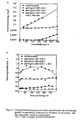
- the components are placed on a ball-disc tribometer tested, the ball is made of hard metal.
Landscapes
- Chemical & Material Sciences (AREA)
- Engineering & Computer Science (AREA)
- Inorganic Chemistry (AREA)
- Mechanical Engineering (AREA)
- Materials Engineering (AREA)
- Metallurgy (AREA)
- Organic Chemistry (AREA)
- Health & Medical Sciences (AREA)
- Chemical Kinetics & Catalysis (AREA)
- Physics & Mathematics (AREA)
- Optics & Photonics (AREA)
- Dermatology (AREA)
- Animal Behavior & Ethology (AREA)
- Crystallography & Structural Chemistry (AREA)
- Veterinary Medicine (AREA)
- Medicinal Chemistry (AREA)
- Oral & Maxillofacial Surgery (AREA)
- Transplantation (AREA)
- Epidemiology (AREA)
- Life Sciences & Earth Sciences (AREA)
- Plasma & Fusion (AREA)
- General Health & Medical Sciences (AREA)
- Public Health (AREA)
- Thermal Sciences (AREA)
- Physical Vapour Deposition (AREA)
- Materials For Medical Uses (AREA)
- Solid-Phase Diffusion Into Metallic Material Surfaces (AREA)
- Other Surface Treatments For Metallic Materials (AREA)
Description
Claims (3)
- Verschleißbeständiger, hochbelastbarer und reibungsarmer Randschicht-aufbau auf einem Substrat des Titan und dessen Legierungen aus einer lasergaslegierten Schicht mit ausgeschiedenen Titannitrid-Nadeln, dadurch gekennzeichnet, daß die Randschicht ausund die gaslegierte Schicht eine Härte zwischen 600 HV0,1und 1400 HV0,1 aufweist.einer 200 ... 400 nm dicken hart-amorphen Kohlenstoffschicht 4einer 50 ... 200 nm dicken Zwischenschicht 3und einer 0,3 ... 2,0 mm dicken lasergaslegierten Schicht 2 besteht
- Randschichtaufbau nach Anspruch 1, dadurch gekennzeichnet, daß die Zwischenschicht aus Titan besteht.
- Verfahren zur Herstellung eines verschleißbeständigen, hochbelastbaren und reibungsarmen Randschichtaufbaues auf einem Substrat aus Titan und dessen Legierungen nach Anspruch 1 und 2, dadurch gekennzeichnet, daßa. die zu schützende Bauteiloberfläche spurweise mit einem Hochleistungslaser aufgeschmolzen wird,b. die Leistungsdichte p des Laserstrahles 1 • 104 W/cm2 ≤ p ≤ 2 • 105 W/cm2 beträgt,c. das Aufschmelzen bei einem Sauerstoffpartialdruck < 5 ppm passiert,d. die reaktive Atmosphäre aus N2 und Ar besteht, wobei ein relativer Stickstoffgehalt zwischen 40 % und 80 % gewählt wird,e. ein Überlappungsgrad Ü;f. das Bauteil anschließend bis mindestens zu einer Oberflächenrauhigkeit ≤ 0,2 µm geschliffen wird,g. in einer Hochvakuumeinrichtung durch lonenbeschuß gereinigt wird,h. anschließend mit dem lasergesteuerten, gepulsten Vakuumbogen (Laser-Arc) - Verfahren die Zwischenschicht aufgebracht wird, Arc)-Verfahren die Zwischenschicht aufgebracht wird,i. und abschließend in der gleichen Anordnung mit dem lasergesteuerten, gepulsten Vakuumbogen(Laser-Arc)-Verfahren eine hart-amorphe Kohlenstoffschicht auf dem Bauteil abgeschieden wird.
Applications Claiming Priority (3)
| Application Number | Priority Date | Filing Date | Title |
|---|---|---|---|
| DE19637450 | 1996-09-13 | ||
| DE1996137450 DE19637450C1 (de) | 1996-09-13 | 1996-09-13 | Verschleißbeständiger, mechanisch hochbelastbarer und reibungsarmer Randschichtaufbau für Titan und dessen Legierungen sowie Verfahren zu seiner Herstellung |
| PCT/DE1997/002071 WO1998011272A1 (de) | 1996-09-13 | 1997-09-12 | Verschleissbeständiger, mechanisch hochbelastbarer und reibungsarmer randschichtaufbau für titan oder seine legierungen sowie verfahren zu seiner herstellung |
Publications (2)
| Publication Number | Publication Date |
|---|---|
| EP0925382A1 EP0925382A1 (de) | 1999-06-30 |
| EP0925382B1 true EP0925382B1 (de) | 2002-11-20 |
Family
ID=7805610
Family Applications (1)
| Application Number | Title | Priority Date | Filing Date |
|---|---|---|---|
| EP97943774A Expired - Lifetime EP0925382B1 (de) | 1996-09-13 | 1997-09-12 | Verschleissbeständiger, mechanisch hochbelastbarer und reibungsarmer randschichtaufbau aus einem substrat aus titan oder seinen legierungen sowie verfahren zu seiner herstellung |
Country Status (5)
| Country | Link |
|---|---|
| US (1) | US6231956B1 (de) |
| EP (1) | EP0925382B1 (de) |
| JP (1) | JP2001500192A (de) |
| DE (2) | DE19637450C1 (de) |
| WO (1) | WO1998011272A1 (de) |
Families Citing this family (25)
| Publication number | Priority date | Publication date | Assignee | Title |
|---|---|---|---|---|
| DE19751337A1 (de) * | 1997-11-19 | 1999-05-27 | Fraunhofer Ges Forschung | Verschleißbeständiger, mechanisch hochbelastbarer und reibungsarmer Randschichtaufbau für Titan oder seine Legierungen sowie Verfahren zu seiner Herstellung |
| DE19920567C2 (de) * | 1999-05-03 | 2001-10-04 | Fraunhofer Ges Forschung | Verfahren zur Beschichtung eines im wesentlichen aus Titan oder einer Titanlegierung bestehenden Bauteils |
| US8470019B1 (en) | 2001-11-30 | 2013-06-25 | Advanced Cardiovascular Systems, Inc. | TiNxOy modified surface for an implantable device and a method of producing the same |
| US6911100B1 (en) | 2002-08-30 | 2005-06-28 | Biomet, Inc. | Method for controlling residual stress in prosthetics |
| US7866343B2 (en) | 2002-12-18 | 2011-01-11 | Masco Corporation Of Indiana | Faucet |
| US7866342B2 (en) | 2002-12-18 | 2011-01-11 | Vapor Technologies, Inc. | Valve component for faucet |
| US8555921B2 (en) | 2002-12-18 | 2013-10-15 | Vapor Technologies Inc. | Faucet component with coating |
| US8220489B2 (en) | 2002-12-18 | 2012-07-17 | Vapor Technologies Inc. | Faucet with wear-resistant valve component |
| US20060009857A1 (en) * | 2004-07-08 | 2006-01-12 | Gibbs Phillip M | Method and apparatus for surface hardening implants |
| DE102004046320A1 (de) * | 2004-09-17 | 2006-05-11 | Bundesanstalt für Materialforschung und -Prüfung (BAM) | Reibmaterialien/Tribowerkstoffe für radiale und axiale Folienlager |
| US20120144985A1 (en) * | 2007-06-22 | 2012-06-14 | Fn Manufacturing Llc | Light Weight Machine Gun |
| US20070224242A1 (en) * | 2006-03-21 | 2007-09-27 | Jet Engineering, Inc. | Tetrahedral Amorphous Carbon Coated Medical Devices |
| EP1884978B1 (de) * | 2006-08-03 | 2011-10-19 | Creepservice S.à.r.l. | Verfahren zur Beschichtung von Substraten mit diamantähnlichen Kohlenstoffschichten |
| US8433576B2 (en) * | 2007-01-19 | 2013-04-30 | Microsoft Corporation | Automatic reading tutoring with parallel polarized language modeling |
| US20080304998A1 (en) * | 2007-06-05 | 2008-12-11 | Goodman Christopher R | Method of hardening titanium and titanium alloys |
| US8306822B2 (en) * | 2007-09-11 | 2012-11-06 | Microsoft Corporation | Automatic reading tutoring using dynamically built language model |
| US20100035051A1 (en) * | 2008-08-08 | 2010-02-11 | Bekir Sami Yilbas | Wear-resistant ceramic coating |
| FR2955061B1 (fr) * | 2010-01-11 | 2012-08-03 | Faurecia Sieges Automobile | Dispositif d'articulation a collet renforce |
| US8541067B2 (en) * | 2010-10-05 | 2013-09-24 | King Fahd University Of Petroleum And Minerals | Method of laser treating ti-6AI-4V to form surface compounds |
| RU2013126583A (ru) | 2010-11-11 | 2014-12-20 | ЭнСиАй-СВИССНАНОКОУТ СА | Устройство и способ обработки поверхности |
| DE102011003254A1 (de) | 2011-01-27 | 2012-08-02 | Federal-Mogul Burscheid Gmbh | Gleitelement, insbesondere Kolbenring, mit einer Beschichtung sowie Verfahren zur Herstellung eines Gleitelements |
| US9765726B2 (en) * | 2013-03-13 | 2017-09-19 | Federal-Mogul | Cylinder liners with adhesive metallic layers and methods of forming the cylinder liners |
| WO2016126917A1 (en) * | 2015-02-04 | 2016-08-11 | The University Of Akron | Duplex surface treatment for titanium alloys |
| CN106011875B (zh) * | 2016-05-13 | 2018-06-08 | 温州大学 | 一种对钛合金进行表面改性的方法 |
| EP3355338A1 (de) | 2017-01-25 | 2018-08-01 | Sergueï Mikhailov | Vorrichtung und verfahren zur oberflächenbearbeitung |
Family Cites Families (12)
| Publication number | Priority date | Publication date | Assignee | Title |
|---|---|---|---|---|
| CH650532A5 (de) | 1982-09-07 | 1985-07-31 | Ver Drahtwerke Ag | Verfahren zur bildung einer haerteschicht im bauteil aus elementen der vierten, fuenften oder sechsten nebengruppen des periodischen systems oder deren legierungen. |
| US4692385A (en) | 1986-04-14 | 1987-09-08 | Materials Development Corporation | Triplex article |
| DE3773258D1 (de) | 1986-05-18 | 1991-10-31 | Daido Steel Co Ltd | Verschleissfeste gegenstaende aus titan oder aus einer titanlegierung. |
| US5009966A (en) | 1987-12-31 | 1991-04-23 | Diwakar Garg | Hard outer coatings deposited on titanium or titanium alloys |
| US4902535A (en) | 1987-12-31 | 1990-02-20 | Air Products And Chemicals, Inc. | Method for depositing hard coatings on titanium or titanium alloys |
| DE3917211A1 (de) * | 1989-05-26 | 1990-11-29 | Aesculap Ag | Verfahren zur herstellung einer gehaerteten oberflaeche bei gelenkendoprothesen |
| CA2049809C (en) * | 1990-11-05 | 2001-02-06 | H. Ravindranath Shetty | Method of surface hardening orthopaedic implant devices |
| DE59009381D1 (de) | 1990-12-19 | 1995-08-10 | Asea Brown Boveri | Verfahren zur Herstellung einer Turbinenschaufel aus einer Titan-Basislegierung. |
| JPH07109034B2 (ja) * | 1991-04-08 | 1995-11-22 | ワイケイケイ株式会社 | 硬質多層膜形成体およびその製造方法 |
| FR2696759B1 (fr) | 1992-10-09 | 1994-11-04 | Alsthom Gec | Procédé de nitruration d'une pièce en alliage de titane et dispositif de projection d'azote et de gaz neutre. |
| US5593719A (en) | 1994-03-29 | 1997-01-14 | Southwest Research Institute | Treatments to reduce frictional wear between components made of ultra-high molecular weight polyethylene and metal alloys |
| US5605714A (en) | 1994-03-29 | 1997-02-25 | Southwest Research Institute | Treatments to reduce thrombogeneticity in heart valves made from titanium and its alloys |
-
1996
- 1996-09-13 DE DE1996137450 patent/DE19637450C1/de not_active Expired - Fee Related
-
1997
- 1997-09-12 EP EP97943774A patent/EP0925382B1/de not_active Expired - Lifetime
- 1997-09-12 US US09/147,810 patent/US6231956B1/en not_active Expired - Fee Related
- 1997-09-12 JP JP51316098A patent/JP2001500192A/ja active Pending
- 1997-09-12 WO PCT/DE1997/002071 patent/WO1998011272A1/de not_active Ceased
- 1997-09-12 DE DE59708779T patent/DE59708779D1/de not_active Expired - Lifetime
Also Published As
| Publication number | Publication date |
|---|---|
| EP0925382A1 (de) | 1999-06-30 |
| DE59708779D1 (de) | 2003-01-02 |
| WO1998011272A1 (de) | 1998-03-19 |
| US6231956B1 (en) | 2001-05-15 |
| JP2001500192A (ja) | 2001-01-09 |
| DE19637450C1 (de) | 1998-01-15 |
Similar Documents
| Publication | Publication Date | Title |
|---|---|---|
| DE19637450C1 (de) | Verschleißbeständiger, mechanisch hochbelastbarer und reibungsarmer Randschichtaufbau für Titan und dessen Legierungen sowie Verfahren zu seiner Herstellung | |
| EP1032721B1 (de) | Verschleissbeständiger, mechanisch hochbelastbarer und reibungsarmer randschichtaufbau für titan oder seine legierungen sowie verfahren zu seiner herstellung | |
| DE3841731C1 (en) | Process for coating a tool base, and tool produced by this process | |
| Rotshtein et al. | Surface modification and alloying of metallic materials with low-energy high-current electron beams | |
| DE3702984C2 (de) | ||
| DE102007047629A1 (de) | Verfahren zum Aufbringen einer hochfesten Beschichtung auf Werkstücke und/oder Werkstoffe | |
| EP0093706B1 (de) | Werkzeug und Verfahren zu dessen Herstellung | |
| EP1769099B1 (de) | Verfahren zur herstellung von verschleissbeständigen und ermüdungsresistenten randschichten in titan-legierungen und damit hergestellte bauteile | |
| DE102010052971A1 (de) | Werkstück mit Si-DLC Beschichtung und Verfahren zur Herstellung von Beschichtungen | |
| EP0438971A1 (de) | Beschichtetes metallisches Substrat | |
| EP2024527A2 (de) | Verfahren zum härten von laufflächen von wälzlagerkomponenten | |
| US10851445B2 (en) | Layered construction of in-situ metal matrix composites | |
| DE69734918T2 (de) | Beschichtetes material und verfahren zu dessen herstellung | |
| CH680369A5 (de) | ||
| DE102004004177B4 (de) | Verfahren zur Herstellung dünner Schichten sowie dessen Verwendung | |
| US6723177B2 (en) | Life extension of chromium coating and chromium alloys | |
| DD148349A1 (de) | Verfahren zur herstellung extrem harter,verschleissfester schichten erhoehter haftfestigkeit | |
| DE19825983A1 (de) | Verfahren zum Aufbringen von Diamant- und karbidische Phasen enthaltenden Komposit-Gradienten-Schichten | |
| EP1154034B1 (de) | Verfahren zur Herstellung einer verschleiss- und reibarmen Beschichtung auf Leichtmetallbauteilen | |
| Moine et al. | Tribological behaviour of some alloys after surface modification using ion beam techniques | |
| EP1449930A1 (de) | Legierung, Verfahren zum Erzeugen von Schichten mittels einer derartigen Legierung, sowie beschichtetes Substrat | |
| EP4200533B1 (de) | Gleitlagerelement | |
| DE102009008271A1 (de) | Verfahren zum Beschichten eines Substrats mit einem kohlenstoffhaltigen Hartstoff | |
| DE19822898C2 (de) | Verfahren zur Beschichtung einer Ventilbrücke sowie Ventilbrücke | |
| DE19822899C2 (de) | Verfahren zur Beschichtung eines Motorbauteils einer Brennkraftmaschine, insbesondere eines Motors eines Kraftfahrzeugs mit einer ein Trockenschmiermittel aufweisenden Beschichtung sowie Motorbauteil mit einer Beschichtung aus einem Trockenschmiermittel sowie Verwendung eines beschichteten Motorbauteils |
Legal Events
| Date | Code | Title | Description |
|---|---|---|---|
| PUAI | Public reference made under article 153(3) epc to a published international application that has entered the european phase |
Free format text: ORIGINAL CODE: 0009012 |
|
| 17P | Request for examination filed |
Effective date: 19990222 |
|
| AK | Designated contracting states |
Kind code of ref document: A1 Designated state(s): CH DE FR GB IT LI NL SE |
|
| RIN1 | Information on inventor provided before grant (corrected) |
Inventor name: ZIEGELE, HOLGER Inventor name: SCHEIBE, HANS-JOACHIM Inventor name: BONSS, STEFFEN Inventor name: BRENNER, BERNDT |
|
| 17Q | First examination report despatched |
Effective date: 19990907 |
|
| GRAG | Despatch of communication of intention to grant |
Free format text: ORIGINAL CODE: EPIDOS AGRA |
|
| RTI1 | Title (correction) |
Free format text: WEAR-RESISTANT EDGE LAYER STRUCTURE ON A SUBSTRATE MADE OF TITANIUM OR ITS ALLOYS WHICH CAN BE SUBJECTED TO A HIGH MECHANICAL LOAD AND HAS A LOW COEFFICIENT OF FRICTION, AND METHOD OF PRODUCING THE SAME |
|
| GRAG | Despatch of communication of intention to grant |
Free format text: ORIGINAL CODE: EPIDOS AGRA |
|
| GRAH | Despatch of communication of intention to grant a patent |
Free format text: ORIGINAL CODE: EPIDOS IGRA |
|
| GRAH | Despatch of communication of intention to grant a patent |
Free format text: ORIGINAL CODE: EPIDOS IGRA |
|
| GRAA | (expected) grant |
Free format text: ORIGINAL CODE: 0009210 |
|
| AK | Designated contracting states |
Kind code of ref document: B1 Designated state(s): CH DE FR GB IT LI NL SE |
|
| PG25 | Lapsed in a contracting state [announced via postgrant information from national office to epo] |
Ref country code: NL Free format text: LAPSE BECAUSE OF FAILURE TO SUBMIT A TRANSLATION OF THE DESCRIPTION OR TO PAY THE FEE WITHIN THE PRESCRIBED TIME-LIMIT Effective date: 20021120 Ref country code: GB Free format text: LAPSE BECAUSE OF FAILURE TO SUBMIT A TRANSLATION OF THE DESCRIPTION OR TO PAY THE FEE WITHIN THE PRESCRIBED TIME-LIMIT Effective date: 20021120 |
|
| REG | Reference to a national code |
Ref country code: GB Ref legal event code: FG4D Free format text: NOT ENGLISH |
|
| REG | Reference to a national code |
Ref country code: CH Ref legal event code: EP |
|
| REF | Corresponds to: |
Ref document number: 59708779 Country of ref document: DE Date of ref document: 20030102 |
|
| PG25 | Lapsed in a contracting state [announced via postgrant information from national office to epo] |
Ref country code: SE Free format text: LAPSE BECAUSE OF FAILURE TO SUBMIT A TRANSLATION OF THE DESCRIPTION OR TO PAY THE FEE WITHIN THE PRESCRIBED TIME-LIMIT Effective date: 20030220 |
|
| NLV1 | Nl: lapsed or annulled due to failure to fulfill the requirements of art. 29p and 29m of the patents act | ||
| GBV | Gb: ep patent (uk) treated as always having been void in accordance with gb section 77(7)/1977 [no translation filed] |
Effective date: 20021120 |
|
| ET | Fr: translation filed | ||
| PLBE | No opposition filed within time limit |
Free format text: ORIGINAL CODE: 0009261 |
|
| STAA | Information on the status of an ep patent application or granted ep patent |
Free format text: STATUS: NO OPPOSITION FILED WITHIN TIME LIMIT |
|
| PG25 | Lapsed in a contracting state [announced via postgrant information from national office to epo] |
Ref country code: LI Free format text: LAPSE BECAUSE OF NON-PAYMENT OF DUE FEES Effective date: 20030930 Ref country code: CH Free format text: LAPSE BECAUSE OF NON-PAYMENT OF DUE FEES Effective date: 20030930 |
|
| 26N | No opposition filed |
Effective date: 20030821 |
|
| REG | Reference to a national code |
Ref country code: CH Ref legal event code: PL |
|
| PGFP | Annual fee paid to national office [announced via postgrant information from national office to epo] |
Ref country code: IT Payment date: 20080924 Year of fee payment: 12 Ref country code: FR Payment date: 20080917 Year of fee payment: 12 |
|
| REG | Reference to a national code |
Ref country code: FR Ref legal event code: ST Effective date: 20100531 |
|
| PG25 | Lapsed in a contracting state [announced via postgrant information from national office to epo] |
Ref country code: FR Free format text: LAPSE BECAUSE OF NON-PAYMENT OF DUE FEES Effective date: 20090930 |
|
| PG25 | Lapsed in a contracting state [announced via postgrant information from national office to epo] |
Ref country code: IT Free format text: LAPSE BECAUSE OF NON-PAYMENT OF DUE FEES Effective date: 20090912 |
|
| PGFP | Annual fee paid to national office [announced via postgrant information from national office to epo] |
Ref country code: DE Payment date: 20130924 Year of fee payment: 17 |
|
| REG | Reference to a national code |
Ref country code: DE Ref legal event code: R119 Ref document number: 59708779 Country of ref document: DE |
|
| PG25 | Lapsed in a contracting state [announced via postgrant information from national office to epo] |
Ref country code: DE Free format text: LAPSE BECAUSE OF NON-PAYMENT OF DUE FEES Effective date: 20150401 |