EP0922012B1 - Vorrichtung und methode zur oxidation von organischen materialien - Google Patents
Vorrichtung und methode zur oxidation von organischen materialien Download PDFInfo
- Publication number
- EP0922012B1 EP0922012B1 EP97921321A EP97921321A EP0922012B1 EP 0922012 B1 EP0922012 B1 EP 0922012B1 EP 97921321 A EP97921321 A EP 97921321A EP 97921321 A EP97921321 A EP 97921321A EP 0922012 B1 EP0922012 B1 EP 0922012B1
- Authority
- EP
- European Patent Office
- Prior art keywords
- electrochemical cell
- cerium
- organic
- temperature
- catholyte
- Prior art date
- Legal status (The legal status is an assumption and is not a legal conclusion. Google has not performed a legal analysis and makes no representation as to the accuracy of the status listed.)
- Expired - Lifetime
Links
- 229910052684 Cerium Inorganic materials 0.000 claims abstract description 48
- GWXLDORMOJMVQZ-UHFFFAOYSA-N cerium Chemical compound [Ce] GWXLDORMOJMVQZ-UHFFFAOYSA-N 0.000 claims abstract description 48
- 238000000034 method Methods 0.000 claims abstract description 35
- 239000011368 organic material Substances 0.000 claims abstract description 34
- 239000012074 organic phase Substances 0.000 claims description 17
- 239000003995 emulsifying agent Substances 0.000 claims description 14
- 239000002253 acid Substances 0.000 claims description 13
- 239000000463 material Substances 0.000 claims description 13
- 239000000203 mixture Substances 0.000 claims description 12
- GRYLNZFGIOXLOG-UHFFFAOYSA-N Nitric acid Chemical compound O[N+]([O-])=O GRYLNZFGIOXLOG-UHFFFAOYSA-N 0.000 claims description 9
- 229910017604 nitric acid Inorganic materials 0.000 claims description 9
- 239000012528 membrane Substances 0.000 claims description 8
- 239000007864 aqueous solution Substances 0.000 claims description 7
- QAOWNCQODCNURD-UHFFFAOYSA-N Sulfuric acid Chemical compound OS(O)(=O)=O QAOWNCQODCNURD-UHFFFAOYSA-N 0.000 claims description 4
- 239000003792 electrolyte Substances 0.000 claims description 4
- 239000008151 electrolyte solution Substances 0.000 claims description 4
- 239000012530 fluid Substances 0.000 claims description 4
- 230000001804 emulsifying effect Effects 0.000 claims description 3
- 239000002575 chemical warfare agent Substances 0.000 claims description 2
- 238000001816 cooling Methods 0.000 claims description 2
- 239000002360 explosive Substances 0.000 claims description 2
- 238000007710 freezing Methods 0.000 claims description 2
- 230000008014 freezing Effects 0.000 claims description 2
- 230000003647 oxidation Effects 0.000 abstract description 21
- 238000007254 oxidation reaction Methods 0.000 abstract description 21
- 230000006378 damage Effects 0.000 description 34
- BQCADISMDOOEFD-UHFFFAOYSA-N Silver Chemical compound [Ag] BQCADISMDOOEFD-UHFFFAOYSA-N 0.000 description 28
- 229910052709 silver Inorganic materials 0.000 description 24
- 239000004332 silver Substances 0.000 description 24
- 239000003921 oil Substances 0.000 description 23
- 238000012360 testing method Methods 0.000 description 14
- 239000000243 solution Substances 0.000 description 13
- 239000003054 catalyst Substances 0.000 description 11
- 239000010411 electrocatalyst Substances 0.000 description 10
- 239000007789 gas Substances 0.000 description 10
- CURLTUGMZLYLDI-UHFFFAOYSA-N Carbon dioxide Chemical compound O=C=O CURLTUGMZLYLDI-UHFFFAOYSA-N 0.000 description 9
- ITZXULOAYIAYNU-UHFFFAOYSA-N cerium(4+) Chemical compound [Ce+4] ITZXULOAYIAYNU-UHFFFAOYSA-N 0.000 description 9
- 239000010730 cutting oil Substances 0.000 description 9
- 230000008569 process Effects 0.000 description 9
- 229910002092 carbon dioxide Inorganic materials 0.000 description 8
- 238000006056 electrooxidation reaction Methods 0.000 description 8
- 238000002474 experimental method Methods 0.000 description 8
- 239000000446 fuel Substances 0.000 description 8
- 239000007787 solid Substances 0.000 description 8
- XLYOFNOQVPJJNP-UHFFFAOYSA-N water Substances O XLYOFNOQVPJJNP-UHFFFAOYSA-N 0.000 description 8
- 230000001590 oxidative effect Effects 0.000 description 7
- DYAHQFWOVKZOOW-UHFFFAOYSA-N Sarin Chemical compound CC(C)OP(C)(F)=O DYAHQFWOVKZOOW-UHFFFAOYSA-N 0.000 description 6
- 239000007788 liquid Substances 0.000 description 6
- 230000008901 benefit Effects 0.000 description 5
- 238000004945 emulsification Methods 0.000 description 5
- 239000007800 oxidant agent Substances 0.000 description 5
- OKTJSMMVPCPJKN-UHFFFAOYSA-N Carbon Chemical compound [C] OKTJSMMVPCPJKN-UHFFFAOYSA-N 0.000 description 4
- 229910052799 carbon Inorganic materials 0.000 description 4
- 238000006243 chemical reaction Methods 0.000 description 4
- 150000002500 ions Chemical class 0.000 description 4
- 238000002156 mixing Methods 0.000 description 4
- 239000012071 phase Substances 0.000 description 4
- QVGXLLKOCUKJST-UHFFFAOYSA-N atomic oxygen Chemical compound [O] QVGXLLKOCUKJST-UHFFFAOYSA-N 0.000 description 3
- 230000003197 catalytic effect Effects 0.000 description 3
- 238000010586 diagram Methods 0.000 description 3
- 239000001301 oxygen Substances 0.000 description 3
- 229910052760 oxygen Inorganic materials 0.000 description 3
- IJGRMHOSHXDMSA-UHFFFAOYSA-N Atomic nitrogen Chemical compound N#N IJGRMHOSHXDMSA-UHFFFAOYSA-N 0.000 description 2
- VEXZGXHMUGYJMC-UHFFFAOYSA-N Hydrochloric acid Chemical compound Cl VEXZGXHMUGYJMC-UHFFFAOYSA-N 0.000 description 2
- GQPLMRYTRLFLPF-UHFFFAOYSA-N Nitrous Oxide Chemical compound [O-][N+]#N GQPLMRYTRLFLPF-UHFFFAOYSA-N 0.000 description 2
- NBIIXXVUZAFLBC-UHFFFAOYSA-N Phosphoric acid Chemical compound OP(O)(O)=O NBIIXXVUZAFLBC-UHFFFAOYSA-N 0.000 description 2
- 238000007792 addition Methods 0.000 description 2
- 230000003466 anti-cipated effect Effects 0.000 description 2
- 230000007423 decrease Effects 0.000 description 2
- 230000000694 effects Effects 0.000 description 2
- 239000000839 emulsion Substances 0.000 description 2
- 231100001261 hazardous Toxicity 0.000 description 2
- 238000013508 migration Methods 0.000 description 2
- 230000005012 migration Effects 0.000 description 2
- 150000007522 mineralic acids Chemical class 0.000 description 2
- 238000001556 precipitation Methods 0.000 description 2
- 238000012546 transfer Methods 0.000 description 2
- 239000002023 wood Substances 0.000 description 2
- XTFIVUDBNACUBN-UHFFFAOYSA-N 1,3,5-trinitro-1,3,5-triazinane Chemical compound [O-][N+](=O)N1CN([N+]([O-])=O)CN([N+]([O-])=O)C1 XTFIVUDBNACUBN-UHFFFAOYSA-N 0.000 description 1
- SPSSULHKWOKEEL-UHFFFAOYSA-N 2,4,6-trinitrotoluene Chemical compound CC1=C([N+]([O-])=O)C=C([N+]([O-])=O)C=C1[N+]([O-])=O SPSSULHKWOKEEL-UHFFFAOYSA-N 0.000 description 1
- VEXZGXHMUGYJMC-UHFFFAOYSA-M Chloride anion Chemical compound [Cl-] VEXZGXHMUGYJMC-UHFFFAOYSA-M 0.000 description 1
- KRHYYFGTRYWZRS-UHFFFAOYSA-N Fluorane Chemical compound F KRHYYFGTRYWZRS-UHFFFAOYSA-N 0.000 description 1
- 239000000020 Nitrocellulose Substances 0.000 description 1
- SNIOPGDIGTZGOP-UHFFFAOYSA-N Nitroglycerin Chemical compound [O-][N+](=O)OCC(O[N+]([O-])=O)CO[N+]([O-])=O SNIOPGDIGTZGOP-UHFFFAOYSA-N 0.000 description 1
- 239000000006 Nitroglycerin Substances 0.000 description 1
- IOVCWXUNBOPUCH-UHFFFAOYSA-N Nitrous acid Chemical compound ON=O IOVCWXUNBOPUCH-UHFFFAOYSA-N 0.000 description 1
- 229920001131 Pulp (paper) Polymers 0.000 description 1
- 239000000024 RDX Substances 0.000 description 1
- FJWGYAHXMCUOOM-QHOUIDNNSA-N [(2s,3r,4s,5r,6r)-2-[(2r,3r,4s,5r,6s)-4,5-dinitrooxy-2-(nitrooxymethyl)-6-[(2r,3r,4s,5r,6s)-4,5,6-trinitrooxy-2-(nitrooxymethyl)oxan-3-yl]oxyoxan-3-yl]oxy-3,5-dinitrooxy-6-(nitrooxymethyl)oxan-4-yl] nitrate Chemical compound O([C@@H]1O[C@@H]([C@H]([C@H](O[N+]([O-])=O)[C@H]1O[N+]([O-])=O)O[C@H]1[C@@H]([C@@H](O[N+]([O-])=O)[C@H](O[N+]([O-])=O)[C@@H](CO[N+]([O-])=O)O1)O[N+]([O-])=O)CO[N+](=O)[O-])[C@@H]1[C@@H](CO[N+]([O-])=O)O[C@@H](O[N+]([O-])=O)[C@H](O[N+]([O-])=O)[C@H]1O[N+]([O-])=O FJWGYAHXMCUOOM-QHOUIDNNSA-N 0.000 description 1
- 150000007513 acids Chemical class 0.000 description 1
- 229910000147 aluminium phosphate Inorganic materials 0.000 description 1
- 230000004888 barrier function Effects 0.000 description 1
- 230000033228 biological regulation Effects 0.000 description 1
- 238000009835 boiling Methods 0.000 description 1
- 230000005587 bubbling Effects 0.000 description 1
- 239000001569 carbon dioxide Substances 0.000 description 1
- 150000001875 compounds Chemical class 0.000 description 1
- 125000004122 cyclic group Chemical class 0.000 description 1
- 230000003247 decreasing effect Effects 0.000 description 1
- 238000002848 electrochemical method Methods 0.000 description 1
- 238000000921 elemental analysis Methods 0.000 description 1
- 238000005516 engineering process Methods 0.000 description 1
- 230000007613 environmental effect Effects 0.000 description 1
- 239000004744 fabric Substances 0.000 description 1
- 229960003711 glyceryl trinitrate Drugs 0.000 description 1
- 150000004820 halides Chemical class 0.000 description 1
- 238000010438 heat treatment Methods 0.000 description 1
- 239000001257 hydrogen Substances 0.000 description 1
- 229910052739 hydrogen Inorganic materials 0.000 description 1
- 125000004435 hydrogen atom Chemical class [H]* 0.000 description 1
- 229910000040 hydrogen fluoride Inorganic materials 0.000 description 1
- 230000006872 improvement Effects 0.000 description 1
- 238000002347 injection Methods 0.000 description 1
- 239000007924 injection Substances 0.000 description 1
- 238000005259 measurement Methods 0.000 description 1
- 229910052751 metal Inorganic materials 0.000 description 1
- 239000002184 metal Substances 0.000 description 1
- 238000012986 modification Methods 0.000 description 1
- 230000004048 modification Effects 0.000 description 1
- 238000012544 monitoring process Methods 0.000 description 1
- 229920001220 nitrocellulos Polymers 0.000 description 1
- 229910052757 nitrogen Inorganic materials 0.000 description 1
- 239000001272 nitrous oxide Substances 0.000 description 1
- 238000005457 optimization Methods 0.000 description 1
- 150000002894 organic compounds Chemical class 0.000 description 1
- 238000006053 organic reaction Methods 0.000 description 1
- 230000000704 physical effect Effects 0.000 description 1
- 239000004033 plastic Substances 0.000 description 1
- 229920003023 plastic Polymers 0.000 description 1
- 239000000047 product Substances 0.000 description 1
- 230000009467 reduction Effects 0.000 description 1
- 230000001172 regenerating effect Effects 0.000 description 1
- 239000005060 rubber Substances 0.000 description 1
- 238000000926 separation method Methods 0.000 description 1
- 238000007086 side reaction Methods 0.000 description 1
- 239000000126 substance Substances 0.000 description 1
- -1 tape Substances 0.000 description 1
- 239000000015 trinitrotoluene Substances 0.000 description 1
- 239000002699 waste material Substances 0.000 description 1
Images



Classifications
-
- A—HUMAN NECESSITIES
- A62—LIFE-SAVING; FIRE-FIGHTING
- A62D—CHEMICAL MEANS FOR EXTINGUISHING FIRES OR FOR COMBATING OR PROTECTING AGAINST HARMFUL CHEMICAL AGENTS; CHEMICAL MATERIALS FOR USE IN BREATHING APPARATUS
- A62D3/00—Processes for making harmful chemical substances harmless or less harmful, by effecting a chemical change in the substances
- A62D3/10—Processes for making harmful chemical substances harmless or less harmful, by effecting a chemical change in the substances by subjecting to electric or wave energy or particle or ionizing radiation
- A62D3/11—Electrochemical processes, e.g. electrodialysis
-
- B—PERFORMING OPERATIONS; TRANSPORTING
- B01—PHYSICAL OR CHEMICAL PROCESSES OR APPARATUS IN GENERAL
- B01D—SEPARATION
- B01D53/00—Separation of gases or vapours; Recovering vapours of volatile solvents from gases; Chemical or biological purification of waste gases, e.g. engine exhaust gases, smoke, fumes, flue gases, aerosols
- B01D53/34—Chemical or biological purification of waste gases
- B01D53/46—Removing components of defined structure
- B01D53/72—Organic compounds not provided for in groups B01D53/48 - B01D53/70, e.g. hydrocarbons
-
- C—CHEMISTRY; METALLURGY
- C02—TREATMENT OF WATER, WASTE WATER, SEWAGE, OR SLUDGE
- C02F—TREATMENT OF WATER, WASTE WATER, SEWAGE, OR SLUDGE
- C02F1/00—Treatment of water, waste water, or sewage
- C02F1/34—Treatment of water, waste water, or sewage with mechanical oscillations
- C02F1/36—Treatment of water, waste water, or sewage with mechanical oscillations ultrasonic vibrations
-
- C—CHEMISTRY; METALLURGY
- C02—TREATMENT OF WATER, WASTE WATER, SEWAGE, OR SLUDGE
- C02F—TREATMENT OF WATER, WASTE WATER, SEWAGE, OR SLUDGE
- C02F1/00—Treatment of water, waste water, or sewage
- C02F1/46—Treatment of water, waste water, or sewage by electrochemical methods
- C02F1/461—Treatment of water, waste water, or sewage by electrochemical methods by electrolysis
- C02F1/46104—Devices therefor; Their operating or servicing
-
- C—CHEMISTRY; METALLURGY
- C02—TREATMENT OF WATER, WASTE WATER, SEWAGE, OR SLUDGE
- C02F—TREATMENT OF WATER, WASTE WATER, SEWAGE, OR SLUDGE
- C02F1/00—Treatment of water, waste water, or sewage
- C02F1/46—Treatment of water, waste water, or sewage by electrochemical methods
- C02F1/461—Treatment of water, waste water, or sewage by electrochemical methods by electrolysis
- C02F1/467—Treatment of water, waste water, or sewage by electrochemical methods by electrolysis by electrochemical disinfection; by electrooxydation or by electroreduction
- C02F1/4672—Treatment of water, waste water, or sewage by electrochemical methods by electrolysis by electrochemical disinfection; by electrooxydation or by electroreduction by electrooxydation
-
- C—CHEMISTRY; METALLURGY
- C02—TREATMENT OF WATER, WASTE WATER, SEWAGE, OR SLUDGE
- C02F—TREATMENT OF WATER, WASTE WATER, SEWAGE, OR SLUDGE
- C02F1/00—Treatment of water, waste water, or sewage
- C02F1/72—Treatment of water, waste water, or sewage by oxidation
-
- A—HUMAN NECESSITIES
- A62—LIFE-SAVING; FIRE-FIGHTING
- A62D—CHEMICAL MEANS FOR EXTINGUISHING FIRES OR FOR COMBATING OR PROTECTING AGAINST HARMFUL CHEMICAL AGENTS; CHEMICAL MATERIALS FOR USE IN BREATHING APPARATUS
- A62D2101/00—Harmful chemical substances made harmless, or less harmful, by effecting chemical change
- A62D2101/02—Chemical warfare substances, e.g. cholinesterase inhibitors
-
- A—HUMAN NECESSITIES
- A62—LIFE-SAVING; FIRE-FIGHTING
- A62D—CHEMICAL MEANS FOR EXTINGUISHING FIRES OR FOR COMBATING OR PROTECTING AGAINST HARMFUL CHEMICAL AGENTS; CHEMICAL MATERIALS FOR USE IN BREATHING APPARATUS
- A62D2101/00—Harmful chemical substances made harmless, or less harmful, by effecting chemical change
- A62D2101/06—Explosives, propellants or pyrotechnics, e.g. rocket fuel or napalm
-
- A—HUMAN NECESSITIES
- A62—LIFE-SAVING; FIRE-FIGHTING
- A62D—CHEMICAL MEANS FOR EXTINGUISHING FIRES OR FOR COMBATING OR PROTECTING AGAINST HARMFUL CHEMICAL AGENTS; CHEMICAL MATERIALS FOR USE IN BREATHING APPARATUS
- A62D2203/00—Aspects of processes for making harmful chemical substances harmless, or less harmful, by effecting chemical change in the substances
- A62D2203/10—Apparatus specially adapted for treating harmful chemical agents; Details thereof
-
- C—CHEMISTRY; METALLURGY
- C02—TREATMENT OF WATER, WASTE WATER, SEWAGE, OR SLUDGE
- C02F—TREATMENT OF WATER, WASTE WATER, SEWAGE, OR SLUDGE
- C02F2101/00—Nature of the contaminant
- C02F2101/003—Explosive compounds, e.g. TNT
-
- C—CHEMISTRY; METALLURGY
- C02—TREATMENT OF WATER, WASTE WATER, SEWAGE, OR SLUDGE
- C02F—TREATMENT OF WATER, WASTE WATER, SEWAGE, OR SLUDGE
- C02F2101/00—Nature of the contaminant
- C02F2101/30—Organic compounds
-
- C—CHEMISTRY; METALLURGY
- C02—TREATMENT OF WATER, WASTE WATER, SEWAGE, OR SLUDGE
- C02F—TREATMENT OF WATER, WASTE WATER, SEWAGE, OR SLUDGE
- C02F2101/00—Nature of the contaminant
- C02F2101/30—Organic compounds
- C02F2101/32—Hydrocarbons, e.g. oil
-
- C—CHEMISTRY; METALLURGY
- C02—TREATMENT OF WATER, WASTE WATER, SEWAGE, OR SLUDGE
- C02F—TREATMENT OF WATER, WASTE WATER, SEWAGE, OR SLUDGE
- C02F2201/00—Apparatus for treatment of water, waste water or sewage
- C02F2201/46—Apparatus for electrochemical processes
- C02F2201/461—Electrolysis apparatus
- C02F2201/46105—Details relating to the electrolytic devices
- C02F2201/46115—Electrolytic cell with membranes or diaphragms
-
- C—CHEMISTRY; METALLURGY
- C02—TREATMENT OF WATER, WASTE WATER, SEWAGE, OR SLUDGE
- C02F—TREATMENT OF WATER, WASTE WATER, SEWAGE, OR SLUDGE
- C02F2201/00—Apparatus for treatment of water, waste water or sewage
- C02F2201/46—Apparatus for electrochemical processes
- C02F2201/461—Electrolysis apparatus
- C02F2201/46105—Details relating to the electrolytic devices
- C02F2201/4612—Controlling or monitoring
-
- C—CHEMISTRY; METALLURGY
- C02—TREATMENT OF WATER, WASTE WATER, SEWAGE, OR SLUDGE
- C02F—TREATMENT OF WATER, WASTE WATER, SEWAGE, OR SLUDGE
- C02F2201/00—Apparatus for treatment of water, waste water or sewage
- C02F2201/46—Apparatus for electrochemical processes
- C02F2201/461—Electrolysis apparatus
- C02F2201/46105—Details relating to the electrolytic devices
- C02F2201/46155—Heating or cooling
-
- C—CHEMISTRY; METALLURGY
- C02—TREATMENT OF WATER, WASTE WATER, SEWAGE, OR SLUDGE
- C02F—TREATMENT OF WATER, WASTE WATER, SEWAGE, OR SLUDGE
- C02F2201/00—Apparatus for treatment of water, waste water or sewage
- C02F2201/46—Apparatus for electrochemical processes
- C02F2201/461—Electrolysis apparatus
- C02F2201/46105—Details relating to the electrolytic devices
- C02F2201/4618—Supplying or removing reactants or electrolyte
- C02F2201/46185—Recycling the cathodic or anodic feed
-
- C—CHEMISTRY; METALLURGY
- C02—TREATMENT OF WATER, WASTE WATER, SEWAGE, OR SLUDGE
- C02F—TREATMENT OF WATER, WASTE WATER, SEWAGE, OR SLUDGE
- C02F2305/00—Use of specific compounds during water treatment
- C02F2305/02—Specific form of oxidant
- C02F2305/026—Fenton's reagent
Definitions
- the present invention relates generally to an apparatus and method for oxidizing organic materials. More specifically, the invention relates to an apparatus and method using catalyzed electrochemical oxidation wherein the catalyst is a regenerative oxidant.
- the invention is based upon the unexpected discovery that cerium electrooxidation of an organic/water/acid emulsion is specific to the organic phase of the emulsion and therefore exhibits a greater organic reaction rate than silver.
- the present invention is a method and apparatus using high cerium concentration in the anolyte of an electrochemical cell to oxidize organic materials.
- Organic materials specifically include organic liquids, for example oils, and solid combustible materials, for example paper products, plastics, rubber, cloth, tape, and wood.
- the invention includes the discovery that under certain conditions cerium can be at least as effective as silver in the destruction of organic materials, particularly cutting the oils.
- conditions for cerium(IV) oxidation of combustible materials are at elevated temperature (i.e., >85°C) and at increased electrocatalyst concentrations.
- cerium as an electrocatalyst has shown that the catalytic electrochemical oxidation process can operate continuously with only minimal electrocatalyst depletion in the anode.
- the only loss of cerium is due to the slow migration across the membrane into the cathode compartment.
- silver is used as an electrocatalyst for Trimsol destruction, a portion of the catalyst is lost in the precipitation reaction with chloride. Also it was observed that the migration of the cerium across the membrane separating the anode for the cathode was much lower than was observed for silver.
- cerium as an electrocatalyst has many advantages over silver. Specifically the cerium is not subject to losses due to precipitation as a halide as is silver. cerium is not a hazardous or listed substance which aids in the disposition of the spent anolyte. Operation of the cell using cerium also has the advantage that higher current densities can be used resulting in higher efficiency than when silver is the electrocatalyst. Other advantages with respect to the operation of the pilot-plant were also observed that make cerium the electro-catalyst of choice. Further advantages are realized because cerium is neither a listed or a hazardous compound, making a cerium based electrochemical oxidation process a more attractive alternative than incineration.
- the method and apparatus further use an agitating emulsifier to reduce the size and increase the surface area of the organic phase and enhance the oxidation rate of the organic material in the electrochemical cell.
- a method of destroying a mixture of an organic phase in an aqueous solution comprising the steps of: (a) supplying the mixture to an electrochemical cell having a cathode compartment and an anode compartment separated by a porous membrane; (b) emulsifying the mixture and increasing the surface area of the organic phase; (c) flowing electrical current through said electrochemical cell so that the organic phase in the anode compartment is oxidised; characterised in that the electrochemical cell has an electrolyte consisting of cerium and an acid, said electrolyte being substantially nonreactive with the aqueous solution at an operating temperature above about 70°C in an anolyte within said anode compartment.
- the invention further provides apparatus for destroying organic materials, comprising: (a) an electrochemical cell having a cathode compartment and an anode compartment separated by a porous membrane; (b) an electrolyte solution provided within said anode and cathode compartments; (c) an agitating emulsifier that increases the surface area of the organic phase added to said electrochemical cell; (d) means for flowing an electrical current through said electrochemical cell such that the organic material in the anode compartment is oxidised; wherein the electrolyte solution consists of cerium and an acid.
- the organic materials may be any organic materials, but the process of the present invention is especially useful for immiscible organic liquids, most especially exoenergetic materials including but not limited to chemical warfare agents, for example sarin (C 4 H 10 FO 2 P), and high explosives, for example HMX (C 4 H 8 N 8 O 8 , RDX, nitrocellulose, trinitrotoluene, and nitroglycerin. of course any combustible organic material is exoenergetic.
- chemical warfare agents for example sarin (C 4 H 10 FO 2 P)
- high explosives for example HMX (C 4 H 8 N 8 O 8 , RDX, nitrocellulose, trinitrotoluene, and nitroglycerin.
- HMX C 4 H 8 N 8 O 8 , RDX
- nitrocellulose trinitrotoluene
- nitroglycerin nitroglycerin
- the electrochemical cell may be operated at any temperature compatible with the anolyte solution and is preferably from about 30°C to about 100°C and most preferably from about 80°C to about 100°C.
- the concentration of cerium is at least about 0.5 M .
- the cerium concentration is from about 1.0 M to about 1.7 M , and most preferably from about 1.5 M to about 1.7 M .
- the higher concentrations permit operation of the electrochemical cell at higher current densities and higher current efficiencies.
- the electrical power consumption ranges from about 8.8 kWh/kg (4 kWh/lb) to about 19.8 kWh/kg (9 kWh/lb) of the organic materials.
- Most organic materials can be processed at near 100% columbic efficiency, i.e., the amount of electrical power used is very near the theoretical electrical power needed to completely oxidize the organic materials to CO 2 and H 2 O and possible inorganic acids in the anolyte.
- the agitating emulsifier provides a more thorough mixing and more even distribution of the organic material in the water.
- the agitating emulsifier serves to completely homogenize the organic material water mixture.
- the agitating emulsifier breaks the organic material phase into smaller "bubbles" thereby emulsifying the mixture and increasing its surface area.
- the agitating emulsifier improves the physical properties of the mixture for better contact to the electrodes.
- the agitating emulsifier may be any agitating emulsifier including but not limited to ultrasonic vibrator, and high speed propeller.
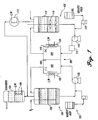
- the electrochemical cell 100 has a cathode compartment 102 and an anode compartment 104 separated by a porous membrane 106 .
- the electrochemical cell 100 is filled with a solution of cerium in a concentration of at least about 1 M in an anolyte. Because the cerium is generally present as a cerous ion, Ce(III), it is oxidized to ceric ion, Ce(IV) in the anode compartment. The ceric ion reacts with the organic material to destroy it. Electrical current flowing through said electrochemical cell provides the energy to re-oxidize cerous ions in the anode compartment 104 and continue to oxidize the organic molecules in the cathode compartment 102.
- the feed may consist of a liquid organic fed into the anolyte loop 108 with a metering pump 110.
- solids such as paper pulp and wood chips could be introduced into the anolyte loop via a screened cage (not shown) in the anolyte tank 112.
- the anolyte solution is pumped (pump 113 ) through the anolyte loop 108 having of an agitating emulsifier 114 .
- the agitating emulsifier 114 serves to increase the organic surface area for faster oxidation rates and may provide 100 to 5000 watts or more of energy to the anolyte/organic solution.
- the solution enters the electrochemical cell anode compartment 104, where the metal catalyst is oxidized (e.g., Ce 3+ to Ce 4+ ).
- Cerium(IV) is a kinetically rapid, powerful oxidizing agent, which is reduced by reacting with and oxidizing organic molecules.
- cerium(IV) After the cerium(IV) is reduced, it again is oxidized in the electrochemical cell 100. In this cyclic manner, cerium acts as,an oxidation catalyst, carrying electrons from the material being oxidized to the anode 116.
- the anolyte solution enters the anolyte tank 112, which not only serves as a gas/liquid separator and surge tank, but also provides the capability for the oxidation of solids. Gases exiting the anolyte tank 112 pass through a condenser 117.
- the anolyte tank 112 is provided with an agitator 118 to promote mass transfer if oxidation of solids is evaluated. Temperature, pressure, density, and flowrate of the anolyte and catholyte loops 108, 120 are measured.
- the cell temperature of the anode and cathode can be independently maintained through heat exchange to fluid jackets 122 on the outside of the electrochemical cell 100.
- Operating temperatures of the anolyte may range from about 20°C to about 100°C, but are preferably between about 30°C and about 100°C, and most preferably from about 80°C to about 100°C.
- Operating pressure is preferably ambient pressure of about 1 atmosphere. Heating may be done separately, or as a result of passing electrical current through the electrochemical cell.
- the catholyte may be about the same temperature as the anolyte, it is preferred to maintain the catholyte at a lower temperature than the anolyte to reduce generation of gaseous nitrous oxide(s) (No x ).
- the catholyte may be cooled to just above a freezing temperature of the catholyte.
- catholyte temperature is maintained at about 25°C to about 70°C which is approximately 30°C cooler than the anolyte.
- the catholyte loop 120 is separated from the anolyte loop 108 with a porous barrier 106 chosen to minimize mixing while maintaining electrical conductivity.
- the catholyte pump 123 moves catholyte through the catholyte loop 120.
- the main chemical reaction in the catholyte loop 120 is the reduction of nitric acid to HNO 2 , which is reoxidized in part by bubbling O 2 through the solution from the catholyte tank.
- Make up acid (acid addition unit 125 ) is added to the catholyte loop 120 to maintain the acid concentration.
- the acid is an inorganic acid in which cerium is soluble.
- the acid is nitric acid which has a high solubility for cerium.
- Other acids include sulfuric acid and hydrochloric acid.
- the evolved gases from the anolyte and catholyte tanks 112, 128 are evacuated to the atmosphere after NO x removal.
- a gas proportioner (not shown) optionally allows controlled mixing of NO x from the catholyte off-gas and O 2 from the anolyte off-gas.
- the evolved gases may be passed through a reaction vessel (not shown), where the gas phase catalytic oxidation of NO to NO 2 takes place. Because NO 2 is absorbed faster by water than NO, this reaction greatly enhances the efficiency of the NO x scrubber 124. After exiting the NO x scrubber 124, the gas is exhausted to the atmosphere. Scrubber temperature is maintained by a cooling coil 126 running through the scrubber 124.
- a 386 computer was used with AIMAX-PLUS data acquisition and control software to control the process with minimal operator oversight. Measured parameters were automatically recorded, and the computer had direct control over four final control elements.
- the anolyte and catholyte temperatures were controlled by motor-operated valves which opened or closed to maintain the anolyte and catholyte temperature set points.
- a third motor-operated valve minimized the differential pressure between the anolyte and catholyte loops. (In the past, a build-up of pressure in one of the loops had caused the membrane to rupture.)
- the fourth, and final, control element was the speed of the makeup HNO 3 metering pump. Additions of HNO 3 maintained acid concentrations at set point and prevented H 2 generation. All of the final control elements were controlled via a 4 to 20 amp signal generated from the computer.
- the computer displays a process diagram by which the operator monitors control parameters. All measured parameters can be displayed on the process diagram and provide the operator with real time measurements.
- the control system provides the operator with manual control of the anolyte and catholyte pumps, the power supply voltage and amperage, and the capability to override all final control elements from the computer.
- the organic destruction rate is also a function of the amount or concentration of organic phase present and is less for decreasing amounts of organic phase.
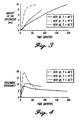
- cerium has a destruction rate for 10 ml of organic phase equal to the destruction rate for silver starting with 20 ml of organic phase illustrates the improved destruction rate of cerium over silver.
- the cerium shows a higher destruction rate than silver both operated at optimal operating temperatures.
- cerium does not appreciably react with the aqueous solution at elevated temperatures, it is preferable to avoid boiling the aqueous solution.
- OTTO Fuel II An experiment was conducted to demonstrate the destruction of OTTO Fuel II according to the present invention.
- the elemental analysis for OTTO Fuel II was 32.50 wt% Carbon 5.22 wt% Hydrogen 12.87 wt% Nitrogen 49.41 wt% Oxygen.
- the electrochemical cell was operated with and without ultrasonic vibration and no difference in destruction performance was observed. This was expected because the concentration of OTTO Fuel in 4 M nitric acid was near its solubility limit and therefore the OTTO Fuel was in solution.
- the electrochemical cell with cerium was operated for about 2 hours which resulted in 28% of the total organic carbon destroyed. Had the experiment been operated to completion, it is estimated that complete destruction would have occurred in about 7 hours under these conditions.
- FIG.5 A summary of power factor versus temperature is presented in FIG.5. It is shown that operation of the CEO process above 90°C is required to obtain reasonable and cost effective performance with respect to the oxidation of Trimsol cutting oil.
Landscapes
- Chemical & Material Sciences (AREA)
- Engineering & Computer Science (AREA)
- Environmental & Geological Engineering (AREA)
- Life Sciences & Earth Sciences (AREA)
- Hydrology & Water Resources (AREA)
- Water Supply & Treatment (AREA)
- Organic Chemistry (AREA)
- Chemical Kinetics & Catalysis (AREA)
- General Chemical & Material Sciences (AREA)
- Electrochemistry (AREA)
- Mechanical Engineering (AREA)
- Health & Medical Sciences (AREA)
- General Health & Medical Sciences (AREA)
- Toxicology (AREA)
- Business, Economics & Management (AREA)
- Emergency Management (AREA)
- Biomedical Technology (AREA)
- Analytical Chemistry (AREA)
- Oil, Petroleum & Natural Gas (AREA)
- Electrolytic Production Of Non-Metals, Compounds, Apparatuses Therefor (AREA)
- Physical Or Chemical Processes And Apparatus (AREA)
- Fire-Extinguishing Compositions (AREA)
- Nitrogen And Oxygen Or Sulfur-Condensed Heterocyclic Ring Systems (AREA)
- Organic Low-Molecular-Weight Compounds And Preparation Thereof (AREA)
- Processing Of Solid Wastes (AREA)
Claims (21)
- Verfahren zum Zerstören eines Gemisches einer organischen Phase in einer wässerigen Lösung, wobei das Verfahren die Schrittedadurch gekennzeichnet, dass die elektrochemische Zelle einen Elektrolyten aufweist, welcher aus Cer und einer Säure besteht, wobei der Elektrolyt im Wesentlichen nicht-reaktiv mit der wässerigen Lösung bei einer Betriebstemperatur oberhalb von etwa 70°C in einem Anolyten innerhalb des Anodenraums ist.(a) des Zuführens des Gemisches in eine elektrochemische Zelle mit einem Kathodenraum und einem Anodenraum, welche durch eine poröse Membran getrennt sind,(b) des Emulgierens des Gemisches und Erhöhens der Oberfläche der organischen Phase,(c) des Fliessens eines elektrischen Stromes durch die elektrochemische Zelle, so das die organische Phase in dem Anodenraum oxidiert wird, umfasst,
- Verfahren nach Anspruch 1, wobei die organischen Materialien exoenergetische Materialien sind.
- Verfahren nach Anspruch 2, wobei die exoenergetischen Materialien aus der Gruppe, bestehend aus Kriegsführungsmitteln und brisanten Explosivstoffen, ausgewählt sind.
- Verfahren nach Anspruch 1, wobei die Säure aus der Gruppe, bestehend aus Salpetersäure und Schwefelsäure, ausgewählt ist.
- Verfahren nach Anspruch 1, wobei die Betriebstemperatur von etwa 80°C bis etwa 100°C beträgt.
- Verfahren nach Anspruch 5, wobei die Betriebstemperatur durch eine Fluidummantelung an der Aussenseite der elektrochemischen Zelle aufrechterhalten wird.
- Verfahren nach Anspruch 1, wobei das Cer in eine Konzentration von mindestens 0,5 M vorhanden ist.
- Verfahren nach Anspruch 7, wobei die Konzentration von Cer von etwa 1,0 M bis etwa 1,7 M beträgt.
- Verfahren nach Anspruch 1, wobei der elektrische Strom mindestens etwa 8,8 kWh/kg (4 kWh/lb) der organischen Materialien beträgt.
- Verfahren nach Anspruch 1, wobei der Schritt des Rührens das Leiten der organischen Materialien durch einen Ultraschall-Mischer umfasst.
- Verfahren nach Anspruch 1, weiter umfassend den Schritt des Aufrechterhaltens einer Temperatur eines Katholyten unterhalb der Temperatur des Anolyten.
- Verfahren nach Anspruch 11, wobei die Temperatur des Katholyten oberhalb der Gefriertemperatur des Katholyten ist.
- Verfahren nach Anspruch 12, wobei die Temperatur des Katholyten von etwa 25°C bis etwa 70°C beträgt.
- Vorrichtung zum Zerstören organischer Materialien, umfassendwobei die Elektrolytlösung aus Cer und einer Säure besteht.(a) eine elektrochemische Zelle mit einem Kathodenraum und einem Anodenraum, welche durch eine poröse Membran getrennt sind,(b) eine in den Anoden- und Kathodenräumen bereitgestellte Elektrolytlösung,(c) einen Rühremulgator, welcher die Oberfläche der zu der elektrochemischen Zelle zugegebenen organischen Phase erhöht,(d) Mittel zum Fliessen eines elektrischen Stromes durch die elektrochemische Zelle, so dass das organische Material in dem Anodenraum oxidiert wird,
- Vorrichtung nach Anspruch 14, weiter umfassend ein Heizelement zum Erhöhen einer Temperatur der elektrochemischen Zelle, wobei das Fliessen eines elektrischen Stromes durch die elektrochemische Zelle die organischen Moleküle in dem Anodenraum oxidiert.
- Vorrichtung nach Anspruch 15, wobei das Heizelement eine Betriebstemperatur von etwa 30°C bis etwa 100°C aufweist.
- Vorrichtung nach Anspruch 14, wobei die Konzentration von Cer mindestens 0,5 M beträgt.
- Vorrichtung nach Anspruch 17, wobei die Konzentration von Cer von etwa 1,0 M bis etwa 1,7 M beträgt.
- Vorrichtung nach Anspruch 14, wobei der Rühremulgator ein Ultraschall-Mischer ist, welcher die organischen Materialien vor der elektrochemischen Zelle mischt.
- Vorrichtung nach Anspruch 14, wobei das Heizelement eine Fluidummantelung an der Aussenseite der elektrochemischen Zelle ist.
- Vorrichtung nach Anspruch 20, weiter umfassend eine zweite Fluidummantelung zum Kühlen eines Katholyten.
Applications Claiming Priority (3)
| Application Number | Priority Date | Filing Date | Title |
|---|---|---|---|
| US634662 | 1996-04-18 | ||
| US08/634,662 US5707508A (en) | 1996-04-18 | 1996-04-18 | Apparatus and method for oxidizing organic materials |
| PCT/US1997/006727 WO1997038943A2 (en) | 1996-04-18 | 1997-04-18 | Apparatus and method for oxidizing organic materials |
Publications (2)
| Publication Number | Publication Date |
|---|---|
| EP0922012A2 EP0922012A2 (de) | 1999-06-16 |
| EP0922012B1 true EP0922012B1 (de) | 2005-06-01 |
Family
ID=24544719
Family Applications (1)
| Application Number | Title | Priority Date | Filing Date |
|---|---|---|---|
| EP97921321A Expired - Lifetime EP0922012B1 (de) | 1996-04-18 | 1997-04-18 | Vorrichtung und methode zur oxidation von organischen materialien |
Country Status (9)
| Country | Link |
|---|---|
| US (1) | US5707508A (de) |
| EP (1) | EP0922012B1 (de) |
| JP (1) | JP3413206B2 (de) |
| AT (1) | ATE296784T1 (de) |
| DE (1) | DE69733419T2 (de) |
| DK (1) | DK0922012T3 (de) |
| ES (1) | ES2241048T3 (de) |
| PT (1) | PT922012E (de) |
| WO (1) | WO1997038943A2 (de) |
Families Citing this family (35)
| Publication number | Priority date | Publication date | Assignee | Title |
|---|---|---|---|---|
| US5968337A (en) * | 1996-04-18 | 1999-10-19 | Battelle Memorial Institute | Apparatus and method for constant flow oxidizing of organic materials |
| GB9920532D0 (en) | 1999-09-01 | 1999-11-03 | Univ Abertay | Method |
| AU2000238151A1 (en) * | 2000-03-28 | 2001-10-08 | Sck.Cen | Method and apparatus for reducing an electrolyte containing nitric acid |
| US7387719B2 (en) * | 2001-04-24 | 2008-06-17 | Scimist, Inc. | Mediated electrochemical oxidation of biological waste materials |
| US7488409B1 (en) * | 2001-10-05 | 2009-02-10 | Scimist, Inc. | Mediated electrochemical oxidation of animal waste materials |
| US7517445B2 (en) * | 2001-10-09 | 2009-04-14 | Scimist, Inc. | Mediated electrochemical oxidation of food waste materials |
| AU2002367842A1 (en) * | 2001-10-22 | 2003-11-11 | The C And M Group, Llc | Mediated electrochemical oxidation of organic waste materials |
| GB0201472D0 (en) * | 2002-01-23 | 2002-03-13 | Accentus Plc | Method and apparatus for mediated electrochemical redox reaction |
| AU2003217242A1 (en) * | 2002-01-24 | 2003-09-09 | The C And M Group, Llc | Mediated electrochemical oxidation used for sterilization/disinfection |
| US7691251B2 (en) * | 2002-01-24 | 2010-04-06 | Scimist, Inc. | Mediated electrochemical oxidation and destruction of sharps |
| WO2003072511A1 (en) * | 2002-01-24 | 2003-09-04 | The C & M Group, Llc | Mediated electrochemical oxidation of halogenated hydrocarbon waste materials |
| US6766751B2 (en) | 2002-01-29 | 2004-07-27 | Asia Pacific Environmental Technology, Inc. | Integrated waste containment and processing system |
| WO2003091165A1 (en) | 2002-04-26 | 2003-11-06 | The C & M Group, Llc | Mediated electrochemical oxidation process used as a hydrogen fuel generator |
| US7531708B2 (en) * | 2002-07-29 | 2009-05-12 | Scimist, Inc. | Mediated electrochemical oxidation for decontamination |
| AU2003270437A1 (en) * | 2002-09-10 | 2004-04-30 | The C And M Group, Llc | Mediated electrochemical oxidation of inorganic materials |
| US20100187178A1 (en) * | 2003-01-29 | 2010-07-29 | Molycorp Minerals, Llc | Process for removing and sequestering contaminants from aqueous streams |
| US8414748B2 (en) * | 2003-06-10 | 2013-04-09 | Scimist, Inc. | Apparatus and process for mediated electrochemical oxidation of materials |
| WO2005038956A2 (en) | 2003-10-17 | 2005-04-28 | Neah Power Systems, Inc. | Nitric acid regeneration fuel cell systems |
| GB0604544D0 (en) * | 2006-03-07 | 2006-04-19 | Enviromental Processes Ltd | Water Treatment |
| US20090107919A1 (en) * | 2007-10-31 | 2009-04-30 | Chevron U.S.A. Inc. | Apparatus and process for treating an aqueous solution containing chemical contaminants |
| US8349764B2 (en) | 2007-10-31 | 2013-01-08 | Molycorp Minerals, Llc | Composition for treating a fluid |
| US20090107925A1 (en) * | 2007-10-31 | 2009-04-30 | Chevron U.S.A. Inc. | Apparatus and process for treating an aqueous solution containing biological contaminants |
| US8252087B2 (en) * | 2007-10-31 | 2012-08-28 | Molycorp Minerals, Llc | Process and apparatus for treating a gas containing a contaminant |
| AR074321A1 (es) * | 2008-11-11 | 2011-01-05 | Molycorp Minerals Llc | Remocion de materiales objetivo utilizando metales de tierras raras |
| TW201038510A (en) * | 2009-03-16 | 2010-11-01 | Molycorp Minerals Llc | Porous and durable ceramic filter monolith coated with a rare earth for removing contaminates from water |
| EA201171231A1 (ru) * | 2009-04-09 | 2012-05-30 | МОЛИКОРП МИНЕРАЛЗ, ЭлЭлСи | Использование редкоземельного элемента для удаления сурьмы и висмута |
| US12252655B2 (en) | 2010-02-08 | 2025-03-18 | Fulcrum Bioenergy, Inc. | Feedstock processing systems and methods for producing Fischer-Tropsch liquids and transportation fuels |
| US11525097B2 (en) | 2010-02-08 | 2022-12-13 | Fulcrum Bioenergy, Inc. | Feedstock processing systems and methods for producing fischer-tropsch liquids and transportation fuels |
| US8604089B2 (en) * | 2010-02-08 | 2013-12-10 | Fulcrum Bioenergy, Inc. | Gas recycle loops in process for converting municipal solid waste into ethanol |
| US9233863B2 (en) | 2011-04-13 | 2016-01-12 | Molycorp Minerals, Llc | Rare earth removal of hydrated and hydroxyl species |
| CN103723886B (zh) * | 2013-12-12 | 2015-05-13 | 北京北方节能环保有限公司 | 一种处理奥克托今生产废水的装置及其方法 |
| MX370462B (es) | 2014-03-07 | 2019-12-13 | Secure Natural Resources Llc | Oxido de cerio (iv) con propiedades de remocion de arsenico excepcionales. |
| CN108059303A (zh) * | 2017-12-22 | 2018-05-22 | 杭州富阳伟文环保科技有限公司 | 一种去除工业废水中硝酸盐氮的处理系统 |
| CN108046532A (zh) * | 2017-12-22 | 2018-05-18 | 杭州富阳伟文环保科技有限公司 | 一种去除工业废水中硝酸盐氮的处理方法 |
| GB201901659D0 (en) | 2019-02-06 | 2019-03-27 | C Tech Innovation Ltd | Method for the destruction of organic material |
Family Cites Families (7)
| Publication number | Priority date | Publication date | Assignee | Title |
|---|---|---|---|---|
| US4639298A (en) * | 1986-05-05 | 1987-01-27 | W. R. Grace & Co. | Oxidation of organic compounds using ceric ions in aqueous methanesulfonic acid |
| US4670108A (en) * | 1986-10-10 | 1987-06-02 | W. R. Grace & Co. | Oxidation of organic compounds using ceric methanesulfonate in an aqueous organic solution |
| US4692227A (en) * | 1986-12-01 | 1987-09-08 | W. R. Grace & Co. | Oxidation of organic compounds using thallium ions |
| US4701245A (en) * | 1986-05-05 | 1987-10-20 | W. R. Grace & Co. | Oxidation of organic compounds using a catalyzed cerium (IV) composition |
| EP0246957B1 (de) * | 1986-05-19 | 1992-09-30 | Delphi Research Inc. | Verfahren zur Behandlung von organischen Abfallstoffen und dafür nützliche Katalysator-/Co-Katalysator-Zusammensetzung |
| US4925540A (en) * | 1988-10-04 | 1990-05-15 | Delphi Research Inc. | Method for treating organic waste material and an oxidation catalyst/cocatalyst composition useful therefor |
| US5250161A (en) * | 1991-01-24 | 1993-10-05 | Aerojet-General Corporation | Electrochemical desensitization process |
-
1996
- 1996-04-18 US US08/634,662 patent/US5707508A/en not_active Expired - Fee Related
-
1997
- 1997-04-18 WO PCT/US1997/006727 patent/WO1997038943A2/en not_active Ceased
- 1997-04-18 JP JP53743397A patent/JP3413206B2/ja not_active Expired - Fee Related
- 1997-04-18 DE DE69733419T patent/DE69733419T2/de not_active Expired - Fee Related
- 1997-04-18 EP EP97921321A patent/EP0922012B1/de not_active Expired - Lifetime
- 1997-04-18 PT PT97921321T patent/PT922012E/pt unknown
- 1997-04-18 AT AT97921321T patent/ATE296784T1/de not_active IP Right Cessation
- 1997-04-18 ES ES97921321T patent/ES2241048T3/es not_active Expired - Lifetime
- 1997-04-18 DK DK97921321T patent/DK0922012T3/da active
Also Published As
| Publication number | Publication date |
|---|---|
| PT922012E (pt) | 2005-08-31 |
| US5707508A (en) | 1998-01-13 |
| WO1997038943A3 (en) | 1997-12-11 |
| JP3413206B2 (ja) | 2003-06-03 |
| ES2241048T3 (es) | 2005-10-16 |
| DE69733419D1 (de) | 2005-07-07 |
| ATE296784T1 (de) | 2005-06-15 |
| DK0922012T3 (da) | 2005-09-12 |
| JP2000512538A (ja) | 2000-09-26 |
| DE69733419T2 (de) | 2006-05-04 |
| WO1997038943A2 (en) | 1997-10-23 |
| EP0922012A2 (de) | 1999-06-16 |
Similar Documents
| Publication | Publication Date | Title |
|---|---|---|
| US5707508A (en) | Apparatus and method for oxidizing organic materials | |
| US5968337A (en) | Apparatus and method for constant flow oxidizing of organic materials | |
| US7387719B2 (en) | Mediated electrochemical oxidation of biological waste materials | |
| Staszak et al. | The pilot‐scale demonstration of the MODAR oxidation process for the destruction of hazardous organic waste materials | |
| US7871508B2 (en) | Mediated electrochemical oxidation process used as a hydrogen fuel generator | |
| WO2003095116A2 (en) | Mediated electrochemical oxidation of organic waste materials | |
| AU2002258953A1 (en) | Mediated electrochemical oxidation of biological waste materials | |
| WO2004024634A2 (en) | Mediated electrochemical oxidation of inorganic materials | |
| US5516407A (en) | Indirect cerium mediated electrosynthesis | |
| US5250161A (en) | Electrochemical desensitization process | |
| CA2251387C (en) | Apparatus and method for oxidizing organic materials | |
| Chiba et al. | Mediated electrochemical oxidation as an alternative to incineration for mixed wastes | |
| JPH01287290A (ja) | エマルジョン中でセリウム(3+)をセリウム(4+)に電気化学的に酸化する方法 | |
| Balazs et al. | Destruction of hazardous and mixed wastes using mediated electrochemical oxidation in a Ag (II) HNO3 bench scale system | |
| Hoh et al. | Electro-reductive stripping of cerium in the TBP HNO3 two-phase system | |
| Balazs et al. | Effect of trace additives on the efficiencyof peroxydisulfate regeneration | |
| WO1992012931A1 (en) | Electrochemical oxidation of organic wastes | |
| GB2206341A (en) | Treatment of organically-based waste matter | |
| JP4381602B2 (ja) | 濃硝酸溶液中の1つまたはそれ以上の抗亜硝酸剤により還元型で安定化された1つまたはそれ以上のアクチニドの酸化方法と装置 | |
| US5705049A (en) | Indirect cerium mediated electrosynthesis | |
| Almon et al. | Electrolytic destruction of spent tributylphosphate extractant using silver catalyzed electrochemical oxidation | |
| Van Alsenoy et al. | The electrochemical oxidation of organic waste and activated graphite by Ag {sup 2+} in nitric acid: a literature study | |
| Charoensri et al. | Electrochemical oxidation process for mineralization of solvent | |
| WO2001072641A1 (en) | Method and apparatus for reducing an electrolyte containing nitric acid | |
| JP2003088881A (ja) | 汚水の処理方法及び装置 |
Legal Events
| Date | Code | Title | Description |
|---|---|---|---|
| PUAI | Public reference made under article 153(3) epc to a published international application that has entered the european phase |
Free format text: ORIGINAL CODE: 0009012 |
|
| 17P | Request for examination filed |
Effective date: 19981014 |
|
| AK | Designated contracting states |
Kind code of ref document: A2 Designated state(s): AT BE CH DE DK ES FI FR GB GR IE IT LI LU MC NL PT SE |
|
| 17Q | First examination report despatched |
Effective date: 19991210 |
|
| GRAP | Despatch of communication of intention to grant a patent |
Free format text: ORIGINAL CODE: EPIDOSNIGR1 |
|
| GRAS | Grant fee paid |
Free format text: ORIGINAL CODE: EPIDOSNIGR3 |
|
| GRAA | (expected) grant |
Free format text: ORIGINAL CODE: 0009210 |
|
| AK | Designated contracting states |
Kind code of ref document: B1 Designated state(s): AT BE CH DE DK ES FI FR GB GR IE IT LI LU MC NL PT SE |
|
| REG | Reference to a national code |
Ref country code: GB Ref legal event code: FG4D |
|
| REG | Reference to a national code |
Ref country code: CH Ref legal event code: EP |
|
| REG | Reference to a national code |
Ref country code: IE Ref legal event code: FG4D |
|
| REF | Corresponds to: |
Ref document number: 69733419 Country of ref document: DE Date of ref document: 20050707 Kind code of ref document: P |
|
| REG | Reference to a national code |
Ref country code: GR Ref legal event code: EP Ref document number: 20050401786 Country of ref document: GR |
|
| REG | Reference to a national code |
Ref country code: CH Ref legal event code: NV Representative=s name: BOVARD AG PATENTANWAELTE |
|
| REG | Reference to a national code |
Ref country code: SE Ref legal event code: TRGR |
|
| REG | Reference to a national code |
Ref country code: PT Ref legal event code: SC4A Effective date: 20050609 |
|
| REG | Reference to a national code |
Ref country code: DK Ref legal event code: T3 |
|
| REG | Reference to a national code |
Ref country code: ES Ref legal event code: FG2A Ref document number: 2241048 Country of ref document: ES Kind code of ref document: T3 |
|
| PGFP | Annual fee paid to national office [announced via postgrant information from national office to epo] |
Ref country code: AT Payment date: 20060314 Year of fee payment: 10 |
|
| PGFP | Annual fee paid to national office [announced via postgrant information from national office to epo] |
Ref country code: DK Payment date: 20060317 Year of fee payment: 10 |
|
| PGFP | Annual fee paid to national office [announced via postgrant information from national office to epo] |
Ref country code: PT Payment date: 20060324 Year of fee payment: 10 Ref country code: NL Payment date: 20060324 Year of fee payment: 10 |
|
| ET | Fr: translation filed | ||
| PGFP | Annual fee paid to national office [announced via postgrant information from national office to epo] |
Ref country code: FR Payment date: 20060403 Year of fee payment: 10 |
|
| PGFP | Annual fee paid to national office [announced via postgrant information from national office to epo] |
Ref country code: SE Payment date: 20060404 Year of fee payment: 10 |
|
| PGFP | Annual fee paid to national office [announced via postgrant information from national office to epo] |
Ref country code: GR Payment date: 20060406 Year of fee payment: 10 |
|
| PLBE | No opposition filed within time limit |
Free format text: ORIGINAL CODE: 0009261 |
|
| STAA | Information on the status of an ep patent application or granted ep patent |
Free format text: STATUS: NO OPPOSITION FILED WITHIN TIME LIMIT |
|
| PGFP | Annual fee paid to national office [announced via postgrant information from national office to epo] |
Ref country code: ES Payment date: 20060418 Year of fee payment: 10 |
|
| PGFP | Annual fee paid to national office [announced via postgrant information from national office to epo] |
Ref country code: IE Payment date: 20060420 Year of fee payment: 10 |
|
| PGFP | Annual fee paid to national office [announced via postgrant information from national office to epo] |
Ref country code: FI Payment date: 20060421 Year of fee payment: 10 |
|
| PGFP | Annual fee paid to national office [announced via postgrant information from national office to epo] |
Ref country code: BE Payment date: 20060425 Year of fee payment: 10 |
|
| PGFP | Annual fee paid to national office [announced via postgrant information from national office to epo] |
Ref country code: DE Payment date: 20060428 Year of fee payment: 10 |
|
| PG25 | Lapsed in a contracting state [announced via postgrant information from national office to epo] |
Ref country code: MC Free format text: LAPSE BECAUSE OF NON-PAYMENT OF DUE FEES Effective date: 20060430 |
|
| PGFP | Annual fee paid to national office [announced via postgrant information from national office to epo] |
Ref country code: IT Payment date: 20060430 Year of fee payment: 10 |
|
| 26N | No opposition filed |
Effective date: 20060302 |
|
| PGFP | Annual fee paid to national office [announced via postgrant information from national office to epo] |
Ref country code: CH Payment date: 20060608 Year of fee payment: 10 |
|
| REG | Reference to a national code |
Ref country code: PT Ref legal event code: MM4A Free format text: LAPSE DUE TO NON-PAYMENT OF FEES Effective date: 20071018 |
|
| REG | Reference to a national code |
Ref country code: DK Ref legal event code: EBP |
|
| REG | Reference to a national code |
Ref country code: CH Ref legal event code: PL |
|
| GBPC | Gb: european patent ceased through non-payment of renewal fee |
Effective date: 20070418 |
|
| BERE | Be: lapsed |
Owner name: *BATTELLE MEMORIAL INSTITUTE Effective date: 20070430 |
|
| NLV4 | Nl: lapsed or anulled due to non-payment of the annual fee |
Effective date: 20071101 |
|
| PG25 | Lapsed in a contracting state [announced via postgrant information from national office to epo] |
Ref country code: PT Free format text: LAPSE BECAUSE OF NON-PAYMENT OF DUE FEES Effective date: 20071018 Ref country code: NL Free format text: LAPSE BECAUSE OF NON-PAYMENT OF DUE FEES Effective date: 20071101 Ref country code: FI Free format text: LAPSE BECAUSE OF NON-PAYMENT OF DUE FEES Effective date: 20070418 Ref country code: DE Free format text: LAPSE BECAUSE OF NON-PAYMENT OF DUE FEES Effective date: 20071101 |
|
| REG | Reference to a national code |
Ref country code: IE Ref legal event code: MM4A |
|
| PG25 | Lapsed in a contracting state [announced via postgrant information from national office to epo] |
Ref country code: AT Free format text: LAPSE BECAUSE OF NON-PAYMENT OF DUE FEES Effective date: 20070418 Ref country code: CH Free format text: LAPSE BECAUSE OF NON-PAYMENT OF DUE FEES Effective date: 20070430 Ref country code: LI Free format text: LAPSE BECAUSE OF NON-PAYMENT OF DUE FEES Effective date: 20070430 |
|
| PG25 | Lapsed in a contracting state [announced via postgrant information from national office to epo] |
Ref country code: BE Free format text: LAPSE BECAUSE OF NON-PAYMENT OF DUE FEES Effective date: 20070430 |
|
| PG25 | Lapsed in a contracting state [announced via postgrant information from national office to epo] |
Ref country code: GB Free format text: LAPSE BECAUSE OF NON-PAYMENT OF DUE FEES Effective date: 20070418 Ref country code: DK Free format text: LAPSE BECAUSE OF NON-PAYMENT OF DUE FEES Effective date: 20070430 |
|
| PG25 | Lapsed in a contracting state [announced via postgrant information from national office to epo] |
Ref country code: IE Free format text: LAPSE BECAUSE OF NON-PAYMENT OF DUE FEES Effective date: 20070418 |
|
| PG25 | Lapsed in a contracting state [announced via postgrant information from national office to epo] |
Ref country code: SE Free format text: LAPSE BECAUSE OF NON-PAYMENT OF DUE FEES Effective date: 20070419 |
|
| REG | Reference to a national code |
Ref country code: ES Ref legal event code: FD2A Effective date: 20070419 |
|
| PG25 | Lapsed in a contracting state [announced via postgrant information from national office to epo] |
Ref country code: LU Free format text: LAPSE BECAUSE OF NON-PAYMENT OF DUE FEES Effective date: 20060418 Ref country code: FR Free format text: LAPSE BECAUSE OF NON-PAYMENT OF DUE FEES Effective date: 20070430 |
|
| PG25 | Lapsed in a contracting state [announced via postgrant information from national office to epo] |
Ref country code: GR Free format text: LAPSE BECAUSE OF NON-PAYMENT OF DUE FEES Effective date: 20071102 Ref country code: ES Free format text: LAPSE BECAUSE OF NON-PAYMENT OF DUE FEES Effective date: 20070419 |
|
| PGFP | Annual fee paid to national office [announced via postgrant information from national office to epo] |
Ref country code: GB Payment date: 20060314 Year of fee payment: 10 |
|
| PG25 | Lapsed in a contracting state [announced via postgrant information from national office to epo] |
Ref country code: IT Free format text: LAPSE BECAUSE OF NON-PAYMENT OF DUE FEES Effective date: 20070418 |