EP0917227A2 - Lithium Sekundärbatterie - Google Patents
Lithium Sekundärbatterie Download PDFInfo
- Publication number
- EP0917227A2 EP0917227A2 EP98121277A EP98121277A EP0917227A2 EP 0917227 A2 EP0917227 A2 EP 0917227A2 EP 98121277 A EP98121277 A EP 98121277A EP 98121277 A EP98121277 A EP 98121277A EP 0917227 A2 EP0917227 A2 EP 0917227A2
- Authority
- EP
- European Patent Office
- Prior art keywords
- battery
- lithium secondary
- secondary battery
- dod
- power
- Prior art date
- Legal status (The legal status is an assumption and is not a legal conclusion. Google has not performed a legal analysis and makes no representation as to the accuracy of the status listed.)
- Withdrawn
Links
Images

Classifications
-
- H—ELECTRICITY
- H01—ELECTRIC ELEMENTS
- H01M—PROCESSES OR MEANS, e.g. BATTERIES, FOR THE DIRECT CONVERSION OF CHEMICAL ENERGY INTO ELECTRICAL ENERGY
- H01M10/00—Secondary cells; Manufacture thereof
- H01M10/05—Accumulators with non-aqueous electrolyte
- H01M10/052—Li-accumulators
-
- H—ELECTRICITY
- H01—ELECTRIC ELEMENTS
- H01M—PROCESSES OR MEANS, e.g. BATTERIES, FOR THE DIRECT CONVERSION OF CHEMICAL ENERGY INTO ELECTRICAL ENERGY
- H01M10/00—Secondary cells; Manufacture thereof
- H01M10/05—Accumulators with non-aqueous electrolyte
- H01M10/058—Construction or manufacture
- H01M10/0587—Construction or manufacture of accumulators having only wound construction elements, i.e. wound positive electrodes, wound negative electrodes and wound separators
-
- H—ELECTRICITY
- H01—ELECTRIC ELEMENTS
- H01M—PROCESSES OR MEANS, e.g. BATTERIES, FOR THE DIRECT CONVERSION OF CHEMICAL ENERGY INTO ELECTRICAL ENERGY
- H01M4/00—Electrodes
- H01M4/02—Electrodes composed of, or comprising, active material
- H01M4/36—Selection of substances as active materials, active masses, active liquids
- H01M4/48—Selection of substances as active materials, active masses, active liquids of inorganic oxides or hydroxides
- H01M4/50—Selection of substances as active materials, active masses, active liquids of inorganic oxides or hydroxides of manganese
- H01M4/505—Selection of substances as active materials, active masses, active liquids of inorganic oxides or hydroxides of manganese of mixed oxides or hydroxides containing manganese for inserting or intercalating light metals, e.g. LiMn2O4 or LiMn2OxFy
-
- H—ELECTRICITY
- H01—ELECTRIC ELEMENTS
- H01M—PROCESSES OR MEANS, e.g. BATTERIES, FOR THE DIRECT CONVERSION OF CHEMICAL ENERGY INTO ELECTRICAL ENERGY
- H01M4/00—Electrodes
- H01M4/02—Electrodes composed of, or comprising, active material
- H01M4/36—Selection of substances as active materials, active masses, active liquids
- H01M4/48—Selection of substances as active materials, active masses, active liquids of inorganic oxides or hydroxides
- H01M4/52—Selection of substances as active materials, active masses, active liquids of inorganic oxides or hydroxides of nickel, cobalt or iron
- H01M4/525—Selection of substances as active materials, active masses, active liquids of inorganic oxides or hydroxides of nickel, cobalt or iron of mixed oxides or hydroxides containing iron, cobalt or nickel for inserting or intercalating light metals, e.g. LiNiO2, LiCoO2 or LiCoOxFy
-
- H—ELECTRICITY
- H01—ELECTRIC ELEMENTS
- H01M—PROCESSES OR MEANS, e.g. BATTERIES, FOR THE DIRECT CONVERSION OF CHEMICAL ENERGY INTO ELECTRICAL ENERGY
- H01M10/00—Secondary cells; Manufacture thereof
- H01M10/05—Accumulators with non-aqueous electrolyte
- H01M10/052—Li-accumulators
- H01M10/0525—Rocking-chair batteries, i.e. batteries with lithium insertion or intercalation in both electrodes; Lithium-ion batteries
-
- H—ELECTRICITY
- H01—ELECTRIC ELEMENTS
- H01M—PROCESSES OR MEANS, e.g. BATTERIES, FOR THE DIRECT CONVERSION OF CHEMICAL ENERGY INTO ELECTRICAL ENERGY
- H01M10/00—Secondary cells; Manufacture thereof
- H01M10/05—Accumulators with non-aqueous electrolyte
- H01M10/058—Construction or manufacture
- H01M10/0585—Construction or manufacture of accumulators having only flat construction elements, i.e. flat positive electrodes, flat negative electrodes and flat separators
-
- H—ELECTRICITY
- H01—ELECTRIC ELEMENTS
- H01M—PROCESSES OR MEANS, e.g. BATTERIES, FOR THE DIRECT CONVERSION OF CHEMICAL ENERGY INTO ELECTRICAL ENERGY
- H01M4/00—Electrodes
- H01M4/02—Electrodes composed of, or comprising, active material
- H01M2004/021—Physical characteristics, e.g. porosity, surface area
-
- H—ELECTRICITY
- H01—ELECTRIC ELEMENTS
- H01M—PROCESSES OR MEANS, e.g. BATTERIES, FOR THE DIRECT CONVERSION OF CHEMICAL ENERGY INTO ELECTRICAL ENERGY
- H01M10/00—Secondary cells; Manufacture thereof
- H01M10/42—Methods or arrangements for servicing or maintenance of secondary cells or secondary half-cells
- H01M2010/4292—Aspects relating to capacity ratio of electrodes/electrolyte or anode/cathode
-
- H—ELECTRICITY
- H01—ELECTRIC ELEMENTS
- H01M—PROCESSES OR MEANS, e.g. BATTERIES, FOR THE DIRECT CONVERSION OF CHEMICAL ENERGY INTO ELECTRICAL ENERGY
- H01M4/00—Electrodes
- H01M4/02—Electrodes composed of, or comprising, active material
- H01M4/13—Electrodes for accumulators with non-aqueous electrolyte, e.g. for lithium-accumulators; Processes of manufacture thereof
- H01M4/131—Electrodes based on mixed oxides or hydroxides, or on mixtures of oxides or hydroxides, e.g. LiCoOx
-
- H—ELECTRICITY
- H01—ELECTRIC ELEMENTS
- H01M—PROCESSES OR MEANS, e.g. BATTERIES, FOR THE DIRECT CONVERSION OF CHEMICAL ENERGY INTO ELECTRICAL ENERGY
- H01M4/00—Electrodes
- H01M4/02—Electrodes composed of, or comprising, active material
- H01M4/36—Selection of substances as active materials, active masses, active liquids
- H01M4/58—Selection of substances as active materials, active masses, active liquids of inorganic compounds other than oxides or hydroxides, e.g. sulfides, selenides, tellurides, halogenides or LiCoFy; of polyanionic structures, e.g. phosphates, silicates or borates
- H01M4/583—Carbonaceous material, e.g. graphite-intercalation compounds or CFx
- H01M4/587—Carbonaceous material, e.g. graphite-intercalation compounds or CFx for inserting or intercalating light metals
-
- Y—GENERAL TAGGING OF NEW TECHNOLOGICAL DEVELOPMENTS; GENERAL TAGGING OF CROSS-SECTIONAL TECHNOLOGIES SPANNING OVER SEVERAL SECTIONS OF THE IPC; TECHNICAL SUBJECTS COVERED BY FORMER USPC CROSS-REFERENCE ART COLLECTIONS [XRACs] AND DIGESTS
- Y02—TECHNOLOGIES OR APPLICATIONS FOR MITIGATION OR ADAPTATION AGAINST CLIMATE CHANGE
- Y02E—REDUCTION OF GREENHOUSE GAS [GHG] EMISSIONS, RELATED TO ENERGY GENERATION, TRANSMISSION OR DISTRIBUTION
- Y02E60/00—Enabling technologies; Technologies with a potential or indirect contribution to GHG emissions mitigation
- Y02E60/10—Energy storage using batteries
-
- Y—GENERAL TAGGING OF NEW TECHNOLOGICAL DEVELOPMENTS; GENERAL TAGGING OF CROSS-SECTIONAL TECHNOLOGIES SPANNING OVER SEVERAL SECTIONS OF THE IPC; TECHNICAL SUBJECTS COVERED BY FORMER USPC CROSS-REFERENCE ART COLLECTIONS [XRACs] AND DIGESTS
- Y02—TECHNOLOGIES OR APPLICATIONS FOR MITIGATION OR ADAPTATION AGAINST CLIMATE CHANGE
- Y02P—CLIMATE CHANGE MITIGATION TECHNOLOGIES IN THE PRODUCTION OR PROCESSING OF GOODS
- Y02P70/00—Climate change mitigation technologies in the production process for final industrial or consumer products
- Y02P70/50—Manufacturing or production processes characterised by the final manufactured product
-
- Y—GENERAL TAGGING OF NEW TECHNOLOGICAL DEVELOPMENTS; GENERAL TAGGING OF CROSS-SECTIONAL TECHNOLOGIES SPANNING OVER SEVERAL SECTIONS OF THE IPC; TECHNICAL SUBJECTS COVERED BY FORMER USPC CROSS-REFERENCE ART COLLECTIONS [XRACs] AND DIGESTS
- Y02—TECHNOLOGIES OR APPLICATIONS FOR MITIGATION OR ADAPTATION AGAINST CLIMATE CHANGE
- Y02T—CLIMATE CHANGE MITIGATION TECHNOLOGIES RELATED TO TRANSPORTATION
- Y02T10/00—Road transport of goods or passengers
- Y02T10/60—Other road transportation technologies with climate change mitigation effect
- Y02T10/70—Energy storage systems for electromobility, e.g. batteries
Definitions
- the present invention relates to a lithium secondary battery in which lowering of its power is small even in the case where a depth of discharge becomes deep, its internal resistance is low, and its charging and discharging properties are excellent, and particularly which is suitably used as a battery for driving a motor of an electric vehicle or the like.
- a lithium compound is used for a positive active material, and various carbon materials are used for a negative active material.
- the lithium ions in the positive active material move into the negative active material, and at discharging, the lithium ions captured by the negative active material move to the positive active material, so that charging and discharging are carried out.
- the structure of an internal electrode body as a place of a battery reaction in such a lithium secondary battery is roughly divided into a winding type and a lamination type.
- the internal electrode body of the winding type is fabricated in such a manner that, as shown in Fig. 4, a positive electrode 2 and a negative electrode 3 are wound through a separator 4, and a tab 5 as a current collecting lead is attached to each of the positive electrode 2 and the negative electrode 3.
- the cylindrical internal electrode body 1 as well as an electrolyte is contained and sealed in a cylindrical container so that an electric cell is fabricated.
- the structure of an electric cell using such a winding type internal electrode body 1 is suitable for fabricating a compact battery while using a large area electrode (positive electrode and/or negative electrode).
- this winding type internal electrode body 1 at least one is sufficient for the number of tabs 5 from each of the positive and negative electrode plates 2 and 3, and even in the case where current collecting resistance from the respective positive and negative electrode plates 2 and 3 is desired to be made small, it is sufficient if the number of tabs 5 is increased, so that the winding type has features that the structure of the inside of the battery does not become complicated, and assembly of the battery is easy.
- a lamination type internal electrode body 7 is formed by alternately laminating a positive electrode 8 and a negative electrode 9 through a separator 10, and even in the case where an area to one of the positive electrodes 8 and the like is not large, the electrode area of the entire of the battery can be made large by laminating a plurality of electrodes.
- the shape of the fabricated internal electrode body 7 can be freely designed into, for example, a rectangular parallelepiped type, a disk type, or a cylinder type, by means of the shape of the positive and negative electrodes 8 and 9 and the number of laminated electrodes, so that the lamination type is suitable for the use of the case where the shape of a battery is restricted.
- a tab 6 is necessary for each of the positive and negative electrode 8 and 9, in addition to other reasons, the structure of the inside of the battery becomes complicated, so that the winding type is superior from the viewpoint of assembly working of the battery.
- the terminal voltage of the lithium secondary battery is about 4 V
- an aqueous solution type electrolyte can not be used, and an organic type electrolyte having lithium ion conductivity lower than that of the aqueous solution type electrolyte must be used.
- the internal resistance of a battery is apt to become large.
- the internal resistance and power characteristics of the battery mainly determine the acceleration performance, climbing performance, and the like, it becomes important to make the internal resistance of the battery small and to stabilize the power characteristics.
- lithium secondary battery as a battery for an EV
- LiCoO 2 is used for a positive active material
- hard carbon is used for a negative active material
- a discharge specific power at a time when 10 seconds has elapsed in each depth of discharge (hereinafter referred to as DOD) is disclosed.
- DOD discharge specific power at a time when 10 seconds has elapsed in each depth of discharge
- the publication discloses that in the case where 4 v is made a full charge, when the DOD is 0%, the specific power is 1540 W/kg, and when the DOD is 80%, the specific power is 500 W/kg, which indicates that the specific power when the DOD is 80% is only about 32% of that when the DOD is 0%.
- the specific power when the DOD is 0%, the specific power is 1740 W/kg, and when the DOD is 80%, the specific power is 620 W/kg, which indicates that the specific power when the DOD is 80% is about 36% of that when the DOD is 0%.
- the diffusion of lithium ions in the positive active material is limited to the lithium plane direction in the crystal structure of LiCoO 2 used as the positive active material, and the lithium ions can diffuse only two-dimensionally, and as a result, the internal resistance becomes large.
- LiCoO 2 used for the positive active material With respect to LiCoO 2 used for the positive active material, the production of Co as a constituent material is not necessarily large in amount even in the world, and is a relatively expensive material, so that the material has a problem in the use as general-purpose parts in view of cost. Moreover, since the countries of origin are limited, the material has also a problem in securing of the raw material, stable supply of products to a market, and the like.
- the present inventors fabricated a large capacity lithium secondary battery having 5 Ah or more, which is considered to be necessary as a battery for an EV or an HEV, by mainly using lithium manganate as a positive active material and a graphite-based carbon material as a negative active material, and clarified the relation between a DOD and an internal resistance, and between the DOD and an power, so that the inventors found that a battery in which an internal resistance at a DOD of 80% is not larger than 120% of an internal resistance at a DOD of 0%, and an power at a DOD of 80% is not less than 60% of an power at a DOD of 0%, is suitable as a battery for an EV and an HEV.
- a lithium secondary battery comprising a battery case and an internal electrode body which is contained in the battery case and in which a positive electrode and a negative electrode are wound or laminated through a separator made of porous polymer so that the positive electrode and the negative electrode are not brought into direct contact with each other, wherein an power at a depth of discharge of 80% is not less than 60% of an power at a depth of discharge of 0%.
- a lithium secondary battery comprising a battery case and an internal electrode body which is contained in the battery case and in which a positive electrode and a negative electrode are wound or laminated through a separator made of porous polymer so that the positive electrode and the negative electrode are not brought into direct contact with each other, wherein an internal resistance at a depth of discharge of 80% is not higher than 120% of an internal resistance at a depth of discharge of 0%.
- Such a lithium secondary battery is suitably used for an electric vehicle (EV) or a hybrid electric vehicle (HEV), and the battery capacity of an electric cell is preferably set to 5 Ah or more.
- EV electric vehicle
- HEV hybrid electric vehicle
- the battery capacity of an electric cell is preferably set to 5 Ah or more.
- the lithium secondary battery having a small DOD dependency with respect to an internal resistance and power of the battery
- the battery comprising a battery case and an internal electrode body which is contained in the battery case and in which a positive electrode and a negative electrode are wound or laminated through a separator made of porous polymer so that the positive electrode and the negative electrode are not brought into direct contact with each other, wherein lithium manganate having a spinel structure is used as a positive active material and the battery is used for an electric vehicle or a hybrid electric vehicle.
- lithium-manganese oxide having the spinel structure and having a ratio of Li/Mn of more than 0.5.
- the lithium secondary battery of the present invention has the features that the DOD dependency of the power is small and the internal resistance is small, the battery can be suitably used particularly as a battery for an EV.
- An internal electrode body of a lithium secondary battery of the present invention is structured such that a negative electrode and a positive electrode are wound or laminated through a separator made of porous polymer so that the negative electrode and the positive electrode are not brought into direct contact with each other, and concretely, the structure as shown in Fig. 4 or 5, that is, an internal electrode body 1 or 7 can be cited.
- lithium-manganese oxide (LiMn 2 O 4 ) is preferably used as the positive active material and particularly, it is preferable to use lithium-manganese oxide (LiMn 2 O 4 spinel) which belongs to a cubic system and has a spinel type crystal structure. By this, maintaining stability of power against the DOD and lowering of internal resistance can be achieved.
- LiMn 2 O 4 used in the lithium secondary battery of the present invention is not limited to such a material having stoichiometric composition, but as long as the crystal structure can be maintained, it does not matter if a positive ion is lacking or excessively exists, while an oxygen ion is lacking or excessively exists.
- part of Mn may be substituted by other ion, for example, at least one kind of positive ion selected from substitution elements M, such as Li, Fe, Mn, Ni, Mg, Zn, B, Al, Co, Cr, Si, Ti, Sn, P, V, Sb, Nb, Ta, Mo, and W.
- LiMn 2 O 4 if a material having a ratio of Li/Mn of more than 0.5 is particularly used, as compared with the case where a material of stoichiometric composition is used, the internal resistance is further lowered and a high power battery can be obtained. Thus, such a material is preferable.
- Li(Li X Mn 2-X )O 4 in which part of Mn is substituted by Li LiM X Mn 2-X O 4 in which part of Mn is substituted by the above substitution element M except for Li, and the like may be cited.
- LiMn 2 O 4 is more advantageous than LiCoO 2 or LiNiO 2 , in that the diffusion plane of lithium ions is not limited to the lithium plane in the crystal structure unlike the foregoing LiCoO 2 or LiNiO 2 , and the diffusion of lithium ions occurs three-dimentionally.
- That the diffusion path is three-dimensional indicates that the diffusion path is secured even if the positive electrode is formed by coating the metal foil with the positive active material powder. That is, in the case where the powder having only two-dimensional lithium ion diffusion paths, such as LiCoO 2 , is coated on the metal foil, the particle in which an entrance of the foregoing diffusion plane is clogged by contact with other particles or the metal foil does not substantially function as an electrode active material even if the surface which is not an entrance of the diffusion plane of the lithium ion forms an interface against an electrolyte.
- LiMn 2 O 4 having three-dimensional diffusion paths as long as the whole surface of the powder is not clogged, ion diffusion paths at the time of formation of the electrode can be secured more easily than LiCoO 2 . It is conceivable that in this way, in the case where LiMn 2 O 4 is used, lowering of an specific power at a deep depth of discharge can be suppressed as compared with the case of using LiCoO 2 .
- LiMn 2 O 4 having an excellent symmetry in crystal structure that is, LiMn 2 O 4 spinel is preferable since diffusion of lithium ions is carried out most easily.
- particles having a narrow particle distribution range and uniform shape are preferable as the positive active material powder.
- LiMn 2 O 4 spinel has a crystal structure with excellent symmetry as a cubic system, it is relatively easy to obtain particles with uniform diameter by various synthesizing methods and powder processing methods.
- electrode active material powder having any shape and any particle diameter
- the diffusion path of the lithium ion to the positive active material powder is secured means that excellent discharge characteristics can be obtained, and reversely, it means that the diffusion of the lithium ion from the positive active material is also excellently carried out, that is, the charging characteristics are also excellent.
- carbon powder added to the thus selected positive active material acetylene black, graphite powder, and the like can be exemplified.
- the aluminum foil constituting the positive electrode in order to prevent the lowering of battery performance due to corrosion by an electrochemical reaction of a battery, it is preferable to use a high purity material.
- the negative electrode although a copper foil coated with an amorphous carbon material, such as soil carbon or hard carbon as a negative active material, or carbon powder, such as natural or artificial graphite, can be used.
- an amorphous carbon material such as soil carbon or hard carbon as a negative active material, or carbon powder, such as natural or artificial graphite
- highly graphitized carbon materials such as graphite or artificial graphite in which the diffusion of lithium ions in the crystal is easy, the specific gravity is large, and the rate of lithium ions contributing to charging and discharging which can be maintained per unit weight is large, is particularly preferable as a negative active material.
- the copper foil used as the negative electrode like the aluminum foil used as the positive electrode, it is preferable to use a highly pure material in order to withstand corrosion due to an electrochemical reaction.
- a three-layer structure in which a lithium ion permeable polyethylene film (PE film) having micropores is sandwiched between porous lithium ion permeable polypropylene films (PP films) is preferably used.
- This separator serves also as a safety mechanism in which when the temperature of the internal electrode body is raised, the PE film is softened at about 130°C so that the micropores are collapsed to suppress the movement of the lithium ions, that is, the battery reaction. Since the PE film is sandwiched between the PP films having higher softening temperature, even in the case where the PE film is softened, the PP films maintain the shape to prevent contact and short circuit between the positive electrode and the negative electrode, so that it becomes possible to certainly suppress the battery reaction and to secure safety.
- the electrolyte a solution obtained by dissolving LiPF 6 as an electrolyte into a mixed solution of ethylene carbonate (EC) and diethyl carbonate (DEC) is preferably used.
- the battery structure is not particularly limited, and it is possible to adopt the structure in which the structure of a small lithium secondary battery is similarly enlarged.
- the present inventors et al. proposed a battery structure in which various pressure releasing mechanisms are disposed at suitable places in Japanese Patent Application No. 9-202963, and such a battery structure can also be preferably used.
- the lithium secondary battery of the present invention is suitably used as a battery for an EV and an HEV.
- the greatest cause of such battery characteristics is that although the coordinate sites of lithium ions in the LiMn 2 O 4 powder of the positive active material become few as the DOD becomes deep, the diffusion of the lithium ions to the vacant coordinate sites is in the state which is not greatly different from the state of the shallow DOD in which many vacant sites exist, that is, the coordinate sites are uniformly distributed in the positive electrode, the diffusion path of the lithium ions is secured, and uniform diffusion is carried out, and further, such battery characteristics show that diffusion of the lithium ions from the negative electrode is also carried out excellently so that the foregoing diffusion of the lithium ions is carried out.
- a negative electrode with 3600 mm in winding direction length ⁇ 200 mm in width was fabricated by coating a copper foil with highly graphitized carbon material (fiber powder). The thus fabricated positive electrode and negative electrode were wound while they were insulated from each other by using a microporous separator made of polypropylene, so that an internal electrode body was fabricated.
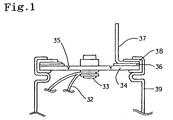
- the fabricated internal electrode body was inserted in a cylindrical battery case, and after one end was sealed by a sealing structure shown in Fig. 1, an electrolyte obtained by dissolving a LiPF 6 electrolyte in a mixing solution of ethylene carbonate (EC) and diethyl carbonate (DEC) is filled, and the other end is also sealed by the sealing structure shown in Fig. 1, so that the battery is sealed.
- EC ethylene carbonate
- DEC diethyl carbonate
- a current collecting tab 32 connected to either one electrode (not shown) of the positive electrode and the negative electrode is connected to a metal rivet 33 attached to a disk 34 for sealing a battery case 39.
- the disk 34 is provided with a pressure releasing valve 35 which is ruptured at a designated pressure, and is caulked to the battery case 39 through an ethylene propylene rubber 38 so that an outer terminal 37 is electrically connected to the disk 34 through a metal ring 36, and the disk 34, the metal ring 36, and the outer terminal 37 are electrically insulated from the battery case.
- a cylindrical both ends terminal type battery in which an outer terminal of either one of the positive and negative electrodes is disposed at one end of the battery case 39 is fabricated.
- an aluminum cylinder with an outer diameter of 50 mm, a thickness of 1 mm, and a length of 245 mm was used, and also as the disk 34, an aluminum disk for positive electrode and a copper disk for negative electrode were used.
- example 2 a battery in which LiMn 2 O 4 spinel with a ratio of Li/Mn of 0.55 was used as a positive active material, other materials were the same as the example 1, and the structure was the same as the example 1, was fabricated.
- example 3 a battery in which LiCoO 2 powder was used as a positive active material, other materials were the same as the example 1, and the structure was the same as the example 1, was fabricated.
- a battery in which the structure was the same as the examples 1 to 3 LiCoO 2 which was the same as the example 3 was used as a positive active material, and hard carbon was used as a negative active material, was fabricated.
- the measurement of the internal resistance at each DOD was carried out such that from an open circuit state, electric current of a discharge rate of 0.2C was applied, the difference between the open circuit voltage and the voltage immediately after application of current was divided by current value to obtain the internal resistance, and normalization was made such that the internal resistance at a DOD of 0% was made 100%.
- the measurement of power at each DOD was carried out such that constant current discharge for 10 seconds was carried out at a current value not lower than 2.5 V after 10 seconds from the start of discharge, and the power was obtained by a product of voltage and current at the time when ten seconds elapsed, and normalization was made such that the power at a DOD of 0% was made 100%.
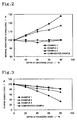
- Fig. 2 shows the relation between the internal resistance normalized and the DOD.
- the internal resistance value became gradually large, and the internal resistance at a DOD of 80% was increased up to 128% of that at a DOD of 0%.
- increase of the inner resistance was hardly seen, and change was not substantially capable of being seen until the DOD reached 80%.
- the internal resistance at a DOD of 80% was increased up to about 116% of that at a DOD of 0%.
- the internal resistance at a DOD of 0% was 4.0 m ⁇ in the example 1
- the internal resistance in the example 2 was 3.1 m ⁇ which was smaller than that of the example 1 by about 20%. From this, it has become clear that even if LiMn 2 O 4 spinel is used, in the case where the ratio of Li/Mn is larger than 0.5, the effect of lowering of the internal resistance itself can also be obtained.
- Fig. 3 shows the relation between the the power normalized and the DOD.
- the examples 1 and 2 even if the DOD became deep, lowering of discharge specific power was small, and even when the DOD was 80%, the discharge specific power of about 82% of that at a DOD of 0% was obtained.
- the power at a DOD of 80% was lowered merely to about 69% of that at a DOD of 0%.
- the comparative example almost the same contents as disclosed in the foregoing cited reference were realized, and the power at a DOD of 80% reached merely about 36% of that at a DOD of 0%.
- the specific power at a DOD of 0% was 1000 W/kg in the example 1
- the specific power in the example 2 was 1200 W/kg which was larger than the example 1 by about 20%. It is conceivable that this is caused by that the internal resistance itself of the battery is lowered by using LiMn 2 O 4 spinel with a ratio of Li/Mn of more than 0.5.
- the lithium secondary battery of the present invention has excellent effects that even in the case where the depth of discharge becomes deep, the increase rate of the internal resistance value is small, and the lowering of power is small, so that necessary large power is always obtained independently of a use state, and charging and discharging characteristics are excellent. Moreover, when LiMn 2 O 4 having the ratio of Li/Mn of more than 0.5 is used as the positive active material, remarkable effects are obtained such that the internal resistance itself is decreased, and the high power of the battery is achieved.
- a lithium secondary battery in which even if the depth of discharge becomes deep, lowering of an power is small, and charging and discharging characteristics are excellent, and which is suitably used particularly as a battery for driving a motor of an electric vehicle or the like.
- an internal electrode body formed by winding a positive electrode and a negative electrode through a separator made of porous polymer is contained in a battery case, and an organic electrolyte is used.
- An power at a depth of discharge of 80% is not smaller than 60% of an power at a depth of discharge of 0%.
Landscapes
- Chemical & Material Sciences (AREA)
- Chemical Kinetics & Catalysis (AREA)
- Electrochemistry (AREA)
- General Chemical & Material Sciences (AREA)
- Engineering & Computer Science (AREA)
- Manufacturing & Machinery (AREA)
- Inorganic Chemistry (AREA)
- Secondary Cells (AREA)
- Battery Electrode And Active Subsutance (AREA)
Applications Claiming Priority (6)
| Application Number | Priority Date | Filing Date | Title |
|---|---|---|---|
| JP30693097 | 1997-11-10 | ||
| JP306930/97 | 1997-11-10 | ||
| JP30693097 | 1997-11-10 | ||
| JP26351398 | 1998-09-17 | ||
| JP26351398 | 1998-09-17 | ||
| JP263513/98 | 1998-09-17 |
Publications (2)
| Publication Number | Publication Date |
|---|---|
| EP0917227A2 true EP0917227A2 (de) | 1999-05-19 |
| EP0917227A3 EP0917227A3 (de) | 2003-04-09 |
Family
ID=26546043
Family Applications (1)
| Application Number | Title | Priority Date | Filing Date |
|---|---|---|---|
| EP98121277A Withdrawn EP0917227A3 (de) | 1997-11-10 | 1998-11-09 | Lithium Sekundärbatterie |
Country Status (3)
| Country | Link |
|---|---|
| US (2) | US6455198B1 (de) |
| EP (1) | EP0917227A3 (de) |
| CA (1) | CA2253890C (de) |
Cited By (2)
| Publication number | Priority date | Publication date | Assignee | Title |
|---|---|---|---|---|
| EP0973214A1 (de) * | 1998-07-14 | 2000-01-19 | Ngk Insulators, Ltd. | Sekundäre Lithiumbatterie |
| WO2002082574A1 (en) * | 2001-03-30 | 2002-10-17 | Sony Corporation | Nonaqueous electrolytic cell and its manufacturing method, and positive electrode active material and its manufacturing method |
Families Citing this family (17)
| Publication number | Priority date | Publication date | Assignee | Title |
|---|---|---|---|---|
| US6455198B1 (en) * | 1997-11-10 | 2002-09-24 | Ngk Insulators, Ltd. | Lithium secondary battery with a lithium manganese oxide positive electrode |
| CN1323462C (zh) * | 2002-11-05 | 2007-06-27 | 株式会社杰士汤浅 | 非水电解质二次电池的充电方法 |
| US8617745B2 (en) * | 2004-02-06 | 2013-12-31 | A123 Systems Llc | Lithium secondary cell with high charge and discharge rate capability and low impedance growth |
| EP1716610B1 (de) * | 2004-02-06 | 2011-08-24 | A 123 Systems, Inc. | Lithium-sekundärzelle mit hoher ladungs- und entladungsratenfähigkeit |
| JP4244041B2 (ja) * | 2005-04-07 | 2009-03-25 | シャープ株式会社 | リチウムイオン二次電池及びその製造方法 |
| US20060240290A1 (en) * | 2005-04-20 | 2006-10-26 | Holman Richard K | High rate pulsed battery |
| US20070240892A1 (en) * | 2005-11-04 | 2007-10-18 | Black & Decker Inc. | Cordless outdoor power tool system |
| JP4557001B2 (ja) * | 2007-12-28 | 2010-10-06 | Tdk株式会社 | 電気化学デバイス用電極及び電気化学デバイス |
| US8754611B2 (en) * | 2008-04-11 | 2014-06-17 | Apple Inc. | Diffusion-limited adaptive battery charging |
| CN102742059B (zh) * | 2010-02-05 | 2016-04-06 | 松下知识产权经营株式会社 | 方形电池 |
| US9595360B2 (en) | 2012-01-13 | 2017-03-14 | Energy Power Systems LLC | Metallic alloys having amorphous, nano-crystalline, or microcrystalline structure |
| US8808914B2 (en) | 2012-01-13 | 2014-08-19 | Energy Power Systems, LLC | Lead-acid battery design having versatile form factor |
| US9263721B2 (en) | 2012-01-13 | 2016-02-16 | Energy Power Systems LLC | Lead-acid battery design having versatile form factor |
| US20130309554A1 (en) * | 2012-05-18 | 2013-11-21 | Energy Power Systems, LLC | Lead-acid battery with high specific power and specific energy |
| US9081068B2 (en) | 2012-09-18 | 2015-07-14 | Apple Inc. | Method and apparatus for determining a capacity of a battery |
| JP6845176B2 (ja) * | 2018-03-26 | 2021-03-17 | 株式会社東芝 | 電極、二次電池、電池パック及び車両 |
| CN109713386B (zh) * | 2018-12-05 | 2020-06-09 | 上海普澜特夫精细化工有限公司 | 一种硬碳负极材料锂离子电池的化成方法 |
Family Cites Families (12)
| Publication number | Priority date | Publication date | Assignee | Title |
|---|---|---|---|---|
| US4539274A (en) * | 1983-12-07 | 1985-09-03 | Gte Government Systems Corporation | Electrochemical cell having wound electrode structures |
| ZA936168B (en) * | 1992-08-28 | 1994-03-22 | Technology Finance Corp | Electrochemical cell |
| US5425932A (en) * | 1993-05-19 | 1995-06-20 | Bell Communications Research, Inc. | Method for synthesis of high capacity Lix Mn2 O4 secondary battery electrode compounds |
| US5478672A (en) * | 1993-12-24 | 1995-12-26 | Sharp Kabushiki Kaisha | Nonaqueous secondary battery, positive-electrode active material |
| JPH0822841A (ja) * | 1994-04-21 | 1996-01-23 | Haibaru:Kk | 二次電池 |
| US5601952A (en) * | 1995-05-24 | 1997-02-11 | Dasgupta; Sankar | Lithium-Manganese oxide electrode for a rechargeable lithium battery |
| US5693307A (en) * | 1995-06-07 | 1997-12-02 | Duracell, Inc. | Process for making a lithiated lithium manganese oxide spinel |
| CA2163695C (en) * | 1995-11-24 | 2000-08-01 | Qiming Zhong | Method for preparing li1+xmn2-x-ymyo4 for use in lithium batteries |
| US6455198B1 (en) * | 1997-11-10 | 2002-09-24 | Ngk Insulators, Ltd. | Lithium secondary battery with a lithium manganese oxide positive electrode |
| JP3526786B2 (ja) * | 1998-07-14 | 2004-05-17 | 日本碍子株式会社 | リチウム二次電池 |
| JP3526223B2 (ja) * | 1998-09-17 | 2004-05-10 | 日本碍子株式会社 | リチウム二次電池 |
| JP3375898B2 (ja) * | 1998-10-01 | 2003-02-10 | 日本碍子株式会社 | リチウム二次電池 |
-
1998
- 1998-11-04 US US09/186,308 patent/US6455198B1/en not_active Expired - Lifetime
- 1998-11-09 EP EP98121277A patent/EP0917227A3/de not_active Withdrawn
- 1998-11-10 CA CA002253890A patent/CA2253890C/en not_active Expired - Fee Related
-
2002
- 2002-07-25 US US10/205,082 patent/US6858348B2/en not_active Expired - Lifetime
Cited By (3)
| Publication number | Priority date | Publication date | Assignee | Title |
|---|---|---|---|---|
| EP0973214A1 (de) * | 1998-07-14 | 2000-01-19 | Ngk Insulators, Ltd. | Sekundäre Lithiumbatterie |
| US6258485B1 (en) | 1998-07-14 | 2001-07-10 | Ngk Insulators, Ltd | Lithium secondary battery |
| WO2002082574A1 (en) * | 2001-03-30 | 2002-10-17 | Sony Corporation | Nonaqueous electrolytic cell and its manufacturing method, and positive electrode active material and its manufacturing method |
Also Published As
| Publication number | Publication date |
|---|---|
| EP0917227A3 (de) | 2003-04-09 |
| CA2253890C (en) | 2005-05-17 |
| CA2253890A1 (en) | 1999-05-10 |
| US20020187395A1 (en) | 2002-12-12 |
| US6455198B1 (en) | 2002-09-24 |
| US6858348B2 (en) | 2005-02-22 |
Similar Documents
| Publication | Publication Date | Title |
|---|---|---|
| US6455198B1 (en) | Lithium secondary battery with a lithium manganese oxide positive electrode | |
| KR101477873B1 (ko) | 비수전해액형 리튬 이온 2차 전지 | |
| US8247101B2 (en) | Active material for battery, non-aqueous electrolyte battery and battery pack | |
| US8178244B2 (en) | Non-aqueous electrolyte battery and battery pack | |
| JP5049680B2 (ja) | 非水電解質電池及び電池パック | |
| US10505215B2 (en) | Method of manufacturing non-aqueous electrolyte secondary battery and non-aqueous electrolyte secondary battery | |
| US20070082265A1 (en) | Positive electrode material for non-aqueous electrolyte lithium ion battery and battery using the same | |
| US20060216600A1 (en) | Battery pack and vehicle | |
| US20100092846A1 (en) | Non-aqueous electrolyte battery and battery pack | |
| CN103326013B (zh) | 非水电解质电池和电池组 | |
| EP2421080B1 (de) | Nichtwässrige Elektrolytbatterie | |
| US20070054191A1 (en) | Non- aqueous electrolyte secondary battery | |
| JP3526786B2 (ja) | リチウム二次電池 | |
| US6972164B2 (en) | Lithium secondary battery for use in electric vehicle | |
| JPH11120990A (ja) | リチウム二次電池 | |
| JP3910740B2 (ja) | リチウム二次電池 | |
| JP2005285545A (ja) | リチウム二次電池 | |
| JP2000182656A (ja) | リチウム二次電池 | |
| JP2020113487A (ja) | リチウムイオン二次電池 | |
| JP2002246008A (ja) | リチウム二次電池 | |
| JP7749866B2 (ja) | 非水電解質電池及び電池パック | |
| JP7702988B2 (ja) | リチウムイオン二次電池およびその製造方法 | |
| EP3712998B1 (de) | Lithium-ionen-sekundärbatterie |
Legal Events
| Date | Code | Title | Description |
|---|---|---|---|
| PUAI | Public reference made under article 153(3) epc to a published international application that has entered the european phase |
Free format text: ORIGINAL CODE: 0009012 |
|
| AK | Designated contracting states |
Kind code of ref document: A2 Designated state(s): AT BE CH CY DE DK ES FI FR GB GR IE IT LI LU MC NL PT SE |
|
| AX | Request for extension of the european patent |
Free format text: AL;LT;LV;MK;RO;SI |
|
| PUAL | Search report despatched |
Free format text: ORIGINAL CODE: 0009013 |
|
| AK | Designated contracting states |
Kind code of ref document: A3 Designated state(s): AT BE CH CY DE DK ES FI FR GB GR IE IT LI LU MC NL PT SE Designated state(s): AT BE CH CY DE DK ES FI FR GB GR IE IT LI LU MC NL PT SE |
|
| AX | Request for extension of the european patent |
Extension state: AL LT LV MK RO SI |
|
| 17P | Request for examination filed |
Effective date: 20030424 |
|
| AKX | Designation fees paid |
Designated state(s): BE CH DE FR GB IT LI |
|
| 17Q | First examination report despatched |
Effective date: 20050506 |
|
| STAA | Information on the status of an ep patent application or granted ep patent |
Free format text: STATUS: THE APPLICATION IS DEEMED TO BE WITHDRAWN |
|
| 18D | Application deemed to be withdrawn |
Effective date: 20071116 |