EP0913136A2 - Knochentransplantatverdichter mit horizontalen Stufen für Hüftrevision - Google Patents
Knochentransplantatverdichter mit horizontalen Stufen für Hüftrevision Download PDFInfo
- Publication number
- EP0913136A2 EP0913136A2 EP98308859A EP98308859A EP0913136A2 EP 0913136 A2 EP0913136 A2 EP 0913136A2 EP 98308859 A EP98308859 A EP 98308859A EP 98308859 A EP98308859 A EP 98308859A EP 0913136 A2 EP0913136 A2 EP 0913136A2
- Authority
- EP
- European Patent Office
- Prior art keywords
- facing surface
- tamp
- bone
- distal
- elongate body
- Prior art date
- Legal status (The legal status is an assumption and is not a legal conclusion. Google has not performed a legal analysis and makes no representation as to the accuracy of the status listed.)
- Granted
Links
- 210000000988 bone and bone Anatomy 0.000 title claims abstract description 80
- 210000000689 upper leg Anatomy 0.000 title description 8
- 230000007423 decrease Effects 0.000 claims abstract description 6
- 239000000463 material Substances 0.000 claims description 11
- 238000001356 surgical procedure Methods 0.000 abstract description 10
- 239000007943 implant Substances 0.000 description 15
- 239000002639 bone cement Substances 0.000 description 9
- 238000005056 compaction Methods 0.000 description 9
- 230000001054 cortical effect Effects 0.000 description 7
- 239000004568 cement Substances 0.000 description 4
- 238000000034 method Methods 0.000 description 4
- 238000003780 insertion Methods 0.000 description 2
- 230000037431 insertion Effects 0.000 description 2
- 229910001220 stainless steel Inorganic materials 0.000 description 2
- 239000010935 stainless steel Substances 0.000 description 2
- 208000033998 Device material issue Diseases 0.000 description 1
- 230000004075 alteration Effects 0.000 description 1
- 239000000919 ceramic Substances 0.000 description 1
- 230000008859 change Effects 0.000 description 1
- 239000000788 chromium alloy Substances 0.000 description 1
- 230000001010 compromised effect Effects 0.000 description 1
- 230000003247 decreasing effect Effects 0.000 description 1
- 238000005553 drilling Methods 0.000 description 1
- 210000001624 hip Anatomy 0.000 description 1
- 210000004394 hip joint Anatomy 0.000 description 1
- 238000011540 hip replacement Methods 0.000 description 1
- 238000002513 implantation Methods 0.000 description 1
- 210000001503 joint Anatomy 0.000 description 1
- 230000007774 longterm Effects 0.000 description 1
- 238000004519 manufacturing process Methods 0.000 description 1
- 229910001092 metal group alloy Inorganic materials 0.000 description 1
- 238000012986 modification Methods 0.000 description 1
- 230000004048 modification Effects 0.000 description 1
- 230000008569 process Effects 0.000 description 1
Images




Classifications
-
- A—HUMAN NECESSITIES
- A61—MEDICAL OR VETERINARY SCIENCE; HYGIENE
- A61F—FILTERS IMPLANTABLE INTO BLOOD VESSELS; PROSTHESES; DEVICES PROVIDING PATENCY TO, OR PREVENTING COLLAPSING OF, TUBULAR STRUCTURES OF THE BODY, e.g. STENTS; ORTHOPAEDIC, NURSING OR CONTRACEPTIVE DEVICES; FOMENTATION; TREATMENT OR PROTECTION OF EYES OR EARS; BANDAGES, DRESSINGS OR ABSORBENT PADS; FIRST-AID KITS
- A61F2/00—Filters implantable into blood vessels; Prostheses, i.e. artificial substitutes or replacements for parts of the body; Appliances for connecting them with the body; Devices providing patency to, or preventing collapsing of, tubular structures of the body, e.g. stents
- A61F2/02—Prostheses implantable into the body
- A61F2/30—Joints
- A61F2/46—Special tools for implanting artificial joints
- A61F2/4601—Special tools for implanting artificial joints for introducing bone substitute, for implanting bone graft implants or for compacting them in the bone cavity
-
- A—HUMAN NECESSITIES
- A61—MEDICAL OR VETERINARY SCIENCE; HYGIENE
- A61F—FILTERS IMPLANTABLE INTO BLOOD VESSELS; PROSTHESES; DEVICES PROVIDING PATENCY TO, OR PREVENTING COLLAPSING OF, TUBULAR STRUCTURES OF THE BODY, e.g. STENTS; ORTHOPAEDIC, NURSING OR CONTRACEPTIVE DEVICES; FOMENTATION; TREATMENT OR PROTECTION OF EYES OR EARS; BANDAGES, DRESSINGS OR ABSORBENT PADS; FIRST-AID KITS
- A61F2/00—Filters implantable into blood vessels; Prostheses, i.e. artificial substitutes or replacements for parts of the body; Appliances for connecting them with the body; Devices providing patency to, or preventing collapsing of, tubular structures of the body, e.g. stents
- A61F2/02—Prostheses implantable into the body
- A61F2/30—Joints
- A61F2/32—Joints for the hip
- A61F2/36—Femoral heads ; Femoral endoprostheses
- A61F2/3662—Femoral shafts
- A61F2/367—Proximal or metaphyseal parts of shafts
-
- A—HUMAN NECESSITIES
- A61—MEDICAL OR VETERINARY SCIENCE; HYGIENE
- A61F—FILTERS IMPLANTABLE INTO BLOOD VESSELS; PROSTHESES; DEVICES PROVIDING PATENCY TO, OR PREVENTING COLLAPSING OF, TUBULAR STRUCTURES OF THE BODY, e.g. STENTS; ORTHOPAEDIC, NURSING OR CONTRACEPTIVE DEVICES; FOMENTATION; TREATMENT OR PROTECTION OF EYES OR EARS; BANDAGES, DRESSINGS OR ABSORBENT PADS; FIRST-AID KITS
- A61F2/00—Filters implantable into blood vessels; Prostheses, i.e. artificial substitutes or replacements for parts of the body; Appliances for connecting them with the body; Devices providing patency to, or preventing collapsing of, tubular structures of the body, e.g. stents
- A61F2/02—Prostheses implantable into the body
- A61F2/28—Bones
- A61F2002/2835—Bone graft implants for filling a bony defect or an endoprosthesis cavity, e.g. by synthetic material or biological material
-
- A—HUMAN NECESSITIES
- A61—MEDICAL OR VETERINARY SCIENCE; HYGIENE
- A61F—FILTERS IMPLANTABLE INTO BLOOD VESSELS; PROSTHESES; DEVICES PROVIDING PATENCY TO, OR PREVENTING COLLAPSING OF, TUBULAR STRUCTURES OF THE BODY, e.g. STENTS; ORTHOPAEDIC, NURSING OR CONTRACEPTIVE DEVICES; FOMENTATION; TREATMENT OR PROTECTION OF EYES OR EARS; BANDAGES, DRESSINGS OR ABSORBENT PADS; FIRST-AID KITS
- A61F2/00—Filters implantable into blood vessels; Prostheses, i.e. artificial substitutes or replacements for parts of the body; Appliances for connecting them with the body; Devices providing patency to, or preventing collapsing of, tubular structures of the body, e.g. stents
- A61F2/02—Prostheses implantable into the body
- A61F2/30—Joints
- A61F2002/30001—Additional features of subject-matter classified in A61F2/28, A61F2/30 and subgroups thereof
- A61F2002/30316—The prosthesis having different structural features at different locations within the same prosthesis; Connections between prosthetic parts; Special structural features of bone or joint prostheses not otherwise provided for
- A61F2002/30535—Special structural features of bone or joint prostheses not otherwise provided for
- A61F2002/30604—Special structural features of bone or joint prostheses not otherwise provided for modular
- A61F2002/30616—Sets comprising a plurality of prosthetic parts of different sizes or orientations
-
- A—HUMAN NECESSITIES
- A61—MEDICAL OR VETERINARY SCIENCE; HYGIENE
- A61F—FILTERS IMPLANTABLE INTO BLOOD VESSELS; PROSTHESES; DEVICES PROVIDING PATENCY TO, OR PREVENTING COLLAPSING OF, TUBULAR STRUCTURES OF THE BODY, e.g. STENTS; ORTHOPAEDIC, NURSING OR CONTRACEPTIVE DEVICES; FOMENTATION; TREATMENT OR PROTECTION OF EYES OR EARS; BANDAGES, DRESSINGS OR ABSORBENT PADS; FIRST-AID KITS
- A61F2/00—Filters implantable into blood vessels; Prostheses, i.e. artificial substitutes or replacements for parts of the body; Appliances for connecting them with the body; Devices providing patency to, or preventing collapsing of, tubular structures of the body, e.g. stents
- A61F2/02—Prostheses implantable into the body
- A61F2/30—Joints
- A61F2/32—Joints for the hip
- A61F2/36—Femoral heads ; Femoral endoprostheses
- A61F2/3662—Femoral shafts
- A61F2002/3678—Geometrical features
- A61F2002/369—Stepped shaft, i.e. having discrete diameter changes
-
- A—HUMAN NECESSITIES
- A61—MEDICAL OR VETERINARY SCIENCE; HYGIENE
- A61F—FILTERS IMPLANTABLE INTO BLOOD VESSELS; PROSTHESES; DEVICES PROVIDING PATENCY TO, OR PREVENTING COLLAPSING OF, TUBULAR STRUCTURES OF THE BODY, e.g. STENTS; ORTHOPAEDIC, NURSING OR CONTRACEPTIVE DEVICES; FOMENTATION; TREATMENT OR PROTECTION OF EYES OR EARS; BANDAGES, DRESSINGS OR ABSORBENT PADS; FIRST-AID KITS
- A61F2/00—Filters implantable into blood vessels; Prostheses, i.e. artificial substitutes or replacements for parts of the body; Appliances for connecting them with the body; Devices providing patency to, or preventing collapsing of, tubular structures of the body, e.g. stents
- A61F2/02—Prostheses implantable into the body
- A61F2/30—Joints
- A61F2/32—Joints for the hip
- A61F2/36—Femoral heads ; Femoral endoprostheses
- A61F2/3662—Femoral shafts
- A61F2002/3678—Geometrical features
- A61F2002/3694—Geometrical features with longitudinal bores
-
- A—HUMAN NECESSITIES
- A61—MEDICAL OR VETERINARY SCIENCE; HYGIENE
- A61F—FILTERS IMPLANTABLE INTO BLOOD VESSELS; PROSTHESES; DEVICES PROVIDING PATENCY TO, OR PREVENTING COLLAPSING OF, TUBULAR STRUCTURES OF THE BODY, e.g. STENTS; ORTHOPAEDIC, NURSING OR CONTRACEPTIVE DEVICES; FOMENTATION; TREATMENT OR PROTECTION OF EYES OR EARS; BANDAGES, DRESSINGS OR ABSORBENT PADS; FIRST-AID KITS
- A61F2/00—Filters implantable into blood vessels; Prostheses, i.e. artificial substitutes or replacements for parts of the body; Appliances for connecting them with the body; Devices providing patency to, or preventing collapsing of, tubular structures of the body, e.g. stents
- A61F2/02—Prostheses implantable into the body
- A61F2/30—Joints
- A61F2/46—Special tools for implanting artificial joints
- A61F2002/4631—Special tools for implanting artificial joints the prosthesis being specially adapted for being cemented
-
- A—HUMAN NECESSITIES
- A61—MEDICAL OR VETERINARY SCIENCE; HYGIENE
- A61F—FILTERS IMPLANTABLE INTO BLOOD VESSELS; PROSTHESES; DEVICES PROVIDING PATENCY TO, OR PREVENTING COLLAPSING OF, TUBULAR STRUCTURES OF THE BODY, e.g. STENTS; ORTHOPAEDIC, NURSING OR CONTRACEPTIVE DEVICES; FOMENTATION; TREATMENT OR PROTECTION OF EYES OR EARS; BANDAGES, DRESSINGS OR ABSORBENT PADS; FIRST-AID KITS
- A61F2250/00—Special features of prostheses classified in groups A61F2/00 - A61F2/26 or A61F2/82 or A61F9/00 or A61F11/00 or subgroups thereof
- A61F2250/0058—Additional features; Implant or prostheses properties not otherwise provided for
- A61F2250/006—Additional features; Implant or prostheses properties not otherwise provided for modular
- A61F2250/0064—Sets comprising a plurality of prosthetic parts of different sizes
-
- A—HUMAN NECESSITIES
- A61—MEDICAL OR VETERINARY SCIENCE; HYGIENE
- A61F—FILTERS IMPLANTABLE INTO BLOOD VESSELS; PROSTHESES; DEVICES PROVIDING PATENCY TO, OR PREVENTING COLLAPSING OF, TUBULAR STRUCTURES OF THE BODY, e.g. STENTS; ORTHOPAEDIC, NURSING OR CONTRACEPTIVE DEVICES; FOMENTATION; TREATMENT OR PROTECTION OF EYES OR EARS; BANDAGES, DRESSINGS OR ABSORBENT PADS; FIRST-AID KITS
- A61F2310/00—Prostheses classified in A61F2/28 or A61F2/30 - A61F2/44 being constructed from or coated with a particular material
- A61F2310/00005—The prosthesis being constructed from a particular material
- A61F2310/00011—Metals or alloys
- A61F2310/00017—Iron- or Fe-based alloys, e.g. stainless steel
-
- A—HUMAN NECESSITIES
- A61—MEDICAL OR VETERINARY SCIENCE; HYGIENE
- A61F—FILTERS IMPLANTABLE INTO BLOOD VESSELS; PROSTHESES; DEVICES PROVIDING PATENCY TO, OR PREVENTING COLLAPSING OF, TUBULAR STRUCTURES OF THE BODY, e.g. STENTS; ORTHOPAEDIC, NURSING OR CONTRACEPTIVE DEVICES; FOMENTATION; TREATMENT OR PROTECTION OF EYES OR EARS; BANDAGES, DRESSINGS OR ABSORBENT PADS; FIRST-AID KITS
- A61F2310/00—Prostheses classified in A61F2/28 or A61F2/30 - A61F2/44 being constructed from or coated with a particular material
- A61F2310/00005—The prosthesis being constructed from a particular material
- A61F2310/00011—Metals or alloys
- A61F2310/00023—Titanium or titanium-based alloys, e.g. Ti-Ni alloys
-
- A—HUMAN NECESSITIES
- A61—MEDICAL OR VETERINARY SCIENCE; HYGIENE
- A61F—FILTERS IMPLANTABLE INTO BLOOD VESSELS; PROSTHESES; DEVICES PROVIDING PATENCY TO, OR PREVENTING COLLAPSING OF, TUBULAR STRUCTURES OF THE BODY, e.g. STENTS; ORTHOPAEDIC, NURSING OR CONTRACEPTIVE DEVICES; FOMENTATION; TREATMENT OR PROTECTION OF EYES OR EARS; BANDAGES, DRESSINGS OR ABSORBENT PADS; FIRST-AID KITS
- A61F2310/00—Prostheses classified in A61F2/28 or A61F2/30 - A61F2/44 being constructed from or coated with a particular material
- A61F2310/00005—The prosthesis being constructed from a particular material
- A61F2310/00179—Ceramics or ceramic-like structures
Definitions
- Prosthetic implants can be used to replace natural joints that have been damaged or have deteriorated.
- hip joint replacement surgery includes implanting a prosthetic femoral component into a prepared cavity in the femur of a patient.
- the femoral component is secured within the femur by an interference fit and bone ingrowth, by bone cement, or by a combination of these techniques.
- Revision surgery, or replacement of a previously implanted prosthesis, may be required in some cases, usually due to long-term wear and/or subsidence of the implant.
- the implanted prosthetic component is first removed from the medullary canal of the femur. Any bone cement used to secure the removed implant, and any cement-retaining plugs, must also be extracted, typically by drilling and reaming. After removal of the bone cement and plug, much of the cancellous bone is removed and usually only cortical bone remains. The resulting cavity will normally be larger than is desired to accommodate a new prosthesis, and the cortical bone will not allow cement inter-digitation to an extent sufficient to support the new prosthesis.
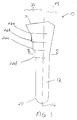
- FIG. 1 shows a typical prior art tamp 5 having a smooth outer surface that matches the contour of the prosthesis to be implanted. See also, U.S. Patent No. 5,470,336, which is incorporated by reference herein. Alternating steps of adding bone matter and compacting the bone matter with tamps of decreasing size can be used to size the canal to generally conform to the shape of the implant.
- the cancellous bone should be sufficiently compacted to remain intact as the new implant and/or bone cement are inserted into the canal. Since the surface of the compacted bone matter interfaces with the bone cement, and/or the prosthetic implant, the compacted bone must be able to withstand shear forces that occur at the interface with the bone matter. If the cancellous bone is not adequately compacted, the strength of the interface surface can be compromised resulting in an unsuccessful revision.
- implant-shaped tamps can provide sufficient radial compaction of the morsellized bone, only limited axial compaction is achieved. The absence of adequate compaction in a longitudinal (axial) direction can leave the compacted bone matter vulnerable to damage from shear forces that result following implant revision surgery.
- the present invention provides a tamp, and a system of tamps, that is useful in compacting a material in a cavity. More particularly, the tamp is useful for compacting morsellized bone matter in a cavity formed in a bone as a result of a surgical procedure such as hip replacement revision surgery. The tamp compacts the morsellized bone matter in both radial and axial directions within the cavity to recreate a cavity of sufficient size and strength to accept a replacement hip prosthesis. Although the tamp is primarily described and illustrated in conjunction with compacting bone matter in a prepared cavity formed in a femur, it is understood that the tamp can be used in other applications as well.
- the tamp device of the invention includes an elongate body having an outer surface with a cross-section that decreases from proximal to distal end of the elongate body.
- a plurality of steps are formed on the outer surface wherein each of the steps extends around the circumference of the elongate body and each step has a distal-facing surface and a side-facing surface.
- the stepped outer surface of the tamp is effective to compact bone matter in both radial and axial directions to form a reconstructed bone cavity of sufficient strength to withstand shear forces that develop following revision surgery.
- the tamp is well-suited for implant revision surgery where a morsellized bone matter is used to prepare a bone graft to recreate a cavity in a bone that is of sufficient size and shape to receive a revision prosthesis. Morsellized bone matter is placed in the canal and it is compacted against walls of the canal with the tamp. Alternating steps of inserting additional bone matter and compacting the material with increasingly smaller tamps shape the canal to generally conform to the new implant. The stepped outer surfaces of the tamps compact each layer of morsellized bone in axial and radial directions.
- the invention provides a tamp, and a tamp system, in which each tamp has a stepped outer surface that offers enhanced axial compaction of a material within a bone cavity.
- axial compaction refers to compaction in a direction substantially parallel to a longitudinal axis of the cavity.
- the invention is particularly applicable to compacting morsellized bone matter in a cavity formed in a bone, and especially during implant revision surgery where the cavity may need to be resized and grafted with cancellous bone to accept the new implant.
- the present invention is described in conjunction with impaction bone grafting in a femur, it is understood that the invention can be adapted for use with a variety of bones, materials and components.
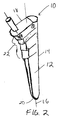
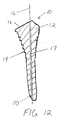
- a tamp 10 includes an elongate body 12 having a longitudinal axis 16 and an outer surface 14 with a circumference or diameter that decreases from the proximal end 18 to the distal end 20 of the elongate body.
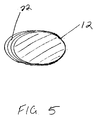
- a plurality of steps 22 are formed on the outer surface 14 of the elongate body to facilitate compaction of morsellized bone matter placed in a cavity formed in a bone, as described below.
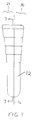
- the longitudinal axis 16 divides the elongate body 12 into a lateral portion 24 and a medial portion 26. As shown in FIG. 4, the longitudinal axis 16 divides the body 12 into an anterior portion 28 and a posterior portion 30.
- the geometry of the steps 22 can vary in relation to the overall size of the tamp, the size of the prosthesis, the amount of bone matter to be compacted, and the particular bone to be prepared to receive an implant. It is understood that each step can be of equal size, proportional in size, or unique in size with respect to other steps.
- the steps can be continuous, or can be formed of discrete portions disposed about the circumference of the tamp. It is further understood that the steps can vary in one or more dimensions as the steps extend circumferentially about the outer surface of the tamp.
- the steps can also vary in size in longitudinal and/or radial directions. Although shown as being relatively flat, it is understood that the step surfaces can be arcuate, including being convex and concave in shape.
- the steps can undulate along the circumference of the body, or they can be generally planar. Also, the length of the elongate body over which the steps are formed can vary. Other such modifications and alterations will be apparent to one of ordinary skill in the art and are understood to be within the scope of the invention.
- each of the steps 22 extend about the anterior, medial, and posterior portions 28,26,30 of the circumference of the elongate body 12. At least a part of the lateral portion 24 is generally smooth along a length of the elongate body 12. The steps 22 are most pronounced along the medial portion 26 of the elongate body 12 during the maximum rate of change in diameter of the elongate body. That is, the steps 22 extend the greatest distance from the elongate body 12 where the elongate body tapers most dramatically along the medial surface.
- the steps 22' extend about the entire circumference of the elongate body including the lateral portion 24.
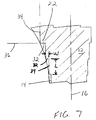
- each of the steps 22 has a distal-facing surface 32 and a side-facing surface 34.
- the distal-facing surface 32 and the side-facing surface 34 can form a range of angles in relation to the longitudinal axis 16 and to each other.
- the distal-facing surface 32 is generally perpendicular to the longitudinal axis 16 and the side-facing surface 34 is substantially parallel to the longitudinal axis.
- the distal-facing surface 32 and the side-facing surface 34 form an angle of about ninety degrees with respect to each other.
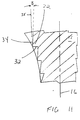
- FIGS. 8-11 show alternative embodiments of the steps 22, and in particular the step surfaces 32,34.
- the distal-facing surface 32 of the step forms an angle A with respect to a line 36 normal to the longitudinal axis 16 of the elongate body 12.
- the angle A can be in the range of about 0 degrees to about 20 degrees. Further, angle A may be canted proximally (FIG. 9) or distally (FIG. 8).
- the side-facing surface 34 forms an angle B with respect to a line 35 drawn parallel to the longitudinal axis 16.
- the angle B can range from about 0 to about 20 degrees, and may be canted laterally (FIG. 10) or medially (FIG. 11) in relation to the longitudinal axis 16. It is understood that the angles A and B can vary about the circumference of the tamp.
- the overall size of the distal-facing and side-facing surfaces 32,34 can vary depending on the desired pitch for the steps, the size of the tamp, and the taper of the tamp circumference.
- the width (W) (FIG.7) of the distal-facing surface 32 can range from about 0.25 to about 6.00 millimeters and the length (L) (FIG. 7) of the side-facing surface 34 can range from about 2.00 to about 10.00 millimeters. In a preferred embodiment, the width (W) of the distal-facing surface 32 is about 2.00 millimeters and the length (L) of the side-facing surface 34 is about 7.00 millimeters.
- the number of steps 22 formed on the outer surface 14 of the tamp can vary depending on the size of the steps, the size of the tamp, the desired step pitch and the intended application.
- the number of steps 22 can vary from about one to about fifty, and more preferably from about three to about six. In an exemplary embodiment, the tamp has about five steps.
- the spacing of the steps 22 can range from about 0.5 millimeter apart to about 5.0 millimeters apart, and more preferably, from about 1.0 millimeter to about 2.0 millimeters apart.
- the spacing is measured from intersections of respective distal-facing and side-facing surfaces.
- the overall length and outer circumference of the tamp 10 can vary depending on the anatomical requirements of a patient, the dimensions of a prosthetic component to be implanted, and the condition of a canal in a bone subsequent to removal of a prior prosthesis.
- the overall length of the tamp can vary from about three to about ten inches, and preferably from about four to five inches.
- the overall cross-sectional area of the tamp varies along the length of the elongate body. It is understood that the cross-section of the tamp can vary to accommodate relatively large bone canals and relatively small bone canals.
- One of ordinary skill in the art can readily determine a tamp of appropriate size for a given canal.
- a bone compaction system can include a number of proportionally sized tamps to sequentially compact layers of morsellized bone.
- the number of tamps comprising the system can range from about two tamps to about twenty tamps and preferably about three to four tamps. It is understood that a tamp can be selected to provide a desired thickness for the compacted bone layer and to size the canal to receive a given prosthesis.
- the tamp 10 can include an extension member (not shown) that extends from the proximal end 18 of the tamp to serve as a handle.
- the extension member can include an impact surface at its proximal end to facilitate impaction of the tamp into the canal. A surgeon or other medical personnel can strike the impact surface with a surgical mallet or other such device to compact the morsellized bone matter.
- the tamp is cannulated along the longitudinal axis 16 to include a passageway 17 extending from the proximal end 18 to the distal end 20. Movement of the tamp may be guided by a wire in the passageway 17 during insertion of the tamp in the canal.
- the tamp of the present invention is well suited for use in preparing a bone for implant revision surgery.
- the prosthesis wears or subsides in the bone cement, the prosthesis must be removed and replaced with a new prosthesis through a revision procedure.
- any bone cement used to secure the original prosthesis and cement plug must be extracted from the cavity within the femur.
- the resulting cavity may be larger than is desired for implantation of an appropriate size replacement prosthesis. Further, the amount of remaining cancellous bone may be insufficient for interdigitation with bone cement.
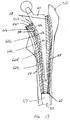
- FIG. 13 shows a cavity 50 in a femur 52 prepared with a tamp system in accordance with the present invention.
- the cavity 50 is formed by cortical bone 54 which remains after removal of the original prosthesis.
- morsellized bone matter 56a is inserted into the cavity 50.
- a plug 57 can be inserted at a distal end of the cavity 50 to retain the bone matter.
- a tamp of a suitable size is inserted into the cavity 50 to compact the bone matter 56a against the cortical bone 54. Additional morsellized bone can be placed in the cavity 50 and a smaller tamp can then be used to compact the bone matter to form a further layer 56b of compacted bone.
- the compacted bone matter 56 can be formed in layers to accommodate a given revision prosthesis.
- the stepped outer surface 14 of the tamp 10 causes the morsellized bone matter to be compacted in both radial and axial directions.
- the steps 22, and in particular the distal-facing surfaces 32 compact the bone matter 56 in a direction along the longitudinal axis 16 of the tamp.
- Radial compaction of the bone matter is achieved as axial force is applied to the tamp during insertion into the cavity 50.
- the side-facing surfaces 34 force bone matter radially outward against the cortical bone 54.
- the cavity is sized to be slightly larger than the contour of the new prosthesis to provide a gap between a surface 58 of the compacted bone 56 and the prosthesis.
- the gap can be filled with bone cement 60 to secure the prosthesis in the bone cavity 50.
- the surface 58 of the compacted bone is a mirror image of the outer surface 14 of the tamp 10.
- the surface 58 includes a series of steps 62 with corresponding outermost portions 63 at a crest of the steps.
- the stepped surface 58 of the bone matter is effective to minimize shear loads between the surface 58 of the compacted bone matter and the cement 60.
- shear forces between layers of compacted cancellous bone 56 are reduced and the outermost portions 63 of the cancellous bone layer 56 are compressed against the cortical bone 54.
- the tamp system of the present invention can be formed from a variety of materials having high strength and durability. Examples of such materials include metal alloys such as cobalt chromium alloys, stainless steel, ceramics and other materials that are well known for use in the manufacture of tamps. A preferred material for the tamp is stainless steel.
Landscapes
- Health & Medical Sciences (AREA)
- Transplantation (AREA)
- Orthopedic Medicine & Surgery (AREA)
- Heart & Thoracic Surgery (AREA)
- Cardiology (AREA)
- Oral & Maxillofacial Surgery (AREA)
- Engineering & Computer Science (AREA)
- Biomedical Technology (AREA)
- Physical Education & Sports Medicine (AREA)
- Vascular Medicine (AREA)
- Life Sciences & Earth Sciences (AREA)
- Animal Behavior & Ethology (AREA)
- General Health & Medical Sciences (AREA)
- Public Health (AREA)
- Veterinary Medicine (AREA)
- Prostheses (AREA)
Applications Claiming Priority (2)
| Application Number | Priority Date | Filing Date | Title |
|---|---|---|---|
| US08/961,044 US6013080A (en) | 1997-10-30 | 1997-10-30 | Tamp with horizontal steps used for impaction bone grafting in revision femur |
| US961044 | 1997-10-30 |
Publications (3)
| Publication Number | Publication Date |
|---|---|
| EP0913136A2 true EP0913136A2 (de) | 1999-05-06 |
| EP0913136A3 EP0913136A3 (de) | 1999-07-21 |
| EP0913136B1 EP0913136B1 (de) | 2004-09-15 |
Family
ID=25503991
Family Applications (1)
| Application Number | Title | Priority Date | Filing Date |
|---|---|---|---|
| EP98308859A Expired - Lifetime EP0913136B1 (de) | 1997-10-30 | 1998-10-29 | Knochentransplantatverdichter mit horizontalen Stufen für Hüftüberprüfung |
Country Status (3)
| Country | Link |
|---|---|
| US (1) | US6013080A (de) |
| EP (1) | EP0913136B1 (de) |
| DE (1) | DE69826207T2 (de) |
Cited By (2)
| Publication number | Priority date | Publication date | Assignee | Title |
|---|---|---|---|---|
| EP1523965A3 (de) * | 2003-09-26 | 2005-11-09 | Depuy Products, Inc. | Knochenverdichter mit radialer Beaufschlagung |
| US8048163B2 (en) | 2002-02-20 | 2011-11-01 | Zimmer, Inc. | Knee arthroplasty prosthesis |
Families Citing this family (43)
| Publication number | Priority date | Publication date | Assignee | Title |
|---|---|---|---|---|
| GB9820369D0 (en) * | 1998-09-19 | 1998-11-11 | Giltech Ltd | Material |
| GB0116341D0 (en) * | 2001-07-04 | 2001-08-29 | Smith & Nephew | Biodegradable polymer systems |
| US20030065397A1 (en) | 2001-08-27 | 2003-04-03 | Hanssen Arlen D. | Prosthetic implant support structure |
| US20040162619A1 (en) * | 2001-08-27 | 2004-08-19 | Zimmer Technology, Inc. | Tibial augments for use with knee joint prostheses, method of implanting the tibial augment, and associated tools |
| US7892288B2 (en) | 2001-08-27 | 2011-02-22 | Zimmer Technology, Inc. | Femoral augments for use with knee joint prosthesis |
| GB0202233D0 (en) * | 2002-01-31 | 2002-03-20 | Smith & Nephew | Bioresorbable polymers |
| USD684693S1 (en) | 2002-08-22 | 2013-06-18 | Zimmer, Inc. | Prosthetic implant support structure |
| US7824409B2 (en) * | 2003-01-31 | 2010-11-02 | Zimmer, Inc. | Modular impaction grafting tamps |
| WO2004071356A2 (en) * | 2003-02-10 | 2004-08-26 | Smith & Nephew, Inc. | Resorbable devices |
| GB0317192D0 (en) * | 2003-07-19 | 2003-08-27 | Smith & Nephew | High strength bioresorbable co-polymers |
| US7141354B2 (en) * | 2003-09-30 | 2006-11-28 | Dai Nippon Printing Co., Ltd. | Photo radical generator, photo sensitive resin composition and article |
| GB0329654D0 (en) * | 2003-12-23 | 2004-01-28 | Smith & Nephew | Tunable segmented polyacetal |
| US7582090B2 (en) * | 2004-03-04 | 2009-09-01 | Wright Medical Technology, Inc. | Bone preserving total hip arthroplasty using autograft |
| US9849216B2 (en) | 2006-03-03 | 2017-12-26 | Smith & Nephew, Inc. | Systems and methods for delivering a medicament |
| US7925320B2 (en) * | 2006-03-06 | 2011-04-12 | Garmin Switzerland Gmbh | Electronic device mount |
| US8187280B2 (en) | 2007-10-10 | 2012-05-29 | Biomet Manufacturing Corp. | Knee joint prosthesis system and method for implantation |
| US8163028B2 (en) * | 2007-01-10 | 2012-04-24 | Biomet Manufacturing Corp. | Knee joint prosthesis system and method for implantation |
| US8157869B2 (en) | 2007-01-10 | 2012-04-17 | Biomet Manufacturing Corp. | Knee joint prosthesis system and method for implantation |
| US8562616B2 (en) | 2007-10-10 | 2013-10-22 | Biomet Manufacturing, Llc | Knee joint prosthesis system and method for implantation |
| US8328873B2 (en) | 2007-01-10 | 2012-12-11 | Biomet Manufacturing Corp. | Knee joint prosthesis system and method for implantation |
| US8348953B2 (en) * | 2008-01-10 | 2013-01-08 | Peter Brehm | Method and apparatus for impacting bone material |
| US9475709B2 (en) | 2010-08-25 | 2016-10-25 | Lockheed Martin Corporation | Perforated graphene deionization or desalination |
| AU2012258998B2 (en) | 2011-05-20 | 2016-05-05 | Zimmer, Inc. | Stabilizing prosthesis support structure |
| US10376845B2 (en) | 2016-04-14 | 2019-08-13 | Lockheed Martin Corporation | Membranes with tunable selectivity |
| US10203295B2 (en) | 2016-04-14 | 2019-02-12 | Lockheed Martin Corporation | Methods for in situ monitoring and control of defect formation or healing |
| US9610546B2 (en) | 2014-03-12 | 2017-04-04 | Lockheed Martin Corporation | Separation membranes formed from perforated graphene and methods for use thereof |
| US9834809B2 (en) | 2014-02-28 | 2017-12-05 | Lockheed Martin Corporation | Syringe for obtaining nano-sized materials for selective assays and related methods of use |
| US10980919B2 (en) | 2016-04-14 | 2021-04-20 | Lockheed Martin Corporation | Methods for in vivo and in vitro use of graphene and other two-dimensional materials |
| US9744617B2 (en) | 2014-01-31 | 2017-08-29 | Lockheed Martin Corporation | Methods for perforating multi-layer graphene through ion bombardment |
| US10653824B2 (en) | 2012-05-25 | 2020-05-19 | Lockheed Martin Corporation | Two-dimensional materials and uses thereof |
| US10005038B2 (en) | 2014-09-02 | 2018-06-26 | Lockheed Martin Corporation | Hemodialysis and hemofiltration membranes based upon a two-dimensional membrane material and methods employing same |
| US9427322B1 (en) * | 2012-06-27 | 2016-08-30 | Signal Medical Corporation | Hip implant |
| US9592475B2 (en) | 2013-03-12 | 2017-03-14 | Lockheed Martin Corporation | Method for forming perforated graphene with uniform aperture size |
| US9572918B2 (en) | 2013-06-21 | 2017-02-21 | Lockheed Martin Corporation | Graphene-based filter for isolating a substance from blood |
| EP3099645A4 (de) | 2014-01-31 | 2017-09-27 | Lockheed Martin Corporation | Verfahren zur formung von verbundstrukturen mit einem zweidimensionalen material unter verwendung einer porösen, nichtbeschädigenden trägerschicht |
| CA2938273A1 (en) | 2014-01-31 | 2015-08-06 | Peter V. Bedworth | Perforating two-dimensional materials using broad ion field |
| CA2942496A1 (en) | 2014-03-12 | 2015-09-17 | Lockheed Martin Corporation | Separation membranes formed from perforated graphene |
| AU2016303048A1 (en) | 2015-08-05 | 2018-03-01 | Lockheed Martin Corporation | Perforatable sheets of graphene-based material |
| MX2018001559A (es) | 2015-08-06 | 2018-09-27 | Lockheed Corp | Modificacion de nanoparticula y perforacion de grafeno. |
| CA3020874A1 (en) | 2016-04-14 | 2017-10-19 | Lockheed Martin Corporation | Two-dimensional membrane structures having flow passages |
| EP3442697A4 (de) | 2016-04-14 | 2020-03-18 | Lockheed Martin Corporation | Selektive grenzflächenminderung von graphendefekten |
| CA3020686A1 (en) | 2016-04-14 | 2017-10-19 | Lockheed Martin Corporation | Method for treating graphene sheets for large-scale transfer using free-float method |
| CN110191691B (zh) | 2017-01-20 | 2022-03-22 | 拜欧米特制造有限责任公司 | 模块化扩充部件 |
Citations (1)
| Publication number | Priority date | Publication date | Assignee | Title |
|---|---|---|---|---|
| US5470336A (en) | 1990-08-10 | 1995-11-28 | Ling; Robin S. M. | System for performing hip prosthesis revision surgery |
Family Cites Families (14)
| Publication number | Priority date | Publication date | Assignee | Title |
|---|---|---|---|---|
| US4068324A (en) * | 1977-01-19 | 1978-01-17 | Bio-Dynamics Inc. | Platform supported hip prosthesis |
| DE3213434C1 (de) * | 1982-04-10 | 1983-10-27 | Günther Dr.med. 7400 Tübingen Aldinger | Verfahren zur Herstellung individuell gestalteter Endoprothesen oder Implantate |
| US4552136A (en) * | 1983-10-19 | 1985-11-12 | Howmedica, Inc. | Femoral rasp |
| US4846839A (en) * | 1984-02-09 | 1989-07-11 | Joint Medical Products Corporation | Apparatus for affixing a prosthesis to bone |
| CH672058A5 (de) * | 1986-08-05 | 1989-10-31 | Synthes Ag | |
| US4921493A (en) * | 1986-08-11 | 1990-05-01 | Zimmer, Inc. | Rasp tool |
| US4800875A (en) * | 1987-08-20 | 1989-01-31 | Cedar Surgical, Inc. | Surgical funnel and method of using |
| US5019083A (en) * | 1989-01-31 | 1991-05-28 | Advanced Osseous Technologies, Inc. | Implanting and removal of orthopedic prostheses |
| US5108405A (en) * | 1990-08-10 | 1992-04-28 | Mikhail Michael W E | System for performing hip prosethesis revision surgery |
| DK0563585T3 (da) * | 1992-04-01 | 1995-12-18 | Integral Medizintechnik | Knoglerasp af plast |
| WO1995014433A1 (en) * | 1993-11-24 | 1995-06-01 | Orthopaedic Innovations, Inc. | Cannulated instrumentation for total joint arthroplasty and method of use |
| DE59607563D1 (de) * | 1995-05-31 | 2001-10-04 | Zsolt Szabo | Knochenmarkraspel |
| IT1278765B1 (it) * | 1995-10-03 | 1997-11-27 | Piero Garosi | Strumentazione per la preparazione della sede per la componente femorale di una protesi d'anca non cementata |
| US5766261A (en) * | 1996-02-01 | 1998-06-16 | Osteonics Corp. | Femoral revision broach with modular trial components and method |
-
1997
- 1997-10-30 US US08/961,044 patent/US6013080A/en not_active Expired - Lifetime
-
1998
- 1998-10-29 EP EP98308859A patent/EP0913136B1/de not_active Expired - Lifetime
- 1998-10-29 DE DE69826207T patent/DE69826207T2/de not_active Expired - Lifetime
Patent Citations (1)
| Publication number | Priority date | Publication date | Assignee | Title |
|---|---|---|---|---|
| US5470336A (en) | 1990-08-10 | 1995-11-28 | Ling; Robin S. M. | System for performing hip prosthesis revision surgery |
Cited By (3)
| Publication number | Priority date | Publication date | Assignee | Title |
|---|---|---|---|---|
| US8048163B2 (en) | 2002-02-20 | 2011-11-01 | Zimmer, Inc. | Knee arthroplasty prosthesis |
| EP1523965A3 (de) * | 2003-09-26 | 2005-11-09 | Depuy Products, Inc. | Knochenverdichter mit radialer Beaufschlagung |
| US7799029B2 (en) | 2003-09-26 | 2010-09-21 | Depuy Orthopaedics, Inc. | Radial impaction bone tamp and associated method |
Also Published As
| Publication number | Publication date |
|---|---|
| EP0913136A3 (de) | 1999-07-21 |
| US6013080A (en) | 2000-01-11 |
| DE69826207T2 (de) | 2005-10-13 |
| DE69826207D1 (de) | 2004-10-21 |
| EP0913136B1 (de) | 2004-09-15 |
Similar Documents
| Publication | Publication Date | Title |
|---|---|---|
| EP0913136B1 (de) | Knochentransplantatverdichter mit horizontalen Stufen für Hüftüberprüfung | |
| US5899907A (en) | Instrumentation for proximal femoral compaction broaching | |
| US5593451A (en) | Prosthetic device and method of implantation | |
| US6143033A (en) | Allogenic intervertebral implant | |
| EP1238635B1 (de) | Eine Reibvorrichtung | |
| US4536894A (en) | Hip prosthesis with flared porous bony ingrowth pads | |
| AU772169B2 (en) | Methods and instruments for radial bone impacting | |
| US5755805A (en) | Tapered prosthesis component | |
| US8157871B2 (en) | Femoral HIP prosthesis and method of implantation | |
| CA2560960C (en) | Allograft implant | |
| EP0149527B1 (de) | Befestigung von Implantaten in Knochen | |
| EP1477140A2 (de) | Zwischeneinsatzprothese und Bausatz | |
| JPS639465B2 (de) | ||
| US7494509B1 (en) | Method and apparatus for providing a short-stemmed hip prosthesis | |
| EP0985385A1 (de) | Implantierbare Prothese mit Knochenverbindungsrippen | |
| EP2002804A1 (de) | Einzeleingangsportal-Implantat | |
| WO1989010730A1 (en) | Hip joint femoral prosthesis | |
| EP0783275B1 (de) | Zuführwerkzeug zur verdichteten räumung des proximalen femoralschaftes | |
| CA2200201C (en) | Instrumentation for proximal femoral compaction broaching | |
| AU2011223978A1 (en) | Femoral hip prosthesis and method of implantation |
Legal Events
| Date | Code | Title | Description |
|---|---|---|---|
| PUAI | Public reference made under article 153(3) epc to a published international application that has entered the european phase |
Free format text: ORIGINAL CODE: 0009012 |
|
| AK | Designated contracting states |
Kind code of ref document: A2 Designated state(s): DE GB |
|
| AX | Request for extension of the european patent |
Free format text: AL;LT;LV;MK;RO;SI |
|
| PUAL | Search report despatched |
Free format text: ORIGINAL CODE: 0009013 |
|
| AK | Designated contracting states |
Kind code of ref document: A3 Designated state(s): AT BE CH CY DE DK ES FI FR GB GR IE IT LI LU MC NL PT SE |
|
| AX | Request for extension of the european patent |
Free format text: AL;LT;LV;MK;RO;SI |
|
| RIC1 | Information provided on ipc code assigned before grant |
Free format text: 6A 61F 2/46 A, 6A 61B 17/56 B, 6A 61B 17/58 B |
|
| 17P | Request for examination filed |
Effective date: 19991228 |
|
| AKX | Designation fees paid |
Free format text: DE GB |
|
| 17Q | First examination report despatched |
Effective date: 20020307 |
|
| RAP1 | Party data changed (applicant data changed or rights of an application transferred) |
Owner name: DEPUY PRODUCTS, INC. |
|
| RAP1 | Party data changed (applicant data changed or rights of an application transferred) |
Owner name: DEPUY PRODUCTS, INC. |
|
| GRAP | Despatch of communication of intention to grant a patent |
Free format text: ORIGINAL CODE: EPIDOSNIGR1 |
|
| GRAS | Grant fee paid |
Free format text: ORIGINAL CODE: EPIDOSNIGR3 |
|
| GRAA | (expected) grant |
Free format text: ORIGINAL CODE: 0009210 |
|
| AK | Designated contracting states |
Kind code of ref document: B1 Designated state(s): DE GB |
|
| REG | Reference to a national code |
Ref country code: GB Ref legal event code: FG4D |
|
| REF | Corresponds to: |
Ref document number: 69826207 Country of ref document: DE Date of ref document: 20041021 Kind code of ref document: P |
|
| PLBE | No opposition filed within time limit |
Free format text: ORIGINAL CODE: 0009261 |
|
| STAA | Information on the status of an ep patent application or granted ep patent |
Free format text: STATUS: NO OPPOSITION FILED WITHIN TIME LIMIT |
|
| 26N | No opposition filed |
Effective date: 20050616 |
|
| PGFP | Annual fee paid to national office [announced via postgrant information from national office to epo] |
Ref country code: DE Payment date: 20151020 Year of fee payment: 18 Ref country code: GB Payment date: 20151028 Year of fee payment: 18 |
|
| REG | Reference to a national code |
Ref country code: DE Ref legal event code: R119 Ref document number: 69826207 Country of ref document: DE |
|
| GBPC | Gb: european patent ceased through non-payment of renewal fee |
Effective date: 20161029 |
|
| PG25 | Lapsed in a contracting state [announced via postgrant information from national office to epo] |
Ref country code: DE Free format text: LAPSE BECAUSE OF NON-PAYMENT OF DUE FEES Effective date: 20170503 Ref country code: GB Free format text: LAPSE BECAUSE OF NON-PAYMENT OF DUE FEES Effective date: 20161029 |