EP0912643B1 - Mit einem funktionalisierten polyorganosiloxan modifizierte teilchen - Google Patents
Mit einem funktionalisierten polyorganosiloxan modifizierte teilchen Download PDFInfo
- Publication number
- EP0912643B1 EP0912643B1 EP96941689A EP96941689A EP0912643B1 EP 0912643 B1 EP0912643 B1 EP 0912643B1 EP 96941689 A EP96941689 A EP 96941689A EP 96941689 A EP96941689 A EP 96941689A EP 0912643 B1 EP0912643 B1 EP 0912643B1
- Authority
- EP
- European Patent Office
- Prior art keywords
- particles
- polyorganosiloxane
- radical
- particles according
- linear
- Prior art date
- Legal status (The legal status is an assumption and is not a legal conclusion. Google has not performed a legal analysis and makes no representation as to the accuracy of the status listed.)
- Expired - Lifetime
Links
- 239000002245 particle Substances 0.000 title claims abstract description 128
- 239000000203 mixture Substances 0.000 claims abstract description 27
- 238000000034 method Methods 0.000 claims abstract description 25
- 229920001169 thermoplastic Polymers 0.000 claims abstract description 22
- 125000000217 alkyl group Chemical group 0.000 claims abstract description 19
- -1 sulphoxides Chemical group 0.000 claims abstract description 19
- 238000002360 preparation method Methods 0.000 claims abstract description 18
- VYPSYNLAJGMNEJ-UHFFFAOYSA-N Silicium dioxide Chemical compound O=[Si]=O VYPSYNLAJGMNEJ-UHFFFAOYSA-N 0.000 claims abstract description 14
- 230000008569 process Effects 0.000 claims abstract description 13
- 125000004469 siloxy group Chemical group [SiH3]O* 0.000 claims abstract description 11
- RTZKZFJDLAIYFH-UHFFFAOYSA-N Diethyl ether Chemical group CCOCC RTZKZFJDLAIYFH-UHFFFAOYSA-N 0.000 claims abstract description 7
- 125000005358 mercaptoalkyl group Chemical group 0.000 claims abstract description 7
- 125000000962 organic group Chemical group 0.000 claims abstract description 7
- 239000000377 silicon dioxide Substances 0.000 claims abstract description 7
- 125000003545 alkoxy group Chemical group 0.000 claims abstract description 6
- 229920000098 polyolefin Polymers 0.000 claims abstract description 6
- NINIDFKCEFEMDL-UHFFFAOYSA-N Sulfur Chemical group [S] NINIDFKCEFEMDL-UHFFFAOYSA-N 0.000 claims abstract description 3
- 239000010954 inorganic particle Substances 0.000 claims abstract 7
- GWEVSGVZZGPLCZ-UHFFFAOYSA-N Titan oxide Chemical compound O=[Ti]=O GWEVSGVZZGPLCZ-UHFFFAOYSA-N 0.000 claims description 59
- 239000004408 titanium dioxide Substances 0.000 claims description 24
- 229910052739 hydrogen Inorganic materials 0.000 claims description 10
- 239000001257 hydrogen Substances 0.000 claims description 10
- 125000004429 atom Chemical group 0.000 claims description 9
- UFHFLCQGNIYNRP-UHFFFAOYSA-N Hydrogen Chemical compound [H][H] UFHFLCQGNIYNRP-UHFFFAOYSA-N 0.000 claims description 8
- 239000000049 pigment Substances 0.000 claims description 8
- 125000001424 substituent group Chemical group 0.000 claims description 8
- 125000004432 carbon atom Chemical group C* 0.000 claims description 7
- 125000002496 methyl group Chemical group [H]C([H])([H])* 0.000 claims description 7
- 229910052721 tungsten Inorganic materials 0.000 claims description 7
- 229910052727 yttrium Inorganic materials 0.000 claims description 7
- 125000004122 cyclic group Chemical group 0.000 claims description 6
- 229910052710 silicon Inorganic materials 0.000 claims description 6
- 239000010703 silicon Substances 0.000 claims description 6
- 239000004215 Carbon black (E152) Substances 0.000 claims description 5
- 229930195733 hydrocarbon Natural products 0.000 claims description 5
- 125000006273 (C1-C3) alkyl group Chemical group 0.000 claims description 3
- 229910018540 Si C Inorganic materials 0.000 claims description 3
- 125000003118 aryl group Chemical group 0.000 claims description 3
- 125000001495 ethyl group Chemical group [H]C([H])([H])C([H])([H])* 0.000 claims description 3
- 239000003973 paint Substances 0.000 claims description 3
- 229910052761 rare earth metal Inorganic materials 0.000 claims description 3
- 229910010271 silicon carbide Inorganic materials 0.000 claims description 3
- 239000000126 substance Substances 0.000 claims description 3
- 125000003358 C2-C20 alkenyl group Chemical group 0.000 claims description 2
- SNRUBQQJIBEYMU-UHFFFAOYSA-N Dodecane Natural products CCCCCCCCCCCC SNRUBQQJIBEYMU-UHFFFAOYSA-N 0.000 claims description 2
- 230000003213 activating effect Effects 0.000 claims description 2
- 125000002947 alkylene group Chemical group 0.000 claims description 2
- PNEYBMLMFCGWSK-UHFFFAOYSA-N aluminium oxide Inorganic materials [O-2].[O-2].[O-2].[Al+3].[Al+3] PNEYBMLMFCGWSK-UHFFFAOYSA-N 0.000 claims description 2
- 125000002619 bicyclic group Chemical group 0.000 claims description 2
- 125000000484 butyl group Chemical group [H]C([*])([H])C([H])([H])C([H])([H])C([H])([H])[H] 0.000 claims description 2
- 229920001577 copolymer Polymers 0.000 claims description 2
- 125000000596 cyclohexenyl group Chemical group C1(=CCCCC1)* 0.000 claims description 2
- 125000005066 dodecenyl group Chemical group C(=CCCCCCCCCCC)* 0.000 claims description 2
- 125000003438 dodecyl group Chemical group [H]C([H])([H])C([H])([H])C([H])([H])C([H])([H])C([H])([H])C([H])([H])C([H])([H])C([H])([H])C([H])([H])C([H])([H])C([H])([H])C([H])([H])* 0.000 claims description 2
- 238000009472 formulation Methods 0.000 claims description 2
- 125000006038 hexenyl group Chemical group 0.000 claims description 2
- 229920005684 linear copolymer Polymers 0.000 claims description 2
- 230000000873 masking effect Effects 0.000 claims description 2
- 125000002347 octyl group Chemical group [H]C([*])([H])C([H])([H])C([H])([H])C([H])([H])C([H])([H])C([H])([H])C([H])([H])C([H])([H])[H] 0.000 claims description 2
- 125000001997 phenyl group Chemical group [H]C1=C([H])C([H])=C(*)C([H])=C1[H] 0.000 claims description 2
- 125000001436 propyl group Chemical group [H]C([*])([H])C([H])([H])C([H])([H])[H] 0.000 claims description 2
- 238000004381 surface treatment Methods 0.000 claims description 2
- 150000003568 thioethers Chemical class 0.000 claims description 2
- 125000002889 tridecyl group Chemical group [H]C([*])([H])C([H])([H])C([H])([H])C([H])([H])C([H])([H])C([H])([H])C([H])([H])C([H])([H])C([H])([H])C([H])([H])C([H])([H])C([H])([H])C([H])([H])[H] 0.000 claims description 2
- 125000002948 undecyl group Chemical group [H]C([*])([H])C([H])([H])C([H])([H])C([H])([H])C([H])([H])C([H])([H])C([H])([H])C([H])([H])C([H])([H])C([H])([H])C([H])([H])[H] 0.000 claims description 2
- MCMNRKCIXSYSNV-UHFFFAOYSA-N Zirconium dioxide Chemical compound O=[Zr]=O MCMNRKCIXSYSNV-UHFFFAOYSA-N 0.000 claims 2
- 229910052681 coesite Inorganic materials 0.000 claims 2
- 229910052906 cristobalite Inorganic materials 0.000 claims 2
- 125000002950 monocyclic group Chemical group 0.000 claims 2
- 229910052682 stishovite Inorganic materials 0.000 claims 2
- DLYUQMMRRRQYAE-UHFFFAOYSA-N tetraphosphorus decaoxide Chemical compound O1P(O2)(=O)OP3(=O)OP1(=O)OP2(=O)O3 DLYUQMMRRRQYAE-UHFFFAOYSA-N 0.000 claims 2
- 229910052905 tridymite Inorganic materials 0.000 claims 2
- 125000000008 (C1-C10) alkyl group Chemical group 0.000 claims 1
- 125000004191 (C1-C6) alkoxy group Chemical group 0.000 claims 1
- ATTZFSUZZUNHBP-UHFFFAOYSA-N Piperonyl sulfoxide Chemical group CCCCCCCCS(=O)C(C)CC1=CC=C2OCOC2=C1 ATTZFSUZZUNHBP-UHFFFAOYSA-N 0.000 claims 1
- 125000001931 aliphatic group Chemical group 0.000 claims 1
- QVGXLLKOCUKJST-UHFFFAOYSA-N atomic oxygen Chemical group [O] QVGXLLKOCUKJST-UHFFFAOYSA-N 0.000 claims 1
- CETPSERCERDGAM-UHFFFAOYSA-N ceric oxide Chemical compound O=[Ce]=O CETPSERCERDGAM-UHFFFAOYSA-N 0.000 claims 1
- 229910000422 cerium(IV) oxide Inorganic materials 0.000 claims 1
- 229910052593 corundum Inorganic materials 0.000 claims 1
- 230000001747 exhibiting effect Effects 0.000 claims 1
- 125000004435 hydrogen atom Chemical class [H]* 0.000 claims 1
- 229920001021 polysulfide Polymers 0.000 claims 1
- 125000002572 propoxy group Chemical group [*]OC([H])([H])C(C([H])([H])[H])([H])[H] 0.000 claims 1
- 229910001845 yogo sapphire Inorganic materials 0.000 claims 1
- 229920000642 polymer Polymers 0.000 abstract description 16
- 150000002148 esters Chemical class 0.000 abstract description 6
- 150000002170 ethers Chemical class 0.000 abstract description 6
- 150000001408 amides Chemical group 0.000 abstract description 5
- 125000002887 hydroxy group Chemical group [H]O* 0.000 abstract description 5
- 150000002576 ketones Chemical class 0.000 abstract description 4
- OAICVXFJPJFONN-UHFFFAOYSA-N Phosphorus Chemical compound [P] OAICVXFJPJFONN-UHFFFAOYSA-N 0.000 abstract description 3
- 125000003342 alkenyl group Chemical group 0.000 abstract description 3
- 125000003277 amino group Chemical group 0.000 abstract description 3
- 125000003700 epoxy group Chemical group 0.000 abstract description 3
- 229910052698 phosphorus Inorganic materials 0.000 abstract description 3
- 239000011574 phosphorus Substances 0.000 abstract description 3
- 229920000647 polyepoxide Polymers 0.000 abstract description 3
- 239000003054 catalyst Substances 0.000 description 16
- LFQSCWFLJHTTHZ-UHFFFAOYSA-N Ethanol Chemical compound CCO LFQSCWFLJHTTHZ-UHFFFAOYSA-N 0.000 description 13
- BASFCYQUMIYNBI-UHFFFAOYSA-N platinum Substances [Pt] BASFCYQUMIYNBI-UHFFFAOYSA-N 0.000 description 11
- 229910052500 inorganic mineral Inorganic materials 0.000 description 8
- 229920001684 low density polyethylene Polymers 0.000 description 8
- 239000004702 low-density polyethylene Substances 0.000 description 8
- 239000011707 mineral Substances 0.000 description 8
- 238000006459 hydrosilylation reaction Methods 0.000 description 7
- XEKOWRVHYACXOJ-UHFFFAOYSA-N Ethyl acetate Chemical compound CCOC(C)=O XEKOWRVHYACXOJ-UHFFFAOYSA-N 0.000 description 6
- 229910004298 SiO 2 Inorganic materials 0.000 description 6
- XUIMIQQOPSSXEZ-UHFFFAOYSA-N Silicon Chemical compound [Si] XUIMIQQOPSSXEZ-UHFFFAOYSA-N 0.000 description 6
- 229910010413 TiO 2 Inorganic materials 0.000 description 6
- 238000006243 chemical reaction Methods 0.000 description 6
- 239000004205 dimethyl polysiloxane Substances 0.000 description 6
- 238000010348 incorporation Methods 0.000 description 6
- 229920003023 plastic Polymers 0.000 description 6
- 239000004033 plastic Substances 0.000 description 6
- 229910052697 platinum Inorganic materials 0.000 description 6
- 229920000435 poly(dimethylsiloxane) Polymers 0.000 description 6
- 229920001296 polysiloxane Polymers 0.000 description 6
- 150000001875 compounds Chemical class 0.000 description 5
- 239000002904 solvent Substances 0.000 description 5
- 239000000654 additive Substances 0.000 description 4
- 239000003153 chemical reaction reagent Substances 0.000 description 4
- PXHVJJICTQNCMI-UHFFFAOYSA-N nickel Substances [Ni] PXHVJJICTQNCMI-UHFFFAOYSA-N 0.000 description 4
- 239000003921 oil Substances 0.000 description 4
- 229920000915 polyvinyl chloride Polymers 0.000 description 4
- 239000004800 polyvinyl chloride Substances 0.000 description 4
- 239000000843 powder Substances 0.000 description 4
- 238000003756 stirring Methods 0.000 description 4
- 239000004416 thermosoftening plastic Substances 0.000 description 4
- ZWEHNKRNPOVVGH-UHFFFAOYSA-N 2-Butanone Chemical compound CCC(C)=O ZWEHNKRNPOVVGH-UHFFFAOYSA-N 0.000 description 3
- YMWUJEATGCHHMB-UHFFFAOYSA-N Dichloromethane Chemical compound ClCCl YMWUJEATGCHHMB-UHFFFAOYSA-N 0.000 description 3
- OKKJLVBELUTLKV-UHFFFAOYSA-N Methanol Chemical compound OC OKKJLVBELUTLKV-UHFFFAOYSA-N 0.000 description 3
- 239000002033 PVDF binder Substances 0.000 description 3
- 239000004952 Polyamide Substances 0.000 description 3
- 150000001336 alkenes Chemical class 0.000 description 3
- 230000008901 benefit Effects 0.000 description 3
- 229920002678 cellulose Polymers 0.000 description 3
- 239000001913 cellulose Substances 0.000 description 3
- 230000007246 mechanism Effects 0.000 description 3
- VLKZOEOYAKHREP-UHFFFAOYSA-N n-Hexane Chemical compound CCCCCC VLKZOEOYAKHREP-UHFFFAOYSA-N 0.000 description 3
- 229920002647 polyamide Polymers 0.000 description 3
- 229920002981 polyvinylidene fluoride Polymers 0.000 description 3
- CTMHWPIWNRWQEG-UHFFFAOYSA-N 1-methylcyclohexene Chemical compound CC1=CCCCC1 CTMHWPIWNRWQEG-UHFFFAOYSA-N 0.000 description 2
- QTBSBXVTEAMEQO-UHFFFAOYSA-M Acetate Chemical compound CC([O-])=O QTBSBXVTEAMEQO-UHFFFAOYSA-M 0.000 description 2
- 229910018072 Al 2 O 3 Inorganic materials 0.000 description 2
- HEDRZPFGACZZDS-UHFFFAOYSA-N Chloroform Chemical compound ClC(Cl)Cl HEDRZPFGACZZDS-UHFFFAOYSA-N 0.000 description 2
- 239000004593 Epoxy Substances 0.000 description 2
- UQSXHKLRYXJYBZ-UHFFFAOYSA-N Iron oxide Chemical compound [Fe]=O UQSXHKLRYXJYBZ-UHFFFAOYSA-N 0.000 description 2
- LRHPLDYGYMQRHN-UHFFFAOYSA-N N-Butanol Chemical compound CCCCO LRHPLDYGYMQRHN-UHFFFAOYSA-N 0.000 description 2
- 239000004698 Polyethylene Substances 0.000 description 2
- XLOMVQKBTHCTTD-UHFFFAOYSA-N Zinc monoxide Chemical compound [Zn]=O XLOMVQKBTHCTTD-UHFFFAOYSA-N 0.000 description 2
- 239000004676 acrylonitrile butadiene styrene Substances 0.000 description 2
- 229920000122 acrylonitrile butadiene styrene Polymers 0.000 description 2
- XECAHXYUAAWDEL-UHFFFAOYSA-N acrylonitrile butadiene styrene Chemical compound C=CC=C.C=CC#N.C=CC1=CC=CC=C1 XECAHXYUAAWDEL-UHFFFAOYSA-N 0.000 description 2
- 150000001298 alcohols Chemical class 0.000 description 2
- 239000007810 chemical reaction solvent Substances 0.000 description 2
- 125000000524 functional group Chemical group 0.000 description 2
- 239000002105 nanoparticle Substances 0.000 description 2
- 229910052759 nickel Inorganic materials 0.000 description 2
- 229920003229 poly(methyl methacrylate) Polymers 0.000 description 2
- 239000004417 polycarbonate Substances 0.000 description 2
- 229920000515 polycarbonate Polymers 0.000 description 2
- 229920000573 polyethylene Polymers 0.000 description 2
- 239000002243 precursor Substances 0.000 description 2
- 125000002924 primary amino group Chemical group [H]N([H])* 0.000 description 2
- 239000012429 reaction media Substances 0.000 description 2
- 239000011541 reaction mixture Substances 0.000 description 2
- 241000894007 species Species 0.000 description 2
- 150000003462 sulfoxides Chemical class 0.000 description 2
- 125000004434 sulfur atom Chemical group 0.000 description 2
- 239000000725 suspension Substances 0.000 description 2
- 229920002554 vinyl polymer Polymers 0.000 description 2
- 238000009736 wetting Methods 0.000 description 2
- KWKAKUADMBZCLK-UHFFFAOYSA-N 1-octene Chemical compound CCCCCCC=C KWKAKUADMBZCLK-UHFFFAOYSA-N 0.000 description 1
- HIQIXEFWDLTDED-UHFFFAOYSA-N 4-hydroxy-1-piperidin-4-ylpyrrolidin-2-one Chemical compound O=C1CC(O)CN1C1CCNCC1 HIQIXEFWDLTDED-UHFFFAOYSA-N 0.000 description 1
- XMSXQFUHVRWGNA-UHFFFAOYSA-N Decamethylcyclopentasiloxane Chemical compound C[Si]1(C)O[Si](C)(C)O[Si](C)(C)O[Si](C)(C)O[Si](C)(C)O1 XMSXQFUHVRWGNA-UHFFFAOYSA-N 0.000 description 1
- 241001644893 Entandrophragma utile Species 0.000 description 1
- 239000001856 Ethyl cellulose Substances 0.000 description 1
- ZZSNKZQZMQGXPY-UHFFFAOYSA-N Ethyl cellulose Chemical compound CCOCC1OC(OC)C(OCC)C(OCC)C1OC1C(O)C(O)C(OC)C(CO)O1 ZZSNKZQZMQGXPY-UHFFFAOYSA-N 0.000 description 1
- 239000004594 Masterbatch (MB) Substances 0.000 description 1
- 238000005481 NMR spectroscopy Methods 0.000 description 1
- 239000004696 Poly ether ether ketone Substances 0.000 description 1
- 239000004642 Polyimide Substances 0.000 description 1
- 239000004734 Polyphenylene sulfide Substances 0.000 description 1
- 239000004743 Polypropylene Substances 0.000 description 1
- 239000004793 Polystyrene Substances 0.000 description 1
- 239000004372 Polyvinyl alcohol Substances 0.000 description 1
- 239000007868 Raney catalyst Substances 0.000 description 1
- 229910000564 Raney nickel Inorganic materials 0.000 description 1
- RTAQQCXQSZGOHL-UHFFFAOYSA-N Titanium Chemical compound [Ti] RTAQQCXQSZGOHL-UHFFFAOYSA-N 0.000 description 1
- WGLPBDUCMAPZCE-UHFFFAOYSA-N Trioxochromium Chemical compound O=[Cr](=O)=O WGLPBDUCMAPZCE-UHFFFAOYSA-N 0.000 description 1
- XTXRWKRVRITETP-UHFFFAOYSA-N Vinyl acetate Chemical compound CC(=O)OC=C XTXRWKRVRITETP-UHFFFAOYSA-N 0.000 description 1
- 239000005083 Zinc sulfide Substances 0.000 description 1
- GEIAQOFPUVMAGM-UHFFFAOYSA-N ZrO Inorganic materials [Zr]=O GEIAQOFPUVMAGM-UHFFFAOYSA-N 0.000 description 1
- 229920006397 acrylic thermoplastic Polymers 0.000 description 1
- 238000007259 addition reaction Methods 0.000 description 1
- 239000003513 alkali Substances 0.000 description 1
- HIGRAKVNKLCVCA-UHFFFAOYSA-N alumine Chemical compound C1=CC=[Al]C=C1 HIGRAKVNKLCVCA-UHFFFAOYSA-N 0.000 description 1
- 150000008064 anhydrides Chemical group 0.000 description 1
- IRERQBUNZFJFGC-UHFFFAOYSA-L azure blue Chemical compound [Na+].[Na+].[Na+].[Na+].[Na+].[Na+].[Na+].[Na+].[Al+3].[Al+3].[Al+3].[Al+3].[Al+3].[Al+3].[S-]S[S-].[O-][Si]([O-])([O-])[O-].[O-][Si]([O-])([O-])[O-].[O-][Si]([O-])([O-])[O-].[O-][Si]([O-])([O-])[O-].[O-][Si]([O-])([O-])[O-].[O-][Si]([O-])([O-])[O-] IRERQBUNZFJFGC-UHFFFAOYSA-L 0.000 description 1
- 239000002585 base Substances 0.000 description 1
- JUPQTSLXMOCDHR-UHFFFAOYSA-N benzene-1,4-diol;bis(4-fluorophenyl)methanone Chemical compound OC1=CC=C(O)C=C1.C1=CC(F)=CC=C1C(=O)C1=CC=C(F)C=C1 JUPQTSLXMOCDHR-UHFFFAOYSA-N 0.000 description 1
- 239000011230 binding agent Substances 0.000 description 1
- 150000007942 carboxylates Chemical class 0.000 description 1
- 238000005266 casting Methods 0.000 description 1
- MMXSKTNPRXHINM-UHFFFAOYSA-N cerium(3+);trisulfide Chemical compound [S-2].[S-2].[S-2].[Ce+3].[Ce+3] MMXSKTNPRXHINM-UHFFFAOYSA-N 0.000 description 1
- 229910000423 chromium oxide Inorganic materials 0.000 description 1
- 230000000052 comparative effect Effects 0.000 description 1
- 150000001924 cycloalkanes Chemical class 0.000 description 1
- 230000007423 decrease Effects 0.000 description 1
- 239000006185 dispersion Substances 0.000 description 1
- 229940082150 encore Drugs 0.000 description 1
- 229920001249 ethyl cellulose Polymers 0.000 description 1
- 235000019325 ethyl cellulose Nutrition 0.000 description 1
- 239000012530 fluid Substances 0.000 description 1
- 229920002313 fluoropolymer Polymers 0.000 description 1
- 238000010438 heat treatment Methods 0.000 description 1
- 125000005842 heteroatom Chemical group 0.000 description 1
- UQEAIHBTYFGYIE-UHFFFAOYSA-N hexamethyldisiloxane Chemical compound C[Si](C)(C)O[Si](C)(C)C UQEAIHBTYFGYIE-UHFFFAOYSA-N 0.000 description 1
- 150000002430 hydrocarbons Chemical class 0.000 description 1
- 150000002431 hydrogen Chemical class 0.000 description 1
- 150000002484 inorganic compounds Chemical class 0.000 description 1
- 229910010272 inorganic material Inorganic materials 0.000 description 1
- 150000002500 ions Chemical class 0.000 description 1
- 125000001449 isopropyl group Chemical group [H]C([H])([H])C([H])(*)C([H])([H])[H] 0.000 description 1
- 239000000314 lubricant Substances 0.000 description 1
- 238000004519 manufacturing process Methods 0.000 description 1
- 238000010907 mechanical stirring Methods 0.000 description 1
- GRVDJDISBSALJP-UHFFFAOYSA-N methyloxidanyl Chemical group [O]C GRVDJDISBSALJP-UHFFFAOYSA-N 0.000 description 1
- 239000002808 molecular sieve Substances 0.000 description 1
- 125000004108 n-butyl group Chemical group [H]C([H])([H])C([H])([H])C([H])([H])C([H])([H])* 0.000 description 1
- 125000004123 n-propyl group Chemical group [H]C([H])([H])C([H])([H])C([H])([H])* 0.000 description 1
- 239000012299 nitrogen atmosphere Substances 0.000 description 1
- HMMGMWAXVFQUOA-UHFFFAOYSA-N octamethylcyclotetrasiloxane Chemical compound C[Si]1(C)O[Si](C)(C)O[Si](C)(C)O[Si](C)(C)O1 HMMGMWAXVFQUOA-UHFFFAOYSA-N 0.000 description 1
- 125000004430 oxygen atom Chemical group O* 0.000 description 1
- 229910052763 palladium Inorganic materials 0.000 description 1
- 150000003057 platinum Chemical class 0.000 description 1
- 229920000058 polyacrylate Polymers 0.000 description 1
- 229920001083 polybutene Polymers 0.000 description 1
- 229920000728 polyester Polymers 0.000 description 1
- 229920002530 polyetherether ketone Polymers 0.000 description 1
- 229920001721 polyimide Polymers 0.000 description 1
- 229920002959 polymer blend Polymers 0.000 description 1
- 239000004926 polymethyl methacrylate Substances 0.000 description 1
- 229920001843 polymethylhydrosiloxane Polymers 0.000 description 1
- 229920000306 polymethylpentene Polymers 0.000 description 1
- 239000011116 polymethylpentene Substances 0.000 description 1
- 229920000069 polyphenylene sulfide Polymers 0.000 description 1
- 229920001155 polypropylene Polymers 0.000 description 1
- 229920002223 polystyrene Polymers 0.000 description 1
- 239000004810 polytetrafluoroethylene Substances 0.000 description 1
- 229920001343 polytetrafluoroethylene Polymers 0.000 description 1
- 229920002451 polyvinyl alcohol Polymers 0.000 description 1
- SCUZVMOVTVSBLE-UHFFFAOYSA-N prop-2-enenitrile;styrene Chemical compound C=CC#N.C=CC1=CC=CC=C1 SCUZVMOVTVSBLE-UHFFFAOYSA-N 0.000 description 1
- BDERNNFJNOPAEC-UHFFFAOYSA-N propan-1-ol Chemical compound CCCO BDERNNFJNOPAEC-UHFFFAOYSA-N 0.000 description 1
- 239000000376 reactant Substances 0.000 description 1
- 230000009257 reactivity Effects 0.000 description 1
- 239000011347 resin Substances 0.000 description 1
- 229920005989 resin Polymers 0.000 description 1
- 230000000717 retained effect Effects 0.000 description 1
- 229910052703 rhodium Inorganic materials 0.000 description 1
- 229910052707 ruthenium Inorganic materials 0.000 description 1
- URGAHOPLAPQHLN-UHFFFAOYSA-N sodium aluminosilicate Chemical compound [Na+].[Al+3].[O-][Si]([O-])=O.[O-][Si]([O-])=O URGAHOPLAPQHLN-UHFFFAOYSA-N 0.000 description 1
- 229920000638 styrene acrylonitrile Polymers 0.000 description 1
- 150000004763 sulfides Chemical class 0.000 description 1
- 125000003375 sulfoxide group Chemical group 0.000 description 1
- 229910052717 sulfur Inorganic materials 0.000 description 1
- ISXSCDLOGDJUNJ-UHFFFAOYSA-N tert-butyl prop-2-enoate Chemical compound CC(C)(C)OC(=O)C=C ISXSCDLOGDJUNJ-UHFFFAOYSA-N 0.000 description 1
- 239000010936 titanium Substances 0.000 description 1
- 229910052719 titanium Inorganic materials 0.000 description 1
- 230000009466 transformation Effects 0.000 description 1
- 230000007704 transition Effects 0.000 description 1
- 229910052723 transition metal Inorganic materials 0.000 description 1
- 150000003624 transition metals Chemical class 0.000 description 1
- 235000013799 ultramarine blue Nutrition 0.000 description 1
- 238000004876 x-ray fluorescence Methods 0.000 description 1
- 239000011787 zinc oxide Substances 0.000 description 1
- 229910052984 zinc sulfide Inorganic materials 0.000 description 1
- DRDVZXDWVBGGMH-UHFFFAOYSA-N zinc;sulfide Chemical compound [S-2].[Zn+2] DRDVZXDWVBGGMH-UHFFFAOYSA-N 0.000 description 1
Classifications
-
- C—CHEMISTRY; METALLURGY
- C09—DYES; PAINTS; POLISHES; NATURAL RESINS; ADHESIVES; COMPOSITIONS NOT OTHERWISE PROVIDED FOR; APPLICATIONS OF MATERIALS NOT OTHERWISE PROVIDED FOR
- C09C—TREATMENT OF INORGANIC MATERIALS, OTHER THAN FIBROUS FILLERS, TO ENHANCE THEIR PIGMENTING OR FILLING PROPERTIES ; PREPARATION OF CARBON BLACK ; PREPARATION OF INORGANIC MATERIALS WHICH ARE NO SINGLE CHEMICAL COMPOUNDS AND WHICH ARE MAINLY USED AS PIGMENTS OR FILLERS
- C09C1/00—Treatment of specific inorganic materials other than fibrous fillers; Preparation of carbon black
- C09C1/36—Compounds of titanium
- C09C1/3607—Titanium dioxide
- C09C1/3684—Treatment with organo-silicon compounds
-
- C—CHEMISTRY; METALLURGY
- C08—ORGANIC MACROMOLECULAR COMPOUNDS; THEIR PREPARATION OR CHEMICAL WORKING-UP; COMPOSITIONS BASED THEREON
- C08K—Use of inorganic or non-macromolecular organic substances as compounding ingredients
- C08K9/00—Use of pretreated ingredients
- C08K9/08—Ingredients agglomerated by treatment with a binding agent
-
- C—CHEMISTRY; METALLURGY
- C09—DYES; PAINTS; POLISHES; NATURAL RESINS; ADHESIVES; COMPOSITIONS NOT OTHERWISE PROVIDED FOR; APPLICATIONS OF MATERIALS NOT OTHERWISE PROVIDED FOR
- C09C—TREATMENT OF INORGANIC MATERIALS, OTHER THAN FIBROUS FILLERS, TO ENHANCE THEIR PIGMENTING OR FILLING PROPERTIES ; PREPARATION OF CARBON BLACK ; PREPARATION OF INORGANIC MATERIALS WHICH ARE NO SINGLE CHEMICAL COMPOUNDS AND WHICH ARE MAINLY USED AS PIGMENTS OR FILLERS
- C09C3/00—Treatment in general of inorganic materials, other than fibrous fillers, to enhance their pigmenting or filling properties
- C09C3/12—Treatment with organosilicon compounds
-
- C—CHEMISTRY; METALLURGY
- C09—DYES; PAINTS; POLISHES; NATURAL RESINS; ADHESIVES; COMPOSITIONS NOT OTHERWISE PROVIDED FOR; APPLICATIONS OF MATERIALS NOT OTHERWISE PROVIDED FOR
- C09D—COATING COMPOSITIONS, e.g. PAINTS, VARNISHES OR LACQUERS; FILLING PASTES; CHEMICAL PAINT OR INK REMOVERS; INKS; CORRECTING FLUIDS; WOODSTAINS; PASTES OR SOLIDS FOR COLOURING OR PRINTING; USE OF MATERIALS THEREFOR
- C09D7/00—Features of coating compositions, not provided for in group C09D5/00; Processes for incorporating ingredients in coating compositions
- C09D7/40—Additives
- C09D7/60—Additives non-macromolecular
- C09D7/61—Additives non-macromolecular inorganic
- C09D7/62—Additives non-macromolecular inorganic modified by treatment with other compounds
-
- C—CHEMISTRY; METALLURGY
- C09—DYES; PAINTS; POLISHES; NATURAL RESINS; ADHESIVES; COMPOSITIONS NOT OTHERWISE PROVIDED FOR; APPLICATIONS OF MATERIALS NOT OTHERWISE PROVIDED FOR
- C09D—COATING COMPOSITIONS, e.g. PAINTS, VARNISHES OR LACQUERS; FILLING PASTES; CHEMICAL PAINT OR INK REMOVERS; INKS; CORRECTING FLUIDS; WOODSTAINS; PASTES OR SOLIDS FOR COLOURING OR PRINTING; USE OF MATERIALS THEREFOR
- C09D7/00—Features of coating compositions, not provided for in group C09D5/00; Processes for incorporating ingredients in coating compositions
- C09D7/40—Additives
- C09D7/66—Additives characterised by particle size
- C09D7/68—Particle size between 100-1000 nm
-
- C—CHEMISTRY; METALLURGY
- C01—INORGANIC CHEMISTRY
- C01P—INDEXING SCHEME RELATING TO STRUCTURAL AND PHYSICAL ASPECTS OF SOLID INORGANIC COMPOUNDS
- C01P2004/00—Particle morphology
- C01P2004/60—Particles characterised by their size
- C01P2004/62—Submicrometer sized, i.e. from 0.1-1 micrometer
-
- C—CHEMISTRY; METALLURGY
- C08—ORGANIC MACROMOLECULAR COMPOUNDS; THEIR PREPARATION OR CHEMICAL WORKING-UP; COMPOSITIONS BASED THEREON
- C08K—Use of inorganic or non-macromolecular organic substances as compounding ingredients
- C08K3/00—Use of inorganic substances as compounding ingredients
- C08K3/18—Oxygen-containing compounds, e.g. metal carbonyls
- C08K3/20—Oxides; Hydroxides
- C08K3/22—Oxides; Hydroxides of metals
-
- Y—GENERAL TAGGING OF NEW TECHNOLOGICAL DEVELOPMENTS; GENERAL TAGGING OF CROSS-SECTIONAL TECHNOLOGIES SPANNING OVER SEVERAL SECTIONS OF THE IPC; TECHNICAL SUBJECTS COVERED BY FORMER USPC CROSS-REFERENCE ART COLLECTIONS [XRACs] AND DIGESTS
- Y10—TECHNICAL SUBJECTS COVERED BY FORMER USPC
- Y10T—TECHNICAL SUBJECTS COVERED BY FORMER US CLASSIFICATION
- Y10T428/00—Stock material or miscellaneous articles
- Y10T428/29—Coated or structually defined flake, particle, cell, strand, strand portion, rod, filament, macroscopic fiber or mass thereof
- Y10T428/2982—Particulate matter [e.g., sphere, flake, etc.]
- Y10T428/2991—Coated
- Y10T428/2993—Silicic or refractory material containing [e.g., tungsten oxide, glass, cement, etc.]
- Y10T428/2995—Silane, siloxane or silicone coating
Definitions
- the present invention relates to new treated particles which can be particular used in thermoplastics.
- Mineral particles used as pigments in plastics are generally introduced in powder form in polymer blends for plastics. However, this introduction in powder form requires a special equipment which plastics manufacturers are not always equipped with.
- An object of the present invention is to propose new particles for the preparation of masterbatches with a higher particle concentration higher than the masterbatches of the prior art.
- Another aim is to propose new particles allowing the preparation of masterbatches using a small amount of energy.
- the invention also relates to processes for the preparation of these particles.
- the invention also relates to a composition comprising particles according to the invention and at least one thermoplastic polymer.
- the invention further relates to the use of the particles according to the invention in the thermoplastic polymers.
- the invention relates to objects obtained from polymers thermoplastics and comprising particles according to the invention.
- the invention therefore relates to particles treated on the surface by a polyorganosiloxane which must have at least two functionalities.
- the first is an alkoxy function and the second can have a fairly varied nature.
- the polyorganosiloxane grafted can have one or more functions of the second type.
- the first functionality Y alkoxyl is carried by the units of formula (I) while the second functionality W hydrocarbon appears in the units of formula (II) defined above.
- the first type of functionalized polyorganosiloxane can comprise, in addition to the units (I) and (II) , at least one residual unit (III) .
- these units (I) and (II) can be units D but also T.
- the polyorganosiloxanes are in the form of linear chains crosslinked together.
- the polyorganosiloxanes functionalized according to the first type can have a linear and / or branched structure and / or cyclical.
- the preferred radicals R are: methyl, ethyl, n-propyl, isopropyl or n-butyl, preferably methyl. Even more preferably, at least 80% in many of the radicals R are methyls.
- the preferred alkoxy radicals Y are ethoxyls.
- radicals W can be of identical or different nature when n> 1 and s> 1.
- the alcohols used are linear alkanols or branched monohydroxylated (primary, secondary, or tertiary, preferably primary), preferably chosen from the following list: methanol, ethanol, (iso) propanol, (n) butanol, ethanol being preferred.
- the catalyst it is advantageously chosen from those containing at least minus one of the following: Pt, Rh, Ru, Pd, Ni and their associations, this catalyst possibly being coupled to an inert support or not.
- the catalyst can advantageously be taken from the family of catalysts at platinum traditionally used to carry out hydrosilylation reactions. These Platinum catalysts are widely described in the literature. We can in particular cite the platinum and organic product complexes described in the patents US-A-3,159,601, US-A-3,159,602, US-A-3,220,972 and European patents EP-A-57 459 EP-188 978 and EP-A-190 530 as well as the platinum complexes and of vinylated organopolysiloxane described in US Patents US-A-3,419,593, US-A-3 715 334, US-A-3 377 432 and US-A-3 814 730.
- the karstedt catalyst is an example of platinum catalyst suitable for the process according to the invention. (US-A-3,775 patent 452 Karstedt).
- Nickel-based catalysts such as, for example, raney nickel, are a possible alternative to platinum catalysts.
- the dehydrogenocondensation can be performed in a wide temperature range, for example, from 0 to 200 ° C, but it is clear that we prefer that it takes place at a temperature between 20 and 80 ° C preferably between 40 and 70 ° C.
- the second phase of the process consists of an addition reaction of the hydrogenated intermediate polyorganosiloxane produced by dehydrogenocondensation, on at least one olefinic compound carrying at least one ⁇ bond.
- hydrosilylation is initiated by adding the compound olefinic from which the radical W as defined above is derived, to polyorganosiloxane alkoxylated intermediate once the dehydrogenocondensation is complete.
- this addition can be done when the evolution of hydrogen has ceased.
- the reactive alkene can be formed by a mixture of products comprising a single or several precursor species of radicals W, which determine multifunctionality of the final polyorganosiloxane.
- W radicals
- the olefinic compound precursor of W can be used before it begins this first phase of the process, or even during it.
- hydrosilylation is catalyzed by at least part of the catalyst dehydrogenocondensation and, preferably, exclusively by this catalyst.
- the olefinic compounds used can be easily deduced from the definition of W given above.
- the choice as to this radical is determined by the targeted applications (one or more different functionalities).
- the hydrosilylation phase can advantageously take place at temperature ambient and in bulk or in solution, for example in alcohol which served as solvent and of reagent to the dehydrogenocondensation reaction.
- the crude polyorganosiloxanes which are obtained can be purified in particular by passage over a column filled with an exchange resin ions and / or by simple devolatilization of the reagents introduced in excess and possibly of the solvent used, by heating operated between 100 and 180 ° C under pressure scaled down.
- the functionalized polyorganosiloxanes grafted on the surface of the particles have at least one functional group W which is a group compatible with a thermoplastic polymer.
- a functional group W which is a group compatible with a thermoplastic polymer.
- compatible grouping is meant with a thermoplastic polymer a group which allows the wetting of particles by such a polymer or a group which exhibits reactivity with said thermoplastic polymer.
- Those skilled in the art know the compatible groups with each type of plastic.
- the content by weight of a particle of functionalized polyorganosiloxane, expressed as SiO 2 is generally at least 0.1% relative to the weight of the treated particle, preferably at most 5% , even more preferably at most 3%. This content is measured by X-ray fluorescence.
- the mineral particles used in the context of the invention are monoparticles of the same chemical nature.
- the mineral particles according to the invention can be chosen from particles of a pigmentary nature.
- the particles of pigmentary nature may be the rare earth sulphides including cerium sulphide, titanium dioxide, iron oxide, chromium oxide, zinc sulfide, zinc oxide, ultramarine blue, their mixtures, etc.
- the particles are particles titanium dioxide and particles of rare earth sulfides, especially alkali and alkaline earth sulfides. These may for example be the particles described in EP-A-0 545 746 and EP-A-0 680 930.
- the particle size according to the invention can be variable depending on the application to which they are intended for. If we want to use the particles as pigments, the size of a particle is a characteristic size of a pigment application, by example of at most 1 ⁇ m for titanium dioxide. However, it is also possible to treat particles of smaller size, for example nanoparticles having a size less than 100 nm and of the same chemical nature as particles pigmentary. The nanoscale particles then also present the advantage of being able to be easily incorporated into a thermoplastic polymer.
- titanium dioxide it is particularly advantageously. he can appear in different crystalline forms and in particular in rutile form.
- the titanium dioxide particles have a size comprised between 0.2 and 0.4 ⁇ m.
- the particles according to the invention have the advantage of being able to be easily incorporated in blends of thermoplastic polymers with a high content of particles without the need for high-power stirring means.
- the invention also relates to methods for preparing the particles according to the invention.
- the suspension of particles can have a varied concentration ranging from up to 900 g / l.
- the functionalized polyorganosiloxane can be used pure or in solution.
- the solvent for the functionalized poylorganosiloxane solution can be chosen from: volatile cyclic organopolysiloxanes (octamethylcyclotetrasiloxane, decamethylcyclopentasiloxane, ...), short polydimethylsiloxane oils (viscosity less than 100 mPa.s), hexamethyldisiloxane, ketones (methyl ethyl ketone, ...), ethers (diethyl ether, %), esters (isopropyl myristate, ethyl acetate, Among, certain chlorinated or chlorofluorinated solvents (methylene chloride, chloroform, ...), highly branched paraffins (white oils based on isoalkanes and cycloalkanes, ...), alcohols.
- the particles are filtered and dried at a temperature of the order of 100 ° C.
- the particles are optionally micronized to the desired final diameter.
- the polyorganosiloxane can be used alone or in solution.
- the polyorganosiloxane solution is of the same nature as that of the first method of preparation.
- the polyorganosiloxane is sprayed onto the particles which present in powder form.
- the particles are then dried in the same manner as in the first method of preparation.
- micronizing mineral particles by introducing the functionalized polyorganosiloxane into the nozzles micronization.
- the polyorganosiloxane can also be used alone or in solution.
- the solution of polyorganosiloxane used is the same as in the previous modes of preparation.
- the particles according to the invention can also be prepared by a process fluidized bed or using a rotary evaporator.
- the particles to be treated with the functionalized polyorganosiloxane can have hydroxyl groups on their surface. These groups can allow better grafting of the functionalized polyorganosiloxane onto the particles. These groups can be present on the surface of the particles by the nature of the particles.
- the particles to be treated with the functionalized polyorganosiloxane can also have a surface treatment based on inorganic compounds such as oxyhydroxides of Al 2 O 3 , TiO 2 , ZrO 2 , P 2 O 5 , SiO 2 , CeO 2 , etc. , which promote the presence of hydroxyl groups on the surface. This is the case with titanium dioxide which can be treated beforehand, for example, with Al 2 O 3 and / or SiO 2 .
- the invention also relates to several compositions comprising particles according to the invention and at least one thermoplastic polymer.
- compositions comprise at least one thermoplastic polymer and particles treated with a polyorganosiloxane, the functional group W being compatible with the polymer of the compositions.
- thermoplastic polymers can for example be polyesters, polyamides, polycarbonates, PPS, PEEK, polystyrene, polyvinyl chloride, polyvinyl alcohol, styrene-acrylonitrile, acrylonitrile-butadienestyrene copolymers (ABS), acrylic polymers, in particular polymethyl methacrylate, polyolefins such as polyethylene, polypropylene, polybutene, polymethylpentene, cellulose derivatives, such as, for example, acetate cellulose, cellulose aceto-butyrate, ethylcellulose, polyamides including polyamide 6-6, etc., mixtures thereof or said functionalized polymers (anhydride functions maleficent, ...), their isomers ...
- PTFE fluorinated polymers
- PVDF fluorinated polymers
- polycarbonates polycarbonates
- polyimides polyimides
- the invention particularly relates to a composition
- a composition comprising at least one polyolefin and particles treated with a polyorganosiloxane in which the organic groups are alkyl groups W C 3 -C 18, preferably C 7 - C 18.
- the invention relates in particular to such a composition
- a composition comprising at least one polyolefin and pigment particles treated with a polyorganosiloxane, the organic groups W of which are C 3 -C 18 , preferably C 7 -C 18 alkyl groups, comprising at least 70% by weight of particles, preferably at least 75%, even more preferably at least 80%.
- the pigment is titanium dioxide.
- compositions for masterbatches are compositions for masterbatches.
- compositions may also include additives such as lubricants, light-fastening additives, etc. They are obtained by mixing particles according to the invention in the molten polymer using a twin screw extruder or a internal mixer such as for example a Brabender plastograph.
- the invention further relates to the use of the particles in polymers. thermoplastics.
- the incorporation of the particles according to the invention can be done directly in the thermoplastic polymers or via masterbatches. If it is pigment particles, the concentration of the particles according to the invention in the thermoplastic polymers is that of a conventional pigment: it is of the order of 0.1 to 20% by weight compared to thermoplastic polymers.
- the invention also relates to objects obtained from polymers thermoplastics and comprising particles according to the invention.
- the particles according to the invention can also be used in formulations for solvent-based paints or silicone paints (silicones being used as binders or as additives).
- Titanium dioxide particles are obtained, the polyorganosiloxane content of which by weight is 1% expressed as SiO 2 relative to the weight of the treated TiO 2 particles.
- LDPE low density polyethylene
- the polymer is melted at a temperature of 180 ° C. in a plastograph internal Brabender type at a speed of 40 rpm. After 10 min, we introduces the treated titanium dioxide particles so that the content of weight of the particles in the mixture is 85%.
- the energy of incorporation of the treated titanium dioxide particles corresponds to the integral of this peak taking as a baseline the value of the final torque at equilibrium after incorporation of titanium.
- the temperature of the reaction medium is maintained at approximately 80-85 ° C.
- Example 1 The same particles of titanium dioxide are treated as in Example 1 with this functionalized polyorganosiloxane according to the same method as in Example 1 so that particles of titanium dioxide are obtained whose content by weight polyorganosiloxane is 2% expressed as SiO 2 relative to the treated TiO 2 particles.
- LDPE low density polyethylene
- the LDPE is melted at a temperature of 180 ° C. in an internal plastograph Brabender type at a speed of 40 rpm. After 10 min, the titanium dioxide particles processed until their weight content in the mixture reaches 85%.
- Example 2 The same titanium dioxide particles are treated as in Example 1 with polydimethylsiloxane (PDMS) (Rhodorsil 47V50 sold by Rhone-Poulenc) according to the same method as in Example 1 so that one obtains particles of titanium dioxide whose PDMS content by weight is 0.5% expressed as SiO 2 relative to the treated TiO 2 particles.
- PDMS polydimethylsiloxane
- LDPE low density polyethylene
- the LDPE is melted at a temperature of 180 ° C. in an internal plastograph Brabender type at a speed of 40 rpm. After 10 min, the titanium dioxide particles processed until their weight content in the mixture reaches 85%.
Landscapes
- Chemical & Material Sciences (AREA)
- Organic Chemistry (AREA)
- Engineering & Computer Science (AREA)
- Life Sciences & Earth Sciences (AREA)
- Wood Science & Technology (AREA)
- Materials Engineering (AREA)
- Medicinal Chemistry (AREA)
- Inorganic Chemistry (AREA)
- Polymers & Plastics (AREA)
- Chemical Kinetics & Catalysis (AREA)
- Health & Medical Sciences (AREA)
- Nanotechnology (AREA)
- Silicon Polymers (AREA)
- Compositions Of Macromolecular Compounds (AREA)
- Graft Or Block Polymers (AREA)
- Pigments, Carbon Blacks, Or Wood Stains (AREA)
- Processes Of Treating Macromolecular Substances (AREA)
- Treatments Of Macromolecular Shaped Articles (AREA)
- Physical Or Chemical Processes And Apparatus (AREA)
Claims (18)
- Mineralische Teilchen, mit Ausnahme von Kieselsäure, dadurch gekennzeichnet, daß sie mindestens ein funktionell wirksam gemachtes Polyorganosiloxan enthalten, das auf ihrer gesamten oder einem Teil ihrer Oberfläche aufgepfropft ist, wobei das genannte Polyorganosiloxan pro Molekül enthält:α- einerseits mindestens eine funktionelle Siloxyleinheit der Formel (I):a = 0 oder 1 und vorzugsweise 1 ist,R ein einwertiger Kohlenwasserstoffrest ist, der aus den linearen oder verzweigten Alkylresten mit 1 bis 6 Atomen, besonders Methyl, Ethyl, Propyl oder Butyl, und/oder aus den Arylresten, besonders Phenyl gewählt ist, wobei Methyl ganz besonders bevorzugt wird und die Reste R gleich oder unterschiedlich sind, wenn a = 2 ist,Y ein linearer oder verzweigter Alkoxyrest ist, der vorzugsweise aus den Alkoxyresten mit C1-C15, insbesondere C1-C6 gewählt ist, wobei Methoxy, Ethoxy und (Iso)propoxy ganz besonders berücksichtigt werden;β- andererseits mindestens eine funktionelle Siloxyleinheit der Formel (II):b = 0, 1 oder 2 ist,R derselben Definition entspricht, wie sie oben für den Substituenten R der Einheit (I) gegeben wurde, und gleich oder verschieden zu letzterem sein kann,W ein einwertiger Kohlenwasserstoffrest ist, der gegebenenfalls S- und/ oder O-Atome enthält und einen funktionellen Rest bildet, der durch eine Si-C-Bindung an das Silicium gebunden ist, wobei dieser Rest aus den folgenden Gruppen gewählt ist:(i) einer linearen oder verzweigten Alkylgruppe mit mindestens 7 Kohlenstoffatomen,(2i) einer linearen oder verzweigten Alkenylgruppe mit C2-C20 mit einer oder mehreren Doppelbindungen in der oder den Kette(n), und/oder an ihrem/ihren Ende(n), wobei die genannten Doppelbindungen vorzugsweise konjugiert und/oder an mindestens eine in α-Stellung gelegene Aktivatorgruppe gebunden sind und vorteilhafterweise aus einem Etheroxid oder einem Thioether bestehen,(3i) einer mono- oder bicyclischen aliphatischen ungesättigten Gruppe mit 5 bis 20 cyclischen Kohlenstoffatomen und einer oder zwei Ethylen-Doppelbindung(en) im Ring und gegebenenfalls substituiert mit einer oder zwei linearen oder verzweigten Alkylgruppe(n) mit C1-C3, wobei die genannte cyclische Gruppe gegebenenfalls durch einen linearen oder verzweigten Alkylenrest mit C2-C10 an das Silicium gebunden ist,(4i) einer Mercaptoalkylgruppe der Formel:R1 einen linearen oder verzweigten Alkylenrest mit C2-C10 bedeutet, der gegebenenfalls ein Sauerstoff-Heteroatom oder einen Alkylen-Cycloalkylen-Rest aufweist, dessen Alkylenteil derselben Definition entspricht, wie sie unmittelbar zuvor gegeben wurde, und dessen cyclischer Teil 5 bis 10 Kohlenstoffatome enthält und gegebenenfalls mit einer oder zwei linearen oder verzweigten Alkylgruppe(n) mit C1-C3 substituiert ist,A entspricht:entweder Wasserstoff,oder einer maskierenden Gruppe M, die mit S durch eine unter den gegebenen Bedingungen unbeständige Bindung verbunden ist und die den Austausch von M durch H oder die Bildung einer aktiven Spezies -R1-S· erlaubt;(5i) einer Gruppe, die eine Polysulfideinheit enthält und der folgenden Formel entspricht:x = 1 bis 6 ist,R2 der Definition des obigen R entspricht,R3 ein lineares oder verzweigtes Alkyl mit C1-C10 ist;(6i) einer Gruppe, die mindestens einen Ring enthält, in dem mindestens eins der Elemente ein Schwefelatom ist, und die den folgenden Formeln entspricht:in denen
 i = 0, 1 oder 2 und j = 1 bis 6 ist,die Substituenten R4 und R5 zweiwertige Reste sind, wie dies oben für R definiert wurde;(7i) einer Sulfoxidgruppe der Formel:in der die Symbole R1 und M die zuvor für die Formel (4i) gegebenen Definitionen haben;
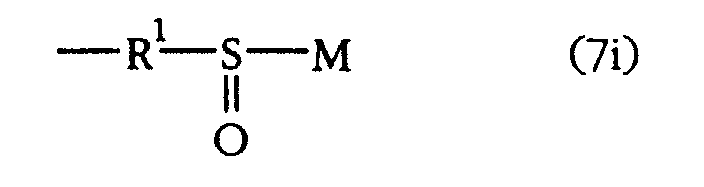 γ- gegebenenfalls mindestens eine restliche Siloxyleinheit der Formel (III):c = 0, 1, 2 oder 3, d = 0 oder 1 und c + d ≤ 3 ist,die Substituenten R so sind, wie zuvor in den Einheiten (I) und (II) definiert.
 - Teilchen nach Anspruch 1, dadurch gekennzeichnet, daß die organische Gruppe W der Einheit (II) des funktionell wirksam gemachten Polyorganosiloxans aus den folgenden Resten gewählt ist:einem Alkylrest (i) mit 8 bis 30 Kohlenstoffatomen, der vorzugsweise aus den folgenden Alkylresten gewählt ist: Octyl, Dodecyl, Undecyl, Tridecyl;einem C6-C10-Rest (2i), der eine Doppelbindung enthält und gegebenenfalls eine weitere zur ersten konjugierten, wobei der genannte Rest vorteilhafterweise Hexenyl oder Dodecenyl ist;einem monocyclischen C5-C6-Rest (3i), vorzugsweise Cyclohexenyl oder Methyl-1-cyclohexen-1-yl, der gegebenenfalls an das Silicium über einen linearen oder verzweigten C2-C6-Alkylenrest gebunden ist, vorzugsweise -CH2-CH2-, -CH2-CH(CH3)-, -(CH2)3-.
- Teilchen nach irgendeinem der Ansprüche 1 oder 2, dadurch gekennzeichnet, daß das funktionell wirksam gemachte Polyorganosiloxan aus einem linearen, statistischen sequenzierten oder Block-Copolymeren der folgenden Durchschnittsformel (IV) gebildet ist:in der:
 die Symbole Y, W und R so wie in den Ansprüchen 1 und 2 definiert sind,das Symbol Z ein einwertiger Rest ist, der aus den Resten Wasserstoff und denen, die den Definitionen für R, Y und W entsprechen, gewählt ist,die Summe m + n + p + q ≥ 3 ist und vorzugsweise zwischen 3 und 100 liegt, wobei der dargestellte Fall ganz besonders bevorzugt wird, in dem p = q = 0, m ≥ 1 und n ≤ 50,0 < m ≤ 100 und vorzugsweise 1 ≤ m ≤ 50,0 < n ≤ 100 und vorzugsweise 1 ≤ n ≤ 50,0 ≤ p ≤ 20 und vorzugsweise 0 ≤ p ≤ 10,0 ≤ q ≤ 40 und vorzugsweise 0 ≤ q ≤ 20 ist.
 - Teilchen nach irgendeinem der Ansprüche 1 oder 2, dadurch gekennzeichnet, daß das funktionell wirksam gemachte Polyorganosiloxan aus einem cyclischen Copolymeren der folgenden Durchschnittsformel (V) gebildet ist:in der Y, W und R so wie in den Ansprüchen 1 und 2 definiert sind, wobei r, s, t und u positive ganze oder dezimale Zahlen bedeuten und:
 die Summe r + s + t + u ≥ 3 ist und vorzugsweise zwischen 3 und 8 liegt, wobei der dargestellte Fall ganz besonders vorgezogen wird, in dem t = u = 0 ist,1 ≤ r ≤ 8 und vorzugsweise 1 ≤ r ≤ 4,1 ≤ s ≤ 8 und vorzugsweise 1 ≤ s ≤ 4,0 ≤ t ≤ 8 und vorzugsweise 0 ≤ t ≤ 4,0 ≤ u ≤ 8 und vorzugsweise 0 ≤ u ≤ 4 ist.
 - Teilchen nach irgendeinem der vorangehenden Ansprüche, dadurch gekennzeichnet, daß der Gewichtsanteil am funktionell wirksam gemachten Polyorganosiloxan, ausgedrückt als SiO2, mindestens 0,1 % und vorzugsweise höchstens 5 %, bezogen auf das Gewicht der behandelten Teilchen, ist.
- Teilchen nach irgendeinem der vorangehenden Ansprüche, dadurch gekennzeichnet, daß die mineralischen Teilchen Monopartikel der selben chemischen Art sind.
- Teilchen nach irgendeinem der vorangehenden Ansprüche, dadurch gekennzeichnet, daß es sich dabei um Pigmente handelt.
- Teilchen nach Anspruch 7, dadurch gekennzeichnet, daß es sich dabei um Titandioxidteilchen oder/und Lantanoidsulfidteilchen handelt.
- Teilchen nach irgendeinem der vorangehenden Ansprüche, dadurch gekennzeichnet, daß es sich dabei um Titandioxidteilchen einer Größe zwischen 0,2 und 0,4 µm handelt.
- Verfahren zur Herstellung von Teilchen nach irgendeinem der vorangehenden Ansprüche, dadurch gekennzeichnet, daß:man die mineralischen Teilchen im funktionell wirksam gemachten Polyorganosiloxan suspendiert,man die Teilchen abfiltert,man die Teilchen trocknet und gegebenenfalls mikronisiert.
- Verfahren zur Herstellung von Teilchen nach irgendeinem der Ansprüche 1 bis 9, dadurch gekennzeichnet, daß:man das funktionell wirksam gemachte Polyorganosiloxan auf den mineralischen Teilchen zerstäubt,man die Teilchen trocknet und gegebenenfalls mikronisiert.
- Verfahren zur Herstellung von Teilchen nach irgendeinem der Ansprüche 1 bis 9, dadurch gekennzeichnet, daß man mineralische Teilchen mikronisiert, indem das funktionell wirksam gemachte Polyorganosiloxan in Mikronisierdüsen gegeben wird.
- Verfahren zur Herstellung von Teilchen nach irgendeinem der Ansprüche 10, 11 oder 12, dadurch gekennzeichnet, daß die mineralischen und durch das funktionell wirksam gemachte Polyorganosiloxan zu behandelnden Teilchen eine Oberflächenbehandlung auf der Grundlage von Oxyhydroxiden von Al2O3-, TiO2-, ZrO2-, P2O5-, SiO2- und/oder CeO2 darstellen.
- Zusammensetzung, dadurch gekennzeichnet, daß sie mindestens ein Polyolefin und Teilchen nach irgendeinem der Ansprüche 1 bis 9 enthält, wobei das funktionelle, auf die Oberfläche der Teilchen aufgepfropfte Polyorganosiloxan mindestens eine organische C7-C18-Alkylgruppe W hat.
- Zusammensetzung nach Anspruch 14, dadurch gekennzeichnet, daß sie mindestens 70 Gew.-% an Titandioxidteilchen enthält.
- Verwendung von Teilchen nach irgendeinem der Ansprüche 1 bis 9 in thermoplastischen Polymeren.
- Aus thermoplastischen Polymeren erhaltener Gegenstand, dadurch gekennzeichnet, daß er Teilchen nach irgendeinem der Ansprüche 1 bis 9 enthält.
- Verwendung von Teilchen nach irgendeinem der Ansprüche 1 bis 9 in Farbrezepturen.
Applications Claiming Priority (3)
| Application Number | Priority Date | Filing Date | Title |
|---|---|---|---|
| FR9514537 | 1995-12-08 | ||
| FR9514537A FR2742158B1 (fr) | 1995-12-08 | 1995-12-08 | Particules traitees par un polyorganosiloxane fonctionnalise leur procede de preparation et leur utilisation dans les polymeres thermoplastiques |
| PCT/FR1996/001909 WO1997021774A1 (fr) | 1995-12-08 | 1996-12-02 | Particules traitees par un polyorganosiloxane fonctionnalise |
Publications (2)
| Publication Number | Publication Date |
|---|---|
| EP0912643A1 EP0912643A1 (de) | 1999-05-06 |
| EP0912643B1 true EP0912643B1 (de) | 2000-05-17 |
Family
ID=9485283
Family Applications (1)
| Application Number | Title | Priority Date | Filing Date |
|---|---|---|---|
| EP96941689A Expired - Lifetime EP0912643B1 (de) | 1995-12-08 | 1996-12-02 | Mit einem funktionalisierten polyorganosiloxan modifizierte teilchen |
Country Status (8)
| Country | Link |
|---|---|
| US (1) | US6265069B1 (de) |
| EP (1) | EP0912643B1 (de) |
| AT (1) | ATE193041T1 (de) |
| AU (1) | AU1100397A (de) |
| CA (1) | CA2245247C (de) |
| DE (1) | DE69608470T2 (de) |
| FR (1) | FR2742158B1 (de) |
| WO (1) | WO1997021774A1 (de) |
Families Citing this family (7)
| Publication number | Priority date | Publication date | Assignee | Title |
|---|---|---|---|---|
| US6420030B1 (en) * | 1997-10-31 | 2002-07-16 | Toda Kogyo Corporation | Black iron-based composite particles, process for producing the same, paint and rubber or resin composition containing the same |
| US6649684B1 (en) | 1999-08-19 | 2003-11-18 | Ppg Industries Ohio, Inc. | Chemically treated fillers and polymeric compositions containing same |
| US6342560B1 (en) | 1999-08-19 | 2002-01-29 | Ppg Industries Ohio, Inc. | Chemically modified fillers and polymeric compositions containing same |
| DE10116315A1 (de) * | 2001-04-02 | 2002-10-10 | Giesecke & Devrient Gmbh | Farbcodierung zur Kennzeichnung von Gegentänden |
| US6569932B2 (en) * | 2001-07-06 | 2003-05-27 | Benjamin S. Hsiao | Blends of organic silicon compounds with ethylene-based polymers |
| US20090075099A1 (en) * | 2007-04-09 | 2009-03-19 | Sung-Yueh Shieh | Waterborne Coating Compositions for Optical-use Polyester film |
| JP5398134B2 (ja) * | 2007-11-15 | 2014-01-29 | 住友金属鉱山株式会社 | 表面処理酸化亜鉛微粒子の製造方法、表面処理酸化亜鉛微粒子、その分散液体および分散固体、並びに酸化亜鉛微粒子被覆基材 |
Family Cites Families (15)
| Publication number | Priority date | Publication date | Assignee | Title |
|---|---|---|---|---|
| US4022152A (en) * | 1969-03-29 | 1977-05-10 | Deutsche Gold- Und Silber-Scheideanstalt Vormals Roessler | Apparatus for making particulate materials, particularly oxides, hydrophobic |
| US3948676A (en) * | 1970-11-24 | 1976-04-06 | Deutsche Gold- Und Silber-Scheideanstalt Vormals Roessler | Process for preparing hydrophobic particles |
| US3849152A (en) * | 1972-11-06 | 1974-11-19 | Ferro Corp | Polysiloxane encapsulation of pigments |
| DE2946549A1 (de) * | 1979-11-17 | 1981-05-27 | Bayer Ag, 5090 Leverkusen | Neuartige tio(pfeil abwaerts)2(pfeil abwaerts) -pigmente mit guter dispergierbarkeit, verfahren zu ihrer herstellung un verwendung |
| JPS58120519A (ja) * | 1982-01-14 | 1983-07-18 | Mitsuhiro Hamada | 微粉末の表面処理方法 |
| US4394469A (en) * | 1982-03-29 | 1983-07-19 | Union Carbide Corporation | Polysiloxane treated antimony compounds |
| US4454288A (en) * | 1982-12-02 | 1984-06-12 | Dow Corning Corporation | Surface treatment of inorganic fillers |
| DE3334598A1 (de) * | 1983-09-24 | 1985-04-18 | Merck Patent Gmbh | Witterungsbestaendige perlglanzpigmente |
| JPH0765003B2 (ja) * | 1986-09-10 | 1995-07-12 | 株式会社資生堂 | 表面処理粉末 |
| JPH01182368A (ja) * | 1988-01-14 | 1989-07-20 | Shiseido Co Ltd | 疎水性粉体およびこれを含有する化粧料 |
| EP0506290B1 (de) * | 1991-03-25 | 1999-04-28 | Ecc International Limited | Mineralische Füllstoffe |
| JP3079395B2 (ja) * | 1991-06-26 | 2000-08-21 | 三好化成株式会社 | 有機ケイ素化合物処理顔料、その製法および化粧料 |
| JP3511269B2 (ja) * | 1992-12-01 | 2004-03-29 | 触媒化成工業株式会社 | 無機酸化物コロイド粒子およびコーティング組成物 |
| JPH07316476A (ja) * | 1994-05-24 | 1995-12-05 | Nippon Paint Co Ltd | 雲母質顔料含有水性塗料組成物 |
| FR2727118B1 (fr) * | 1994-11-18 | 1997-01-03 | Rhone Poulenc Chimie | Polyorganosiloxanes fonctionnalises et l'un de leurs procedes de preparation |
-
1995
- 1995-12-08 FR FR9514537A patent/FR2742158B1/fr not_active Expired - Fee Related
-
1996
- 1996-12-02 US US09/142,640 patent/US6265069B1/en not_active Expired - Fee Related
- 1996-12-02 CA CA002245247A patent/CA2245247C/fr not_active Expired - Fee Related
- 1996-12-02 AT AT96941689T patent/ATE193041T1/de not_active IP Right Cessation
- 1996-12-02 EP EP96941689A patent/EP0912643B1/de not_active Expired - Lifetime
- 1996-12-02 DE DE69608470T patent/DE69608470T2/de not_active Expired - Fee Related
- 1996-12-02 AU AU11003/97A patent/AU1100397A/en not_active Abandoned
- 1996-12-02 WO PCT/FR1996/001909 patent/WO1997021774A1/fr not_active Ceased
Also Published As
| Publication number | Publication date |
|---|---|
| DE69608470T2 (de) | 2001-01-04 |
| FR2742158A1 (fr) | 1997-06-13 |
| CA2245247A1 (fr) | 1997-06-19 |
| AU1100397A (en) | 1997-07-03 |
| CA2245247C (fr) | 2004-03-02 |
| ATE193041T1 (de) | 2000-06-15 |
| US6265069B1 (en) | 2001-07-24 |
| FR2742158B1 (fr) | 1998-01-02 |
| WO1997021774A1 (fr) | 1997-06-19 |
| DE69608470D1 (de) | 2000-06-21 |
| EP0912643A1 (de) | 1999-05-06 |
Similar Documents
| Publication | Publication Date | Title |
|---|---|---|
| EP0792322A1 (de) | Funktionalisierte polyorganosiloxane und verfahren zu deren herstellung | |
| US6066727A (en) | Organopolysiloxane-grafted polysaccharide compound | |
| EP0792323B1 (de) | Modifizierte polyorganosiloxane und ein verfahren zur ihrer herstellung | |
| FR2756291A1 (fr) | Silicones polymeriques non-volatiles liberant une odeur agreable | |
| EP0354145B1 (de) | Benzotriazolgruppenhaltiges Diorganopolysiloxan | |
| WO2019138194A1 (fr) | Catalyseurs de nanoparticules de complexes co de métaux zerovalents pour l'hydrosilylation] et la silylation deshydrogenante | |
| FR2726564A1 (fr) | Pullulan contenant du siloxane et un procede pour la preparation de celui-ci | |
| EP0421895B1 (de) | Zinnverbindungen, gegebenenfalls cheliert, verwendbar als latente Katalysatoren | |
| CA2245247C (fr) | Particules traitees par un polyorganosiloxane fonctionnalise | |
| EP2257589A2 (de) | Änderung der oberflächenzusammensetzung einer makromolekularen spezies unter verwendung eines konjugierten guanidins | |
| FR2702483A1 (fr) | Poudre de résine de silicone à écoulement libre et procédé de fabrication. | |
| FR2630124A1 (fr) | Poudre fine de polyorganosilsesquioxanne traitee en surface | |
| FR2735135A1 (fr) | Fluides silicone substitues par des groupes aryle presentant des indices de refraction eleves et leur procede de fabrication | |
| WO2000075234A1 (fr) | Compositions a base d'organopolysiloxanes et de polymere silyle durcissant en elastomeres des la temperature ambiante en presence d'humidite | |
| FR2616152A1 (fr) | Nouveaux polysilanes, polysilanes modifies correspondants, leur preparation et leur application dans des compositions reticulables | |
| EP0755961A1 (de) | Perhalogenierte Polyorganosiloxane und Verfahren zu deren Herstellung | |
| EP1844088B1 (de) | Verfahren zur herstellung von polyorganosiloxan mit funktionellen gruppen in gegenwart von lithiumsilanolat | |
| FR2686091A1 (fr) | Composition a base de polysilane (s). | |
| EP1922323B1 (de) | Mineral/organisches verbundmaterial | |
| EP0338947A1 (de) | Zu einer dünnen Schicht aushärtende Polysiloxanzusammensetzung enthaltend einen latenten Zinnkatalysator | |
| FR2716888A1 (fr) | Procédé pour préparer des compositions de silicone stables ayant une teneur élevée en matières solides. | |
| FR2831544A1 (fr) | Procede de preparation d'huiles silicones portant un groupement contenant au moins un cycle hydrocarbone dans lequel est inclus un atome d'oxygene | |
| FR2642763A1 (fr) | Composition organopolysiloxane reticulable par reaction de polyaddition en un elastomere autoadherant et/ou hydrophile et/ou organophile | |
| FR2611960A1 (fr) | Procede de preparation de diamines aromatiques a groupement diorganopolysiloxane | |
| BE502052A (de) |
Legal Events
| Date | Code | Title | Description |
|---|---|---|---|
| PUAI | Public reference made under article 153(3) epc to a published international application that has entered the european phase |
Free format text: ORIGINAL CODE: 0009012 |
|
| 17P | Request for examination filed |
Effective date: 19980729 |
|
| AK | Designated contracting states |
Kind code of ref document: A1 Designated state(s): AT BE CH DE DK ES FI FR GB GR IE IT LI LU MC NL PT SE |
|
| GRAG | Despatch of communication of intention to grant |
Free format text: ORIGINAL CODE: EPIDOS AGRA |
|
| 17Q | First examination report despatched |
Effective date: 19990715 |
|
| GRAG | Despatch of communication of intention to grant |
Free format text: ORIGINAL CODE: EPIDOS AGRA |
|
| GRAG | Despatch of communication of intention to grant |
Free format text: ORIGINAL CODE: EPIDOS AGRA |
|
| GRAH | Despatch of communication of intention to grant a patent |
Free format text: ORIGINAL CODE: EPIDOS IGRA |
|
| GRAH | Despatch of communication of intention to grant a patent |
Free format text: ORIGINAL CODE: EPIDOS IGRA |
|
| GRAA | (expected) grant |
Free format text: ORIGINAL CODE: 0009210 |
|
| AK | Designated contracting states |
Kind code of ref document: B1 Designated state(s): AT BE CH DE DK ES FI FR GB GR IE IT LI LU MC NL PT SE |
|
| PG25 | Lapsed in a contracting state [announced via postgrant information from national office to epo] |
Ref country code: NL Free format text: LAPSE BECAUSE OF FAILURE TO SUBMIT A TRANSLATION OF THE DESCRIPTION OR TO PAY THE FEE WITHIN THE PRESCRIBED TIME-LIMIT Effective date: 20000517 Ref country code: IT Free format text: LAPSE BECAUSE OF FAILURE TO SUBMIT A TRANSLATION OF THE DESCRIPTION OR TO PAY THE FEE WITHIN THE PRESCRIBED TIME-LIMIT;WARNING: LAPSES OF ITALIAN PATENTS WITH EFFECTIVE DATE BEFORE 2007 MAY HAVE OCCURRED AT ANY TIME BEFORE 2007. THE CORRECT EFFECTIVE DATE MAY BE DIFFERENT FROM THE ONE RECORDED. Effective date: 20000517 Ref country code: GR Free format text: LAPSE BECAUSE OF NON-PAYMENT OF DUE FEES Effective date: 20000517 Ref country code: FI Free format text: LAPSE BECAUSE OF FAILURE TO SUBMIT A TRANSLATION OF THE DESCRIPTION OR TO PAY THE FEE WITHIN THE PRESCRIBED TIME-LIMIT Effective date: 20000517 Ref country code: ES Free format text: THE PATENT HAS BEEN ANNULLED BY A DECISION OF A NATIONAL AUTHORITY Effective date: 20000517 Ref country code: AT Free format text: LAPSE BECAUSE OF FAILURE TO SUBMIT A TRANSLATION OF THE DESCRIPTION OR TO PAY THE FEE WITHIN THE PRESCRIBED TIME-LIMIT Effective date: 20000517 |
|
| REF | Corresponds to: |
Ref document number: 193041 Country of ref document: AT Date of ref document: 20000615 Kind code of ref document: T |
|
| REG | Reference to a national code |
Ref country code: IE Ref legal event code: FG4D Free format text: FRENCH Ref country code: CH Ref legal event code: EP |
|
| REF | Corresponds to: |
Ref document number: 69608470 Country of ref document: DE Date of ref document: 20000621 |
|
| GBT | Gb: translation of ep patent filed (gb section 77(6)(a)/1977) |
Effective date: 20000724 |
|
| PG25 | Lapsed in a contracting state [announced via postgrant information from national office to epo] |
Ref country code: SE Free format text: LAPSE BECAUSE OF FAILURE TO SUBMIT A TRANSLATION OF THE DESCRIPTION OR TO PAY THE FEE WITHIN THE PRESCRIBED TIME-LIMIT Effective date: 20000817 Ref country code: PT Free format text: LAPSE BECAUSE OF FAILURE TO SUBMIT A TRANSLATION OF THE DESCRIPTION OR TO PAY THE FEE WITHIN THE PRESCRIBED TIME-LIMIT Effective date: 20000817 Ref country code: DK Free format text: LAPSE BECAUSE OF FAILURE TO SUBMIT A TRANSLATION OF THE DESCRIPTION OR TO PAY THE FEE WITHIN THE PRESCRIBED TIME-LIMIT Effective date: 20000817 |
|
| NLV1 | Nl: lapsed or annulled due to failure to fulfill the requirements of art. 29p and 29m of the patents act | ||
| PG25 | Lapsed in a contracting state [announced via postgrant information from national office to epo] |
Ref country code: LU Free format text: LAPSE BECAUSE OF NON-PAYMENT OF DUE FEES Effective date: 20001202 |
|
| PG25 | Lapsed in a contracting state [announced via postgrant information from national office to epo] |
Ref country code: MC Free format text: THE PATENT HAS BEEN ANNULLED BY A DECISION OF A NATIONAL AUTHORITY Effective date: 20001231 Ref country code: LI Free format text: LAPSE BECAUSE OF NON-PAYMENT OF DUE FEES Effective date: 20001231 Ref country code: CH Free format text: LAPSE BECAUSE OF NON-PAYMENT OF DUE FEES Effective date: 20001231 |
|
| PG25 | Lapsed in a contracting state [announced via postgrant information from national office to epo] |
Ref country code: IE Free format text: LAPSE BECAUSE OF NON-PAYMENT OF DUE FEES Effective date: 20010205 |
|
| REG | Reference to a national code |
Ref country code: IE Ref legal event code: FD4D |
|
| PLBE | No opposition filed within time limit |
Free format text: ORIGINAL CODE: 0009261 |
|
| STAA | Information on the status of an ep patent application or granted ep patent |
Free format text: STATUS: NO OPPOSITION FILED WITHIN TIME LIMIT |
|
| 26N | No opposition filed | ||
| REG | Reference to a national code |
Ref country code: CH Ref legal event code: PL |
|
| REG | Reference to a national code |
Ref country code: GB Ref legal event code: IF02 |
|
| PGFP | Annual fee paid to national office [announced via postgrant information from national office to epo] |
Ref country code: GB Payment date: 20071128 Year of fee payment: 12 Ref country code: FR Payment date: 20071210 Year of fee payment: 12 |
|
| PGFP | Annual fee paid to national office [announced via postgrant information from national office to epo] |
Ref country code: DE Payment date: 20071129 Year of fee payment: 12 |
|
| PGFP | Annual fee paid to national office [announced via postgrant information from national office to epo] |
Ref country code: BE Payment date: 20080314 Year of fee payment: 12 |
|
| BERE | Be: lapsed |
Owner name: *RHODIA CHIMIE Effective date: 20081231 |
|
| GBPC | Gb: european patent ceased through non-payment of renewal fee |
Effective date: 20081202 |
|
| PG25 | Lapsed in a contracting state [announced via postgrant information from national office to epo] |
Ref country code: BE Free format text: LAPSE BECAUSE OF NON-PAYMENT OF DUE FEES Effective date: 20081231 |
|
| REG | Reference to a national code |
Ref country code: FR Ref legal event code: ST Effective date: 20090831 |
|
| PG25 | Lapsed in a contracting state [announced via postgrant information from national office to epo] |
Ref country code: DE Free format text: LAPSE BECAUSE OF NON-PAYMENT OF DUE FEES Effective date: 20090701 |
|
| PG25 | Lapsed in a contracting state [announced via postgrant information from national office to epo] |
Ref country code: GB Free format text: LAPSE BECAUSE OF NON-PAYMENT OF DUE FEES Effective date: 20081202 |
|
| PG25 | Lapsed in a contracting state [announced via postgrant information from national office to epo] |
Ref country code: FR Free format text: LAPSE BECAUSE OF NON-PAYMENT OF DUE FEES Effective date: 20081231 |
|
| REG | Reference to a national code |
Ref country code: DE Ref legal event code: R082 Ref document number: 69608470 Country of ref document: DE Representative=s name: PATENTANWAELTE GESTHUYSEN, VON ROHR & EGGERT, DE |
|
| REG | Reference to a national code |
Ref country code: DE Ref legal event code: R082 Ref document number: 69608470 Country of ref document: DE Representative=s name: GESTHUYSEN PATENT- UND RECHTSANWAELTE, DE Effective date: 20120411 Ref country code: DE Ref legal event code: R081 Ref document number: 69608470 Country of ref document: DE Owner name: BLUESTAR SILICONES FRANCE, FR Free format text: FORMER OWNER: RHODIA CHIMIE, COURBEVOIE, FR Effective date: 20120411 |