EP0912239B1 - Method for providing dense particle compositions for use in transdermal particle delivery - Google Patents
Method for providing dense particle compositions for use in transdermal particle delivery Download PDFInfo
- Publication number
- EP0912239B1 EP0912239B1 EP97926146A EP97926146A EP0912239B1 EP 0912239 B1 EP0912239 B1 EP 0912239B1 EP 97926146 A EP97926146 A EP 97926146A EP 97926146 A EP97926146 A EP 97926146A EP 0912239 B1 EP0912239 B1 EP 0912239B1
- Authority
- EP
- European Patent Office
- Prior art keywords
- particles
- densified
- protein
- antagonists
- preparation
- Prior art date
- Legal status (The legal status is an assumption and is not a legal conclusion. Google has not performed a legal analysis and makes no representation as to the accuracy of the status listed.)
- Expired - Lifetime
Links
- 239000002245 particle Substances 0.000 title claims abstract description 119
- 238000000034 method Methods 0.000 title claims abstract description 66
- 239000000203 mixture Substances 0.000 title claims abstract description 31
- 239000008194 pharmaceutical composition Substances 0.000 claims abstract description 17
- 230000037317 transdermal delivery Effects 0.000 claims abstract description 17
- 108010000521 Human Growth Hormone Proteins 0.000 claims description 38
- 102000002265 Human Growth Hormone Human genes 0.000 claims description 38
- 239000000854 Human Growth Hormone Substances 0.000 claims description 38
- 238000002347 injection Methods 0.000 claims description 26
- 239000007924 injection Substances 0.000 claims description 26
- 238000002360 preparation method Methods 0.000 claims description 24
- 239000000825 pharmaceutical preparation Substances 0.000 claims description 19
- 108090000623 proteins and genes Proteins 0.000 claims description 18
- 239000000463 material Substances 0.000 claims description 14
- 108090000765 processed proteins & peptides Proteins 0.000 claims description 13
- 102000004169 proteins and genes Human genes 0.000 claims description 12
- 238000005056 compaction Methods 0.000 claims description 10
- 229960000074 biopharmaceutical Drugs 0.000 claims description 8
- 239000003102 growth factor Substances 0.000 claims description 7
- 108010000437 Deamino Arginine Vasopressin Proteins 0.000 claims description 6
- 102000003982 Parathyroid hormone Human genes 0.000 claims description 6
- 108090000445 Parathyroid hormone Proteins 0.000 claims description 6
- 108090000373 Tissue Plasminogen Activator Proteins 0.000 claims description 6
- 102000003978 Tissue Plasminogen Activator Human genes 0.000 claims description 6
- 108010004977 Vasopressins Proteins 0.000 claims description 6
- 102000002852 Vasopressins Human genes 0.000 claims description 6
- 239000000556 agonist Substances 0.000 claims description 6
- KBZOIRJILGZLEJ-LGYYRGKSSA-N argipressin Chemical compound C([C@H]1C(=O)N[C@@H](CCC(N)=O)C(=O)N[C@@H](CC(N)=O)C(=O)N[C@@H](CSSC[C@@H](C(N[C@@H](CC=2C=CC(O)=CC=2)C(=O)N1)=O)N)C(=O)N1[C@@H](CCC1)C(=O)N[C@@H](CCCN=C(N)N)C(=O)NCC(N)=O)C1=CC=CC=C1 KBZOIRJILGZLEJ-LGYYRGKSSA-N 0.000 claims description 6
- NOESYZHRGYRDHS-UHFFFAOYSA-N insulin Chemical compound N1C(=O)C(NC(=O)C(CCC(N)=O)NC(=O)C(CCC(O)=O)NC(=O)C(C(C)C)NC(=O)C(NC(=O)CN)C(C)CC)CSSCC(C(NC(CO)C(=O)NC(CC(C)C)C(=O)NC(CC=2C=CC(O)=CC=2)C(=O)NC(CCC(N)=O)C(=O)NC(CC(C)C)C(=O)NC(CCC(O)=O)C(=O)NC(CC(N)=O)C(=O)NC(CC=2C=CC(O)=CC=2)C(=O)NC(CSSCC(NC(=O)C(C(C)C)NC(=O)C(CC(C)C)NC(=O)C(CC=2C=CC(O)=CC=2)NC(=O)C(CC(C)C)NC(=O)C(C)NC(=O)C(CCC(O)=O)NC(=O)C(C(C)C)NC(=O)C(CC(C)C)NC(=O)C(CC=2NC=NC=2)NC(=O)C(CO)NC(=O)CNC2=O)C(=O)NCC(=O)NC(CCC(O)=O)C(=O)NC(CCCNC(N)=N)C(=O)NCC(=O)NC(CC=3C=CC=CC=3)C(=O)NC(CC=3C=CC=CC=3)C(=O)NC(CC=3C=CC(O)=CC=3)C(=O)NC(C(C)O)C(=O)N3C(CCC3)C(=O)NC(CCCCN)C(=O)NC(C)C(O)=O)C(=O)NC(CC(N)=O)C(O)=O)=O)NC(=O)C(C(C)CC)NC(=O)C(CO)NC(=O)C(C(C)O)NC(=O)C1CSSCC2NC(=O)C(CC(C)C)NC(=O)C(NC(=O)C(CCC(N)=O)NC(=O)C(CC(N)=O)NC(=O)C(NC(=O)C(N)CC=1C=CC=CC=1)C(C)C)CC1=CN=CN1 NOESYZHRGYRDHS-UHFFFAOYSA-N 0.000 claims description 6
- 238000003801 milling Methods 0.000 claims description 6
- 239000000199 parathyroid hormone Substances 0.000 claims description 6
- 229960001319 parathyroid hormone Drugs 0.000 claims description 6
- 229960003726 vasopressin Drugs 0.000 claims description 6
- 102000008394 Immunoglobulin Fragments Human genes 0.000 claims description 5
- 108010021625 Immunoglobulin Fragments Proteins 0.000 claims description 5
- IDLFZVILOHSSID-OVLDLUHVSA-N corticotropin Chemical compound C([C@@H](C(=O)N[C@@H](CO)C(=O)N[C@@H](CCSC)C(=O)N[C@@H](CCC(O)=O)C(=O)N[C@@H](CC=1NC=NC=1)C(=O)N[C@@H](CC=1C=CC=CC=1)C(=O)N[C@@H](CCCNC(N)=N)C(=O)N[C@@H](CC=1C2=CC=CC=C2NC=1)C(=O)NCC(=O)N[C@@H](CCCCN)C(=O)N1[C@@H](CCC1)C(=O)N[C@@H](C(C)C)C(=O)NCC(=O)N[C@@H](CCCCN)C(=O)N[C@@H](CCCCN)C(=O)N[C@@H](CCCNC(N)=N)C(=O)N[C@@H](CCCNC(N)=N)C(=O)N1[C@@H](CCC1)C(=O)N[C@@H](C(C)C)C(=O)N[C@@H](CCCCN)C(=O)N[C@@H](C(C)C)C(=O)N[C@@H](CC=1C=CC(O)=CC=1)C(=O)N1[C@@H](CCC1)C(=O)N[C@@H](CC(N)=O)C(=O)NCC(=O)N[C@@H](C)C(=O)N[C@@H](CCC(O)=O)C(=O)N[C@@H](CC(O)=O)C(=O)N[C@@H](CCC(O)=O)C(=O)N[C@@H](CO)C(=O)N[C@@H](C)C(=O)N[C@@H](CCC(O)=O)C(=O)N[C@@H](C)C(=O)N[C@@H](CC=1C=CC=CC=1)C(=O)N1[C@@H](CCC1)C(=O)N[C@@H](CC(C)C)C(=O)N[C@@H](CCC(O)=O)C(=O)N[C@@H](CC=1C=CC=CC=1)C(O)=O)NC(=O)[C@@H](N)CO)C1=CC=C(O)C=C1 IDLFZVILOHSSID-OVLDLUHVSA-N 0.000 claims description 5
- 238000007873 sieving Methods 0.000 claims description 5
- 102400000739 Corticotropin Human genes 0.000 claims description 4
- 101800000414 Corticotropin Proteins 0.000 claims description 4
- 108010079345 Follicle Stimulating Hormone Proteins 0.000 claims description 4
- 102000012673 Follicle Stimulating Hormone Human genes 0.000 claims description 4
- 108010073521 Luteinizing Hormone Proteins 0.000 claims description 4
- 102000009151 Luteinizing Hormone Human genes 0.000 claims description 4
- 108060008682 Tumor Necrosis Factor Proteins 0.000 claims description 4
- 229960000258 corticotropin Drugs 0.000 claims description 4
- 229940028334 follicle stimulating hormone Drugs 0.000 claims description 4
- 229940040129 luteinizing hormone Drugs 0.000 claims description 4
- 238000005549 size reduction Methods 0.000 claims description 4
- 229960000187 tissue plasminogen activator Drugs 0.000 claims description 4
- 102000003390 tumor necrosis factor Human genes 0.000 claims description 4
- ZDRRIRUAESZNIH-BZGUUIOASA-N (2s)-1-[(4r,7s,10s,13s,16s,19r)-19-amino-7-(2-amino-2-oxoethyl)-13-[(2s)-butan-2-yl]-10-[(1r)-1-hydroxyethyl]-16-[(4-hydroxyphenyl)methyl]-6,9,12,15,18-pentaoxo-1,2-dithia-5,8,11,14,17-pentazacycloicosane-4-carbonyl]-n-[(2s)-1-[(2-amino-2-oxoethyl)amino]- Chemical compound C([C@H]1C(=O)N[C@H](C(N[C@H](C(=O)N[C@@H](CC(N)=O)C(=O)N[C@@H](CSSC[C@H](N)C(=O)N1)C(=O)N1[C@@H](CCC1)C(=O)N[C@@H](CC(C)C)C(=O)NCC(N)=O)[C@@H](C)O)=O)[C@@H](C)CC)C1=CC=C(O)C=C1 ZDRRIRUAESZNIH-BZGUUIOASA-N 0.000 claims description 3
- DEQANNDTNATYII-OULOTJBUSA-N (4r,7s,10s,13r,16s,19r)-10-(4-aminobutyl)-19-[[(2r)-2-amino-3-phenylpropanoyl]amino]-16-benzyl-n-[(2r,3r)-1,3-dihydroxybutan-2-yl]-7-[(1r)-1-hydroxyethyl]-13-(1h-indol-3-ylmethyl)-6,9,12,15,18-pentaoxo-1,2-dithia-5,8,11,14,17-pentazacycloicosane-4-carboxa Chemical compound C([C@@H](N)C(=O)N[C@H]1CSSC[C@H](NC(=O)[C@H]([C@@H](C)O)NC(=O)[C@H](CCCCN)NC(=O)[C@@H](CC=2C3=CC=CC=C3NC=2)NC(=O)[C@H](CC=2C=CC=CC=2)NC1=O)C(=O)N[C@H](CO)[C@H](O)C)C1=CC=CC=C1 DEQANNDTNATYII-OULOTJBUSA-N 0.000 claims description 3
- FIEYHAAMDAPVCH-UHFFFAOYSA-N 2-methyl-1h-quinazolin-4-one Chemical compound C1=CC=C2NC(C)=NC(=O)C2=C1 FIEYHAAMDAPVCH-UHFFFAOYSA-N 0.000 claims description 3
- 229940123413 Angiotensin II antagonist Drugs 0.000 claims description 3
- 102000015790 Asparaginase Human genes 0.000 claims description 3
- 108010024976 Asparaginase Proteins 0.000 claims description 3
- 102000055006 Calcitonin Human genes 0.000 claims description 3
- 108060001064 Calcitonin Proteins 0.000 claims description 3
- 102000011022 Chorionic Gonadotropin Human genes 0.000 claims description 3
- 108010062540 Chorionic Gonadotropin Proteins 0.000 claims description 3
- 102000007644 Colony-Stimulating Factors Human genes 0.000 claims description 3
- 108010071942 Colony-Stimulating Factors Proteins 0.000 claims description 3
- 108010049140 Endorphins Proteins 0.000 claims description 3
- 102000009025 Endorphins Human genes 0.000 claims description 3
- 102400000321 Glucagon Human genes 0.000 claims description 3
- 108060003199 Glucagon Proteins 0.000 claims description 3
- 102000004877 Insulin Human genes 0.000 claims description 3
- 108090001061 Insulin Proteins 0.000 claims description 3
- 108010050904 Interferons Proteins 0.000 claims description 3
- 102000014150 Interferons Human genes 0.000 claims description 3
- 108010063738 Interleukins Proteins 0.000 claims description 3
- 102000015696 Interleukins Human genes 0.000 claims description 3
- 108010057021 Menotropins Proteins 0.000 claims description 3
- 108010025020 Nerve Growth Factor Proteins 0.000 claims description 3
- 102000007072 Nerve Growth Factors Human genes 0.000 claims description 3
- 108010016076 Octreotide Proteins 0.000 claims description 3
- 101800000989 Oxytocin Proteins 0.000 claims description 3
- 102400000050 Oxytocin Human genes 0.000 claims description 3
- XNOPRXBHLZRZKH-UHFFFAOYSA-N Oxytocin Natural products N1C(=O)C(N)CSSCC(C(=O)N2C(CCC2)C(=O)NC(CC(C)C)C(=O)NCC(N)=O)NC(=O)C(CC(N)=O)NC(=O)C(CCC(N)=O)NC(=O)C(C(C)CC)NC(=O)C1CC1=CC=C(O)C=C1 XNOPRXBHLZRZKH-UHFFFAOYSA-N 0.000 claims description 3
- 102000006877 Pituitary Hormones Human genes 0.000 claims description 3
- 108010047386 Pituitary Hormones Proteins 0.000 claims description 3
- 108010038512 Platelet-Derived Growth Factor Proteins 0.000 claims description 3
- 102000010780 Platelet-Derived Growth Factor Human genes 0.000 claims description 3
- 101800004937 Protein C Proteins 0.000 claims description 3
- 102000017975 Protein C Human genes 0.000 claims description 3
- 229940096437 Protein S Drugs 0.000 claims description 3
- 108010066124 Protein S Proteins 0.000 claims description 3
- 102000029301 Protein S Human genes 0.000 claims description 3
- 101800001700 Saposin-D Proteins 0.000 claims description 3
- 108010056088 Somatostatin Proteins 0.000 claims description 3
- 102000005157 Somatostatin Human genes 0.000 claims description 3
- 108010023197 Streptokinase Proteins 0.000 claims description 3
- 108010047196 Urofollitropin Proteins 0.000 claims description 3
- 108090000435 Urokinase-type plasminogen activator Proteins 0.000 claims description 3
- 102000003990 Urokinase-type plasminogen activator Human genes 0.000 claims description 3
- GXBMIBRIOWHPDT-UHFFFAOYSA-N Vasopressin Natural products N1C(=O)C(CC=2C=C(O)C=CC=2)NC(=O)C(N)CSSCC(C(=O)N2C(CCC2)C(=O)NC(CCCN=C(N)N)C(=O)NCC(N)=O)NC(=O)C(CC(N)=O)NC(=O)C(CCC(N)=O)NC(=O)C1CC1=CC=CC=C1 GXBMIBRIOWHPDT-UHFFFAOYSA-N 0.000 claims description 3
- 229940116211 Vasopressin antagonist Drugs 0.000 claims description 3
- 102000015395 alpha 1-Antitrypsin Human genes 0.000 claims description 3
- 108010050122 alpha 1-Antitrypsin Proteins 0.000 claims description 3
- 229940024142 alpha 1-antitrypsin Drugs 0.000 claims description 3
- 239000002333 angiotensin II receptor antagonist Substances 0.000 claims description 3
- 239000005557 antagonist Substances 0.000 claims description 3
- 229960003272 asparaginase Drugs 0.000 claims description 3
- DCXYFEDJOCDNAF-UHFFFAOYSA-M asparaginate Chemical compound [O-]C(=O)C(N)CC(N)=O DCXYFEDJOCDNAF-UHFFFAOYSA-M 0.000 claims description 3
- 239000003152 bradykinin antagonist Substances 0.000 claims description 3
- 229960004015 calcitonin Drugs 0.000 claims description 3
- BBBFJLBPOGFECG-VJVYQDLKSA-N calcitonin Chemical compound N([C@H](C(=O)N[C@@H](CC(C)C)C(=O)NCC(=O)N[C@@H](CCCCN)C(=O)N[C@@H](CC(C)C)C(=O)N[C@@H](CO)C(=O)N[C@@H](CCC(N)=O)C(=O)N[C@@H](CCC(O)=O)C(=O)N[C@@H](CC(C)C)C(=O)N[C@@H](CC=1NC=NC=1)C(=O)N[C@@H](CCCCN)C(=O)N[C@@H](CC(C)C)C(=O)N[C@@H](CCC(N)=O)C(=O)N[C@@H]([C@@H](C)O)C(=O)N[C@@H](CC=1C=CC(O)=CC=1)C(=O)N1[C@@H](CCC1)C(=O)N[C@@H](CCCNC(N)=N)C(=O)N[C@@H]([C@@H](C)O)C(=O)N[C@@H](CC(N)=O)C(=O)N[C@@H]([C@@H](C)O)C(=O)NCC(=O)N[C@@H](CO)C(=O)NCC(=O)N[C@@H]([C@@H](C)O)C(=O)N1[C@@H](CCC1)C(N)=O)C(C)C)C(=O)[C@@H]1CSSC[C@H](N)C(=O)N[C@@H](CO)C(=O)N[C@@H](CC(N)=O)C(=O)N[C@@H](CC(C)C)C(=O)N[C@@H](CO)C(=O)N[C@@H]([C@@H](C)O)C(=O)N1 BBBFJLBPOGFECG-VJVYQDLKSA-N 0.000 claims description 3
- 229940015047 chorionic gonadotropin Drugs 0.000 claims description 3
- 229940047120 colony stimulating factors Drugs 0.000 claims description 3
- 229960004281 desmopressin Drugs 0.000 claims description 3
- NFLWUMRGJYTJIN-NXBWRCJVSA-N desmopressin Chemical compound C([C@H]1C(=O)N[C@H](C(N[C@@H](CC(N)=O)C(=O)N[C@@H](CSSCCC(=O)N[C@@H](CC=2C=CC(O)=CC=2)C(=O)N1)C(=O)N1[C@@H](CCC1)C(=O)N[C@@H](CCCNC(N)=N)C(=O)NCC(N)=O)=O)CCC(=O)N)C1=CC=CC=C1 NFLWUMRGJYTJIN-NXBWRCJVSA-N 0.000 claims description 3
- 229960002845 desmopressin acetate Drugs 0.000 claims description 3
- 229960001123 epoprostenol Drugs 0.000 claims description 3
- KAQKFAOMNZTLHT-VVUHWYTRSA-N epoprostenol Chemical compound O1C(=CCCCC(O)=O)C[C@@H]2[C@@H](/C=C/[C@@H](O)CCCCC)[C@H](O)C[C@@H]21 KAQKFAOMNZTLHT-VVUHWYTRSA-N 0.000 claims description 3
- MASNOZXLGMXCHN-ZLPAWPGGSA-N glucagon Chemical compound C([C@@H](C(=O)N[C@H](C(=O)N[C@@H](CCC(N)=O)C(=O)N[C@@H](CC=1C2=CC=CC=C2NC=1)C(=O)N[C@@H](CC(C)C)C(=O)N[C@@H](CCSC)C(=O)N[C@@H](CC(N)=O)C(=O)N[C@@H]([C@@H](C)O)C(O)=O)C(C)C)NC(=O)[C@H](CC(O)=O)NC(=O)[C@H](CCC(N)=O)NC(=O)[C@H](C)NC(=O)[C@H](CCCNC(N)=N)NC(=O)[C@H](CCCNC(N)=N)NC(=O)[C@H](CO)NC(=O)[C@H](CC(O)=O)NC(=O)[C@H](CC(C)C)NC(=O)[C@H](CC=1C=CC(O)=CC=1)NC(=O)[C@H](CCCCN)NC(=O)[C@H](CO)NC(=O)[C@H](CC=1C=CC(O)=CC=1)NC(=O)[C@H](CC(O)=O)NC(=O)[C@H](CO)NC(=O)[C@@H](NC(=O)[C@H](CC=1C=CC=CC=1)NC(=O)[C@@H](NC(=O)CNC(=O)[C@H](CCC(N)=O)NC(=O)[C@H](CO)NC(=O)[C@@H](N)CC=1NC=NC=1)[C@@H](C)O)[C@@H](C)O)C1=CC=CC=C1 MASNOZXLGMXCHN-ZLPAWPGGSA-N 0.000 claims description 3
- 229960004666 glucagon Drugs 0.000 claims description 3
- 238000010438 heat treatment Methods 0.000 claims description 3
- 239000000960 hypophysis hormone Substances 0.000 claims description 3
- 229940125396 insulin Drugs 0.000 claims description 3
- 229940047124 interferons Drugs 0.000 claims description 3
- 229940047122 interleukins Drugs 0.000 claims description 3
- 239000003900 neurotrophic factor Substances 0.000 claims description 3
- 229960002700 octreotide Drugs 0.000 claims description 3
- 229960001723 oxytocin Drugs 0.000 claims description 3
- XNOPRXBHLZRZKH-DSZYJQQASA-N oxytocin Chemical compound C([C@H]1C(=O)N[C@H](C(N[C@@H](CCC(N)=O)C(=O)N[C@@H](CC(N)=O)C(=O)N[C@@H](CSSC[C@H](N)C(=O)N1)C(=O)N1[C@@H](CCC1)C(=O)N[C@@H](CC(C)C)C(=O)NCC(N)=O)=O)[C@@H](C)CC)C1=CC=C(O)C=C1 XNOPRXBHLZRZKH-DSZYJQQASA-N 0.000 claims description 3
- 229940023041 peptide vaccine Drugs 0.000 claims description 3
- 239000002089 prostaglandin antagonist Substances 0.000 claims description 3
- 229960000856 protein c Drugs 0.000 claims description 3
- 239000003488 releasing hormone Substances 0.000 claims description 3
- 239000002461 renin inhibitor Substances 0.000 claims description 3
- 229940086526 renin-inhibitors Drugs 0.000 claims description 3
- NHXLMOGPVYXJNR-ATOGVRKGSA-N somatostatin Chemical compound C([C@H]1C(=O)N[C@H](C(N[C@@H](CO)C(=O)N[C@@H](CSSC[C@@H](C(=O)N[C@@H](CCCCN)C(=O)N[C@@H](CC(N)=O)C(=O)N[C@@H](CC=2C=CC=CC=2)C(=O)N[C@@H](CC=2C=CC=CC=2)C(=O)N[C@@H](CC=2C3=CC=CC=C3NC=2)C(=O)N[C@@H](CCCCN)C(=O)N[C@H](C(=O)N1)[C@@H](C)O)NC(=O)CNC(=O)[C@H](C)N)C(O)=O)=O)[C@H](O)C)C1=CC=CC=C1 NHXLMOGPVYXJNR-ATOGVRKGSA-N 0.000 claims description 3
- 229960000553 somatostatin Drugs 0.000 claims description 3
- 229960005202 streptokinase Drugs 0.000 claims description 3
- 229960000103 thrombolytic agent Drugs 0.000 claims description 3
- 230000002537 thrombolytic effect Effects 0.000 claims description 3
- 229960004371 urofollitropin Drugs 0.000 claims description 3
- 229960005356 urokinase Drugs 0.000 claims description 3
- 239000003038 vasopressin antagonist Substances 0.000 claims description 3
- 101100422412 Catharanthus roseus SSRP1 gene Proteins 0.000 claims 2
- 101150004167 HMG gene Proteins 0.000 claims 2
- 101000599951 Homo sapiens Insulin-like growth factor I Proteins 0.000 claims 2
- 102100037852 Insulin-like growth factor I Human genes 0.000 claims 2
- -1 liprecin Proteins 0.000 claims 2
- 239000000843 powder Substances 0.000 abstract description 22
- 238000009472 formulation Methods 0.000 abstract description 7
- 229940063135 genotropin Drugs 0.000 description 24
- 239000003814 drug Substances 0.000 description 23
- 241001465754 Metazoa Species 0.000 description 20
- 229940079593 drug Drugs 0.000 description 18
- 210000003491 skin Anatomy 0.000 description 17
- 210000004369 blood Anatomy 0.000 description 13
- 239000008280 blood Substances 0.000 description 13
- 239000000546 pharmaceutical excipient Substances 0.000 description 13
- 239000000243 solution Substances 0.000 description 12
- 230000035515 penetration Effects 0.000 description 11
- 210000002966 serum Anatomy 0.000 description 11
- FBPFZTCFMRRESA-KVTDHHQDSA-N D-Mannitol Chemical compound OC[C@@H](O)[C@@H](O)[C@H](O)[C@H](O)CO FBPFZTCFMRRESA-KVTDHHQDSA-N 0.000 description 9
- 229930195725 Mannitol Natural products 0.000 description 9
- 239000000594 mannitol Substances 0.000 description 9
- 235000010355 mannitol Nutrition 0.000 description 9
- 238000007920 subcutaneous administration Methods 0.000 description 9
- 239000008176 lyophilized powder Substances 0.000 description 7
- 239000008177 pharmaceutical agent Substances 0.000 description 7
- 210000003462 vein Anatomy 0.000 description 7
- HDTRYLNUVZCQOY-UHFFFAOYSA-N α-D-glucopyranosyl-α-D-glucopyranoside Natural products OC1C(O)C(O)C(CO)OC1OC1C(O)C(O)C(O)C(CO)O1 HDTRYLNUVZCQOY-UHFFFAOYSA-N 0.000 description 6
- HDTRYLNUVZCQOY-WSWWMNSNSA-N Trehalose Natural products O[C@@H]1[C@@H](O)[C@@H](O)[C@@H](CO)O[C@@H]1O[C@@H]1[C@H](O)[C@@H](O)[C@@H](O)[C@@H](CO)O1 HDTRYLNUVZCQOY-WSWWMNSNSA-N 0.000 description 6
- HDTRYLNUVZCQOY-LIZSDCNHSA-N alpha,alpha-trehalose Chemical compound O[C@@H]1[C@@H](O)[C@H](O)[C@@H](CO)O[C@@H]1O[C@@H]1[C@H](O)[C@@H](O)[C@H](O)[C@@H](CO)O1 HDTRYLNUVZCQOY-LIZSDCNHSA-N 0.000 description 6
- 210000004027 cell Anatomy 0.000 description 6
- 230000000694 effects Effects 0.000 description 6
- 238000001694 spray drying Methods 0.000 description 6
- 238000004108 freeze drying Methods 0.000 description 5
- 210000004379 membrane Anatomy 0.000 description 5
- 239000012528 membrane Substances 0.000 description 5
- 239000008188 pellet Substances 0.000 description 5
- 102000004196 processed proteins & peptides Human genes 0.000 description 5
- 239000007787 solid Substances 0.000 description 5
- GUBGYTABKSRVRQ-QKKXKWKRSA-N Lactose Natural products OC[C@H]1O[C@@H](O[C@H]2[C@H](O)[C@@H](O)C(O)O[C@@H]2CO)[C@H](O)[C@@H](O)[C@H]1O GUBGYTABKSRVRQ-QKKXKWKRSA-N 0.000 description 4
- 239000000872 buffer Substances 0.000 description 4
- 150000001875 compounds Chemical class 0.000 description 4
- 238000000280 densification Methods 0.000 description 4
- LOKCTEFSRHRXRJ-UHFFFAOYSA-I dipotassium trisodium dihydrogen phosphate hydrogen phosphate dichloride Chemical compound P(=O)(O)(O)[O-].[K+].P(=O)(O)([O-])[O-].[Na+].[Na+].[Cl-].[K+].[Cl-].[Na+] LOKCTEFSRHRXRJ-UHFFFAOYSA-I 0.000 description 4
- 238000001990 intravenous administration Methods 0.000 description 4
- 239000008101 lactose Substances 0.000 description 4
- 239000004570 mortar (masonry) Substances 0.000 description 4
- 239000002953 phosphate buffered saline Substances 0.000 description 4
- 210000000434 stratum corneum Anatomy 0.000 description 4
- 235000000346 sugar Nutrition 0.000 description 4
- 210000001519 tissue Anatomy 0.000 description 4
- 238000013271 transdermal drug delivery Methods 0.000 description 4
- XLYOFNOQVPJJNP-UHFFFAOYSA-N water Substances O XLYOFNOQVPJJNP-UHFFFAOYSA-N 0.000 description 4
- GUBGYTABKSRVRQ-XLOQQCSPSA-N Alpha-Lactose Chemical compound O[C@@H]1[C@@H](O)[C@@H](O)[C@@H](CO)O[C@H]1O[C@@H]1[C@@H](CO)O[C@H](O)[C@H](O)[C@H]1O GUBGYTABKSRVRQ-XLOQQCSPSA-N 0.000 description 3
- 206010028980 Neoplasm Diseases 0.000 description 3
- 239000000969 carrier Substances 0.000 description 3
- KRKNYBCHXYNGOX-UHFFFAOYSA-N citric acid Chemical compound OC(=O)CC(O)(C(O)=O)CC(O)=O KRKNYBCHXYNGOX-UHFFFAOYSA-N 0.000 description 3
- 238000007906 compression Methods 0.000 description 3
- 230000006835 compression Effects 0.000 description 3
- 238000001739 density measurement Methods 0.000 description 3
- 239000007789 gas Substances 0.000 description 3
- 238000001476 gene delivery Methods 0.000 description 3
- 238000003018 immunoassay Methods 0.000 description 3
- 238000001727 in vivo Methods 0.000 description 3
- 239000007858 starting material Substances 0.000 description 3
- 238000010254 subcutaneous injection Methods 0.000 description 3
- 239000007929 subcutaneous injection Substances 0.000 description 3
- 238000011144 upstream manufacturing Methods 0.000 description 3
- CIWBSHSKHKDKBQ-JLAZNSOCSA-N Ascorbic acid Chemical compound OC[C@H](O)[C@H]1OC(=O)C(O)=C1O CIWBSHSKHKDKBQ-JLAZNSOCSA-N 0.000 description 2
- 102000003951 Erythropoietin Human genes 0.000 description 2
- 108090000394 Erythropoietin Proteins 0.000 description 2
- DHMQDGOQFOQNFH-UHFFFAOYSA-N Glycine Chemical compound NCC(O)=O DHMQDGOQFOQNFH-UHFFFAOYSA-N 0.000 description 2
- 102000018997 Growth Hormone Human genes 0.000 description 2
- 108010051696 Growth Hormone Proteins 0.000 description 2
- 108010078049 Interferon alpha-2 Proteins 0.000 description 2
- 241000700159 Rattus Species 0.000 description 2
- 230000009102 absorption Effects 0.000 description 2
- 238000010521 absorption reaction Methods 0.000 description 2
- 238000004458 analytical method Methods 0.000 description 2
- 239000003242 anti bacterial agent Substances 0.000 description 2
- 229940088710 antibiotic agent Drugs 0.000 description 2
- 238000013459 approach Methods 0.000 description 2
- OSGAYBCDTDRGGQ-UHFFFAOYSA-L calcium sulfate Chemical compound [Ca+2].[O-]S([O-])(=O)=O OSGAYBCDTDRGGQ-UHFFFAOYSA-L 0.000 description 2
- 238000001647 drug administration Methods 0.000 description 2
- 238000012377 drug delivery Methods 0.000 description 2
- 229940105423 erythropoietin Drugs 0.000 description 2
- 238000001704 evaporation Methods 0.000 description 2
- 230000008020 evaporation Effects 0.000 description 2
- 239000001307 helium Substances 0.000 description 2
- 229910052734 helium Inorganic materials 0.000 description 2
- SWQJXJOGLNCZEY-UHFFFAOYSA-N helium atom Chemical compound [He] SWQJXJOGLNCZEY-UHFFFAOYSA-N 0.000 description 2
- 229940088597 hormone Drugs 0.000 description 2
- 239000005556 hormone Substances 0.000 description 2
- 208000015181 infectious disease Diseases 0.000 description 2
- 239000007788 liquid Substances 0.000 description 2
- 210000002751 lymph Anatomy 0.000 description 2
- 210000004400 mucous membrane Anatomy 0.000 description 2
- 238000011587 new zealand white rabbit Methods 0.000 description 2
- 108020004707 nucleic acids Proteins 0.000 description 2
- 102000039446 nucleic acids Human genes 0.000 description 2
- 150000007523 nucleic acids Chemical class 0.000 description 2
- 239000000902 placebo Substances 0.000 description 2
- 229940068196 placebo Drugs 0.000 description 2
- 229920001223 polyethylene glycol Polymers 0.000 description 2
- 239000011148 porous material Substances 0.000 description 2
- OXCMYAYHXIHQOA-UHFFFAOYSA-N potassium;[2-butyl-5-chloro-3-[[4-[2-(1,2,4-triaza-3-azanidacyclopenta-1,4-dien-5-yl)phenyl]phenyl]methyl]imidazol-4-yl]methanol Chemical compound [K+].CCCCC1=NC(Cl)=C(CO)N1CC1=CC=C(C=2C(=CC=CC=2)C2=N[N-]N=N2)C=C1 OXCMYAYHXIHQOA-UHFFFAOYSA-N 0.000 description 2
- 239000003755 preservative agent Substances 0.000 description 2
- 238000001812 pycnometry Methods 0.000 description 2
- 238000011002 quantification Methods 0.000 description 2
- 230000010076 replication Effects 0.000 description 2
- 108700031632 somatrem Proteins 0.000 description 2
- 239000012798 spherical particle Substances 0.000 description 2
- UCSJYZPVAKXKNQ-HZYVHMACSA-N streptomycin Chemical compound CN[C@H]1[C@H](O)[C@@H](O)[C@H](CO)O[C@H]1O[C@@H]1[C@](C=O)(O)[C@H](C)O[C@H]1O[C@@H]1[C@@H](NC(N)=N)[C@H](O)[C@@H](NC(N)=N)[C@H](O)[C@H]1O UCSJYZPVAKXKNQ-HZYVHMACSA-N 0.000 description 2
- 239000000126 substance Substances 0.000 description 2
- 150000008163 sugars Chemical class 0.000 description 2
- 230000001225 therapeutic effect Effects 0.000 description 2
- 239000013598 vector Substances 0.000 description 2
- 230000000007 visual effect Effects 0.000 description 2
- 239000001993 wax Substances 0.000 description 2
- 108091032973 (ribonucleotides)n+m Proteins 0.000 description 1
- 108010001478 Bacitracin Proteins 0.000 description 1
- 208000031648 Body Weight Changes Diseases 0.000 description 1
- 229940078581 Bone resorption inhibitor Drugs 0.000 description 1
- 0 C*CC(C)(*)C(CC1)CC1C=* Chemical compound C*CC(C)(*)C(CC1)CC1C=* 0.000 description 1
- 229940127291 Calcium channel antagonist Drugs 0.000 description 1
- 239000010369 Cascara Substances 0.000 description 1
- 239000000055 Corticotropin-Releasing Hormone Substances 0.000 description 1
- FBPFZTCFMRRESA-FSIIMWSLSA-N D-Glucitol Natural products OC[C@H](O)[C@H](O)[C@@H](O)[C@H](O)CO FBPFZTCFMRRESA-FSIIMWSLSA-N 0.000 description 1
- FBPFZTCFMRRESA-JGWLITMVSA-N D-glucitol Chemical compound OC[C@H](O)[C@@H](O)[C@H](O)[C@H](O)CO FBPFZTCFMRRESA-JGWLITMVSA-N 0.000 description 1
- 101000783577 Dendroaspis angusticeps Thrombostatin Proteins 0.000 description 1
- 101000783578 Dendroaspis jamesoni kaimosae Dendroaspin Proteins 0.000 description 1
- 229920002307 Dextran Polymers 0.000 description 1
- FEWJPZIEWOKRBE-JCYAYHJZSA-N Dextrotartaric acid Chemical compound OC(=O)[C@H](O)[C@@H](O)C(O)=O FEWJPZIEWOKRBE-JCYAYHJZSA-N 0.000 description 1
- 102000004190 Enzymes Human genes 0.000 description 1
- 108090000790 Enzymes Proteins 0.000 description 1
- 241000556215 Frangula purshiana Species 0.000 description 1
- 206010070840 Gastrointestinal tract irritation Diseases 0.000 description 1
- 108010010803 Gelatin Proteins 0.000 description 1
- WQZGKKKJIJFFOK-GASJEMHNSA-N Glucose Natural products OC[C@H]1OC(O)[C@H](O)[C@@H](O)[C@@H]1O WQZGKKKJIJFFOK-GASJEMHNSA-N 0.000 description 1
- 239000004471 Glycine Substances 0.000 description 1
- SQUHHTBVTRBESD-UHFFFAOYSA-N Hexa-Ac-myo-Inositol Natural products CC(=O)OC1C(OC(C)=O)C(OC(C)=O)C(OC(C)=O)C(OC(C)=O)C1OC(C)=O SQUHHTBVTRBESD-UHFFFAOYSA-N 0.000 description 1
- 239000004705 High-molecular-weight polyethylene Substances 0.000 description 1
- DGAQECJNVWCQMB-PUAWFVPOSA-M Ilexoside XXIX Chemical compound C[C@@H]1CC[C@@]2(CC[C@@]3(C(=CC[C@H]4[C@]3(CC[C@@H]5[C@@]4(CC[C@@H](C5(C)C)OS(=O)(=O)[O-])C)C)[C@@H]2[C@]1(C)O)C)C(=O)O[C@H]6[C@@H]([C@H]([C@@H]([C@H](O6)CO)O)O)O.[Na+] DGAQECJNVWCQMB-PUAWFVPOSA-M 0.000 description 1
- 206010069803 Injury associated with device Diseases 0.000 description 1
- 108090000723 Insulin-Like Growth Factor I Proteins 0.000 description 1
- 102000004218 Insulin-Like Growth Factor I Human genes 0.000 description 1
- 229930182555 Penicillin Natural products 0.000 description 1
- JGSARLDLIJGVTE-MBNYWOFBSA-N Penicillin G Chemical compound N([C@H]1[C@H]2SC([C@@H](N2C1=O)C(O)=O)(C)C)C(=O)CC1=CC=CC=C1 JGSARLDLIJGVTE-MBNYWOFBSA-N 0.000 description 1
- 108090000284 Pepsin A Proteins 0.000 description 1
- 102000057297 Pepsin A Human genes 0.000 description 1
- 108010009736 Protein Hydrolysates Proteins 0.000 description 1
- 108091028664 Ribonucleotide Proteins 0.000 description 1
- 206010040880 Skin irritation Diseases 0.000 description 1
- 206010070835 Skin sensitisation Diseases 0.000 description 1
- 229920002472 Starch Polymers 0.000 description 1
- CZMRCDWAGMRECN-UGDNZRGBSA-N Sucrose Chemical compound O[C@H]1[C@H](O)[C@@H](CO)O[C@@]1(CO)O[C@@H]1[C@H](O)[C@@H](O)[C@H](O)[C@@H](CO)O1 CZMRCDWAGMRECN-UGDNZRGBSA-N 0.000 description 1
- 229930006000 Sucrose Natural products 0.000 description 1
- FEWJPZIEWOKRBE-UHFFFAOYSA-N Tartaric acid Natural products [H+].[H+].[O-]C(=O)C(O)C(O)C([O-])=O FEWJPZIEWOKRBE-UHFFFAOYSA-N 0.000 description 1
- JZRWCGZRTZMZEH-UHFFFAOYSA-N Thiamine Natural products CC1=C(CCO)SC=[N+]1CC1=CN=C(C)N=C1N JZRWCGZRTZMZEH-UHFFFAOYSA-N 0.000 description 1
- 241000700605 Viruses Species 0.000 description 1
- 230000001133 acceleration Effects 0.000 description 1
- 229940099983 activase Drugs 0.000 description 1
- 229960003318 alteplase Drugs 0.000 description 1
- 150000001413 amino acids Chemical class 0.000 description 1
- 239000002269 analeptic agent Substances 0.000 description 1
- 230000000202 analgesic effect Effects 0.000 description 1
- 229940035676 analgesics Drugs 0.000 description 1
- 230000000578 anorexic effect Effects 0.000 description 1
- 239000000730 antalgic agent Substances 0.000 description 1
- 230000003288 anthiarrhythmic effect Effects 0.000 description 1
- 230000002456 anti-arthritic effect Effects 0.000 description 1
- 230000002924 anti-infective effect Effects 0.000 description 1
- 229940121363 anti-inflammatory agent Drugs 0.000 description 1
- 239000002260 anti-inflammatory agent Substances 0.000 description 1
- 230000000118 anti-neoplastic effect Effects 0.000 description 1
- 230000001139 anti-pruritic effect Effects 0.000 description 1
- 230000001754 anti-pyretic effect Effects 0.000 description 1
- 230000000692 anti-sense effect Effects 0.000 description 1
- 230000002921 anti-spasmodic effect Effects 0.000 description 1
- 229940124346 antiarthritic agent Drugs 0.000 description 1
- 239000000924 antiasthmatic agent Substances 0.000 description 1
- 229940125681 anticonvulsant agent Drugs 0.000 description 1
- 239000001961 anticonvulsive agent Substances 0.000 description 1
- 239000000935 antidepressant agent Substances 0.000 description 1
- 229940005513 antidepressants Drugs 0.000 description 1
- 229940125715 antihistaminic agent Drugs 0.000 description 1
- 239000000739 antihistaminic agent Substances 0.000 description 1
- 239000002220 antihypertensive agent Substances 0.000 description 1
- 229940030600 antihypertensive agent Drugs 0.000 description 1
- 229960005475 antiinfective agent Drugs 0.000 description 1
- 239000002579 antinauseant Substances 0.000 description 1
- 229940034982 antineoplastic agent Drugs 0.000 description 1
- 239000002246 antineoplastic agent Substances 0.000 description 1
- 229940127218 antiplatelet drug Drugs 0.000 description 1
- 239000003908 antipruritic agent Substances 0.000 description 1
- 239000000164 antipsychotic agent Substances 0.000 description 1
- 229940005529 antipsychotics Drugs 0.000 description 1
- 239000002221 antipyretic Substances 0.000 description 1
- 229940125716 antipyretic agent Drugs 0.000 description 1
- 229940124575 antispasmodic agent Drugs 0.000 description 1
- 239000003443 antiviral agent Substances 0.000 description 1
- 235000010323 ascorbic acid Nutrition 0.000 description 1
- 229960005070 ascorbic acid Drugs 0.000 description 1
- 239000011668 ascorbic acid Substances 0.000 description 1
- 238000000889 atomisation Methods 0.000 description 1
- 229960003071 bacitracin Drugs 0.000 description 1
- 229930184125 bacitracin Natural products 0.000 description 1
- CLKOFPXJLQSYAH-ABRJDSQDSA-N bacitracin A Chemical compound C1SC([C@@H](N)[C@@H](C)CC)=N[C@@H]1C(=O)N[C@@H](CC(C)C)C(=O)N[C@H](CCC(O)=O)C(=O)N[C@@H]([C@@H](C)CC)C(=O)N[C@@H]1C(=O)N[C@H](CCCN)C(=O)N[C@@H]([C@@H](C)CC)C(=O)N[C@H](CC=2C=CC=CC=2)C(=O)N[C@@H](CC=2N=CNC=2)C(=O)N[C@H](CC(O)=O)C(=O)N[C@@H](CC(N)=O)C(=O)NCCCC1 CLKOFPXJLQSYAH-ABRJDSQDSA-N 0.000 description 1
- 238000000498 ball milling Methods 0.000 description 1
- 229940125388 beta agonist Drugs 0.000 description 1
- 239000002876 beta blocker Substances 0.000 description 1
- 229940097320 beta blocking agent Drugs 0.000 description 1
- WQZGKKKJIJFFOK-VFUOTHLCSA-N beta-D-glucose Chemical compound OC[C@H]1O[C@@H](O)[C@H](O)[C@@H](O)[C@@H]1O WQZGKKKJIJFFOK-VFUOTHLCSA-N 0.000 description 1
- 230000037396 body weight Effects 0.000 description 1
- 230000004579 body weight change Effects 0.000 description 1
- 210000000988 bone and bone Anatomy 0.000 description 1
- 239000002617 bone density conservation agent Substances 0.000 description 1
- 230000008468 bone growth Effects 0.000 description 1
- 230000009172 bursting Effects 0.000 description 1
- 239000000480 calcium channel blocker Substances 0.000 description 1
- 239000001506 calcium phosphate Substances 0.000 description 1
- 235000011010 calcium phosphates Nutrition 0.000 description 1
- 235000011132 calcium sulphate Nutrition 0.000 description 1
- 229940058505 cascara Drugs 0.000 description 1
- 239000001913 cellulose Substances 0.000 description 1
- 229920002678 cellulose Polymers 0.000 description 1
- 235000010980 cellulose Nutrition 0.000 description 1
- 239000003795 chemical substances by application Substances 0.000 description 1
- CYDMQBQPVICBEU-UHFFFAOYSA-N chlorotetracycline Natural products C1=CC(Cl)=C2C(O)(C)C3CC4C(N(C)C)C(O)=C(C(N)=O)C(=O)C4(O)C(O)=C3C(=O)C2=C1O CYDMQBQPVICBEU-UHFFFAOYSA-N 0.000 description 1
- 229960004475 chlortetracycline Drugs 0.000 description 1
- CYDMQBQPVICBEU-XRNKAMNCSA-N chlortetracycline Chemical compound C1=CC(Cl)=C2[C@](O)(C)[C@H]3C[C@H]4[C@H](N(C)C)C(O)=C(C(N)=O)C(=O)[C@@]4(O)C(O)=C3C(=O)C2=C1O CYDMQBQPVICBEU-XRNKAMNCSA-N 0.000 description 1
- 235000019365 chlortetracycline Nutrition 0.000 description 1
- 210000000349 chromosome Anatomy 0.000 description 1
- 235000015165 citric acid Nutrition 0.000 description 1
- 238000011109 contamination Methods 0.000 description 1
- 239000000599 controlled substance Substances 0.000 description 1
- 238000007796 conventional method Methods 0.000 description 1
- 229940037530 cough and cold preparations Drugs 0.000 description 1
- 239000000850 decongestant Substances 0.000 description 1
- 229940124581 decongestants Drugs 0.000 description 1
- 206010061428 decreased appetite Diseases 0.000 description 1
- 230000002950 deficient Effects 0.000 description 1
- 230000018044 dehydration Effects 0.000 description 1
- 238000006297 dehydration reaction Methods 0.000 description 1
- 230000002939 deleterious effect Effects 0.000 description 1
- 238000002716 delivery method Methods 0.000 description 1
- 239000005547 deoxyribonucleotide Substances 0.000 description 1
- 125000002637 deoxyribonucleotide group Chemical group 0.000 description 1
- 210000004207 dermis Anatomy 0.000 description 1
- 239000008121 dextrose Substances 0.000 description 1
- 238000006073 displacement reaction Methods 0.000 description 1
- 239000002934 diuretic Substances 0.000 description 1
- 229940030606 diuretics Drugs 0.000 description 1
- 238000001035 drying Methods 0.000 description 1
- 230000002526 effect on cardiovascular system Effects 0.000 description 1
- 238000004520 electroporation Methods 0.000 description 1
- 239000000839 emulsion Substances 0.000 description 1
- 239000003623 enhancer Substances 0.000 description 1
- 229940088598 enzyme Drugs 0.000 description 1
- 210000002615 epidermis Anatomy 0.000 description 1
- 239000013604 expression vector Substances 0.000 description 1
- 239000000284 extract Substances 0.000 description 1
- 235000013305 food Nutrition 0.000 description 1
- 239000012634 fragment Substances 0.000 description 1
- 230000008014 freezing Effects 0.000 description 1
- 238000007710 freezing Methods 0.000 description 1
- 229920000159 gelatin Polymers 0.000 description 1
- 239000008273 gelatin Substances 0.000 description 1
- 235000019322 gelatine Nutrition 0.000 description 1
- 235000011852 gelatine desserts Nutrition 0.000 description 1
- 238000001415 gene therapy Methods 0.000 description 1
- 239000003193 general anesthetic agent Substances 0.000 description 1
- 229940005494 general anesthetics Drugs 0.000 description 1
- 238000007429 general method Methods 0.000 description 1
- 230000002068 genetic effect Effects 0.000 description 1
- 239000011521 glass Substances 0.000 description 1
- 230000005484 gravity Effects 0.000 description 1
- 230000012010 growth Effects 0.000 description 1
- 239000000122 growth hormone Substances 0.000 description 1
- 230000036541 health Effects 0.000 description 1
- 229940065770 humatrope Drugs 0.000 description 1
- 238000007654 immersion Methods 0.000 description 1
- 229940125721 immunosuppressive agent Drugs 0.000 description 1
- CDAISMWEOUEBRE-GPIVLXJGSA-N inositol Chemical compound O[C@H]1[C@H](O)[C@@H](O)[C@H](O)[C@H](O)[C@@H]1O CDAISMWEOUEBRE-GPIVLXJGSA-N 0.000 description 1
- 229960000367 inositol Drugs 0.000 description 1
- 230000010354 integration Effects 0.000 description 1
- 229940065638 intron a Drugs 0.000 description 1
- 230000001788 irregular Effects 0.000 description 1
- FZWBNHMXJMCXLU-BLAUPYHCSA-N isomaltotriose Chemical compound O[C@@H]1[C@@H](O)[C@H](O)[C@@H](CO)O[C@@H]1OC[C@@H]1[C@@H](O)[C@H](O)[C@@H](O)[C@@H](OC[C@@H](O)[C@@H](O)[C@H](O)[C@@H](O)C=O)O1 FZWBNHMXJMCXLU-BLAUPYHCSA-N 0.000 description 1
- 239000003589 local anesthetic agent Substances 0.000 description 1
- 229960005015 local anesthetics Drugs 0.000 description 1
- 238000004519 manufacturing process Methods 0.000 description 1
- 239000011159 matrix material Substances 0.000 description 1
- 238000005259 measurement Methods 0.000 description 1
- QSHDDOUJBYECFT-UHFFFAOYSA-N mercury Chemical compound [Hg] QSHDDOUJBYECFT-UHFFFAOYSA-N 0.000 description 1
- 229910052753 mercury Inorganic materials 0.000 description 1
- 230000004060 metabolic process Effects 0.000 description 1
- 210000003205 muscle Anatomy 0.000 description 1
- 229940035363 muscle relaxants Drugs 0.000 description 1
- 239000003158 myorelaxant agent Substances 0.000 description 1
- 231100000252 nontoxic Toxicity 0.000 description 1
- 230000003000 nontoxic effect Effects 0.000 description 1
- 239000002773 nucleotide Substances 0.000 description 1
- 125000003729 nucleotide group Chemical group 0.000 description 1
- 210000000056 organ Anatomy 0.000 description 1
- 238000010951 particle size reduction Methods 0.000 description 1
- 239000003961 penetration enhancing agent Substances 0.000 description 1
- 229940049954 penicillin Drugs 0.000 description 1
- 229940111202 pepsin Drugs 0.000 description 1
- 230000000144 pharmacologic effect Effects 0.000 description 1
- 239000013612 plasmid Substances 0.000 description 1
- 239000000106 platelet aggregation inhibitor Substances 0.000 description 1
- 229920001184 polypeptide Polymers 0.000 description 1
- 229920001296 polysiloxane Polymers 0.000 description 1
- 230000008569 process Effects 0.000 description 1
- 238000012545 processing Methods 0.000 description 1
- 238000003672 processing method Methods 0.000 description 1
- 239000003531 protein hydrolysate Substances 0.000 description 1
- 239000003368 psychostimulant agent Substances 0.000 description 1
- 230000009467 reduction Effects 0.000 description 1
- 238000011160 research Methods 0.000 description 1
- 238000002271 resection Methods 0.000 description 1
- 230000000284 resting effect Effects 0.000 description 1
- 230000000717 retained effect Effects 0.000 description 1
- 239000002336 ribonucleotide Substances 0.000 description 1
- 125000002652 ribonucleotide group Chemical group 0.000 description 1
- CDAISMWEOUEBRE-UHFFFAOYSA-N scyllo-inosotol Natural products OC1C(O)C(O)C(O)C(O)C1O CDAISMWEOUEBRE-UHFFFAOYSA-N 0.000 description 1
- 229940125723 sedative agent Drugs 0.000 description 1
- 239000000932 sedative agent Substances 0.000 description 1
- 230000008313 sensitization Effects 0.000 description 1
- 239000010420 shell particle Substances 0.000 description 1
- 238000004513 sizing Methods 0.000 description 1
- 230000008591 skin barrier function Effects 0.000 description 1
- 210000004927 skin cell Anatomy 0.000 description 1
- 230000036556 skin irritation Effects 0.000 description 1
- 231100000475 skin irritation Toxicity 0.000 description 1
- 231100000245 skin permeability Toxicity 0.000 description 1
- 231100000370 skin sensitisation Toxicity 0.000 description 1
- 239000002002 slurry Substances 0.000 description 1
- 229910052708 sodium Inorganic materials 0.000 description 1
- 239000001488 sodium phosphate Substances 0.000 description 1
- 235000011008 sodium phosphates Nutrition 0.000 description 1
- 239000002904 solvent Substances 0.000 description 1
- 229960003259 somatrem Drugs 0.000 description 1
- 229960004532 somatropin Drugs 0.000 description 1
- 239000000600 sorbitol Substances 0.000 description 1
- 238000009987 spinning Methods 0.000 description 1
- 229910001220 stainless steel Inorganic materials 0.000 description 1
- 239000010935 stainless steel Substances 0.000 description 1
- 239000008107 starch Substances 0.000 description 1
- 235000019698 starch Nutrition 0.000 description 1
- 239000000021 stimulant Substances 0.000 description 1
- 229960005322 streptomycin Drugs 0.000 description 1
- 238000000859 sublimation Methods 0.000 description 1
- 230000008022 sublimation Effects 0.000 description 1
- 239000005720 sucrose Substances 0.000 description 1
- 238000001356 surgical procedure Methods 0.000 description 1
- 230000001839 systemic circulation Effects 0.000 description 1
- 230000009885 systemic effect Effects 0.000 description 1
- 239000011975 tartaric acid Substances 0.000 description 1
- 235000002906 tartaric acid Nutrition 0.000 description 1
- 235000019640 taste Nutrition 0.000 description 1
- 229940124597 therapeutic agent Drugs 0.000 description 1
- 235000019157 thiamine Nutrition 0.000 description 1
- KYMBYSLLVAOCFI-UHFFFAOYSA-N thiamine Chemical compound CC1=C(CCO)SCN1CC1=CN=C(C)N=C1N KYMBYSLLVAOCFI-UHFFFAOYSA-N 0.000 description 1
- 229960003495 thiamine Drugs 0.000 description 1
- 239000011721 thiamine Substances 0.000 description 1
- 229940043263 traditional drug Drugs 0.000 description 1
- 239000003204 tranquilizing agent Substances 0.000 description 1
- 230000002936 tranquilizing effect Effects 0.000 description 1
- 238000012546 transfer Methods 0.000 description 1
- QORWJWZARLRLPR-UHFFFAOYSA-H tricalcium bis(phosphate) Chemical class [Ca+2].[Ca+2].[Ca+2].[O-]P([O-])([O-])=O.[O-]P([O-])([O-])=O QORWJWZARLRLPR-UHFFFAOYSA-H 0.000 description 1
- 238000002604 ultrasonography Methods 0.000 description 1
- 229960005486 vaccine Drugs 0.000 description 1
- 229940124549 vasodilator Drugs 0.000 description 1
- 239000003071 vasodilator agent Substances 0.000 description 1
- 210000002845 virion Anatomy 0.000 description 1
- 230000003442 weekly effect Effects 0.000 description 1
Images
Classifications
-
- B—PERFORMING OPERATIONS; TRANSPORTING
- B01—PHYSICAL OR CHEMICAL PROCESSES OR APPARATUS IN GENERAL
- B01J—CHEMICAL OR PHYSICAL PROCESSES, e.g. CATALYSIS OR COLLOID CHEMISTRY; THEIR RELEVANT APPARATUS
- B01J2/00—Processes or devices for granulating materials, e.g. fertilisers in general; Rendering particulate materials free flowing in general, e.g. making them hydrophobic
- B01J2/22—Processes or devices for granulating materials, e.g. fertilisers in general; Rendering particulate materials free flowing in general, e.g. making them hydrophobic by pressing in moulds or between rollers
-
- A—HUMAN NECESSITIES
- A61—MEDICAL OR VETERINARY SCIENCE; HYGIENE
- A61K—PREPARATIONS FOR MEDICAL, DENTAL OR TOILETRY PURPOSES
- A61K9/00—Medicinal preparations characterised by special physical form
- A61K9/14—Particulate form, e.g. powders, Processes for size reducing of pure drugs or the resulting products, Pure drug nanoparticles
- A61K9/141—Intimate drug-carrier mixtures characterised by the carrier, e.g. ordered mixtures, adsorbates, solid solutions, eutectica, co-dried, co-solubilised, co-kneaded, co-milled, co-ground products, co-precipitates, co-evaporates, co-extrudates, co-melts; Drug nanoparticles with adsorbed surface modifiers
- A61K9/145—Intimate drug-carrier mixtures characterised by the carrier, e.g. ordered mixtures, adsorbates, solid solutions, eutectica, co-dried, co-solubilised, co-kneaded, co-milled, co-ground products, co-precipitates, co-evaporates, co-extrudates, co-melts; Drug nanoparticles with adsorbed surface modifiers with organic compounds
-
- A—HUMAN NECESSITIES
- A61—MEDICAL OR VETERINARY SCIENCE; HYGIENE
- A61K—PREPARATIONS FOR MEDICAL, DENTAL OR TOILETRY PURPOSES
- A61K9/00—Medicinal preparations characterised by special physical form
- A61K9/14—Particulate form, e.g. powders, Processes for size reducing of pure drugs or the resulting products, Pure drug nanoparticles
- A61K9/16—Agglomerates; Granulates; Microbeadlets ; Microspheres; Pellets; Solid products obtained by spray drying, spray freeze drying, spray congealing,(multiple) emulsion solvent evaporation or extraction
- A61K9/1682—Processes
- A61K9/1688—Processes resulting in pure drug agglomerate optionally containing up to 5% of excipient
-
- C—CHEMISTRY; METALLURGY
- C12—BIOCHEMISTRY; BEER; SPIRITS; WINE; VINEGAR; MICROBIOLOGY; ENZYMOLOGY; MUTATION OR GENETIC ENGINEERING
- C12N—MICROORGANISMS OR ENZYMES; COMPOSITIONS THEREOF; PROPAGATING, PRESERVING, OR MAINTAINING MICROORGANISMS; MUTATION OR GENETIC ENGINEERING; CULTURE MEDIA
- C12N15/00—Mutation or genetic engineering; DNA or RNA concerning genetic engineering, vectors, e.g. plasmids, or their isolation, preparation or purification; Use of hosts therefor
- C12N15/09—Recombinant DNA-technology
- C12N15/87—Introduction of foreign genetic material using processes not otherwise provided for, e.g. co-transformation
- C12N15/89—Introduction of foreign genetic material using processes not otherwise provided for, e.g. co-transformation using microinjection
-
- A—HUMAN NECESSITIES
- A61—MEDICAL OR VETERINARY SCIENCE; HYGIENE
- A61K—PREPARATIONS FOR MEDICAL, DENTAL OR TOILETRY PURPOSES
- A61K48/00—Medicinal preparations containing genetic material which is inserted into cells of the living body to treat genetic diseases; Gene therapy
Definitions
- the invention relates to a method for densifying processed pharmaceutical compositions.
- transdermal delivery provides many advantages over oral or parenteral delivery techniques.
- transdermal delivery provides a safe, convenient and noninvasive alternative to traditional drug administration systems, conveniently avoiding the major problems associated with oral delivery, e.g., variable rates of absorption and metabolism, gastrointestinal irritation and/or bitter or unpleasant drug tastes.
- Transdermal delivery also avoids problems associated with parenteral delivery, e.g., needle pain, the risk of introducing infection to treated individuals, the risk of contamination or infection of health care workers caused by accidental needle-sticks and the disposal of used needles.
- parenteral delivery e.g., needle pain, the risk of introducing infection to treated individuals, the risk of contamination or infection of health care workers caused by accidental needle-sticks and the disposal of used needles.
- such delivery affords a high degree of control over blood concentrations of administered drugs.
- transdermal drug delivery presents a number of its own inherent logistical problems.
- the passive delivery of drugs through intact skin necessarily entails the transport of molecules through a number of structurally different tissues, including the stratum corneum, the viable epidermis, the papillary dermis, and the capillary walls in order for the drug to gain entry into the blood or lymph system.
- Transdermal delivery systems must therefore be able to overcome the various resistances presented by each type of tissue. In light of the above, a number of alternatives to passive transdermal delivery have been developed.
- the needleless syringe can also be used in conjunction with surgery to deliver drugs and biologics to organ surfaces, solid tumors and/or to surgical cavities (e.g., tumor beds or cavities after tumor resection).
- surgical cavities e.g., tumor beds or cavities after tumor resection.
- any pharmaceutical agent that can be prepared in a substantially solid, particulate form can be safely and easily delivered using such devices.
- One particular needleless syringe generally comprises an elongate tubular nozzle having a rupturable membrane initially closing the passage through the nozzle and arranged substantially adjacent to the upstream end of the nozzle. Particles of a therapeutic agent to be delivered are disposed adjacent to the rupturable membrane and are delivered using an energizing means which applies a gaseous pressure to the upstream side of the membrane sufficient to burst the membrane and produce a supersonic gas flow (containing the pharmaceutical particles) through the nozzle for delivery from the downstream end thereof.
- the particles can thus be delivered from the needleless syringe at delivery velocities of between Mach 1 and Mach 8 which are readily obtainable upon the bursting of the rupturable membrane.
- Another needleless syringe configuration generally includes the same elements as described above, except that instead of having the pharmaceutical particles entrained within a supersonic gas flow, the downstream end of the nozzle is provided with a bistable diaphragm which is moveable between a resting "inverted" position (in which the diaphragm presents a concavity on the downstream face to contain the pharmaceutical particles) and an active "everted” position (in which the diaphragm is outwardly convex on the downstream face as a result of a supersonic shockwave having been applied to the upstream face of the diaphragm).
- the pharmaceutical particles contained within the concavity of the diaphragm are expelled at a supersonic initial velocity from the device for transdermal delivery thereof to a targeted skin or mucosal surface.
- Transdermal delivery using the above-described needleless syringe configurations is carried out with particles having an approximate size that generally ranges between 0.1 and 250 ⁇ m.
- an optimal particle size is usually at least about 10 to 15 ⁇ m (the size of a typical cell).
- an optimal particle size is generally substantially smaller than 10 ⁇ m.
- Particles larger than about 250 ⁇ m can also be delivered from the device, with the upper limitation being the point at which the size of the particles would cause untoward damage to the skin cells.
- optimal particle densities for use in needleless injection generally range between about 0.1 and 25 g/cm 3 , preferably between about 0.8 and 1.5 g/cm 3
- injection velocities generally range between about 200 and 3,000 m/sec.
- a particularly unique feature of the needleless syringe is the ability to closely control the depth of penetration of delivered particles, thereby allowing for targeted administration of pharmaceuticals to various sites.
- particle characteristics and/or device operating parameters can be selected to provide penetration depths of less than about 1 mm for intra-dermal delivery, or approximately 1-2mm for subcutaneous delivery.
- One approach entails the selection of particle size, particle density and initial velocity to provide a momentum density (e.g., particle momentum divided by particle frontal area) of between about 2 and 10 kg/sec/m, and more preferably between about 4 and 7 kg/sec/m.
- a momentum density e.g., particle momentum divided by particle frontal area
- Such control over momentum density allows for precisely controlled, tissue-selective delivery of the pharmaceutical particles.
- the present invention provides a method for forming densified particles from a particulate pharmaceutical preparation, comprising compacting the preparation to provide a compacted pharmaceutical preparation and size-reducing the compacted preparation into densified particles of suitable size and density for transdermal delivery thereof by needleless injection.
- One suitable such method comprises compacting the particulate pharmaceutical preparation to provide a compacted pharmaceutical preparation, size-reducing the compacted preparation into densified particles, and then selecting densified particles of suitable size and density for transdermal delivery thereof by needleless injection.
- the compacting is generally carried out without heating or shear.
- the size reduction of the compacted material is typically carried out by milling and/or sieving.
- the invention also provides a densified particulate pharmaceutical composition formed from a lyophilized or spray-dried pharmaceutical preparation, said densified composition having an average particle size in the range of 0.1 to 250 ⁇ m and a particle density in the range of 0.1 to 25 g/cm 3 .
- a needleless syringe loaded with particles of the invention is additionally provided.
- a method for converting non-dense pharmaceutical powders or particulate formulations (e.g., having particle densities below that required for transdermal delivery at supersonic velocities) into densified particles that are optimally suited for transdermal delivery using needleless syringe.
- Such particles have an optimal particle density ranging from 0.1 to about 25 g/cm 3 , preferably ranging from about 0.5 or 0.8 to about 3.0 g/cm 3 , and most preferably ranging from about 0.8 to about 1.5 g/cm 3 .
- the densified particles are processed to obtain optimal particle sizes ranging from about 0.1 to about 250 ⁇ m, preferably ranging from about 0.1 to about 150 ⁇ m, and most preferably ranging from about 20 to about 60 ⁇ m.
- the method entails the compaction of a pharmaceutical composition using high pressure and, optionally vacuum, to densify the composition.
- the resulting compacted material is then size-reduced using conventional methods to provide densified particles of optimized size.
- a method for optimizing the density and particle size of a particulate pharmaceutical composition that has particle size and density characteristics that fall within the above ranges using the above-described compaction and size-reduction techniques.
- the penetration depths that are obtained when the optimized particles are delivered at supersonic velocities using a needleless syringe can be adjusted to provide targeted intra-dermal delivery (e.g., the particle size and density are optimized for penetration of less than about 1 mm) or sub-cutaneous delivery (e.g., the particle size and density are optimized for penetration of approximately 1-2 mm).
- the invention pertains to a method for optimizing the particle size and density of a lyophilized or spray-dried biopharmaceutical composition.
- the method entails the compaction of a lyophilized or spray-dried pharmaceutical powder to obtain a densified material.
- the densified material can then be reground to produce compositions in which the individual particles approach the theoretical maximum density and are thus optimal for delivery by impact with and penetration into skin at supersonic velocities when delivered from a needleless syringe.
- lyophilized recombinant human growth hormone (rhGH) powder is densified to obtain particles in the range of about 20 to 50 ⁇ m and having a density of about 0.8 to 1.5 g/cc 3 .
- the densified rhGH particles are ideally suited for delivery from a needleless syringe device.
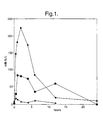
- Figure 1 depicts a comparison of the mean in vivo serum levels of recombinant human growth hormone (rhGH) in animals that were administered lyophilized rhGH powder by needleless injection ( ⁇ ), densified rhGH particles (prepared by the method of the invention) by needleless injection ( ⁇ ), or lyophilized rhGH powder by sub-cutaneous injection (•).
- rhGH recombinant human growth hormone
- transdermal delivery applicants intend to include both transdermal (or “percutaneous”) and transmucosal administration, i.e., delivery by passage of a drug or pharmaceutical agent through the skin or mucosal tissue.
- transdermal Drug Delivery Developmental Issues and Research Initiatives, Hadgraft and Guy (eds.), Marcel Dekker, Inc., (1989); Controlled Drug Delivery: Fundamentals and Applications, Robinson and Lee (eds.), Marcel Dekker Inc., (1987); and Transdermal Delivery of Drugs, Vols. 1-3, Kydonieus and Berner (eds.), CRC Press, (1987).
- transdermal delivery
- compositions, systems, and methods of the invention unless explicitly stated otherwise, should be presumed to be equally applicable with transdermal and transmucosal modes of delivery.
- drug or “pharmaceutical agent” intends any compound or composition of matter which, when administered to an organism (human or animal) induces a desired pharmacologic and/or physiologic effect by local and/or systemic action.
- the term therefore encompasses those compounds or chemicals traditionally regarded as drugs, as well as biopharmaceuticals including molecules such as peptides, hormones, nucleic acids, gene constructs and the like.
- drug or “pharmaceutical agent” includes compounds or compositions for use in all of the major therapeutic areas including, but not limited to, anti-infectives such as antibiotics and antiviral agents; analgesics and analgesic combinations; local and general anesthetics; anorexics; antiarthritics; antiasthmatic agents; anticonvulsants; antidepressants; antihistamines; anti-inflammatory agents; antinauseants; antineoplastics; antipruritics; antipsychotics; antipyretics; antispasmodics; cardiovascular preparations (including calcium channel blockers, beta-blockers, beta-agonists and antiarrythmics); antihypertensives; diuretics; vasodilators; central nervous system stimulants; cough and cold preparations; decongestants; diagnostics; hormones; bone growth stimulants and bone resorption inhibitors; immunosuppressives; muscle relaxants; psychostimulants; sedatives; tranquilizers;
- anti-infectives
- compositions which can contain one or more added materials such as carriers, vehicles, and/or excipients.
- carriers generally refer to substantially inert materials which are nontoxic and do not interact with other components of the composition in a deleterious manner. These materials can be used to increase the amount of solids in particulate pharmaceutical compositions, such as those prepared using spray-drying or lyophilization techniques.
- suitable carriers include water, silicone, gelatin, waxes, and like materials.
- excipients include pharmaceutical grades of dextrose, sucrose, lactose, trehalose, mannitol, sorbitol, inositol, dextran, starch, cellulose, sodium or calcium phosphates, calcium sulfate, citric acid, tartaric acid, glycine, high molecular weight polyethylene glycols (PEG), and combinations thereof.
- Gene delivery refers to methods or systems for reliably inserting foreign DNA into host cells. Such methods can result in expression of non-integrated transferred DNA, extrachromosomal replication and expression of transferred replicons (e.g., episomes), or integration of transferred genetic material into the genomic DNA of host cells.
- transferred replicons e.g., episomes
- vector any genetic element, such as a plasmid, phage, transposon, cosmid, chromosome, virus, virion, etc., which is capable of replication when associated with the proper control elements and which can transfer gene sequences between cells.
- the invention entails a procedure for forming dense particles from low density particulate pharmaceutical preparations.
- manufacturing processes for preparing pharmaceutical particles from delicate molecules such as proteins or peptides generally result in low density particles having either a hollow spherical or open lattice monolithic structure.
- Such particles are poorly suited for use in needleless syringe delivery systems, wherein the particles must have sufficient physical strength to withstand sudden acceleration to several times the speed of sound and the impact with, and passage through, the skin and tissue.
- Lyophilization relates to a technique for removing moisture from a material and involves rapid freezing at a very low temperature, followed by rapid dehydration by sublimation in a high vacuum. This technique typically yields low-density porous particles having an open matrix structure. Such particles are chemically stable, but are rapidly reconstituted (disintegrated and/or brought into solution) when introduced into an aqueous environment.
- biopharmaceuticals available as lyophilized particles include recombinant human growth factor (e.g., Genotropin® , Pharmacia, Piscataway, NJ); somatrem (e.g., Protropin® , Genentech, S.
- recombinant human growth factor e.g., Genotropin® , Pharmacia, Piscataway, NJ
- somatrem e.g., Protropin® , Genentech, S.
- somatropin e.g., Humatrope® , Eli Lilly, Indianapolis, IN
- recombinant interferon ⁇ -2a e.g., Roferon® -A, Hoffman-La Roche, Nutley, NJ
- recombinant interferon ⁇ -2b e.g., Intron A® , Schering-Plough, Madison, NJ
- recombinant alteplase e.g., Activase® , Genentech, S. San Francisco, CA.
- Spray-drying relates to the atomization of a solution of one or more solids using a nozzle, spinning disk or other device, followed by evaporation of the solvent from the droplets. More particularly, spray-drying involves combining a highly dispersed liquid pharmaceutical preparation (e.g., a solution, slurry, emulsion or the like) with a suitable volume of hot air to produce evaporation and drying of the liquid droplets.
- a highly dispersed liquid pharmaceutical preparation e.g., a solution, slurry, emulsion or the like
- Spray-dried pharmaceuticals are generally characterized as homogenous spherical particles that are frequently hollow. Such particles have low density and exhibit a rapid rate of solution.
- Exemplary heat-sensitive pharmaceuticals that are prepared using spray-drying techniques include the amino acids; antibiotics such as aureomycin, bacitracin, penicillin and streptomycin; ascorbic acid; cascara extracts; pepsin and similar enzymes; protein hydrolysates; and thiamine.
- the stratum corneum is a thin layer of dense packed, highly keratinized cells, generally about 10-15 ⁇ m thick and which covers most of the human body. The stratum corneum thus provides the primary skin barrier which a transdermally-delivered particle must cross.
- the present method entails densifying such preparations to provide particles that are much better suited for delivery from a needleless syringe (e.g., substantially solid particles having a size of about 50 ⁇ m and a density of at least about 0.8 to 1.5 g/cc 3 ).
- a needleless syringe e.g., substantially solid particles having a size of about 50 ⁇ m and a density of at least about 0.8 to 1.5 g/cc 3 .
- the open lattice or hollow shell particles provided by spray-drying or lyophilization are condensed without heating or shear to provide dense materials that can be milled or otherwise size-reduced to yield pharmaceutical particles having both size and density characteristics suitable for delivery by needleless injection.
- Condensing of the spray-dried or lyophilized powders is conducted by compaction in a suitable press (e.g., a hydraulic press, tableting press or rotary press), wherein the powders are compressed at about 7.03 x 10 4 to 1.68 x 10 6 g/cm 2 (1,000 to 24,000 pounds/square inch, 0.5 to 12 tons/square inch) for a suitable time.
- a suitable press e.g., a hydraulic press, tableting press or rotary press
- the powders are compressed at about 7.03 x 10 4 to 1.68 x 10 6 g/cm 2 (1,000 to 24,000 pounds/square inch, 0.5 to 12 tons/square inch) for a suitable time.
- Compaction can be carried out under vacuum if desired.
- the resulting compacted material is then coarsely reground until visually broken up.
- the particle size is then reduced to about a 20 to 50 ⁇ m average size to yield a density of around 0.8 to 1.5 g/cc 3 .
- Particle size reduction can be conducted using methods well known in the art including, but not limited to, roller milling, ball milling, hammer or impact milling, attrition milling, sieving, sonicating, or combinations thereof.
- the compression parameters and particle sizing will, of course, vary depending upon the starting material used, the desired target particle size and density, and like considerations.
- the starting material can be any pharmaceutical preparation having a particle size and density which one is desirous of changing to obtain more optimal size and density characteristics for use in needleless syringes.
- Envelope density information is useful in characterizing the density of porous objects of irregular size and shape.
- Envelope density, or “bulk density” is the mass of an object divided by its volume, where the volume includes that of its pores and small cavities.
- suitable devices are also available for determining envelope density, for example, the GeoPycTM Model 1360, available from the Micromeritics Instrument Corp.
- the difference between the absolute density and envelope density of a sample pharmaceutical composition provides information about the sample's percentage total porosity and specific pore volume.
- compaction of porous particulate pharmaceutical compositions will generally result in a reduction of porosity, and a concomitant increase in envelope density.
- the method can be used to obtain particles having a size ranging from about 0.1 to about 250 ⁇ m, preferably about 0.1 to about 150 ⁇ m, and most preferably about 20 to about 60 ⁇ m; and a particle density ranging from about 0.1 to about 25 g/cm 3 , preferably about 0.5 or 0.8 to about 3.0 g/cm 3 , and most preferably about 0.8 to about 1.5 g/cm 3 .
- the above-described method can also be used to optimize the density and particle size of a particulate pharmaceutical composition that has particle size and density characteristics that fall within the above ranges.
- the penetration depths that are obtained when the optimized particles are delivered at supersonic velocities using a needleless syringe can be adjusted to provide targeted intra-dermal delivery (e.g., the particle size and density are optimized for penetration of less than about 1 mm) or sub-cutaneous delivery (e.g., the particle size and density are optimized for penetration of approximately 1-2 mm).
- the invention is particularly suited for preparing densified particles having optimized density from heat-sensitive biopharmaceutical preparations of peptides, polypeptides, proteins and other such biological molecules.
- exemplary peptide and protein formulations which can be densified using the instant method include, without limitation, insulin; calcitonin; octreotide; endorphin; liprecin; pituitary hormones (e.g., human growth hormone and recombinant human growth hormone (hGH and rhGH), HMG, desmopressin acetate, etc) ; follicle luteoids; growth factors (such as growth factor releasing factor (GFRF), somatostatin, somatotropin and platelet-derived growth factor); asparaginase; chorionic gonadotropin; corticotropin (ACTH); erythropoietin (EPO); epoprostenol (platelet aggregation inhibitor); glucagon; interferons; interferons; interfer
- rhGH Human Growth Hormone
- Lyophilized recombinant human growth hormone powder (Genotropin® , available from Pharmacia, Piscataway, NJ) was obtained and reprocessed using the method of the invention. Particularly, approximately 30 mg of Genotropin was compacted under pressure using a Carver Laboratory Pellet Press (Model 3620, available from Carver, Inc., Wabash, IN). The pressure of compaction was 1.05 x 10 6 g/cm 2 (15,000 lbs/in 2 ) which was applied for approximately 45 seconds. A pellet was obtained which was ground using mortar and pestle until visually broken up. The resulting reduced pellet was then sieved using a 53 ⁇ m sieve (Endecott, London). Particles having a size greater 53 ⁇ m were selected and appropriate dosages thereof were measured into drug cassettes for delivery from a needleless syringe.
- rhGH human growth hormone
- Genotropin® 36 IU lyophilized powder was milled gently, weighed into individual doses of approximately 0.8 mg powder and loaded into a needleless syringe device for delivery.
- Densified Genotropin® was prepared as described in Example 1 and approximately 0.8 mg of the densified particles were loaded into a needleless syringe device for delivery.
- Porcine subjects were prepared by clipping a sufficient area on the hindquarters.
- the lyophilized powder and densified particles were delivered to the porcine skin under high velocity.
- Upon a side-by-side comparison it was observed that a higher proportion of the densified particles penetrated the skin as evidenced by the visual presence of the lyophilized powder remaining largely on the surface of the skin while substantially no densified particles were observed to remain on the surface of the skin.
- Genotropin® powder Approximately 0.8 mg of lyophilized Genotropin® powder was reconstituted into 1.8 mL of a suitable buffer without preservatives (e.g., sterile phosphate buffered saline (PBS)) to provide a Genotropin® solution having a concentration of 20 IU/mL. 1 mL dosages were withdrawn by syringe and gently mixed with 1 mL of buffer to provide an injection solution having a concentration of 10 IU/mL.
- a suitable buffer without preservatives e.g., sterile phosphate buffered saline (PBS)
- Each animal in the first group were given 0.1 mL/kg of the injection solution by subcutaneous injection, and the injection site was observed to ensure that there was no leakage of the injected solution after administration.
- Venous blood samples were taken from the marginal ear vein of the right ear of each animal at 0, 30 minutes, 1, 2, 4, 6, 12 and 24 hours after administration.
- Serum levels of rhGH were ascertained using an immunoassay with labeled anti-rhGH antibodies.
- the mean serum levels of subcutaneously delivered Genotropin® (•) found in the animals of Group 1 at each time point are depicted in Figure 1.
- lyophilized Genotropin® powder Approximately 2 mg was loaded into a needleless syringe. The lyophilized powder was administered to each animal in the second group by needleless injection at high velocity. Venous blood samples were taken from the marginal ear vein of the right ear of each animal at 0, 30 minutes, 1, 2, 4, 6, 12 and 24 hours after administration. Serum levels of the administered rhGH were ascertained using an immunoassay with labeled anti-hGH antibodies. The mean serum levels of transdermally injected lyophilized Genotropin® powder ( ⁇ ) found in the animals of Group 2 at each time point are depicted in Figure 1.
- rhGH human growth hormone powder
- SC sub-cutaneous
- IV intravenous
- Genotropin® 36 IU lyophilized powder is milled gently and filled into a glass vial.
- the milled lyophilized powder is weighed into individual dosages and loaded into needleless syringe devices at approximately 0.8 mg powder/kg.
- the injection is conducted in the first week of the study, and multiple venous blood samples (1 mL whole blood) are taken from the marginal ear vein at times 0, 30 minutes, 1, 2, 4, 6, 12, 24 and 48 hours after administration.
- the animals are individually-housed at all times with food and water available ad libitum.
- Blood samples are handled and processed as follows: each venous blood sample is allowed to clot at ambient temperature for approximately 30 minutes and then left for an additional 30 minutes at approximately 4 °C. Clotted samples are centrifuged for 10 minutes and the serum is aspirated and stored at -20 °C for analysis.
- Genotropin® formulation prepared as follows: 36 IU (approximately 30 mg) of the lyophilized Genotropin® powder is reconstituted into 1.8 mL of a suitable buffer without preservatives (e.g., sterile phosphate buffered saline (PBS)) to provide a Genotropin® solution having a concentration of 20 IU/mL. 1 mL dosages are withdrawn by syringe and gently mixed with 1 mL of buffer to provide an injection solution having a concentration of 10 IU/mL. Each animal is given an IV injection of 0.1 mL/kg of the solution in the left ear.
- PBS sterile phosphate buffered saline
- the animals are administered 0.1 mL/kg of a buffered Genotropin® solution (prepared as above) by sub-cutaneous injection.
- the injection site is observed to ensure that there is no leakage after administration.
- multiple venous blood samples are taken from the marginal ear vein of the right ear at times 0, 30 minutes, 1, 2, 4, 6, 12, 24 and 48 hours after administration.
- Serum rhGH levels are determined as previously described and pharmacokinetic variables are calculated for each drug administration technique. It is expected that needleless syringe administration of the densified Genotropin® particles will result in achieving and maintaining in vivo therapeutic levels of the administered drug.
- Dwarf or hypophysectomized (growth hormone-deficient) rats are administered pharmaceutical preparations containing either: densified Genotropin® particles; lyophilized Genotropin® powder; or placebo at approximately 4 IU rhGH per animal/week by daily sub-cutaneous (SC) injection.
- SC sub-cutaneous
- fur from the peritoneal region of the animal subjects is clipped prior to administration of the densified rhGH, the lyophilized rhGH or the placebo by SC injection.
- Body weight and, if desired, bone size and length are monitored on a daily basis.
- Bio-activity of the densified rhGH particle formulation is determined by measuring body weight change over time. It is expected that the densified rhGH particle formulation will retain sufficient bio-activity
- Finely ground powders of pharmaceutical grade mannitol and lactose were obtained and reprocessed using the method of the invention. Particularly, approximately 30 to 50 mg of mannitol or lactose were compacted under pressure using a Carver Laboratory Pellet Press (Model 3620, available from Carver, Inc., Wabash, IN). The pressure of compaction was 7.03 x 10 5 g/cm 2 (10,000 lbs/in 2 ) which was applied for approximately 30 seconds. The resulting compacted pellets were ground using mortar and pestle until visually broken up, and then sieved to select for particles having a size greater than about 50 ⁇ m using the methods described in Example 1. In both the mannitol and the lactose preparations, a significant size reduction was observed when the compacted particles were compared against_like weights of the non-densified starting materials.
- Trehalose 45H3830 (Sigma) and mannitol K91698380-703 (Merck) were either sieved, or freeze dried, compacted, ground and then sieved. A range of the resulting preparations were then analyzed for particle size and density measurements.
- each sugar excipient was processed using the methods of the invention as follows. 40g of each of the sugars was dissolved in water, flash frozen, and then freeze dried over night. Samples of each freeze dried preparation were retained, and the remainder compacted in a 13 mm compression die (1.05x10 6 g/cm 2 (15,000 lbs/inch 2 ) for 45 seconds) into discs. The mannitol discs were ground using mortar and pestle, and then sieved as described above at 3 mm amplitude, using three sieve sizes. The trehalose discs were first ground in a vibratory ball mill (Retsch mill), then ground by mortar and pestle and sieved as above.
- Retsch mill vibratory ball mill
Landscapes
- Health & Medical Sciences (AREA)
- Engineering & Computer Science (AREA)
- Bioinformatics & Cheminformatics (AREA)
- Chemical & Material Sciences (AREA)
- Life Sciences & Earth Sciences (AREA)
- Genetics & Genomics (AREA)
- Organic Chemistry (AREA)
- General Health & Medical Sciences (AREA)
- Pharmacology & Pharmacy (AREA)
- Zoology (AREA)
- Animal Behavior & Ethology (AREA)
- Medicinal Chemistry (AREA)
- Public Health (AREA)
- Veterinary Medicine (AREA)
- Epidemiology (AREA)
- Wood Science & Technology (AREA)
- Biomedical Technology (AREA)
- General Engineering & Computer Science (AREA)
- Biotechnology (AREA)
- Biophysics (AREA)
- Molecular Biology (AREA)
- Plant Pathology (AREA)
- Microbiology (AREA)
- Physics & Mathematics (AREA)
- Chemical Kinetics & Catalysis (AREA)
- Biochemistry (AREA)
- Medicinal Preparation (AREA)
- Medicines That Contain Protein Lipid Enzymes And Other Medicines (AREA)
- Infusion, Injection, And Reservoir Apparatuses (AREA)
Applications Claiming Priority (3)
| Application Number | Priority Date | Filing Date | Title |
|---|---|---|---|
| GB9612629 | 1996-06-17 | ||
| GBGB9612629.7A GB9612629D0 (en) | 1996-06-17 | 1996-06-17 | Method for providing dense particle compositions for use in transdermal particle delivery |
| PCT/GB1997/001636 WO1997048485A1 (en) | 1996-06-17 | 1997-06-17 | Method for providing dense particle compositions for use in transdermal particle delivery |
Publications (2)
| Publication Number | Publication Date |
|---|---|
| EP0912239A1 EP0912239A1 (en) | 1999-05-06 |
| EP0912239B1 true EP0912239B1 (en) | 2001-09-26 |
Family
ID=10795416
Family Applications (1)
| Application Number | Title | Priority Date | Filing Date |
|---|---|---|---|
| EP97926146A Expired - Lifetime EP0912239B1 (en) | 1996-06-17 | 1997-06-17 | Method for providing dense particle compositions for use in transdermal particle delivery |
Country Status (11)
| Country | Link |
|---|---|
| EP (1) | EP0912239B1 (enExample) |
| JP (1) | JP2000513338A (enExample) |
| AT (1) | ATE206067T1 (enExample) |
| AU (1) | AU3102597A (enExample) |
| CA (1) | CA2258554C (enExample) |
| DE (1) | DE69706988T2 (enExample) |
| DK (1) | DK0912239T3 (enExample) |
| ES (1) | ES2164348T3 (enExample) |
| GB (1) | GB9612629D0 (enExample) |
| PT (1) | PT912239E (enExample) |
| WO (1) | WO1997048485A1 (enExample) |
Cited By (4)
| Publication number | Priority date | Publication date | Assignee | Title |
|---|---|---|---|---|
| WO2004039428A3 (en) * | 2002-10-31 | 2004-09-02 | Transpharma Medical Ltd | Transdermal delivery system for dried particulate or lyophilized medications |
| US7383084B2 (en) | 2002-10-31 | 2008-06-03 | Transpharma Medical Ltd. | Transdermal delivery system for dried particulate or lyophilized medications |
| US7662404B2 (en) | 2002-10-31 | 2010-02-16 | Transpharma Medical Ltd. | Transdermal delivery system for dried particulate or lyophilized peptides and polypeptides |
| US8133505B2 (en) | 2002-10-31 | 2012-03-13 | Transpharma Medical Ltd. | Transdermal delivery system for dried particulate or lyophilized medications |
Families Citing this family (29)
| Publication number | Priority date | Publication date | Assignee | Title |
|---|---|---|---|---|
| US7223739B1 (en) | 1995-06-07 | 2007-05-29 | Powderject Vaccines, Inc. | Adjuvanted genetic vaccines |
| GB9619002D0 (en) * | 1996-09-11 | 1996-10-23 | Oxford Biosciences Ltd | Particle delivery |
| GB9819272D0 (en) * | 1998-09-03 | 1998-10-28 | Andaris Ltd | Microparticles |
| AU765050B2 (en) * | 1998-09-04 | 2003-09-04 | Powderject Research Limited | Immunodiagnostics using particle delivery methods |
| WO2000019982A1 (en) | 1998-10-01 | 2000-04-13 | Powderject Research Limited | Spray coated microparticles for use in needleless syringes |
| US6881723B1 (en) | 1998-11-05 | 2005-04-19 | Powderject Vaccines, Inc. | Nucleic acid constructs |
| AU765429B2 (en) * | 1999-01-22 | 2003-09-18 | Powderject Research Limited | Method of enhancing needleless transdermal powdered drug delivery |
| WO2000045792A1 (en) | 1999-02-03 | 2000-08-10 | Powderject Research Limited | Hydrogel particle formulations |
| AU3593200A (en) | 1999-02-09 | 2000-08-29 | Powderject Vaccines, Inc. | (mycobacterium tuberculosis), immunization |
| WO2000053160A1 (en) * | 1999-03-08 | 2000-09-14 | Powderject Research Limited | Delivery of microparticle formulations using needleless syringe device for sustained-release of bioactive compounds |
| US6190701B1 (en) | 1999-03-17 | 2001-02-20 | Peter M. Ronai | Composition and method for stable injectable liquids |
| ES2237476T3 (es) | 1999-10-11 | 2005-08-01 | Felton International, Inc. | Protector universal contra infecciones para inyectores sin aguja. |
| US7196066B1 (en) | 1999-11-03 | 2007-03-27 | Powderject Vaccines, Inc. | DNA-vaccines based on constructs derived from the genomes of human and animal pathogens |
| US7887506B1 (en) | 1999-11-23 | 2011-02-15 | Pulse Needlefree Systems, Inc. | Safety mechanism to prevent accidental patient injection and methods of same |
| NZ526175A (en) | 2000-11-27 | 2006-01-27 | Powderject Vaccines Inc | Nucleic acid adjuvants |
| GB0103620D0 (en) * | 2001-02-14 | 2001-03-28 | Prometic Biosciences Ltd | Sterile composition and its preparation |
| EP1399131A2 (en) | 2001-06-08 | 2004-03-24 | Powderject Vaccines, Inc. | Spray freeze-dried compositions |
| EP3590503A1 (en) | 2006-10-12 | 2020-01-08 | The University of Queensland | Compositions and methods for modulating immune responses |
| US20110212096A1 (en) | 2006-12-01 | 2011-09-01 | Scott Rollins | Anti-p-selectin antibodies and methods of their use and identification |
| DK2662091T3 (en) | 2006-12-01 | 2018-12-17 | Novartis Ag | Anti-P-selectin antibodies and methods for their use in the treatment of inflammatory diseases |
| US8945565B2 (en) | 2006-12-01 | 2015-02-03 | Selexys Pharmaceuticals Corporation | Methods of treating inflammatory or thrombotic conditions with anti-P-selectin antibodies |
| PT3225250T (pt) | 2008-05-21 | 2019-10-15 | Ferring Bv | Desmopressina orodispersivel para aumentar o periodo inicial de sono não perturbado pela nocturia |
| US20100286045A1 (en) | 2008-05-21 | 2010-11-11 | Bjarke Mirner Klein | Methods comprising desmopressin |
| US11963995B2 (en) | 2008-05-21 | 2024-04-23 | Ferring B.V. | Methods comprising desmopressin |
| DE102009002826A1 (de) * | 2009-05-05 | 2010-11-11 | Beiersdorf Ag | Nadelfreies Injektionssystem zur kosmetischen Wirkstoffapplikation |
| ES2362525B8 (es) | 2009-10-08 | 2013-01-03 | Azurebio, S.L. | Formulación de medicamentos en forma de agujas percutaneas penetrantes. |
| BR112013010926A2 (pt) | 2010-11-01 | 2016-08-23 | Univ Technology Sidney | agentes imunomoduladores e seus usos |
| CN110404062A (zh) | 2012-03-23 | 2019-11-05 | 昆士兰大学 | 免疫调节剂及其用途 |
| EP3419606B1 (de) | 2016-02-23 | 2019-12-25 | Merck Patent GmbH | Glycin-partikel, sowie verfahren zur deren herstellung und deren verwendung |
Family Cites Families (2)
| Publication number | Priority date | Publication date | Assignee | Title |
|---|---|---|---|---|
| DE4018037A1 (de) * | 1990-02-10 | 1991-08-14 | Peroxid Chemie Gmbh | Verfahren zur herstellung von peroxoborat-agglomeraten |
| US5147291A (en) * | 1990-06-11 | 1992-09-15 | Cukier A David | Sound transmission apparatus for uniformly administering chemical composition through the skin |
-
1996
- 1996-06-17 GB GBGB9612629.7A patent/GB9612629D0/en not_active Ceased
-
1997
- 1997-06-17 DE DE69706988T patent/DE69706988T2/de not_active Expired - Fee Related
- 1997-06-17 WO PCT/GB1997/001636 patent/WO1997048485A1/en not_active Ceased
- 1997-06-17 ES ES97926146T patent/ES2164348T3/es not_active Expired - Lifetime
- 1997-06-17 AU AU31025/97A patent/AU3102597A/en not_active Abandoned
- 1997-06-17 JP JP10500963A patent/JP2000513338A/ja active Pending
- 1997-06-17 PT PT97926146T patent/PT912239E/pt unknown
- 1997-06-17 CA CA002258554A patent/CA2258554C/en not_active Expired - Fee Related
- 1997-06-17 EP EP97926146A patent/EP0912239B1/en not_active Expired - Lifetime
- 1997-06-17 DK DK97926146T patent/DK0912239T3/da active
- 1997-06-17 AT AT97926146T patent/ATE206067T1/de not_active IP Right Cessation
Cited By (6)
| Publication number | Priority date | Publication date | Assignee | Title |
|---|---|---|---|---|
| WO2004039428A3 (en) * | 2002-10-31 | 2004-09-02 | Transpharma Medical Ltd | Transdermal delivery system for dried particulate or lyophilized medications |
| US7335377B2 (en) | 2002-10-31 | 2008-02-26 | Transpharma Medical Ltd. | Transdermal delivery system for dried particulate or lyophilized medications |
| US7363075B2 (en) | 2002-10-31 | 2008-04-22 | Transpharma Medical Ltd. | Transdermal delivery system for dried particulate or lyophilized medications |
| US7383084B2 (en) | 2002-10-31 | 2008-06-03 | Transpharma Medical Ltd. | Transdermal delivery system for dried particulate or lyophilized medications |
| US7662404B2 (en) | 2002-10-31 | 2010-02-16 | Transpharma Medical Ltd. | Transdermal delivery system for dried particulate or lyophilized peptides and polypeptides |
| US8133505B2 (en) | 2002-10-31 | 2012-03-13 | Transpharma Medical Ltd. | Transdermal delivery system for dried particulate or lyophilized medications |
Also Published As
| Publication number | Publication date |
|---|---|
| DE69706988T2 (de) | 2002-04-04 |
| DE69706988D1 (de) | 2001-10-31 |
| JP2000513338A (ja) | 2000-10-10 |
| CA2258554C (en) | 2006-08-15 |
| GB9612629D0 (en) | 1996-08-21 |
| DK0912239T3 (da) | 2001-11-19 |
| WO1997048485A1 (en) | 1997-12-24 |
| ES2164348T3 (es) | 2002-02-16 |
| CA2258554A1 (en) | 1997-12-24 |
| PT912239E (pt) | 2002-03-28 |
| ATE206067T1 (de) | 2001-10-15 |
| AU3102597A (en) | 1998-01-07 |
| EP0912239A1 (en) | 1999-05-06 |
Similar Documents
| Publication | Publication Date | Title |
|---|---|---|
| CA2258554C (en) | Method for providing dense particle compositions for use in transdermal particle delivery | |
| US6893664B1 (en) | Particle delivery techniques | |
| CA2629393C (en) | Solid solution perforator containing drug particle and/or drug-adsorbed particles | |
| US20030202978A1 (en) | Spray freeze-dried compositions | |
| HU228144B1 (en) | The use of active ingredient for producing medicament, for transdermal delivery using needleless syringe | |
| US20050276846A1 (en) | Solid dose delivery vehicle and methods of making same | |
| EP0928190B1 (en) | Nucleic acid particle delivery | |
| CN101745177A (zh) | 一次性使用并拥有自身动力的给药装置 | |
| EP1117382B1 (en) | Spray coated microparticles for use in needleless syringes | |
| IL144597A (en) | Hydrogel particle formulations | |
| US20060088595A1 (en) | Dispersant for sustained release preparations | |
| US20100173005A1 (en) | Microparticle formulations for sustained-release of bioactive compounds | |
| EP1592443B1 (en) | Improved anthrax vaccines and delivery methods | |
| JP2002535293A (ja) | 無針の経皮的粉末薬物送達を増強する方法 | |
| AU2020301414B2 (en) | Permeant delivery patch via a formed pathway | |
| JP5672554B2 (ja) | 皮下又は経皮吸収用組成物 | |
| US20030026842A1 (en) | Production of hard, dense particles | |
| WO2002007803A1 (en) | Needleless syringe |
Legal Events
| Date | Code | Title | Description |
|---|---|---|---|
| PUAI | Public reference made under article 153(3) epc to a published international application that has entered the european phase |
Free format text: ORIGINAL CODE: 0009012 |
|
| 17P | Request for examination filed |
Effective date: 19990115 |
|
| AK | Designated contracting states |
Kind code of ref document: A1 Designated state(s): AT BE CH DE DK ES FI FR GB GR IE IT LI LU MC NL PT SE |
|
| AX | Request for extension of the european patent |
Free format text: AL PAYMENT 19990115;LT PAYMENT 19990115;LV PAYMENT 19990115;RO PAYMENT 19990115;SI PAYMENT 19990115 |
|
| 17Q | First examination report despatched |
Effective date: 19990907 |
|
| GRAG | Despatch of communication of intention to grant |
Free format text: ORIGINAL CODE: EPIDOS AGRA |
|
| GRAG | Despatch of communication of intention to grant |
Free format text: ORIGINAL CODE: EPIDOS AGRA |
|
| GRAH | Despatch of communication of intention to grant a patent |
Free format text: ORIGINAL CODE: EPIDOS IGRA |
|
| GRAH | Despatch of communication of intention to grant a patent |
Free format text: ORIGINAL CODE: EPIDOS IGRA |
|
| GRAA | (expected) grant |
Free format text: ORIGINAL CODE: 0009210 |
|
| AK | Designated contracting states |
Kind code of ref document: B1 Designated state(s): AT BE CH DE DK ES FI FR GB GR IE IT LI LU MC NL PT SE |
|
| AX | Request for extension of the european patent |
Free format text: AL PAYMENT 19990115;LT PAYMENT 19990115;LV PAYMENT 19990115;RO PAYMENT 19990115;SI PAYMENT 19990115 |
|
| LTIE | Lt: invalidation of european patent or patent extension | ||
| REF | Corresponds to: |
Ref document number: 206067 Country of ref document: AT Date of ref document: 20011015 Kind code of ref document: T |
|
| REG | Reference to a national code |
Ref country code: CH Ref legal event code: EP |
|
| REF | Corresponds to: |
Ref document number: 69706988 Country of ref document: DE Date of ref document: 20011031 |
|
| REG | Reference to a national code |
Ref country code: IE Ref legal event code: FG4D |
|
| REG | Reference to a national code |
Ref country code: DK Ref legal event code: T3 |
|
| REG | Reference to a national code |
Ref country code: CH Ref legal event code: NV Representative=s name: SCHMAUDER & PARTNER AG PATENTANWALTSBUERO |
|
| REG | Reference to a national code |
Ref country code: GB Ref legal event code: IF02 |
|
| ET | Fr: translation filed | ||
| REG | Reference to a national code |
Ref country code: ES Ref legal event code: FG2A Ref document number: 2164348 Country of ref document: ES Kind code of ref document: T3 |
|
| REG | Reference to a national code |
Ref country code: PT Ref legal event code: SC4A Free format text: AVAILABILITY OF NATIONAL TRANSLATION Effective date: 20011219 |
|
| REG | Reference to a national code |
Ref country code: GR Ref legal event code: EP Ref document number: 20010402252 Country of ref document: GR |
|
| PLBE | No opposition filed within time limit |
Free format text: ORIGINAL CODE: 0009261 |
|
| STAA | Information on the status of an ep patent application or granted ep patent |
Free format text: STATUS: NO OPPOSITION FILED WITHIN TIME LIMIT |
|
| 26N | No opposition filed | ||
| REG | Reference to a national code |
Ref country code: CH Ref legal event code: NV Representative=s name: PATENTANWAELTE FELDMANN & PARTNER AG |
|
| PGFP | Annual fee paid to national office [announced via postgrant information from national office to epo] |
Ref country code: DK Payment date: 20080612 Year of fee payment: 12 |
|
| PGFP | Annual fee paid to national office [announced via postgrant information from national office to epo] |
Ref country code: AT Payment date: 20080612 Year of fee payment: 12 |
|
| PGFP | Annual fee paid to national office [announced via postgrant information from national office to epo] |
Ref country code: FI Payment date: 20080613 Year of fee payment: 12 Ref country code: PT Payment date: 20080617 Year of fee payment: 12 Ref country code: MC Payment date: 20080529 Year of fee payment: 12 Ref country code: IT Payment date: 20080626 Year of fee payment: 12 |
|
| PGFP | Annual fee paid to national office [announced via postgrant information from national office to epo] |
Ref country code: SE Payment date: 20080609 Year of fee payment: 12 Ref country code: NL Payment date: 20080603 Year of fee payment: 12 Ref country code: LU Payment date: 20080702 Year of fee payment: 12 Ref country code: IE Payment date: 20080613 Year of fee payment: 12 Ref country code: ES Payment date: 20080717 Year of fee payment: 12 Ref country code: DE Payment date: 20080626 Year of fee payment: 12 Ref country code: CH Payment date: 20080710 Year of fee payment: 12 |
|
| PGFP | Annual fee paid to national office [announced via postgrant information from national office to epo] |
Ref country code: FR Payment date: 20080617 Year of fee payment: 12 |
|
| PGFP | Annual fee paid to national office [announced via postgrant information from national office to epo] |
Ref country code: GB Payment date: 20080618 Year of fee payment: 12 |
|
| PGFP | Annual fee paid to national office [announced via postgrant information from national office to epo] |
Ref country code: BE Payment date: 20080813 Year of fee payment: 12 |
|
| PGFP | Annual fee paid to national office [announced via postgrant information from national office to epo] |
Ref country code: GR Payment date: 20080515 Year of fee payment: 12 |
|
| REG | Reference to a national code |
Ref country code: PT Ref legal event code: MM4A Free format text: LAPSE DUE TO NON-PAYMENT OF FEES Effective date: 20091217 |
|
| BERE | Be: lapsed |
Owner name: *POWDERJECT RESEARCH LTD Effective date: 20090630 |
|
| PG25 | Lapsed in a contracting state [announced via postgrant information from national office to epo] |
Ref country code: MC Free format text: LAPSE BECAUSE OF NON-PAYMENT OF DUE FEES Effective date: 20090630 Ref country code: FI Free format text: LAPSE BECAUSE OF NON-PAYMENT OF DUE FEES Effective date: 20090617 |
|
| REG | Reference to a national code |
Ref country code: CH Ref legal event code: PL |
|
| REG | Reference to a national code |
Ref country code: DK Ref legal event code: EBP |
|
| GBPC | Gb: european patent ceased through non-payment of renewal fee |
Effective date: 20090617 |
|
| NLV4 | Nl: lapsed or anulled due to non-payment of the annual fee |
Effective date: 20100101 |
|
| REG | Reference to a national code |
Ref country code: FR Ref legal event code: ST Effective date: 20100226 |
|
| PG25 | Lapsed in a contracting state [announced via postgrant information from national office to epo] |
Ref country code: PT Free format text: LAPSE BECAUSE OF NON-PAYMENT OF DUE FEES Effective date: 20091217 |
|
| REG | Reference to a national code |
Ref country code: IE Ref legal event code: MM4A |
|
| PG25 | Lapsed in a contracting state [announced via postgrant information from national office to epo] |
Ref country code: LI Free format text: LAPSE BECAUSE OF NON-PAYMENT OF DUE FEES Effective date: 20090630 Ref country code: IE Free format text: LAPSE BECAUSE OF NON-PAYMENT OF DUE FEES Effective date: 20090617 Ref country code: FR Free format text: LAPSE BECAUSE OF NON-PAYMENT OF DUE FEES Effective date: 20090630 Ref country code: CH Free format text: LAPSE BECAUSE OF NON-PAYMENT OF DUE FEES Effective date: 20090630 |
|
| PG25 | Lapsed in a contracting state [announced via postgrant information from national office to epo] |
Ref country code: GB Free format text: LAPSE BECAUSE OF NON-PAYMENT OF DUE FEES Effective date: 20090617 |
|
| PG25 | Lapsed in a contracting state [announced via postgrant information from national office to epo] |
Ref country code: DE Free format text: LAPSE BECAUSE OF NON-PAYMENT OF DUE FEES Effective date: 20100101 Ref country code: BE Free format text: LAPSE BECAUSE OF NON-PAYMENT OF DUE FEES Effective date: 20090630 Ref country code: AT Free format text: LAPSE BECAUSE OF NON-PAYMENT OF DUE FEES Effective date: 20090617 |
|
| PG25 | Lapsed in a contracting state [announced via postgrant information from national office to epo] |
Ref country code: NL Free format text: LAPSE BECAUSE OF NON-PAYMENT OF DUE FEES Effective date: 20100101 Ref country code: DK Free format text: LAPSE BECAUSE OF NON-PAYMENT OF DUE FEES Effective date: 20090630 |
|
| REG | Reference to a national code |
Ref country code: ES Ref legal event code: FD2A Effective date: 20090618 |
|
| PG25 | Lapsed in a contracting state [announced via postgrant information from national office to epo] |
Ref country code: GR Free format text: LAPSE BECAUSE OF NON-PAYMENT OF DUE FEES Effective date: 20100107 Ref country code: ES Free format text: LAPSE BECAUSE OF NON-PAYMENT OF DUE FEES Effective date: 20090618 |
|
| PG25 | Lapsed in a contracting state [announced via postgrant information from national office to epo] |
Ref country code: IT Free format text: LAPSE BECAUSE OF NON-PAYMENT OF DUE FEES Effective date: 20090617 |
|
| PG25 | Lapsed in a contracting state [announced via postgrant information from national office to epo] |
Ref country code: LU Free format text: LAPSE BECAUSE OF NON-PAYMENT OF DUE FEES Effective date: 20090617 |
|
| PG25 | Lapsed in a contracting state [announced via postgrant information from national office to epo] |
Ref country code: SE Free format text: LAPSE BECAUSE OF NON-PAYMENT OF DUE FEES Effective date: 20090618 |