EP0912101B1 - Broad spectrum prevention and removal of microbial contamination of food by quaternary ammonium compounds - Google Patents
Broad spectrum prevention and removal of microbial contamination of food by quaternary ammonium compounds Download PDFInfo
- Publication number
- EP0912101B1 EP0912101B1 EP97918681A EP97918681A EP0912101B1 EP 0912101 B1 EP0912101 B1 EP 0912101B1 EP 97918681 A EP97918681 A EP 97918681A EP 97918681 A EP97918681 A EP 97918681A EP 0912101 B1 EP0912101 B1 EP 0912101B1
- Authority
- EP
- European Patent Office
- Prior art keywords
- quaternary ammonium
- food
- microorganisms
- cpc
- ammonium compounds
- Prior art date
- Legal status (The legal status is an assumption and is not a legal conclusion. Google has not performed a legal analysis and makes no representation as to the accuracy of the status listed.)
- Expired - Lifetime
Links
- 235000013305 food Nutrition 0.000 title claims abstract description 98
- 150000003856 quaternary ammonium compounds Chemical class 0.000 title claims abstract description 64
- 230000000813 microbial effect Effects 0.000 title claims abstract description 18
- 238000011109 contamination Methods 0.000 title abstract description 21
- 230000002265 prevention Effects 0.000 title description 11
- 244000005700 microbiome Species 0.000 claims abstract description 73
- 238000000034 method Methods 0.000 claims abstract description 62
- 238000005507 spraying Methods 0.000 claims abstract description 37
- 241000607142 Salmonella Species 0.000 claims abstract description 26
- 239000003053 toxin Substances 0.000 claims abstract description 19
- 231100000765 toxin Toxicity 0.000 claims abstract description 19
- 230000002401 inhibitory effect Effects 0.000 claims abstract description 13
- 241000588722 Escherichia Species 0.000 claims abstract description 12
- 235000013372 meat Nutrition 0.000 claims abstract description 9
- 230000001717 pathogenic effect Effects 0.000 claims abstract description 9
- 241000233866 Fungi Species 0.000 claims abstract description 8
- 241000186781 Listeria Species 0.000 claims abstract description 6
- 241000607534 Aeromonas Species 0.000 claims abstract description 5
- 241001135163 Arcobacter Species 0.000 claims abstract description 5
- 241000193830 Bacillus <bacterium> Species 0.000 claims abstract description 5
- 241000191940 Staphylococcus Species 0.000 claims abstract description 5
- 235000013311 vegetables Nutrition 0.000 claims abstract description 5
- 241000589876 Campylobacter Species 0.000 claims abstract description 4
- 235000013399 edible fruits Nutrition 0.000 claims abstract description 4
- 244000045947 parasite Species 0.000 claims abstract description 4
- 235000014102 seafood Nutrition 0.000 claims abstract description 4
- YMKDRGPMQRFJGP-UHFFFAOYSA-M cetylpyridinium chloride Chemical group [Cl-].CCCCCCCCCCCCCCCC[N+]1=CC=CC=C1 YMKDRGPMQRFJGP-UHFFFAOYSA-M 0.000 claims description 82
- 229960001927 cetylpyridinium chloride Drugs 0.000 claims description 81
- 241000894006 Bacteria Species 0.000 claims description 32
- 241001646719 Escherichia coli O157:H7 Species 0.000 claims description 23
- 244000144977 poultry Species 0.000 claims description 18
- 235000013594 poultry meat Nutrition 0.000 claims description 18
- 150000004820 halides Chemical class 0.000 claims description 5
- 150000003839 salts Chemical class 0.000 claims description 4
- 150000003863 ammonium salts Chemical class 0.000 claims description 3
- 125000005843 halogen group Chemical group 0.000 claims 1
- 150000005621 tetraalkylammonium salts Chemical class 0.000 claims 1
- PEDCQBHIVMGVHV-UHFFFAOYSA-N Glycerine Chemical compound OCC(O)CO PEDCQBHIVMGVHV-UHFFFAOYSA-N 0.000 abstract description 44
- 238000011282 treatment Methods 0.000 abstract description 38
- 239000000203 mixture Substances 0.000 abstract description 33
- LFQSCWFLJHTTHZ-UHFFFAOYSA-N Ethanol Chemical compound CCO LFQSCWFLJHTTHZ-UHFFFAOYSA-N 0.000 abstract description 27
- 238000009472 formulation Methods 0.000 abstract description 26
- 235000011187 glycerol Nutrition 0.000 abstract description 22
- 235000019441 ethanol Nutrition 0.000 abstract description 13
- 241000228150 Penicillium chrysogenum Species 0.000 abstract description 6
- 241000228197 Aspergillus flavus Species 0.000 abstract description 4
- 239000002953 phosphate buffered saline Substances 0.000 description 45
- LOKCTEFSRHRXRJ-UHFFFAOYSA-I dipotassium trisodium dihydrogen phosphate hydrogen phosphate dichloride Chemical compound P(=O)(O)(O)[O-].[K+].P(=O)(O)([O-])[O-].[Na+].[Na+].[Cl-].[K+].[Cl-].[Na+] LOKCTEFSRHRXRJ-UHFFFAOYSA-I 0.000 description 43
- 241000287828 Gallus gallus Species 0.000 description 38
- 235000013330 chicken meat Nutrition 0.000 description 38
- 241000293869 Salmonella enterica subsp. enterica serovar Typhimurium Species 0.000 description 34
- 230000009467 reduction Effects 0.000 description 31
- 238000012545 processing Methods 0.000 description 24
- XLYOFNOQVPJJNP-UHFFFAOYSA-N water Substances O XLYOFNOQVPJJNP-UHFFFAOYSA-N 0.000 description 23
- 230000000694 effects Effects 0.000 description 21
- 239000000243 solution Substances 0.000 description 21
- 229940027983 antiseptic and disinfectant quaternary ammonium compound Drugs 0.000 description 16
- 230000005764 inhibitory process Effects 0.000 description 15
- 238000010790 dilution Methods 0.000 description 14
- 239000012895 dilution Substances 0.000 description 14
- 108700012359 toxins Proteins 0.000 description 14
- 239000001888 Peptone Substances 0.000 description 13
- 108010080698 Peptones Proteins 0.000 description 13
- 238000002474 experimental method Methods 0.000 description 13
- 235000019319 peptone Nutrition 0.000 description 13
- 241000588724 Escherichia coli Species 0.000 description 12
- 241000186779 Listeria monocytogenes Species 0.000 description 12
- 235000015278 beef Nutrition 0.000 description 12
- 241001233037 catfish Species 0.000 description 12
- 238000011534 incubation Methods 0.000 description 12
- 239000004033 plastic Substances 0.000 description 12
- 230000001580 bacterial effect Effects 0.000 description 11
- 238000012360 testing method Methods 0.000 description 11
- 239000003795 chemical substances by application Substances 0.000 description 10
- 239000006150 trypticase soy agar Substances 0.000 description 10
- 150000001875 compounds Chemical class 0.000 description 9
- 235000013622 meat product Nutrition 0.000 description 9
- 230000008569 process Effects 0.000 description 9
- 239000000047 product Substances 0.000 description 9
- 239000001488 sodium phosphate Substances 0.000 description 9
- 239000007921 spray Substances 0.000 description 9
- RYFMWSXOAZQYPI-UHFFFAOYSA-K trisodium phosphate Chemical compound [Na+].[Na+].[Na+].[O-]P([O-])([O-])=O RYFMWSXOAZQYPI-UHFFFAOYSA-K 0.000 description 9
- 229910000406 trisodium phosphate Inorganic materials 0.000 description 9
- 235000019801 trisodium phosphate Nutrition 0.000 description 9
- 241000589875 Campylobacter jejuni Species 0.000 description 8
- 241000196324 Embryophyta Species 0.000 description 8
- 239000012085 test solution Substances 0.000 description 8
- 229920001817 Agar Polymers 0.000 description 7
- 239000008272 agar Substances 0.000 description 7
- 230000000845 anti-microbial effect Effects 0.000 description 7
- 238000012864 cross contamination Methods 0.000 description 7
- 239000000126 substance Substances 0.000 description 7
- 239000008399 tap water Substances 0.000 description 7
- 235000020679 tap water Nutrition 0.000 description 7
- 235000011299 Brassica oleracea var botrytis Nutrition 0.000 description 6
- 235000017647 Brassica oleracea var italica Nutrition 0.000 description 6
- 208000019331 Foodborne disease Diseases 0.000 description 6
- 239000004599 antimicrobial Substances 0.000 description 6
- 210000004027 cell Anatomy 0.000 description 6
- 230000002708 enhancing effect Effects 0.000 description 6
- 238000007654 immersion Methods 0.000 description 6
- 239000008188 pellet Substances 0.000 description 6
- 241000607528 Aeromonas hydrophila Species 0.000 description 5
- 240000003259 Brassica oleracea var. botrytis Species 0.000 description 5
- 241000191967 Staphylococcus aureus Species 0.000 description 5
- 244000000010 microbial pathogen Species 0.000 description 5
- 238000003860 storage Methods 0.000 description 5
- 241001135164 Arcobacter butzleri Species 0.000 description 4
- 241000193755 Bacillus cereus Species 0.000 description 4
- 241000219094 Vitaceae Species 0.000 description 4
- 238000004458 analytical method Methods 0.000 description 4
- 230000000844 anti-bacterial effect Effects 0.000 description 4
- 239000007864 aqueous solution Substances 0.000 description 4
- 235000021021 grapes Nutrition 0.000 description 4
- 239000007788 liquid Substances 0.000 description 4
- 239000002504 physiological saline solution Substances 0.000 description 4
- 230000002829 reductive effect Effects 0.000 description 4
- 239000006152 selective media Substances 0.000 description 4
- 241000271566 Aves Species 0.000 description 3
- 125000002091 cationic group Chemical group 0.000 description 3
- 230000001332 colony forming effect Effects 0.000 description 3
- 238000011081 inoculation Methods 0.000 description 3
- 230000002147 killing effect Effects 0.000 description 3
- 238000002360 preparation method Methods 0.000 description 3
- 230000035945 sensitivity Effects 0.000 description 3
- 238000001228 spectrum Methods 0.000 description 3
- 239000006228 supernatant Substances 0.000 description 3
- 239000000725 suspension Substances 0.000 description 3
- QAQSNXHKHKONNS-UHFFFAOYSA-N 1-ethyl-2-hydroxy-4-methyl-6-oxopyridine-3-carboxamide Chemical compound CCN1C(O)=C(C(N)=O)C(C)=CC1=O QAQSNXHKHKONNS-UHFFFAOYSA-N 0.000 description 2
- 241000251468 Actinopterygii Species 0.000 description 2
- 241000228212 Aspergillus Species 0.000 description 2
- 208000032759 Hemolytic-Uremic Syndrome Diseases 0.000 description 2
- MHAJPDPJQMAIIY-UHFFFAOYSA-N Hydrogen peroxide Chemical compound OO MHAJPDPJQMAIIY-UHFFFAOYSA-N 0.000 description 2
- 241001465754 Metazoa Species 0.000 description 2
- CDBYLPFSWZWCQE-UHFFFAOYSA-L Sodium Carbonate Chemical compound [Na+].[Na+].[O-]C([O-])=O CDBYLPFSWZWCQE-UHFFFAOYSA-L 0.000 description 2
- FAPWRFPIFSIZLT-UHFFFAOYSA-M Sodium chloride Chemical compound [Na+].[Cl-] FAPWRFPIFSIZLT-UHFFFAOYSA-M 0.000 description 2
- 238000000540 analysis of variance Methods 0.000 description 2
- 230000002421 anti-septic effect Effects 0.000 description 2
- 229940064004 antiseptic throat preparations Drugs 0.000 description 2
- 239000012141 concentrate Substances 0.000 description 2
- 235000008504 concentrate Nutrition 0.000 description 2
- 230000003111 delayed effect Effects 0.000 description 2
- OSVXSBDYLRYLIG-UHFFFAOYSA-N dioxidochlorine(.) Chemical compound O=Cl=O OSVXSBDYLRYLIG-UHFFFAOYSA-N 0.000 description 2
- 239000003814 drug Substances 0.000 description 2
- 229940079593 drug Drugs 0.000 description 2
- 230000037406 food intake Effects 0.000 description 2
- 235000012055 fruits and vegetables Nutrition 0.000 description 2
- 230000002070 germicidal effect Effects 0.000 description 2
- 238000004128 high performance liquid chromatography Methods 0.000 description 2
- 230000002779 inactivation Effects 0.000 description 2
- 238000012994 industrial processing Methods 0.000 description 2
- 239000002054 inoculum Substances 0.000 description 2
- JVTAAEKCZFNVCJ-UHFFFAOYSA-N lactic acid Chemical compound CC(O)C(O)=O JVTAAEKCZFNVCJ-UHFFFAOYSA-N 0.000 description 2
- 238000004519 manufacturing process Methods 0.000 description 2
- 235000015277 pork Nutrition 0.000 description 2
- 239000001965 potato dextrose agar Substances 0.000 description 2
- 108090000623 proteins and genes Proteins 0.000 description 2
- 102000004169 proteins and genes Human genes 0.000 description 2
- 238000011160 research Methods 0.000 description 2
- 239000011780 sodium chloride Substances 0.000 description 2
- UCSJYZPVAKXKNQ-HZYVHMACSA-N streptomycin Chemical compound CN[C@H]1[C@H](O)[C@@H](O)[C@H](CO)O[C@H]1O[C@@H]1[C@](C=O)(O)[C@H](C)O[C@H]1O[C@@H]1[C@@H](NC(N)=N)[C@H](O)[C@@H](NC(N)=N)[C@H](O)[C@H]1O UCSJYZPVAKXKNQ-HZYVHMACSA-N 0.000 description 2
- 239000004094 surface-active agent Substances 0.000 description 2
- 125000005207 tetraalkylammonium group Chemical group 0.000 description 2
- 239000001974 tryptic soy broth Substances 0.000 description 2
- 108010050327 trypticase-soy broth Proteins 0.000 description 2
- 235000001674 Agaricus brunnescens Nutrition 0.000 description 1
- 231100000039 Ames test Toxicity 0.000 description 1
- 244000308180 Brassica oleracea var. italica Species 0.000 description 1
- 241000589513 Burkholderia cepacia Species 0.000 description 1
- 241000220095 Campylobacter jejuni X Species 0.000 description 1
- ZAMOUSCENKQFHK-UHFFFAOYSA-N Chlorine atom Chemical compound [Cl] ZAMOUSCENKQFHK-UHFFFAOYSA-N 0.000 description 1
- 239000004155 Chlorine dioxide Substances 0.000 description 1
- 241000224432 Entamoeba histolytica Species 0.000 description 1
- 229920002306 Glycocalyx Polymers 0.000 description 1
- 238000010268 HPLC based assay Methods 0.000 description 1
- 241000282412 Homo Species 0.000 description 1
- 235000019687 Lamb Nutrition 0.000 description 1
- 108090001030 Lipoproteins Proteins 0.000 description 1
- 102000004895 Lipoproteins Human genes 0.000 description 1
- 201000009906 Meningitis Diseases 0.000 description 1
- 239000004100 Oxytetracycline Substances 0.000 description 1
- CBENFWSGALASAD-UHFFFAOYSA-N Ozone Chemical compound [O-][O+]=O CBENFWSGALASAD-UHFFFAOYSA-N 0.000 description 1
- 108010013381 Porins Proteins 0.000 description 1
- 241000589516 Pseudomonas Species 0.000 description 1
- -1 QACs Chemical class 0.000 description 1
- 208000001647 Renal Insufficiency Diseases 0.000 description 1
- 206010040047 Sepsis Diseases 0.000 description 1
- 238000003639 Student–Newman–Keuls (SNK) method Methods 0.000 description 1
- NHUHCSRWZMLRLA-UHFFFAOYSA-N Sulfisoxazole Chemical compound CC1=NOC(NS(=O)(=O)C=2C=CC(N)=CC=2)=C1C NHUHCSRWZMLRLA-UHFFFAOYSA-N 0.000 description 1
- 239000004098 Tetracycline Substances 0.000 description 1
- 235000009754 Vitis X bourquina Nutrition 0.000 description 1
- 235000012333 Vitis X labruscana Nutrition 0.000 description 1
- 240000006365 Vitis vinifera Species 0.000 description 1
- 235000014787 Vitis vinifera Nutrition 0.000 description 1
- 230000005856 abnormality Effects 0.000 description 1
- 206010000269 abscess Diseases 0.000 description 1
- 230000009471 action Effects 0.000 description 1
- 230000001154 acute effect Effects 0.000 description 1
- 230000002411 adverse Effects 0.000 description 1
- 239000003242 anti bacterial agent Substances 0.000 description 1
- 229940088710 antibiotic agent Drugs 0.000 description 1
- 238000013459 approach Methods 0.000 description 1
- 239000013011 aqueous formulation Substances 0.000 description 1
- 244000052616 bacterial pathogen Species 0.000 description 1
- 230000008901 benefit Effects 0.000 description 1
- 229960000686 benzalkonium chloride Drugs 0.000 description 1
- CADWTSSKOVRVJC-UHFFFAOYSA-N benzyl(dimethyl)azanium;chloride Chemical compound [Cl-].C[NH+](C)CC1=CC=CC=C1 CADWTSSKOVRVJC-UHFFFAOYSA-N 0.000 description 1
- 230000003115 biocidal effect Effects 0.000 description 1
- 239000003139 biocide Substances 0.000 description 1
- 230000033228 biological regulation Effects 0.000 description 1
- 230000015572 biosynthetic process Effects 0.000 description 1
- 230000023555 blood coagulation Effects 0.000 description 1
- 210000004556 brain Anatomy 0.000 description 1
- 210000000481 breast Anatomy 0.000 description 1
- 239000003093 cationic surfactant Substances 0.000 description 1
- 229940106178 cepacol Drugs 0.000 description 1
- 239000000460 chlorine Substances 0.000 description 1
- 235000019398 chlorine dioxide Nutrition 0.000 description 1
- 229910001902 chlorine oxide Inorganic materials 0.000 description 1
- 208000020832 chronic kidney disease Diseases 0.000 description 1
- 239000000356 contaminant Substances 0.000 description 1
- 238000007796 conventional method Methods 0.000 description 1
- 125000004093 cyano group Chemical group *C#N 0.000 description 1
- 238000005202 decontamination Methods 0.000 description 1
- 230000003588 decontaminative effect Effects 0.000 description 1
- 230000001419 dependent effect Effects 0.000 description 1
- 238000007598 dipping method Methods 0.000 description 1
- 201000010099 disease Diseases 0.000 description 1
- 208000037265 diseases, disorders, signs and symptoms Diseases 0.000 description 1
- 238000010894 electron beam technology Methods 0.000 description 1
- 229940007078 entamoeba histolytica Drugs 0.000 description 1
- 238000002481 ethanol extraction Methods 0.000 description 1
- 238000011156 evaluation Methods 0.000 description 1
- 244000078673 foodborn pathogen Species 0.000 description 1
- 230000006870 function Effects 0.000 description 1
- 210000004517 glycocalyx Anatomy 0.000 description 1
- ACGUYXCXAPNIKK-UHFFFAOYSA-N hexachlorophene Chemical compound OC1=C(Cl)C=C(Cl)C(Cl)=C1CC1=C(O)C(Cl)=CC(Cl)=C1Cl ACGUYXCXAPNIKK-UHFFFAOYSA-N 0.000 description 1
- 229960004068 hexachlorophene Drugs 0.000 description 1
- 238000003018 immunoassay Methods 0.000 description 1
- 230000006872 improvement Effects 0.000 description 1
- 230000000415 inactivating effect Effects 0.000 description 1
- 238000001802 infusion Methods 0.000 description 1
- 238000007689 inspection Methods 0.000 description 1
- 201000006370 kidney failure Diseases 0.000 description 1
- 239000004310 lactic acid Substances 0.000 description 1
- 235000014655 lactic acid Nutrition 0.000 description 1
- 235000014666 liquid concentrate Nutrition 0.000 description 1
- 239000006193 liquid solution Substances 0.000 description 1
- 239000007937 lozenge Substances 0.000 description 1
- 239000011159 matrix material Substances 0.000 description 1
- 230000007246 mechanism Effects 0.000 description 1
- 239000010445 mica Substances 0.000 description 1
- 229910052618 mica group Inorganic materials 0.000 description 1
- 230000003641 microbiacidal effect Effects 0.000 description 1
- 239000008267 milk Substances 0.000 description 1
- 235000013336 milk Nutrition 0.000 description 1
- 210000004080 milk Anatomy 0.000 description 1
- 238000012986 modification Methods 0.000 description 1
- 230000004048 modification Effects 0.000 description 1
- 230000007886 mutagenicity Effects 0.000 description 1
- 231100000299 mutagenicity Toxicity 0.000 description 1
- 238000002414 normal-phase solid-phase extraction Methods 0.000 description 1
- 229960000625 oxytetracycline Drugs 0.000 description 1
- IWVCMVBTMGNXQD-PXOLEDIWSA-N oxytetracycline Chemical compound C1=CC=C2[C@](O)(C)[C@H]3[C@H](O)[C@H]4[C@H](N(C)C)C(O)=C(C(N)=O)C(=O)[C@@]4(O)C(O)=C3C(=O)C2=C1O IWVCMVBTMGNXQD-PXOLEDIWSA-N 0.000 description 1
- 235000019366 oxytetracycline Nutrition 0.000 description 1
- 244000052769 pathogen Species 0.000 description 1
- 230000035699 permeability Effects 0.000 description 1
- 239000012071 phase Substances 0.000 description 1
- 150000003904 phospholipids Chemical class 0.000 description 1
- 238000000053 physical method Methods 0.000 description 1
- 239000002985 plastic film Substances 0.000 description 1
- 239000008057 potassium phosphate buffer Substances 0.000 description 1
- 239000000843 powder Substances 0.000 description 1
- 239000002244 precipitate Substances 0.000 description 1
- 125000001453 quaternary ammonium group Chemical group 0.000 description 1
- 238000011084 recovery Methods 0.000 description 1
- 238000005057 refrigeration Methods 0.000 description 1
- 230000001105 regulatory effect Effects 0.000 description 1
- 230000002441 reversible effect Effects 0.000 description 1
- 230000009919 sequestration Effects 0.000 description 1
- 238000013207 serial dilution Methods 0.000 description 1
- 235000015170 shellfish Nutrition 0.000 description 1
- 229910000029 sodium carbonate Inorganic materials 0.000 description 1
- 235000017550 sodium carbonate Nutrition 0.000 description 1
- 239000004550 soluble concentrate Substances 0.000 description 1
- 241000894007 species Species 0.000 description 1
- 229910001220 stainless steel Inorganic materials 0.000 description 1
- 239000010935 stainless steel Substances 0.000 description 1
- 238000010561 standard procedure Methods 0.000 description 1
- 230000000638 stimulation Effects 0.000 description 1
- 229960005322 streptomycin Drugs 0.000 description 1
- 229960000654 sulfafurazole Drugs 0.000 description 1
- 238000004114 suspension culture Methods 0.000 description 1
- IWVCMVBTMGNXQD-UHFFFAOYSA-N terramycin dehydrate Natural products C1=CC=C2C(O)(C)C3C(O)C4C(N(C)C)C(O)=C(C(N)=O)C(=O)C4(O)C(O)=C3C(=O)C2=C1O IWVCMVBTMGNXQD-UHFFFAOYSA-N 0.000 description 1
- 229960002180 tetracycline Drugs 0.000 description 1
- 229930101283 tetracycline Natural products 0.000 description 1
- 235000019364 tetracycline Nutrition 0.000 description 1
- 150000003522 tetracyclines Chemical class 0.000 description 1
- 238000012546 transfer Methods 0.000 description 1
- 230000001018 virulence Effects 0.000 description 1
- 238000005406 washing Methods 0.000 description 1
- 239000012224 working solution Substances 0.000 description 1
Images


Classifications
-
- A—HUMAN NECESSITIES
- A23—FOODS OR FOODSTUFFS; TREATMENT THEREOF, NOT COVERED BY OTHER CLASSES
- A23B—PRESERVATION OF FOODS, FOODSTUFFS OR NON-ALCOHOLIC BEVERAGES; CHEMICAL RIPENING OF FRUIT OR VEGETABLES
- A23B2/00—Preservation of foods or foodstuffs, in general
- A23B2/70—Preservation of foods or foodstuffs, in general by treatment with chemicals
- A23B2/725—Preservation of foods or foodstuffs, in general by treatment with chemicals in the form of liquids or solids
- A23B2/729—Organic compounds; Microorganisms; Enzymes
- A23B2/771—Organic compounds containing hetero rings
-
- A—HUMAN NECESSITIES
- A23—FOODS OR FOODSTUFFS; TREATMENT THEREOF, NOT COVERED BY OTHER CLASSES
- A23B—PRESERVATION OF FOODS, FOODSTUFFS OR NON-ALCOHOLIC BEVERAGES; CHEMICAL RIPENING OF FRUIT OR VEGETABLES
- A23B2/00—Preservation of foods or foodstuffs, in general
- A23B2/70—Preservation of foods or foodstuffs, in general by treatment with chemicals
- A23B2/725—Preservation of foods or foodstuffs, in general by treatment with chemicals in the form of liquids or solids
- A23B2/729—Organic compounds; Microorganisms; Enzymes
- A23B2/762—Organic compounds containing nitrogen
-
- A—HUMAN NECESSITIES
- A23—FOODS OR FOODSTUFFS; TREATMENT THEREOF, NOT COVERED BY OTHER CLASSES
- A23B—PRESERVATION OF FOODS, FOODSTUFFS OR NON-ALCOHOLIC BEVERAGES; CHEMICAL RIPENING OF FRUIT OR VEGETABLES
- A23B4/00—Preservation of meat, sausages, fish or fish products
- A23B4/14—Preserving with chemicals not covered by groups A23B4/02 or A23B4/12
- A23B4/18—Preserving with chemicals not covered by groups A23B4/02 or A23B4/12 in the form of liquids or solids
- A23B4/20—Organic compounds; Microorganisms; Enzymes
-
- A—HUMAN NECESSITIES
- A23—FOODS OR FOODSTUFFS; TREATMENT THEREOF, NOT COVERED BY OTHER CLASSES
- A23B—PRESERVATION OF FOODS, FOODSTUFFS OR NON-ALCOHOLIC BEVERAGES; CHEMICAL RIPENING OF FRUIT OR VEGETABLES
- A23B4/00—Preservation of meat, sausages, fish or fish products
- A23B4/26—Apparatus for preserving using liquids ; Processes therefor
- A23B4/30—Apparatus for preserving using liquids ; Processes therefor by spraying of liquids
-
- A—HUMAN NECESSITIES
- A23—FOODS OR FOODSTUFFS; TREATMENT THEREOF, NOT COVERED BY OTHER CLASSES
- A23B—PRESERVATION OF FOODS, FOODSTUFFS OR NON-ALCOHOLIC BEVERAGES; CHEMICAL RIPENING OF FRUIT OR VEGETABLES
- A23B7/00—Preservation of fruit or vegetables; Chemical ripening of fruit or vegetables
- A23B7/14—Preserving or ripening with chemicals not covered by group A23B7/08 or A23B7/10
- A23B7/153—Preserving or ripening with chemicals not covered by group A23B7/08 or A23B7/10 in the form of liquids or solids
- A23B7/154—Organic compounds; Microorganisms; Enzymes
-
- A—HUMAN NECESSITIES
- A23—FOODS OR FOODSTUFFS; TREATMENT THEREOF, NOT COVERED BY OTHER CLASSES
- A23B—PRESERVATION OF FOODS, FOODSTUFFS OR NON-ALCOHOLIC BEVERAGES; CHEMICAL RIPENING OF FRUIT OR VEGETABLES
- A23B7/00—Preservation of fruit or vegetables; Chemical ripening of fruit or vegetables
- A23B7/14—Preserving or ripening with chemicals not covered by group A23B7/08 or A23B7/10
- A23B7/153—Preserving or ripening with chemicals not covered by group A23B7/08 or A23B7/10 in the form of liquids or solids
- A23B7/158—Apparatus for preserving using liquids
Definitions
- the present invention relates generally to a method of preventing the growth of a broad range of microorganisms on food products. More specifically, the present invention relates to a method of using quaternary ammonium compounds (QACs) for preventing the growth of a broad spectrum of microorganisms on food products; such as, meat products, for example, poultry, beef, pork, lamb, venison, and other edible meat products; seafood, for example, fish and shellfish; fruit, vegetables, and any other food products that can be treated utilizing the aqueous treatment methods of the present invention without detrimentally affecting the appearance, texture, and quality of the food.
- QACs quaternary ammonium compounds
- the present invention relates to a method of using QACs to inhibit the attachment of, to remove, and to prevent the growth of microorganisms on food products.
- the use relates to the effect of QACs on microorganisms that can cause foodborne contamination.
- these microorganisms include microorganisms from the genus Staphylococcus, Campylobacter, Arcobacter, Listeria, Aeromonas, Bacillus, Salmonella, non-toxin-producing Escherichia, and pathogenic toxin-producing Escherichia , such as O157:H7.
- the present invention relates to an improved treatment method of spraying QACs on the food products to prevent broad spectrum microbial growth on these products.
- the present invention also relates to a formulation of QACs that makes the treatment method more amenable for commercial use in a food processing plant.
- Salmonella typhimurium contamination has been of special concern to the poultry processing industry because the organism is often present on live birds. Poultry processors have had great difficulty in removing microorganisms, such as S. typhimurium , that attach or adhere to poultry tissues.
- a variety of chemical and physical approaches have been suggested for use during poultry processing to eliminate S. typhimurium contamination of carcasses and minimize cross-contamination among carcasses.
- Trisodium phosphate (TSP) has been utilized in poultry processing for suppressing S. typhimurium ; however, studies report conflicting results on the efficacy of TSP against Salmonella. As a result of its water solubility, TSP can be washed off of the poultry and thus, cannot inhibit attachment of microorganisms.
- U.S. Patent No. 5,366,983 discloses a method for removing or preventing Salmonella contamination of meat products by treatment with an effective amount of an aqueous solution of a QAC.
- quaternary ammonium cationic surfactants such as alkylpyridinium, particularly cetylpyridinium chloride (CPC) and cetylpyridinium bromide (CPB) were effective in removing S . typhimurium from poultry.
- CPC cetylpyridinium chloride
- CPB cetylpyridinium bromide
- This patent does not disclose that QACs have a broader antimicrobial spectrum against any other genuses of food contaminating microorganisms than Salmonella . Further, it does not suggest that this treatment method would be effective on food products other than meat.
- Food substances differ chemically and physically by virtue of their protein content, porosity, lipophilicity, surface pH, water permeability, surface area, and surface net electrical charge. Porosity of food could be important in the sequestration of bacteria whereas a tough, impermeable integument on a food substance could reduce bacterial contamination of the food. All of these chemical and physical differences among food products make it difficult to predict whether one antimicrobial agent's success on meat products would suggest success on other food products, such as fruit, vegetables, and seafood.
- CPC is known to bind to proteins; however, if the antimicrobial efficacy of CPC on food products were due in large part to the protein binding then the present method for treating non-proteinaceous fruits and vegetables would not have been expected to be successful.
- Escherichia coli O157:H7 is of special concern because of its virulence, severity of the illness produced, and associated mortality.
- E. coli O157:H7 produces strong "shiga-like" toxins that lead to blood clotting abnormalities, kidney failure (hemolytic uremic syndrome), and death. Even if recovery from the acute illness is complete, 15-30% of infected people with hemolytic uremic syndrome will have evidence of chronic kidney disease.
- the risks associated with contamination with E. coli O157:H7 are compounded by its reported resistance to antibiotics. In 1993, between 8,000-16,000 cases of foodborne illnesses were produced by E. coli 0157:H7 with an estimated cost of between 0.2 and 0.5 billion dollars.
- L. monocytogenes is a cold tolerant microorganism capable of growing under refrigeration. In 1993, about 1,700 cases of foodborne illness were produced by L. monocytogenes with an estimated cost of between 0.1 and 0.2 billion dollars.
- Aeromonas hydrophila which causes spoilage in the food and meat processing industry and reduces the shelf life of these products.
- microbicidal compounds which are effective at preventing and removing contamination in a broad range of food products against a broad spectrum of gram positive, gram negative, aerobic, facultative anaerobic, and microaerophilic microorganisms.
- the present inventors have determined that QACs are effective against a broad spectrum of different microorganisms which produce foodborne illnesses when they become attached to a broad range of food products. This sensitivity of a broad spectrum of pathogenic microorganisms could not have been predicted.
- Sensitivity of a microorganism to a particular antimicrobial agent is not predictive of the sensitivity of other microorganisms to the same agent. It is believed that antiseptics or germicides have a continuous spectrum of activity but the relative susceptibilities of different microorganisms must be considered. For example, the germicide, hexachlorophene is primarily effective against Gram positive microorganisms, and cationic antiseptics are not effective against sporulating organisms. Some Gram negative microorganisms, such as Pseudomonas cepacia , have been known to grow in solutions of the drug, benzalkonium chloride. Other bacteria have been known to be capable of growing in 70% ethanol (Harvey, S.C., Antimicrobial Drugs in Remington's Pharmaceutical Sciences , 18th Ed., Mack Publishing Co., pp. 1163-1241 1990).
- the present invention shows that QACs are effective against E. coli O157:H7 in suspension in liquids, in reducing the numbers of this bacteria when it is attached to food products, as well as in inhibiting the attachment of this bacteria to food products. It has been reported that E. coli O157:H7 shows resistance towards broad spectrum antimicrobial agents, such as tetracycline, streptomycin, sulfisoxazole (Kim et al., J. Infect. Dis. , 170:1606-1609, 1994) and oxytetracycline (Ciosek et al., Med. Weter. 40:335,338:1984), whereas these same agents are very active against regular non-toxin-producing strains of E. coli.
- broad spectrum antimicrobial agents such as tetracycline, streptomycin, sulfisoxazole (Kim et al., J. Infect. Dis. , 170:1606-1609, 1994) and
- an antimicrobial agent or biocide against a particular microorganism cannot be predicted based upon its effectiveness against a different microorganism.
- microbial characteristics which may play a role in the effectiveness of an antimicrobial agent against a particular microorganism. These characteristics include but are not limited to: (1) the degree of glycocalyx formation by a given species of attached microorganism, (2) the presence of a lipopolysaccharide- and phospholipid-containing cell envelope in gram negative bacteria, (3) the presence of lipoprotein as in most enteric bacteria and Pseudomonas, and (4) the presence of porin protein channels, for example in E. coli and Salmonella (Fulton et al., Structure in Medical Microbiology , 3rd Ed., pp. 37-54, 1991).
- the food processing industry is in need of a more effective process for the prevention of growth of a broad range of contaminating microorganisms on many different food products. This is especially true for microorganisms which are attached to the surfaces of food.
- the food processing industry now requires more effective processes for the removal and prevention of a broader spectrum of microorganisms, and particularly for pathogenic microorganisms, such as, toxin-producing Escherichia , i.e., E. coli O157:H7, which are known to cause serious human diseases as a result of food contamination.
- the present inventors have provided a method of preventing the growth of microorganisms in liquids associated with food products, an important goal in preventing cross-contamination inside the processing plant; in removing attached microorganisms from food products, in inhibiting the attachment of microorganisms to the food products; and in preventing the growth of microorganisms that remain attached to the food products. Further, the method of the present invention can easily be adapted for use in a food processing plant.
- the present invention provides a concentrated QAC formulation for use in dilution to a working solution for use in the present method.
- the present invention provides a method for the prevention of growth of a broad spectrum of microorganisms on food products.
- the prevention of growth of microorganisms on food products is intended to provide a food product that is devoid of or contains minimal numbers of viable microorganisms that could cause illness in humans or animals or spoilage of the food product prior to ingestion.
- the prevention of growth of microorganisms on food products is intended to include but is not limited to the following mechanisms: (1) removal of attached microorganisms from the food products; (2) inhibition of attachment of microorganisms to the food products; (3) killing or inactivation of attached microorganisms on the food products; and (4) killing or inactivation of microorganisms which are not attached to the food product but which are present in liquids associated with the food products during processing; such as in chill tanks.
- microorganisms which are susceptible to QACs include microorganisms from the genus Staphylococcus, Campylobacter, Arcobacter, Listeria, Aeromonas, Bacillus, Salmonella, non-toxin-producing Escherichia , pathogenic toxin-producing Escherichia , and other foodborne microorganisms which are capable of causing microbial foodborne contamination of food for human or animal consumption.
- Additional microorganisms which are also susceptible to QACs are fungi, such as, Aspergillus flavum and Penicillium chrysogenum, and parasites, such as Entamoeba histolytica .
- composition of the present invention comprises a microbial growth inhibiting effective amount of QAC in an aqueous solution.
- QACs of the present invention are effective in preventing the growth of a broad spectrum of pathogenic and spoilage microorganisms.
- QACs, particularly cetylpyridinium chloride (CPC) are especially effective to prevent the growth of a broad spectrum of microorganisms on a broad range of food products.
- the present invention has an important application in the food processing industry, as well as for home use.
- QACs are readily available and the cost of carrying out the method of the present invention is not expensive as compared to existing antimicrobial processes.
- TSP the use of QACs does not alter the appearance, color, taste, or texture of the food product.
- a range of concentrations of QACs are effective in preventing broad spectrum microbial growth on food products.
- QACs are safe as shown by the lack of mutagenicity of CPC using the Ames assay.
- CPC is already approved for human use in products for oral ingestion in preparations, such as Cepacol® lozenges which are orally ingested in amounts up to 20 mg per day.
- the present invention is also directed to a formulation of QAC for use with the present method for the treatment of food products, in which for example, CPC is formulated with solubility enhancing agents, such as ethyl alcohol and/or glycerin.
- solubility enhancing agents such as ethyl alcohol and/or glycerin.
- the present invention also is directed to an improved method of contacting food products with QAC for a period of time of less than five minutes, even as short as 20 to 90 seconds, which results in significant prevention of growth of microorganisms on the food products.
- the invention also includes an improved method of contacting QACs with food products by spraying the compound on the food product.
- the spraying method can be performed using QAC in solution in water or using the new formulation with QAC formulated with solubility enhancing agents.
- the method of the present invention can optionally include a determination step prior to contacting the food product with the QACs to determine the presence of microorganisms on the food before treatment.
- a determination step prior to contacting the food product with the QACs to determine the presence of microorganisms on the food before treatment.
- Any conventional methods for rapidly determining the presence of microorganisms can be utilized as the determination step, which for example, includes PRC and immunoassays.
- the method of the present invention can optionally include a step to determine the presence of QACs on the surface of the food product after contact with the QACs. This determination can be performed immediately after the contacting step or after several washing steps.
- the QAC can be extracted from the tissues of the food in a form suitable for high performance liquid chromatography (HPLC) analysis.
- HPLC high performance liquid chromatography
- the method comprises ethanol extraction of the food tissue followed by solid-phase extraction using a weak cationic exchange column that selectively separates QACs from other compounds in the matrix that would otherwise interfere with the HPLC analysis.
- the HPLC assay for quantitation of QAC residues employs a reverse phase cyano column and uses a QAC analog as an internal standard.
- the present invention is based upon the determination that QACs can be used to treat a broad range of food products to reduce a broad spectrum of foodborne microbial contamination on these products.
- the present invention is also based upon the finding that QACs are effective in removing, killing, inactivating and inhibiting the attachment of a broad range of foodborne pathogenic microorganisms to food products.
- These microorganisms include but are not limited to bacteria belonging to the genuses, Salmonella, Staphylococcus, Campylabacter, Arcobacter, Listeria, Aeromonas, Bacillus, non-toxin-producing Escherichia , and the virulent toxin-producing Escherichia strains, such as E. coli O157:H7; fungi, such as Aspergillus flavus and Penicillium chrysogenum ; and parasites, such as Eatamoeba histolytica .
- compositions of the present invention comprise an effective amount of QAC in an aqueous solution.
- the QAC is selected from the group consisting of alkylpyridinium, tetra-alkylammonium and alkylalicyclic ammonium salts.
- Alkylpyridinium is represented by the structural formula (I): wherein n is 9-21; and X is a halide.
- Tetra-alkylammonium is represented by the structural formula (II): wherein n is 9-21; R is selected from the group consisting of CH 3 and C 2 H 5 ; and X is a halide.
- Alkylalicyclic ammonium salts are represented by the structural formula (III): wherein n is 9-21; Z is 4-5; R is selected from the group consisting of CH 3 and C 2 H 5 ; and X is a halide.
- QACs cationic surface-active agents
- surfactants i.e., surfactants
- CPC cetylpyridinium chloride
- the present invention is further based on the determination that the contact time of QACs with the food products in the immersion process can be reduced to 1 minute yet still result in significant inhibition of microorganism attachment, for foodborne microorganisms including Salmonella , which is a significant improvement and a commercial advantage in the industrial use of this process.
- the present invention is also based on the determination that a new method of spraying QACs under various pressures on the food products for 20 to 90 seconds significantly reduces the viable foodborne microorganisms on these products.
- the present invention is also based on the determination that a new formulation of QACs in solutions containing varying concentrations of at least one solubility enhancing agents, such as ethyl alcohol or glycerin, is useful for treatment of food products.
- a new formulation of QACs in solutions containing varying concentrations of at least one solubility enhancing agents, such as ethyl alcohol or glycerin, is useful for treatment of food products.
- This new formulation allows concentrated QAC to be stored and then easily diluted for use in the antimicrobial treatment process in the processing plant rather than requiring powder QACs to be mixed prior to using.
- This new formulation of QACs provides an easy to use concentrate which is advantageous for industrial use.
- This new QAC formulation can be used in both the standard immersion method or the new spraying method.
- the examples utilize poultry, beef, catfish, broccoli, and grapes as the food products treated in the method, but it is intended that the treatment of other food products which would not be adversely affected by the treatment process are also intended to be encompassed by the present invention.
- microorganisms utilized in the following examples are as follows: Staphylococcus aureus ATCC 29213, Campylobacter jejuni ATTC 29428, Escherichia coli (non-toxin producing strain) ATCC 25922; Escherichia coli O157:H7 (toxin-producing strain) ATCC 43895, Arcobacter butzleri ATCC 49616, Listeria monocytogenes ATCC 49594, Aeromonas hydrophila ATCC 49140, Bacillus cereus ATCC 49063, Salmonella typhimurium ATCC 14028 and NCTC 12023, and commercially available cultures of Aspergillus flavus and Penicillium chrysogenum .
- MIC Minimum Inhibitory Concentration
- MIC Minimum inhibitory concentrations for QAC were determined in Mueller Hinton broth (BBL Microbiology System) using the macrodilution method established by the 1987 National Committee for Clinical Laboratory Standards. Experiments were conducted by 16 hour incubation at 37°C for Staphylococcus aureus, Escherichia coli O157:H7, Listeria monocytogenes , and Salmonella typhimurium . For Aeromonas hydrophila , and Bacillus cereus incubations were performed at 30°C . MIC were determined by the lowest dilution with no visible turbidity.
- Table 2 shows the data from the above experiment: MINIMAL INHIBITORY CONCENTRATION (MIC) Cetylpyridinium chloride, (CPC) ⁇ g/mL CPC vs E. coli O157:H7 CPC vs B. cereus CPC vs S. aureus CPC vs S. typhimurium CPC vs A. hydrophila CPC vs L.
- MIC Minimum bactericidal concentration
- MBC Minimum bactericidal concentrations
- Table 3 shows the data from the above experiment: MINIMAL BACTERICIDAL CONCENTRATION (MBC) Cetylpyridinium Chloride, ⁇ g/mL CPC vs Campylobacter jejuni CPC vs Arcobacter butzleri 125 - - 62.5 - - 31.25 - + 15.63 - + 7.81 - + 3.91 + + 1.96 + + 0.98 + + 0.50 + + 0.25 + + 0.00 + + (-) No growth (*) Growth MBCs were obtained by the macrodilution broth method (National Committee for Clinical Laboratory Standards).
- the MIC and MBC data shows that CPC is effective against a broad range of microorganisms.
- each pellet was suspended in either 1 ml of an aqueous solution of various concentrations (100-1,000 ⁇ g/ml) of test composition (CPC) or 1.0 ml of PPB, vortexed (30 sec), incubated for 1 min at 25°C, and centrifuged (14,000 rpm, 3 min). After removal of the supernatant, each pellet was suspended in 0.5 ml PPB. Cells from each sample were counted using duplicate 0.05 ml aliquots and standard serial dilution techniques on trypticase soy agar, and the data recorded as mean colony-forming units (CFU)/ml.
- CFU colony-forming units
- Chicken skins (2.5 x 2.5 cm) excised from a drumstick, sterilized by a 45 KGy dose of irradiation from an electron source, were placed epidermal side up in each well of six-well tissue culture plate.
- Each skin piece was inoculated with 5 ml 0.008 M phosphate buffered saline (PBS, pH 7.2) containing 6-8 x 10 3 CFU/ml bacteria with the exception of the background control group that was treated only with 5 ml of PBS.
- the plates were incubated (30 min, 35°C), and each skin piece was rinsed (2X, 5ml PBS) to remove loosely bound (unattached) microorganisms.
- Each inoculated skin was treated with 5 ml of PBS containing CPC. Three pieces of skin were used for each concentration of CPC, including one in which the skins were treated only with 5 ml of PBS (0 concentration). The plates were incubated with shaking (100 rpm) for 30 min at 25°C. After incubation, each skin piece was rinsed (5 ml PBS), placed in a sterile plastic bag containing 80 ml of saline or 1% peptone, and homogenized for 2 minutes using a laboratory blender (Stomacher® 400, Seward Medical, London, England). Three aliquots of the homogenate (1 ml) were pour-plated and incubated (37°C, 18-24 hr). Bacterial colonies were counted, corrected for dilution, and reported as CFU/skin.
- Chicken skins (2.5 x 2.5cm) excised from a drumstick, sterilized by a 45 KGy dose of irradiation from an electron source, were placed epidermal side up in each well of six-well tissue culture plate. Each skin piece was inoculated with 5 ml 0.008 M phosphate buffered saline (PBS, pH 7.2) containing CPC. Three pieces of skin were used for each concentration of test compound, including one in which the skins were treated only with 5 ml of PBS (0 concentration). The plates were incubated with shaking (100 rpm) for various times (1 min or 10 min) at 25°C.
- PBS phosphate buffered saline
- the incubating solution was removed by aspiration, and the skins were rinsed (5 ml PBS), and then incubated 30 min, 35°C with 5 ml of PBS containing 6-8 x 10 3 CFU/ml bacteria. After incubation, each skin piece was rinsed (2X, 5 ml PBS), to remove loosely bound (unattached) microorganisms, placed in a sterile plastic bag containing 80 ml of saline or 1% peptone, and homogenized for 2 minutes using a laboratory blender (Stomacher® 400, Seward Medical, London, England). Three aliquots of the homogenate (1 ml) were pour-plated and incubated (37°C, 18-24 hr). Bacterial colonies were counted, corrected for dilution, and reported as CFU/skin.
- Treating chicken skin with CPC for only 1 minute results in significant inhibition of attachment of S. typhimurium at 500 ppm and 1000 ppm.
- This shorter contact time of QAC with the meat products supports using shorter contact times than have been previously reported as being effective.
- chill tank immersions can for up to 60 minutes but the data presented herein supports that a shorter contact or immersion time can be used which still results in significant reduction in the number of viable microorganisms.
- the contacting step of the present invention can be performed for approximately 20 seconds to about 60 minutes; however, the present invention also discloses a method of a shorter contact time of less than 10 minutes; preferably approximately 20 seconds to about 9 minutes, more preferably approximately 20 seconds to about 5 minutes, and most preferably approximately 20 seconds to about 90 seconds.
- results of this study show a reduction in viable Escherichia coli O157:H7 after treatment with 50 to 1000ppm concentrations of CPC on beef flank tissue with 62-64% reduction in attached bacteria at 500 and 1000 ppm CPC.
- Beef flank tissue squares (2.5 x 2.5cm), approximately 0.5 cm thick, sterilized by a 45 KGy dose of irradiation from an electron source, were placed in each well of six-well tissue culture plate. Each tissue piece was treated with 5 ml 0.008 M phosphate buffered saline (PBS, pH 7.2) containing CPC. Three pieces of beef tissue were used for each concentration of test compound, including one in which the squares were treated only with 5 ml of PBS (0 concentration). The culture plates were incubated with shaking (100 rpm) for 10 minutes at 25°C.
- PBS phosphate buffered saline
- the incubating solution was removed by aspiration, and the squares were rinsed (5 ml PBS), and then incubated (30 min, 35°C) with 5 ml of PBS containing 6-8 x 10 3 CFU/ml bacteria. After incubation, each tissue piece was rinsed (2X, 5 ml PBS), to remove loosely bound (unattached) microorganisms, placed in a sterile plastic bag containing 50 ml of 1% peptone, and homogenized for 2 minutes using a laboratory blender (Stomacher® 400, Seward Medical, London, England). Three aliquots of the homogenate (1 ml) were pour-plated and incubated (37°C, 18-24 hr). Bacterial colonies were counted, corrected for dilution, and reported as CFU/square.
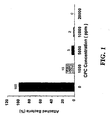
- Fig. 1 shows the results of a separate trial using higher concentrations of CPC and the same experimental procedure. At 20,000 ppm CPC, the bacteria was completely inhibited from attaching to beef.
- a spraying test chamber was designed and constructed for use in a poultry processing pilot plant.
- the spraying test system consisted of a testing chamber, a spraying water storage tank, a pressure pump, a filter, pressure regulators, a plastic spraying chamber with eight nozzles located on four sides, and a used water collector. There were three nozzles on each of the pipes for front and back spraying. One nozzle was used for top spraying and one nozzle for bottom spraying.
- the chamber dimensions preferably are 91.4 x 91.4 x 91.4 cm (3 x 3 x 3 feet). With a high pressure booster pump, the pressure could be adjusted between 0-140 psi.
- the distance between the spraying nozzles and the chicken carcass was 12-15 inches.
- the top nozzle was used to spray the inside of the chicken carcass.
- Flat-cone spraying nozzles (1/8TK-SS1, Spraying Systems Co.) were used.
- the spray solution in the storage tank was pumped to the pressure regulator, and then sprayed through the nozzles in the chamber.
- several spraying layers consisting of stainless steel nozzles and pipes were installed, and the chamber was covered with plastic sheets to prevent chemical drift.
- a shackle was used to hang up a chicken carcass in the chamber.
- Pre-chill chicken carcasses were obtained from a local poultry processing plant. They were taken from the end of an evisceration processing line, transported to the research laboratory, and immediately used for the tests. The time elapsed between the processing plant and the research laboratory was less than one half hour. The temperature of chicken carcasses was in the range of 32-37°C.
- Chicken carcasses were inoculated by spraying 1 ml of S . typhimurium at 1 x 10 6 CFU/ml and then incubated at room temperature for 30 min. The inoculated chicken carcasses were rinsed by spraying tap water at 30 psi and 22°C for 5 sec. to wash off loosely attached Salmonella cells. Then each carcass was hung in the spraying chamber and sprayed with one of the test compounds. After spraying, each chicken carcass was rinsed with tap water for 20 sec. The chicken carcasses were then washed with buffered peptone water in a plastic bag on an automatic shaker to get samples for microbial analysis. The color of chicken skin was examined visually by comparing the birds treated with test compounds, such as QACs, with untreated birds.
- test compounds such as QACs
- CPC at a concentration of 1000 ppm was used at different spraying pressures and durations.
- Spraying water temperature was set at room temperature of 22°C. Pressures were set at 30, 50, and 120 psi, and duration at 30 and 90 sec. Three replicates were performed for each trial. Reduction of S. typhimurium on chicken carcasses was compared among test compound sprayed, water sprayed, and non-sprayed groups.
- each carcass was mechanically shaken with 100 ml of buffered peptone water (BPW) for 1 min, and then the wash water was collected.
- the samples were diluted, enriched, plated on XLT agar or Petrifilm (3M,Inc.; St. Paul, MN for total aerobic count plates) and incubated for 18-24 hours at 37°C. Then, colony forming units were counted. The number of attached bacteria was calculated using a most-probable-number technique. The most probable numbers of Salmonella and total aerobic plate counts were performed for each carcass using the wash water samples.
- An analysis of variance was used to analyze the experimental data to determine any significant differences among the treatment groups and controls (SAS/STAT User's Guide, SAS Institute, Inc., Cary, NC 1993).
- the results of this experiment show that 30 and 90 second spraying of 1000 ppm solution of CPC at pressures of 30, 50, and 120 psi cause a significant reduction in the number of Salmonella on chicken carcasses.
- This data shows that the spraying method is a viable alternate method to the standard method of immersion or dipping of chickens when sprayed for 30 seconds to 90 seconds with a pressure in the range of 30 to 120 psi at 0.1% CPC concentration. It may be possible to use lower concentrations of CPC with varying spray pressures within the disclosed range of 30 to 120 or greater psi and varying spray times to obtain the most efficient process which results in significant reduction in the foodborne microorganisms.
- the spraying method would be advantageous to use in industrial processes because many chicken carcasses could be sprayed automatically for short periods of time and yet result in significant reduction of pathogenic bacteria.
- Test solutions comprised various concentrations of CPC (Sigma Chemical Co., St. Louis, MO) in 5% (v/v) glycerin in 0.008 M, pH 7.2 phosphate buffered saline (PBS). The solutions were prepared by dissolving the appropriate amounts of CPC in the glycerin-PBS mixture.
- Skin squares 2.5 x 2.5 cm) from drumsticks of freshly frozen, unprocessed chickens were sterilized by a 45 kGy dose of irradiation (electron beam from a linear accelerator, Iowa State University). The source of S.
- typhimurium was ATCC strain # 14028 or NCTC strain # 12023). All colony counts were performed on tryptic soy agar (TSA; DIFCO, Detroit, MI) plates. Salmonella storage was on TSA. Inoculum preparation was performed as follows. A flask containing 50 ml tryptic soy broth was inoculated with S. typhimurium from a single colony and then incubated (37°C) with shaking (150 rpm) overnight. A one ml aliquot of the culture was washed with 9 ml PBS (4800 rpm, 10 min.) two times. The pellet was resuspended in PBS to obtain a final cell concentration (spectrophotometrically, 420 nm) of 1 to 2 x 10 6 colony forming units (CFU) per ml.
- TSA tryptic soy agar
- CFU colony forming units
- Chicken skin was excised from drumsticks and placed epidermal side up in each well of six-well tissue culture plates. Skin pieces were inoculated with 5 ml of PBS containing 1 to 2 x 10 6 CFU of S . typhimurium per ml, with the exception of the background control group that was treated only with 5 ml of PBS. Culture plates with the skin pieces were incubated (30 min., 35°C), and then the incubating solution was removed by aspiration. The inoculated skins were treated with 5 ml of the test solution. Sets of three pieces of skin were used for each concentration of test solution, including one set in which the skins were treated only with 5 ml of 5% (v/v) glycerin in PBS (0 concentration).
- each skin piece was rinsed with aspiration (5 ml PBS), placed in a sterile plastic bag containing 50 ml of 0.1% (w/v) peptone, and homogenized for 2 minutes using a Stomacher® 400 laboratory blender (Seward Medical Co., London, England). A corner of the bag was aseptically cut and the entire contents were transferred to a sterile centrifuge tube, which was then spun for 10 min (12,000 rpm, 20°C). The pellet was resuspended in 5 ml 0.1% (w/v) peptone/water.
- Skin squares were placed epidermal side up in each well of six-well tissue culture plates. Skin pieces were treated with 5 ml of the test solution. Sets of three pieces of skin were used for each concentration of test solution, including one set in which the skins were treated only with 5 ml of 5% (v/v) glycerin in PBS (0 concentration). Culture plates with the skin pieces were incubated at 25°C with shaking (100 rpm) for 1, 3, or 10 min. The incubating solution was removed by aspiration, and the skins were rinsed (5 ml PBS) and then incubated (30 min., 35°C) with 5 ml of PBS containing 1 to 2 x 10 6 CFU of S. typhimurium per ml.
- each skin piece was rinsed with aspiration (5 ml PBS), placed in a sterile plastic bag containing 50 ml of 0.1% (w/v) peptone, and homogenized for 2 minutes using a Stomacher® 400 laboratory blender.
- Three aliquots of the homogenates (1 ml) were pour-plated onto TSA agar and incubated at 37°C for 24 h and then colonies were counted, corrected for dilution, and reported as log 10 CFU/skin.
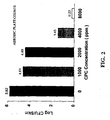
- the results indicate that prevention of Salmonella contamination by pretreatment with CPC also showed concentration and time dependency. The most marked effects were observed for 10 minute pretreatment times where a 4.9 log 10 inhibition of Salmonella attachment was shown at a concentration of 8,000 ppm. This result is important since prevention of cross-contamination is of paramount importance in food processing.
- Example 2 The steps of Example 2 were followed except that L . monocytogenes was used to inoculate the chicken skin and the media in the plastic bag used in the Stomacher 400 contained 0.1% peptone. At concentrations of CPC of 2000 ppm or higher, there was greater than a 4 log 10 reduction in L. monocytogenes .
- Example 3 The steps of Example 3 were followed except that L. monocytogenes was used to inoculate the chicken skin and the media in the plastic bag used in the Stomacher 400 contained 0.1% peptone.
- the results of this study show a reduction of 82% of attached bacteria at 50 ppm, reduction of 92% at 100 ppm, and reduction of 100% at 500 and 1000 ppm.
- Test solutions comprised various concentrations of CPC (Sigma Chemical Co., St. Louis, MO) in 5% (v/v) glycerin in 0.008 M, pH 7.2 phosphate buffered saline (PBS). The solutions were prepared by dissolving the appropriate amounts of CPC in the glycerin-PBS mixture.
- Food samples were small intact mushrooms, small intact black grapes, broccoli florets, and catfish skin squares (2.5 x 2.5 cm) excised from unprocessed, freshly thawed catfish.
- the fruit and vegetables were purchased from a local grocery, while the fish was shipped frozen from a local catfish supplier.
- the source of S. typhimurium was ATCC strain # 14028 or NCTC strain # 12023).
- Inoculum preparation for S. typhimurium was performed as described in Example 7 above. Food samples were placed in, each well of six-well tissue culture plates. The samples were then inoculated with 5 ml of PBS containing 1 to 2 x 10 6 CFU of S . typhimurium per ml, with the exception of the background control group that was treated only with 5 ml of PBS. Culture plates with the food samples were incubated (30 min., 35°C), and then the incubating solution was removed by aspiration. The inoculated samples were treated with 5 ml of the test solution.
- E . coli (ATTC # 25922) was grown in brain heart infusion broth (BHI) for 20-24 h and then diluted to a 1:1000 concentration by adding 0.5 ml of E . coli culture to 500 ml of physiological saline solution (PSS) .
- S . typhimurium was grown in BHI for 20-24 h and then diluted to a 1:5000 concentration by adding 0.1 ml of S. typhimurium culture to 500 ml of physiological saline solution (PSS).
- the CPC treatment solution was prepared to a concentration of 5,000 ppm.
- Prechill chicken carcasses were obtained from a local poultry processing plant for each trial. The carcasses were placed on a shackle line and 1 ml of the bacterial inoculating solution was sprayed on the breast of the carcass, and 1 ml was sprayed on the back. The bacteria were allowed to attach for 30 min at room temperature. After attachment the carcasses were rinsed on the shackle line with tap water for 20 seconds. The carcasses were divided into groups of ten. For each run, there was a group of ten chickens that were sprayed with only tap water but for S. typhimurium , there was also a group that was not sprayed after inoculation to evaluate the effect of the spray.
- one group of carcasses were treated with the JohnsonTM washer for 20 seconds at 60 psi with 35 cups of tap water. After the rinse, the carcasses were allowed to set for 90 seconds, and then rinsed with 20 cups of tap water for 20 seconds at 80 psi. This rinse cycle was repeated either two or three times. The interval of each rinse was also 90 seconds. Another group of carcasses were treated with 5,000 ppm CPC for 20 seconds at 60 psi in the JohnsonTM washer, then allowed to set for 90 seconds, and then rinsed with 20 cups of tap water for 20 seconds at 80 psi. This rinse cycle was repeated either two or three times.
- a formulation of QAC has been developed that allows QAC concentrations up to 1000-fold greater than those presently available in formulation made in water alone.
- This formulation which contains at least one solubility enhancing agent provides a soluble concentrate for easy dilution to the final concentration for use in large scale industrial processing.
- the solubility enhancing agent functions to maintain the solubility of the QAC so that it does not precipitate out of solution.
- Any compatible solubility agent can used but ethyl alcohol or glycerin are preferred.
- the formulation can contain ethyl alcohol, glycerin or both.
- This formulation contains approximately 100,000 ppm to about 300,000 ppm QAC, approximately 0% to about 49% ethyl alcohol and approximately 0 to about 20% glycerin in water.
- a preferred formulation contains approximately 150,000 ppm to about 250,000 ppm QAC, approximately 10% to about 40% ethyl alcohol and approximately 0.5 to about 10% glycerin in water. More preferably, the ethyl alcohol concentration can range from approximately 15% to about 30% and the glycerin concentration can range from approximately 0.5 to about 5%.
- this formulation contains approximately 200,000 ppm QAC, approximately 20% ethyl alcohol, and approximately 1% glycerin. This formulation is particularly useful as a concentrate to be added to the storage tanks for use in immersion treatment of food products with QAC but it is also useful in a spraying method at a final concentration of approximately 5,000 ppm QAC.
- a second formulation was developed to increase the contact time of a QAC solution on food products during processing, particularly when delivered by a spraying method.
- This formulation potentially allows a longer contact time of the QAC with the product without any additional steps which would increase the processing time.
- the formulation by virtue of its properties potentially increases the antimicrobial effectiveness of the process.
- This formulation preferably contains approximately 50 ppm to about 20,000 ppm QAC, and at least one of a solubility enhancing agent selected from approximately 0 to about 10% ethyl alcohol, and approximately 0 to about 20% glycerin or both.- More preferably this formulation contains approximately 50 ppm to about 5,000 ppm, approximately 0 to about 10% ethyl alcohol, and approximately 1.0% to about 10% glycerin in water.
- this formulation contains approximately 500 ppm to about 5,000 ppm QAC, 0 to 10% ethyl alcohol, and approximately 1.0 to about 5% glycerin in water and more preferably approximately 1.0 to about 3% glycerin.
Landscapes
- Life Sciences & Earth Sciences (AREA)
- Engineering & Computer Science (AREA)
- Chemical & Material Sciences (AREA)
- Polymers & Plastics (AREA)
- Zoology (AREA)
- Food Science & Technology (AREA)
- Wood Science & Technology (AREA)
- Chemical Kinetics & Catalysis (AREA)
- General Chemical & Material Sciences (AREA)
- Microbiology (AREA)
- Food Preservation Except Freezing, Refrigeration, And Drying (AREA)
- Agricultural Chemicals And Associated Chemicals (AREA)
- General Preparation And Processing Of Foods (AREA)
- Distillation Of Fermentation Liquor, Processing Of Alcohols, Vinegar And Beer (AREA)
- Organic Low-Molecular-Weight Compounds And Preparation Thereof (AREA)
Priority Applications (1)
| Application Number | Priority Date | Filing Date | Title |
|---|---|---|---|
| EP05017265A EP1595457B1 (en) | 1996-04-12 | 1997-04-14 | Broad spectrum prevention and removal of microbial contamination of food by quaternary ammonium compounds |
Applications Claiming Priority (3)
| Application Number | Priority Date | Filing Date | Title |
|---|---|---|---|
| US08/631,578 US5855940A (en) | 1996-04-12 | 1996-04-12 | Method for the broad spectrum prevention and removal of microbial contamination of poultry and meat products by quaternary ammonium compounds |
| US631578 | 1996-04-12 | ||
| PCT/US1997/006360 WO1997038586A1 (en) | 1996-04-12 | 1997-04-14 | Broad spectrum prevention and removal of microbial contamination of food by quaternary ammonium compounds |
Related Child Applications (1)
| Application Number | Title | Priority Date | Filing Date |
|---|---|---|---|
| EP05017265A Division EP1595457B1 (en) | 1996-04-12 | 1997-04-14 | Broad spectrum prevention and removal of microbial contamination of food by quaternary ammonium compounds |
Publications (3)
| Publication Number | Publication Date |
|---|---|
| EP0912101A1 EP0912101A1 (en) | 1999-05-06 |
| EP0912101A4 EP0912101A4 (en) | 2001-05-16 |
| EP0912101B1 true EP0912101B1 (en) | 2005-08-10 |
Family
ID=24531821
Family Applications (2)
| Application Number | Title | Priority Date | Filing Date |
|---|---|---|---|
| EP97918681A Expired - Lifetime EP0912101B1 (en) | 1996-04-12 | 1997-04-14 | Broad spectrum prevention and removal of microbial contamination of food by quaternary ammonium compounds |
| EP05017265A Expired - Lifetime EP1595457B1 (en) | 1996-04-12 | 1997-04-14 | Broad spectrum prevention and removal of microbial contamination of food by quaternary ammonium compounds |
Family Applications After (1)
| Application Number | Title | Priority Date | Filing Date |
|---|---|---|---|
| EP05017265A Expired - Lifetime EP1595457B1 (en) | 1996-04-12 | 1997-04-14 | Broad spectrum prevention and removal of microbial contamination of food by quaternary ammonium compounds |
Country Status (10)
| Country | Link |
|---|---|
| US (2) | US5855940A (enExample) |
| EP (2) | EP0912101B1 (enExample) |
| JP (1) | JP4275735B2 (enExample) |
| AT (2) | ATE443448T1 (enExample) |
| AU (1) | AU735308B2 (enExample) |
| CA (1) | CA2250761C (enExample) |
| DE (2) | DE69733951T2 (enExample) |
| DK (1) | DK0912101T3 (enExample) |
| ES (1) | ES2247628T3 (enExample) |
| WO (1) | WO1997038586A1 (enExample) |
Families Citing this family (53)
| Publication number | Priority date | Publication date | Assignee | Title |
|---|---|---|---|---|
| US6864269B2 (en) | 1996-04-12 | 2005-03-08 | University Of Arkansas | Concentrated, non-foaming solution of quarternary ammonium compounds and methods of use |
| US6010729A (en) | 1998-08-20 | 2000-01-04 | Ecolab Inc. | Treatment of animal carcasses |
| AU758625B2 (en) * | 1998-08-20 | 2003-03-27 | Ecolab Inc. | The treatment of meat products |
| US6180585B1 (en) | 1999-04-16 | 2001-01-30 | Spartan Chemical Company, Inc. | Aqueous disinfectant and hard surface cleaning composition and method of use |
| US6165965A (en) * | 1999-04-16 | 2000-12-26 | Spartan Chemical Company, Inc. | Aqueous disinfectant and hard surface cleaning composition and method of use |
| US6767569B1 (en) | 1999-07-14 | 2004-07-27 | Steris Inc. | Surface decontamination of cooked sausage and processed meat and poultry products |
| US6365193B1 (en) * | 1999-08-30 | 2002-04-02 | Surfcera Co., Ltd. | Anti-bacteria agent made from shell, and methods for purifying and desalinating water and for washing agricultural products with use thereof |
| US7150884B1 (en) | 2000-07-12 | 2006-12-19 | Ecolab Inc. | Composition for inhibition of microbial growth |
| KR20020046362A (ko) * | 2000-12-13 | 2002-06-21 | 김용철 박홍양 | 세틸피리디니엄 클로라이드 함유 살균제를 이용한가금류의 살모넬라증 예방 및 위생란 생산 |
| US7316824B2 (en) * | 2000-12-15 | 2008-01-08 | Ecolab Inc. | Method and composition for washing poultry during processing |
| US6514556B2 (en) * | 2000-12-15 | 2003-02-04 | Ecolab Inc. | Method and composition for washing poultry during processing |
| US6500476B1 (en) * | 2001-03-28 | 2002-12-31 | Epl Technologies, Inc. | Preservation compositions and process for mushrooms |
| DE10130298A1 (de) | 2001-06-22 | 2003-01-23 | Nutrinova Gmbh | Antimikrobiell wirksame Acesulfam-Komplexe, Verfahren zu ihrer Herstellung und ihre Verwendung |
| US6387874B1 (en) | 2001-06-27 | 2002-05-14 | Spartan Chemical Company, Inc. | Cleaning composition containing an organic acid and a spore forming microbial composition |
| US6498137B1 (en) | 2001-06-27 | 2002-12-24 | Spartan Chemical Company, Inc. | Aerosol cleaning composition containing an organic acid and a spore forming microbial composition |
| US6908636B2 (en) * | 2001-06-28 | 2005-06-21 | Albermarle Corporation | Microbiological control in poultry processing |
| US20030077365A1 (en) * | 2001-06-28 | 2003-04-24 | Howarth Jonathan N. | Environmentally-friendly microbiological and microbiocidal control in aqueous systems |
| US6986910B2 (en) * | 2001-06-28 | 2006-01-17 | Albemarle Corporation | Microbiological control in poultry processing |
| US6635286B2 (en) * | 2001-06-29 | 2003-10-21 | Ecolab Inc. | Peroxy acid treatment to control pathogenic organisms on growing plants |
| KR20030010788A (ko) * | 2001-07-27 | 2003-02-06 | (주)지텍 바이오 메디컬 | 두채류의 부패병 방지 및 색택 향상을 위한세틸피리디니움 클로라이드 함유 제제 및 그 사용 방법 |
| JP4709486B2 (ja) * | 2001-10-09 | 2011-06-22 | アルベマール・コーポレーシヨン | 産業用水システム中のバイオフィルムの抑制 |
| US7247330B2 (en) * | 2002-07-23 | 2007-07-24 | Kraft Foods Holdings, Inc. | Method for controlling microbial contamination of a vacuum-sealed food product |
| WO2004049799A2 (en) * | 2002-12-02 | 2004-06-17 | Byocoat Enterprises, Inc. | Composition ad method for treating plant fungal disease |
| US20060073216A1 (en) * | 2002-12-26 | 2006-04-06 | Solution Biosciences, Inc. | Compositions and methods for control of bovine mastitis |
| US20040175480A1 (en) * | 2003-03-03 | 2004-09-09 | Kraft Foods Holdings, Inc. | Hop beta acid compositions for use in food products |
| US7001632B2 (en) * | 2003-03-03 | 2006-02-21 | Kraft Foods Holdings, Inc. | Anti-listeria compositions for use in food products |
| BRPI0408099B1 (pt) | 2003-03-05 | 2014-04-08 | Byocoat Entpr Inc | Solução antimicrobiana e processo |
| US20030165403A1 (en) * | 2003-03-12 | 2003-09-04 | Marsden James L. | Decontamination of surface exposed to biological warfare agents |
| US20040265445A1 (en) * | 2003-06-24 | 2004-12-30 | Liimatta Eric W. | Microbiocidal control in the processing of poultry |
| US20040265446A1 (en) * | 2003-06-24 | 2004-12-30 | Mcnaughton James L. | Microbiocidal control in the processing of poultry |
| US7901276B2 (en) | 2003-06-24 | 2011-03-08 | Albemarle Corporation | Microbiocidal control in the processing of meat-producing four-legged animals |
| US20050069623A1 (en) * | 2003-09-26 | 2005-03-31 | Schneider David J. | Process for sanitizing animal carcasses |
| US8999175B2 (en) * | 2004-01-09 | 2015-04-07 | Ecolab Usa Inc. | Methods for washing and processing fruits, vegetables, and other produce with medium chain peroxycarboxylic acid compositions |
| US7504123B2 (en) * | 2004-01-09 | 2009-03-17 | Ecolab Inc. | Methods for washing poultry during processing with medium chain peroxycarboxylic acid compositions |
| US20050161636A1 (en) * | 2004-01-09 | 2005-07-28 | Ecolab Inc. | Methods for washing and processing fruits, vegetables, and other produce with medium chain peroxycarboxylic acid compositions |
| US7771737B2 (en) | 2004-01-09 | 2010-08-10 | Ecolab Inc. | Medium chain peroxycarboxylic acid compositions |
| US7507429B2 (en) | 2004-01-09 | 2009-03-24 | Ecolab Inc. | Methods for washing carcasses, meat, or meat products with medium chain peroxycarboxylic acid compositions |
| WO2005070205A1 (en) * | 2004-01-09 | 2005-08-04 | Ecolab Inc. | Medium chain peroxycarboxylic acid compositions |
| US7887641B2 (en) * | 2004-01-09 | 2011-02-15 | Ecolab Usa Inc. | Neutral or alkaline medium chain peroxycarboxylic acid compositions and methods employing them |
| US20050202120A1 (en) * | 2004-03-12 | 2005-09-15 | Giorgio Foods, Inc. | Method for preserving fruits, vegetables and mushrooms |
| WO2005112907A2 (en) | 2004-05-14 | 2005-12-01 | Lifetech Usa, Inc. | Nontoxic killer of e. coli and other problem microorganisms |
| US7300631B2 (en) * | 2005-05-02 | 2007-11-27 | Bioscale, Inc. | Method and apparatus for detection of analyte using a flexural plate wave device and magnetic particles |
| US7754670B2 (en) | 2005-07-06 | 2010-07-13 | Ecolab Inc. | Surfactant peroxycarboxylic acid compositions |
| JP4799615B2 (ja) * | 2005-09-03 | 2011-10-26 | ビオコート エンタープライジズ, インコーポレイテッド | 微生物溶液およびそれに関連するプロセス |
| JP2009518014A (ja) * | 2005-12-01 | 2009-05-07 | ソリユーシヨン・バイオサイエンシズ・インコーポレーテツド | 食肉用四足動物の処理における殺菌剤コントロール |
| US8075857B2 (en) | 2006-10-18 | 2011-12-13 | Ecolab Usa Inc. | Apparatus and method for making a peroxycarboxylic acid |
| US7547421B2 (en) | 2006-10-18 | 2009-06-16 | Ecolab Inc. | Apparatus and method for making a peroxycarboxylic acid |
| WO2009045456A1 (en) * | 2007-10-03 | 2009-04-09 | Byocoat Enterprises, Inc. | Compositions and methods for treating mastitis |
| US20090130082A1 (en) * | 2007-10-18 | 2009-05-21 | Kaplan Jeffrey B | Compositions and methods for the treatment and prevention of infections caused by staphylococcus aureus bacteria |
| WO2013074526A2 (en) | 2011-11-15 | 2013-05-23 | Byocoat Enterprises, Inc. | Antimicrobial compositions and methods of use thereof |
| US9752105B2 (en) | 2012-09-13 | 2017-09-05 | Ecolab Usa Inc. | Two step method of cleaning, sanitizing, and rinsing a surface |
| US20140308162A1 (en) | 2013-04-15 | 2014-10-16 | Ecolab Usa Inc. | Peroxycarboxylic acid based sanitizing rinse additives for use in ware washing |
| AU2019222696B2 (en) | 2018-02-14 | 2024-02-29 | Ecolab Usa Inc. | Compositions and methods for the reduction of biofilm and spores from membranes |
Family Cites Families (12)
| Publication number | Priority date | Publication date | Assignee | Title |
|---|---|---|---|---|
| GB479925A (en) * | 1935-05-09 | 1938-02-14 | Heyden Chem Fab | Process for disinfecting and preserving |
| US2756647A (en) * | 1952-07-11 | 1956-07-31 | Personal Products Corp | Method of incorporating quaternary ammonium compounds in paper |
| BE578935A (enExample) * | 1958-05-23 | |||
| DE2450666C3 (de) * | 1974-10-25 | 1978-11-09 | Freimut 5135 Selfkant Riemer | Antimikrobielle Behandlung von Futtermitteln |
| DE2530584C2 (de) * | 1975-07-09 | 1985-09-12 | Henkel KGaA, 4000 Düsseldorf | Desinfizierende Mittel auf Basis von quartären Ammoniumverbindungen |
| CA1154555A (fr) * | 1979-10-09 | 1983-10-04 | Lucette Letartre | Bactericide |
| DE3233607A1 (de) * | 1982-09-10 | 1984-03-15 | Freimut 5135 Selfkant Riemer | Mittel zur antimikrobiellen behandlung von lebens- und futtermitteln |
| CA1316623C (en) * | 1989-04-06 | 1993-04-20 | Pavel Stovicek | Biocidal surface coating and casting compositions based on quarternary ammonium salts of nalkyl x,x bis (4,4' hydroxyphenyl) and quarternary salts of polyglycols as backbones of resins |
| BE1003510A5 (fr) * | 1989-10-09 | 1992-04-07 | Fabricom Air Conditioning Sa | Composition desinfectante et procede de desinfection. |
| ES2037592B1 (es) * | 1991-07-03 | 1994-02-01 | Garcia Nunez Maria Rosalia | Procedimiento para preparar nuevos compuestos yodados con actividad germicida y fungicida. |
| US5366983A (en) * | 1992-04-03 | 1994-11-22 | The Board Of Trustees Of The University Of Arkansas | Use of quaternary ammonium compounds to remove salmonella contamination from meat products |
| US5518636A (en) * | 1995-04-21 | 1996-05-21 | Betz Laboratories, Inc. | Methods of detoxifying quaternary ammonium compounds toward aquatic organisms |
-
1996
- 1996-04-12 US US08/631,578 patent/US5855940A/en not_active Expired - Lifetime
-
1997
- 1997-04-14 AT AT05017265T patent/ATE443448T1/de not_active IP Right Cessation
- 1997-04-14 US US08/840,288 patent/US6039992A/en not_active Expired - Lifetime
- 1997-04-14 EP EP97918681A patent/EP0912101B1/en not_active Expired - Lifetime
- 1997-04-14 AU AU26729/97A patent/AU735308B2/en not_active Expired
- 1997-04-14 ES ES97918681T patent/ES2247628T3/es not_active Expired - Lifetime
- 1997-04-14 EP EP05017265A patent/EP1595457B1/en not_active Expired - Lifetime
- 1997-04-14 DE DE69733951T patent/DE69733951T2/de not_active Expired - Lifetime
- 1997-04-14 WO PCT/US1997/006360 patent/WO1997038586A1/en not_active Ceased
- 1997-04-14 JP JP53735797A patent/JP4275735B2/ja not_active Expired - Lifetime
- 1997-04-14 DK DK97918681T patent/DK0912101T3/da active
- 1997-04-14 DE DE69739594T patent/DE69739594D1/de not_active Expired - Fee Related
- 1997-04-14 AT AT97918681T patent/ATE301400T1/de active IP Right Revival
- 1997-04-14 CA CA002250761A patent/CA2250761C/en not_active Expired - Lifetime
Also Published As
| Publication number | Publication date |
|---|---|
| DE69733951T2 (de) | 2006-06-01 |
| CA2250761C (en) | 2006-09-19 |
| HK1019692A1 (en) | 2000-02-25 |
| AU735308B2 (en) | 2001-07-05 |
| ES2247628T3 (es) | 2006-03-01 |
| EP0912101A4 (en) | 2001-05-16 |
| EP1595457A3 (en) | 2006-05-31 |
| DE69739594D1 (de) | 2009-11-05 |
| US6039992A (en) | 2000-03-21 |
| ATE443448T1 (de) | 2009-10-15 |
| EP1595457B1 (en) | 2009-09-23 |
| EP0912101A1 (en) | 1999-05-06 |
| CA2250761A1 (en) | 1997-10-23 |
| AU2672997A (en) | 1997-11-07 |
| US5855940A (en) | 1999-01-05 |
| DE69733951D1 (de) | 2005-09-15 |
| JP2000508541A (ja) | 2000-07-11 |
| ATE301400T1 (de) | 2005-08-15 |
| DK0912101T3 (da) | 2005-12-19 |
| JP4275735B2 (ja) | 2009-06-10 |
| EP1595457A2 (en) | 2005-11-16 |
| WO1997038586A1 (en) | 1997-10-23 |
Similar Documents
| Publication | Publication Date | Title |
|---|---|---|
| EP0912101B1 (en) | Broad spectrum prevention and removal of microbial contamination of food by quaternary ammonium compounds | |
| US8323673B2 (en) | Concentrated, non-foaming solution of quaternary ammonium compounds and methods of use | |
| RS57302B1 (sr) | Pirolo[2,3-b]piridin-4-il-amini i pirolo[2m3-b]pirimidin-4-il-amini kao inhibitori janus kinaze | |
| HK1019692B (en) | Broad spectrum prevention and removal of microbial contamination of food by quaternary ammonium compounds | |
| MXPA98008364A (en) | Wide spectrum of prevention and removal of microbial food contamination through cuaterna ammonium compounds | |
| Compadre et al. | Method for the broad spectrum prevention and removal of microbial contamination of poultry and meat products by quaternary ammonium compounds |
Legal Events
| Date | Code | Title | Description |
|---|---|---|---|
| PUAI | Public reference made under article 153(3) epc to a published international application that has entered the european phase |
Free format text: ORIGINAL CODE: 0009012 |
|
| 17P | Request for examination filed |
Effective date: 19981112 |
|
| AK | Designated contracting states |
Kind code of ref document: A1 Designated state(s): AT BE CH DE DK ES FI FR GB GR IE IT LI LU MC NL PT SE |
|
| RIC1 | Information provided on ipc code assigned before grant |
Free format text: 7A 23B 4/20 A, 7A 23L 3/3544 B, 7A 23L 3/3526 B, 7A 23B 7/154 B |
|
| A4 | Supplementary search report drawn up and despatched |
Effective date: 20010330 |
|
| AK | Designated contracting states |
Kind code of ref document: A4 Designated state(s): AT BE CH DE DK ES FI FR GB GR IE IT LI LU MC NL PT SE |
|
| 17Q | First examination report despatched |
Effective date: 20030721 |
|
| GRAP | Despatch of communication of intention to grant a patent |
Free format text: ORIGINAL CODE: EPIDOSNIGR1 |
|
| GRAS | Grant fee paid |
Free format text: ORIGINAL CODE: EPIDOSNIGR3 |
|
| GRAA | (expected) grant |
Free format text: ORIGINAL CODE: 0009210 |
|
| RAP1 | Party data changed (applicant data changed or rights of an application transferred) |
Owner name: UNIVERSITY OF ARKANSAS |
|
| AK | Designated contracting states |
Kind code of ref document: B1 Designated state(s): AT BE CH DE DK ES FI FR GB GR IE IT LI LU MC NL PT SE |
|
| REG | Reference to a national code |
Ref country code: GB Ref legal event code: FG4D |
|
| REG | Reference to a national code |
Ref country code: CH Ref legal event code: EP |
|
| REG | Reference to a national code |
Ref country code: IE Ref legal event code: FG4D |
|
| REF | Corresponds to: |
Ref document number: 69733951 Country of ref document: DE Date of ref document: 20050915 Kind code of ref document: P |
|
| PG25 | Lapsed in a contracting state [announced via postgrant information from national office to epo] |
Ref country code: GR Free format text: LAPSE BECAUSE OF FAILURE TO SUBMIT A TRANSLATION OF THE DESCRIPTION OR TO PAY THE FEE WITHIN THE PRESCRIBED TIME-LIMIT Effective date: 20051110 |
|
| REG | Reference to a national code |
Ref country code: SE Ref legal event code: TRGR |
|
| REG | Reference to a national code |
Ref country code: DK Ref legal event code: T3 |
|
| REG | Reference to a national code |
Ref country code: CH Ref legal event code: NV Representative=s name: A. BRAUN, BRAUN, HERITIER, ESCHMANN AG PATENTANWAE |
|
| REG | Reference to a national code |
Ref country code: ES Ref legal event code: FG2A Ref document number: 2247628 Country of ref document: ES Kind code of ref document: T3 |
|
| REG | Reference to a national code |
Ref country code: HK Ref legal event code: GR Ref document number: 1019692 Country of ref document: HK |
|
| ET | Fr: translation filed | ||
| PLBE | No opposition filed within time limit |
Free format text: ORIGINAL CODE: 0009261 |
|
| STAA | Information on the status of an ep patent application or granted ep patent |
Free format text: STATUS: NO OPPOSITION FILED WITHIN TIME LIMIT |
|
| 26N | No opposition filed |
Effective date: 20060511 |
|
| REG | Reference to a national code |
Ref country code: PT Ref legal event code: MM4A Free format text: LAPSE DUE TO NON-PAYMENT OF FEES Effective date: 20071015 |
|
| REG | Reference to a national code |
Ref country code: DK Ref legal event code: EBP |
|
| REG | Reference to a national code |
Ref country code: CH Ref legal event code: PL |
|
| GBPC | Gb: european patent ceased through non-payment of renewal fee |
Effective date: 20070414 |
|
| BERE | Be: lapsed |
Owner name: *UNIVERSITY OF ARKANSAS Effective date: 20070430 |
|
| NLV4 | Nl: lapsed or anulled due to non-payment of the annual fee |
Effective date: 20071101 |
|
| PG25 | Lapsed in a contracting state [announced via postgrant information from national office to epo] |
Ref country code: FI Free format text: LAPSE BECAUSE OF NON-PAYMENT OF DUE FEES Effective date: 20070414 Ref country code: DE Free format text: LAPSE BECAUSE OF NON-PAYMENT OF DUE FEES Effective date: 20071101 |
|
| REG | Reference to a national code |
Ref country code: IE Ref legal event code: MM4A |
|
| REG | Reference to a national code |
Ref country code: PT Ref legal event code: NF4A Free format text: RESTITUTIO IN INTEGRUM Effective date: 20080121 |
|
| REG | Reference to a national code |
Ref country code: CH Ref legal event code: AEN Free format text: DAS PATENT IST AUFGRUND DES WEITERBEHANDLUNGSANTRAGS VOM 10.01.2008 REAKTIVIERT WORDEN. |
|
| PG25 | Lapsed in a contracting state [announced via postgrant information from national office to epo] |
Ref country code: AT Free format text: LAPSE BECAUSE OF NON-PAYMENT OF DUE FEES Effective date: 20070414 Ref country code: CH Free format text: LAPSE BECAUSE OF NON-PAYMENT OF DUE FEES Effective date: 20070430 Ref country code: LI Free format text: LAPSE BECAUSE OF NON-PAYMENT OF DUE FEES Effective date: 20070430 |
|
| REG | Reference to a national code |
Ref country code: GB Ref legal event code: 728V |
|
| PG25 | Lapsed in a contracting state [announced via postgrant information from national office to epo] |
Ref country code: BE Free format text: LAPSE BECAUSE OF NON-PAYMENT OF DUE FEES Effective date: 20070430 |
|
| NLXE | Nl: other communications concerning ep-patents (part 3 heading xe) |
Free format text: A REQUEST FOR RESTORATION TO THE PRIOR STATE (ARTICLE 23 OF THE PATENTS ACT 1995) HAS BEEN FILED ON 20080214 |
|
| PG25 | Lapsed in a contracting state [announced via postgrant information from national office to epo] |
Ref country code: GB Free format text: LAPSE BECAUSE OF NON-PAYMENT OF DUE FEES Effective date: 20070414 Ref country code: DK Free format text: LAPSE BECAUSE OF NON-PAYMENT OF DUE FEES Effective date: 20070430 |
|
| PGRI | Patent reinstated in contracting state [announced from national office to epo] |
Ref country code: CH Effective date: 20080110 |
|
| REG | Reference to a national code |
Ref country code: FR Ref legal event code: RN |
|
| PG25 | Lapsed in a contracting state [announced via postgrant information from national office to epo] |
Ref country code: IE Free format text: LAPSE BECAUSE OF NON-PAYMENT OF DUE FEES Effective date: 20070416 |
|
| PGRI | Patent reinstated in contracting state [announced from national office to epo] |
Ref country code: PT Effective date: 20080121 Ref country code: CH Effective date: 20080110 |
|
| REG | Reference to a national code |
Ref country code: CH Ref legal event code: PFA Owner name: UNIVERSITY OF ARKANSAS Free format text: UNIVERSITY OF ARKANSAS#UNIVERSITY TOWER BUILDING, SUITE 601, 1123 SOUTH UNIVERSITY#LITTLE ROCK, ARKANSAS 72204 (US) -TRANSFER TO- UNIVERSITY OF ARKANSAS#UNIVERSITY TOWER BUILDING, SUITE 601, 1123 SOUTH UNIVERSITY#LITTLE ROCK, ARKANSAS 72204 (US) |
|
| PG25 | Lapsed in a contracting state [announced via postgrant information from national office to epo] |
Ref country code: SE Free format text: LAPSE BECAUSE OF NON-PAYMENT OF DUE FEES Effective date: 20070415 |
|
| PGRI | Patent reinstated in contracting state [announced from national office to epo] |
Ref country code: AT Effective date: 20080326 |
|
| REG | Reference to a national code |
Ref country code: FR Ref legal event code: FC |
|
| PG25 | Lapsed in a contracting state [announced via postgrant information from national office to epo] |
Ref country code: FR Free format text: LAPSE BECAUSE OF NON-PAYMENT OF DUE FEES Effective date: 20070430 |
|
| REG | Reference to a national code |
Ref country code: DK Ref legal event code: EGE |
|
| REG | Reference to a national code |
Ref country code: GB Ref legal event code: S28 Effective date: 20080717 |
|
| BERR | Be: reestablished |
Owner name: *UNIVERSITY OF ARKANSAS Effective date: 20080805 |
|
| NLXE | Nl: other communications concerning ep-patents (part 3 heading xe) |
Free format text: THE REQUEST FOR RESTORATION TO THE PRIOR STATE, AS PROVIDED FOR IN ARTICLE 23 OF THE PATENTS ACT 1995 (SEE PUBLICATION IN HEADING XE OF THE PATENT BULLETIN OF 20080401) HAS BEEN GRANTED; THE RESTORATION OF THE PATENT HAS BEEN ENTERED IN THE PATENT REGISTER. |
|
| REG | Reference to a national code |
Ref country code: IE Ref legal event code: NF4A Effective date: 20080820 |
|
| PGRI | Patent reinstated in contracting state [announced from national office to epo] |
Ref country code: IE Effective date: 20080820 Ref country code: FR Effective date: 20080618 Ref country code: DE Effective date: 20080715 |
|
| PGRI | Patent reinstated in contracting state [announced from national office to epo] |
Ref country code: BE Effective date: 20080805 |
|
| PG25 | Lapsed in a contracting state [announced via postgrant information from national office to epo] |
Ref country code: MC Free format text: LAPSE BECAUSE OF NON-PAYMENT OF DUE FEES Effective date: 20070430 |
|
| PGRI | Patent reinstated in contracting state [announced from national office to epo] |
Ref country code: SE Effective date: 20080327 |
|
| REG | Reference to a national code |
Ref country code: CH Ref legal event code: PCAR Free format text: NEW ADDRESS: HOLBEINSTRASSE 36-38, 4051 BASEL (CH) |
|
| REG | Reference to a national code |
Ref country code: FR Ref legal event code: PLFP Year of fee payment: 20 |
|
| PGFP | Annual fee paid to national office [announced via postgrant information from national office to epo] |
Ref country code: LU Payment date: 20160422 Year of fee payment: 20 |
|
| PGFP | Annual fee paid to national office [announced via postgrant information from national office to epo] |
Ref country code: NL Payment date: 20160420 Year of fee payment: 20 |
|
| PGFP | Annual fee paid to national office [announced via postgrant information from national office to epo] |
Ref country code: GB Payment date: 20160421 Year of fee payment: 20 Ref country code: CH Payment date: 20160420 Year of fee payment: 20 Ref country code: IE Payment date: 20160421 Year of fee payment: 20 Ref country code: ES Payment date: 20160413 Year of fee payment: 20 Ref country code: DE Payment date: 20160421 Year of fee payment: 20 Ref country code: FI Payment date: 20160413 Year of fee payment: 20 Ref country code: MC Payment date: 20160414 Year of fee payment: 20 |
|
| PGFP | Annual fee paid to national office [announced via postgrant information from national office to epo] |
Ref country code: DK Payment date: 20160420 Year of fee payment: 20 Ref country code: BE Payment date: 20160420 Year of fee payment: 20 Ref country code: FR Payment date: 20160421 Year of fee payment: 20 Ref country code: PT Payment date: 20160411 Year of fee payment: 20 Ref country code: SE Payment date: 20160420 Year of fee payment: 20 Ref country code: IT Payment date: 20160427 Year of fee payment: 20 Ref country code: AT Payment date: 20160421 Year of fee payment: 20 |
|
| REG | Reference to a national code |
Ref country code: DE Ref legal event code: R071 Ref document number: 69733951 Country of ref document: DE |
|
| REG | Reference to a national code |
Ref country code: DK Ref legal event code: EUP Effective date: 20170414 |
|
| REG | Reference to a national code |
Ref country code: NL Ref legal event code: MK Effective date: 20170413 |
|
| REG | Reference to a national code |
Ref country code: CH Ref legal event code: PL |
|
| REG | Reference to a national code |
Ref country code: GB Ref legal event code: PE20 Expiry date: 20170413 |
|
| REG | Reference to a national code |
Ref country code: IE Ref legal event code: MK9A |
|
| REG | Reference to a national code |
Ref country code: AT Ref legal event code: MK07 Ref document number: 301400 Country of ref document: AT Kind code of ref document: T Effective date: 20170414 |
|
| PG25 | Lapsed in a contracting state [announced via postgrant information from national office to epo] |
Ref country code: IE Free format text: LAPSE BECAUSE OF EXPIRATION OF PROTECTION Effective date: 20170414 Ref country code: GB Free format text: LAPSE BECAUSE OF EXPIRATION OF PROTECTION Effective date: 20170413 |
|
| PG25 | Lapsed in a contracting state [announced via postgrant information from national office to epo] |
Ref country code: PT Free format text: LAPSE BECAUSE OF EXPIRATION OF PROTECTION Effective date: 20170427 |
|
| REG | Reference to a national code |
Ref country code: ES Ref legal event code: FD2A Effective date: 20180508 |
|
| PG25 | Lapsed in a contracting state [announced via postgrant information from national office to epo] |
Ref country code: ES Free format text: LAPSE BECAUSE OF EXPIRATION OF PROTECTION Effective date: 20170415 |