EP0910652B1 - Hormon-vermittelte methoden zur beeinflussung der expression exogener gene in säugetiersystemen und damit verbundene produkte - Google Patents
Hormon-vermittelte methoden zur beeinflussung der expression exogener gene in säugetiersystemen und damit verbundene produkte Download PDFInfo
- Publication number
- EP0910652B1 EP0910652B1 EP97917146.9A EP97917146A EP0910652B1 EP 0910652 B1 EP0910652 B1 EP 0910652B1 EP 97917146 A EP97917146 A EP 97917146A EP 0910652 B1 EP0910652 B1 EP 0910652B1
- Authority
- EP
- European Patent Office
- Prior art keywords
- seq
- modified
- response element
- receptor
- expression
- Prior art date
- Legal status (The legal status is an assumption and is not a legal conclusion. Google has not performed a legal analysis and makes no representation as to the accuracy of the status listed.)
- Expired - Lifetime
Links
- 108090000623 proteins and genes Proteins 0.000 title claims description 125
- 230000014509 gene expression Effects 0.000 title claims description 82
- 238000000034 method Methods 0.000 title claims description 44
- 229940088597 hormone Drugs 0.000 title description 17
- 239000005556 hormone Substances 0.000 title description 17
- 230000001404 mediated effect Effects 0.000 title description 3
- 150000002058 ecdysones Chemical class 0.000 claims description 113
- 108091027981 Response element Proteins 0.000 claims description 110
- 108010057988 ecdysone receptor Proteins 0.000 claims description 99
- UPEZCKBFRMILAV-UHFFFAOYSA-N alpha-Ecdysone Natural products C1C(O)C(O)CC2(C)C(CCC3(C(C(C(O)CCC(C)(C)O)C)CCC33O)C)C3=CC(=O)C21 UPEZCKBFRMILAV-UHFFFAOYSA-N 0.000 claims description 64
- UPEZCKBFRMILAV-JNEQICEOSA-N Ecdysone Natural products O=C1[C@H]2[C@@](C)([C@@H]3C([C@@]4(O)[C@@](C)([C@H]([C@H]([C@@H](O)CCC(O)(C)C)C)CC4)CC3)=C1)C[C@H](O)[C@H](O)C2 UPEZCKBFRMILAV-JNEQICEOSA-N 0.000 claims description 63
- UPEZCKBFRMILAV-JMZLNJERSA-N ecdysone Chemical compound C1[C@@H](O)[C@@H](O)C[C@]2(C)[C@@H](CC[C@@]3([C@@H]([C@@H]([C@H](O)CCC(C)(C)O)C)CC[C@]33O)C)C3=CC(=O)[C@@H]21 UPEZCKBFRMILAV-JMZLNJERSA-N 0.000 claims description 63
- 150000007523 nucleic acids Chemical class 0.000 claims description 42
- 239000003446 ligand Substances 0.000 claims description 39
- 108020004414 DNA Proteins 0.000 claims description 38
- 102000039446 nucleic acids Human genes 0.000 claims description 37
- 108020004707 nucleic acids Proteins 0.000 claims description 37
- 230000001939 inductive effect Effects 0.000 claims description 34
- 239000002773 nucleotide Substances 0.000 claims description 29
- 125000003729 nucleotide group Chemical group 0.000 claims description 28
- 238000013518 transcription Methods 0.000 claims description 22
- 230000035897 transcription Effects 0.000 claims description 22
- 230000001105 regulatory effect Effects 0.000 claims description 21
- 239000013598 vector Substances 0.000 claims description 21
- 125000003275 alpha amino acid group Chemical group 0.000 claims description 19
- 102000040945 Transcription factor Human genes 0.000 claims description 15
- 108091023040 Transcription factor Proteins 0.000 claims description 15
- 230000027455 binding Effects 0.000 claims description 13
- 150000002061 ecdysteroids Chemical class 0.000 claims description 11
- 238000012546 transfer Methods 0.000 claims description 8
- 238000000338 in vitro Methods 0.000 claims description 6
- 230000001627 detrimental effect Effects 0.000 claims description 3
- 239000003814 drug Substances 0.000 claims description 3
- 230000001131 transforming effect Effects 0.000 claims description 2
- 238000004519 manufacturing process Methods 0.000 claims 1
- 210000004027 cell Anatomy 0.000 description 86
- 102000005962 receptors Human genes 0.000 description 56
- 108020003175 receptors Proteins 0.000 description 56
- 230000004568 DNA-binding Effects 0.000 description 45
- LRJUYAVTHIEHAI-LHBNDURVSA-N Muristerone Chemical compound C1[C@@H](O)[C@@H](O)C[C@]2(C)[C@@H]([C@H](O)C[C@@]3([C@@H]([C@@](C)(O)[C@H](O)CCC(C)C)CC[C@]33O)C)C3=CC(=O)[C@@]21O LRJUYAVTHIEHAI-LHBNDURVSA-N 0.000 description 38
- 230000000694 effects Effects 0.000 description 31
- 102000004169 proteins and genes Human genes 0.000 description 25
- 102000034527 Retinoid X Receptors Human genes 0.000 description 24
- 108010038912 Retinoid X Receptors Proteins 0.000 description 24
- 235000001014 amino acid Nutrition 0.000 description 24
- 150000001413 amino acids Chemical class 0.000 description 24
- 235000018102 proteins Nutrition 0.000 description 22
- 241000699670 Mus sp. Species 0.000 description 20
- 150000003431 steroids Chemical class 0.000 description 18
- 230000004913 activation Effects 0.000 description 17
- 230000006870 function Effects 0.000 description 17
- 102000003676 Glucocorticoid Receptors Human genes 0.000 description 15
- 108090000079 Glucocorticoid Receptors Proteins 0.000 description 15
- 230000006698 induction Effects 0.000 description 14
- 108091008039 hormone receptors Proteins 0.000 description 13
- 210000001685 thyroid gland Anatomy 0.000 description 13
- 210000001519 tissue Anatomy 0.000 description 13
- 230000009261 transgenic effect Effects 0.000 description 13
- 241000124008 Mammalia Species 0.000 description 12
- 108020001756 ligand binding domains Proteins 0.000 description 12
- 230000001177 retroviral effect Effects 0.000 description 11
- LQGNCUXDDPRDJH-UHFFFAOYSA-N 3'-GMP Natural products C1C(O)C(O)CC2(C)C(C(O)CC3(C(C(C)(O)C(O)CCC(C)C)CCC33O)C)C3=CC(=O)C21 LQGNCUXDDPRDJH-UHFFFAOYSA-N 0.000 description 10
- 239000005089 Luciferase Substances 0.000 description 10
- LRJUYAVTHIEHAI-UHFFFAOYSA-N Muristeron A Natural products C1C(O)C(O)CC2(C)C(C(O)CC3(C(C(C)(O)C(O)CCC(C)C)CCC33O)C)C3=CC(=O)C21O LRJUYAVTHIEHAI-UHFFFAOYSA-N 0.000 description 10
- 239000013604 expression vector Substances 0.000 description 10
- 238000011830 transgenic mouse model Methods 0.000 description 10
- 102100038495 Bile acid receptor Human genes 0.000 description 9
- 101000603876 Homo sapiens Bile acid receptor Proteins 0.000 description 9
- 108060001084 Luciferase Proteins 0.000 description 9
- 241000699660 Mus musculus Species 0.000 description 9
- 231100000331 toxic Toxicity 0.000 description 9
- 230000002588 toxic effect Effects 0.000 description 9
- 239000000833 heterodimer Substances 0.000 description 8
- 239000013612 plasmid Substances 0.000 description 8
- 238000001890 transfection Methods 0.000 description 8
- 102000052510 DNA-Binding Proteins Human genes 0.000 description 7
- 239000004098 Tetracycline Substances 0.000 description 7
- 238000003556 assay Methods 0.000 description 7
- 229960002180 tetracycline Drugs 0.000 description 7
- 229930101283 tetracycline Natural products 0.000 description 7
- 235000019364 tetracycline Nutrition 0.000 description 7
- 150000003522 tetracyclines Chemical class 0.000 description 7
- 230000001225 therapeutic effect Effects 0.000 description 7
- LFQSCWFLJHTTHZ-UHFFFAOYSA-N Ethanol Chemical compound CCO LFQSCWFLJHTTHZ-UHFFFAOYSA-N 0.000 description 6
- 101000976075 Homo sapiens Insulin Proteins 0.000 description 6
- 239000002299 complementary DNA Substances 0.000 description 6
- 230000001419 dependent effect Effects 0.000 description 6
- 239000012634 fragment Substances 0.000 description 6
- 239000003862 glucocorticoid Substances 0.000 description 6
- 230000023603 positive regulation of transcription initiation, DNA-dependent Effects 0.000 description 6
- 238000002360 preparation method Methods 0.000 description 6
- 230000004044 response Effects 0.000 description 6
- 230000004043 responsiveness Effects 0.000 description 6
- 210000002966 serum Anatomy 0.000 description 6
- 241000894007 species Species 0.000 description 6
- 102000004217 thyroid hormone receptors Human genes 0.000 description 6
- 108090000721 thyroid hormone receptors Proteins 0.000 description 6
- 108091032973 (ribonucleotides)n+m Proteins 0.000 description 5
- 102100026189 Beta-galactosidase Human genes 0.000 description 5
- 241000238631 Hexapoda Species 0.000 description 5
- 241001465754 Metazoa Species 0.000 description 5
- 108091028043 Nucleic acid sequence Proteins 0.000 description 5
- 108010029485 Protein Isoforms Proteins 0.000 description 5
- 102000001708 Protein Isoforms Human genes 0.000 description 5
- 210000001744 T-lymphocyte Anatomy 0.000 description 5
- 125000000539 amino acid group Chemical group 0.000 description 5
- 238000004458 analytical method Methods 0.000 description 5
- 108010005774 beta-Galactosidase Proteins 0.000 description 5
- 230000001413 cellular effect Effects 0.000 description 5
- PBGKTOXHQIOBKM-FHFVDXKLSA-N insulin (human) Chemical compound C([C@@H](C(=O)N[C@@H](CC(C)C)C(=O)N[C@H]1CSSC[C@H]2C(=O)N[C@H](C(=O)N[C@@H](CO)C(=O)N[C@H](C(=O)N[C@H](C(N[C@@H](CO)C(=O)N[C@@H](CC(C)C)C(=O)N[C@@H](CC=3C=CC(O)=CC=3)C(=O)N[C@@H](CCC(N)=O)C(=O)N[C@@H](CC(C)C)C(=O)N[C@@H](CCC(O)=O)C(=O)N[C@@H](CC(N)=O)C(=O)N[C@@H](CC=3C=CC(O)=CC=3)C(=O)N[C@@H](CSSC[C@H](NC(=O)[C@H](C(C)C)NC(=O)[C@H](CC(C)C)NC(=O)[C@H](CC=3C=CC(O)=CC=3)NC(=O)[C@H](CC(C)C)NC(=O)[C@H](C)NC(=O)[C@H](CCC(O)=O)NC(=O)[C@H](C(C)C)NC(=O)[C@H](CC(C)C)NC(=O)[C@H](CC=3NC=NC=3)NC(=O)[C@H](CO)NC(=O)CNC1=O)C(=O)NCC(=O)N[C@@H](CCC(O)=O)C(=O)N[C@@H](CCCNC(N)=N)C(=O)NCC(=O)N[C@@H](CC=1C=CC=CC=1)C(=O)N[C@@H](CC=1C=CC=CC=1)C(=O)N[C@@H](CC=1C=CC(O)=CC=1)C(=O)N[C@@H]([C@@H](C)O)C(=O)N1[C@@H](CCC1)C(=O)N[C@@H](CCCCN)C(=O)N[C@@H]([C@@H](C)O)C(O)=O)C(=O)N[C@@H](CC(N)=O)C(O)=O)=O)CSSC[C@@H](C(N2)=O)NC(=O)[C@H](CCC(N)=O)NC(=O)[C@H](CCC(O)=O)NC(=O)[C@H](C(C)C)NC(=O)[C@@H](NC(=O)CN)[C@@H](C)CC)[C@@H](C)CC)[C@@H](C)O)NC(=O)[C@H](CCC(N)=O)NC(=O)[C@H](CC(N)=O)NC(=O)[C@@H](NC(=O)[C@@H](N)CC=1C=CC=CC=1)C(C)C)C1=CN=CN1 PBGKTOXHQIOBKM-FHFVDXKLSA-N 0.000 description 5
- 239000008159 sesame oil Substances 0.000 description 5
- 235000011803 sesame oil Nutrition 0.000 description 5
- 239000000126 substance Substances 0.000 description 5
- 101710096438 DNA-binding protein Proteins 0.000 description 4
- 108010068250 Herpes Simplex Virus Protein Vmw65 Proteins 0.000 description 4
- 108091034117 Oligonucleotide Proteins 0.000 description 4
- RJKFOVLPORLFTN-LEKSSAKUSA-N Progesterone Chemical compound C1CC2=CC(=O)CC[C@]2(C)[C@@H]2[C@@H]1[C@@H]1CC[C@H](C(=O)C)[C@@]1(C)CC2 RJKFOVLPORLFTN-LEKSSAKUSA-N 0.000 description 4
- 230000008901 benefit Effects 0.000 description 4
- 210000004899 c-terminal region Anatomy 0.000 description 4
- 235000018417 cysteine Nutrition 0.000 description 4
- 150000001945 cysteines Chemical class 0.000 description 4
- 238000011161 development Methods 0.000 description 4
- 230000018109 developmental process Effects 0.000 description 4
- 239000003623 enhancer Substances 0.000 description 4
- 108020001507 fusion proteins Proteins 0.000 description 4
- 102000037865 fusion proteins Human genes 0.000 description 4
- 239000000710 homodimer Substances 0.000 description 4
- 238000001727 in vivo Methods 0.000 description 4
- 239000000411 inducer Substances 0.000 description 4
- 238000012986 modification Methods 0.000 description 4
- 230000004048 modification Effects 0.000 description 4
- 125000002924 primary amino group Chemical group [H]N([H])* 0.000 description 4
- 230000022532 regulation of transcription, DNA-dependent Effects 0.000 description 4
- 102000003702 retinoic acid receptors Human genes 0.000 description 4
- 108090000064 retinoic acid receptors Proteins 0.000 description 4
- 210000001626 skin fibroblast Anatomy 0.000 description 4
- 125000006850 spacer group Chemical group 0.000 description 4
- 231100000378 teratogenic Toxicity 0.000 description 4
- 230000003390 teratogenic effect Effects 0.000 description 4
- 239000013603 viral vector Substances 0.000 description 4
- KUWPCJHYPSUOFW-YBXAARCKSA-N 2-nitrophenyl beta-D-galactoside Chemical compound O[C@@H]1[C@@H](O)[C@@H](O)[C@@H](CO)O[C@H]1OC1=CC=CC=C1[N+]([O-])=O KUWPCJHYPSUOFW-YBXAARCKSA-N 0.000 description 3
- NKDFYOWSKOHCCO-YPVLXUMRSA-N 20-hydroxyecdysone Chemical compound C1[C@@H](O)[C@@H](O)C[C@]2(C)[C@@H](CC[C@@]3([C@@H]([C@@](C)(O)[C@H](O)CCC(C)(O)C)CC[C@]33O)C)C3=CC(=O)[C@@H]21 NKDFYOWSKOHCCO-YPVLXUMRSA-N 0.000 description 3
- 241000557626 Corvus corax Species 0.000 description 3
- 108700020911 DNA-Binding Proteins Proteins 0.000 description 3
- 102000004190 Enzymes Human genes 0.000 description 3
- 108090000790 Enzymes Proteins 0.000 description 3
- WSFSSNUMVMOOMR-UHFFFAOYSA-N Formaldehyde Chemical compound O=C WSFSSNUMVMOOMR-UHFFFAOYSA-N 0.000 description 3
- QVJMXSGZTCGLHZ-VWADHSNXSA-N Juvenile hormone III Natural products O=C(OC)/C=C(\CC/C=C(\CC[C@H]1C(C)(C)O1)/C)/C QVJMXSGZTCGLHZ-VWADHSNXSA-N 0.000 description 3
- 102000007651 Macrophage Colony-Stimulating Factor Human genes 0.000 description 3
- 108010046938 Macrophage Colony-Stimulating Factor Proteins 0.000 description 3
- 108090000375 Mineralocorticoid Receptors Proteins 0.000 description 3
- 241000699666 Mus <mouse, genus> Species 0.000 description 3
- 238000000636 Northern blotting Methods 0.000 description 3
- 102000003728 Peroxisome Proliferator-Activated Receptors Human genes 0.000 description 3
- 108090000029 Peroxisome Proliferator-Activated Receptors Proteins 0.000 description 3
- 108010048349 Steroidogenic Factor 1 Proteins 0.000 description 3
- 102100029856 Steroidogenic factor 1 Human genes 0.000 description 3
- HCHKCACWOHOZIP-UHFFFAOYSA-N Zinc Chemical compound [Zn] HCHKCACWOHOZIP-UHFFFAOYSA-N 0.000 description 3
- JLCPHMBAVCMARE-UHFFFAOYSA-N [3-[[3-[[3-[[3-[[3-[[3-[[3-[[3-[[3-[[3-[[3-[[5-(2-amino-6-oxo-1H-purin-9-yl)-3-[[3-[[3-[[3-[[3-[[3-[[5-(2-amino-6-oxo-1H-purin-9-yl)-3-[[5-(2-amino-6-oxo-1H-purin-9-yl)-3-hydroxyoxolan-2-yl]methoxy-hydroxyphosphoryl]oxyoxolan-2-yl]methoxy-hydroxyphosphoryl]oxy-5-(5-methyl-2,4-dioxopyrimidin-1-yl)oxolan-2-yl]methoxy-hydroxyphosphoryl]oxy-5-(6-aminopurin-9-yl)oxolan-2-yl]methoxy-hydroxyphosphoryl]oxy-5-(6-aminopurin-9-yl)oxolan-2-yl]methoxy-hydroxyphosphoryl]oxy-5-(6-aminopurin-9-yl)oxolan-2-yl]methoxy-hydroxyphosphoryl]oxy-5-(6-aminopurin-9-yl)oxolan-2-yl]methoxy-hydroxyphosphoryl]oxyoxolan-2-yl]methoxy-hydroxyphosphoryl]oxy-5-(5-methyl-2,4-dioxopyrimidin-1-yl)oxolan-2-yl]methoxy-hydroxyphosphoryl]oxy-5-(4-amino-2-oxopyrimidin-1-yl)oxolan-2-yl]methoxy-hydroxyphosphoryl]oxy-5-(5-methyl-2,4-dioxopyrimidin-1-yl)oxolan-2-yl]methoxy-hydroxyphosphoryl]oxy-5-(5-methyl-2,4-dioxopyrimidin-1-yl)oxolan-2-yl]methoxy-hydroxyphosphoryl]oxy-5-(6-aminopurin-9-yl)oxolan-2-yl]methoxy-hydroxyphosphoryl]oxy-5-(6-aminopurin-9-yl)oxolan-2-yl]methoxy-hydroxyphosphoryl]oxy-5-(4-amino-2-oxopyrimidin-1-yl)oxolan-2-yl]methoxy-hydroxyphosphoryl]oxy-5-(4-amino-2-oxopyrimidin-1-yl)oxolan-2-yl]methoxy-hydroxyphosphoryl]oxy-5-(4-amino-2-oxopyrimidin-1-yl)oxolan-2-yl]methoxy-hydroxyphosphoryl]oxy-5-(6-aminopurin-9-yl)oxolan-2-yl]methoxy-hydroxyphosphoryl]oxy-5-(4-amino-2-oxopyrimidin-1-yl)oxolan-2-yl]methyl [5-(6-aminopurin-9-yl)-2-(hydroxymethyl)oxolan-3-yl] hydrogen phosphate Polymers Cc1cn(C2CC(OP(O)(=O)OCC3OC(CC3OP(O)(=O)OCC3OC(CC3O)n3cnc4c3nc(N)[nH]c4=O)n3cnc4c3nc(N)[nH]c4=O)C(COP(O)(=O)OC3CC(OC3COP(O)(=O)OC3CC(OC3COP(O)(=O)OC3CC(OC3COP(O)(=O)OC3CC(OC3COP(O)(=O)OC3CC(OC3COP(O)(=O)OC3CC(OC3COP(O)(=O)OC3CC(OC3COP(O)(=O)OC3CC(OC3COP(O)(=O)OC3CC(OC3COP(O)(=O)OC3CC(OC3COP(O)(=O)OC3CC(OC3COP(O)(=O)OC3CC(OC3COP(O)(=O)OC3CC(OC3COP(O)(=O)OC3CC(OC3COP(O)(=O)OC3CC(OC3COP(O)(=O)OC3CC(OC3COP(O)(=O)OC3CC(OC3CO)n3cnc4c(N)ncnc34)n3ccc(N)nc3=O)n3cnc4c(N)ncnc34)n3ccc(N)nc3=O)n3ccc(N)nc3=O)n3ccc(N)nc3=O)n3cnc4c(N)ncnc34)n3cnc4c(N)ncnc34)n3cc(C)c(=O)[nH]c3=O)n3cc(C)c(=O)[nH]c3=O)n3ccc(N)nc3=O)n3cc(C)c(=O)[nH]c3=O)n3cnc4c3nc(N)[nH]c4=O)n3cnc4c(N)ncnc34)n3cnc4c(N)ncnc34)n3cnc4c(N)ncnc34)n3cnc4c(N)ncnc34)O2)c(=O)[nH]c1=O JLCPHMBAVCMARE-UHFFFAOYSA-N 0.000 description 3
- 230000003213 activating effect Effects 0.000 description 3
- 108010080146 androgen receptors Proteins 0.000 description 3
- NKDFYOWSKOHCCO-UHFFFAOYSA-N beta-ecdysone Natural products C1C(O)C(O)CC2(C)C(CCC3(C(C(C)(O)C(O)CCC(C)(O)C)CCC33O)C)C3=CC(=O)C21 NKDFYOWSKOHCCO-UHFFFAOYSA-N 0.000 description 3
- 230000003115 biocidal effect Effects 0.000 description 3
- 230000015572 biosynthetic process Effects 0.000 description 3
- 238000012761 co-transfection Methods 0.000 description 3
- 150000001875 compounds Chemical class 0.000 description 3
- 230000001276 controlling effect Effects 0.000 description 3
- 229960003957 dexamethasone Drugs 0.000 description 3
- UREBDLICKHMUKA-CXSFZGCWSA-N dexamethasone Chemical compound C1CC2=CC(=O)C=C[C@]2(C)[C@]2(F)[C@@H]1[C@@H]1C[C@@H](C)[C@@](C(=O)CO)(O)[C@@]1(C)C[C@@H]2O UREBDLICKHMUKA-CXSFZGCWSA-N 0.000 description 3
- 231100000673 dose–response relationship Toxicity 0.000 description 3
- 102000015694 estrogen receptors Human genes 0.000 description 3
- 108010038795 estrogen receptors Proteins 0.000 description 3
- 238000001415 gene therapy Methods 0.000 description 3
- 230000000977 initiatory effect Effects 0.000 description 3
- -1 inokosterohe Chemical compound 0.000 description 3
- QVJMXSGZTCGLHZ-HONBPKQLSA-N juvenile hormone III Chemical compound COC(=O)\C=C(/C)CC\C=C(/C)CC[C@H]1OC1(C)C QVJMXSGZTCGLHZ-HONBPKQLSA-N 0.000 description 3
- 229930000772 juvenile hormones III Natural products 0.000 description 3
- 210000004962 mammalian cell Anatomy 0.000 description 3
- 108020004999 messenger RNA Proteins 0.000 description 3
- 238000002703 mutagenesis Methods 0.000 description 3
- 231100000350 mutagenesis Toxicity 0.000 description 3
- 230000002018 overexpression Effects 0.000 description 3
- 230000003389 potentiating effect Effects 0.000 description 3
- 108090000765 processed proteins & peptides Proteins 0.000 description 3
- 108090000468 progesterone receptors Proteins 0.000 description 3
- 239000003270 steroid hormone Substances 0.000 description 3
- 210000001541 thymus gland Anatomy 0.000 description 3
- 239000003053 toxin Substances 0.000 description 3
- 231100000765 toxin Toxicity 0.000 description 3
- 108700012359 toxins Proteins 0.000 description 3
- 238000003146 transient transfection Methods 0.000 description 3
- 239000011701 zinc Substances 0.000 description 3
- 229910052725 zinc Inorganic materials 0.000 description 3
- OPIFSICVWOWJMJ-AEOCFKNESA-N 5-bromo-4-chloro-3-indolyl beta-D-galactoside Chemical compound O[C@@H]1[C@@H](O)[C@@H](O)[C@@H](CO)O[C@H]1OC1=CNC2=CC=C(Br)C(Cl)=C12 OPIFSICVWOWJMJ-AEOCFKNESA-N 0.000 description 2
- 102100032187 Androgen receptor Human genes 0.000 description 2
- 241000701022 Cytomegalovirus Species 0.000 description 2
- 102000004163 DNA-directed RNA polymerases Human genes 0.000 description 2
- 108090000626 DNA-directed RNA polymerases Proteins 0.000 description 2
- 101100460842 Danio rerio nr2f5 gene Proteins 0.000 description 2
- 239000006144 Dulbecco’s modified Eagle's medium Substances 0.000 description 2
- 102000003951 Erythropoietin Human genes 0.000 description 2
- 108090000394 Erythropoietin Proteins 0.000 description 2
- 241000588724 Escherichia coli Species 0.000 description 2
- 108700028146 Genetic Enhancer Elements Proteins 0.000 description 2
- DHMQDGOQFOQNFH-UHFFFAOYSA-N Glycine Chemical compound NCC(O)=O DHMQDGOQFOQNFH-UHFFFAOYSA-N 0.000 description 2
- 102000009331 Homeodomain Proteins Human genes 0.000 description 2
- 108010048671 Homeodomain Proteins Proteins 0.000 description 2
- 108090001061 Insulin Proteins 0.000 description 2
- 102000007330 LDL Lipoproteins Human genes 0.000 description 2
- 108010007622 LDL Lipoproteins Proteins 0.000 description 2
- 102100021316 Mineralocorticoid receptor Human genes 0.000 description 2
- 241000713869 Moloney murine leukemia virus Species 0.000 description 2
- 241000713333 Mouse mammary tumor virus Species 0.000 description 2
- 108020005497 Nuclear hormone receptor Proteins 0.000 description 2
- 102000016978 Orphan receptors Human genes 0.000 description 2
- 108070000031 Orphan receptors Proteins 0.000 description 2
- 102100025803 Progesterone receptor Human genes 0.000 description 2
- 102000006601 Thymidine Kinase Human genes 0.000 description 2
- 108020004440 Thymidine kinase Proteins 0.000 description 2
- AUYYCJSJGJYCDS-LBPRGKRZSA-N Thyrolar Chemical class IC1=CC(C[C@H](N)C(O)=O)=CC(I)=C1OC1=CC=C(O)C(I)=C1 AUYYCJSJGJYCDS-LBPRGKRZSA-N 0.000 description 2
- 108700019146 Transgenes Proteins 0.000 description 2
- 108060008682 Tumor Necrosis Factor Proteins 0.000 description 2
- 241000700605 Viruses Species 0.000 description 2
- 230000006907 apoptotic process Effects 0.000 description 2
- 230000009286 beneficial effect Effects 0.000 description 2
- 230000033228 biological regulation Effects 0.000 description 2
- 210000004369 blood Anatomy 0.000 description 2
- 239000008280 blood Substances 0.000 description 2
- 210000004556 brain Anatomy 0.000 description 2
- 230000037011 constitutive activity Effects 0.000 description 2
- 210000004748 cultured cell Anatomy 0.000 description 2
- 238000010586 diagram Methods 0.000 description 2
- 229940079593 drug Drugs 0.000 description 2
- 229940105423 erythropoietin Drugs 0.000 description 2
- 210000003527 eukaryotic cell Anatomy 0.000 description 2
- 238000010363 gene targeting Methods 0.000 description 2
- 210000002443 helper t lymphocyte Anatomy 0.000 description 2
- 230000003054 hormonal effect Effects 0.000 description 2
- 230000001976 improved effect Effects 0.000 description 2
- NOESYZHRGYRDHS-UHFFFAOYSA-N insulin Chemical compound N1C(=O)C(NC(=O)C(CCC(N)=O)NC(=O)C(CCC(O)=O)NC(=O)C(C(C)C)NC(=O)C(NC(=O)CN)C(C)CC)CSSCC(C(NC(CO)C(=O)NC(CC(C)C)C(=O)NC(CC=2C=CC(O)=CC=2)C(=O)NC(CCC(N)=O)C(=O)NC(CC(C)C)C(=O)NC(CCC(O)=O)C(=O)NC(CC(N)=O)C(=O)NC(CC=2C=CC(O)=CC=2)C(=O)NC(CSSCC(NC(=O)C(C(C)C)NC(=O)C(CC(C)C)NC(=O)C(CC=2C=CC(O)=CC=2)NC(=O)C(CC(C)C)NC(=O)C(C)NC(=O)C(CCC(O)=O)NC(=O)C(C(C)C)NC(=O)C(CC(C)C)NC(=O)C(CC=2NC=NC=2)NC(=O)C(CO)NC(=O)CNC2=O)C(=O)NCC(=O)NC(CCC(O)=O)C(=O)NC(CCCNC(N)=N)C(=O)NCC(=O)NC(CC=3C=CC=CC=3)C(=O)NC(CC=3C=CC=CC=3)C(=O)NC(CC=3C=CC(O)=CC=3)C(=O)NC(C(C)O)C(=O)N3C(CCC3)C(=O)NC(CCCCN)C(=O)NC(C)C(O)=O)C(=O)NC(CC(N)=O)C(O)=O)=O)NC(=O)C(C(C)CC)NC(=O)C(CO)NC(=O)C(C(C)O)NC(=O)C1CSSCC2NC(=O)C(CC(C)C)NC(=O)C(NC(=O)C(CCC(N)=O)NC(=O)C(CC(N)=O)NC(=O)C(NC(=O)C(N)CC=1C=CC=CC=1)C(C)C)CC1=CN=CN1 NOESYZHRGYRDHS-UHFFFAOYSA-N 0.000 description 2
- BPHPUYQFMNQIOC-NXRLNHOXSA-N isopropyl beta-D-thiogalactopyranoside Chemical compound CC(C)S[C@@H]1O[C@H](CO)[C@H](O)[C@H](O)[C@H]1O BPHPUYQFMNQIOC-NXRLNHOXSA-N 0.000 description 2
- 238000012423 maintenance Methods 0.000 description 2
- 210000001161 mammalian embryo Anatomy 0.000 description 2
- 239000002395 mineralocorticoid Substances 0.000 description 2
- 210000004897 n-terminal region Anatomy 0.000 description 2
- 102000006255 nuclear receptors Human genes 0.000 description 2
- 108020004017 nuclear receptors Proteins 0.000 description 2
- 238000004806 packaging method and process Methods 0.000 description 2
- 239000002245 particle Substances 0.000 description 2
- 238000003752 polymerase chain reaction Methods 0.000 description 2
- OXCMYAYHXIHQOA-UHFFFAOYSA-N potassium;[2-butyl-5-chloro-3-[[4-[2-(1,2,4-triaza-3-azanidacyclopenta-1,4-dien-5-yl)phenyl]phenyl]methyl]imidazol-4-yl]methanol Chemical compound [K+].CCCCC1=NC(Cl)=C(CO)N1CC1=CC=C(C=2C(=CC=CC=2)C2=N[N-]N=N2)C=C1 OXCMYAYHXIHQOA-UHFFFAOYSA-N 0.000 description 2
- 239000000186 progesterone Substances 0.000 description 2
- 229960003387 progesterone Drugs 0.000 description 2
- 230000003362 replicative effect Effects 0.000 description 2
- 239000000523 sample Substances 0.000 description 2
- 238000010186 staining Methods 0.000 description 2
- 102000005969 steroid hormone receptors Human genes 0.000 description 2
- 230000002123 temporal effect Effects 0.000 description 2
- 238000012360 testing method Methods 0.000 description 2
- 239000005495 thyroid hormone Substances 0.000 description 2
- 229940036555 thyroid hormone Drugs 0.000 description 2
- 102000003390 tumor necrosis factor Human genes 0.000 description 2
- 210000002845 virion Anatomy 0.000 description 2
- 210000005253 yeast cell Anatomy 0.000 description 2
- DIGQNXIGRZPYDK-WKSCXVIASA-N (2R)-6-amino-2-[[2-[[(2S)-2-[[2-[[(2R)-2-[[(2S)-2-[[(2R,3S)-2-[[2-[[(2S)-2-[[2-[[(2S)-2-[[(2S)-2-[[(2R)-2-[[(2S,3S)-2-[[(2R)-2-[[(2S)-2-[[(2S)-2-[[(2S)-2-[[2-[[(2S)-2-[[(2R)-2-[[2-[[2-[[2-[(2-amino-1-hydroxyethylidene)amino]-3-carboxy-1-hydroxypropylidene]amino]-1-hydroxy-3-sulfanylpropylidene]amino]-1-hydroxyethylidene]amino]-1-hydroxy-3-sulfanylpropylidene]amino]-1,3-dihydroxypropylidene]amino]-1-hydroxyethylidene]amino]-1-hydroxypropylidene]amino]-1,3-dihydroxypropylidene]amino]-1,3-dihydroxypropylidene]amino]-1-hydroxy-3-sulfanylpropylidene]amino]-1,3-dihydroxybutylidene]amino]-1-hydroxy-3-sulfanylpropylidene]amino]-1-hydroxypropylidene]amino]-1,3-dihydroxypropylidene]amino]-1-hydroxyethylidene]amino]-1,5-dihydroxy-5-iminopentylidene]amino]-1-hydroxy-3-sulfanylpropylidene]amino]-1,3-dihydroxybutylidene]amino]-1-hydroxy-3-sulfanylpropylidene]amino]-1,3-dihydroxypropylidene]amino]-1-hydroxyethylidene]amino]-1-hydroxy-3-sulfanylpropylidene]amino]-1-hydroxyethylidene]amino]hexanoic acid Chemical compound C[C@@H]([C@@H](C(=N[C@@H](CS)C(=N[C@@H](C)C(=N[C@@H](CO)C(=NCC(=N[C@@H](CCC(=N)O)C(=NC(CS)C(=N[C@H]([C@H](C)O)C(=N[C@H](CS)C(=N[C@H](CO)C(=NCC(=N[C@H](CS)C(=NCC(=N[C@H](CCCCN)C(=O)O)O)O)O)O)O)O)O)O)O)O)O)O)O)N=C([C@H](CS)N=C([C@H](CO)N=C([C@H](CO)N=C([C@H](C)N=C(CN=C([C@H](CO)N=C([C@H](CS)N=C(CN=C(C(CS)N=C(C(CC(=O)O)N=C(CN)O)O)O)O)O)O)O)O)O)O)O)O DIGQNXIGRZPYDK-WKSCXVIASA-N 0.000 description 1
- LNZNOYRMKZKDCM-ZYMCXWDTSA-N (2S,3R,5R,9R,10R,13R,14S,17S)-2,3,14-trihydroxy-10,13-dimethyl-17-[(2R,3R)-2,3,7-trihydroxy-6-methyl-7-methylsulfonylheptan-2-yl]-2,3,4,5,9,11,12,15,16,17-decahydro-1H-cyclopenta[a]phenanthren-6-one Chemical compound C1[C@@H](O)[C@@H](O)C[C@]2(C)[C@@H](CC[C@@]3([C@@H]([C@@](C)(O)[C@H](O)CCC(C)C(O)S(C)(=O)=O)CC[C@]33O)C)C3=CC(=O)[C@@H]21 LNZNOYRMKZKDCM-ZYMCXWDTSA-N 0.000 description 1
- OFAWDAXRJPJULO-GRIYGNIGSA-N (2s,3r,5r,9r,10r,13r,17s)-17-[(2r)-2,3-dihydroxy-7-iodo-6-methylheptan-2-yl]-2,3,14-trihydroxy-10,13-dimethyl-2,3,4,5,9,11,12,15,16,17-decahydro-1h-cyclopenta[a]phenanthren-6-one Chemical compound C1[C@@H](O)[C@@H](O)C[C@]2(C)[C@@H](CC[C@@]3([C@@H]([C@@](C)(O)C(O)CCC(CI)C)CCC33O)C)C3=CC(=O)[C@@H]21 OFAWDAXRJPJULO-GRIYGNIGSA-N 0.000 description 1
- PJYYBCXMCWDUAZ-JJJZTNILSA-N 2,3,14,20,22-pentahydroxy-(2β,3β,5β,22R)-Cholest-7-en-6-one Chemical compound C1[C@@H](O)[C@@H](O)C[C@]2(C)[C@@H](CC[C@@]3([C@@H]([C@@](C)(O)[C@H](O)CCC(C)C)CC[C@]33O)C)C3=CC(=O)[C@@H]21 PJYYBCXMCWDUAZ-JJJZTNILSA-N 0.000 description 1
- RSMRWWHFJMENJH-LQDDAWAPSA-M 2,3-bis[[(z)-octadec-9-enoyl]oxy]propyl-trimethylazanium;methyl sulfate Chemical compound COS([O-])(=O)=O.CCCCCCCC\C=C/CCCCCCCC(=O)OCC(C[N+](C)(C)C)OC(=O)CCCCCCC\C=C/CCCCCCCC RSMRWWHFJMENJH-LQDDAWAPSA-M 0.000 description 1
- HXWZQRICWSADMH-SEHXZECUSA-N 20-hydroxyecdysone Natural products CC(C)(C)CC[C@@H](O)[C@@](C)(O)[C@H]1CC[C@@]2(O)C3=CC(=O)[C@@H]4C[C@@H](O)[C@@H](O)C[C@]4(C)[C@H]3CC[C@]12C HXWZQRICWSADMH-SEHXZECUSA-N 0.000 description 1
- 102100027211 Albumin Human genes 0.000 description 1
- 108010088751 Albumins Proteins 0.000 description 1
- 108020005544 Antisense RNA Proteins 0.000 description 1
- 101150019028 Antp gene Proteins 0.000 description 1
- 108010017384 Blood Proteins Proteins 0.000 description 1
- 102000004506 Blood Proteins Human genes 0.000 description 1
- 241000283690 Bos taurus Species 0.000 description 1
- 108091003079 Bovine Serum Albumin Proteins 0.000 description 1
- 241000282465 Canis Species 0.000 description 1
- 201000009030 Carcinoma Diseases 0.000 description 1
- 108010001857 Cell Surface Receptors Proteins 0.000 description 1
- 241000282693 Cercopithecidae Species 0.000 description 1
- 241000282552 Chlorocebus aethiops Species 0.000 description 1
- 206010008631 Cholera Diseases 0.000 description 1
- 108010051219 Cre recombinase Proteins 0.000 description 1
- 241000699802 Cricetulus griseus Species 0.000 description 1
- IVOMOUWHDPKRLL-KQYNXXCUSA-N Cyclic adenosine monophosphate Chemical compound C([C@H]1O2)OP(O)(=O)O[C@H]1[C@@H](O)[C@@H]2N1C(N=CN=C2N)=C2N=C1 IVOMOUWHDPKRLL-KQYNXXCUSA-N 0.000 description 1
- 102000004127 Cytokines Human genes 0.000 description 1
- 108090000695 Cytokines Proteins 0.000 description 1
- IGXWBGJHJZYPQS-SSDOTTSWSA-N D-Luciferin Chemical compound OC(=O)[C@H]1CSC(C=2SC3=CC=C(O)C=C3N=2)=N1 IGXWBGJHJZYPQS-SSDOTTSWSA-N 0.000 description 1
- CYCGRDQQIOGCKX-UHFFFAOYSA-N Dehydro-luciferin Natural products OC(=O)C1=CSC(C=2SC3=CC(O)=CC=C3N=2)=N1 CYCGRDQQIOGCKX-UHFFFAOYSA-N 0.000 description 1
- 208000035240 Disease Resistance Diseases 0.000 description 1
- 241000255581 Drosophila <fruit fly, genus> Species 0.000 description 1
- 241000255601 Drosophila melanogaster Species 0.000 description 1
- 241000282324 Felis Species 0.000 description 1
- BJGNCJDXODQBOB-UHFFFAOYSA-N Fivefly Luciferin Natural products OC(=O)C1CSC(C=2SC3=CC(O)=CC=C3N=2)=N1 BJGNCJDXODQBOB-UHFFFAOYSA-N 0.000 description 1
- 102100039556 Galectin-4 Human genes 0.000 description 1
- 241000287828 Gallus gallus Species 0.000 description 1
- 108700039691 Genetic Promoter Regions Proteins 0.000 description 1
- 239000004471 Glycine Substances 0.000 description 1
- 101800000194 Growth hormone-binding protein Proteins 0.000 description 1
- 102400001066 Growth hormone-binding protein Human genes 0.000 description 1
- 101150033506 HOX gene Proteins 0.000 description 1
- 102100022054 Hepatocyte nuclear factor 4-alpha Human genes 0.000 description 1
- 108700005087 Homeobox Genes Proteins 0.000 description 1
- 241000282412 Homo Species 0.000 description 1
- 101000608765 Homo sapiens Galectin-4 Proteins 0.000 description 1
- 101001045740 Homo sapiens Hepatocyte nuclear factor 4-alpha Proteins 0.000 description 1
- 101001023043 Homo sapiens Myoblast determination protein 1 Proteins 0.000 description 1
- 101000958865 Homo sapiens Myogenic factor 5 Proteins 0.000 description 1
- 101000687346 Homo sapiens PR domain zinc finger protein 2 Proteins 0.000 description 1
- 101000904173 Homo sapiens Progonadoliberin-1 Proteins 0.000 description 1
- 101001093899 Homo sapiens Retinoic acid receptor RXR-alpha Proteins 0.000 description 1
- 101000640876 Homo sapiens Retinoic acid receptor RXR-beta Proteins 0.000 description 1
- 101000640882 Homo sapiens Retinoic acid receptor RXR-gamma Proteins 0.000 description 1
- 102000002265 Human Growth Hormone Human genes 0.000 description 1
- 108010000521 Human Growth Hormone Proteins 0.000 description 1
- 239000000854 Human Growth Hormone Substances 0.000 description 1
- 108060003951 Immunoglobulin Proteins 0.000 description 1
- 108010004250 Inhibins Proteins 0.000 description 1
- 102000002746 Inhibins Human genes 0.000 description 1
- 102000004877 Insulin Human genes 0.000 description 1
- 102000014150 Interferons Human genes 0.000 description 1
- 108010050904 Interferons Proteins 0.000 description 1
- 102000011782 Keratins Human genes 0.000 description 1
- 108010076876 Keratins Proteins 0.000 description 1
- WHUUTDBJXJRKMK-VKHMYHEASA-N L-glutamic acid Chemical group OC(=O)[C@@H](N)CCC(O)=O WHUUTDBJXJRKMK-VKHMYHEASA-N 0.000 description 1
- KZSNJWFQEVHDMF-BYPYZUCNSA-N L-valine Chemical group CC(C)[C@H](N)C(O)=O KZSNJWFQEVHDMF-BYPYZUCNSA-N 0.000 description 1
- DDWFXDSYGUXRAY-UHFFFAOYSA-N Luciferin Natural products CCc1c(C)c(CC2NC(=O)C(=C2C=C)C)[nH]c1Cc3[nH]c4C(=C5/NC(CC(=O)O)C(C)C5CC(=O)O)CC(=O)c4c3C DDWFXDSYGUXRAY-UHFFFAOYSA-N 0.000 description 1
- 108010074338 Lymphokines Proteins 0.000 description 1
- 102000008072 Lymphokines Human genes 0.000 description 1
- 102000003792 Metallothionein Human genes 0.000 description 1
- 108090000157 Metallothionein Proteins 0.000 description 1
- 238000006957 Michael reaction Methods 0.000 description 1
- 102000003979 Mineralocorticoid Receptors Human genes 0.000 description 1
- 102100035077 Myoblast determination protein 1 Human genes 0.000 description 1
- 102100038380 Myogenic factor 5 Human genes 0.000 description 1
- 102100035044 Myosin light chain kinase, smooth muscle Human genes 0.000 description 1
- 108010074596 Myosin-Light-Chain Kinase Proteins 0.000 description 1
- 108091008650 NR0A2 Proteins 0.000 description 1
- 108091008747 NR2F3 Proteins 0.000 description 1
- 229930193140 Neomycin Natural products 0.000 description 1
- 239000000020 Nitrocellulose Substances 0.000 description 1
- 241000283973 Oryctolagus cuniculus Species 0.000 description 1
- 102100024885 PR domain zinc finger protein 2 Human genes 0.000 description 1
- 108091081548 Palindromic sequence Proteins 0.000 description 1
- 241000282520 Papio Species 0.000 description 1
- 102000003982 Parathyroid hormone Human genes 0.000 description 1
- 108090000445 Parathyroid hormone Proteins 0.000 description 1
- 102000010292 Peptide Elongation Factor 1 Human genes 0.000 description 1
- 108010077524 Peptide Elongation Factor 1 Proteins 0.000 description 1
- 102000012288 Phosphopyruvate Hydratase Human genes 0.000 description 1
- 108010022181 Phosphopyruvate Hydratase Proteins 0.000 description 1
- 108091000080 Phosphotransferase Proteins 0.000 description 1
- PJYYBCXMCWDUAZ-YKDQUOQBSA-N Ponasterone A Natural products O=C1[C@H]2[C@@](C)([C@@H]3C([C@@]4(O)[C@@](C)([C@H]([C@@](O)([C@@H](O)CCC(C)C)C)CC4)CC3)=C1)C[C@H](O)[C@H](O)C2 PJYYBCXMCWDUAZ-YKDQUOQBSA-N 0.000 description 1
- 102100024028 Progonadoliberin-1 Human genes 0.000 description 1
- 108010076504 Protein Sorting Signals Proteins 0.000 description 1
- 102000009572 RNA Polymerase II Human genes 0.000 description 1
- 108010009460 RNA Polymerase II Proteins 0.000 description 1
- 230000006819 RNA synthesis Effects 0.000 description 1
- 241000700159 Rattus Species 0.000 description 1
- 108020004511 Recombinant DNA Proteins 0.000 description 1
- 102000007056 Recombinant Fusion Proteins Human genes 0.000 description 1
- 108010008281 Recombinant Fusion Proteins Proteins 0.000 description 1
- 108700008625 Reporter Genes Proteins 0.000 description 1
- 102100035178 Retinoic acid receptor RXR-alpha Human genes 0.000 description 1
- 102100034253 Retinoic acid receptor RXR-beta Human genes 0.000 description 1
- 102100034262 Retinoic acid receptor RXR-gamma Human genes 0.000 description 1
- 102100023606 Retinoic acid receptor alpha Human genes 0.000 description 1
- 102100033909 Retinoic acid receptor beta Human genes 0.000 description 1
- 102100033912 Retinoic acid receptor gamma Human genes 0.000 description 1
- 241000220010 Rhode Species 0.000 description 1
- 108091058545 Secretory proteins Proteins 0.000 description 1
- 102000040739 Secretory proteins Human genes 0.000 description 1
- MTCFGRXMJLQNBG-UHFFFAOYSA-N Serine Natural products OCC(N)C(O)=O MTCFGRXMJLQNBG-UHFFFAOYSA-N 0.000 description 1
- 238000002105 Southern blotting Methods 0.000 description 1
- 108010085012 Steroid Receptors Proteins 0.000 description 1
- 101000996723 Sus scrofa Gonadotropin-releasing hormone receptor Proteins 0.000 description 1
- 108010068068 Transcription Factor TFIIIA Proteins 0.000 description 1
- 102100028509 Transcription factor IIIA Human genes 0.000 description 1
- 102100030246 Transcription factor Sp1 Human genes 0.000 description 1
- 101710085924 Transcription factor Sp1 Proteins 0.000 description 1
- IVOMOUWHDPKRLL-UHFFFAOYSA-N UNPD107823 Natural products O1C2COP(O)(=O)OC2C(O)C1N1C(N=CN=C2N)=C2N=C1 IVOMOUWHDPKRLL-UHFFFAOYSA-N 0.000 description 1
- 229910052770 Uranium Inorganic materials 0.000 description 1
- KZSNJWFQEVHDMF-UHFFFAOYSA-N Valine Natural products CC(C)C(N)C(O)=O KZSNJWFQEVHDMF-UHFFFAOYSA-N 0.000 description 1
- 102100033364 Vitamin D3 receptor Human genes 0.000 description 1
- 241000269370 Xenopus <genus> Species 0.000 description 1
- 101000649167 Xenopus laevis Zinc finger protein Xfin Proteins 0.000 description 1
- PTFCDOFLOPIGGS-UHFFFAOYSA-N Zinc dication Chemical compound [Zn+2] PTFCDOFLOPIGGS-UHFFFAOYSA-N 0.000 description 1
- 101710185494 Zinc finger protein Proteins 0.000 description 1
- 102100023597 Zinc finger protein 816 Human genes 0.000 description 1
- 238000002679 ablation Methods 0.000 description 1
- 230000002159 abnormal effect Effects 0.000 description 1
- 238000010521 absorption reaction Methods 0.000 description 1
- 230000009471 action Effects 0.000 description 1
- 239000012190 activator Substances 0.000 description 1
- 230000003321 amplification Effects 0.000 description 1
- 239000003098 androgen Substances 0.000 description 1
- 102000001307 androgen receptors Human genes 0.000 description 1
- 230000009118 appropriate response Effects 0.000 description 1
- 101150010487 are gene Proteins 0.000 description 1
- 239000011324 bead Substances 0.000 description 1
- WQZGKKKJIJFFOK-FPRJBGLDSA-N beta-D-galactose Chemical compound OC[C@H]1O[C@@H](O)[C@H](O)[C@@H](O)[C@H]1O WQZGKKKJIJFFOK-FPRJBGLDSA-N 0.000 description 1
- 230000005540 biological transmission Effects 0.000 description 1
- 239000003114 blood coagulation factor Substances 0.000 description 1
- 210000000988 bone and bone Anatomy 0.000 description 1
- 229910000389 calcium phosphate Inorganic materials 0.000 description 1
- 239000001506 calcium phosphate Substances 0.000 description 1
- 235000011010 calcium phosphates Nutrition 0.000 description 1
- 238000004113 cell culture Methods 0.000 description 1
- 230000030833 cell death Effects 0.000 description 1
- 239000013592 cell lysate Substances 0.000 description 1
- 238000005119 centrifugation Methods 0.000 description 1
- 239000003795 chemical substances by application Substances 0.000 description 1
- 235000013330 chicken meat Nutrition 0.000 description 1
- 108700010039 chimeric receptor Proteins 0.000 description 1
- 210000004978 chinese hamster ovary cell Anatomy 0.000 description 1
- 230000002759 chromosomal effect Effects 0.000 description 1
- 239000013599 cloning vector Substances 0.000 description 1
- 238000004891 communication Methods 0.000 description 1
- 230000000295 complement effect Effects 0.000 description 1
- 239000003184 complementary RNA Substances 0.000 description 1
- 230000009918 complex formation Effects 0.000 description 1
- 238000010276 construction Methods 0.000 description 1
- 210000000448 cultured tumor cell Anatomy 0.000 description 1
- 229940095074 cyclic amp Drugs 0.000 description 1
- 229960000633 dextran sulfate Drugs 0.000 description 1
- 206010013023 diphtheria Diseases 0.000 description 1
- 238000003182 dose-response assay Methods 0.000 description 1
- 239000012636 effector Substances 0.000 description 1
- 235000013601 eggs Nutrition 0.000 description 1
- 238000004520 electroporation Methods 0.000 description 1
- 230000003511 endothelial effect Effects 0.000 description 1
- 238000005516 engineering process Methods 0.000 description 1
- 238000002474 experimental method Methods 0.000 description 1
- 238000001400 expression cloning Methods 0.000 description 1
- 230000002349 favourable effect Effects 0.000 description 1
- 239000012091 fetal bovine serum Substances 0.000 description 1
- 210000002950 fibroblast Anatomy 0.000 description 1
- 102000034356 gene-regulatory proteins Human genes 0.000 description 1
- 108091006104 gene-regulatory proteins Proteins 0.000 description 1
- 238000010353 genetic engineering Methods 0.000 description 1
- 238000003205 genotyping method Methods 0.000 description 1
- 229930195712 glutamate Natural products 0.000 description 1
- XLXSAKCOAKORKW-AQJXLSMYSA-N gonadorelin Chemical compound C([C@@H](C(=O)NCC(=O)N[C@@H](CC(C)C)C(=O)N[C@@H](CCCNC(N)=N)C(=O)N1[C@@H](CCC1)C(=O)NCC(N)=O)NC(=O)[C@H](CO)NC(=O)[C@H](CC=1C2=CC=CC=C2NC=1)NC(=O)[C@H](CC=1N=CNC=1)NC(=O)[C@H]1NC(=O)CC1)C1=CC=C(O)C=C1 XLXSAKCOAKORKW-AQJXLSMYSA-N 0.000 description 1
- XLXSAKCOAKORKW-UHFFFAOYSA-N gonadorelin Chemical compound C1CCC(C(=O)NCC(N)=O)N1C(=O)C(CCCN=C(N)N)NC(=O)C(CC(C)C)NC(=O)CNC(=O)C(NC(=O)C(CO)NC(=O)C(CC=1C2=CC=CC=C2NC=1)NC(=O)C(CC=1NC=NC=1)NC(=O)C1NC(=O)CC1)CC1=CC=C(O)C=C1 XLXSAKCOAKORKW-UHFFFAOYSA-N 0.000 description 1
- 230000012010 growth Effects 0.000 description 1
- 229910001385 heavy metal Inorganic materials 0.000 description 1
- 102000036124 hormone binding proteins Human genes 0.000 description 1
- 108091011044 hormone binding proteins Proteins 0.000 description 1
- 210000005260 human cell Anatomy 0.000 description 1
- 102000018358 immunoglobulin Human genes 0.000 description 1
- 208000015181 infectious disease Diseases 0.000 description 1
- 239000000893 inhibin Substances 0.000 description 1
- 239000003112 inhibitor Substances 0.000 description 1
- 239000002428 insect molting hormone Substances 0.000 description 1
- 229940125396 insulin Drugs 0.000 description 1
- 229940047124 interferons Drugs 0.000 description 1
- 102000027411 intracellular receptors Human genes 0.000 description 1
- 108091008582 intracellular receptors Proteins 0.000 description 1
- 239000002758 invertebrate hormone Substances 0.000 description 1
- 210000003292 kidney cell Anatomy 0.000 description 1
- 238000001638 lipofection Methods 0.000 description 1
- 239000007788 liquid Substances 0.000 description 1
- 210000004185 liver Anatomy 0.000 description 1
- 239000000463 material Substances 0.000 description 1
- 230000007246 mechanism Effects 0.000 description 1
- 239000002609 medium Substances 0.000 description 1
- 239000012528 membrane Substances 0.000 description 1
- 102000006240 membrane receptors Human genes 0.000 description 1
- 230000004060 metabolic process Effects 0.000 description 1
- 230000029052 metamorphosis Effects 0.000 description 1
- MYWUZJCMWCOHBA-VIFPVBQESA-N methamphetamine Chemical compound CN[C@@H](C)CC1=CC=CC=C1 MYWUZJCMWCOHBA-VIFPVBQESA-N 0.000 description 1
- 230000003278 mimic effect Effects 0.000 description 1
- 239000003068 molecular probe Substances 0.000 description 1
- 231100000219 mutagenic Toxicity 0.000 description 1
- 230000003505 mutagenic effect Effects 0.000 description 1
- 230000035772 mutation Effects 0.000 description 1
- 229960004927 neomycin Drugs 0.000 description 1
- 229920001220 nitrocellulos Polymers 0.000 description 1
- 231100000252 nontoxic Toxicity 0.000 description 1
- 230000003000 nontoxic effect Effects 0.000 description 1
- 102000027507 nuclear receptors type II Human genes 0.000 description 1
- 108091008686 nuclear receptors type II Proteins 0.000 description 1
- 238000003199 nucleic acid amplification method Methods 0.000 description 1
- 230000003606 oligomerizing effect Effects 0.000 description 1
- 238000005457 optimization Methods 0.000 description 1
- 210000001672 ovary Anatomy 0.000 description 1
- 229960001319 parathyroid hormone Drugs 0.000 description 1
- 239000000199 parathyroid hormone Substances 0.000 description 1
- 230000002093 peripheral effect Effects 0.000 description 1
- 102000020233 phosphotransferase Human genes 0.000 description 1
- 230000035479 physiological effects, processes and functions Effects 0.000 description 1
- 230000035790 physiological processes and functions Effects 0.000 description 1
- 238000013492 plasmid preparation Methods 0.000 description 1
- 239000013600 plasmid vector Substances 0.000 description 1
- 102000003998 progesterone receptors Human genes 0.000 description 1
- 210000001236 prokaryotic cell Anatomy 0.000 description 1
- 230000001737 promoting effect Effects 0.000 description 1
- 108020001580 protein domains Proteins 0.000 description 1
- 230000001007 puffing effect Effects 0.000 description 1
- 238000010188 recombinant method Methods 0.000 description 1
- 230000010076 replication Effects 0.000 description 1
- 238000011160 research Methods 0.000 description 1
- 108091008726 retinoic acid receptors α Proteins 0.000 description 1
- 108091008761 retinoic acid receptors β Proteins 0.000 description 1
- 108091008760 retinoic acid receptors γ Proteins 0.000 description 1
- 102000027483 retinoid hormone receptors Human genes 0.000 description 1
- 108091008679 retinoid hormone receptors Proteins 0.000 description 1
- 238000012552 review Methods 0.000 description 1
- 230000035945 sensitivity Effects 0.000 description 1
- 230000035939 shock Effects 0.000 description 1
- 238000002741 site-directed mutagenesis Methods 0.000 description 1
- 210000000329 smooth muscle myocyte Anatomy 0.000 description 1
- 238000010561 standard procedure Methods 0.000 description 1
- 108020003113 steroid hormone receptors Proteins 0.000 description 1
- 239000000758 substrate Substances 0.000 description 1
- 229940037128 systemic glucocorticoids Drugs 0.000 description 1
- 238000002560 therapeutic procedure Methods 0.000 description 1
- 231100000167 toxic agent Toxicity 0.000 description 1
- 239000003440 toxic substance Substances 0.000 description 1
- 231100000419 toxicity Toxicity 0.000 description 1
- 230000001988 toxicity Effects 0.000 description 1
- 231100000041 toxicology testing Toxicity 0.000 description 1
- 230000002103 transcriptional effect Effects 0.000 description 1
- 230000002463 transducing effect Effects 0.000 description 1
- 238000010361 transduction Methods 0.000 description 1
- 230000026683 transduction Effects 0.000 description 1
- QORWJWZARLRLPR-UHFFFAOYSA-H tricalcium bis(phosphate) Chemical compound [Ca+2].[Ca+2].[Ca+2].[O-]P([O-])([O-])=O.[O-]P([O-])([O-])=O QORWJWZARLRLPR-UHFFFAOYSA-H 0.000 description 1
- 230000001960 triggered effect Effects 0.000 description 1
- 239000002753 trypsin inhibitor Substances 0.000 description 1
- 230000009452 underexpressoin Effects 0.000 description 1
- 241001430294 unidentified retrovirus Species 0.000 description 1
- 238000011144 upstream manufacturing Methods 0.000 description 1
- 239000004474 valine Substances 0.000 description 1
- 230000003612 virological effect Effects 0.000 description 1
- 238000011179 visual inspection Methods 0.000 description 1
- 108050000156 vitamin D receptors Proteins 0.000 description 1
- 239000011647 vitamin D3 Substances 0.000 description 1
Images




Classifications
-
- A—HUMAN NECESSITIES
- A01—AGRICULTURE; FORESTRY; ANIMAL HUSBANDRY; HUNTING; TRAPPING; FISHING
- A01K—ANIMAL HUSBANDRY; AVICULTURE; APICULTURE; PISCICULTURE; FISHING; REARING OR BREEDING ANIMALS, NOT OTHERWISE PROVIDED FOR; NEW BREEDS OF ANIMALS
- A01K67/00—Rearing or breeding animals, not otherwise provided for; New or modified breeds of animals
- A01K67/027—New or modified breeds of vertebrates
- A01K67/0275—Genetically modified vertebrates, e.g. transgenic
-
- C—CHEMISTRY; METALLURGY
- C07—ORGANIC CHEMISTRY
- C07K—PEPTIDES
- C07K14/00—Peptides having more than 20 amino acids; Gastrins; Somatostatins; Melanotropins; Derivatives thereof
- C07K14/435—Peptides having more than 20 amino acids; Gastrins; Somatostatins; Melanotropins; Derivatives thereof from animals; from humans
- C07K14/705—Receptors; Cell surface antigens; Cell surface determinants
- C07K14/72—Receptors; Cell surface antigens; Cell surface determinants for hormones
- C07K14/721—Steroid/thyroid hormone superfamily, e.g. GR, EcR, androgen receptor, oestrogen receptor
-
- C—CHEMISTRY; METALLURGY
- C12—BIOCHEMISTRY; BEER; SPIRITS; WINE; VINEGAR; MICROBIOLOGY; ENZYMOLOGY; MUTATION OR GENETIC ENGINEERING
- C12N—MICROORGANISMS OR ENZYMES; COMPOSITIONS THEREOF; PROPAGATING, PRESERVING, OR MAINTAINING MICROORGANISMS; MUTATION OR GENETIC ENGINEERING; CULTURE MEDIA
- C12N15/00—Mutation or genetic engineering; DNA or RNA concerning genetic engineering, vectors, e.g. plasmids, or their isolation, preparation or purification; Use of hosts therefor
- C12N15/09—Recombinant DNA-technology
- C12N15/63—Introduction of foreign genetic material using vectors; Vectors; Use of hosts therefor; Regulation of expression
- C12N15/79—Vectors or expression systems specially adapted for eukaryotic hosts
- C12N15/85—Vectors or expression systems specially adapted for eukaryotic hosts for animal cells
-
- A—HUMAN NECESSITIES
- A01—AGRICULTURE; FORESTRY; ANIMAL HUSBANDRY; HUNTING; TRAPPING; FISHING
- A01K—ANIMAL HUSBANDRY; AVICULTURE; APICULTURE; PISCICULTURE; FISHING; REARING OR BREEDING ANIMALS, NOT OTHERWISE PROVIDED FOR; NEW BREEDS OF ANIMALS
- A01K2217/00—Genetically modified animals
- A01K2217/05—Animals comprising random inserted nucleic acids (transgenic)
-
- C—CHEMISTRY; METALLURGY
- C12—BIOCHEMISTRY; BEER; SPIRITS; WINE; VINEGAR; MICROBIOLOGY; ENZYMOLOGY; MUTATION OR GENETIC ENGINEERING
- C12N—MICROORGANISMS OR ENZYMES; COMPOSITIONS THEREOF; PROPAGATING, PRESERVING, OR MAINTAINING MICROORGANISMS; MUTATION OR GENETIC ENGINEERING; CULTURE MEDIA
- C12N2830/00—Vector systems having a special element relevant for transcription
- C12N2830/001—Vector systems having a special element relevant for transcription controllable enhancer/promoter combination
- C12N2830/002—Vector systems having a special element relevant for transcription controllable enhancer/promoter combination inducible enhancer/promoter combination, e.g. hypoxia, iron, transcription factor
-
- C—CHEMISTRY; METALLURGY
- C12—BIOCHEMISTRY; BEER; SPIRITS; WINE; VINEGAR; MICROBIOLOGY; ENZYMOLOGY; MUTATION OR GENETIC ENGINEERING
- C12N—MICROORGANISMS OR ENZYMES; COMPOSITIONS THEREOF; PROPAGATING, PRESERVING, OR MAINTAINING MICROORGANISMS; MUTATION OR GENETIC ENGINEERING; CULTURE MEDIA
- C12N2830/00—Vector systems having a special element relevant for transcription
- C12N2830/75—Vector systems having a special element relevant for transcription from invertebrates
Definitions
- the present invention relates to methods in the field of recombinant DNA technology, and products related thereto. More particularly, the invention relates to methods and products for modulating the expression of exogenous genes in mammalian systems.
- the steroid/thyroid hormone receptors comprise a superfamily of ligand-dependent transcription factors that play a crucial role in mediating changes in cell fate and function ( Evans, R.M., Science 240:889-895 (1988 )).
- the receptors transduce extracellular hormonal signals to target genes that contain specific enhancer sequences referred to as hormone response elements (HREs) Evans, (1988); Green and Chambon, Trends Genet. 4:309-314 (1988 ); Yamamoto, K.R., Annu. Rev. Genet. 19:209-252 (1985 )).
- HREs hormone response elements
- Each receptor recognizes its own HRE, assuring that a distinct response is triggered by each hormonal signal. Together the collection of related transcription factors and their cognate response elements provides a unique opportunity to control gene expression.
- each member of the steroid/thyroid superfamily of receptors has 66-68 amino acids. Twenty of these, including nine cysteines, are conserved throughout the family. The modular structure of members of this receptor superfamily allows the exchange of homologous domains between receptors to create functional chimeras.
- cysteines are thought to form two "zinc fingers" that mediate the DNA binding function ( Hollenberg and Evans, Cell 55:899-906 (1988 )). Involvement of these cysteines in Zn(II) coordination is supported by extended X-ray absorption fine structure ( Freedman et al., Nature 334:543-546 (1988 )), and DNA binding by point mutagenesis experiments (Hollenberg and Evans, (1988)); Severne et al., EMBO J. 7:2503-2508 (1988 )).
- the HREs are in fact structurally related but functionally distinct.
- the glucocorticoid receptor response element (GRE), estrogen receptor response element (ERE), and thyroid hormone receptor response element (TRE) have been characterized in detail. These particular response elements have been found to have a palindromic pair of hexameric "half-sites" (Evans, (1988); Green and Chambon, (1988)). With optimized pseudo- or consensus response elements, only two nucleotides per half-site differ between GRE and ERE ( Klock et al., Nature 329:734-736 (1987 )). On the other hand, EREs and TREs have identical half-sites but the number of nucleotide spacers between the two half sites is different ( Glass et al., Cell 54:313-323 (1988 )).
- the following hormone receptors typically recognize response elements having two half-sites in a direct-repeat (DR) sequence motif: RXR, RAR, COUP-TF, PPAR, and the like (see, e.g., Mangelsdorf et al., The Retinoids: Biology. Chemistry, and Medicine, 2nd Edition, Raven Press, Ltd., New York, 1994, Chapter 8 ).
- DR direct-repeat
- a pulse of the steroid hormone ecdysone triggers metamorphosis in Drosophila melanogaster showing genomic effects, such as chromosomal puffing, within minutes of hormone addition.
- Mediating this response in insects is the functional ecdysone receptor, a heterodimer of the ecdysone receptor (EcR) and the product of the ultraspiracle gene (USP) ( Yao et al. (1993) Nature 366, 476-479 ; and Yao et al. (1992) Cell 71, 63-72 ).
- Responsiveness to an insect ecdysteroid can be recreated in cultured mammalian cells by co-transfection of EcR, USP, an ecdysone responsive reporter, and treatment with ecdysone or the synthetic analog muristerone A.
- an inducible tetracycline regulated system has been devised and utilized in transgenic mice, whereby gene activity is induced in the absence of the antibiotic and repressed in its presence (see, e.g, Gossen et al. (1992) Proc. Natl. Acad. Sci. 89, 5547-5551 ; Gossen et al.(1993) TIBS 18, 471-475 ; Furth et al. (1994) Proc. Natl. Acad. Sci. 91, 9302-9306 ; and Shockett et al. (1995) Proc. Natl. Acad. Sci. 92, 6522-6526 ).
- disadvantages of this system include the continuous treatment of tetracycline to repress expression and the slow clearance of antibiotic from bone which interferes with quick and precise induction. While this system has been improved by the recent identification of a mutant tetracycline repressor which acts conversely as an inducible activator, the pharmacokinetics of tetracycline may hinder its use during development when a precise and efficient "on-off" switch is essential ( Gossen et al. (1995) Science 268, 1766-1769 ).
- various methods for modulating the expression of an exogenous gene in a mammalian subject are provided.
- the invention method is useful in a wide variety of applications where inducible in vivo expression of an exogenous gene is desired, such as in vivo therapeutic methods for delivering recombinant proteins into a variety of cells within a patient.
- ecdysone responsiveness takes advantage of a naturally evolved steroid inducible system.
- Advantages of ecdysteroid use include the lipophilic nature of the compounds (which provides efficient penetrance thereof into all tissues, including the brain), short half-lives (which allow for precise and potent inductions), and favorable pharmacokinetics that prevent storage and expedite clearance.
- modified ecdysone receptors which can be in the form of homodimeric species or heterodimeric species comprising at least one silent partner of the steroid/thyroid superfamily of receptors, along with an invention modified ecdysone receptor.
- invention modified ecdysone receptors are useful, for example, in methods for modulating expression of an exogenous gene in a mammalian subject.
- nucleic acids encoding invention modified ecdysone receptors modified ecdysone receptor response elements, gene transfer vectors, recombinant cells, and transgenic animals containing nucleic acid encoding invention modified ecdysone receptor.
- the present invention provides a method in accordance with claim 1.
- the insect molting hormone, ecdysone is advantageously employed as a regulated inducer of gene expression in mammalian systems, i.e., background levels of expression are substantially zero in the absence of conditions required for induction. It has been found that optimized promoters containing a novel modified ecdysone response element in conjunction with an invention modified ecdysone receptor (preferably having an altered DNA binding specificity) provide an extremely powerful and specific inducible mammalian expression system. The low basal activity of the invention expression system is advantageously suitable for the expression of transcription factors and toxic genes. The excellent dose response and induction rate characteristics of the invention inducible expression system allow for precise control of both the degree and duration of induction of a desired gene.
- the invention method provides for regulated gene expression by an exogenous non-mammalian inducer, it can be advantageously employed in a variety of in vivo and in vitro mammalian expression systems.
- inducible expression of cre recombinase in transgenic mammals would enable those of skill in the art to accomplish temporally specific inducible gene targeting of the adult or the developing embryo ( O'Gorman et al. (1991) Science 251, 1351-1355 ).
- the terms “modulate” and “modulating” refer to the ability of a given ligand/receptor complex to effect transactivation of transcription of an exogenous gene, relative to such ability of said receptor in the absence of ligand.
- the actual effect of complex formation on the transactivation activity of a receptor will vary depending on the specific receptor species which are part of the ligand/receptor complex, and on the response element with which the ligand/receptor complex interacts.
- exogenous to said mammalian subject refers to any gene wherein the gene product is not naturally expressed in the particular cell where expression is desired.
- exogenous genes can be either natural or synthetic wild type genes and therapeutic genes, which are introduced into the subject in the form of DNA or RNA.
- the gene of interest can be introduced into target cells (for in vitro applications), or the gene of interest can be introduced directly into a subject, or indirectly introduced by the transfer of transformed cells into a subject.
- Wild type genes are those that are native to cells of a particular type. Such genes may be undesirably overexpressed, or may not be expressed in biologically significant levels.
- a synthetic or natural gene coding for human insulin would be exogenous genetic material to a yeast cell (since yeast cells do not naturally contain insulin genes)
- a human insulin gene inserted into a human skin fibroblast cell would be a wild type gene with respect to that cell since human skin fibroblasts contain genetic material encoding human insulin, although human skin fibroblasts do not express human insulin in biologically significant levels.
- Wild type genes contemplated for use in the practice of the present invention include genes which encode a gene product:
- therapeutic gene refers to a gene which imparts a beneficial function to the host cell in which such gene is expressed.
- Therapeutic genes are those that are not naturally found in host cells. For example, a synthetic or natural gene coding for wild type human insulin would be therapeutic when inserted into a skin fibroblast cell so as to be expressed in a human host, where the human host is not otherwise capable of expressing functionally active human insulin in biologically significant levels.
- therapeutic genes are expressed at a level that provides a therapeutically effective amount of the corresponding therapeutic protein.
- genes contemplated for use in the practice of the present invention include genes which encode a gene product:
- Exogenous genetic material useful in the practice of the present invention include genes that encode biologically active proteins of interest, such as, e.g., secretory proteins that can be released from said cell; enzymes that can metabolize a substrate from a toxic substance to a nontoxic substance, or from an inactive substance to a useful substance; regulatory proteins; cell surface receptors; and the like.
- Useful genes include genes that encode blood clotting factors such as human factors VIII and IX; genes that encode hormones such as insulin, parathyroid hormone, luteinizing hormone releasing factor (LHRH), alpha and beta seminal inhibins, and human growth hormone; genes that encode proteins such as enzymes, the absence of which leads to the occurrence of an abnormal state; genes encoding cytokines or lymphokines such as interferons, granulocytic macrophage colony stimulating factor (GM-CSF), colony stimulating factor-1 (CSF-1), tumor necrosis factor (TNF), and erythropoietin (EPO); genes encoding inhibitor substances such as alpha, -antitrypsin; genes encoding substances that function as drugs, e.g., genes encoding the diphtheria and cholera toxins; and the like.
- blood clotting factors such as human factors VIII and IX
- genes that encode hormones such as insulin, parathyroid hormone, luteinizing hormone releasing factor (
- nucleic acid sequence information for a desired protein can be located in one of many public access databases, e.g., GENBANK, EMBL, Swiss-Prot, and PIR, or in many biology related journal publications. Thus, those of skill in the art have access to nucleic acid sequence information for virtually all known genes. Those of skill in the art can either obtain the corresponding nucleic acid molecule directly from a public depository or the institution that published the sequence.
- the skilled artisan can employ routine methods, e.g., polymerase chain reaction (PCR) amplification, to isolate the desired nucleic acid molecule from the appropriate nucleic acid library.
- PCR polymerase chain reaction
- mammal and “mammalian” refer to humans; domesticated animals, e.g., rats, mice, rabbits, canines, felines, and the like; farm animals, e.g., chickens, bovine, porcine and ovine, and the like; and animals of zoological interest, e.g., monkeys and baboons, and the like.
- domesticated animals e.g., rats, mice, rabbits, canines, felines, and the like
- farm animals e.g., chickens, bovine, porcine and ovine, and the like
- animals of zoological interest e.g., monkeys and baboons, and the like.
- Modified ecdysone receptors contemplated for use in the present disclosure comprise:
- Ecdysone ligand binding domains contemplated for use in the preparation of modified ecdysone receptors of the present disclosure are typically derived from the carboxy-terminal portion of native ecdysone receptor and are able to bind ecdysteroids ( Koelle et al., Cell, 67:59-77, 1991 ; and Christopherson et al., PNAS. USA, 89:6314-6318, 1992 ). Ecdysone ligand binding domains can be functionally located in either orientation and at various positions within the modified ecdysone receptor of the invention.
- the ecdysone ligand binding domain can be positioned at either the amino or carboxy terminus of the modified receptor, or therebetween.
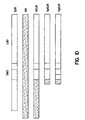
- the ecdysone ligand binding domain is positioned at the carboxy terminus of the modified receptor (see Figure 1D ).
- DNA-binding domains contemplated for use in the preparation of modified ecdysone receptors of the present disclosure are typically obtained from DNA-binding proteins (e.g., transcription factors).
- DNA-binding domain is understood in the art to refer to an amino acid sequence that is able to bind to DNA.
- DNA-binding domain encompasses a minimal peptide sequence of a DNA-binding protein, up to the entire length of a DNA-binding protein, so long as the DNA-binding domain functions to associate with a particular response element.
- DNA-binding domains are known to function heterologously in combination with other functional protein domains by maintaining the ability to bind the natural DNA recognition sequence (see, e.g., Brent and Ptashne, 1985, Cell, 43:729-736 ).
- hormone receptors are known to have interchangeable DNA-binding domains that function in chimeric proteins (see, e.g., U.S. Patent 4,981,784 ; and Evans, R., 1988, Science, 240:889-895 ).
- the DNA-binding domain can be positioned at either the carboxy terminus or the amino terminus, or the DNA-binding domain can be positioned between the ligand binding domain and the activation domain.
- the DNA-binding domain is positioned internally between the ligand binding domain and the activation domain.
- DNA-binding protein(s) contemplated for use herein belong to the well-known class of proteins that are able to directly bind DNA and facilitate initiation or repression of transcription.
- Exemplary DNA-binding proteins contemplated for use herein include transcription control proteins (e.g., transcription factors and the like; Conaway and Conaway, 1994, “Transcription Mechanisms and Regulation", Raven Press Series on Molecular and Cellular Biology, Vol. 3, Raven Press, Ltd., New York, NY ).
- Transcription factors contemplated for use herein as a source of such DNA binding domains include, e.g., homeobox proteins, zinc finger proteins, hormone receptors, helix-turn-helix proteins, helix-loop-helix proteins, basic-Zip proteins (bzip), ⁇ -ribbon factors, and the like. See, for example, Harrison, s., "A Structural Taxonomy of DNA-binding Domains," Nature, 353:715-719 .
- Homeobox DNA-binding proteins suitable for use herein include, for example, HOX, STF-1 ( Leonard et al., 1993, Mol. Endo., 7:1275-1283 ), Antp, Mat ⁇ -2, INV, and the like.
- the DNA-binding domain used herein is obtained from a member of the steroid/thyroid superfamily of receptors.
- the phrase "member(s) of the steroid/thyroid hormone superfamily of receptors” refers to hormone binding proteins that operate as ligand-dependent transcription factors, including identified members of the steroid/thyroid superfamily of receptors for which specific ligands have not yet been identified (referred to hereinafter as "orphan receptors").
- Exemplary members of the steroid/thyroid superfamily of receptors include steroid receptors such as glucocorticoid receptor (GR), mineralocorticoid receptor (MR), estrogen receptor (ER), progesterone receptor (PR), androgen receptor (AR), vitamin D 3 receptor (VDR), and the like; plus retinoid receptors, such as the various isoforms of retinoic acid receptor (e.g., RAR ⁇ , RAR ⁇ , or RAR ⁇ ), the various isoforms of retinoid X receptor (e.g., RXR ⁇ , RXR ⁇ , or RXR ⁇ ), and the like (see, e.g., U.S.
- retinoid receptors such as the various isoforms of retinoic acid receptor (e.g., RAR ⁇ , RAR ⁇ , or RAR ⁇ ), the various isoforms of retinoid X receptor (e.g., RXR ⁇ , RXR ⁇ , or RXR ⁇ ), and the like
- TR thyroid receptors
- TR ⁇ such as TR ⁇ , TR ⁇ , and the like
- insect derived receptors such as the ecdysone receptor, and the like
- other gene products which, by their structure and properties, are considered to be members of the superfamily, as defined hereinabove, including the various isoforms thereof.
- orphan receptors contemplated for use herein as a source of DNA binding domain include HNF4 [see, for example, Sladek et al., in Genes & Development 4: 2353-2365 (1990 )], the COUP family of receptors (see, for example, Miyajima et al., in Nucleic Acids Research 16: 11057-11074 (1988 ), and Wang et al., in Nature 340: 163-166 (1989 )], COUP-like receptors and COUP homologs, such as those described by Mlodzik et al., in Cell 60: 211-224 (1990 ) and Ladias et al., in Science 251: 561-565 (1991 ), various isoforms of peroxisome proliferator-activated receptors (PPARs; see, for example, Issemann and Green, supra ), the insect derived knirps and knirps-related receptors, and the like.
- DNA-binding domains of all members of the steroid/thyroid superfamily of receptors are related, consisting of 66-68 amino acid residues, and possessing about 20 invariant amino acid residues, including nine cysteines.
- a member of the superfamily can be characterized as a protein which contains these 20 invariant amino acid residues.
- the highly conserved amino acids of the DNA-binding domain of members of the superfamily are as follows: wherein X designates non-conserved amino acids within the DNA-binding domain; an asterisk denotes the amino acid residues which are almost universally conserved, but for which variations have been found in some identified hormone receptors; and the residues enclosed in parenthesis are optional residues (thus, the DNA-binding domain is a minimum of 66 amino acids in length, but can contain several additional residues).
- Modification of existing DNA-binding domains to recognize new target recognition sequences is also contemplated herein.
- the modification of the "P-box" sequence of DNA-binding domains of members of the steroid/thyroid superfamily of receptors offers unique advantages not present in other chimeric hormone receptors.
- the modification of a P-box amino acid sequence to preferentially bind to a different hormone response element half-site than the naturally occurring P-box amino acid sequence can reduce undesired background levels of gene expression.
- disclosed receptors and methods provide the advantage of increasing the selectivity of exogenous gene expression in a particular subject.
- P-box amino acid sequence refers to the proximal element region in a DNA-binding domain of a hormone receptor that typically occurs at the junction of the first zinc finger and the linker region, e.g., at about amino acids 19-23 of the DNA-binding domain (i.e., amino acids 19-23 of SEQ ID NO:1; see, e.g., Umesono et al. (1989), Cell. 57:1139-1146 , Figure 2 ). Umesono et al. (1989), supra, in Table 1, describe various naturally occurring P-box amino acid sequences for a variety of hormone receptor DNA-binding domains.
- the P-box sequence of a hormone receptor DNA-binding domain is modified to have a P-box amino acid sequence that differs from the naturally occurring P-box amino acid sequence.
- the modified P-box amino acid sequence differs from the naturally occurring P-box amino acid sequence by 3 amino acids.
- the P-box amino acid sequence is modified so that only the half-site nucleotide sequence recognized by the DNA-binding domain is changed while not altering the spacing between the two half-sites recognized by the DNA-binding domain.
- the P-box can be modified from the amino acid sequence EGCKG (SEQ ID NO:2; which recognizes the half-site -AGGTCA-) to the amino acid sequence GSCKV (SEQ ID NO:3; which recognizes the half-site seqeunce -AGAACA-).
- the DNA-binding domain of modified ecdysone receptor of the present disclosure is derived from ecdysone receptor
- the P-box amino acid sequence is modified to GSCKV (SEQ ID NO:3).
- Activation domains contemplated for use in the preparation of modified ecdysone receptor are typically derived from transcription factors and comprise a contiguous sequence of amino acids that functions to activate gene expression when associated with a suitable DNA-binding domain and a suitable ligand binding domain.
- the activation domain can be positioned at the carboxy terminus, the amino terminus or between the ligand binding domain and the DNA binding domain.
- the activation domain is positioned at the amino terminus of the modified ecdysone receptor.
- Suitable activation domains can be obtained from a variety of sources, e.g., from the N-terminal region of a member of the steroid/thyroid superfamily of receptors, from a transcription factor activation domain, such as, for example, VP16 or GAL4 activation domains, and the like.
- a transcription factor activation domain such as, for example, VP16 or GAL4 activation domains, and the like.
- the presently most preferred activation domain contemplated for use is obtained from the N-terminal region of the VP16 protein.
- modified ecdysone receptors contemplated for use herein are VgEcR (SEQ ID NO:5), VpEcR (SEQ ID NO:7) or GEcR (SEQ ID NO:9), with VgEcR (SEQ ID NO:5) being especially preferred.
- VgEcR SEQ ID NO:5
- VpEcR SEQ ID NO:7
- GEcR SEQ ID NO:9
- the preparation of these modified ecdysone receptors is set forth hereinafter in Example 1.
- Modified ecdysone receptor proteins of the present disclosure can be produced by expressing nucleic acid constructs encoding the chimeric proteins in suitable host cells as described in Example 1. Recombinant methods of producing desired proteins by introducing an expression construct into appropriate host cells are well-known in the art. Modified ecdysone receptors of the present disclosure can be introduced into a particular subject by direct introduction of the proteins themselves, by introducing DNA construct(s) encoding the receptor into the subject, or into cells obtained from the subject (wherein the cells are transformed and subsequently returned to the subject).
- modified ecdysone receptors are expressed under the control of a tissue specific promoter.
- tissue specific refers to the substantially exclusive initiation of transcription in the tissue from which a particular promoter drives expression of a given gene.
- modified ecdysone receptors are present in the form of heterodimeric species comprising an modified ecdysone receptor and at least one silent partner of the steroid/thyroid superfamily of receptors.
- the silent partner is a mammalian-derived receptor, with RXR being especially preferred.
- Silent partners contemplated herein are members of the steroid/thyroid superfamily of receptors which are capable of forming heterodimeric species with the modified ecdysone receptor of the present disclosure, wherein the silent partner does not directly participate in binding ligand (i.e., only the modified ecdysone receptor co-partner of the heterodimer binds ligand).
- the silent partner can either be endogenous to the cells of the subject or can be provided to the subject by introducing DNA construct(s) encoding receptor into the subject.
- a preferred silent partner for use herein is RXR.
- exogenous RXR is provided to said mammalian subject.
- heterodimeric receptor(s) can modulate the ability of member(s) of the steroid/thyroid superfamily of receptors to trans-activate transcription of genes maintained under expression control in the presence of ligand for said receptor.
- formation of a heterodimer of the modified ecdysone receptor with another mammalian hormone receptor promotes the ability of the modified ecdysone receptor to induce trans-activation activity in the presence of an ecdysone response element.
- modified ecdysone receptors are present in the form of homodimeric species comprising a plurality (i.e., at least two) disclosed modified ecdysone receptors.
- Ligands contemplated for use herein are compounds which, inside a cell, bind to disclosed modified ecdysone receptors, thereby creating a ligand/receptor complex, which in turn can bind to an appropriate response element.
- the terms "ecdysone” and “ecdysteroid” as interchangeably used herein, are employed herein in the generic sense (in accordance with common usage in the art), referring to a family of ligands with the appropriate binding and transactivation activity (see, for example, Cherbas et al., in Biosynthesis. metabolism and mode of action of invertebrate hormones (ed. J. Hoffmann and M. Porchet), p. 305-322; Springer-Verlag, Berl in).
- An ecdysone therefore, is a compound which acts to modulate gene transcription for a gene maintained under the control of an ecdysone response element.
- 20-Hydroxy-ecdysone (also known as ⁇ -ecdysone) is the major naturally occurring ecdysone. Unsubstituted ecdysone (also known as ⁇ -ecdysone) is converted in peripheral tissues to ⁇ -ecdysone. Analogs of the naturally occurring ecdysones are also contemplated within the scope of the present invention. Examples of such analogs, commonly referred to as ecdysteroids, include ponasterone A, 26-iodoponasterone A, muristerone A, inokosterohe, 26-mesylinokosterone, and the like.
- Ligands contemplated for use in the practice of the present invention are characterized as not normally being present in the cells of the subject, meaning that the ligand is exogenous to the subject. Ecdysteroids, for example, are not naturally present in mammalian systems. Thus, in accordance with the invention method, unless and until an ecdysteroid is administered to the subject, substantially no expression of the desired gene occurs.
- ligand i.e., ecdysteroid
- Ligand can be administered in a variety of ways, as are well-known in the art. For example, such ligands can be administered topically, orally, intravenously, intraperitoneally, intravascularly, and the like.
- Ecdysone response elements contemplated for use in the present disclosure include native, as well as modified ecdysone response elements. Since modified ecdysone receptors of the present disclosure can function as either homodimers or as heterodimers (with a silent partner therefor), any response element that is responsive to a modified ecdysone receptor of the present disclosure, in the form of a homodimer or heterodimer, is contemplated for use in the methods described herein.
- modified ecdysone response elements are engineered so as to no longer be capable of binding to a farnesoid hormone receptor (since the mammalian farnesoid hormone receptor is able to bind to native ecdysone receptor response element).
- Disclosed modified ecdysone response elements provide low background expression levels of the exogenous gene and increase the selectivity of the gene expression system when used in mammalian systems.
- Ecdysone response elements contemplated for use herein are short cis-acting sequences (i.e., having about 12-20 bp) that are required for activation of transcription in response to a suitable ligand, such as ecdysone or muristerone A, associated with a particular hormone receptor.
- a suitable ligand such as ecdysone or muristerone A
- the association of these response elements with otherwise ecdysone-nonresponsive regulatory sequences causes such regulatory sequences to become ecdysone responsive.
- Ecdysone response element sequences function in a position- and orientation-independent fashion.
- Modified ecdysone response elements comprise two half-sites (in either direct repeat or inverted repeat orientation to one another), separated by a spacer of 0-5 nucleotides.
- half-site refers to a contiguous 6 nucleotide sequence that is bound by a particular member of the steroid/thyroid superfamily of receptors. Each half-site is typically separated by a spacer of 0 up to about 5 nucleotides. Typically, two half-sites with a corresponding spacer make up a hormone response element. Hormone response elements can be incorporated in multiple copies into various transcription regulatory regions.
- Preferred modified ecdysone response elements comprise, in any order, a first half-site and a second half-site separated by a spacer of 0-5 nucleotides; wherein the first and second half-sites are inverted with respect to each other; wherein said first half-site has the sequence: -RGBNNM-, (or complements thereof) wherein each R is independently selected from A or G; each B is independently selected from G, C, or T; each N is independently selected from A, T, C, or G; and each M is independently selected from A or C; with the proviso that at least 4 nucleotides of each -RGBNNM- group of nucleotides are identical with the nucleotides at comparable positions of the sequence -AGGTCA-; and said second half-site is obtained from a glucocorticoid receptor subfamily response element.
- Exemplary first half-sites having the -RGBNNM- motif for use in the invention modified ecdysone response element include, for example, half-sites selected from -AGGGCA-, -AGTTCA-, -AGGTAA-, -AGGTCA-, -GGTTCA-, -GGGTTA-, -GGGTGA-, -AGGTGA-, or -GGGTCA-.
- a particularly preferred first half-site is -AGTGCA-.
- Glucocorticoid receptor subfamily response elements contemplated for use in the present disclosure are response elements having half-sites that are typically bound by glucocorticoid, mineralocorticoid, progesterone or androgen receptors.
- Suitable half-sites from glucocorticoid receptor subfamily response elements can be selected from the following sequence (in either orientation): -RGNNCA- (or complements thereof such as -YCNNGT-), wherein R, Y and N are as defined above.
- Exemplary half-sites having the -RGNNCA- motif for use in the invention modified ecdysone response element include -AGAACA-, -GGAACA-, -AGTTCA-, -AGGTCA-, -GGAACA-, -GGTTCA-, -GGGTCA-, -GGGTCA-, -AGGTGA-, -GGGTCA-, and the like, as well as complements thereof.
- Particularly preferred half-sites having the -RGNNCA- motif include -AGAACA- and -GGAACA-, with -AGAACA- being especially preferred.
- the second half-site is inverted with respect to the first half-site.
- the first half-site is obtained from an ecdysone response element and the second half-site is obtained from a hormone response element selected from a glucocorticoid response element, a mineralocorticoid response element, a progesterone response element or an androgen response element.
- the first half-site is obtained from an ecdysone response element and the second half-site is obtained from a glucocorticoid response element.
- the first half-site is AGTGCA and said second half-site is TGTTCT.
- the presently most preferred modified-ecdysone response element for use in the invention methods is: AGTGCA-N-TGTTCT (SEQ ID NO:12).
- modified ecdysone response elements are characterized as having substantially no constitutive activity, which refers to the substantial absence of background levels of gene expression initiated by invention modified ecdysone response elements when introduced into mammalian expression systems. Since it has been found that mammalian farnesoid hormone receptors are able to bind to and transactivate gene expression from native ecdysone response elements, in certain aspects of the present disclosure (e.g., where it is desired to avoid farnesoid-mediated background expression), modified ecdysone response elements are employed.
- modified ecdysone response elements are further characterized as having substantially no binding affinity for farnesoid X receptor (FXR), i.e., response elements are incapable of binding FXR (which would thereby create undesired background levels of expression).
- FXR farnesoid X receptor
- presently preferred modified ecdysone response elements preferably induce basal levels of expression of substantially zero.
- promoter refers to a specific nucleotide sequence recognized by RNA polymerase, the enzyme that initiates RNA synthesis. This sequence is the site at which transcription can be specifically initiated under proper conditions.
- Inducible promoters contemplated for use in the practice of the present disclosure are transcription regulatory regions that do not function to transcribe mRNA unless inducing conditions are present.
- suitable inducible promoters include DNA sequences corresponding to: the E. coli lac operator responsive to IPTG (see Nakamura et al., Cell, 18:1109-1117, 1979 ); the metallothionein promoter metal-regulatory-elements responsive to heavy-metal (e.g. zinc) induction (see Evans et. al, U.S. Patent No. 4,870,009 ), the phage T71ac promoter responsive to IPTG (see Studier et al., Meth. Enzymol., 185: 60-89, 1990 ; and U.S. #4,952,496), the heat-shock promoter, and the like.
- Recombinant products detrimental to a host organism contemplated for expression in accordance with the present invention include any gene product that functions to confer a toxic effect on the organism.
- inducible expression of a toxin such as the diptheroid toxin would allow for inducible tissue specific ablation ( Ross et al. (1993) Genes and Development 7, 1318-1324 ).
- the numerous gene products that are known to induce apoptosis in cells expressing such products are contemplated for use herein (see, e.g, Apoptosis, The Molecular Basis of Cell Death, Current Communications In Cell & Molecular Biology, Cold Spring Harbor Laboratory Press, 1991 ).
- Suitable media contemplated for use in the practice of the present invention include any growth and/or maintenance media, in the substantial absence of ligand(s) which, in combination with an invention modified ecdysone receptor, is(are) capable of binding to an ecdysone response element.
- nucleic acids encoding invention modified ecdysone receptors there are provided nucleic acids encoding invention modified ecdysone receptors.
- invention nucleic acids can be incorporated into various expression vectors known to those of skill in the art.
- Preferred nucleic acids encoding modified ecdysone receptors are set forth in SEQ ID NOs:4, 6 and 8, with SEQ ID NO:4 being especially preferred.
- gene transfer vectors useful for the introduction of invention constructs into suitable host cells.
- Such gene transfer vectors comprise a transcription regulatory region having a minimal promoter (i.e., a promoter region that does not have an enhancer), and an invention modified ecdysone response element, wherein said regulatory region is operatively associated with DNA containing an exogenous gene, and wherein said modified ecdysone response element is present in multiple copies.
- the number of copies of response elements can readily be varied by those of skill in the art.
- transcription regulatory regions can contain from 1 up to about 50 copies of a particular response element, preferably 2 up to about 25 copies, more preferably 3 up to about 10-15 copies, with about 4-6 copies being especially preferred.
- Gene transfer vectors contemplated for use herein are recombinant nucleic acid molecules that are used to transport exogenous nucleic acid into cells for expression and/or replication thereof.
- Expression vectors may be either circular or linear, and are capable of incorporating a variety of nucleic acid constructs therein.
- Expression vectors typically come in the form of a plasmid that, upon introduction into an appropriate host cell, results in expression of the inserted DNA.
- transcription regulatory region refers to the region of a gene or expression construct that controls the initiation of mRNA transcription. Regulatory regions contemplated for use herein typically comprise at least a minimal promoter in combination with an ecdysone response element.
- a minimal promoter when combined with an enhancer region (e.g., a hormone response element), functions to initiate mRNA transcription in response to a ligand/receptor complex. However, transcription will not occur unless the required inducer (ligand) is present.
- operatively associated with refers to the functional relationship of DNA with regulatory and effector sequences of nucleotides, such as promoters, enhancers, transcriptional and translational stop sites, and other signal sequences.
- operative linkage of DNA to a promoter refers to the physical and functional relationship between the DNA and promoter such that the transcription of such DNA is initiated from the promoter by an RNA polymerase that specifically recognizes, binds to and transcribes the DNA.
- the transcription regulatory region further comprises a binding site for an ubiquitous transcription factor.
- a binding site is preferably positioned between the promoter and modified ecdysone response element of the invention.
- Suitable ubiquitous transcription factors for use herein are well-known in the art and include, for example, Sp1.
- Expression vectors suitable for use in the practice of the present invention are well known to those of skill in the art and include those that are replicable in eukaryotic cells and/or prokaryotic cells as well as those that remain episomal and those that integrate into the host cell genome. Expression vectors typically further contain other functionally important nucleic acid sequences, such as expression constructs encoding antibiotic resistance proteins, and the like.
- Exemplary eukaryotic expression vectors include eukaryotic constructs, such as the pSV-2 gpt system ( Mulligan et al., Nature, 1979, 277:108-114 ); pBlueSkript (Stratagene, La Jolla, CA), the expression cloning vector described by Genetics Institute ( Science, 1985, 228:810-815 ), and the like. Each of these plasmid vectors are capable of promoting expression of the invention chimeric protein of interest.
- Promoters may be constitutively or inducibly regulated, or may be tissue-specific (e.g., expressed only in T-cells, endothelial cels, smooth muscle cells, and the like).
- Exemplary promoters contemplated for use in the practice of the present invention include the SV40 early promoter, the cytomegalovirus (CMV) promoter, the mouse mammary tumor virus (MMTV) steroid-inducible promoter, Moloney murine leukemia virus (MMLV) promoter, elongation factor 1 ⁇ (EF1 ⁇ ) promoter, albumin promoter, APO A1 promoter, cyclic AMP dependent kinase II (CaMKII) promoter, keratin promoter, CD3 promoter, immunoglobulin light or heavy chain promoters, neurofiliment promoter, neuron specific enolase promoter, L7 promoter, CD2 promoter, myosin light chain kinase promoter, HOX gene promote
- transducing Suitable means for introducing (transducing) expression vectors containing invention nucleic acid constructs into host cells to produce transduced recombinant cells (i.e., cells containing recombinant heterologous nucleic acid) are well-known in the art (see, for review, Friedmann, 1989, Science, 244:1275-1281 ; Mulligan, 1993, Science, 260:926-932 , each of which are incorporated herein by reference in their entirety).
- Exemplary methods of transduction include, e.g., infection employing viral vectors (see, e.g., U.S. Patent 4,405,712 and 4,650,764 ), calcium phosphate transfection ( U.S.
- heterologous nucleic acid can optionally include sequences which allow for its extrachromosomal (i.e., episomal) maintenance, or the heterologous nucleic acid can be donor nucleic acid that integrates into the genome of the host.
- said gene transfer vector is a viral vector, preferably a retroviral vector.
- Retroviral vectors are gene transfer plasmids that have an expression construct encoding an heterologous gene residing between two retroviral LTRs.
- Retroviral vectors typically contain appropriate packaging signals that enable the retroviral vector, or RNA transcribed using the retroviral vector as a template, to be packaged into a viral virion in an appropriate packaging cell line (see, e.g., U.S. Patent 4,650,764 ).
- retroviral vectors for use herein are described, for example, in U.S. Patents 5,399,346 and 5,252,479 ; and in WIPO publications WO 92/07573 , WO 90/06997 , WO 89/05345 , WO 92/05266 and WO 92/14829 , incorporated herein by reference, which provide a description of methods for efficiently introducing nucleic acids into human cells using such retroviral vectors.
- retroviral vectors include, for example, mouse mammary tumor virus vectors (e.g., Shackleford et al., 1988, PNAS, USA, 85:9655-9659 ), and the like.
- helper cells which produce retroviral vector particles which are essentially free of replicating virus. See, for example, U.S. Patent 4,650,764 ; Miller, Human Gene Therapy, 1:5-14 (1990 ); Markowitz, et al., Journal of Virology, 61(4):1120-1124 (1988 ) ; Watanabe, et al., Molecular and Cellular Biology, 3(12):2241-2249 (1983 ); Danos, et al., Proc. Natl. Acad.
- Recombinant retroviruses suitable for carrying out the invention methods are produced employing well-known methods for producing retroviral virions. See, for example, U.S. Patent 4,650,764 ; Miller, Human Gene_Therapy, 1:5-14 (1990 ); Markowitz, et al., Journal of Virology, 61(4):1120-1124 (1988 ); Watanabe, et al., Molecular and Cellular Biology, 3(12):2241-2249 (1983 ); Danos, et al., Proc. Natl. Acad. Sci., 85:6460-6464 (1988 ); and Bosselman, et al., Molecular and Cellular Biology, 7(5):1797-1806 (1987 ).
- recombinant cells containing a nucleic acid encoding an invention modified ecdysone receptor e.g., CV-1 cells, P19 cells and NT2/D1 cells (which are derived from human embryo carcinomas), COS cells, mouse L cells, Chinese hamster ovary (CHO) cells, primary human fibroblast cells, human embryonic kidney cells, African green monkey cells, HEK 293 (ATCC accession #CRL 1573; U.S. Patent No.
- Ltk - cells ATCC accession #CCL1.3
- COS-7 cells ATCC under accession #CRL 1651
- DG44 cells dhfr - CHO cells; see, e.g., Urlaub et al. (1986) Cell. Molec. Genet. 12: 555 ), cultured primary tissues, cultured tumor cells, and the like.
- Presently preferred cells include CV-1 and 293 cells.
- transgenic mammal containing a nucleic acid encoding an inveniton modified ecdysone receptor.
- transgenic mammal refers to a mammal that contains one or more inheritable expression constructs containing a recombinant modified ecdysone receptor transgene and/or an exogenous gene under the transcription control of an invention modified ecdysone response element.
- an invention transgenic mammal also contains one or more inheritable expression constructs containing a member of the steroid/thyroid superfamily of receptors that functions as a silent partner for modified ecdysone receptor (e.g., RXR).
- transgenic mammals using a particular nucleic acid construct are well-known in the art.
- the first line will express, for example, RXR and a modified EcR (e.g., VpEcR). Tissue specificity is conferred by the selection of tissue-specific promoters (e.g., T-cell specific) that will then direct the expression of the receptors.
- a second line contains an ecdysone responsive promoter controlling the expression of an exogenous cDNA.
- an invention transgenic mammal contains one or more expression constructs containing nucleic acid encoding a modified ecdysone receptor, exogenous RXR, and an exogenous gene under the transcription control of an invention modified ecdysone response element. It has been found that in transgenic mice containing an ecdysone inducible promoter (i.e., an invention modified ecdysone response element) and expressing a modified ecdysone receptor and RXR, muristerone treatment can activate gene expression. Thus, with tissue specific expression of the modified ecdysone receptor and RXR and timely hormone treatment, inducible gene expression can be achieved with spatial, dosage, and temporal specificity.
- the modified ecdysone receptor forms a homodimer, or optionally a heterodimer in the presence of a silent partner of the steroid/thyroid hormone superfamily of receptors, and functions to activate transcription from an expression vector having a response element responsive to the particular homodimer or heterodimer formed.
- methods for the induction of two different genes in a mammalian subject comprising: activating a first exogenous gene employing the invention ecdysone inducible system; and activating a second gene using a tetracycline inducible system.
- the invention method for inducing two different genes is particularly advantagous because it permits the temporal, spatial, and dosage specific control of two exogenous genes.
- the tetracycline inducible system is well-known in the art (see, e.g, Gossen et al. (1992) Proc. Natl. Acad. Sci. 89, 5547-5551 ; Gossen et al.(1993) TIBS 18, 471-475 ; Furth et al. (1994) Proc. Natl. Acad. Sci. 91, 9302-9306 ; and Shockett et al. (1995) Proc. Natl. Acad. Sci. 92, 6522-6526 ).
- CMX-EcR CMX-USP
- CMX-FXR CMX-hRXRa
- EcREx5- ⁇ MTV-Luc CMX-GEcR
- MMTV-luc CMX-GR
- CMX-VpEcR The plasmid CMX-VpEcR was constructed by ligation of an EcoRI fragment of psk-EcR and CMX-Vp16.
- CMX-VgEcR The plasmid CMX-VgEcR was generated by site-directed mutagenesis of CMX-VpEcR using the Transformer Mutagenesis Kit (Clontech) and the mutagenic Oligonucleotide (SEQ ID NO:14): 5'-TACAACGCCCTCACCTGTGGATCCTGCAAGGTGTTTCTTTCGACGCAGC-3'.
- VpEcR VgEcR altered the P-box region of the DNA binding domain of ecdysone receptor to resemble that of GR ( Umesono and Evans, Cell 57:1139-1146 (1989 )).
- the reporter construct EcREx4- ⁇ HSP-ß-gal was constructed by oligomerizing two annealed oligonucleotides containing the HSP-EcRE ( Yao, et al., Nature 366:476-479 (1993 )).
- EcREx4-Sp1x3- ⁇ HSP-ßgal was constructed by ligating the following annealed oligonucleotides into the Asp718 site of EcREx4-HSP-ß-gal (SEQ ID NO:15):
- a BglII/(XhoI) fragment containing EcREx4-Sp1x3- ⁇ HSP-ß-gal was subcloned into BglII/(NotI) digested pRC-CMV (Invitrogen, San Diego, CA), which contains a neomycin resistance gene.
- CV-1 cells were maintained in DMEM supplemented with 10% Fetal Bovine Serum.
- Transient transfections were performed using DOTAP transfection reagent (Boehringer-Mannheim).
- Transfections using ß-galactosidase as the reporter were assayed either by Galactolight luminescent assay (Tropix, Bedford, MA) or by standard liquid ONPG assay (Sigma, St. Louis, MO). The values were normalized by co-transfection of CMX-luciferase.
- Transfections using luciferase as the reporter were assayed by standard techniques using luciferin and ATP. These values were normalized by co-transfection of CMX-ß-galactosidase.
- Hormone treated cells were treated with ethanol, 50 ⁇ M Juvenile Hormone III (Sigma), 1 ⁇ M muristerone A (Zambon, Bresso, IT), or 1 ⁇ M dexamethasone (Sigma) unless otherwise noted.
- ecdysone receptor modifications of the ecdysone receptor were made.
- the N-terminal transactivation domain of the ecdysone receptor was replaced by the corresponding domain of the glucocorticoid receptor (GR), resulting in the modified ecdysone receptor GEcR (See Figure 1D ).
- CV-1 cells were transfected with the plasmid CMX-GEcR encoding the modified ecdysone receptor as discussed above. After transfection, cells were either treated with ethanol or 1 ⁇ M muristerone A. This hybrid modified ecdysone receptor boosted muristerone responsiveness from 3- to 11-fold in a transient transfection assay ( Fig.
- the reporter vector was also modified by inserting consensus binding sites for the ubiquitous transcription factor Sp1 between the minimal promoter and the ecdysone response elements ( Kamine et al., Proc. Natl. Acad. Sci. 88:8510-8514 (1991 ) and Strahle te al., EMBO 7:3389-3395 (1988 )).
- the addition of Sp1 sites to the ecdysone responsive promoter increases the absolute activity 5-fold ( Fig. 1A ).
- FXR farnesoid X receptor
- VpEcR DNA binding specificity of VpEcR was altered to mimic that of GR, which binds as a homodimer to an inverted repeat of the sequence AGAACA, spaced by three nucleotides. This altered binding specificity was achieved by mutating three amino acid residues of VpEcR in the P-box of the DNA binding domain, a region previously shown to be essential for DNA sequence recognition ( Umesono and Evans, Cell 57:1139-1146 (1989 )).
- This new hybrid modified ecdysone receptor is referred herein as VgEcR and is responsive to a new hybrid respone element referred to herein as the E/GRE (SEQ ID NO:12), which contains two different half-site motifs, RGBNNM and RGNNCA, spaced by one nucleotide ( Fig. 1B ).
- This new response element is a hybrid between the glucocorticoid response element (GRE) and that of type II nuclear receptors like RXR, EcR, retinoic acid receptor (RAR), thyroid hormone receptor (T3R), etc.
- FXR can activate a promoter containing the wild type ecdysone response element, it cannot activate one containing the E/GRE ( Fig 1B ; note log scale).
- the E/GRE reporter is not activated by GR nor does VgEcR activate a dexamethasone responsive promoter ( Fig 1C ).
- Stable cell lines were generated containing the modified ecdysone receptor VpEcR, a heterodimeric partner (RXR), and an ecdysone inducible reporter ( Figure 2 ).
- 293 cells were transfected with the following linearized plasmids, pRC-ESHß, EcREx5- ⁇ MTV-Luc, CMX-VpEcR, and CMX-hRXRa. The following day, the cells were split 1:10 and were allowed to recover one day prior to selection with 1mg/ml G418 (GIBCO). After 14 days of selection, 14 individual clones were isolated and grown separately in the presence of 0.5mg/ml G418. Of 14 G418 resistant clones, 10 demonstrated differing degrees of muristerone responsiveness.
- N13 One of these cell lines, N13, was grown in the presence or absence of 1 ⁇ M muristerone for 20 hours. Cell lysates were then assayed for ß-galactosidase and luciferase activities as described in Example 1. X-gal staining was performed on the stable cell lines. Cells were fixed briefly with 10% formaldehyde in PBS and then stained with X-Gal (Molecular Probes, Eugene, OR) for 2 to 6 hours. After 24 hours of treatment with 1 ⁇ M muristerone, 100% of the cells turned dark blue after 3 hours of staining.
- X-Gal Molecular Probes, Eugene, OR
- mammalian cells containing the modified ecdysone receptor VpEcR, a heterodimeric partner (RXR), and a reporter gene construct regulated by a modified ecdysone response element function to efficiently express an exogenous gene in response to a ligand, e.g., ecdysone.
- a dose-response assay was conducted by growing N13 cells with varying concentrations of muristerone for 36 hours and then assaying for ß-galactosidase activity (using the well-known ONPG assay), or the cells were assayed for luciferase activity.
- Dose response curves of stably integrated ß-galactosidase and luciferase reporters in N13 cells revealed that inducibility approaching 3 orders of magnitude can be achieved at a final concentration 10 ⁇ M muristerone ( Figure 3A ).
- One-hundred fold induction was achieved by muristerone concentrations as low as 100nM ( Figure 3A ).
- N13 cells were grown in separate wells in the presence of 1 ⁇ M muristerone, harvested at varying times, and assayed for luciferase activity. Inductions of 100-fold in 3 hrs., 1000 fold in 8 hrs., and maximal effects of 20,000 fold after 20 hours of treatment were observed ( Figure 3B ). Similar results were observed in stable lines containing CMX-VgEcR and the E/GRE reporters.
- muristerone In order to use muristerone as a potential hormone in mice, its toxicity and bioavailability was examined. For toxicity studies, adult mice were injected intraperitonealy with 20mg of muristerone A suspended in sesame oil. The mice were then observed for approximately two months. For teratogenic studies, pregnant mice were injected with 20mg of muristerone A suspended in sesame oil and both the mother and pups were observed for three months. The results indicate that muristerone maintains its activity when injected into mice, and that it is neither toxic, teratogenic, nor inactivated by serum binding proteins. In addition to the inert qualities of muristerone (an ecdysone), overexpression of VpEcR and RXR appears not to be toxic.
- mice For muristerone bioavailability studies, adult mice were injected intraperitoneally with sesame oil with or without 10mg of muristerone, and were subsequently sacrificed for serum collection. After twelve hours, blood was drawn from the mice, and the serum was isolated by brief centrifugation of the whole blood. In order to conduct transfection assays to test for muristerone activity, serum from sesame oil injected mice was divided, and half was supplemented with muristerone to a final concentration of 10 ⁇ M. The three batches of mouse serum were diluted 1:10 in DMEM and placed onto CV-1 cells transfected with CMX-GEcR, CMX-hRXRa, and EcREx5-DMTV-Luc.
- transgenic mice To produce transgenic mice, the following DNA constructs were prepared and subsequently injected into fertilized eggs: CD3-VpEcR, CD3-RXR, ESHß ( Lee et al., J. Exp. Med. 175:1013-1025 (1992 )).
- Two separate lines of transgenic mice were generated harboring either an ecdysone inducible reporter, ESHß, or a T-cell specific expression construct of VpEcR and RXR, respectively.
- the former are referred to as reporter mice, the latter are referred to as receptor mice, and double transgenic mice are referred to as receptor/reporter mice.
- Constructs CD3-VpEcR and CD3-RXR were mixed and coinjected, while ESHß was injected alone.
- Receptor expressing mice were bred with reporter mice (containing ESHß) to produce double transgenic receptor/reporter mice.
- a Northern blot analysis was performed on the double transgenic lines using RNA isolated 48 hours after treatment from various tissues including the thymus, brain and liver, to test for the specific induction of an ecdysone inducible promoter.
- the probe used was specific to the activity of the ecdysone inducible promoter.
- the autoradiograph was exposed for 36 hrs.
- the results of the Northern analysis indicate that muristerone treatment of the transgenic mouse containing a T-cell specific expression construct of VpEcR and RXR, and the ecdysone inducible reporter ESHß, caused a significant induction from an ecdysone inducible promoter in the thymus, while low basal activity is observed in its absence.
Landscapes
- Health & Medical Sciences (AREA)
- Life Sciences & Earth Sciences (AREA)
- Chemical & Material Sciences (AREA)
- Genetics & Genomics (AREA)
- Organic Chemistry (AREA)
- Zoology (AREA)
- Engineering & Computer Science (AREA)
- General Health & Medical Sciences (AREA)
- Biotechnology (AREA)
- Wood Science & Technology (AREA)
- Bioinformatics & Cheminformatics (AREA)
- General Engineering & Computer Science (AREA)
- Environmental Sciences (AREA)
- Biomedical Technology (AREA)
- Biochemistry (AREA)
- Molecular Biology (AREA)
- Biophysics (AREA)
- Animal Husbandry (AREA)
- Biodiversity & Conservation Biology (AREA)
- Toxicology (AREA)
- Medicinal Chemistry (AREA)
- Immunology (AREA)
- Proteomics, Peptides & Aminoacids (AREA)
- Cell Biology (AREA)
- Physics & Mathematics (AREA)
- Endocrinology (AREA)
- Gastroenterology & Hepatology (AREA)
- Plant Pathology (AREA)
- Animal Behavior & Ethology (AREA)
- Microbiology (AREA)
- Veterinary Medicine (AREA)
- Micro-Organisms Or Cultivation Processes Thereof (AREA)
- Peptides Or Proteins (AREA)
- Medicines That Contain Protein Lipid Enzymes And Other Medicines (AREA)
Claims (13)
- In vitro-Verfahren zur Modulation der Expression eines exogenen Gens in einer isolierten Zelle, umfassend:(i) den modifizierten Ecdyson-Rezeptor VgEcR mit der Aminosäuresequenz, die in SEQ ID NO: 5 dargestellt ist; und(ii) ein DNA-Konstrukt, umfassend das genannte exogene Gen unter der Kontrolle eines modifizierten Ecdyson-Response-Elements, wobei das genannte modifizierte Response-Element E/GRE mit der Nukleotidsequenz ist, die in SEQ ID NO: 12 dargestellt ist;
wobei das genannte Verfahren Bereitstellen einer wirksamen Menge eines oder mehrerer Ecdysteroide für die Zelle umfasst. - Rekombinante Zelle, umfassend:(i) den modifizierten Ecdyson-Rezeptor VgEcR mit der Aminosäuresequenz, die in SEQ ID NO: 5 dargestellt ist; und(ii) ein DNA-Konstrukt, umfassend das genannte exogene Gen unter der Kontrolle eines modifizierten Ecdyson-Response-Elements, wobei das genannte modifizierte Response-Element E/GRE mit der Nukleotidsequenz ist, die in SEQ ID NO: 12 dargestellt ist.
- Expressionssystem zur Modulation der Expression eines exogenen Gens in einer isolierten Zelle, umfassend(i) den modifizierten Ecdyson-Rezeptor VgEcR mit der Aminosäuresequenz, die in SEQ ID NO: 5 dargestellt ist; und(ii) ein DNA-Konstrukt, umfassend das genannte exogene Gen unter der Kontrolle eines modifizierten Ecdyson-Response-Elements, wobei das genannte modifizierte Response-Element E/GRE mit der Nukleotidsequenz ist, die in SEQ ID NO: 12 dargestellt ist;
- Modifizierter Ecdyson-Rezeptor VgEcR mit der Aminosäuresequenz, die in SEQ ID NO: 5 dargestellt ist.
- Nukleinsäure, die den Ecdyson-Rezeptor gemäß Anspruch 4 kodiert.
- Modifiziertes Ecdyson-Rezeptor-Response-Element E/GRE mit der Nukleotidsequenz, die in SEQ ID NO: 12 dargestellt ist.
- Gentransfervektor, umfassend einen Transkriptionsregulierenden Bereich mit einem minimalen Promotor und ein modifiziertes Ecdyson-Response-Element gemäß Anspruch 6, wobei der genannte regulatorische Bereich operativ mit DNA, die ein exogenes Gen enthält, verbunden ist und wobei das genannte modifizierte Ecdyson-Response-Element in 1 bis zu etwa 6 Kopien vorliegt.
- Vektor gemäß Anspruch 7, wobei der genannte regulatorische Bereich ferner eine Bindungsstelle für einen ubiquitären Transkriptionsfaktor enthält.
- Vektor gemäß Anspruch 8, wobei die genannte Bindungsstelle zwischen dem genannten Promotor und dem genannten synthetischen Ecdyson-Response-Element positioniert ist.
- Vektor gemäß Anspruch 9, wobei der genannte ubiquitäre Transkriptionsfaktor Sp1 ist.
- Vektor gemäß Anspruch 7, wobei der genannte Promotor gewebespezifisch ist.
- In vitro-Verfahren zur Expression eines rekombinanten Produkts, das für den Wirtsorganismus schädlich ist, wobei das genannte Verfahren umfasst:Transformieren geeigneter Wirtszellen mit:(i) einem DNA-Konstrukt, das das genannte rekombinante Produkt unter der Kontrolle des modifizierten Ecdyson-Response-Elements E/GRE mit der Nukleotidsequenz, die in SEQ ID NO: 12 dargestellt ist; kodiert und(ii) DNA, die den modifizierten Ecdyson-Rezeptor VgEcR mit der Aminosäuresequenz, die in SEQ ID NO: 5 dargestellt ist, kodiert;Züchten der genannten Wirtszellen in geeigneten Medien; undInduzieren der Expression des genannten rekombinanten Produkts durch Einführen eines Ecdysteroids in die genannten Wirtszellen.
- Verwendung einer wirksamen Menge eines Liganden für den modifizierten Ecdyson-Rezeptor VgEcR mit der Aminosäuresequenz, die in SEQ ID NO: 5 dargestellt ist, wobei der genannte Ligand ein Ecdysteroid ist, zur Herstellung eines Medikaments zur Modulation der Expression eines exogenen Gens bei einem Säugetier, umfassend:(i) ein DNA-Konstrukt, umfassend das genannte exogene Gen unter der Kontrolle des modifizierten Ecdyson-Response-Elements E/GRE mit der Nukleotidsequenz, die in SEQ ID NO: 12 dargestellt ist; und(ii) den modifizierten Ecdyson-Rezeptor VgEcR mit der Aminosäuresequenz, die in SEQ ID NO: 5 dargestellt ist.
Applications Claiming Priority (3)
| Application Number | Priority Date | Filing Date | Title |
|---|---|---|---|
| US62883096A | 1996-04-05 | 1996-04-05 | |
| US628830 | 1996-04-05 | ||
| PCT/US1997/005330 WO1997038117A1 (en) | 1996-04-05 | 1997-03-27 | Hormone-mediated methods for modulating expression of exogenous genes in mammalian systems, and products related thereto |
Publications (2)
| Publication Number | Publication Date |
|---|---|
| EP0910652A1 EP0910652A1 (de) | 1999-04-28 |
| EP0910652B1 true EP0910652B1 (de) | 2014-10-08 |
Family
ID=24520484
Family Applications (1)
| Application Number | Title | Priority Date | Filing Date |
|---|---|---|---|
| EP97917146.9A Expired - Lifetime EP0910652B1 (de) | 1996-04-05 | 1997-03-27 | Hormon-vermittelte methoden zur beeinflussung der expression exogener gene in säugetiersystemen und damit verbundene produkte |
Country Status (7)
| Country | Link |
|---|---|
| EP (1) | EP0910652B1 (de) |
| JP (1) | JP2000508895A (de) |
| CN (1) | CN1215432A (de) |
| AU (1) | AU734051B2 (de) |
| CA (1) | CA2251466A1 (de) |
| IL (1) | IL126418A0 (de) |
| WO (1) | WO1997038117A1 (de) |
Families Citing this family (64)
| Publication number | Priority date | Publication date | Assignee | Title |
|---|---|---|---|---|
| BR9611032A (pt) | 1995-10-10 | 1999-07-06 | Novartis Ag | Hormônio juvenil ou um de seus agonistas como um ligante químico para controle de expressão de gente em plantas por transativação de receptor mediato |
| AUPP135698A0 (en) | 1998-01-15 | 1998-02-05 | Commonwealth Scientific And Industrial Research Organisation | Insectical modalities |
| US6342596B1 (en) | 1998-05-05 | 2002-01-29 | Hsf Pharmaceuticals S.A. | Molecular regulatory circuits to achieve sustained activation of genes of interest by a single stress |
| US6333318B1 (en) * | 1998-05-14 | 2001-12-25 | The Salk Institute For Biological Studies | Formulations useful for modulating expression of exogenous genes in mammalian systems, and products related thereto |
| US6258603B1 (en) * | 1998-06-17 | 2001-07-10 | Rohm And Haas Company | Ligands for modulating the expression of exogenous genes via an ecdysone receptor complex |
| FR2782732A1 (fr) * | 1998-08-28 | 2000-03-03 | Transgene Sa | Systeme d'expression inductible |
| US6117639A (en) | 1998-08-31 | 2000-09-12 | Vertex Pharmaceuticals Incorporated | Fusion proteins, DNA molecules, vectors, and host cells useful for measuring protease activity |
| AU3642601A (en) * | 1999-11-05 | 2001-05-30 | Avigen, Inc. | Ecdysone-inducible adeno-associated virus expression vectors |
| AU2046801A (en) * | 1999-11-23 | 2001-06-04 | Mayo Foundation For Medical Education And Research | Gene expression by positive feedback activation of a cell type-specific promoter |
| WO2001062780A1 (en) * | 2000-02-24 | 2001-08-30 | The Salk Institute For Biological Studies | Gene expression system based on chimeric receptors |
| US20040033600A1 (en) | 2001-03-21 | 2004-02-19 | Palli Subba Reddy | Ecdysone receptor-based inducible gene expression system |
| WO2001070816A2 (en) * | 2000-03-22 | 2001-09-27 | Rohm And Haas Company | Ecdysone receptor-based inducible gene expression system |
| US7514239B2 (en) | 2000-03-28 | 2009-04-07 | Amgen Inc. | Nucleic acid molecules encoding beta-like glycoprotein hormone polypeptides and heterodimers thereof |
| US7964713B2 (en) | 2000-06-28 | 2011-06-21 | Amgen Inc. | Nucleic acid molecules encoding thymic stromal lympopoietin receptor proteins and a process for producing the encoded polypeptides thereof |
| US8105825B2 (en) | 2000-10-03 | 2012-01-31 | Intrexon Corporation | Multiple inducible gene regulation system |
| EP1356066A2 (de) | 2000-10-24 | 2003-10-29 | Syngenta Participations AG | Kontrolle der pflanzengenexpression |
| EP1534738B1 (de) | 2001-02-20 | 2012-06-20 | Intrexon Corporation | Neue substitutionsmutantenrezeptoren und ihre verwendung in einem induzierbaren genexpressionsystem auf grundlage eines nukleären rezeptors |
| ES2385598T3 (es) | 2001-02-20 | 2012-07-27 | Intrexon Corporation | Sistema novedoso de expresión génica inducible basado en el receptor de ecdisona/receptor X retinoide de invertebrado |
| CA2438119C (en) | 2001-02-20 | 2014-12-16 | Rheogene Holdings, Inc. | Chimeric retinoid x receptors and their use in a novel ecdysone receptor-based inducible gene expression system |
| AU2002306550B2 (en) | 2001-02-20 | 2007-10-25 | Intrexon Corporation | Novel substitution mutant receptors and their use in a nuclear receptor-based inducible gene expression system |
| CA2344208A1 (en) | 2001-04-30 | 2002-10-30 | Oxford Biomedica (Uk) Limited | Method |
| EP1490686A2 (de) | 2001-09-26 | 2004-12-29 | RheoGene Holdings Inc. | Weisse-fliege-ecdyson-rezeptor-nukleinsäuren, -polypeptide und ihre verwendungen |
| JP2005532781A (ja) | 2001-09-26 | 2005-11-04 | レオジーン・ホールディングス,インコーポレーテッド | ヨコバイエクジソン受容体核酸、ポリペプチド、およびそれらの使用 |
| US7662924B2 (en) | 2002-02-22 | 2010-02-16 | The Board Of Trustees Of The University Of Illinois | Beta chain-associated regulator of apoptosis |
| AU2003216407A1 (en) * | 2002-02-25 | 2003-09-09 | University Of Rochester | Dna construct for inducible expression of angiogenic protein and use thereof |
| US7375093B2 (en) | 2002-07-05 | 2008-05-20 | Intrexon Corporation | Ketone ligands for modulating the expression of exogenous genes via an ecdysone receptor complex |
| US7304161B2 (en) | 2003-02-10 | 2007-12-04 | Intrexon Corporation | Diaclhydrazine ligands for modulating the expression of exogenous genes in mammalian systems via an ecdysone receptor complex |
| US7456315B2 (en) | 2003-02-28 | 2008-11-25 | Intrexon Corporation | Bioavailable diacylhydrazine ligands for modulating the expression of exogenous genes via an ecdysone receptor complex |
| US20050164210A1 (en) * | 2004-01-23 | 2005-07-28 | Vivek Mittal | Regulated polymerase III expression systems and related methods |
| US7935510B2 (en) | 2004-04-30 | 2011-05-03 | Intrexon Corporation | Mutant receptors and their use in a nuclear receptor-based inducible gene expression system |
| CN101016518B (zh) * | 2006-09-12 | 2010-07-28 | 南方医科大学 | 一种生物杀虫剂筛选模型及其制备方法和应用 |
| MX363066B (es) | 2007-05-29 | 2019-03-07 | Intrexon Corp | Ligandos quirales de diacilhidrazina para modular la expresion de genes exogenos por medio de un complejo receptor de ecdisona. |
| US8852928B2 (en) | 2007-07-06 | 2014-10-07 | Temasek Life Sciences Laboratory Limited | LexA-based chemical-inducible gene expression system for use in transgenic animals |
| MX2010002777A (es) | 2007-09-17 | 2010-05-21 | Rohm & Haas | Composiciones y metodos para modificacion de respuestas fisiologicas en plantas. |
| US20090136465A1 (en) * | 2007-09-28 | 2009-05-28 | Intrexon Corporation | Therapeutic Gene-Switch Constructs and Bioreactors for the Expression of Biotherapeutic Molecules, and Uses Thereof |
| WO2009114201A2 (en) | 2008-03-14 | 2009-09-17 | Intrexon Corporation | Steroidal ligands and their use in gene switch modulation |
| ES2337973B8 (es) | 2008-05-16 | 2011-07-21 | Proyecto De Biomedicina Cima, S.L. | Adenovirus auxiliares auto-inactivantes para la produccion de adenovirus recombinantes de alta capacidad. |
| ES2330826B1 (es) | 2008-06-04 | 2010-07-26 | Proyecto De Biomedicina Cima, S.L. | Sistema para empaquetamiento de adenovirus de alta capacidad. |
| CA2752697A1 (en) | 2009-03-05 | 2010-09-10 | Rohm And Haas Company | Control of targeted turnover of key ethylene hormone signaling pathway proteins to modulate ethylene sensitivity in plants |
| WO2010114143A1 (ja) * | 2009-03-30 | 2010-10-07 | 国立大学法人岡山大学 | 特異的プロモーターの活性を上昇させるシステム及び該システムを保持したベクター |
| EP2407534A1 (de) | 2010-07-14 | 2012-01-18 | Neo Virnatech, S.L. | Verfahren und Reagenzien zum Erhalt von transkriptionell aktiven virusähnlichen Artikeln und rekombinante Virionen |
| ES2562274T3 (es) | 2010-10-06 | 2016-03-03 | Fundació Institut De Recerca Biomèdica (Irb Barcelona) | Procedimiento para el diagnóstico, pronóstico y tratamiento de metástasis de cáncer de mama |
| WO2013145331A1 (ja) * | 2012-03-27 | 2013-10-03 | 株式会社トランスジェニック | ヒト化マウス |
| EP2650682A1 (de) | 2012-04-09 | 2013-10-16 | Fundació Privada Institut de Recerca Biomèdica | Asymmetrische Ester von als Schmiermittel geeigneten Fettsäuren |
| EP3467124A1 (de) | 2012-06-06 | 2019-04-10 | Fundació Institut de Recerca Biomèdica IRB (Barcelona) | Verfahren zur diagnose, prognose und behandlung von lungenkrebsmetastasen |
| EP2687852A1 (de) | 2012-07-17 | 2014-01-22 | Laboratorios Del. Dr. Esteve, S.A. | Verfahren zur Diagnose und Behandlung des chronischen Erschöpfungssyndroms |
| CA2888122A1 (en) | 2012-10-12 | 2014-04-17 | Inbiomotion S.L. | Method for the diagnosis, prognosis and treatment of prostate cancer metastasis using c-maf |
| US20160032399A1 (en) | 2013-03-15 | 2016-02-04 | Inbiomotion S.L. | Method for the Prognosis and Treatment of Renal Cell Carcinoma Metastasis |
| US20160032400A1 (en) | 2013-03-15 | 2016-02-04 | Fundació Institut De Recerca Biomèdica (Irb Barcelona) | Method for the prognosis and treatment of cancer metastasis |
| KR20150122786A (ko) | 2013-03-15 | 2015-11-02 | 펀다시오 인스티튜트 드 르세르카 바이오메디카 (아이알비 바르셀로나) | 암 전이의 진단, 예후 및 치료를 위한 방법 |
| ES2683329T3 (es) | 2013-03-15 | 2018-09-26 | Intrexon Corporation | Diacilhidrazinas que contienen boro |
| ES2523016B1 (es) | 2013-05-20 | 2015-09-09 | 3P Biopharmaceuticals | Vectores alfavirales y líneas celulares para la producción de proteínas recombinantes |
| EP3524698A1 (de) | 2013-10-09 | 2019-08-14 | Fundació Institut de Recerca Biomèdica IRB (Barcelona) | Verfahren zur prognose und behandlung von krebsmetastasen |
| EP3089755A1 (de) | 2014-01-03 | 2016-11-09 | Fundacion Biofisica Bizkaia | Vlps, verfahren zu deren gewinnung und anwendungen davon |
| EP3194359B1 (de) | 2014-09-17 | 2020-04-08 | Intrexon Corporation | Borhaltige diacylhydrazinverbindungen |
| GB201619876D0 (en) * | 2016-11-24 | 2017-01-11 | Cambridge Entpr Ltd | Controllable transcription |
| CA3049652A1 (en) | 2017-01-10 | 2018-07-19 | Intrexon Corporation | Modulating expression of polypeptides via new gene switch expression systems |
| EP3635132A4 (de) | 2017-06-07 | 2021-05-26 | Intrexon Corporation | Expression von neuartigen zellmarkern |
| SG11202008539YA (en) | 2018-03-06 | 2020-10-29 | Precigen Inc | Human papillomavirus vaccines and uses of the same |
| IL277128B2 (en) | 2018-03-06 | 2025-11-01 | Precigen Inc | Hepatitis b vaccines and uses of the same |
| CA3105816A1 (en) | 2018-07-10 | 2020-01-16 | Precigen, Inc. | Ror-1 specific chimeric antigen receptors and uses thereof |
| KR20210031898A (ko) | 2018-07-13 | 2021-03-23 | 난징 레전드 바이오테크 씨오., 엘티디. | 전염병을 치료하기 위한 공동수용체 시스템 |
| CN113613664B (zh) | 2019-03-01 | 2025-11-18 | 阿奇洛伊斯生物制药公司 | 在抗原特异性免疫细胞中调节cd160功能的方法及其用途 |
| EP4371569A1 (de) | 2022-11-16 | 2024-05-22 | Universidad del País Vasco/Euskal Herriko Unibertsitatea | Vlps gegen akute myeloische leukämie |
Family Cites Families (4)
| Publication number | Priority date | Publication date | Assignee | Title |
|---|---|---|---|---|
| US6492137B1 (en) * | 1989-11-16 | 2002-12-10 | The Salk Institute For Biological Studies | Response element compositions and assays employing same |
| ATE220421T1 (de) * | 1990-02-26 | 2002-07-15 | Univ Leland Stanford Junior | Identifizierung und expression von insekten- steroidrezeptor-dns-sequenzen |
| ATE173295T1 (de) * | 1991-08-08 | 1998-11-15 | Genentech Inc | Ecdysteroid-abhängige gen regulierung in säugetier-zellen |
| WO1994001558A2 (en) * | 1992-07-02 | 1994-01-20 | The Salk Institute For Biological Studies | Multimeric forms of members of the steroid/thyroid superfamily of receptors with the ultraspiracle receptor |
-
1997
- 1997-03-27 EP EP97917146.9A patent/EP0910652B1/de not_active Expired - Lifetime
- 1997-03-27 JP JP9536281A patent/JP2000508895A/ja active Pending
- 1997-03-27 CA CA002251466A patent/CA2251466A1/en not_active Abandoned
- 1997-03-27 AU AU25572/97A patent/AU734051B2/en not_active Ceased
- 1997-03-27 IL IL12641897A patent/IL126418A0/xx unknown
- 1997-03-27 CN CN97193597.1A patent/CN1215432A/zh active Pending
- 1997-03-27 WO PCT/US1997/005330 patent/WO1997038117A1/en not_active Ceased
Non-Patent Citations (1)
| Title |
|---|
| TAN NGUAN SOON ET AL: "MOLECULAR CLONING AND SEQUENCING OF THE HORMONE-BINDING DOMAIN OF OREOCHROMIS AUREUS ESTROGEN RECEPTOR GENE", DNA SEQUENCE, NEW YORK, NY, US, vol. 5, no. 6, 1 January 1995 (1995-01-01), pages 359 - 370, XP009073331, ISSN: 1042-5179 * |
Also Published As
| Publication number | Publication date |
|---|---|
| CA2251466A1 (en) | 1997-10-16 |
| IL126418A0 (en) | 1999-05-09 |
| CN1215432A (zh) | 1999-04-28 |
| EP0910652A1 (de) | 1999-04-28 |
| AU2557297A (en) | 1997-10-29 |
| JP2000508895A (ja) | 2000-07-18 |
| WO1997038117A1 (en) | 1997-10-16 |
| AU734051B2 (en) | 2001-05-31 |
Similar Documents
| Publication | Publication Date | Title |
|---|---|---|
| AU734051B2 (en) | Hormone-mediated methods for modulating expression of exogenous genes in mammalian systems, and products related thereto | |
| US6723531B2 (en) | Method for modulating expression of exogenous genes in mammalian systems, and products related thereto | |
| US6333318B1 (en) | Formulations useful for modulating expression of exogenous genes in mammalian systems, and products related thereto | |
| US6265173B1 (en) | Methods of modulating the expression of genes using ultraspiracle receptor | |
| No et al. | Ecdysone-inducible gene expression in mammalian cells and transgenic mice. | |
| CA2296093A1 (en) | Modified lepidopteran receptors and hybrid multifunctional proteins for use in regulation of transgene expression | |
| US7057015B1 (en) | Hormone receptor functional dimers and methods of their use | |
| US5919667A (en) | Modular assembly retroviral vectors and uses thereof | |
| EP0999271A2 (de) | Retinoid-rezeptor-Zusammensetzungen und Verfahren | |
| US6875569B2 (en) | Modified lepidopteran receptors and hybrid multifunctional proteins for use in transcription and regulation of transgene expression | |
| EP1259537A1 (de) | Genexpressionssystem basierend auf chimären rezeptoren | |
| US7119077B1 (en) | Multimeric forms of members of the steroid/thyroid superfamily of receptors with the ultraspiracle receptor | |
| AU4769793A (en) | Multimeric forms of members of the steroid/thyroid superfamily of receptors with the ultraspiracle receptor | |
| US20030109678A1 (en) | Methods and means for regulation of gene expression | |
| WO1997048277A1 (en) | Modular assembly retroviral vectors and uses thereof | |
| WO1997048277A9 (en) | Modular assembly retroviral vectors and uses thereof | |
| US20040102367A1 (en) | Gene expression system based on chimeric receptors | |
| US20040235169A1 (en) | Inducible expression of transfected genes | |
| No | Ecdysone-inducible gene transcription in mammalian cells and transgenic mice |
Legal Events
| Date | Code | Title | Description |
|---|---|---|---|
| PUAI | Public reference made under article 153(3) epc to a published international application that has entered the european phase |
Free format text: ORIGINAL CODE: 0009012 |
|
| 17P | Request for examination filed |
Effective date: 19981012 |
|
| AK | Designated contracting states |
Kind code of ref document: A1 Designated state(s): AT BE CH DE DK ES FI FR GB GR IE IT LI LU MC NL PT SE |
|
| 17Q | First examination report despatched |
Effective date: 20030210 |
|
| 17Q | First examination report despatched |
Effective date: 20030210 |
|
| GRAP | Despatch of communication of intention to grant a patent |
Free format text: ORIGINAL CODE: EPIDOSNIGR1 |
|
| INTG | Intention to grant announced |
Effective date: 20130705 |
|
| INTG | Intention to grant announced |
Effective date: 20130712 |
|
| GRAP | Despatch of communication of intention to grant a patent |
Free format text: ORIGINAL CODE: EPIDOSNIGR1 |
|
| INTG | Intention to grant announced |
Effective date: 20131210 |
|
| GRAJ | Information related to disapproval of communication of intention to grant by the applicant or resumption of examination proceedings by the epo deleted |
Free format text: ORIGINAL CODE: EPIDOSDIGR1 |
|
| GRAP | Despatch of communication of intention to grant a patent |
Free format text: ORIGINAL CODE: EPIDOSNIGR1 |
|
| INTG | Intention to grant announced |
Effective date: 20140226 |
|
| GRAS | Grant fee paid |
Free format text: ORIGINAL CODE: EPIDOSNIGR3 |
|
| GRAA | (expected) grant |
Free format text: ORIGINAL CODE: 0009210 |
|
| AK | Designated contracting states |
Kind code of ref document: B1 Designated state(s): AT BE CH DE DK ES FI FR GB GR IE IT LI LU MC NL PT SE |
|
| REG | Reference to a national code |
Ref country code: GB Ref legal event code: FG4D |
|
| REG | Reference to a national code |
Ref country code: AT Ref legal event code: REF Ref document number: 690636 Country of ref document: AT Kind code of ref document: T Effective date: 20141015 Ref country code: CH Ref legal event code: NV Representative=s name: NOVAGRAAF INTERNATIONAL SA, CH Ref country code: CH Ref legal event code: EP |
|
| REG | Reference to a national code |
Ref country code: IE Ref legal event code: FG4D |
|
| REG | Reference to a national code |
Ref country code: DE Ref legal event code: R096 Ref document number: 69740743 Country of ref document: DE Effective date: 20141120 |
|
| REG | Reference to a national code |
Ref country code: NL Ref legal event code: VDEP Effective date: 20141008 |
|
| REG | Reference to a national code |
Ref country code: AT Ref legal event code: MK05 Ref document number: 690636 Country of ref document: AT Kind code of ref document: T Effective date: 20141008 |
|
| PG25 | Lapsed in a contracting state [announced via postgrant information from national office to epo] |
Ref country code: NL Free format text: LAPSE BECAUSE OF FAILURE TO SUBMIT A TRANSLATION OF THE DESCRIPTION OR TO PAY THE FEE WITHIN THE PRESCRIBED TIME-LIMIT Effective date: 20141008 |
|
| PG25 | Lapsed in a contracting state [announced via postgrant information from national office to epo] |
Ref country code: FI Free format text: LAPSE BECAUSE OF FAILURE TO SUBMIT A TRANSLATION OF THE DESCRIPTION OR TO PAY THE FEE WITHIN THE PRESCRIBED TIME-LIMIT Effective date: 20141008 Ref country code: ES Free format text: LAPSE BECAUSE OF FAILURE TO SUBMIT A TRANSLATION OF THE DESCRIPTION OR TO PAY THE FEE WITHIN THE PRESCRIBED TIME-LIMIT Effective date: 20141008 Ref country code: PT Free format text: LAPSE BECAUSE OF FAILURE TO SUBMIT A TRANSLATION OF THE DESCRIPTION OR TO PAY THE FEE WITHIN THE PRESCRIBED TIME-LIMIT Effective date: 20150209 |
|
| PG25 | Lapsed in a contracting state [announced via postgrant information from national office to epo] |
Ref country code: SE Free format text: LAPSE BECAUSE OF FAILURE TO SUBMIT A TRANSLATION OF THE DESCRIPTION OR TO PAY THE FEE WITHIN THE PRESCRIBED TIME-LIMIT Effective date: 20141008 Ref country code: AT Free format text: LAPSE BECAUSE OF FAILURE TO SUBMIT A TRANSLATION OF THE DESCRIPTION OR TO PAY THE FEE WITHIN THE PRESCRIBED TIME-LIMIT Effective date: 20141008 Ref country code: GR Free format text: LAPSE BECAUSE OF FAILURE TO SUBMIT A TRANSLATION OF THE DESCRIPTION OR TO PAY THE FEE WITHIN THE PRESCRIBED TIME-LIMIT Effective date: 20150109 |
|
| REG | Reference to a national code |
Ref country code: DE Ref legal event code: R097 Ref document number: 69740743 Country of ref document: DE |
|
| PG25 | Lapsed in a contracting state [announced via postgrant information from national office to epo] |
Ref country code: DK Free format text: LAPSE BECAUSE OF FAILURE TO SUBMIT A TRANSLATION OF THE DESCRIPTION OR TO PAY THE FEE WITHIN THE PRESCRIBED TIME-LIMIT Effective date: 20141008 |
|
| PLBE | No opposition filed within time limit |
Free format text: ORIGINAL CODE: 0009261 |
|
| STAA | Information on the status of an ep patent application or granted ep patent |
Free format text: STATUS: NO OPPOSITION FILED WITHIN TIME LIMIT |
|
| PG25 | Lapsed in a contracting state [announced via postgrant information from national office to epo] |
Ref country code: IT Free format text: LAPSE BECAUSE OF FAILURE TO SUBMIT A TRANSLATION OF THE DESCRIPTION OR TO PAY THE FEE WITHIN THE PRESCRIBED TIME-LIMIT Effective date: 20141008 |
|
| 26N | No opposition filed |
Effective date: 20150709 |
|
| PG25 | Lapsed in a contracting state [announced via postgrant information from national office to epo] |
Ref country code: LU Free format text: LAPSE BECAUSE OF FAILURE TO SUBMIT A TRANSLATION OF THE DESCRIPTION OR TO PAY THE FEE WITHIN THE PRESCRIBED TIME-LIMIT Effective date: 20150327 Ref country code: MC Free format text: LAPSE BECAUSE OF FAILURE TO SUBMIT A TRANSLATION OF THE DESCRIPTION OR TO PAY THE FEE WITHIN THE PRESCRIBED TIME-LIMIT Effective date: 20141008 |
|
| REG | Reference to a national code |
Ref country code: IE Ref legal event code: MM4A |
|
| PG25 | Lapsed in a contracting state [announced via postgrant information from national office to epo] |
Ref country code: IE Free format text: LAPSE BECAUSE OF NON-PAYMENT OF DUE FEES Effective date: 20150327 |
|
| REG | Reference to a national code |
Ref country code: FR Ref legal event code: PLFP Year of fee payment: 20 |
|
| PGFP | Annual fee paid to national office [announced via postgrant information from national office to epo] |
Ref country code: DE Payment date: 20160322 Year of fee payment: 20 Ref country code: CH Payment date: 20160311 Year of fee payment: 20 |
|
| PGFP | Annual fee paid to national office [announced via postgrant information from national office to epo] |
Ref country code: GB Payment date: 20160323 Year of fee payment: 20 Ref country code: FR Payment date: 20160208 Year of fee payment: 20 |
|
| REG | Reference to a national code |
Ref country code: DE Ref legal event code: R071 Ref document number: 69740743 Country of ref document: DE |
|
| REG | Reference to a national code |
Ref country code: CH Ref legal event code: PL |
|
| REG | Reference to a national code |
Ref country code: GB Ref legal event code: PE20 Expiry date: 20170326 |
|
| PG25 | Lapsed in a contracting state [announced via postgrant information from national office to epo] |
Ref country code: GB Free format text: LAPSE BECAUSE OF EXPIRATION OF PROTECTION Effective date: 20170326 |
|
| PG25 | Lapsed in a contracting state [announced via postgrant information from national office to epo] |
Ref country code: BE Free format text: LAPSE BECAUSE OF FAILURE TO SUBMIT A TRANSLATION OF THE DESCRIPTION OR TO PAY THE FEE WITHIN THE PRESCRIBED TIME-LIMIT Effective date: 20141008 |