EP0908024B1 - Paketvermittelte spreizspektrumanordnung - Google Patents
Paketvermittelte spreizspektrumanordnung Download PDFInfo
- Publication number
- EP0908024B1 EP0908024B1 EP97937202A EP97937202A EP0908024B1 EP 0908024 B1 EP0908024 B1 EP 0908024B1 EP 97937202 A EP97937202 A EP 97937202A EP 97937202 A EP97937202 A EP 97937202A EP 0908024 B1 EP0908024 B1 EP 0908024B1
- Authority
- EP
- European Patent Office
- Prior art keywords
- spread
- chip
- data
- spectrum
- sequence
- Prior art date
- Legal status (The legal status is an assumption and is not a legal conclusion. Google has not performed a legal analysis and makes no representation as to the accuracy of the status listed.)
- Expired - Lifetime
Links
- 238000001228 spectrum Methods 0.000 title claims description 181
- 238000012545 processing Methods 0.000 claims description 46
- 238000000034 method Methods 0.000 claims description 37
- 238000001514 detection method Methods 0.000 claims description 19
- 230000004044 response Effects 0.000 claims description 16
- 238000004891 communication Methods 0.000 claims description 12
- 108091006146 Channels Proteins 0.000 claims 31
- 230000008569 process Effects 0.000 description 5
- 238000013461 design Methods 0.000 description 4
- 230000011664 signaling Effects 0.000 description 4
- 238000013478 data encryption standard Methods 0.000 description 3
- 230000007480 spreading Effects 0.000 description 3
- 230000005540 biological transmission Effects 0.000 description 2
- 230000015556 catabolic process Effects 0.000 description 2
- 238000006731 degradation reaction Methods 0.000 description 2
- 230000006870 function Effects 0.000 description 2
- 238000012986 modification Methods 0.000 description 2
- 230000004048 modification Effects 0.000 description 2
- 230000003044 adaptive effect Effects 0.000 description 1
- 238000012937 correction Methods 0.000 description 1
- 238000010586 diagram Methods 0.000 description 1
- 238000005516 engineering process Methods 0.000 description 1
- 238000005562 fading Methods 0.000 description 1
- 230000036039 immunity Effects 0.000 description 1
- 238000010561 standard procedure Methods 0.000 description 1
- 230000001960 triggered effect Effects 0.000 description 1
Images

Classifications
-
- H—ELECTRICITY
- H04—ELECTRIC COMMUNICATION TECHNIQUE
- H04B—TRANSMISSION
- H04B1/00—Details of transmission systems, not covered by a single one of groups H04B3/00 - H04B13/00; Details of transmission systems not characterised by the medium used for transmission
- H04B1/69—Spread spectrum techniques
- H04B1/707—Spread spectrum techniques using direct sequence modulation
-
- H—ELECTRICITY
- H04—ELECTRIC COMMUNICATION TECHNIQUE
- H04B—TRANSMISSION
- H04B1/00—Details of transmission systems, not covered by a single one of groups H04B3/00 - H04B13/00; Details of transmission systems not characterised by the medium used for transmission
- H04B1/69—Spread spectrum techniques
- H04B1/707—Spread spectrum techniques using direct sequence modulation
- H04B1/709—Correlator structure
- H04B1/7093—Matched filter type
-
- H—ELECTRICITY
- H04—ELECTRIC COMMUNICATION TECHNIQUE
- H04J—MULTIPLEX COMMUNICATION
- H04J13/00—Code division multiplex systems
-
- H—ELECTRICITY
- H04—ELECTRIC COMMUNICATION TECHNIQUE
- H04J—MULTIPLEX COMMUNICATION
- H04J13/00—Code division multiplex systems
- H04J13/0007—Code type
- H04J13/0022—PN, e.g. Kronecker
-
- H—ELECTRICITY
- H04—ELECTRIC COMMUNICATION TECHNIQUE
- H04J—MULTIPLEX COMMUNICATION
- H04J13/00—Code division multiplex systems
- H04J13/10—Code generation
Definitions
- This invention relates to a packet-switched system, as might be used in an ethernet system, and more particularly to using multiple spread-spectrum channels to achieve a high processing gain and maintain a high capacity channel.
- spread-spectrum communications systems have a limited capacity for communicating information over a single channel.
- T1 network and T3 network by way of example, and assume a spread-spectrum transmitter spread-spectrum processes the message data at a rate of 25 megachips per second.
- a typical processing gain of 17 might be realized.
- T3 network which can have data rates of 10 megabits per second, a processing gain of 2.5 might be realized.
- the low processing gains can result in channel degradation and loss of the advantages of spread-spectrum modulation such as resistance to fading caused by multipath and ability to share the spectrum with other spread-spectrum systems.
- U.S. patent no. 5,166,951 entitled, HIGH CAPACITY SPREAD SPECTRUM CHANNEL, by D. L. Schilling.
- data at a transmitter are demultiplexed into a plurality of sub-data-sequence signals, each sub-data-sequence signal is spread-spectrum processed into a spread-spectrum signal, and a plurality of spread-spectrum signals are combined and sent over a communications channel.
- the received signal is despread into the plurality of sub-data-sequence signals, and the plurality of sub-data-sequence signals multiplexed as the data.
- the '951 patent does not teach how all transmitters and receivers can use identical chip-sequence signals, yet maintain network integrity.
- a general object of the invention is a packet-switched system having high processing gain and high capacity.
- Another object of the invention is a packet-switched system having sufficient processing gain using orthogonal chipping sequences.
- An additional object of the invention is a packet-switched system having fast acquisition and synchronization, and low cost.
- a packet-switched system comprising a plurality of packet transmitters that communicate with a plurality of packet receivers using radio waves.
- Each of the packet transmitters includes a transmitter-first-in-first-out (transmitter-FIFO) memory, an encoder, a demultiplexer, chip-sequence means, a plurality of product devices, a combiner, a header device, and a transmitter subsystem.
- Each packet receiver includes a translating device, a header-matched filter, a processor, a plurality of data-matched filters, a multiplexer, a decoder, and a receiver-first-in-first-out (receiver-FIFO) memory.
- the transmitter-FIFO memory stores data from a data input.
- the encoder encodes the data from the transmitter-FIFO memory as encoded data.
- Encoder for encoding data from the transmitter-FIFO memory is meant privacy type of encoding, such as scrambling or encrypting the data.
- encoded data as used herein is meant to include scrambled data or encrypted data.
- the demultiplexer demultiplexes the encoded data into a plurality of sub-data-sequence signals. A respective sub-data-sequence signal is outputted from a respective output of the demultiplexer.
- sub-data-sequence signal is a demultiplexed part of the encoded data.
- the chip-sequence means outputs a plurality of chip-sequence signals, and the plurality of product devices, or exclusive-OR gates, multiplies each of the sub-data-sequence signals by a respective chip-sequence signal.
- Each of the chip-sequence signals is orthogonal or has low correlation to the other chip-sequence signals in the plurality of chip-sequence signals.
- At the output of the plurality of product devices is a plurality of spread-spectrum channels.
- the combiner algebraically combines the plurality of spread-spectrum channels as a multichannel-spread-spectrum signal.
- the header device adds, i.e., concatenates, the multichannel-spread-spectrum signal to a header.
- the header device outputs a packet-spread-spectrum signal.
- the header later provides chip-sequence synchronization at the receiver.
- the transmitter subsystem amplifies and transmits at a carrier frequency the packet-spread-spectrum signal using radio waves over a communications channel.
- a packet-spread-spectrum signal is a spread-spectrum signal transmitted by one or more packet transmitters, and arriving at the input of one or more packet receivers.
- the packet-spread-spectrum signal has the header concatenated with the multichannel-spread-spectrum signal. Timing for the present invention may be triggered from the header as part of the packet-spread-spectrum signal. For the case of the packet-spread-spectrum signal, each packet has the header followed in time by the multichannel-spread-spectrum signal.
- the header and multichannel-spread-spectrum signal are sent as the packet-spread-spectrum signal, and the timing for the multichannel-spread-spectrum signal, and thus the data, in the packet-spread-spectrum signal is keyed from the header.
- the data in the multichannel-spread-spectrum signal may contain information such as digitized voice, signalling, adaptive power control (APC), cyclic-redundancy-check (CRC) code, etc.
- the header is generated from spread-spectrum processing a header-symbol-sequence signal with a chip-sequence signal.
- the multichannel-spread-spectrum signal part of the packet-spread-spectrum signal is generated from spread-spectrum processing a plurality of sub-data-sequence signals with the plurality of chip-sequence signals, respectively.
- the chip-sequence signal used for the header and data is common to all users.
- the use of a common chip-sequence signal achieves low cost, since circuitry for changing chip-sequence signals is not required.
- the translating device translates the packet-spread-spectrum signal from the carrier frequency to a processing frequency.
- the processing frequency may be at a radio frequency (RF), intermediate frequency (IF) or at baseband frequency.
- the processing frequency is a design choice, and any of the frequency ranges may be used by the invention.
- the header-matched filter detects the header in the packet-spread-spectrum signal. In response to detecting the header, the header-matched filter outputs a header-detection signal.
- the processor in response to the header-detection signal, generates control and timing signals.
- the plurality of data-matched filters despreads the multichannel-spread-spectrum signal embedded in the packet-spread-spectrum signal, as a plurality of received spread-spectrum channels.
- the multiplexer multiplexes the plurality of received spread-spectrum channels as received-encoded data.
- the decoder decodes the received-encoded data as received data.
- the receiver-FIFO memory stores the received data and outputs the received data to a data output. In an error-free environment, the received data are identical to the data input to the transmitter.
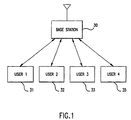
- the present invention provides a new and novel spread-spectrum, packet-switched system, illustrated in FIG. 1, using a packet-spread-spectrum signal.
- the packet-switched spread-spectrum system might be used as part of a radio based ethernet system.
- the packet-switched system includes a base station 30 communicating with a plurality of users 31, 32, 33, 34.
- the packet-switched system alternatively could be used to communicate between two users, i.e., a peer-to-peer system, or several base stations could be accessed when needed.
- the base station and each user has a packet transmitter and a packet receiver.
- the present invention is illustrated, by way of example, with a packet transmitter transmitting the packet-spread-spectrum signal to a packet receiver.
- the packet-spread-spectrum signal in a preferred embodiment, includes a header, followed in time by a multichannel-spread-spectrum signal.
- the header is concatenated with the multichannel-spread-spectrum signal.
- the header is generated from spread-spectrum processing, by using techniques well known in the art, a header-symbol-sequence signal with a chip-sequence signal.
- the header-symbol-sequence signal is a predefined sequence of symbols.
- the header-symbol-sequence signal may be a constant value, i.e., just a series of 1-bits or symbols, or a series of 0-bits or symbols, or alternating 1-bits and 0-bits or alternating symbols, a pseudorandom symbol sequence, or other predefined sequence as desired.
- the chip-sequence signal is user defined, and in a usual practice, is used with a header-symbol-sequence signal.
- the header in a preferred embodiment, is a chip-sequence signal used for the purpose of synchronization.
- Each spread-spectrum channel of the multichannel-spread-spectrum signal part of the packet-spread-spectrum signal is generated similarly, from techniques well known in the art as used for the header, by spread-spectrum processing a sub-data-sequence signal with a respective chip-sequence signal.
- the sub-data-sequence signal may be derived from data, or an analog signal converted to data, signalling information, or other source of data symbols or bits.
- the chip-sequence signal can be user defined, and preferably is orthogonal to other chip-sequence signals used for generating the plurality of spread-spectrum channels.
- the present invention broadly comprises a packet-switched- system for communicating data between a plurality of packet transmitters and a plurality of packet receivers, preferably using radio waves.
- Each packet transmitter includes transmitter-memory means, encoder means, demultiplexer means, spread-spectrum means, combiner means, header means, and transmitter means.
- the encoder means is coupled to the transmitter-memory means.
- the demultiplexer means which is coupled to the encoder means, has a plurality of outputs.
- the spread-spectrum means is coupled to the plurality of outputs of the demultiplexer means.
- the combiner means is coupled between the spread-spectrum means and the header means.
- the transmitter-memory means is coupled to a data input, and stores data from the data input.
- the encoder means encodes the data from the transmitter-memory means as encoded data.
- the demultiplexer means demultiplexes the encoded data into a plurality of sub-data-sequence signals, with a respective sub-data-sequence signal at a respective output of the demultiplexer means.
- the spread-spectrum means spread-spectrum processes each of the sub-data-sequence signals with a respective chip-sequence signal.
- the output of the spread-spectrum means is a plurality of spread-spectrum channels, with each spread-spectrum channel corresponding to one of the outputs of the demultiplexer means.
- the combiner means algebraically combines the plurality of spread-spectrum channels as a multichannel-spread-spectrum signal.
- the header means concatenates a header to the multichannel-spread-spectrum signal.
- the header is for chip-sequence synchronization.
- At the output of the header means is the packet-spread-spectrum signal.
- the transmitter means transmits, at a carrier frequency, the packet-spread-spectrum signal, using radio waves, over a communications channel.
- Each of the packet receivers includes translating means, header-detection means, processor means, receiver-spread-spectrum means, multiplexing means, decoding means, and receiver-memory means.
- the translating means is coupled to the communications channel.
- the header-detection means is coupled between the translating means and the processor means.
- the receiver-spread-spectrum means is coupled to the translating means and to the multiplexing means.
- the decoding means is coupled between the multiplexing means and the receiver-memory means. At the output of the receiver-memory means are the data.
- the translating means translates the received packet-spread-spectrum signal from the carrier frequency to a processing frequency.
- the processing frequency may be a radio frequency (RF), an intermediate frequency (IF), a baseband frequency, or other desirable frequency for processing data.
- the header-detection means detects, at the processing frequency, the header embedded in the packet-spread-spectrum signal.
- the header-detection means outputs, in response to detecting the header, a header-detection signal.
- the processor means generates control and timing signals. These signals are used for controlling sequences and timing of the invention.
- the receiver-spread-spectrum means despreads the multichannel spread-spectrum signal of the packet-spread-spectrum signal, as a plurality of spread-spectrum signals.
- the multiplexing means multiplexes the plurality of spread-spectrum signals as the encoded data.
- the decoding means decodes the encoded data and the receiver memory means stores the data from the decoding means and outputs the data.
- the transmitter-memory means is embodied as a transmitter-first-in-first-out (transmitter-FIFO) memory 41.
- the transmitter-FIFO memory 41 may employ random access memory (RAM) or other memory components as is well known in the art.
- RAM random access memory
- the transmitter-FIFO memory 41 may be part of a digital signal processor (DSP); or, preferably, part of an application specific integrated circuit (ASIC).
- DSP digital signal processor
- ASIC application specific integrated circuit
- an analog-to-digital converter would be inserted before the input to the transmitter-FIFO memory 41 for converting the analog signal to data.
- the analog-to-digital converter may be a one bit analog-to-digital converter, i.e., a hard limiter.
- the encoder means is embodied as an encoder 42.
- the encoder 42 may be an encryptor or other privacy device.
- Encoders and privacy devices are well known in the art for encrypting or scrambling data. If security were not a primary concern, privacy may be achieved employing modulo two addition of a bit-sequence signal, generated from a linear shift register.
- Encryption sequences generated from a Data Encryption Standard (DES) algorithm, by way of example, may be used when privacy is of high concern.
- DES Data Encryption Standard
- the encoder 42 encodes the data from the transmitter-FIFO memory 41, as encoded data.
- the encoding process may include using any of an encryption device, a privacy device, or other device for uniquely distinguishing, as encoded data, a particular data channel.
- encoded data broadly means data that are encrypted or scrambled for privacy.
- the demultiplexing means is embodied as a demultiplexer 44.
- the demultiplexer 44 has a plurality of outputs, with each output having a demultiplexed portion of the encoded signal.
- the spread-spectrum means is embodied as a chip-sequence means and a plurality of product devices 51, 58.
- the chip-sequence means may be embodied as a chip-sequence generator 39 for generating a plurality of chip-sequence signals.
- the chip-sequence means may be embodied as a plurality of EXCLUSIVE-OR gates coupled between the plurality of outputs of the demultiplexer and a memory device for storing the plurality of chip-sequence signals.
- the memory device outputs a respective chip-sequence signal to the respective sub-data-sequence signal.
- a third alternative may include having the chip-sequence means embodied as a memory device, with appropriate detection circuit so that in response to a particular data symbol or data bit at the output of a particular output the demultiplexer, a chip-sequence signal is substituted for that data symbol or data bit.
- the chip-sequence means may also be embodied as any other technology known in the art capable of outputting a plurality of chip-sequence signals.
- the combining means is embodied as a combiner 45
- the header means is embodied as a header device 46 for concatenating a header with data
- the transmitter means is embodied as a transmitter subsystem 50.
- the transmitter subsystem may include an oscillator 49 and multiplier device 48 for shifting a signal to a carrier frequency, and a power amplifier 59 and/or other circuitry as is well known in the art for transmitting a signal over a communications channel.
- the signal is transmitted using an antenna 60.
- the encoder 42 is coupled between the transmitter-FIFO memory 41 and the demultiplexer 44.
- the chip-sequence generator 39 is coupled to the plurality of product devices 51, 58.
- the combiner 45 is coupled between the plurality of product devices 51, 58 and the header device 46, and the header device 46 is coupled to the transmitter subsystem 50.
- the transmitter-FIFO memory 41 receives data from a data input, and stores the data.
- the encoder 42 encodes the data from the transmitter-FIFO 41 as encoded data.
- the encoder 42 encodes the data using privacy type of encoding, i.e., scrambling the data or encrypting the data.
- the encoded data are scrambled data or encrypted data.
- the encoder 42 is necessary for distinguishing data from different users. By having the proper key for decoding the encoded data, data from a particular user are distinguished from data from other users.
- the encoding of the data is what defines a user's channel, unlike other multichannel spread-spectrum systems, where a user's channel is defined by a particular chip-sequence signal.
- a common set of chip-sequence signals can be used by all users, reducing cost of having matched filters or correlators.
- the reduced cost is achieved since, at a receiver, one set of matched filters or correlator is required for the despreading the multichannel-spread-spectrum signal from all users, and different sets of matched-filters or correlators are not required for each user.
- the demultiplexer 44 demultiplexes the encoded data into a plurality of sub-data-sequence signals, with a respective sub-data-sequence signal at a respective output of the demultiplexer 44.
- the chip-sequence generator 39 generates a plurality of chip-sequence signals.
- Each of the chip-sequence signals of the plurality of chip-sequence signals has low correlation with the other chip-sequence signals in the plurality of chip-sequence signals, and is preferably orthogonal to the other chip-sequence signals in the plurality of chip-sequence signals.
- the plurality of product devices 51, 58 may be embodied as a plurality of EXCLUSIVE-OR gates coupled between the plurality of outputs of the demultiplexer 44 and the chip-sequence means.
- Each EXCLUSIVE-OR gate multiplies a respective sub-data-sequence signal from the demultiplexer, by a respective chip-sequence signal from the chip-sequence generator 39.
- the plurality of product devices 51, 58 multiplies each of the sub-data-sequence signals by a respective chip-sequence signal.
- At the output of the plurality of product devices 51, 58 is a plurality of spread-spectrum channels, respectively.
- a particular spread-spectrum channel is identified by the chip-sequence signal that was used to spread-spectrum process the particular sub-data sequence signal.
- the combiner 45 algebraically combines the plurality of spread-spectrum channels, and outputs the combined signal as a multichannel-spread-spectrum signal.
- the combiner 45 combines the plurality of spread-spectrum channels linearly, although some nonlinear process may be involved without significant degradation in system performance.
- the header device 46 concatenates a header to the multichannel-spread-spectrum signal. At the output of the header device 46 is the packet-spread-spectrum signal. The header is for chip-sequence synchronization at the receiver.
- the transmitter subsystem 50 transmits, at a carrier frequency, the packet-spread-spectrum signal using radio waves over a communications channel.
- the transmitter subsystem 50 of the packet transmitter includes appropriate filters, power amplifiers and matching circuits coupled to an antenna 60.
- the transmitter subsystem 50 also may include a hard limiter, for hard limiting the packet-spread-spectrum signal before transmitting.
- the translating means is shown as a translating device 62 with oscillator 63 and frequency locked loop 70
- the header-detection means is embodied as a header-matched filter 79
- the processor means is embodied as a processor 90
- the receiver-spread-spectrum means is embodied as a plurality of data-matched filters 71,78
- the multiplexing means is embodied as a multiplexer 80
- the decoding means is embodied as a decoder 81.
- the receiver-memory means is embodied as a receiver-first-in-first-out (receiver-FIFO) memory 82.
- the translating device 62 is coupled through an antenna 61 to the communications channel and through an amplifier 64 to the header-matched filter 79.
- the translating device 62 is coupled to oscillator 63, and the oscillator 63 is coupled to frequency locked loop 70.
- the header-matched filter 79 is coupled to frequency locked loop 70.
- the processor 90 is coupled to the header-matched filter 79.
- the plurality of data-matched filters 71, 78 is coupled between the translating device 62 and the multiplexer 80.
- the decoder 81 is coupled between the multiplexer 80 and the receiver-FIFO memory 82.
- the translating device 62 translates the received packet-spread-spectrum signal from the carrier frequency to a processing frequency.
- the translating device 62 may be a mixer, which is well known in the art, for shifting an information signal, which in this disclosure is the received packet-spread-spectrum signal, modulated at a carrier frequency to IF or baseband.
- the processing frequency may be RF, IF, at baseband frequency or other desired frequency for a digital signal processor.
- the signal for shifting the received packet-spread-spectrum signal is produced by oscillator 63.
- the header-matched filter 79 detects, at the processing frequency, the header embedded in the packet-spread-spectrum signal.
- the term "header-matched filter” as used herein, is a matched filter for detecting the header, by having an impulse response matched to the chip-sequence signal of the header of the packet-spread-spectrum signal.
- the header-matched filter 79 outputs a header-detection signal.
- the header-matched filter at a base station can detect the header embedded in the packet-spread-spectrum signal from all users, since the chip-sequence signal for the header and data is common to all users.
- the frequency locked loop 70 is frequency locked in response to the header-detection signal.
- the frequency locked loop 70 locks the frequency of the oscillator 63 to the carrier frequency of the received packet-spread-spectrum signal. Circuits for frequency locked loops, and their operation, are well known in the art.
- the processor 90 in response to the header-detection signal, generates control and timing signals.
- the control and timing signals are used for controlling sequences and timing of the invention.
- Each of the plurality of data-matched filters 71, 78 has an impulse response matched to a chip-sequence signal of a respective one of the plurality of chip-sequence signals.
- the plurality of data-matched filters 71, 78 despreads the multichannel-spread-spectrum signal of the packet-spread-spectrum signal as the plurality of received spread-spectrum channels.
- Each chip-sequence signal in the plurality of chip-sequence signals is different, one from another.
- the plurality of chip-sequence signals is common to all users.
- the plurality of data-matched filters 71, 78 can detect the plurality of chip-sequence signals from any of the users.
- the multiplexer 80 multiplexes the plurality of received spread-spectrum channels as the received-encoded data.
- the received-encoded data in an error-free environment, is the same as the encoded data that was generated at the packet transmitter.
- the decoder 81 decodes the received-encoded data as the received data.
- the decoding is what distinguishes one user from another, since each user encodes with a different privacy type of encoding.
- a first user and a second user may encode first data and second data, respectively, using a first key and a second key for the DES.
- the first user and the second user might encode first data and second data, respectively, using modulo two addition of bits from linear shift register.
- the first user would have a first set of taps or settings for generating a first bit sequence
- the second user would have a second set of taps or settings for generating a second bit sequence.
- the second bit sequence would therefore be different from the first bit sequence.
- the decoder 81 were set to decode with the first key, then either the first data would appear at the output of decoder 81, or non-decoded data would appear at the output of decoder 81. The presence of non-decoded data would be rejected by the decoder 81. The presence of first data, which would be detected by the presence of a correct data sequence in the header or data portion of the packet, would pass to the receiver-FIFO memory 82. A correct data sequence might be a particular combination of bits, indicating proper decoding.
- the receiver-FIFO memory 82 stores the received data and has the data present at an output.
- the present invention also comprises a method.
- the method includes the steps of storing data in a memory and encoding the data from the memory as encoded data.
- the data are demultiplexed using a demultiplexer, into sub-data sequence signals.
- the method includes generating a plurality of chip-sequence signals, and multiplying each of the sub-data-sequence signals by a respective chip-sequence signal, thereby generating a plurality of spread-spectrum channels.
- the steps include algebraically combining the plurality of spread-spectrum channels as a multichannel-spread-spectrum signal, concatenating a header to the multichannel-spread-spectrum signal to generate a packet-spread-spectrum signal, and transmitting on a carrier frequency the packet-spread-spectrum signal over a communications channel using radio waves.
- the steps include, at a packet receiver, translating the packet-spread-spectrum signal from the carrier frequency to a processing frequency, and detecting, at the processing frequency, the header embedded in the packet-spread-spectrum signal.
- the chip-sequence signal used for the header and the data is common to all uses.
- the method includes outputting a header-detection signal and generating control and timing signals.
- the steps also include despreading the multichannel-spread-spectrum signal of the packet-spread-spectrum signal as a plurality of received spread-spectrum channels.
- the plurality of received spread-spectrum channels are multiplexed as received-encoded data.
- the steps include decoding the received-encoded data as received data, and storing the received data in a memory for output to a data output.
- the packet-switched system is a wideband code division multiple access (W-CDMA) system, capable of transmitting, in a particular application, 9.6 megabits per second of data.
- W-CDMA wideband code division multiple access
- the following discussion assumes operation in the frequency band 2.4-2.483 GHz, although operation in other bands is possible.
- Preferred bandwidths are 26 MHz, available in Japan, and 70 MHz, for operation in USA, but again other bandwidths are possible.
- FIG. 2 The circuit operation of FIG. 2 is as follows:
Landscapes
- Engineering & Computer Science (AREA)
- Computer Networks & Wireless Communication (AREA)
- Signal Processing (AREA)
- Mobile Radio Communication Systems (AREA)
Claims (39)
- Verfahren zur Datenübertragung, das einen Paketsender verwendet und folgende Schritte aufweist:Speichern von Daten (41) von einem Dateneingang als gespeicherte Daten;Demultiplexen (44) der gespeicherten Daten in eine Vielzahl Subdatensequenzkanäle;Spreizspektrumverarbeiten (51, 58, 39) der Vielzahl Subdatensequenzsignale durch eine Vielzahl Chipsequenzsignale, wodurch eine Vielzahl Spreizspektrumkanäle erzeugt wird, wobei jedes Signal der Vielzahl der Chipsequenzsignale von anderen Chipsequenzsignalen in der Vielzahl der Chipsequenzsignale verschieden ist;Verknüpfen (45) der Vielzahl Spreizspektrumkanäle zu einem Mehrkanal-Spreizspektrumsignal;Verketten eines Anfangskennsatzes mit dem Mehrkanal-Spreizspektrumsignal, wodurch ein Paket-Spreizspektrumsignal erzeugt wird; undSenden (50, 60) des Paket-Spreizspektrumsignals auf einer Trägerfrequenz unter Verwendung von Funkwellen über einen Kommunikationskanal.
- Verfahren nach Anspruch 1, bei dem der Schritt der Spreizspektrumverarbeitung den Schritt der Multiplikation der Vielzahl Subdatensequenzsignale mit der Vielzahl Chipsequenzsignale enthält, wodurch die Vielzahl Spreizspektrumkanäle erzeugt wird, wobei jedes Chipsequenzsignal der Vielzahl Chipsequenzsignale von anderen Chipsequenzsignalen in der Vielzahl der Chipsequenzsignale verschieden ist.
- Verfahren nach Anspruch 1, bei dem der Schritt der Spreizspektrumverarbeitung den Schritt der Multiplikation der Vielzahl Subdatensequenzsignale mit der Vielzahl Chipsequenzsignale enthält, wodurch die Vielzahl Spreizspektrumkanäle erzeugt wird, wobei jedes Chipsequenzsignal der Vielzahl Chipsequenzsignale relativ zu anderen Chipsequenzsignalen in der Vielzahl der Chipsequenzsignale orthogonal ist.
- Verfahren nach Anspruch 1, 2 oder 3, bei dem der Verknüpfungsschritt den Schritt der algebraischen Verknüpfung der Vielzahl Spreizspektrumkanäle als das Mehrkanal-Spreizspektrumsignal enthält.
- Verfahren nach Anspruch 1, 2 oder 3, bei dem der Verkettungsschritt den Schritt der Verkettung des Anfangskennsatzes mit dem Mehrkanal-Spreizspektrumsignal enthält, wobei dem Anfangskennsatz das Mehrkanal-Spreizspektrumsignal zeitlich folgt, wodurch das Paket-Spreizspektrumsignal erzeugt wird.
- Verfahren nach Anspruch 1, 2 oder 3, bei dem der Schritt der Spreizspektrumverarbeitung den Schritt der Ausgabe eines entsprechenden Chipsequenzsignals der Vielzahl Chipsequenzsignale als Antwort auf ein entsprechendes Subdatensequenzsignal der Vielzahl Subdatensequenzsignale enthält, wodurch die Vielzahl Spreizspektrumkanäle erzeugt wird, wobei jedes Chipsequenzsignal der Vielzahl Chipsequenzsignale relativ zu anderen Chipsequenzsignalen der Vielzahl Chipsequenzsignale orthogonal ist.
- Verfahren nach Anspruch 1, 2 oder 3, bei dem der Schritt der Spreizspektrumverarbeitung den Schritt der Ausgabe eines entsprechenden Chipsequenzsignals der Vielzahl Chipsequenzsignale als Antwort auf ein entsprechendes Datensymbol in einem Subdatensequenzsignal der Vielzahl Subdatensequenzsignale enthält, wodurch die Vielzahl Spreizspektrumkanäle erzeugt wird, wobei jedes Chipsequenzsignal der Vielzahl Chipsequenzsignale relativ zu anderen Chipsequenzsignal der Vielzahl Chipsequenzsignale orthogonal ist.
- Verfahren nach Anspruch 1, 2 oder 3, bei dem der Schritt der Spreizspektrumverarbeitung den Schritt der Ausgabe eines entsprechenden Chipsequenzsignals der Vielzahl Chipsequenzsignale als Antwort auf ein entsprechendes Datensymbol in einem Subdatensequenzsignal der Vielzahl Subdatensequenzsignale enthält, wodurch die Vielzahl Spreizspektrumkanäle erzeugt wird, wobei jedes Chipsequenzsignal der Vielzahl Chipsequenzsignale von anderen Chipsequenzsignalen der Vielzahl Chipsequenzsignale verschieden ist.
- Verfahren nach Anspruch 1, 2 oder 3, das des Weiteren zwischen den Schritten der Speicherung und des Demultiplexens die Codierung der gespeicherten Daten als codierte Daten enthält, wobei der Schritt des Demultiplexens der gespeicherten Daten den Schritt des Demultiplexens der codierten Daten in die Vielzahl der Subdatensequenzkanäle enthält.
- Verfahren nach Anspruch 1, 2 oder 3, das des Weiteren zwischen den Schritten der Speicherung und des Demultiplexens die Verschlüsselung der gespeicherten Daten als codierte Daten enthält, wobei der Schritt des Demultiplexens der gespeicherten Daten den Schritt des Demultiplexens der codierten Daten zur Vielzahl der Subdatensequenzkanäle enthält.
- Verfahren nach Anspruch 1, 2 oder 3, das des Weiteren zwischen den Schritten der Speicherung und des Demultiplexens die Chiffrierung der gespeicherten Daten als codierte Daten enthält, wobei der Schritt des Demultiplexens der gespeicherten Daten den Schritt des Demultiplexens der codierten Daten in die Vielzahl der Subdatensequenzkanäle enthält.
- Verfahren zur Übertragung von Daten unter Verwendung eines Paketempfängers, das folgende Schritte aufweist:Verarbeiten eines Anfangskennsatzes (79, 90) in einem Paket-Spreizspektrumsignal, um Steuer- und Taktsignale zu erzeugen;als Antwort auf die Steuer- und Taktsignale Entspreizen (71, 78) eines im Paket-Spreizspektrumsignal eingebetteten Mehrkanal-Spreizspektrumsignals als eine Vielzahl empfangener Spreizspektrumkanäle; undMultiplexen (80) der Vielzahl empfangener Spreizspektrumkanäle als empfangene Daten.
- Verfahren nach Anspruch 12, bei dem der Schritt der Verarbeitung des Anfangskennsatzes des Weiteren folgende Schritte enthält:Erkennen des Anfangskennsatzes im Paket-Spreizspektrumsignal bei der Verarbeitungsfrequenz;als Antwort auf die Erkennung des Anfangskennsatzes Ausgeben eines Anfangskennsatz-Detektorsignals; undals Antwort auf der Anfangskennsatz-Detektorsignal Erzeugen von Steuer- und Taktsignalen.
- Verfahren nach Anspruch 12 oder 13, das nach dem Schritt des Multiplexens des Weiteren den Schritt der Speicherung der empfangenen Daten enthält.
- Verfahren nach Anspruch 12 oder 13, das nach dem Schritt des Multiplexens des Weiteren den Schritt der Decodierung der empfangenen Daten enthält.
- Verfahren nach Anspruch 12 oder 13, das vor dem Schritt der Verarbeitung des Anfangskennsatzes das Verschieben des Paket-Spreizspektrumsignals von einer Trägerfrequenz zu einer Verarbeitungsfrequenz enthält.
- Verfahren zur Übertragung von Daten unter Verwendung eines Paketsenders, das die Schritte nach einem der Ansprüche 1 bis 11 aufweist, und unter Verwendung eines Paketempfängers, das die Schritte nach einem der Ansprüche 12 bis 16 aufweist.
- Paketsender mit:Sender-Speichermittel (41) zum Speichern von Daten von einem Dateneingang als gespeicherte Daten;mit dem Sender-Speichermittel gekoppelte Demultiplexermittel (44) zum Demultiplexen der gespeicherten Daten in eine Vielzahl Subdatensequenzkanäle;mit den Demultiplexermitteln gekoppelte Spreizspektrummittel (51, 58, 39) zur Spreizspektrumverarbeitung der Vielzahl Subdatensequenzsignale durch eine Vielzahl Chipsequenzsignale, wodurch eine Vielzahl Spreizspektrumkanäle erzeugt wird, wobei jedes Signal der Vielzahl Chipsequenzsignale von anderen Chipsequenzsignalen der Vielzahl Chipsequenzsignale verschieden ist;mit den Spreizspektrummitteln gekoppelte Verknüpfungsmittel (45) zum Verknüpfen der Vielzahl Spreizspektrumkanäle als ein Mehrkanal-Spreizspektrumsignal;mit den Verknüpfungsmitteln gekoppelte Anfangskennsatzmittel (46), um einen Anfangskennsatz mit dem Mehrkanal-Spreizspektrumsignal zu verketten, wodurch ein Paket-Spreizspektrumsignal erzeugt wird; undmit den Anfangskennsatzmitteln gekoppelte Sendemittel (50, 60) zum Senden des Paket-Spreizspektrumsignals auf einer Trägerfrequenz mittels Funkwellen über einen Kommunikationskanal.
- Paketsender nach Anspruch 18, bei dem die Spreizspektrummittel Multiplikationsmittel zum Multiplizieren der Vielzahl Subdatensequenzsignale mit der Vielzahl der Chipsequenzsignale enthalten, wodurch die Vielzahl der Spreizspektrumkanäle erzeugt wird, wobei jedes Chipsequenzsignal der Vielzahl Chipsequenzsignale von anderen Chipsequenzsignalen der Vielzahl Chipsequenzsignale verschieden ist.
- Paketsender nach Anspruch 18, bei dem die Spreizspektrummittel Multiplikationsmittel zum Multiplizieren der Vielzahl Subdatensequenzsignale mit der Vielzahl der Chipsequenzsignale enthalten, wodurch die Vielzahl der Spreizspektrumkanäle erzeugt wird, wobei jedes Chipsequenzsignal der Vielzahl Chipsequenzsignale relativ zu anderen Chipsequenzsignalen der Vielzahl Chipsequenzsignale orthogonal ist.
- Paketsender nach Anspruch 18, 19 oder 20, bei dem die Verknüpfungsmittel Mittel zur algebraischen Verknüpfung der Vielzahl Spreizspektrumkanäle als das Mehrkanal-Spreizspektrumsignal enthalten.
- Paketsender nach Anspruch 18, 19 oder 20, bei dem die Anfangskennsatzmittel Mittel zur Verkettung des Anfangskennsatzes mit dem Mehrkanal-Spreizspektrumsignal enthalten, wobei dem Anfangskennsatz das Mehrkanal-Spreizspektrumsignal zeitlich folgt, wodurch das Paket-Spreizspektrumsignal erzeugt wird.
- Paketsender nach Anspruch 18 oder 20, bei dem die Spreizspektrummittel Spreizspektrum-Speichermittel zur Ausgabe eines entsprechenden Chipsequenzsignals der Vielzahl Chipsequenzsignale als Antwort auf ein entsprechendes Subdatensequenzsignal der Vielzahl Subdatensequenzsignale enthalten, wodurch die Vielzahl Spreizspektrumkanäle erzeugt wird, wobei jedes Chipsequenzsignal der Vielzahl Chipsequenzsignale relativ zu anderen Chipsequenzsignale der Vielzahl Chipsequenzsignale orthogonal ist.
- Paketsender nach Anspruch 18 oder 20, bei dem die Spreizspektrummittel Spreizspektrum-Speichermittel zur Ausgabe eines entsprechenden Chipsequenzsignals der Vielzahl Chipsequenzsignale als Antwort auf ein entsprechendes Datensymbol in einem Subdatensequenzsignal der Vielzahl Subdatensequenzsignale enthalten, wodurch die Vielzahl Spreizspektrumkanäle erzeugt wird, wobei jedes Chipsequenzsignal der Vielzahl Chipsequenzsignale relativ zu anderen Chipsequenzsignale der Vielzahl Chipsequenzsignale orthogonal ist.
- Paketsender nach Anspruch 19 oder 20, bei dem die Spreizspektrummittel Spreizspektrum-Speichermittel zur Ausgabe eines entsprechenden Chipsequenzsignals der Vielzahl Chipsequenzsignale als Antwort auf ein entsprechendes Datensymbol in einem Subdatensequenzsignal der Vielzahl Subdatensequenzsignale enthalten, wodurch die Vielzahl Spreizspektrumkanäle erzeugt wird, wobei jedes Chipsequenzsignal der Vielzahl Chipsequenzsignale von anderen Chipsequenzsignalen der Vielzahl Chipsequenzsignale verschieden ist.
- Paketsender nach Anspruch 18, 19 oder 20, der des Weiteren zwischen den Sender-Speichermitteln und den Demultiplexermitteln gekoppelte Codiermittel zum Codieren der gespeicherten Daten als codierte Daten enthält, wobei die Demultiplexermittel Mittel zum Demultiplexen der codierten Daten in die Vielzahl der Subdatensequenzkanäle enthalten.
- Paketsender nach Anspruch 18, 19 oder 20, der des Weiteren zwischen den Sender-Speichermitteln und den Demultiplexermitteln gekoppelte Codiermittel zum Verschlüsseln der gespeicherten Daten als codierte Daten enthält, wobei die Demultiplexermittel Mittel zum Demultiplexen der codierten Daten zur Vielzahl der Subdatensequenzkanäle enthalten.
- Paketsender nach Anspruch 18, 19 oder 20, bei dem die Spreizspektrummittel Folgendes enthalten:Generierungsmittel zum Erzeugen der Vielzahl Chipsequenzsignale; undeine zwischen den Demultiplexermitteln, den Verknüpfungmitteln und den Generierungsmitteln gekoppelte Vielzahl exklusiver ODER-Gatter zum Multiplizieren der Vielzahl Subdatensequenzsignale mit der Vielzahl Chipsequenzsignale, wodurch die Vielzahl Spreizspektrumkanäle erzeugt wird.
- Paketsender nach Anspruch 18, 19 oder 20, bei dem die Speizspektrummittel einen Speicher zum Speichern der Vielzahl Chipsequenzsignale enthalten.
- Paketsender nach Anspruch 18, 19 oder 20, bei dem die Codiermittel entweder einen Chiffrierer oder ein Datenschutzgerät enthalten.
- Paketsender nach Anspruch 18, 19 oder 20, bei dem die Spreizspektrum-Verarbeitungsmittel eine Vielzahl Produktgeräte zum Multiplizieren jedes der Subdatensequenzsignale mit einem entsprechenden Chipsequenzsignal aus der Vielzahl Chipsequenzsignale enthalten.
- Paketempfänger mit:Anfangskennsatz-Detektormitteln (79, 90) zum Verarbeiten eines Anfangskennsatzes in einem Paket-Spreizspektrumsignal, um Steuer- und Taktsignale zu erzeugen;Empfänger-Spreizspektrummitteln (71, 78), die mit dem Kommunikationskanal gekoppelt sind und auf die Steuer- und Taktsignale ansprechen, um ein im Paket-Spreizspektrumsignal eingebettetes Mehrkanal-Spreizspektrumsignal als Vielzahl empfangener Spreizspektrumkanäle zu entspreizen; undmit den Empfänger-Spreizspektrummitteln gekoppelte Multiplexermittel (80) zum Multiplexen der Vielzahl empfangener Spreizspektrumkanäle als empfangene Daten und zum Ausgeben der empfangenen Daten an einen Datenausgang.
- Paketempfänger nach Anspruch 32, bei dem die Anfangskennsatz-Detektormittel Mittel zum Erkennen des Anfangskennsatzes im Paket-Spreizspektrumsignal bei der Verarbeitungsfrequenz, zur Ausgabe eines Anfangskennsatz-Detektorsignals als Antwort auf die Erkennung des Anfangskennsatzes und zum Erzeugen von Steuer- und Taktsignalen vom Anfangskennsatz-Detektorsignal enthalten.
- Paketempfänger nach Anspruch 32 oder 33, der des Weiteren nach den Multiplexermitteln Empfänger-Speichermittel zum Speichern der empfangenen Daten enthält.
- Paketempfänger nach Anspruch 32 oder 33, der des Weiteren nach den Multiplexermitteln Decodiermittel zum Decodieren der empfangenen Daten enthält.
- Paketempfänger nach Anspruch 32, der des Weiteren Verschiebungsmittel zum Verschieben des Paket-Spreizspektrumsignals von der Trägerfrequenz zur Verarbeitungsfrequenz enthält.
- Paketsender- und Paketempfängersystem zur Datenübertragung, das einen Paketsender nach Anspruch 18 und einen Paketempfänger nach Anspruch 32 aufweist.
- System nach Anspruch 37, das des Weiteren Mittel zum Erzeugen von Steuer- und Taktsignalen als Antwort auf den Anfangskennsatz enthält.
- System zur Datenübertragung, das eine Vielzahl Paketsender aufweist, wobei jeder Paketsender einem der Ansprüche 18 bis 31 entspricht, sowie ein Vielzahl Paketempfänger, wobei jeder Paketempfänger einem der Ansprüche 32 bis 36 entspricht.
Applications Claiming Priority (3)
| Application Number | Priority Date | Filing Date | Title |
|---|---|---|---|
| US08/692,782 US5862133A (en) | 1996-08-02 | 1996-08-02 | Packet-switched spread-spectrum system |
| US692782 | 1996-08-02 | ||
| PCT/US1997/014114 WO1998006190A1 (en) | 1996-08-02 | 1997-07-25 | Packet-switched spread-spectrum system |
Publications (3)
| Publication Number | Publication Date |
|---|---|
| EP0908024A1 EP0908024A1 (de) | 1999-04-14 |
| EP0908024A4 EP0908024A4 (de) | 1999-10-06 |
| EP0908024B1 true EP0908024B1 (de) | 2003-02-05 |
Family
ID=24782004
Family Applications (1)
| Application Number | Title | Priority Date | Filing Date |
|---|---|---|---|
| EP97937202A Expired - Lifetime EP0908024B1 (de) | 1996-08-02 | 1997-07-25 | Paketvermittelte spreizspektrumanordnung |
Country Status (5)
| Country | Link |
|---|---|
| US (7) | US5862133A (de) |
| EP (1) | EP0908024B1 (de) |
| AU (1) | AU3977297A (de) |
| DE (1) | DE69718909T2 (de) |
| WO (1) | WO1998006190A1 (de) |
Families Citing this family (70)
| Publication number | Priority date | Publication date | Assignee | Title |
|---|---|---|---|---|
| US6893704B1 (en) | 1995-06-20 | 2005-05-17 | Dsm Ip Assets B.V. | Ballistic-resistant moulded article and a process for the manufacture of the moulded article |
| NL1000598C2 (nl) | 1995-06-20 | 1996-12-23 | Dsm Nv | Antiballistisch vormdeel en een werkwijze voor de vervaardiging van het vormdeel. |
| KR100197352B1 (ko) * | 1996-07-31 | 1999-06-15 | 이계철 | 기준 정합여파기를 이용한 병렬포착시스템 |
| US5862133A (en) * | 1996-08-02 | 1999-01-19 | Golden Bridge Technology | Packet-switched spread-spectrum system |
| US6061359A (en) * | 1996-08-02 | 2000-05-09 | Golden Bridge Technology, Inc. | Increased-capacity, packet spread-spectrum system and method |
| JPH1066039A (ja) * | 1996-08-23 | 1998-03-06 | Sony Corp | 通信方法、送信装置、送信方法、受信装置及び受信方法 |
| JPH1070780A (ja) * | 1996-08-27 | 1998-03-10 | Uniden Corp | データ収集システム |
| US20050163084A1 (en) * | 1996-09-03 | 2005-07-28 | Golden Bridge Technology, Inc. | Packet spread-spectrum transmitter |
| JP3671992B2 (ja) * | 1996-10-28 | 2005-07-13 | ソニー株式会社 | 映像信号受信装置および映像信号受信方法 |
| JPH10262029A (ja) * | 1997-03-18 | 1998-09-29 | Sharp Corp | 遅延多重方式対応スペクトル直接拡散通信システム及び該システムを用いる通信方法 |
| US6389000B1 (en) * | 1997-09-16 | 2002-05-14 | Qualcomm Incorporated | Method and apparatus for transmitting and receiving high speed data in a CDMA communication system using multiple carriers |
| JPH11177522A (ja) * | 1997-12-10 | 1999-07-02 | Oki Electric Ind Co Ltd | 無線通信装置及び移動体通信システム |
| US6160803A (en) * | 1998-01-12 | 2000-12-12 | Golden Bridge Technology, Inc. | High processing gain spread spectrum TDMA system and method |
| US6396819B1 (en) | 1998-03-21 | 2002-05-28 | Richard D. Fleeter | Low-cost satellite communication system |
| US6353627B1 (en) | 1998-11-04 | 2002-03-05 | Linex Technologies, Inc. | High data rate spread-spectrum system and method |
| EP1049266A1 (de) * | 1999-04-27 | 2000-11-02 | Lucent Technologies Inc. | Verfahren und Vorrichtung zur Präambelsignaturerkennung unter Verwendung eines kodeangepassten Filters |
| US6614776B1 (en) | 1999-04-28 | 2003-09-02 | Tantivy Communications, Inc. | Forward error correction scheme for high rate data exchange in a wireless system |
| US6674787B1 (en) * | 1999-05-19 | 2004-01-06 | Interdigital Technology Corporation | Raising random access channel packet payload |
| US6728296B1 (en) * | 1999-10-19 | 2004-04-27 | Skyworks Solutions, Inc. | Direct sequence spread spectrum system with enhanced forward error correction code feature |
| US6760366B1 (en) * | 1999-11-29 | 2004-07-06 | Qualcomm Incorporated | Method and apparatus for pilot search using a matched filter |
| US7227884B2 (en) | 2000-02-28 | 2007-06-05 | Aeroastro, Inc. | Spread-spectrum receiver with progressive fourier transform |
| US6842480B1 (en) | 2000-02-28 | 2005-01-11 | Golden Bridge Technology Incorporated | Programmable matched filter bank |
| US6324209B1 (en) * | 2000-02-28 | 2001-11-27 | Golden Bridge Technology Inc. | Multi-channel spread spectrum system |
| US6741637B1 (en) | 2000-06-22 | 2004-05-25 | Golden Bridge Technology, Inc. | Method and apparatus of joint detection of a CDMA receiver |
| US8977683B2 (en) | 2000-12-26 | 2015-03-10 | Polycom, Inc. | Speakerphone transmitting password information to a remote device |
| US8964604B2 (en) | 2000-12-26 | 2015-02-24 | Polycom, Inc. | Conference endpoint instructing conference bridge to dial phone number |
| US8948059B2 (en) | 2000-12-26 | 2015-02-03 | Polycom, Inc. | Conference endpoint controlling audio volume of a remote device |
| US9001702B2 (en) | 2000-12-26 | 2015-04-07 | Polycom, Inc. | Speakerphone using a secure audio connection to initiate a second secure connection |
| US7864938B2 (en) | 2000-12-26 | 2011-01-04 | Polycom, Inc. | Speakerphone transmitting URL information to a remote device |
| US7339605B2 (en) | 2004-04-16 | 2008-03-04 | Polycom, Inc. | Conference link between a speakerphone and a video conference unit |
| DE60121476T2 (de) * | 2001-04-05 | 2007-02-22 | Nortel Networks Ltd., St. Laurent | Sender für ein drahtloses kommunikationssystem mit einer vielzahl an kodes und antennen |
| EP1388080A4 (de) | 2001-05-10 | 2006-10-25 | Polycom Israel Ltd | Steuereinheit für ein mehrpunkt-multimedia-/audiosystem |
| US8934382B2 (en) | 2001-05-10 | 2015-01-13 | Polycom, Inc. | Conference endpoint controlling functions of a remote device |
| US8976712B2 (en) | 2001-05-10 | 2015-03-10 | Polycom, Inc. | Speakerphone and conference bridge which request and perform polling operations |
| US20030053521A1 (en) * | 2001-09-17 | 2003-03-20 | Xiaojing Huang | System and electronic device for providing a multi-carrier spread spectrum signal |
| US8947487B2 (en) | 2001-12-31 | 2015-02-03 | Polycom, Inc. | Method and apparatus for combining speakerphone and video conference unit operations |
| US8144854B2 (en) | 2001-12-31 | 2012-03-27 | Polycom Inc. | Conference bridge which detects control information embedded in audio information to prioritize operations |
| US8885523B2 (en) | 2001-12-31 | 2014-11-11 | Polycom, Inc. | Speakerphone transmitting control information embedded in audio information through a conference bridge |
| US8223942B2 (en) * | 2001-12-31 | 2012-07-17 | Polycom, Inc. | Conference endpoint requesting and receiving billing information from a conference bridge |
| US7978838B2 (en) | 2001-12-31 | 2011-07-12 | Polycom, Inc. | Conference endpoint instructing conference bridge to mute participants |
| US8705719B2 (en) | 2001-12-31 | 2014-04-22 | Polycom, Inc. | Speakerphone and conference bridge which receive and provide participant monitoring information |
| US7742588B2 (en) | 2001-12-31 | 2010-06-22 | Polycom, Inc. | Speakerphone establishing and using a second connection of graphics information |
| US8102984B2 (en) | 2001-12-31 | 2012-01-24 | Polycom Inc. | Speakerphone and conference bridge which receive and provide participant monitoring information |
| US7787605B2 (en) | 2001-12-31 | 2010-08-31 | Polycom, Inc. | Conference bridge which decodes and responds to control information embedded in audio information |
| US8934381B2 (en) | 2001-12-31 | 2015-01-13 | Polycom, Inc. | Conference endpoint instructing a remote device to establish a new connection |
| US20040010746A1 (en) * | 2002-07-10 | 2004-01-15 | Lucas L. Victor | Forward error correction system for wireless communications |
| JP2004266504A (ja) * | 2003-02-28 | 2004-09-24 | Sony Corp | 送受信システム、送信装置および方法、受信装置および方法、記録媒体、並びにプログラム |
| US20040208199A1 (en) * | 2003-04-16 | 2004-10-21 | Bo Li | Data encoding for simultaneous bus access |
| US20050020217A1 (en) * | 2003-07-23 | 2005-01-27 | Ramin Khoini-Poorfard | Communication terminal with low carrier feedthrough and communication system using such a terminal |
| FR2871312B1 (fr) * | 2004-06-03 | 2006-08-11 | St Microelectronics Sa | Modulation de charge dans un transpondeur electromagnetique |
| US20060209970A1 (en) * | 2005-01-11 | 2006-09-21 | Emmanuel Kanterakis | Adaptive transmission rate communication system |
| US8199791B2 (en) | 2005-06-08 | 2012-06-12 | Polycom, Inc. | Mixed voice and spread spectrum data signaling with enhanced concealment of data |
| US7796565B2 (en) * | 2005-06-08 | 2010-09-14 | Polycom, Inc. | Mixed voice and spread spectrum data signaling with multiplexing multiple users with CDMA |
| US8126029B2 (en) | 2005-06-08 | 2012-02-28 | Polycom, Inc. | Voice interference correction for mixed voice and spread spectrum data signaling |
| WO2007136415A2 (en) | 2005-12-30 | 2007-11-29 | Comtech Mobile Datacom Corporation | Mobile satellite communications |
| US8275080B2 (en) * | 2006-11-17 | 2012-09-25 | Comtech Mobile Datacom Corporation | Self-supporting simplex packets |
| KR100859724B1 (ko) * | 2007-05-28 | 2008-09-23 | 한국전자통신연구원 | 인체 통신 시스템에서 데이터 속도가 변하는 신호 송신 및수신 장치 및 방법 |
| GB0714927D0 (en) * | 2007-08-01 | 2007-09-12 | Nokia Siemens Networks Oy | Resource allocation |
| US8284749B2 (en) | 2008-03-10 | 2012-10-09 | Comtech Mobile Datacom Corporation | Time slot synchronized, flexible bandwidth communication system |
| US8050634B2 (en) * | 2008-04-18 | 2011-11-01 | Telefonaktiebolaget L M Ericsson (Publ) | Transceiver with isolated receiver |
| US8548107B1 (en) | 2009-01-26 | 2013-10-01 | Comtech Mobile Datacom Corporation | Advanced multi-user detector |
| US9106364B1 (en) | 2009-01-26 | 2015-08-11 | Comtech Mobile Datacom Corporation | Signal processing of a high capacity waveform |
| US8675711B1 (en) | 2009-09-25 | 2014-03-18 | Comtech Mobile Datacom Corporation | System and methods for dynamic spread spectrum usage |
| US9031167B2 (en) * | 2012-01-31 | 2015-05-12 | Innophase Inc. | Receiver architecture and methods for demodulating quadrature phase shift keying signals |
| US9513671B2 (en) | 2014-08-01 | 2016-12-06 | Microsoft Technology Licensing, Llc | Peripheral retention device |
| US10191986B2 (en) | 2014-08-11 | 2019-01-29 | Microsoft Technology Licensing, Llc | Web resource compatibility with web applications |
| US9705637B2 (en) | 2014-08-19 | 2017-07-11 | Microsoft Technology Licensing, Llc | Guard band utilization for wireless data communication |
| US9397723B2 (en) | 2014-08-26 | 2016-07-19 | Microsoft Technology Licensing, Llc | Spread spectrum wireless over non-contiguous channels |
| US9424048B2 (en) | 2014-09-15 | 2016-08-23 | Microsoft Technology Licensing, Llc | Inductive peripheral retention device |
| US11586883B2 (en) * | 2018-12-14 | 2023-02-21 | Microsoft Technology Licensing, Llc | Residual quantization for neural networks |
Citations (2)
| Publication number | Priority date | Publication date | Assignee | Title |
|---|---|---|---|---|
| US5291486A (en) * | 1991-08-19 | 1994-03-01 | Sony Corporation | Data multiplexing apparatus and multiplexed data demultiplexing apparatus |
| US5321721A (en) * | 1991-09-13 | 1994-06-14 | Sony Corporation | Spread spectrum communication system and transmitter-receiver |
Family Cites Families (31)
| Publication number | Priority date | Publication date | Assignee | Title |
|---|---|---|---|---|
| US35402A (en) * | 1862-05-27 | Improvement in self-regulating gas-burners | ||
| US4672658A (en) | 1985-10-16 | 1987-06-09 | At&T Company And At&T Bell Laboratories | Spread spectrum wireless PBX |
| KR870004587A (ko) * | 1985-10-16 | 1987-05-11 | 엘리 와이스 | 무선 근거리 통신 장치 |
| US4694467A (en) * | 1986-07-03 | 1987-09-15 | Signatron, Inc. | Modem for use in multipath communication systems |
| US4932037A (en) * | 1987-02-11 | 1990-06-05 | Hillier Technologies Limited Partnership | Remote control system, components and methods |
| US4912722A (en) * | 1988-09-20 | 1990-03-27 | At&T Bell Laboratories | Self-synchronous spread spectrum transmitter/receiver |
| US5022046A (en) * | 1989-04-14 | 1991-06-04 | The United States Of America As Represented By The Secretary Of The Air Force | Narrowband/wideband packet data communication system |
| JPH0421025A (ja) * | 1990-05-15 | 1992-01-24 | Toshiba Corp | 左右シフタ |
| US5166951A (en) * | 1991-05-15 | 1992-11-24 | Scs Mobilecom, Inc. | High capacity spread spectrum channel |
| WO1993004588A1 (en) | 1991-09-05 | 1993-03-18 | Haarmann & Reimer Corporation | Composition and method of attenuation of ionic strength inhibition of lantibiotics |
| US5260967A (en) * | 1992-01-13 | 1993-11-09 | Interdigital Technology Corporation | CDMA/TDMA spread-spectrum communications system and method |
| IL118832A (en) * | 1992-01-16 | 1998-03-10 | Qualcomm Inc | Method and apparatus for combining data for transmission and using excess capacity |
| JP3280141B2 (ja) | 1993-04-30 | 2002-04-30 | キヤノン株式会社 | スペクトラム拡散受信装置 |
| JP2708350B2 (ja) * | 1993-05-18 | 1998-02-04 | 三菱電機株式会社 | 通信装置 |
| CA2142188A1 (en) * | 1993-06-23 | 1995-01-05 | Noriyoshi Kuroyanagi | Chip-based selective receiving system for a spread spectrum signal |
| US5383219A (en) * | 1993-11-22 | 1995-01-17 | Qualcomm Incorporated | Fast forward link power control in a code division multiple access system |
| KR960003102B1 (ko) * | 1993-12-01 | 1996-03-04 | 재단법인 한국전자통신연구소 | 씨.디.엠.에이(cdma) 이동통신 기지국 변조장치의 채널 변조회로 및 그를 이용한 변조장치 |
| US5404377A (en) * | 1994-04-08 | 1995-04-04 | Moses; Donald W. | Simultaneous transmission of data and audio signals by means of perceptual coding |
| US5614914A (en) * | 1994-09-06 | 1997-03-25 | Interdigital Technology Corporation | Wireless telephone distribution system with time and space diversity transmission for determining receiver location |
| US5648982A (en) * | 1994-09-09 | 1997-07-15 | Omnipoint Corporation | Spread spectrum transmitter |
| US5566164A (en) * | 1994-12-19 | 1996-10-15 | Stanford Telecommunications, Inc. | Practical means for digital generation and combination of a multiplicity of CDMA/FDMA signals |
| US5696789A (en) * | 1995-03-06 | 1997-12-09 | Unisys Corporation | Apparatus and method for signal identification |
| US5613191A (en) * | 1995-05-01 | 1997-03-18 | Bell Atlantic Network Services, Inc. | Customer premise wireless distribution of audio-video, control signals and voice using CDMA |
| US5630204A (en) * | 1995-05-01 | 1997-05-13 | Bell Atlantic Network Services, Inc. | Customer premise wireless distribution of broad band signals and two-way communication of control signals over power lines |
| FI98024C (fi) * | 1995-05-11 | 1997-03-25 | Nokia Telecommunications Oy | Menetelmä ja laitteisto tiedostopohjaisen multimedia- ja hypermedia-palvelun välittämiseksi liikkuvalle vastaanottajalle |
| US5627855A (en) * | 1995-05-25 | 1997-05-06 | Golden Bridge Technology, Inc. | Programmable two-part matched filter for spread spectrum |
| US6122295A (en) | 1995-06-08 | 2000-09-19 | Canon Kabushiki Kaisha | Multi-channel communication |
| US7123600B2 (en) * | 1995-06-30 | 2006-10-17 | Interdigital Technology Corporation | Initial power control for spread-spectrum communications |
| JPH09321721A (ja) * | 1996-05-27 | 1997-12-12 | Sony Corp | 送信方法,送信装置,受信方法及び受信装置 |
| US5862133A (en) | 1996-08-02 | 1999-01-19 | Golden Bridge Technology | Packet-switched spread-spectrum system |
| US6262791B1 (en) | 1998-07-10 | 2001-07-17 | Ball Semiconductor, Inc. | Optical element for imaging a flat mask onto a nonplanar substrate |
-
1996
- 1996-08-02 US US08/692,782 patent/US5862133A/en not_active Expired - Fee Related
-
1997
- 1997-07-25 EP EP97937202A patent/EP0908024B1/de not_active Expired - Lifetime
- 1997-07-25 WO PCT/US1997/014114 patent/WO1998006190A1/en not_active Ceased
- 1997-07-25 DE DE69718909T patent/DE69718909T2/de not_active Expired - Fee Related
- 1997-07-25 AU AU39772/97A patent/AU3977297A/en not_active Abandoned
-
1998
- 1998-10-30 US US09/182,316 patent/US6262971B1/en not_active Expired - Fee Related
-
2000
- 2000-12-08 US US09/732,186 patent/US7012907B2/en not_active Expired - Lifetime
- 2000-12-08 US US09/732,185 patent/US6894997B2/en not_active Expired - Fee Related
-
2001
- 2001-02-27 US US09/793,433 patent/US6940841B2/en not_active Expired - Lifetime
-
2005
- 2005-07-22 US US11/186,786 patent/US20050271017A1/en not_active Abandoned
- 2005-08-25 US US11/210,849 patent/US20050281319A1/en not_active Abandoned
Patent Citations (2)
| Publication number | Priority date | Publication date | Assignee | Title |
|---|---|---|---|---|
| US5291486A (en) * | 1991-08-19 | 1994-03-01 | Sony Corporation | Data multiplexing apparatus and multiplexed data demultiplexing apparatus |
| US5321721A (en) * | 1991-09-13 | 1994-06-14 | Sony Corporation | Spread spectrum communication system and transmitter-receiver |
Also Published As
| Publication number | Publication date |
|---|---|
| US7012907B2 (en) | 2006-03-14 |
| US5862133A (en) | 1999-01-19 |
| DE69718909D1 (de) | 2003-03-13 |
| US20050271017A1 (en) | 2005-12-08 |
| WO1998006190A1 (en) | 1998-02-12 |
| US6940841B2 (en) | 2005-09-06 |
| US20010009545A1 (en) | 2001-07-26 |
| US6262971B1 (en) | 2001-07-17 |
| US20050281319A1 (en) | 2005-12-22 |
| US20010015997A1 (en) | 2001-08-23 |
| US20010015996A1 (en) | 2001-08-23 |
| EP0908024A1 (de) | 1999-04-14 |
| EP0908024A4 (de) | 1999-10-06 |
| US6894997B2 (en) | 2005-05-17 |
| DE69718909T2 (de) | 2004-01-15 |
| AU3977297A (en) | 1998-02-25 |
Similar Documents
| Publication | Publication Date | Title |
|---|---|---|
| US7012907B2 (en) | Packet spread-spectrum receiver | |
| US6515981B1 (en) | Packet-switched spread-spectrum system | |
| US6160803A (en) | High processing gain spread spectrum TDMA system and method | |
| US5260967A (en) | CDMA/TDMA spread-spectrum communications system and method | |
| US6078576A (en) | High processing gain CDMA/TDMA system and method | |
| US6289039B1 (en) | Spread-spectrum communications utilizing variable throughput reduction | |
| US6993065B2 (en) | Multi-channel spread spectrum system | |
| RU2434339C2 (ru) | Способ и устройство для мультиплексирования высокоскоростной передачи пакетных данных с передачей голоса/данных | |
| US5748687A (en) | Spreading code sequence acquisition system and method that allows fast acquisition in code division multiple access (CDMA) systems | |
| US5822359A (en) | Coherent random access channel in a spread-spectrum communication system and method | |
| US20050265293A1 (en) | Apparatus and method for transmitting and receiving a cell identification code in a mobile communication system | |
| US20020191676A1 (en) | Parallel spread spectrum communication system and method | |
| US6587452B1 (en) | High performance signal structure with multiple modulation formats | |
| JP2008022567A (ja) | スペクトラム拡散通信システムに用いるチャネルの多様性を達成するための方法および装置 | |
| WO2002100005A2 (en) | A method of cellular communication | |
| EP1065825B1 (de) | Synchronisierung von zeitverteilten Duplex | |
| US6075793A (en) | High efficiency spread spectrum system and method | |
| US20050163084A1 (en) | Packet spread-spectrum transmitter | |
| WO2000077963A1 (en) | Interleaving in a spread-spectrum communication system | |
| HK1020462A1 (en) | Subscriber unit for a cdma wireless communication system | |
| AU2003244550A1 (en) | Method and Apparatus for Orthogonal Code Hopping Multiplexing Communications |
Legal Events
| Date | Code | Title | Description |
|---|---|---|---|
| PUAI | Public reference made under article 153(3) epc to a published international application that has entered the european phase |
Free format text: ORIGINAL CODE: 0009012 |
|
| 17P | Request for examination filed |
Effective date: 19990118 |
|
| AK | Designated contracting states |
Kind code of ref document: A1 Designated state(s): DE GB |
|
| A4 | Supplementary search report drawn up and despatched |
Effective date: 19990820 |
|
| AK | Designated contracting states |
Kind code of ref document: A4 Designated state(s): DE GB |
|
| 17Q | First examination report despatched |
Effective date: 20000809 |
|
| GRAG | Despatch of communication of intention to grant |
Free format text: ORIGINAL CODE: EPIDOS AGRA |
|
| GRAG | Despatch of communication of intention to grant |
Free format text: ORIGINAL CODE: EPIDOS AGRA |
|
| GRAH | Despatch of communication of intention to grant a patent |
Free format text: ORIGINAL CODE: EPIDOS IGRA |
|
| GRAH | Despatch of communication of intention to grant a patent |
Free format text: ORIGINAL CODE: EPIDOS IGRA |
|
| GRAA | (expected) grant |
Free format text: ORIGINAL CODE: 0009210 |
|
| AK | Designated contracting states |
Designated state(s): DE GB |
|
| REG | Reference to a national code |
Ref country code: GB Ref legal event code: FG4D |
|
| REF | Corresponds to: |
Ref document number: 69718909 Country of ref document: DE Date of ref document: 20030313 Kind code of ref document: P |
|
| PLBE | No opposition filed within time limit |
Free format text: ORIGINAL CODE: 0009261 |
|
| STAA | Information on the status of an ep patent application or granted ep patent |
Free format text: STATUS: NO OPPOSITION FILED WITHIN TIME LIMIT |
|
| 26N | No opposition filed |
Effective date: 20031106 |
|
| PGFP | Annual fee paid to national office [announced via postgrant information from national office to epo] |
Ref country code: GB Payment date: 20090731 Year of fee payment: 13 |
|
| PGFP | Annual fee paid to national office [announced via postgrant information from national office to epo] |
Ref country code: DE Payment date: 20090929 Year of fee payment: 13 |
|
| GBPC | Gb: european patent ceased through non-payment of renewal fee |
Effective date: 20100725 |
|
| PG25 | Lapsed in a contracting state [announced via postgrant information from national office to epo] |
Ref country code: DE Free format text: LAPSE BECAUSE OF NON-PAYMENT OF DUE FEES Effective date: 20110201 |
|
| REG | Reference to a national code |
Ref country code: DE Ref legal event code: R119 Ref document number: 69718909 Country of ref document: DE Effective date: 20110201 |
|
| PG25 | Lapsed in a contracting state [announced via postgrant information from national office to epo] |
Ref country code: GB Free format text: LAPSE BECAUSE OF NON-PAYMENT OF DUE FEES Effective date: 20100725 |