EP0907089B1 - Kristalloptisches Interferenzfilter mit periodischem Durchlassbereich sowie Verfahren zur aktiven Anpassung des spektralen Durchlassbereichs - Google Patents
Kristalloptisches Interferenzfilter mit periodischem Durchlassbereich sowie Verfahren zur aktiven Anpassung des spektralen Durchlassbereichs Download PDFInfo
- Publication number
- EP0907089B1 EP0907089B1 EP98114521A EP98114521A EP0907089B1 EP 0907089 B1 EP0907089 B1 EP 0907089B1 EP 98114521 A EP98114521 A EP 98114521A EP 98114521 A EP98114521 A EP 98114521A EP 0907089 B1 EP0907089 B1 EP 0907089B1
- Authority
- EP
- European Patent Office
- Prior art keywords
- interference filter
- birefringent
- optical
- polarizer
- birefringent element
- Prior art date
- Legal status (The legal status is an assumption and is not a legal conclusion. Google has not performed a legal analysis and makes no representation as to the accuracy of the status listed.)
- Expired - Lifetime
Links
- 239000013078 crystal Substances 0.000 title claims abstract description 39
- 230000003595 spectral effect Effects 0.000 title claims abstract description 32
- 230000003287 optical effect Effects 0.000 title claims abstract description 30
- 230000000737 periodic effect Effects 0.000 title claims abstract description 12
- 238000000034 method Methods 0.000 title claims abstract description 6
- ZOMNIUBKTOKEHS-UHFFFAOYSA-L dimercury dichloride Chemical compound Cl[Hg][Hg]Cl ZOMNIUBKTOKEHS-UHFFFAOYSA-L 0.000 claims abstract 3
- 239000000835 fiber Substances 0.000 claims description 10
- 239000003921 oil Substances 0.000 claims description 5
- 239000004973 liquid crystal related substance Substances 0.000 claims description 4
- 239000013307 optical fiber Substances 0.000 claims description 2
- 125000006850 spacer group Chemical group 0.000 claims description 2
- -1 mercury (I) halide Chemical class 0.000 abstract description 9
- 230000004075 alteration Effects 0.000 abstract 1
- 230000000979 retarding effect Effects 0.000 abstract 1
- 230000010287 polarization Effects 0.000 description 19
- 230000005540 biological transmission Effects 0.000 description 13
- 229910052753 mercury Inorganic materials 0.000 description 7
- 239000000463 material Substances 0.000 description 5
- 239000012071 phase Substances 0.000 description 5
- 210000004027 cell Anatomy 0.000 description 4
- 238000001914 filtration Methods 0.000 description 3
- 239000003365 glass fiber Substances 0.000 description 3
- 229910021532 Calcite Inorganic materials 0.000 description 2
- 238000010521 absorption reaction Methods 0.000 description 2
- 230000006978 adaptation Effects 0.000 description 2
- 210000002858 crystal cell Anatomy 0.000 description 2
- 230000001419 dependent effect Effects 0.000 description 2
- 150000004820 halides Chemical class 0.000 description 2
- 238000001069 Raman spectroscopy Methods 0.000 description 1
- 230000018199 S phase Effects 0.000 description 1
- 230000003321 amplification Effects 0.000 description 1
- 238000004891 communication Methods 0.000 description 1
- 230000008878 coupling Effects 0.000 description 1
- 238000010168 coupling process Methods 0.000 description 1
- 238000005859 coupling reaction Methods 0.000 description 1
- 238000001514 detection method Methods 0.000 description 1
- 230000000694 effects Effects 0.000 description 1
- 238000000605 extraction Methods 0.000 description 1
- 230000009477 glass transition Effects 0.000 description 1
- 238000009434 installation Methods 0.000 description 1
- 230000002452 interceptive effect Effects 0.000 description 1
- 238000004519 manufacturing process Methods 0.000 description 1
- QSHDDOUJBYECFT-UHFFFAOYSA-N mercury Chemical compound [Hg] QSHDDOUJBYECFT-UHFFFAOYSA-N 0.000 description 1
- QKEOZZYXWAIQFO-UHFFFAOYSA-M mercury(1+);iodide Chemical compound [Hg]I QKEOZZYXWAIQFO-UHFFFAOYSA-M 0.000 description 1
- 239000000203 mixture Substances 0.000 description 1
- 238000003199 nucleic acid amplification method Methods 0.000 description 1
- 238000005498 polishing Methods 0.000 description 1
- 230000008929 regeneration Effects 0.000 description 1
- 238000011069 regeneration method Methods 0.000 description 1
- 238000000926 separation method Methods 0.000 description 1
- 230000002269 spontaneous effect Effects 0.000 description 1
- 238000000859 sublimation Methods 0.000 description 1
- 230000008022 sublimation Effects 0.000 description 1
- 238000005496 tempering Methods 0.000 description 1
- 239000012808 vapor phase Substances 0.000 description 1
Images
Classifications
-
- G—PHYSICS
- G02—OPTICS
- G02F—OPTICAL DEVICES OR ARRANGEMENTS FOR THE CONTROL OF LIGHT BY MODIFICATION OF THE OPTICAL PROPERTIES OF THE MEDIA OF THE ELEMENTS INVOLVED THEREIN; NON-LINEAR OPTICS; FREQUENCY-CHANGING OF LIGHT; OPTICAL LOGIC ELEMENTS; OPTICAL ANALOGUE/DIGITAL CONVERTERS
- G02F1/00—Devices or arrangements for the control of the intensity, colour, phase, polarisation or direction of light arriving from an independent light source, e.g. switching, gating or modulating; Non-linear optics
- G02F1/0009—Materials therefor
- G02F1/0018—Electro-optical materials
-
- G—PHYSICS
- G02—OPTICS
- G02B—OPTICAL ELEMENTS, SYSTEMS OR APPARATUS
- G02B27/00—Optical systems or apparatus not provided for by any of the groups G02B1/00 - G02B26/00, G02B30/00
- G02B27/28—Optical systems or apparatus not provided for by any of the groups G02B1/00 - G02B26/00, G02B30/00 for polarising
- G02B27/288—Filters employing polarising elements, e.g. Lyot or Solc filters
-
- G—PHYSICS
- G02—OPTICS
- G02B—OPTICAL ELEMENTS, SYSTEMS OR APPARATUS
- G02B5/00—Optical elements other than lenses
- G02B5/30—Polarising elements
- G02B5/3083—Birefringent or phase retarding elements
-
- G—PHYSICS
- G02—OPTICS
- G02F—OPTICAL DEVICES OR ARRANGEMENTS FOR THE CONTROL OF LIGHT BY MODIFICATION OF THE OPTICAL PROPERTIES OF THE MEDIA OF THE ELEMENTS INVOLVED THEREIN; NON-LINEAR OPTICS; FREQUENCY-CHANGING OF LIGHT; OPTICAL LOGIC ELEMENTS; OPTICAL ANALOGUE/DIGITAL CONVERTERS
- G02F1/00—Devices or arrangements for the control of the intensity, colour, phase, polarisation or direction of light arriving from an independent light source, e.g. switching, gating or modulating; Non-linear optics
- G02F1/01—Devices or arrangements for the control of the intensity, colour, phase, polarisation or direction of light arriving from an independent light source, e.g. switching, gating or modulating; Non-linear optics for the control of the intensity, phase, polarisation or colour
- G02F1/03—Devices or arrangements for the control of the intensity, colour, phase, polarisation or direction of light arriving from an independent light source, e.g. switching, gating or modulating; Non-linear optics for the control of the intensity, phase, polarisation or colour based on ceramics or electro-optical crystals, e.g. exhibiting Pockels effect or Kerr effect
-
- G—PHYSICS
- G02—OPTICS
- G02F—OPTICAL DEVICES OR ARRANGEMENTS FOR THE CONTROL OF LIGHT BY MODIFICATION OF THE OPTICAL PROPERTIES OF THE MEDIA OF THE ELEMENTS INVOLVED THEREIN; NON-LINEAR OPTICS; FREQUENCY-CHANGING OF LIGHT; OPTICAL LOGIC ELEMENTS; OPTICAL ANALOGUE/DIGITAL CONVERTERS
- G02F2203/00—Function characteristic
- G02F2203/05—Function characteristic wavelength dependent
- G02F2203/055—Function characteristic wavelength dependent wavelength filtering
Definitions
- the invention relates to a crystal optical interference filter periodic pass band, especially for wavelength division multiplexing of optical networks in telecommunications, as well as a Method for actively adjusting the spectral pass band of a such interference filter.
- WDM wavelength division multiplex
- the transmission channels are adapted, allow the regeneration of the spectral purity in WDM operation.
- the passive filter suppresses light, that occurs between the spectral channels, e.g. B. by the spontaneous Emission in the optical amplifier, through Brillouin or Raman scattering or by other extraneous light, and thus increases the signal-to-noise ratio in detection.
- the comb-like pass band on the wavelength scale parallel postponed When actively tuning such filters, the comb-like pass band on the wavelength scale parallel postponed.
- Such tunable filters allow switching on or off other systems of parallel spectral channels or that precise Readjust the wavelength comb.
- Interference filters with a periodic comb-like pass band have been known for a long time.
- multi-beam interference the pass band is passed through periodic narrow transmission lines marked between those wide impervious areas.
- two-beam interference that is Transmission characteristic a sine square distribution with the same width Transmission and absorption areas.
- the two-beam interference filters there is a special class among the two-beam interference filters, the is mechanically very stable, but not easily matched can.
- These are the crystal optical interference filters with periodic Passband such as the Lyot filter element, the Solc filter and the like Arrangements. With these filters, the interfering light rays are the fast and slow natural wave in a birefringent crystal. This Filters are mechanically as stable as the crystal. Because the length of the Interferometer poor but clearly by the thickness d of the crystal plate is determined, there is no continuous voting option, except due to temperature changes. Switching from the transmission areas on the absorption areas and vice versa, d. H. the postponement of the filter by half a period (reciprocal pass band) is through Changing the input polarization is always possible.
- the distance between the channels is off with crystal-optical interference filters birefringent material by the difference in the refractive indices of the fast or slow axis of the crystal, and by its thickness d established. It can be shown that the most famous birefringent Material Kalkspat an approximately 14 mm thick crystal is necessary for the the channel spacing required by WDM operation of optical networks to realize at least one nanometer. The extraction of such large ones Calcite crystals is very expensive, however, so these filters are only for rare special purposes can be used.
- the invention is therefore based on the object, a crystal optical To provide interference filter, which is inexpensive and the Adaptation of the spectral passband of the filter to the requirements of the optical WDM network allowed. Furthermore, a method for active Adjustment of the interference filter can be made available.
- a crystal-optical interference filter with a periodic spectral pass band in particular for the wavelength division multiplex operation of optical networks in telecommunications, at least consisting of a birefringent element and a polarizer arranged at its output, the birefringent element being a mercury-I-halide Single crystal of Hg 2 Cl 2 and / or Hg 2 Br 2 and / or Hg 2 J 2 , whereby for the continuous tuning of the spectral pass band of the interference filter between the birefringent element and the output polarizer a ⁇ / 4 retardation plate at 45 ° relative to the fast one or slow axis of the birefringent element is inserted and the adjustment is possible by adjusting the forward direction of the output polarizer.
- Mercury halides are transparent in the infrared, ie also in the wavelength range around 1500 nanometers, which is used for the WDM operation of optical networks, and have a high birefringence in this range.
- a clean separation of the WDM channels spaced about 1 nm can therefore already be achieved with mercury halide crystals of 2 to 5 mm in thickness.
- mercury-I halides Hg 2 Cl 2 and / or Hg 2 Br 2 and / or Hg 2 J 2 as crystal-optical interference filters with a periodic pass band, in particular for the wavelength division multiplex operation of optical networks in telecommunications, is therefore advantageous.
- the three mercury halides Hg 2 J 2 , Hg 2 Cl 2 and Hg 2 Br 2 can be grown in good quality as large crystals from the vapor phase.
- the crystals can be split, sawn and polished. Sawing and polishing surfaces can be cleaned and / or recrystallized by tempering below the sublimation temperature. In this way, influences that impair birefringence can be eliminated.
- a mercury iodide single crystal Hg 2 J 2 is preferably used as the birefringent element, since this has the greatest birefringence in the infrared.
- the incident light is dependent on the birefringent element from its wavelength and initial polarization into a certain one Brought polarization state (polarization coding of the spectral Components).
- An essential part of the crystal optical interference filter is besides a polarizer arranged behind the birefringent element, in particular linear polarizer, which serves the undesired spectral components by using the birefringent element a certain polarization state were coded out or reflect. Only those spectral components whose Polarization with the transmission direction of the output polarizer matches, are transmitted by the filter. In this way the spectral filtering of the optical signal achieved.
- the polarizer is so in introduced the beam path that the polarization direction that he transmitted in the slow and fast axis of the birefringent element spanned plane.
- the birefringent element the different spectral Components of the incoming wave with different polarizations can encode, it is necessary that the light is birefringent Element is supplied in a defined polarization state. This can, on the one hand, through active polarization management in the optical network can be realized by e.g. only certain polarizations over the Glass fibers are transferred.
- active polarization management in the optical network can be realized by e.g. only certain polarizations over the Glass fibers are transferred.
- This polarizer is preferably a linear polarizer whose transmission direction by about 45 ° compared to the slow or fast axis of the birefringent crystal is offset. This arrangement maximizes the Effects of birefringence.
- the forward direction of the polarizer at the exit of the birefringent element also around 45 ° opposite the slow or fast axis of the birefringent Crystal is offset.
- the pass directions of input and output polarizers are therefore preferably parallel or perpendicular to each other and lie in parallel planes. Switching from normal to reciprocal passband of the interference filter is very successful in this case simply by turning the input or output polarizer through 90 °.
- the continuous tuning of the spectral pass band of the Interference filter is advantageous due to an electro-optical retardation element reached, which may be at the entrance of the birefringent element introduced between the crystal and the input polarizer in the beam path is. Due to the electro-optical retardation element, the entire effective birefringence of the interference filter actively changed be, which also the polarization coding of the individual spectral Components is varied. The polarization coding is thus by a electrical signal indicating the birefringence of the retardation element changed, controlled.
- the electro-optical retardation element is preferably a fast one Liquid crystal cell, a Kerr or a Pockelzell or a cell from one other electro-optical material.
- the interference filter for coupling to the optical network between two optical fiber ends is inserted, the interference filter and two additional lenses so are arranged so that the light emerging from the fiber into the first lens enters and preferably leaves as flat waves and after passing of the interference filter into the second lens and from there into the fiber.
- the lenses are lenses or gradient index lenses.
- the individual components or Components of the interference filter i.e. Polarizers, birefringent Crystal and possibly other delay elements are in defined distance from each other and the spaces filled with oil between the components. For the production of oil gaps defined thickness are preferably spacers between the individual components used.
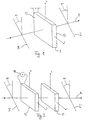
- Figure 1 shows an interference filter, which consists of a Arrangement of a birefringent element 1 and two linear polarizers 2 and 3 exists.
- the birefringent element 1 consists of a single crystal of mercury halide and has a thickness d of a few Millimeters.
- the birefringent crystal is cut so that the of slower and faster axis L or F spanned plane parallel to The front or back surface of the crystal runs with the beam direction R perpendicular to it.
- the forward direction of 45 ° is rotated with respect to the axes of the birefringent element 1 first a defined polarization state of light any Wavelengths produced, the 45 ° position of the polarizer causes that the parallel to the fast axis of the birefringent element polarized component has the same amplitude as that parallel to polarized slow axis.
- the initial phase difference between these polarization components before entering the birefringent element is independent of the wavelength for everyone spectral components zero.
- the birefringent element takes Now, depending on the wavelength, polarization coding of the spectral Components before by making a wavelength dependent phase difference ⁇ ( ⁇ ) between the individual polarization components induced.
- the spectral filtering of the polarization-coded light takes place on Exit of the birefringent element with the help of another Polarizer 2, which is also a linear polarizer here and its Forward direction parallel to the forward direction of the input polarizer 3 is.
- the spectral filtering is theoretically considered Pancharatnam's phase.
- Figure 2 shows an interference filter, which compared to the arrangement Figure 1 is extended by an electro-optical delay element 4.
- the other arrangement of components birefringent plate 1 ', Output polarizer 2 'and input polarizer 3' corresponds to that Design of the interference filter from FIG. 1.
- the electro-optical retardation element 4 is used for continuous Tuning the comb-like pass band of the interference filter.
- the retardation element 4 consists of a material whose Birefringence can be changed electrically. this happens in particular in that a voltage is applied to the delay element 4 is applied, which is indicated here by a voltage source 14.
- the retardation element 4 is aligned so that its fast or slow axis S or L parallel to the axes of the birefringent Elements 1 'runs. Particularly suitable for continuous Fast liquid crystal cells, Kerr cells and Pockels cells and cells with other electro-optical materials.
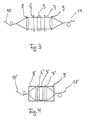
- Figures 3 and 4 show the arrangement of a Interference filter in the application between two glass fibers 10 and 11 or 10 'and 11'.
- the crystal optical interference filter consists of both Figures from a birefringent plate 5 and 5 ', and one each polarizer 6, 6 ', 7, 7' arranged in front or behind.
- the polarizers are relative, for example, as shown in Figures 1 and 2 oriented to each other and to the axes of the birefringent plate.
- a given spectral light emerges from the ends of the glass fibers 10, 10 ' Composition expanding conically. It is by means of a first lens 8 or 8 'converted into preferably plane waves, wherein then parallel light emerges from the lens. That’s why Fiber end in the area of the focal point of the lens 8 or 8 '.
- the light coupled out on the fiber 10 passes through the interference filter as parallel beam and strikes another at the filter output Lens 9 or 9 ', with which the light again in the outgoing fiber 11 or 11 'is coupled.
- the end of the fiber 11 or 11 ' is in Area of focus of the lens 9 or 9 '.
- the lenses 8 and 9 from FIG. 3 are infrared-compatible lenses, the lenses 8 'and 9' of Figure 4 are gradient index lenses.
Landscapes
- Physics & Mathematics (AREA)
- General Physics & Mathematics (AREA)
- Optics & Photonics (AREA)
- Nonlinear Science (AREA)
- Crystals, And After-Treatments Of Crystals (AREA)
- Polarising Elements (AREA)
- Inorganic Compounds Of Heavy Metals (AREA)
- Optical Filters (AREA)
- Investigating Or Analysing Materials By Optical Means (AREA)
- Lasers (AREA)
- Spectrometry And Color Measurement (AREA)
Description
- Figur 1
- ein Interferenzfilter bestehend aus einer doppelbrechenden Platte und jeweils einem Ein- und Ausgangspolarisator
- Figur 2
- ein Interferenzfilter bestehend aus einer doppelbrechenden Platte, zwei Polarisatoren sowie einer elektrooptischen Verzögerungsplatte
- Figuren 3 und 4
- den Einbau eines Interferenzfilters zwischen zwei Faserenden
- 1,1', 5,5'
- doppelbrechendes Element (Quecksilber-I-Halogenid-Einkristall)
- 2,2', 7,7'
- Ausgangspolarisator
- 3,3', 6,6'
- Eingangspolarisator
- 4
- elektrooptisches Retardierungselement
- 8,8', 9,9'
- Linse
- 10,10', 11,11'
- Faser
- 12, 13
- Front- bzw. Rückfläche des doppelbrechenden Elements
- 14
- spannungsquelle
- F/L
- schnelle/langsame Achse
- R
- Strahlrichtung
Claims (14)
- Kristalloptisches Interferenzfilter mit periodischem spektralen Durchlaßbereich, insbesondere für den Wellenlängenmultiplexbetrieb von optischen Netzen in der Telekommunikation, wenigstens bestehend aus einem doppelbrechenden Element (1, 1', 5, 5') sowie einem an dessen Ausgang angeordneten Polarisator (2, 2', 7, 7'), wobei das doppelbrechende Element ein Quecksilber-I-Halogenid-Einkristall aus Hg2Cl2 und/oder Hg2Br2 und/oder Hg2J2 ist, wobei zur kontinuierlichen Durchstimmung des spektralen Durchlaßbereichs des Interferenzfilters zwischen dem doppelbrechenden Element (1, 1', 5, 5') und dem Ausgangspolarisator (2, 2', 7, 7') eine λ/4-Retardierungsplatte unter 45° relativ zur schnellen bzw. langsamen Achse des doppelbrechenden Elements (1, 1' 5, 5') eingefügt ist und die Abstimmung durch Anpassung der Durchlaßrichtung des Ausgangspolarisator (2, 2', 7, 7') möglich ist.
- Interferenzfilter nach Anspruch 1, dadurch gekennzeichnet, daß der doppelbrechende Quecksilber-I-Halogenid-Einkristall so geschnitten ist, daß die von langsamer und schneller Achse (L bzw. F) aufgespannte Ebene parallel zur Front- bzw. Rückfläche (12 bzw. 13) des Kristalls verläuft, wobei die Strahlrichtung (R) senkrecht dazu ist.
- Interferenzfilter nach Anspruch 1 oder 2, dadurch gekennzeichnet, daß vor dem doppelbrechenden Element (1, 1', 5, 5') ein weiterer Polarisator (3, 3', 6, 6') angeordnet ist.
- Interferenzfilter nach Anspruch 3, dadurch gekennzeichnet, daß die Durchlaßrichtung des Polarisators (3, 3', 6, 6') am Eingang des doppelbrechenden Elements (1, 1', 5, 5') um etwa 45° gegenüber der langsamen bzw. schnellen Achse des doppelbrechenden Kristalls versetzt ist.
- Interferenzfilter nach einem der vorangegangenen Ansprüche, dadurch gekennzeichnet, daß die Durchlaßrichtung des Polarisators (2, 2', 7, 7') am Ausgang des doppelbrechenden Elements (1, 1', 5, 5') um etwa 45° gegenüber der langsamen bzw. schnellen Achse des doppelbrechenden Kristalls versetzt ist.
- Interferenzfilter nach einem der vorangegangenen Ansprüche, dadurch gekennzeichnet, daß zur kontinuierlichen Durchstimmung des spektralen Durchlaßbereichs am Eingang bzw. Ausgang des doppelbrechenden Elements ein elektrooptisches Retardierungselement (4) in den Strahlengang eingebracht ist, wobei dieses gegebenenfalls zwischen dem doppelbrechenden Element und dem Eingangs- (3, 3', 6, 6') bzw. Ausgangspolarisator (2, 2', 7, 7') angeordnet ist.
- Interferenzfilter nach Anspruch 6, dadurch gekennzeichnet, daß das elektrooptische Retardierungselement (4) eine schnelle Flüssigkristallzelle ist.
- Interferenzfilter nach Anspruch 6, dadurch gekennzeichnet, daß das elektrooptische Retardierungselement (4) eine Kerr- oder Pockelszelle ist.
- Interferenzfilter nach einem der vorangegangenen Ansprüche, dadurch gekennzeichnet, daß es zur Ankopplung an das optische Netz zwischen zwei optischen Faserenden (10, 10', 11, 11') eingefügt ist, wobei das Interferenzfilter und zusätzlich zwei Linsen (8, 8', 9, 9') so angeordnet sind, daß das aus der Faser (10, 10') austretende Licht in die erste Linse (8, 8') eintritt und diese vorzugsweise als ebene Wellen verläßt und nach Passieren des Interferenzfilters in die zweite Linse (9, 9') und von dort in die Faser (11, 11') eintritt.
- Interferenzfilter nach Anspruch 9, dadurch gekennzeichnet, daß die Linsen Objektive (8, 9) oder Gradientenindexlinsen (8', 9') sind.
- Interferenzfilter nach Anspruch 19 oder 10, dadurch gekennzeichnet, daß die einzelnen Bauteile in definiertem Abstand voneinander angeordnet sind, wobei in die Zwischenräume zur Verminderung von Reflexionen an den Grenzflächen Öle geeigneter Brechungsindizes eingebracht sind.
- Interferenzfilter nach Anspruch 11, dadurch gekennzeichnet, daß Abstandhalter zwischen den einzelnen Bauteilen definierte Ölspalte erzeugen.
- Verfahren zur aktiven Anpassung des spektralen Durchlaßbereichs eines Interferenzfilters nach einem der Ansprüche 1 bis 12, wobei die Veränderung der Durchlaßcharakteristik durch Verdrehung der Durchlaßrichtung der Polarisatoren (2, 2', 3, 3', 6, 6' 7, 7') am Eingang und/oder Ausgang des Interferenzfilters relativ zu den Achsen des doppelbrechenden Elements (1, 1', 5, 5') und/oder durch Veränderung der doppelbrechenden Eigenschaften des elektrooptischen Retardierungselements (4) erfolgt.
- Verfahren nach Anspruch 13, dadurch gekennzeichnet, daß zum Umschalten des Interferenzfilters auf reziproken Durchlaßbereich die Durchlaßrichtung eines der Polarisatoren (2, 2', 3, 3', 6, 6' 7, 7') am Eingang oder Ausgang des Interferenzfilters um 90° gedreht wird.
Applications Claiming Priority (2)
| Application Number | Priority Date | Filing Date | Title |
|---|---|---|---|
| DE19743716A DE19743716C2 (de) | 1997-10-02 | 1997-10-02 | Kristalloptisches Interferenzfilter mit periodischem Durchlaßbereich sowie Verfahren zur aktiven Anpassung des spektralen Durchlaßbereichs |
| DE19743716 | 1997-10-02 |
Publications (3)
| Publication Number | Publication Date |
|---|---|
| EP0907089A2 EP0907089A2 (de) | 1999-04-07 |
| EP0907089A3 EP0907089A3 (de) | 2000-08-16 |
| EP0907089B1 true EP0907089B1 (de) | 2003-01-22 |
Family
ID=7844487
Family Applications (1)
| Application Number | Title | Priority Date | Filing Date |
|---|---|---|---|
| EP98114521A Expired - Lifetime EP0907089B1 (de) | 1997-10-02 | 1998-08-03 | Kristalloptisches Interferenzfilter mit periodischem Durchlassbereich sowie Verfahren zur aktiven Anpassung des spektralen Durchlassbereichs |
Country Status (4)
| Country | Link |
|---|---|
| EP (1) | EP0907089B1 (de) |
| AT (1) | ATE231624T1 (de) |
| DE (2) | DE19743716C2 (de) |
| NO (1) | NO984592L (de) |
Cited By (1)
| Publication number | Priority date | Publication date | Assignee | Title |
|---|---|---|---|---|
| DE102008048213A1 (de) | 2008-09-20 | 2010-03-25 | Carl Zeiss Microimaging Gmbh | Anordnung zur Verlängerung des Strahlenweges bei optischen Geräten |
Families Citing this family (4)
| Publication number | Priority date | Publication date | Assignee | Title |
|---|---|---|---|---|
| DE19941079A1 (de) | 1999-08-30 | 2001-03-01 | Deutsche Telekom Ag | Vorrichtung und Verfahren zum temperaturunabhängigen Betrieb von elektrooptischen Schaltern auf der Gundlage ferroelektrischer Flüssigkeitskristalle mit deformierter Helix |
| CN100495118C (zh) * | 2006-03-08 | 2009-06-03 | 中国科学院上海光学精密机械研究所 | 电控超分辨光瞳滤波器 |
| MX2007013953A (es) * | 2007-10-18 | 2009-04-17 | Inst Nac De Astrofisica Optica | Filtro birrefringente en dos longitudes de onda. |
| CN118169782A (zh) * | 2023-12-29 | 2024-06-11 | 闽都创新实验室 | 一种卤化汞在双折射率材料中的应用 |
Family Cites Families (5)
| Publication number | Priority date | Publication date | Assignee | Title |
|---|---|---|---|---|
| GB1310432A (en) * | 1970-01-26 | 1973-03-21 | Kodak Ltd | Photographic silver halide printing method |
| DE2933858A1 (de) * | 1978-09-23 | 1980-04-03 | Akademija Nauk Ssr | Polarisator |
| US4602342A (en) * | 1983-10-04 | 1986-07-22 | Westinghouse Electric Corp. | Acousto-optic tunable filter |
| US5469279A (en) * | 1989-10-30 | 1995-11-21 | The University Of Colorado Foundation, Inc. | Chiral smectic liquid crystal multipass optical filters including a variable retarder (and a variable isotropic spacer) |
| US5528393A (en) * | 1989-10-30 | 1996-06-18 | Regents Of The University Of Colorado | Split-element liquid crystal tunable optical filter |
-
1997
- 1997-10-02 DE DE19743716A patent/DE19743716C2/de not_active Expired - Lifetime
-
1998
- 1998-08-03 DE DE59806986T patent/DE59806986D1/de not_active Expired - Lifetime
- 1998-08-03 EP EP98114521A patent/EP0907089B1/de not_active Expired - Lifetime
- 1998-08-03 AT AT98114521T patent/ATE231624T1/de not_active IP Right Cessation
- 1998-10-01 NO NO984592A patent/NO984592L/no not_active Application Discontinuation
Cited By (1)
| Publication number | Priority date | Publication date | Assignee | Title |
|---|---|---|---|---|
| DE102008048213A1 (de) | 2008-09-20 | 2010-03-25 | Carl Zeiss Microimaging Gmbh | Anordnung zur Verlängerung des Strahlenweges bei optischen Geräten |
Also Published As
| Publication number | Publication date |
|---|---|
| EP0907089A3 (de) | 2000-08-16 |
| EP0907089A2 (de) | 1999-04-07 |
| DE19743716A1 (de) | 1999-04-29 |
| NO984592D0 (no) | 1998-10-01 |
| ATE231624T1 (de) | 2003-02-15 |
| DE59806986D1 (de) | 2003-02-27 |
| DE19743716C2 (de) | 2000-09-07 |
| NO984592L (no) | 1999-04-06 |
Similar Documents
| Publication | Publication Date | Title |
|---|---|---|
| DE68918764T2 (de) | Wellenlängenmultiplexermodul. | |
| DE69202993T2 (de) | Elektrisch steuerbares, wellenlängenselektives Filter. | |
| DE4029626C2 (de) | Optische Logikvorrichtungen | |
| DE69025904T2 (de) | Optischer Faserfilter | |
| DE69019576T2 (de) | Optischer Multiplexer/Demultiplexer mit fokussierenden Bragg-Reflektoren. | |
| DE69321154T2 (de) | Durch Rotation abstimmbares Fabry-Perot-Interferometor enthaltendes optisches Filter | |
| DE3209927C2 (de) | ||
| DE3012184C2 (de) | ||
| DE2804105C2 (de) | ||
| DE3687272T2 (de) | Optischer leistungsteiler und polarisationsteiler. | |
| DE4304685A1 (de) | ||
| DE60017412T2 (de) | Dichter wellenlängenmultiplexer hoher isolation mit polarisationsstrahlteiler, nichtlinearem interferometer und doppelbrechenden platten | |
| EP2478400A2 (de) | Transversalmodenfilter für wellenleiter | |
| DE2804363C2 (de) | Anordnung zur Lichtmodulation von über einen optischen Wellenleiter übertragenem Licht | |
| DE10257648A1 (de) | Abstimmbarer Filter für die Anwendung in optischen Netzwerken | |
| DE4038654A1 (de) | Integrierter optischer multiplexer/demultiplexer mit hoher dichte | |
| DE19743716C2 (de) | Kristalloptisches Interferenzfilter mit periodischem Durchlaßbereich sowie Verfahren zur aktiven Anpassung des spektralen Durchlaßbereichs | |
| DE10122010A1 (de) | Anordnung zum Multiplexing und/oder Demultiplexing | |
| DE3737634A1 (de) | Optisches mehrtorelement mit einem akustooptischen modulator | |
| DE60115525T2 (de) | Polarisierendes doppelbrechendes Filter mit Doppeldurchgang | |
| DE69109433T2 (de) | Wellenlängenfilter in Form eines optischen Wellenleiters. | |
| DE10146006A1 (de) | Verfahren zur Temperaturkompensation einer optischen WDM-Komponente sowie optische WDM-Komponente mit Temperaturkompensation | |
| DE60311984T2 (de) | Optische filtrierungseinrichtung | |
| DE3528294A1 (de) | Verfahren zur faseroptischen, spektral kodierten uebertragung des wertes einer veraenderlichen physikalischen messgroesse | |
| DE10225176C1 (de) | Vorrichtung zum Demultiplexen optischer Signale einer Vielzahl von Wellenlängen |
Legal Events
| Date | Code | Title | Description |
|---|---|---|---|
| PUAI | Public reference made under article 153(3) epc to a published international application that has entered the european phase |
Free format text: ORIGINAL CODE: 0009012 |
|
| AK | Designated contracting states |
Kind code of ref document: A2 Designated state(s): AT BE DE DK ES FI FR GB GR IE IT LU NL PT SE |
|
| AX | Request for extension of the european patent |
Free format text: AL;LT;LV;MK;RO;SI |
|
| PUAL | Search report despatched |
Free format text: ORIGINAL CODE: 0009013 |
|
| RIC1 | Information provided on ipc code assigned before grant |
Free format text: 7G 02B 5/28 A, 7G 02B 27/28 B |
|
| AK | Designated contracting states |
Kind code of ref document: A3 Designated state(s): AT BE CH CY DE DK ES FI FR GB GR IE IT LI LU MC NL PT SE |
|
| AX | Request for extension of the european patent |
Free format text: AL;LT;LV;MK;RO;SI |
|
| 17P | Request for examination filed |
Effective date: 20010216 |
|
| 17Q | First examination report despatched |
Effective date: 20010321 |
|
| AKX | Designation fees paid |
Free format text: AT BE DE DK ES FI FR GB GR IE IT LU NL PT SE |
|
| GRAG | Despatch of communication of intention to grant |
Free format text: ORIGINAL CODE: EPIDOS AGRA |
|
| GRAG | Despatch of communication of intention to grant |
Free format text: ORIGINAL CODE: EPIDOS AGRA |
|
| GRAH | Despatch of communication of intention to grant a patent |
Free format text: ORIGINAL CODE: EPIDOS IGRA |
|
| GRAH | Despatch of communication of intention to grant a patent |
Free format text: ORIGINAL CODE: EPIDOS IGRA |
|
| GRAA | (expected) grant |
Free format text: ORIGINAL CODE: 0009210 |
|
| AK | Designated contracting states |
Kind code of ref document: B1 Designated state(s): AT BE DE DK ES FI FR GB GR IE IT LU NL PT SE |
|
| PG25 | Lapsed in a contracting state [announced via postgrant information from national office to epo] |
Ref country code: IE Free format text: LAPSE BECAUSE OF FAILURE TO SUBMIT A TRANSLATION OF THE DESCRIPTION OR TO PAY THE FEE WITHIN THE PRESCRIBED TIME-LIMIT Effective date: 20030122 Ref country code: GR Free format text: LAPSE BECAUSE OF FAILURE TO SUBMIT A TRANSLATION OF THE DESCRIPTION OR TO PAY THE FEE WITHIN THE PRESCRIBED TIME-LIMIT Effective date: 20030122 Ref country code: FI Free format text: LAPSE BECAUSE OF FAILURE TO SUBMIT A TRANSLATION OF THE DESCRIPTION OR TO PAY THE FEE WITHIN THE PRESCRIBED TIME-LIMIT Effective date: 20030122 |
|
| REG | Reference to a national code |
Ref country code: GB Ref legal event code: FG4D Free format text: NOT ENGLISH |
|
| REG | Reference to a national code |
Ref country code: IE Ref legal event code: FG4D Free format text: GERMAN |
|
| REF | Corresponds to: |
Ref document number: 59806986 Country of ref document: DE Date of ref document: 20030227 Kind code of ref document: P |
|
| PG25 | Lapsed in a contracting state [announced via postgrant information from national office to epo] |
Ref country code: SE Free format text: LAPSE BECAUSE OF FAILURE TO SUBMIT A TRANSLATION OF THE DESCRIPTION OR TO PAY THE FEE WITHIN THE PRESCRIBED TIME-LIMIT Effective date: 20030422 Ref country code: PT Free format text: LAPSE BECAUSE OF FAILURE TO SUBMIT A TRANSLATION OF THE DESCRIPTION OR TO PAY THE FEE WITHIN THE PRESCRIBED TIME-LIMIT Effective date: 20030422 Ref country code: DK Free format text: LAPSE BECAUSE OF FAILURE TO SUBMIT A TRANSLATION OF THE DESCRIPTION OR TO PAY THE FEE WITHIN THE PRESCRIBED TIME-LIMIT Effective date: 20030422 |
|
| GBT | Gb: translation of ep patent filed (gb section 77(6)(a)/1977) |
Effective date: 20030519 |
|
| PG25 | Lapsed in a contracting state [announced via postgrant information from national office to epo] |
Ref country code: ES Free format text: LAPSE BECAUSE OF FAILURE TO SUBMIT A TRANSLATION OF THE DESCRIPTION OR TO PAY THE FEE WITHIN THE PRESCRIBED TIME-LIMIT Effective date: 20030730 |
|
| PG25 | Lapsed in a contracting state [announced via postgrant information from national office to epo] |
Ref country code: LU Free format text: LAPSE BECAUSE OF NON-PAYMENT OF DUE FEES Effective date: 20030803 Ref country code: AT Free format text: LAPSE BECAUSE OF NON-PAYMENT OF DUE FEES Effective date: 20030803 |
|
| REG | Reference to a national code |
Ref country code: IE Ref legal event code: FD4D Ref document number: 0907089E Country of ref document: IE |
|
| PG25 | Lapsed in a contracting state [announced via postgrant information from national office to epo] |
Ref country code: BE Free format text: LAPSE BECAUSE OF NON-PAYMENT OF DUE FEES Effective date: 20030831 |
|
| ET | Fr: translation filed | ||
| PLBE | No opposition filed within time limit |
Free format text: ORIGINAL CODE: 0009261 |
|
| STAA | Information on the status of an ep patent application or granted ep patent |
Free format text: STATUS: NO OPPOSITION FILED WITHIN TIME LIMIT |
|
| 26N | No opposition filed |
Effective date: 20031023 |
|
| BERE | Be: lapsed |
Owner name: DEUTSCHE *TELEKOM A.G. Effective date: 20030831 |
|
| PGFP | Annual fee paid to national office [announced via postgrant information from national office to epo] |
Ref country code: NL Payment date: 20100823 Year of fee payment: 13 |
|
| PGFP | Annual fee paid to national office [announced via postgrant information from national office to epo] |
Ref country code: IT Payment date: 20100825 Year of fee payment: 13 Ref country code: FR Payment date: 20100901 Year of fee payment: 13 |
|
| PGFP | Annual fee paid to national office [announced via postgrant information from national office to epo] |
Ref country code: GB Payment date: 20100823 Year of fee payment: 13 |
|
| PGFP | Annual fee paid to national office [announced via postgrant information from national office to epo] |
Ref country code: DE Payment date: 20100922 Year of fee payment: 13 |
|
| REG | Reference to a national code |
Ref country code: NL Ref legal event code: V1 Effective date: 20120301 |
|
| GBPC | Gb: european patent ceased through non-payment of renewal fee |
Effective date: 20110803 |
|
| REG | Reference to a national code |
Ref country code: FR Ref legal event code: ST Effective date: 20120430 |
|
| PG25 | Lapsed in a contracting state [announced via postgrant information from national office to epo] |
Ref country code: IT Free format text: LAPSE BECAUSE OF NON-PAYMENT OF DUE FEES Effective date: 20110803 Ref country code: NL Free format text: LAPSE BECAUSE OF NON-PAYMENT OF DUE FEES Effective date: 20120301 |
|
| REG | Reference to a national code |
Ref country code: DE Ref legal event code: R119 Ref document number: 59806986 Country of ref document: DE Effective date: 20120301 |
|
| PG25 | Lapsed in a contracting state [announced via postgrant information from national office to epo] |
Ref country code: GB Free format text: LAPSE BECAUSE OF NON-PAYMENT OF DUE FEES Effective date: 20110803 Ref country code: FR Free format text: LAPSE BECAUSE OF NON-PAYMENT OF DUE FEES Effective date: 20110831 |
|
| PG25 | Lapsed in a contracting state [announced via postgrant information from national office to epo] |
Ref country code: DE Free format text: LAPSE BECAUSE OF NON-PAYMENT OF DUE FEES Effective date: 20120301 |