EP0904981B1 - Method and device for controlling the lighting distance of a headlamp - Google Patents
Method and device for controlling the lighting distance of a headlamp Download PDFInfo
- Publication number
- EP0904981B1 EP0904981B1 EP19980114238 EP98114238A EP0904981B1 EP 0904981 B1 EP0904981 B1 EP 0904981B1 EP 19980114238 EP19980114238 EP 19980114238 EP 98114238 A EP98114238 A EP 98114238A EP 0904981 B1 EP0904981 B1 EP 0904981B1
- Authority
- EP
- European Patent Office
- Prior art keywords
- headlamp
- signal
- circuit arrangement
- transistor
- time
- Prior art date
- Legal status (The legal status is an assumption and is not a legal conclusion. Google has not performed a legal analysis and makes no representation as to the accuracy of the status listed.)
- Expired - Lifetime
Links
- 238000000034 method Methods 0.000 title claims description 14
- 239000003990 capacitor Substances 0.000 claims description 21
- 230000000873 masking effect Effects 0.000 claims description 11
- 238000010586 diagram Methods 0.000 description 4
- 230000000694 effects Effects 0.000 description 2
- 230000033001 locomotion Effects 0.000 description 2
- 230000010355 oscillation Effects 0.000 description 2
- 239000000919 ceramic Substances 0.000 description 1
- 239000003985 ceramic capacitor Substances 0.000 description 1
- 230000008878 coupling Effects 0.000 description 1
- 238000010168 coupling process Methods 0.000 description 1
- 238000005859 coupling reaction Methods 0.000 description 1
- 230000007423 decrease Effects 0.000 description 1
- 230000001419 dependent effect Effects 0.000 description 1
- 238000011161 development Methods 0.000 description 1
- 230000018109 developmental process Effects 0.000 description 1
- 238000013021 overheating Methods 0.000 description 1
- 238000005096 rolling process Methods 0.000 description 1
- 239000004065 semiconductor Substances 0.000 description 1
- 230000002123 temporal effect Effects 0.000 description 1
Images

Classifications
-
- B—PERFORMING OPERATIONS; TRANSPORTING
- B60—VEHICLES IN GENERAL
- B60Q—ARRANGEMENT OF SIGNALLING OR LIGHTING DEVICES, THE MOUNTING OR SUPPORTING THEREOF OR CIRCUITS THEREFOR, FOR VEHICLES IN GENERAL
- B60Q1/00—Arrangement of optical signalling or lighting devices, the mounting or supporting thereof or circuits therefor
- B60Q1/02—Arrangement of optical signalling or lighting devices, the mounting or supporting thereof or circuits therefor the devices being primarily intended to illuminate the way ahead or to illuminate other areas of way or environments
- B60Q1/04—Arrangement of optical signalling or lighting devices, the mounting or supporting thereof or circuits therefor the devices being primarily intended to illuminate the way ahead or to illuminate other areas of way or environments the devices being headlights
- B60Q1/06—Arrangement of optical signalling or lighting devices, the mounting or supporting thereof or circuits therefor the devices being primarily intended to illuminate the way ahead or to illuminate other areas of way or environments the devices being headlights adjustable, e.g. remotely-controlled from inside vehicle
- B60Q1/08—Arrangement of optical signalling or lighting devices, the mounting or supporting thereof or circuits therefor the devices being primarily intended to illuminate the way ahead or to illuminate other areas of way or environments the devices being headlights adjustable, e.g. remotely-controlled from inside vehicle automatically
- B60Q1/10—Arrangement of optical signalling or lighting devices, the mounting or supporting thereof or circuits therefor the devices being primarily intended to illuminate the way ahead or to illuminate other areas of way or environments the devices being headlights adjustable, e.g. remotely-controlled from inside vehicle automatically due to vehicle inclination, e.g. due to load distribution
- B60Q1/115—Arrangement of optical signalling or lighting devices, the mounting or supporting thereof or circuits therefor the devices being primarily intended to illuminate the way ahead or to illuminate other areas of way or environments the devices being headlights adjustable, e.g. remotely-controlled from inside vehicle automatically due to vehicle inclination, e.g. due to load distribution by electric means
Definitions
- the invention relates to a method for headlamp leveling of a headlamp according to the preamble of claim 1 and a circuit arrangement according to the preamble of claim 7.
- the headlamp leveling of the headlights is provided regularly. A headlamp leveling is therefore necessary so that the headlights are adjusted depending on the load condition of the car so that oncoming traffic is not dazzled.
- stepless headlamp levelers or switchable headlamp levelers are common.
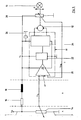
- FIG. 5 A known circuit arrangement for a headlamp leveling of a motor vehicle headlight is shown in FIG 5.
- the circuit is constructed as follows.
- a setpoint generator 14 is connected in the form of a transmitter potentiometer.
- This setpoint generator 14 is located in the area of the dashboard A of the vehicle.
- the supply lines B are shown for simplicity sake by the series connection of a resistor 16 with a downstream coil 18 intentionallyschaltsentlich.
- the headlamp leveler C has a drive motor 12 for height and / or tilt adjustment of the headlamp 10. The adjustment is indicated schematically by the arrow P.
- the headlamp leveler C has a control device IC with an input-side comparison stage 20 and an output-side driver stage 24, to which the drive motor 12 is connected. Between the comparator 20, which is regularly hysteresis, and the driver stage 24, a logic unit 22 is connected. For voltage supply of the comparison stage 20, the logic unit 22 and the driver stage 24, these are connected with supply lines to the supplied via the series connection of the resistor 16 and the coil 18 supply voltage V S and to reference potential.
- the comparison stage 20 is connected with its one input terminal to the center tap of the setpoint generator 14 and receives from there a desired signal V 14 . At the other input terminal, the comparison stage 20 receives the actual signal V FB and forms at its output hysteresis a differential voltage .DELTA.V.
- the setpoint generator on the dashboard A allows the driver of the car the individual adjustment of the headlight position. Due to the necessary mechanical coupling of the motor 12 and the actual value transmitter 28 with the headlight 10, the headlamp leveler C is accommodated directly on the headlight 10.
- the drive motor 12 is driven by the driver stage 24, which is preferably a full bridge circuit. Depending on the position of the setpoint generator 14 of the headlight 10 is more or less up or dimmed, so the inclination angle can be adjusted.
- the actual value 28 is used as an angle sensor.
- This provides the actual signal V FB and is mechanically connected to the drive motor 12 and z. B. connected via a worm drive with the pitch mechanism of the headlamp 10.
- the signal V 14 supplied from the reference value generator 14 is compared in the comparator 20 with the signal V FB. Depending on the differential voltage V, the drive motor 12 rotates as long and changes the signal V FB until the difference signal .DELTA.V becomes zero.
- the invention has the aim of providing a method and a circuit arrangement for headlamp leveling of a headlight, which makes the use of an electrolytic capacitor with high capacity unnecessary and therefore is small-scale to realize.
- the invention essentially provides an additional device which blocks the result of an actual / desired comparison of the control loop for a predetermined time each time the drive motor is started and thus blocks it.
- the output signal of the comparison stage within the control device remains without effect for this time.
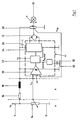
- the decisive difference from the circuit arrangement of FIG. 5 is the circuit arrangement of FIG. 1 in that in the control device IC, preferably as an integrated circuit Circuit is executed, a blanking device 30 is seated, which is coupled to the logic unit 22 in a manner to be explained.
- the blanking device 30 receives a signal START from the logic unit 22, processes this signal and forwards to the logic unit 22 a signal BLANK.
- the masking device 30 is connected to reference potential via a capacitor 40, which is arranged outside the control device IC.
- the capacitor 26 is now formed not as an electrolytic capacitor, but as a capacitor with a relatively small capacity.
- the capacitor 26 also serves as a filter capacitor, but may be reduced to a few 100 nF.
- the blanking device 30 ensures that the output signal of the comparator 20 remains without effect for a predetermined period of time and is thus hidden.
- the circuit operates again without the blanking device 30 continues to influence.
- the blanking time can be adapted individually to the respective application with a ceramic capacitor of relatively small capacity (cf, see FIG. 3).
- the capacitor 26 is still required to limit the rate of voltage change (dV S / dt). Too high a voltage change rate (“slew rate”) has repercussions from the driver stage 24 on the logic unit 22 and the comparison stage 20 result. Such repercussions occur in particular when the control device IC is monolithically integrated in a semiconductor body.
- FIG. 2 With each other four timing diagrams of voltage and current waveforms in temporal relation to each other shown one below the other.
- the uppermost curve shows the voltage signal V 14 which, starting from a higher value at time a, is gradually reduced to a lower value by corresponding actuation of the setpoint generator 14 (see FIG. At time c, this lower value is reached.
- V HY is the hysteresis voltage of the comparison stage 20.
- the signal V 14 reaches the lower hysteresis value of the comparator 20.
- the drive motor 12 starts.
- the motor current IM jumps at the time b to the high stall current I STALL , then with the mechanical time constant to the nominal current I NEN fall .
- V S drops abruptly at time b.
- the actual value signal V FB breaks according to the dashed line in the upper signal diagram at time b and drops significantly below the desired signal V 14 .
- the drive motor 12 would in this case be stopped and controlled backwards since V FB ⁇ (V 14 -1/2 V HY ).
- the masking device 30 ensures that immediately after the start of the drive motor 12, ie at time b, the output signal of the comparator 20 is suppressed for a predetermined period of time.
- the predetermined period of time is chosen so that in any case after the expiry of the period V FB > V 14 .
- the blanking time t A is chosen so large that its end is slightly after the time c. As shown in the top timing diagram of Fig. 2, that is, the signal V FB jumps suddenly under V 14 at time b, and then gradually increase again. After the blanking time t A , the signal V FB decreases until the point in time at which the drive motor 12 is switched off.
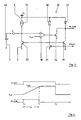
- FIG. 3 shows an exemplary embodiment of the masking device 30 of FIG. 1.
- the circuit has the already described capacitor 40, which may for example have a capacitance value of 47 nF and is connected to one terminal to the reference potential terminal 3 and with its other terminal to a terminal of the control device.
- This terminal is designated by the reference character K and within the masking device 30 with the non-inverting input of a comparator 38 in combination.
- the inverting input of the comparator 38 is in contact with a reference voltage V REF .
- the terminal K is also connected via a current source 31 to the supply voltage terminal 5 for the supply voltage V S.
- the terminal K is additionally connected via the load path of a bipolar transistor 32 to the reference potential terminal 3.
- the output terminal of the comparator 38 is connected to the control terminal of a second transistor 34 in connection.
- the load path of this second transistor 34 is located between the reference potential terminal 3 and a terminal on which the signal BLANK can be tapped.
- This terminal is connected via a resistor 37 to the supply voltage terminal 5 in combination.
- this terminal is connected via the load path of a third transistor 35 to the reference potential terminal 3.
- the control terminal of this third transistor 35 is connected to the control terminal of the first transistor 32 in connection and via the load path of a fourth transistor 33 to the reference potential terminal 3.
- the connection point of the two control terminals of the transistors 32, 35 is further connected via a resistor 36 to the supply voltage terminal 5.
- the control terminal of the fourth transistor is connected to a terminal for the signal START.
- the mentioned resistors 36, 37 may also be replaced by current sources.
- this masking device 30 will become apparent in connection with the waveforms of FIG. If the difference V 14 -V FB (compare FIG. 1) is greater than the switching hysteresis of the comparator 20, the signal START is generated, which clamps the bases of the transistors 32 and 35 via the transistor 33. As a result, the charging process of the capacitor 40 is started, whereby the voltage V 40 dropping across it increases. With the beginning of the signal START also the signal BLANK starts at the time t 0 . If the voltage V 40 reaches the reference voltage V ref , the signal BLANK is set by the transistor 34 back to low level "Low". The time span t 1 -t 0 is the fade time t A.
- the logic unit 22 of the control device IC ensures that the output signal of the comparison stage 20 is hidden. If the signal V 14 is equal to the signal V FB , which is the case at time t 2 , the signal START is reset and the capacitor 40 is discharged via the transistor 32.
- the circuit can not necessarily be used only for headlamp leveling of headlamps. Rather, the inventive method and the proposed circuit arrangement also finds useful wherever it is important that a motor without unwanted reciprocating motion must start. Such motors are commonly referred to as servomotors.
Landscapes
- Engineering & Computer Science (AREA)
- Mechanical Engineering (AREA)
- Lighting Device Outwards From Vehicle And Optical Signal (AREA)
Description
Die Erfindung betrifft ein Verfahren zur Leuchtweitenregulierung eines Scheinwerfers gemäß dem Oberbegriff des Anspruchs 1 sowie eine Schaltungsanordnung gemäß dem Oberbegriff des Anspruchs 7.The invention relates to a method for headlamp leveling of a headlamp according to the preamble of claim 1 and a circuit arrangement according to the preamble of claim 7.
Bei den heute hergestellten Kraftfahrzeugen ist regelmäßig die Leuchtweitenregulierung der Scheinwerfer vorgesehen. Eine Leuchtweitenregulierung ist deshalb notwendig, damit die Scheinwerfer je nach Beladungszustand des Kfz so eingestellt sind, daß ein Gegenverkehr nicht geblendet wird. In Kraftfahrzeugen sind hierfür entweder stufenlose Leuchtweitensteller oder schaltbare Leuchtweitensteller üblich.In the vehicles produced today, the headlamp leveling of the headlights is provided regularly. A headlamp leveling is therefore necessary so that the headlights are adjusted depending on the load condition of the car so that oncoming traffic is not dazzled. In motor vehicles, either stepless headlamp levelers or switchable headlamp levelers are common.
Eine bekannte Schaltungsanordnung für eine Leuchtweitenregulierung eines Kfz-Scheinwerfers zeigt Figur 5. Die Schaltung ist folgendermaßen aufgebaut.A known circuit arrangement for a headlamp leveling of a motor vehicle headlight is shown in FIG 5. The circuit is constructed as follows.
Zwischen eine Versorgungsspannungsklemme 1, an der die Betriebsspannung VB und damit also die Batteriespannung eines Kfz anliegt, und eine Bezugspotentialklemme 3 ist ein Sollwertgeber 14 in Form eines Geber-Potentiometers geschaltet. Dieser Sollwertgeber 14 befindet sich im Bereich des Armaturenbretts A des Kfzs. Über geeignete Zuleitungen B ist der Mittenabgriff des Sollwertgebers 14 und die Versorgungsspannungsklemme 1 mit einem an den Scheinwerfer 10 mechanisch gekoppelten Leuchtweitensteller C verbunden. Die Zuleitungen B sind der Einfachheit halber durch die Serienschaltung eines Widerstandes 16 mit nachgeschalteter Spule 18 ersatzschaltbildlich dargestellt. Der Leuchtweitensteller C weist einen Antriebsmotor 12 zum Höhen- und/oder Neigungsverstellen des Scheinwerfers 10 auf. Die Verstellung ist durch den Pfeil P schematisch angedeutet. Mit dem Scheinwerfer 10 ist ein Istwertgeber 28, hier ein sogenanntes Feedback-Potentiometer, gekoppelt, zwischen dessen Mittenabgriff und Bezugspotentialklemme 3 ein für die augenblickliche Stellung des Scheinwerfers 10 repräsentatives Signal VFB greifbar ist. Der Leuchtweitensteller C verfügt über eine Steuereinrichtung IC mit einer eingangsseitigen Vergleichsstufe 20 und einer ausgangsseitigen Treiberstufe 24, an die der Antriebsmotor 12 geschaltet ist. Zwischen der Vergleichsstufe 20, die regelmäßig hysteresebehaftet ist, und der Treiberstufe 24 ist eine Logikeinheit 22 geschaltet. Zur Spannungsversorgung der Vergleichsstufe 20, der Logikeinheit 22 und der Treiberstufe 24 sind diese mit Zuleitungen an die über die Serienschaltung des Widerstandes 16 und der Spule 18 bereitgestellte Speisespannung VS und an Bezugspotential angeschlossen. Zwischen der Bezugspotentialklemme 3 und der Leitung für die Speisespannung VS ist ein Elektrolytkondensator, der noch näher erläutert wird, angeschlossen. Die Vergleichsstufe 20 ist mit ihrer einen Eingangsklemme an den Mittenabgriff des Sollwertgebers 14 angeschlossen und erhält von dort ein Sollsignal V14. An der andere Eingangsklemme erhält die Vergleichsstufe 20 das Istsignal VFB und bildet an ihrem Ausgang hysteresebehaftet eine Differenzspannung ΔV.Between a supply voltage terminal 1, to which the operating voltage V B and thus thus the battery voltage of a motor vehicle is applied, and a reference
Die Funktionsweise ist folgendermaßenThe operation is as follows
Der Sollwertgeber am Armaturenbrett A ermöglicht dem Fahrer des Kfz die individuelle Justage der Scheinwerferstellung. Aufgrund der notwendigen mechanischen Kopplung des Motors 12 und des Istwertgebers 28 mit dem Scheinwerfer 10 ist der Leuchtweitensteller C direkt am Scheinwerfer 10 untergebracht. Der Antriebsmotor 12 wird von der Treiberstufe 24, die vorzugsweise eine Vollbrückenschaltung ist, angetrieben. Je nach Stellung des Sollwertgebers 14 soll der Scheinwerfer 10 mehr oder weniger auf- oder abgeblendet, also dessen Neigungswinkel verstellt werden. Dazu wird der Istwertgeber 28 als Winkelaufnehmer benutzt. Dieser liefert das Istsignal VFB und ist mechanisch mit dem Antriebsmotor 12 und z. B. über einen Schneckenantrieb mit der Nickmechanik des Scheinwerfers 10 verbunden. Das vom Sollwertgeber 14 gelieferte Signal V14 wird in der Vergleichsstufe 20 mit dem Signal VFB verglichen. Je nach Differenzspannung V dreht der Antriebsmotor 12 so lange und verändert das Signal VFB bis das Differenzsignal ΔV zu null wird.The setpoint generator on the dashboard A allows the driver of the car the individual adjustment of the headlight position. Due to the necessary mechanical coupling of the
Da das gesamte System eine gewisse Massenträgheit aufweist, wird der Abgleich zwischen Sollwertgeber 14 und Istwertgeber 28 durch ein "Ausrollen" und damit einer Weiterbelegung des Antriebsmotors 12 verfälscht. Dies kann zu unerwünschten Kippschwingungen des gesamten Systems führen. Ferner führt die Anordnung bei kleinsten Störspannungen unerwünschte Stellbewegungen aus.Since the entire system has a certain mass inertia, the adjustment between
Weil der Sollwertgeber 14 und der Istwertgeber 28 an zwei verhältnismäßig weit voneinander entfernten Orten installiert ist, ist des Weiteren die Einstreuung von Störungen über die Zuleitungen B hochwahrscheinlich. Da die Betriebsspannung VB direkt an dem Sollwertgeber 14 angelegt ist und die übrige Schaltung über die Zuleitungsimpedanz versorgt wird, bricht bei jedem Start des Antriebsmotors 12 die Speisespannung VS ein. Es entsteht eine unerwünschte Eingangsspannungsdifferenz an der Vergleichsstufe 20, was gezwungenermaßen zu Kippschwingungen am Scheinwerfer 10 aufgrund des unerwünschten Hin- und Herantriebes des Motors 12 bewirkt. Eine solche Kippschwingung hat darüber hinaus eine deutlich erhöhte Leistungsaufnahme zur Folge und kann evtl. sogar zu einer Überhitzung der Treiberstufe 24 führen.Because the
Dieses Problem wurde im Wesentlichen dadurch gelöst, daß die Vergleichsstufe 20 mit einer Hysterese versehen ist. Zusätzlich muß jedoch die Speisespannung VS mit einem relativ großen Elektrolytkondensator (vgl. in Fig. 5, Bezugszeichen 26) gegen Masse gesiebt werden. Dieser Elektrolytkondensator 26 ist teuer und zeichnet sich nur durch einen eingeschränkten Temperaturbereich aus. Darüber hinaus ist ein solcher Elektrolytkondensator mit einer entsprechend großen Kapazität nicht als SMD-Bauelement verfügbar und läuft daher einer zunehmenden Miniaturisierung der Schaltung zuwider. Schließlich können solche Elektrolytkondensatoren bei hartem Einsatz, wie er im Kfz regelmäßig gegeben ist, auch austrocknen, so daß deren Zuverlässigkeit unsicher ist. Für eine akzeptable Leuchtweitenregulierung ist es dennoch erforderlich, einen solchen Elektrolytkondensator mit hoher Kapazität und damit großem Siebfaktor zu verwenden, um Kippschwingungen des Scheinwerfers 10 sicher zu unterdrücken.This problem has essentially been solved by providing
Die Erfindung hat das Ziel, ein Verfahren und eine Schaltungsanordnung zur Leuchtweitenregulierung eines Scheinwerfers anzugeben, das die Verwendung eines Elektrolytkondensators mit hoher Kapazität entbehrlich macht und daher klein bauend zu realisieren ist.The invention has the aim of providing a method and a circuit arrangement for headlamp leveling of a headlight, which makes the use of an electrolytic capacitor with high capacity unnecessary and therefore is small-scale to realize.
Diese Aufgabe wird für das Verfahren durch die Merkmale des Anspruchs 1 und für die Schaltungsanordnung durch die Merkmale des Anspruchs 7 gelöst.This object is achieved for the method by the features of claim 1 and for the circuit arrangement by the features of claim 7.
Weiterbildungen der Erfindung sind Gegenstand der Unteransprüche.Further developments of the invention are the subject of the dependent claims.
Die Erfindung sieht im Wesentlichen eine Zusatzeinrichtung vor, die bei jedem Start des Antriebsmotors das Ergebnis eines Ist-/Soll-Vergleiches des Regelkreises für eine vorgegebene Zeit blockiert und damit ausblendet. Das Ausgangssignal der Vergleichsstufe innerhalb der Steuereinrichtung bleibt für diese Zeit ohne Wirkung.The invention essentially provides an additional device which blocks the result of an actual / desired comparison of the control loop for a predetermined time each time the drive motor is started and thus blocks it. The output signal of the comparison stage within the control device remains without effect for this time.
Das Verfahren und die Schaltungsanordnung werden nachfolgend im Zusammenhang mit einem Ausführungsbeispiel anhand der Zeichnung näher erläutert. Es zeigen:
- Fig. 1
- das Blockschaltbild eines Ausführungsbeispieles einer Schaltungsanordnung zur Leuchtweitenregulierung eines Scheinwerfers gemäß vorliegender Erfindung,
- Fig. 2
- die wesentlichen Spannungs- und Stromverläufe in der Schaltungsanordnung von Fig. 1,
- Fig. 3
- ein Ausführungsbeispiel für eine in der Steuereinrichtung von Fig. 1 eingesetzte Ausblendeinrichtung,
- Fig. 4
- Signalverläufe zu der Schaltungsanordnung von Fig. 3, und
- Fig. 5
- die bereits erläuterte Schaltungsanordnung zur Leuchtweitenregulierung eines Scheinwerfers nach dem Stand der Technik.
- Fig. 1
- the block diagram of an embodiment of a circuit arrangement for headlamp leveling of a headlamp according to the present invention,
- Fig. 2
- the essential voltage and current waveforms in the circuit arrangement of Fig. 1,
- Fig. 3
- An exemplary embodiment of a blanking device used in the control device of FIG. 1,
- Fig. 4
- Waveforms to the circuit arrangement of Fig. 3, and
- Fig. 5
- the already explained circuit arrangement for headlamp leveling of a headlamp according to the prior art.
In den nachfolgenden Figuren bezeichnen, sofern nicht anders angegeben, gleiche Bezugszeichen gleiche Teile mit gleicher Bedeutung. Die bereits im Zusammenhang mit der Erläuterung von Fig. 5 benutzten Bezugszeichen gelten für gleiche Teile mit gleicher Bedeutung weiter.In the following figures, unless otherwise stated, like reference numerals designate like parts with the same meaning. The reference numerals already used in connection with the explanation of Fig. 5 apply to the same parts with the same meaning.
Die in Fig. 1 dargestellte Schaltungsanordnung entspricht bis auf die nachfolgend erläuterten Unterschiede der Schaltungsanordnung von Fig. 5. Der entscheidende Unterschied zur Schaltungsanordnung von Fig. 5 besteht in der Schaltungsanordnung von Fig. 1 darin, daß in der Steuereinrichtung IC, die vorzugsweise als integrierter Schaltkreis ausgeführt ist, eine Ausblendeinrichtung 30 sitzt, welche mit der Logikeinheit 22 in noch zu erläuternder Weise gekoppelt ist. Die Ausblendeinrichtung 30 empfängt von der Logikeinheit 22 ein Signal START, verarbeitet dieses Signal und leitet der Logikeinheit 22 ein Signal BLANK zu. Die Ausblendeinrichtung 30 ist über einen Kondensator 40, der außerhalb der Steuereinrichtung IC angeordnet ist, an Bezugspotential geschaltet.The decisive difference from the circuit arrangement of FIG. 5 is the circuit arrangement of FIG. 1 in that in the control device IC, preferably as an integrated circuit Circuit is executed, a blanking
Ein weiterer wesentlicher Unterschied ist, daß der Kondensator 26 jetzt nicht als Elektrolytkondensator, sondern als Kondensator mit verhältnismäßig geringer Kapazität ausgebildet ist. Der Kondensator 26 dient ebenfalls als Siebkondensator, kann jedoch auf einige 100 nF verringert sein. Damit ist der Einsatz einer preiswerten, kleinen temperaturfesten SMDfähigen (surface mounted device) und zuverlässigen keramischen Kapazität möglich.Another significant difference is that the
Die Ausblendeinrichtung 30 sorgt dafür, daß das Ausgangssignal der Vergleichsstufe 20 für eine vorgegebene Zeitspanne ohne Wirkung bleibt und damit ausgeblendet ist.The blanking
Zum besseren Verständnis dieser Funktion sind die wichtigsten Spannungs- und Stromverläufe in Fig. 2 dargestellt. Hierauf wird noch weiter unten eingegangen. Nach der vorgegebenen Zeitspanne der Ausblendung arbeitet die Schaltungsanordnung wieder, ohne daß die Ausblendeinrichtung 30 weiter Einfluß nimmt. Die Ausblendzeit kann mit einem keramischen Kondensator verhältnismäßig geringer Kapazität individuell an die jeweilige Applikation angepaßt werden (vgl. hierzu Fig. 3). Der Kondensator 26 ist noch erforderlich, um die Spannungsänderungsgeschwindigkeit (dVS/dt) zu limitieren. Eine zu hohe Spannungsänderungsgeschwindigkeit ("Slew-rate") hat Rückwirkungen von der Treiberstufe 24 auf die Logikeinheit 22 und der Vergleichsstufe 20 zur Folge. Solche Rückwirkungen treten insbesondere dann auf, wenn die Steuereinrichtung IC monolithisch in einen Halbleiterkörper integriert ist.For a better understanding of this function, the most important voltage and current characteristics are shown in FIG. This will be discussed below. After the predetermined period of blanking, the circuit operates again without the blanking
In Fig. 2 sind untereinander vier Zeitdiagramme von Spannungs- und Stromverläufen in zeitlicher Beziehung zueinander untereinander dargestellt. In der obersten Kurve ist das Spannungssignal V14 dargestellt, das ausgehend von einem höheren Wert zum Zeitpunkt a allmählich auf einen niedrigeren Wert durch entsprechende Betätigung des Sollwertgebers 14 (vgl. hierzu Fig. 1) reduziert wird. Zum Zeitpunkt c ist dieser niedrigere Wert erreicht. Mit VHY ist die Hysteresespannung der Vergleichsstufe 20 bezeichnet. Zum Zeitpunkt b, der zwischen den Zeitpunkten a und c liegt, erreicht das Signal V14 den unteren Hysteresewert der Vergleichsstufe 20. Zum Zeitpunkt b startet der Antriebsmotor 12. Der Motorstrom IM springt zum Zeitpunkt b auf den hohen Blockierstrom ISTALL, um anschließend mit der mechanischen Zeitkonstanten auf den Nennstrom INENN abzusinken.In Fig. 2 with each other four timing diagrams of voltage and current waveforms in temporal relation to each other shown one below the other. The uppermost curve shows the voltage signal V 14 which, starting from a higher value at time a, is gradually reduced to a lower value by corresponding actuation of the setpoint generator 14 (see FIG. At time c, this lower value is reached. V HY is the hysteresis voltage of the
Die Speisespannung VS sinkt zum Zeitpunkt b abrupt ab. Das Istwertsignal VFB bricht entsprechend der strichlierten Linie im oberen Signaldiagramm zum Zeitpunkt b ein und sinkt deutlich unter das Sollsignal V14. Ohne die erfindungsgemäße Ausblendeinrichtung 30 und damit bei einer Schaltungsanordnung nach dem Stand der Technik würde der Antriebsmotor 12 in diesem Fall gestoppt und rückwärts gesteuert, da VFB < (V14 -1/2 VHY) ist.The supply voltage V S drops abruptly at time b. The actual value signal V FB breaks according to the dashed line in the upper signal diagram at time b and drops significantly below the desired signal V 14 . Without the
Erfindungsgemäß sorgt jedoch die Ausblendeinrichtung 30 dafür, daß unmittelbar nach dem Start des Antriebsmotors 12, also zum Zeitpunkt b, das Ausgangssignal der Vergleichsstufe 20 für eine vorgegebene Zeitspanne unterdrückt wird. Die vorgegebene Zeitspanne ist so gewählt, daß auf jeden Fall nach Ablauf der Zeitspanne VFB > V14 ist. Im dargestellten Ausführungsbeispiel von Fig. 2 ist die Ausblendzeit tA so groß gewählt, daß deren Ende etwas nach dem Zeitpunkt c liegt. Wie im obersten Zeitdiagramm von Fig. 2 dargestellt, springt also das Signal VFB zum Zeitpunkt b sprungartig unter V14, um dann allmählich wieder anzusteigen. Nach der Ausblendzeit tA sinkt das Signal VFB bis zum Zeitpunkt d, zu dem der Antriebsmotor 12 abgeschaltet wird.According to the invention, however, the masking
In Fig. 3 ist ein Ausführungsbeispiel der Ausblendeinrichtung 30 von Fig. 1 dargestellt. Die Schaltung weist den bereits erläuterten Kondensator 40 auf, der beispielsweise einen Kapazitätswert von 47 nF haben kann und mit einem Anschluß mit der Bezugspotentialklemme 3 und mit seinem anderen Anschluß an eine Klemme der Steuereinrichtung angeschlossen ist. Diese Klemme ist mit dem Bezugszeichen K bezeichnet und innerhalb der Ausblendeinrichtung 30 mit dem nicht invertierenden Eingang eines Vergleichers 38 in Verbindung. Der invertierende Eingang des Vergleichers 38 ist mit einer Referenzspannung VREF in Kontakt. Die Klemme K ist darüber hinaus über eine Stromquelle 31 an die Speisespannungsklemme 5 für die Speisespannung VS geschaltet. Die Klemme K ist zusätzlich über die Laststrecke eines Bipolartransistors 32 an die Bezugspotentialklemme 3 geschaltet. Die Ausgangsklemme des Vergleichers 38 ist mit dem Steueranschluß eines zweiten Transistors 34 in Verbindung. Die Laststrecke dieses zweiten Transistors 34 liegt zwischen der Bezugspotentialklemme 3 und einer Klemme, an der das Signal BLANK abgreifbar ist. Diese Klemme ist über einen Widerstand 37 mit der Speisespannungsklemme 5 in Verbindung. Zusätzlich ist diese Klemme über die Laststrecke eines dritten Transistors 35 an die Bezugspotentialklemme 3 geschaltet. Der Steueranschluß dieses dritten Transistors 35 ist mit dem Steueranschluß des ersten Transistors 32 in Verbindung und über die Laststrecke eines vierten Transistors 33 an Bezugspotentialklemme 3 geschaltet. Der Verbindungspunkt der beiden Steueranschlüsse der Transistoren 32, 35 ist des Weiteren über einen Widerstand 36 an die Speisespannungsklemme 5 gelegt. Der Steueranschluß des vierten Transistors ist mit einer Klemme für das Signal START in Verbindung. Die erwähnten Widerstände 36, 37 können auch durch Stromquellen ersetzt sein.FIG. 3 shows an exemplary embodiment of the
Die Funktionsweise dieser Ausblendeinrichtung 30 wird im Zusammenhang mit den Signalverläufen von Fig. 4 deutlich. Wird die Differenz V14 - VFB (vgl. hierzu Fig. 1) größer als die Schalthysterese der Vergleichsstufe 20, so wird das Signal START erzeugt, was über den Transistor 33 die Basen der Transistoren 32 und 35 klemmt. Hierdurch wird der Ladevorgang des Kondensators 40 gestartet, wodurch die an ihm abfallende Spannung V40 ansteigt. Mit dem Beginn des Signales START beginnt auch das Signal BLANK zum Zeitpunkt t0. Erreicht die Spannung V40 die Referenzspannung Vref, wird das Signal BLANK durch den Transistor 34 wieder auf niedrigen Pegel "Low" gesetzt. Die Zeitspanne t1-t0 ist die Ausblendzeit tA. Während das Signal BLANK einen hohen Pegel "high" einnimmt, sorgt die Logikeinheit 22 der Steuereinrichtung IC dafür, daß das Ausgangssignal der Vergleichsstufe 20 ausgeblendet wird. Wird das Signal V14 gleich dem Signal VFB, was zum Zeitpunkt t2 der Fall ist, wird das Signal START rückgesetzt und der Kondensator 40 über den Transistor 32 entladen.The operation of this
Es ist hier noch abschließend anzumerken, daß die Schaltung nicht notwendigerweise nur zur Leuchtweitenregulierung von Scheinwerfern eingesetzt werden kann. Vielmehr findet das erfindungsgemäße Verfahren und die vorgestellte Schaltungsanordnung auch überall dort sinnvoll Anwendung, wo es darauf ankommt, daß ein Motor ohne unerwünschte Hin- und Herbewegung anlaufen muß. Solche Motoren werden allgemein als Servomotoren bezeichnet.It should be noted in conclusion that the circuit can not necessarily be used only for headlamp leveling of headlamps. Rather, the inventive method and the proposed circuit arrangement also finds useful wherever it is important that a motor without unwanted reciprocating motion must start. Such motors are commonly referred to as servomotors.
Claims (15)
- Method for controlling the lighting range of a headlamp (10), in which a drive motor (12) which is mechanically coupled to the headlamp (10) and is intended to adjust the headlamp (10) is driven on the basis of an actuating signal obtained from an actual/desired comparison,
characterized in that the result of the actual/desired comparison is ignored and thus masked for a predefined period of time (tA) each time the drive motor (12) is started. - Method according to Claim 1,
characterized in that the actuating signal is derived as a differential signal of a desired signal (V14) coming from an adjustment device (14), which can be manually operated, and an actual signal (VFB) corresponding to the current position of the headlamp (10). - Method according to Claim 1 or 2,
characterized in that the actuating signal is subject to hysteresis. - Method according to one of Claims 1 to 3,
characterized in that the predefined period of time (tA) can be set. - Method according to one of Claims 1 to 4,
characterized in that the beginning (t0) of the period of time (tA) is determined by a predefined magnitude of the differential signal, and the end (t1) of the period of time (tA) is reached when a capacitor (40) has been charged to a predefined reference voltage (Vref). - Method according to Claim 5,
characterized in that a reset signal for a new beginning (t0) of the period of time (tA) is generated when the differential signal is at least approximately equal to 0 or is equal to 0. - Circuit arrangement for controlling the lighting range of a headlamp (10), said circuit arrangement having the following features:- a drive motor (12) for adjusting the headlamp (10);- an actual value transmitter (28) which is coupled to the headlamp (10) and is intended to form an actual signal (VFB) which is decisive for the current position of the headlamp (10);- a desired value transmitter (14) for forming a desired signal (V14) which is decisive for a desired position of the headlamp (10);- a control device (IC) which can be used to drive the drive motor (12) in accordance with a differential signal formed from the desired signal (V14) and the actual signal (VFB),characterized by the following further feature:- a masking device (30) which is provided in the control device (IC) and can be used to mask the differential signal for a predefined period of time (tA) each time the drive motor (12) is started.
- Circuit arrangement according to Claim 7,
characterized in that the control device (IC) has a comparison stage (20) on the input side and a driver stage (24) on the output side as well as a logic unit (22) which is connected between the comparison stage (20) and the driver stage (24). - Circuit arrangement according to Claim 8,
characterized in that the actual value transmitter (14) and/or the desired value transmitter (28) is/are formed by potentiometers, the centre tap or the centre taps of the potentiometer(s) being coupled to the comparison stage (20) of the control device (IC). - Circuit arrangement according to one of Claims 7 to 9,
characterized in that the masking device (30) has a capacitor (40), which is decisive to the period of time (tA), and a comparator (38), and in that a reference voltage (Vref) can be applied to the input of the comparator (38), on the one hand, and the input of the comparator is connected to the capacitor (40), on the other hand. - Circuit arrangement according to one of Claims 7 to 10,
characterized in that the masking device (30) has the series connection of a series circuit comprising a current source (31) and the load path of a transistor (32), said series circuit being connected between a supply voltage terminal (1) and a reference-earth potential terminal (3), in that the capacitor (40) is connected between the reference-earth potential terminal (3) and the centre tap of the series circuit comprising the current source (31) and the transistor (32), in that the centre tap is connected to a first input source of the comparator (38), in that another input terminal of the comparator (38) can be coupled to the reference voltage (Vref), in that the output of the comparator (38) is connected to the control connection of a second transistor (34), in that the load path of this second transistor (34) is connected between the reference-earth potential terminal (3) and an output terminal for an output signal (BLANK) from the masking device (30), in that this output terminal is connected to the supply voltage terminal (1) via a resistor (37) and is connected to the reference-earth potential terminal (3) via the load path of a third transistor (35), in that the control connection of this third transistor (35) is connected to the control connection of the first transistor (32) and is connected to the reference-earth potential terminal (3) via the load path of a fourth transistor (33) and is connected to the supply voltage terminal (1) via a further resistor (36), and in that the control connection of the fourth transistor (33) is connected to an input terminal for an input signal (START) of the masking device (30). - Circuit arrangement according to Claim 11,
characterized in that at least one of the resistors (36, 37) is implemented using current sources. - Circuit arrangement according to one of Claims 7 to 12,
characterized in that the control device (IC) is in the form of an integrated circuit. - Circuit arrangement according to one of Claims 7 to 13,
characterized in that the comparison stage (20) has switching hysteresis. - Circuit arrangement according to one of Claims 7 to 14,
characterized in that the headlamp (10) is a motor vehicle headlamp.
Applications Claiming Priority (2)
| Application Number | Priority Date | Filing Date | Title |
|---|---|---|---|
| DE1997143260 DE19743260C2 (en) | 1997-09-30 | 1997-09-30 | Method and circuit arrangement for headlight range control |
| DE19743260 | 1997-09-30 |
Publications (3)
| Publication Number | Publication Date |
|---|---|
| EP0904981A2 EP0904981A2 (en) | 1999-03-31 |
| EP0904981A3 EP0904981A3 (en) | 2003-04-16 |
| EP0904981B1 true EP0904981B1 (en) | 2007-12-12 |
Family
ID=7844190
Family Applications (1)
| Application Number | Title | Priority Date | Filing Date |
|---|---|---|---|
| EP19980114238 Expired - Lifetime EP0904981B1 (en) | 1997-09-30 | 1998-07-28 | Method and device for controlling the lighting distance of a headlamp |
Country Status (2)
| Country | Link |
|---|---|
| EP (1) | EP0904981B1 (en) |
| DE (2) | DE19743260C2 (en) |
Families Citing this family (1)
| Publication number | Priority date | Publication date | Assignee | Title |
|---|---|---|---|---|
| JP2001322484A (en) * | 2000-05-12 | 2001-11-20 | Koito Mfg Co Ltd | Motor control circuit of device for adjusting optical axis of vehicle light |
Family Cites Families (4)
| Publication number | Priority date | Publication date | Assignee | Title |
|---|---|---|---|---|
| FR2190265A5 (en) * | 1972-06-23 | 1974-01-25 | Jaeger | |
| DE2846602A1 (en) * | 1978-10-26 | 1980-05-08 | Bosch Gmbh Robert | Automatic correction system for vehicle headlight inclination - has pressure switch to release warning when system fails and includes potentiometer with indicator |
| DE3827983C1 (en) * | 1988-08-18 | 1990-02-01 | Hella Kg Hueck & Co, 4780 Lippstadt, De | |
| DE4024915A1 (en) * | 1990-08-06 | 1992-02-13 | Hella Kg Hueck & Co | METHOD AND DEVICE FOR REGULATING THE HEADLIGHT OF A MOTOR VEHICLE |
-
1997
- 1997-09-30 DE DE1997143260 patent/DE19743260C2/en not_active Expired - Fee Related
-
1998
- 1998-07-28 EP EP19980114238 patent/EP0904981B1/en not_active Expired - Lifetime
- 1998-07-28 DE DE59814136T patent/DE59814136D1/en not_active Expired - Lifetime
Also Published As
| Publication number | Publication date |
|---|---|
| EP0904981A3 (en) | 2003-04-16 |
| DE59814136D1 (en) | 2008-01-24 |
| DE19743260C2 (en) | 1999-10-21 |
| EP0904981A2 (en) | 1999-03-31 |
| DE19743260A1 (en) | 1999-04-08 |
Similar Documents
| Publication | Publication Date | Title |
|---|---|---|
| DE60015052T2 (en) | Semiconductor power conversion device | |
| EP0543826B1 (en) | Process and device for driving an electromagnetic consumer | |
| DE2716476A1 (en) | LEVELING DEVICE FOR MOTOR VEHICLES | |
| DE2705320C2 (en) | Vehicle headlight control circuit | |
| EP0072406A2 (en) | Device for automatically turning the lights on and off | |
| DE3507130A1 (en) | DRIVER CIRCUIT FOR A MAGNETIC COIL | |
| DE3233536A1 (en) | DEVICE FOR THE CLOCKED REGULATION OF A COIL FLOWING THROUGH | |
| EP0904981B1 (en) | Method and device for controlling the lighting distance of a headlamp | |
| DE19708115C1 (en) | Process for controlling a sensor with offset control | |
| DE69108187T2 (en) | Control device for the battery voltage delivered by an alternator. | |
| DE3924805A1 (en) | DC CONVERTER | |
| EP0545111A2 (en) | Device for adjusting the inclination of vehicle headlamps | |
| WO2005083251A1 (en) | Method and device for control of a capacitive actuator | |
| EP0098460B1 (en) | Control device for an electrical actuator | |
| EP1504317B1 (en) | Power supply circuit | |
| WO2006119751A2 (en) | Method and device for electrically actuating a valve with a mechanical closing element | |
| EP0197035A1 (en) | Circuit arrangement for the operation of fluorescent or ultra-violet low voltage discharge lamps | |
| DE10202279A1 (en) | Control circuit for an actuator | |
| EP1625663A2 (en) | Integrated circuit arrangement, and method for programming an integrated circuit arrangement | |
| DE3335200A1 (en) | Voltage supply device for motor vehicles | |
| DE102009047714A1 (en) | Circuit arrangement and method for operating at least one discharge lamp | |
| EP2807056B1 (en) | Method and arrangement for actuating at least one triggering element for a personal protection means | |
| EP2440022A2 (en) | Switch and method for controlling a lamp | |
| DE10040078C2 (en) | Device for additional load-dependent adjustment of headlights for motor vehicles | |
| DE4223660C2 (en) | Device for adjusting the light beam angle of a vehicle headlight |
Legal Events
| Date | Code | Title | Description |
|---|---|---|---|
| PUAI | Public reference made under article 153(3) epc to a published international application that has entered the european phase |
Free format text: ORIGINAL CODE: 0009012 |
|
| AK | Designated contracting states |
Kind code of ref document: A2 Designated state(s): AT BE CH CY DE DK ES FI FR GB GR IE IT LI LU MC NL PT SE |
|
| AX | Request for extension of the european patent |
Free format text: AL;LT;LV;MK;RO;SI |
|
| RAP1 | Party data changed (applicant data changed or rights of an application transferred) |
Owner name: INFINEON TECHNOLOGIES AG |
|
| PUAL | Search report despatched |
Free format text: ORIGINAL CODE: 0009013 |
|
| AK | Designated contracting states |
Designated state(s): AT BE CH CY DE DK ES FI FR GB GR IE IT LI LU MC NL PT SE |
|
| AX | Request for extension of the european patent |
Extension state: AL LT LV MK RO SI |
|
| RIC1 | Information provided on ipc code assigned before grant |
Ipc: 7B 60Q 1/076 A |
|
| 17P | Request for examination filed |
Effective date: 20030625 |
|
| AKX | Designation fees paid |
Designated state(s): DE FR GB IE IT |
|
| GRAP | Despatch of communication of intention to grant a patent |
Free format text: ORIGINAL CODE: EPIDOSNIGR1 |
|
| GRAS | Grant fee paid |
Free format text: ORIGINAL CODE: EPIDOSNIGR3 |
|
| GRAA | (expected) grant |
Free format text: ORIGINAL CODE: 0009210 |
|
| AK | Designated contracting states |
Kind code of ref document: B1 Designated state(s): DE FR GB IE IT |
|
| REG | Reference to a national code |
Ref country code: GB Ref legal event code: FG4D Free format text: NOT ENGLISH |
|
| REG | Reference to a national code |
Ref country code: IE Ref legal event code: FG4D Free format text: LANGUAGE OF EP DOCUMENT: GERMAN |
|
| REF | Corresponds to: |
Ref document number: 59814136 Country of ref document: DE Date of ref document: 20080124 Kind code of ref document: P |
|
| GBT | Gb: translation of ep patent filed (gb section 77(6)(a)/1977) |
Effective date: 20080227 |
|
| ET | Fr: translation filed | ||
| PLBE | No opposition filed within time limit |
Free format text: ORIGINAL CODE: 0009261 |
|
| STAA | Information on the status of an ep patent application or granted ep patent |
Free format text: STATUS: NO OPPOSITION FILED WITHIN TIME LIMIT |
|
| 26N | No opposition filed |
Effective date: 20080915 |
|
| REG | Reference to a national code |
Ref country code: FR Ref legal event code: PLFP Year of fee payment: 19 |
|
| PGFP | Annual fee paid to national office [announced via postgrant information from national office to epo] |
Ref country code: DE Payment date: 20160920 Year of fee payment: 19 |
|
| REG | Reference to a national code |
Ref country code: FR Ref legal event code: PLFP Year of fee payment: 20 |
|
| PGFP | Annual fee paid to national office [announced via postgrant information from national office to epo] |
Ref country code: IT Payment date: 20170728 Year of fee payment: 20 Ref country code: GB Payment date: 20170719 Year of fee payment: 20 Ref country code: FR Payment date: 20170724 Year of fee payment: 20 |
|
| PGFP | Annual fee paid to national office [announced via postgrant information from national office to epo] |
Ref country code: IE Payment date: 20170727 Year of fee payment: 20 |
|
| REG | Reference to a national code |
Ref country code: DE Ref legal event code: R119 Ref document number: 59814136 Country of ref document: DE |
|
| PG25 | Lapsed in a contracting state [announced via postgrant information from national office to epo] |
Ref country code: DE Free format text: LAPSE BECAUSE OF NON-PAYMENT OF DUE FEES Effective date: 20180201 |
|
| REG | Reference to a national code |
Ref country code: GB Ref legal event code: PE20 Expiry date: 20180727 Ref country code: IE Ref legal event code: MK9A |
|
| PG25 | Lapsed in a contracting state [announced via postgrant information from national office to epo] |
Ref country code: IE Free format text: LAPSE BECAUSE OF EXPIRATION OF PROTECTION Effective date: 20180728 |
|
| PG25 | Lapsed in a contracting state [announced via postgrant information from national office to epo] |
Ref country code: GB Free format text: LAPSE BECAUSE OF EXPIRATION OF PROTECTION Effective date: 20180727 |