EP0904774B1 - Resorcinol derivatives - Google Patents
Resorcinol derivatives Download PDFInfo
- Publication number
- EP0904774B1 EP0904774B1 EP98307523A EP98307523A EP0904774B1 EP 0904774 B1 EP0904774 B1 EP 0904774B1 EP 98307523 A EP98307523 A EP 98307523A EP 98307523 A EP98307523 A EP 98307523A EP 0904774 B1 EP0904774 B1 EP 0904774B1
- Authority
- EP
- European Patent Office
- Prior art keywords
- alkyl
- formula
- aryl
- compound
- hydrogen
- Prior art date
- Legal status (The legal status is an assumption and is not a legal conclusion. Google has not performed a legal analysis and makes no representation as to the accuracy of the status listed.)
- Expired - Lifetime
Links
Classifications
-
- A—HUMAN NECESSITIES
- A61—MEDICAL OR VETERINARY SCIENCE; HYGIENE
- A61Q—SPECIFIC USE OF COSMETICS OR SIMILAR TOILETRY PREPARATIONS
- A61Q19/00—Preparations for care of the skin
- A61Q19/02—Preparations for care of the skin for chemically bleaching or whitening the skin
-
- A—HUMAN NECESSITIES
- A61—MEDICAL OR VETERINARY SCIENCE; HYGIENE
- A61K—PREPARATIONS FOR MEDICAL, DENTAL OR TOILETRY PURPOSES
- A61K8/00—Cosmetics or similar toiletry preparations
- A61K8/18—Cosmetics or similar toiletry preparations characterised by the composition
- A61K8/19—Cosmetics or similar toiletry preparations characterised by the composition containing inorganic ingredients
- A61K8/25—Silicon; Compounds thereof
-
- A—HUMAN NECESSITIES
- A61—MEDICAL OR VETERINARY SCIENCE; HYGIENE
- A61K—PREPARATIONS FOR MEDICAL, DENTAL OR TOILETRY PURPOSES
- A61K8/00—Cosmetics or similar toiletry preparations
- A61K8/18—Cosmetics or similar toiletry preparations characterised by the composition
- A61K8/30—Cosmetics or similar toiletry preparations characterised by the composition containing organic compounds
- A61K8/33—Cosmetics or similar toiletry preparations characterised by the composition containing organic compounds containing oxygen
- A61K8/34—Alcohols
- A61K8/347—Phenols
-
- A—HUMAN NECESSITIES
- A61—MEDICAL OR VETERINARY SCIENCE; HYGIENE
- A61K—PREPARATIONS FOR MEDICAL, DENTAL OR TOILETRY PURPOSES
- A61K8/00—Cosmetics or similar toiletry preparations
- A61K8/18—Cosmetics or similar toiletry preparations characterised by the composition
- A61K8/30—Cosmetics or similar toiletry preparations characterised by the composition containing organic compounds
- A61K8/33—Cosmetics or similar toiletry preparations characterised by the composition containing organic compounds containing oxygen
- A61K8/36—Carboxylic acids; Salts or anhydrides thereof
- A61K8/365—Hydroxycarboxylic acids; Ketocarboxylic acids
-
- A—HUMAN NECESSITIES
- A61—MEDICAL OR VETERINARY SCIENCE; HYGIENE
- A61K—PREPARATIONS FOR MEDICAL, DENTAL OR TOILETRY PURPOSES
- A61K8/00—Cosmetics or similar toiletry preparations
- A61K8/18—Cosmetics or similar toiletry preparations characterised by the composition
- A61K8/30—Cosmetics or similar toiletry preparations characterised by the composition containing organic compounds
- A61K8/33—Cosmetics or similar toiletry preparations characterised by the composition containing organic compounds containing oxygen
- A61K8/37—Esters of carboxylic acids
- A61K8/375—Esters of carboxylic acids the alcohol moiety containing more than one hydroxy group
-
- A—HUMAN NECESSITIES
- A61—MEDICAL OR VETERINARY SCIENCE; HYGIENE
- A61K—PREPARATIONS FOR MEDICAL, DENTAL OR TOILETRY PURPOSES
- A61K8/00—Cosmetics or similar toiletry preparations
- A61K8/18—Cosmetics or similar toiletry preparations characterised by the composition
- A61K8/30—Cosmetics or similar toiletry preparations characterised by the composition containing organic compounds
- A61K8/40—Cosmetics or similar toiletry preparations characterised by the composition containing organic compounds containing nitrogen
- A61K8/41—Amines
-
- A—HUMAN NECESSITIES
- A61—MEDICAL OR VETERINARY SCIENCE; HYGIENE
- A61K—PREPARATIONS FOR MEDICAL, DENTAL OR TOILETRY PURPOSES
- A61K8/00—Cosmetics or similar toiletry preparations
- A61K8/18—Cosmetics or similar toiletry preparations characterised by the composition
- A61K8/30—Cosmetics or similar toiletry preparations characterised by the composition containing organic compounds
- A61K8/46—Cosmetics or similar toiletry preparations characterised by the composition containing organic compounds containing sulfur
-
- A—HUMAN NECESSITIES
- A61—MEDICAL OR VETERINARY SCIENCE; HYGIENE
- A61K—PREPARATIONS FOR MEDICAL, DENTAL OR TOILETRY PURPOSES
- A61K8/00—Cosmetics or similar toiletry preparations
- A61K8/18—Cosmetics or similar toiletry preparations characterised by the composition
- A61K8/30—Cosmetics or similar toiletry preparations characterised by the composition containing organic compounds
- A61K8/67—Vitamins
- A61K8/671—Vitamin A; Derivatives thereof, e.g. ester of vitamin A acid, ester of retinol, retinol, retinal
-
- A—HUMAN NECESSITIES
- A61—MEDICAL OR VETERINARY SCIENCE; HYGIENE
- A61P—SPECIFIC THERAPEUTIC ACTIVITY OF CHEMICAL COMPOUNDS OR MEDICINAL PREPARATIONS
- A61P17/00—Drugs for dermatological disorders
-
- A—HUMAN NECESSITIES
- A61—MEDICAL OR VETERINARY SCIENCE; HYGIENE
- A61P—SPECIFIC THERAPEUTIC ACTIVITY OF CHEMICAL COMPOUNDS OR MEDICINAL PREPARATIONS
- A61P17/00—Drugs for dermatological disorders
- A61P17/02—Drugs for dermatological disorders for treating wounds, ulcers, burns, scars, keloids, or the like
-
- A—HUMAN NECESSITIES
- A61—MEDICAL OR VETERINARY SCIENCE; HYGIENE
- A61P—SPECIFIC THERAPEUTIC ACTIVITY OF CHEMICAL COMPOUNDS OR MEDICINAL PREPARATIONS
- A61P17/00—Drugs for dermatological disorders
- A61P17/06—Antipsoriatics
-
- A—HUMAN NECESSITIES
- A61—MEDICAL OR VETERINARY SCIENCE; HYGIENE
- A61P—SPECIFIC THERAPEUTIC ACTIVITY OF CHEMICAL COMPOUNDS OR MEDICINAL PREPARATIONS
- A61P17/00—Drugs for dermatological disorders
- A61P17/10—Anti-acne agents
-
- A—HUMAN NECESSITIES
- A61—MEDICAL OR VETERINARY SCIENCE; HYGIENE
- A61P—SPECIFIC THERAPEUTIC ACTIVITY OF CHEMICAL COMPOUNDS OR MEDICINAL PREPARATIONS
- A61P17/00—Drugs for dermatological disorders
- A61P17/16—Emollients or protectives, e.g. against radiation
-
- A—HUMAN NECESSITIES
- A61—MEDICAL OR VETERINARY SCIENCE; HYGIENE
- A61P—SPECIFIC THERAPEUTIC ACTIVITY OF CHEMICAL COMPOUNDS OR MEDICINAL PREPARATIONS
- A61P29/00—Non-central analgesic, antipyretic or antiinflammatory agents, e.g. antirheumatic agents; Non-steroidal antiinflammatory drugs [NSAID]
-
- A—HUMAN NECESSITIES
- A61—MEDICAL OR VETERINARY SCIENCE; HYGIENE
- A61Q—SPECIFIC USE OF COSMETICS OR SIMILAR TOILETRY PREPARATIONS
- A61Q19/00—Preparations for care of the skin
- A61Q19/10—Washing or bathing preparations
-
- A—HUMAN NECESSITIES
- A61—MEDICAL OR VETERINARY SCIENCE; HYGIENE
- A61K—PREPARATIONS FOR MEDICAL, DENTAL OR TOILETRY PURPOSES
- A61K2800/00—Properties of cosmetic compositions or active ingredients thereof or formulation aids used therein and process related aspects
- A61K2800/74—Biological properties of particular ingredients
- A61K2800/78—Enzyme modulators, e.g. Enzyme agonists
- A61K2800/782—Enzyme inhibitors; Enzyme antagonists
-
- Y—GENERAL TAGGING OF NEW TECHNOLOGICAL DEVELOPMENTS; GENERAL TAGGING OF CROSS-SECTIONAL TECHNOLOGIES SPANNING OVER SEVERAL SECTIONS OF THE IPC; TECHNICAL SUBJECTS COVERED BY FORMER USPC CROSS-REFERENCE ART COLLECTIONS [XRACs] AND DIGESTS
- Y10—TECHNICAL SUBJECTS COVERED BY FORMER USPC
- Y10S—TECHNICAL SUBJECTS COVERED BY FORMER USPC CROSS-REFERENCE ART COLLECTIONS [XRACs] AND DIGESTS
- Y10S977/00—Nanotechnology
- Y10S977/902—Specified use of nanostructure
- Y10S977/904—Specified use of nanostructure for medical, immunological, body treatment, or diagnosis
- Y10S977/915—Therapeutic or pharmaceutical composition
-
- Y—GENERAL TAGGING OF NEW TECHNOLOGICAL DEVELOPMENTS; GENERAL TAGGING OF CROSS-SECTIONAL TECHNOLOGIES SPANNING OVER SEVERAL SECTIONS OF THE IPC; TECHNICAL SUBJECTS COVERED BY FORMER USPC CROSS-REFERENCE ART COLLECTIONS [XRACs] AND DIGESTS
- Y10—TECHNICAL SUBJECTS COVERED BY FORMER USPC
- Y10S—TECHNICAL SUBJECTS COVERED BY FORMER USPC CROSS-REFERENCE ART COLLECTIONS [XRACs] AND DIGESTS
- Y10S977/00—Nanotechnology
- Y10S977/902—Specified use of nanostructure
- Y10S977/904—Specified use of nanostructure for medical, immunological, body treatment, or diagnosis
- Y10S977/926—Topical chemical, e.g. cosmetic or sunscreen
Definitions
- the present invention relates to the use of certain resorcinol derivatives as skin lightening agents.
- lightening agent and “depigmentation agent” are used interchangeably throughout this document.
- melanocytes Skin color in humans arises from a complex series of cellular processes which are carried out within a unique population of cells called melanocytes. Melanocytes are located in the lower part of the epidermis, and their function is to synthesize a pigment, melanin, which protects the body from the damaging effects of ultraviolet radiation.
- melanocytes When skin is exposed to ultraviolet radiation, such as that contained in sunlight, melanocytes increase their synthesis of melanin. Melanin is deposited in melanosomes, which are vesicles found within the cell. The melanosomes are extruded from the cell and carried to the surface of the skin by keratinocytes, which internalize the melanin containing melanosomes. The end result is that the visible layers of the skin exhibit a brown color typically known as a "tan". The darkness of the color observed in the skin is proportionate to the amount of melanin synthesized by melanocytes and transferred to the keratinocytes.
- the mechanism by which skin pigmentation is formed, melanogenesis, is particularly complex and schematically involves the following main steps: Tyrosine ⁇ L-Dopa ⁇ Dopaquinone ⁇ Dopachrome ⁇ Melanins.
- the first two reactions in this series are catalyzed by the enzyme tyrosinase.
- the activity of tyrosinase is promoted by the action of ⁇ -melanocyte stimulating hormone or UV rays to have melanin eventually formed as chromatism in the skin.
- ⁇ -melanocyte stimulating hormone or UV rays to have melanin eventually formed as chromatism in the skin.
- a substance has a depigmenting effect if it acts directly on the vitality of the epidermal melanocytes where melanogenesis normally occurs and/or if it interferes with one of the stages in melanin biosynthesis.
- the active compounds that are employed in the various methods and compositions of this invention inhibit tyrosinase and thus inhibit or decrease melanin
- agents which enable acquired deposition sites such as spots or freckles
- agents and methods have been developed and put on the market. Examples of such methods are (a) a method wherein vitamin C (L-ascorbic acid) having good reducing ability is administered orally in large amounts, (b) a method wherein glutathione is administered parenterally; (c) a method wherein a peroxide, such as hydrogen peroxide, zinc peroxide, sodium peroxide and the like, which is believed to have the bleaching action of melamine, is administered: and (d) a method wherein vitamin C or cysteine is administered topically in the form of an ointment, cream, lotion or the like.
- a peroxide such as hydrogen peroxide, zinc peroxide, sodium peroxide and the like
- Vitamin C has a problem with respect to stability and becomes so unstable in water-containing systems that they will cause changes in odor and color.
- Thiol compounds such as glutathione and cysteine do not exhibit a satisfactory depigmental effect since the development of the effect is very slow.
- hydroquinone and its derivatives particularly its ethers such as hydroquinone monomethyl ether.
- hydroquinone use of which is limited to a concentration of 2%, is both irritating and cytotoxic to the melanocyte.
- United States Patent 4,526,179 refers to certain hydroquinone fatty esters that have good activity and are less irritating and more stable than hydroquinone.
- Japanese Patent Application No. 27909/86 refers to other hydroquinone derivatives that do not have the drawbacks of hydroquinone but that have relatively poor efficacy.
- United States Patent 5,449,518 refers to 2,5-dihydoxyphenyl carboxylic acid derivatives as skin depigmentation agents.
- EP 341,664A1 refers to certain resorcinol derivatives as tyrosinase inhibitors and skin depigmentation agents.
- topical depigmention agents that have good efficacy and are harmless is particularly desirable for treating the following: regional hyperpigmentation caused by melanocytic hyperactivity, such as idiopathic melasma occurring either during pregnancy (mask of pregnancy or chloasma) or secondary to estrogen-progesterone contraception; local hyperpigmentation caused by benign melanocytic hyperactivity and proliferation such as lentigo senilis or liver spots; accidental hyperpigmentation such as postlesional photosensitization and scarring; and certain forms of leukoderma such as vitiligo where, if the injured skin cannot be repigmented, the residual zones of normal skin are depigmented to impart a homogeneous white color to the entire skin.
- regional hyperpigmentation caused by melanocytic hyperactivity such as idiopathic melasma occurring either during pregnancy (mask of pregnancy or chloasma) or secondary to estrogen-progesterone contraception
- resorcinol derivatives of formula I which are defined below and used in the various methods and compositions of this invention, are useful in the treatment of the foregoing dermatological conditions as well as other dermatological conditions, some of which are referred to later in this document, for which the subject being treated desires, for medicinal or cosmetic purposes, to lighten or reduce the pigmentation of the skin affected by the condition.
- the resorcinol derivatives of formula I are also useful for the treatment of inflammatory disorders such as psoriasis and acne.
- the invention relates to the use of 4-cycloalkyl resorcinols having the formula: wherein X is hydrogen; OR 1 , wherein R 1 represents hydrogen, (C 1 -C 6 )alkyl or aryl-(C 1 -C 6 )alkyl; OCOR 2 wherein R 2 represents (C 1 -C 6 )alkyl, aryl-(C 1 -C 6 )alkyl or phenyl; halogen; (C 1 -C 6 )alkyl; aryl-(C 1 -C 6 )alkyl; SR 3 wherein R 3 represents hydrogen, (C 1 -C 6 )alkyl, or aryl-(C 1 -C 6 )alkyl; or NHR 1 wherein R 1 is defined as above. n is 0 to 3; and the dashed line indicates an optional double bond at that position.
- the present invention also relates to the pharmaceutically acceptable acid addition and base salts of compounds of the formula I.
- the acids which are used to prepare the pharmaceutically acceptable acid addition salts of the aforementioned base compounds of this invention are those which form non-toxic acid addition salts, i.e.
- salts containing pharmacologically acceptable anions such as the hydrochloride, hydrobromide, hydroiodide, nitrate, sulfate, bisulfate, phosphate, acid phosphate, acetate, lactate, citrate, acid citrate, tartrate, bitartrate, succinate, maleate, fumarate, gluconate, saccharate, benzoate, methanesulfonate, ethanesulfonate, benzenesulfonate, p-toluenesulfonate and pamoate [ i.e. , 1,1-methylene-bis-(2-hydroxy-3-naphthoate)] salts.
- pharmacologically acceptable anions such as the hydrochloride, hydrobromide, hydroiodide, nitrate, sulfate, bisulfate, phosphate, acid phosphate, acetate, lactate, citrate, acid citrate, tartrate, bitartrate
- alkyl as used herein, unless otherwise indicated, includes saturated monovalent hydrocarbon radicals having straight, branched or cyclic moieties or combinations thereof.
- aryl refers to phenyl or naphthyl optionally substituted with one or more substituents, preferably from zero to two substituents, independently selected from halogen, (C 1 -C 6 )alkyl, (C 1 -C 6 ) alkoxy, amino, (C 1 -C 6 )alkylamino, di-[(C 1 -C 6 )alkyl)]amino, nitro, cyano and trifluoromethyl.
- one or more substituents refers to a number of substituents that equals from one to the maximum number of substituents possible based on the number of available bonding sites.
- halogen as used herein, unless otherwise indicated, include chloro, fluoro, bromo and iodo.
- the compound of formula I is 4-cyclohexylresorcinol or 4-cyclopentylresorcinol.
- the present invention also relates to a topical pharmaceutical composition for lightening skin or reducing the pigmentation of skin in a human, comprising an amount of a compound of the formula I, or a pharmaceutically acceptable salt thereof, that is effective in lightening skin or reducing the pigmentation of skin, and a pharmaceutically acceptable carrier.
- the present invention also relates to a method of lightening skin or reducing the pigmentation of skin in a human, comprising administering to said human an amount of a compound of the formula I, or a pharmaceutically acceptable salt thereof, that is effective in lightening skin or reducing the pigmentation of skin.
- the present invention also relates to a topical pharmaceutical composition for inhibiting tyrosinase in a human, comprising a tyrosinase inhibiting effective amount of a compound of the formula I, or a pharmaceutically acceptable salt thereof, and a pharmaceutically acceptable carrier.
- the present invention also relates to a method of inhibiting tyrosinase in a human, comprising administering to said mammal a tyrosinase inhibiting effective amount of a compound of the formula I, or a pharmaceutically acceptable salt thereof.
- the present invention also relates to a topical pharmaceutical composition for lightening skin or reducing the pigmentation of skin in a human, comprising a tyrosinase inhibiting effective amount of a compound of the formula I, or a pharmaceutically acceptable salt thereof, and a pharmaceutically acceptable carrier.
- the present invention also relates to a method of lightening skin or reducing the pigmentation of skin in a human, comprising administering to said human a tyrosinase inhibiting effective amount of a compound of the formula I, or a pharmaceutically acceptable salt thereof.
- the present invention also relates to a topical or transdermal pharmaceutical composition for the treatment of an inflammatory disorder such as acne or psoriasis in a human, comprising an amount of a compound of the formula I, or a pharmaceutically acceptable salt thereof, that is effective in treating such disorder, and a pharmaceutically acceptable carrier.
- the present invention also relates to a method of treating inflammatory disorders such as psoriasis and acne in a human, comprising administering to said human an amount of a compound of the formula I, or a pharmaceutically acceptable salt thereof, that is effective in treating such disorder.
- the present invention also relates to a topical or transdermal pharmaceutical composition for the treatment of an inflammatory disorder such as acne or psoriasis in a human, comprising a tyrosinase inhibiting effective amount of a compound of the formula I, or a pharmaceutically acceptable salt thereof, and a pharmaceutically acceptable carrier.
- the present invention also relates to a method of treating inflammatory disorders such as psoriasis and acne in a human, comprising administering to said human a tyrosinase inhibiting effective amount of a compound of the formula I, or a pharmaceutically acceptable salt thereof.
- Compounds of formula I may contain chiral centers and therefore may exist in different enantiomeric and diastereomeric forms.
- This invention relates to all optical isomers and all stereoisomers of compounds of the formula I and mixtures thereof, and to all pharmaceutical compositions and methods of treatment defined above that contain or employ them, respectively.
- Formula I above includes compounds identical to those depicted but for the fact that one or more hydrogen, carbon or other atoms are replaced by isotopes thereof. Such compounds may be useful as research and diagnostic tools in metabolism pharmacokinetic studies and in binding assays.
- Reaction schemes 1 through 4 illustrate various methods of synthesizing compounds of the formula I.
- compounds of the formula I can be formed by heating resorcinol with the appropriate cycloalkanol of formula (1) using polyphosphoric acid (PPA) or another suitable acidic catalyst.
- PPA polyphosphoric acid
- the reaction is typically carried out using one to three equivalents of the alcohol in neat PPA at a temperature between about 100°C and about 160°C.
- the starting material of formula (2) can be obtained by protecting commercially available 4-bromoresorcinol.
- Suitable protecting groups (PG) are methyl (CH 3 ) and benzyl (CH 2 C 6 H 5 ), and can be introduced by conventional methods that are well known to those of skill in the art.
- the methyl and benzyl protected compounds may be obtained by alkylating 4-bromoresorcinol with two equivalents of methyl iodide or benzyl bromide, respectively, and five equivalents of potassium carbonate in an acetone solvent at about room temperature.
- Compounds of the general formula (3) are known and may be obtained using conventional methods well known to those of skill in the art.
- Compounds of the formula (4) can be obtained by reaction of compounds of the formula (2) and those of the formula (3) under Heck conditions. Specifically, the Heck reaction may be carried out using palladium (II) acetate (one mole percent), triphenylphosphine (two mole percent) and triethylamine (one equivalent), and heating the reaction mixture in a suitable solvent (e.g. , N,N-dimethylformamide (DMF)) at a temperature from about 80°C to about 130°C.
- a suitable solvent e.g. , N,N-dimethylformamide (DMF)
- Reduction of compounds of the formula (4) with di(isobutyl)aluminum hydride (DIBAL-H) gives the corresponding allylic alcohols of formula (5).
- Hydrogenolysis of alcohols of formula (5) for example, using hydrogen gas and a metal catalyst such as palladium-on-charcoal in ethanol at about room temperature, yields the saturated analogues of formula (6), which can then be deprotected under suitable conditions to give the correspondent resorcinols of formula I wherein X is hydroxy.
- esterification of compounds of the formula (5) or (6) with an appropriate acyl chloride gives the corresponding compounds of formula I wherein X is OCOR 2 .
- esterification can be accomplished by reacting the alcohol of formula (5) or (6) with one equivalent of an acyl chloride and one equivalent of triethylamine in dichloromethane at about room temperature.
- the compounds of formula I that are basic in nature are capable of forming a wide variety of different salts with various inorganic and organic acids. Although such salts must be pharmaceutically acceptable for administration to animals, it is often desirable in practice to initially isolate a compound of the formula I from the reaction mixture as a pharmaceutically unacceptable salt and then simply convert the latter back to the free base compound by treatment with an alkaline reagent and subsequently convert the latter free base to a pharmaceutically acceptable acid addition salt.
- the acid addition salts of the active base compounds of this invention are readily prepared by treating the base compound with a substantially equivalent amount of the chosen mineral or organic acid in an aqueous solvent medium or in a suitable organic solvent, such as methanol or ethanol. Upon careful evaporation of the solvent, the desired solid salt is readily obtained.
- Those compounds of formula I that are acidic in nature are capable of forming base salts with various pharmaceutically acceptable cations.
- such salts include the alkali metal and alkaline earth metal salts and, particularly, the sodium and potassium salts. These salts can be prepared by conventional techniques.
- the chemical bases that are used as reagents to prepare the pharmaceutically acceptable base salts of this invention are those that form non-toxic base salts with the acidic compounds of formula I.
- Such non-toxic base salts include those derived from such pharmaceutically acceptable cations as sodium, potassium, calcium and magnesium, etc.
- salts can easily be prepared by treating the corresponding acidic compounds with an aqueous solution containing the desired pharmaceutically acceptable cations, and then evaporating the resulting solution to dryness, preferably under reduced pressure.
- they may also be prepared by mixing lower alkanolic solutions of the acidic compounds and the desired alkali metal alkoxide together, and then evaporating the resulting solution to dryness, as described above.
- stoichiometric quantities of reagents are preferably employed in order to ensure completeness of reaction and maximum yields of the desired final products.
- the active compounds used in this invention are useful in the treatment of disorders of human pigmentation, including solar and simple lentigines (including age/liver spots), melasma/chloasma and postinflammatory hyperpigmentation.
- Such compounds reduce skin melanin levels by inhibiting the production of melanin, whether the latter is produced constitutively or in response to UV irradiation (such as sun exposure).
- the active compounds used in this invention can be used to reduce skin melanin content in non-pathological states so as to induce a lighter skin tone, as desired by the user. They can also be used in combination with skin peeling agents (including glycolic acid or trichloroacetic acid face peels) to lighten skin tone and prevent repigmentation.
- the active compounds used in this invention can also be used in combination with sunscreens (UVA or UVB blockers) to prevent repigmentation, to protect against sun or UV-induced skin darkening or to enhance their ability to reduce skin melanin and their skin bleaching action.
- sunscreens UVA or UVB blockers
- Such compounds can also be used in combination with retinoic acid or its derivatives or any compounds that interact with retinoic acid receptors and accelerate or enhance the invention's ability to reduce skin melanin and skin bleaching action.
- the active compounds used in this invention can also be used in combination with ascorbic acid, its derivatives and ascorbic-acid based products (such as magnesium ascorbate) or other products with an anti-oxidant mechanism (such as resveratrol) which accelerate or enhance their ability to reduce skin melanin and their skin bleaching action.
- ascorbic acid such as magnesium ascorbate
- ascorbic-acid based products such as magnesium ascorbate
- an anti-oxidant mechanism such as resveratrol
- This invention relates both to methods of lightening or reducing the pigmentation of skin in which the compound of formula I, or pharmaceutically acceptable salt thereof, and one or more of the other active ingredients referred to above are administered together, as part of the same pharmaceutical composition, as well as methods in which they are administered separately as part of an appropriate dose regimen designed to obtain the benefits of the combination therapy.
- the appropriate dose regimen, the amount of each dose administered, and specific intervals between doses of each active agent will depend upon the specific combination of active agents employed, the condition of the patient being treated, and the nature and severity of the disorder or condition being treated.
- Such additional active ingredients will generally be administered in amounts less than or equal to those for which they are effective as single topical therapeutic agents.
- the FDA approved dosages for such active agents that have received FDA approval for administration to humans are publicly available.
- compositions comprising at least one of the compounds of the formula (I), together with a pharmaceutically acceptable vehicle or diluent
- a pharmaceutically acceptable vehicle or diluent Such compositions are generally formulated in a conventional manner utilizing solid or liquid vehicles or diluents as appropriate for topical administration, in the form of solutions, gels, creams, jellies, pastes, lotions, ointments, salves and the like.
- Examples of vehicles for application of the active compounds of this invention include an aqueous or water-alcohol solution, an emulsion of the oil-in-water or water-in-oil type, an emulsified gel, or a two-phase system.
- the compositions according to the invention are in the form of lotions, creams, milks, gels, masks, microspheres or nanospheres, or vesicular dispersions.
- the lipids of which the vesicles are made can be of the ionic or nonionic type, or a mixture thereof.
- the concentration of the active compounds of the invention is generally between 0.01 and 10%, preferably between 0.1 and 10%, relative to the total weight of the composition.
- compositions of this invention can optionally also contain a moistener, a surfactant, keratolytic, an anti-inflammatory agent, a complexing agent, an antioxidant, a preservative, a fragrance, or a sunscreen.
- ⁇ -melanocyte stimulating hormone ⁇ -MSH
- SDS sodium dodecyl sulfate
- melanin signals are read at 405 nm.
- 14 C-DOPA is added to the cells in combination with tyrosinase inhibitors and acid-insoluble 14 C-melanin is quantitated by a scintillation counter.
- IC 50 's reflect the inhibitory potency of the compounds in the new melanin synthesis which was stimulated by ⁇ -MSH.
- TK assays can be performed using purified tyrosine kinases domain of c-met, erb-B2, or IGF-r. A specific antibody against phosphorylated tyrosine residue is used in the assay. Colorimetric signals are generated by horse radish peroxidase, which is conjugated to the antibody.
- a mixture of human melanocytes and keratinocytes is grown in an air-liquid interphase. This tissue culture forms a three dimensional structure that histologically and microscopically resembles the human skin epidermis. Test compounds are added on top of the cells to mimic topical drug application. After incubation with the compounds (10 ⁇ M) for 3 days, the cells are washed extensively and lysed for DOPA oxidase assay.
- IL-1 assay Interleukin-1 assay
- IL-1 ⁇ ELISA assay (R&D system) can be used to evaluate the effect of compounds on IL-1 secretion in a human skin equivalent model.
- IL-1 ⁇ is a pro-inflammatory cytokine and plays a role in UV-induced skin inflammation.
- Black or dark brown guinea pigs with homogeneous skin color can be used in this study.
- a solution of the test compound of formula I (5% in ethanol:propylene glycol, 70:30) and the vehicle control are applied to the animals twice daily, 5 days per week for 4-8 weeks.
- depigmentation of skin was visualized using 5% 4-cyclohexylresorcinol or 5% 4-cyclopentylresorcinol as the test compound.
- Resorcinol (2.2 g, 20 mmol) and cyclohexanol (6.33 ml, 6g, 60mmol) were suspended in 85% polyphosphoric acid (8 ml).
- the mixture was heated to 125°C for 24 hours, after which time TLC appeared to show complete consumption of the starting materials.
- the mixture was partitioned between water (50 ml) and diethyl ether (50 ml).
- the aqueous layer was discarded, and the organic portion extracted with sodium hydroxide solution (2 x 50 ml, 2M).
- the base extract was washed with ether (3 x 50 ml), and then acidified with aqueous hydrochloric acid (120 ml, 2M).
Landscapes
- Health & Medical Sciences (AREA)
- Life Sciences & Earth Sciences (AREA)
- Veterinary Medicine (AREA)
- Public Health (AREA)
- General Health & Medical Sciences (AREA)
- Animal Behavior & Ethology (AREA)
- Epidemiology (AREA)
- Birds (AREA)
- Dermatology (AREA)
- Chemical & Material Sciences (AREA)
- Chemical Kinetics & Catalysis (AREA)
- Pharmacology & Pharmacy (AREA)
- Nuclear Medicine, Radiotherapy & Molecular Imaging (AREA)
- Medicinal Chemistry (AREA)
- Organic Chemistry (AREA)
- General Chemical & Material Sciences (AREA)
- Emergency Medicine (AREA)
- Engineering & Computer Science (AREA)
- Bioinformatics & Cheminformatics (AREA)
- Toxicology (AREA)
- Rheumatology (AREA)
- Pain & Pain Management (AREA)
- Inorganic Chemistry (AREA)
- Acyclic And Carbocyclic Compounds In Medicinal Compositions (AREA)
- Cosmetics (AREA)
- Pharmaceuticals Containing Other Organic And Inorganic Compounds (AREA)
- Organic Low-Molecular-Weight Compounds And Preparation Thereof (AREA)
- Medicinal Preparation (AREA)
Description
- The present invention relates to the use of certain resorcinol derivatives as skin lightening agents.
- The terms "lightening agent" and "depigmentation agent" are used interchangeably throughout this document.
- Skin color in humans arises from a complex series of cellular processes which are carried out within a unique population of cells called melanocytes. Melanocytes are located in the lower part of the epidermis, and their function is to synthesize a pigment, melanin, which protects the body from the damaging effects of ultraviolet radiation.
- When skin is exposed to ultraviolet radiation, such as that contained in sunlight, melanocytes increase their synthesis of melanin. Melanin is deposited in melanosomes, which are vesicles found within the cell. The melanosomes are extruded from the cell and carried to the surface of the skin by keratinocytes, which internalize the melanin containing melanosomes. The end result is that the visible layers of the skin exhibit a brown color typically known as a "tan". The darkness of the color observed in the skin is proportionate to the amount of melanin synthesized by melanocytes and transferred to the keratinocytes.
- The mechanism by which skin pigmentation is formed, melanogenesis, is particularly complex and schematically involves the following main steps: Tyrosine→L-Dopa→Dopaquinone→Dopachrome→Melanins. The first two reactions in this series are catalyzed by the enzyme tyrosinase. The activity of tyrosinase is promoted by the action of α-melanocyte stimulating hormone or UV rays to have melanin eventually formed as chromatism in the skin. It is well established that a substance has a depigmenting effect if it acts directly on the vitality of the epidermal melanocytes where melanogenesis normally occurs and/or if it interferes with one of the stages in melanin biosynthesis. The active compounds that are employed in the various methods and compositions of this invention inhibit tyrosinase and thus inhibit or decrease melanin biosynthesis.
- There is a strong demand for agents which enable acquired deposition sites, such as spots or freckles, to be restored to a normal skin color. For this purpose, a variety of agents and methods have been developed and put on the market. Examples of such methods are (a) a method wherein vitamin C (L-ascorbic acid) having good reducing ability is administered orally in large amounts, (b) a method wherein glutathione is administered parenterally; (c) a method wherein a peroxide, such as hydrogen peroxide, zinc peroxide, sodium peroxide and the like, which is believed to have the bleaching action of melamine, is administered: and (d) a method wherein vitamin C or cysteine is administered topically in the form of an ointment, cream, lotion or the like. Vitamin C has a problem with respect to stability and becomes so unstable in water-containing systems that they will cause changes in odor and color. Thiol compounds such as glutathione and cysteine do not exhibit a satisfactory depigmental effect since the development of the effect is very slow.
- The substances in widest use at the present time as depigmentors are, in particular, hydroquinone and its derivatives, particularly its ethers such as hydroquinone monomethyl ether. These compounds, while effective, are known to produce side effects, that can be dangerous. Hydroquinone, use of which is limited to a concentration of 2%, is both irritating and cytotoxic to the melanocyte.
- United States Patent 4,526,179 refers to certain hydroquinone fatty esters that have good activity and are less irritating and more stable than hydroquinone.
- Japanese Patent Application No. 27909/86 refers to other hydroquinone derivatives that do not have the drawbacks of hydroquinone but that have relatively poor efficacy.
- United States Patent 5,449,518 refers to 2,5-dihydoxyphenyl carboxylic acid derivatives as skin depigmentation agents.
- European Patent Application EP 341,664A1 refers to certain resorcinol derivatives as tyrosinase inhibitors and skin depigmentation agents.
- The use of topical depigmention agents that have good efficacy and are harmless is particularly desirable for treating the following: regional hyperpigmentation caused by melanocytic hyperactivity, such as idiopathic melasma occurring either during pregnancy (mask of pregnancy or chloasma) or secondary to estrogen-progesterone contraception; local hyperpigmentation caused by benign melanocytic hyperactivity and proliferation such as lentigo senilis or liver spots; accidental hyperpigmentation such as postlesional photosensitization and scarring; and certain forms of leukoderma such as vitiligo where, if the injured skin cannot be repigmented, the residual zones of normal skin are depigmented to impart a homogeneous white color to the entire skin.
- The resorcinol derivatives of formula I, which are defined below and used in the various methods and compositions of this invention, are useful in the treatment of the foregoing dermatological conditions as well as other dermatological conditions, some of which are referred to later in this document, for which the subject being treated desires, for medicinal or cosmetic purposes, to lighten or reduce the pigmentation of the skin affected by the condition.
- The resorcinol derivatives of formula I are also useful for the treatment of inflammatory disorders such as psoriasis and acne.
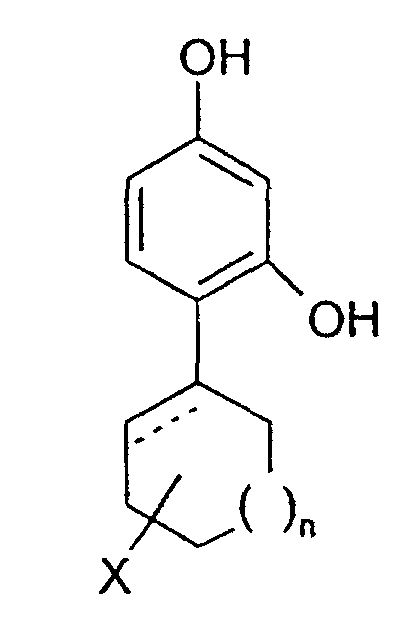
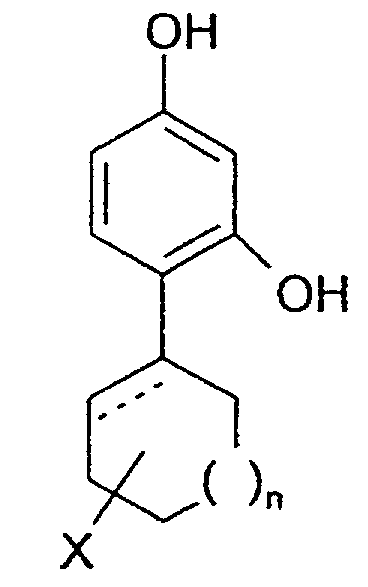
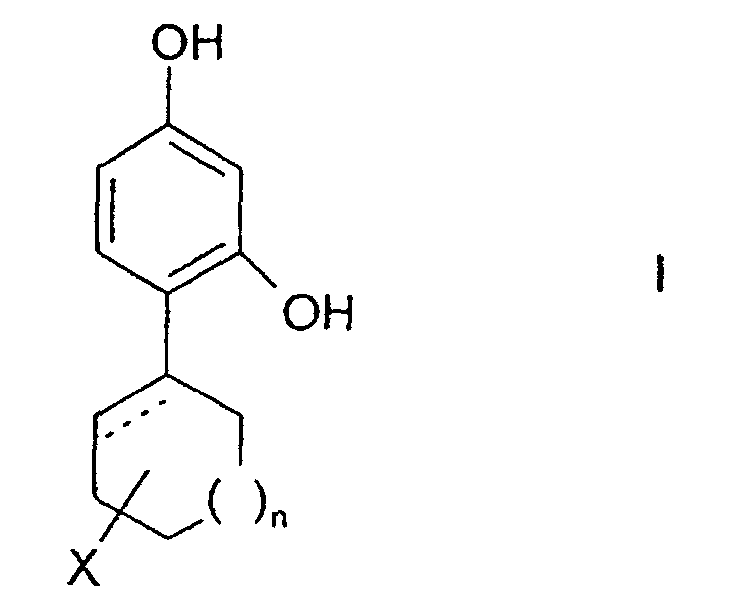
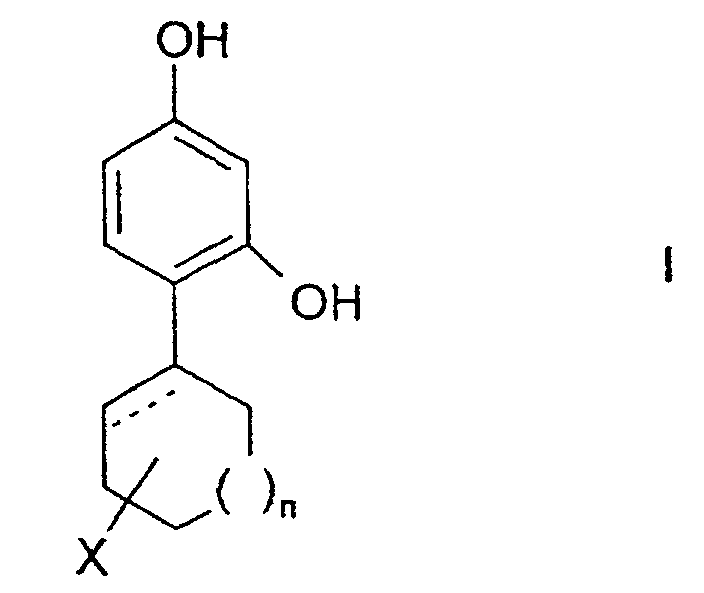
- The invention relates to the use of 4-cycloalkyl resorcinols having the formula:wherein X is hydrogen; OR1, wherein R1 represents hydrogen, (C1-C6)alkyl or aryl-(C1-C6)alkyl; OCOR2 wherein R2 represents (C1-C6)alkyl, aryl-(C1-C6)alkyl or phenyl; halogen; (C1-C6)alkyl; aryl-(C1-C6)alkyl; SR3 wherein R3 represents hydrogen, (C1-C6)alkyl, or aryl-(C1-C6)alkyl; or NHR1 wherein R1 is defined as above.

n is 0 to 3; and
the dashed line indicates an optional double bond at that position. - The present invention also relates to the pharmaceutically acceptable acid addition and base salts of compounds of the formula I. The acids which are used to prepare the pharmaceutically acceptable acid addition salts of the aforementioned base compounds of this invention are those which form non-toxic acid addition salts, i.e., salts containing pharmacologically acceptable anions, such as the hydrochloride, hydrobromide, hydroiodide, nitrate, sulfate, bisulfate, phosphate, acid phosphate, acetate, lactate, citrate, acid citrate, tartrate, bitartrate, succinate, maleate, fumarate, gluconate, saccharate, benzoate, methanesulfonate, ethanesulfonate, benzenesulfonate, p-toluenesulfonate and pamoate [i.e., 1,1-methylene-bis-(2-hydroxy-3-naphthoate)] salts.
- The term "alkyl", as used herein, unless otherwise indicated, includes saturated monovalent hydrocarbon radicals having straight, branched or cyclic moieties or combinations thereof.
- The term "aryl", as used herein, refers to phenyl or naphthyl optionally substituted with one or more substituents, preferably from zero to two substituents, independently selected from halogen, (C1-C6)alkyl, (C1-C6) alkoxy, amino, (C1-C6)alkylamino, di-[(C1-C6)alkyl)]amino, nitro, cyano and trifluoromethyl.
- The term "one or more substituents". as used herein, refers to a number of substituents that equals from one to the maximum number of substituents possible based on the number of available bonding sites.
- The "halogen", as used herein, unless otherwise indicated, include chloro, fluoro, bromo and iodo.
- Examples of more specific embodiments of the present invention include:
- (a) compounds of the formula I wherein a single bond connects the two carbon atoms at the dashed line;
- (b) compounds of the formula I wherein n is one;
- (c) compounds of the formula I wherein X is hydrogen;
- (d) compounds of the formula I wherein X is hydrogen, methyl or ethyl;
- (e) compounds of the formula I wherein n is zero;
- (f) compounds of the formula I wherein n is two; and
- (g) compounds of the formula I wherein X is benzyloxy.
-
- In a preferred embodiment, the compound of formula I is 4-cyclohexylresorcinol or 4-cyclopentylresorcinol.
- The present invention also relates to a topical pharmaceutical composition for lightening skin or reducing the pigmentation of skin in a human, comprising an amount of a compound of the formula I, or a pharmaceutically acceptable salt thereof, that is effective in lightening skin or reducing the pigmentation of skin, and a pharmaceutically acceptable carrier.
- The present invention also relates to a method of lightening skin or reducing the pigmentation of skin in a human, comprising administering to said human an amount of a compound of the formula I, or a pharmaceutically acceptable salt thereof, that is effective in lightening skin or reducing the pigmentation of skin.
- The present invention also relates to a topical pharmaceutical composition for inhibiting tyrosinase in a human, comprising a tyrosinase inhibiting effective amount of a compound of the formula I, or a pharmaceutically acceptable salt thereof, and a pharmaceutically acceptable carrier.
- The present invention also relates to a method of inhibiting tyrosinase in a human, comprising administering to said mammal a tyrosinase inhibiting effective amount of a compound of the formula I, or a pharmaceutically acceptable salt thereof.
- The present invention also relates to a topical pharmaceutical composition for lightening skin or reducing the pigmentation of skin in a human, comprising a tyrosinase inhibiting effective amount of a compound of the formula I, or a pharmaceutically acceptable salt thereof, and a pharmaceutically acceptable carrier.
- The present invention also relates to a method of lightening skin or reducing the pigmentation of skin in a human, comprising administering to said human a tyrosinase inhibiting effective amount of a compound of the formula I, or a pharmaceutically acceptable salt thereof.
- The present invention also relates to a topical or transdermal pharmaceutical composition for the treatment of an inflammatory disorder such as acne or psoriasis in a human, comprising an amount of a compound of the formula I, or a pharmaceutically acceptable salt thereof, that is effective in treating such disorder, and a pharmaceutically acceptable carrier.
- The present invention also relates to a method of treating inflammatory disorders such as psoriasis and acne in a human, comprising administering to said human an amount of a compound of the formula I, or a pharmaceutically acceptable salt thereof, that is effective in treating such disorder.
- The present invention also relates to a topical or transdermal pharmaceutical composition for the treatment of an inflammatory disorder such as acne or psoriasis in a human, comprising a tyrosinase inhibiting effective amount of a compound of the formula I, or a pharmaceutically acceptable salt thereof, and a pharmaceutically acceptable carrier.
- The present invention also relates to a method of treating inflammatory disorders such as psoriasis and acne in a human, comprising administering to said human a tyrosinase inhibiting effective amount of a compound of the formula I, or a pharmaceutically acceptable salt thereof.
- Compounds of formula I may contain chiral centers and therefore may exist in different enantiomeric and diastereomeric forms. This invention relates to all optical isomers and all stereoisomers of compounds of the formula I and mixtures thereof, and to all pharmaceutical compositions and methods of treatment defined above that contain or employ them, respectively.
- Formula I above includes compounds identical to those depicted but for the fact that one or more hydrogen, carbon or other atoms are replaced by isotopes thereof. Such compounds may be useful as research and diagnostic tools in metabolism pharmacokinetic studies and in binding assays.
- The compounds of the formula I may be prepared as described in the following reaction schemes and discussion. Unless otherwise indicated, X, n, R1, R2 and R3 and structural formula I in the reaction schemes and discussion that follow are defined as above.

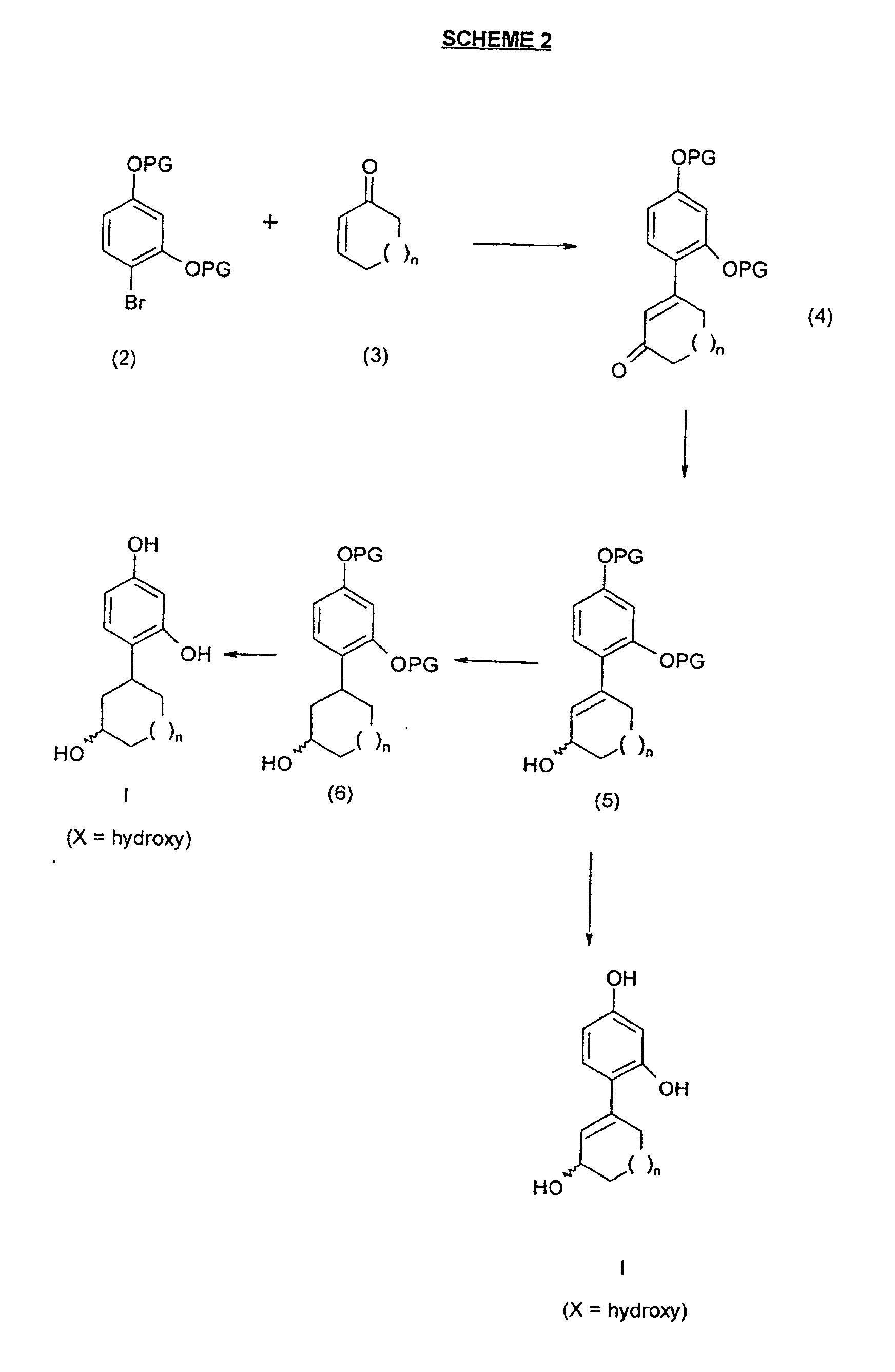


- Reaction schemes 1 through 4 illustrate various methods of synthesizing compounds of the formula I.
- Referring to Scheme 1, compounds of the formula I can be formed by heating resorcinol with the appropriate cycloalkanol of formula (1) using polyphosphoric acid (PPA) or another suitable acidic catalyst. When PPA is used, the reaction is typically carried out using one to three equivalents of the alcohol in neat PPA at a temperature between about 100°C and about 160°C.
- Referring to Scheme 2, the starting material of formula (2) can be obtained by protecting commercially available 4-bromoresorcinol. Suitable protecting groups (PG) are methyl (CH3) and benzyl (CH2C6H5), and can be introduced by conventional methods that are well known to those of skill in the art. For example, the methyl and benzyl protected compounds may be obtained by alkylating 4-bromoresorcinol with two equivalents of methyl iodide or benzyl bromide, respectively, and five equivalents of potassium carbonate in an acetone solvent at about room temperature.
- Compounds of the general formula (3) are known and may be obtained using conventional methods well known to those of skill in the art. Compounds of the formula (4) can be obtained by reaction of compounds of the formula (2) and those of the formula (3) under Heck conditions. Specifically, the Heck reaction may be carried out using palladium (II) acetate (one mole percent), triphenylphosphine (two mole percent) and triethylamine (one equivalent), and heating the reaction mixture in a suitable solvent (e.g., N,N-dimethylformamide (DMF)) at a temperature from about 80°C to about 130°C. Reduction of compounds of the formula (4) with di(isobutyl)aluminum hydride (DIBAL-H) gives the corresponding allylic alcohols of formula (5). Hydrogenolysis of alcohols of formula (5), for example, using hydrogen gas and a metal catalyst such as palladium-on-charcoal in ethanol at about room temperature, yields the saturated analogues of formula (6), which can then be deprotected under suitable conditions to give the correspondent resorcinols of formula I wherein X is hydroxy. Alternatively, similar deprotection of the allylic alcohols of formula (5) yields the corresponding resorcinols of formula I wherein X is hydroxy.
- Referring to Scheme 3, esterification of compounds of the formula (5) or (6) with an appropriate acyl chloride (R2COCl) under conventional conditions well known to those of skill in the art, followed by suitable deprotection, gives the corresponding compounds of formula I wherein X is OCOR2. For example, esterification can be accomplished by reacting the alcohol of formula (5) or (6) with one equivalent of an acyl chloride and one equivalent of triethylamine in dichloromethane at about room temperature. Alkylation of compounds of the formula (5) or (6) with an alkyl iodide (R1I) in the presence of base (using, for example, one equivalent of sodium hydride and the desired alkylating agent in the form of an alkyl chloride, bromide or iodide, in tetrahydrofuran (THF) at about the reflux temperature), using methods well known to those of skill in the art, followed by deprotection, gives the corresponding compounds of the formula I wherein X is OR1.
- Referring to Scheme 4, transformation of the alcohol function in compounds of the formula (5) or (6) into a suitable leaving group (L), such as, for example, mesylate, gives the corresponding compounds of formula (7). Formation of the mesylate may be carried out using one equivalent of mesyl chloride and one equivalent of triethylamine in dichloromethane at about room temperature. Displacement with a thioalkoxide (for example, by reacting the compound of formula (7) with the appropriate lithium or sodium thioalkoxide in THF at the reflux temperature), and subsequent deprotection using conventional methods well known to those skilled in the art, leads to the corresponding compounds of formula I wherein X is SR3. Alternatively, displacement with an amine, for example, by reacting the compound of formula (7) with one equivalent of the appropriate amine of the formula R1NH2 in THF at the reflux temperature, followed by deprotection, yields the corresponding compounds of the formula 1 wherein X is NHR1.
- Compounds of the formula I wherein X is halogen can be obtained from the corresponding compounds of formula (7) by displacement with the appropriate metal halide and subsequent deprotection using conventional methods well known to those of skill in the art.
- The compounds of formula I that are basic in nature are capable of forming a wide variety of different salts with various inorganic and organic acids. Although such salts must be pharmaceutically acceptable for administration to animals, it is often desirable in practice to initially isolate a compound of the formula I from the reaction mixture as a pharmaceutically unacceptable salt and then simply convert the latter back to the free base compound by treatment with an alkaline reagent and subsequently convert the latter free base to a pharmaceutically acceptable acid addition salt. The acid addition salts of the active base compounds of this invention are readily prepared by treating the base compound with a substantially equivalent amount of the chosen mineral or organic acid in an aqueous solvent medium or in a suitable organic solvent, such as methanol or ethanol. Upon careful evaporation of the solvent, the desired solid salt is readily obtained.
- Those compounds of formula I that are acidic in nature are capable of forming base salts with various pharmaceutically acceptable cations. Examples of such salts include the alkali metal and alkaline earth metal salts and, particularly, the sodium and potassium salts. These salts can be prepared by conventional techniques. The chemical bases that are used as reagents to prepare the pharmaceutically acceptable base salts of this invention are those that form non-toxic base salts with the acidic compounds of formula I. Such non-toxic base salts include those derived from such pharmaceutically acceptable cations as sodium, potassium, calcium and magnesium, etc. These salts can easily be prepared by treating the corresponding acidic compounds with an aqueous solution containing the desired pharmaceutically acceptable cations, and then evaporating the resulting solution to dryness, preferably under reduced pressure. Alternatively, they may also be prepared by mixing lower alkanolic solutions of the acidic compounds and the desired alkali metal alkoxide together, and then evaporating the resulting solution to dryness, as described above. In either case, stoichiometric quantities of reagents are preferably employed in order to ensure completeness of reaction and maximum yields of the desired final products.
- Compounds of the formula I and their pharmaceutically acceptable salts (hereinafter "the active compounds used in this invention") are useful in the treatment of disorders of human pigmentation, including solar and simple lentigines (including age/liver spots), melasma/chloasma and postinflammatory hyperpigmentation. Such compounds reduce skin melanin levels by inhibiting the production of melanin, whether the latter is produced constitutively or in response to UV irradiation (such as sun exposure). Thus, the active compounds used in this invention can be used to reduce skin melanin content in non-pathological states so as to induce a lighter skin tone, as desired by the user. They can also be used in combination with skin peeling agents (including glycolic acid or trichloroacetic acid face peels) to lighten skin tone and prevent repigmentation.
- The active compounds used in this invention can also be used in combination with sunscreens (UVA or UVB blockers) to prevent repigmentation, to protect against sun or UV-induced skin darkening or to enhance their ability to reduce skin melanin and their skin bleaching action. Such compounds can also be used in combination with retinoic acid or its derivatives or any compounds that interact with retinoic acid receptors and accelerate or enhance the invention's ability to reduce skin melanin and skin bleaching action.
- The active compounds used in this invention can also be used in combination with ascorbic acid, its derivatives and ascorbic-acid based products (such as magnesium ascorbate) or other products with an anti-oxidant mechanism (such as resveratrol) which accelerate or enhance their ability to reduce skin melanin and their skin bleaching action.
- This invention relates both to methods of lightening or reducing the pigmentation of skin in which the compound of formula I, or pharmaceutically acceptable salt thereof, and one or more of the other active ingredients referred to above are administered together, as part of the same pharmaceutical composition, as well as methods in which they are administered separately as part of an appropriate dose regimen designed to obtain the benefits of the combination therapy. The appropriate dose regimen, the amount of each dose administered, and specific intervals between doses of each active agent will depend upon the specific combination of active agents employed, the condition of the patient being treated, and the nature and severity of the disorder or condition being treated. Such additional active ingredients will generally be administered in amounts less than or equal to those for which they are effective as single topical therapeutic agents. The FDA approved dosages for such active agents that have received FDA approval for administration to humans are publicly available.
- The active compounds of the present invention are generally administered in the form of pharmaceutical compositions comprising at least one of the compounds of the formula (I), together with a pharmaceutically acceptable vehicle or diluent Such compositions are generally formulated in a conventional manner utilizing solid or liquid vehicles or diluents as appropriate for topical administration, in the form of solutions, gels, creams, jellies, pastes, lotions, ointments, salves and the like.
- Examples of vehicles for application of the active compounds of this invention include an aqueous or water-alcohol solution, an emulsion of the oil-in-water or water-in-oil type, an emulsified gel, or a two-phase system. Preferably, the compositions according to the invention are in the form of lotions, creams, milks, gels, masks, microspheres or nanospheres, or vesicular dispersions. In the case of vesicular dispersions, the lipids of which the vesicles are made can be of the ionic or nonionic type, or a mixture thereof.
- In the depigmenting compositions according to the present invention, the concentration of the active compounds of the invention is generally between 0.01 and 10%, preferably between 0.1 and 10%, relative to the total weight of the composition.
- The compositions of this invention can optionally also contain a moistener, a surfactant, keratolytic, an anti-inflammatory agent, a complexing agent, an antioxidant, a preservative, a fragrance, or a sunscreen.
- The ability of compounds of the formulae I to inhibit tyrosinase may be determined using any of the following procedures.
- Human melanoma cell line, SKMEL 188 (licensed from Memorial Sloan-Kettering), is used in the cell lysate assay and the screen. In the assay, compounds and L-dihydroxyphenylalanine (L-DOPA) (100 µg/ml) are incubated with the cell lysates containing human tyrosinase for 8 hours before the plates are read at 405 nm. Potency of the compounds in DOPA oxidase assay is correlated very well with that in tyrosine hydroxylase assay using 3H-tyrosine as a substrate. 4-Cyclohexylresorcinol, when tested in this assay, exhibited an IC50 of 0.3 µM.
- Compounds are incubated with human primary melanocytes in the presence of α-melanocyte stimulating hormone (α-MSH) for 2-3 days. Cells are then lysed with sodium hydroxide and sodium dodecyl sulfate (SDS) and melanin signals are read at 405 nm. Alternatively, 14C-DOPA is added to the cells in combination with tyrosinase inhibitors and acid-insoluble 14C-melanin is quantitated by a scintillation counter. IC50's reflect the inhibitory potency of the compounds in the new melanin synthesis which was stimulated by α-MSH.
- TK assays can be performed using purified tyrosine kinases domain of c-met, erb-B2, or IGF-r. A specific antibody against phosphorylated tyrosine residue is used in the assay. Colorimetric signals are generated by horse radish peroxidase, which is conjugated to the antibody.
- A mixture of human melanocytes and keratinocytes is grown in an air-liquid interphase. This tissue culture forms a three dimensional structure that histologically and microscopically resembles the human skin epidermis. Test compounds are added on top of the cells to mimic topical drug application. After incubation with the compounds (10 µM) for 3 days, the cells are washed extensively and lysed for DOPA oxidase assay.
- An IL-1α ELISA assay (R&D system) can be used to evaluate the effect of compounds on IL-1 secretion in a human skin equivalent model. IL-1α is a pro-inflammatory cytokine and plays a role in UV-induced skin inflammation.
- Black or dark brown guinea pigs with homogeneous skin color can be used in this study. A solution of the test compound of formula I (5% in ethanol:propylene glycol, 70:30) and the vehicle control are applied to the animals twice daily, 5 days per week for 4-8 weeks. Using this assay, depigmentation of skin was visualized using 5% 4-cyclohexylresorcinol or 5% 4-cyclopentylresorcinol as the test compound.
- The present invention is illustrated by the following examples. It will be understood, however, that the invention is not limited to the specific details of these examples. Melting points are uncorrected. Proton nuclear magnetic resonance spectra (1H NMR) were measured for solutions in d6 - DMSO and peak positions are expressed in parts per million (ppm) downfield from tetramethylsilane (TMS). The peak shapes are denoted as follows: s, singlet; d, doublet; t, triplet; q, quartet, m, multiplet, b, broad.
- Resorcinol (2.2 g, 20 mmol) and cyclohexanol (6.33 ml, 6g, 60mmol) were suspended in 85% polyphosphoric acid (8 ml). The mixture was heated to 125°C for 24 hours, after which time TLC appeared to show complete consumption of the starting materials. On cooling the mixture was partitioned between water (50 ml) and diethyl ether (50 ml). The aqueous layer was discarded, and the organic portion extracted with sodium hydroxide solution (2 x 50 ml, 2M). The base extract was washed with ether (3 x 50 ml), and then acidified with aqueous hydrochloric acid (120 ml, 2M). The organic components were then extracted into diethyl ether (2 x 50 ml), dried (magnesium sulfate), filtered and the solvent removed under reduced pressure. The resulting brown oil was then chromatographed on silica gel, eluting with ethyl acetate/petroleum ether (bp 60-80°C) 1:2 to give the desired product as an off-white solid (1.7 g, 44%).
- 1H NMR (250 MHZ, d6-DMSO): δ 1.13-1.34 (5H, m); 1.65-1.71 (5H, m); 2.67-2.75 (1H, m); 6.11 (1H, dd J=8.3, 2.4 HZ); 6.22 (1H, d, J=2.4 HZ); 6.79 (1H, d, J=8.3 HZ); 8.90 (1H, s); 9.00 (1H, s).
- M/Z (ES-ve) gives 191.5 (M-H).
- The following compounds were prepared in a similar manner:
- From cyclopentanol as a white solid.
- 1H NMR (250 MHz, d6-DMSO): d 1.34-1.75 (6H, m); 1.78-1.88 (2H, m); 3.06 (1H, quint, J = 9.5 Hz); 6.12 (1H, dd, J = 2.4, 8.2 Hz); 6.22 (1H, d, J = 2.4 Hz); 6.83 (1H, d, J = 8.3 Hz); 8.91 (1H, s); 9.01 (1H, s).
- M/Z (ES-ve) gives 177.5 (M-H).
- From 1-methylcyclopentanol as a solid.
- 1H NMR (400 MHz, CDCl3-MeOH): d 1.31 (3H, s); 1.74-1.89 (4H, m); 1.94-2.03 (4H, m); 6.33-6.34 (1H, m); 6.39 (1H, dd, J = 2.5, 8.4 Hz); 7.10 (1H, m).
- M/Z (ES-ve) gives 191.6 (M-H).
- From 1-methylcyclohexanol as an orange oil. Data reported for a 1:1 mixture of conformers.
- 1H NMR (250 MHz, d6-DMSO); d 1.20-1.80 (9H, m); 1.97 (3H, s); 2.60-3.00 (1H, m); 6.10-6.14 (1H, m); 6.22-6.70 (1H, m); 6.67-6.85 (1H, m); 8.89-8.90 (1H, m); 8.98-9.02 (1H, m).
- M/Z (ES-ve) gives 411.6 (2M-H).
- From cycloheptanol as an orange oil. Data reported for a 1:1 mixture of conformers.
- 1H NMR (250 MHz, d6-DMSO): d 1.30-1.80 (12H, m); 2.60-2.90 (1H, m); 6.08-6.13 (1H, m); 6.20-6.22 (1H, m); 6.78-6.88 (1H, m); 8.86-8.87 (1H, m); 8.89-8.98 (1H, m).
- M/Z (ES-ve) gives 205.5 (M-H).
- From cyclooctanol as an orange oil. Data reported for a 1:1 mixture of conformers.
- 1H NMR (250 MHz, d6-DMSO): d 1.20-1.80 (14H, m); 2.68-3.00 (1H, m); 6.09-6.15 (1H, m); 6.21-6.23 (1H, m); 6.73-6.84 (1H, m); 8.80-8.83 (1H, m); 8.90-9.00 (1H, m).
- M/Z (ES-ve) gives 219.6 (M-H).
- In vivo experiments were carried out to determine the depigmenting effects of 4-cyclohexylresorcinol and 4-cyclopentylresorcinol using the assay described above (in vivo study). Thus, 5% 4-cyclohexylresorcinol and 5% 4-cyclopentylresorcinol, each in ethanol:propylene glycol (70:30), were administered separately to the ears of black guinea pigs. Depigmentation was determined by subtracting the light reflectance of untreated ears from the light reflectance of treated ears. As shown by the data in the Table below, both test compositions reduced pigmentation in treated ears starting 3 weeks after initial treatment The depigmentation effect was reversible, and repigmentation partially resumed one week after ceasing treatment.
Depigmentation Effect Of Selected Compounds Animal 3-week 6-week 8.5 week 1 week post-treatment 4-cyclohexylresorcinol 1A 13 8 6 1B 0 0 7 1 1C 14 14 19 1D 3 7 7 0 4-cyclopentylresorcinol 3B 15 12 10 6 3C 9 9 18 3D 4 9 7
Claims (35)
- A topical pharmaceutical composition for lightening skin or reducing the pigmentation of skin in a human, comprising an amount of a compound of the formula I,wherein X is hydrogen; OR1, wherein R1 represents hydrogen, (C1-C6)alkyl or aryl-(C1-C6)alkyl; OCOR2 wherein R2 represents (C1-C6)alkyl, aryl-(C1-C6)alkyl or phenyl; halogen; (C1-C6)alkyl; aryl-(C1-C6)alkyl; SR3 wherein R3 represents hydrogen, (C1-C6)alkyl, or aryl-(C1-C6)alkyl; or NHR1 wherein R1 is defined as above;
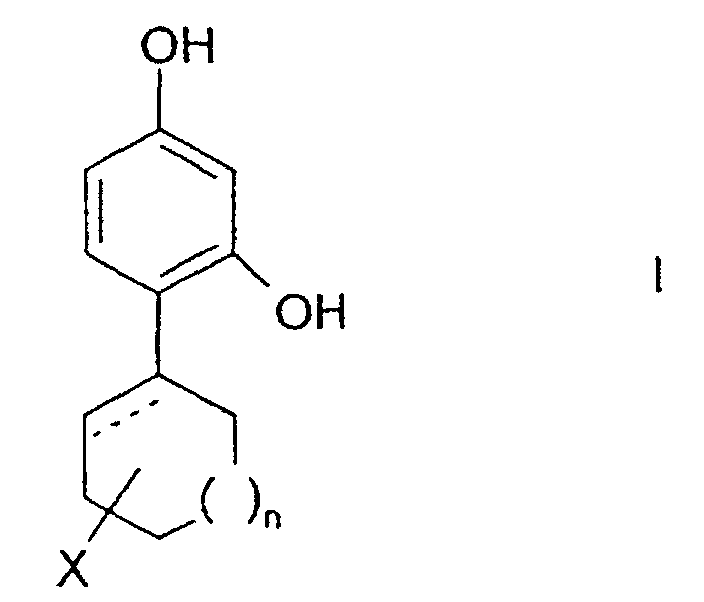
n is 0 to 3; and
the dashed line represents an optional double bond;
or a pharmaceutically acceptable salt thereof, that is effective in lightening skin or reducing the pigmentation of skin, and a pharmaceutically acceptable carrier. - The topical pharmaceutical composition of claim 1, wherein the compound of formula I is 4-cyclohexylresorcinol.
- The topical pharmaceutical composition of claim 1, wherein the compound of formula I is 4-cyclopentylresorcinol.
- A non-therapeutic method of lightening skin or reducing the pigmentation of skin in a human, comprising administering to said human an amount of a compound of the formula I,wherein X is hydrogen; OR1, wherein R1 represents hydrogen, (C1-C6)alkyl or aryl-(C1-C6)alkyl; OCOR2 wherein R2 represents (C1-C6)alkyl, aryl-(C1-C6)alkyl or phenyl; halogen; (C1-C6)alkyl; aryl-(C1-C6)alkyl; SR3 wherein R3 represents hydrogen, (C1-C6)alkyl, or aryl-(C1-C6)alkyl; or NHR1 wherein R1 is defined as above;

n is 0 to 3; and
the dashed line represents an optional double bond;
or a pharmaceutically acceptable salt thereof, that is effective in lightening skin or reducing the pigmentation of skin. - The method of claim 4, wherein the compound of formula I is 4-cyclohexylresorcinol.
- The method of claim 4, wherein the compound of formula I is 4-cyclopentylresorcinol.
- A topical pharmaceutical composition for inhibiting tyrosinase in a human, comprising a tyrosinase inhibiting effective amount of a compound of the formula I,wherein X is hydrogen; OR1, wherein R1 represents hydrogen, (C1-C6)alkyl or aryl-(C1-C6)alkyl; OCOR2 wherein R2 represents (C1-C6)alkyl, aryl-(C1-C6)alkyl or phenyl; halogen; (C1-C6)alkyl; aryl-(C1-C6)alkyl; SR3 wherein R3 represents hydrogen, (C1-C6)alkyl, or aryl-(C1-C6)alkyl; or NHR1 wherein R1 is defined as above;
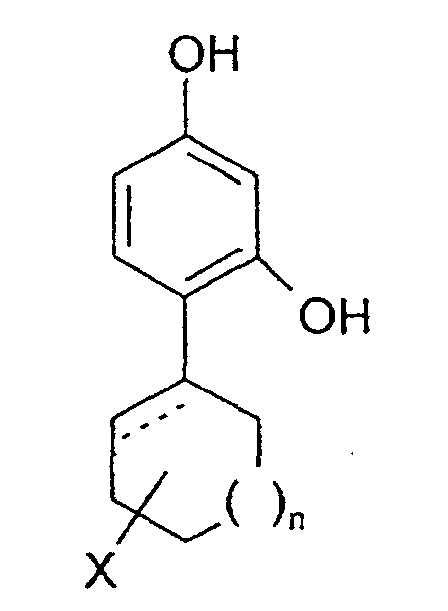
n is 0 to 3; and
the dashed line represents an optional double bond; or a pharmaceutically acceptable salt thereof, and a pharmaceutically acceptable carrier. - The topical pharmaceutical composition of claim 7, wherein the compound of formula I is 4-cyclohexylresorcinol.
- The topical pharmaceutical composition of claim 7, wherein the compound of formula I is 4-cyclopentylresorcinol.
- A non-therapeutic method of inhibiting tyrosinase in a human, comprising administering to said mammal a tyrosinase inhibiting effective amount of a compound of the formula I,wherein X is hydrogen; OR1, wherein R1 represents hydrogen, (C1-C6)alkyl or aryt-(C1-C6)alkyl; OCOR2 wherein R2 represents (C1-C6)alkyl, aryl-(C1-C6)alkyl or phenyl; halogen; (C1-C6)alkyl; aryl-(C1-C6)alkyl; SR3 wherein R3 represents hydrogen, (C1-C6)alkyl, or aryl-(C1-C6)alkyl; or NHR1 wherein R1 is defined as above;
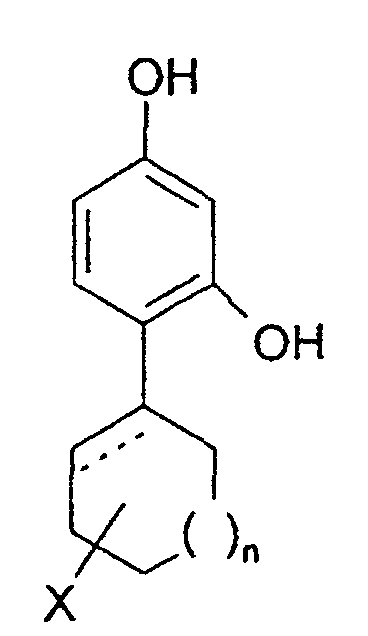
n is 0 to 3; and
the dashed line represents an optional double bond;
or a pharmaceutically acceptable salt thereof. - The method of claim 10, wherein the compound of formula I is 4-cyclohexylresorcinol.
- The method of claim 10, wherein the compound of formula I is 4-cyclopentylresorcinol.
- A topical pharmaceutical composition for lightening skin or reducing the pigmentation of skin in a human, comprising a tyrosinase inhibiting effective amount of a compound of the formula I,wherein X is hydrogen; OR1, wherein R1 represents hydrogen, (C1-C6)alkyl or aryl-(C1-C6)alkyl; OCOR2 wherein R2 represents (C1-C6)alkyl, aryl-(C1-C6)alkyl or phenyl; halogen; (C1-C6)alkyl; aryl-(C1-C6)alkyl; SR3 wherein R3 represents hydrogen, (C1-C6)alkyl, or aryl-(C1-C6)alkyl; or NHR1 wherein R1 is defined as above;
n is 0 to 3; and
the dashed line represents an optional double bond;
or a pharmaceutically acceptable salt thereof, and a pharmaceutically acceptable carrier. - The topical pharmaceutical composition of claim 13, wherein the compound of formula I is 4-cyclohexylresorcinol.
- The topical pharmaceutical composition of claim 13, wherein the compound of formula I is 4-cyclopentylresorcinol.
- A non-therapeutic method of lightening skin or reducing the pigmentation of skin in a human, comprising administering to said human a tyrosinase inhibiting effective amount of a compound of the formula I,wherein X is hydrogen; OR1, wherein R1 represents hydrogen, (C1-C6)alkyl or aryl-(C1-C6)alkyl; OCOR2 wherein R2 represents (C1-C6)alkyl, aryl-(C1-C6)alkyl or phenyl; halogen; (C1-C6)alkyl; aryl-(C1-C6)alkyl; SR3 wherein R3 represents hydrogen, (C1-C6)alkyl, or aryl-(C1-C6)alkyl; or NHR1 wherein R1 is defined as above;
n is 0 to 3; and
the dashed line represents an optional double bond;
or a pharmaceutically acceptable salt thereof. - The method of claim 16, wherein the compound of formula I is 4-cyclohexylresorcinol.
- The method of claim 16, wherein the compound of formula I is 4-cyclopentylresorcinol.
- A composition according to claim 1, which further comprises a sunscreen.
- A composition according to claim 1, further comprising resveratrol or another active agent that is an anti-oxidant.
- A composition according to claim 1, further comprising retinoic acid or a derivative of retinoic acid.
- A composition according to claim 1, further comprising glycolic acid, trichloroacetic acid or another skin peeling agent.
- A composition according to claim 1, in the form of a lotion, cream or ointment.
- A topical or transdermal pharmaceutical composition for treating an inflammatory disorder in a human, comprising an amount of a compound of the formula I,wherein X is hydrogen; OR1, wherein R1 represents hydrogen, (C1-C6)alkyl or aryl-(C1-C6)alkyl; OCOR2 wherein R2 represents (C1-C6)alkyl, aryl-(C1-C6)alkyl or phenyl; halogen; (C1-C6)alkyl; aryl-(C1-C6)alkyl; SR3 wherein R3 represents hydrogen, (C1-C6)alkyl, or aryl-(C1-C6)alkyl; or NHR1 wherein R1 is defined as above;
n is 0 to 3; and
the dashed line represents an optional double bond;
or a pharmaceutically acceptable salt thereof, that is effective in treating such disorder, and a pharmaceutically acceptable carrier. - The composition of claim 24, wherein the compound of formula I is 4-cyclohexylresorcinol.
- The composition of claim 24, wherein the compound of formula I is 4-cyclopentylresorcinol.
- A non-therapeutic method of treating an inflammatory disorder in a human, comprising administering to said human an amount of a compound of the formula I,wherein X is hydrogen; OR1, wherein R1 represents hydrogen, (C1-C6)alkyl or aryt-(C1-C6)alkyl; OCOR2 wherein R2 represents (C1-C6)alkyl, aryl-(C1-C6)alkyl or phenyl; halogen; (C1-C6)alkyl; aryl-(C1-C6)alkyl; SR3 wherein R3 represents hydrogen, (C1-C6)alkyl, or aryl-(C1-C6)alkyl; or NHR1 wherein R1 is defined as above;
n is 0 to 3; and
the dashed line represents an optional double bond;
or a pharmaceutically acceptable salt thereof, that is effective in treating such disorder. - The method of claim 27, wherein the compound of formula I is 4-cyclohexylresorcinol.
- The method of claim 27, wherein the compound of formula I is 4-cyclopentylresorcinol.
- A topical or transdermal pharmaceutical composition for treating an inflammatory disorder in a human, comprising a tyrosinase inhibiting effective amount of a compound of the formula I,wherein X is hydrogen; OR1, wherein R1 represents hydrogen, (C1-C6)alkyl or aryl-(C1-C6)alkyl; OCOR2 wherein R2 represents (C1-C6)alkyl, aryl-(C1-C6)alkyl or phenyl; halogen; (C1-C6)alkyl; aryl-(C1-C6)alkyl; SR3 wherein R3 represents hydrogen, (C1-C6)alkyl, or aryl-(C1-C6)alkyl; or NHR1 wherein R1 is defined as above;

n is 0 to 3; and
the dashed line represents an optional double bond;
or a pharmaceutically acceptable salt thereof, and a pharmaceutically acceptable carrier. - The composition of claim 30, wherein the compound of formula I is 4-cyclohexylresorcinol.
- The composition of claim 30, wherein the compound of formula I is 4-cyclopentylresorcinol.
- A non-therapeutic method of treating an inflammatory disorder in a human, comprising administering to said human a tyrosinase inhibiting effective amount of a compound of the formula I,wherein X is hydrogen; OR1, wherein R1 represents hydrogen, (C1-C6)alkyl or aryl-(C1-C6)alkyl; OCOR2 wherein R2 represents (C1-C6)alkyl, aryl-(C1-C6)alkyl or phenyl; halogen; (C1-C6)alkyl; aryl-(C1-C6)alkyl; SR3 wherein R3 represents hydrogen, (C1-C6)alkyl, or aryl-(C1-C6)alkyl; or NHR1 wherein R1 is defined as above;

n is 0 to 3; and
the dashed line represents an optional double bond;
or a pharmaceutically acceptable salt thereof. - The method of claim 33, wherein the compound of formula I is 4-cyclohexylresorcinol.
- The method of claim 33, wherein the compound of formula I is 4-cyclopentylresorcinol.
Priority Applications (1)
| Application Number | Priority Date | Filing Date | Title |
|---|---|---|---|
| SI9830403T SI0904774T1 (en) | 1997-09-23 | 1998-09-16 | Resorcinol derivatives |
Applications Claiming Priority (2)
| Application Number | Priority Date | Filing Date | Title |
|---|---|---|---|
| US5962597P | 1997-09-23 | 1997-09-23 | |
| US59625P | 1997-09-23 |
Publications (2)
| Publication Number | Publication Date |
|---|---|
| EP0904774A1 EP0904774A1 (en) | 1999-03-31 |
| EP0904774B1 true EP0904774B1 (en) | 2003-03-26 |
Family
ID=22024176
Family Applications (1)
| Application Number | Title | Priority Date | Filing Date |
|---|---|---|---|
| EP98307523A Expired - Lifetime EP0904774B1 (en) | 1997-09-23 | 1998-09-16 | Resorcinol derivatives |
Country Status (45)
Families Citing this family (77)
| Publication number | Priority date | Publication date | Assignee | Title |
|---|---|---|---|---|
| HN1996000101A (en) | 1996-02-28 | 1997-06-26 | Inc Pfizer | COMBINED THERAPY FOR OSTEOPOROSIS |
| US6414037B1 (en) * | 1998-01-09 | 2002-07-02 | Pharmascience | Pharmaceutical formulations of resveratrol and methods of use thereof |
| FR2777186B1 (en) * | 1998-04-10 | 2001-03-09 | Oreal | USE OF AT LEAST ONE HYDROXYSTILBENE IN A FIRMING COMPOSITION |
| FR2777183B1 (en) * | 1998-04-10 | 2001-03-02 | Oreal | USE OF AT LEAST ONE HYDROXYSTILBENE IN A COMPOSITION FOR PROMOTING DEQUAMATION OF THE SKIN AND COMPOSITION COMPRISING SAME |
| US6828460B2 (en) * | 1999-03-22 | 2004-12-07 | Pfizer Inc. | Resorcinol derivatives |
| US6878381B2 (en) * | 1999-03-22 | 2005-04-12 | Pfizer, Inc | Resorcinol composition |
| ES2238993T3 (en) * | 1999-03-22 | 2005-09-16 | Pfizer Inc. | RESORCINOL DERIVATIVES |
| HN2000000033A (en) * | 1999-03-22 | 2001-02-02 | Pfizer Prod Inc | RESORCINOL COMPOSITION |
| US20020034772A1 (en) * | 1999-06-29 | 2002-03-21 | Orlow Seth J. | Methods and compositions that affect melanogenesis |
| EP1134207A1 (en) * | 2000-03-15 | 2001-09-19 | Pfizer Products Inc. | Process for preparing resorcinol derivatives |
| IT1318425B1 (en) * | 2000-03-24 | 2003-08-25 | D B P Dev Biotechnological Pro | USE OF RESVERATROL FOR THE TREATMENT OF DESQUAMATIVE ECZEMA, ACNE AND PSORIASIS. |
| JP4615671B2 (en) * | 2000-04-20 | 2011-01-19 | ポーラ化成工業株式会社 | Preventing wrinkle formation or loss of skin elasticity for use in the presence of inflammation |
| DE60106954T2 (en) * | 2000-09-11 | 2005-12-01 | Pfizer Products Inc., Groton | Resorcinol DERIVATIVES |
| WO2002024613A2 (en) * | 2000-09-21 | 2002-03-28 | Pfizer Products, Inc. | Resorcinol derivatives |
| US6514506B1 (en) * | 2001-02-14 | 2003-02-04 | Color Access, Inc. | Whitening compositions containing ascomycete derived enzyme |
| MY134040A (en) | 2001-05-02 | 2007-11-30 | Univ New York | Inhibition of pigmentation by inhibition of fatty acid synthase |
| DE50203353D1 (en) * | 2001-05-25 | 2005-07-14 | Wella Ag | 1,3-DIHYDROXYBENZOLE DERIVATIVES AND STAINERS CONTAINING THESE COMPOUNDS |
| US6863897B2 (en) * | 2002-03-22 | 2005-03-08 | Unilever Home & Personal Care Usa, Division Of Conopco, Inc. | Stabilization of resorcinol derivatives in cosmetic compositions |
| US6869598B2 (en) * | 2002-03-22 | 2005-03-22 | Unilever Home & Personal Care Usa Division Of Conopco, Inc. | Stabilization of sunscreens in cosmetic compositions |
| WO2003095645A1 (en) * | 2002-05-09 | 2003-11-20 | New York University | Assay for melanogenesis |
| US7977049B2 (en) * | 2002-08-09 | 2011-07-12 | President And Fellows Of Harvard College | Methods and compositions for extending the life span and increasing the stress resistance of cells and organisms |
| US6852310B2 (en) * | 2002-08-23 | 2005-02-08 | Unilever Home & Personal Care Usa Division Of Conopco, Inc. | Skin lightening agents, compositions and methods |
| US20040109832A1 (en) * | 2002-12-09 | 2004-06-10 | Unilever Home & Personal Care Usa, Division Of Conopco, Inc. | Di-substituted resorcinols as skin lightening agents |
| US6875425B2 (en) * | 2002-12-12 | 2005-04-05 | Unilever Home & Personal Care Usa | Skin lightening agents, compositions and methods |
| US7524485B2 (en) * | 2002-12-12 | 2009-04-28 | Unilever Home & Personal Care, Usa, Division Of Conopco, Inc. | Skin lightening agents, compositions and methods |
| MXPA05008243A (en) * | 2003-02-03 | 2005-10-05 | Warner Lambert Co | Improved formulation for skin-lightening agents. |
| US7338979B2 (en) * | 2003-02-11 | 2008-03-04 | Warner-Lambert Company | Depigmentation agents |
| EP1628945B1 (en) * | 2003-05-20 | 2008-08-20 | Warner-Lambert Company LLC | Depigmenting agents |
| US20070009455A1 (en) * | 2003-05-26 | 2007-01-11 | Hyo-Jung Kim | Whitening and antionxidative cosmetic composition containing resveratrol and method for preparing the same |
| US20050096256A1 (en) | 2003-07-01 | 2005-05-05 | President And Fellows Of Harvard College | Compositions for manipulating the lifespan and stress response of cells and organisms |
| ES2315670T3 (en) * | 2003-07-08 | 2009-04-01 | Unilever N.V. | PROCEDURE FOR PREPARATION OF A COSMETIC ACTIVE PRINCIPLE. |
| US8017634B2 (en) | 2003-12-29 | 2011-09-13 | President And Fellows Of Harvard College | Compositions for treating obesity and insulin resistance disorders |
| CN101247793B (en) | 2003-12-29 | 2013-04-10 | 哈佛大学校长及研究员协会 | Compositions for treating or preventing obesity and insulin resistance disorders |
| US7300646B2 (en) * | 2004-02-27 | 2007-11-27 | Unilever Home & Personal Care Usa, Division Of Conopco, Inc. | Skin lightening agents, compositions and methods |
| EP1748767B1 (en) | 2004-05-28 | 2011-12-28 | Unigen, Inc. | 1-(3-methyl-2,4-dimethoxyphenyl)-3-(2',4'-dihydroxyphenyl)-propane as a potent tyrosinase inhibitor |
| EP1799228B1 (en) * | 2004-09-14 | 2010-04-14 | Ajinomoto Omnichem S.A. | Topical compositions containing phosphorylated polyphenols |
| JP5093998B2 (en) * | 2004-09-22 | 2012-12-12 | 大塚製薬株式会社 | Pigmentation preventing or improving agent |
| US20060210497A1 (en) * | 2005-03-18 | 2006-09-21 | Unilever Home & Personal Care Usa, Division Of Conopco, Inc. | Novel resorcinol derivatives |
| US20060210498A1 (en) * | 2005-03-18 | 2006-09-21 | Unilever Home & Personal Care Usa, Division Of Conopco, Inc. | Novel resorcinol derivatives for skin |
| WO2006138418A2 (en) | 2005-06-14 | 2006-12-28 | President And Fellows Of Harvard College | Improvement of cognitive performance with sirtuin activators |
| JP5244400B2 (en) * | 2005-12-26 | 2013-07-24 | 株式会社林原 | Alkylresorcinol glycoside, its production method and use |
| EP1973520A1 (en) * | 2006-01-05 | 2008-10-01 | Symrise GmbH & Co. KG | Stabilized preparations comprising phenolic compounds and benzophenones |
| US7270805B1 (en) | 2006-03-30 | 2007-09-18 | Conopco, Inc. | Skin lightening agents, compositions and methods |
| US7247294B1 (en) | 2006-03-30 | 2007-07-24 | Conopco, Inc. | Skin lightening agents, compositions and methods |
| US7250158B1 (en) | 2006-03-30 | 2007-07-31 | Conopco, Inc. | Skin lightening agents, compositions and methods |
| KR101361430B1 (en) * | 2006-06-19 | 2014-02-10 | 가부시키가이샤 구라레 | Skin external preparation having excellent stability |
| JP4990574B2 (en) * | 2006-07-13 | 2012-08-01 | ポーラ化成工業株式会社 | Novel compound and topical skin preparation containing the same |
| JP5132095B2 (en) * | 2006-07-13 | 2013-01-30 | ポーラ化成工業株式会社 | Emulsion dosage form for external use on skin |
| DE102007038097A1 (en) | 2007-08-13 | 2009-02-19 | Merck Patent Gmbh | tyrosinase |
| DE102007038098A1 (en) | 2007-08-13 | 2009-02-19 | Merck Patent Gmbh | tyrosinase |
| WO2009064493A1 (en) * | 2007-11-14 | 2009-05-22 | New York University School Of Medicine | Tricyclic compounds as melanogenesis modifiers and uses thereof |
| WO2009064492A1 (en) * | 2007-11-14 | 2009-05-22 | New York University School Of Medicine | Quinoline compounds as melanogenesis modifiers and uses thereof |
| US20100040568A1 (en) * | 2008-04-30 | 2010-02-18 | Skinmedica, Inc. | Steroidal compounds as melanogenesis modifiers and uses thereof |
| WO2010005989A1 (en) * | 2008-07-09 | 2010-01-14 | Edison Pharmaceuticals, Inc. | Dermatological compositions with anti-aging and skin even-toning properties |
| KR101988329B1 (en) * | 2008-07-21 | 2019-06-12 | 유니젠, 인크. | Series of skin-whitening (lightening) compounds |
| US20100029784A1 (en) * | 2008-07-30 | 2010-02-04 | Hinman Andrew W | Naphthoquinone compositions with anti-aging, anti-inflammatory and skin even-toning properties |
| FR2939136B1 (en) * | 2008-12-02 | 2010-12-03 | Galderma Res & Dev | NOVEL 4- (HETEROCYCLOALKYL) -BENZENE-1,3-DIOL COMPOUNDS AS TYROSINASE INHIBITORS, PROCESS FOR THEIR PREPARATION AND THEIR USE IN HUMAN MEDICINE AND COSMETICS |
| FR2939135B1 (en) * | 2008-12-02 | 2010-12-03 | Galderma Res & Dev | NOVEL 4- (AZACYCLOALKYL) -BENZENE-1,3-DIOL COMPOUNDS AS TYROSINASE INHIBITORS, PROCESS FOR THEIR PREPARATION AND THEIR USE IN HUMAN MEDICINE AND COSMETICS |
| FR2953834B1 (en) | 2009-12-10 | 2012-01-13 | Galderma Res & Dev | NOVEL 4- (AZACYCLOALKYL) -BENZENE-1,3-DIOL COMPOUNDS AS TYROSINASE INHIBITORS, PROCESS FOR THEIR PREPARATION AND THEIR USE IN HUMAN MEDICINE AND COSMETICS |
| JP4825921B1 (en) * | 2010-07-16 | 2011-11-30 | 株式会社 資生堂 | 4-alkylresorcinol derivative and skin external preparation containing the same |
| WO2012103487A1 (en) | 2011-01-27 | 2012-08-02 | New York University | Coumarin compounds as melanogenesis modifiers and uses thereof |
| JP6216312B2 (en) | 2011-03-24 | 2017-10-18 | ユニゲン・インコーポレーテッド | Compounds and methods for preparing diarylpropanes |
| US10470986B2 (en) | 2013-03-08 | 2019-11-12 | Conopco, Inc. | Resorcinol compounds for dermatological use |
| RU2582215C1 (en) * | 2015-01-16 | 2016-04-20 | Александр Ливиевич Ураков | Method for skin discoloration in bruising area |
| WO2017079905A1 (en) * | 2015-11-10 | 2017-05-18 | Henkel Ag & Co. Kgaa | A cosmetic composition for skin brightening |
| WO2017215863A1 (en) | 2016-06-15 | 2017-12-21 | Unilever N.V. | Method and cosmetic composition for enhanced transdermal delivery of alkyl substituted resorcinol |
| CN109789066A (en) * | 2016-06-30 | 2019-05-21 | 西姆莱斯股份公司 | Drug and make-up composition containing resorcinol derivatives |
| CA3069345A1 (en) * | 2017-07-12 | 2019-01-17 | Unilever Plc | Skin composition booster oil |
| IT201700104536A1 (en) | 2017-09-19 | 2019-03-19 | Cmed Aesthetics Srl | Topical products with two-phase system |
| GB201904744D0 (en) * | 2019-04-04 | 2019-05-22 | Univ Exeter | Anti-fungal compositions |
| CN114206298B (en) | 2019-07-12 | 2024-11-15 | 联合利华知识产权控股有限公司 | Stabilization of resorcinol compounds in cosmetic compositions |
| WO2021081782A1 (en) * | 2019-10-30 | 2021-05-06 | Dow Global Technologies Llc | Sun care compositions with hollow mesoporous silica nanospheres |
| CN115484921B (en) | 2020-04-28 | 2024-10-18 | 联合利华知识产权控股有限公司 | N,N′-diacetylcysteine endogenously stabilized cosmetic compositions |
| CN114315527B (en) * | 2021-12-29 | 2024-06-11 | 苏州博研医药科技有限公司 | A kind of preparation method of resorcinol |
| EP4637692A1 (en) | 2022-12-21 | 2025-10-29 | Unilever IP Holdings B.V. | Color stabilization of formulae with an indole |
| WO2025140839A1 (en) | 2023-12-29 | 2025-07-03 | Unilever Ip Holdings B.V. | Colour stabilization of formulae with boron nitride |
| WO2025225705A1 (en) * | 2024-04-25 | 2025-10-30 | 国立大学法人富山大学 | Melanin decomposition promoter and melanin production inhibitor |
Family Cites Families (25)
| Publication number | Priority date | Publication date | Assignee | Title |
|---|---|---|---|---|
| GB1131200A (en) * | 1966-06-06 | 1968-10-23 | Fuji Photo Film Co Ltd | Process for the production of polymer images by the polymerization of vinyl compounds |
| GB1221325A (en) * | 1967-04-06 | 1971-02-03 | Fuji Photo Film Co Ltd | Dormation of dye images from photographic images |
| US3933925A (en) * | 1972-06-29 | 1976-01-20 | Koppers Company, Inc. | Hydrolysis of toluene diamines to produce methyl resorcinols |
| US4006218A (en) * | 1974-07-08 | 1977-02-01 | Johnson & Johnson | Potentiated medicaments |
| DE2616479C2 (en) * | 1976-04-14 | 1986-12-04 | Brickl, Rolf, Dr., 7951 Warthausen | Substituted fluoroacylresorcinols, processes for their preparation and pharmaceuticals and cosmetics containing them |
| DE3127590A1 (en) * | 1980-07-12 | 1982-08-12 | Kozak, Pavel, 6600 Saarbrücken | Composition for the external treatment of skin disorders |
| US4391827A (en) * | 1980-09-08 | 1983-07-05 | Pfizer Inc. | 3-(2-Hydroxy-4-(substituted)phenyl)-cycloalkanone and cycloalkanol analgesic agents and intermediates therefor |
| US4526179A (en) * | 1983-01-28 | 1985-07-02 | Leonard Salesky | Digital apical foramen locating apparatus |
| DE3604865A1 (en) * | 1986-02-15 | 1987-08-20 | Walter Dr Med Langbehn | Skin cosmetic |
| JPH0651619B2 (en) * | 1988-05-09 | 1994-07-06 | 株式会社クラレ | Whitening agent |
| US4985157A (en) * | 1989-05-01 | 1991-01-15 | Mobil Oil Corporation | Mixed alkoxylated alcohol-hydroquinone/resorcinol borates-antioxidants |
| US5059438A (en) * | 1990-02-05 | 1991-10-22 | Enzytech, Inc. | Compositions and methods for inhibiting browning in foods using resorcinol derivatives |
| JPH054905A (en) * | 1990-10-31 | 1993-01-14 | Pola Chem Ind Inc | Cosmetics |
| JP2875374B2 (en) * | 1990-10-31 | 1999-03-31 | ポーラ化成工業株式会社 | Acne cosmetics |
| JP2801960B2 (en) * | 1990-10-31 | 1998-09-21 | ポーラ化成工業株式会社 | Hair cosmetics |
| FR2679133B1 (en) * | 1991-07-17 | 1993-10-15 | Oreal | USE OF CARBOXYLIC (2,5-DIHYDROXYPHENYL) ACID DERIVATIVES, THEIR APPROVALS AND THEIR SALTS IN THE PREPARATION OF A DEPIGMENTING COSMETIC OR DERMATOLOGICAL COMPOSITION. |
| EP0524439A1 (en) * | 1991-07-24 | 1993-01-27 | F.Hoffmann-La Roche & Co. Aktiengesellschaft | Novel cyclohexane and tetrahydropyran derivatives and antifungal compositions containing these derivatives |
| SK280617B6 (en) * | 1992-01-16 | 2000-05-16 | Hoechst Aktiengesellschaft | Arylcycloalkyl derivatives, method of their preparation, pharmaceutical compositions them containing, and their use |
| CA2094465A1 (en) * | 1992-04-23 | 1993-10-24 | Pierre Andre Raymond Bruneau | Cycloalkane derivatives |
| US5399785A (en) * | 1992-08-05 | 1995-03-21 | Nippon Paint Co., Ltd. | Tyrosinase activity inhibitor |
| JPH0656641A (en) * | 1992-08-05 | 1994-03-01 | Nippon Paint Co Ltd | Cosmetics |
| FR2704428B1 (en) * | 1993-04-29 | 1995-06-09 | Oreal | Use of derivatives of resorcin substituted in position (s) 4, 4 and 5 or 4 and 6 in cosmetic or dermopharmaceutical compositions with depigmenting action. |
| FR2704753B1 (en) * | 1993-05-06 | 1995-06-30 | Oreal | USE OF DERIVATIVES OF 4-THIO RESORCIN OR 4-THIO 1-3-DIHYDROXYBENZENE, IN COSMETIC OR DERMOPHARMACEUTICAL COMPOSITIONS WITH DEPIGMENTING ACTION. |
| GB9418762D0 (en) * | 1994-09-16 | 1994-11-02 | Bayer Ag | Use of substituted cyclopentane-DI-and-triones |
| JP2790986B2 (en) * | 1995-02-27 | 1998-08-27 | 住友建設株式会社 | Bridge pier construction method and construction method |
-
1998
- 1998-08-23 BR BR9803596-7A patent/BR9803596A/en not_active Application Discontinuation
- 1998-09-15 US US09/153,479 patent/US6132740A/en not_active Expired - Fee Related
- 1998-09-16 EP EP98307523A patent/EP0904774B1/en not_active Expired - Lifetime
- 1998-09-16 DE DE69812519T patent/DE69812519T2/en not_active Expired - Lifetime
- 1998-09-16 SI SI9830403T patent/SI0904774T1/en unknown
- 1998-09-16 PT PT98307523T patent/PT904774E/en unknown
- 1998-09-16 ES ES98307523T patent/ES2192301T3/en not_active Expired - Lifetime
- 1998-09-16 AT AT98307523T patent/ATE235220T1/en not_active IP Right Cessation
- 1998-09-16 DK DK98307523T patent/DK0904774T3/en active
- 1998-09-17 JP JP26259798A patent/JP3591763B2/en not_active Expired - Fee Related
- 1998-09-17 AP APAP/P/1998/001349A patent/AP857A/en active
- 1998-09-20 EG EG115598A patent/EG23860A/en active
- 1998-09-21 CA CA002247748A patent/CA2247748C/en not_active Expired - Fee Related
- 1998-09-21 WO PCT/IB1998/001451 patent/WO1999015148A1/en not_active Ceased
- 1998-09-21 IL IL13459898A patent/IL134598A0/en not_active IP Right Cessation
- 1998-09-21 EA EA200000251A patent/EA003576B1/en not_active IP Right Cessation
- 1998-09-21 SK SK378-2000A patent/SK284983B6/en not_active IP Right Cessation
- 1998-09-21 UA UA2000031611A patent/UA57106C2/en unknown
- 1998-09-21 HU HU0003743A patent/HUP0003743A3/en unknown
- 1998-09-21 TR TR2000/00782T patent/TR200000782T2/en unknown
- 1998-09-21 ID IDW20000553A patent/ID24084A/en unknown
- 1998-09-21 MY MYPI98004323A patent/MY117805A/en unknown
- 1998-09-21 CN CNB988091267A patent/CN1176647C/en not_active Expired - Fee Related
- 1998-09-21 AR ARP980104713A patent/AR012520A1/en active IP Right Grant
- 1998-09-21 HR HR20000168A patent/HRP20000168B1/en not_active IP Right Cessation
- 1998-09-21 AU AU89946/98A patent/AU735716C/en not_active Ceased
- 1998-09-21 KR KR10-2000-7003026A patent/KR100373996B1/en not_active Expired - Fee Related
- 1998-09-21 PL PL98339551A patent/PL195192B1/en not_active IP Right Cessation
- 1998-09-21 NZ NZ502797A patent/NZ502797A/en unknown
- 1998-09-21 CZ CZ20001037A patent/CZ297669B6/en not_active IP Right Cessation
- 1998-09-22 MA MA25269A patent/MA26548A1/en unknown
- 1998-09-22 PA PA19988459901A patent/PA8459901A1/en unknown
- 1998-09-22 GT GT199800150A patent/GT199800150A/en unknown
- 1998-09-22 PE PE1998000904A patent/PE117299A1/en not_active Application Discontinuation
- 1998-09-22 ZA ZA9808669A patent/ZA988669B/en unknown
- 1998-09-22 DZ DZ980224A patent/DZ2614A1/en active
- 1998-09-22 TN TNTNSN98176A patent/TNSN98176A1/en unknown
- 1998-09-22 TW TW087115791A patent/TW585780B/en not_active IP Right Cessation
- 1998-09-23 CO CO98055164A patent/CO5070677A1/en unknown
- 1998-09-23 UY UY25191A patent/UY25191A1/en not_active Application Discontinuation
- 1998-11-08 SA SA98190724A patent/SA98190724B1/en unknown
-
1999
- 1999-06-08 UY UY25550A patent/UY25550A1/en not_active Application Discontinuation
-
2000
- 2000-02-15 IS IS5376A patent/IS2280B/en unknown
- 2000-03-10 OA OA1200000070A patent/OA11334A/en unknown
- 2000-03-16 BG BG104247A patent/BG64524B1/en unknown
- 2000-03-22 NO NO20001473A patent/NO327177B1/en not_active IP Right Cessation
-
2004
- 2004-04-20 JP JP2004123687A patent/JP2004210799A/en active Pending
-
2005
- 2005-08-29 IL IL170545A patent/IL170545A/en not_active IP Right Cessation
Also Published As
Similar Documents
| Publication | Publication Date | Title |
|---|---|---|
| US6132740A (en) | Resorcinol derivatives | |
| EP1165031B1 (en) | Resorcinol composition | |
| US5730962A (en) | Depigmenting cosmetic or dermatologic composition containing a benzofuran derivative and its use in depigmentating skin | |
| MXPA98007778A (en) | Derivatives of resorci | |
| RS49973B (en) | REZORCINOLA DERIVATIVES | |
| HK1028344B (en) | Resorcinol derivatives |
Legal Events
| Date | Code | Title | Description |
|---|---|---|---|
| PUAI | Public reference made under article 153(3) epc to a published international application that has entered the european phase |
Free format text: ORIGINAL CODE: 0009012 |
|
| 17P | Request for examination filed |
Effective date: 19981005 |
|
| AK | Designated contracting states |
Kind code of ref document: A1 Designated state(s): AT BE CH CY DE DK ES FI FR GB GR IE IT LI LU NL PT SE |
|
| AX | Request for extension of the european patent |
Free format text: AL PAYMENT 981005;LT PAYMENT 981005;LV PAYMENT 981005;MK PAYMENT 981005;RO PAYMENT 981005;SI PAYMENT 981005 |
|
| AKX | Designation fees paid |
Free format text: AT BE CH CY DE DK ES FI FR GB GR IE IT LI LU NL PT SE |
|
| AXX | Extension fees paid |
Free format text: AL PAYMENT 19981005;LT PAYMENT 19981005;LV PAYMENT 19981005;MK PAYMENT 19981005;RO PAYMENT 19981005;SI PAYMENT 19981005 |
|
| GRAH | Despatch of communication of intention to grant a patent |
Free format text: ORIGINAL CODE: EPIDOS IGRA |
|
| GRAH | Despatch of communication of intention to grant a patent |
Free format text: ORIGINAL CODE: EPIDOS IGRA |
|
| GRAA | (expected) grant |
Free format text: ORIGINAL CODE: 0009210 |
|
| AK | Designated contracting states |
Designated state(s): AT BE CH CY DE DK ES FI FR GB GR IE IT LI LU NL PT SE |
|
| AX | Request for extension of the european patent |
Extension state: AL LT LV MK RO SI |
|
| REG | Reference to a national code |
Ref country code: GB Ref legal event code: FG4D |
|
| REG | Reference to a national code |
Ref country code: CH Ref legal event code: NV Representative=s name: E. BLUM & CO. PATENTANWAELTE Ref country code: CH Ref legal event code: EP |
|
| REG | Reference to a national code |
Ref country code: GR Ref legal event code: EP Ref document number: 20030401166 Country of ref document: GR |
|
| REF | Corresponds to: |
Ref document number: 69812519 Country of ref document: DE Date of ref document: 20030430 Kind code of ref document: P |
|
| REG | Reference to a national code |
Ref country code: IE Ref legal event code: FG4D |
|
| REG | Reference to a national code |
Ref country code: SE Ref legal event code: TRGR |
|
| REG | Reference to a national code |
Ref country code: DK Ref legal event code: T3 |
|
| REG | Reference to a national code |
Ref country code: ES Ref legal event code: FG2A Ref document number: 2192301 Country of ref document: ES Kind code of ref document: T3 |
|
| ET | Fr: translation filed | ||
| PLBE | No opposition filed within time limit |
Free format text: ORIGINAL CODE: 0009261 |
|
| STAA | Information on the status of an ep patent application or granted ep patent |
Free format text: STATUS: NO OPPOSITION FILED WITHIN TIME LIMIT |
|
| 26N | No opposition filed |
Effective date: 20031230 |
|
| REG | Reference to a national code |
Ref country code: SI Ref legal event code: IF |
|
| REG | Reference to a national code |
Ref country code: CH Ref legal event code: PFA Owner name: PFIZER PRODUCTS INC. Free format text: PFIZER PRODUCTS INC.#EASTERN POINT ROAD#GROTON, CT 06340-5146 (US) -TRANSFER TO- PFIZER PRODUCTS INC.#EASTERN POINT ROAD#GROTON, CT 06340-5146 (US) |
|
| PGFP | Annual fee paid to national office [announced via postgrant information from national office to epo] |
Ref country code: IE Payment date: 20090724 Year of fee payment: 12 Ref country code: ES Payment date: 20090915 Year of fee payment: 12 Ref country code: DK Payment date: 20090811 Year of fee payment: 12 |
|
| PGFP | Annual fee paid to national office [announced via postgrant information from national office to epo] |
Ref country code: SE Payment date: 20090904 Year of fee payment: 12 Ref country code: PT Payment date: 20090713 Year of fee payment: 12 Ref country code: NL Payment date: 20090915 Year of fee payment: 12 Ref country code: LU Payment date: 20090723 Year of fee payment: 12 Ref country code: FI Payment date: 20090901 Year of fee payment: 12 Ref country code: CH Payment date: 20090811 Year of fee payment: 12 Ref country code: AT Payment date: 20090807 Year of fee payment: 12 |
|
| PGFP | Annual fee paid to national office [announced via postgrant information from national office to epo] |
Ref country code: CY Payment date: 20090710 Year of fee payment: 12 |
|
| PGFP | Annual fee paid to national office [announced via postgrant information from national office to epo] |
Ref country code: GR Payment date: 20090710 Year of fee payment: 12 Ref country code: BE Payment date: 20091022 Year of fee payment: 12 |
|
| PGFP | Annual fee paid to national office [announced via postgrant information from national office to epo] |
Ref country code: FR Payment date: 20101004 Year of fee payment: 13 |
|
| PGFP | Annual fee paid to national office [announced via postgrant information from national office to epo] |
Ref country code: GB Payment date: 20100923 Year of fee payment: 13 |
|
| PGFP | Annual fee paid to national office [announced via postgrant information from national office to epo] |
Ref country code: DE Payment date: 20100930 Year of fee payment: 13 |
|
| REG | Reference to a national code |
Ref country code: PT Ref legal event code: MM4A Free format text: LAPSE DUE TO NON-PAYMENT OF FEES Effective date: 20110316 |
|
| BERE | Be: lapsed |
Owner name: *PFIZER PRODUCTS INC. Effective date: 20100930 |
|
| PGFP | Annual fee paid to national office [announced via postgrant information from national office to epo] |
Ref country code: IT Payment date: 20100929 Year of fee payment: 13 |
|
| REG | Reference to a national code |
Ref country code: NL Ref legal event code: V1 Effective date: 20110401 |
|
| LTLA | Lt: lapse of european patent or patent extension |
Effective date: 20100916 |
|
| REG | Reference to a national code |
Ref country code: CH Ref legal event code: PL |
|
| REG | Reference to a national code |
Ref country code: SE Ref legal event code: EUG |
|
| REG | Reference to a national code |
Ref country code: DK Ref legal event code: EBP |
|
| PG25 | Lapsed in a contracting state [announced via postgrant information from national office to epo] |
Ref country code: FI Free format text: LAPSE BECAUSE OF NON-PAYMENT OF DUE FEES Effective date: 20100916 Ref country code: PT Free format text: LAPSE BECAUSE OF NON-PAYMENT OF DUE FEES Effective date: 20110316 Ref country code: CY Free format text: LAPSE BECAUSE OF NON-PAYMENT OF DUE FEES Effective date: 20100916 |
|
| REG | Reference to a national code |
Ref country code: SI Ref legal event code: KO00 Effective date: 20110421 |
|
| REG | Reference to a national code |
Ref country code: IE Ref legal event code: MM4A |
|
| PG25 | Lapsed in a contracting state [announced via postgrant information from national office to epo] |
Ref country code: LI Free format text: LAPSE BECAUSE OF NON-PAYMENT OF DUE FEES Effective date: 20100930 Ref country code: BE Free format text: LAPSE BECAUSE OF NON-PAYMENT OF DUE FEES Effective date: 20100930 Ref country code: CH Free format text: LAPSE BECAUSE OF NON-PAYMENT OF DUE FEES Effective date: 20100930 Ref country code: GR Free format text: LAPSE BECAUSE OF NON-PAYMENT OF DUE FEES Effective date: 20110404 Ref country code: IE Free format text: LAPSE BECAUSE OF NON-PAYMENT OF DUE FEES Effective date: 20100916 |
|
| PG25 | Lapsed in a contracting state [announced via postgrant information from national office to epo] |
Ref country code: NL Free format text: LAPSE BECAUSE OF NON-PAYMENT OF DUE FEES Effective date: 20110401 Ref country code: AT Free format text: LAPSE BECAUSE OF NON-PAYMENT OF DUE FEES Effective date: 20100916 |
|
| REG | Reference to a national code |
Ref country code: ES Ref legal event code: FD2A Effective date: 20111019 |
|
| PG25 | Lapsed in a contracting state [announced via postgrant information from national office to epo] |
Ref country code: DK Free format text: LAPSE BECAUSE OF NON-PAYMENT OF DUE FEES Effective date: 20100930 |
|
| PG25 | Lapsed in a contracting state [announced via postgrant information from national office to epo] |
Ref country code: ES Free format text: LAPSE BECAUSE OF NON-PAYMENT OF DUE FEES Effective date: 20100917 |
|
| GBPC | Gb: european patent ceased through non-payment of renewal fee |
Effective date: 20110916 |
|
| PG25 | Lapsed in a contracting state [announced via postgrant information from national office to epo] |
Ref country code: IT Free format text: LAPSE BECAUSE OF NON-PAYMENT OF DUE FEES Effective date: 20110916 |
|
| REG | Reference to a national code |
Ref country code: FR Ref legal event code: ST Effective date: 20120531 |
|
| REG | Reference to a national code |
Ref country code: DE Ref legal event code: R119 Ref document number: 69812519 Country of ref document: DE Effective date: 20120403 |
|
| PG25 | Lapsed in a contracting state [announced via postgrant information from national office to epo] |
Ref country code: DE Free format text: LAPSE BECAUSE OF NON-PAYMENT OF DUE FEES Effective date: 20120403 |
|
| PG25 | Lapsed in a contracting state [announced via postgrant information from national office to epo] |
Ref country code: FR Free format text: LAPSE BECAUSE OF NON-PAYMENT OF DUE FEES Effective date: 20110930 Ref country code: GB Free format text: LAPSE BECAUSE OF NON-PAYMENT OF DUE FEES Effective date: 20110916 |
|
| PG25 | Lapsed in a contracting state [announced via postgrant information from national office to epo] |
Ref country code: LU Free format text: LAPSE BECAUSE OF NON-PAYMENT OF DUE FEES Effective date: 20100916 Ref country code: SE Free format text: LAPSE BECAUSE OF NON-PAYMENT OF DUE FEES Effective date: 20100917 |