EP0904722A2 - Distributeur de liquides anti-microbiens - Google Patents
Distributeur de liquides anti-microbiens Download PDFInfo
- Publication number
- EP0904722A2 EP0904722A2 EP98124233A EP98124233A EP0904722A2 EP 0904722 A2 EP0904722 A2 EP 0904722A2 EP 98124233 A EP98124233 A EP 98124233A EP 98124233 A EP98124233 A EP 98124233A EP 0904722 A2 EP0904722 A2 EP 0904722A2
- Authority
- EP
- European Patent Office
- Prior art keywords
- actuator
- reservoir
- assembly
- piston
- container assembly
- Prior art date
- Legal status (The legal status is an assumption and is not a legal conclusion. Google has not performed a legal analysis and makes no representation as to the accuracy of the status listed.)
- Granted
Links
- 0 *C(CCC1)N*1C=* Chemical compound *C(CCC1)N*1C=* 0.000 description 1
Images






Classifications
-
- A—HUMAN NECESSITIES
- A47—FURNITURE; DOMESTIC ARTICLES OR APPLIANCES; COFFEE MILLS; SPICE MILLS; SUCTION CLEANERS IN GENERAL
- A47K—SANITARY EQUIPMENT; ACCESSORIES THEREFOR, e.g. TOILET ACCESSORIES
- A47K5/00—Holders or dispensers for soap, toothpaste or the like
- A47K5/06—Dispensers for soap
- A47K5/12—Dispensers for soap for liquid or pasty soap
- A47K5/1202—Dispensers for soap for liquid or pasty soap dispensing dosed volume
- A47K5/1204—Dispensers for soap for liquid or pasty soap dispensing dosed volume by means of a rigid dispensing chamber and pistons
- A47K5/1207—Dispensing from the bottom of the dispenser with a vertical piston
-
- A—HUMAN NECESSITIES
- A47—FURNITURE; DOMESTIC ARTICLES OR APPLIANCES; COFFEE MILLS; SPICE MILLS; SUCTION CLEANERS IN GENERAL
- A47K—SANITARY EQUIPMENT; ACCESSORIES THEREFOR, e.g. TOILET ACCESSORIES
- A47K5/00—Holders or dispensers for soap, toothpaste or the like
- A47K5/06—Dispensers for soap
- A47K5/12—Dispensers for soap for liquid or pasty soap
- A47K5/1202—Dispensers for soap for liquid or pasty soap dispensing dosed volume
- A47K5/1204—Dispensers for soap for liquid or pasty soap dispensing dosed volume by means of a rigid dispensing chamber and pistons
-
- B—PERFORMING OPERATIONS; TRANSPORTING
- B05—SPRAYING OR ATOMISING IN GENERAL; APPLYING FLUENT MATERIALS TO SURFACES, IN GENERAL
- B05B—SPRAYING APPARATUS; ATOMISING APPARATUS; NOZZLES
- B05B11/00—Single-unit hand-held apparatus in which flow of contents is produced by the muscular force of the operator at the moment of use
- B05B11/01—Single-unit hand-held apparatus in which flow of contents is produced by the muscular force of the operator at the moment of use characterised by the means producing the flow
- B05B11/10—Pump arrangements for transferring the contents from the container to a pump chamber by a sucking effect and forcing the contents out through the dispensing nozzle
- B05B11/1097—Pump arrangements for transferring the contents from the container to a pump chamber by a sucking effect and forcing the contents out through the dispensing nozzle with means for sucking back the liquid or other fluent material in the nozzle after a dispensing stroke
Definitions
- the present invention relates generally to product dispensers, and more particularly to liquid or fluid dispensers specially adapted to dispense cleansing, disinfecting or sterilizing products such as antiseptic soaps, hydroalcoholic solutions, disinfecting lotions, cleaning solutions and other antimicrobial liquids.
- antiseptic preparation of a surgeon's hands conventionally includes a prolonged hand and lower arm scrubbing with an antimicrobial soap.
- the antimicrobial soap is typically dispensed from a liquid soap dispenser mounted near a scrub sink.
- antimicrobial soap dispensers are designed to be operated without hand contact by mechanical, pneumatic or electromechanical means.
- U.S. Patent No. 3,203,597 discloses a surgical soap dispenser which includes a complex bracket/actuator assembly and a bottle/pump assembly.
- the entire fluid (soap) path is provided in the bottle/pump assembly.
- the bottle/pump assembly is disposable in order to resist contamination build up in the fluid path.
- the bracket/actuator assembly is intended to be reusable and must itself be cleaned and disinfected.
- the bracket/actuator assembly comprises a complex structure including keyways and cam surfaces. This complex structure may tend to collect debris and make it very difficult to clean.
- a container assembly for a product dispenser which (1) affords quick, convenient set up, refill and maintenance without requiring excessive user handling, (2) is easily cleaned, (3) reduces opportunities for contamination build up in its product path, (4) may optionally provide precise, repeatable metered amounts of product, regardless of the volume of product in a reservoir, (5) has a low profile, (6) optionally includes a novel nozzle for reducing dripping, waste, drying and clogging, (7) may be actuated without hand contact to avoid contamination due to actuation, and (8) includes container and bracket/actuator assemblies and an attachment mechanism which automatically aligns elements of the container and bracket/actuator assemblies without the need for excessive handling.
- a container assembly that is attachable to a bracket/actuator assembly.
- the bracket/actuator assembly has a movable actuator and a pair of mounting flanges.
- the actuator is movable between a retracted position which affords attachment of the container assembly to the bracket/actuator assembly and an extended position that is spaced from the retracted position.
- the container assembly comprises a reservoir for holding product to be dispensed, an outlet sized and shaped to afford passage of product to be dispensed, and a pump that is operatively associated with the actuator.
- the pump includes a driven surface for receiving the actuator. The driven surface is adapted to be driven by the actuator when the actuator moves from the retracted to the extended position.
- the container assembly also includes a pair of channels which are sized and shaped to cooperatively receive the mounting flanges of the bracket/actuator assembly to attach the container assembly to the bracket/actuator assembly and to align the driven surface of the pump with the actuator when the container assembly is attached to the bracket/actuator assembly.
- the container assembly is attachable to the bracket/actuator assembly in a vertically downward direction.
- the channels of the bracket/actuator assembly are elongate and situated so that they taper toward each other in the direction of attachment so that the driven surface of the pump is guided into a predetermined orientation relative to the actuator upon attachment of the container assembly to the bracket/actuator assembly.
- the container assembly includes a valve assembly having inner surfaces.
- the inner surfaces receive the pump and define a pump chamber.
- the valve assembly also has outer surfaces including sealing surfaces for sealing the reservoir, and grasping surfaces that are sized and shaped to be manually grasped.
- the valve assembly also includes the outlet. Surfaces extend between the inner and outer surfaces to define a fill hole for the pump chamber.
- the valve assembly is adapted to move between a sealed position with the sealing surfaces sealing the pump chamber from the reservoir, and a dispense position with the fill hole affording passage of the product from the reservoir to the pump chamber.
- the present invention may be viewed as a unique method of dispensing product.
- the present invention is directed to a dispenser 30 (or components thereof) for dispensing product.
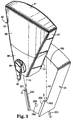
- the dispenser 30 comprises a container assembly 32 ( Figure 3) which is removably attachable to a bracket/actuator assembly 34.
- the bracket/actuator assembly 34 includes an actuator 196 that is movable between a retracted position (see Figure 3, Figure 25, solid lines) which affords attachment of the container assembly 32 to the bracket/actuator assembly 34 and an extended position ( Figure 25, dashed lines).
- the bracket/actuator assembly 34 also includes a pair of inwardly directed mounting flanges 200 and 202 which will be described in greater detail below.
- the container assembly 32 includes a reservoir for holding product to be dispensed.
- the dispenser 30 is particularly suitable for dispensing cleansing, disinfecting or sterilizing liquids, fluids, compositions or solutions, such as antiseptic soaps, hydroalcoholic solutions, disinfecting lotions, cleaning solutions and other antimicrobial liquids.
- the product may comprise the compositions described in PCT Publication No. WO/97/00667 and PCT Publication No. WO/97/00668.
- the dispenser 30 is particularly suitable for dispensing antimicrobial liquids that include volatile active ingredients, may other compositions may be dispensed from the dispenser 30.
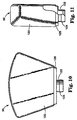
- the reservoir is provided by bottle 36 which is shown in Figures 10 and 11.
- the actuator 196 of the bracket/actuator assembly 34 is preferably controlled without hand or arm contact with the dispenser 30 to reduce the risk of contamination due to actuation of the dispenser 30.
- Figure 1 illustrates a foot actuated pneumatic bladder pump 220 with an air hose 221 adapted to be connected to port 214.
- the bladder pump 220 may optionally be used to move the actuator 196 from the retracted position to the extended position by delivering pneumatic pressure to the bracket/actuator assembly 34 when depressed by the operator.
- a wide variety of structures may be used to operate the bracket/actuator assembly 34 without hand contact.
- a wide variety of devices may be used which are designed to engage a user's foot, knee, elbow or even the user's hand.
- an electronic eye may be used to activate the dispenser 30.
- a wide variety of devices may be used to propel the actuator 196 between the retracted and extended position.
- the actuator 196 may be propelled by a fluid (e.g. pneumatic or hydraulic), a mechanical device, an electromechanical device or an electro/fluid device.
- fluid driven devices include molded bulbs, bladders, bellows and cylinders.
- mechanical devices include linkages, cables and foot pedals.
- Electromechanical devices include motors and solenoids with and without mechanical linkages.
- An example of an electrofluid device includes an electric compressor.
- the container assembly 32 includes a valve assembly (described in greater detail below) which includes an outlet 42 that is sized and shaped to afford passage of product to be dispensed (e.g. a circular opening with a diameter of about 0.094 inches), and a pump that is operatively associated with the actuator 196 to dispense product through the outlet 42.
- a valve assembly described in greater detail below
- an outlet 42 that is sized and shaped to afford passage of product to be dispensed (e.g. a circular opening with a diameter of about 0.094 inches)
- a pump that is operatively associated with the actuator 196 to dispense product through the outlet 42.
- the pump for the dispenser 30 comprises a constant volume pump adapted to deliver reproducible, metered amounts of the product regardless of the product volume (e.g. fluid level) in the reservoir.
- the pump comprises a piston 98 which includes a driven means in the form of driven surfaces 164 for receiving the actuator 196. More preferably, the pump is capable of delivering a precise volume with each actuation. This feature is particularly preferred if the dispenser 30 is utilized to deliver a product whose efficacy, performance or effectiveness is dependent upon the volume delivered to the user. Controlling the volume of product delivered by the dispenser 30 also helps ensure that product is not wasted.
- the dispenser 30 may function with a pump that varies the volume of product delivered.
- the container assembly 32 includes a pair of channels 138 and 140 which are sized and shaped to cooperatively receive the mounting flanges 200 and 202 of the bracket/actuator assembly 34 to attach the container assembly 32 to the bracket/actuator assembly 34 and to align the driven surfaces 164 of the piston 98 with the actuator 196 when the container assembly 32 is attached to the bracket/actuator assembly 34.
- Engagement between the mounting flanges 200 and 202 and the channels 138 and 140 not only attaches the container assembly 32 to the bracket/actuator assembly 34, but also properly orients the actuator 196 and piston 98 to afford proper operation of the dispenser 30.
- the container assembly 32 is quickly attachable to the bracket/actuator assembly 34 in a vertically downward direction (see arrows 10 in Figure 3). Conveniently, to assembly the dispenser 30, the operator may simply drop the container assembly 32 into the bracket/actuator assembly so that the flanges 200 and 202 engage the channels 138 and 140. This relatively simple task does not require excessive handling with the attendant contamination risks. Set up, maintenance and refilling of the dispenser 30 may be rapidly accomplished without the need for complicated steps or excessive handling.
- the channels 138 and 140 are elongate and situated to taper toward each other in the direction of attachment 10 ( Figure 3) so that the driven surfaces 164 of the piston 98 are automatically guided into a predetermined orientation relative to the actuator 196 upon attachment of the container assembly 32 to the bracket/actuator assembly 34.
- Automatic orientation of the driven surfaces 164 and actuator 196 eliminates the need to carefully manipulate those elements into a proper orientation.
- the channels 138 and 140 may be situated to form an acute angle of about forty (40) degrees therebetween, and a vertical height of about 2.1 inches.
- the container assembly 32 preferably includes a substantially planar rear wall 39 which is adapted to abut a substantially planar front housing 192 of the bracket/actuator assembly 34 when the dispenser 30 is assembled. Should the operator so desire, to assemble the dispenser 30, the rear wall 39 may be placed against the housing 192, and the container assembly 32 slid downwardly until the flanges 200 and 202 engage the channels 138 and 140.
- the container assembly 32 includes a top wall 51, a front wall 53, a pair of side walls 45 and 47 which taper toward each other in the direction of attachment, and a bottom wall 49.
- Each of the side walls 45 and 47 include one of the channels 138 and 140. Referring to Figure 7, there is shown a bottom, rear portion of the side wall 47.
- the channels e.g. 140
- the channels are preferably located in the bottom, rear portion of a side wall (e.g. 47).
- the dispenser 30 preferably has surfaces which are substantially free of sudden discontinuities to afford ease of cleaning and to reduce the potential for accumulation of contaminants on the dispenser 30.
- the top 51, front 53, side 45 and 47 and bottom 49 walls of the container assembly 32 have surfaces which are substantially free of sudden discontinuities to afford ease of cleaning.
- the top, side and bottom walls of the bracket/actuator assembly 34 form a shape that is substantially identical to the shape of the container assembly 32 to provide a dispenser 30 which is substantially free of discontinuities.
- the shape of the dispenser 30 is not a complex geometry which contributes to the ease with which the dispenser 30 may be cleaned.
- the top 51 and front 53 walls have outer surfaces that are slightly curved while the side walls 45 and 47 are substantially flat.
- the front wall may have a radius of about six inches and the top wall 51 may have a radius of about six inches.
- the dispenser 30 is preferably relatively flat so that it presents a low profile which reduces the chances of it being inadvertently bumped, dislodged, or knocked over.
- the container assembly 32 is preferably relatively flat.
- the thickness of the container assembly 32 should be less than about two inches.
- the flanges 200 and 202 project inwardly from support arms 201 and 203.
- the container assembly 32 includes recessed ledges 139 and 141 adjacent the channels 138 and 140.
- the ledges 139 and 141 are recessed from the rest of the side walls 45 and 47 by an amount that is substantially the thickness of the support arms 201 and 203 so that there is a substantially flush interface or junction between the container assembly 32 and the bracket actuator assembly 34 to reduce the surfaces which may collect contaminants or which may be difficult to keep clean.
- the channels 138 and 140 each have first ends opening onto the bottom wall 49 and second ends detined by shoulder surfaces 143 and 145 which are adapted to engage stop surfaces S of the mounting flanges 200 and 202 and support arms 201 and 203. Engagement between the stop surfaces S and the shoulder surfaces 143 and 145 terminates the insertion of the container assembly 32 into the bracket/actuator assembly at the point where actuator 196 is properly oriented with the driven surfaces 164 of the piston 98.
- the container assembly 32 has a product path between the reservoir and the outlet 42.
- the container assembly 32 is disposable and the product path is located entirely within the container assembly 32 so that the entire product path is disposed of upon disposal of the container assembly 32. In this manner, the dispenser 30 avoids accumulation of contaminants within the product path.
- the container assembly 32 or portions thereof may be reusable.
- the container assembly 32 includes a valve assembly with inner surfaces which receive the piston 98 and define a pump chamber 90.
- the valve assembly includes outer surfaces 83 including sealing surfaces 84 for sealing the reservoir, grasping surfaces 40 (e.g. a knob) that are sized and shaped to be manually grasped, the outlet 42, and surfaces extending between the inner and outer surfaces 83 to define a fill hole 94.
- grasping surfaces 40 e.g. a knob
- the knob 40 can be turned to permit or prohibit flow of product (e.g. liquid) from the bottle 36 out through nozzle 42.
- the valve assembly is mounted within the dispenser 30 for movement between a sealed position ( Figure 2) with the sealing surfaces 84 sealing reservoir from the pump chamber 90, and a dispense position ( Figures 5 and 26-30) with the fill hole 94 affording passage of the product from the reservoir to the pump chamber 90.
- a sealed position Figure 2 with the sealing surfaces 84 sealing reservoir from the pump chamber 90
- a dispense position Figures 5 and 26-30
- the valve assembly provides a positive seal for the reservoir which is particularly convenient for shipping, handling or storage of the container assembly 32.
- the pump is a constant volume pump.
- the piston 98 is mounted within the inner surfaces of the valve assembly for movement between a return position ( Figure 26) and an actuated position ( Figure 29). Movement of the actuator 196 from the retracted to the extended position causes the actuator 196 to engage the surfaces 164 of the piston 98 and drive the piston 98 from the return position to the actuated position.
- a spring 100 is mounted within the inner surfaces of the valve assembly to bias the piston 98 toward the return position. The spring 100 also biases the actuator 196 toward the retracted position through the piston 98.
- the container assembly 32 includes a cover 38 that is adapted to receive the reservoir.
- the cover 38 has surfaces defining a passageway 46.
- the valve assembly comprises a spool element 52 ( Figures 17 and 18) adapted to be received in the passageway 46 of the cover 38.
- the spool element 52 is mounted to rotate within the passageway 46 between the sealed and dispense positions.
- the cover 38 includes a main opening 44 adapted to receive the bottle 36.
- the passageway 46 has a first end 48 and a second end 50 on opposite faces which receive the spool element 52.
- the axis of the passageway 46 in the cover 38 is conveniently oriented perpendicular to the main axis of the disposable container assembly 32.
- First 54 and second 56 hollow coaxial bosses project perpendicularly from the wall of the passageway 46 in the cover 38.
- the first hollow boss 54 includes a first opening 58 at the top and a second opening 60 into the passageway 46.
- the second hollow boss 56 includes an opening 62 at the top that is adapted to be connected to the bottle 36.
- the cover 38 may be constructed from any suitable material, such as, but not limits to high density polyethylene.
- the spool element 52 preferably includes a vent hole 96 which affords passage of replacement air into the reservoir.
- the vent hole 96 in the spool element 52 is a port for the aspiration of replacement air into the bottle 36.
- the reservoir includes a plug 64 having first 76 and second 78 passageways.
- the first passageway 76 affords passage of product from the reservoir to the pump chamber 90
- the second passageway 78 affords passage of replacement air into the reservoir.
- the plug 64 is constructed from an elastomeric material, but may include an insert 144( Figure 5).
- the majority of the plug 64 may be constructed from a thermoplastic elastomer such as Santoprene 271-64 available from Advanced Elastomer, and with the insert 144 constructed from high density polyethylene.
- the sealing surfaces 84 seal the first and second passageways 76 and 78, and in the dispense position, the fill hole 94 is aligned with the first passageway 76 and the vent hole 96 is aligned with the second passageway 78.
- the plug 64 is disposed between the bottle 36 and the cover 38.
- the plug 64 includes a conical top portion 66 that is adapted to seal against the inside surface of a neck portion 122 of the bottle 36, and a bottom portion 70 that is conveniently constructed to fit inside the first hollow boss 54 of the cover 38.
- the plug 64 also includes an intermediate flange 72 that is adapted to be compressed between the end of the bottle neck 122 and the top of the first hollow boss 54 in the cover 38.
- the bottom portion 70 of the plug 64 is constructed to include a cylindrical surface with a diameter substantially equal to that of the passageway 46 in the cover 38. When the plug 64 is compressed between the bottle 36 and the cover 38, the bottom surface 74 of the plug 64 projects slightly into the passageway 46 of the cover 38 and seals against spool element 52.
- the passageways 76 and 78 communicate between the interior of the bottle 36 and the spool element 52.
- the first passageway 76 includes a one-way valve 80 for preventing flow of product from the pump chamber 90 to the reservoir.
- the illustrated one-way valve 80 comprises a ball valve having a ball 146.
- the ball valve may be constructed from the insert mentioned above.
- the ball 146 is movable between an open position ( Figure 30) which affords passage of product from the reservoir to the pump chamber 90, and a closed position ( Figures 26-29) which prevents flow of product from the pump chamber 90 to the reservoir.
- the bottle 36 is situated above the outlet 42 when the dispenser 30 dispenses product, thus, gravity biases the ball 146 toward the closed position.
- the dispenser 30 is capable of completely dispensing substantially all of the product within the bottle 36, at least partly due to the location of the bottle 36 above the pump. Dispensing substantially all of the product within bottle 36 helps reduce wastage of product upon disposal of the container assembly 32.
- the second passageway 78 is adapted to provide a vent 82 for the entrainment of replacement air into the bottle 36.
- the piston 98 includes first and second piston seals 104 and 106 which are situated to seal the vent hole 96 when the piston 98 is in the return position, and to afford passage of ambient air through the vent hole 96, the second passageway 78, vent tube 82 and into the reservoir when the piston 98 is in the actuated position.
- the spool element 52 is adapted to closely fit in the passageway 46 of the cover 38 and includes a hollow cylindrical portion with a first end 86 that is adapted to connect to a retaining element 88 ( Figures 22 and 23), a second end that comprises the knob 40, and the pumping chamber 90.
- the retaining element 88 axially holds the spool element 52 in the passageway 46 of the cover 38 but permits rotation thereof.
- a solid portion (the sealing surfaces 84) of the hollow cylindrical portion of the spool element 52 seals against the elastomeric plug 64 and blocks the first 76 and second 78 passageways that communicate with the liquid in the bottle 36.
- the driven surfaces 164 of the piston 98 preferably do not project out beyond the rear wall 39 of the container assembly which helps reduce the chances of inadvertent or undesirable actuation of the container assembly during shipping, storage or handling prior to use.
- the inner cylindrical surface of the spool element 52 seals with piston 98.
- a boss 102 on the retaining element 88 holds the piston 98 in the spool element 52.
- the vent hole 96 in the spool element 52 is closed between first 104 and second 106 piston seal surfaces.
- product e.g. liquid
- the vent hole 96 is open to the atmosphere.
- the dispenser 30 preferably includes a drip resistant nozzle.
- the nozzle includes portions of the outlet tube 110 which includes the outlet 42, and a flexible, resilient member 112.
- the flexible, resilient member 112 has a seal portion 174 adapted to engage inner surfaces of the outlet tube 110 to seal the outlet 42 relative to the pump chamber 90.
- the flexible, resilient member 112 prevents air aspiration into the pump chamber 90 when the pump chamber 90 is filled with product (e.g. a liquid) from the reservoir.
- product e.g. a liquid
- the flexible, resilient member 112 also helps reduce the amount of unsealed liquid which is left adjacent the outlet 42 after a metered amount of the liquid is dispensed. This helps reduce contamination build up as there is less unsealed liquid adjacent the outlet 42 which may attract dirt, dust and other contaminants. Reducing the amount of unsealed liquid adjacent the outlet 42 diminishes the chance that dried liquid will clog or occlude the outlet 42 and also reduces the chance that any unsealed, undispensed liquid will drip from the outlet 42 at an inopportune time (e.g. between discharges of liquid).
- the flexible, resilient member 112 is mounted within the inner surfaces of the nozzle for movement between a) a relaxed position ( Figures 26 and 30) with the seal portion 174 engaging a portion of the inner surfaces of the nozzle to seal the outlet 42 relative to the pump chamber 90, b) a displaced sealing position ( Figures 27 and 29) in which the seal portion 174 is spaced from the relaxed position and in which the seal portion 174 engages a different portion of the inner surfaces of the nozzle to seal the outlet 42 relative to the pump chamber 90, and c) a deflected, dispense position (Figure 28) with the seal portion 174 of the flexible, resilient member 112 spaced from engagement with the inner surfaces of the nozzle to afford flow of the product to be dispensed from the pump chamber 90 through the outlet 42. Movement of the flexible resilient member 112 from the deflected, dispense position (Figure 28) toward said relaxed position ( Figure 29) tends to urge the unsealed, undispensed product from the outlet 42 back into
- a relaxed shape of the flexible, resilient member 112 is shown in Figures 21 and 26.
- the flexible, resilient member 112 is elongate in an axial direction and includes a seating portion having a first end 168 and retaining surfaces 172 spaced from the first end 168.
- the flexible resilient member 112 is preferably physically displaced to a different location within the nozzle without being deformed or deflected from its relaxed shape.
- the flexible resilient member 112 preferably stretches axially to deform from its relaxed shape.
- the inner surfaces of the nozzle include a base surface 173 for receiving the first end 168 of the flexible, resilient member 112 in the relaxed position ( Figures 26 and 30), and a stop surface 175 which is spaced from the base surface 173 to afford displacement of the flexible resilient member 112 from the relaxed position to the displaced sealing position by pressure within the pump chamber 90.
- the surfaces 173 and 175 may be spaced from each other about 0.19 inches.
- the seating portion of the member 112 may be fixed relative to the nozzle so that pressure within the pump chamber 90 deflects the flexible resilient member 112 from the relaxed position to the displaced sealing position.
- the inner surfaces of the outlet tube 110 of the nozzle are elongate in an axial direction and have a cross section along the axis.
- the cross section of the inner surface 118 of the outlet tube 110 which is immediately adjacent the sealing portion 174 of the flexible, resilient member 112 in the displaced, sealing position (Figure 27) is smaller than the cross section of the inner surface 119 of the outlet tube 110 which is immediately adjacent the sealing portion 174 of the flexible, resilient member 112 in the deflected, dispense position ( Figure 28).
- the inner surface 118 comprises a cylindrical portion having a substantially constant cross-sectional diameter (e.g. about 0.25 inches).
- the cylindrical portion is adapted to engage the sealing portion 174 of the flexible, resilient member 112 in the relaxed position ( Figures 26 and 30) and the displaced, sealing position ( Figures 27 and 29).
- the inner surfaces 119 include an enlarged portion (e.g. tapering out to a diameter of about 0.29 inches) substantially adjacent the cylindrical portion 118.
- the seating portion of the member 112 has a cross sectional area along its axis, and a central shaft portion 170 between the seating portion and the sealing portion 174.
- the central shaft portion 170 has a cross sectional area along the axis.
- the sealing portion 174 of the flexible resilient member 112 comprises a substantially cylindrical surface having a diameter defining a cross sectional area along the axis.
- the cross sectional area of the central shaft portion 170 is substantially less than the cross sectional areas of both the seating portion and the sealing portion 174 to afford axial stretching of the flexible, resilient member 112.
- the seating portion of the member 112 is capable of being snapped through a partition in the outlet tube 110 during assembly of the container assembly 32.
- the seating portion may be cylindrical with a maximum outer diameter of about 0.22 inches and a thickness of about 0.12 inches; the central shaft portion may be cylindrical with a diameter of about 0.125 inches and a length of less than about 1 inch, and the sealing portion may be frusto-conical with a maximum diameter of about 0.26 inches with a taper of about forty five degrees relative to its longitudinal axis.
- the flexible, resilient member 112 is first axially displaced and then stretched. In the deflected dispense position of the member 112, an annular flow path is opened between the seal portion 174 and the inner surface 119 of the outlet tube 110. At approximately the time when liquid stops flowing from the pump chamber 90 through the outlet 42, the member 112 relaxes from the deflected, dispense position to its relaxed shape in the displaced, sealing position and circumferentially seals.
- the member 112 is axially retracted until the first end 168 of the seating portion abuts the base surface 173 of the inner surface of the nozzle. The axial retraction of the sealing portion 174 after it circumferentially seals against the inner surfaces of the nozzle causes any liquid remaining within the nozzle adjacent outlet 42 to be drawn back into the nozzle and away from the outlet 42.
- liquid in the pump chamber 90 flows through a port 108 into the outlet tube 110 in the knob 40.
- the member 112 controls the direction of flow and helps reduce the amount of unsealed liquid that remains adjacent the outlet 42 that could dry between uses and obstruct the outlet 42.
- the outlet 42 is preferably provided by an insert 41 that is connected to the distal end of the outlet tube 110 by means of a snap fit, although gluing, staking, or ultrasonic welding could also be used to make the connection.
- the bottle 36 includes a body portion 120 and neck portion 122 that is adapted to connect to the cover 38.
- the neck portion 122 of the bottle is adapted to connect to cover 38 by any convenient means; threads are one possibility, or as in the depicted embodiment, the neck portion 122 of the bottle 36 includes an externally projecting lip 124 that connects to cover 38 by means of a snap fit.
- the bottle 36 includes a non-circular region 126 that is recessed from the body portion 120. The recessed region 126 is adapted to extend into the cover 38 to prevent rotation of the bottle 36 after assembly with the cover 38.
- the bottle 36 can be fabricated from any material compatible with the product to be dispensed.
- the bottle 36 is fabricated from a blow molded thermoplastic such as, but not limited to high density polyethylene.
- the entire bottle 36 or a portion thereof may be constructed from a transparent or semi-transparent material so that the user may visually determine the amount of product (liquid) that remains in the reservoir.
- the cover 38 is seen in isolation.
- the cover 38 includes an exterior body portion with a main opening 44 adapted to receive bottle 36 (not shown in these views for clarity).
- the main opening 44 is sized and shaped to receive the recessed region 126 on the bottle 36 ( Figure 10) such that the junction between the bottle 36 and the cover 38 is essentially flush.
- a passageway 46 runs substantially perpendicular to the main axis of the bottle 36, and there is an orifice 130 in the passageway 46 that is substantially parallel to the main axis of the bottle 36.
- the passageway 46 extends completely through the cover 38 and is bounded by a first end 48 on the front face and a second end 50 on the back face.
- the first 48 and second 50 ends are surrounded by first 132 and second 134 countersunk regions.
- the first countersunk region 132 optionally includes projections 137 that function as a detent or to limit the rotation of the spool element 52.
- the second countersunk region 134 is adapted to receive retaining element 88.
- the cover 38 includes first 54 and second 56 hollow coaxial bosses that project perpendicularly from the passageway 46.
- the first inner boss 54 surrounds the orifice 130 in the wall of the passageway 46 and is adapted to retain the bottom portion of the plug 64.
- the top of the first boss 54 is adapted to seat against a flange 72 on the plug 64 and control the distance that the bottom surface of the plug 64 projects into the passageway 46.
- the second boss 56 connects to the bottle 36 by any convenient means; in the depicted embodiment, the second boss 56 includes an inwardly projecting lip 136 that connects with the externally projecting lip 124 on the bottle 36 by means of a snap fit.
- the second boss 56 can be continuous or can be slotted so as to control the assembly force of the snap fit joint.
- the plug 64 is seen in isolation.
- the plug 64 includes a top conical portion 66 adapted to seal against the inside of the bottle neck 122, and a bottom portion 70 adapted to fit inside the first boss 54 in the cover 38.
- the bottom surface 74 is adapted to seal against the spool element 52, and an outwardly projecting flange 72 is adapted to seal between the end of the bottle neck 122 and the top of the first boss 54.
- the plug 64 includes a outwardly projecting annular rib ( Figures 15 and 16) that is intended to improve the seal between the top conical portion 66 and the inside of the bottle neck 122.
- the one-way valve 80 inserted within first passageway 76 can be of any of several well known types, including valves integrally molded in the elastomeric plug. As depicted in Figure 5, the presently preferred valve 80 includes valve seat insert 144 and the valve includes a gravity-biased ball 146 or poppet. Alternatively the valve 80 could be a spring-biased ball or poppet sealing against an integral valve seat in the plug 64.
- the second passageway 78 in the plug 64 retains a first end of a vent tube 82.
- the second end of the vent tube 82 is above the normal liquid level in the bottle when the disposable container assembly 32 is mounted in an inverted position on the bracket/actuator 34.
- Portions of the plug 64 can be fabricated from any elastomeric material that is compatible with the product to be dispensed. This is can be accomplished by molding from a thermoset elastomer.
- the portions of the plug shown in Figure 16 may be injection molded from thermoplastic elastomers (e.g. Santoprene 271-64) with a hardness of 40 to 90 Shore A.
- the spool element 52 is adapted to connect to a retaining element 88.
- the second end of the spool element 52 is shaped as a knob 40 that integrally includes outlet tube 110.
- the spool 52 includes two externally projecting ribs 148 and 150 that seal with the passageway 46 in the cover 38 by means of an interference fit.
- the first end 86 of the spool element 52 is adapted to be axially retained in the cover 38 by any convenient means.
- the first end 86 of the spool element 52 includes an externally projecting lip 152 that engages a snap fit joint on retaining element 88, but other expedients such as a threaded retainer or a split ring retainer could be used.
- the pump chamber 90 is open at first end 86 and is in part defined by the inner surfaces of the knob 40 at the other end.
- the pump chamber 90 contains the piston 98 and the piston return spring 100.
- a shoulder 154 in the pump chamber 90 acts as a piston stop.
- the knob 40 includes a flange 156 adapted for grasping by the hand of a user.
- the flange 156 of the knob 40 can include projections 158 adapted to limit the rotation of the spool element 52 in the cover 38.
- the valve assembly rotates approximately one-hundred twenty (120) degrees between the sealed and dispense positions.
- the piston 98 is seen in isolation.
- the piston 98 slidably seals in the pump chamber 90 and includes a rod portion 162.
- the piston 98 preferably includes multiple piston seals 104 and 106 but could optionally include a single sealing surface.
- the vent hole 96 in the spool element 52 is blocked between the two piston surfaces 104 and 106 in the return position of the piston 98.
- the two piston surfaces 104 and 106 are supported from the rod portion by any convenient structure.
- the driven surface 164 transmits the force from an actuator 196 in the bracket/actuator assembly 34 as will be explained with more particularity below.
- the second end 166 of the rod portion 162 retains the piston return spring 100.
- the piston 98 can be fabricated from any material compatible with the liquid to be dispensed; in the presently preferred embodiment, the piston 98 is injection molded from a thermoplastic material, such as, but not limited to high density polyethylene (HDPE).
- HDPE high density polyethylene
- the retaining element 88 connects to the spool element 52 to axially hold the spool element 52 in the cover 38 and to retain the piston 98 in the spool element 52 in the normal spring-biased (return) position.
- a number of expedients for retaining the spool element 52 may be used, such as a threaded retainer or a split ring retainer.
- the retaining element 88 includes three concentric bosses projecting from a cylindrical disc portion 176.
- the first central boss 178 fits inside the spool element 52.
- the top surface 180 of the first boss 178 retains the piston 98 in the return position.
- An axial bore 182 in the first boss 178 functions as a bushing for the piston 98 and the reciprocating actuator 196 of the bracket/actuator assembly 34.
- the second middle boss 184 includes projections 186 that connect to the first end 86 of the spool element 52 by means of a snap fit.
- the third outer boss 188 includes multiple, inwardly projecting, cantilevered beams 190 that axially bias the spool element 52 against the cover 38.
- the retaining element 88 is injection molded from a thermoplastic material, such as high density polyethylene.
- the bracket/actuator assembly 34 includes a housing 191 including a front housing 192 and a rear housing 194. Mounted within the two housings are the actuator 196 and a means 198 to drive the actuator 196.
- the front and rear housings 192 and 194 can be fabricated in any convenient shape, although it is desirable to provide a exterior surface with simple planar projections as depicted so as to make the bracket/actuator assembly 34 easy to clean.
- the bracket/actuator assembly 34 is formed from a plastic material in a shape visually similar to the disposable container assembly 32.
- the front housing 192 includes a passageway 208 that serves as a bushing for the actuator 196.
- the means 198 for moving the actuator 196 conveniently includes a cavity 210 in the rear housing 194 in which the actuator can slide forwards and back.
- An air chamber 212 disposed behind the cavity 210 is in fluid communication with the hose 221 which allows the air chamber to be pressurized.
- the actuator 196 is moved forward and against the driven surface 164 of the piston 98.
- the piston return spring 100 in the container assembly 32 helps return the actuator when the air chamber 212 is depressurized.
- An actuator seal 216 is provided to prevent leakage of air from the air cavity past the actuator 196.
- the seal 216 can include any well known devices such as o-rings, v-rings, u-seals, diaphragms, and rolling diaphragms.
- the actuator 196 can be reciprocated by any of several well known means including mechanically, for example a mechanical linkage to a user operated lever; electromechanically, for example a motor and a lead screw; or hydraulically, for example a fluid actuator.
- the various parts of the container assembly 32 may injection molded from a thermoplastic material.
- the spool element 52 can be fabricated from any material compatible with the liquid to be dispensed.
- the spool element 52 is injection molded from a thermoplastic material, such as, but not limited to high density polyethylene.
- the flexible, resilient member 112 can be fabricated from any elastomeric material compatible with the product to be dispensed.
- the flexible, resilient member 112 is molded from a compatible elastomer by well known processes; conveniently, the member 112 is injection molded from a thermoplastic elastomer.
- the member 112 may be constructed from a thermoplastic elastomer, such as, but not limited to Santoprene 271-64 available from Advanced Elastomer Systems.
- Set up of the dispenser 30 may begin with attaching the bracket/actuator assembly 34 in a convenient location, such as on the wall by a sink or on a wheel mounted vertical pole (not shown).
- the foot actuated pneumatic bladder pump 220 is coupled to the bracket/actuator assembly 34 with the air hose 221 through port 214.
- the container assembly 32 may then be attached to the bracket/actuator assembly 34 in the manner shown in Figure 3, except that typically the valve assembly will be in the sealed position (as opposed to the dispense position shown in Figure 3) during attachment of the container assembly 32 to the bracket/actuator assembly 34.
- the rear wall 39 of the container assembly 32 is placed opposite the front housing 192 of the bracket/actuator assembly 34 and the container assembly is moved in a substantially vertically downward direction 10 until the flanges 200 and 202 engage the channels 138 and 140.
- the flanges 200 and 202 and channels 138 and 140 are situated to automatically guide the driven surfaces 164 of the piston 98 to a position opposite the actuator 196. Engagement between the stop surfaces S and the shoulder surfaces 143 and 145 limits the insertion of the container assembly 32 into the bracket/actuator assembly 34 at the point where the piston 98 is properly oriented relative to the actuator 196.
- the valve assembly should be moved from the sealed position ( Figure 2) to the dispense position ( Figure 1).
- the outlet 42 opens substantially vertically downward.
- the user now steps on the foot actuated pneumatic bladder 220 which causes the actuator 196 to move from the retracted ( Figure 25 solid lines) position to the extended position ( Figure 25 dashed lines). Movement of the actuator from the retracted to the extended position causes the distal end of the actuator 196 to engage the driven surfaces 164 of the piston 98 and drives the piston from the return position to the actuated position.
- FIGS 26 through 30 sequentially illustrate movement of the piston 98 from the return to actuated position and back to the return position.
- the actuator 198 is omitted from these views to emphasize other details.
- the piston 98 is biased to the return position by spring 100.
- the vent tube 82 and hole 96 are sealed from atmospheric air by piston seal surface 106.
- the pump chamber 90 is full of a precise, metered amount of product to be dispensed, regardless of the amount of product in the reservoir.
- the pump chamber 90 is sealed by the piston seal surfaces 104 and 106 and the flexible, resilient member 112 in the relied position. Because the ball 146 of the ball valve is in a down, closed position, product from the pump chamber 90 cannot travel from the pump chamber 90 back into the reservoir via first passageway 76.
- the arrow in Figure 27 illustrates the direction of movement of the piston 98.
- the piston 98 is shown just as it moves from the return toward the actuated position.
- pressure within the pump chamber 90 increases and causes the flexible, resilient member 112 to be initially displaced from its relaxed position in Figure 26 to a displaced, sealing position ( Figure 27). While the flexible resilient member 112 still seals the pump chamber 90 when it is in the displaced, sealing position, it seals with a different portion of the inner surface 118 than it does when it is in the relaxed position.
- the dispenser has not yet dispensed product.
- Figure 28 illustrates the piston 98 after it has moved further along its stroke toward the actuated position.
- the flexible, resilient member 112 stretches axially to a deflected, dispense position which affords dispensing of the product from pump chamber 90 through the outlet 42.
- the axial stretching of the member 112 opens an annular path for the product to flow from the pump chamber 90, past the sealing portion 174 of the member 112 and past the inner surface 119 which is just adjacent the sealing portion 174 when the member 112 is in the deflected, dispense position.
- Figure 29 illustrates the piston 98 in the actuated position.
- Figure 30 illustrates the piston 98 as it is being spring biased from the actuated position back to the return position.
- a partial vacuum is created in the pump chamber.
- Vacuum in the pump chamber 90 causes the flexible, resilient member 112 to move from the displaced sealing position (Figure 29) back to the relaxed position ( Figure 30).
- the movement of the member 112 from the displaced sealing position ( Figure 29) back to the relaxed position ( Figure 30) changes the unsealed volume within tube 110 that is substantially adjacent the outlet 42.
- the unsealed volume adjacent outlet 42 is increased which tends to draw product from the outlet 42 back within outlet tube 110 which helps reduce the chance that the outlet 42 will drip at an inopportune time.
- the outlet 42 is formed by insert 41 which provides a restriction substantially adjacent the outlet 41 to enhance the effectiveness of the flexible, resilient member 112 at preventing drips.
- the vacuum also causes the ball 146 of the ball valve to move upward to an open position which affords flow of product from the reservoir, through first passageway 76 and into the pump chamber 90.
- the direction of the piston 98 is also illustrated in Figure 30 with an arrow.
- Piston seal 106 has already sealed vent hole 96 and vent tube 82.
- the entire container assembly 32 When the product within the reservoir is depleted, the entire container assembly 32 may be disposed of which reduces the chance of contaminant build up within the dispenser 30.
- a refill container assembly may be attached to bracket/actuated assembly 34 and the process repeated.
- product with the reservoir may be simply be replenished (or a new, full bottle 36 may be supplied for the container assembly 32) and the other elements of the container assembly (e.g. the pump and valve assembly) may be reused.
Landscapes
- Health & Medical Sciences (AREA)
- Public Health (AREA)
- Containers And Packaging Bodies Having A Special Means To Remove Contents (AREA)
- Devices For Dispensing Beverages (AREA)
- Medical Preparation Storing Or Oral Administration Devices (AREA)
- Details Of Reciprocating Pumps (AREA)
- Apparatus For Disinfection Or Sterilisation (AREA)
- Agricultural Chemicals And Associated Chemicals (AREA)
- Immobilizing And Processing Of Enzymes And Microorganisms (AREA)
- Detergent Compositions (AREA)
Applications Claiming Priority (3)
| Application Number | Priority Date | Filing Date | Title |
|---|---|---|---|
| US08/668,198 US5897031A (en) | 1996-06-21 | 1996-06-21 | Dispenser for antimicrobial liquids |
| US668198 | 1996-06-21 | ||
| EP97924780A EP0906049B1 (fr) | 1996-06-21 | 1997-05-20 | Distributeur pour liquides antimicrobiens |
Related Parent Applications (1)
| Application Number | Title | Priority Date | Filing Date |
|---|---|---|---|
| EP97924780A Division EP0906049B1 (fr) | 1996-06-21 | 1997-05-20 | Distributeur pour liquides antimicrobiens |
Publications (3)
| Publication Number | Publication Date |
|---|---|
| EP0904722A2 true EP0904722A2 (fr) | 1999-03-31 |
| EP0904722A3 EP0904722A3 (fr) | 1999-09-08 |
| EP0904722B1 EP0904722B1 (fr) | 2003-07-30 |
Family
ID=24681396
Family Applications (2)
| Application Number | Title | Priority Date | Filing Date |
|---|---|---|---|
| EP97924780A Expired - Lifetime EP0906049B1 (fr) | 1996-06-21 | 1997-05-20 | Distributeur pour liquides antimicrobiens |
| EP98124233A Expired - Lifetime EP0904722B1 (fr) | 1996-06-21 | 1997-05-20 | Distributeur de liquides anti-microbiens |
Family Applications Before (1)
| Application Number | Title | Priority Date | Filing Date |
|---|---|---|---|
| EP97924780A Expired - Lifetime EP0906049B1 (fr) | 1996-06-21 | 1997-05-20 | Distributeur pour liquides antimicrobiens |
Country Status (8)
| Country | Link |
|---|---|
| US (1) | US5897031A (fr) |
| EP (2) | EP0906049B1 (fr) |
| JP (1) | JP3811742B2 (fr) |
| AT (2) | ATE245935T1 (fr) |
| AU (1) | AU3009697A (fr) |
| CA (1) | CA2257592C (fr) |
| DE (2) | DE69723836T2 (fr) |
| WO (1) | WO1997048321A1 (fr) |
Cited By (1)
| Publication number | Priority date | Publication date | Assignee | Title |
|---|---|---|---|---|
| GB2389840A (en) * | 2001-12-13 | 2003-12-24 | Ian Fairweather | Stackable fluid dispensing and holding system |
Families Citing this family (41)
| Publication number | Priority date | Publication date | Assignee | Title |
|---|---|---|---|---|
| WO1997000667A1 (fr) | 1995-06-22 | 1997-01-09 | Minnesota Mining And Manufacturing Company | Compositions hydro-alcooliques stables |
| US7566460B2 (en) * | 1995-06-22 | 2009-07-28 | 3M Innovative Properties Company | Stable hydroalcoholic compositions |
| EP2314272A1 (fr) | 1995-06-22 | 2011-04-27 | Minnesota Mining And Manufacturing Company | Compositions hydro-alcooliques stables |
| US6623744B2 (en) * | 1995-06-22 | 2003-09-23 | 3M Innovative Properties Company | Stable hydroalcoholic compositions |
| US6582711B1 (en) | 1997-01-09 | 2003-06-24 | 3M Innovative Properties Company | Hydroalcoholic compositions thickened using polymers |
| US6247621B1 (en) | 1998-09-30 | 2001-06-19 | Kimberly-Clark Worldwide, Inc. | Dual use dispensing system |
| US6079595A (en) * | 1999-04-12 | 2000-06-27 | Ecolab Inc. | Chemical solution dispenser |
| US6516976B2 (en) | 2000-12-19 | 2003-02-11 | Kimberly-Clark Worldwide, Inc. | Dosing pump for liquid dispensers |
| US6543651B2 (en) | 2000-12-19 | 2003-04-08 | Kimberly-Clark Worldwide, Inc. | Self-contained viscous liquid dispenser |
| US6540117B2 (en) | 2001-03-30 | 2003-04-01 | Kimberly-Clark Worldwide, Inc. | Dosing pump for liquid dispensers |
| USD480001S1 (en) | 2001-06-20 | 2003-09-30 | Dieter Bakic Design S.R.L. | Bottle |
| US7261701B2 (en) * | 2002-10-03 | 2007-08-28 | 3M Innovative Properties Co. | Skin antiseptic composition dispenser and methods of use |
| US8105306B2 (en) * | 2002-10-03 | 2012-01-31 | 3M Innovative Properties Company | Skin antiseptic composition dispenser and methods of use |
| USD503229S1 (en) | 2002-10-14 | 2005-03-22 | 3M Innovative Properties Company | Skin antiseptic composition dispenser |
| US7793801B2 (en) * | 2002-11-18 | 2010-09-14 | David Carl Drummond | Positive pressure liquid transfer and removal system configured for operation by a hand and by a foot |
| US7299951B2 (en) | 2005-03-08 | 2007-11-27 | Ecolab Inc. | Foot activated dispenser |
| US20070138208A1 (en) * | 2005-12-16 | 2007-06-21 | 3M Innovative Properties Company | Dispenser |
| US20070147946A1 (en) * | 2005-12-23 | 2007-06-28 | 3M Innovative Properties Cornpany | Surgical prep solution applicator |
| ATE529792T1 (de) | 2006-03-22 | 2011-11-15 | Diversey Inc | Vorrichtung und verfahren zur verdünnungssteuerung |
| CA2656708C (fr) | 2006-07-07 | 2015-05-19 | Fairlife, L.L.C. | Systeme et procede de distribution de nourritures liquides |
| GB0623052D0 (en) * | 2006-11-18 | 2006-12-27 | Reckitt Benckiser Uk Ltd | An assembly |
| ES2378265T3 (es) | 2007-03-21 | 2012-04-10 | Diversey, Inc. | Aparato de dispensación de fluido |
| JP2011507978A (ja) | 2007-12-31 | 2011-03-10 | スリーエム イノベイティブ プロパティズ カンパニー | 抗菌剤組成物 |
| US8235689B2 (en) * | 2008-11-03 | 2012-08-07 | Gojo Industries, Inc. | Piston pump with rotating pump actuator |
| DE102010004950A1 (de) * | 2010-01-18 | 2011-07-21 | Remis Gesellschaft für Entwicklung und Vertrieb von technischen Elementen mbH, 50829 | Kühlregal mit Türvorrichtung |
| US8534504B2 (en) * | 2011-03-18 | 2013-09-17 | Gojo Industries, Inc. | Wall-mounted and countertop-mounted dispenser |
| US9739272B2 (en) | 2012-11-29 | 2017-08-22 | Fair Oaks Farms Brands, Llc | Liquid product dispensing system and method |
| US20150053791A1 (en) * | 2013-08-21 | 2015-02-26 | Gojo Industries, Inc. | Anti-clog pump nozzles, pump and refill units |
| US20150090737A1 (en) * | 2013-09-30 | 2015-04-02 | Gojo Industries, Inc. | Dispensers, refill units and pumps having suck-back features |
| MY186715A (en) * | 2014-10-02 | 2021-08-12 | Unilever Plc | Liquid dispenser with framed refill receiving bay |
| WO2016137494A1 (fr) * | 2015-02-27 | 2016-09-01 | Aptargroup, Inc. | Système d'actionnement pour un système de distribution de substance fluide |
| US10022023B2 (en) | 2015-04-07 | 2018-07-17 | Vi-Jon, Inc. | Dispenser assembly |
| US10149575B2 (en) | 2015-10-08 | 2018-12-11 | Gojo Industries, Inc. | Slide open refillable dispenser |
| US10337662B1 (en) * | 2016-06-15 | 2019-07-02 | Leonard Galindo Gradillas | Water cooler stand |
| EP3585225B1 (fr) * | 2017-02-22 | 2021-07-07 | GOJO Industries, Inc. | Distributeurs, unités de recharge et pompes à mécanismes antigoutte actionnés par le vide |
| EP3648645B1 (fr) | 2017-07-07 | 2022-01-05 | Gojo Industries, Inc. | Distributeurs rechargeables à réservoirs et récipients de recharge conçus pour un transfert de fluide et d'air entre ceux-ci |
| DE202019006125U1 (de) | 2018-09-14 | 2025-03-20 | Solventum Intellectual Properties Company | Antimikrobielle Zusammensetzungen, umfassend Chlorhexidin |
| AU2020203799B1 (en) * | 2020-03-27 | 2021-06-24 | Déric RUSSIER | Device for dispensing gel or liquid |
| US11744411B2 (en) * | 2020-05-21 | 2023-09-05 | Clean Hand Station USA, LLC | Hand sanitizing station |
| AT523899B1 (de) * | 2020-05-27 | 2023-02-15 | Zawo Tec Gmbh | Spender zur Ausgabe eines Desinfektionsmittels |
| US20220007896A1 (en) * | 2020-07-08 | 2022-01-13 | Han San Station LLC | Mobile dispensing station and method for using same |
Citations (8)
| Publication number | Priority date | Publication date | Assignee | Title |
|---|---|---|---|---|
| US3203597A (en) | 1964-01-22 | 1965-08-31 | Bard Parker Company Inc | Surgical soap dispenser |
| US4667854A (en) | 1985-04-19 | 1987-05-26 | Ecolab Inc. | Liquid dispenser |
| US4921131A (en) | 1988-07-27 | 1990-05-01 | Horst Binderbauer | Liquid dispenser |
| US4946070A (en) | 1989-02-16 | 1990-08-07 | Johnson & Johnson Medical, Inc. | Surgical soap dispenser |
| US4946072A (en) | 1989-02-16 | 1990-08-07 | Johnson & Johnson Medical, Inc. | Container for surgical soap dispenser |
| US5136300A (en) | 1991-06-13 | 1992-08-04 | Westinghouse Electric Corp. | Modular solid state radar transmitter |
| WO1997000668A1 (fr) | 1995-06-22 | 1997-01-09 | Minnesota Mining And Manufacturing Company | Compositions hydro-alcooliques stables |
| WO1997000667A1 (fr) | 1995-06-22 | 1997-01-09 | Minnesota Mining And Manufacturing Company | Compositions hydro-alcooliques stables |
Family Cites Families (73)
| Publication number | Priority date | Publication date | Assignee | Title |
|---|---|---|---|---|
| US1174674A (en) * | 1910-03-09 | 1916-03-07 | Standard Sanitary Specialties Co Inc | Liquid-dispensing apparatus. |
| US1219364A (en) * | 1915-03-11 | 1917-03-13 | Frank W Adsit | Soap-dispensing machine. |
| US1565686A (en) * | 1925-01-24 | 1925-12-15 | Thomas L Titus | Dispensing valve |
| US1949315A (en) * | 1926-08-02 | 1934-02-27 | Martin W Levernier | Portable foot pedal soap dispenser |
| US1736392A (en) * | 1928-07-12 | 1929-11-19 | Coss Dorris | Pipette |
| US2032163A (en) * | 1932-09-30 | 1936-02-25 | Ralph B Bagby | Filling machine |
| US2283529A (en) * | 1938-12-27 | 1942-05-19 | Arthur L Bobrick | Dispenser for liquid soap and the like |
| US2294236A (en) * | 1940-11-08 | 1942-08-25 | Martin W Levernier | Pedal operated hydraulic fluid dispenser |
| US2456958A (en) * | 1944-11-18 | 1948-12-21 | Midland Lab | Liquid dispenser |
| US2488266A (en) * | 1946-01-19 | 1949-11-15 | Huntington Lab Inc | Pedestal type foot-operated liquid dispenser |
| US2537415A (en) * | 1948-07-29 | 1951-01-09 | Loeb Noel | Dispensing cover for open ends of containers for granular material having a spring-biased reciprocable valve |
| US2616095A (en) * | 1951-01-29 | 1952-11-04 | Lloyd C Stuckey | Hand cleansing apparatus |
| US2703191A (en) * | 1952-07-10 | 1955-03-01 | K P Mfg Co | Multistage lubricating gun |
| US2824676A (en) * | 1955-01-31 | 1958-02-25 | Still & Sons Ltd W M | Dispensing apparatus |
| US2975942A (en) * | 1958-12-15 | 1961-03-21 | Sherwin Williams Co | Metering dispensing valve |
| US2978149A (en) * | 1959-12-18 | 1961-04-04 | Rosen Sidney | Variable pressure suck-back device for a pump |
| US3090528A (en) * | 1960-10-27 | 1963-05-21 | Sterling Drug Inc | Mechanically operated fluid dispensing device |
| US3072297A (en) * | 1961-02-23 | 1963-01-08 | Lippman | Liquid soap dispenser |
| US3233787A (en) * | 1962-12-17 | 1966-02-08 | Rollin W Emerson | Foot-operated, bottled-liquid dispensing apparatus |
| US3197081A (en) * | 1963-04-22 | 1965-07-27 | Sterling Drug Inc | Dispenser having a pressure actuated outlet means |
| US3231149A (en) * | 1964-04-13 | 1966-01-25 | Joseph J Yuza | Dispenser for viscous fluids |
| US3381856A (en) * | 1967-03-29 | 1968-05-07 | Ceskoslovenska Akademie Ved | Device for the repetitive metering of exact quantities of liquids |
| US3584834A (en) * | 1967-09-21 | 1971-06-15 | Otto S Reid | Manually operable elastic spring and valve member |
| US3465924A (en) * | 1967-09-27 | 1969-09-09 | United States Borax Chem | Soap dispenser |
| US3485419A (en) * | 1968-01-30 | 1969-12-23 | Wilfred V Taylor | Fluent material dispenser |
| US3952924A (en) * | 1968-11-08 | 1976-04-27 | Gustav Eric Valdemar Benson | Dispenser for dispensing a liquid or pasty product from a container |
| SE355131B (fr) * | 1971-08-12 | 1973-04-09 | Landstroem K Med Fa Ind Kompan | |
| US3741439A (en) * | 1971-11-04 | 1973-06-26 | R Vehrs | Viscous liquid dispenser |
| US3897890A (en) * | 1974-01-10 | 1975-08-05 | Grace W R & Co | Automatic dispenser |
| US3977569A (en) * | 1975-10-14 | 1976-08-31 | Scholle Corporation | Drink dispenser |
| US4130224A (en) * | 1976-10-08 | 1978-12-19 | Envair, Inc. | Viscous liquid dispenser |
| US4222500A (en) * | 1978-07-24 | 1980-09-16 | James D. Pauls, Limited | Non-propellant, duration spray dispenser with positive shut off valve |
| DE2932848C2 (de) * | 1979-08-14 | 1983-09-15 | Apura GmbH + Co PWA Einmalhandtücher, 6200 Wiesbaden | Seifenspender für Flüssigseifen |
| US4371097A (en) * | 1980-05-07 | 1983-02-01 | Diamond International Corporation | Liquid dispensing pump |
| US4340158A (en) * | 1980-06-13 | 1982-07-20 | Realex Corporation | Vent-sealing, down-locked pump dispenser |
| US4546904A (en) * | 1980-08-11 | 1985-10-15 | Sani-Fresh International, Inc. | Dispenser and package for liquid or granular materials |
| US4489857A (en) * | 1982-03-22 | 1984-12-25 | Bobrick Washroom Equipment, Inc. | Liquid dispenser |
| US4615476A (en) * | 1982-07-26 | 1986-10-07 | Huntington Laboratories, Inc. | Fluid-dispensing apparatus |
| US4534669A (en) * | 1983-03-24 | 1985-08-13 | Sani-Fresh International, Inc. | Cleaning system with cartridge having valve means |
| US4705195A (en) * | 1983-03-24 | 1987-11-10 | Sani-Fresh International, Inc. | Valve apparatus for liquid dispensers |
| US4645094A (en) * | 1983-04-26 | 1987-02-24 | Calgon Corporation | Photo-electric controlled dispenser |
| US4493440A (en) * | 1983-08-08 | 1985-01-15 | United States Borax & Chemical Corporation | Wall-mounted soap dispenser |
| US4561571A (en) * | 1983-08-29 | 1985-12-31 | Chen Jason K S | Washing liquid supplier |
| US4564127A (en) * | 1984-03-22 | 1986-01-14 | Dexide, Inc. | Dispenser with pump for dispensing liquid from a collapsible bag |
| US4586635A (en) * | 1984-06-01 | 1986-05-06 | Collins Jr Virgil H | Conical dome collapsible tube dispenser for dispensing liquids |
| DE8426265U1 (de) * | 1984-09-06 | 1984-12-06 | Erich Schumm Gmbh, 7157 Murrhardt | Seifen-spender |
| US4673109A (en) * | 1985-10-18 | 1987-06-16 | Steiner Company, Inc. | Liquid soap dispensing system |
| US4671428A (en) * | 1985-11-15 | 1987-06-09 | Spatz Walter B | Dispenser for fluent masses |
| US5312018A (en) * | 1988-07-08 | 1994-05-17 | Evezich Paul D | Containing and dispensing device for flowable material having relatively rigid and deformable material containment portions |
| USD304548S (en) | 1986-07-14 | 1989-11-14 | Dexide, Inc. | Wall mounted dispensing bottle |
| US4792064A (en) * | 1986-08-12 | 1988-12-20 | The Dial Corporation | Liquid soap dispenser |
| US4838460A (en) * | 1987-10-09 | 1989-06-13 | Calmar Corporation | Product dispenser having actuator locking collar and shroud |
| US4895276A (en) * | 1987-10-19 | 1990-01-23 | Sani-Fresh International, Inc. | Dual liquid cartridge dispenser |
| US4793521A (en) * | 1988-01-13 | 1988-12-27 | Andy Steiner | Device for dispensing fluent materials from cartridges |
| DE3819412A1 (de) * | 1988-06-07 | 1989-12-21 | Schulze Karl Heinz | Dosierbarer fluessigkeitsspender |
| US4930670A (en) * | 1989-03-17 | 1990-06-05 | Smiley Chien | Pumping mechanism for dispensing lotion in bottle/container |
| US4949877A (en) * | 1989-05-11 | 1990-08-21 | Bobrick Washroom Equipment, Inc. | Fluid dispenser valve |
| US4967935A (en) * | 1989-05-15 | 1990-11-06 | Celest Salvatore A | Electronically controlled fluid dispenser |
| FR2650255B1 (fr) * | 1989-07-25 | 1992-01-10 | Oreal | Ensemble de distribution d'un ou plusieurs produit(s) sous forme de creme, de liquide ou de poudre, notamment de produits cosmetiques |
| WO1991013003A1 (fr) * | 1990-02-22 | 1991-09-05 | The Procter & Gamble Company | Distributeur de liquide a bouteille comprimable contenant un sac, dote d'un moyen resistant a l'affaissement du sac insere dans ledit distributeur |
| DE9106675U1 (de) * | 1991-05-31 | 1991-07-18 | CWF-Chemie Frankfurt GmbH, 6457 Maintal | Seifenspender |
| US5226625A (en) * | 1991-08-05 | 1993-07-13 | Bobrick Washroom Equipment, Inc. | Container mounting system |
| US5222633A (en) * | 1991-09-20 | 1993-06-29 | Jack W. Kaufman | Foam dispensing device |
| IT1251684B (it) * | 1991-10-11 | 1995-05-19 | Carlo Mancini | Pompetta ad azionamento manuale per dispensare sostanze liquide o cremose a pressione costante e prestabilita. |
| US5213236A (en) * | 1991-12-06 | 1993-05-25 | Liquid Molding Systems, Inc. | Dispensing valve for packaging |
| US5435465A (en) * | 1992-04-28 | 1995-07-25 | El-Amin; Hassan A. | Hygiene device |
| US5234132A (en) * | 1992-05-29 | 1993-08-10 | The Gillette Company | Actuator for dispensing pump |
| FR2693174B1 (fr) * | 1992-07-03 | 1994-08-19 | Saint Laurent Parfums Yves | Perfectionnements aux dispositifs distributeur et doseur de produit. |
| US5356038A (en) * | 1993-01-21 | 1994-10-18 | Sprintvest Corporation N.V. | Wall mountable cream tube dispenser |
| US5277332A (en) * | 1993-02-04 | 1994-01-11 | Isabel Rogers | Multiple dispensing container for viscous materials, cups and toothpaste |
| US5332129A (en) * | 1993-06-16 | 1994-07-26 | Moen Incorporated | Soap dispenser assembly |
| US5379813A (en) * | 1993-09-10 | 1995-01-10 | Ing; Hwang L. C. | Liquid dispenser |
| US5622317A (en) * | 1994-12-12 | 1997-04-22 | Contico International, Inc. | Pressure buildup trigger sprayer |
-
1996
- 1996-06-21 US US08/668,198 patent/US5897031A/en not_active Expired - Lifetime
-
1997
- 1997-05-20 EP EP97924780A patent/EP0906049B1/fr not_active Expired - Lifetime
- 1997-05-20 DE DE69723836T patent/DE69723836T2/de not_active Expired - Lifetime
- 1997-05-20 JP JP50296598A patent/JP3811742B2/ja not_active Expired - Fee Related
- 1997-05-20 AT AT98124233T patent/ATE245935T1/de not_active IP Right Cessation
- 1997-05-20 EP EP98124233A patent/EP0904722B1/fr not_active Expired - Lifetime
- 1997-05-20 DE DE69723834T patent/DE69723834T2/de not_active Expired - Fee Related
- 1997-05-20 AU AU30096/97A patent/AU3009697A/en not_active Abandoned
- 1997-05-20 AT AT97924780T patent/ATE245936T1/de not_active IP Right Cessation
- 1997-05-20 WO PCT/US1997/008529 patent/WO1997048321A1/fr not_active Ceased
- 1997-05-20 CA CA002257592A patent/CA2257592C/fr not_active Expired - Fee Related
Patent Citations (8)
| Publication number | Priority date | Publication date | Assignee | Title |
|---|---|---|---|---|
| US3203597A (en) | 1964-01-22 | 1965-08-31 | Bard Parker Company Inc | Surgical soap dispenser |
| US4667854A (en) | 1985-04-19 | 1987-05-26 | Ecolab Inc. | Liquid dispenser |
| US4921131A (en) | 1988-07-27 | 1990-05-01 | Horst Binderbauer | Liquid dispenser |
| US4946070A (en) | 1989-02-16 | 1990-08-07 | Johnson & Johnson Medical, Inc. | Surgical soap dispenser |
| US4946072A (en) | 1989-02-16 | 1990-08-07 | Johnson & Johnson Medical, Inc. | Container for surgical soap dispenser |
| US5136300A (en) | 1991-06-13 | 1992-08-04 | Westinghouse Electric Corp. | Modular solid state radar transmitter |
| WO1997000668A1 (fr) | 1995-06-22 | 1997-01-09 | Minnesota Mining And Manufacturing Company | Compositions hydro-alcooliques stables |
| WO1997000667A1 (fr) | 1995-06-22 | 1997-01-09 | Minnesota Mining And Manufacturing Company | Compositions hydro-alcooliques stables |
Cited By (2)
| Publication number | Priority date | Publication date | Assignee | Title |
|---|---|---|---|---|
| GB2389840A (en) * | 2001-12-13 | 2003-12-24 | Ian Fairweather | Stackable fluid dispensing and holding system |
| GB2389840B (en) * | 2001-12-13 | 2005-03-30 | Ian Fairweather | Stackable fluid dispensers |
Also Published As
| Publication number | Publication date |
|---|---|
| EP0906049B1 (fr) | 2003-07-30 |
| DE69723836T2 (de) | 2004-05-13 |
| JP3811742B2 (ja) | 2006-08-23 |
| ATE245935T1 (de) | 2003-08-15 |
| EP0904722B1 (fr) | 2003-07-30 |
| CA2257592A1 (fr) | 1997-12-24 |
| CA2257592C (fr) | 2005-12-13 |
| ATE245936T1 (de) | 2003-08-15 |
| DE69723836D1 (de) | 2003-09-04 |
| US5897031A (en) | 1999-04-27 |
| DE69723834D1 (de) | 2003-09-04 |
| AU3009697A (en) | 1998-01-07 |
| EP0904722A3 (fr) | 1999-09-08 |
| WO1997048321A1 (fr) | 1997-12-24 |
| EP0906049A1 (fr) | 1999-04-07 |
| JP2000514020A (ja) | 2000-10-24 |
| DE69723834T2 (de) | 2004-04-15 |
Similar Documents
| Publication | Publication Date | Title |
|---|---|---|
| EP0904722B1 (fr) | Distributeur de liquides anti-microbiens | |
| US5799841A (en) | Drip resistant nozzle for a dispenser | |
| US20070138208A1 (en) | Dispenser | |
| EP1140369B1 (fr) | Flacon pressable pour une distribution de liquide par doses et sensiblement depourvue de germes | |
| US8087843B2 (en) | Liquid dentifrice dispensing toothbrush | |
| US6082593A (en) | Low maintenance cosmetic dispenser with a slideable nozzle hood | |
| PT802760E (pt) | Distribuidor de sabao flexivel | |
| US20040159332A1 (en) | Cleaning device and method of use | |
| EP1920694B1 (fr) | Distributeur multi-réservoirs à commutation par dépression | |
| EP3174430B1 (fr) | Instrument de soins bucco-dentaires | |
| CA2429810A1 (fr) | Pompe de dosage destinee a des distributeurs de liquide | |
| CA2882714A1 (fr) | Pompes horizontales, unites de recharge et distributeurs de mousse dotes de compresseurs d'air integres | |
| CN215423261U (zh) | 用于分配液体产品的可补充分配器 | |
| WO2015048698A1 (fr) | Distributeurs, unités de remplissage et pompes à caractéristiques d'aspiration inverse | |
| KR20160008514A (ko) | 유체제품의 패키징과 디스펜싱을 위한 리필가능장치 | |
| US20090308896A1 (en) | Venting System for Battery Operated Sprayer | |
| CA2522124C (fr) | Distributeur pour liquides antimicrobiens | |
| CA2639124A1 (fr) | Distributeur de fluide | |
| US12121916B2 (en) | Pump assembly with shield | |
| AU709023B2 (en) | Cosmetic dispenser | |
| MXPA98010046A (en) | Liquid dispenser with seat for valve skirt | |
| AU2002235223A1 (en) | Dosing pump for liquid dispensers |
Legal Events
| Date | Code | Title | Description |
|---|---|---|---|
| PUAI | Public reference made under article 153(3) epc to a published international application that has entered the european phase |
Free format text: ORIGINAL CODE: 0009012 |
|
| 17P | Request for examination filed |
Effective date: 19981217 |
|
| AK | Designated contracting states |
Kind code of ref document: A2 Designated state(s): AT DE DK ES FR GB IT NL |
|
| PUAL | Search report despatched |
Free format text: ORIGINAL CODE: 0009013 |
|
| RIN1 | Information on inventor provided before grant (corrected) |
Inventor name: FOSLIEN, FLOYD L. Inventor name: WIRT, DAVID F. |
|
| AK | Designated contracting states |
Kind code of ref document: A3 Designated state(s): AT DE DK ES FR GB IT NL |
|
| RIC1 | Information provided on ipc code assigned before grant |
Free format text: 6A 47K 5/12 A, 6F 04B 9/14 B |
|
| GRAH | Despatch of communication of intention to grant a patent |
Free format text: ORIGINAL CODE: EPIDOS IGRA |
|
| GRAH | Despatch of communication of intention to grant a patent |
Free format text: ORIGINAL CODE: EPIDOS IGRA |
|
| GRAA | (expected) grant |
Free format text: ORIGINAL CODE: 0009210 |
|
| AC | Divisional application: reference to earlier application |
Ref document number: 0906049 Country of ref document: EP Kind code of ref document: P |
|
| AK | Designated contracting states |
Designated state(s): AT DE DK ES FR GB IT NL |
|
| PG25 | Lapsed in a contracting state [announced via postgrant information from national office to epo] |
Ref country code: NL Free format text: LAPSE BECAUSE OF FAILURE TO SUBMIT A TRANSLATION OF THE DESCRIPTION OR TO PAY THE FEE WITHIN THE PRESCRIBED TIME-LIMIT Effective date: 20030730 Ref country code: AT Free format text: LAPSE BECAUSE OF FAILURE TO SUBMIT A TRANSLATION OF THE DESCRIPTION OR TO PAY THE FEE WITHIN THE PRESCRIBED TIME-LIMIT Effective date: 20030730 |
|
| REG | Reference to a national code |
Ref country code: GB Ref legal event code: FG4D |
|
| REF | Corresponds to: |
Ref document number: 69723834 Country of ref document: DE Date of ref document: 20030904 Kind code of ref document: P |
|
| PG25 | Lapsed in a contracting state [announced via postgrant information from national office to epo] |
Ref country code: DK Free format text: LAPSE BECAUSE OF FAILURE TO SUBMIT A TRANSLATION OF THE DESCRIPTION OR TO PAY THE FEE WITHIN THE PRESCRIBED TIME-LIMIT Effective date: 20031030 |
|
| PG25 | Lapsed in a contracting state [announced via postgrant information from national office to epo] |
Ref country code: ES Free format text: LAPSE BECAUSE OF FAILURE TO SUBMIT A TRANSLATION OF THE DESCRIPTION OR TO PAY THE FEE WITHIN THE PRESCRIBED TIME-LIMIT Effective date: 20031110 |
|
| NLV1 | Nl: lapsed or annulled due to failure to fulfill the requirements of art. 29p and 29m of the patents act | ||
| ET | Fr: translation filed | ||
| PLBE | No opposition filed within time limit |
Free format text: ORIGINAL CODE: 0009261 |
|
| STAA | Information on the status of an ep patent application or granted ep patent |
Free format text: STATUS: NO OPPOSITION FILED WITHIN TIME LIMIT |
|
| 26N | No opposition filed |
Effective date: 20040504 |
|
| PGFP | Annual fee paid to national office [announced via postgrant information from national office to epo] |
Ref country code: FR Payment date: 20070517 Year of fee payment: 11 |
|
| PGFP | Annual fee paid to national office [announced via postgrant information from national office to epo] |
Ref country code: DE Payment date: 20080630 Year of fee payment: 12 |
|
| PGFP | Annual fee paid to national office [announced via postgrant information from national office to epo] |
Ref country code: IT Payment date: 20080528 Year of fee payment: 12 |
|
| PGFP | Annual fee paid to national office [announced via postgrant information from national office to epo] |
Ref country code: GB Payment date: 20080529 Year of fee payment: 12 |
|
| REG | Reference to a national code |
Ref country code: FR Ref legal event code: ST Effective date: 20090119 |
|
| PG25 | Lapsed in a contracting state [announced via postgrant information from national office to epo] |
Ref country code: FR Free format text: LAPSE BECAUSE OF NON-PAYMENT OF DUE FEES Effective date: 20080602 |
|
| GBPC | Gb: european patent ceased through non-payment of renewal fee |
Effective date: 20090520 |
|
| PG25 | Lapsed in a contracting state [announced via postgrant information from national office to epo] |
Ref country code: GB Free format text: LAPSE BECAUSE OF NON-PAYMENT OF DUE FEES Effective date: 20090520 |
|
| PG25 | Lapsed in a contracting state [announced via postgrant information from national office to epo] |
Ref country code: DE Free format text: LAPSE BECAUSE OF NON-PAYMENT OF DUE FEES Effective date: 20091201 |
|
| PG25 | Lapsed in a contracting state [announced via postgrant information from national office to epo] |
Ref country code: IT Free format text: LAPSE BECAUSE OF NON-PAYMENT OF DUE FEES Effective date: 20090520 |