EP0903896A2 - Verfahren zur Stabilisierung eines fraktionierten Entzerrers in digitalen Signalempfängern - Google Patents
Verfahren zur Stabilisierung eines fraktionierten Entzerrers in digitalen Signalempfängern Download PDFInfo
- Publication number
- EP0903896A2 EP0903896A2 EP98440206A EP98440206A EP0903896A2 EP 0903896 A2 EP0903896 A2 EP 0903896A2 EP 98440206 A EP98440206 A EP 98440206A EP 98440206 A EP98440206 A EP 98440206A EP 0903896 A2 EP0903896 A2 EP 0903896A2
- Authority
- EP
- European Patent Office
- Prior art keywords
- fractionally spaced
- values
- stabilizing
- equalization coefficients
- coefficients
- Prior art date
- Legal status (The legal status is an assumption and is not a legal conclusion. Google has not performed a legal analysis and makes no representation as to the accuracy of the status listed.)
- Granted
Links
Images


Classifications
-
- H—ELECTRICITY
- H04—ELECTRIC COMMUNICATION TECHNIQUE
- H04L—TRANSMISSION OF DIGITAL INFORMATION, e.g. TELEGRAPHIC COMMUNICATION
- H04L25/00—Baseband systems
- H04L25/02—Details ; arrangements for supplying electrical power along data transmission lines
- H04L25/03—Shaping networks in transmitter or receiver, e.g. adaptive shaping networks
- H04L25/03006—Arrangements for removing intersymbol interference
- H04L25/03012—Arrangements for removing intersymbol interference operating in the time domain
- H04L25/03019—Arrangements for removing intersymbol interference operating in the time domain adaptive, i.e. capable of adjustment during data reception
- H04L25/03038—Arrangements for removing intersymbol interference operating in the time domain adaptive, i.e. capable of adjustment during data reception with a non-recursive structure
- H04L25/03044—Arrangements for removing intersymbol interference operating in the time domain adaptive, i.e. capable of adjustment during data reception with a non-recursive structure using fractionally spaced delay lines or combinations of fractionally integrally spaced taps
Definitions
- This invention refers to a method for stabilizing the operation of fractionally spaced equalizers having a determinated number of taps, associated with which are respective equalization coefficients, used in digital signal receivers, said equalization coefficients being updatable through an algorithm based on the minimization of a proper cost function and stabilized by a proper modification, said modification involving evaluation of a plurality of values to be considered for updating said equalization coefficients.
- the invention also concerns the relating fractionally spaced equalizer and digital signal receiver incorporating the method.
- Adaptive equalization is a technique commonly used to compensate the channel distorting effect in a general transmission system.
- a known technique uses synchronous equalizers obtained through FIR (Finite Impulse Response) filters with variable coefficients time-spaced by an amount equal to the signal interval or to the symbol time.
- FIR Finite Impulse Response
- Performance of such an equalizer depends significantly on the phase of the symbol synchronism reconstructed during reception. Improved performance can be obtained with the use of the socalled fractionally spaced equalizers (FSE) consisting of an adaptive FIR filter with coefficients time-spaced by a quantity equal to a fraction of the signal interval or to the symbol time. Performance of the fractionally spaced equalizer with a sufficient number of coefficients is practically free from the phase characteristics of the transmission channel and from the phase of the symbol synchronism as reconstructed during reception.
- FSE fractionally spaced equalizers
- the fractionally spaced equalizer is able to execute adaptively in only one device both the adaptive filtering and equalization functions, and provide for instance the optimum linear receiver.
- a fractionally spaced equalizer has two main drawbacks: first of all the coefficient drift and, secondly, its low convergence rate. Both these drawbacks are due to the fact that a fractionally spaced equalizer in general allows more configurations than the equalization coefficients, substantially corresponding to the same root-mean-square error. In other words, the root-mean-square error does not change significantly according to certain directions around the point corresponding to the optimum configuration point of the equalization coefficients.
- Experimental tests have demonstrated that a fractionally spaced equalizer is affected by a long term intrinsic instability due to unavoidable bias taking place in the control circuits. This behaviour leads the equalizer to operate with coefficients having so high values to cause overflow in the registers or a coefficient saturation, leading to a performance degradation.
- the function of the leakage value vector I k +1 is to behave like an additional term controlling the value of the coefficients c k +1 at every update, so as to avoid their divergence in the long term.
- the fictitious white noise shaping matrix is a 2N+1-value square matrix, corresponding to the number of coefficients of the fictitious noise filter to be implemented.
- the present invention seeks to overcome the above-mentioned drawbacks and provide both a method for stabilizing the operation of fractionally spaced equalizers and a system for stabilizing the operation of fractionally spaced equalizers, whose execution is improved, better performing and more cost effective as compared with the known solutions.
- a further object of the present invention is to provide a method for stabilizing the operation of fractionally spaced equalizers wherein the leakage value calculation function is concentrated on one functional block alone.
- a further object of the present invention is to provide a method for stabilizing the operation of fractionally spaced equalizers to be implemented with a lower circuit complexity and resulting smaller area on the integrated circuit, cost-effective manufacture and lower power consumption.
- a further object of the present invention is to provide a fractionally spaced equalizer designed to implement the improved method for stabilizing its operation.
- a further object of the present invention is to provide a digital signal receiver incorporating the above fractionally spaced equalizer.
- the present invention seeks to provide a method for stabilizing the operation of fractionally spaced equalizers, a fractionally spaced equalizer and a digital signal receiver incorporating the characteristics of the annexed claims, which form an integral part of the present description. Further objects, characteristics and advantages of the present invention will be apparent from the following detailed description and annexed drawings, which are only supplied by way of a non limiting example, wherein:
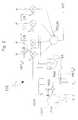
- Fig. 1 shows a schematic block diagram of a standard digital transmission system 1 according to the known art, where an adaptive fractionally spaced equalizer FSE is used.
- This transmission system 1 is provided with a data signal a k , forming the numerical sequence to be transmitted at the time k, which is fed to the input of a transmitter circuit TX.
- the transmitter circuit TX sends the data signal a k , associated with which is a certain symbol period T, over a transmission channel CH. Due to its own nature, said transmission channel CH introduces interferences of various kind in the data signal a k .
- a summing block NSUM represents the physical event of introducing a Gaussian white noise n(t), that will sum up at the output from channel CH, thus causing an output signal r(t).
- the signal r(t) on the receiving side enters the fractionally spaced equalizer FSE and in particular, at first, a sampler CP1, which samples the output signal r(t) according to an period T M equal to the period T divided by a factor M, where for instance M can be worth 2, thus producing a sampled signal r(kT M ).
- the sampled signal r(kT M ) is then passed through the adaptive fractionally spaced equalizer FSE, which will output - after passing through a second sampler circuit CP2 operating according to the period T - an equalized signal x(kT) according to a vector c k of the equalization coefficients, associated with the fractionally spaced equalizer FSE.
- the vector c k of the equalization coefficients is the vector at time k, whereas its components are equalization coefficients c k / i at time k.
- the equalized signal x (kT) is finally handled by a decision block MD, that may consist of a simple integrator, which outputs a recognized signal â k , However, the equalized signal x(kT) and the recognized signal â k are also picked up and sent to an error calculation block BE.
- Said error calculation block BE ouputs an error signal e k , of the type identified by the above equation (1a), which is used by the adaptive fractionally spaced equalizer FSE to update the vector c k of the equalization coefficients at instant k in a vector c k +1 of the equalization coefficients at instant k+1.
- the error calculation block BE produces an error signal e k , which is a sequence of errors calculated for each symbol of the sequences forming the equalized signal x (kT) and the recognized signal â k ; for instance, it is calculated according to the known algorithm of the minimum root-mean-square error (MMSE), i.e. minimizing the cost function described in the previous equation (1a).
- MMSE minimum root-mean-square error
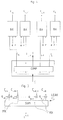
- Fig. 2 shows a schematic block diagram of the fractionally spaced equalizer FSE illustrated in Fig. 1.
- the fractionally spaced equalizer FSE comprises 2L+1 delay taps P, obtained by interposing corresponding delay lines LR, where L is an integer, which select 2L+1 symbols of the signal r(kT M ) spaced apart by the time interval T M , and send them to a summing block FSUM after multiplying them by some equalization coefficients c k -L , c k -L+1 ,..., c k L-1 , c k L of the vector c k +1 of equalization coefficients. Therefore, the equalized signal x (kT) is supplied as output.
- Equalization coefficients c k -L , c k -L+1 ,..., c k L-1 , c k L come from respective update blocks BA, that receive at the input the error signal e k and have inside a computation block LEAK that calculates the values I i k+ 1 of a leakage vector I k +1 , as expressed in the above equations (1) and (2).
- a multiplier block MXK executes, on the other hand, the product of the error signal e k and the signal r(kT M ), to be added to the values I i k +1 of the leakage vector I k +1 in a summing block LSUM.
- An accumulator block ACCK is also provided to complete the operations between the vectors following multiplication by a proper step value ⁇ in a further multiplier MXG.
- Said values I i k +1 of the leakage vector I k +1 are dependent on a shaping matrix of the fictitious white noise Q , appearing at the input of the computation block LEAK.
- Said shaping matrix of the white noise Q is represented by 2N+1 values q -N ...q N , where N is an integer, corresponding to the number of coefficients of the noise filter to be implemented, according to the above equation (1).
- Updating operations generally take place within an updating time TA, which may be equal to T M .
- T M the vector c k +1 of the equalization coefficients is updated through the vector c k of the equalization coefficients that temporally preceeds it by the updating time TA.
- Fig. 3 shows a schematic block diagram of the computation block LEAK, which calculates a value of the leakage vector, I i k +1 .
- each value of the leakage vector I k +1 is calculated by multiplying, at proper multiplier means MX, a corresponding set of values q - N ...q N of the shaping matrix Q by a respective set of equalization coefficients c k i- N .
- 2N+1 values are obtained, which are summed up by a summation block SUM to give the value I i k +1 of the leakage vector I k +1 .
- the computation block LEAK is contained in each one of the 2L+1 updating blocks BA which, therefore, are so many as the delay taps P of the fractionally spaced equalizer FSE.
- each updating block BA shall receive at its input the whole vector c k of the equalization coefficients to be sent to the computation block LEAK contained therein, introducing 2L+1 connections, such as metal tracks or wires for each updating block BA.
- Fig. 4 shows a schematic block diagram of a processor block COMP according to the invention, capable of replacing the 2L+1 computation blocks LEAK represented in Figs. 2 and 3 and concentrating their functions.
- the processor block COMP receives at its input a vector c of the equalization coefficients, which is formed in fact by its 2L+1 equalization coefficients c -L ,..., c L . By removing the apex it is indicated that the vector c of the equalization coefficients is not considered by the processor block COMP at a given instant to cause its output.
- the processor block COMP outputs the values I i of the leakage vector I to some updating blocks BA', which differ from updating blocks BA of Fig. 2 simply because they have no computation blocks LEAK.
- the updating block BA' will receive the corresponding value I i of the leakage vector I directly, which directly reaches the adder LSUM shown in Fig. 2.
- said values I i of the leakage vector I are not supplied at the instant k+1, as in the computation block LEAK shown in Fig. 2, but they are available at every instant and sequentially updated, executing an updating sequence within a time interval DT that is worth (2L+1)(2N+1) times the updating interval TA.
- Time interval DT is the total updating interval spent by the process block COMP to provide updating of a value I i of the leakage vector I for use in the corresponding update block BA to update the vector c of the equalization coefficients according to equation (1).
- both the instants k and k+1 loose in significance with respect to equation (1), by since the leakage vector I , is updated by sequentially changing each one of its values I i at every subsequent instant, and said variable leakage vector I is available at the input of the updating blocks BA at every instant for the evaluation of the vector c of the equalization coefficients, therefore it follows that the same vector c of the equalization coefficients is input again to the processor block COMP according to the changes of the leakage vector I .
- Fig. 5 represents a schematic block diagram of the processor block COMP, consisting of a selector circuit SEL, which receives the vector c of the equalization coefficients at its input.
- said selector circuit SEL will select, from the set of equalization coefficients c -L ,...,c L available at its inputs, a subset of equalization coefficients c i-N ,...,c i+N and output them serially in a serial signal c ser to a multiplier means MX2 through a multiplexing operation.
- the selector circuit SEL will select a further subset of equalization coefficients c k i-N , , c k i+N , incrementing index i by one. Iteration goes on so as to serialize all subsets of equalization coefficients c k i-N , , c k i+N .
- a second multiplexer MUX2 receives at its input the coefficients q -N ...q N of the shaping matrix Q and transmits them serially in a signal q ser to the multiplier MX2.
- a timing block TEMP is provided for clock reference CK, i.e. a clock signal, to the selector circuit SEL and to the multiplexer MUX2, as well as to a demultiplexer DEMUX.
- multiplier MX2 outputs a serial signal c q , which is sent to an accumulator block ACC.
- Said accumulator block ACC is then followed by a decimation circuit DEC.
- Said accumulator block ACC accumulates 2N+1 values of the serial signal c q , adds them and sends them to the demultiplexer DEMUX through the decimation circuit DEC.
- decimation circuit DEC The function of decimation circuit DEC is to let only the sum of the 2N+1 values of the serial signal c q reach the demultiplexer DEMUX and not the intermediate results.
- the demultiplexer DEMUX has 2L+1 outputs, each corresponding to a value I i of the leakage vector I .
- the demultiplexer DEMUX distributes the values received from the accumulator block ACC in a cyclic and sequential manner over the 2L+1 outputs, completing the leakage vector I in the time interval DT.
- Values I i of the leakage vector I at each one of the 2L+1 outputs of the demultiplexer DEMUX are maintained constant during the time interval DT, provided they are not updated by the demultiplexer DEMUX.
- the processor block COMP picks up at its input through the selector circuit SEL, seven coefficients c 2 to c 8 and serializes them in the signal c ser .
- the multiplexer MUX2 picks up the 7 coefficients q -3 to q +3 of the fictitious white noise shaping matrix Q and serializes them in the signal q ser .
- Multiplication of the signal c ser and the signal q ser is executed at the multiplier MX2, so that the resulting signal c q will consist of the series c 2 q -3 , c 3 q -2 c 4 q -1 ... c 8 q 3 . Therefore the accumulator ACC will produce the sum c 2 q -3 + c 3 q -2 +c 4 q -1 +...+ c 8 q 3 .
- the function of the decimation circuit DEC is to pick up the accumulator result only every 7 operations, i.e. only the final sum, preventing partial sums c 2 q -3 , c 2 q -3 + c 3 q -2 , c 2 q -3 + c 3 q -2 +c 4 q -1 from reaching the input of the demultiplexer DEMUX and so on.
- the final sum thus obtained is sent by the demultiplexer DEMUX for the updating of the coefficient of the pertaining vector I , namely I 5 .
- the selector circuit SEL will choose seven coefficients c 3 to c 9 and serialize them in the signal c ser , repeating the procedure till the value I 6 , is obtained.
- the processor block COMP updates the vector c of the equalization coefficients in a time interval DT that is (2L+1)(2N+1) times that of the computation block LEAK.
- only one processor block COMP comprising essentially only a selector circuit SEL and a multiplexer MUX2, a multiplier MX2, an accumulator ACC, a decimation circuit DEC and a demultiplexer DEMUX instead of (2N+1)(2L+1) multipliers MX and (2L+1) adders SUM of the computation block LEAK of Fig. 2.
- the method of stabilizing the operation of the fractionally spaced equalizer FSE according to the present invention consists essentially of the following steps:
- the vector c of the equalization coefficients coming into the processor block COMP changes with every iteration, whereas at the processor block output corresponding to the 2L+1 outputs of the demultiplexer DEMUX, each value I i is maintained on its last value if it is not its turn to be updated.
- the value I i at an output of the demultiplexer DEMUX changes at every time interval DT only. Therefore, the leakage vector I will be fully updated within the time interval DT, although at the end of said time time interval DT the new leakage vector I is not really the result of the vector c of the equalization coefficients considered after the time inverval DT, but rather during said time interval DT.
- the method for stabilizing the operation of fractionally spaced equalizers as described herein supplies the values I i of the leakage vector I serially to the updating blocks BA'.
- the demultiplexer DEMUX simply fulfils the function of sending to each updating block BA' through the decimation circuit DEC the values I i reaching it serially at a time interval substantially equal to DT/(2L+1).
- the system and method for stabilizing the operation of fractionally spaced equalizers allow the reduction of the circuit complexity of the fractionally spaced equalizer, since instead of introducing (2L+1) adders, i.e. one for each equalizer tap and, above all, instead of having to provide connections to send the values of the equalization coefficients and coefficients of the fictitious white noise shaping matrix to the 2L+1 update blocks, only one circuit is used, with only one input for the equalization coefficients and the coefficients of the fictitious white noise shaping matrix acting on all equalizer taps.
- the method and/or system for stabilizing the operation of the fractionally spaced equalizers according to the invention advantageously allow a space saving in the integrated circuit executions.
- said method and/or system for stabilizing the operation of the fractionally spaced equalizers imply a lower manufacturing cost, since the circuits suitable to implement it are not only less as compared with the known art, but their manufacture is also cost-effective and simple.
- the method and/or system for stabilizing the operation of the fractionally spaced equalizers according to the invention advantageously allow a power consumption saving due to a reduced circuit complexity and a longer time interval required to update leakage values.
- circuit shapes adopted for the implementation of the stabilizing method and through which the leakage vector is updated in a serial manner during a time interval bound to the number of equalizer taps may be different.
- the use of various mathematical algorithms will be possible for error evaluation, including the method of the minimum root-mean-square error (MMSE) or Godard's constant module algorithm, as well as the use of adaptive algorithms of the equalization coefficients differing from the method of the stochastic gradient, but requiring error evaluation and error correction.
- MMSE minimum root-mean-square error
- Godard's constant module algorithm as well as the use of adaptive algorithms of the equalization coefficients differing from the method of the stochastic gradient, but requiring error evaluation and error correction.
- the number of delay taps indicated conventionally with the odd number 2L+1, can also be even.
Landscapes
- Engineering & Computer Science (AREA)
- Power Engineering (AREA)
- Computer Networks & Wireless Communication (AREA)
- Signal Processing (AREA)
- Cable Transmission Systems, Equalization Of Radio And Reduction Of Echo (AREA)
Applications Claiming Priority (2)
| Application Number | Priority Date | Filing Date | Title |
|---|---|---|---|
| ITTO970830 | 1997-09-19 | ||
| IT97TO000830A IT1294878B1 (it) | 1997-09-19 | 1997-09-19 | Metodo per la stabilizzazione del funzionamento di equalizzatori a spaziatura frazionata e relativo sistema di implementazione. |
Publications (3)
| Publication Number | Publication Date |
|---|---|
| EP0903896A2 true EP0903896A2 (de) | 1999-03-24 |
| EP0903896A3 EP0903896A3 (de) | 2000-08-30 |
| EP0903896B1 EP0903896B1 (de) | 2003-04-23 |
Family
ID=11416010
Family Applications (1)
| Application Number | Title | Priority Date | Filing Date |
|---|---|---|---|
| EP98440206A Expired - Lifetime EP0903896B1 (de) | 1997-09-19 | 1998-09-11 | Verfahren zur Stabilisierung eines fraktionierten Entzerrers in digitalen Signalempfängern |
Country Status (5)
| Country | Link |
|---|---|
| US (1) | US6442199B1 (de) |
| EP (1) | EP0903896B1 (de) |
| CA (1) | CA2245296A1 (de) |
| DE (1) | DE69813707T9 (de) |
| IT (1) | IT1294878B1 (de) |
Family Cites Families (5)
| Publication number | Priority date | Publication date | Assignee | Title |
|---|---|---|---|---|
| US4237554A (en) * | 1979-03-01 | 1980-12-02 | Bell Telephone Laboratories, Incorporated | Coefficient tap leakage for fractionally-spaced equalizers |
| JPS59211313A (ja) * | 1983-05-17 | 1984-11-30 | Toshiba Corp | 自動等化器 |
| JPH0590904A (ja) * | 1991-09-27 | 1993-04-09 | Nec Corp | 制御信号発生回路 |
| IT1273963B (it) * | 1995-02-24 | 1997-07-11 | Alcatel Italia | Metodo e circuiti di equalizzazione a spaziatura frazionata |
| IT1295451B1 (it) * | 1997-09-30 | 1999-05-12 | Alsthom Cge Alcatel | Metodo per la stabilizzazione del funzionamento di equalizzatori a spaziatura frazionata e relativo sistema di implementazione. |
-
1997
- 1997-09-19 IT IT97TO000830A patent/IT1294878B1/it active IP Right Grant
-
1998
- 1998-09-11 EP EP98440206A patent/EP0903896B1/de not_active Expired - Lifetime
- 1998-09-11 DE DE69813707T patent/DE69813707T9/de active Active
- 1998-09-17 US US09/156,140 patent/US6442199B1/en not_active Expired - Lifetime
- 1998-09-18 CA CA002245296A patent/CA2245296A1/en not_active Abandoned
Also Published As
| Publication number | Publication date |
|---|---|
| EP0903896A3 (de) | 2000-08-30 |
| US6442199B1 (en) | 2002-08-27 |
| DE69813707T2 (de) | 2004-03-11 |
| CA2245296A1 (en) | 1999-03-19 |
| ITTO970830A1 (it) | 1999-03-19 |
| DE69813707D1 (de) | 2003-05-28 |
| DE69813707T9 (de) | 2004-09-09 |
| EP0903896B1 (de) | 2003-04-23 |
| IT1294878B1 (it) | 1999-04-23 |
Similar Documents
| Publication | Publication Date | Title |
|---|---|---|
| EP0426026B1 (de) | Entzerrer | |
| US5175747A (en) | Equalizer | |
| US4468786A (en) | Nonlinear equalizer for correcting intersymbol interference in a digital data transmission system | |
| KR960011739B1 (ko) | 실시간 계수 갱신값 추출장치를 구비한 등화기 | |
| EP0583927B1 (de) | Dynamisches adaptives Entzerrersystem und Verfahren hierfür | |
| US5048060A (en) | Digital signal receiving circuit with means for controlling a baud rate sampling phase by a power of sampled signals | |
| US5894428A (en) | Recursive digital filter | |
| KR100201776B1 (ko) | 고리 구조를 갖는 적응 등화기 | |
| US4225832A (en) | Self-adapting equalizer | |
| US6289046B1 (en) | Adaptive equalization method | |
| EP0903896B1 (de) | Verfahren zur Stabilisierung eines fraktionierten Entzerrers in digitalen Signalempfängern | |
| US6108681A (en) | System for sharing resources in a digital filter | |
| US20020027953A1 (en) | Low-complexity blind equalizer | |
| JPH0964791A (ja) | 波形等化装置 | |
| CN113708914B (zh) | 基于对称折半查找逐次逼近原理的迭代盲符号同步方法 | |
| US6944218B2 (en) | Adaptive filter having a small circuit scale with a low power consumption and tap-coefficients updating method of adaptive filter | |
| EP0782262A2 (de) | Aktualisierungssystem für eine adaptive Filter-Konfiguration geeignet zur Verarbeitung von Komplexwert-Koeffizienten | |
| EP0905945B1 (de) | Verfahren zur Stabilisierung eines fraktionierten Entzerrers in digitalen Signalempfängern | |
| JPH0738479A (ja) | 適応受信機 | |
| KR100595500B1 (ko) | 온라인 적응 등화기 | |
| US7987220B2 (en) | Computing filter coefficients for an equalizer in a communication receiver | |
| JPH0736537B2 (ja) | 等化器 | |
| KR0152028B1 (ko) | 스펙트럼예측을이용한자력복구등화기및그의초기화방법 | |
| Saranya et al. | Implementation of low complexity fast least mean square filter for noise cancellation application | |
| JPH09326728A (ja) | イコライザ |
Legal Events
| Date | Code | Title | Description |
|---|---|---|---|
| PUAI | Public reference made under article 153(3) epc to a published international application that has entered the european phase |
Free format text: ORIGINAL CODE: 0009012 |
|
| AK | Designated contracting states |
Kind code of ref document: A2 Designated state(s): DE ES FR GB IT |
|
| AX | Request for extension of the european patent |
Free format text: AL;LT;LV;MK;RO;SI |
|
| PUAL | Search report despatched |
Free format text: ORIGINAL CODE: 0009013 |
|
| AK | Designated contracting states |
Kind code of ref document: A3 Designated state(s): AT BE CH CY DE DK ES FI FR GB GR IE IT LI LU MC NL PT SE |
|
| AX | Request for extension of the european patent |
Free format text: AL;LT;LV;MK;RO;SI |
|
| 17P | Request for examination filed |
Effective date: 20000918 |
|
| 17Q | First examination report despatched |
Effective date: 20001213 |
|
| AKX | Designation fees paid |
Free format text: DE ES FR GB IT |
|
| GRAG | Despatch of communication of intention to grant |
Free format text: ORIGINAL CODE: EPIDOS AGRA |
|
| GRAG | Despatch of communication of intention to grant |
Free format text: ORIGINAL CODE: EPIDOS AGRA |
|
| GRAH | Despatch of communication of intention to grant a patent |
Free format text: ORIGINAL CODE: EPIDOS IGRA |
|
| GRAH | Despatch of communication of intention to grant a patent |
Free format text: ORIGINAL CODE: EPIDOS IGRA |
|
| GRAA | (expected) grant |
Free format text: ORIGINAL CODE: 0009210 |
|
| AK | Designated contracting states |
Designated state(s): DE ES FR GB IT |
|
| REG | Reference to a national code |
Ref country code: GB Ref legal event code: FG4D |
|
| REF | Corresponds to: |
Ref document number: 69813707 Country of ref document: DE Date of ref document: 20030528 Kind code of ref document: P |
|
| PG25 | Lapsed in a contracting state [announced via postgrant information from national office to epo] |
Ref country code: ES Free format text: LAPSE BECAUSE OF FAILURE TO SUBMIT A TRANSLATION OF THE DESCRIPTION OR TO PAY THE FEE WITHIN THE PRESCRIBED TIME-LIMIT Effective date: 20031030 |
|
| ET | Fr: translation filed | ||
| PLBE | No opposition filed within time limit |
Free format text: ORIGINAL CODE: 0009261 |
|
| STAA | Information on the status of an ep patent application or granted ep patent |
Free format text: STATUS: NO OPPOSITION FILED WITHIN TIME LIMIT |
|
| 26N | No opposition filed |
Effective date: 20040126 |
|
| REG | Reference to a national code |
Ref country code: FR Ref legal event code: CD |
|
| PGFP | Annual fee paid to national office [announced via postgrant information from national office to epo] |
Ref country code: IT Payment date: 20100927 Year of fee payment: 13 |
|
| PG25 | Lapsed in a contracting state [announced via postgrant information from national office to epo] |
Ref country code: IT Free format text: LAPSE BECAUSE OF NON-PAYMENT OF DUE FEES Effective date: 20110911 |
|
| REG | Reference to a national code |
Ref country code: FR Ref legal event code: GC Effective date: 20140717 |
|
| REG | Reference to a national code |
Ref country code: FR Ref legal event code: RG Effective date: 20141016 |
|
| REG | Reference to a national code |
Ref country code: FR Ref legal event code: PLFP Year of fee payment: 18 |
|
| PGFP | Annual fee paid to national office [announced via postgrant information from national office to epo] |
Ref country code: GB Payment date: 20150917 Year of fee payment: 18 Ref country code: DE Payment date: 20150922 Year of fee payment: 18 |
|
| PGFP | Annual fee paid to national office [announced via postgrant information from national office to epo] |
Ref country code: FR Payment date: 20150922 Year of fee payment: 18 |
|
| REG | Reference to a national code |
Ref country code: DE Ref legal event code: R119 Ref document number: 69813707 Country of ref document: DE |
|
| GBPC | Gb: european patent ceased through non-payment of renewal fee |
Effective date: 20160911 |
|
| REG | Reference to a national code |
Ref country code: FR Ref legal event code: ST Effective date: 20170531 |
|
| PG25 | Lapsed in a contracting state [announced via postgrant information from national office to epo] |
Ref country code: FR Free format text: LAPSE BECAUSE OF NON-PAYMENT OF DUE FEES Effective date: 20160930 Ref country code: DE Free format text: LAPSE BECAUSE OF NON-PAYMENT OF DUE FEES Effective date: 20170401 Ref country code: GB Free format text: LAPSE BECAUSE OF NON-PAYMENT OF DUE FEES Effective date: 20160911 |