EP0903683A2 - Sicherheitsverfahren durch statistische Stichproben für Selbstabtast-Verkaufstellensystem - Google Patents
Sicherheitsverfahren durch statistische Stichproben für Selbstabtast-Verkaufstellensystem Download PDFInfo
- Publication number
- EP0903683A2 EP0903683A2 EP98117783A EP98117783A EP0903683A2 EP 0903683 A2 EP0903683 A2 EP 0903683A2 EP 98117783 A EP98117783 A EP 98117783A EP 98117783 A EP98117783 A EP 98117783A EP 0903683 A2 EP0903683 A2 EP 0903683A2
- Authority
- EP
- European Patent Office
- Prior art keywords
- items
- self
- customer
- shopper
- checkout
- Prior art date
- Legal status (The legal status is an assumption and is not a legal conclusion. Google has not performed a legal analysis and makes no representation as to the accuracy of the status listed.)
- Ceased
Links
Images
Classifications
-
- G—PHYSICS
- G06—COMPUTING OR CALCULATING; COUNTING
- G06Q—INFORMATION AND COMMUNICATION TECHNOLOGY [ICT] SPECIALLY ADAPTED FOR ADMINISTRATIVE, COMMERCIAL, FINANCIAL, MANAGERIAL OR SUPERVISORY PURPOSES; SYSTEMS OR METHODS SPECIALLY ADAPTED FOR ADMINISTRATIVE, COMMERCIAL, FINANCIAL, MANAGERIAL OR SUPERVISORY PURPOSES, NOT OTHERWISE PROVIDED FOR
- G06Q30/00—Commerce
- G06Q30/06—Buying, selling or leasing transactions
-
- G—PHYSICS
- G07—CHECKING-DEVICES
- G07G—REGISTERING THE RECEIPT OF CASH, VALUABLES, OR TOKENS
- G07G1/00—Cash registers
- G07G1/0036—Checkout procedures
- G07G1/0045—Checkout procedures with a code reader for reading of an identifying code of the article to be registered, e.g. barcode reader or radio-frequency identity [RFID] reader
- G07G1/0054—Checkout procedures with a code reader for reading of an identifying code of the article to be registered, e.g. barcode reader or radio-frequency identity [RFID] reader with control of supplementary check-parameters, e.g. weight or number of articles
-
- G—PHYSICS
- G07—CHECKING-DEVICES
- G07G—REGISTERING THE RECEIPT OF CASH, VALUABLES, OR TOKENS
- G07G3/00—Alarm indicators, e.g. bells
- G07G3/003—Anti-theft control
Definitions
- This invention relates to self-service shopping, and in particular to a methodology for improving the security of a self-service shopping system by the use of statistical sampling of shoppers and their purchases.
- Self-service shopping systems are desired for their ability to offload service-oriented functions from human labor forces and provide automatic assistance to the shopper for increase in response time, efficiency, throughput, lower cost, and the like.
- systems in the prior art provide each shopper with a portable bar code scanning device, which is used to scan the bar code located on a product in order to determine the price by accessing a locally stored look-up table and keep a tally list of all items selected for purchase.
- the shopper is finished selecting items for purchase and scanning the bar codes on the items, he places the self-scanner into a recess in a stationary (i.e., wall-mounted) cradle, wherein a list of items selected is printed out for a receipt and provided to the shopper.
- the shopper then brings the list along with the cart of selected items to a clerk for tender of final payment and, possibly, an audit of items selected for purchase in order to ensure that all items selected and placed in the cart were properly scanned.
- This self-service scenario speeds shoppers through the store quicker than the conventional conveyor belt/cashier environment typical in stores today.
- Two goals of a self-checkout system are to increase shopper throughput and to save in labor costs.
- a shopper can scan his items when selected from the shelf and save scanning time at the checkout line.
- stores would require less human labor since there is a reduction in the number of cashiers required.
- there is still a requirement to scan some items from a shopper's cart if a shopper is determined to be audited in order to flag an attempted theft as well as to provide deterrence against pilferage.
- some labor is required to scan at least some of the items leaving the store.
- the present invention proposes the implementation of a statistical basis for use in a self-scanning checkout system for determining whether a shopper or customer should be audited and how many items to check in a shopper's shopping cart for incorrect or missing scans as well as which particular or types of items to check to determine if they were properly scanned.
- a fraction of the shoppers, depending upon an algorithm will be checked by a cashier or security guard, but only a limited and select number of items will be checked for each shopper.
- the present methodology determines how many items to check for a given shopper as well as which particular items to check for that shopper.
- shopper frequency the number of times the shopper has visited that store
- queue length the length of the checkout line at that time
- prior history check more items if the shopper has had errors in the past, check less items if the shopper has had no errors in the past
- store location check more items in stores located in areas with a high risk of pilferage
- time of day, day of week, date of year determines if pilferage more likely at certain times of day or year
- number of times items are returned to shelf during shopping; dwell time between scans, and other factors.
- a method for use in a self-service shopping checkout system wherein a shopper is provided with a self-scanning terminal for the scanning of the bar code of an item selected for purchase prior to depositing the item into a shopping cart, and wherein a list of items self-scanned by the shopper is compiled and made available to a cashier for surveillance and payment purposes.
- the method performs a security check to determine if the shopper did not likely fail to scan an item prior to depositing the item into the shopping cart.
- the method comprises the steps of determining, as a function of a plurality of input criteria, whether a shopper should be audited and the number of items n to be scanned, selecting from the shopper's cart of items presented for purchase n items to be scanned, scanning a bar code located on each of said n items selected for scanning, allowing the shopping transaction if each item selected for scanning is present on the list of self-scanned items compiled by the shopper, and disallowing the shopping transaction if any item selected for scanning is not present on the list of self-scanned items compiled by the shopper.
- the number of items n is determined as a function of the criteria mentioned above.
- the method further comprises the steps of selecting items at random system checks and determining whether more items are needed to be checked until statistical significance is achieved.
- a self-service shopping checkout system comprises a plurality of portable self-checkout devices, wherein each of the self-checkout devices is to be used by a customer to scan a bar code located on an item to be purchased so as to record therein a list of such items to be purchased.
- a stationary dispenser unit is used for the releasable containment of said plurality of portable self-checkout devices and transmission of data stored in the devices by wireline to a host computer for processing; and a plurality of point-of-sale terminals using the host processing to check out the customer.
- the portable device contains a wireless transceiver for transmitting the data stored in the device directly to the host computer in lieu of storing the data in the device and using the dispenser to transmit the stored data to the computer.
- the portable device is a dumb terminal for collecting and storing the shopping data which may be used in conjunction with a kiosk to determine the prices and cost of items selected for purchase.
- the kiosk contains a display and a rack for receiving the dumb terminal to communicate with the host computer by wireline or a wireless link. In response to customer inputs, the desired information is presented on the display.
- the customer may place the dumb terminal in a cradle at the checkout stand. The cradle loads the data in the dumb terminal into the host computer for processing and check out of the customer.
- each of the portable self-checkout devices comprises bar code scanning means for scanning and decoding a bar code located on an item to be purchased, means for compiling a list of items scanned by said customer, and a data output port for allowing transfer of said scanned item list to an associated data port located in a dispenser external to said portable device or by wireless link directly to a host computer for processing the shopper's items selected for purchase.
- the dispenser unit of the system comprises a plurality of device containment slots, each of said slots being configured for releasable containment of a mating self-scanning device, each of said slots having associated therewith a data input port suitable for mating with a data output port located on a portable self-checkout device, and a printer for printing a tally list of items scanned for purchase by said shopper, said tally list being supplied by a self-checkout device after said self-checkout device is returned to a device containment slot after being used by a shopper, said tally list further comprising a bar code encoded with said items scanned by said shopper, a unique identification record associated with said shopper, and the number of items scanned by said shopper.
- Each of the point-of-sale terminals in the present system comprises bar code reading means for reading said two-dimensional bar code from a tally list presented to a cashier operating said point-of-sale terminal, said bar code reading means providing as output data signals representing said items scanned by said shopper, a unique identification record associated with said shopper, and the number of items scanned by said shopper.
- Each of the point-of-sale terminals in the present system comprised bar code reading means for reading said two-dimensional bar code from a tally list presented to a cashier operating said point-of-sale terminal, said bar code reading means providing as output data signals representing said items scanned by amid shopper, said unique identification record associated with said shopper, and said number of items scanned by said shopper; said bar code reading means also configured so as to scan select items presented for checking by maid cashier; means for determining, as a function of said number of items scanned by said customer and an internally stored check number unique to said customer, the number of items n to be scanned by the cashier; means for comparing the identity of the items scanned by said cashier with the list of items scanned by said customer; means for allowing the shopping transaction if each item selected for scanning by the cashier is present on the list of self-scanned items compiled by the shopper; and means for disallowing the shopping transaction if any item selected for scanning by the cashier is not present on the list of
- the present invention may be further enhanced using other auditing factors as a basis for statistical techniques for self-check out.
- the audit factors for such self-checkout are shopper audit history, loyalty of shoppers, regional differences and other factors which attempt to model the real world to obtain the minimum checkout loss for a shopper.
- a shopping transaction is allowed according to a statistical decision if the minimum check-out loss for the transaction is less than a threshold defined by a loss function L(c) and (p), where L(c) is the expected inventory loss associated with the shopper and (p) is the probability of performing an audit on the shopper.
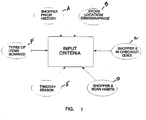
- the present methodology determines how many items to check for a given shopper transaction as well as which particular items to check for that shopper, using the following input criteria which may be considered, alone or in varying combinations: shopper's prior history A (check more items if the shopper has had errors in the past, check less items if the shopper has had no errors in the past); store location and demographics B (check more items in stores located in areas with a high risk of pilferage); number of shopper's in checkout queues or queue length C (the length of the checkout line at that time); shopper's scan habits D or the number of times items are returned to shelf during shopping, and dwell time between scans; time of day, day of week date of year E (determine if pilferage more likely at certain times of day or year); and types of items scanned F . Other factors may include, shopping frequency (the number of times the shopper has visited that store).
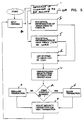
- a method for performing a security check to determine if the shopper did not likely fail to scan an item prior to depositing the item into the shopping cart comprises the steps of G generating a plurality of input criteria for self-check out; H determining if the customer is to be audited, i.e items to be re-scanned; I performing a statistical determination of which items (R) to be selected and scanned; J performing a statistical determination of how many items of the selected items to check in a shopper's basket; K generating a list of items to check; L selecting from the shopper's cart of items presented for purchase n items to be scanned including M the step of properly scanning a bar code located on each of said n items selected for scanning from the chart for proper scanning; N allowing the shopping transaction if each item selected for scanning is present on the list of self-scanned items compiled by the shopper; O disallowing the shopping transaction if any item selected for scanning is not present on the list of self-scanned items compiled by the shopper
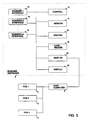
- FIG. 3 illustrates a block diagram of the secure self-service shopping system of the present invention.
- the system 2 comprises, at the top level, a scanner dispenser 2, a host computer system 4, and a plurality of point of sale (POS) terminals 6.
- the host computer 4 is a standard computer system well known in the prior art and found in retail establishments such as supermarkets for controlling operations of the supermarket, as modified as described below to carry out the methods and functions of the present invention.
- the host computer 4 is capable of interfacing with the scanner dispenser 2 for data communications therebetween in accordance with the present invention as will be described more fully below.
- each POS terminal 6 is a standard POS computer system well known in the prior art and found in retail establishments such as supermarkets for controlling checkout functions of the supermarket, such as purchase item entry and payment tender functions, as modified as described below to carry out the methods and functions of the present invention.
- the POS terminal 6 is capable of interfacing with the host computer 4 for data communications therebetween in accordance with the present invention as will be described more fully below.
- the scanner dispenser 2 is a stationary, i.e., wall-mounted chassis, which comprises a plurality of interface slots 10 configured to physically and electrically mate with an associated portable scanning terminal 100, shown in detail in Figure 4.
- Each terminal 100 is placed within an associated recess in the dispenser 2 for data transfer functions, battery recharge, etc., after the shopper has used the scanning terminal for self-service scanning functions.
- the terminal power supply i.e. battery
- the dispenser 2 will allow a subsequent shopper to select that terminal for use in his or her shopping functions.
- the dispenser 2 also comprises a control processing section 12, a memory section 14, a printer 16, a card reader 18, a host I/O section 20, and a display 22, all of which will be described below in further detail.
- the card reader may be a magnetic stripe reader, which is well known in the art.
- the shopper presents a "loyalty card" having an associated encoded magnetic stripe, comprising data indicative of the identity of the shopper.
- the shopper may also present a credit card, smart card, debit card or the like having a suitable encoded magnetic stripe.
- the card reader 18 may be a bar code symbol scanning device, suitable for reading a one or two dimensional bar code symbol printed on a loyalty card, driver's license or the like, for obtaining therefrom the required identification data. Any type of technology which lends itself towards the use of automatic identification may be implemented by this system.
- a terminal is assigned to the user and the identity of the assigned terminal is signaled to the user in any of various ways. For example, an LED associated with and in close proximity to the assigned terminal may be caused to blink on and off, thus catching the attention of the shopper and indicating that he should select that terminal. Likewise, appropriate instructions may be displayed to the shopper via the display 22, such "Please take terminal number 17" or the like. Concurrently therewith, a locking mechanism which may be used for terminal security purposes to prevent unauthorized removal of the terminal will be disabled by the dispenser control logic 12, thus enabling the removal of the assigned terminal 100 from the dispenser 2 by the shopper.
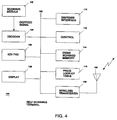
- the scanning terminal 100 shown in block diagrammatic form in Figure 4 is a lightweight, portable, hand-holdable device well suited for carrying by the shopper and performing data entry functions such as keypad entry and/or bar code scanning of items selected for purchase.
- the terminal 100 comprises a scanning module 102, a decoder 104, a keypad 106, a display 108, a dispenser interface section 110, a control section 112, an items scanned memory section 114, a price look-up table 116, and, optionally, a wireless transceiver 118 and antenna 120, all of which function in operative association with bus 122 as further described.
- the scanning module 102 and decoder 104 operate in conjunction in a manner well known in the art to allow the user to scan a bar code located on an item selected for purchase and input onto bus 122 for subsequent processing.
- the scanning module 102 is a laser bar code scanner which utilizes a laser light source, a scanning means such as a mirror mounted on a miniature motor, and a photosensor for receiving light reflected from a target bar code and for converting the received reflected light into an electrical signal indicative of the degrees of reflectivity of the various portions of the bar code.
- the scanning module also comprises signal processing which digitizes the signal from the photosensor so that the decoder may perform an analysis thereon to determine the data represented by the bar code.
- a laser scanning device such as this is well known in the art and may be found, for example, in U.S. Patent No. 5,479,000, which is incorporated by reference herein.
- the scanning module may be of the CCD type, which utilizes a linear or two-dimensional CCD array for capturing the reflected light (ambient or otherwise) from the target bar code and for generating an associated signal which is processed in accordance with techniques well known in the art.
- the decoded data signal indicative of the data represented by the target bar code is output by the decoder onto the bus 122.
- the decoded data is used to fetch price and item description information from the price look-up table 116, which is in turn sent to the display 108 for display to the user.
- the price and description data is also sent to the item scanned memory 114 for storage therein such that the item scanned memory 114 will compile a tally list of all items scanned by the user in that shopping trip.
- the user may delete an item from the tally list by scanning the bar code of the item and depressing an appropriate function key found on the keypad, e.g. a "minus" key, to signal to the control logic 112 that the associated scanned bar code is to removed from, rather than added to, the tally list in the memory 114.
- an appropriate function key found on the keypad, e.g. a "minus" key
- the user may, at any desired time, obtain a subtotal of the items scanned for purchase and resident in memory 114 by depressing an appropriate key on the keypad 106, e.g. a "subtotal" key.
- This key will cause the control logic section 112 to fetch the price of each item from the memory 114, add the prices together, and display the total on the display 108. This enables the user to ensure that he has not exceeded a certain spending limit.
- the terminal 100 may employ wireless communication with the host computer 4 via the optional wireless transceiver 118 and antenna 120.
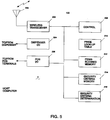
- the price and item description information is stored in the price look-up table 210 at the host computer 4, as shown in Figure 5.
- the decoded bar code data is sent via the transceiver 118 to the associated antenna 203 and transceiver 202 at the host computer 4, which fetches the price and item description from its price look-up table 210 and sends it back to the terminal 100 via the wireless link.
- This type of embodiment eliminates the need for a look-up table to be stored in each terminal 100, and changes to the data in the price look-up table may be made at the host rather than requiring each terminal 100 to be revised when the price or item description is changed.
- the tally list of items scanned may be kept in an appropriate memory location in the items scanned memory 212 at the host computer 4 rather than utilizing an on-board memory 114. Deletion of an item and acquisition of a subtotal may be likewise executed through the wireless link rather than performing those functions at the terminal 100.
- the wireless link may be accomplished via an RF (radio frequency) link, which is well known in the art and is described in detail in U.S. Patent No. 5,157,687; which is incorporated by reference herein.
- RF radio frequency
- the host transceiver would likely be physically located near the host since communications with the terminals need not be in close proximity.
- other wireless technologies such as infrared communications may be implemented, with transceiver stations strategically located throughout the store for communications with each terminal 100 as the shopper proceeds through the store.
- the terminal 100 may be used in conjunction with a kiosk located in the store to provide the customer for information purposes only a list of the items scanned, the item prices and the cost of purchase.
- the terminal 100 maybe a "dumb terminal" and simplified to eliminate costly functions, such as control, display and other functions.
- the kiosk contains a receptacle for receiving the terminal; a display and a keyboard for communication with the host computer.
- the terminal would be loaded into the receptacle and the scanned items loaded into the host computer for processing in accordance with customer inputs through the keyboard. The processing results would be shown on the display.
- the kiosk may communicate with the host computer by wireline or wireless link, as previously indicated.
- the customer may load the "dumb terminal" into a cradle at the checkout stand whereupon the scanned items would be loaded into the host computer for check-out processing.
- terminal 100 is returned back to the scanner dispenser 2 and placed within an appropriate mating recess for communications with the scanner interface 10.
- the terminal has implemented an on-board look-up table 116 and memory 114, then the tally list of items scanned is downloaded from the memory 114 to the host computer 4 for further processing.
- data indicative of the identity of the shopper which is obtained when the shopper initially requests a terminal 100 from the dispenser 2 as described above, is downloaded to the host 4.
- the host 4 thusly has stored therein the identity of the shopper along with data indicative of the items selected for purchase. If the system is operating in wireless communications mode, then the items scanned memory 212 at the host computer will contain the tally list of items scanned for purchase for that particular shopper without the need for downloading from the scanning terminal at the dispenser interface.
- the host computer After determining that the shopper has completed selecting and scanning items for purchase, the host computer proceeds to determine, in accordance with the present invention, the items to be checked by the checkout cashier (or security guard or the like). Referring to Figure 5, the host computer has stored in a security criteria memory 214 a plurality of security criteria which are used to determine the items to check by the cashier, if the shopper is determined to be audited.
- the security criteria include, but are not limited to, the following:
- the host computer 4 After the host computer 4 has used the security criteria as described above in order to ascertain, via the security determination logic means 216, the specific number of items to check for scan accuracy by the cashier or security guard, it proceeds to determine if this shopper is to be re-scanned (audited) or not, and if so, which types of items the cashier or security guard should look for in selecting the items to check. Factors to consider in determining which items to look for from among the shoppers purchases include the following:
- the shopper may then proceed to an appropriate POS terminal 6, which is manned by a cashier for tender of payment and security checking of the items selected for purchase.
- POS terminal 6 which is manned by a cashier for tender of payment and security checking of the items selected for purchase.
- the shopper reaches the POS station, he presents his loyalty card (or other suitable automatic identification card) to the cashier, who will present the card to an appropriate card reader for automatic identification of the shopper.
- the shopper's identification data is used to fetch from the host computer 4 the tally list of items scanned and the data indicative of the number of items to be checked as well as the identity of specific items or types of items to look for in performing the audit process.
- the cashier or security guard reads from the display at the POS terminal the list of items to check (or from a printed version of the list) and selects the items for checking.
- the cashier scans the bar code of each item, and if any item scanned is not on the tally list, the cashier or security guard is alerted that the shopper has made an error in scanning.
- the retail establishment may opt to re-scan the entire shopping cart, may simply add the item to the tally list, or may take some other act it deems appropriate for the situation.
- Data indicative of the mis-scanned item is then transmitted from the POS terminal back to the host computer and stored in its security criteria memory 214 for subsequent processing and subsequent criteria determination.
- a more advanced auditing policy will increase security and further reduce labor. Many factors can be used in developing such a policy. Some of the factors that can be used in an advanced auditing policy are listed hereinafter in Section A. How these factors are taken into account by a system operator determines the auditing policy.
- Several auditing policies are proposed. One policy is based on statistical decision theory and is described in Section B1. A policy based on different customers response to auditing is given in Section B2. A policy based on Neural Networks is described in Section B3.
- the audit history of a given customer is a good indication of his future checkout accuracy.
- Regions with a high theft level may require more stringent security so the level of auditing should be higher in those regions.
- the store may want to reduce the average auditing level during times when the store is very busy. This will increase the throughput of the store at the risk of slightly increased theft.
- the first parameter that is required in setting up a decision rule is a description of the state space, which is the set of possible states of nature [2]. This is all the information that we have at our disposal to make a decision.
- the state space, ⁇ which we will use consists of a finite set of possible events that can occur. As an example we will consider a state space of four events which consist of all combinations of two independent events.
- the first event to consider is whether there is an error in the self checkout that was performed by the customer.
- This event, E ⁇ ⁇ represents an error in the self checkout data; its complement E ⁇ ⁇ , means there is no error.
- the second event indicates whether the store is busy or not.
- the event, B ⁇ ⁇ means the store is busy and the event B ⁇ ⁇ means the store is not busy.
- Table 1 lists the different losses that occur. The actual values for that table would depend on what store this system is being used in and could be adjusted to fit their circumstances. Combining the losses listed in this table it is possible to build a loss function.
- loss function L( ⁇ , a) is given in Table 2.
- Table 2 Lets see in Table 2 how the loss function is built up from the losses in Table 1. For example, whether the store is busy or not, there is an average inventory loss of $5.00 if the customer has made an error in his self checkout and we chose not to audit. If he has not made an error and we do not audit then their is no loss since there is no error to find. There are no other types of losses when you do not perform an audit. If the store is busy and we chose to do a limited audit, and the customer made an error, then we have a $2.00 loss of inventory, a $0.50 loss in potential sales, a loss of $0.50 in labor costs, and finally a loss of $0.50 in customer dissatisfaction.
- Equation 10 one estimates p e using Equation 10. If the store is busy one uses Equation 7 for the Bayes loss, substituting p ⁇ e for p e , If the store is not busy one uses Equation 8 for the Bayes loss, substituting p ⁇ e for p e , Select the Bayes action, a B , that minimizes the Bayes loss as in Equation 9,
- Another approach that can be taken in developing an auditing policy is to quantify the customers reaction to being audited and use his reaction to govern your audit policy.
- L(c) be the expected inventory loss associated with customer c if an audit is not performed. This expected loss takes into account both the average loss if an error is made and the probability that he will make an error.
- the objective of this auditing policy it to select a probability of performing an audit to minimize the average overall loss. Then once that probability is calculated an audit is performed with that probability.
- L(c) is also actually a function of the audit probability? Then we write the inventory loss as a function of both the customer and the frequency of auditing, so the loss has two parameters: L(c,p a ) .
- L(c,p a ) B(c)(1 - p a ) n
- B(c) is the loss when the customer is never audited and n is positive integer. The larger n the more likely the customer will make less errors when audited frequently.
- Equation 19 gives the formula for the optimum audit probability.
- Neural Networks have been applied to sales forecasting, industrial process control, customer research, data validation, risk management, target marketing, medical diagnosis and other problems were the system transfer function depends in the input variables, and changes over time.
- Mellon Bank installed a neural network credit card fraud detection system and the realized savings were expected to pay for the new system in six months. See Appendix I, references [3, 4].
- a Neural Network is used to learn patterns and relationships in data. The data here can be information about the customer and the output can be whether or not the customer is to be audited.
- the input variables may be fuzzified.
- the customer's age may be fuzzified to ⁇ teenager, young, middle aged or aged. ⁇
- the shape of the membership functions may be learned and generated via a neural net in order to minimize some cost function - usually from a teacher (expert).
- the fuzzy rule base may also be adaptable over time. Genetic Algorithms may be applied to this rule base such that rules that work well will mutate and spawn children that will perform better over time. See Appendix I, reference [5]. References on Genetic Algorithms may be found in texts that describe "Evolutionary Programming" concepts.
- the advanced auditing policies of the present invention is not to audit every customer. Instead, the present invention determines whether a given shopper or customer is to be audited on a given shopping trip based upon obtaining a minimum checkout loss for such customer thereby providing an audit policy which is not too intrusive to customers or shoppers, but which is a significant deterrent to theft and unintentional errors.
Landscapes
- Physics & Mathematics (AREA)
- General Physics & Mathematics (AREA)
- Business, Economics & Management (AREA)
- Accounting & Taxation (AREA)
- Finance (AREA)
- Development Economics (AREA)
- Economics (AREA)
- Marketing (AREA)
- Strategic Management (AREA)
- General Business, Economics & Management (AREA)
- Engineering & Computer Science (AREA)
- Theoretical Computer Science (AREA)
- Cash Registers Or Receiving Machines (AREA)
- Management, Administration, Business Operations System, And Electronic Commerce (AREA)
Applications Claiming Priority (2)
| Application Number | Priority Date | Filing Date | Title |
|---|---|---|---|
| US08/932,779 US6092725A (en) | 1997-01-24 | 1997-09-18 | Statistical sampling security methodology for self-scanning checkout system |
| US932779 | 1997-09-18 |
Publications (2)
| Publication Number | Publication Date |
|---|---|
| EP0903683A2 true EP0903683A2 (de) | 1999-03-24 |
| EP0903683A3 EP0903683A3 (de) | 2003-08-27 |
Family
ID=25462906
Family Applications (1)
| Application Number | Title | Priority Date | Filing Date |
|---|---|---|---|
| EP98117783A Ceased EP0903683A3 (de) | 1997-09-18 | 1998-09-18 | Sicherheitsverfahren durch statistische Stichproben für Selbstabtast-Verkaufstellensystem |
Country Status (2)
| Country | Link |
|---|---|
| US (3) | US6092725A (de) |
| EP (1) | EP0903683A3 (de) |
Cited By (2)
| Publication number | Priority date | Publication date | Assignee | Title |
|---|---|---|---|---|
| US9311668B2 (en) | 2013-01-30 | 2016-04-12 | Wal-Mart Stores, Inc. | Determining to audit a customer utilizing analytics |
| US20220058538A1 (en) * | 2012-05-17 | 2022-02-24 | Catalina Marketing Corporation | System and method of initiating in-trip audits in a self-checkout system |
Families Citing this family (205)
| Publication number | Priority date | Publication date | Assignee | Title |
|---|---|---|---|---|
| US6092725A (en) * | 1997-01-24 | 2000-07-25 | Symbol Technologies, Inc. | Statistical sampling security methodology for self-scanning checkout system |
| US6062474A (en) * | 1997-10-02 | 2000-05-16 | Kroll; Mark William | ATM signature security system |
| US9183306B2 (en) | 1998-12-18 | 2015-11-10 | Microsoft Technology Licensing, Llc | Automated selection of appropriate information based on a computer user's context |
| US6801223B1 (en) | 1998-12-18 | 2004-10-05 | Tangis Corporation | Managing interactions between computer users' context models |
| US7231439B1 (en) * | 2000-04-02 | 2007-06-12 | Tangis Corporation | Dynamically swapping modules for determining a computer user's context |
| US6842877B2 (en) * | 1998-12-18 | 2005-01-11 | Tangis Corporation | Contextual responses based on automated learning techniques |
| US7779015B2 (en) | 1998-12-18 | 2010-08-17 | Microsoft Corporation | Logging and analyzing context attributes |
| US7046263B1 (en) * | 1998-12-18 | 2006-05-16 | Tangis Corporation | Requesting computer user's context data |
| US6513046B1 (en) | 1999-12-15 | 2003-01-28 | Tangis Corporation | Storing and recalling information to augment human memories |
| US8225214B2 (en) | 1998-12-18 | 2012-07-17 | Microsoft Corporation | Supplying enhanced computer user's context data |
| US6920616B1 (en) | 1998-12-18 | 2005-07-19 | Tangis Corporation | Interface for exchanging context data |
| US8181113B2 (en) | 1998-12-18 | 2012-05-15 | Microsoft Corporation | Mediating conflicts in computer users context data |
| US6791580B1 (en) * | 1998-12-18 | 2004-09-14 | Tangis Corporation | Supplying notifications related to supply and consumption of user context data |
| US7225229B1 (en) | 1998-12-18 | 2007-05-29 | Tangis Corporation | Automated pushing of computer user's context data to clients |
| US6434527B1 (en) * | 1999-05-17 | 2002-08-13 | Microsoft Corporation | Signalling and controlling the status of an automatic speech recognition system for use in handsfree conversational dialogue |
| US7103806B1 (en) | 1999-06-04 | 2006-09-05 | Microsoft Corporation | System for performing context-sensitive decisions about ideal communication modalities considering information about channel reliability |
| US6714967B1 (en) * | 1999-07-30 | 2004-03-30 | Microsoft Corporation | Integration of a computer-based message priority system with mobile electronic devices |
| US7194681B1 (en) | 1999-07-30 | 2007-03-20 | Microsoft Corporation | Method for automatically assigning priorities to documents and messages |
| US6622160B1 (en) * | 1999-07-30 | 2003-09-16 | Microsoft Corporation | Methods for routing items for communications based on a measure of criticality |
| US7051091B1 (en) * | 1999-11-15 | 2006-05-23 | Lipman Electronic Engineering Ltd. | Remote system to configure management center of point of sale terminals |
| US7255200B1 (en) * | 2000-01-06 | 2007-08-14 | Ncr Corporation | Apparatus and method for operating a self-service checkout terminal having a voice generating device associated therewith |
| US7114656B1 (en) * | 2000-01-27 | 2006-10-03 | Ecr Software Corporation | Fixed self-checkout station with cradle for communicating with portable self-scanning units |
| US7743340B2 (en) * | 2000-03-16 | 2010-06-22 | Microsoft Corporation | Positioning and rendering notification heralds based on user's focus of attention and activity |
| US8024415B2 (en) * | 2001-03-16 | 2011-09-20 | Microsoft Corporation | Priorities generation and management |
| US7634528B2 (en) * | 2000-03-16 | 2009-12-15 | Microsoft Corporation | Harnessing information about the timing of a user's client-server interactions to enhance messaging and collaboration services |
| US7444383B2 (en) * | 2000-06-17 | 2008-10-28 | Microsoft Corporation | Bounded-deferral policies for guiding the timing of alerting, interaction and communications using local sensory information |
| US6847924B1 (en) * | 2000-06-19 | 2005-01-25 | Ncr Corporation | Method and system for aggregating data distribution models |
| US20020087649A1 (en) * | 2000-03-16 | 2002-07-04 | Horvitz Eric J. | Bounded-deferral policies for reducing the disruptiveness of notifications |
| US7464153B1 (en) * | 2000-04-02 | 2008-12-09 | Microsoft Corporation | Generating and supplying user context data |
| WO2001075676A2 (en) * | 2000-04-02 | 2001-10-11 | Tangis Corporation | Soliciting information based on a computer user's context |
| US8086672B2 (en) * | 2000-06-17 | 2011-12-27 | Microsoft Corporation | When-free messaging |
| US20030046401A1 (en) * | 2000-10-16 | 2003-03-06 | Abbott Kenneth H. | Dynamically determing appropriate computer user interfaces |
| US20020054130A1 (en) * | 2000-10-16 | 2002-05-09 | Abbott Kenneth H. | Dynamically displaying current status of tasks |
| US7869067B2 (en) * | 2000-10-20 | 2011-01-11 | Visioneer, Inc. | Combination scanner and image data reader system including image management and software |
| US7168525B1 (en) * | 2000-10-30 | 2007-01-30 | Fujitsu Transaction Solutions, Inc. | Self-checkout method and apparatus including graphic interface for non-bar coded items |
| US20020062342A1 (en) * | 2000-11-22 | 2002-05-23 | Sidles Charles S. | Method and system for completing forms on wide area networks such as the internet |
| US6659344B2 (en) * | 2000-12-06 | 2003-12-09 | Ncr Corporation | Automated monitoring of activity of shoppers in a market |
| US7844666B2 (en) * | 2000-12-12 | 2010-11-30 | Microsoft Corporation | Controls and displays for acquiring preferences, inspecting behavior, and guiding the learning and decision policies of an adaptive communications prioritization and routing system |
| US6533173B2 (en) * | 2000-12-29 | 2003-03-18 | Donald A. Benyak | Product Locator and Price checking system |
| US6598791B2 (en) * | 2001-01-19 | 2003-07-29 | Psc Scanning, Inc. | Self-checkout system and method including item buffer for item security verification |
| US20040133477A1 (en) * | 2001-02-02 | 2004-07-08 | Charles Morris | Self-checkout system with biometric data processing |
| US6988132B2 (en) * | 2001-03-15 | 2006-01-17 | Microsoft Corporation | System and method for identifying and establishing preferred modalities or channels for communications based on participants' preferences and contexts |
| US7330895B1 (en) | 2001-03-15 | 2008-02-12 | Microsoft Corporation | Representation, decision models, and user interface for encoding managing preferences, and performing automated decision making about the timing and modalities of interpersonal communications |
| US6761316B2 (en) | 2001-03-27 | 2004-07-13 | Symbol Technologies, Inc. | Compact auto ID reader and radio frequency transceiver data collection module |
| US7415426B2 (en) * | 2001-04-06 | 2008-08-19 | Catalina Marketing Corporation | Method and system for providing promotions to a customer based on the status of previous promotions |
| US7233933B2 (en) * | 2001-06-28 | 2007-06-19 | Microsoft Corporation | Methods and architecture for cross-device activity monitoring, reasoning, and visualization for providing status and forecasts of a users' presence and availability |
| US7689521B2 (en) * | 2001-06-28 | 2010-03-30 | Microsoft Corporation | Continuous time bayesian network models for predicting users' presence, activities, and component usage |
| US7409335B1 (en) | 2001-06-29 | 2008-08-05 | Microsoft Corporation | Inferring informational goals and preferred level of detail of answers based on application being employed by the user |
| US7127706B2 (en) * | 2001-12-14 | 2006-10-24 | Ncr Corporation | System and method for controlling software configuration in a convertible self-checkout station |
| US7644144B1 (en) | 2001-12-21 | 2010-01-05 | Microsoft Corporation | Methods, tools, and interfaces for the dynamic assignment of people to groups to enable enhanced communication and collaboration |
| US7386492B2 (en) * | 2002-01-15 | 2008-06-10 | Clear Channel Communications, Inc. | Inventory and revenue maximization method and system |
| US20030222152A1 (en) * | 2002-05-28 | 2003-12-04 | Boley George E.S. | Pre-paid debit & credit card |
| US7069259B2 (en) * | 2002-06-28 | 2006-06-27 | Microsoft Corporation | Multi-attribute specification of preferences about people, priorities and privacy for guiding messaging and communications |
| US7870240B1 (en) | 2002-06-28 | 2011-01-11 | Microsoft Corporation | Metadata schema for interpersonal communications management systems |
| US7988553B2 (en) * | 2002-07-17 | 2011-08-02 | Igt | Method and apparatus for enrolling gaming device players into a player-tracking system |
| US9367841B2 (en) * | 2011-07-18 | 2016-06-14 | Tiger T G Zhou | Facilitating mobile device payments using product code scanning |
| US7460252B2 (en) * | 2003-01-13 | 2008-12-02 | Axiohm Transaction Solutions, Inc. | Graphical printing system and method using text triggers |
| US7457879B2 (en) * | 2003-04-01 | 2008-11-25 | Microsoft Corporation | Notification platform architecture |
| US6854656B2 (en) * | 2003-05-08 | 2005-02-15 | Fujitsu Limited | Self-scanning system with enhanced features |
| US20040238629A1 (en) * | 2003-05-30 | 2004-12-02 | Buchholz Kenneth E. | System and method for conducting sales of goods and retail store employing the same |
| EP1636700A1 (de) * | 2003-06-24 | 2006-03-22 | Bayerische Motoren Werke Aktiengesellschaft | Verfahren zum nachladen einer software in den bootsektor eines programmierbaren lesespeicher |
| US20040264677A1 (en) * | 2003-06-30 | 2004-12-30 | Horvitz Eric J. | Ideal transfer of call handling from automated systems to human operators based on forecasts of automation efficacy and operator load |
| US8346587B2 (en) | 2003-06-30 | 2013-01-01 | Microsoft Corporation | Models and methods for reducing visual complexity and search effort via ideal information abstraction, hiding, and sequencing |
| US7738881B2 (en) * | 2003-07-22 | 2010-06-15 | Microsoft Corporation | Systems for determining the approximate location of a device from ambient signals |
| US7454393B2 (en) * | 2003-08-06 | 2008-11-18 | Microsoft Corporation | Cost-benefit approach to automatically composing answers to questions by extracting information from large unstructured corpora |
| US8360207B1 (en) * | 2003-09-05 | 2013-01-29 | Ncr Corporation | Security method for a self-service checkout system with RFID capability |
| US7005988B2 (en) * | 2003-09-19 | 2006-02-28 | International Business Machines Corporation | Using radio frequency identification to detect and/or prevent theft and shoplifting |
| US7012528B2 (en) * | 2003-09-19 | 2006-03-14 | International Business Machines Corporation | Using radio frequency identification with transaction-specific correlator values written on transaction receipts to detect and/or prevent theft and shoplifting |
| US7240824B2 (en) * | 2003-09-19 | 2007-07-10 | International Business Machines Corporation | Using radio frequency identification with customer loyalty cards to detect and/or prevent theft and shoplifting |
| US20050061874A1 (en) * | 2003-09-19 | 2005-03-24 | International Business Machines Corporation | Using radio frequency identification with transaction-specific correlator values to detect and/or prevent theft and shoplifting |
| US20060033620A1 (en) * | 2003-09-19 | 2006-02-16 | International Business Machines Corporation | Using radio frequency identification with transaction receipts to detect and/or prevent theft and shoplifting |
| US20050187825A1 (en) * | 2003-09-23 | 2005-08-25 | Ncr Corporation | Personalized security method for a self-service checkout system |
| US7831679B2 (en) * | 2003-10-15 | 2010-11-09 | Microsoft Corporation | Guiding sensing and preferences for context-sensitive services |
| US20050084082A1 (en) * | 2003-10-15 | 2005-04-21 | Microsoft Corporation | Designs, interfaces, and policies for systems that enhance communication and minimize disruption by encoding preferences and situations |
| US7873724B2 (en) * | 2003-12-05 | 2011-01-18 | Microsoft Corporation | Systems and methods for guiding allocation of computational resources in automated perceptual systems |
| US7774349B2 (en) | 2003-12-11 | 2010-08-10 | Microsoft Corporation | Statistical models and methods to support the personalization of applications and services via consideration of preference encodings of a community of users |
| US20050165631A1 (en) * | 2004-01-28 | 2005-07-28 | Microsoft Corporation | Time management representations and automation for allocating time to projects and meetings within an online calendaring system |
| US7908663B2 (en) | 2004-04-20 | 2011-03-15 | Microsoft Corporation | Abstractions and automation for enhanced sharing and collaboration |
| US20060074883A1 (en) * | 2004-10-05 | 2006-04-06 | Microsoft Corporation | Systems, methods, and interfaces for providing personalized search and information access |
| US7519564B2 (en) | 2004-11-16 | 2009-04-14 | Microsoft Corporation | Building and using predictive models of current and future surprises |
| US7698055B2 (en) * | 2004-11-16 | 2010-04-13 | Microsoft Corporation | Traffic forecasting employing modeling and analysis of probabilistic interdependencies and contextual data |
| US7831532B2 (en) | 2004-11-16 | 2010-11-09 | Microsoft Corporation | Precomputation and transmission of time-dependent information for varying or uncertain receipt times |
| US7647248B2 (en) | 2004-12-17 | 2010-01-12 | International Business Machines Corporation | Shopping environment including detection of unpaid items in proximity to an exit |
| US7229015B2 (en) * | 2004-12-28 | 2007-06-12 | International Business Machines Corporation | Self-checkout system |
| US7337962B2 (en) * | 2004-12-30 | 2008-03-04 | International Business Machines Corporation | Method to detect false purchases with a consumer service device |
| US20060149621A1 (en) * | 2004-12-30 | 2006-07-06 | Do Phuc K | Method to provide tactile or audio feedback in a personal shopping device |
| US9069436B1 (en) * | 2005-04-01 | 2015-06-30 | Intralinks, Inc. | System and method for information delivery based on at least one self-declared user attribute |
| EP1736947A1 (de) * | 2005-06-09 | 2006-12-27 | NCR International, Inc. | Personalisiertes Sicherheitsverfahren für ein Selbstbedienungsabrechnungssystem |
| US7693817B2 (en) * | 2005-06-29 | 2010-04-06 | Microsoft Corporation | Sensing, storing, indexing, and retrieving data leveraging measures of user activity, attention, and interest |
| US7925995B2 (en) | 2005-06-30 | 2011-04-12 | Microsoft Corporation | Integration of location logs, GPS signals, and spatial resources for identifying user activities, goals, and context |
| US7623643B2 (en) | 2005-07-26 | 2009-11-24 | Microsoft Corporation | Augmenting a call with context |
| US8024112B2 (en) | 2005-09-29 | 2011-09-20 | Microsoft Corporation | Methods for predicting destinations from partial trajectories employing open-and closed-world modeling methods |
| US7319908B2 (en) * | 2005-10-28 | 2008-01-15 | Microsoft Corporation | Multi-modal device power/mode management |
| US20070136222A1 (en) * | 2005-12-09 | 2007-06-14 | Microsoft Corporation | Question and answer architecture for reasoning and clarifying intentions, goals, and needs from contextual clues and content |
| US7984853B2 (en) * | 2006-05-30 | 2011-07-26 | Muhammad Safder Ali | Reducing internal theft at a point of sale |
| US7761464B2 (en) * | 2006-06-19 | 2010-07-20 | Microsoft Corporation | Diversifying search results for improved search and personalization |
| US7610151B2 (en) * | 2006-06-27 | 2009-10-27 | Microsoft Corporation | Collaborative route planning for generating personalized and context-sensitive routing recommendations |
| US8793066B2 (en) | 2006-06-27 | 2014-07-29 | Microsoft Corporation | Route monetization |
| US8145532B2 (en) * | 2006-06-27 | 2012-03-27 | Microsoft Corporation | Connecting devices to a media sharing service |
| US7792756B2 (en) * | 2006-06-27 | 2010-09-07 | Microsoft Corporation | Subscription management in a media sharing service |
| US9396269B2 (en) * | 2006-06-28 | 2016-07-19 | Microsoft Technology Licensing, Llc | Search engine that identifies and uses social networks in communications, retrieval, and electronic commerce |
| US20080005067A1 (en) * | 2006-06-28 | 2008-01-03 | Microsoft Corporation | Context-based search, retrieval, and awareness |
| US9141704B2 (en) * | 2006-06-28 | 2015-09-22 | Microsoft Technology Licensing, Llc | Data management in social networks |
| US20080005074A1 (en) * | 2006-06-28 | 2008-01-03 | Microsoft Corporation | Search over designated content |
| US8874592B2 (en) | 2006-06-28 | 2014-10-28 | Microsoft Corporation | Search guided by location and context |
| US20080005104A1 (en) * | 2006-06-28 | 2008-01-03 | Microsoft Corporation | Localized marketing |
| US20080005068A1 (en) * | 2006-06-28 | 2008-01-03 | Microsoft Corporation | Context-based search, retrieval, and awareness |
| US20080005047A1 (en) * | 2006-06-29 | 2008-01-03 | Microsoft Corporation | Scenario-based search |
| US7617042B2 (en) * | 2006-06-30 | 2009-11-10 | Microsoft Corporation | Computing and harnessing inferences about the timing, duration, and nature of motion and cessation of motion with applications to mobile computing and communications |
| US8126641B2 (en) * | 2006-06-30 | 2012-02-28 | Microsoft Corporation | Route planning with contingencies |
| US20080004926A1 (en) * | 2006-06-30 | 2008-01-03 | Microsoft Corporation | Methods and architectures for context-sensitive reminders and service facilitation |
| US7797267B2 (en) * | 2006-06-30 | 2010-09-14 | Microsoft Corporation | Methods and architecture for learning and reasoning in support of context-sensitive reminding, informing, and service facilitation |
| US7739040B2 (en) | 2006-06-30 | 2010-06-15 | Microsoft Corporation | Computation of travel routes, durations, and plans over multiple contexts |
| US7706964B2 (en) * | 2006-06-30 | 2010-04-27 | Microsoft Corporation | Inferring road speeds for context-sensitive routing |
| US7823073B2 (en) * | 2006-07-28 | 2010-10-26 | Microsoft Corporation | Presence-based location and/or proximity awareness |
| US20080033782A1 (en) * | 2006-08-01 | 2008-02-07 | International Business Machines Corporation | Method and system for product measurement validation |
| US8290820B2 (en) * | 2006-09-13 | 2012-10-16 | Microsoft Corporation | Methods of maintaining a journal of media encounters between co-existing portable devices |
| US7673797B2 (en) * | 2006-12-13 | 2010-03-09 | Ncr Corporation | Personalization of self-checkout security |
| US20080154621A1 (en) * | 2006-12-21 | 2008-06-26 | Ping-Chen Wu | Method for verifying defective material list |
| US20080249667A1 (en) * | 2007-04-09 | 2008-10-09 | Microsoft Corporation | Learning and reasoning to enhance energy efficiency in transportation systems |
| US7729204B2 (en) * | 2007-06-08 | 2010-06-01 | Microsoft Corporation | Acoustic ranging |
| US7979252B2 (en) * | 2007-06-21 | 2011-07-12 | Microsoft Corporation | Selective sampling of user state based on expected utility |
| US20080319658A1 (en) * | 2007-06-25 | 2008-12-25 | Microsoft Corporation | Landmark-based routing |
| US7912637B2 (en) * | 2007-06-25 | 2011-03-22 | Microsoft Corporation | Landmark-based routing |
| US7991718B2 (en) * | 2007-06-28 | 2011-08-02 | Microsoft Corporation | Method and apparatus for generating an inference about a destination of a trip using a combination of open-world modeling and closed world modeling |
| US8244660B2 (en) | 2007-06-28 | 2012-08-14 | Microsoft Corporation | Open-world modeling |
| US10331708B2 (en) * | 2007-06-29 | 2019-06-25 | Microsoft Technology Licensing, Llc | Dynamic awareness involving location |
| US7948400B2 (en) * | 2007-06-29 | 2011-05-24 | Microsoft Corporation | Predictive models of road reliability for traffic sensor configuration and routing |
| US20090006085A1 (en) * | 2007-06-29 | 2009-01-01 | Microsoft Corporation | Automated call classification and prioritization |
| US8631419B2 (en) * | 2007-06-29 | 2014-01-14 | Microsoft Corporation | System and methods for disruption detection, management, and recovery |
| MX2010005096A (es) * | 2007-11-08 | 2010-07-02 | Wal Mart Stores Inc | Metodo y aparato para pago automatizado para compradores que usa tecnologia de identificacion de radio frecuencia. |
| US20090157498A1 (en) * | 2007-12-14 | 2009-06-18 | Microsoft Corporation | Generational intelligent navigation synchronization or update |
| US20090157540A1 (en) * | 2007-12-14 | 2009-06-18 | Microsoft Corporation | Destination auctioned through business of interest |
| US20090210142A1 (en) * | 2008-02-19 | 2009-08-20 | Microsoft Corporation | Safe route configuration |
| US20090210242A1 (en) * | 2008-02-19 | 2009-08-20 | Microsoft Corporation | Load balance payment |
| US8903430B2 (en) * | 2008-02-21 | 2014-12-02 | Microsoft Corporation | Location based object tracking |
| JP5286910B2 (ja) * | 2008-04-22 | 2013-09-11 | 株式会社寺岡精工 | 携帯端末および商品販売処理システム |
| US20090315766A1 (en) * | 2008-06-19 | 2009-12-24 | Microsoft Corporation | Source switching for devices supporting dynamic direction information |
| US8700301B2 (en) | 2008-06-19 | 2014-04-15 | Microsoft Corporation | Mobile computing devices, architecture and user interfaces based on dynamic direction information |
| US8467991B2 (en) | 2008-06-20 | 2013-06-18 | Microsoft Corporation | Data services based on gesture and location information of device |
| US9846049B2 (en) * | 2008-07-09 | 2017-12-19 | Microsoft Technology Licensing, Llc | Route prediction |
| US20100030685A1 (en) * | 2008-07-30 | 2010-02-04 | Bobbitt Russell P | Transaction analysis |
| US20100088143A1 (en) * | 2008-10-07 | 2010-04-08 | Microsoft Corporation | Calendar event scheduling |
| US8639637B2 (en) * | 2008-10-28 | 2014-01-28 | Tecnologico De Monterrey | Intelligent control toolkit |
| US20100228612A1 (en) * | 2009-03-09 | 2010-09-09 | Microsoft Corporation | Device transaction model and services based on directional information of device |
| US8661030B2 (en) | 2009-04-09 | 2014-02-25 | Microsoft Corporation | Re-ranking top search results |
| US8872767B2 (en) * | 2009-07-07 | 2014-10-28 | Microsoft Corporation | System and method for converting gestures into digital graffiti |
| US8769442B2 (en) * | 2009-07-07 | 2014-07-01 | Microsoft Corporation | System and method for allocating digital graffiti objects and canvasses |
| US20110010433A1 (en) * | 2009-07-10 | 2011-01-13 | Microsoft Corporation | Targeted presentation and delivery of themes |
| US20110010243A1 (en) * | 2009-07-10 | 2011-01-13 | Microsoft Corporation | User control of advertising content |
| US20110010244A1 (en) * | 2009-07-10 | 2011-01-13 | Microsoft Corporation | Sponsored application launcher suggestions |
| DE102009044156B4 (de) * | 2009-10-01 | 2022-01-20 | Wincor Nixdorf International Gmbh | System für einen selbstbedienten Warenerfassungsplatz und Verfahren hierzu |
| FR2950999A1 (fr) * | 2009-10-02 | 2011-04-08 | Hmy | Ilot d'encaissement, zone d'encaissement et procede d'encaissement |
| DE102009044537A1 (de) | 2009-11-16 | 2011-05-19 | Wincor Nixdorf International Gmbh | System für eine mobile Warenerfassung und Verfahren hierzu |
| US9053473B2 (en) * | 2010-05-28 | 2015-06-09 | Ncr Corporation | Techniques for assisted self checkout |
| US8565783B2 (en) | 2010-11-24 | 2013-10-22 | Microsoft Corporation | Path progression matching for indoor positioning systems |
| US9589254B2 (en) | 2010-12-08 | 2017-03-07 | Microsoft Technology Licensing, Llc | Using e-mail message characteristics for prioritization |
| US9134137B2 (en) | 2010-12-17 | 2015-09-15 | Microsoft Technology Licensing, Llc | Mobile search based on predicted location |
| US11354638B2 (en) * | 2010-12-20 | 2022-06-07 | Ncr Corporation | Dynamic security for a self-checkout terminal |
| US9163952B2 (en) | 2011-04-15 | 2015-10-20 | Microsoft Technology Licensing, Llc | Suggestive mapping |
| US8788686B1 (en) * | 2011-04-27 | 2014-07-22 | Cellco Partnership | Continuous cloud computing sessions using handheld mobile communication device interfaced to different kiosks |
| US8981995B2 (en) | 2011-06-03 | 2015-03-17 | Microsoft Technology Licensing, Llc. | Low accuracy positional data by detecting improbable samples |
| US9464903B2 (en) | 2011-07-14 | 2016-10-11 | Microsoft Technology Licensing, Llc | Crowd sourcing based on dead reckoning |
| US9470529B2 (en) | 2011-07-14 | 2016-10-18 | Microsoft Technology Licensing, Llc | Activating and deactivating sensors for dead reckoning |
| US10474858B2 (en) | 2011-08-30 | 2019-11-12 | Digimarc Corporation | Methods of identifying barcoded items by evaluating multiple identification hypotheses, based on data from sensors including inventory sensors and ceiling-mounted cameras |
| US11288472B2 (en) | 2011-08-30 | 2022-03-29 | Digimarc Corporation | Cart-based shopping arrangements employing probabilistic item identification |
| US9367770B2 (en) | 2011-08-30 | 2016-06-14 | Digimarc Corporation | Methods and arrangements for identifying objects |
| US8538686B2 (en) | 2011-09-09 | 2013-09-17 | Microsoft Corporation | Transport-dependent prediction of destinations |
| US10184798B2 (en) | 2011-10-28 | 2019-01-22 | Microsoft Technology Licensing, Llc | Multi-stage dead reckoning for crowd sourcing |
| US9429657B2 (en) | 2011-12-14 | 2016-08-30 | Microsoft Technology Licensing, Llc | Power efficient activation of a device movement sensor module |
| US20130153655A1 (en) * | 2011-12-15 | 2013-06-20 | Barbara W. Dawkins | Self service retail check out using smart phone |
| US9553860B2 (en) | 2012-04-27 | 2017-01-24 | Intralinks, Inc. | Email effectivity facility in a networked secure collaborative exchange environment |
| US8856034B2 (en) * | 2012-08-16 | 2014-10-07 | International Business Machines Corporation | Intelligent point of sale system |
| US9311645B2 (en) | 2012-08-31 | 2016-04-12 | Ncr Corporation | Techniques for checkout security using video surveillance |
| US9817125B2 (en) | 2012-09-07 | 2017-11-14 | Microsoft Technology Licensing, Llc | Estimating and predicting structures proximate to a mobile device |
| US9224184B2 (en) | 2012-10-21 | 2015-12-29 | Digimarc Corporation | Methods and arrangements for identifying objects |
| US8944314B2 (en) * | 2012-11-29 | 2015-02-03 | Ebay Inc. | Systems and methods for recommending a retail location |
| US8874471B2 (en) * | 2013-01-29 | 2014-10-28 | Wal-Mart Stores, Inc. | Retail loss prevention using biometric data |
| US9799173B2 (en) * | 2013-01-30 | 2017-10-24 | Wal-Mart Stores, Inc. | List based shopping cart inspection process |
| US9053615B2 (en) | 2013-03-14 | 2015-06-09 | Wal-Mart Stores, Inc. | Method and apparatus pertaining to use of both optical and electronic product codes |
| US9704146B1 (en) | 2013-03-14 | 2017-07-11 | Square, Inc. | Generating an online storefront |
| US10496946B2 (en) * | 2013-11-06 | 2019-12-03 | Catalina Marketing Corporation | System and method for risk-based auditing of self-scan shopping baskets |
| GB2530685A (en) | 2014-04-23 | 2016-03-30 | Intralinks Inc | Systems and methods of secure data exchange |
| US9569767B1 (en) * | 2014-05-06 | 2017-02-14 | Square, Inc. | Fraud protection based on presence indication |
| US20160110791A1 (en) | 2014-10-15 | 2016-04-21 | Toshiba Global Commerce Solutions Holdings Corporation | Method, computer program product, and system for providing a sensor-based environment |
| US20160189277A1 (en) * | 2014-12-24 | 2016-06-30 | Digimarc Corporation | Self-checkout arrangements |
| US9589168B2 (en) * | 2015-03-26 | 2017-03-07 | Infineon Technologies Ag | Automatic storage scheme by simultaneous ID recognition |
| US10033702B2 (en) | 2015-08-05 | 2018-07-24 | Intralinks, Inc. | Systems and methods of secure data exchange |
| US10418133B2 (en) * | 2015-12-07 | 2019-09-17 | Mastercard International Incorporated | System and method for monitoring containment of an epidemic |
| JP7036540B2 (ja) * | 2017-02-21 | 2022-03-15 | 東芝テック株式会社 | 情報処理装置およびプログラム |
| JP6942560B2 (ja) * | 2017-08-24 | 2021-09-29 | 東芝テック株式会社 | セルフチェックアウト装置およびプログラム |
| WO2019157114A1 (en) * | 2018-02-08 | 2019-08-15 | Walmart Apollo, Llc | Customized item self-returns system |
| US20190287113A1 (en) * | 2018-03-13 | 2019-09-19 | Walmart Apollo, Llc | Customized score-based basket approval system |
| US10679471B2 (en) * | 2018-06-29 | 2020-06-09 | Ncr Corporation | Model-based data validation |
| KR102761852B1 (ko) * | 2019-01-28 | 2025-02-03 | 엘지전자 주식회사 | 송신모듈의 위치 정보에 기반하여 송신모듈을 추종하는 카트 및 이동 방법 |
| EP3924919A1 (de) * | 2019-02-11 | 2021-12-22 | Everseen Limited | System und verfahren zum betrieb eines sco-fläche eines einzelhandelsgeschäfts |
| CN110060414B (zh) * | 2019-04-25 | 2022-05-06 | 益逻触控系统公司 | 自助购物系统以及用于运行该自助购物系统的方法 |
| US11151492B2 (en) * | 2019-09-27 | 2021-10-19 | International Business Machines Corporation | Multiple point of sale (POS) overall wait time optimization |
| US10607080B1 (en) * | 2019-10-25 | 2020-03-31 | 7-Eleven, Inc. | Feedback and training for a machine learning algorithm configured to determine customer purchases during a shopping session at a physical store |
| US11568378B2 (en) * | 2019-11-26 | 2023-01-31 | Ncr Corporation | Data-driven partial rescan precision booster |
| US11727470B2 (en) * | 2020-10-12 | 2023-08-15 | Maplebear, Inc. | Optical scanning for weights and measures |
| US11810168B2 (en) * | 2021-04-02 | 2023-11-07 | Toshiba Global Commerce Solutions Holdings Corporation | Auditing mobile transactions based on symbol cues and transaction data |
| WO2023049250A1 (en) | 2021-09-27 | 2023-03-30 | Walmart Apollo, Llc | Checkout terminal |
| USD1097663S1 (en) | 2023-01-31 | 2025-10-14 | Walmart Apollo, Llc | Checkout station |
| USD1090140S1 (en) | 2023-01-31 | 2025-08-26 | Walmart Apollo, Llc | Checkout station |
Family Cites Families (19)
| Publication number | Priority date | Publication date | Assignee | Title |
|---|---|---|---|---|
| CH543871A (de) * | 1972-11-03 | 1973-11-15 | Peyer Siegfried | Verfahren zur Durchführung von Stichkontrollen an der Sammelkasse eines Selbstbedienungsladens |
| US4071740A (en) * | 1976-05-26 | 1978-01-31 | Paul Gogulski | Mobile automated shopping system |
| US4676343A (en) * | 1984-07-09 | 1987-06-30 | Checkrobot Inc. | Self-service distribution system |
| US4929819A (en) * | 1988-12-12 | 1990-05-29 | Ncr Corporation | Method and apparatus for customer performed article scanning in self-service shopping |
| US5083638A (en) * | 1990-09-18 | 1992-01-28 | Howard Schneider | Automated point-of-sale machine |
| US5168961A (en) * | 1991-02-04 | 1992-12-08 | Howard Schneider | Supermarket with self-service checkout |
| US5115888A (en) * | 1991-02-04 | 1992-05-26 | Howard Schneider | Self-serve checkout system |
| US5543607A (en) * | 1991-02-16 | 1996-08-06 | Hitachi, Ltd. | Self check-out system and POS system |
| US5466942A (en) * | 1991-07-04 | 1995-11-14 | Kabushiki Kaisha Toshiba | Charged beam irradiating apparatus having a cleaning means and a method of cleaning a charged beam irradiating apparatus |
| US5378860A (en) * | 1992-09-21 | 1995-01-03 | Dingfelder; Heinz | System and method for the prevention of theft in salesrooms |
| US5397882A (en) * | 1993-05-14 | 1995-03-14 | Ahold Retail Services Ag | Method for spot checking a client in a self-service store |
| IT1264463B1 (it) * | 1993-06-08 | 1996-09-23 | Awax Progettazione | Mobile cassa per supermercati |
| AU7482094A (en) * | 1993-08-05 | 1995-02-28 | David R. Humble | Integrated automated retail checkout terminal |
| US5418354A (en) * | 1993-08-20 | 1995-05-23 | Halling; Leonard W. | Self service cart system |
| US5468942A (en) * | 1994-04-18 | 1995-11-21 | Ahold Retail Services Ag | Dispensing device for hand scanners accessible from two sides |
| US5437346A (en) * | 1994-05-11 | 1995-08-01 | Dumont; Charles | Station for price scanning verifying and selectively bagging purchase items |
| US5640002A (en) * | 1995-08-15 | 1997-06-17 | Ruppert; Jonathan Paul | Portable RF ID tag and barcode reader |
| US6092725A (en) * | 1997-01-24 | 2000-07-25 | Symbol Technologies, Inc. | Statistical sampling security methodology for self-scanning checkout system |
| US5877485A (en) * | 1996-01-25 | 1999-03-02 | Symbol Technologies, Inc. | Statistical sampling security methodology for self-scanning checkout system |
-
1997
- 1997-09-18 US US08/932,779 patent/US6092725A/en not_active Expired - Lifetime
-
1998
- 1998-09-18 EP EP98117783A patent/EP0903683A3/de not_active Ceased
-
2000
- 2000-02-04 US US09/498,911 patent/US20010015375A1/en not_active Abandoned
-
2001
- 2001-10-15 US US09/977,477 patent/US6672506B2/en not_active Expired - Lifetime
Cited By (3)
| Publication number | Priority date | Publication date | Assignee | Title |
|---|---|---|---|---|
| US20220058538A1 (en) * | 2012-05-17 | 2022-02-24 | Catalina Marketing Corporation | System and method of initiating in-trip audits in a self-checkout system |
| US12001986B2 (en) * | 2012-05-17 | 2024-06-04 | Catalina Marketing Corporation | System and method of initiating in-trip audits in a self-checkout system |
| US9311668B2 (en) | 2013-01-30 | 2016-04-12 | Wal-Mart Stores, Inc. | Determining to audit a customer utilizing analytics |
Also Published As
| Publication number | Publication date |
|---|---|
| US20030102373A1 (en) | 2003-06-05 |
| US6092725A (en) | 2000-07-25 |
| EP0903683A3 (de) | 2003-08-27 |
| US20010015375A1 (en) | 2001-08-23 |
| US6672506B2 (en) | 2004-01-06 |
Similar Documents
| Publication | Publication Date | Title |
|---|---|---|
| US6672506B2 (en) | Statistical sampling security methodology for self-scanning checkout system | |
| US5877485A (en) | Statistical sampling security methodology for self-scanning checkout system | |
| JP4073397B2 (ja) | 完全に総合されたセルフチェックアウトシステムおよび方法 | |
| US9747631B2 (en) | Systems and methods for purchasing products from a retail establishment using a mobile device | |
| US10380572B2 (en) | Techniques for assisted self checkout | |
| US7200567B2 (en) | Purchasing aid logistics appliance and method for use | |
| US5418354A (en) | Self service cart system | |
| US7619525B2 (en) | Method and system for providing security using RFID tagged items exiting or entering a retail establishment | |
| KR100397813B1 (ko) | 무선 바코드를 이용한 고객관리 시스템 | |
| EP0654477B1 (de) | Vorrichtung zum Aufnehmen und Transportieren von eingekauften Artikeln, mit Selbstabtastfunktion, und Verkaufsstellen-System | |
| AU2002257364A1 (en) | Complete integrated self-checkout system and method | |
| JP2000509175A (ja) | 販売および在庫管理に特に有用な製品監視システム | |
| JP2000207641A (ja) | スマ―トカ―ド上に同一顧客優遇プログラムを保持するための方法及び装置 | |
| CN101006445A (zh) | 基于rfid的购物模式分析系统和方法 | |
| WO2000073971A1 (en) | Shopping system and shopping cart utilizing same | |
| US8055541B2 (en) | Object transaction method and system | |
| CA2605459A1 (en) | Return rewards |
Legal Events
| Date | Code | Title | Description |
|---|---|---|---|
| PUAI | Public reference made under article 153(3) epc to a published international application that has entered the european phase |
Free format text: ORIGINAL CODE: 0009012 |
|
| AK | Designated contracting states |
Kind code of ref document: A2 Designated state(s): AT BE CH CY DE DK ES FI FR GB GR IE IT LI LU MC NL PT SE |
|
| AX | Request for extension of the european patent |
Free format text: AL;LT;LV;MK;RO;SI |
|
| RIN1 | Information on inventor provided before grant (corrected) |
Inventor name: BRIDGELALL, RAJ Inventor name: BEADLE, EDWARD Inventor name: MURRAH, JUDITH Inventor name: WOFFINDEN, JOHN Inventor name: PAVLIDIS, THEODORE Inventor name: KATZ, JOSEPH Inventor name: SHELLHAMMER, STEVEN Inventor name: SWARTZ, JEROME |
|
| PUAL | Search report despatched |
Free format text: ORIGINAL CODE: 0009013 |
|
| AK | Designated contracting states |
Designated state(s): AT BE CH CY DE DK ES FI FR GB GR IE IT LI LU MC NL PT SE |
|
| AX | Request for extension of the european patent |
Extension state: AL LT LV MK RO SI |
|
| RIC1 | Information provided on ipc code assigned before grant |
Ipc: 7G 06K 7/00 B Ipc: 7G 06K 7/10 A |
|
| 17P | Request for examination filed |
Effective date: 20040223 |
|
| 17Q | First examination report despatched |
Effective date: 20040405 |
|
| AKX | Designation fees paid |
Designated state(s): DE FR GB IT |
|
| STAA | Information on the status of an ep patent application or granted ep patent |
Free format text: STATUS: THE APPLICATION HAS BEEN REFUSED |
|
| 18R | Application refused |
Effective date: 20100224 |