EP0902527A2 - Aktiv gesteuerte energierückgewinnende Entlastungsschaltung für einpoligen bürstenlosen Gleichstrommotor - Google Patents
Aktiv gesteuerte energierückgewinnende Entlastungsschaltung für einpoligen bürstenlosen Gleichstrommotor Download PDFInfo
- Publication number
- EP0902527A2 EP0902527A2 EP98113266A EP98113266A EP0902527A2 EP 0902527 A2 EP0902527 A2 EP 0902527A2 EP 98113266 A EP98113266 A EP 98113266A EP 98113266 A EP98113266 A EP 98113266A EP 0902527 A2 EP0902527 A2 EP 0902527A2
- Authority
- EP
- European Patent Office
- Prior art keywords
- motor
- capacitor
- switch
- inductor
- accordance
- Prior art date
- Legal status (The legal status is an assumption and is not a legal conclusion. Google has not performed a legal analysis and makes no representation as to the accuracy of the status listed.)
- Withdrawn
Links
Images








Classifications
-
- H—ELECTRICITY
- H02—GENERATION; CONVERSION OR DISTRIBUTION OF ELECTRIC POWER
- H02M—APPARATUS FOR CONVERSION BETWEEN AC AND AC, BETWEEN AC AND DC, OR BETWEEN DC AND DC, AND FOR USE WITH MAINS OR SIMILAR POWER SUPPLY SYSTEMS; CONVERSION OF DC OR AC INPUT POWER INTO SURGE OUTPUT POWER; CONTROL OR REGULATION THEREOF
- H02M1/00—Details of apparatus for conversion
- H02M1/32—Means for protecting converters other than automatic disconnection
- H02M1/34—Snubber circuits
-
- H—ELECTRICITY
- H02—GENERATION; CONVERSION OR DISTRIBUTION OF ELECTRIC POWER
- H02M—APPARATUS FOR CONVERSION BETWEEN AC AND AC, BETWEEN AC AND DC, OR BETWEEN DC AND DC, AND FOR USE WITH MAINS OR SIMILAR POWER SUPPLY SYSTEMS; CONVERSION OF DC OR AC INPUT POWER INTO SURGE OUTPUT POWER; CONTROL OR REGULATION THEREOF
- H02M3/00—Conversion of DC power input into DC power output
- H02M3/02—Conversion of DC power input into DC power output without intermediate conversion into AC
- H02M3/04—Conversion of DC power input into DC power output without intermediate conversion into AC by static converters
- H02M3/10—Conversion of DC power input into DC power output without intermediate conversion into AC by static converters using discharge tubes with control electrode or semiconductor devices with control electrode
- H02M3/145—Conversion of DC power input into DC power output without intermediate conversion into AC by static converters using discharge tubes with control electrode or semiconductor devices with control electrode using devices of a triode or transistor type requiring continuous application of a control signal
- H02M3/155—Conversion of DC power input into DC power output without intermediate conversion into AC by static converters using discharge tubes with control electrode or semiconductor devices with control electrode using devices of a triode or transistor type requiring continuous application of a control signal using semiconductor devices only
-
- H—ELECTRICITY
- H02—GENERATION; CONVERSION OR DISTRIBUTION OF ELECTRIC POWER
- H02P—CONTROL OR REGULATION OF ELECTRIC MOTORS, ELECTRIC GENERATORS OR DYNAMO-ELECTRIC CONVERTERS; CONTROLLING TRANSFORMERS, REACTORS OR CHOKE COILS
- H02P6/00—Arrangements for controlling synchronous motors or other dynamo-electric motors using electronic commutation dependent on the rotor position; Electronic commutators therefor
- H02P6/34—Modelling or simulation for control purposes
-
- H—ELECTRICITY
- H02—GENERATION; CONVERSION OR DISTRIBUTION OF ELECTRIC POWER
- H02M—APPARATUS FOR CONVERSION BETWEEN AC AND AC, BETWEEN AC AND DC, OR BETWEEN DC AND DC, AND FOR USE WITH MAINS OR SIMILAR POWER SUPPLY SYSTEMS; CONVERSION OF DC OR AC INPUT POWER INTO SURGE OUTPUT POWER; CONTROL OR REGULATION THEREOF
- H02M1/00—Details of apparatus for conversion
- H02M1/32—Means for protecting converters other than automatic disconnection
- H02M1/34—Snubber circuits
- H02M1/342—Active non-dissipative snubbers
-
- Y—GENERAL TAGGING OF NEW TECHNOLOGICAL DEVELOPMENTS; GENERAL TAGGING OF CROSS-SECTIONAL TECHNOLOGIES SPANNING OVER SEVERAL SECTIONS OF THE IPC; TECHNICAL SUBJECTS COVERED BY FORMER USPC CROSS-REFERENCE ART COLLECTIONS [XRACs] AND DIGESTS
- Y02—TECHNOLOGIES OR APPLICATIONS FOR MITIGATION OR ADAPTATION AGAINST CLIMATE CHANGE
- Y02B—CLIMATE CHANGE MITIGATION TECHNOLOGIES RELATED TO BUILDINGS, e.g. HOUSING, HOUSE APPLIANCES OR RELATED END-USER APPLICATIONS
- Y02B70/00—Technologies for an efficient end-user side electric power management and consumption
- Y02B70/10—Technologies improving the efficiency by using switched-mode power supplies [SMPS], i.e. efficient power electronics conversion e.g. power factor correction or reduction of losses in power supplies or efficient standby modes
Definitions
- This invention relates to the field of devices for the protection of power electronic devices from extreme voltage or current changes and, in particular, to snubbers which protect switching devices in unipolar brushless DC motors and also return energy stored in such snubbers to the motors protected.
- Snubbers in general are devices which limit overvoltage or overcurrent transients over electronic switching devices during or after the action of switching current. Snubbers have been used to protect devices against rapid changes in voltage with respect to time (dv/dt), rapid changes in current with respect to time (di/dt) and transient voltages.
- Regenerative snubbers have been proposed to return energy stored in snubber elements back to the positive voltage supply, thereby increasing system efficiency.
- Regenerative snubbers may be comprised of passive or active components.
- Regenerative snubbers using transformers have been proposed.
- An actively controlled regenerative snubber configuration for use in unipolar configuration brushless direct current (DC) motors is disclosed herein.
- the regenerative snubber is used to maintain a constant voltage across the switching devices to prevent braking of the motor through conduction of motor back electromotive force (EMF), and to return excess energy stored in the motor phase coils to the positive voltage supply.
- EMF motor back electromotive force
- the return of energy to the positive rail is done in a manner so as to minimize conducted electromagnetic interference at the power leads.
- the most common snubber configuration is the Resistor-Capacitor-Diode (RCD) snubber.
- RCD Resistor-Capacitor-Diode
- This snubber configuration appears in Figure 1.
- the principle of operation of the RCD snubber follows. When switch S 2 is open, the current stored in L 4 is discharged into the snubber capacitor C 6 through diode D 8. When switch S 2 is closed again, the energy stored in C 6 discharges through the resistor R 10 back into the switch S 2. As a result, the energy stored in the coil 4 is transferred to the capacitor, C 6 and through the resistor R 10.
- the disadvantage of the RCD snubber is the dissipation of stored energy in the form of heat. If the switching frequency of the device to which the snubber is attached is high, the amount of energy converted to heat may be excessive.
- each particular phase has its own diode to feed the snubber network.
- the diodes are present to prevent the shorting out of the motor phase coils.
- the low side drive configuration is called by this name since the switch S 15 is connected to the low side or bottom side of the load.
- the low side drive configuration is also called a boost converter since V A 13 is always greater than V S 17 when the switch S 15 is turned on and off rapidly.
- Such a snubber has been proposed by Elliot et al., United States Patent Number 4,678,973.
- the performance of the snubber resistor 12 is not optimized for all motor speeds. Therefore, at high motor speeds when there is no chopping, the snubber resistor acts as a brake. Consequently, the efficiency of the motor is adversely affected at high motor speeds. For a 600 watt (W) application, there would be an increase in losses and, therefore, the snubber circuit would dissipate more power.
- RCD snubber network is only required for low side drive, or boost converter type motor drives.
- the RCD snubber may be replaced by diodes connected to the positive rail. This configuration is illustrated in Figure 3. This configuration is so named since the switch S1 19 is connected to the high side or top side of the load. It is also called a "buck" converter or a “down” converter as V A 21 is never greater than V S 23. In some automotive systems, however, there is a requirement for reverse voltage protection.
- the switching devices used are MOSFETs (Metal Oxide Semiconductor Field Effect Transistors) which are best suited for high power, low voltage operation (low on resistance)
- MOSFETs Metal Oxide Semiconductor Field Effect Transistors
- the reverse protection devices must be included due to the source to drain diodes inherent to the MOSFETs. These diodes will become forward biased during a reverse polarity condition.
- the additional reverse protection devices have a voltage drop associated with them, causing a loss in motor efficiency.
- the low side drive configuration requires reverse voltage protection devices. However, in this configuration, only two voltage drops are dealt with, as opposed to three in the case of the high side drive, or buck converter, configuration.
- the active snubber configuration may also be used to increase motor efficiency at all speeds.
- the added challenges with motors of this type involve dealing with motor back electromotive force (EMF), and the return of the capacitor energy to the positive rail in such a manner as to minimize conducted radio frequency noise emissions.
- EMF motor back electromotive force
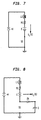
- Inductor L is connected to the positive voltage supply 20, and the top of switch S1 22 is used to switch the windings at a frequency f c .
- Coil L may be modeled as a resistor, R1 24, in series with. an inductor L1 18.
- the back EMF may be modeled as a DC voltage source during this time.
- Back EMF voltage E 26 is in opposition to the battery voltage +V 20.
- L1 18 The bottom of L1 18 is connected to the snubber circuit comprised of L2 28, S2 30, and C 32, through diode D1 34.
- L1 18 When L1 18 is turned on, a current i 1 (t) flows through the phase coil, L1, though switch S1 22, and to ground. There will be a buildup of current in the phase coil L1.
- the voltage across S1 22 is great enough, S1 22 will avalanche (break down and conduct the short circuit current of the device), and could be permanently damaged. Consequently, it is desired to limit the voltage across S1 to a safe level as specified in the device literature. It is also desired to minimize the switching losses in the device. As switching losses are the product of the voltage and current during turn off and turn on, the magnitude of losses will be proportional to the voltage across S1, during turn on and turn off. To maximize motor efficiency, the motor back EMF should not be conducted through the snubber network, for the snubber will act as a brake. As this is a common snubber to all phase coils, the snubber capacitor voltage must be maintained slightly higher in magnitude above the back EMF voltage for a particular motor speed.
- the motor back EMF is linear with respect to motor speed. Therefore, the desired capacitor voltage will also be linear with respect to motor speed, being slightly greater than the magnitude of the motor back EMF. This is illustrated in Figure 6.
- the motor for which the invention is used is a unipolar motor with the back EMF superimposed on top of the supply voltage. Consequently, the minimum desired capacitor voltage will be the supply voltage. Therefore, the desired capacitor voltage also depends on the applied terminal voltage in addition to the motor speed.
- the invention comprises an actively controlled regenerative snubber configuration for use in a unipolar brushless direct current motor comprising a snubber circuit, the snubber circuit comprising a first inductor, a first switch, and a capacitor, the first inductor, the first switch and the capacitor being connected in series to a positive voltage supply of the motor.
- the invention comprises an actively controlled regenerative snubber configuration for use in a unipolar brushless direct current motor comprising at least one snubber circuit, each of the at least one snubber circuit comprising a first inductor, a first switch, and a capacitor, the first inductor, the first switch and the capacitor being connected in series to a positive voltage supply of the motor.
- the invention also comprises a method for protecting a unipolar brushless direct current motor and returning energy to the motor by employing an actively controlled regenerative snubber configuration comprising a snubber circuit, the snubber circuit comprising a first inductor, a first switch, and a capacitor, the first inductor, the first switch, and the capacitor being connected in series to a positive voltage supply of the motor, the snubber configuration further comprising a set of a second inductor and a second switch for each phase of at least one phase of current powering the motor, each set of the second inductor and the second switch being connected to the positive voltage supply in parallel with the first inductor, the first switch, and the capacitor, the method comprising the steps of: 1) closing the second switch corresponding to a phase of the at least one phase of current, thereby allowing the phase to flow through the second inductor corresponding to the phase and increase within the second inductor; 2) opening the second switch when voltage across the second switch has reached a first predetermined
- the invention also comprises a method for protecting a unipolar brushless direct current motor and returning energy to the motor by employing an actively controlled regenerative snubber configuration comprising at least one snubber circuit, each snubber circuit of the at least one snubber circuit comprising a first inductor, a first switch, and a capacitor, each snubber circuit corresponding to one phase of at least one phase of current powering the motor, each snubber circuit being connected in series to a positive voltage supply of the motor, the snubber configuration further comprising a set of a second inductor and a second switch for each phase of the at least one phase of current powering the motor, each set of the second inductor and the second switch being connected to the positive voltage supply in parallel with each snubber circuit, the method comprising the steps of: 1) closing the second switch corresponding to a phase of the at least one phase of current, thereby allowing the phase to flow through the second inductor corresponding to the phase and increase
- the cycle is initially started with switch S 1 being closed to energize the motor phase coil. If we assume that the motor phase coil has been conducting for some period of time at the onset of analysis, the phase coil will have a current flowing through it. The snubber capacitor will be precharged to a known voltage. The applied voltage is equal to the supply voltage V minus the back EMF voltage, E.
- Mode I ends when S 1 is opened.
- the phase coil is carrying an initial current I o '.
- the phase coil will discharge into the snubber capacitor C through snubber diode D 1 .
- the voltage in the snubber capacitor will start to rise.
- the rate of rise may be controlled by capacitor C.
- V - V o - L 1 di 1 dt - R 1 i 1 -1 C o t i 1 dt 0
- i 1 (t) A 1 e - ⁇ t cos ⁇ o t + A 2 e - ⁇ t sin ⁇ o t (A)
- i 1 (t) may be represented as a current source.
- switches S 1 and S 2 were modeled as ideal switches. Only one phase was modeled.
- the SPICE listing may be found in Figure 10a.
- the SPICE plots appear in Figures 11- 13.
- the first set of harmonics will come from the interaction between the phase coil and the snubber capacitor during the charging of the snubber capacitor.
- the second set of harmonics will come from the closing of S 2 .
- the waveforms comprising the rise and fall in the capacitor voltage are primarily sinusoidal, one would expect the number of harmonics generated to be very low.
- the magnitude of the harmonics, however, at the fundamental frequency will be high. Consequently, the harmonics will be easy to filter by using capacitors placed across the supply voltage tuned to the fundamental frequencies.
- FIG 14 illustrates one embodiment of the active snubbing circuit.
- the active switch control or driver of the circuit is comprised of U1A 34, R1 36, R2 38, R3 40, and C3 42, commonly known as a "push-pull" driver.
- the circuit is comprised of a comparator which senses the capacitor voltage and compares it to a set voltage reference.
- the reference level is supplied by a ⁇ to ⁇ converter based on the motor speed from a microcontroller. (A ⁇ to ⁇ converter converts a sum of pulse width modulated pulses of constant frequency to a voltage difference.)
- the reference level is supplied by a potentiometer.
- Figure 15 illustrates the output of the triggering circuit used to control the active snubber switch. The circuit reacts very quickly to any voltage peaks present across the snubber capacitor.
- Figures 16 to 19 illustrate the current through the Zener diode once the threshold voltage was exceeded.
- the magnitude and width of the peak current values varied as the active snubber's inductance value varied.
- the current and di/dt through the Zener diode was very high. Consequently, there were many high frequency harmonics generated without an inductor.
- the peak current through the Zener diode decreased, and the base widened.
- the shape of the Zener diode current was sinusoidal. The difference between the simulated and actual results is the absence of a sharp turn off edge in the Zener diode current once the capacitor voltage had fallen to the desired level. This was the result of turn off behavior of the Zener diode as opposed to that of a controlled switch.
- the frequency of the current through the Zener diode should also be noted. From Figure 19, one half cycle of the zener diode current is 33 ⁇ s . The entire period, therefore was equal to 66 ⁇ s. This corresponded to a frequency of 15.151 kHz, or 95,199 rads s -1 .
- the active snubber circuitry comprises components including U2A 44, C2 46, D1 47, D2 48, D3 53, Q1 50, and L1 52.
- Components D1 47 and C2 46 act as a voltage doubler ensuring Q1, a MOSFET, 50 will be turned on since the MOSFET source is referenced to the positive voltage rail.
- D2 48 acts as a voltage clamp ensuring the gate to source voltage of the MOSFET never exceeds +25 V, which would cause a MOSFET failure.
- the gate drive for the MOSFET is supplied by the voltage doubler.
- "Freewheeling" diode D3 53 is present to allow freewheeling current in the snubber inductor L1 52 to flow when it has been turned off. If the inductance in the snubber inductor L1 52 is very small, then freewheeling diode D3 53 is not necessary.
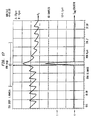
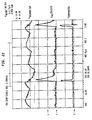
- Figures 20 to 22 illustrate the behavior of the active snubbing circuit.
- Figure 20 we see the effects of the active snubber triggering on the snubber capacitor voltage and the current through S 2 .
- S 2 conducted resulting in a current flowing through it.
- the snubber capacitor voltage was effectively clamped to the desired reference level.
- Figure 21 we see that the current through S 2 increased very rapidly with a 1.7 ⁇ H inductance.
- the current in S 2 rose to 12 amperes (A) in a matter of 4 microseconds ( ⁇ s).
- the corresponding rise in current through S 2 also resulted in a rapid fall in the snubber capacitor voltage.
- Figure 23 illustrates the operation of the snubber at a pulse width modulated (PWM) input duty cycle of 15 %. It may be seen that the active snubber effectively clamped the snubber capacitor voltage to 22.6 volts. The peak current through S 2 was approximately 15 A.
- Figure 25 shows the behavior of the snubber circuit over two chopping cycles. It may be seen that the current through S 2 is not instantaneous. Therefore, the snubber capacitor is not discharged instantaneously when S 2 starts to conduct. Consequently, energy may be removed from the snubber capacitor and the snubber capacitor voltage may be maintained at the desired levels.
- Figures 26 and 27 show the full speed operation of the snubber.
- the snubber resistor conducts the phase back EMF through it even when there is no chopping. This situation is not desired as it leads to the application of braking torque. This leads to an overall loss of high speed efficiency.
- Figure 27 shows the action of the active snubber when the phase coil turns off.
- the scope trace is an expansion in the area of the turn off peak for one phase coil.
- S 2 will start to close as soon as the MOSFET drain to source voltage exceeds the reference level.
- the phase MOSFET drain to source voltage will be maintained by repeatedly turning on S 2 .
- the current S 2 must conduct is very small, due to the absence of PWM chopping.
- Figure 29 shows an alternative embodiment of the active snubbing circuit shown in Figure 14.
- the gate drive for the snubber MOSFET 54 is supplied by the snubber capacitor 56.
- the driver circuit for the snubber MOSFET 54 is comprised of Q1 58, Q2 60, D3 62, and R P 64 and is known as a standard "totem pole" MOSFET driver (inverting type).
- D1 66 and D2 68 protect the MOSFET 54 gate from overvoltage.
- Alternate embodiments of the snubber circuit 69 appear in Figures 29a and 29b. In these embodiments as in Figure 14 and for the same purpose as previously explained, a freewheeling diode D F 70, 72 has been added to the snubber circuit.
- Figures 14, 29, 29a, and 29b show the snubber capacitor connected to ground, it could also be connected to the positive voltage rail, V S .
- the active snubber is based on a resonant return of energy to the positive voltage rail, EMI harmonics associated with the return of energy to the positive rail when using a conventional RCD snubber may be minimized.
Landscapes
- Engineering & Computer Science (AREA)
- Power Engineering (AREA)
- Control Of Motors That Do Not Use Commutators (AREA)
- Control Of Stepping Motors (AREA)
- Stopping Of Electric Motors (AREA)
Applications Claiming Priority (4)
| Application Number | Priority Date | Filing Date | Title |
|---|---|---|---|
| US5335997P | 1997-07-18 | 1997-07-18 | |
| US53359P | 1997-07-18 | ||
| US09/104,449 US6166500A (en) | 1997-07-18 | 1998-06-25 | Actively controlled regenerative snubber for unipolar brushless DC motors |
| US104449 | 1998-06-25 |
Publications (2)
| Publication Number | Publication Date |
|---|---|
| EP0902527A2 true EP0902527A2 (de) | 1999-03-17 |
| EP0902527A3 EP0902527A3 (de) | 2001-05-02 |
Family
ID=26731769
Family Applications (1)
| Application Number | Title | Priority Date | Filing Date |
|---|---|---|---|
| EP98113266A Withdrawn EP0902527A3 (de) | 1997-07-18 | 1998-07-16 | Aktiv gesteuerte energierückgewinnende Entlastungsschaltung für einpoligen bürstenlosen Gleichstrommotor |
Country Status (2)
| Country | Link |
|---|---|
| US (2) | US6166500A (de) |
| EP (1) | EP0902527A3 (de) |
Cited By (7)
| Publication number | Priority date | Publication date | Assignee | Title |
|---|---|---|---|---|
| WO2001033707A1 (de) * | 1999-11-02 | 2001-05-10 | Patent-Treuhand-Gesellschaft für elektrische Glühlampen mbH | Schaltungsanordnung zum schutz spannungsempfindlicher elektrischer bauteile gegen spannungsüberlastung |
| WO2007136422A1 (en) * | 2005-12-28 | 2007-11-29 | Flyback Energy, Inc. | Supply architecture for inductive loads |
| WO2009019634A1 (en) * | 2007-08-06 | 2009-02-12 | Nxp B.V. | Solid state lighting system and a driver integrated circuit for driving light emitting semiconductor devices |
| US7957160B2 (en) | 2007-09-18 | 2011-06-07 | Flyback Energy, Inc. | Current waveform construction to generate AC power with low harmonic distortion from localized energy sources |
| US8638074B2 (en) | 2009-12-28 | 2014-01-28 | Flyback Energy, Inc. | Controllable universal supply with reactive power management |
| US8860273B2 (en) | 2009-12-28 | 2014-10-14 | Flyback Energy, Inc. | External field interaction motor |
| EP3378154A1 (de) * | 2015-11-16 | 2018-09-26 | Linak A/S | Linearaktuator mit bürstenlosem gleichstrommotor |
Families Citing this family (51)
| Publication number | Priority date | Publication date | Assignee | Title |
|---|---|---|---|---|
| US6768977B1 (en) * | 1999-11-30 | 2004-07-27 | Texas Instruments Incorporated | Method and circuit for modeling a voice coil actuator of a mass data storage device |
| US6341076B1 (en) * | 2000-05-23 | 2002-01-22 | Next Power Corporation | Loss reduction circuit for switching power converters |
| US6348820B1 (en) * | 2000-07-17 | 2002-02-19 | Motorola, Inc. | High-side, low-side configurable driver |
| GB0030844D0 (en) * | 2000-12-18 | 2001-01-31 | Switched Reluctance Drives Ltd | Transient voltage supression |
| FR2824963B1 (fr) * | 2001-05-18 | 2004-12-24 | Sagem | Reseau de distribution electrique automobile |
| GB0116423D0 (en) * | 2001-07-05 | 2001-08-29 | Crookes William M | Improved electric motor |
| US6664750B2 (en) * | 2002-03-13 | 2003-12-16 | Pelko Electric (Hk) Ltd. | D.C. motor bridge coil driver |
| US7372232B2 (en) * | 2002-05-24 | 2008-05-13 | Virginia Tech Intellectual Properties, Inc. | Apparatus for drive control, power conversion, and start-up control in a PMBDCM or two-phase SRM drive system |
| TW200409448A (en) * | 2002-05-24 | 2004-06-01 | Virginia Tech Intell Prop | PMBDCM and two-phase SRM motor, two-phase SRM rotor and stator, and coil wrap for PMBDCM and SRM motors |
| JP4067367B2 (ja) * | 2002-09-09 | 2008-03-26 | シャープ株式会社 | 負荷制御装置 |
| US7049786B1 (en) * | 2002-11-25 | 2006-05-23 | The Texas A&M University System | Unipolar drive topology for permanent magnet brushless DC motors and switched reluctance motors |
| KR100488522B1 (ko) * | 2003-02-07 | 2005-05-11 | 삼성전자주식회사 | 모터제어장치 |
| US7542258B2 (en) * | 2004-01-16 | 2009-06-02 | Lutron Electronics Co., Inc. | DV/dt-detecting overcurrent protection circuit for power supply |
| US7215097B2 (en) * | 2004-02-17 | 2007-05-08 | Keith D. Myers | Series resonant capacitive discharge motor |
| FR2867323B1 (fr) * | 2004-03-05 | 2006-10-20 | Valeo Climatisation | Systeme de commande de vitesse d'un moteur de groupe moto-ventilateur, notamment pour une installation de chauffage et/ou de climatisation de vehicule automobile |
| JP4075884B2 (ja) * | 2004-11-05 | 2008-04-16 | 株式会社デンソー | 電荷蓄積素子の電力制御回路 |
| US8134329B2 (en) * | 2006-04-13 | 2012-03-13 | International Rectifier Corporation | Buck converter with improved filter design |
| US7411363B2 (en) * | 2006-06-26 | 2008-08-12 | Lam Dat D | Conservation of electrical energy and electro-magnetic power in motor, generator, and product components |
| US7609494B2 (en) * | 2006-06-30 | 2009-10-27 | Silicon Laboratories, Inc. | Voltage protection system and method for a powered device |
| WO2008005463A2 (en) * | 2006-06-30 | 2008-01-10 | Silicon Laboratories, Inc. | System and method for voltage protection in a powered device |
| US7715165B2 (en) * | 2006-07-11 | 2010-05-11 | Silicon Laboratories, Inc. | System and method of surge protection in a powered device |
| US7486040B2 (en) * | 2006-08-22 | 2009-02-03 | Delphi Technologies, Inc. | Circuit to momentarily increase the peak torque of a DC motor |
| US7397222B2 (en) * | 2006-08-30 | 2008-07-08 | Westinghouse Electric Co Llc | On-line testable solid state reversing DC motor starter |
| US7498755B2 (en) | 2007-03-01 | 2009-03-03 | Microchip Technology Incorporated | Brushed motor control with voltage boost for reverse and braking |
| DE102008008046A1 (de) * | 2007-05-30 | 2008-12-04 | Siemens Aktiengesellschaft | Schaltungsanordnung zum selektiven Betrieb von mindestens zwei elektrischen Maschinen |
| US7852038B2 (en) * | 2007-08-14 | 2010-12-14 | Ramu Inc. | Single switch controlled switched reluctance machine |
| US20090257254A1 (en) * | 2008-04-15 | 2009-10-15 | National Taiwan University Of Science And Technology | Voltage-clamp power converters |
| FR2933545B1 (fr) * | 2008-07-03 | 2011-08-05 | Sagem Defense Securite | Circuit d'amortissement actif pour circuit electrique de decoupage |
| EP2244383A1 (de) * | 2009-04-23 | 2010-10-27 | Mitsubishi Electric R&D Centre Europe B.V. | Verfahren und Vorrichtung zur Steuerung einer Dämpferschaltung |
| WO2010129850A2 (en) * | 2009-05-07 | 2010-11-11 | The Curators Of The University Of Missouri | Circuit and method to suppress the parasitic resonance from a dc/dc converter |
| US8525450B2 (en) * | 2010-03-29 | 2013-09-03 | Regal Beloit America, Inc. | Power factor correction drive circuit topologies and control for switched reluctance machines |
| US8723464B2 (en) * | 2011-05-24 | 2014-05-13 | Regal Beloit America, Inc. | Permanent magnet motor system |
| JP2013017310A (ja) * | 2011-07-04 | 2013-01-24 | Sumitomo Heavy Ind Ltd | 電力変換装置 |
| US8448474B1 (en) | 2012-02-20 | 2013-05-28 | Nike, Inc. | Article of footwear incorporating a knitted component with a tongue |
| US9431920B2 (en) * | 2012-06-19 | 2016-08-30 | Sharp Kabushiki Kaisha | Non-isolated DC/DC converter with 2 inductors and zero voltage switching |
| KR101315143B1 (ko) * | 2012-08-22 | 2013-10-14 | 전북대학교산학협력단 | 높은 승압 비를 갖는 고효율 dc/dc 컨버터 |
| TWI456880B (zh) | 2012-11-19 | 2014-10-11 | Ind Tech Res Inst | 交換式電路 |
| US9106122B2 (en) * | 2013-01-25 | 2015-08-11 | Everette Energy, LLC | Single phase switched reluctance machine with short flux path |
| TWM465724U (zh) * | 2013-03-15 | 2013-11-11 | Lin mao ming | 三相直流無刷馬達及其驅動電路 |
| US9876450B2 (en) * | 2014-01-24 | 2018-01-23 | Marvell World Trade, Ltd. | Active clamp for motor driver |
| US10450162B2 (en) * | 2015-06-29 | 2019-10-22 | Otis Elevator Company | Electromagnetic brake control circuitry for elevator application |
| US10442659B2 (en) * | 2015-06-29 | 2019-10-15 | Otis Elevator Company | Electromagnetic brake system for elevator application |
| US10479645B2 (en) * | 2015-06-29 | 2019-11-19 | Otis Elevator Company | Electromagnetic brake system for elevator application |
| FR3043284B1 (fr) * | 2015-10-29 | 2023-06-23 | Ifp Energies Now | Systeme de conversion d'une puissance electrique continue en puissance electrique alternative avec module recuperateur d'energie |
| US10432130B2 (en) * | 2017-11-28 | 2019-10-01 | GM Global Technology Operations LLC | Electric powertrain and a method of operating the same |
| US10369896B2 (en) | 2017-11-28 | 2019-08-06 | GM Global Technology Operations LLC | Apparatus and method for flexible DC fast charging of an electrified vehicle |
| TWI730281B (zh) | 2018-01-03 | 2021-06-11 | 美商米沃奇電子工具公司 | 電動工具中之電子制動技術 |
| US11462943B2 (en) | 2018-01-30 | 2022-10-04 | Wireless Advanced Vehicle Electrification, Llc | DC link charging of capacitor in a wireless power transfer pad |
| US11437854B2 (en) * | 2018-02-12 | 2022-09-06 | Wireless Advanced Vehicle Electrification, Llc | Variable wireless power transfer system |
| EP4051331A4 (de) | 2019-10-31 | 2022-12-28 | Terumo Cardiovascular Systems Corporation | Herz-lungen-maschine mit anzeige der erweiterten realität |
| US12233723B2 (en) | 2023-01-11 | 2025-02-25 | Ford Global Technologies, Llc | Contained package for automotive inverter and y-snubber components |
Family Cites Families (18)
| Publication number | Priority date | Publication date | Assignee | Title |
|---|---|---|---|---|
| US4334254A (en) * | 1980-01-25 | 1982-06-08 | Exxon Research And Engineering Company | Gated snubber circuit |
| GB2150772B (en) * | 1983-12-01 | 1987-08-05 | Barry Wayne Williams | Motor drive circuits |
| EP0178615A3 (de) * | 1984-10-19 | 1987-08-05 | Kollmorgen Corporation | Stromversorgungssysteme für induktive Elemente |
| GB8522323D0 (en) * | 1985-09-09 | 1985-10-16 | Caterpillar Tractor Co | Electrical drive circuit |
| FR2596931B1 (fr) * | 1986-04-04 | 1993-03-26 | Thomson Csf | Multiplicateur de tension continue pouvant etre integre a une structure semi-conductrice |
| US4678973A (en) * | 1986-10-07 | 1987-07-07 | General Motors Corporation | Sensorless starting control for a brushless DC motor |
| US4760324A (en) * | 1987-10-07 | 1988-07-26 | Raytheon Company | Non-dissipative snubber circuit for high-efficiency switching power supplies |
| US5055762A (en) * | 1989-04-17 | 1991-10-08 | General Motors Corporation | Current controlled full wave transitor bridge inverter for a multiple phase AC machine |
| FR2654270A1 (fr) * | 1989-11-07 | 1991-05-10 | Marelli Autronica | Limiteur de surtension aux bornes d'une charge inductive, applicable aux installations d'injection. |
| JP2674341B2 (ja) * | 1991-03-27 | 1997-11-12 | 三菱電機株式会社 | 電力変換装置のスナバ回路 |
| JP2821714B2 (ja) * | 1991-07-09 | 1998-11-05 | マイクロ・リニア・コーポレーション | 交差導通電流を減少させる電力用mosfet駆動回路 |
| US5252907A (en) * | 1992-04-20 | 1993-10-12 | Honeywell, Inc. | Circuit arrangement for mitigating power switch capacitance |
| US5424624A (en) * | 1993-02-08 | 1995-06-13 | Dana Corporation | Driver circuit for electric actuator |
| US5232052A (en) * | 1993-02-09 | 1993-08-03 | Hypro Corporation | Apparatus and method for controlling the introduction of chemical foamant into a water stream in fire-fighting equipment |
| US5548196A (en) * | 1993-02-27 | 1996-08-20 | Goldstar Co., Ltd. | Switched reluctance motor driving circuit |
| US5559683A (en) * | 1994-09-30 | 1996-09-24 | Apple Computer, Inc. | Flyback switching power supply with bootstrapped gate drive |
| US5636114A (en) * | 1995-11-30 | 1997-06-03 | Electronic Measurements, Inc. | Lossless snubber circuit for use in power converters |
| US5828559A (en) * | 1997-02-03 | 1998-10-27 | Chen; Keming | Soft switching active snubber |
-
1998
- 1998-06-25 US US09/104,449 patent/US6166500A/en not_active Expired - Fee Related
- 1998-07-16 EP EP98113266A patent/EP0902527A3/de not_active Withdrawn
-
2000
- 2000-11-29 US US09/727,114 patent/US6630805B2/en not_active Expired - Fee Related
Cited By (14)
| Publication number | Priority date | Publication date | Assignee | Title |
|---|---|---|---|---|
| WO2001033707A1 (de) * | 1999-11-02 | 2001-05-10 | Patent-Treuhand-Gesellschaft für elektrische Glühlampen mbH | Schaltungsanordnung zum schutz spannungsempfindlicher elektrischer bauteile gegen spannungsüberlastung |
| US8729842B2 (en) | 2005-12-28 | 2014-05-20 | Flyback Energy, Inc. | Supply architecture for inductive loads |
| WO2007136422A1 (en) * | 2005-12-28 | 2007-11-29 | Flyback Energy, Inc. | Supply architecture for inductive loads |
| JP2009522998A (ja) * | 2005-12-28 | 2009-06-11 | フライバック エナジー インコーポレーティッド | 誘導性負荷のための供給アーキテクチャ |
| US7602157B2 (en) | 2005-12-28 | 2009-10-13 | Flyback Energy, Inc. | Supply architecture for inductive loads |
| US7898229B2 (en) | 2005-12-28 | 2011-03-01 | Flyback Energy, Inc. | Supply architecture for inductive loads |
| EP2503685A1 (de) * | 2005-12-28 | 2012-09-26 | Flyback Energy, Inc. | Versorgungsarchitektur für Induktive Lasten |
| WO2009019634A1 (en) * | 2007-08-06 | 2009-02-12 | Nxp B.V. | Solid state lighting system and a driver integrated circuit for driving light emitting semiconductor devices |
| US8373346B2 (en) | 2007-08-06 | 2013-02-12 | Nxp B.V. | Solid state lighting system and a driver integrated circuit for driving light emitting semiconductor devices |
| US7957160B2 (en) | 2007-09-18 | 2011-06-07 | Flyback Energy, Inc. | Current waveform construction to generate AC power with low harmonic distortion from localized energy sources |
| US8638074B2 (en) | 2009-12-28 | 2014-01-28 | Flyback Energy, Inc. | Controllable universal supply with reactive power management |
| US8860273B2 (en) | 2009-12-28 | 2014-10-14 | Flyback Energy, Inc. | External field interaction motor |
| EP3378154A1 (de) * | 2015-11-16 | 2018-09-26 | Linak A/S | Linearaktuator mit bürstenlosem gleichstrommotor |
| EP3378154B1 (de) * | 2015-11-16 | 2026-01-07 | Linak A/S | Ein linearantrieb mit einem bürstenlosen dc motor |
Also Published As
| Publication number | Publication date |
|---|---|
| US6166500A (en) | 2000-12-26 |
| US20010000293A1 (en) | 2001-04-19 |
| US6630805B2 (en) | 2003-10-07 |
| EP0902527A3 (de) | 2001-05-02 |
Similar Documents
| Publication | Publication Date | Title |
|---|---|---|
| US6166500A (en) | Actively controlled regenerative snubber for unipolar brushless DC motors | |
| US6462962B1 (en) | Lossless switching DC-to-DC converter | |
| Kim et al. | A PWM buck-boost AC chopper solving the commutation problem | |
| Lippincott et al. | A capacitor-charging power supply using a series-resonant topology, constant on-time/variable frequency control, and zero-current switching | |
| Park et al. | A self-boost charge pump topology for a gate drive high-side power supply | |
| US6775162B2 (en) | Self-regulated cooling system for switching power supplies using parasitic effects of switching | |
| US7965484B2 (en) | Device for protecting a speed controller against overcurrent | |
| JP3752943B2 (ja) | 半導体素子の駆動装置及びその制御方法 | |
| Srinivasan et al. | Comparative evaluation of PWM AC-AC converters | |
| US5793190A (en) | Method and device for power conversion | |
| Roschatt et al. | Bootstrap voltage and dead time behavior in GaN DC–DC buck converter with a negative gate voltage | |
| US6657845B2 (en) | Circuit for driving a solenoid | |
| EP4102706A1 (de) | Eintaktflusswandler mit regenerativen aktiven snubber-glied | |
| Singh et al. | A buck-derived topology with improved step-down transient performance | |
| JPH06101930B2 (ja) | スイッチング電源装置 | |
| Yunus et al. | Motor overvoltage mitigation using SiC-based zero-voltage switching inverter | |
| US6011702A (en) | Low noise forward/flyback switching power supply | |
| US6704211B1 (en) | DC-to-DC converter | |
| US20060267527A1 (en) | System, apparatus and method for driving permanent magnet electrical machine | |
| JPH07175533A (ja) | 突入電流防止回路 | |
| Deacon et al. | An evaluation of resonant snubbers applied to GTO converters | |
| Formenti et al. | Design trade-offs for switch-mode battery chargers | |
| Meneses et al. | CCM Totem-Pole PFC for Ultra-High Power Density USB-PD Chargers | |
| Lehmeier et al. | Comparative experimental evaluation of a three-phase ARCP inverter with a single shared inductor using SiC MOSFETs and Si IGBTs | |
| Thong et al. | A novel low-cost RCD snubber for bifilar-wound motors |
Legal Events
| Date | Code | Title | Description |
|---|---|---|---|
| PUAI | Public reference made under article 153(3) epc to a published international application that has entered the european phase |
Free format text: ORIGINAL CODE: 0009012 |
|
| AK | Designated contracting states |
Kind code of ref document: A2 Designated state(s): DE FR GB IT |
|
| AX | Request for extension of the european patent |
Free format text: AL;LT;LV;MK;RO;SI |
|
| 17P | Request for examination filed |
Effective date: 19990716 |
|
| PUAL | Search report despatched |
Free format text: ORIGINAL CODE: 0009013 |
|
| AK | Designated contracting states |
Kind code of ref document: A3 Designated state(s): AT BE CH CY DE DK ES FI FR GB GR IE IT LI LU MC NL PT SE |
|
| AX | Request for extension of the european patent |
Free format text: AL;LT;LV;MK;RO;SI |
|
| RIC1 | Information provided on ipc code assigned before grant |
Free format text: 7H 02M 3/155 A, 7H 02P 6/00 B |
|
| AKX | Designation fees paid |
Free format text: DE FR GB IT |
|
| RAP1 | Party data changed (applicant data changed or rights of an application transferred) |
Owner name: SIEMENS VDO AUTOMOTIVE INC. |
|
| 17Q | First examination report despatched |
Effective date: 20040419 |
|
| STAA | Information on the status of an ep patent application or granted ep patent |
Free format text: STATUS: THE APPLICATION IS DEEMED TO BE WITHDRAWN |
|
| 18D | Application deemed to be withdrawn |
Effective date: 20050721 |