EP0899982A2 - Verfahren, System und Vorrichtungen zur Funkanbindung mehrerer Endgeräte über eine Basisstation an eine Schnittstelle eines Telefon- oder Datennetzes - Google Patents
Verfahren, System und Vorrichtungen zur Funkanbindung mehrerer Endgeräte über eine Basisstation an eine Schnittstelle eines Telefon- oder Datennetzes Download PDFInfo
- Publication number
- EP0899982A2 EP0899982A2 EP98115273A EP98115273A EP0899982A2 EP 0899982 A2 EP0899982 A2 EP 0899982A2 EP 98115273 A EP98115273 A EP 98115273A EP 98115273 A EP98115273 A EP 98115273A EP 0899982 A2 EP0899982 A2 EP 0899982A2
- Authority
- EP
- European Patent Office
- Prior art keywords
- base station
- interface
- isdn
- dect
- radio
- Prior art date
- Legal status (The legal status is an assumption and is not a legal conclusion. Google has not performed a legal analysis and makes no representation as to the accuracy of the status listed.)
- Withdrawn
Links
Images



Classifications
-
- H—ELECTRICITY
- H04—ELECTRIC COMMUNICATION TECHNIQUE
- H04Q—SELECTING
- H04Q11/00—Selecting arrangements for multiplex systems
- H04Q11/04—Selecting arrangements for multiplex systems for time-division multiplexing
- H04Q11/0428—Integrated services digital network, i.e. systems for transmission of different types of digitised signals, e.g. speech, data, telecentral, television signals
- H04Q11/0435—Details
- H04Q11/0471—Terminal access circuits
-
- H—ELECTRICITY
- H04—ELECTRIC COMMUNICATION TECHNIQUE
- H04Q—SELECTING
- H04Q2213/00—Indexing scheme relating to selecting arrangements in general and for multiplex systems
- H04Q2213/13003—Constructional details of switching devices
-
- H—ELECTRICITY
- H04—ELECTRIC COMMUNICATION TECHNIQUE
- H04Q—SELECTING
- H04Q2213/00—Indexing scheme relating to selecting arrangements in general and for multiplex systems
- H04Q2213/1305—Software aspects
-
- H—ELECTRICITY
- H04—ELECTRIC COMMUNICATION TECHNIQUE
- H04Q—SELECTING
- H04Q2213/00—Indexing scheme relating to selecting arrangements in general and for multiplex systems
- H04Q2213/13093—Personal computer, PC
-
- H—ELECTRICITY
- H04—ELECTRIC COMMUNICATION TECHNIQUE
- H04Q—SELECTING
- H04Q2213/00—Indexing scheme relating to selecting arrangements in general and for multiplex systems
- H04Q2213/13096—Digital apparatus individually associated with a subscriber line, digital line circuits
-
- H—ELECTRICITY
- H04—ELECTRIC COMMUNICATION TECHNIQUE
- H04Q—SELECTING
- H04Q2213/00—Indexing scheme relating to selecting arrangements in general and for multiplex systems
- H04Q2213/13098—Mobile subscriber
-
- H—ELECTRICITY
- H04—ELECTRIC COMMUNICATION TECHNIQUE
- H04Q—SELECTING
- H04Q2213/00—Indexing scheme relating to selecting arrangements in general and for multiplex systems
- H04Q2213/13196—Connection circuit/link/trunk/junction, bridge, router, gateway
-
- H—ELECTRICITY
- H04—ELECTRIC COMMUNICATION TECHNIQUE
- H04Q—SELECTING
- H04Q2213/00—Indexing scheme relating to selecting arrangements in general and for multiplex systems
- H04Q2213/13202—Network termination [NT]
-
- H—ELECTRICITY
- H04—ELECTRIC COMMUNICATION TECHNIQUE
- H04Q—SELECTING
- H04Q2213/00—Indexing scheme relating to selecting arrangements in general and for multiplex systems
- H04Q2213/13204—Protocols
-
- H—ELECTRICITY
- H04—ELECTRIC COMMUNICATION TECHNIQUE
- H04Q—SELECTING
- H04Q2213/00—Indexing scheme relating to selecting arrangements in general and for multiplex systems
- H04Q2213/13209—ISDN
-
- H—ELECTRICITY
- H04—ELECTRIC COMMUNICATION TECHNIQUE
- H04Q—SELECTING
- H04Q2213/00—Indexing scheme relating to selecting arrangements in general and for multiplex systems
- H04Q2213/13299—Bus
-
- H—ELECTRICITY
- H04—ELECTRIC COMMUNICATION TECHNIQUE
- H04Q—SELECTING
- H04Q2213/00—Indexing scheme relating to selecting arrangements in general and for multiplex systems
- H04Q2213/13332—Broadband, CATV, dynamic bandwidth allocation
-
- H—ELECTRICITY
- H04—ELECTRIC COMMUNICATION TECHNIQUE
- H04Q—SELECTING
- H04Q2213/00—Indexing scheme relating to selecting arrangements in general and for multiplex systems
- H04Q2213/13367—Hierarchical multiplexing, add-drop multiplexing
Definitions
- the present invention relates to a method, a system and devices for Radio connection of several end devices via a base station to an interface of a Telephone or data network, at least one terminal being a computer.
- ISDN Integrated Services Digital Network
- S 0 The basic connection (S 0 ) comprises two B channels with 64 Kbit / s each and a D channel with 16 Kbit / s.
- the B channels transmit the useful information.
- the D channel is used for signaling.
- S 2M the primary multiplex connection (S 2M ) is available, which comprises 30 B channels and one D channel with 64 kbit / s.
- CAPI 2.0 offers uniform access to the various ISDN services such as telephone, fax, data, voice and video transmission.
- CAPI supports one or more basic and primary multiplex connections on one or several ISDN interface cards. Furthermore, the simultaneous execution of several Programs supported.
- CAPI can be extended on a manufacturer-specific basis.
- IAP DECT ISDN End System Configuration ETS 300 434
- IIP DECT ISDN Intermediate System Configuration ETS 300 xxx
- IIP defines a system in which the ISDN protocol data units (PDU) from the DECT base station can be passed on to the mobile stations via the air interface.
- the ISDN PDUs are only monitored to ensure that the To be able to control the connection establishment of the DECT system. So that's on the side a physical ISDN interface is available to the mobile station.
- the disadvantage of this Systems is that in every mobile station hardware and software for termination of the signaling channel must be provided.
- the protocol stacks according to the IIP standard are shown schematically in FIG. 2.
- the IAP standard defines a complete mapping from ISDN to DECT messages and - procedures regarding the control channels. This means that B - channel - Protocols are not terminated and therefore the full 64 kbit / s data stream over the Air interface is transmitted and in turn the corresponding in each mobile station Hardware and software must be available.
- the protocol stacks according to the IAP standard are shown schematically in Fig. 3.
- This object is achieved by a method for wireless connection by radio from several terminals (PP), at least one of which is a computer device, via a base station (FP) to a digital interface (BRA / BPA) of a telephone or Data network, the interface of the telephone or data network in the base station (FP) is completely terminated, and the radio interface between the at least one Computer device and the base station has a plurality of channels.
- PP terminals
- FP base station
- BRA / BPA digital interface
- a base station for wireless connection by radio from a number of terminals (PP), at least one of which is a computer device is to an interface (BRA / BPA) of a telephone or data network, the base station being an interface to the telephone or data network, and a Radio interface to the multiple terminals comprises, the interface of the telephone or data network in the base station (FP) is fully terminated, and wherein the Radio interface between the at least one computer device and the base station has a plurality of channels.
- a base station for wireless connection by radio from a number of terminals (PP), at least one of which is a computer device is to an interface (BRA / BPA) of a telephone or data network, the base station being an interface to the telephone or data network, and a Radio interface to the multiple terminals comprises, the interface of the telephone or data network in the base station (FP) is fully terminated, and wherein the Radio interface between the at least one computer device and the base station has a plurality of channels.
- a PCMCIA card with driver software Radio connection according to the DECT standard of a computer device (PP) via a base station (FP) to an ISDN interface
- the PCMCIA card being used for Radio communication with the base station and at least the DECT-specific PHL - and MAC layer for the corresponding partial termination of the DECT protocol - Has stacks
- the driver software did not terminate those in the PCMCIA card Layers, preferably the DLC and NWK layers, to the corresponding complete termination of the DECT protocol stack, whereby neither PCMCIA card or driver software Means for terminating the B channel of the ISDN Have interface
- the driver software also a standard programming interface for the DECT radio interface (DAPI) and a CAPI CLIENT layer and includes a standard programming interface (CAPI 2.0) for ISDN interfaces
- the CAPI CLIENT layer manages the communication with the base station and for communication with a corresponding CAPI SERVER layer in the base station serves that can manage several end devices itself.
- PP terminals
- FP base station
- BRA / BPA digital interface
- Fig. 1 shows the preferred embodiment of a wireless according to the invention Computer network.
- computers portable part
- the computers are connected to a base station via a radio interface (FP, fixed part) in connection.
- the computers are due to the wireless Connection also referred to as mobile stations.
- the base station provides the computers Access to a digital telephone or data network, preferably an ISDN network.
- the radio interface preferably corresponds to the DECT standard.
- To the computer plug-in cards are preferably used to expand a radio interface.
- PCMCIA cards are particularly suitable for laptops, since the majority of laptops have two PCMCIA slots. Because of the compact design, in particular PCMCIA cards with directly connected antenna use. This PCMCIA cards therefore do not need external cables connected Radio units.
- the base station itself can be a computer that uses an ISDN - Connection and a DECT - PCMCIA card and on which the CAPI - SERVER - Software is running.
- Another preferred use of the present invention is in the SOHO range (Small Office, Home Office).
- SOHO range Small Office, Home Office
- the CAPI SERVER and the DAPI layer extended and adapted.
- This protocol structure allows a large number of mobile stations have wireless access via an HF interface according to the DECT standard (ETS 300 175-x) on a telecommunications network the ISDN standard.
- the system comprises a base station (FP, fixed part) with one physical connection according to the ISDN standard.
- the necessary chipsets e.g. HSCX-TE, PSB21525 from Siemens
- all necessary Software elements housed to complete the ISDN protocol stack terminate with respect to both D channel and B channel.
- the ISDN layers L1, L2 and L3 is a standard ISDN programming interface, preferably according to the CAPI 2.0 standard.
- the on the standard ISDN programming interface The following application is called CAPI SERVER.
- the CAPI SERVER allows several wirelessly connected via the DECT HF interface Mobile stations access to the ISDN telecommunications network.
- the interworking Unit (IWU) is responsible for the data exchange between CAPI SERVER and DAPI.
- the DAPI layer transforms the data in such a way that it uses a DECT interface can be sent or received.
- the data then travels through the DECT Protocol stack, which consists of the NWK, DLC, MAC and PHL layers sent over the DECT interface. Wander through the respective recipient Data the DECT protocol stack in the opposite direction.
- the CAPI CLIENT follows the DAPI layer.
- the CAPI CLIENT in the Mobile station corresponds to the CAPI SERVER in the base station.
- On the CAPI CLIENT a CAPI 2.0 interface is set up. So software applications can be in the mobile stations also to a standardized ISDN interface, preferably one CAPI 2.0 interface, access. This is the wireless DECT interface completely transparent for software applications (application) in the mobile stations. Because the software applications made no difference between a remote Realize the programming interface or a direct ISDN access any software application for standardized ISDN - Use programming interfaces.
- This architecture shown in Fig. 4 can be call the remote procedure call (RPC).
- the protocol layers represented by the mobile station can at least the layers PHL, MAC hardware in a PCMCIA plug-in card. Also are Solutions conceivable in which further layers, namely DLC, NWK and DAPI, all the way to to the CAPI CLIENT layer in the PCMCIA card.
- the advantage of the protocol architecture shown in FIG. 4 is that no ISDN specific hardware or software elements in the mobile stations are necessary because the B channel is completely terminated in the base station. This will the implementation of such a system is simplified and the costs for the system reduced.
- the protocol architecture shown in FIG. 4 allows a simple connection of cordless phones according to the GAP profile (generic access profile ETS 300 344). The cordless telephones are then configured according to the DECT ISDN End System Configuration Profiles (IAP, ETS 300 434) connected to ISDN. Because the preferred one Standard ISDN interface CAPI 2.0 voice transmission over different B - channel protocols for voice transmission supported by a bit transparent mode, the programming effort in the CAPI SERVER and DAPI layers can be reduced be limited to a minimum.
- the overall architecture underlying the preferred embodiment is based on a profile of the DECT standard, which is based on the DECT data profiles.
- This Profile allows the dynamic configuration of the connections with regard to symmetry and bandwidth depending on the actually required by the user data channel Bandwidth.
- This adaptation of the bandwidth is only possible by terminating the B channel - Protocol stacks in the base station enabled. Adjusting the bandwidth is achieved by channel bundling. A channel represents the smallest unit, with the connection can be modified.
- the DAPI layers in FIG. 4 also provide standardized software interfaces that are based on the CAPI 2.0 standard. Similar to the CAPI 2.0 - Standard represents a standardized software interface for ISDN connections, so DAPI (DECT Application Programming Interface) provides a standardized interface for a DECT transmission system.
- DAPI DECT Application Programming Interface
- the DAPI supports software development simplified for DECT systems.
- the DAPI interface is also meant to be other software - be made available to developers.
- continuous data compression preferably carried out according to the ITU - T standard V.42bis. This Data compression is also used for Internet access via GSM mobile phones used.
- a virtual, parallel printer interface, a virtual, serial interface and a virtual TCP / IP interface implemented.
- the digital ISDN interface between base station and telephone network through an analog interface preferably an ab connector can be replaced.
- a modem chipset instead of an ISDN chipset uses a modem chipset. 4 would be the ISDN protocol stack comprising the layers ISDN L1, ISDN L2 and ISDN L3, to be replaced by a modem stack. You would also need the CAPI 2.0 programming interface and the CAPI CLIENT and CAPI SERVER layers accordingly through an AT - Hayes compatible interface and MODEM CLIENT or MODEM SERVER layers are replaced.
- the preferred embodiment of the DAPI layer also enables internal connections from mobile station to mobile station (Fig. 5). Since the DECT standard is a direct one Connection from mobile station to mobile station does not allow a mobile station as a base station reconfigured or configured simultaneously as a mobile and base station become. The DECT standard allows this detour. This reconfiguration will prompted by the CAPI CLIENT layer so that it can be said that the CAPI CLIENT layer comprises server functionality. The connection is then over made available to the internal DAPI service. The CAPI-CLIENT layer differentiates whether a connection to the ISDN interface or to a mobile station is established becomes. If a connection is to be established between two mobile stations, the connection is then established as an internal DAPI connection.
- compounds are additionally enabled from mobile station to mobile station via the base station (Fig. 6).
- the functionality of the CAPI-CLIENT layer preferably comprises no additional server functionality. Decides in this embodiment the CAPI SERVER layer, whether the connection is established internally or externally should. The connection is then made in the base station via the NWK layer CAPI-CLIENT layer in the selected mobile station via an external DAPI connection manufactured.
- the disadvantage of this embodiment is that Transmission from the mobile station to the base station and to another mobile station twice the bandwidth compared to a direct transmission from mobile station to mobile station is needed. This places a greater burden on the wireless communication network.
Landscapes
- Engineering & Computer Science (AREA)
- Computer Networks & Wireless Communication (AREA)
- Mobile Radio Communication Systems (AREA)
Abstract
Description
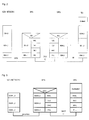
- Fig. 1
- ein schnurloses Netzwerk, bestehend aus zwei feststehenden, zwei tragbaren Computern und einer Basisstation, über die die Computer an ein ISDN - Netzwerk angeschlossen werden,
- Fig. 2
- eine Protokollarchitektur gemäß dem IIP - Standard für die Verbindung von der Basisstation (DIFS) zu einer Mobilstation (DIPS) über eine schnurlose DECT - Schnittstelle,
- Fig. 3
- eine Protokollarchitektur gemäß dem IAP - Standard, bei dem eine Mobilstation (DPS) über eine schnurlose DECT - Schnittstelle mit einer Basisstation (DFS) verbunden wird und über diese an ein ISDN - Netzwerk angeschlossen wird,
- Fig. 4
- eine Protokollarchitektur gemäß einer bevorzugten Ausführungsform der Erfindung, wobei eine Mobilstation (PP) über eine schnurlose DECT - Schnittstelle mit einer Basisstation (FP) verbunden wird und an ein ISDN - Netzwerk angeschlossen wird,
- Fig. 5
- eine Protokollarchitektur gemäß einer bevorzugten Ausführungsform der vorliegenden Erfindung, wobei die Kommunikation zwischen zwei Mobilstationen (PP) erfolgt, und
- Fig. 6
- eine Protokollarchitektur gemäß einer bevorzugten Ausführungsform der vorliegenden Erfindung, wobei die Kommunikation zwischen zwei Mobilstationen unter Zwischenschaltung der Basisstation erfolgt.
Claims (10)
- Verfahren zur drahtlosen Anbindung über Funk von mehreren Endgeräten (PP), von denen mindestens eines eine Computereinrichtung ist, über eine Basisstation (FP) an eine digitale Schnittstelle (BRA/BPA) eines Telefon- oder Datennetzes, dadurch gekennzeichnet, daßdie Schnittstelle des Telefon- oder Datennetzes in der Basisstation (FP) vollständig terminiert wird, unddie Funkschnittstelle zwischen der mindestens einen Computereinrichtung und der Basisstation eine Vielzahl von Kanälen aufweist.
- Verfahren nach Anspruch 1, dadurch gekennzeichnet, daß das Telefon- oder Datennetz dem ISDN - Standard (Integrated Services Digital Network) entspricht, wobei die ISDN - Schnittstelle eine S0-, S2M-, Up0-, U200-, UA- oder eine Uk0 - Schnittstelle ist, wobei auf den ISDN - Protokoll - Stack (ISDN L1, ISDN L2, ISDN L3) eine Standardprogrammierschnittstelle gemäß dem CAPI-Standard folgt und die gleiche Standardprogrammierschnittstelle in der mindestens einen Computereinrichtung zur Verfügung gestellt wird, so daß die Funkschnittstelle für die Softwareanwendungen transparent erscheint.
- Verfahren nach Anspruch 1 oder 2, dadurch gekennzeichnet, daß die Funkschnittstelle dem DECT - Standard entspricht, auf den DECT - Protokoll - Stack (PHL, MAC, DLC, NWK) eine weitere Standardprogrammierschnittstelle (DAPI) folgt und die Standardprogrammierschnittstelle für den DECT - Protokoll - Stack (DAPI) an die Standschnittstelle für den ISDN - Protokoll - Stack (CAPI 2.0) über eine weitere Schicht (CAPI CLIENT) angepaßt wird.
- Verfahren nach einem der Ansprüche 1 bis 3, dadurch gekennzeichnet, daß die auf der mindestens einen angeschlossen Computereinrichtung laufenden Programme Bandbreite anfordern, wobei in der Basisstation die zur Verfügung stehende Bandbreite für die Funkschnittstelle zwischen Basisstation und der mindestens einen angeschlossenen Computereinrichtung festgestellt und unter Berücksichtigung dieser Größe sowie der angeforderten Bandbreite die tatsächlich zur Verfügung gestellte Bandbreite festgelegt wird (CAPI SERVER), und wobei entweder die Übertragungsraten von und zu der Basisstation (FP) unabhängig voneinander angepaßt werden, oder für beide Richtungen die gleiche Bandbreite zur Verfügung gestellt wird, und wobei die Bandbreite durch Kanalbündelung angepaßt wird.
- Verfahren nach Anspruch einem der Ansprüche 1 bis 4, dadurch gekennzeichnet, daß Daten von einer Computereinrichtung zu einer anderen Computereinrichtung entweder direkt unter Umgehung der Basisstation oder indirekt unter Einbeziehung der Basisstation (FP) aber unter Umgehung der digitalen Schnittstelle übertragen werden.
- Basisstation (FP) zur drahtlosen Anbindung über Funk von mehreren Endgeräten (PP), von denen mindestens eine, vorzugsweise mehrere Computereinrichtungen sind, an eine Schnittstelle (BRA/BPA) eines Telefon- oder Datennetzes,
wobei die Basisstation eine Schnittstelle zu dem Telefon- oder Datennetz, sowie eine Funkschnittstelle zu den mehreren Endgeräten umfaßt,
wobei die Schnittstelle des Telefon- oder Datennetzes in der Basisstation (FP) vollständig terminiert wird, und
wobei die Funkschnittstelle zwischen der mindestens einen Computereinrichtung und der Basisstation eine Vielzahl von Kanälen aufweist. - Basisstation (FP) nach Anspruch 18, dadurch gekennzeichnet, daß die Basisstation Einrichtungen (CAPI SERVER) zum Anpassen der Datenübertragungsraten von der Basisstation (FP) zu den Endgeräten (PP) und von den Endgeräten zu der Basisstation an die aktuellen Erfordernissen mittels Kanalbündelung aufweist, wobei die Übertragungsraten von und zu der Basisstation (FP) entweder gleich hoch sind, oder unabhängig voneinander angepaßt werden, wobei die aktuellen Erfordernisse von der zur Verfügung stehenden Bandbreite für die Funkschnittstelle zwischen Basisstation und der mindestens einen angeschlossenen Computereinrichtung sowie der angeforderten Bandbreite abhängen.
- Basisstation (FP) nach der Anspruch 6 oder 7, dadurch gekennzeichnet, daß das Telefon- oder Datennetz, zu dem die Basisstation eine Schnittstelle besitzt, dem ISDN - Standard (Integrated Services Digital Network) entspricht, wobei die Schnittstelle eine S0-, S2M-, Up0-, U200-, UA- oder eine Uk0 - Schnittstelle ist, wobei auf den ISDN - Protokoll - Stack (ISDN L1, ISDN L2, ISDN L3) eine Standardprogrammierschnittstelle gemäß dem CAPI-Standard, wobei die Funkschnittstelle dem DECT - Standard entspricht und auf den DECT - Protokoll - Stack (PHL, MAC, DLC, NWK) eine weitere Standardprogrammierschnittstelle (DAPI) folgt.
- PCMCIA - Karte mit Treibersoftware zur Funkanbindung gemäß DECT - Standard einer Computereinrichtung (PP) über eine Basisstation (FP) an eine ISDN - Schnittstelle,
wobei die PCMCIA - Karte Einrichtungen zur Funkkommunikation mit der Basisstation sowie zumindest die DECT - spezifische PHL - und MAC - Schicht zur entsprechenden teilweisen Terminierung des DECT - Protokoll - Stacks aufweist, und
wobei die Treibersoftware die nicht in der PCMCIA - Karte terminierten Schichten, vorzugsweise die DLC - und die NWK - Schicht, zur entsprechenden vollständigen Terminierung des DECT - Protokoll - Stacks umfaßt,
wobei weder PCMCIA - Karte noch Treibersoftware Mittel zur Terminierung des B - Kanals der ISDN - Schnittstelle aufweisen,
wobei die Treibersoftware ferner eine Standardprogrammierschnittstelle für die DECT - Funkschnittstelle (DAPI), sowie eine CAPI CLIENT - Schicht und eine Standardprogrammierschnittstelle (CAPI 2.0) für ISDN - Schnittstellen umfaßt,
wobei die CAPI CLIENT - Schicht die Kommunikation mit der Basisstation verwaltet und zur Kommunikation einer entsprechenden CAPI SERVER - Schicht in der Basisstation dient, die selbst mehrere Endgeräte verwalten kann. - System zur drahtlosen Anbindung über Funk von mehreren Endgeräten (PP), von denen mindestens eines eine Computereinrichtung ist, über eine Basisstation (FP) an eine digitale Schnittstelle (BRA/BPA) eines Telefon- oder Datennetzes, dadurch gekennzeichnet, daßEinrichtungen vorgesehen sind, um die Schnittstelle des Telefon- oder Datennetzes in der Basisstation (FP) vollständig zu terminieren, unddie Funkschnittstelle zwischen der mindestens einen Computereinrichtung und der Basisstation eine Vielzahl von Kanälen aufweist.
Applications Claiming Priority (2)
| Application Number | Priority Date | Filing Date | Title |
|---|---|---|---|
| DE19735384 | 1997-08-14 | ||
| DE1997135384 DE19735384B4 (de) | 1997-08-14 | 1997-08-14 | Verfahren, Basisstation, PCMCIA-Karte und Vorrichtungen zur Funkanbindung mehrerer Endgeräte über eine Basisstation an eine ISDN-Schnittstelle |
Publications (2)
| Publication Number | Publication Date |
|---|---|
| EP0899982A2 true EP0899982A2 (de) | 1999-03-03 |
| EP0899982A3 EP0899982A3 (de) | 2005-10-12 |
Family
ID=7839053
Family Applications (1)
| Application Number | Title | Priority Date | Filing Date |
|---|---|---|---|
| EP98115273A Withdrawn EP0899982A3 (de) | 1997-08-14 | 1998-08-13 | Verfahren, System und Vorrichtungen zur Funkanbindung mehrerer Endgeräte über eine Basisstation an eine Schnittstelle eines Telefon- oder Datennetzes |
Country Status (2)
| Country | Link |
|---|---|
| EP (1) | EP0899982A3 (de) |
| DE (1) | DE19735384B4 (de) |
Cited By (2)
| Publication number | Priority date | Publication date | Assignee | Title |
|---|---|---|---|---|
| DE10213370A1 (de) * | 2002-03-21 | 2003-10-02 | Deutsche Telekom Ag | Verfahren und Vorrichtung zur Kanalallokation für ein kanalbasiertes Funk-Kommunikationsnetz mit fester Kanalzuordnung |
| EP1217818A3 (de) * | 2000-12-20 | 2003-11-05 | Dosch & Amand GmbH & Co. KG | Basisstation für ein schnurloses Telefonsystem |
Families Citing this family (4)
| Publication number | Priority date | Publication date | Assignee | Title |
|---|---|---|---|---|
| DE19850173C1 (de) * | 1998-10-30 | 2000-07-27 | Dosch & Amand Gmbh & Co Kg | Verfahren zum Bereitstellen eines drahtlosen Netzwerkes sowie einer Basisstation für ein derartiges Netzwerk |
| DE19945666A1 (de) * | 1999-09-23 | 2001-01-11 | Siemens Ag | Basisstation sowie dazugehöriges Schnurlos-Kommunikationssystem |
| DE10014365B4 (de) * | 2000-03-16 | 2011-08-11 | DDG Gesellschaft für Verkehrsdaten mbH, 40547 | Funktionale Telematikendgeräte-Steuerung |
| DE10101106A1 (de) * | 2001-01-12 | 2002-08-01 | Sci Worx Gmbh | Verfahren zum Datenaustausch zwischen Endgeräten und entfernten Internet-Servern sowie Vorrichtung zum Anschluss von Endgeräten an das Internet |
Family Cites Families (7)
| Publication number | Priority date | Publication date | Assignee | Title |
|---|---|---|---|---|
| WO1993021719A1 (de) * | 1992-04-09 | 1993-10-28 | Siemens Aktiengesellschaft | Verfahren zur strukturierung eines b-feld formates im dect-standard |
| FI104870B (fi) * | 1994-12-12 | 2000-04-14 | Nokia Mobile Phones Ltd | Tiedonsiirtomenetelmä |
| DE19502641C2 (de) * | 1995-01-20 | 1999-01-14 | Deutsche Telephonwerk Kabel | Anordnung zur Netzabschlußtechnik für öffentliche, stationäre Telekommunikationsnetze |
| DE19533507C2 (de) * | 1995-09-04 | 1997-10-02 | Hartmut Dipl Ing Neus | Multiplex-, Zugriffs- und Duplexverfahren für ein zellulares Funksystem |
| DE19643774C1 (de) * | 1996-10-23 | 1998-04-30 | Siemens Ag | Verfahren und Telekommunikationsschnittstelle zum Übertragen kontinuierlicher und/oder diskontinuierlicher Datenströme in einem hybriden Telekommunikationssystem, insbesondere einem "ISDN-DECT-spezifischen RLL/WLL"-System |
| DE19704907A1 (de) * | 1997-02-10 | 1997-07-31 | Andre Bornholt | Mobilfunktelefon mit Möglichkeit zur Direktverbindung |
| DE19709430A1 (de) * | 1997-03-07 | 1998-09-10 | Dosch & Amand Gmbh & Co Kg | Vorrichtung sowie Verfahren zur schnurlosen Kommunikation im DECT-Standard |
-
1997
- 1997-08-14 DE DE1997135384 patent/DE19735384B4/de not_active Expired - Fee Related
-
1998
- 1998-08-13 EP EP98115273A patent/EP0899982A3/de not_active Withdrawn
Cited By (3)
| Publication number | Priority date | Publication date | Assignee | Title |
|---|---|---|---|---|
| EP1217818A3 (de) * | 2000-12-20 | 2003-11-05 | Dosch & Amand GmbH & Co. KG | Basisstation für ein schnurloses Telefonsystem |
| DE10213370A1 (de) * | 2002-03-21 | 2003-10-02 | Deutsche Telekom Ag | Verfahren und Vorrichtung zur Kanalallokation für ein kanalbasiertes Funk-Kommunikationsnetz mit fester Kanalzuordnung |
| DE10213370B4 (de) * | 2002-03-21 | 2011-05-12 | Deutsche Telekom Ag | Verfahren und Vorrichtung zur Kanalallokation für ein kanalbasiertes Funk-Kommunikationsnetz mit fester Kanalzuordnung |
Also Published As
| Publication number | Publication date |
|---|---|
| DE19735384A1 (de) | 1999-02-18 |
| DE19735384B4 (de) | 2005-03-03 |
| EP0899982A3 (de) | 2005-10-12 |
Similar Documents
| Publication | Publication Date | Title |
|---|---|---|
| DE69628925T2 (de) | Verbesserter zugriff auf kommunikationsnetze in einer mehrdienstumgebung | |
| DE69736008T2 (de) | Teilnehmer-endgerät für mobile kommunikationen | |
| DE69832474T2 (de) | Netzzugriff in einer mehrdiensteumgebung | |
| DE69330424T2 (de) | Faksimileübertragung in einem digitalen zellenfunknetzwerk | |
| DE19847679B4 (de) | Verfahren, Mobilfunkgerät und bedienender GPRS-Unterstützungsknoten in Zusammenhang mit einem teilnetzabhängigen Konvergenzprotokoll für ein Mobilfunknetz | |
| DE69411214T2 (de) | Einrichtung eines digitalen Funkkommunikationsnetzes mit Mitteln um Sprachsignale und Daten auszutauschen | |
| DE69434826T2 (de) | Datenübertragung in einem Funktelefonnetz | |
| DE19645433C2 (de) | Kommunikationssystem, Mobilvermittlungszentrum und Verfahren zum Herstellen einer Mehrdialog-Kommunikation zwischen Teilnehmerstationen | |
| DE19937098B4 (de) | Intelligente Zuweisung der Bandbreite für mehrere unabhängige Verbindungen auf einem digitalen Netzwerk | |
| DE69633342T2 (de) | Anpassung einer Interworking function an ein Festnetzprotokoll | |
| EP0935895B1 (de) | Verfahren und telekommunikationsschnittstelle zum übertragen kontinuierlicher und/oder diskontinuierlicher datenströme in einem hybriden telekommunikationssystem, insbesondere einem "isdn - dect-spezifischen rll/wll"-system | |
| EP0794680A2 (de) | Verfahren zum Betreiben einer Breitband-Verbindung zwischen einem Mobilfunk-Endgerät und einer netzseitigem Mobilfunkeinrichtung sowie Mobilfunk-Endgerät, netzseitige Mobilfunkeinrichtung und Mobilfunksystem | |
| DE4309848A1 (de) | Kommunikationssystem zum Anschluß an eine Basisstation eines mehrzellularen, drahtlosen Fernsprechsystems | |
| DE69938252T2 (de) | Sicherheit in telekommunikationsnetzübergangseinrichtungen | |
| EP0899982A2 (de) | Verfahren, System und Vorrichtungen zur Funkanbindung mehrerer Endgeräte über eine Basisstation an eine Schnittstelle eines Telefon- oder Datennetzes | |
| EP1135892B1 (de) | Verfahren und kommunikationssystem zur übertragung von daten über gemeinsam genutzte physikalische kanäle | |
| DE3337646A1 (de) | Funknetz mit einer vielzahl von mobilen stationen | |
| EP0965202A2 (de) | Vorrichtung sowie verfahren zur schnurlosen kommunikation im dect-standard | |
| DE19834634C2 (de) | Kommunikationsanordnung mit zumindest einer zentralen Kommunikationseinrichtung, an die drahtlose Netzabschlußeinrichtungen für den Anschluß von Kommunikationsendgeräten anschließbar sind | |
| EP1110418B1 (de) | Verfahren zur optimierten übertragung von multimedialen diensten in mobilen kommunikationsnetzen (mobilfunknetzen) | |
| EP1072146B1 (de) | Verfahren zur nutzung digitaler datennetze bei der übertragung von daten über sprachverbindungswege | |
| DE19944334C1 (de) | Verfahren zum Betreiben eines Mobilfunknetzes | |
| DE60101662T2 (de) | Ressourcenverwaltung in einem drahtlosen Betriebskommunikationssystem | |
| DE19847692A1 (de) | Vermittlungseinrichtung eines leitungsvermittelten Netzes | |
| DE19741770C1 (de) | Kommunikationssystem und entsprechendes Verfahren |
Legal Events
| Date | Code | Title | Description |
|---|---|---|---|
| PUAI | Public reference made under article 153(3) epc to a published international application that has entered the european phase |
Free format text: ORIGINAL CODE: 0009012 |
|
| AK | Designated contracting states |
Kind code of ref document: A2 Designated state(s): AT BE CH CY DE DK ES FI FR GB GR IE IT LI LU MC NL PT SE |
|
| AX | Request for extension of the european patent |
Free format text: AL;LT;LV;MK;RO;SI |
|
| RAP1 | Party data changed (applicant data changed or rights of an application transferred) |
Owner name: DOSCH & AMAND GMBH & CO. KG |
|
| PUAL | Search report despatched |
Free format text: ORIGINAL CODE: 0009013 |
|
| AK | Designated contracting states |
Kind code of ref document: A3 Designated state(s): AT BE CH CY DE DK ES FI FR GB GR IE IT LI LU MC NL PT SE |
|
| AX | Request for extension of the european patent |
Extension state: AL LT LV MK RO SI |
|
| AKX | Designation fees paid | ||
| 17P | Request for examination filed |
Effective date: 20060712 |
|
| RBV | Designated contracting states (corrected) |
Designated state(s): AT BE CH CY DE DK LI |
|
| RBV | Designated contracting states (corrected) |
Designated state(s): BE CH DE FR GB IT LI |
|
| RAP1 | Party data changed (applicant data changed or rights of an application transferred) |
Owner name: DETEWE SYSTEMS GMBH |
|
| RAP1 | Party data changed (applicant data changed or rights of an application transferred) |
Owner name: AASTRA DETEWE GMBH |
|
| 17Q | First examination report despatched |
Effective date: 20070924 |
|
| STAA | Information on the status of an ep patent application or granted ep patent |
Free format text: STATUS: THE APPLICATION IS DEEMED TO BE WITHDRAWN |
|
| 18D | Application deemed to be withdrawn |
Effective date: 20080205 |