EP0899691B1 - Three dimensional virtual reality enhancement techniques - Google Patents
Three dimensional virtual reality enhancement techniques Download PDFInfo
- Publication number
- EP0899691B1 EP0899691B1 EP98305992A EP98305992A EP0899691B1 EP 0899691 B1 EP0899691 B1 EP 0899691B1 EP 98305992 A EP98305992 A EP 98305992A EP 98305992 A EP98305992 A EP 98305992A EP 0899691 B1 EP0899691 B1 EP 0899691B1
- Authority
- EP
- European Patent Office
- Prior art keywords
- video
- world
- user
- computer graphics
- additional information
- Prior art date
- Legal status (The legal status is an assumption and is not a legal conclusion. Google has not performed a legal analysis and makes no representation as to the accuracy of the status listed.)
- Expired - Lifetime
Links
Images


Classifications
-
- G—PHYSICS
- G06—COMPUTING OR CALCULATING; COUNTING
- G06T—IMAGE DATA PROCESSING OR GENERATION, IN GENERAL
- G06T15/00—Three-dimensional [3D] image rendering
Definitions
- This invention relates to the integration of computer graphics and video to provide a realistic three dimensional virtual reality experience.
- a portion of the world that is in the distance may be represented in only two dimensions as a video displayed on a surface, e.g., a screen.
- video it is meant the common usage of the term, such as the placing or projecting of predefined images on the surface, e.g., the electronic version of filmed moving pictures.
- a world is essentially truncated in length to the screen on which the video is displayed.
- US-A-4 970 666 discloses a system and method for producing highly realistic video images which depict the appearance of a simulated structure in an actual environment, and provides for accurate placement of the structure in the environment and matching of the perspective of the structure with that of the environment so that a highly realistic result is achieved.
- Displays can include composite images including, for example a video screen within a computer graphics scene.
- an object which pops out from a video into the computer graphics part of the world may be "investigated" by a viewer of the world.
- One way that this may be achieved is by receiving an indication of a selection of such an object by a user and, in response thereto, providing the user with additional information about the selected object.
- Another way that this may be achieved is by receiving an indication of a selection of such an object by a user and, in response thereto, allowing the user to explore within the selected object.
- the user could click on the popped-out Arc de Triomphe which is now in the computer graphics part of the world and obtain historical information about it, e.g., displayed in a window on the screen.
- the user avatar in response to appropriate commands, such as mouse clicks, could be made to dismount the bicycle and further investigate the Arc de Triomphe, e.g., entering therein, ascending a set of stairs and looking out from one or more viewpoints. The user could then return to his bicycle and continue his journey in the world which has a portion of the world distant from the point of view of the user represented in only two dimensions as a video on the video screen and the remainder of the world as computer graphics.
- appropriate commands such as mouse clicks
- the user could enter a store which popped out of the video, and engage in virtual shopping therein.
- the particular store which is actually entered may be customized on a per user basis.
- the particular vendor may be selected as a function of the actual geographic location of the user, or a particular location that is associated with the user.
- each user, or different subsets of the users may be served by a different vendor, e.g., as a function of specified parameter, such as their individual geographic locations.
- a different vendor e.g., as a function of specified parameter, such as their individual geographic locations.
- such users could specify that a subset, or all of them, should be served by a single vendor.
- a message such as an advertisement, or other communication, such as opening a communication channel, e.g., a chat service or voice communication channel, may be transmitted to, or initiated with, such passing persons.
- the communication may be general in nature or it may be customized as a function of information available regarding the passing persons.
- a feeling of community may be engendered in the virtual environment
- FIGs. 1-3 Before describing how an object which pops out from a video into the computer graphics part of the world may be "investigated” by a viewer of the world, in accordance with the principles of the invention, an example of a video object "popping" out of the video and becoming visible in front of, to the side of, above, or below the video screen, rather than simply becoming invisible because it is no longer on the video screen, is shown in FIGs. 1-3.
- a portion of an object may simply be referred to as an object, since any portion of an object may be considered an object in its own right.
- FIG. 1 shows world 101, which is the Champs Elysees in Paris, France, as one approaches La Place de l'Etoile in the center of which is the Arc de Triomphe, built by Napoleon Bonaparte.
- World 101 is divided into two portions, video screen 103, on which is shown the current frame of a video and the remainder of the world 105, which is represented using computer graphics techniques, and is thus referred to herein as computer graphics part (CG Part) 105.
- the current frame of video being displayed on video screen 103 includes police van 113 and Arc de Triumph 115.
- CG Part 105 there are various elements, such as bicyclist 107, representing the user, road 109, and sky 111.
- FIG. 2 shows world 101 of FIG. 1, but at a later time.
- the frame of video being shown on screen 103 is from a view closer to Arc de Triumph 115.
- Such a frame may have resulted, for example, from moving the camera that captured the video closer to Arc de Triumph 115.
- the camera location when the frame of video on screen 103 that is shown in FIG. 2 was taken, only a portion of police van 113 was captured video frame. The rest of the police van 113 was out of view of the camera, and hence is not visible within the current frame of video on screen 103 that is shown in FIG. 2.
- the remaining portion of police van 113 should be visible, notwithstanding that it is no longer within the boundaries of video screen 103. Therefore, the remaining portion of police van 113 is displayed using computer graphic techniques within world 101 as element 201, which is a part of CG Part 105.
- FIG. 3 shows world 101 of FIG. 1, but at a time even later than that of FIG. 2.
- the frame of video being shown on screen 103 is from a view still closer to Arc de Triumph 115 than that of FIG. 2.
- the camera location when the frame of video on screen 103 that is shown in FIG. 3 was taken none of police van 113 is visible within the current frame of video on screen 103 that is shown in FIG. 3.
- police van 113 should be visible to the user's left, notwithstanding that it is no longer within the boundaries of video screen 103.
- the entirety of police van 113 is displayed using computer graphic techniques within world 101 as element 201, which is a part of CG Part 105. At least a portion of element 201 will continue to be displayed as part of CG Part 105 until element 201 passes completely from the user's viewpoint.
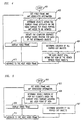
- FIG. 4 shows an exemplary process by which objects within the field represented by the video surface that, due to their projected motion are to be displayed in the three dimensional world, e.g., in front of, to the side of, above, or below, the video surface, are so displayed using computer graphics techniques, so that the object "pops out” of the video surface.
- the objects to be displayed using computer graphics are predefined, and their location in the video and the time associated with its position within the video is known, so that the time and extent at which the object needs to be popped out of the video is known.
- the techniques of the invention may be employed with computers and software which are sufficiently sophisticated to track recognizable objects within the video surface and to develop computer graphics models from such video representations in order to create the popped out computer graphics.
- step 401 The process is entered in step 401 when the user selects a video to view and the first frame of the video is to be displayed to a user.
- step 403 the video frame to be displayed is retrieved. This may be achieved by retreving data representing the frame which is pointed to by a pointer. Such a frame pointer is set initially, e.g., in step 401, to point to the first frame of the video.
- step 405 it is determined if there are any objects with the current video frame which is to be displayed on the video screen for which popping out needs to be initiated. This may be achieved by employing additional information associated with the frame that describes any objects that need to be popped out. Such additional information may also include data necessary to render the object as well as motion data which indicates the path of the object.
- this step may be achieved by analyzing the content of the video frame, perhaps in conjunction with prior frames and future frames, to determine data necessary to render the object as well as motion data which indicates the path of the object.
- the viewpoint given to the user by the overall display may be incorporated in the determination. Such a viewpoint is determined by camera controls, which may be set by the user.
- a combination of the foregoing techniques may also be employed.
- a computer graphics display engine routine is initiated for each of the objects determined in step 405.
- Each of these computer graphics routines are supplied with the information necessary to generate their respective objects as time passes with each frame for display on the video surface.
- the information supplied for each object may include the aforementioned motion. data which indicates the path of the object.
- steps 409 and 411 are performed substantially in parallel with step 413.
- the degree of parallelism to be achieved should enable the popped out objects to be displayed substantially while the frame is displayed so that the user perceives them as being displayed together at the same time.
- step 409 a location on the viewscreen is determined for each of objects for which a computer graphics display engine routine is executing.
- each of the objects for which a computer graphics display engine routine is executing that are still within the view of the viewer are rendered.
- the computer graphics display engine routine for any object that has moved so that it is no longer within the view of the viewer may be deleted.
- such computer graphics display engine routines should only be deleted provided that it is known that the motion path of the object or the viewpoint of the viewer will not again bring that object into view.
- step 413 The video frame is displayed in step 413. Control then passes from both steps 411 and 413 to step 415. In step 415 the next video frame is advanced to, provided that there is one. This may be achieved by incrementing or otherwise updating the value of the frame pointer. Thereafter, control passes back to step 403 and the process continues as described above.
- the video screen is moving within the overall three-dimensional world being displayed to the user.
- the initiation may be based on the current location of the video screen within the overall three-dimensional world being displayed to the user. For example, if the video screen is displaying a video which gives the user the feeling of traveling down the Champs Elysees each successive video frame is actually a representation of the view from a location further and further down the street.
- the computer graphics display engine routine for each of the objects may be initiated as a function of the distance traveled by the video screen down the street, which, for example, may be either indicated in additional information associated with the frame, or, for simple situations, determined as a predetermined function of the time that the video has been running.
- a three-dimensional world ready for rendering including all the elements that must pop out of the video surface, is modeled in memory.
- the three-dimensional world includes information such as the spatial location, size and orientation for each of the elements that must pop out. Motion information for the pop out elements may also be included.
- the video screen is moving within the overall three-dimensional world that is being displayed to the user, as described above.
- Each frame of the video has spatial information which describes the location of the video screen within the three-dimensional world stored in memory. Such information may be implied, e.g., if the video screen is moving at a constant rate of speed, or it may be in separate information that is associated with the video frame.
- each video pop out element Using the information about each video pop out element as well as the information about the location of the video screen allows the spatial location of each video pop out element, as well as the portion of each video pop out element that is not blocked by the video screen and is within the viewpoint of the user, to be determined for each frame. Therefore, when the video screen is at a particular location, the portion of any video pop out element that is visible, e.g., in front of or to the side of, above, or below, the video screen may be rendered on the display. Thus, a match may be achieved between what is seen on the video screen and the computer graphic pop out elements.
- FIG. 5 A process for implementing this embodiment is shown, in flow chart form, in FIG. 5. Note that prior to entering the process shown in FIG. 5 a three-dimensional world including all the elements that must pop out of the video surface must be pregenerated and stored in memory. Also, spatial information which describes the location of the video screen within the three-dimensional world must be associated with frames of the video and stored in memory.
- step 501 The process is entered in step 501 when the user selects a video to view and the first frame of the video is to be displayed to a user.
- step 503 the video frame to be displayed is retrieved. This may be achieved by retrieving data representing the frame which is pointed to by a pointer. Such a frame pointer is set initially, e.g., in step 501, to point to the first frame of the video.
- step 505 the location of the video screen within the three-dimensional world is determined. As noted, such information may be implied, e.g., if the video screen is moving at a constant rate of speed, or it may be in separate information that is associated with the video frame.
- step 507 the visible portion of any pop out elements is determined as a function of the current video surface location and the user viewpoint.
- steps 507 and 509 are performed substantially in parallel.
- the degree of parallelism to be achieved should enable the popped out objects to be displayed substantially while the frame is displayed, so that the user perceives them as being displayed together at the same time.
- step 507 the determined visible portion of each of the pop out elements is rendered.
- the video frame is displayed in step 509.
- Control then passes from both steps 507 and 509 to step 511.
- step 511 the next video frame is advanced to, provided that there is one. This may be achieved by incrementing or otherwise updating the value of the frame pointer. Thereafter, control passes back to step 503 and the process continues as described above.
- step 501 or 511 in which the video frame to be displayed next is determined, the desired location of the video screen within the three-dimensional world is ascertained.
- This location may be specified as a function of user input. For example, if the scene being displayed corresponds to the view of a user on a bicycle, the location of the video screen may be determined by sensors mounted to a stationary bicycle which detects riding of the bicycle by the user. A search of the information identifying the location of the frames is conducted to determine which frame corresponds to the current location of the screen, and the frame pointer is set to point to that frame.
- the various method of determining which frame is displayed may be used separately, or their usage may be intermixed, depending on the need of the application being implemented.
- an object which pops out from a video into the computer graphics part of the world may be "investigated" by a viewer of the world, in accordance with the principles of the invention, is by receiving an indication of a selection of such an object by a user and, in response thereto, providing the user with additional information about the selected object.
- additional information could be displayed on the display screen in response to the viewer selecting the object, such as with point and click selection system, the most common type of which are mice, trackballs, and touchpads.
- a new window could be overlayed on the video display containing additional information.
- Another way that this may be achieved is by receiving an indication of a selection of such an object by a user and, in response thereto, allowing the user to explore within the selected object. This may be done within the context of the world which is being explored or external thereto.
- One way this may be achieved is by having a uniform resource locator (URL) associated with the object in the CG part of the world.
- URL uniform resource locator
- the user could click on the popped-out Arc de Triomphe which is now in the computer graphics part of the world and obtain historical information about it, e.g., displayed in a window on the screen.
- the user is represented in the world as an avatar riding on a bicycle, the user avatar, in response to appropriate commands, such as mouse clicks, could be made to dismount the bicycle and further investigate the Arc de Triomphe, e.g., entering therein, ascending a set of stairs and looking out from one or more viewpoints.
- the user could then cause his avatar to return to the bicycle and continue the journey in the world which has a portion of the world distant from the point of view of the user represented in only two dimensions as a video on the video screen and the remainder of the world as computer graphics.
- the description of the interior of the Arc de Triomphe may have been directly associated with information employed for popping it out of the video or information pointing to the necessary description of the interior of the Arc de Triomphe, such as a pointer to another "world" or a URL, may have been directly associated with information employed for popping the Arc de Triomphe out of the video.
- the user could enter a store which popped out of the video, and engage in virtual shopping therein.
- the particular store which is actually entered may be customized on a per user basis.
- the particular vendor may be selected as a function of the actual geographic location of the user, or a particular location that is associated with the user.
- each friend may be served by a different vendor, e.g., as a function of their individual geographic locations.
- a different vendor e.g., as a function of their individual geographic locations.
- users could specify that a subset, or all of them, should be served by a single vendor.
- a message such as an advertisement, or other communication, such as opening a communication channel, e.g., a chat service or voice communication channel, may be transmitted to, or initiated with, such passing persons.
- the communication may be general in nature or it may be customized as a function of information available regarding the passing persons.
- a feeling of community may be engendered in the virtual environment
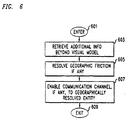
- FIG. 6 shows steps of a process by which aspects of the invention may be implemented.
- the process of FIG. 6 is entered in step 601, which may be, for example, after completion of execution of step 411 of FIG. 4 or step 507 of FIG. 5.
- step 603 additional information which is necessary to support the permitted interaction between the viewer and the popped out object and is beyond what is necessary to simply generate the computer graphics visual model of the object is retrieved.
- Such information may be included along with the information associated with the video that is used to pop the object out of the video.
- any geographic functions associated with the object are resolved.
- the geographic function may specify a restaurant of the type that serves the same kind of food that is available from vendor cart.
- Such food may include, for example, frankfurters, hamburgers, sodas and snacks.
- the type of restaurant that corresponds to the cart is then used along with the actual physical location in the real world of the user, e.g., Omaha, Kansas, to determine a local restaurant that serves food of the same type and provides delivery service.
- the information provided by exploring the cart is linked to information corresponding to the determined restaurant, e.g., available menu selections and prices therefor.
- the viewer may order an item from the restaurant by manipulating objects on the cart, and the restaurant could then deliver them directly to the viewer.
- users who are in different real world locations but are jointly negotiating a virtual world may be supplied with substantially the same services, enhancing their experience in the virtual world.
- the resolution of the object may also be made dependent upon knowledge about the user, such as may be stored in a user profile.
- a communication channel may be enabled between the popped out object and an entity, which may have been geographically resolved as described above.
- a communication channel may be opened to the corresponding restaurant, or an agent therefor.
- the restaurant may transmit a message, such as "Get your hot dogs and cold soda here.”
- the message may be manifest by having an avatar of a vendor behind the cart appear to speak the message, either using text-to-speech or by having a representation of the speech transmitted directly.
- a so-called "chat" service may be used to enable bidirectional communication between the viewer and the vendor.
- a billboard may operate in one of several ways.
- the billboard when popped out may signal an advertiser of the approach of a potential customer and in response thereto the advertiser may immediately transmit a message to the billboard, in accordance with an aspect of the invention.
- the particular advertiser selected may be fixed worldwide for all viewers, or it may be geographically resolved for each viewer.
- the billboard when popped out may signal an advertiser of the approach of a potential customer and enable the advertiser to transmit a message to the billboard should the advertiser wish to do so, e.g., after having reviewed information which may be sent to it about the viewer, in accordance with an aspect of the invention.
- step 609 The process exits in step 609 and then the processes of FIGs. 4 or 5 may be resumed.
- the process of FIG. 6 need not be limited to occurring within the time span of one frame.
- any simulation of a joint exploration of a world may employ the principles of the invention.
- users exploring a world may take together automobile rides, boat rides, plane rides, train rides, and even spaceship rides.
- a rowboat ride may be arranged for users having rowing machines which are coordinated with images of the world seen by the users.
- the users may be walking together through the world, e.g., each user walks on his own treadmill which is coordinated with images of the world seen by the users.
- users can ski together, e.g., each is on a skiing simulator machine, such as a Nordictrak, which is coordinated with the images of the world seen by the users.
- Ticket booths which appear on the video screen may pop out from the video screen and the users must each obtain, e.g., buy, or have bought for them, a ticket in order to proceed into the attraction.
Landscapes
- Engineering & Computer Science (AREA)
- Computer Graphics (AREA)
- Physics & Mathematics (AREA)
- General Physics & Mathematics (AREA)
- Theoretical Computer Science (AREA)
- Processing Or Creating Images (AREA)
- Image Processing (AREA)
- Digital Computer Display Output (AREA)
- User Interface Of Digital Computer (AREA)
Applications Claiming Priority (4)
| Application Number | Priority Date | Filing Date | Title |
|---|---|---|---|
| US938304 | 1986-12-05 | ||
| US5538497P | 1997-08-04 | 1997-08-04 | |
| US55384P | 1997-08-04 | ||
| US08/938,304 US6256043B1 (en) | 1997-09-26 | 1997-09-26 | Three dimensional virtual reality enhancement techniques |
Publications (3)
| Publication Number | Publication Date |
|---|---|
| EP0899691A2 EP0899691A2 (en) | 1999-03-03 |
| EP0899691A3 EP0899691A3 (en) | 1999-12-08 |
| EP0899691B1 true EP0899691B1 (en) | 2001-06-06 |
Family
ID=26734159
Family Applications (1)
| Application Number | Title | Priority Date | Filing Date |
|---|---|---|---|
| EP98305992A Expired - Lifetime EP0899691B1 (en) | 1997-08-04 | 1998-07-28 | Three dimensional virtual reality enhancement techniques |
Country Status (4)
| Country | Link |
|---|---|
| EP (1) | EP0899691B1 (enExample) |
| JP (1) | JP3592541B2 (enExample) |
| CA (1) | CA2242170C (enExample) |
| DE (1) | DE69800884T2 (enExample) |
Cited By (2)
| Publication number | Priority date | Publication date | Assignee | Title |
|---|---|---|---|---|
| TWI411292B (zh) * | 2009-12-17 | 2013-10-01 | Chien Hui Chuan | 實景虛擬化的編碼方法 |
| US9405770B2 (en) | 2014-03-10 | 2016-08-02 | Google Inc. | Three dimensional navigation among photos |
Families Citing this family (13)
| Publication number | Priority date | Publication date | Assignee | Title |
|---|---|---|---|---|
| AU6377100A (en) * | 1999-07-28 | 2001-02-19 | Perceptual Robotics, Inc. | Method and apparatus for remote location shopping over a computer network |
| EP1085438A3 (en) * | 1999-09-20 | 2003-12-03 | Ncr International Inc. | Information gathering and personalisation techniques |
| EP1085440A3 (en) * | 1999-09-20 | 2003-11-26 | Ncr International Inc. | Information gathering and personalisation techniques |
| DE19958609A1 (de) * | 1999-12-06 | 2001-06-07 | Duester Hans Uwe | Verfahren zur Präsentation von Angeboten, wie Waren und Dienstleistungen |
| EP1261906A2 (en) * | 2000-03-10 | 2002-12-04 | Richfx Ltd. | Natural user interface for virtual reality shopping systems |
| KR20020007052A (ko) * | 2000-07-15 | 2002-01-26 | 이종구 | 3차원 입체적 사이버 쇼핑몰 시스템 |
| EP1197898A3 (en) * | 2000-09-05 | 2004-02-04 | Ncr International Inc. | Information gathering and personalisation techniques |
| JP2009026283A (ja) * | 2007-07-23 | 2009-02-05 | Masazumi Fukuda | バーチャル(仮想)旅行 |
| US20120162225A1 (en) * | 2010-12-23 | 2012-06-28 | Google Inc. | View dependent techniques to determine user interest in a feature in a 3d application |
| US8566325B1 (en) | 2010-12-23 | 2013-10-22 | Google Inc. | Building search by contents |
| US11328456B2 (en) | 2018-01-22 | 2022-05-10 | Apple Inc. | Method and device for presenting synthesized reality companion content |
| CN109461210B (zh) * | 2018-10-15 | 2023-03-21 | 杭州群核信息技术有限公司 | 一种在线家装的全景漫游方法 |
| WO2022264846A1 (ja) * | 2021-06-15 | 2022-12-22 | 至 石井 | 仮想旅行システム、仮想集会システムおよび通信端末 |
Family Cites Families (4)
| Publication number | Priority date | Publication date | Assignee | Title |
|---|---|---|---|---|
| US4970666A (en) * | 1988-03-30 | 1990-11-13 | Land Development Laboratory, Inc. | Computerized video imaging system for creating a realistic depiction of a simulated object in an actual environment |
| FR2675977B1 (fr) * | 1991-04-26 | 1997-09-12 | Inst Nat Audiovisuel | Procede de modelisation d'un systeme de prise de vues et procede et systeme de realisation de combinaisons d'images reelles et d'images de synthese. |
| GB2256567B (en) * | 1991-06-05 | 1995-01-11 | Sony Broadcast & Communication | Modelling system for imaging three-dimensional models |
| US5577981A (en) * | 1994-01-19 | 1996-11-26 | Jarvik; Robert | Virtual reality exercise machine and computer controlled video system |
-
1998
- 1998-06-30 CA CA002242170A patent/CA2242170C/en not_active Expired - Fee Related
- 1998-07-28 DE DE69800884T patent/DE69800884T2/de not_active Expired - Lifetime
- 1998-07-28 EP EP98305992A patent/EP0899691B1/en not_active Expired - Lifetime
- 1998-08-04 JP JP22012198A patent/JP3592541B2/ja not_active Expired - Fee Related
Cited By (3)
| Publication number | Priority date | Publication date | Assignee | Title |
|---|---|---|---|---|
| TWI411292B (zh) * | 2009-12-17 | 2013-10-01 | Chien Hui Chuan | 實景虛擬化的編碼方法 |
| US9405770B2 (en) | 2014-03-10 | 2016-08-02 | Google Inc. | Three dimensional navigation among photos |
| US9600932B2 (en) | 2014-03-10 | 2017-03-21 | Google Inc. | Three dimensional navigation among photos |
Also Published As
| Publication number | Publication date |
|---|---|
| EP0899691A3 (en) | 1999-12-08 |
| EP0899691A2 (en) | 1999-03-03 |
| JP3592541B2 (ja) | 2004-11-24 |
| DE69800884D1 (de) | 2001-07-12 |
| CA2242170A1 (en) | 1999-02-04 |
| DE69800884T2 (de) | 2001-12-06 |
| CA2242170C (en) | 2002-11-05 |
| JPH11134084A (ja) | 1999-05-21 |
Similar Documents
| Publication | Publication Date | Title |
|---|---|---|
| US6256043B1 (en) | Three dimensional virtual reality enhancement techniques | |
| CA2242170C (en) | Three dimensional virtual reality enhancement techniques | |
| US7464344B1 (en) | Systems and methods for immersive advertising | |
| US9824391B2 (en) | Virtual reality shopping experience | |
| US7739086B2 (en) | Information delivering method | |
| JP2000207575A (ja) | 空間融合装置及びこれを適用した応用装置 | |
| US20100228633A1 (en) | Method and system for hosting a metaverse environment within a webpage | |
| WO2001061539A2 (en) | Methods and systems for presenting a virtual representation of a real city | |
| JP2007500883A (ja) | 情報表示 | |
| WO2002086766A9 (en) | Method and system for providing a service in a photorealistic, 3-d environment | |
| EP1922697A2 (en) | Web enabled three-dimensional visualization | |
| KR20000017845A (ko) | 지리정보에 의한 인터넷 예약 및 구매 시스템과 그 방법 | |
| EP1924052A2 (en) | System and procedure for communication based on virtual reality | |
| KR20000063161A (ko) | 3차원 지리정보시스템 기반의 실제거리 정보제공 방법과그 장치 및 3차원 지리정보시스템을 기반으로 하는전자상거래 방법 | |
| Engel et al. | Immersive visualization of virtual 3D City models and its applications in E-Planning | |
| CN108459700A (zh) | 提供交互对象信息的方法及装置 | |
| JPH11103451A5 (ja) | バーチャルトラベルなどのために使用するのに適した実況映像を視させる装置 | |
| KR20020039295A (ko) | 3차원 지리정보시스템을 이용한 전자 상거래방법 | |
| KR20160097604A (ko) | 캐릭터 메시지 서비스에 기반한 광고 서비스 제공 방법 및 상기 방법을 수행하는 장치 | |
| AU742529B2 (en) | Display techniques for three dimensional virtual reality | |
| US20060152532A1 (en) | The largest toy gallery park with 3D simulation displays for animations and other collectibles juxtaposed with physical-virtual collaborative games and activities in a three-dimension photo-realistic virtual-reality environment | |
| CN113409432A (zh) | 一种基于虚拟现实的图像信息生成方法、装置和可读介质 | |
| WO2019114019A1 (zh) | 一种用于自动驾驶车辆的场景生成方法及智能眼镜 | |
| CA2242166C (en) | Display techniques for three dimensional virtual reality | |
| WO2000020987A2 (en) | Systems and methods for displaying three dimensional representations and an associated separate web window |
Legal Events
| Date | Code | Title | Description |
|---|---|---|---|
| PUAI | Public reference made under article 153(3) epc to a published international application that has entered the european phase |
Free format text: ORIGINAL CODE: 0009012 |
|
| 17P | Request for examination filed |
Effective date: 19980810 |
|
| AK | Designated contracting states |
Kind code of ref document: A2 Designated state(s): DE FR GB |
|
| AX | Request for extension of the european patent |
Free format text: AL;LT;LV;MK;RO;SI |
|
| PUAL | Search report despatched |
Free format text: ORIGINAL CODE: 0009013 |
|
| AK | Designated contracting states |
Kind code of ref document: A3 Designated state(s): AT BE CH CY DE DK ES FI FR GB GR IE IT LI LU MC NL PT SE |
|
| AX | Request for extension of the european patent |
Free format text: AL;LT;LV;MK;RO;SI |
|
| 17Q | First examination report despatched |
Effective date: 20000517 |
|
| AKX | Designation fees paid |
Free format text: DE FR GB |
|
| GRAG | Despatch of communication of intention to grant |
Free format text: ORIGINAL CODE: EPIDOS AGRA |
|
| GRAG | Despatch of communication of intention to grant |
Free format text: ORIGINAL CODE: EPIDOS AGRA |
|
| GRAH | Despatch of communication of intention to grant a patent |
Free format text: ORIGINAL CODE: EPIDOS IGRA |
|
| GRAH | Despatch of communication of intention to grant a patent |
Free format text: ORIGINAL CODE: EPIDOS IGRA |
|
| GRAA | (expected) grant |
Free format text: ORIGINAL CODE: 0009210 |
|
| AK | Designated contracting states |
Kind code of ref document: B1 Designated state(s): DE FR GB |
|
| REF | Corresponds to: |
Ref document number: 69800884 Country of ref document: DE Date of ref document: 20010712 |
|
| ET | Fr: translation filed | ||
| REG | Reference to a national code |
Ref country code: GB Ref legal event code: IF02 |
|
| PLBE | No opposition filed within time limit |
Free format text: ORIGINAL CODE: 0009261 |
|
| STAA | Information on the status of an ep patent application or granted ep patent |
Free format text: STATUS: NO OPPOSITION FILED WITHIN TIME LIMIT |
|
| 26N | No opposition filed | ||
| REG | Reference to a national code |
Ref country code: GB Ref legal event code: 732E Free format text: REGISTERED BETWEEN 20131107 AND 20131113 |
|
| REG | Reference to a national code |
Ref country code: FR Ref legal event code: CD Owner name: ALCATEL-LUCENT USA INC. Effective date: 20131122 |
|
| REG | Reference to a national code |
Ref country code: FR Ref legal event code: GC Effective date: 20140410 |
|
| REG | Reference to a national code |
Ref country code: FR Ref legal event code: RG Effective date: 20141015 |
|
| REG | Reference to a national code |
Ref country code: FR Ref legal event code: PLFP Year of fee payment: 18 |
|
| PGFP | Annual fee paid to national office [announced via postgrant information from national office to epo] |
Ref country code: FR Payment date: 20150626 Year of fee payment: 18 |
|
| PGFP | Annual fee paid to national office [announced via postgrant information from national office to epo] |
Ref country code: DE Payment date: 20150721 Year of fee payment: 18 Ref country code: GB Payment date: 20150721 Year of fee payment: 18 |
|
| REG | Reference to a national code |
Ref country code: DE Ref legal event code: R119 Ref document number: 69800884 Country of ref document: DE |
|
| GBPC | Gb: european patent ceased through non-payment of renewal fee |
Effective date: 20160728 |
|
| PG25 | Lapsed in a contracting state [announced via postgrant information from national office to epo] |
Ref country code: DE Free format text: LAPSE BECAUSE OF NON-PAYMENT OF DUE FEES Effective date: 20170201 Ref country code: FR Free format text: LAPSE BECAUSE OF NON-PAYMENT OF DUE FEES Effective date: 20160801 |
|
| REG | Reference to a national code |
Ref country code: FR Ref legal event code: ST Effective date: 20170331 |
|
| PG25 | Lapsed in a contracting state [announced via postgrant information from national office to epo] |
Ref country code: GB Free format text: LAPSE BECAUSE OF NON-PAYMENT OF DUE FEES Effective date: 20160728 |