EP0899549A2 - Interne Farbsonde - Google Patents
Interne Farbsonde Download PDFInfo
- Publication number
- EP0899549A2 EP0899549A2 EP98306650A EP98306650A EP0899549A2 EP 0899549 A2 EP0899549 A2 EP 0899549A2 EP 98306650 A EP98306650 A EP 98306650A EP 98306650 A EP98306650 A EP 98306650A EP 0899549 A2 EP0899549 A2 EP 0899549A2
- Authority
- EP
- European Patent Office
- Prior art keywords
- color
- sample
- probe
- blend
- sensor
- Prior art date
- Legal status (The legal status is an assumption and is not a legal conclusion. Google has not performed a legal analysis and makes no representation as to the accuracy of the status listed.)
- Ceased
Links
Images

Classifications
-
- G—PHYSICS
- G01—MEASURING; TESTING
- G01J—MEASUREMENT OF INTENSITY, VELOCITY, SPECTRAL CONTENT, POLARISATION, PHASE OR PULSE CHARACTERISTICS OF INFRARED, VISIBLE OR ULTRAVIOLET LIGHT; COLORIMETRY; RADIATION PYROMETRY
- G01J3/00—Spectrometry; Spectrophotometry; Monochromators; Measuring colours
- G01J3/46—Measurement of colour; Colour measuring devices, e.g. colorimeters
- G01J3/50—Measurement of colour; Colour measuring devices, e.g. colorimeters using electric radiation detectors
-
- G—PHYSICS
- G01—MEASURING; TESTING
- G01J—MEASUREMENT OF INTENSITY, VELOCITY, SPECTRAL CONTENT, POLARISATION, PHASE OR PULSE CHARACTERISTICS OF INFRARED, VISIBLE OR ULTRAVIOLET LIGHT; COLORIMETRY; RADIATION PYROMETRY
- G01J3/00—Spectrometry; Spectrophotometry; Monochromators; Measuring colours
- G01J3/02—Details
- G01J3/0205—Optical elements not provided otherwise, e.g. optical manifolds, diffusers, windows
- G01J3/0224—Optical elements not provided otherwise, e.g. optical manifolds, diffusers, windows using polarising or depolarising elements
-
- G—PHYSICS
- G01—MEASURING; TESTING
- G01J—MEASUREMENT OF INTENSITY, VELOCITY, SPECTRAL CONTENT, POLARISATION, PHASE OR PULSE CHARACTERISTICS OF INFRARED, VISIBLE OR ULTRAVIOLET LIGHT; COLORIMETRY; RADIATION PYROMETRY
- G01J3/00—Spectrometry; Spectrophotometry; Monochromators; Measuring colours
- G01J3/46—Measurement of colour; Colour measuring devices, e.g. colorimeters
- G01J3/463—Colour matching
Definitions
- This invention relates to the production of colored polymers, and, more specifically, to measuring color thereof.
- Modern plastics are typically formed of one or more base polymers or resins, one or more colorants, and other additives including, for example, fiberglass for structural reinforcement, flame retardants, plasticizers, or mold release agents.
- the plastics are manufactured by initially mixing these components, usually by machine, to form a substantially homogeneous polymer mixture or blend.
- the blend then undergoes extrusion to form a raw product which may be in the exemplary form of pellets which are in turn used by manufacturers to produce final, finished polymer products of various forms and configurations.
- the color of the final product may depend on several factors including the concentration and type of colorant and base resin, temperature history during mixing, and the ultimate degree of constituent inter-mixing achieved during processing. Thus, variations in color between otherwise similar polymer products may arise for a variety of reasons.
- color may vary among polymer products due to polymer product formulation or recipe differences. Color variations may exist between lots for a given product formulation or recipe due to machine-to-machine differences. Color differences may exist within lots due to changing raw material characteristics, changing operating conditions, and inaccuracies and other anomalies in processing including speed rates.
- Plastics including thermoplastic or thermoset polymers may be used in various commercial products. Typical industries include printing, painting, fabrics, and plastics, wherein accurate color of the final polymer product is important.
- Polymer color is typically adjusted by adjusting the amount of colorant for a given production run.
- the colorant may take any conventional form which affects the color of the polymer product by itself or in combination with other constituents.
- solid pigments and liquid pigments or dyes may be used for effecting the color of the final product.
- the colorant and base resin are blended together and compounded or extruded in a laboratory machine to generate pellets.
- the pellets are then injection molded to obtain a plaque with substantially uniform color, which is then conventionally measured in a laboratory spectrocolorimeter.
- the measured plaque color is compared with a reference or standard plaque color, and differences therebetween are corrected by adjusting the colorant.
- the sequence is repeated until the plaque color falls within an acceptable range to the reference plaque.
- a sample of the finally corrected colorant and resin blend is then compounded on a production scale machine which follows a similar procedure as the laboratory machine to produce a color plaque which is again compared with the reference plaque. If required, the colorant in the production machine is suitably corrected to effect an acceptable match between the measured plaque and the reference plaque.
- This process therefore, requires many steps to achieve a desired color in the polymer pellets which increases processing time and cost.
- a probe is configured for measuring color in a sample having a refractive index.
- the probe includes a light source for emitting a light beam toward the sample.
- a color sensor is disposed obliquely with the light source toward a common probe zone for receiving the sample therein.
- the light source and sensor are optically aligned with a reference plane in the probe zone to effect angles of incidence and reflection relative thereto having magnitude substantially equal to Brewster's maximum polarization angle for the refractive index of the sample for measuring internal color thereof.
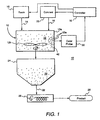
- System 10 includes a conventional blender 12 employing a vessel 12a for receiving and blending a conventional polymer base resin 14 with one or more conventional colorants 16.
- a conventional resin dispenser 18 is operatively joined to blender 12 for selectively adding resin 14 thereto.
- a conventional colorant dispenser 20 is operatively joined to blender 12 for selectively adding colorant 16 thereto.
- Blender 12 also includes a suitable paddle or mixer 12b for blending together base resin 14 and colorant 16, and any additional additives as desired. The resulting mixture batch or blend 22 after suitable blending is temporarily stored in a holding bin 24 operatively joined to blender 12.
- Holding bin 24 is operatively pined to a conventional compounder or extruder 26 which includes an extrusion screw that acts upon blend 22 delivered thereto to form, under heat, a polymer raw product 28 in any conventional form, such as pellets.
- the raw product 28 is in turn used by various manufacturers to produce final products in various forms and configurations having the inherent color thereof.
- the color of the raw product is important in many final products requiring specific colors. Repeatability of accurate final product color requires repeatability in color of the raw product itself.
- the color of raw product 28 may initially be manually adjusted by adjusting colorant 16 in an interactive process until the color of raw product 28 is within an acceptable range based on the reference plaque color.
- Sample plaques are formed as described above for measuring color thereof using conventional color sensors in the exemplary form of a spectrocolorimeter. Color measurement is usually made by reflecting light off the surface of the sample plaque and performing spectrum analysis thereof for determining color.
- System 10 illustrated in Figure 1, includes a color monitor or probe 30 in optical communication with blender 12 for measuring internal color of blend 22 itself, instead of measuring the color of raw product 28.
- blender 12 After the blender has operated for a sufficient time to thoroughly mix resin 14 with colorant 16, blend 22 takes on a uniform color which is measurable by probe 30.
- blend 22 comprises a powder colored by the action of colorant 16. The powder is formed of individual small partides having irregular, three-dimensional surface contours. Probe 30, therefore, is optically joined to blender vessel 12a so as to cover the field of view of a probe zone portion 42 of blend 22 containing individual powder particles of blend 22. By accurately measuring the color of samples 22a of the powder particles, the color of blend 22 itself may be determined.
- system 10 further includes a suitable controller 32 operatively coupled to both the resin and colorant dispensers 18 and 20, respectively, for controlling the ratio of colorant to resin in blend 22.
- Probe 30 is operatively coupled to controller 32 for varying the blend ratio of colorant to resin to control color of the blend in response to measured color of a sample 22a of the blend powder particles.
- Controller 32 may take any conventional form such as a digitally programmable computer which compares a color signal from probe 30 to a reference signal for the desired color of blend 22 required for achieving a corresponding desired color of raw product 28. Controller 32 responds to deviation between the measured color of blend 22 and the desired color thereof by varying appropriate control valves (not shown) in resin dispenser 18 or colorant dispenser 20, or both, as required to control the color of blend 22.
- a closed-loop feedback control system may be implemented in suitable software within controller 32 for controlling operation of system 10 to achieve the desired color of blend 22 and product 28.
- a preferred embodiment of color probe 30, as illustrated in Figure 2 includes a housing 34 suitably pined to blender vessel 12a.
- Blender 12 includes a suitable optically transparent window 12c in the wall of vessel 12a for permitting optical communication between probe 30 and blender 12.
- a suitable light source 36 is mounted in housing 34 for emitting and projecting an incident light beam 38 toward probe zone 42 inside blender 12.
- Light source 36 may be of any conventional form for use in measuring color of samples 22a, and, for example, may comprise a tungsten-halogen light source for producing broad spectrum white light.
- a color sensor 40 is suitably mounted in housing 34 at an oblique angle with light source 36 and directed toward probe zone 42 containing blend powder particle samples 22a. Samples 22a are comprised of a substantial number of randomly oriented blend powder particles. Color sensor 40 may comprise, for example, any instrument which is effective for performing spectrum color analysis of incident light thereon, such as those commonly referred to as a spectrometer, spectrocolorimeter, or spectrophotometric colorimeter.
- Light source 36 and color sensor 40 are optically aligned with a fixed reference plane 42a within probe zone 42 to effect angles of incidence and reflection relative thereto, each having a magnitude substantially equal to the conventionally known Brewster's maximum polarization angle B for the specific refractive index (n) of a specific sample 22a for measuring internal color thereof.
- probe zone 42 is defined by both the viewing angle of color sensor 40 and the cooperating illumination angle of light source 36 within which one or more samples 22a are illuminated for color measurement by sensor 40.
- Light source 36 and color sensor 40 are simply mounted in housing 34 in a fixed spatial orientation to effect Brewsters angle viewing of samples 22a.
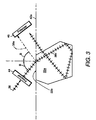
- FIG. 3 is a schematic representation of light beam 38 illuminating an exemplary sample 22a to explain the principle of operation of color probe 30 in accordance with the present invention.
- Unpolarized light such as light beam 38
- reflected ray or wave 38a shown in phantom
- refracted ray or wave 38b when incident upon a sample surface, produces a reflected ray or wave 38a (shown in phantom), and a refracted ray or wave 38b.
- Incident light beam 38 is directed to have an angle of incidence B relative to the normal to reference plane 42a, and reflected wave 38a has an equal angle B of reflection relative thereto.
- Reflected wave 38a undergoes plane-polarization when light is incident at Brewster's angle, since at that angle light vibrating in the plane of incidence is not reflected but is refracted into the material.
- Brewsters law provides that the angle of incidence for maximum polarization depends on the refractive index (n) of the material affected.
- Brewsters angle B equals the arctangent of the refractive index (n) of sample 22a, which effects maximum polarization of light beam 38.
- Brewster's angle is about 57°, whereas the specific composition of sample 22a has its own specific Brewster's angle.
- light source 36 and color sensor 40 are preferably aligned relative to reference plane 42a to direct each of the incident and reflected light beams at the specific Brewster's angle B for the refractive index of sample 22a, such as the colored base resin of blend 22.
- the unpolarized incident light beam 38 is schematically represented by a series of dots and crosslines representing the two mutually perpendicular plane-polarized components thereof, specifically, a perpendicular polarization ray or wave vibrating perpendicular to the plane of incidence, and a parallel polarization ray or wave vibrating in the plane of incidence, respectively.
- the refracted ray 38b usually contains some of both planes of polarization.
- light source 36 and color sensor 40 are specifically oriented to maximize the reception in color sensor 40 of refraction wave 38b after its journey through sample 22a, while minimizing the magnitude of reflection wave 38a.
- the internal color of sample 22a may be probed for obtaining a more accurate indication of the color of sample 22a, as opposed to probing the color of sample 22a from its surface only.
- Figure 3 illustrates only a single sample 22a
- a large number of samples 22a will be within probe zone 42 in random orientations.
- a suitable number of the individual samples 22a will include a reflection surface 22b aligned parallel with reference plane 42a for effecting Brewster angle viewing of those samples 22a.
- light beam 38 could reflect from those surfaces directly into color sensor 40 ( Figure 2), which is undesirable.
- the Brewster angle condition minimizes collection of specular reflected light while maximizing collection of light initially refracted inside samples 22a before reaching sensor 40.
- a first linear polarization filter or polarizer 44 is optically aligned between light source 36 and probe zone 42 for selectively polarizing light beam 38 to prevent generation of reflection wave 38a from sample 22a, while permitting transmission of refraction wave 38b into sample 22a and, upon internal reflection therein, passing to sensor 40.
- unpolarized light beam 38 without polarizer 44 would contain components polarized perpendicular to the plane of incidence or reflection according to Brewster's law, and would generate reflection wave 38a.
- reflection wave 38a may be prevented by using first polarizer 44 specifically oriented therefor. In this condition, reflection wave 38a is illustrated in phantom indicating where it would exist but for polarizer 44 which prevents its transmission to color sensor 40 ( Figure 2).
- the parallel polarization component of light beam 38 is unaffected by polarizer 44 and refracts inside sample 22a along the exemplary intemal reflection path shown for refraction wave 38b. Statistically, many samples 22a will have internally reflected refraction waves 38b exiting the samples in the direction of color sensor 40 for measuring the intemal color.
- Refraction wave 38b is illustrated in Figure 3 as reflecting internally off of multiple surfaces of sample 22a. In the usual case, the normals to these planes will not all lie in the same plane. In consequence of this three-dimensional orientation, and also the general laws of reflection, refraction wave 38b will undergo different polarizations in its travel. Refraction wave 38b may also scatter off of inclusions in sample 22a, further affecting its polarization.
- a second linear polarization filter or polarizer 46 may be optically aligned between probe zone 42 and color sensor 40 for transmitting refraction wave 38b to sensor 40 while blocking differently polarized components thereof, as well as for blocking reflection wave 38a from reaching sensor 40 and blocking light that is multiply scattered to small angles, with polarization rotation, from reaching sensor 40.
- the embodiment illustrated in Figure 2 preferably includes a first collimating lens 48 optically aligned between light source 36 and first polarizer 44 for collimating light beam 38 toward probe zone 42.
- a second lens 50 is optically aligned between second polarizer 46 and color sensor 40 for focusing collected light therefrom upon sensor 40.
- Sensor 40 preferably includes a pinhole or small slit inlet 52 sized to define a suitably narrow view direction corresponding to the volume of probe zone 42 to maintain viewing within narrow bounds of the Brewster angle B.
- an optical fiber might serve this purpose as well.
- probe zone 42 is illuminated with collimated light to maximize internal refraction within samples 22a while minimizing surface reflections therefrom, with refraction waves 38b leaving samples 22a and being statistically observed by use of directionally-oriented color sensor 40.
- Color probe 30 thus allows highly accurate measurement of powder color by controlling the illumination and observation directions and polarizations so that direct reflections from the individual powder particles are minimized, allowing clearer detection of the interior color of the powder.
- the ability to measure the color of powder blend 22 in blender 12 and to make adjustments to the color for obtaining a desired final color for the extruded product 28 (Figure 1) has many benefits. For example, the need to take a powder sample, run it through an off-line extruder, and form sample plaques in order to obtain a preliminary color measurement, will be eliminated, eliminating the need to maintain off-line equipment for this purpose and reducing the labor necessary to achieve an on-color blend. Furthermore, less material will be wasted or recycled because the number of off-color blends can be reduced. Extruder down-time while off-color blends are adjusted and brought into specification can also be reduced.
- the blend color is not necessarily the same as the color of the produced raw product, there is a necessary correlation therebetween which allows the measurement of the blend color to determine the color of the extruded product 28.
Landscapes
- Physics & Mathematics (AREA)
- Spectroscopy & Molecular Physics (AREA)
- General Physics & Mathematics (AREA)
- Spectrometry And Color Measurement (AREA)
- Investigating Or Analysing Materials By Optical Means (AREA)
Applications Claiming Priority (2)
| Application Number | Priority Date | Filing Date | Title |
|---|---|---|---|
| US915288 | 1997-08-20 | ||
| US08/915,288 US5963332A (en) | 1997-08-20 | 1997-08-20 | Internal color probe |
Publications (2)
| Publication Number | Publication Date |
|---|---|
| EP0899549A2 true EP0899549A2 (de) | 1999-03-03 |
| EP0899549A3 EP0899549A3 (de) | 2000-03-29 |
Family
ID=25435514
Family Applications (1)
| Application Number | Title | Priority Date | Filing Date |
|---|---|---|---|
| EP98306650A Ceased EP0899549A3 (de) | 1997-08-20 | 1998-08-19 | Interne Farbsonde |
Country Status (4)
| Country | Link |
|---|---|
| US (1) | US5963332A (de) |
| EP (1) | EP0899549A3 (de) |
| JP (1) | JPH11132851A (de) |
| SG (1) | SG67535A1 (de) |
Cited By (1)
| Publication number | Priority date | Publication date | Assignee | Title |
|---|---|---|---|---|
| WO2007067587A1 (en) * | 2005-12-05 | 2007-06-14 | E. I. Du Pont De Nemours And Company | Probe apparatus for measuring a color property of a liquid |
Families Citing this family (57)
| Publication number | Priority date | Publication date | Assignee | Title |
|---|---|---|---|---|
| US6307629B1 (en) * | 1997-08-12 | 2001-10-23 | Lj Laboratories, L.L.C. | Apparatus and method for measuring optical characteristics of an object |
| US6373573B1 (en) | 2000-03-13 | 2002-04-16 | Lj Laboratories L.L.C. | Apparatus for measuring optical characteristics of a substrate and pigments applied thereto |
| US6254385B1 (en) | 1997-01-02 | 2001-07-03 | Lj Laboratories, Llc | Apparatus and method for measuring optical characteristics of teeth |
| US6301004B1 (en) | 2000-05-31 | 2001-10-09 | Lj Laboratories, L.L.C. | Apparatus and method for measuring optical characteristics of an object |
| US6870616B2 (en) | 1998-06-30 | 2005-03-22 | Jjl Technologies Llc | Spectrometer apparatus for determining an optical characteristic of an object or material having one or more sensors for determining a physical position or non-color property |
| US6501542B2 (en) | 1998-06-30 | 2002-12-31 | Lj Laboratories, Llc | Apparatus and method for measuring optical characteristics of an object |
| US6573984B2 (en) | 1998-06-30 | 2003-06-03 | Lj Laboratories Llc | Apparatus and method for measuring optical characteristics of teeth |
| US6249348B1 (en) | 1998-11-23 | 2001-06-19 | Lj Laboratories, L.L.C. | Integrated spectrometer assembly and methods |
| IT1316145B1 (it) * | 2000-10-26 | 2003-03-28 | Viptronic Srl | Dispositivo di misurazione fotoelettrica dotato di filtro dipolarizzazione. |
| US6903813B2 (en) | 2002-02-21 | 2005-06-07 | Jjl Technologies Llc | Miniaturized system and method for measuring optical characteristics |
| JP2007010576A (ja) * | 2005-07-01 | 2007-01-18 | Toyota Motor Corp | 測色装置と測色方法 |
| DE102005041455A1 (de) * | 2005-08-31 | 2007-03-15 | Abb Patent Gmbh | Automatisierungstechnische Einrichtung |
| DE102005043482A1 (de) * | 2005-09-13 | 2007-03-15 | Abb Patent Gmbh | Automatisierungstechnische Einrichtung |
| DE102005043481A1 (de) * | 2005-09-13 | 2007-03-15 | Abb Patent Gmbh | Automatisierungstechnische Einrichtung |
| DE102005043485A1 (de) * | 2005-09-13 | 2007-03-15 | Abb Patent Gmbh | Automatisierungstechnische Einrichtung |
| DE102005043487A1 (de) * | 2005-09-13 | 2007-03-15 | Abb Patent Gmbh | Automatisierungstechnische Einrichtung |
| US7423755B2 (en) * | 2005-12-05 | 2008-09-09 | E.I. Du Pont De Nemours And Company | Liquid measurement cell having a transparent partition therein |
| US7719686B2 (en) * | 2005-12-05 | 2010-05-18 | E.I. Du Pont De Nemours And Company | System for measuring a color property of a liquid |
| US7542143B2 (en) * | 2005-12-05 | 2009-06-02 | E.I. Du Pont De Nemours And Company | Liquid measurement cell having a pressurized air cavity therein |
| US7477394B2 (en) * | 2005-12-05 | 2009-01-13 | E.I Du Pont De Nemours & Company | Method for measuring a color property of a liquid using a liquid measurement cell having a transparent partition therein |
| US9265457B2 (en) * | 2010-06-03 | 2016-02-23 | Koninklijke Philips N.V. | Apparatus and method for measuring a tissue analyte such as bilirubin using the Brewster's angle |
| JP2014010093A (ja) * | 2012-07-02 | 2014-01-20 | Seiko Epson Corp | 分光画像撮像装置 |
| US9542016B2 (en) | 2012-09-13 | 2017-01-10 | Apple Inc. | Optical sensing mechanisms for input devices |
| US9086738B2 (en) * | 2013-03-12 | 2015-07-21 | Apple Inc. | Multi-surface optical tracking system |
| US9753436B2 (en) | 2013-06-11 | 2017-09-05 | Apple Inc. | Rotary input mechanism for an electronic device |
| JP6345782B2 (ja) | 2013-08-09 | 2018-06-20 | アップル インコーポレイテッド | 電子デバイス用のタクタイルスイッチ |
| US10048802B2 (en) | 2014-02-12 | 2018-08-14 | Apple Inc. | Rejection of false turns of rotary inputs for electronic devices |
| US10190891B1 (en) | 2014-07-16 | 2019-01-29 | Apple Inc. | Optical encoder for detecting rotational and axial movement |
| US9797752B1 (en) | 2014-07-16 | 2017-10-24 | Apple Inc. | Optical encoder with axially aligned sensor |
| US10066970B2 (en) | 2014-08-27 | 2018-09-04 | Apple Inc. | Dynamic range control for optical encoders |
| US9797753B1 (en) | 2014-08-27 | 2017-10-24 | Apple Inc. | Spatial phase estimation for optical encoders |
| KR102239316B1 (ko) | 2014-09-02 | 2021-04-13 | 애플 인크. | 웨어러블 전자 디바이스 |
| WO2016141228A1 (en) | 2015-03-05 | 2016-09-09 | Apple Inc. | Optical encoder with direction-dependent optical properties |
| JP6479997B2 (ja) | 2015-03-08 | 2019-03-06 | アップル インコーポレイテッドApple Inc. | 回転可能かつ並進可能な入力機構のための圧縮可能な封止 |
| US9952682B2 (en) | 2015-04-15 | 2018-04-24 | Apple Inc. | Depressible keys with decoupled electrical and mechanical functionality |
| US10018966B2 (en) | 2015-04-24 | 2018-07-10 | Apple Inc. | Cover member for an input mechanism of an electronic device |
| EP3467475B1 (de) | 2015-12-22 | 2020-04-22 | X-Rite Switzerland GmbH | Sparkle-messung |
| US9891651B2 (en) | 2016-02-27 | 2018-02-13 | Apple Inc. | Rotatable input mechanism having adjustable output |
| US10551798B1 (en) | 2016-05-17 | 2020-02-04 | Apple Inc. | Rotatable crown for an electronic device |
| US10061399B2 (en) | 2016-07-15 | 2018-08-28 | Apple Inc. | Capacitive gap sensor ring for an input device |
| US10019097B2 (en) | 2016-07-25 | 2018-07-10 | Apple Inc. | Force-detecting input structure |
| US10664074B2 (en) | 2017-06-19 | 2020-05-26 | Apple Inc. | Contact-sensitive crown for an electronic watch |
| US10962935B1 (en) | 2017-07-18 | 2021-03-30 | Apple Inc. | Tri-axis force sensor |
| US11360440B2 (en) | 2018-06-25 | 2022-06-14 | Apple Inc. | Crown for an electronic watch |
| US11561515B2 (en) | 2018-08-02 | 2023-01-24 | Apple Inc. | Crown for an electronic watch |
| US12259690B2 (en) | 2018-08-24 | 2025-03-25 | Apple Inc. | Watch crown having a conductive surface |
| US11181863B2 (en) | 2018-08-24 | 2021-11-23 | Apple Inc. | Conductive cap for watch crown |
| CN209560398U (zh) | 2018-08-24 | 2019-10-29 | 苹果公司 | 电子表 |
| CN209625187U (zh) | 2018-08-30 | 2019-11-12 | 苹果公司 | 电子手表和电子设备 |
| US11194298B2 (en) | 2018-08-30 | 2021-12-07 | Apple Inc. | Crown assembly for an electronic watch |
| DE102019201440A1 (de) * | 2019-02-05 | 2020-08-06 | Implen GmbH | Vorrichtung für eine lichtspektroskopische Analyse |
| US11194299B1 (en) | 2019-02-12 | 2021-12-07 | Apple Inc. | Variable frictional feedback device for a digital crown of an electronic watch |
| US11550268B2 (en) | 2020-06-02 | 2023-01-10 | Apple Inc. | Switch module for electronic crown assembly |
| US11269376B2 (en) | 2020-06-11 | 2022-03-08 | Apple Inc. | Electronic device |
| US12092996B2 (en) | 2021-07-16 | 2024-09-17 | Apple Inc. | Laser-based rotation sensor for a crown of an electronic watch |
| US12189347B2 (en) | 2022-06-14 | 2025-01-07 | Apple Inc. | Rotation sensor for a crown of an electronic watch |
| US12596334B2 (en) | 2023-02-07 | 2026-04-07 | Apple Inc. | Crown for an electronic watch |
Family Cites Families (5)
| Publication number | Priority date | Publication date | Assignee | Title |
|---|---|---|---|---|
| US4398541A (en) * | 1978-05-25 | 1983-08-16 | Xienta, Inc. | Method and apparatus for measuring moisture content of skin |
| EP0091500B1 (de) * | 1982-04-10 | 1986-07-02 | DR.-ING. RUDOLF HELL GmbH | Verfahren und Vorrichtung zur Dichtemessung von Farbschichten noch feuchter Druckfarbe |
| DE3728210A1 (de) * | 1987-08-24 | 1989-03-16 | Sick Optik Elektronik Erwin | Optische abtastvorrichtung fuer transparentes bahnmaterial |
| US4878756A (en) * | 1988-08-08 | 1989-11-07 | Honeywell Inc. | Method and apparatus for sensing color |
| EP0646409B1 (de) * | 1993-10-04 | 1999-12-08 | General Electric Company | System für die Kontrolle der Farbe gemischter Polymere mittels kontinuierlicher Farbemessung |
-
1997
- 1997-08-20 US US08/915,288 patent/US5963332A/en not_active Expired - Fee Related
-
1998
- 1998-08-11 JP JP10226392A patent/JPH11132851A/ja active Pending
- 1998-08-12 SG SG1998002983A patent/SG67535A1/en unknown
- 1998-08-19 EP EP98306650A patent/EP0899549A3/de not_active Ceased
Cited By (1)
| Publication number | Priority date | Publication date | Assignee | Title |
|---|---|---|---|---|
| WO2007067587A1 (en) * | 2005-12-05 | 2007-06-14 | E. I. Du Pont De Nemours And Company | Probe apparatus for measuring a color property of a liquid |
Also Published As
| Publication number | Publication date |
|---|---|
| JPH11132851A (ja) | 1999-05-21 |
| EP0899549A3 (de) | 2000-03-29 |
| SG67535A1 (en) | 1999-09-21 |
| US5963332A (en) | 1999-10-05 |
Similar Documents
| Publication | Publication Date | Title |
|---|---|---|
| US5963332A (en) | Internal color probe | |
| US10703018B2 (en) | Spectral properties-based system and method for feeding masterbatches into a plastic processing machine | |
| CA1136886A (en) | Spectrophotometer | |
| EP0901004B1 (de) | Messung der Homogenität von gemischten Farben | |
| CN1100002A (zh) | 用于混合和在线探测混合物的均匀性的设备及方法 | |
| EP1191326A1 (de) | Verfahren und vorrichtung zum nachweis von mastitis mittels sichtbarem und/oder nahinfrarot-licht | |
| KR101133379B1 (ko) | 고정밀 유동 지향 다각도 반사 센서 | |
| KR20190045340A (ko) | 투과 및/또는 전방 산란 및/또는 재-방출을 실질적으로 동시에 측정하기 위한 그리고 액체 샘플의 투과 및 전방 산란 또는 투과 및 재방출을 동시에 측정하기 위한 센서 | |
| CN1238709C (zh) | 用于表征特定物体的外观、预测物体外观以及制造预定外观的物体的方法 | |
| AU2019329926B2 (en) | Method and apparatus for processing and/or recycling of materials | |
| GB2496897A (en) | Measurement of colour strength of a diffusely reflective liquid e.g. paint | |
| Garton et al. | Molecular orientation measurements in polymers by infrared spectral subtraction | |
| US6075608A (en) | Blend segregation detection | |
| JP4033563B2 (ja) | 透明樹脂成形体の調色方法 | |
| JPH06331542A (ja) | 同色粉体の混合度測定用検出装置 | |
| Janostik et al. | Effect of pigment concentration on mechanical properties and on color stability of polycarbonate | |
| KR200150091Y1 (ko) | 분광 분석기용 시료장착 유니트 | |
| CN215727657U (zh) | 一种纤维白度测量仪 | |
| JPS6140540B2 (de) | ||
| EP2032968B1 (de) | Diffuse-reflexion-sonde für optische messungen | |
| Janoštík et al. | Effect of Pigment Concentration on Mechanical Properties and on color stability of Polycarbonate | |
| DE10002238A1 (de) | Reflektanz-Meßsonde | |
| CN119433725A (zh) | 一种能自动识别和精确调色的全色谱熔体切片纺丝装置 | |
| Foulk | Final Technical Report-Advanced Optical Sensors to Minimize Energy Consumption in Polymer Extrusion Processes | |
| SU1728735A1 (ru) | Способ изготовлени образца отражени света |
Legal Events
| Date | Code | Title | Description |
|---|---|---|---|
| PUAI | Public reference made under article 153(3) epc to a published international application that has entered the european phase |
Free format text: ORIGINAL CODE: 0009012 |
|
| AK | Designated contracting states |
Kind code of ref document: A2 Designated state(s): DE ES FR GB IT NL |
|
| AX | Request for extension of the european patent |
Free format text: AL;LT;LV;MK;RO;SI |
|
| PUAL | Search report despatched |
Free format text: ORIGINAL CODE: 0009013 |
|
| AK | Designated contracting states |
Kind code of ref document: A3 Designated state(s): AT BE CH CY DE DK ES FI FR GB GR IE IT LI LU MC NL PT SE |
|
| AX | Request for extension of the european patent |
Free format text: AL;LT;LV;MK;RO;SI |
|
| RIC1 | Information provided on ipc code assigned before grant |
Free format text: 7G 01J 3/46 A, 7G 01N 21/25 B |
|
| 17P | Request for examination filed |
Effective date: 20000929 |
|
| AKX | Designation fees paid |
Free format text: DE ES FR GB IT NL |
|
| 17Q | First examination report despatched |
Effective date: 20031027 |
|
| STAA | Information on the status of an ep patent application or granted ep patent |
Free format text: STATUS: THE APPLICATION HAS BEEN REFUSED |
|
| 18R | Application refused |
Effective date: 20050602 |