EP0894149B1 - Procede pour la fabrication d'une bande laminee a chaud en acier a haute resistance - Google Patents
Procede pour la fabrication d'une bande laminee a chaud en acier a haute resistance Download PDFInfo
- Publication number
- EP0894149B1 EP0894149B1 EP97903163A EP97903163A EP0894149B1 EP 0894149 B1 EP0894149 B1 EP 0894149B1 EP 97903163 A EP97903163 A EP 97903163A EP 97903163 A EP97903163 A EP 97903163A EP 0894149 B1 EP0894149 B1 EP 0894149B1
- Authority
- EP
- European Patent Office
- Prior art keywords
- temperature
- steel
- hot
- hot rolled
- sec
- Prior art date
- Legal status (The legal status is an assumption and is not a legal conclusion. Google has not performed a legal analysis and makes no representation as to the accuracy of the status listed.)
- Revoked
Links
Images

Classifications
-
- C—CHEMISTRY; METALLURGY
- C22—METALLURGY; FERROUS OR NON-FERROUS ALLOYS; TREATMENT OF ALLOYS OR NON-FERROUS METALS
- C22C—ALLOYS
- C22C38/00—Ferrous alloys, e.g. steel alloys
- C22C38/12—Ferrous alloys, e.g. steel alloys containing tungsten, tantalum, molybdenum, vanadium, or niobium
-
- C—CHEMISTRY; METALLURGY
- C21—METALLURGY OF IRON
- C21D—MODIFYING THE PHYSICAL STRUCTURE OF FERROUS METALS; GENERAL DEVICES FOR HEAT TREATMENT OF FERROUS OR NON-FERROUS METALS OR ALLOYS; MAKING METAL MALLEABLE, e.g. BY DECARBURISATION OR TEMPERING
- C21D8/00—Modifying the physical properties of ferrous metals or ferrous alloys by deformation combined with, or followed by, heat treatment
- C21D8/02—Modifying the physical properties of ferrous metals or ferrous alloys by deformation combined with, or followed by, heat treatment during manufacturing of plates or strips
- C21D8/0221—Modifying the physical properties of ferrous metals or ferrous alloys by deformation combined with, or followed by, heat treatment during manufacturing of plates or strips characterised by the working steps
- C21D8/0226—Hot rolling
Definitions
- the present invention relates to a method for manufacturing a laminated strip with hot in high resistance steel, intended to be used directly, i.e. without that hot rolling is followed by cold rolling.
- these steels are now required to have a breaking load (Rm) greater than 550 MPa, a ratio of the elastic limit (Re) to the breaking load (Rm), ie Re / Rm , less than 0.7 and a high ductility, expressed by an elongation (A) greater than 20%.
- the resilience must also be high, for example at least 150 J / cm 2 at -50 ° C, in order to give the steel a high impact resistance. Good oligocyclic fatigue strength and high weldability are also considered essential characteristics.
- the high levels of resistance desired for these steels can be obtained by adding alloying elements (Mn, Si, Cr, ...), which generate the formation of microstructures multiphases out of balance under certain cooling and winding conditions.
- alloying elements Mn, Si, Cr, (7), which generate the formation of microstructures multiphases out of balance under certain cooling and winding conditions.
- Obtaining these multi-phase steels (ferrite, bainite, martensite, residual austenite, ...) requires the implementation of complex cooling cycles including phases accelerated cooling and stepped quenching. However, these practices may not be compatible with certain applications such as welding.
- the object of the present invention is to propose a method for manufacturing a strip hot rolled for direct use, which greatly improves the mechanical properties mentioned above while ensuring consistency of these properties along the strip thus produced.
- a method for manufacturing a rolled strip with hot in high resistance steel in which a hot rolled steel is rolled carbon, manganese and silicon are, by weight, between 0.04% ... and 0.2%, between 0.5% and 2% and between 0.010% and 0.5% respectively, is characterized in that said steel additionally contains niobium in a content of between 0.01 % and 0.1% by weight, the remainder being iron and usual impurities, in that performs the hot finish rolling of said steel between an initial temperature below 950 ° C and a final temperature above the temperature of transformation of austenite into ferrite (Ar3), with a thickness reduction rate at least 85%, in that said hot-rolled steel is cooled within a period less than 5 s with a cooling rate greater than 20 ° C / s from said final temperature down to a temperature below 200 ° C and in that one coils said hot rolled steel at said temperature below 200 ° C.
- the cooling is carried out in as short a time as possible, preferably less than 1 s.
- the speed of cooling of hot rolled steel is between 30 ° C / s and 1000 ° C / s, this value representing an average cooling rate between the temperature of finish and winding temperature.
- this cooling is carried out continuously and monotonously up to said temperature below 200 ° C, called winding temperature, the most high cooling speed values to increase the limit of elasticity and the breaking load without altering the compromise between strength and ductility.
- said winding temperature is understood between 20 ° C and 150 ° C.
- the different operations mentioned above can correspond to successive stages reported to the facility itself. So the initial rolling temperature of finishing normally designates the temperature of entry into the finishing train, the final temperature designates the outlet temperature of this finishing train, cooling of the band includes the transfer of the band between the exit of the train finisher and entry of the cooling section, transfer to be carried out in as short a time as possible, and the cooling performed on a table proper cooling.
- Table I indicates the chemical composition of the steels used for the manufacture of these strips. Chemical composition of steels (% by weight) No. VS Mn Yes Nb Ti Al 1. HSLA 0.07 0.75 0.011 0.060 0.035 0.025 2. Invention 0.07 1.4 0.01 0.028 0 0.04
- the two bands were manufactured under the conditions indicated in Table II. Strip manufacturing parameters No. Thickness (mm) Inlet temperature (° C) Outlet temperature (° C) Average cooling speed (° C / s) Winding temperature (° C) 1 4.5 1050 910 20 600 2 5.0 950 850 30 150
- This table shows the improvements of different mechanical properties observed on hot strips treated by the two processes.
- These two properties are particularly important for setting using resistance steels.
- the traction curve of the steel of the invention is continuous and without plateau of the elastic limit, which gives to the hot strip of the invention non-aging properties appreciated by the users.
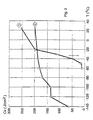
- the improvement of the properties of hot strips is also visible in the layout of the oligocyclic fatigue resistance curve, represented in the diagram Fig. 1.
- a strong improvement in the resistance to oligocyclic fatigue is indeed observed in favor of hot rolled steel according to the invention.
- This improvement is expressed by a relative decrease in resistance to 0.25% (R0.25) a lot less for the steel of the invention (14%) than for the reference steel HSLA (35%), also corresponding to a higher number of cycles (N) for the steel of the invention (45,000) as for HSLA steel (15,000).
- Fig. 2 shows the evolution of Charpy resilience (5 mm test pieces) as a function of the test temperature. Regarding the strength properties, the examination of the Table III and Fig. 2 shows the marked improvement observed in the case of steel laminated according to the process of the invention.
Landscapes
- Chemical & Material Sciences (AREA)
- Engineering & Computer Science (AREA)
- Materials Engineering (AREA)
- Mechanical Engineering (AREA)
- Metallurgy (AREA)
- Organic Chemistry (AREA)
- Physics & Mathematics (AREA)
- Thermal Sciences (AREA)
- Crystallography & Structural Chemistry (AREA)
- Heat Treatment Of Sheet Steel (AREA)
- Heat Treatment Of Steel (AREA)
Description
| Composition chimique des aciers (% poids) | ||||||
| N° | C | Mn | Si | Nb | Ti | Al |
| 1. HSLA | 0,07 | 0,75 | 0,011 | 0,060 | 0,035 | 0,025 |
| 2. Invention | 0,07 | 1,4 | 0,01 | 0,028 | 0 | 0,04 |
| Paramètres de fabrication des bandes | |||||
| N° | Epaisseur (mm) | Température d'entrée (°C) | Température de sortie (°C) | Vitesse moyenne de refroidissement (°C/s) | Température de bobinage (°C) |
| 1 | 4,5 | 1050 | 910 | 20 | 600 |
| 2 | 5,0 | 950 | 850 | 30 | 150 |
| Propriétés mécaniques des bandes | |||||
| N° | Re (MPa) | Rm (MPa) | Re/Rm | Allongement (%) | Cv à - 60°C (J/cm2) |
| 1 | 494 | 570 | 0.87 | 24 | 15 |
| 2 | 400 | 750 | 0.53 | 23 | 170 |
Claims (5)
- Procédé pour fabriquer une bande laminée à chaud en acier à haute résistance, dans lequel on lamine à chaud un acier dont les teneurs en carbone, en manganèse et en silicium sont comprises, en poids, entre 0,04 % et 0,2 %, entre 0,5 % et 2 %, et entre 0,010 % et 0,5 % respectivement, avec une température finale du laminage à chaud de finition supérieure à la température de transformation de l'austénite en ferrite (Ar3), caractérisé en ce que ledit acier contient en outre du niobium en une teneur comprise entre 0,01 % et 0,1 % en poids, le reste étant du fer et des impuretés habituelles, en ce que l'on effectue ledit laminage à chaud de finition avec une température initiale inférieure à 950°C et un taux de réduction d'épaisseur d'au moins 85 %, en ce que l'on refroidit ledit acier laminé à chaud dans un délai inférieur à 5 s avec une vitesse de refroidissement supérieure à 20°C/s jusqu'à une température inférieure à 200°C, et en ce que l'on bobine ledit acier laminé à chaud à ladite température inférieure à 200°C.
- Procédé suivant la revendication 1, caractérisé en ce que l'on effectue le refroidissement en une durée inférieure à 1 s.
- Procédé suivant l'une ou l'autre des revendications 1 et 2, caractérisé en ce que la vitesse de refroidissement de l'acier laminé à chaud est comprise entre 30°C/s et 1000°C/s.
- Procédé suivant l'une ou l'autre des revendications 1 à 3, caractérisé en ce que ledit refroidissement est effectué de manière continue et monotone jusqu'à ladite température inférieure à 200°C, dite température de bobinage.
- Procédé suivant l'une ou l'autre des revendications 1 à 4, caractérisé en ce que ladite température de bobinage est comprise entre 20°C et 150°C.
Applications Claiming Priority (3)
| Application Number | Priority Date | Filing Date | Title |
|---|---|---|---|
| BE9600324A BE1010142A6 (fr) | 1996-04-16 | 1996-04-16 | Procede pour la fabrication d'une bande laminee a chaud en acier a haute resistance. |
| BE9600324 | 1996-04-16 | ||
| PCT/BE1997/000020 WO1997039152A1 (fr) | 1996-04-16 | 1997-02-24 | Procede pour la fabrication d'une bande laminee a chaud en acier a haute resistance |
Publications (2)
| Publication Number | Publication Date |
|---|---|
| EP0894149A1 EP0894149A1 (fr) | 1999-02-03 |
| EP0894149B1 true EP0894149B1 (fr) | 2001-10-24 |
Family
ID=3889675
Family Applications (1)
| Application Number | Title | Priority Date | Filing Date |
|---|---|---|---|
| EP97903163A Revoked EP0894149B1 (fr) | 1996-04-16 | 1997-02-24 | Procede pour la fabrication d'une bande laminee a chaud en acier a haute resistance |
Country Status (4)
| Country | Link |
|---|---|
| EP (1) | EP0894149B1 (fr) |
| BE (1) | BE1010142A6 (fr) |
| DE (1) | DE69707660T2 (fr) |
| WO (1) | WO1997039152A1 (fr) |
Families Citing this family (5)
| Publication number | Priority date | Publication date | Assignee | Title |
|---|---|---|---|---|
| DE19911287C1 (de) | 1999-03-13 | 2000-08-31 | Thyssenkrupp Stahl Ag | Verfahren zum Erzeugen eines Warmbandes |
| JP3927384B2 (ja) * | 2001-02-23 | 2007-06-06 | 新日本製鐵株式会社 | 切り欠き疲労強度に優れる自動車用薄鋼板およびその製造方法 |
| ATE383452T1 (de) * | 2001-10-04 | 2008-01-15 | Nippon Steel Corp | Ziehbares hochfestes dünnes stahlblech mit hervorragender formfixierungseigenschaft und herstellungsverfahren dafür |
| DE102008010062A1 (de) * | 2007-06-22 | 2008-12-24 | Sms Demag Ag | Verfahren zum Warmwalzen und zur Wärmebehandlung eines Bandes aus Stahl |
| CN116875786B (zh) * | 2023-04-27 | 2025-08-15 | 唐山不锈钢有限责任公司 | Bj770钢带的生产方法及其制备直缝臂架钢管的方法 |
Family Cites Families (5)
| Publication number | Priority date | Publication date | Assignee | Title |
|---|---|---|---|---|
| US3102831A (en) * | 1960-08-10 | 1963-09-03 | Molybdenum Corp | Production of columbium containing steels |
| US3849209A (en) * | 1972-02-01 | 1974-11-19 | Nippon Steel Corp | Manufacturing method of high tension, high toughness steel |
| JPS5421917A (en) * | 1977-07-20 | 1979-02-19 | Nippon Kokan Kk <Nkk> | Method of manufacturing non-quenched high-tensile steel having high toughness |
| JPS5818410B2 (ja) * | 1977-12-06 | 1983-04-13 | 新日本製鐵株式会社 | 高延性低降伏比熱延高張力薄鋼板の製造方法 |
| AU527097B2 (en) * | 1979-01-12 | 1983-02-17 | Nippon Steel Corporation | Artifically aged low yield to tensile strength ratio high strength steel sheet |
-
1996
- 1996-04-16 BE BE9600324A patent/BE1010142A6/fr not_active IP Right Cessation
-
1997
- 1997-02-24 DE DE69707660T patent/DE69707660T2/de not_active Revoked
- 1997-02-24 WO PCT/BE1997/000020 patent/WO1997039152A1/fr not_active Ceased
- 1997-02-24 EP EP97903163A patent/EP0894149B1/fr not_active Revoked
Also Published As
| Publication number | Publication date |
|---|---|
| DE69707660D1 (de) | 2001-11-29 |
| EP0894149A1 (fr) | 1999-02-03 |
| BE1010142A6 (fr) | 1998-01-06 |
| WO1997039152A1 (fr) | 1997-10-23 |
| DE69707660T2 (de) | 2002-06-20 |
Similar Documents
| Publication | Publication Date | Title |
|---|---|---|
| EP1819461B1 (fr) | Procede de fabrication de toles d' acier austenitique , fer-carbone-manganese a tres hautes caracteristiques de resistance et excellente homogénéité. | |
| EP1913169B1 (fr) | Procede de fabrication de tôles d'acier presentant une haute resistance et une excellente ductilite, et tôles ainsi produites | |
| AU2005200300C1 (en) | High strength steel sheet and method for manufacturing same | |
| EP0851038B1 (fr) | Acier et procédé pour la fabrication d'une piéce en acier mise en forme par déformation plastique à froid | |
| FR2536765A1 (fr) | Procede de fabrication de plaques d'acier ayant une resistance elevee a la traction | |
| CA2686940A1 (fr) | Procede de fabrication de toles d'acier laminees a froid et recuites a tres haute resistance, et toles ainsi produites | |
| WO2013178887A1 (fr) | Acier laminé a chaud ou a froid a faible densite, son procede de mise en oeuvre et son utilisation | |
| WO2015177582A1 (fr) | Tôle d'acier doublement recuite à hautes caractéristiques mécaniques de résistance et ductilité, procédé de fabrication et utilisation de telles tôles | |
| WO2003025240A1 (fr) | Procede de fabrication de tubes roules et soudes comportant une etape finale d'etirage ou d'hydroformage et tube soude ainsi obtenu | |
| JPH07268461A (ja) | 面内異方性が小さいフェライト系ステンレス鋼帯の製造方法 | |
| EP1587963B1 (fr) | Acier laminé à chaud à très haute résistance et procédé de fabrication de bandes | |
| EP0747495B1 (fr) | Tôle d'acier laminée à chaud à haute résistance et haute emboutissabilité refermant du niobium, et ses procédés de fabrication | |
| EP0747496B1 (fr) | Tôle d'acier laminée à chaud à haute résistance et haute emboutissabilité renfermant du titane, et ses procédés de fabrication | |
| BE1010142A6 (fr) | Procede pour la fabrication d'une bande laminee a chaud en acier a haute resistance. | |
| EP1099769B1 (fr) | Procédé de réalisation d'une bande de tôle laminée à chaud à très haute résistance, utilisable pour la mise en forme et notamment pour l'emboutissage | |
| EP1138796B1 (fr) | Acier laminé à chaud à très haute limite d'élasticité et résistance mécanique utilisable notamment pour la réalisation de pièce de véhicules automobiles | |
| FR2833617A1 (fr) | Procede de fabrication de toles laminees a froid a tres haute resistance d'aciers dual phase micro-allies | |
| EP2257652B1 (fr) | Procede de fabrication de tôles d'acier inoxydable austenitique a hautes caracteristiques mecaniques, et tôles ainsi obtenues | |
| FR2477178A1 (fr) | Procede pour fabriquer des toles d'acier par laminage a chaud | |
| BE1010093A6 (fr) | Procede pour fabriquer une bande laminee a chaud en acier a haute resistance. | |
| JP2000309848A (ja) | 疲労特性に優れた加工用熱延鋼板およびその製造方法 | |
| EP0564309B1 (fr) | Procédé d'élaboration d'une tÔle d'acier et tÔle d'acier obtenue par ce procédé | |
| FR2748033A1 (fr) | Procede de realisation d'une bande de tole d'acier laminee a chaud a tres haute resistance utilisable pour la mise en forme et notamment pour l'emboutissage |
Legal Events
| Date | Code | Title | Description |
|---|---|---|---|
| PUAI | Public reference made under article 153(3) epc to a published international application that has entered the european phase |
Free format text: ORIGINAL CODE: 0009012 |
|
| 17P | Request for examination filed |
Effective date: 19981015 |
|
| AK | Designated contracting states |
Kind code of ref document: A1 Designated state(s): DE FR NL |
|
| 17Q | First examination report despatched |
Effective date: 19991129 |
|
| GRAG | Despatch of communication of intention to grant |
Free format text: ORIGINAL CODE: EPIDOS AGRA |
|
| GRAG | Despatch of communication of intention to grant |
Free format text: ORIGINAL CODE: EPIDOS AGRA |
|
| GRAH | Despatch of communication of intention to grant a patent |
Free format text: ORIGINAL CODE: EPIDOS IGRA |
|
| GRAH | Despatch of communication of intention to grant a patent |
Free format text: ORIGINAL CODE: EPIDOS IGRA |
|
| GRAA | (expected) grant |
Free format text: ORIGINAL CODE: 0009210 |
|
| AK | Designated contracting states |
Kind code of ref document: B1 Designated state(s): DE FR NL |
|
| REF | Corresponds to: |
Ref document number: 69707660 Country of ref document: DE Date of ref document: 20011129 |
|
| PLBQ | Unpublished change to opponent data |
Free format text: ORIGINAL CODE: EPIDOS OPPO |
|
| PLBI | Opposition filed |
Free format text: ORIGINAL CODE: 0009260 |
|
| PLBF | Reply of patent proprietor to notice(s) of opposition |
Free format text: ORIGINAL CODE: EPIDOS OBSO |
|
| 26 | Opposition filed |
Opponent name: THYSSEN KRUPP STAHL AG Effective date: 20020723 |
|
| PLBF | Reply of patent proprietor to notice(s) of opposition |
Free format text: ORIGINAL CODE: EPIDOS OBSO |
|
| NLR1 | Nl: opposition has been filed with the epo |
Opponent name: THYSSEN KRUPP STAHL AG |
|
| PLBF | Reply of patent proprietor to notice(s) of opposition |
Free format text: ORIGINAL CODE: EPIDOS OBSO |
|
| PGFP | Annual fee paid to national office [announced via postgrant information from national office to epo] |
Ref country code: DE Payment date: 20040212 Year of fee payment: 8 |
|
| PGFP | Annual fee paid to national office [announced via postgrant information from national office to epo] |
Ref country code: FR Payment date: 20040223 Year of fee payment: 8 |
|
| PGFP | Annual fee paid to national office [announced via postgrant information from national office to epo] |
Ref country code: NL Payment date: 20040227 Year of fee payment: 8 |
|
| RDAF | Communication despatched that patent is revoked |
Free format text: ORIGINAL CODE: EPIDOSNREV1 |
|
| RDAG | Patent revoked |
Free format text: ORIGINAL CODE: 0009271 |
|
| STAA | Information on the status of an ep patent application or granted ep patent |
Free format text: STATUS: PATENT REVOKED |
|
| 27W | Patent revoked |
Effective date: 20040302 |
|
| NLR2 | Nl: decision of opposition |
Effective date: 20040302 |