EP0892577B1 - Steuerung der Bandbreite einer dynamischen ATM-Verbindung - Google Patents
Steuerung der Bandbreite einer dynamischen ATM-Verbindung Download PDFInfo
- Publication number
- EP0892577B1 EP0892577B1 EP98305419A EP98305419A EP0892577B1 EP 0892577 B1 EP0892577 B1 EP 0892577B1 EP 98305419 A EP98305419 A EP 98305419A EP 98305419 A EP98305419 A EP 98305419A EP 0892577 B1 EP0892577 B1 EP 0892577B1
- Authority
- EP
- European Patent Office
- Prior art keywords
- elastic
- connections
- connection
- bandwidth
- processor
- Prior art date
- Legal status (The legal status is an assumption and is not a legal conclusion. Google has not performed a legal analysis and makes no representation as to the accuracy of the status listed.)
- Expired - Lifetime
Links
Images






Classifications
-
- H—ELECTRICITY
- H04—ELECTRIC COMMUNICATION TECHNIQUE
- H04L—TRANSMISSION OF DIGITAL INFORMATION, e.g. TELEGRAPHIC COMMUNICATION
- H04L12/00—Data switching networks
- H04L12/54—Store-and-forward switching systems
- H04L12/56—Packet switching systems
- H04L12/5601—Transfer mode dependent, e.g. ATM
- H04L12/5602—Bandwidth control in ATM Networks, e.g. leaky bucket
-
- H—ELECTRICITY
- H04—ELECTRIC COMMUNICATION TECHNIQUE
- H04Q—SELECTING
- H04Q11/00—Selecting arrangements for multiplex systems
- H04Q11/04—Selecting arrangements for multiplex systems for time-division multiplexing
- H04Q11/0428—Integrated services digital network, i.e. systems for transmission of different types of digitised signals, e.g. speech, data, telecentral, television signals
- H04Q11/0478—Provisions for broadband connections
-
- H—ELECTRICITY
- H04—ELECTRIC COMMUNICATION TECHNIQUE
- H04L—TRANSMISSION OF DIGITAL INFORMATION, e.g. TELEGRAPHIC COMMUNICATION
- H04L12/00—Data switching networks
- H04L12/54—Store-and-forward switching systems
- H04L12/56—Packet switching systems
- H04L12/5601—Transfer mode dependent, e.g. ATM
- H04L2012/5629—Admission control
- H04L2012/563—Signalling, e.g. protocols, reference model
-
- H—ELECTRICITY
- H04—ELECTRIC COMMUNICATION TECHNIQUE
- H04L—TRANSMISSION OF DIGITAL INFORMATION, e.g. TELEGRAPHIC COMMUNICATION
- H04L12/00—Data switching networks
- H04L12/54—Store-and-forward switching systems
- H04L12/56—Packet switching systems
- H04L12/5601—Transfer mode dependent, e.g. ATM
- H04L2012/5629—Admission control
- H04L2012/5631—Resource management and allocation
- H04L2012/5632—Bandwidth allocation
Definitions
- This invention relates to automatic control of ATM dynamic connection bandwidth in ATM interfaces and more particularly, inverse multiplexers.
- IMA Inverse multiplexing for ATM
- IMA interfaces are provided at each end of a link group.
- the cell stream received from the ATM layer is distributed on a cell by cell basis across the multiple links within the link group.
- the receiving IMA recombines the cells from each link on a cell by cell basis, reforming the original cell stream.
- the re-combined stream is then passed up to the ATM layer and processed in the conventional manner.
- IMA virtual link bandwidth may fluctuate resulting in a congested state where quality of service (QoS) guarantees (e.g. cell loss ratio) can no longer be met.
- QoS quality of service
- a dynamic bandwidth management mechanism would be desirable to ensure that quality of service guarantees are met at all times. With such a mechanism it would be possible to preserve ATM QoS guarantees, provide flexible bandwidth loss distribution, provide a predictable effect on ATM connections and make efficient use of the available bandwidth.
- a rate-Based Feedback Traffic Controlles for ATM Networks ATAI
- a ET AL already provides a method for reducing bandwidth loading in a communication interface having elastic and non-elastic call connections, by reducing the current cell rate of elastic connections.
- the present invention seeks to provide a mechanism for managing bandwidth loading on a communications interface.
- the method includes a step of releasing said non-elastic connections according to said release priority, when said bandwidth change amount is negative.
- the step of associating a release priority includes the step of prioritizing call connection records associated with respective said connections, said call connection records having at least one connection attribute field, said connection records being prioritized according to said at least one connection attribute field.
- the step of prioritizing includes the step of prioritizing call connection records having attribute fields including an enable/disable field, an ATM service category field, a bandwidth elastic field, a holding priority field, a connection type field, a vpi.vci field and a cell rate field, by applying the contents of each of said attribute fields to a hashing function to produce a first set of sorting indices for connection records associated with elastic connections and a second set of sorting indices for connection records associated with non-elastic connections.
- attribute fields including an enable/disable field, an ATM service category field, a bandwidth elastic field, a holding priority field, a connection type field, a vpi.vci field and a cell rate field.
- the method further includes the step of producing a first sorting index for connection records having a first group of attribute fields with common entries.
- the method further includes the step of producing a linked list of pointers to connection records associated with said first sorting index.
- the method further includes the step of producing at least a second sorting index associated with connection records having a group of attribute fields with common entries, said group being a sub group of said first group.
- the method further includes the step of producing at least a second linked list of pointers to connection records associated with said second sorting index.
- the method further includes the step of releasing connections according to the order of said linked list associated with connection records associated with said first sorting index.
- the method further includes the step of associating a disable code with released connection records.
- the method further includes the step of placing said disable code in said enable/disable field.
- the method further includes the step of identifying each of said non-elastic connections as static or dynamic and releasing at least some non-elastic connections identified as dynamic before releasing said non-elastic connections identified as static.
- the method further includes the steps of
- the method further includes the step of associating a release priority with each of said non-elastic connections.
- the method further includes the step of releasing said non-elastic connections according to an ascending order of said release priority.
- the method further includes the step of re-establishing said non-elastic connections according to a descending order of said release priority.
- the method further includes the step of identifying each of said non-elastic connections as static or dynamic and releasing at least some non-elastic connections identified as dynamic before releasing said non-elastic connections identified as static.
- the method further includes the step of re-establishing said non-elastic connections identified as static before re-establishing said non-elastic connections identified as dynamic.
- the step of re-establishing said non-elastic connections includes the step of re-establishing said non-elastic connections according to descending order of said indices and descending order of said link lists associated with said indices.
- a bandwidth change amount in a communications interface having elastic call connections and disabled non-elastic call connections, the elastic call connections having associated current cell rates comprising the steps of:
- the processor is programmed to associate a release priority with each of said non-elastic connections.
- the processor is programmed to release said non-elastic connections according to said release priority, when said bandwidth change amount is negative.
- the processor is programmed to prioritize call connection records associated with respective said connections, said call connection records having at least one connection attribute field, said connection records being prioritized according to said at least one connection attribute field.
- the processor is programmed to prioritize call connection records having attribute fields including an enable/disable field, an ATM service category field, a bandwidth elastic field, a holding priority field, a connection type field, a vpi.vci field and a cell rate field, by applying the contents of each of said attribute fields to a hashing function to produce a first set of sorting indices for connection records associated with elastic connections and a second set of sorting indices for connection records associated with non-elastic connections.
- attribute fields including an enable/disable field, an ATM service category field, a bandwidth elastic field, a holding priority field, a connection type field, a vpi.vci field and a cell rate field.
- the processor is programmed to produce a first sorting index for connection records having a first group of attribute fields with common entries.
- the processor is programmed to produce a linked list of pointers to connection records associated with said first sorting index.
- the processor is programmed to produce at least a second sorting index associated with connection records having a group of attribute fields with common entries, said group being a sub group of said first group.
- the processor is programmed to produce at least a second linked list of pointers to connection records associated with said second sorting index.
- the processor is programmed to release connections according to the order of said linked list associated with connection records associated with said first sorting index.
- the processor is programmed to associate a disable code with released connection records.
- the processor is programmed to place said disable code in said enable/disable field.
- the processor is programmed to identify each of said non-elastic connections as static or dynamic and release at least some non-elastic connections identified as dynamic before releasing said non-elastic connections identified as static.
- the processor is programmed to:
- the processor is programmed to associate a release priority with each of said non-elastic connections.
- the processor is programmed to release said non-elastic connections according to an ascending order of said release priority.
- the processor is programmed to re-establish said non-elastic connections according to a descending order of said release priority.
- the processor is programmed to identify each of said non-elastic connections as static or dynamic and release at least some non-elastic connections identified as dynamic before releasing said non-elastic connections identified as static.
- the processor is programmed to re-establish said non-elastic connections identified as static before re-establishing said non-elastic connections identified as dynamic.
- the processor is programmed to re-establish said non-elastic connections according to descending order of said indices and descending order of said link lists associated with said indices.
- an apparatus for increasing bandwidth loading by a bandwidth change amount in a communications interface having elastic call connections and disabled non-elastic call connections, the elastic call connections having associated current cell rates comprising:
- an apparatus for changing bandwidth loading by a bandwidth change amount in an asynchronous transfer mode (ATM) interface is shown generally at 10 .
- the apparatus includes an ATM switch 12 having an inverse multiplexer for ATM functional processor (IMAFP) card 14 , a control processor 17 , an operator terminal 18 and a display 20 .
- IMAFP ATM functional processor
- the switch includes a bus 32 connected to the bus interface 26 to facilitate communication between the ATM functional processor card 14 the control processor 16 the operator terminal 18 and the display 20 in the ATM switch 12 . It will be appreciated that there may be a plurality of IMAFP cards similar to card 14 , all connected to the same bus 32 for communication with the control processor 17 .
- the IMAFP card 14 includes a microprocessor 22 , a link interface 24 , a bus interface 26 , read only memory 28 and random access memory 30 .
- the link interface 24 is connected to a plurality, in this embodiment, 4 ATM communications links shown generally at 34 .
- the ATM communications links in this embodiment, are type E1 and each have a bit rate capacity of approximately 2 MB/sec. Thus, the total bandwidth available using all four links is 8 MB/sec.
- the IMAFP card is of the type used in a Nortel Passport ATM switch, available from Northern Telecom Limited of Montreal, Canada.
- connection pools each associated with a different connection type.
- CBR constant bit rate
- rt-VBR real time variable bit rate
- nrt-VBR non-real time variable bit rate
- the bandwidth provided field 48 is used to specify the percentage of bandwidth serviced by the IMAFP card, which is to be associated with the respective pool.
- constant bit rate (CBR type connections) are permitted to comprise up to 20 percent of the bandwidth or total bit rate of the IMAFP card.
- the pool available bandwidth field 52 is used to store a number representing the available bandwidth, calculated on the basis of the bandwidth provided and the total bit rate of the IMAFP card 14 .
- the pool available bandwidth is 1.6 MB/sec.
- the pool admitted bandwidth field 54 is used to store a number representing the bandwidth occupied by the call connections established at any given time.
- the pool admitted bandwidth is presently 0 and there are no CBR type connections established.
- the pool elastic bandwidth field 56 is used to store a number representing the bandwidth currently used by elastic call connections of the CBR type.
- the ATM interface may be said to have elastic and non-elastic all connections. In the present embodiment, it can be seen that there are no such connections as indicated by the 0 in this field.
- the operator has allocated 30 percent of the bandwidth provided to pool number 2 , of the rt-VBR type resulting in a total pool available bandwidth of 2.4 MB/sec.
- the operator has specified that call connections of the nrt-VBR type are to be associated with pool 3 and are to be allocated 50 percent of the bandwidth provided for a total available bandwidth of 4 MB/sec.
- the establishment of a connection at the IMAFP card 14 is done in response to receipt of a call set-up message, shown generally at 58.
- the call set-up message may be provided by the operator or may be received in an ATM communication at the ATM switch, and includes an ATM service category field 60 , a bandwidth elasticity field 62 , a holding priority field 64, a connection type field 66 , a vpi.vci field 68 and a traffic descriptor field 70 .
- the ATM service category defines the type of category as being CBR, rt-VBR or nrt-VBR.
- the bandwidth elasticity field 62 identifies whether or not the connection type is to be elastic. An elastic connection is one which can withstand a reduction in allocated bandwidth, without compromising service guarantees for the delivery of data.
- elastic connections are used to carry data which is not required to be transmitted at a specific bit rate.
- the holding priority field 64 carries a number from 0-4 representing the holding priority of the connection.
- the actual holding priority is inversely proportional to the number indicating the holding priority, ie., a connection having a holding priority of 4 has the least highest priority, while a connection having a holding priority of 0 has the highest holding priority.
- connection type field 66 identifies the connection type as being either dynamic or static.
- a dynamic connection is one which is established dynamically by the network in response to a set-up message received at the switch whereas a static connection is one which manually set-up by the operator.
- the vpi.vci field 68 includes a first number representing the virtual path identifier (vpi) and includes a second number representing the virtual channel identifier (vci) of the connection.
- the traffic descriptor field 70 includes values representing the peak cell rate, the sustainable cell rate and the maximum burst size.
- connection table/CBC tree algorithm shown generally at 72 is run by the IMAFP processor 22 shown in Figure 1 .
- the connection table/CBC tree algorithm begins with block 74 which directs the IMAFP processor 22 to apply certain fields of the set-up message to a hash function to produce an index value.
- the processor reads the ATM service category 60 , the bandwidth elasticity field 62 , the holding priority field 64 and the connection type field 66 and applies the contents of these fields to the hash function.
- the hash function produces an index number, in this example 1 , 2 , 3 or 4 , which effectively associates a release priority with each of the elastic and non-elastic connections in order of ATM service category bandwidth elasticity, holding priority and connection type.
- block 76 directs the processor to select a memory location in memory 30 , in which to store a connection table record associated with the call with the connection defined by the set-up message.
- pointers A-F are used where the letters identify addresses of respective blocks of memory locations of memory 30 , which are used to store respective connection records.
- Block 78 then directs the IMAFP processor 22 to produce and store a connection record produced from the set-up message 58 .
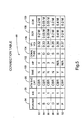
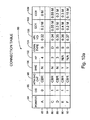
- connection table is shown generally at 80 , is maintained by the control processor 16 to store a plurality of connection records 82, 84 , 86 , 88, 90 and 92 .
- Each connection record includes a pointer field 94, an enable/disable field 96, an ATM service category field 98, a bandwidth elastic field 100, a holding priority field 102 , a connection type field 104 , a vpi.cpi field 106 , an effective cell rate field 108, and a current cell rate field 109 .
- the pointer field 94 for each record is loaded with a value produced at block 76 in the connection table/CBC tree algorithm shown in Figure 4 .
- the contents of the enable/disable field 96 are set to 1 or 0 , depending upon whether or not the connection is enabled or disabled. Initially, a particular connection is enabled when a set-up message is received, however, the connection may be disabled, or enabled, for example as a result of processing as to be described below.
- the ATM service category field 98 includes a value which is copied from the ATM service category field 60 of the set-up message 58 shown in Figure 4 .
- the bandwidth elastic field 100 holding priority field 102 , connection type field 104 and vpi.vci field 106 are loaded with copies of the contents in fields 62 , 64 , 66 and 68 , shown in Figure 4 , by the same names.
- the effective cell rate field 108 is loaded with a value calculated according to conventional methods, on the basis of the traffic descriptor information which includes the peak cell rate, the sustainable cell rate and the maximum burst size.
- the elastic and non-elastic connections have associated equivalent cell rates.
- the current cell rate field 109 is loaded with the current cell rate of the associated connection, as determined in the conventional manner of the associated connection, as determined in the conventional manner by the IMA functional processor.
- the elastic and non-elastic connections have associated current cell rates.
- the values indicated represent values which might be expected to be determined, before any algorithms according to this embodiment of the invention are executed,
- block 110 directs the IMAFP processor 22 to perform a linked list insertion.
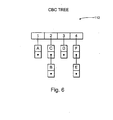
- this involves linking the pointer established at block 76 with the index produced at block 74, to produce a connection bandwidth control tree (CBC) as shown in Figure 6 .
- CBC connection bandwidth control tree
- each index identifies a particular type of connection that is each index is for connection records having a respective group of attribute fields with common entries, and associated with the index is stored an address of a connection record, in the connection table 80 shown in Figure 5 , which is the least desirable to maintain.
- the processor is programmed to produce a linked list of pointers to connection respective sorting indices.
- the desirability to maintain a connection within an index category is determined by the contents of the vpi.vci field 68 of the set-up message.
- the processor associates a release priority with each of the non-elastic and elastic connections through the index and the linking of the pointers under the index.
- the processor is programmed to prioritize call connection records associated with respective connections, the call connection records having at least one connection attribute field, in this embodiment, the vpi.vci field, and being prioritized according to the connection attribute field.
- a first set of sorting indices including index 4 associated with connection records associated with elastic connections and a second set of sorting indices including indices 1 , 2 and 3 is associated with connection records associated with non-elastic connections.
- the processor is programmed to prioritize call connection records having attribute fields including an enable/disable field, an ATM service category field, a bandwidth elastic field, a holding priority field, a connection type field, a vpi.vci field and a cell rate field, by applying the contents of each of the attribute fields to a hashing function to produce a first set of sorting indices for connection records associated with elastic connections and a second set of sorting indices for connection records associated with non-elastic connections.
- connection set-up message 58 when a connection set-up message 58 is received, a corresponding index and pointer are produced at blocks 74 and 76 in the algorithm shown in Figure 4 .
- a connection record is then produced and stored in the connection table, in no particular order.
- the purpose of the connection table is simply to maintain a record of the connections currently established on the IMAFP card.
- each index identifies a particular type of connection and associated with the index is stored an address of a connection record, in the connection table 80 shown in Figure 5 , which has the least priority to maintain.
- the priority to maintain a connection within an index category is determined by the contents of the vpi.vci field 68 of the set-up message.
- first and second sorting indices will be produced by the processor.
- First and second linked lists of pointers to records associated with each index will also be produced by the processor.
- connection table/CBC algorithm 72 further includes block 114 which directs the IMAFP processor 22 to update the pool parameters, shown in Figure 3 , each time a new set-up message is received.
- the pool available bandwidth is recalculated according to the equation shown generally at 116 which provides that the pool available bandwidth is equal to the current pool available bandwidth (PABW) less the equivalent cell rate (ECR) of the connection just admitted to the pool, ie., the connection corresponding to the record just added to the connection table.
- the pool admitted bandwidth is calculated according to equation 118 which calculates the new pool admitted bandwidth as the previous pool admitted bandwidth plus the equivalent cell rate of the connection just admitted.
- the pool elastic bandwidth is calculated according to equation 119 which calculates the new pool elastic bandwidth as the previous pool elastic bandwidth plus the equivalent cell rate of the connection, if the bandwidth elastic field 100 of the record indicates that the connection is bandwidth elastic.
- the contents of the pool available bandwidth field 52 , the pool admitted bandwidth field 54 and the pool elastic bandwidth field 56 are continually updated as new connections are added or taken away from the pool.
- pool parameters are updated whenever the bandwidth for a connection is changed.
- the contents of the pool admitted bandwidth field are updated whenever a non-elastic connection is released or re-admitted.
- the contents of the pool elastic bandwidth field are updated whenever the bandwidth of an elastic connection is reduced or increased.
- the link interface sends an IMA down-speed message to the IMAFP processor 22 .
- the IMA down-speed message includes an indication of the loss in bandwidth resulting from the lost link and, in this embodiment, with one link inoperative the loss, is 2 MB/sec.
- the processor executes code implementing a bandwidth loss distribution algorithm shown generally at 120 .
- This algorithm begins with block 122 which distributes the loss among the bandwidth pools and calculates the bandwidth loss amounts for each pool.
- the loss amounts or, bandwidth change amounts are 0.4 MB/sec, 0.6 MB/sec and 1.0 MB/sec, respectively.
- Block 124 then directs the IMAFP processor 22 to calculate the new pool available bandwidth values as a result of the loss in bandwidth.
- the new pool available bandwidth values are negative 0.4 , positive 1.8 and positive 3.0, respectively.
- block 124 directs the processor to determine new pool available bandwidth values reflecting bandwidth change amounts and whether such amounts are positive or negative, for each pool.
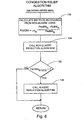
- Block 126 then directs the IMAFP processor 22 to determine whether or not any of the new pool available bandwidth values is less than 0 . If none are found to be less than 0 then the bandwidth loss algorithm is ended. If, however, at least one value is less than 0 , block 128 directs the processor to call the congestion relief algorithm. The congestion relief algorithm is called for each pool having a negative pool available bandwidth value. In this embodiment, only pool 1 has a negative pool available bandwidth value.
- block 132 After calculating the bandwidth to be recovered from the non-elastic connections in block 130 , block 132 calls the non-elastic reduction algorithm which directs the processor to release non-elastic connections according to the order of the linked list associated with connection records associated with the first sorting index.
- block 134 directs the IMAFP processor 22 to determine if the new pool available bandwidth is less than 0 , and if so, block 136 calls the elastic reduction algorithm which directs the processor to reduce the bandwidth of elastic connections.
- the congestion relief algorithm for a specific bandwidth pool is then ended and processing returns back to the bandwidth loss distribution algorithm 120 shown in Figure 7 .
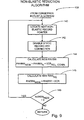
- the non-elastic reduction algorithm is shown generally at 138 .
- This algorithm includes a first block 140 which directs the IMAFP processor 22 to refer back to the CBC tree shown at 112 in Figure 6 and to locate the first address pointer under the first index. In this embodiment, address pointer A is located. The processor then uses the pointer to refer to the connection table shown in Figure 5 , to identify the connection associated pointer B.
- block 147 then directs the processor to set the enable/disable field 95 contents to disable.
- the processor is programmed to associate a disable code with released connection records by placing the disable code in the enable/disable field 95 .
- Block 146 then directs the processor to determine whether or not the RNEBW[n new] value is less than 0 . In other words, whether or not the remaining bandwidth to be recovered from non-elastic connections is less than 0 . If so, the non-elastic reduction algorithm is completed and processing returns to the congestion relief algorithm. If, on the other hand, the new pool available bandwidth is not less than 0 , the processor is directed to continue processing at block 140 where the next least desirable connection is released as described above. In this embodiment, address pointer B is located next by block 140. The processor uses pointer B to refer to the connection table 80 shown in Figure 5 to identify the connection records 84 and connection associated with pointer B.
- block 147 directs the processor to set the contents of the enable/disable filed 95 to 0 to disable hereby removing the connection associated with record 84.
- the processor is programmed to release the non-elastic connections according to the release priority when the bandwidth change amount is negative.
- the release priority is, of course, established by the CBC tree and because the hash function used in creating the CBC tree places non-elastic dynamic connections in positions of higher priority for release than non-elastic static connections, it may be said that the processor is programmed to identify each of the non-elastic connections as static or dynamic and to release at least some non-elastic connections identified as dynamic before releasing the non-elastic connections identified as static and of the same holding priority.
- the pool parameters shown in Figure 6a are updated to produce new pool available BW, pool admitted BW, and pool elastic BW values.
- the elastic reduction algorithm is shown generally at 150 .
- Block 154 then directs the processor to refer back to the CBC tree to get the first pointer associated with elastic connections.
- this pointer is pointer E.
- Block 156 further directs the processor to copy the new CCR value into field 109 of record 90 in Figure 10a, thereby reducing the current cell rate associated with the elastic connection.
- Block 158 then directs the processor to determine whether or not all pointers to records associated with elastic connections have been addressed and, if not, processing continues with block 152 which directs the processor to retrieve the next pointer associated with that elastic connection.
- that pointer is pointer F.
- the process of executing blocks 152 through 158 continues until the CCR values associated with respective elastic connections have been reduced, at which point the elastic reduction algorithm is completed and processing returns to the congestion relief algorithm shown in Figure 8 .
- the current cell rate of each elastic connection is reduced and non-elastic connections are released until the total of the current cell rates of the elastic connections and the equivalent cell rates of the non-elastic connections has been reduced by at least the bandwidth change amount.
- connection table 80 the contents of the connection table 80 are shown to reflect values expected after completion of the Elastic Reduction Algorithm of Figure 10 .
- connection table 80 the contents of the connection table 80 are shown to reflect values expected after completion of the Elastic Reduction Algorithm of Figure 10 .
- the contents of the pool parameters table are updated and take the values in Figure 10 b.
- the up-speed algorithm is shown generally at 160. This algorithm is invoked by the control processor in response to an IMA up-speed message.
- An IMA up-speed message is similar to the down-speed message described in connection with Figure 7 with the exception that the amount by which the bandwidth is to be increased is provided in the message.
- the IMAFP processor 22 interprets the IMA up-speed message as a request for an increase in bandwidth and, therefore, the bandwidth change amount is considered to be positive. Thus, the IMAFP processor 22 is able to determine whether or not the bandwidth change amount is positive or negative on the basis of the IMA Message it receives.
- the up-speed algorithm begins with block 162 which directs the IMAFP processor to distribute the gain among the bandwidth pools and calculates bandwidth gain amounts for each pool.
- block 166 directs the control processor to call the restore elastic connections algorithm.
- Block 168 then directs the processor to determine whether or not a gain value is less than or equal to 0 and, if so, the up-speed algorithm is ended. If not, then block 170 directs the processor to restore static connections after which the up-speed algorithm is completed.
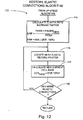
- the restore elastic connection algorithm is shown generally at 172 .
- Block 174 further directs the processor to use as the new elastic rate increase factor the minimum of the elastic rate increase factor or 100 percent, as more bandwidth than is required by the elastic connections can be recovered.
- Block 176 then directs the processor to refer back to the CBC tree to get the first pointer associated with elastic connections.
- this pointer is pointer E.
- Block 178 further directs the processor to copy the new CCR value into field 109 of record so, thereby increasing the current cell rate associated with the connection.
- Block 180 then directs the processor to determine whether or not all pointers to records associated with elastic connections have been addressed, and if not, processing continues with block 176 which directs the processor to retrieve the next pointer associated with an elastic connection.
- the next pointer is pointer F.
- the process of executing blocks 176 through 180 continues until the CCR values associated with respective elastic connections have been increased, at which point the restore elastic connection algorithm is completed and processing returns to the up-speed algorithm shown in Figure 11 .
- the bandwidth change amount is positive, the current cell rate of each elastic connection is increased.
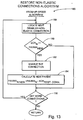
- the restore non-elastic connections algorithm is shown generally at 186 .
- This algorithm begins with block 188 which directs the IMAFP processor 22 to locate the next pointer of a non-elastic connection record in the CBC tree, having a disable code in the enable/disable field 96 .
- pointer A is located.
- pointer A is associated with record 82 .
- block 190 directs the processor to determine whether the pool available bandwidth is sufficient to allow the connection associated with record 82 to be enabled, and if not, to locate the pointer of the next non-elastic connection record. If the connection associated with record 82 can be re-enabled.
- Block 192 directs the processor to set the contents of the enable/disable field 96 of record 82 to enable, in order to re-enable the connection associated with the record.
- Block 196 directs the processor to determine if there are any more non-elastic connections, and if so processing continues with blocks 188 through 196 to re-establish at least some non-elastic connections until all non-elastic connections have been considered by the algorithm. Then the restore non-elastic connections algorithm is completed and processing returns to the up-speed algorithm shown in Figure 11 .
- an apparatus for changing bandwidth loading by a bandwidth change amount in a communications interface having elastic and non-elastic call connections where the elastic and non-elastic call connections have associated current cell rates and equivalent cell rates respectively.
- the apparatus includes a processor programmed to determine whether the bandwidth change amount is negative or positive. When the bandwidth change amount is negative the processor reduces the current cell rate of each elastic connection and releases at least some non-elastic connections such that the current cell rate of each elastic connection is reduced and the non-elastic connections are released until the total of the current cell rates of the elastic connections and the equivalent cell rates of the non-elastic connections have been reduced by at least the bandwidth change amount. When the bandwidth change amount is positive, the processor increase the current cell rate of each elastic connection and restores non-elastic connections.
Landscapes
- Engineering & Computer Science (AREA)
- Computer Networks & Wireless Communication (AREA)
- Signal Processing (AREA)
- Data Exchanges In Wide-Area Networks (AREA)
Claims (66)
- Verfahren zur Reduzierung der Bandbreiten-Belastung um einen Bandbreiten-Reduzierungsbetrag in einer Kommunikations-Schnittstelle, die elastische und nicht-elastische Anrufverbindungen hat, wobei die elastischen und nicht-elastischen Anrufverbindungen zugehörige derzeitige Zellenraten bzw. äquivalente Zellenraten haben und das Verfahren die folgenden Schritte umfasst:a) Reduzieren der derzeitigen Zellenrate jeder elastischen Verbindung; undb) Auslösen zumindest einiger nicht-elastischer Verbindungen,
wobei die derzeitige Zellenrate jeder elastischen Verbindung verringert und die nicht-elastischen Verbindungen ausgelöst werden, bis der Gesamtbetrag der derzeitigen Zellenraten der elastischen Verbindungen und die äquivalenten Zellenraten der nicht-elastischen Verbindungen um zumindest den Bandbreiten-Reduzierungsbetrag verringert wurden. - Verfahren nach Anspruch 1, das weiterhin den Schritt der Zuordnung einer Auslöse-Priorität zu jeder der nicht-elastischen Verbindungen und die Auslösung der nicht-elastischen Verbindungen entsprechend der Auslöse-Priorität einschließt.
- Verfahren nach Anspruch 2, bei dem der Schritt der Zuordnung einer Auslöse-Priorität den Schritt des Versehens von Anrufverbindungs-Aufzeichnungen, die jeweiligen dieser Verbindungen zugeordnet sind, mit Prioritäten einschließt, wobei die Anrufverbindungs-Aufzeichnungen zumindest ein Verbindungs-Attribut-Feld aufweisen und die Verbindungs-Aufzeichnungen entsprechend dem zumindest einen Verbindungs-Attribut-Feld mit einer Priorität versehen werden.
- Verfahren nach Anspruch 3, bei dem der Schritt des Versehens mit einer Priorität den Schritt des Versehens von Anrufverbindungs-Aufzeichnungen, die Attribut-Felder unter Einschluss eines Freigabe-/Sperr-Feldes, eines ATM-Dienstekategorie-Feldes, eines elastischen Bandbreiten-Feldes, eines Halte-Prioritäts-Feldes, eines Verbindungstyp-Feldes, eines vpi.vci-Feldes und eines Zellenraten-Feldes aufweisen, mit einer Priorität einschließt, indem die Inhalte jedes der Attribut-Felder auf eine Hash-Funktion angewandt werden, um einen ersten Satz von Sortier-Indizes für Verbindungs-Aufzeichnungen, die elastischen Verbindungen zugeordnet sind, und einen zweiten Satz von Sortier-Indizes für Verbindungs-Aufzeichnungen zu erzeugen, die nicht-elastischen Verbindungen zugeordnet sind.
- Verfahren nach Anspruch 4, das weiterhin den Schritt der Erzeugung eines ersten Sortier-Index für Verbindungs-Aufzeichnungen einschließt, die eine erste Gruppe von Attribut-Feldern mit gemeinsamen Einträgen haben.
- Verfahren nach Anspruch 5, das weiterhin den Schritt der Erzeugung einer verketteten Liste von Zeigern zu Verbindungs-Aufzeichnungen einschließt, die dem ersten Sortier-Index zugeordnet sind.
- Verfahren nach Anspruch 5, das weiterhin den Schritt der Erzeugung von zumindest einem zweiten Sortier-Index einschließt, der Verbindungs-Aufzeichnungen zugeordnet ist, die eine Gruppe von Attribut-Feldern mit gemeinsamen Einträgen haben, wobei die Gruppe eine Teilgruppe der ersten Gruppe ist.
- Verfahren nach Anspruch 7, das weiterhin den Schritt der Erzeugung von zumindest einer zweiten verketteten Liste von Zeigern auf Verbindungs-Aufzeichnungen einschließt, die dem zweiten Sortier-Index zugeordnet sind.
- Verfahren nach Anspruch 8, das weiterhin den Schritt des Auslösens von Verbindungen entsprechend der Reihenfolge der verketteten Liste einschließt, die Verbindungs-Aufzeichnungen zugeordnet sind, die dem ersten Sortier-Index zugeordnet sind.
- Verfahren nach Anspruch 9, das weiterhin den Schritt der Zuordnung eines Sperr-Codes zu ausgelösten Verbindungs-Aufzeichnungen einschließt.
- Verfahren nach Anspruch 10, das weiterhin den Schritt des Anordnens des Sperr-Codes in dem Freigabe-/Sperr-Feld einschließt.
- Verfahren nach Anspruch 1, das weiterhin den Schritt der Identifikation jeder der nicht-elastischen Verbindungen als statisch oder dynamisch und das Auslösen von zumindest einigen nicht-elastischen Verbindungen einschließt, die als dynamisch identifiziert sind, bevor die nicht-elastischen Verbindungen ausgelöst werden, die als statisch identifiziert sind.
- Verfahren nach Anspruch 1, das weiterhin die folgenden Schritte einschließt:a) Erzeugen eines elastischen Bandbreitenverlust-Wertes und eines nicht-elastischen Bandbreitenverlust-Wertes, die jeweilige komplementäre Proportionen des Bandbreiten-Reduzierungsbetrages darstellen;b) Reduzieren der derzeitigen Zellenrate jeder elastischen Verbindung um einen Betrag, der gleich dem Produkt des elastischen Bandbreitenverlust-Wertes und dem Verhältnis der derzeitigen Zellenrate jeder jeweiligen elastischen Verbindung zu der Summe der derzeitigen Zellenraten aller der elastischen Verbindungen ist; undc) Auslösen zumindest einiger nicht-elastischer Verbindungen, bis die Summe der äquivalenten Zellenraten jeder ausgelösten nicht-elastischen Verbindung zumindest angenähert gleich dem nicht-elastischen Bandbreitenverlust-Wert ist.
- Verfahren nach Anspruch 13, das weiterhin den Schritt der Zuordnung einer Auslöse-Priorität zu jeder der nicht-elastischen Verbindungen und die Auslösung der nicht-elastischen Verbindungen entsprechend der Auslöse-Priorität einschließt.
- Verfahren nach Anspruch 14, das weiterhin den Schritt der Identifikation jeder der nicht-elastischen Verbindungen als statisch oder dynamisch und des Auslösens von zumindest einigen nicht-elastischen Verbindungen einschließt, die als dynamisch identifiziert werden, bevor die nicht-elastischen Verbindungen ausgelöst werden, die als statisch identifiziert sind.
- Verfahren zur Änderung der Bandbreiten-Belastung um einen Bandbreiten-Änderungsbetrag in einer Kommunikations-Schnittstelle, die elastische und nicht-elastische Anrufverbindungen hat, wobei die elastischen und nicht-elastischen Anrufverbindungen zugehörige derzeitige Zellenraten bzw. äquivalente Zellenraten haben, wobei das Verfahren die folgenden Schritte umfasst:a) Bestimmen, ob der Bandbreiten-Änderungsbetrag negativ oder positiv ist;b) wenn der Bandbreiten-Änderungsbetrag negativ ist:i) Reduzieren der derzeitigen Zellenrate jeder elastischen Verbindung; undii) Auslösen zumindest einiger nicht-elastischer Verbindungen;wobei die derzeitige Zellenrate jeder elastischen Verbindung reduziert und die nicht-elastischen Verbindungen ausgelöst werden, bis der Gesamtbetrag der derzeitigen Zellenrate der elastischen Verbindungen und die äquivalenten Zellenraten der nicht-elastischen Verbindungen um zumindest den Bandbreiten-Änderungsbetrag verringert wurde; undc) wenn der Bandbreiten-Änderungsbetrag positiv ist:i) Vergrößern der derzeitigen Zellenrate jeder elastischen Verbindung.
- Verfahren nach Anspruch 16, das weiterhin den Schritt der Wiederherstellung zumindest einiger nicht-elastischer Verbindungen einschließt.
- Verfahren zur Vergrößerung der Bandbreiten-Belastung um einen Bandbreiten-Änderungsbetrag in einer Kommunikations-Schnittstelle, die elastische Anrufverbindungen und gesperrte nicht-elastische Anrufverbindungen hat, wobei den elastischen Anrufverbindungen derzeitige Zellenraten zugeordnet sind, wobei das Verfahren die folgenden Schritte umfasst:a) Vergrößern der derzeitigen Zellenrate jeder elastischen Verbindung; undb) Wiederherstellung von zumindest einigen gesperrten nicht-elastischen Verbindungen.
- Verfahren nach Anspruch 18, das weiterhin den Schritt der Zuordnung einer Auslöse-Priorität zu jeder der gesperrten nicht-elastischen Verbindungen einschließt.
- Verfahren nach Anspruch 19, das weiterhin den Schritt der Wiederherstellung der gesperrten nicht-elastischen Verbindungen entsprechend einer absteigenden Reihenfolge der Auslöse-Priorität einschließt.
- Verfahren nach Anspruch 19, bei dem der Schritt der Zuordnung einer Auslöse-Priorität den Schritt des Versehens von Anrufverbindungs-Aufzeichnungen, die jeweiligen der Verbindungen zugeordnet sind, mit einer Priorität einschließt, wobei die Anrufverbindungs-Aufzeichnungen zumindest ein Verbindungs-Attribut-Feld aufweisen, wobei die Verbihdungs-Aufzeichnungen entsprechend dem zumindest einen Verbindungs-Attribut-Feld mit einer Priorität versehen werden.
- Verfahren nach Anspruch 21, bei dem der Schritt des Versehens mit einer Priorität den Schritt des Versehens von Anrufverbindungs-Aufzeichnungen mit einer Priorität einschließt, die Attribut-Felder aufweisen, die ein Freigabe-/Sperr-Feld, ein ATM-Dienstekategorie-Feld, ein elastisches Bandbreiten-Feld, ein Halte-Prioritäts-Feld, ein Verbindungstyp-Feld, ein vpi.vci-Feld und ein Zellenraten-Feld einschließen, indem die Inhalte jedes der Attribut-Felder auf eine Hash-Funktion angewandt werden, um einen ersten Satz von Sortier-Indizes für Verbindungs-Aufzeichnungen, die elastischen Verbindungen zugeordnet sind, und einen zweiten Satz von Sortier-Indizes für Verbindungs-Aufzeichnungen zu erzeugen, die den gesperrten nicht-elastischen Verbindungen zugeordnet sind.
- Verfahren nach Anspruch 22, das weiterhin den Schritt der Erzeugung eines ersten Sortier-Index für Verbindungs-Aufzeichnungen einschließt, die eine erste Gruppe von Attribut-Feldern mit gemeinsamen Einträgen haben.
- Verfahren nach Anspruch 23, das weiterhin den Schritt der Erzeugung einer verketteten Liste von Zeigern auf Verbindungs-Aufzeichnungen einschließt, die dem ersten Sortier-Index zugeordnet sind.
- Verfahren nach Anspruch 23, das weiterhin den Schritt der Erzeugung von zumindest einem zweiten Sortier-Index einschließt, der Verbindungs-Aufzeichnungen zugeordnet ist, die eine Gruppe von Attribut-Feldern mit gemeinsamen Einträgen haben, wobei die Gruppen eine Teilgruppe der ersten Gruppe sind.
- Verfahren nach Anspruch 25, das weiterhin den Schritt der Erzeugung von zumindest einer zweiten verketteten Liste von Zeigern auf Verbindungs-Aufzeichnungen einschließt, die dem zweiten Sortier-Index zugeordnet sind.
- Verfahren nach Anspruch 26, das weiterhin den Schritt der Wiederherstellung von Verbindungen entsprechend einer absteigenden Reihenfolge der verketteten Liste einschließt, die Verbindungs-Aufzeichnungen zugeordnet ist, die dem zweiten Sortier-Index zugeordnet sind.
- Verfahren nach Anspruch 18, das weiterhin den Schritt der Identifikation jeder der gesperrten nicht-elastischen Verbindungen als statisch oder dynamisch und die Wiederherstellung von zumindest einigen der gesperrten nicht-elastischen Verbindungen, die als statisch identifiziert sind, vor der Wiederherstellung der gesperrten nicht-elastischen Verbindungen einschließt, die als dynamisch identifiziert sind.
- Verfahren nach Anspruch 18, das weiterhin die folgenden Schritte einschließt:a) Vergrößern der derzeitigen Zellenrate jeder elastischen Verbindung um einen Betrag, der gleich dem Minimum einer anfänglichen derzeitigen Zellenrate und dem Produkt des Bandbreiten-Änderungsbetrages und dem Verhältnis der anfänglichen derzeitigen Zellenrate dieser jeder jeweiligen elastischen Verbindung zu der Summe der anfänglichen derzeitigen Zellenraten aller der elastischen Verbindungen ist; undb) wenn der Bandbreiten-Änderungsbetrag größer als die Summe der anfänglichen derzeitigen Zellenraten aller elastischen Verbindungen ist, Wiederherstellen von zumindest einigen gesperrten nicht-elastischen Verbindungen, bis die Summe der äquivalenten Zellenraten jeder ausgelösten gesperrten nicht-elastischen Verbindung zumindest angenähert gleich einem Betrag ist, um den der Bandbreiten-Änderungsbetrag die Summe der anfänglichen derzeitigen Zellenraten aller der elastischen Verbindungen übersteigt.
- Verfahren nach Anspruch 29, das weiterhin den Schritt der Zuordnung einer Auslöse-Priorität zu jeder der gesperrten nicht-elastischen Verbindungen einschließt.
- Verfahren nach Anspruch 30, das weiterhin den Schritt der Wiederherstellung der gesperrten nicht-elastischen Verbindungen entsprechend einer absteigenden Reihenfolge der Auslöse-Priorität einschließt.
- Verfahren nach Anspruch 30, das weiterhin den Schritt der Identifikation jeder der gesperrten nicht-elastischen Verbindungen als statisch oder dynamisch und die Wiederherstellung zumindest einiger gesperrter nicht-elastischer Verbindungen, die als statisch identifiziert sind, vor der Wiederherstellung gesperrter nicht-elastischer Verbindungen einschließt, die als dynamisch identifiziert wurden.
- Verfahren nach Anspruch 26, bei dem der Schritt der Wiederherstellung der gesperrten nicht-elastischen Verbindungen den Schritt der Wiederherstellung der gesperrten nicht-elastischen Verbindungen entsprechend einer absteigenden Reihenfolge der Indizes und einer absteigenden Reihenfolge der verketteten Listen einschließt, die den Indizes zugeordnet sind.
- Vorrichtung zur Verringerung der Bandbreiten-Belastung durch einen Bandbreiten-Reduzierungsbetrag in einer Kommunikations-Schnittstelle, die elastische und nicht-elastische Anrufverbindungen hat, wobei die elastischen und nicht-elastischen Anrufverbindungen zugeordnete derzeitige Zellenraten bzw. äquivalente Zellenraten haben, wobei die Vorrichtung Folgendes umfasst:einen Prozessor, der so programmiert ist, dass er:a) die derzeitige Zellenrate jeder elastischen Verbindung reduziert; undb) zumindest einige der nicht-elastischen Verbindungen auslöst, wobei die derzeitige Zellenrate jeder elastischen Verbindung verringert und die nicht-elastischen Verbindungen ausgelöst werden, bis ein Gesamtbetrag der derzeitigen Zellenraten der elastischen Verbindungen und der äquivalenten Zellenraten der nicht-elastischen Verbindungen um zumindest den Bandbreiten-Reduzierungsbetrag verringert wurde.
- Vorrichtung nach Anspruch 34, bei der der Prozessor so programmiert ist, dass er jeder der nicht-elastischen Verbindungen eine Priorität zuordnet, und dass er die nicht-elastischen Verbindungen entsprechend der Auslöse-Priorität auslöst.
- Vorrichtung nach Anspruch 35, bei der der Prozessor so programmiert ist, dass er Anrufverbindungs-Aufzeichnungen, die jeweiligen der Verbindungen zugeordnet sind, mit einer Priorität versieht, wobei die Anrufverbindungs-Aufzeichnungen zumindest ein Verbindungs-Attribut-Feld haben, wobei die Verbindungsaufzeichnungen entsprechend dem zumindest einen Verbindungs-Attribut-Feld mit einer Priorität versehen werden.
- Vorrichtung nach Anspruch 36, bei der der Prozessor so programmiert ist, dass er Anrufverbindungs-Aufzeichnungen mit einer Priorität versieht, die Attribut-Felder haben, die ein Freigabe-/Sperr-Feld, ein ATM-Dienstekategorie-Feld, ein elastisches Bandbreiten-Feld, ein Halte-Prioritäts-Feld, ein Verbindungstyp-Feld, ein vpi.vci-Feld und ein Zellenraten-Feld einschließen, indem die Inhalte jedes der Attribut-Felder auf eine Hash-Funktion angewandt werden, um einen ersten Satz von Sörtier-Indizes für Verbindungs-Aufzeichnungen, die elastischen Verbindungen zugeordnet sind, und einen zweiten Satz von Sortier-Indizes für Verbindungs-Aufzeichnungen zu erzeugen, die nicht-elastischen Verbindungen zugeordnet sind.
- Vorrichtung nach Anspruch 37, bei der der Prozessor so programmiert ist, dass er einen ersten Sortier-Index für Verbindungs-Aufzeichnungen erzeugt, die eine erste Gruppe von Attribut-Feldem mit gemeinsamen Einträgen haben.
- Vorrichtung nach Anspruch 38, bei der der Prozessor so programmiert ist, dass er eine verkettete Liste von Zeigern auf Verbindungs-Aufzeichnungen erzeugt, die dem ersten Sortier-Index zugeordnet sind.
- Vorrichtung nach Anspruch 38, bei der der Prozessor so programmiert ist, dass er zumindest einen zweiten Sortier-Index erzeugt, der Verbindungs-Aufzeichnungen zugeordnet ist, die eine Gruppe von Attribut-Feldern mit gemeinsamen Einträgen haben.
- Vorrichtung nach Anspruch 40, bei der der Prozessor so programmiert ist, dass er zumindest eine zweite verkettete Liste von Zeigern auf Verbindungs-Aufzeichnungen erzeugt, die dem zweiten Sortier-Index zugeordnet sind.
- Vorrichtung nach Anspruch 41, bei der der Prozessor so programmiert ist, Verbindungen entsprechend der Reihenfolge der verketteten Liste auszulösen, die Verbindungs-Aufzeichnungen zugeordnet ist, die dem ersten Sortier-Index zugeordnet sind.
- Vorrichtung nach Anspruch 42, bei der der Prozessor so programmiert ist, dass er einen Sperr-Code zu ausgelösten Verbindungs-Aufzeichnungen zuordnet.
- Vorrichtung nach Anspruch 43, bei der der Prozessor so programmiert ist, dass er den Sperr-Code in das Freigabe-/Sperr-Feld einbringt.
- Vorrichtung nach Anspruch 44, bei der der Prozessor so programmiert ist, dass er jede der nicht-elastischen Verbindungen als statisch oder dynamisch identifiziert und zumindest einige nicht-elastische Verbindungen, die als dynamisch identifiziert sind, vor dem Auslösen der nicht-elastischen Verbindungen, die als statisch identifiziert sind, auslöst.
- Vorrichtung nach Anspruch 34, bei der der Prozessor so programmiert ist, dass er:a) einen elastischen Bandbreitenverlust-Wert und einen nicht-elastischen Bandbreitenverlust-Wert erzeugt, die jeweilige komplementäre Proportionen des Bandbreiten-Reduzierungsbetrages darstellen;b) die derzeitige Zellenrate jeder elastischen Verbindung um einen Betrag verringert, der gleich dem Produkt des elastischen Bandbreitenverlust-Wertes und des Verhältnisses der derzeitigen Zellenrate jeder jeweiligen elastischen Verbindung zu der Summe der derzeitigen Zellenraten aller der elastischen Verbindungen ist, reduziert; undc) zumindest einige nicht-elastische Verbindungen auslöst, bis die Summe der äquivalenten Zellenraten jeder ausgelösten nicht-elastischen Verbindung zumindest angenähert gleich dem nicht-elastischen Bandbreitenverlust-Wert ist.
- Vorrichtung nach Anspruch 46, bei der der Prozessor so programmiert ist, dass er eine Auslöse-Priorität zu jeder der nicht-elastischen Verbindungen zuordnet, und dass er die nicht-elastischen Verbindungen entsprechend der Auslöse-Priorität auslöst.
- Vorrichtung nach Anspruch 47, bei der der Prozessor so programmiert ist, dass er jede der nicht-elastischen Verbindungen als statisch oder dynamisch identifiziert, um zumindest einige nicht-elastische Verbindungen, die als dynamisch identifiziert sind, vor dem Auslösen der nicht-elastischen Verbindungen auslöst, die als statisch identifiziert sind.
- Vorrichtung zum Ändern der Bandbreiten-Belastung um einen Bandbreiten-Änderungsbetrag in einer Kommunikations-Schnittstelle, die elastische und nicht-elastische Anrufverbindungen hat, wobei die elastischen und nicht-elastischen Anrufverbindungen zugehörige derzeitige Zellenraten bzw. äquivalente Zellenraten haben, wobei die Vorrichtung Folgendes umfasst:einen Prozessor, der so programmiert ist, dass er:a) feststellt, ob der Bandbreiten-Änderungsbetrag negativ oder positiv ist;b) wenn der Bandbreiten-Änderungsbetrag negativ ist:i) die derzeitige Zellenrate jeder elastischen Verbindung reduziert; undii) zumindest einige nicht-elastische Verbindungen auslöst, wobei die derzeitige Zellenrate jeder elastischen Verbindung reduziert und die nicht-elastischen Verbindungen ausgelöst werden, bis der Gesamtbetrag der derzeitigen Zellenraten der elastischen Verbindungen und der äquivalenten Zellenraten der nicht-elastischen Verbindungen um zumindest den Bandbreiten-Änderungsbetrag reduziert wurde; undc) wenn der Bandbreiten-Änderungsbetrag positiv ist:i) die derzeitige Zellenrate jeder elastischen Verbindung vergrößert.
- Vorrichtung nach Anspruch 49, bei der der Prozessor so programmiert ist, dass er zumindest einige der nicht-elastischen Verbindungen wiederherstellt.
- Vorrichtung zur Vergrößerung der Bandbreiten-Belastung um einen Bandbreiten-Änderungsbetrag in einer Kommunikations-Schnittstelle, die elastische Anrufverbindungen und gesperrte nicht-elastische Anrufverbindungen hat, wobei die elastischen Anrufverbindungen zugehörige derzeitige Zellenraten haben, wobei die Vorrichtung Folgendes umfasst:einen Prozessor, der so programmiert ist, dass er:a) die derzeitige Zellenrate jeder elastischen Verbindung vergrößert; undb) zumindest einige gesperrte nicht-elastische Verbindungen wiederherstellt.
- Vorrichtung nach Anspruch 51, bei der der Prozessor so programmiert ist, dass er jeder der gesperrten nicht-elastischen Verbindungen eine Auslöse-Priorität zuordnet.
- Vorrichtung nach Anspruch 52, bei der der Prozessor so programmiert ist, dass er die gesperrten nicht-elastischen Verbindungen entsprechend einer absteigenden Reihenfolge der Auslöse-Priorität wiederherstellt.
- Vorrichtung nach Anspruch 52, bei der der Prozessor so programmiert ist, dass er Anrufverbindungs-Aufzeichnungen, die jeweiligen der Verbindungen zugeordnet sind, mit einer Priorität versieht, wobei die Anrufverbindungs-Aufzeichnungen zumindest ein Verbindungs-Attribut-Feld haben, wobei die Verbindungs-Aufzeichnungen entsprechend dem zumindest einen Verbindungs-Attribut-Feld mit einer Priorität versehen werden.
- Vorrichtung nach Anspruch 54, bei der der Prozessor so programmiert ist, dass er Anrufverbindungs-Aufzeichnungen mit einer Priorität versieht, die Attribut-Felder haben, die ein Freigabe-/Sperr-Feld, ein ATM-Dienstekategorie-Feld, ein elastisches Bandbreiten-Feld, ein Halte-Prioritäts-Feld, ein Verbindungstyp-Feld, ein vpi.vci-Feld und ein Zellenraten-Feld einschließen, indem er die Inhalte jedes der Attribut-Felder auf eine Hash-Funktion anwendet, um einen ersten Satz von Sortier-Indizes für Verbindungs-Aufzeichnungen, die elastischen Verbindungen zugeordnet sind, und einen zweiten Satz von Sortier-Indizes für Verbindungs-Aufzeichnungen erzeugt, die den gesperrten nicht-elastischen Verbindungen zugeordnet sind.
- Vorrichtung nach Anspruch 55, bei der der Prozessor so programmiert ist, dass er einen ersten Sortier-Index für Verbindungs-Aufzeichnungen erzeugt, die eine erste Gruppe von Attribut-Feldern mit gemeinsamen Einträgen haben.
- Vorrichtung nach Anspruch 56, bei der der Prozessor so programmiert ist, dass er eine verkettete Liste von Zeigern auf Verbindungs-Aufzeichnungen erzeugt, die dem ersten Sortier-Index zugeordnet sind.
- Vorrichtung nach Anspruch 56, bei der der Prozessor so programmiert ist, dass er zumindest einen zweiten Sortier-Index erzeugt, der Verbindungs-Aufzeichnungen zugeordnet ist, die eine Gruppe von Attribut-Feldern mit gemeinsamen Einträgen haben.
- Vorrichtung nach Anspruch 56, bei der der Prozessor so programmiert ist, dass er zumindest eine zweite verkettete Liste von Zeigern auf Verbindungs-Aufzeichnungen erzeugt, die dem zweiten Sortier-Index zugeordnet sind.
- Vorrichtung nach Anspruch 59, bei der der Prozessor so programmiert ist, dass er Verbindungen entsprechend einer absteigenden Reihenfolge der verketteten Liste wiederherstellt, die den Verbindungs-Aufzeichnungen zugeordnet sind, die dem zweiten Sortier-Index zugeordnet sind.
- Vorrichtung nach Anspruch 51, bei der der Prozessor so programmiert ist, dass er jede der gesperrten nicht-elastischen Verbindungen als statisch oder dynamisch identifiziert und zumindest einige gesperrte nicht-elastische Verbindungen, die als statisch identifiziert sind, vor der Wiederherstellung der gesperrten nicht-elastischen Verbindungen wiederherstellt, die als dynamisch identifiziert sind.
- Vorrichtung nach Anspruch 51, bei der der Prozessor so programmiert ist, dass er:a) eine derzeitige Zellenrate jeder elastischen Verbindung um einen Betrag vergrößert, der gleich dem Minimum einer anfänglichen derzeitigen Zellenrate und dem Produkt des Bandbreiten-Änderungsbetrages und des Verhältnisses der anfänglichen derzeitigen Zellenrate dieser jeden jeweiligen elastischen Verbindung zur Summe der anfänglichen derzeitigen Zellenraten aller der elastischen Verbindungen ist; undb) wenn der Bandbreiten-Änderungsbetrag größer als die Summe der anfänglichen derzeitigen Zellenraten aller elastischen Verbindungen ist, zumindest einige gesperrte nicht-elastische Verbindungen wiederherstellt, bis die Summe der äquivalenten Zellenraten von jeder ausgelösten gesperrten nicht-elastischen Verbindung zumindest angenähert gleich einem Betrag ist, um den der Bandbreiten-Änderungsbetrag die Summe der anfänglichen derzeitigen Zellenraten aller der elastischen Verbindungen übersteigt.
- Vorrichtung nach Anspruch 62, bei der der Prozessor so programmiert ist, dass er eine Auslöse-Priorität zu jeder der gesperrten nicht-elastischen Verbindungen zuordnet.
- Vorrichtung nach Anspruch 63, bei der der Prozessor so programmiert ist, dass er die gesperrten nicht-elastischen Verbindungen entsprechend einer absteigenden Reihenfolge der Auslöse-Priorität wiederherstellt.
- Vorrichtung nach Anspruch 63, bei der der Prozessor so programmiert ist, dass er jede der gesperrten nicht-elastischen Verbindungen als statisch oder dynamisch identifiziert und zumindest einige gesperrte nicht elastische Verbindungen, die als statisch identifiziert sind, vor der Wiederherstellung gesperrter nicht-elastischer Verbindungen wiederherstellt, die als dynamisch identifiziert sind.
- Vorrichtung nach Anspruch 59, bei der der Prozessor so programmiert ist, dass er die gesperrten nicht-elastischen Verbindungen entsprechend einer absteigenden Reihenfolge der Indizes und der absteigenden Reihenfolge der verketteten Listen wiederherstellt, die den Indizes zugeordnet sind.
Applications Claiming Priority (2)
| Application Number | Priority Date | Filing Date | Title |
|---|---|---|---|
| US08/895,261 US6128280A (en) | 1997-07-16 | 1997-07-16 | Dynamic connection bandwidth control |
| US895261 | 1997-07-16 |
Publications (3)
| Publication Number | Publication Date |
|---|---|
| EP0892577A2 EP0892577A2 (de) | 1999-01-20 |
| EP0892577A3 EP0892577A3 (de) | 2001-05-09 |
| EP0892577B1 true EP0892577B1 (de) | 2007-08-22 |
Family
ID=25404231
Family Applications (1)
| Application Number | Title | Priority Date | Filing Date |
|---|---|---|---|
| EP98305419A Expired - Lifetime EP0892577B1 (de) | 1997-07-16 | 1998-07-08 | Steuerung der Bandbreite einer dynamischen ATM-Verbindung |
Country Status (6)
| Country | Link |
|---|---|
| US (1) | US6128280A (de) |
| EP (1) | EP0892577B1 (de) |
| JP (1) | JPH1174908A (de) |
| AT (1) | ATE371352T1 (de) |
| CA (1) | CA2240472C (de) |
| DE (1) | DE69838274T2 (de) |
Families Citing this family (33)
| Publication number | Priority date | Publication date | Assignee | Title |
|---|---|---|---|---|
| CA2223118A1 (en) * | 1997-11-28 | 1999-05-28 | Newbridge Networks Corporation | Virtual path level fairness |
| US6665271B1 (en) * | 1998-03-17 | 2003-12-16 | Transnexus, Llc | System for real-time prediction of quality for internet-based multimedia communications |
| US6631118B1 (en) * | 1998-11-10 | 2003-10-07 | At&T Corp. | System and method for providing dynamic bandwidth on demand |
| US6229795B1 (en) * | 1999-01-13 | 2001-05-08 | Qualcomm Incorporated | System for allocating resources in a communication system |
| US7406098B2 (en) * | 1999-01-13 | 2008-07-29 | Qualcomm Incorporated | Resource allocation in a communication system supporting application flows having quality of service requirements |
| US6222858B1 (en) * | 1999-02-10 | 2001-04-24 | Verizon Laboratories Inc. | Method of inverse multiplexing for ATM |
| US7200110B1 (en) * | 1999-03-24 | 2007-04-03 | Alcatel Canada Inc. | Method and apparatus for prioritized release of connections in a communications network |
| US7444407B2 (en) * | 2000-06-29 | 2008-10-28 | Transnexus, Inc. | Intelligent end user devices for clearinghouse services in an internet telephony system |
| US6535485B1 (en) * | 1999-10-01 | 2003-03-18 | Telcordia Technologies, Inc. | Methods and systems for an improved reliability packet network |
| US6947388B1 (en) * | 1999-10-20 | 2005-09-20 | International Business Machines Corporation | Method and system for a real-time bandwidth allocation scheduler for media delivery |
| WO2001047232A2 (en) | 1999-12-22 | 2001-06-28 | Transnexus, Inc. | Secure enrollment of a device with a clearinghouse server for internet telephony system |
| US7017050B2 (en) | 2000-09-11 | 2006-03-21 | Transnexus, Inc. | Clearinghouse server for internet telephony and multimedia communications |
| US7525956B2 (en) * | 2001-01-11 | 2009-04-28 | Transnexus, Inc. | Architectures for clearing and settlement services between internet telephony clearinghouses |
| US7110525B1 (en) * | 2001-06-25 | 2006-09-19 | Toby Heller | Agent training sensitive call routing system |
| US7263063B2 (en) * | 2001-07-06 | 2007-08-28 | Sri International | Per hop behavior for differentiated services in mobile ad hoc wireless networks |
| CA2665714C (en) | 2001-09-10 | 2014-06-17 | Nippon Telegraph And Telephone Corporation | Dynamic bandwidth allocation circuit, dynamic bandwidth allocation method, optical network unit, pon system, and dynamic bandwidth allocation program and recording medium |
| US7453801B2 (en) * | 2001-11-08 | 2008-11-18 | Qualcomm Incorporated | Admission control and resource allocation in a communication system supporting application flows having quality of service requirements |
| EP1449394A2 (de) * | 2001-11-26 | 2004-08-25 | Nokia Corporation | Verfahren und vorrichtung zur bereitstellung eines schnellen transportdienstes in einer aal2-umgebung in einem funkzugriffsnetzwerk |
| KR100415114B1 (ko) * | 2001-11-28 | 2004-01-13 | 삼성전자주식회사 | 음성 및 데이타 서비스를 지원하는 비동기전송모드 네트워크의 음성 다중화 장치 및 방법 |
| US20030152112A1 (en) * | 2002-01-30 | 2003-08-14 | Spediant Systems Ltd. | Inverse multiplexing via disparate links |
| US7372952B1 (en) | 2002-03-07 | 2008-05-13 | Wai Wu | Telephony control system with intelligent call routing |
| US9818136B1 (en) | 2003-02-05 | 2017-11-14 | Steven M. Hoffberg | System and method for determining contingent relevance |
| US7602726B1 (en) * | 2003-08-11 | 2009-10-13 | Cisco Technology, Inc. | Method and system for optimizing link aggregation usage during failures |
| EP1545071B1 (de) * | 2003-12-19 | 2009-07-08 | Alcatel, Lucent | Verfahren zur verbesserten Behandlung von dynamischen Bandbreitenveränderungen in einem Transportnetz mit inversem Multiplexen |
| US6929507B2 (en) * | 2003-12-30 | 2005-08-16 | Huang Liang Precision Enterprise Co., Ltd. | Coaxial connector structure |
| US7743263B2 (en) | 2004-03-11 | 2010-06-22 | Transnexus, Inc. | Method and system for routing calls over a packet switched computer network |
| US7369505B2 (en) * | 2004-06-07 | 2008-05-06 | Ebay Inc. | Method and system to efficiently manage network connection to connect a client and a resource |
| US20050286568A1 (en) * | 2004-06-29 | 2005-12-29 | Canning Hsueh | Method and apparatus to display network information of an inverse multiplexed asynchronous transfer mode network |
| US7443792B2 (en) * | 2004-08-27 | 2008-10-28 | Cisco Technology, Inc. | Method and system for selecting connections to bump based on priority in a network |
| US8238329B2 (en) | 2005-12-13 | 2012-08-07 | Transnexus, Inc. | Method and system for securely authorizing VoIP interconnections between anonymous peers of VoIP networks |
| WO2006065789A2 (en) * | 2004-12-13 | 2006-06-22 | Transnexus, Inc. | Method and system for securely authorizing anonymous peers of voip networks |
| US9414401B2 (en) | 2008-12-15 | 2016-08-09 | At&T Intellectual Property I, L.P. | Opportunistic service management for elastic applications |
| US8661118B2 (en) | 2010-03-08 | 2014-02-25 | Microsoft Corporation | Detection of end-to-end transport quality |
Family Cites Families (12)
| Publication number | Priority date | Publication date | Assignee | Title |
|---|---|---|---|---|
| US5442630A (en) * | 1991-05-24 | 1995-08-15 | Gagliardi; Ugo O. | ISDN interfacing of local area networks |
| US5274644A (en) * | 1991-11-05 | 1993-12-28 | At&T Bell Laboratories | Efficient, rate-base multiclass access control |
| US5355374A (en) * | 1992-05-08 | 1994-10-11 | Scientific-Atlanta, Inc. | Communication network with divisible auxilliary channel allocation |
| US5452330A (en) * | 1992-07-06 | 1995-09-19 | Digital Equipment Corporation | Bus-oriented switching system for asynchronous transfer mode |
| JPH0646082A (ja) * | 1992-07-22 | 1994-02-18 | Toshiba Corp | 情報転送制御方式 |
| JPH0744542B2 (ja) * | 1993-01-11 | 1995-05-15 | 日本電気株式会社 | 非同期転送モードにおける仮想パスの帯域割当方式 |
| US5574861A (en) * | 1993-12-21 | 1996-11-12 | Lorvig; Don | Dynamic allocation of B-channels in ISDN |
| US5491691A (en) * | 1994-08-16 | 1996-02-13 | Motorola, Inc. | Method and apparatus for pacing asynchronous transfer mode (ATM) data cell transmission |
| JPH08204723A (ja) * | 1995-01-30 | 1996-08-09 | Fujitsu Ltd | Atm網のclad装置 |
| US5590127A (en) * | 1995-05-26 | 1996-12-31 | Lucent Technologies Inc. | Multimedia conference call providing adjustable bandwidth for individual communication terminals |
| US5574724A (en) * | 1995-05-26 | 1996-11-12 | Lucent Technologies Inc. | Adjustment of call bandwidth during a communication call |
| US5796724A (en) * | 1995-12-28 | 1998-08-18 | Intel Corporation | Method and apparatus for partitioning transmission bandwidth among different data streams |
-
1997
- 1997-07-16 US US08/895,261 patent/US6128280A/en not_active Expired - Lifetime
-
1998
- 1998-06-12 CA CA002240472A patent/CA2240472C/en not_active Expired - Lifetime
- 1998-07-08 AT AT98305419T patent/ATE371352T1/de not_active IP Right Cessation
- 1998-07-08 DE DE69838274T patent/DE69838274T2/de not_active Expired - Fee Related
- 1998-07-08 EP EP98305419A patent/EP0892577B1/de not_active Expired - Lifetime
- 1998-07-15 JP JP19990698A patent/JPH1174908A/ja active Pending
Also Published As
| Publication number | Publication date |
|---|---|
| DE69838274T2 (de) | 2008-01-03 |
| US6128280A (en) | 2000-10-03 |
| JPH1174908A (ja) | 1999-03-16 |
| EP0892577A3 (de) | 2001-05-09 |
| CA2240472A1 (en) | 1999-01-16 |
| ATE371352T1 (de) | 2007-09-15 |
| CA2240472C (en) | 2004-05-25 |
| EP0892577A2 (de) | 1999-01-20 |
| DE69838274D1 (de) | 2007-10-04 |
Similar Documents
| Publication | Publication Date | Title |
|---|---|---|
| EP0892577B1 (de) | Steuerung der Bandbreite einer dynamischen ATM-Verbindung | |
| US5822540A (en) | Method and apparatus for discarding frames in a communications device | |
| DE69727936T2 (de) | Verfahren und vorrichtung zur wiederzusammensetzung von paketen in eine nachricht, in einem atm-kommunikationssystem | |
| JP3359499B2 (ja) | 送出トラヒック制御装置 | |
| JPH06209329A (ja) | 非同期転送モードにおける仮想パスの帯域割当方式 | |
| JP2000013385A (ja) | セルブリッジ装置及びセルブリッジ方法並びにセルブリッジ装置を有する情報伝送システム | |
| US5963553A (en) | Handling ATM multicast cells | |
| WO1997039555A1 (en) | A method and a network element for transferring data packets in a teletransmission network | |
| EP0818098B1 (de) | Verfahren zur abweisung von zellen an einem überlasteten knotenpuffer | |
| US6542509B1 (en) | Virtual path level fairness | |
| EP0481447A2 (de) | Verfahren zur Steuerung eines Kommunikationsnetzes mit Knoten zur Vermittlung von virtuellen Kanälen und Knoten zur Vermittlung von virtuellen Wegen | |
| US5802049A (en) | Method of selecting route in cell switch | |
| JP3085515B2 (ja) | 帯域可変通信装置 | |
| JP2832591B2 (ja) | 一斉通知型輻輳制御方式 | |
| JP3382517B2 (ja) | 優先制御回路 | |
| CA2296688C (en) | Method for optimizing the load level on connecting sections for vbr traffic | |
| JPH11508735A (ja) | 輻輳回避 | |
| JP3159961B2 (ja) | セル受信側装置及びトラヒック制御システム | |
| JPH11136252A (ja) | Atmスイッチ及びシェーピング方法 | |
| JP2780513B2 (ja) | バッファー容量設計方法 | |
| JP3327446B2 (ja) | Atm通信網 | |
| JP2954091B2 (ja) | Atmトラフィック制御方式 | |
| JP2939668B2 (ja) | Atmネットワークにおけるセル廃棄制御方式 | |
| JP3090308B2 (ja) | Atm交換機 | |
| KR0151920B1 (ko) | 에이비알 서비스를 위한 에이티엠 단위 스위치의 제어방법 |
Legal Events
| Date | Code | Title | Description |
|---|---|---|---|
| PUAI | Public reference made under article 153(3) epc to a published international application that has entered the european phase |
Free format text: ORIGINAL CODE: 0009012 |
|
| AK | Designated contracting states |
Kind code of ref document: A2 Designated state(s): AT DE FR GB IT NL SE |
|
| AX | Request for extension of the european patent |
Free format text: AL;LT;LV;MK;RO;SI |
|
| RAP3 | Party data changed (applicant data changed or rights of an application transferred) |
Owner name: NORTEL NETWORKS CORPORATION |
|
| RAP1 | Party data changed (applicant data changed or rights of an application transferred) |
Owner name: NORTEL NETWORKS LIMITED |
|
| PUAL | Search report despatched |
Free format text: ORIGINAL CODE: 0009013 |
|
| AK | Designated contracting states |
Kind code of ref document: A3 Designated state(s): AT BE CH CY DE DK ES FI FR GB GR IE IT LI LU MC NL PT SE |
|
| AX | Request for extension of the european patent |
Free format text: AL;LT;LV;MK;RO;SI |
|
| 17P | Request for examination filed |
Effective date: 20011017 |
|
| AKX | Designation fees paid |
Free format text: AT BE DE FR GB IE IT |
|
| RBV | Designated contracting states (corrected) |
Designated state(s): AT DE FR GB IT NL SE |
|
| RAP1 | Party data changed (applicant data changed or rights of an application transferred) |
Owner name: NORTEL NETWORKS LIMITED |
|
| 17Q | First examination report despatched |
Effective date: 20041214 |
|
| GRAP | Despatch of communication of intention to grant a patent |
Free format text: ORIGINAL CODE: EPIDOSNIGR1 |
|
| GRAS | Grant fee paid |
Free format text: ORIGINAL CODE: EPIDOSNIGR3 |
|
| GRAA | (expected) grant |
Free format text: ORIGINAL CODE: 0009210 |
|
| AK | Designated contracting states |
Kind code of ref document: B1 Designated state(s): AT DE FR GB IT NL SE |
|
| REG | Reference to a national code |
Ref country code: GB Ref legal event code: FG4D |
|
| REG | Reference to a national code |
Ref country code: SE Ref legal event code: TRGR |
|
| REF | Corresponds to: |
Ref document number: 69838274 Country of ref document: DE Date of ref document: 20071004 Kind code of ref document: P |
|
| ET | Fr: translation filed | ||
| PLBE | No opposition filed within time limit |
Free format text: ORIGINAL CODE: 0009261 |
|
| STAA | Information on the status of an ep patent application or granted ep patent |
Free format text: STATUS: NO OPPOSITION FILED WITHIN TIME LIMIT |
|
| 26N | No opposition filed |
Effective date: 20080526 |
|
| EUG | Se: european patent has lapsed | ||
| GBPC | Gb: european patent ceased through non-payment of renewal fee |
Effective date: 20080708 |
|
| NLV4 | Nl: lapsed or anulled due to non-payment of the annual fee |
Effective date: 20090201 |
|
| PG25 | Lapsed in a contracting state [announced via postgrant information from national office to epo] |
Ref country code: DE Free format text: LAPSE BECAUSE OF NON-PAYMENT OF DUE FEES Effective date: 20090203 |
|
| REG | Reference to a national code |
Ref country code: FR Ref legal event code: ST Effective date: 20090331 |
|
| PG25 | Lapsed in a contracting state [announced via postgrant information from national office to epo] |
Ref country code: NL Free format text: LAPSE BECAUSE OF NON-PAYMENT OF DUE FEES Effective date: 20090201 |
|
| PG25 | Lapsed in a contracting state [announced via postgrant information from national office to epo] |
Ref country code: GB Free format text: LAPSE BECAUSE OF NON-PAYMENT OF DUE FEES Effective date: 20080708 |
|
| PG25 | Lapsed in a contracting state [announced via postgrant information from national office to epo] |
Ref country code: IT Free format text: LAPSE BECAUSE OF NON-PAYMENT OF DUE FEES Effective date: 20080708 Ref country code: FR Free format text: LAPSE BECAUSE OF NON-PAYMENT OF DUE FEES Effective date: 20080731 |
|
| PG25 | Lapsed in a contracting state [announced via postgrant information from national office to epo] |
Ref country code: AT Free format text: LAPSE BECAUSE OF NON-PAYMENT OF DUE FEES Effective date: 20080708 |
|
| PG25 | Lapsed in a contracting state [announced via postgrant information from national office to epo] |
Ref country code: SE Free format text: LAPSE BECAUSE OF NON-PAYMENT OF DUE FEES Effective date: 20080709 |