EP0891091B1 - Kodierungsverfahren - Google Patents
Kodierungsverfahren Download PDFInfo
- Publication number
- EP0891091B1 EP0891091B1 EP98203273A EP98203273A EP0891091B1 EP 0891091 B1 EP0891091 B1 EP 0891091B1 EP 98203273 A EP98203273 A EP 98203273A EP 98203273 A EP98203273 A EP 98203273A EP 0891091 B1 EP0891091 B1 EP 0891091B1
- Authority
- EP
- European Patent Office
- Prior art keywords
- motion vector
- data
- vlc
- range
- variable length
- Prior art date
- Legal status (The legal status is an assumption and is not a legal conclusion. Google has not performed a legal analysis and makes no representation as to the accuracy of the status listed.)
- Expired - Lifetime
Links
Images




Classifications
-
- H—ELECTRICITY
- H04—ELECTRIC COMMUNICATION TECHNIQUE
- H04N—PICTORIAL COMMUNICATION, e.g. TELEVISION
- H04N19/00—Methods or arrangements for coding, decoding, compressing or decompressing digital video signals
- H04N19/50—Methods or arrangements for coding, decoding, compressing or decompressing digital video signals using predictive coding
- H04N19/503—Methods or arrangements for coding, decoding, compressing or decompressing digital video signals using predictive coding involving temporal prediction
- H04N19/51—Motion estimation or motion compensation
- H04N19/513—Processing of motion vectors
- H04N19/517—Processing of motion vectors by encoding
-
- H—ELECTRICITY
- H04—ELECTRIC COMMUNICATION TECHNIQUE
- H04N—PICTORIAL COMMUNICATION, e.g. TELEVISION
- H04N19/00—Methods or arrangements for coding, decoding, compressing or decompressing digital video signals
- H04N19/50—Methods or arrangements for coding, decoding, compressing or decompressing digital video signals using predictive coding
- H04N19/503—Methods or arrangements for coding, decoding, compressing or decompressing digital video signals using predictive coding involving temporal prediction
- H04N19/51—Motion estimation or motion compensation
-
- H—ELECTRICITY
- H04—ELECTRIC COMMUNICATION TECHNIQUE
- H04N—PICTORIAL COMMUNICATION, e.g. TELEVISION
- H04N19/00—Methods or arrangements for coding, decoding, compressing or decompressing digital video signals
- H04N19/60—Methods or arrangements for coding, decoding, compressing or decompressing digital video signals using transform coding
- H04N19/61—Methods or arrangements for coding, decoding, compressing or decompressing digital video signals using transform coding in combination with predictive coding
-
- H—ELECTRICITY
- H04—ELECTRIC COMMUNICATION TECHNIQUE
- H04N—PICTORIAL COMMUNICATION, e.g. TELEVISION
- H04N19/00—Methods or arrangements for coding, decoding, compressing or decompressing digital video signals
- H04N19/10—Methods or arrangements for coding, decoding, compressing or decompressing digital video signals using adaptive coding
- H04N19/102—Methods or arrangements for coding, decoding, compressing or decompressing digital video signals using adaptive coding characterised by the element, parameter or selection affected or controlled by the adaptive coding
- H04N19/13—Adaptive entropy coding, e.g. adaptive variable length coding [AVLC] or context adaptive binary arithmetic coding [CABAC]
-
- H—ELECTRICITY
- H04—ELECTRIC COMMUNICATION TECHNIQUE
- H04N—PICTORIAL COMMUNICATION, e.g. TELEVISION
- H04N19/00—Methods or arrangements for coding, decoding, compressing or decompressing digital video signals
- H04N19/90—Methods or arrangements for coding, decoding, compressing or decompressing digital video signals using coding techniques not provided for in groups H04N19/10-H04N19/85, e.g. fractals
- H04N19/91—Entropy coding, e.g. variable length coding [VLC] or arithmetic coding
Definitions
- the invention relates to a variable length coding method for motion vector used in highly efficient coding of a moving picture signal, for example, based on interframe correlation.
- US-A-4 816 914 discloses a method of encoding motion vectors.
- a picture is divided into blocks of a predetermined size (for example, 16 x 16 picture elements shown in Fig. 1A).
- a motion vector indicates that a certain block (objective block) has moved to what position on another picture from which a difference is taken (shown in Fig. 1B).
- variable length coding of the motion vector has been known. Namely, as shown in Fig. 2, picture data is supplied to a motion vector detecting circuit 10 to detect a motion vector. The motion vector is given to a variable length coding circuit 20 and coded to provide a variable length coding code (VLC code).
- VLC code variable length coding code
- the motion vector its size and accuracy are theoretically arbitrary, and there is restriction on hardware size, etc, actually.
- the range of the size of the motion vector may be ⁇ 7 picture elements or ⁇ 15 picture elements from the origin which is the center.
- its accuracy may be 1 picture element unit or 0.5 picture element unit.
- a case where such a motion vector is variable-length-coded will be considered.
- two kinds of variable length coding tables are needed.
- the table for the range of ⁇ 7 picture elements with 1 picture element accuracy becomes a table which has 15 kinds of elements 7, 6, ..., 0, ..., -6, -7
- the table of the range of ⁇ 15 picture elements becomes a table which has 31 kinds of elements 15, 14, ..., 0, ..., -14, -15.
- the table for the range of ⁇ 7 picture elements with 0.5 picture element becomes a table which has 29 kinds of elements 7.0, 6,5, ..., 0, ..., -6.5, -7.0.
- An object of this invention is, therefore, to provide a variable length coding method for motion vector which can reduce the load imposed on the hardware when there are plural kinds of motion vector ranges and accuracies.
- variable length codes VLC representing motion vectors indicative of motion within images comprising the steps of:
- the additional data changes the range and/or accuracy of the said VLC data.
- the additional data changes the values represented by a portion of the stored VLC data.
- variable length coding is done for a motion vector within the range of ⁇ 2 picture elements with the 1 picture element accuracy and a motion vector within the range of ⁇ 4 picture elements with the 1 picture element accuracy.
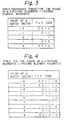
- Fig. 3 indicates a variable length coding table for the range of ⁇ 2 picture elements with the 1 picture element accuracy (the relationship between a value of a motion vector and a VLC code).
- the table has 5 kinds of elements 2, 1, 0, -1, and -2.
- variable length coding of a motion vector lying within the range of ⁇ 4 picture elements is performed based on a variable length coding table for ⁇ two-picture element range.
- a VLC code is provided by adding a remainder Z as an additional bit to a VLC code (coded at the table of Fig. 3) corresponding to the quotient Y.
- a VLC code coded at the table of Fig. 3
- the variable length coding table of Fig. 4 has nine kinds of elements 4, 3, ..., 0, ..., -3, -4.
- the coding of a motion vector within the range of ⁇ 2 picture elements with the 1 picture element accuracy as well as the coding of a motion vector within the range of ⁇ 4 picture elements with the 1 picture element accuracy can be made.
- a coded motion vector can be reproduced correctly on the decoder side with the operation reverse with the above-mentioned one by transmitting a flag indicative of whether the motion vector is within the range of ⁇ 2 picture elements or within the range of ⁇ 4 picture elements.
- Fig. 5 is an example of a circuit for coding a motion vector within the range of ⁇ 2 picture elements with the 1 picture element accuracy as well as for coding of a motion vector within the range of ⁇ 4 picture elements with the 1 picture element accuracy on the basis of a variable length coding table for ⁇ 2 picture elements with the 1 picture element accuracy.
- reference numeral 1 denotes a calculation circuit to which a motion vector within the range ⁇ 4 picture elements is supplied. At the calculation circuit 1, the above-mentioned calculation of equation (1) is done so that a quotient Y and a remainder Z are produced.
- Reference numeral 2 indicates a ROM, which constructs a variable length coding table shown in Fig. 3.
- the ROM 2 is directly supplied with a motion vector as an address when the motion vector lies within the range of ⁇ 2 picture elements, while the quotient Y which is produced from the calculation circuit 1 when the motion vector lies with the range of ⁇ 4 picture elements.
- the output of the ROM 2 is produced as a VLC code. Meanwhile, in the case where the motion vector lies in the range of ⁇ 4 picture elements, the remainder Z given from the calculation circuit 1 is added to the output of the ROM 2 as an additional bit by the additional circuit 3 to provide a VLC code as an output.
- the coding of the motion vector within the range of ⁇ 2 picture elements with the 1 picture element accuracy as well as that of the motion vector within the range of ⁇ 4 picture elements with the 1 picture element accuracy can be made using the single variable length coding table (ROM 2) to reduce the burden of the hardware.
- Fig. 6 shows a decoding circuit corresponding to a coding circuit shown in Fig. 5. It is judged based on a flag sent with a VLC code whether the VLC code relates to a motion vector within the range of ⁇ 2 picture elements or a motion vector within the range of ⁇ 4 picture elements.
- reference numeral 4 denotes a separating circuit, which is supplied with a VLC code relating to a notion vector within the range of ⁇ 4 picture elements. The separation into an additional bit (remainder Z) and the other bits is carried out at the separating circuit 4.
- reference numeral 5 indicates a ROM, which- constitutes a conversion table reverse with the variable length coding table of Fig. 3.
- a VLC code is directly supplied as an address when the VLC code relates to a motion vector lying within the range of ⁇ 2 picture elements.
- bits other than the additional bit separated at the separating circuit 4 are supplied as an address.
- the output of the ROM 5 is produced as a motion vector.
- the output of the calculation circuit 6 is produced as a motion vector.
- X is obtained in the calculation circuit 6 from the output Y of the ROM 5 and an additional bit Z separated at the separating circuit 4 by the use of equation (1).
- Y becomes an integer part of X.
- Z becomes the value equal to twice the decimal part to be "0" or "1".
- variable length coding table of Fig. 7 has nine kinds of elements 2.0, 1.5, ..., 0, ..., -1.5, -2.0.
- a VLC code corresponding to a motion vector X is directly obtained using the variable length coding table shown in Fig. 3.
- a coded motion vector can be reproduced accurately on the decoder side with the operation reverse with the above-mentioned one by transmitting a flag indicating whether the motion vector is within the 1 picture element accuracy or within the 0.5 picture element accuracy.
- circuits for coding and decoding a motion vector within the range of ⁇ 2 picture elements with the 1 picture element accuracy and a motion vector within the range of 2 picture elements with the 0.5 picture element accuracy can be composed of similarly to those of Figs. 5 and 6.
- the coding can be made using one variable length coding table (ROM 2) to reduce the burden of hardware.
- a method which is called the reflected DPCM method is a method used in DPCM of a value whose range is determined like a motion vector. For example, two values are allotted to one VLC code as shown in Figs. 8 and 9.
- Figs. 8 and 9 are variable length coding tables for DPCM transmission of motion vectors lying within the range of ⁇ 7 picture elements with the 1 picture element accuracy and ⁇ 3 picture elements with the 1 picture element accuracy.
- variable length coding through DPCM is done for a motion vector whose range covers ⁇ 7 picture elements and ⁇ 3 picture elements
- variable length coding tables shown in Figs. 8 and 9 are prepared.
- only the variable length coding table shown in Fig. 8 is prepared so that values ⁇ 6 of DPCM of a motion vector within the range of ⁇ 3 picture elements are variable length coded depending on the table shown in Fig. 8.
- a flag indicative of the range of a motion vector is provided as in the above-mentioned embodiment.
- the motion vector For variable length coding the motion vector, only the table shown in Fig. 8 is prepared. In this case, if the range of the motion vector is ⁇ 7 picture elements, the coding is done using the entire table. Meanwhile, if the range is ⁇ 3 picture elements, the broken portion is replaced by the table shown in Fig. 9 for coding.
- the motion vector is correctly reproduced by preparing a reference table shown in Fig. 8 on the decoder side and decoding by the replacement of the table of Fig. 8 with the table of Fig. 9 only when the flag indicating the range of the motion vector shows the range of ⁇ 3 picture elements.
- a reference variable length coding table suffices for plural kinds of motion vector ranges and accuracies to decrease the burden of the hardware. Also, since an embodiment of invention can be adapted to a motion vector of a broad range by expanding the reference table and be further adapted to a motion vector of a narrow range, there is an advantage that flexibility increases. Further, as to the accuracy, the accuracy can be elevated by expanding the reference table.
Landscapes
- Engineering & Computer Science (AREA)
- Multimedia (AREA)
- Signal Processing (AREA)
- Compression Or Coding Systems Of Tv Signals (AREA)
- Compression, Expansion, Code Conversion, And Decoders (AREA)
Claims (9)
- Verfahren zum Erzeugen von variablen Längencodes VLC, die Bewegungsvektoren repräsentieren, welche für die Bewegung innerhalb von Bildern kennzeichnend sind,
mit den Verfahrensschritten:gekennzeichnet durchErzeugen von Bewegungsvektoren aus Bilddaten undvariable Längencodierung (VLC) der Bewegungsvektoren, wobei der Verfahrensschritt der variablen Längencodierung das Speichern einer Tabelle mit VLC-Daten in einer Speicherschaltung (2) umfaßt, die einen vorbestimmten Satz von Bewegungsvektorwerten repräsentieren undAuslesen der gespeicherten VLC-Daten in Abhängigkeit von den Bewegungsvektoren,
das Erzeugen von Daten in Abhängigkeit von den Bewegungsvektoren zusätzlich zu den aus der Speicherschaltung (2) ausgelesenen VLC-Daten, wobei diese zusätzlichen Daten die durch die VLC-Daten oder einen Teil der VLC-Daten repräsentierten Werte ändern, und
das Kombinieren der VLC-Daten mit den zusätzlichen Daten. - Verfahren nach Anspruch 1, bei dem die zusätzlichen Daten den Bereich und/oder die Genauigkeit der VLC-Daten ändern.
- Verfahren nach Anspruch 1 oder 2, bei dem die gespeicherten VLC-Daten ohne das Erzeugen der zusätzlichen Daten aus der Speicherschaltung ausgelesen werden, wenn die Bewegungsvektorwerte durch die gespeicherten VLC-Daten repräsentiert werden, und bei der die VLC-Daten ausgelesen und die zusätzlichen Daten erzeugt werden, wenn die Bewegungsvektoren die genannten geänderten Werte haben.
- Verfahren nach Anspruch 3, bei dem
Bewegungsvektorwerte der Speicherschaltung (2) direkt als Adressen zugeführt werden, um die VLC-Daten ohne zusätzliche Daten auszulesen, und
Adressen für die Speicherschaltung (2) und zum Erzeugen der zusätzlichen Daten aus Bewegungsvektorwerten abgeleitet werden, die die geänderten Werte haben. - Verfahren nach Anspruch 4, bei dem ein Quotient (Y) als die genannte Adresse und ein Rest (Z) als die zusätzlichen Daten benutzt werden, wobei der Quotient und der Rest dadurch gewonnen werden, daß der Wert des Bewegungsvektors durch zwei dividiert wird.
- Verfahren nach einem der Ansprüche 3 bis 5, bei dem die Speicherschaltung eine Tabelle zur variablen Längencodierung speichert, die einen Bereich von plus oder minus zwei Bildelementen mit einer Genauigkeit von einem Bildelement repräsentiert, und die zusätzlichen Daten die VLC-Daten verändern, um Bewegungsvektorwerte innerhalb eines Bereichs von plus oder minus vier Bildelementen mit einer Genauigkeit von einem Bildelement darzustellen.
- Verfahren nach Anspruch 1, 2 oder 3, bei dem die VLC-Daten Daten sind, die Differenzen zwischen Bewegungsvektorwerten repräsentieren.
- Verfahren nach Anspruch 7, bei dem die zusätzlichen Daten die durch einen Teil der gespeicherten VLC-Daten repräsentierten Werte ändern.
- Verfahren nach einem der vorhergehenden Ansprüche, bei dem die Speicherschaltung ein ROM umfaßt.
Priority Applications (1)
| Application Number | Priority Date | Filing Date | Title |
|---|---|---|---|
| EP00109705A EP1032210B1 (de) | 1991-08-03 | 1992-07-28 | Kodierungsverfahren |
Applications Claiming Priority (4)
| Application Number | Priority Date | Filing Date | Title |
|---|---|---|---|
| JP3194576A JPH0541862A (ja) | 1991-08-03 | 1991-08-03 | 動きベクトルの可変長符号化方式 |
| JP194576/91 | 1991-08-03 | ||
| JP19457691 | 1991-08-03 | ||
| EP92306852A EP0527011B1 (de) | 1991-08-03 | 1992-07-28 | Gerät und Verfahren zur variablen Längenkodierung für einen Bewegungsvektor |
Related Parent Applications (1)
| Application Number | Title | Priority Date | Filing Date |
|---|---|---|---|
| EP92306852A Division EP0527011B1 (de) | 1991-08-03 | 1992-07-28 | Gerät und Verfahren zur variablen Längenkodierung für einen Bewegungsvektor |
Related Child Applications (1)
| Application Number | Title | Priority Date | Filing Date |
|---|---|---|---|
| EP00109705A Division EP1032210B1 (de) | 1991-08-03 | 1992-07-28 | Kodierungsverfahren |
Publications (3)
| Publication Number | Publication Date |
|---|---|
| EP0891091A2 EP0891091A2 (de) | 1999-01-13 |
| EP0891091A3 EP0891091A3 (de) | 1999-01-27 |
| EP0891091B1 true EP0891091B1 (de) | 2002-05-02 |
Family
ID=16326838
Family Applications (5)
| Application Number | Title | Priority Date | Filing Date |
|---|---|---|---|
| EP00109706A Expired - Lifetime EP1028592B1 (de) | 1991-08-03 | 1992-07-28 | Bewegungsvektordekoder |
| EP00109705A Expired - Lifetime EP1032210B1 (de) | 1991-08-03 | 1992-07-28 | Kodierungsverfahren |
| EP92306852A Expired - Lifetime EP0527011B1 (de) | 1991-08-03 | 1992-07-28 | Gerät und Verfahren zur variablen Längenkodierung für einen Bewegungsvektor |
| EP98203272A Expired - Lifetime EP0891090B1 (de) | 1991-08-03 | 1992-07-28 | Dekoder |
| EP98203273A Expired - Lifetime EP0891091B1 (de) | 1991-08-03 | 1992-07-28 | Kodierungsverfahren |
Family Applications Before (4)
| Application Number | Title | Priority Date | Filing Date |
|---|---|---|---|
| EP00109706A Expired - Lifetime EP1028592B1 (de) | 1991-08-03 | 1992-07-28 | Bewegungsvektordekoder |
| EP00109705A Expired - Lifetime EP1032210B1 (de) | 1991-08-03 | 1992-07-28 | Kodierungsverfahren |
| EP92306852A Expired - Lifetime EP0527011B1 (de) | 1991-08-03 | 1992-07-28 | Gerät und Verfahren zur variablen Längenkodierung für einen Bewegungsvektor |
| EP98203272A Expired - Lifetime EP0891090B1 (de) | 1991-08-03 | 1992-07-28 | Dekoder |
Country Status (4)
| Country | Link |
|---|---|
| US (1) | US5298991A (de) |
| EP (5) | EP1028592B1 (de) |
| JP (4) | JPH0541862A (de) |
| DE (3) | DE69229153T2 (de) |
Families Citing this family (56)
| Publication number | Priority date | Publication date | Assignee | Title |
|---|---|---|---|---|
| US5428396A (en) * | 1991-08-03 | 1995-06-27 | Sony Corporation | Variable length coding/decoding method for motion vectors |
| JP3025827B2 (ja) * | 1993-09-14 | 2000-03-27 | 松下電器産業株式会社 | 可変長コード化装置 |
| GB2287602B (en) * | 1994-03-16 | 1998-06-03 | Hyundai Electronics Ind | Motion vector decoding apparatus and method |
| JP3552811B2 (ja) * | 1995-09-29 | 2004-08-11 | 三菱電機株式会社 | ディジタル映像信号符号化装置および復号化装置 |
| US6408029B1 (en) | 1998-04-02 | 2002-06-18 | Intel Corporation | Method and apparatus for simplifying real-time data encoding |
| US6904174B1 (en) * | 1998-12-11 | 2005-06-07 | Intel Corporation | Simplified predictive video encoder |
| US7046734B2 (en) * | 1998-04-02 | 2006-05-16 | Intel Corporation | Method and apparatus for performing real-time data encoding |
| US6983018B1 (en) | 1998-11-30 | 2006-01-03 | Microsoft Corporation | Efficient motion vector coding for video compression |
| JP3681342B2 (ja) | 2000-05-24 | 2005-08-10 | 三星電子株式会社 | 映像コーディング方法 |
| US7003035B2 (en) * | 2002-01-25 | 2006-02-21 | Microsoft Corporation | Video coding methods and apparatuses |
| US7305034B2 (en) * | 2002-04-10 | 2007-12-04 | Microsoft Corporation | Rounding control for multi-stage interpolation |
| US7620109B2 (en) * | 2002-04-10 | 2009-11-17 | Microsoft Corporation | Sub-pixel interpolation in motion estimation and compensation |
| US20040001546A1 (en) | 2002-06-03 | 2004-01-01 | Alexandros Tourapis | Spatiotemporal prediction for bidirectionally predictive (B) pictures and motion vector prediction for multi-picture reference motion compensation |
| US7280700B2 (en) * | 2002-07-05 | 2007-10-09 | Microsoft Corporation | Optimization techniques for data compression |
| US7154952B2 (en) | 2002-07-19 | 2006-12-26 | Microsoft Corporation | Timestamp-independent motion vector prediction for predictive (P) and bidirectionally predictive (B) pictures |
| US7212681B1 (en) | 2003-01-15 | 2007-05-01 | Cisco Technology, Inc. | Extension of two-dimensional variable length coding for image compression |
| US7194137B2 (en) * | 2003-05-16 | 2007-03-20 | Cisco Technology, Inc. | Variable length coding method and apparatus for video compression |
| US7426308B2 (en) * | 2003-07-18 | 2008-09-16 | Microsoft Corporation | Intraframe and interframe interlace coding and decoding |
| US20050013498A1 (en) | 2003-07-18 | 2005-01-20 | Microsoft Corporation | Coding of motion vector information |
| US7499495B2 (en) * | 2003-07-18 | 2009-03-03 | Microsoft Corporation | Extended range motion vectors |
| US10554985B2 (en) | 2003-07-18 | 2020-02-04 | Microsoft Technology Licensing, Llc | DC coefficient signaling at small quantization step sizes |
| US7738554B2 (en) * | 2003-07-18 | 2010-06-15 | Microsoft Corporation | DC coefficient signaling at small quantization step sizes |
| US7599438B2 (en) * | 2003-09-07 | 2009-10-06 | Microsoft Corporation | Motion vector block pattern coding and decoding |
| US7724827B2 (en) * | 2003-09-07 | 2010-05-25 | Microsoft Corporation | Multi-layer run level encoding and decoding |
| US7620106B2 (en) | 2003-09-07 | 2009-11-17 | Microsoft Corporation | Joint coding and decoding of a reference field selection and differential motion vector information |
| US7567617B2 (en) * | 2003-09-07 | 2009-07-28 | Microsoft Corporation | Predicting motion vectors for fields of forward-predicted interlaced video frames |
| US7623574B2 (en) | 2003-09-07 | 2009-11-24 | Microsoft Corporation | Selecting between dominant and non-dominant motion vector predictor polarities |
| US7317839B2 (en) * | 2003-09-07 | 2008-01-08 | Microsoft Corporation | Chroma motion vector derivation for interlaced forward-predicted fields |
| US8064520B2 (en) | 2003-09-07 | 2011-11-22 | Microsoft Corporation | Advanced bi-directional predictive coding of interlaced video |
| US7616692B2 (en) | 2003-09-07 | 2009-11-10 | Microsoft Corporation | Hybrid motion vector prediction for interlaced forward-predicted fields |
| US7577200B2 (en) | 2003-09-07 | 2009-08-18 | Microsoft Corporation | Extended range variable length coding/decoding of differential motion vector information |
| US7471840B2 (en) * | 2004-08-18 | 2008-12-30 | Cisco Technology, Inc. | Two-dimensional variable length coding of runs of zero and non-zero transform coefficients for image compression |
| US7492956B2 (en) * | 2004-08-18 | 2009-02-17 | Cisco Technology, Inc. | Video coding using multi-dimensional amplitude coding and 2-D non-zero/zero cluster position coding |
| US7471841B2 (en) * | 2004-06-15 | 2008-12-30 | Cisco Technology, Inc. | Adaptive breakpoint for hybrid variable length coding |
| US7454073B2 (en) * | 2004-06-15 | 2008-11-18 | Cisco Technology, Inc. | Video compression using multiple variable length coding processes for multiple classes of transform coefficient blocks |
| US7499595B2 (en) * | 2004-08-18 | 2009-03-03 | Cisco Technology, Inc. | Joint amplitude and position coding for photographic image and video coding |
| US7499596B2 (en) | 2004-08-18 | 2009-03-03 | Cisco Technology, Inc. | Amplitude coding for clustered transform coefficients |
| US7454076B2 (en) * | 2004-06-15 | 2008-11-18 | Cisco Technology, Inc. | Hybrid variable length coding method for low bit rate video coding |
| WO2006011197A1 (ja) * | 2004-07-27 | 2006-02-02 | Mitsubishi Denki Kabushiki Kaisha | 符号化データ再符号化装置及びその復号装置並びにプログラム |
| US7680349B2 (en) * | 2004-08-18 | 2010-03-16 | Cisco Technology, Inc. | Variable length coding for clustered transform coefficients in video compression |
| US7620258B2 (en) * | 2004-08-18 | 2009-11-17 | Cisco Technology, Inc. | Extended amplitude coding for clustered transform coefficients |
| US8031777B2 (en) | 2005-11-18 | 2011-10-04 | Apple Inc. | Multipass video encoding and rate control using subsampling of frames |
| US8780997B2 (en) | 2005-11-18 | 2014-07-15 | Apple Inc. | Regulation of decode-side processing based on perceptual masking |
| US8233535B2 (en) * | 2005-11-18 | 2012-07-31 | Apple Inc. | Region-based processing of predicted pixels |
| US20070116117A1 (en) * | 2005-11-18 | 2007-05-24 | Apple Computer, Inc. | Controlling buffer states in video compression coding to enable editing and distributed encoding |
| US8295343B2 (en) * | 2005-11-18 | 2012-10-23 | Apple Inc. | Video bit rate control method |
| US7242328B1 (en) * | 2006-02-03 | 2007-07-10 | Cisco Technology, Inc. | Variable length coding for sparse coefficients |
| US8254455B2 (en) * | 2007-06-30 | 2012-08-28 | Microsoft Corporation | Computing collocated macroblock information for direct mode macroblocks |
| US8189666B2 (en) | 2009-02-02 | 2012-05-29 | Microsoft Corporation | Local picture identifier and computation of co-located information |
| JP5785164B2 (ja) * | 2009-07-09 | 2015-09-24 | トムトム インターナショナル ベスローテン フエンノートシャップ | 経路計算の時間依存に関するナビゲーション装置及び方法 |
| US9749642B2 (en) | 2014-01-08 | 2017-08-29 | Microsoft Technology Licensing, Llc | Selection of motion vector precision |
| US9774881B2 (en) | 2014-01-08 | 2017-09-26 | Microsoft Technology Licensing, Llc | Representing motion vectors in an encoded bitstream |
| US9942560B2 (en) | 2014-01-08 | 2018-04-10 | Microsoft Technology Licensing, Llc | Encoding screen capture data |
| WO2020098808A1 (en) | 2018-11-17 | 2020-05-22 | Beijing Bytedance Network Technology Co., Ltd. | Construction of merge with motion vector difference candidates |
| CN117499668A (zh) | 2018-12-21 | 2024-02-02 | 北京字节跳动网络技术有限公司 | 具有运动矢量差的Merge模式中的运动矢量精度 |
| CN113196771B (zh) | 2018-12-21 | 2023-12-22 | 北京字节跳动网络技术有限公司 | 基于运动矢量精度的运动矢量范围 |
Family Cites Families (8)
| Publication number | Priority date | Publication date | Assignee | Title |
|---|---|---|---|---|
| JPH06101841B2 (ja) * | 1984-01-11 | 1994-12-12 | 日本電気株式会社 | 動画像信号の符号化方法およびその装置 |
| AU579550B2 (en) * | 1985-06-10 | 1988-11-24 | Nec Corporation | Movement compensation predictive encoder for a moving picture signal with a reduced amount of information |
| ATE108587T1 (de) * | 1986-09-13 | 1994-07-15 | Philips Nv | Verfahren und schaltungsanordung zur bitratenreduktion. |
| CA1296430C (en) * | 1986-11-10 | 1992-02-25 | Masahide Kaneko | Encoding system capable of accomplishing a high efficiency by anterior and/or posterior processing to quantization |
| US4816914A (en) * | 1987-01-07 | 1989-03-28 | Pictel Corporation | Method and apparatus for efficiently encoding and decoding image sequences |
| US4995059A (en) * | 1988-01-14 | 1991-02-19 | Canon Kabushiki Kaisha | Predictive coding device |
| CA2000156C (en) * | 1989-02-14 | 1995-05-02 | Kohtaro Asai | Picture signal encoding and decoding apparatus |
| EP0419752B1 (de) * | 1989-09-25 | 1995-05-10 | Rai Radiotelevisione Italiana | Umfassendes System zur Codierung und Übertragung von Videosignalen mit Bewegungsvektoren |
-
1991
- 1991-08-03 JP JP3194576A patent/JPH0541862A/ja active Pending
-
1992
- 1992-07-24 US US07/918,010 patent/US5298991A/en not_active Expired - Lifetime
- 1992-07-28 EP EP00109706A patent/EP1028592B1/de not_active Expired - Lifetime
- 1992-07-28 DE DE69229153T patent/DE69229153T2/de not_active Expired - Lifetime
- 1992-07-28 DE DE69232597T patent/DE69232597T2/de not_active Expired - Lifetime
- 1992-07-28 EP EP00109705A patent/EP1032210B1/de not_active Expired - Lifetime
- 1992-07-28 DE DE69232824T patent/DE69232824T2/de not_active Expired - Lifetime
- 1992-07-28 EP EP92306852A patent/EP0527011B1/de not_active Expired - Lifetime
- 1992-07-28 EP EP98203272A patent/EP0891090B1/de not_active Expired - Lifetime
- 1992-07-28 EP EP98203273A patent/EP0891091B1/de not_active Expired - Lifetime
-
1998
- 1998-08-03 JP JP10219458A patent/JPH11112995A/ja active Pending
- 1998-08-03 JP JP10219460A patent/JPH11113004A/ja active Pending
- 1998-08-03 JP JP10219459A patent/JPH11112996A/ja active Pending
Also Published As
| Publication number | Publication date |
|---|---|
| DE69232597T2 (de) | 2002-12-05 |
| EP0891090B1 (de) | 2002-10-16 |
| JPH11112996A (ja) | 1999-04-23 |
| JPH11113004A (ja) | 1999-04-23 |
| EP1028592A1 (de) | 2000-08-16 |
| DE69232597D1 (de) | 2002-06-06 |
| DE69232824T2 (de) | 2003-08-07 |
| EP1028592B1 (de) | 2004-02-04 |
| EP0527011B1 (de) | 1999-05-12 |
| EP0891091A2 (de) | 1999-01-13 |
| HK1030322A1 (en) | 2001-04-27 |
| EP1032210A1 (de) | 2000-08-30 |
| EP0527011A3 (en) | 1994-07-27 |
| US5298991A (en) | 1994-03-29 |
| DE69229153T2 (de) | 1999-11-25 |
| JPH11112995A (ja) | 1999-04-23 |
| DE69229153D1 (de) | 1999-06-17 |
| DE69232824D1 (de) | 2002-11-21 |
| EP0891091A3 (de) | 1999-01-27 |
| EP1032210B1 (de) | 2003-02-26 |
| EP0527011A2 (de) | 1993-02-10 |
| EP0891090A2 (de) | 1999-01-13 |
| EP0891090A3 (de) | 1999-01-20 |
| HK1013570A1 (en) | 1999-08-27 |
| HK1030123A1 (en) | 2001-04-20 |
| JPH0541862A (ja) | 1993-02-19 |
Similar Documents
| Publication | Publication Date | Title |
|---|---|---|
| EP1032210B1 (de) | Kodierungsverfahren | |
| JP3210996B2 (ja) | 高能率符号化装置及び高能率復号化装置 | |
| EP0379217B1 (de) | Prädiktives Zwischenbildkodierungssystem | |
| EP0222592B1 (de) | Zweckmässige Technik zum Kodieren eines digitalen Videosignals | |
| HK1001183B (en) | Inter-frame predictive encoding system | |
| JPH0229275B2 (de) | ||
| HK1030322B (en) | Encoding method | |
| HK1013570B (en) | Variable length coding apparatus and method for motion vector | |
| HK1030123B (en) | Motion vector decoder | |
| KR20010032315A (ko) | 부호화 장치 및 방법, 복호 장치 및 방법 | |
| KR0126662B1 (ko) | 움직임화상신호의 부호화장치 | |
| JP2861380B2 (ja) | 画像信号符号化装置およびその方法と、画像信号復号装置およびその方法 | |
| JP3251286B2 (ja) | コンポーネント符号化されたカラーテレビ信号のデジタル伝送および/又は記録のための方法及びエンコーダ並びにデコーダ | |
| JP2861381B2 (ja) | 画像信号符号化装置およびその方法 | |
| JP2832976B2 (ja) | 適応符号化装置 | |
| JPS634784A (ja) | 高能率符号化装置 | |
| JP2778629B2 (ja) | 高能率符号化装置 | |
| JPS6313485A (ja) | 高能率符号化装置 | |
| JPS6359186A (ja) | 高能率符号化装置 | |
| HK1001182B (en) | Decoding system for decoding video signals | |
| JPH01151383A (ja) | 画像符号化装置 | |
| JPS62266923A (ja) | 高能率符号化装置 | |
| JPH01194584A (ja) | テレビジョン信号の高能率符号化方式のデコード装置 |
Legal Events
| Date | Code | Title | Description |
|---|---|---|---|
| PUAI | Public reference made under article 153(3) epc to a published international application that has entered the european phase |
Free format text: ORIGINAL CODE: 0009012 |
|
| PUAL | Search report despatched |
Free format text: ORIGINAL CODE: 0009013 |
|
| 17P | Request for examination filed |
Effective date: 19980928 |
|
| AC | Divisional application: reference to earlier application |
Ref document number: 527011 Country of ref document: EP |
|
| AK | Designated contracting states |
Kind code of ref document: A2 Designated state(s): DE FR |
|
| AK | Designated contracting states |
Kind code of ref document: A3 Designated state(s): DE FR GB |
|
| 17Q | First examination report despatched |
Effective date: 20000531 |
|
| RBV | Designated contracting states (corrected) |
Designated state(s): DE FR |
|
| GRAG | Despatch of communication of intention to grant |
Free format text: ORIGINAL CODE: EPIDOS AGRA |
|
| GRAG | Despatch of communication of intention to grant |
Free format text: ORIGINAL CODE: EPIDOS AGRA |
|
| GRAH | Despatch of communication of intention to grant a patent |
Free format text: ORIGINAL CODE: EPIDOS IGRA |
|
| GRAH | Despatch of communication of intention to grant a patent |
Free format text: ORIGINAL CODE: EPIDOS IGRA |
|
| GRAA | (expected) grant |
Free format text: ORIGINAL CODE: 0009210 |
|
| AC | Divisional application: reference to earlier application |
Ref document number: 527011 Country of ref document: EP |
|
| AK | Designated contracting states |
Kind code of ref document: B1 Designated state(s): DE FR |
|
| REF | Corresponds to: |
Ref document number: 69232597 Country of ref document: DE Date of ref document: 20020606 |
|
| ET | Fr: translation filed | ||
| PLBE | No opposition filed within time limit |
Free format text: ORIGINAL CODE: 0009261 |
|
| STAA | Information on the status of an ep patent application or granted ep patent |
Free format text: STATUS: NO OPPOSITION FILED WITHIN TIME LIMIT |
|
| 26N | No opposition filed |
Effective date: 20030204 |
|
| PGFP | Annual fee paid to national office [announced via postgrant information from national office to epo] |
Ref country code: FR Payment date: 20110729 Year of fee payment: 20 |
|
| PGFP | Annual fee paid to national office [announced via postgrant information from national office to epo] |
Ref country code: DE Payment date: 20110722 Year of fee payment: 20 |
|
| REG | Reference to a national code |
Ref country code: DE Ref legal event code: R071 Ref document number: 69232597 Country of ref document: DE |
|
| REG | Reference to a national code |
Ref country code: DE Ref legal event code: R071 Ref document number: 69232597 Country of ref document: DE |
|
| PG25 | Lapsed in a contracting state [announced via postgrant information from national office to epo] |
Ref country code: DE Free format text: LAPSE BECAUSE OF EXPIRATION OF PROTECTION Effective date: 20120731 |