EP0889965B1 - Production of proteins, plasmids coding therefor and organisms containing such plasmids - Google Patents
Production of proteins, plasmids coding therefor and organisms containing such plasmids Download PDFInfo
- Publication number
- EP0889965B1 EP0889965B1 EP97905224A EP97905224A EP0889965B1 EP 0889965 B1 EP0889965 B1 EP 0889965B1 EP 97905224 A EP97905224 A EP 97905224A EP 97905224 A EP97905224 A EP 97905224A EP 0889965 B1 EP0889965 B1 EP 0889965B1
- Authority
- EP
- European Patent Office
- Prior art keywords
- plasmid
- replication
- dna
- gene
- plasmids
- Prior art date
- Legal status (The legal status is an assumption and is not a legal conclusion. Google has not performed a legal analysis and makes no representation as to the accuracy of the status listed.)
- Expired - Lifetime
Links
Images



Classifications
-
- C—CHEMISTRY; METALLURGY
- C12—BIOCHEMISTRY; BEER; SPIRITS; WINE; VINEGAR; MICROBIOLOGY; ENZYMOLOGY; MUTATION OR GENETIC ENGINEERING
- C12N—MICROORGANISMS OR ENZYMES; COMPOSITIONS THEREOF; PROPAGATING, PRESERVING, OR MAINTAINING MICROORGANISMS; MUTATION OR GENETIC ENGINEERING; CULTURE MEDIA
- C12N9/00—Enzymes; Proenzymes; Compositions thereof; Processes for preparing, activating, inhibiting, separating or purifying enzymes
- C12N9/14—Hydrolases (3)
-
- C—CHEMISTRY; METALLURGY
- C12—BIOCHEMISTRY; BEER; SPIRITS; WINE; VINEGAR; MICROBIOLOGY; ENZYMOLOGY; MUTATION OR GENETIC ENGINEERING
- C12N—MICROORGANISMS OR ENZYMES; COMPOSITIONS THEREOF; PROPAGATING, PRESERVING, OR MAINTAINING MICROORGANISMS; MUTATION OR GENETIC ENGINEERING; CULTURE MEDIA
- C12N15/00—Mutation or genetic engineering; DNA or RNA concerning genetic engineering, vectors, e.g. plasmids, or their isolation, preparation or purification; Use of hosts therefor
- C12N15/09—Recombinant DNA-technology
- C12N15/63—Introduction of foreign genetic material using vectors; Vectors; Use of hosts therefor; Regulation of expression
- C12N15/67—General methods for enhancing the expression
- C12N15/68—Stabilisation of the vector
-
- C—CHEMISTRY; METALLURGY
- C12—BIOCHEMISTRY; BEER; SPIRITS; WINE; VINEGAR; MICROBIOLOGY; ENZYMOLOGY; MUTATION OR GENETIC ENGINEERING
- C12N—MICROORGANISMS OR ENZYMES; COMPOSITIONS THEREOF; PROPAGATING, PRESERVING, OR MAINTAINING MICROORGANISMS; MUTATION OR GENETIC ENGINEERING; CULTURE MEDIA
- C12N15/00—Mutation or genetic engineering; DNA or RNA concerning genetic engineering, vectors, e.g. plasmids, or their isolation, preparation or purification; Use of hosts therefor
- C12N15/09—Recombinant DNA-technology
- C12N15/63—Introduction of foreign genetic material using vectors; Vectors; Use of hosts therefor; Regulation of expression
- C12N15/70—Vectors or expression systems specially adapted for E. coli
-
- C—CHEMISTRY; METALLURGY
- C12—BIOCHEMISTRY; BEER; SPIRITS; WINE; VINEGAR; MICROBIOLOGY; ENZYMOLOGY; MUTATION OR GENETIC ENGINEERING
- C12N—MICROORGANISMS OR ENZYMES; COMPOSITIONS THEREOF; PROPAGATING, PRESERVING, OR MAINTAINING MICROORGANISMS; MUTATION OR GENETIC ENGINEERING; CULTURE MEDIA
- C12N9/00—Enzymes; Proenzymes; Compositions thereof; Processes for preparing, activating, inhibiting, separating or purifying enzymes
- C12N9/14—Hydrolases (3)
- C12N9/24—Hydrolases (3) acting on glycosyl compounds (3.2)
- C12N9/2402—Hydrolases (3) acting on glycosyl compounds (3.2) hydrolysing O- and S- glycosyl compounds (3.2.1)
- C12N9/2477—Hemicellulases not provided in a preceding group
- C12N9/248—Xylanases
-
- C—CHEMISTRY; METALLURGY
- C12—BIOCHEMISTRY; BEER; SPIRITS; WINE; VINEGAR; MICROBIOLOGY; ENZYMOLOGY; MUTATION OR GENETIC ENGINEERING
- C12Y—ENZYMES
- C12Y302/00—Hydrolases acting on glycosyl compounds, i.e. glycosylases (3.2)
- C12Y302/01—Glycosidases, i.e. enzymes hydrolysing O- and S-glycosyl compounds (3.2.1)
- C12Y302/01008—Endo-1,4-beta-xylanase (3.2.1.8)
-
- C—CHEMISTRY; METALLURGY
- C12—BIOCHEMISTRY; BEER; SPIRITS; WINE; VINEGAR; MICROBIOLOGY; ENZYMOLOGY; MUTATION OR GENETIC ENGINEERING
- C12Y—ENZYMES
- C12Y302/00—Hydrolases acting on glycosyl compounds, i.e. glycosylases (3.2)
- C12Y302/01—Glycosidases, i.e. enzymes hydrolysing O- and S-glycosyl compounds (3.2.1)
- C12Y302/01032—Xylan endo-1,3-beta-xylosidase (3.2.1.32), i.e. endo-1-3-beta-xylanase
Definitions
- THIS INVENTION relates to the production of proteins, plasmids coding therefor and organisms containing such plasmids.
- genes which give a selective advantage to the microbe for example genes giving resistance to an antibiotic are suitable if the microbes are cultivated in the presence of the antibiotic, or genes making good a deficiency in the host organism may be incorporated.
- DDR patent 233,851 A1 there are disclosed vector plasmids in which a sequence is present twice in opposite senses (inverted repeat sequences) into each of which sequences duplicate genes are cloned or recloned. This is said to cause increased synthesis of the gene product in the microorganism due to the gene dosage effect.
- the inverted repeat sequences must each have at least one homologous cleavage site into which the duplicate genes may be inserted.
- Stable plasmids are disclosed as producible.
- each inverted sequence of DDR 233851 A1 must have at least one cleavage site and that these will be homologous. Normally the vector plasmids will be cleaved at both such sites. This increases the difficulty of constructing a plasmid with the desired gene correctly inserted into both of the inverted sequences. For example the free ends may link with a single added gene leaving plasmids with only one such gene. In addition non-functional nucleic acid fragments will be formed. The greater the number of cleavage sites in the inverted sequences the greater this problem becomes.
- Expression cassette is meant a DNA sequence effective in production of a protein which comprises a promoter sequence and ribosomal binding site, a gene coding for a protein and normally a termination sequence.
- the gene may code for a fusion protein and may have a signal sequence.
- plasmids (excluding the desired expression cassette) of at most 10kB, for example at most 6kB and even for example at most 5kB may be used.
- Each such plasmid places a smaller burden on the host organism than a larger plasmid. They normally also have higher copy numbers than larger plasmids for example 50-300 or even more than 300 plasmids per host cell, with, in general, an improvement in output of the desired protein.
- the inverted repeat sequences may themselves code for proteins thus placing an additional burden on the host and complicating separation of the desired product.
- the invention comprises a continuous process for the production of organisms containing plasmids or polypeptides expressed by genes of such plasmids in which a plasmid comprises an origin of replication and an additional sequence required for plasmid replication and/or preferably a gene giving a microbe a selective advantage, and two expression cassettes each being in a DNA sequence located between the originating sequence and the gene giving the selective advantage or an additional sequence required for plasmid replication but being separated from one another on one side by DNA comprising the origin of replication and on the other side by DNA comprising the gene giving the selective advantage or the sequence required for plasmid replication, the plasmid being substantially free from inverted repeat sequences other than sequences represented by the expression cassettes.
- additional expression cassettes may be included.
- the expression cassettes may be different but preferably are the same.
- At most one antibiotic resistance gene is present.
- the expression cassettes code for the same protein or for proteins which are enzymes used together for catalytic purposes whereby the organism or material derived therefrom is useful as a catalyst or a component of a catalyst comprising both such enzymes.
- continuous process is meant a process in which fresh nutrients are added and product removed continuously or intermittently without discontinuing the fermentation.
- a suitable concentration of the organisms per unit volume of culture medium It is normal to reach that condition by inoculation of a fermenter with the desired organism and permitting it to grow until the desired concentration is reached, and no product would normally be removed until then other than for sampling.
- at least 5, preferably at least 10 and more preferably at least 50 generations of organisms be produced after this has been achieved.
- a production of 5%, preferably 10% and more preferably at least 15% by weight of the desired protein is produced based on the total protein content of the organism.
- the invention also comprises a plasmid which comprises an origin of replication and an additional sequence required for plasmid replication and/or preferably a gene giving a microbe a selective advantage, and two expression cassettes which express the same polypeptide or different polypeptides which are enzymes used for catalytic purposes and which are preferably the same, each being in a DNA sequence located between the origin of replication and the gene giving the selective advantage or the additional sequence required for plasmid replication but being separated from one another on one side by DNA comprising the origin of replication and on the other side by DNA comprising the gene giving the selective advantage or the additional sequence required for plasmid replication, the plasmid being substantially free from inverted repeat sequences other than sequences represented by the expression cassettes.
- a second gene giving a selective advantage may be present if desired as also may additional expression cassette(s).
- the genes for producing the desired protein are arranged to read in the opposite sense in the plasmid, i.e. if one is regarded as clockwise the other is anticlockwise. This makes it difficult for homologous sequences to come into contact, especially if the genes are close together, in a "head-to-head” or "tail-to-tail” relationship with as little DNA between them as possible.
- the invention also comprises microbes containing plasmids according to the invention and also processes in which a desired protein is produced by means of such plasmids and/or microbes.
- the protein may be separated therefrom for example in a purified form if desired.
- the invention also comprises a process in which a plasmid is cut at a first restriction site, a desired expression cassette is inserted at the first restriction site to form a modified plasmid, the modified plasmid is cut at a second restriction site which is not homologous with the first restriction site and a desired expression cassette is inserted at the second restriction site, the first and second restriction sites being separated on one side by a sequence which comprises an origin of replication and if they are not separated on the other side by a sequence which includes a gene giving a selective advantage to the host organism or a sequence required for plasmid replication, such a gene is inserted on that side, the plasmid being substantially free from inverted repeat sequences other than sequences represented by the expression cassette.
- the host has a recombinational deficiency.
- the deficiency may be in consequence of the non-functionality or deletion of a recombination gene, for example rec A or preferably rec J gene.
- Plasmid pSPR6 (see Figure 1 ), (in Escherichia coli NM554 host NCIMB 40786 deposited with The National Collections of Industrial and Marine Bacteria Limited, 23 St Machar Drive, Aberdeen AB2 1RY Scotland UK on 8 February 1996 under the Budapest Treaty) contains unique NotI and SpeI restriction sites which are positioned on either side of the plasmid origin of replication (ori) and on either side of a tetracycline resistance marker tetA/R. This plasmid allows the insertion of two independent copies of an expression cassette to improve the genetic stability of the plasmid during
- the expression cassette was DNA encoding the expression of a fungal xylanase comprising of a constitutive promoter (gene A3 promoter from bacteriophage T7), a ribosome binding site (from lac z of E.coli), the coding sequence for the enzyme (truncated xylanase gene from plasmid pNX10 described in WO 93/25693 ) and a transcriptional terminator from bacteriophage T4.
- the expression cassette was flanked by either NotI or SpeI restriction sites.
- the expression cassette can be obtained by complete digestion of the plasmid pSPR8 in E.
- NCIMB 40787 deposited with The National Collections of Industrial and Marine Bacteria Limited, 23 St Machar Drive, Aberdeen AB2 1RY Scotland UK on 8 February 1996 under the Budapest Treaty) using restriction endonucleases NotI or SpeI in a high salt restriction buffer.
- Plasmid DNA was prepared from E. coli strain NM554 (pSPR6) grown overnight at 37°C in L broth (1% tryptone, 0.5% yeast extract, 0.5% NaCl) using "Rapid Pure Miniprep” (RPM) (Stratech Scientific Ltd, Luton, UK) following the manufacturers protocol. Plasmid DNA may also be isolated using standard methods such as described by Sambrook et al 1 . 50 ⁇ l of plasmid pSPR6 DNA was digested with restriction endonuclease NotI (Boehringer Mannheim, Lewes, UK) with the addition of 6 ⁇ l of the manufacturers H buffer (high salt restriction buffer) and 20 units of restriction enzyme. Digestion was carried out at 37°C for 16h.
- the xylanase expression cassette was digested with NotI and ligated to plasmid pSPR6 similarly digested with NotI, as follows.
- the two species of DNA were mixed and the restriction enzyme and other contaminants were removed using an RPM miniprep (following the manufacturer's protocol but with the following modifications: DNA mixture used in place of cleared lysate and DNA eluted into 40 ⁇ l).
- DNA mixture used in place of cleared lysate and DNA eluted into 40 ⁇ l.
- 0.5 ⁇ l of 100mM adenosine triphosphate (ATP) was added with 4 ⁇ l of M buffer (medium salt restriction buffer).
- M buffer medium salt restriction buffer
- 1 unit of T4 DNA ligase (Boehringer Mannheim) was added and the reaction incubated at 18°C for 16h.
- E.coli strain JM109 (ATCC 53323) competent cell suspension, produced by calcium chloride treatment essentially as described by Hanahan 2 , and incubated on ice for 45m. Cells were then heat shocked at 42°C for 90s and returned to ice for 2m. 1ml of L broth was added and cells incubated at 37°C, with shaking, for 1h before plating out dilutions onto L agar plates (L broth + 1% bacteriological agar) containing 10 ⁇ g/ml tetracycline and 1% remazol brilliant blue - xylan (RBB-Xylan, Sigma, Poole, UK). Plates were incubated for 24h at 37°C. One colony which gave a zone of clearing and contained the expected plasmid when miniprep DNA was digested with NotI was designated JM109 (pSPR7).
- Plasmid DNA from pSPR7 which is shown diagramatically in Figure 2 was prepared as above from an overnight culture of JM109 (pSPR7) in L broth supplemented with 10 ⁇ g/ml tetracycline. 50 ⁇ l of plasmid DNA was linearised by digestion with restriction endonuclease SpeI (Boehringer Mannheim) by adding 5 ⁇ l of manufacturers H buffer and 20 units of SpeI enzyme. Reaction was incubated for 16h at 37°C. The position of the NotI flanked xylanase expression cassette (XYL) relative to the plasmid origin of replication (ori) and the selectable marker (tetA/R) is shown.
- XYL NotI flanked xylanase expression cassette
- ori plasmid origin of replication
- selectable marker tetA/R
- a second xylanase expression cassette identical to the first except flanked by SpeI restriction sites rather than NotI, was digested with SpeI as described above.
- This expression cassette may be obtained by the complete digestion of plasmid pSPR8 with the restriction enzyme SpeI.
- This DNA was ligated to SpeI digested plasmid pSPR7 exactly as described above but with selection of transformants on L agar containing 10 ⁇ g/ml tetracycline.
- Tetracycline resistant colonies were screened using a rapid lysis method (Twigg and Sherrett 3 ) to estimate the size of the plasmid carried.
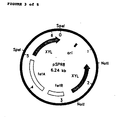
- 1 colony which contained a plasmid larger than plasmid pSPR7 and which subsequent digests of isolated plasmid DNA with NotI and SpeI restriction endonucleases showed to contain 2 copies of the xylanase expression cassette was designated JM109 (pSPR8), see Figure 3 which shows plasmid pSPR8 showing the positions of both inserted xylanase expression cassettes (XYL) relative to the plasmid origin of replication (ori) and selectable marker (tetA/R).
- Plasmid DNA was prepared from JM109 (pSPR8) and JM109 (pSPR7) and 1 ⁇ l used to transform E.coli strain NM554 (Stratagene, Cambridge, UK) . Preparation of DNA and competent cells and transformation of DNA were done as described above. Transformants were selected on L agar containing 10 ⁇ g/ml tetracycline. Stocks of NM554 (pSPR7) and NM554 (pSPR8) were stored at -70°C in L broth containing 10 ⁇ g/ml tetracycline and 25% (v/v) glycerol.
- Fermentations were done using Braun ED/ER5 fermenters (B. Braun Biotech, Reading, UK). Vessels were in situ sterilised and bottom agitated using 2x70mm diameter Rushton impellers. The fermenter working volume was approximately 2L. The medium used throughout the experiments was JV1 (see appendix). Temperature was maintained at 37°C ⁇ 0.2°C. The pH was measured using an Ingold pH probe and maintained at 6.7 ⁇ 0.1 by the controlled addition of filter sterilised 10M NH 4 OH and 2M H 3 PO 4 . An agitation speed of 600 rpm was used with air or 35% O 2 aeration to maintain a %pO 2 (dissolved oxygen tension) between 20% and 80%, of saturation measured by an Ingold oxygen probe. Foaming was controlled by the addition of sterile Diamond Shamrock PPG Foamaster EEA 142 at a rate of 0.1ml/h.
- xylanase enzyme activity was determined by measuring the amount of reducing sugar released from soluble oat spelt xylan substrate (1%), essentially as described by Kellett et al 4 . The production of xylanase and molecular weight was confirmed by sodium dodecyl sulphate polyacrylamide gel electrophoresis (SDS-PAGE) on an 8-25% gradient gel with commasie blue protein staining using Phast electrophoresis system (Pharmacia Biotech, St Albans, UK).
- Dry cell weights were determined by pelleting the cells in the withdrawn sample by centrifugation at 5700 rpm in a Beckman TJ-6 centrifuge for 20m and resuspending cells in 2-3mls Tris buffer (100mM, pH7.2). Cells were then re-pelleted and dried in a pre-weighed tube in an oven at 105°C for 16h and mass of dried cells determined.
- Changes to plasmid size during the fermentations were detected by plating of stored fermentation samples onto L agar containing 10 ⁇ g/ml tetracycline and 1% RBB-Xylan. Colonies were then picked and lysed using the procedure described by Twigg and Sherrett 3 . Changes in plasmid size were seen as a shift in mobility of the plasmid band on a 1% agarose gel compared to the control plasmid (agarose gel electrophoresis was done as described by Sambrook et all).
- Figure 4 shows xylanase activities (KU/ml) for fermentations of E.coli strains NM554 (pSPR7) ⁇ , and NM554 (pSPR8), ⁇ , growing in JV1 medium. Cultures switched from batch to continuous culture, with dilution rate of 0.1h -1 , at approx. 10 hrs. These results show that strain NM554 (pSPR7), with a single copy of the xylanase expression cassette, very rapidly lost enzyme activity during continuous culture. SDS PAGE analysis of samples confirmed that the loss of enzyme activity corresponded to the loss of production of a heterologous protein band.
- Strain NM554 (pSPR8), containing 2 copies of the xylanase expression cassette, produced a high level of xylanase activity for 480 hrs in continuous culture. SDS PAGE confirmed production of heterologous protein over this time period. Analysis of plasmids from fermentation samples showed no detectable change in plasmid size during the course of this experiment, indicated that no rearrangements or deletions had occurred.
- the invention was further exemplified through production of a second protein, a haloalkanoic acid dehalogenase.
- a second protein a haloalkanoic acid dehalogenase.
- the host strain, promoter, ribosomal binding site, structural gene and fermentation medium were all different from those used in the xylanase example indicating the wide applicability of the invention.
- Plasmid pSPR6 was modified to remove the unique NotI restriction site and introduce a unique PstI restriction site at the same position.
- Plasmid pSPR6 DNA was isolated and digested with NotI restriction enzyme, as above. Approx 2 ⁇ g of a synthetic oligonucleotide with the sequence GGCCCTGCAG was self annealed by heating to 94°C in high salt restriction buffer and cooling slowly to room temperature. The annealed oligonucleotide and digested pSPR6 DNA were mixed, ATP added to final concentration of 1mM and 1 unit of T4 DNA ligase added. Reaction was incubated at 18°C overnight.
- Ligation mix was transformed into JM109 competent cells as described above and plated onto L agar plates containing 10 ⁇ g/ml tetracycline. Randomly picked colonies were screened by isolating plasmid DNA and digesting with Not I and PstI restriction enzymes in separate reactions. One clone which failed to digest with NotI but digested with PstI was isolated and designated JM109 (pSPR6pst).
- Plasmid pSPR6pst DNA was isolated and digested with PstI restriction enzyme in high salt restriction buffer. After 3h incubation at 37°C 1 unit of calf intestinal alkaline phosphatase (Boehringer Mannheim) was added to prevent relegation. The reaction was incubated at 37°C for a further 30 mins then stopped by adding EDTA to a final concentration of 5mM and heating the reaction to 75°C for 10 mins.
- the dehalogenase expression cassette comprising the E. coli trp promoter, a two cistron type ribosomal binding site (Gold and Stormo 5 ), the hadD dehalogenase structural gene (Barth et al 6 .,) and T4 phage transcriptional terminator, may be obtained by digesting the plasmid pSPR11.1 (deposited in E.coli host strain XL1 Blue MR at NCIMB as deposit no 40859 on 12 February 1997) with the restriction enzyme PstI as described above.
- Plasmid pSPR10 which contains a single copy of the dehalogenase expression cassette, may then be obtained by ligation of this DNA with the pSPR6pst DNA prepared as above, selecting for transformants on agar containing 10 ⁇ g/ml of tetracycline.
- Plasmid pSPR11.1 (available from NCIMB in host strain XL1 Blue MR, deposit no 40859), contains 2 copies of the same dehalogenase expression cassette. This plasmid was constructed by the addition of a second copy of the expression cassette into a unique SwaI restriction site on plasmid pSPR10. Plasmid pSPR10 DNA was isolated as previously and digested with restriction enzyme SwaI in high salt restriction buffer before treatment with calf intestinal alkaline phosphatase as described above. The dehalogenase expression cassette may be obtained by digestion of pSPR11.1 with restriction enzyme PstI.
- the blunt ended dehalogenase expression cassette and SwaI digested pSPR10 were ligated and transformed into XL1 Blue MR competent cells (Stratagene) as described above and plated onto L agar plates containing 10 ⁇ g/ml tetracycline. Plasmid pSPR11.1 was identified by restriction digests of isolated plasmid DNA, as containing 2 copies of the expression cassette in opposite orientations to one another.
- Plasmid containing PCR product 1 was isolated and digested with restriction enzyme BglII (Boehringer Mannheim) in medium salt restriction buffer.
- a DNA fragment encoding streptomycin and spectinomycin resistance was produced by Bam HI restriction digestion of plasmid pUT::miniTn5Sm/Sp (De Lorenzo 7 ) in medium salt restriction buffer.
- This fragment was ligated to the digested plasmid and transformed into XL1 Blue MR competent cells with selection for transformants on L agar containing 50 ⁇ g/ml ampicillin and 25 ⁇ g/ml streptomycin.
- the insert from this plasmid was released by restriction digestion with the enzyme BamHI in medium salt restriction buffer.
- This fragment was ligated to the plasmid containing PCR product 2 which was digested with the restriction enzyme BglII. Ligation and transformation was as above. A clone was identified by restriction digestion of isolated plasmid DNA in which the streptomycin/ spectinomycin resistance gene was flanked by DNA which normally flanks the recJ gene on the E.coli chromosome.
- the deletion of the recJ gene on the E.coli chromosome was achieved by transformation of E.coli strain JC7623 (ATCC 47002).
- the above plasmid was digested using the restriction enzyme BamHI and the DNA concentrated by ethanol precipitation (Sambrook et all) to give a final concentration approx 500ng/ ⁇ l.
- Fresh electrocompetent JC7623 cells were produced (Sambrook et al 1 ) and 2 ⁇ l of digested plasmid DNA was transformed by electroporation in Gene Pulser Electroporation apparatus (Bio-Rad, Hemel Hempstead, UK) (15KV/cm, 25 ⁇ F capacitance, 2000 parallel resistance).
- transformants were recovered on L agar containing 25 ⁇ g/ml streptomycin and 25 ⁇ g/ml spectinomycin. Transformants were screened for sensitivity to ampicillin by plating onto L agar containing 100 ⁇ g/ml ampicillin. A transformant was identified as resistant to streptomycin and spectinomycin but sensitive to ampicillin and with an increased sensitivity to UV light compared to strain JC7623. This strain was designated JC7623 ⁇ recJ.
- the ⁇ recJ mutation was introduced to strain W3110 by P1 phage transduction.
- a phage lysate was raised on JC7623 and used to infect W3110 using the method described by Miller 8 .
- Transductants were selected on L agar containing streptomycin and spectinomycin as above.
- the strain W3110 ⁇ recJ was transformed with the plasmids pSPR10 and pSPR11.1 using electroporation as described above.
- Fermentation inocula and fermentations of dehalogenase producing strains were carried out essentially as described for xylanase production except that no yeast autolysate was present in the medium and glucose was used rather than glycerol.
- Dehalogenase enzyme activity was measured as the rate of dechlorination of 2-chloropropionic acid, (Fluka Chemical, Gillingham, Dorset, UK) neutralised with NaOH.
- Results of continuous fermentations of W3110 ⁇ recJ (pSPR10) and W3110 ⁇ recJ (pSPR11.1) are shown in figure 5 . They show dehalogenase activities (Units/ml) for fermentations of E.coli strains W3110 ⁇ recJ (pSPR10) ⁇ and W3110 ⁇ recJ (pSPR11.1) •growing in JV1 medium, modified as described. The cultures were switched from batch to continuous operation, with dilution rate of 0.1h -1 , at approx 40 hrs.
- the strain with pSPR11.1, containing 2 copies of the dehalogenase expression cassette has much greater stability than the strain with plasmid pSPR10, which has only a single copy of the expression cassette. It is clear that although the peak enzyme activity is reduced the overall productivity of the fermentation is greatly enhanced.
- Trace Element Solution contained 0.2g/l AlCl 3 .6H 2 O, 0.08g/l CoCl 2 .6H 2 O, 0.02g/l CuCl 2 .2H 2 O, 0.01g/l H 3 BO 4 , 0.2g/l KI, 0.5g/l MnSO 4 .H 2 O, 0.01g/l NiSO 4 .6H 2 O, 0.5g/l Na 2 MO 4 .2H 2 O, 0.5g/l ZnSO 4 .7H 4 O.
Landscapes
- Health & Medical Sciences (AREA)
- Genetics & Genomics (AREA)
- Chemical & Material Sciences (AREA)
- Life Sciences & Earth Sciences (AREA)
- Engineering & Computer Science (AREA)
- Organic Chemistry (AREA)
- Zoology (AREA)
- Bioinformatics & Cheminformatics (AREA)
- Wood Science & Technology (AREA)
- General Engineering & Computer Science (AREA)
- General Health & Medical Sciences (AREA)
- Biochemistry (AREA)
- Biomedical Technology (AREA)
- Biotechnology (AREA)
- Microbiology (AREA)
- Molecular Biology (AREA)
- Medicinal Chemistry (AREA)
- Physics & Mathematics (AREA)
- Biophysics (AREA)
- Plant Pathology (AREA)
- Micro-Organisms Or Cultivation Processes Thereof (AREA)
- Preparation Of Compounds By Using Micro-Organisms (AREA)
- Saccharide Compounds (AREA)
- Peptides Or Proteins (AREA)
Applications Claiming Priority (3)
| Application Number | Priority Date | Filing Date | Title |
|---|---|---|---|
| GB9603803 | 1996-02-22 | ||
| GBGB9603803.9A GB9603803D0 (en) | 1996-02-22 | 1996-02-22 | Production of proteins, plasmids coding therefor and organisms containing such plasmids |
| PCT/GB1997/000465 WO1997031118A1 (en) | 1996-02-22 | 1997-02-20 | Production of proteins, plasmids coding therefor and organisms containing such plasmids |
Publications (2)
| Publication Number | Publication Date |
|---|---|
| EP0889965A1 EP0889965A1 (en) | 1999-01-13 |
| EP0889965B1 true EP0889965B1 (en) | 2009-02-18 |
Family
ID=10789244
Family Applications (1)
| Application Number | Title | Priority Date | Filing Date |
|---|---|---|---|
| EP97905224A Expired - Lifetime EP0889965B1 (en) | 1996-02-22 | 1997-02-20 | Production of proteins, plasmids coding therefor and organisms containing such plasmids |
Country Status (11)
| Country | Link |
|---|---|
| US (1) | US6136567A (da) |
| EP (1) | EP0889965B1 (da) |
| JP (1) | JP2000504590A (da) |
| AT (1) | ATE423211T1 (da) |
| AU (1) | AU1884997A (da) |
| CA (1) | CA2247162A1 (da) |
| DE (1) | DE69739263D1 (da) |
| DK (1) | DK0889965T3 (da) |
| GB (1) | GB9603803D0 (da) |
| WO (1) | WO1997031118A1 (da) |
| ZA (1) | ZA971477B (da) |
Families Citing this family (5)
| Publication number | Priority date | Publication date | Assignee | Title |
|---|---|---|---|---|
| WO2002059297A2 (en) | 2001-01-25 | 2002-08-01 | Evolva Biotech A/S | A library of a collection of cells |
| US8008459B2 (en) * | 2001-01-25 | 2011-08-30 | Evolva Sa | Concatemers of differentially expressed multiple genes |
| EP1308517A1 (en) * | 2001-10-31 | 2003-05-07 | Aventis Pharmacueticals Products Inc. | Vectors for expressing multiple transgenes |
| EP1472349B1 (en) * | 2002-01-25 | 2008-10-29 | Evolva AG | Methods for multiple parameter screening and evolution of cells to produce small molecules with multiple functionalities |
| WO2004016791A1 (en) * | 2002-08-01 | 2004-02-26 | Evolva Ltd | Methods of mixing large numbers of heterologous genes |
Family Cites Families (4)
| Publication number | Priority date | Publication date | Assignee | Title |
|---|---|---|---|---|
| DD233852B1 (de) * | 1984-10-03 | 1987-11-18 | Adw Ddr | Verfahren zur herstellung von alpha-amylase |
| US5017488A (en) * | 1986-04-01 | 1991-05-21 | University Of Medicine And Dentistry Of New Jersey | Highly efficient dual T7/T3 promoter vector PJKF16 and dual SP6/T3 promoter vector PJFK15 |
| WO1989000605A1 (en) * | 1987-07-16 | 1989-01-26 | Codon | Transfected cells containing plasmids having genes oriented in opposing directions and methods of obtaining the same |
| US5460954A (en) * | 1992-04-01 | 1995-10-24 | Cheil Foods & Chemicals, Inc. | Production of human proinsulin using a novel vector system |
-
1996
- 1996-02-22 GB GBGB9603803.9A patent/GB9603803D0/en active Pending
-
1997
- 1997-02-20 US US09/125,604 patent/US6136567A/en not_active Expired - Lifetime
- 1997-02-20 CA CA002247162A patent/CA2247162A1/en not_active Abandoned
- 1997-02-20 WO PCT/GB1997/000465 patent/WO1997031118A1/en not_active Ceased
- 1997-02-20 AU AU18849/97A patent/AU1884997A/en not_active Abandoned
- 1997-02-20 DK DK97905224T patent/DK0889965T3/da active
- 1997-02-20 AT AT97905224T patent/ATE423211T1/de not_active IP Right Cessation
- 1997-02-20 JP JP09529890A patent/JP2000504590A/ja not_active Withdrawn
- 1997-02-20 ZA ZA9701477A patent/ZA971477B/xx unknown
- 1997-02-20 DE DE69739263T patent/DE69739263D1/de not_active Expired - Lifetime
- 1997-02-20 EP EP97905224A patent/EP0889965B1/en not_active Expired - Lifetime
Also Published As
| Publication number | Publication date |
|---|---|
| ATE423211T1 (de) | 2009-03-15 |
| DE69739263D1 (de) | 2009-04-02 |
| AU1884997A (en) | 1997-09-10 |
| EP0889965A1 (en) | 1999-01-13 |
| US6136567A (en) | 2000-10-24 |
| ZA971477B (en) | 1997-08-22 |
| WO1997031118A1 (en) | 1997-08-28 |
| DK0889965T3 (da) | 2009-05-18 |
| JP2000504590A (ja) | 2000-04-18 |
| GB9603803D0 (en) | 1996-04-24 |
| CA2247162A1 (en) | 1997-08-28 |
Similar Documents
| Publication | Publication Date | Title |
|---|---|---|
| Zimmermann et al. | Anaerobic growth and cyanide synthesis of Pseudomonas aeruginosa depend on anr, a regulatory gene homologous with fnr of Escherichia coli | |
| DE3856339T2 (de) | Transformation von alkalophilen Bazillus-Stämmen | |
| Ganter et al. | Production of thermostable, recombinant α-galactosidase suitable for raffinose elimination from sugar beet syrup | |
| DE3883041T2 (de) | Stabile Genamplifizierung in prokaryotischer chromosonaler DNA. | |
| Janssen et al. | Molecular analysis and regulation of the glnA gene of the gram-positive anaerobe Clostridium acetobutylicum | |
| US5939295A (en) | Production of tryptophan by microorganisms | |
| JPH0767637A (ja) | バチラス種由来のキシラナーゼ、その発現ベクター及び宿主生物 | |
| WO1993005154A1 (en) | Ammonia production by a recombinant nitrogen fixing bacteria | |
| Sugimoto et al. | Hyperproduction of phenylalanine by Escherichia coli: application of a temperature-controllable expression vector carrying the repressor-promoter system of bacteriophage lambda | |
| US5418156A (en) | Agarase enzyme system from alteromonas strain 2-40 | |
| EP0889965B1 (en) | Production of proteins, plasmids coding therefor and organisms containing such plasmids | |
| US4806480A (en) | Novel E. coli hybrid plasmid vector conferring sucrose fermenting capacity | |
| US20250051822A1 (en) | Method for improved production of intracellular proteins in bacillus | |
| CN115176018A (zh) | 用于大肠杆菌和芽孢杆菌中表达的穿梭载体 | |
| JP2025510901A (ja) | グラム陽性細菌細胞におけるタンパク質産生を強化するプロ領域突然変異 | |
| Lebbink et al. | β-Glucosidase CelB from Pyrococcus furiosus: production by Escherichia coli, purification, and in vitro evolution | |
| US5985668A (en) | Sucrose metabolism mutants | |
| Sakka et al. | Cloning and expression in Escherichia coli of Clostridium stercorarium strain F-9 genes related to xylan hydrolysis | |
| US8679814B2 (en) | Protein and DNA sequence encoding a cold adapted xylanase | |
| US5670333A (en) | Expression of polypeptides in E. coli under control of the E. coli MDH-gene promoter | |
| Winteler et al. | Anaerobically controlled expression system derived from the arcDABC operon of Pseudomonas aeruginosa: application to lipase production | |
| JPH06277073A (ja) | 蛋白質のトランスロケーションマシナリーをコードする遺伝子dna | |
| CN120944859B (zh) | 一种酸性蛋白酶突变体及其编码基因、制备方法与应用 | |
| EP0174785A1 (en) | A positive retroregulatory element, plasmid and cells comprising said element and their production, a method of enhancing gene expression using said element and a method of enhancing RNA half life using said element | |
| Natarajan et al. | Production of catechol by a Bacillus stearothermophilus transpositional mutant |
Legal Events
| Date | Code | Title | Description |
|---|---|---|---|
| PUAI | Public reference made under article 153(3) epc to a published international application that has entered the european phase |
Free format text: ORIGINAL CODE: 0009012 |
|
| 17P | Request for examination filed |
Effective date: 19980922 |
|
| AK | Designated contracting states |
Kind code of ref document: A1 Designated state(s): AT BE CH DE DK ES FR GB IE IT LI NL SE |
|
| RAP1 | Party data changed (applicant data changed or rights of an application transferred) |
Owner name: AVECIA LIMITED |
|
| 17Q | First examination report despatched |
Effective date: 20040805 |
|
| RIN1 | Information on inventor provided before grant (corrected) |
Inventor name: TOPPING, ANDREW WILLIAM Inventor name: DUCHARS, MATTHEW GUY |
|
| RAP1 | Party data changed (applicant data changed or rights of an application transferred) |
Owner name: AVECIA LIMITED |
|
| RAP1 | Party data changed (applicant data changed or rights of an application transferred) |
Owner name: AVECIA BIOLOGICS LIMITED |
|
| GRAP | Despatch of communication of intention to grant a patent |
Free format text: ORIGINAL CODE: EPIDOSNIGR1 |
|
| GRAS | Grant fee paid |
Free format text: ORIGINAL CODE: EPIDOSNIGR3 |
|
| GRAA | (expected) grant |
Free format text: ORIGINAL CODE: 0009210 |
|
| AK | Designated contracting states |
Kind code of ref document: B1 Designated state(s): AT BE CH DE DK ES FR GB IE IT LI NL SE |
|
| REG | Reference to a national code |
Ref country code: GB Ref legal event code: FG4D |
|
| REG | Reference to a national code |
Ref country code: CH Ref legal event code: EP |
|
| REG | Reference to a national code |
Ref country code: IE Ref legal event code: FG4D |
|
| REF | Corresponds to: |
Ref document number: 69739263 Country of ref document: DE Date of ref document: 20090402 Kind code of ref document: P |
|
| REG | Reference to a national code |
Ref country code: CH Ref legal event code: NV Representative=s name: SUSI PRYDE-HAENI BSC |
|
| REG | Reference to a national code |
Ref country code: DK Ref legal event code: T3 |
|
| PG25 | Lapsed in a contracting state [announced via postgrant information from national office to epo] |
Ref country code: ES Free format text: LAPSE BECAUSE OF FAILURE TO SUBMIT A TRANSLATION OF THE DESCRIPTION OR TO PAY THE FEE WITHIN THE PRESCRIBED TIME-LIMIT Effective date: 20090529 |
|
| PG25 | Lapsed in a contracting state [announced via postgrant information from national office to epo] |
Ref country code: AT Free format text: LAPSE BECAUSE OF FAILURE TO SUBMIT A TRANSLATION OF THE DESCRIPTION OR TO PAY THE FEE WITHIN THE PRESCRIBED TIME-LIMIT Effective date: 20090218 |
|
| PG25 | Lapsed in a contracting state [announced via postgrant information from national office to epo] |
Ref country code: BE Free format text: LAPSE BECAUSE OF FAILURE TO SUBMIT A TRANSLATION OF THE DESCRIPTION OR TO PAY THE FEE WITHIN THE PRESCRIBED TIME-LIMIT Effective date: 20090218 |
|
| PLBE | No opposition filed within time limit |
Free format text: ORIGINAL CODE: 0009261 |
|
| STAA | Information on the status of an ep patent application or granted ep patent |
Free format text: STATUS: NO OPPOSITION FILED WITHIN TIME LIMIT |
|
| 26N | No opposition filed |
Effective date: 20091119 |
|
| REG | Reference to a national code |
Ref country code: CH Ref legal event code: PFA Owner name: MSD BIOLOGICS (UK) LIMITED Free format text: AVECIA BIOLOGICS LIMITED#P.O. BOX 42#HEXAGON TOWER BLACKLEY MANCHESTER M9 8ZS (GB) -TRANSFER TO- MSD BIOLOGICS (UK) LIMITED#HERTFORD ROAD#HODDESDON, HERTFORDSHIRE EN11 9BU (GB) |
|
| REG | Reference to a national code |
Ref country code: FR Ref legal event code: CD Ref country code: FR Ref legal event code: CA |
|
| PG25 | Lapsed in a contracting state [announced via postgrant information from national office to epo] |
Ref country code: IT Free format text: LAPSE BECAUSE OF FAILURE TO SUBMIT A TRANSLATION OF THE DESCRIPTION OR TO PAY THE FEE WITHIN THE PRESCRIBED TIME-LIMIT Effective date: 20090218 |
|
| REG | Reference to a national code |
Ref country code: NL Ref legal event code: TD Effective date: 20110826 |
|
| REG | Reference to a national code |
Ref country code: DE Ref legal event code: R082 Ref document number: 69739263 Country of ref document: DE Representative=s name: FDST PATENTANWAELTE FREIER DOERR STAMMLER TSCH, DE |
|
| REG | Reference to a national code |
Ref country code: NL Ref legal event code: TD Effective date: 20120104 |
|
| REG | Reference to a national code |
Ref country code: DE Ref legal event code: R082 Ref document number: 69739263 Country of ref document: DE Representative=s name: FDST PATENTANWAELTE FREIER DOERR STAMMLER TSCH, DE Effective date: 20111121 Ref country code: DE Ref legal event code: R082 Ref document number: 69739263 Country of ref document: DE Effective date: 20111121 Ref country code: DE Ref legal event code: R081 Ref document number: 69739263 Country of ref document: DE Owner name: FUJIFILM DIOSYNTH BIOTECHNOLOGIES UK LTD., GB Free format text: FORMER OWNER: AVECIA BIOLOGICS LTD., BLACKLEY, MANCHESTER, GB Effective date: 20111121 Ref country code: DE Ref legal event code: R081 Ref document number: 69739263 Country of ref document: DE Owner name: FUJIFILM DIOSYNTH BIOTECHNOLOGIES UK LTD., GB Free format text: FORMER OWNER: AVECIA BIOLOGICS LTD., BLACKLEY, GB Effective date: 20111121 |
|
| REG | Reference to a national code |
Ref country code: CH Ref legal event code: PFA Owner name: FUJIFILM DIOSYNTH BIOTECHNOLOGIES UK LIMITED Free format text: MSD BIOLOGICS (UK) LIMITED#HERTFORD ROAD#HODDESDON, HERTFORDSHIRE EN11 9BU (GB) -TRANSFER TO- FUJIFILM DIOSYNTH BIOTECHNOLOGIES UK LIMITED#BELASIS AVENUE#BILLINGHAM TS23 1LH (GB) |
|
| REG | Reference to a national code |
Ref country code: FR Ref legal event code: CD Owner name: FUJIFILM DIOSYNTH BIOTECHNOLOGIES UK LIMITED, GB Effective date: 20111230 Ref country code: FR Ref legal event code: CA Effective date: 20111230 |
|
| REG | Reference to a national code |
Ref country code: DE Ref legal event code: R082 Ref document number: 69739263 Country of ref document: DE Representative=s name: FDST PATENTANWAELTE FREIER DOERR STAMMLER TSCH, DE |
|
| REG | Reference to a national code |
Ref country code: DE Ref legal event code: R082 Ref document number: 69739263 Country of ref document: DE Effective date: 20120502 Ref country code: DE Ref legal event code: R082 Ref document number: 69739263 Country of ref document: DE Effective date: 20120529 Ref country code: DE Ref legal event code: R081 Ref document number: 69739263 Country of ref document: DE Owner name: FUJIFILM DIOSYNTH BIOTECHNOLOGIES UK LTD., GB Free format text: FORMER OWNER: MSD BIOLOGICS ( UK ) LTD., HODDESDON, HERTFORDSHIRE, GB Effective date: 20120502 Ref country code: DE Ref legal event code: R081 Ref document number: 69739263 Country of ref document: DE Owner name: FUJIFILM DIOSYNTH BIOTECHNOLOGIES UK LTD., GB Free format text: FORMER OWNER: MSD BIOLOGICS ( UK ) LTD., HODDESDON, GB Effective date: 20120502 |
|
| PGFP | Annual fee paid to national office [announced via postgrant information from national office to epo] |
Ref country code: DK Payment date: 20140211 Year of fee payment: 18 Ref country code: CH Payment date: 20140212 Year of fee payment: 18 Ref country code: NL Payment date: 20140208 Year of fee payment: 18 Ref country code: SE Payment date: 20140211 Year of fee payment: 18 Ref country code: IE Payment date: 20140211 Year of fee payment: 18 |
|
| PGFP | Annual fee paid to national office [announced via postgrant information from national office to epo] |
Ref country code: FR Payment date: 20140211 Year of fee payment: 18 |
|
| PGFP | Annual fee paid to national office [announced via postgrant information from national office to epo] |
Ref country code: GB Payment date: 20140219 Year of fee payment: 18 |
|
| PGFP | Annual fee paid to national office [announced via postgrant information from national office to epo] |
Ref country code: DE Payment date: 20140417 Year of fee payment: 18 |
|
| REG | Reference to a national code |
Ref country code: DE Ref legal event code: R119 Ref document number: 69739263 Country of ref document: DE |
|
| REG | Reference to a national code |
Ref country code: NL Ref legal event code: V1 Effective date: 20150901 |
|
| REG | Reference to a national code |
Ref country code: DK Ref legal event code: EBP Effective date: 20150228 |
|
| REG | Reference to a national code |
Ref country code: SE Ref legal event code: EUG |
|
| PG25 | Lapsed in a contracting state [announced via postgrant information from national office to epo] |
Ref country code: NL Free format text: LAPSE BECAUSE OF NON-PAYMENT OF DUE FEES Effective date: 20150901 |
|
| REG | Reference to a national code |
Ref country code: CH Ref legal event code: PL |
|
| GBPC | Gb: european patent ceased through non-payment of renewal fee |
Effective date: 20150220 |
|
| PG25 | Lapsed in a contracting state [announced via postgrant information from national office to epo] |
Ref country code: LI Free format text: LAPSE BECAUSE OF NON-PAYMENT OF DUE FEES Effective date: 20150228 Ref country code: CH Free format text: LAPSE BECAUSE OF NON-PAYMENT OF DUE FEES Effective date: 20150228 |
|
| REG | Reference to a national code |
Ref country code: IE Ref legal event code: MM4A |
|
| REG | Reference to a national code |
Ref country code: FR Ref legal event code: ST Effective date: 20151030 |
|
| PG25 | Lapsed in a contracting state [announced via postgrant information from national office to epo] |
Ref country code: SE Free format text: LAPSE BECAUSE OF NON-PAYMENT OF DUE FEES Effective date: 20150221 |
|
| PG25 | Lapsed in a contracting state [announced via postgrant information from national office to epo] |
Ref country code: IE Free format text: LAPSE BECAUSE OF NON-PAYMENT OF DUE FEES Effective date: 20150220 Ref country code: GB Free format text: LAPSE BECAUSE OF NON-PAYMENT OF DUE FEES Effective date: 20150220 Ref country code: DE Free format text: LAPSE BECAUSE OF NON-PAYMENT OF DUE FEES Effective date: 20150901 Ref country code: DK Free format text: LAPSE BECAUSE OF NON-PAYMENT OF DUE FEES Effective date: 20150228 |
|
| PG25 | Lapsed in a contracting state [announced via postgrant information from national office to epo] |
Ref country code: FR Free format text: LAPSE BECAUSE OF NON-PAYMENT OF DUE FEES Effective date: 20150302 |