EP0886166B1 - Aspherische Brillenlinse - Google Patents
Aspherische Brillenlinse Download PDFInfo
- Publication number
- EP0886166B1 EP0886166B1 EP98111228A EP98111228A EP0886166B1 EP 0886166 B1 EP0886166 B1 EP 0886166B1 EP 98111228 A EP98111228 A EP 98111228A EP 98111228 A EP98111228 A EP 98111228A EP 0886166 B1 EP0886166 B1 EP 0886166B1
- Authority
- EP
- European Patent Office
- Prior art keywords
- axis
- lens
- knots
- value
- condition
- Prior art date
- Legal status (The legal status is an assumption and is not a legal conclusion. Google has not performed a legal analysis and makes no representation as to the accuracy of the status listed.)
- Expired - Lifetime
Links
- 201000009310 astigmatism Diseases 0.000 claims description 59
- 230000006870 function Effects 0.000 claims description 42
- 230000003287 optical effect Effects 0.000 claims description 30
- 238000000034 method Methods 0.000 claims description 14
- 208000014733 refractive error Diseases 0.000 claims description 11
- 230000008859 change Effects 0.000 claims description 10
- 208000029091 Refraction disease Diseases 0.000 claims description 4
- 230000004430 ametropia Effects 0.000 claims description 4
- 230000004075 alteration Effects 0.000 abstract description 47
- 210000001508 eye Anatomy 0.000 description 68
- 238000010586 diagram Methods 0.000 description 44
- 230000014509 gene expression Effects 0.000 description 22
- 230000000052 comparative effect Effects 0.000 description 10
- 210000005252 bulbus oculi Anatomy 0.000 description 9
- VZSRBBMJRBPUNF-UHFFFAOYSA-N 2-(2,3-dihydro-1H-inden-2-ylamino)-N-[3-oxo-3-(2,4,6,7-tetrahydrotriazolo[4,5-c]pyridin-5-yl)propyl]pyrimidine-5-carboxamide Chemical compound C1C(CC2=CC=CC=C12)NC1=NC=C(C=N1)C(=O)NCCC(N1CC2=C(CC1)NN=N2)=O VZSRBBMJRBPUNF-UHFFFAOYSA-N 0.000 description 8
- 238000013461 design Methods 0.000 description 8
- AFCARXCZXQIEQB-UHFFFAOYSA-N N-[3-oxo-3-(2,4,6,7-tetrahydrotriazolo[4,5-c]pyridin-5-yl)propyl]-2-[[3-(trifluoromethoxy)phenyl]methylamino]pyrimidine-5-carboxamide Chemical compound O=C(CCNC(=O)C=1C=NC(=NC=1)NCC1=CC(=CC=C1)OC(F)(F)F)N1CC2=C(CC1)NN=N2 AFCARXCZXQIEQB-UHFFFAOYSA-N 0.000 description 7
- YLZOPXRUQYQQID-UHFFFAOYSA-N 3-(2,4,6,7-tetrahydrotriazolo[4,5-c]pyridin-5-yl)-1-[4-[2-[[3-(trifluoromethoxy)phenyl]methylamino]pyrimidin-5-yl]piperazin-1-yl]propan-1-one Chemical compound N1N=NC=2CN(CCC=21)CCC(=O)N1CCN(CC1)C=1C=NC(=NC=1)NCC1=CC(=CC=C1)OC(F)(F)F YLZOPXRUQYQQID-UHFFFAOYSA-N 0.000 description 5
- 238000012937 correction Methods 0.000 description 5
- 230000002093 peripheral effect Effects 0.000 description 5
- 238000007796 conventional method Methods 0.000 description 4
- 230000000694 effects Effects 0.000 description 4
- 238000010420 art technique Methods 0.000 description 1
- 230000003796 beauty Effects 0.000 description 1
- 238000004364 calculation method Methods 0.000 description 1
- 230000003247 decreasing effect Effects 0.000 description 1
- 230000004438 eyesight Effects 0.000 description 1
- 230000002349 favourable effect Effects 0.000 description 1
- 238000012986 modification Methods 0.000 description 1
- 230000004048 modification Effects 0.000 description 1
- 230000035479 physiological effects, processes and functions Effects 0.000 description 1
- 230000008569 process Effects 0.000 description 1
- 238000005096 rolling process Methods 0.000 description 1
- 230000009466 transformation Effects 0.000 description 1
- 230000004304 visual acuity Effects 0.000 description 1
Images








Classifications
-
- G—PHYSICS
- G02—OPTICS
- G02C—SPECTACLES; SUNGLASSES OR GOGGLES INSOFAR AS THEY HAVE THE SAME FEATURES AS SPECTACLES; CONTACT LENSES
- G02C7/00—Optical parts
- G02C7/02—Lenses; Lens systems ; Methods of designing lenses
Definitions
- the present invention generally relates to a spectacle (or eyeglass) lens having a pair of first and second refractive (or refracting) surfaces (hereunder sometimes referred to simply as first and second surfaces, respectively), one or both of which have aspherical shapes. More particularly, the present invention relates to an astigmatic spectacle-lens (namely, a spectacle lens for correction of astigmatism).
- the shape of a curved surface of a spectacle lens is represented by coordinates of a coordinate system shown in FIG. 1 .
- an optical axis thereof is set as the x-axis of the coordinate system shown in this figure and that the orientation (namely, the positive direction) of the optical axis (or x-axis) is the horizontally rightward direction thereof (as viewed in this figure).
- the eye of a spectacle lens wearer namely, the wearer's line of sight
- the center 0' of rotation (or rotation center 0') of his or her eye is positioned on the x-axis.
- the y-axis assumes the vertically upward direction and the z-axis takes a direction determined according to the right-hand rule. Additionally, it is supposed that the origin 0 of the coordinate system is a point of intersection of the optical axis and a refracting surface. Especially, in the case that no decentration occurs in the spectacle lens, the x-axis coincides with a normal to the refracting surface at the origin thereof.
- Astigmatic spectacle-lens is required to employ one or two refracting surfaces (hereunder sometimes referred to astigmatic surfaces), whose curvatures vary with directions, as one or both of the first and second surfaces thereof.
- Astigmatic surface is a curved surface whose curvature (namely, a normal curvature) at the origin of a curve (namely, an orthogonal curve or trajectory), which intersects with a plane containing the x-axis (namely, an orthogonal cross-section plane) and with the curved surface, changes depending upon an angle ⁇ of intersection of the orthogonal cross-section plane and an x-y plane.
- a normal curvature C( ⁇ ) is calculated from two principal curvatures (namely, maximum and minimum curvatures of orthogonal trajectories or curves on orthogonal cross-section planes intersecting with each other at right angles) in accordance with the following equation:
- C ⁇ C y ⁇ cos 2 ⁇ ⁇ + C z ⁇ sin 2 ⁇ ⁇
- the directions corresponding to these principal curvatures are the y-direction and z-direction, respectively.
- This is a typical equation that represents an aspherical surface and is effective in the case of an axisymmetric lens but has only a limited effect in the case of an astigmatic lens.
- the residual astigmatism and the mean power error (to be described later), which correspond to a direction corresponding to one of the principal curvatures, can be corrected by employing a free curve as the generating line of the toric surface instead of a circle to thereby increase the degree of freedom.
- the orthogonal curve which corresponds to a direction corresponding to the other principal curvature, is a circle.
- a curve having a (relatively) large curvature should be selected so as to correct the residual astigmatism and the mean power error.
- the herein-above described equation is obtained by extending the previously described equation, which represents an axisymmetric surface, in such a manner as to be a two-dimensional one.
- Free curved surface which is represented by this equation, assures the continuity of a differential of arbitrary order and meets requirements for correcting the astigmatic conditions of the central portion of the lens.
- the excellent analyzability of this two-dimensional equation causes demerits in designing a lens. For instance, it is necessary for improving aberration conditions at a certain place or portion to change all of the coefficients in this equation. Further, in the process of changing such coefficients, owing to the properties of finite power series, the curved surface is liable to undulate (namely, what is called Runge phenomenon is to occur).
- the degree of difficulty in converging the power series becomes higher with increasing the number of terms of the power series (n, m, 1) so as to raise the degree of freedom.
- Such difficulty can be alleviated to a certain extent by taking measures, for example, limiting the numerical quantities (or classes) of the coefficients, this does not reach a significant solution.
- An aspherical lens comprising a central area of constant power is known from EP 0 379 976 .
- the present invention is accomplished in view of the aforementioned background.
- an object of the present invention is to provide an aspherical spectacle-lens that can minimize the residual astigmatism and the aberration thereof in all of third eye positions (namely, tertiary positions) and can reduce the center thickness and edge thickness thereof.
- the knots and the coefficient are determined so that the aforementioned equation (1) satisfies the following conditions:
- the invention has the ability of correcting residual astigmatism and mean power error in second eye positions (namely, secondary positions) and in third eye positions according to Listing's law, while correcting ametropia (namely, refractive error); spherical degree(power), astigmatic degree in first eye positions (namely, primary positions).
- n y knots which are present within a range (a, b) and satisfy the following inequality: ⁇ 0 ⁇ ⁇ 1 ⁇ ... ⁇ ⁇ my - 1 ⁇ a ⁇ ⁇ my ⁇ ⁇ ny + my - 1 ⁇ b ⁇ ⁇ ny + my ⁇ ... ⁇ ⁇ ny + 2 ⁇ my - 1 , are referred to as internal knots.
- m y knots ( ⁇ 0 , ⁇ 1 , ..., ⁇ my-1 ), which are present within (-b,a]
- m y knots ( ⁇ ny+my , ⁇ ny+my+1 , ..., ⁇ ny+2my-t ), which are present within (- ⁇ , a]
- additional knots e.g., ⁇ ny+my + ⁇ ny+my+1 , ..., ⁇ ny+2my-t
- overlapping knots are referred to as multiple knots.
- N 4,4 (y) takes non-zero values for y ⁇ [ ⁇ 4 , ⁇ 8 ].
- N my,i takes non-zero values only within the range ob y ⁇ [ ⁇ i , ⁇ i+my ].
- such a function f(y) is represented by a polynomial of degree (m y -1) between adjacent knots, and a derivative of (m y -1)th-order is a constant.
- derivatives of first to (my-2) th-order are continuous at a single knot.
- a cusp and an interrupt function can be represented by utilizing 2) th-order are continuous at a single knot.
- the highest order of derivatives, the continuity of which is ensured is lowered.
- a cusp and an interrupt function can be represented by utilizing this property of multiple knots.
- the B-spline representation of a one-dimensional function has been described. Further, the spline representation of a two-dimensional function can be obtained by extending or expanding the concept or idea of "knots” to the concept of "knot curves” and further defining spline functions in a region surrounded by such "knot curves” and using a linear combination of such spline functions.
- the aforementioned equation (1) is expanded into a two-dimensional equation by assuming the "knot curves" as straight lines which are parallel with coordinate axes, respectively, and further representing a spline function in a region, which is surrounded by such "knot curves", in terms of a product of one-dimensional B-spline functions respectively corresponding to the coordinate axes (of, for example, ordinate and abscissa).
- Spline expressions or representations have locality. Therefore, in the case of employing spline expressions, a change in the shape of a certain part hardly affects those of other parts. Moreover, occurrences of undesirable undulations in a curved surface can be prevented by suitably selecting knots. These features are very significant for designing lenses. Further, spline expressions are superior to power-series expressions in these respects or features. However, power-series expressions are superior to spline expressions in analyticity. In the case of an mth-order spline interpolation function, the highest-order one of derivatives, the continuity of which is ensured, is an (m - 2)th-order derivative.
- the ability of correcting aberration becomes higher with increase in the number of the coefficients c (which is ⁇ (the number n of internal knots) + (the order m of the spline function) ⁇ in the case of a one-dimensional expression, and is a product of the numbers, which respectively correspond to the coordinate axes, of the coefficients in the case of a two-dimensional expression).
- c which is ⁇ (the number n of internal knots) + (the order m of the spline function) ⁇ in the case of a one-dimensional expression, and is a product of the numbers, which respectively correspond to the coordinate axes, of the coefficients in the case of a two-dimensional expression.
- the refracting surfaces, by which the correction of astigmatism is achieved, of the aspherical spectacle-lens is symmetric with respect to both of principal axes.
- the second aspherical spectacle-lens of the present invention relates to this symmetry.
- the third and fourth aspherical spectacle-lenses of the present invention relate to the practical methods of selecting the knots and the coefficients so as to assure this symmetry in the case of employing B-spline expression.
- the fifth aspherical spectacle-lens of the present invention relates to the correction of residual astigmatism and mean power error at the third eye positions, which is another characteristic feature of the present invention.
- the term "first eye position” (namely, the primary position) designates a condition of an eye in the case that the (primary) line of sight coincides with the x-axis of the coordinate system of the present invention (see FIG. 1 ).
- the term “second eye position” (namely, the secondary position) denotes a condition of an eye in which the line of sight is only within the x-y plane or the x-z plane.
- the "third eye position" represents a condition of an eye when the line of sight is directed to an oblique direction that is other than the directions of the line of sight in the case of the first and second eye positions.
- Eyeball or eyeglobe
- Arbitrary third eye position is considered as being equivalent to the second eye position.
- astigmatism occurs in the eyeball, such a view is not taken. This is because a direction corresponding to each of the coordinate axes of the coordinate system x-y'-z', that is , the direction of the line of sight of the eyeball on the coordinate point, (see FIG. 1 ) is significant for the eyeball after rotated to the arbitrary third eye position.
- a line of sight is directed to a certain oblique direction by combining the rotation of the eyeball around the y'-axis with the rotation thereof around the z'-axis.
- a part of an aspherical lens, through which the line of sight in this third eye position passes through, should be designed in such a manner as to correct the power and astigmatic component in the case of an occurrence of a refractive error of eyes.
- past patents have shown only graphs illustrating aberrations in both of the directions of the astigmatic axes.
- the shapes of astigmatic surfaces can be designed in such a manner as to correct the power and astigmatic component in the case of an occurrence of a refractive error of eyes in all eye positions on the base of the direction of the astigmatic axes determined by the Donder-Listing law.
- a portion (in the vicinity of a point P shown in FIG. 1 ) of the lens, which intersects with principal rays (a light beam coinciding with the x-axis after rotation) when the eyes are directed to the arbitrary third eye position should be essentially designed in such a way as to completely correct the power and astigmatic component in the case of an occurrence of a refractive error of eyes, only a part of the power and astigmatic component can be actually achieved.
- the remaining uncorrected part thereof is referred to as a residual aberration.
- the definitions of the residual astigmatism and the mean power error will be described hereinafter.
- a spherical surface which has the center at the center 0' of rotation and also has a radius 00' is a reference spherical surface.
- reference character 0 denotes a vertex of the second surface.
- an incident wave surface (or plane) coming from an object at infinity is refracted by the lens.
- an incident wave surface (or plane), which similarly comes from an object at infinity, is refracted by a predetermined portion (namely, a portion intersecting with the principal ray) of the lens.
- y 1 / 2 ⁇ D ⁇ y ⁇ y ⁇ 2 + 1 / 2 ⁇ D ⁇ z ⁇ z ⁇ 2
- the y"-axis is obtained by turning the y-axis toward the z-axis by angle ⁇ .
- the z"-axis is orthogonal to the y"-axis.
- the description of expressions for calculating ⁇ y , ⁇ z and the angles in the y ⁇ - and z ⁇ -directions is omitted herein.
- AS ⁇ y - ⁇ z
- PE 1 2 ⁇ ⁇ y + ⁇ z .
- the aspherical spectacle-lens is designed by considering aberrations, which occur during worn by a wearer in the slightly decentered condition, in such a manner as to prevent the optical performance thereof from being deteriorated.
- the aspherical spectacle-lens is designed by regarding what is called the wearing stability (namely, the stability in the optical performance thereof during worn by a wearer) as important.
- the present invention relates mainly to astigmatic lenses, it is impracticable to present embodiments respectively corresponding to all of the combinations of spherical powers, astigmatic powers, a front astigmatic surface and a rear astigmatic surface. Therefore, examples of a plus lens and a minus lens, each of which has a corresponding one power, will be presented hereinbelow.
- the first surface is a spherical surface
- the second surface is an astigmatic surface.
- This embodiment is an example of making an astigmatic lens based on the basic design data listed in the following TABLE 1.
- the second surface is (a kind of) a toric surface.
- C y > C z
- this curved surface is a "tire surface”.
- this curved surface is a kind of a toric surface.
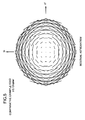
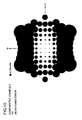
- FIG. 5 is a diagram illustrating the residual astigmatism in the case of Comparative Example 1.
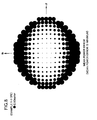
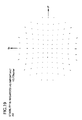
- FIG. 6 is a diagram showing the mean power error in the case of Comparative Example 1.
- the axis of abscissa and the axis of ordinate respectively represent the value of cf and the value of tk in the direction of the principal light ray outputted or emitted from the lens when a wearer's eye is directed to a predetermined third eye position (namely, the direction of the x-axis after the rotation of the eye ball).
- the value of cf (namely, cf-value) is the value of a tangent of an angle between the projection of the light ray onto the x-z plane and the x-axis.
- the value of tk (namely, the tk-value) is the value of a tangent of an angle between the projection of the light ray onto the x-y plane and the x-axis.
- the tangents cf and tk take discrete values and that the residual astigmatism and the mean power error are represented by using the value of aberration at each discrete point.
- the cf- and tk-values taken correspondingly to the outing light direction are equivalent to cf- and tk-values in the direction of the incident light which are sampled at an interval of tan 10° and include 0.0.
- the cf- and tk-values of the incident light are positioned on the square lattice points.
- points, whose coordinate values are the cf-value and the tk-value are nonuniformly arranged on the cf-tk plane. The degree of this nonuniformity indicates the degree of distortion aberration.
- FIGS. 5 and 6 aid in grasping the degree of distortion aberration in addition to the residual astigmatism and the mean power error.
- a segment is indicated at each discrete point.
- the values of the coordinates of the midpoint of the segment are the cf-value and the tk-value, respectively, in the direction of a predetermined outgoing light ray.
- the length of the segment is proportional to the value of the residual astigmatism.
- the direction of the segment indicates the direction corresponding to the principal curvature that is a larger (signed) one of the curvatures of an aberration wave surface.
- a circle is indicated at each discrete point.
- the values of the coordinates of the center of the circle are the values of the tangents cf and tk-value in the direction of a predetermined outgoing light ray or beam.
- the radius of the circle is proportional to the absolute value of mean power error.
- White circles indicate that the mean power error is negative, whereas black circles indicate that the mean power error is positive.
- the design of a toric surface having a slight curve in this manner cannot possibly be employed because high aberration is caused in such a toric surface portion.
- the following two Examples are obtained by forming the second surface, which is an astigmatic surface, as an aspherical surface in order to correct the aberration.
- the second surface is represented by a two-dimensional spline expression.
- the following parameters are used in this Example. Regarding the meaning of the parameters or variables, refer to the foregoing description of the equation (1).
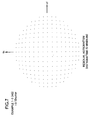
- FIG. 7 shows the distribution of residual astigmatism obtained when a wearer of the spectacle-lens of Example 1-1 directs his eyes along each line of sight.
- FIG. 8 shows the distribution of mean power error obtained when a wearer of the spectacle-lens of Example 1-1 directs his eyes along each line of sight.
- the residual astigmatism is corrected in such a manner as not to be more than 0.01 Diopters (1/m) for all of lines of sight that pass through the lens (range).
- the axis of abscissa represents ⁇ S( ⁇ ) and is graduated at the interval of 1 Diopter (1/m)
- the axis of ordinate represents ⁇ and is graduated at the interval of 10 mm.
- ⁇ S( ⁇ ) takes negative values for all values of ⁇ . This corresponds to and is consistent with the foregoing description of the seventh aspherical spectacle-lens of the present invention.
- the second surface is represented by a two-dimensional spline expression.
- the following parameters are used in this Example. Regarding the meaning of the parameters or variables, refer to the foregoing description of the equation (1).
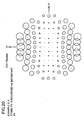
- FIG. 10 is a diagram showing the distribution of residual astigmatism obtained when a wearer of the spectacle-lens of Example 2-1 directs his eyes along each line of sight.
- FIG. 11 is a diagram showing the distribution of mean power error obtained when a wearer of the spectacle-lens of Example 2-1 directs his eyes along each line of sight.
- both of the residual astigmatism and the mean power error can be corrected in a wide range and can be reduced to small values, respectively.
- each of the residual astigmatism and the mean power errors is not more than 0.01 Diopters (l/m) at least in a range where ⁇ 35° .
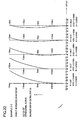
- the axis of abscissa represents ⁇ S( ⁇ ) and is graduated at the interval of 1 Diopter (l/m)
- the axis of ordinate represents ⁇ and is graduated at the interval of 10 mm.
- ⁇ S( ⁇ ) is small in the vicinity of the optical axis and takes negative values in the peripheral portion.
- ⁇ S( ⁇ ) takes a positive value at least once. Furthermore, in a range where ⁇ > 10. 0 mm, ⁇ S( ⁇ ) takes negative values. Namely, this corresponds to and is consistent with the descriptions of the eighth and tenth aspherical spectacle-lens of the present invention.
- the Embodiment 1 (namely, the Examples 1-1 and 1-2) has noticeable effects of reducing the thickness and weight of the lens.
- This embodiment is an example of making an astigmatic lens based on the basic design data listed in the following TABLE 3.
- TABLE 3 Prescribed Value S+3. 00, C+2. 00 Outside Diameter 70 mm Minimum Edge Thickness 0. 8 mm Center Thickness 6. 992361mm (incidentally, this value slightly changes in the case of an aspherical surface)
- 501 First Curvature 1. 070379579 ⁇ 10 -2 mm -1 (S 5. 36260D)
- the second surface is (a kind of) a toric surface.
- C y ⁇ C z
- this curved surface is a "tire surface”.
- this curved surface is a kind of a toric surface.
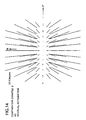
- FIG. 14 is a diagram illustrating the residual astigmatism in the case of directing a wearer's eye along each line of sight.
- FIG. 15 is a diagram showing the mean power error in the case of directing the wearer's eye along each line of sight.
- the designed toric surface having a slight curve in this manner cannot possibly be employed because high aberration is caused in such a toric surface portion.
- the following two Examples are obtained by forming the second surface, which is an astigmatic surface, as an aspherical surface in order to correct the aberration.
- the second surface is represented by a two-dimensional spline expression. Further, the following parameters are used in this Example. Regarding the meaning of the parameters or variables, refer to the foregoing description of the equation (I).
- FIG. 16 is a diagram showing the distribution of residual astigmatism obtained when a wearer of the spectacle-lens of Example 2-1 directs his eyes along each line of sight.
- FIG. 17 is a diagram showing the distribution of mean power error obtained when a wearer of the spectacle-lens of Example 2-1 directs his eyes along each line of sight.
- the residual astigmatism is corrected in such a manner as not to be more than 0.01 Diopters (l/m) for all of lines of sight that pass through the lens (range).
- segments indicating the magnitude of the residual astigmatism are represented by points at all discrete points. However, in the peripheral portion, there still remain some large mean value errors. It is clear that, in the case of "Example 2-1" the condition of aberration is extremely improved in comparison with the toric lens of "Comparative Example 2".
- the axis of abscissa represents ⁇ S( ⁇ ) and is graduated at the interval of 1 Diopter (l/m)
- the axis of ordinate represents ⁇ and is graduated at the interval of 10 mm.
- ⁇ S( ⁇ ) takes positive values for all values of ⁇ . This corresponds to and is consistent with the foregoing description of the seventh aspherical spectacle-lens of the present invention.
- the second surface is represented by a two-dimensional spline expression. Further, the following parameters are used in this Example. Regarding the meaning of the parameters or variables, refer to the foregoing description of the equation (1).
- FIG. 19 is a diagram showing the distribution of residual astigmatism obtained when a wearer of the spectacle-lens of Example 2-1 directs his eyes along each line of sight.
- FIG. 20 is a diagram showing the distribution of mean power error obtained when a wearer of the spectacle-lens of Example 2-1 directs his eyes along each line of sight.
- both of the residual astigmatism and the mean power error can be corrected in a wide range and can be reduced to small values, respectively.
- each of the residual astigmatism and the mean power errors is not more than 0.01 Diopters (l/m) at least in a range where ⁇ 30° .
- the axis of abscissa represents ⁇ S( ⁇ ) and is graduated at the interval of 1 Diopter (l/m)
- the axis of ordinate represents ⁇ and is graduated at the interval of 10 mm.
- ⁇ S( ⁇ ) is small in the vicinity of the optical axis and takes positive values in the peripheral portion.
- ⁇ S( ⁇ ) takes a negative value at least once. Furthermore, in a range where ⁇ > 10.0 mm, ⁇ S( ⁇ ) takes positive values. Namely, this corresponds to and is consistent with the descriptions of the eighth and tenth aspherical spectacle-lens of the present invention.
- the Embodiment 2 (namely, the Examples 2-1 and 2-2) has noticeable effects of reducing the thickness and weight of the lens.
- the residual aberration in all of the third eye-positions are corrected.
- the center or edge thickness of the lens can be set in such a manner as to be less than the thickness of a toric lens having a circular section.
- distortion aberration can be slightly corrected by the lens of the present invention, in comparison with the toric lens having the similar basic data.
- a wearer of the spectacle-lens can obtain good vision (or visual acuity) by using not only the central portion of the lens but also the peripheral portion thereof. If the lens is thin, the present invention has advantageous effects of reducing the burden imposed on the wearer and of obtaining the favorable or beautiful appearance of the lens. Furthermore, as a result of correcting distortion aberration, the degree of the distortion of an image of a viewed object is decreased.
Landscapes
- Health & Medical Sciences (AREA)
- Ophthalmology & Optometry (AREA)
- Physics & Mathematics (AREA)
- General Health & Medical Sciences (AREA)
- General Physics & Mathematics (AREA)
- Optics & Photonics (AREA)
- Lenses (AREA)
- Eyeglasses (AREA)
- Glass Compositions (AREA)
- Grinding And Polishing Of Tertiary Curved Surfaces And Surfaces With Complex Shapes (AREA)
- Prostheses (AREA)
Claims (5)
- Verfahren zum Herstellen einer refraktiven Oberfläche einer asphärischen Brillenlinse mit einem Paar von ersten und zweiten refraktiven Oberflächen, von denen beide asphärische Formen aufweisen, die die Formen der ersten und zweiten gekrümmten Oberflächen entsprechend der nachfolgenden Gleichung (1) darstellen:
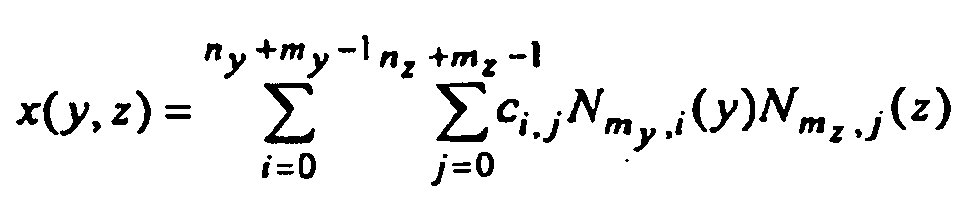
wobei gilt:(x, y, z) stellt Koordinaten eines Punktes auf einer asphärischen Oberfläche dar und genügt (y ∈ [a, b]) n (z ∈ [c, d]);my ist eine Ordnung einer Spline-Funktion in einer Richtung einer y-Achse;mz ist eine Ordnung der Spline-Funktion in einer Richtung einer z-Achse;ny ist die Anzahl von inneren Knoten in [a, b] in der Richtung der y-Achse (ny ist eine ganze Zahl, die nicht kleiner als 4 ist);nz ist die Anzahl von inneren Knoten in [c, d] in der Richtung der z-Achse (nz ist eine ganze Zahl, die nicht kleiner als 4 ist);Nmy,i(y) stellt eine normierte i-te B-Spline-Funktion my-ter Ordnung in dem Fall dar, dass Knoten in der Richtung der y-Achse gleich ξ0, ξ1, ξ2, ..., ξny+2my-1 sind, wobei "i" eine ganze Zahl innerhalb von [0, ny + my - 1] ist und eine Position jedes Knotens der nachfolgenden Bedingung genügt:ξ0 ≤ ξ1 ≤ ... ≤ ξmy-1 ≤ a < ξmy ≤ ... ≤ ξny+my-1 < b ≤ ξny+my ≤ ... ≤ ξny+my+1;Nmz,1(Z) stellt eine j-te normierte B-Spline-Funktion mz-ter Ordnung in dem Fall dar, dass Knoten in der Richtung der z-Achse gleich ξ0, ξ1, ξ2, ..., ξnz+2mz-1 sind, wobei "j" eine ganze Zahl innerhalb von [0, nz + mz - 1] ist und eine Position jedes Knotens der nachfolgenden Bedingung genügt:ξ0, ξ1 ≤ ... ≤ ξmz-1 ≤ c < ξmz ≤ ... ≤ ξnz+mz-1 < d ≤ ξnz+mz ≤ ... ≤ ξnz+2mz-1; undci,j ist ein Koeffizient entsprechend einer Kombination von ganzen Zahlen "i" und "j"; und wobeidie Ordnung der B-Spline-Funktionen gleich 5 oder 6 ist,die B-Spline-Funktionen und die Koeffizienten ci,j derart bestimmt werden, dass Restastigmatismus und mittlerer Brechkraftfehler in zweiten Augenpositionen undin dritten Augenpositionen entsprechend dem Listing'schen Gesetz berichtigt werden, während Ametropie in ersten Augenpositionen berichtigt wird, sowie derart, dass auf einer eine orthogonale Kurve genannten Schnittlinie einer asphärischen Oberfläche und einer die optische Achse enthaltenden beliebigen Ebene den nachfolgenden Bedingungen 1 und 2, Bedingungen 1 und 3, Bedingungen 1 und 4 oder Bedingungen 1 und 5 genügt wird:Bedingung 1: die Linsenbrechkraft D auf einer optischen Achse genügt auf einer orthogonalen Querschnittsebene der nachfolgenden Ungleichung: -6,0 ≤ D ≤ +6,0; und eine Änderung der Kurvenbrechkraft ΔS(ρ) genügt für 0,0 < ρ < 4,0 (ρ bezeichnet einen Abstand von einem vorbestimmten Punkt innerhalb eines Linsenbereiches auf der orthogonalen Kurve zur optischen Achse) der nachfolgenden Ungleichung: -0,05 ≤ ΔS(ρ) ≤ 0,05;Bedingung 2: die Linsenbrechkraft D auf einer optischen Achse genügt auf einer orthogonalen Querschnittsebene der nachfolgenden Ungleichung: D > 0,0; und eine Änderung der Kurvenbrechkraft ΔS(ρ) nimmt wenigstens einmal für 0,0 ≤ ρ ≤ 10,0 mm (ρ bezeichnet einen Abstand von einem vorbestimmten Punkt innerhalb eines Linsenbereiches auf der orthogonalen Kurve zur optischen Achse) einen positiven Wert an und ΔS(ρ) nimmt für ρ > 10,0 mm negative Werte an;Bedingung 3: die Linsenbrechkraft D auf einer optischen Achse genügt auf einer orthogonalen Querschnittsebene der nachfolgenden Ungleichung: D ≤ 0,0; und eine Änderung der Kurvenbrechkraft ΔS(ρ) nimmt wenigstens einmal für 0,0 ≤ ρ ≤ 10,0 mm (ρ bezeichnet einen Abstand von einem vorbestimmten Punkt innerhalb eines Linsenbereiches auf der orthogonalen Kurve zur optischen Achse) einen negativen Wert an und ΔS(ρ) nimmt für ρ > 10,0 mm positive Werte an;Bedingung 4: die Linsenbrechkraft D auf einer optischen Achse genügt auf einer orthogonalen Querschnittsebene der nachfolgenden Ungleichung: D > 0,0; und eine Änderung der Kurvenbrechkraft ΔS(ρ) nimmt wenigstens einmal für 0,0 ≤ ρ ≤ 10,0 mm (ρ bezeichnet einen Abstand von einem vorbestimmten Punkt innerhalb eines Linsenbereiches auf der orthogonalen Kurve zur optischen Achse) einen negativen Wert an und ΔS(ρ) nimmt für ρ > 10,0 mm positive Werte an;Bedingung 5: die Linsenbrechkraft D auf einer optischen Achse genügt auf einer orthogonalen Querschnittsebene der nachfolgenden Ungleichung: D ≤ 0,0; und eine Änderung der Kurvenbrechkraft ΔS(ρ) nimmt wenigstens einmal für 0,0 ≤ ρ ≤ 10,0 mm (ρ bezeichnet einen Abstand von einem vorbestimmten Punkt innerhalb eines Linsenbereiches auf der orthogonalen Kurve zur optischen Achse) einen positiven Wert an und ΔS(ρ) nimmt für ρ > 10,0 mm negative Werte an. - Verfahren nach Anspruch 1, wobei die Knoten und die Koeffizienten derart bestimmt werden, dass Gleichung (1) den nachfolgenden Bedingungen genügt:x(y, z) = x(y, -z), gültig für z ∈ [-a, a] und/oderx(y, z) = x(-y, z), gültig für y ∈ [-c, c].
- Verfahren nach Anspruch 2, wobei die B-Spline-Funktion in der Richtung der y-Achse, die Anzahl von Knoten, die Knoten und die Koeffizienten den nachfolgenden ersten oder zweiten Bedingungen genügen:erste Bedingung:my ist geradzahlig; ny ist ungeradzahlig;
ξ(ny+2my-1)/2 = 0, ξ0 = -ξny+2my-1, ξ1 = -ξny+2my-2, ..., ξ(ny+2my-3)/2 = -ξ(ny+2my+1)/2; und
ci,j = c(mj+nj-1-i),j (i = 0, 1, ..., (my + ny - 3)/2, gültig für alle "j"zweite Bedingung:my ist ungeradzahlig; ny ist geradzahlig;
ξ0 = -ξny+2my-1, ξ1 = -ξny+2my-2, ..., ξ(ny+2my-1)/2 = -ξ(ny+2my+1)/2; und
ci,j = C(mj+nj-1-i),j (i = 0, 1, ..., (my + ny - 3)/2, gültig für alle "j". - Verfahren nach Anspruch 2 oder 3, wobei die B-Spline-Funktion in der Richtung der z-Achse, die Anzahl von Knoten, die Knoten und die Koeffizienten den nachfolgenden ersten oder zweiten Bedingungen genügen:erste Bedingung:my ist geradzahlig; ny ist ungeradzahlig;
ξ(nz+2mz-1)/2 = 0, ξ0 = -ξnz+2mz-1, ξ1 = -ξnz+2mz-2, ..., ξ(nz+2mz-3)/2 = -ξ(nz+2mz+1)/2; und
ci,j = c(mj+nj-1-j), (i = 0, 1, ..., (mz + nz - 3)/2, gültig für alle "i"zweite Bedingung: my ist ungeradzahlig; ny ist geradzahlig;
ξ0 = -ξny+2mz-1, ξ1 = -ξnz+2mz-2, ..., ξ(nz+2mz-1)/2 = -ξ(nz+2mz+1)/2; und
ci,j = C(mj+nj-1-j), (i = 0, 1, ..., (mz + nz - 3)/2, gültig für alle "i". - Verfahren nach Anspruch 1, wobei die B-Spline-Funktion in der Richtung der z-Achse, die Anzahl von Knoten, die Knoten und die Koeffizienten den nachfolgenden ersten oder zweiten Bedingungen genügen:erste Bedingung:my ist geradzahlig; ny ist ungeradzahlig;
ξ(nz+2mz-1)/2 = 0, ξ0 = -ξnz+2mz-1, ξ1 = -ξnz+2mz-2, ..., ξ(nz+2mz-3)/2 = -ξ(nz+2mz+1)/2; und
ci,j = c(mj+nj-1-j), (i = 0, 1, ..., (mz + nz - 3)/2, gültig für alle "i"zweite Bedingung:my ist ungeradzahlig; ny ist geradzahlig;
ξ0 = -ξny+2mz-1, ξ1 = -ξnz+2mz-2, .... ξ(nz+2mz-1)/2 = -ξ(nz+2mz+1)/2; und
ci,j = c(mj+nj-1-j), (i = 0, 1, ..., (mz + nz - 3)/2, gültig für alle "i".
Applications Claiming Priority (3)
| Application Number | Priority Date | Filing Date | Title |
|---|---|---|---|
| JP16294197 | 1997-06-19 | ||
| JP16294197 | 1997-06-19 | ||
| JP162941/97 | 1997-06-19 |
Publications (3)
| Publication Number | Publication Date |
|---|---|
| EP0886166A2 EP0886166A2 (de) | 1998-12-23 |
| EP0886166A3 EP0886166A3 (de) | 2004-12-08 |
| EP0886166B1 true EP0886166B1 (de) | 2010-03-17 |
Family
ID=15764170
Family Applications (1)
| Application Number | Title | Priority Date | Filing Date |
|---|---|---|---|
| EP98111228A Expired - Lifetime EP0886166B1 (de) | 1997-06-19 | 1998-06-18 | Aspherische Brillenlinse |
Country Status (5)
| Country | Link |
|---|---|
| US (1) | US6012813A (de) |
| EP (1) | EP0886166B1 (de) |
| AT (1) | ATE461468T1 (de) |
| AU (1) | AU736878C (de) |
| DE (1) | DE69841558D1 (de) |
Families Citing this family (16)
| Publication number | Priority date | Publication date | Assignee | Title |
|---|---|---|---|---|
| DE19540186A1 (de) * | 1995-10-28 | 1997-04-30 | Rodenstock Optik G | Einstärken-Brillenglas mit zwei asphärischen Flächen |
| EP0964285A1 (de) * | 1998-06-10 | 1999-12-15 | Nikon Corporation | Aspherische ophthalmische Linse |
| JP4219546B2 (ja) * | 2000-10-17 | 2009-02-04 | セイコーオプティカルプロダクツ株式会社 | 眼鏡レンズ |
| US6595639B1 (en) * | 2000-11-10 | 2003-07-22 | Ocular Sciences, Inc. | Junctionless ophthalmic lenses and methods for making same |
| US7152975B2 (en) * | 2000-11-10 | 2006-12-26 | Cooper Vision, Inc. | Junctionless ophthalmic lenses and methods for making same |
| DE10106386A1 (de) * | 2001-02-12 | 2002-09-12 | Rodenstock Optik G | B-Spline-Optimierung von optischen Gläsern und insbesondere Brillengläsern mit Symmetrieebenen |
| AU2002253630B2 (en) * | 2001-04-26 | 2007-02-15 | Hoya Corporation | Spectacle lens designing method and spectacle lens |
| IL143503A0 (en) * | 2001-05-31 | 2002-04-21 | Visionix Ltd | Aberration correction spectacle lens |
| JP4361254B2 (ja) * | 2002-10-08 | 2009-11-11 | 株式会社ニコン・エシロール | 眼鏡レンズの設計方法、眼鏡レンズの製造方法及び計算機プログラム |
| US20080036963A1 (en) * | 2004-06-10 | 2008-02-14 | Glen Stanley | Variable Geometry Lens |
| JP4537134B2 (ja) * | 2004-07-12 | 2010-09-01 | セイコーオプティカルプロダクツ株式会社 | 非球面眼鏡レンズの設計方法 |
| US8393732B2 (en) * | 2007-10-31 | 2013-03-12 | Hoya Corporation | Spectacle lens evaluating method, spectacle lens designing method using same, spectacle lens manufacturing method, spectacle lens manufacturing system, and spectacle lens |
| RU2442125C2 (ru) * | 2007-10-31 | 2012-02-10 | Хойа Корпорейшн | Способ оценки очковых линз, способ расчета очковых линз с его использованием, способ изготовления очковых линз, система изготовления очковых линз и очковые линзы |
| DE102012010221A1 (de) * | 2012-05-23 | 2013-11-28 | Carl Zeiss Vision International Gmbh | Verfahren zum Herstellen einer Brillenlinse mit astigmatischer Korrektur und Brille mit solcher Brillenlinse |
| EP3118671B1 (de) * | 2014-03-11 | 2022-03-23 | Kowa Company Ltd. | Ophthalmische linsen und verfahren zum entwurf ophthalmischer linsen |
| CN111077676B (zh) * | 2019-12-10 | 2021-09-07 | 华为技术有限公司 | 散光矫正透镜、头戴显示设备和散光矫正方法 |
Citations (1)
| Publication number | Priority date | Publication date | Assignee | Title |
|---|---|---|---|---|
| EP0379976A2 (de) * | 1989-01-21 | 1990-08-01 | Seiko Epson Corporation | Asphärische ophthalmische Linse |
Family Cites Families (6)
| Publication number | Priority date | Publication date | Assignee | Title |
|---|---|---|---|---|
| JPS601604B2 (ja) * | 1978-04-03 | 1985-01-16 | 旭光学工業株式会社 | 乱視用眼鏡レンズ |
| DE3016936C2 (de) * | 1980-05-02 | 1983-12-01 | Fa. Carl Zeiss, 7920 Heidenheim | Brillenlinse mit astigmatischer Wirkung |
| DE69113127T2 (de) * | 1990-06-13 | 1996-03-21 | Seiko Epson Corp | Brillenlinse. |
| US5767939A (en) * | 1991-10-09 | 1998-06-16 | Seiko Epson Corporation | Eyeglass lens |
| US5479220A (en) * | 1991-10-09 | 1995-12-26 | Seiko Epson Corporation | Eyeglass lens |
| JPH085967A (ja) * | 1994-06-23 | 1996-01-12 | Nikon Corp | 非球面眼鏡レンズ |
-
1998
- 1998-06-15 US US09/094,638 patent/US6012813A/en not_active Expired - Lifetime
- 1998-06-18 AU AU71937/98A patent/AU736878C/en not_active Ceased
- 1998-06-18 AT AT98111228T patent/ATE461468T1/de not_active IP Right Cessation
- 1998-06-18 DE DE69841558T patent/DE69841558D1/de not_active Expired - Lifetime
- 1998-06-18 EP EP98111228A patent/EP0886166B1/de not_active Expired - Lifetime
Patent Citations (1)
| Publication number | Priority date | Publication date | Assignee | Title |
|---|---|---|---|---|
| EP0379976A2 (de) * | 1989-01-21 | 1990-08-01 | Seiko Epson Corporation | Asphärische ophthalmische Linse |
Also Published As
| Publication number | Publication date |
|---|---|
| EP0886166A2 (de) | 1998-12-23 |
| EP0886166A3 (de) | 2004-12-08 |
| ATE461468T1 (de) | 2010-04-15 |
| AU736878C (en) | 2002-08-15 |
| AU736878B2 (en) | 2001-08-02 |
| AU7193798A (en) | 1998-12-24 |
| DE69841558D1 (de) | 2010-04-29 |
| US6012813A (en) | 2000-01-11 |
Similar Documents
| Publication | Publication Date | Title |
|---|---|---|
| US6019470A (en) | Progressive multifocal lens and manufacturing method of eyeglass lens and progressive multifocal lens | |
| EP2821840B1 (de) | Verbesserte ophthalmische Linse | |
| EP0472291B1 (de) | Methode zur Herstellung von Linsen | |
| US7527376B2 (en) | Method for designing spectacle lens, spectacle lens, and spectacles | |
| EP1385038B1 (de) | Brillenlinsenentwurfsverfahren und brillenlinse | |
| EP0809127B1 (de) | Mehrstärkenglas für Brillen und Brillenglas | |
| AU723308B2 (en) | Progressive power multi-focal lens | |
| EP3990975B1 (de) | Brillenglas und herstellungsverfahren dafür | |
| US6012813A (en) | Aspherical spectacle lens | |
| EP2407815B1 (de) | Verfahren für die zusammenstellung von formdaten für ein brillenglas, vorrichtung für die zusammenstellung von formdaten für ein brillenglas und brillenglas | |
| EP0446698B1 (de) | Linsen für Schutzbrillen | |
| US5061058A (en) | Opthalmic lens for use in the correction of astigmatism | |
| EP1019779B1 (de) | Verbesserte progressive linse | |
| WO2000028368A9 (en) | Methods for designing and making contact lenses having aberration control and contact lenses made thereby | |
| US7207675B1 (en) | Ophthalmic lens | |
| EP4123362A1 (de) | Brillenglas | |
| US6505930B1 (en) | Spectacles frames for shaped lens elements | |
| US7210780B1 (en) | Method for determination of an ophthalmic lens | |
| JP4361254B2 (ja) | 眼鏡レンズの設計方法、眼鏡レンズの製造方法及び計算機プログラム | |
| JP3236263B2 (ja) | 非球面眼鏡レンズ設計方法 | |
| JP2002040373A (ja) | 非球面眼鏡レンズ | |
| JP5040889B2 (ja) | 眼鏡レンズの設計方法 | |
| GB1569764A (en) | Progressive power ophthalmic lens | |
| JPH04217225A (ja) | 近距離中距離域無歪曲老視用レンズ | |
| MXPA99008683A (en) | Lens with surface correction |
Legal Events
| Date | Code | Title | Description |
|---|---|---|---|
| PUAI | Public reference made under article 153(3) epc to a published international application that has entered the european phase |
Free format text: ORIGINAL CODE: 0009012 |
|
| AK | Designated contracting states |
Kind code of ref document: A2 Designated state(s): AT BE CH CY DE DK ES FI FR GB GR IE IT LI LU MC NL PT SE |
|
| AX | Request for extension of the european patent |
Free format text: AL;LT;LV;MK;RO;SI |
|
| PUAL | Search report despatched |
Free format text: ORIGINAL CODE: 0009013 |
|
| AK | Designated contracting states |
Kind code of ref document: A3 Designated state(s): AT BE CH CY DE DK ES FI FR GB GR IE IT LI LU MC NL PT SE |
|
| AX | Request for extension of the european patent |
Extension state: AL LT LV MK RO SI |
|
| 17P | Request for examination filed |
Effective date: 20050204 |
|
| 17Q | First examination report despatched |
Effective date: 20050310 |
|
| AKX | Designation fees paid |
Designated state(s): AT BE CH CY DE DK ES FI FR GB GR IE IT LI LU MC NL PT SE |
|
| 17Q | First examination report despatched |
Effective date: 20050310 |
|
| GRAP | Despatch of communication of intention to grant a patent |
Free format text: ORIGINAL CODE: EPIDOSNIGR1 |
|
| GRAS | Grant fee paid |
Free format text: ORIGINAL CODE: EPIDOSNIGR3 |
|
| GRAA | (expected) grant |
Free format text: ORIGINAL CODE: 0009210 |
|
| RAP1 | Party data changed (applicant data changed or rights of an application transferred) |
Owner name: HOYA CORPORATION |
|
| AK | Designated contracting states |
Kind code of ref document: B1 Designated state(s): AT BE CH CY DE DK ES FI FR GB GR IE IT LI LU MC NL PT SE |
|
| REG | Reference to a national code |
Ref country code: GB Ref legal event code: FG4D |
|
| REG | Reference to a national code |
Ref country code: CH Ref legal event code: EP |
|
| REG | Reference to a national code |
Ref country code: IE Ref legal event code: FG4D |
|
| REF | Corresponds to: |
Ref document number: 69841558 Country of ref document: DE Date of ref document: 20100429 Kind code of ref document: P |
|
| REG | Reference to a national code |
Ref country code: NL Ref legal event code: VDEP Effective date: 20100317 |
|
| PG25 | Lapsed in a contracting state [announced via postgrant information from national office to epo] |
Ref country code: FI Free format text: LAPSE BECAUSE OF FAILURE TO SUBMIT A TRANSLATION OF THE DESCRIPTION OR TO PAY THE FEE WITHIN THE PRESCRIBED TIME-LIMIT Effective date: 20100317 Ref country code: AT Free format text: LAPSE BECAUSE OF FAILURE TO SUBMIT A TRANSLATION OF THE DESCRIPTION OR TO PAY THE FEE WITHIN THE PRESCRIBED TIME-LIMIT Effective date: 20100317 |
|
| PG25 | Lapsed in a contracting state [announced via postgrant information from national office to epo] |
Ref country code: SE Free format text: LAPSE BECAUSE OF FAILURE TO SUBMIT A TRANSLATION OF THE DESCRIPTION OR TO PAY THE FEE WITHIN THE PRESCRIBED TIME-LIMIT Effective date: 20100317 Ref country code: NL Free format text: LAPSE BECAUSE OF FAILURE TO SUBMIT A TRANSLATION OF THE DESCRIPTION OR TO PAY THE FEE WITHIN THE PRESCRIBED TIME-LIMIT Effective date: 20100317 Ref country code: GR Free format text: LAPSE BECAUSE OF FAILURE TO SUBMIT A TRANSLATION OF THE DESCRIPTION OR TO PAY THE FEE WITHIN THE PRESCRIBED TIME-LIMIT Effective date: 20100618 Ref country code: ES Free format text: LAPSE BECAUSE OF FAILURE TO SUBMIT A TRANSLATION OF THE DESCRIPTION OR TO PAY THE FEE WITHIN THE PRESCRIBED TIME-LIMIT Effective date: 20100628 Ref country code: CY Free format text: LAPSE BECAUSE OF FAILURE TO SUBMIT A TRANSLATION OF THE DESCRIPTION OR TO PAY THE FEE WITHIN THE PRESCRIBED TIME-LIMIT Effective date: 20100317 Ref country code: BE Free format text: LAPSE BECAUSE OF FAILURE TO SUBMIT A TRANSLATION OF THE DESCRIPTION OR TO PAY THE FEE WITHIN THE PRESCRIBED TIME-LIMIT Effective date: 20100317 |
|
| PLBE | No opposition filed within time limit |
Free format text: ORIGINAL CODE: 0009261 |
|
| STAA | Information on the status of an ep patent application or granted ep patent |
Free format text: STATUS: NO OPPOSITION FILED WITHIN TIME LIMIT |
|
| PG25 | Lapsed in a contracting state [announced via postgrant information from national office to epo] |
Ref country code: PT Free format text: LAPSE BECAUSE OF FAILURE TO SUBMIT A TRANSLATION OF THE DESCRIPTION OR TO PAY THE FEE WITHIN THE PRESCRIBED TIME-LIMIT Effective date: 20100719 Ref country code: MC Free format text: LAPSE BECAUSE OF NON-PAYMENT OF DUE FEES Effective date: 20100630 Ref country code: DK Free format text: LAPSE BECAUSE OF FAILURE TO SUBMIT A TRANSLATION OF THE DESCRIPTION OR TO PAY THE FEE WITHIN THE PRESCRIBED TIME-LIMIT Effective date: 20100317 |
|
| REG | Reference to a national code |
Ref country code: CH Ref legal event code: PL |
|
| 26N | No opposition filed |
Effective date: 20101220 |
|
| PG25 | Lapsed in a contracting state [announced via postgrant information from national office to epo] |
Ref country code: IT Free format text: LAPSE BECAUSE OF FAILURE TO SUBMIT A TRANSLATION OF THE DESCRIPTION OR TO PAY THE FEE WITHIN THE PRESCRIBED TIME-LIMIT Effective date: 20100317 |
|
| PG25 | Lapsed in a contracting state [announced via postgrant information from national office to epo] |
Ref country code: IE Free format text: LAPSE BECAUSE OF NON-PAYMENT OF DUE FEES Effective date: 20100618 Ref country code: CH Free format text: LAPSE BECAUSE OF NON-PAYMENT OF DUE FEES Effective date: 20100630 Ref country code: LI Free format text: LAPSE BECAUSE OF NON-PAYMENT OF DUE FEES Effective date: 20100630 |
|
| PG25 | Lapsed in a contracting state [announced via postgrant information from national office to epo] |
Ref country code: LU Free format text: LAPSE BECAUSE OF NON-PAYMENT OF DUE FEES Effective date: 20100618 |
|
| REG | Reference to a national code |
Ref country code: FR Ref legal event code: PLFP Year of fee payment: 18 |
|
| PGFP | Annual fee paid to national office [announced via postgrant information from national office to epo] |
Ref country code: DE Payment date: 20150609 Year of fee payment: 18 Ref country code: GB Payment date: 20150617 Year of fee payment: 18 |
|
| PGFP | Annual fee paid to national office [announced via postgrant information from national office to epo] |
Ref country code: FR Payment date: 20150608 Year of fee payment: 18 |
|
| REG | Reference to a national code |
Ref country code: DE Ref legal event code: R119 Ref document number: 69841558 Country of ref document: DE |
|
| GBPC | Gb: european patent ceased through non-payment of renewal fee |
Effective date: 20160618 |
|
| REG | Reference to a national code |
Ref country code: FR Ref legal event code: ST Effective date: 20170228 |
|
| PG25 | Lapsed in a contracting state [announced via postgrant information from national office to epo] |
Ref country code: DE Free format text: LAPSE BECAUSE OF NON-PAYMENT OF DUE FEES Effective date: 20170103 Ref country code: FR Free format text: LAPSE BECAUSE OF NON-PAYMENT OF DUE FEES Effective date: 20160630 |
|
| PG25 | Lapsed in a contracting state [announced via postgrant information from national office to epo] |
Ref country code: GB Free format text: LAPSE BECAUSE OF NON-PAYMENT OF DUE FEES Effective date: 20160618 |