EP0871459B1 - Vector and method of use for nucleic acid delivery to non-dividing cells - Google Patents
Vector and method of use for nucleic acid delivery to non-dividing cells Download PDFInfo
- Publication number
- EP0871459B1 EP0871459B1 EP96933140A EP96933140A EP0871459B1 EP 0871459 B1 EP0871459 B1 EP 0871459B1 EP 96933140 A EP96933140 A EP 96933140A EP 96933140 A EP96933140 A EP 96933140A EP 0871459 B1 EP0871459 B1 EP 0871459B1
- Authority
- EP
- European Patent Office
- Prior art keywords
- nucleic acid
- acid sequence
- cell
- retrovirus
- vector
- Prior art date
- Legal status (The legal status is an assumption and is not a legal conclusion. Google has not performed a legal analysis and makes no representation as to the accuracy of the status listed.)
- Revoked
Links
- 238000000034 method Methods 0.000 title claims abstract description 43
- 239000013598 vector Substances 0.000 title claims description 98
- 150000007523 nucleic acids Chemical class 0.000 title claims description 85
- 108020004707 nucleic acids Proteins 0.000 title claims description 30
- 102000039446 nucleic acids Human genes 0.000 title claims description 30
- 241001430294 unidentified retrovirus Species 0.000 claims abstract description 60
- 241000700605 Viruses Species 0.000 claims abstract description 34
- 241000713666 Lentivirus Species 0.000 claims abstract description 16
- 208000037265 diseases, disorders, signs and symptoms Diseases 0.000 claims abstract description 15
- 208000035475 disorder Diseases 0.000 claims abstract description 10
- 210000004027 cell Anatomy 0.000 claims description 156
- 108090000623 proteins and genes Proteins 0.000 claims description 66
- 241000725303 Human immunodeficiency virus Species 0.000 claims description 44
- 108091028043 Nucleic acid sequence Proteins 0.000 claims description 44
- 230000003612 virological effect Effects 0.000 claims description 41
- 238000004806 packaging method and process Methods 0.000 claims description 39
- 230000001177 retroviral effect Effects 0.000 claims description 21
- 230000001105 regulatory effect Effects 0.000 claims description 17
- 230000010354 integration Effects 0.000 claims description 15
- 230000000692 anti-sense effect Effects 0.000 claims description 13
- 210000002569 neuron Anatomy 0.000 claims description 12
- 238000010839 reverse transcription Methods 0.000 claims description 12
- 241000711975 Vesicular stomatitis virus Species 0.000 claims description 11
- 239000003623 enhancer Substances 0.000 claims description 10
- -1 nef Proteins 0.000 claims description 10
- 230000001537 neural effect Effects 0.000 claims description 8
- 101710149136 Protein Vpr Proteins 0.000 claims description 7
- 230000002950 deficient Effects 0.000 claims description 5
- 208000024827 Alzheimer disease Diseases 0.000 claims description 4
- 101710177291 Gag polyprotein Proteins 0.000 claims description 4
- 108020005067 RNA Splice Sites Proteins 0.000 claims description 4
- 208000032839 leukemia Diseases 0.000 claims description 4
- 210000000278 spinal cord Anatomy 0.000 claims description 4
- 208000023105 Huntington disease Diseases 0.000 claims description 3
- 208000018737 Parkinson disease Diseases 0.000 claims description 3
- 210000002798 bone marrow cell Anatomy 0.000 claims description 3
- 210000005229 liver cell Anatomy 0.000 claims description 3
- 230000010076 replication Effects 0.000 claims description 3
- 238000011144 upstream manufacturing Methods 0.000 claims description 3
- 208000003808 Amyloid Neuropathies Diseases 0.000 claims description 2
- 201000003883 Cystic fibrosis Diseases 0.000 claims description 2
- 206010013801 Duchenne Muscular Dystrophy Diseases 0.000 claims description 2
- 208000015439 Lysosomal storage disease Diseases 0.000 claims description 2
- 201000000582 Retinoblastoma Diseases 0.000 claims description 2
- 230000006378 damage Effects 0.000 claims description 2
- 210000002064 heart cell Anatomy 0.000 claims description 2
- 210000005265 lung cell Anatomy 0.000 claims description 2
- 239000003607 modifier Substances 0.000 claims description 2
- 210000000663 muscle cell Anatomy 0.000 claims description 2
- 230000003961 neuronal insult Effects 0.000 claims description 2
- 238000002360 preparation method Methods 0.000 claims description 2
- 210000004927 skin cell Anatomy 0.000 claims description 2
- 102100034353 Integrase Human genes 0.000 claims 5
- 108010078428 env Gene Products Proteins 0.000 claims 5
- 108010089520 pol Gene Products Proteins 0.000 claims 3
- 101710125418 Major capsid protein Proteins 0.000 claims 2
- 230000000977 initiatory effect Effects 0.000 claims 2
- 208000009625 Lesch-Nyhan syndrome Diseases 0.000 claims 1
- 208000035317 Total hypoxanthine-guanine phosphoribosyl transferase deficiency Diseases 0.000 claims 1
- 108010067390 Viral Proteins Proteins 0.000 claims 1
- 239000008194 pharmaceutical composition Substances 0.000 claims 1
- 208000012902 Nervous system disease Diseases 0.000 abstract description 2
- 208000025966 Neurological disease Diseases 0.000 abstract 1
- 208000015181 infectious disease Diseases 0.000 description 45
- 239000013612 plasmid Substances 0.000 description 42
- 239000012634 fragment Substances 0.000 description 24
- 108020004414 DNA Proteins 0.000 description 20
- 230000014509 gene expression Effects 0.000 description 18
- 238000010361 transduction Methods 0.000 description 15
- 230000026683 transduction Effects 0.000 description 15
- 238000012546 transfer Methods 0.000 description 15
- 102000004169 proteins and genes Human genes 0.000 description 13
- 108091032973 (ribonucleotides)n+m Proteins 0.000 description 12
- 230000002458 infectious effect Effects 0.000 description 11
- 108010005774 beta-Galactosidase Proteins 0.000 description 10
- 210000004556 brain Anatomy 0.000 description 10
- VYFYYTLLBUKUHU-UHFFFAOYSA-N dopamine Chemical compound NCCC1=CC=C(O)C(O)=C1 VYFYYTLLBUKUHU-UHFFFAOYSA-N 0.000 description 10
- 238000001727 in vivo Methods 0.000 description 10
- 239000002245 particle Substances 0.000 description 10
- 241000700159 Rattus Species 0.000 description 9
- 238000010367 cloning Methods 0.000 description 9
- 230000012010 growth Effects 0.000 description 9
- 239000003550 marker Substances 0.000 description 9
- 108020004999 messenger RNA Proteins 0.000 description 9
- 102100034349 Integrase Human genes 0.000 description 8
- 238000000338 in vitro Methods 0.000 description 8
- 210000002540 macrophage Anatomy 0.000 description 8
- 238000001890 transfection Methods 0.000 description 8
- 239000005089 Luciferase Substances 0.000 description 7
- NOFOAYPPHIUXJR-APNQCZIXSA-N aphidicolin Chemical compound C1[C@@]23[C@@]4(C)CC[C@@H](O)[C@@](C)(CO)[C@@H]4CC[C@H]3C[C@H]1[C@](CO)(O)CC2 NOFOAYPPHIUXJR-APNQCZIXSA-N 0.000 description 7
- SEKZNWAQALMJNH-YZUCACDQSA-N aphidicolin Natural products C[C@]1(CO)CC[C@]23C[C@H]1C[C@@H]2CC[C@H]4[C@](C)(CO)[C@H](O)CC[C@]34C SEKZNWAQALMJNH-YZUCACDQSA-N 0.000 description 7
- 210000002845 virion Anatomy 0.000 description 7
- WSFSSNUMVMOOMR-UHFFFAOYSA-N Formaldehyde Chemical compound O=C WSFSSNUMVMOOMR-UHFFFAOYSA-N 0.000 description 6
- 108091034117 Oligonucleotide Proteins 0.000 description 6
- 108700004025 env Genes Proteins 0.000 description 6
- 210000002950 fibroblast Anatomy 0.000 description 6
- 239000003446 ligand Substances 0.000 description 6
- 238000004519 manufacturing process Methods 0.000 description 6
- 230000001566 pro-viral effect Effects 0.000 description 6
- 101710091045 Envelope protein Proteins 0.000 description 5
- 101710188315 Protein X Proteins 0.000 description 5
- WQZGKKKJIJFFOK-FPRJBGLDSA-N beta-D-galactose Chemical compound OC[C@H]1O[C@@H](O)[C@H](O)[C@@H](O)[C@H]1O WQZGKKKJIJFFOK-FPRJBGLDSA-N 0.000 description 5
- 239000003795 chemical substances by application Substances 0.000 description 5
- 238000012761 co-transfection Methods 0.000 description 5
- 239000003636 conditioned culture medium Substances 0.000 description 5
- 229960003638 dopamine Drugs 0.000 description 5
- 239000002609 medium Substances 0.000 description 5
- 239000000047 product Substances 0.000 description 5
- 230000004083 survival effect Effects 0.000 description 5
- 238000013518 transcription Methods 0.000 description 5
- 230000035897 transcription Effects 0.000 description 5
- 230000001052 transient effect Effects 0.000 description 5
- TWRXJAOTZQYOKJ-UHFFFAOYSA-L Magnesium chloride Chemical compound [Mg+2].[Cl-].[Cl-] TWRXJAOTZQYOKJ-UHFFFAOYSA-L 0.000 description 4
- 241000713869 Moloney murine leukemia virus Species 0.000 description 4
- JLCPHMBAVCMARE-UHFFFAOYSA-N [3-[[3-[[3-[[3-[[3-[[3-[[3-[[3-[[3-[[3-[[3-[[5-(2-amino-6-oxo-1H-purin-9-yl)-3-[[3-[[3-[[3-[[3-[[3-[[5-(2-amino-6-oxo-1H-purin-9-yl)-3-[[5-(2-amino-6-oxo-1H-purin-9-yl)-3-hydroxyoxolan-2-yl]methoxy-hydroxyphosphoryl]oxyoxolan-2-yl]methoxy-hydroxyphosphoryl]oxy-5-(5-methyl-2,4-dioxopyrimidin-1-yl)oxolan-2-yl]methoxy-hydroxyphosphoryl]oxy-5-(6-aminopurin-9-yl)oxolan-2-yl]methoxy-hydroxyphosphoryl]oxy-5-(6-aminopurin-9-yl)oxolan-2-yl]methoxy-hydroxyphosphoryl]oxy-5-(6-aminopurin-9-yl)oxolan-2-yl]methoxy-hydroxyphosphoryl]oxy-5-(6-aminopurin-9-yl)oxolan-2-yl]methoxy-hydroxyphosphoryl]oxyoxolan-2-yl]methoxy-hydroxyphosphoryl]oxy-5-(5-methyl-2,4-dioxopyrimidin-1-yl)oxolan-2-yl]methoxy-hydroxyphosphoryl]oxy-5-(4-amino-2-oxopyrimidin-1-yl)oxolan-2-yl]methoxy-hydroxyphosphoryl]oxy-5-(5-methyl-2,4-dioxopyrimidin-1-yl)oxolan-2-yl]methoxy-hydroxyphosphoryl]oxy-5-(5-methyl-2,4-dioxopyrimidin-1-yl)oxolan-2-yl]methoxy-hydroxyphosphoryl]oxy-5-(6-aminopurin-9-yl)oxolan-2-yl]methoxy-hydroxyphosphoryl]oxy-5-(6-aminopurin-9-yl)oxolan-2-yl]methoxy-hydroxyphosphoryl]oxy-5-(4-amino-2-oxopyrimidin-1-yl)oxolan-2-yl]methoxy-hydroxyphosphoryl]oxy-5-(4-amino-2-oxopyrimidin-1-yl)oxolan-2-yl]methoxy-hydroxyphosphoryl]oxy-5-(4-amino-2-oxopyrimidin-1-yl)oxolan-2-yl]methoxy-hydroxyphosphoryl]oxy-5-(6-aminopurin-9-yl)oxolan-2-yl]methoxy-hydroxyphosphoryl]oxy-5-(4-amino-2-oxopyrimidin-1-yl)oxolan-2-yl]methyl [5-(6-aminopurin-9-yl)-2-(hydroxymethyl)oxolan-3-yl] hydrogen phosphate Polymers Cc1cn(C2CC(OP(O)(=O)OCC3OC(CC3OP(O)(=O)OCC3OC(CC3O)n3cnc4c3nc(N)[nH]c4=O)n3cnc4c3nc(N)[nH]c4=O)C(COP(O)(=O)OC3CC(OC3COP(O)(=O)OC3CC(OC3COP(O)(=O)OC3CC(OC3COP(O)(=O)OC3CC(OC3COP(O)(=O)OC3CC(OC3COP(O)(=O)OC3CC(OC3COP(O)(=O)OC3CC(OC3COP(O)(=O)OC3CC(OC3COP(O)(=O)OC3CC(OC3COP(O)(=O)OC3CC(OC3COP(O)(=O)OC3CC(OC3COP(O)(=O)OC3CC(OC3COP(O)(=O)OC3CC(OC3COP(O)(=O)OC3CC(OC3COP(O)(=O)OC3CC(OC3COP(O)(=O)OC3CC(OC3COP(O)(=O)OC3CC(OC3CO)n3cnc4c(N)ncnc34)n3ccc(N)nc3=O)n3cnc4c(N)ncnc34)n3ccc(N)nc3=O)n3ccc(N)nc3=O)n3ccc(N)nc3=O)n3cnc4c(N)ncnc34)n3cnc4c(N)ncnc34)n3cc(C)c(=O)[nH]c3=O)n3cc(C)c(=O)[nH]c3=O)n3ccc(N)nc3=O)n3cc(C)c(=O)[nH]c3=O)n3cnc4c3nc(N)[nH]c4=O)n3cnc4c(N)ncnc34)n3cnc4c(N)ncnc34)n3cnc4c(N)ncnc34)n3cnc4c(N)ncnc34)O2)c(=O)[nH]c1=O JLCPHMBAVCMARE-UHFFFAOYSA-N 0.000 description 4
- UCTWMZQNUQWSLP-UHFFFAOYSA-N adrenaline Chemical compound CNCC(O)C1=CC=C(O)C(O)=C1 UCTWMZQNUQWSLP-UHFFFAOYSA-N 0.000 description 4
- 230000022131 cell cycle Effects 0.000 description 4
- 230000032823 cell division Effects 0.000 description 4
- 201000010099 disease Diseases 0.000 description 4
- 108700004026 gag Genes Proteins 0.000 description 4
- 101150098622 gag gene Proteins 0.000 description 4
- 230000008488 polyadenylation Effects 0.000 description 4
- QZAYGJVTTNCVMB-UHFFFAOYSA-N serotonin Chemical compound C1=C(O)C=C2C(CCN)=CNC2=C1 QZAYGJVTTNCVMB-UHFFFAOYSA-N 0.000 description 4
- 210000002966 serum Anatomy 0.000 description 4
- 238000010561 standard procedure Methods 0.000 description 4
- 210000001519 tissue Anatomy 0.000 description 4
- 238000002054 transplantation Methods 0.000 description 4
- 102100026189 Beta-galactosidase Human genes 0.000 description 3
- 102000053642 Catalytic RNA Human genes 0.000 description 3
- 108090000994 Catalytic RNA Proteins 0.000 description 3
- 241000588724 Escherichia coli Species 0.000 description 3
- 108090000331 Firefly luciferases Proteins 0.000 description 3
- 241000713772 Human immunodeficiency virus 1 Species 0.000 description 3
- 108060001084 Luciferase Proteins 0.000 description 3
- 108010025020 Nerve Growth Factor Proteins 0.000 description 3
- 108010092799 RNA-directed DNA polymerase Proteins 0.000 description 3
- OIPILFWXSMYKGL-UHFFFAOYSA-N acetylcholine Chemical compound CC(=O)OCC[N+](C)(C)C OIPILFWXSMYKGL-UHFFFAOYSA-N 0.000 description 3
- 229960004373 acetylcholine Drugs 0.000 description 3
- 239000003242 anti bacterial agent Substances 0.000 description 3
- 229940088710 antibiotic agent Drugs 0.000 description 3
- 239000012298 atmosphere Substances 0.000 description 3
- 230000025084 cell cycle arrest Effects 0.000 description 3
- 210000003169 central nervous system Anatomy 0.000 description 3
- 238000010276 construction Methods 0.000 description 3
- 230000007812 deficiency Effects 0.000 description 3
- 238000012217 deletion Methods 0.000 description 3
- 230000037430 deletion Effects 0.000 description 3
- 230000001419 dependent effect Effects 0.000 description 3
- 101150030339 env gene Proteins 0.000 description 3
- 238000002474 experimental method Methods 0.000 description 3
- 230000006870 function Effects 0.000 description 3
- BTCSSZJGUNDROE-UHFFFAOYSA-N gamma-aminobutyric acid Chemical compound NCCCC(O)=O BTCSSZJGUNDROE-UHFFFAOYSA-N 0.000 description 3
- 239000001963 growth medium Substances 0.000 description 3
- 230000007246 mechanism Effects 0.000 description 3
- 210000004980 monocyte derived macrophage Anatomy 0.000 description 3
- 230000035772 mutation Effects 0.000 description 3
- 238000010899 nucleation Methods 0.000 description 3
- 239000002243 precursor Substances 0.000 description 3
- 230000022532 regulation of transcription, DNA-dependent Effects 0.000 description 3
- 230000000717 retained effect Effects 0.000 description 3
- 108091092562 ribozyme Proteins 0.000 description 3
- 241000894007 species Species 0.000 description 3
- 238000013519 translation Methods 0.000 description 3
- YBJHBAHKTGYVGT-ZKWXMUAHSA-N (+)-Biotin Chemical compound N1C(=O)N[C@@H]2[C@H](CCCCC(=O)O)SC[C@@H]21 YBJHBAHKTGYVGT-ZKWXMUAHSA-N 0.000 description 2
- SFLSHLFXELFNJZ-QMMMGPOBSA-N (-)-norepinephrine Chemical compound NC[C@H](O)C1=CC=C(O)C(O)=C1 SFLSHLFXELFNJZ-QMMMGPOBSA-N 0.000 description 2
- 102000040650 (ribonucleotides)n+m Human genes 0.000 description 2
- 108091003079 Bovine Serum Albumin Proteins 0.000 description 2
- 108020004705 Codon Proteins 0.000 description 2
- 102000012605 Cystic Fibrosis Transmembrane Conductance Regulator Human genes 0.000 description 2
- 108010079245 Cystic Fibrosis Transmembrane Conductance Regulator Proteins 0.000 description 2
- 241000713813 Gibbon ape leukemia virus Species 0.000 description 2
- SXRSQZLOMIGNAQ-UHFFFAOYSA-N Glutaraldehyde Chemical compound O=CCCCC=O SXRSQZLOMIGNAQ-UHFFFAOYSA-N 0.000 description 2
- 102000004457 Granulocyte-Macrophage Colony-Stimulating Factor Human genes 0.000 description 2
- 108010017213 Granulocyte-Macrophage Colony-Stimulating Factor Proteins 0.000 description 2
- 241000713858 Harvey murine sarcoma virus Species 0.000 description 2
- 229920000209 Hexadimethrine bromide Polymers 0.000 description 2
- 101001092197 Homo sapiens RNA binding protein fox-1 homolog 3 Proteins 0.000 description 2
- 241000701024 Human betaherpesvirus 5 Species 0.000 description 2
- 108090001061 Insulin Proteins 0.000 description 2
- 102000015696 Interleukins Human genes 0.000 description 2
- 108010063738 Interleukins Proteins 0.000 description 2
- 108091092195 Intron Proteins 0.000 description 2
- WTDRDQBEARUVNC-LURJTMIESA-N L-DOPA Chemical compound OC(=O)[C@@H](N)CC1=CC=C(O)C(O)=C1 WTDRDQBEARUVNC-LURJTMIESA-N 0.000 description 2
- WTDRDQBEARUVNC-UHFFFAOYSA-N L-Dopa Natural products OC(=O)C(N)CC1=CC=C(O)C(O)=C1 WTDRDQBEARUVNC-UHFFFAOYSA-N 0.000 description 2
- 102000015336 Nerve Growth Factor Human genes 0.000 description 2
- 108010077850 Nuclear Localization Signals Proteins 0.000 description 2
- 102100035530 RNA binding protein fox-1 homolog 3 Human genes 0.000 description 2
- 108700008625 Reporter Genes Proteins 0.000 description 2
- 241000714474 Rous sarcoma virus Species 0.000 description 2
- 108060008682 Tumor Necrosis Factor Proteins 0.000 description 2
- 108010003533 Viral Envelope Proteins Proteins 0.000 description 2
- 239000002253 acid Substances 0.000 description 2
- 230000003321 amplification Effects 0.000 description 2
- 238000013459 approach Methods 0.000 description 2
- 210000004227 basal ganglia Anatomy 0.000 description 2
- 244000309466 calf Species 0.000 description 2
- 210000002932 cholinergic neuron Anatomy 0.000 description 2
- 230000000295 complement effect Effects 0.000 description 2
- 239000002299 complementary DNA Substances 0.000 description 2
- 210000004748 cultured cell Anatomy 0.000 description 2
- 230000007547 defect Effects 0.000 description 2
- 230000007850 degeneration Effects 0.000 description 2
- 238000009792 diffusion process Methods 0.000 description 2
- 238000010790 dilution Methods 0.000 description 2
- 239000012895 dilution Substances 0.000 description 2
- 108010030074 endodeoxyribonuclease MluI Proteins 0.000 description 2
- 239000012894 fetal calf serum Substances 0.000 description 2
- 238000000684 flow cytometry Methods 0.000 description 2
- 230000037433 frameshift Effects 0.000 description 2
- 229960003692 gamma aminobutyric acid Drugs 0.000 description 2
- 239000003102 growth factor Substances 0.000 description 2
- 210000002443 helper t lymphocyte Anatomy 0.000 description 2
- 238000002347 injection Methods 0.000 description 2
- 239000007924 injection Substances 0.000 description 2
- NOESYZHRGYRDHS-UHFFFAOYSA-N insulin Chemical compound N1C(=O)C(NC(=O)C(CCC(N)=O)NC(=O)C(CCC(O)=O)NC(=O)C(C(C)C)NC(=O)C(NC(=O)CN)C(C)CC)CSSCC(C(NC(CO)C(=O)NC(CC(C)C)C(=O)NC(CC=2C=CC(O)=CC=2)C(=O)NC(CCC(N)=O)C(=O)NC(CC(C)C)C(=O)NC(CCC(O)=O)C(=O)NC(CC(N)=O)C(=O)NC(CC=2C=CC(O)=CC=2)C(=O)NC(CSSCC(NC(=O)C(C(C)C)NC(=O)C(CC(C)C)NC(=O)C(CC=2C=CC(O)=CC=2)NC(=O)C(CC(C)C)NC(=O)C(C)NC(=O)C(CCC(O)=O)NC(=O)C(C(C)C)NC(=O)C(CC(C)C)NC(=O)C(CC=2NC=NC=2)NC(=O)C(CO)NC(=O)CNC2=O)C(=O)NCC(=O)NC(CCC(O)=O)C(=O)NC(CCCNC(N)=N)C(=O)NCC(=O)NC(CC=3C=CC=CC=3)C(=O)NC(CC=3C=CC=CC=3)C(=O)NC(CC=3C=CC(O)=CC=3)C(=O)NC(C(C)O)C(=O)N3C(CCC3)C(=O)NC(CCCCN)C(=O)NC(C)C(O)=O)C(=O)NC(CC(N)=O)C(O)=O)=O)NC(=O)C(C(C)CC)NC(=O)C(CO)NC(=O)C(C(C)O)NC(=O)C1CSSCC2NC(=O)C(CC(C)C)NC(=O)C(NC(=O)C(CCC(N)=O)NC(=O)C(CC(N)=O)NC(=O)C(NC(=O)C(N)CC=1C=CC=CC=1)C(C)C)CC1=CN=CN1 NOESYZHRGYRDHS-UHFFFAOYSA-N 0.000 description 2
- 229940047122 interleukins Drugs 0.000 description 2
- 230000016507 interphase Effects 0.000 description 2
- 210000003292 kidney cell Anatomy 0.000 description 2
- 230000007774 longterm Effects 0.000 description 2
- 229910001629 magnesium chloride Inorganic materials 0.000 description 2
- 239000000203 mixture Substances 0.000 description 2
- 210000003205 muscle Anatomy 0.000 description 2
- 239000002858 neurotransmitter agent Substances 0.000 description 2
- SFLSHLFXELFNJZ-UHFFFAOYSA-N norepinephrine Natural products NCC(O)C1=CC=C(O)C(O)=C1 SFLSHLFXELFNJZ-UHFFFAOYSA-N 0.000 description 2
- 229960002748 norepinephrine Drugs 0.000 description 2
- 230000012223 nuclear import Effects 0.000 description 2
- 210000004492 nuclear pore Anatomy 0.000 description 2
- 238000003199 nucleic acid amplification method Methods 0.000 description 2
- 239000002773 nucleotide Substances 0.000 description 2
- 125000003729 nucleotide group Chemical group 0.000 description 2
- 239000008188 pellet Substances 0.000 description 2
- 230000000144 pharmacologic effect Effects 0.000 description 2
- 238000012342 propidium iodide staining Methods 0.000 description 2
- RXWNCPJZOCPEPQ-NVWDDTSBSA-N puromycin Chemical compound C1=CC(OC)=CC=C1C[C@H](N)C(=O)N[C@H]1[C@@H](O)[C@H](N2C3=NC=NC(=C3N=C2)N(C)C)O[C@@H]1CO RXWNCPJZOCPEPQ-NVWDDTSBSA-N 0.000 description 2
- 238000011536 re-plating Methods 0.000 description 2
- 229940076279 serotonin Drugs 0.000 description 2
- 239000000725 suspension Substances 0.000 description 2
- 230000008685 targeting Effects 0.000 description 2
- 230000002463 transducing effect Effects 0.000 description 2
- 102000003390 tumor necrosis factor Human genes 0.000 description 2
- 239000013603 viral vector Substances 0.000 description 2
- 238000005406 washing Methods 0.000 description 2
- OGNSCSPNOLGXSM-UHFFFAOYSA-N (+/-)-DABA Natural products NCCC(N)C(O)=O OGNSCSPNOLGXSM-UHFFFAOYSA-N 0.000 description 1
- QKNYBSVHEMOAJP-UHFFFAOYSA-N 2-amino-2-(hydroxymethyl)propane-1,3-diol;hydron;chloride Chemical compound Cl.OCC(N)(CO)CO QKNYBSVHEMOAJP-UHFFFAOYSA-N 0.000 description 1
- HVCOBJNICQPDBP-UHFFFAOYSA-N 3-[3-[3,5-dihydroxy-6-methyl-4-(3,4,5-trihydroxy-6-methyloxan-2-yl)oxyoxan-2-yl]oxydecanoyloxy]decanoic acid;hydrate Chemical compound O.OC1C(OC(CC(=O)OC(CCCCCCC)CC(O)=O)CCCCCCC)OC(C)C(O)C1OC1C(O)C(O)C(O)C(C)O1 HVCOBJNICQPDBP-UHFFFAOYSA-N 0.000 description 1
- OPIFSICVWOWJMJ-AEOCFKNESA-N 5-bromo-4-chloro-3-indolyl beta-D-galactoside Chemical compound O[C@@H]1[C@@H](O)[C@@H](O)[C@@H](CO)O[C@H]1OC1=CNC2=CC=C(Br)C(Cl)=C12 OPIFSICVWOWJMJ-AEOCFKNESA-N 0.000 description 1
- 208000030507 AIDS Diseases 0.000 description 1
- 101800000263 Acidic protein Proteins 0.000 description 1
- 208000000044 Amnesia Diseases 0.000 description 1
- 101710137189 Amyloid-beta A4 protein Proteins 0.000 description 1
- 102100022704 Amyloid-beta precursor protein Human genes 0.000 description 1
- 101710151993 Amyloid-beta precursor protein Proteins 0.000 description 1
- 108090001008 Avidin Proteins 0.000 description 1
- 206010006187 Breast cancer Diseases 0.000 description 1
- 101000583086 Bunodosoma granuliferum Delta-actitoxin-Bgr2b Proteins 0.000 description 1
- OYPRJOBELJOOCE-UHFFFAOYSA-N Calcium Chemical compound [Ca] OYPRJOBELJOOCE-UHFFFAOYSA-N 0.000 description 1
- 241000700199 Cavia porcellus Species 0.000 description 1
- 102100022641 Coagulation factor IX Human genes 0.000 description 1
- 101710094648 Coat protein Proteins 0.000 description 1
- 102000004127 Cytokines Human genes 0.000 description 1
- 108090000695 Cytokines Proteins 0.000 description 1
- IGXWBGJHJZYPQS-SSDOTTSWSA-N D-Luciferin Chemical compound OC(=O)[C@H]1CSC(C=2SC3=CC=C(O)C=C3N=2)=N1 IGXWBGJHJZYPQS-SSDOTTSWSA-N 0.000 description 1
- 230000004543 DNA replication Effects 0.000 description 1
- 230000007023 DNA restriction-modification system Effects 0.000 description 1
- CYCGRDQQIOGCKX-UHFFFAOYSA-N Dehydro-luciferin Natural products OC(=O)C1=CSC(C=2SC3=CC(O)=CC=C3N=2)=N1 CYCGRDQQIOGCKX-UHFFFAOYSA-N 0.000 description 1
- 239000006144 Dulbecco’s modified Eagle's medium Substances 0.000 description 1
- 241001269524 Dura Species 0.000 description 1
- 241001635598 Enicostema Species 0.000 description 1
- YQYJSBFKSSDGFO-UHFFFAOYSA-N Epihygromycin Natural products OC1C(O)C(C(=O)C)OC1OC(C(=C1)O)=CC=C1C=C(C)C(=O)NC1C(O)C(O)C2OCOC2C1O YQYJSBFKSSDGFO-UHFFFAOYSA-N 0.000 description 1
- 241001131785 Escherichia coli HB101 Species 0.000 description 1
- 108010076282 Factor IX Proteins 0.000 description 1
- BJGNCJDXODQBOB-UHFFFAOYSA-N Fivefly Luciferin Natural products OC(=O)C1CSC(C=2SC3=CC(O)=CC=C3N=2)=N1 BJGNCJDXODQBOB-UHFFFAOYSA-N 0.000 description 1
- 108700039691 Genetic Promoter Regions Proteins 0.000 description 1
- 102000004547 Glucosylceramidase Human genes 0.000 description 1
- 108010017544 Glucosylceramidase Proteins 0.000 description 1
- 229930186217 Glycolipid Natural products 0.000 description 1
- 208000031886 HIV Infections Diseases 0.000 description 1
- 241000713340 Human immunodeficiency virus 2 Species 0.000 description 1
- 102000018251 Hypoxanthine Phosphoribosyltransferase Human genes 0.000 description 1
- 108010091358 Hypoxanthine Phosphoribosyltransferase Proteins 0.000 description 1
- 102000004877 Insulin Human genes 0.000 description 1
- 108010061833 Integrases Proteins 0.000 description 1
- 102000008070 Interferon-gamma Human genes 0.000 description 1
- 108010074328 Interferon-gamma Proteins 0.000 description 1
- 102000014150 Interferons Human genes 0.000 description 1
- 108010050904 Interferons Proteins 0.000 description 1
- YQEZLKZALYSWHR-UHFFFAOYSA-N Ketamine Chemical compound C=1C=CC=C(Cl)C=1C1(NC)CCCCC1=O YQEZLKZALYSWHR-UHFFFAOYSA-N 0.000 description 1
- ZQISRDCJNBUVMM-UHFFFAOYSA-N L-Histidinol Natural products OCC(N)CC1=CN=CN1 ZQISRDCJNBUVMM-UHFFFAOYSA-N 0.000 description 1
- WHUUTDBJXJRKMK-VKHMYHEASA-N L-glutamic acid Chemical compound OC(=O)[C@@H](N)CCC(O)=O WHUUTDBJXJRKMK-VKHMYHEASA-N 0.000 description 1
- ZQISRDCJNBUVMM-YFKPBYRVSA-N L-histidinol Chemical compound OC[C@@H](N)CC1=CNC=N1 ZQISRDCJNBUVMM-YFKPBYRVSA-N 0.000 description 1
- FBOZXECLQNJBKD-ZDUSSCGKSA-N L-methotrexate Chemical compound C=1N=C2N=C(N)N=C(N)C2=NC=1CN(C)C1=CC=C(C(=O)N[C@@H](CCC(O)=O)C(O)=O)C=C1 FBOZXECLQNJBKD-ZDUSSCGKSA-N 0.000 description 1
- 208000032420 Latent Infection Diseases 0.000 description 1
- DDWFXDSYGUXRAY-UHFFFAOYSA-N Luciferin Natural products CCc1c(C)c(CC2NC(=O)C(=C2C=C)C)[nH]c1Cc3[nH]c4C(=C5/NC(CC(=O)O)C(C)C5CC(=O)O)CC(=O)c4c3C DDWFXDSYGUXRAY-UHFFFAOYSA-N 0.000 description 1
- 208000026139 Memory disease Diseases 0.000 description 1
- 241001465754 Metazoa Species 0.000 description 1
- 241001529936 Murinae Species 0.000 description 1
- 108010021466 Mutant Proteins Proteins 0.000 description 1
- 102000008300 Mutant Proteins Human genes 0.000 description 1
- 229930193140 Neomycin Natural products 0.000 description 1
- 102000007072 Nerve Growth Factors Human genes 0.000 description 1
- 108090000189 Neuropeptides Proteins 0.000 description 1
- 229910021586 Nickel(II) chloride Inorganic materials 0.000 description 1
- 108090001074 Nucleocapsid Proteins Proteins 0.000 description 1
- 102000011931 Nucleoproteins Human genes 0.000 description 1
- 108010061100 Nucleoproteins Proteins 0.000 description 1
- 241000283973 Oryctolagus cuniculus Species 0.000 description 1
- 208000027089 Parkinsonian disease Diseases 0.000 description 1
- 206010034010 Parkinsonism Diseases 0.000 description 1
- 102000003992 Peroxidases Human genes 0.000 description 1
- 239000006146 Roswell Park Memorial Institute medium Substances 0.000 description 1
- 230000018199 S phase Effects 0.000 description 1
- FAPWRFPIFSIZLT-UHFFFAOYSA-M Sodium chloride Chemical compound [Na+].[Cl-] FAPWRFPIFSIZLT-UHFFFAOYSA-M 0.000 description 1
- 101710172711 Structural protein Proteins 0.000 description 1
- 229930006000 Sucrose Natural products 0.000 description 1
- CZMRCDWAGMRECN-UGDNZRGBSA-N Sucrose Chemical compound O[C@H]1[C@H](O)[C@@H](CO)O[C@@]1(CO)O[C@@H]1[C@H](O)[C@@H](O)[C@H](O)[C@@H](CO)O1 CZMRCDWAGMRECN-UGDNZRGBSA-N 0.000 description 1
- 210000001744 T-lymphocyte Anatomy 0.000 description 1
- 101710120037 Toxin CcdB Proteins 0.000 description 1
- 101800001690 Transmembrane protein gp41 Proteins 0.000 description 1
- 206010046865 Vaccinia virus infection Diseases 0.000 description 1
- 108020005202 Viral DNA Proteins 0.000 description 1
- 108700005077 Viral Genes Proteins 0.000 description 1
- 108020000999 Viral RNA Proteins 0.000 description 1
- 101710165741 Virion-associated protein Proteins 0.000 description 1
- SXEHKFHPFVVDIR-UHFFFAOYSA-N [4-(4-hydrazinylphenyl)phenyl]hydrazine Chemical compound C1=CC(NN)=CC=C1C1=CC=C(NN)C=C1 SXEHKFHPFVVDIR-UHFFFAOYSA-N 0.000 description 1
- NOSIYYJFMPDDSA-UHFFFAOYSA-N acepromazine Chemical compound C1=C(C(C)=O)C=C2N(CCCN(C)C)C3=CC=CC=C3SC2=C1 NOSIYYJFMPDDSA-UHFFFAOYSA-N 0.000 description 1
- 229960005054 acepromazine Drugs 0.000 description 1
- DZHSAHHDTRWUTF-SIQRNXPUSA-N amyloid-beta polypeptide 42 Chemical compound C([C@@H](C(=O)N[C@@H](C)C(=O)N[C@@H](CCC(O)=O)C(=O)N[C@@H](CC(O)=O)C(=O)N[C@H](C(=O)NCC(=O)N[C@@H](CO)C(=O)N[C@@H](CC(N)=O)C(=O)N[C@@H](CCCCN)C(=O)NCC(=O)N[C@@H](C)C(=O)N[C@H](C(=O)N[C@@H]([C@@H](C)CC)C(=O)NCC(=O)N[C@@H](CC(C)C)C(=O)N[C@@H](CCSC)C(=O)N[C@@H](C(C)C)C(=O)NCC(=O)NCC(=O)N[C@@H](C(C)C)C(=O)N[C@@H](C(C)C)C(=O)N[C@@H]([C@@H](C)CC)C(=O)N[C@@H](C)C(O)=O)[C@@H](C)CC)C(C)C)NC(=O)[C@H](CC=1C=CC=CC=1)NC(=O)[C@@H](NC(=O)[C@H](CC(C)C)NC(=O)[C@H](CCCCN)NC(=O)[C@H](CCC(N)=O)NC(=O)[C@H](CC=1N=CNC=1)NC(=O)[C@H](CC=1N=CNC=1)NC(=O)[C@@H](NC(=O)[C@H](CCC(O)=O)NC(=O)[C@H](CC=1C=CC(O)=CC=1)NC(=O)CNC(=O)[C@H](CO)NC(=O)[C@H](CC(O)=O)NC(=O)[C@H](CC=1N=CNC=1)NC(=O)[C@H](CCCNC(N)=N)NC(=O)[C@H](CC=1C=CC=CC=1)NC(=O)[C@H](CCC(O)=O)NC(=O)[C@H](C)NC(=O)[C@@H](N)CC(O)=O)C(C)C)C(C)C)C1=CC=CC=C1 DZHSAHHDTRWUTF-SIQRNXPUSA-N 0.000 description 1
- 210000003484 anatomy Anatomy 0.000 description 1
- 238000010171 animal model Methods 0.000 description 1
- 239000005557 antagonist Substances 0.000 description 1
- 230000036436 anti-hiv Effects 0.000 description 1
- 230000000340 anti-metabolite Effects 0.000 description 1
- 239000000427 antigen Substances 0.000 description 1
- 102000036639 antigens Human genes 0.000 description 1
- 108091007433 antigens Proteins 0.000 description 1
- 229940100197 antimetabolite Drugs 0.000 description 1
- 239000002256 antimetabolite Substances 0.000 description 1
- 239000002246 antineoplastic agent Substances 0.000 description 1
- 229940041181 antineoplastic drug Drugs 0.000 description 1
- 238000003556 assay Methods 0.000 description 1
- 210000001130 astrocyte Anatomy 0.000 description 1
- 230000003416 augmentation Effects 0.000 description 1
- 230000009286 beneficial effect Effects 0.000 description 1
- 230000008901 benefit Effects 0.000 description 1
- 102000007478 beta-N-Acetylhexosaminidases Human genes 0.000 description 1
- 108010085377 beta-N-Acetylhexosaminidases Proteins 0.000 description 1
- 230000008512 biological response Effects 0.000 description 1
- 230000015572 biosynthetic process Effects 0.000 description 1
- 229960002685 biotin Drugs 0.000 description 1
- 235000020958 biotin Nutrition 0.000 description 1
- 239000011616 biotin Substances 0.000 description 1
- 230000000903 blocking effect Effects 0.000 description 1
- 210000004899 c-terminal region Anatomy 0.000 description 1
- 229910052791 calcium Inorganic materials 0.000 description 1
- 239000011575 calcium Substances 0.000 description 1
- 210000000234 capsid Anatomy 0.000 description 1
- 230000030833 cell death Effects 0.000 description 1
- 230000006727 cell loss Effects 0.000 description 1
- 239000006285 cell suspension Substances 0.000 description 1
- 230000001413 cellular effect Effects 0.000 description 1
- 238000005119 centrifugation Methods 0.000 description 1
- 230000002490 cerebral effect Effects 0.000 description 1
- 230000001713 cholinergic effect Effects 0.000 description 1
- 239000013611 chromosomal DNA Substances 0.000 description 1
- 210000000349 chromosome Anatomy 0.000 description 1
- 230000003920 cognitive function Effects 0.000 description 1
- 150000001875 compounds Chemical class 0.000 description 1
- 230000030944 contact inhibition Effects 0.000 description 1
- 210000001653 corpus striatum Anatomy 0.000 description 1
- 230000001054 cortical effect Effects 0.000 description 1
- 210000000805 cytoplasm Anatomy 0.000 description 1
- 230000008021 deposition Effects 0.000 description 1
- 238000011161 development Methods 0.000 description 1
- UREBDLICKHMUKA-CXSFZGCWSA-N dexamethasone Chemical compound C1CC2=CC(=O)C=C[C@]2(C)[C@]2(F)[C@@H]1[C@@H]1C[C@@H](C)[C@@](C(=O)CO)(O)[C@@]1(C)C[C@@H]2O UREBDLICKHMUKA-CXSFZGCWSA-N 0.000 description 1
- 230000004069 differentiation Effects 0.000 description 1
- 230000029087 digestion Effects 0.000 description 1
- 208000037771 disease arising from reactivation of latent virus Diseases 0.000 description 1
- 238000004090 dissolution Methods 0.000 description 1
- 238000005553 drilling Methods 0.000 description 1
- 238000009510 drug design Methods 0.000 description 1
- 241001493065 dsRNA viruses Species 0.000 description 1
- 230000000694 effects Effects 0.000 description 1
- 230000002255 enzymatic effect Effects 0.000 description 1
- 229960005542 ethidium bromide Drugs 0.000 description 1
- 210000003527 eukaryotic cell Anatomy 0.000 description 1
- 229960004222 factor ix Drugs 0.000 description 1
- 239000000835 fiber Substances 0.000 description 1
- 231100000221 frame shift mutation induction Toxicity 0.000 description 1
- 230000008014 freezing Effects 0.000 description 1
- 238000007710 freezing Methods 0.000 description 1
- 101150047047 gag-pol gene Proteins 0.000 description 1
- 229940044627 gamma-interferon Drugs 0.000 description 1
- 150000002270 gangliosides Chemical class 0.000 description 1
- 108091006104 gene-regulatory proteins Proteins 0.000 description 1
- 102000034356 gene-regulatory proteins Human genes 0.000 description 1
- 230000002068 genetic effect Effects 0.000 description 1
- 230000002518 glial effect Effects 0.000 description 1
- 229930195712 glutamate Natural products 0.000 description 1
- 229940049906 glutamate Drugs 0.000 description 1
- 101150106093 gpt gene Proteins 0.000 description 1
- 210000003958 hematopoietic stem cell Anatomy 0.000 description 1
- 230000000971 hippocampal effect Effects 0.000 description 1
- 210000001320 hippocampus Anatomy 0.000 description 1
- 235000003642 hunger Nutrition 0.000 description 1
- 238000003365 immunocytochemistry Methods 0.000 description 1
- 238000010166 immunofluorescence Methods 0.000 description 1
- 230000002434 immunopotentiative effect Effects 0.000 description 1
- 238000011534 incubation Methods 0.000 description 1
- 230000005764 inhibitory process Effects 0.000 description 1
- 229940125396 insulin Drugs 0.000 description 1
- 230000003993 interaction Effects 0.000 description 1
- 229940047124 interferons Drugs 0.000 description 1
- 238000001738 isopycnic centrifugation Methods 0.000 description 1
- 229960003299 ketamine Drugs 0.000 description 1
- 210000004185 liver Anatomy 0.000 description 1
- 238000000464 low-speed centrifugation Methods 0.000 description 1
- 238000004020 luminiscence type Methods 0.000 description 1
- 210000004698 lymphocyte Anatomy 0.000 description 1
- UEGPKNKPLBYCNK-UHFFFAOYSA-L magnesium acetate Chemical compound [Mg+2].CC([O-])=O.CC([O-])=O UEGPKNKPLBYCNK-UHFFFAOYSA-L 0.000 description 1
- 230000000873 masking effect Effects 0.000 description 1
- 239000011159 matrix material Substances 0.000 description 1
- 230000035800 maturation Effects 0.000 description 1
- 210000004779 membrane envelope Anatomy 0.000 description 1
- 230000006984 memory degeneration Effects 0.000 description 1
- 208000023060 memory loss Diseases 0.000 description 1
- 210000001259 mesencephalon Anatomy 0.000 description 1
- 229960000485 methotrexate Drugs 0.000 description 1
- 238000000386 microscopy Methods 0.000 description 1
- 230000011278 mitosis Effects 0.000 description 1
- 230000026232 mitotic prophase Effects 0.000 description 1
- 230000004048 modification Effects 0.000 description 1
- 238000012986 modification Methods 0.000 description 1
- 210000001616 monocyte Anatomy 0.000 description 1
- 230000017066 negative regulation of growth Effects 0.000 description 1
- 229960004927 neomycin Drugs 0.000 description 1
- 229940053128 nerve growth factor Drugs 0.000 description 1
- 210000003061 neural cell Anatomy 0.000 description 1
- 210000002241 neurite Anatomy 0.000 description 1
- 210000003757 neuroblast Anatomy 0.000 description 1
- 210000004498 neuroglial cell Anatomy 0.000 description 1
- 239000003900 neurotrophic factor Substances 0.000 description 1
- QMMRZOWCJAIUJA-UHFFFAOYSA-L nickel dichloride Chemical compound Cl[Ni]Cl QMMRZOWCJAIUJA-UHFFFAOYSA-L 0.000 description 1
- 244000309711 non-enveloped viruses Species 0.000 description 1
- 210000000633 nuclear envelope Anatomy 0.000 description 1
- 210000000056 organ Anatomy 0.000 description 1
- 230000008506 pathogenesis Effects 0.000 description 1
- 210000005259 peripheral blood Anatomy 0.000 description 1
- 239000011886 peripheral blood Substances 0.000 description 1
- 108040007629 peroxidase activity proteins Proteins 0.000 description 1
- DCWXELXMIBXGTH-QMMMGPOBSA-N phosphonotyrosine Chemical group OC(=O)[C@@H](N)CC1=CC=C(OP(O)(O)=O)C=C1 DCWXELXMIBXGTH-QMMMGPOBSA-N 0.000 description 1
- 231100000614 poison Toxicity 0.000 description 1
- 108700004029 pol Genes Proteins 0.000 description 1
- 101150088264 pol gene Proteins 0.000 description 1
- 102000004196 processed proteins & peptides Human genes 0.000 description 1
- 108090000765 processed proteins & peptides Proteins 0.000 description 1
- 230000002062 proliferating effect Effects 0.000 description 1
- 230000001737 promoting effect Effects 0.000 description 1
- 210000004129 prosencephalon Anatomy 0.000 description 1
- 229950010131 puromycin Drugs 0.000 description 1
- 238000011084 recovery Methods 0.000 description 1
- 238000009256 replacement therapy Methods 0.000 description 1
- 230000003362 replicative effect Effects 0.000 description 1
- 210000001533 respiratory mucosa Anatomy 0.000 description 1
- 108091008146 restriction endonucleases Proteins 0.000 description 1
- 230000002441 reversible effect Effects 0.000 description 1
- 230000028327 secretion Effects 0.000 description 1
- 238000013207 serial dilution Methods 0.000 description 1
- 239000000243 solution Substances 0.000 description 1
- 230000000392 somatic effect Effects 0.000 description 1
- 238000010186 staining Methods 0.000 description 1
- 230000037351 starvation Effects 0.000 description 1
- 210000000130 stem cell Anatomy 0.000 description 1
- 230000000638 stimulation Effects 0.000 description 1
- 208000003265 stomatitis Diseases 0.000 description 1
- 210000003523 substantia nigra Anatomy 0.000 description 1
- 239000000758 substrate Substances 0.000 description 1
- 239000005720 sucrose Substances 0.000 description 1
- 239000006228 supernatant Substances 0.000 description 1
- 230000001629 suppression Effects 0.000 description 1
- 208000011580 syndromic disease Diseases 0.000 description 1
- 238000003786 synthesis reaction Methods 0.000 description 1
- 230000001225 therapeutic effect Effects 0.000 description 1
- 238000002560 therapeutic procedure Methods 0.000 description 1
- 231100000331 toxic Toxicity 0.000 description 1
- 230000002588 toxic effect Effects 0.000 description 1
- 239000003440 toxic substance Substances 0.000 description 1
- 231100000419 toxicity Toxicity 0.000 description 1
- 230000001988 toxicity Effects 0.000 description 1
- 239000003053 toxin Substances 0.000 description 1
- 231100000765 toxin Toxicity 0.000 description 1
- 108700012359 toxins Proteins 0.000 description 1
- 238000005199 ultracentrifugation Methods 0.000 description 1
- 208000007089 vaccinia Diseases 0.000 description 1
- 230000002861 ventricular Effects 0.000 description 1
- 230000029812 viral genome replication Effects 0.000 description 1
- 230000017613 viral reproduction Effects 0.000 description 1
Images




Classifications
-
- C—CHEMISTRY; METALLURGY
- C12—BIOCHEMISTRY; BEER; SPIRITS; WINE; VINEGAR; MICROBIOLOGY; ENZYMOLOGY; MUTATION OR GENETIC ENGINEERING
- C12N—MICROORGANISMS OR ENZYMES; COMPOSITIONS THEREOF; PROPAGATING, PRESERVING, OR MAINTAINING MICROORGANISMS; MUTATION OR GENETIC ENGINEERING; CULTURE MEDIA
- C12N15/00—Mutation or genetic engineering; DNA or RNA concerning genetic engineering, vectors, e.g. plasmids, or their isolation, preparation or purification; Use of hosts therefor
- C12N15/09—Recombinant DNA-technology
- C12N15/63—Introduction of foreign genetic material using vectors; Vectors; Use of hosts therefor; Regulation of expression
- C12N15/79—Vectors or expression systems specially adapted for eukaryotic hosts
- C12N15/85—Vectors or expression systems specially adapted for eukaryotic hosts for animal cells
- C12N15/86—Viral vectors
-
- C—CHEMISTRY; METALLURGY
- C07—ORGANIC CHEMISTRY
- C07K—PEPTIDES
- C07K14/00—Peptides having more than 20 amino acids; Gastrins; Somatostatins; Melanotropins; Derivatives thereof
- C07K14/005—Peptides having more than 20 amino acids; Gastrins; Somatostatins; Melanotropins; Derivatives thereof from viruses
-
- C—CHEMISTRY; METALLURGY
- C12—BIOCHEMISTRY; BEER; SPIRITS; WINE; VINEGAR; MICROBIOLOGY; ENZYMOLOGY; MUTATION OR GENETIC ENGINEERING
- C12N—MICROORGANISMS OR ENZYMES; COMPOSITIONS THEREOF; PROPAGATING, PRESERVING, OR MAINTAINING MICROORGANISMS; MUTATION OR GENETIC ENGINEERING; CULTURE MEDIA
- C12N7/00—Viruses; Bacteriophages; Compositions thereof; Preparation or purification thereof
-
- A—HUMAN NECESSITIES
- A61—MEDICAL OR VETERINARY SCIENCE; HYGIENE
- A61K—PREPARATIONS FOR MEDICAL, DENTAL OR TOILETRY PURPOSES
- A61K48/00—Medicinal preparations containing genetic material which is inserted into cells of the living body to treat genetic diseases; Gene therapy
-
- C—CHEMISTRY; METALLURGY
- C12—BIOCHEMISTRY; BEER; SPIRITS; WINE; VINEGAR; MICROBIOLOGY; ENZYMOLOGY; MUTATION OR GENETIC ENGINEERING
- C12N—MICROORGANISMS OR ENZYMES; COMPOSITIONS THEREOF; PROPAGATING, PRESERVING, OR MAINTAINING MICROORGANISMS; MUTATION OR GENETIC ENGINEERING; CULTURE MEDIA
- C12N2740/00—Reverse transcribing RNA viruses
- C12N2740/00011—Details
- C12N2740/10011—Retroviridae
- C12N2740/13011—Gammaretrovirus, e.g. murine leukeamia virus
- C12N2740/13041—Use of virus, viral particle or viral elements as a vector
- C12N2740/13043—Use of virus, viral particle or viral elements as a vector viral genome or elements thereof as genetic vector
-
- C—CHEMISTRY; METALLURGY
- C12—BIOCHEMISTRY; BEER; SPIRITS; WINE; VINEGAR; MICROBIOLOGY; ENZYMOLOGY; MUTATION OR GENETIC ENGINEERING
- C12N—MICROORGANISMS OR ENZYMES; COMPOSITIONS THEREOF; PROPAGATING, PRESERVING, OR MAINTAINING MICROORGANISMS; MUTATION OR GENETIC ENGINEERING; CULTURE MEDIA
- C12N2740/00—Reverse transcribing RNA viruses
- C12N2740/00011—Details
- C12N2740/10011—Retroviridae
- C12N2740/16011—Human Immunodeficiency Virus, HIV
- C12N2740/16021—Viruses as such, e.g. new isolates, mutants or their genomic sequences
-
- C—CHEMISTRY; METALLURGY
- C12—BIOCHEMISTRY; BEER; SPIRITS; WINE; VINEGAR; MICROBIOLOGY; ENZYMOLOGY; MUTATION OR GENETIC ENGINEERING
- C12N—MICROORGANISMS OR ENZYMES; COMPOSITIONS THEREOF; PROPAGATING, PRESERVING, OR MAINTAINING MICROORGANISMS; MUTATION OR GENETIC ENGINEERING; CULTURE MEDIA
- C12N2740/00—Reverse transcribing RNA viruses
- C12N2740/00011—Details
- C12N2740/10011—Retroviridae
- C12N2740/16011—Human Immunodeficiency Virus, HIV
- C12N2740/16022—New viral proteins or individual genes, new structural or functional aspects of known viral proteins or genes
-
- C—CHEMISTRY; METALLURGY
- C12—BIOCHEMISTRY; BEER; SPIRITS; WINE; VINEGAR; MICROBIOLOGY; ENZYMOLOGY; MUTATION OR GENETIC ENGINEERING
- C12N—MICROORGANISMS OR ENZYMES; COMPOSITIONS THEREOF; PROPAGATING, PRESERVING, OR MAINTAINING MICROORGANISMS; MUTATION OR GENETIC ENGINEERING; CULTURE MEDIA
- C12N2740/00—Reverse transcribing RNA viruses
- C12N2740/00011—Details
- C12N2740/10011—Retroviridae
- C12N2740/16011—Human Immunodeficiency Virus, HIV
- C12N2740/16041—Use of virus, viral particle or viral elements as a vector
- C12N2740/16043—Use of virus, viral particle or viral elements as a vector viral genome or elements thereof as genetic vector
-
- C—CHEMISTRY; METALLURGY
- C12—BIOCHEMISTRY; BEER; SPIRITS; WINE; VINEGAR; MICROBIOLOGY; ENZYMOLOGY; MUTATION OR GENETIC ENGINEERING
- C12N—MICROORGANISMS OR ENZYMES; COMPOSITIONS THEREOF; PROPAGATING, PRESERVING, OR MAINTAINING MICROORGANISMS; MUTATION OR GENETIC ENGINEERING; CULTURE MEDIA
- C12N2740/00—Reverse transcribing RNA viruses
- C12N2740/00011—Details
- C12N2740/10011—Retroviridae
- C12N2740/16011—Human Immunodeficiency Virus, HIV
- C12N2740/16061—Methods of inactivation or attenuation
- C12N2740/16062—Methods of inactivation or attenuation by genetic engineering
-
- C—CHEMISTRY; METALLURGY
- C12—BIOCHEMISTRY; BEER; SPIRITS; WINE; VINEGAR; MICROBIOLOGY; ENZYMOLOGY; MUTATION OR GENETIC ENGINEERING
- C12N—MICROORGANISMS OR ENZYMES; COMPOSITIONS THEREOF; PROPAGATING, PRESERVING, OR MAINTAINING MICROORGANISMS; MUTATION OR GENETIC ENGINEERING; CULTURE MEDIA
- C12N2760/00—MICROORGANISMS OR ENZYMES; COMPOSITIONS THEREOF; PROPAGATING, PRESERVING, OR MAINTAINING MICROORGANISMS; MUTATION OR GENETIC ENGINEERING; CULTURE MEDIA ssRNA viruses negative-sense
- C12N2760/00011—Details
- C12N2760/20011—Rhabdoviridae
- C12N2760/20211—Vesiculovirus, e.g. vesicular stomatitis Indiana virus
- C12N2760/20222—New viral proteins or individual genes, new structural or functional aspects of known viral proteins or genes
Definitions
- the present invention relates generally to the field of viral vectors and specifically to a novel recombinant retrovirus useful for the transfer and expression of nucleic acid sequences in non-dividing cells.
- Retroviral vectors based on simple retroviruses, such as the Moloney Leukemia Virus (MLV), are often selected because they efficiently integrate into the genome of the target cell. Integration is thought to be a prerequisite for long-term expression of the transduced gene.
- MMV Moloney Leukemia Virus
- retroviral vectors can only integrate in actively dividing cells which severely limits their use for in vivo gene transfer. Non-dividing cells are the predominant, long-lived cell type in the body, and account for most desirable targets of gene transfer, including liver, muscle, and brain. Even protocols attempting the transduction of hematopoietic stem cells require demanding ex vivo procedures for triggering cell division in these cells prior to infection
- retroviruses deliver their nucleoprotein core into the cytoplasm of the target cell.
- reverse transcription of the viral genome takes place while the core matures into a preintegration complex.
- the complex must reach the nudeus to achieve integration of the viral DNA into the host cell chromosomes.
- retroviruses oncoretroviruses
- this step requires the dissolution of the nuclear membrane at mitotic prophase, most likely because the bulky size of the preintegration complex prevents its passive diffusion through the nuclear pores.
- retroviral vectors are useful for many kinds of in vitro gene transfer studies, problems including low titers limits their use for some in vitro and most in vivo studies. Further, another problem is that integration of retroviral vectors into the host genome was thought to be restricted to cells undergoing DNA replication. Thus, although retroviral vectors capable of infecting a broad class of cell types are known, cell division is necessary for the proviral integration of these vectors. This effectively restricts the efficient use of retrovirus vectors to replicating cells. Thus, retroviruses have not been utilized to introduce genes into non-dividing or post-mitotic cells.
- Lentiviruses are complex retroviruses, which, in addition to the common retroviral genes gag, pol, and env, contain other genes with regulatory or structural function. The higher complexity enables the virus to modulate its life cycle, as in the course of latent infection.
- a typical lentivirus is the Human Immunodeficiency Virus (HIV), the etiologic agent of AIDS.
- HIV can infect macrophages which are terminally differentiated cells that rarely divide.
- HIV can infect primary cultures of monocyte-derived macrophages (MDM), and HeLa-Cd4 or T lymphoid cells arrested in the cell cycle by treatment with aphidicolin or ⁇ irradiation. Infection of these cells is dependent on the active nuclear import of HIV preintegration complexes through the nuclear pores of the target cells. This occurs by the interaction of multiple, partly redundant, molecular determinants in the complex with the nuclear import machinery of the target cell. Identified determinants include a functional nuclear localization signal (NLS) in the gag MA protein, the karyophilic virion-associated protein vpr, and a C-terminal phosphotyrosine residue in a subset of the gag MA protein.
- NLS functional nuclear localization signal
- the present invention provides a recombinant retrovirus that infects non-dividing host cells and transfers nucleic acid sequences which can then be expressed in the host cell.
- the present invention solves a long-felt need for a means of delivery of nucleic acid sequences to non-dividing cells.
- the invention provides a recombinant retrovirus capable of infecting a non-dividing cell comprising a viral GAG, a viral POL, a viral ENV, a heterologous nucleic acid sequence operably linked to a regulatory nucleic acid sequence, and cis -acting nucleic acid sequences necessary for reverse transcription and integration.
- the recombinant retrovirus of the invention is preferably a lentivirus.
- the invention provides a method of producing a recombinant retrovirus capable of infecting a non-dividing cell comprising transfecting a suitable host cell with the following: a vector providing a nucleic add encoding a viral gag and a viral pol, a vector providing a nucleic acid encoding a viral env, a vector providing a nucleic acid sequence encoding a packaging signal flanked by cis -acting nucleic acid sequences for reverse transcription and integration, and providing a cloning site for introduction of a heterologous nucleic acid sequence, operably linked to a regulatory nucleic acid sequence, and recovering the recombinant virus.
- the invention provides a method for introduction and expression of a heterologous nucleic acid sequence in a non-dividing cell comprising infecting the non-dividing cell with the recombinant virus of the invention and expressing the heterologous nucleic acid sequence in the non-dividing cell.
- the present invention provides a recombinant retrovirus capable of infecting non-dividing cells.
- the virus is useful for the in vivo and ex vivo transfer and expression of genes nucleic acid sequences ( e . g ., in non-dividing cells).
- Retroviruses are RNA viruses wherein the viral genome is RNA.
- the genomic RNA is reverse transcribed into a DNA intermediate which is integrated very efficiently into the chromosomal DNA of infected cells.
- This integrated DNA intermediate is referred to as a provirus.
- Transcription of the provirus and assembly into infectious virus occurs in the presence of an appropriate helper virus or in a cell line containing appropriate sequences enabling encapsidation without coincident production of a contaminating helper virus.
- a helper virus is not required for the production of the recombinant retrovirus of the present invention, since the sequences for encapsidation are provided by co-transfection with appropriate vectors.
- the retroviral genome and the proviral DNA have three genes: the gag , the pol , and the env , which are flanked by two long terminal repeat (LTR) sequences.
- the gag gene encodes the internal structural (matrix, capsid, and nucleocapsid) proteins; the pol gene encodes the RNA-directed DNA polymerase (reverse transcriptase) and the env gene encodes viral envelope glycoproteins.
- the 5' and 3' LTRs serve to promote transcription and polyadenylation of the virion RNAs.
- the LTR contains all other cis -acting sequences necessary for viral replication.
- Lentiviruses have additional genes including vif, vpr, tat, rev, vpu, nef, and vpx (in HIV-1, HIV-2 and/or SIV).
- Adjacent to the 5' LTR are sequences necessary for reverse transcription of the genome (the tRNA primer binding site) and for efficient encapsidation of viral RNA into particles (the Psi site) If the sequences necessary for encapsidation (or packaging of retrovirual RNA into infectious virions) are missing from the viral genome, the result is a cis defect which prevents encapsidation of genomic RNA. However, the resulting mutant is still capable of directing the synthesis of all virion proteins.
- the invention provides a recombinant retrovirus capable of infecting a non-dividing cell.
- the recombinant retrovirus comprises a viral GAG, a viral POL, a viral ENV, a heterologous nucleic acid sequence operably linked to a regulatory nucleic acid sequence, and cis-acting nucleic acid sequences necessary for packaging, reverse transcription and integration, as described above. It should be understood that the recombinant retrovirus of the invention is capable of infecting dividing cells as well as non-dividing cells.
- the recombinant retrovirus of the invention is therefore genetically modified in such a way that some of the structural, infectious genes of the native virus have been removed and replaced instead with a nucleic acid sequence to be delivered to a target non-dividing cell.
- the virus injects its nucleic acid into the cell and the retrovirus genetic material can integrate into the host cell genome.
- the transferred retrovirus genetic material is then transcribed and translated into proteins within the host cell.
- the invention provides a method of producing a recombinant retrovirus capable of infecting a non-dividing cell comprising transfecting a suitable host cell with the following: a vector providing a nucleic acid encoding a viral gag and a viral pol; a vector providing a nucleic acid encoding a viral env; a vector providing a nucleic acid sequence encoding a packaging signal flanked by cis -acting nucleic acid sequences for reverse transcription and integration, and providing a cloning site for introduction of a heterologous gene, operably linked to a regulatory nucleic acid sequence, and recovering the recombinant virus.
- FIGURE 1 An illustration of the individual vectors used in the method of the invention is shown in FIGURE 1.
- the method of the invention includes the combination of a minimum of three vectors in order to produce a recombinant virion or recombinant retrovirus.
- a first vector provides a nucleic acid encoding a viral gag and a viral pol. (see the illustrative Packaging Construct, FIGURE 1) These sequences encode a group specific antigen and reverse transcriptase, (and integrase and protease-enzymes necessary for maturation and reverse transcription), respectively, as discussed above.
- the viral gag and pol are derived from a lentivirus, and most preferably from HIV.
- a second vector provides a nucleic add encoding a viral envelope (env).
- the env gene can be derived from any virus, including retroviruses.
- the env may be amphotropic envelope protein which allows transduction of cells of human and other species, or may be ecotropic envelope protein, which is able to transduce only mouse and rat cells.
- it may be desirable to target the recombinant virus by linkage of the envelope protein with an antibody or a particular ligand for targeting to a receptor of a particular cell-type.
- a sequence (including regulatory region) of interest into the viral vector, along with another gene which encodes the ligand for a receptor on a specific target cell, for example, the vector is now target specific.
- Retroviral vectors can be made target specific by inserting, for example, a glycolipid, or a protein. Targeting is often accomplished by using an antibody to target the retroviral vector. Those of skill in the art will know of, or can readily ascertain without undue experimentation, specific methods to achieve delivery of a retroviral vector to a specific target.
- retroviral-derived env genes include, but are not limited to: Moloney murine leukemia virus (MoMuLV), Harvey murine sarcoma virus (HaMuSV), murine mammary tumor virus (MuMTV), gibbon ape leukemia virus (GaLV), human immunodeficiency virus (HIV) and Rous Sarcoma Virus (RSV).
- MoMuLV Moloney murine leukemia virus
- HaMuSV Harvey murine sarcoma virus
- MuMTV murine mammary tumor virus
- GaLV gibbon ape leukemia virus
- HV human immunodeficiency virus
- RSV Rous Sarcoma Virus
- VSV Vesicular stomatitis virus
- the vector providing the viral env nudeic acid sequence is operably associated with regulatory sequence, e.g. , a promoter or enhancer.
- regulatory sequence e.g. , a promoter or enhancer.
- the regulatory sequence is a viral promoter.
- the regulatory sequence can be any eukaryotic promoter or enhancer, including for example, the Moloney murine leukemia virus promoter-enhancer element, the human cytomegalovirus enhancer (as used in the illustrative example), or the vaccinia P7.5 promoter. In some cases, such as the Moloney murine leukemia virus promoter-enhancer element, these promoter-enhancer elements are located within or adjacent to the LTR sequences.
- a third vector provides the cis-acting viral sequences necessary for the viral life cycle. Such sequences include the ⁇ packaging sequence, reverse transcription signals, integration signals, viral promoter, enhancer, and polyadenylation sequences.
- the third vector also contains a cloning site for a heterologous nucleic acid sequence to be transferred to a non-dividing cell. A schematic illustration of a suitable vector is shown in FIGURE 1).
- recombinant retroviruses produced by standard methods in the art are defective, they require assistance in order to produce infectious vector particles. Typically, this assistance is provided, for example, by using a helper cell line that provides the missing viral functions. These plasmids are missing a nucleotide sequence which enables the packaging mechanism to recognize an RNA transcript for encapsidation.
- Helper cell lines which have deletions of the packaging signal include but are not limited to ⁇ 2, PA317 and PA12, for example. Suitable cell lines produce empty virions, since no genome is packaged. If a retroviral vector is introduced into such cells in which the packaging signal is intact, but the structural genes are replaced by other genes of interest, the vector can be packaged and vector virion produced.
- the method of producing the recombinant retrovirus of the invention is different than the standard helper virus/packaging cell line method described above.
- the three or more individual vectors used to co-transfect a suitable packaging cell line collectively contain all of the required genes for production of a recombinant virus for infection and transfer of nucleic acid to a non-dividing cell. Consequently, there is no need for a helper virus.
- heterologous nucleic acid sequence is operably linked to a regulatory nucleic acid sequence.
- heterologous nudeic acid sequence refers to a sequence that originates from a foreign species, or, if from the same species, it may be substantially modified from its original form. Alternatively, an unchanged nucleic acid sequence that is not normally expressed in a cell is a heterologous nucleic acid sequence.
- operably linked refers to functional linkage between the regulatory sequence and the heterologous nucleic acid sequence.
- the heterologous sequence is linked to a promoter, resulting in a chimeric gene.
- the heterologous nucleic acid sequence is preferably under control of either the viral LTR promoter-enhancer signals or of an internal promoter, and retained signals within the retrovirual LTR can stiff bring about efficient integration of the vector into the host cell genome.
- the promoter sequence may be homologous or heterologous to the desired gene sequence.
- a wide range of promoters may be utilized, including viral or mammalian promoter.
- Cell or tissue specific promoters can be utilized to target expression of gene sequences in specific cell populations. Suitable mammalian and viral promoters for the present invention are available in the art.
- the nucleic acid construct referred to as the transfer vector having the packaging signal and the heterologous cloning site, also contains a selectable marker gene.
- Marker genes are utilized to assay for the presence of the vector, and thus, to confirm infection and integration. The presence of this marker gene ensures the growth of only those host cells which express the inserts.
- Typical selection genes encode proteins that confer resistance to antibiotics and other toxic substances, e.g ., histidinol, puromycin, hygromycin, neomycin, methotrexate, etc.
- the illustrative examples herein utilize the ⁇ -galactosidase (LacZ) or luciferase reporter or marker system.
- nucleic acid sequence refers to any nucleic acid molecule, preferably DNA.
- the nucleic acid molecule may be derived from a variety of sources, including DNA, cDNA, synthetic DNA, RNA, or combinations thereof.
- Such nucleic acid sequences may comprise genomic DNA which may or may not include naturally occumng introns. Moreover, such genomic DNA may be obtained in association with promoter regions, introns, or poly A sequences. Genomic DNA may be extracted and purified from suitable cells by means well known in the art. Alternatively, messenger RNA (mRNA) can be isolated from cells and used to produce cDNA by reverse transcription or other means.
- mRNA messenger RNA
- non-dividing cell refers to a cell that does not go through mitosis. Non-dividing cells may be blocked at any point in the cell cycle, (e.g., G 0 /G 1 , G 1 /S, G 2 /M), as long as the cell is not actively dividing.
- a dividing cell can be treated to block cell division by standard techniques used by those of skill in the art, including, irradiation, aphidocolin treatment, serum starvation, and contact inhibition. However, it should be understood that ex vivo infection is often performed without blocking the cells since many cells are already arrested (e.g., stem cells).
- the recombinant retrovirus vector of the invention is capable of infecting any non-dividing cell, regardless of the mechanism used to block cell division or the point in the cell cycle at which the cell is blocked.
- Examples of pre-existing non-dividing cells in the body include neuronal, muscle, liver, skin, heart, lung, and bone marrow cells, and their derivatives.
- the recombinant retrovirus produced by the method of the invention is lentivirus-derived, and more preferably the recombinant lentivirus is a derivative of human immunodeficiency virus (HIV).
- HIV human immunodeficiency virus
- the env will be derived from a virus other than HIV.
- the method of the invention provides at least three vectors which provide all of the functions required for packaging of recombinant virions as discussed above.
- the method also envisions transfection of vectors including viral genes such as vpr, vif, nef, vpx, tat, rev, and vpu. Some or all of these genes can be included on the packaging construct vector, for example, or, alternatively, they may reside on individual vectors.
- the vectors are introduced via transfection or infection into the packaging cell line.
- the packaging cell line produces viral particles that contain the vector genome. Methods for transfection or infection are well known by those of skill in the art. After co-transfection of the at least three vectors to the packaging cell line, the recombinant virus is recovered from the culture media and titered by standard methods used by those of skill in the art.
- the invention provides a recombinant retrovirus produced by the method of the invention as described above.
- the invention also provides a recombinant retrovirus capable of infecting a non-dividing cell comprising a viral GAG; a viral POL; a viral ENV; a heterologous nucleic acid sequence operably linked to a regulatory nucleic acid sequence; and cis-acting nucleic acid sequences necessary for packaging, reverse transcription and integration.
- the recombinant retrovirus is preferably a lentivirus, and most preferably HIV.
- the recombinant retrovirus of the invention may further include at least one of VPR, VIF, NEF, VPX, TAT, REV, and VPU protein.
- genes/protein products are important for increasing the viral titer of the recombinant retrovirus produced (e.g., NEF) or may be necessary for infection and packaging of virions, depending on the packaging cell line chosen ( e . g ., VIF).
- the invention also provides a method of nucleic acid transfer to a non-dividing cell to provide expression of a particular nucleic acid sequence. Therefore, in another embodiment, the invention provides a method for introduction and expression of a heterologous nucleic acid sequence in a non-dividing cell comprising infecting the non-dividing cell with the recombinant virus of the invention and expressing the heterologous nucleic acid sequence in the non-dividing cell.
- a gene regulating molecule in a cell by the introduction of a molecule by the method of the invention.
- modulate envisions the suppression of expression of a gene when it is over-expressed, or augmentation of expression when it is under-expressed.
- nucleic acid sequences that interfere with the gene's expression at the translational level can be used. This approach utilizes, for example, antisense nucleic acid, ribozymes, or triplex agents to block transcription or translation of a specific mRNA, either by masking that mRNA with an antisense nucleic acid or triplex agent, or by cleaving it with a ribozyme.
- Antisense nucleic acids are DNA or RNA molecules that are complementary to at least a portion of a specific mRNA molecule (Weintraub, Scientific American , 262 :40, 1990). In the cell, the antisense nucleic acids hybridize to the corresponding mRNA, forming a double-stranded molecule. The antisense nucleic acids interfere with the translation of the mRNA. since the cell will not translate a mRNA that is double-stranded. Antisense oligomers of about 15 nucleotides are preferred, since they are easily synthesized and are less likely to cause problems than larger molecules when introduced into the target cell. The use of antisense methods to inhibit the in vitro translation of genes is well known in the art (Marcus-Sakura, Anal . Biochem ., 172 :289, 1988).
- the antisense nucleic acid can be used to block expression of a mutant protein or a dominantly active gene product, such as amyloid precursor protein that accumulates in Alzheimer's disease. Such methods are also useful for the treatment of Huntington's disease, hereditary Parkinsonism, and other diseases. Antisense nucleic acids are also useful for the inhibition of expression of proteins associated with toxicity.
- triplex strategy Use of an oligonucleotide to stall transcription is known as the triplex strategy since the oligomer winds around double-helical DNA, forming a three-strand helix. Therefore, these triplex compounds can be designed to recognize a unique site on a chosen gene (Maher, et al ., Antisense Res. and Dev ., 1(3) :227, 1991; Helene, C., Anticancer Drug Design , 6(6) :569, 1991).
- Ribozymes are RNA molecules possessing the ability to specifically cleave other single-stranded RNA in a manner analogous to DNA restriction endonucleases. Through the modification of nucleotide sequences which encode these RNAs, it is possible to engineer molecules that recognize specific nucleotide sequences in an RNA molecule and cleave it (Cech, J.Amer.Med. Assn ., 260 :3030, 1988). A major advantage of this approach is that, because they are sequence-specific, only mRNAs with particular sequences are inactivated.
- nucleic acid encoding a biological response modifier.
- immunopotentiating agents including nucleic acids encoding a number of the cytokines classified as “interleukins”. These include, for example, interleukins 1 through 12.
- interferons include gamma interferon ( ⁇ -IFN), tumor necrosis factor (TNF) and granulocyte-macrophage-colony stimulating factor (GM-CSF). It may be desirable to deliver such nucleic acids to bone marrow cells or macrophages to treat enzymatic deficiencies or immune defects.
- Nucleic acids encoding growth factors, toxic peptides, ligands, receptors, or other physiologically important proteins can also be introduced into specific non-dividing cells.
- the recombinant retrovirus of the invention can be used to treat an HIV infected cell (e.g., T-cell or macrophage) with an anti-HIV molecule.
- respiratory epithelium for example, can be infected with a recombinant retrovirus of the invention having a gene for cystic fibrosis transmembrane conductance regulator (CFTR) for treatment of cystic fibrosis.
- CFTR cystic fibrosis transmembrane conductance regulator
- the method of the invention may also be useful for neuronal or glial cell transplantation, or "grafting", which involves transplantation of cells infected with the recombinant retrovirus of the invention ex vivo, or infection in vivo into the central nervous system or into the ventricular cavities or subdurally onto the surface of a host brain.
- grafting Such methods for grafting will be known to those skilled in the art and are described in Neural Grafting in the Mammalian CNS, Bjorklund and Stenevi, eds., (1985), incorporated by reference herein. Procedures include intraparenchymal transplantation, ( i . e ., within the host brain) achieved by injection or deposition of tissue within the host brain so as to be apposed to the brain parenchyma at the time of transplantation.
- Administration of the cells or virus into selected regions of the recipient subject's brain may be made by drilling a hole and piercing the dura to permit the needle of a microsyringe to be inserted.
- the cells or recombinant retrovirus can alternatively be injected intrathecally into the spinal cord region.
- a cell preparation infected ex vivo, or the recombinant retrovirus of the invention permits grafting of neuronal cells to any predetermined site in the brain or spinal cord, and allows multiple grafting simultaneously in several different sites using the same cell suspension or viral suspension and permits mixtures of cells from different anatomical regions.
- Cells infected with a recombinant retrovirus of the invention, in vivo , or ex vivo , used for treatment of a neuronal disorder for example, may optionally contain an exogenous gene.
- a gene which encodes a receptor or a gene which encodes a ligand include receptors which respond to dopamine, GABA, adrenaline, noradrenaline, serotonin, glutamate, acetylcholine and other neuropeptides, as described above.
- Examples of ligands which may provide a therapeutic effect in a neuronal disorder include dopamine, adrenaline, noradrenaline, acetylcholine, gamma-aminobutyric acid and serotonin.
- a cell genetically modified to secrete a neurotrophic factor such as nerve growth factor, (NGF) might be used to prevent degeneration of cholinergic neurons that might otherwise die without treatment.
- NGF nerve growth factor
- cells be grafted into a subject with a disorder of the basal ganglia, such as Parkinson's disease can be modified to contain an exogenous gene encoding L-DOPA, the precursor to dopamine. Parkinson's disease is characterized by a loss of dopamine neurons in the substantia-nigra of the midbrain, which have the basal ganglia as their major target organ.
- Alzheimer's disease is characterized by degeneration of the cholinergic neurons of the basal forebrain.
- the neurotransmitter for these neurons is acetylcholine, which is necessary for their survival.
- Engraftment of cholinergic cells infected with a recombinant retrovirus of the invention containing an exogenous gene for a factor which would promote survival of these neurons can be accomplished by the method of the invention, as described. Following a stroke, there is selective loss of cells in the CA1 of the hippocampus as well as cortical cell loss which may underlie cognitive function and memory loss in these patients.
- molecules responsible for CA1 cell death can be inhibited by the methods of this invention.
- antisense sequences, or a gene encoding an antagonist can be transferred to a neuronal cell and implanted into the hippocampal region of the brain.
- the method of transferring nucleic acid also contemplates the grafting of neuroblasts in combination with other therapeutic procedures useful in the treatment of disorders of the CNS.
- the retroviral infected cells can be co-administered with agents such as growth factors, gangliosides, antibiotics, neurotransmitters, n-eurohormones, toxins, neurite promoting molecules and antimetabolites and precursors of these molecules such as the precursor of dopamine, L-DOPA.
- lysosomal storage diseases such as those involving ⁇ -hexosaminidase or glucocerebrosidase
- deficiencies in hypoxanthine phosphoribosyl transferase activity the "Lesch-Nyhan” syndrome''
- amyloid polyneuropathies -prealbumin
- Duchenne's muscular dystrophy and retinoblastoma, for example.
- gene transfer could introduce a normal gene into the affected tissues for replacement therapy, as well as to create animal models for the disease using antisense mutations.
- a Factor IX encoding nucleic acid into a retrovirus for infection of a muscle of liver cell.
- a non infectious plasmid provides in trans the structural and regulatory proteins of HIV but the envelope (packaging construct, pCMV ⁇ R8).
- the transducing vector contains all known cis -acting sequences of HIV-and doning sites for the introduction of the gene to be transduced (vector plasmid, pHR').
- vector plasmid pHR'
- a third plasmid encodes a heterologous envelope to pseudotype the viral particles. Pseudotyping both broadens the host range of the vector, and increases its biosafety. Three types of env-encoding plasmid have been used in the present examples. Plasmid pSV-A-MLV-env (Page, et al ., 1990, J. Virol ., 64 :5270, 1990) encodes the amphotropic envelope of the 4070 Moloney Leukemia Virus (MLV/Ampho) under the transcriptional control of the MLV LTR.
- MLV/Ampho Moloney Leukemia Virus
- Plasmid pCMV-Eco env encodes the ecotropic envelope of the Moloney Leukemia Virus (MLV/Eco) under the transcriptional control of the CMV promoter (N. Somia, Salk Institute, La Jolla, CA).
- Plasmid pMD.G encodes the envelope protein G of the Vescicular Stomatitis Virus (VSV.G) under the transcriptional control of the CMV promoter (D. Ory and R. Mulligan, Whitehead Institute, Cambridge, MA).
- Replication-defective viral particles were produced by the transient co-transfection of the three plasmids in 293T human kidney cells.
- the conditioned medium was harvested, filtered, and assayed for the transduction of the reporter genes into target cells by standard methods.
- Human HeLa cells and rat 208F fibroblasts were tested in different growth conditions, and the dependence of the transduction on the progression along the cell cycle was evaluated. Growth arrest by density-dependent inhibition of growth (GO) was compared with pharmacological or other means of the cell cycle arrest (later phases of the cycle).
- the transduction of non-dividing, terminally differentiated cells such as macrophages and neurons was also tested, both in vitro and in vivo .
- the packaging plasmid pCMVDR8 was constructed in a series of steps starting from the plasmid pR8, an infectious molecular clone of proviral HIV DNA.
- pR8 was made by replacing a BamHI-BssHII fragment in the plasmid pR7 (Kim et al ., J. Virol ., 63 :3708, 1989; von Schwedler et al., J.
- NL4.3 is a molecularly constructed provirus that contains full-length, functional vpr and vpu reading frames (Adachi et al., J. Virol ., 59 :284, 1986).
- the backbone of plasmid pR7/R8 contains the Amp resistance gene and the pUC origin of replication from plasmid sp65, and the SV40 origin of replication and the gpt gene from plasmid pSVgpt.
- An env-defective version of pR8, p ⁇ ER8, was made by replacing the 2.7 kbp SalI-BamHI fragment with the homologous fragment from p ⁇ ER7, which contains a MluI linker inserted at the Stul site 6831 that frameshifts the env reading frame (Trono, et al., Cell ., 59 :113, 1989).
- a 39 bp internal deletion in the ⁇ sequence between the 5' splice donor site and the starting codon of the gag gene was introduced in p ⁇ ER8 by replacing a 797 bp BssHII-SpeI fragment with an homologous 758 fragment containing a previously described deletion in the packaging signal (Aldovini & Young, J. Virol ., 64 :1920, 1990).
- the resulting plasmid was called p ⁇ ER8.
- Plasmid pA ⁇ ER8 was constructed by replacing the 3' HIV LTR with the polyadenylation site of insulin genomic DNA (Trono, et al ., Cell ., 59 :113, 1989) maintaining intact the nef reading frame, It was constructed by PCR, introducing a unique Notl site at the junction between the nef reading frame and the polyA signal.
- a 961 bp fragment was amplified with the oligonucleotides gp41.4 (s), overlapping the BamHI site in gp41 of HIV1HXB2- and nef27 (a) from the p ⁇ ER8 template, and a 402 bp fragment was amplified with the oligonucleotides LN-A (s) and LN-B (a) containing an Xbal site - from a DNA template containing the polyadenylation site of the insulin gene.
- Oligonucleotides nef27(a) and LN-A(s) contain a complementary sequence carrying a NotI restriction site.
- the two amplificates were purified, mixed and used as template for a second amplification with the oligonucleotides gp41.4(s) and LN-B(a) (see Table 1 for oligo sequences).
- the final 1.3 kbp product was purified, digested with BamHI and Xbal and cloned in the 13.5 kpb BamHI-XbaI fragment of p ⁇ ER8.
- Plasmid pCMV ⁇ 8 was constructed substituting the 5' LTR and leader sequences in pA ⁇ ER8 with the CMV promoter.
- a 0.8 kbp fragment containing the CMV promoter was lifted from the plasmid pCMVpA(W.W.
- the vector plasmid pHR' was constructed by cloning a fragment of the env gene encompassing the RRE (responsive element) and a splice acceptor site between the two LTR's of the HIV-1 HXB2 proviral DNA. The leader and ⁇ sequences were retained in the construct, together with the 5' 0.3 kbp of the gag gene, previously shown to constitute an extended packaging signal. A 854 bp env fragment (BgIII 7620-BamHI 8474) was obtained from pR7. A NotI linker was added to the filled-in BglII end.
- Plasmid pHR was obtained. Plasmid pHR' was generated introducing a frameshift mutation 42 bp downstream the gag gene AUG, which closes the reading frame of the gene fragment retained in the construct. The mutation was introduced by opening and filling-in a ClaI site. Two unique BamHI and XhoI sites are available in pHR' upstream of the 3' LTR for cloning inserts.
- a SalI-XhoI 3.6 kbp fragment containing the E. coli ⁇ -galactosidase gene under the trascriptional control of the CMV promoter was obtained from the plasmid pSLX-CMVLacZ (Scharfmann et al., Proc . Natl. Acad. Sci. USA , 88 :4626, 1991). After filling-in the SalI ends, the fragment was cloned into the 8.9 kbp XhoI-BamHI fragment of pHR', whose BamHl ends had previously been filled-in. pHR'-ClacZ was obtained.
- pHR'-CLucif was obtained replacing a 3.1 kbp BamHI-XhoI fragment in pHR'-CLacZ, containing the LacZ reading frame, with a 1.7 kbp BamHI-XhoI fragment from pGEM-luc (Promega) containing the firefly luciferase reading frame.
- Replication-defective viral particles were produced by the transient cotransfection of the above-described plasmids in 293T human kidney cells. All plasmids were transformed and grown in E. coli HB101 bacteria following standard molecular biology procedures. For transfection of eukaryotic cells, plasmid DNA was purified twice by equilibrium centrifugation in CsCl-ethidium bromide gradients. A total of 40 ⁇ g DNA was used for the transfection of a culture in a 10 cm dish, in the following proportions: 10 ⁇ g pCMV ⁇ R8, 20 ⁇ g pHR', and 10 ⁇ g env plasmids, either MLV/Ampho. MLV/Eco or VSV.G.
- pGEM-LacZ was added to maintain constant the total amount of DNA added to the cells.
- 293T cells were grown in DMEM supplemented with 10% fetal calf serum and antibiotics in a 10% CO 2 incubator. Cells were plated at a density of 1.3 x 10 6 /10 cm dish the day before transfection. Culture medium was changed 4 to 6 hrs before transfection. Calcium phosphate-DNA complexes were prepared according to the method of Chen and Okayama ( Mol . Cell. Biol ., 7 :2745, 1987), and incubated overnight with the cells in an atmosphere of 5% CO 2 . The following morning, the medium was replaced, and the cultures returned to 10% CO 2 .
- Conditioned medium was harvested 48 to 60 hrs after transfection, cleared of cellular debris by low speed centrifugation (300 x g 10 min), and filtered through 0.45 ⁇ m low protein binding fibers. The conditioned medium was either used immediately for infection or kept frozen at - 80°C. The content of viral particles was monitored by p24 gag antigen EUSA (DuPont).
- Plasmid pSLX-CMVLacZ (Scharfmann et al ., Proc . Natl . Acad. Sci. USA, 88 :4628, 1991) is a MLV-derived vector carrying a CMV-driven E.coli ⁇ -galactosidase gene.
- the pCL plasmid series carry a hybrid CMV-LTR promoter which allows for CMV-driven transcription in the packaging cell and reconstitution of a functional LTR in the target cell (R. Naviaux, Salk Institute, La Jolla, CA).
- Plasmid pCLNC-Lucif is a MLV-derived vector carrying a CMV-driven Firefly luciferase gene. It was made by cloning a 1.7 kbp Hindlll-Stul fragment from pGEM-luc (Promega), containing the luciferase reading frame, into the 8 kbp ClaI-HindIII fragment of pCLNCX, after filling-in the ClaI ends. Plasmid pCL-ECO is a ecotropic packaging plasmid. Plasmid pCMV-GAGPOL (N. Somia, Salk institute, La Jolla, CA) is a semi-packaging plasmid carrying a CMV-driven gag-pol gene from MLV. It was used in conjunction with pMD.G to package VSV.G-pseudotyped MLV-based vectors.
- Figure 2 shows a comparison between the infectious titers of recombinant lentivirus (HIV) construct and an MLV construct assayed on 208F fibroblasts.
- HIV vector of the present invention is at least as infectious as the standard MLV vector.
- Purified stock indicated that titers after concentrating the supernatant by ultracentrifugation. Yield reflects percent recovery of virus after concentration.
- FIG 3 shows the results of co-transfection of a packaging construct, env-encoding construct and transfer vector (as in Figure 1).
- Various HIV and MLV-based packaging constructs were compared using amphotropic and ecotropic env genes, as well as VSV.G env.
- the figure shows a comparison of infection of rat 208F cells with the resulting recombinant retroviruses.
- the titers for the HIV constructs having an MLV (amphotropic) or VSV.G env were similar to the standard MLV-based vector (approximately 10 5 ).
- the infectious titer for the HIV-based construct having an MLV ecotropic env was about 10-fold less than the amphotropic env (approx. 10 4 ).
- serial dilutions of conditioned medium from 293T transient transfectants or of concentrated viral stocks were added to the culture medium supplemented with 8 ⁇ g/ml polybrene.
- the cells were incubated from 3 hrs to overnight, then the medium was replaced, and the cells further incubated for 36 hrs prior to assaying expression of the transduced gene.
- ⁇ -Galactosidase ( ⁇ -Gal) was scored by fixing the cultures 5 min in cold 2% formaldehyde/0.2% glutaraldehyde in PBS, washing twice with PBS, and staining with 1 mg/ml X-gal in PBS containing 5 mM each of K ferri- and ferro-cyanide and 2 mM MgCl 2 , for 4 hrs to overnight at 37°C. Titers were calculated counting the number of individual foci of blue cells per well, and multiplying it by the volume of vector stock added and the dilution factor.
- Human HeLa cells were grown in RPMI 1640-10% fetal calf serum in an atmosphere of 5% CO 2 .
- cells were seeded at a density of 1.6 x 10 5 /well in a 6-well tray the day before infection.
- G1/S arrested cultures were prepared seeding 2 x 10 5 cells/well two days before infection, and adding 15 ⁇ g/ml aphidicolin 24 hrs before infection. Aphidicolin was added daily to the medium throughout the infection and post-infection time, as described.
- G2-arrested cells were prepared by exposing the cells for 20 min to a 61 Co source calibrated at 200 rad/min one day before infection and seeding the cells at 4 x 10 5 /well. Cell cycle arrest at the indicating stage of the cycle was confirmed by propidium iodide staining and flow cytometry.
- Figure 4 shows the relative efficiency of transduction of CMV- ⁇ -Gal into HeLa cells.
- the cells were growth arrested using either pharmacological means (aphidicolin) or x-irradiation.
- the infection rate for the HIV-based vector was more efficient when cells were arrested at the G1/S interphase by aphidicolin, however, the HIV-based vector was more efficient than MLV-based vector overall.
- Rat 208F fibroblasts (a gift of B. Sefton, Salk Institute, La Jolla, CA) were grown in DMEM-10% calf serum in an atmosphere of 10% CO 2 .
- cells were seeded at a density of 10 5 cells/well in a 6-well tray the day before infection.
- Growth-arrested cultures were prepared by seeding 2.5 x 10 5 cells/well in a 6-well tissue culture tray, and shifting the cultures to medium containing 5% calf serum and 2 ⁇ M dexamethazone after they reached confluence, as described by Miller et al . ( Mol. Cell . Biol ., 10 :4239, 1990).
- Medium was changed every three-four days, and the cultures were kept for two to four weeks.
- G 0 cultures When not otherwise indicated, G 0 cultures were used 3 weeks after reaching confluence. Growth arrest was documented by propidium iodide staining and flow cytometry. The fraction of cells in S-phase was 40 to 50% in growing cells, and from 10 down to 2% after reaching confluence, depending on the time past it. For rescue experiments, infected G 0 cultures were trypsinized at the indicated time after infection, and the cells replated at several dilutions. Expression of ⁇ -Gal was scored 48 hrs from replating.
- Figure 5 shows the relative efficiency of transduction of CMV-luciferase into rat 208F fibroblasts with the HIV- and MLV-based vectors in cells growth arrested for 4, 7, 11 or 15 days. The results show that the vectors both efficiently infect growing cells. The efficiency of transduction of the HIV-based vector versus the MLV-based vector was approximately 4-10 fold higher, depending on the length of time of the growth arrest.
- FIG. 6 shows the results of transduction of CMV-luciferase into human primary macrophages using the HIV-based and MLV-based vectors, either with or without an envelope.
- the MLV-based vector was almost completely ineffective in infecting the cells and was similar in infectivity to the non-enveloped virus.
- the HIV-based vector was highly efficient in transducing primary macrophages.
- the survival of the HIV-based vector was assessed in growth arrested cells that were passaged over a period of 2-8 days. Survival of the MLV-based vector was very low in cells at G0 and after replating at 2, 4, and B days. However, the HIV-based vector maintained at about 45-50% infectivity in the same cells. While not wanting to be bound by a particular theory, it is believed that HIV can remain extrachromosomal without being degraded, unlike MLV. Therefore, HIV is stable without integration.
- HIV-based and MLV-based vectors carrying a CMV-LacZ marker gene were used. Both vector types were pseudotyped with VSV.G envelope proteins.
- Vectors were purified and concentrated to a titer of 3 x 10 8 I.U./ml in a vehicle of sterile PBS supplemented with 2 ⁇ g/ml polybrene. All procedures were performed according to institution-approved protocols for animal work, and in a biosafety level 3 (BSL3) environment. Normal adult female Fischer rats were anesthetized with a mixture of ketamine (44 mg/kg), acepromazine (0.75 mg/kg) and xylozine (4 mg/kg) in 0.9% NaCl.
- the transduction efficiency obtained with a three-plasmid, transient packaging system was comparable to that obtained with similarly assembled, conventional (MLV-based) retroviral vectors.
- the lentiviral vector was capable of efficient gene transfer in the absence of division of the target cell.
- Efficiency of transduction into non-dividing cells in vitro was dependent on the stage of cell cycle arrest. Infection of G1/S and G2 arrested cells was as efficient as that observed with growing cells. Infection of cells arrested in G 0 in vitro was less efficient, the lesser the longer the cultures had been in G 0 .
Landscapes
- Life Sciences & Earth Sciences (AREA)
- Health & Medical Sciences (AREA)
- Chemical & Material Sciences (AREA)
- Genetics & Genomics (AREA)
- Organic Chemistry (AREA)
- Engineering & Computer Science (AREA)
- Wood Science & Technology (AREA)
- Bioinformatics & Cheminformatics (AREA)
- Zoology (AREA)
- Biochemistry (AREA)
- General Health & Medical Sciences (AREA)
- Virology (AREA)
- Biomedical Technology (AREA)
- Biotechnology (AREA)
- General Engineering & Computer Science (AREA)
- Medicinal Chemistry (AREA)
- Biophysics (AREA)
- Molecular Biology (AREA)
- Microbiology (AREA)
- Gastroenterology & Hepatology (AREA)
- Plant Pathology (AREA)
- Physics & Mathematics (AREA)
- Proteomics, Peptides & Aminoacids (AREA)
- Immunology (AREA)
- Micro-Organisms Or Cultivation Processes Thereof (AREA)
- Measuring Or Testing Involving Enzymes Or Micro-Organisms (AREA)
- Medicines That Contain Protein Lipid Enzymes And Other Medicines (AREA)
- Preparation Of Compounds By Using Micro-Organisms (AREA)
Abstract
Description
- The present invention relates generally to the field of viral vectors and specifically to a novel recombinant retrovirus useful for the transfer and expression of nucleic acid sequences in non-dividing cells.
- The development of genetic vectors has heralded the fast-growing field of somatic gene transfer. Vectors based on simple retroviruses, such as the Moloney Leukemia Virus (MLV), are often selected because they efficiently integrate into the genome of the target cell. Integration is thought to be a prerequisite for long-term expression of the transduced gene. However, currently available retroviral vectors can only integrate in actively dividing cells which severely limits their use for in vivo gene transfer. Non-dividing cells are the predominant, long-lived cell type in the body, and account for most desirable targets of gene transfer, including liver, muscle, and brain. Even protocols attempting the transduction of hematopoietic stem cells require demanding ex vivo procedures for triggering cell division in these cells prior to infection
- In the early steps of infection, retroviruses deliver their nucleoprotein core into the cytoplasm of the target cell. Here, reverse transcription of the viral genome takes place while the core matures into a preintegration complex. The complex must reach the nudeus to achieve integration of the viral DNA into the host cell chromosomes. For simple retroviruses (oncoretroviruses), this step requires the dissolution of the nuclear membrane at mitotic prophase, most likely because the bulky size of the preintegration complex prevents its passive diffusion through the nuclear pores.
- While retroviral vectors are useful for many kinds of in vitro gene transfer studies, problems including low titers limits their use for some in vitro and most in vivo studies. Further, another problem is that integration of retroviral vectors into the host genome was thought to be restricted to cells undergoing DNA replication. Thus, although retroviral vectors capable of infecting a broad class of cell types are known, cell division is necessary for the proviral integration of these vectors. This effectively restricts the efficient use of retrovirus vectors to replicating cells. Thus, retroviruses have not been utilized to introduce genes into non-dividing or post-mitotic cells.
- A possible way around this obstacle was suggested by recent studies of the pathogenesis of lentiviral diseases. Lentiviruses are complex retroviruses, which, in addition to the common retroviral genes gag, pol, and env, contain other genes with regulatory or structural function. The higher complexity enables the virus to modulate its life cycle, as in the course of latent infection. A typical lentivirus is the Human Immunodeficiency Virus (HIV), the etiologic agent of AIDS. In vivo, HIV can infect macrophages which are terminally differentiated cells that rarely divide. In vitro, HIV can infect primary cultures of monocyte-derived macrophages (MDM), and HeLa-Cd4 or T lymphoid cells arrested in the cell cycle by treatment with aphidicolin or γ irradiation. Infection of these cells is dependent on the active nuclear import of HIV preintegration complexes through the nuclear pores of the target cells. This occurs by the interaction of multiple, partly redundant, molecular determinants in the complex with the nuclear import machinery of the target cell. Identified determinants include a functional nuclear localization signal (NLS) in the gag MA protein, the karyophilic virion-associated protein vpr, and a C-terminal phosphotyrosine residue in a subset of the gag MA protein.
- The present invention provides a recombinant retrovirus that infects non-dividing host cells and transfers nucleic acid sequences which can then be expressed in the host cell. Thus, the present invention solves a long-felt need for a means of delivery of nucleic acid sequences to non-dividing cells.
- In a first embodiment, the invention provides a recombinant retrovirus capable of infecting a non-dividing cell comprising a viral GAG, a viral POL, a viral ENV, a heterologous nucleic acid sequence operably linked to a regulatory nucleic acid sequence, and cis-acting nucleic acid sequences necessary for reverse transcription and integration. The recombinant retrovirus of the invention is preferably a lentivirus.
- In another embodiment, the invention provides a method of producing a recombinant retrovirus capable of infecting a non-dividing cell comprising transfecting a suitable host cell with the following: a vector providing a nucleic add encoding a viral gag and a viral pol, a vector providing a nucleic acid encoding a viral env, a vector providing a nucleic acid sequence encoding a packaging signal flanked by cis-acting nucleic acid sequences for reverse transcription and integration, and providing a cloning site for introduction of a heterologous nucleic acid sequence, operably linked to a regulatory nucleic acid sequence, and recovering the recombinant virus.
- In yet another embodiment, the invention provides a method for introduction and expression of a heterologous nucleic acid sequence in a non-dividing cell comprising infecting the non-dividing cell with the recombinant virus of the invention and expressing the heterologous nucleic acid sequence in the non-dividing cell.
-
- Figure 1 is a schematic illustration of the method for production of an HIV-based recombinant retrovirus.
- Figure 2 is a table of the titer of infectious virus particles using a VSV.G env, LacZ reporter gene and a packaging construct having an HIV (pCMVDR8) or MLV gag/pol before and after concentration (= "yield").
- Figure 3 is a table of titers of recombinant virus after co-transfection of 293T cells (fibroblast packaging cell line) with HIV-based and MLV-based packaging constructs.
- Figure 4 is a graph of the efficiency of transduction of HIV and MLV-based CMV-β-galactosidase vectors into growing HeLa cells, cells arrested at the G1/S interphase by aphidicolin, and cells arrested at G2 by x-rays.
- Figure 5 is a graph of the efficiency of transduction of HIV and MLV CMV-luciferase
vectors into
rat 208F fibroblasts in G0 after 4, 7, 11, and 15 days. - Figure 6 is a graph of the efficiency of transduction of HIV and MLV CMV-luciferase vectors into human primary macrophages.
- Figure 7 is a graph of survival of HIV- and MLV-based vector in cells arrested for 3 weeks, inoculated with the vectors, and induced to divide at indicated times after infection.
-
- The present invention provides a recombinant retrovirus capable of infecting non-dividing cells. The virus is useful for the in vivo and ex vivo transfer and expression of genes nucleic acid sequences (e.g., in non-dividing cells).
- Retroviruses are RNA viruses wherein the viral genome is RNA. When a host cell is infected with a retrovirus, the genomic RNA is reverse transcribed into a DNA intermediate which is integrated very efficiently into the chromosomal DNA of infected cells. This integrated DNA intermediate is referred to as a provirus. Transcription of the provirus and assembly into infectious virus occurs in the presence of an appropriate helper virus or in a cell line containing appropriate sequences enabling encapsidation without coincident production of a contaminating helper virus. As described below, a helper virus is not required for the production of the recombinant retrovirus of the present invention, since the sequences for encapsidation are provided by co-transfection with appropriate vectors.
- The retroviral genome and the proviral DNA have three genes: the gag, the pol, and the env, which are flanked by two long terminal repeat (LTR) sequences. The gag gene encodes the internal structural (matrix, capsid, and nucleocapsid) proteins; the pol gene encodes the RNA-directed DNA polymerase (reverse transcriptase) and the env gene encodes viral envelope glycoproteins. The 5' and 3' LTRs serve to promote transcription and polyadenylation of the virion RNAs. The LTR contains all other cis-acting sequences necessary for viral replication. Lentiviruses have additional genes including vif, vpr, tat, rev, vpu, nef, and vpx (in HIV-1, HIV-2 and/or SIV).
- Adjacent to the 5' LTR are sequences necessary for reverse transcription of the genome (the tRNA primer binding site) and for efficient encapsidation of viral RNA into particles (the Psi site) If the sequences necessary for encapsidation (or packaging of retrovirual RNA into infectious virions) are missing from the viral genome, the result is a cis defect which prevents encapsidation of genomic RNA. However, the resulting mutant is still capable of directing the synthesis of all virion proteins.
- In a first embodiment, the invention provides a recombinant retrovirus capable of infecting a non-dividing cell. The recombinant retrovirus comprises a viral GAG, a viral POL, a viral ENV, a heterologous nucleic acid sequence operably linked to a regulatory nucleic acid sequence, and cis-acting nucleic acid sequences necessary for packaging, reverse transcription and integration, as described above. It should be understood that the recombinant retrovirus of the invention is capable of infecting dividing cells as well as non-dividing cells.
- The recombinant retrovirus of the invention is therefore genetically modified in such a way that some of the structural, infectious genes of the native virus have been removed and replaced instead with a nucleic acid sequence to be delivered to a target non-dividing cell. After infection of a cell by the virus, the virus injects its nucleic acid into the cell and the retrovirus genetic material can integrate into the host cell genome. The transferred retrovirus genetic material is then transcribed and translated into proteins within the host cell.
- The invention provides a method of producing a recombinant retrovirus capable of infecting a non-dividing cell comprising transfecting a suitable host cell with the following: a vector providing a nucleic acid encoding a viral gag and a viral pol; a vector providing a nucleic acid encoding a viral env; a vector providing a nucleic acid sequence encoding a packaging signal flanked by cis-acting nucleic acid sequences for reverse transcription and integration, and providing a cloning site for introduction of a heterologous gene, operably linked to a regulatory nucleic acid sequence, and recovering the recombinant virus. An illustration of the individual vectors used in the method of the invention is shown in FIGURE 1.
- The method of the invention includes the combination of a minimum of three vectors in order to produce a recombinant virion or recombinant retrovirus. A first vector provides a nucleic acid encoding a viral gag and a viral pol. (see the illustrative Packaging Construct, FIGURE 1) These sequences encode a group specific antigen and reverse transcriptase, (and integrase and protease-enzymes necessary for maturation and reverse transcription), respectively, as discussed above. Most preferably, the viral gag and pol are derived from a lentivirus, and most preferably from HIV.
- A second vector provides a nucleic add encoding a viral envelope (env). The env gene can be derived from any virus, including retroviruses. The env may be amphotropic envelope protein which allows transduction of cells of human and other species, or may be ecotropic envelope protein, which is able to transduce only mouse and rat cells. Further, it may be desirable to target the recombinant virus by linkage of the envelope protein with an antibody or a particular ligand for targeting to a receptor of a particular cell-type. By inserting a sequence (including regulatory region) of interest into the viral vector, along with another gene which encodes the ligand for a receptor on a specific target cell, for example, the vector is now target specific. Retroviral vectors can be made target specific by inserting, for example, a glycolipid, or a protein. Targeting is often accomplished by using an antibody to target the retroviral vector. Those of skill in the art will know of, or can readily ascertain without undue experimentation, specific methods to achieve delivery of a retroviral vector to a specific target.
- Examples of retroviral-derived env genes include, but are not limited to: Moloney murine leukemia virus (MoMuLV), Harvey murine sarcoma virus (HaMuSV), murine mammary tumor virus (MuMTV), gibbon ape leukemia virus (GaLV), human immunodeficiency virus (HIV) and Rous Sarcoma Virus (RSV). Other env genes such as Vesicular stomatitis virus (VSV) (Protein G) can also be used.
- The vector providing the viral env nudeic acid sequence is operably associated with regulatory sequence, e.g., a promoter or enhancer. (see Pseudotyping ENV plasmid, FIGURE 1) Preferably, the regulatory sequence is a viral promoter. The regulatory sequence can be any eukaryotic promoter or enhancer, including for example, the Moloney murine leukemia virus promoter-enhancer element, the human cytomegalovirus enhancer (as used in the illustrative example), or the vaccinia P7.5 promoter. In some cases, such as the Moloney murine leukemia virus promoter-enhancer element, these promoter-enhancer elements are located within or adjacent to the LTR sequences.
- A third vector provides the cis-acting viral sequences necessary for the viral life cycle. Such sequences include the ψ packaging sequence, reverse transcription signals, integration signals, viral promoter, enhancer, and polyadenylation sequences. The third vector also contains a cloning site for a heterologous nucleic acid sequence to be transferred to a non-dividing cell. A schematic illustration of a suitable vector is shown in FIGURE 1).
- Since recombinant retroviruses produced by standard methods in the art are defective, they require assistance in order to produce infectious vector particles. Typically, this assistance is provided, for example, by using a helper cell line that provides the missing viral functions. These plasmids are missing a nucleotide sequence which enables the packaging mechanism to recognize an RNA transcript for encapsidation. Helper cell lines which have deletions of the packaging signal include but are not limited to ψ2, PA317 and PA12, for example. Suitable cell lines produce empty virions, since no genome is packaged. If a retroviral vector is introduced into such cells in which the packaging signal is intact, but the structural genes are replaced by other genes of interest, the vector can be packaged and vector virion produced.
- The method of producing the recombinant retrovirus of the invention is different than the standard helper virus/packaging cell line method described above. The three or more individual vectors used to co-transfect a suitable packaging cell line collectively contain all of the required genes for production of a recombinant virus for infection and transfer of nucleic acid to a non-dividing cell. Consequently, there is no need for a helper virus.
- The heterologous nucleic acid sequence is operably linked to a regulatory nucleic acid sequence. As used herein, the term "heterologous" nudeic acid sequence refers to a sequence that originates from a foreign species, or, if from the same species, it may be substantially modified from its original form. Alternatively, an unchanged nucleic acid sequence that is not normally expressed in a cell is a heterologous nucleic acid sequence. The term "operably linked" refers to functional linkage between the regulatory sequence and the heterologous nucleic acid sequence. Preferably, the heterologous sequence is linked to a promoter, resulting in a chimeric gene. The heterologous nucleic acid sequence is preferably under control of either the viral LTR promoter-enhancer signals or of an internal promoter, and retained signals within the retrovirual LTR can stiff bring about efficient integration of the vector into the host cell genome.
- The promoter sequence may be homologous or heterologous to the desired gene sequence. A wide range of promoters may be utilized, including viral or mammalian promoter. Cell or tissue specific promoters can be utilized to target expression of gene sequences in specific cell populations. Suitable mammalian and viral promoters for the present invention are available in the art.
- Preferably during the cloning stage, the nucleic acid construct referred to as the transfer vector, having the packaging signal and the heterologous cloning site, also contains a selectable marker gene. Marker genes are utilized to assay for the presence of the vector, and thus, to confirm infection and integration. The presence of this marker gene ensures the growth of only those host cells which express the inserts. Typical selection genes encode proteins that confer resistance to antibiotics and other toxic substances, e.g., histidinol, puromycin, hygromycin, neomycin, methotrexate, etc. The illustrative examples herein utilize the β-galactosidase (LacZ) or luciferase reporter or marker system.
- The recombinant virus of the invention is capable of transferring a nucleic acid sequence into a non-dividing cell. The term nucleic acid sequence refers to any nucleic acid molecule, preferably DNA. The nucleic acid molecule may be derived from a variety of sources, including DNA, cDNA, synthetic DNA, RNA, or combinations thereof. Such nucleic acid sequences may comprise genomic DNA which may or may not include naturally occumng introns. Moreover, such genomic DNA may be obtained in association with promoter regions, introns, or poly A sequences. Genomic DNA may be extracted and purified from suitable cells by means well known in the art. Alternatively, messenger RNA (mRNA) can be isolated from cells and used to produce cDNA by reverse transcription or other means.
- The phrase "non-dividing" cell refers to a cell that does not go through mitosis. Non-dividing cells may be blocked at any point in the cell cycle, (e.g., G0/G1, G1/S, G2/M), as long as the cell is not actively dividing. For ex vivo infection, a dividing cell can be treated to block cell division by standard techniques used by those of skill in the art, including, irradiation, aphidocolin treatment, serum starvation, and contact inhibition. However, it should be understood that ex vivo infection is often performed without blocking the cells since many cells are already arrested (e.g., stem cells). The recombinant retrovirus vector of the invention is capable of infecting any non-dividing cell, regardless of the mechanism used to block cell division or the point in the cell cycle at which the cell is blocked. Examples of pre-existing non-dividing cells in the body include neuronal, muscle, liver, skin, heart, lung, and bone marrow cells, and their derivatives.
- Preferably, the recombinant retrovirus produced by the method of the invention is lentivirus-derived, and more preferably the recombinant lentivirus is a derivative of human immunodeficiency virus (HIV). For public policy reasons, typically when the retrovirus is HIV, the env will be derived from a virus other than HIV.
- The method of the invention provides at least three vectors which provide all of the functions required for packaging of recombinant virions as discussed above. The method also envisions transfection of vectors including viral genes such as vpr, vif, nef, vpx, tat, rev, and vpu. Some or all of these genes can be included on the packaging construct vector, for example, or, alternatively, they may reside on individual vectors. There is no limitation to the number of vectors which are utilized, as long as they are co-transfected to the packaging cell line in order to produce a single recombinant retrovirus. For example, one could put the env nucleic acid sequence on the same construct as the gag and pol.
- The vectors are introduced via transfection or infection into the packaging cell line. The packaging cell line produces viral particles that contain the vector genome. Methods for transfection or infection are well known by those of skill in the art. After co-transfection of the at least three vectors to the packaging cell line, the recombinant virus is recovered from the culture media and titered by standard methods used by those of skill in the art.
- In another embodiment, the invention provides a recombinant retrovirus produced by the method of the invention as described above.
- The invention also provides a recombinant retrovirus capable of infecting a non-dividing cell comprising a viral GAG; a viral POL; a viral ENV; a heterologous nucleic acid sequence operably linked to a regulatory nucleic acid sequence; and cis-acting nucleic acid sequences necessary for packaging, reverse transcription and integration. The recombinant retrovirus is preferably a lentivirus, and most preferably HIV. As described above for the method of producing a recombinant retrovirus above, the recombinant retrovirus of the invention may further include at least one of VPR, VIF, NEF, VPX, TAT, REV, and VPU protein. While not wanting to be bound by a particular theory, it is believed that one or more of these genes/protein products are important for increasing the viral titer of the recombinant retrovirus produced (e.g., NEF) or may be necessary for infection and packaging of virions, depending on the packaging cell line chosen (e.g., VIF).
- The invention also provides a method of nucleic acid transfer to a non-dividing cell to provide expression of a particular nucleic acid sequence. Therefore, in another embodiment, the invention provides a method for introduction and expression of a heterologous nucleic acid sequence in a non-dividing cell comprising infecting the non-dividing cell with the recombinant virus of the invention and expressing the heterologous nucleic acid sequence in the non-dividing cell.
- It may be desirable to modulate the expression of a gene regulating molecule in a cell by the introduction of a molecule by the method of the invention. The term "modulate" envisions the suppression of expression of a gene when it is over-expressed, or augmentation of expression when it is under-expressed. Where a cell proliferative disorder is associated with the expression of a gene, nucleic acid sequences that interfere with the gene's expression at the translational level can be used. This approach utilizes, for example, antisense nucleic acid, ribozymes, or triplex agents to block transcription or translation of a specific mRNA, either by masking that mRNA with an antisense nucleic acid or triplex agent, or by cleaving it with a ribozyme.
- Antisense nucleic acids are DNA or RNA molecules that are complementary to at least a portion of a specific mRNA molecule (Weintraub, Scientific American, 262:40, 1990). In the cell, the antisense nucleic acids hybridize to the corresponding mRNA, forming a double-stranded molecule. The antisense nucleic acids interfere with the translation of the mRNA. since the cell will not translate a mRNA that is double-stranded. Antisense oligomers of about 15 nucleotides are preferred, since they are easily synthesized and are less likely to cause problems than larger molecules when introduced into the target cell. The use of antisense methods to inhibit the in vitro translation of genes is well known in the art (Marcus-Sakura, Anal.Biochem., 172:289, 1988).
- The antisense nucleic acid can be used to block expression of a mutant protein or a dominantly active gene product, such as amyloid precursor protein that accumulates in Alzheimer's disease. Such methods are also useful for the treatment of Huntington's disease, hereditary Parkinsonism, and other diseases. Antisense nucleic acids are also useful for the inhibition of expression of proteins associated with toxicity.
- Use of an oligonucleotide to stall transcription is known as the triplex strategy since the oligomer winds around double-helical DNA, forming a three-strand helix. Therefore, these triplex compounds can be designed to recognize a unique site on a chosen gene (Maher, et al., Antisense Res. and Dev., 1(3):227, 1991; Helene, C., Anticancer Drug Design, 6(6):569, 1991).
- Ribozymes are RNA molecules possessing the ability to specifically cleave other single-stranded RNA in a manner analogous to DNA restriction endonucleases. Through the modification of nucleotide sequences which encode these RNAs, it is possible to engineer molecules that recognize specific nucleotide sequences in an RNA molecule and cleave it (Cech, J.Amer.Med. Assn., 260:3030, 1988). A major advantage of this approach is that, because they are sequence-specific, only mRNAs with particular sequences are inactivated.
- It may be desirable to transfer a nucleic acid encoding a biological response modifier. Included in this category are immunopotentiating agents including nucleic acids encoding a number of the cytokines classified as "interleukins". These include, for example,
interleukins 1 through 12. Also included in this category, although not necessarily working according to the same mechanisms, are interferons, and in particular gamma interferon (γ-IFN), tumor necrosis factor (TNF) and granulocyte-macrophage-colony stimulating factor (GM-CSF). It may be desirable to deliver such nucleic acids to bone marrow cells or macrophages to treat enzymatic deficiencies or immune defects. Nucleic acids encoding growth factors, toxic peptides, ligands, receptors, or other physiologically important proteins can also be introduced into specific non-dividing cells. - The recombinant retrovirus of the invention can be used to treat an HIV infected cell (e.g., T-cell or macrophage) with an anti-HIV molecule. In addition, respiratory epithelium, for example, can be infected with a recombinant retrovirus of the invention having a gene for cystic fibrosis transmembrane conductance regulator (CFTR) for treatment of cystic fibrosis.
- The method of the invention may also be useful for neuronal or glial cell transplantation, or "grafting", which involves transplantation of cells infected with the recombinant retrovirus of the invention ex vivo, or infection in vivo into the central nervous system or into the ventricular cavities or subdurally onto the surface of a host brain. Such methods for grafting will be known to those skilled in the art and are described in Neural Grafting in the Mammalian CNS, Bjorklund and Stenevi, eds., (1985), incorporated by reference herein. Procedures include intraparenchymal transplantation, (i.e., within the host brain) achieved by injection or deposition of tissue within the host brain so as to be apposed to the brain parenchyma at the time of transplantation.
- Administration of the cells or virus into selected regions of the recipient subject's brain may be made by drilling a hole and piercing the dura to permit the needle of a microsyringe to be inserted. The cells or recombinant retrovirus can alternatively be injected intrathecally into the spinal cord region. A cell preparation infected ex vivo, or the recombinant retrovirus of the invention, permits grafting of neuronal cells to any predetermined site in the brain or spinal cord, and allows multiple grafting simultaneously in several different sites using the same cell suspension or viral suspension and permits mixtures of cells from different anatomical regions.
- Cells infected with a recombinant retrovirus of the invention, in vivo, or ex vivo, used for treatment of a neuronal disorder for example, may optionally contain an exogenous gene. for example, a gene which encodes a receptor or a gene which encodes a ligand. Such receptors include receptors which respond to dopamine, GABA, adrenaline, noradrenaline, serotonin, glutamate, acetylcholine and other neuropeptides, as described above. Examples of ligands which may provide a therapeutic effect in a neuronal disorder include dopamine, adrenaline, noradrenaline, acetylcholine, gamma-aminobutyric acid and serotonin. The diffusion and uptake of a required ligand after secretion by an infected donor cell would be beneficial in a disorder where the subject's neural cell is defective in the production of such a gene product. A cell genetically modified to secrete a neurotrophic factor, such as nerve growth factor, (NGF), might be used to prevent degeneration of cholinergic neurons that might otherwise die without treatment. Alternatively, cells be grafted into a subject with a disorder of the basal ganglia, such as Parkinson's disease, can be modified to contain an exogenous gene encoding L-DOPA, the precursor to dopamine. Parkinson's disease is characterized by a loss of dopamine neurons in the substantia-nigra of the midbrain, which have the basal ganglia as their major target organ.
- Other neuronal disorders that can be treated similarly by the method of the invention include Alzheimer's disease, Huntington's disease, neuronal damage due to stroke, and damage in the spinal cord. Alzheimer's disease is characterized by degeneration of the cholinergic neurons of the basal forebrain. The neurotransmitter for these neurons is acetylcholine, which is necessary for their survival. Engraftment of cholinergic cells infected with a recombinant retrovirus of the invention containing an exogenous gene for a factor which would promote survival of these neurons can be accomplished by the method of the invention, as described. Following a stroke, there is selective loss of cells in the CA1 of the hippocampus as well as cortical cell loss which may underlie cognitive function and memory loss in these patients. Once identified, molecules responsible for CA1 cell death can be inhibited by the methods of this invention. For example, antisense sequences, or a gene encoding an antagonist can be transferred to a neuronal cell and implanted into the hippocampal region of the brain.
- The method of transferring nucleic acid also contemplates the grafting of neuroblasts in combination with other therapeutic procedures useful in the treatment of disorders of the CNS. For example, the retroviral infected cells can be co-administered with agents such as growth factors, gangliosides, antibiotics, neurotransmitters, n-eurohormones, toxins, neurite promoting molecules and antimetabolites and precursors of these molecules such as the precursor of dopamine, L-DOPA.
- Further, there are a number of inherited neurologic diseases in which defective genes may be replaced including: lysosomal storage diseases such as those involving β-hexosaminidase or glucocerebrosidase; deficiencies in hypoxanthine phosphoribosyl transferase activity (the "Lesch-Nyhan" syndrome''); amyloid polyneuropathies (-prealbumin); Duchenne's muscular dystrophy, and retinoblastoma, for example.
- For diseases due to deficiency of a protein product, gene transfer could introduce a normal gene into the affected tissues for replacement therapy, as well as to create animal models for the disease using antisense mutations. For example, it may be desirable to insert a Factor IX encoding nucleic acid into a retrovirus for infection of a muscle of liver cell.
- The following Examples are intended to illustrate, but not to limit the invention. While such Examples are typical of those that might be used, other procedures known to those skilled in the art may alternatively be utilized.
- The following examples illustrate the three-plasmid lentiviral vector system of the invention. A non infectious plasmid provides in trans the structural and regulatory proteins of HIV but the envelope (packaging construct, pCMVΔR8). The transducing vector contains all known cis-acting sequences of HIV-and doning sites for the introduction of the gene to be transduced (vector plasmid, pHR'). In the experiments described hereafter, two marker genes (E. coli β-galactosidase -LacZ-, and firefly luciferase -Lucif-), driven by the human Cytomegalovirus immediate early enhancer/promoter -CMV or C- have been cloned in the vector plasmid, thus generating pHR'CLacZ and pHR'-Clucif (FIGURE 1).
- A third plasmid encodes a heterologous envelope to pseudotype the viral particles. Pseudotyping both broadens the host range of the vector, and increases its biosafety. Three types of env-encoding plasmid have been used in the present examples. Plasmid pSV-A-MLV-env (Page, et al., 1990, J. Virol., 64:5270, 1990) encodes the amphotropic envelope of the 4070 Moloney Leukemia Virus (MLV/Ampho) under the transcriptional control of the MLV LTR. Plasmid pCMV-Eco env encodes the ecotropic envelope of the Moloney Leukemia Virus (MLV/Eco) under the transcriptional control of the CMV promoter (N. Somia, Salk Institute, La Jolla, CA). Plasmid pMD.G encodes the envelope protein G of the Vescicular Stomatitis Virus (VSV.G) under the transcriptional control of the CMV promoter (D. Ory and R. Mulligan, Whitehead Institute, Cambridge, MA).
- Replication-defective viral particles were produced by the transient co-transfection of the three plasmids in 293T human kidney cells. The conditioned medium was harvested, filtered, and assayed for the transduction of the reporter genes into target cells by standard methods. Human HeLa cells and
rat 208F fibroblasts were tested in different growth conditions, and the dependence of the transduction on the progression along the cell cycle was evaluated. Growth arrest by density-dependent inhibition of growth (GO) was compared with pharmacological or other means of the cell cycle arrest (later phases of the cycle). The transduction of non-dividing, terminally differentiated cells such as macrophages and neurons was also tested, both in vitro and in vivo. - The packaging plasmid pCMVDR8 was constructed in a series of steps starting from the plasmid pR8, an infectious molecular clone of proviral HIV DNA. pR8 was made by replacing a BamHI-BssHII fragment in the plasmid pR7 (Kim et al., J. Virol., 63:3708, 1989; von Schwedler et al., J. Virol., 67:4945, 1993), which contains the HIV-1 HXB2d proviral DNA (Shaw et al., Science, 226:1165, 1984) with a full-length nef reading frame, by the homologous fragment from the NL4.3 HIV proviral DNA. NL4.3 is a molecularly constructed provirus that contains full-length, functional vpr and vpu reading frames (Adachi et al., J. Virol., 59:284, 1986). The backbone of plasmid pR7/R8 contains the Amp resistance gene and the pUC origin of replication from plasmid sp65, and the SV40 origin of replication and the gpt gene from plasmid pSVgpt. An env-defective version of pR8, pΔER8, was made by replacing the 2.7 kbp SalI-BamHI fragment with the homologous fragment from pΔER7, which contains a MluI linker inserted at the Stul site 6831 that frameshifts the env reading frame (Trono, et al., Cell., 59:113, 1989). A 39 bp internal deletion in the ψ sequence between the 5' splice donor site and the starting codon of the gag gene, was introduced in pΔER8 by replacing a 797 bp BssHII-SpeI fragment with an homologous 758 fragment containing a previously described deletion in the packaging signal (Aldovini & Young, J. Virol., 64:1920, 1990). The resulting plasmid was called pΔψΔER8. Plasmid pAΔψΔER8 was constructed by replacing the 3' HIV LTR with the polyadenylation site of insulin genomic DNA (Trono, et al., Cell., 59:113, 1989) maintaining intact the nef reading frame, It was constructed by PCR, introducing a unique Notl site at the junction between the nef reading frame and the polyA signal.
- In a first series of amplification, a 961 bp fragment was amplified with the oligonucleotides gp41.4 (s), overlapping the BamHI site in gp41 of HIV1HXB2- and nef27 (a) from the pΔER8 template, and a 402 bp fragment was amplified with the oligonucleotides LN-A (s) and LN-B (a) containing an Xbal site - from a DNA template containing the polyadenylation site of the insulin gene. Oligonucleotides nef27(a) and LN-A(s) contain a complementary sequence carrying a NotI restriction site. The two amplificates were purified, mixed and used as template for a second amplification with the oligonucleotides gp41.4(s) and LN-B(a) (see Table 1 for oligo sequences). The final 1.3 kbp product was purified, digested with BamHI and Xbal and cloned in the 13.5 kpb BamHI-XbaI fragment of pΔψΔER8. Plasmid pCMVΔ8 was constructed substituting the 5' LTR and leader sequences in pAΔψΔER8 with the CMV promoter. A 0.8 kbp fragment containing the CMV promoter was lifted from the plasmid pCMVpA(W.W. Chang, University of Texas, M.D. Anderson Cancer Center, Houston, TX) by double digestion with SmaI and HpaI. A MluI linker was added to the HpaI ends and the fragment was cloned into the 14.5 kbp BssHII-HpaI fragment of pAΔψΔER8. One of skill in the art will be able to identify similar starting plasmids and sequences without undue experimentation based on the teachings herein.
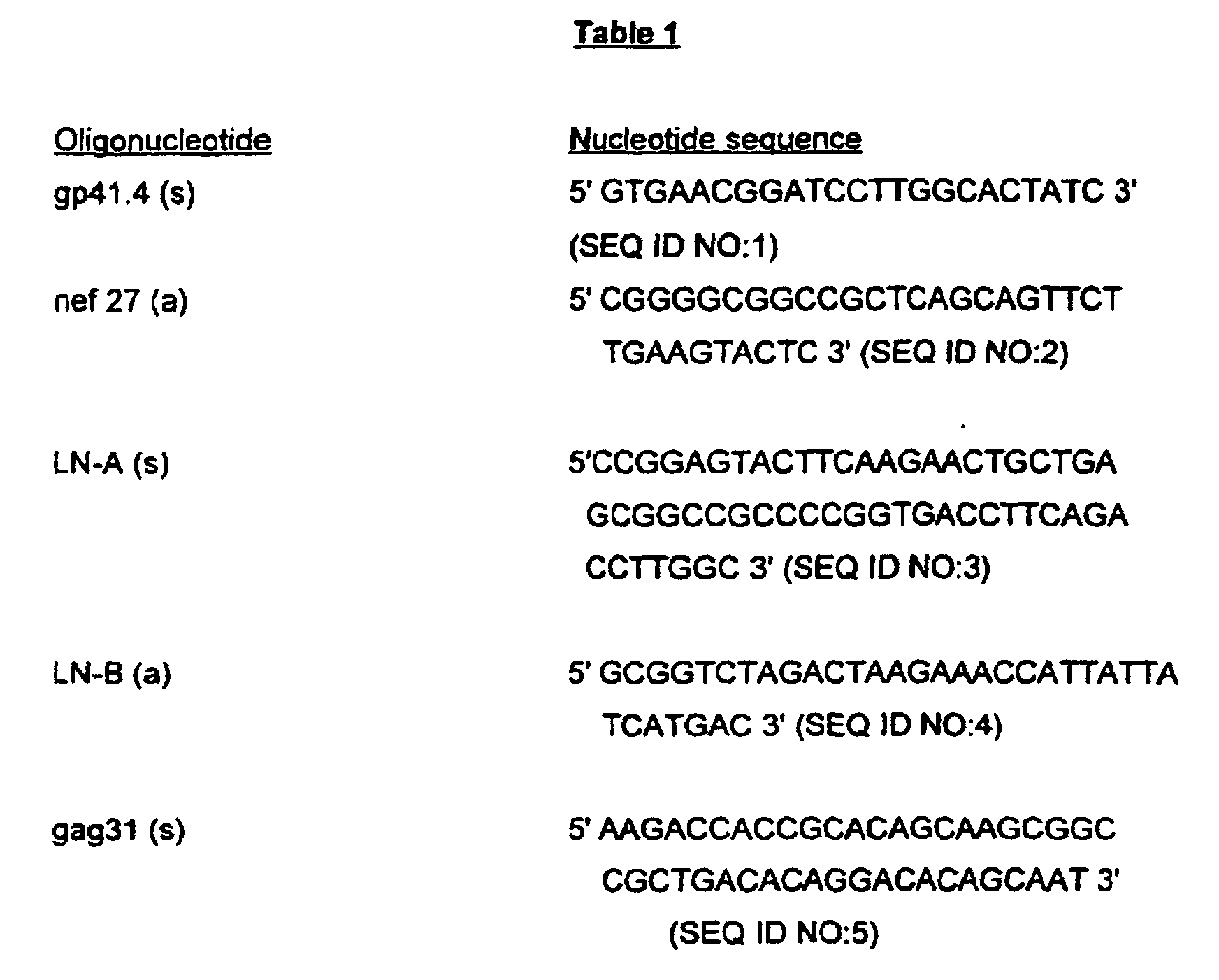
- The vector plasmid pHR' was constructed by cloning a fragment of the env gene encompassing the RRE (responsive element) and a splice acceptor site between the two LTR's of the HIV-1 HXB2 proviral DNA. The leader and ψ sequences were retained in the construct, together with the 5' 0.3 kbp of the gag gene, previously shown to constitute an extended packaging signal. A 854 bp env fragment (BgIII 7620-BamHI 8474) was obtained from pR7. A NotI linker was added to the filled-in BglII end. The fragment was doned into the 8.9 kbp NotI-BamHI fragment of plasmid pMAKK113TTR7, a pR7 derivative containing mutations in the gag codons 113, 114, and 118 (the last ones introduce a unique NotI cloning site; sequence as in oligonucleotide Gag 31 (s)). Plasmid pHR was obtained. Plasmid pHR' was generated introducing a frameshift mutation 42 bp downstream the gag gene AUG, which closes the reading frame of the gene fragment retained in the construct. The mutation was introduced by opening and filling-in a ClaI site. Two unique BamHI and XhoI sites are available in pHR' upstream of the 3' LTR for cloning inserts.
- A SalI-XhoI 3.6 kbp fragment containing the E. coli β-galactosidase gene under the trascriptional control of the CMV promoter was obtained from the plasmid pSLX-CMVLacZ (Scharfmann et al., Proc. Natl. Acad. Sci. USA, 88:4626, 1991). After filling-in the SalI ends, the fragment was cloned into the 8.9 kbp XhoI-BamHI fragment of pHR', whose BamHl ends had previously been filled-in. pHR'-ClacZ was obtained. pHR'-CLucif was obtained replacing a 3.1 kbp BamHI-XhoI fragment in pHR'-CLacZ, containing the LacZ reading frame, with a 1.7 kbp BamHI-XhoI fragment from pGEM-luc (Promega) containing the firefly luciferase reading frame.
- Replication-defective viral particles were produced by the transient cotransfection of the above-described plasmids in 293T human kidney cells. All plasmids were transformed and grown in E. coli HB101 bacteria following standard molecular biology procedures. For transfection of eukaryotic cells, plasmid DNA was purified twice by equilibrium centrifugation in CsCl-ethidium bromide gradients. A total of 40 µg DNA was used for the transfection of a culture in a 10 cm dish, in the following proportions: 10 µg pCMVΔR8, 20 µg pHR', and 10 µg env plasmids, either MLV/Ampho. MLV/Eco or VSV.G. When a plasmid was omitted, or added in different proportion, pGEM-LacZ was added to maintain constant the total amount of DNA added to the cells. 293T cells were grown in DMEM supplemented with 10% fetal calf serum and antibiotics in a 10% CO2 incubator. Cells were plated at a density of 1.3 x 10⁶/10 cm dish the day before transfection. Culture medium was changed 4 to 6 hrs before transfection. Calcium phosphate-DNA complexes were prepared according to the method of Chen and Okayama (Mol. Cell. Biol., 7:2745, 1987), and incubated overnight with the cells in an atmosphere of 5% CO2. The following morning, the medium was replaced, and the cultures returned to 10% CO2. Conditioned medium was harvested 48 to 60 hrs after transfection, cleared of cellular debris by low speed centrifugation (300 x g 10 min), and filtered through 0.45 µm low protein binding fibers. The conditioned medium was either used immediately for infection or kept frozen at - 80°C. The content of viral particles was monitored by p24 gag antigen EUSA (DuPont).
- MLV-based vectors were also produced from transient cotransfection in 293T cells of the following plasmids. Plasmid pSLX-CMVLacZ (Scharfmann et al., Proc. Natl. Acad. Sci. USA, 88:4628, 1991) is a MLV-derived vector carrying a CMV-driven E.coli β-galactosidase gene. The pCL plasmid series carry a hybrid CMV-LTR promoter which allows for CMV-driven transcription in the packaging cell and reconstitution of a functional LTR in the target cell (R. Naviaux, Salk Institute, La Jolla, CA). Plasmid pCLNC-Lucif is a MLV-derived vector carrying a CMV-driven Firefly luciferase gene. It was made by cloning a 1.7 kbp Hindlll-Stul fragment from pGEM-luc (Promega), containing the luciferase reading frame, into the 8 kbp ClaI-HindIII fragment of pCLNCX, after filling-in the ClaI ends. Plasmid pCL-ECO is a ecotropic packaging plasmid. Plasmid pCMV-GAGPOL (N. Somia, Salk institute, La Jolla, CA) is a semi-packaging plasmid carrying a CMV-driven gag-pol gene from MLV. It was used in conjunction with pMD.G to package VSV.G-pseudotyped MLV-based vectors.
- Figure 2 shows a comparison between the infectious titers of recombinant lentivirus (HIV) construct and an MLV construct assayed on 208F fibroblasts. The results indicate that the HIV vector of the present invention is at least as infectious as the standard MLV vector. Purified stock indicated that titers after concentrating the supernatant by ultracentrifugation. Yield reflects percent recovery of virus after concentration.
- Figure 3 shows the results of co-transfection of a packaging construct, env-encoding construct and transfer vector (as in Figure 1). Various HIV and MLV-based packaging constructs were compared using amphotropic and ecotropic env genes, as well as VSV.G env. The figure shows a comparison of infection of
rat 208F cells with the resulting recombinant retroviruses. The titers for the HIV constructs having an MLV (amphotropic) or VSV.G env were similar to the standard MLV-based vector (approximately 105). The infectious titer for the HIV-based construct having an MLV ecotropic env was about 10-fold less than the amphotropic env (approx. 104). - Pooled conditioned medium harvested as described above was layered on top of a cushion of 20% sucrose solution in PBS and centrifuged in a Beckman SW28 rotor at 50,000 x g for 90 min. The pellet was resuspended by incubation and gentle pipetting in 1-4 ml PBS for 30-60 min, then centrifuged again at 50,000 x g x 90 min in a Beckmann SW55 rotor. The pellet was resuspended in a minimal volume (20-50 µl) of PBS and either used directly for infection or stored in frozen aliquots at -80°C.
- For the infection of cultured cells, serial dilutions of conditioned medium from 293T transient transfectants or of concentrated viral stocks were added to the culture medium supplemented with 8 µg/ml polybrene. The cells were incubated from 3 hrs to overnight, then the medium was replaced, and the cells further incubated for 36 hrs prior to assaying expression of the transduced gene. Expression of β-Galactosidase (β-Gal) was scored by fixing the
cultures 5 min in cold 2% formaldehyde/0.2% glutaraldehyde in PBS, washing twice with PBS, and staining with 1 mg/ml X-gal in PBS containing 5 mM each of K ferri- and ferro-cyanide and 2 mM MgCl2, for 4 hrs to overnight at 37°C. Titers were calculated counting the number of individual foci of blue cells per well, and multiplying it by the volume of vector stock added and the dilution factor. Expression of luciferase was assayed by washing the cultures twice with TBS and extracting the cells with 200 µl/well 0.5% NP40 in TBS containing 5 mM MgCl2. The extract was cleared by centrifugation at 15,000 x g for 10 min. 50 µl of extract were diluted with 150 µl of 75 mM Tris-HCl pH=7.8, 15 mM Mg acetate and 4 mM ATP, and assayed for luminescence in a luminometer which added 100 µl of 1 mM luciferin. - Human HeLa cells (ATCC) were grown in RPMI 1640-10% fetal calf serum in an atmosphere of 5% CO2. For infection of dividing cultures, cells were seeded at a density of 1.6 x 10⁵/well in a 6-well tray the day before infection. G1/S arrested cultures were prepared seeding 2 x 10⁵ cells/well two days before infection, and adding 15 µg/ml aphidicolin 24 hrs before infection. Aphidicolin was added daily to the medium throughout the infection and post-infection time, as described. G2-arrested cells were prepared by exposing the cells for 20 min to a 61Co source calibrated at 200 rad/min one day before infection and seeding the cells at 4 x 10⁵/well. Cell cycle arrest at the indicating stage of the cycle was confirmed by propidium iodide staining and flow cytometry.
- Figure 4 shows the relative efficiency of transduction of CMV-β-Gal into HeLa cells. The cells were growth arrested using either pharmacological means (aphidicolin) or x-irradiation. The infection rate for the HIV-based vector was more efficient when cells were arrested at the G1/S interphase by aphidicolin, however, the HIV-based vector was more efficient than MLV-based vector overall.
-
Rat 208F fibroblasts (a gift of B. Sefton, Salk Institute, La Jolla, CA) were grown in DMEM-10% calf serum in an atmosphere of 10% CO2. For infection of growing cultures, cells were seeded at a density of 105 cells/well in a 6-well tray the day before infection. Growth-arrested cultures were prepared by seeding 2.5 x 10⁵ cells/well in a 6-well tissue culture tray, and shifting the cultures to medium containing 5% calf serum and 2 µM dexamethazone after they reached confluence, as described by Miller et al. ( Mol. Cell. Biol., 10:4239, 1990). Medium was changed every three-four days, and the cultures were kept for two to four weeks. When not otherwise indicated, G0 cultures were used 3 weeks after reaching confluence. Growth arrest was documented by propidium iodide staining and flow cytometry. The fraction of cells in S-phase was 40 to 50% in growing cells, and from 10 down to 2% after reaching confluence, depending on the time past it. For rescue experiments, infected G0 cultures were trypsinized at the indicated time after infection, and the cells replated at several dilutions. Expression of β-Gal was scored 48 hrs from replating. - Figure 5 shows the relative efficiency of transduction of CMV-luciferase into
rat 208F fibroblasts with the HIV- and MLV-based vectors in cells growth arrested for 4, 7, 11 or 15 days. The results show that the vectors both efficiently infect growing cells. The efficiency of transduction of the HIV-based vector versus the MLV-based vector was approximately 4-10 fold higher, depending on the length of time of the growth arrest. - Human peripheral blood monocytes were prepared from the buffy coats of healthy donors as previously described (von Schwedler et al., Proc. Natl. Acad. Sci. USA, 91:6992, 1994). Monocyte-derived macrophages were cultured in RPM1-10% human serum (Sigma) for two to four weeks prior to infection. Figure 6 shows the results of transduction of CMV-luciferase into human primary macrophages using the HIV-based and MLV-based vectors, either with or without an envelope. The MLV-based vector was almost completely ineffective in infecting the cells and was similar in infectivity to the non-enveloped virus. In contrast, the HIV-based vector was highly efficient in transducing primary macrophages.
- Further, the survival of the HIV-based vector was assessed in growth arrested cells that were passaged over a period of 2-8 days. Survival of the MLV-based vector was very low in cells at G0 and after replating at 2, 4, and B days. However, the HIV-based vector maintained at about 45-50% infectivity in the same cells. While not wanting to be bound by a particular theory, it is believed that HIV can remain extrachromosomal without being degraded, unlike MLV. Therefore, HIV is stable without integration.
- For in vivo experiments, HIV-based and MLV-based vectors carrying a CMV-LacZ marker gene were used. Both vector types were pseudotyped with VSV.G envelope proteins. Vectors were purified and concentrated to a titer of 3 x 10⁸I.U./ml in a vehicle of sterile PBS supplemented with 2 µg/ml polybrene. All procedures were performed according to institution-approved protocols for animal work, and in a biosafety level 3 (BSL3) environment. Normal adult female Fischer rats were anesthetized with a mixture of ketamine (44 mg/kg), acepromazine (0.75 mg/kg) and xylozine (4 mg/kg) in 0.9% NaCl. 2µl of viral suspension were slowly injected in the corpus striatum of both sides of the brain with a stereotactical guide using a 5 µl Hamilton syringe with a 26 gauge beveled needle. 7 days after injection the rats were deeply anesthetized and perfused with 4% formaldehyde/0.1% glutaraldehyde. The brains were removed and free-floating coronal freezing microtome sections (40 µm) were processed in parallel series of one section out of every five cut. One series was processed for β-Gal immunocytochemistry with a monoclonal antibody and stained with avidin/biotin peroxidase and diaminobenzidine/NiCl2 as substrate. Another series was processed for triple immunofluorescence with β-Gal (rabbit), NeuN (monoclonal), and GFAP (guinea pig) antibodies using FITC-, Texas Red-, or Cy5-labeled secondary antibodies. NeuN is a nuclear marker reported to be present in terminally differentiated neurons (Mullen, Develop., 116:201, 1992). Glial fibrillar acidic protein (GFAP) is a astrocyte differentiation marker. The sections were then analyzed by confocal scanning laser microscopy (bioRad MRTC600). Immunofluorescent signals were collected, digitally color enhanced and superimposed. False color images were generated electronically using Adobe Photoshop (Adobe System Inc.).
- The results revealed numerous β-gal positive neurons in regions injected with the HIV-based vector, but not in those inoculated with the MLV-based vector.
- The results indicated the feasibility of gene transfer using a lentiviral vector. Using growing cells, the transduction efficiency obtained with a three-plasmid, transient packaging system was comparable to that obtained with similarly assembled, conventional (MLV-based) retroviral vectors. In sharp contrast with MLV-based vectors, the lentiviral vector was capable of efficient gene transfer in the absence of division of the target cell. Efficiency of transduction into non-dividing cells in vitro was dependent on the stage of cell cycle arrest. Infection of G1/S and G2 arrested cells was as efficient as that observed with growing cells. Infection of cells arrested in G0 in vitro was less efficient, the lesser the longer the cultures had been in G0. However, in long-term G0 cultures the vector survived as a stable intermediate, and it could be rescued to complete its infectious cycle by stimulation of the cells to divide. Transduction of the marker gene into terminally differentiated cells, such as human primary macrophages in vitro and rat cerebral neurons in vivo, was observed.
Claims (19)
- A replication defective recombinant retrovirus comprising:(a) a lentiviral GAG protein;(b) a lentiviral POL protein;(c) a non-lentiviral ENV protein; and(d) a retroviral genome comprising: a heterologous nucleic acid sequence operably linked to a regulatory nucleic acid sequence; at least one lentiviral cis-acting nucleic acid sequence necessary for reverse transcription and integration; a lentiviral packaging nucleic acid sequence, wherein said lentiviral packaging nucleic acid sequence comprises a lentiviral 5' splice donor sequence, a psi sequence, wherein the nucleic acid sequence is devoid of lentiviral sequences both upstream and downstream from the splice donor site to a gag initiation site.
- The retrovirus of claim 1, wherein the retroviral genome is derived from a lentivirus.
- The retrovirus of claim 1 or 2, wherein the lentivirus is human immunodeficiency virus (HlV).
- The retrovirus of any one of claims 1 to 3, wherein the ENV protein is amphotropic or ecotropic.
- The retrovirus of any one of claims 1 to 3, wherein the ENV protein is Moloney leukemia virus (MLV) or Vesicular stomatitis virus (VSV) ENV.
- The retrovirus of any one of claims 1 to 5, wherein the regulatory nucleic acid sequence is a promoter or an enhancer.
- The retrovirus of claim 6, wherein the promoter is a viral promoter.
- A method of producing a recombinant retrovirus which infects non-dividing cells, said method comprising:(a) transfecting a suitable packaging host cell with the following vectors:(i) a retroviral vector providing a nucleic acid encoding a retroviral gag and a retroviral pol wherein the gag and pol nucleic acid sequences are operably linked to a heterologous regulatory nucleic acid sequence and wherein the vector is defective for nucleic acid sequence encoding functional ENV protein, and wherein the nucleic acid of the retroviral vector is devoid of lentiviral sequences both upstream and downstream from the splice donor site to a gag initiation site of a lentiviral genome;(ii) a vector providing a nucleic acid encoding a non-lentivira! ENV protein; and(iii) a vector providing a nucleic acid sequence containing a lentiviral packaging signal flanked by lentiviral cis-acting nucleic acid sequences for reverse transcription, packaging and integration; a heterologous nucleic acid sequence, operably linked to a regulatory nucleic acid sequence; and a less than full length gag structural gene; and(b) recovering the recombinant virus.
- The method of claim 8, wherein the retroviral vector is derived from a lentivirus.
- The method of claim 9, wherein the lentivirus is human immunodeficiency virus (HIV).
- The method of any one of claims 8 to 10, wherein the transfecting further includes at least one vector providing a nucleic acid sequence selected from the group consisting of vpr, vif, nef, vpx, tat, rev, and vpu.
- An ex vivo method for delivery of a heterologous nucleic acid sequence to a non-dividing cell comprising infecting the non-dividing cell with the recombinant virus of any one of claims 1 to 7 and delivering the heterologous nucleic acid sequence to the non-dividing cell.
- The ex vivo method of claim 12, wherein the heterologous nucleic acid is an antisense nucleic acid or a biological modifier nucleic acid.
- The retrovirus of any one of claims 1 to 7 or the method of any one of claims 8 to 11 or the ex vivo method of claim 12 or 13, wherein the non-dividing cell is selected from the group consisting of a neuron, muscle, liver, skin, heart, lung, and bone marrow cell.
- The ex vivo method of any one of claims 12 to 14, wherein the viral GAG protein, viral POL protein or retroviral vector are derived from a lentivirus.
- The recombinant retrovirus of claim 1, wherein the lentivirus derived GAG and POL proteins are derived from human immunodeficiency virus.
- The recombinant retrovirus of any one of claims 1 to 7 or 16, further comprising at least one viral protein selected from the group consisting of VPR, VIF, NEF, VPX, TAT, REV and VPU.
- Use of the recombinant retrovirus of any one of claims 1 to 7 or 16 and 17 for the preparation of a pharmaceutical composition for the treatment of an HIV-infected cell, cystic fibrosis or neuronal disorders.
- The use of claim 18, wherein the neuronal disorder is Parkinson's disease, Alzheimer's disease, Huntington's disease, neuronal damage due to stroke, damage in the spinal cord, lysosomal storage diseases, Lesch-Nyhan syndrome, amyloid polyneuropathies, Duchenne's muscular dystrophy or retino blastoma.
Applications Claiming Priority (3)
| Application Number | Priority Date | Filing Date | Title |
|---|---|---|---|
| US540259 | 1995-10-06 | ||
| US08/540,259 US6013516A (en) | 1995-10-06 | 1995-10-06 | Vector and method of use for nucleic acid delivery to non-dividing cells |
| PCT/US1996/015406 WO1997012622A1 (en) | 1995-10-06 | 1996-09-26 | Vector and method of use for nucleic acid delivery to non-dividing cells |
Publications (3)
| Publication Number | Publication Date |
|---|---|
| EP0871459A1 EP0871459A1 (en) | 1998-10-21 |
| EP0871459A4 EP0871459A4 (en) | 2001-09-05 |
| EP0871459B1 true EP0871459B1 (en) | 2004-03-03 |
Family
ID=24154683
Family Applications (1)
| Application Number | Title | Priority Date | Filing Date |
|---|---|---|---|
| EP96933140A Revoked EP0871459B1 (en) | 1995-10-06 | 1996-09-26 | Vector and method of use for nucleic acid delivery to non-dividing cells |
Country Status (9)
| Country | Link |
|---|---|
| US (1) | US6013516A (en) |
| EP (1) | EP0871459B1 (en) |
| JP (1) | JP4190579B2 (en) |
| AT (1) | ATE260981T1 (en) |
| AU (1) | AU720993B2 (en) |
| DE (1) | DE69631795T2 (en) |
| IL (1) | IL123833A0 (en) |
| WO (1) | WO1997012622A1 (en) |
| ZA (1) | ZA968382B (en) |
Cited By (1)
| Publication number | Priority date | Publication date | Assignee | Title |
|---|---|---|---|---|
| US7888320B2 (en) | 2005-04-15 | 2011-02-15 | Centre National De La Recherche Scientifique - Cnrs | Composition for treating cancer adapted for intra-tumoral administration and uses thereof |
Families Citing this family (789)
| Publication number | Priority date | Publication date | Assignee | Title |
|---|---|---|---|---|
| US6605712B1 (en) * | 1990-12-20 | 2003-08-12 | Arch Development Corporation | Gene transcription and ionizing radiation: methods and compositions |
| GB2325003B (en) | 1996-10-17 | 2000-05-10 | Oxford Biomedica Ltd | Rectroviral vectors |
| US7198784B2 (en) * | 1996-10-17 | 2007-04-03 | Oxford Biomedica (Uk) Limited | Retroviral vectors |
| US20070213290A1 (en) * | 1996-10-17 | 2007-09-13 | Kingsman Alan J | Neurite regeneration |
| WO1998039463A2 (en) * | 1997-03-06 | 1998-09-11 | Ueberla Klaus | Lentivirus based vector and vector system |
| EP0981636B1 (en) * | 1997-05-13 | 2005-03-23 | University Of North Carolina At Chapel Hill | Lentivirus-based gene transfer vectors |
| EP1003894A2 (en) * | 1997-07-18 | 2000-05-31 | Chiron Corporation | Lentiviral vectors |
| CA2304983A1 (en) | 1997-09-24 | 1999-04-01 | The Regents Of The University Of California | Non-primate lentiviral vectors and packaging systems |
| JP4303418B2 (en) * | 1997-10-24 | 2009-07-29 | ライフ テクノロジーズ コーポレーション | Recombination cloning using nucleic acids with recombination sites |
| EP1039931B1 (en) * | 1997-12-01 | 2005-04-27 | Fang Fang | Multivalent recombinant antibodies for treating hrv infections |
| US5994136A (en) * | 1997-12-12 | 1999-11-30 | Cell Genesys, Inc. | Method and means for producing high titer, safe, recombinant lentivirus vectors |
| EP1037669A4 (en) * | 1997-12-12 | 2003-04-02 | Cell Genesys Inc | Therapeutic use of lentiviral vectors |
| ATE528405T1 (en) * | 1997-12-22 | 2011-10-15 | Oxford Biomedica Ltd | EQUINE INFECTIOUS ANEMIA VIRUS (EIAV) BASED VECTORS |
| GB9803351D0 (en) | 1998-02-17 | 1998-04-15 | Oxford Biomedica Ltd | Anti-viral vectors |
| US6451304B1 (en) * | 1998-03-09 | 2002-09-17 | The Regents Of The University Of California | Method for retrovirus vector production by separated gag and pol expression |
| US6218181B1 (en) | 1998-03-18 | 2001-04-17 | The Salk Institute For Biological Studies | Retroviral packaging cell line |
| AU2007216712B2 (en) * | 1998-04-24 | 2010-05-27 | Centre National De La Recherche Scientifique | Use of Triplex Structure DNA Sequences for Transferring Nucleotide Sequences |
| FR2777909B1 (en) * | 1998-04-24 | 2002-08-02 | Pasteur Institut | USE OF TRIPLEX-STRUCTURED DNA SEQUENCES FOR THE TRANSFER OF NUCLEOTID SEQUENCES IN CELLS, RECOMBINANT VECTORS CONTAINING THESE TRIPLEX SEQUENCES |
| AU2003271326B2 (en) * | 1998-04-24 | 2007-06-28 | Centre National De La Recherche Scientifique | Use of triplex structure DNA sequences for transferring nucleotide sequences |
| US6365150B1 (en) | 1998-05-13 | 2002-04-02 | Genetix Pharmaceuticals, Inc. | Lentiviral packaging cells |
| US20030035798A1 (en) | 2000-08-16 | 2003-02-20 | Fang Fang | Humanized antibodies |
| US6790657B1 (en) * | 1999-01-07 | 2004-09-14 | The United States Of America As Represented By The Department Of Health And Human Services | Lentivirus vector system |
| WO2000046377A1 (en) * | 1999-02-02 | 2000-08-10 | Thomas Jefferson University | Genetically engineered retroviral vector particles capable of infecting non-dividing cells |
| AU778698B2 (en) * | 1999-04-29 | 2004-12-16 | Miltenyi Biotec B.V. & Co. KG | Method and means for producing high titer, safe, recombinant lentivirus vectors |
| AU5250100A (en) * | 1999-06-22 | 2001-01-09 | Dnavec Research Inc. | Vector for expressing two foreign genes |
| EP2169073B1 (en) * | 1999-10-11 | 2013-11-13 | Institut Pasteur | Vector for the preparation of immunotherapeutical compositions |
| WO2001027304A2 (en) | 1999-10-12 | 2001-04-19 | Institut Pasteur | Lentiviral triplex dna, and vectors and recombinant cells containing lentiviral triplex dna |
| AU1013601A (en) | 1999-10-22 | 2001-05-08 | Aventis Pasteur Limited | Method of inducing and/or enhancing an immune response to tumor antigens |
| EP1103615A1 (en) * | 1999-11-25 | 2001-05-30 | Universite De Geneve | Vectors capable of immortalizing non-dividing cells and cells immortalized with said vectors |
| US6864085B2 (en) * | 1999-12-14 | 2005-03-08 | Novartis Ag | Bovine immunodeficiency virus (BIV) based vectors |
| WO2001044458A2 (en) * | 1999-12-14 | 2001-06-21 | Novartis Ag | Bovine immunodeficiency virus (biv) based vectors |
| CN102151337B (en) | 2000-03-13 | 2014-03-12 | 恩根尼公司 | Compositions and methods for regulated protein expression in gut |
| US20040102388A1 (en) * | 2000-03-22 | 2004-05-27 | High Katherine A. | Modified blood clotting factors and methods of use |
| GB0009760D0 (en) | 2000-04-19 | 2000-06-07 | Oxford Biomedica Ltd | Method |
| ATE346925T1 (en) * | 2000-05-10 | 2006-12-15 | Sanofi Pasteur Ltd | IMMUNOGENIC POLYPEPTIDES ENCODED BY MAGE MINIGENE AND USES THEREOF |
| CA2410015A1 (en) * | 2000-05-26 | 2001-12-06 | Thomas W. Dubensky, Jr. | Methods of transducing neural cells using lentivirus vectors |
| US20040204379A1 (en) * | 2000-06-19 | 2004-10-14 | Cheng Seng H. | Combination enzyme replacement, gene therapy and small molecule therapy for lysosomal storage diseases |
| CA2413156C (en) * | 2000-07-03 | 2009-08-18 | Gala Design, Inc. | Expression vectors |
| US20030224415A1 (en) * | 2001-06-29 | 2003-12-04 | Gala Design, Inc. | Selection free growth of host cells containing multiple integrating vectors |
| AU2001271614B2 (en) | 2000-07-03 | 2007-05-31 | Catalent Pharma Solutions, Llc | Host cells containing multiple integrating vectors |
| US7198924B2 (en) | 2000-12-11 | 2007-04-03 | Invitrogen Corporation | Methods and compositions for synthesis of nucleic acid molecules using multiple recognition sites |
| US6627442B1 (en) * | 2000-08-31 | 2003-09-30 | Virxsys Corporation | Methods for stable transduction of cells with hiv-derived viral vectors |
| US7575924B2 (en) | 2000-11-13 | 2009-08-18 | Research Development Foundation | Methods and compositions relating to improved lentiviral vectors and their applications |
| US6712612B1 (en) | 2000-12-12 | 2004-03-30 | Genecure Llc | Safe and stable retroviral helper cell line and related compositions and methods |
| EP1472337A4 (en) | 2001-03-09 | 2008-02-27 | Univ Texas | INDUCTION OF TUMOR IMMUNITY BY VARIANTS OF FOLATE FIXATION PROTEIN |
| AU2002254212A1 (en) * | 2001-03-12 | 2002-09-24 | Irm, Llc | Identification of cellular targets for biologically active molecules |
| US20040076954A1 (en) * | 2001-03-12 | 2004-04-22 | Irm, Llc | Genomics-driven high speed cellular assays, development thereof, and collections of cellular reporters |
| US20040242523A1 (en) * | 2003-03-06 | 2004-12-02 | Ana-Farber Cancer Institue And The Univiersity Of Chicago | Chemo-inducible cancer gene therapy |
| ATE541937T1 (en) * | 2001-04-06 | 2012-02-15 | Univ Chicago | CHEMOTHERAPEUTIC INTRODUCTION OF EGR-1 PROMOTER ACTIVITY IN GENE THERAPY |
| US8034791B2 (en) | 2001-04-06 | 2011-10-11 | The University Of Chicago | Activation of Egr-1 promoter by DNA damaging chemotherapeutics |
| EP1395293B1 (en) * | 2001-05-14 | 2009-07-22 | Gbp Ip, Llc | Lentiviral vectors encoding clotting factors for gene therapy |
| AUPR518501A0 (en) | 2001-05-22 | 2001-06-14 | Unisearch Limited | Yin yang-1 |
| WO2002095002A2 (en) | 2001-05-22 | 2002-11-28 | University Of Chicago | N4 virion single-stranded dna dependent rna polymerase |
| US7381813B2 (en) | 2001-05-31 | 2008-06-03 | Novartis Ag | Nucleic acids encoding estrogen receptor ligand binding domain variants |
| IL159371A0 (en) | 2001-06-29 | 2004-06-01 | Sloan Kettering Inst Cancer | Vector encoding human globin gene and use thereof in treatment of hemoglobinopathies |
| WO2003062370A2 (en) | 2001-07-19 | 2003-07-31 | Perlan Therapeutics, Inc. | Multimeric proteins and methods of making and using same |
| WO2003012054A2 (en) * | 2001-08-02 | 2003-02-13 | Institut Clayton De La Recherche | Methods and compositions relating to improved lentiviral vector production systems |
| US20040143104A1 (en) * | 2001-08-08 | 2004-07-22 | Wadsworth Samuel C. | Methods of treating diabetes and other blood sugar disorders |
| AU2002327430A1 (en) * | 2001-08-08 | 2003-02-24 | Genzyme Corporation | Methods for treating diabetes and other blood sugar disorders |
| WO2003022228A2 (en) * | 2001-09-13 | 2003-03-20 | California Institute Of Technology | Method for producing transgenic birds and fish |
| AU2002326906C1 (en) | 2001-09-13 | 2009-01-29 | California Institute Of Technology | Method for expression of small antiviral RNA molecules within a cell |
| US7737124B2 (en) | 2001-09-13 | 2010-06-15 | California Institute Of Technology | Method for expression of small antiviral RNA molecules with reduced cytotoxicity within a cell |
| CA2462628C (en) | 2001-10-02 | 2019-08-20 | Institut Clayton De La Recherche | Restricted expression lentiviral vectors |
| CN1612931A (en) | 2002-01-09 | 2005-05-04 | 米诺斯生物系统有限公司 | Genetic manipulation method |
| US20040038304A1 (en) * | 2002-03-28 | 2004-02-26 | Gala Design, Inc. | Antibody libraries |
| US7384738B2 (en) * | 2002-03-28 | 2008-06-10 | Bremel Robert D | Retrovirus-based genomic screening |
| DE10215123A1 (en) * | 2002-04-05 | 2003-10-16 | Klaus Cichutek | Lentiviral vectors derived from SIVsmmPBj14, processes for their preparation and their use for gene transfer in mammalian cells |
| ATE369895T1 (en) | 2002-04-09 | 2007-09-15 | Sanofi Pasteur Ltd | MODIFIED CEA NUCLIC ACID AND EXPRESSION VECTORS |
| DK1499736T3 (en) | 2002-04-26 | 2009-06-08 | Inst Nat Sante Rech Med | Enhanced chimeric glycoproteins and pseudotyped lentoviral vectors |
| US6863884B2 (en) * | 2002-05-01 | 2005-03-08 | Cell Genesys, Inc. | Pseudotyped retroviral vectors |
| WO2003093417A2 (en) | 2002-05-01 | 2003-11-13 | Cell Genesys, Inc. | Lentiviral vector particles resistant to complement inactivation |
| AU2002344959A1 (en) * | 2002-05-03 | 2003-11-17 | Nikolai Rainov | Use of fasl for the treatment of neurodegenerative diseases |
| EP1997913A1 (en) | 2002-05-15 | 2008-12-03 | Integragen | Human obesity susceptibility gene and uses thereof |
| US7501127B2 (en) * | 2002-05-16 | 2009-03-10 | Bavarian Nordic A/S | Intergenic regions as novel sites for insertion of HIV DNA sequences in the genome of Modified Vaccinia virus Ankara |
| US20040009158A1 (en) * | 2002-07-11 | 2004-01-15 | Washington University | Promotion of neovascularization using bone marrow-derived endothelial-progenitor cells |
| US20040219516A1 (en) * | 2002-07-18 | 2004-11-04 | Invitrogen Corporation | Viral vectors containing recombination sites |
| AU2003291426A1 (en) * | 2002-11-12 | 2004-06-03 | The Government Of The United States Of America, As Represented By The Secretary, Department Of Health Human Services, The National Institutes Of Health | Gp64-pseudotyped vectors and uses thereof |
| DK1563069T3 (en) * | 2002-11-22 | 2012-07-23 | Inst Clayton De La Rech | COMPOSITIONS AND SYSTEMS FOR REGULATION |
| DK1616012T3 (en) | 2003-04-24 | 2008-04-21 | San Raffaele Centro Fond | Lentiviral vectors bearing synthetic bidirectional promoters and their applications |
| US20050036988A1 (en) * | 2003-05-28 | 2005-02-17 | Ruian Xu | Compositions and methods for preventing and treating liver cirrhosis |
| US7696322B2 (en) * | 2003-07-28 | 2010-04-13 | Catalent Pharma Solutions, Inc. | Fusion antibodies |
| JP2007503210A (en) | 2003-08-22 | 2007-02-22 | アンテグラジャン | Human autism susceptibility genes and uses thereof |
| EP2055316A1 (en) * | 2003-09-09 | 2009-05-06 | VIRxSYS Corporation | Lentivirus vector-based approaches for generating an immune response to HIV in humans |
| US8562970B2 (en) * | 2003-10-08 | 2013-10-22 | Sanofi Pasteur Limited | Modified CEA/B7 vector |
| US20050107318A1 (en) * | 2003-11-17 | 2005-05-19 | Samuel Wadsworth | Methods of treating diabetes and other blood sugar disorders |
| US8304189B2 (en) * | 2003-12-01 | 2012-11-06 | Life Technologies Corporation | Nucleic acid molecules containing recombination sites and methods of using the same |
| WO2005056761A2 (en) * | 2003-12-05 | 2005-06-23 | Massachusetts Institute Of Technology | REAGENTS AND METHODS FOR IDENTIFICATION OF RNAi PATHWAY GENES AND CHEMICAL MODULATORS OF RNAi |
| US20050221429A1 (en) * | 2004-01-16 | 2005-10-06 | Cardinal Health Pts, Llc | Host cells containing multiple integrating vectors comprising an amplifiable marker |
| US20060058255A1 (en) * | 2004-03-01 | 2006-03-16 | Jianzhu Chen | RNAi-based therapeutics for allergic rhinitis and asthma |
| WO2005086967A2 (en) * | 2004-03-11 | 2005-09-22 | Shantha West, Inc. | Therapeutic use of rm1 antigen |
| US20050249667A1 (en) * | 2004-03-24 | 2005-11-10 | Tuszynski Jack A | Process for treating a biological organism |
| CN1980955A (en) * | 2004-04-29 | 2007-06-13 | 北卡罗来纳-查佩尔山大学 | Methods and compositions for enhancing cell adhesion properties |
| FR2872170B1 (en) | 2004-06-25 | 2006-11-10 | Centre Nat Rech Scient Cnrse | NON-INTERACTIVE AND NON-REPLICATIVE LENTIVIRUS, PREPARATION AND USES |
| US20080193464A1 (en) | 2004-07-01 | 2008-08-14 | Anne Philippi | Human Autism Susceptibility Gene Encoding Prkcb1 and Uses Thereof |
| US7862829B2 (en) * | 2004-07-09 | 2011-01-04 | University Of North Carolina At Chapel Hill | Viral adjuvants |
| WO2006017279A2 (en) * | 2004-07-12 | 2006-02-16 | Board Of Regents, The University Of Texas System | Methods and compositions related to identifying protein-protein interactions |
| EP1781284B1 (en) * | 2004-08-25 | 2010-10-13 | The University of Chicago | Use of the combination comprising temozolomide and tnf-alpha for treating glioblastoma |
| CN101094688B (en) | 2004-09-13 | 2013-05-01 | 建新公司 | Multimeric constructs |
| JP2008525000A (en) * | 2004-12-28 | 2008-07-17 | アレス トレーディング エス.エー. | Compositions and methods for treating schizophrenia and related disorders |
| WO2007046839A2 (en) * | 2005-02-15 | 2007-04-26 | University Of North Carolina At Chapel Hill | New live virus vaccines |
| MX2007010008A (en) | 2005-02-16 | 2008-01-18 | Lentigen Corp | Lentiviral vectors and their use. |
| DE602006017045D1 (en) | 2005-03-24 | 2010-11-04 | Integragen Sa | A TRANSMEMBRANE PROTEIN ENCODING HUMAN AUTISM SUSCEPTIBILITY AND ITS USE |
| US20090203055A1 (en) * | 2005-04-18 | 2009-08-13 | Massachusetts Institute Of Technology | Compositions and methods for RNA interference with sialidase expression and uses thereof |
| WO2006127585A2 (en) * | 2005-05-20 | 2006-11-30 | Virxsys Corporation | Transduction of primary cells |
| CA2611056C (en) | 2005-06-01 | 2016-06-28 | California Institute Of Technology | Method of targeted gene delivery using viral vectors |
| EP1739092A1 (en) | 2005-06-28 | 2007-01-03 | I.N.S.E.R.M. Institut National de la Sante et de la Recherche Medicale | Peptidic antagonists of class III semaphorins/neuropilins complexes |
| US7919583B2 (en) * | 2005-08-08 | 2011-04-05 | Discovery Genomics, Inc. | Integration-site directed vector systems |
| WO2007044627A2 (en) * | 2005-10-06 | 2007-04-19 | Sloan Kettering Institute For Cancer Research | Compositions and methods for delivery of interfering rna |
| ES2380803T3 (en) | 2005-11-14 | 2012-05-18 | Centre National De La Recherche Scientifique (Cnrs) | Non-histone MACROH2A domain as an inhibitor of PARP-1 activity and its use |
| TWI461436B (en) | 2005-11-25 | 2014-11-21 | Kyowa Hakko Kirin Co Ltd | Human CD134 (OX40) human monoclonal antibody and method of making and using same |
| AR059089A1 (en) | 2006-01-20 | 2008-03-12 | Genzyme Corp | INTRAVENTRICULAR ADMINISTRATION OF AN ENZYME FOR LISOSOMAL STORAGE DISEASES |
| MX361816B (en) | 2006-02-09 | 2018-12-17 | Genzyme Corp | Slow intraventricular delivery. |
| EP1835032A1 (en) | 2006-03-14 | 2007-09-19 | Université de Liège | A self-inactivating recombinant lentiviral vector for the inhibition of HIV replication |
| EP1835036A1 (en) | 2006-03-16 | 2007-09-19 | Exonhit Therapeutics SA | Methods and compositions for the detection and treatment of cancers |
| US20070248539A1 (en) * | 2006-04-24 | 2007-10-25 | Shantha West Inc. | AgRM2 antigen |
| BRPI0714495B8 (en) | 2006-07-21 | 2021-05-25 | California Inst Of Techn | Deficient lentivirus for pseudotyped recombinant replication |
| WO2008013692A2 (en) | 2006-07-25 | 2008-01-31 | Celladon Corporation | Extended antegrade epicardial coronary infusion of adeno-associated viral vectors for gene therapy |
| EP2069791B1 (en) | 2006-07-27 | 2012-01-25 | University of Maryland, Baltimore | Cellular receptor for antiproliferative factor |
| US8685720B2 (en) * | 2006-11-03 | 2014-04-01 | The Trustees Of Princeton University | Engineered cellular pathways for programmed autoregulation of differentiation |
| WO2008152446A2 (en) | 2006-11-27 | 2008-12-18 | Patrys Limited | Novel glycosylated peptide target in neoplastic cells |
| US20080292591A1 (en) * | 2007-03-05 | 2008-11-27 | The Salk Institute For Biological Studies | Tumor mouse models using lentiviral vectors |
| DK2170938T3 (en) * | 2007-06-06 | 2012-07-16 | Res Dev Foundation | RTEF-1 variants as well as their use in inhibiting angiogenesis |
| EP2185694A2 (en) | 2007-08-02 | 2010-05-19 | California Stem Cell, Inc. | Neuronal progenitor cells and methods of derivation and purification of neuronal progenitor cells from embryonic stem cells |
| EP2027868A1 (en) | 2007-08-24 | 2009-02-25 | Institut National De La Sante Et De La Recherche Medicale (Inserm) | Use of SCO-Spondin peptides for inhibiting or preventing neuronal apoptosis mediated by cell death receptor ligands |
| US9593340B2 (en) * | 2007-10-15 | 2017-03-14 | Admedus Vaccines Pty Ltd. | Expression system for modulating an immune response |
| US9605035B2 (en) | 2008-01-10 | 2017-03-28 | Research Development Foundation | Vaccines and diagnostics for the ehrlichioses |
| WO2009094647A2 (en) | 2008-01-25 | 2009-07-30 | Introgen Therapeutics, Inc. | P53 biomarkers |
| US20100303828A1 (en) | 2008-01-31 | 2010-12-02 | INSERM Institut National de la Sante et de la Recherche Medicale) | Antibodies Against Human CD39 and Use Thereof for Inhibiting T Regulatory Cells Activity |
| JP5951254B2 (en) | 2008-03-17 | 2016-07-13 | ザ スクリプス リサーチ インスティテュート | A combination of chemical and genetic techniques to generate induced pluripotent stem cells |
| EP2282759B1 (en) * | 2008-04-30 | 2015-09-16 | KCI Licensing, Inc. | Use of nucleic acids with reduced pressure therapy for treating wounds |
| JP2012500005A (en) | 2008-08-12 | 2012-01-05 | セルラー ダイナミクス インターナショナル, インコーポレイテッド | Method for generating iPS cells |
| CA2734325A1 (en) | 2008-08-18 | 2010-02-25 | University Of Maryland, Baltimore | Derivatives of apf and methods of use |
| WO2010040766A1 (en) | 2008-10-07 | 2010-04-15 | INSERM (Institut National de la Santé et de la Recherche Médicale) | Neutralizing antibodies and fragments thereof directed against platelet factor-4 variant 1 (pf4v1) |
| US8211487B2 (en) * | 2008-11-26 | 2012-07-03 | Srinivasan Damodaran | Inhibition of ice crystal growth |
| JP6093110B2 (en) | 2008-12-17 | 2017-03-08 | ザ スクリプス リサーチ インスティテュート | Production and maintenance of stem cells |
| EP2199387A1 (en) | 2008-12-19 | 2010-06-23 | INSERM (Institut National de la Santé et de la Recherche Médicale) | Serine protease derivatives and uses for the prevention and/or the treatment of blood coagulation disorders |
| ES2629099T3 (en) | 2008-12-19 | 2017-08-07 | INSERM (Institut National de la Santé et de la Recherche Médicale) | Serine protease derivatives and uses in the prevention or treatment of and blood clotting disorders |
| EP3002296B1 (en) | 2009-03-17 | 2020-04-29 | Université d'Aix-Marseille | Btla antibodies and uses thereof |
| ES2571235T3 (en) | 2009-04-10 | 2016-05-24 | Kyowa Hakko Kirin Co Ltd | Procedure for the treatment of a blood tumor that uses the anti-TIM-3 antibody |
| JP5694923B2 (en) | 2009-04-27 | 2015-04-01 | 協和発酵キリン株式会社 | Anti-IL-3Rα antibody for blood tumor treatment |
| DK2424885T3 (en) | 2009-04-28 | 2016-06-06 | Univ Vanderbilt | Compositions and methods for the treatment of disorders involving epitelcelleapoptose |
| EP2427205A2 (en) | 2009-05-04 | 2012-03-14 | INSERM - Institut National de la Santé et de la Recherche Médicale | Par2 agonists for use in the treatment or prevention of influenza virus type a infections |
| ES2615881T3 (en) | 2009-05-07 | 2017-06-08 | Stallergenes | Use of igg1 immunoglobulins and / or cd32 receptor ligands for the treatment of diseases and inflammatory manifestations through the mucosa. |
| CA2764158A1 (en) | 2009-06-01 | 2010-12-09 | Halo-Bio Rnai Therapeutics, Inc. | Polynucleotides for multivalent rna interference, compositions and methods of use thereof |
| US9050276B2 (en) | 2009-06-16 | 2015-06-09 | The Trustees Of Columbia University In The City Of New York | Autism-associated biomarkers and uses thereof |
| AU2010274031B2 (en) | 2009-07-15 | 2015-07-16 | Csl Behring Gene Therapy, Inc. | Dual vector for inhibition of human immunodeficiency virus |
| KR101790187B1 (en) | 2009-07-24 | 2017-10-25 | 이뮨 디자인 코포레이션 | Lentiviral vectors pseudotyped with a sindbis virus envelope glycoprotein |
| KR101574056B1 (en) | 2009-07-31 | 2015-12-02 | 백스터 인터내셔널 인코포레이티드 | Cell culture medium for adamts protein expression |
| KR20210054598A (en) | 2009-09-21 | 2021-05-13 | 다케다 야쿠힌 고교 가부시키가이샤 | Stabilized liquid and lyophilized adamts13 formulations |
| US9005968B2 (en) | 2009-10-16 | 2015-04-14 | The Scripps Research Institute | Induction of pluripotent cells |
| WO2011048443A1 (en) | 2009-10-20 | 2011-04-28 | INSERM (Institut National de la Santé et de la Recherche Médicale) | Neuronal exocytosis inhibiting peptides derived from c subunit of v-atpase and cosmetic and pharmaceutical compositions containing said peptides |
| US9556272B2 (en) | 2009-11-11 | 2017-01-31 | The Trustees Of The University Of Pennsylvania | Anti-TEM1 antibodies and uses thereof |
| WO2011080322A1 (en) | 2009-12-30 | 2011-07-07 | Institut National De La Sante Et De La Recherche Medicale (Inserm) | Method of prognosing the outcome of acquired hemophilia and of treatment of hemophilia |
| CA2786664C (en) | 2010-01-08 | 2020-03-10 | Immusoft Corporation | Vectors and methods for transducing b cells |
| EP2524226A1 (en) | 2010-01-13 | 2012-11-21 | INSERM (Institut National de la Santé et de la Recherche Médicale) | Promyelocytic leukemia protein as a redox sensor |
| US10787701B2 (en) | 2010-04-05 | 2020-09-29 | Prognosys Biosciences, Inc. | Spatially encoded biological assays |
| HUE050815T2 (en) | 2010-04-08 | 2021-01-28 | Inst Nat Sante Rech Med | Inhibiting peptides derived from trem-like transcript 1 (tlt-1) and uses thereof |
| WO2011133512A1 (en) | 2010-04-19 | 2011-10-27 | Research Development Foundation | Rtef-1 variants and uses thereof |
| US9795658B2 (en) | 2010-04-20 | 2017-10-24 | Admedus Vaccines Pty Ltd | Expression system for modulating an immune response |
| WO2011147889A1 (en) | 2010-05-25 | 2011-12-01 | INSERM (Institut National de la Santé et de la Recherche Médicale) | Methods and pharmaceutical composition for the treatment of a feeding disorder with early-onset in a patient |
| CA2802087A1 (en) | 2010-06-15 | 2011-12-22 | Cellular Dynamics International, Inc. | A compendium of ready-built stem cell models for interrogation of biological response |
| WO2012006440A2 (en) | 2010-07-07 | 2012-01-12 | Cellular Dynamics International, Inc. | Endothelial cell production by programming |
| PT3626736T (en) | 2010-07-08 | 2025-08-11 | Takeda Pharmaceuticals Co | Method of producing recombinant high molecular weight vwf in cell culture |
| WO2012004416A2 (en) | 2010-07-09 | 2012-01-12 | INSERM (Institut National de la Santé et de la Recherche Médicale) | Treatment of a disease associated with retinal degenerative disorder |
| EP2596025B1 (en) | 2010-07-23 | 2018-06-20 | INSERM (Institut National de la Santé et de la Recherche Médicale) | Methods for cancer management targeting co-029 |
| KR101990068B1 (en) * | 2010-09-02 | 2019-06-17 | 몰메드 에스피에이 | Stable production of lentiviral vectors |
| US9132173B2 (en) | 2010-10-15 | 2015-09-15 | Institut National De La Sante Et De La Recherche Medicale (Inserm) | Expression vector for cholesterol 24-hydrolase in therapy of Huntington's disease |
| WO2012080769A1 (en) | 2010-12-15 | 2012-06-21 | INSERM (Institut National de la Santé et de la Recherche Médicale) | Anti-cd277 antibodies and uses thereof |
| AU2011349446C1 (en) | 2010-12-22 | 2016-01-21 | Fate Therapauetics, Inc. | Cell culture platform for single cell sorting and enhanced reprogramming of iPSCs |
| WO2012085132A1 (en) | 2010-12-22 | 2012-06-28 | Orega Biotech | Antibodies against human cd39 and use thereof |
| US9598499B2 (en) | 2010-12-30 | 2017-03-21 | Institut National De La Santé Et De La Recherche Médicale (Inserm) | Antigen binding formats for use in therapeutic treatments or diagnostic assays |
| WO2012101125A1 (en) | 2011-01-24 | 2012-08-02 | INSERM (Institut National de la Santé et de la Recherche Médicale) | Specific antibodies against human cxcl4 and uses thereof |
| WO2012109208A2 (en) | 2011-02-08 | 2012-08-16 | Cellular Dynamics International, Inc. | Hematopoietic precursor cell production by programming |
| EP2741784B1 (en) | 2011-03-02 | 2017-05-17 | Board Of Regents, The University Of Texas System | Tusc2 therapies |
| WO2012120131A1 (en) | 2011-03-09 | 2012-09-13 | INSERM (Institut National de la Santé et de la Recherche Médicale) | Methods for generating cell microparticles |
| WO2012120129A1 (en) | 2011-03-10 | 2012-09-13 | INSERM (Institut National de la Santé et de la Recherche Médicale) | Methods and pharmaceutical composition for the treatment of infectious diseases |
| MX373443B (en) | 2011-03-31 | 2020-05-20 | Inst Nat Sante Rech Med | ANTIBODIES DIRECTED AGAINST ICOS AND THEIR USES. |
| US9346883B2 (en) | 2011-05-13 | 2016-05-24 | Institut National De La Sante Et De La Recherche Medicale (Inserm) | Antibodies against HER3 |
| JP2014516960A (en) | 2011-05-19 | 2014-07-17 | インサーム(インスティテュ ナシオナル ドゥ ラ サンテ エ ドゥ ラ ルシェルシェ メディカル) | Anti-human HER3 antibody and use thereof |
| WO2012156535A1 (en) | 2011-05-19 | 2012-11-22 | Fundación Progreso Y Salud | Highly inducible dual-promoter lentiviral tet-on system |
| AU2012267512B2 (en) | 2011-06-10 | 2014-11-20 | Bluebird Bio, Inc. | Gene therapy vectors for adrenoleukodystrophy and adrenomyeloneuropathy |
| EP2721057B1 (en) | 2011-06-15 | 2019-07-31 | INSERM (Institut National de la Santé et de la Recherche Médicale) | Polypeptides isolated from brevibacterium aurantiacum and their use for the treatment of cancer |
| JP6033293B2 (en) | 2011-06-22 | 2016-11-30 | インサーム(インスティテュ ナシオナル ドゥ ラ サンテ エ ドゥ ラ ルシェルシェ メディカル)Inserm(Institut National Dela Sante Et De La Recherche Medicale) | Anti-Axl antibody and use thereof |
| US9409988B2 (en) | 2011-06-22 | 2016-08-09 | Inserm (Institut National De La Sante Et De La Recherche Medicale) | Anti-Axl antibodies and uses thereof |
| WO2013006486A2 (en) | 2011-07-01 | 2013-01-10 | Ngm Biopharmaceuticals, Inc. | Compositions, uses and methods for treatment of metabolic disorders and diseases |
| EP2543679A1 (en) | 2011-07-08 | 2013-01-09 | INSERM (Institut National de la Santé et de la Recherche Médicale) | Antibodies for the treatment and prevention of thrombosis |
| EP2543677A1 (en) | 2011-07-08 | 2013-01-09 | INSERM (Institut National de la Santé et de la Recherche Médicale) | Antibodies for the treatment and prevention of thrombosis |
| EP2543678A1 (en) | 2011-07-08 | 2013-01-09 | INSERM (Institut National de la Santé et de la Recherche Médicale) | Antibodies for the treatment and prevention of thrombosis |
| WO2013009825A1 (en) | 2011-07-11 | 2013-01-17 | Cellular Dynamics International, Inc. | Methods for cell reprogramming and genome engineering |
| US20130101664A1 (en) | 2011-08-18 | 2013-04-25 | Donald W. Kufe | Muc1 ligand traps for use in treating cancers |
| FR2979346B1 (en) | 2011-08-23 | 2013-09-27 | Univ Joseph Fourier | NANOCORPS ANTI-VCAM-1 |
| US20140235492A1 (en) | 2011-09-20 | 2014-08-21 | Institut National De La Sante Et De La Recherche Medicate (Inserm) | Methods for preparing single domain antibody microarrays |
| JP6066356B2 (en) | 2011-09-23 | 2017-01-25 | ブルーバード バイオ, インコーポレイテッド | Improved gene therapy methods |
| EP3269802B1 (en) | 2011-09-30 | 2019-10-23 | Bluebird Bio, Inc. | Compounds for improved viral transduction |
| BR112014010091B1 (en) | 2011-10-27 | 2022-11-08 | Wellstat Ophthalmics Corporation | NUCLEIC ACID, VIRAL VECTOR, PHARMACEUTICAL PREPARATION, USE THEREOF, METHOD FOR PRODUCING AN RDCVF PROTEIN, AND IN VITRO OR EX VIVO METHOD FOR SECRETION OF AN RDCVF PROTEIN FROM A CELL |
| US10039777B2 (en) | 2012-03-20 | 2018-08-07 | Neuro-Lm Sas | Methods and pharmaceutical compositions of the treatment of autistic syndrome disorders |
| US8323662B1 (en) | 2012-03-30 | 2012-12-04 | Immune Design Corp. | Methods useful for generating highly mannosylated pseudotyped lentiviral vector particles comprising a Vpx protein |
| US9713635B2 (en) | 2012-03-30 | 2017-07-25 | Immune Design Corp. | Materials and methods for producing improved lentiviral vector particles |
| DK2831095T3 (en) | 2012-03-30 | 2019-02-18 | Immune Design Corp | LENTIVIRAL VECTOR PARTICLES WITH IMPROVED TRANSDUCTION EFFICIENCY FOR CELL EXPRESSING DC SIGN |
| WO2013162748A1 (en) | 2012-04-27 | 2013-10-31 | The Trustees Of The University Of Pennsylvania | Anti-tumor endothelial marker-1 (tem1) antibody variants and uses thereof |
| TWI775096B (en) | 2012-05-15 | 2022-08-21 | 澳大利亞商艾佛蘭屈澳洲私營有限公司 | Treatment of amd using aav sflt-1 |
| WO2013174835A1 (en) | 2012-05-22 | 2013-11-28 | INSERM (Institut National de la Santé et de la Recherche Médicale) | Methods for screening a candidate compound for its pharmacology on a nuclear receptor |
| EP2855678B1 (en) | 2012-05-25 | 2017-08-23 | INSERM (Institut National de la Santé et de la Recherche Médicale) | Methods for selecting binders by phage display and masked selection |
| DK2855665T3 (en) | 2012-05-30 | 2019-11-04 | Univ Cornell | PROVISION OF FUNCTIONAL AND RESISTANT ENDOTEL CELLS FROM HUMAN AMNION FLUID DERIVATED CELLS |
| EP2864355B1 (en) | 2012-06-25 | 2016-10-12 | Orega Biotech | Il-17 antagonist antibodies |
| UA114108C2 (en) | 2012-07-10 | 2017-04-25 | Борд Оф Ріджентс, Дзе Юніверсіті Оф Техас Сістем | Monoclonal antibody for use in the diagnosis and therapy of malignant tumors and autoimmune disease |
| WO2014022455A1 (en) | 2012-07-31 | 2014-02-06 | The Board Of Regents Of The University Of Texas System | Methods and compositions for in vivo induction of pancreatic beta cell formation |
| EP2692732A1 (en) | 2012-08-03 | 2014-02-05 | Stallergenes S.A. | Novel allergen from ragweed pollen and uses thereof |
| EP2892928B1 (en) | 2012-09-03 | 2018-05-30 | INSERM - Institut National de la Santé et de la Recherche Médicale | Antibodies directed against icos for treating graft-versus-host disease |
| ES2797625T3 (en) | 2012-09-07 | 2020-12-03 | Inst Nat Sante Rech Med | Inhibitory peptides derived from the myeloid cell-expressed trigger receptor-1 (TREM-1) and from the TREM-1-like transcript (TLT-1) and their uses |
| AU2013328550B2 (en) | 2012-10-12 | 2017-10-05 | University Of Leicester | CSN5 polypeptides and uses thereof for screening therapeutic agents |
| US9593365B2 (en) | 2012-10-17 | 2017-03-14 | Spatial Transcriptions Ab | Methods and product for optimising localised or spatial detection of gene expression in a tissue sample |
| EP2733153A1 (en) | 2012-11-15 | 2014-05-21 | INSERM (Institut National de la Santé et de la Recherche Médicale) | Methods for the preparation of immunoconjugates and uses thereof |
| HRP20170743T1 (en) | 2012-11-20 | 2017-07-28 | Sanofi | Anti-ceacam5 antibodies and uses thereof |
| WO2014085365A2 (en) | 2012-11-28 | 2014-06-05 | Ngm Biopharmaceuticals, Inc. | Compositions and methods for treatment of metabolic disorders and diseases |
| AU2013204922B2 (en) | 2012-12-20 | 2015-05-14 | Celgene Corporation | Chimeric antigen receptors |
| EP2749289A1 (en) | 2012-12-26 | 2014-07-02 | Institut National De La Recherche Agronomique (INRA) | Anti-inflammatory peptides |
| US11013783B2 (en) | 2012-12-26 | 2021-05-25 | Institut National De Recherche Pour L'agriculture, L'alimentation Et L'environnement | Anti-inflammatory peptides and methods for treating inflammatory diseases |
| EP3400961B1 (en) | 2012-12-27 | 2021-02-24 | Sanofi | Anti-lamp1 antibodies and antibody drug conjugates, and uses thereof |
| IL292303A (en) | 2012-12-27 | 2022-06-01 | Ngm Biopharmaceuticals Inc | Methods of regulating bile acid homeostasis and treatment of bile acid disorders and diseases |
| US9066966B2 (en) | 2013-02-01 | 2015-06-30 | Institut National De La Sante Et De La Recherche Medicale (Inserm) | Methods and pharmaceutical compositions for the treatment of cardiomyopathy due to friedreich ataxia |
| EP2953970A4 (en) | 2013-02-08 | 2016-06-29 | Misfolding Diagnostics Inc | Transthyretin antibodies and uses thereof |
| FI3889173T3 (en) | 2013-02-15 | 2023-10-02 | Bioverativ Therapeutics Inc | Optimized factor viii gene |
| CN105229144A (en) | 2013-02-22 | 2016-01-06 | 细胞动力学国际有限公司 | By combination genetic engineering and chemical engineering via forward programming produce liver cell |
| US20160010094A1 (en) | 2013-03-01 | 2016-01-14 | University Of Pretoria | Transgenic cell selection |
| HK1220111A1 (en) | 2013-03-05 | 2017-04-28 | Baylor College Of Medicine | Heparanase expression in human t lymphocytes |
| JP6420776B2 (en) | 2013-03-05 | 2018-11-07 | ベイラー カレッジ オブ メディスンBaylor College Of Medicine | Engager cells for immunotherapy |
| EP3241897B1 (en) | 2013-03-07 | 2018-10-03 | Baylor College of Medicine | Targeting cd138 in cancer |
| HK1219980A1 (en) | 2013-03-09 | 2017-04-21 | Baylor College Of Medicine | Vascular-targeted t-cell therapy |
| JP6392315B2 (en) | 2013-03-14 | 2018-09-19 | イミュソフト コーポレーション | In vitro memory B cell differentiation method and transduction method using VSV-G pseudotype virus vector |
| AU2013202965B2 (en) | 2013-03-15 | 2016-07-21 | Takeda Pharmaceutical Company Limited | Improved method for producing factor h from a plasma precipitation fraction |
| CA2907397C (en) | 2013-03-15 | 2022-11-22 | Anthrogenesis Corporation | Modified t lymphocytes |
| WO2014165707A2 (en) | 2013-04-03 | 2014-10-09 | Memorial Sloan-Kettering Cancer Center | Effective generation of tumor-targeted t-cells derived from pluripotent stem cells |
| DK3013983T3 (en) | 2013-06-25 | 2023-03-06 | Prognosys Biosciences Inc | SPATIALLY ENCODED BIOLOGICAL ASSAYS USING A MICROFLUIDIC DEVICE |
| US20160152952A1 (en) | 2013-06-25 | 2016-06-02 | Temple University-Of The Commonwealth System Of Higher Education | Cortical Bone-Derived Stem Cells |
| ES2698375T3 (en) | 2013-06-27 | 2019-02-04 | Inst Nat Sante Rech Med | Interleukin 15 (IL-15) antagonists and uses thereof for the treatment of autoimmune diseases and inflammatory diseases |
| EP2824176A1 (en) | 2013-07-11 | 2015-01-14 | Siamed'xpress | Methods for producing sialylated therapeutic proteins |
| US11819555B2 (en) | 2013-09-09 | 2023-11-21 | Figene, Llc | Gene therapy for the regeneration of chondrocytes or cartilage type cells |
| EP3065711B8 (en) | 2013-11-05 | 2024-10-16 | Takara Bio USA, Inc. | Dry transfection compositions and methods for making and using the same |
| WO2015067668A1 (en) | 2013-11-05 | 2015-05-14 | INSERM (Institut National de la Santé et de la Recherche Médicale) | New alzheimer's disease animal model |
| CA2929386C (en) | 2013-11-07 | 2023-01-03 | Inserm (Institut National De La Sante Et De La Recherche Medicale) | Neuregulin allosteric anti-her3 antibody |
| EP3065775B1 (en) | 2013-11-08 | 2020-09-30 | The Board of Regents of the University of Texas System | Vh4 antibodies against gray matter neuron and astrocyte |
| US10028902B2 (en) | 2013-11-08 | 2018-07-24 | Baylor Research Institute | Nuclear localization of GLP-1 stimulates myocardial regeneration and reverses heart failure |
| US10801070B2 (en) | 2013-11-25 | 2020-10-13 | The Broad Institute, Inc. | Compositions and methods for diagnosing, evaluating and treating cancer |
| EP3074025A1 (en) | 2013-11-27 | 2016-10-05 | Baylor College Of Medicine | Csgp4-specific chimeric antigen receptor for cancer |
| US11725237B2 (en) | 2013-12-05 | 2023-08-15 | The Broad Institute Inc. | Polymorphic gene typing and somatic change detection using sequencing data |
| NZ721908A (en) | 2013-12-20 | 2022-12-23 | Massachusetts Gen Hospital | Combination therapy with neoantigen vaccine |
| KR20160108540A (en) | 2014-01-20 | 2016-09-19 | 사노피 | Novel cytochrome p450 polypeptide with increased enzymatic activity |
| MX380864B (en) | 2014-01-29 | 2025-03-12 | Dana Farber Cancer Inst Inc | ANTIBODIES AGAINST THE EXTRACELLULAR DOMAIN OF MUC1-C (MUC1-C/ECD). |
| EP3110836A1 (en) | 2014-02-25 | 2017-01-04 | Research Development Foundation | Sty peptides for inhibition of angiogenesis |
| SG11201606934SA (en) | 2014-03-04 | 2016-09-29 | Fate Therapeutics Inc | Improved reprogramming methods and cell culture platforms |
| EP3800191B1 (en) | 2014-03-17 | 2025-08-20 | Adverum Biotechnologies, Inc. | Compositions and methods for enhanced gene expression in cone cells |
| WO2015158851A1 (en) | 2014-04-16 | 2015-10-22 | INSERM (Institut National de la Santé et de la Recherche Médicale) | Antibodies for the prevention or the treatment of bleeding episodes |
| FR3020063A1 (en) | 2014-04-16 | 2015-10-23 | Gamamabs Pharma | ANTI-HER4 HUMAN ANTIBODY |
| WO2015158810A1 (en) | 2014-04-17 | 2015-10-22 | INSERM (Institut National de la Santé et de la Recherche Médicale) | Polypeptides and uses thereof for reducing cd95-mediated cell motility |
| WO2015164228A1 (en) | 2014-04-21 | 2015-10-29 | Cellular Dynamics International, Inc. | Hepatocyte production via forward programming by combined genetic and chemical engineering |
| IL296691B2 (en) | 2014-04-25 | 2023-11-01 | 2Seventy Bio Inc | Mnd promoter chimeric antigen receptors |
| EP3738597A1 (en) | 2014-04-25 | 2020-11-18 | Bluebird Bio, Inc. | Improved methods for manufacturing adoptive cell therapies |
| CN106793780B (en) | 2014-06-06 | 2020-05-26 | 蓝鸟生物公司 | Improved T cell compositions |
| EP2957634A1 (en) | 2014-06-20 | 2015-12-23 | Consejo Superior De Investigaciones Científicas | Compounds for prevention and/or treatment of fibrotic diseases |
| WO2016004113A1 (en) | 2014-06-30 | 2016-01-07 | Biogen Ma Inc. | Optimized factor ix gene |
| EP2974735A1 (en) | 2014-07-15 | 2016-01-20 | Institut National De La Recherche Agronomique (INRA) | Anti-inflammatory properties of a surface protein of propionibacterium freudenreichii |
| MX2017001079A (en) | 2014-07-24 | 2017-09-12 | Bluebird Bio Inc | Bcma chimeric antigen receptors. |
| EP2977463A1 (en) | 2014-07-25 | 2016-01-27 | Centro de Investigación Biomédica en Red (CIBER) | Methods and agents related to lung diseases |
| EP3188762A4 (en) | 2014-07-31 | 2018-01-10 | The Board of Regents of the University of Oklahoma | High isomerohydrolase activity mutants of mammalian rpe65 |
| WO2016025510A1 (en) | 2014-08-12 | 2016-02-18 | Rappolee Daniel A | Systems and methods to detect stem cell stress and uses thereof |
| ES3034398T3 (en) | 2014-08-28 | 2025-08-18 | Bioatla Inc | Conditionally active chimeric antigen receptors for modified t-cells |
| US11111288B2 (en) | 2014-08-28 | 2021-09-07 | Bioatla, Inc. | Conditionally active chimeric antigen receptors for modified t-cells |
| WO2016030501A1 (en) | 2014-08-28 | 2016-03-03 | Centre National De La Recherche Scientifique - Cnrs - | Synthetic alu-retrotransposon vectors for gene therapy |
| EP3189152A4 (en) | 2014-09-03 | 2018-04-04 | BioAtla LLC | Discovering and producing conditionally active biologic proteins in the same eukaryotic cell production hosts |
| DK3194602T3 (en) | 2014-09-18 | 2020-02-17 | Univ Montreal | RELATIONSHIPS AND PROCEDURES TO ENHANCE VIRUS REVERSION TO HUMAN HEMATOPOIETIC CELLS |
| EP3858991A1 (en) | 2014-09-26 | 2021-08-04 | Baylor College of Medicine | Glypican-3 specific chimeric antigen receptors for adoptive immunotherapy |
| WO2016065106A1 (en) | 2014-10-23 | 2016-04-28 | Ngm Biopharmaceuticals, Inc. | Pharmaceutical compositions comprising peptide variants and methods of use thereof |
| EP3229836B1 (en) | 2014-12-09 | 2019-11-13 | Institut National de la Sante et de la Recherche Medicale (INSERM) | Human monoclonal antibodies against axl |
| EP3971210A1 (en) | 2014-12-12 | 2022-03-23 | 2seventy bio, Inc. | Composition for use in the treatment of b cell related conditions in a subject in need thereof comprisine an effector cell comrising a bcma chimeric antigen receptors |
| US10975442B2 (en) | 2014-12-19 | 2021-04-13 | Massachusetts Institute Of Technology | Molecular biomarkers for cancer immunotherapy |
| RU2017125735A (en) | 2014-12-19 | 2019-01-22 | Дана-Фарбер Кэнсер Инститьют, Инк. | CHIMERIC ANTIGENIC RECEPTORS AGAINST CARBOANHYDRAIS IX AND METHODS OF APPLICATION |
| KR102923234B1 (en) | 2014-12-19 | 2026-02-04 | 다나-파버 캔서 인스티튜트 인크. | Chimeric antigen receptors and methods of using the same |
| EP4177336A1 (en) | 2014-12-19 | 2023-05-10 | Immusoft Corporation | B cells for in vivo delivery of therapeutic agents |
| EP4636401A2 (en) | 2014-12-19 | 2025-10-22 | The Broad Institute, Inc. | Methods for profiling the t-cell-receptor repertoire |
| MA41346A (en) | 2015-01-12 | 2017-11-21 | Juno Therapeutics Inc | POST-TRANSCRIPTIONAL REGULATORY ELEMENTS OF MODIFIED HEPATITIS |
| EP3812398A3 (en) | 2015-01-23 | 2021-07-21 | Sanofi | Anti-cd3 antibodies, anti-cd123 antibodies and bispecific antibodies specifically binding to cd3 and/or cd123 |
| MA41433A (en) | 2015-01-26 | 2017-12-05 | Baylor College Medicine | UNIVERSAL IMMUNE CELLS FOR ANTI-CANCER IMMUNOTHERAPY |
| CN107531780B (en) | 2015-02-03 | 2021-11-02 | 国家健康与医学研究院 | Anti-Rho GTPase conformational single domain antibody and its use |
| US9901639B2 (en) | 2015-02-13 | 2018-02-27 | Temple University—Of the Commonwealth System of Higher Education | Bone marrow origin progenitor cell or endothelial progenitor cell in combination with DNMT1 gene therapy for vascular repair in metabolic disease |
| WO2016134293A1 (en) | 2015-02-20 | 2016-08-25 | Baylor College Of Medicine | p63 INACTIVATION FOR THE TREATMENT OF HEART FAILURE |
| WO2016135041A1 (en) | 2015-02-26 | 2016-09-01 | INSERM (Institut National de la Santé et de la Recherche Médicale) | Fusion proteins and antibodies comprising thereof for promoting apoptosis |
| JP7095994B2 (en) | 2015-03-02 | 2022-07-05 | アドヴェラム バイオテクノロジーズ, インコーポレイテッド | Compositions and Methods for Intravitreal Delivery of Polynucleotides to the Retinal Pyramids |
| WO2016145150A2 (en) | 2015-03-11 | 2016-09-15 | The Broad Institute Inc. | Selective treatment of prmt5 dependent cancer |
| WO2016150964A1 (en) | 2015-03-23 | 2016-09-29 | INSERM (Institut National de la Santé et de la Recherche Médicale) | Methods and pharmaceutical composition for the treatment and the prevention of neurological phenotype associated with friedreich ataxia |
| EP3286225B1 (en) | 2015-04-23 | 2020-07-01 | Baylor College of Medicine | Cd5 chimeric antigen receptor for adoptive t cell therapy |
| EP3091033A1 (en) | 2015-05-06 | 2016-11-09 | Gamamabs Pharma | Anti-human-her3 antibodies and uses thereof |
| WO2016186708A1 (en) | 2015-05-18 | 2016-11-24 | Calimmune, Inc. | Gene therapeutic for the treatment of hiv and uses thereof |
| CA2986235A1 (en) | 2015-05-20 | 2016-11-24 | The Broad Institute, Inc. | Shared neoantigens |
| US20180125947A1 (en) | 2015-05-20 | 2018-05-10 | INSERM (Institut National de la Santé et de la Recherche Médicale) | Treatment of retinal detachment |
| EP3685830A1 (en) | 2015-05-20 | 2020-07-29 | Institut National De La Sante Et De La Recherche Medicale - Inserm | Methods and pharmaceutical composition for modulation polarization and activation of macrophages |
| WO2016188911A1 (en) | 2015-05-22 | 2016-12-01 | INSERM (Institut National de la Santé et de la Recherche Médicale) | Human monoclonal antibodies fragments inhibiting both the cath-d catalytic activity and its binding to the lrp1 receptor |
| TWI750122B (en) | 2015-06-09 | 2021-12-21 | 美商博德研究所有限公司 | Formulations for neoplasia vaccines and methods of preparing thereof |
| WO2017004579A1 (en) | 2015-07-01 | 2017-01-05 | O'connor Colleen M | Artificial antigen presenting cells for adoptive cell therapy against cancer |
| WO2017005847A1 (en) | 2015-07-07 | 2017-01-12 | INSERM (Institut National de la Santé et de la Recherche Médicale) | Antibodies having specificity to myosin 18a and uses thereof |
| AU2016309948B2 (en) | 2015-08-14 | 2021-05-20 | The University Of Sydney | Connexin 45 inhibition for therapy |
| WO2017029391A1 (en) | 2015-08-20 | 2017-02-23 | INSERM (Institut National de la Santé et de la Recherche Médicale) | New method for treating cancer |
| WO2017035278A1 (en) | 2015-08-24 | 2017-03-02 | Halo-Bio Rnai Therapeutics, Inc. | Polynucleotide nanoparticles for the modulation of gene expression and uses thereof |
| ES2911015T3 (en) | 2015-08-31 | 2022-05-17 | Helixmith Co Ltd | Chimeric anti-sialyl Tn antigen receptors |
| JP6800219B2 (en) | 2015-09-16 | 2020-12-16 | アンスティチュ ナショナル ドゥ ラ サンテ エ ドゥ ラ ルシェルシュ メディカル | Specific interleukin-15 (IL-15) antagonist polypeptides and their use for the treatment of inflammatory and autoimmune diseases |
| US10647752B2 (en) | 2015-09-22 | 2020-05-12 | Inserm (Institut National De La Santé Et De La Recherche Medicale) | Polypeptides capable of inhibiting the binding between leptin and Neuropilin-1 |
| WO2017050955A1 (en) | 2015-09-24 | 2017-03-30 | INSERM (Institut National de la Santé et de la Recherche Médicale) | Agents capable of inhibiting the binding between leptin and vegf165 |
| WO2017055248A1 (en) | 2015-09-28 | 2017-04-06 | INSERM (Institut National de la Santé et de la Recherche Médicale) | Methods and pharmaceutical compositions for the treatment of heart failure |
| CA3001917A1 (en) | 2015-10-16 | 2017-04-20 | Fate Therapeutics, Inc. | Platform for the induction & maintenance of ground state pluripotency |
| ES2862676T3 (en) | 2015-10-20 | 2021-10-07 | Fujifilm Cellular Dynamics Inc | Production of multilineage hematopoietic stem cells through genetic programming |
| HK1258932A1 (en) | 2015-10-22 | 2019-11-22 | Juno Therapeutics Gmbh | Methods, kits, agents and apparatuses for transduction |
| WO2017079202A1 (en) | 2015-11-02 | 2017-05-11 | Board Of Regents, The University Of Texas System | Methods of cd40 activation and immune checkpoint blockade |
| AU2016349632A1 (en) | 2015-11-07 | 2018-05-24 | Multivir Inc. | Compositions comprising tumor suppressor gene therapy and immune checkpoint blockade for the treatment of cancer |
| AU2016353988B2 (en) | 2015-11-09 | 2019-09-26 | Ngm Biopharmaceuticals, Inc. | Methods for treatment of bile acid-related disorders |
| CN116479001A (en) | 2015-11-13 | 2023-07-25 | 武田药品工业株式会社 | Viral vectors encoding recombinant FVIII variants with increased expression for gene therapy of hemophilia a |
| TWI823830B (en) | 2015-11-13 | 2023-12-01 | 日商武田藥品工業股份有限公司 | Viral vectors encoding recombinant fviii variants with increased expression for gene therapy of hemophilia a |
| WO2017096363A1 (en) | 2015-12-04 | 2017-06-08 | Board Of Regents, The University Of Texas System | Reporter system for detecting and targeting activated cells |
| WO2017099712A1 (en) | 2015-12-07 | 2017-06-15 | Bluebird Bio, Inc. | Improved t cell compositions |
| CA3006779A1 (en) | 2015-12-09 | 2017-06-15 | Admedus Vaccines Pty Ltd | Immunomodulating composition for treatment |
| GB2545763A (en) | 2015-12-23 | 2017-06-28 | Adverum Biotechnologies Inc | Mutant viral capsid libraries and related systems and methods |
| PL3405215T3 (en) | 2016-01-19 | 2022-10-31 | The Regents Of The University Of California | METHODS OF TREATMENT FOR DANON'S DISEASE AND OTHER AUTOPHAGY DISORDERS |
| KR20180118659A (en) | 2016-02-01 | 2018-10-31 | 바이오버라티브 테라퓨틱스 인크. | Optimized Factor VIII Factor |
| EP3413896B1 (en) | 2016-02-12 | 2021-03-17 | Bluebird Bio, Inc. | Vcn enhancer compositions and methods of using the same |
| RU2021103425A (en) | 2016-02-12 | 2021-02-25 | Блубёрд Био, Инк. | COMPOSITIONS INCREASING THE NUMBER OF VECTOR COPIES (VECTOR COPIES) AND METHODS OF THEIR APPLICATION |
| CA3013479A1 (en) | 2016-02-16 | 2017-08-24 | Carl NOVINA | Immunotherapy compositions and methods |
| US20190160098A1 (en) | 2016-02-16 | 2019-05-30 | Dana-Farber Cancer Institute, Inc. | Chimeric antigen receptors and methods of use thereof |
| US10435682B2 (en) | 2016-02-19 | 2019-10-08 | University Of South Florida | Arginine deiminase gene therapy for disordered proteins |
| CA3013333A1 (en) | 2016-02-26 | 2017-08-31 | Inserm (Institut National De La Sante Et De La Recherche Medicale) | Antibodies having specificity for btla and uses thereof |
| GB201604458D0 (en) | 2016-03-16 | 2016-04-27 | Immatics Biotechnologies Gmbh | Peptides and combination of peptides for use in immunotherapy against cancers |
| WO2017162678A1 (en) | 2016-03-22 | 2017-09-28 | INSERM (Institut National de la Santé et de la Recherche Médicale) | Humanized anti-claudin-1 antibodies and uses thereof |
| EP3436049B1 (en) | 2016-03-31 | 2022-01-12 | Baylor Research Institute | Angiopoietin-like protein 8 (angptl8) |
| EP3443001B1 (en) | 2016-04-11 | 2025-04-30 | Obsidian Therapeutics, Inc. | REGULATED BIOS CIRCUIT SYSTEMS |
| WO2017180713A1 (en) | 2016-04-13 | 2017-10-19 | Orimabs Ltd. | Anti-psma antibodies and use thereof |
| WO2017180993A1 (en) | 2016-04-14 | 2017-10-19 | Bluebird Bio, Inc. | Salvage chimeric antigen receptor systems |
| AU2017254477A1 (en) | 2016-04-18 | 2018-11-01 | Jennifer G. ABELIN | Improved HLA epitope prediction |
| CN109641063B (en) | 2016-04-20 | 2022-11-15 | 能源环境和技术研究中心O.A., M.P. | Compositions and methods for enhancing gene expression of PKLR |
| WO2017182608A1 (en) | 2016-04-22 | 2017-10-26 | INSERM (Institut National de la Santé et de la Recherche Médicale) | Methods and vaccine compositions for the treatment of b-cell malignancies |
| WO2017182609A1 (en) | 2016-04-22 | 2017-10-26 | INSERM (Institut National de la Santé et de la Recherche Médicale) | Methods and pharmaceutical composition for the treatment of inflammatory skin diseases associated with desmoglein-1 deficiency |
| TWI851939B (en) | 2016-05-13 | 2024-08-11 | 美商拜奧亞特拉公司 | Anti-ror2 antibodies, antibody fragments, their immunoconjugates and uses thereof |
| JP7099967B2 (en) | 2016-07-01 | 2022-07-12 | リサーチ ディベロップメント ファウンデーション | Elimination of Proliferative Cells from Stem Cell-Derived Grafts |
| TWI790206B (en) | 2016-07-18 | 2023-01-21 | 法商賽諾菲公司 | Bispecific antibody-like binding proteins specifically binding to cd3 and cd123 |
| CA3031994A1 (en) | 2016-07-29 | 2018-02-01 | Juno Therapeutics, Inc. | Methods for assessing the presence or absence of replication competent virus |
| US11186634B2 (en) | 2016-07-29 | 2021-11-30 | INSERM (Institut National de la Santé et de la Recherche Médicale) | Antibodies targeting tumor associated macrophages and uses thereof |
| US11866733B2 (en) | 2016-08-01 | 2024-01-09 | University of Pittsburgh—of the Commonwealth System of Higher Education | Human induced pluripotent stem cells for high efficiency genetic engineering |
| WO2018035141A1 (en) | 2016-08-16 | 2018-02-22 | Bluebird Bio, Inc. | Il-10 receptor alpha homing endonuclease variants, compositions, and methods of use |
| CA3034782A1 (en) | 2016-08-23 | 2018-03-01 | Bluebird Bio, Inc. | Tim3 homing endonuclease variants, compositions, and methods of use |
| SG11201901642XA (en) | 2016-08-26 | 2019-03-28 | Baylor College Medicine | Constitutively active cytokine receptors for cell therapy |
| BR112019004629A2 (en) | 2016-09-08 | 2019-10-01 | Bluebird Bio, Inc. | homing pd-1 endonuclease variants, compositions and methods of use |
| EP3512540A1 (en) | 2016-09-14 | 2019-07-24 | Université Catholique de Louvain | Modified vsv-g and vaccines thereof |
| AU2017338846B2 (en) | 2016-10-04 | 2020-09-24 | Precision Biosciences, Inc. | Co-stimulatory domains for use in genetically-modified cells |
| ES2907741T3 (en) | 2016-10-05 | 2022-04-26 | Inst Nat Sante Rech Med | elabela polypeptides (ELA) for use in the treatment of kidney cancer |
| KR102598351B1 (en) | 2016-10-05 | 2023-11-08 | 후지필름 셀룰러 다이내믹스, 인코포레이티드 | Method for direct differentiation of pluripotent stem cells into HLA homozygous immune cells |
| EP3523422B1 (en) | 2016-10-05 | 2024-12-25 | FUJIFILM Cellular Dynamics, Inc. | Generating mature lineages from induced pluripotent stem cells with mecp2 disruption |
| WO2018069422A1 (en) | 2016-10-12 | 2018-04-19 | INSERM (Institut National de la Santé et de la Recherche Médicale) | Methods and pharmaceutical compositions for the treatment of non-alcoholic fatty liver disease |
| CA3040458A1 (en) | 2016-10-12 | 2018-04-19 | Board Of Regents, The University Of Texas System | Methods and compositions for tusc2 immunotherapy |
| EP4652926A3 (en) | 2016-10-12 | 2026-03-18 | Bioverativ USA Inc. | Anti-c1s antibodies and methods of use thereof |
| MA46543A (en) | 2016-10-17 | 2019-08-21 | Bluebird Bio Inc | TGFBETA R2 ENDONUCLEASE VARIANTS, COMPOSITIONS AND METHODS OF USE |
| TW202300515A (en) | 2016-10-20 | 2023-01-01 | 法商賽諾菲公司 | Anti-chikv antibodies and uses thereof |
| CN110121508A (en) | 2016-10-25 | 2019-08-13 | 法国国家健康和医学研究院 | Monoclonal antibody in conjunction with CD160 transmembrane isofonns |
| FR3058143B1 (en) | 2016-10-27 | 2021-03-12 | Univ Grenoble Alpes | ANTI-TAU NANOCBODIES |
| KR20240005168A (en) | 2016-11-04 | 2024-01-11 | 2세븐티 바이오, 인코포레이티드 | Anti-bcma car t cell compositions |
| KR102431830B1 (en) | 2016-11-07 | 2022-08-16 | 주식회사 뉴라클사이언스 | Anti-family 19, member A5 antibodies with sequence similarity and methods of use thereof |
| US11116852B2 (en) | 2016-11-09 | 2021-09-14 | Precigen, Inc. | Frataxin expression constructs |
| DK3541833T5 (en) | 2016-11-17 | 2024-09-02 | 2Seventy Bio Inc | TGFß signal converter |
| EP3541830A1 (en) | 2016-11-17 | 2019-09-25 | INSERM (Institut National de la Santé et de la Recherche Médicale) | Methods and pharmaceutical compositions for increasing endogenous protein level |
| MA46998A (en) | 2016-12-05 | 2019-10-09 | Juno Therapeutics Inc | PRODUCTION OF MODIFIED CELLS FOR ADOPTIVE CELL THERAPY |
| CN110381997A (en) | 2016-12-12 | 2019-10-25 | 茂体外尔公司 | For treating and preventing the method and composition comprising gene-virus therapy and immunologic test point inhibitor of cancer and infectious diseases |
| WO2018130518A1 (en) | 2017-01-10 | 2018-07-19 | INSERM (Institut National de la Santé et de la Recherche Médicale) | Methods and pharmaceutical composition for inducing senescence in cancer cells |
| US11549149B2 (en) | 2017-01-24 | 2023-01-10 | The Broad Institute, Inc. | Compositions and methods for detecting a mutant variant of a polynucleotide |
| JP7618386B2 (en) | 2017-01-30 | 2025-01-21 | ブレインヴェクティス | Expression vectors for cholesterol 24-hydroxylase in the treatment of polyglutamine repeat spinocerebellar ataxia - Patent Application 20070123333 |
| JP2020506695A (en) | 2017-01-30 | 2020-03-05 | ザ ユナイテッド ステイツ オブ アメリカ, アズ リプレゼンテッド バイ ザ セクレタリー, デパートメント オブ ヘルス アンド ヒューマン サービシーズ | Recombinant viral vector for treating glycogen disease |
| CN116693695A (en) | 2017-02-12 | 2023-09-05 | 百欧恩泰美国公司 | HLA-based methods and compositions and uses thereof |
| EP3583201B1 (en) | 2017-02-14 | 2024-01-17 | University of Pittsburgh - Of the Commonwealth System of Higher Education | Methods of engineering human induced pluripotent stem cells to produce liver tissue |
| AU2018221730B2 (en) | 2017-02-15 | 2024-06-20 | Novo Nordisk A/S | Donor repair templates multiplex genome editing |
| EP3589654A1 (en) | 2017-03-02 | 2020-01-08 | INSERM (Institut National de la Santé et de la Recherche Médicale) | Antibodies having specificity to nectin-4 and uses thereof |
| CN110913954A (en) | 2017-03-03 | 2020-03-24 | 黑曜石疗法公司 | Compositions and methods of immunotherapy |
| CN110831961B (en) | 2017-03-03 | 2024-01-02 | 黑曜石疗法公司 | CD19 compositions and methods for immunotherapy |
| WO2018169922A2 (en) | 2017-03-13 | 2018-09-20 | Kite Pharma, Inc. | Chimeric antigen receptors for melanoma and uses thereof |
| CN110382544B (en) | 2017-03-16 | 2023-12-22 | 先天制药公司 | Compositions and methods for treating cancer |
| EP3600447A4 (en) | 2017-03-20 | 2020-12-30 | Baylor College of Medicine | TRANSGENIC C-MPL FOR LIGAND DEPENDENT CO-STIMULATION AND CYTOKINE SIGNALS FOR TCR-MANIPULATED CELLS |
| WO2018178051A1 (en) | 2017-03-28 | 2018-10-04 | INSERM (Institut National de la Santé et de la Recherche Médicale) | Scgb1a1 polymorphism for the prediction and therapy or prevention of primary graft dysfunction |
| EP3600355B1 (en) | 2017-03-28 | 2025-11-05 | The Trustees of the University of Pennsylvania | Hla-a2 specific car for use in the treatment of transplanted tissue from rejection |
| EP3388072A1 (en) | 2017-04-10 | 2018-10-17 | Universität Leipzig | Ubiquinone-independent cytoplasmic dihydroorotate dehydrogenase for use as medicament |
| EP3388520A1 (en) | 2017-04-11 | 2018-10-17 | INSERM (Institut National de la Santé et de la Recherche Médicale) | Methods and pharmaceutical composition for reducing the expression of nkcc1 in a subject in need thereof |
| AU2018254442B2 (en) | 2017-04-18 | 2024-03-28 | FUJIFILM Cellular Dynamics, Inc. | Antigen-specific immune effector cells |
| WO2018204694A1 (en) | 2017-05-03 | 2018-11-08 | Biomarin Pharmaceutical Inc. | Improved lentiviruses for transduction of hematopoietic stem cells. |
| CA3062698A1 (en) | 2017-05-08 | 2018-11-15 | Precision Biosciences, Inc. | Nucleic acid molecules encoding an engineered antigen receptor and an inhibitory nucleic acid molecule and methods of use thereof |
| ES3052812T3 (en) | 2017-05-08 | 2026-01-14 | Flagship Pioneering Innovations V Inc | Compositions for facilitating membrane fusion and uses thereof |
| WO2018213679A1 (en) | 2017-05-19 | 2018-11-22 | Second Genome, Inc. | Proteins for the treatment of epithelial barrier function disorders |
| KR102386890B1 (en) | 2017-05-22 | 2022-04-15 | 다케다 야쿠힌 고교 가부시키가이샤 | Viral Vector Encoding Recombinant FIX Variant with Increased Expression for Hemophilia B Gene Therapy |
| EP3630962A4 (en) | 2017-05-25 | 2021-01-20 | Bluebird Bio, Inc. | CBLB ENDONUCLEASE VARIANTS, COMPOSITIONS AND METHODS OF USE |
| JP7402503B2 (en) | 2017-06-14 | 2023-12-21 | テクニスチェ ユニベルシタト ドレスデン | Methods and means for genetically modifying the genome using designer DNA recombinase |
| WO2018232372A1 (en) | 2017-06-16 | 2018-12-20 | Protelica, Inc. | Fibronectin binding domain chimeric antigen receptors and methods of use thereof |
| JP7076059B2 (en) | 2017-06-27 | 2022-05-27 | ニューラクル サイエンス カンパニー リミテッド | Anti-FAM19A5 antibody and its uses |
| CA3067416A1 (en) | 2017-06-27 | 2019-01-03 | Neuracle Science Co., Ltd. | Use of anti-fam19a5 antibodies for treating cancers |
| CN111344011B (en) | 2017-06-27 | 2024-01-26 | 纽洛可科学有限公司 | Use of anti-FAM19A5 antibodies to treat fibrosis |
| JP6904616B2 (en) | 2017-06-27 | 2021-07-21 | ニューラクル サイエンス カンパニー リミテッド | Use of member A5 antibody, a family with sequence homology for the treatment of glaucoma |
| JP2020529834A (en) | 2017-06-30 | 2020-10-15 | プレシジョン バイオサイエンシズ,インク. | Genetically modified T cells containing modified introns of the T cell receptor alpha gene |
| US11597917B2 (en) | 2017-07-06 | 2023-03-07 | The Medical College Of Wisconsin, Inc. | In vitro and in vivo enrichment strategy targeting lymphocytes derived from vector transduced HSCs for therapy of disorders |
| US20210228738A1 (en) | 2017-07-17 | 2021-07-29 | INSERM (Institut National de la Santé et de la Recherche Médicale) | Compositions and methods for increasing or enhancing transduction of gene therapy vectors and for removing or reducing immunoglobulins |
| BR112020001059A2 (en) | 2017-07-18 | 2020-07-14 | Calimmune, Inc. | compositions and methods for the treatment of beta-hemoglobinopathies |
| WO2019020480A1 (en) | 2017-07-24 | 2019-01-31 | INSERM (Institut National de la Santé et de la Recherche Médicale) | Antibodies and peptides to treat hcmv related diseases |
| KR20200064060A (en) | 2017-07-29 | 2020-06-05 | 주노 쎄러퓨티크스 인코퍼레이티드 | Reagent for cell amplification expressing a recombinant receptor |
| AU2018313950A1 (en) | 2017-08-09 | 2020-02-13 | Juno Therapeutics, Inc. | Methods for producing genetically engineered cell compositions and related compositions |
| AU2018322482B2 (en) | 2017-08-22 | 2024-04-04 | Monash University | Screening assays, modulators and modulation of activation of receptor for advanced glycation end-products (RAGE) |
| WO2019038420A1 (en) | 2017-08-25 | 2019-02-28 | INSERM (Institut National de la Santé et de la Recherche Médicale) | Pharmaceutical compositions for the treatment of osteoclast diseases |
| JP7330174B2 (en) | 2017-09-20 | 2023-08-21 | アンスティチュ ナショナル ドゥ ラ サンテ エ ドゥ ラ ルシェルシュ メディカル | Methods and pharmaceutical compositions for modulating autophagy |
| AU2018335955B2 (en) | 2017-09-21 | 2024-12-12 | Centre National De La Recherche Scientifique - Cnrs - | Antibodies having specificity for BTN2 and uses thereof |
| US11579147B2 (en) | 2017-09-25 | 2023-02-14 | INSERM (Institut National de la Santé et de la Recherche Médicale) | Use of VNN1 as a biomarker and a therapeutic target in sarcomas |
| US20200239544A1 (en) | 2017-10-03 | 2020-07-30 | Precision Biosciences, Inc. | Modified epidermal growth factor receptor peptides for use in genetically-modified cells |
| WO2019070974A1 (en) | 2017-10-04 | 2019-04-11 | Bluebird Bio, Inc. | Pcsk9 endonuclease variants, compositions, and methods of use |
| US11192944B2 (en) | 2017-10-11 | 2021-12-07 | Bioverativ Usa Inc. | Methods of inducing complement activity |
| SG11202002263TA (en) | 2017-10-16 | 2020-04-29 | Centro De Investigaciones Energeticas Medioambientales Y Tecnologicas | Lentiviral vectors for delivery of pklr to treat pyruvate kinase deficiency |
| MA50859A (en) | 2017-11-01 | 2020-09-09 | Celgene Corp | PROCESS FOR THE PRODUCTION OF A COMPOSITION OF T LYMPHOCYTES |
| MA50855A (en) | 2017-11-01 | 2020-09-09 | Juno Therapeutics Inc | PROCESS FOR GENERATING THERAPEUTIC COMPOSITIONS OF MODIFIED CELLS |
| WO2019094835A1 (en) | 2017-11-10 | 2019-05-16 | Juno Therapeutics, Inc. | Closed-system cryogenic vessels |
| JP7433230B2 (en) | 2017-12-08 | 2024-02-19 | ジュノー セラピューティクス インコーポレイテッド | Serum-free media formulations for culturing cells and methods of their use |
| EP3720480A2 (en) | 2017-12-08 | 2020-10-14 | Juno Therapeutics, Inc. | Phenotypic markers for cell therapy and related methods |
| WO2019152747A1 (en) | 2018-01-31 | 2019-08-08 | Juno Therapeutics, Inc. | Methods and reagents for assessing the presence or absence of replication competent virus |
| AU2019215063B2 (en) | 2018-02-01 | 2025-10-16 | Bioverativ Therapeutics, Inc. | Use of lentiviral vectors expressing Factor VIII |
| WO2019178356A1 (en) | 2018-03-14 | 2019-09-19 | Dana-Farber Cancer Institute, Inc. | Engineered cells, t cell immune modulating antibodies and methods for using the same |
| CN111936617A (en) | 2018-03-16 | 2020-11-13 | 益缪索夫特公司 | B cells genetically engineered to secrete follistatin and methods of using the same to treat follistatin-related diseases, conditions, disorders, and enhance muscle growth and strength |
| KR20200135986A (en) | 2018-03-19 | 2020-12-04 | 멀티비르 인코포레이티드 | Methods and compositions for cancer treatment comprising tumor suppressor gene therapy and CD122/CD132 agonists |
| WO2019186274A2 (en) | 2018-03-30 | 2019-10-03 | University Of Geneva | Micro rna expression constructs and uses thereof |
| US12103972B2 (en) | 2018-04-06 | 2024-10-01 | Dana-Farber Cancer Institute, Inc. | KIR3DL3 as an HHLA2 receptor, anti-HHLA2 antibodies, and uses thereof |
| JP7576754B2 (en) | 2018-04-11 | 2024-11-01 | スペースクラフト セブン リミテッド ライアビリティ カンパニー | Compositions and methods for stem cell transplantation |
| CN112262214A (en) | 2018-04-12 | 2021-01-22 | 优莫佳生物制药股份有限公司 | Viral vectors and packaging cell lines |
| AU2019259798A1 (en) | 2018-04-24 | 2020-11-12 | Neuracle Science Co., Ltd. | Use of anti-family with sequence similarity 19, member A5 antibodies for the treatment of neuropathic pain |
| AU2019261646A1 (en) | 2018-04-27 | 2020-11-12 | Spacecraft Seven, Llc | Gene therapy for CNS degeneration |
| US12239693B2 (en) | 2018-04-27 | 2025-03-04 | The Medical College Of Wisconsin, Inc. | Use of lentivector-transduced T-Rapa cells for amelioration of lysosomal storage disorders |
| KR20240056644A (en) | 2018-05-10 | 2024-04-30 | 주식회사 뉴라클사이언스 | Anti-family with sequence similarity 19, member a5 antibodies and method of use thereof |
| MX2020012295A (en) | 2018-05-15 | 2021-03-31 | Flagship Pioneering Innovations V Inc | FUSOSOME COMPOSITIONS AND THEIR USES. |
| US12343397B2 (en) | 2018-05-17 | 2025-07-01 | Regents Of The University Of Minnesota | Drug-resistant immune cells and methods of use thereof |
| US20220403001A1 (en) | 2018-06-12 | 2022-12-22 | Obsidian Therapeutics, Inc. | Pde5 derived regulatory constructs and methods of use in immunotherapy |
| DK3806903T5 (en) | 2018-06-14 | 2024-08-19 | 2Seventy Bio Inc | CD79A CHIMERIC ANTIGEN RECEPTORS |
| WO2019238934A1 (en) | 2018-06-15 | 2019-12-19 | INSERM (Institut National de la Santé et de la Recherche Médicale) | Use of the apolipoprotein m for the treatment and diagnosis of insulin resistance |
| AU2019289646B2 (en) | 2018-06-18 | 2025-10-23 | Innate Pharma | Compositions and methods for treating cancer |
| CN119930818A (en) | 2018-06-29 | 2025-05-06 | 爱必泰生物有限公司 | Anti-L1CAM antibodies and uses thereof |
| WO2020014209A1 (en) | 2018-07-09 | 2020-01-16 | Flagship Pioneering Innovations V, Inc. | Fusosome compositions and uses thereof |
| CN112689516A (en) | 2018-07-11 | 2021-04-20 | 细胞基因公司 | Use of anti-BCMA chimeric antigen receptors |
| WO2020014523A1 (en) | 2018-07-12 | 2020-01-16 | Rocket Pharmaceuticals, Ltd. | Gene therapy vectors for treatment of danon disease |
| KR20210034013A (en) | 2018-07-16 | 2021-03-29 | 박스알타 인코퍼레이티드 | Genetic treatment of hemophilia using viral vectors encoding recombinant FVIII variants with increased expression |
| KR102944997B1 (en) | 2018-08-24 | 2026-03-30 | 씨에스엘 베링 진 테라피, 인크. | Vector preparation in serum-free medium |
| WO2020047467A2 (en) | 2018-08-30 | 2020-03-05 | Tenaya Therapeutics, Inc. | Cardiac cell reprogramming with myocardin and ascl1 |
| KR20210055725A (en) | 2018-09-06 | 2021-05-17 | 상뜨로 레옹 베라르 | HERV-K-derived antigens as shared tumor antigens for anticancer vaccines |
| WO2020064907A1 (en) | 2018-09-27 | 2020-04-02 | INSERM (Institut National de la Santé et de la Recherche Médicale) | Methods and pharmaceutical composition reducing skin inflammation |
| WO2020072700A1 (en) | 2018-10-02 | 2020-04-09 | Dana-Farber Cancer Institute, Inc. | Hla single allele lines |
| WO2020072059A1 (en) | 2018-10-04 | 2020-04-09 | Bluebird Bio, Inc. | Cblb endonuclease variants, compositions, and methods of use |
| AU2019363368A1 (en) | 2018-10-16 | 2021-05-13 | Neuracle Science Co., Ltd. | Use of anti-FAM19A5 antibodies |
| WO2020086742A1 (en) | 2018-10-24 | 2020-04-30 | Obsidian Therapeutics, Inc. | Er tunable protein regulation |
| EP3873511B1 (en) | 2018-10-29 | 2022-12-07 | Institut National de la Santé et de la Recherche Médicale (INSERM) | Expression vector for cholesterol 24-hydrolase in therapy of amyotrophic lateral sclerosis |
| SG11202104188VA (en) | 2018-11-01 | 2021-05-28 | Juno Therapeutics Inc | Methods for treatment using chimeric antigen receptors specific for b-cell maturation antigen |
| CA3120082A1 (en) | 2018-11-14 | 2020-05-22 | Flagship Pioneering Innovations V, Inc. | Fusosome compositions for cns delivery |
| WO2020102485A1 (en) | 2018-11-14 | 2020-05-22 | Flagship Pioneering Innovations V, Inc. | Fusosome compositions for hematopoietic stem cell delivery |
| CN113365650A (en) | 2018-11-16 | 2021-09-07 | 新免疫技术有限公司 | Methods of treating tumors with combinations of IL-7 proteins and immune checkpoint inhibitors |
| EP3880238A1 (en) | 2018-11-16 | 2021-09-22 | Juno Therapeutics, Inc. | Methods of dosing engineered t cells for the treatment of b cell malignancies |
| WO2020106992A1 (en) | 2018-11-21 | 2020-05-28 | Umoja Biopharma, Inc. | Multicistronic vector for surface engineering lentiviral particles |
| AU2019386140A1 (en) | 2018-11-28 | 2021-06-24 | Board Of Regents, The University Of Texas System | Multiplex genome editing of immune cells to enhance functionality and resistance to suppressive environment |
| WO2020112493A1 (en) | 2018-11-29 | 2020-06-04 | Board Of Regents, The University Of Texas System | Methods for ex vivo expansion of natural killer cells and use thereof |
| AU2019387566A1 (en) | 2018-11-30 | 2021-06-17 | Dana-Farber Cancer Institute, Inc. | Chimeric antigen receptor factories and methods of use thereof |
| SG11202105380RA (en) | 2018-11-30 | 2021-06-29 | Juno Therapeutics Inc | Methods for dosing and treatment of b cell malignancies in adoptive cell therapy |
| BR112021010354A2 (en) | 2018-11-30 | 2021-11-03 | Juno Therapeutics Inc | Methods for treatment using adoptive cell therapy |
| WO2020117910A1 (en) | 2018-12-04 | 2020-06-11 | Catalent Pharma Solutions, Llc | Vectors for protein manufacture |
| BR112021010047A2 (en) | 2018-12-06 | 2021-08-24 | Bioverativ Therapeutics Inc. | Use of lentiviral vectors expressing factor ix |
| KR20200071198A (en) | 2018-12-10 | 2020-06-19 | 네오이뮨텍, 인코퍼레이티드 | Development of new adoptive T cell immunotherapy by modification of Nrf2 expression |
| AU2019395334B2 (en) | 2018-12-10 | 2026-04-23 | Regeneron Pharmaceuticals, Inc. | PDCD-1 homing endonuclease variants |
| US12404500B2 (en) | 2018-12-10 | 2025-09-02 | Novo Nordisk A/S | Homing endonuclease variants |
| EP3895052A4 (en) | 2018-12-14 | 2022-10-26 | 2seventy bio, Inc. | DIMERIZING AGENT REGULATED IMMUNORECEPTOR COMPLEXES |
| US20220062394A1 (en) | 2018-12-17 | 2022-03-03 | The Broad Institute, Inc. | Methods for identifying neoantigens |
| AU2019404547B2 (en) | 2018-12-21 | 2025-01-30 | Biontech Us Inc. | Method and systems for prediction of HLA class II-specific epitopes and characterization of CD4+ T cells |
| JP2022514954A (en) | 2018-12-23 | 2022-02-16 | シーエスエル・ベーリング・エルエルシー | Donor T cells with kill switch |
| EP3897745A1 (en) | 2018-12-23 | 2021-10-27 | CSL Behring LLC | Haematopoietic stem cell-gene therapy for wiskott-aldrich syndrome |
| JP7239216B2 (en) | 2018-12-27 | 2023-03-14 | ニューラクル サイエンス カンパニー リミテッド | Use of anti-FAM19A5 antibodies to treat atherosclerosis |
| CN113195533B (en) | 2019-01-02 | 2024-04-26 | 纽洛可科学有限公司 | Antibodies against sequence similarity family 19 member A5 and methods of using the same |
| WO2020148207A1 (en) | 2019-01-14 | 2020-07-23 | INSERM (Institut National de la Santé et de la Recherche Médicale) | Human monoclonal antibodies binding to hla-a2 |
| KR20210121077A (en) | 2019-01-15 | 2021-10-07 | 인쎄름 (엥스띠뛰 나씨오날 드 라 쌍떼 에 드 라 흐쉐르슈 메디깔) | Mutated Interleukin-34 (IL-34) Polypeptides and Uses thereof in Therapy |
| TWI851647B (en) | 2019-01-16 | 2024-08-11 | 日商武田藥品工業股份有限公司 | Viral vectors encoding recombinant fviii variants with increased expression for gene therapy of hemophilia a |
| US11596671B2 (en) | 2019-02-01 | 2023-03-07 | Takeda Pharmaceutical Company Limited | Gene therapy of hemophilia B using viral vectors encoding recombinant fix variants with increased expression |
| KR20210149251A (en) | 2019-03-08 | 2021-12-08 | 옵시디안 테라퓨틱스, 인크. | Human carbonic anhydrase 2 compositions and methods for tunable modulation |
| AU2020243076A1 (en) | 2019-03-20 | 2021-10-14 | Centre National De La Recherche Scientifique - Cnrs - | Antibodies having specificity for BTN2 and uses thereof |
| WO2020193441A1 (en) | 2019-03-22 | 2020-10-01 | Université de Paris | New inhibitors of lrrk2/pp1 interaction |
| EP3947446A1 (en) | 2019-03-25 | 2022-02-09 | INSERM (Institut National de la Santé et de la Recherche Médicale) | Treatment of taupathy disorders by targeting new tau species |
| JP7654557B2 (en) | 2019-03-27 | 2025-04-01 | ザ トラスティーズ オブ ザ ユニバーシティ オブ ペンシルバニア | Tn-MUC1 chimeric antigen receptor (CAR) T cell therapy |
| WO2020205889A1 (en) | 2019-04-01 | 2020-10-08 | Tenaya Therapeutics, Inc. | Adeno-associated virus with engineered capsid |
| WO2020227515A1 (en) | 2019-05-07 | 2020-11-12 | Voyager Therapeutics, Inc. | Compositions and methods for the vectored augmentation of protein destruction, expression and/or regulation |
| MX2021013588A (en) | 2019-05-08 | 2022-02-11 | Medigene Immunotherapies Gmbh | GENOMODIFIED T CELLS. |
| US20220251232A1 (en) | 2019-05-20 | 2022-08-11 | INSERM (Institut National de la Santé et de la Recherche Médicale) | Novel anti-cd25 antibodies |
| US20220233654A1 (en) | 2019-05-21 | 2022-07-28 | INSERM (Institut National de la Santé et de la Recherche Médicale) | Expression vector for cholesterol 24-hydrolase in therapy of rett syndrome |
| MX2021015125A (en) | 2019-06-07 | 2022-04-06 | Juno Therapeutics Inc | AUTOMATED CULTURE OF T CELLS. |
| US20220249637A1 (en) | 2019-06-12 | 2022-08-11 | Juno Therapeutics, Inc. | Combination therapy of a cell-mediated cytotoxic therapy and an inhibitor of a prosurvival bcl2 family protein |
| WO2020254619A1 (en) | 2019-06-20 | 2020-12-24 | INSERM (Institut National de la Santé et de la Recherche Médicale) | Anti- protease nexin-1 conformational single domain antibodies and uses thereof |
| EP3997225A1 (en) | 2019-07-10 | 2022-05-18 | INSERM (Institut National de la Santé et de la Recherche Médicale) | Methods for the treatment of epilepsy |
| WO2021007515A1 (en) | 2019-07-11 | 2021-01-14 | Tenaya Therapeutics, Inc. | Cardiac cell reprogramming with micrornas and other factors |
| JP7753184B2 (en) | 2019-07-16 | 2025-10-14 | インサーム(インスティテュ ナシオナル ドゥ ラ サンテ エ ドゥ ラ ルシェルシェ メディカル) | Antibodies specific to CD38 and uses thereof |
| WO2021009299A1 (en) | 2019-07-17 | 2021-01-21 | INSERM (Institut National de la Santé et de la Recherche Médicale) | Bcl-xl:fkbp12 fusion proteins suitable for screening agents capable of slowing down the aging process |
| US20220281967A1 (en) | 2019-08-02 | 2022-09-08 | Orega Biotech | Novel il-17b antibodies |
| DE102019121007A1 (en) | 2019-08-02 | 2021-02-04 | Immatics Biotechnologies Gmbh | Antigen binding proteins that specifically bind to MAGE-A |
| US20210032370A1 (en) | 2019-08-02 | 2021-02-04 | Immatics Biotechnologies Gmbh | Recruiting agent further binding an mhc molecule |
| CN114555112A (en) | 2019-08-22 | 2022-05-27 | 朱诺治疗学股份有限公司 | Combination therapy of T cell therapy and ZESTE enhancer homolog 2(EZH2) inhibitors and related methods |
| EP4022637A2 (en) | 2019-08-30 | 2022-07-06 | Juno Therapeutics, Inc. | Machine learning methods for classifying cells |
| US20230092895A1 (en) | 2019-08-30 | 2023-03-23 | Obsidian Therapeutics, Inc. | Tandem cd19 car-based compositions and methods for immunotherapy |
| EP4025206A1 (en) | 2019-09-02 | 2022-07-13 | Institut National de la Santé et de la Recherche Médicale (INSERM) | Methods and compositions for treating pax6- deficiency related disease |
| AU2020341454A1 (en) | 2019-09-03 | 2022-03-10 | Sana Biotechnology, Inc. | CD24-associated particles and related methods and uses thereof |
| EP4025604A1 (en) | 2019-09-04 | 2022-07-13 | Institut National de la Santé et de la Recherche Médicale (INSERM) | Antibodies specific for il20-rb and uses thereof for the treatment of acute exacerbation of chronic obstructive pulmonary disease |
| WO2021046451A1 (en) | 2019-09-06 | 2021-03-11 | Obsidian Therapeutics, Inc. | Compositions and methods for dhfr tunable protein regulation |
| WO2021048171A1 (en) | 2019-09-10 | 2021-03-18 | INSERM (Institut National de la Santé et de la Recherche Médicale) | Method to improve phagocytosis |
| WO2021055801A1 (en) | 2019-09-18 | 2021-03-25 | The Medical College Of Wisconsin, Inc. | Improved alpha-galactosidase protein for enzyme replacement therapy (ert) and methods of use |
| AU2020356334A1 (en) | 2019-09-24 | 2022-03-31 | Université Catholique de Louvain | Modified vesicular stomatitis virus glycoprotein and uses thereof for the treatment of brain tumors |
| CN114450304B (en) | 2019-09-27 | 2023-12-12 | 国家医疗保健研究所 | Anti-Müllerian inhibitory substance antibodies and their uses |
| WO2021058729A1 (en) | 2019-09-27 | 2021-04-01 | INSERM (Institut National de la Santé et de la Recherche Médicale) | Anti-müllerian inhibiting substance type i receptor antibodies and uses thereof |
| WO2021058795A2 (en) | 2019-09-27 | 2021-04-01 | Stark Labs | Senescent cell-associated antigen-binding domains, antibodies and chimeric antigen receptors comprising the same, and uses thereof |
| US12403164B2 (en) | 2019-09-30 | 2025-09-02 | Bioverativ Therapeutics Inc. | Lentiviral vector formulations |
| US12394502B2 (en) | 2019-10-02 | 2025-08-19 | The General Hospital Corporation | Method for predicting HLA-binding peptides using protein structural features |
| JP7640538B2 (en) | 2019-10-08 | 2025-03-05 | トラスティーズ オブ ボストン カレッジ | Proteins containing multiple different unnatural amino acids and methods of making and using such proteins |
| CA3154281A1 (en) | 2019-10-16 | 2021-04-22 | Andrew Scharenberg | Retroviral vector for universal receptor therapy |
| EP3812008A1 (en) | 2019-10-23 | 2021-04-28 | Gamamabs Pharma | Amh-competitive antagonist antibody |
| WO2021087305A1 (en) | 2019-10-30 | 2021-05-06 | Precision Biosciences, Inc. | Cd20 chimeric antigen receptors and methods of use for immunotherapy |
| CN115087868A (en) | 2019-11-05 | 2022-09-20 | 朱诺治疗学股份有限公司 | Methods of determining attributes of therapeutic T cell compositions |
| CA3160178A1 (en) | 2019-11-05 | 2021-05-14 | Celgene Corporation | Uses of anti-bcma chimeric antigen receptors |
| WO2021099394A1 (en) | 2019-11-19 | 2021-05-27 | INSERM (Institut National de la Santé et de la Recherche Médicale) | Antisense oligonucleotides and their use for the treatment of cancer |
| JP2023502712A (en) | 2019-11-21 | 2023-01-25 | インサーム(インスティテュ ナシオナル ドゥ ラ サンテ エ ドゥ ラ ルシェルシェ メディカル) | Novel PD-1-targeted immunotherapy with anti-PD-1/IL-15 immunocytokines |
| IL293116A (en) | 2019-11-25 | 2022-07-01 | Univ Cornell | Apoe gene therapy |
| WO2021113644A1 (en) | 2019-12-05 | 2021-06-10 | Multivir Inc. | Combinations comprising a cd8+ t cell enhancer, an immune checkpoint inhibitor and radiotherapy for targeted and abscopal effects for the treatment of cancer |
| WO2021113770A1 (en) | 2019-12-06 | 2021-06-10 | Juno Therapeutics, Inc. | Methods related to toxicity and response associated with cell therapy for treating b cell malignancies |
| US12577324B2 (en) | 2019-12-09 | 2026-03-17 | Inserm (Institut National De La Sante Et De La Recherche Medicale) | Antibodies having specificity to HER4 and uses thereof |
| CN114981299A (en) | 2019-12-12 | 2022-08-30 | 武田药品工业株式会社 | Gene therapy for hemophilia A using viral vectors encoding recombinant FVIII variants with increased expression |
| US20230057939A1 (en) | 2020-01-13 | 2023-02-23 | Neoimmunetech, Inc. | Method of treating a tumor with a combination of il-7 protein and a bispecific antibody |
| JP2023525423A (en) | 2020-01-15 | 2023-06-16 | イマティクス バイオテクノロジーズ ゲーエムベーハー | Antigen binding protein that specifically binds to PRAME |
| EP4093752A2 (en) | 2020-01-22 | 2022-11-30 | Outpace Bio, Inc. | Chimeric polypeptides |
| WO2021151001A1 (en) | 2020-01-22 | 2021-07-29 | Outpace Bio, Inc. | Chimeric polypeptides |
| KR20220145341A (en) | 2020-01-24 | 2022-10-28 | 주노 쎄러퓨티크스 인코퍼레이티드 | Methods of Administration and Treatment of Follicular Lymphoma and Marginal Zone Lymphoma in Adoptive Cell Therapy |
| KR20220146480A (en) | 2020-01-28 | 2022-11-01 | 주노 쎄러퓨티크스 인코퍼레이티드 | T cell transduction method |
| CN115697388A (en) | 2020-01-30 | 2023-02-03 | 优莫佳生物制药股份有限公司 | Bispecific transduction enhancers |
| KR20220137009A (en) | 2020-02-04 | 2022-10-11 | 인쎄름 (엥스띠뛰 나씨오날 드 라 쌍떼 에 드 라 흐쉐르슈 메디깔) | Methods and pharmaceutical compositions for treating inflammatory diseases |
| US20230210952A1 (en) | 2020-02-05 | 2023-07-06 | Washington University | Method of treating a solid tumor with a combination of an il-7 protein and car-bearing immune cells |
| US20230106973A1 (en) | 2020-02-17 | 2023-04-06 | Board Of Regents, The University Of Texas System | Methods for expansion of tumor infiltrating lymphocytes and use thereof |
| CN115427555A (en) | 2020-02-28 | 2022-12-02 | 武田药品工业株式会社 | Method for producing natural killer cells from pluripotent stem cells |
| CA3173567A1 (en) | 2020-03-02 | 2021-09-10 | Tenaya Therapeutics, Inc. | Gene vector control by cardiomyocyte-expressed micrornas |
| WO2021175954A1 (en) | 2020-03-04 | 2021-09-10 | Imcheck Therapeutics Sas | Antibodies having specificity for btnl8 and uses thereof |
| AU2021357520A1 (en) | 2020-03-05 | 2022-09-29 | Neotx Therapeutics Ltd. | Methods and compositions for treating cancer with immune cells |
| CN115768899B (en) | 2020-03-09 | 2026-03-27 | 詹森生物科技公司 | Compositions and methods for quantitative integration of recombinant vector nucleic acids |
| CA3173527A1 (en) | 2020-03-10 | 2021-09-16 | Massachusetts Institute Of Technology | Methods for generating engineered memory-like nk cells and compositions thereof |
| CA3171066A1 (en) | 2020-03-11 | 2021-09-16 | Saar GILL | Methods and composition for gene delivery using an engineered viral particle |
| GB202004371D0 (en) | 2020-03-26 | 2020-05-13 | Glaxosmithkline Ip Dev Ltd | CAR constructs |
| US20210322471A1 (en) | 2020-03-27 | 2021-10-21 | Dcprime B.V. | In vivo use of modified cells of leukemic origin for enhancing the efficacy of adoptive cell therapy |
| WO2021191870A1 (en) | 2020-03-27 | 2021-09-30 | Dcprime B.V. | Ex vivo use of modified cells of leukemic origin for enhancing the efficacy of adoptive cell therapy |
| EP4127144A1 (en) | 2020-03-31 | 2023-02-08 | Sana Biotechnology, Inc. | Targeted lipid particles and compositions and uses thereof |
| AU2021248679A1 (en) | 2020-04-02 | 2022-10-27 | Takeda Pharmaceutical Company Limited | ADAMTS13 variant, compositions, and uses thereof |
| CN115667289A (en) | 2020-04-10 | 2023-01-31 | 索拉生物科学有限公司 | Compositions and methods for treating protein aggregation disorders |
| IL297147B1 (en) | 2020-04-10 | 2026-05-01 | Juno Therapeutics Inc | Methods and uses related to cell therapy engineered with a chimeric antigen receptor targeting b-cell maturation antigen |
| CA3181339A1 (en) | 2020-04-27 | 2021-11-04 | Juno Therapeutics, Inc. | Stabilization of polyethyleneimine-deoxyribonucleic acid complex size and activity |
| WO2021222168A2 (en) | 2020-04-28 | 2021-11-04 | Sola Biosciences Llc | Compositions and methods for the treatment of tdp-43 proteinopathies |
| KR20230008751A (en) | 2020-05-12 | 2023-01-16 | 인쎄름 (엥스띠뛰 나씨오날 드 라 쌍떼 에 드 라 흐쉐르슈 메디깔) | Novel methods of treating cutaneous T-cell lymphoma and TFH derived lymphoma |
| WO2021231657A1 (en) | 2020-05-13 | 2021-11-18 | Juno Therapeutics, Inc. | Methods of identifying features associated with clinical response and uses thereof |
| US20230190871A1 (en) | 2020-05-20 | 2023-06-22 | Sana Biotechnology, Inc. | Methods and compositions for treatment of viral infections |
| IL298558A (en) | 2020-05-27 | 2023-01-01 | Antion Biosciences Sa | Adapter molecules to re-direct car t cells to an antigen of interest |
| BR112022024064A2 (en) | 2020-05-29 | 2023-01-31 | Fujifilm Cellular Dynamics Inc | RETINAL PIGMENTED EPITHELIUM BILAYER AND PHOTORECEPTORS AND USE THEREOF |
| PH12022552993A1 (en) | 2020-05-29 | 2023-01-16 | Fujifilm Cellular Dynamics Inc | Retinal pigmented epithelium and photoreceptor dual cell aggregates and methods of use thereof |
| WO2021248038A1 (en) | 2020-06-05 | 2021-12-09 | Sola Biosciences Llc | Compositions and methods for the treatment of synucleinopathies |
| KR20230074703A (en) | 2020-06-24 | 2023-05-31 | 바이오버라티브 테라퓨틱스 인크. | Method for removing free factor VIII from preparations of lentiviral vectors modified to express the protein |
| WO2021263070A1 (en) | 2020-06-26 | 2021-12-30 | Csl Behring Llc | Donor t-cells with kill switch |
| CN115884986A (en) | 2020-06-29 | 2023-03-31 | Inserm(法国国家健康医学研究院) | Anti-protein S single domain antibodies and polypeptides comprising the same |
| KR20230033647A (en) | 2020-06-30 | 2023-03-08 | 멘두스 비.브이. | Use of leukemia-derived cells in ovarian cancer vaccines |
| IL299771A (en) | 2020-07-10 | 2023-03-01 | Inst Nat Sante Rech Med | Methods and compositions for treating epilepsy |
| CN116323656A (en) | 2020-07-16 | 2023-06-23 | 优莫佳生物制药股份有限公司 | Gating adapter targeting receptors |
| IL300263A (en) | 2020-08-07 | 2023-03-01 | Spacecraft Seven Llc | Plakophilin-2 (pkp2) gene therapy using aav vector |
| US20260028412A1 (en) | 2020-08-10 | 2026-01-29 | Precision Biosciences, Inc. | Antibodies and fragments specific for b-cell maturation antigen and uses thereof |
| WO2022036068A1 (en) | 2020-08-13 | 2022-02-17 | A2 Biotherapeutics, Inc. | Gene fusions for control of genetically modified cells |
| US20230303665A1 (en) | 2020-08-28 | 2023-09-28 | Sana Biotechnology, Inc. | Modified anti-viral binding agents |
| MX2023002330A (en) | 2020-09-04 | 2023-03-21 | Merck Patent Gmbh | Anti-ceacam5 antibodies and conjugates and uses thereof. |
| JP7415042B2 (en) | 2020-10-09 | 2024-01-16 | テナヤ セラピューティクス, インコーポレイテッド | Plakophilin 2 gene therapy methods and compositions |
| US11781156B2 (en) | 2020-10-09 | 2023-10-10 | Tenaya Therapeutics, Inc. | Plakophillin-2 gene therapy methods and compositions |
| WO2022087453A1 (en) | 2020-10-22 | 2022-04-28 | Lyell Immunopharma, Inc. | Chimeric activation receptors |
| CA3199433A1 (en) | 2020-10-26 | 2022-05-05 | Sola Biosciences Llc | Compositions and methods for the treatment of alzheimer's disease |
| EP4232070A1 (en) | 2020-10-26 | 2023-08-30 | NeoImmuneTech, Inc. | Methods of inducing stem cell mobilization |
| US20240101629A1 (en) | 2020-11-02 | 2024-03-28 | Neoimmunetech, Inc. | Use of interleukin-7 for the treatment of coronavirus |
| JP2023550309A (en) | 2020-11-04 | 2023-12-01 | セルジーン コーポレーション | CAR T cell therapy in patients who previously received anticancer alkylating agent therapy |
| CN116615236A (en) | 2020-11-05 | 2023-08-18 | 新免疫技术有限公司 | Methods of treating tumors using combinations of IL-7 proteins and nucleotide vaccines |
| WO2022097068A1 (en) | 2020-11-05 | 2022-05-12 | Dcprime B.V. | Use of tumor-independent antigens in immunotherapies |
| US12564642B2 (en) | 2020-11-10 | 2026-03-03 | Sanofi | CEACAM5 antibody-drug conjugate formulation |
| KR20230107260A (en) | 2020-11-12 | 2023-07-14 | 인쎄름 (엥스띠뛰 나씨오날 드 라 쌍떼 에 드 라 흐쉐르슈 메디깔) | Antibodies conjugated or fused to the receptor-binding domain of the SARS-COV-2 spike protein, and their use for vaccine purposes |
| EP4243839A1 (en) | 2020-11-13 | 2023-09-20 | Catamaran Bio, Inc. | Genetically modified natural killer cells and methods of use thereof |
| AU2021388155A1 (en) | 2020-11-25 | 2023-06-15 | Catamaran Bio, Inc. | Cellular therapeutics engineered with signal modulators and methods of use thereof |
| EP4272002A1 (en) | 2020-12-04 | 2023-11-08 | Celgene Corporation | Uses of chimeric antigen receptor (car) t-cell therapies in combination with inhibitors of inflammation-related soluble factors |
| CA3202176A1 (en) | 2020-12-14 | 2022-06-23 | Michael Steven ROONEY | Tissue-specific antigens for cancer immunotherapy |
| WO2022133030A1 (en) | 2020-12-16 | 2022-06-23 | Juno Therapeutics, Inc. | Combination therapy of a cell therapy and a bcl2 inhibitor |
| US20240131138A1 (en) | 2020-12-23 | 2024-04-25 | Institut National De La Santé Et De La Recherche Médicale (Inserm) | Chlamydia vaccine based on targeting momp vs4 antigen to antigen presenting cells |
| JP2024502832A (en) | 2020-12-31 | 2024-01-23 | アラマー バイオサイエンシーズ, インコーポレイテッド | Binding agent molecules with high affinity and/or specificity and methods for their production and use |
| CA3204161A1 (en) | 2021-01-11 | 2022-07-14 | Jagesh Vijaykumar SHAH | Use of cd8-targeted viral vectors |
| WO2022152698A1 (en) | 2021-01-12 | 2022-07-21 | INSERM (Institut National de la Santé et de la Recherche Médicale) | Use of npdk-d to evaluate cancer prognosis |
| US20250282870A1 (en) | 2021-01-20 | 2025-09-11 | Bioentre Llc | Ctla4-binding proteins and methods of treating cancer |
| AU2022211682A1 (en) | 2021-01-22 | 2023-08-03 | Mendus B.V. | Methods of tumor vaccination |
| MX2023008831A (en) | 2021-01-27 | 2023-10-19 | Umoja Biopharma Inc | Lentivirus for generating cells expressing anti-cd19 chimeric antigen receptor. |
| EP4284832A1 (en) | 2021-01-29 | 2023-12-06 | (INSERM) Institut National de la Santé et de la Recherche Médicale | Chlamydia trachomatis antigenic polypeptides and uses thereof for vaccine purposes |
| WO2022184805A1 (en) | 2021-03-03 | 2022-09-09 | Immatics Biotechnologies Gmbh | Antigen binding proteins specifically binding sars-cov-2 antigenic peptides in complex with a major histocompatibility complex protein |
| WO2022190058A1 (en) | 2021-03-12 | 2022-09-15 | Dcprime B.V. | Methods of vaccination and use of cd47 blockade |
| CN118638226A (en) | 2021-03-19 | 2024-09-13 | 葛兰素史密斯克莱知识产权发展有限公司 | Chimeric antigen receptor targeting claudin 3 and method for treating cancer |
| KR20230158573A (en) | 2021-03-22 | 2023-11-20 | 주노 쎄러퓨티크스 인코퍼레이티드 | Methods for Assessing Potency of Viral Vector Particles |
| KR20230159851A (en) | 2021-03-22 | 2023-11-22 | 주노 쎄러퓨티크스 인코퍼레이티드 | How to Determine the Potency of a Therapeutic Cell Composition |
| WO2022200469A1 (en) | 2021-03-24 | 2022-09-29 | INSERM (Institut National de la Santé et de la Recherche Médicale) | A dominant negative protein of rad51 for treating cancer |
| WO2022212400A1 (en) | 2021-03-29 | 2022-10-06 | Juno Therapeutics, Inc. | Methods for dosing and treatment with a combination of a checkpoint inhibitor therapy and a car t cell therapy |
| EP4322937A1 (en) | 2021-04-14 | 2024-02-21 | Institut National de la Santé et de la Recherche Médicale (INSERM) | New method to improve the anti-tumoral activity of macrophages |
| US20240228659A1 (en) | 2021-04-14 | 2024-07-11 | INSERM (Institut National de la Santé et de la Recherche Médicale) | New method to improve nk cells cytotoxicity |
| AU2022257093A1 (en) | 2021-04-16 | 2023-11-02 | Celgene Corporation | T cell therapy in patients who have had prior stem cell transplant |
| CA3217028A1 (en) | 2021-04-22 | 2022-10-27 | Baylor College Of Medicine | Methods of engineering immune cells having reduced fratricidal activity |
| CA3217862A1 (en) | 2021-05-05 | 2022-11-10 | Radius Pharmaceuticals, Inc. | Animal model having homologous recombination of mouse pth1 receptor |
| BR112023022765A2 (en) | 2021-05-05 | 2024-01-02 | Immatics Biotechnologies Gmbh | ANTIGEN-BINDING PROTEINS THAT SPECIFICALLY BIND PRAME |
| US20240262917A1 (en) | 2021-05-06 | 2024-08-08 | Dana-Farber Cancer Institute, Inc. | Antibodies against alk and methods of use thereof |
| US20240238385A1 (en) | 2021-05-13 | 2024-07-18 | Universidade Do Algarve | Isolated or artificial nucleotide sequences for use in neurodegenerative diseases |
| US20240228987A1 (en) | 2021-05-26 | 2024-07-11 | INSERM (Institut National de la Santé et de la Recherche Médicale) | Hexokinase-derived peptides and therapeutical uses thereof |
| WO2022251443A1 (en) | 2021-05-26 | 2022-12-01 | FUJIFILM Cellular Dynamics, Inc. | Methods to prevent rapid silencing of genes in pluripotent stem cells |
| WO2022251712A1 (en) | 2021-05-28 | 2022-12-01 | Sana Biotechnology, Inc. | Lipid particles containing a truncated baboon endogenous retrovirus (baev) envelope glycoprotein and related methods and uses |
| WO2022251644A1 (en) | 2021-05-28 | 2022-12-01 | Lyell Immunopharma, Inc. | Nr4a3-deficient immune cells and uses thereof |
| JP2024520676A (en) | 2021-06-02 | 2024-05-24 | ライエル・イミュノファーマ・インコーポレイテッド | NR4A3-deficient immune cells and uses thereof |
| US20240141001A1 (en) | 2021-06-14 | 2024-05-02 | Institut National de la Santé et de la Recherche Médicale | Mutated annexin a5 polypeptides and uses thereof for therapeutic purposes |
| US20240269241A1 (en) | 2021-06-14 | 2024-08-15 | Takeda Pharmaceutical Company Limited | Gene therapy of hemophilia a using viral vectors encoding recombinant fviii variants with increased expression |
| WO2022264033A1 (en) | 2021-06-15 | 2022-12-22 | Takeda Pharmaceutical Company Limited | Method for producing natural killer cells from pluripotent stem cells |
| AU2022301302A1 (en) | 2021-07-01 | 2024-01-25 | Indapta Therapeutics, Inc. | Engineered natural killer (nk) cells and related methods |
| AU2022310862A1 (en) | 2021-07-14 | 2024-02-01 | Regeneron Pharmaceuticals, Inc. | Engineered t cell receptors fused to binding domains from antibodies |
| JP2024529467A (en) | 2021-07-27 | 2024-08-06 | イマティクス バイオテクノロジーズ ゲーエムベーハー | Antigen-binding protein that specifically binds to CT45 |
| US20250084420A1 (en) | 2021-08-02 | 2025-03-13 | Universite De Montpellier | Compositions and methods for treating cmt1a or cmt1e diseases with rnai molecules targeting pmp22 |
| EP4130038A1 (en) | 2021-08-03 | 2023-02-08 | Institut national de recherche pour l'agriculture, l'alimentation et l'environnement | Anti-il-2 antibody, complex comprising it, and uses thereof |
| US20240344083A1 (en) | 2021-08-04 | 2024-10-17 | Sana Biotechnology, Inc. | Use of cd4-targeted viral vectors |
| US20250114452A1 (en) | 2021-08-04 | 2025-04-10 | The Regents Of The University Of Colorado, A Body Corporate | Lat activating chimeric antigen receptor t cells and methods of use thereof |
| JP2024531234A (en) | 2021-08-11 | 2024-08-29 | サナ バイオテクノロジー,インコーポレイテッド | Genetically modified primary cells for allogeneic cell therapy |
| WO2023019226A1 (en) | 2021-08-11 | 2023-02-16 | Sana Biotechnology, Inc. | Genetically modified cells for allogeneic cell therapy |
| AU2022325955A1 (en) | 2021-08-11 | 2024-02-08 | Sana Biotechnology, Inc. | Genetically modified cells for allogeneic cell therapy to reduce instant blood mediated inflammatory reactions |
| JP2024534771A (en) | 2021-08-11 | 2024-09-26 | サナ バイオテクノロジー,インコーポレイテッド | Genetically modified cells for allogeneic cell therapy to reduce complement-mediated inflammatory responses - Patent Application 20070229633 |
| GB202112471D0 (en) | 2021-09-01 | 2021-10-13 | King S College London | Microna systems |
| EP4408874A1 (en) | 2021-09-30 | 2024-08-07 | Bioverativ Therapeutics Inc. | Nucleic acids encoding factor viii polypeptides with reduced immunogenicity |
| EP4413024A2 (en) | 2021-10-08 | 2024-08-14 | SOLA Biosciences LLC | Compositions and methods for the treatment of proteopathies |
| CA3234720A1 (en) | 2021-10-08 | 2023-04-13 | Sola Biosciences Llc | Compositions and methods for the treatment of p53-mediated cancers |
| US20250230511A1 (en) | 2021-10-29 | 2025-07-17 | Sana Biotechnology, Inc. | Methods and reagents for amplifying viral vector nucleic acid products |
| KR20240115979A (en) | 2021-11-08 | 2024-07-26 | 프로젠토스 테라퓨틱스, 인크. | Platelet-derived growth factor receptor (PDGFR) alpha inhibitors and uses thereof |
| AU2022386716A1 (en) | 2021-11-15 | 2024-05-02 | Technische Universität Dresden | Site-specific recombinases for efficient and specific genome editing |
| EP4433504A1 (en) | 2021-11-17 | 2024-09-25 | Institut National de la Santé et de la Recherche Médicale | Universal sarbecovirus vaccines |
| EP4433512A4 (en) | 2021-11-19 | 2025-12-31 | Univ Pennsylvania | MANIPULATED PAN LEUKCYTE ANTIGENE CD45 TO Facilitate CAR-T CELL THERAPY |
| US20250002596A1 (en) | 2021-12-01 | 2025-01-02 | Institut National de la Santé et de la Recherche Médicale | Neutralizing anti-cd95l monoclonal antibodies |
| WO2023114949A1 (en) | 2021-12-16 | 2023-06-22 | Sana Biotechnology, Inc. | Methods and systems of particle production |
| WO2023114544A1 (en) | 2021-12-17 | 2023-06-22 | Dana-Farber Cancer Institute, Inc. | Antibodies and uses thereof |
| US20250051755A1 (en) | 2021-12-17 | 2025-02-13 | Dana-Farber Cancer Institute, Inc. | Platform for antibody discovery |
| WO2023115041A1 (en) | 2021-12-17 | 2023-06-22 | Sana Biotechnology, Inc. | Modified paramyxoviridae attachment glycoproteins |
| JP2025500894A (en) | 2021-12-17 | 2025-01-15 | ウモジャ バイオファーマ インコーポレイテッド | Cytotoxic innate lymphoid cells and uses thereof |
| US20250059239A1 (en) | 2021-12-17 | 2025-02-20 | Sana Biotechnology, Inc. | Modified paramyxoviridae fusion glycoproteins |
| EP4456907A1 (en) | 2021-12-30 | 2024-11-06 | NeoImmuneTech, Inc. | Method of treating a tumor with a combination of il-7 protein and vegf antagonist |
| WO2023133595A2 (en) | 2022-01-10 | 2023-07-13 | Sana Biotechnology, Inc. | Methods of ex vivo dosing and administration of lipid particles or viral vectors and related systems and uses |
| EP4209508A1 (en) | 2022-01-11 | 2023-07-12 | Centre national de la recherche scientifique | Nanobodies for the deneddylating enzyme nedp1 |
| WO2023147515A1 (en) | 2022-01-28 | 2023-08-03 | Juno Therapeutics, Inc. | Methods of manufacturing cellular compositions |
| JP2025504081A (en) | 2022-02-01 | 2025-02-06 | コーネル・ユニバーシティー | Methods and pharmaceutical compositions for the treatment and prevention of cardiomyopathy associated with friedreich's ataxia - Patents.com |
| EP4472646A1 (en) | 2022-02-01 | 2024-12-11 | Sana Biotechnology, Inc. | Cd3-targeted lentiviral vectors and uses thereof |
| WO2023150647A1 (en) | 2022-02-02 | 2023-08-10 | Sana Biotechnology, Inc. | Methods of repeat dosing and administration of lipid particles or viral vectors and related systems and uses |
| US20250066471A1 (en) | 2022-02-16 | 2025-02-27 | Institut National de la Santé et de la Recherche Médicale | Anti-robo4 human monoclonal antibodies and uses thereof for the treatment of cancer |
| JP2025508720A (en) | 2022-02-17 | 2025-04-10 | サナ バイオテクノロジー,インコーポレイテッド | CROSS-REFERENCE TO RELATED APPLICATIONS REGARDING ENGINEERED CD47 PROTEINS AND USES THEREOF |
| WO2023161412A1 (en) | 2022-02-25 | 2023-08-31 | INSERM (Institut National de la Santé et de la Recherche Médicale) | Antibodies for preventing the cleavage of cd95l by metalloproteases |
| WO2023172514A1 (en) | 2022-03-07 | 2023-09-14 | Catamaran Bio, Inc. | Engineered immune cell therapeutics targeted to her2 and methods of use thereof |
| CN119487076A (en) | 2022-03-09 | 2025-02-18 | 默克专利股份公司 | Anti-CEACAM5 antibodies and conjugates thereof and uses thereof |
| US20250255902A1 (en) | 2022-03-09 | 2025-08-14 | Dana-Farber Cancer Institute, Inc. | Genetically engineered b cells and methods of use thereof |
| JP2025510588A (en) | 2022-03-11 | 2025-04-15 | アンスティチュ ナショナル ドゥ ラ サンテ エ ドゥ ラ ルシェルシュ メディカル | Nucleic acid system for specifically reprogramming B and T cells and uses thereof - Patents.com |
| US20250101382A1 (en) | 2022-03-11 | 2025-03-27 | Sana Biotechnology, Inc. | Genetically modified cells and compositions and uses thereof |
| AU2023236826A1 (en) | 2022-03-18 | 2024-09-26 | The Regents Of The University Of Colorado, A Body Corporate | Genetically engineered t-cell co-receptors and methods of use thereof |
| US20250222027A1 (en) | 2022-04-01 | 2025-07-10 | Sana Biotechnology, Inc. | Cytokine receptor agonist and viral vector combination therapies |
| IL316032A (en) | 2022-04-08 | 2024-11-01 | Regeneron Pharma | Multipartite receptor and signaling complexes |
| CN119365208A (en) | 2022-04-13 | 2025-01-24 | 巴塞罗那自治大学 | Treating neuromuscular diseases by gene therapy expressing KLOTHO protein |
| GB202206507D0 (en) | 2022-05-04 | 2022-06-15 | Antion Biosciences Sa | Expression construct |
| US20250223326A1 (en) | 2022-05-10 | 2025-07-10 | Institut National de la Santé et de la Recherche Médicale | Syncitin-1 fusion proteins and uses thereof for cargo delivery into target cells |
| US20250295771A1 (en) | 2022-05-11 | 2025-09-25 | Celgene Corporation | Methods and uses related to t cell therapy and production of same |
| US20240002800A1 (en) | 2022-05-16 | 2024-01-04 | Mendus B.V. | Use of leukemia-derived cells for enhancing natural killer (nk) cell therapy |
| KR20250011945A (en) | 2022-05-17 | 2025-01-22 | 우모자 바이오파마 인코포레이티드 | Production of virus particles |
| JP2025521120A (en) | 2022-05-18 | 2025-07-08 | ザ・チルドレンズ・ホスピタル・オブ・フィラデルフィア | Compositions and methods for inducible alternative splicing regulation of gene expression - Patents.com |
| US20250345432A1 (en) | 2022-05-25 | 2025-11-13 | Celgene Corporation | Method for predicting response to a t cell therapy |
| IL317172A (en) | 2022-05-26 | 2025-01-01 | Regeneron Pharma | Compositions for maintaining lentiviral vector and uses thereof |
| WO2023237663A1 (en) | 2022-06-09 | 2023-12-14 | Institut National de la Santé et de la Recherche Médicale | Use of the f359l missense irf4 variant for increasing the stability of regulatory t cells |
| IL317532A (en) | 2022-06-10 | 2025-02-01 | Umoja Biopharma Inc | Engineered stem cells and uses thereof |
| US20260053913A1 (en) | 2022-06-10 | 2026-02-26 | Bioentre Llc | Combinations of ctla4 binding proteins and methods of treating cancer |
| WO2023250400A1 (en) | 2022-06-22 | 2023-12-28 | Juno Therapeutics, Inc. | Treatment methods for second line therapy of cd19-targeted car t cells |
| WO2024006911A1 (en) | 2022-06-29 | 2024-01-04 | FUJIFILM Holdings America Corporation | Ipsc-derived astrocytes and methods of use thereof |
| CN120051297A (en) | 2022-06-30 | 2025-05-27 | 因达普塔治疗公司 | Combination of engineered Natural Killer (NK) cells and antibody therapies and related methods |
| EP4551711A1 (en) | 2022-07-08 | 2025-05-14 | Cornell University | Methods and pharmaceutical compositions for the treatment and the prevention of alzheimers disease |
| WO2024015892A1 (en) | 2022-07-13 | 2024-01-18 | The Broad Institute, Inc. | Hla-ii immunopeptidome methods and systems for antigen discovery |
| WO2024017990A1 (en) | 2022-07-21 | 2024-01-25 | Institut National de la Santé et de la Recherche Médicale | Methods and compositions for treating chronic pain disorders |
| EP4558128A1 (en) | 2022-07-21 | 2025-05-28 | Institut National de la Santé et de la Recherche Médicale | Extracellular vesicles functionalized with an erv syncitin and uses thereof for cargo delivery |
| US20260027145A1 (en) | 2022-07-27 | 2026-01-29 | Sana Biotechnology, Inc. | Methods of transduction using a viral vector and inhibitors of antiviral restriction factors |
| CN119866224A (en) | 2022-07-28 | 2025-04-22 | 加拿大干细胞技术公司 | Polynucleotide encoding a linking antigen and uses thereof |
| KR20250050869A (en) | 2022-08-15 | 2025-04-15 | 에프. 호프만-라 로슈 아게 | Prevention or alleviation of adverse effects associated with recombinant viral vectors |
| US20260055146A1 (en) | 2022-08-24 | 2026-02-26 | Sana Biotechnology, Inc. | Delivery of heterologous proteins |
| EP4580658A1 (en) | 2022-08-31 | 2025-07-09 | Institut National de la Santé et de la Recherche Médicale | Method to generate more efficient car-t cells |
| EP4583905A1 (en) | 2022-09-06 | 2025-07-16 | Institut National de la Santé et de la Recherche Médicale | Novel dual split car-t cells for the treatment of cd38-positive hematological malignancies |
| JP2025531832A (en) | 2022-09-08 | 2025-09-25 | アンスティチュ ナショナル ドゥ ラ サンテ エ ドゥ ラ ルシェルシュ メディカル | Antibodies with specificity for LTBP2 (latent transforming growth factor beta binding protein 2) and uses thereof |
| CN120225559A (en) | 2022-09-12 | 2025-06-27 | 国家健康与医学研究院 | Novel anti-ITGB 8 antibody and application thereof |
| WO2024064838A1 (en) | 2022-09-21 | 2024-03-28 | Sana Biotechnology, Inc. | Lipid particles comprising variant paramyxovirus attachment glycoproteins and uses thereof |
| WO2024061930A1 (en) | 2022-09-22 | 2024-03-28 | Institut National de la Santé et de la Recherche Médicale | New method to treat and diagnose peripheral t-cell lymphoma (ptcl) |
| EP4598953A1 (en) | 2022-10-05 | 2025-08-13 | Institut National de la Santé et de la Recherche Médicale | Dc-targeting vaccine against nipah virus infection |
| WO2024081820A1 (en) | 2022-10-13 | 2024-04-18 | Sana Biotechnology, Inc. | Viral particles targeting hematopoietic stem cells |
| WO2024079317A1 (en) | 2022-10-14 | 2024-04-18 | Institut National de la Santé et de la Recherche Médicale | Methods and pharmaceutical composition for the treatment of alpha-synucleinopathies |
| PT118269A (en) | 2022-10-20 | 2024-04-22 | Univ Aveiro | PKMYT1 FOR USE IN REGENERATIVE MEDICINE |
| AU2023371650A1 (en) | 2022-11-04 | 2025-05-29 | Umoja Biopharma, Inc. | Polynucleotide construct and related viral vectors and methods |
| WO2024097992A2 (en) | 2022-11-04 | 2024-05-10 | Umoja Biopharma, Inc. | Particles displaying adhesion-molecule fusions |
| KR20250121163A (en) | 2022-11-04 | 2025-08-11 | 우모자 바이오파마 인코포레이티드 | Lentiviral particles displaying fusion molecules and uses thereof |
| KR20250089492A (en) | 2022-11-07 | 2025-06-18 | 네오이뮨텍, 인코퍼레이티드 | Treatment of tumors with unmethylated MGMT promoter |
| WO2024102954A1 (en) | 2022-11-10 | 2024-05-16 | Massachusetts Institute Of Technology | Activation induced clipping system (aics) |
| WO2024119157A1 (en) | 2022-12-02 | 2024-06-06 | Sana Biotechnology, Inc. | Lipid particles with cofusogens and methods of producing and using the same |
| CN120752339A (en) | 2023-01-06 | 2025-10-03 | 国家医疗保健研究所 | Intravenous administration of antisense oligonucleotides for the treatment of pain |
| WO2024151541A1 (en) | 2023-01-09 | 2024-07-18 | Sana Biotechnology, Inc. | Type-1 diabetes autoimmune mouse |
| EP4658303A1 (en) | 2023-02-02 | 2025-12-10 | Institut National de la Santé et de la Recherche Médicale | Anti-tuberculosis vaccine targeting selected mycobacterium tuberculosis protective antigens to dendritic cells |
| WO2024170500A1 (en) | 2023-02-13 | 2024-08-22 | Institut National de la Santé et de la Recherche Médicale | Methods of treating iron deficiency-related diseases |
| WO2024170543A1 (en) | 2023-02-14 | 2024-08-22 | Institut National de la Santé et de la Recherche Médicale | Anti-cd44 antibodies and uses thereof |
| WO2024175604A1 (en) | 2023-02-21 | 2024-08-29 | Institut National de la Santé et de la Recherche Médicale | Methods and pharmaceutical composition for the treatment of sanfilippo syndrome type iiib |
| US20240342313A1 (en) | 2023-03-30 | 2024-10-17 | Pharma Cinq, Llc | Vector encoding rod-derived cone viability factor and human igk signal sequence |
| WO2024200846A1 (en) | 2023-03-30 | 2024-10-03 | 272BIO Limited | Gnrh-binding polypeptides and uses thereof |
| WO2024209036A1 (en) | 2023-04-07 | 2024-10-10 | Institut National de la Santé et de la Recherche Médicale | Generating highly pure glutamatergic neuronal populations using the pro-neural factor ascl1 |
| WO2024213767A1 (en) | 2023-04-14 | 2024-10-17 | Institut National de la Santé et de la Recherche Médicale | Engraftment of mesenchymal stromal cells engineered to stimulate immune infiltration in tumors |
| WO2024220574A1 (en) | 2023-04-18 | 2024-10-24 | Sana Biotechnology, Inc. | Universal protein g fusogens and adapter systems thereof and related lipid particles and uses |
| EP4698902A1 (en) | 2023-04-18 | 2026-02-25 | Juno Therapeutics, Inc. | Cytotoxicity assay for assessing potency of therapeutic cell compositions |
| WO2024220597A2 (en) | 2023-04-18 | 2024-10-24 | Sana Biotechnology, Inc. | Digital droplet based assay for detecting replication competent lentiviral vector |
| AU2024258754A1 (en) | 2023-04-18 | 2025-11-13 | Cornell University | Methods and apoe pharmaceutical compositions for the treatment and the prevention of alzheimers disease |
| WO2024220719A1 (en) | 2023-04-18 | 2024-10-24 | Crystal Ronald G | Modified aav capsids for gene delivery |
| WO2024220560A1 (en) | 2023-04-18 | 2024-10-24 | Sana Biotechnology, Inc. | Engineered protein g fusogens and related lipid particles and methods thereof |
| WO2024220722A1 (en) | 2023-04-18 | 2024-10-24 | Cornell University | Compositions and methods for tissue- specific expression of gene therapies |
| EP4698215A1 (en) | 2023-04-19 | 2026-02-25 | GlaxoSmithKline Intellectual Property Development Limited | Cytotoxicity targeting chimeras for car-t and car-nk cells |
| WO2024226858A1 (en) | 2023-04-26 | 2024-10-31 | Juno Therapeutics, Inc. | Methods for viral vector manufacturing |
| AU2024264889A1 (en) | 2023-05-03 | 2025-11-13 | Sana Biotechnology, Inc. | Methods of dosing and administration of engineered islet cells |
| GB202306619D0 (en) | 2023-05-04 | 2023-06-21 | Antion Biosciences Sa | Cell |
| WO2024231820A1 (en) | 2023-05-05 | 2024-11-14 | Takeda Pharmaceutical Company Limited | Treatment of pompe disease |
| WO2024238153A1 (en) | 2023-05-15 | 2024-11-21 | Umoja Biopharma, Inc. | Lentiviral delivery of anti-cd20 chimeric antigen receptors |
| WO2024236156A1 (en) | 2023-05-17 | 2024-11-21 | Institut National de la Santé et de la Recherche Médicale | Anti-cathepsin-d antibodies |
| CN121604968A (en) | 2023-05-22 | 2026-03-03 | 萨那生物科技公司 | Methods of delivering islet cells and related methods |
| AU2024274792A1 (en) | 2023-05-23 | 2025-10-23 | Sana Biotechnology, Inc. | Tandem fusogens and related lipid particles |
| EP4716851A2 (en) | 2023-05-23 | 2026-04-01 | Juno Therapeutics, Inc. | Activation markers of t cells and method for assessing t cell activation |
| EP4724809A2 (en) | 2023-06-08 | 2026-04-15 | Cornell University | Satseq: a modular system for coupling saturation mutagenesis, dna barcoding, and deep sequencing |
| EP4731681A1 (en) | 2023-06-23 | 2026-04-29 | Imcheck Therapeutics | Bispecific antibodies targeting btn3a and the pd-1/pd-l1 inhibitory axis |
| WO2025004002A2 (en) | 2023-06-30 | 2025-01-02 | Takeda Pharmaceutical Company Limited | Treatment of pompe disease |
| KR20260033048A (en) | 2023-07-03 | 2026-03-10 | 네오이뮨텍, 인코퍼레이티드 | Heterodimeric FC molecules and their uses |
| WO2025008406A1 (en) | 2023-07-04 | 2025-01-09 | Institut National de la Santé et de la Recherche Médicale | Antisense oligonucleotides and their use for the treatment of cancer |
| TW202517669A (en) | 2023-07-05 | 2025-05-01 | 日商武田藥品工業股份有限公司 | Viral vectors encoding recombinant fviii variants with increased expression for gene therapy of hemophilia a |
| WO2025012417A1 (en) | 2023-07-13 | 2025-01-16 | Institut National de la Santé et de la Recherche Médicale | Anti-neurotensin long fragment and anti-neuromedin n long fragment antibodies and uses thereof |
| WO2025017186A1 (en) | 2023-07-20 | 2025-01-23 | Institut National de la Santé et de la Recherche Médicale | Extracellular vesicles functionalized with a tethering system for cargo delivery |
| WO2025021839A1 (en) | 2023-07-25 | 2025-01-30 | Institut National de la Santé et de la Recherche Médicale | Method to treat metabolic disorders |
| AU2024300235A1 (en) | 2023-07-27 | 2026-01-08 | Immatics Biotechnologies Gmbh | Antigen binding proteins against mageb2 |
| WO2025021979A1 (en) | 2023-07-27 | 2025-01-30 | Immatics Biotechnologies Gmbh | Novel t cell receptors targeting melanoma-associated antigen (mage) b2 and immune therapy using the same |
| WO2025032158A1 (en) | 2023-08-08 | 2025-02-13 | Institut National de la Santé et de la Recherche Médicale | Method to treat tauopathies |
| WO2025032112A1 (en) | 2023-08-08 | 2025-02-13 | Institut National de la Santé et de la Recherche Médicale | Methods for the treatment of type 2-mediated diseases |
| WO2025045915A1 (en) | 2023-08-29 | 2025-03-06 | Institut National de la Santé et de la Recherche Médicale | Methods for inducing muscle hypertrophy |
| WO2025049905A1 (en) | 2023-09-01 | 2025-03-06 | Gennao Bio, Inc. | Dnase co-expression in host cells |
| WO2025059162A1 (en) | 2023-09-11 | 2025-03-20 | Dana-Farber Cancer Institute, Inc. | Car-engager containing il-2 variants to enhance the functionality of car t cells |
| WO2025059113A1 (en) | 2023-09-12 | 2025-03-20 | The Board Of Regents Of The University Of Oklahoma | Treatments for enhancing immune response to clostridioides difficile infections |
| WO2025073890A1 (en) | 2023-10-06 | 2025-04-10 | Institut National de la Santé et de la Recherche Médicale | Method to capture circulating tumor extracellular vesicles |
| WO2025097055A2 (en) | 2023-11-02 | 2025-05-08 | The Broad Institute, Inc. | Compositions and methods of use of t cells in immunotherapy |
| US20250152714A1 (en) | 2023-11-15 | 2025-05-15 | Immusoft Corporation | Migratory modified differentiated b cells for cancer therapy |
| WO2025104700A2 (en) | 2023-11-16 | 2025-05-22 | Takeda Pharmaceutical Company Limited | Improved methods for cryopreservation and fitness of natural killer cells, and compositions thereof |
| EP4563586A1 (en) | 2023-11-28 | 2025-06-04 | Université Paris Cité | New inhibitors of lrrk2/pp1 interaction |
| WO2025114512A1 (en) | 2023-11-29 | 2025-06-05 | Cnrs Dsi | Therapeutic use of surf2 modulators |
| WO2025120015A1 (en) | 2023-12-06 | 2025-06-12 | Institut National de la Santé et de la Recherche Médicale | Cd5 targeting antibodies with depleting and t or b-cell activation effects |
| WO2025125363A1 (en) | 2023-12-11 | 2025-06-19 | Institut National de la Santé et de la Recherche Médicale | Host cells engineered to bypass the cd28 co-stimulation pathway and uses thereof for inducing durable immune responses under non-inflammatory conditions |
| WO2025129084A1 (en) | 2023-12-13 | 2025-06-19 | Umoja Biopharma, Inc. | Engineered induced stem cell derived myeloid cells and methods of differentiating and using same |
| WO2025132560A1 (en) | 2023-12-19 | 2025-06-26 | Institut National de la Santé et de la Recherche Médicale | Methods of treating cancer combining uros invalidation and phototherapy |
| WO2025133290A1 (en) | 2023-12-21 | 2025-06-26 | Temper Bio | Protein for immune regulation |
| WO2025147573A2 (en) | 2024-01-05 | 2025-07-10 | Immusoft Corporation | Glp-1 expressing modified b cells for the treatment of metabolic disease |
| WO2025153530A1 (en) | 2024-01-16 | 2025-07-24 | Novo Nordisk A/S | Albumin-targeted endonucleases, compositions, and methods of use |
| WO2025157848A1 (en) | 2024-01-23 | 2025-07-31 | Institut National de la Santé et de la Recherche Médicale | Methods for the intravenous treatment of sanfilippo syndrome type iiib |
| WO2025171001A1 (en) | 2024-02-06 | 2025-08-14 | Regeneron Pharmaceuticals, Inc. | Compositions and methods for improved production of aav viral vectors |
| GB202402745D0 (en) | 2024-02-27 | 2024-04-10 | Antion Biosciences Sa | Cell |
| WO2025184529A1 (en) | 2024-03-01 | 2025-09-04 | Sana Biotechnology, Inc. | Viral particles with fusogen display and related compositions and methods |
| WO2025186293A1 (en) | 2024-03-06 | 2025-09-12 | Institut National de la Santé et de la Recherche Médicale | Chmp2b mutants for use for treating infection |
| WO2025202674A1 (en) | 2024-03-27 | 2025-10-02 | Institut National de la Santé et de la Recherche Médicale | Langerhans cells targeting hiv-1 vaccines |
| WO2025215206A1 (en) | 2024-04-12 | 2025-10-16 | Institut National de la Santé et de la Recherche Médicale | Activator of primary cilia to treat cognitive dysfunctions or ciliopathies |
| WO2025224297A1 (en) | 2024-04-26 | 2025-10-30 | Institut National de la Santé et de la Recherche Médicale | Antibodies having specificity to tgfbi and uses thereof |
| WO2025231174A1 (en) | 2024-04-30 | 2025-11-06 | Umoja Biopharma, Inc. | Manufacturing viral particles |
| WO2025233432A1 (en) | 2024-05-07 | 2025-11-13 | Immatics Biotechnologies Gmbh | Use and dosage of an antigen-binding protein comprising a tcr specific for an hla-a*02 restricted peptide |
| WO2025233431A1 (en) | 2024-05-07 | 2025-11-13 | Immatics Biotechnologies Gmbh | Heteromeric proteins comprising three heteromerization improving substitution, production, combinations and applications thereof |
| WO2025235604A1 (en) | 2024-05-08 | 2025-11-13 | Umoja Biopharma, Inc. | Fusion protein for use as immune cell engager |
| WO2025235862A1 (en) | 2024-05-10 | 2025-11-13 | Inndura Therapeutics Inc. | A modified immune cell receptor comprising a target-binding domain and the extracellular domain of cd16a |
| WO2025237990A1 (en) | 2024-05-14 | 2025-11-20 | Institut National de la Santé et de la Recherche Médicale | Antisense oligonucleotides and their use for the treatment of pulmonary fibrosis |
| WO2025242732A1 (en) | 2024-05-21 | 2025-11-27 | Institut National de la Santé et de la Recherche Médicale | Pan antibodies against sars-cov-2 spike protein and uses thereof for therapeutical purposes |
| WO2025247918A1 (en) | 2024-05-28 | 2025-12-04 | Institut National de la Santé et de la Recherche Médicale | ANTI-IFN-α2 MONOCLONAL ANTIBODIES |
| WO2025247913A1 (en) | 2024-05-28 | 2025-12-04 | Institut National de la Santé et de la Recherche Médicale | Anti-ifn-omega1 monoclonal antibodies |
| WO2025247924A1 (en) | 2024-05-28 | 2025-12-04 | Institut National de la Santé et de la Recherche Médicale | ANTI-IFN-α2 MONOCLONAL ANTIBODIES |
| WO2025247917A1 (en) | 2024-05-28 | 2025-12-04 | Institut National de la Santé et de la Recherche Médicale | ANTI-IFN-α2 AND ANTI-IFN-ω1 MONOCLONAL ANTIBODIES |
| WO2025248097A2 (en) | 2024-05-31 | 2025-12-04 | Gamamabs Pharma | Humanized anti-human her3 antibodies and uses thereof |
| WO2025252857A1 (en) | 2024-06-05 | 2025-12-11 | Institut National de la Santé et de la Recherche Médicale | Il-15 muteins with ph-dependent binding for il-15ralpha |
| WO2025252855A1 (en) | 2024-06-05 | 2025-12-11 | Institut National de la Santé et de la Recherche Médicale | IL-15 MUTEINS WITH PH-DEPENDENT BINDING FOR IL-15Rbeta |
| WO2025257181A1 (en) | 2024-06-11 | 2025-12-18 | Institut National de la Santé et de la Recherche Médicale | Antibodies targeting trans-active response dna-binding protein-43 (tdp-43) |
| US20250388676A1 (en) | 2024-06-20 | 2025-12-25 | Sanofi | Binding proteins comprising an anti-immune checkpoint antibody or a fragment thereof and single-chain tnfrsf ligand multimers |
| WO2026002973A1 (en) | 2024-06-25 | 2026-01-02 | Institut National de la Santé et de la Recherche Médicale | Host immune cells engineered to overexpress a foxk1 polypeptide |
| WO2026006832A1 (en) | 2024-06-28 | 2026-01-02 | University Of Connecticut | Gene modulation for treating cancer |
| WO2026003242A1 (en) | 2024-06-28 | 2026-01-02 | Institut National de la Santé et de la Recherche Médicale | Dendritic cells-targeting vaccine against hbv infection |
| WO2026033259A1 (en) | 2024-08-05 | 2026-02-12 | Lys Therapeutics | Antibodies for treating neurological and neurovascular disorders |
| WO2026033136A1 (en) | 2024-08-09 | 2026-02-12 | Immatics Biotechnologies Gmbh | Advanced treatment modalities for anti-prame tcr-engineered immune cells |
| WO2026055342A1 (en) | 2024-09-04 | 2026-03-12 | Arsenal Biosciences, Inc. | Synthetic pathway activators |
| GB202415862D0 (en) | 2024-10-28 | 2024-12-11 | Antion Biosciences Sa | Intronic mirna |
Family Cites Families (11)
| Publication number | Priority date | Publication date | Assignee | Title |
|---|---|---|---|---|
| JP3082204B2 (en) * | 1988-09-01 | 2000-08-28 | ホワイトヘッド・インスティチュート・フォー・バイオメディカル・リサーチ | Recombinant retrovirus with an amphotropic and ecotropic host range |
| JPH05501201A (en) * | 1989-10-16 | 1993-03-11 | ホワイトヘツド・インスチチユート・フオー・バイオメデイカル・リサーチ | Non-infectious HIV-1 particles and their uses |
| WO1991019798A1 (en) * | 1990-06-20 | 1991-12-26 | Dana Farber Cancer Institute | Vectors containing hiv packaging sequences, packaging defective hiv vectors, and uses thereof |
| US5817491A (en) * | 1990-09-21 | 1998-10-06 | The Regents Of The University Of California | VSV G pseusdotyped retroviral vectors |
| CA2557882C (en) * | 1992-02-28 | 2010-05-18 | Syngenix Limited | Defective packaging non-oncoviral vectors based on mpmv and hiv |
| AU678152B2 (en) * | 1992-03-27 | 1997-05-22 | Whitehead Institute For Biomedical Research | Non-infectious HIV particles and uses therefor |
| DE69430646T2 (en) * | 1993-02-17 | 2003-01-02 | Wisconsin Alumni Research Foundation, Madison | "More-complex" retroviruses containing mixed-type LTR and their uses |
| US5834256A (en) * | 1993-06-11 | 1998-11-10 | Cell Genesys, Inc. | Method for production of high titer virus and high efficiency retroviral mediated transduction of mammalian cells |
| US5580766A (en) * | 1994-01-14 | 1996-12-03 | Alexion Pharmaceuticals, Inc. | Retroviral vector particles for transducing non-proliferating cells |
| JPH09510361A (en) * | 1994-03-24 | 1997-10-21 | シンジェニックス・リミテッド | Packaging defective lentivirus |
| US5750396A (en) * | 1995-05-08 | 1998-05-12 | St. Judes Children's Research Hospital | Stable virus packaging cell lines |
-
1995
- 1995-10-06 US US08/540,259 patent/US6013516A/en not_active Expired - Lifetime
-
1996
- 1996-09-26 WO PCT/US1996/015406 patent/WO1997012622A1/en not_active Ceased
- 1996-09-26 EP EP96933140A patent/EP0871459B1/en not_active Revoked
- 1996-09-26 AT AT96933140T patent/ATE260981T1/en not_active IP Right Cessation
- 1996-09-26 JP JP51431997A patent/JP4190579B2/en not_active Expired - Lifetime
- 1996-09-26 AU AU71681/96A patent/AU720993B2/en not_active Expired
- 1996-09-26 IL IL12383396A patent/IL123833A0/en unknown
- 1996-09-26 DE DE69631795T patent/DE69631795T2/en not_active Expired - Lifetime
- 1996-10-04 ZA ZA968382A patent/ZA968382B/en unknown
Cited By (1)
| Publication number | Priority date | Publication date | Assignee | Title |
|---|---|---|---|---|
| US7888320B2 (en) | 2005-04-15 | 2011-02-15 | Centre National De La Recherche Scientifique - Cnrs | Composition for treating cancer adapted for intra-tumoral administration and uses thereof |
Also Published As
| Publication number | Publication date |
|---|---|
| JP4190579B2 (en) | 2008-12-03 |
| IL123833A0 (en) | 1998-10-30 |
| EP0871459A1 (en) | 1998-10-21 |
| AU7168196A (en) | 1997-04-28 |
| ATE260981T1 (en) | 2004-03-15 |
| DE69631795D1 (en) | 2004-04-08 |
| AU720993B2 (en) | 2000-06-22 |
| DE69631795T2 (en) | 2005-02-10 |
| JPH11512615A (en) | 1999-11-02 |
| WO1997012622A1 (en) | 1997-04-10 |
| US6013516A (en) | 2000-01-11 |
| EP0871459A4 (en) | 2001-09-05 |
| ZA968382B (en) | 1997-06-27 |
Similar Documents
| Publication | Publication Date | Title |
|---|---|---|
| US6013516A (en) | Vector and method of use for nucleic acid delivery to non-dividing cells | |
| WO1997012622A9 (en) | Vector and method of use for nucleic acid delivery to non-dividing cells | |
| Naldini et al. | In vivo gene delivery and stable transduction of nondividing cells by a lentiviral vector | |
| JP4418536B2 (en) | Retro virus vector | |
| Zufferey et al. | Multiply attenuated lentiviral vector achieves efficient gene delivery in vivo | |
| Johnston et al. | Minimum requirements for efficient transduction of dividing and nondividing cells by feline immunodeficiency virus vectors | |
| US6165782A (en) | Method and means for producing high titer, safe, recombinant lentivirus vectors | |
| US8119119B2 (en) | Non-integrative and non-replicative lentivirus, preparation and uses thereof | |
| US8652837B2 (en) | Method and means for producing high titer, safe, recombinant lentivirus vectors | |
| Klimatcheva et al. | Lentiviral vectors and gene therapy | |
| CA2328404C (en) | Novel lentiviral packaging cells | |
| US20010018202A1 (en) | Lentiviral vectors derived from SIVagm, methods for their preparation and their use for gene transfer into mammalian cells | |
| US20020123471A1 (en) | Lentivirus based vector and vector system | |
| Metharom et al. | Novel bovine lentiviral vectors based on Jembrana disease virus | |
| US5580766A (en) | Retroviral vector particles for transducing non-proliferating cells | |
| AU758600B2 (en) | Vector and method of use for nucleic acid delivery to non-dividing cells | |
| CA2233867C (en) | Vector and method of use for nucleic acid delivery to non-dividing cells | |
| WO1998012314A1 (en) | Retroviral vectors capable of transducing non-dividing cells | |
| DE69829174T2 (en) | EXPRESSION OF A MODIFIED "FOAMY VIRUS ENVELOPE PROTEIN" (SLEEP PROTEIN) | |
| Trono et al. | Lentiviral Vectors for Gene Delivery in the Nervous System | |
| Yee | Prospects for using retroviral vectors for human gene therapy |
Legal Events
| Date | Code | Title | Description |
|---|---|---|---|
| PUAI | Public reference made under article 153(3) epc to a published international application that has entered the european phase |
Free format text: ORIGINAL CODE: 0009012 |
|
| 17P | Request for examination filed |
Effective date: 19980505 |
|
| AK | Designated contracting states |
Kind code of ref document: A1 Designated state(s): AT BE CH DE DK ES FI FR GB GR IE IT LI LU MC NL PT SE |
|
| A4 | Supplementary search report drawn up and despatched |
Effective date: 20010719 |
|
| AK | Designated contracting states |
Kind code of ref document: A4 Designated state(s): AT BE CH DE DK ES FI FR GB GR IE IT LI LU MC NL PT SE |
|
| RIC1 | Information provided on ipc code assigned before grant |
Free format text: 7C 12N 15/86 A, 7C 12N 7/01 B, 7A 61K 35/76 B, 7A 61K 48/00 B |
|
| 17Q | First examination report despatched |
Effective date: 20020724 |
|
| GRAP | Despatch of communication of intention to grant a patent |
Free format text: ORIGINAL CODE: EPIDOSNIGR1 |
|
| RTI1 | Title (correction) |
Free format text: VECTOR AND METHOD OF USE FOR NUCLEIC ACID DELIVERY TO CELLS |
|
| GRAS | Grant fee paid |
Free format text: ORIGINAL CODE: EPIDOSNIGR3 |
|
| GRAA | (expected) grant |
Free format text: ORIGINAL CODE: 0009210 |
|
| RTI1 | Title (correction) |
Free format text: VECTOR AND METHOD OF USE FOR NUCLEIC ACID DELIVERY TO NON-DIVIDING CELLS |
|
| AK | Designated contracting states |
Kind code of ref document: B1 Designated state(s): AT BE CH DE DK ES FI FR GB GR IE IT LI LU MC NL PT SE |
|
| PG25 | Lapsed in a contracting state [announced via postgrant information from national office to epo] |
Ref country code: NL Free format text: LAPSE BECAUSE OF FAILURE TO SUBMIT A TRANSLATION OF THE DESCRIPTION OR TO PAY THE FEE WITHIN THE PRESCRIBED TIME-LIMIT Effective date: 20040303 Ref country code: IT Free format text: LAPSE BECAUSE OF FAILURE TO SUBMIT A TRANSLATION OF THE DESCRIPTION OR TO PAY THE FEE WITHIN THE PRESCRIBED TIME-LIMIT;WARNING: LAPSES OF ITALIAN PATENTS WITH EFFECTIVE DATE BEFORE 2007 MAY HAVE OCCURRED AT ANY TIME BEFORE 2007. THE CORRECT EFFECTIVE DATE MAY BE DIFFERENT FROM THE ONE RECORDED. Effective date: 20040303 Ref country code: FI Free format text: LAPSE BECAUSE OF FAILURE TO SUBMIT A TRANSLATION OF THE DESCRIPTION OR TO PAY THE FEE WITHIN THE PRESCRIBED TIME-LIMIT Effective date: 20040303 Ref country code: BE Free format text: LAPSE BECAUSE OF FAILURE TO SUBMIT A TRANSLATION OF THE DESCRIPTION OR TO PAY THE FEE WITHIN THE PRESCRIBED TIME-LIMIT Effective date: 20040303 Ref country code: AT Free format text: LAPSE BECAUSE OF FAILURE TO SUBMIT A TRANSLATION OF THE DESCRIPTION OR TO PAY THE FEE WITHIN THE PRESCRIBED TIME-LIMIT Effective date: 20040303 |
|
| REG | Reference to a national code |
Ref country code: GB Ref legal event code: FG4D |
|
| REG | Reference to a national code |
Ref country code: CH Ref legal event code: EP |
|
| REG | Reference to a national code |
Ref country code: IE Ref legal event code: FG4D |
|
| REF | Corresponds to: |
Ref document number: 69631795 Country of ref document: DE Date of ref document: 20040408 Kind code of ref document: P |
|
| PG25 | Lapsed in a contracting state [announced via postgrant information from national office to epo] |
Ref country code: SE Free format text: LAPSE BECAUSE OF FAILURE TO SUBMIT A TRANSLATION OF THE DESCRIPTION OR TO PAY THE FEE WITHIN THE PRESCRIBED TIME-LIMIT Effective date: 20040603 Ref country code: GR Free format text: LAPSE BECAUSE OF FAILURE TO SUBMIT A TRANSLATION OF THE DESCRIPTION OR TO PAY THE FEE WITHIN THE PRESCRIBED TIME-LIMIT Effective date: 20040603 Ref country code: DK Free format text: LAPSE BECAUSE OF FAILURE TO SUBMIT A TRANSLATION OF THE DESCRIPTION OR TO PAY THE FEE WITHIN THE PRESCRIBED TIME-LIMIT Effective date: 20040603 |
|
| PG25 | Lapsed in a contracting state [announced via postgrant information from national office to epo] |
Ref country code: ES Free format text: LAPSE BECAUSE OF FAILURE TO SUBMIT A TRANSLATION OF THE DESCRIPTION OR TO PAY THE FEE WITHIN THE PRESCRIBED TIME-LIMIT Effective date: 20040614 |
|
| REG | Reference to a national code |
Ref country code: CH Ref legal event code: NV Representative=s name: BOVARD AG PATENTANWAELTE |
|
| NLV1 | Nl: lapsed or annulled due to failure to fulfill the requirements of art. 29p and 29m of the patents act | ||
| PG25 | Lapsed in a contracting state [announced via postgrant information from national office to epo] |
Ref country code: LU Free format text: LAPSE BECAUSE OF NON-PAYMENT OF DUE FEES Effective date: 20040926 |
|
| PG25 | Lapsed in a contracting state [announced via postgrant information from national office to epo] |
Ref country code: IE Free format text: LAPSE BECAUSE OF NON-PAYMENT OF DUE FEES Effective date: 20040927 |
|
| PG25 | Lapsed in a contracting state [announced via postgrant information from national office to epo] |
Ref country code: MC Free format text: LAPSE BECAUSE OF NON-PAYMENT OF DUE FEES Effective date: 20040930 |
|
| ET | Fr: translation filed | ||
| PLBQ | Unpublished change to opponent data |
Free format text: ORIGINAL CODE: EPIDOS OPPO |
|
| PLBI | Opposition filed |
Free format text: ORIGINAL CODE: 0009260 |
|
| PLAX | Notice of opposition and request to file observation + time limit sent |
Free format text: ORIGINAL CODE: EPIDOSNOBS2 |
|
| 26 | Opposition filed |
Opponent name: OXFORD BIOMEDICA (UK) LTD.MEDAWAR CENTRE Effective date: 20041201 |
|
| PLAX | Notice of opposition and request to file observation + time limit sent |
Free format text: ORIGINAL CODE: EPIDOSNOBS2 |
|
| REG | Reference to a national code |
Ref country code: IE Ref legal event code: MM4A |
|
| PLAF | Information modified related to communication of a notice of opposition and request to file observations + time limit |
Free format text: ORIGINAL CODE: EPIDOSCOBS2 |
|
| PLAB | Opposition data, opponent's data or that of the opponent's representative modified |
Free format text: ORIGINAL CODE: 0009299OPPO |
|
| R26 | Opposition filed (corrected) |
Opponent name: OXFORD BIOMEDICA (UK) LTD. MEDAWAR CENTRE Effective date: 20041201 |
|
| PG25 | Lapsed in a contracting state [announced via postgrant information from national office to epo] |
Ref country code: PT Free format text: LAPSE BECAUSE OF NON-PAYMENT OF DUE FEES Effective date: 20040803 |
|
| RDAF | Communication despatched that patent is revoked |
Free format text: ORIGINAL CODE: EPIDOSNREV1 |
|
| APAH | Appeal reference modified |
Free format text: ORIGINAL CODE: EPIDOSCREFNO |
|
| APBM | Appeal reference recorded |
Free format text: ORIGINAL CODE: EPIDOSNREFNO |
|
| APBP | Date of receipt of notice of appeal recorded |
Free format text: ORIGINAL CODE: EPIDOSNNOA2O |
|
| APBQ | Date of receipt of statement of grounds of appeal recorded |
Free format text: ORIGINAL CODE: EPIDOSNNOA3O |
|
| REG | Reference to a national code |
Ref country code: CH Ref legal event code: PFA Owner name: THE SALK INSTITUTE FOR BIOLOGICAL STUDIES Free format text: THE SALK INSTITUTE FOR BIOLOGICAL STUDIES#10280 NORTH TORREY PINES ROAD#LA JOLLA CALIFORNIA 92037 (US) -TRANSFER TO- THE SALK INSTITUTE FOR BIOLOGICAL STUDIES#10280 NORTH TORREY PINES ROAD#LA JOLLA CALIFORNIA 92037 (US) |
|
| PGFP | Annual fee paid to national office [announced via postgrant information from national office to epo] |
Ref country code: CH Payment date: 20110913 Year of fee payment: 16 |
|
| REG | Reference to a national code |
Ref country code: DE Ref legal event code: R103 Ref document number: 69631795 Country of ref document: DE Ref country code: DE Ref legal event code: R064 Ref document number: 69631795 Country of ref document: DE |
|
| PGFP | Annual fee paid to national office [announced via postgrant information from national office to epo] |
Ref country code: GB Payment date: 20120926 Year of fee payment: 17 |
|
| APBU | Appeal procedure closed |
Free format text: ORIGINAL CODE: EPIDOSNNOA9O |
|
| PGFP | Annual fee paid to national office [announced via postgrant information from national office to epo] |
Ref country code: DE Payment date: 20120919 Year of fee payment: 17 Ref country code: FR Payment date: 20120926 Year of fee payment: 17 |
|
| RDAG | Patent revoked |
Free format text: ORIGINAL CODE: 0009271 |
|
| STAA | Information on the status of an ep patent application or granted ep patent |
Free format text: STATUS: PATENT REVOKED |
|
| 27W | Patent revoked |
Effective date: 20121001 |
|
| GBPR | Gb: patent revoked under art. 102 of the ep convention designating the uk as contracting state |
Effective date: 20121001 |
|
| REG | Reference to a national code |
Ref country code: DE Ref legal event code: R107 Ref document number: 69631795 Country of ref document: DE Effective date: 20130425 |
|
| PG25 | Lapsed in a contracting state [announced via postgrant information from national office to epo] |
Ref country code: LI Free format text: LAPSE BECAUSE OF THE APPLICANT RENOUNCES Effective date: 20040303 Ref country code: CH Free format text: LAPSE BECAUSE OF THE APPLICANT RENOUNCES Effective date: 20040303 |